Country policy and information note: internal relocation, Pakistan, September 2026 (accessible)
Updated 25 September 2026

© Crown copyright 2026
This publication is licensed under the terms of the Open Government Licence v3.0 except where otherwise stated. To view this licence, visit nationalarchives.gov.uk/doc/open-government-licence/version/3 or write to the Information Policy Team, The National Archives, Kew, London TW9 4DU, or email: psi@nationalarchives.gov.uk.
Where we have identified any third party copyright information you will need to obtain permission from the copyright holders concerned.
This publication is available at https://www.gov.uk/government/publications/pakistan-country-policy-and-information-notes/country-policy-and-information-note-internal-relocation-pakistan-september-2026-accessible
Version 3.0, September 2026
Executive summary
In general, a person fearing non-state or rogue-state actors is likely to be able to internally relocate to another area of Pakistan.
Pakistan has a population of over 241 million and is divided into 4 provinces, 2 self-administered areas and the Islamabad Capital Territory (ICT). Most people live in rural areas, but there are numerous large urban centres, including Karachi, Lahore and Islamabad.
This CPIN does not specifically cover the self-administrative territory of Pakistan-administered Kashmir.
The law provides for freedom of movement, and the authorities generally respect this right, although access to some areas may be restricted for security reasons. Internal migration is widespread. People commonly move for work and education, and major cities are connected by road, rail and air networks.
Pakistan is a lower-middle-income country with rising poverty and pressure on public services. Education, employment, food security, housing and welfare provision vary by province and between urban and rural areas, with larger cities generally offering better services and employment opportunities than rural or remote areas.
Returnees are usually processed like other Pakistani citizens, although failed asylum seekers may be questioned on arrival, particularly about identity, illegal departure, fraudulent documents or criminal matters. Reintegration services are available through UK and EU-funded projects, and returnees can generally access healthcare, education and community reintegration, though debt or family shame may cause hardship.
Each case must be considered on its individual facts. The onus is on the person to demonstrate they face persecution or serious harm.
Assessment
Section updated: 16 September 2026
About the assessment
This section considers relevant evidence – including country information, refugee and human rights law and policy, and case law – to assess whether, in general:
- internal relocation is possible to avoid persecution or serious harm
Each case must be considered on its individual facts.
For details on how CPIT makes its assessments, gathers and presents country information, its research methodology and disclaimers and explainers on coverage, source selection, maps, translations and the use of Artificial Intelligence (AI) in developing CPIT products, see About country policy and information notes.
1. Material facts, credibility and other checks
1.1.1 Decision makers must:
- assess credibility (see the Asylum Instruction on Assessing Credibility and Refugee Status.
- check if there has been a previous application for a UK visa or another form of leave. Asylum applications matched to visas should be investigated prior to the asylum interview (see the Asylum Instruction on Visa Matches, Asylum Claims from UK Visa Applicants).
- consider making an international biometric data-sharing check, when one has not already been undertaken (see Biometric data-sharing process (Migration 5 biometric data-sharing process)).
- consider language analysis testing, where available, in cases where there are doubts surrounding a person’s claimed place of origin (see the Asylum Instruction on Language Analysis).
Official – sensitive: Not for disclosure – Start of section
The information in this section has been removed as it is restricted for internal Home Office use.
Official – sensitive: Not for disclosure – End of section
2. Exclusion
2.1.1 Decision makers must consider whether there are serious reasons to apply one (or more) of the exclusion clauses. Each case must be considered on its individual facts.
2.1.2 If the person is excluded from the Refugee Convention, they will also be excluded from a grant of humanitarian protection, which has a wider range of exclusions than refugee status.
2.1.3 For guidance on exclusion and restricted leave, see the Asylum Instruction on Exclusion under Articles 1F and 33(2) of the Refugee Convention, Humanitarian Protection and the instruction on Restricted Leave.
Official – sensitive: Not for disclosure – Start of section
The information in this section has been removed as it is restricted for internal Home Office use.
Official – sensitive: Not for disclosure – End of section
3. Internal relocation
3.1.1 In general, a person with a well-founded fear of persecution or serious harm from the state is unlikely to be able to internally relocate to escape that risk.
3.1.2 In general, a person with a well-founded fear of persecution or serious harm from a non-state or rogue state actor is likely to be able to internally relocate to escape that risk.
3.1.3 This is because in general, there are parts of Pakistan, particularly larger urban areas and cities such as (but not limited to) Karachi, Lahore, and Islamabad, where it will be reasonable to expect a person to relocate to.
3.1.4 Pakistan has an estimated population of over 241 million (2023 census). The country is divided into 4 provinces: Balochistan, Khyber-Pakhtunkhwa (KP), Punjab and Sindh, 2 self-administered areas – Pakistan Administered Kashmir and Gilgit Baltistan, and the Islamabad Capital Territory (ICT). There are numerous urban centres and large cities with populations of over 1 million to more than 18 million (see Geography and demography).
3.1.5 The law provides for freedom of movement, subject to certain restrictions. For example, access to some areas may be limited for security reasons. International travel can be limited if a person is on a restricted list, reportedly affecting people considered as raising security, criminal, immigration-control or political concerns. Large, ethnically and religiously diverse cities such as Islamabad, Karachi and Lahore can provide anonymity for people fleeing violence by non-state actors. Internal migration is widespread and all main cities are connected by major road networks. Tenant registration is mandatory and takes place at local police stations (see Freedom of movement).
3.1.6 Pakistan is a lower-middle-income country where poverty has risen since 2018 to 2019. Between 22% and 29% of people are estimated to live below the national poverty line as of 2024 to 2025. Public services, including education and welfare, are subject to funding constraints resulting from debt repayments, defence spending, floods and International Monetary Fund-related measures (see Economy).
3.1.7 Education is compulsory for children aged 5 to 16, but quality and access vary, with urban areas generally better served than rural or remote areas. School enrolment is high but learning outcomes and literacy remain limited. (see Education).
3.1.8 In 2024 to 2025, the labour force was 83.1 million and unemployment was 7.1%. Earnings varied by sector, region and whether a person’s employment is formal or informal. Punjab had the largest employed population, accounting for 45.9 million of Pakistan’s 79.7 million employed people, but lower paid-employee wages compared to other provinces. In contrast, Balochistan recorded the highest average paid-employee wage but had low participation and employment rates. Most employment was informal, accounting for 80.8% of employed people (see Employment).
3.1.9 Household food insecurity rose between 2018 to 2019 and 2024 to 2025, with 24.35% of households experiencing moderate or severe food insecurity and 5.04% severe insecurity nationally. Balochistan had the highest moderate or severe food insecurity, followed by Sindh (see Food security).
3.1 10 There is a shortage of formal housing and over half of urban residents live in informal settlements. Housing conditions vary by province: most homes are owner-occupied and built from permanent materials, but kacha housing, built from temporary materials such as mud and wood, are more common in Balochistan and rural Sindh. Nationally, 66.3% of households had drinking water inside the home, but access was substantially poorer in Balochistan. Around two-thirds had separate bathrooms, 87.1% had separate or shared toilets, and 84% used electricity for lighting (see Housing).
3.1.11 Welfare provision includes subsidised education and healthcare to the entire population, cash transfers, pensions, microfinance and Benazir Income Support Program (BISP) payments, but social services remain insufficient given the scale of poverty and deprivation (see Social welfare).
3.1.12 For information on availability and accessibility of healthcare, see the Country Information Note on Pakistan: Healthcare and medical treatment.
3.1.13 Returnees are generally processed like other Pakistani citizens although, according to Australia’s Department of Foreign Affairs and Trade (DFAT), failed asylum seekers may be interviewed on arrival. Authorities usually focus on identity, whether the person left Pakistan illegally, used fraudulent documents, is wanted for crimes, or committed offences abroad. Those with fraudulent documents or criminal issues may face more intensive questioning, arrest, reporting requirements, or travel restrictions. A 2025 policy reportedly bans some deported Pakistanis linked to criminal or undesirable activity from travelling abroad for 5 years. Reintegration services are available through UK and EU-funded projects with partner organisations, and returnees can generally access healthcare, education and community reintegration, although debt may cause hardship or familial shame (see Returnees).
3.1.14 For information on internal relocation for specific groups, see the relevant Pakistan Country Policy and Information Note.
3.1.15 For further guidance on internal relocation and factors to consider, see the Asylum Instruction on Assessing Credibility and Refugee Status.
Country information
About the country information
The COI provides the basis for the assessment and the executive summary. Decision makers must use relevant COI as the evidential basis for decisions.
The cut-off date for COI included in this note is 31 July 2026.
For details on how CPIT gathers and presents country information, its research methodology and disclaimers and explainers on coverage, source selection, maps, translations and the use of Artificial Intelligence (AI) in developing CPIT products, see About country policy and information notes.
4. Geography and demography
4.1 Country overview
Full country name: Islamic Republic of Pakistan.[footnote 1]
Total area: 796,096 sq km[footnote 2], about 3 times the area of the UK.[footnote 3]
Population: 241.49 million (2023).[footnote 4]
Capital city: Islamabad.[footnote 5]
Languages: Urdu (national language spoken by 9.25% of the population[footnote 6] [footnote 7], Punjabi (36.98%), Pashto (18.15%), Sindhi (14.31%), Saraiki (12%), Balochi (3.38%), Hindko (2.32%), and Brahvi (1.16%), Others, including Shina, Balti, Mehwati and Kohistani (2.35%).[footnote 8] English is an official language[footnote 9], widely used by the government, judiciary and the elite, and is commonly spoken in cities.[footnote 10]
4.1.1 Ethnic groups: Punjabi (44.7%), Pashtun (15.4%), Sindhi (14.1%), Saraiki (8.4%), Muhajirs (7.6%), Balochi (3.6%), other (6.3%).[footnote 11] There was no official census data on ethnicity.[footnote 12]
Religious groups: Muslim 96.35% (Sunni 85 to 90%, Shia 10 to 15%[footnote 13], Christian (1.37%), Hindu (1.61%), Ahmadi (0.07%).[footnote 14]
4.1.2 For further information on religious minorities, see the Pakistan Country Policy and Information Notes on Ahmadis and Christians and Christian converts.
4.2 Map
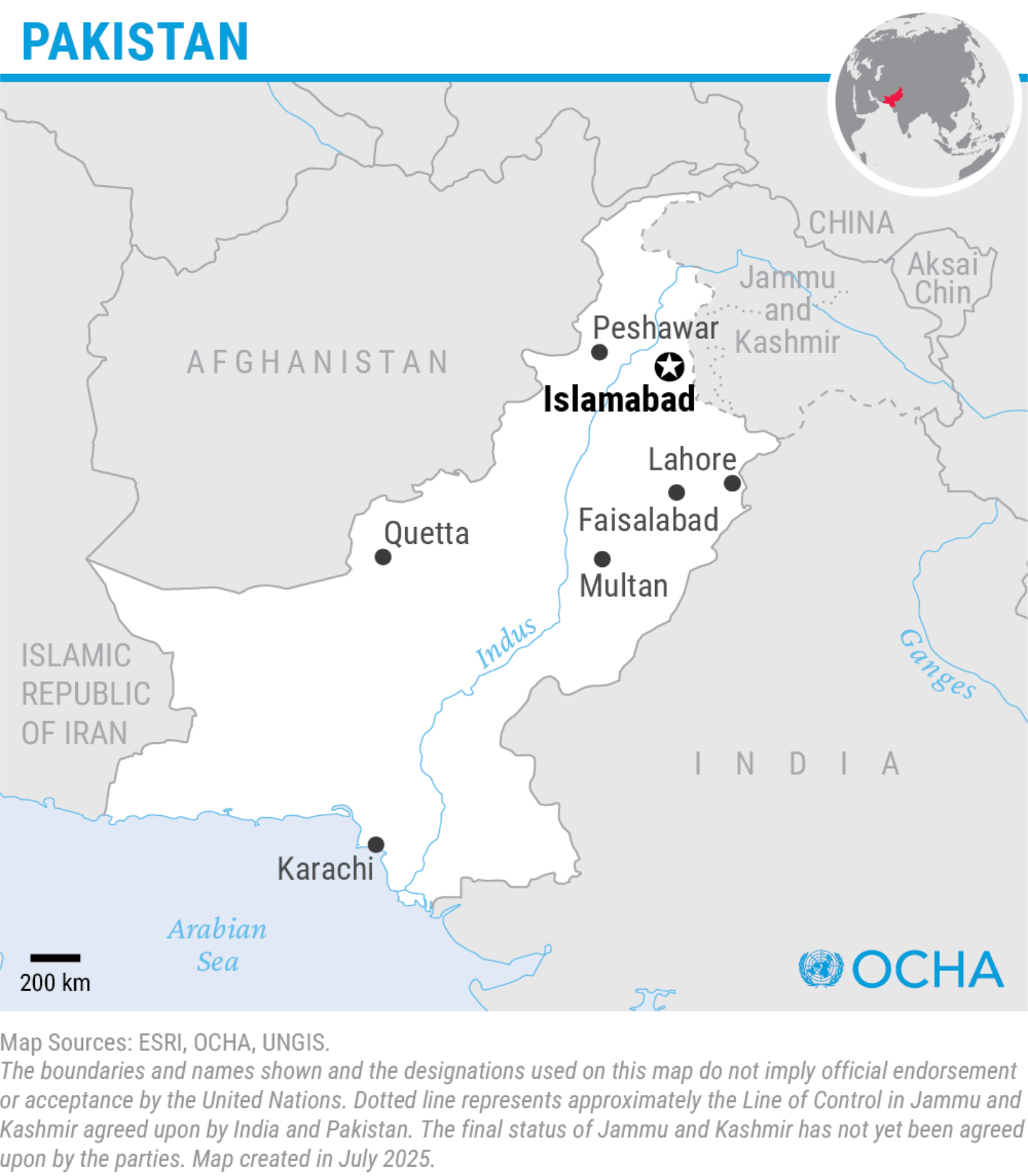
Source: OCHA, Pakistan: Location Map (2025)[footnote 15]
4.3 Administrative divisions
4.3.1 Pakistan is divided into 4 provinces: Balochistan (14.89 million), Khyber Pakhtunkhwa (KP – 40.86 million), Punjab (127.69 million), and Sindh (55.70 million).[footnote 16] There are 2 self-administered regions: Pakistan Administered Kashmir (4.46 million, 2024 estimate)[footnote 17] and Gilgit Baltistan (2.3 million).[footnote 18] The Islamabad Capital Territory (ICT – 2.36 million) is administered by the federal government.[footnote 19] [footnote 20]
4.3.2 As noted in the Pakistan Bureau of Statistics 2023 Population and Housing Census, ‘Each province is divided into divisions which are sub-divided into districts. Each district is further sub-divided into tehsil/ sub-division to facilitate administrative functioning. Generally, a subdivision comprises of one tehsil/taluka, but in some cases more than one tehsil/taluka fall under one sub-division.’[footnote 21]
4.3.3 The majority of the population (61.12% in 2023) lived in rural areas.[footnote 22]
4.4 Main population centres
4.4.1 According to the 2023 census, the 10 cities with a population exceeding one million were:
- Karachi: 18.87 million
- Lahore: 13 million
- Faisalabad: 3.69 million
- Rawalpindi: 3.36 million
- Gujranwala: 2.67 million
- Multan: 2.22 million
- Hyderabad: 1.92 million
- Peshawar: 1.91 million
- Quetta: 1.57 million
- Islamabad: 1.11 million[footnote 23]
5. Freedom of movement
5.1 Legal context
5.1.1 Article 15 of the Constitution guarantees citizens the right to free movement and to reside in Pakistan, ‘subject to any reasonable restriction imposed by law in the public interest.’[footnote 24] The April 2025 Australian Government’s Department of Foreign Affairs and Trade (DFAT) COI report on Pakistan, based on a range of sources, noted that the authorities generally respected the right to freedom of movement.[footnote 25]
5.1.2 For information on tenant registration systems, including implementation, requirements and procedures, enforcement, how the system works in each province and whether the authorities share information, consult the 2018 Immigration and Refugee Board of Canada (IRB) Research Directorate response on tenant registration (2015 to December 2017).[footnote 26]
5.1.3 In December 2025, Sindh police launched an online registration system for landlords to record tenant information.[footnote 27] In March 2026, Rawalpindi police urged citizens to register urban tenants and employees at the police station or via the Punjab mobile app or government portal. Non-registration was an offence.[footnote 28] It was reported in April 2026 that the Balochistan government made the registration of tenants in the province mandatory.[footnote 29]
5.2 Internal migration and travel restrictions
5.2.1 According to the April 2025 DFAT report:
‘Internal migration is common and widespread as people regularly move to seek better employment and education opportunities. Those migrating often rely on family, friends, tribal and/or ethnic networks to establish themselves in a new location. Social and economic barriers to relocation can impact vulnerable groups disproportionally, including women and their children leaving family violence situations …
‘Large urban centres such as Islamabad, Karachi and Lahore have ethnically and religiously diverse populations and offer anonymity for people fleeing violence by non-state actors.’[footnote 30]
5.2.2 The Freedom House report, Freedom in the World 2025, covering 2024 events, noted that ‘Authorities routinely hinder internal movement in some parts of the country for security reasons.’[footnote 31]
5.2.3 The Freedom in the World 2025 report also noted that ‘Foreign travel is restricted in part through the Exit Control List [ECL], which blocks named individuals from using official exit points. Though the list is intended to prevent those posing a security threat and those facing court proceedings from fleeing, authorities have frequently used it to control dissent.’[footnote 32]
5.2.4 Lawyer and political activist, Jibran Nasir[footnote 33] described, in a post on X dated 9 August 2025, the different lists in Pakistan which restrict travel abroad:
‘ECL (Exit Control List): Only Federal Cabinet allowed to place name on the list. Duration 120 days extendable by 90 days unless challenged in Court.
‘PNIL (Provisional National Identification List): No official law or legislation for this. It operates under a 2018 SOP [Standard Operating Procedure] issued by FIA [Federal Investigation Agency] which FIA does not make available to the public. DG [Director General] FIA can place your name no cabinet approval needed. List valid for 30 days only but name is never removed even after 30 days and list is used to repeatedly block travel until you seek intervention from Court.
‘PCL (Passport Control List): DG Passport and Immigration can place your name on the list on recommendation of Home Dept of any Provincial or Federal Govt. Duration 5 years unless reviewed or challenged in Court.
‘ECL, PNIL and PCL requires authorities to immediately inform the affectee of the restriction placed on them but they only learn of the restriction when they are offloaded at the airport as uncertainty, harassment and humiliation is the tool kit of the State …
‘Stop List (Unofficial List): This is the wish list of ISI [Inter-Services Intelligence] and MI [Ministry of Interior]. This does not exist under any official law. There is no digital centralised record of this. FIA stops you from traveling on a simple direction by Intel Agencies. Duration indefinite till you seek intervention from Court.’[footnote 34]
5.2.5 The concluding observations of the UN Human Rights Committee (UNHRC) on the state report on implementation of the International Covenant on Civil and Political Rights (ICCPR), dated 2 December 2024, noted that, ‘The Committee remains concerned about reports of the frequent use of the Exit Control List, the Fourth Schedule list under the Anti-Terrorism Act, 1997, and other control lists and measures used to arbitrarily restrict the freedom of movement of dissenting persons, journalists, activists, members of ethnic minorities and human rights defenders, leading to the confiscation of their passports, detention, and monitoring of their movements …’[footnote 35]
5.2.6 The Human Rights Commission of Pakistan (HRCP), a non-governmental organisation[footnote 36], highlighted some of the main issues affecting freedom of movement in their State of Human Rights in 2025 report:
‘The authorities continued to curtail the movement and civil liberties of political activists, particularly in Balochistan. At least 64 activists in Hub were added to the Fourth Schedule of the Anti-Terrorism Act 1997, mandating strict police surveillance and travel limitations, marking a significant expansion of these restrictions.
‘The Federal Investigation Agency (FIA) intercepted 8,149 travellers flagged on a consolidated ‘Stop List’ at airports and borders. This measure targeted individuals on criminal and security watchlists to enhance national border control and inter-agency coordination.
‘A total of 66,000 passengers were prevented from travelling abroad, including 51,000 due to insufficient or unverified documentation.’[footnote 37]
5.2.7 The Express Tribune[footnote 38], reporting in December 2025, noted that the FIA’s ‘off-loading’ of 66,154 passengers during the year was to ‘curb organised gangs of beggars and illegal immigrants from travelling abroad.’[footnote 39]
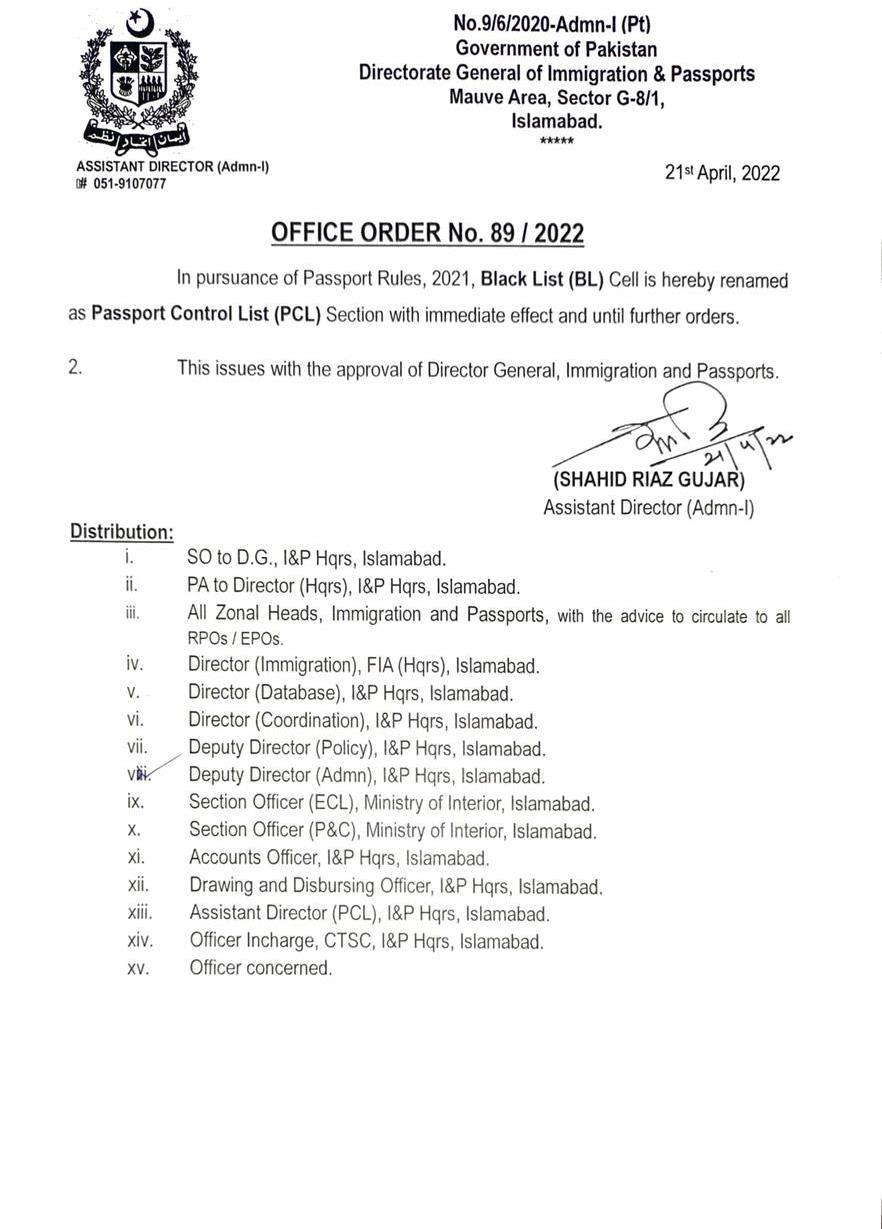
5.2.8 In March 2025, national newspaper, The Nation[footnote 40], reported that the Islamabad High Court (IHC) ‘… declared that placement of a citizen’s name on the Passport Control List (PCL) without tangible evidence to be illegal and unconstitutional …’[footnote 41], and ordered relevant authorities to follow the correct procedures when placing someone on the list.[footnote 42] The PCL was maintained by the Directorate General of Immigration and Passports (DGI&P) and, up until 21 April 2022, it was known as the Black List (BL).[footnote 43]
See also Treatment on return.
5.3 Transport network
5.3.1 The total national road network is 263,775km, 14,480 km of which comprise of 48 highways, motorways, expressways and strategic roads.[footnote 44] The National Highways Authority (NHA) Interactive Map labelled Pakistan’s Motorways and National Highways.[footnote 45] Pakistan’s rail network was shown on the Ministry of Railway’s Route Map.[footnote 46] There were at least 12 international airports across the country.[footnote 47]
5.3.2 For information on mobility and travel in Islamabad, Karachi and Lahore, see Section 7 of the European Union Agency for Asylum (EUAA) country report, Pakistan – Country Focus, dated May 2026, compiled using a range of sources.[footnote 48] The EUAA supports EU countries’ national authorities to implement the Common European Asylum System by providing operational and technical assistance.[footnote 49]
6. Socio-economic situation
6.1 About this section
6.1.1 This section covers Pakistan’s socio-economic situation at the national level.
6.1.2 For information specific to Islamabad, Karachi and Lahore, see Section 7 of the EUAA Pakistan – Country Focus.[footnote 50]
6.2 Economy
6.2.1 The World Bank classified Pakistan as a lower-middle income country as of 2024.[footnote 51] In their overview of Pakistan, the World Bank noted, in November 2025, that ‘Progress with reducing poverty, which was rapid between 2000 and the mid-2010s, has stalled. Around 22 percent of the population live below the national poverty line, amid slow growth, repeated macroeconomic shocks and natural disasters, and continued weaknesses in service-delivery.’[footnote 52]
6.2.2 Using the Cost of Basic Needs (CBN) methodology[footnote 53], the Pakistan Ministry of Planning, Development and Special Initiatives (MoPDSI) estimated that national poverty increased, from 21.9% of the population in 2018 to 2019, to 28.9% in 2024 to 2025.[footnote 54] The poverty line was set at Rs8,484 PKR (£22.64 GBP[footnote 55]) per adult per month.[footnote 56] At a provincial level, poverty levels increased in 2024 to 2025 compared to 2018 to 2019 data:[footnote 57]
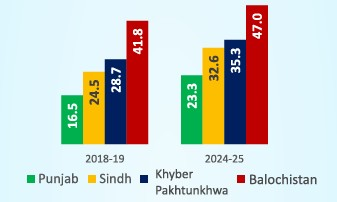
| Location | 2018-19 | 2024-25 |
|---|---|---|
| Punjab | 16.5 | 23.3 |
| Sindh | 24.5 | 32.6 |
| Kyber Pakhtunkhwa | 28.7 | 35.3 |
| Balochistan | 41.8 | 47.0 |
6.2.3 The May 2026 EUAA Pakistan Country Focus noted that ‘The combination of debt repayments and defence spending limits the government’s ability to invest in sectors such as education, healthcare, and social welfare. The effects of floods plus the measures mandated by the International Monetary Fund (IMF), have placed additional pressure on social security services.’[footnote 58]
6.3 Education
6.3.1 Article 25-A of the Constitution obligates the state to provide ‘free and compulsory education’ to children aged 5 to 16 years.[footnote 59] The April 2025 DFAT report noted that ‘In practice, insufficient budgets, sociocultural barriers, lack of capacity and inadequate facilities affect the quality and availability of education.’[footnote 60]
6.3.2 The Bertelsmann Stiftung’s Transformation Index (BTI), a project of Bertelsmann Stiftung, a German non-profit think tank, ‘… analyzes and evaluates whether and how developing countries and countries in transition are steering social change toward democracy and a market economy.’[footnote 61] The BTI 2026 Pakistan, covering the period February 2023 to January 2025, noted that ‘A poorly funded and equipped public education system coexists with a tiered private education system that offers the wealthy access to world-class educational facilities at the primary, secondary and tertiary levels.’[footnote 62]
6.3.3 According to the Pakistan Economic Survey 2025-26, produced by Pakistan’s Finance Division, in 2023 to 2024 there were around 159,000 primary schools, 44,000 middle schools, 45,000 secondary schools, 11,000 higher secondary schools or colleges, 2,500 ‘degree colleges’[footnote 63], and between 239 and 278 universities.[footnote 64] There were about 4,750 technical and vocational institutions in 2024 to 2025.[footnote 65]
6.3.4 According to the April 2025 DFAT report, ‘There were 180,000 public [government-run] educational institutions throughout the country. School budgets and education quality vary widely, urban areas generally have better services and facilities than those in rural and remote areas. In general, public schools across Pakistan suffer from a lack of funding, shortages of teachers, high rates of teacher absenteeism and inadequate facilities.’[footnote 66]
6.3.5 The Annual Status of Education Report (ASER) 2025 found that 91.5% of children aged 6 to 16 were enrolled in school. However, only 7% of children at Grade 3 could read ‘a simple story’ and only 8% could perform basic division.[footnote 67] At a national level, 53% of children at Grade 5 in a public school could read a sentence in English compared to 55% of privately educated children.[footnote 68] In 2024 to 2025, the literacy rate for people aged 10 and over was 63%, with higher literacy rates in urban areas.[footnote 69]
6.4 Employment
6.4.1 The Pakistan Bureau of Statistics (PBS) Labour Force Survey (LFS) is Pakistan’s principal source of official labour market data and provides information on employment, unemployment and labour force participation at the national and provincial level.[footnote 70] According to the LFS 2024 to 2025, Pakistan’s labour force comprised approximately 83.1 million people. The survey reported a labour force participation rate of 46.3%.[footnote 71]
6.4.2 The LFS reported an overall unemployment rate of 7.1% in 2024 to 2025, as per the 19th International Conference of Labour Statisticians (ICLS – the global standard-setting forum for labour statistics[footnote 72]) recommendations.[footnote 73] According to the LFS 2024 to 2025, 33.1% of employed persons worked in agriculture, forestry and fishing, 14.8% in manufacturing, 9.9% in construction, 16.0% in wholesale and retail trade, 6.6% in transport, storage and communication, 17.9% in community, social and personal services, and 1.6% in other sectors.[footnote 74]
6.4.3 Punjab had both the largest employed population and the strongest overall employment ratios. It accounted for 45.9 million of Pakistan’s 79.7 million employed people and recorded the highest employment-to-population ratio (EPR) at 46.7%, and labour-force participation rate (LFPR of 50.3%).[footnote 75] Sindh had the lowest unemployment rate.[footnote 76]
6.4.4The following table was compiled by CPIT using LFS data.[footnote 77] For direct comparison with the 2020-21 survey, the LFS 2024 to 2025 presented provincial indicators under the 13th ICLS framework, which applied a broader definition of employment:[footnote 78]
| Area/Province | Employed population | EPR % | LFPR % | Unemployment rate % |
|---|---|---|---|---|
| Pakistan | 79.7 million | 44.4 | 47.7 | 6.9 |
| KP | 11.8 million | 38.9 | 42.9 | 9.2 |
| Punjab | 45.9 million | 46.7 | 50.3 | 7.1 |
| Sindh | 18.2 million | 43.8 | 46.2 | 5.1 |
| Balochistan | 3.8 million | 40.1 | 42.4 | 5.4 |
6.4.5 Average monthly wages increased from around Rs 24,000 (about £63[footnote 79]) in 2020 to 2021 to approximately Rs 39,000 (£103[footnote 80]) in 2024 to 2025, although earnings varied by sector, region and whether employment was in the formal or informal economy. Formal-sector workers generally earned more than workers in the informal sector, defined as those employed in unregistered enterprises or private households.[footnote 81]
6.4.6 The following table was compiled by CPIT and shows average monthly wages in Pakistan rupees (PKR), of paid employees in 2024 to 2025 by province and locality, based on LFS data:[footnote 82]
| Area/Province | All areas PKR | Rural | Urban |
|---|---|---|---|
| Pakistan | 39,042 | 35,508 | 44,171 |
| KP | 39,974 | 39,268 | 43,826 |
| Punjab | 38,189 | 34,712 | 43,246 |
| Sindh | 39,801 | 32,075 | 45,654 |
| Balochistan | 41,780 | 40,405 | 44,179 |
6.4.7 The LFS data showed that Balochistan had the highest provincial average monthly wage and Punjab the lowest. Urban wages were higher than rural wages nationally and in every province.[footnote 83]
6.4.8 The LFS 2024 to 2025 found that 72.1% of non-agricultural employment was in the informal sector, with a higher share in rural areas (75.5%) than urban areas (68.3%). Taking employment as a whole, 80.8% of employed people were in informal employment.[footnote 84]
6.5 Food security
6.5.1 The PBS Household Integrated Economic Survey (HIES) 2024 to 2025, dated December 2025, found that household food insecurity increased significantly between 2018 to 2019 and 2024 to 2025. Nationally, moderate or severe food insecurity rose from 15.92% to 24.35%, while severe food insecurity increased from 2.37% to 5.04%[footnote 85], indicating that approximately 75% of households were food secure.[footnote 86]
6.5.2 In urban areas, moderate or severe food insecurity increased from 9.22% to 20.58% over the same period, and severe food insecurity from 1.24% to 5.12%. Rural areas also recorded an increase, with moderate or severe food insecurity rising from 19.96% to 26.72%, and severe food insecurity from 3.05% to 4.99%. However, severe food insecurity was lower in rural areas than in urban areas.[footnote 87]
6.5.3 At provincial level, Balochistan had the highest proportion of households experiencing moderate or severe food insecurity, at 30.26%, followed by Sindh at 29.42%, Punjab at 22.58%, and KP at 21.54%. KP also had the lowest reported level of severe food insecurity at 1.38%.[footnote 88]
6.5.4 The following table was compiled by CPIT and shows food insecurity severity by province as per the HIES 2024 to 2025.[footnote 89] Data on the ICT was not included in the HIES:
Moderate or severe food insecurity by province (% of households) 2024 to 2025
| Province | Moderate or severe (%) | Severe (%) |
|---|---|---|
| Punjab | 22.58 | 5.20 |
| Sindh | 29.42 | 6.30 |
| Khyber Pakhtunkhwa | 21.54 | 1.38 |
| Balochistan | 30.26 | 8.20 |
6.6 Healthcare
6.6.1 For information on healthcare in Pakistan, see the Country Information Note on Pakistan: Healthcare and medical treatment.
6.7 Housing
6.7.1 The 2023 census described the construction materials of houses, known as pacca houses, semi pacca houses and kacha houses. Pacca was defined as a permanent or concrete house, built from durable materials like bricks and concrete. A semi pacca house was made of durable and temporary or prefabricated materials, and a kacha house was constructed of mud, wood and other temporary materials.[footnote 90] Nationwide, 67.4% of houses were pacca, 12.5% semi pacca, and nearly 20% kacha.[footnote 91] The average household size was 6.3 people per household.[footnote 92] Around 82% of houses were owner-occupied and 11% were rented.[footnote 93]
6.7.2 The 2023 census noted that:
‘Pacca houses … are most common in Islamabad with 97.35% and Punjab with 80.80%, indicating better infrastructure. Sindh with 57.69% and Khyber Pakhtunkhwa with 55.57% have moderate percentages, while Balochistan with 19.64% has the lowest, reflecting underdeveloped housing conditions.
‘Semi-Pacca houses … are more common in Khyber Pakhtunkhwa with 19.58% and Balochistan with 16.78%, while Punjab with 11.93% and Sindh with 9.19% have lower percentages.
‘Kacha houses … are highly prevalent in Balochistan with 63.58% and rural Sindh with 61.01%, highlighting severe housing inadequacies. Sindh overall has a significant proportion with 33.11%, while Punjab with 7.26% and Khyber Pakhtunkhwa with 24.85% have lower percentages.’[footnote 94]
6.7.3 The 2023 census showed that, nationally, 66.3% of households had access to drinking water inside the house.[footnote 95] The census found that:
‘Punjab has the highest number of households with access to drinking water inside the house, reaching 14.13 million, followed by Sindh with 6.28 million and Khyber Pakhtunkhwa with 3.80 million. In contrast, Balochistan shows a concerning trend, where more households rely on outside sources (1.37 million) compared to those with water inside the house (0.95 million). The data indicates that Balochistan faces significant challenges, with a large portion of its population lacking direct household access to water.’[footnote 96]
6.7.4 Separate bathroom facilities were found in 66.6% of households and 87.1% were equipped with a ‘separate’ or ‘shared’ toilet.[footnote 97] Most houses (84%) used electricity as the main source of lighting.[footnote 98]
6.7.5 In June 2025, UN-Habitat Pakistan noted that the country faced a ‘housing backlog’ of over 10 million units and that more than half the urban population lived in informal settlements.[footnote 99] Pakistan’s National Housing Policy 2025 stated ‘The housing shortage in the country’s urban areas is estimated to be 9 million. Because of these circumstances, about 50% of the urban population finds no other way but to reside in slums and Katchi Abadis [informal settlements].’[footnote 100]
6.8 Social welfare
6.8.1The BTI 2026 Pakistan noted regarding the welfare system that:
‘Pakistan manages a number of welfare programs aimed at establishing a basic, universal social safety net for its citizens. Funded through tax revenues, government operated schools and hospitals offer highly subsidized education and health care to the entire population. Organizations such as Zakat and the Pakistan Bait-ul-Mal also use tax revenues to provide small cash transfers to about 3 million people throughout the country. Pakistan also offers the Employee Old Age Benefits Institution as a contributory pension scheme that currently has more than 9 million enrollees. The Pakistan Poverty Alleviation Fund provides microfinance loans to its citizens. Nonetheless, the provision of social services remains dismally insufficient, particularly given the scale of poverty and deprivation in the country. The welfare programs provided by the government exist in tandem with extensive, tiered systems of private provision.’[footnote 101]
6.8.2 The same report stated that:
‘Although significant challenges persist in providing welfare in Pakistan, progress has been evident in selected areas. The Benazir Income Support Program (BISP), initiated in 2008, is an unconditional cash-transfer program for poverty reduction that primarily targets women. At the end of 2024, an estimated 10 million households were receiving BISP payments, and the Asian Development Bank approved a $330 million [around £220 million[footnote 102]] loan to expand the program in the coming years.’[footnote 103]
6.8.3 In January 2025, the BISP Program noted on its official website that, ‘Chairperson Benazir Income Support Program (BISP), Senator Rubina Khalid has announced that the quarterly stipend under the Benazir Kafaalat program for deserving women has been increased from Rs. 10,500 to Rs. 13,500 [approximately £36[footnote 104]]. She described this as a New Year’s gift from BISP to registered families, aimed at providing maximum support during challenging times.’[footnote 105]
6.8.4 Regarding the BISP, the May 2026 EUAA Pakistan Country Focus noted:
‘The nationwide governmental Benazir Income Support Programme (BISP), headquartered in Islamabad, offers financial support for poor households, with a special focus on women. Under its Kafaalat programme, female beneficiaries receive a quarterly amount of 14 500 Pakistani rupees [approximately £39[footnote 106]]. Access to BISP is based on a household poverty score ranging from 0 to 100, with eligibility set at 32 or below, and applies to low-income households, including widows, divorced women, single mothers, and persons with disabilities in eligible families.’[footnote 107]
6.8.5 Pakistan Bait-ul-Mal (PBM), a semi-autonomous social welfare organisation, provided financial support for the poor and for vulnerable people across the country.[footnote 108] [footnote 109]
7. Returnees
7.1 Treatment on return
7.1.1 A query response by the EUAA, on entry procedures and treatment of returnees (January 2024 to 30 November 2025), based on a range of sources, noted that:
‘Oral sources consulted in 2024 by the Netherlands Ministry of Foreign Affairs reported that they were not aware of any specific cases in which returnees faced serious problems with the Pakistani authorities. Forced returnees arriving on charter flights from Europe, often in handcuffs, were questioned by the FIA upon landing; and although they feared questioning, the source noted no particularly harsh treatment. In the case of rejected asylum seekers returning to Pakistan, the authorities were said to focus mainly on detecting fraudulent travel documents, and those carrying such documents were subjected to more intensive interrogation and potential arrest.’[footnote 110]
7.1.2 The April 2025 DFAT report observed the conditions for returnees to Pakistan, noting that:
‘Repatriates usually departed Pakistan on valid travel documents and are generally processed like any other citizen when returning to the country. Pakistan’s diplomatic missions issue emergency travel documents and passports to Pakistanis overseas, including those who have previously sought asylum in foreign countries. As a rule, the government issues returnees with temporary documents when they arrive.
‘Immigration officials sometimes interview failed asylum seekers upon return but generally only detain them if they had committed a crime in Pakistan prior to their departure or if their identity documents pre-date enrolment in Pakistan’s national biometric database. Immigration officers have posed questions to returnees to ascertain whether they left the country illegally, were wanted for crimes in Pakistan or have committed offences while abroad. Repatriates wanted for a crime in Pakistan can be arrested and held on remand or required to report regularly to police. Repatriates may be placed on the “Passenger Control List”, an alert database that can trigger an intervention should they attempt to depart again via an airport.’[footnote 111]
7.1.3 The EUAA query response (January 2024 to 30 November 2025) noted that:
‘On 24 May 2025, Interior Minister, Mohsin Naqvi, chaired a high-level meeting in Islamabad, where the government adopted a new policy toward Pakistanis who are deported from abroad. The meeting concluded that such individuals would have First Information Reports (FIRs) registered against them, their passports would be cancelled, and their names placed on the Passport Control List for five years, restricting their ability to obtain new travel documents.’[footnote 112]
7.1.4 An article by The News International, dated 21 August 2025, reported that the policy on banning deported citizens from travelling abroad for 5 years had been enacted. According to the report, ‘Interior Ministry sources say the individuals deported due to criminal or other “undesirable” activities would be put on the list of deported Pakistanis banned from travelling abroad.’[footnote 113]
7.2 Reintegration
7.2.1 WELDO, working in partnership with the UK and EU member states, provided reintegration and resettlement services to returnees[footnote 114], including, but not limited to ‘… temporary accommodation, access to healthcare, vocational training, small business support, and legal documentation. [WELDO] also support family reunification and community reintegration efforts.’[footnote 115]
7.2.2 In February 2025, the Government of Pakistan launched the Sustainable Reintegration of Returnees and Improved Migration Management project, known as R&R Pakistan.[footnote 116] The project, funded by the EU in partnership with the International Centre for Migration Policy Development (ICMPD), will continue until November 2027[footnote 117], and aims to:
‘Provide better opportunities for sustainable reintegration of returnees, particularly women and persons with disabilities, within their communities while employing gender, human rights, including labour rights, and age responsible approaches;
‘Enhance post-arrival assistance for Pakistani returnees and mid- to long-term services for sustainable reintegration;
‘Strengthen capacities of stakeholders in developing a gender-sensitive National Reintegration Policy and other policy related documents, as well as in programming and service delivery; and
‘Increase awareness on safe and orderly migration, including the dangers of irregular migration and avenues for sustainable reintegration among returnees, potential migrants, their families and communities.’[footnote 118]
7.2.3 As noted on its official website (undated), Migrant Resource Centres (MRCs), located in Islamabad, Lahore and Peshawar, support returnees and deportees through its Return and Reintegration services, which aimed to:
‘… facilitate the safe and dignified reintegration of migrants back into their communities after returning from abroad. The MRC provides immediate assistance at airports and Arrival Reception Desks (ARDs), where returnees are welcomed, registered, and guided about available support. Basic needs such as food, water, hygiene kits, onward transportation, medical assistance, shelter and communication facilities are also provided to ensure their initial comfort and connection with families.’[footnote 119]
7.2.5 The April 2025 DFAT report stated that:
‘Repatriates are responsible for arranging their own onward transportation from their point of entry into Pakistan, although some CSOs reported in 2023 they provided assistance. Repatriates are typically able to reintegrate into the Pakistani community without repercussions stemming from their migration attempt, although involuntary returnees who took on debt to fund their migration tend to face a higher risk of financial hardship and sometimes familial shame. A small percentage of repatriates do not reintegrate and attempt to go abroad again to seek asylum.’[footnote 120]
7.2.5 The EUAA query response noted that:
‘According to a 2024 Country Fact Sheet on Pakistan published by International Organization for Migration (IOM) Germany, returnees and their families can freely access public and private healthcare in Pakistan without any special registration, by simply walking into hospitals, clinics, health units or diagnostic centres, and may also obtain private health insurance if they choose. The same source further added that returnees can enroll their children by visiting any public or private school, where basic supplies are needed and textbooks are provided in public schools up to grade 10. Admission requires documents such as a Birth Certificate or Form-B (official document that records the details of a child such as name, date of birth, parentage) for school-level entry, and the Secondary School Certificate (SSC), Higher Secondary School Certificate (HSSC), and Computerized National Identity Card (CNIC) for college or university enrollment.’[footnote 121]
See also Freedom of movement.
Official – sensitive: Not for disclosure – Start of section
The information in this section has been removed as it is restricted for internal Home Office use.
Official – sensitive: Not for disclosure – End of section
Terms of Reference
The ‘Terms of Reference’ are the main topics and issues relevant to the scope of this note and provides the framework for the country information. In this note, they were:
- Geography and demographics
- Freedom of movement, including
- Legal rights
- Travel restrictions
- Transport
- Socio-economic situation
- Economy and employment
- Education
- Food security
- Housing
- Social welfare
- Return and reintegration
Bibliography
Unless otherwise stated, all sources were accessed between 5 and 16 September 2026
Sources cited
Annual Status of Education Report (ASER), ASER Pakistan 2025, 26 March 2026
Australian Government, Department of Foreign Affairs and Trade (DFAT), Country Information Report Pakistan, 30 April 2025
BBC News, United Kingdom country profile, 9 July 2024
Benazir Income Support Programme (BISP), New Year’s gift for registered families of BISP: Increase in quarterly stipend from RS. 10,500 to RS. 13,500; New Year’s resolution is Benazir Hunar Mand Program, 9 January 2025
Bertelsmann Stiftung:
-
Methodology, 2026
Dawn:
-
Over 50 detained for violating Tenancy Act in Rawalpindi, 30 March 2026
-
Stories by Jibran Nasir, no date
-
Tenants’ registration with police mandatory, says Balochistan aide, 15 April 2026
Directorate General of Immigration and Passports (DGI&P), Rename of BL (Black List) Cell to PCL (Passport Control List) Section, 21 April 2022
European Union (EU), EU joins forces with Pakistan to foster sustainable reintegration of returnees, 3 March 2025
European Union Agency for Asylum (EUAA):
-
COI Query Response – Pakistan, 1 December 2025
-
Overview, no date
-
Pakistan Country Focus, May 2026
The Express Tribune:
-
66,154 air travellers offloaded this year, FIA tells NA body, 18 December 2025
-
About, no date
Finance Division, Pakistan Economic Survey 2025-26, June 2026
Freedom House, Freedom in the World 2025: Pakistan, 2025
Gallup Pakistan, Gallup Pakistan Analysis of Household Integrated Economic Survey (HIES) – Food Insecurity & Inequality (FIES), 24 April 2026
Government of Gilgit Baltistan, Importance of Gilgit Baltistan, 22 April 2024
Human Rights Commission of Pakistan (HRCP):
-
About us, no date
-
State of Human Rights in 2025, May 2026
Immigration and Refugee Board of Canada (IRB), Pakistan: Tenant registration systems, including implementation; whether authorities share information on tenant registration (2015-December 2017) [PAK106026.E], 23 January 2018
International Centre for Migration Policy Development (ICMPD), Sustainable Reintegration of Returnees and Improved Migration Management in Pakistan, 4 March 2025
Islamabad Capital Territory Administration (ICTA), About ICTA, no date
Kashmir Welfare Foundation, Azad Jammu and Kashmir, no date
Migrant Resource Centre (MRC), Services - MRC Pakistan, no date
Ministry of Foreign Affairs (MFA), Visit Pakistan, no date
Ministry of Housing and Works (MoHW), National Housing Policy 2025, 2026
Ministry of Human Rights (MoHR), Victim Support Services Directory, no date
Ministry of Planning, Development and Special Initiatives (MoPDSI), Preliminary Report on Poverty Estimation 2024-25, February 2026
Ministry of Railways, Route Map of Pakistan Railways, no date
Minority Rights Group (MRG), Pakistan, December 2025
The Nation:
-
About us, no date
-
IHC directs authorities to follow procedure for placing any citizen on no-fly list, 10 March 2025
National Highways Authority (NHA):
-
Interactive Map, no date
-
Welcome, no date
The News International, Deported Pakistanis face 5-year travel ban, 21 August 2025
Pakistan Bait-ul-Mal (PBM), Mission, no date
Pakistan Bureau of Statistics (PBS):
Pakistan Code, The Constitution of the Islamic Republic of Pakistan, 1973
Pakistan Information Website:
UNHabitat, Media Update: United Nations Pakistan, 23 June 2025
UN Human Rights Commission (UNHRC), Concluding observations on the second periodic report of Pakistan, 2 December 2024
UN Office for the Coordination of Humanitarian Affairs (OCHA), Pakistan: Location Map (2025), July 2025
US Commission for International Religious Freedom (USCIRF), Annual Report 2026 Pakistan, March 2026
WELDO:
-
Returns and Reintegration, no date
-
Who We Are, no date
World Bank:
-
Overview: Pakistan, 19 November 2025
-
Understanding country income: World Bank Group income classifications for FY26, 1 July 2025
X, @MJibranNasir, The difference lists of Pakistan which ban your travel abroad, 9 August 2025
Sources consulted but not cited
Human Rights Watch (HRW), World Report 2026, 2026
Pakistan Bureau of Statistics (PBS), Pakistan Employment Trend Report 2025, March 2026
United States Department of State (USSD), Country Report on Human Rights Practices 2024, 12 August 2025
Version control and feedback
Clearance
Below is information on when this note was cleared:
- version 3.0
- valid from 21 September 2026
Official – sensitive: Not for disclosure – Start of section
The information in this section has been removed as it is restricted for internal Home Office use.
Official – sensitive: Not for disclosure – End of section
Changes from last version of this note
Updated country information and assessment.
Feedback to the Home Office
We welcome feedback on how to improve our products. If you would like to comment on this note, please email the Country Policy and Information Team.
Independent Advisory Group on Country Information
The Independent Advisory Group on Country Information (IAGCI) was set up in March 2009 by the Independent Chief Inspector of Borders and Immigration to support them in reviewing the efficiency, effectiveness and consistency of approach of COI produced by the Home Office.
The IAGCI welcomes feedback on the Home Office’s COI material. It is not the function of the IAGCI to endorse any Home Office material, procedures or policy. The IAGCI may be contacted at:
Independent Advisory Group on Country Information
Independent Chief Inspector of Borders and Immigration
3rd Floor
28 Kirby Street
London
EC1N 8TE
Email: chiefinspector@icibi.gov.uk
Information about the IAGCI’s work and a list of the documents which have been reviewed by the IAGCI can be found on the Independent Chief Inspector’s pages of the GOV.UK website.
-
Pakistan Information Website, Facts and Information about Pakistan, 2026 ↩
-
Pakistan Information Website, Facts and Information about Pakistan, 2026 ↩
-
BBC News, United Kingdom country profile, 9 July 2024 ↩
-
PBS, National Census Report 2023 (pages 3, 124), 2024 ↩
-
Pakistan Information Website, Facts and Information about Pakistan, 2026 ↩
-
DFAT, Country Information Report Pakistan (paragraph 2.10), 30 April 2025 ↩
-
PBS, National Census Report 2023 (page 138), 2024 ↩
-
PBS, National Census Report 2023 (page 138), 2024 ↩
-
Pakistan Information Website, Languages of Pakistan, 2025 ↩
-
DFAT, Country Information Report Pakistan (paragraph 2.10), 30 April 2025 ↩
-
PBS, National Census Report 2023, 2024 ↩
-
USCIRF, Annual Report 2026 Pakistan, March 2026 ↩
-
PBS, National Census Report 2023 (page 137), 2024 ↩
-
OCHA, Pakistan: Location Map (2025), July 2025 ↩
-
PBS, National Census Report 2023 (page 7), 2024 ↩
-
Kashmir Welfare Foundation, Azad Jammu and Kashmir, no date ↩
-
Government of Gilgit Baltistan, Importance of Gilgit Baltistan, 22 April 2024 ↩
-
PBS, National Census Report 2023 (pages 7, 26), 2024 ↩
-
ICTA, About ICTA, no date ↩
-
PBS, National Census Report 2023 (page 25), 2024 ↩
-
PBS, National Census Report 2023 (page 7), 2024 ↩
-
PBS, National Census Report 2023 (page 109), 2024 ↩
-
Pakistan Code, The Constitution of the Islamic Republic of Pakistan (Chapter 1, Article 15), 1973 ↩
-
DFAT, Country Information Report Pakistan (paragraph 5.29), 30 April 2025 ↩
-
IRB, Pakistan: Tenant registration systems, including implementation…, 23 January 2018 ↩
-
Express Tribune, Sindh police introduces digital platform for tenant registration, 18 December 2025 ↩
-
Dawn, Over 50 detained for violating Tenancy Act in Rawalpindi, 30 March 2026 ↩
-
Dawn, Tenants’ registration with police mandatory, says Balochistan aide, 15 April 2026 ↩
-
DFAT, Country Information Report Pakistan (paragraph 5.29), 30 April 2025 ↩
-
Freedom House, Freedom in the World 2025: Pakistan (G1), 2025 ↩
-
Freedom House, Freedom in the World 2025: Pakistan (G1), 2025 ↩
-
Dawn, Stories by Jibran Nasir, no date ↩
-
X, @MJibranNasir, The difference lists of Pakistan which ban your travel abroad, 9 August 2025 ↩
-
UNHRC, Concluding observations on the second periodic … (paragraph 34), 2 December 2024 ↩
-
HRCP, State of Human Rights in 2025 (page 13), May 2026 ↩
-
Express Tribune, 66,154 air travellers offloaded this year, FIA tells NA body, 18 December 2025 ↩
-
The Nation, IHC directs authorities to follow procedure for placing any citizen …, 10 March 2025 ↩
-
The Nation, IHC directs authorities to follow procedure for placing any citizen …, 10 March 2025 ↩
-
DGI&P, Rename of BL (Black List) Cell to PCL (Passport Control List) Section, 21 April 2022 ↩
-
NHA, Interactive Map, no date ↩
-
Ministry of Railways, Route Map of Pakistan Railways, no date ↩
-
MFA, Visit Pakistan, no date ↩
-
EUAA, Pakistan Country Focus (Section 7), May 2026 ↩
-
EUAA, Pakistan Country Focus (Section 7), May 2026 ↩
-
World Bank, Understanding country income: World Bank Group income …, 1 July 2025 ↩
-
World Bank, Overview: Pakistan (Economy), 19 November 2025 ↩
-
MoPDSI, Preliminary Report on Poverty Estimation 2024-25 (page 3), February 2026 ↩
-
MoPDSI, Preliminary Report on Poverty Estimation 2024-25 (page 4), February 2026 ↩
-
Xe.com, 8,484 PKR to GBP - Pakistani Rupees to British Pounds Exchange Rate, 7 August 2026 ↩
-
MoPDSI, Preliminary Report on Poverty Estimation 2024-25 (page 4), February 2026 ↩
-
MoPDSI, Preliminary Report on Poverty Estimation 2024-25 (page 5), February 2026 ↩
-
EUAA, Pakistan Country Focus (page 183), May 2026 ↩
-
Pakistan Code, The Constitution of the Islamic Republic of Pakistan (Chapter 1, Article 25A), 1973 ↩
-
DFAT, Country Information Report Pakistan (paragraph 2.20), 30 April 2025 ↩
-
Bertelsmann Stiftung, Methodology, 2026 ↩
-
Bertelsmann Stiftung, BTI 2026 Country Report - Pakistan (Sustainability), 2026 ↩
-
Finance Division, Pakistan Economic Survey 2025-26 (page 171), June 2026 ↩
-
Finance Division, Pakistan Economic Survey 2025-26 (pages 171 and 182), June 2026 ↩
-
Finance Division, Pakistan Economic Survey 2025-26 (page 171), June 2026 ↩
-
DFAT, Country Information Report Pakistan (paragraph 2.21), 30 April 2025 ↩
-
ASER, ASER Pakistan 2025 (page 6), 26 March 2026 ↩
-
ASER, ASER Pakistan 2025 (page 59), 26 March 2026 ↩
-
Finance Division, Pakistan Economic Survey 2025-26 (page 173), June 2026 ↩
-
PBS, Labour Force Statistics (Methodology), no date ↩
-
PBS, Labour Force Survey 2024-25 (page VII), 2025 ↩
-
PBS, Labour Force Survey 2024-25 (page VI), 2025 ↩
-
PBS, Labour Force Survey 2024-25 (page VIII), 2025 ↩
-
PBS, Labour Force Survey 2024-25 (page 42), 2025 ↩
-
PBS, Labour Force Survey 2024-25 (page 19, table 3.5), 2025 ↩
-
PBS, Labour Force Survey 2024-25 (page 19, table 3.5), 2025 ↩
-
PBS, Labour Force Survey 2024-25 (page 19, table 3.5), 2025 ↩
-
PBS, Labour Force Survey 2024-25 (pages VI), 2025 ↩
-
Xe.com, Currency converter, 31 July 2026 ↩
-
Xe.com, Currency converter, 31 July 2026 ↩
-
PBS, Labour Force Survey 2024-25 (pages 51 and 77), 2025 ↩
-
PBS, Labour Force Survey 2024-25 (page 72, Table 5.2), 2025 ↩
-
PBS, Labour Force Survey 2024-25 (page 72), 2025 ↩
-
PBS, Labour Force Survey 2024-25 (page IX), 2025 ↩
-
PBS, Household Integrated Economic Survey 2024-25 (page 270), 2025 ↩
-
Gallup Pakistan, Gallup Pakistan Analysis of Household Integrated Economic Survey (HIES) – Food Insecurity & Inequality (FIES), 24 April 2026 ↩
-
PBS, Household Integrated Economic Survey 2024-25 (page 270), 2025 ↩
-
PBS, Household Integrated Economic Survey 2024-25 (page 270), 2025 ↩
-
PBS, Household Integrated Economic Survey 2024-25 (page 270), 2025 ↩
-
PBS, National Census Report 2023 (page 167 to 168), 2024 ↩
-
PBS, National Census Report 2023 (page 168), 2024 ↩
-
PBS, National Census Report 2023 (page 165), 2024 ↩
-
PBS, Household Integrated Economic Survey 2024-25 (page 245), 2025 ↩
-
PBS, National Census Report 2023 (page 168), 2024 ↩
-
PBS, National Census Report 2023 (page 176, Table 5.13), 2024 ↩
-
PBS, National Census Report 2023 (page 177), 2024 ↩
-
PBS, National Census Report 2023 (page 192, Table 5.19), 2024 ↩
-
PBS, National Census Report 2023 (page 183, Table 5.15), 2024 ↩
-
UNHabitat, Media Update: United Nations Pakistan, 23 June 2025 ↩
-
MoHW, National Housing Policy 2025 (page 3), 2026 ↩
-
Bertelsmann Stiftung, BTI 2026 Country Report - Pakistan (Welfare regime), 2026 ↩
-
Xe.com, Currency converter, 31 July 2026 ↩
-
Bertelsmann Stiftung, BTI 2026 Country Report - Pakistan (Welfare regime), 2026 ↩
-
Xe.com, Currency converter, 31 July 2026 ↩
-
BISP, NEW YEAR’S GIFT FOR REGISTERED FAMILIES OF BISP…, no date ↩
-
Xe.com, Currency converter, 31 July 2026 ↩
-
EUAA, Pakistan Country Focus (page 191 and 192), May 2026 ↩
-
MoHR, Victim Support Services Directory (Bait-ul-Mal), no date ↩
-
EUAA, COI Query Response – Pakistan (page 5), 1 December 2025 ↩
-
DFAT, Country Information Report Pakistan (paragraph 5.36 to 5.38), 30 April 2025 ↩
-
EUAA, COI Query Response – Pakistan (page 5), 1 December 2025 ↩
-
News International, Deported Pakistanis face 5-year travel ban, 21 August 2025 ↩
-
WELDO, Who We Are, no date ↩
-
WELDO, Returns and Reintegration, no date ↩
-
EU, EU joins forces with Pakistan to foster sustainable reintegration of returnees, 3 March 2025 ↩
-
ICMPD, Sustainable Reintegration of Returnees and Improved Migration …, 4 March 2025 ↩
-
EU, EU joins forces with Pakistan to foster sustainable reintegration of returnees, 3 March 2025 ↩
-
Migrant Resource Centre (MRC), Services - MRC Pakistan, no date ↩
-
DFAT, Country Information Report Pakistan (paragraph 5.36 to 5.38), 30 April 2025 ↩
-
EUAA, COI Query Response – Pakistan (page 5), 1 December 2025 ↩