
Ofqual delivery report 2025
Published 11 December 2025
Applies to England

© Crown copyright 2025
This publication is licensed under the terms of the Open Government Licence v3.0 except where otherwise stated. To view this licence, visit nationalarchives.gov.uk/doc/open-government-licence/version/3 or write to the Information Policy Team, The National Archives, Kew, London TW9 4DU, or email: psi@nationalarchives.gov.uk.
Where we have identified any third party copyright information you will need to obtain permission from the copyright holders concerned.
This publication is available at https://www.gov.uk/government/publications/ofqual-delivery-report-2025/ofqual-delivery-report-2025
Executive summary
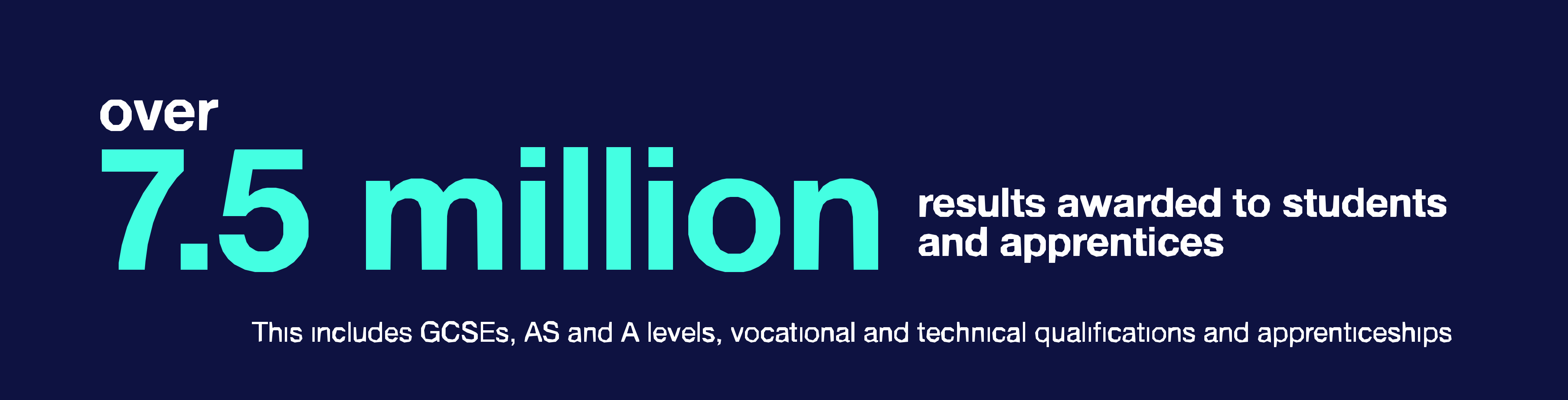
The scale of qualifications covered by this report is significant, with over 7.5 million results awarded to students and apprentices. This includes GCSEs, AS and A levels, vocational and technical qualifications and apprenticeships. Despite the volume and the complexity of assessment delivery throughout the year, there were no issues which caused significant disruption to the secure and timely delivery of qualifications and the 2025 series was delivered successfully overall.
Ofqual requires awarding organisations (AOs) to manage risks and ensure they deal appropriately with issues that arise. The scale and complexity of qualifications taken throughout the year means continuous vigilance is needed from both AOs and Ofqual to maintain and secure standards of delivery.
Among the risks to the assessment system is the increasing use and familiarity of artificial intelligence (AI). Inappropriate use of AI in non-examined assessments presents a risk, primarily in subjects with coursework components. AOs use detection software and moderation processes to identify potential misuse, with confirmed cases reported within official malpractice statistics under plagiarism offences. Information sharing between AOs helped ensure a consistent sector-wide approach to managing this complex and evolving challenge.
Ofqual continues to work with the National Cyber Security Centre and the Department for Education to strengthen sector cyber resilience, including publishing guidance during Cybersecurity Awareness Month to support centres in protecting their systems against cyber attacks. The number of cyber attacks on centres was broadly in line with recent years, but increasing vigilance remains a priority. A poll commissioned by Ofqual has shown that schools and colleges have taken longer to recover quickly from attacks when they occur.
There were fewer errors in assessment materials than last year. However, no error is ever acceptable and Ofqual expects all assessment materials to be error-free, and AOs’ quality assurance processes must be robust enough to identify and correct any errors that may be introduced during development. While most assessments were error-free this year, errors with potential adverse effects were mitigated through measures including replacement papers, erratum notices and mark scheme adjustments.
The introduction of new T Levels continued this year. Ofqual has continued to closely monitor the Technical Qualifications (TQs) within the T Levels. Consistent with our approach to new qualifications and informed by the evidence that students and teachers are less familiar with these assessments, AOs were appropriately generous in their awarding approach to compensate for the impact of this.
In total AOs reported 306 incidents for GCSEs, AS and A levels, 213 for Vocational and Technical Qualifications (VTQs), and 219 for apprenticeship end-point assessments. Effective incident management by AOs, overseen by Ofqual, ensured that potential adverse effects were minimised and students were protected throughout the assessment cycle.
Introduction
Scope and Scale
Ofqual is the statutory and independent regulator responsible for maintaining standards and confidence in qualifications in England. Ofqual recognises 247 AOs, offering a wide range of qualifications which give students and apprentices of all ages opportunities for progression through their chosen pathways.
This report covers Ofqual-regulated qualifications awarded between 1 September 2024 and 31 August 2025. All data relates to qualifications taken in England only.
AOs deliver these qualifications in schools, colleges, training providers and other exam centres (referred to as “centres” in this report).
In this report, where reference is made to General Qualifications, this relates to GCSE, AS and A level qualifications and those classed as Other Generals such as the IB Diploma and Extended Project Qualification, which are taken alongside GCSEs, AS and A levels. The report covers assessments taken in the summer 2025 (May and June) exam series. The report does not cover the November 2025 exam series.
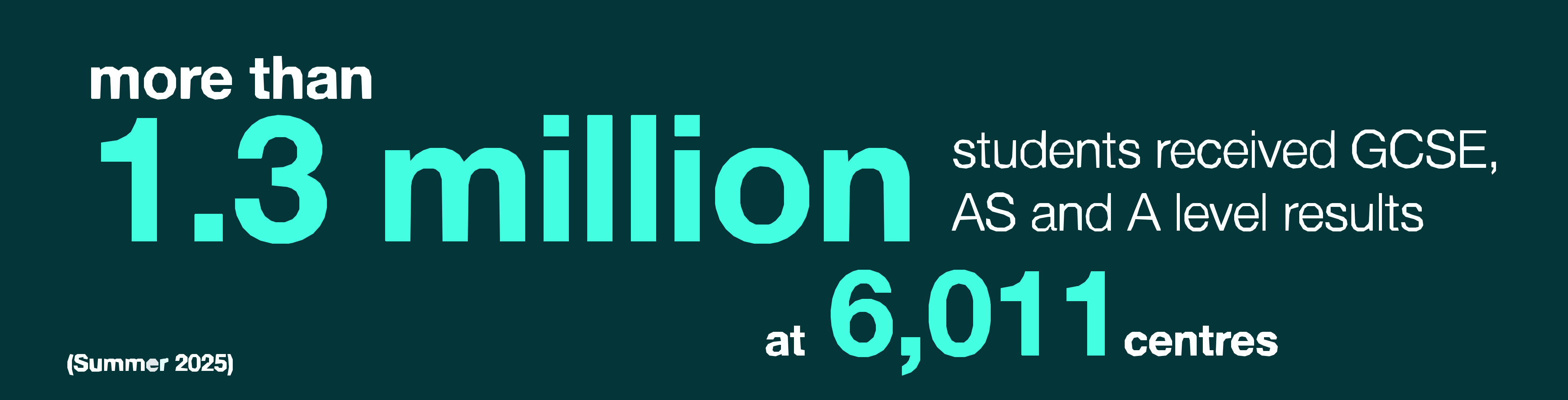
In summer 2025, 4 AOs, AQA, Cambridge OCR (which changed name from OCR in September 2025), Pearson and WJEC (Eduqas), also known as exam boards, offered 366 unique specifications in 93 subjects at GCSE, AS and A level, as well as other qualifications. More than 1.3 million GCSE, AS and A level students at 6,011 centres in England produced more than 17 million individual exam scripts, in 1,430 different question papers (and 3,655 modified papers).
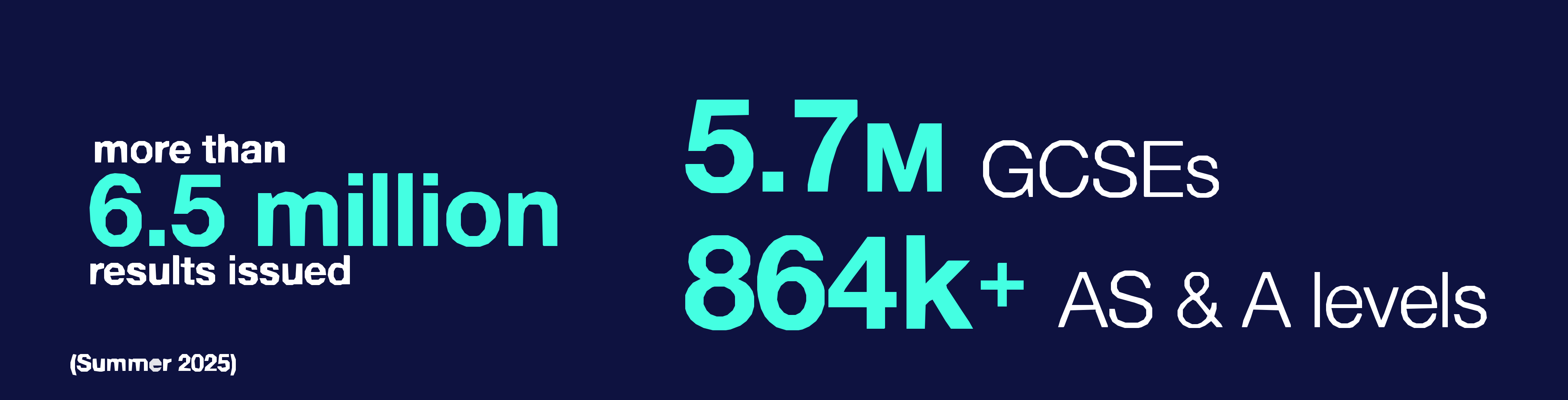
Around 73,000 examiner contracts were fulfilled to undertake marking, and in August these 4 AOs issued approximately 6.5 million results, distributed as follows:
-
5.7 million GCSE results
-
50,475 AS results
-
814,335 A level results
Where reference is made to T Levels in this report, this relates specifically to the Technical Qualifications (TQs) in T Levels. Ofqual regulates the TQs, which comprise the core assessments (core examinations and employer set project) and the occupational specialism. In the academic year 2024 to 2025, the core assessments of the fifth wave of T Levels were available for the first time, alongside the core and occupational specialism assessments for first, second, third and fourth wave TQs.
Ofqual has reviewed TQ assessment materials for each assessment series since autumn 2022. Overall, the reviews have shown continual improvements in TQ assessments, and Ofqual determined that any issues found in the papers sampled during 2025 would not have prevented a sufficiently valid form of assessment. These reviews have covered all AOs offering T Levels.
This report also includes VTQs that feature in government performance tables and are known as performance table qualifications (PTQs) such as applied generals and technical awards. Information about apprenticeship end-point assessments (EPAs) and Functional Skills qualifications in English and maths (FSQs) is also included.
Some VTQ qualifications are taken instead of or alongside GCSEs, AS and A levels and can be used for progression to further or higher education, or progression to employment. Apprenticeships combine practical training in a job with study. Many more VTQs test occupational competency or are used as a licence to practise.
Many VTQs have a flexible approach to assessment, which supports students to complete qualifications as they are ready, taking assessments throughout the academic year. Some assessments are internally assessed (typically set by AOs and marked by centres); others are externally assessed (set and marked by AOs). AOs require centres to make entries in advance for timetabled assessments. Some external assessments are on demand, such as those for Functional Skills, giving students the flexibility to take an assessment whenever they are ready.
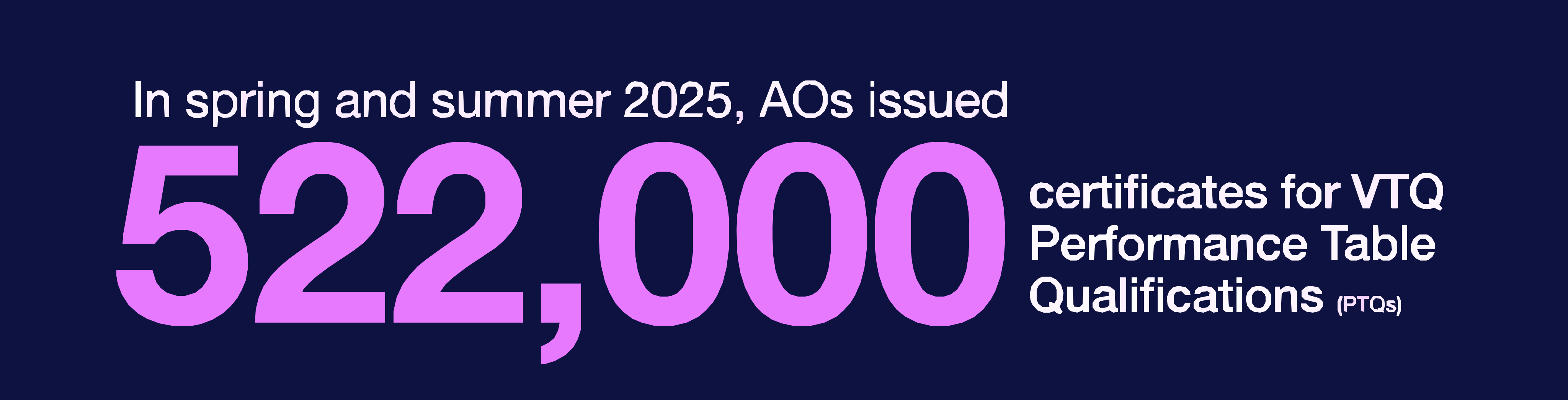
For VTQ PTQs, there were over 1 million results issued for external assessments taken between September 2024 and August 2025. These results contributed to the issue of over 522,000 VTQ PTQs qualification certificates in Spring and Summer 2025.
Fourteen AOs issued certificates for more than 320 VTQ PTQs.
Three AOs offered 18 T Level pathways and around 11,900 students received results for T Levels.

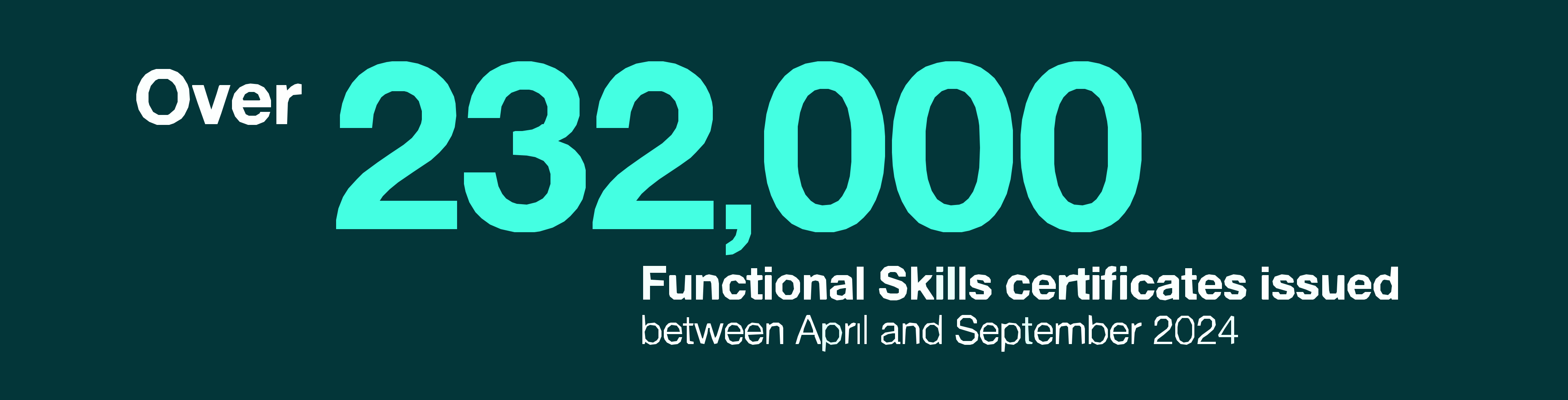
Eleven AOs issued over 232,000 certificates for more than 75 FSQs in spring and summer 2025. For more details see the FSQ outcomes interactive visualisation.
Ofqual regulated 158 AOs across 600 apprenticeship standards in the period up to 31 August 2025.
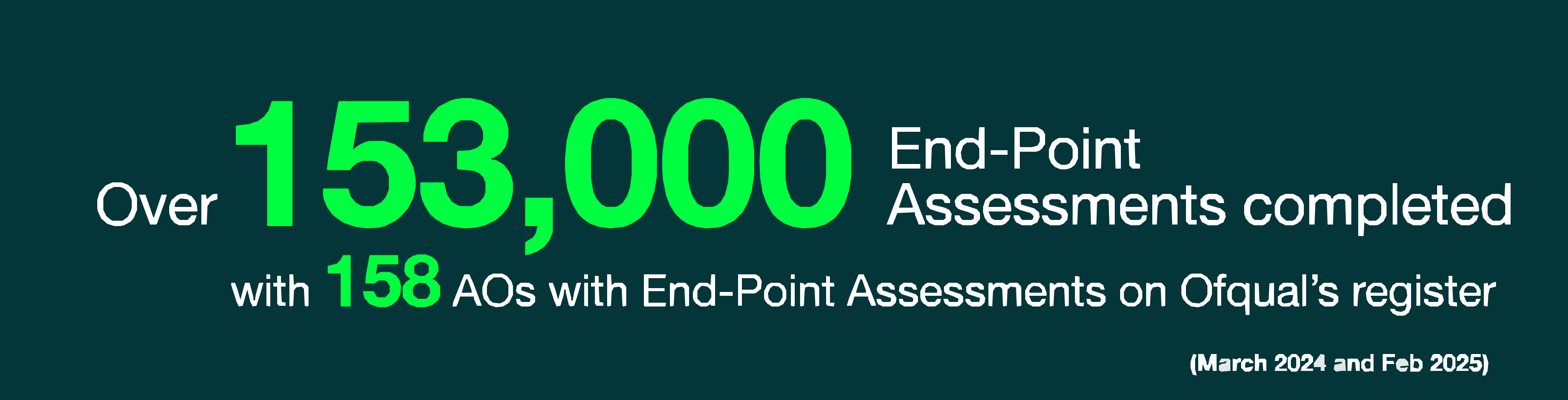
For EPAs, assessments are not taken within a fixed period, and apprentices can be registered with an AO at any time, typically 6 months prior to the apprentice starting their EPA. Apprentices can only start their EPA once the employer, apprentice and training provider agree that the apprentice is fully prepared. EPA outcomes data was collected from AOs to cover the period between March 2024 and February 2025. The data showed that 153,155 EPAs were fully completed, and 422,645 individual EPA components were taken by apprentices. For further data see Ofqual’s Apprenticeship end-point assessments statistical report.
This report covers the awarding of more than 7.5 million results in total, across all the types of qualifications in the scope set out above.
Supporting the sector
Throughout the academic year Ofqual met AOs to monitor their delivery of assessments and discuss policy developments.
Ofqual also met with centre representative organisations and individual schools, colleges and training providers to gather feedback about working with AOs and preparation for results. Ofqual shared relevant feedback with AOs so they could address any issues swiftly. Ofqual published materials to help centres and students understand AOs’ processes in relation to assessment, including the Guide for schools and colleges 2025. See Appendix E for more detail.
Ofqual updated its VTQ information hub so that exams officers and subject teachers could prepare for AOs’ key dates and deadlines ahead of summer 2025.
Delivery of assessments
For this report, the delivery of assessments is divided into 5 phases. They are as follows:
- Phase 1: planning includes information about preparation for the delivery of assessments.
- Phase 2: delivery covers incidents with the potential to affect the delivery of live assessments.
- Phase 3: marking explains the processes around marking, including special consideration.
- Phase 4: grading looks at how AOs arrive at grades after marking is complete.
- Phase 5: results and post results includes information about the volume of results released and reviews of marking, moderation and appeals.
Phase 1: planning
Awarding organisation readiness
Following the delivery of results in 2024, Ofqual met AOs for review meetings during the autumn. Afterwards, Ofqual wrote to AOs to confirm the follow-up work AOs were expected to carry out ahead of future series and set out Ofqual’s regulatory priorities.
By May 2025, Ofqual had conducted annual readiness reviews with 7 AOs. These AOs together cover most of the regulated market. Ofqual sought assurances from each AO about its:
- governance and capability
- management of key delivery risks, such as assessment material production and marking
Ofqual did not identify any serious concerns with AOs’ preparations for series delivery. Where Ofqual identified isolated issues within AOs’ delivery plans, Ofqual required them to strengthen their controls.
Before the summer series, Ofqual met again with the largest AOs to review their individual preparations and progress against their plans. Ofqual reiterated the types of incidents it expected to be notified about, the requirement to alert Ofqual swiftly and the factors AOs should consider in managing such issues if they arose. Ofqual made clear the importance of resolving issues quickly and effectively to minimise any impact on students. Ofqual subsequently wrote to a wider group of AOs, including those expecting to issue VTQ results on or before A level and GCSE results days, to confirm these expectations (see Appendix G).
Ofqual monitored marker recruitment closely, receiving monthly updates from January until the end of May.
Access arrangements and reasonable adjustments
Access arrangements, which include arrangements provided as reasonable adjustments for students with a disability, are provisions to ensure all students can be validly assessed and are not unfairly disadvantaged. Some access arrangements are applied for by centres and agreed by AOs ahead of an exam series. For more information see Appendix F - Glossary.
In November 2025, Ofqual published official statistics on access arrangements submitted to Ofqual by exam boards in relation to GCSEs, AS and A levels. The statistics, published as ‘in development’, cover both the 2024 to 2025 academic year as well as revised statistics going back to the 2015 to 2016 academic year. These statistics use a revised methodology which gives a more accurate picture of access arrangements approved for the specific exam year cohort, compared to previous releases.
Alongside the statistics, Ofqual published a report on its work in this area, including its plans to improve data in the long term.
In a small number of exceptional cases where a student’s disability prevents them from taking all formal exams and assessments for a qualification, and no other adjustment can be made, AOs may consider alternative assessment evidence. In these cases, AOs use assessment evidence provided by centres, with senior examiners using only robust evidence to determine a grade in line with the national standard.
On GCSE results day this year there were a total of 660 GCSE grades awarded to 140 students through use of alternative assessment evidence as a reasonable adjustment, which represents 0.01% of the total GCSE level grades awarded this summer. The comparable figures for 2024 were 790 grades issued to 165 students through alternative assessment approaches.
On A level results day this year there were a total of 65 A level grades awarded to 35 students through use of alternative assessment evidence as a reasonable adjustment, which represents less than 0.01% of the total A level grades awarded this summer. The comparable figures for 2024 were 75 grades issued to 35 students through alternative assessment approaches.
Assessment material production
Ofqual’s Conditions require AOs to produce assessment materials that are clear, appropriate, and fit for purpose. Some qualifications also have additional rules about the design of the assessments, such as the nature and balance of content and skills that must be assessed. It is an AO’s responsibility to ensure its assessment materials are free of errors and assess the content stipulated in the specification. Ofqual does not review or otherwise vet the content of question papers before students take them due to their confidential nature.
Production of assessment materials typically starts more than a year before assessments take place. These materials include question papers, stimulus materials and mark schemes, as well as adapted versions of assessment materials to support students with specific needs (modified assessment materials). Centres are required to order these well in advance of assessments taking place because modified papers of all types take time to produce, quality assure and print.
For assessments that are on demand, some AOs use software to generate assessments, from a bank of standardised questions or items, so that each student takes an individualised version of an assessment. AOs tend to update their question banks frequently, adding fresh items to the bank and retiring old ones to ensure the questions are functioning appropriately and to prevent predictability. For EPAs, the required frequency of these question bank reviews is often stipulated within the apprenticeship EPA plan.
In 2024 to 2025, for VTQ Performance Table Qualifications, AOs produced:
- unique external assessment materials for around 400 assessments
- around 815 discrete modified question papers
For T Levels, AOs produced:
- unique external assessment materials for around 255 assessments
- around 1,185 discrete modified question papers
For GCSEs, AS and A levels, AOs produced:
- 1,430 standard question papers
- 3655 unique modified question papers
Following Ofqual’s public consultation in October 2024, the provision of formulae sheets for GCSEs in mathematics, physics and combined science was extended for the 2025, 2026, and 2027 exams so students were not required to memorise all the formulae and equations expected in a normal year in view of the disruption this cohort of students may have experienced during COVID-19.
Assessment arrangements for EPA
Between September 2024 and August 2025, Ofqual conducted monitoring of 80 AOs to gain assurance about their delivery of assessments and/or assessor standardisation and training.
Ofqual also reviewed a sample of assessment materials from 9 AOs across 16 apprenticeship standards to check they were fit for purpose, delivering valid and reliable assessment of the apprentice in line with the terms of the end-point assessment plan and Ofqual’s requirements. Where Ofqual identified issues, either through monitoring or assessment material reviews, AOs were required to rectify these.
In addition, Ofqual concluded its thematic monitoring of EPA assessor training. This was undertaken to assess how AOs train and support EPA assessors. Ofqual received 130 responses to an initial information request and subsequently observed 335 hours of training across 12 months, involving 799 assessors. We observed that most training focused on standardisation and was delivered remotely. Some compliance concerns were raised, with the most frequent issues linked to Conditions EPA 1.1 (adherence to assessment plan), A5 (resource and workforce competence), and A4 (conflicts of interest). The findings underscore the need for training consistency, better alignment with assessment plans, and proactive management of assessor conduct to ensure valid and reliable assessments.
Phase 2: delivery
Ofqual expects AOs to manage their qualifications so that incidents which could cause adverse effects to the delivery and awarding of qualifications are avoided. However, no large-scale series of exams and assessments passes without any incident. While this section of the report summarises those that arose in this reporting period, none of these incidents caused significant disruption to the otherwise successful delivery of exams and assessments during the 2024 to 2025 academic year.
Reported incidents
AOs are responsible for managing, and reporting to Ofqual, any incidents that may have a potential adverse effect on the delivery and awarding of their qualifications. When such incidents arise Ofqual monitors the AOs’ actions closely, to make sure they do all they can to minimise the impact, if any, on students.
Ofqual’s immediate priority during assessment delivery is to ensure students take assessments that enable them to demonstrate what they know, understand and can do, and that they get results that reflect their performance and are delivered on time. Once results are released, Ofqual follows up each incident with the relevant AO to make sure they are taking appropriate corrective action to prevent recurrence. It also evaluates the cause, impact and management of each incident before determining whether regulatory action is necessary.
Appendix A provides definitions for the event types and sub-types listed in the tables.
GCSEs, AS and A levels
Table 1: Incidents reported relating to summer 2025 and summer 2024 for GCSEs, AS and A levels
| Event type | 2025 | 2024 |
|---|---|---|
| Security breach | 102 | 70 |
| Assessment material error | 93 | 100 |
| Incorrect results | 35 | 24 |
| Delivery failure | 31 | 35 |
| Centre failure | 19 | 1 |
| Suspected malpractice | 9 | 6 |
| Cyber attack | 7 | 6 |
| Other | 5 | 5 |
| Maladministration | 4 | 3 |
| Issues potentially impacting marking | 1 | 3 |
| Total | 306 | 253 |
Overall, there were more incidents (306) reported by AOs in the summer 2025 series compared with summer 2024 (253). The most common incident types were security breaches (102), which have seen an increase since summer 2024; the majority of these relate to potential security breaches within centres. Although not all the 93 assessment material errors reported this year had the potential to impact on students, they are the second most common type of incident and a focus of our regulatory activity. There were more reports of incorrect results being issued by AOs this year. There was also an increase in reports of centre failures where centres entered administration and there was a risk of an adverse effect on learners due to the circumstances of the closure. However, this figure includes multiple notifications from different AOs about the same 8 centres.
Other Generals
Table 2: Incidents reported relating to summer 2025 and summer 2024 for Other Generals
| Event type | 2025 | 2024 |
|---|---|---|
| Assessment material error | 12 | 14 |
| Security breach | 9 | 23 |
| Delivery failure | 6 | 1 |
| Centre failure | 3 | 0 |
| Incorrect results | 2 | 0 |
| Cyber attack | 1 | 2 |
| Other | 1 | 0 |
| Total | 34 | 40 |
Fewer incidents (34) were reported by AOs in the summer 2025 series compared with summer 2024 (40). The 2 most common types of incidents reported remained assessment materials errors and security breaches. However, the number of reports of students discussing assessment content online, where the qualification may be taken later by others in different time-zones, had reduced.
Vocational and Technical Qualifications
Table 3: Incidents reported in 2024 to 2025 and 2023 to 2024 for VTQs (T Levels, PTQs and FSQs)
| Event type | 2024 to 2025 | 2023 to 2024 |
|---|---|---|
| Assessment material error | 60 | 67 |
| Delivery failure | 43 | 49 |
| Maladministration | 27 | 16 |
| Security breach | 27 | 55 |
| Suspected malpractice | 19 | 31 |
| Incorrect results | 18 | 18 |
| Centre failure | 6 | 4 |
| Cyber attack | 6 | 5 |
| Incorrect certificates | 3 | 4 |
| Other | 4 | 5 |
| Issues potentially impacting marking | 0 | 1 |
| Total | 213 | 255 |
There were fewer reported incidents (213 events) concerning VTQs in the academic year 2024 to 2025 compared with the previous academic year (255 events). The 2 most common types of incidents reported in 2024 to 2025 were assessment material errors (60 events) and delivery failures (43 events) although both have seen a decrease since the previous academic year. The number of security breaches has fallen this year, which can largely be attributed to the work AOs have done with centres to encourage better security around the transit of assessment materials for on demand qualifications and AOs’ improvements to their own processes to reduce the risk of these being lost in transit.
Incidents relating to T Levels, PTQs and FSQs are all summarised in this section of the report. Data regarding incidents by qualification type for VTQs can be found in Appendix D.
End-point assessments
Table 4: Incidents reported in 2024 to 2025 and 2023 to 2024 for EPAs
| Event Type | 2024 to 2025 | 2023 to 2024 |
|---|---|---|
| Other | 85 | 29 |
| Delivery failure | 54 | 56 |
| Assessment material error | 21 | 12 |
| Malpractice | 18 | 12 |
| Maladministration | 11 | 4 |
| Incorrect results | 10 | 8 |
| Centre failure | 10 | 4 |
| Security breach | 5 | 15 |
| Issues potentially impacting marking | 3 | 4 |
| Incorrect certificates | 1 | 2 |
| Cyber attack | 1 | 2 |
| Total | 219 | 148 |
There were 219 reported incidents concerning apprenticeship EPAs in the academic year 2024 to 2025, which is 71 more than Ofqual received in the previous year. The increase is likely due to a rise in the number of regulated AOs offering EPA and AOs reporting incidents via a different process.
Pearson A level mathematics
This series, Pearson replaced paper 2 of its A level mathematics qualification ahead of the exam being sat after concerns were raised that paper 1 had been similar to a previous paper. Most students took the replacement paper, apart from a very small number of students who required a modified version of paper 2 as Pearson stated that it was not possible to replace these in the limited time between the two exams.
Ofqual closely scrutinised Pearson’s approach to delivering and awarding the qualification, which ultimately saw grade boundaries set which were the same for both versions of paper 2 taken by learners.
Ofqual is currently considering whether Pearson breached any Ofqual rules in its approach to the design and/or delivery of these assessments and whether further action is appropriate.
Delivery failure incidents
Breaking down the different categories of incidents reported above, delivery, in this context, includes a range of processes from printing and dispatch of question papers to issuing results and processing appeals. Ofqual requires AOs to deliver their assessments effectively, efficiently and to set timescales. AOs are required to report any actual or potential delivery incident which could have a potential or actual adverse effect on students.
GCSEs, AS and A levels
Table 5: Incidents of delivery failure relating to summer 2025 and summer 2024 for GCSEs, AS and A levels
| Event sub-type | 2025 | 2024 |
|---|---|---|
| Missing scripts | 8 | 5 |
| Information error | 7 | 6 |
| Other | 6 | 5 |
| IT failure | 4 | 12 |
| Delayed results | 3 | 1 |
| AO missed own deadline | 2 | 1 |
| Conflict of interest | 1 | 2 |
| Exam disruption | 0 | 3 |
| Total | 31 | 35 |
During the summer series, AOs that deliver GCSE, AS and A levels told Ofqual about 31 incidents where aspects of the delivery of an assessment were or could have been compromised. These were fewer than in summer 2024, when 35 incidents were reported. We received more notifications relating to small numbers of missing exam scripts; this is covered further in the ‘Phase 5: results and post results’ section. There were fewer incidents related to issues with AOs’ IT systems this year.
Other Generals
This summer, AOs that deliver Other Generals notified Ofqual about 6 incidents where aspects of the delivery of an assessment were or could have been compromised. Two of these related to issues with AOs’ systems, and Ofqual ensured that they addressed these and took appropriate action to mitigate the impact on students. Further information on the breakdown of delivery incidents by sub-type can be found Appendix D.
Vocational and Technical Qualifications
Table 6: Incidents of delivery failure reported in 2024 to 2025 and 2023 to 2024 for VTQs (T Levels, PTQs and FSQs)
| Event sub-type | 2024 to 2025 | 2023 to 2024 |
|---|---|---|
| IT failure | 13 | 11 |
| Missing scripts | 9 | 1 |
| Delayed results | 7 | 12 |
| Other | 6 | 10 |
| AO missed own deadline | 4 | 11 |
| Exam disruption | 2 | 1 |
| Information error | 2 | 1 |
| Process weakness | 0 | 2 |
| Total | 43 | 49 |
Issues with IT and missing scripts were the most frequent incidents with the potential to compromise delivery of VTQ assessments during 2024 to 2025.
Most of the IT problems were due to issues with AO systems. In all cases, AOs deployed temporary fixes or solutions until the problems with their systems were repaired and took appropriate action to mitigate the impact on students. When IT failures occurred in centres, AOs worked with centres to support them and minimise any disadvantage to students.
Most of the missing scripts were due to centres not following AOs’ processes for returning scripts correctly. AOs collaborated with centres to locate scripts and issued estimated grades where needed to minimise disadvantage to learners. AOs continue to engage with centres to improve understanding of AO processes, to mitigate risks of lost scripts.
End-point assessments
Table 7: Incidents of delivery failure reported in 2024 to 2025 and 2023 to 2024 for EPAs
| Event sub-type | 2024 to 2025 | 2023 to 2024 |
|---|---|---|
| Other | 40 | 23 |
| IT failure | 6 | 8 |
| Exam disruption | 5 | 3 |
| Missed deadline | 1 | 8 |
| Delayed results | 1 | 2 |
| Missing scripts | 1 | 0 |
| Human error | 0 | 4 |
| Incorrect content | 0 | 2 |
| Information error | 0 | 3 |
| Process weakness | 0 | 1 |
| Resource capacity | 0 | 2 |
| Total | 54 | 56 |
There were 54 reports of incidents which compromised or could have compromised the delivery of EPAs in 2024 to 2025, a decrease of 2 from the previous reporting period. The highest number of issues were categorised as ‘other’, with 14 relating to potential non-compliance with the requirements of the assessment plan. Examples of non-compliance included assessment timings not in line with the requirements of the assessment plan, and not delivering assessments in the order mandated by the assessment plan. In these instances, AOs are expected to describe the measures they have taken to limit negative impacts on apprentices and reduce the likelihood of recurrence.
IT issues accounted for 6 of the reported incidents for EPAs. The impact of these issues included unavailability of assessments, delayed assessments, and delays in releasing final assessment grades.
Cyber attacks
AOs report instances of cyber attacks on centres only if the delivery of assessments was potentially affected. Of the 7 cyber attacks reported against centres that affected delivery of GCSEs, AS and A levels, one also affected the delivery of Other Generals at the affected centre, and one centre’s delivery of VTQs were affected. A further 6 cyber attacks only affected the delivery of VTQs and there were 2 that affected apprenticeship EPAs.
Centres are responsible for managing their cyber resilience. Ofqual encourages all parties across the sector to work together in tackling the evolving risks around cyber security. As part of Cybersecurity Awareness Month in October, Ofqual published new data highlighting the importance of having defences in place and directed schools and colleges to practical support via the National Cyber Security Centre (NCSC) small business guide to cyber security.
Before the summer series a significant cyber attack took place on a supplier to the exam system. The attack took place in February, and the affected AOs deployed their contingency plans for managing cyber threats. All mitigating activity was completed prior to the series.
Ofqual worked closely with the Department for Education, the NCSC and affected AOs to oversee their response to this incident. Students can be confident that due to these actions neither their assessments nor their grades were compromised by this incident, and that exam results were delivered appropriately this summer with standards maintained.
Ofqual has clear expectations of AOs’ risk management including cyber security and third-party arrangements and is working to ensure that best practice guidance from NCSC is implemented by all parties involved in the delivery of exams.
Security breaches
Within this report the term ‘security breach’ refers to either a potential security breach (for example, where procedures are not followed and there is the potential for the assessment to be compromised, even where this is not realised), or an actual security breach (for example, where the content of a live question paper is shared). This means that for a significant proportion of potential security breaches reported to Ofqual, there will have been no evidence that the integrity of the assessment was compromised.
Most security breaches are accidental, though some are intentional. Examples of accidental breaches are a student accidentally being given paper 2 instead of paper 1 at their centre, or results accidentally being released early to students by their centre.
When there is the potential that the content of a question paper has been leaked prior to the exam, Ofqual expects AOs to identify and investigate the breaches quickly and take steps to prevent the material from being shared. We also expect AOs to consider if additional security controls should be implemented to safeguard the integrity of the remaining assessments in the series.
Where AOs’ investigations establish the content of a question paper may have been seen by some students prior to their exam, Ofqual closely monitors the approach taken to mitigate any disadvantage to other students. AOs conduct analysis during and after marking to look for any indications of impact from a security breach. AOs did not report any evidence this year of their awards being affected by security breaches. AOs must consider appropriate sanctions for any students or centre staff found to have committed malpractice.
For GCSE, AS, A level and the majority of VTQ PTQs, centres must follow Joint Council for Qualifications’ (JCQs’) Instructions for conducting examinations which specifies requirements for the handling and safe storage of assessment materials.
Other VTQ PTQs, have similar requirements specified by the individual AO.
Sharing confidential material on social media
AOs closely monitor social media to identify any potential breaches of their assessment materials. If found to be genuine, AOs work with social media companies and law enforcement as part of their investigation into the breach to take down materials to prevent malpractice and avoid students being disadvantaged.
Where assessments are taken around the world in different time zones, social media can also increase the risk of breaches in confidentiality should students who have completed an assessment taken later by others in different time-zones discuss the content online.
Ofqual expects AOs to take all reasonable steps to preserve the confidentiality of their assessments, including in circumstances such as these. Students that distribute exam materials that should be confidential receive appropriate sanctions.
Hoax papers on social media
There were again instances of individuals prior to and during the exam period falsely claiming to have question papers for sale, frequently uploading a doctored copy of the front cover of the question paper as ‘proof’ of access. In some cases, sellers seek large payments for these hoax papers.
Alongside the AOs’ monitoring, Ofqual undertakes its own monitoring of social media for accounts claiming to have access to confidential question papers, and members of the public are also able to report concerns about such malpractice to us directly. We pass this information on to the AOs and expect them to promptly investigate to establish if they are genuine. Ofqual contacted individual AOs on 11 occasions to share information relating to social media accounts claiming to have question papers for sale. All were confirmed to be fake. This was a reduction compared with 28 occasions in the summer 2024 series. This may reflect the continuing actions taken by AOs to improve detection and increase awareness of the consequences of engaging in such activity. AOs employ legal routes, such as court injunctions and disclosure orders, against those who try to undermine confidence in exams.
Ofqual’s guidance for students reminds them that if they see offers of exam questions or papers on social media, they will most likely be fake and not to access them. It also reminds students about the serious consequences of committing malpractice. We also saw evidence of students themselves challenging the distribution of hoax papers online - calling out both that such activity is not permitted, and the high likelihood that papers shared in advance will be hoaxes. It is welcome that students are increasingly clear on these points.
In addition, as part of our stakeholder engagement we encouraged representative bodies and other stakeholders to be alert to hoax papers and report them to AOs.
GCSEs, AS and A levels
Centres normally receive exam papers and supporting materials some weeks before the exams are taken. For the summer 2025 series, the exam boards delivered question papers for these qualifications to 6011 centres in England.
Table 8: Security breach incidents related to summer 2025 and summer 2024 for GCSEs, AS and A levels
| Event sub-type | 2025 | 2024 |
|---|---|---|
| Leak of materials (centre staff) | 39 | 19 |
| Incorrect paper issued for assessment | 27 | 32 |
| Results released before results day | 27 | 3 |
| Leak of materials (AO) | 3 | 3 |
| Assessment held at incorrect time | 2 | 7 |
| Leak of materials (examiner/assessor) | 2 | 1 |
| Grade boundaries | 2 | 0 |
| Loss in transit | 0 | 2 |
| Leak of materials (public) | 0 | 1 |
| Leak of materials (student) | 0 | 1 |
| Other | 0 | 1 |
| Total | 102 | 70 |
There were 102 reported security breaches in 2025 for GCSEs, AS and A levels, compared with 70 in 2024. There were no question papers leaked into the public domain via social media immediately prior to an exam this year.
The most frequent type of security breach reported to Ofqual related to the leak of materials by centre staff (39) which increased from 19 such incidents in 2024. These incidents involved centre staff opening assessment materials ahead of requirements, sharing pre-release material ahead of the publication date, not keeping assessment materials within the appropriate secure storage and not returning test materials to secure storage (for example for modern foreign languages speaking tests). AOs investigate these incidents and apply sanctions to centre staff where necessary.
The second most frequent type of security breach also related to breaches within centres where centre staff open the wrong exam paper (27), although this was slightly down from 32 cases in 2024. AOs require centres to follow protocols intended to prevent such errors, including having 2 people present when papers are opened. In about half of the cases reported, exam papers did not leave the confinement of the secure storage area, or were removed but not distributed to students, but the packet was incorrectly opened and resealed.
Where centre staff open and distribute the wrong exam paper, Ofqual expects AOs to do all they can to minimise the impact on students and on the security of the paper. AOs may accept the paper the student has sat, even if they sat it on the wrong day, and estimate the missing mark of the paper they should have sat, if the student was unable to sit the correct paper in the same sitting. They will also require students and centre staff to sign confidentiality statements confirming they will not disclose the content of the assessment and centres may receive additional scrutiny to ensure that remaining exams are conducted correctly.
This year, there was also a significant increase in notifications related to the early release of exam results where centres inadvertently allowed students to access their results ahead of the official publication time on results day. However, this figure includes multiple notifications from different AOs about the same 14 centres. These all related to failures with embargo settings in systems for sharing results or accidentally sending results emails that should have been delayed. Where appropriate, centre staff received sanctions. Centres also provided information to AOs on measures taken to prevent recurrence, such as process improvements and staff training.
Other Generals
There was a reduction in reported security breaches for Other Generals with 9 in 2025 compared to 23 in 2024. Four of these 9 relate to reports of students who have completed an assessment taken later by others in different time-zones, discussing the content online. There has, however, been a significant reduction in these incidents following activity undertaken by the relevant AO to reduce the opportunity for this. Further information on the breakdown of security breach incidents by sub-type can be found Appendix D.
Vocational and Technical Qualifications
Table 9: Security breach incidents reported in 2024 to 2025 and 2023 to 2024 for VTQs (T Levels, PTQs, FSQs)
| Event sub-type | 2024 to 2025 | 2023 to 2024 |
|---|---|---|
| Leak of materials (student) | 9 | 6 |
| Incorrect paper issued for assessment | 3 | 1 |
| Assessment held at incorrect time | 3 | 1 |
| Leak of materials (public) | 3 | 1 |
| Loss in transit | 3 | 25 |
| Results released before results day | 2 | 5 |
| Other | 2 | 6 |
| Leak of materials (examiner/assessor) | 1 | 0 |
| Leak of materials (AO) | 1 | 3 |
| Leak of materials (teacher/examiner) | 0 | 1 |
| Leak of materials (centre staff) | 0 | 6 |
| Total | 27 | 55 |
Leak of materials by students was the most frequent type of security breach reported to Ofqual by AOs for VTQs in 2024 to 2025, with a total of 9 incidents compared to 6 in 2023 to 2024.
All of the materials leaked by students involved the sharing of assessment materials on ‘homework help’ websites or social media. No complete examination paper was shared online, rather questions from papers were uploaded by students. These questions were from qualifications where assessments are available on demand, or within a specified window, and therefore constituted a potential security breach. The affected AOs worked together to share intelligence about the breaches and websites. Ofqual highlighted the websites with all AOs and reminded them of their obligations under the General Conditions of Recognition (GCR). AOs took the leaked questions out of circulation, although many were not live at the time they were identified online. They also contacted the organisations running the websites or social media, requesting they remove the questions. Students’ responses and performance on affected questions were closely analysed to rule out any malpractice. AOs worked with centres and training providers to investigate and to improve their training and guidance in this area.
End-point assessments
There were 5 reports of potential security breaches for EPAs in 2024 to 2025. Three of these incidents were related to potential leaks of assessment materials, one was related to loss of materials in transit, and one involved the missed delivery of a paper-based test. These security breaches pose a risk to the confidentiality of assessment. The causes of these breaches ranged from incidents caused by human error to process weakness. AOs were required to demonstrate to Ofqual what mitigations they had put in place to ensure that apprentices were not negatively impacted. These mitigations included notifying centres and requesting that all assessment materials that may have been subject to a security breach be deleted; using encryption software to restrict access and prohibit onward distribution; using new versions of assessment task and retiring versions of assessments that may have been subject to a breach; and implementing new processes and staff training where necessary to prevent reoccurrence.
Assessment material errors
Ofqual expects all assessment materials to be error-free, and that AOs’ quality assurance processes are robust enough to identify and correct any that may be introduced during development. When errors do happen, AOs must act promptly to prevent or minimise any impact on students, investigate the root causes and explain how they plan to prevent reoccurrence. Errors can undermine student and public confidence in regulated qualifications.
When considering the number of assessment material errors by AO, it should be noted that the number of distinct qualifications offered by AOs differs significantly (see Ofqual’s Annual qualifications market report: academic year 2023 to 2024).
Some errors can affect all students, whereas others affect a proportion of those taking the assessment. Depending on the nature of the error, they may also impact a greater or lesser proportion of the total marks available for a qualification. Some errors reported to Ofqual by AOs may not impact on students’ ability to respond to a question or task at all.
Ofqual categorises errors by their potential level of impact on students and ahead of the summer series, we reviewed these descriptors to include reference to mark scheme errors:
- Category 1 – assessment material errors which could or do make it impossible for students to generate a meaningful response to a question or task. This includes mark scheme errors that could or do make it impossible to mark the assessment in a way that accurately and consistently reflects the level of attainment demonstrated by the learner.
- Category 2 – assessment material errors which could or do cause unintentional difficulties for students to generate a meaningful response to a question or task. This includes mark scheme errors that could or do cause confusion or misinterpretation and may prevent accurate and consistent marking.
- Category 3 – assessment material errors which will not affect a student’s ability to generate a meaningful response to a question or task. This includes minor mark scheme errors that do not influence the assessment outcome.
AOs have several options for mitigating assessment material errors identified before the assessment is taken, such as issuing a replacement paper, an addendum or an erratum notice, depending on how close to the exam the error is identified.
AOs have a number of options for mitigating assessment material errors, depending on whether different centres have started the assessment once the AO becomes aware of the error. For example, if an error is identified during an assessment window, an AO may be able to re-publish corrected materials and communicate with centres to ensure they are using the correct version.
Some VTQs offer ‘on demand’ assessments, so centres can choose when students complete an assessment. Consequently, assessment material errors may be identified and reported at any point during an assessment’s lifetime; this could be before, during or after students have completed an assessment. Therefore, mitigations applied by AOs will necessarily vary depending on the circumstances of different students. For instance, AOs can ‘switch off’ a live paper until an error is corrected; they can track centre bookings and completed tests then analyse responses and make adjustments for impacted students during awarding, if needed. In some cases, AOs will refund the entry fee to centres and offer a re-sit to students.
When an error is found after an exam, Ofqual requires AOs to take steps to minimise its impact as much as possible. If an AO has evidence suggesting that the error caused confusion or adversely affected students’ performance, it may adjust the mark scheme to accept a range of plausible answers. AOs instruct examiners to identify any unusual responses or those indicating student confusion and, depending on the nature of the error, may conduct more detailed analyses of student responses. In some cases, assessment material errors may not be identified until after results have been issued and subsequently need to be corrected.
Ultimately, if the error cannot be mitigated in a manner that maintains fairness to students, AOs might decide to award marks to all students or exclude the question. In certain circumstances based on the evidence presented, an AO may award special consideration to compensate students whose performance was affected by circumstances out of their control.
GCSEs, AS and A levels
The majority (98%) of the GCSE, AS and A level question papers produced were error free. There were fewer assessment material errors (93) identified this summer compared with summer 2024 (100).
Table 10: Assessment material errors by sub-type and AO
| Event sub-type | AQA | Cambridge OCR | Pearson | WJEC |
|---|---|---|---|---|
| Question paper error | 10 | 36 | 14 | 12 |
| Supporting materials error | 7 | 1 | 1 | 1 |
| Front cover instruction error | 2 | 0 | 0 | 2 |
| Mark scheme or answer key error | 1 | 1 | 1 | 0 |
| Collation or printing error | 0 | 1 | 1 | 0 |
| Specification error | 0 | 0 | 0 | 2 |
Table 11: Assessment material errors by AO and categorisation of impact
| AO | Category 1 | Category 2 | Category 3 |
|---|---|---|---|
| AQA | 5 | 11 | 4 |
| Cambridge OCR | 10 | 21 | 8 |
| Pearson | 6 | 7 | 4 |
| WJEC | 1 | 11 | 4 |
Table 12: Assessment material errors by sub-type and categorisation of impact
| Event sub-type | Category 1 | Category 2 | Category 3 |
|---|---|---|---|
| Question paper error | 17 | 40 | 15 |
| Supporting materials error | 3 | 5 | 2 |
| Front cover instruction error | 0 | 2 | 2 |
| Mark scheme error | 1 | 1 | 1 |
| Collation or printing error | 1 | 1 | 0 |
| Specification error | 0 | 1 | 0 |
There were 72 errors reported in the content of question papers in summer 2025. Seventeen of these were category 1 while 15 were category 3.
There were 9 assessment material errors that occurred only in the modified braille version of the assessments (including tactile diagrams), compared with 20 in 2024. These represent instances when the error was introduced at the point of modification and was not present in the standard version of the assessment material. Eight of these errors were identified during or after the exam and were mitigated by either discounting the question or applying special consideration following a script review to identify potential adverse effects on learners. The other error was identified prior to the examination, and the assessment materials were replaced.
There were another 7 errors that occurred only in other types of modified versions of assessment materials (for example large print papers), compared with 9 in 2024. Four were identified prior to the exam and replacement materials or communications were issued to centres. The other 3 were identified during or after the exam and the AOs concluded that either students were not impacted by the error or applied special consideration to mitigate any potential impact.
While these errors were mitigated, or identified before the relevant exam, they highlight the importance of ensuring high-quality processes are followed across all versions and formats of assessment materials.
Ofqual takes seriously the quality of modified papers – both for students using Braille and other types of modification. Whilst it was positive to see a reduction overall in errors in modified papers, it is important that exam boards retain their focus on reducing further these issues. Ofqual has written to Exam Boards seeking substantive assurance on the steps they will be taking to further improve quality.
Table 13: Point of identification of question paper errors by AO
| AO | Prior to exam | During exam | After exam |
|---|---|---|---|
| AQA | 1 | 0 | 9 |
| Cambridge OCR | 10 | 1 | 25 |
| Pearson | 9 | 1 | 4 |
| WJEC | 5 | 2 | 5 |
Table 14: Mitigations to errors in standard question papers
| Mitigations taken | Number of occurrences |
|---|---|
| Amend mark scheme | 28 |
| Erratum | 15 |
| Script review (outside of marking) | 11 |
| Discount question | 6 |
| Replacement paper | 3 |
| Special consideration (arrangements for candidates) | 2 |
| Estimated marks | 1 |
Table 15: Mitigations to errors in only modified versions of question papers
| Mitigations taken | Number of occurrences |
|---|---|
| Replacement paper | 2 |
| Discount question | 2 |
| Special consideration (arrangements for candidates) | 1 |
| Script review (outside of marking) | 1 |
OCR AS and A level physics
Cambridge OCR reported 12 assessment material errors across its AS and A level physics suite in the 2025 summer series. This resulted in multiple errors in 3 of the question papers taken for these assessments, which also impacted delivery in one instance due to linked complications issuing an erratum notice. However, some of these errors were found and resolved ahead of the exams being sat.
Ofqual scrutinised Cambridge OCR’s management of these issues and their subsequent investigation into their causes and is closely monitoring the actions it is taking to prevent them from reoccurring. Ofqual is also considering whether further regulatory action may be appropriate.
Other Generals
There were 12 reported assessment material errors for Other Generals in total in 2025, compared with 14 in 2024. Of these 12, 11 related to an error within the question paper and one was an error within supporting materials. Two of these were category 1 and the other 10 incidents were category 2.
Two of these were identified during the exam and the other 9 were identified after the exam. AOs chose to either amend the mark scheme, discount the question or estimate marks to mitigate any potential impact. Further information can be found Appendix D.
Four of the assessment material errors reported relate to errors in braille assessment materials only; 3 within the question paper and one within supporting materials.
Vocational and Technical Qualifications
Most of the question papers produced for VTQs were error free. There were fewer assessment material errors during the academic year 2024 to 2025 (60) compared with the academic year 2023 to 2024 (67). As with GCSE, AS and A levels, not all errors affected all the students taking the assessments or had the potential to impact on their performance.
Table 16: Assessment material errors reported in 2024 to 2025 for VTQs (T Levels, PTQs, FSQs)
| Event sub-type | Cambridge OCR | City & Guilds | NCFE | Pearson | TQUK | VTCT Skills | WJEC |
|---|---|---|---|---|---|---|---|
| Collation or printing error | 0 | 0 | 1 | 0 | 3 | 0 | 0 |
| Front cover instruction error | 0 | 0 | 0 | 1 | 0 | 0 | 0 |
| Mark scheme or answer key error | 1 | 4 | 0 | 1 | 0 | 0 | 0 |
| Non-exam assessment (NEA) error | 0 | 2 | 0 | 11 | 0 | 0 | 0 |
| Question paper error | 7 | 8 | 2 | 6 | 2 | 1 | 0 |
| Specification error | 1 | 0 | 0 | 1 | 0 | 0 | 1 |
| Supporting materials error | 0 | 6 | 0 | 1 | 0 | 0 | 0 |
There were 26 errors reported in the content of question papers. Four errors were of the most severe type (category 1), while 5 (category 3) were minor.
Five of the question paper errors occurred in modified papers and were introduced during the modification process, so they did not appear in the standard version of the assessment. Two of the errors were identified after the assessment and the AOs acted to mitigate the impact on students during and after the marking process. One of the errors was identified during the assessment and the centre was able to mitigate the impact of the error using the standard version of the assessment. Two of the errors were identified before the assessment and the AO replaced the papers so there was no impact on the students.
Table 17: Assessment material errors reported in 2024 to 2025 for VTQs (T Levels, PTQs, FSQs) by AO and categorisation of impact
| Category | Cambridge OCR | City & Guilds | NCFE | Pearson | TQUK | VTCT Skills | WJEC |
|---|---|---|---|---|---|---|---|
| Category 1 | 2 | 0 | 0 | 5 | 3 | 1 | 0 |
| Category 2 | 5 | 16 | 3 | 11 | 1 | 0 | 1 |
| Category 3 | 2 | 4 | 0 | 5 | 1 | 0 | 0 |
Table 18: Number and severity of errors in different assessment material types for VTQs (T Levels, PTQs, FSQs)
| Event sub-type | Category 1 | Category 2 | Category 3 |
|---|---|---|---|
| Question paper error | 4 | 17 | 5 |
| Supporting materials error | 0 | 4 | 3 |
| Collation or printing error | 3 | 1 | 0 |
| Specification error | 0 | 2 | 1 |
| Mark scheme or answer key error | 1 | 5 | 0 |
| Non-exam assessment (NEA) error | 3 | 8 | 2 |
| Front cover instruction error | 0 | 0 | 1 |
Table 19: Assessment material errors by point of identification reported in 2024 to 2025 for VTQs (T Levels, PTQs, FSQs) by AO
| Point of identification | Cambridge OCR | City & Guilds | NCFE | Pearson | TQUK | VTCT Skills | WJEC |
|---|---|---|---|---|---|---|---|
| Prior to exam | 0 | 6 | 0 | 9 | 0 | 0 | 0 |
| During exam | 0 | 4 | 1 | 7 | 0 | 0 | 1 |
| After exam | 9 | 10 | 2 | 5 | 5 | 1 | 0 |
For all of these errors the AOs implemented mitigations to minimise negative effects on students; in some cases, they were able to replace assessments prior to students taking them. AOs also reviewed their own processes and training as necessary.
End-point assessments
Table 20: Assessment material errors reported in 2024 to 2025 and 2023 to 2024 for EPAs
| Event sub-type | 2024 to 2025 | 2023 to 2024 |
|---|---|---|
| Question paper error | 12 | 6 |
| Mark scheme or answer key error | 5 | 5 |
| Support material error | 3 | 0 |
| Specification error | 1 | 0 |
| Collation or printing error | 0 | 1 |
There were 21 reported assessment material errors for EPAs, up from 12 in 2023 to 2024. Of the 21 reported incidents, 12 related to question paper errors, 5 to mark scheme/answer key errors, 3 to supporting materials errors and 1 was a specification error.
Nine incidents were categorised as category 1, with 6 of these caused by question paper error and 3 caused by mark scheme or answer key error. AOs implemented measures to ensure that apprentices were not disadvantaged and any resulting errors in grading were corrected. There was only one category 2 incident reported relating to a mark scheme or answer key error. Two category 3 incidents relating to specification error and question paper error were reported.
Malpractice
Malpractice undermines the integrity of qualifications and disadvantages students who have genuinely achieved their results. We take allegations of malpractice very seriously and we expect AOs to do the same. AOs must investigate all instances where there are reasonable grounds for an allegation of malpractice.
When malpractice is proven, penalties are imposed against those responsible to protect fairness and maintain confidence in the system. Penalties may include disqualification of a student’s qualification, suspension of staff from administering assessments, and withdrawal of a centre’s approval to deliver assessments on behalf of awarding organisations.
AOs are required to submit data to Ofqual on all malpractice cases investigated, including offence type and any penalties applied. Ofqual has published official statistics on the number of cases of malpractice for GCSE, AS and A level in the summer exam series. VTQ data on malpractice cases will be published in 2026. These official statistics capture all the malpractice cases investigated by AOs within the specified time period, and the sanctions applied.
Direct reports to Ofqual of alleged malpractice
In addition to reports from AOs, anyone can raise concerns they have about exam or assessment-related wrongdoing with Ofqual. Ofqual is designated as a prescribed body for whistleblowing for workers, and annual whistleblowing data is reported in Ofqual’s Annual Report and Accounts. Allegations of malpractice by other individuals, for example, students and parents, are raised with the relevant AOs and followed up to make sure that the allegations are properly investigated and, where appropriate, that sanctions are applied. Ofqual investigates and acts on any concerns reported to it regarding an AO not following its rules.
Table 21: Number of malpractice allegations received by qualification and series
| Qualifications | Summer 2025 (Sep 2024 to Aug 2025 for VTQs) |
Summer 2024 (Sep 2023 to Aug 2024 for VTQs) |
|---|---|---|
| GCSEs, AS and A levels | 42 | 51 |
| VTQ PTQs, T Levels and FSQs, and EPA | 12 | 13 |
Ofqual did not receive any allegations of malpractice relating to Other Generals.
Misuse of Artificial Intelligence
Artificial Intelligence (AI) creates risks to assessments primarily in subjects with written non-examined assessment (NEA) and instances of inappropriate use of AI are reported by centres to AOs or identified by AO moderators. Misuse of AI is reported separately within the Ofqual official statistics, under the category of plagiarism and can be found here: Malpractice in GCSE, AS and A level: summer 2025 exam series
AOs use a combination of different approaches, including detection software, to identify the use of AI in students’ work. Where malpractice through plagiarism is confirmed and students receive a sanction, AOs may review other papers or qualifications taken by that student to determine whether similar malpractice has taken place. Ofqual also requires this information to be shared with other AOs that the student may have taken qualifications with.
JCQ has produced AI Use in Assessments: Your role in protecting the integrity of qualifications, and Information for Candidates highlighting the regulations and providing guidance to help teachers, assessors, and students understanding when AI can and cannot be used in assessments.
Maladministration
Table 22: Number of serious maladministration allegations received by qualification and series
| Qualifications | Summer 2025 (Sep 2024 to Aug 2025 for VTQs) |
|---|---|
| GCSEs, AS and A levels | 4 |
| VTQs (PTQs, T Levels and FSQs) | 27 |
| EPA | 11 |
In most of the maladministration cases, centre staff were not aware of, or did not understand, requirements relating to exam delivery. This led to issues such as administering the incorrect non-examined assessment, not following AO processes correctly resulting in late submission of non-examined assessment, or incorrect timings being used in examinations. For VTQS and EPA, 3 instances of maladministration related to AO staff, 2 involved an examiner/assessor and one case was due to a third-party supplier.
AOs applied sanctions as appropriate and where necessary required centres to provide robust reassurance related to measures taken to prevent recurrence.
Phase 3: marking
Current AO practices see most externally examined components marked by examiners online. Online marking can be by item (an individual question or several related part questions) or at whole paper level, depending on the type of paper. Marking at item level means that many different examiners will mark each student’s work.
Every paper has a team of examiners. Before marking starts, examiners are trained on the mark scheme for the paper. They must complete their training satisfactorily before they can start marking, to make sure they understand and can consistently apply the mark scheme. Examiners who do not pass the training will not be allowed to mark.
During marking, every examiner’s work is regularly quality checked by their respective AO to ensure their marking is consistent and continues to meet the required standard.
Where marking is online, quality checks include a check each time an examiner logs on to the marking system, as well as random checks while they are marking. If examiners do not mark the quality assurance items to the agreed standard, they will be stopped from marking until their supervising examiner is confident that they understand the mark scheme. Where marking is on paper, examiners send samples of their marking to a more senior examiner for checking. If an examiner is not marking to the required standard, but their marking is consistent, their marking may be adjusted; if their marking is inconsistent, they will be stopped from marking altogether and the marking they have already completed will be reviewed.
As in previous years, in 2025 Ofqual attended a sample of AO standardisation events (face to face meetings or held online) to observe the process. Ofqual staff attended 75 events – 19 for GCSEs and 7 for A levels, as well as 49 events for VTQs in performance tables and T Levels – to be satisfied that AOs’ training and standardisation was in line with expectations and the role of the examiners and the processes they were being asked to complete were clear. Any queries from these events were followed up with individual AOs so that Ofqual received the necessary level of assurance for this stage of marking.
Monitoring marking and moderation progress
Ofqual required all AOs issuing results in August 2025 to provide data on their progress towards the delivery of these results.
Ofqual required AOs to report marking progress data for GCSE, AS and A levels weekly. Ofqual scrutinised progress both in terms of items (where AOs marked assessments online in this way) and completion of whole scripts.
For VTQs that are used for progression, AOs were required to submit data which enabled Ofqual to closely monitor progress towards release of results.
For GCSE, AS, A level, VTQ PTQ and T Levels, Ofqual also monitored AOs’ moderation progress
Where progress for marking or moderation was slower than expected, Ofqual discussed with the relevant AO the mitigations they intended to put in place.
All AOs completed their marking and moderation in time to issue results. As in previous years a small number of grades were withheld or pending on results days due to ongoing malpractice investigations or unresolved administrative issues.
Special consideration
In November 2025, we published official statistics on Special consideration in GCSE, AS and A level: summer 2025 exam series. AOs received more than 725,115 special consideration requests for mark adjustments and qualification awards, and approved 696,655 (96.1%) of these requests.
AOs also received nearly 25,500 requests for special consideration mark adjustments and qualification awards for approximately 182 applied general, tech level, Tech Certificates and technical award qualifications. Of the almost 25,500 total requests, approximately 23,400 requests were made on behalf of students who were present in an assessment but whose performance in that assessment was disrupted, and around 2,100 requests were made on behalf of students who were unable to take an assessment for reasons outside of their control. AOs approved just over 22,500 of the requests received to mitigate the disadvantages experienced by students.
As with other learners, apprentices can apply for special consideration for their apprenticeship EPAs. AOs are expected to have clear arrangements in place for this provision, however Ofqual does not currently collect data from AOs related to these requests.
Phase 4: grading
Maintenance of standards
One of Ofqual’s key responsibilities is ensuring that qualification standards are set and maintained appropriately. This means that students can be confident in their qualifications. The grades they achieve have currency and can be trusted, both now and in the future.
Grades should reflect what students know, understand and can do. They provide evidence that students have the knowledge and skills to enable them to progress to the next stage of their lives.
Grading happened as normal in summer 2025. For external exams, grade boundaries were set after students had taken the assessments and once marking was nearly complete. Senior examiners evaluated the quality of students’ work and compared it closely with previous years, then recommended grade boundaries based on a range of both judgemental and technical evidence.
Grade boundaries typically change each year to make sure the standard of work needed for each grade remains stable and to reflect any differences in the difficulty of the assessments. This means that this year, the standard of work required to achieve a particular grade is indistinguishable from 2024, and before the pandemic. For VTQs, some assessments are not marked but instead are graded using pre-set criteria.
GCSE, AS and A levels
Overall, results for GCSE, AS and A levels were similar to summer 2024. There will always be some small changes in results that reflect changes in the cohort of students entering particular qualifications, and how they perform in the assessments. However, the standard of work to achieve a particular grade remains comparable.
On results days in August, Ofqual published resources to help contextualise and explain results. These included interactive visualisations that allow users to explore results information in more detail, and a new qualification results statistical release. Ofqual’s grading toolkit has more information on grading in GCSEs, AS and A levels.
National Reference Test
The NRT provides an additional source of evidence to support the awarding of GCSEs in English language and maths. Where there is a statistically significant difference in performance, Ofqual can require AOs to adjust the grade standards when setting grade boundaries in those subjects.
The results of the National Reference Test (NRT) were published on GCSE results day. The results show that in English, there was a statistically significant downward change when compared with 2017 at grade 4 (at the 0.05 level of significance). There was no statistically significant difference at grade 7 when compared with 2017. In maths, there was a statistically significant upward change at grade 7 (at the 0.05 level of significance). There was no statistically significant change at grade 4.
When deciding whether to make an adjustment based on the NRT, we carry out additional analysis to help us interpret the NRT results. Having analysed the results from both the English and maths NRT, and following application of our established principles to support our judgments, we decided not to require an adjustment to the awarding of either subject for summer 2025. We published more information about these analyses on GCSE results day.
VTQs in performance tables
For those VTQs which are taken alongside or instead of GCSEs or A levels, AOs used established approaches to maintain standards.
This is the second year that new technical awards have been awarded. These qualifications have new rules about their design and structure. These rules were introduced so that students who take vocational and technical qualifications can be confident their results provide a reliable reflection of their abilities and are valuable in progressing their education and career. In many cases, these rules represented a substantial change to the design and structure for technical awards, with some qualifications changing more than others.
Ofqual asked AOs to consider the fact that students and teachers may be less familiar with the new assessments when setting grade boundaries, and to consider accepting a slightly lower quality of work than they might otherwise do. We have taken this approach with other new qualifications. However, it is crucial that these new qualifications are robust and so expert examiners judged that the knowledge, skills and understanding students have demonstrated at each grade was appropriate. The changes to the design and structure of some qualifications, as well as changes to the number of qualifications available, mean it is not meaningful to make comparisons with results from before 2024.
As with GCSEs, AS and A levels, on results days in August, Ofqual published resources to help contextualise and explain results for VTQ PTQs. These included interactive visualisations that allow users to explore results information in more detail.
T Levels
This is the fourth year that students have completed T levels. AOs were generous when awarding T Levels that were in the first years of awards, as students and teachers are less familiar with the assessments. As for other qualifications, Ofqual published resources to help contextualise and explain results for T Levels. These included interactive visualisations that allow users to explore results information in more detail.
Phase 5: results and post results
AOs and centres carry out a substantial amount of preparation ahead of results release. qual requires AOs to provide information to students and centres about which results will be released and when.
Incorrect results
Ofqual requires AOs to ensure that as far as possible their examiners mark all assessments according to the mark scheme and to issue results that reflect the performance of each student. It is possible for errors to be made, however, and so it is important that when they occur, AOs identify and correct them quickly.
AOs must tell Ofqual promptly if they have issued any incorrect results which were not identified and corrected through their usual review processes. Any errors found following a review of marking or an appeal must be corrected by the AO. However, there will be instances where an incorrect result is identified through other routes such as an IT system error or following a quality check. When this occurs, AOs must try to mitigate any Adverse Effect created by the incorrect results, taking note of Ofqual guidance on making changes to incorrect results, when determining how to rectify this. This guidance explains what AOs should consider when deciding whether to re-issue results to correct an error, including any potential negative impact (for example, if the correct result is lower). AOs must explain to us how they have considered our guidance.
The numbers of incorrect results that were corrected after a successful review of marking or moderation is reported separately in Ofqual’s statistics on reviews of marking and moderation for GCSEs, AS and A levels.
Ofqual received 2 notifications of incorrect results issued for Other Generals for summer 2025. Data for all of the other qualifications included in this report is included below. In all cases, AOs took action to identify impacted students and issue correct results as soon as possible, considering Ofqual’s guidance on making changes to incorrect results. AOs identified the root causes and are taking measures to prevent recurrence.
GCSE, AS and A levels
In summer 2025, AOs notified us of 35 instances for GCSEs, AS and A levels where they had issued results which they later found to be incorrect, outside of appeals, compared with 24 in 2024. Across these 35 instances, 120 centres and 237 students were affected. The reasons for these included AO staff making errors in inputting data, other administrative errors, and errors in IT systems.
Vocational and Technical Qualifications
Between 1 September 2024 and 31 August 2025, AOs told Ofqual of 18 instances where they found they had issued results they later found to be incorrect, which was the same number as the previous academic year (18). Fifteen of these cases were for PTQs, one was for a T Level and 2 were for FSQs. The reasons for these included administrative errors at centres or AOs, incomplete marking when AOs did not receive complete scripts and errors in AOs’ IT systems.
End-point assessments
Between 1 September 2024 and 31 August 2025, AOs reported 10 instances of incorrect results being issued for apprenticeship EPAs, compared with 8 in 2024. The root causes include misinterpretation of grading criteria, inadequate assessor training and errors with grade entries.
Lost GCSE, AS and A level scripts
Ofqual collects data from AOs on the number of GCSE, AS or A level scripts (or other assessment materials) which have been lost at any point in the exam process. Exam scripts can be lost at various points in the process: in a centre before despatch, in transit between centres, markers and AOs, within the AO itself, or at an external scanning bureau. AOs must notify Ofqual of all instances where a script or other evidence is lost and explain how they will make sure the student receives a fair result. Usually, an AO will calculate a grade using the student’s performance in other assessments in that subject.
Chart 1: Lost scripts by qualification level, summer 2025 and summer 2024
| Qualification | 2025 | 2024 |
|---|---|---|
| A level | 165 | 245 |
| AS | 45 | 15 |
| GCSE | 1,095 | 1,485 |
| Total | 1,305 | 1,745 |
There has been a reduction in the number of lost scripts reported in 2025, compared with 2024. Losses this year represent 0.007% of the total scripts marked, compared with 0.010% last year.
Chart 2: Lost scripts by cause, summer 2025 and summer 2024
| Cause | 2025 | 2024 |
|---|---|---|
| Lost in transit | 1,135 | 1,310 |
| Lost within AO | 95 | 190 |
| Scanning or IT issue | 70 | 120 |
| Lost within centre | 5 | 125 |
In summer 2025, lost in transit remained the most common cause of script loss. There was a reduction in the proportion of scripts lost within centres and within the AO. Ofqual will continue to monitor the number of lost scripts and require AOs to take measures to minimise any script losses.
VTQ on-time delivery of results
As confirmed with centres after the August results days in 2024, the process for monitoring AOs’ delivery of timely results for VTQs used for progression to further or higher education has been embedded as part of Ofqual’s standard monitoring for VTQs. All expected results were issued, except in cases of withdrawals or results not being claimed, which is expected each year because VTQs tend to be flexible according to learners’ needs. Data relating to these was included in Ofqual’s monitoring and means cases can be followed up with AOs as necessary.
End-point assessment outcomes
Ofqual requires AOs to provide outcomes data for their regulated EPAs. The 2025 collection period was from 1 March 2024 to 28 February 2025. The 2025 collection provided data for 168,280 EPAs taken across 491 apprenticeship standards and 139 AOs. The data does not include outcomes for EPAs regulated by other regulators.
The data provided insight into the overall and component-level (assessment method) pass rates and grade distributions within and across standards. Ofqual publishes this data within a statistical report: Apprenticeship end-point assessment statistical report.
Table 23: Outcomes data for Ofqual-regulated EPAs collected in 2025 and 2024
| Data Type | 2025 outcomes data | 2024 outcomes data |
|---|---|---|
| Apprenticeship Standards covered by data collection | 491 | 456 |
| AOs involved in data collection | 139 | 132 |
| EPAs reflected in data collection | 168,280 | 159,875 |
Access to scripts, reviews of marking, moderation, and appeals
Ofqual monitors how AOs implement our regulatory requirements to provide centres with access to scripts for GCSE, AS and A levels.
In June 2025 there were 1,807,910 accepted requests for access to scripts for GCSE, AS and A level for 432,170 students. Scripts are requested at component level so more than one script can be accessed for a given qualification grade. Of the accepted requests for access to scripts, 441,670 (24%) requests were for AS and A level scripts and 1,366,240 (76%) requests were for GCSE scripts.
Although T Levels and Project qualifications have similar rules relating to access to scripts, Ofqual does not currently collect data on the number of marked assessment material requests for these qualifications. The cohorts of T Levels are limited in size and Extended Project Qualifications (EPQs) are usually centre marked therefore requests for access to scripts will be rare.
If a centre believes there has been a marking error in a paper marked by an AO, it can seek a review of marking. AOs must also carry out reviews of moderation on request if the moderation resulted in a change to the marks the centre gave to the work.
If a centre has requested a review but is still dissatisfied with the outcome, it can make an appeal to the AO. The AO will review the outcome of the review and/or check that its procedures have been correctly followed. Ofqual requires AOs to offer this service for GCSEs, AS and A levels, EPQs and T Levels. For other qualifications, AOs may also choose to offer these post-results services.
If a centre still has concerns following the appeal, it can request a review from Ofqual through the Examination Procedures Review Service (EPRS). Ofqual will consider whether the AO followed its own procedures correctly and whether it complied with Ofqual’s rules. EPRS does not review students’ work. This service is available for GCSEs, AS and A levels, EPQs and T Levels.
Ofqual has published statistics on reviews of marking and moderation for GCSEs, AS and A levels.
For GCSE, AS, A level and Project qualifications, statistics on appeals for the 2024 to 2025 academic year will be published in spring 2026 (figures for the 2023 to 2024 academic year can already be found on GOV.UK). Ofqual does not currently publish data on reviews of marking and moderation in T Levels due to the size of the cohort but will consider whether to do so in the future.
For all other qualifications, Ofqual requires AOs to permit appeals on the basis that the AO did not apply procedures consistently or that procedures were not followed properly or fairly. AOs must provide for the appeal of:
- the results of assessments
- decisions regarding reasonable adjustments and special consideration
- decisions relating to any action to be taken against a student or a centre following an investigation into malpractice or maladministration.
AOs offering EPAs must also establish and maintain an appeals process to enable the results of assessments to be appealed.
Conclusions and next steps
In the year reviewed in this report, awarding organisations issued more than 7.5 million results for the extensive range of qualifications the report covers. AOs, schools, colleges and other centres worked together to ensure students received results that reflected their work and achievements. Those results are trusted by employers and the education sector and allow students to progress to the next stages of their lives.
The summer 2025 series of general qualifications saw about 6.5 million GCSE, AS and A level results issued to more than 1.3 million students. Overall results were similar to the previous year and marking and grading were carried out as in any other year. Following tried and tested processes ensures a consistent grading standard, known and understood by teachers, schools, colleges, higher and further education and employers. This helps students make the right choices about their future.
While there were fewer errors in modified braille assessments than last year, it is important that exam boards continue to address this. Students utilising modified braille assessments are entitled to receive assessments of the highest quality and free from errors. Ofqual takes this issue seriously and will monitor progress in this area. Ofqual has also requested formal written assurances from the examination boards regarding ongoing efforts to enhance accuracy and ensure robust quality assurance of their assessments.
VTQs and apprenticeship EPAs were also delivered as planned. These qualifications are diverse and often assessed flexibly throughout the year. AOs issued hundreds of thousands of certificates for VTQs, including those used for progression to further and higher education, and regulated EPAs across more than 600 apprenticeship standards. The continued rollout of T Levels and new technical awards required close monitoring to ensure awarding approaches were appropriate and standards maintained. Ofqual worked with AOs to support timely delivery of VTQ results, particularly those needed for progression, and will continue to prioritise this area.
Appendix A – Event type and sub-type definitions
Assessment material error
Errors in assessment materials that can affect a student’s ability to answer questions as intended, or cause confusion and unnecessary anxiety.
Centre failure
- Centre closure due to insolvency
- AO removal of centre approval to deliver qualifications
Cyber attack
Such as a ransomware attack on a centre or group of centres resulting in:
- potential loss of student NEA work
- loss of access to student NEA work
- loss of access to learning
- issues with submission of NEA work and marks or grades
- inability to access exam results
Cyber attack on AO resulting in potential disruption or loss of access to systems.
Phishing attacks attempting to access secure information.
Delivery failure
Any actual or potential delivery issue which could impact the delivery of the assessment, the validity of the assessment result or delay the issue of results.
Incorrect certificates
Certificates issued do not reflect accurate and complete results.
Incorrect results
Results issued to students are incorrect, such as wrong marks or grades because of marker error, IT or system error, administrative error, mark scheme error etc.
Maladministration
Mistakes or poor processes that can affect the integrity of the assessment but where there has been no intention on the part of the person responsible to do any harm.
Suspected malpractice
Attempts to gain an unfair advantage by either centres or students. Compared with maladministration, malpractice will generally involve some form of intent.
Malpractice also includes non-compliance with regulations.
Issues potentially impacting marking
Issues with marking of assessment materials due to marker or administrative error or IT or system error.
Issues relating to marking progress.
Security breach
The potential for confidential assessment material to be compromised, even where this is not realised.
Other
Events which cannot be categorised into the above event types.
Delivery failure sub-types
Missing scripts
- Loss of completed exam or assessment question paper scripts (full paper or missing pages) within the centre, the AO or in transit
- Loss of additional material such as continuation booklets, recordings of speaking exams, video recordings, moderation, and mark sheets etc
AO missed own deadline
- Certification delay - issues that lead to a delay in the release of certificates to centres and/or students
- Reviews of marking, moderation and appeals not completed within published deadlines
IT failure
AO website or system issues resulting in:
- centres being unable to access material, assessments or results
- examiners being unable to access online systems affecting marking or awarding
Delayed results
Issues that lead to a delay in the release of results to students, such as due to unresolved malpractice investigations, missing information from centres or marking not completed.
Conflict of interest
Examiners or AO staff not declaring a conflict of interest potentially impacting on marking or access to confidential information.
Information error
Incorrect information provided by an AO causing confusion, for example, incorrect information regarding grade boundaries.
Exam disruption
Disruption to students during an exam.
Security breach sub-types
Leak of materials (public)
- Unauthorised access or theft of live assessment materials
- Sharing of live assessment materials by a member of the public
Leak of materials (centre staff)
- Centre staff mistakenly opening question paper packets ahead of required time
- Centre staff removing question papers from secure storage outside of requirements
- Centre staff taking question papers off-site without required permission
- Centre staff accessing, uploading, or sharing assessment material
- Centre staff releasing students from exam ahead of required supervision time
Leak of materials (student)
Student sharing confidential content from an assessment they have taken, for example via social media.
Leak of materials (examiner or assessor)
An examiner or assessor (not employed by the centre) acts incorrectly (carelessly or with intent) leading to a breach.
Leak of materials (AO)
- Secure assessment material shared or accessed due to IT system issues or incorrect permissions
- Question paper packaging issues resulting in confidential information being visible or packages containing incorrect papers
Incorrect paper issued for assessment
Centre opened and/or distributed incorrect exam question paper.
Assessment held at incorrect time
Exam held at incorrect time - ahead of permitted times as per JCQ regulations.
Loss in transit
Exam papers missing due to logistics issue.
Results released before results day
Exam or assessment results accessed ahead of scheduled release date or time due to:
- AO or centre IT system issues
- AO or centre permissions issues
- results released in error
Grade boundaries
Information relating to grade boundaries released ahead of scheduled release date or time by AO or centre
Assessment material error sub-types
Question paper error
Errors in:
- exam or assessment question papers
- on-screen tests
- controlled assessments, for example science practical instructions
Including typographical and spelling errors; missing words, prompts, brackets, keys, or symbols; incorrect information including data, dates, instructions, translations in modern foreign language papers; incorrect titling.
Supporting materials error
Errors in additional assessment materials, such as preliminary or pre-release materials, teacher instruction materials, speaking assessment photocards and role plays, glossaries, source booklets, equation or formula booklets, or audio files that may affect students’ ability to complete a question.
Collation or printing error
Printing error including:
- missing pages
- missing questions
- missing information in pdf files for centre printing
Collation error:
- question paper pages out of order or missing
Front cover instruction error
Error in instructions or information on front cover of question paper
Mark scheme or answer key error
Error in the framework for assigning marks.
Specification error
Error in qualification specification.
Non-exam assessment (NEA) error
Error relating to non-exam assessment material.
Appendix B – Data table: Number of students (GCSE, AS and A levels) summer 2024 and 2025
Table 24: Number of students who took GCSEs, AS and A levels in summer 2025 and 2024 (England only figures)
| 2025 | 2024 | |
|---|---|---|
| GCSE (all) | 1,019,005 | 989,880 |
| GCSE (age 16) | 661,300 | 667,340 |
| AS (all) | 27,775 | 31,115 |
| AS (age 17) | 20,385 | 22,730 |
| A level (all) | 313,190 | 313,020 |
| A level (age 18) | 281,795 | 282,610 |
Appendix C – Data table: Online vs traditional marking for GCSEs, AS and A levels
Table 25: Data for online vs traditional marking in 2025
| Qualification | Exam series | Papers marked online | Scripts marked online | Papers traditionally marked | Scripts traditionally marked | Papers Marked Total | Scripts Marked Total | % papers marked online | % scripts marked online |
|---|---|---|---|---|---|---|---|---|---|
| AS or A level | 2024 | 695 | 2,342,130 | 115 | 63,295 | 810 | 2,405,425 | 85.7 | 97.4 |
| AS or A level | 2025 | 700 | 2,355,695 | 110 | 58,315 | 810 | 2,414,010 | 86.4 | 97.6 |
| GCSE | 2024 | 575 | 14,010,515 | 40 | 313,150 | 615 | 14,323,665 | 93.4 | 97.8 |
| GCSE | 2025 | 575 | 14,326,830 | 40 | 331,835 | 620 | 14,658,665 | 93.4 | 97.7 |
| Total | 2024 | 1,270 | 16,352,645 | 155 | 376,445 | 1,425 | 16,729,090 | 89.0 | 97.7 |
| Total | 2025 | 1,280 | 16,682,520 | 150 | 390,150 | 1,430 | 17,072,675 | 89.4 | 97.7 |
Appendix D – Additional data tables by qualification type for Other Generals, VTQs and EPA
Table 26: Incidents reported in 2024 to 2025 and 2023 to 2024 for VTQ PTQs
| Event type | 2024 to 2025 | 2023 to 2024 |
|---|---|---|
| Assessment material error | 37 | 40 |
| Maladministration | 20 | 14 |
| Delivery failure | 15 | 33 |
| Incorrect results | 15 | 10 |
| Security breach | 12 | 17 |
| Suspected malpractice | 10 | 18 |
| Cyber attack | 5 | 3 |
| Centre failure | 2 | 0 |
| Incorrect certificates | 2 | 3 |
| Other | 1 | 3 |
| Total | 119 | 141 |
Table 27: Incidents reported in 2024 to 2025 and 2023 to 2024 for T Levels
| Event type | 2024 to 2025 | 2023 to 2024 |
|---|---|---|
| Assessment material error | 14 | 20 |
| Delivery failure | 11 | 9 |
| Maladministration | 6 | 2 |
| Suspected malpractice | 5 | 5 |
| Security breach | 2 | 3 |
| Cyber attack | 1 | 2 |
| Incorrect results | 1 | 2 |
| Other | 1 | 0 |
| Incorrect certificates | 0 | 1 |
| Issues potentially impacting marking | 0 | 1 |
| Total | 41 | 45 |
Table 28: Incidents reported in 2024 to 2025 and 2023 to 2024 for FSQs
| Event type | 2024 to 2025 | 2023 to 2024 |
|---|---|---|
| Delivery failure | 17 | 7 |
| Security reach | 13 | 35 |
| Assessment material error | 9 | 7 |
| Centre failure | 4 | 4 |
| Suspected malpractice | 4 | 8 |
| Incorrect results | 2 | 6 |
| Other | 2 | 2 |
| Maladministration | 1 | 0 |
| Incorrect certificates | 1 | 0 |
| Total | 53 | 69 |
Table 29: Incidents of delivery failure relating to summer 2025 and summer 2024 for Other Generals
| Event sub-type | 2025 | 2024 |
|---|---|---|
| IT failure | 2 | 0 |
| Delayed results | 2 | 0 |
| Missing scripts | 1 | 1 |
| Other | 1 | 0 |
| Total | 6 | 1 |
Table 30: Incidents of delivery failure reported in 2024 to 2025 and 2023 to 2024 for VTQ PTQs
| Event sub-type | 2024 to 2025 | 2023 to 2024 |
|---|---|---|
| Missing scripts | 5 | 0 |
| IT failure | 4 | 6 |
| Delayed results | 2 | 10 |
| Exam disruption | 1 | 1 |
| Information error | 1 | 0 |
| AO missed own deadline | 1 | 9 |
| Other | 1 | 6 |
| Process weakness | 0 | 1 |
| Total | 15 | 33 |
Table 31: Incidents of delivery failure reported in 2024 to 2025 and 2023 to 2024 for T Levels
| Event sub-type | 2024 to 2025 | 2023 to 2024 |
|---|---|---|
| Delayed results | 3 | 1 |
| AO missed own deadline | 3 | 1 |
| Missing scripts | 2 | 0 |
| IT failure | 2 | 2 |
| Other | 1 | 3 |
| Information error | 0 | 1 |
| Process weakness | 0 | 1 |
| Total | 11 | 9 |
Table 32: Incidents of delivery failure reported in 2024 to 2025 and 2023 to 2024 for FSQs
| Event sub-type | 2024 to 2025 | 2023 to 2024 |
|---|---|---|
| IT failure | 7 | 3 |
| Other | 4 | 1 |
| Delayed results | 2 | 1 |
| Missing scripts | 2 | 1 |
| Exam disruption | 1 | 0 |
| Information error | 1 | 0 |
| AO missed own deadline | 0 | 1 |
| Total | 17 | 7 |
Table 33: Security breach incidents related to summer 2025 and summer 2024 for Other Generals
| Event sub-type | 2025 | 2024 |
|---|---|---|
| Leak of materials (student) | 4 | 0 |
| Leak of materials (centre staff) | 2 | 1 |
| Results released before results day | 1 | 0 |
| Incorrect paper issued for assessment | 1 | 0 |
| Leak of materials (examiner/assessor) | 1 | 0 |
| Leak of materials (public) | 0 | 22 |
| Total | 9 | 23 |
There have been some changes to Ofqual’s classification of security breach event sub-types in 2025. In the comparison data for 2024 there are no event sub-types recorded for ‘leak of materials (student)’ incidents, because these were previously included in the ‘leak of materials (public)’ sub-type.
Table 34: Security breach incidents reported in 2024 to 2025 and 2023 to 2024 for VTQ PTQs
| Event sub-type | 2024 to 2025 | 2023 to 2024 |
|---|---|---|
| Assessment held at incorrect time | 3 | 1 |
| Results released before results day | 2 | 4 |
| Incorrect paper issued for assessment | 2 | 0 |
| Leak of materials (AO) | 1 | 1 |
| Leak of materials (examiner/assessor) | 1 | 0 |
| Leak of materials (public) | 1 | 0 |
| Loss in transit | 1 | 5 |
| Other | 1 | 2 |
| Leak of materials (centre staff) | 0 | 3 |
| Leak of materials (teacher/examiner) | 0 | 1 |
| Total | 12 | 17 |
Table 35: Security breach incidents reported in 2024 to 2025 and 2023 to 2024 for T Levels
| Event sub-type | 2024 to 2025 | 2023 to 2024 |
|---|---|---|
| Incorrect paper issued for assessment | 1 | 0 |
| Leak of materials (student) | 1 | 0 |
| Results released before results day | 0 | 1 |
| Leak of materials (centre staff) | 0 | 1 |
| Loss in transit | 0 | 1 |
| Total | 2 | 3 |
Table 36: Security breach incidents reported in 2024 to 2025 and 2023 to 2024 for FSQs
| Event sub-type | 2024 to 2025 | 2023 to 2024 |
|---|---|---|
| Leak of materials (student) | 8 | 6 |
| Loss in transit | 2 | 19 |
| Leak of materials (public) | 2 | 1 |
| Other | 1 | 4 |
| Incorrect paper issued for assessment | 0 | 1 |
| Leak of materials (AO) | 0 | 2 |
| Leak of materials (centre staff) | 0 | 2 |
| Total | 13 | 35 |
Table 37: Security breach incidents reported in 2024 to 2025 and 2023 and 2024 for EPAs
| Event sub-type | 2024 to 2025 | 2023 to 2024 |
|---|---|---|
| Leak of materials (examiner/assessor) | 2 | 1 |
| Loss in transit | 1 | 0 |
| Leak of material (AO) | 1 | 3 |
| Leak of material (centre staff) | 0 | 3 |
| Leak of material (student) | 0 | 2 |
| Leak of material (teacher/examiner) | 0 | 2 |
| Leak of material (centre) | 0 | 2 |
| Other | 1 | 2 |
| Total | 5 | 15 |
Table 38: Mitigations to assessment material errors for Other Generals
| Mitigations taken | Number of occurrences |
|---|---|
| Amend mark scheme | 4 |
| Special consideration | 3 |
| Discount question | 2 |
| Estimated marks | 1 |
Table 39: assessment material errors reported in 2024 to 2025 and 2023 to 2024 for PTQs
| Event sub-type | 2024 to 2025 | 2023 to 2024 |
|---|---|---|
| Question paper error | 18 | 26 |
| Non-exam assessment (NEA) error | 7 | 1 |
| Mark scheme or answer key error | 5 | 4 |
| Specification error | 4 | 0 |
| Collation or printing error | 1 | 1 |
| Front cover instruction error | 1 | 0 |
| Supporting materials error | 1 | 8 |
| Total | 37 | 40 |
Table 40: Assessment material errors reported in 2024 to 2025 and 2023 to 2024 for T Levels
| Event sub-type | 2024 to 2025 | 2023 to 2024 |
|---|---|---|
| Supporting materials error | 5 | 9 |
| Non-exam assessment (NEA) error | 5 | 1 |
| Question paper error | 3 | 8 |
| Mark scheme or answer key error | 1 | 1 |
| Front cover instruction error | 0 | 1 |
| Total | 14 | 20 |
Table 41: Assessment material errors reported in 2024 to 2025 and 2023 to 2024 for FSQs
| Event sub-type | 2024 to 2025 | 2023 to 2024 |
|---|---|---|
| Question paper error | 5 | 5 |
| Collation or printing error | 3 | 1 |
| Supporting materials error | 1 | 0 |
| Mark scheme or answer key error | 0 | 1 |
| Total | 9 | 7 |
Appendix E – Resources provided for centres and students
To help centres and students better understand how grades would be awarded in 2025 and what their results meant, Ofqual published bespoke resources for centres and students, including but not limited to:
- Ofqual guide for schools and colleges 2025
- Ofqual student guide to exams and assessments in 2025
- Understanding grading: toolkit for schools and colleges
- How GCSE and A level grading works – teachers’ and headteachers’ guide
- GCSE and A level grading: what you need to know
- Message to school and college leaders: understanding GCSE, AS and A level grading
- GCSE 9 to 1 grade scale explained
- Nine years of GCSE grades 9 to 1 – The Ofqual blog
- Message to school and college leaders
- Coping with exam pressure - a guide for students
- A letter to students from Ofqual and UCAS
- Qualification results in England: summer 2025
- Level 3 results: Key trends and context for teachers – The Ofqual blog
- GCSE and level 1 and 2 results 2025 at a glance – The Ofqual blog
- Research and analysis: The National Reference Test Results 2025
- Infographics: Level 3 and A level results 2025 - GOV.UK
- Infographics: Level 1/2 and GCSE results 2025
- Interactive visualisations of outcomes by centre type, variability in school and college GCSE results, GCSE outcomes in England, an interactive map of England showing GCSE results in different subjects by grade and county and GCSE grade combinations Ofqual - Analytics
- PTQ outcomes dashboard level 1, level 1/2 and level 2
- PTQ outcomes dashboard level 3
- Ofqual’s Letter to governors and trustees
- VTQ information hub 2025 to 2026: key dates and deadlines
- Ofqual’s action plan for the prevention of qualification fraud
- Tackling qualification fraud
- Schools show improved cyber training rates but recovery times slow
- Apprenticeship end-point assessments statistical report: March 2024 to February 2025
Appendix F – Glossary
Access arrangements
This is a term often used to describe changes made to an assessment, or to the way the assessment is taken, that allow students with specific needs, such as disabilities, special educational needs or temporary injury or illness, to access the assessment without changing the demands of the assessment.
Access arrangements provided for disabled students, to address disadvantage caused by their disability, are Reasonable Adjustments. AOs have a legal duty to provide Reasonable Adjustments for disabled students under the Equality Act 2010. AOs must publish their arrangements for Reasonable Adjustments.
Access arrangements can be provided for any students taking exams or non-exam assessments who are eligible. Individual students may require more than one form of access arrangement.
Access to scripts
GCSEs, AS and A Levels, Extended Project Qualifications and T Levels have specific rules in place regarding access to scripts. These include requiring that AOs make marked scripts or assessments available to centres prior to the deadline for requesting a review of marking enabling them to make informed decisions as to whether to seek a review.
Adverse effects and reporting
AOs must promptly notify Ofqual of any actual or potential incident which could have an impact on standards, public confidence in qualifications, or the AO’s ability to develop, deliver or award qualifications in a way which complies with our rules. AOs must also show how they have mitigated any impact. These are referred to as Adverse Effects under Condition B3 of our General Conditions of Recognition. For apprenticeship EPAs, this is required under EPA qualification level condition EPA3.
Appropriate and prompt management of these events and incidents is crucial to making sure students are treated fairly across qualifications, and between AOs and centres.
Ofqual actively monitors the events and incidents that are reported by AOs to assess the impact of the issues and to evaluate AOs’ management of them. This determines not only whether Ofqual needs to take any formal action, but also feeds into the ongoing monitoring of AOs.
Assessed grade
Where a student is absent from an exam for a reason beyond their control, centres can request a qualification award. If eligible, the AO will determine the student’s grade for the qualification based on their performance (compared to all students’) in other assessments in that subject. Some AOs refer to this as a ‘calculated grade’.
Centre
In an educational setting, a centre refers to an organisation that delivers qualifications and assessments on behalf of an AO. This could be a school, college or training provider.
A centre is responsible for ensuring that the qualification is taught according to the requirements set by the AO, managing the assessments and examinations and maintaining the integrity and quality or security of the qualification. The centre typically works under the guidelines and regulations set by the AO and the Joint Council for Qualifications.
AOs are required to have centre agreements in place with their approved centres. These agreements must outline the responsibilities and expectations of centres, ensuring compliance with regulatory requirements.
For EPA, ‘centres’ are more commonly referred to as ‘providers.’ Providers do not usually undertake assessments and thus Ofqual’s requirements for these relationships differ to those for general qualifications and VTQs. Alongside the employer, these organisations deliver training to apprentices to prepare them to undertake their EPA with their selected AO, the requirements of which are set out within the apprenticeship occupational standard and assessment plan. In most cases, providers remain independent of the EPA and do not play a role in the assessment process.
General Conditions of Recognition (GCR)
Ofqual’s General Conditions of Recognition are the rules set for all the qualifications and organisations Ofqual regulates.
Malpractice and maladministration
Everyone involved in the delivery of an assessment has a role to play in preventing and reporting malpractice, so that users of qualifications can be confident that individual students’ outcomes genuinely reflect what they know, understand, and can do. Ofqual takes all allegations of malpractice extremely seriously.
Ofqual’s rules apply to instances of both malpractice and maladministration. Maladministration generally constitutes mistakes or poor process that can affect the integrity of the assessment but where there has been no intention on the part of the person responsible to do any harm. By contrast, malpractice will generally involve some form of intent.
AOs must investigate all allegations of malpractice and maladministration where there are reasonable grounds to suspect that malpractice or maladministration has taken place. AOs require centres and examiners to report all suspected incidents and to co-operate with any subsequent investigation. Where proven, the AO will act against those responsible.
National Reference Test (NRT)
The NRT provides evidence on changes in the performance standards in GCSE English language and maths in England at the end of key stage 4. It does this by testing content taken from the GCSE English and maths curricula. It has been designed to provide additional information to support the awarding of GCSEs in English language and maths and is based on a robust and representative sample of Year 11 students who will, in the relevant year, take their GCSEs.
Other Generals
Other regulated academic qualifications that are taken alongside GCSEs, AS and A levels are collectively known as Other Generals. These include Extended Project Qualifications (EPQs), Core Maths, the Advanced Extension Award (AEA), the International Baccalaureate, entry level certificate and other level 1, 2 and 3 qualifications.
Readiness review
During the planning phase, prior to the delivery of assessments Ofqual meets senior staff from AOs to review an AO’s plans and assess their readiness for delivering assessments. The focus is how the AO intends to manage its specific risks and how it plans to secure the timely delivery of fair results.
Reasonable adjustments
These are changes made to an assessment or the way it is conducted that reduce or remove a disadvantage caused by a student’s disability. The Equality Act 2010 requires AOs to make reasonable adjustments to assessments for disabled students (defined as those that have a physical or mental impairment that has a substantial and long-term negative effect on their ability to do normal daily activities).
Results days
The days on which students in Key Stages 4 and 5 are issued with their results for national assessments. Level 3 and A level results are typically issued on the second Thursday in August. Level 2 and GCSE results are issued a week later, typically on the third Thursday in August.
Reviews of marking (ROM)
For GCSE, AS, A level and T Level, centres can ask AOs to review whether there were any errors in the AOs marking of any exam or non-exam assessment. AOs only accept review requests through centres (except for private candidates) and require consent from the student. Ofqual requires AOs to accept review requests directly from private candidates, who may not have the same relationship with a centre as other students.
The 3 post-results services for reviewing students’ assessments each AO offers are:
- an administrative error review for an individual assessment
- a review of marking for an individual assessment
- a review of moderation of the centre’s internal assessment
An administrative error review is a check to make sure that every question has been marked and the total number of marks is correct.
A review of marking considers the marking of the original examiner to determine whether the marking included any marking errors. The AO also does a full administrative error review. Ofqual regulations require AOs to provide the reasons for review of marking decisions automatically, rather than on request.
AOs operate a priority service which centres can request if a quick response is required, for example because a university or higher education place is at stake. All AOs offer this service for AS and A levels, T Levels and some offer it for GCSEs.
Reviews of moderation
A centre can ask for the outcome of an AOs’ moderation to be reviewed by the AO if the moderation resulted in a change to the marks the centre gave to the work. AOs do not provide reviews where the marks given by a centre were not changed following moderation. The request for a review of moderation must be made on behalf of the whole of the centre’s cohort for that component. AOs must carry out reviews of moderation on request. The judgement of the moderator is reviewed using the original sample of students’ work, to determine if there were any errors with the initial moderation or with any adjustments made to the centre’s original marks because of the moderation.
Skills England
Skills England took over some of the functions of IfATE (the Institute for Apprenticeship and Technical Education) in July 2025. Skills England is responsible for apprenticeship assessment plans, and it works with employers to develop and approve apprenticeship standards.
Special consideration
Where a student’s ability to take or perform in an assessment is affected by an event outside of their control, such as illness, injury, or bereavement at the time of the assessment, centres can request special consideration from the AO on their behalf. A guide to the special consideration process (published by JCQ) allows for percentage adjustments to the mark given for a student’s work, according to a tariff. Changes to the way assessments are taken for students with temporary injury or illnesses are also provided as a form of special consideration.
T Level waves
T Level qualifications have been made available in different ‘waves’. The first wave became available in September 2020 and comprised:
- Digital Production, Design and Development
- Education and Early Years
- Design, Surveying and Planning for Construction.
In September 2021 the second wave of T Levels were introduced. These were:
- Digital Support and Services
- Digital Business Services
- Onsite Construction
- Building Services Engineering for Construction
- Health
- Healthcare Science
- Science
In September 2022, the third wave of T Levels were available for the first time. The third wave is made up of:
- Management and Administration
- Finance
- Accounting
- Design and Development for Engineering and Manufacturing
- Maintenance, Installation and Repair for Engineering and Manufacturing
- Engineering, Manufacturing, Processing and Control.
In September 2023, the fourth wave of T Levels became available for first teaching. Wave 4 is made up of:
- Agriculture, Land Management and Production
- Legal Services.
In September 2024, the fifth wave of T Levels were introduced. Wave 5 marks the addition of T Levels in:
- Craft and Design
- Media Broadcasting and Production
- Animal Care and Management.
The core assessments were taken in summer 2025 at the end of the first year of teaching. The occupational specialism for these T Levels will be available for learners to take in the second year of their course.
In total, 21 T Level qualifications were available in September 2024.
Yellow label service
This is a traceable exam scripts dispatch service funded centrally by the DfE for centres in England. Exam centres can use the service to send unmarked exam scripts, coursework and controlled assessments to examiners. It covers externally assessed general qualifications, functional skills and other eligible accredited qualifications. This service offers a high level of security for pre-arranged collections from exam centres. More information can be found at Dispatch of exam scripts: yellow label service.
Appendix G – Letter to AOs ahead of the 2025 summer exam series
Dear Responsible Officer,
As you enter the summer series this letter confirms Ofqual’s reporting expectations and how we will monitor your delivery of assessments and results. Many of your qualifications are available to learners in Wales and Northern Ireland, and the regulators in these jurisdictions (Qualifications Wales and CCEA Regulation) share Ofqual’s expectations.
Management of risks and incidents
Earlier this year Ofqual met with you to seek assurance on your readiness to deliver assessments this series. Following that review, we wrote to you highlighting areas of risk specific to your organisation and others which concern all awarding organisations (AOs) delivering GCSE, AS and A levels. In addition to the risks discussed at recent meetings, there continues to be a risk that external factors such as cyber attacks, extreme weather, school closures, or industrial action may disrupt the delivery of the summer series.
Ofqual expects you to have appropriate contingency plans in place to prevent or mitigate any Adverse Effect that may arise, and to deal with issues promptly and effectively and that you continue to be alive to these risks during the series and keep the effectiveness of these plans under review.
For this series, JCQ has developed a set of principles for how to respond to issues affecting more than one JCQ AO. Where an incident involves, or could potentially involve, other JCQ AOs we would strongly encourage JCQ members to adopt a collaborative approach to considering and implementing mitigations.
Should you encounter an exceptional circumstance, or incident, that potentially impacts other JCQ AOs, you should consider whether to contact Ofqual to convene the Contingency Incident Group (CIG). Ofqual should be contacted either by a ‘Contact the Regulator’ Portal message or by contacting relevant Ofqual staff, as identified in this letter.
An exceptional circumstance is defined as a UK-wide national event, or an event that causes significant emotional or operational impact, resulting in large-scale disruption to national infrastructure. CIG may be convened for AOs to discuss and consider any necessary response(s) which may have consequences for the planned delivery of summer 2025 General Qualifications (GQ) exams and assessments and/or results.
CIG may also be convened in response to a significant incident experienced by one AO that would have consequences for the sector and may require a sector response. As per the Terms of Reference of CIG, once invoked, we would ask that the impacted AO circulate a summary of the issue to CIG members 24 hours in advance of the meeting where circumstances allow.
Timely release of results
Ofqual recognises the intensity of the work involved in 2024 to ensure students taking Vocational & Technical Qualifications (VTQs) got the results they needed to progress. This was an important step towards parity of treatment for VTQ students. A similar approach for 2025 onwards was announced on 14 October 2024. Ofqual will monitor your implementation of these measures, however, we would expect a notification via the Portal, should you have any concerns about your ability to meet these measures which lead to the conclusion that there is the potential for an Adverse Effect.
Please also ensure that you are aware which students centres are expecting to certificate in summer 2025; this includes meaningful checks on registrations with particular focus on students who require results to progress into higher education.
Assessment material errors
Ofqual expects AOs to have processes in place to ensure that assessment material errors are detected and prevented, including in modified papers. However, should errors occur, prompt notification under Condition B3 is expected for all instances with the potential for an Adverse Effect on learners, including where mitigations such as an advisory notice, erratum notice, or replacement paper have been issued. You should continue to notify Ofqual of errors that come to light after the summer series, including modified papers.
Each assessment material error should be submitted as a separate event notification when it could have a distinct potential adverse effect and there are variations in assessment material error categorisation, root cause, or prevention measures.
However, AOs may consider it appropriate to provide single submissions for issues such as very minor grammatical errors within the same assessment or a printing error that impacts multiple questions in an assessment.
As detailed in the recent EN workshop, Ofqual categorises errors in standard or modified papers, or associated materials, non-exam assessment (NEA) tasks or mark schemes by their potential level of impact on students, before any mitigation has been applied:
Category 1: Assessment material errors which could or do make it impossible for students to generate a meaningful response to a question or task. This includes mark scheme errors that could or do make it impossible to mark the assessment in a way that accurately and consistently reflects the level of attainment demonstrated by the learner.
Category 2: Assessment material errors which could or do cause unintentional difficulties for students to generate a meaningful response to a question or task. This includes mark scheme errors that could or do cause confusion or misinterpretation and may prevent accurate and consistent marking.
Category 3: Assessment material errors which will not affect a student’s ability to generate a meaningful response to a question or task. This includes minor mark scheme errors that do not influence the assessment outcome.
Provision of assessment materials
Thank you for agreeing to upload GCSE, AS and A level assessments and any additional materials (source booklets, erratum notices, etc) following the exam(s) being sat. We would be grateful if these could be uploaded as promptly as possible once the exams have been sat. For other qualifications, Ofqual will give notice to provide any assessment materials where we identify a need for them.
Marker recruitment and marking progress
As like last year, Ofqual has continued to collect marker recruitment data and will be collecting marking progress data for GCSE, AS and A level qualifications. However, for either GQ or VTQ qualifications, we would expect a notification via the Portal should concerns about progress of moderation or marking for a particular specification leads to the conclusion that there is the potential for an Adverse Effect.
Notifying us about events
We remind you that in accordance with the General Conditions of Recognition (GCR), you must tell Ofqual promptly if you believe an event has occurred, or is likely to occur, that could have an Adverse Effect (GCR B3). Ofqual’s Guidance sets out when a notification should be made for an event, and you should have regard to this. Notifications should be made promptly through the Portal.
Ofqual aims to minimise any unnecessary and time-consuming exchanges. Therefore, where all relevant information is not available at the time of an event notification, please set out when it is expected that further details will be provided.
- When considering whether to make a notification to the regulator(s) about events occurring during delivery this summer AOs will wish to consider, but not be limited to, the following:
- Any out of the ordinary events, or event affecting a number of centres, which requires specific action by AOs or their centres to address the potential Adverse Effect (for example, unusual disturbance or disruption to the delivery of an assessment).
- Notifying Ofqual where you are aware of any potential for, or actual, media or social media coverage that could have an Adverse Effect. This includes where the volume of coverage causes you to take some form of action to monitor or respond to the potential issues that are being raised.
- Where cyber attacks affecting centres are reported, we appreciate that at the point at which you initially become aware it may not be evident if delivery of assessments has been affected. However, you should consider notification when:
- you will be unable to meet a published date for the issue of results or the award of a qualification (B3.2e))
- the evidence underpinning an assessment may be affected (GCR H5.1)
- there has been a loss or theft of, or a breach of confidentiality in, any assessment materials (GCR B3.2(b)).
- Note that where NEA is lost or potentially lost, we would expect to be notified of the cyber attack, even where you have used, or plan to use, established Special Consideration processes to mitigate any Adverse Effect.
Should you wish to discuss an emerging issue, or any live event notification, you should approach your named contact (either by telephone or through the ‘Contact the Regulator’ facility on the Portal) to arrange a conversation. Ofqual will respond as soon as possible, and if required, will schedule a meeting within 24 hours.
Associate Director of Qualification Delivery for VTQ, Siobhan Cummings or Associate Director of Delivery and Performance for GQ, Markus Hextall, can be contacted directly should the nature or the urgency of the issue warrant it.
Ofqual’s approach to monitoring delivery issues
Ofqual will acknowledge and continue to monitor any notifications made.
We will allow you to focus on managing the event once we have the necessary information about the nature, scale, and potential impact, and have sufficient assurance that it is being managed appropriately. The event notification will be closed as soon as it is clear that the event itself has been contained, that any Adverse Effect has been sufficiently prevented or mitigated, and appropriate steps have been taken to prevent reoccurrence in the future. Further work may be carried out or action taken after the summer to address any outstanding thematic or compliance issues.
We may intervene if we believe your approach is inadequate, inappropriate or believe that you are likely to breach your Conditions. Depending on the nature of the event and the urgency with which it must be dealt, we may:
- Give you the opportunity to review your approach in light of our concerns; and/or
- Direct you to take a specific course of action.
Where appropriate, we will monitor your delivery in a coordinated way with the other qualification regulators to minimise unnecessary burden.
Through the GQ Responsible Officers’ Regulatory Group (RORG) and VTQ Delivery Oversight & Regulatory Approaches Group (DORAG) we will provide AOs with interim updates on any cross-AO trends and discuss collective delivery risks and emergent issues. Organisation specific issues will not normally be discussed at meetings where other AOs are present.
Ofqual are also holding weekly RO meetings to discuss risks and issues specific to your organisation and may ask for further information on the way in which you have delivered the summer series. These will be adjusted to fortnightly in due course.
Setting and maintaining standards
It will be important to ensure that the awarding of qualifications this summer supports the maintenance of standards over time, and, where appropriate, alignment between AOs in a subject. As in any year, there will be separate discussions relating to this, where relevant.
Monitoring standardisation and awarding
Ofqual will arrange to monitor standardisation and awarding meetings with you as part of our normal cycle of monitoring. Ofqual may also ask for other colleagues to observe the meetings for development purposes and where possible, we would appreciate your support with this.
Delivery report
In line with Ofqual’s regulatory approach, a report will be published on the issues that occur during the academic year. Where we use your data, we will give you an opportunity to provide feedback on the report’s factual accuracy before it is published. We will share a complete version of the draft report (unredacted so each organisation’s data is visible) with all AOs, unless concerns are raised about this approach.
Further clarification about any of the expectations outlined in this letter can be provided if required. We wish you every success in your assessment delivery for the remainder of this year.