Novel Autonomy & Robotics Competition Document
Updated 20 August 2026

© Crown copyright 2026
This publication is licensed under the terms of the Open Government Licence v3.0 except where otherwise stated. To view this licence, visit nationalarchives.gov.uk/doc/open-government-licence/version/3 or write to the Information Policy Team, The National Archives, Kew, London TW9 4DU, or email: psi@nationalarchives.gov.uk.
Where we have identified any third party copyright information you will need to obtain permission from the copyright holders concerned.
This publication is available at https://www.gov.uk/government/publications/novel-autonomy-and-robotics-phase-1/novel-autonomy-robotics-competition-document
1. Introduction
This UK Defence Innovation (UKDI) competition is run on behalf of Defence Science and Technology Laboratory (Dstl)’s Autonomy Programme Incubator project. It seeks proposals that develop early-stage novel and disruptive science and technology (S&T) that may give rise to future game-changing advances in Defence robotics and autonomous systems. The aim is to find cutting-edge low -technology readiness level (TRL) S&T ideas that may be matured to support military use of autonomous systems across land, sea and air environments.
In this competition we will be running a 2-stage process. UKDI has introduced this 2-stage submission process to help innovators understand early on, and with reduced effort, if their idea is appropriate for the competition and to make the review and decision-making process more efficient. The table below summarises the differences and expectations of the 2 stages.
| STAGE | PURPOSE | EXPECTED CONTENT |
|---|---|---|
| Submission Stage 1 | Initial innovation screening | Idea overview with technical plan outline |
| Submission Stage 2 | Full detailed proposal review (by invitation only) | Detailed proposal with full technical description, detailed project plan and finance breakdown |
All Stage 1 submissions will be carefully reviewed by the Dstl competition team. They will look for ideas that align well with the competition, demonstrate a strong chance of successful delivery, and meet the customer’s needs. Submissions that demonstrate a good fit will be invited to progress to Stage 2 and submit a full proposal.
2. Competition key information
| Key Information | Competition Details |
|---|---|
| Submission Stage 1 deadline | 12:00 Midday on 11 August 2026 (BST) |
| Submission Stage 1 decision release | 20 August 2026 |
| Submission Stage 2 open (by invitation) | 12:00 Midday 20 August 2026 (BST) |
| Submission Stage 2 deadline | 12:00 Midday on 17 September 2026 (BST) |
| Total funding available | Project Phase 1 - £600,000 (excluding VAT). Maximum proposal value is £60,000. Estimated funding for Project Phase 2 is £600,000 |
| Technology Readiness Level (TRL) | Starting at TRL 1 or 2, You must move through at least one TRL level during the project |
| Contract start month | Aim to start November 2026 |
| Project duration | Equal to or less than 3 months |
| Risk Assessment Reference | RAR-SLWSHVL; Level 1 |
| Feedback release date | 31 October 2026 |
| Pre-sift criteria | See Section 9 Pre-sift Criteria |
2.1 Competition Specific Requirements
Please note that this competition has specific deliverables as part of its pre-sift criteria. Only those proposals submitted into Stage 2 that demonstrate compliance with the UKDI pre-sift criteria will be taken forward to full assessment.
- an in-person presentation (with slides) to the Ministry of Defence (MOD) board at the end of your project. You should ensure you include Travel and Subsistence in your bid to cover the cost of this.
- A written report (15-20 pages) detailing the work completed and plans for future development
- All work has to be undertaken in the United Kingdom
For the full list of criteria, please see Section 9.
2.2 Where do I submit my proposal?
Both Stage 1 and Stage 2 proposals are to be submitted via the UKDI Online Submission Service where you will need to register for an account if you don’t already have one. Only proposals submitted through the UKDI Online Submission Service will be accepted.
Innovators are strongly advised to submit their proposal at least one hour before the specified deadline. Proposals submitted close to the deadline risk encountering issues that cannot be resolved in time.
Responsibility for timely submission rests entirely with the innovator, no extensions will be made. If you are having problems submitting your proposal, email us prior to the deadline on accelerator@dstl.gov.uk or call 01980 950000 option 3 Monday to Friday 0900-1200 only).
3. Public facing information
Submission Stage 1
Information supplied in this stage will be retained in confidence within UKDI for 12 months, and then destroyed. No information from Stage 1 shall be shared with any third party.
Submission Stage 2
When submitting your Stage 2 proposal, you will be required to include a title, Proposal Value Proposition Statement (PVPS) and a short abstract. The title, PVPS and abstract you provide will be used by UKDI, and Partners Across Government (PAG), to describe your project and its intended outcomes and benefits. They may be included at UKDI events in relation to this competition and in documentation such as brochures. As this information can be shared, it should not contain information that may compromise Intellectual Property.
When asked at the start of the Stage 2 submission “Have you already sent this submission in an earlier form?” Select NO. You will be asked for your Stage 1 submission number under the Innovation details section.
3.1 Further guidance
For further guidance on what to expect during the submission process and how your proposal will be assessed, please see the following GOV.UK pages and forms:
- Submit a proposal
- Assessment process and criteria
- UKDI: ethical, legal and regulatory guidance
- MODREC Guidance for Suppliers
- Competition Terms and Conditions
- UKDI contracting guidance
- Cyber Security Model
- How to get in touch with UKDI
4. Supporting activities
4.1 Launch webinar
On 20 July 2026, UKDI hosted a launch webinar providing further detail on the problem space and a chance to ask questions in an open forum. View the webinar below.
Novel Autonomy and Robotics Webinar.
4.2 Innovation Partner
UKDI has a team of regional Innovation Partners that can provide support in working with UKDI. It is strongly recommended that you contact your local Innovation Partner to discuss your idea for any aspect of this competition.
You can initiate this through the submission of an Innovation Outline through the UKDI Online Submission Service. Select “UKDI Innovation Outline” and then “Innovation Outline: Novel Autonomy and Robotics”. NB this is not your Stage 1 submission.
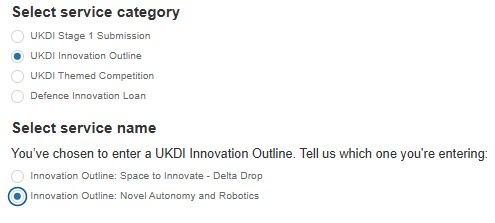
For stage 2 submissions there is a separate UKDI Innovation Outline option. You will be asked for an abstract on the Summary page. As you will have been invited to submit please enter “N/A” into this field. You will be asked about your enquiry under the Innovation details section of the submission.
Non-technical questions about the competition process should be sent to the UKDI Help Centre, accelerator@dstl.gov.uk.
5. Competition scope
5.1 Background
The Autonomy Programme vision 2026-29 is:
“To lead the discovery and maturation of autonomous technologies, enabling Defence to rapidly adopt, integrate, and gain decisive operational advantage from autonomy.”
As the novel Science and Technology (S&T) function within the Programme, the Autonomy Incubator project has 3 core objectives:
- To explore novel autonomy technologies and concepts to support integration into future capability.
- To support the development of a resilient and collaborative UK Defence supplier ecosystem for Robotics and Autonomous Systems (RAS).
- To enhance Defence’s ability to assess the implications of novel RAS technologies.
As such the project seeks to identify and develop a breadth of novel and innovative technologies for autonomous air, maritime, and land systems which may have a significant or game-changing impact on future military capability.
This call is to address the objectives above by identifying and exploring novel and potentially disruptive ideas within the UK supplier base that may impact future Defence capability. Areas of S&T that may be applicable to this call are broad, however, ideas must be novel and must have the potential to be applicable in some form to improving future RAS capability. As guidance - ideas may lead to (but are not restricted to) improved:
- physical robotics aspects (e.g. propulsion, power storage, sensors, structural components, communications, actuators, effectors and overall design paradigms)
- methods of managing, integrating and using information from different sources (giving rise to e.g. improved navigation, increased ability to function when information sources conflict, better discrimination of objects in the environment, improved ability to operate in non-benign conditions, improved efficiency/ range)
- high level autonomous behaviours/system intelligence
- wider interactions (e.g. system of systems coordination, human-machine interaction, swarming)
- system survivability (e.g. improved ruggedness, resilience to attack, stealthiness, graceful degradation).
We are looking for novel ideas starting at TRL1-2, that can be further explored to better understand their ability to impact on future Defence capability. We will prioritise proposals with the potential to have the greatest impact on Defence, including through disruption of traditional technologies or ways of thinking.
5.2 Scope
This competition is for 2 Phases of work. Project Phase 1 is an initial proof of concept and must be completed within 3 months. Project Phase 2 will be open to those successful in Project Phase 1 and, wholly at the discretion of MOD, may lead to a task to further develop an idea or concept.
For this competition we define Proof of Concept as ideas that
- demonstrate that a novel idea is technically feasible
- produce early experimental evidence
- do not need to deliver prototypes or systems
Project Phase 1
This competition is interested in the proving of early-stage S&T ideas. It is about testing out a new idea and demonstrating that it may have potential. It is not about maturing or developing a working system or concept, but about demonstrating that something new might be achievable. Projects with a high risk of failure are acceptable.
Proposals should include:
- Novel S&T – completely new science or approaches. This also includes S&T known in other sectors but not applied in Defence.
- Research that is potentially speculative, uncertain, or high risk – however it must have a basis in scientific theory.
- Low Technology Readiness Level (TRL) ideas – we are seeking to accelerate low TRL (1-2) research.
- Ideas that may radically alter how we do things in the future, give rise to a new type of capability or a new type threat (that we could need to counter).
This competition is NOT interested in proposals that:
- are for S&T that is greater than TRL 2 at the start of the contract – it can be any TRL at the end – but realistically we are trying to prove concepts, so TRL3 or 4 is probably a realistic maximum;
- constitute consultancy, paper-based studies or literature reviews which just summarise the existing literature without any new S&T developments;
- develop process designs, architectures, standards, or code improvements in isolation from other novel developments;
- are an unsolicited resubmission of a previous DASA or UKDI bid;
- are incremental improvements in existing systems or technologies;
- are existing products rebadged as novel technology;
- cannot be applied to improving robotics and autonomous systems within Defence;
- offer demonstrations of off-the-shelf products requiring no experimental development (unless applied in a novel way);
- offer no real long-term prospect of integration into defence and security capabilities;
- offer no real prospect of out-competing existing technological solutions ;
All proposals must:
- be for early stage S&T research that has application to an aspect of robotics, autonomous systems, or how humans can interact with them;
- articulate the benefit to Defence and the potential to disrupt. Why should Defence care and what should we be excited or worried about?
- state the innovation or a creative approach;
- describe the fundamental scientific or theoretical basis – it must show grounding in science;
- highlight the potentially disruptive impacts and use cases (both positive, negative, opportunity and threat) within Defence;
- be for short term projects completing within 3 months of contracting and finishing by 31 March 2027, for Project Phase 1;
- be for a total contract value of less than £60,000 for Project Phase 1;
- tell us how you plan to take forward or prove the S&T within this project;
- tell us what its future viability might be and the potential future development paths;
- agree to present the final outputs of Project Phase 1 and outline a proposed approach to Project Phase 2 at a MOD board;
- describe the final deliverables to be produced, which must as a minimum include a short (15-20 page maximum report on the work) and slides for the board presentation.
Note: given the timeframe of the work suppliers should not require any Government furnished information and the work should not require ethical approval of any type.
Project Phase 2
On completion of Project Phase1, some projects may be taken forward to Project Phase 2. At the MOD board at the end of Project Phase 1 suppliers will present the outcomes of the work undertaken and suggest how this work could be taken forward to the next phase.
The board will decide from which suppliers, if any, to request a Phase 2 proposal. The decision to request Phase 2 proposals, and the decision to take forward any of those proposals once received, will be entirely at the discretion of MOD.
Phase 2 proposals will be for up to £200,000 over a 1-year period.
5.3 Exploitation
The outcomes of your proposal may be exploited through one or more of the following, depending on the nature of the idea/concept:
- Further development through the Autonomy Incubator project
- Further development through and integration into the Autonomy Programme Challenge areas
- Incorporation into a responding programme within Dstl linked to domain
- Exploitation through UKDI, an appropriate MOD unit or Front Line Command (if single domain)
Successful bidders will be offered the opportunity to present on their project to a range of MOD stakeholders at the Defence Autonomy Research Collaboration conference in either 2026 or 2027
6. Overview of some of the robotics and autonomy challenges in Defence
Below is a flavour of some of the challenges that the Ministry of Defence faces associated with deployment of robotics and autonomous systems. This is intended to give those not involved with Defence some background into the issues we face. These areas should not be taken to be the only areas of interest, and bids will not be given priority based on their ability to address these challenges over others.
Ideas in this call are not expected to be developed enough to directly address any of these challenges or issues but may in the future contribute to systems that may address them.
Swarming Uncrewed Air Systems
This example challenge area seeks to understand how autonomy can be used to help Uncrewed Air System (UAS) swarms make good decisions about how to proceed with a mission in an environment where communications with a human operator are likely to be severely degraded, and perhaps even denied. The challenge is therefore to develop an approach that can determine the best way to proceed with a task without operator intervention. Sensor/perception information may potentially be from several different payloads (which may or may not be located on the same platform in the case of a swarm) and may be from several different sensor modalities.
Maritime Autonomous Systems
Maritime Autonomous Systems (MAS) are required to operate reliably over extended durations and in comms limited environments. Over a single mission, MAS can be required to operate across varying environments, mission complexities, and levels of operator oversight. This challenge is aimed at developing capability to support the future navy, with MAS operating in mixed fleets of crewed and uncrewed systems underwater, on water and in the air.
Land Autonomous Systems
Autonomous Uncrewed Ground Vehicles (UGVs) have the potential to be used in a range of roles within the British Army such as logistics, reconnaissance, casualty evacuation (CASEVAC), and minefield clearance. However, autonomous UGVs are currently not in service in the British Army because the fundamental autonomy is not robust enough to be reliably used, except for some very specific and favourable situations and conditions, e.g. short distance on-road movement in uncluttered environments. Having a single operator commanding many uncrewed systems, allows the British Army to increase combat mass, but this is only achievable if the on-board autonomy is effective and robust. The central challenge is achieving reliable/robust autonomous navigation across a variety of terrain types and conditions.
All the above challenges are aided through better autonomous decision-making, navigation, communication in degraded RF environments, endurance, sensing, propulsion, and many other factors.
7. Critical elements to include
7.1 Submission Stage 1
Stage 1 submissions must include the following elements:
- A description of what you propose to develop, demonstrating alignment with the scope
- A summary of how your S&T is likely to function along with expected performance parameters, if known. Where possible include any evidence to support your claims (open-source literature, test results, etc.)
- Any constraints on the use of your S&T (large power requirements, etc.)
- Demonstrates how your proposal is new and innovative
7.2 Submission Stage 2 (by invitation only)
When writing your proposal, ensure you have:
- prioritised the Competition requirements but also included a brief (un-costed) outline of the next stages of work required for exploitation
- included a list of other government funding you have received in this area. Making it clear how this proposal differs from that work
- included a detailed project plan with clear milestones and deliverables. Deliverables need to be well defined and designed to provide evidence of progress against the project plan. Your deliverables must include a written final report and presentation. The final report must include plans for potential future work to further develop the technology
- planned (and costed) attendance at the following meetings , which will all be in the UK.
- a kick-off meeting at the start of Project Phase 1. This will be in person at the suppliers site, unless mutually agreed with Dstl to be elsewhere or via MS Teams.
- 30 minute fortnightly catch-ups with the appointed Technical Partner and Project Manager (and other discussions as appropriate);
- the presentation to the MOD board at a UK venue (Venue to be confirmed)
The presentation will be in person. Other meetings may be virtual. Slides presented at these meetings should be appropriately marked and made available
- identified any ethical / legal / regulatory factors. Associated risks should have been added to the Risk Register in Step 5 of the submission service along with details of how they will be managed, including break points in the project if approvals are not received
8. Accelerating and exploiting your innovation
As this competition is looking for low TRL research and development it may not be able to articulate exploitation in great detail. It should be clear in your Stage 2 submission that there is credible advantage to be gained from the technology development. You should consider
- expected next steps beyond the end of Project Phase
- future applications and wider markets for exploitation
- product testing
- any specific legal, ethical, commercial or regulatory considerations for exploitation
9. Pre-sift Criteria for Submission Stage 2
Before your Submission Stage 2 proposal is assessed, all proposals will be checked for compliance with the UKDI pre-sift criteria. Proposals will be rejected before full assessment if they do not comply.
For more information on how your proposal will be assessed please read Assessment process and criteria.
Novel Autonomy pre-sift criteria are as follows:
| Criteria | Measure - Within scope (Pass) / Out of scope (Fail) |
|---|---|
| The proposal was invited to submit into Stage 2 | Pass / Fail |
| The proposal outlines how it meets the scope of the competition | Pass / Fail |
| The proposal explains how it meets the UKDI criteria (Desirability, Feasibility, and Viability) in the relevant questions in Step 3 of the submission service | Pass / Fail |
| The proposal must contain a financial plan, a project plan and a resourcing plan which demonstrate how the work proposed will be completed | Pass / Fail |
| The delivery schedule within your proposal includes evidence of a written final report and an in person presentation with slides to a MOD board | Pass / Fail |
| The starting TRL level is below 3 and there is a TRL increase during the project | Pass / Fail |
| The proposal confirms there is no need for MODREC | Pass / Fail |
| The proposal confirms there is no need for GFX | Pass / Fail |
| The proposal does not contain attachments that have been used for additional text data over the stated word counts in Desirability, Feasibility, Viability and Additional Information | Pass / Fail |
| If the proposal is a resubmission of a previous one, it adheres to the resubmission guidelines | Pass / Fail |
10. How your proposal will be assessed
Submission Stage 1
Submissions into Stage 1 of this competition will be reviewed by the Dstl competition team. Those that are selected will be invited to submit a more detailed proposal into Stage 2.
Submission Stage 2
Stage 2 proposals that are compliant will be assessed against the standard UKDI assessment criteria (Desirability, Feasibility and Viability) by subject matter experts from the MOD (including Dstl), PAG and the front-line military commands. You will not have the opportunity to view or comment on assessors’ recommendations.
UKDI reserves the right to disclose on a confidential basis any information it receives from innovators during the procurement process, which includes the full proposal, to any third party engaged by UKDI for the specific purpose of evaluating or assisting UKDI in the evaluation of your proposal. In providing such information you consent to such disclosure. Appropriate confidentiality agreements will be put in place.
After assessment, proposals will be discussed at a Decision Conference where funding decisions are made based on the assessments, budget and wider strategic considerations.
Innovators are not permitted to attend the Decision Conference.
11. UKDI Terms and Conditions
Please read the UKDI contracting guidance which contain important information for innovators. For this competition we will be using the Innovation Standard Contract (ISC), Terms and Conditions. Information on the relevant DEFCONs can be found by registering on the Knowledge in Defence site.
We require unqualified acceptance of the Terms and Conditions. Where innovator organisations have a commercial department they will need to provide acceptance.
We will use deliverables from UKDI contracts in accordance with our rights detailed in the contract Terms and Conditions.
11.1 Feedback
Proposals that are unsuccessful will receive feedback in the form of bullet points and a couple of short paragraphs after the Decision Conference.
Where a proposal meets the fundable requirements for a competition, but is not funded, UKDI will continue to seek funding and shall consider your proposal fundable for 12 months from the date of the feedback release.
We will share the abstract, PVPS and title of your proposal with partners across His Majesty’s Government that may express an interest in funding the proposal through UKDI, in accordance with the competition document. We may also share this information on our cross-government Ideas Marketplace platform to foster collaboration and attempt to elicit funding. If partners across His Majesty’s Government wish to read the full proposal to decide if they will fund it, we will share the full proposal with them without seeking your permission if it is within 60 days of the feedback release date. If it is over 60 days since the feedback release date, we will seek your permission before sharing the full proposal with them.
For other potential funders, we will seek your permission before sharing the full proposal regardless of the number of days since the feedback release date.
In the event that funding becomes available, UKDI may ask whether you would still be prepared to undertake the work outlined in your proposal under the same terms. Your official UKDI feedback will indicate if your proposal was deemed fundable, but not awarded funding at the time.
12. If your proposal is recommended for funding
Funded projects will be allocated a Project Manager (to monitor the project) and a Technical Partner (as a technical point of contact). In addition, the UKDI team may work with an innovator to support delivery and exploitation including, when appropriate, introductions to end-users and business support to help develop their business.
12.1 Cyber Security Model
The Cyber Security Model (CSM) is how Defence builds cyber security into its supply chain.
On receipt of a FUND decision, successful innovators (and their sub-contractors) must prove cyber resilience before the contract is awarded. The start of this process is the submission of a Supplier Assurance Questionnaire (SAQ). The SAQ allows innovators to demonstrate compliance with the specified risk level and the corresponding profile in Def Stan 05-138, and the level of control required will depend on this risk level.
To expedite the contracting time of successful innovators we ask all innovators to complete the SAQ before they submit their proposal (this is not mandated). The SAQ must be completed using the Risk Assessment number RAR-SLWSHVL.
The SAQ will be automatically scored against the Cyber Risk Profile (CRP) and you will be immediately informed of the outcome, compliant or not compliant.
If non-compliant, you will be required to complete a Cyber Improvement Plan (CIP) before the contract is placed which will need to be reviewed and agreed with the relevant project manager. The CIP template can be found here.
Before you start your SAQ you will need:
- the Risk Assessment Reference (RAR) RAR- SLWSHVL Level 1
- a D-U-N-S number (a unique identifier for your organisation)
- a GOV.UK One Login
13. Points of Contact
During the competition phase all correspondence must be via the UKDI Points of Contact detailed below.
While all reasonable efforts will be made to answer queries, UKDI reserves the right to impose management controls if volumes of queries restrict fair access of information to all potential innovators.
13.1 UKDI Help Centre
Competition queries including on process, application, commercial, technical and intellectual property aspects should be sent to the UKDI Help Centre at accelerator@dstl.gov.uk, quoting the competition title. UKDI cannot guarantee a response to a query after 28 July 2026 for stage 1 submissions and 3 September 2026 for stage 2 submissions, 2 weeks before the stage submission deadlines.
13.2 Innovation Partners
To contact your innovation Partner see Section 4.2
14. Novel Autonomy and Robotics Themed Competition Clarifications
14.1 Competition Structure
The competition comprises two phases. Projects must begin at Technology Readiness Level (TRL) 1 or 2 and progress through defined development stages.
Phase 1: Feasibility and Early Development
Funding: Up to £60,000
Duration: Up to 3 months
Phase 1 supports early-stage research and development activities intended to increase the maturity of technologies currently at TRL 1 or 2. Projects are expected to achieve TRL 2 to TRL 4 by the end of the Phase 1 period.
Phase 1 is delivered through a two-stage application process.
Stage 1: Outline Proposal (Deadline 11 August 2026)
Applicants must submit a short proposal that explains:
- The technology or capability being developed.
- The innovation and novelty of the proposed approach.
- The potential relevance and value to Defence.
Outline proposals will be assessed within approximately four weeks of submission. Following assessment, applicants will be notified whether they have been selected to proceed to Stage 2.
Stage 2: Full Proposal (Deadline 17 September 2026)
Only applicants invited from Stage 1 may submit a full proposal.
The full proposal must include:
- A detailed description of the proposed Phase 1 work.
- A structured work plan with milestones and deliverables.
- A detailed financial breakdown of project costs.
- A description of the expected technical outcomes and TRL progression.
At the conclusion of Phase 1, successful projects must present their outcomes, findings, and future development potential to a Ministry of Defence (MOD) review board.
Phase 2: Further Development (Dates to be confirmed)
Selected applicants will be invited to propose further work for up to £200,000 in value over a period of 12 months
14.2 Intellectual Property (IP)
Questions:
- How does Dstl protect the IP of the proposer for a ‘good idea’. Will the idea not be floated across the established big suppliers as part of the assessment who then take it forward as their own?
- Can you confirm that the IP position for the call will be DEFCON 705?
- What are the views on the universities publishing low TRL outcomes from Stage 1 in peer reviewed international conferences/journals?
This competition will be using DEFCON 705. Under these terms any intellectual property (IP) generated by the Contractor is vested with that organisation, not with MOD/Dstl. MOD however secures rights to use this information, in confidence, for its government purposes, which are detailed in Clause 12 of the DEFCON. The assessment of the proposals submitted into both stage 1 and Stage 2 of the competition will not involve any organisations outside of UK government. We handle all information we receive in proposals in confidence and distribute it, in confidence, only to those involved in assessment and moderation. The information shall only be used for the purpose of deciding whether to fund the proposals. Details of the proposal, outside of title and abstract, will be removed from our system 12 months after funding decisions are made.
Publication is generally encouraged; however express written permission should first be sought in accordance with Clause 8 of DEFCON 705.
14.3 Eligibility
Questions:
- Can universities or sole traders apply, or do you need to be a registered company?
- What limitations are there around subcontracting all or part of the work?
- Are collaborative bids with UK or overseas companies permitted?
- Can companies submit multiple proposals?
- Do employees involved require a certain level of security clearance?
- What is meant by ‘all work to be undertaken in the United Kingdom’
The competition is open to academia, sole traders, SMEs or larger organisations. Bids may be submitted from single entities or consortia. We ask that a submission is made by a single entity who will raise invoices for the work undertaken. Payment will be made to that organisation who must make their own arrangements to distribute to other members of a consortium or to sub-contractors. The only restriction is that work must be undertaken in the United Kingdom. Obtaining parts or components from overseas is permitted, as is the use of overseas people to advise on work undertaken in the UK.
It is possible to make more than one submission, but we ask that people consider the resourcing required should all bids be successful. We suggest discussing with your Innovation Partner to explore possible approaches.
All people involved in the work will need to be security checked but this does not mean having a specific security clearance. Details of your project team will be requested in the stage 2 submission.
The requirement for all work to be undertaken in the United Kingdom relates to the actual research work. Components and consumables may be purchased from overseas, and overseas consultancies may be used in an advisory capacity but payment to an overseas consultant would not be permitted.
14.4 Finance and Project management
Questions:
- Will the proposal value be required for Stage 1 submission?
- Is funding received based on 100% of full economic cost?
- Is the £60,000 cap inclusive or exclusive of VAT?
- What are considered eligible costs for this competition?
- What are the payment conditions?
For Phase 1 projects we will only require full detailed costs if you are invited to take part in Stage 2. The cost cap per proposal is £60,000 excluding VAT and funding is awarded on a 100% basis; there is no match funding requirement.
The Stage 2 submission will require you to breakdown costs into
- Labour Costs
- Capital Cost
- Material/Consumable Costs
- Overhead Costs
- Travel and Subsistence Costs
- Subcontracting Costs
Items excluded from funding include, but are not limited to:
- Publication and conference costs unrelated to the needs of the competition
- Patent costs
- Any work not related to the needs of the competition
- Costs of preparing the bid
Payment will be made in accordance with the published Draft Terms and Conditions (Clause 13c), within 30 days of receipt of valid and undisputed invoice. Given the short duration of the project it is expected that payment will be after completion of the project.
14.5 Scope
Several technology areas were raised during the meeting to ask about scope. These are detailed below.
| Technology Area | Comments |
|---|---|
| Space Applications | Not out of scope but demonstrate the technology will have broader use than just space domain. |
| Lethal/strike effectors used by robotic systems | For this area you should refer to the UK Government’s position on lethal autonomous weapon systems and AI (link). For this competition we are interested in the novel autonomy and robotics aspects and not just supporting technology/payloads that could be applied to any platform (i.e. we are not interested if it does not have a uniquely disruptive impact when combined with RAS). |
| Novel Counter UAS solutions | Not out of scope as a use case but we are interested in the novel RAS elements. |
| Stealth technologies | In scope but needs to clearly explain how it relates to autonomy and robotics. |
| Energy harvesting, Energy storage, Propulsion technologies, Ultra-low power robotics, Heat exchangers | For supporting technologies like these we would like to know what is truly disruptive and novel about your technology and how it is specifically relevant to autonomy and robotics. |
| Human machine interaction | In scope |
| Quantum technologies | In scope |
| Operation in comms or navigation denied areas | In scope |
| Capability-based autonomous system payloads rather than key RAS components | Ensure you have explained the RAS novelty that makes this uniquely disruptive? |
| technologies that improve how autonomous systems retain experience, adapt over time and sustain intelligent behaviour throughout extended operations | In scope. Note that we are not looking for incremental improvement over existing approaches. |
14.6 Process
Questions:
- Will feedback be given after Stage 1?
- What are expectations for the end of Phase 1 presentation?
- What is the approximate timeframe for Phase 2 activities?
It is not intended to offer detailed feedback on the proposals at the end of Stage 1. You will receive an indication of which of the review factors detailed in the introduction (alignment, delivery potential and meeting needs), was the main reason for not being invited into Stage 2.
Successful Phase 1 suppliers will be required to attend a UK based venue towards the end of March 2027 to give a 20 minute presentation of the work completed during phase 1. A further 10 mins will be allowed for questions from the MOD board. The supplier will just be expected to attend their allocated timeslot.
It is expected that agreement to any Phase 2 programme of work will commence shortly after the Phase 1 MOD presentation. It is difficult to determine precise times, but contract start during Q2 2027 is anticipated.
By introducing the 2 stage process for Phase 1 we are expecting to reduce the total time for a competition (Competition Open to Funding Decision) by about 25%; and looking to take 4-5 weeks off of a 22 week process.
14.7 General
Questions:
- Is UKDI targeting large/small SMEs and universities?
- Does UKDI replace DASA?
- Given that UKDI stated it is looking beyond its traditional defence suppliers, will ideas submitted by organisations that are not traditional defence suppliers be preferred over ideas from organisations that are traditional defence suppliers?
UKDI is a larger organisation sitting under the NAD group and as such doesn’t replace DASA. UKDI will continue to support innovation from all organisation types to meet the needs of Defence. Part of this will be in the form of competitions similar to those run by DASA.
UKDI is interested in developing ideas from across the industrial sector from larger defence primes through to SMEs and academia. All ideas submitted will be reviewed based on their fit to the competition requirements irrespective of the organisation type.