Northern Growth Strategy: Case for change
Updated 19 March 2026
Applies to England

© Crown copyright 2026
This publication is licensed under the terms of the Open Government Licence v3.0 except where otherwise stated. To view this licence, visit nationalarchives.gov.uk/doc/open-government-licence/version/3 or write to the Information Policy Team, The National Archives, Kew, London TW9 4DU, or email: psi@nationalarchives.gov.uk.
Where we have identified any third party copyright information you will need to obtain permission from the copyright holders concerned.
This publication is available at https://www.gov.uk/government/publications/northern-growth-strategy-case-for-change/northern-growth-strategy-case-for-change
Ministerial foreword
1. The North of England is home to world-famous towns and cities, a vibrant and dynamic culture, beautiful countryside and proud and passionate people. Its history is intertwined with industry and enterprise – the waterways, railway viaducts, and civic architecture reflecting the region’s contribution to the development of both the industrial revolution and the modern global economy. The North has always been at the forefront of innovation and creativity, whether in the development of the first public steam railway and the first computer, or the region’s immense creative, sporting and cultural impact. Today, the North is home to 16 million people, with an economy that supports 8.1 million jobs and represents one fifth of the UK’s Gross Value Added, equivalent to £476 billion.
2. The decline of heavy industry in the late 20th century hit parts of the region hard and left deep seated pockets of inequality and poverty. But there has, in recent times, been recovery and stories of incredible transformation. Cities in the North have seen remarkable regeneration and dramatic increases in city centre populations, emerging as cutting-edge centres in the Industrial Strategy’s growth-driving sectors like Financial Services, Professional and Business Services, Creative Industries, Digital and Tech and Life Sciences, as well as fantastic places to live, to work and to start a business. The East Coast, from the Humber to the North East, is at the forefront of Clean Energy Industries, towns like Blyth are positioning themselves at the heart of the AI revolution, while places like Barrow and regions such as South Yorkshire are set to be transformed by generational investment in defence. As a result, the North is now home to some of the country’s fastest growing city regions. But the gap to its potential is still too large, productivity and growth rates are still too low, and too many people and places are not sharing in the proceeds of a more inclusive growth.
3. Boosting growth in the North and ensuring it is lifting living standards is critical to unlocking national economic growth, which is the number one mission of this government. The potential national economic gains to boosting growth in the North are large – just growing the North’s five most populous Mayoral Strategic Authority areas’ productivity to the national average could add around £40 billion per year in Gross Value Added, alongside around £15 billion per year in fiscal revenues. Of course, while such gains would themselves be significant, they do not constitute the limit of either the North’s potential or the government’s ambition.
4. Recent economic successes in the North have been underpinned by stronger local institutions and local leadership, building on the vision of pioneering civic leaders and the development of the MSAs, first spearheaded by Greater Manchester. But too often, local leaders have not been sufficiently backed by central government – with pepperpot funding, empty slogans or false promises on infrastructure investment.
5. To make more of the immense opportunity before us, this government has a different approach: driving forward the right national strategies and reforms for growth, empowering and working in genuine partnership with local leaders, rewiring the way government works to support them, backing their Local Growth Plans and focussing national investment to support those local priorities. This is embodied in the reforms set out in the English Devolution White Paper, which are being put on a statutory footing through the English Devolution and Community Empowerment Bill, including an ambitious new framework for English devolution, moving power out of Westminster and giving it to the local leaders who know their areas best.
6. We need to make the most of our investment in the North with a comprehensive policy plan that can have impact now and throughout the Parliament. We must support the start-ups, scale-ups, and backbone of medium-sized and large firms across the North with a strong local connection and long-term outlook, alongside efforts to expand and densify city centres alongside new transit routes . We must revitalise towns and communities, and amplify the visitor economy in the region’s five national parks, cultural assets, and heritage sites. And we must nurture the North’s world class strengths in the Industrial Strategy’s growth-driving sectors and emerging clusters in future industries, while supporting people with the skills they need to make the most of these new opportunities. In the spring, the government will set out further detail on its economic plan for the North in partnership with northern local and business leaders. The North once kept the nation’s lights on and can again power the cutting-edge sectors of the future with the right long-term plan delivered in partnership between government, local leaders and businesses.
7. Nowhere is historic underinvestment in the North felt more than in transport. The government is already making great strides to correct this, with a transformative £10.4 billion of funding for mass transit and local transport upgrades across the region, the £11 billion Transpennine Route upgrade currently underway – on time and on budget – and record investment to fix potholes and better maintain the roads.
8. The plans the government is setting out today for Northern Powerhouse Rail takes this work further, transforming the North’s railways over the coming decades, joining the nearby city regions either side of the Pennines together into a growth corridor, and improving connectivity between this corridor, the North East and beyond. To lift living standards across the North, it is critical that economic growth is not just experienced in a handful of city centres, but generated and felt across the region’s great towns like Rotherham, Huddersfield, Wigan, Washington and Warrington too. We must better connect more residents across the North to opportunities, allowing people to get about and get ahead.
9. This government is determined to address the cost of living challenges that people are facing and to boost living standards across the country. The government’s plan for the North, added to today with Northern Powerhouse Rail, will do just that.
The Rt Hon Rachel Reeves MP
Chancellor of the Exchequer
The Rt Hon Heidi Alexander MP
Secretary of State for Transport
The Rt Hon Steve Reed OBE MP
Secretary of State for Housing, Communities and Local Government
The economy of the North
1. Delivering economic growth is the government’s number one mission. The government is restoring stability, increasing investment, and reforming the economy to drive up prosperity and living standards across the UK. Across the country, the government is putting in place the right national strategies and reforms for growth, and empowering local leaders to deliver on the ground – backing them and their Local Growth Plans to make the most of the opportunities in each area.
2. The North of England is at the heart of this agenda. Addressing the North’s long-standing productivity gap is a crucial part of the government’s national plan for growth. Narrowing the gap to the North’s potential can generate higher, more broad-based national growth, while the region’s existing sectoral strengths offer opportunities for business investment and employment, supporting living standards across the region.
The productivity challenge
3. The productivity of the northern regions has been behind the UK average for several decades, due to a history of underinvestment and the legacy of past economic shocks. The productivity of northern England was 9% lower than the UK average in 2004[footnote 1] and 26% lower than London and the South East[footnote 2]. This remained the case in 2023, where the productivity of northern England was 10% lower than the UK average and 25% lower than London and the South East.
4. This pattern is particularly apparent in the North’s largest cities and their surrounding regions. Cities should be engines of growth, yet the North’s largest cities have been less productive than the rest of the UK and similar-sized international cities for several decades. Despite recent productivity growth of 2.2% per year in the largest northern Mayoral Strategic Authorities (MSAs), higher than the UK average productivity growth rate of 0.7%,[footnote 3][footnote 4] they still lag behind UK average productivity by 11%.[footnote 5]
5. This gap between northern cities and the UK average stands in contrast to the performance of many comparable cities in the OECD, which are typically much closer to or perform above their national average in terms of productivity.[footnote 6]
Figure 1: Productivity (Gross Domestic Product per worker) across select UK and European cities, OECD Functional Urban Areas, 2004 to 2019.[footnote 7][footnote 8]
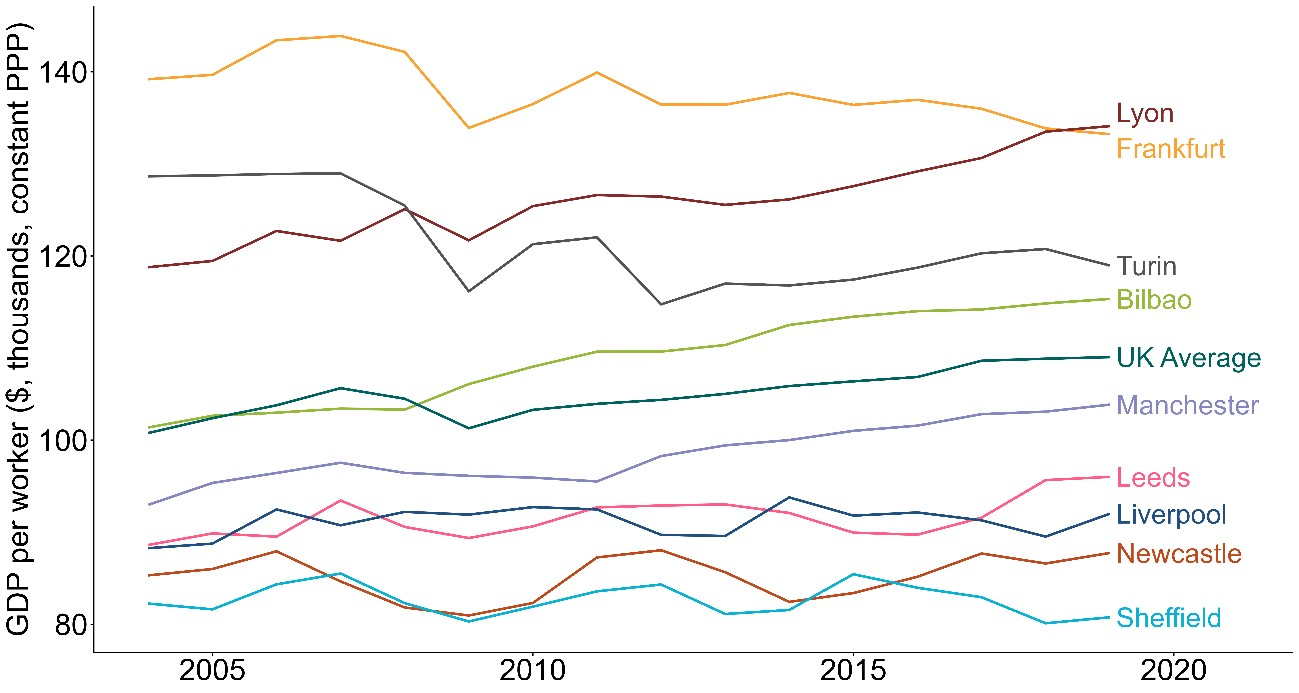
6. The economic performance of the North’s largest cities has anchored lower productivity across their wider city regions. Economic outcomes in communities across the North are strongly influenced by the success of their nearest city – towns and villages with more commuting connections to cities have higher incomes than those with fewer connections, whilst thriving cities provide high skilled jobs, services, opportunities and amenities that are crucial to boosting incomes and quality of life in these nearby areas.[footnote 9]
7. The economic outcomes seen across the North and its city regions are driven by multiple, interconnected factors. Achieving sustained growth will therefore require coordinated changes across a broad range of issues, including:
a) Improving residential housing density in city centres and connectivity within and between city regions: increasing the density of northern cities is essential to unlocking agglomeration benefits and driving productivity growth across northern city regions. Northern cities have much lower numbers of people that can access city centres within reasonable commuting times compared to international counterparts, and lower residential population densities, meaning there is a smaller pool of workers which firms can access and fewer job opportunities available to workers.[footnote 10][footnote 11] Only 38% of residents can access the city centre of Leeds within 30 minutes by public transport compared to 87% in Marseille, a similar sized city.[footnote 12] In South Yorkshire, 28% of the population live within 30 minutes of Sheffield’s city centre and connectivity along the Rotherham-Sheffield corridor suffers from poor public transport links, suggesting limited access to tradable jobs in South Yorkshire (50% of which are located in Sheffield’s city centre).[footnote 13] At the same time, accessibility by car is also constrained in the North’s cities compared to many US cities.[footnote 14]
b) Increasing the historically low levels of business investment in the region: northern regions also have lower investment per worker which acts as a drag on growth. For example, total investment per job in the North West is £9,200 per job compared to £13,000 in London.[footnote 15] Lower investment per worker constrains the productivity of firms and the workforce through the slower adoption of new technologies and upgrade of equipment.
c) Improving educational opportunities and graduate retention: northern cities also have lower shares of residents who go to university and lower shares of graduate retention. 40% of young people in London graduate from university compared to only 27% in Sheffield and 29% in Liverpool.[footnote 16] Similarly, northern regions have a higher share of individuals aged 16-64 with no qualifications: nearly 10% in the North East compared to 4.8% in the South West.[footnote 17] Addressing these disparities in education and graduate retention is critical to building a skilled workforce to support long term economic growth across northern regions.
8. Beyond the largest city regions, across the North productivity is also typically lower than elsewhere in the UK. Other cities and towns[footnote 18] in the North, such as Hull, Blackburn and Chester were on average 6% less productive than similar-sized towns and cities in other parts of the UK in 2023.[footnote 19] The wider regions including these smaller cities and towns can provide alternative locations for smaller agglomeration economies to grow, which may suit specific businesses, workers and sectors key to national prosperity. Enhancing connectivity is key to enabling these smaller cities and towns to build on local strengths and contribute to productivity growth in their region, complementing growth of large city regions.[footnote 20]
9. Unlocking higher productivity in all of these areas is central to the government’s national economic plan, but it also delivers more than growth – it unlocks opportunity, boosts living standards, and supports quality of life.[footnote 21]
The opportunities
10. Despite lower overall productivity across the North, recent years have seen promising signs of progress: places like Sheffield and Newcastle have grown roughly twice as fast as the UK average since 2019 whilst Manchester and North East Lincolnshire have grown over 4 times as fast.[footnote 22][footnote 23] Today the North is home to significant strengths and economic assets, with its economy representing one fifth of the UK’s Gross Value Added (GVA), equivalent to £476 billion.[footnote 24]
11. As set out in MSAs’ Local Growth Plans and outlined in the table below, each region across the North has key economic strengths, with the potential to support transformational growth, if coupled with sustained investment in transport connectivity, skills, research and development and inward investment. Better connecting people and businesses across the North helps workers access greater job opportunities and improves access to workers, supply chains and customers for businesses, driving sustainable productivity growth across the whole region.
Table 1: Examples of the North’s major economic assets and strengths
| North West | North East | Yorkshire and the Humber |
|---|---|---|
|
Advanced Manufacturing: World-leading research facilities and manufacturing clusters, with Jaguar Land Rover and Ford in Liverpool and the Greater Manchester Advanced Materials and Manufacturing Investment Zone. Clean Energy Industries:Home to a nuclear fission cluster with Springfields, Capenhurst and Sellafield and the HyNet CCUS cluster. Life Sciences: Liverpool’s Knowledge Quarter, Life Sciences Innovation Zone, Sci-Tech Daresbury and bio-manufacturing cluster. Greater Manchester’s Oxford Road Corridor, the Christie and UK BioBank HQ and Cheshire’s Alderley Park. Digital and Technologies: The North West cyber corridor with GCHQ Manchester, the Greater Manchester Digital Security Hub, with Sci-Tech Daresbury and the Hartree National Centre for Digital Innovation in Liverpool. Professional and Business Services: Greater Manchester hosts the largest Professional and Business Services sector outside London. Creative Industries: MediaCityUK and BBC North, the planned Littlewoods world class film and TV studios and production space and over 50 active gaming companies in Liverpool. Defence: Concept to delivery manufacturing, digital and cyber strengths with GCHQ Manchester and Cammell Laird in Liverpool’s crucial shipbuilding and maintenance capabilities. Financial Services: Greater Manchester hosts BNY, Vanguard and Klarna, with a strong Fintech sector. |
Advanced Manufacturing: Nissan and Automotive Energy Supply Corporation’s electric vehicle battery gigafactory in Sunderland, and Northumbria University’s North East Space Skills Technology Centre. Clean Energy Industries: The region has strengths in offshore wind, benefitting from world-leading R&D at the Offshore Renewable Energy catapult in Blyth, Northumberland, and the development of a state-of-the-art subsea cable manufacturing facility in nearby Cambois. Creative Industries: Centre for Writing, Generator, Sunderland Music City and Newcastle’s Quayside studios with Warner Music. Defence: Octric Semiconductors, Compound Semiconductor Applications Catapult and Space Skills and Technology centre. Life Sciences: Centre for Process Innovation, National Horizons Centre, and the National Innovation Centre for Ageing. Digital and Technologies: Planned data centres at Blyth and Cobalt, and the recent announcement of an AI Growth Zone for the region, have strengthened the North East’s position as a hub for AI development. |
Advanced Manufacturing and Defence: South Yorkshire’s manufacturing cluster around the Advanced Manufacturing Research Centre, with Boeing, McLaren and Rolls Royce. A sovereign production and innovation hub, anchored by Sheffield Forgemasters, BAE and one of the country’s first Defence Growth Deals. York and North Yorkshire hosts leading Agri-Tech innovation institutions such as the University of York and Uk AgriTech centre. Clean Energy Industries: The Humber is a centre for offshore wind energy, with some of the world’s largest wind farms off its coastline, and anchor employers like the Siemens Gamesa blade factory in Hull. Creative Industries: Home to Channel 4, Games Republic and Production Park, West Yorkshire has strengths in music, film and TV, fashion and textiles. Financial Services: A growing financial services, fintech and digital ecosystem is leading the development of a ‘Northern Square Mile’ in Leeds, supported by the presence of the Bank of England, National Wealth Fund and Financial Conduct Authority, inward investments from fintech firms such as GoCardless, and a thriving Professional and Business Services sector. |
12. Over recent years, the North has been at the forefront of England’s devolution journey, with its elected mayors acting as pioneers in the use of new powers to direct positive economic change and is set to be the first part of England to be fully covered by MSAs. MSAs in the North have matured over recent years into bodies that will lead the next phase of the region’s economic story. Mayors and local leaders are well placed to spearhead this, reducing regional productivity gaps, pivoting towards more productive and new sectors, and developing a more diverse mix of assets across growth-driving sectors. Councils across the North will also continue to play a fundamental role in this journey, building on the successes of previous city leaders which have made the region a more vibrant and economically dynamic place to live and work.
The case for action
13. Addressing the North’s longstanding productivity gap is key to boosting national economic growth and spreading opportunity. This is particularly important in the North’s large city regions which could be engines of national growth but currently lag national and international benchmarks. Just raising productivity in the five most populous MSA areas in the North – Greater Manchester, Liverpool City Region, South Yorkshire, West Yorkshire and the North East – to the UK average could add around £40 billion in additional GVA per year, which could generate roughly £15 billion in additional tax revenue annually.[footnote 25] This would mean better opportunities and increased living standards for local communities, more revenues to invest in public services, more opportunities for businesses to invest, export and grow, and a more resilient, broad-based national economy. Of course, while such gains are themselves significant, they do not constitute the limit of either the North’s potential or the government’s ambition.
The policy agenda
A plan for the North
1. The government intends to take a bold new approach to boosting growth in the North, building on the promising signs of progress seen in recent years to make quicker and deeper progress, and to spread the benefits more widely to tackle the cost of living and to lift living standards. The government is already working in lockstep with local leaders to accelerate their Local Growth Plans, and has taken swift action to make significant new investments where they can make the biggest difference – for example investing £10.4 billion in the Transport for City Regions Fund[footnote 26], which is better connecting cities and towns as in the case of the Tyne and Wear Metro to Washington, and devolving £9 billion of funding to local leaders through integrated settlements.[footnote 27] Today’s announcement on plans for Northern Powerhouse Rail (NPR) is a further major step.
2. In the spring, the government will set out further detail on the economic plan for the North, working with local leaders and businesses. This will be a plan for the entire North, but tailored to capitalise on the strengths, talent and assets which exist in different parts of the region to unlock its full potential. Taking this tailored approach, the plan aims to capitalise on opportunities for growth and good jobs in the North’s leading sectors like Clean Energy Industries, Defence, Digital and Technologies, Professional and Business services, Life Sciences and Advanced Manufacturing, which can ensure that the whole region benefits from the proceeds of growth. Within this, the plan will also set out more detail on how the huge potential that exists in the Northern Growth Corridor across the Pennines from Liverpool to York can be unlocked through the much needed transport investment being made today, as well as through wider collaboration – complementing plans for the Oxford-Cambridge corridor. The aim is to make the most of the economic opportunities in a densely populated area of over 9.5 million people with the potential to be one of Europe’s great economic powerhouses.
3. The plan will set out the government’s next steps to support the economy of the North East, in collaboration with local leaders to make the most of this particular geography and its distinct economic assets. NPR services will join the North East, the Humber and Cheshire with regions in the Northern Growth Corridor, delivering wider benefits. The scale of the North East’s potential and its distinct geography warrant a separate focus. This strand of work will support the delivery of existing regional priorities, and look to unlock new opportunities linked to: the outstanding potential of the Clean Energy Industries sector along the east coast; jointly working on the business case and subsequent delivery (subject to that business case) for the remainder of the Leamside reopening proposal ; strengthening cross-border innovation links with Scotland; and transformational regeneration in Newcastle city centre to capitalise on the momentum generated through football and other anchor investments.
4. This tailored approach aims to achieve broad-based growth across the entire North: boosting growth within city regions and connecting these geographies more effectively to capitalise on pan-Northern synergies, and connecting surrounding towns and villages to opportunities, while also investing in the growth assets of these localities:
a) To fuel higher growth within city regions, the government will support northern leaders to expand and densify city centres and better connect more parts of the city region – including surrounding towns – to increase their effective size and ultimately lift living standards. This has already begun, with Mayors acting to expand smart ticketing in the North East, grow bus ridership in Greater Manchester, and build new stations in Liverpool City Region, and deliver the first phase of a mass transit system for West Yorkshire.
b) But as well as investing in the foundations of productivity within city regions, there is also great potential to better connect northern city regions and towns together, particularly in the densely populated urban areas either side of the Pennines. Unlike in equivalent urban corridors in Europe such as the Rhine-Ruhr belt in Germany, this corridor of large city regions currently functions more as separate economies rather than a pan-regional economic unit, limiting the North’s clustering of firms and workers which drives productivity. Connecting these large city regions and improving the infrastructure around them is also crucial in ensuring that more of their surrounding towns and counties – such as Lancashire, Cheshire and North Yorkshire – are better joined up to high growth centres, creating new links across sectors and firms.
c) Within and beyond the city regions, across the entire North, there are huge opportunities in Defence, Clean Energy Industries, Digital and Technologies and other Industrial Strategy sectors, and much to do to revive and revitalise towns, communities and rural areas. This plan will build on the Industrial Strategy and make the most of the particular advantages in each area, working side by side with the private sector and local leadership.
5. The significant economic prize in unlocking growth in the North is clear. The government’s approach is therefore threefold, to embed real and lasting change over this Parliament but also for the long-term:
a) Backing places and local businesses with the right national investment decisions and national strategies needed to unlock growth at the local level.
b) Empowering and working in a new, genuine partnership with local leaders and businesses. Continuing to back Mayors as those best able to identify and address specific local productivity challenges, giving them certainty over the long term.
c) Rewiring how the whole of central government works to better understand and support the needs of places, to unblock economic opportunities across the region in partnership with local leaders.
What the government has delivered to date
6. This government has acted swiftly and decisively to back northern leaders with real powers and long-term investment. While this is necessarily a long-term agenda, there are early successes which the government will build on throughout the Parliament.
7. Through national reforms the government has laid the groundwork for stronger growth rates across the whole country, which will help northern firms to grow and help speed up critical infrastructure across the region. This includes the commitment to over £120 billion of additional capital spending over the Parliament, made possible by this government’s fiscal rules, and the plan for the next decade set out in the Infrastructure Strategy. The government has also made great progress with the establishment of the National Wealth Fund (NWF) and backing the British Business Bank, major reforms to the planning system, commitment to permanent full expensing, commitment to R&D and innovation, and support for entrepreneurs including expanded tax reliefs. Building on that underpinning, the government has put its approach to regional growth into practice: empowering local leaders, reforming central government, and investing strategically to improve connectivity within and between cities; increasing effective city size and density alongside that investment; supporting business investment and innovation; and investing in skills and human capital.
8. The government is empowering local leaders to get on and deliver. The government has initiated a radical English devolution agenda, which will free up local leaders who know their economy best and can unlock the specific opportunities in their place. These opportunities include streamlining the local funding landscape, removing competitive and duplicative pots, providing mayors with additional sources of revenue through a Mayoral Community Infrastructure Levy and a Visitor Levy, and devolving £9 billion of funding via integrated settlements to Greater Manchester, Liverpool City Region, West Yorkshire, North East and South Yorkshire Strategic Authorities. This will give mayors local control over a single flexible pot for growth and public service priorities aligned with their Local Growth Plans and will underpin game changing investments in northern city regions. The government is also redistributing council funding to more economically deprived areas including in the North.
9. The government is rewiring how it works to support place. This includes publishing a 10 Year Infrastructure Strategy, major reforms to the Green Book and adopting placed-based business cases to ensure investment decisions are taken in the round, setting up strategic partnerships between the NWF and mayors to develop a pipeline of investible propositions, and tasking all Public Finance Institutions to work together to support major investible schemes in the North including Leeds South Bank and Victoria North in Manchester. Throughout the parliament, the government will work closely with the mayors to understand how it can further advance the priorities in their Local Growth Plans.
10. The government is backing places with the right national investment decisions to complement local priorities and fuel the drivers of growth:
a. Improving connectivity within and between city regions, including surrounding towns: the government’s transformative £10.4 billion investment in intracity transport is expanding mass transit systems and better connecting cities and towns across the major northern conurbations. This includes expanding Greater Manchester Metrolink to Stockport, the Tyne and Wear Metro to Washington, and the first phase of a mass transit system for West Yorkshire, finally bringing a mass transit solution to the largest city region in Western Europe without a light rail or metro system. The government is already funding delivery of the first phase of a mass transit system for West Yorkshire through Transport for City Regions (TCRs). Subject to business case approval, the government will continue to support delivery through future rounds of TCRs, marking a new commitment to provide the investment needed to transform regional connectivity. This is complemented by this government’s record investment to fix potholes and better maintain roads across the country over the next 4 years, including in the North, £950 million to improve bus services,[footnote 28] and supporting more local leaders who want to take buses back into public ownership and create truly integrated local transport systems. The £11 billion Transpennine Route Upgrade (TRU)[footnote 29] will improve reliability, increase network capacity, and cut journey times between Manchester, Huddersfield, Leeds, Hull, Liverpool, Newcastle, Durham, Darlington and York, and the government is supporting Greater Manchester’s plans to integrate more suburban and commuter rail into the Bee Network. In December the government introduced a new rail timetable that has added 60,000 extra seats each week on the East Coast Mainline, with new services to Bradford and reduced journey times between London, Leeds and Newcastle.
b. Increasing effective city size and density, and investing in towns: the government is providing mayors with new planning powers so that they can take a strategic view of land use and capitalise on regeneration opportunities in their area. The government has co-created with mayors a new £500 million Mayoral Revolving Growth Fund to invest innovatively in major commercial city centre projects. Government funding is backing major regeneration and density opportunities throughout the region and especially alongside major transit routes, including investments such as York Central – which will create 2,500 homes and over 1 million square feet of commercial space – and the regeneration of Liverpool’s Docklands, Leeds South Bank, Bradford City Village, Sheffield city centre and Riverside Sunderland. Alongside this, public and private investments are repairing the urban fabric of northern towns, improving their connections and making them nicer places to live, work and relax, with regeneration underway in towns such as Halifax, Huddersfield, Rochdale and Carlisle. Mayors are establishing Mayoral Development Corporations (MDCs) to spur regeneration as seen with the remarkable transformation of Stockport, Greater Manchester Combined Authority’s creation of the MDCs including in Middleton, Oldham and Bolton integrated with plans to expand Metrolink, and Liverpool City Region’s announcement of an MDC for Liverpool to spearhead accelerated housing growth in the north of the city centre. The Pride in Place programme is providing up to £5 billion in funding to establish long-term, community-led partnerships in 244 places across Great Britain, backed by up to £20 million funding each and support to make the long-term improvements residents want to see.
c. Supporting business investment and innovation: The government is investing in the foundations of growth across the North, backing local strengths and emerging sectors. Across the North, the £170 million investment in Local Innovation Partnerships Fund[footnote 30] builds on major R&D assets such as the Daresbury Laboratory, which has helped businesses raise over £278 million in private investment, and the UK RNA Biofoundry in Darlington, which works with firms to develop new manufacturing techniques for clinical innovations. The government is also supporting the Cambridge-Manchester Innovation Partnership to strengthen links between two of the UK’s leading innovation hubs. To back northern mayors to grow the creative sector, the government is devolving £25 million of a Creative Places Growth Fund to Greater Manchester, Liverpool City Region, West Yorkshire and the North East. And too strengthen the North’s Professional and Business Services sector, the government is launching a £64 million pilot scheme and co-creating hubs in major city regions. In the North East, to transform the region’s tech landscape, create long-term AI careers, and boost public services, the government has designated the North East as an AI Growth Zone (AIGZ), unlocking up to £30 billion in investment. This includes a major investment by Blackstone QTS at Cobalt Park and Cambois, Blyth, creating thousands of high-quality jobs and new training routes, supported by the £5 million AIGZ fund and Blackstone’s community fund. Alongside this, the government has launched a pilot initiative to develop a resilient electric vehicle supply chain in partnership with Nissan’s £450 million investment to manufacture the new LEAF at its Wearside plant. In South Yorkshire, to support the emerging Defence and Advanced Manufacturing cluster, the government has established a Defence Growth Deal and invested strategically in Sheffield Forgemasters. In West Yorkshire, leveraging the growing financial services cluster in Leeds, the government is headquartering the National Housing Bank in the city. In the Humber, the government is backing Siemens’ ambitions, including the opening of the new Rail Village manufacturing site in Goole, which is building the new Piccadilly line trains for London Underground. The government is also supporting the East Coast Cluster in Teesside and the Humber, investing in hydrogen production as part of the £2 billion Hydrogen Allocation Rounds. In the North West, the government is investing in Carbon Capture and Storage projects in Ellesmere Port as part of the HyNet cluster, helping to decarbonise industry and create new jobs.
d. Investing in skills and human capital: the government and local leaders are investing to deliver a world-leading skills system, building on the Skills White Paper and ensuring that people in the North can access new opportunities in the economy. This includes investing an additional £1.2 billion per year by 2028-29 in the skills system in England, funding to support 1.3 million 16-19 year olds to access high quality training, the Youth Guarantee which ensures that every young person can access the support they need to earn or learn, reforms to the apprenticeship system and a major investment in the construction skills where mayors will play a key role in delivering 60,000 new construction workers needed to deliver major infrastructure and housing investments. The government is empowering local leaders to shape this, tailoring local skills provision and integrating it with other local levers. Local colleges in England will receive £570 million to expand training facilities,[footnote 31] and £140 million is being made available for a pilot where mayors can connect young people with thousands of apprenticeship opportunities at local employers.[footnote 32] Further, through their integrated settlements, 5 mayors in the North will be able to use over £1 billion in adult skills funding in combination with flexible funding from the new Local Growth Fund and other policy levers to meet local needs.[footnote 33] The government is also investing in advanced innovation skills in the North, with UK Research & Innovation funding approximately 6,000 PhD students in the region, and their Future Leaders Fellowship scheme has awarded over £184 million to individuals based in northern institutions.
Northern Powerhouse Rail
1. To maximise the benefits of the growth strategy for the North, it is critical that there are the right transport connections to support wider investment. Therefore, as the next step in the government’s ambition for the North, the government is setting out plans for investment in Northern Powerhouse Rail, as well as plans for taking forward this programme in collaboration with local leaders, to ensure that it is deliverable and that commitments remain firm. Alongside the government’s investments within cities to improve connectivity, NPR has the potential to fuel the economy of the Northern Growth Corridor and beyond with better intercity connections, which will make it easier for people to access jobs, education and opportunities; and easier for businesses to find the skills they need. It is crucial for creating the economic powerhouse that the corridor has the potential to be.
2. The North has experienced decades of underinvestment in rail, but at the same time a growth in passenger and freight services has seen intensive use of the current network. It is heavily congested and has not kept pace with the needs of the modern economy. Previous investment in rail infrastructure in the North has not kept pace with growth in the population and the region still has an overreliance on outdated infrastructure built during the Victorian era.
3. The government is already taking steps to change this and to improve rail connectivity across the North. Delivery of the £11 billion Transpennine Route Upgrade is progressing at pace, while the Leeds Existing Station Programme and the Manchester and North West Transformation Programme (MNTP) are upgrading the existing rail network on both sides of the Pennines. Further, the government is setting out its commitment of over £100 million for upgrades to the existing Manchester Airport station as part of the MNTP. This investment will support additional services to the airport, recognising its importance as a key northern hub, and improve capacity and reliability of the rail network across the North West.
4. Building on this, the NPR programme will seek to improve connections between the northern cities, delivering a turn up and go railway for the Northern Growth Corridor: Liverpool, Manchester, Bradford, Leeds, Sheffield, and York; with regular services onward to Newcastle via Darlington and Durham, Hull, and Chester for North Wales connections. The government’s plans for NPR will bring connectivity benefits felt across the rest of the North and improve access to Manchester Airport. It will further support major projects in mayors’ Local Growth Plans, helping to catalyse broader regeneration and housing interventions around stations in key cities.
5. The scheme will support major development plans around the stations. In Liverpool, the Central Gateway scheme aims to improve the urban environment between Liverpool Lime Street and Liverpool Central stations, integrating transport with the Knowledge Quarter. In Leeds, regeneration of land around the station will unlock thousands of new homes, commercial and office space, and support plans for the South Bank. Warrington Bank Quay Gateway is at the heart of the council’s regeneration plans, with the potential for thousands of new homes and office space close to the station. In Manchester, there are plans for thousands of new homes on brownfield land close to Piccadilly station, with rapidly growing health, life sciences, manufacturing and innovation clusters in development at sites such as Crescent Salford, Oxford Road and Atom Valley, as well as in the vicinity of Manchester Airport. For South Yorkshire, the Advanced Manufacturing Innovation District spans 2,000 acres along the Don Valley corridor, linking Rotherham and Sheffield, with the potential to enable thousands of new homes and jobs, with further regeneration planned at Parkgate Rotherham and through the Sheffield Station Campus Masterplan blueprint. In Bradford, the Southern Gateway regeneration site is planned to contribute thousands of new homes, commercial space and jobs. In York, underutilised brownfield railway land will deliver a whole new district for the city, providing thousands of new homes, jobs and square feet of commercial floorspace at York Central.
Delivery plans
6. The government will take NPR forward and develop it in partnership with local leaders, on the basis of clear and committed funding. The government is confirming up to £45 billion[footnote 34] (2025 prices) of funding for the delivery of NPR as a long-term programme over the coming decades. This £45 billion does not constitute a formal cost estimate for the programme but a funding cap that demonstrates both the government’s long-term commitment to the programme and the need to refine and develop scope with local partners, and ensure the programme is affordable, alongside wider transport and capital priorities. The government, in collaboration with local leaders, will seek to ensure its ambitions are delivered as cost effectively as possible within this funding cap. Whilst infrastructure investment is expected to be centred on the primary corridor itself, many more communities will benefit from NPR through capacity for better local services or integration of the main stations with local transport networks.
7. NPR is an ambitious infrastructure programme that will span multiple decades. To maximise the value of this infrastructure and its integration with local development plans, the government is firmly committed to developing and refining the scheme in collaboration with local leaders. It will work jointly to determine the scheme’s scope, specification and delivery timescales, ensuring plans are deliverable, appropriately sequenced and fully integrated with local transport plans.
8. Funding for the programme within this envelope will be allocated at future Spending Reviews, ensuring that the programme is affordable and fiscally sustainable. This includes £1.1 billion of funding over the current Spending Review period, which is already accounted for in DfT’s budgets, to support this development process. Major construction works are expected in the 2030s continuing through to the 2040s, where the majority of the £45 billion will be allocated, in line with the delivery phasing below. The funding will be allocated at future spending reviews based on the principles of annual affordability, maintaining a balanced transport investment portfolio, and ensuring supply chain stability. It will be open to local areas to contribute additional funding from their own resources to allow even greater enhancements and ensure that NPR is fully integrated into local transport and local development plans, maximising the impact of this generational commitment. The government will work with mayors to develop a blended funding approach. The majority of funding will be from central government, but local contributions will be considered for specific or additional scope, noting the need to agree appropriate mechanisms for the management and release of additional local funds before jointly agreeing local contributions.
9. Rail schemes like NPR can be a catalyst for growth, but the government will not accept the runaway costs seen previously. The costs per mile of new rail in the UK are many times higher than those in other countries. Some of that can be explained because this is a crowded island, but that does not explain all of the disparity. This government is committed to getting rail infrastructure costs back on track and has already made strides to address this with planning reform through the Planning and Infrastructure Act. However, the government must and can go further to drive down costs. First, the establishment of Great British Railways (GBR) will ensure that new infrastructure is specified and designed efficiently, considering the needs of the national system across infrastructure, operations and maintenance. Second, the government will launch a targeted external review of rail infrastructure costs with GBR, industry, academia and international experts to identify practical reforms to project scoping, specification, estimation, planning consents, contracting, and the way the government leads and controls infrastructure projects. Third, the government will establish robust benchmarks for time and cost and drive relentlessly to beat them.
10. As part of this, the government is determined to learn lessons from High Speed 2 (HS2) and other projects. It has accepted the recommendation of James Stewart, who was commissioned to consider how the Department for Transport (DfT) governs and assures delivery of its major projects, with a particular focus on HS2. Those lessons are being applied across the government’s project portfolio, including on NPR. By its nature, NPR is a programme that is comprised of a range of different projects, rather than one single mega project. This enables both its development and its delivery to be far more dynamic and measured, with greater opportunity for incremental delivery, in contrast to some of the pitfalls identified on HS2.
11. The commitment to NPR today will be followed by a thorough refinement process embedding the lessons of HS2, including by taking the time to determine the exact details of the NPR programme; make sensible and informed decisions on standards; implement a genuine partnership with local places; and establish a sequencing of delivery that focuses on successive benefits while also providing a stable pipeline for the supply chain. The government will take the time to get this right, by incorporating the findings of external, independent reviews of rail infrastructure and costs and working with local partners to embed stable designs, and finalise relevant consents before progressing with construction, which will have pay offs in delivery for both schedule and efficiency. The government will work closely with local partners to ensure that consenting and planning processes are carried out efficiently, streamlining approvals and making the most of planning reforms, reducing opportunities for delay.
12. The government plans for three phases of delivery that will translate the ongoing development work across the network into tangible benefits for communities. This sequencing will enable us to progress delivery of an overall scheme through to the 2040s, whilst making the most of early investment and avoiding overloading the supply chain. The first phase will prioritise the quickest wins via upgrades to lines east of the Pennines for delivery in the 2030s, focusing on electrification and upgrades in the Leeds-Bradford, Sheffield-Leeds and Leeds-York corridors, including the stations. While the government’s immediate focus is improving frequency, reliability, and journey times for rail links between the cities, the expectation is that many of the trains used would be extensions of longer distance services, meaning that this package should also improve links from the Yorkshire cities to the Midlands, London, and the North East. This phase aligns with the proposals for NPR delivery in the 2030s set out in Yorkshire’s Plan for Rail produced by Lord Blunkett with the White Rose Mayors.
Figure 2 NPR Phase Map
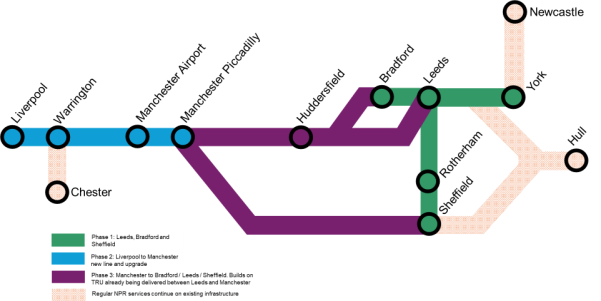
13. The government will work closely with local leaders to align rail improvements with wider plans to modernise and unlock capacity at key stations. This will include:
a) Delivering a holistic plan for Leeds station, allowing unified delivery, enhanced onward travel and the subsequent release of major adjacent development sites.
b) Pressing forward with the work already in hand with Bradford Metropolitan District Council on the business case for Bradford station, putting this large dynamic city at the heart of the northern network. It is expected that decisions on the station will be reached by Summer 2026, and DfT has reserved funding available for moving forward after this into detailed design work.
c) Working with local leaders on a redesigned York station masterplan, to ensure the NPR programme supports York Central and the delivery of the UK’s largest city centre brownfield development site.
d) Providing the additional station capacity needed at Sheffield and working together with local leaders to ensure tram-train interdependencies and options are fully explored as part of the forward joint development work. While more substantial work on Sheffield-Manchester connections will come in phase 3, this phase will consider opportunities for unlocking additional capacity on this corridor sooner. The government will also ensure that development work aligns with local plans for a new Rotherham station, for which final business case funding has been confirmed.
e) Considering the economic case for further rail interventions in the North East, particularly as part of ensuring NPR services reach Newcastle, and as part of enhancing NPR benefits to the North East. This will include working jointly with local leaders on the business case for the remainder of the proposed Leamside reopening, including considering better connectivity for Sunderland. Subject to agreement of that business case and assurance that this delivers good value for money, the government will ensure that resources are made available, for example through the Rail Network Enhancements Pipeline or future rounds of TCR, for its delivery in partnership with local leaders. Separately, the government has already invested £4 billion in infrastructure enhancements on the East Coast Mainline and a new fleet of ‘Azuma’ trains, which have provided route-wide improvements for passengers through the introduction of the major timetable upgrades in December 2025, which includes increasing the frequency of services between Middlesbrough and Newcastle.
14. The second phase, west of the Pennines would see major construction works in the 2030s and beyond. The government will take forward a new route between Liverpool and Manchester as a predominantly new line, running via new stations at Manchester Airport and Warrington Bank Quay Low Level. This phasing reflects the delivery timescales inherent in building major new lines. Development work including consenting has been fully funded in this Parliament and work has resumed on the adapted High Speed Rail (Crewe-Manchester) Bill to seek powers for the section of the route into Manchester via Manchester Airport, which will also include a new station at Manchester Piccadilly. The exact details of this station are still to be determined and the government will work closely with Greater Manchester to explore the evidence and analysis for different options available, including underground choices. Improvements related to Liverpool Central are being considered alongside the work the government is undertaking together with Liverpool City Region to look at options for a major regeneration scheme in the city centre .
15. In parallel, the government will bring forward development work for the connection to Liverpool via Warrington, including an assessment of possible gateway stations in Liverpool City Region and of integrating improvements at Liverpool Central . The detailed route to Liverpool will be subject to future consultation. Government will work with local partners to continue to refine designs across the entirety of the Liverpool-Manchester route to ensure value for money.
16. This route is in line with the key proposals of the Liverpool-Manchester Railway Board, and the government will work with this board to develop detailed plans. The route supports major development plans at Manchester Airport, Warrington and Manchester. It will also significantly improve access from across the North to Manchester Airport. Warrington will benefit from a multi-directional rail interchange, becoming a centre for agglomeration of labour markets across Manchester and Liverpool, backed by major growth and housing plans.
17. Communities in North Wales will benefit from better connectivity through Chester to the North’s largest cities, and to Manchester airport. This will better tie the communities of North Wales into the northern economy, driving growth by creating more opportunities for people and businesses. The government will additionally look at the potential to extend NPR services beyond Chester to North Wales, further maximising these benefits.
18. For the third phase of NPR, the government will look at better cross-Pennine links over and above the TRU currently being delivered. As well as Manchester-to-Leeds, Manchester-to-Bradford and Manchester-to-Sheffield are key corridors for this overall programme, and the government will build at this stage on the initial work done in phase 1 on these corridors.
19. The government is committed to supporting rail freight growth, recognising its significant economic and environmental potential and will target at least 75% growth in rail freight by 2050. This is aligned to the ambition in Yorkshire’s Plan for Rail to unlock freight opportunities across the network and will be amongst the key areas of focus for GBR once it is established. The TRU investment will facilitate serious capacity for cross-Pennine rail freight for the first time creating 15 new intermodal freight paths per day – the equivalent of 1,140 container lorries. This will help decongest busy roads across Greater Manchester and West Yorkshire and support the movement of freight to and from the east and west coast ports of northern England. Opportunities for further rail freight growth will be considered through the NPR scheme’s development.
20. Integral to the way the government takes forward NPR is the principle of close collaborative working with local leaders. Delivery boards, including the Liverpool-Manchester Rail Board and the White Rose Partnership, attended by mayors and ministers will be used to embed joint working and support decision making and effective delivery. This will be overseen by Tom Riordan as government’s Northern Growth Envoy, with the aim to reach decisions on intended delivery plans at the next Spending Review.
21. Beyond improving connections between northern cities, the government wishes to safeguard future growth for the long term by ensuring that the West Coast Main Line corridor, which serves 6 of the country’s largest cities, offers sufficient capacity (in terms of both train paths and seat numbers) and good connectivity (in terms of reliability, journey times, and frequency). In order to achieve this, the government is therefore also setting out its intention to ultimately deliver a full North-South new line between Birmingham and Manchester, which can also support capacity and connectivity for the wider North-West and Scotland connections. The future use of the NPR line for London and Birmingham services is therefore an integral part of the strategic objectives for NPR overall, building on and enhancing the benefits and connectivity that the proposed Liverpool to Manchester route will provide. Having this intention has been a key factor in deciding to proceed with the Liverpool-Manchester route via Manchester Airport, over potentially cheaper alternatives.
22. However, this is not a reinstatement of HS2 and the government is yet to determine exactly what will be delivered and to what specification. Given the lessons from the historic management of HS2, the government believes now is not the time to take these decisions on either the design standards or delivery schedule of such a route, and significant further work is required to develop plans before such decisions are made. Current expectations are that delivery timelines for these ambitions would follow completion of HS2 Phase 1 in the South and Midlands and NPR in the North, implying delivery in the 2040s at the earliest. However, in the meantime, the government is acting responsibly to safeguard the long-term future of the country and as such, while this work continues, the government’s existing land holdings between the West Midlands and Crewe will be retained.
Future priorities
1. Alongside the work on NPR, the government will continue to work to deliver in the North, including pursuing an economic plan for the Northern Growth Corridor, the North East and the wider North to maximise more immediate economic opportunities.
2. The government will work with local leaders and northern businesses to develop and publish further detail on the economic plan this spring, and to begin to unlock the major economic assets and investible propositions across the North. This will be critical to the government’s plan to tackle the cost of living and lift living standards through sustained economic growth. The government has appointed Tom Riordan – former Chief Executive of Leeds City Council – to be the government’s Northern Growth Envoy and he will take forward a programme of work to deliver on the government’s economic strategy for the region.
3. The priorities in this work will include but not be limited to:
a. Supporting improved connectivity within and between city regions: developing plans with local leaders to quickly and effectively deliver local infrastructure enhancements, and further deepen the integration of local transport systems. The government wants to ensure that more of the country’s city regions and surrounding towns are seeing the improved local systems they deserve as quickly as possible, so that more people, places and employers can be better connected and access more opportunities.
b. Increasing effective city size, density and town regeneration: furthering the government’s reforms and investments to expand city centres, unlock major regeneration projects in towns and cities, and to further densify northern city regions so that more people can live closer to opportunities and firms can access broader pools of talent.
c. Supporting business investment and innovation: further building on the North’s nationally significant strengths in growth-driving Industrial Strategy sectors and its key innovation clusters. As magnets for business investment, these sectors are foundational to improvements in productivity and critical to the North’s long-term growth. Unlocking these opportunities will require a holistic approach, with transport, skills and other investments all supporting the ecosystem that will allow the North’s clusters to realise their potential. The government will work hand-in-glove with mayors and businesses to achieve this, identifying the most exciting growth-driving opportunities, overcome the blockers to realising them and promote them to investors.
d. Investing in skills and human capital: working with regional leaders to ensure the £570 million investment in expanding local college training facilities and the £902 million Local Growth Fund matches regional needs and plugs skills gaps. The government has introduced a range of reforms to help young people take that vital step into the workplace or training, via the new Jobs Guarantee, and is working with local employers to deliver 50,000 more apprenticeships and foundation apprenticeships for young people over the next 3 years. The government will work alongside designated Employer Representative Bodies across the North East, Cheshire and Warrington, Greater Manchester, West Yorkshire, Liverpool City Region and South Yorkshire on the next round of Local Skills Improvement Plans.
e. Enriching culture: building on the government’s investment so far including in the expansion of the National Railway Museum in York, in the Royal Armouries in Leeds, and the Liverpool Museums to make sure that the region is home to a thriving and dynamic cultural scene and visitor economy worthy of its size and international renown.
f. Future devolution: this government has already made significant progress to empower mayors and local leaders with the tools they need to drive growth. The English Devolution White Paper set out an ambitious new framework of powers for local leaders and is now being put on a statutory footing via the English Devolution and Community Empowerment Bill. The government has been clear that this framework is the floor of the ambition, not the ceiling, and will look to continue to deepen devolution across England in the future.
4. The North has immense potential, which has been held back for too long by underinvestment and fragmented decision-making. That must change. This government is determined to do things differently: backing local leaders with real powers, investing in the infrastructure and industries of the future, and working in genuine partnership to spread the proceeds of growth to every town and city. This government is acting now, with Northern Powerhouse Rail the latest transformative investment in the future of the North. And this government will go further, together, to unlock opportunity, raise living standards and build a stronger, fairer economy for the whole country. The North powered Britain’s past; with the right long-term plan delivered in partnership, it can lead the country’s future.
-
2004 represents the oldest available ONS subnational productivity data. ↩
-
ONS. Current Price (smoothed) Gross Value Added (B) per hour worked for 2004 and 2023. Subregional productivity: labour productivity indices by UK ITL2 and ITL3 subregions. (2025). ↩
-
Productivity growth calculated as the compound average growth rate between 2019 and 2023. ↩
-
ONS, Gross Value Added (B) by industry: local authorities by ITL1 region, deflated to 2023 prices. Regional gross value added (balanced) by industry: local authorities by ITL1 region. ONS, productivity hours by local authority, Subregional productivity: labour productivity indices by local authority district. (2025). ↩
-
ONS. Current Price (smoothed) Gross Value Added (B) per hour worked for 2004 and 2023. Subregional productivity: labour productivity indices by UK ITL2 and ITL3 subregions. (2025). ↩
-
OECD (2020), Enhancing Productivity in UK Core Cities: Connecting Local and Regional Growth, OECD Urban Policy Reviews, OECD Publishing, Paris, https://doi.org/10.1787/9ef55ff7-en. (2020). ↩
-
Cities selected are similar-sized European comparators. ↩
-
Chart data sourced from the OECD Atlas and OECD Dashboard of Productivity Indicators. ↩
-
Centre for Cities. Does ‘trickle out’ work? How cities help their surrounding towns. (2023). ↩
-
Resolution Foundation. A tale of two cities (part 2). (2023). ↩
-
Centre for Cities. Climbing the Summit: Big cities in the UK and the G7. (2024). ↩
-
Centre for Cities. Measuring up: Comparing public transport in the UK and Europe’s biggest cities. Measuring up: Comparing public transport in the UK and Europe’s biggest cities. (2021). ↩
-
South Yorkshire Combined Authority. SYMCA Bus Service Improvement Plan. South Yorkshire Combined Authority, 09/05/2024 (2024). ↩
-
Stansbury, Turner and Balls. Tackling the UK’s regional economic inequality: Binding constraints and avenues for policy intervention. (2023). ↩
-
Based on a 5-year average between 2015 and 2019. ONS, annual GFCF investment in all assets in the UK. Experimental regional gross fixed capital formation (GFCF) estimates by asset type (2022) and ONS, workforce jobs for September 2025. Nomis - Query Tool - workforce jobs by industry (SIC 2007) - seasonally adjusted. (2025). ↩
-
ONS. Exploring educational attainment and internal migration, within English Travel to Work Areas. (2023). ↩
-
ONS. Labour Market Profiles (North East and South West). (2024). ↩
-
Based on an adaptation of the OECD’s size-based categorisation of metropolitan areas to include Functional Urban Areas with a population between 250,000 and 1 million individuals. Population data sourced from ONS, Estimates of the population for the UK, England, Wales, Scotland, and Northern Ireland. (2025). ↩
-
ONS, Current Price (smoothed) Gross Value Added (B) per hour worked for 2023. Subregional productivity: labour productivity indices by local authority district. (2025). ↩
-
Institute for Public Policy Research. City systems: The role of small and medium-sized towns and cities in growing the northern powerhouse. (2016). ↩
-
Local level economic outcomes such as productivity are also strongly correlated with wider socio-economic indicators like life expectancy, crime and life satisfaction, which in turn can improve living standards across neighbourhoods. Zymek, R., Jones B. UK Regional Productivity Differences: An Evidence Review. Industrial Strategy Council. (2020). ↩
-
Productivity growth calculated as the compound average growth rate between 2019 and 2023 for Functional Urban Areas (OECD). ↩
-
ONS, Gross Value Added (B) by industry: local authorities by ITL1 region, deflated to 2023 prices. Regional gross value added (balanced) by industry: local authorities by ITL1 region. ONS, productivity hours by local authority, Subregional productivity: labour productivity indices by local authority district. (2025). ↩
-
ONS. Gross Value Added (balanced) at current basic prices for 2023. Regional gross value added (balanced) per head and income components. (2025). ↩
-
Productivity data available and sourced at ITL2-level and UK-level from the ONS, Subregional productivity: labour productivity indices by UK ITL2 and ITL3 subregions. (2025). Additional GVA calculated as the summed differences between the 2023 annual Gross Value Added (GVA) of each area and their estimated GVA if their GVA per filled job matched the 2023 UK average, holding the level of jobs constant. Additional tax revenues calculated using a simple scaling factor and for illustrative purposes only. Assumes that a hypothetical addition to GVA in the North of England is wholly additive to overall UK GVA. A full methodology note has been published alongside this document. ↩
-
Allocation to eligible northern MSAs within the £15.6 billion Transport for City Regions funding over the period 2026-27 to 2031-32. ↩
-
Integrated Settlement quantum for Liverpool City Region, Greater Manchester, North East, South Yorkshire and West Yorkshire MSAs during the current Spending Review period. ↩
-
Bus service improvement funding for the North over the period 2025-26 to 2028-29. ↩
-
Current Anticipated Final Cost in cash terms. ↩
-
This figure references the funding earmarked for Greater Manchester, Liverpool City Region, North East, South Yorkshire and West Yorkshire through the £500 million Local Innovation Partnerships Fund. ↩
-
Spending in England between 2025-26 and 2029-30. ↩
-
Spending in England during the current Spending Review period. ↩
-
Spending in Liverpool City Region, Greater Manchester, North East, South Yorkshire and West Yorkshire MSAs during the current Spending Review period. ↩
-
2025 prices, will be updated using Gross Domestic Product deflator. ↩