Country policy and information note: separatist groups in the South-East, Nigeria, April 2026 (accessible)
Updated 14 April 2026

© Crown copyright 2026
This publication is licensed under the terms of the Open Government Licence v3.0 except where otherwise stated. To view this licence, visit nationalarchives.gov.uk/doc/open-government-licence/version/3 or write to the Information Policy Team, The National Archives, Kew, London TW9 4DU, or email: psi@nationalarchives.gov.uk.
Where we have identified any third party copyright information you will need to obtain permission from the copyright holders concerned.
This publication is available at https://www.gov.uk/government/publications/nigeria-country-policy-and-information-notes/country-policy-and-information-note-separatist-groups-in-the-south-east-nigeria-april-2026-accessible
Version 4.0, April 2026
Executive summary
The Igbo people, who live predominantly in the South East of Nigeria and are one of the country’s 3 main ethnic groups, have a history of struggle for self-determination. This includes declaration of an independent republic of ‘Biafra’ in 1967 followed by a 3-year civil war that ended with the republic’s reintegration into Nigeria. The Igbo people have continued to see themselves as marginalised, and since the late 1990s, separatist groups have revived the call for the region’s independence.
Actual or perceived members or supporters of the Movement for the Actualization of the Sovereignty of ‘Biafra’ (MASSOB) or an affiliated group or faction are unlikely to face a real risk of persecution or serious harm from the state. The onus is on the person to demonstrate otherwise. Any risk of persecution will depend on the person’s profile and their activities on behalf of the group.
MASSOB is banned but evidence suggests it is not proscribed as a terrorist organisation in Nigeria. It has become less active in recent years. There is limited evidence of recent arrests or intimidation of perceived members or supporters of MASSOB, and no recent information on any attacks on them by the state.
The Indigenous People of Biafra (IPOB) is a proscribed terrorist organisation in Nigeria and has been implicated in inciting and committing acts of violence against the state and other actors. The government has a legitimate interest in pursuing and arresting persons who are, or are suspected of being, involved with or supporting the group. In general, actual or perceived members or supporters of IPOB or an affiliated group or faction who are fleeing prosecution or punishment for a criminal offence are not likely to be refugees. Affiliated groups or factions include, but are not limited to, the Directorate of State and ‘Biafra’ Republic Government in Exile (BRGIE)/Autopilot factions and IPOB’s armed wing, the Eastern Security Network (ESN).
There are allegations from some sources of human rights violations against perceived members of IPOB, including extrajudicial killings, arbitrary arrests and detention, detention in inhuman conditions and enforced disappearance.
Where a person is able to demonstrate that, because of their links to IPOB, affiliated groups or factions, or the ESN, they are likely to face prosecution or punishment which is disproportionate to the crime committed or discriminatory, or are likely to face detention in degrading or inhuman conditions or torture, then such treatment is likely to amount to persecution.
An actual or perceived member or supporter of a pro-‘Biafran’ group who has engaged in sur place activities is unlikely be at risk on return to Nigeria. The onus is on the person to demonstrate otherwise.
Where the person has a well-founded fear of persecution or serious harm from the state, they will not, in general, be able to obtain protection nor be able to internally relocate to escape that risk.
Where a claim is refused, it is not likely to be certifiable as ‘clearly unfounded’ under section 94 of the Nationality, Immigration and Asylum Act 2002.
All cases must be considered on their individual facts, with the onus on the person to demonstrate they face persecution or serious harm.
Assessment
Section updated: 2 April 2026
About the assessment
This section considers the evidence relevant to this note – that is the country information, refugee/human rights laws and policies, and applicable caselaw – and provides an assessment of whether, in general:
- a person faces a real risk of persecution/serious harm by the state because the person is a member or supporter of, or is perceived to be a member or supporter of, a group agitating for a separate state of ‘Biafra’
- internal relocation is possible to avoid persecution/serious harm
- a claim, if refused, is likely or not to be certified as ‘clearly unfounded’ under section 94 of the Nationality, Immigration and Asylum Act 2002
Decision makers must, however, consider all claims on an individual basis, taking into account each case’s specific facts.
Points to note
‘Biafra’ was the name used by the former Eastern Region of Nigeria when it unilaterally declared independence from Nigeria in 1967. This action led to the Nigerian Civil War, which concluded in 1970. ‘Biafra’ is not a legally recognised area but is often invoked by those members of the Igbo people who support secession from Nigeria. The states in Nigeria with a majority Igbo population are Abia, Imo, Ebonyi, Enugu and Anambra, which form the South East geopolitical zone of Nigeria.
Open source material cited in this note refers to ‘Biafra’. For consistency and clarity, this note will also use the term ‘Biafra’, although it is important to note the UK government’s consistent policy to respect the territorial integrity of the Federal Republic of Nigeria, and that use of the term ‘Biafra’ in this note does not in any way imply any shift in that policy.
There are reported to be several groups agitating for the secession of ‘Biafra’. This Country Policy and Information Note focuses on the following 2 main groups:
- the Movement for the Actualization of the Sovereign State of ‘Biafra’ (MASSOB) the Indigenous People of ‘Biafra’ (IPOB), including
1. Material facts, credibility and other checks/referrals
1.1 Credibility
1.1.1 For information on assessing credibility, see the instruction on Assessing Credibility and Refugee Status.
1.1.2 Decision makers must also check if there has been a previous application for a UK visa or another form of leave. Asylum applications matched to visas should be investigated prior to the asylum interview (see the Asylum Instruction on Visa Matches, Asylum Claims from UK Visa Applicants).
1.1.3 Decision makers must also consider making an international biometric data-sharing check, when one has not already been undertaken (see Biometric data-sharing process (Migration 5 biometric data-sharing process)).
1.1.4 In cases where there are doubts surrounding a person’s claimed place of origin, decision makers should also consider language analysis testing, where available (see the Asylum Instruction on Language Analysis).
Official – sensitive: Not for disclosure – Start of section
The information in this section has been removed as it is restricted for internal Home Office use only.
Official – sensitive: Not for disclosure – End of section
1.2 Exclusion
1.2.1 IPOB is proscribed as a terrorist group in Nigeria, and members of the group and its paramilitary wing, the Eastern Security Network (ESN, established in December 2020), have reportedly committed human rights violations in Nigeria (see Indigenous People of ‘Biafra’ (IPOB)).
1.2.2 MASSOB has been banned and membership of the group is illegal, but it does not appear to be proscribed as a terrorist group in Nigeria. It has reportedly been involved in violent clashes with the authorities (see Movement for the Actualization of the Sovereign State of ‘Biafra’ (MASSOB)).
1.2.3 If a person has been involved with IPOB, ESN, MASSOB and/or an affiliated group or any other pro-‘Biafran’ group that incites or uses violence to achieve its aims, decision makers must consider whether there are serious reasons to apply one (or more) of the exclusion clauses. Each case must be considered on its individual facts.
1.2.4 If the person is excluded from the Refugee Convention, they will also be excluded from a grant of humanitarian protection (which has a wider range of exclusions than refugee status).
1.2.5 For guidance on exclusion and restricted leave, see the Asylum Instruction on Exclusion under Articles 1F and 33(2) of the Refugee Convention, Humanitarian Protection and the instruction on Restricted Leave.
Official – sensitive: Not for disclosure – Start of section
The information in this section has been removed as it is restricted for internal Home Office use only.
Official – sensitive: Not for disclosure – End of section
2. Convention reason(s)
2.1.1 Actual or imputed political opinion.
2.1.2 Establishing a convention reason is not sufficient to be recognised as a refugee. The question is whether the person has a well-founded fear of persecution on account of an actual or imputed Refugee Convention reason.
2.1.3 In the absence of a link to one of the 5 Refugee Convention reasons necessary for the grant of asylum, the question is whether the person will face a real risk of serious harm to qualify for Humanitarian Protection (HP).
2.1.4 For further guidance on the 5 Refugee Convention grounds, see the Asylum Instruction, Assessing Credibility and Refugee Status.
3. Risk
3.1 Political and security context
3.1.1 ‘Biafra’ is a loosely defined area in the South East of Nigeria that roughly corresponds to the states of Abia, Anambra, Ebonyi, Enugu and Imo. The area is inhabited principally by Igbo (Ibo) people, who are one of the country’s 3 largest ethnic groups. The South East has an estimated population of 23.5 million (see Geography and demography and the Country Policy and Information Note Nigeria: Internal relocation).
3.1.2 In the mid-1960s, newly independent Nigeria was affected by economic and political instability and ethnic friction. Violence erupted in the north, including in September 1966, when sources estimate that between 10,000 and 30,000 Igbo were killed. Attempts to resolve tensions failed and in May 1967, the Eastern Region unilaterally declared independence from Nigeria as the Republic of ‘Biafra’, triggering a civil war in which an estimated 500,000 to 3 million people died. ‘Biafran’ rebels were eventually overwhelmed by and surrendered to federal government forces in January 1970 (see Civil war and its aftermath).
3.1.3 Since the 1990s, new ‘Biafra’ separatist movements have been established, reportedly driven by perceptions of unfair treatment and marginalisation among the Igbo people. While several groups have reportedly formed with the goal of achieving ‘Biafran’ secession, the main groups are the Movement for the Actualization of the Sovereign State of ‘Biafra’ (MASSOB) and the Indigenous People of ‘Biafra’ (IPOB) (see Separatist groups/factions, Movement for the Actualization of the Sovereign State of ‘Biafra’ (MASSOB) and Indigenous People of ‘Biafra’ (IPOB)). Other ‘Biafran’ groups do not appear to have a significant presence in Nigeria (see Overview).
3.1.4 During the early 2000s MASSOB was the foremost ‘Biafran’ group, but reports suggest it has become divided and less active. The internal fragmentation of MASSOB led to the emergence of IPOB, formed by Kenny Nwannekaenyi Okwu-Kanu (known as Nnamdi Kanu) between 2012 and 2014, which has since become the dominant ‘Biafran’ group. However, Kanu’s arrest in June 2021 on charges including treason and terrorism, followed by his continued detention, resulted in the group dividing into 2 factions, the Directorate of State (DOS) and a breakaway faction, the self-styled ‘Biafra’ Republic Government in Exile (BRGIE)/Autopilot. The fragmentation across the pro-‘Biafran’ movement as a whole, marked by both ideological and strategic divergences, is so pronounced that one source – the Atlantic Post, a Nigerian online news platform – describes the movement as ‘teetering on the brink of chaos’ (see Overview of separatist groups and methods, Movement for the Actualization of the Sovereign State of ‘Biafra’ (MASSOB) and Indigenous People of ‘Biafra’ (IPOB), and subsections 3.2 (MASSOB) and 3.3 (IPOB) of this assessment, below).
3.1.5 Although both MASSOB and IPOB have advocated for peaceful change, often using civil disobedience as a tactic, they have also used rhetoric that may encourage violence and, in some instances, used violence directly against state agents. In 2020, IPOB established the Eastern Security Network (ESN), an armed wing that the group claims is a defensive force rather than an offensive militia. BRGIE/Autopilot is reportedly considered more violent than MASSOB and the DOS faction of IPOB, and since 2023, fighters under BRGIE/Autopilot have been linked to rising violence in the region. On some occasions, BRGIE/Autopilot has claimed responsibility for attacks on state agents (see Common aims and methods, Movement for the Actualization of the Sovereign State of ‘Biafra’ (MASSOB) and Indigenous People of ‘Biafra’ (IPOB).
3.1.6 IPOB reportedly introduced weekly and ad hoc ‘sit-at-home orders’ (curfews as a form of civil disobedience) shortly after Kanu’s arrest in June 2021. Despite IPOB’s announcement later the same year that it was lifting the weekly orders, reports indicate that enforcement of them by IPOB and other armed actors has continued through violent means including beatings, floggings, targeted assassinations and beheadings, with deaths documented among both the security forces and the civilian population (see Governance and state security presence, Overview of separatist groups and methods and Sit-at-home orders).
3.1.7 Sources indicate that between January 2021 and July 2025, violence in the South East claimed more than 3,000 lives. The Nigerian authorities reportedly blame the violence on IPOB and/or ESN and favour a predominantly security-led response which some sources describe as heavy-handed. Other reporting notes the complexity of the security context. IPOB’s DOS faction has repeatedly denied responsibility for violent attacks. Sources suggest the insecurity in the region is of a complex, hybrid nature involving not only state actors and separatists but also other non-state armed groups such as the Umuoma/’unknown gunmen’, Fulani herdsmen, cultists and criminal gangs seeking to exploit local fear and confusion, particularly in areas where state governance is weak. In some instances, gang members reportedly claim to be acting for IPOB or ESN, thus blurring the distinction between actors driven by ideology and those with criminal motives (see Political and administrative context, Security situation and governance in the South East, General state treatment of pro-‘Biafran’ separatists, Indigenous People of ‘Biafra’ (IPOB) and Treatment of IPOB).
3.2 Movement for the Actualization of the Sovereign State of ‘Biafra’ (MASSOB)
3.2.1 Actual or perceived members or supporters of the Movement for the Actualization of the Sovereignty of ‘Biafra’ (MASSOB) or an affiliated group or faction are unlikely to face a real risk of persecution or serious harm from the state. The onus is on the person to demonstrate otherwise.
3.2.2 Any risk of persecution will depend on the person’s profile and their activities on behalf of the group (see General state treatment of pro-‘Biafran’ separatists and Treatment of MASSOB). MASSOB members may be perceived to be members of IPOB (see Arrests and detention, and for risk for perceived IPOB members, see Indigenous People of ‘Biafra’ (IPOB)/Eastern Security NetworkIndigenous People of ‘Biafra’ (IPOB)/Eastern Security Network (ESN), below).
3.2.3 In the early 2000s, MASSOB was banned and membership of the group was made illegal. DFAT reported in 2020 that it had not been proscribed as a terrorist group in Nigeria and that it continued to conduct public activities. However, a 2025 police statement quoted in a newspaper report referred to MASSOB as ‘proscribed’, but this information is not corroborated by other sources (see Legal status).
3.2.4 Sources indicate that MASSOB is agitating for the secession of ‘Biafra’ in accordance with what it describes as non-violent principles. The group has reportedly become less active in recent years (see Separatist groups/factions and Movement for the Actualization of the Sovereign State of ‘Biafra’ (MASSOB)). MASSOB has 2 main factions, the Biafra Independent Movement (BIM)/MASSOB, led by Ralph Uwazuruike, and MASSOB, led by Uchenna Madu. Membership figures and membership procedures for the overall MASSOB group or its factions are not known, but one source reported in 2025 that, when arrested, a MASSOB member was in possession of an ‘operational identity card’. The existence of membership or ID cards is not corroborated by other sources (see Membership and documentation).
3.2.5 After its formation in the late 1990s, MASSOB clashed with the security forces on numerous occasions. Sources report that more than 2,000 members had been killed in clashes by 2008, usually during protests. There were mass arrests of MASSOB members in 2018 and 2022, but there is no evidence of clashes resulting in deaths of MASSOB members since 2 individuals were killed in 2019 (see Background). In September 2023, 8 people were arrested on suspicion of MASSOB membership at a police squad office. The arrests reportedly occurred after the individuals stormed the office in connection with another matter (see Arrests and detention).
3.2.6 Sources report that in 2023, the BIM/MASSOB faction accused the police of indiscriminate arrests and extortion of MASSOB group members, but in some instances, such arrests were reportedly made because the MASSOB members were perceived to be members of IPOB (see Arrests and detention). A 2025 MASSOB statement quoted in a newspaper article reports that MASSOB members have been harassed and that a local MASSOB official was acquitted after being arrested and detained for MASSOB membership, but the information is not corroborated by other sources. Sources suggest that pro-‘Biafran’ separatists in general have been forcibly disappeared after being arrested or abducted, but none of the cases set out in a 2025 Amnesty International report that provides more than 20 examples of alleged enforced disappearance mentions suspected MASSOB membership (see Enforced disappearances).
3.2.7 According to reports, possession of ‘Biafra’ flags or insignia may result in arrest or abduction, but, with the possible exception of the arrest of a MASSOB member in 2025 mentioned in paragraph 3.2.4, there is no information in the sources consulted to suggest that actual or perceived MASSOB members specifically have been arrested or abducted for this reason (see Arrests, detention and enforced disappearances (general) and Arrests and detention (MASSOB)). There is no information in the sources consulted for this note to indicate that any MASSOB-related arrests were made at all in 2024 (see Bibliography and Arrests and detention).
3.2.8 Sources providing information not specific to MASSOB suggest that the state closely monitors, both online and offline, high-profile individuals who are most strongly supportive of the ‘Biafran’ cause but is unlikely to have the capacity to monitor all supporters (see Monitoring and tracking).
3.2.9 BIM/MASSOB faction leader Ralph Uwazuruike was reportedly summoned to attend the Imo State police anti-kidnapping unit on 20 October 2025, a move that the faction noted may have been aimed at preventing him from attending protests against IPOB leader Nnamdi Kanu’s detention that were scheduled for the same day (see Discrimination and harassment).
3.2.10 For further guidance on assessing risk, see the Asylum Instruction on Assessing Credibility and Refugee Status.
3.3 Indigenous People of ‘Biafra’ (IPOB)/Eastern Security Network (ESN)
3.3.1 The Indigenous People of Biafra (IPOB) is a proscribed terrorist organisation in Nigeria and has been implicated in inciting and committing acts of violence against the state and other actors. The government has a legitimate interest in pursuing and arresting persons who are, or are suspected of being, involved with or supporting the group. In general, actual or perceived members or supporters of IPOB or an affiliated group or faction who are fleeing prosecution or punishment for a criminal offence are not likely to be refugees. Affiliated groups or factions include, but are not limited to, the Directorate of State and ‘Biafra’ Republic Government in Exile (BRGIE)/Autopilot factions and IPOB’s armed wing, the Eastern Security Network (ESN).
3.3.2 However, prosecution may amount to persecution if it involves victimisation in its application by the authorities, for example, if it is the vehicle or excuse for persecution or if only certain groups are prosecuted for a particular offence and the consequences of that discrimination are sufficiently severe. Punishment which is cruel, inhuman or degrading (including punishment which is disproportionate to the offence committed) may also amount to persecution (see the section on prosecution in the Asylum Instruction on Assessing credibility and refugee status).
3.3.3 Where a person is able to demonstrate that because of their links to IPOB or an affiliated group or faction, they are likely to face prosecution or punishment which is disproportionate to the crime committed or discriminatory, or are likely to face detention in degrading or inhuman conditions or torture, then such treatment is likely to amount to persecution (see the Country Policy and Information Note Nigeria: Actors of protection for information about the criminal justice system, including detention conditions).
3.3.4 Each case must be considered on its individual facts, taking into account the person’s activities, profile and role in the group (see General treatment of pro-‘Biafran’ separatists and Treatment of IPOB).
3.3.5 IPOB was proscribed as a terrorist group in Nigeria in 2017, and a total of 14 individuals and businesses allegedly linked to IPOB have been designated as ‘terrorism financiers’, thus attracting financial sanctions. One consequence of the group’s proscription is that it is not permitted to stage rallies (see Proscription/legal status).
3.3.6 Membership figures for IPOB, its factions or ESN in Nigeria are not known but sources suggest IPOB is the most active and influential of the pro-‘Biafran’ separatist groups, having eclipsed MASSOB (see Overview and Funding, membership and documentation).
3.3.7 ESN was established in 2020 with the stated aim of protecting the Southeastern region from Fulani herdsmen and other armed groups. However, reports suggest its activities have increasingly expanded to include clashes with the security forces and guerrilla-style attacks against police and military installations (see Eastern Security Network (ESN)).
3.3.8 During IPOB leader Nnamdi Kanu’s continued detention following his arrest in 2021, IPOB split into 2 factions. The Directorate of State (DOS) faction reportedly has a governing council, the DOS, overseeing day to day operations, with Kanu above it as the supreme decision-making authority and a hierarchy of officials in Nigeria and overseas below it (see Background and Structure and leadership). The other faction is the Biafran Republic Government In Exile (BRGIE), also known as ‘Autopilot’. BRGIE, formed by Finland-based Simon Ekpa in 2022, is diaspora-based, but funds and directs fighters in the South East, including members of the ‘Biafra’ Liberation Army (BLA). In November 2024, the faction reportedly self-declared ‘independence’ for the ‘United States of ‘Biafra’’ (USB), territory comprising Igbo and some non-Igbo areas of southeastern Nigeria. Ekpa was convicted of terrorism and other charges in Finland in September 2025 and sentenced to 6 years in prison, and was replaced as ‘prime minister’ of the group by Ogechukwu Nkere in January 2026 (see ‘Biafra’ Republic Government in Exile (BRGIE)/Autopilot faction).
3.3.9 According to reports, the DOS faction has repeatedly disassociated itself from BRGIE/Autopilot and rejected the formation of the ‘government in exile’ and the USB. However, sources suggest the authorities regard Simon Ekpa as part of IPOB or affiliated with it (see Relationship to IPOB and the Directorate of State faction).
3.3.10 Reports indicate IPOB has recently dialled down its once-violent rhetoric and has instead focused its messaging on establishing ‘Biafra’ through peaceful means. However, this is reportedly less of an ideological shift than a tactical move aimed at softening IPOB’s image to bolster local and international support for Kanu and the ‘Biafran’ cause (see Indigenous People of ‘Biafra’ (IPOB)).
3.3.11 The military has reportedly conducted airstrikes on suspected IPOB/ESN hideouts, with the latest having occurred in 2023. Sources do not provide casualty figures (see Airstrikes). IPOB’s DOS faction has denied that the group has hideouts, camps or terror cells (see Other activities and methods).
3.3.12 In 2024, pro-‘Biafra’ agitation in the South East reportedly claimed 379 lives, ‘many’ of whom were IPOB/ESN members killed in the security forces’ special operations. Between January and March 2025, the army was reportedly responsible for at least 200 deaths as part of the ‘neutralisation’ of IPOB/ESN members (see Other attacks and killings).
3.3.13 Sources report that IPOB leader Nnamdi Kanu was found guilty of terrorism, treason and involvement with an outlawed movement on 20 November 2025 and sentenced to 4 life sentences, among other terms, to be served concurrently. Prior to his conviction, a statement issued on behalf of his family noted that his detention conditions had negatively affected his mental and physical health and that he had been restricted from seeing his legal team. Reports indicate that after Kanu was sentenced, he was transferred to a detention centre in Sokoto in accordance with an order by the trial judge citing a recent jailbreak in Abuja. The transfer reportedly makes it harder for Kanu and his lawyers to prepare and lodge an appeal (see Detention, conviction and sentencing of IPOB leader Nnamdi Kanu).
3.3.14 Reports indicate that high-profile supporters of IPOB – the group’s lawyer, the brother of Nnamdi Kanu and a prominent human rights activist – were among at least 14 people arrested at protests demanding Kanu’s release on 20 October 2025 and subsequently released on bail. The sources consulted for this note do not indicate the identities and profiles of the other people arrested (see Bibliography and Other arrests, detention, convictions and acquittals). Reports suggest there were isolated clashes at the protests and that police used gunshots, tear gas, water cannon and electric barriers to disperse the crowds. In the sources consulted, there were no reports of police presence or arrests when IPOB rallies calling for Kanu’s release were held in 3 states in January 2026 (see Bibliography and Protests and rallies).
3.3.15 Sources are not consistent about whether non-violent, low-profile members or supporters of IPOB or their family members are arrested by the authorities. Examples from 2024 and 2025 suggest most arrests relating to the group take place at suspected IPOB/ESN camps or hideouts. In December 2023, police arrested 50 people wearing IPOB caps at a funeral, but a federal high court judge reportedly struck out the case due to a lack of credible evidence linking them to the group (see Other arrests, detention, convictions and acquittals and Other activities and methods).
3.3.16 Other reports suggest that some actual or suspected ‘Biafra’ supporters have been detained without charge, sometimes for years and often in inhumane conditions in military facilities, with their families subjected to extortion. Those arrested have reportedly often been held incommunicado, with family members and lawyers sometimes denied access even once the person arrested is located. Some security agents reportedly extract confessions through torture (see Arrests, detention and enforced disappearances, and for information on general detention conditions, see the Country Policy and Information Note Nigeria: Actors of protection). In some cases, IPOB members who have been acquitted have not immediately been released from prison (see Arrests, detention and enforced disappearances).
3.3.17 Sources indicate that more than 20 people arrested or abducted by the security forces in 2021 and 2022 over their suspected IPOB/ESN membership were forcibly disappeared. This figure includes at least 3 who have now been released and one who died in detention, reportedly after being denied medical care (see Enforced disappearances).
3.3.18 There are some indications of efforts by the Tinubu administration to address issues affecting suspected members of IPOB/ESN who have been arrested and detained. A review is reportedly being undertaken of cases inherited by the new director-general of the Department of State Services (DSS), Oluwatosin Adeola Ajayi, with the stated aims of ensuring compliance with the rule of law and providing rapid access to justice. Sources report that as part of the review, 3 people in detention on suspicion of IPOB/ESN membership were released in July 2025, while another suspected IPOB/ESN member detained in July 2022 was released in December 2025 (see Other arrests, detention, convictions and acquittals).
3.3.19 Prominent individuals who strongly support the ‘Biafran’ cause are reportedly considered ‘individuals of concern’ by the security system and are monitored very closely both online and offline. However, the authorities reportedly lack the resources to track all supporters of the cause. A member of the DOS faction directorate has claimed that the security forces pay villagers in Abia State to spy on and expose IPOB members, but this could not be independently corroborated in the sources consulted (see Bibliography and Monitoring and surveillance).
3.3.20 The government has reportedly asked social media companies to block IPOB on their platforms. Internet service providers sometimes block content at the request of the Nigerian Communications Commission (see Internet censorship (general) and Internet censorship (IPOB)).
3.3.21 Sources indicate that journalists reporting on separatism-related violence have been harassed and arrested. A journalist with French news agency Agence France-Presse was reportedly arrested at the protests against Kanu’s detention on 20 October 2025 but released shortly afterwards (see Journalists covering separatist violence).
3.3.22 For further guidance on assessing risk, see the Asylum Instruction on Assessing Credibility and Refugee Status.
3.3 Sur place activities
3.3.1 An actual or perceived member or supporter of a pro-‘Biafran’ group who has engaged in sur place activities is unlikely to be at risk on return to Nigeria.
3.3.2 However, each case must be considered on its facts with the onus on the person to show that they would be at real risk of serious harm or persecution on account of their actual or perceived membership or support of a pro-‘Biafran’ group. Factors to take into account include:
- the legal status and profile of the group/organisation to which the person belongs and its activities
- whether the group/organisation has a presence in Nigeria as well as outside the country and any evidence that it is being monitored by the government
- the person’s profile and political activities (including those online) and relevant documentary or other evidence
- whether the person would wish to continue their activism if returned to Nigeria (and if not, why not)
- past treatment of the person
- any evidence that their activities in the UK may have come to the attention of the Nigerian security agencies
3.4.3 Pro-‘Biafra’ groups exhibit a varied online presence in the form of websites, radio broadcasts and social media activity. However, the scale of the support within a large and established diaspora living in the UK is not clear (see Separatists outside Nigeria).
3.4.4 Sources suggest that pro-‘Biafran’ protests have been held in the UK. However, there is no evidence in the sources consulted to indicate that there is significant ongoing pro-‘Biafran’ activity in the UK (see Bibliography and UK pro-‘Biafran’ groups/supporters and sur place activities).
3.4.5 Available evidence suggests that the Nigerian government closely monitors, online and offline, prominent individuals in Nigeria who are strongly supportive of the ‘Biafran’ cause, who are considered ‘individuals of concern’ by the security system (see Monitoring and tracking). There is also some evidence to suggest that the Nigerian government monitors the activities of members of the diaspora, including ‘militants’ identified via informants (see Monitoring and tracking of pro-‘Biafra’ groups/supporters). It may also have blocked websites featuring content relating to ‘Biafra’ (see Internet censorship). However, there is no specific information in the sources consulted to indicate that the Nigerian government monitors the activities of members of the Nigerian diaspora in the UK, including supporters of pro-‘Biafran’ separatist groups (see Monitoring and tracking of pro-‘Biafra’ groups/supporters).
3.4.6 There was some limited evidence from 2022 to indicate that pro-‘Biafran’ separatists returning to Nigeria face may indiscriminate arrest and/or other human rights abuses, but there was no more recent information in the sources consulted to suggest this practice has continued, nor that it is systematic and widespread (see Bibliography and Treatment of returnee pro-‘Biafran’ separatists).
4. Protection
4.1.1 Where the person has a well-founded fear of persecution or serious harm from the state, they are unlikely to be able to obtain protection.
4.1.2 For further guidance on assessing state protection, see the Asylum Instruction on Assessing Credibility and Refugee Status.
5. Internal relocation
5.1.1 Where the person has a well-founded fear of persecution or serious harm from the state, they are unlikely to be able to internally relocate to escape that risk.
5.1.2 For further guidance on internal relocation and factors to consider, see the Asylum Instruction on Assessing Credibility and Refugee Status.
6. Certification
6.1.1 Where a claim from an adult male is refused, it must be considered for certification under section 94(3) of the Nationality, Immigration and Asylum Act 2002 as Nigeria is listed as a designated state in respect of men only. Such a claim must be certified under section 94(3) if you are satisfied it is clearly unfounded.
6.1.2 Where a claim is refused, it is unlikely to be certifiable as ‘clearly unfounded’ under section 94 of the Nationality, Immigration and Asylum Act 2002.
6.1.3 For further guidance on certification, see Certification of Protection and Human Rights claims under section 94 of the Nationality, Immigration and Asylum Act 2002 (clearly unfounded claims).
Country information
About the country information
This section contains publicly available or disclosable country of origin information (COI) which has been gathered, collated and analysed in line with the research methodology. It provides the evidence base for the assessment which, as stated in the About the assessment, is the guide to the current objective conditions.
The structure and content follow a terms of reference which sets out the general and specific topics relevant to the scope of this note.
This document is intended to be comprehensive but not exhaustive. If a particular event, person or organisation is not mentioned this does not mean that the event did or did not take place or that the person or organisation does or does not exist.
Information quoted in this note from the 2025 report ‘Nigeria: Security Situation in the South East’, published in French by Cedoca, the research unit of the Office of the Belgian Commissioner General for Refugees and Stateless Persons, has been translated using an online translation tool except where indicated.
The COI included in this note was published or made publicly available on or before 27 January 2026. Any event taking place or report published after this date will not be included.
Decision makers must use relevant COI as the evidential basis for decisions.
7. ‘Biafra’ background
7.1 Civil war and its aftermath
7.1.1 The Editors of the Encyclopaedia Britannica stated that ‘Biafra’ was a ‘… secessionist western African state that unilaterally declared its independence from Nigeria in May 1967. It constituted the former Eastern Region of Nigeria and was inhabited principally by Igbo (Ibo) people. Biafra ceased to exist as an independent state in January 1970.’[footnote 1]
7.1.2 The same source provided the following short history of ‘Biafra’:
‘In the mid-1960s economic and political instability and ethnic friction characterized Nigerian public life. In the mostly Hausa north, resentment against the more prosperous, educated Igbo minority erupted into violence. In September 1966, some 10,000 to 30,000 Igbo people were massacred in the Northern Region, and perhaps 1,000,000 fled as refugees to the Igbo-dominated east. Non-Igbos were then expelled from the Eastern Region.
‘Attempts by representatives of all regions to come to an agreement were unsuccessful. On May 30, 1967, the head of the Eastern Region, Lieutenant Colonel (later General) Odumegwu Ojukwu, with the authorization of a consultative assembly, declared the region a sovereign and independent republic under the name of Biafra. General Yakubu Gowon, the leader of the federal government, refused to recognize Biafra’s secession. Fighting began in July [1967]. Biafran troops were at first successful, but, as the Nigerian Civil War proceeded, the numerically superior federal forces began to press Biafra’s boundaries inward from the south, west, and north. Biafra shrank to one-tenth its original area in the course of the war. By 1968 it had lost its seaports and become landlocked; supplies could be brought in only by air. Starvation and disease followed; estimates of mortality during the war generally range from 500,000 to 3,000,000.
‘The Organization of African Unity, the papacy, and others tried to reconcile the combatants. Most countries continued to recognize Gowon’s regime as the government of all Nigeria, and the United Kingdom and the Soviet Union supplied it with arms. On the other hand, international sympathy for the plight of starving Biafran children brought airlifts of food and medicine from many countries. Côte d’Ivoire, Gabon, Tanzania, and Zambia recognized Biafra as an independent state, and France sent Biafra weapons.
‘Biafran forces were finally routed in a series of engagements in late December 1969 and early January 1970. Ojukwu fled to Côte d’Ivoire, and the remaining Biafran officers surrendered to the federal government on January 15, 1970. Biafra, on the point of total collapse, thereupon ceased to exist.’[footnote 2]
7.1.3 BBC News, in an article dated 15 January 2020, provided the following timeline:
- ‘January 1966 - Nigerian government overthrown in what was seen as an “Igbo coup” led by junior army officers
- January 1966 - Lt Col Odumegwu-Ojukwu appointed military governor of Eastern Region
- July 1966 - Second coup masterminded by Murtala Muhammed, Lt Col Yakubu Gowon becomes head of state
- June to October 1966 - Riots in northern Nigeria targeted at Igbos, killing many and forcing up to a million to return to south-eastern Nigeria
- May 1967 - Ojukwu declares independence of the Republic of Biafra
- July 1967 - War begins
- October 1967 - Biafran capital Enugu falls
- May 1968 - Nigeria captures oil-rich Port Harcourt
- April 1969 - Umuahia, new Biafran capital falls to Nigerian forces
- January 1970 - Ojukwu flees Nigeria
- January 1970 - Biafra surrenders’[footnote 3]
7.1.4 Anthony Hamilton Millard Kirk-Greene, JE Luebering and Toyin O Falola, in the ‘Nigerian Civil War’ entry in the Encyclopaedia Britannica, updated 1 January 2026, stated in relation to the immediate aftermath of the war: ‘[Then head of state Yakubu] Gowon was able, through his own personal magnetism, to reconcile the two sides so that the former Biafran states were integrated into Nigeria once again and were not blamed for the Nigerian Civil War.’[footnote 4]
7.1.5 Ngozika Anthonia Obi-Ani, lecturer at the University of Nigeria, Nsukka[footnote 5], in a paper dated 18 December 2024 (Obi-Ani 2024), based on various sources including an online survey, in-person interviews in the South East and secondary sources, stated: ‘The subsequent generation … refused to accept the prevailing status quo, feeling aggrieved by the shared memories and perceived injustices perpetrated by the Nigerian state in contemporary times. Consequently, the ranks of Biafran agitators swelled among the populace. This bottled-up anger exploded in the late 1990s and early 2000s into renewed agitation for secession, mostly by Igbo youths who were born after the Biafran war.’[footnote 6]
7.1.6 HumAngle is an Abuja-based, investigative media platform that covers Africa’s conflict, humanitarian and development issues with the support of the HumAngle Foundation, a non-governmental, not-for-profit organisation.[footnote 7] In an article dated 25 October 2024 (2024 HumAngle article), it reported: ‘Decades [after the Nigerian Civil War], the cracks that led to the war and the new ones created by it are still present, and the calls for secession still ripple across the South East.’[footnote 8]
7.1.7 For information on the history of pro-‘Biafran’ separatist groups, see History and overview.
7.2 Geography and demography
7.2.1 NOTE: The maps in this section are not intended to reflect the UK Government’s views of any boundaries.
7.2.2 For general information on geography and demography, see the Country Policy and Information Note Nigeria: Internal relocation.
7.2.3 According to projections published by the Nigerian National Population Commission in July 2020, the 2022 populations of the 5 states that comprise the South East geopolitical zone were projected to be as follows:
- Abia State – 4.13 million[footnote 9]
- Anambra State – 5.95 million[footnote 10]
- Ebonyi State – 3.24 million[footnote 11]
- Enugu State – 4.70 million[footnote 12]
- Imo State – 5.46 million[footnote 13]
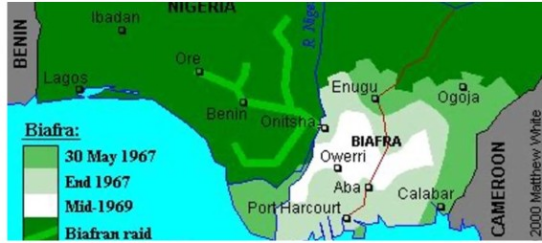
7.2.4 The University of Reading, in an entry in their online archives dated 22 October 2021, featured a map, reproduced below[footnote 14], of the former state of ‘Biafra’, showing its boundaries at 3 stages of the Nigerian Civil War: 30 May 1967, the end of 1967 and mid-1969. The map also shows ‘Biafran’ raids, in which the ‘Biafran’ air force carried out attacks on Nigerian targets such as oil installations[footnote 15]:
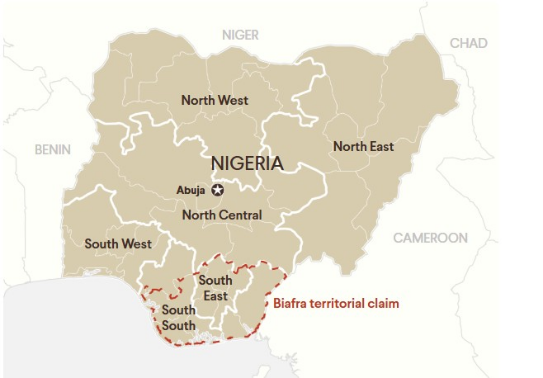
7.2.5 The Council for Foreign Relations, a US-based ‘independent, nonpartisan membership organization, think tank, and publisher’[footnote 16], in an article dated 3 August 2021 (2021 CFR article), provided a map, reproduced below[footnote 17], showing the South East geopolitical zone and part of the South South zone as comprising the ‘Biafra territorial claim’:
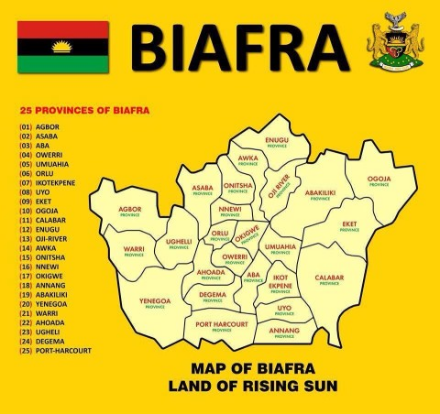
7.2.6 An undated entry on the [Indigenous People of ‘Biafra’] IPOB Worldwide website featured a map showing the 25 provinces of ‘Biafra’, which is reproduced below[footnote 18]:
7.2.7 The 2021 CFR article featured a map showing the distribution of Nigeria’s ethnic groups, which is reproduced below[footnote 19]:
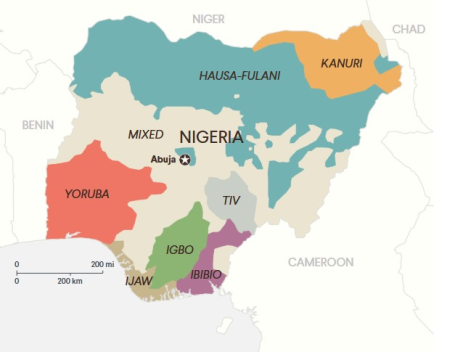
7.2.8 The same article reported: ‘Most supporters of Biafra are ethnically Igbo.’[footnote 20] It further stated: ‘… [C]laims by Biafran separatists include Ijaw [ethnic group] territory in the South South …’[footnote 21]
7.2.9 Cedoca, the research unit of the Office of the Belgian Commissioner General for Refugees and Stateless Persons, published a report in French on 30 September 2025 (2025 Cedoca report), based on various sources including a meeting with an expert on the security situation in Nigeria working for an international peacebuilding organisation. Information from the report quoted in this note has been translated using an online translation tool except where indicated. Noting that the states of Abia, Anambra, Ebonyi, Enugu and Imo form the South East geopolitical zone, the 2025 Cedoca report observed: ‘Biafra comprises the five aforementioned states, predominantly Igbo and claimed by Biafran secessionists, as well as five non-Igbo states (Delta, Akwa Ibom, Bayelsa, Cross River, and Rivers) which partially form the South-South geographical area.’[footnote 22]
7.2.10 An undated entry on the IPOB website stated: ‘IPOB … are the original inhabitanst [sic] and owners of the Lands and Communities of Biafra and Biafraland …They are presently located in the areas called South East, some parts of South South and Middle Belt of Nigeria.’[footnote 23]
7.2.11 Regarding ‘Biafrans’ cultural and religious heritage, an undated entry on the IPOB Worldwide website stated: ‘Biafrans are Hebrews. With the advent of colonialism under the British, many of our people were cajoled forced [sic] to convert to Christianity, but our Judeo cultural roots remained.’[footnote 24]
7.2.12 For more information on IPOB’s aims, see Aims and on Nnamdi Kanu’s conviction, see Background and Conviction of IPOB leader Nnamdi Kanu
7.3 ‘Biafra’ emblems and anthem
7.3.1 An undated entry on the IPOB Worldwide website featured an image of the ‘Biafra’ flag, which is reproduced below[footnote 25]:
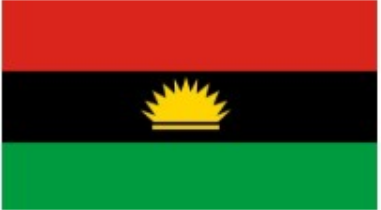
7.3.2 An undated entry on the website of IPOB Ontario, Canada, stated:
‘The Biafra flag consisting of 3-colored horizontal stripes name Red, Black, Green with a golden 11 rays of a rising sun engraved in the black section. The 3-colored Pan-African renassance [sic] flag which was designed by Jamaican revolutionary, Marcus Garvey in support for Africa’s struggle against colonialism and slavery with the “Red” signifying the blood shed on the African continent by the invaders including those lot in resistance, the “Black” signifying the African continent and peoples all over the world, while the “Green” signifies the wealth of Africa in human as well as natural resources and vegetation, was adopted by the Biafran leader, Dim Chukwuemeka Ojukwu as a staunch Pan-African.
‘In the Biafran context, the Red signified the lives lost during the pogroms of 1966-70 before Biafra ultimate withdrawal from Nigeria, the “Black” signifying the consistency of the Biafra as a African nation, the “Green” signifies the rich landscape of the Biafra nation in natural, vegetative and human resources while the 11 rising rays of sun engraved in the black section signifies first 11 provinces created upon the declaration of independence on May 30th 1979, and the geographical position of the Biafra nation in the East part of West Africa, a natural gift which has earned it the title of being often addressed as “land of the rising sun”.’[footnote 26]
7.3.3 The American Historical Association (AHA), ‘the largest membership association of historians in the world’[footnote 27], in an entry on their website dated 1 May 2004, posted the lyrics to the national anthem of Biafra, written by Nnamdi Azikiwe.[footnote 28]
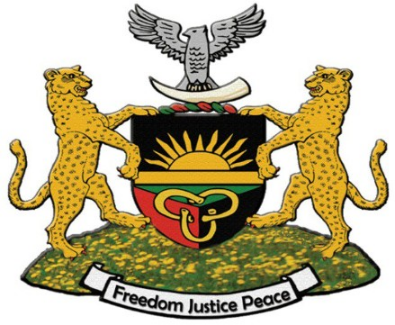
7.3.4 In undated entry on the IPOB Worldwide website featured an image of the ‘Biafra’ coat of arms, which is reproduced below[footnote 29]:
8. Political and administrative context
Official – sensitive: Not for disclosure – Start of section
The information in this section has been removed as it is restricted for internal Home Office use only.
Official – sensitive: Not for disclosure – End of section
8.1.2 Folorunso Gideon Ibukuntomiwa, Celestina Ekene Chukwudi and Chisom Peace Asom, of Covenant University in Ogun State, and Tmitope Damilola Oyebajo, of Lead City University in Ibadan, in a paper dated March 2025 (Ibukuntomiwa and others 2025), reported:
‘Nigeria is a multiethnic and multicultural nation with over 250 ethnic groups, and federalism was adopted as a form of administration to manage the ethnic and regional variations of the country. There are several issues with federalism in Nigeria, such as the concentration of power at the center, corruption, and unequal resource distribution. The IPOB drive for self-determination reflects the problems with federalism in Nigeria, especially in the southeast, where the group has attracted many supporters. The group maintains that Nigeria’s federal system has failed to solve systemic disparities and injustices faced by the Igbo people and that the only answer is to form an independent state of Biafra. The Nigerian government, on the other hand, sees IPOB’s call for independence as a danger to national unity and territorial integrity.’[footnote 30]
8.1.3 Ekeledirichukwu C Njoku, lecturer at Kingsley Ozumba Mbadiwe University in Imo State, in a paper dated August 2025 (Njoku 2025), based on various sources, observed that reasons given by the government for its approach to IPOB:
‘… include the need to preserve national unity, uphold state sovereignty, prevent ethnic conflict, safeguard economic stability, and maintain internal security. IPOB’s self-assertion, which manifests in its symbolic use of flags, public declarations of autonomy, and parallel governance rhetoric, is viewed by the state as an affront to Nigeria’s constitutional authority and territorial integrity. Consequently, the government frames repression not as an act of suppression, but rather as a legitimate strategy to assert control and avert the establishment of alternative power centres within its territory. Drawing from the traumatic memory of the Nigeria-Biafra civil war, the state contends that permitting IPOB’s activities and separatist discourse risks reviving national fissures and threatening cohesion. Actions such as protests, sit-at-home directives, and confrontations with security forces are construed as subversive acts capable of inciting broader unrest. Furthermore, the establishment of the Eastern Security Network (ESN) – IPOB’s paramilitary wing-has intensified state anxieties. The government accuses ESN of orchestrating violent attacks against security personnel and infrastructure, and this reinforces its rationale for adopting pre-emptive repression to forestall what it perceives as an impending large-scale conflict.’[footnote 31]
8.1.4 For more information on IPOB and ESN activities, see Sit-at-home orders and Other activities and methods.
8.1.5 Regarding the approaches of different administrations to ‘Biafran’ separatism, Deutsche Welle, Germany’s international broadcaster[footnote 32], in an article dated 14 July 2023, stated:
‘Kanu was arrested and detained in 2021 under the leadership of former Nigerian President Muhammadu Buhari …
‘“Part of the issue that aggravated the agitation was a disposition of the immediate past government led by President Buhari towards that [South East] region, where he regarded that region as 5% and those who voted for him as 95%. You don’t do that as a leader, as a leader, you must regard the entire country as your constituency,’ [lawyer and political analyst Eric] Omari explained.’[footnote 33]
8.1.6 The article also stated: ‘“The immediate past administration took the agitation for Biafra too personally,” [IPOB leader Nnamdi Kanu’s brother] Prince [Emmanuel] Kanu said.’[footnote 34] The article did not provide details of other reasons for the growth of the agitation or the scale of the growth.
8.1.7 Regarding the presidency of Bola Tinubu, who took office on 29 May 2023[footnote 35] and was the incumbent at the time of writing, Kingsley Ozumba Mbadiwe University’s Njoku and Christopher I Obiukwu of Alvan Ikoku Federal University of Education, Owerri, Imo State, in a paper dated May 2025 (Njoku and Obiukwu 2025), based on various sources, noted: ‘The government has significantly relied on a military-centric approach against secessionist movements [among other things] but it has failed to produce lasting solutions to these challenges … [T]he government has failed to identify that these threats are driven by deep-seated economic problems, deprivation, socio-economic grievances, multidimensional poverty and all-time neglect by successive Nigerian governments.’[footnote 36]
8.1.8 For information on development initiatives, including projects in the South East, see the government’s Renewed Hope Agenda website.
8.1.9 Bertelsmann Stiftung, a German private foundation that supports evidence based non-profit projects, publishes the Transformation Index (BTI). The BTI 2024 is based on country expert analysis of Nigeria’s progress towards democracy and a market economy covering the period 1 February 2021 to 31 January 2023 (during the administration of then-President Buhari). Regarding Igbo perceptions of marginalisation, it reported:
‘For many Igbos, an acceptable reconciliation agreement to conclude the Biafra war civil war (1967-1970), in which an estimated one million mostly easterners died, has not been achieved. The repression of separatist movements and the two main political parties’ unwillingness to present an Igbo presidential candidate continue to fuel perceptions of marginalization in the southeast.’[footnote 37]
8.1.10 The Sun, a privately-owned Nigerian newspaper[footnote 38], in an article dated 1 December 2024, commented:
‘A major sore point in Nigeria’s trajectory is the palpable marginalization of the Igbo nation. Despite being one of Nigeria’s most influential ethnic groups, the Igbo people have faced systemic marginalization that touches nearly every aspect of national life from successive governments as if it is a state policy. This pattern of marginalization is not just historical; it remains a painful, everyday reality for millions of the Igbo, particularly in the South-east of Nigeria.
‘One of the most glaring symbols of Igbo marginalization is the political structure of Nigeria itself. Only the South-east region is composed of five states, the fewest of any of Nigeria’s six geopolitical zones. By contrast, the North-west, a predominantly Hausa-Fulani region, has seven states. The ripple implications of this imbalance are obvious, as it significantly affects federal resource allocation, representation in the National Assembly, and access to political power. In Nigeria’s system of governance, states serve as units of political influence; fewer states mean fewer senators, fewer representatives, and reduced federal resources. As a result, the South-east region receives a disproportionately smaller share of federal funding and political appointments.
‘Also, despite being home to some of Nigeria’s most industrious populations, the South-east suffers from severe infrastructural neglect. Roads, bridges, and public facilities across Igbo states are in near total disrepair, with little or no attention paid to revitalisation projects compared to other regions. This infrastructural decay not only stifles economic growth but also reinforces a sense of abandonment among the Igbo population, who feel excluded from national development priorities, even though these are sponsored by loans they also contribute to repaying …
‘Beyond political and economic marginalisation, the Igbo often feel culturally excluded from the national narrative. National appointments rarely reflect ethnic balance, with Ndigbo [Igbo people] frequently underrepresented in key federal leadership positions, including the military, judiciary, and security services. Mainstream media narratives sometimes portray Igbo self-determination movements as inherently violent or destabilising, which deepens societal divides and alienates a population that feels misunderstood by the rest of the country.’[footnote 39]
8.1.11 Obi-Ani 2024 observed:
‘The Igbo people have been in political limbo since their defeat in the Nigeria-Biafra war in 1970. There appears to be a glass ceiling politically and bureaucratically for the Igbo parvenu. The generation that experienced the war appears to bear the consequences of defeat stoically: those born after the war are exasperated by their second-class status. To them, either they are accepted as full citizens or allowed the quest for an independent Biafra …
‘The secondary victims are fighting the Nigerian culture of silence and are revisiting the hegemonic memory narrative through different social media platforms. In this way, the past shared by the older generation, apart from being experienced, is also learned and interpreted … The survivors’ children are found among the different Biafra movements that have evolved.’[footnote 40]
8.1.12 Obi-Ani 2024 also noted: ‘Post-war Igbo youths, who are part of this social media generation, are deeply concerned by several of Nigeria’s official policies, such as the federal character, quota system, educational disadvantages, and the unequal distribution of government appointments. This perceived marginalization has eroded their faith in a unified Nigeria.’[footnote 41]
8.1.13 Njoku 2025 stated: ‘IPOB alleges systemic discrimination [against the Igbo people] …’[footnote 42] The paper also observed that IPOB ‘has reignited demands for an independent Biafran state, citing systematic exclusion and marginalisation of the Igbo people.’[footnote 43]
8.1.14 In reference to separatist agitations in general in Nigeria, Njoku 2025 noted: ‘… [D]espite decades of repression, separatist agitations in Nigeria have not subsided … The [state’s] continued reliance on coercion, such as military deployments, arrests, surveillance, and legal suppression, has failed to address the fundamental grievances of marginalisation, political exclusion and identity-based discrimination. If anything, state repression has often reinforced the legitimacy of these movements in the eyes of their supporters, deepening distrust between citizens and the state.’[footnote 44]
8.1.15 The European Union Agency for Asylum (EUAA) published a report, ‘Nigeria: Country Focus’, on 3 November 2025 (2025 EUAA country report), based on various sources, including an EUAA online interview conducted on 30 July 2025 with a Nigerian senior security adviser working for an international research organisation that monitors conflict dynamics across the world. The report stated that the adviser ‘… described the attitude by the Nigerian government and its agents towards separatist agitation as “very negative, combative and repressive”. The same source noted that authorities are especially sensitive towards the Biafran agitation given its longer history and the consequences that led to the war between 1967 and 1970.’[footnote 45]
8.1.16 The 2025 Cedoca report identified the following as the main factors fuelling resurgence of the ‘Biafra’ claim among Igbos in the South East:
- economic deficits, including neglected infrastructure and economic stagnation
- administrative disadvantages
- political marginalisation
- cultural and religious differences
- a belief that independence would achieve faster development for the South East[footnote 46]
8.1.17 An article published on 3 October 2025 on the website of This Day, a Nigerian privately-owned newspaper[footnote 47], stated:
‘Three United States-based advocacy groups have criticised President Bola Ahmed Tinubu over his recent Independence Day speech in which he reportedly equated the Indigenous People of Biafra (IPOB) with the Boko Haram insurgency.
‘In a joint statement yesterday, … the organisations – Advocates for Victims of Injustice and Discrimination (AVID), Rising Sun, and Ambassadors for Self-Determination, faulted … Tinubu’s comments, describing the remarks as “reckless, prejudicial and subjudice.” The groups stressed that comparing IPOB, which, according to them, is a non-violent self-determination movement, with a globally recognised terrorist organisation like Boko Haram, was both “inflammatory and irresponsible.”
‘The statement said: “It is deeply unfortunate that a sitting president would make such a false and inflammatory statement while judicial proceedings are ongoing. This utterance is not only subjudice but a blatant attempt to prejudice the course of justice and poison the atmosphere of fair trial.”’[footnote 48]
8.1.18 The Premium Times, a Nigerian privately-owned media outlet[footnote 49], in an article dated 26 October 2025, reported:
‘The Joint Committee of the National Assembly on the Review of the 1999 Constitution has approved the creation of an additional state in the South-east geopolitical zone, a move aimed at addressing long-standing agitation over the region’s perceived marginalisation in Nigeria’s political structure. The decision, … if ratified, will increase the number of states in the South-east from five to six …
‘The South-east is currently the only geopolitical zone in Nigeria with five states, compared to seven in the North-west zone and six in the remaining four zones. The disparity has, over the years, fuelled demands for a new state to ensure equitable representation in federal appointments, resource distribution, and legislative representation.’[footnote 50]
8.1.19 The International Centre for Investigative Reporting (ICIR), a Nigerian independent, non-profit news agency[footnote 51], in an article dated 26 October 2025, stated that under the Constitution, formal creation of a new state would require approval of two-thirds of both chambers of the National Assembly and endorsement by at least two-thirds of the 36 State Houses of Assembly.[footnote 52]
8.1.20 There was no reference to a vote having been held at the national or state level, in the sources consulted for this note (see Bibliography).
8.1.21 The Sun, a Nigerian privately-owned news outlet[footnote 53], in an article dated 14 December 2025, reported:
‘Minister of Works David Umahi has called on Igbo people across the world to lay aside every lingering agitation for the creation of a separate Biafran nation, stressing that national inclusion has addressed the age-long agitation.
‘Umahi said President Bola Ahmed Tinubu has already given Ndigbo what they sought for decades, not through secession, but through unprecedented inclusion in the national grid of governance and development. He made this assertion during his inspection tour of the ongoing Enugu–Anambra Road mega projects, where he addressed stakeholders, contractors and community leaders.
‘He explained that the historical push for Biafran secession was born out of years of neglect, exclusion, and underrepresentation at the federal level. “But today, that narrative has shifted dramatically under President Tinubu,” he said.
‘“Every sector in Nigeria now carries a visible imprint of Igbo interest,” Umahi noted, stressing that appointments, policy inputs and infrastructural priorities now reflect true federal balance. He highlighted that the South East has received its full quota in national appointments, citing his own emergence as Minister of Works, along with several other strategic and “juicy” positions given to Igbo sons and daughters in the current administration.
‘Umahi further pointed out that life-changing projects are springing up across all states in the South East, many of which were considered impossible in previous administrations.
‘… “When a people are fully integrated, respected and empowered within the structure of the nation, then the dream they once chased through agitation has already been achieved through cooperation. Biafra was never about breaking Nigeria; it was about being counted in Nigeria. And today, through inclusion, equity and concrete development, Ndi-Igbo are no longer spectators in the Nigerian project, they are co-authors of its future. …”’[footnote 54]
8.1.22 In an article dated 20 December 2025, the Daily Post, a Nigerian privately-owned newspaper[footnote 55], reported that a coalition of Igbo rights groups in the diaspora had issued a statement that day.[footnote 56] The article quoted the statement as follows:
‘Since Tinubu became President, what has Alaigbo [the homeland of the Igbo] gained? Why is Umuahia-Enugu railway still moribund when Lagos-Kano and Katsina-Niger Republic tracks are functional? Why is the South-East still having only five ministers with two of them junior ministers while one state in South-West has four ministers?
‘Is Umahi not aware that there’s no seaport in the South-East while our people are the highest importers in the country? Do we have any functional cargo airport in Igbo land? Do we have major federal industries or maritime projects? Other regions have these things. Alaigbo does not.’[footnote 57]
9. Security situation and governance in the South East
9.1 Security situation
9.1.1 Nextier is ‘a multi-competency firm … [that] focuses on addressing complex development challenges in Africa’.[footnote 58] In a report dated 15 August 2024, Nextier observed:
‘The drivers of insecurity in South-East Nigeria are complex. Armed groups, including separatist movements and criminal gangs, have taken root in the region, their activities fanning the flames of instability. Research asserts that a group such as the IPOB (Indigenous People of Biafra) has birthed a monster that it can no longer control or manage. Violent groups often target vulnerable communities, using fear and violence as tools to assert control. The spectre of attacks looms large over everyday life, with families living in constant dread of the next assault.’[footnote 59]
9.1.2 The German Federal Office for Migration and Refugees (BAMF), in their ‘Briefing Notes cw40/2024’, dated 30 September 2024 (BAMF brief of September 2024), stated: ‘Members of the Indigenous People of Biafra (IPOB) group … and its armed wing, the Eastern Security Network (ESN), are often held responsible for acts of violence in the region. Both organisations regularly deny such accusations. Other armed groups are also active in the region, including herdsmen belonging to the Fulani ethnic group, according to media reports …’[footnote 60]
9.1.3 The Punch, a Nigerian privately-owned news outlet[footnote 61], in an article dated 15 January 2025, reported: ‘The Chief of Defence Staff, Gen Christopher Musa, on Tuesday [14 January 2025] said the arrest of pro-Biafran agitator, Simon Ekpa, in Finland has brought down the level of insecurity in the South-East zone of the country. He also stated that the launch of Operation Udoka by the Defence Headquarters is gradually restoring peace in the troubled region.’[footnote 62] The article did not provide statistics on the reported changes.
9.1.4 For more information on Operation Udo Ka, see State treatment.
9.1.5 SBM Intelligence, a consulting firm that provides analysis on West Africa[footnote 63], in a report dated 26 May 2025 (2025 SBM Intelligence report), based on various sources, stated:
‘Apart from the more organised separatist movements, various local criminal gangs have been using the escalating conflict to their advantage. These gangs often engage in kidnappings, armed robbery, and extortion, especially in areas where the state’s security presence is weak. Many of these criminal elements, while not directly linked to IPOB or ESN, have capitalised on the fear and confusion to terrorise local populations. Some even claim to be acting on behalf of IPOB or ESN, making it harder to tell the difference between the separatist militants and regular criminals.’[footnote 64]
9.1.6 The same SBM Intelligence report also noted:
‘The rise of unauthorised actors, such as Simon Ekpa and various criminal gangs, has fractured IPOB’s authority, turning a once-organised agitation into a splintered conflict marked by intimidation, extortion, and fear. Ultimately, the Southeast’s security and political crisis is no longer a straightforward tale of secession versus state but a multi-layered conflict driven by ideological conviction, state failure, criminal exploitation, and generational differences in political vision.’[footnote 65]
9.1.7 HumAngle, in an article, ‘Nigeria’s Governance Gap Widens as Ungoverned Areas Multiply’, dated 27 June 2025 (2025 HumAngle governance article), reported: ‘States like Anambra, Imo, Abia, and Ebonyi have become centres for violence … The violence [in the South East] is driven by a volatile mix: separatist agitation, criminal opportunism, and state withdrawal. IPOB and ESN are often suspected to be responsible for many of the terror attacks, though they frequently deny involvement. Criminal gangs, exploiting the chaos, further destabilise the region.’[footnote 66]
9.1.8 For more information on state withdrawal, see Governance and state security presence.
9.1.9 Nextier, in a report dated 9 July 2025 (2025 Nextier Umuoma report), observed:
‘In recent years, the security landscape in Nigeria’s South East region has undergone a disturbing transformation, shaped by the rise of an elusive armed network now widely referred to as “Umuoma”. Once known generically as “unknown gunmen,” these groups have evolved into more organised, assertive actors embedded within local communities, particularly in Anambra, Imo, and Ebonyi States … Based on the data generated from Nextier’s Nigeria Violent Conflicts Database (June 2020 – June 2025), unidentified armed groups were responsible for 1240 deaths in the South East, including 947 civilians and 293 security personnel. These figures point to a lethal blend of insurgency and organised criminality, cloaked in political grievances and often legitimised by community complicity or fear.’[footnote 67]
9.1.10 The same report noted:
‘… Nigeria’s security agencies and the media are fixated on the common conflict in the region, which is the secession agitation by the Indigenous People of Biafra (IPOB), to the detriment of the rapid growth of banditry and terrorism in the region. This fixation implies a lack of deep commitment to understanding the complex nature of IPOB and the Eastern Security Network (ESN). Even if such understanding exists, the lack of ownership of its existence, as evidenced by the Nigerian state’s failure to provide distinctions for all non-state armed groups in the region, is not helping the Nigerian state win the minds and hearts of the people against the criminal groups. Therefore, it is easier for groups like Umuoma, which in many narrations have been described as either a breakaway faction of ESN, or Unknown Gunmen, to be hiding under the pretence of freedom fighting or secession agitation and be carrying out acts that are not short of banditry and terrorism.’[footnote 68]
9.1.11 The US State Department, in their 2024 Country Report on Human Rights Practices (USSD 2024 human rights report), dated 12 August 2025, stated: ‘Individuals believed to be associated with the Eastern Security Network … staged attacks on security personnel, civilians, and government offices, including police stations in the South East region.’[footnote 69] The USSD previously referenced ‘multiple’ such attacks in their 2021 human rights report.[footnote 70] In their 2022 and 2023 human rights reports, they made the same observation as in 2024.[footnote 71] [footnote 72]
9.1.12 The USSD 2024 human rights report also stated: ‘Armed criminal groups linked to Indigenous People of Biafra (IPOB) movement separatists in the South East region conducted significant attacks on government and civilian targets, resulting in dozens of deaths and injuries, destruction of property, and reduction in economic activity.’[footnote 73]
9.1.13 On 13 August 2025, Amnesty International (AI) published a report entitled ‘A decade of impunity: Attacks and unlawful killings in South-East Nigeria’ (2025 AI report), based on various sources including interviews conducted during 3 research missions to the South East zone between April and November 2023.[footnote 74] The report stated: ‘The security situation in South-East Nigeria involves a hybrid of criminal and political violence that different actors can choose to portray and manipulate to suit their interests. The multifaceted nature of the actors in the South-East violence makes it easy for state and non-state actors to reduce the actors to a singular narrative: an IPOB/ESN secessionist group.’[footnote 75]
9.1.14 Similarly, the 2025 AI report also noted: ‘… Nigerian authorities continue to attribute every attack and security challenge in the South-East to the activities of IPOB/ESN, thereby oversimplifying the complex situation on the ground. Amnesty International believes there is no traditional or coherent insurgency in the region.’[footnote 76]
9.1.15 According to the same report,
‘Amnesty International estimates that between January 2021 and June 2023, according to available data, 1,844 people were killed in the South-East region of Nigeria. Since 2021, there have been several attacks on security agents by gunmen leading to the unlawful killing of security agents and residents. Amnesty International has documented several cases of killings in different areas in the South-East by so-called “unknown gunmen,” cult groups, and IPOB and its militant arm, the ESN.’[footnote 77] The report also noted that killings had been perpetrated by herders over grazing lands.[footnote 78]
9.1.16 The 2025 AI report further stated: ‘The so-called “unknown gunmen” are prevalent in conducting random assaults across the South-East, as opposed to a coordinated and calculated attack targeted at the Nigerian state and its institutions or interests … The “unknown gunmen” are indeed known persons in the communities where they operate … There is no clear-cut difference between the activities of the “unknown gunmen” and IPOB/ESN in the South-East, as both have committed violations and abuses of human rights.’[footnote 79]
9.1.17 For more information on the ‘unknown gunmen’, see Eastern Security Network (ESN).
9.1.18 Additionally, the 2025 AI report stated with reference to the Ebube Agu security outfit:
‘On 11 April 2021, … the five governors of Abia, Anambra, Ebonyi, Enugu and Imo, announced the setting up of the South-East security outfit code-named “Ebube Agu”, to support the efforts of security agencies to curb insecurity … Ebube Agu has become available to the state governors who wish to use them as the private army of their administration … Imo and Ebonyi states are the only states where Ebube Agu became operational …’[footnote 80]
9.1.19 The Premium Times, in an article, ‘IPOB not major cause of insecurity in South-east – Odinkalu’, dated 24 October 2025 (2025 Premium Times insecurity article), reported:
‘Human rights activist and a former Chairperson of the National Human Rights Commission (NHRC), Chidi Odinkalu, says cultism financed by politicians is the major security challenge confronting Nigeria’s South-east …
‘He admitted that the impact of violence linked to the outlawed Indigenous People of Biafra (IPOB) in the South-east is undeniable, but argued that IPOB’s contributions to the insecurity in the region are “overblown.” “The idea that every issue in the South-east is an IPOB issue is ridiculous. It’s absolutely not the case,” he said …
‘The former NHRC chairperson acknowledged that there is a possibility of “crossover between cultism and IPOB” in the South-east violence, but argued that cultism remains “the biggest single security challenge confronting” the region.’[footnote 81]
Official – sensitive: Not for disclosure – Start of section
9.1.20 The information in this section has been removed as it is restricted for internal Home Office use only.
Official – sensitive: Not for disclosure – End of section
9.2.21 The 2025 Cedoca report stated:
‘For four decades following the Biafran War, the southeastern region was the safest in terms of violent incidents and deaths. Today, it is the most dangerous place in southern Nigeria. This region has become a hotbed of militant activity, violence, and instability …
‘All southeastern states are experiencing attacks from various armed groups including separatist activists, criminal gangs (sometimes also operating under the separatist banner), government security forces, state militias and community militias …
9.2.22 The 2025 Cedoca report stated: ‘From January 1, 2023 to July 18, 2025, ACLED [Armed Conflict Location & Event Dataset] recorded 1,683 incidents (violence against civilians, explosions/remote violence, battles) in southestern Nigeria, resulting in 2,109 victims …’[footnote 82] The 2025 Cedoca report featured a graph produced by Cedoca using ACLED data to show distribution of incidents in this period, which is reproduced below.[footnote 83] ACLED data is derived from reports by traditional and social media, international organisations and non-governmental organisations and local partner data. For further details on ACLED methodology, see the ACLED Codebook.[footnote 84]
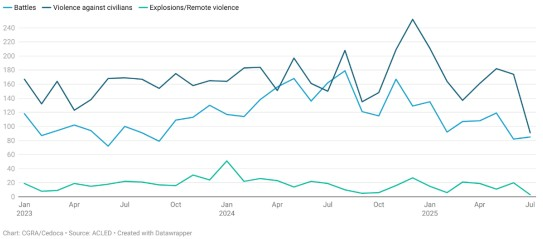
9.1.23 According to Cedoca’s 2025 report, ACLED data showed the distribution of perpetrators of incidents in the same states and during the same period as:
- Unidentified Armed Group (Nigeria) – 40%
- Military Forces of Nigeria – 11%
- Police Forces of Nigeria – 9%
- Unidentified Cult Militia (Nigeria) – 7%
- IPOB – 6%
- Fulani Ethnic Militia (Nigeria) – 6%
- Other – 20%[footnote 85]
The report did not provide information specifically on the number of pro-‘Biafran’ supporters killed or injured.
9.1.24 According to the 2025 Cedoca report:
‘The authorities systematically attribute responsibility to IPOB or its armed wing whenever there is evidence suggesting that Biafran activists might be involved, but this does not always correspond to reality. Research conducted by AI and the expert on the security situation in Nigeria indicates that several criminal and militant groups in the Southeast have begun operating under the cover of IPOB in order to conceal the true nature and intentions of their operations.’[footnote 86]
9.1.25 Citing Cedoca’s conference with an expert on the security situation in Nigeria, the 2025 Cedoca report further stated: ‘In the Southeast, the escalation of armed attacks against government security personnel and assets, along with a surge in criminal violence in recent years, has plunged the region into a state of siege.’[footnote 87]
9.1.26 For more information on:
- attacks on pro-‘Biafran’ separatists, see Attacks and killings (General treatment), Attacks and killings (MASSOB) and Attacks and killings (IPOB)
- attacks blamed on IPOB/ESN and BRGIE/Autopilot/BLA, see Other activities and methods
9.2 Governance and state security presence
9.2.1 The BAMF brief of September 2024 observed: ‘Military offensives are seen as an attempt at systematic countermeasures against the threat to the security situation in several parts of the country. The violence in the south-east is one facet of this.’[footnote 88]
9.2.2 For more information on military, police and vigilante roles and use of the armed forces for internal security, see the Country Policy and Information Note Nigeria: Actors of Protection.
9.2.3 The 2025 HumAngle governance article reported ‘The secessionist group known as the Indigenous People of Biafra (IPOB) has transformed parts of Imo and Anambra States into shadow states. What began as ideological agitation has evolved into fragmented shadow governance, particularly in Orsu, Oguta, and Nnewi South, where IPOB’s Eastern Security Network (ESN) now operates checkpoints, enforces lockdowns, and levies informal taxes …’[footnote 89]
9.2.4 Referring to the South East’s forest belts, the same source continued:
‘The state’s coercive apparatus has collapsed in these ungoverned interiors, like Ihiala and stretches of rural Imo. Local vigilante outfits like Ebube Agu and Operation Udo Ga Chi [a police operation in Anambra State conducted in collaboration with other security agencies[footnote 90]] strive to maintain a fragile order, often overwhelmed by better-armed non-state actors …
‘Ultimately, the region faces a dual crisis of security and legitimacy. As uniforms vanish from the rural southeast, so does any semblance of state authority. What remains is a precarious state of fear and survival – residents trapped between hostile non-state actors and a disengaged state, teetering on the edge of anarchy.’[footnote 91]
9.2.5 The 2025 Nextier Umuoma report observed:
‘The rise of “Umuoma” signals not just a security crisis, but a deeper erosion of state authority, where the monopoly of force is being contested not only by secessionist rhetoric but by emergent hybrid structures of justice and coercion. Far from being isolated criminals, “Umuoma” factions increasingly operate as parallel governance structures issuing weekly sit-at-home orders, extorting local vigilante groups, and enforcing informal justice in communities where state institutions are weak or absent.’[footnote 92]
9.2.6 For more information on ‘Umuoma’, see Security situation, above.
9.2.7 The 2025 AI report observed that gunmen ‘have turned some communities [in the South East] into “ungoverned spaces,” by sacking traditional rulers, displacing residents, and taking total control of communities, including Agwa and Izombe in the Oguta Local Government Area (LGA) of Imo state and Lilu in Ihiala LGA of Anambra State.’[footnote 93]
9.2.8 BBC News, in an article, ‘The kidnap gangs, jihadists and separatists wreaking havoc in Nigeria’, dated 28 November 2025 (2025 BBC News security article), reported: ‘ESN has been in control of several towns in Imo and Anambra states where thousands were forced from their homes.’[footnote 94]
9.2.9 For more information on IPOB and ESN activities, see Sit-at-home orders and Other activities and methods.
10. Overview of separatist groups and methods
10.1.1 Obi-Ani 2024 stated that among the ‘Biafra’ movements that have evolved since the Nigeria Civil War are the Biafra Zionist Movement, the Movement for the Actualization of the Sovereign State of Biafra (MASSOB), the Biafra Independent Movement and IPOB, noting: ‘However, IPOB has been the most influential of all these groups in recent times …’[footnote 95]
10.2.2 For more information on:
- the evolution and fragmentation of he main separatist groups, see Nyor, GA, and others, Nationalities Papers (Cambridge University Press), Biafra Since 1999: Common Cause Versus a Divided Interest in the Struggle for the Creation of Nationhood, 16 October 2025 (Nyor 2025)
- minor separatist groups, see section 3 of the 2025 Cedoca report and Nyor 2025
10.1.3 The 2025 Cedoca report stated:
‘The investigative media outlet HumAngle has identified numerous similarities in the strategies and trajectories of the MASSOB and IPOB movements, with the latter having supplanted the former: aggressive rhetoric towards adversaries, support networks, funding, propaganda, civil disobedience and violent actions, political struggles, etc. Another common tactic is to maintain ambiguity regarding responsibility or to firmly reject any accusations related to criminal acts that could damage their image. Members of these movements are also subjected to fierce repression, including criminal prosecutions and abuses (mass arrests, unfair trials, torture and ill-treatment, extrajudicial killings, etc.).
‘Both MASSOB and IPOB have always been able to count on the financial support of the Nigerian diaspora.
‘Both movements also employ similar methods to express their opposition to the government and draw attention to their cause. One of the main tactics used is civil disobedience, particularly through calls for voluntary confinement, asking people to stay home on certain days. However, these instructions are sometimes enforced by force. The first such call dates back to 2004.
‘MASSOB and IPOB use propaganda, notably by trying to create the impression of widespread international support for the Biafran cause. Both groups discredit traditional media, which they often refer to as “Yoruba media,” and have invested heavily in creating their own information platforms, primarily blogs.
‘MASSOB also exploited the rise of jihadist groups in northeastern Nigeria to bolster nationalist sentiment among the Igbo people. IPOB follows in this tradition by relying on conspiracy narratives, particularly those surrounding an alleged plot to Islamize Nigeria.’[footnote 96]
10.1.4 The French Institute of International Relations, ‘an independent think tank’[footnote 97], in a report, ‘Understanding the Role of Women in Nigeria’s Non-State Armed Groups and Security Architecture’, dated January 2024, stated with reference to secessionist groups in the South East, among others:
‘Although these groups are often male-dominated and may be perceived as threatening women’s security, they also open space for female agency … The women’s wings of these groups often operate at the fringe of the male-dominated main group, and the percentage of female aggressors in these conflicts is usually very low … Nonetheless, the evidence shows that beyond the soft contributions, including providing intelligence, moral guidance, and spiritual protection, women also actively participate in the group’s violent operations. The few women who can transcend their peripheral roles often show a willingness to engage in ruthless violence as the price of transcending the confinement of marginality that describes the position of most female actors in armed conflicts.’[footnote 98]
11. General treatment of pro-‘Biafran’ separatists
11.1 Attacks and killings
11.1.1 For information on the general security situation in the South East, including the state security presence, see Security situation and governance in the South East.
11.1.2 An article by the state-funded[footnote 99] News Agency of Nigeria, dated 5 December 2024, published on the website of the People’s Gazette, quoted the director of the Defence Headquarters’ media operations as reporting that from January to December 2024 in the South East, ‘… the troops of Operation UDO KA neutralised 666 terrorists [and] arrested 893 suspects …’.[footnote 100] ‘Operation Udo Ka’ is the code name for the Nigerian Army’s Joint Task Force South-East.[footnote 101] The article did not explicitly state how many, if any, of the ‘terrorists’ were pro-‘Biafran’ separatists.
11.1.3 Freedom House (FH), a US-based non-government organisation that monitors freedom and democracy across the world, in their Freedom in the World 2025 report (FH FitW 2025 report), covering events in 2024, stated: ‘The military has been repeatedly criticized by local and international human rights groups for extrajudicial killings, torture, and other abuses, including during … operations against separatist movements in the southeast …’[footnote 102] FH made the same observation in all FitW reports dated from 2018 (covering events in 2017)[footnote 103] to 2024 (covering events in 2023).[footnote 104]
11.1.4 For information on oversight and accountability mechanisms for the armed forces, see the Country Policy and Information Note Nigeria: Actors of Protection.
11.2 Monitoring
11.2.1 The 2025 EUAA country report stated: ‘The Nigerian senior security advisor added that most prominent individuals who are strongly supportive of the Biafran cause – considered “individuals of concern” by the security system – are being monitored very closely online and offline. However, the state does not have the capacity to track the large number of people who support the cause. “Therefore, it is unlikely that all supporters are being monitored.”’[footnote 105] The report did not explicitly state whether the observation applied to supporters in the diaspora as well as those in Nigeria.
11.2.2 For information on:
- monitoring of separatists in the diaspora specifically, see Monitoring and other treatment of pro-‘Biafran’ groups/separatists
- monitoring of IPOB/ESN, see Monitoring and surveillance
- expansion of the government’s general monitoring and surveillance capabilities, see the Polis Project, In Tinubu’s Nigeria, Dissent Faces Digital Crackdown, 12 January 2026
11.3 Arrests, detention and enforced disappearances
11.3.1 The 2025 AI report stated: ‘According to Amnesty International findings, persons found in possession of a Biafra flag or insignia were often arrested or abducted by the authorities, whether the person was a member of IPOB or not. State security agents teamed up with members of state-backed Ebube Agu militia, who understand local terrains, as they live in the same community as the suspected IPOB members …’[footnote 106]
11.3.2 The 2025 Cedoca report, citing Cedoca’s conference with an expert on the security situation, stated without specifying a particular separatist group: ‘Real or suspected supporters are arrested and detained, sometimes for years, without charge or trial, often in military facilities with inhumane conditions. Some are held indefinitely, without being brought to justice or released, while their families are repeatedly subjected to extortion …’[footnote 107]
11.3.3 Citing the same expert, the 2025 Cedoca report also stated: ‘When people are arrested, the authorities often choose not to provide any information about their whereabouts or status … Those arrested are often held incommunicado … Even when they are eventually located, their families and lawyers are sometimes denied access … Some security agents extract confessions through torture.’[footnote 108] The report did not explicitly state whether these observations applied specifically to detained suspected pro-‘Biafran’ separatists.
11.3.4 For general information on extortion, torture, and prison and detention centre conditions, and on oversight and accountability mechanisms for the security forces, see the Country Policy and Information Note Nigeria: Actors of Protection.
11.3.5 Regarding suspects’ ‘wanted’ status, the Telegraph, a Nigerian privately-owned ‘multimedia news brand’[footnote 109], in an article dated 23 March 2024 (2024 Telegraph article), reported that [the] BRGIE’s [‘Biafran’ Republic Government In Exile] Simon Ekpa, the head of DOS [Directorate of State], Chika Edoziem, and an unspecified number of South East ‘insurgents’ were among 97 people declared wanted by the Defence Headquarters in Abuja.[footnote 110] The article did not explicitly state whether the insurgents included pro-‘Biafran’ separatists.
11.3.6 However, Lawyard, a Nigerian legal media and services platform[footnote 111], in an article dated 21 February 2025, reported: ‘A Federal High Court in Owerri has declared as illegal and wrongful the designation of a member of the Indigenous People of Biafra (IPOB), Mazi Chika Edoziem as a wanted person, terrorist and insurgent. The court also nullified his [designation] as a kidnapper, and violent criminal by the Minister of Defence and the Chief of Defence Staff.’[footnote 112]
11.4 Internet censorship
11.4.1 FH, in their Freedom on the Net report 2024, dated 16 October 2024, covering events from 1 June 2023 to 31 May 2024, stated: ‘According to OONI [Open Observatory of Network Interference, a ‘[g]lobal community measuring Internet censorship’[footnote 113]] data, 16 pro-Biafran websites that were blocked in 2017 continued to show signs of censorship during the coverage period.’[footnote 114]
11.4.2 The FH FitW 2025 report stated: ‘Internet service providers sometimes block websites at the request of the Nigerian Communications Commission, particularly sites that advocate independence for the region known to separatists as Biafra.[footnote 115] FH made similar observations in all FitW reports dated from 2019 (covering events in 2018)[footnote 116] to 2024.[footnote 117]
11.4.3 HumAngle, in an article dated 1 July 2025, observed that the Nigerian government had restricted access to Biafra War Memories, a digital archive of first-hand accounts of the Nigerian Civil War. It quoted the compiler of another digital repository of the war, the War Archives, as saying that their site had also been blocked but access returned after they changed the domain name and removed the word ‘Biafra’.[footnote 118]
11.4.4 Business Vanguard, a Nigerian business news website[footnote 119], in an article dated 21 August 2025 that reported on general online safety efforts and did not refer to separatism, cited ‘growing concerns from the Nigerian government over the misuse of digital platforms for cybercrime, misinformation, online fraud, and threats to national security’.[footnote 120]
11.5 Journalists covering separatism-related violence
11.5.1 According to the FH FitW 2025 report, ‘Officials restrict press freedom in practice by publicly criticizing, harassing, and arresting journalists, especially when they cover … separatist … violence … [among other topics]’[.[footnote 121] FH previously made the same observation in all FitW reports dated from 2014 (covering events in 2013)[footnote 122] to 2024.[footnote 123]
11.5.2 The Associated Press (AP) news agency, in an article dated 20 October 2025 (2025 AP article), reported that a journalist with French news agency Agence France-Presse (AFP) was arrested during a demonstration in Abuja against Nnamdi Kanu’s detention, but was released shortly afterwards. The article did not state the nationality of the journalist or the reason for his arrest. The article also reported that: ‘… [H]is equipment was destroyed during the altercation. “There were no protesters at the scene where he was arrested,” AFP said.’[footnote 124]
12. Movement for the Actualization of the Sovereign State of ‘Biafra’ (MASSOB)
12.1 Background
12.1.1 Njoku 2025 observed:
‘In the early 2000s, the Movement for the Actualisation of the Sovereign State of Biafra (MASSOB), under the leadership of Ralph Uwazuruike, emerged as a pacifist platform promoting the peaceful emancipation of the Biafran people … MASSOB’s nonviolent strategy was initially rooted in civil disobedience and cultural revival, but tensions with Nigerian security forces and the arrest of Uwazuruike led to a decline in its influence and effectiveness.’[footnote 125]
12.1.2 The 2025 Cedoca report stated:
‘MASSOB was created in 1999 and is one of the first and most important pro-Biafran movements. Under the leadership of Ralph Uwazuruike, MASSOB advocated for Biafran self-determination through peaceful demonstrations and civil disobedience …
‘The Nigerian government responded to the crisis caused by MASSOB primarily through acts of repression by the police and the judicial system, including imprisonment … Ralph Uwazuruike was first arrested in April 2000, when MASSOB announced its intention to raise the Biafran flag and adopt official symbols such as a coat of arms and a national anthem for the secessionist region … Summary executions were reported as early as May 2000, when two young members, Gabriel Oga and Joseph Okereke, were shot dead by police during an operation against the MASSOB secretariat in Aba … Demonstrators were also victims of extrajudicial killings.
‘The official banning of the movement in 2001 marked the beginning of an authoritarian policy. Law enforcement launched a massive crackdown on its members, while intelligence services and the military conducted raids on their offices and headquarters. A large number of activists were arrested and imprisoned across the country, often for extended periods and without trial. One of the most significant incidents occurred on March 29, 2003, in Umulolo Okigwe, Imo State, where more than 600 MASSOB members were reportedly killed. In the following years, particularly in 2005 and 2006, numerous activists lost their lives in clashes with security forces. Faced with this violence, MASSOB leader Ralph Uwazuruike called on his supporters to remain peaceful.
‘In October 2005, MASSOB leader Ralph Uwazuruike and several others were arrested and tried in November for treason. Authorities accused them of plotting a war to intimidate and overthrow the president and the Federal Republic of Nigeria. Uwazuruike remained in custody until his release on bail in October 2007 … Shortly after his release, he declared he would not be intimidated and would continue his struggle. However, this period appears to have marked the beginning of MASSOB’s decline in influence.
‘Following the release of Ralph Uwazuruike, the mobilization in favor of Biafran independence continued, but with less intensity. MASSOB organized two sit-at-home protests in 2008, aiming to send a signal to the international community. However, these actions were accompanied by a clear warning, with the MASSOB official in Lagos emphasizing the peaceful nature of the protests, without any public gatherings.
‘Many activists, including Ralph Uwazuruike himself, [were] forced to leave their homes and live in hiding to avoid arrest. Those captured [were] prosecuted for treason, participating in banned gatherings, and belonging to an illegal group. Between 2000 and 2008, more than 2,000 members were reportedly killed, while over 1,000 others languished in various prisons across the country, according to the movement’s estimates …’[footnote 126]
12.1.3 The 2025 Cedoca report stated:
‘MASSOB is still officially active. It has expanded its organization beyond southeastern Nigeria. In particular, it has established a presence in Lagos, where it has opened a secretariat, and has appointed a coordinator for the Southwest region, as well as in several northern states, including Kaduna.
‘[MASSOB] is currently divided into two factions: the Biafra Independent Movement (BIM)/MASSOB, led by Ralph Uwazuruike; and MASSOB, led by Uchenna Madu.’[footnote 127]
12.2 Legal status
12.2.1 A Human Rights Watch report dated July 2005 stated: ‘Although there is no law proscribing MASSOB, the federal government has declared membership of the organization illegal on the grounds that they constitute a threat to the security and sovereignty of the nation.’[footnote 128]
12.2.2 The Australian Government’s Department of Foreign Affairs and Trade’s Country Report for Nigeria, dated 3 December 2020 (2020 DFAT country report), the latest version at the time of writing and based on various sources, stated: ‘DFAT understands that, although authorities have threatened to proscribe MASSOB on several occasions, they have not actually done so and MASSOB has continued to conduct public activities.’[footnote 129]
12.2.3 A HumAngle article dated 10 July 2024 reported that MASSOB was banned in 2001.[footnote 130]
12.2.4 According to an article published on 28 May 2025 by the National Post, a Nigerian digital news platform[footnote 131] (2025 National Post article), when a suspected MASSOB member was arrested in Anambra State, the police spokesperson for the state issued a statement in which he described MASSOB as ‘the proscribed movement for the [sic] Actualisation of Sovereign State of Biafra.’[footnote 132]
12.2.5 There was no other information in the sources consulted for this note to suggest that MASSOB had been proscribed (see Bibliography).
12.3 Aims
12.3.1 The Daily Post, in an article dated 15 September 2025, reported ‘The Movement for the Actualization of the Sovereign State of Biafra (MASSOB) says it will not give up its struggle for the actualization of Biafra. It said the self determination struggle would continue through principals [sic] of non-violence. This was contained in a statement issued on Sunday [14 September 2025], signed by Comrade Uchenna Madu, leader of MASSOB.’[footnote 133]
12.4 Structure and leadership
12.4.1 There was limited information on the structure and leadership of MASSOB, in the sources consulted (see Bibliography).
12.4.2 For information on the 2 main MASSOB factions and their leaders, see Background.
12.4.3 Vanguard, a Nigerian privately-owned newspaper[footnote 134], in an article dated 12 October 2025, referred to Chris Mocha as BIM/MASSOB’s Director of Information and Senior Special Assistant on Media and Publicity.[footnote 135]
12.4.4 A Vanguard article dated 19 October 2025 (2025 Vanguard MASSOB article), stated that MASSOB’s National Director of Information is Edeson Samuel.[footnote 136]
12.5 Membership and documentation
12.5.1 The 2025 National Post article reported that when a member of MASSOB was arrested in Anambra State, police recovered from him, among other items, ‘an operational identification card of the proscribed organization.’[footnote 137]
12.5.2 There was no further information on cards issued by MASSOB, no information on any membership procedures and no information on membership figures, in the sources consulted for this note (see Bibliography).
12.6 Activities and methods
12.6.1 For information on activities and methods common to MASSOB and IPOB, see Overview of separatist groups and methods.
12.6.2 Vanguard, in an article dated 12 May 2025, stated: ‘The Movement for the Actualization of the Sovereign State of Biafra (MASSOB) [led by Uchenna Madu] has declared a voluntary sit-at-home order to commemorate the 58th anniversary of the declaration of the independent state of Biafra on May 30 [2025].’[footnote 138]
12.6.3 Journalist101, a Nigerian online news platform[footnote 139], in an article dated 25 January 2026, stated:
‘The Movement for the Actualization of the Sovereign State of Biafra (MASSOB) has signalled an imminent strategic shift in its decades-long self-determination campaign, hinting at a new phase that could redefine the group’s methods and international engagement.
‘In a press statement issued on behalf of the organisation, MASSOB said its leadership had concluded a series of high-level consultations with pro-Biafra leaders both within Nigeria and across the diaspora, resulting in what it described as a renewed and recalibrated push for the actualisation and restoration of the Biafra state. According to the group, the forthcoming phase of the struggle will intensify efforts aimed at securing greater international recognition, sympathy, and intervention, while maintaining its commitment to non-violent agitation …
‘The organisation also announced its intention to deepen political participation as part of what it termed Biafra’s political emancipation, stressing that it possesses a strong grassroots base capable of influencing political formations.’[footnote 140]
13. Treatment of MASSOB
13.1 Attacks and killings
13.1.1 The 2020 DFAT country report stated that MASSOB members had clashed with security forces during pro-‘Biafra’ demonstrations in 2018 and 2019. It reported that 125 had been arrested at a rally in Anambra State in 2018, while 2 had reportedly been killed at an anniversary event, also in Amambra State, in 2019.[footnote 141]
13.1.2 The Punch, in an article dated 25 July 2020, reported that 4 MASSOB members were shot and injured and an unspecified number were arrested in clashes with police at a protest in Imo State.[footnote 142]
13.1.3 There was no information on MASSOB members being killed or injured after 2020, in the sources consulted for this note (see Bibliography).
13.2 Monitoring and surveillance
13.2.1 For information on monitoring of pro-‘Biafran’ separatists in general, see Monitoring and Tracking.
13.2.2 The 2025 National Post article reported that following the arrest of a suspected member of MASSOB ahead of ‘Biafra Day’ on 30 May 2025, the Commissioner of Police of Anambra State had urged police ‘to step up surveillance operations to thwart any unlawful gathering in the State.’[footnote 143]
13.3 Arrests and detentions
13.3.1 Business Day, a Nigerian privately-owned business newspaper[footnote 144], in an article dated 4 October 2023, stated that police had released a Catholic priest and 7 other people who were arrested on 27 September 2023 in Anambra State on suspicion of membership of MASSOB. The priest and the others arrested had reportedly stormed an anti-kidnapping squad office demanding to know why a relative of the priest had been arrested.[footnote 145]
13.3.2 The Punch, in an article dated 7 October 2023 (2023 Punch arrests article), reported:
‘The leadership of Biafra Independence Movement and Movement for the Actualisation of Sovereign State of Biafra has accused the police of indiscriminate arrests and extortion of its members across the South-East …
‘A release issued on Friday [6 October 2023] by the Senior Special Assistant on Media and Publicity of the group, Mazi Chris Mocha, alleged that the Police Tiger Base [‘the popular name given to the Imo State Police Command’s Anti-Kidnapping Squad’[footnote 146] was responsible for the indiscriminate arrests and extortions of its members in the South-East. Mocha added that Tiger Base had become another “money making machine” for the Police Force after the scrapping of the Special Anti-Robbery Squad, adding that innocent civilians were being arrested without charging them to court.’[footnote 147]
13.3.3 For more information on police extortion and the Special Anti-Robbery Squad, see the Country Policy and Information Note Nigeria: Actors of Protection.
13.3.4 According to the 2023 Punch arrests article, the MASSOB press release cited the following examples relating to the arrest of MASSOB members:
- a chief and his son were arrested on suspicion of membership of IPOB in April 2023 and detained for 2 weeks until Tiger Base were paid 300,000 naira (£157.02[footnote 148]) by an unspecified party
- a man was arrested in Orlu, Imo State, on suspicion of belonging to IPOB and transferred to Tiger Base in Owerri in the same state, where he was released on 6 June 2023 after MASSOB paid 150,000 naira (£78.51[footnote 149])
- a man was arrested by soldiers in Nsukka, Enugu State, on an unspecified dated and moved to the State Criminal Investigation Department in Enugu, where a police officer demanded 150,000 naira for his release[footnote 150]
13.3.5 According to the same Punch article, the Anambra State Police spokesperson denied that the events took place.[footnote 151]
13.3.6 The 2025 National Post article reported that a member of MASSOB had been arrested in Anambra state for allegedly planning to enforce a sit-at-home order on 30 May 2025, ‘Biafra Day’.[footnote 152]
13.3.7 The Guardian, a Nigerian privately-owned newspaper[footnote 153], in an article dated 17 July 2025 (2025 Guardian MASSOB article), citing a statement issued by MASSOB, reported:
‘… [T]he group highlighted the experience of Mr. Vitus Obumnaeme Ofido, its Regional Director of Mobilisation in the Surulere area of Lagos State. According to MASSOB, Ofido, a known non-violent pro-Biafra activist, was unlawfully arrested and detained by the Lagos State Police Command solely for his affiliation with the movement.
‘“His wrongful detention was challenged in court, and through the intervention of civil society organisations, he was acquitted by the Lagos State High Court,” the statement noted.’[footnote 154]
13.3.8 There was no information to independently corroborate MASSOB’s report of Ofido’s arrest, detention or acquittal, in the sources consulted for this note (see Bibliography). For more information on the MASSOB statement about Ofido, see Discrimination, harassment and intimidation, below.
13.3.9 There was no information on any convictions or enforced disappearances of suspected MASSOB members or supporters, in the sources consulted (see Bibliography).
13.4 Discrimination, harassment and intimidation
13.4.1 The 2025 Guardian MASSOB article reported:
‘The Movement for the Actualisation of the Sovereign State of Biafra (MASSOB) has raised alarm over what it described as the increasing harassment and persecution of its members by Nigerian security forces.
‘In a statement issued by the group’s Director of Information, Edeson Samuel, MASSOB said the growing trend of intimidation reflects a broader pattern of oppression against individuals and groups advocating for self-determination and human rights in Nigeria. The group called on the International Human Rights Commission and other global rights organizations to intervene, investigate the alleged abuses, and help bring an end to the ongoing harassment.’[footnote 155]
13.4.2 The same 2025 Guardian article also reported:
‘MASSOB alleged that security operatives have continued to target [a Lagos State MASSOB official, Vitus Obumnaeme] Ofido. It claimed that plain-clothed officers from the Lagos Command have been trailing him with the intent to re-arrest him, having already attempted to apprehend him at his business premises.
‘“This alarming trend of intimidation and threats towards MASSOB members is not an isolated incident,” the group stated. “It represents a broader pattern of state-sanctioned oppression against those peacefully demanding self-determination.”’[footnote 156]
13.4.3 For more information on MASSOB’s statement about Ofido, see Arrests and detention, above.
13.4.4 Vanguard, in an article dated 18 October 2025, reported:
‘The Imo State Police Command has summoned the leader of the Movement for the Actualization of the Sovereign State of Biafra (MASSOB), Chief Ralph Uwazuruike, to appear before its Anti-Kidnapping Unit (AKU) over alleged criminal offences.
‘Uwazuruike was invited to report at the AKU headquarters in Owerri on Monday, October 20, the same day civil society organizations are expected to hold nationwide peaceful protests demanding the release of detained Indigenous People of Biafra (IPOB) leader, Nnamdi Kanu …
‘Reacting to the development, MASSOB described the police invitation as a possible attempt to prevent Uwazuruike from participating in the planned peaceful protest.’[footnote 157]
13.4.5 In an article dated 19 October 2025, Vanguard stated: ‘The Movement for the Actualisation of the Sovereign State of Biafra (MASSOB) has declared that it will not back down from participating in the pro-Nnamdi Kanu peaceful protest scheduled for Monday in Abuja, despite alleged intimidation from security agencies.’[footnote 158] The article did not explicitly state whether the alleged intimidation referred to the request for Ralph Uwazuruike to appear before the AKU.
13.4.5 For more information on the protests of 20 October 2025, see Protests and rallies.
14. Indigenous People of ‘Biafra’ (IPOB)
14.1 Background
14.1.1 According to Njoku 2025, ‘The internal fragmentation of MASSOB subsequently paved the way for the emergence of a more assertive movement – the Indigenous People of Biafra (IPOB), founded in 2012 by Nnamdi Kanu, a British-Nigerian citizen.’[footnote 159]
14.1.2 BBC News, in an article, ‘Nigerian separatist leader sentenced to life for terrorism’ (2025 BBC News sentencing article), dated 20 November 2025, stated that Kanu set up IPOB in 2014.[footnote 160]
14.1.3 A HumAngle article dated 23 June 2023 (2023 HumAngle article) gave a slightly different account of the emergence of IPOB, reporting:
‘Kenny Nwannekaenyi Okwu-Kanu (popularly known as Nnamdi Kanu), a British-Nigerian national who gained prominence as director of London-based broadcaster Radio Biafra, joined forces with Alphonsus Uche Okafor-Mefor to establish IPOB. Their goal was to restore the sovereignty of Biafra with “renewed vigour”. While it is not clear exactly when IPOB emerged, some of the earliest records date back to 2013. Mefor and Kanu first registered the Indigenous People of Biafra with the UK government in Oct. 2013 and then again in July 2014.’[footnote 161]
14.1.4 The 2025 EUAA country report stated: ‘In 2014, Kanu first introduced the idea of armed struggle, followed by an open call for weapons in 2015 … In 2017, the Nigerian Federal Government and South-East Governors proscribed IPOB as a terrorist organisation.’[footnote 162]
14.1.5 The 2025 EUAA country report also stated that in 2020, Kanu founded the Eastern Security Network (ESN), ‘the armed paramilitary wing of IPOB.’[footnote 163]
14.1.6 Noting that Nnamdi Kanu was first arrested in Lagos in 2015 and then jumped bail in 2017, the 2023 HumAngle article reported: ‘Kanu’s re-arrest in June 2021 and his continued detention led to the IPOB breaking up into at least two factions: the Directorate of State (DOS) and the more radical Autopilot.’[footnote 164]
14.1.7 The Hudson Institute, a US non-partisan policy research organisation[footnote 165], in a report, ‘Understanding the “Unknown Gunmen” Who Attacked a US Convoy in Nigeria”, dated 18 May 2023 (2023 Hudson Institute report), commented:
‘… [T]here is no coherent insurgency in southeastern Nigeria as such. Nigerian officials and Biafran agitators alike claim there is one, even if some may admit it has become “factionalized” with rival groups vying for power. But IPOB is not factionalized so much as it lacks any coherent identity at all. Although there are rival self-styled leaders of the movement – principally individuals in the diaspora who attack each other over Twitter and Facebook – it remains unclear the extent to which any of these figures direct the violence on the ground. All the while, a host of criminal and militant groups in the southeast have begun operating under the guise of IPOB’s armed wing in a way that obfuscates the true nature and intent of their operations.’[footnote 166]
14.1.8 The 2025 SBM Intelligence report noted: ‘While Nnamdi Kanu retains influence, particularly among younger supporters, his movement is increasingly fractured, with a generational divide emerging over secessionist versus restructuring agendas. The continued violence and economic hardship are eroding public support for the sit-at-home protests.’[footnote 167]
14.1.9 The same report explained: ‘Support for Kanu’s secessionist agenda is waning among the region’s political, economic, and intellectual elite, especially those over 50, who often prefer national restructuring over disintegration and reject Kanu’s inflammatory approach as counterproductive. The secessionist vision propagated by IPOB under Kanu does not represent the totality of Igbo aspirations. Instead, it underscores a generational and ideological rift within the region’s advocacy for justice and equity.’[footnote 168]
14.1.10 For information on IPOB’s position on national restructuring, see Aims.
14.1.11 The 2025 EUAA security report observed:
‘Referring to the South-East in general, a Nigerian senior security advisor interviewed by EUAA in July 2025 stated that IPOB was now generally viewed as “less combative” than in the past and appeared not to have been implicated in most of the recent attacks against federal security personnel. According to this source, these attacks seemed to have been carried out either by criminal organisations “masquerading” as Biafran agitators (using Biafran symbols and flags) or by elements linked to the so-called Biafran Republic Government In Exile (BRGIE) of the Finland-based Biafran agitator Simon Ekpa.’[footnote 169]
14.1.12 For more information on BRGIE, see ‘Biafra’ Republic Government in Exile (BRGIE)/Autopilot faction, below.
14.1.13 The 2025 BBC News sentencing article stated: ‘A court in Nigeria has found separatist leader Nnamdi Kanu guilty of terrorism and other charges following a decade-long legal case full of drama. He has been given four life sentences, along with other terms, to be served concurrently.’[footnote 170]
14.1.14 For more information on Kanu’s convictions and sentencing, see Detention, conviction and sentencing of IPOB leader Nnamdi Kanu.
14.1.15 An undated entry on the IPOB Worldwide website featured an image of the IPOB logo[footnote 171], which is reproduced below:
14.2 Eastern Security Network (ESN)
14.2.1 The 2025 SBM Intelligence report stated:
‘Founded in December 2020, the Eastern Security Network (ESN) was established by IPOB as a response to what it described as the failure of the Nigerian government and security agencies to protect the lives and properties of Igbo people. IPOB claimed that the ESN’s primary goal was to protect the Southeastern region from armed groups, including Fulani herdsmen, who were reportedly wreaking havoc on farms and rural communities.
‘However, over time, the ESN’s activities expanded beyond its self-proclaimed mandate, and it became increasingly involved in violent operations aimed at enforcing IPOB’s broader agenda, including the enforcement of the sit-at-home order …
‘… [ESN’s] presence is marked by heavy weaponry such as sub-machine guns and rocket-propelled grenades.’[footnote 172]
14.2.2 For more information on the sit-at-home order, see Activities and strategies and ‘Biafra’ Republic Government in Exile (BRGIE)/Autopilot.
14.2.3 Ovenaone Jennifer Uniga, of Taraba State University, and Mustapha Saleh Dankishiya, of Federal Polytechnic Bali-Nigeria in Taraba State, in a paper dated June 2025 (Uniga and others 2025), based on various secondary sources, stated: ‘… [T]he ESN functions as the paramilitary wing of IPOB, though the group claims that it is a defensive force and not an offensive militia.’[footnote 173]
14.2.4 The 2025 AI report quoted a South East security analyst as telling AI: ‘ESN was set up by Mazi Nnamdi Kanu for the purpose of securing the lives and properties of people. That was when the Fulani herdsmen were on [the] rampage, killing people in the farms … That was why Nnamdi Kanu set up ESN to contain the activities of the criminals. At that point, this effectively worked.’[footnote 174]
14.2.5 Regarding ESN and the term ‘unknown gunmen’, the 2023 Hudson Institute report noted that ‘unknown gunmen’ is an ironic reference by IPOB supporters to implied ESN members.[footnote 175]
14.2.6 For more information on ‘unknown gunmen’, see Security situation.
14.2.7 The same Hudson Institute report commented: ‘In thinking he would form a Biafran army with ESN, Kanu had instead undermined IPOB’s claim to be fighting on behalf of ordinary Igbo and invited various self-interested parties to hijack his movement.’[footnote 176]
14.2.8 According to the 2025 EUAA security report, ‘ESN launched a campaign targeting Fulanis in the forests of the South-East. Over 2024, the campaign reportedly dislodged more than 70 Fulani herders and criminal settlements in these areas. It also engaged in clashes with security forces, often conducting guerrilla-style attacks against police and military installations.’[footnote 177]
14.2.9 The 2025 EUAA country report stated: ‘… ESN members include former soldiers who served in the Nigerian army, while others are civilians trained in basic combat skills. Many are armed with military-grade rifles.’[footnote 178]
14.2.10 Sahara Reporters, ‘an online community of international reporters and social advocates’[footnote 179], in an article dated 14 December 2025 (2025 Sahara Reporters article), stated:
‘The Indigenous People of Biafra (IPOB) has congratulated operatives of the Eastern Security Network (ESN) on its fifth anniversary, claiming the outfit has significantly reduced attacks on rural communities and farmlands across the South-East. In a statement issued by its spokesperson, Emma Powerful, and obtained by SaharaReporters on Sunday [14 December 2025], IPOB said ESN was established on December 12, 2020, by its leader, Nnamdi Kanu, to address what it described as a “grave security vacuum” in Biafran territories …
‘IPOB described ESN operatives as volunteers drawn from its ranks who, it said, abandoned personal careers and comforts to protect their communities. The group also alleged that the outfit has faced sustained military operations, media attacks and internal sabotage but has remained “resolute” in pursuing its objectives.’[footnote 180]
14.3 Proscription/legal status
14.3.1 The Premium Times, in an article dated 30 January 2025 (2025 Premium Times proscription article), reported that, in a unanimous decision, ‘The Court of Appeal in Abuja, on Thursday [30 January 2025], affirmed the proscription of the Indigenous People of Biafra (IPOB) and its designation as a terrorist organisation.’[footnote 181]
14.3.2 The same article provided the following background information on IPOB’s proscription:
‘In September 2017, the then-president, Mr Buhari, signed a presidential proclamation proscribing IPOB. Also in September 2017, a Federal High Court in Abuja formalised IPOB’s proscription and tagged the group a terrorist organisation. The then Acting Chief Judge of the Federal High Court, Abdul Kafarati, granted the order proscribing the group. The order followed an application filed and moved by the then Attorney-General of the Federation and Minister of Justice, Abubakar Malami, a Senior Advocate of Nigeria.
‘The South-east Governors Forum later announced that they had proscribed the group in the region.
‘IPOB, through its legal team, challenged the proscription in courts for several years without success. But on 23 October 2023, a State High Court in Enugu, nullified the proscription of IPOB … The IPOB leader, Mr Kanu, [had] filed the suit in January 2023 against the Nigerian government and the South-East Governors’ Forum …
‘Thursday’s [30 January 2025] appeal court ruling means IPOB remains proscribed ….’[footnote 182]
14.3.3 The Cable, a Nigerian privately-owned online newspaper[footnote 183], in an article dated 8 February 2025, reported: ‘The Indigenous Peoples [sic] of Biafra (IPOB) has approached the supreme court to appeal the judgment of the court of appeal affirming the proscription of the group.’[footnote 184]
14.3.4 There was no information on any further developments in IPOB’s appeal to the Supreme Court, in the sources consulted for this note (see Bibliography).
14.3.5 The Cedoca 2025 report explained that being proscribed as a terrorist group ‘prevents IPOB … from organizing rallies’.[footnote 185]
14.3.6 According to a Premium Times article dated 7 March 2025 (2025 Premium Times sanctions article), Simon Ekpa and 13 other individuals or companies linked to IPOB were recommended for designation as ‘terrorism financiers’ by the Nigeria Sanctions Committee (NSC) on 6 March 2025. The article reported that the recommendation had been approved by President Bola Tinubu, resulting in the imposition of sanctions such as the freezing of their assets.[footnote 186]
14.4 Aims
14.4.1 For information on the territory claimed by IPOB for ‘Biafra’, see Geography and demography.
14.4.2 Princewilliams Oder Oguejiofor, of Nnamdi Azikiwe University Awka, Anambra State, in a paper dated 2024, stated: ‘The Indigenous People of Biafra (IPOB) is a separatist organization that supports a referendum overseen by the United Nations to grant the former eastern part of Nigeria independence from Nigeria.’[footnote 187]
14.4.3 The 2025 Cedoca report, citing Cedoca’s conference with an expert on the security situation, stated: ‘Its objectives are the political independence of southeastern Nigeria, the protection of the interests of the Igbo people in Nigeria and around the world, opposition to the influx and presence of Fulani herders in the Southeast, and encouraging the population to turn away from the Nigerian state (particularly by not joining the Nigerian military and security services).’[footnote 188]
14.4.4 An undated ‘Frequently Asked Questions’ section of the website of IPOB Ontario included the following:
‘Is IPOB Willing To Accept Restructuring From the Government of Nigeria?
‘NO. The Aburi accord … of January 1967 [reached between delegates of the federal government and the Eastern Region at a meeting described as the last chance of preventing all-out civil war[footnote 189]] was all about restructuring Nigeria, but the Fulani fundamentalists after agreeing, declined to comply with the implementation as agreed. The 2014 Confab (National Conference) was a national call for restructuring Nigeria; that same group again undermined that very expensive process. For over 100 years, Biafrans have been part of Nigeria. They were committed to national unity, made huge capital intensive investments, and contributed immensely towards her development as a country. However, the reward we reap from Nigeria is unending envy, aninmosity, unprovoked cruelty and incessant massacre. Restructuring Nigeria cannot solve our problems …
‘What Religions Will be Allowed in Biafra?
‘There will be religious freedom in Biafra.’[footnote 190]
14.5 Structure and leadership
14.5.1 BBC Monitoring, in a biography of IPOB leader Nnamdi Kanu, stated that he was born on 25 September 1967 in Isiama Afara, Abia State, and is the son of a traditional monarch from that state. He holds both Nigerian and British passports and identifies as Jewish.[footnote 191]
14.5.2 For information on the conviction of Nnamdi Kanu, see Detention, conviction and sentencing of IPOB leader Nnamdi Kanu.
14.5.3 BBC News, in an article dated 24 February 2023, noted: ‘[Nnamdi Kanu’s] continued detention has meant that Ipob no longer operates as a coherent force, with a clear command structure or political programme.’[footnote 192]
14.5.4 John Sunday Ojo, of the University of Portsmouth, in a paper dated 16 March 2023, provided a diagram of the structure of IPOB’s leadership, citing an undated IPOB pamphlet.[footnote 193] The same diagram was included in English in the 2025 Cedoca report, which cited Cedoca’s conference with the expert on the security situation in Nigeria as the source.[footnote 194] [footnote 195] The diagram is reproduced below:
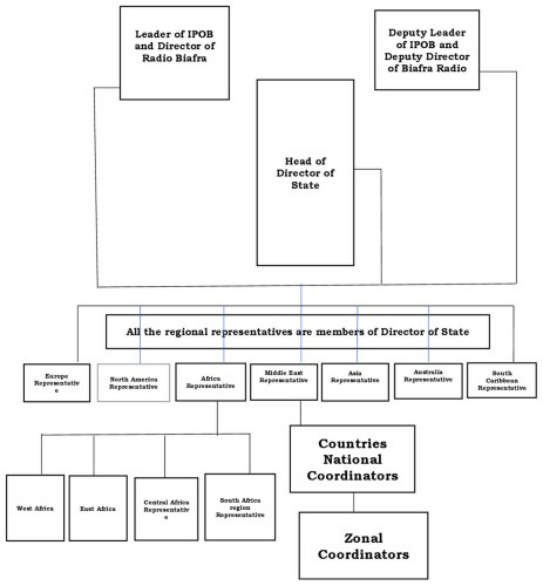
14.5.5 Uniga and others 2025 stated:
‘IPOB is organised under a structured hierarchy. At the top is Nnamdi Kanu, the supreme leader and the central decision-making authority. Beneath him is the Directorate of State (DOS), a governing council overseeing operations, currently led by Chika Edoziem, who assumed key responsibilities after Kanu’s arrest in 2021 … IPOB operates globally through regional chapters across Europe, North America, and Africa, coordinated by diaspora representatives. These international structures help fund IPOB’s activities and mobilise advocacy campaigns abroad … IPOB adheres to a “command and control” system, meaning that all members are subject to a strict chain of command and are expected to follow orders from the leadership.’[footnote 196]
14.5.6 Citing Cedoca’s conference with the expert on the security situation in Nigeria, the 2025 Cedoca report stated:
‘The DOS comprises officials with specific missions, functioning like a council of ministers, and international representatives. Under the authority of the DOS, the IPOB has continental representatives, national coordinators, regional coordinators in each country, and finally, senatorial, zonal and unit officials.
‘The DOS Media Department, one of its most powerful departments, is responsible for official IPOB announcements, via appropriate communication channels, including Radio Biafra.’[footnote 197]
14.5.7 The undated ‘Frequently Asked Questions’ section of the IPOB Ontario website included the following:
‘What Does IPOB Under The Leadership Of Nnamdi Kanu Mean By Command And Control Rule?
‘It is bidirectional, well-organized, systemic, and hierarchichal structure with the sole aim of accomplishing our mission. It is analogous to how the body system works: in other words, every part of the system is important.
‘How Are The Command And Control Rules Executed?
‘Information flows smoothly from head to toe (top to bottom) and toe to head (bottom to top), without jumping huddles [sic].
‘Who Is Expected To Execute The Command And Control Rules?
‘All active participants of IPOB’[footnote 198]
14.5.8 An IPOB press release dated 1 November 2025, posted on the IPOB official website, was issued in the name of ‘Comrade Emma Powerful, media and publicity secretary for IPOB.’[footnote 199]
14.5.9 In an entry dated 5 January 2026, the ‘Biafra’ Times, a news blog, posted the text of an address by Chika Edoziem, head of DOS, which stated:
‘… [T]he following changes are being made in the leadership of IPOB Nigeria family.
‘i. Mazi Julius has been appointed the IPOB West Africa Deputy Regional Coordinator
‘ii. Mazi N Flavour is appointed the new National Coordinator for the IPOB Nigeria family
‘iii. Mazi N Chukwudi will be the IPOB Nigeria family deputy National Coordinator
‘iv. Mazi Uyi C is appointed the IPOB Ghana National Coordinator
‘v. Mazi Chukwuezi N. is the IPOB Ghana deputy National Coordinator
‘vi. Mazi Nnamani is the new Coordinator for the IPOB family in Abuja
‘vii. Mazi Dede will deputize him as the Abuja deputy Coordinator
‘All appointments take immediate effect.’[footnote 200]
‘Mazi’ is an Igbo honorific similar to ‘Mr’.[footnote 201]
14.5.10 Regarding an IPOB youth wing, IPOB, in a press release dated 5 February 2023, reported that ‘Ndubuisi Igwekala alias Agu Biafra … a former MASSOB member sacked by the leadership of the group because of his criminal activities in MASSOB’ had been claiming to be a leader and president of IPOB Youth Wing.[footnote 202] It stated: ‘We want the public and the good people of Biafra to know that there is no unit or department called IPOB Youth Wing in IPOB Structure.’[footnote 203]
14.6 Funding, membership and documentation
14.6.1 The 2025 Cedoca report stated:
‘IPOB’s activities are primarily funded by mandatory monthly membership dues, as well as contributions from its supporters, particularly those living outside Nigeria.
‘In southeastern Nigeria, the group requires its members to pay a monthly membership fee equivalent to [0.56 euros] [£0.48[footnote 204]]. IPOB previously provided copies of payment receipts, but this practice is becoming less common as the group seeks to minimize its paperwork. Payments by members in Nigeria are increasingly conducted clandestinely. For example, during some online meetings, the account number is shared only at the end, as a precaution.
‘This source of funding has decreased in recent years due to intensive surveillance by Nigerian intelligence and security services. According to a security expert in Nigeria working for an international peacebuilding organization, a local IPOB official knows who is a member of the organization. There is no pressure to join the group, nor is there any forced recruitment. However, there is pressure to contribute. For example, it is appropriate to contribute financially to IPOB in order to secure a stall in certain markets.
‘Instead of local funding, members of the group living abroad have become its primary source of financing, notably through online campaigns via lobbying groups … These contributions are made to the group via online platforms and overseas bank accounts. Within the diaspora, proof of payment remains.’[footnote 205]
14.6.2 For more information on funding from the diaspora, see UK pro-‘Biafran’ groups/supporters and sur place activities.
14.6.3 The undated ‘Frequently Asked Questions’ section of the IPOB Ontario website included the following:
‘How Does IPOB Identify Active Participants?
‘There is a process through which all people must pass in order to become IPOB members. IPOB also maintains an active ledger of all members.
‘For the purposes of diseminating [sic] information, there are various Biafra-related facebook grops. Joining any one of these Biafra or facebook groups is not equivalent to joining IPOB.
‘What Are The Duties Of An Active IPOB Participant?
‘On a regular basis active participants of IPOB support Biafra’s freedom/resoration in words and deeds, including, but not limited to spreading awareness about Biafra, forming and maining strategic relationships, and supporting financially.
‘Can I Make A Charitable Contribution Without Becoming IPOB Member?
‘Yes, all concerned people are free to make charitable donations as single payments or recurring payments to support the indigenous people of Biafra …’[footnote 206]
The website did not explicitly state whether questions and answers relating to ‘IPOB’ were applicable to IPOB globally or only to IPOB Ontario.
16.4.4 Regarding membership, there was no information on membership figures for IPOB in Nigeria, in the sources consulted for this note (see Bibliography).
16.4.5 Regarding IPOB identity cards, a press release issued by IPOB media and publicity secretary Emma Powerful on 17 November 2023 and posted on the website of IPOB Ontario stated:
‘The attention of the global family and movement of the Indigenous People of Biafra (IPOB) has been drawn to the nefarious activities of some criminals scamming people with fake IPOB identity cards within Orlu Province, Imo State and it’s [sic] environs. For public record purposes, IPOB does not issue identity cards to members, and neither did the leadership authorize anyone to issue identity cards to anyone on her behalf … Biafrans who are genuinely interested in joining the IPOB family should do so through physical attendance to the IPOB family meeting within their areas and not be obtaining fake identity cards.’[footnote 207]
14.7 Sit-at-home orders
14.7.1 The 2025 SBM Intelligence report stated:
‘Following the arrest of their leader, Nnamdi Kanu, the IPOB formally introduced the sit-at-home order in June 2021. With its initial widespread implementation on Mondays starting from 9 August 2021, this action directly correlated with the detention of Kanu, underscoring the primary objective of the tactic: his release.
‘What began on Monday, 9 August 2021, as a weekly action intended to demand the release of IPOB leader, Nnamdi Kanu, has become a persistent and complex issue with substantial economic and security repercussions across Nigeria’s Southeast geopolitical zone. What began as an annual commemoration of those who perished in the Biafran War subsequently transformed into a recurring tool for addressing broader Biafran-related grievances and demanding the freedom of the IPOB leader. This evolution from a single annual event to a weekly disruption signifies a strategic decision by IPOB to utilise civil disobedience as a means to achieve its aims. Consequently, the sit-at-home orders, predominantly enforced on Mondays, have become a significant and persistent disruption to the socioeconomic fabric of Southeast Nigeria.
‘Initially presented as a symbolic act of solidarity, the sit-at-home order quickly transitioned from passive protest to a situation marked by widespread fear. Despite a public announcement of the suspension of weekly protests shortly after their commencement, the situation has continued to degenerate. Mondays in most of the Southeast have become mainly characterised by inactivity, with empty streets and closed businesses. This inactivity stems not solely from voluntary compliance but also from violence directed at those who choose to disregard the order. Individuals or groups enforcing the order, sometimes armed, have engaged in acts such as setting fire to commercial vehicles and attacking those who defy the directive, creating an atmosphere where compliance is often driven by fear.’[footnote 208]
14.7.2 According to the same SBM Intelligence report, ‘While there was a high rate of compliance with sit-at-home orders in 2021 (82.6%), surveys reveal that actual support is much lower (29%), with many complying under duress.’[footnote 209] SBM Intelligence stated in a separate report on the surveys, dated 9 September 2021, that researchers interviewed a total of 1,012 people across all 5 states in the South East.[footnote 210]
14.7.3 The 2025 SBM Intelligence report also noted that the sit-at-home order is enforced primarily by ESN.[footnote 211] However, the same report observed that the sit-at-home order ‘has gradually degenerated into a vehicle for violence, economic disruption, and criminality … Business owners, students, and commuters are at the mercy of armed enforcers acting in IPOB’s name or hijacking the movement.’[footnote 212] It also noted: ‘The enforcement of the sit-at-home orders has frequently involved violent tactics employed by individuals or groups referred to as “unknown gunmen,” who target those who attempt to go about their normal activities on designated days.’[footnote 213]
14.7.4 In a press release also dated 26 May 2025, posted on IPOB’s website, IPOB described the 2025 SBM Intelligence report as a ‘hatchet job’, adding: ‘Let it be known and recorded that IPOB officially cancelled Monday Sit-at-Home in 2021, and our leader publicly disowned any individual or group enforcing such orders. Therefore, any attack attributed to a “Sit-at-Home” cannot be logically or factually linked to IPOB.’[footnote 214]
14.7.5 The 2025 Cedoca report stated: ‘Despite IPOB’s announcement that it was lifting its lockdown order, several sources, including AI [Amnesty International], HumAngle, and academic researchers, have documented violent enforcement of these orders by IPOB and other armed actors. The violence observed – ranging from beatings, destruction of property, and flogging of students and teachers, to targeted assassinations and beheadings – has resulted in deaths among civilians and security forces …’[footnote 215] The report did not provide information on the scale or extent of this violence.
14.7.6 Regarding sit-at-home orders to mark ‘Biafra Remembrance Day’, the Punch, in an article dated 30 May 2025, reported:
‘Business, education, and government activities were shut down in Owerri, the Imo State capital, as residents stayed indoors in compliance with a sit-at-home directive. This is despite the Imo State Police Command’s call for residents to disregard the directive and go about their normal business activities.
‘The proscribed Indigenous People of Biafra has, for years, directed residents to stay indoors on May 30 to honour fallen Biafra heroes and this year was no exception.’[footnote 216]
14.8 Other activities and methods
14.8.1 The 2023 HumAngle article, citing various sources, reported:
‘[IPOB] started by organising peaceful protests, broadcasting its campaign online, and rallying a group of supporters locally and internationally within the diaspora community. Kanu became notorious for his unrestrained, often treasonous and hateful, language. At the World Igbo Conference in Los Angeles in Sept. 2015, he said, “We need guns and we need bullets to defend our land or else our people will perish at home.” About a month later, Nigerian intelligence officers arrested him in Lagos, leading to a wave of protests and grave police clampdown. Kanu jumped bail in 2017.
‘During the #EndSARS anti-police brutality demonstrations in Oct. 2020, Kanu released several statements on Radio Biafra where he urged his followers to kill security personnel and hunt politicians such as Abia state governor Okezie Ikpeazu, former Lagos governor Bola Tinubu [Nigeria’s president at the time of writing], and Rivers governor Nyesom Wike. “Anybody wearing police or army uniform is an enemy of the people. Anywhere you see them, you take them down,” he announced in one broadcast. After a period of calling on security agents to resign and join the “Peoples Revolutionary Army/Force”, in Dec. 2020, IPOB launched the Eastern Security Network (ESN), touting it as a vigilante group set up to protect civilians in the region from foreign invaders. Instead, it marked the beginning of a dark episode in southeastern Nigeria.
‘Attacks on security personnel and structures increased. High-handed military offensives targeted at crushing the ESN inflamed passions, with IPOB declaring that it saw it as a declaration of war. “They shall be shamefully defeated. The war has begun! We shall defend Biafra and we shall triumph!” said spokesperson Emma Powerful.’[footnote 217]
14.8.2 The same article further stated:
‘… [U]nlike other insurgent groups, IPOB would not directly take responsibility for attacks that carry its signature or promote its interests. Instead, while its propaganda may often come off as inciting, it distances itself from violent acts as much as possible - except in “self-defence” or in defence of civilians. But this may only be a strategy to maintain a brand that would not jeopardise efforts to secure diplomatic backing or the support of people in the affected areas.’[footnote 218]
14.8.3 Ibukuntomiwa and others 2025, citing interviews conducted in the South East, reported:
‘ … [D]ifferent individuals within the [IPOB] movement employ different approaches such as:
‘a. Peaceful Advocacy: IPOB has engaged in peaceful protests, demonstrations, and campaigns to raise awareness about their cause and advocate for self-determination. Peaceful advocacy includes activities such as rallies, sit-at-home, and public speeches aimed at promoting their message and garnering support.
‘b. Secessionist Agitation: Some factions or individuals associated with IPOB have expressed more radical views and pursued secessionist aspirations more forcefully. This involves advocating for the complete independence of the Biafran region from Nigeria through political means or, in some cases, through calls for armed resistance …
‘d. Civil Disobedience: IPOB has called for civil disobedience as a means of expressing their grievances and putting pressure on the government. Civil disobedience involves acts like strikes, boycotts, or non-cooperation with government directives as a form of protest against perceived marginalization …
‘e .Social media and Online Activism: IPOB and other groups advocating for self-determination have utilized social media and online platforms to mobilize support, disseminate information, and raise awareness about their cause.
‘f. International Lobbying and Diaspora Support: IPOB has sought to gain international attention and support through lobbying efforts, engaging with diaspora communities, and leveraging their networks to highlight their cause on the global stage …’[footnote 219]
14.8.4 Njoku 2025 stated:
‘IPOB’s rise has been characterised by a blend of civil resistance, local and diaspora mobilisation, digital propaganda, and acts of defiance, including sit-at-home orders, which have frequently led to violent clashes with Nigerian security forces …
‘While IPOB’s initial tactics emphasised peaceful protests, online engagement, and international advocacy, the government’s repression arguably contributed to the group’s radicalisation. Central to IPOB’s mobilisation strategy is its appeal to the economically and politically marginalised underclass comprising artisans, petty traders, commercial motorcyclists, and rural peasants. Through digital platforms, particularly Radio Biafra, IPOB has disseminated its ideology, critiqued the Nigerian state, and challenged the perceived betrayal by conservative Igbo elites. The founding of the Eastern Security Network (ESN) in 2020 marked a decisive shift from nonviolence to armed self-defence. IPOB justified the creation of ESN as a response to the threat posed by armed Fulani herdsmen and broader insecurity in the Southeast. This militarised turn has not only heightened IPOB’s confrontations with the state but has also transformed it into a central security concern in Nigeria.’[footnote 220]
14.8.5 The Guardian (Nigeria), in an article dated 4 August 2025, reported:
‘The Indigenous People of Biafra (IPOB) said on Monday that it has no hideouts, camps or terror cells anywhere, stressing that her members don’t live in bushes … The clarification by the IPOB came on the heels of claims by the Nigerian Army that it “raided IPOB hideouts in Delta State and arrested 13 suspects”.
‘Reacting to the claim, Spokesperson/Media and Publicity Secretary of the IPOB, Emma Powerful, dismissed it as “routine propaganda warfare”. Powerful added that IPOB under the leadership of Mazi Nnamdi Kanu was a peaceful organisation made up of enlightened people.
‘He said: “Let us state unequivocally and for the record: IPOB has no hideouts, camps or terror cells anywhere in Biafra land, let alone in the bushes of Delta State. We are a peaceful movement of enlightened, urban-based, family-rooted indigenous people, not the nomadic bandits the Nigerian security forces are clearly more familiar with. We do not live in bushes; we own homes, build communities, and uphold values.”’[footnote 221]
14.8.6 According to the 2025 EUAA country report:
‘The Nigerian senior security advisor stated that, while initially IPOB backed armed struggle – with its leader urging loyalists to take up arms against the Nigerian state and “take down” security personnel – in recent years, the group has shifted to a non-violent approach, calling for the realisation of Biafra through peaceful means, particularly through a referendum. The source added that such a change in messaging must be seen more as a tactical rather than an ideological shift, namely as a legal strategy tied to Kanu’s trial, aimed at softening his image and gaining international support.’[footnote 222]
14.8.7 The 2025 BBC News security article reported: ‘Ahead of the judgement [in Kanu’s court case], he [Kanu] had written to [US President Donald] Trump urging the US to investigate “killings of Christians and Igbo people”[,] and his group and others have been promoting the “Christian genocide” narrative in America, a BBC investigation into documents filed with the US justice department shows.’[footnote 223]
14.8.8 The Cable, in an article dated 22 January 2026 (2026 Cable article), stated:
‘The Indigenous Peoples of Biafra (IPOB) has organised rallies in Abia, Anambra, and Ebonyi states to commemorate the controversial killings of its members during a solidarity rally on January 20, 2017.
‘On January 20, 2017, IPOB held a solidarity rally in Port Harcourt, Rivers state capital, for Donald Trump on the day of his inauguration as the 45th US president. The separatist group had alleged that security operatives killed 11 of its members during the solidarity rally. But the police claimed that it only used tear gas and nobody died.
‘During the rallies on Tuesday [20 January 2026] across major towns in Abia, Anambra, and Ebonyi states, IPOB members carried placards with photographs of their leader, Nnamdi Kanu, and Israeli flags, while chanting solidarity songs. They demanded the release of Kanu, recently sentenced to life imprisonment on terrorism charges, and called for intervention by Trump and the Israeli government.’[footnote 224]
14.8.9 For more information on:
- state treatment of rallies, see Protests and rallies
- Radio Biafra, social media engagement and other diaspora activities, see UK pro-‘Biafran’ groups/supporters and sur place activities
- ESN control of towns, see Governance and security in the South East
14.8.10 Regarding attacks for which no group has claimed responsibility but for which IPOB/ESN has been blamed, the Guardian (Nigeria), in an article dated 10 May 2025, reported:
‘Human rights organisation, Amnesty International Nigeria, has called on authorities to ensure that the perpetrators of the May 8, 2025, attack on travellers in Imo State are brought to book. While condemning the attack that happened along Okigwe-Owerri Road, Amnesty said at least 30 people were killed and over 20 commuter vehicles and trucks burnt.
‘In a statement on Friday [9 May 2025], Amnesty said the attack was allegedly carried out by the Indigenous People of Biafra (IPOB) and its militant wing, the Eastern Security Network (ESN) …
‘Reacting, Kanuta Kanu, the brother of IPOB leader, Nnamdi Kanu, slammed Amnesty for linking the secessionist group to the incident.’[footnote 225]
14.8.11 In an article dated 26 July 2025, Sahara Reporters stated:
‘The Indigenous People of Biafra (IPOB) has issued a seven-day ultimatum to the Commissioner of Police in Imo State, Danjuma Aboki, demanding an immediate retraction of allegations linking the group to the recent gunmen attack and killing in Umualuaku community in Ehime Mbano Local Government Area of the State …
‘The attackers reportedly stormed the area at about 5:30am, firing indiscriminately and forcing residents to remain indoors in fear and confusion.
‘Confirming the incident, the spokesperson for the Imo State Police Command, ASP Henry Okoye, alleged that the attackers were suspected members of the Indigenous People of Biafra (IPOB) and its armed wing, Eastern Security Network (ESN).
‘In a statement released by IPOB’s Media and Publicity Secretary on Saturday [26 July 2025], Emma Powerful, the group described the Commissioner’s comments as “defamatory, inciteful, and malicious.”’[footnote 226]
14.8.12 The following sources provide information on examples of attacks that took place between January 2024 and January 2026 for which no group claimed responsibility but for which IPOB/ESN was blamed (the list is not exhaustive):
-
an article published on 12 February 2024 on the website of the Cable, which reported that gunmen suspected of being IPOB members attacked a farm settlement operated by the Okigwe Correctional Service in Imo State on 12 February, killing a police inspector and allowing 7 inmates to escape[footnote 227]
-
a Reuters news agency article dated 31 May 2024, published on the website of US government-funded international broadcaster[footnote 228] Voice of America, which reported that in an attack on a military checkpoint in Abia State, armed men killed 5 soldiers and 6 civilians died in the crossfire, according to the army, which blamed IPOB[footnote 229]
-
an article published on 14 November 2024 on the website of the Telegraph, a Nigerian multimedia news outlet ‘committed to the integrity and sovereignty of the Federation of Nigeria’[footnote 230] , which stated that 2 soldiers attached to Operation UDO KA had been killed by unidentified gunmen in an attack at a military checkpoint in Abia State. The military had reportedly attributed the attack to IPOB and ESN[footnote 231]
-
a Guardian (Nigeria) article dated 25 July 2025, which stated that ‘large numbers’ of gunmen invaded 2 communities in Imo State on 23 July, killing 7 people and injuring several others. Police reportedly blamed the attack on suspected members of IPOB and ESN[footnote 232]
-
a Sahara Reporters article dated 16 January 2026, which reported that, according to a police statement, on 15 January, suspected members of IPOB and ESN attacked a police checkpoint in Enugu, Enugu State, killing 2 police officers[footnote 233]
14.8.13 Regarding BRGIE/Autopilot, the Foundation for Investigative Journalism (FIJ), a Nigerian not-for-profit organisation[footnote 234], in an article dated 27 May 2025 (2025 FIJ article), based on various sources reported:
‘Analysing various posts from [Simon Ekpa’s] X account, this reporter [Muheeb Mashood] discovered that spreading false information about Nigerian authorities proved to be an invaluable weapon for Ekpa as he promoted his agenda. Between November 11 and 18 [2024], the BRGIE leader shared nothing less than 250 posts on his X account, with an average of 30 posts per day and thousands of reactions generated …
‘[O]n August 18 [2024], the separatist leader shared a video on his X handle where he claimed Nigerian soldiers were captured kidnapping a woman in Biafraland. An FIJ fact-check of the claim shows that the gunmen were bandits who dressed up in military uniforms. Similarly, further findings on the post uncovered that the incident happened in Edo (Southwest), not Southeast Nigeria as claimed by the factional leader …
‘“The implications of the online propaganda are enormous, as seen in the further aggravation of the violence their disinformation tactics have led to,” says Habeeb Adisa, the Head of Programme and Co-editor at FactCheckAfrica, one of the leading platforms promoting media literacy in Africa …
‘Despite Ekpa’s detention, … loyalists remain relentless in their pursuit for Biafra freedom both online and offline. One of the active X accounts promoting Biafra liberation is the United States of Biafra Government (USB). With over 45,300 followers, the handle has religiously been used to publicise Biafran internet crowdfunding, implementation of Monday sit-at-home orders, and sharing of misleading content about the government of Nigeria, among other things.’[footnote 235]
15. ‘Biafra’ Republic Government in Exile/Autopilot faction
15.1 Background and activities
15.1.1 According to the 2025 EUAA country report:
‘Following the re-arrest of Kanu in 2021, Finland-based Simon Ekpa, a self-proclaimed disciple of Kanu, gained prominence as the new lead broadcaster for Radio Biafra. Ekpa was however removed within a few months after refusing to sign the Radio’s rules of engagement. In July 2021, Simon Ekpa declared that the Biafra movement had entered an “autopilot phase” and in 2022 he announced the establishment of the Biafra Republic Government in Exile (BRGIE). His faction began recruiting fighters, including from the ESN, who became known as “Autopilot”. BRGIE, a diaspora-led separatist group, is now considered as a more violent group than IPOB, which has distanced itself from it. Since 2023, fighters under Ekpa’s rebranded BRGIE group have been linked to rising violence in the region.’[footnote 236]
15.1.2 An undated entry on the BRGIE website featured an image of the BRGIE logo, which is reproduced below[footnote 237]:
15.1.3 The 2023 Hudson Institute report observed:
‘A Finland-based social media pugilist and self-anointed prime minister of the “Biafran Government in Exile,” [Simon] Ekpa made a name for himself with his open embrace of bloodshed and calls for militants to enforce a weekly general strike known as a “sit-at-home” order in the southeast. Many Nigerian analysts and security officials see his bellicose tweets as evidence that Ekpa leads the bulk of the militants in the region and has succeeded Kanu as leader of IPOB. (Ekpa still claims fealty to Kanu despite falling out with most of Kanu’s closest associates.) But many individuals close to Kanu, as well as some self-described ESN members … dispute Ekpa’s command or influence, accusing him instead of being a front man for the political interests that began using the IPOB/ESN cover for partisan violence in the lead up to elections [in 2023].’[footnote 238]
15.1.4 The 2024 HumAngle article noted: ‘Autopilot has gained notoriety as the more aggressive of the factions. It violently enforces sit-at-home orders that ask people in the South East to remain indoors on Mondays and any other specified period, killing many civilians in the process. It has also claimed responsibility for numerous attacks on Nigeria’s police officers and military personnel. This faction has now rebranded as the Biafra Republic Government in Exile (BRGIE) - of which Ekpa is “Prime Minister” …’[footnote 239]
15.1.5 Vanguard, in an article dated 22 November 2024, reported: ‘… Simon Ekpa had on several occasions claimed responsibility for the Monday sit-at-home in the [South East] region and the killing of persons by those described as unknown gunmen.’[footnote 240]
15.1.6 The 2025 SBM Intelligence report noted: ‘Simon Ekpa, a Finland-based activist who claims to represent IPOB in Kanu’s absence, has become a figure of controversy. Sources repeatedly emphasise that Ekpa was not part of IPOB’s original structure and lacks the historical legitimacy or ideological clarity associated with Kanu. Ekpa’s pronouncements, including the continued enforcement of sit-at-home orders despite public disavowals by IPOB’s leadership, have reportedly contributed to confusion and further violence in the region. This has fragmented IPOB’s authority and led to the emergence of differing factions with varying methods and objectives.’[footnote 241]
15.1.7 The 2025 AI report quoted a federal lawmaker from the South East, referred to in the report as XXY, as telling AI: ‘Whether it is Simon Ekpa’s (so-called Biafra Auto Pilot group), or any of the diverse groups that have emerged, criminal elements have hijacked the [pro-‘Biafran’] struggle and are hiding under that to achieve their ulterior motives.[footnote 242]
15.1.8 The 2025 Cedoca report stated:
‘The [BRGIE/Autopilot] movement … distributed a national identity card for Biafra and launched a project for an international passport. On June 22, 2024, Simon Ekpa announced that the international passport for Biafra would be ready before the convention and declaration of independence of Biafra, scheduled for December 2, 2024, and that it would be issued from December 3, 2024.
‘Also in June 2024, Simon Ekpa signed a one-year agreement for the BRGIE to be represented by the American lobbying firm Moran Global Strategies (MGS), owned by a former American parliamentarian, James Moran.
‘Simon Ekpa, however, affirmed the same month that: “Nnamdi Kanu was and is still the leader of the Indigenous People of Biafra (IPOB) while we are in government” .
‘On August 20, 2024, Simon Ekpa unveiled a map of a proposed “United States of Biafra” (USB) comprising 40 states. Representatives of the non-Igbo regions included in the map, notably the Pan Niger Delta Forum (PANDEF), firmly rejected any inclusion in this project.
‘On November 21, 2024, two weeks before his proposed declaration of Biafran independence, Simon Ekpa and four others were arrested by the Finnish National Bureau of Investigation on suspicion of terrorism-related activities, including incitement to violence and financing terrorism …
‘On December 2, 2024, Simon Ekpa’s supporters proceeded to declare [the] independence [of] Biafra …
‘On January 31, 2025, the USB announced that it had adopted eleven bills proposed by its cabinet during a virtual meeting held the previous day. They specified that these bills included a constitutional law [and] … a law on the defense of the territory …
‘In a statement, USB Deputy Prime Minister and Chief of Staff Ngozi Orabueze said the USB also ordered Nigerian security agencies to leave the Southeast, parts of the South-South and other territories it claims as part of Biafra.
‘Ogechukwu Nkere, who became interim Prime Minister of the USB, is leading an intense diplomatic campaign to secure American support for Biafran independence. After meeting with Speaker of the House Mike Johnson in September 2024, he returned to Washington in February 2025 to engage with senators and members of Congress, assisted by the MGS consulting firm. He presents these efforts as a major step forward in the quest for international recognition, even though the actual reception of his message by American lawmakers remains uncertain.’[footnote 243]
15.1.9 For more information on Ngozi Orabueze and Ogechukwu Nkere, including Nkere’s appointment as ‘prime minister’, see Structure and leadership.
15.1.10 The Punch, in an article dated 1 September 2025 (2025 Punch sentencing article), reported that according to court documents seen by BBC News Pidgin, a court in Finland sentenced BRGIE’s Simon Ekpa to 6 years in prison for terrorism-related and other crimes.[footnote 244]
15.1.11 According to a fact check by Reuters dated 29 October 2025, ‘A spokesperson for the East Finland Court of Appeal told Reuters via email on October 22 that Ekpa’s appeals had now been filed … “The hearing of the case will be held at the earliest in April and May 2026,” the spokesperson added.’[footnote 245]
15.2 Relationship to IPOB and the Directorate of State faction
15.2.1 Regarding the authorities’ view of BRGIE/Autopilot’s organisational status in relation to IPOB, the Independent, a Nigerian privately-owned newspaper and news website[footnote 246], in an article dated 22 November 2024, quoted a Ministry of Foreign Affairs statement as referring to Simon Ekpa as ‘a … prominent leader of the proscribed Indigenous People of Biafra’ and as describing his arrest in Finland as ‘a significant development in addressing the activities of IPOB …’.[footnote 247]
15.2.2 For information on the linking by the Department of State Services of suspected IPOB commanders to Simon Ekpa, see Other arrests, detention, convictions and acquittals.
15.2.3 Regarding the DOS faction’s position on its relationship with BRGIE/Autopilot, an article published by the Punch on 23 August 2024, citing a statement by DOS spokesperson Emma Powerful, reported: ‘The Indigenous People of Biafra has asked the Enugu State Governor, Peter Mbah, to stop linking the group with the Finland-based Simon Ekpa’s autopilot group. It insisted that IPOB had nothing to do with Ekpa and his group.’[footnote 248]
15.2.3 The Atlantic Post, a Nigerian privately-owned digital news publisher[footnote 249], in an editorial dated 30 November 2024 (2024 Atlantic Post editorial), noted after the declaration by Simon Ekpa’s supporters of the formation of the United States of ‘Biafra’ (USB):
‘Despite the fanfare surrounding the declaration of the USB, the event has exposed deep divisions within the pro-Biafran movement. The Indigenous People of Biafra, through its spokesperson Emma Powerful, distanced itself from the event, labelling Ekpa’s faction as criminals intent on sowing discord. This rejection highlights the fragmentation within the movement, with multiple factions pursuing divergent strategies and objectives.
‘Emma Powerful’s statement underscores IPOB’s assertion that any legitimate declaration of Biafran independence would come from the group’s leadership and not from splinter factions.
‘… The declaration of the United States of Biafra (USB) in Lahti, Finland, was a dramatic spectacle … However, beneath the surface of this flamboyant display lies a complex and fragmented movement teetering on the brink of chaos.’[footnote 250]
15.2.3 The same editorial also explained: ‘IPOB’s rejection of the USB declaration reflects its longstanding position that any legitimate move towards Biafran independence must come from its leadership and be rooted in the historical and cultural context of the South-East. The group’s emphasis on grassroots mobilisation, civil disobedience, and international advocacy stands in contrast to the more confrontational and symbolic approach adopted by Ekpa and his faction.’[footnote 251] See paragraph 16.3.8 for information regarding the United States of ‘Biafra’ (USB).
15.2.4 The 2025 SBM Intelligence report observed: ‘Sources repeatedly emphasise that Ekpa was not part of IPOB’s original structure and lacks the historical legitimacy or ideological clarity associated with Kanu.’ It reported that Ekpa had continued to enforce sit-at-home orders ‘despite public disavowals by IPOB’s leadership.’[footnote 252]
15.2.5 According to an article dated 10 July 2025 published by the Whistler, a Nigerian privately-owned news outlet[footnote 253]:
‘The Indigenous People of Biafra (IPOB) has distanced itself from the purported formation of a “Biafra Government in Exile,” branding it a fraudulent venture championed by a “Helsinki-based impostor” lacking in ideological clarity, discipline, and legitimacy.
‘The group, in a statement released on Thursday [10 July 2025] and signed by its spokesperson, Comrade Emma Powerful, condemned the idea of forming any government outside the will of the Biafran people, warning that such an act undermines the disciplined, non-violent path laid down by its detained leader, Mazi Nnamdi Kanu.’[footnote 254]
15.3 Aims
15.3.1 An undated entry on the BRGIE website stated:
‘Our Mission
‘The Biafra Republic Government in Exile is established to undertake the political and administrative governance of the Biafran nation from outside the United States of Biafra territory. It undertakes diplomatic and foreign relationships, arrangements and agreements, negotiations and pacts with other nations and organizations of the world on behalf of the Biafran People …
‘Our Vision
‘… [T]he nation of the United States of Biafra seeks to establish a nation that creates wealth, recognizes the sanctity of life and protects every life with all of its might. A nation where equity and justice shall prevail. Such a nation facilitates and provides resources for all of its citizens to develop their God-given talents and attain the highest height possible without hindrance …’[footnote 255]
15.4 Structure and leadership
15.4.1 In relation to BRGIE/Autopilot, the 2025 Cedoca report stated: ‘Unlike IPOB, BRGIE is an overseas separatist activist group composed of members of the Igbo diaspora. BRGIE has no political presence or network in the Southeast, except for its armed wing. Its targets are the security forces.’[footnote 256]
15.4.2 The HumAngle article of 2024 reported: ‘Simon Ekpa, who is based in Finland, even now calls himself Prime Minister of the Biafra Republic Government in-Exile (BRGIE). His “government” has several Twitter accounts opened for the ministries and departments of culture and tourism, foreign affairs and diplomacy, pharmacy and laboratory science, planning and strategy, police, transportation and logistics, and so on. There is also a media arm called Homeland Reports.’[footnote 257]
15.4.3 The 2025 FIJ article reported: ‘… [A]mong the loyalists who are prominent in the pro-Biafra agitation after Ekpa’s arrest is Ngozi Orabueze, the self-acclaimed BRGIE Deputy Minister …’ The article also referred to Orabueze as ‘the so-called BRGIE Chief of Staff.’[footnote 258]
15.4.4 The People’s Gazette, a Nigerian privately-owned online news platform[footnote 259], in an article dated 3 June 2025, stated:
‘The self-acclaimed prime minister of the Indigenous People of Biafra, Simon Ekpa, has filed a lawsuit against former ally Ngozie [sic] Orabueze over the creation of a parallel faction of the Biafra Republic Government in Exile and hijack of members’ database, according to court filings sighted by Peoples Gazette.
‘Court documents showed that the matter began in December 2024 when Ms Orabueze began the alleged takeover of BRGIE after she declared herself as the group’s “acting deputy prime minister” and “head of state” before summarily moving the organisation’s properties, including declaration documents and database of members from Finland to the United States, where she is based … Subsequently, Ms Orabueze left BRGIE to create a parallel organisation to compete against the former faction, registering the “United States of Biafra-Biafra Republic Government in Exile-Defacto Corp” as an organisation in the State of Georgia on January 5, 2025, the court filing stated.’[footnote 260]
15.4.5 The undated ‘Personnel’ section of the BRGIE website featured the names and titles, such as ‘Health Minister’ and ‘Head of UK Liaison’, of members of the ‘government in exile’.[footnote 261] The undated ‘Structure’ section of the same website featured organograms for each ‘government department’ as well as for the ‘Home Land’ overall. The latter showed the structure of the judicial, executive and legislative branches as well as the ‘Head of State/President’, named as Nnamdi Kanu.[footnote 262]
15.4.6 The Guardian (Nigeria), in an article dated 16 January 2026, reported:
‘The Biafra Republic Government in Exile (BRGIE) has appointed Ogechukwu Nkere as its new Prime Minister, replacing Simon Ekpa, whose prolonged detention and conviction in Finland have continued to weigh heavily on the separatist movement’s leadership structure. Nkere’s emergence was confirmed in a statement issued on Friday, which said he was unanimously elected by the BRGIE cabinet on January 14, 2026, following Ekpa’s formal removal from office …
‘The statement said the appointment effectively formalises Nkere’s leadership role, having served as Acting Prime Minister since December 2024, shortly after Ekpa was arrested by Finnish authorities … Since his incarceration, Ekpa has been unable to actively direct the affairs of the group, prompting the group to first appoint Nkere in an acting capacity before confirming him as substantive Prime Minister …
15.4.7 ‘Before his elevation, Nkere served in several strategic roles within the BRGIE, including Finance Minister and the group’s longtime representative in Washington, DC. According to the statement, Nkere worked closely with BRGIE lobbyists in the United States and engaged with key figures in the U.S. political establishment.’[footnote 263]
15.5 Membership and ID cards
15.5.1 There was no information on membership figures, membership procedures or membership cards for BRGIE/Autopilot, in the sources consulted for this note (see Bibliography).
15.5.2 The ‘Biafra’ Security Administration website for the United States of ‘Biafra’ featured a ‘Biafra’ Citizens Official Identity Card Application Portal that included an undated New Diaspora ID Card Application Form.[footnote 264] The United States of ‘Biafra’ Government Portal website featured an online application form for ‘the official Biafran National Identity Card – your reconized proof of citizenship and national belonging’.[footnote 265] The websites did not describe these documents as BRGIE/Autopilot membership cards.
15.5.3 For information on a ‘passport’ for the USB, see Background and activities.
15.6 Armed groups under BRGIE/Autopilot
15.6.1 Vanguard, in an article dated 23 October 2023, reported:
‘The Biafra Republic Government in Exile, BRGIE, on Saturday, 21st October 2023, unveiled the Biafra Liberation Army and Resistance Fighters during a convention in Finland …
‘[Simon Ekpa] noted that the Army, hovering around 100,000, is currently stationed across different locations in Biafra land.
‘According to Ekpa, the inauguration of the Army is to protect Igbos in the southeast against their oppressors.
‘“The Biafra Army is to defend the Biafra territory against external aggression and invasion of oppressors … [T]he government in Exile had no option but to form the Biafra Liberation Army with equal arms and firepower to resist the oppressors of Igbos,” he stated.’[footnote 266]
15.6.2 There was no independent corroboration of Ekpa’s statement on the size of the BLA, in the sources consulted for this note (see Bibliography).
15.6.3 The 2025 Cedoca report stated:
‘On April 6, 2023, Simon Ekpa claimed that the BLA had launched Operation Sanctity across “Biafraland and Biafra territory” to target Nigerian soldiers stationed at checkpoints which he considered illegal and involved in the abductions and disappearances of Biafran youth …
‘On January 2, 2024, Simon Ekpa stated that … the BRGIE ordered the BLA to neutralize all strategic bases of the Nigerian Army on “Biafra land” with immediate effect.’[footnote 267]
15.6.4 Sahara Reporters, in an article dated 28 December 2024, reported:
‘Ngozi Orabueze, the deputy to the detained Finland-based self-acclaimed Prime Minister of the United States of Biafran Government in Exile, Simon Ekpa, has announced the recruitment of agitators into the Biafran security forces. Orabueze made the announcement in a statement dated December 25, 2024 …
‘According to Orabueze, the conscription/recruiment is into Biafra Defence forces, Biafra liberation army, Biafra Navy, Biafra Airforce and special squads …
‘The statement read, “… The task to strengthen our armed forces against reintegrated terrorists wearing Nigeria military and police uniform is critical to protecting the sovereignty and geographical space of the newly declared Nation - United States of Biafra.”’[footnote 268]
15.6.5 The 2025 Punch sentencing article reported: ‘It was revealed during [Ekpa’s] trial that armed groups were established under the movement, which the [Finnish] court classified as terrorist organisations. “Ekpa equipped the groups with weapons, explosives and ammunition through his contact network. He also urged and enticed his followers on X (formerly Twitter) to commit crimes in Nigeria,” the court said.’[footnote 269]
15.6.6 Regarding a specific attack, the Premium Times, in an article dated 7 July 2025, reported: ‘A police operative was killed Sunday [7 July 2025] morning in Imo State when gunmen attacked officers at a checkpoint in the state. Sources told this newspaper that another police operative … was missing after the attack … . A secessionist group, which identified itself as the Biafra Liberation Army, has claimed responsibility for the attack and killing …’[footnote 270]
15.6.7 However, the same Premium Times article stated: ‘Mr [Henry] Okoye, a deputy superintendent of police, said the attackers were members of the outlawed Indigenous People of Biafra (IPOB) and its military wing, Eastern Security Network (ESN).’[footnote 271]
15.6.8 There were no other examples of the BLA claiming responsibility for, or being blamed for, a specific attack, in the sources consulted for this note (see Bibliography).
16. Treatment of IPOB
16.1 Attacks and killings
16.1.1 According to Njoku 2025, the proscription of IPOB in 2017 ‘has triggered widespread reports of human rights violations, including extra-judicial killings and systemic abuses by the military under the guise of counter-terrorism operations.’[footnote 272]
16.1.2 Nigeria Watch, a database that monitors lethal violence through newspaper reports and other sources[footnote 273], in their ‘Fourteenth Report on Violence in Nigeria 2024’, dated 21 March 2025, covering the period 1 January to 31 December 2024, stated:
‘In 2024, pro-Biafra agitation in Southeast Nigeria claimed 379 lives, with Imo State recording the highest number of deaths (174), followed by Anambra (114), Enugu (50), Abia (34) and Ebonyi (7). Communities in Orsu and Ehime Mbano LGAs [Local Government Areas] of Imo State and Ihiala and Aguata LGAs in Anambra State were the worst hit. Many of the victims were IPOB and ESN members who were killed in special operations by government security forces …’[footnote 274]
16.1.3 The 2025 Cedoca report stated: ‘A report by the International Society for Civil Liberties and Rule of Law (InterSociety) states that between January and March 2025, the army was responsible for at least 200 deaths, as part of the neutralization of members of IPOB and ESN.’[footnote 275]
16.1.4 The 2025 Sahara Reporters article reported that in a statement to mark the fifth anniversary of ESN’s formation, ‘[IPOB] claimed that some ESN operatives have been killed or abducted, while their families have allegedly been targeted.’[footnote 276] The statement did not provide information on perpetrators, frequency, location or other details.
16.1.5 Regarding airstrikes, the 2025 AI report stated:
‘The Nigerian military has on many occasions resorted to conducting airstrikes as it struggles to tame the insecurity in South-East Nigeria. The airstrikes, which the military claimed targeted IPOB/ESN members and their camps/locations, often hit civilian communities and populations, destroying civilian communities and killing dozens. The military claimed they acted based on credible intelligence that IPOB/ESN forces had perfected plans to disrupt civil activities in Anambra state and other states in the South-East from their camp at Mother Valley Orsumughu.’[footnote 277]
16.1.6 As well as detailing earlier airstrikes, the same AI report provided 2 examples from 2023:
- ‘On 11 August 2023, the Nigerian military carried out an air strike on a suspected IPOB/ESN camp in Orsumoghu in Ihiala LGA of Anambra state.
- ‘On 26 September 2023, the Nigerian Airforce carried out several strikes on IPOB/ESN locations at Mother Valley Orsumughu in Ihiala LGA of Anambra state and at Aku Ihube in Okigwe LGA of Imo state.’[footnote 278]
16.1.7 The 2025 AI report did not state how many, if any, suspected IPOB/ESN members were killed or injured in the airstrikes.
16.1.8 There was no information on any subsequent airstrikes in the South East, in the sources consulted for this note (see Bibliography).
16.1.9 Examples of fatal attacks against suspected IPOB/ESN members between January 2024 and January 2026 are available in the following sources (the list is not exhaustive):
- a Vanguard article dated 9 March 2024 (2024 Vanguard Mother Valley article), which quoted an army statement as saying that the army and sister agencies under Operation Udo Ka had destroyed IPOB’s supreme headquarters in Mother Valley, spanning an area both sides of the border between Imo and Anambra states. ‘Many’ terrorists had reportedly been killed, while others with gunshot wounds had fled[footnote 279]
- the 2025 AI report, which, in addition to listing the incident reported in the 2024 Vanguard Mother Valley article above, reported the following:
- the killing of 5 IPOB/ESN fighers by the military during a gun battle in Imo State on 5 March 2024
- the killing on 6 May 2024 of an IPOB commander, Tochukwu, also known as Ojoto, and 2 unspecified other people by security agents in a combined operation in Imo State
- the killing on 8 June 2024 of 6 people (not specified as IPOB/ESN fighters) at a suspected IPOB/ESN camp by Operation Udo Ka troops in Abia State
- the 2 July 2024 killing by the Nigerian army of an IPOB/ESN fighter, Chinemerem, popularly known as ‘Bam Bam’, in Imo State[footnote 280]
- the CrisisWatch conflict tracker, maintained by the International Crisis Group (ICG), a Brussels-based ‘independent organisation working to prevent wars and shape policies that will build a more peaceful world’[footnote 281], filtered as follows:
- October 2024, Nigeria: IPOB stated on 21 October 2024 that government agents had assassinated one of its leaders in Abia State
- January 2025, Nigeria: on 15 January 2025, according to the military, troops killed 8 members of ESN in Anambra State, while a soldier also died, and that on 24 January 2025, police killed 6 suspected IPOB/ESN members in Imo State
- February 2025, Nigeria: according to the authorities, police killed 5 members of ESN in Imo State on 8 and 9 February[footnote 282]
- a Cable article, dated 15 January 2025 (2025 Cable article), which stated that Operation Udo Ka troops killed 8 suspected IPOB members on an unspecified date at a camp in Anambra State and killed 3 suspected IPOB members on a road in the same state on 8 January[footnote 283]
- an article, dated 12 October 2025, on the website of PRNigeria, a privately-owned press release distribution agency[footnote 284], which reported that Operation Udo Ka troops killed an IPOB/ESN commander known as ‘Alhaji’ at his hideout in Ebonyi State, when he attempted to disarm a soldier during his arrest[footnote 285]
16.1.10 There is limited information on attacks on, and killings of, BRGIE/Autopilot/BLA members or supporters specifically, in the sources consulted for this note (see Bibliography).
16.1.11 The Guardian (Nigeria), in an article dated 21 August 2024, reported that 27 kidnappers, of whom an unspecified number comprised a group loyal to Simon Ekpa, had been killed by security operatives in Enugu State.[footnote 286]
16.2 Discrimination and harassment
16.2.1 Vanguard, in an article dated 11 May 2025, reported:
‘Civil Society Organizations (CSOs) across the South-East region of Nigeria have accused security agencies of operating with a bias, alleging that while Indigenous People of Biafra (IPOB) activists are routinely targeted with swift and forceful action, armed herdsmen responsible for violent attacks on communities are ignored. In a joint statement, the CSOs expressed deep concern over what they described as selective law enforcement …
‘The organizations, including RULAAC [Rule of Law and Accountability Advocacy Centre, a Nigerian, pro-‘Biafra’[footnote 287] non-governmental organisation[footnote 288]], SWAG Initiative [Sisters with a Goal Initiative, based in Imo State[footnote 289]], and the Nchekwa Ndi Ogbenye Foundation [‘Protect the Weak International Foundation’, whose president is a human rights activist based in Imo State[footnote 290]], documented a disturbing pattern of attacks across the five South-East states, with incidents ranging from killings and kidnappings to widespread destruction of farmland …
‘The statement read: “… While law enforcement agencies routinely undertake swift and heavily armed operations against alleged IPOB/ESN camps, we observe with alarm the contrasting inertia with which they respond or fail to respond to the persistent and violent incursions by armed herdsmen …”’[footnote 291]
16.2.2 The 2025 AI report stated:
‘Amnesty International’s research shows that houses [have] been burnt in the South-East by state agents and Ebube Agu security operatives in response to the insecurity in the community. According to research, over 1,400 houses were destroyed between January 2021 and June 2023 in Imo state. In Agwa community in Oguta LGA of Imo state, at least 20 houses have been burnt by security agents and Ebube Agu security operatives since 2022. The houses were burnt by government security operatives and Ebube Agu security operatives because the owners or occupiers of the houses were either linked to IPOB membership or an armed group.’[footnote 292] The report did not indicate how many of the incidents related to IPOB membership, but it provided 4 IPOB/ESN-related examples from the period specified.[footnote 293]
16.3 Monitoring and surveillance
16.3.1 BBC Monitoring, in an article dated 18 July 2025, reported: ‘According to member of the leadership of the Indigenous People of Biafra (Ipob), (Chinasa) Nworu, the Nigerian Army and Department of State Services (DSS) is enticing villagers with money and recruiting them to spy and expose Ipob members in some communities of Abia state in the south-east.’[footnote 294]
16.3.2 For information on:
- general monitoring of pro-‘Biafran’ separatists, see Monitoring and tracking
- monitoring of separatists in the diaspora, see Monitoring and tracking of pro-‘Biafran’ groups/separatists
- expansion of the government’s general monitoring and surveillance capabilities, see the Polis Project, In Tinubu’s Nigeria, Dissent Faces Digital Crackdown, 12 January 2026
16.4 Detention, conviction and sentencing of IPOB leader Nnamdi Kanu
16.4.1 The FH FitW 2025 report stated: ‘In 2021, IPOB leader Nnamdi Kanu was arrested in Kenya and returned to Nigeria, facing charges including treason. The government refused to release him after a Nigerian court ruled in 2022 that his arrest and extradition had been illegal. The Supreme Court ultimately overturned the 2022 ruling in 2023 …’[footnote 295]
16.4.2 Reuters, in an article dated 21 October 2021, reported: ‘Kanu’s supporters say his detention since 2021 is politically motivated …’[footnote 296]
16.4.3 On 7 March 2023, the law firm Bindmans LLP made a submission on behalf of the family of Nnamdi Kanu to the UK Parliament’s Foreign Affairs Select Committee Inquiry into the handling of state level hostage situations. According to the submission:
‘Although Mr Kanu faces criminal charges, he has not been remanded in custody in a conventional prison on that basis. Instead, he has been detained in solitary confinement at the DSS’ headquarters for 19 months in dire conditions that fail to meet international minimum standards … For example, he has been kept alone in a small cell, approximately six feet by six feet. The cell has a toilet but no wash basin or furniture. There is no window or natural light source. The general condition of the cell is very dirty. He does not have readily available access to fresh drinking water. He receives bread, tap water and soup once a day. He has informed his Nigerian legal team that the food provided is of low quality, with little nutritional value. His brother, Emmanuel, who has visited him in detention reported in October 2021 that his breath was laboured, that he looked very frail and that his fingernails were cracking.
‘Mr Kanu is only able to clean himself once a week and he has not been allowed any change of clothes since he was abducted in Kenya on 19 June 2021. He does not have regular access to sanitation facilities such as a shower, and cannot wash himself in his cell. He has been denied access to independent medical attention and has therefore not received adequate treatment for his serious pre-existing heart condition. He has also been denied access to his religious materials. All of these factors have had a profound and damaging impact on his mental and physical health.
‘The damage to his health is exacerbated by the onerous length of time he is required to remain in his cell. For the initial 6 months, he was not permitted to leave his cell every day and would largely spends [sic] 24 hours a day there, which amounted to solitary confinement. In more recent months, he has been allowed out every day for a limited period of time to eat and watch TV. However, he has no opportunity to exercise meaningfully and no access to the outdoors and fresh air. He also has no interaction with other inmates …
‘In addition to the catalogue of violations of Mr Kanu’s physical and mental health, throughout his detention, he has been restricted from seeing his Nigerian legal team …’[footnote 297]
The submission noted that the UN Working Group on Arbitrary Detention had concluded that his detention was arbitrary.[footnote 298]
16.4.4 For information on:
- the findings of the UN Working Group on Arbitrary Detention in relation to Nnamdi Kanu, see Opinions adopted by the Working Group on Arbitrary Detention at its 93rd session, 30 March-8 April 2022
- general prison conditions in Nigeria, see the Country Policy and Information Note Nigeria: Actors of protection
16.4.5 The 2025 BBC News sentencing article provided the following details of Kanu’s conviction and sentencing:
‘A court in Nigeria has found separatist leader Nnamdi Kanu guilty of terrorism and other charges following a decade-long legal case full of drama. He has been given four life sentences, along with other terms, to be served concurrently …
‘In his ruling [Judge James Omotosho] said he was satisfied that Kanu had made a series of broadcasts to incite violence and killings, as part of his campaign for a separate state in south-east Nigeria, known as Biafra.
‘Kanu was convicted on all seven charges he faced. As well as terrorism, they included treason and involvement with an outlawed movement.’[footnote 299]
16.4.6 The Punch, in an article dated 20 November 2025, reported: ‘The leader of the Indigenous People of Biafra, Nnamdi Kanu, will appeal against the life imprisonment and other jail terms handed down by Justice James Omotosho of the Federal High Court in Abuja, his former lawyer and consultant, Aloy Ejimakor, has said … “If the Court of Appeal disagrees with us, we will proceed to the Supreme Court …,” he added.’[footnote 300]
16.4.7 At the time of writing, there was no information in the sources consulted for this note to indicate that such an appeal had been lodged with the Court of Appeal (see Bibliography).
16.4.8 In an article dated 4 December 2025, the Daily Post reported:
‘A coalition of South-East clergymen … has condemned the transfer of Indigenous People of Biafra, IPOB, leader, Nnamdi Kanu, to the Sokoto Custodial Centre for his life imprisonment sentence. The clergymen demanded Kanu’s immediate relocation to a custodial facility within the Federal Capital Territory, FCT.
‘In a statement on Thursday [4 December 2025] …, the Igbo clerics said Kanu’s “sudden” transfer to Sokoto has nothing to do with justice, law and order, and everything to do with politics and punishment. “Government officials keep repeating the excuse of “prison insecurity,” yet they are the ones running the prisons. Instead of fixing their own failures, they now use those same failures as an excuse to keep frustrating one man. We say clearly – It is wrong, it is unfair, and it is targeted,” the Igbo clerics said.
‘The [coalition] further alleged that moving Kanu to Sokoto was part of a plot to frustrate his appeal of the terrorism conviction. According to the group, it will be difficult for Kanu to have adequate access to his lawyers in Sokoto. “Mazi Nnamdi Kanu has ongoing legal rights, including appeals and meetings with his lawyers. Moving him to Sokoto - one of the farthest places from Abuja courts - is clearly meant to make his legal work difficult, if not impossible.”
‘The clergymen insisted that courts have no business deciding where a prisoner should be kept. “It is also important to remind Nigerians that it is not the job of any court to decide the exact prison where someone should be kept. That duty belongs to the Correctional Service, not judges acting under pressure. The attempt to dress political orders in the robe of the judiciary is one of the biggest problems in this case.”’[footnote 301]
16.4.9 The Premium Times, in an article dated 27 January 2026, explained that when the judge in Kanu’s trial sentenced him to life imprisonment on 20 November 2025, ‘[he] ordered that Mr Kanu should be held in any secure prison in any part of the country but not Abuja, which has a history of a recent jailbreak. This prompted the prison authorities to keep him in the Sokoto correctional facility.’[footnote 302]
16.4.10 The same Premium Times article also reported: ‘The Federal Hugh Court, Abuja, on Tuesday [27 January 2026] struck out a request for the transfer of the custody of Biafra agitator Nnamdi Kanu … from Sokoto, where he is serving a life jail term, to Abuja.’[footnote 303]
16.5 Other arrests, detention, convictions and acquittals
16.5.1 The Immigration and Refugee Board of Canada (IRBC), in their ‘Reponse to Information Request on Nigeria and Canada: The Indigenous People of Biafra (IPOB) …’, dated 2 June 2022 (IRBC RIR of June 2022), cited various sources including correspondence between the IRBC Research Direcorate and an associate professor at the University of Ilorin in Kwara State; an interview conducted by the Research Directorate with a journalist serving as Deputy Head of Investigations at the Premium Times; and correspondence between the Research Directorate and a coordinator for the US West Coast branch of MASSOB speaking on behalf of the organisation. The response stated:
‘According to the MASSOB Coordinator, “relatives including minor children, of low level IPOB members are arrested and detained by the Nigerian police and the Nigerian military”.
‘In contrast, the journalist stated that ordinary Nigerian citizens “have nothing to fear” even if they are members or sympathizers of IPOB and that only low-level IPOB members involved in violence and criminal activities would be of interest to the Nigerian police and face arrest. According to the same source, the relatives of current IPOB members, as well as former members who left the movement before it became violent “do not represent a danger” for Nigerian authorities.’[footnote 304]
16.5.2 The 2025 AI report stated that on 29 May 2023, 6 female and ‘several’ male IPOB members were arrested at a church in Enugu State and beaten by the police. They were taken to a magistrates’ court and charged with offences including treason, then remanded in prison for more than 7 weeks before being released on bail, according to one of the female IPOB members quoted in the report.[footnote 305]
16.5.3 Examples of arrests, detention and prosecution of suspected IPOB/ESN members between January 2024 and January 2026 are provided in the following sources (the list is not intended to be exhaustive):
- the CrisisWatch Conflict Tracker, filtered for ‘Nigeria’, which reported that on 21 October 2024, police reportedly arrested 29 suspected militants in a raid on an ESN camp in Imo State[footnote 306]
- a Defence Headquarters press release, dated 11 July 2025, on the website of PRNigeria, which reported that troops of Operation Udo Ka had arrested 5 members of IPOB/ESN, including a logistics operative and informants, following operations across Anambra and Imo states between 26 June and 10 July 2025[footnote 307]
- a Punch article, dated 19 July 2025, which stated that 4 high-profile suspected IPOB/ESN members had been arrested by the Imo State Police Command over alleged attacks on security formations and public infrastructure, and during interrogation had confessed to a man’s kidnap and murder[footnote 308]
- an article, dated August 2025, on the website of Africa Press, a privately-owned news platform[footnote 309], which reported that the army and the Joint Task Force South South, Operation Delta Safe, arrested 13 suspects during raids of IPOB/ESN hideouts in Delta State between 26 July and 1 August 2025. 4 were reportedly confirmed to be IPOB/ESN collaborators and the other 9 were found to have no links to the group and were released[footnote 310]
- a Cable article dated 19 September 2025, which quoted the police command in Imo State as saying they had arrested 16 suspected members of ESN on suspicion of ‘terrorising’ 3 localities[footnote 311]
- a Vangaurd article, dated 2 October 2025, which stated that the Anambra State Police Command had detained a suspected member of IPOB on 1 October 2025 on suspicion of extortion and terrorism[footnote 312]
- an article, updated on 16 October 2025, on the website of Channels TV, a privately-owned news and media organisation[footnote 313], which reported on the October 2025 arrests by the military of a ‘wanted’ IPOB/ESN commander known as ‘Gentle’ and 8 alleged accomplices in Imo and Ebonyi states, as well as on the arrest of a female suspect allegedly linked to ESN in Abia State[footnote 314]
16.5.4 An article published by the Punch on 20 November 2025 reported:
‘The Department of State Services has filed terrorism charges against seven suspected commanders of the proscribed Indigenous People of Biafra, alleged to be linked to Finland-based separatist agitator, Simon Ekpa …
‘A statement on Thursday [20 November 2025] by the DSS Deputy Director of Public Relations and Strategic Communications, Favour Dozie, said the suspects were accused of receiving funds and other material support from Ekpa and other foreign-based members of IPOB to advance the group’s activities …
‘[According to the statement,] “The suspects were established to be IPOB commanders, arms dealers/couriers, ESN fighters, and foot soldiers funded and directed by Simon Ekpa …”’[footnote 315]
16.5.5 Regarding bail, Sahara Reporters, in an article dated 24 October 2025, reported:
‘A Magistrate Court sitting in Kuje, Abuja, has granted bail to human rights activist and publisher of SaharaReporters, Omoyele Sowore, alongside several protesters arrested during the #FreeNnamdiKanuNow protest in the Federal Capital Territory [on 20 October 2025]. Others are Aloy Ejimakor, counsel for the detained leader of the Indigenous People of Biafra (IPOB), Nnamdi Kanu; his brother, Prince Emmanuel Kanu and 11 others.’[footnote 316]
16.5.6 For more information on the 20 October 2025 protest, see Protests and rallies.
16.5.7 Regarding acquittal or striking out of charges, a Whistler article dated 29 November 2024 stated:
‘Justice James Omotosho of the Federal High Court sitting in Abuja on Friday discharged and acquitted 50 persons accused of being members of the proscribed Indigenous People of Biafra (IPOB). Justice Omotosho struck out the case against the individuals, stating that the police prosecution could not produce credible evidence linking them to the proscribed group.
‘According to the police, the suspects, including four women, were arrested on December 12, 2023, in Umunze Village, Anambra State, while allegedly engaging in a gathering related to acts of terrorism. The police also said the defendants had on them caps emblazoned with the IPOB emblem … when they were arrested.’[footnote 317]
16.5.8 The 2025 Cedoca report, referencing the same case and citing Cedoca’s conference with the expert on the security situation, stated that those arrested had been attending a funeral.[footnote 318]
16.5.9 Pulse, a Nigerian privately-owned online news platform, in an article dated 10 April 2025, reported:
‘An Ebonyi State High Court has granted freedom to 12 members of the proscribed Indigenous Peoples [sic] of Biafra (IPOB) who had been detained for four years. The IPOB members, arrested on May 24, 2021, were acquitted on Thursday, April 10, 2025 …
‘[Counsel to IPOB] Ifeanyi Ejiofor, explained that the 12 individuals are part of the 36 IPOB members imprisoned since 2021. The lawyer said that, though earlier court rulings had discharged and acquitted them, they were kept in custody due to delays in effecting those decisions. However, things turned around when the Ebonyi State Director of Public Prosecution officially dropped the latest charges against them.’[footnote 319] The article did not provide information on the other 24 in detention.
16.5.10 According to a Vanguard article dated 30 July 2025,
‘The Department of State Services [also known as the State Security Service[footnote 320]] on Tuesday [29 July 2025] released three persons detained on the suspicion of belonging to the outlawed Indigenous Peoples of Biafra (IPOB), and its militant wing, Eastern Security Network (ESN), and involvement in the killing of seven Fulani cattle herders.
‘At the same time, the Service is reviewing more than 20 cases of persons believed to have been wrongfully detained, as part of the reforms being initiated by the new Director General of the secret police, Mr. Oluwatosin [Adeola] Ajayi.
‘[Human rights lawyer Deji Adeyanju] described the release as part of the ongoing reforms by the new DSS boss to reposition the Service and make it rule of law-compliant …’[footnote 321] The article did not state how long the 3 people released had been in detention.
16.5.11 The Premium Times, in an article dated 26 November 2025, reported:
‘After three years in detention, the Director-General of the State Security Service (SSS), [Oluwatosin] Adeola Ajayi, has ordered the release of Kenneth Nwafor, who was wrongfully accused of being a member of the outlawed Indigenous People of Biafra (IPOB). Mr Nwafor, who hails from Isuikwuato Local Government Area of Abia State, was arrested in July 2022 over false allegations of being an IPOB member and involvement in the group’s activities …
‘Sources within the SSS said on Tuesday [25 November 2025] that a detailed investigation conducted by the secret police exonerated Mr Nwafor from involvement in IPOB activities. One of the sources, who asked not to be named because he was not permitted to speak on the matter, said the release and compensation of Mr Nwafor were in line with the director-general’s directive that all the cases he inherited be reviewed to ensure due process and prompt dispensation of justice.’[footnote 322]
16.5.12 For information on:
- arrests leading to enforced disappearances, see Enforced disappearances, below
- general prison conditions in Nigeria, see the Country Policy and Information Note Nigeria: Actors of protection
16.6 Enforced disappearances
16.6.1 According to the 2025 AI report, ‘Nigerian authorities have responded to the insecurity in the South-East by abducting suspected IPOB members and holding them in secret detention.’[footnote 323]
16.6.2 The same source also reported:
‘In the first days or weeks following arrest or remand, families were sometimes allowed to visit their relatives in detention. Later, the police, DSS, military or state-backed Ebube Agu militia told people that their relatives have been “transferred”. In other instances, following a person’s arrest, the police, State Security Service (SSS), military or Ebube Agu simply denied any knowledge of their whereabouts. Because there is no or limited access to military barracks, police stations and SSS detention facilities, families often do not know if their relative is still being held.’[footnote 324]
16.6.3 The 2025 AI report further stated: ‘During three missions in the South-East, Amnesty International interviewed two survivors of enforced disappearance and 18 relatives of IPOB members who were seen being arrested by security forces or were in their detention, but their whereabouts are now unknown.’[footnote 325] The 18 relatives were family members of 15 people accused of IPOB membership who had been forcibly disappeared.[footnote 326] Of those 15 plus the 2 survivors, 13 were arrested or abducted in 2021 and 3 in 2022. One was abducted on an unspecified date.[footnote 327]
16.6.4 Additionally, the 2025 AI report quoted an IPOB member living in Ebonyi State as saying that 4 individuals named by the IPOB member as well as ‘several’ others were abducted in Ebonyi State in May 2022 for alleged IPOB membership, and that their whereabouts were still unknown.[footnote 328] It also quoted a resident of Imo State as telling AI that Ebube Agu had arrested her father and 2 brothers over their alleged support for IPOB and that the resident did not know of their whereabouts.[footnote 329]
16.6.5 Among the 13 people named by AI as having been arrested or abducted in 2021 and forcibly disappeared were Sunday Ifedi and Calista Ifedi, a couple from Enugu State who were taken from their home in Enugu on 23 November 2021 by state security agents, according to the 2025 AI report.[footnote 330]
16.6.6 Sahara Reporters, in an article dated 13 January 2026, stated:
‘The Department of State Services (DSS) has officially confirmed that Mrs. Calista Ifedi, who had been held in detention since November 2021, died while in custody at Wawa Barracks, Niger State. The admission comes after more than two years of silence from the security agency, during which Mrs. Ifedi’s family and human rights activists had been demanding answers about her fate.
‘Former presidential candidate and human rights activist, Omoyele Sowore, disclosed the confirmation on Monday [12 January 2026] evening, calling it a shocking testament to the lawlessness and impunity of the DSS under the leadership of Yusuf Bichi during the administration of former President Muhammadu Buhari.
‘“Mrs. Calista Ifedi died at Wawa Barracks two years ago under unlawful detention by the lawless Department of State Services (DSS) …,” Sowore said.
‘Mrs. Ifedi, who ran a small restaurant in Enugu, was arrested alongside her husband, Sunday Ifedi, at their home on November 23, 2021. According to her husband, who was only released in December 2025, the couple’s detention was arbitrary, with no formal charges filed against them. Sowore and other advocates, including Amnesty International Nigeria and lawyer Barrister Deji Adeyanju, have repeatedly stated that Mrs. Ifedi’s only alleged offence was that members of the Indigenous People of Biafra (IPOB) had purchased food from her establishment.
‘She was violently apprehended, taken into DSS custody, and disappeared from public knowledge for months.
‘“While in detention at Wawa Barracks, Mrs. Ifedi fell ill. Instead of receiving medical care, her repeated complaints were ignored. She was allegedly taunted and left to deteriorate until she died,” Sowore said.’[footnote 331]
16.7 Protests and rallies
16.7.1 The FH FitW 2025 report stated: ‘Rights groups have criticized federal and state governments for prohibiting or dispersing protests that are … associated with controversial groups, including the Indigenous People of Biafra (IPOB).’[footnote 332] FH previously made the same observation in all FitW reports dated from 2018 (covering 2017)[footnote 333] to 2024 (covering 2023).[footnote 334]
16.7.2 BBC News, in an article dated 20 October 2025, reported:
‘The Nigerian police have fired tear gas to disperse protesters who had gathered in the capital, Abuja, over the continued detention of separatist leader Nnamdi Kanu. The protesters, led by activist and publisher of the Sahara Reporters news site, Omoyele Sowore, want the immediate release of Kanu, who is on trial on terrorism charges …
‘Eyewitnesses said police officers fired multiple rounds of tear gas at people who had begun to gather as early as 07:00 … The police also blocked major roads in the capital, causing heavy gridlock and confusion across several parts of the city.’[footnote 335]
16.7.3 The October 2025 AP article stated: ‘Witnesses and journalists also reported hearing gunshots amid pockets of clashes between the protesters and security forces in the capital, Abuja … In the central part of Abuja and along major roads, police used tear gas, water cannons and electric barriers to disperse the protests, according to witnesses and videos from the scene.’[footnote 336]
16.7.4 ICIR, in an article dated 20 October 2025, quoted a police spokesperson as saying that the police would ensure the protection of lives and property. It further reported: ‘Inspector-General of Police (IGP) Kayode Egbetokun also directed the FCT Commissioner of Police, Miller Dantawaye, to ensure adequate deployment of personnel across the city to maintain order.’[footnote 337]
16.7.5 The 2026 Cable article reported that IPOB held rallies in major towns in Abia, Anambra and Ebonyi states on 20 January 2026 and that one of the purposes of the rallies was to demand the release of Nnamdi Kanu. The article did not refer to any police or military presence or response.[footnote 338]
16.7.6 For more information on the protests of 20 October 2025, see Other arrests, detention, convictions and acquittals and Journalists covering separatist violence.
16.7.7 For information on Imo State police summoning MASSOB’s Ralph Uwazuruike for questioning on the same day as the protest, see Other arrests, convictions and imprisonment.
16.8 Internet censorship
16.8.1 Africanews, a privately-owned pan-African news media outlet[footnote 339] based in France[footnote 340], in an article first published on 18 May 2022 and updated on 13 August 2024, reported:
‘The Nigerian government has asked Facebook and other social media platforms to prevent the pro-Biafra separatist group (IPOB) on their platforms. The government said members of the group use these platforms to incite violence and instigate ethnic hatred in the country but the social media platforms have not done much to prevent these occurrences.
‘At a meeting with a team from Facebook in Abuja on Tuesday [13 August 2024], the Minister of Information and Culture, Lai Mohammed, said since IPOB had been proscribed and classified as a terrorist organisation by the government, Facebook has no justification for yielding its platform to the organisation.’[footnote 341]
16.8.2 There was no further information on Internet censorship specific to IPOB, in the sources consulted (see Bibliography). For information on Internet censorship relating to pro-‘Biafran’ separatists in general, see Internet censorship.
17. Separatists outside Nigeria
17.1 Nigerian diaspora
17.1.1 Stanley Jachike Onyemechalu, lecturer at the University of Nigeria in Nsukka, Enugu State[footnote 342], and Promise Frank Ejiofor, doctoral candidate at the University of Cambridge[footnote 343], in a paper published in June 2024 (Onyemechalu and others 2024), based on various sources, stated:
‘Immediately after the [Nigerian Civil] war, some Igbos returned to other parts of Nigeria and established businesses there, but the devastations wrought by the secessionist conflict and its legacies directly or indirectly compelled many Igbos to migrate outside Igboland and Nigeria in search of better economic opportunities whilst maintaining strong ties with the homeland. Hence, the increasing emigration of Igbos out of their homeland since the 1970s and the concomitant diffusion of post-war Igbo diaspora across Europe, North America, Asia, and the Middle East have durable connections to the devastations of the tragic war that paralysed the economy of southeastern Nigeria. Of course, this is not to suggest that all Igbo – and, by extension, Nigerian – emigrations from Nigeria are invariably determined by the Nigerian Civil War. In an Afrobarometer survey … of why Nigerians from the six geopolitical zones – including Igbos in the southeast region – have decided to emigrate, economic reasons are predominant … In this sense, poverty, lack of opportunity, and the search for greener pastures and better living conditions also determine the emigration of Igbos – including IPOB’s supporters in the diaspora – to various parts of the world …
‘… [T]here is more neo-Biafran support among the IID [Igbo international diaspora] than the ILD [Igbo local diaspora, residing in other parts of Nigeria]; while the former dreams of a return to a Biafran homeland that once was, the latter are increasingly worried of the potential loss to their investments and livelihoods in other regions of Nigeria if a Republic Biafra were to re-emerge.’[footnote 344]
17.1.2 The UK Office for National Statistics (ONS) published figures to June 2021 estimate that 312,000 people who were born in Nigeria live in the UK. The figures also show that there are estimated to be 178,000 people with Nigerian citizenship living in the UK.[footnote 345] In an entry on its website, the ONS posted a response to a Freedom of Information request, dated 3 December 2025, in which it stated that the June 2021 data was the most recent available.[footnote 346] Igbo ethnicity was not captured as a category.[footnote 347]
17.1.3 The Nigerians in Diaspora Organisation (NIDO) UK Chapter, ‘the official UK chapter of NIDO Europe (NIDOE), the European arm of a global Nigerian diaspora network’[footnote 348], in an undated entry on its website, stated: ‘We are dedicated to connecting Nigerian professionals in the UK, fostering collaboration, and contributing to the development of Nigeria. We provide a platform for networking, skill-sharing, and community building, empowering our members to make a positive impact both in the diaspora and back home.’[footnote 349] The website did not provide data on the number of NIDO UK Chapter members. There was no indication in the sources consulted for this note that NIDO has connections to separatist groups (see Bibliography).
17.2 Separatist groups’ presence in the diaspora
17.2.1 For information on the BRGIE/Autopilot faction, see Indigenous People of ‘Biafra’ (IPOB) and Treatment of IPOB.
17.2.2 Onyemechalu and others 2024 noted, without citing a source for the observation: ‘Today, there is an ever-growing, unrelenting, population of Biafran support groups all over the world – notable among them is the Indigenous Peoples of Biafra (IPOB) …’[footnote 350] They further observed: ‘[IPOB] is a registered organisation in the United Kingdom, the United States, and several other countries across the world.’[footnote 351]
17.2.3 In an undated entry, the IPOB website reported: ‘The Indigenous People of Biafra is a worldwide movement in more than 170 countries scattered all over the continents of the world.’[footnote 352]
17.2.4 Vanguard, in an article dated 28 March 2024 (2024 Vanguard NFIU article), reported: ‘The Nigerian Financial Intelligence Unit, NFIU, has uncovered 27 cells belonging to the Indigenous Peoples of Biafra, IPOB, in 22 countries across the globe, including the United States of America, United Kingdom of Great Britain and Northern Ireland.’[footnote 353] The article did not list the other countries.
17.2.5 The 2024 HumAngle article reported that BRGIE ‘raises money for its operations from thousands of loyalists worldwide …’[footnote 354] It added: ‘At least about $109,000 [£79,733[footnote 355]] was pledged during [online] fundraising meetings held in June 2024 by the Simon Ekpa-led IPOB faction. This came from members in 43 countries.’[footnote 356]
17.2.6 The 2024 Atlantic Post editorial noted:
‘The declaration of an independent Biafran state in Finland, far removed from the historical Biafran heartland, underscores a critical dilemma for the movement – the disconnection between diaspora activism and the realities on the ground in Nigeria. While the diaspora plays a crucial role in funding and advocacy, it often lacks a nuanced understanding of the daily struggles faced by the people in the South-East. The symbolic declaration in Finland may have resonated with the diaspora community, but for many residents of the South-East, it remains an abstract and distant notion.
‘Economic hardship, insecurity, and political disenfranchisement are the harsh realities confronting the people of the South-East. These pressing issues often overshadow the ideological debates about secession and independence. Critics argue that the declaration of the USB in Finland does little to address these challenges and may, in fact, exacerbate them by drawing attention away from practical solutions.
‘The disconnect between the diaspora and the local population is further highlighted by the lack of widespread support for the USB within Nigeria. While videos of jubilant Biafrans in Finland circulated on social media, the reaction in Nigeria was far more muted. For many in the South-East, the focus remains on immediate concerns such as economic survival, security, and political representation.’[footnote 357]
17.2.7 The same editorial further noted: ‘Despite these criticisms, the diaspora remains a vital component of the Biafran movement. Its financial contributions, international networks, and ability to draw attention to the plight of the South-East provide a valuable resource for the movement. The challenge is to harness this diaspora support in a way that complements and supports the efforts of local activists and leaders in Nigeria.’[footnote 358]
17.3 UK pro-‘Biafran’ groups/supporters and sur place activities
17.3.1 The 2024 Vanguard NFIU article stated that, according to a NIFU newsletter, ‘The NFIU confirmed that the diaspora affiliates of the IPOB group have spread over 22 countries across the globe. Further analysis exposed 27 entities across the globe registered in the name of [IPOB]. The US and the UK had the highest number of registrations, having seven and six registered entities, respectively.’[footnote 359] The article did not explain how the remaining 14 entities were distributed among the 20 other countries.
17.3.2 Onyemechalu and others 2024 reported that ‘… over 44 Facebook pages affiliated with IPOB were identified to have administrators from across 27 countries, top amongst which were Germany, Ghana, Italy, UK, USA, Côte d’Ivoire and Austria.’[footnote 360]
17.3.3 Onyemechalu and others 2024 also observed:
‘Radio Biafra is a powerful mobilisation tool for Kanu and IPOB, through which they shape public discourse on Biafra – especially amongst diasporic Igbo youths who did not experience the civil war – across the globe. Kanu’s radio strategy is not far from the strategies employed by the original Radio Biafra set up during the war, employing propaganda and outright provocation for the radicalisation and motivation of its supporters within and beyond Nigeria. Through this strategy, Kanu and IPOB have been able to recruit many members in the diaspora …
‘Since Kanu’s rearrest and detention in 2021, IPOB has continued to employ Radio Biafra to rally the Igbo diaspora to its struggle for self-determination and to call for Kanu’s release … A radio [station] can be legal in the country where it is primarily located and from where it transmits signals but can be illegal in the country where the signals are received. Radio Biafra is one such example because it transmits legally from London to all countries in the world – including Nigeria. It is no surprise then that Nigeria’s federal government who considers Radio Biafra as illegal has tried and failed to jam its signals …’[footnote 361]
17.3.4 The 2024 HumAngle article reported that BRGIE live-streamed weekly fundraising events on online platforms including Facebook, YouTube and X, and that contributions raised from members based in the UK were second only to those received from members in the United States. It added: ‘Ekpa’s group does not mince words about what it wants to do with all this money. It uses it to support its militia, the Biafra Defence Forces (BDF) …’[footnote 362]
17.3.5 The 2025 Cedoca report stated that in March 2024, the Nigerian Financial Intelligence Unit reported that most of IPOB’s revenue came from 9 countries, including the UK.[footnote 363]
Official – sensitive: Not for disclosure – Start of section
17.3.6 The information in this section has been removed as it is restricted for internal Home Office use only.
17.3.7 The information in this section has been removed as it is restricted for internal Home Office use only.
Official – sensitive: Not for disclosure – End of section
17.3.8 There was no further information on the number or size of any pro-‘Biafran’ separatist groups in the UK, and no information on the number of pro-‘Biafran’ supporters in the UK, in the sources consulted (see Bibliography).
17.4 Monitoring and tracking of pro-‘Biafra’ groups/supporters
17.4.1 There is limited information on monitoring of pro-‘Biafran’ groups in the diaspora, in the sources consulted for this note (see Bibliography).
17.4.2 The IRBC RIR of June 2022 stated:
‘In response to the Research Directorate’s question concerning the ability of Nigerian authorities to monitor and track IPOB organizations abroad, the MASSOB coordinator stated that Nigerian embassies are able to and [do] monitor the activities of all Biafran agitators and IPOB members living abroad. [The coordinator said that] [i]t is a well-known fact that IPOB and MASSOB members and other Biafran agitators are confronted by DSS agent upon arrival on international flights with a list that includes their names.
‘The Associate Professor indicated the following: It has been very easy for the Nigerian government to monitor the activities of IPOB members and also track the source of their funding. It is because of that ease in monitoring them that enabled the arrest of their leader Nnamdi Kanu after his departure from the United Kingdom.
‘In contrast, the journalist explained that the Nigerian government does not have sufficient means to track and monitor IPOB members who are no longer living in the country.’[footnote 364]
17.4.3 Citing a meeting with an expert on the security situation in Nigeria on 7 May 2025, the 2025 Cedoca report stated: ‘… “[I]nformants” within the diaspora transmit information to the Nigerian security services, which then monitor militants abroad. These individuals are not recruited based on their skills or abilities, but rather on networks and recommendations. They may be students or entrepreneurs, for example.’[footnote 365]
17.4.4 For more information on monitoring and tracking, see Monitoring and surveillance.
17.5 Treatment of returnee pro-‘Biafran’ separatists
17.5.1 The IRBC RIR of June 2022 stated: ‘The MASSOB Coordinator indicated that IPOB members who return to Nigeria face “[a]rrest, detention, torture, disappearance, and extrajudicial killings by the DSS”. In contrast, the Associate Professor stated that “[t]here is no known harassment” of current or former IPOB members who return to Nigeria.’[footnote 366]
17.5.2 The Guardian (Nigeria), in an article dated 18 August 2022, reported:
‘The Indigenous People of Biafra (IPOB) has raised the alarm over alleged indiscriminate arrests of members and innocent Igbo people by security agents at Lagos and Abuja airports.
‘According to a statement by IPOB spokesperson, Emma Powerful, Igbo passengers have been subjected to humiliating searches at airports and later arrested if found with any Biafra paraphenalia.
‘“Nigerian security agents have taken it as a duty to humiliate Biafrans, who are departing or arriving these international airports, because of the agitation for Biafra referendum project. Any Biafran passenger, who is unfortunate to have Biafra-related content in his or her phone, or even without these contents, is arrested and detained by security personnel at the airports …
‘“Those illegally arrested at these airports were not allowed to speak to their families and lawyers. They were detained in different security facilities across Lagos and Abuja.”’[footnote 367]
17.5.3 There was no independent confirmation of such arrests or mistreatment, and no more recent information on the treatment of returnee IPOB or other pro-‘Biafran’ separatists, in the sources consulted for this note (see Bibliography).
Research methodology
The country of origin information (COI) in this note has been carefully selected in accordance with the general principles of COI research as set out in the Common EU [European Union] Guidelines for Processing Country of Origin Information (COI), April 2008, and the Austrian Centre for Country of Origin and Asylum Research and Documentation’s (ACCORD), Researching Country Origin Information – Training Manual, 2024. Namely, taking into account the COI’s relevance, reliability, accuracy, balance, currency, transparency and traceability.
Sources and the information they provide are carefully considered before inclusion. Factors relevant to the assessment of the reliability of sources and information include:
- the motivation, purpose, knowledge and experience of the source
- how the information was obtained, including specific methodologies used
- the currency and detail of information
- whether the COI is consistent with and/or corroborated by other sources
Commentary may be provided on source(s) and information to help readers understand the meaning and limits of the COI.
Wherever possible, multiple sourcing is used and the COI compared to ensure that it is accurate and balanced, and provides a comprehensive and up-to-date picture of the issues relevant to this note at the time of publication.
The inclusion of a source is not, however, an endorsement of it or any view(s) expressed.
Each piece of information is referenced in a footnote.
Full details of all sources cited and consulted in compiling the note are listed alphabetically in the bibliography.
Terms of reference
The ‘Terms of Reference’ (ToR) provides a broad outline of the issues relevant to the scope of this note and forms the basis for the country information.
The following topics were identified prior to drafting as relevant and on which research was undertaken:
- background on ‘Biafra’
- Nigerian Civil War and aftermath
- geography and demography
- political and administrative context
- summary of political situation
- South East/Igbo participation in political process
- security context
- summary of security situation
- legal framework
- right to life and security
- arbitrary arrest and detention
- enforced disappearance
- freedom of assembly and association
- separatist groups – size, structure, aims and activities
- treatment of groups by state actors
- legal status
- attacks and killings
- discrimination and harassment
- meetings and demonstrations
- monitoring and surveillance
- arrest, detention, conviction and sentencing
- treatment in detention
- separatist groups outside Nigeria
- size of the diaspora in the UK
- size and composition of separatist groups in the diaspora
- sur place activities of separatist groups in the UK
- monitoring by the Government of Nigeria in the UK
treatment of returnees
Bibliography
Sources cited
Africanews:
-
About Africanews, corporate information, no date. Accessed: 4 February 2026
-
Nigeria asks Facebook, other platforms to curtail separatists’ posts, updated 13 August 2024. Accessed: 4 February 2026
Africa Press:
-
About Us, 15 November 2022. Accessed: 4 February 2026
-
Troops raid IPOB hideouts, arrest 13 suspects in Delta - Nigeria, 2 August 2025. Accessed: 4 February 2026
American Historical Association:
-
About Us, no date. Accessed: 4 February 2026
-
The Republic of Biafra, 1 May 2004. Accessed: 4 February 2026
Amnesty International (AI):
Armed Conflict Location & Event Data Project (ACLED), ACLED Codebook, no date. Accessed: 4 February
Associated Press:
-
Protests for separatist leader’s release turn violent in Nigeria’s capital, AP News, 20 October 2025. Accessed: 4 February 2026
-
Protests for separatist leader’s release turn violent in Nigeria’s capital, 20 October 2025. Accessed: 4 February 2026
Atlantic Post:
-
About, 31 December 2025. Accessed: 4 February 2026
-
Biafra Reborn: Ngozi Orabueze Declares the United States of Biafra in Finland Amid Simon Ekpa’s Incarceration, 30 November 2024. Accessed: 4 February 2026
Australian Department of Foreign Affairs and Trade (DFAT), Nigeria Country Information Report, updated 3 December 2020. Accessed: 4 February 2026
BBC-Monitoring:
- Nigerian radio angered by reported plans of spying on separatist group, 19 July 2025 (subscription only, copy on request). Accessed: 4 February 2026
BBC News:
-
Nnamdi Kanu: Nigeria police fire tear gas at Abuja protesters, 20 October 2025. Accessed: 4 February 2026
-
Police summon Uwazuruike, MASSOB leader, over proposed Oct. 20 pro-Nnamdi Kanu peaceful protest, 20 November 2026. Accessed: 4 February 2026
-
Remembering Nigeria’s Biafra war that many prefer to forget,15 January 2020. Accessed: 4 February 2026
Bertelsmann Stiftung, Transformation Index (BTI), Nigeria Country Report, 2024. Accessed: 4 February 2026
‘Biafra’ Republic Government in Exile (BRGIE):
-
GOVERNMENT, no date. Accessed: 4 February 2026
-
PERSONNEL, no date. Accessed: 4 February 2026
-
‘Biafra’ Security Administration, Is the agency tasked with protective security measures for all Biafra government agencies ensuring the operational environment necessary for the confident and secure administration of government information technology systems, citizens information’s capturing, and security, no date. Accessed: 4 February 2026
-
‘Biafra’ Times, IPOB New Year National Broadcast, International community - Page5, 5 January 2026. Accessed: 4 February 2026
Bindmans LLP, Submission on behalf of the family of Nnamdi Kanu to the …,, 7 March 2023. Accessed: 4 February 2026. Accessed via Parliament.uk
Business Day:
-
About BusinessDay Nigeria, no date. Accessed: 4 February 2026
-
Anambra Catholic priest, 7 others regain freedom, 4 October 2023. Accessed: 4 February 2026
-
Business News Nigeria, no date. Accessed: 4 February 2026
-
Nigeria one of biggest beneficiaries of Brexit — UK envoy, 18 September 2025. Accessed: 4 February 2026
-
Police launch special operation in Anambra to fight crimes, 15 April 2025. Accessed: 4 February 2026
Business List, The Sun News Online - Lagos, Nigeria - Contact Number, Email Address, no date. Accessed: 4 February 2026
Business Vanguard:
-
About, no date. Accessed: 25 March 2026
-
Google, Microsoft, TikTok Block 13.5 Million Accounts in Nigeria Over Policy Violations, 21 August 2025. Accessed: 25 March 2026
The Cable:
-
About Us, no date. Accessed: 4 February 2026
-
IPOB commemorates ‘killings’ of members in 2017 Trump solidarity rally, demands Nnamdi Kanu’s release, 22 January 2026. Accessed: 4 February 2026
-
IPOB files appeal against order affirming proscription, 8 February 2025. Accessed: 4 February 2026
-
Nigerian govt designates Simon Ekpa, IPOB members, Lakurawa, firms as terrorism financiers, 7 March 2025. Accessed: 4 February 2026
-
Police arrest 16 ‘ESN members’ in Imo, recover arms, 19 September 2025. Accessed: 4 February 2026
-
Police: Gunmen freed seven inmates, killed inspector in Imo prison attack, 12 February 2024. Accessed: 4 February 2026
-
Troops kill eight ‘IPOB members’ in Anambra, recover weapons, 15 January 2025. Accessed: 4 February 2026
Cedoca (Research unit of the Office of the Belgian Commissioner General for Refugees and Stateless Persons), Security situation in the South-East, 30 September 2025. Accessed: 4 February 2026
Channels TV:
-
About Us, no date. Accessed: 4 February 2026
-
Military Arrests Wanted IPOB Commander, Eight Others, updated 16 October 2025. Accessed: 4 February 2026
Committee to Protect Journalists, Nigerian news website Peoples Gazette blocked, threatened with legal action, 5 February 2021. Accessed: 4 February 2026
Council on Foreign Relations (CFR):
-
About CFR, no date. Accessed: 4 February 2026
-
What’s Behind Growing Separatism in Nigeria?, 3 August 2021
The Daily News, ‘Operation Udo Ka’ Reaffirms Commitment To Security, Professionalism in S/East, 28 May 2025. Accessed: 4 February 2026
The Daily Post:
-
About Us, no date. Accessed: 4 February 2026
-
Biafra agitation: Umahi can’t speak for Igbos - Pan-Igbo activists slam Tinubu’s minister, 20 December 2025. Accessed: 4 February 2026
-
No going back on Biafra - MASSOB declares after 24 years struggle, 15 September 2025
Deutsche Welle (DW):
-
Can dialogue resolve Nigeria’s ‘IPOB problem’?, 14 July 2023. Accessed: 4 February 2026
-
Homepage of DW’s corporate website, no date. Accessed: 4 February 2026
Encyclopaedia Britannica, Editors, Biafra, Secession, Nigerian Civil War, Map, & Legacy, updated 30 May 2025. Accessed: 4 February 2026
European Union Agency for Asylum:
-
COI Report - Nigeria: Country Focus, 3 November 2025. Accessed: 4 February 2026
-
COI Report - Nigeria: Security Situation, 3 November 2025. Accessed: 4 February 2026
Foundation for Investigative Journalism (FIJ):
-
About Us, no date. Accessed: 4 February 2026
-
Simon Ekpa’s BRGIE Enjoys Uninterrupted Broadcast on X Despite Terrorism Financing Case, 27 May 2025. Accessed: 4 February 2026
Freedom House:
-
Freedom in the World 2014, 26 June 2014. Accessed: 4 February 2026. Accessed via Refworld
-
Freedom in the World 2018, January 2018. Accessed: 4 February 2026
-
Freedom in the World 2019, 4 March 2020. Accessed: 4 February 2026
-
Freedom in the World 2024, 29 February 2024. Accessed: 4 February 2026
-
Freedom in the World 2025, 25 August 2025. Accessed: 4 February 2026
-
Freedom on the Net 2024, 16 October 2024. Accessed: 4 February 2026
French Institute of International Relations (IFRI), Understanding the Role of Women in Nigeria’s Non-State Armed Groups and Security Architecture, 18 January 2024. Accessed: 4 February 2026
German Federal Office for Migration and Refugees (Bundesamt für Migration und Flüchtlinge, BAMF), Briefing Notes cw40 / 2024, 30 September 2024. Accessed: 27 November 2025
Google Scholar, Ngozika Anthonia Obi-Ani, no date. Accessed: 4 February 2026
The Guardian (Nigeria):
-
About Us, no date. Accessed: 4 February 2026
-
Amnesty fingers IPOB as gunmen kill 30, burn vehicles in Imo, 10 May 2025. Accessed: 4 February 2026
-
Gunmen invade Imo communities, kill seven, injure scores, 25 July 2025. Accessed: 4 February 2026
-
IPOB raises the alarm over indiscriminate arrest of members, Igbo at airports, 18 August 2022. Accessed: 4 February 2026
-
MASSOB alleges persecution of members by security forces, 17 July 2025. Accessed: 25 March 2026
-
Police claim killing of 27 kidnappers in Enugu, 21 August 2024. Accessed: 4 February 2026
-
Pro-Biafra group sacks Ekpa, appoints new leader, 16 January 2026. Accessed: 4 February 2026
-
We have no hideouts, camps, terror cells, IPOB tells FG, 4 August 2025. Accessed: 4 February 2026
Hudson Insitute, Understanding the “Unknown Gunmen” Who Attacked a US Convoy in Nigeria, 18 May 2023. Accessed: 4 February 2026
Human Rights Watch, Nigeria: “Rest in Pieces”, July 2005
HumAngle:
-
About Us, no date. Accessed: 4 February 2026
-
Before IPOB, There Was MASSOB: Nigeria’s Long History Of Biafran Nationalism, 10 July 2024. Accessed: 4 February 2026
-
Blockage of Biafra Memory Websites Highlights Disturbing Pattern in Nigeria, 1 July 2025. Accessed: 4 February 2026. Accessed: 4 February 2026
-
The Curious Case Of The ‘Unknown Gunmen’ And IPOB’s Internet Propaganda, 23 June 2023. Accessed: 4 February 2026
-
The Internet Fundraising Marathons Behind IPOB’s Armed Struggle in Nigeria, 25 October 2024. Accessed: 4 February 2026
-
Nigeria’s Governance Gap Widens as Ungoverned Areas Multiply, 27 June 2025. Accessed: 4 February 2026
Ibukuntomiwa, FG, Chukwudi, CE, Asom, CP, and Oyebajo, TD, View of Federalism and Agitation of Self-Determination in Nigeria: A Study of the Indigenous People of Biafra, Mediterranean Journal of Social Sciences, Volume 16, No. 2, March 2025. Accessed: 4 February 2026. Accessed via Richtmann Publishing
Immigration and Refugee Board of Canada (IRBC), Responses to Information Requests, 2 June 2022. Accessed: 4 February 2026
The Independent (Nigeria):
-
About Us, no date
-
FG Confirms Arrest Of Simon Ekpa, IPOB Leader In Finland On Charges Of Inciting Terrorism, Violence, 22 November 2024
Indigenous People of ‘Biafra’ (IPOB):
-
About us, no date. Accessed: 4 February 2026
-
IPOB Commends U.S. Designation Of Nigeria As A Country Of Particular Concern; Calls For Independent Inquiry Into Ethno-Religious Killings In Igboland, 1 November 2025. Accessed: 4 February 2026
-
IPOB Missions, no date. Accessed: 4 February 2026
International Centre for Investigative Reporting (ICIR):
-
About Us, no date. Accessed: 4 February 2026
-
NASS joint committee approves additional state for south-east, 26 October 2025. Accessed: 4 February 2026
-
Security operatives disperse #FreeNnamdiKanuNow protesters, 20 October 2025
-
SSS or DSS: What does the law say?, 25 August 2023. Accessed: 4 February 2026
International Crisis Group (ICG):
-
CrisisWatch Conflict Tracker, 2026. Accessed: 4 February 2026
-
For Journalists, no date. Accessed: 4 February 2026
IPOB Ontario:
-
The Biafra Flag, Its History And Significance, no date. Accessed: 4 February 2026
-
FAQ, no date. Accessed: 4 February 2026
-
IPOB DOES NOT ISSUE IDENTITY CARDS TO MEMBERS- IPOB, 17 November 2023. Accessed: 4 February 2026
-
IPOB Youths Wing Does Not Exists, Any Group Parading Themselves As Such Are Sponsored Criminals - IPOB, 5 February 2023. Accessed: 5 February 2026
IPOB Worldwide:
-
Biafran Separatist Organization, no date. Accessed: 4 February 2026
-
Information on Biafra, no date. Accessed: 4 February 2026
Journalist101:
-
About Us, no date
-
What’s Coming Next? MASSOB Signals Strategic Shift in Biafra Self-Determination Drive, 25 January 2026
Lawyard:
-
About, no date. Accessed: 4 February 2026
-
Court Rules Against FG, Orders Removal of ‘Unlawful’ Terrorist Label from IPOB’s Chika Edoziem, Awards N5m in Damages, 21 February 2025. Accessed: 4 February 2026
Millard Kirk-Greene, AH, Luebering, JE, and Falola, TO, Nigerian Civil War – Summary, Causes, Death Toll, & Facts, Encyclopaedia Britannica, updated 1 January 2026. Accessed: 8 January 2026
National Post:
-
May 30 sit-at-home: Police arrest MASSOB member in Anambra , 28 May 2025
-
National Post Nigeria - Latest Nigerian News & Updates, no date
News Agency of Nigeria, About Us, 28 January 2022. Accessed: 4 February 2026
The News Chronicle, S’east CSOs Call Out Gov Uzodinma Over Alleged Clampdown On Dissenting Voices In Imo, 2 December 2024. Accessed: 4 February 2026
Nextier:
-
About Nextier, no date
-
The Invisible Population: Displacement in South East Nigeria, 15 August 2024. Accessed: 4 February 2026
-
UMUOMA: Is this Nigeria’s South East’s “Newest” Terror Threat? – The Nextier Group, 9 July 2025. Accessed: 4 February 2026
Nigeria Watch:
-
Home, no date. Accessed: 4 February 2026
-
Fourteenth Report on Violence (2024), 2024. Accessed: 4 February 2026
Nigerian National Institute for Legislative and Democratic Studies (NILDS), The Constitution of the Federal Republic of Nigeria 1999: Updated with the 1st, 2nd, 3rd Alterations (2010), 4th Alteration (2017) and 5th Alteration (2023), 2023. Accessed: 4 February 2026
Nigerian National Population Commission, Nigeria Population Estimates - Nigeria Population Projections and Demographics Indicators, 2022, updated 25 November 2022. Accessed: 4 February 2026. Accessed via openAFRICA
Nigerians in Diaspora Organisation UK Chapter (NIDO UK Chapter), About Us, no date. Accessed: 4 February 2026
Njoku, EC, The IPOB Question: Separatist Agitation and State Repression in Southeast Nigeria, African Journal of Social and Behavioural Sciences, Volume 15, No. 6, 2025. Accessed: 4 February 2026. Accessed via ResearchGate
Njoku, EC, and Obiukwu, CI, The Nexus Between Insurgency, Armed Banditry, and Secessionist Movements: Revisiting Nigeria’s Indivisibility, Journal of Security Management, Policy & Administration, Volume 2, No. 1, May 2025. Accessed: 3 December. Accessed via ResearchGate
Obi-Ani, NA, Unforgotten shadows: exploring the dynamics of Biafra agitation in south-east Nigeria, Africa, Volume 94, No. 4, 18 December 2024. Accessed: 4 February 2026
Office for National Statistics:
-
Ethnic group (detailed) variable: Census 2021, 28 November 2023. Accessed: 4 February 2026
-
Population of the UK by country of birth and nationality: individual country data (Discontinued after June 2021), 25 November 2021. Accessed: 4 February 2026
-
UK residents born in Nigeria or who identify as Nigerian, 3 December 2025. Accessed: 4 February 2026
Oguejiofor, PO, The Indigenous People of Biafra’s (IPOB) Self-Determination Movements and the Role of the United Nations, Jurnal Politik Walisongo, Volume 6, No. 1, 2024. Accessed: 4 February 2026
Ojo, JS, Transforming pacifists into warmongers? Separatist movement, state repression, and the politics of framing terrorism in Nigeria: evidence from IPOB and Yoruba Nation’s freedom frontiers, Journal of Applied Security Research, 16 March 2023
On Think Tanks, Hudson institute, no date. Accessed: 4 February 2026
Onu, G, Chiamogu, AP, and Chiamogu, UP, Governance challenges and resurgence of Igbo nationalism in Nigeria: Dissecting Indigenous People of Biafra (IPOB), Journal of Governance and Accountability Studies, Volume 2, No. 2, July 2022. Accessed: 7 November 2025. Accessed via ResearchGate. Accessed: 4 February 2026
Onyemechalu, SJ, and Ejiofor, PF, Long-distance nationalism, diaspora mobilisation, and the struggle for Biafran self-determination in Nigeria, Ethnicities, Volume 24, Issue 3, June 2024. Accessed: 4 February 2026. Accessed via Sage Journals
Open Observatory of Network Interference (OONI), OONI: Open Observatory of Network Interference, no date. Accessed: 4 February 2026
ORCID, Stanley Jachike Onyemechalu, no date. Accessed: 4 February 2026
People’s Gazette:
-
Military killed 8,034 terrorists, apprehended 11,623 suspects in 11 months: DHQ, 5 December 2024. Accessed: 4 February 2026
-
Simon Ekpa sues Ngozie Orabueze in Washington, claims she stole database of IPOB members across U.S., Europe, 3 June 2025. Accessed: 4 February 2026
Policy and Legal Advocacy Centre:
-
Administration of Criminal Justice Act , 2015, 2015. Accessed: 4 February 2026
-
Anti-Torture Act, 2017, 2017. Accessed: 4 February 2026
Premium Times:
-
About Us, no date. Accessed: 4 February 2026
-
Appeal Court affirms IPOB’s proscription as terrorist group, 30 January 2025. Accessed: 4 February 2026
-
Constitution Review: NASS joint committee approves additional state for South-east, 26 October 2025. Accessed: 4 February 2026
-
Court strikes out Kanu’s application for transfer from Sokoto prison to Abuja, 27 January 2026. Accessed: 4 February 2026
-
IPOB not major cause of insecurity in South-east —- Odinkalu, 24 October 2025. Accessed: 4 February 2026
-
SSS releases man wrongfully accused of being an IPOB member after three years in detention, 26 November 2025. Accessed: 4 February 2026
PRNigeria:
-
About, no date. Accessed: 4 February 2026
-
Army Eliminates Wanted IPOB Commander, 26 Others, Rescue Hostages in Nationwide Operations, 12 October 2025. Accessed: 4 February 2026
-
Troops Bust IPOB/ESN Logistics Network, Arrest Informants in Southeast — DHQ, 11 July 2025
Pulse, Court sets 12 IPOB members free after 4 years in detention, Pulse Nigeria, 10 April 2025. Accessed: 4 February 2026
The Punch:
-
About us, no date. Accessed: 4 February 2026
-
DSS Files Terrorism Charges Against IPOB Commanders, 20 November 2025. Accessed: 4 February 2026
-
Four shot as police, MASSOB clash in Imo, 25 July 2020. Accessed: 4 February 2026
-
Imo Police Bust IPOB/ESN Syndicates, Rescue 100+ Victims, 19 July 2025. Accessed: 4 February 2026
-
Imo shut down as residents obey sit-at-home order, 30 May 2025. Accessed: 4 February 2026
-
MASSOB decries indiscriminate arrest of members, 7 October 2023. Accessed: 4 February 2026
-
Nnamdi Kanu to appeal life imprisonment judgment, 20 November 2025. Accessed: 4 February 2026
-
Simon Ekpa’s arrest reduced S’East insecurity, says CDS, 15 January 2025
-
Stop linking IPOB with Simon Ekpa, spokesman tells gov, 23 August 2024
Reuters:
-
Gunmen kill 11 in attack in Nigeria’s southeast, army says, 31 May 2024. Accessed: 30 January 2026. Accessed via Voice of America
-
Nigerian police use teargas to quash protests over separatist leader’s detention, 20 October 2025. Accessed: 4 February 2026. Accessed via Yahoo.com
Rule of Law & Accountability Advocacy Centre (RULAAC), RULAAC, no date. Accessed: 4 February 2026
Sahara Reporters:
-
DSS Confirms Death Of Enugu Woman, Calista Ifedi In Unlawful Detention As Sowore Condemns Grave Abuse Of Power, 13 January 2026. Accessed: 4 February 2026
-
Enugu Police Command Confirms Two Officers Killed At Checkpoint By Gunmen, Blames IPOB, ESN, 16 January 2026. Accessed: 4 February 2026
-
IPOB Marks ESN’s Five Years, Praises Group For ‘Defending Biafraland, Securing Southeast Forests’, 14 December 2025. Accessed: 4 February 2026
-
Kuje Magistrate Court Grants Bail To Sowore, Nnamdi Kanu’s Lawyer, Others Arrested During Abuja Protest, 24 October 2025. Accessed: 4 February 2026
-
Mbano Killings: IPOB Gives Imo Police Seven Days To Retract Allegation Or Face Legal Action, 26 July 2025. Accessed: 4 February 2026
-
Nigerian Journalist Accuses Imo Police Tiger Base Of Plotting His Assassination Over Rights Abuses Reports, 22 December 2025. Accessed: 4 February 2026
SBM Intelligence:
-
About, no date. Accessed: 4 February 2026
-
Four Years of Disruption: Unmasking the Impact of IPOB’s Sit-at-Home Order in Southeast Nigeria, 26 May 2025. Accessed: 4 February 2026
-
Impact of IPOB-ordered sit-at-home protests, 9 September 2021. Accessed 20 February 2026
Security Watch Africa News (SWAfrica News), SWA Investigation Unveils Facts About Tiger Base In Imo State, 15 July 2025
Squid TV, Africanews - Live TV from Lyon, France, no date. Accessed: 4 February 2026
The Sun (Nigeria):
-
About Us, no date. Accessed: 4 February 2026
-
Biafra has come through national inclusion – Umahi, 14 December 2025. Accessed: 4 February 2026
-
Igbo marginalisation in Nigeria: A deepening divide, 24 February 2025. Accessed: 4 February 2026
The Telegraph (Nigeria):
-
About Us, no date. Accessed: 4 February 2026
-
DHQ declares Simon Ekpa, 96 others wanted, 23 March 2024. Accessed: 4 February 2026
-
Gunmen attack military checkpoint in Abia, kill two soldiers, 14 November 2024. Accessed: 4 February 2026
This Day:
-
About Us, no date. Accessed: 4 February 2026
-
US-Based Groups Fault Tinubu’s IPOB-Boko Haram Comparison, 3 October 2025. Accessed: 4 February 2026
Top 5.ng, 15 Must-Know Igbo Etiquette Rules for Visitors, no date. Accessed: 4 February 2026
Uniga, OJ, and Dankishiya, MS, Indigenous Peoples of Biafra and National Security in Nigeria: An Exploratory Analysis, Taraba International Journal of Social Scinces Research, Volume 2, No. 1, 20 September 2025
United States of ‘Biafra’ Government, Premium Navigation, no date. Accessed: 4 February 2026
University of Cambridge, PhD Student Promise Frank Ejiofor Wins Cedric Smith Prize, 8 April 2025. Accessed:
University of Reading, Biafra, the Nigerian Civil War and context in the archives (2/3), 22 October 2021. Accessed: 4 February 2026
US State Department (USSD):
-
2021 Country Reports on Human Rights Practices, 12 April 2022. Accessed: 4 February 2026
-
2022 Country Reports on Human Rights Practices, 20 March 2023. Accessed: 4 February 2026
-
2023 Country Reports on Human Rights Practices, 22 April 2024. Accessed: 4 February 2026
-
2024 Country Reports on Human Rights Practices, 12 August 2025. Accessed: 4 February 2026
US State Department (USSD), Office of the Historian, Historical Documents, 14 November 1969
Vanguard:
-
About Us, no date. Accessed: 4 February 2026
-
Anambra Police detain 62-year-old suspected IPOB member, 2 October 2025. Accessed: 4 February 2026
-
Biafra: We need to revisit Aburi Accord — Ahamba, 30 May 2020. Accessed: 4 February 2026
-
BIM/MASSOB confirms Uwazuruike’s voluntary offer to testify for Nnamdi Kanu, 12 October 2025. Accessed: 4 February 2026
-
DSS releases three wrongfully detained men accused of IPOB/ESN membership, 30 July 2025. Accessed: 4 February 2026
-
IPOB: CSOs accuse security agencies of bias, 11 May 2025. Accessed: 4 February 2026
-
May 30: MASSOB orders voluntary sit-at-home to mark 58 years of Biafra declaration, 12 May 2025. Accessed: 4 February 2026
-
NFIU uncovers IPOB’s cells in 22 countries, 28 March 2024. Accessed: 4 February 2026
-
No going back on #FreeNnamdiKanu protest — MASSOB, 19 October 2025. Accessed: 4 February 2026
-
Police summon Uwazuruike, MASSOB leader, over proposed Oct. 20 pro-Nnamdi Kanu peaceful protest, 18 October 2025. Accessed: 4 February 2026
-
Terrorism: Presidency mum, DHQ thrilled over arrest of Simon Ekpa, 4 others, 22 November 2024. Accessed: 4 February 2026
-
Troops destroy IPOB ‘supreme headquarters’ in Imo – Army, 9 March 2024. Accessed: 4 February 2026
Voice of America, Mission, Firewall and Charter, no date. Accessed: 4 February 2026
The Whistler:
-
Court Dismisses Case Against 50 IPOB Suspects, 29 November 2024. Accessed: 4 February 2026
-
IPOB Disowns ‘Biafra Govt In Exile’, 10 July 2025. Accessed: 4 February 2026
-
Ownership / Funding Information, no date. Accessed: 4 February 2026
WIPO Lex, Criminal Code Act (Chapter 77), Nigeria, 1990. Accessed: 4 February 2026
Xe.com, Currency Converter, no date. Variously accessed
Sources consulted but not cited
Amnesty International, The State of the World’s Human Rights 2024, 30 May 2024. Accessed: 21 January 2026
Human Rights Watch (HRW), World Report 2025, 16 January 2025. Accessed: 21 January 2026
Inter Press Service, Will Nnamdi Kanu’s Life Sentence End the Agitation for Biafra?, 23 December 2025
Version control and feedback
Clearance
Below is information on when this note was cleared:
- version 7.0
- valid from 8 April 2026
Official – sensitive: Not for disclosure – Start of section
The information in this section has been removed as it is restricted for internal Home Office use only.
Official – sensitive: Not for disclosure – End of section
Changes from last version of this note
Updated COI and assessment.
Feedback to the Home Office
Our goal is to provide accurate, reliable and up-to-date COI and clear guidance. We welcome feedback on how to improve our products. If you would like to comment on this note, please email the Country Policy and Information Team.
Independent Advisory Group on Country Information
The Independent Advisory Group on Country Information (IAGCI) was set up in March 2009 by the Independent Chief Inspector of Borders and Immigration to support them in reviewing the efficiency, effectiveness and consistency of approach of COI produced by the Home Office.
The IAGCI welcomes feedback on the Home Office’s COI material. It is not the function of the IAGCI to endorse any Home Office material, procedures or policy. The IAGCI may be contacted at:
Independent Advisory Group on Country Information
Independent Chief Inspector of Borders and Immigration
3rd Floor
28 Kirby Street
London
EC1N 8TE
Email: chiefinspector@icibi.gov.uk
Information about the IAGCI’s work and a list of the documents which have been reviewed by the IAGCI can be found on the Independent Chief Inspector’s pages of the gov.uk website.
-
Encyclopaedia Britannica, Editors, Biafra …, updated 30 May 2025 ↩
-
Encyclopaedia Britannica, Editors, Biafra …, updated 30 May 2025 ↩
-
BBC News, Remembering Nigeria’s Biafra war …’,15 January 2020 ↩
-
Millard Kirk-Greene, AH, and others, EB, Nigerian Civil War …, updated 1 January 2026 ↩
-
Google Scholar, Ngozika Anthonia Obi-Ani, no date ↩
-
Obi-Ani, NA, Africa, Unforgotten shadows: exploring … (page 535), 18 December 2024 ↩
-
HumAngle, The Internet Fundraising Marathons Behind …, 25 October 2024 ↩
-
National Population Commission, Nigeria Population … (page 29), updated 25 November 2022 ↩
-
National Population Commission, Nigeria Population … (page 41), updated 25 November 2022 ↩
-
National Population Commission, Nigeria Population … (page 69), updated 25 November 2022 ↩
-
National Population Commission, Nigeria Population … (page 81), updated 25 November 2022 ↩
-
National Population Commission, Nigeria Population … (page 89), updated 25 November 2022 ↩
-
University of Reading, Biafra, the Nigerian Civil War and context …, 22 October 2021 ↩
-
USSD, Office of the Historian, Historical Documents, 14 November 1969 ↩
-
CFR, What’s Behind Growing Separatism in Nigeria?, 3 August 2021 ↩
-
IPOB Worldwide, Information on Biafra, no date ↩
-
CFR, What’s Behind Growing Separatism in Nigeria?, 3 August 2021 ↩
-
CFR, What’s Behind Growing Separatism in Nigeria?, 3 August 2021 ↩
-
CFR, What’s Behind Growing Separatism in Nigeria?, 3 August 2021 ↩
-
Cedoca, Security situation in the South East (section 1.1), 30 September 2025 ↩
-
IPOB Worldwide, Information on Biafra, no date ↩
-
IPOB Worldwide, Biafran Separatist Organization, no date ↩
-
IPOB Ontario, The Biafra Flag, Its History And Significance, no date ↩
-
AHA, The Republic of Biafra, 1 May 2004 ↩
-
IPOB Worldwide, Information on Biafra, no date ↩
-
Ibukuntomiwa, FG, and others, MJSS, View of Federalism and Agitation … (page 22), March 2025 ↩
-
Njoku, EC, AJSBS, The IPOB Question: Separatist Agitation … (page 2307), August 2025 ↩
-
DW, Homepage of DW’s corporate website, no date ↩
-
DW, Can dialogue resolve Nigeria’s ‘IPOB problem’?, 14 July 2023 ↩
-
DW, Can dialogue resolve Nigeria’s ‘IPOB problem’?, 14 July 2023 ↩
-
Encyclopaedia Britannica, Editors, Nigeria - Economy, Politics, People, updated 4 February 2026 ↩
-
Njoku, EC, and Obiukwu, CI, JMSPA, The Nexus Between … (page 186), May 2025 ↩
-
Bertelsmann Stiftung, BTI, Nigeria Country Report (page 31), 2024 ↩
-
Business List, The Sun News Online - Lagos, Nigeria …, no date ↩
-
The Sun (Nigeria), Igbo marginalisation in Nigeria: A deepening divide, 24 February 2025 ↩
-
Obi-Ani, NA, Unforgotten shadows: exploring … (page 538), Africa, 18 December 2024 ↩
-
Obi-Ani, NA, Unforgotten shadows: exploring … (page 535), Africa, 18 December 2024 ↩
-
Njoku, EC, The IPOB Question: Separatist Agitation … (page 2307), AJSBS, August 2025 ↩
-
Njoku, EC, The IPOB Question: Separatist Agitation … (page 2309), AJSBS, August 2025 ↩
-
Njoku, EC, The IPOB Question: Separatist Agitation … (page 2307), AJSBS, August 2025 ↩
-
EUAA, COI Report - Nigeria: Country Focus (page 72), 3 November 2025 ↩
-
Cedoca, Security situation in the South East (section 1.1), 30 September 2025 ↩
-
This Day, US-Based Groups Fault Tinubu’s IPOB-Boko Haram Comparison, 3 October 2025 ↩
-
Premium Times, Constitution Review: NASS joint committee approves …, 26 October 2025 ↩
-
ICIR, NASS joint committee approves additional state for south-east, 26 October 2025 ↩
-
The Sun, Biafra has come through national inclusion, 14 Deember 2025 ↩
-
The Daily Post, Biafra agitation: Umahi can’t speak for Igbos …, 20 December 2025 ↩
-
The Daily Post, Biafra agitation: Umahi can’t speak for Igbos …, 20 December 2025 ↩
-
Nextier, About Nextier, no date ↩
-
Nextier, The Invisible Population: Displacement in South East Nigeria (page 4), 15 August 2024 ↩
-
BAMF, Briefing Notes cw40 / 2024 (page 5), 30 September 2024 ↩
-
The Punch, Simon Ekpa’s arrest reduced S’East insecurity, says CDS, 15 January 2025 ↩
-
SBM Intelligence, Four Years of Disruption: Unmasking … (page 31), 26 May 2025 ↩
-
SBM Intelligence, Four Years of Disruption: Unmasking … (page 50), 26 May 2025 ↩
-
HumAngle, Nigeria’s Governance Gap Widens …, 27 June 2025 ↩
-
Nextier, UMUOMA: Is this Nigeria’s South East’s “Newest” Terror Threat? (page 1), 9 July 2025 ↩
-
Nextier, UMUOMA: Is this Nigeria’s South East’s “Newest” Terror Threat? (page 3), 9 July 2025 ↩
-
USSD, 2024 Country Report on Human Rights Practices (Executive summary), 12 August 2025 ↩
-
USSD, 2021 Country Report on Human Rights Practices (Executive summary), 12 April 2022 ↩
-
USSD, 2022 Country Report on Human Rights Practices (Executive summary), 21 March 2023 ↩
-
USSD, 2023 Country Report on Human Rights Practices (Executive summary), 23 April 2024 ↩
-
USSD, 2024 Country Report on Human Rights Practices (section 1c), 12 August 2025 ↩
-
AI, Nigeria: A decade of impunity: Attacks and unlawful killings … (page 8), 13 August 2025 ↩
-
AI, Nigeria: A decade of impunity: Attacks and unlawful killings … (page 8), 13 August 2025 ↩
-
AI, Nigeria: A decade of impunity: Attacks and unlawful killings … (page 14), 13 August 2025 ↩
-
AI, Nigeria: A decade of impunity: Attacks and unlawful killings … (page 7), 13 August 2025 ↩
-
AI, Nigeria: A decade of impunity: Attacks and unlawful killings … (page 7), 13 August 2025 ↩
-
AI, Nigeria: A decade of impunity: Attacks and unlawful killings … (page 8), 13 August 2025 ↩
-
AI, Nigeria: A decade of impunity: Attacks and unlawful killings … (page 69), 13 August 2025 ↩
-
Premium Times, IPOB not major cause of insecurity in South-east – Odinkalu, 24 October 2025 ↩
-
Cedoca, Security situation in the South East (section 2), 30 September 2025 ↩
-
Cedoca, Security situation in the South East (section 2), 30 September 2025 ↩
-
ACLED, ACLED Codebook, no date ↩
-
Cedoca, Security situation in the South East (section 3), 30 September 2025 ↩
-
Cedoca, Security situation in the South East (section 3), 30 September 2025 ↩
-
Cedoca, Security situation in the South East (section 3), 30 September 2025 ↩
-
BAMF, Briefing Notes cw40 / 2024 (page 5), 30 September 2024 ↩
-
HumAngle, Nigeria’s Governance Gap Widens …, 27 June 2025 ↩
-
Business Day, Police launch special operation in Anambra to fight crimes, 15 April 2025 ↩
-
HumAngle, Nigeria’s Governance Gap Widens …, 27 June 2025 ↩
-
Nextier, UMUOMA: Is this Nigeria’s South East’s “Newest” Terror Threat? (page 3), 9 July 2025 ↩
-
AI, Nigeria: A decade of impunity: Attacks and unlawful killings … (page 7), 13 August 2025 ↩
-
BBC News, Nigeria’s security crises: A guide to the different groups …, 28 November 2025 ↩
-
Obi-Ani, NA, Unforgotten shadows: exploring … (page 538), Africa, 18 December 2024 ↩
-
Cedoca, Security situation in the South East (section 1.1), 30 September 2025 ↩
-
IFRI, Understanding the Role of Women in Nigeria’s Non-State … (page 1), January 2024 ↩
-
IFRI, Understanding the Role of Women in Nigeria’s Non-State … (pages 19-20), January 2024 ↩
-
The People’s Gazette, Military killed 8,034 terrorists, apprehended …, 5 December 2024 ↩
-
Daily News, ‘Operation Udo Ka’ Reaffirms Commitment To Security …, 28 May 2025 ↩
-
FH, Nigeria: Freedom in the World 2025 Country Report (section F3), 27 August 2025 ↩
-
FH, Nigeria: Freedom in the World 2018 Country Report (section F3), January 2018 ↩
-
FH, Nigeria: Freedom in the World 2024 Country Report (section F3), 29 February 2024 ↩
-
EUAA, COI Report - Nigeria: Country Focus (page 75), 3 November 2025 ↩
-
AI, Nigeria: A decade of impunity: Attacks and unlawful killings … (page 86), 13 August 2025 ↩
-
Cedoca, Security situation in the South East (section 4.2.1.1), 30 September 2025 ↩
-
Cedoca, Security situation in the South East (section 4.2.1.1), 30 September 2025 ↩
-
The Telegraph (Nigeria), DHQ declares Simon Ekpa, 96 others wanted …, 23 March 2024 ↩
-
Lawyard, Court Rules Against FG, Orders Removal of ‘Unlawful’ …, 21 February 2025 ↩
-
OONI, OONI: Open Observatory of Network Interference, no date ↩
-
FH, Nigeria: Freedom on the Net 2024 Country Report (section B1), 16 October 2024 ↩
-
FH, Nigeria: Freedom in the World 2025 Country Report (section D1), 2025 ↩
-
FH, Nigeria: Freedom in the World 2019 Country Report (section D1), 2019 ↩
-
FH, Nigeria: Freedom in the World 2024 Country Report (section D1), 2024 ↩
-
HumAngle, Blockage of Biafra Memory Websites Highlights …, 1 July 2025 ↩
-
Business Vanguard, Google, Microsoft, TikTok Block 13.5 Million Accounts …, 21 August 2025 ↩
-
FH, Nigeria: Freedom in the World 2025 Country Report (section D1), 2025 ↩
-
FH, Nigeria: Freedom in the World 2014 Country Report (section D), 26 June 2014 ↩
-
FH, Nigeria: Freedom in the World 2024 Country Report (section D1), 2024 ↩
-
AP, Protests for separatist leader’s release turn violent in Nigeria’s capital, 20 October 2025 ↩
-
Njoku, EC, The IPOB Question: Separatist Agitation … (page 2311), AJSBS, August 2025 ↩
-
Cedoca, Security situation in the South East (section 3.2.4.1), 30 September 2025 ↩
-
Cedoca, Security situation in the South East (section 3.2.4.1), 30 September 2025 ↩
-
HRW, Nigeria: “Rest in Pieces” (page 34), July 2005 ↩
-
DFAT, Country Information Reports (Nigeria, section 3.51), updated 3 December 2020 ↩
-
HumAngle, Before IPOB, There Was MASSOB: Nigeria’s Long History …, 10 July 2024 ↩
-
The National Post, National Post Nigeria, no date ↩
-
The National Post, May 30 sit-at-home: Police arrest MASSOB member in Anambra, 28 May 2025 ↩
-
The Daily Post, No going back on Biafra - MASSOB declares after …, 15 September 2025 ↩
-
Vanguard, BIM/MASSOB confirms Uwazuruike’s voluntary offer to testify …, 12 October 2025 ↩
-
Vanguard, No going back on #FreeNnamdiKanu protest, 19 October 2025 ↩
-
The National Post, May 30 sit-at-home: Police arrest MASSOB member in Anambra, 28 May 2025 ↩
-
Vanguard, May 30: MASSOB orders voluntary sit-at-home to mark 58 years …, 12 May 2025 ↩
-
Journalist101, What’s Coming Next? MASSOB Signals Strategic Shift …, 25 January 2026 ↩
-
DFAT, Country Information Reports (Nigeria, section 3.51), updated 3 December 2020 ↩
-
The Punch, Four shot as police, MASSOB clash in Imo, 25 July 2020 ↩
-
National Post, May 30 sit-at-home: Police arrest MASSOB member in Anambra, 28 May 2025 ↩
-
Business Day, Business News Nigeria, no date ↩
-
Business Day, Anambra Catholic priest, 7 others regain freedom, 4 October 2023 ↩
-
SWAfrica News, EXCLUSIVE: SWA Investigation Unveils Facts …, 15 July 2025 ↩
-
The Punch, MASSOB decries indiscriminate arrest of members, 7 October 2023 ↩
-
Xe.com, Currency Converter, converted 29 January 2026 ↩
-
Xe.com, Currency Converter, converted 29 January 2026 ↩
-
The Punch, MASSOB decries indiscriminate arrest of members, 7 October 2023 ↩
-
The Punch, MASSOB decries indiscriminate arrest of members, 7 October 2023 ↩
-
National Post, May 30 sit-at-home: Police arrest MASSOB member in Anambra, 28 May 2025 ↩
-
The Guardian (Nigeria), MASSOB alleges persecution of members …, 17 July 2025 ↩
-
The Guardian (Nigeria), MASSOB alleges persecution of members …, 17 July 2025 ↩
-
The Guardian (Nigeria), MASSOB alleges persecution of members …, 17 July 2025 ↩
-
Vanguard, Police summon Uwazuruike, MASSOB leader …, 18 October 2025 ↩
-
Vanguard, No going back on #FreeNnamdiKanu protest, 19 October 2025 ↩
-
Njoku, EC, The IPOB Question: Separatist Agitation … (page 2311), AJSBS, August 2025 ↩
-
BBC News, Nnamdi Kanu: Nigerian separatist leader sentenced to life …, 20 November 2025 ↩
-
HumAngle, The Curious Case Of The ‘Unknown Gunmen’ …, 23 June 2023 ↩
-
EUAA, COI Report - Nigeria: Country Focus (page 73), 3 November 2025 ↩
-
EUAA, COI Report - Nigeria: Country Focus (page 73), 3 November 2025 ↩
-
HumAngle, The Curious Case Of The ‘Unknown Gunmen’ …, 23 June 2023 ↩
-
On Think Tanks, Hudson Institute, updated 20 March 2025 ↩
-
Hudson Institute, Understanding the “Unknown Gunmen” Who Attacked …, 18 May 2023 ↩
-
SBM Intelligence, Four Years of Disruption: Unmasking … (page 3), 26 May 2025 ↩
-
SBM Intelligence, Four Years of Disruption: Unmasking … (page 49), 26 May 2025 ↩
-
EUAA, COI Report - Nigeria: Security Situation (pages 117-118), ↩
-
BBC News, Nnamdi Kanu: Nigerian separatist leader sentenced to life …, 20 November 2025 ↩
-
IPOB Worldwide, Information on Biafra, no date ↩
-
SBM Intelligence, Four Years of Disruption: Unmasking … (pages 28-31), 26 May 2025 ↩
-
Uniga, OJ, and others, TIJSSR, Indigenous Peoples of Biafra and … (page 131), June 2025 ↩
-
AI, Nigeria: A decade of impunity: Attacks and unlawful killings … (page 43), 13 August 2025 ↩
-
Hudson Institute, Understanding the “Unknown Gunmen” Who Attacked …, 18 May 2023 ↩
-
Hudson Institute, Understanding the “Unknown Gunmen” Who Attacked …, 18 May 2023 ↩
-
EUAA, COI Report - Nigeria: Security Situation (page 25), 3 November 2025 ↩
-
EUAA, COI Report - Nigeria: Country Focus (page 73), 3 November 2025 ↩
-
Sahara Reporters, Sahara Reporters, no date ↩
-
Sahara Reporters, IPOB Marks ESN’s Five Years, Praises Group …, 14 December 2025 ↩
-
Premium Times, Appeal Court affirms IPOB’s proscription as terrorist group, 30 January 2025 ↩
-
Premium Times, Appeal Court affirms IPOB’s proscription as terrorist group, 30 January 2025 ↩
-
The Cable, IPOB files appeal against order affirming proscription, 8 February 2025 ↩
-
Cedoca, Security situation in the South East (section 3.2.2.1), 30 September 2025 ↩
-
Premium Times, Nigerian govt designates Simon Ekpa, IPOB members …, 7 March 2025 ↩
-
Oguejiofor, PO, JPW, The Indigenous People of Biafra’s (IPOB) … (page 2), 2024 ↩
-
Cedoca, Security situation in the South East (section 3.2.2.1), 30 September 2025 ↩
-
Vanguard, Biafra: We need to revisit Aburi Accord — Ahamba …, 30 May 2020 ↩
-
IPOB Ontario, FAQ – IPOB ONTARIO, no date ↩
-
BBC Monitoring, KANU, Nnamdi, updated 9 December 2025, subscription only ↩
-
BBC News, Simon Ekpa: Nigeria’s Ipob faction leader arrested in Finland, 24 February 2023 ↩
-
Ojo, JS, JASR, Transforming pacifists into warmongers? Separatist … (page 20), 16 March 2023 ↩
-
Cedoca, Security situation in the South East (annex 2), 30 September 2025 ↩
-
Ojo, JS, JASR, Transforming pacifists into warmongers? Separatist … (page 20), 16 March 2023 ↩
-
Uniga, OJ, and others, TIJSSR, Indigenous Peoples of Biafra and … (page 131), June 2025 ↩
-
Cedoca, Security situation in the South East (page 16), 30 September 2025 ↩
-
IPOB Ontario, FAQ – IPOB ONTARIO, no date ↩
-
IPOB, IPOB Commends U.S. Designation Of Nigeria As A Country Of …, 1 November 2025 ↩
-
Biafra Times, IPOB New Year National Broadcast, International community …, 5 January 2026 ↩
-
Top 5.ng, 15 Must-Know Igbo Etiquette Rules for Visitors, 13 June 2025 ↩
-
IPOB, IPOB Youths Wing Does Not Exists, Any Group Parading …, 5 February 2025 ↩
-
IPOB, IPOB Youths Wing Does Not Exists, Any Group Parading …, 5 February 2025 ↩
-
Xe.com, Currency Converter, converted 30 January 2026 ↩
-
Cedoca, Security situation in the South East (section 3.2.2.5), 30 September 2025 ↩
-
IPOB Ontario, FAQ – IPOB ONTARIO, no date ↩
-
IPOB, IPOB does not issue identity cards to members, 17 November 2023 ↩
-
SBM Intelligence, Four Years of Disruption: Unmasking … (pages 5-6), 26 May 2025 ↩
-
SBM Intelligence, Four Years of Disruption: Unmasking … (page 22), 26 May 2025 ↩
-
SBM Intelligence, Impact of IPOB-ordered sit-at-home protests (page 5), 9 September 2021 ↩
-
SBM Intelligence, Four Years of Disruption: Unmasking … (page 42), 26 May 2025 ↩
-
SBM Intelligence, Four Years of Disruption: Unmasking … (page 49), 26 May 2025 ↩
-
SBM Intelligence, Four Years of Disruption: Unmasking … (page 14), 26 May 2025 ↩
-
IPOB, SBM Intelligence, Reuters And Nuhu Ribadu’s Hatchet Job …, 26 May 2025 ↩
-
Cedoca, Security situation in the South East (section 3.2.2.4.2), 30 September 2025 ↩
-
The Punch, Imo shut down as residents obey sit-at-home order, 30 May 2025 ↩
-
HumAngle, The Curious Case Of The ‘Unknown Gunmen’ …, 23 June 2023 ↩
-
HumAngle, The Curious Case Of The ‘Unknown Gunmen’ …, 23 June 2023 ↩
-
Ibukuntomiwa, FG, and others, View of Federalism and Agitation … (page 39), MJSS, March 2025 ↩
-
Njoku, EC, The IPOB Question: Separatist Agitation … (page 2311), AJSBS, August 2025 ↩
-
The Guardian (Nigeria), We have no hideouts, camps, terror cells, IPOB tells FG, 4 August 2025 ↩
-
EUAA, COI Report - Nigeria: Country Focus (pages 73-74), 3 November 2025 ↩
-
BBC News, Nigeria’s security crises: A guide to the different groups …, 28 November 2025 ↩
-
The Cable, IPOB commemorates ‘killings’ of members in 2017 Trump …, 22 January 2026 ↩
-
The Guardian (Nigeria), Amnesty fingers IPOB as gunmen kill 30, burn vehicles …, 10 May 2025 ↩
-
Sahara Reporters, Mbano Killings: IPOB Gives Imo Police Seven Days …, 26 July 2025 ↩
-
The Cable, Police: Gunmen freed seven inmates, killed inspector in Imo …, 12 February 2024 ↩
-
VoA, Mission, Firewall and Charter, no date ↩
-
Reuters, Gunmen kill 11 in attack in Nigeria’s southeast, army says, 31 May 2024 ↩
-
The Telegraph (Nigeria), Gunmen attack military checkpoint in Abia, kill two …, 14 November 2024 ↩
-
The Guardian (Nigeria), Gunmen invade Imo communities, kill seven, …, 25 July 2025 ↩
-
Sahara Reporters, Enugu Police Command Confirms Two Officers Killed …, 16 January 2026 ↩
-
FIJ, Simon Ekpa’s BRGIE Enjoys Uninterrupted Broadcast on X …, 27 May 2025 ↩
-
EUAA, COI Report - Nigeria: Country Focus (page 74), 3 November 2025 ↩
-
BRGIE, Biafra Republic Government in Exile, no date ↩
-
Hudson Institute, Understanding the “Unknown Gunmen” Who Attacked …, 18 May 2023 ↩
-
HumAngle, The Internet Fundraising Marathons Behind …, 25 October 2024 ↩
-
Vanguard, Terrorism: Presidency mum, DHQ thrilled …, 22 November 2024 ↩
-
SBM Intelligence, Four Years of Disruption: Unmasking … (page 16), 26 May 2025 ↩
-
AI, Nigeria: A decade of impunity: Attacks and unlawful killings … (page 68), 13 August 2025 ↩
-
Cedoca, Security situation in the South East (section 3.2.3), 30 September 2025 ↩
-
The Punch, Simon Ekpa Jailed 6 Years for Terrorism in Finland, 1 September 2025 ↩
-
Reuters, Fact Check: Jailed Biafran separatist leader not released …, 29 October 2025 ↩
-
The Independent (Nigeria), FG Confirms Arrest Of Simon Ekpa, IPOB …, 22 November 2024 ↩
-
The Punch, Stop linking IPOB with Simon Ekpa, spokesman tells gov, 23 August 2024 ↩
-
Atlantic Post, Biafra Reborn: Ngozi Orabueze Declares the United States …, 30 November 2024 ↩
-
Atlantic Post, Biafra Reborn: Ngozi Orabueze Declares the United States …, 30 November 2024 ↩
-
SBM Intelligence, Four Years of Disruption: Unmasking … (page 16), 26 May 2025 ↩
-
The Whistler, Ownership / Funding Information, no date ↩
-
The Whistler, IPOB Disowns ‘Biafra Govt In Exile’, 10 July 2025 ↩
-
BRGIE, Biafra Republic Government in Exile, no date ↩
-
Cedoca, Security situation in the South East (section 3.2.3), 30 September 2025 ↩
-
HumAngle, Before IPOB, There Was MASSOB: Nigeria’s Long History …, 10 July 2024 ↩
-
FIJ, Simon Ekpa’s BRGIE Enjoys Uninterrupted Broadcast on X …, 27 May 2025 ↩
-
Committee to Protect Journalists, Nigerian news website Peoples Gazette …, 5 February 2021 ↩
-
People’s Gazette, Simon Ekpa sues Ngozie Orabueze in Washington …, 3 June 2025 ↩
-
BRGIE, GOVERNMENT, no date ↩
-
The Guardian (Nigeria), Pro-Biafra group sacks Ekpa, appoints new leader, 16 January 2026 ↩
-
‘Biafra’ Security Administration, Is the agency tasked with protective security …, no date ↩
-
United States of ‘Biafra’, Premium Navigation, no date ↩
-
Vanguard, Biafra Liberation Army, Resistance Fighters will protect Igbos …, 23 October 2023 ↩
-
Cedoca, Security situation in the South East (section 3.2.3), 30 September 2025 ↩
-
Sahara Reporters, Simon Ekpa’s Deputy, Ngozi Orabueze Announces …, 28 December 2024 ↩
-
The Punch, Simon Ekpa Jailed 6 Years for Terrorism in Finland, 1 September 2025 ↩
-
Premium Times, Gunmen attack checkpoint, kill police officer, 7 July 2025 ↩
-
Premium Times, Gunmen attack checkpoint, kill police officer, 7 July 2025 ↩
-
Njoku, EC, The IPOB Question: Separatist Agitation … (page 2311), AJSBS, August 2025 ↩
-
Nigeria Watch, Fourteenth Report on Violence (2024) (page 13), 2024 ↩
-
Cedoca, Security situation in the South East (section 4.2.1.1), 30 September 2025 ↩
-
Sahara Reporters, IPOB Marks ESN’s Five Years, Praises Group …, 14 December 2025 ↩
-
AI, Nigeria: A decade of impunity: Attacks and unlawful killings … (page 82), 13 August 2025 ↩
-
AI, Nigeria: A decade of impunity: Attacks and unlawful killings … (page 82), 13 August 2025 ↩
-
Vanguard, Troops destroy IPOB ‘supreme headquarters’ in Imo – Army, 9 March 2024 ↩
-
AI, Nigeria: A decade of impunity: Attacks and unlawful … (pages 18-19, 31), 13 August 2025 ↩
-
ICG, For Journalists, no date ↩
-
ICG, CrisisWatch Conflict Tracker, 2026 ↩
-
The Cable, Troops kill eight ‘IPOB members’ in Anambra, recover weapons, 15 January 2025 ↩
-
PRNigeria, Army Eliminates Wanted IPOB Commander, 26 Others …, 12 October 2025 ↩
-
The Guardian (Nigeria), Police claim killing of 27 kidnappers in Enugu, 21 August 2024 ↩
-
Cedoca, Security situation in the South East (section 4.2.1.1), 30 September 2025 ↩
-
The News Chronicle, S’east CSOs Call Out Gov Uzodinma …, 2 December 2024 ↩
-
Sahara Reporters, Nigerian Journalist Accuses Imo Police Tiger Base …, 22 December 2025 ↩
-
Vanguard, IPOB: CSOs accuse security agencies of bias, 11 May 2025 ↩
-
AI, Nigeria: A decade of impunity: Attacks and unlawful killings … (page 73), 13 August 2025 ↩
-
AI, Nigeria: A decade of impunity: Attacks and unlawful killings … (pages 73-75), 13 August 2025 ↩
-
BBC Monitoring, Nigerian radio angered by reported plans …, 18 July 2025, subscription only ↩
-
FH, Nigeria: Freedom in the World 2025 Country Report (section F2), 2025 ↩
-
Reuters, Nigerian police use teargas to quash protests …, 21 October 2025 ↩
-
Bindmans LLP, Submission on behalf of the family of Nnamdi Kanu to the …, 7 March 2023 ↩
-
Bindmans LLP, Submission on behalf of the family of Nnamdi Kanu to the …, 7 March 2023 ↩
-
BBC News, Nnamdi Kanu: Nigerian separatist leader sentenced to life …, 20 November 2025 ↩
-
The Punch, Nnamdi Kanu to appeal life imprisonment judgment, 20 November 2025 ↩
-
The Daily Post, ‘Sokoto will frustrate appeal’ - Igbo clerics demand Nnamdi …, 4 December 2025 ↩
-
Premium Times, Court strikes out Kanu’s application for transfer from Sokoto …, 27 January 2026 ↩
-
Premium Times, Court strikes out Kanu’s application for transfer from Sokoto …, 27 January 2026 ↩
-
IRBC, Responses to Information Requests [IPOB …] (section 5), 2 June 2023 ↩
-
AI, Nigeria: A decade of impunity: Attacks and unlawful killings … (page 84), 13 August 2025 ↩
-
ICG, CrisisWatch Conflict Tracker, no date ↩
-
PR Nigeria, Troops Bust IPOB/ESN Logistics Network, Arrest Informants …, 11 July 2025 ↩
-
The Punch, Imo Police Bust IPOB/ESN Syndicates …, 19 July 2025 ↩
-
Africa Press, Troops raid IPOB hideouts, arrest 13 suspects in Delta, 2 August 2025 ↩
-
The Cable, Police arrest 16 ‘ESN members’ in Imo, recover arms, 19 September 2025 ↩
-
Vanguard, Anambra Police detain 62-year-old suspected IPOB member, 2 October 2025 ↩
-
Channels TV, Military Arrests Wanted IPOB Commander, Eight …, updated 16 October 2025 ↩
-
The Punch, DSS Files Terrorism Charges Against IPOB Commanders, 20 November 2025 ↩
-
Sahara Reporters, Kuje Magistrate Court Grants Bail To Sowore …, 24 October 2025 ↩
-
The Whistler, Court Dismisses Case Against 50 IPOB Suspects, 29 November 2024 ↩
-
Cedoca, Security situation in the South East (section 4.2.1.1), 30 September 2025 ↩
-
Pulse, Court sets 12 IPOB members free after 4 years in detention, 10 April 2025 ↩
-
ICIR, SSS or DSS: What does the law say?, 25 August 2023 ↩
-
Vanguard, DSS releases three wrongfully detained men accused …, 30 July 2025 ↩
-
Premium Times, SSS releases man wrongfully accused …, 26 November 2025 ↩
-
AI, Nigeria: A decade of impunity: Attacks and unlawful killings … (page 87), 13 August 2025 ↩
-
AI, Nigeria: A decade of impunity: Attacks and unlawful killings … (page 86), 13 August 2025 ↩
-
AI, Nigeria: A decade of impunity: Attacks and unlawful killings … (page 87), 13 August 2025 ↩
-
AI, Nigeria: A decade of impunity: Attacks and unlawful killings … (pages 89-95), 13 August 2025 ↩
-
AI, Nigeria: A decade of impunity: Attacks and unlawful killings … (pages 89-95), 13 August 2025 ↩
-
AI, Nigeria: A decade of impunity: Attacks and unlawful killings … (page 86), 13 August 2025 ↩
-
AI, Nigeria: A decade of impunity: Attacks and unlawful killings … (page 75), 13 August 2025 ↩
-
AI, Nigeria: A decade of impunity: Attacks and unlawful killings … (page 89), 13 August 2025 ↩
-
Sahara Reporters, DSS Confirms Death Of Enugu Woman …, 13 January 2026 ↩
-
FH, Nigeria: Freedom in the World 2025 Country Report (section E1), 2025 ↩
-
FH, Nigeria: Freedom in the World 2018 Country Report (section E1), 2018 ↩
-
FH, Nigeria: Freedom in the World 2024 Country Report (section E1), 2024 ↩
-
BBC News, Nnamdi Kanu: Nigeria police fire tear gas at Abuja protesters, 20 October 2025 ↩
-
AP, Protests for separatist leader’s release turn violent in Nigeria’s capital, 20 October 2025 ↩
-
ICIR, Security operatives disperse #FreeNnamdiKanuNow protesters, 20 October 2025 ↩
-
The Cable, IPOB commemorates ‘killings’ of members in 2017 Trump …, 22 January 2026 ↩
-
Africanews, About Africanews, corporate information, no date ↩
-
Squid TV, Africanews - Live TV from Lyon, France, no date ↩
-
Africanews, Nigeria asks Facebook, other platforms to curtail …, updated 13 August 2024 ↩
-
ORCID, Stanley Jachike Onyemechalu, no date ↩
-
University of Cambridge, PhD Student Promise Frank Ejiofor Wins …, 8 April 2025 ↩
-
Onyemechalu, SJ, and others, Ethnicities, Long-distance … (pages 315-317), June 2024 ↩
-
ONS, Population of the UK by country of birth and nationality …, 25 November 2021 ↩
-
ONS, UK residents born in Nigeria or who identify as Nigerian, 3 December 2025 ↩
-
ONS, Ethnic group (detailed) variable: Census 2021, updated 28 November 2023 ↩
-
Onyemechalu, SJ, and others, Ethnicities, Long-distance … (page 317), June 2024 ↩
-
Onyemechalu, SJ, and others, Ethnicities, Long-distance … (page 317), June 2024 ↩
-
IPOB, Information on Biafra, no date ↩
-
Vanguard, NFIU uncovers IPOB’s cells in 22 countries, 28 March 2024 ↩
-
HumAngle, The Internet Fundraising Marathons Behind IPOB’s …, 25 October 2024 ↩
-
Xe.com, Currency Converter, converted on 30 January 2026 ↩
-
HumAngle, The Internet Fundraising Marathons Behind IPOB’s …, 25 October 2024 ↩
-
Atlantic Post, Biafra Reborn: Ngozi Orabueze Declares the United States …, 30 November 2024 ↩
-
Atlantic Post, Biafra Reborn: Ngozi Orabueze Declares the United States …, 30 November 2024 ↩
-
Vanguard, NFIU uncovers IPOB’s cells in 22 countries, 28 March 2024 ↩
-
Onyemechalu, SJ, and others, Ethnicities, Long-distance … (page 322), June 2024 ↩
-
Onyemechalu, SJ, and others, Ethnicities, [Long-distance …]https://journals.sagepub.com/doi/epub/10.1177/14687968231208307) (page 322), June 2024 ↩
-
HumAngle, The Internet Fundraising Marathons Behind IPOB’s …, 25 October 2024 ↩
-
Cedoca, Security situation in the South East (section 3.2.2.5), 30 September 2025 ↩
-
IRBC, Responses to Information Requests [IPOB], 2 June 2022 ↩
-
Cedoca, Security situation in the South East (section 3.1.1), 30 September 2025 ↩
-
IRBC, Responses to Information Requests [IPOB] (section 6), 2 June 2022 ↩
-
The Guardian (Nigeria), IPOB raises the alarm over indiscriminate arrest …, 18 August 2022 ↩