Country policy and information note: political affiliation, Nepal, May 2026 (accessible)
Updated 21 May 2026

© Crown copyright 2026
This publication is licensed under the terms of the Open Government Licence v3.0 except where otherwise stated. To view this licence, visit nationalarchives.gov.uk/doc/open-government-licence/version/3 or write to the Information Policy Team, The National Archives, Kew, London TW9 4DU, or email: psi@nationalarchives.gov.uk.
Where we have identified any third party copyright information you will need to obtain permission from the copyright holders concerned.
This publication is available at https://www.gov.uk/government/publications/nepal-country-policy-and-information-notes/country-policy-and-information-note-political-affiliation-nepal-may-2026-accessible
Version 2.0, May 2026
Executive summary
Nepal is a federal democratic republic. Political parties are generally free to form and operate. The law provides citizens the ability to choose their government in free and fair elections based on universal and equal suffrage.
Elections held in March 2026 were judged by domestic and international observers to be generally free, fair and peaceful. The Rastriya Swatantra Party (RSP) won a parliamentary majority, securing 182 of the 275 seats in the House of Representatives.
Freedom of expression, assembly and association are guaranteed under the constitution and, in general, the government respects these rights. Individuals are generally able to criticise the government.
Large scale youth protests took place in September 2025 following the government’s decision to ban multiple social media platforms. A number of people died, and a further 2000 people were injured. A judicial commission of inquiry was tasked with investigating the deaths and violence and the former prime minister and home affairs minister were arrested over their alleged roles and subsequently released.
Since the protests in September 2025 and in the run up to the March 2026 elections protests and demonstrations have taken place but these have been mostly peaceful.
In general, leaders, members and supporters of opposition political parties are not at real risk of persecution or serious harm from state actors. The onus is on the person to demonstrate otherwise.
Where the person has a well-founded fear of persecution from the state they will not, in general, be able to obtain protection from the authorities or internally relocate.
Where a claim is refused, it is likely to be certifiable as ‘clearly unfounded’ under section 94 of the Nationality, Immigration and Asylum Act 2002.
All cases must be considered on their individual facts, with the onus on the person to demonstrate they face persecution or serious harm.
Assessment
Section updated: 19 May 2026
About the assessment
This section considers the evidence relevant to this note – that is the country information, refugee/human rights laws and policies, and applicable caselaw – and provides an assessment of whether, in general:
- a person faces a real risk of persecution/serious harm by the state because of their actual or imputed political opinion
- the state (or quasi state bodies) can provide effective protection
- internal relocation is possible to avoid persecution/serious harm
- a claim, if refused, is likely or not to be certified as ‘clearly unfounded’ under section 94 of the Nationality, Immigration and Asylum Act 2002.
Decision makers must, however, consider all claims on an individual basis, taking into account each case’s specific facts.
This CPIN has been developed with assistance from Artificial Intelligence (AI). Where AI has been used, it has been reviewed by a human editor.
1. Material facts, credibility and other checks/referrals
1.1 Credibility
1.1.1 For information on assessing credibility, see the instruction on Assessing Credibility and Refugee Status]https://www.gov.uk/government/publications/considering-asylum-claims-and-assessing-credibility-instruction).
1.1.2 Decision makers must also check if there has been a previous application for a UK visa or another form of leave. Asylum applications matched to visas should be investigated prior to the asylum interview (see the Asylum Instruction on Visa Matches, Asylum Claims from UK Visa Applicants).
1.1.3 Decision makers must also consider making an international biometric data-sharing check, when one has not already been undertaken (see Biometric data-sharing process (Migration 5 biometric data-sharing process)).
1.1.4 In cases where there are doubts surrounding a person’s claimed place of origin, decision makers should also consider language analysis testing, where available (see the Asylum Instruction on Language Analysis).
Official – sensitive: Not for disclosure – Start of section
The information in this section has been removed as it is restricted for internal Home Office use only.
Official – sensitive: Not for disclosure – End of section
1.2 Exclusion
1.2.1 Decision makers must consider whether there are serious reasons to apply one (or more) of the exclusion clauses. Each case must be considered on its individual facts.
1.2.2 If the person is excluded from the Refugee Convention, they will also be excluded from a grant of humanitarian protection (which has a wider range of exclusions than refugee status).
1.2.3 For guidance on exclusion and restricted leave, see the Asylum Instruction on Exclusion under Articles 1F and 33(2) of the Refugee Convention, Humanitarian Protection and the instruction on Restricted Leave.
Official – sensitive: Not for disclosure – Start of section
The information in this section has been removed as it is restricted for internal Home Office use only.
Official – sensitive: Not for disclosure – End of section
2. Convention reason(s)
2.1.1 Actual or imputed political opinion.
2.1.2 Establishing a convention reason is not sufficient to be recognised as a refugee. The question is whether the person has a well-founded fear of persecution on account of an actual or imputed Refugee Convention reason.
2.1.3 For further guidance on the 5 Refugee Convention grounds, see the Asylum Instruction, Assessing Credibility and Refugee Status.
3. Risk
3.1.1 Members and supporters of opposition political parties are unlikely to face a real risk of persecution or serious harm from the state. The onus is on the person to demonstrate otherwise.
3.1.2 In the Country Guidance (CG) case of KG (Review of current situation) Nepal CG [2006] UKAIT 00076, heard on 14 August 2006 and promulgated on 31 October 2006, the Upper Tribunal (UT), which considered background material relating to the Maoist insurgency between 1996 up to August 2006, found that:
‘1. The fact that conditions in a country are unstable or fluid does not necessarily mean the AIT [Asylum Immigration Tribunal] will avoid producing country guidance decisions relating to risk categories in that country.
‘2. Generally speaking and given recent developments, it would only be in the exceptional case that an appellant could show a continuing risk of persecution or serious harm or treatment contrary to Article 3 by virtue of being perceived by the authorities in Nepal as a Maoist.
‘3. Similarly, it will only be in very limited cases that a person would be able to show he or she faces risk in his or her home area at the hands of the Maoists.
‘4. However, even those able to show a risk (from Maoists) on return to their home area (such as businessmen, industrialists and entrepreneurs), will generally have a viable internal relocation alternative in Kathmandu. Only in an exceptional case would this not be so.
‘5. The following cases should no longer be referred to for country guidance on Nepal: KH (Risk - Maoist) Nepal CG [2002] UKIAT 03945, IP (Risk - Maoist - Farmer) Nepal CG [2002] UKIAT 04038, DG (Journalist – Healthcare) Nepal CG [2002] UKIAT 04284, LG (Maoist – Ex -Military) Nepal CG [2002] UKIAT 04334, Gurung (Exclusion - Risk – Maoist) Nepal CG* [2002] UKIAT 04870, GC (Relocation - Maoists) Nepal CG [2002] UKIAT 05241 and RS (Relocation - Maoists) Nepal CG [2002] UKIAT 05407. (Gurung remains starred on the point of law it deals with).’
3.1.3 The UT in KG found:
‘So far as the issue of risk on return to Maoists from the current government is concerned, we consider that the latest background evidence, which includes reference to the dropping of all terrorism charges against Maoist rebels and to a clear commitment from the interim government to include Maoists both in the interim government (at some stage) and in a new regular government following elections, demonstrates that even active members of the CPN [Communist Party of Nepal (Maoist)] and members of the PLA [People’s Liberation Army, the military wing of the CPN] would not be at risk on return to Nepal. In our view it would only be in the exceptional case that an appellant could show a continuing risk of persecution or serious harm or treatment contrary to Article 3 by virtue of being, or being perceived as, a Maoist.’ (paragraph 47)
3.1.4 The UT’s findings were made as peace talks were ongoing between the then Government of Nepal and the CPN (Maoist), led by Pushpa Kamal Dahal (Prachanda). On 21 November 2006, a Comprehensive Peace Accord was signed by both parties, formally ending the 10-year insurgency and resulting in the decommissioning of the PLA. Nepal is now a functioning democratic state where a diverse range of political parties are generally free to form and operate. The CPN (Maoist Centre) transitioned into mainstream politics under Dahal who served as prime minister on 3 occasions but was defeated in the 2026 elections, which were widely considered free and fair (see Overview of the political system, Political parties and Communist parties).
3.1.5 In KG the UT held that:
‘Whilst we do not seek in this determination to try and specify all the current categories of those who face a risk on return to Nepal, we would accept that such a risk may arise in a person’s home area where he is (or would be perceived as being) a businessman or industrialist or entrepreneur. It would appear that the CPN (at least through its military wing) is continuing to engage in the practice of extortion and/or abduction and for this purpose to target businessmen, industrialists and entrepreneurs – broadly speaking those perceived as having significant wealth. Whether or not it is correct that the Maoists have a viable option of reaching an agreement with the current interim government and with donor agencies in a position to help them pay the salaries of their military wing, it does appear that their inability to raise taxes through any governmental structure means that they are continuing to target businessmen, industrialists and entrepreneurs with a view to obtaining financial resources with which to pay their own soldiers. Thus a person who was able to show that in Nepal he ran a business or was an industrialist or entrepreneur may on the facts of an individual case, be able to show a real risk of persecution/serious harm/treatment contrary to Article 3 in their home area. Whilst we accept that there continue to be raids and attacks on governmental and non-governmental organisations, this does not appear to involve any consistent pattern of targeting of those who are officials in these organisations.’ (paragraph 48)
3.1.6 The evidence considered in KG related to Maoist militants involved in the insurgency between 1996 up to August 2006 (see the previous version of this CPIN for a history of the political situation) is no longer representative of the country situation. Consequently, there are very strong grounds supported by cogent evidence to depart from the UT’s findings. It remains that the country guidance cited at headnote 5 should no longer be followed.
3.1.7 Nepal is a federal democratic republic, following the abolition of the monarchy in 2008. The 2015 Constitution established the current political system, comprising a bicameral federal parliament (House of Representatives and National Assembly), seven provincial governments, and local government bodies. The prime minister is the chief executive, while the president is the head of state with largely ceremonial functions. Political parties are generally free to form and operate, and the law provides citizens with the right to choose their government through elections based on universal and equal suffrage (see Political system).
3.1.8 Nepal uses a mixed electoral system to elect members of the House of Representatives, combining first‑past‑the‑post and proportional representation elements. Following the dissolution of parliament in September 2025, early general elections were held on 5 March 2026. A large number of political parties and candidates contested the elections. International and domestic observers reported that the elections were completed without the need for re‑polling, and security forces were deployed nationwide to support the conduct of the vote. Voter turnout was reportedly around 60%, which was slightly lower than previous years (see Elections and 2026 Demonstrations and protests).
3.1.9 The relatively new party Rastriya Swatantra Party (RSP) won a parliamentary majority, securing 182 of the 275 seats in the House of Representatives. The party won 165 of the directly elected seats and just over half of the proportional votes. Established parties, including the Nepali Congress and CPN‑UML, won substantially fewer seats. The large majority was a surprise result given Nepal’s history of coalition governments. Following the elections, Balendra Shah was sworn in as prime minister on 27 March 2026 (see 2026 election results).
3.1.10 Freedom of opinion and expression is guaranteed under Article 17 of the Constitution. People are generally able to criticise the government and express political views. The constitution allows for “reasonable restrictions” to be imposed by law. In practice, while complaints about political criticism are rare, authorities do at times act against individuals, particularly in the online space, although enforcement is not consistent. The Electronic Transactions Act has been used in some cases to charge or arrest individuals for anti‑government content and to remove material (see Freedom of expression).
3.1.11 In September 2025, large‑scale youth‑led demonstrations took place in Kathmandu and other major cities following a government decision to ban multiple social media platforms. The protests developed to include wider grievances related to governance and corruption. Security forces used force to disperse protesters, resulting in fatalities and injuries. A total of 76 people, mainly young students, died during the protests and in the days that followed. A further 2,000 people were injured. Following the protests the Federal parliament was dissolved, and an interim government was subsequently appointed. In September 2025 a judicial commission of inquiry was tasked with investigating the deaths and violence. The report was published in March 2026 and recommended a number of criminal investigations and disciplinary actions against senior offices. Following publication of the report former Prime Minister KP Sharma Oli and former home affairs minister Ramesh Lekhak were arrested over their alleged roles in the protests. They were subsequently released in April 2026 and at the time of writing had not been charged with any criminal offence (see ‘Gen-Z’ protests – 8 and 9 September 2025).
3.1.12 Data from the Armed Conflict Location and Event Data Project (ACLED), which records a broad snapshot of unrest and political demonstrations, shows that between August 2025 and March 2026 there were 1,257 demonstrations and instances of political violence. The majority of those (1,003) occurred during August- December 2025. Violent demonstrations which were low in August 2025 (13) spiked with the Gen-Z protests in September 2025 (146) and returned to significantly lower levels in the following months. During the period of January to March 2026 there were 254 demonstrations and instances of political violence. Most of these events (178), were peaceful, with only 25 recorded as violent demonstrations. Political groups were identified as the main actors in 65 of the 254 events, and the majority of those (48) were peaceful protests (see 2026 Demonstrations and protests).
3.1.13 Corruption is widespread. Nepal’s principal anti-corruption agency, the Commission for the Investigation of Abuse of Authority (CIAA), is reportedly more effective in pursuing low-ranking officials than senior or influential figures although there have been recent high-profile investigations, including the former prime minister and arrests of senior officials (see Corruption).
3.1.14 For further guidance on assessing risk, see the Asylum Instruction on Assessing Credibility and Refugee Status.
4. Protection
4.1.1 Where the person has a well-founded fear of persecution or serious harm from the state, they are unlikely to be able to obtain protection.
4.1.2 For further guidance on assessing state protection, see the Asylum Instruction on Assessing Credibility and Refugee Status.
5. Internal relocation
5.1.1 Where the person has a well-founded fear of persecution or serious harm from the state, they are unlikely to be able to internally relocate to escape that risk.
5.1.2 For further guidance on internal relocation and factors to consider, see the Asylum Instruction on Assessing Credibility and Refugee Status.
6. Certification
6.1.1 Where a claim is refused, it is likely to be certifiable as ‘clearly unfounded’ under section 94 of the Nationality, Immigration and Asylum Act 2002. Decision makers must consider each case on their individual facts.
6.1.2 For further guidance on certification, see Certification of Protection and Human Rights claims under section 94 of the Nationality, Immigration and Asylum Act 2002 (clearly unfounded claims).
Country information
About the country information
This section contains publicly available or disclosable country of origin information (COI) which has been gathered, collated and analysed in line with the research methodology. It provides the evidence base for the assessment which, as stated in the About the assessment, is the guide to the current objective conditions.
The structure and content follow a terms of reference which sets out the general and specific topics relevant to the scope of this note.
This document is intended to be comprehensive but not exhaustive. If a particular event, person or organisation is not mentioned this does not mean that the event did or did not take place or that the person or organisation does or does not exist.
The COI included was published or made publicly available on or before 19 May 2026. Any event taking place or report published after this date will not be included.
Decision makers must use relevant COI as the evidential basis for decisions.
7. Map
7.1.1 NOTE: The maps in this section are not intended to reflect the UK Government’s views of any boundaries.
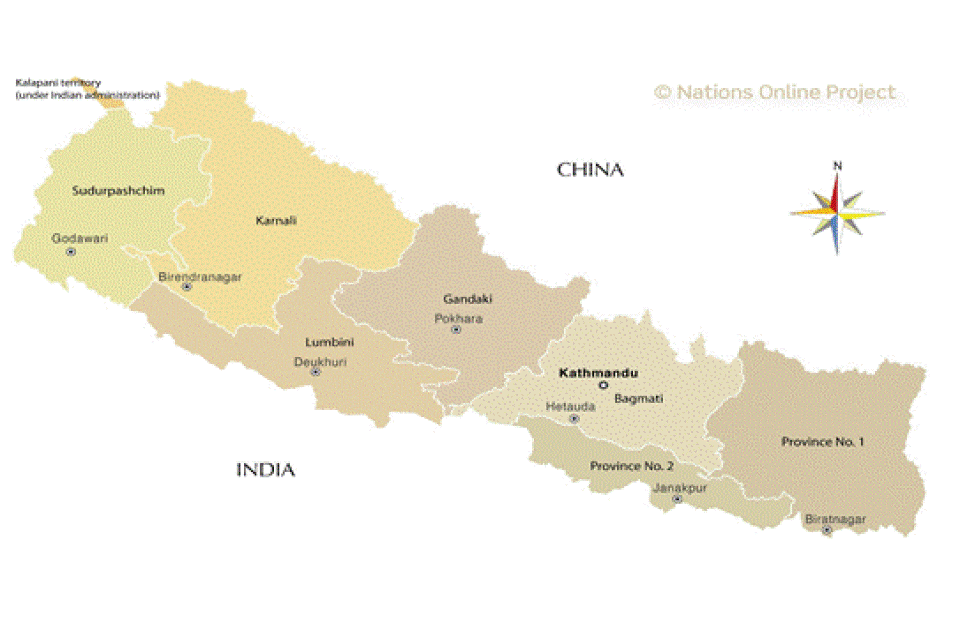
7.1.2 Map showing Nepal’s 7 provinces – Province No.1, Province No.2, Bagmati, Gandaki, Kamali, Lumbini and Sudurpashchim, and Kalapani territory (under Indian administration, claimed by Nepal), the national capital Kathmandu, and the provincial capitals.[footnote 1]
8. Political system
8.1 Overview of the political system
8.1.1 The Australian Government’s Department for Foreign Affairs and Trade’s (DFAT) Country Report 2024, based on a range of public and non-public available sources including on-the-ground knowledge and discussions with a range of sources, noted that:
‘The 2015 constitution established a bicameral federal parliament consisting of a House of Representatives and a National Assembly, as well as unicameral provincial parliaments. Representation of disadvantaged and minority groups, including women, Dalits, Madhesi and Muslims, is required in both houses of the national parliament. The President is the head of state and has largely ceremonial powers. The President is elected by members of the Federal Parliament and the state assemblies. Nepal’s cabinet is chosen by the Prime Minister in consultation with their party and any coalition partners.
‘The federal system instituted under the 2015 Constitution marked a significant shift in Nepali politics, which was previously highly centralised. In addition to the federal government, the 2015 Constitution created seven provinces, based on ethno-linguistic identity and economic viability, and 753 local government areas. The shift was intended to spread the benefits of development, increase government effectiveness and accountability, and empower marginalised groups such as Dalits, Muslims and Tharus. In-country sources told DFAT that federalisation had brought both benefits and challenges, including budgeting issues and increased opportunities for corruption.
‘Elections were held in November 2022 for both national and provincial parliaments. The national poll was won by a coalition of the Communist Party of Nepal – Unified Marxist Leninist and the Communist Party of Nepal – Maoist Center, though this alliance survived for only a few months. In the provincial elections, Nepali Congress enjoyed a significant swing, but communist parties still won more seats. Note that while many Nepali political parties identify as “Communist” or “Maoist” and publicly espouse Marxist-Leninist ideology, most do not actively pursue traditional communist aims and would be better described as social-democratic or leftist parties. Ideological splits are common, and coalitions and allegiances shift frequently.’[footnote 2]
8.1.2 The International Foundation for Electoral Systems (IFES), a global, nonpartisan organisation based in the USA[footnote 3], in their Election snapshots for the Nepal 2026 General Elections noted: ‘Elected members of the House of Representatives generally serve five-year terms. Members elected in 2022, however, served less than three years, given the dissolution of parliament in September 2025. The constitution provides for holding an election for the House of Representatives no later than six months after the expiration of the five-year term or the dissolution of parliament.’[footnote 4]
8.1.3 On electoral system, the same source noted: ‘Members of the House of Representatives are elected through a mixed system, with 60 percent elected through FPTP and 40 percent by proportional representation using closed lists of candidates submitted by parties. Voters will therefore cast two ballots on Election Day – one each for an FPTP candidate and the party list.’[footnote 5]
8.1.4 A political history timeline can be found on the Nepal Economic Forum.
8.2 Political participation
8.2.1 The Constitution of Nepal provides that every citizen has the freedom to form political parties.[footnote 6]
8.2.2 The International Foundation for Electoral Systems (IFES), in a report from 2023 on Political and Electoral Participation of Dalits in South Asia, noted:
‘Since its first democratic elections in 1991, and particularly with the ratification of the 2015 Constitution, Nepal has made steady strides to ensure the political representation and participation of Dalits in electoral processes. The country’s transition to a federal democratic republic localized inclusion. The introduction of a mixed electoral system— a combination of first-past-the-post and proportional representation, with distinctive inclusive treatment for minorities and women—demonstrated remarkable progress toward the realization of an inclusive electoral system. The Constituent Assembly swelled to 601 members after increasing the number of first-past-the-post seats from 205 to 240 to increase the representation of Madhesis44—indigenous inhabitants of the terai region who were historically excluded from political and electoral processes and who have had limited access to education, medical care, and economic opportunities.’[footnote 7]
8.2.3 Freedom House noted in their Freedom in the World report 2024 that:
‘Political parties are generally free to form and operate. … Political parties have a realistic chance of gaining power through elections and through the formation of coalitions. In the past, smaller opposition parties had difficulty gaining power at the national level, partly due to a 3% threshold for proportional representation in the House of Representatives. However, the newly created RSP secured legislative seats in the November 2022 election and became part of a ruling coalition.
‘… Indigenous Nepalis and Dalits are underrepresented in politics and in civil service, despite policies meant to bolster their participation. Members of the Chhettri and Hill Brahmin groups, meanwhile, remain relatively overrepresented.[footnote 8]
8.2.4 The 2024 DFAT report noted:
‘All Nepali citizens 18 years and older are eligible to vote. Under the 2015 Constitution, seats in the Federal Parliament are reserved for women through quotas, and substantial, proportional allocations are made for Madhesis, Dalits and other minority groups.
‘Voter turnout [ for the November 2022 elections] was about 60 per cent, lower than previous elections. Some communist groups boycotted the election…’[footnote 9]
8.2.5 Bertelsmann Stiftung (BTI), a German private foundation which ‘stimulates debate and provides impetus for social’[footnote 10], in its Nepal Country Report 2026, compiled by country and regional experts from universities and think tanks[footnote 11], covering the period of 1 February 2023 to 31 January 2025, published in March 2026 noted that: ‘Article 17 of the 2015 constitution guarantees the freedoms of association and assembly. Individuals in Nepal are free to join political and civic groups. Many people hold multiple affiliations. However, the constitution allows ordinary laws to impose “reasonable restrictions” on civil liberties in a wide range of circumstances.’[footnote 12]
9. Political parties
9.1 Main parties
9.1.1 Prior to the results of the 2026 election the IFES in their Election snapshot for the Nepal 2026 General Elections noted:
‘Nepal’s political landscape is dominated by several major parties that have shaped the country’s post-conflict democratic transition since the adoption of the 2015 constitution. While coalition governments are common, three parties have historically held the largest share of parliamentary seats:
- ‘Nepali Congress is a center-left democratic party and one of Nepal’s oldest political organizations. It has traditionally advocated for multiparty democracy, constitutionalism and a mixed-market economy. The party has led or participated in multiple coalition governments since the end of the monarchy.
- ‘Communist Party of Nepal (Unified Marxist–Leninist) is a leftist party that supports social democracy and national development through state-led and market-oriented policies. The party has alternated in government leadership and has played a central role in shaping federal governance structures. (see Communist parties)
- ‘Communist Party of Nepal (Maoist Centre) emerged from the decade-long insurgency (1996-2006) and transitioned into mainstream politics following the Comprehensive Peace Agreement. The party has advocated for republicanism, federalism and social inclusion and has frequently served as a coalition partner in successive governments. (see Communist parties)
‘In addition to these major parties, two political parties – the Rastriya Swatantra Party and the Rastriya Prajatantra Party - secured a historic number of seats in 2022. The Rastriya Prajatantra Party advocates for a constitutional monarchy and Hindu nationhood. Separately, several smaller and regional parties represent specific geographic areas, ethnic communities or political platforms, including Madhesi-based parties in the southern Terai region and newer reform-oriented or anti-establishment parties that have gained support among urban and younger voters.
‘Nepal’s mixed electoral system, which combines FPTP and proportional representation seats, encourages coalition-building and allows smaller parties to gain parliamentary representation.’[footnote 13]
9.1.2 For further information on the Rastriya Swatantra Party (RSP) see their website- RSP-Rastriya Swatantra Party, National Independent Party.
9.1.3 Bertelsmann Stiftung (BTI), in its Nepal Country Report 2026 that covers the period from 1 February 2023 to 31 January 2025, stated that:
‘The political party system remains fractionalized, polarized and generally elite-dominated. Levels of popular support for and trust in the various parties have varied widely over time, as indicated by the Himalmedia Public Opinion Poll. Most political parties also lack adequate internal democratic and participatory mechanisms, remaining personality-oriented organizations with authoritarian power structures. Although power is typically concentrated in party headquarters in the Kathmandu Valley, decentralization and competition from independent candidates have led many established politicians to spend more time in their constituencies and shift their focus to local interests.’[footnote 14]
9.1.4 BTI also noted: ‘The rise of the National Independent Party, which won a substantial number of seats in the 2022 elections, represents a shift away from the establishment. Many ethnic and regional identity-based groups continue to perceive political parties as intent on keeping power in the hands of long-dominant upper-caste Hindus. The recent influx of independent candidates suggests turbulence for the party system, but the fact that this popularly supported trend is aimed at electoral victory – not violence – is promising.’[footnote 15]
9.1.5 The Japan Times, a Japan based English newspaper aligned with the New York Times[footnote 16], noted in February 2026 that: ‘K.P. Sharma Oli, 73, was ousted as prime minister by the uprising but retained enough support to be reelected leader of the Communist Party of Nepal-UML (Unified Marxist Leninist). Another former prime minister, Pushpa Kamal Dahal, 71, heads the Nepal Communist Party, which has roped in several other communist factions since the protests.’[footnote 17]
9.1.6 Ekantipur website, an election portal providing real-time updates, results and candidate information run by ekantipur, one of Nepal’s leading media outlets[footnote 18], noted:
‘Claiming to be an alternative to traditional political parties, Harka Sampang formed the Shram Sanskriti Party after resigning as mayor of Dharan. Its manifesto proposes a directly elected executive president, a five-year term with a maximum of two terms, a fully proportional system in the House of Representatives, and proportional representation of Indigenous nationalities, Khas Arya, Madhesis, Dalits, Muslims and other communities in state bodies.’[footnote 19]
9.1.7 The Hindu reported in February 2026 that: ‘As many as 68 parties are contesting the March 5 [2026] polls, with more than 3,000 candidates running for the 275-member House of Representatives. In Nepal, 165 members are elected under the directly elected first-past-the-post system, while 110 are elected under the proportional representation (PR) system. This mixed system makes it extremely difficult for any party to secure a majority.’[footnote 20]
9.1.8 Foreign Policy, a global politics and economics magazine[footnote 21], noted in February 2026, prior to the election, that:
‘Groups such as the Gen Z Front and Gen Z Movement Alliance—some of the several youth collectives born after the September revolt—are trying to make sure that politics doesn’t become business as usual. While some members have joined political parties, including RSP, others plan to back independent and younger candidates or act as election watchdogs.
‘Monika Niroula of the Gen Z Movement Alliance said the uprising has already sparked voices of resistance and demands for internal democracy within established political parties. She is hopeful that the election will bring a new generation of leaders, but she is “less hopeful of the far-right populist faces who do not offer radical changes … and practice not a radical departure from Oli-era populism.”’[footnote 22]
9.1.9 Khabarhub, a digital news media site, noted on 25 October 2025 that following the announcement of the election on 5 March 2026 the Election Commission released an updated list of political parties registered. Several parties updated their registration, and new parties were also registered.[footnote 23] The list contained 122 political parties and can be accessed on the Khabarhub article.
See also 2026 election results
9.2 Student wings
9.2.1 Online Khabar, an online news portal[footnote 24], reporting in November 2022 noted: ‘Currently, almost all government colleges have units of student unions supporting various political parties. While their roles in academic institutions are often criticised as they are frequently seen demonstrating and protesting in colleges and vandalising property, they become more active during political campaigns of their mother parties.’[footnote 25]
9.2.2 The same source noted in October 2025 that:
‘The roles of student unions and leaders have long been questioned, and after the Gen Z movement, their credibility has come under even greater scrutiny. They have faced criticism for prioritizing party interests over addressing corruption and mismanagement. Their silence regarding the students who lost their lives during the Gen Z Protest on September 8 has drawn widespread disapproval. [see ‘Gen-Z’ protests – 8 and 9 September 2025]
‘While voices demanding justice for the martyred students have emerged globally, the student wings of major political parties have remained largely silent, their response limited to statements of grief.[footnote 26]
9.2.3 Student wings and affiliated parties:
| Student organisation | Affiliated party |
|---|---|
| All Nepal National Free Student Union (ANNFSU)[footnote 27] | CPN UML |
| All Nepal National Independent Students Union (Revolutionary) (ANNISU) | Communist Party of Nepal-Maoist |
| Nepal Student Union (NSU)[footnote 28] | Nepali Congress |
| All Nepal National Free Students Union (Sixth)[footnote 29] | Rastriya Janamorcha |
9.2.4 On 31 March 2026 the Kathmandu Post reported:
‘Student leaders have voiced strong objections after the government unveiled a plan on March 28 to remove party-affiliated student organisations from schools and universities. The government’s 100-point work plan was approved by the Cabinet on Friday [27 March], shortly after Rastriya Swatantra Party senior leader Balendra Shah assumed office as prime minister, and released on Saturday [28 March].
‘Under the plan, all structures of political student organisations in educational institutions are to be dismantled within 60 days. The government argues that the move is necessary to address declining academic standards, excessive political interference in education, and the failure of existing student groups to represent students’ concerns.
‘The action plan further states that after removing party-affiliated structures, the government intends to introduce an alternative system—such as a “Student Council” or “Voice of Students”—within 90 days.
‘… At present, universities in Nepal elect representatives through the Free Students’ Union (FSU), a system in which student wings affiliated with political parties, as well as independent groups, compete in elections. Student leaders argue that dismantling such structures would undermine the democratic space within college campuses and goes against the constitution.
‘They have also pointed to Article 17 of the Constitution of Nepal, which guarantees the freedom to form organisations and engage in political activities. According to them, the government’s plan runs contrary to these constitutional protections. Article 17 of the constitution preserves the right to freedom under its section (D), which includes freedom to form unions and associations.
‘… However, constitutional expert Chandrakanta Gyawali interprets the constitutional provision differently. Gyawali argues that while Article 17 of the constitution guarantees the freedom to form unions and associations, it does not specifically mention political unions or associations. “The government has not banned organisations from the universities altogether; it has only moved to dissolve those linked to political parties, which does not violate the constitution,” Gyawali told the Post.’[footnote 30]
10. Hindu monarchists
10.1 Rastriya Prajatantra Party (RPP)
10.1.1 Nepal News, independent English-language news portal[footnote 31], noted in an article on April 2025 that:
‘The RPP’s story began in 1990, a year that marked the end of the Panchayat regime and the restoration of multiparty democracy in Nepal. The party formally emerged in 1992, following the merger of two factions led by two former Panchayat-era prime ministers, Surya Bahadur Thapa and Lokendra Bahadur Chand. These factions, despite ideological similarities, represented competing personalities rather than a cohesive vision.
‘Initially, RPP’s ideology drew heavily from its Panchayat past, advocating for a constitutional monarchy and a conservative sociopolitical framework. The party positioned itself as a proponent of nationalism, democracy, and liberalism—a blend that sought to preserve traditional values while adapting to the democratic milieu. However, critics often dismissed RPP as a relic of Nepal’s autocratic past, labeling it a congregation of former “panchas” rather than a forward-looking political force.
‘… The RPP’s electoral fortunes have fluctuated. In recent elections, the party has struggled to regain the influence it wielded in the 1990s. Its vote base, primarily conservative and nationalist, has faced stiff competition from larger parties like the Nepali Congress (NC) and the Communist Party of Nepal (CPN). Despite these challenges, the RPP remains a notable player in Nepal’s political arena, particularly in its advocacy for Hindu nationalism and cultural identity.
‘… In the 2022 Nepali general election, the Rastriya Prajatantra Party (RPP) secured a total of 588,849 votes, which accounted for 5.58% of the national vote under the proportional representation system. This performance earned the party 7 proportional representation seats. Combined with the 7 seats won under the first-past-the-post system, the RPP achieved a total of 14 seats in the House of Representatives, affirming its status as the fifth-largest political party in the chamber.’[footnote 32]
10.1.2 Open Doors UK, who primarily work to support persecuted Christians[footnote 33], noted in June 2025 that:
‘On 29 May, in Kathmandu, royalist parties led by the Rastriya Prajatantra Party (RPP) renewed calls for the restoration of the monarchy and a Hindu state. The demonstrators, carrying Nepali flags, umbrellas and posters of former king, Gyanendra Shah, marched peacefully from Sifal to Ratnapark, chanting slogans such as “Bring the king back to the throne and save the country” and “We want monarchy back”.
‘Earlier this year in March, pro-monarchy demonstrations turned violent, resulting in two deaths and multiple injuries, including property damage. This was followed by another protest on 8 April organised by the RPP. This latest demonstration drew broader support, with 45 royalist and pro-Hindu groups united under the Joint People’s Movement, but the crowd was estimated to be between 5,000-7,000 people. However, many Nepalese citizens view a return of the monarchy as improbable; Gyanendra and his son, Paras, are deeply unpopular.’[footnote 34]
10.1.3 The Nepal News article Everything you need to know about Rashtriya Prajatantra Party contains a timeline of the Rashtriya Prajatantra Party key events and milestones.
10.1.4 See also 2026 election results for a breakdown of the number of seats currently held by the Rashtriya Prajatantra Party.
11. Communist parties
11.1 Splits and factions
11.1.1 The communist movement in Nepal has split into factions at various points throughout its history due to, amongst other things, ideological differences.[footnote 35] [footnote 36]
11.1.2 The Wire, run by the Foundation for Independent Journalism (FIJ), a not-for-profit company[footnote 37], noted in an article dated 5 November 2025 that:
‘Seeking to consolidate his political base after recent turmoil, Communist Party of Nepal (Maoist Centre) chairman Pushpa Kamal Dahal “Prachanda” has brought together 10 communist parties to form a new organisation called the Nepali Communist Party.
‘The unification, however, excludes KP Sharma Oli’s CPN(UML), which is the largest communist party, and which was ousted from power following Gen-Z protests in September [2025]. Several fringe communist groups have also stayed out of the new formation.
‘The 10 parties that formed the new Nepali Communist Party include the CPN (Maoist Centre), CPN (Unified Socialist), Nepal Communist Party, CPN (Socialist), Nepal Socialist Party, Janasamajbadi Party, CPN (Maoist-Socialist), CPN (Communism), CPN (Maoist) and Deshbhakta Samajbadi Morcha.
‘Most of the smaller groups are splinter factions of the Maoist and CPN (UML) parties formed over the past decade. After joining mainstream politics 15 years ago, the Maoist party fragmented several times, and the current merger marks a return of many former members who had failed to establish independent political bases.’[footnote 38]
11.1.3 Peoples Dispatch, an international media outlet[footnote 39], noted on forming the Nepali Communist Party:
‘Nine left parties in Nepal decided to merge to form a new Nepali Communist Party (NCP) in Kathmandu on Tuesday, November 4 [2025]. The new party revives hope in the left’s electoral presence in the upcoming national elections in March.
‘The parties who formally announced their merger are the Communist Party of Nepal (Maoist Center), led by former prime minister Pushpa Kamal Dahal “Prachanda”, Communist Party of Nepal (Unified Socialist) led by Madhav Kumar Nepal, CPN, Nepal Socialist Party, Janata Samajbadi Party Nepal, CPN (Maoist Socialist), CPN (Samyabadi), CPN (Communist) and CPN (Revolutionary Maoist).
‘The parties signed an 18-point agreement on Tuesday to form the NCP. The new party held its first national convention on Wednesday in which a new central committee was formed, a formal declaration was made and its principles were announced.
‘According to news reports, the party will follow Marxist-Leninist principles with a political program focusing on scientific socialism with “Nepali characteristics”. It will have a five-pointed star as its new election symbol.’[footnote 40]
11.1.4 The Farsight Nepal, a digital media platform and research initiative in Nepal[footnote 41], noted that the Nepali Communist Party (NCP):
‘The party is a merger of 22 different communist and socialist factions, including CPN (Maoist Centre) led by Pushpa Kamal Dahal and CPN (Unified Socialist) led by Madhav Kumar Nepal. Dahal serves as the convener and Nepal co-convener of the newly formed NCP.
‘The NCP pledges to amend the constitution to ensure political stability and balance of power, reform what it calls a “costly and chaotic” electoral system, and form a smaller, expert-inclusive federal council of ministers instead of the existing constitutionally allowed 25-member cabinet. It promises to pass all laws necessary for the full implementation of federalism within one year of the formation of the new House of Representatives.’[footnote 42]
See also Main parties for information on the Nepal Communist Party (Maoist Centre) and the Communist Party of Nepal-UML (Unified Marxist Leninist). For information on 2026 election results for a breakdown of the number of seats currently held by the Communist parties.
11.2 Communist Party of Nepal (CPN Maoist-Chand)
11.2.1 The CPN (Maoist-Chand), led by Netra Bikram Chand (also known as Biplav or Biplab[footnote 43] was formed in December 2014, after splitting from the Communist Party of Nepal (Revolutionary Maoist) headed by Mohan Baidya.[footnote 44]
11.2.2 The party was declared a criminal group by the Nepali government in March 2019 for its involvement in politically motivated violence, including a bomb blast at a telecommunications company which killed a civilian.[footnote 45] [footnote 46][footnote 47] A special task force led by security agencies was created to monitor the groups cadres and leaders.[footnote 48] In February 2021, it was reported that according to Home Ministry officials, more than 2,000 leaders and cadres of the Chand-led party had been arrested and more than 135 were in jail.[footnote 49]
11.2.3 In March 2021 the Nepalese government signed a peace agreement with the Nepal Communist Party led by Netra Bikram Chand. Al Jazeera noted in March 2021 that ‘The government agreed to lift a ban on the group, release all their party members and supporters in jail and drop all legal cases against them, while the group agreed to give up all violence and resolve any issues through peaceful dialogue…’[footnote 50]
11.2.4 The Kathmandu Post noted in 2023 that:
‘The Communist Party of Nepal led by Netra Bikram Chand ‘Biplav’ on Tuesday announced a protest programme after the Kathmandu District Court issued arrest warrants against the party’s senior leaders. The protest programmes include taking out torchy rallies, burning effigies and nationwide marches.
‘The court on Monday issued the arrest notice against the party chief Chand, standing committee member Khadga Bahadur Bishwakarma ‘Prakanda’, Kathmandu Valley Bureau in-charge Maila Lama ‘Prajwal’, and Raju Karki, chair of the All Nepal Peasants’ Federation Revolutionary.
‘Prime Minister Pushpa Kamal Dahal expressed discontent over the issuance of arrest warrants against the leaders. He said the court’s action had created complications in the political deal reached earlier between the government and the Chand-led group to bring them into peaceful politics.’[footnote 51]
11.2.5 On 18 November 2025 the Nepal Communist Party (Maoist) formally registered with the Election Commission in Kathmandu for the 2026 election.[footnote 52]
12. Elections
12.1 2026 Election results
12.1.1 The IFES noted that in March 2026 that:
‘On September 12, 2025, the Federal Parliament was dissolved and former Chief Justice Sushila Karki was sworn in as interim prime minister. That same day, President Ram Chandra Poudel, acting on the government’s recommendation, announced early general elections to be held on March 5, 2026, to elect members of the House of Representatives.
‘These elections are significant not only because they will determine the composition of the House of Representatives – the constitutional central body responsible for lawmaking, budget approval and executive oversight – but also because they will be the first formal political test of the protest movement’s influence. The key question is whether public mobilization will translate into electoral participation and the election of reform-oriented candidates capable of advancing meaningful institutional change.’[footnote 53]
12.1.2 BBC News reported that: ‘The election commission said 60% of registered voters took part in the poll.’[footnote 54] Kathmandu Post reported that this was slightly lower than previous elections which saw turnouts ranging from 61.63% in 2002 to 78.34% in 2013.[footnote 55]
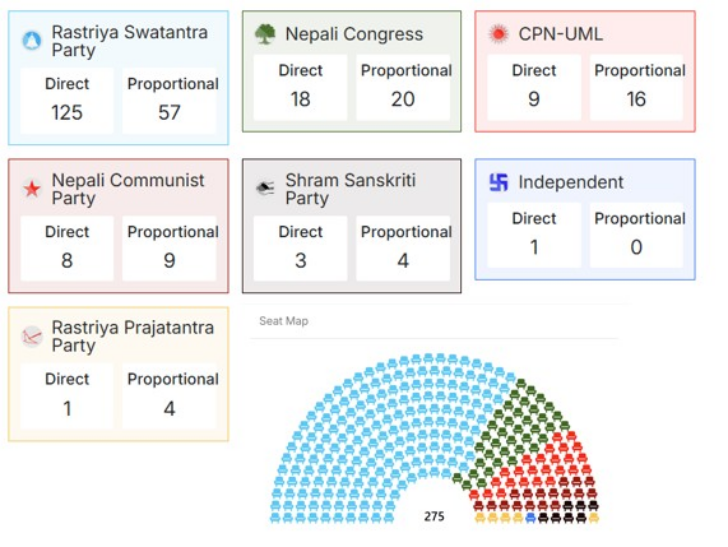
12.1.3 The diagrams below, taken from the Ekantipur website, an election portal providing real-time updates, results and candidate information run by eKantipur, one of Nepal’s leading media outlets[footnote 56], show the breakdown and map of the seats directly and proportionally elected in the 2026 election.[footnote 57]
12.1.4 The Hindu reported on 9 March 2026 that:
‘In a country that has seen political instability following every election since multiparty democracy was restored in 1990, Nepali voters have finally delivered a decisive mandate and in favour of a relatively new party. In the March 5 elections, Rastriya Swatantra Party (RSP), founded barely four years ago, won a commanding majority in the 165 directly elected seats to the House of Representatives and roughly 50% of proportional votes, decimating parties that dominated Nepali politics for decades.
‘… The results show that the Gen Z protests were no flash in the pan. Balendra Shah’s entry transformed the RSP’s fortunes. A former rapper who stormed into politics by winning the 2022 Kathmandu mayoral election as an independent, Mr. Shah joined the RSP in January and became its prime ministerial candidate. The 35-year-old politician defeated 74-year-old [former prime minister] Mr. Oli by nearly 50,000 votes in his stronghold Jhapa. Mr. Shah was the choice of the Gen Z protesters when they demanded a generational shift in political leadership and a decisive break from the Oli-Dahal-Deuba troika. The scale of the RSP’s victory, including a clean sweep of all 15 seats in the Kathmandu Valley, is a powerful expression of a young electorate’s frustrations. This is a verdict against incestuous patronage politics, endemic corruption, and the dire economic conditions that have driven Nepalis to work abroad. Whether the RSP, and Mr. Shah, can translate this sweeping mandate into the institutional reform and economic revival that Nepal desperately needs remains to be seen. Considering that Mr. Shah’s tenure as mayor drew criticism for an anti-poor and technocratic approach to urban governance, the mandate must be greeted with caution.’[footnote 58]
12.1.5 BBC News reported on the 12 March 2026 that:
‘The Rastriya Swatantra Party (RSP) has won a landslide in Nepal’s election - the first held since last year’s youth-led protests toppled the then government.
‘The RSP received 182 seats in the final tally - falling short of achieving a two-thirds supermajority in the parliament’s lower house by two seats. Nevertheless, it is the biggest win for a single party in Nepal in decades.
‘The Nepali Congress came in second with 38 seats, while the Communist Party of Nepal UML (CPN-UML) was third on 25. Voter turnout was around 60% of the nearly 19 million eligible voters.
‘The result puts the RSP’s Balendra Shah - a rapper-turned-politician - on track to become the country’s next leader.
‘… The result is an amazing turn in fortune for the RSP, which was only founded in 2022 and came fourth in the election held that same year. Shah, like the party he only recently joined, is largely untested - his only political experience so far has been as the mayor of the capital, Kathmandu.
‘The landslide is all the more significant because the country’s mixed political system - which uses a combination of first past the post and proportional representation - is mathematically designed to prevent such domination by a single party.
‘The outcome of the election reflects a desire for change that was seen during the election campaign, with parties courting Nepal’s key youth bloc with promises of addressing issues including unemployment, economic stagnation and inequality.[footnote 59]
12.1.6 BBC News reported on 13 March 2026 that:
‘The four-year-old Rastriya Swatantra Party (RSP), led by rapper-turned-politician Balendra Shah, has achieved a feat many thought impossible under Nepal’s dual-election system: a sweeping majority.
‘The country’s political elite have been cast aside, and entrenched power structures shattered. Perhaps the biggest symbol of this was when Shah, or Balen as he is commonly known in Nepal, defeated former prime minister KP Sharma Oli in Jhapa 5, a seat long considered a stronghold for him.
‘… As for the party, one of its chief promises is to tackle corruption. The RSP has promised to investigate assets of those who’ve been in power since the 1990s and to nationalise any properties that were acquired illegally.
‘They’ve also pledged to reform Nepal’s judiciary, end the political appointments of judges, and consider live-streaming trials for better transparency.’[footnote 60]
12.1.7 Council on Foreign Relations, an independent, nonpartisan think tank[footnote 61], noted in March that:
‘The Rastriya Swatantra Party’s (Shah’s party) [Balendra Shah] win marks the first time in decades that a single party has garnered a majority in Nepal which has a two-system format that makes it difficult for any one party to win outright.”
‘Shah had been mayor of Kathmandu when the protests erupted last year, and Nepal’s younger generation rallied around him, as he projected himself as a new face untouched by Nepal’s entrenched problems. Shah—who also defeated former prime minister K.P. Sharma Oli in a specific constituency for a seat in parliament, capping off the victory—will almost surely become prime minister. At thirty-five years old, and with only four years in politics, he will be the youngest prime minister in Nepal’s history, and the first Madhesi prime minister. The Madhesi are an ethnic group that lives primarily in southern Nepal, and that has long been ostracized by the political classes dominated by people from upland Nepal.
‘… In the election, both younger voters and many others tired with traditional parties rallied around Balen Shah’s party, which has advertised itself as free of corruption, without links to traditional patronage, and filled with technocratic problem solvers. (The population appeared angry even with the interim government that was in place for several months before the election and made little progress toward accountability for the crackdowns on protests and protestor deaths.) As some reports have noted, voters chose his party in districts where they did not even appear to know who the candidate of the party was. Nepal’s traditional parties were completely decimated.
‘The new government lacks political experience, which could certainly be a problem. But on the other hand, it will likely have a massive majority in parliament, portending real stability and potentially allowing the government to last longer than many of its predecessors since democracy was restored.’[footnote 62]
12.1.8 The Center for Strategic & International Studies, a bipartisan nonprofit policy research organisation[footnote 63], reported on 12 March 2026 that:
‘Nepal’s latest election has produced something the country has not seen in decades: a genuine generational rupture with its political past. But the significance extends well beyond Kathmandu. As a younger political figure rises to national leadership, Nepal is entering a new strategic moment—shaped by intensifying geopolitical competition, shifting development partnerships, and a generation of voters who have run out of patience with institutions that promise reforms but rarely deliver.
‘The victory of former Kathmandu mayor Balendra “Balen” Shah places a leader at the helm who sits outside Nepal’s traditional political establishment. At 35, Shah represents a stark contrast to the governing class that has defined Nepal’s politics since the end of the monarchy—a small circle of senior party figures, many now in their 70s and 80s, whose influence has survived coalition after coalition with remarkably little accountability. His election signals that a growing share of Nepali voters, particularly younger ones, are no longer willing to accept political recycling as a governing philosophy.
‘… Shah’s victory did not come from nowhere.
‘For several electoral cycles, younger Nepalis have been signaling dissatisfaction with entrenched leadership—at first at the margins, then with increasing force. That trajectory reached a turning point in 2025, when youth-led protests erupted across the country…
‘Shah…A former rapper turned independent political figure, he first captured national attention by winning the Kathmandu mayoral race in 2022 on a reformist, anti-corruption platform built on digital outreach and grassroots mobilization rather than traditional party structures. His national campaign followed the same logic—and this time, at a much larger scale.
‘For many voters, Shah represents not simply a younger face but the possibility of a different governing style: one that prioritizes transparency, responsiveness, and measurable results. Whether that expectation can survive contact with Nepal’s political system is, of course, an entirely different matter.’[footnote 64]
12.1.9 CIVICUS Lens, part of the global civil society alliance analyses major events from a civil society perspective[footnote 65], reported on 19 March 2026 that:
‘The result was a shock. Coalition governments are the norm in Nepal, but the RSP won an outright majority, taking 182 of 275 House of Representatives seats after a campaign that made intensive use of social media. The three established parties all sustained heavy losses.
‘Shah used his music to attack corruption and inequality, resonating with the Gen Z movement during the protests, when one of his songs was viewed over 10 million times on YouTube. But he isn’t a completely new political figure, having become mayor of the capital, Kathmandu, in a surprise result when he ran as an independent in 2022. His track record there suggests grounds for concern. He’s rarely made himself available for media questioning, preferring to communicate directly via social media, where he’s known for making controversial outbursts. He also received criticism for deploying police against street vendors and launching “demolition drives” to clear illegally built structures with minimal notice, leading to clashes between police and locals.
‘Shah now has a mandate to deliver change, and expectations are high. But he faces the challenge of reforming a typically resistant bureaucracy while delivering on his economic promises amid difficult global conditions …. The new government must also ensure accountability for human rights violations during the 2025 protests, starting with releasing the report of a commission set up to investigate protest deaths, which hasn’t yet been made public.’[footnote 66]
12.1.10 The Kathmandu Post noted in March 2026 that:
‘Within just four months of its formation, the Shram Sanskriti Party (SSP), led by Harka Sampang, the former mayor of Dharan Sub-metropolitan City, has emerged as the fifth largest party in the House of Representatives, securing three seats under the first-past-the-post (FPTP) system and four under proportional representation (PR) in the March 5 elections.
‘… In Koshi province, where Sampang built his political base as independent mayor of Dharan until before the elections, his new party managed to secure three seats, a major achievement for a party that contested its first elections.’[footnote 67]
12.1.11 The Carnegie Endowment for International Peace, a global think tank[footnote 68], noted:
‘Electoral data suggests that the RSP did particularly well in urban and semi-urban areas with high internet access, while older parties did better in areas with limited state reach, where party networks remain essential for service delivery. Rapid urbanization, internal migration, and a younger electorate meant that old party bastions such as the Bhaktapur-1 seat could be breached. Communist parties saw their generational domination of the popular vote reduced from around 40 percent to 21 percent. Almost a third of the incoming MPs are below the age of forty. In the last Parliament, this figure was roughly one in ten.
‘…The RSP lacks a distinctive ideological identity, unlike traditional actors in Nepali politics. Beyond the multitude of left-wing parties, the NC represents a democratic socialist strand of politics, while several regional parties—especially in the Madhes—emphasize identity politics. By contrast, the RSP’s primary appeal lies in offering an alternative politics that seeks to break the hold of traditional parties on policymaking and governance, while promising to end the old guard’s corruption and cronyism.’[footnote 69]
12.1.12 Congressional Research Service (CRS), an independent, non-partisan US government research body[footnote 70], noted:
‘The March elections signaled a desire for change on the part of the electorate, representing opportunities but also potential challenges for Shah and the RSP. Shah gained popularity as an anti-establishment figure and a reformer, but his record governing as mayor has been described by some analysts as mixed. Some note that Shah has been “short on specifics” on how he intends to govern. Shah communicates primarily through Facebook posts, rather than engaging with traditional media. Some analysts foresee potential tensions between Shah and RSP leadership. One analyst describes RSP as “an umbrella organization that brings together those disaffected with the existing parties under a technocratic vision centered on governance reform.” Upon taking power, the new government unveiled a 100-point framework for governance reform. How Shah approaches fighting corruption and pursuing accountability for the September 2025 violence may influence public sentiment toward his administration. The incoming RSP government also faces a range of economic and geopolitical challenges, including high youth unemployment, the return of migrant workers from Persian Gulf states and disruptions to remittance flows due to U.S. and Israeli military operations against Iran, and energy shortages.’[footnote 71]
On 27 March 2026 Balen Shah was sworn in as Nepal’s prime minister.[footnote 72]
12.2 Registered voters
12.2.1 The IFES noted that in March 2026 there were 18,903,689 registered voters, 10,967 polling locations and 23,112 polling centres.[footnote 73]
12.3 Election transparency and monitoring
12.3.1 Centre for Social Innovation and Foreign Policy (CESIF), a not-for profit, autonomous, and independent private research institution serving in the public interest[footnote 74], noted:
‘On the positive side, international observation is part of Nepal’s strategy to bolster confidence and transparency. The Election Commission has accredited 40 national and international organizations, including four international observer groups, and is actively facilitating observer orientation and accreditation to ensure external monitoring of electoral conduct. Such international attention not only reinforces procedural credibility but also places Nepal’s political process under global scrutiny.’[footnote 75]
12.3.2 The Asian Network for Free Elections (ANFREL), an international, multi-sector, independent and non-political alliance focused on conducting international election observation[footnote 76], noted in a pre-election assessment report published in February 2026 that:
‘As electoral campaigns move online, concerns around the volatile social media landscape remain one of the biggest concerns for many stakeholders. In preparation for these challenges, the ECN has set up the Information Integrity Promotion Centre (IIPC) to address the spread of misinformation and misleading content. The IIPC plans to monitor social media during the 2026 elections using an AI-based tool, eMonitor+, developed with support from the UNDP. The system will track public content on platforms such as Facebook, Instagram, TikTok, and YouTube to identify misinformation, hate speech, deepfakes, and violations of the election code of conduct, analysing posts based on keywords and sentiment in Nepali (Devanagari and Roman) and English. As part of the monitoring activities, two cyber police officers will also be deployed to each district to monitor social media activities. The Commission is also collaborating with Meta and TikTok to curb misleading and defamatory content and will work with Tekpana News Portal to fact-check AI-generated material. As of January 27, 2026, ECN has requested various agencies take action against 98 pieces of content on social media.’[footnote 77]
12.3.3 The IFES noted that there were ‘Approximately 4,500 observers from 3 international organizations and 37 national organizations.’[footnote 78]
12.3.4 The Kathmandu Post reported on 6 March 2026 that: ‘“The elections met international benchmarks,” said Gopal Krishna Siwakoti, chair of the National Election Observation Committee. The commission said no repolling was required anywhere in Nepal, a rarity in the country’s electoral history. Issuing a preliminary election monitoring report, the National Human Rights Commission also said the polls were concluded peacefully.’[footnote 79]
12.3.5 The Asian Network for Free Elections (ANFREL) International Election Observation Mission monitored the 2026 elections. The ANFREL noted:
‘ANFREL observers visited 303 polling centers across Nepal, covering both urban and rural areas, including 59.41 % urban locations and 40.59 % rural locations, and spanning both hilly regions (56.11 %) and the plains or Tarai areas (43.89 %). Observers monitored the electoral process from the opening of polling stations, voting and closing processes through the day.
‘… Based on observer reports submitted as of 6:00 PM, the overall conduct of the Election Day process was generally assessed as positive across the areas observed. Of the responses evaluating the polling environment and process, 39% rated the process as Average, indicating that several minor incidents or irregularities were observed but without significant impact on the integrity of the process. 33% assessed the process as Good, where only a few incidents or irregularities were noted, while 22% rated it as Very Good, indicating that no significant incidents were observed. A small proportion, 6%, assessed the process as Poor, reflecting isolated incidents that could have affected aspects of the process.’[footnote 80]
12.4 Election-related violence and demonstrations
See 2026 Demonstrations and protests
13. Political opinions
13.1 Freedom of expression
13.1.1 The 2024 DFAT report noted: ‘A lively political environment provides an opportunity for diverse political parties and views, and an individual’s membership of a political party, along with their ability to be identified as a member and to be politically active, is generally respected in Nepal. It is common for people to criticise the government without repercussions.’[footnote 81]
13.1.2 World Crunch, a Paris based digital media website[footnote 82], noted in February 2025 that:
‘According to the Cyber Bureau, 11 people were charged with crimes in the past year for anti-government posts on social media, with cases filed under the Electronic Transactions Act — on top of many others who were arrested but not charged.
‘The social media accounts of each person charged highlight opposition to established parties and support for newer ones. … In some cases, the Cyber Bureau simply removes content from the internet that might “spark social conflict and spread rapidly” rather than identifying individuals, Cyber Bureau spokesperson Deepak Raj Awasthi says. He adds that complaints about political criticism are rare.’[footnote 83]
13.1.3 The BTI Nepal Country Report 2026 noted:
‘… the freedoms of opinion and expression are guaranteed under Article 17 of the constitution. Still, the constitution does allow “reasonable restrictions” to be imposed by ordinary laws under a broad range of circumstances. With Nepal’s political stabilization, protections for free speech – even on sensitive topics – have expanded. However, authorities occasionally crack down on individuals who criticize the government on social media or other platforms.’[footnote 84]
13.1.4 The Independent newspaper reported in April 2026 that:
‘A YouTuber who was arrested for allegedly using abusive language against Nepal’s newly elected prime minister has been released following protests by Gen Z activists. Roshan Pokharel was arrested on 9 April on charges of publishing abusive and defamatory content on his YouTube channel “Hades” which targeted prime minister Balendra Shah and other political leaders. He was arrested by police in Panchthar following a Cyber Bureau investigation and sent in custody for 10 days by a local court. Mr Pokharel’s arrest triggered severe backlash against the prime minister over his new government’s bid to suppress free speech under the guise of legal action.’[footnote 85]
13.1.5 The Kathmandu Post reported in April 2026 that:
‘Records at the Kathmandu District Court show how the Electronic Transactions Act, 2006 has been used over the past decade in cases involving freedom of expression.
‘Until 2023, the Kathmandu District Court was the only court in the country authorised to hear cybercrime cases. In the decade following 2013, it adjudicated over 700 cases, of which 70 were directly linked to freedom of expression and journalism. An analysis of these verdicts by Kantipur shows that the law has frequently been used not only to address cyber offences but also to suppress voices, including those of journalists, satirists and ordinary citizens.
‘In most of these cases, the core issue was not a distinct technological crime involving computers or the internet. Instead, they revolved around opinions and news content expressed online. The data offers a stark picture of how widely the law has been applied.’[footnote 86]
13.2 ‘Gen-Z’ protests – 8 and 9 September 2025
13.2.1 On 4 September 2025 Nepal banned 26 prominent social media platforms and messaging apps for failing to register with the Ministry of Communication and Information Technology. The apps included Facebook, Instagram, LinkedIn, Pinterest, Reddit, Signal and YouTube.[footnote 87] [footnote 88] According to the Nepali Times, an English language newspaper based in Nepal[footnote 89] : ‘The government says it took the action after repeated warnings to the platforms to open offices in Nepal, a Cabinet decision last month setting a deadline, as well as a 17 August [2025] Supreme Court ruling also requiring them to register and pay requisite taxes.’[footnote 90] The Guardian, an independent British newspaper[footnote 91] , noted that the government faced mounting criticism after imposing the ban. They went on to note that: ‘The almost blanket social media ban came into effect at midnight on Thursday [4th September] and subsequently caused chaos across the country, affecting businesses and tourism and leaving people unable to communicate with relatives abroad.’[footnote 92]
13.2.2 In regard to the build-up to the protests, on 15 September 2025, South Asia Intelligence Review (SAIR) published by the South Asia Terrorism Portal (SATP) described as non-governmental organisation focussed on terrorism and security in South Asia[footnote 93], assessment on Nepal reported:
‘Although the September protests were triggered by the social media ban, the anger behind them had been building for years. Since the monarchy was abolished in 2008, Nepal has cycled through 14 governments in 17 years (the incumbent caretaker government is the 15th), dominated by the same few leaders — CPN-UML Chairman Oli, CPN-MC Chairman Pushpa Kamal Dahal, and Sher Bahadur Deuba — each accused of corruption, nepotism, and self-interest. Youth unemployment hovers around 20 percent, while more than 2,000 Nepalis leave the country every day to take up low-paying jobs abroad. Earlier in 2025, a viral TikTok campaign exposing the extravagant lifestyles of politicians’ children — dubbed “nepo kids” — further deepened resentment. When Oli dismissed the demonstrators as nothing more than “Gen Z troublemakers,” the gap between the ruling elite and the youth widened further.’[footnote 94]
13.2.3 In relation to the political context for the protests, on 21 September 2025, East Asia Forum described as an online platform which provides analysis on Asia[footnote 95], article reported:
‘September 2025 saw one of Nepal’s most significant political shifts since the country emerged from civil war in 2006. What began as a peaceful protest by Generation Z against corruption and social media censorship escalated after a heavy-handed government response, culminating in regime change.
‘Young people are significant stakeholders in Nepal, with 56 per cent of the population below the age of 30. An inability to generate large scale employment has pushed youth joblessness above 20 per cent…
‘Parallel to the daily realities of ordinary Nepalis runs a political regime built on rent-seeking and corruption. The merry-go-round of KP Sharma Oli, Sher Bahadur Deuba and Pushpa Kamal Dahal — who between them have held the prime ministership continuously for a decade across six changes of leadership… Oli’s party recently endorsed a proposal to remove two-term limits and the 70-year age ceiling on top internal leadership positions.
‘The latest manifestation of popular discontent is the ‘nepo babies’ trend … In the weeks leading up to 8 September, young Nepalis, languishing in bleak conditions, expressed their frustration on social media at the children of political elites flaunting their wealth online.’[footnote 96]
13.2.4 In relation to police response during protests, the Guardian September 2025 article noted:
‘Police responded with deadly and allegedly indiscriminate force, firing live rounds of ammunition and teargas as well as hitting protesters with batons, rubber bullets and water cannon.
‘Police confirmed at least 19 people had died from serious injuries sustained at the protests, including bullet injuries to the head and chest.
‘Most died in the clashes in Kathmandu but two were killed when protests turned violent in the eastern city of Itahari. More than 200 were injured and receiving treatment in hospital ….
‘The death toll from Monday’s protests intensified anger on the streets and protests continued well into the evening, despite attempts by the government to impose a curfew in areas of unrest. By Monday night, the home minister, Ramesh Lekhak, had resigned in response to the police killings.
‘The UN demanded an immediate probe into the state violence unleashed on the protests.’[footnote 97]
13.2.5 Harvard T.H. Chan School of Public Health noted:
‘The state’s response on September 8 constituted one of the most severe episodes of violence against civilians in Nepal’s post-1990 democratic era. The gathering that day was widely expected to be non-violent given that it was composed mostly of teenagers and students in school uniforms and because public protest had long been an institutionalized feature of Nepali civil society.
‘… Police logs revealed that 13,182 rounds of ammunition had been fired over the two days — 2,642 live bullets, 1,884 rubber rounds, and 6,279 tear-gas shells. The Model Protocol for Law Enforcement Officials, endorsed by UN special rapporteurs, states that police should facilitate and protect assemblies, use negotiation and communication to de-escalate tensions, and give clear warnings and safe avenues for dispersal before resorting to force. It also calls for civilian-led oversight and special care when children are present. These standards were not followed on September 8th’s protest. Nepal’s Ministry of Health and Population confirmed the death of a 12-year-old student, and at least nineteen students were reported killed that day alone. A forensic report prepared by Tribhuvan University Teaching Hospital confirmed that nearly all gunshot victims were struck above the waist, primarily in the head, neck, and chest.’[footnote 98]
13.5.6 The Kathmandu Post noted in November 2025 that: A total of 76 people, mostly young students, died during and in the days following the Gen Z protests held on September 8 and 9. However, some bodies, charred in fires, could not be identified by security agencies.[footnote 99] Amnesty International further noted that there were : ‘…more than 2,000 injured.’[footnote 100]
13.5.7 The Armed Conflict Location and Event Data Project (ACLED), a non-profit organisation which collects information on political violence and protest events, have a dashboard which records protest events along with other information on political violence. ACLED include the following in their recording of protests events ‘individuals and groups who peacefully demonstrate against a political entity, government institution, policy, group, tradition, business, or other private institution.’ ACLED assesses 4 types of sources when compiling their database on protest events: traditional media, reports by international institutions and NGOs, local partner data and new media (for example, Twitter and WhatsApp).[footnote 101] Protests are defined by ACLED as: ‘…an in-person public demonstration of three or more participants in which the participants do not engage in violence, though violence may be used against them.’[footnote 102]
13.5.8 During August to December 2025 ACLED recorded 1,003 demonstrations and instances of political violence. The table below shows the breakdown of each event type by month, giving a monthly total of events and a total of each event type for the months covered.
| Event type | Sub event type | Aug | Sep | Oct | Nov | Dec | Event type total |
|---|---|---|---|---|---|---|---|
| Violence against civilians | Attack | 1 | 1 | 1 | 1 | 0 | 4 |
| Riots | Violent demonstrations | 13 | 146 | 5 | 17 | 8 | 189 |
| Riots | Mob violence | 18 | 24 | 9 | 2 | 5 | 58 |
| Protests | Peaceful protests | 156 | 92 | 60 | 251 | 168 | 727 |
| Protests | Protests with intervention | 5 | 3 | 5 | 6 | 5 | 24 |
| Explosions/ remote violence | Remote explosive/ landmine/ IED | 1 | 0 | 0 | 0 | 0 | 1 |
| Monthly total | 194 | 266 | 80 | 277 | 186 |
13.2.9 The Kathmandu Post noted September 2025 that the interim government formed a judicial inquiry to look into the use of excessive force by security agents during the Gen Z protests. The article noted:
‘A Cabinet meeting on Sunday [21 September 2025] constituted the three-member commission headed by former judge Gauri Bahadur Karki, according to Home Minister Om Prakash Aryal.
‘Former assistant inspector general (AIG) of Nepal Police Bigyan Raj Sharma and legal expert Bishweshwor Prasad Bhandari are the other two members of the commission. The commission is given three months to study the issue and submit a report to the government.’[footnote 103]
13.2.10 Human Rights Watch noted in February 2026 that: ‘Following the killings during the “Gen Z” movement in September, a commission chaired by former justice Gauri Bahadur Karki (who is not related to the interim prime minister) was formed to investigate, but on February 9 its deadline was extended beyond election day, for fear that its findings could be opposed by security forces or political actors and cause “friction” in the election environment.’[footnote 104]
13.2.11 CIVICUS Monitor, a global civil society alliance[footnote 105], noted in February 2026:
‘The Karki government created a judicial commission of inquiry in September 2025 - chaired by former justice Gauri Bahadur Karki - tasked with investigating the deaths of at least 76 people nationwide in the two days of violence, around 47 of them in Kathmandu, including three policemen.
‘However, on 22nd January 2025 [sic] the Cabinet extended the commission’s term by 20 days. On 9th February 2025 [sic] its deadline was extended for another 25 days beyond election day, for fear that its findings could be opposed by security forces or political actors and cause “friction” in the election environment.
‘Human rights groups have raised concerns that the report will be buried like previous judge-led inquiry reports on human rights violations and abuses and have called for it to be made public to “dismantle the culture of impunity”.’[footnote 106]
13.2.12 On 26 March the Office of the Prime Minister announced it would publish the report into the September Gen-Z protests after the report was leaked[footnote 107]. Khabarhub reported on 26 March 2026 that:
‘The report recommends criminal investigation against former prime minister KP Sharma Oli, former home minister Ramesh Lekhak and then inspector general of police Chandra Kuber Khapung.
‘It also calls for action against Armed Police Force chief Raju Aryal and the head of the National Investigation Department of Nepal, Hutaraj Thapa.
‘The commission has recommended issuing a departmental warning to current inspector general of police Dan Bahadur Karki for failing to secure weapons and police offices during the unrest.
‘The report also suggests departmental action against several Nepal Police officials, including AIG Siddhi Bikram Shah.
‘…The commission also recommended action under military law against four army commanders for failing to maintain security in sensitive locations such as Shital Niwas, Baluwatar and Singha Durbar.
‘Similarly, three Armed Police Force officials, including operation commander Narayan Datt Paudel, have been held responsible for lapses during the incident.
‘The report further calls for criminal investigation into the role of the [The Original Brothers- a motorcycle collective[footnote 108]] TOB group, which it says was involved in inciting violence during the protest.
‘…The commission noted intelligence failures and recommended action against two district-level officials of the National Investigation Department for failing to provide timely information.
‘At the same time, it recommended rewards for six police officers who protected government property and weapons during the unrest, as well as recognition for two civilians who helped save the lives of police personnel.’[footnote 109]
13.2.13 On 28 March 2026 former prime minister KP Sharma Oli and former home affairs minister Ramesh Lekhak were arrested over their alleged role in the deaths of dozens of people who took part in the 2025 gen Z protests. The Guardian noted that:
‘The arrests came less than 24 hours after Nepal’s new prime minister, Balendra Shah, and his cabinet were sworn into office.
‘… Their detention comes after a government-backed report into the deadly uprising was leaked. The investigation had recommended that Oli, Lekhak and the chief of police at the time of the protests face a punishment of 10 years in prison for their alleged role in the crackdown.
‘The report said that it was “not established that there was an order to shoot”, but alleged that “no effort was made to stop or control the firing and, due to their negligent conduct, even minors lost their lives”.’[footnote 110]
13.2.14 On 9 April 2026 Organised Crime and Corruption Reporting Project (OCCRP), a non-profit investigative journalism organisation[footnote 111], noted that:
‘Following an order from the Supreme Court of Nepal, authorities released on Thursday [9 April] the country’s former prime minister [KP Sharma Oli] and his home minister, ending a two-week detention on criminal negligence charges stemming from a deadly police crackdown on youth-led protests last year.
‘… In a statement posted to social media following his release, Oli dismissed the investigation as a politically motivated witch hunt. He asserted that the new government had acted “with prejudice and vindictiveness,” holding him for 13 days without sufficient evidence. Despite the collapse of his government last fall, the four-time prime minister remains a formidable political force, having been elected to a third term as chairman of the Communist Party of Nepal (Unified Marxist-Leninist) in December.’[footnote 112]
13.2.15 The Annapurna Express, a prominent English-language broadsheet newspaper in Nepal published by the Annapurna Media Network[footnote 113], noted: ‘The Karki Commission report holds both Oli and Lekhak responsible and recommends charges under Sections 181 and 182 of Nepal’s National Penal Code. Section 181 pertains to causing death through negligence. Despite their release, officials have emphasized that the investigation remains active and further legal action will depend on the strength of evidence gathered in the coming days.’[footnote 114]
13.2.16 At the time of writing neither former prime minister, KP Sharma Oli, or former home affairs minister, Ramesh Lekhak, had been formally charged with any criminal offences.[footnote 115]
13.3 2026 Demonstrations and protests
13.3.1 IFES 2026 Nepal 2026 General Elections snapshot noted:
‘The ECN has seconded approximately 340,000 security personnel from the Nepal Police and Armed Police Forces, including 149,000 temporary recruits. Security forces are coordinated by the Joint Elections Operations Center, which is led by the ECN’s secretary and includes senior representatives of the Nepal Army, Armed Police Forces, Nepal Police, National Investigation Department and the Ministry of Home Affairs.
‘Security forces will be deployed to protect the perimeters of polling locations. Unarmed security personnel will directly supervise sealed ballot boxes at all times. In previous elections, these personnel have remained with the ballots until counting is completed.’[footnote 116]
13.3.2 The Kathmandu Post reported on 6 March 2026 that: ‘Except for a few incidents of clashes and disputes in some hilly and Madhesh districts, millions of voters exercised their franchise in the first elections following the September Gen Z movement.
‘“Holding the elections on the scheduled date under exceptional circumstances and ensuring their enthusiastic completion was itself a challenge,” said Ram Prasad Bhandari, acting chief election commissioner. “We successfully completed the job.”
‘As Bhandari claims, there were only some minor scuffles in Dolakha, Sarlahi, and Rautahat districts. At Malu polling centre in ward 4 of Tamakoshi Rural Municipality in Dolakha, the police had to fire warning shots after clashes between cadres from different parties. Voting resumed in the evening. Voting in Balara, Sarlahi, was also deferred by a couple of hours due to disputes.’[footnote 117]
13.3.3 During the first 3 months (January- March) of 2026 ACLED recorded 254 demonstrations and instances of political violence. The table below shows the breakdown of each event type by month, giving a monthly total of events and a total of each event type for 3 months.
| Event Type | Sub event type | Jan | Feb | Mar | Event type total |
|---|---|---|---|---|---|
| Violence against Civilians | Attack (when civilians are targeted with violence by an organised armed actor outside the context of other forms of violence[footnote 118] | 0 | 3 | 2 | 5 |
| Violence against Civilians | Sexual violence | 0 | 0 | 1 | 1 |
| Riots | Mob violence | 7 | 13 | 14 | 34 |
| Riots | Violent demonstrations | 16 | 7 | 2 | 25 |
| Protests | Peaceful protest | 66 | 38 | 74 | 178 |
| Protests | Protest with intervention | 2 | 3 | 1 | 7 |
| Explosions/ remote violence | Remote explosive/landmine/IED | 0 | 2 | 3 | 5 |
| Monthly total | 91 | 66 | 97 |
13.3.4 The ACLED data for January- March 2026 shows that of the recorded 254 demonstrations and instances of political violence there were 65 where a political group was recorded as a main actor involved in the protest/demonstration/mob violence or attack. Of those 65 the majority, (48), were peaceful protests.
13.3.5 Data from ACLED shows that since the spike of violent demonstrations in September 2025 the number of violent demonstrations since then has significantly reduced. The below graph uses ACLED data from August 2025 to March 2026 and shows the number of violent demonstrations, protests with intervention and peaceful protests during this time period.
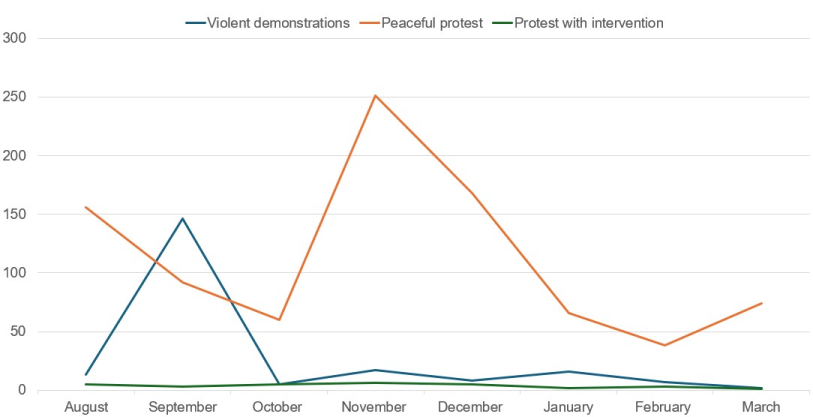
14. Corruption
14.1.1 Nepal scored 34 on the corruption perceptions index[footnote 119], where 0 is highly corrupt and 100 means very clean.[footnote 120]
14.1.2 The 2024 DFAT report noted:
‘Corruption is widespread in Nepal, including bribery, graft, nepotism, and influence peddling. Nepal ranked 110th out of 180 countries in Transparency International’s 2022 Corruption Perceptions Index. International consultancy GAN Integrity notes high levels of corruption in the judiciary, police and other public services. In-country sources told DFAT that businesses often have patrons in powerful politicians who facilitate corrupt conduct.
‘In-country sources reported that it was common to pay “facilitation fees” for basic government services (for example, renewing a driver licence). These can range from several hundred to several thousand rupees (NPR 1,000 = approximately AUD 10) [GBP1.00=approximately NPR 198[footnote 121]]. Without bribes, such processes can take several years. It is common for people of influence to use personal networks to influence government and judicial outcomes, such as court cases …
‘The Commission for Investigation of the Abuse of Authority (CIAA) is the peak anti-corruption body in Nepal. In-country sources told DFAT that the CIAA dealt effectively with corruption by low-ranking officials but was much less effective when the perpetrator was high-ranking or influential. The CIAA can refer cases for prosecution which sometimes result in convictions, and DFAT is aware of officials being fined and/or imprisoned for corruption.’[footnote 122]
14.1.3 Amish Raj Mulmi, an author, contributing editor for Himal South Asian and visiting fellow at Centre for Social Innovation and Foreign Policy[footnote 123], in an article published on Carnegie Russia Eurasia Center, which focuses on major policy challenges across the region following the Russian invasion of Ukraine[footnote 124] noted:
‘In 2025 alone, more than ten cases emerged of corruption involving former prime ministers, ministers, and bureaucrats. The list was long: allegations of embezzlement to the tune of NPR 14 billion [£71.4 million[footnote 125]] during the construction of Pokhara airport; a NPR 3.2 billion [£16.3 million[footnote 126]] procurement scam during the purchase of a Telecommunications Traffic Monitoring and Fraud Control System (Teramocs); a “visit visa” scam where immigration officers at the airport allowed Nepalis to fly abroad on tourist visas to work and live illegally, with bribe “rates” quoted at NPR 50,000 [£255[footnote 127]] for the Middle East and NPR 300,000 [£1,531[footnote 128]]for those going to Europe. A 2023 scam promising Nepalis certification as Bhutanese refugees to help them settle in the U.S. involved ministers and officials of the Home Ministry. To top it off, several cooperative finance companies, run by political affiliates, had embezzled depositor funds to the tune of tens of billions of rupees.’[footnote 129]
14.1.4 Human Rights Watch noted in their annual World Report published in February 2026 that:
‘Impunity prevails for numerous well-documented, grave violations and abuses because successive governments have sought to shield perpetrators. In 2024, parliament adopted a law that victims’ groups broadly accepted as a viable basis to restart the long delayed transitional justice process. However, in May 2025 the appointment of new commissioners to the Truth and Reconciliation Commission and Commission of Investigation on Enforced Disappeared Persons was widely opposed by victims who said that the commissioners lacked credentials or political independence.’[footnote 130]
14.1.5 The Wire noted in April 2026 that:
‘Government agencies have reopened corruption cases, including investigations into former prime ministers K.P. Sharma Oli, Pushpa Kamal Dahal and Sher Bahadur Deuba in connection with a money laundering case. Deepak Khadka, energy minister in the Oli-led government, has also been arrested in the same case. Authorities say dozens of cases are being reopened, and the government has decided to form high-level committees to investigate the properties of public service holders after 1990.
‘The crackdown extends beyond political figures. Police have arrested several individuals and businessmen in connection with money laundering cases, while also carrying out a wider law enforcement sweep targeting criminal activity. In one such operation, 195 individuals were arrested from various parts of Kathmandu in an overnight drive against hooliganism, vandalism and fraud.
‘These moves come as Nepal faces sustained international pressure to act on financial crimes. The country remains on the grey list of the Financial Action Task Force, which has cited persistent deficiencies in its anti-money laundering and counter-terrorist financing regime.’[footnote 131]
14.1.6 The Rising Nepal, an online edition of Nepal’s daily English broadsheet[footnote 132], noted on 9 April 2026 that:
‘The Commission for Investigation of Abuse of Authority (CIAA) has field [sic] a corruption case against 29 individuals including former Speaker Krishna Bahadur Mahara at the special court.
‘The defendants are accused of corruption for cheating customs as they did not confiscate gold hidden in vapes and take action as per customs law at the [Tribhuvan International Airport] TIA customs office. The vape was found to have been imported illegally.
‘According to Ganesh Bahadur Adhikari, assistant spokesperson of the CIAA, the defendants include former speaker Mahara, Arun Pokharel, then customs chief at TIA office, Mukti Prasad Shrestha and Ambika Prasad Khanal, chief customs officers, Ramesh Kumar Khatiwada and Subendra Shrestha, customs officers. Chinese, Indian and Belgian nationals have also been sued in the case.’[footnote 133]
Research methodology
The country of origin information (COI) in this note has been carefully selected in accordance with the general principles of COI research as set out in the Common EU [European Union] Guidelines for Processing Country of Origin Information (COI), April 2008, and the Austrian Centre for Country of Origin and Asylum Research and Documentation’s (ACCORD), Researching Country Origin Information – Training Manual, 2024. Namely, taking into account the COI’s relevance, reliability, accuracy, balance, currency, transparency and traceability.
Sources and the information they provide are carefully considered before inclusion. Factors relevant to the assessment of the reliability of sources and information include:
- the motivation, purpose, knowledge and experience of the source
- how the information was obtained, including specific methodologies used
- the currency and detail of information
- whether the COI is consistent with and/or corroborated by other sources
Commentary may be provided on source(s) and information to help readers understand the meaning and limits of the COI.
Wherever possible, multiple sourcing is used and the COI compared to ensure that it is accurate and balanced, and provides a comprehensive and up-to-date picture of the issues relevant to this note at the time of publication.
The inclusion of a source is not, however, an endorsement of it or any view(s) expressed.
Each piece of information is referenced in a footnote.
Full details of all sources cited and consulted in compiling the note are listed alphabetically in the bibliography.
Terms of reference
The ‘Terms of Reference’ (ToR) provides a broad outline of the issues relevant to the scope of this note and forms the basis for the country information.
The following topics were identified prior to drafting as relevant and on which research was undertaken:
- Map
- Political system
- Overview of political situation
- Participation
- Political parties
- Main parties
- Student wings
- Hindu monarchists
- Rastriya Prajatantra Party (RPP)
- Communist parties
- Overview
- Communist Party of Nepal (CPN Maoist-Chand)
- Elections 2026?
- Political events 2025?
- Corruption
- Political opponents
- Freedom of expression
- Arrests and detention
- Violence and protests
Bibliography
Sources cited
Al Jazeera, Nepal gov’t signs peace accord with banned Maoist splinter group, 4 March 2021. Accessed: 4 March 2026
Amnesty International, Nepal: Government must ensure accountability for unlawful killings and use of force during Gen-Z protests, 8 December 2025. Accessed: 10 March 2026
The Annapurna Express:
-
Home, no date. Accessed: 13 May 2026
-
What’s next in the Oli-Lekhak case?, 11 April 2026. Accessed: 13 May 2026
Asian Network for Free Elections (ANFREL):
-
Introducing ANFREL, no date. Accessed: 2 March 2026
-
Pre-election Assessment Report: 2026 House of Representatives Elections in Nepal, 26 February 2026. Accessed: 2 March 2026
-
Nepal’s 2026 House of Representatives Elections Conducted Peacefully and Orderly due to Visible Security Deployment; Accessibility and Observer Access Concerns Identified, 5 March 2026. Accessed: 27 April 2026
Australian Department of Foreign Affairs and Trade (DFAT), Country Information Report Nepal, 1 March 2024. Accessed: 9 February 2026
Bertelsmann Stiftung Transformation Index (BTI):
-
About us, no date. Accessed: 24 February 2026
-
Transformation Index (Who We Are), no date. Accessed: 13 April 2026
-
Nepal Country Report 2026, March 2026. Accessed: 13 April 2026
BBC News:
-
Nepal election 2026 results - follow live, 9 March 2026. Accessed: 9 March 2026
-
Nepal election result: Who is winning, and when will we get the final results?, updated 9 March 2026. Accessed: 9 March 2026
-
Nepal: Rapper-politician Balendra Shah’s party wins Nepal election, 12 March 2026. Accessed: 17 March 2026
-
Nepal election: Balen Shah’s RSP wins a huge mandate and country steps into unknown, 13 March 2026. Accessed: 16 March 2026
-
Balen Shah: Ex-rapper sworn in as Nepal’s prime minister, 27 March 2026. Accessed: 8 April 2026
The Carnegie Endowment for International Peace:
-
Who We Are, no date. Accessed: 13 May 2026
-
A New Generation Takes Power in Nepal, 31 March 2026. Accessed: 13 May 2026
Carnegie Russia Eurasia Center, About the Carnegie Russia Eurasia Center, no date. Accessed: 3 March 2025
Centre for Social Innovation and Foreign Policy (CESIF):
-
about us, no date. Accessed: 13 May 2026
-
January 2026 Analysis, 9 February 2026. Accessed: 13 May 2026
Center for Strategic & International Studies (CSIS):
-
About CSIS, no date. Accessed: 23 March 2026
-
Nepal’s Election Marks a Generational Break—and a New Strategic Moment in the Himalayas, 12 March 2026. Accessed: 23 March 2026
CIVICUS LENS:
-
About us, no date. Accessed: 23 March 2026
-
Nepal’s Gen Z electoral revolution, 19 March 2026. Accessed: 23 March 2026
CIVICUS Monitor:
-
About, no date. Accessed: 11 March 2026
-
Nepal: Still no accountability for violent crackdown by security forces as civic space violations persist and election draws near, 19 February 2026. Accessed: 11 March 2026
Congressional Research Service (CRS):
-
About, no date. Accessed: 13 May 2026
-
Parliamentary Elections in Nepal, 31 March 2026. Accessed: 13 May 2026
Council on Foreign Relations:
-
About CFR, no date. Accessed: 11 March 2026
-
In Nepal, Gen Z Gets a Victory – and the Country May Too, 9 March 2026. Accessed: 11 March 2026
The Diplomat, Are the Maoists Rising Again in Nepal? , 13 March 2019. Accessed: 4 March 2026
East Asia Forum:
-
About East Asia Forum, no date. Accessed: 10 March 2026
-
Nepal’s protests are about social injustices, not social media, 21 September 2025. Accessed: 10 March 2026
Ekantipur:
-
Profile of Shram Sanskriti Party including leadership, election symbol, candidates and Nepal Election 2082 results, no date. Accessed: 27 April 2026
-
Nepal Election 2082 - PR Vote Results & Parliament Seat Distribution Chart, 2026. Accessed: 10 March 2026
The Farsight Nepal:
-
about us, no date. Accessed: 13 May 2026
-
What’s inside Nepali Communist Party’s election manifesto, 11 February 2026. Accessed: 13 May 2026
Freedom House, Freedom in the World 2024 – Nepal, 29 February 2024. Accessed: 23 February 2026
Foreign Policy:
-
About Us, no date. Accessed: 2 March 2026
-
Can Elections Secure Nepal’s Youth Revolution?, 24 February 2026. Accessed: 3 March 2026
The Guardian:
-
About us, no date
-
At least 19 killed in ‘gen Z’ protests against Nepal’s social media ban, 8 Sept 2025. Accessed: 8 April 2026
-
Nepal’s PM-to-be uses rap to call for unity in first post-election message, 28 March 2026. Accessed: 8 April 2026
Harvard T.H. Chan School of Public Health, The 2025 Gen Z Uprising in Nepal: A Three-Part Analysis, 17 November 2025. Accessed: 13 May 2026
The Hindu:
-
RSP rides reform wave, old guard digs in ahead of Nepal’s elections, 21 February 2026. Accessed: 25 February 2026
-
Generational shift: On the Nepal election, the results, 9 March 2026. Accessed: 9 March 2026
Human Rights Watch (HRW):
-
World Report 2026: Nepal, 4 February 2026. Accessed: 8 April 2026
-
Nepal: Publish Reports on Violent Crackdowns on Protests, 12 February 2026. Accessed: 4 March 2026
Immigration and Refugee Board of Canada (IRB), Nepal: Instances of kidnapping and extortion by Maoist groups and affiliated student groups, including targeting of the Nepal Congress (NC) party and pro-monarchists; instances of land capture by Maoist groups; availability and effectiveness of state protection to victims (January 2015-November 2015), 26 November 2015. Accessed: 4 March 2026
The Independent, YouTuber arrested for criticising Nepal PM released after protests, 13 April 2026. Accessed: 19 May 2026
International Foundation for Electoral Systems (IFES):
-
About Us, no date. Accessed: 4 March 2026
-
Political and Electoral Participation of Dalits in South Asia, 2023. Accessed: 13 May 2026
-
Elections in Nepal: 2026 General Elections, 2 March 2026. Accessed: 4 March 2026
The Japan Times:
-
Media kit, 2022. Accessed: 3 March 2026
-
Nepal’s political crossroads: an election guide, 17 February 2026. Accessed: 25 February 2026
Kantipur, Kantipur Media Group, no date. Accessed: 23 March 2026
Karn, Sujeet, Political parties, old and new, March 2017. Accessed: 11 February 2026
The Kathmandu Post:
-
Government labels Chand party a criminal group, bans its activities, 13 March 2019. Accessed: 4 March 2026
-
Chand-led party expresses willingness to hold dialogue with the government, 21 February 2021. Accessed: 4 March 2026
-
Chand-led Communist Party of Nepal announces protest against issuance of arrest warrants, 5 December 2023. Accessed: 13 May 2026
-
Government forms judicial commission to probe excessive use of force during Gen Z protests, 21 September 2025. Accessed: 3 March 2026
-
Inside the ‘TOB’ controversy that has taken social media in Nepal by storm, 13 October 2025. Accessed: 28 April 2026
-
45 who died in Gen Z movement declared martyrs, 4 November 2025. Accessed: 10 March 2026
-
Nepali Congress elects Gagan Thapa as new president, 15 January 2026. Accessed: 9 February 2026
-
Monarchists organise rallies to welcome former king Gyanendra in Kathmandu, 9 March 2025. Accessed: 25 February 2026
-
Voter turnout around 60 percent in Nepal’s parliamentary elections, 5 March 2026. Accessed: 13 April 2026
-
58.07% turnout in peaceful polls as Nepal seeks stability after political upheaval, 6 March 2026. Accessed: 9 March 2026
-
How Shram Sanskriti Party won hearts in Koshi, 19 March 2026. Accessed: 27 April 2026
-
Planned ban on student unions sparks debate on fundamental right, 31 March 2026. Accessed: 27 April 2026
-
Nepal’s electronic transactions law continues to be misused to stifle free speech, 29 April 2026. Accessed: 19 May 2026
Khabarhub:
-
122 political parties registered with the Election Commission, 25 October 2025. Accessed: 9 February 2026
-
Karki Commission report lists 15 key findings on Gen-Z protest, 26 March 2026. Accessed: 28 April 2026
Mulmi, Amish Raj - Carnegie Russia Eurasia Center, From Streets to Discord: How Nepal’s Gen Z Toppled a Government, 24 September 2025
Nations Online Project, Administrative Map of Nepal, no date. Accessed: 11 February 2026
Nepal, Constitution, revised 2016. Accessed: 23 February 2026
Nepal Economic Forum, Nepal’s Political History: A Focus on the Past 19 Years, 24 September 2025. Accessed: 23 February 2026
Nepal News:
-
About Nepal News, no date. Accessed: 2 March 2026
-
Students’ union stage demonstration against HoR dissolution, 24 June 2021. Accessed: 23 March 2026
-
Everything you need to know about Rashtriya Prajatantra Party, 8 April 2025. Accessed: 2 March 2026
Nepali Times:
-
About us, no date. Accessed: 3 March 2026
-
Protest grows against Nepal’s social media ban, 5 September 2025. Accessed: 3 March 2026
News AZ, Nepal’s ex-PM Oli released after 12 days in custody, 9 April 2026. Accessed: 14 April 2026
News Kerala, Nepal to Publish Leaked Gen-Z Protest Investigation Report, 26 March 2026. Accessed: 28 April 2026
Organised Crime and Corruption Reporting Project (OCCRP):
-
About Us, no date. Accessed: 13 April 2026
-
Nepal Frees Former Premier Held Over Deadly Crackdown on Youth Protests, 9 April 2026. Accessed: 13 April 2026
Online Khabar:
-
About Us, no date. Accessed: 17 March 2026
-
How are political student unions working for the Nepal elections 2022?, 19 November 2022. Accessed: 17 March 2026
-
Who do student unions stand for? Questions rise after Gen Z Movement, 10 October 2025. Accessed: 17 March 2026
Open Doors UK:
-
Open Doors FAQs, no date. Accessed: 3 March 2026
-
Nepal’s Christians face growing threats as monarchists demand Hindu kingdom, 3 June 2025
Peoples Dispatch:
-
who we are, no date. Accessed: 13 May 2026
-
Left groups in Nepal form united Communist Party, 5 November 2025. Accessed: 13 May 2026
Rajendra Lingden, Rajendra Prasad Lingden - Chairman, Rastriya Prajatantra Party, no date. Accessed: 9 February 2026
Rastriya Swatantra Party (RSP), Executive Members, no date. Accessed: 9 February 2026
Ratopati, Rastriya Swatantra Party Leader Balen Shah Highlights Football’s Strong Following in Nepal’s Districts, 7 February 2026. Accessed: 9 February 2026
Republica, Special taskforce to monitor Chand outfit activities, 17 March 2019. Accessed: 4 March 2026
Reuters, From Guns To Roses: Former Rebel Group Nepal Communist Party (Maoist) Prepares To Contest Election With Rose As Election Symbol, 18 November 2025. Accessed: 4 March 2026
The Rising Nepal:
-
The Rising Nepal, Nepal’s First English Broadsheet Daily, no date. Accessed: 14 April 2026
-
CIAA files bribe case of Rs 77mln against 28 including Mahara, 9 April 2026. Accessed: 14 April 2026
South Asia Terrorism Portal (SATP):
-
About Us, no date
-
Terrorism Assessment, Nepal, 2021. Accessed: 4 March 2026
-
South Asia Intelligence Review: Assessment (Nepal), 15 September 2025. Accessed: 10 March 2026
-
Netra Bikram Chand-led Communist Party of Nepal-Maoist (CPN-Maoist-Chand) Terrorist Group, Nepal, no date. Accessed: 4 March 2026
Thapa, Santa Bahadur, Persistence of Factionalism in Nepal Communist Party, 2022. Accessed: 11 February 2026
Transparency International:
-
The ABCs of the CPI: How the Corruption perceptions index is calculated, 11 February 2025. Accessed: 24 February 2026
-
2025 Corruption Perceptions Index- Nepal, 2025. Accessed: 24 February 2026
The Tribune, Nepal bans Facebook, Instagram, YouTube, other social media platforms, 4 Sept 2025
The Wire:
-
About Us, no date. Accessed: 13 April 2026
-
Nepal: Ahead of March Elections, Former PM Prachanda Brings Together 10 Parties Under One Fold, 5 November 2025. Accessed: 13 April 2026
-
Balen Shah’s First Week as Nepal PM: Arrests, Probes and Protests, 5 April 2026. Accessed: 13 April 2026
World Crunch:
-
About us, no date. Accessed: 19 May 2026
-
Nepal’s Free Speech Crackdown, Jailing Government Critics For Facebook Posts, 11 February 2025. Accessed: 19 May 2026
XE.com, British Pounds to Nepalese Rupees Exchange Rate, 11 February 2026. Accessed: 11 February 2026
Xinhua Oli re-elected as chairman of Nepal’s CPN-UML, 19 December 2025. Accessed: 9 February 2026
Sources consulted but not cited
ABC News, Polls close in Nepal’s first election since deadly uprising forced out government, 5 March 2026. Accessed: 11 March 2026
Al Jazeera, Nepal election: Is the monarchy still a force, two decades after ouster? Elections, 4 March 2026. Accessed: 4 March 2026
Amnesty International, Nepal: Government must ensure accountability for unlawful killings and use of force during Gen-Z protests, 8 December 2025. Accessed: 11 March 2026
BBC News:
-
Nepal’s major parties say dissolved parliament must be reinstated, 13 September 2025. Accessed: 3 March 2026
-
Nepal’s Gen Z protest: BBC reveals police order to fire, 26 February 2026. Accessed: 16 March 2026
-
Nepal election: Kathmandu empties as 800,000 Nepalis head home to vote, 4 March 2026. Accessed: 4 March 2026
The Conversation:
-
Who we are, no date. Accessed: 10 March 2026
-
How hardships and hashtags combined to fuel Nepal’s violent response to social media ban, 14 Sept 2025. Accessed: 10 March 2026
The Diplomat:
-
The Diplomat, no date. Accessed: 10 March 2026
-
Nepal’s Political Future Now in Army’s Hands, 11 September 2025. Accessed: 10 March 2026
Exchange 4 Media, Nepal: Journalist arrested for criticising PM Balendra Shah, released after protests, 13 April 2026. Accessed: 19 May 2026
The Express Tribune, Nepal’s rapper-mayor in pole position to become prime minister, 25 February 2026. Accessed: 25 February 2026
The Guardian, Nepal’s gen-Z election: can popular former rapper Balen topple a veteran political heavyweight?, 3 March 2026. Accessed: 3 March 2026
Gupta, Dipak- Encyclopaedia Britannica, Communist Party of Nepal (Maoist Centre), 21 April 2025. Accessed: 24 February 2026
The Himalayan Times, 125 political parties registered with Election Commission, 12 November 2025. Accessed: 23 February 2026
The Hindu, Nepal elections 2026 highlights: Himalayan country votes to elect new PM, six months after Gen Z movement toppled Oli-led govt, 5 March 2026. Accessed: 11 March 2026
Human Rights Watch, World Report 2026: Nepal, 4 February 2026. Accessed: 3 March 2026
IPS Journal, Nepal’s vote of reckoning, 3 March 2026. Accessed: 3 March 2026
The Japan Times:
-
Nepal’s political crossroads: an election guide, 17 February 2026. Accessed: 3 March 2026
-
The rocky road to Nepal’s elections is paved with dramatic developments, 2 March 2026. Accessed: 2 March 2026
The Kathmandu Post:
-
Monarchists organise rallies to welcome former king Gyanendra in Kathmandu, 9 March 2025. Accessed: 2 March 2026
-
Passports of Oli, four others who worked under him, frozen, 29 September 2025. Accessed: 16 March 2026
-
Probe commission officials visit provinces to collect details of Gen Z movement damages, 28 October 2025. Accessed: 11 March 2026
-
Rastriya Prajatantra Party recalls its minister from Madhesh government, 10 November 2025. Accessed: 3 March 2026
-
Poll pressure may keep Karki panel report under wraps, 7 February 2026. Accessed: 11 March 2026
-
Geopolitics of Nepal’s elections, 22 February 2026. Accessed: 25 February 2026
Khabarhub, Former King Gyanendra heads to Nirmal Niwas amid large crowd of supporters (In photos), 9 March 2025. Accessed: 25 February 2026
Morning Star, Left groups in Nepal form united Communist Party, 6 November 2025. Accessed: 24 February 2026
Nepal News, What’s inside Rastriya Prajatantra Party’s election manifesto?, 15 February 2026. Accessed: 23 February 2026
Newsweek:
-
About Newsweek, no date. Accessed: 10 March 2026
-
Why Gen Z Is Revolting in Nepal to Overthrow Government, 9 September 2025. Accessed: 10 March 2026
NPR, A new Nepali party, led by an ex-rapper, is set for a landslide win in parliamentary election, 8 March 2026. Accessed: 9 March 2026
Reuters Connect, Nepal’s Right-wing Pro-monarchy Party- The Rastriya Prajatantra Party (RPP) Unveils Election Manifesto Promising Monarchy, 14 February 2026. Accessed: 23 February 2026
The Rising Nepal:
-
Shram Sanskriti Party’s initial commitments made public, 3 December 2025. Accessed: 27 April 2026
-
PM Shah directs vice chancellors to dismantle party-based student, employee wings in universities, 20 April 2026. Accessed: 27 April 2026
The Week, Nepal PM directs universities to scrap party-based student unions, 20 April 2026. Accessed: 27 April 2026
Version control and feedback
Clearance
Below is information on when this note was cleared:
- version 2.0
- valid from 19 May 2026
Official – sensitive: Not for disclosure – Start of section
The information in this section has been removed as it is restricted for internal Home Office use only.
Official – sensitive: Not for disclosure – End of section
Changes from last version of this note
Update to country information.
Feedback to the Home Office
Our goal is to provide accurate, reliable and up-to-date COI and clear guidance. We welcome feedback on how to improve our products. If you would like to comment on this note, please email the Country Policy and Information Team.
Independent Advisory Group on Country Information
The Independent Advisory Group on Country Information (IAGCI) was set up in March 2009 by the Independent Chief Inspector of Borders and Immigration to support them in reviewing the efficiency, effectiveness and consistency of approach of COI produced by the Home Office.
The IAGCI welcomes feedback on the Home Office’s COI material. It is not the function of the IAGCI to endorse any Home Office material, procedures or policy. The IAGCI may be contacted at:
Independent Advisory Group on Country Information
Independent Chief Inspector of Borders and Immigration
3rd Floor
28 Kirby Street
London
EC1N 8TE
Email: chiefinspector@icibi.gov.uk
Information about the IAGCI’s work and a list of the documents which have been reviewed by the IAGCI can be found on the Independent Chief Inspector’s pages of the GOV.UK website.
-
Nations Online Project, Administrative Map of Nepal, no date ↩
-
DFAT, Country Information Report Nepal (paragraphs 2.33- 2.35), 1 March 2024 ↩
-
IFES, Elections in Nepal: 2026 General Elections, 2 March 2026 ↩
-
IFES, Elections in Nepal: 2026 General Elections, 2 March 2026 ↩
-
Nepal, Constitution, revised 2016 ↩
-
IFES, Political and Electoral Participation of Dalits in South Asia, 2023 ↩
-
Freedom House, Freedom in the World 2024 – Nepal, 29 February 2024 ↩
-
DFAT, Country Information Report Nepal (paragraphs 3.45- 3.46), 1 March 2024 ↩
-
BTI, Transformation Index (Who We Are), no date ↩
-
BTI, Nepal Country Report 2024, March 2026 ↩
-
IFES, Elections in Nepal: 2026 General Elections, 2 March 2026 ↩
-
BTI, Nepal Country Report 2026, 2026 ↩
-
BTI, Nepal Country Report 2026, 2026 ↩
-
The Japan Times, Nepal’s political crossroads: an election guide, 17 February 2026 ↩
-
Kantipur, Kantipur Media Group, no date ↩
-
Ekantipur, Profile of Shram Sanskriti Party including leadership, election symbol …, no date ↩
-
The Hindu, RSP rides reform wave, old guard digs in ahead of Nepal’s elections, 21 February 2026 ↩
-
Foreign Policy, Can Elections Secure Nepal’s Youth Revolution?, 24 February 2026 ↩
-
Khabarhub, 122 political parties registered with the Election Commission, 25 October 2025 ↩
-
Online Khabar, How are political student unions working for the Nepal …, 19 November 2022 ↩
-
Online Khabar, Who do student unions stand for? Questions rise after Gen Z.., 10 October 2025 ↩
-
Online Khabar, Who do student unions stand for? Questions rise after Gen Z.., 10 October 2025 ↩
-
Online Khabar, Who do student unions stand for? Questions rise after Gen Z.., 10 October 2025 ↩
-
Nepal News, Students’ union stage demonstration against HoR dissolution, 24 June 2021 ↩
-
The Kathmandu Post, Planned ban on student unions sparks debate on …, 31 March 2026 ↩
-
Nepal News, About Nepal News, no date ↩
-
Nepal News, Everything you need to know about Rashtriya Prajatantra Party, 8 April 2025 ↩
-
Open Doors UK, Open Doors FAQs, no date ↩
-
Open Doors, Nepal’s Christians face growing threats as monarchists demand Hindu…, 3 June 2025 ↩
-
Karn, S, Political parties, old and new, March 2017 ↩
-
Thapa, S B, Persistence of Factionalism in Nepal Communist Party, 2022 ↩
-
The Wire, Nepal: Ahead of March Elections, Former PM Prachanda Brings …, 5 November 2025 ↩
-
Peoples Dispatch, who we are, no date ↩
-
Peoples Dispatch, Left groups in Nepal form united Communist Party, 5 November 2025 ↩
-
The Farsight Nepal, What’s inside Nepali Communist Party’s election manifesto, 11 February 2026 ↩
-
IRB, Nepal: Instances of kidnapping and extortion by Maoist groups and …, 26 November 2015 ↩
-
SATP, Terrorism Assessment, Nepal, 2021 ↩
-
The Diplomat, Are the Maoists Rising Again in Nepal? , 13 March 2019 ↩
-
The Kathmandu Post, Government labels Chand party a criminal group, bans its…, 13 March 2019 ↩
-
SATP, Netra Bikram Chand-led Communist Party of Nepal-Maoist (CPN-Maoist-Chand)…, no date ↩
-
Republica, Special taskforce to monitor Chand outfit activities, 17 March 2019 ↩
-
The Kathmandu Post, Chand-led party expresses willingness to hold dialogue …, 21 February 2021 ↩
-
Al Jazeera, Nepal gov’t signs peace accord with banned Maoist splinter group, 4 March 2021 ↩
-
The Kathmandu Post, Chand-led Communist Party of Nepal announces… , 5 December 2023 ↩
-
Reuters, From Guns To Roses: Former Rebel Group Nepal Communist …, 18 November 2025 ↩
-
IFES, Elections in Nepal: 2026 General Elections, 2 March 2026 ↩
-
BBC News, Nepal election result: Who is winning, and when will we get …, updated 9 March 2026 ↩
-
Kathmandu Post, Voter turnout around 60 percent in Nepal’s parliamentary elections, 5 March 2026 ↩
-
Kantipur, Kantipur Media Group, no date ↩
-
Ekantipur, Nepal Election 2082 - PR Vote Results & Parliament Seat Distribution Chart, 2026 ↩
-
The Hindu, Generational shift: On the Nepal election, the results, 9 March 2026 ↩
-
BBC News, Nepal: Rapper-politician Balendra Shah’s party wins Nepal election, 12 March 2026 ↩
-
BBC News, Nepal election: Balen Shah’s RSP wins a huge mandate and…, 13 March 2026 ↩
-
Council on Foreign Relations, About CFR, no date ↩
-
CFR, In Nepal, Gen Z Gets a Victory – and the Country May Too, 9 March 2026 ↩
-
CSIS, About CSIS, no date ↩
-
CSIS, Nepal’s Election Marks a Generational Break—and a New Strategic …, 12 March 2026 ↩
-
CIVICUS Lens, Nepal’s Gen Z electoral revolution, 19 March 2026 ↩
-
The Kathmandu Post, How Shram Sanskriti Party won hearts in Koshi, 19 March 2026 ↩
-
The Carnegie Endowment for International Peace, Who We Are, no date ↩
-
The Carnegie Endowment for International Peace, A New Generation…, 31 March 2026 ↩
-
CRS, Parliamentary Elections in Nepal, 31 March 2026 ↩
-
BBC News, Balen Shah: Ex-rapper sworn in as Nepal’s prime minister, 27 March 2026 ↩
-
IFES, Elections in Nepal: 2026 General Elections, 2 March 2026 ↩
-
CESIF, January 2026 Analysis, 9 February 2026 ↩
-
ANFREL, Introducing ANFREL, no date ↩
-
ANFREL, Pre-election Assessment Report: 2026 House of Representatives …, 26 February 2026 ↩
-
IFES, Elections in Nepal: 2026 General Elections, 2 March 2026 ↩
-
The Kathmandu Post, 58.07% turnout in peaceful polls as Nepal seeks stability…, 6 March 2026 ↩
-
ANFREL, Nepal’s 2026 House of Representatives Elections Conducted …, 5 March 2026 ↩
-
DFAT, Country Information Report Nepal (paragraphs 3.49), 1 March 2024 ↩
-
World Crunch, Nepal’s Free Speech Crackdown, Jailing Government Critics …, 11 February 2025 ↩
-
BTI, Nepal Country Report 2026, March 2026 ↩
-
The Independent, YouTuber arrested for criticising Nepal PM released after protests, 13 April 2026 ↩
-
The Kathmandu Post, Nepal’s electronic transactions law continues to be misused…, 29 April 2026 ↩
-
The Tribune, Nepal bans Facebook, Instagram, YouTube, other social media…, 4 Sept 2025 ↩
-
The Guardian, At least 19 killed in ‘gen Z’ protests against Nepal’s social media ban, 8 Sept 2025 ↩
-
Nepali Times, Protest grows against Nepal’s social media ban, 5 September 2025 ↩
-
The Guardian, At least 19 killed in ‘gen Z’ protests against Nepal’s social media ban, 8 Sept 2025 ↩
-
SATP, South Asia Intelligence Review: Assessment (Nepal), 15 September 2025 ↩
-
East Asia Forum, About East Asia Forum, no date ↩
-
East Asia Forum, Nepal’s protests are about social injustices, not social media, 21 September 2025 ↩
-
The Guardian, At least 19 killed in ‘gen Z’ protests against Nepal’s social media ban, 8 Sept 2025 ↩
-
Harvard T.H. Chan School of Public Health, The 2025 Gen Z Uprising…, 17 November 2025 ↩
-
The Kathmandu Post, 45 who died in Gen Z movement declared martyrs, 4 November 2025 ↩
-
AI, Nepal: Government must ensure accountability for unlawful killings and …, 8 December 2025 ↩
-
ACLED, ACLED Methodology, no date ↩
-
ACLED, ACLED Methodology, no date ↩
-
The Kathmandu Post, Government forms judicial commission to probe …, 21 September 2025 ↩
-
HRW, Nepal: Publish Reports on Violent Crackdowns on Protests, 12 February 2026 ↩
-
CIVICUS Monitor, Nepal: Still no accountability for violent crackdown by …, 19 February 2026 ↩
-
News Kerala, Nepal to Publish Leaked Gen-Z Protest Investigation Report, 26 March 2026 ↩
-
The Kathmandu Post, Inside the ‘TOB’ controversy that has taken social …, 13 October 2025 ↩
-
Khabarhub, Karki Commission report lists 15 key findings on Gen-Z protest, 26 March 2026 ↩
-
The Guardian, Nepal’s PM-to-be uses rap to call for unity in first post-election…, 28 March 2026 ↩
-
OCCRP, Nepal Frees Former Premier Held Over Deadly Crackdown on Youth…, 9 April 2026 ↩
-
The Annapurna Express, What’s next in the Oli-Lekhak case?, 11 April 2026 ↩
-
News AZ, Nepal’s ex-PM Oli released after 12 days in custody, 9 April 2026 ↩
-
IFES, Elections in Nepal: 2026 General Elections, 2 March 2026 ↩
-
The Kathmandu Post, 58.07% turnout in peaceful polls as Nepal seeks stability…, 6 March 2026 ↩
-
ACLED, ACLED Methodology, no date ↩
-
Transparency International, 2025 Corruption Perceptions Index- Nepal, 2025 ↩
-
Transparency International, The ABCs of the CPI: How the Corruption …, 11 February 2025 ↩
-
XE.com, British Pounds to Nepalese Rupees Exchange Rate, 11 February 2026 ↩
-
DFAT, Country Information Report Nepal (paragraphs 2.36- 2.38), 1 March 2024 ↩
-
Amish Raj Mulmi, From Streets to Discord: How Nepal’s Gen Z Toppled a …, 24 September 2025 ↩
-
Carnegie Russia Eurasia Center, About the Carnegie Russia Eurasia Center, no date ↩
-
Xe.com, 1.00 NPR= 0.0051 GBP, 3 March 2026 ↩
-
Xe.com, 1.00 NPR= 0.0051 GBP, 3 March 2026 ↩
-
Xe.com, 1.00 NPR= 0.0051 GBP, 3 March 2026 ↩
-
Xe.com, 1.00 NPR= 0.0051 GBP, 3 March 2026 ↩
-
Amish Raj Mulmi, From Streets to Discord: How Nepal’s Gen Z Toppled…, 24 September 2025 ↩
-
Human Rights Watch, World Report 2026: Nepal, 4 February 2026 ↩
-
The Wire, Balen Shah’s First Week as Nepal PM: Arrests, Probes and Protests, 5 April 2026 ↩
-
The Rising Nepal, The Rising Nepal, Nepal’s First English Broadsheet Daily, no date ↩
-
The Rising Nepal, CIAA files bribe case of Rs 77mln against 28 including Mahara, 9 April 2026 ↩