
National assessments regulation annual report 2025
Published 16 December 2025
Applies to England

© Crown copyright 2025
This publication is licensed under the terms of the Open Government Licence v3.0 except where otherwise stated. To view this licence, visit nationalarchives.gov.uk/doc/open-government-licence/version/3 or write to the Information Policy Team, The National Archives, Kew, London TW9 4DU, or email: psi@nationalarchives.gov.uk.
Where we have identified any third party copyright information you will need to obtain permission from the copyright holders concerned.
This publication is available at https://www.gov.uk/government/publications/national-assessments-regulation-annual-report-2025/national-assessments-regulation-annual-report-2025
Executive summary
Ofqual regulates all aspects of the development and delivery of national assessments. This report outlines our regulatory activity and findings related to the assessments conducted in 2025.
This year marked a transition in responsibilities because at the end of this cycle of activities for national assessments, Capita will be concluding its role as the Standard and Testing Agency’s (STA’s) delivery supplier. From September 2025 Pearson assumed responsibility for delivery of the 2026 cycle. September 2025 also saw the launch of a revised version of the reception baseline assessment (RBA) that has been developed by STA with new test content and a new delivery method.
STA maintained its established approach to national assessment development this year, drawing on expert input (including from teachers) and quantitative data from trialling to inform decisions about test content. The statistical processes required to maintain standards for the KS2 tests were completed as usual. Ofqual is satisfied that the KS2 results in 2025 can be robustly linked to the standards as they were originally set in 2016.
STA returned more than 99.9% of KS2 results to schools on time. Ofqual’s analysis confirmed a high degree of KS2 marking reliability, consistent with trends reported since 2018. The phonics screening check and the multiplication tables check were also successfully delivered.
STA delivered a new version of the RBA to schools from August 2025 and by 17 October schools had completed assessments with 551,517 pupils.
Ofqual will continue to monitor risks to validity and public confidence from any changes to the arrangements for national assessments for 2026.
Introduction
About national assessments regulation
Ofqual is accountable to Parliament for regulating statutory national curriculum assessments, including the reception baseline assessment (RBA), the early years foundation stage profile (EYFSP), the phonics screening check (PSC), the multiplication tables check (MTC) and the key stage 2 (KS2) tests. Collectively, Ofqual refers to these as “national assessments”.
Ofqual’s statutory objectives are to:
- Promote the development and implementation of national assessments that reliably and consistently indicate pupil achievement and attainment over time.
- Promote public confidence in national assessments.
The regulatory framework for national assessments outlines how Ofqual fulfils these objectives using a risk-based approach and by prioritising assessments with the greatest impact, particularly those used in school accountability.
Ofqual’s focus is on validity: ensuring assessments meet their statutory purposes and that results can be trusted. Our regulation provides independent assurance of the robustness of national assessment development and delivery processes and identifies risks to validity that can be addressed over time. Ofqual is also required to report to the Secretary of State for Education if it identifies, or anticipates, significant failings in national assessment arrangements.
The Standards and Testing Agency (STA), an executive agency of the Department for Education (DfE), is responsible for the majority of national curriculum assessments and works with contracted suppliers to develop, deliver and monitor them. Other organisations have responsibility for certain aspects of national assessments, including local authorities, schools and the DfE, which is also responsible for the EYFSP.
Context for 2025
Two key developments shaped the national assessment landscape in 2025:
- Supplier transition: At the end of this cycle of activities for national assessments, Capita will be concluding its role as STA’s delivery supplier. From September 2025, Pearson assumed responsibility for fulfilling STA’s national assessments contract; including activities linked to the printing, delivery and marking of the KS2 tests for 2026.
- A new version of RBA: STA launched a revised version of the digitally administered RBA utilising a new, internally developed, online platform. This replaced the previous version of the assessment delivered under contract by the National Foundation for Educational Research (NFER). The updated assessment includes new content and was made available for schools to use during the autumn term of the 2025 to 2026 academic year.
Section A: Priorities for 2025
Ofqual’s regulatory priorities centre on securing assurance from responsible bodies regarding their management of risks during the development and delivery of national assessments. This is supplemented by an ongoing programme of engagement with national assessment stakeholders which provides valuable additional information throughout the year. Monitoring and scrutinising key aspects of the KS2 test cycle and the implementation of the RBA guided Ofqual’s activities in 2025. Ofqual also convened a focus group with teachers who had delivered the new RBA as part of our monitoring of the roll out of the new version of the assessment.
STA demonstrated its operational readiness ahead of the 2025 assessment cycle, which included detailed scrutiny by Ofqual of its plans for the secure delivery of the KS2 tests and the new version of the RBA. Readiness reviews assessed both STA’s preparedness, and its identification and management of risks to assessment validity and public confidence. Ofqual met STA senior staff regularly before, during and after the peak delivery periods. Responsible bodies are also expected to notify Ofqual as soon as possible of any emerging risks that could impact the validity of, or public confidence in, national assessments.
Ofqual observed a sample of STA’s governance processes for test development, attended marker training sessions for all externally marked KS2 subjects, and was present at the standards maintenance meeting where the 2025 KS2 thresholds were confirmed. In addition, Ofqual requested information from STA for assurance purposes including, for example, analysis of the outcomes from some of their trialling and testing.
During peak delivery periods, Ofqual monitored operational data provided by STA, such as KS2 scanning and marking progress and completion rates for the digital RBA. At the end of its cycles of development and delivery activities, Ofqual asks STA to review its own performance. This approach of combining readiness assurance with ongoing monitoring and end-of-cycle reviews aligns with Ofqual’s broader regulatory framework for awarding organisations.
A further priority in 2025 was the continuation of independent quality assurance of KS2 marking.
This report details the outcomes of Ofqual’s regulatory activities in 2025 in relation to our objectives and these priorities.
Section B: Monitoring national assessments in 2025
The KS2 test development process
STA is responsible for developing a suite of national curriculum assessments including KS2 tests. The details of the processes underpinning KS2 assessment development can be found in STA’s national curriculum test development handbook.
Ofqual’s observations of the KS2 test development process
In 2025, Ofqual observed a sample of STA’s governance mechanisms for KS2 test development. These observations provide the most efficient means of monitoring STA using the full range of validity evidence it collects during the development of national assessments.
STA applied a consistent structure to governance meetings across KS2 subjects, ensuring the intended purposes of STA’s processes were reliably achieved. During these meetings, senior officials reviewed summaries of evidence gathered throughout the item development process, including input from experts such as teachers, and quantitative data from trialling. This evidence informed decisions on the final approval of test items and texts used in the live tests. It is this evidence base that STA uses to support the 5 validity claims for the KS2 tests it makes in the national curriculum test development handbook.
The governance meetings observed by Ofqual clearly demonstrated STA’s use of appropriate validity evidence to inform the development and content of the KS2 national assessments.
Marking of KS2 tests
STA’s delivery contractor administers the marking of KS2 tests, including the recruitment of a suitably qualified marking workforce. Ofqual has previously reported on the composition and experience of KS2 markers. The national curriculum test development handbook outlines the quality assurance processes used to ensure effective marker training and reliable live marking.
For externally marked KS2 tests, completed scripts are collected from schools, scanned, and marked on screen. Items are grouped into ‘segments’ based on similar marking principles and classified as either ‘regular’ or ‘specialist’, depending on the level of marker expertise required. Markers are assigned to segments according to their experience and must meet quality assurance standards before marking begins. This structured approach is designed to optimise marking reliability.
Ofqual’s observations of the marker training process
In 2025, Ofqual attended a targeted sample of online marker training events for KS2 English reading, mathematics, and grammar, punctuation and spelling assessments, which included user acceptance testing of the training materials. The purpose of the training was clearly communicated, including the importance of maintaining the security and confidentiality of training materials.
Training sessions used examples of pupil responses to support markers to interpret and apply the mark scheme consistently.
In the meetings Ofqual observed, the delivery of training aligned with the processes outlined in the national curriculum test development handbook, supporting the reliability of KS2 test marking.
Ofqual’s analysis of the quality of KS2 marking
Ofqual analysed operational marking data from 2025 using the same methodology referred to in previous reports, enabling year-on-year comparisons of marking quality.
One key measure of consistency during live marking is the use of ‘seeds’ - pre-marked responses inserted into a marker’s allocation at times and intervals unknown to the marker. Approximately one in every 40 responses is a seed. Comparison between the mark awarded for the seed and the pre-agreed mark set by a more senior colleague provides an indication of the marker’s adherence to the mark scheme.
Ofqual considers the difference between the marks for seeds is a suitable measure of marking consistency for externally marked KS2 assessments. This approach assumes that seed responses are representative of the broader range of responses in terms of marking difficulty, thereby offering an indication of the overall agreement levels across all pupils.
Ofqual’s analysis for 2025 found that for all 3 externally marked KS2 subjects, markers agreed with the mark set by senior markers for 99.3% of the seeds. This is consistent with agreement rates recorded in previous series.
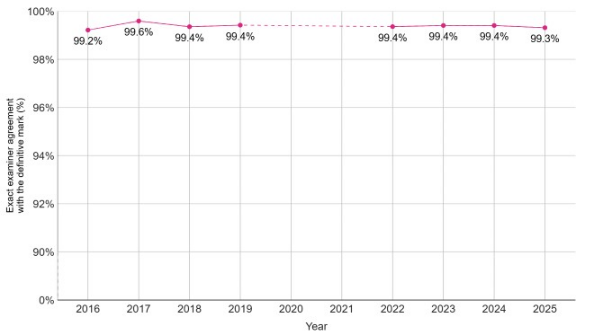
Figure 1: Combined agreement levels for all 3 externally marked KS2 subjects between 2016 and 2025
Figure 1 illustrates that Ofqual’s metric for capturing marker agreement remained high in 2025. Note that there were no KS2 assessments in 2020 or 2021 owing to the COVID-19 pandemic.
Based on this evidence, Ofqual concludes that the training and quality assurance measures for external marking of KS2 English reading, mathematics and grammar, punctuation and spelling were effective in 2025.
Moderation of KS2 writing teacher assessment
Previous annual reports (in 2022 and 2023) have detailed the moderation process for KS2 writing assessments. In summary, STA grants approval to moderate English writing only to local authority moderators who successfully complete a standardisation exercise. Moderators are given 2 attempts to pass one of 3 exercises, although the majority of moderators are recruited by the end of the second exercise.
STA recruited a total of 2,395 moderators in 2025 which was approximately 500 fewer than the numbers recruited in 2024. The overall moderator pass rate of 70% in 2025 was broadly in line with previous years (73% in 2024 and 75% in 2023).
During STA’s KS2 delivery readiness review, it was confirmed there were no concerns regarding moderator capacity in 2025 and following the delivery cycle STA provided assurance that moderation activity had been completed successfully.
Ofqual is satisfied with the arrangements for the completion of teacher assessment of KS2 writing in 2025.
KS2 standards maintenance
A key requirement of KS2 national assessments is that they support accurate comparisons of pupil performance over time. As tests are constructed from new items each year, standards maintenance processes are essential to account for variations in test difficulty.
Following the 2016 primary curriculum review, new assessments were introduced and new standards established. Standards maintenance is the statistical process that links pupil performance in subsequent years to the original standard as it was set in 2016. This approach ensures that the meaning of the results remain consistent over time.
A more detailed description of this process is available in Ofqual’s national assessments regulation annual report for 2023.
Ofqual’s observations of the standards maintenance process
STA’s processes for maintaining test standards in 2025 were completed in line with their published description and based on the same professionally recognised techniques and underlying assumptions used in previous years.
Ofqual is satisfied that STA’s approach to standards maintenance provided a robust link to the original standards set in 2016.
Operational delivery of KS2 assessments in 2025
Following assurance of STA’s KS2 delivery readiness, Ofqual received regular progress updates during the peak period of activity. After the tests were administered in the week commencing 12 May, Ofqual monitored scanning and marking rates, along with other key operational metrics provided by STA.
Approximately 3.75 million scripts across the 3 subjects were marked in 3 weeks by about 4,450 markers. Sufficient marking data was available to allow for standards maintenance procedures to be completed on schedule, and more than 99.9% of results were returned to schools on 8 July.
STA reported that 16 pupils’ scripts were declared lost in 2025, a significant reduction from the 350 reported in 2024 (see Ofqual’s 2024 report for more details). Of these 16 pupils, 6 met the expected standard based on their performance in other components. The 2025 cycle recorded the lowest level of script losses over the past 4 years of KS2 delivery.
Once KS2 results were returned, STA opened its marking review service; the outcomes of those reviews were returned to schools on time on 10 September.
STA has a statutory responsibility to investigate allegations of maladministration across the suite of national assessments it produces (KS2 tests, the RBA, the MTC and the PSC). Outcomes from these investigations are published in the following academic year; STA’s report on its investigations in 2025 is expected in 2026.
Ofqual received 5 complaints regarding allegations of maladministration of KS2 tests in 2025. In line with the national assessments regulatory framework, Ofqual passed these cases to STA to investigate.
The reception baseline assessment
The RBA measures pupils’ early mathematics, language, communication, and literacy skills and is administered to pupils within their first 6 weeks of starting reception. As such, some pupils may continue to undertake the RBA if they have a delayed start to reception this academic year. Therefore, any view from Ofqual is based on the situation that existed following the first 6 weeks of the autumn term, which was the peak delivery period.
RBA data, alongside KS2 outcomes, will be used to calculate school progress 7 years later. As an in-year measure, RBA outcomes are only used to compare schools within the same academic year and are not utilised for year-on-year comparisons. The first progress measures based on the RBA will be reported in 2028.
The original version of the RBA, developed by NFER, had been in use since 2019. It required practitioners to record pupil responses using a touchscreen device. In January 2024, STA confirmed that its new version of the assessment would be introduced from September 2025. This updated solution features a new set of questions and uses 2 touchscreen devices, one for the pupil and one for the practitioner, connected via STA’s web-based assessment platform.
This 2-device approach allows practitioners to manage the session and input responses when necessary while the pupils interact with the assessment. STA’s online platform provides 2 digital services needed by the schools: one for managing pupil registration and another for administering the assessment.
Both versions of the RBA use physical resources and adaptive routing to tailor the assessment to pupil ability. The new STA-developed version also allows accessibility adjustments to be made, such as enlarging the font or changing the colour of the background.
Upon completion, schools receive narrative statements that reflect a pupils’ understanding in the assessed domains. Numerical scores generated by the RBA are available solely to the DfE and will be used to calculate progress measures.
The RBA test development process
Ofqual has closely monitored the development of the new version of the RBA since STA began work in 2019. In September 2024, Ofqual observed the final governance meeting for RBA test development, during which the content of the new assessment was finalised.
The new RBA items were developed using the same processes applied to KS2 assessments, as outlined in the national curriculum test handbook. STA’s senior officials reviewed evidence gathered during test development, including trialling data and feedback from a range of external experts such as teachers. STA uses this evidence to support its validity claims for the RBA detailed in the RBA validity report.
Ofqual observed STA making appropriate use of its validity evidence to inform the content of the RBA used in 2025.
STA’s readiness for RBA delivery in 2025
In the summer of 2024, STA provided Ofqual with evidence of progress towards the safe delivery of the new RBA from September 2025. At this stage, STA outlined the remaining key project milestones and its approach to managing risks during the development of the digital assessment system.
In March 2025, STA presented evidence of its operational readiness for the RBA delivery which included outcomes from testing, trialling and user research. STA was satisfied it had appropriately established the platform’s functionality across a range of school settings, operating systems and device manufacturers. STA’s view was that if connectivity issues emerged for schools, they were more likely to be derived from variability in school infrastructure than from STA’s technology. To support operational delivery, STA would have in place various mitigations including:
- rolling out the new system over 3 distinct phases – this would allow schools to prepare for the change (phase 1 – early summer 2025) and have an opportunity to familiarise themselves with the system (phase 2 – summer 2025) prior to using the platform to deliver assessments (phase 3 – autumn 2025).
- a helpdesk service providing technical support available to schools from June.
- the flexibility for schools to administer the RBA at any point within the first 6 weeks of a pupil’s start date to allow time to resolve any localised issues.
- the availability of an ‘offline’ version of the RBA using printed questions and requiring only one device for the practitioner to enter a pupil’s answers - this option was developed primarily to support pupils with specific needs but could also be used by schools experiencing significant technical issues.
Following the readiness review, Ofqual provided feedback to STA highlighting some of the residual risks associated with implementing a technology-dependent solution across schools in England. Ofqual noted that ultimately the possibility that issues could materialise for schools would only be revealed during the live delivery period and therefore that STA should have in place robust mechanisms to allow it to respond promptly to fluctuations in system performance or school engagement.
Operational delivery of the RBA
The first phase of rollout began on 1 April 2025 with the publication of guidance materials and an explanatory video. Phase 2 began on 2 June with schools being given access to the assessment platform, training resources and a practice area. STA’s helpdesk was also fully operational from this point. By the end of the familiarisation phase (2) on 17 August, about 3,600 schools (over 22% of all primary schools) had engaged with the familiarisation activities. The new RBA assessment was made available to schools via the digital platform from 18 August 2025 coinciding with the start of term for some primary schools (phase 3 of STA’s planned roll out).
Given Ofqual’s assessment of the level of residual risk associated with the large scale roll out of a fully digitised assessment, Ofqual monitored evidence of schools’ engagement with the assessment platform and completions of the assessment from 18 August.
During operational delivery, STA notified Ofqual that some schools were raising queries to STA’s helpdesk about issues with registering pupils while others were reporting difficulties connecting to the digital service or pairing devices. Some teachers also noted issues with the RBA on social media.
STA provided assurances that it was able to rectify the registration issue and that it had implemented measures to reduce the likelihood that schools would experience connection issues. After making these improvements to its systems, STA confirmed that calls to its helpline from schools about connection issues reduced significantly. STA had previously identified that the 6-week window could also act as an important mitigation for schools experiencing problems.
Schools appeared to make full use of the window when administering the assessment with their pupils. STA confirmed that the first assessments were completed by schools in the week ending 29 August (219 pupils). By 17 October, 551,517 pupils had completed the assessment, which represented 98% of the total number of pupils registered by schools as taking the RBA.
STA also confirmed that schools were able to download narrative statements for their pupils from the mid-way point of the assessment window as planned.
Ofqual expects that STA will undertake appropriate root cause analysis where it identifies there have been any significant deviations in the performance of the assessment system or associated processes during the peak delivery period, and that this should include gaining feedback from system users. Ofqual will seek assurance that any outcomes from this analysis are used to inform subsequent cycles of development and delivery of the RBA.
Other national assessments
The phonics screening check and the multiplication tables check
The phonics screening check (PSC) and the multiplication tables check (MTC) assess pupils’ development in specific areas of the primary curriculum. Both are statutory assessments, with results reported nationally by the DfE. Ofqual’s regulatory monitoring activity in relation to both of these assessments is proportionate to our evaluation of the associated risks, given the nature of these assessments and the prime purposes they serve.
For the MTC, year 4 pupils complete 25 multiplication questions online drawn from a fixed bank of times table questions (up to the 12 times table). Pupils have 6 seconds to answer each question. STA contracts a specialist IT supplier to deliver and support the MTC administration in schools. At the end of the administration window, schools receive pupil scores. There is no set threshold.
The PSC is administered to year 1 pupils, with those not meeting the expected standard retaking the assessment in year 2. STA releases a new PSC each year, developed using the same processes applied to KS2 assessments (see the national curriculum test development handbook). STA’s main delivery contractor is responsible for ensuring that the new PSC materials are distributed to schools each year.
In 2025, Ofqual observed STA’s governance procedure for the PSC development and found it consistent with those used for other national assessments. STA used both qualitative expert input and quantitative trialling data to ensure the live test met the specification outlined in the PSC framework. There is no annual development cycle for MTC and STA does not operate a comparable governance structure for this test.
At the end-of-cycle review, STA provided assurance to Ofqual that both the PSC and the MTC were delivered successfully in 2025.
Ofqual is satisfied with the arrangements for the delivery of the MTC and the PSC in 2025.
The early years foundation stage profile
The Department of Education is responsible for the development and delivery of the EYFSP. Practitioners use their professional judgment to determine whether a pupil has demonstrated the expected level of development described in the early learning goals by the end of Reception. The purpose of the assessment is to inform a pupil’s transition to key stage 1, and there is no external moderation of teachers’ professional judgements.
In September 2025, DfE announced that schools, trusts and local authorities would have access to more detailed EYFSP data, and from 2026, Ofsted will be given access to EYFSP data. Ofqual provided feedback to DfE and Ofsted highlighting that should there be changes to the use of EYFSP, the interpretation of outcomes should be consistent with the original design and purpose of the assessment.
Section C: Summary of national assessment delivery in 2025
The development of KS2 assessments, the new RBA and the PSC, administered in 2025, followed processes described in the national curriculum test handbook.
The test development model STA follows generates an evidence-base that informs choices over which items and texts will be used to construct final tests. The approach allows the final assessment instrument to be optimised for various performance characteristics while ensuring the tests meet the specifications published in the relevant test frameworks. Ofqual’s monitoring provides assurance that STA consistently demonstrates the gathering and use of evidence to support the claims it makes about assessment validity across the national assessments it produced in 2025.
During STA’s delivery cycle for the 2025 national assessments there were no notable issues in relation to the KS2 tests, the MTC or the PSC. STA confirmed that its key metrics associated with the completion and quality of KS2 marking and return of KS2 results to schools were achieved.
Ofqual is satisfied that the development and delivery of the PSC, the MTC and the KS2 tests were successful in 2025 and the outcomes are valid and reliable.
The outcomes for the 2025 KS2 assessments, the MTC and the PSC, along with the EYFSP are published by DfE and can be found by accessing the explore education statistics service.
Ofqual is satisfied that overall delivery of the new RBA was successful.
Ofqual has also received assurances from STA that it is satisfied with the quality and quantity of the RBA data generated in 2025 and outcomes will be suitable for calculating school progress in 2032.
As 2025 marked the first cycle of delivery of the new version of RBA and it is still being reviewed, Ofqual will engage with STA during its ongoing evaluation to inform continuous improvement ahead of delivery in 2026.
Section D: Looking forward
National assessment delivery in 2026
Given the scale of national assessments delivery, STA needs to sub-contract important activities to an external supplier and this itself carries inherent risks. The complexity of the delivery contract means that STA and its new supplier Pearson have been engaged in mobilisation activities since mid-2024, ahead of the formal transition in September 2025. The extended onboarding process for the new supplier is, in part, a mitigating strategy designed to manage risks associated with transition. It is incumbent on STA to ensure that the entire transition process is smooth and that there is, for example, effective knowledge transfer from Capita to Pearson as the incoming supplier.
In August 2025, STA and Pearson provided assurance to Ofqual on the progress of supplier transition, highlighting the features of Pearson’s proprietary scanning and marking solution and where there would be changes to core assessment services such as the introduction of the new school-facing ‘NCA Portal’ (formerly the Primary Assessment Gateway – ‘the PAG’).
Ahead of the peak delivery period, Ofqual will seek further assurance from STA on its readiness for safe and secure delivery of national assessments in 2026. There will be a particular focus on gaining assurance that STA has adequately prepared schools and other key stakeholders for the specific changes associated with Pearson’s delivery model. Ofqual will also monitor progress towards completion of STA’s key performance indicators in the first delivery cycle.