MGN 472 (M) Amendment 4 MLC, 2006 guidance on the procedure for applying for a substantial equivalence
Published 17 December 2025

© Crown copyright 2025
This publication is licensed under the terms of the Open Government Licence v3.0 except where otherwise stated. To view this licence, visit nationalarchives.gov.uk/doc/open-government-licence/version/3 or write to the Information Policy Team, The National Archives, Kew, London TW9 4DU, or email: psi@nationalarchives.gov.uk.
Where we have identified any third party copyright information you will need to obtain permission from the copyright holders concerned.
This publication is available at https://www.gov.uk/government/publications/mgn-472-m-amendment-4-mlc-applying-for-a-substantial-equivalence/mgn-472-m-amendment-4-mlc-2006-guidance-on-the-procedure-for-applying-for-a-substantial-equivalence
Summary
The purpose of this note is to outline the procedure for applying for a substantial equivalence
on UK flagged vessels which are subject to the Maritime Labour Convention, 2006 (MLC).
Substantial equivalences can only be approved where permitted in legislation.
This notice–
• briefly describes the application procedure for UK flagged vessels and for vessels flagging into the UK.
• provides details on the information which will be required when applying for a substantial equivalence
• lists the substantial equivalences that have been approved with agreement of both shipowners’ and seafarers’ organisations.
• outlines initial timescales to be expected when applying for substantial equivalence
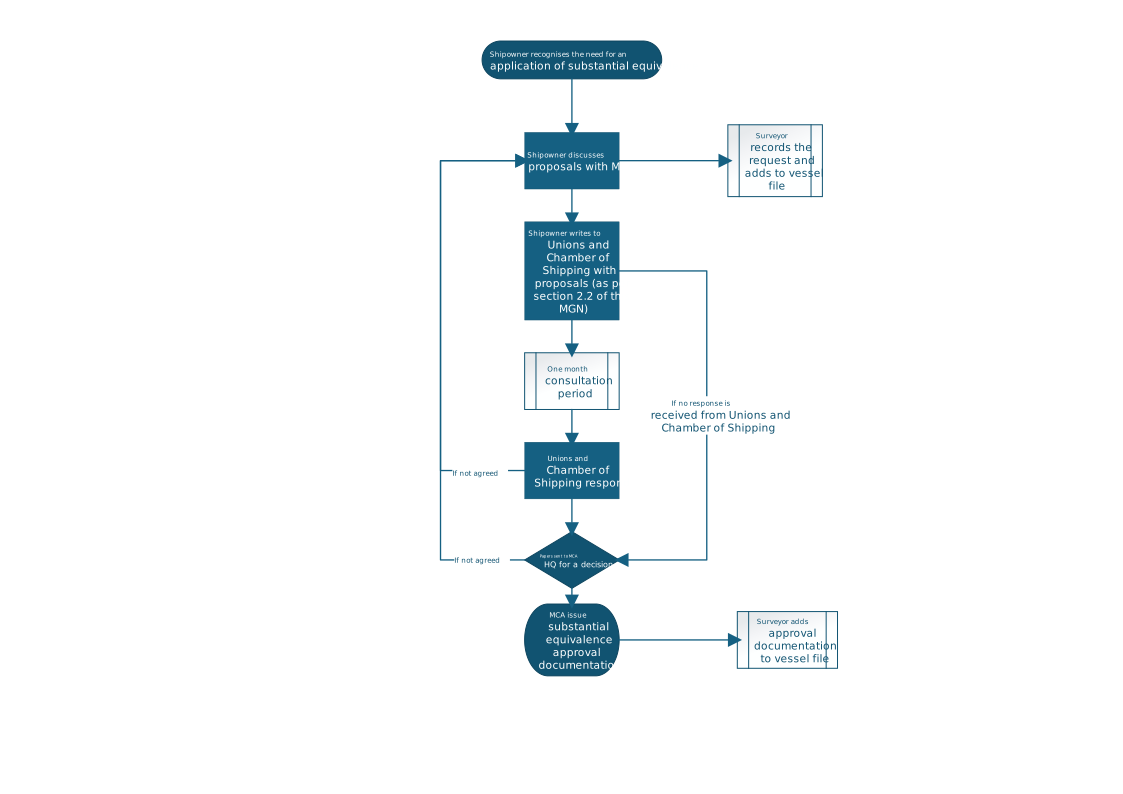
This notice provides contact information for the unions (para 2.2) and a flowchart of the approval process in annex C.
Amendment 4 updates references, and annex A list of substantial equivalents agreed by the MLC Tripartite Working Group.
1. Introduction
1.1 There are two kinds of substantial equivalence under UK regulations;
-
those embedded in Regulations, as an alternative means for UK ships to comply with the provisions of the Maritime Labour Convention, 2006 (MLC), which are available to all ships subject to any limitations of restrictions specified in the regulations, and
-
ship-specific substantial equivalences – generally relating to crew accommodation.
1.2 The procedure for the approval of ship-specific substantial equivalences will follow the same arrangement that was used for exemptions under the Merchant Shipping (Crew Accommodation) Regulations 1997 (based on ILO 92 and ILO 133). These arrangements are (also detailed in flow chart in annex C) :
a) the shipowner discusses the proposals with the attending surveyor. The surveyor records this on a form which is placed on the ship’s file.
b) the shipowner writes to the Unions with the proposals
c) the Unions respond.
1.3 The papers are sent to the Maritime and Coastguard Agency (MCA) for a decision and approval.
2. Procedure for agreement
2.1 The MCA intends to use a standard procedure with a set criteria, for considering any proposal seeking ship-specific “substantial equivalences”, similar to that described above. This will not create a derogation for the shipbuilder to build further ships to the same standard.
2.2 Any proposal for a substantial equivalence should be submitted with the agreement of both the shipowners and the seafarers’ representatives. That means in all cases the UK Chamber of Shipping, Nautilus (MLCrequest@nautilusint.org) and the National Union of Rail, Maritime and Transport Workers (RMT) (d.crimes@rmt.org.uk), the official social partners for the MCA, should be consulted. There may however be situations where additional organisations such as the British Tugowners Association (BTA), Prospect and Unite representing specific sectors in the shipping industry are included in the consultation process. In these situations, the appropriate organisations representing that sector will also be consulted.
2.3 Under normal circumstances, the applicant will write to the shipowners’ and seafarers’ representatives, who should reply to the applicant. The applicant will then provide the responses with their applications to the MCA. The MCA will only undertake this task in exceptional circumstances.
2.4 Any application for substantive equivalence will be subject to a one month consultation period. If no comments are made by shipowners or seafarers representatives in relation to the proposals during this one month (30 day) period, the proposal can be treated as approved.
2.5 In controversial or significant cases, the MCA reserves the right to put the proposal to the UK’s MLC Tripartite Working Group for discussion before coming to a decision.
2.6 All approved substantial equivalences and their supporting documentation will be retained by the MCA and reported periodically to the International Labour Organization (ILO), as part of the Annual Reports on seafarers living and working conditions.
3. Information required
3.1 In any application for substantial equivalence, the shipowner is required to demonstrate the reason behind seeking the substantial equivalence with consideration to:
a) the reason for seeking the substantial equivalence;
b) how the proposal, in accordance with Article VI of the Maritime Labour Convention, meets the same objectives as, and gives effect to the provisions of Part A of the Maritime Labour Convention Code and giving due consideration to Part B of the Maritime Labour Convention Code;
c) the effects on the provision of decent living and working conditions for seafarers;
d) how full compliance would impact on the remainder of the ship;
e) any special design challenges driving the substantial equivalence request;
f) what objective can be accomplished through substantial equivalence which cannot be achieved by adhering to the regulations.
4. Subsequent application for the same substantial equivalence
4.1 It is intended that, after a particular measure or solution has been approved as a substantial equivalence by the MCA, any further use of the same substantial equivalence, unless specifically requested and approved for the initial application undergoes the same process of approval in the light of the considerations identified in section 3 above.
4.2 Approval of a measure in one context should not necessarily be seen as setting a precedent. However, it is expected that once an approval has been given, this will make any subsequent application a simpler decision process.
5. Flagging in
5.1 When a ship flags onto the UK register an application should be made following the same procedure for any substantial equivalence and with the prior agreement of the shipowners’ and seafarers’ representatives. If the substantial equivalence has been agreed by another MLC flag State then, this should make a smoother transition process.
5.2 As with the substantial equivalences agreed by the UK, all substantial equivalences agreed on this basis will need to be communicated to the ILO as part of the Annual Reports on seafarers living and working conditions.
6. Procedure for approval
6.1 Any substantial equivalence which is requested for general application will be considered by the MLC Tripartite Working Group, which has members from the UK Chamber of Shipping, Nautilus International, the National Union of Rail, Maritime and Transport Workers (RMT), the Department for Transport, the MCA and the Red Ensign Group Administrations.
6.2 The information required is the same as for paragraph 3.1 above. Any shipowner or group of shipowners may apply for such exemption. While consultation with the social partners will be carried out a national level, local view should be sought and reported to aid consideration.
6.3 Any substantial equivalences requiring amendments to the legislation will be incorporated at the next opportunity for revision. In the meantime, with the support of the TWG, the MCA will consider administrative arrangements for accepting the alternative arrangements on a case by case basis.
6.4 Substantial equivalences already agreed are listed in Annex A to this Note, subject in some cases to consideration as part of the MLC inspection process. For further details, contact the MCA surveyor responsible, or use the contact details below.
6.5 This procedure will also be used for approving substantial equivalences for the Red Ensign Group members that do not have their own tripartite arrangements for consultation.
7. More information
Seafarer Safety and Health Branch
Maritime and Coastguard Agency
Bay 2/17
Spring Place
105 Commercial Road
Southampton
SO15 1EG
Telephone: +44 (0)203 81 72000
Email: mlc@mcga.gov.uk
Website: www.gov.uk/mca
Please note that all addresses and telephone numbers are correct at time of publishing.
Annex A – list of MCA approved substantial equivalences
SE001 Crew accommodation requirements for large commercial yachts between 200GT-500GT - see MSN 1895 (M) The Red Ensign Group (REG) Yacht Code Part A - GOV.UK
SE002 Crew accommodation requirements for commercial vessels less than 200GT - see MGN 601 MLC Crew accommodation for small vessels < 200GT - GOV.UK
SE003 Crew accommodation below the reference load line for tugs and workboats under 500GT - see MGN 602 MLC Substantial equivalence for accommodation for 200GT to < 500GT vessels - GOV.UK
SE004 Dispensation allowing cadets to share a cabin - To agree with MCA as part of DMLC Part 1 approval
SE005 Acceptance of the use of digital records for the purpose of recording hours of work and rest - To agree with MCA as part of DMLC Part 1 approval
SE006 Medical Certificates recognised as equivalent to ENG 1 in certain circumstances - To agree with MCA as part of DMLC Part 1 approval as Annex B below.
SE007 UK Oil and Gas (UKOG)
SE008 NOGEPA (Norway Offshore Certificate)
SE009 OLF (Netherlands Offshore Certificate)
On the UK, Norway or Netherlands Continental Shelf only, for oil and gas professionals not deemed seafarers pre-MLC1 or for the purposes of STCW, or by the shipowner, not applicable for marine crew.
SE010 Commercial Diver Medical Certificate (HSE approved) - as SE007 but worldwide - for the role of diver only.
SE011 Aviation/Pilot Medical Certificate (EASA approved) - as SE 007 but worldwide – for the role of pilot only.
SE012 Recognition of Training Agreement with an approved training providers as equivalent to a Seafarer Employment Agreement (SEA) - see MGN 485 (M).
SE013 Recognition of experience or standing as a chef, equivalent to a Ships’ Cook Certificate of Competency (for large yachts, in appropriate circumstances) - To agree by contacting SSDT@mcga.gov.uk, as part DMLC Part 1 approval.
SE014 Crew Accommodation requirements for large commercial yachts of 3000GT up to 5000GT - see Red Ensign Group Large Yacht Code Part A Section 21.B.8 (5).
Annex B – requirement for ENG 1 medical certification pre and post MLC
The Merchant Shipping (Medical Examination) Regulations 2002 defined “seafarer” as follows:
- “seafarer” means any person, including a master, who is employed or engaged in any capacity on board a ship on the business of the ship
The Merchant Shipping (Maritime Labour Convention) (Medical Certification) Regulations 2010, as amended by S.I. 2014/1614, define seafarer as follows:
- “seafarer” means any person, including a master, who is employed or engaged or works in any capacity on board a ship and whose normal place of work is on a ship
The 2010 Regulations therefore have a potentially wider application.
The following example groups summarises the anticipated scenarios which are likely to be encountered, and whether SE007 (see Annex A) is applicable:
-
Post holders who previously were required to have ENG 1 Medical Certificates pre-MLC are still required to have ENG 1 Medical Certificates, with no effect of SE007.
-
Post holders who are required to have UKOG Medical Certificates (or their Norwegian and Dutch equivalents) pre-MLC may have some brought within the definition of “seafarer” post MLC. The effect of SE007 for those post holders who are brought within the definition of “seafarer” for MLC purposes, but were not previously considered seafarers, the proposed equivalences would apply in circumstances described.
-
Post holders who previously were not required to have either an ENG 1 or UKOG Medical Certificate may be brought within the definition of “seafarer” post MLC. The effect of SE007 being that post holders in this group who are brought within the definition of “seafarer” for MLC purposes will be required to have an ENG 1.
-
Post holders who have previously been required to have both an ENG 1 and a UKOG Medical Certificate pre-MLC, it is envisaged that if they are already required to have ENG 1s they will probably already be considered seafarers, regardless of the MLC legislation. No effect of SE007 is expected. Regardless of their post-MLC status this group will not be affected as the proposed substantial equivalences are aimed solely at relieving additional burdens brought about by the MLC.
Annex C - process map for applying for substantial equivalence