Laboratory confirmed cases of measles, mumps and rubella, England: January to March 2026
Published 30 July 2026
Applies to England

© Crown copyright 2026
This publication is licensed under the terms of the Open Government Licence v3.0 except where otherwise stated. To view this licence, visit nationalarchives.gov.uk/doc/open-government-licence/version/3 or write to the Information Policy Team, The National Archives, Kew, London TW9 4DU, or email: psi@nationalarchives.gov.uk.
Where we have identified any third party copyright information you will need to obtain permission from the copyright holders concerned.
This publication is available at https://www.gov.uk/government/publications/measles-mumps-and-rubella-lab-confirmed-cases-in-england-2026/laboratory-confirmed-cases-of-measles-mumps-and-rubella-england-january-to-march-2026
Introduction
Measles, mumps and rubella are notifiable diseases; healthcare professionals are legally required to inform their local Health Protection Team (HPT) of any suspected case. National enhanced surveillance including oral fluid (OF) testing of all suspected cases is provided through the Virus Reference Department (VRD) at Colindale to support and monitor progress towards WHO measles and rubella elimination targets (1).
Two WHO indicators are of prime importance for measuring the performance of national measles and rubella surveillance systems. These are:
- The rate of laboratory investigations (at least 80% of suspected cases).
- The annual rate of discarded cases (at least 2 per 100,000 population)
To achieve these targets, the focus of the UK Health Security Agency (UKHSA) is to ensure that all suspected cases are appropriately tested. IgM serology testing and oral fluid testing are the only 2 tests considered adequate by WHO for confirming or discarding a suspected measles or rubella case. Recent infection is confirmed by measuring the presence of IgM/IgG antibodies or detecting viral RNA (by PCR) in these samples.
Samples that have been confirmed positive for measles or rubella in a proficient laboratory (this includes local laboratories as well as the National Reference Laboratory) are included in this report. Samples that are referred to, or tested at, the National Reference Laboratory are further sequenced and entered on the WHO global Measles Nucleotide Surveillance (MeaNS) or the Rubella Nucleotide Surveillance (RubeNS) system, respectively, which are hosted by the National Reference Laboratory. Genotyping and further characterisation of measles and rubella is used to support investigation of transmission pathways and sources of infection.
Data presented here are for the first quarter of 2026 (January to March). However, details of the most recent epidemiology are published at Measles epidemiology 2023 to 2026.
The analyses are executed using the onset date of a rash or other symptoms, and regional breakdown figures relate to the Government Office Regions. Hospitalisation statistics have been derived from the Secondary Users Service and Emergency Care Data Sets. Travel related data is retrieved from UKHSA’s case incident management system (CIMS).
Historical annual and quarterly measles, mumps and rubella epidemiological data are available here from 2013 onwards:
The results from all samples tested at Colindale are reported using UKHSA’s laboratory information system MOLIS. The results are then reported back to the respective general practitioner (GP) and local HPT.
Overview
Table 1. Total suspected cases of measles, mumps and rubella reported to HPTs with breakdown of:
a) number of suspected cases
b) proportion tested by Oral Fluid (OF)
c) other samples referred onto the Virus Reference Department (VRD) Colindale from local NHS hospital and private laboratories
d) cases confirmed at the VRD
e) cases confirmed at regional, local NHS hospital and private laboratories only
f) percentage of suspected cases confirmed
g) discard rate per 100,000 population: weeks 53 of 2025 to 13 of 2026
| Notification | Total suspected cases [note 1] |
Number (%) tested by OFK [note 2] |
Other samples received by VRD | Cases confirmed at VRD (Number of samples IgM positive or viral detection in VRD) | Cases confirmed at regional, local NHS hospital and private laboratories only [note 3] |
% of suspected cases confirmed [note 4] |
Discard rate based on negative tests per 100,000 population [note 5][note 6] |
|---|---|---|---|---|---|---|---|
| Measles | 1,917 | 897 (46.8%) | 308 | 344 | 46 | 20.3% | 2.60 |
| Mumps | 1,640 | 832 (50.7%) | 331 | 42 | 6 | 2.9% | 2.72 |
| Rubella | 40 | 22 (55%) | 2 | 0 | 0 | 0% | 0.07 |
Note 1: This represents all cases reported to HPTs in England.
Note 2: For surveillance purposes, all suspected measles and rubella cases should be sent an OFK by the HPT. Many cases will also undergo local diagnostic testing in parallel; however, only positive results are reported to UKHSA.
Note 3: Laboratories are required to report locally confirmed measles and rubella cases to UKHSA.
Note 4: Negative PCR results from local NHS and private laboratories are not routinely reported to UKHSA and therefore the estimated discard rate is an underestimate.
Note 5: Percentage confirmed = (cases confirmed at the VRD + cases confirmed at regional, local NHS hospital and private laboratories) ÷ suspected notifications × 100
Note 6: The WHO has set a target for an annual discard rate of 2 cases per 100,000 population, which translates to a quarterly target of 0.5 per 100,000. It’s important to note that we have proportionally adjusted the annual target to ensure there is consistent testing across each quarter.
Measles
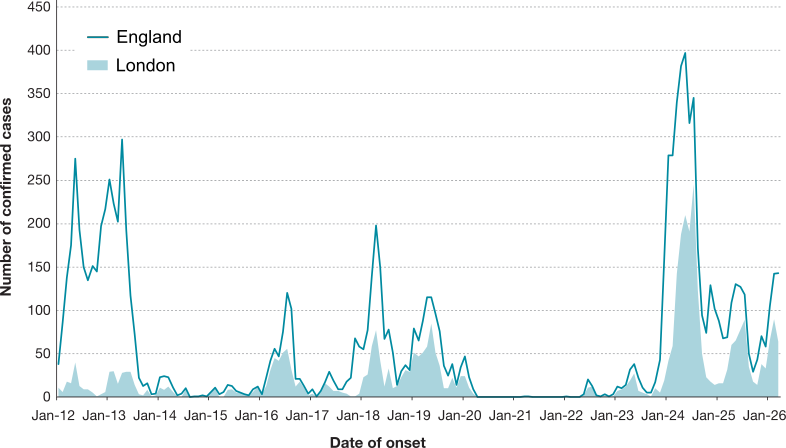
In the period between January to March 2026, there were 390 laboratory confirmed cases of measles reported in England, a significant increase on the previous quarter (n=170) (2) (Figure 1). This increase was mainly driven by outbreaks in North London and the West Midlands. Details of the latest epidemiology can be found in the linked page here (3).
Of the 390 cases reported this quarter, 33 were classified as imported and 9 were classified as import-related. The majority, 68.7% (268 out of 390), of cases were in children aged 10 years or younger. Sixteen (4.1%) cases were previously vaccinated with 1 dose of the MMR vaccine and 9 (2.3%) with at least 2 doses.
No laboratory confirmed cases were reported in Northern Ireland, 13 in Scotland and 1 in Wales in the first quarter.
All suspected cases of measles and rubella should be reported promptly to Health Protection Teams, a risk assessment conducted, and an Oral Fluid kit (OFK) sent for surveillance purposes even if local diagnostic testing is underway. Of the 1,917 suspected measles cases reported to UKHSA this quarter only 20.3% were subsequently confirmed through laboratory testing.
Figure 1. Laboratory confirmed cases of measles by month of onset of rash or symptoms reported, London and England: January 2012 to March 2026
Using NHS number, 388 of the 390 laboratory confirmed measles cases linked to the secondary care datasets in the period 5 days before to 10 days after their onset of measles symptoms. Of these 388, 36.9% of cases attended A&E only with no admission (143 out of 388). 50.8% of cases had a primary measles-related reason for admission (197 out of 388).
Globally, based on provisional WHO data reported up to June 2026, measles transmission remains widespread. A total of 64,542 laboratory confirmed measles cases were reported during this period, and the WHO European Region accounted for approximately 14% (4,5) of these. Europe continued to represent a moderate share of the global burden, with other WHO regions reporting higher overall case numbers (5). The countries with the highest total case counts in 2026 in the WHO European region were: Kazakhstan (n= 6,155), Russian Federation (n= 813), and Türkiye (n= 677) (4).
Given the continued high measles incidence globally, importations into England remain likely. This continues to pose a risk to under‑vaccinated communities. In 2026, measles importations in England were linked to travel from Pakistan (n=8), Saudi Arabia (n=4), and India (n=3) although cases were reported among travelers returning from a further 16 countries.
Mumps
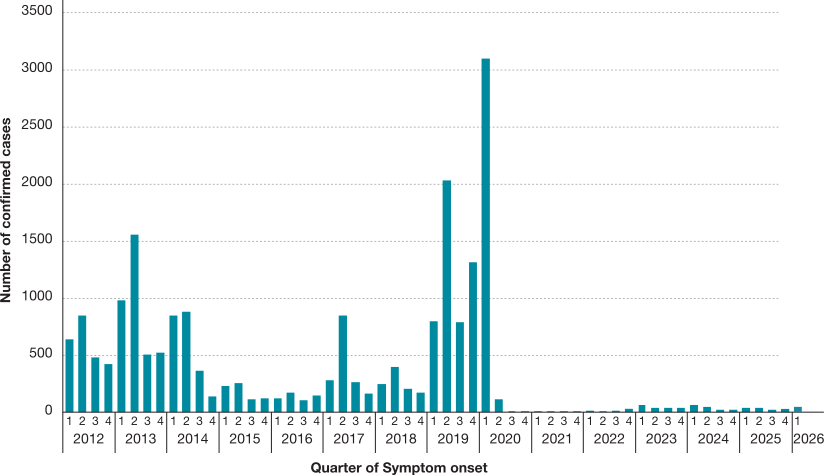
In England, there were 48 laboratory confirmed mumps infections in the period between January to March 2026, an increase of 71.4% since last quarter (n=28).
The majority of the cases (41 out of 48, 85%) were in young people and adults aged 15 years and older. 8.4% (4 out of 48) were vaccinated with at least 1 dose of MMR and 14.6% (7 out of 48) had received 2 doses.
Figure 2. Laboratory confirmed cases of mumps by year and quarter in England: January 2012 to March 2026
Rubella
This quarter there were no laboratory confirmed cases of rubella.
References
1. Public Health England (2019). ‘UK Measles and rubella elimination strategy 2019’
2. UKHSA (2026). ‘Laboratory confirmed cases of measles, rubella and mumps in England: October to December 2025’. Health Protection Report volume 20 number 4
3. UK Health Security Agency (2026). ‘Confirmed cases of measles in England by month, age, region and upper tier local authority: 2026’
4. WHO (2026). ‘Measles/Rubella (MR) Dashboard. Summary table: cases by year and final classification’
5. WHO (2026). ‘Measles and Rubella Global Situation Update’