Country policy and information note: Christians and Christian converts, Iran, June 2026 (accessible)
Updated 26 August 2026

© Crown copyright 2026
This publication is licensed under the terms of the Open Government Licence v3.0 except where otherwise stated. To view this licence, visit nationalarchives.gov.uk/doc/open-government-licence/version/3 or write to the Information Policy Team, The National Archives, Kew, London TW9 4DU, or email: psi@nationalarchives.gov.uk.
Where we have identified any third party copyright information you will need to obtain permission from the copyright holders concerned.
This publication is available at https://www.gov.uk/government/publications/iran-country-policy-and-information-notes/country-policy-and-information-note-christians-and-christian-converts-iran-june-2026-accessible
Version 8.0, June 2026
Executive summary
The Constitution recognises ‘ethnic’ Christians (Armenians, Assyrians and Chaldeans) and the government generally allows them to practice and teach their religion without interference, though some restrictions apply.
However, the Iranian authorities continue to arrest and detain Christian converts, mainly leaders and organisers, but also sometimes ‘ordinary’ Christians. The authorities also continue to arrest and detain small numbers of recognised Christians who are found by them to be actively proselytising.
Christian converts and proselytisers are prosecuted on vaguely worded charges such as ‘propaganda against the state’, the ‘promotion of evangelical Zionist Christianity’ and for national security offences. Penalties, which are reportedly becoming increasingly harsh, include lengthy prison sentences, fines, and the imposition of social deprivations.
Recognised Christians generally refrain from proselytising. While they face official discrimination, it is unlikely to be sufficiently serious by its nature or repetition, or an accumulation of various measures, to amount to persecution or serious harm. The onus is on the person to demonstrate otherwise.
Christians who are known, or believed, by the Iranian authorities to have converted from Islam to Christianity and who seek to openly practice their faith in Iran, are likely to be subject to treatment or discrimination by the state that is sufficiently serious, by its nature or repetition, to amount to persecution.
Christians, whether recognised or unrecognised, who the authorities find to be actively seeking to convert Muslims to Christianity are also likely to be subject to treatment or discrimination by the state that is sufficiently serious by its nature or repetition, to amount to persecution.
Where the person has a well-founded fear of persecution or serious harm from the state, they are unlikely to be able to obtain protection.
In general, a person with a well-founded fear of persecution or serious harm from the state is unlikely to be able to internally relocate to escape that risk.
Where a claim is refused, it is unlikely to be certifiable as ‘clearly unfounded’ under section 94 of the Nationality, Immigration and Asylum Act 2002.
Each case must be considered on its individual facts. The onus is on the person to demonstrate they face persecution or serious harm.
Assessment
Section updated: 24 June 2026
About the assessment
This section considers relevant evidence – including country information, refugee and human rights law and policy, and case law – to assess whether, in general:
- a person faces a real risk of persecution/serious harm by the state because of their Christianity, their conversion to Christianity, and/or because they actively seek to convert others to Christianity
- internal relocation is possible to avoid persecution/serious harm
- if refused, a claim is likely or not to be certified as ‘clearly unfounded’ under section 94 of the Nationality, Immigration and Asylum Act 2002.
Each case must be considered on its individual facts.
For details on how CPIT makes its assessments, and information on disclaimers (including the use of Artificial Intelligence (AI) in developing CPINs), see About country policy and information notes.
Points to note
Though not all sources distinguish between these groups, Christians in this note generally comprise of:
- recognised, ‘ethnic’, Christians (Armenians, Assyrians and Chaldeans, the majority of whom are Orthodox or Catholic)
- non-ethnic’ Christians, who can prove that their families were Christian before the 1979 Iranian revolution. They are predominantly Farsi-(Persian-)speaking and/or evangelical. Those with no ethnic association but who belong to recognised and traditional churches in Iran are recognised. Evangelical Protestants are not recognised
- non-recognised, ‘Christian converts’, those who have converted from Islam to Christianity after the 1979 Iranian revolution (see Legal context: Religion)
1. Material facts, credibility and other checks/referrals
1.1.1 Decision makers must:
- assess credibility (see the Asylum Instruction on Assessing Credibility and Refugee Status).
- check if there has been a previous application for a UK visa or another form of leave. Asylum applications matched to visas should be investigated prior to the asylum interview (see the Asylum Instruction on Visa Matches, Asylum Claims from UK Visa Applicants).
- consider making an international biometric data-sharing check, when one has not already been undertaken (see Biometric data-sharing process (Migration 5 biometric data-sharing process)).
- consider language analysis testing, where available, in cases where there are doubts surrounding a person’s claimed place of origin (see the Asylum Instruction on Language Analysis).
Official – sensitive: Not for disclosure – Start of section
The information in this section has been removed as it is restricted for internal Home Office use.
Official – sensitive: Not for disclosure – End of section
1.2 Exclusion
1.2.1 Decision makers must consider whether there are serious reasons to apply one (or more) of the exclusion clauses. Each case must be considered on its individual facts.
1.2.2 If the person is excluded from the Refugee Convention, they will also be excluded from a grant of humanitarian protection (which has a wider range of exclusions than refugee status).
1.2.3 For guidance on exclusion and restricted leave, see the Asylum Instruction on Exclusion under Articles 1F and 33(2) of the Refugee Convention, Humanitarian Protection and the instruction on Restricted Leave.
Official – sensitive: Not for disclosure – Start of section
The information in this section has been removed as it is restricted for internal Home Office use.
Official – sensitive: Not for disclosure – End of section
2. Convention reason(s)
2.1.1 Actual or imputed religion.
2.1.2 Establishing a convention reason is not sufficient to be recognised as a refugee. The question is whether the person has a well-founded fear of persecution on account of an actual or imputed Refugee Convention reason.
2.1.3 For further guidance on the 5 Refugee Convention grounds, see the Asylum Instruction, Assessing Credibility and Refugee Status.
3. Risk
3.1 ‘Ethnic’ and ‘non-ethnic’ Christians – inside Iran
3.1.1 Recognised Christians generally refrain from proselytising. While they face official discrimination, it is unlikely to be sufficiently serious by its nature or repetition, or an accumulation of various measures, to amount to persecution or serious harm. The onus is on the person to demonstrate otherwise.
3.1.2 See Risk: Christian converts – inside Iran for information about recognised Christians who actively seek to convert Muslims inside Iran to Christianity.
3.1.3 The Constitution recognises ‘ethnic’ Christians (Armenians, Assyrians and Chaldeans) and the government generally allows them to practice and teach their religion without interference, though some restrictions apply. Services in their churches cannot be held in Farsi (Persian), but only in their local language (see Legal context: Religion and State attitudes and treatment: Towards ‘ethnic’ Christians).
3.1.4 Christians and Christian churches must be registered with the authorities, and only recognised Christians can attend church and must not proselytise. Churches are monitored by the authorities to ensure Christians of a Muslim background do not attend and those that do not comply with these restrictions have been closed down (see State attitudes and treatment: Towards ‘ethnic’ Christians and Towards Christian converts, and House churches: Evolution and organisation).
3.1.5 For further guidance on assessing risk, see the Asylum Instruction on Assessing Credibility and Refugee Status.
3.2 Christian converts and proselytisers
3.2.1 Christians who are known, or believed, by the Iranian authorities to have converted from Islam to Christianity and who seek to openly practice their faith in Iran are likely to be subject to treatment by the state that is sufficiently serious, by its nature or repetition, to amount to persecution.
3.2.2 Christians, whether recognised or unrecognised, who the authorities find to be actively seeking to convert Muslims to Christianity are also likely to be subject to treatment or discrimination by the state that is sufficiently serious by its nature or repetition, to amount to persecution.
3.2.3 The Iranian authorities’ interest, monitoring and punitive efforts against Christian converts and proselytisers is likely to intensify during, or immediately after, periods of international conflict with Western entities in Iran (providing the authorities retain the capacity to do so).
3.2.4 The country guidance case of PS (Christianity – risk) Iran CG [2020] UKUT 00046 (IAC), promulgated on 20 February 2020, heard 13 to 14 November 2019 (PS Iran), ‘… applies to protection claims from Iranians who claim to have converted from Islam to Christianity’ (paragraph 141).
3.2.5 The Upper Tribunal (UT) in PS Iran held that ‘Insofar as they relate to non-ethnic Christians, this decision replaces the country guidance decisions in FS and Others (Iran - Christian Converts) Iran CG [2004] UKIAT 00303 and SZ and JM (Christians - FS confirmed) Iran CG [2008] UKAIT 00082 which are no longer to be followed’ (paragraph 142).
3.2.6 The UT in PS Iran found that, ‘… the situation for Christians in Iran has deteriorated drastically since the last country guidance was published. The most marked change has been that the Persian-language churches then permitted to operate openly (albeit with restrictions) have now almost all closed down. Those few that remain do so under the direct control of the Ministry of Intelligence. That means that all remaining Christian worship must be conducted “underground”’ (paragraph 119).
3.2.7 The UT in PS Iran agreed with the finding in SZ and JM, in that ‘those who are perceived to be church leaders or activists face a real risk of harm’ (paragraph 85).
3.2.8 In contrast to SZ and JM, which found that ordinary converts would not be at real risk of serious harm if returned to Iran, subject to other risk factors (paragraph 148), the UT in PS Iran held:
‘We do not however find it safe to assume that “ordinary” Christians, that is to say individuals with no role beyond attending collective worship at house churches, escape the attention of the authorities. On a general level the language used by the sources indicates that to the contrary, simply being a Christian is enough to get you arrested: “authorities continued to arrest members of unrecognized churches”, “many arrests reportedly took place during police raids on religious gatherings”, “Christians, particularly evangelicals and converts from Islam, continued to experience disproportionate levels of arrests and detention” (paragraph 86).
3.2.9 The UT in PS Iran held that ‘Decision makers should begin by determining whether the claimant has demonstrated [to the required standard of proof] that he or she is a Christian. If that burden is discharged the following considerations apply:
‘i) A convert to Christianity seeking to openly practice that faith in Iran would face a real risk of persecution.
‘ii) If the claimant would in fact conceal his faith, decision-makers should consider why. If any part of the claimant’s motivation is a fear of such persecution, the appeal should be allowed.
‘iii) If the claimant would choose to conceal his faith purely for other reasons (family pressure, social constraints, personal preference etc) then protection should be refused. The evidence demonstrates that private and solitary worship, within the confines of the home, is possible and would not in general entail a real risk of persecution (paragraph 143).
3.2.10 In respect of ‘written and oral evidence given by “church witnesses”’, in the reported case of TF & MA v SSHD [2018] CSIH 58, promulgated on 30 August 2018, the Court of Session held that:
‘It was suggested in Dorodian (Ali) v Secretary of State for the Home Department (supra) at paragraph 8(a) that no one should be regarded as a committed Christian who is not vouched for as such “by a minister of some church established in this country”. We would respectfully disagree. While it would no doubt be desirable that the individual concerned be vouched for by someone in a position of leadership within the relevant church, it is more important that the evidence be given by someone who has knowledge of the individual whose commitment is in question. We are conscious that churches in Scotland follow a number of different traditions. In those circumstances it would be wrong for this court to insist that any relevant evidence be given from someone at a particular level within the hierarchy (if any) of any particular church. What matters is that they have sufficient knowledge of the practices of the church of which they are a member; sufficient experience of observing and interacting with those seeking to become members of the church; sufficient knowledge and experience of others who have gone through similar processes of engagement in church activities with a view to becoming members of the church; and, in cases such as these, sufficient knowledge of the individuals concerned and of the manner in which they have thrown themselves into church activities …
‘… [I]t may be that all the expert can do is give his opinion based upon his long and varied experience. That, in our opinion, is the type of evidence that we are concerned with in cases such as this. The witnesses have observed many people undertaking courses with a view to baptism and becoming members of the church. They have seen some succeed and some fail. They will have been able to assess individuals over time as a result of those individuals taking part in activities within the church. They will have seen the intensity of their participation and will have heard the questions they ask and the interest in understanding that they show as matters are explained. Their evidence will be of the impression that that individual has made on them. They will be able to say that, in their opinion, based on their experience of this individual and many others, the individual in question is or appears to be genuine (or in other cases they are not satisfied, or not yet satisfied, of the genuineness of their self-proclaimed faith). This, in our opinion, is admissible opinion evidence which is entitled to respect. Of course it remains for the court or tribunal to make the final decision, and nothing in the expert evidence can take that away from the court or tribunal. To this extent it is legitimate to question the experts on their opinions and as to the basis upon which they have reached those opinions. In some cases it may be appropriate to question the objectivity of the assessment made by the witness, or to suggest that there may be an element of wishful thinking given the evangelical mission of the particular church. But, as we have already made clear, that exercise should not start with any predisposition to reject the evidence because it does not fit in with some a priori view formed as to the credibility of the appellant. The evidence should be considered on its merits and without any preconception, based upon an assessment of the individual appellants, that it is suspect or otherwise falls to be disregarded.’ (paragraphs 58 and 59)
3.2.11 In the reported case of MH (review; slip rule; church witnesses) Iran [2020] UKUT 125 (IAC), heard on 28 January 2020 and promulgated on 11 March 2020, the UT held that: ‘“Respect” is not the same as weight. Judicial fact finders commonly decline to ascribe significant weight to expert evidence for a wide range of entirely legitimate reasons.’ (paragraph 43)
3.2.12 The UT in MH Iran summarised that: ‘Written and oral evidence given by “church witnesses” is potentially significant in cases of Christian conversion (see TF & MA v SSHD [2018] CSIH 58). Such evidence is not aptly characterised as expert evidence, nor is it necessarily deserving of particular weight, and the weight to be attached to such evidence is for the judicial fact-finder.’ (headnote iv)
3.2.13 In summary, whilst the ‘Dorodian precedent’ made it extremely difficult for a person to establish their conversion to Christianity in the absence of a supporting witness of a ministerial, or similar standing, this approach is no longer followed in light of TF & MA, which struck down the Dorodian precedent. The case of MH Iran has since clarified that such evidence is important but not determinative, and should be considered holistically.
3.2.14 The UT in PS Iran also held that:
‘In cases where the claimant is found to be insincere in his or her claimed conversion, there is not a real risk of persecution “in-country”. There being no reason for such an individual to associate himself with Christians, there is not a real risk that he would come to the adverse attention of the Iranian authorities. Decision-makers must nevertheless consider the possible risks arising at the “pinch point” of arrival:
‘i) All returning failed asylum seekers are subject to questioning on arrival, and this will include questions about why they claimed asylum;
‘ii) A returnee who divulges that he claimed to be a Christian is reasonably likely to be transferred for further questioning;
‘iii) The returnee can be expected to sign an undertaking renouncing his claimed Christianity. The questioning will therefore in general be short and will not entail a real risk of ill-treatment;
‘iv) If there are any reasons why the detention becomes prolonged, the risk of ill-treatment will correspondingly rise. Factors that could result in prolonged detention must be determined on a case by case basis. They could include but are not limited to:
‘a) Previous adverse contact with the Iranian security services;
‘b) Connection to persons of interest to the Iranian authorities;
‘c) Attendance at a church with perceived connection to Iranian house churches;
‘d) Overt social media content indicating that the individual concerned has actively promoted Christianity’ (paragraph 144).
3.2.15 The information in this note does not indicate that there are ‘very strong grounds supported by cogent evidence’ to depart from these findings.
3.2.16 Each case must be considered on its own merits with the onus on the person to show that they would be at real risk of serious harm or persecution on account of their actual or perceived religion.
3.2.17 For more information about the treatment of returnees, including procedures on arrival in Iran, see Country Policy and Information Note, Iran: Illegal exit. For more information about sur place activities more generally, including sur place social media activities and the monitoring of such by the Iranian authorities, see Country Policy and Information Note, Iran: Social media, surveillance and sur place activities.
3.2.18 Multiple Christian advocacy groups, including Article 18, Open Doors, Middle East Concern and Christian Solidarity Worldwide, continue to report the arrest and detention of Christian converts, mainly of leaders and organisers, but also, albeit to a lesser extent, of ‘ordinary’ Christians. Sources also report the arrest and detention of small numbers of recognised Christians who are found by the authorities to be actively proselytising. These arrests often, though not always, occur after house-church raids by the security forces.
Sources noted an increase in the number of Christian arrests during the in the immediate aftermath of the 12-day Israel-Iran war in June 2025, often on allegations of collaborating with Israel (see House churches, Monitoring of, and raids on, house churches and Arrests, detentions and criminal charges).
3.2.19 Sources also continue to report the criminal prosecutions of Christian converts and proselytisers on vaguely worded charges such as ‘propaganda against the state’, the ‘promotion of evangelical Zionist Christianity’ and national security offences. Many convictions are made under articles of the penal code that were amended in 2021. Penalties include lengthy prison sentences, fines, enforced participation in Islamic ‘re-education’, and the imposition of social deprivations such as bans on membership of groups or from some forms of employment, internal exile, and travel bans. Sentences are reportedly becoming increasingly harsh, with the total length of faith-related prison sentences handed down to Christians in 2024 being six times that in 2023 and increasing again in 2025 despite involving fewer individuals. While other ill-defined charges including ‘corruption on earth’ and ‘waging war against God’, which carry the potential for a death penalty, have also been invoked against Christian converts and proselytisers, CPIT has not found any recent examples of Christians being sentenced to death (see Legal context: Apostasy and proselytising, State attitudes and treatment: Towards Christian converts, and Convictions and prison sentences).
3.2.20 Sources report that, in line with the experience of the general detained population in Iran, many detained Christians have faced mistreatment at the hands of the authorities. This includes, but is not limited to, physical and psychological torture, the denial of or restricted access to healthcare, a lack of due process, the sexual assault or harassment of women during their interrogations, and the use of solitary confinement (see Treatment of detainees).
3.2.21 Sources indicate that where a returning Christian does not have a pre-existing profile with the Iranian authorities, they are unlikely to come to their attention on return providing they keep a low profile, in part because the authorities on arrival do not ask about religious beliefs. The authorities’ interest in a person is likely to be increased when the authorities become aware that person has either converted to Christianity or has applied for asylum abroad based on conversion. There are some, though few, recent examples of Christian converts having been summonsed or sentenced on return to Iran. However, the Iranian government resources do not allow for the pursual of every known or perceived Christian convert and the authorities are likely to focus on those who are particularly vocal about their conversion, organise Christian gatherings, or try to convert others, including on social media. Some Christian converts have been forced by the authorities to make confessions, including publicly. There is very limited evidence of the Iranian authorities monitoring the Christian activities of Iranians abroad and/or targeting families inside Iran as a result (see Sur place Christian activities, Arrests, detentions and criminal charges, Treatment of detainees, Convictions and prison sentences, State attitudes and treatment: Towards Christian converts).
3.2.22 For further guidance on assessing risk, see the Asylum Instruction on Assessing Credibility and Refugee Status.
4. Protection
4.1.1 Where the person has a well-founded fear of persecution or serious harm from the state, they are unlikely to be able to obtain protection.
4.1.2 For further guidance on assessing state protection, see the Asylum Instruction on Assessing Credibility and Refugee Status.
5. Internal relocation
5.1.1 In general, a person with a well-founded fear of persecution or serious harm from the state is unlikely to be able to internally relocate to escape that risk.
5.1.2 For further guidance on internal relocation and factors to consider, see the Asylum Instruction on Assessing Credibility and Refugee Status.
6. Certification
6.1.1 Where a claim is refused, it is unlikely to be certifiable as ‘clearly unfounded’ under section 94 of the Nationality, Immigration and Asylum Act 2002.
6.1.2 For further guidance on certification, see Certification of Protection and Human Rights claims under section 94 of the Nationality, Immigration and Asylum Act 2002 (clearly unfounded claims).
Country information
About the country information
For details on how CPIT gathers and presents country information, including the research methodology, see About country policy and information notes.
The COI included in this note was published or made publicly available on or before 1 May 2026. Any event that took place or reports published after this date are not included.
Some country information quoted in this CPIN was originally published in languages other than English and has been translated using free online translation tools. Translated information is clearly signposted throughout.
Maps, where included, are not intended to reflect the UK Government’s views on any boundaries.
Decision makers must use relevant COI as the evidential basis for decisions.
7. Legal context
7.1 Religion
7.1.1 The Iran Data Portal, an online portal which hosts social science data on Iran in both English and Farsi[footnote 1], published an English translation of the Constitution of the Islamic Republic of Iran, which states:
‘Article 12 (Official Religion) The official religion of Iran is Islam and the Twelver Ja’fari school, and this principle will remain eternally immutable. Other Islamic schools are to be accorded full respect, and their followers are free to act in accordance with their own jurisprudence in performing their religious rites …
‘Article 13 (Recognized Religious Minorities) Zoroastrian, Jewish, and Christian Iranians are the only recognized religious minorities, who, within the limits of the law, are free to perform their religious rites and ceremonies, and to act according to their own canon in matters of personal affairs and religious education.
‘Article 14 (Non-Muslims’ Rights) In accordance with the sacred verse “God does not forbid you to deal kindly and justly with those who have not fought against you because of your religion and who have not expelled you from your homes” … the government of the Islamic Republic of Iran and all Muslims are duty-bound to treat non-Muslims in conformity with ethical norms and the principles of Islamic justice and equity, and to respect their human rights. This principle applies to all who refrain from engaging in conspiracy or activity against Islam and the Islamic Republic of Iran.
‘… Article 23 (Freedom of Belief) The investigation of individuals’ beliefs is forbidden, and no one may be molested or taken to task simply for holding a certain belief.
‘… Article 26 (Freedom of Association) The formation of … religious societies, whether Islamic or pertaining to one of the recognized religious minorities, is permitted provided they do not violate the principles of independence, freedom, national unity, the criteria of Islam, or the basis of the Islamic Republic. No one may be prevented from participating in the aforementioned groups, or be compelled to participate in them.
‘… The Islamic Consultative Assembly
‘… Article 64 (270 Members, Religious Representatives)
‘… (2) … Assyrian and Chaldean Christians will jointly elect one representative; and Armenian Christians in the north and those in the south of the country will each elect one representative.’[footnote 2]
7.1.2 In September 2023, the Netherlands Ministry of Foreign Affairs (BZ, Dutch abbreviation) published the General Country of Origin Information Report on Iran (the BZ 2023 report), which cited various sources and covered the period between April 2022 and August 2023.[footnote 3] The source stated:
‘Only a minority of Iranian Christians are thought to belong to one of the constitutionally recognised religious groups. These groups are made up of people who are born Christian and who mostly belong to one of the ethnic churches. These include Armenians, Chaldeans [descendants of ancient occupants of land in southern Babylonia (modern southern Iraq)[footnote 4]] and Assyrians [‘an ethnic group primarily in parts of Iran, Iraq, Syria, and Turkey that traces its roots to the Assyrian Empire …’[footnote 5]]. In addition, Iran recognises Christians who can prove that their families were Christian before the 1979 Iranian revolution. They mostly belong to recognised and traditional churches in Iran which have no ethnic association, are Persian-speaking and/or evangelical. The recognised churches include the Armenian Apostolic Church, the Assyrian Orthodox Church, the Armenian Catholic Church, the Chaldean Catholic Church, the Roman Catholic Church and the Anglican Church.
‘… Most Christians in Iran are thought to belong to a Christian minority that is not recognised by the constitution. These non-recognised Christians mostly belong to one of the new Persian-speaking churches. They generally converted from Islam to Christianity after the Iranian revolution.’[footnote 6]
7.1.3 On 26 June 2024, the US Department of State (USSD) published its 2023 annual report on international religious freedom. The report, which was the most recent annual report on international religious freedom to have been published by the USSD at the time of writing, and which cited various sources, stated:
‘… [T]he government only recognizes the Christianity of citizens who are Armenian or Assyrian Christians, because the presence of these groups in the country predates Islam, or of citizens who can prove they or their families were Christian prior to the 1979 revolution. The government also recognizes Sabean-Mandaeans [one of the world’s oldest and smallest religious communities … [that has] lived in Southern Iraq and Iran (Khuzestan province) for over 1000 years’[footnote 7]] as Christian, even though adherents to that faith state they do not consider themselves as such … The government does not recognize evangelical Protestants as Christian.’[footnote 8]
7.2 Apostasy and proselytising
7.2.1 The USSD 2023 report on international religious freedom stated: ‘The law prohibits Muslims from changing or renouncing their religious beliefs. The only recognized conversions are from other religions to Islam. Under the law, a child born to a Muslim father is Muslim.’[footnote 9]
7.2.2 The same USSD report also stated:
‘Prevailing fatwas prescribe the death penalty for apostasy … Sharia as interpreted by the government considers conversion from Islam to be apostasy, a crime punishable by death. Although apostasy is not codified in the penal code, the code instructs judges to rely on the constitution and fatwas in cases of apostasy, and the constitution instructs judges in general to pass judgments based on “authoritative Islamic sources and authentic fatwas,” rather than dismissing a case for lack of a codified crime or sentence. A judge may issue the death penalty to someone accused of apostasy under other charges, such as “enmity against God,” “corruption on earth,” “insulting the Prophet Muhammad,” and “outrage against high-ranking officials.” [However, t]he only known execution of an Iranian Christian specifically on the charge of apostasy occurred in 1990.’[footnote 10]
7.2.3 The BZ 2023 report stated:
‘There is no official statement as to what the Iranian authorities mean by apostasy. This concept is not included as such in the Islamic Penal Code. There is no agreement among clerics and Islamic scholars on the definition of apostasy, and whether or how it should be punished. Section 167 of the Iranian constitution states that when a law does not provide for a particular issue, a judge can turn to Islamic jurisprudence as a basis for his own verdict. This enables a judge to punish a person for apostasy based on his own interpretation of Islamic legal sources and fatwas. In practice, however, it is rare for someone to be charged with apostasy’.[footnote 11]
7.2.4 In a joint submission on Iran to the 48th session of the UN Universal Periodic Review (UPR) (a ‘mechanism of the Human Rights Council that calls for each UN Member State to undergo a peer review of its human rights records every 4.5 years’[footnote 12], on 18 July 2024, Christian Solidarity Worldwide (CSW), a research and advocacy organisation that supports global rights to freedom of religion or belief[footnote 13], and CSW-Nigeria stated:
‘Apostasy (in this instance, renouncing Islam) is not permitted under Islamic Law and is punishable by death; however, the legal position of converts from Islam remains unclear, as Iran has never codified apostasy as a crime. The Shi’a theocracy relies on charges such as blasphemy, or on broadly defined crime[s] encompassing anything deemed undesirable by the state such as mofsed-e-filarz (“spreading corruption on earth”) or Moharebeh (waging war against God). With no set penalty for these wide-ranging crimes, punishments can range from a few months in jail to execution …’[footnote 14]
7.2.5 On 20 January 2025, Article 18 ‘a non-profit organisation based in London, dedicated to the protection and promotion of religious freedom in Iran and advocating on behalf of its persecuted Christians’[footnote 15] published a joint annual report on human rights violations against Christians in Iran with CSW, Open Doors, and Middle East Concern (MEC), organisations which aim to promote religious freedom and/or to otherwise support Christians who experience faith-based persecution and discrimination[footnote 16] [footnote 17] (Article 18 et al). It should be noted that Landinfo, the Norwegian Country of Origin Information Center[footnote 18], in a translated update report on the conditions for Christian converts in Iran, published on 28 July 2025, stated: ‘The[se 4] organisations cannot be characterised as religiously neutral actors, and the information they provide can often not be verified against other more neutral sources. Nevertheless … they have good contacts within the Christian convert communities in Iran. They possess first-hand knowledge of the conditions under which Christians and Christian converts live. There are no other independent sources with the same amount of information.’[footnote 19] The report, entitled ‘Tip of the Iceberg’, covering events of 2024, and which cited various sources, stated: ‘… “[A]postasy” charges … could theoretically lead to a death sentence. Although apostasy is not codified in the IPC [Islamic Penal Code], judges can refer to Article 167 of the Iranian Constitution, which states: “The judge is bound to endeavour to judge each case on the basis of the codified law. In case of the absence of any such law, he has to deliver his judgment on the basis of authoritative Islamic sources and authentic fatwa.”’[footnote 20]
N.B. the Landinfo information quoted above, and all other COI quoted from this source throughout the rest of this CPIN, was originally published in Norwegian. See About the country information for further information about the method of translation.
7.2.6 On 14 October 2025, Barnabas Aid, an international Christian ministry that supports persecuted Christians[footnote 21], published an article entitled ‘Growing through persecution: What is it like to live as a Christian in Iran?’. The article stated: ‘When 12 Christians from Nowshahr, northern Iran, appeared in court in November 2024 to answer charges of “propagating a religion contrary to Islam” and “collaborating with foreign governments”, the prosecutor described the converts as “Shia Muslims” who had “identified themselves as Christians”. The implication seems to be that Shia Muslims can never legally leave the religion of their birth.’[footnote 22]
7.2.7 In January 2026[footnote 23], Open Doors published its annual ‘World Watch List’ for 2026, covering the situation of religious freedom for Christians during the period between 1 October 2024 and 30 September 2025.[footnote 24] The report stated: ‘Ethnic Persians are automatically considered Muslim, making converts to Christianity apostates under Islamic law. This classification renders virtually all Christian activities illegal, particularly those conducted in Persian.’[footnote 25]
7.2.8 On 21 April 2026, Amnesty International published its annual human rights reports, covering events of 2025 (the 2026 human rights report), which stated: ‘People born to parents registered as Muslim risked arbitrary detention, torture and other ill-treatment, and the death penalty for “apostasy” if they adopted other religions …’[footnote 26] The Amnesty International 2025 human rights report, published on 28 April 2025, made the same assertion.[footnote 27]
7.2.9 The BZ 2023 report stated:
‘In the case of evangelising Muslims and preaching evangelical Christianity, converts may face criminal charges, although there is no law prohibiting the use of Persian in a church or the possession of a Persian-language Bible. The authorities usually punish such offences on the grounds of propaganda against the [Islamic Republic of Iran] IRI through the promotion of evangelical Zionist Christianity (Section 500 of the Penal Code). A charge under Section 500 of the Penal Code can be punishable by three months or up to a year in prison. Converts themselves also risk fines, imprisonment and/or flogging … In addition to Section 500 of the Penal Code, punishment can also take place on any of the following grounds:
- Founding or leading an illegal organisation (Section 498 of the Penal Code). This is punishable by two to ten years in prison.
- Membership of an illegal organisation (Section 499 of the Penal Code). This is punishable by three months to five years in prison.
- Insulting ethnic groups, religions or Islamic schools of law (Section 499b of the Penal Code). This carries a maximum jail term of five years or a fine. In cases involving financial or organisational assistance from abroad, the maximum jail term is ten years.
- Propaganda that educates in a deviant way contrary to Islam, through mind control or psychological indoctrination, or making false claims (Section 500b of the Penal Code). This is punishable by two to five years’ imprisonment and/or a fine and/or the denial of certain civil rights, such as the right to vote and practise certain professions, for up to fifteen years. In cases involving financial or organisational assistance from abroad, the maximum jail term is ten years.
- Insulting the sanctities of Islam (Section 513 of the Penal Code). This is punishable by one to five years in prison or the death penalty.
- Threatening national security (Section 610 of the Penal Code). This is punishable by two to five years in prison.’[footnote 28]
7.2.10 The USSD 2023 report on international religious freedom stated: ‘The penal code criminalizes insulting “divine religions or Islamic schools of thought” and committing “any deviant educational or proselytizing activity that contradicts or interferes with the sacred law of Islam.” Proselytization of religions other than Islam carries a punishment of up to 10 years in prison.’[footnote 29]
7.2.11 In February 2026, Article 18 et al published its joint 2026 annual report, entitled ‘Scapegoats’. The report, which covered events of 2025 and cited various sources, stated:
‘In 2021, Iran’s parliament amended Articles 499 and 500 of the penal code to increase penalties and broaden the scope against those who could be charged respectively with membership of a group “aiming to perturb the security of the country” or of engaging in “propaganda against the Islamic Republic of Iran”.’[footnote 30] The same report noted that the penalties under Article 499 and 500 of the IPC increased from up to 5 years, to a maximum of 10 years, ‘“if they received financial or organisational help from outside the country”’.[footnote 31] For more information about the amendments, see Articles 499b and 500b in paragraph 7.2.9 above.
7.2.12 The Landinfo translated report noted that, ‘[s]everal sources believed that the wording [of the amended Articles 499 and 500 of the penal code] was specifically designed to prosecute unrecognised religious minorities [for information regarding which Christians are recognised and unrecognised in Iran, see Religion].’[footnote 32]
7.3 Documentation
7.3.1 For historic information on this topic, see the previous version of this CPIN (Version 7.0), published in September 2022.
7.3.2 Sources published in 2023 note that a person’s religion is not stated on their national identity card[footnote 33] [footnote 34], nor on their passport.[footnote 35]
7.3.3 On 4 February 2025, Pishkhan24, an ‘online citizen service platform’[footnote 36], published a webpage entitled ‘Smart National ID Card Registration Guide in 3 Steps’ (translated into English), which stated:
‘1. Visiting the National ID Card Registration and Appointment System
‘By visiting the Smart National ID Card registration system, you can carry out the necessary steps for your initial registration. Everyone can use this platform to register for a national ID card using their mobile phone or laptop.
‘2. Entering Personal Information
‘At this stage, you need to enter details such as your date of birth, gender, mother’s name, religion, etc. …’[footnote 37]
N.B. the information quoted above was originally published in Farsi. See About the country information for further information about the method of translation.
7.3.4 On 7 June 2025, Zoomit, a ‘Persian-language online magazine in the field of technology … and is active in the fields of new information and communication technologies under the Ministry of Culture and Islamic Guidance’[footnote 38], published a webpage entitled ‘Complete Guide to Getting a Smart National ID Card in 1404 [20 March 2025 to 19 March 2026 converted to the Gregorian calendar[footnote 39]’ (translated into English), which stated:
‘Electronic registration process
‘… Enter your national ID and birth certificate serial number along with the displayed security code. If the information is correct, you will be taken to the identity details entry page.
‘You need to carefully fill out the requested information here based on your identification documents, including your date of birth in both the Persian and lunar calendars, gender, mother’s name, and mobile phone number. Also, if you belong to a religious minority, including Christian, Jewish, or Zoroastrian, you should enter it in the relevant field.’[footnote 40]
7.3.5 CPIT was unable to find any further information in the sources consulted (see Bibliography) about whether a person is required to declare their religion when applying for a national identity card or passport.
8. Religious demography
8.1 General
8.1.1 A ‘Country Focus’ report, published by the European Union Asylum Agency (EUAA) in June 2024, cited the US Central Intelligence Agency (CIA) World Factbook, which has since been discontinued[footnote 41], as having estimated in 2020 that 0.7% of Iran’s population was Christian.[footnote 42] With an estimated population of approximately 87.72 million people in 2020[footnote 43], this represented approximately 614,000 Christians in absolute numbers.
8.1.2 In January 2025 and February 2026, the Swiss Refugee Council (SRC), ‘an NGO umbrella organisation for refugee assisting and human rights organisations’[footnote 44], published Iran factsheets which both noted the 2020 estimate of the Christian population of Iran, as a percentage of the total population, to be 0.7%).[footnote 45] [footnote 46]
N.B. the information quoted above was originally published in German. See About the country information for further information about the method of translation.
8.1.3 In August 2020, the Group for Analyzing and Measuring Attitudes in IRAN (GAMAAN), ‘an independent, non-profit research foundation registered in the Netherlands’[footnote 47], published a report of its findings from a survey it conducted of ‘Iranians’ attitudes toward religion’, in June 2020, with over 50,000 Iranian respondents, 90% of whom lived in Iran.[footnote 48] The report showed that, when asked ‘Which of the following is closer to your beliefs and faith?’, fewer than 40% of respondents identified as Muslim (32.2% Shi’ite Muslim, 5% Sunni Muslim), while 1.5% identified as Christian.[footnote 49]
8.1.4 Commenting on the GAMAAN survey results, an article published by Article 18 on 27 August 2020 stated that GAMAAN ‘… researchers told Article18 [that the 1.5% of respondents having identified as Christians] would lead to an estimated total number of between 750,000-950,000 Christians.’[footnote 50] Similarly, the ‘Tip of the Iceberg’ annual report, published by Article 18 et al, stated: ‘Based on this [the 1.5% finding], and taking into account possible skewing from the type of people who chose to respond, researchers estimated there could be as many as 800,000 Christians in Iran overall.’[footnote 51]
8.1.5 The USSD 2023 report on international religious freedom stated:
‘According to Boston University’s 2020 World Religion Database [which CPIT was unable to access[footnote 52]], there are approximately 579,000 Christians. The Christian advocacy NGO Article 18 estimates there are 500,000 to 800,000 Christians in the country [CPIT was unable to locate an Article 18 source that provided the lower estimate of 500,000], while the Christian advocacy NGO Open Doors International estimates the number is 1.24 million [CPIT was unable to locate the primary source].’[footnote 53]
8.1.6 The same USSD report also stated:
‘The U.S. government estimates the population at 87.6 million (midyear 2023). According to Iranian government estimates, Muslims constitute 99.4 percent of the population, of whom 90 to 95 percent are Shia, and 5 to 10 percent are Sunni … According to U.S. government estimates, groups constituting the remaining less than 1 percent of the population include Baha’is, Christians, Yarsanis, Jews, Sabean-Mandaeans, and Zoroastrians. The three largest non-Muslim minorities are Baha’is, Christians, and Yarsanis.’[footnote 54]
8.1.7 In March 2025 and March 2026, the US Commission on International Religious Freedom (USCIRF) published its 2025 and 2026 annual reports on international religious freedom, covering, respectively, events of 2024 and 2025. Both reports stated: ‘Around 90 to 95 percent of Iran’s population of nearly 88.4 million is Shi’a Muslim, while Sunni Muslims account for five to 10 percent. Approximately 0.3 percent of the population [approximately 265,200 in absolute numbers, CPIT’s calculation] identifies as non-Muslim, including adherents of the Baha’i faith, Zoroastrianism, Christianity, and Judaism.’[footnote 55] [footnote 56]
8.1.8 In its 2026 World Watch List, Open Doors noted that its estimate of the number of Christians in Iran was 800,000 (which it said represented 0.9% of a total population of 90,411,000).[footnote 57]
8.2 ‘Ethnic’ Christians
8.2.1 On 24 July 2023, the Australian Department of Foreign Affairs and Trade (DFAT) published its most recent country information report on Iran. The report noted that according to Christian groups there were up to 1 million recognised Christians in Iran.[footnote 58] The same report stated: ‘The majority of [recognised] Christians are ethnic Armenian and Assyrian. Chaldean and Roman Catholic communities also exist in small numbers.’[footnote 59]
8.2.2 The BZ 2023 report stated:
‘Estimates of the number of recognised Christians in Iran vary widely. The English-language Iranian state-run newspaper Tehran Times puts the number [in December 2022[footnote 60]] at 150,000. Estimates of the number of Armenians [between November 2022[footnote 61] and an unspecified date[footnote 62]] range from 40,000 to 100,000. The estimated number of Assyrians [between November 2022[footnote 63] and an unspecified date[footnote 64]] ranges from 20,000 to 50,000. In addition, about 2,000 people belong to the Roman Catholic Church in Iran [between February 2021[footnote 65] and July 2023[footnote 66]].’[footnote 67]
8.2.3 The USSD 2023 report on international religious freedom stated:
‘The government-run Statistical Center of Iran reports there are 117,700 Christians of recognized denominations in the country as of the 2016 census [CPIT noted that reporting of the same census figures were varied, with the UN Statistics Division noting the figure to have been 130,158[footnote 68]]. Some estimates suggest there may be many more than reported.
‘… Estimates by the Assyrian Church of the total Assyrian and Chaldean Christian population put their combined number at 7,000. The Assyrian Policy Institute estimates [on an undated webpage[footnote 69]] there are fewer than 50,000 Assyrian Christians in the country, the majority residing in Tehran, with 15,000 residing in the northern city of Urmia … According to recent estimates from Armenian Christians who maintain contact with the Christian community in the country, their current numbers range from 20,000 to 50,000. Article 18 estimates [in an article of 26 February 2021[footnote 70]] there are 2,000-6,000 Roman Catholics in the country.
‘… Government media report the population includes 14,000 Sabean-Mandaeans [it should be noted that Sabean-Mandaeans do not identify themselves as Christians, however, the Iranian government recognises them as Christians, see paragraph 7.1.3].’[footnote 71]
8.2.4 A query response on the situation of Christian converts during 2023 to 2024, published by the Finnish Immigration Service (FIS) on 3 February 2025, which cited various sources, noted that the 117,700 figure of ‘native Christians’ in Iran, from the 2016 census was, ‘[t]he most up-to-date official information on representatives of different religions in Iran … which indicates that the number of officially recognised Christians has remained at the same level since the late 1980s.’[footnote 72]
N.B. the FIS information quoted above, and all other COI quoted from FIS throughout the rest of this CPIN, was originally published in Finnish. See About the country information for further information about the method of translation.
8.2.5 The ‘Tip of the Iceberg’ annual report, published by Article 18 et al, stated: ‘Ethnic Assyrian and Armenian Christians account for approximately 50,000-80,000 …’[footnote 73]
8.2.6 On 12 August 2025, Article 18 published an article entitled ‘Ministry of Intelligence admits arresting over 50 Christians’ which stated: ‘Armenian and Assyrian Christians in Iran … today number less than 100,000 in total …’[footnote 74]
8.2.7 An article published by Article 18 on 20 October 2025 stated: ‘As different sources have reported previously, the Armenian population has dropped to one-fifth of what it was before the revolution of 1979, even as Iran’s overall population has doubled.’[footnote 75]
8.2.8 In March 2026, the Armenian Assembly of America, a Washington DC-based Washington, DC, non-partisan Armenian-American advocacy organisation in the US[footnote 76], stated in a factsheet entitled ‘Armenian Community in Iran’:
‘Armenians currently constitute the country’s largest Christian religious minority. The present-day Armenian population in the country is approximately 150,000. Although some sources mention figures as high as 500,000, this discrepancy can be explained by the complexities of Iranian legislation, which makes relinquishing citizenship an extremely difficult process. An estimated 250,000 Iranian Armenians left the country following the 1979 Islamic Revolution, and approximately 80,000 resettled in Armenia after the collapse of the USSR.
‘… The majority of Iranian Armenians – around 80,000 – reside in Tehran and in the surrounding areas. Approximately 31,000 live in Isfahan and the neighboring city of Shahin Shahr, while fewer than 1,000 live in Tabriz. Other cities with notable dense Armenian communities include Urmia, Arak, Rasht, and Bandar-e Anzali.’[footnote 77]
8.3 Christian converts and other unrecognised Christians
8.3.1 The DFAT country report, published on 24 July 2023, stated:
‘The Joshua Project, an Evangelical ministry from the United States that publishes information for missionaries, estimates 0.52 per cent of the population is Evangelical Christian. In 2019, UN Special Rapporteur Rehman estimated that there were between 300,000 and 350,000 Muslim converts to Christianity. In-country sources told DFAT in 2019 that the number of underground Christians was growing, and Christians may travel to Turkey (with which Iran has visa-free arrangements) to be baptised then continue to practise their religion in secret … DFAT has been unable to source more recent figures on Christian conversions.’[footnote 78]
8.3.2 An article published by Article 18 on 7 May 2024 referred to ‘… a huge rise in conversions to Christianity – with the number of converts now estimated to be 10 times the number of ethnic Armenian and Assyrian Christians …’[footnote 79]
8.3.3 The USSD 2023 report on international religious freedom stated: ‘Christian NGOs report many Christians are converts from Islam or other recognized faiths … There are also Protestant denominations, including evangelical groups, but there is no authoritative data on their numbers. Christian groups outside the country disagree on the size of the Protestant community, with several estimates citing figures lower than 10,000. Many Protestants and converts to Christianity from Islam practice in secret.’[footnote 80]
8.3.3 An undated article which compared the combined length of prison sentences handed down to Christians in 2024 with those handed down in 2023, published by Stefanus Alliance USA, the US branch of an organisation that was founded in Norway and which seeks to raise awareness, advocate and provide direct assistance for persecuted Christians globally[footnote 81], stated: ‘The large and growing community of Christians from a Muslim background … [is now] possibly nearing one million people …’[footnote 82]
8.3.4 The translated FIS query response, published on 3 February 2025, stated: ‘… [T]hose who have converted from Islam to Christianity have been left out of the … figures, with only rough estimates available regarding their numbers.’[footnote 83]
8.3.5 The Article 18 et al ‘Tip of the Iceberg’ report noted that most of the up to 800,000 Christians in Iran as of 2020 were Christian converts, minus the approximately 50,000 to 80,000 ethnic Assyrian and Armenian Christians[footnote 84], therefore leaving approximately 720,000 to 750,000 Christian converts.
8.3.6 The translated Landinfo update report, translated into English, and citing various sources, stated:
‘There are no official and reliable figures on the number of converts in Iran. Converts from Islam to Christianity are not considered part of the recognised Christian minority. Converts are recorded as Muslims in public records.
‘Estimates of the number of converts vary widely, ranging from a few hundred thousand to over one million. Christian sources have for several years claimed that the number of converts is increasing in Iran. The head of an Iranian organisation (… [in] May 2025) stated that the growth in the number of converts and house churches is accelerating faster now than before. Christian communities are emerging in all parts of the country and across all social strata. A number of leaders of house churches and pastors report that new members are constantly joining. The leader emphasised that no one knows for certain how strong the growth is, as house churches operate in secret. All figures are only estimates, but he had heard estimates of both one and two million converts in Iran.’[footnote 85]
8.3.7 Citing Global Christian Relief (GCR), an organisation ‘supporting persecuted Christians around the world’[footnote 86], the translated Landinfo update report also added: ‘At the same time, a significant number of Christians and Christian converts leave Iran, estimated at 10,000 people annually.’[footnote 87]
8.3.8 The article published by Article 18 on 12 August 2025 noted that there were an estimated 800,000 Christian converts in Iran.[footnote 88]
8.3.9 The ‘Scapegoats’ annual report stated: ‘Christian converts from a Muslim background are numerically the largest Christian community in Iran …’[footnote 89]
9. House churches
9.1 Evolution and organisation
9.1.1 The DFAT country report, published on 24 July 2023, stated:
‘Iranian Christians who are not members of recognised churches generally practise in underground “house churches” … House churches vary in size, style and structure. Most are small and informal, and consist of close family and friends gathering on a regular or semi-regular basis to pray, worship, read the Bible and/or watch Farsi Christian television programs broadcast via satellite or discs smuggled from abroad … Local Christian leaders and adherents may be foreign trained while overseas.’[footnote 90]
9.1.2 The BZ 2023 report stated:
‘Christian converts are not allowed to attend religious services in recognised Christian churches. Moreover, these services are not held in Persian. If converts were to attend services in recognised Christian churches, there could be far-reaching consequences for these churches and/or their pastors. The churches would risk closure and the pastors would risk having their work permit revoked and being expelled from Iran. Converts therefore gather in their own homes to pray and worship together, to engage in Bible study or to celebrate Christian holidays.’[footnote 91]
9.1.3 An article published by Article 18 on 14 September 2023 stated:
‘Iranians from Armenian and Assyrian families are permitted a degree of freedom to worship – in their own languages – but churches that offered services in the Persian language have been systematically closed over the past 15 years.
‘As a result, Iranians who wish to worship in the national language of Persian – whether converts, Armenians, or Assyrians – have no place to worship.
‘This led to the rise of the so-called “house-churches” – private worship meetings in homes … But these have been outlawed by the Iranian authorities, and referred to as “enemy groups”, and members systematically arrested and imprisoned on charges of “acting against national security”.’[footnote 92]
9.1.4 The EUAA Country Focus report stated: ‘Iranian house-churches refer to apartments, where 10 to 15 believers gather for their rituals.’[footnote 93]
9.1.5 The translated FIS response, published on 3 February 2025, stated: ‘Those who have converted to Christianity still do not have the opportunity to participate in worship in official churches and must meet unofficially in private homes.’[footnote 94]
9.1.6 Citing information provided by an Iranian Christian organisation in March 2023, the translated Landinfo update report stated that house churches, ‘… are usually small communities, rarely more than ten people. If the group grows, it is split for security reasons. Several house churches can be linked together in networks, and some of them have connections abroad.’[footnote 95]
9.1.7 It went on to state:
‘Many of Landinfo’s sources distinguish between leaders and ordinary members in house churches. The leaders bring the believers together, have a pastoral role, conduct Bible teaching and preaching for the members of the house church. Ordinary members attend the house church gatherings but do not have responsibilities of either a theological or practical nature. They also do not spread the Christian message.
‘Most house churches have a leader; without one, the activity stops. The leader’s background, knowledge and qualifications vary, but there are more women than men in leadership roles. It is not uncommon for leaders to be responsible for a network of house churches. These networks can consist of several hundred members in total.’[footnote 96]
9.1.8 The Barnabas Aid article, published on 14 October 2025, stated: ‘Considerable discretion is necessary in planning meetings for such churches, and it is impossible to guarantee protection from informers. House churches have had to vary their venues regularly, but this does not always prevent the authorities locating such gatherings and arresting attendees [see Monitoring of, and raids on, house churches]. In some cases, Christians meet discreetly in twos and threes, going for walks or drives together.’[footnote 97]
9.2 Number and locations
9.2.1 The DFAT country report, published on 24 July 2023, stated: ‘House churches are usually Evangelical Protestant and are found throughout the country, but especially in more affluent and cosmopolitan areas. Numbers of house church adherents are not known because these churches are secret and illegal.’[footnote 98]
9.2.2 The translated Landinfo update report, stated: ‘According to an Iranian Christian organisation, more than 90 percent of converts in Iran are connected to a house church.’[footnote 99] While estimates of the numbers of Christian converts in Iran vary, recent estimates mostly indicate there to be between 720,000 and 1 million Christian converts in Iran (see Religious demography: Christian converts). Based on these figures, between approximately 648,000 and 900,000 Christian converts in absolute numbers (CPIT’s calculations) were connected to a house church, according to the mentioned Iranian Christian organisation.
9.2.3 The Barnabas Aid article, published on 14 October 2025, stated: ‘… [T]here are small networks of underground “house churches” operating throughout the country … There are estimated to be between 500,000 and 800,000 Christians in Iran. Some estimates put the figure above one million. With the secrecy required of house churches it is hard to be definite, but Barnabas Aid contacts confirm that there is Christian witness in many parts of this vast country.’[footnote 100]
9.2.4 While the Open Doors 2026 World Watch List did not comment on the number of house churches in Iran, it did state that: ‘Thousands of Christian converts meet secretly in small house groups …’[footnote 101]
10. State attitudes and treatment
10.1 Towards ‘ethnic’ Christians
10.1.1 The DFAT country report, published on 24 July 2023, stated:
‘The activities of recognised Christian communities are closely regulated, to guard against proselytisation. Recognised Christian groups refuse to proselytise as a result, and in-country sources told DFAT this resolve is tested regularly by authorities. All Christians and Christian churches must be registered with the authorities, and only recognised Christians can attend church. Security officials closely monitor registered churches to verify that services are not conducted in Farsi (they must be performed in the traditional language of the Church and not the vernacular) and perform regular identity checks on worshippers to confirm that non-Christians or converts do not participate in services. Churches that do not comply face closure.
‘Community leaders associated with registered churches report authorities respect their religious rights, and their communities can act freely in their own spaces without government interference (including holding mixed-gender gatherings, using alcohol for ceremonial purposes and allowing women to uncover their heads).’[footnote 102]
10.1.2 The BZ 2023 report stated:
‘Recognised Christians encounter all kinds of pressures in Iran. Within a very limited context, they are permitted to gather and perform their rituals, such as celebrating Christmas. This is permitted as long as the authorities do not consider their activities to be “directed against the Islamic Republic” and provided that recognised Christians do not spread their beliefs or convert people. Evangelising or allowing converts to attend their religious services is forbidden. This means that recognised Christians can only practise their faith under strict conditions. Their compliance with these conditions is actively monitored and controlled by the authorities. The entrances and exits of church buildings are under camera surveillance. The authorities summon church leaders for questioning and, for example, to warn them not to admit converts. Recognised churches also have to submit lists of their church members to the authorities. The ethnic churches are not permitted to conduct the liturgy in Persian; this must be done in one of the other languages, such as Armenian or Assyrian. Nor are ethnic churches allowed to possess religious works in Persian.’[footnote 103]
10.1.3 On 31 July 2024, IranWire, a ‘news website run by professional Iranian journalists in the diaspora and citizen journalists inside Iran’[footnote 104], published a report entitled ‘Conscience Held Captive: The State of Religious Minorities in the Islamic Republic of Iran’, covering developments in the human rights situation for religious minorities in Iran between 1 April and 30 June 2024. The report, which IranWire noted was, ‘… based primarily on IranWire’s own findings’[footnote 105], stated: ‘Officially recognized minorities comprise Christians … who as a result enjoy certain freedoms in “rites and ceremonies,” “personal affairs,” and “religious education,” but “within the limits of the law” … These groups are in practice further qualified (“Christians” include only heritage Assyrians and Armenians, and not converts from Islamic to Christianity) and exercise of their limited rights depends on compliance with state red lines.’[footnote 106]
10.1.4 On 29 August 2024, Article 18 published an article which stated:
‘Article 18’s director, Mansour Borji, explains: “It should be noted that Evangelical Protestant churches, which were shutdown one after the other, especially since 2009, were all once officially registered and recognised churches. They came increasingly under pressure when they refused to abandon the national language of Persian in their worship services, allowing the opportunity for people from all other faith groups to join their congregation. There are still a handful of Evangelical Protestant churches operating with the full knowledge of the Iranian authorities, albeit now open only to ethnic Armenian or Assyrians.”’[footnote 107]
10.1.5 On 5 November 2024, the government of the Islamic Republic of Iran (IRI) submitted a report to the UN Human Rights Council (UNHRC) which stated: ‘Approximately 300 churches across the nation operate without hindrance, and 40 of these have been restored with financial assistance from the Cultural Heritage and Tourism Organization.’[footnote 108] While CPIT was unable to find external evidence in the sources consulted (see Bibliography) to support the numbers reported by the Iranian government, see also paragraph 10.1.16.
10.1.6 The same report also stated: ‘There are currently 9 specialized branches [ “Specialized Dispute Resolution Councils” … established specifically for religious minorities to address issues and claims related to personal status.[footnote 109] ] … ([including for] Christians (both Armenian and Assyrian) …) in the provinces of West Azerbaijan, Isfahan, Tehran, Fars, Kerman, Mazandaran and Yazd …’[footnote 110] The government of the IRI also noted several press publications and websites that facilitate religious minorities, including Armenian and Assyrian Christians, to communicate with their community members.[footnote 111] CPIT was unable to find external evidence in the sources consulted (see Bibliography) to support the government’s claims, however.
10.1.7 The ‘Tip of the Iceberg’ annual report, published by Article 18 et al, stated: ‘Making financial donations, charitable offerings, or paying tithes to support church activities are standard practices for Christians worldwide, but such activities have been criminalised by Iran’s Revolutionary Courts. These activities are also common in churches that exclusively serve Armenian and Assyrian-speaking members, which do not face similar restrictions.’[footnote 112]
10.1.8 The Barnabas Aid article, published on 14 October 2025, stated: ‘While historic Armenian and Assyrian churches are permitted to operate … [e]ven … [they] are monitored and kept under surveillance. The government controls when churches can meet for worship and keeps lists of attendees. Unofficial meetings are closed down.’[footnote 113]
10.1.9 The Article 18 article, published on 20 October 2025, about the opening of a new metro station in Tehran named after the Virgin Mary and ‘adorned with Christian symbols’[footnote 114], stated that, ‘… the Iranian government has long used expensive symbolic gestures to project an image of tolerance … Yet the reality remains unchanged: institutional discrimination, organised repression, and the slow erasure of religious minorities from Iran’s social fabric.’[footnote 115]
10.1.10 The same Article 18 article stated that a ‘… dramatic decline [in the Armenian population in Iran, see Religious demography: ‘Ethnic’ Christians for further details] reflects the impact of institutionalised discrimination in areas such as inheritance, blood money (diyah), and employment discrimination, relegating Armenians to the status of second or third-class citizens … [and] Armenians and Assyrians who associate with converts are … targeted [by the Iranian security forces]. ’[footnote 116]
10.1.11 The Open Doors 2026 World Watch List stated that, ‘… recognized Armenian and Assyrian communities remain subject to legalized discrimination, with restrictions on employment, language use and contact with Persian-speaking converts … Despite constitutional recognition, they face systematic discrimination in marriage rights, inheritance laws, and employment opportunities.[footnote 117]
10.1.12 The 2026 World Watch List also stated: ‘Iranian authorities showcase Armenian and Assyrian representatives in media and international forums to project religious tolerance, while these representatives make statements about “freedoms” that only apply to a small segment of the Christian population … Historical communities of Armenian and Assyrian Christians are recognized by the state but are treated as second-class citizens.’[footnote 118]
10.1.13 The ‘Scapegoats’ annual report, published by Article 18 et al, stated that ‘… [R]ecognised Christians of Armenian or Assyrian descent are lauded in public; provided with political representation in the parliament; access to churches; and freedom to worship in their own ethnic minority languages – though not to open their doors to converts, or to preach in Persian … [and while t]hese groups are relatively free to practise their faith … [they] face legal and societal discrimination and are not permitted to hold services or possess religious materials in Persian (the national language), and can face imprisonment if they promote Christianity among people from a Muslim background or encourage them to attend church services.’[footnote 119]
10.1.14 On 26 February 2025 and 23 March 2026, Freedom House published its annual ‘Freedom in the World’ reports, covering events of 2024 and 2025, respectively. Both reports stated, in reference to ‘certain Christian communities’ recognised by the constitution as non-Muslim religious minorities, that, ‘… these small groups are relatively free to worship …’[footnote 120] [footnote 121]
10.1.15 The USCIRF 2026 annual report on religious freedom stated: ‘Five of the parliament’s 290 seats are reserved for recognized religious minorities — two for Armenian Christians and one each for Assyro-Chaldean Christians, Jews, and Zoroastrians.’[footnote 122]
10.1.16 The factsheet published by the Armenian Assembly of America in March 2026 listed 38 active churches across 3 dioceses of the Armenian Apostolic Church in Iran, and a further 4 Armenian Catholic and Evangelical churches, located in Tehran.[footnote 123]
10.2 Towards Christian converts
10.2.1 The BZ 2023 report stated: ‘Non-recognised religious communities are under great pressure and do not have any protection. They are closely monitored, pressurised and in some cases subject to criminal prosecution. Consequently, many Christian converts do not outwardly express their religious beliefs for fear of criminal persecution.’[footnote 124]
10.2.2 On 11 June 2024, Article 18 published an article which stated: ‘… [T]here is no freedom whatsoever for any non-Armenian or Assyrian Iranian who wishes to practise Christianity, as they are prohibited from attending the services of Armenians and Assyrians, who are themselves prohibited from preaching in the national language of Persian – all to reduce the chance of conversions.’[footnote 125]
10.2.3 The article published by IranWire on 28 June 2024 stated: ‘Among the various minority groups in Iran, Christian converts face more repression than other officially recognized minorities. Besides being non-Muslim, they face life threats due to their conversion, primarily from Islam to Christianity, regarded as “apostasy.”’[footnote 126]
10.2.4 The IranWire report, published on 31 July 2024, stated: ‘Officially non-recognized groups like … Christian converts … face an even harsher reality [than officially recognised Christians, see paragraph 10.1.3]. These groups are at special risk of arbitrary arrest and prosecution (often on trumped-up security charges), asset appropriation, denial of education and unemployment, denial of the right to worship and to observe other ceremonies, and even capital punishment on charges of apostasy.’[footnote 127]
10.2.5 The Article 18 article published on 29 August 2024 stated: ‘… [L]eaked documents … reveal the common practice of ordinary Christian worship being labelled “cultic”, “anti-revolutionary”, or a “security risk”, with the clear aim of stigmatising Christian groups that do not conform to government criteria of “acceptable Christians”.’[footnote 128]
10.2.6 A ‘General Briefing’ published by CSW on 25 November 2024 stated:
‘Despite the notable releases in 2023 of nine unjustly detained Christians as part of a general amnesty, members of this religious community, and particularly the converts who form the majority of adherents, continue to experience discrimination, harassment, arbitrary and often cyclical arrest and detention, lack of due process, lengthy imprisonment, excessive fines denial of education or employment, psychological and physical torture, flogging and confiscation of property, among other violations.’[footnote 129]
10.2.7 On 10 July 2025, Article 18 published an article which, citing various sources, stated: ‘In Iran, prosecutors and judges frequently label evangelical Christians as “Zionists”, “deviant” and belonging to “illegal sects”, in an attempt to distinguish between them and the tolerated Orthodox and Catholic Christians of Armenian and Assyrian descent.’[footnote 130]
10.2.8 In another article, published on 24 July 2025, Article 18 stated that the ‘… monitoring of news sites linked to the intelligence agencies of the Islamic Republic has shown a significant increase in hate speech against evangelical Christians during and since the conflict [with Israel, in June 2025], with many seeking to paint them as co-conspirators with Israel.’[footnote 131]
10.2.9 The Landinfo update report, translated into English, stated:
‘The authorities’ interest in Christian converts goes in waves … The focus on converts may be related to the capacity of the security forces, the resources they have available, and whether they are facing other pressing tasks. But it may also be the result of signals from the supreme leader or other high-ranking representatives of the regime that converts pose a threat to national security.
‘… Christians and converts are considered peaceful communities that are not directly involved in politics and do not have an overt agenda for regime change. In 2023, Article 18 stated in conversation with Landinfo … that Christians and converts are not the highest priority precisely because converts do not endanger the political system and do not advocate for revolution. Nevertheless, it is primarily provisions on national security that are used when Christians and converts are persecuted.’[footnote 132]
10.2.10 The translated Landinfo report also stated:
‘Converts can also be deprived of social rights and subjected to movement restrictions … The authorities exercise various forms of extrajudicial pressure … Some are pressured to leave the country. The authorities focus on what happens inside the country, and thus it may be a solution for troublesome individuals to leave. The totality of reactions, threats and harassment results in many Christian converts feeling compelled to leave the country.’[footnote 133] See also paragraphs 10.9.4 to 10.9.5 and 11.1.5.
10.2.11 The Article 18 article, published on 20 October 2025, stated: ‘For Christian converts, the situation is far worse [than for Armenian Christians]. This community — now the largest Christian population in Iran — is not even afforded the recognition of citizenship … [T]hey have been turned into … people without a voice, without the right to worship, without the right to gather … [and they] are denied churches and cemeteries and live under the constant threat of being accused of apostasy.’[footnote 134]
10.2.12 The Open Doors 2026 World Watch List stated: ‘Converts from Islam to Christianity in Iran face the harshest religious freedom violations, primarily from the government … The regime views conversions as a Western threat to undermine the Islamic Republic. Leaders and members of convert groups, and Christians assisting them, face arrests, prosecutions, and lengthy sentences, typically on charges of “national security” violations … Following the Iran-Israel war, the government now publicly brands them as spies and collaborators.’[footnote 135]
10.2.13 The ‘Scapegoats’ annual report, published by Article 18 et al, stated:
‘Christian converts from a Muslim background … are frequently targeted by the authorities … Unable to attend existing churches belonging to the Armenian and Assyrian communities, converts either gather in informal meetings in private homes, known as “house-churches”, or are forced to remain isolated and disconnected from other Christians. In either case, their freedom to collectively express their faith is violated … [D]ifferences in interpretation of Islamic law regarding apostasy contribute to a lack of certainty and consistency in how converts from Islam are treated.’[footnote 136]
10.2.14 The Freedom in the World 2026 report stated: ‘The government subjects some non-Muslim minority groups to repressive policies and discrimination, including … unrecognized Christian groups.’[footnote 137] The Freedom in the World 2025 report made the same assertion.[footnote 138] Neither report provided any further information to quantify the scale or extent to which this occurred.
10.2.15 The USCIRF 2026 annual report on religious freedom stated: ‘The June [2025] military escalation [the 12-day Iran-Israel war] exacerbated religious freedom concerns for religious minorities … Iranian state media … portrayed Christians as national enemies and accused Evangelical Christians of collaboration with foreign “Zionist” churches. In June [2025], Ferghe News [an Iranian news site which describes itself as being ‘in the field of criticism and review of deviant sects’[footnote 139] (translated from Farsi to English)] claimed Evangelicals harbor the same “racist and inhuman beliefs of the Zionist regime.”’[footnote 140]
10.2.16 An undated GCR persecution report stated: ‘The pattern of Christian persecution in Iran varies by location, particularly for Christians of Muslim heritage. In major cities, the state is the persecutor. Some are arrested, some imprisoned; others are simply excluded from their place of study or work. Some choose to leave the country; a few are obligated to do so due to intense pressure and threats of imprisonment.’[footnote 141]
10.3 Monitoring of, and raids on, house churches
10.3.1 The BZ 2023 report stated:
‘According to several sources, Iranian authorities pursue an active policy of detection regarding attendance of house churches by Christian converts. The intelligence agencies monitor the activities of a range of religious groups in Iran, including Christians. As part of this monitoring, [Iran’s Ministry of Intelligence and Security] MOIS personnel seek to infiltrate churches. They may infiltrate directly or use informants. This policy is used regardless of the type of Christianity under surveillance … It is not possible to be more specific about how frequently house churches were broken up during the reporting period, as much of this information is not in the public domain.’[footnote 142]
10.3.2 The same BZ report stated that, ‘… house churches are closely monitored by the Iranian authorities. If house churches go too far in their eyes, attendance at these gatherings can result in interrogation, threats, arrest and/or criminal conviction.’[footnote 143]
10.3.3 The DFAT country report, published on 24 July 2023, stated:
‘Authorities interpret the growth in house churches as a threat to national security and periodically carry out raids against them. Congregants regularly change houses to avoid detection. Raids focus particularly on house churches that actively proselytise or seek out new members. Sources told DFAT authorities do not actively look for house churches. Rather, raids – where they occur – are usually the result of tip-offs by Muslim neighbours. Other sources say the government sends people posing as converts to infiltrate house churches.’[footnote 144]
10.3.4 A BBC News article published on 1 April 2024 entitled ‘The Christians celebrating Easter in secret’ stated: ‘Authorities have been intensifying raids against … [house church] groups … so church members are having to take extra precautions.’[footnote 145]
10.3.5 An article published by Article 18 on 18 February 2025 stated: ‘Iranian authorities routinely raid the homes of Christian converts and house-churches …’[footnote 146] While the article provided an example of one such raid (see paragraph 10.3.15), it did not expand on what it meant by ‘routinely’, nor did it provide any broader data to indicate the scale or extent to which raids on house churches occurred in Iran.
10.3.6 The translated Landinfo update report, translated into English, stated:
‘It is not personal faith that is problematic for the authorities, but activities such as evangelism and the organisation of home churches. From the authorities’ perspective, home churches threaten national security and contribute to cooperation with foreign and hostile states such as the USA and Israel. Iranian authorities therefore define the organised home church movement as political opposition activity that threatens national security. The Iranian regime constantly works to protect the Islamic Republic and neutralise all opposition.
‘… Previously, the Ministry of Intelligence carried out most of the raids and interrogations targeting converts and house church communities. In recent years, there has been a shift towards the intelligence service of the Revolutionary Guards, which is more violent and less respectful, becoming more involved. The trend appears to have continued into 2024. An increased focus and pressure from the authorities will normally result in a higher number of raids on house churches and private homes. This leads to an increase in the number of arrests and detentions.
‘… Usually, the house church dissolves after a raid and members and leaders are monitored.’[footnote 147] For more information about the numbers of arrests and detentions of Christians, see Arrests, detentions and criminal charges.
10.3.7 The Barnabas Aid article, published on 14 October 2025, stated: ‘… “[H]ouse churches” made up of Farsi-speaking converts, deemed to be apostates and a threat to the nation’s security, are illegal.’[footnote 148]
10.3.8 The Article 18 article, published on 20 October 2025, stated: ‘Security forces have repeatedly raided … homes merely because a few Christians gathered to read the Bible.’[footnote 149] The source did not provide any further information regarding the scale or extent to which this occurred.
10.3.9 In December 2025, the Danish Immigration Service (DIS) published a report which cited various sources, entitled ‘Iran: Return following Sur Place Activities 2025’. The report stated: ‘Based on the conversion cases in Iran, the security apparatus does not target individual converts themselves, but rather the practises in house churches. The main focus of the authorities is on the collective activities and the gatherings themselves, as the primary goal is to stop the spread of Christianity in Iran.’[footnote 150]
10.3.10 The Open Doors 2026 World Watch List stated that house churches were,
‘… constantly threatened by security services that monitor their activities … Government surveillance is most concentrated in urban centers, while rural areas experience less direct monitoring. However, this creates a paradoxical situation, despite a stronger government presence, urban Christians benefit from greater anonymity, allowing them to organize gatherings with less community scrutiny. Conversely, rural Christians face intense social monitoring from neighbors and community members who might report suspicious activities to authorities.’[footnote 151]
10.3.11 The same Open Doors report also stated: ‘Christians face constant community-level surveillance, particularly those suspected of house church involvement or evangelism … The government has intensified efforts to eliminate Persian-speaking Christianity by raiding house churches and arresting leaders and members.’[footnote 152]
10.3.12 The ‘Scapegoats’ annual report also stated:
‘Unrecognised converts to Christianity … are arrested for praying and worshipping together in their homes, in what are termed “illegal gatherings” of “enemy groups” … Whereas in previous years the MOIS was the main government body responsible for the monitoring and gathering evidence against Christians, the Islamic Revolutionary Guard Corps (IRGC) is now playing an increasing role … IRGC involvement in raids tends to be characterised by increased brutality.’[footnote 153]
10.3.13 On 10 April 2026, Christianity Today, ‘a nonprofit global media ministry’ and magazine[footnote 154], published an article which stated:
‘Through gaps in the internet blackout [amid war in Iran], I hear that many house churches are still meeting despite government checkpoints increasing the risk of being searched and arrested … Pushed underground, Persian-speaking Christians now meet only in house churches, facing constant threats of raids, arrests, interrogation, torture, and prosecutions that often end in prison.’[footnote 155]
10.3.14 The Amnesty International 2025 and 2026 reports both noted that Iranian authorities raided house churches during the reporting periods[footnote 156] [footnote 157], neither report provided any further information to quantify the scale or extent to which raids occurred.
10.3.15 A recent example of an IRGC raid was (Note: this is not intended to be an exhaustive list) conducted on 6 February 2025 by at least 20 IRGC plainclothes agents on a gathering of Christians in northern Iran[footnote 158][footnote 159][footnote 160] which reportedly took place in a private garden.[footnote 161] CPIT notes that the number of Christians reportedly present at the gathering, approximately 80[footnote 162] [footnote 163], is inconsistent with the evidence about the typical size of house church gatherings (see House churches). However, it is also noted that, ‘Christians from the nearby cities of Gorgan and Babol had joined together’[footnote 164] for the gathering.
10.4 Social media monitoring
10.4.1 The translated Landinfo update report stated:
‘According to several sources, Christians in Iran have become more cautious with direct and physical missionary work. The authorities monitor phone calls and keep track of the movements of people suspected of missionary activity. According to an Iranian leader (… [in] 2023), it has therefore become more common to evangelise on digital platforms such as Telegram, WhatsApp and Instagram or through satellite TV. This is, according to the leader, the safest way to spread the Christian message. In this way, they can reach thousands of people without revealing their identities. Training programmes for Christian leaders focus on how they can evangelise online with minimal risk.
‘Much Christian material is available online and can be used by both individuals and house churches … The Bible is available in Persian and can be downloaded for free from the internet. [Virtual Private Network] VPN technology enables Christians in Iran to access such channels.’[footnote 165]
10.4.2 The Open Doors 2026 World Watch List stated: ‘Christians, particularly converts, face severe risks for expressing faith publicly or online, as authorities monitor internet activities to gather evidence for arrests. Sharing Christian content in Persian is considered proselytization, while accessing Christian materials online or contacting foreign Christians invites surveillance.’[footnote 166]
10.4.3 Some recent examples of Christians who were convicted, in part, for their social media activities, include (Note: this is not intended to be exhaustive):
- a pregnant female Christian convert who was sentenced to an additional year in prison for ‘propaganda against the state’ (on top of prison sentences relating to her other religious activities including worship at a house church) after she criticised the government on social media[footnote 167] [footnote 168] [footnote 169]. Sources reported, in April 2025, that her sentence was upheld at appeal[footnote 170] [footnote 171]
- a female Christian convert who, having been arrested and charged in relation to her religious activities, reportedly faced 2 additional charges for alleged social media activity in support of the ‘Women, Life, Freedom’ protests [a protest movement which began in September 2022, with the death of Mahsa Amini, a young woman arrested in Tehran for allegedly violating Iran’s requirement that women cover their hair with a hijab[footnote 172], and against the former leader of Hezbollah [an Iran-based political party and militant group based in Lebanon[footnote 173] [footnote 174] [footnote 175]
- a male Christian convert who was sentenced to 7.5 years in prison for ‘propaganda activity contrary to Islamic law due to overseas connections’ and 7 months for ‘propaganda against the system’, in relation to his Christian activities, was reportedly served an additional 17 months for allegedly insulting Iran’s Supreme Leader on social media.[footnote 176] [footnote 177]
10.4.4 For more information about the general surveillance of online activities in Iran, see Country Policy and Information Note, Iran: Social media, surveillance and sur place activities.
10.5 Arrests, detentions and criminal charges
10.5.1 The joint submission on 18 July 2024 to the UNHRC of CSW and CSW-Nigeria noted that vague, or broadly defined charges of blasphemy, ‘spreading corruption on earth’, and ‘waging war against God’ were used to persecute religious minorities, including Christians.[footnote 178] The same submission also stated: ‘The first known case of Christians being charged under the amended articles [499 and 500 of the IPC, see Legal context: Apostasy and proselytising] occurred in May 2021.’[footnote 179]
10.5.2 The Article 18 article published on 29 August 2024 referred to leaked data which ‘… include[d] the cases of at least 327 Christians prosecuted in the Tehran area between July 2008 and January 2023, including at least seven ordained ministers … represent[ing] a mere drop in the ocean of all convictions of Christians over the 15-year period …’[footnote 180]
10.5.3 The same Article 18 article also stated:
‘The most common charge, referenced in 86% of cases [representing approximately 281 individuals], was “propaganda against the state (by promoting Christianity)”, followed by membership (69%) [approximately 226 individuals] or leadership (58%) [approximately 190 individuals] of “anti-security” groups (house-churches).
‘Other common charges included “insulting Islamic sanctities” (42% of cases) [approximately 137 individuals] and “gathering and collusion against national security” (30%) [approximately 98 individuals], while 34 individuals were charged with “disturbing public opinion”; 30 with “disrupting peace and order”; 28 with “insulting the Supreme Leader”; 26 with possession of satellite receivers; and 25 with “apostasy”.’[footnote 181]
10.5.4 Article 18 noted that other charges included ‘spying’, ‘disobeying officers performing their duty’, ‘acting against the country’s national security through the administration of illegal organisations of the Iranian Evangelical Council’, and ‘foreign trips and communicating and cooperating with evangelistic organisations and spy services’.[footnote 182]
10.5.5 The same Article 18 article additionally stated: ‘Of the 327 individuals, the vast majority (around 90%) [approximately 294] were converts to Christianity … and 22 [approximately 7%] Christians of Assyrian or Armenian descent …’[footnote 183]
10.5.6 The ‘Tip of the Iceberg’ annual report, published by Article 18 et al, stated: ‘At least 139 Christians were arrested in Iran in 2024 on account of their religious beliefs or activities, 80 were detained and 77 were charged … [I]n the same month [September 2024] that … two Christians were released [from prison, see paragraph 10.8.18], others were being detained, illustrating that any hopes of a substantive change of approach under the new president, Masoud Pezeshkian, may be unfounded.’[footnote 184]
10.5.7 The same report also noted that a trend of arrested Christians, or their families choosing not to publicise their cases for fear of repercussions during 2023, ‘… continued in 2024; however, some who experienced violations chose to publicise their cases in the hope it would help not only them, but others also …’[footnote 185]
10.5.8 The ‘Tip of the Iceberg’ report also stated:
‘In the latter half of 2024, a new trend emerged involving the financial transactions of Christians and that of their lawyers being scrutinised by agents of the Islamic Revolutionary Guard Corps (IRGC) to uncover any funds received from friends, family members or Christians abroad. Over a two-month period, Christians in at least five cities were arrested or summoned for prolonged questioning by IRGC agents on suspicion of having received funds from abroad, for which they were threatened with charges under the amended Article 500 of the Islamic Penal Code (IPC) … [it is noted that the translated Landinfo report, commenting on the same information, stated: ‘There is no information on whether any convictions have been made on this basis.’[footnote 186]]. Over 70% of the charges against Christians in 2024 were filed under the amended Article 500.’[footnote 187]
10.5.9 The ‘Tip of the Iceberg’ report also provided the following breakdown of charges against detained Christians in 2024; 2 for apostasy, 4 under Article 498, 13 under Article 500, 53 under 500 bis [second version[footnote 188]] [CPIT calculates this to represent just under 69% of the 77 Christians that the report said were charged in 2024], 1 under Article 513, and 2 under other (unspecified) charges.[footnote 189] For information about each of the mentioned articles of the penal code, see Legal context: Apostasy and proslytising.
10.5.10 On 7 January 2025, Article 18 published an article which stated: ‘There is always an increase in arrests of Christians at Christmas-time, as well as Easter, both as a deterrent to stop Christians from meeting and a means of arresting the greatest number of Christians possible, as Christians are guaranteed to gather together in larger numbers on such occasions.’[footnote 190]
10.5.11 In March 2025, the USCIRF published its 2025 annual report on international religious freedom, covering events of 2024, which stated that, ‘… at least 21 Christians remained imprisoned in Iran [as of the end of 2024].’[footnote 191]
10.5.12 On 1 April 2025, the Center for Human Rights in Iran (CHRI), published an article about a sixfold increase in the combined length of prison sentences handed down to Christians in 2024 compared with 2023 [see Convictions and prison sentences], which stated: ‘The arrests in 2024 were carried out by Islamic Revolutionary Guard Corps (IRGC) intelligence agents …’[footnote 192]
10.5.13 An article published by Article 18 on 12 June 2025 stated: ‘Ordinary Christian acts such as praying, performing baptisms, taking Communion and celebrating Christmas have been cited as evidence of alleged crimes in the indictment against five Christians charged with “gathering and collusion” and “propaganda against the Islamic Republic of Iran”.’[footnote 193] See also paragraph 10.10.6.
10.5.14 In its article of 24 July 2025, Article 18 stated:
‘More Christians have been arrested in the month since the [Israel-Iran] ceasefire was announced [on 24 June 2025[footnote 194]] than in the six months prior, with at least 54 documented arrests since 24 June [2025], compared to 40 between 1 January and 24 June [2025] … Christians … [are] known to have been targeted in Amol, Lahijan, Shiraz, Mashhad, Garmsar, Hamedan, Miandoab, Isfahan, Karaj, Takestan, Borujerd, Anzali, Neyshabur, and Nowshahr [as well as in Tehran, Rasht, Orumiyeh, Kermanshah and Varamin[footnote 195].’[footnote 196]
10.5.15 The same article noted ‘… a newly proposed law … seeks to enforce harsher punishments for those perceived to have collaborated with “hostile states” such as the United States or Israel, and which some of the arrested Christians have been threatened will be used against them.’[footnote 197]
10.5.16 The article published by Article 18 on 12 August 2025 stated:
‘Iran’s Ministry of Intelligence (MOIS) has admitted to having arrested over 50 Christians since the end of the [12-day] conflict with Israel, accusing them of involvement in “anti-security” activities and even possession of arms … At the time of writing … over 40 … remain detained, on top of those already serving prison sentences. Prior to the conflict, over 60 other Christians were either detained or in the process of being tried on charges related to their faith in Iran, and this number has now nearly doubled.’[footnote 198]
10.5.17 On 19 August 2025, the Human Rights Activists News Agency (HRANA), a US-registered press association of human rights advocates, reporting daily on human rights violations in Iran[footnote 199], published an article which noted that an IRIB (Islamic Republic of Iran Broadcasting, Iran’s state broadcaster[footnote 200] documentary, broadcast after a group of Christians were arrested, showed forced confessions of detained Christians. The article stated that the documentary, ‘… levels accusations against Christian converts – referred to in the program as “Evangelists” – including alleged ties to foreign entities, participation in religious camps abroad, collaboration with opposition groups, and attempts to undermine national security.’[footnote 201]
10.5.18 The Barnabas Aid article, published on 14 October 2025, stated: ‘The usual charges levelled at Christians are offences against national security, spreading “propaganda activities contrary to Islamic law”, and membership of illegal organisations. House churches are routinely defined as illegal groups “with the aim of disrupting the security of the country through educational and propaganda activities contrary to and disturbing to the holy religion of Islam”.’[footnote 202]
10.5.19 An IranWire article published on 22 October 2025, stated: ‘International organizations report that conditions for religious minorities have worsened since the recent war between Iran and Israel, with many Christians facing accusations of spying for Israel or maintaining illegal contact with the Jewish state.’[footnote 203]
10.5.20 The December 2025 DIS report stated: ‘Christian converts are often charged under vague national security laws, such as “acting against national security” or “propaganda against the state”.’[footnote 204] The same report noted that stricter national security law, adopted in Iran’s penal code law [see Legal context: Apostasy and proselytising], ‘… is frequently used against religious converts.’[footnote 205]
10.5.21 The Open Doors 2026 World Watch List stated: ‘Many [Christians] endure repeated intimidation through summons for interrogation.’[footnote 206]
10.5.22 The ‘Scapegoats’ annual report, published by Article 18 et al, included the below graph, showing the numbers of arrested, detained, and sentenced Christians (as well as dependents directly affected by the detention of Christians) between 2015 and 2025[footnote 207]:
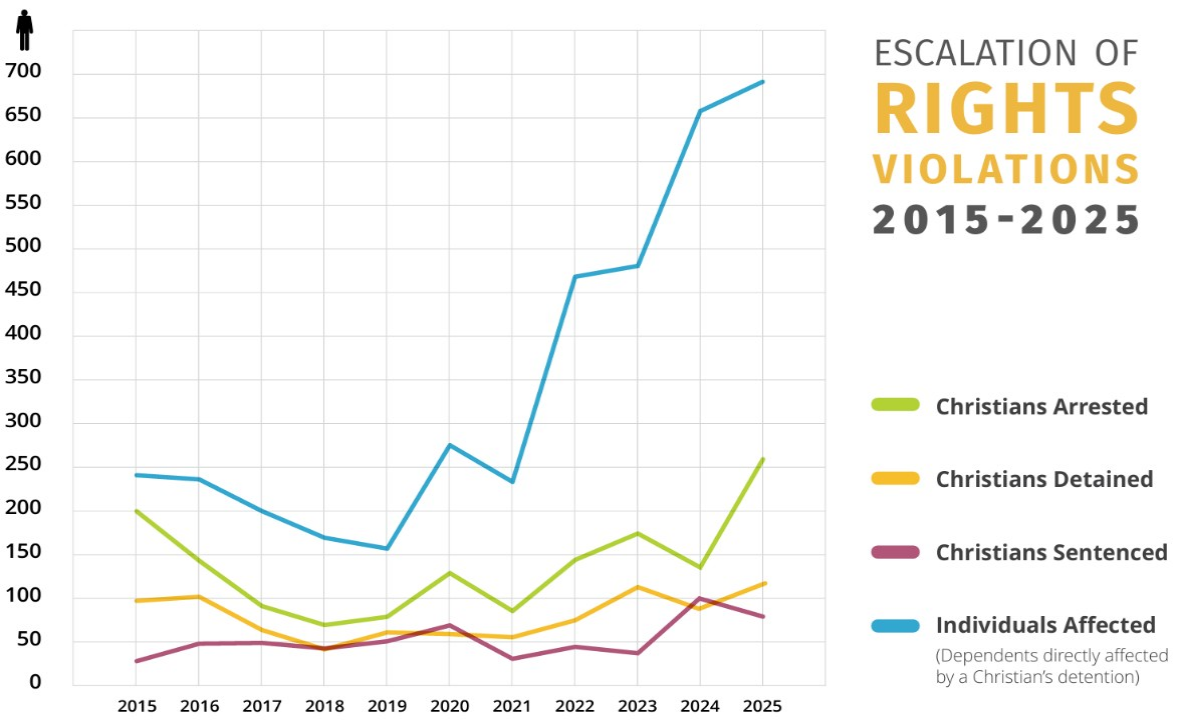
10.5.23 The above graph shows that while the number of arrested and detained Christians fell between 2015 and 2018, between 2018 and 2023 there was an overall increase, despite some decreases within that period. Numbers of arrested and detained Christians fell again in 2024, however, they rose to their highest levels in 10 years in 2025, with over 250 Christians arrested and over 100 Christians detained.
10.5.24 With regard to how the Article 18 et al report defined arrests, the translated Landinfo update report stated:
‘In an email to Landinfo, Article 18 ([in] March, 2025) explains that persons held for up to 24 hours are considered arrested. This also includes persons who have been summoned for interrogation by a court order or by telephone, provided they are released within 24 hours. In an email ([in] 2025) from one of the other organisations behind the reports, it is stated that they are not aware of such a definition of the term. They write in their response to Landinfo: “This is a good question and one we should discuss with partners to make sure we are agreed on a definition.” … A differing understanding of such a central term can be a significant source of error and result in inaccuracies in reporting.’[footnote 208] CPIT therefore considers there to be some ambiguity about how Christians who came to the adverse attention of the authorities were classified for the purposes of the above graph.
10.5.25 The translated Landinfo update report also included the below graph which, citing Article 18 et al data (in their annual reports published between 2021 and 2025[footnote 209], showed a ‘zoomed in’ picture of the numbers of arrested (blue line, ‘arresterte’ in Norwegian), detained (orange line, ‘varetektsfengslede’) and convicted (green line, ‘domfelte’) Christians in Iran, between 2020 and 2024.[footnote 210] Regarding the definitions applied, Landinfo stated: ‘In this note, we adopt Article 18’s understanding of arrested and detained. If the arrested person is held for more than 24 hours, they are considered detained; in this report, the term ‘in custody’ is used for this category [see also paragraph 10.5.24].’[footnote 211]:
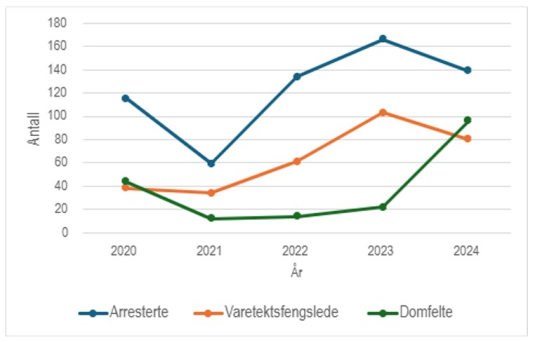
10.5.26 The translated Landinfo update report stated: ‘As Landinfo understands the situation, the number of arrested individuals is … a “barometer” of whether the pressure on Christians and converts is increasing or decreasing. It will take some time before the effects are reflected in the statistics on convicted individuals.’[footnote 212]
10.5.27 The translated Landinfo report noted several factors which, it considered, explained the fluctuations in arrest numbers between 2021 and late 2023, including the Covid-19 pandemic and the Women, Life, Freedom movement. The report stated:
‘It was only in the autumn of 2023 that Iran returned to what can be described as a “normal state”.
‘… In discussions with Landinfo [in March 2023], Article 18 … estimated that the actual number of arrests varies between 200 and 300 per year. This includes cases that have become known afterwards.
‘The number of arrests during the reporting period [2022 to 2024[footnote 213]] falls within this range of variation. In these three years, between 100 and 200 arrests have been reported annually, with the highest number in 2023. Consideration must be given to unreported cases and to the fact that cases may come to light later.
‘… The highest number of arrests was in 2023, when 166 were registered as arrested, and of these, 103 were remanded in custody. In the first six months, there were few arrests.
‘In 2024, the number of arrests and remand detainees decreased slightly, according to Article 18 a total of 139 people were arrested. Of these, 59 received no criminal penalties, while 80 were remanded in custody.’[footnote 214]
10.5.28 Landinfo (translated) added: ‘By the nature of the matter, it is difficult to know the extent of hidden and unreported cases. As understood by Landinfo, it is particularly arrests that may go unreported … [and t]he leader of an Iranian organisation (… [in] 2025) explained that even though ordinary members are not prosecuted, they are questioned and threatened.’[footnote 215]
10.5.29 The ‘Scapegoats’ annual report, published by Article 18 et al, included the below graph, showing the number of Christians arrested in Iran in 2024 and 2025.[footnote 216] The graph shows that the number of arrested Christians increased by almost 83% in 2025 compared with 2024 (CPIT’s calculation):
| Year | Arrests |
|---|---|
| 2024 | 139 |
| 2025 | 254 |
10.5.30 The ‘Scapegoats’ report also noted that, in 2025, an additional 108 Christians were detained.[footnote 217] However, it also stated that ‘… many more go unreported, either because no-one raises awareness – arresting authorities frequently issue threats against publicity – or because those involved request confidentiality.’[footnote 218] It further stated, in respect of Christians who were charged in 2025, ‘[i]n the vast majority of cases (nearly 90%), charges against Christians were brought under the amended Article 500 … of the penal code, which criminalises “propaganda contrary to the holy religion of Islam” … [while at least] 5 Christians faced charges under the new espionage law brought in following the 12-day war, resulting in combined sentences of over 40 years in prison.’[footnote 219]
10.5.31 The Article 18 et al report further noted that at least 16 Christians remained in pre-trial detention at the end of 2025[footnote 220] and stated that, ‘… it should be noted that at least five of the Christians who remained detained in Iran on charges related to their religious activities at the end of 2025 were ethnic Armenians.’[footnote 221]
10.5.32 The Amnesty International 2025 and 2026 human rights reports both noted that the Iranian authorities subjected religious minorities who professed or practised their faith to arbitrary detention and unjust persecution.[footnote 222] [footnote 223] Both reports also noted that the Iranian authorities arbitrarily detained, specifically, Christian converts during 2024 and 2025.[footnote 224] [footnote 225] Neither report, however, provided any further information to quantify the scale or extent to which this occurred, nor to indicate its occurrence to Christian converts compared with its occurrence to ‘ethnic’ Christians.
10.5.33 The Amnesty International 2026 human rights report also stated: ‘Authorities smeared Christians as “Mossad mercenaries” … [and] broadcast forced “confessions” of those detained …’[footnote 226]
10.5.34 Some recent examples of the arrest and detention of, or criminal charges made against, Christians by Iranian authorities include (Note: this is not intended to be an exhaustive list):
- the arrest of a Christian convert at his home in Karaj (in the Kermanshah province) on 26 May 2024 by members of the intelligence forces who reportedly held him in custody at an unknown location.[footnote 227] [footnote 228] [footnote 229] [footnote 230] He had not been made aware of any charges against him 19 days after his arrest more than 2 weeks later.[footnote 231] [footnote 232] CPIT was unable to find any further information in the sources consulted (see Bibliography) to indicate whether he was subsequently released or charged and prosecuted
- the arrest, in September 2024, of a Christian convert who had gone to the Prosecutor’s Office with documents for her Christian friend’s release, after they were arrested the previous day; she was reportedly detained on arrival on charges of ‘illegal Christian activities’[footnote 233] [footnote 234] [footnote 235] See Bail for information about her subsequent release on bail. CPIT was unable to find any further information in the sources consulted (see Bibliography) to indicate whether she was subsequently prosecuted and sentenced
- the arrest, in 2 incidents in 2 different cities, in December 2024, of 40 Christians who had met to celebrate Christmas.[footnote 236] [footnote 237] [footnote 238] [footnote 239] The arrests coincided with an announcement by the authorities to grant 5 days’ leave to some Christian prisoners to celebrate Christmas[footnote 240] [footnote 241]
- the arrest of one Christian convert, on 6 February 2025, during an IRGC raid on a gathering of approximately 80 Christians in a garden in northern Iran.[footnote 242] She was reportedly later charged with ‘gathering and collusion’ and ‘propaganda against the regime’ before being released on bail.[footnote 243] [footnote 244] However, CPIT was unable to find any further information from the sources consulted (see Bibliography) regarding whether she was subsequently prosecuted and/ or sentenced
- the arrest, also on 6 February 2025, in Tehran, of a female Christian convert in her 40s (who was reportedly arrested and charged in January 2022 with ‘deviant propaganda contrary to the sacred Islamic faith’ (under the amended Article 500 of the penal code) but was acquitted later that year), when she was taken to Evin Prison facing charges of ‘acting against national security’ and ‘propaganda against the regime’[footnote 245] [footnote 246]
- 2 Christian males who were reportedly rearrested, in February 2025, in the Tehran area and returned to Evin Prison, having previously been ‘pardoned’ and released from prison on charges relating to their leadership of house-churches.[footnote 247] One of the men, a Christian convert, had been released in October 2022 after previously serving 5 years in prison[footnote 248] [footnote 249], while the other, an Iranian-Armenian, was released in September 2023 after serving just over one year in Evin Prison.[footnote 250] [footnote 251] Both were reported to have initially been sentenced to 10 years’ imprisonment for ‘actions against national security’[footnote 252] [footnote 253] [footnote 254] , though the Iranian-Armenian’s sentence was subsequently reduced to 2 years in prison.[footnote 255] The USCIRF reported broadly the same information about the rearrests of both men, though with some differences regarding some of the details[footnote 256][footnote 257]
- the Iranian-Armenian’s (in the above example) Christian wife, was also reportedly arrested in April 2025[footnote 258] [footnote 259] though she was not informed of any official charges, despite Iranian law requiring that detainees are informed of charges within 48 hours[footnote 260]
10.5.35 For additional details regarding the above examples, and for further examples of arrests, detentions and charges made against Christians for their faith-related activities in 2024 and 2025, see, respectively, pages 4 to 11 of the ‘Tip of the Iceberg’ and pages 13 to 21 of the ‘Scapegoats’ annual reports, published by Article 18 et al. Additionally, Article 18 maintains a Prisoners List, which provides the names, dates, location, and current status of Christians arrested in Iran, as well as the charges under which they were arrested, where known. It should be noted that Article 18 has not presented this list as definitive of all prisoners.
10.6 Treatment of detainees
10.6.1 The ‘Tip of the Iceberg’ annual report, published by Article 18 et al, noted that reports were made that detained Christians were physically tortured during 2024.[footnote 261]
10.6.2 On 24 June 2025, Article 18 noted that, considering Israeli strikes on Iran that took place in June 2025, rather than the Iranian authorities effecting the ‘… release of all prisoners of conscience, in line with the Islamic Republic’s own regulations, which allow for the temporary release of all but the most dangerous criminals in “critical situations”’[footnote 262], they instead transferred some prisoners, including some Christian prisoners, ‘… to the Greater Tehran Central Penitentiary, where they are being held in unsanitary conditions in overcrowded cells, with as many as 40 prisoners in each.’[footnote 263]
10.6.3 The Open Doors 2026 World Watch List stated: ‘Christian women, especially converts, are highly vulnerable. Many participate in house churches, but risk arrest, sexual harassment, and verbal abuse during interrogations … [while] Christian men in Iran are more likely to be arrested, tortured and imprisoned for years, often in deplorable conditions with no phone calls, exercise, or due process.’[footnote 264]
10.6.4 The 2026 World Watch List also stated: ‘Despite violating Iran’s own Penal Code, sexual harassment during interrogation of arrested Christians continues with impunity.’[footnote 265]
10.6.5 The ‘Scapegoats’ annual report, published by Article 18 et al, stated: ‘Severe mistreatment of Christian prisoners was another notable characteristic of 2025, including denial of healthcare, psychological torture, and a reported beating …’[footnote 266] See paragraph 10.6.10 for some individual examples provided within the same report.
10.6.6 The same annual report also stated:
‘After the strike [on Evin Prison, on 23 June 2025, during the 12-day war with Israel[footnote 267]], male prisoners were transferred to Greater Tehran Penitentiary and female prisoners to Qarchak Prison in Varamin, while Evin Prison underwent repairs. Rights organisations reported unsuitable conditions, including severe overcrowding in both prisons, prompting Amnesty International to initiate an urgent appeal on behalf of prisoners. Christians involved in the prison transfers confirmed the dire conditions …’[footnote 268]
10.6.7 In December 2025, the USCIRF published a factsheet about prison mistreatment and the freedom of religion or belief (FORB). The factsheet, which cited various sources, stated: ‘Evin holds about 60 percent of Christians detained in Iran. Former Christian prisoners report prison guards making harassing comments about their religion during interrogations. Others have been pressured to “confess” to participation in religious activities. An Armenian Christian woman reported that in 2022, an interrogator at Evin sexually assaulted and disparaged her for not wearing hijab on account of her non-Muslim religious identity.’[footnote 269]
10.6.8 The Amnesty International 2025 and 2026 human rights reports both noted that the Iranian Authorities subjected religious minorities professing or practising their faith to arbitrary detention, unjust prosecution, torture, and other ill treatment.[footnote 270] [footnote 271] Neither report provided any data to quantify the scale or extent to which this occurred, nor did they comment on the occurrence of this specifically for Christians.
10.6.9 Though not specifically regarding Christians, the Amnesty International 2026 human rights report stated:
‘Torture and other ill-treatment, enforced disappearance and incommunicado detention were widespread and systematic.
‘Following Israeli air strikes on Evin prison, dozens of prisoners detained for political reasons were forcibly disappeared for weeks or months. Authorities transferred hundreds of other Evin prisoners to other prisons where conditions were cruel and inhumane and included overcrowding, insanitary conditions, poor ventilation, infestations of mice or insects, and insufficient access to potable water, edible food, bedding, toilets or washing facilities. Authorities continued to deny prisoners adequate healthcare. Several individuals died in custody in suspicious circumstances following credible reports of torture and other ill-treatment, including denial of healthcare …
‘… Trials were systematically unfair, rendering detentions and executions arbitrary. Authorities routinely denied detainees access to lawyers during investigations and based convictions on torture-tainted “confessions” that were frequently broadcast by state television. The judiciary lacked independence and was complicit in torture and other crimes under international law.’[footnote 272]
10.6.10 Some recent examples of the treatment of Christian detainees by Iranian authorities include (Note: this is not intended to be an exhaustive list):
- a detained Christian convert who, as of May 2024, needed a ‘specialist neurological examination’ due to interrogator abuse/imprisonment conditions[footnote 273] [footnote 274], but who was reportedly denied medical care.[footnote 275] In April 2025, Article 18 reported that the same individual was denied ‘specialised medical care and medical furlough’ after she fell in the prison yard, bending 2 fingers on her left hand[footnote 276]
- a female Christian convert in her 40s who said, in July 2025, that she, and other prisoners, transferred to Qarchak Prison were transferred ‘… in “such a disgraceful manner, handcuffed”, and are now “suffering without clean water, cooling, or heating, lacking hygiene and proper food, entangled and helpless”’[footnote 277] She was reportedly also denied proper medical treatment in late October 2025 after she fell from her bunk bed at Evin Prison, fracturing her spine; she was taken to hospital for an x-ray, but was reportedly returned to prison the same day on a stretcher and in pain, and was only hospitalised after other prisoners protested.[footnote 278] [footnote 279] [footnote 280] Article 18 stated that, ‘[s]he has been repeatedly denied access to adequate medical care during her detention, which included 65 days of solitary confinement in the ward operated by the Ministry of Intelligence: Ward 209.’[footnote 281]
- a male Christian convert in his 60s, held in Tehran’s Evin Prison since February 2025, who, after suffering a stroke while on hunger strike in prison, and despite being ‘… rushed to the nearby Bani-Hashem Hospital, where he was treated and provided with a range of exercises to help him seek to regain movement in the left-hand side of his body … [before t]wo days later, [he] was returned to the general ward of Evin Prison, where he remains detained …’[footnote 282], was reported by a number of sources to have been denied adequate medical care[footnote 283] [footnote 284] [footnote 285] [footnote 286]
- the Iranian-Armenian Christian who was rearrested and sentenced to 10-years’ imprisonment in 2025 was denied permission to attend his mother’s funeral when she died two months after his re-arrest[footnote 287] [footnote 288] [footnote 289]
- an imprisoned Christian convert in his 30s who, reportedly developed a heart condition due to stress/interrogations during his initial detention and subsequently had all his requests for a referral to a cardiologist rejected and was beaten.[footnote 290] [footnote 291] [footnote 292], causing a fracture in his leg or foot[footnote 293] [footnote 294] The same individual was reportedly denied access to a telephone in April 2025 before a 2-day hunger strike led to him being given limited use[footnote 295]
- in May 2025, a letter written by an Armenian[footnote 296] Christian man, describing ‘… the treatment he has been subjected to by Iranian security forces while in detention, which includes psychological torture, denial of due process, and death threats to his family members.’[footnote 297]
- the reported torture by prison authorities in June 2025 during the pre-trial detention of a male Christian[footnote 298] [footnote 299], who was reported by one source to be a Christian convert[footnote 300]
For additional details regarding the above examples, and for some further examples of the treatment of Christian detainees in 2024 and 2025, see, respectively, pages 4 to 11 of the ‘Tip of the Iceberg’ and pages 13 to 21 of the ‘Scapegoats’ annual reports, published by Article 18 et al.
10.7 Bail
10.7.1 The BZ 2023 report stated: ‘Christians charged under Section 610 threatening national security] of the Penal Code are often released on bail pending sentencing, although they are often remanded in custody for longer than legally prescribed and the amounts demanded in bail are high.’[footnote 301]
10.7.2 The BBC News article, published on 1 April 2024, stated: ‘Bails [for Christians] have become more expensive, and often are unaffordable.’[footnote 302]
10.7.3 Article 18 noted that as of 12 August 2025, 11 of the 54 Christians arrested since the end of the 12-day war in Iran had been released on bail.[footnote 303]
10.7.4 An article published by Article 18 on 4 November 2025 stated: ‘Heavy bail conditions have increasingly been imposed on Christian detainees.’[footnote 304]
10.7.5 The Open Doors 2026 World Watch List stated: ‘A systematic pattern of financial exploitation targets imprisoned Christians, particularly converts. Authorities regularly offer release on bail, demanding sums between $2,000 [approximately £1,493 GBP[footnote 305]] and $150,000 [approximately £112,000 GBP[footnote 306]], forcing families to surrender property deeds. Those released on bail often self-censor due to fear of property confiscation, while authorities pressure them to leave Iran and forfeit their bail.’[footnote 307]
10.7.6 Some recent examples of bail amounts set for detained Christians include (Note: this is not intended to be an exhaustive list):
- a Christian convert who was released on bail of 2.5 billion tomans (equivalent to $40,000/ 38,000 Euros (approximately £30,000 GBP[footnote 308] [footnote 309])) on 8 October 2024, having been detained approximately one month earlier when she attended the Prosecutor’s Office to assist her Christian friend who was arrested a day earlier[footnote 310][footnote 311]
- in December 2024, approximately one month after their arrest, 3 Christian converts were released on a bail amount equivalent to over $20,000 (approximately £14,800 GBP[footnote 312]) each, prior to their court hearing on 15 February 2025 and their sentencing in March 2025[footnote 313]
- the release on 8 March 2025 on a bail amount equivalent to approximately $40,000/ 36,000 Euros (approximately £30,000 GBP[footnote 314] [footnote 315] of a Christian convert who was arrested at a gathering on 6 February 2025, after she was charged with ‘gathering and collusion’ and ‘propaganda against the regime’[footnote 316] [footnote 317]
- a Christian convert who remained in Evin Prison several months after her arrest due to her bail amount being set at the equivalent to $130,000 (approximately £96,000 GBP[footnote 318] [footnote 319] [footnote 320]). She was later sentenced to 17 years in prison, and reportedly on 21 December 2025, she was released on bail[footnote 321] [footnote 322], pending the outcome of her appeal against her sentence[footnote 323]
- the release on a bail amount equivalent to $50,000 (approximately £37,000 GBP[footnote 324]) one month after the arrest[footnote 325] [footnote 326] [footnote 327] of the wife of an Iranian-Armenian detained pastor[footnote 328] [footnote 329], who as of 12 June 2025 had not himself been set any bail amount having been rearrested in February 2025[footnote 330]
10.7.7 For additional details regarding the above examples, and for some further examples of bail amounts set for Christian detainees in 2024 and 2025, see, respectively, pages 4 to 11 of the ‘Tip of the Iceberg’ and pages 13 to 21 of the ‘Scapegoats’ annual reports, published by Article 18 et al.
10.8 Convictions and prison sentences
10.8.1 The DFAT country report, published on 24 July 2023, stated: ‘Prison or the death penalty are possible outcomes for Christians meeting in house churches, both leaders and everyday adherents. DFAT understands that while not a common punishment, prison or the death penalty for apostasy is possible. Years or even decades-long prison sentences are also possible.’[footnote 331]
10.8.2 The Article 18 article, published on 7 May 2024, stated: ‘Members [of house churches] have faced prison sentences of up to five years, and leaders up to 10 years, under Articles 498 and 499 of the penal code, relating to organisation and membership, respectively, of “anti-state groups”. It is also increasingly common for house-church members to be charged under the amended Article 500, which criminalises “educating in a deviant way contrary to the holy religion of Islam”.’[footnote 332]
10.8.3 The joint submission on 18 July 2024 to the UNHRC of CSW and CSW-Nigeria stated: ‘Despite its articulated commitment to protect the rights of Christians and other religious minorities, Iran has continued to target the former, and particularly converts to Christianity, with lengthy periods of arbitrary detention and imprisonment on unfounded charges typically related to “national security”, “extremism” and “propaganda”.’[footnote 333]
10.8.4 The ‘Tip of the Iceberg’ annual report, published by Article 18 et al stated: ‘Heavy sentencing was a … trend in 2024, with 96 Christians sentenced to a combined 263 years in prison, 37 years of internal exile, and nearly $800,000 [approximately £588,500 GBP[footnote 334] in fines. Confiscation of Christian properties was another trend …’[footnote 335] While 96 Christians were reported to have been sentenced in 2024, the same report also noted that 25 Christians ‘endured imprisonment’ during 2024.[footnote 336]
10.8.5 The ‘Tip of the Iceberg’ report also stated:
‘… [O]ver four times as many individuals were convicted for their peaceful Christian activities in 2024 than in the previous year … [T]he cumulative length of sentences issued in 2024 [was] over six times higher than in 2023. This was partly due to a huge uptick in arrests in the second half of 2023 which required judicial processing, resulting in a surge of sentencing in 2024 of over four times as many Christians. Notably, five Christians received 10-year prison terms, while another was sentenced to 15 years – a stark example of the intensifying penalties imposed … Over the past decade, Revolutionary Court judges have increasingly been adding supplementary punishments such as fines on top of prison sentences. Other punishments frequently employed against Christians in recent years have included terms of internal exile, deprivation of social rights, enforced religious “re-education”, and travel bans.’[footnote 337]
10.8.6 The Landinfo update report stated:
‘Article 18 explains [in email correspondence] the large increase in the number of convictions in 2024 partly due to the large “waves of arrests” in the autumn and Christmas of 2023. These came to trial in 2024. The news outlet Christian Daily International points to this exactly as the explanation …
‘An Iranian Christian organisation (… [in] April 2025) stated that the number of convictions in 2024 does not represent a new trend, but rather a return to a normal level after the COVID-19 pandemic and the Women, Life, Freedom protests …
‘The leader of an Iranian organisation (… [in] May 2025) pointed out that the authorities want to curb the strong growth in the number of converts, which is done by sentencing leaders of house churches to long prison terms. The leader further noted that no one has the complete picture, and there may be unreported cases making it difficult to compare figures from year to year. At the same time, the source believed that the number of convicts is probably more reliable than the number of arrests.’[footnote 338]
10.8.7 Article 18 et al noted that 18 Christian ‘prisoners of conscience’ remained in prison at the end of 2024[footnote 339], further to which the translated Landinfo update report stated:
‘… [I]n the period from December 2024 to March 2025 … the number of Christians and converts serving sentences had risen to 21 people. In addition, 7 Christians had been summoned to serve their sentences, but following advice from their lawyer, they were waiting for the appeal case to be heard.
‘… [T]he relatively low number of incarcerated individuals … [was explained by one of the organisations behind the report by] noting that some are out on bail pending the hearing of their appeals. The organisation points out that there may also be unreported cases here.
‘This illustrates that the number of convictions can be misleading, as it is not clear at what stage in the criminal process the case is. It is not indicated whether the judgment is final, whether the case has been appealed, whether the convicted person is out on bail, or is possibly waiting in the prison queue.’[footnote 340] The translated Landinfo report also noted: ‘This may be significant because there appears to be a pattern where the appellate court in some cases reduces the sentences from the first instance.’[footnote 341]
10.8.8 Addressing the issue of whether Christians have ever been sentenced to death or executed for apostasy, the Article 18 et al ‘Tip of the Iceberg’ report stated:
‘Rev Hossein Soodmand of the Assemblies of God (AoG) denomination is … the only Iranian Christian convert to have been executed for “apostasy” – back in 1990. Since then, others have been sentenced to death, but in each case the sentence has been overturned following an international outcry. However, in 1994, Christian convert Rev Mehdi Dibaj of the AoG was freed from death row, only to be killed extrajudicially five months later. Pastor Yousef Nadarkhani of the Church of Iran denomination was the most recent publicly reported instance of an “apostate” being sentenced to death, in 2010, but he was also later acquitted.’[footnote 342] Referring to the same information, the translated Landinfo report stated that it ‘… has no further information on the circumstances of these cases and is not aware that charges of apostasy have resulted in convictions in recent years.’[footnote 343]
10.8.9 The CHRI article, published on 1 April 2025, stated, in reference to evangelical Christians, that, ‘… the courts typically used a provision added to Article 500 of Iran’s Penal Code in 2021 (which stipulates heavy punishments for anyone who commits “any deviant educational or proselytizing activity that contradicts or interferes with the sacred law of Islam”) [see Legal context: Apostasy and proselytising] to justify long prison sentences.’[footnote 344]
10.8.10 The translated Landinfo update report stated:
‘Christians and converts who are persecuted as punishment are generally charged and punished under the provisions of the Penal Code concerning national security. Individuals charged with national security offences are normally tried by the Revolutionary Courts … Sentencing can be arbitrary in many cases, and it is not obvious that there is a direct correlation between indictment and conviction. Some judges in the Revolutionary Court are known for imposing very harsh punishments on Christians and converts.’[footnote 345]
10.8.11 The translated Landinfo report also stated:
‘There is no complete overview of the profile of the convicted. No sources, including Article 18, publish such information. In many of the referenced cases, there is no information about either the profile or which law they are charged or convicted under. It is therefore difficult to state anything certain about the profile of the convicted …
‘… In 2023, Landinfo held a number of conversations with Iranian converts and Christian organisations in Turkey and England about the profile of those convicted. Article 18 confirmed that the majority of those convicted in 2022 were leaders. The sources were relatively consistent in stating that the regime’s primary focus is to stop the spread of Christianity in Iran. Therefore, they target individuals who contribute to spreading the Christian message; these are people who lead and organise house churches, and those who engage in outreach evangelism and distribute information about Christianity to Muslims.
‘In May 2023, Landinfo met (digitally) with a leader of an Iranian Christian organisation who has previously been imprisoned in Iran. The leader has left the country but continues to have close contact with the church community in his home country. In conversation with Landinfo, he emphasised that the authorities do not care about an individual’s faith, or whether they are Christian or not. He stated the following regarding the authorities’ attitude: “They do not care what you believe in your heart, that is your personal problem. But if they hear that you are evangelising or bringing people together, then they will put you in prison.”
‘Furthermore, the Christian leader stated [Note: the following statement of the Christian leader was published in English and has not, therefore, been translated]:
‘The government does not put ordinary members in prison. Because the government doesn’t have enough resources, money and prisons to put hundred[s of] thousands of Christians in prison. Let me tell you the process: they raid a house and arrest all the people who are there. Then they find out who is the leader and separate him/her from the rest and take that person to the intelligence service center. The other members are just interrogated (who are you, what are you doing), and then they need to sign a paper that they will never join the house church again. For the government it is the leaders that are important.
‘… Article 18 stated in an email ([in] March 2025) that many of those currently convicted under the Penal Code’s Article 500 (propaganda undermining the Islamic Republic) are ordinary members. According to Article 18, only 11 of the 96 people convicted in 2024 had responsibilities as pastors, evangelists and organisers. The rest can, according to Article 18, be categorised as merely members. As an example, Article 18 refers to … not a convert but a born Christian Armenian … [who] was on holiday in Iran with his Iranian-Armenian wife and is, among other things, convicted for proselytising in Persian communities. Article 18 wrote in October 2024 that … [he] was sentenced to ten years in prison for ‘alleged membership and leadership of a network of evangelical Christianity.
‘As far as Landinfo is aware, there is no documentation that substantiates and verifies the claim that a large proportion of those convicted are ordinary members. Therefore, in an email in April 2025, Landinfo requested Article 18 to provide additional information and a description of the profile of converts who are only members and who have been sentenced to the lowest punishments. Despite a reminder in May 2025, Landinfo has not received a response to the request. In preparing this note, Landinfo has contacted several of the sources we spoke with in 2023 and asked whether the situation has significantly changed over the past two years. The organisations agree that the overall picture has not changed. The authorities do not have the capacity to prosecute several hundred thousand Christians and converts. The leader of an Iranian Christian organisation ([by] email, [in] April 2025) expressed himself as follows [Note: the following statement of the Christian leader was published in English and has not, therefore, been translated]:
‘The regime’s strategy hasn’t changed. They go after the house group leaders - those who actively share their faith and anyone found with more than one or two New Testaments.
‘According to a leader of an Iranian organisation ([in a] digital meeting, [in] May 2025), the authorities are primarily after “the big fishes”. The authorities focus on individuals who could undermine the Islamic identity of the republic by sharing their Christian faith with others, and who have influence by organising and running house churches. The authorities’ assessment is that if they imprison a leader, it will help stop the growth of Christian communities. In this context, a pastor of a house church with five or ten members is not of interest, but influential leaders who can mobilise and persuade are.
‘One of the four Christian organisations (… [in] March 2025) states in its response to Landinfo that there is a strong correlation between high activity, such as proselytising among former Muslims, and prison sentences. When asked how many of the convicted are regular members of house churches, the organisation replies that it is impossible to estimate. The organisation points out that some take greater risks than others. Much depends on whether the person has come under the authorities’ scrutiny.’[footnote 346]
10.8.12 The translated Landinfo update report, stated, in summary:
‘Based on the information presented above, the pattern seems to be that the likelihood of conviction increases with leadership positions in home churches and outward missionary work. Nevertheless, it is a fact that some who have kept a low profile and acted cautiously have still been convicted. As Landinfo understands the situation, this happens exceptionally and there may be circumstances that explain why the convert has come under government scrutiny. An example of an ordinary member that Article 18 refers to is … [the female] who was remanded in custody in September 2024 [see paragraph 10.5.34]. The background was that she approached the prosecution to request the release of Christian friends.
‘The leader of an Iranian organisation (… [in] May 2025) believed that in smaller locations, where the intelligence service has full control over the population, it can happen that ordinary members are arrested and convicted. In large cities like Tehran, with thousands of converts, ordinary members are ignored, according to the leader.
‘Another exception may, according to a Christian organisation, be if the person has a high public profile, for example in the security apparatus or in the entertainment industry. They may risk punishment to set an example in the public sphere, in addition they risk losing their job.’[footnote 347]
10.8.13 The Barnabas Aid article, published on 14 October 2025, stated:
‘Punishments [for Christian-related ‘offences’] include long prison terms of several years, often including fines. On release Christians are sometimes forced into internal exile, living hundreds of miles from home for years, and suffer social exclusion, banned from certain professions as well as associating with churches or other Christian organisations …
‘Those convicted are not immediately incarcerated. They are instructed to await a summons to begin their sentences, forcing them to put their lives on hold for weeks, even months.
‘Even when sentences are reduced and a “pardon” is granted, grounds have been found to re-arrest Christians within months.’[footnote 348]
For more information about social exclusion, see Right to education and employment.
10.8.14 Citing information provided in May 2025 by an expert in Iranian law, the December 2025 DIS report stated that, for apostasy ‘… consequences can follow, especially if the individual is publicly open about their faith or involved in evangelism … [however,] death sentences for apostasy are rarely enforced.’[footnote 349]
10.8.15 The Open Doors 2026 World Watch List stated: ‘Both leaders and ordinary members [of small house churches] face prosecution and lengthy prison sentences for “national security crimes”.’[footnote 350]
10.8.16 The ‘Scapegoats’ annual report, published by Article 18 et al, stated:
‘At least four trials involving Christians facing charges related to their beliefs or religious activities were postponed during the [12-day] conflict [in June 2025], but calls to temporarily release prisoners of conscience, especially in detention centres close to conflict zones, were ignored … Following the conflict, the sentencing and imprisonment of Christians resumed, with at least four Christians beginning prison sentences in the month of November [2025] alone …’[footnote 351]
10.8.17 The ‘Scapegoats’ report also noted that in 2025:
- at least 73 Christians were sentenced
- at least 57 Christians served sentences of imprisonment (totalling over 280 years in prison, a higher figure than in 2024 despite involving fewer individuals, which indicates a trend towards harsher sentences), exile (totalling 9 years), or forced labour. Sentences also included at total of 249 years of social deprivation, and at least 4 Christians paid fines to avoid imprisonment
- at least 11 Christians were given prison sentences of at least 10 years
- at least 43 Christians were serving sentences at the end of the year[footnote 352]
10.8.18 Some recent examples of sentences that the Iranian authorities have handed down to Christians for their faith-based activities, including some amended sentences at appeal, acquittals etc., include (Note: this is not intended to be an exhaustive list):
- the May 2024 sentencing by the Revolutionary Court of 8 Christian converts from Izeh, Western Iran, who were among at least 46 Iranian Christians to have been arrested over the Christmas period, to a total of almost 45 years in prison.[footnote 353] [footnote 354] One of the 8 had been arrested 3 times previously, including during the 2022 protests, and was given the harshest sentence of 15-years in prison (10 years for ‘membership of a group intent on disrupting national security’ and 5 years for ‘propaganda against the regime through the promotion of Zionist Christianity’).[footnote 355] [footnote 356] His indictment ‘… alleged he had “played an active role in the protests” and had been “one of the leaders” of an evangelical Christian organisation in the region.’[footnote 357] The individual given the most lenient sentence was sentenced to 9 months in prison.[footnote 358] At the time of reporting the sentences (June 2024), all but one of the individuals (who was sentenced to 5 years in prison) were reportedly released on bail. [footnote 359] [footnote 360] CPIT has been unable to find any further information from the sources consulted (see Bibliography) about the outcomes of their appeals, or whether the individuals have served, or begun serving, their sentences
- the sentencing by the Revolutionary Court (the same judge who sentenced the 8 Christian converts, see example immediately above), on 28 May 2024, of another Christian convert to 5 years in prison for ‘acting against national security by communicating with Christian Zionist organisations’.[footnote 361] [footnote 362] He had reportedly previously (in 2021) been cleared of ‘propaganda’ charges, but (in January 2022) forced to attend Islamic re-education classes.[footnote 363] As of mid-June 2024, he was on bail, awaiting a summons to begin serving his sentence[footnote 364] [footnote 365], however CPIT has been unable to find any more recent update from the sources consulted (see Bibliography)
- in June 2024, the Iranian judicial authorities upheld at appeal the 10 years prison sentence for of an Armenian Christian man who was arrested in summer 2023 and sentenced in early 2024 for ‘engaging in deviant proselytising activity that contradicts the sacred law of Islam’ and the alleged membership and leadership of ‘a network of evangelical Christianity’.[footnote 366] [footnote 367] [footnote 368] According to an undated Article 18 webpage, he continued to serve his sentence at the time of writing[footnote 369]
- the acquittal by the Appeal Court of Tehran, and release from Evin Prison, of an Iranian-Armenian pastor on 24 September 2024 after he successfully appealed against a 10-year prison sentence for leading a house-church, after serving a little over one year of his sentence.[footnote 370] [footnote 371] [footnote 372] CPIT was unable to find any information from the sources consulted (see Bibliography) to suggest that he had been rearrested or returned to prison at the time of writing
- the September 2024 release of a Christian convert after his 10-year prison sentence, for ‘acting against national security by forming a house-church’, handed down in 2020, was reduced to 4 years and 5 months by the Tehran appeal court.[footnote 373] [footnote 374] He had spent 4 years and 9 months in prison and had had 4 previous applications to the Supreme Court for retrial rejected, with the 5th application approved which subsequently led to his sentence reduction and release.[footnote 375] [footnote 376] [footnote 377] CPIT was unable to find any information from the sources consulted (see Bibliography) to suggest that he had been rearrested or returned to prison at the time of writing
- the November 2024 sentencing by the Revolutionary Court of Karaj of a Christian convert (who was reportedly first arrested in October 2022 for faith-based reasons[footnote 378] [footnote 379] to 10 years in prison, and a 2 year ban from membership of any group, for ‘propagating Christianity’, ‘collaborating’ with the ‘hostile governments’ of Israel, the UK and the US, and membership of ‘anti regime groups’.[footnote 380] [footnote 381] [footnote 382] [footnote 383] As of 18 November 2024, he was awaiting an appeal outcome.[footnote 384] [footnote 385] CPIT has been unable to find information from the sources consulted (see Bibliography) on the appeal outcome, or whether he has begun serving his prison sentence
- the sentencing of a Catholic convert women, arrested on 5 November 2024, to 6 months in prison (with two-thirds of her prison sentence suspended), 74 lashes, and a mobile phone ban on charges of ‘propaganda against the regime’ and ‘appearing in public without a hijab’.[footnote 386] [footnote 387] It was since reported that in May 2026 she was sentenced to 9 years and 8 months in prison on charges including ‘propaganda against the state’ and ‘assembly and collusion with the intent to disrupt national security’ after her re-arrest in January 2026[footnote 388] [footnote 389]
- the sentencing to a total of over 40 years in prison, on 8 March 2025, to 3 Christian converts who were arrested in raids in autumn 2024 and convicted on charges that included ‘propaganda activities contrary to Islamic law’ and membership of an ‘opposition group’ for their religious beliefs and worship meetings (in a house-church)[footnote 390] [footnote 391] [footnote 392], under Articles 499, 500, and 500 bis of the IPC.[footnote 393] The most severe sentence, 16 years’ imprisonment, was handed down to a pregnant woman.[footnote 394] [footnote 395] [footnote 396] In addition to imprisonment, the 3 converts were sentenced to years of deprivation of social rights (such as access to healthcare, education, and employment[footnote 397], given fines of between 250 million tomans ($2,750 [approximately £2,040 GBP[footnote 398]]) and 330 million tomans ($3,500 [approximately £2,600 GBP[footnote 399]]), and were banned from membership of any group, residing in their home province of Tehran or leaving Iran for 2 years after their release.[footnote 400] [footnote 401] [footnote 402] It was reported that in April 2025 their sentences were upheld at appeal[footnote 403] [footnote 404], and that in May 2025, the 3 converts were summoned to begin their sentences.[footnote 405] [footnote 406] Sources indicate that all 3 converts may have since fled Iran[footnote 407] [footnote 408], with one of the 3 detained and having started serving his sentence, in July 2025, after he was deported to Iran from Turkey[footnote 409] [footnote 410] [footnote 411]
- 2 Christian convert brothers, who were arrested in December 2021 at a Christian gathering, were each sentenced in early 2025 to 4 years in prison, deprivation of social rights, and fines[footnote 412] [footnote 413] (of 150 million tomans each, around $1,500 (approximately £1,120 GBP[footnote 414][footnote 415]). Article 18 reported that both brothers began serving their prison sentences in December 2025[footnote 416] [footnote 417]
- the sentencing of 2 Christian converts from Tabriz, each to 12 years in prison, a fine, and 15 year bans from being able to exercise their social rights, including for ‘propaganda activity of deviant Christian Zionist beliefs opposed to the system of the Islamic Republic of Iran’ and ‘smuggling prohibited goods’, after they were tried in absentia in April 2025 in relation to their multiple copies of the Bible/ other Christian religious books[footnote 418] [footnote 419] [footnote 420], which Hengaw, an organisation that covers human rights violations across Iran[footnote 421] specifically reported they were distributing.[footnote 422] Article 18 reported that both converts fled Iran
- the October 2025 sentencing to 8 years in prison of the wife of an Iranian-Armenian pastor[footnote 423]
- the sentencing on 21 October 2025[footnote 424] to 17 years in prison of a female Christian convert after she was arrested in February 2025 and charged in connection with her Christian activities.[footnote 425] [footnote 426] [footnote 427] As of late December 2025, she was on temporary release from prison, pending the outcome of an appeal against her sentence[footnote 428]
10.8.19 For tables showing ‘… the public cases of Christians charged with offences related to their faith and detained or serving sentences of exile or forced labour …’ in 2024 and 2025, see, respectively, pages 16 to 18 of the ‘Tip of the Iceberg’ and pages 22 to 24 of the ‘Scapegoats’ annual reports, published by Article 18 et al. In respect of the data included, Article 18 stated: ‘Some unpublicised cases have also been included, with individuals identified only by their first name, or a pseudonym … It should also be noted that at the end of 2025 many more Christians were still awaiting verdicts, the decision of an appeal court, a summons to serve their sentences, or had fled the country to avoid imprisonment. Supplementary punishments, such as internal exile, deprivation of social rights and travel bans, are not included in this list.’[footnote 429] Therefore, the absence from the table of a claimed detention, charge or sentence should not be considered as definitive evidence that the claimed incident did not take place.
10.8.20 Article 18’s Prisoners List also provides the sentences handed down to convicted Christians, however it should not be considered as a definitive or exhaustive list of all prisoners.
10.9 Declaration to end Christian activity and re-education
10.9.1 Citing Open Doors’ World Watch List 2023[footnote 430], the BZ 2023 report stated: ‘Several sources say that some Christians [found by authorities during their raids on house churches] were warned and forced to sign statements that they would refrain from further contact (including online contact) with other Christians and from searching for Christian material online.’[footnote 431]
10.9.2 The USSD 2023 report on international religious freedom stated: ‘Christian converts from Islam reported being detained and forced to sign commitments to refrain from further Christian activities or ordered to attend Islamic re-education sessions.’[footnote 432]
10.9.3 The August 2024 Article 18 article stated that, ‘… a letter … included in a … [leaked] case file describes how [a Christian man] and his wife were made to confess their crimes on camera and ask for forgiveness, as well as being forced to participate in Islamic classes and break contact with other Christians.’[footnote 433] The article did not state when this case related to; as the leaked case files covered the period from July 2008 to January 2023, CPIT noted that this may be a recent example.
10.9.4 The translated Landinfo update report stated:
‘Individuals arrested in connection with a house search or raid at a house church may be forced to sign a statement confirming that they are still Muslims and that they will refrain from further participation in house churches. Signing such a statement is a prerequisite for their release. According to an Iranian leader ([in] 2023), many see this as a formality and sign to avoid further trouble.
‘… If they sign the declaration and are then arrested again, the pressure may increase further. The threats may include family members being subjected to reactions or being arrested. The aim is to create fear so that they refrain from further activity. In rare cases, the threats may also involve losing daily care of their own children and the children being placed in orphanages. The result is that some drop out and do not dare to maintain contact with home churches.’[footnote 434]
10.9.5 The same translated Landinfo report also noted that some Christian converts were forced into compulsory religious re-education.[footnote 435]
10.9.6 Reports were made that some of a group of at least 7 Christian converts, who were arrested in June 2025 in Varamin and Pishva (in the Tehran area), were pressured to renounce their faith in exchange for having their sentences reduced.[footnote 436] [footnote 437] The 7.5-year sentences of 5 of the group were upheld at appeal in October 2025.[footnote 438]
10.9.7 The Barnabas Aid article, published on 14 October 2025, stated: ‘Christians are sometimes forced to undertake re-education classes in Islam to be guided “back on the right path”.’[footnote 439]
10.9.8 The USCIRF factsheet, published in December 2025, stated: ‘In April 2025, a convert to Christianity who was recently released from Evin reported that in late 2023 or early 2024, an interrogator at Evin tried to pressure him to sign a legal commitment to cease his religious activities.’[footnote 440]
10.9.9 The ‘Scapegoats’ annual report, published by Article 18 et al, stated that in 2025, at least 5 ‘… Christian converts were referred by court order to “cult treatment clinics”, with the stated aim of “returning them to the holy religion of Islam”.’[footnote 441]
10.10 Christian symbols (including bibles, tattoos, and crosses)
10.10.1 The BZ 2023 report stated:
‘In Iran, it is not a punishable offence to have a tattoo. There is no law that explicitly prohibits tattoos or classifies them as prohibited under Islamic law (haram). Nevertheless, the authorities consider tattoos to be a Western phenomenon and, as such, detrimental to Iranian values. According to one source, a court can treat visible Christian tattoos as part of the burden of proof in connection with a conversion. The same applies to items confiscated when a convert is arrested, such as jewellery in the shape of a cross or paintings on Christian themes. This practice can differ from case to case.’[footnote 442]
10.10.2 The USSD 2023 report on international religious freedom stated: ‘Citizens who are not recognized as Christians [or one of the other recognised minority religions] … generally may not engage in public expression of religious faith, such as worshiping in a church or wearing religious symbols such as a cross. The government makes some exceptions for foreigners belonging to unrecognized religious groups.’[footnote 443]
10.10.3 The same USSD report also stated:
‘According to Christian NGOs, government restrictions on published religious material continued, although government-approved translations of the Bible reportedly remained available. Government officials frequently confiscated Bibles and non-Shia religious literature and pressured publishing houses printing unsanctioned non-Muslim religious materials to cease operations … Authorities required books published by religious minorities, regardless of topic, to carry labels on the cover denoting their non-Shia Muslim authorship.’[footnote 444]
10.10.4 The Article 18 article published on 29 August 2024 stated: ‘… [T]he managers of three online shops which sold Christian books were charged with “selling deviant evangelistic materials” and “hurting public modesty and morals through the display, promotion and sale of evangelistic books and items”.’[footnote 445]
10.10.5 The same article also stated:
‘A … notable trend is the frequent reference in court documents to the Christian holy book as evidence of a crime. In one case, Bibles in the evangelical church of [an] Iranian-Assyrian pastor … are referred to as “unauthorised evangelical items”. In another case, they are termed “deviant books”, and in another “divisive books”.
‘The “smuggling” of Bibles is listed among accusations in numerous other cases, termed a “propaganda activity against the regime”, while Christian literature sold online is described as “providing grounds for people’s corruption”.’[footnote 446]
10.10.6 Articles published by Article 18 on 12 June 2025 and 10 July 2025 noted that an indictment against five Christians charged with ‘gathering and collusion’ and ‘propaganda against the Islamic Republic of Iran’ [see paragraph 10.5.13] referred to the Bible as a ‘prohibited book’.[footnote 447] [footnote 448]
10.10.7 An article published by Article 18 on 19 August 2025 referred to a video report of more than 50 Christians arrested in ‘recent months’ which, it noted, contained screenshots of some of their confiscated items including New Testaments and other Christian literature.[footnote 449] The article also noted that the video report contained ‘… alleged surveillance recordings of Bibles being “smuggled” into the country.’[footnote 450] See also paragraph 12.1.4.
10.10.8 The Article 18 article, published on 20 October 2025, stated: ‘Religious books, crosses, and even personal belongings have been confiscated [by security forces].’[footnote 451]
10.10.9 The Open Doors 2026 World Watch List stated: ‘Even private possession of religious items like Bibles, songbooks or cross necklaces has been used as criminal evidence.’[footnote 452]
10.10.10 The ‘Scapegoats’ annual report, published by Article 18 et al, stated: ‘The targeting of Christians involved in Bible distribution continued to be a theme in 2025, with at least 21 Christians receiving custodial sentences related to their alleged involvement in the distribution of Bibles in Iran, in addition to other forms of punishment, such as fines, exile, and social deprivation.’[footnote 453]
10.10.11 The same annual reported stated: ‘… [S]ince the forced closure and confiscation of the Bible Society’s premises in Tehran in 1990, Christians have found it challenging to access printed Bibles and the Iranian authorities have criminalised importing and distributing Bibles … [D]espite the passage of years, the Bible Society remains closed, and the Bible and other Christian books are frequently treated as illegal contraband and evidence of a crime.’[footnote 454]
10.10.12 Some recent examples of the Iranian authorities having confiscated Christian symbols from Christians include (Note: this is not intended to be an exhaustive list):
- the confiscation of Bibles, musical instruments and communication devices IRGC, during a raid on a Christian gathering on 6 February 2025 in northern Iran, in which security agents reportedly targeted those wearing cross necklaces, tearing them off[footnote 455] [footnote 456]
- the confiscation of personal belongings including Bibles, crosses and musical instruments from the homes in Tehran of 3 Christian converts when they were raided by intelligence agents on 3 November 2024, before being sentenced on 8 March 2025[footnote 457]
- the confiscation of personal property, including Bibles and other Christian literature, from five Christians who were tried on 21 October 2025.[footnote 458] Article 18 reported that the items were ‘… confiscated by the state for the “research” purposes of the Ministry of Intelligence – as happened in a previous case earlier [in 2025] involving two Christians sentenced to 12 years each in prison for “smuggling” Bibles into Iran’[footnote 459]
10.10.13 See also Arrests, detentions and criminal charges and Convictions and prison sentences, and for more information about the smuggling of items into Iran, see Country Policy and Information Note, Iran: Smugglers.
11. Right to education and employment
11.1 Education
11.1.1 The Amnesty International 2024 and 2025 human rights reports, covering events of 2023 and 2024, respectively, both stated: ‘Religious minorities, including … Christians … suffered discrimination in law and practice, including in access to education …’[footnote 460] [footnote 461] The reports did not provide any data to quantify the scale or extent of the discrimination it said took place.
11.1.2 In April 2024, Human Rights Watch (HRW) published a report which cited various sources and stated that, ‘… the criteria for entering universities in Iran is belonging to one of the recognized religions in the Iranian Constitution … [which includes] Christianity [see Legal context: Religion] …’[footnote 462] The USSD 2023 report on international religious freedom noted that Christian university applicants must pass on an exam on Christian theology. However, ‘[m]embers of unrecognized religious groups must pass Islamic studies exams.’[footnote 463]
11.1.3 The same USSD report also stated: ‘Assyrian Christians reported the government continued to permit their community to use its own religious textbooks in schools, but only after the government authorized their content. Armenian Christians were also permitted to teach their faith to Armenian students as an elective at select schools.’[footnote 464]
11.1.4 The government of Iran, in its report to the UNHRC of November 2024, noted that 50 schools for Christians provide the opportunity for study in addition to the country’s regular schools.[footnote 465] Notwithstanding the information provided at paragraph 11.1.8, CPIT was unable to find any independent information from the sources consulted (see Bibliography) to corroborate this claim.
11.1.5 The translated Landinfo update report stated: ‘The authorities exercise various forms of extrajudicial pressure, which can include bans on education and work. According to an Iranian leader (… [in] 2023), there is no uniform policy in this area; it largely depends on the individual employer, principal or director to choose the form of reaction.’[footnote 466]
11.1.6 The Amnesty International 2026 human rights reports noted that, ‘[r]eligious minorities, including … Christians … suffered widespread and systemic human rights violations, including discrimination in access to education …’[footnote 467] The report did not expand on what it meant by ‘widespread and systemic’, nor did it provide any data to quantify the scale or extent of the violations it said took place.
11.1.7 The Open Doors 2026 World Watch List stated:
‘Children of converts are automatically registered as Muslims and must attend Islamic education, while even recognized Armenian and Assyrian Christians’ children face mandatory Islamic classes. University applications require religious declaration, with Muslim-background individuals who identify as Christian being rejected.
‘… [R]ecognized [Armenian and Assyrian Christian] communities operate some state subsidized schools, though Muslim headteachers are typically imposed.’[footnote 468]
11.1.8 The factsheet published by the Armenian Assembly of America in March 2026 stated: ‘There are currently 30 functioning Armenian schools across Iran, including primary and secondary institutions – for boys, for girls, and coeducational.’[footnote 469]
11.2 Employment
11.2.1 The Amnesty International 2024 and 2025 human rights reports both noted that access to employment was among the discrimination suffered by religious minorities, including Christians, in law and practice.[footnote 470] [footnote 471] The reports did not provide any data to quantify the scale or extent of the discrimination it said took place.
11.2.2 The DFAT country report, published on 24 July 2023, stated: ‘… [I]n-country sources report that the government restricts the … community members [of recognised churches] from senior management roles in public and private organisations due to an Iranian law that prohibits non-Muslims from holding positions of authority over Muslims. This means that the heads of Christian schools [are] Shi’a Muslims appointed by the government.’[footnote 472]
11.2.3 Citing information provided in March and April 2024 by an ‘expert and professional working for the French authorities examining asylum applications’, the EUAA Country Focus report stated: ‘Most of the Christians run family business[es] in the country due to the discrimination they face when they are applying for jobs in the public sector.’[footnote 473]
11.2.4 The USSD 2023 report on international religious freedom stated:
‘By law, non-Muslims may not serve in the judiciary, the security services (which are separate from the regular armed forces), or as public school principals. Officials screen candidates for elected offices and applicants for public sector employment based on their adherence to and knowledge of Islam and loyalty to the Islamic Republic (gozinesh review requirements), although members of recognized religious minorities may serve in the lower ranks of government if they meet these loyalty requirements. Government workers who do not observe Islamic principles and rules are subject to penalties and may be fired or barred from work in a particular sector.’[footnote 474]
11.2.5 On 19 September 2024, the UN Committee on the Elimination of Racial Discrimination (UNCERD) published ‘Concluding observations on the combined twentieth to twenty-seventh periodic reports of the Islamic Republic of Iran’ which stated:
‘The Committee is … concerned about the application of the gozinesh criterion for selection and employment in the public sector, the judiciary and law enforcement agencies, whereby prospective State officials and employees are required to demonstrate allegiance to the State religion, which leads to discrimination against and low levels of participation among members of ethnic and ethno-religious minority groups, particularly women, at the central and provincial levels …’[footnote 475]
11.2.6 The Article 18 article, published on 20 October 2025, stated that the Iranian, ‘… regime has barred … [Christian] communities from employment in the army, public institutions, and key professions for decades.’[footnote 476]
11.2.7 The IranWire article, published on 22 October 2025 stated: ‘Armenians and Assyrians – recognized Christian minorities under Iranian law – face barriers to employment in the military and many government institutions.’[footnote 477]
11.2.8 The Open Doors 2026 World Watch List noted that Christian women may be pressured with ‘economic harassment via business/job/work access’, while ‘[m]any [Christian men] face job loss, denial of business permits, or expulsion from education, leaving families in financial ruin. As primary providers, imprisonment or unemployment causes deep strain, sometimes leading to divorce or trauma for children. Converts endure monitoring, threats, and harassment, and many ultimately flee the country under acute stress, leaving families vulnerable and divided.’[footnote 478]
11.2.9 The Open Doors 2026 World Watch List also stated: ‘The state’s control of over 80% of the economy enables systematic discrimination, with historical Armenian and Assyrian Christians facing business obstacles while other Christians rarely receive business permits … All high government positions are reserved for Shia Muslims, with Christians banned from public office except for three token parliamentary seats allocated to Armenian and Assyrian representatives.’[footnote 479]
11.2.10 The ‘Scapegoats’ annual report, published by Article 18 et al, stated: ‘In an unpublicised case [in 2025], an army officer’s employment was terminated after 23 years of service because of his conversion to Christianity …’[footnote 480]
11.2.11 The Amnesty International 2026 human rights report noted that Christians were among the religious minorities who suffered ‘widespread and systemic human rights violations, including discrimination, in access to employment’.[footnote 481] The report did not expand on what it meant by ‘widespread and systemic’, nor did it provide any data to quantify the scale or extent of the violations it said took place.
11.2.12 In 2026, Bertelsmann Stiftung, a ‘German non-profit think tank’[footnote 482], published an Iran report which stated: ‘Religious minorities, including … Christians … are systematically excluded from high-ranking positions and face daily discrimination. This includes … business closures …’[footnote 483]
11.2.13 An article published by Article 18 on 1 May 2026 stated:
‘The state has weaponised the economy for decades as a tool of pressure and punishment, routinely depriving individuals of work and livelihood as a means of repression against unrecognised religious minorities such as Christian converts … In countless cases, judges and security agencies have … imposed employment bans that effectively strip individuals of the right to earn a normal livelihood and even survive …
‘In some cases, these sanctions are set out explicitly in court verdicts …
‘… Elsewhere, pressure continues after release from prison through direct interference in employment. [A] Christian convert and former prisoner of conscience … for example, was dismissed from Maskan Bank after 10 years of service following orders from security bodies. He later explained that “wherever I found work, within a few days the employer would say they had been threatened and told not to hire me” …
‘Another convert and former prisoner … lost his business licence and later faced obstacles even in trying to obtain simple jobs such as driving a taxi.’[footnote 484]
12. Sur place Christian activities
12.1 Treatment on return
12.1.1 The DFAT country report, published on 24 July 2023, stated:
‘Protestant (including Evangelical) and Pentecostal churches, which some asylum seekers join while they are in Western countries like Australia, are not legal [in Iran] … [and] conversions that take place outside Iran are not recognised by the government … [If a] person who claims to be Christian, however cannot prove that their family was Christian before 1979, [they] would be considered Muslim by the government and thus subject to apostasy laws.
‘… In-country sources told DFAT that returnees who have not had a profile previously (for example through political activism in country) are unlikely to come to attention of authorities if they keep a low profile, and that this is not affected by social media posts about their conversion that they may have made while they were in a Western country like Australia.’[footnote 485]
12.1.2 Citing confidential sources, the BZ 2023 report stated:
‘In itself, religious background does not play a role on return, according to one source. According to another source, religious background does not usually play a role because religion is not stated in a person’s passport or on their national identity card, and the authorities at the airport tend not to ask about religious beliefs. This may come into play, however, if the authorities are aware that someone has changed religion while abroad. According to yet another source, in some cases, the authorities ask questions of the returnee if they know that the person has converted to Christianity or if they know that the person has used conversion to Christianity as a motive for applying for asylum. According to another source, the authorities may be aware of this without paying it any further attention.
‘… It cannot be ruled out that if a convert is subject to surveillance for reasons other than conversion to Christianity after returning to Iran, they may still be accused of conversion to Christianity in the course of the surveillance.’[footnote 486]
12.1.3 The BZ 2023 report, citing confidential sources, also stated:
‘Insufficient information was available to answer the question of whether, in cases where an asylum seeker has invoked apostasy as a motive for asylum and this is known to the Iranian authorities, that person has to be able to prove that they are not an apostate and how the person might then go about proving this. However, according to one source, apostasy can be used as a contributory factor leading to a harsher punishment for committing another offence.’[footnote 487]
12.1.4 The Article 18 article, published on 19 August 2025, noted there was video footage of some of the over 50 Christians arrested in ‘recent months’ (see paragraph 10.10.7) attending a gathering in Turkey for ‘religious instruction’.[footnote 488]
12.1.5 The IranWire article, published on 22 October 2025 stated:
‘… [O]ver a dozen Iranian Christian converts who had migrated to the United States and were deported from there, were arrested at the airport on their return to Iran, forced to hold up their crosses and Bibles before government cameras, and coerced into making confessions against their faith.
‘… Mohabbat News [a US-based TV channel which promotes Christianity among Persian-speaking audiences[footnote 489]] reported that Christian converts arriving at Khomeini International Airport after deportation from the United States were immediately detained.
‘Authorities interrogated them and forced them to appear before state media cameras for what the publication described as coerced confessions.’[footnote 490] CPIT has been unable to find any further information in the sources consulted (see Bibliography) about whether the individuals involved were released after their confessions, or subjected to any further action by the Iranian authorities, such as formal prosecution.
12.1.6 On 5 November 2025, FIS published a response to a query on the situation for Christian converts (and Jehovah’s Witnesses) since June 2025. The translated response, which cited various sources, mentioned the same US to Iran deportations covered in the above IranWire article. It noted there to have been approximately 10 to 15 Iranians involved and, with regard to their televised confessions, it noted that the converts had been ‘… forced on video to deny their faith and to state that the reason for their conversion was to obtain asylum by deceitful means.’[footnote 491]
12.1.7 On 22 November 2025, BBC News published an article about the same deportees from the US to Iran, which stated: ‘On arrival, they were questioned about their time in the US and their religious activities but were not immediately arrested … [one of the deportees] said in a video, which was posted on a Farsi-language YouTube channel. Among the passengers was the wife of … an Iranian Christian convert now living in the US. She has since been contacted and summoned by Iranian intelligence.’[footnote 492]
12.1.8 The December 2025 DIS report, citing information provided by an international organisation in March and May 2025, stated that it ‘… is not a common procedure to prosecute or interrogate returning migrants for … [having converted to Christianity while abroad] upon arrival. It may happen only when there is concrete evidence for that.’[footnote 493] When asked to what extent rejected asylum applicants who converted to Christianity while abroad are subjected to reactions (official legal procedure including arrest, prosecution and trial) upon return to Iran, the international organisation stated: ‘Rarely.’[footnote 494]
12.1.9 The DIS report also stated that an
‘…. expert on civil society [with more than 10 years’ experience working on Iran, in May 2025[footnote 495]] had not heard about recent cases of converts being questioned upon return to Tehran. The source considered the likelihood of repercussions for low-profile converts who share their faith on social media to be highly hypothetical - depending on different factors; e.g. the asylum claim, possession of a valid passport upon return, the mode of exit and return to Iran. If a person left Iran irregularly, the authorities would want to know their background and question them in order to identify the network that helped them leave the country. The source however assesses that the authorities would deal differently with a person who is vocal about their conversion; boasts about it; tries to convert others or organises groups or congregations, compared to a person who keeps it private. However, the authorities do not have the human resources to target every single person.’[footnote 496]
12.1.10 A 16 October 2024 report entitled ‘Iran; Treatment by the authorities of family members of dissidents residing abroad’ was written by the COI unit of the Belgium Office of the Commissioner General for Refugees and Stateless Persons (CGRS–CEDOCA). Citing a phone call with a researcher on transnational repression on 23 September 2024, the report, on the subject of ‘expatriate Christian converts proclaiming their faith on social media’, stated: ‘In light of the ongoing monitoring, he believes it is not unlikely that Iranians openly proclaiming and discussing their conversion will face retaliation.’[footnote 497]
12.1.11 Some recent examples of returnees to Iran who encountered difficulties due to their Christian activities abroad include (Note: this is not intended to be an exhaustive list):
- a Christian woman who was arrested and sentenced to 2 years in prison and a 2 year travel ban following her release, on charges of ‘acting against national security’ in February 2024 after she was baptised in Malaysia (where she claimed asylum) some years earlier, having returned to Iran in 2017.[footnote 498] [footnote 499] [footnote 500] [footnote 501] She was reportedly released from prison on 31 May 2025, after spending 15 months in prison, on the condition that she refrained from speaking with any media or other contacts abroad and with her travel ban taking effect.[footnote 502] See also paragraph 10.6.10 for information regarding her treatment while in detention.
On 9 August 2024, the EUAA published a response to a query on the treatment of returnees from Western countries of Christians who have converted from Islam. The response cited the situation for the individual who returned from Malaysia and stated: ‘Further information on specific incidents of the treatment by the state towards Christian convert returnees could not be found among the sources consulted by the EUAA within the time constraints of this query.’[footnote 503]
- in July 2025, 5 Christian converts were sentenced (following their arrest in June 2024) to 7.5 years in prison each (one was reportedly sentenced to an additional 17 months), due to, in part, their attendance at Christian training courses in Turkey (as well as attendance of church meetings in their homes and online, and other online activities)[footnote 504]
- a migrant who ‘… experienced arrest and interrogation for [a] couple of weeks and was released accordingly’ after a photo that he shared on social media of himself in front of a Church while abroad, suggesting that he had converted to Christianity, was disclosed by someone to the authorities[footnote 505] The report did not state when this incident was alleged to have taken place.
12.1.12 For more information about the treatment of returnees, including procedures on arrival in Iran, see Country Policy and Information Note, Iran: Illegal exit. For more information about sur place activities more generally, including sur place social media activities and the monitoring of such by the Iranian authorities, see Country Policy and Information Note, Iran: Social media, surveillance and sur place activities.
12.2 Family members
12.2.1 The USSD 2023 report on international religious freedom stated: ‘Iranian nationals from religious minority groups also reported they sometimes received threats from apparent Iranian regime officials while abroad – either to themselves or to their family members.’[footnote 506] It was not clear from the report, however, whether the mentioned family members were in Iran or also abroad.
12.2.2 The CGRS-CEDOCA report, regarding the treatment by the authorities of family members of dissidents residing abroad stated: ‘There are … some reports of … Christians’ families being targeted in Iran.’[footnote 507]
12.2.3 While both the CGRS-CEDOCA report and the December 2025 DIS report referred to the reporting, by Article 18 et al and at least one other source, of families of Iranian Christians active abroad having been questioned and harassed in Iran, these references related to events in 2020 and 2022.[footnote 508] [footnote 509]
12.2.4 The CGRS-CEDOCA report added:
‘Cedoca did not find any mention of Iran-based relatives of Christian Iranian expatriates being targeted by the Iranian authorities in USCIRF’s annual reports covering 2021, 2022 and 2023 or its September 2023 country update on Iran, nor in the 2020, 2021 and 2023 annual reports on rights violations against Christians in Iran by Article 18, MEC, CSW and Open Doors International, nor in USDOS’ 2021 and 2022 freedom of religion reports.
‘Asked about the likelihood of Iranian authorities targeting Iran-based relatives of expatriate Christian converts proclaiming their faith on social media, the researcher on transnational repression replied that he had not come across such cases, adding that his research focuses more on activists.’ [footnote 510]
Terms of Reference
The ‘Terms of Reference’ are the main topics and issues relevant to the scope of this note and provides the framework for the country information. In this note, they were:
- Religious demography
- In general
- Christians
- Converts
- Denominations
- House Churches
- Numbers
- Types
- Locations
- Legal framework on religious minorities
- Generally
- ‘Ethnic’ Christians
- Christian converts
- Treatment by the state
- Christians and converts
- House church monitoring and raids, social media monitoring
- Arrest, detention and prosecution, bail conditions/amounts
- Charges, trials, sentences
- Possession of Christian symbols e.g. crosses, Bibles, Christian tattoos
- Recant and re-educate
- Right to education and employment
- Treatment on return of ‘sur place’ Christians and Christian converts
Bibliography
Sources cited
Amnesty International:
-
The State of the World’s Human Rights 2024, 23 April 2024. Accessed: 26 May 2026
-
The State of the World’s Human Rights 2025, 28 April 2025. Accessed: 11 May 2026
-
The State of the World’s Human Rights 2026, 21 April 2026. Accessed: 27 April 2026
Armenian Assembly of America:
-
About Us, no date. Accessed: 20 May 2026
-
Armenian Community in Iran, March 2026. Accessed: 20 May 2026
Article 18:
-
Armenian Christian given 10-year sentence ‘on judge’s intuition’, 11 June 2024. Accessed: 29 April 2026
-
Brothers sentenced to four years in prison, fined and exiled, 31 March 2025. Accessed: 27 May 2026
-
Christian convert arrested, Bibles and musical instruments confiscated during IRGC raid, 18 February 2025. Accessed: 30 April 2026
-
Christian convert assaulted by prison officer ends hunger strike, 22 April 2025. Accessed: 30 April 2026
-
Christian convert baptised in Malaysia given prison sentence on return to Iran, 26 March 2024. Accessed: 18 May 2026
-
Christian convert begins nine-year prison sentence after torture and unfair trial, 4 November 2025. Accessed: 7 May 2026
-
Christian convert can’t afford bail, remains in Evin Prison months after arrest, 19 May 2025. Accessed: 27 April 2026
-
Christian convert denied urgent medical care in Evin Prison, 17 April 2025. Accessed: 30 April 2026
-
Christian convert freed after nearly five years in Evin Prison, 17 October 2022. Accessed: 28 April 2026
-
Christian convert in Evin Prison suffers spinal fracture after fall, 4 November 2025. Accessed: 28 April 2026
Christian convert released on $40,000 bail charged with ‘gathering and collusion’, 11 March 2025. Accessed: 22 May 2026
-
Christian converts sentenced to 12 years in prison for bringing Bibles into Iran, 6 June 2025. Accessed: 27 May 2026
-
Christian converts summoned to begin sentences or forfeit $20,000 bail, 8 May 2025. Accessed: 27 May 2026
-
Christian convert suffers stroke after 35-day hunger strike, 24 March 2025. Accessed: 26 May 2026
-
Christian convert tortured during 6-month pre-trial detention, 30 September 2025. Accessed: 7 May 2026
-
Christians once ‘pardoned’ after years in prison re-arrested, 10 February 2025. Accessed: 28 April 2026
-
Concern for Christian convert after two weeks’ detention in unknown location, 12 June 2024. Accessed: 22 May 2026
-
Eight Christians sentenced to combined 45 years in prison, 18 June 2024. Accessed: 27 May 2026
-
Five Christian converts sentenced to total of over 40 years in prison, 26 September 2025. Accessed: 26 May 2026
-
Five Christians sentenced to combined over 50 years in prison, 9 December 2025. Accessed: 28 May 2026
-
Former asylum-seeker released after 15 months in Evin Prison, 4 June 2025. Accessed: 18 May 2026
-
Hakop Gochumyan, no date. Accessed: 26 May 2026
-
Imprisoned Christian convert with heart condition beaten for requesting treatment, 19 March 2025. Accessed: 30 April 2026
-
Increase in arrests and hate speech against Christians since war with Israel, 24 July 2025. Accessed: 29 April 2026
-
International Workers’ Day in Iran: From the repression of Christians to solidarity, 1 May 2026. Accessed: 23 June 2026
-
Iranian-Armenian pastor acquitted, released from 10-year prison sentence, 25 September 2024. Accessed: 29 April 2026
-
Iranian-Armenian pastor denied leave for mother’s funeral as wife reportedly arrested, 14 April 2025. Accessed: 28 April 2026
-
Iranian-Armenian pastor ‘pardoned’, released from prison, 14 September 2023. Accessed: 28 April 2026
-
Iran’s Assyrian Christians warned against further involvement in protests, 10 November 2022. Accessed: 15 May 2026
-
Iran’s Catholics welcome new archbishop after six-year hiatus, 26 February 2021
-
Iran’s judiciary boasts about Christmas leave for Christian prisoners, as arrests continue, 7 January 2025. Accessed: 18 May 2026
-
Mahmoud Mardani-Kharaji, no date. Accessed: 27 May 2026
-
Mansour Mardani-Kharaji, no date. Accessed: 27 May 2026
-
Mehran Shamloui, no date. Accessed: 27 May 2026
-
Ministry of Intelligence admits arresting over 50 Christians, 12 August 2025. Accessed: 7 May 2026
-
Prisoners List, no date. Accessed: 27 May 2026
-
Over 20 Christians arrested as UN experts decry targeting of minorities, 10 July 2025. Accessed: 27 April 2026
-
Over 300 Christian cases among hacked Tehran judiciary files, 29 August 2024. Accessed: 27 April 2026
-
Pastor’s wife released on $50,000 bail after month in Evin Prison, 13 May 2025. Accessed: 28 April 2026
-
Prayer, baptism and celebrating Christmas cited as examples of Christians’ ‘crimes’, 12 June 2025. Accessed: 28 April 2026
-
Prisoners including Christians transferred after strike on Evin, 24 June 2025. Accessed; 13 May 2026
-
‘Propagating Christianity’ among charges against convert sentenced to 10 years in prison, 18 November 2024. Accessed: 27 May 2026
-
State media accuses Christians of espionage in ‘clear hate speech’, 19 August 2025. Accessed: 13 May 2026
-
Survey supports claims of nearly 1 million Christians in Iran, 27 August 2020. Accessed: 20 May 2026
-
Tehran court rejects appeals of converts sentenced to combined 40 years in prison, 28 April 2025. Accessed: 27 May 2026
-
Three Christians including pregnant woman sentenced to over 40 years in prison, 10 March 2025. Accessed: 29 April 2026
-
Who we are, no date. Accessed: 27 April 2026
-
Why do most Iranian Christians worship in house-churches?, 7 May 2024. Accessed: 15 May 2026
-
Why has Iran named a metro station after the Virgin Mary?, 20 October 2025. Accessed: 14 May 2026
-
Yasser Akbari, 9 October 2024. Accessed: 5 May 2026
Article 18, Open Doors, Christian Solidarity Worldwide (CSW), and Middle East Concern (MEC) (Article 18 et al):
-
Scapegoats - 2026 Annual Report: Rights Violations Against Christians in Iran, February 2026. Accessed: 1 May 2026
-
The Tip of the Iceberg – 2025 Annual Report: Documented Rights Violations Against Christians in Iran, 20 January 2025. Accessed: 5 May 2026
Assyrian Policy Institute, Iran, no date. Accessed: 20 May 2026
Australian Department of Foreign Affairs and Trade (DFAT), Country Information Report Iran, 24 July 2023. Accessed: 12 May 2026
Barnabas Aid:
-
About us, no date. Accessed: 8 May 2026
-
Christian convert released after nearly five years in Iranian prison, 1 October 2024. Accessed: 26 May 2026
-
Growing through persecution: What is it like to live as a Christian in Iran?, 14 October 2025. Accessed: 8 May 2026
-
Iranian appeal court upholds prison sentences for five Christians, 7 October 2025. Accessed: 8 May 2026
-
Iranian convert deported from Turkey, 9 July 2025. Accessed: 26 May 2026
-
Iranian Ministry of Intelligence detains Christian convert, 18 September 2024. Accessed: 22 May 2026
-
Pastor released after serving one year of ten-year sentence in Iran, 26 September 2024. Accessed: 26 May 2026
-
Three Iranian Christians receive prison sentences totalling more than 40 years, 14 March 2025. Accessed: 27 May 2026
BBC Monitoring, Media Guide: Iran (accessed via subscription), 18 February 2026. Accessed: 27 May 2026
BBC News:
-
Christian converts are among the Iranians being sent home from US, 22 November 2025. Accessed: 24 June 2026
-
Iran: A really simple guide to the protests, 15 September 2023. Accessed: 21 May 2026
Iran: The Christians celebrating Easter in secret, 1 April 2024. Accessed: 13 May 2026
Bertelsmann Stiftung, Transformation Index (BTI), Iran report 2026, 2026. Accessed: 1 May 2026
Britannica AI and fact-checked by Britannica Editors, Chaldea, no date. Accessed: 19 May 2026
Catholic World Report, ‘Offer the light of the Gospel’: Tehran’s new Catholic archbishop is ordained, 18 February 2021. Accessed: 15 May 2026
Center for Human Rights in Iran (CHRI), Imprisonment of Christians Jumps Six-Fold in Iran as Persecution Intensifies, 1 April 2025. Accessed: 8 May 2026
Central Intelligence Agency (CIA) World Factbook, Spotlighting The World Factbook as We Bid a Fond Farewell, 4 February 2026. Accessed; 15 May 2026
Christianity Today:
-
The Iranian Church Persists, 10 April 2026. Accessed: 23 June 2026
-
What We Do, no date. Accessed: 23 June 2026
Christian Solidarity Worldwide (CSW):
-
About CSW, no date. Accessed: 1 May 2026
-
General Briefing: Iran, 25 November 2024. Accessed: 23 June 2026
Church in Chains:
-
Iran: Christian convert Mojdeh Falahi detained, 18 September 2024, updated January 2025. Accessed: 22 May 2026
-
Iran: Christian convert unable to afford bail remains in prison, 21 May 2025. Accessed: 22 May 2026
-
Iran: Eight Christian converts sentenced to total of 45 years in prison, 27 June 2024. Accessed: 27 May 2026
-
Iran: Esmaeil Narimanpour sentenced to five years in prison, 13 June 2024. Accessed: 26 May 2026
Iran: Five Christians given long prison sentences, 10 December 2025, updated 23 December 2025. Accessed: 22 May 2026
-
Iran: Somayeh Rajabi released on large bail, 12 March 2025. Accessed: 22 May 2026
-
Iran: Three Christian converts given long prison sentences, 20 March 2025, updated May 2025. Accessed: 27 May 2026
CSW and CSW-Nigeria, Iran: submission to the 48th session of the UN Universal Periodic Review, 18 July 2024. Accessed: 12 May 2026
Danish Immigration Service (DIS), Iran: Return following Sur Place Activities 2025, December 2025. Accessed: 26 May 2026
Diaspora.gov, Iran, no date. Accessed: 20 May 2026
Ecoi.net:
-
Source description: Bertelsmann Stiftung, 19 May 2020. Accessed: 1 May 2026
-
Source description: Norwegian Country of Origin Information Centre (Landinfo), 11 March 2021. Accessed: 19 May 2026
-
Source description: Schweizerische Flüchtlingshilfe (SFH), 3 December 2021. Accessed: 20 May 2026
European Union Agency for Asylum (EUAA):
-
Iran – Country Focus, June 2024. Accessed: 15 May 2026
-
Iran; Situation of returnees from Western countries who converted from Islam to Christianity, including those who have a family with a Christian spouse and children; treatment by the state [Q54-2024], 9 August 2024. Accessed: 13 May 2026
Ferghe.ir, About Us, no date. Accessed: 20 May 2026
Finnish Immigration Service (FIS), Iran / 2023-24 update on the situation of Christian converts [KT1011], 3 February 2025. Accessed: 11 May 2026
Freedom House:
-
Freedom in the World 2025, 26 February 2025. Accessed: 11 May 2026
-
Freedom in the World 2026, 23 March 2026. Accessed: 1 May 2026
Government of the Islamic Republic of Iran, published by the UN Human Rights Council (UNHRC), National report submitted pursuant to Human Rights Council resolutions 5/1 and 16/21; Islamic Republic of Iran [A/HRC/WG.6/48/IRN/1], 5 November 2024. Accessed: 11 May 2026
Group for Analyzing and Measuring Attitudes in Iran (GAMAAN):
-
About Us, no date. Accessed: 20 May 2026
-
Iranians’ Attitudes Toward Religion: A 2020 Survey Report (page 1), August 2020. Accessed: 20 May 2026
Hengaw Organization for Human Rights (Hengaw):
-
About us, no date. Accessed: 27 May 2026
-
Christian convert Ghazal Marzban sentenced to more than 9 years in prison, 26 May 2026. Accessed: 27 May 2026
-
Five Christian converts sentenced to 55 years in Tehran, 9 December 2025. Accessed: 22 May 2026
-
Karaj: Christian convert, Farrokh Kakai arrested and his case status pending, 13 June 2024. Accessed: 22 May 2026
-
Two Christian converts in Tabriz face 24 years in prison and civil rights ban, 25 May 2025. Accessed: 27 May 2026
Hermiz, Joseph and fact-checked by Britannica Editors, Assyrian, no date. Accessed: 19 May 2026
Human Rights Activists News Agency (HRANA):
-
About Us, no date. Accessed: 7 May 2026
-
Appeals Court; 3 Christian Converts Sentenced to Over 41 Years in Prison and Other Punishments, 28 April 2025. Accessed: 21 May 2026
-
Christian Convert Ghazal Marzban Sentenced to Prison, Flogging, and Additional Restrictions, 2 January 2025. Accessed: 27 May 2026
-
Christian Convert Narges Nasri Sentenced to 16 Years in Prison and Additional Penalties, 10 March 2025. Accessed: 21 May 2026
-
Christian Converts Sentenced to 24 Years in Prison by Tabriz Revolutionary Court, 26 May 2025. Accessed: 27 May 2026
-
Five Christian Converts Sentenced to Prison, 9 December 2025. Accessed: 22 May 2026
-
Iran’s State TV Airs Forced Confessions of Christian Converts, 19 August 2025. Accessed: 7 May 2026
-
Toomaj Aryankia Sentenced to 10 Years in Prison, 18 November 2024. Accessed: 27 May 2026
Human Rights Watch (HRW), “The Boot on My Neck” - Iranian Authorities’ Crime of Persecution Against Baha’is in Iran, April 2024. Accessed: 12 May 2026
Iran Chamber Society, Iranian Calendar Converter, no date. Accessed 24 June 2026
Iran Data Portal:
-
About Us, no date. Accessed: 28 April 2026
-
The Constitution of the Islamic Republic of Iran (English), approved by referendum on 2 and 3 December 1979, amended on 28 July 1989. Accessed: 28 April 2026
Iran Human Rights Society (HRS), Ghazal Marzban Sentenced to 9 Years and 8 Months in Prison, 21 May 2026. Accessed: 27 May 2026
Iran International:
-
Christian convert broke spine, denied care in Iran prison - rights group, 13 November 2025. Accessed: 21 May 2026
-
Jailed Iranian Christian Denied Medical Care, 11 May 2024. Accessed: 21 May 2026
IranWire:
-
About IranWire, no date. Accessed: 30 April 2026
-
Christian Convert Arrested in Northern Iran, 18 February 2025. Accessed: 21 May 2026
-
Christian Convert Brothers Sentenced to Prison in Iran, 1 April 2025. Accessed: 27 May 2026
-
Christian Convert Denied Medical Care After Possible Stroke in Iranian Prison, 25 March 2025. Accessed: 21 May 2026
-
Christian Convert in Iran Detained for 19 Days, Charges Unclear, 14 June 2024. Accessed: 14 May 2026
-
Conscience Held Captive: The State of Religious Minorities in the Islamic Republic of Iran, 31 July 2024. Accessed: 13 May 2026
-
Religious Minorities Overlooked in Iran’s Presidential Campaigns, 28 June 2024. Accessed: 13 May 2026
Tehran’s ‘Christian’ Metro Station Opens as Persecution Intensifies, 22 October 2025. Accessed: 14 May 2026
Landinfo, Iran; Conditions for Christian converts - an update (translated into English), 28 July 2025. Accessed: 5 May 2026
Middle East Concern (MEC):
-
About MEC, no date. Accessed: 27 May 2026
-
Iran: Christian converts summoned to serve prison sentences, 13 May 2025. Accessed: 27 May 2026
National Council of Resistance of Iran (NCRI) Women’s Committee:
-
Christian Convert Sentenced to Prison and Flogging for Flouting Hijab Rule, 1 January 2025. Accessed: 27 May 2026
-
Somayeh Rajabi, a Christian Convert, Is Arrested in a Raid on Christian Gathering, 18 February 2025. Accessed: 21 May 2026
Netherlands Ministry of Foreign Affairs (BZ, Dutch abbreviation), General Country of Origin Information Report on Iran, September 2023. Accessed: 15 May 2026
Office of the Commissioner General for Refugees and Stateless Persons (Belgium) COI unit (CGRS-CEDOCA), Iran; Treatment by the authorities of family members of dissidents residing abroad, 16 October 2024. Accessed: 26 May 2026
Open Doors:
-
How we support, no date. Accessed: 1 May 2026
-
Impossible faith, no date. Accessed: 15 May 2026
-
Iran: Harsh Prison Sentences Given to Three Converts, 17 March 2025. Accessed: 26 May 2026
-
Iranian Christian sentenced to two years in Evin Prison, 27 April 2024. Accessed: 18 May 2026
-
Update: Iranian convert detained after deportation back to country, 7 July 2025. Accessed: 27 May 2026
-
World Watch List 2023, January 2023. Accessed: 22 May 2026
-
World Watch List 2026, January 2026. Accessed: 15 May 2026
PBS News, What is Hezbollah? What to know about its origins, structure and history, 16 October 2023. Accessed: 21 May 2026
Pishkhan24:
-
Smart National ID Card Registration Guide in 3 Steps (translated into English), 4 February 2025. Accessed: 24 June 2026
-
The online citizen service platform (translated into English), no date. Accessed: 24 June 2026
Pontifical Institute for Foreign Missions (PIME) AsiaNews:
-
Easter in Iran: convert asylum seeker sentenced to two years after returning home, 30 March 2024. Accessed: 26 May 2026
-
Iran, 10 years jail for convert for ‘propagating Christianity’, 19 November 2024. Accessed: 27 May 2026
PopulationPyramid.net, Iran (Islamic Republic of) 2020, no date. Accessed: 20 May 2026
Premier Christian News, Pastor freed from Iranian jail after being given 10 years for leading house church, 27 September 2024. Accessed: 26 May 2026
Stefanus Alliance USA:
-
About Us, no date. Accessed: 8 May 2026
-
Iranian Christians: Sixfold Increase in Prison Sentences, Report Reveals, no date. Accessed: 8 May 2026
Swiss Refugee Council (SRC):
-
Factsheet Iran, February 2026. Accessed: 5 May 2026
-
Factsheet Iran, January 2025. Accessed: 11 May 2026
Tehran Times, Christmas celebrations being held in Iran, 25 December 2022. Accessed: 15 May 2026
UN Committee for the Elimination of Racial Discrimination (UNCERD), Concluding observations on the combined twentieth to twenty-seventh periodic reports of the Islamic Republic of Iran, 19 September 2024. Accessed: 11 May 2026
UN Human Rights Council (UNHRC), Situation of human rights in the Islamic Republic of Iran; Report of the Secretary-General [A/HRC/59/22], 18 June 2025. Accessed: 8 May 2026
UN Office of the High Commissioner for Human Rights (OHCHR), Universal Periodic Review, no date. Accessed: 19 May 2026
UN Statistics Division (UNSD), Population by religion, sex and urban/rural residence: Iran (published by UN Data), last updated 26 February 2026. Accessed: 20 May 2026
University of Exeter, The Worlds of Mandaean Priests (The Mandaeans), no date. Accessed: 19 May 2026
US Commission on International Religious Freedom (USCIRF):
-
Aida Najaflou, no date. Accessed: 22 May 2026
-
Amir-Ali Minaei, no date. Accessed: 21 May 2026
-
Factsheet – Prison Mistreatment and FORB, December 2025. Accessed: 21 May 2026
-
Hakop Gochumyan, no date. Accessed: 11 May 2026
-
Joseph Shahbazian, no date. Accessed: 22 May 2026
-
Mojdeh Falahi, no date. Accessed: 22 May 2026
-
Narges Nasri, no date. Accessed: 27 May 2026
-
Naser Navard Goltapeh, no date. Accessed: 22 May 2026
-
United States Commission on International Religious Freedom 2025 Annual Report, March 2025. Accessed: 11 May 2026
-
United States Commission on International Religious Freedom 2026 Annual Report, 4 March 2026. Accessed: 1 May 2026
US Law Explained, Bis in Law: An Ultimate Guide to Double Jeopardy and Legal Citations, no date. Accessed: 22 May 2026
US State Department (USSD), 2023 Report on International Religious Freedom, 26 June 2024. Accessed: 12 May 2026
Voice of the Martyrs:
-
Iran: Christian Prisoner Injured After Fall, 12 November 2025. Accessed: 21 May 2026
-
Iran: Esmaeil Narimanpour Sentenced to Prison, 19 June 2024. Accessed: 26 May 2026
-
Iran: Update – Aida Najaflou Secured Temporary Release, 14 January 2026. Accessed: 22 May 2026
World Religion Database, Access The World Religion Database, no date. Accessed: 19 May 2026
XE.com:
-
Currency converter – Euros to British pounds, no date. Accessed: 22 May 2026
-
Currency converter – US dollars to British pounds, no date. Accessed: 22 May 2026
Zeidan, Adam and fact-checked by Britannica Editors, 12-Day War, 22 May 2026. Accessed: 22 May 2026
Zoomit:
-
About Us (translated into English), no date. Accessed: 24 June 2026
-
Complete Guide to Getting a Smart National ID Card in 1404 (translated into English), 7 June 2025. Accessed: 24 June 2026
Sources consulted but not cited
Article 18:
-
Give Persian-speaking Christians a #place2worship!, no date. Accessed: 28 April 2026
-
Imprisoned converts ask: ‘Where can I worship after I’m released?’, 27 October 2021. Accessed: 28 April 2026
-
Iran’s Supreme Court rules converts did not act against national security, 25 November 2021. Accessed: 28 April 2026
-
The case of Alexander B., 29 August 2024. Accessed: 28 April 2026
Article 18, Open Doors, Christian Solidarity Worldwide (CSW), and Middle East Concern (MEC) (Article 18 et al), Faceless Victims – 2024 Annual Report: Rights Violations Against Christians in Iran, 19 February 2024
Austrian Centre for Country of Origin and Asylum Research and Documentation (ACCORD):
-
Response to inquiry about Iran: Enrollment/Registration at a university (admission/eligibility process, entrance examination, selection of applicants, reasons for rejection, possibility of appeal against rejection) [a-12443] (translated into English), 13 September 2024. Accessed: 12 May 2026
-
Response to inquiry on Iran: Types of activities abroad that lead to surveillance by the Iranian state, consequences upon return [a-12351] (translated into English), 10 July 2024. Accessed: 12 May 2026
Barnabas Aid, Three Iranian Christian converts released on bail, 6 December 2024. Accessed: 8 May 2026
European Union Agency for Asylum (EUAA):
-
Country Guidance: Iran; Common analysis and guidance note, January 2025. Accessed: 11 May 2026
-
Iran; Freedom of movement and right of employment for converts from Islam to Christianity, including for returnees [Q53-2024], 9 August 2024. Accessed: 13 May 2026
-
Iran; Human rights situation [Q72-2024], 17 October 2024. Accessed: 13 May 2026
-
Iran; Treatment of converts from Islam to Christianity by intelligence agents in Lorestan province, including the city of Khorramabad [Q55-2024], 12 August 2024. Accessed: 14 May 2026
Federal Office for Migration and Refugees (Germany) (BAMF):
-
Briefing Notes Summary, 19 July 2024. Accessed: 12 May 2026
-
Briefing Notes Summary, 30 June 2025. Accessed: 8 May 2026
-
Briefing Notes Summary, 31 December 2024. Accessed: 11 May 2026
Finnish Immigration Service (FIS), Situation of Christian converts and Jehovah’s Witnesses in 2025 [KT1216], 5 November 2025. Accessed: 7 May 2026
Global Christian Relief (GCR), What is Christian Persecution?, no date. Accessed: 5 May 2026
Human Rights Activists News Agency (HRANA), Annual Report 2025; Annual statistical report on Human Rights Conditions in Iran, 26 December 2025. Accessed: 5 May 2026
Human Rights Watch (HRW):
-
Iran: Authorities unleash wave of oppression after hostilities with Israel, 2 September 2025. Accessed: 8 May 2026
-
World Report 2026, 4 February 2026. Accessed: 1 May 2026
IranWire:
-
Bulgaria Grants Asylum to Iranian Christian Convert Sentenced to Death, 2 February 2024. Accessed: 15 May 2026
-
Iran’s State-led Hate Speech Surged in March Amid Religious Tensions, 30 April 2025. Accessed: 30 April 2026
Radio Free Europe/Free Liberty (RFE/RL):
-
As Persecution Of Iran’s Christians Intensifies, Tehran Opens ‘Holy Mary’ Metro Station, 1 November 2025. Accessed: 8 May 2026
-
Hacktivist Group Publishes Leaked Documents Showing Iran’s Judiciary Targeting Journalists, 23 February 2025. Accessed: 27 April 2026
UN Human Rights Council (UNHRC):
-
Report of the independent international fact-finding mission on the Islamic Republic of Iran [A/HRC/61/60], 10 March 2026. Accessed: 1 May 2026
-
Situation of human rights in the Islamic Republic of Iran in 2025 and the nationwide protests; Report of the Special Rapporteur on the situation of human rights in the Islamic Republic of Iran, Mai Sato [A/HRC/61/59], 9 March 2026. Accessed: 1 May 2026
-
Situation of human rights in the Islamic Republic of Iran; Report of the Special Rapporteur on the situation of human rights in the Islamic Republic of Iran, Mai Sato [A/HRC/58/62], 12 March 2025. Accessed: 11 May 2026
-
Summary of stakeholders’ submissions on the Islamic Republic of Iran; Report of the Office of the United Nations High Commissioner for Human Rights [A/HRC/WG.6/48/IRN/3], 4 November 2024. Accessed: 12 May 2026
UN Office of the High Commissioner for Human Rights (OHCHR):
-
Independent International Fact-finding Mission on the Islamic Republic of Iran: “They have dehumanized us”: Minority rights violations during the “Woman, Life, Freedom” movement in the Islamic Republic of Iran, August 2024. Accessed: 12 May 2026
-
UN experts urge Iran to choose protection over repression after ceasefire, 4 July 2025. Accessed: 27 April 2026
World Organisation Against Torture (OMCT), Tab`eed: Internal exile as a punishment for human rights defenders and minorities in Iran, 11 November 2024. Accessed: 11 May 2026
Version control and feedback
Clearance
Below is information on when this note was cleared:
- version 8.0
- valid from 26 June 2026
Official – sensitive: Not for disclosure – Start of section
The information in this section has been removed as it is restricted for internal Home Office use.
Official – sensitive: Not for disclosure – End of section
Changes from last version of this note
Updated COI and updated assessment.
Feedback to the Home Office
We welcome feedback on how to improve our products. If you would like to comment on this note, please email the Country Policy and Information Team.
Independent Advisory Group on Country Information
The Independent Advisory Group on Country Information (IAGCI) was set up in March 2009 by the Independent Chief Inspector of Borders and Immigration to support them in reviewing the efficiency, effectiveness and consistency of approach of COI produced by the Home Office.
The IAGCI welcomes feedback on the Home Office’s COI material. It is not the function of the IAGCI to endorse any Home Office material, procedures or policy. The IAGCI may be contacted at:
Independent Advisory Group on Country Information
Independent Chief Inspector of Borders and Immigration
3rd Floor
28 Kirby Street
London
EC1N 8TE
Email: chiefinspector@icibi.gov.uk
Information about the IAGCI’s work and a list of the documents which have been reviewed by the IAGCI can be found on the Independent Chief Inspector’s pages of the GOV.UK website.
-
Iran Data Portal, The Constitution … (page 9,10,11,16), 2/3 December 1979, amended 28 July 1989 ↩
-
BZ, General Country of Origin Information Report on Iran (Introduction), September 2023 ↩
-
Britannica AI and fact-checked by Britannica Editors, Chaldea, no date ↩
-
Hermiz, Joseph and fact-checked by Britannica Editors, Assyrian, no date ↩
-
BZ, General Country of Origin Information Report … (Sections 3.2.3.3 and 3.2.3.4), September 2023 ↩
-
University of Exeter, The Worlds of Mandaean Priests (The Mandaeans), no date ↩
-
USSD, 2023 Report on International Religious Freedom (Section II), 26 June 2024 ↩
-
USSD, 2023 Report on International Religious Freedom (Section II), 26 June 2024 ↩
-
USSD, 2023 Report on International Religious Freedom (Exec. Summary, Section II), 26 June 2024 ↩
-
BZ, General Country of Origin Information Report on Iran (Section 3.2.3.9), September 2023 ↩
-
OHCHR, Universal Periodic Review, no date ↩
-
CSW and CSW-Nigeria, Iran: submission to the 48th session … (paragraph 7), 18 July 2024 ↩
-
Article 18, Who we are, no date ↩
-
Open Doors, How we support, no date ↩
-
Ecoi.net, Source description: Norwegian Country of Origin Information Centre …, 11 March 2021 ↩
-
Landinfo, … Conditions for Christian converts … (English translation) (section 1.1), 28 July 2025 ↩
-
Article 18 et al, The Tip of the Iceberg – 2025 Annual Report … (page 24), 20 January 2025 ↩
-
Barnabas Aid, … What is it like to live as a Christian in Iran?, 14 October 2025 ↩
-
Open Doors, Impossible faith, no date ↩
-
Open Doors, World Watch List 2026 (page 10), January 2026 ↩
-
Open Doors, World Watch List 2026 (page 4), January 2026 ↩
-
Amnesty International, The State of the World’s Human Rights 2026 (page 205), 21 April 2026 ↩
-
Amnesty International, The State of the World’s Human Rights 2025 (page 204), 28 April 2025 ↩
-
BZ, General Country of Origin Information Report on Iran (Section 3.2.3.5), September 2023 ↩
-
USSD, 2023 Report on International Religious Freedom (Executive Summary), 26 June 2024 ↩
-
Article 18 et al, Scapegoats - 2026 Annual Report … (page 9), February 2026 ↩
-
Article 18 et al, Scapegoats - 2026 Annual Report … (page 10), February 2026 ↩
-
Landinfo, … Conditions for Christian converts … (English translation) (section 3.2), 28 July 2025 ↩
-
DFAT, Country Information Report Iran (paragraph 2.214), 24 July 2023 ↩
-
BZ, General Country of Origin Information Report on Iran (Section 3.2.3.1), September 2023 ↩
-
BZ, General Country of Origin Information Report on Iran (Section 3.2.3.1), September 2023 ↩
-
Pishkhan24, The online citizen service platform (translated into English), no date ↩
-
Pishkhan24, Smart National ID Card Registration Guide … (English translation), 4 February 2025 ↩
-
Iran Chamber Society, Iranian Calendar Converter, no date, accessed 24 June 2026 ↩
-
Zoomit, … Guide to Getting a Smart National ID Card … (translated into English), 7 June 2025 ↩
-
CIA, Spotlighting The World Factbook as We Bid a Fond Farewell, 4 February 2026 ↩
-
EUAA, Iran – Country Focus (section 4.8), June 2024 ↩
-
PopulationPyramid.net, Iran (Islamic Republic of) 2020, no date ↩
-
Ecoi.net, Source description: Schweizerische Flüchtlingshilfe (SFH), 3 December 2021 ↩
-
SRC, Factsheet Iran (page 1), January 2025 ↩
-
SRC, Factsheet Iran (page 2), February 2026 ↩
-
GAMAAN, Iranians’ Attitudes Toward Religion: A 2020 Survey Report (page 1), August 2020 ↩
-
GAMAAN, Iranians’ Attitudes Toward Religion: A 2020 Survey Report (page 6), August 2020 ↩
-
Article 18, Survey supports claims of nearly 1 million Christians in Iran, 27 August 2020 ↩
-
Article 18 et al, The Tip of the Iceberg – 2025 … (footnote 2 on page 21), 20 January 2025 ↩
-
World Religion Database, Access The World Religion Database, no date ↩
-
USSD, 2023 Report on International Religious Freedom (Section I), 26 June 2024 ↩
-
USSD, 2023 Report on International Religious Freedom (Section I), 26 June 2024 ↩
-
USCIRF, … International Religious Freedom 2025 Annual Report (page 25), March 2025 ↩
-
USCIRF, … International Religious Freedom 2026 Annual Report (page 31), 4 March 2026 ↩
-
Open Doors, World Watch List 2026 (page 2), January 2026 ↩
-
DFAT, Country Information Report Iran (paragraph 2.79), 24 July 2023 ↩
-
DFAT, Country Information Report Iran (paragraph 2.79), 24 July 2023 ↩
-
Tehran Times, Christmas celebrations being held in Iran, 25 December 2022 ↩
-
Article 18, Iran’s Assyrian Christians warned against … involvement in protests, 10 November 2022 ↩
-
Article 18, Iran’s Assyrian Christians warned against … involvement in protests, 10 November 2022 ↩
-
Catholic World Report, … Tehran’s new Catholic archbishop is ordained, 18 February 2021 ↩
-
BZ, General Country of Origin Information Report … (Footnote 580 on page 24), September 2023 ↩
-
BZ, General Country of Origin Information Report on Iran (Section 3.2.3.3), September 2023 ↩
-
UNSD, Population by religion … (published by UN Data), last updated 26 February 2026 ↩
-
Article 18, Iran’s Catholics welcome new archbishop after six-year hiatus, 26 February 2021 ↩
-
USSD, 2023 Report on International Religious Freedom (Section I), 26 June 2024 ↩
-
FIS, Iran / 2023-24 update on the situation of Christian converts … (page 1), 3 February 2025 ↩
-
Article 18 et al, The Tip of the Iceberg – 2025 … (footnote 2 on page 21), 20 January 2025 ↩
-
Article 18, Ministry of Intelligence admits arresting over 50 Christians, 12 August 2025 ↩
-
Article 18, Why has Iran named a metro station after the Virgin Mary?, 20 October 2025 ↩
-
Armenian Assembly of America, Armenian Community in Iran, March 2026 ↩
-
DFAT, Country Information Report Iran (paragraph 2.83), 24 July 2023 ↩
-
Article 18, Why do most Iranian Christians worship in house-churches?, 7 May 2024 ↩
-
USSD, 2023 Report on International Religious Freedom (Section I), 26 June 2024 ↩
-
Stefanus Alliance USA, Iranian Christians: Sixfold Increase in Prison Sentences …, no date ↩
-
FIS, Iran / 2023-24 update on the situation of Christian converts … (page 1), 3 February 2025 ↩
-
Article 18 et al, The Tip of the Iceberg – 2025 … (footnote 2 on page 21), 20 January 2025 ↩
-
Landinfo, … Conditions for Christian converts … (English translation) (section 1.2), 28 July 2025 ↩
-
Landinfo, … Conditions for Christian converts … (English translation) (section 1.2), 28 July 2025 ↩
-
Article 18, Ministry of Intelligence admits arresting over 50 Christians, 12 August 2025 ↩
-
Article 18 et al, Scapegoats - 2026 Annual Report … (page 30), February 2026 ↩
-
DFAT, Country Information Report Iran (paragraphs 2.83 and 2.84), 24 July 2023 ↩
-
BZ, General Country of Origin Information Report on Iran (Section 3.2.3.4), September 2023 ↩
-
Article 18, Iranian-Armenian pastor ‘pardoned’, released from prison, 14 September 2023 ↩
-
EUAA, Iran – Country Focus (section 4.8.2), June 2024 ↩
-
FIS, Iran / 2023-24 update on the situation of Christian converts … (page 2), 3 February 2025 ↩
-
Landinfo, … Conditions for Christian converts … (English translation) (section 1.3), 28 July 2025 ↩
-
Landinfo, … Conditions for Christian converts … (English translation) (section 3.3.1), 28 July 2025 ↩
-
Barnabas Aid, … What is it like to live as a Christian in Iran?, 14 October 2025 ↩
-
DFAT, Country Information Report Iran (paragraph 2.83), 24 July 2023 ↩
-
Landinfo, … Conditions for Christian converts … (English translation) (section 1.3), 28 July 2025 ↩
-
Barnabas Aid, … What is it like to live as a Christian in Iran?, 14 October 2025 ↩
-
Open Doors, World Watch List 2026 (page 3), January 2026 ↩
-
DFAT, Country Information Report Iran (paragraphs 2.81 to 2.82), 24 July 2023 ↩
-
BZ, General Country of Origin Information Report … (Section 3.2.3.3), September 2023 ↩
-
IranWire, About IranWire, no date ↩
-
IranWire, … The State of Religious Minorities in the Islamic Republic of Iran, 31 July 2024 ↩
-
IranWire, … The State of Religious Minorities in the Islamic Republic of Iran, 31 July 2024 ↩
-
Article 18, Over 300 Christian cases among hacked Tehran judiciary files, 29 August 2024 ↩
-
Government of the IRI, published by UNHRC, National report … (paragraph 29), 5 November 2024 ↩
-
Government of the IRI, published by UNHRC, National report … (paragraph 33), 5 November 2024 ↩
-
Government of the IRI, published by UNHRC, National report … (footnote 43), 5 November 2024 ↩
-
Gov’t. of the IRI, pub’d. by UNHRC, National … (paragraph 35, footnote 45), 5 November 2024 ↩
-
Article 18 et al, The Tip of the Iceberg – 2025 Annual Report … (page 14), 20 January 2025 ↩
-
Barnabas Aid, … What is it like to live as a Christian in Iran?, 14 October 2025 ↩
-
Article 18, Why has Iran named a metro station after the Virgin Mary?, 20 October 2025 ↩
-
Article 18, Why has Iran named a metro station after the Virgin Mary?, 20 October 2025 ↩
-
Article 18, Why has Iran named a metro station after the Virgin Mary?, 20 October 2025 ↩
-
Open Doors, World Watch List 2026 (pages 1 and 3), January 2026 ↩
-
Open Doors, World Watch List 2026 (pages 4 and 6), January 2026 ↩
-
Article 18 et al, Scapegoats - 2026 Annual Report … (pages 3 to 4 and 30), February 2026 ↩
-
Freedom House, Freedom in the World 2025 (section D2), 26 February 2025 ↩
-
Freedom House, Freedom in the World 2026 (section D2), 23 March 2026 ↩
-
USCIRF, … International Religious Freedom 2026 Annual Report (page 31), 4 March 2026 ↩
-
Armenian Assembly of America, Armenian Community in Iran, March 2026 ↩
-
BZ, General Country of Origin Information Report … (Section 3.2.3.4), September 2023 ↩
-
Article 18, Armenian Christian given 10-year sentence ‘on judge’s intuition’, 11 June 2024 ↩
-
IranWire, Religious Minorities Overlooked in Iran’s Presidential Campaigns, 28 June 2024 ↩
-
IranWire, … The State of Religious Minorities in the Islamic Republic of Iran, 31 July 2024 ↩
-
Article 18, Over 300 Christian cases among hacked Tehran judiciary files, 29 August 2024 ↩
-
CSW, General Briefing: Iran, 25 November 2024 ↩
-
Article 18, Over 20 Christians arrested as UN experts decry targeting of minorities, 10 July 2025 ↩
-
Article 18, Increase in arrests and hate speech against Christians since war …, 24 July 2025 ↩
-
Landinfo, … Conditions for Christian converts … (English translation) (section 1.3), 28 July 2025 ↩
-
Landinfo, … Conditions for Christian converts … (English translation) (section 6), 28 July 2025 ↩
-
Article 18, Why has Iran named a metro station after the Virgin Mary?, 20 October 2025 ↩
-
Open Doors, World Watch List 2026 (pages 1 and 6), January 2026 ↩
-
Article 18 et al, Scapegoats - 2026 Annual Report … (page 30), February 2026 ↩
-
Freedom House, Freedom in the World 2026 (section D2), 23 March 2026 ↩
-
Freedom House, Freedom in the World 2025 (section D2), 26 February 2025 ↩
-
USCIRF, … International Religious Freedom 2026 Annual Report (page 30), 4 March 2026 ↩
-
GCR, Persecution Report: Iran, no date ↩
-
BZ, General Country of Origin Information Report … (Section 3.2.3.8), September 2023 ↩
-
BZ, General Country of Origin Information Report … (Section 3.2.3.4), September 2023 ↩
-
DFAT, Country Information Report Iran (paragraph 2.85), 24 July 2023 ↩
-
BBC News, Iran: The Christians celebrating Easter in secret, 1 April 2024 ↩
-
Article 18, Christian convert arrested, Bibles … confiscated during IRGC raid, 18 February 2025 ↩
-
Landinfo, … Conditions for … converts … (English translation) (sections 1.3, 2, 6), 28 July 2025 ↩
-
Barnabas Aid, … What is it like to live as a Christian in Iran?, 14 October 2025 ↩
-
Article 18, Why has Iran named a metro station after the Virgin Mary?, 20 October 2025 ↩
-
DIS, Iran: Return following Sur Place Activities 2025 (page 11), December 2025 ↩
-
Open Doors, World Watch List 2026 (page 3), January 2026 ↩
-
Open Doors, World Watch List 2026 (page 7), January 2026 ↩
-
Article 18 et al, Scapegoats - 2026 Annual Report … (pages 4 and 8), February 2026 ↩
-
Christianity Today, What We Do, no date ↩
-
Christianity Today, The Iranian Church Persists, 10 April 2026 ↩
-
Amnesty International, The State of the World’s Human Rights 2025 (page 204), 28 April 2025 ↩
-
Amnesty International, The State of the World’s Human Rights 2026 (page 206), 21 April 2026 ↩
-
Article 18, Christian convert arrested, Bibles … confiscated during IRGC raid, 18 February 2025 ↩
-
IranWire, Christian Convert Arrested in Northern Iran, 18 February 2025 ↩
-
NCRI Women’s Committee, … Christian Convert, Is Arrested in a Raid …, 18 February 2025 ↩
-
Article 18, Christian convert arrested, Bibles … confiscated during IRGC raid, 18 February 2025 ↩
-
Article 18, Christian convert arrested, Bibles … confiscated during IRGC raid, 18 February 2025 ↩
-
NCRI Women’s Committee, … Christian Convert, Is Arrested in a Raid …, 18 February 2025 ↩
-
Article 18, Christian convert arrested, Bibles … confiscated during IRGC raid, 18 February 2025 ↩
-
Landinfo, … Conditions for Christian converts … (English translation) (section 1.4), 28 July 2025 ↩
-
Open Doors, World Watch List 2026 (page 7), January 2026 ↩
-
Article 18, Three Christians … sentenced to over 40 years in prison, 10 March 2025 ↩
-
HRANA, Christian Convert Narges Nasri Sentenced to 16 Years in Prison …, 10 March 2025 ↩
-
Barnabas Aid, Three Iranian Christians receive prison sentences …, 14 March 2025 ↩
-
Article 18, Tehran court rejects appeals of converts …, 28 April 2025 ↩
-
HRANA, Appeals Court; 3 Christian Converts Sentenced to Over 41 Years …, 28 April 2025 ↩
-
BBC News, Iran: A really simple guide to the protests, 15 September 2023 ↩
-
PBS News, What is Hezbollah? …, 16 October 2023 ↩
-
Article 18, Prayer, baptism and celebrating Christmas cited as … ‘crimes’, 12 June 2025 ↩
-
Article 18, Over 20 Christians arrested as UN experts decry targeting of minorities, 10 July 2025 ↩
-
Barnabas Aid, Iranian appeal court upholds prison sentences for five Christians, 7 October 2025 ↩
-
Article 18, Christian convert begins nine-year prison sentence after torture …, 4 November 2025 ↩
-
CSW and CSW-Nigeria, Iran: submission to the 48th session … (paragraph 7), 18 July 2024 ↩
-
CSW and CSW-Nigeria, Iran: submission to the 48th session … (paragraph 6), 18 July 2024 ↩
-
Article 18, Over 300 Christian cases among hacked Tehran judiciary files, 29 August 2024 ↩
-
Article 18, Over 300 Christian cases among hacked Tehran judiciary files, 29 August 2024 ↩
-
Article 18, Over 300 Christian cases among hacked Tehran judiciary files, 29 August 2024 ↩
-
Article 18, Over 300 Christian cases among hacked Tehran judiciary files, 29 August 2024 ↩
-
Article 18 et al, The Tip of the Iceberg – 2025 Annual Report … (page 3), 20 January 2025 ↩
-
Article 18 et al, The Tip of the Iceberg – 2025 Annual Report … (page 3), 20 January 2025 ↩
-
Landinfo, … Conditions for Christian converts … (English translation) (section 3.5), 28 July 2025 ↩
-
Article 18 et al, The Tip of the Iceberg – 2025 Annual Report … (page 3), 20 January 2025 ↩
-
US Law Explained, Bis in Law: An Ultimate Guide to Double Jeopardy and Legal Citations, no date ↩
-
Article 18 et al, The Tip of the Iceberg – 2025 Annual Report … (page 24), 20 January 2025 ↩
-
Article 18, … Christmas leave for … prisoners, as arrests continue, 7 January 2025 ↩
-
USCIRF, … International Religious Freedom 2025 Annual Report (page 25), March 2025 ↩
-
CHRI, Imprisonment of Christians Jumps Six-Fold in Iran as Persecution Intensifies, 1 April 2025 ↩
-
Article 18, Prayer, baptism and celebrating Christmas cited as … ‘crimes’, 12 June 2025 ↩
-
Zeidan, Adam and fact-checked by Britannica Editors, 12-Day War, 22 May 2026 ↩
-
Article 18, Over 20 Christians arrested as UN experts decry targeting of minorities, 10 July 2025 ↩
-
Article 18, Increase in arrests and hate speech against Christians since war …, 24 July 2025 ↩
-
Article 18, Increase in arrests and hate speech against Christians since war …, 24 July 2025 ↩
-
Article 18, Ministry of Intelligence admits arresting over 50 Christians, 12 August 2025 ↩
-
BBC Monitoring, Media Guide: Iran (Media Overview) (via subscription), 18 February 2026 ↩
-
HRANA, Iran’s State TV Airs Forced Confessions of Christian Converts, 19 August 2025 ↩
-
Barnabas Aid, … What is it like to live as a Christian in Iran?, 14 October 2025 ↩
-
IranWire, Tehran’s ‘Christian’ Metro Station Opens as Persecution Intensifies, 22 October 2025 ↩
-
DIS, Iran: Return following Sur Place Activities 2025 (page 11), December 2025 ↩
-
DIS, Iran: Return following Sur Place Activities 2025 (page 11), December 2025 ↩
-
Open Doors, World Watch List 2026 (page 7), January 2026 ↩
-
Article 18 et al, Scapegoats - 2026 Annual Report … (page 25), February 2026 ↩
-
Landinfo, … Conditions for Christian converts … (English translation) (section 2.1), 28 July 2025 ↩
-
Landinfo, … Conditions for Christian converts … (English translation) (section 2.2), 28 July 2025 ↩
-
Landinfo, … Conditions for Christian converts … (English translation) (section 2.2), 28 July 2025 ↩
-
Landinfo, … Conditions for Christian converts … (English translation) (section 2.1), 28 July 2025 ↩
-
Landinfo, … Conditions for Christian converts … (English translation) (section 2), 28 July 2025 ↩
-
Landinfo, … Conditions for Christian converts … (English translation) (Summary), 28 July 2025 ↩
-
Landinfo, … Conditions for Christian converts … (English translation) (section 2.2), 28 July 2025 ↩
-
Landinfo, … Conditions for … converts … (English translation) (sections 5 and 6), 28 July 2025 ↩
-
Article 18 et al, Scapegoats - 2026 Annual Report … (page 5), February 2026 ↩
-
Article 18 et al, Scapegoats - 2026 Annual Report … (page 12), February 2026 ↩
-
Article 18 et al, Scapegoats - 2026 Annual Report … (page 13), February 2026 ↩
-
Article 18 et al, Scapegoats - 2026 Annual Report … (page 5), February 2026 ↩
-
Article 18 et al, Scapegoats - 2026 Annual Report … (page 5), February 2026 ↩
-
Article 18 et al, Scapegoats - 2026 Annual Report … (page 4), February 2026 ↩
-
Amnesty International, The State of the World’s Human Rights 2025 (page 204), 28 April 2025 ↩
-
Amnesty International, The State of the World’s Human Rights 2026 (page 205), 21 April 2026 ↩
-
Amnesty International, The State of the World’s Human Rights 2025 (page 204), 28 April 2025 ↩
-
Amnesty International, The State of the World’s Human Rights 2026 (page 206), 21 April 2026 ↩
-
Amnesty International, The State of the World’s Human Rights 2026 (page 206), 21 April 2026 ↩
-
Article 18, Concern for Christian convert after two weeks’ detention …, 12 June 2024 ↩
-
Hengaw, … Christian convert, Farrokh Kakai arrested and his case status pending, 13 June 2024 ↩
-
IranWire, Christian Convert in Iran Detained for 19 Days, Charges Unclear, 14 June 2024 ↩
-
Article 18 et al, The Tip of the Iceberg – 2025 Annual Report … (page 8), 20 January 2025 ↩
-
Article 18, Concern for Christian convert after two weeks’ detention …, 12 June 2024 ↩
-
IranWire, Christian Convert in Iran Detained for 19 Days, Charges Unclear, 14 June 2024 ↩
-
Barnabas Aid, Iranian Ministry of Intelligence detains Christian convert, 18 September 2024 ↩
-
Article 18 et al, The Tip of the Iceberg – 2025 Annual Report … (page 9), 20 January 2025 ↩
-
USCIRF, Mojdeh Falahi, no date ↩
-
Article 18, … Christmas leave for … prisoners, as arrests continue, 7 January 2025 ↩
-
Article 18 et al, The Tip of the Iceberg – 2025 Annual Report … (page 11), 20 January 2025 ↩
-
UNHRC, … Report of the Secretary-General … (paragraph 43), 18 June 2025 ↩
-
Stefanus Alliance USA, Iranian Christians: Sixfold Increase in Prison Sentences …, no date ↩
-
Article 18, … Christmas leave for … prisoners, as arrests continue, 7 January 2025 ↩
-
UNHRC, … Report of the Secretary-General … (paragraph 43), 18 June 2025 ↩
-
Article 18, Christian convert arrested, Bibles … confiscated during IRGC raid, 18 February 2025 ↩
-
Article 18, Christian convert released on $40,000 bail charged …, 11 March 2025 ↩
-
Church in Chains, Iran: Somayeh Rajabi released on large bail, 12 March 2025 ↩
-
Article 18, Christian convert can’t afford bail, remains in Evin Prison …, 19 May 2025 ↩
-
Church in Chains, Iran: Christian convert unable to afford bail remains in prison, 21 May 2025 ↩
-
Article 18, Christians once ‘pardoned’ after years in prison re-arrested, 10 February 2025 ↩
-
Article 18, Christian convert freed after nearly five years in Evin Prison, 17 October 2022 ↩
-
Article 18, Christians once ‘pardoned’ after years in prison re-arrested, 10 February 2025 ↩
-
Article 18, Iranian-Armenian pastor ‘pardoned’, released from prison, 14 September 2023 ↩
-
Article 18, Christians once ‘pardoned’ after years in prison re-arrested, 10 February 2025 ↩
-
Article 18, Christian convert freed after nearly five years in Evin Prison, 17 October 2022 ↩
-
Article 18, Iranian-Armenian pastor ‘pardoned’, released from prison, 14 September 2023 ↩
-
Article 18, Christians once ‘pardoned’ after years in prison re-arrested, 10 February 2025 ↩
-
Article 18, Iranian-Armenian pastor ‘pardoned’, released from prison, 14 September 2023 ↩
-
USCIRF, Naser Navard Goltapeh, no date ↩
-
USCIRF, Joseph Shahbazian, no date ↩
-
Article 18, Iranian-Armenian pastor denied leave … as wife … arrested, 14 April 2025 ↩
-
Article 18, Prayer, baptism and celebrating Christmas cited as … ‘crimes’, 12 June 2025 ↩
-
Article 18, Pastor’s wife released on $50,000 bail after month in Evin Prison, 13 May 2025 ↩
-
Article 18 et al, The Tip of the Iceberg – 2025 Annual Report … (page 3), 20 January 2025 ↩
-
Article 18, Prisoners including Christians transferred after strike on Evin, 24 June 2025 ↩
-
Article 18, Prisoners including Christians transferred after strike on Evin, 24 June 2025 ↩
-
Open Doors, World Watch List 2026 (page 5), January 2026 ↩
-
Open Doors, World Watch List 2026 (page 7), January 2026 ↩
-
Article 18 et al, Scapegoats - 2026 Annual Report … (page 6), February 2026 ↩
-
Article 18 et al, Scapegoats - 2026 Annual Report … (pages 2 and 4), February 2026 ↩
-
Article 18 et al, Scapegoats - 2026 Annual Report … (page 4), February 2026 ↩
-
USCIRF, Factsheet – Prison Mistreatment and FORB (page 2), December 2025 ↩
-
Amnesty International, The State of the World’s Human Rights 2025 (page 204), 28 April 2025 ↩
-
Amnesty International, The State of the World’s Human Rights 2026 (page 205), 21 April 2026 ↩
-
Amnesty International, … the World’s Human Rights 2026 (pages 203 to 204), 21 April 2026 ↩
-
Iran International, Jailed Iranian Christian Denied Medical Care, 11 May 2024 ↩
-
IranWire, … The State of Religious Minorities in the Islamic Republic of Iran, 31 July 2024 ↩
-
Iran International, Jailed Iranian Christian Denied Medical Care, 11 May 2024 ↩
-
Article 18, Christian convert denied urgent medical care in Evin Prison, 17 April 2025 ↩
-
Article 18, Over 20 Christians arrested as UN experts decry targeting of minorities, 10 July 2025 ↩
-
Article 18, Christian convert in Evin Prison suffers spinal fracture after fall, 4 November 2025 ↩
-
Voice of the Martyrs, Iran: Christian Prisoner Injured After Fall, 12 November 2025 ↩
-
Iran International, Christian convert broke spine, denied care in Iran prison …, 13 November 2025 ↩
-
Article 18, Christian convert in Evin Prison suffers spinal fracture after fall, 4 November 2025 ↩
-
Article 18, Christian convert suffers stroke after 35-day hunger strike, 24 March 2025 ↩
-
IranWire, Christian Convert Denied Medical Care After Possible Stroke …, 25 March 2025 ↩
-
Article 18, Iranian-Armenian pastor denied leave … as wife … arrested, 14 April 2025 ↩
-
Article 18, Christian convert denied urgent medical care in Evin Prison, 17 April 2025 ↩
-
USCIRF, Naser Navard Goltapeh, no date ↩
-
Article 18, Iranian-Armenian pastor denied leave … as wife … arrested, 14 April 2025 ↩
-
Article 18 et al, Scapegoats - 2026 Annual Report … (page 6), February 2026 ↩
-
USCIRF, Joseph Shahbazian, no date ↩
-
Article 18, Imprisoned Christian convert with heart condition beaten …, 19 March 2025 ↩
-
Article 18, Christian convert assaulted by prison officer ends hunger strike, 22 April 2025 ↩
-
USCIRF, Amir-Ali Minaei, no date ↩
-
Article 18, Christian convert assaulted by prison officer ends hunger strike, 22 April 2025 ↩
-
USCIRF, Amir-Ali Minaei, no date ↩
-
Article 18, Christian convert assaulted by prison officer ends hunger strike, 22 April 2025 ↩
-
USCIRF, … International Religious Freedom 2025 Annual Report (page 25), March 2025 ↩
-
USCIRF, Hakop Gochumyan, no date ↩
-
Article 18, Christian convert tortured during 6-month pre-trial detention, 30 September 2025 ↩
-
USCIRF, … International Religious Freedom 2026 Annual Report (page 31), 4 March 2026 ↩
-
Article’ 18, Christian convert tortured during 6-month pre-trial detention, 30 September 2025 ↩
-
BZ, General Country of Origin Information Report on Iran (Section 3.2.3.5), September 2023 ↩
-
BBC News, Iran: The Christians celebrating Easter in secret, 1 April 2024 ↩
-
Article 18, Ministry of Intelligence admits arresting over 50 Christians, 12 August 2025 ↩
-
Article 18, Christian convert in Evin Prison suffers spinal fracture after fall, 4 November 2025 ↩
-
XE.com, Currency converter – US dollars to British pounds, 18 May 2026 ↩
-
XE.com, Currency converter – US dollars to British pounds, 18 May 2026 ↩
-
Open Doors, World Watch List 2026 (page 4), January 2026 ↩
-
XE.com, Currency converter – US dollars to British pounds, 6 May 2026 ↩
-
XE.com, Currency converter – Euros to British pounds, 22 May 2026 ↩
-
Church in Chains, Iran: Christian convert … detained, 18 September 2024, updated January 2025 ↩
-
Article 18 et al, The Tip of the Iceberg – 2025 Annual Report … (page 9), 20 January 2025 ↩
-
XE.com, Currency converter – US dollars to British pounds, 29 April 2026 ↩
-
Article 18, Christian converts summoned to begin sentences or forfeit $20,000 bail, 8 May 2025 ↩
-
XE.com, Currency converter – US dollars to British pounds, 22 May 2026 ↩
-
XE.com, Currency converter – Euros to British pounds, 22 May 2026 ↩
-
Article 18, Christian convert released on $40,000 bail charged …, 11 March 2025 ↩
-
Church in Chains, Iran: Somayeh Rajabi released on large bail, 12 March 2025 ↩
-
XE.com, Currency converter – US dollars to British pounds, 27 April 2026 ↩
-
Article 18, Christian convert can’t afford bail, remains in Evin Prison …, 19 May 2025 ↩
-
Article 18, Christian convert in Evin Prison suffers spinal fracture after fall, 4 November 2025 ↩
-
Church in Chains, Iran: Five Christians …, 10 December 2025, updated 23 December 2025 ↩
-
Voice of the Martyrs, Iran: Update – Aida Najaflou Secured Temporary Release, 14 January 2026 ↩
-
Voice of the Martyrs, Iran: Update – Aida Najaflou Secured Temporary Release, 14 January 2026 ↩
-
XE.com, Currency converter – US dollars to British pounds, 28 April 2026 ↩
-
Article 18, Pastor’s wife released on $50,000 bail after month in Evin Prison, 13 May 2025 ↩
-
Article 18, Prayer, baptism and celebrating Christmas cited as … ‘crimes’, 12 June 2025 ↩
-
Article 18, Christian convert in Evin Prison suffers spinal fracture after fall, 4 November 2025 ↩
-
Article 18, Pastor’s wife released on $50,000 bail after month in Evin Prison, 13 May 2025 ↩
-
Article 18, Christian convert in Evin Prison suffers spinal fracture after fall, 4 November 2025 ↩
-
Article 18, Prayer, baptism and celebrating Christmas cited as … ‘crimes’, 12 June 2025 ↩
-
DFAT, Country Information Report Iran (paragraph 2.86), 24 July 2023 ↩
-
Article 18, Why do most Iranian Christians worship in house-churches?, 7 May 2024 ↩
-
CSW and CSW-Nigeria, Iran: submission to the 48th session … (paragraph 17), 18 July 2024 ↩
-
XE.com, Currency converter – US dollars to British pounds, 6 May 2026 ↩
-
Article 18 et al, The Tip of the Iceberg – 2025 Annual Report … (page 3), 20 January 2025 ↩
-
Article 18 et al, The Tip of the Iceberg – 2025 Annual Report … (page 12), 20 January 2025 ↩
-
Article 18 et al, The Tip of the Iceberg – 2025 Annual … (pages 11 and 14), 20 January 2025 ↩
-
Landinfo, … Conditions for Christian converts … (English translation) (section 3.1), 28 July 2025 ↩
-
Article 18 et al, The Tip of the Iceberg – 2025 Annual Report … (page 11), 20 January 2025 ↩
-
Landinfo, … Conditions for Christian converts … (English translation) (section 4), 28 July 2025 ↩
-
Landinfo, … Conditions for Christian converts … (English translation) (section 3.2.2), 28 July 2025 ↩
-
Article 18 et al, The Tip of the Iceberg – 2025 Annual Report … (page 24), 20 January 2025 ↩
-
Landinfo, … Conditions for Christian converts … (English translation) (section 3.2.1), 28 July 2025 ↩
-
CHRI, Imprisonment of Christians Jumps Six-Fold in Iran as Persecution Intensifies, 1 April ↩
-
Landinfo, … Conditions for … converts … (English translation) (sections 3 and 3.2.2), 28 July 2025 ↩
-
Landinfo, … Christian converts … (English translation) (sections 3.3, 3.3.2, 3.3.3), 28 July 2025 ↩
-
Landinfo, … Christian converts … (English translation) (sections 3.3.2 and 3.3.4), 28 July 2025 ↩
-
Barnabas Aid, … What is it like to live as a Christian in Iran?, 14 October 2025 ↩
-
DIS, Iran: Return following Sur Place Activities 2025 (page 11), December 2025 ↩
-
Open Doors, World Watch List 2026 (page 3), January 2026 ↩
-
Article 18 et al, Scapegoats - 2026 Annual Report … (page 4), February 2026 ↩
-
Article 18 et al, Scapegoats - 2026 Annual Report … (pages 5 and 12), February 2026 ↩
-
Article 18, Eight Christians sentenced to combined 45 years in prison, 18 June 2024 ↩
-
Church in Chains, Iran: Eight Christian converts sentenced to total of 45 years …, 27 June 2024 ↩
-
Article 18, Eight Christians sentenced to combined 45 years in prison, 18 June 2024 ↩
-
Article 18 et al, The Tip of the Iceberg – 2025 Annual Report … (page 7), 20 January 2025 ↩
-
Article 18 et al, The Tip of the Iceberg – 2025 Annual Report … (page 7), 20 January 2025 ↩
-
Article 18 et al, The Tip of the Iceberg – 2025 Annual Report … (page 7), 20 January 2025 ↩
-
Article 18, Eight Christians sentenced to combined 45 years in prison, 18 June 2024 ↩
-
Church in Chains, Iran: Eight Christian converts sentenced to total of 45 years …, 27 June 2024 ↩
-
Church in Chains, Iran: Esmaeil Narimanpour sentenced to five years in prison, 13 June 2024 ↩
-
Article 18 et al, The Tip of the Iceberg – 2025 Annual Report … (page 8), 20 January 2025 ↩
-
Church in Chains, Iran: Esmaeil Narimanpour sentenced to five years in prison, 13 June 2024 ↩
-
Church in Chains, Iran: Esmaeil Narimanpour sentenced to five years in prison, 13 June 2024 ↩
-
Voice of the Martyrs, Iran: Esmaeil Narimanpour Sentenced to Prison, 19 June 2024 ↩
-
Article 18, Armenian Christian given 10-year sentence ‘on judge’s intuition’, 11 June 2024 ↩
-
USCIRF, Hakop Gochumyan, no date ↩
-
USCIRF, … International Religious Freedom 2025 Annual Report (page 25), March 2025 ↩
-
Article 18, Hakop Gochumyan, no date ↩
-
Article 18, Iranian-Armenian pastor acquitted …, 25 September 2024 ↩
-
Barnabas Aid, Pastor released after serving one year of ten-year sentence …, 26 September 2024 ↩
-
Premier Christian News, Pastor freed from Iranian jail …, 27 September 2024 ↩
-
Barnabas Aid, Christian convert released after nearly five years in Iranian prison, 1 October 2024 ↩
-
Article 18, Yasser Akbari, 9 October 2024 ↩
-
Barnabas Aid, Christian convert released after nearly five years in Iranian prison, 1 October 2024 ↩
-
Article 18, Yasser Akbari, 9 October 2024 ↩
-
Article 18 et al, The Tip of the Iceberg – 2025 Annual Report … (page 10), 20 January 2025 ↩
-
Article 18, ‘Propagating Christianity’ among charges against convert …, 18 November 2024 ↩
-
HRANA, Toomaj Aryankia Sentenced to 10 Years in Prison, 18 November 2024 ↩
-
Article 18, ‘Propagating Christianity’ among charges against convert …, 18 November 2024 ↩
-
HRANA, Toomaj Aryankia Sentenced to 10 Years in Prison, 18 November 2024 ↩
-
PIME AsiaNews, Iran, 10 years jail for convert for ‘propagating Christianity’, 19 November 2024 ↩
-
Article 18 et al, The Tip of the Iceberg – 2025 Annual Report … (page 10), 20 January 2025 ↩
-
Article 18, ‘Propagating Christianity’ among charges against convert …, 18 November 2024 ↩
-
HRANA, Toomaj Aryankia Sentenced to 10 Years in Prison, 18 November 2024 ↩
-
NCRI Women’s Committee, Christian Convert Sentenced to Prison and …, 1 January 2025 ↩
-
HRANA, Christian Convert Ghazal Marzban Sentenced to Prison, Flogging …, 2 January 2025 ↩
-
Iran HRS, Ghazal Marzban Sentenced to 9 Years and 8 Months in Prison, 21 May 2026 ↩
-
Hengaw, Christian convert Ghazal Marzban sentenced to more than 9 years …, 26 May 2026 ↩
-
Article 18, Three Christians … sentenced to over 40 years in prison, 10 March 2025 ↩
-
Barnabas Aid, Three Iranian Christians receive prison sentences …, 14 March 2025 ↩
-
Open Doors, Iran: Harsh Prison Sentences Given to Three Converts, 17 March 2025 ↩
-
Article 18, Three Christians … sentenced to over 40 years in prison, 10 March 2025 ↩
-
Article 18, Three Christians … sentenced to over 40 years in prison, 10 March 2025 ↩
-
Barnabas Aid, Three Iranian Christians receive prison sentences …, 14 March 2025 ↩
-
Open Doors, Iran: Harsh Prison Sentences Given to Three Converts, 17 March 2025 ↩
-
Article 18, Three Christians … sentenced to over 40 years in prison, 10 March 2025 ↩
-
XE.com, Currency converter – US dollars to British pounds, 29 April 2026 ↩
-
XE.com, Currency converter – US dollars to British pounds, 29 April 2026 ↩
-
Article 18, Three Christians … sentenced to over 40 years in prison, 10 March 2025 ↩
-
Barnabas Aid, Three Iranian Christians receive prison sentences …, 14 March 2025 ↩
-
Open Doors, Iran: Harsh Prison Sentences Given to Three Converts, 17 March 2025 ↩
-
Article 18, Tehran court rejects appeals of converts …, 28 April 2025 ↩
-
Article 18, Mehran Shamloui, no date ↩
-
MEC, Iran: Christian converts summoned to serve prison sentences, 13 May 2025 ↩
-
Article 18, Mehran Shamloui, no date ↩
-
Church in Chains, … Three Christian converts …, 20 March 2025, updated May 2025 ↩
-
USCIRF, Narges Nasri, no date ↩
-
Open Doors, Update: Iranian convert detained after deportation back to country, 7 July 2025 ↩
-
Barnabas Aid, Iranian convert deported from Turkey, 9 July 2025 ↩
-
Article 18, Mehran Shamloui, no date ↩
-
Article 18, Brothers sentenced to four years in prison, fined and exiled, 31 March 2025 ↩
-
IranWire, Christian Convert Brothers Sentenced to Prison in Iran, 1 April 2025 ↩
-
XE.com, Currency converter – US dollars to British pounds, 18 May 2026 ↩
-
Article 18, Brothers sentenced to four years in prison, fined and exiled, 31 March 2025 ↩
-
Article 18, Mahmoud Mardani-Kharaji, no date ↩
-
Article 18, Mansour Mardani-Kharaji, no date ↩
-
Hengaw, Two Christian converts in Tabriz face 24 years in prison and civil rights ban, 25 May 2025 ↩
-
HRANA, Christian Converts Sentenced to 24 Years in Prison …, 26 May 2025 ↩
-
Article 18, Christian converts sentenced to 12 years in prison for bringing Bibles …, 6 June 2025 ↩
-
Hengaw, Two Christian converts in Tabriz face 24 years in prison and civil rights ban, 25 May 2025 ↩
-
Article 18, Five Christians sentenced to combined over 50 years in prison, 9 December 2025 ↩
-
USCIRF, Aida Najaflou, no date ↩
-
Hengaw, Five Christian converts sentenced to 55 years in Tehran, 9 December 2025 ↩
-
HRANA, Five Christian Converts Sentenced to Prison, 9 December 2025 ↩
-
USCIRF, Aida Najaflou, no date ↩
-
Voice of the Martyrs, Iran: Update – Aida Najaflou Secured Temporary Release, 14 January 2026 ↩
-
Article 18 et al, Scapegoats - 2026 Annual Report … (page 22), February 2026 ↩
-
Open Doors, World Watch List 2023 (page 6), January 2023 ↩
-
BZ, General Country of Origin Information Report on Iran (Section 3.2.3.8), September 2023 ↩
-
USSD, 2023 Report on International Religious Freedom (Executive Summary), 26 June 2024 ↩
-
Article 18, Over 300 Christian cases among hacked Tehran judiciary files, 29 August 2024 ↩
-
Landinfo, … Conditions for Christian converts … (English translation) (section 6), 28 July 2025 ↩
-
Landinfo, … Conditions for Christian converts … (English translation) (section 6), 28 July 2025 ↩
-
Barnabas Aid, Iranian appeal court upholds prison sentences for five Christians, 7 October 2025 ↩
-
Article 18, Christian convert begins nine-year prison sentence after torture …, 4 November 2025 ↩
-
Barnabas Aid, Iranian appeal court upholds prison sentences for five Christians, 7 October 2025 ↩
-
Barnabas Aid, … What is it like to live as a Christian in Iran?, 14 October 2025 ↩
-
USCIRF, Factsheet – Prison Mistreatment and FORB (page 2), December 2025 ↩
-
Article 18 et al, Scapegoats - 2026 Annual Report … (page 5), February 2026 ↩
-
BZ, General Country of Origin Information Report on Iran (Section 3.2.3.7), September 2023 ↩
-
USSD, 2023 Report on International Religious Freedom (Section II), 26 June 2024 ↩
-
USSD, 2023 Report on International Religious Freedom (Section II), 26 June 2024 ↩
-
Article 18, Over 300 Christian cases among hacked Tehran judiciary files, 29 August 2024 ↩
-
Article 18, Over 300 Christian cases among hacked Tehran judiciary files, 29 August 2024 ↩
-
Article 18, Prayer, baptism and celebrating Christmas cited as … ‘crimes’, 12 June 2025 ↩
-
Article 18, Over 20 Christians arrested as UN experts decry targeting of minorities, 10 July 2025 ↩
-
Article 18, State media accuses Christians of espionage in ‘clear hate speech’, 19 August 2025 ↩
-
Article 18, State media accuses Christians of espionage in ‘clear hate speech’, 19 August 2025 ↩
-
Article 18, Why has Iran named a metro station after the Virgin Mary?, 20 October 2025 ↩
-
Open Doors, World Watch List 2026 (page 7), January 2026 ↩
-
Article 18 et al, Scapegoats - 2026 Annual Report … (page 6), February 2026 ↩
-
Article 18 et al, Scapegoats - 2026 Annual Report … (page 9), February 2026 ↩
-
Article 18, Christian convert arrested, Bibles … confiscated during IRGC raid, 18 February 2025 ↩
-
NCRI Women’s Committee, … Christian Convert, Is Arrested in a Raid …, 18 February 2025 ↩
-
Article 18, Three Christians … sentenced to over 40 years in prison, 10 March 2025 ↩
-
Article 18, Five Christians sentenced to combined over 50 years in prison, 9 December 2025 ↩
-
Article 18, Five Christians sentenced to combined over 50 years in prison, 9 December 2025 ↩
-
Amnesty International, The State of the World’s Human Rights 2024 (page 204), 23 April 2024 ↩
-
Amnesty International, The State of the World’s Human Rights 2025 (page 204), 28 April 2025 ↩
-
HRW, “The Boot on My Neck” … Crime of Persecution Against Baha’is …, April 2024 ↩
-
USSD, 2023 Report on International Religious Freedom (Section II), 26 June 2024 ↩
-
USSD, 2023 Report on International Religious Freedom (Section II), 26 June 2024 ↩
-
Gov’t. of the IRI, pub’d. by UNHRC, National … (paragraph 35, footnote 46), 5 November 2024 ↩
-
Landinfo, … Conditions for Christian converts … (English translation) (section 6), 28 July 2025 ↩
-
Amnesty International, The State of the World’s Human Rights 2026 (page 205), 21 April 2026 ↩
-
Open Doors, World Watch List 2026 (page 7), January 2026 ↩
-
Armenian Assembly of America, Armenian Community in Iran, March 2026 ↩
-
Amnesty International, The State of the World’s Human Rights 2024 (page 204), 23 April 2024 ↩
-
Amnesty International, The State of the World’s Human Rights 2025 (page 204), 28 April 2025 ↩
-
DFAT, Country Information Report Iran (paragraph 2.82), 24 July 2023 ↩
-
EUAA, Iran – Country Focus (section 4.8.2), June 2024 ↩
-
USSD, 2023 Report on International Religious Freedom (Section II), 26 June 2024 ↩
-
UNCERD, Concluding observations … (paragraph 32), 19 September 2024 ↩
-
Article 18, Why has Iran named a metro station after the Virgin Mary?, 20 October 2025 ↩
-
IranWire, Tehran’s ‘Christian’ Metro Station Opens as Persecution Intensifies, 22 October 2025 ↩
-
Open Doors, World Watch List 2026 (page 5), January 2026 ↩
-
Open Doors, World Watch List 2026 (page 7), January 2026 ↩
-
Article 18 et al, Scapegoats - 2026 Annual Report … (page 4), February 2026 ↩
-
Amnesty International, The State of the World’s Human Rights 2026 (page 205), 21 April 2026 ↩
-
Ecoi.net, Source description: Bertelsmann Stiftung, 19 May 2020 ↩
-
Bertelsmann Stiftung, Transformation Index (BTI), Iran report 2026 (page 22), 2026 ↩
-
Article 18, International Workers’ Day in Iran …, 1 May 2026 ↩
-
DFAT, Country Information Report Iran (paragraphs 2.80 and 2.87), 24 July 2023 ↩
-
BZ, General Country of Origin Information Report … (Sections 5.2.1 and 5.2.3), September 2023 ↩
-
BZ, General Country of Origin Information Report on Iran (Section 3.2.3.9), September 2023 ↩
-
Article 18, State media accuses Christians of espionage in ‘clear hate speech’, 19 August 2025 ↩
-
BBC Monitoring, Media Guide: Iran (Christian channels) (via subscription), 18 February 2026 ↩
-
IranWire, Tehran’s ‘Christian’ Metro Station Opens as Persecution Intensifies, 22 October 2025 ↩
-
FIS, Situation of Christian converts … in 2025 … (pages 2 to 3), 5 November 2025 ↩
-
BBC News, Christian converts … among the Iranians … sent home from US, 22 November 2025 ↩
-
DIS, Iran: Return following Sur Place Activities 2025 (page 31), December 2025 ↩
-
DIS, Iran: Return following Sur Place Activities 2025 (page 31), December 2025 ↩
-
DIS, Iran: Return following Sur Place Activities 2025 (page 22), December 2025 ↩
-
DIS, Iran: Return following Sur Place Activities 2025 (page 13), December 2025 ↩
-
DIS, Iran: Return following Sur Place Activities 2025 (page 13), December 2025 ↩
-
Article 18, Christian convert baptised in Malaysia given prison sentence …, 26 March 2024 ↩
-
PIME AsiaNews, Easter in Iran: convert asylum seeker sentenced to two years …, 30 March 2024 ↩
-
Open Doors, Iranian Christian sentenced to two years in Evin Prison, 27 April 2024 ↩
-
Article 18, Former asylum-seeker released after 15 months in Evin Prison, 4 June 2025 ↩
-
Article 18, Former asylum-seeker released after 15 months in Evin Prison, 4 June 2025 ↩
-
EUAA, … returnees … who converted … to Christianity … (page 4), 9 August 2024 ↩
-
Article 18, Five Christian converts sentenced to total of over 40 years …, 26 September 2025 ↩
-
DIS, Iran: Return following Sur Place Activities 2025 (page 31), December 2025 ↩
-
USSD, 2023 Report on International Religious Freedom (Section II), 26 June 2024 ↩
-
CGRS–CEDOCA, … family … of dissidents … abroad (page 2), 16 October 2024 ↩
-
CGRS–CEDOCA, … family … of dissidents … abroad (page 19), 16 October 2024 ↩
-
DIS, Iran: Return following Sur Place Activities 2025 (page 13), December 2025 ↩
-
DIS, Iran: Return following Sur Place Activities 2025 (page 13), December 2025 ↩