Managing suspected infectious diarrhoea and/or vomiting in adult social care
Published 28 October 2026

© Crown copyright 2026
This publication is licensed under the terms of the Open Government Licence v3.0 except where otherwise stated. To view this licence, visit nationalarchives.gov.uk/doc/open-government-licence/version/3 or write to the Information Policy Team, The National Archives, Kew, London TW9 4DU, or email: psi@nationalarchives.gov.uk.
Where we have identified any third party copyright information you will need to obtain permission from the copyright holders concerned.
This publication is available at https://www.gov.uk/government/publications/infection-prevention-and-control-ipc-in-adult-social-care-asc/managing-suspected-infectious-diarrhoea-andor-vomiting-in-adult-social-care
This content is owned and managed by UKHSA.
This section explains what to do when a person is suspected of having an infectious illness that causes diarrhoea and/or vomiting. It outlines the steps care and support workers should take to reduce the risk of infection spreading while the cause is being identified.
Key summary
- diarrhoea and vomiting should be treated as infectious until confirmed otherwise
- it spreads easily through contact with an infected person or contact with contaminated surfaces and food
- diarrhoea is defined as 3 or more loose stools in 24 hours
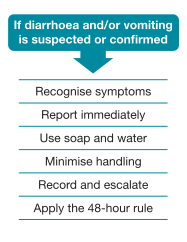
- early recognition, risk assessment, and reporting are important
- an outbreak is 2 or more linked cases (including staff)
- the SIGHT approach is used to manage cases
- good hygiene, cleaning, and isolation help reduce spread
Call for action
- spot symptoms early and report straight away
- check risk and get clinical advice if needed
- keep people away from others until 48 hours symptom‑free
- staff should not work if unwell; return after 48 hours symptom‑free
- follow SIGHT (Suspect, Individual (person), Gloves, Hand hygiene, Test)
- increase cleaning with appropriate products, especially frequently touched surfaces
- keep everyone informed (staff, families, professionals)
- watch for more cases and report quickly
- record symptoms and actions clearly
- after recovery, deep clean and review care
This guidance is for care and support workers working in adult social care (ASC) and provides support and guidance to manage suspected infectious diarrhoea and/or vomiting in ASC settings before the cause is known. If the cause (pathogen) is confirmed, follow specific guidance for that pathogen.
This should be read alongside transmission-based precautions of this ASC guidance
Diarrhoea and/or vomiting can be caused by infectious or non-infectious agents; however, all cases of new onset diarrhoea and/or vomiting should be regarded as infectious unless good evidence suggests otherwise.
The term ‘people/person’ is used throughout this guidance to refer to people who access care and support in ASC settings, such as care homes for older adults, homes for younger adults with learning disabilities, day centres, extra care services, supported living and care provided at home (domiciliary care).
Care and support workers providing care and support to people should follow the infection prevention and control (IPC) principles set out below to minimise the risk of spreading suspected infectious diarrhoea and/or vomiting within ASC settings.
Safeguarding statement
In keeping with the Mental Capacity Act 2005, care and support workers must presume capacity unless assessed otherwise, provide tailored support to enable understanding, and document any capacity assessments clearly. Where a person lacks capacity, decisions or protective measures must be made in their best interests and be proportionate, necessary, and least restrictive, with involvement from relevant professionals and those close to the person wherever appropriate.
Always ensure any information sharing about a person who is infectious is done so in a compassionate but proportionate way.
Definitions
Infectious diarrhoea and/or vomiting is caused by pathogens (such as viruses, bacteria or parasites) that can spread from person to person, usually through the faecal-oral route. Some of these infections can also spread through contact with contaminated equipment, surfaces, food or water. Examples of pathogens that can cause vomiting and/or diarrhoea are norovirus, rotavirus, Clostridioides difficile, Salmonella, or Cryptosporidium.
Suspected infectious diarrhoea and/or vomiting is when the cause is not yet known, but it is suspected to be infectious based on symptoms and risk factors.
Diarrhoea is 3 or more loose stools in 24 hours. The Bristol stool chart is a medical tool that identifies stool into 7 types from hard lumps (Type 1, constipation) to mushy or watery liquid (Type 6 and 7, diarrhoea). Escalate any concerns on the interpretation of stool types as needed.
Other symptoms may include stomach cramps or pain, fever, nausea, vomiting, or signs of dehydration (such as dry mouth or less urine).
Vomiting (throwing up or being sick) is the forceful removal of stomach contents.
How to identify infectious diarrhoea and vomiting
As soon as a person is having diarrhoea and/or vomiting symptoms, complete a risk assessment to identify a possible source or explanation for the symptoms. Using the diarrhoea and vomiting decision-making tool for adult social care may help to consider:
- foods that could have caused illness, or food that may have been prepared by someone who is unwell
- recent close contact with someone who has similar symptoms, including staff, other people accessing care and support, and visitors
- any underlying conditions
- recent gastrointestinal procedures
- presence of nasogastric tube
- use of laxatives
- recent use of antibiotics
Complete the risk assessment with support from a healthcare professional if needed.
Tell the ASC setting manager or their nominated deputy straight away if someone has symptoms of infectious diarrhoea and vomiting. Always follow the ASC setting’s usual policy and local process when reporting this.
In domiciliary care, report immediately, document observations, follow the care provider’s escalation policy and seek support from managers or healthcare professionals.
Notify healthcare providers
Seek clinical advice as needed for the management of the symptomatic person.
Tell a healthcare professional (for example GP practice or NHS 111) if the person needs medical care or if their condition is getting worse. Share details about diarrhoea and/or vomiting with health care professionals where required, including if and when the person is attended by ambulance staff, so that they can apply the necessary IPC precautions.
Follow local policies for escalation.
Definition of an Outbreak
An outbreak is defined as two or more confirmed or suspected cases, which are linked in time (often within a 24 to 48-hour period) or place (care setting), with a common suspected or confirmed exposure. This could include care and support workers and/or people accessing care and support and other visitors. Follow IPC advice quickly to minimise spread and reduce the numbers of people affected.
If an outbreak of diarrhoea and/or vomiting is suspected or confirmed, make sure it is reported to the care setting’s UKHSA local health protection team (HPT), local authorities and local IPC teams as per local arrangements. The UKHSA local HPT will support ASC settings to control and reduce suspected or confirmed outbreaks of diarrhoea/vomiting through the provision of IPC and public health advice, and working with other agencies as required.
In domiciliary care, it may be harder to identify an outbreak. Providers should monitor reports from care and support workers, visit logs and staff sickness to identify possible outbreaks early.
Managing a person who has infectious diarrhoea or vomiting using SIGHT
If a person develops diarrhoea and/or vomiting, follow the SIGHT checklist to remember what to do. SIGHT stands for (Suspect, Individual (person), Gloves, Hand hygiene, Test).The SIGHT protocol is an easy way to remember what to do if someone has diarrhoea and/or vomiting.
S: suspect
Suspect that a person may be infectious where there is no clear cause for the diarrhoea or vomiting.
Use the diarrhoea and/or vomiting decision-making tool to help follow the SIGHT steps with support from the person’s GP.
I: individual (person)
Encourage the person to stay away from others whilst symptomatic with diarrhoea and/or vomiting and until they are free from symptoms for 48 hours. Balance staying away from others with their overall safety.
They should also avoid preparing food or drinks until they are free from symptoms for 48 hours.
Explain that diarrhoea and vomiting can spread easily, so staying away from other people helps protect others from getting diarrhoea and vomiting.
In care homes:
- encourage people to rest in their own room until they have had no diarrhoea or vomiting symptoms for 48 hours
- always balance separation with safety (for example falls risk, mental wellbeing)
- monitor other people accessing care and support and staff for symptoms
- put IPC measures in place if complete separation is not possible
- review and enhance cleaning for all people affected and the setting they are in, with special attention to high touch points, communal areas including flooring, and shared equipment (for example commodes)
In day centres and for social activities:
- people should avoid attending until they have had no diarrhoea and/or vomiting symptoms for 48 hours
- if symptoms occur at the centre, follow the same guidance as in care homes
- avoid social gatherings until people have had no symptoms for 48 hours
Staying apart does not mean no contact. Safe visiting supports people’s wellbeing when infectious diseases occur. Follow guidance on safe visiting and support people to stay in touch with family and friends in line with CQC Regulation 9A. People and their visitors should be given clear information about any risks and the steps being taken to keep them safe.
Infectious diarrhoea and vomiting usually doesn’t last long. Once the person has been symptom free for 48 hours, they can resume normal contact with others unless specified otherwise by a healthcare professional, a local IPC advisor or UKHSA local HPT.
In domiciliary settings (Homecare)
Make sure people have easy access to a toilet and handwashing facilities (liquid soap and warm water or hand wipes) to clean their hands after each episode
Support people in keeping the environment clean. Diarrhoea and/or vomiting can be easily spread by contaminated surfaces and linen .
Symptomatic staff
Care and support workers who develop symptoms of vomiting and/or diarrhoea should be excluded from work until they have been symptom free for 48 hours. This should include maintenance, reception, food handlers, activities co-ordinators or other workers within the ASC setting.
Staff whose symptoms do not improve should seek medical advice.
G: gloves and aprons
Wear gloves and aprons for all contact with the person and their environment.
Explain to the person that you are wearing gloves and aprons to help prevent spreading infection.
Wear non-sterile impermeable gloves and aprons to protect your hands and clothing from faeces or vomit.
Assess if a fluid resistant mask and eye protection are needed in case of any body fluids splashing to the face. Wear face protection when very close to a person who is vomiting.
Always remove gloves and aprons immediately after contact with the person or their environment and change them between tasks and after each episode of contact, even with the same person. This includes removing gloves and aprons after leaving the affected person’s room, environment, or home.
H: hand washing
Wash hands with liquid soap and warm water before and after each contact with the person and their environment (home, bedroom, bathroom, or toilet).
Remember, alcohol-based hand rub is not effective against all diarrhoea or vomiting pathogens, especially norovirus and C. difficile. Always wash hands with soap and water immediately after removing personal protective equipment (PPE) like gloves and aprons.
When visiting someone’s home (domiciliary care), have a supply of liquid soap and disposable paper towels in case these are not available. Always avoid using the person’s fabric towels. Kitchen roll can be used as a simple and safe way to dry hands, and is a common household item, and will help reduce the spread of infection.
Encourage the person accessing care and support to wash their hands too, especially:
- before eating and drinking
- after using the toilet
- after any episodes of vomiting or diarrhoea
Care and support workers should also wash their hands:
- at the start and end of the shift
- before taking a break
- before eating or drinking
- before preparing food or drinks
- immediately after leaving a person’s room and just before leaving a person’s own home
- after using the toilet
This helps protect both care and support workers and the person that has accessed care and support.
T: test
Where confident and trained to do so, take a stool sample if there are 3 or more loose stools, between type 5 and 7 on the Bristol stool chart, within 24 hours to find out which pathogen is the cause.
Speak to the person’s GP to get a specific stool sample pot or container. In a care home, these may already be available. In domiciliary care, inform the care manager or nominated deputy and ensure support is available to get a container and enable testing.
Collect the stool in the sample pot, secure it, and take it to the GP surgery for transport to the hospital laboratory. Care homes may have their own collection arrangements, so follow local policy.
Try to collect and send the sample quickly, ideally within 24 hours of symptom onset for the most accurate results.
Stool samples can still be used even if mixed with urine.
Where possible, samples should be sent to the laboratory on the day they are collected. If a delay is unavoidable, follow local laboratory advice on storage and transport requirements.
The GP or nurse practitioner should request the appropriate pathogen or infection investigations, (specifically requesting norovirus or C. difficile testing if required as these are not routinely done) on the microbiology request form. Make sure the request forms are fully completed by the requesting clinician, including clinical symptoms, date of onset, and any other relevant information.
Once the cause (pathogen) is confirmed on the results and the diagnosis shared by a healthcare professional, follow specific guidance for that pathogen.
IPC measures to use alongside the SIGHT approach
Always use standard infection control precautions for all people, at all times. These are the basic precautions that protect the person accessing care and support and care and support workers.
Transmission-based precautions are extra precautions that should be used in addition to standard infection control precautions and are to be used whenever a person has symptoms of diarrhoea and/or vomiting.
Communicating suspected or known infectious diarrhoea
Clear and timely communication is important in all ASC settings.
If care and support workers are visiting people accessing homecare with suspected or known infectious diarrhoea or vomiting make sure other staff, healthcare professionals, and family members know the person has symptoms. This allows everyone to take the right infection control precautions.
In care homes, signs may be placed outside the person’s room to make sure visitors and staff speak to care staff before entering to understand what precautions are needed.
Visitors
Supporting safe visiting must be facilitated in line with CQC regulation 9A, unless there are exceptional circumstances, where facilitating a visit would pose a significant risk to the health or wellbeing of someone in a communal ASC setting which cannot be mitigated through other precautions. Agree a plan with affected people and support alternatives to visiting when agreed and appropriate.
Always let visitors know about the risk of infection so they can decide whether to continue the visit safely and explain how they can reduce their risk of exposure.
Ask all visitors to wash their hands when entering and leaving the room of someone with diarrhoea or vomiting. Alcohol-based hand rub is not effective against all pathogens that cause diarrhoea and vomiting. Visitors who have entered the affected person’s room should be asked to inform the care manager or their nominated deputy if they develop diarrhoea or vomiting symptoms within 48 hours of their visit.
In domiciliary care or extra care, visitors should wash their hands on entering and leaving the persons home and between any care activities. Any visitors to the person’s home should report to the care provider if they develop diarrhoea or vomiting symptoms within 48 hours of their visit.
If visitors to any ASC setting, including domiciliary care have diarrhoea or vomiting themselves, they should be advised not visit until they have been symptom-free for 48 hours.
Reschedule non-essential visitors (for example, hairdressers) until the person has been symptom-free for 48 hours.
Cleaning and decontamination during suspected infectious diarrhoea or vomiting
In care homes, day centres, and other communal care settings, increase cleaning as soon as infectious diarrhoea or vomiting is suspected. Focus on frequently touched surfaces like door handles, light switches, and shared areas such as bathrooms, toilets, and dining rooms. Appendix 4 of the NHS England National standards of healthcare cleanliness includes a useful list of frequently touched areas, which can help care providers prioritise cleaning.
In domiciliary care, cleaning responsibilities often fall to the person accessing care and support and their family members, therefore care and support workers can advise people and their family that increasing cleaning, particularly frequently touched surfaces can help prevent spread of infection.
The exact cleaning protocol will depend on the number of cases and how fast cases are increasing, which will suggest contamination of the care environment.
In any setting, first clean up vomit or diarrhoea immediately. Then use 1,000 parts per million (ppm) of chlorine or hypochlorite solutions, if possible, following the manufacturer’s dilution instructions. Products that clean and disinfect in one step are helpful because they reduce the time it takes to effectively clean and disinfect the area
Soft furnishings like carpets or delicate items are hard to clean and usually cannot be cleaned with chlorine disinfectants as these will discolour the soft furnishing. Laundry or steam cleaning can be used if it’s safe after the initial clean. Always discuss options with the owner first.
In communal settings, cleaning cloths and mop heads should be disposable or washed at 60°C or higher. Make sure the washing process disinfects properly: either 65°C that is maintained for at least 10 minutes or 71°C for at least 3 minutes. Other time and temperature combinations are suitable. The Health Technical Memorandum 01-04 and Linen processing within adult social care: information sheet provides details on the requirements for handling and laundering of these and other items within the ASC sector
In domiciliary care, advise the person or their family to wash any cloths used for cleaning on the hottest temperature that the cloth can tolerate or use disposable cloths whilst infectious.
In communal settings, toilets used by a person with suspected or confirmed infectious diarrhoea should be cleaned and disinfected at least twice a day, and immediately if visibly soiled, using 1,000 parts per million (ppm) chlorine solution (bleach) (follow product instructions and relevant safety data sheets when preparing disinfectants).
In communal settings, if possible, the person should have their own ensuite or commode. If they must use a communal toilet, care and support workers or a designated domestic staff member should clean it after each use.
Ensure commodes (including frames and undersides) and bedpans are cleaned after each use. In communal settings or day centres, use a washer-disinfector if available; if not, use disposable bedpans. In domiciliary care, first disinfect the used bedpan or commode, clean the sink and then disinfect with 1,000ppm parts per million (ppm) of chlorine, a bleach-based product if this is available, or a standard household disinfectant.
In communal settings, once the person has been 48 hours symptom-free, carry out a deep clean. This includes the person’s room, surfaces, floors, soft furnishings, and reusable equipment. Wash or steam-clean carpets, curtains, and other soft furnishings as soon as possible. In domiciliary care, a family member or friend should clean these areas if the person is unable to do this themselves, including communal spaces, following the same guidance.
In domiciliary care there is no recommendation to give the home a deep clean.
In home care, a deep clean is not usually needed. Regular cleaning should be carried out, and extra cleaning may be needed if there is a higher risk of infection.
Bleach alternatives
Disinfectants used as an alternative to bleach should be selected based on their intended use and comply with relevant British and European (EN) standards for bactericidal (the ability to kill bacteria), virucidal (the ability to kill viruses) and fungicidal (the ability to kill fungal pathogens) activity. Where sporicidal activity is required (the ability of the chemical to kill and destroy bacterial or fungal spores), products should also demonstrate effectiveness against bacterial spores. Information about compliance with these standards can be found on the product label, technical data sheet or manufacturer’s product information.
The British and European (EN) standards can be hard to understand. If you are unsure which disinfectant to use, check with your manager, supervisor, IPC lead, or the person responsible for buying cleaning products before choosing or using a disinfectant. One product should not automatically be substituted for another, even if they appear similar, because their ingredients, concentration, preparation, or effectiveness may differ, Individual products must be checked to ensure they have been tested to and pass the relevant standards.
Waste and linen
Always treat soiled linen and waste from a person with diarrhoea and or vomiting as infectious, including used gloves and aprons. Handle them carefully, ensuring separation of clean from dirty or used items at all times. Follow the ASC settings infection control procedures for disposal including for domiciliary care.
Record keeping
Registered managers should maintain detailed records of all suspected and confirmed infectious diarrhoea and or vomiting cases using an outbreak spreadsheet that includes the person details (usually initials rather than full name), identifiers (date of birth, NHS number), location of the person, date and time of symptom onset, type of symptoms, Bristol Stool Chart classification, duration of illness, confirmed laboratory results, clinical management and IPC measures implemented.
A structured risk assessment should be included to evaluate the person’s vulnerability, potential opportunities for transmission from contact between people, symptom severity, hydration and nutritional status, and environmental factors.
Ensure care planning includes hydration, nutrition, stool monitoring, and any other relevant clinical information. Inform healthcare professionals if people are unwell. Timely communication with the local UKHSA health protection team, GP and other key stakeholders should also be recorded to support a coordinated response.
Training
All care and support workers should undergo IPC training that includes the recognition and management of infectious diarrhoea and/or vomiting, and the use of standard and transmission-based IPC precautions. Some useful IPC resources for Care Homes are available.
Training should be documented and updated annually or in response to changes in national guidelines.
Although NHS-focused, the NHSE Infection prevention and control education framework provides a clear benchmark for the design, delivery and assurance of infection prevention and control training within ASC settings.
Evaluation and auditing for improvement
Regular IPC audits of hand hygiene practices, PPE use and cleaning practices will enable assessment of the effectiveness of the content of this guidance document. More information on auditing is available in the NHS England National Standards of healthcare cleanliness 2025. Although this is tailored to NHS settings, there are useful aspects that can be transferable to communal ASC settings. There is also Scottish guidance that focuses on Cleaning Specification for Care Homes, that may be useful.
Incident reports can be used to review the management of suspected and confirmed infectious diarrhoea and/or vomiting cases.
Diarrhoea and vomiting decision-making tool for adult social care staff
Purpose
To assist care and support workers in assessing if a person’s episode of diarrhoea and/or vomiting may be due to an infection or other causes, guiding appropriate action.
Initial observation and information gathering
Symptom onset: When did the vomiting/diarrhoea start? Has the person recently experienced vomiting, nausea, fever, or stomach pain?
Pattern and frequency: How many times has vomiting/diarrhoea occurred in the past 24 hours?
Stool characteristics: Observe and note if the stool is watery, bloody, or unusually foul-smelling.
Other symptoms: Fever, chills, abdominal cramping, muscle and body aches, bloody diarrhoea.
Non-infectious indicators: Bloating, general constipation history, recent gastrointestinal procedure, nasogastric tube presence, use of laxatives, or food intolerance.
Assessing infectious diarrhoea risk
Recent contact: Has the person had contact with anyone who has recently had diarrhoea or vomiting? This might be other people accessing care and support, family members, visitors or care support workers that have looked after people over the previous 2 to 3 days.
Recent travel: Has the person travelled, especially to areas with a higher reported risk of infectious diarrhoea and vomiting incidence or outbreaks?
Food intake: Does the person have any food intolerances? Or has the person eaten food not properly prepared, unusual or high-risk foods (for example, undercooked meat, unpasteurised dairy, seafood)? If more than one person has developed symptoms, are there any foods or meals that they all have in common?
Medication changes: Any recent changes in medications that might affect the gut? For example, broad-spectrum antibiotics like co-amoxiclav, magnesium-based antacids, laxatives such as lactulose, NSAIDs like ibuprofen, chemotherapy drugs, or diabetes medications like metformin - this list is not exhaustive.
Personal hygiene and facility risks: Are there any personal cleanliness considerations that may contribute to potential spread of diarrhoea and/or vomiting?
Considerations for deciding if diarrhoea and/vomiting is infectious or not
The diarrhoea is likely to be infectious if there is:
- diarrhoea with fever, vomiting, or abdominal pain
- sudden onset following contact with symptomatic or recently recovered people
- presence of blood or mucus in stool
The diarrhoea is likely to be non-infectious if there is:
- no fever or vomiting
- recent change in medication, diet, or a stressful event
- known conditions like irritable bowel syndrome or food intolerance
Some medicines can cause diarrhoea and/or vomiting. If symptoms start after a recent medication change or a new medicine has been prescribed, seek advice from the prescriber or another healthcare professional.
Monitor symptoms closely for any changes that may indicate infectious diarrhoea and/or vomiting. If there is any doubt about whether diarrhoea and/or vomiting is infectious, seek advice from a GP or other appropriate healthcare professional.
Immediate actions if infectious diarrhoea is suspected
If infectious diarrhoea is suspected:
- encourage the person to stay away from others and explain why
- notify a healthcare professional if they become unwell. The local health protection team should be informed if an outbreak is suspected or IPC provider as per local process.
- follow TBPs to prevent the spread of infectious diarrhoea
Monitoring and documentation
Record details of episodes of diarrhoea and/or vomiting, noting any other symptoms, frequency, stool type, and actions taken.
Continue to observe and monitor symptoms for 48 hours. For people accessing home care this will mean monitoring whilst care and support visits are taking place for this timeframe. If the person has been symptom-free for 48h without fever, vomiting, or diarrhoea, resume normal protocols.
Escalate (notify healthcare professionals) if symptoms worsen or do not improve
Seek medical advice if the person has or develops severe symptoms, for example, blood in stool, severe dehydration, confusion, severe abdominal pain, or high fever, or the symptoms do not improve within 48 hours.
Figure to support actions