Country Policy and Information Note: political parties and affiliation, India, December 2023 (accessible version)
Updated 18 December 2025

© Crown copyright 2025
This publication is licensed under the terms of the Open Government Licence v3.0 except where otherwise stated. To view this licence, visit nationalarchives.gov.uk/doc/open-government-licence/version/3 or write to the Information Policy Team, The National Archives, Kew, London TW9 4DU, or email: psi@nationalarchives.gov.uk.
Where we have identified any third party copyright information you will need to obtain permission from the copyright holders concerned.
This publication is available at https://www.gov.uk/government/publications/india-country-policy-and-information-notes/country-policy-and-information-note-political-parties-and-affiliation-india-december-2023-accessible-version
Version 1.0 December 2023
Executive summary
In general, supporters, members and leaders of opposition political parties are unlikely to be at risk of persecution or serious harm.
The federal government is headed by Prime Minister Narendra Modi, led by the Bharatiya Janata Party (BJP). The Prime Minister and Council of Ministers hold the majority of power with the BJP, having (at the time of publication) control in 11 out of 28 Indian states.
The law provides for the freedoms of peaceful assembly, association and expression and the state generally respects this. Citizens are able to criticise the government privately and publicly, express political opinions through protest, in online forums and join political groups.
Hundreds of political parties exist, the majority of which are regional rather than national. They operate without restrictions on their formation, recruitment of members or on individuals of any community from participating in the election process, which is generally democratic, free and fair.
There are isolated reports of politically motivated arrests and detentions. Official statistics from 2021 recorded 5,857 people charged under the Indian Penal Code (IPC) across India for ‘political’ crime and 400 were convicted, although there were no details on the nature of the cases. This should also be seen in the context of a population of nearly 1.4 billion people.
Sikh parties are generally able to operate unhindered by the state, participating in the electoral process. Some members of legitimate Sikh political parties have reportedly faced harassment, preventative detention prior to major events and temporary arrest although this is not considered systemic.
Sikhs advocating for Khalistan, a separatist movement seeking to create a homeland for a Sikh sovereign state in Punjab, may be monitored, added to police lists, and in some cases charged and detained on terrorist related offences.
It is illegal to be a member of, support or fund a terrorist organisation. Available penalties range from a fine to life imprisonment, depending on the offence. Members of and those associated with, or suspected of being associated with, illegal extremist or terrorist groups are likely to face prosecution for criminal activities rather than persecution or serious harm.
Left Wing Extremist groups remain active in the central and eastern states and are engaged in armed conflict with the Indian military and security forces. In addition to prosecutions and convictions there have been acquittals and release as well as those who have surrendered, been rehabilitated and (re-)integrated into society.
The scale and extent of LTTE presence (a proscribed organisation in the UK and India) is unclear although where it exists, it is mainly within Tamil Nadu south Indian state. Those suspected of actively participating in the LTTE face arrest and imprisonment, and although it is not clear how many Indian nationals this has affected the numbers are likely to be low.
Decision makers must consider whether there are serious reasons for considering whether one (or more) of the exclusion clauses is applicable.
Assessment
About the assessment
This section considers the evidence relevant to this note – that is information in the country information, refugee/human rights laws and policies, and applicable caselaw – and provides an assessment of whether, in general:
- a person is reasonably likely to face a real risk of persecution/serious harm by the state because of their actual or perceived political opinion
- a person is able to obtain protection from the state (or quasi state bodies)
- a person is reasonably able to relocate within a country or territory
- a grant of asylum, humanitarian protection or other form of leave is likely, and
- if a claim is refused, it is likely or unlikely to be certifiable as ‘clearly unfounded’ under section 94 of the Nationality, Immigration and Asylum Act 2002.
Decision makers must, however, still consider all claims on an individual basis, taking into account each case’s specific facts.
This CPIN does not cover the situation in Jammu and Kashmir region, although it is referred to in some of the COI sources used. The Country Policy and Information Note Pakistan: Political parties and affiliation provides more detailed information on political parties operating in Azad Jammu and Kashmir.
1. Material facts, credibility and other checks/referrals
1.1 Credibility
1.1.1 For information on assessing credibility, see the instruction on Assessing Credibility and Refugee Status.
1.1.2 Decision makers must also check if there has been a previous application for a UK visa or another form of leave. Asylum applications matched to visas should be investigated prior to the asylum interview (see the Asylum Instruction on Visa Matches, Asylum Claims from UK Visa Applicants).
1.1.3 In cases where there are doubts surrounding a person’s claimed place of origin, decision makers should also consider language analysis testing, where available (see the Asylum Instruction on Language Analysis).
Official – sensitive: Not for disclosure – Start of section
The information on this page has been removed as it is restricted for internal Home Office use.
Official – sensitive: Not for disclosure – End of section
1.2 Exclusion
1.2.1 Decision makers must consider whether there are serious reasons for considering whether one (or more) of the exclusion clauses is applicable. Each case must be considered on its individual facts and merits.
1.2.2 The Liberation Tigers of Tamil Eelam (LTTE) has been responsible for serious human rights abuses. It has been proscribed in both India (under the Unlawful Activities (Prevention) Act, 1967) and the UK (under the Terrorism Act 2000). Other separatist organisations which are illegal in India, such as Pro-Khalistan militant/extremist groups and communist militant groups (Left Wing Extremists (LWE)) have been engaged in armed conflict with the government and have been accused of human rights abuses (see Maoist Left Wing Extremist (LWE) groups and Liberation Tigers of Tamil Eelam (LTTE) and affiliated groups).
1.2.3 If the person is excluded from the Refugee Convention, they will also be excluded from a grant of humanitarian protection (which has a wider range of exclusions than refugee status).
1.2.4 For guidance on exclusion and restricted leave, see the Asylum Instruction on Exclusion under Articles 1F and 33(2) of the Refugee Convention, Humanitarian Protection and the instruction on Restricted Leave.
Official – sensitive: Not for disclosure – Start of section
The information on this page has been removed as it is restricted for internal Home Office use.
Official – sensitive: Not for disclosure – End of section
2. Convention reason(s)
2.1.1 Actual or imputed political opinion.
2.1.2 Establishing a convention reason is not sufficient to be recognised as a refugee. The question is whether the person has a well-founded fear of persecution on account of an actual or imputed Refugee Convention reason.
2.1.3 For further guidance on the 5 Refugee Convention grounds see the Asylum Instruction, Assessing Credibility and Refugee Status.
3. Risk
3.1 Political parties - general
3.1.1 In general supporters, members and leaders of opposition political parties are unlikely to be at risk of persecution or serious harm. The onus is on the person to demonstrate otherwise.
3.1.2 The law provides for the freedoms of peaceful assembly, association and expression and the state generally respects this. Citizens are able to criticise the government privately and publicly, express political opinions through protest, in online forums and join political groups. Some restrictions on freedom of expression and assembly have been reported including the use internet shutdowns and assembly bans (see Freedom of expression and assembly and Freedom of association).
3.1.3 Hundreds of political parties exist and operate without restrictions on their formation, recruitment of members or on persons of any community from participating in the election process. Elections are generally democratic, free and fair. Political positions are filled according to the outcomes of elections (see Parliamentary elections and the India: Background note).
3.1.4 Most political parties are regional, representing diverse interests at a local level rather than nationally. The main national parties are the ruling Bharatiya Janata Party (BJP) led by Prime Minister Narendra Modi and the opposition Indian National Congress Party (Congress Party). Despite India’s status as a secular democracy, the BJP advocates Hindu nationalism (Hindutva) - a political ideology whereby Indian national identity and culture are inseparable from the Hindu religion (see Parliamentary elections and the India: Background note, and the Country Policy and Information Note, India: Religious minorities and Scheduled Castes and Tribes).
3.1.5 There are isolated reports of politically motivated arrests and detentions although the examples provided in the United States State Report (USSD) covering events of 2022 are limited to the union territory (UT) of Jammu and Kashmir and Kashmiri separatism, rather than involving mainstream political parties. Statistics recorded by the National Crime Records Bureau’s (NCRB) in 2021 across all states and UTs in India recorded 5,857 people charged under the Indian Penal Code (IPC) across India for ‘political’ crime and 400 were convicted. However, there were no details on the nature of the cases and the figures should also be seen in the context of a population of nearly 1.4 billion people (see Harassment, arrest and detentions).
3.2 Sikh political parties and militant separatist groups
3.2.1 The Indian government has a legitimate right to act against terrorism – including acts committed by armed Sikh separatist groups – and to use all lawful and proportionate means to do so. This includes seeking to prosecute those who belong to, or profess to belong to, or invite support for, the organisation. Members of, and those associated with, or suspected of being associated with illegal armed Sikh separatist groups which use or incite violence are likely to face prosecution for criminal activities rather than persecution or serious harm.
3.2.2 Whilst there is some corruption within the judiciary and effectiveness is hampered by understaffing, in general there is a functioning independent judicial system, including public trials, presumption of innocence, free legal counsel and punishment that is proportionate to the crime.
3.2.3 In general, Sikhs who engage in lawful political activity are unlikely to face state treatment which is sufficiently serious by nature and repetition that it would amount to persecution or serious harm. The onus is on the person to demonstrate otherwise.
3.2.4 Some members of legitimate Sikh political parties such as Shiromani Akali Dal SAD(A) have reportedly faced harassment, preventative detention prior to major events and temporary arrest although according to one source interviewed by the Immigration and Refugee Board (IRB) of Canada, such treatment is not systemic and occurs at a local level against targeted individuals. However, Sikh parties are generally able to operate unhindered by the state, participating in the electoral process in order to express their views and gain public support. For example, in June 2022, Simranjit Singh Mann of SAD(A) won a by-election becoming MP for the Sangrur Lok Sabha constituency in Punjab (see Treatment of suspected Sikh separatists).
3.2.5 Persons advocating for ‘Khalistan’, a separatist movement seeking to create a homeland for a Sikh sovereign state in Punjab, which is proscribed as a terrorist organisation by the Indian government, may be monitored, added to police lists, and in some cases charged and detained on terrorist related offences. (see Sikh separatism and Pro-Khalistan militant/extremist groups).
3.2.6 In April 2023, the arrest under India’s National Security Act of high-profile Sikh rights activist, preacher and separatist Amritpal Singh in Punjab was widely reported. Protests demanding his release resulted in 100s of arrests of Singh’s supporters and an internet and mobile blackout across Punjab. Sources noted sporadic violence, isolated bombings, attacks on police stations and killings of religious leaders in Punjab in April and May 2023. The authorities claimed the Sikh separatist movement was responsible (see The Unlawful Activities (Prevention) Act, 1967 and Treatment of suspected Sikh separatists).
3.2.7 The Indian government seeks to prosecute those who belong to or invite support for proscribed pro-Khalistan militant groups, many of which operate from outside of India. It is illegal to be a member of, support or fund a terrorist organisation with available penalties ranging from a fine to life imprisonment, depending on the offence. In April 2022 police in Punjab arrested a Babbar Khalsa International (BKI) terrorist for bombings carried out in 2007 and 2010 (see Pro-Khalistan militant/extremist groups).
3.2.8 For further information on protection and the criminal justice system see Country Policy and Information Note India: Actors of protection.
3.3 Left Wing Extremist (LWE) groups
3.3.1 In general, members of and those associated, or suspected of being associated, with illegal LWE groups are likely to face prosecution rather than persecution. The onus is on the person to demonstrate otherwise.
3.3.2 Legal left-wing and communist parties exist in India such as the Communist Party of India (Marxist-Leninist) Liberation and the Communist Party of India (Marxist) which are registered political parties, fielding candidates in parliamentary and state assembly elections (see Political system, Parliamentary elections and Communist Party of India (Maoist)).
3.3.3 The LWE groups also known as ‘Naxalite’ grew out of the communist political movement and the Communist party of India (Maoist) (CPI Maoist), which was formed in 2004 when the Maoist Communist Centre (MCC) merged with the Communist Party of India (Marxist-Leninist): People’s War Group. The groups were proscribed as terrorist organisations under section 35 of the Unlawful Activities (Prevention) Act, 1967. It is illegal to be a member of, support or fund a terrorist organisation with available penalties ranging from a fine to life imprisonment, depending on the offence (see Maoist Left Wing Extremist (LWE) groups).
3.3.4 CPI (Maoist) has remained the largest of the many active LWE organisations. Maoist rebels are active in the Central and eastern states of Andhra Pradesh, Bihar, Chhattisgarh, Jharkhand, Kerala, Madhya Pradesh, Maharashtra, Odisha, and Telangana, although sources note an overall improvement in the security situation in these areas in recent years, including up to early 2023 (see Areas with active Maoist rebels).
3.3.5 Since March 2000 the CPI (Maoist) and People’s Liberation Guerrilla Army have been engaged in armed conflict with the Indian military and security forces, mainly in central and eastern states, resulting in the death of approximately 4,287 Maoist fighters up to 3 June 2023 according to the South Asia Terrorist Portal (SATP). Security forces have arrested nearly 16,000 LWEs since 6 March 2000, with 409 in 2021, 395 in 2022, and 122 up to June 2023. SATP also noted a large number of LWEs surrendered to security forces at least 533 in 2021, 2,855 in 2022, and 97 up to April 2023 (see Areas with active Maoist rebels and Left-wing extremist (‘Naxalite’) groups in India).
3.3.6 There are reports of LWEs being arrested, prosecuted, and imprisoned along with examples of judicial due process, where those accused of LWE activity have been acquitted and released. In the Bastar region of Chhattisgarh state in central India, LWEs who have surrendered to authorities are able to join a rehabilitation program where they receive economic assistance to help them integrate into mainstream life. Sources indicate that some former LWE members have been able to join the police and contribute to the anti-LWE operation (see Left-wing extremist (‘Naxalite’) groups).
3.3.7 For further guidance on assessing risk, see the Asylum Instruction on Assessing Credibility and Refugee Status.
3.3.8 For further guidance on assessing risk, including prosecution as opposed to persecution, see the Asylum Instruction on Assessing Credibility and Refugee Status.
3.4 Liberation Tigers of Tamil Eelam (LTTE)
3.4.1 In general, members of, and those associated, or suspected of being associated, with the LTTE are likely to face prosecution rather than persecution. The onus is on the person to demonstrate otherwise.
3.4.2 The scale and extent of LTTE presence in India is unclear although appears mainly within Tamil Nadu (South Indian) state where it has reportedly used Tamil refugees from camps to smuggle drugs and arms to strengthen terrorism in South India. Nine Sri Lankan nationals were arrested on this basis in December 2022. In sources consulted, there is no information around the recruitment of Indian nationals to the LTTE or their involvement or affiliation with the terrorist organisation, but it is likely to be low (see Sympathisers, members, or people with suspected LTTE links in India).
3.4.3 India proscribed the LTTE in 2019 and it has been proscribed in the UK since March 2001. Sources indicate those suspected of actively participating in the LTTE face arrest and imprisonment under the Unlawful Activities (Prevention) Act, 1967. The Indian Home Ministry reported that cases were registered under the Act against LTTE, pro-LTTE elements and affiliated groups between May 2014 and May 2019, but did not give an indication of numbers and whether the cases related to Indian nationals or Sri Lankans residing within India (see Liberation Tigers of Tamil Eelam (LTTE) and Sympathisers, members, or people with suspected LTTE links in India).
3.4.4 For further information about the LTTE in Sri Lanka see the Country Policy and Information Note, Sri Lanka: Tamil Separatism.
3.4.5 For further guidance on assessing risk, see the Asylum Instruction on Assessing Credibility and Refugee Status.
4. Protection
4.1.1 Where the person has a well-founded fear of persecution from the state they will not, in general, be able to obtain protection from the authorities.
4.1.2 For further guidance on assessing state protection, see the Asylum Instruction on Assessing Credibility and Refugee Status.
4.1.3 For information on protection see: Country Policy and Information Note India: Actors of protection.
5. Internal relocation
5.1.1 Where the person has a well-founded fear of persecution or serious harm from the state, they are unlikely to be able to relocate to escape that risk.
5.1.2 For further guidance on considering internal relocation and factors to be taken into account see the Asylum Instruction on Assessing Credibility and Refugee Status.
5.1.3 For information on freedom of movement and internal relocation see: Country Policy and Information Note India: Internal relocation.
6. Certification
6.1.1 Where a claim is refused, it must be considered for certification under section 94 of the Nationality, Immigration and Asylum Act 2002 as India is listed as a designated state. It is likely to be certifiable as ‘clearly unfounded’.
6.1.2 For further guidance on certification, see Certification of Protection and Human Rights claims under section 94 of the Nationality, Immigration and Asylum Act 2002 (clearly unfounded claims).
Country information
About the country information
This contains publicly available or disclosable country of origin information (COI) which has been gathered, collated and analysed in line with the research methodology. It provides the evidence base for the assessment.
The structure and content of this section follow a terms of reference which sets out the general and specific topics relevant to the scope of this note.
Decision makers must use relevant COI as the evidential basis for decisions.
This CPIN does not cover the situation in Jammu and Kashmir region, although it is referred to in some of the COI sources used. The Country Policy and Information Note Pakistan: Political parties and affiliation provides more detailed information on political parties operating in Azad Jammu and Kashmir.
Section updated: 8 November 2023
7. Map of states and union territories
7.1.1 A map showing the states and union territories of India can be found in the India: Country Background Note.
Section updated: 6 September 2023
8. Political system
8.1 Overview
8.1.1 India is a federal, parliamentary democracy with a bicameral legislature[footnote 1] [footnote 2]. The country has 28 states and 8 union territories[footnote 3] and a population of nearly 1.4 billion people[footnote 4]. Droupadi Murmu is head of state, elected President in July 2022 to serve a five-year term, and Narendra Modi became Prime Minister for the second time following the victory of the National Democratic Alliance coalition led by the Hindu nationalist Bharatiya Janata Party (BJP) in the 2019 general election[footnote 5].
8.1.2 According to The Congressional Research Service (CRS) in an overview of India’s political system, dated 1 June 2023:
‘The Indian president is a ceremonial chief of state with limited executive powers… The 543-seat Lok Sabha (House of the People) is the locus of national power, with directly elected representatives from each of the country’s 28 states and 8 union territories. A smaller upper house of a maximum 250 seats, the Rajya Sabha (Council of States), may review, but not veto, revenue legislation, and has no powers over the prime minister or the cabinet. Lok Sabha and state legislators are elected to five-year terms.
Rajya Sabha legislators are elected by state assemblies to six-year terms; 12 are appointed by the president.’[footnote 6]
8.1.3 The CRS added:
‘The nationally ruling BJP is now in power in 10 Indian states, with NDA [National Democratic Alliance]-allied chief ministers seated in another 5. The Congress Party controls four state governments; its UPA [United Progressive Alliance] allies lead three others. Six states are run by parties independent of either national coalition. Steadily broadening its state assembly presence in recent years—which directly translates to increased presence in the Rajya Sabha—the BJP now accounts for more than one-third of the country’s state legislators, as compared to under one-fifth for the declining Congress.’[footnote 7]
(See Main political parties and Political opponents)
8.2 Constitution
8.2.1 Chatham House, in its report - Democracy in India, 7 April 2022, noted:
‘India’s constitution sets out the country’s political code, federal structure, powers of government and guarantees Indians’ rights, including to equality before the law and freedoms of speech, assembly, movement and others… India is understood to be a deeply religious country, with diverse religions represented in its population. The constitution is secular in that it prohibits the persecution of individuals for their religious beliefs, but it does not specifically separate church and state in the fashion of the United States constitution.’[footnote 8]
8.2.2 The US State Department, 2022 Country Report on Human Rights Practices: India (USSD HR Report 2022), 20 March 2023, noted: ‘The constitution gives the country’s 28 states and eight union territories a high degree of autonomy and primary responsibility for law and order.’[footnote 9]
8.2.3 The Constitution (as at May 2022) can be accessed via: Government of India (GOI), Ministry of Law and Justice, Legislative Department.
Section updated: 18 August 2023
9. Laws regulating terrorist (militant political activities) activities
9.1 The Unlawful Activities (Prevention) Act, 1967
9.1.1 Regarding membership of, or support for, a terrorist organisation, the Unlawful Activities (Prevention) Act, 1967 provides as follows:
Section ‘38. Offence relating to membership of a terrorist organisation. (1) A person, who associates himself, or professes to be associated, with a terrorist organisation with intention to further its activities, commits an offence relating to membership of a terrorist organisation… (2) A person, who commits the offence relating to membership of a terrorist organisation under sub-section (1), shall be punishable with imprisonment for a term not exceeding ten years, or with a fine, or with both.’[footnote 10]
Section ‘39. Offence relating to support given to a terrorist organisation. (1) A person commits the offence relating to support given to a terrorist organisation,— (a) who, with intention to further the activity of a terrorist organisation,— (i) invites support for the terrorist organization; and (ii) the support is not or is not restricted to provide money or other property within the meaning of section 40; or (b) who, with intention to further the activity of a terrorist organisation, arranges, manages or assists in arranging or managing a meeting which he knows is— (i) to support the terrorist organization; or (ii) to further the activity of the terrorist organization; or (iii) to be addressed by a person who associates or professes to be associated with the terrorist organisation; or (c) who, with intention to further the activity of a terrorist organisation, addresses a meeting for the purpose of encouraging support for the terrorist organisation or to further its activity. (2) A person, who commits the offence relating to support given to a terrorist organisation under sub-section (1) shall be punishable with imprisonment for a term not exceeding ten years, or with fine, or with both.’[footnote 11]
Section 40. Offence of raising fund[s] for a terrorist organisation.
(1) A person commits the offence of raising fund for a terrorist organisation, who, with intention to further the activity of a terrorist organisation,— (a) invites another person to provide money or other property, and intends that it should be used, or has reasonable cause to suspect that it might be used, for the purposes of terrorism; or (b) receives money or other property, and intends that it should be used, or has reasonable cause to suspect that it might be used, for the purposes of terrorism; or (c) provides money or other property, and knows, or has reasonable cause to suspect, that it would or might be used for the purposes of terrorism. [Explanation…]
(2) A person, who commits the offence of raising fund for a terrorist organisation under sub-section (1), shall be punishable with imprisonment for a term not exceeding fourteen years, or with fine, or with both.[footnote 12]
9.1.2 Chapter IV of the Unlawful Activities (Prevention) Act, 1967 sets out the penalties for ‘Terrorist activities’. Section 15 defines what is meant by a ‘terrorist act’ and includes, for example, the use of firearms or explosives with the intent of causing death or injury to any persons, or destruction to property. Section 16 provides for maximum penalties of the death sentence or life imprisonment if a terrorist act has resulted in the death of any persons, or a sentence of 5 years to life imprisonment and a fine in other cases[footnote 13].
9.1.3 Section 18. ‘Punishment for conspiracy, etc’ states: ‘Whoever conspires or attempts to commit, or advocates, abets, advises or [incites, directly or knowingly facilitates] the commission of a terrorist act or any act preparatory to the commission of a terrorist act, shall be punishable with imprisonment for a term which shall not be less than five years but which may extend to imprisonment for life, and shall also be liable to fine.’[footnote 14]
Section updated: 6 September 2023
10. Parliamentary elections
10.1 General elections
10.1.1 The Australian Department of Foreign Affairs and Trade (DFAT), in its Country Information Report India, 10 December 2020, noted:
‘In May 2019, securing a second election victory, [Narendra] Modi became the first non-Congress prime minister in India to return to power after a full five-year term. Official data from the Election Commission showed Modi’s BJP winning 303 of 543 seats (up from the 282 it had won in 2014). The BJP formed government along with its National Democratic Alliance (NDA) partners, with the alliance winning 352 seats in total. The opposition Congress party won 52 seats in 2019, after having been reduced to 44 seats in 2014…’[footnote 15]
10.1.2 The BBC[footnote 16] and Election Guide[footnote 17] provided detailed results of the 2019 India general election.
10.1.3 The CRS paper dated 1 June 2023 noted:
‘The 2019 election cycle (and a key 2022 state election in Uttar Pradesh) revolved around nationalism and religion, with growing concerns among many observers that strident Hindu majoritarianism represents a threat to the status of India’s religious minorities and to the country’s syncretic traditions. Still, hundreds of millions across the country voted to keep the remarkably popular prime minister in power into 2024…
‘The influence of regional and caste-based (and often “family-run”) parties—although blunted by two consecutive BJP majority victories—remains a crucial variable in Indian politics. Such parties hold roughly one-third of all Lok Sabha seats. In 2019, more than 8,000 candidates and hundreds of parties vied for parliament seats; 33 of those parties won at least one seat.’[footnote 18]
10.1.4 The following seven parties account for 84% of Lok Sabha seats:
- Bharatiya Janata Party (BJP)
- Indian National Congress (INC)
- Dravida Munnetra Kazhagam (DMK)
- All India Trinamool Congress (AITMC or TMC)
- YSR Congress (YSRCP)
- Shiv Sena
- Janata Dal (United) (JDU)[footnote 19].
(See Main political parties)
10.2 Participation
10.2.1 The Bertelsmann Stiftung BTI 2022 Country Report – India, noted:
‘Elections in India have been free and fair for nearly seven decades since independence, with only a temporary interruption in the 1970s. Universal suffrage by secret ballot is ensured, a large number of political parties are able to run and political posts are filled according to the outcomes of elections. Parliamentary elections in India are a huge exercise. The general election of 2019 was the largest democratic exercise in the world, with over 900 million people eligible to vote and voter turnout surpassing 67% (including the highest participation of female voters in Indian history).’[footnote 20]
Section updated: 8 November 2023
11. Political parties
11.1.1 India has over 2,000 political parties registered with the Commission[footnote 21] [footnote 22]. The CRS noted that the BJP and Indian National Congress Party ‘are, in practice, India’s only genuinely national parties’[footnote 23]. For a list of the major political parties represented in parliament since 2014 and those which won seats in the 2019 general election see the India: Background note (copy available on request). The Central Intelligence Agency (CIA) - World Factbook – India (Government), provides a list of main political parties and their leaders.
11.1.2 The Election Symbols (Reservation and Allotment) Order, 1968 (as amended up to August 2016) sets out the criteria for recognition as a State party or National party:
‘[6A. Conditions for recognition as a State Party – A political party shall be eligible for recognition as a State party in a State, if, and only if, any of the following conditions is fulfilled:
‘(i) At the last general election to the Legislative Assembly of the State, the candidates set up by the party have secured not less than six percent of the total valid votes polled in the State; and, in addition, the party has returned at least two members to the Legislative Assembly of that State at such general election; or
‘(ii) At the last general election to the House of the People from that State, the candidates set up by the party have secured not less than six percent of the total valid votes polled in the State; and, in addition, the party has returned at least one member to the House of the People from that State at such general election; or
‘(iii) At the last general election to the Legislative Assembly of the State, the party has won at least three percent of the total number of seats in the Legislative Assembly, (any fraction exceeding half being counted as one), or at least three seats in the Assembly, whichever is more; or
‘(iv) At the last general election to the House of the People from the State, the party has returned at least one member to the House of the People for every 25 members or any fraction thereof allotted to that State;] or
’{(v) At the last general election to the House of the People from the State, or at the last general election to the Legislative Assembly of the State, the candidates set up by the Party have secured not less than eight percent of the total valid votes polled in the State.}
‘6B. Conditions for recognition as a National Party – A political party shall be eligible to be recognized as National party, if, and only if, any of the following conditions is fulfilled:
‘(i) The candidates set up by the party, in any four or more States, at the last general election to the House of the People, or to the Legislative Assembly of the State concerned, have secured not less than six percent of the total valid votes polled in each of those States at that general election; and, in addition, it has returned at least four members to the House of the People at the aforesaid last general election from any State or States; or
‘(i) The candidates set up by the party, in any four or more States, at the last general election to the House of the People, or to the Legislative Assembly of the State concerned, have secured not less than six percent of the total valid votes polled in each of those States at that general election; and, in addition, it has returned at least four members to the House of the People at the aforesaid last general election from any State or States; or
‘(ii) At the last general election to the House of the People, the party has won at least two percent of the total number of seats in the House of the People, any fraction exceeding half being counted as one; and the party ’s candidates have been elected to that House from not less than three States; or
‘(iii) The party is recognized as State party in at least four States.][footnote 24]
11.1.3 DFAT, in its Country Information Report India, 10 December 2020, noted:
‘India has hundreds of political parties registered with the election commission, with a small group registered as national parties. The BJP and its rival the Indian National Congress (Congress) party are the largest among them. Since independence, the Congress party has dominated the national movement for ending British rule and has formed most of India’s governments. The party, which has lost successive general elections to BJP since 2014, is currently led by Sonia Gandhi… Besides the national parties, numerous regional movements play an important role in each state. The influence of regional parties has reportedly been growing steadily, often at the expense of the Congress.’[footnote 25]
11.1.4 Deutsche Welle, a German public, state-owned international broadcaster, reported on 24 July 2023:
‘The leaders of 26 opposition parties in India came together last week to form a new alliance to challenge Prime Minister Narendra Modi’s ruling Bharatiya Janata Party (BJP) in the parliamentary elections expected next year. The new coalition — called Indian National Developmental Inclusive Alliance (INDIA) — said in a statement that the BJP was assaulting the character of the republic. They pledged to “safeguard the idea of India as enshrined in the Constitution.”[footnote 26]
11.1.5 Al Jazeera reported:
‘The INDIA is led by the Indian National Congress party [see Indian National Congress (Congress Party)] which once dominated the country’s politics…
‘Besides Congress, the other main opposition parties that form INDIA are the Trinamool Congress (TMC), which governs the crucial West Bengal state; the Dravida Munnetra Kazhagam (DMK), which is in power in the southern Tamil Nadu state; and the Aam Aadmi Party (AAP), which rules in Delhi and Punjab states.
‘The other prominent allies are the Janata Dal-United (JD-U) and the Rashtriya Janata Dal (RJD), which together govern the key state of Bihar in the east; and the Jharkhand Mukti Morcha (JMM), which rules over neighbouring Jharkhand with its allies.
‘The National Congress Party (NCP-Sharad Pawar), the Shiv Sena (UBT), the Samajwadi Party (SP), the National Conference (NC), the People’s Democratic Party (PDP), the Communist Party of India-Marxist (CPM), the Communist Party of India (CPI), the Rashtriya Lok Dal (RLD), the Marumalarchi Dravida Munnetra Kazhagam (MDMK), the Kongunadu Makkal Desia Katchi (KMDK), the Viduthalai Chiruthaigal Katchi (VCK), the Revolutionary Socialist Party (RSP), the Communist Party of India- MarxistLeninist (CPI-ML Liberation), the Forward Bloc, the Indian Union Muslim League (IUML), the Kerala Congress (Joseph), the Kerala Congress (Mani), the Apna Dal (Kamerawadi), and the Manithaneya Makkal Katchi (MMK) are the other members in the 26-party alliance.
‘Some of these are powerful regional parties that are direct rivals to some of their own alliance partners in some states. The parties are also beset with ideological differences and personality clashes, and seem undecided on whether to cede space to other groups in regions where they hold sway.’[footnote 27]
Section updated: 6 September 2023
12. Bharatiya Janata Party (BJP)
12.1.1 The CRS report - India’s Domestic Political Setting, 1 June 2023, noted:
‘Bharatiya Janata Party (BJP) arose in 1980 as the political wing of the RSS, [Rashtriya Swayamsevak Sangh] a militant Hindu nationalist and social service group itself founded in 1925 and progenitor of dozens of affiliated organizations (the “Sangh Parivar”). The BJP advocates Hindu nationalism (“Hindutva”) and is right-leaning on social policy with a generally more pro-business outlook than others, although it is also home to “swadeshi” (self-sufficiency) sentiments. …The NDA-leading BJP won 303 Lok Sabha seats with 38% of the popular vote in 2019.’[footnote 28]
12.1.2 The Guardian in an article dated 20 September 2022:
’ … since the BJP came to power in 2014, led by the prime minister, Narendra Modi, Hindu nationalism has come to entirely dominate the Indian political landscape. The BJP is widely seen as the political wing of the RSS – Modi was an RSS youth member – and rightwing Hindu nationalism is at the centre of their political agenda. The BJP openly prescribes to Hindutva but has downplayed its associations with violence, instead proclaiming it is a cultural agenda that promotes India’s heritage and history.’[footnote 29]
12.1.3 Encyclopaedia Britannica noted in its article on the BJP, dated 23 May 2023:
‘The party has enjoyed broad support among members of the higher castes and in northern India. It has attempted to attract support from lower castes, particularly through the appointment of several lower-caste members to prominent party positions…
‘The BJP advocated Hindutva (“Hindu-ness”), an ideology that sought to define Indian culture in terms of Hindu values, and it was highly critical of the secular policies and practices of the Indian National Congress (Congress Party)
‘The party’s second term in power was marked by swift and heavy-handed actions. In August 2019 the BJP-led government stripped Jammu and Kashmir of its autonomy and in October [2019] brought the former state under the direct control of the union government. Communications and movement in the territory were severely restricted during the transition.’[footnote 30]
12.1.4 For more background information on the BJP see:
- Carnegie Endowment for International Peace (CEIP), The Politics of Opposition in South Asia, 2023
- The Editors of Encyclopaedia, Encyclopaedia Britannica, Bharatiya Janata Party: political party, India, 8 August 2023
- National Public Radio (NPR), Modi’s Hindu nationalist party loses India’s Karnataka state ahead of national vote, 13 May 2023
Section updated: 26 September 2023
13. Main opposition parties
13.1 Indian National Congress (Congress Party)
13.1.1 Encyclopaedia Britannica noted in its article on the Indian National Congress, dated 16 May 2023:
‘Indian National Congress, byname Congress Party, broadly based political party of India. Formed in 1885.
‘… It dominated nearly all state governments in the early years after independence By the early 21st century, however, Congress’s influence in state politics had declined to the point where it controlled only a minority of state governments. The party has tended to do better in the northeastern and northern states and poorly in most of the southern states…
‘The Congress Party is a hierarchically structured party. Delegates from state and district parties attend an annual national conference, which elects a president and the All India Congress Committee. However, the 20-member Congress Working Committee, the majority of whose members are appointed by the party president (handpicked by the prime minister when the party is in power), wields enormous influence. The party is also organized into various committees and sections (e.g., youth and women’s groups), and it publishes a daily newspaper, the National Herald. Mirroring the party’s declining fortunes, the party’s membership dropped from nearly 40 million in the mid-1990s to under 20 million at the beginning of the 21st century.’[footnote 31]
13.1.2 The CEIP report of 2023, noted:
‘The [Congress] party has historically represented centrism and main-stream nationalism. However, the centrist space has been shrinking since the early 1980s, coinciding with the increased politicization of caste and emerging religious cleavages. In Uttar Pradesh and Bihar—two of the biggest states in the country, located in the Hindi heartland—the Congress fell between the two stools of the Mandal movement (backward caste) and Mandir (Ram temple) movement, losing the upper castes to the BJP and the lower castes to the Samajwadi Party (SP) and the Bahujan Samaj Party (BSP), two caste-based regional parties. In the aftermath of these movements, the Congress was rendered a largely spent force in this vast Gangetic plain.’[footnote 32]
13.1.3 Foreign Policy (FP) an American news publication focusing on global affairs, current events, and domestic and international policy, reported in an article dated 7 April 2023:
‘The Gandhi family has long dominated the Congress party, making [Rahul] Gandhi a target ahead of national elections even though he has not been the party’s formal leader since 2019. His mother, Sonia Gandhi, has held a near stranglehold on the party for a few decades and expended considerable effort in boosting her son as her heir apparent. In turn, the party has failed to coalesce around an alternative de facto leader despite Gandhi’s failure to bring Congress electoral success. … Party stalwarts… rallied around now-octogenarian lawmaker Mallikarjun Kharge, seen as close to Sonia Gandhi. Shortly after Kharge assumed leadership, a senior Congress politician said Gandhi remained the party’s preferred candidate for prime minister.’[footnote 33]
13.2 Dravida Munnetra Kazhagam (DMK)
13.2.1 Elections.in, a New Delhi based organisation providing analysis, and facts on the different elections in India, noted on its website dated 20 July 2023:
‘The Dravida Munnetra Kazhagam, translated as the ‘Dravidian Progress Federation’ is a breakaway faction of Periyar’s political party called Dravida Kazhagam. The Dravida Munnetra Kazhagam (DMK) was formed in the year 1949 by C.N. Annadurai. It is a regional political party with a centre-left political position and political ideologies of Social Democracy, Democratic Socialism and Populism. Its mass base is in the states of Tamil Nadu and Puducherry in India…
‘The … Dravida Kazhagam was seen as a political movement, demanding the creation of a separate state for Dravidians, which would not have Hindi as its official language. The Dravida Kazhagam, in other words, was a political party fighting for the cause of the anti-Hindi belt in the Madras Presidency. Soon however, differences began to creep in between Periyar and other members of the party. C.N. Annadurai, along with other senior leaders in the Dravida Kazhagam, such as N.V. Nataranjan, E.V.K. Sampath and others, split from the Dravida Kazhagam and formed the Dravida Munnetra Kazhagam.’[footnote 34]
13.2.2 Encyclopaedia Britannica, noted in its article on the Dravidian Progressive Federation, dated 7 April 2023:
‘In its early years the DMK espoused the secession of Madras state (since 1968 Tamil Nadu) from the Indian union and the establishment of an independent country for the region’s Dravidian population. Following India’s 1962 border war with China, however, the party transformed itself into a nationalistic movement advocating the betterment of the Dravidian population in Tamil Nadu as well as in Sri Lanka. The DMK also voiced strenuous opposition to the imposition of Hindi, India’s predominant national language, on the Tamil-speaking population of southern India, and it participated in anti-Hindi movements in Tamil Nadu …in the 2014 Lok Sabha elections, [the party]… failed to win a single seat in the chamber.’[footnote 35]
13.2.3 The Congressional Research Service (CRS) in an overview of India’s political system, dated 1 June 2023, noted that, ‘… the DMK is a Tamil Nadu-based party led by former Chennai mayor M.K. Stalin. Social democratic with a mostly ethnic Tamil constituency, the UPA [United Progressive Alliance] member won 23 Lok Sabha seats in 2019.’[footnote 36]
13.3 All India Trinamool Congress (AITC or TMC)
13.3.1 According to the Times of India, in an undated article, the All India Trinamool Congress is a regional political party in the state of West Bengal, founded on 1 January 1998 by politician and current Chief Minister of the state of West Bengal, Mamata Banerjee[footnote 37] [footnote 38]. The party is a breakaway faction of the Indian National Congress and as of 2018, TMC is active in Tripura, West Bengal and Manipur.
13.3.2 Mint, an online portal news website in India, reported on 11 April 2023 that the Trinamool Congress had lost its national party status. According to Mint, the TMC was ‘recognised as a national party on in September 2016, after the Election Commission amended the Election Symbols (Reservation and Allotment) Order, 1968. In 2016, TMC had the status of a state party in West Bengal, Manipur, and Tripura.[footnote 39]’
13.3.3 The Wire, an Indian non-profit news and opinion website, reported in an article dated 13 April 2023:
‘“Trinamool is Bengal’s party. It doesn’t matter if the party uses an ‘All India’ before its name. It had got the status of a national party, which they have now lost. Everybody thinks of the Trinamool as a political party of Bengal and Bengalis, except for the Trinamool,” wrote Garga Chatterjee, the founder-leader of the Bengali rights organisation, Bangla Pokkho, … after the Election Commission of India (ECI) withdrew the national party status given to West Bengal chief minister Mamata Banerjee’s Trinamool Congress [achieved in 2016]…
‘The party …made it clear that the ECI’s decision is not going to impact their national aspirations. …[T]he party’s national spokesperson and Rajya Sabha member Sukhendu Sekhar Roy said, “Our national expansion drive under the leadership of national general secretary Abhishek Banerjee is on and shall continue. We can regain the status by meeting the necessary criteria with our performance in the coming elections.”’[footnote 40]
13.3.4 The CRS reported that the All India Trinamool Congress won 22 Lok Sabha seats in 2019[footnote 41].
13.4 Yuvajana Sramika Rythu Congress Party (YSR)
13.4.1 The YSR was formed on 11 March 2011 in Jaggampet in East Godavari district in the Indian state of Andhra Pradesh[footnote 42]. The YSR Congress Party noted on its undated website the election of: ‘…party president YS Jagan Mohan Reddy and his mother YS Vijayamma to Lok Sabha and the state assembly from Kadapa and Pulivendula constituencies respectively…The … YSR Congress Party is committed to the uplift of all sections of the society. Farmers, women, students, weavers and other marginalized sections of the society are the solid pillars of the YSR Congress party.’[footnote 43]
13.4.2 The YSR won 22 Lok Sabha seats in 2019[footnote 44].
Section updated: 9 October 2023
14. Political opponents
14.1 Politically motivated violence
14.1.1 The Observer Research Foundation (ORF), an India based independent global think tank which proposes policy responses to major global problems, noted in its Occasional Paper - Understanding the Unique Nature of Political Violence in Bengal, 28 March 2022:
‘It is a difficult challenge to find an accurate recording and enumeration of all cases of political violence in India. Often, violent incidents are underreported by the police, given common reluctance to register First Information Reports (FIRs). Political influence further inhibits the police from registering such cases. The National Crime Records Bureau’s (NCRB) data collection also has serious shortcomings. It is often found that the numbers cited by both ruling and opposition parties relating to incidents of violence vary widely. Even so, the NCRB does record what it categorises as “murders due to political reasons”—these numbers can give an estimate of the scale of political violence across the states.
‘According to the latest NCRB report of 2021, West Bengal has recorded the highest number of political murders in the country, and the rates are also notable in states like Kerala, Jharkhand, and West Bengal. The highest numbers of overall murders are in Uttar Pradesh and Bihar. A recent report in The Times of India on political violence listed more than 200 political murders in Kerala in the last three decades emanating largely out of the rivalry between the Left parties and the Bharatiya Janata Party (BJP), with its parent organisation, the Rashtriya Swayamsevak Sangh (RSS).’[footnote 45]
(See also Treatment of suspected Sikh separatists)
14.2 Harassment, arrest and detentions
14.2.1 The Government of India, National Crime Records Bureau (NCRB), recorded 5857 persons were charged in 2021 under the Indian Penal Code (IPC) for ‘political’ crimes and 400 were convicted[footnote 46], compared to 2020, when 4179 persons were charged under the IPC and 492 were convicted[footnote 47].
14.2.2 Voice of America (VoA) reported on 27 June 2022:
‘The arrest in India of a prominent human rights activist accused of criminal conspiracy and fabrication of evidence against Prime Minister Narendra Modi has triggered outrage across the global human rights community. On Saturday 25 June, Gujarat police arrested activist Teesta Setalvad and former senior police officer and whistleblower RB Sreekumar. The two and another former police officer, Sanjiv Bhatt — who has already been jailed for life in a case of custodial killing — were named in a First Information Report (FIR) related to the Gujarat riots. Setalvad is known for her fight in support of the victims of the 2002 riots in which more than 1,000 people, mostly Muslims, died in communal riots when Modi was the chief minister of the western state.
‘During the riots, Gujarat state police were accused of sitting idle while Hindu mobs hacked and burned Muslims to death. India’s National Human Rights Commission then blamed Modi’s Gujarat government for not taking basic steps to prevent violence and failing to respond to specific pleas for protection during the riots. In 2012, a court-appointed Special Investigation Team (SIT) filed a report noting that there was “no prosecutable evidence” against Modi and his officials and exonerated all of them from complicity in the riots. On Friday, India’s Supreme Court dismissed a petition that Setalvad and Zakia Jafri — whose husband and former member of Indian parliament, Ehsan Jafri, was burned to death during the riots — had filed challenging Modi’s exoneration by the SIT. The next day, India’s home minister Amit Shah accused Setalvad of giving false information about the Gujarat riots to the police with an intention to defame Modi and his Bharatiya Janata Party… Setalvad was picked up by the Gujarat police hours after Shah’s accusation against Setalvad was broadcast on national TV.’[footnote 48]
14.2.3 United Nations Human Rights Council (UNHRC), in its Summary of Stakeholders’ submissions on India: Report of the Office of the United Nations High Commissioner for Human Rights, 22 July 2022, noted: ‘HRW stated that people who protested or criticized the Government were frequently labeled “anti-national” and the authorities targeted them by bringing politically motivated criminal cases under the broadly worded counterterrorism law, the Unlawful Activities Prevention Act, sedition law, or by alleging financial fraud or irregularities.’[footnote 49]
14.2.4 USSD HR Report 2022 noted: ‘There were isolated reports of political prisoners and detainees. Former Jammu and Kashmir Chief Minister Mehbooba Mufti, who was released in 2020, alleged that she was subjected to periods of house arrest through the year, which security officials at times denied. Chairman of the separatist Hurriyat Conference Mirwaiz Umar Farooq continued to be under house arrest, and political parties called for his release.’[footnote 50]
14.2.5 On 1 March 2023, India Today, a weekly Indian English-language news magazine, reported:
‘Senior AAP leader and the former deputy Chief Minister, Manish Sisodia, was arrested by the Central Bureau of Investigation (CBI) in the alleged Delhi liquor policy scam on Sunday [26 February] night. The CBI arrested him for criminal conspiracy and intent to defraud under the Indian Penal Code (IPC) and relevant sections of the Prevention of Corruption Act after eight hours of questioning. … Following the arrest, the CBI, in a statement, said that the AAP leader gave evasive replies and did not cooperate with the investigation. The arrest provoked a series of media briefings by the AAP and the BJP, pitted against one another in the national capital…
‘Manish Sisodia, who was in charge of 18 ministries in the Delhi government, was produced before a court in Delhi on Monday. The CBI, in a statement, said the leader gave evasive replies and did not cooperate with the investigators. The court granted the CBI Sisodia’s five-day custody but with conditions. The court considered the apprehensions of senior counsels about the use of force or third-degree methods for extracting information from the accused and said that such concerns can be taken care of by imposing certain conditions.’[footnote 51]
14.2.6 In its World Human Rights report covering the human rights situation in India in 2022, Amnesty International noted that: ‘On 25 April, Jignesh Mevani, an independent Dalit member of the Gujarat Legislative Assembly, was rearrested immediately after he was granted bail by a court in the state of Assam. His first arrest came after he posted on Twitter calling on Prime Minister Narendra Modi to maintain peace in the state of Gujarat, which was witnessing religious violence.’[footnote 52]
14.2.7 In relation to Jignesh Mevani’s arrest, Amnesty International claimed:
‘Responding to the re-arrest today of Jignesh Mevani, an independent Dalit member of the Gujarat legislative assembly, immediately after he was granted bail by a court in Assam, Aakar Patel, Chair of Amnesty International’s India Board, said:
“The fact that Jignesh Mevani was arrested for a second time immediately after being granted bail reveals the authorities’ utter disregard for the rule of law and their intention to escalate the ongoing crackdown on dissent. This re-arrest smacks of nothing else than a politically motivated act to silence opposition leaders ahead of the state assembly elections.”[footnote 53]
14.2.8 On 23 March 2023 Congress Party leader Rahul Gandhi was sentenced to 2 years in jail on charges of defamation for a 2019 speech in which he referred to ‘thieves as having the surname Modi’[footnote 54]. Reuters reported: ‘The judgment was passed by a magistrate’s court in the city of Surat, located in Modi’s home state of Gujarat. The case was brought by a Gujarat lawmaker from Modi’s Bharatiya Janata Party (BJP)… In the speech ahead of the last general election in 2019, Gandhi referred to the prime minister and two fugitive Indian businessmen, all surnamed Modi, while talking about alleged high-level corruption in the country.’[footnote 55]
14.2.9 Foreign Policy (FP), in an article dated 7 April 2023 opined: ‘The ruling …BJP… seems intent on undermining key members of the opposition through any legal means at its disposal.The recent conviction of lawmaker and former Indian National Congress party leader Rahul Gandhi underscores this trend and puts India’s democracy at risk.’[footnote 56]
14.2.10 The Guardian reported on 20 April 2023: ‘Many pointed out that the defamation case against Gandhi only began to gather pace this year, just as he was drawing public attention to Prime Minister Modi’s links to the Indian billionaire industrialist Gautam Adani, whose company was recently accused of committing the “largest corporate con in history”. The company has issued a lengthy rebuttal of the allegations.’[footnote 57]
14.2.11 In August 2023 it was reported that the Supreme Court had suspended Rahul Gandhi’s two-year conviction.[footnote 58][footnote 59]
14.2.12 In July 2023, it was reported that ‘[a] police complaint has been filed against 26 Opposition parties for alleged improper use of the name of ‘INDIA’ and use of the said name for the undue influence and personation at elections.’[footnote 60]
Section updated: 8 November 2023
15. Sikh separatism
15.1 Overview
15.1.1 This section covers Sikh separatism within the political landscape. For information specifically on religion and religious groups in India, see the Country Policy and Information Note, India: Religious minorities and Scheduled Castes and Tribes
15.2 The Khalistan movement and its ideology
15.2.1 Adda247, India’s Government Exam and job Preparation online Platform, noted in an article dated 23 March 2023:
‘The Khalistan movement is a separatist group that seeks to establish a sovereign state for Sikhs called Khālistān in the Punjab region. This proposed state would include the territory of Punjab, India, and Punjab, Pakistan, with Lahore as its capital …Although there is some support for the movement in India and the Sikh diaspora, it has not achieved its objective, and protests continue annually to commemorate those killed during Operation Blue Star [in 1984]. The Khalistan movement has, at times, expressed territorial ambitions beyond Punjab, including parts of North India and the western states of India.’[footnote 61]
15.2.2 For further information about Operation Blue Star see: India Today, What happened during 1984 Operation Blue Star?, 6 June 2018
15.2.3 For more information on the Khalistan movement and its ideology see:
- Coda Media, India reopens its Khalistan wounds, 24 April 2023
- The Editors of Encyclopaedia, Encyclopaedia Britannica, Khalistan: Sikh political ideology, 23 April 2023
15.3 Proscription
15.3.1 CNN, reporting in March 2023, noted: ‘The Khalistan movement is outlawed in India and considered a grave national security threat by the government – a number of groups associated with the movement are listed as “terrorist organizations” under India’s Unlawful Activities (Prevention) Act.’[footnote 62]
15.3.2 According to the South Asian Terrorist Portal (SATP), a database administered by the Institute for Conflict Management in New Delhi[footnote 63], ‘[T]here remain a handful of terrorist outfits, chiefly supported by Pakistan and some non-resident Indian Sikh groups who continue to propagate the ideology of Khalistan.[footnote 64]
15.3.3 The SATP has given details of 39 ‘Proscribed Terrorist/Extremist Groups’; 2 ‘Active Terrorist/Insurgent Groups’ and 18 ‘Inactive Terrorist/Insurgent Groups’, in Punjab. Among the most prominent are those described below.
15.3.4 A list of banned terrorist organisations in India can also be found in The Unlawful Activities (Prevention) Act, 1967[footnote 65].
Section updated: 9 October 2023
16. Pro-Khalistan militant/extremist groups
16.1 Babbar Khalsa International (BKI)
16.1.1 SATP noted that one of the most prominent groups is the ‘Babbar Khalsa International (BKI). It is one of the oldest and most organised Khalistan terrorist groups.’[footnote 66]
16.1.2 According to the Khalistan Extremist Monitor (KEM) Babbar Khalsa is a sectarian group whose objective is ‘the Secession from India and the formation of Khalistan’[footnote 67]. BKI is, according to KEM, ‘considered to be the most fanatical of all Khalistani groups.’[footnote 68] It has been proscribed under the Unlawful Activities (Prevention) Act, 1967 by the Indian Ministry of Home Affairs[footnote 69].
16.1.3 The BKI traces its origin to the Babbar Akali Movement of 1920. Its most recent formation dates from 1979, when Sukhdev Singh Babbar and Talwinder Singh Parmar formed the group[footnote 70].
16.1.4 KEM stated, ‘Wadhwa Singh Babbar is the current leader of BKI and is based in Pakistan. Wadhawa Singh, Mehal Singh (Deputy Chief) is based in Pakistan, Joga Singh, the ‘general secretary’ is based in UK, Avtar Singh Sanghera ‘vice president’ of BKI is based in UK. Jatinder Singh alias Kaka and Hardevinder Singh are based in Germany, and other leaders Jagdish Singh Bhura and Massa Singh are based in Denmark and Norway respectively.’[footnote 71]
16.1.5 A splinter faction was formed in 1992, when Talwinder Singh Parmar, the co-founder of BKI split from the principal body and formed ‘Babbar Khalsa Parmar’[footnote 72].
16.1.6 KEM noted that ‘BKI has specialized in targeted assassinations as well as mass killings. It has been involved in killings with small arms as well as explosives.’[footnote 73]
16.1.7 The Times of India reported on 19 March 2023: ‘US’s National Counter-Terrorism Strategy unveiled in October 2018, categorically stated that Babbar Khalsa wants to establish an independent Sikh state through terror and violence.’[footnote 74]
16.1.8 SATP reported in its Punjab: Assessment- 2023, that on 24 April 2022, ‘The Punjab Police arrested BKI terrorist Charanjit Singh aka Patialavi, who was accused in Ludhiana’s Shingar Cinema bomb blast (2007). He was also involved in the Ambala blast (2010) and Kali Mata Mandir blast in Patiala.’[footnote 75]
16.2 Khalistan Commando Force (KCF)
The Khalistan Extremism Monitor noted: ‘Khalistan Commando Force (KCF) was formed … in August 1986 under the leadership of Manbir Singh Chaheru. Presently the only surviving and active faction of KCF is the faction led by Paramjit Singh Panjwar [until his death in May 2023…], an ex-smuggler. Currently KCF is identified as KCF-Panjwar. At present the capability of the group is limited and overseas support base is considerably narrow.’[footnote 76]
16.2.1 On 14 March 2019, The Economic Times (India), reported:
‘A member of the banned terrorist group and an associate of Jarnail Singh Bhinderwale, who was killed by the Indian Army in “Operation Blue Star” in 1984 was nabbed by the Delhi police, officials said on Wednesday. The accused Gursewak Singh (53), is a member of Khalistan Commando Force (KCF) and was planning to re-constitute his organization on directions of KCF chief Paramjeet Singh Panjwad, who was based in Pakistan, police said. ‘Singh was also in touch with Jagtaar Singh Hawara and other terrorists lodged in various jails in India … police said adding Gursewak was arrested by the crime branch from ISBT Delhi on March 12 where he had come to meet one of his contacts. Gursewak was previously involved in more than 50 cases of terrorist activities, murders of police officials and informers, robberies in banks and police station among others, said Ajit Kumar Singla, 71KEM, Babbar Khalsa International (BKI), no date Additional Commissioner of Police (Crime). He remained in jail for more than 26 years in different cases and was in regular touch with some Pakistan based terrorists.’[footnote 77]
16.2.2 A number of sources reported the death of Khalistan Commando Force chief Paramjit Singh Panjwar on 6 May 2023. Panwar was reportedly shot and killed by an unknown gunman whilst walking in near his residence in Pakistan’s Lahore along with his bodyguard[footnote 78],[footnote 79],[footnote 80].
16.2.3 The Indian Express reported: ‘Panjwar (63) was designated as a terrorist by India under the Unlawful Activities (Prevention) Act in July 2020… Though inactive for the last couple of years, Panjwar had been operating from Lahore and was involved in arranging arms training for youths in Pakistan. He was engaged in supplying arms and ammunition and subsequent infiltration into India for targeting VIPs and economic installations.’[footnote 81]
16.2.4 For further information on the KFC see:
-
Khalistan Extremist Monitor (KEM), Khalistan Commando Force (KCF), no date
-
The Spiritual Life, Khalistan Movement, no date
16.3 Khalistan Zindabad Force (KZF)
16.3.1 The South Asia Terrorism Portal (SATP), a database administered by the Institute for Conflict Management in New Delhi reported:
‘The Khalistan Zindabad Force (KZF), a proscribed group under The Unlawful Activities (Prevention) Act, 1967, aims to establish a “sovereign Khalistan state”. Although the exact cadre strength and organisational structure of the KZF is not known, it is largely comprised of Jammu-based Sikhs. ‘Ranjit Singh Neeta heads the KZF… reportedly now based somewhere in Pakistan. One of the 20 terrorists that India wants Pakistan to deport… ‘While Punjab, Jammu, Delhi are the main areas of operation, the outfit is also reported to have operated from Nepal in the past… While Pakistan continues to host the KZF and its “chief”, Ranjit Singh Neeta, the outfit is also reported to have activists and sympathisers in Britain, Germany, Canada and some other European countries.’[footnote 82]
16.3.2 The SATP further noted ‘Apart from being linked to the [Pakistani security service] ISI, the KZF has close links with several terrorist groups active in Jammu and Kashmir, including the Hizb-ul-Mujahideen (HM).’[footnote 83]
16.3.3 See also Support for the Khalistan movement
16.4 International Sikh Youth Federation (ISYF)
16.4.1 The SATP noted:
‘The International Sikh Youth Federation (ISYF), proscribed in India under the Prevention of Terrorism Act (POTA) on March 22, 2002, was founded in the United Kingdom (UK) in 1984 after Operation Blue Star… ‘Reports indicate that Bhagwan Singh, a leader of the All India Sikh Students Federation (AISSF) and a close associate of Bhindranwale, S S Bhinder of the ISYF’s Germany chapter, S S Bhullar of Canada and Bhagwan Singh Sandhu had been making attempts to revive the ISYF’s activities in India.’[footnote 84]
16.4.2 KEM noted:
‘ISYF primarily operates from foreign countries. Although they had operated [i]n Punjab, after the ebbing of violence in the state, the group has shifted out of the state. ISYF primarily acted as an off shore support group which assisted terrorists operating in Punjab. One of the primary motives of the group was to raise fund for the Khalistani movement. Currently ISYF’s support base is spread across the UK, North America, Canada, Pakistan as well as West European countries. The hub of operations of ISYF in Pakistan is Gurudawara Dera Sahib in Lahore. Currently the main faction of ISYF is led by Lakhbir Singh Rode, who is wields political influence and kinship in some parts of Punjab.’[footnote 85]
16.4.3 The Mackenzie Institute, a Canadian-based public policy institute focusing on geopolitical and security matters, noted in an article dated 7 January 2016: ‘ISYF was responsible for a number of low-intensity bombings, assassinations, and kidnappings, which targeted Hindus, moderate Sikhs, and Indian government officials. ISYF was also implicated in a range of failed bomb and firearm attacks. These attacks have diminished since 1992 as Indian security forces have either killed or captured many senior Sikh militants.’[footnote 86]
16.4.4 The Print, an Indian digital news platform, reported on 8 January 2023:
‘Lakhbir Singh Rode, a Pakistan-based International Sikh Youth Federation (ISYF) and Khalistan Liberation Force (KLF) terrorist handler, had planned to execute Improvised Explosive Device blasts at various locations in Punjab including December 23, 2021, Ludhiana court complex blast case which claimed one person and injuries to six others, said NIA chargesheet.
‘The National Investigation Agency (NIA) chargesheet also states that Rode, in association with Pakistan-based smugglers, recruited India-based operatives to smuggle IEDs and to carry out blasts to cause maximum casualties and to strike terror among the general public in order to execute these plans…
‘Those named in the chargesheet are Gagandeep Singh, Surmukh Singh, Dilbag Singh, Rajanpreet Singh, and Zulfikar. The accused persons charge sheeted under sections 120-B and 113 r/w 307,326, 436, 109 r/w 302 r/w 301 of Indian Penal Code, Sections 6 r/w 3, 4 Explosive Substance Act 1908, Sections 16, 18, 20 of Unlawful Activities (Prevention) Act and Sections 4 Prevention of Damage to Public Property Act 1984. The case was initially registered on December 23, 2021, at Division -5 Police Station in Ludhiana Commissionerate, Punjab and re-registered by the NIA on January 13 last year [2022].’[footnote 87]
16.4.5 For further information about Operation Blue Star see: India Today, What happened during 1984 Operation Blue Star?, 6 June 2018
16.5 Other militant groups
16.5.1 Newsroom Post, an Indian news media platform, reported on 5 June 2022:
‘In …February [2022], pro-Khalistani groups like Sikhs for Justice (SFJ) have been trying to revive the Khalistani movement and sentiments in Punjab…
‘On May 5, Haryana Police arrested four people at a toll plaza in Karnal [City in the State of Haryana] carrying three IEDs [improvised explosive device] weighing 2.5 kg each. On May 8, flags of Khalistan were found sticking to the main entrance of the Himachal Pradesh Assembly complex in Dharamsala [City]. Himachal Pradesh Police booked SFJ leader Gurpatwant Singh Pannun under UAPA [Unlawful Activities (Prevention) Act] and sealed the state’s borders and beefed up security in the state citing pro-Khalistan activities. On May 9, a Pakistani-made rocket-propelled grenade explosion happened at the Punjab Police Intelligence headquarters just a day after state police seized an IED [improvised explosive device] loaded with RDX from Punjab’s Tarn Tarn district. This happened following the communal rift between Hindu and Sikh groups in Patiala.’[footnote 88]
16.6 Support for the Khalistan movement
16.6.1 According to the CRS, in a February 2021 article ‘… Punjab is India’s only Sikh-majority state’[footnote 89]. However, Outlook (India), a current affairs news magazine, reported on 13 April 2023: ‘In Punjab there is no mass support for Khalistan, the idea of an independent Sikh homeland at the moment gets much more traction among Sikhs living in the UK, Canada, Australia and the US rather than in their home country. Unless the situation on the ground changes, the revival of the movement in Punjab appears dim.’[footnote 90]
16.6.2 The Times of India reported on 19 March 2023:
‘The fears of a revival of the Khalistan movement had never died completely and were always lurking in the shadows. The 2nd generation in the Sikh diaspora, which hardly had any real-time exposure of living in India, lacked the understanding of India’s cultural dynamics, inter-religious harmony and diversity. They have been nurtured on the politically-motivated propaganda engineered by Sikh extremist leaders and the ISI, of injustices and killings that Sikhs faced in India during the separatist movement. The false propaganda machine also thrives on lies that even now the Sikhs in India are facing suppression in India at the hands of the Indian state and the Hindu nationalist parties…
‘As the Khalistani cause has little traction in Punjab, Pakistan’s support of Khalistani extremists entails leveraging extremists based in Canada and some other countries, including supporters with ties to terrorism.’[footnote 91]
16.6.3 The Times of India reported on 19 March 2023: ‘In the past six years, more than 20 incidents, including murders of Rashtriya Swayamsevak Sangh (RSS) and Hindutva leaders and attacks on Sikh preachers, have been linked to Khalistan separatists. Such attacks are being carried out to sow disharmony in Punjab and the ghost of the long-dead Khalistan movement is now sought to be revived, mostly from overseas.’[footnote 92]
16.6.4 The Adda247 article of 23 March 2023, noted: ‘Despite the relative peace in the state of Punjab, the Khalistan movement still has a presence among some Sikh communities living overseas.’[footnote 93]
16.6.5 SATP reported in its Punjab: Assessment- 2023:
‘… there was not a single Khalistan-linked fatality for eight years, between 2008 and 2015. However, each year since has recorded such fatalities – three in 2016; six in 2017; three in 2018, and two in each year between 2019 and 2022. Crucially, however, with the exception of the nine targeted killings between 2016 and 2017, investigations reveal that the perpetrators were petty criminal mercenaries or gangsters, and not ideologically motivated Khalistanis. In the nine killings of 2016-17, however, a two-man team had significant ideological motivation… In almost all these cases – including the 2016-17 targeted killings – the controlling impulse and direction came from elements within the radicalized Sikh Diaspora…
‘Khalistani organisations and elements abroad continue not only to engage in high-decibel anti-India propaganda, but also to fund and direct subversive campaigns and terrorist operations in India. Prominent among these are Wadhawa Singh Babbar, the Pakistan-based “chie” of Babbar Khalsa International (BKI); Paramjit Singh, the United Kingdom-based “chief” of BKI; Lakhbir Singh, the Pakistan-based “chief” of the International Sikh Youth Federation (ISYF); Ranjeet Singh, the Pakistan-based “chief” of the Khalistan Zindabad Force (KZF); Bhupinder Singh Bhinda, a Germany-based key member of KZF; Gurmeet Singh Bagga, a Germany-based key member of KZF; Paramjit Singh, the Pakistan-based “chief” of Khalistan Commando Force; and Hardeep Singh Nijjar:, the Canada-based “chief” of the Khalistan Tiger Force (KTF).’[footnote 94]
16.6.6 The CNN article of 22 March 2023, noted: ‘Canada, the US, Australia and the UK are home to a sizable Sikh communities, many of whom fled Punjab following independence in search of better economic opportunities. A small but influential number of those Sikhs support the idea of Khalistan, with referendums periodically held to reach a consensus to establish a separate homeland within India.’[footnote 95]
16.6.7 In March 2023, Khalistan supporters in London pulled down the Indian flag and smashed windows at the country’s high commission, in what The Guardian reported as ‘a show of anger’ against the move to arrest Amritpal Singh, a separatist leader[footnote 96] (See Treatment of suspected Sikh separatists). The article noted: ‘India’s foreign ministry denounced the incident and summoned the UK’s deputy high commissioner in New Delhi to protest against what it called the breach of security at the embassy in London. The supporters of the Khalistan movement also vandalised the Indian consulate in San Francisco.’[footnote 97]
16.6.8 The Conversation, a network of non-profit media outlets which publish news articles written by academics and researchers, noted in an online article dated 11 May 2023: ‘In March, groups of separatists vandalised the Indian consulate in San Francisco. Another group of separatists blocked the entrance to the Indian consulate in Brisbane, forcing it to close temporarily. This followed attacks on three Hindu temples in Australia, allegedly by supporters of a group called Sikhs for Justice.’[footnote 98]
16.6.9 For further information on support for the Khalistan movement see: The Conversation, Is a Sikh separatist movement seeing a resurgence four decades after sparking terror in India?, 11 May 2023
16.7 Treatment of suspected Sikh separatists
16.7.1 On 7 February 2019, The Times of India reported:
‘A Nawanshahr court has awarded life imprisonment to three Sikh youths on charges of waging war against the state. Legal experts have termed it a first-of-its-kind case where accused have been sentenced on recovery of incriminating literature and not any ammunitions or for an act of violence. The accused were charged on the basis of “books, literature, pamphlets”, which were kept by them for propaganda and inciting people to establish Khalistan.
‘The three… [were sentenced to] life imprisonment and Rs one lakh [£950[footnote 99]] fine under Section 121 of IPC – for waging or attempting to wage war against the Government of India and rigorous imprisonment for 10 years along with fine of Rs 25,000 under section 121 A of IPC – conspiracy for such war. Both the sentences would run concurrently….’[footnote 100]
16.7.2 The Immigration and Refugee Board (IRB) of Canada stated in a response of 3 June 2020, citing various sources, ‘[A legal counsel of the World Sikh Organization of Canada] stated that individuals who support or advocate for Khalistan are monitored, “often included on police lists for heightened scrutiny,” and “often” charged in terrorism-related cases, which can result in being detained for years before being released due to lack of evidence…’[footnote 101]
16.7.3 The IRB further noted:
‘In a telephone interview with the Research Directorate, an associate professor of political science at Hiram College in Ohio, who has conducted research on Sikh politics including the Shiromani Akali Dal (SAD), indicated that the SAD was the main political party of the Sikh community in the State of Punjab, which began to divide into separate factions in the 1960s and 1970s. The Associate Professor stated that the SAD(A) began as a faction of the SAD in 1984 after Operation Blue Star…
‘According to the Legal Counsel, active members of SAD(A) have been taken into custody or preventative detention prior to major events, rallies or important anniversaries, such as the anniversary of Operation Blue Star, and held for various lengths of time, ranging from one to several days. The Associate Professor indicated that SAD(A) members may be harassed and sometimes temporarily arrested by the authorities, but that it is not “systematic or constant mistreatment”; rather, it is individuals that can be targeted at the local level…
‘[A] commission of inquiry led by Justice Mehtab Singh Gill was set up in Punjab to investigate false cases registered during the SAD-BJP administration. A September 2018 article published by the Times of India, an Indian English-language daily newspaper, states that most cases reviewed by the commission of inquiry involve citizens, but some involve politicians. A December 2019 Tribune article, citing the eighteenth report from the commission of inquiry, indicates that the commission has cancelled 260 First Information Reports (FIRs) as false cases…’[footnote 102]
16.7.4 Deccan Herald, an English-language daily newspaper that features the latest local and international news, reported in an article dated 14 October 2021:
‘Some SAD leaders, including party chief Sukhbir Singh Badal, were briefly detained by police here on Thursday [October] when they tried to march towards the governor’s residence to protest the Centre’s decision to extend the BSF’s [Border Security Force] jurisdiction in Punjab, among other states, according to officials. The Shiromani Akali Dal (SAD) alleged that the police manhandled and hustled Badal and some party supporters who were part of the protest held outside the Raj Bhawan.
‘Police said SAD leaders and supporters were briefly detained when they were marching towards the Governor’s House. However, SAD said in a statement that Badal courted arrest and was taken to the Sector 3 police station along with senior party leaders and workers in a bus. The Union government has amended the BSF Act to authorise the force to undertake search, search, seizure and arrest within a 50-km stretch, instead of the existing 15 km, from the international borders in Punjab, West Bengal and Assam.’[footnote 103]
16.7.5 First post, an Indian news website, reported on 27 June 2022: ‘Simranjit Singh Mann, the Shiromani Akali Dal (Amritsar) candidate, won the Lok Sabha bypoll in Sangrur, Punjab, which fell vacant after Chief Minister Bhagwant Mann vacated the assembly seat post his win in the state poll in March. He attributed his victory to Khalistani separatist Jarnail Singh Bhindranwale and said he would raise the issues of “Indian Army’s atrocities in Kashmir” in parliament.’[footnote 104]
16.7.6 Hindustan Times, reporting on the Lok Sabha bypoll result, reported: ‘Shiromani Akali Dal-Amritsar (SAD-A) candidate Simranjit Singh Mann has won the Sangrur bypoll seat in Punjab, defeating Aam Aadmi Party’s (AAP) Gurmail Singh by around 5,822 votes after a neck-and-neck battle for hours.’[footnote 105]
16.7.7 The Guardian article of 23 April 2023, noted:
‘Indian police have arrested a separatist leader who revived calls for an independent Sikh homeland and the secession of India’s northern Punjab state, which has a history of violent insurgency. Amritpal Singh had been on the run since March after capturing national attention in February when hundreds of his supporters stormed a police station in the Punjab town of Ajnala with wooden batons, swords and guns to demand the release of a jailed aide. State police said on Sunday that Singh was arrested in the Punjab town of Moga. The police appealed to people to maintain peace and harmony. A Sikh religious leader, Jasbir Singh Rodde, said Singh surrendered to police after offering morning prayers at a Sikh shrine in Moga. Police then arrested him and took him away, he said…
‘Police declared Singh, a 30-year-old preacher, a fugitive and accused him and his aides of creating discord in the state. Police accused him and his associates of spreading disharmony among people, attempted murder, attacking police personnel and obstructing public servants’ lawful discharge of duty. Authorities… deployed thousands of paramilitary soldiers in the state and arrested nearly 100 of his supporters. Singh’s wife was prevented from leaving India last week. Very little was known about Singh until he arrived in Punjab state in 2022 and began leading marches calling for the protection of rights for Sikhs, who account for about 1.7% of India’s population.’[footnote 106]
16.7.8 Voice of America (VoA) reported on 23 March 2023: ‘In recent months, [Amritpal] Singh led marches calling for protecting the rights of Sikhs against what he called the overreach of Modi’s Hindu nationalist government. He said an independent homeland was the only way to protect Sikh culture and address societal problems, such as the widespread use of drugs in the state.’[footnote 107]
16.7.9 CNN reporting on the response by Amritpal Singh supporters, noted: ‘Dramatic scenes captured on video showed hundreds of Singh’s supporters, some holding swords and sticks, marching through the streets of Punjab, demanding his freedom. Hundreds of armed police and paramilitary troops were deployed in various districts to maintain law and order. More than 100 people … [were] arrested … and authorities blocked mobile internet access for the entire state to “prevent any incitement to violence” – forcing about 27 million offline in one of the country’s most extensive blackouts in recent years.’[footnote 108]
16.7.10 In March 2023, whilst security forces were searching for Singh, the government enforced a temporary suspension of internet and mobile services across Punjab[footnote 109]. Baaz, Tweeted a map by the Internet freedom NGO @SFLCin showing the extent of the internet shutdowns across the region[footnote 110].
16.7.11 The BBC added: ‘A couple of weeks after his arrest, Mr Singh had released a video from an undisclosed location, where he termed the crackdown as an “attack on the Sikh community”. He had also termed as “unfair” the invocation of the [National Security Act] against him and his supporters.’[footnote 111]
16.7.12 The Washington Post reported on 16 April 2023:
‘The Indian government is sounding the alarm about what security officials see as signs of a potential revival by a Sikh separatist movement in the northern state of Punjab… There has been sporadic violence, with isolated bombings, attacks on police stations and killings of religious leaders. On Wednesday [12 April], four soldiers were shot dead at a military base in Punjab. The incident is under investigation…
‘Anger over historical grievances remains palpable in Punjab, despite limited support for separatism. The frequent calls for India to be a Hindu nation by supporters of Prime Minister Narendra Modi’s administration have further enraged residents, even those who do not espouse separation.’[footnote 112]
16.7.13 The Conversation, a network of non-profit media outlets publishing news stories, with their headquarters in Australia, noted in an article dated 11 May 2023: ‘Tensions are… rising in India over the… Sikh separatist movement, with sporadic bouts of violence and the recent arrest of a firebrand preacher and independence leader, Amritpal Singh, under India’s National Security Act. Elsewhere, the alleged military chief of a Sikh separatist group, Paramjit Singh Panjwar, was gunned down in Lahore, Pakistan, last week. There was no immediate claim of responsibility.’[footnote 113]
16.7.14 The National, a Scottish daily newspaper, reported on 8 August 2023:
‘The Supreme Court of India has granted bail in one of the cases against Jagtar Singh Johal in a “major breakthrough” six years after his arrest and torture. Johal, known as Jaggi, from Dumbarton, was detained after he was accused of helping to fund a Sikh-on-Hindu assassination plot in India following his wedding in 2017, an accusation strongly denied by Johal and his family…
‘However, the 36-year-old has remained in custody in India while his family have relentlessly campaigned for his release. And now, the Supreme Court of India upheld an earlier High Court decision by granting bail in one of the nine cases against Johal, rejecting the state’s appeal. The Court found that his six-year continued imprisonment violated Johal’s rights under India’s constitution.’[footnote 114]
16.7.15 On 19 September 2023, Al Jazeera reported that:
‘On Monday, Canadian Prime Minister Justin Trudeau described in parliament what he called credible allegations that India was connected to [Hardeep Singh] Nijjar’s [the Canada-based Sikh leader and “chief” of the Khalistan Tiger Force (KTF)] assassination in British Columbia state in June. The Indian government dismissed the allegations as “absurd” and asked Canada instead to crack down on anti-India groups operating in its territory.
… India accuses Canada of sheltering Khalistani activists. Nijjar, 45, was shot dead outside a Sikh temple on June 18 in Surrey, a Vancouver suburb with a large Sikh population, three years after India had designated him as a “terrorist”.’[footnote 115]
17. Left Wing Extremist (LWE) groups
17.1 Maoist parties and groups
17.1.1 Al Jazeera noted in an article of April 2017:
Section updated: 9 October 2023
‘The communist political movement in India started in 1920s as an anticolonial struggle when the country was still ruled by Britain. But the seeds of the first radical Marxist movement were sown in the southern state of Andhra Pradesh shortly after India gained independence in 1947. The first armed uprising was launched in 1967 in the remote Naxalbari village in the eastern Indian state of West Bengal. The uprising… was put down by force after 72 days. But that inspired other revolutionaries across the country. By 1972, the first phase of what the government called Left-Wing Extremism, popularly called “Naxalism” – deriving its name from the Naxalbari village – [came into being].’[footnote 116]
17.1.2 Following a series of splits and mergers involving Marxist-Leninist and Maoist groups in India during the 1980s and 1990s, according to Swarajya magazine, the Communist party of India (Maoist), or CPI (Maoist), was formed in 2004 when the Maoist Communist Centre (MCC) merged with the CPI (ML) People’s War Group[footnote 117].
17.1.3 The CPI (Maoist) has remained the largest and ‘most lethal’ of the left-wing extremist organisations active in India[footnote 118]. However, the South Asia Terrorism Portal (SATP), a database administered by the Institute for Conflict Management in New Delhi[footnote 119], has also identified the following as being active ‘terrorist, insurgent and extremist’ (left-wing/Maoist) groups:
‘Communist Party of India-Marxist Leninist-Janashakti (CPI-ML-Janashakti), Tritiya Prastuti Committee (TPC), People’s Liberation Front of India (PLFI), Jharkhand Jan Mukti Parishad (JJMP), Jharkhand Sangharsh Jan Mukti Morcha (JSJMM), Jharkhand Prastuti Committee (JPC), Tritiya Prastuti Committee-1 (TPC-1), Tritiya Prastuti Committee-2 (TPC-2), Communist Party of India-Marxist-Leninist-New Democracy (CPI-ML-New Democracy) Chandranna faction, Communist Party of India- Marxist Leninist (CPI-ML, Chandra Pulla Reddy Bata faction), Communist Party of India-Marxist-Leninist-New Democracy (CPI-ML-New Democracy) Ramanna faction, Communist Party of India-Marxist-Leninist-New Democracy (CPI-ML-New Democracy), Odisha Maobadi Party (OMP), Communist Party of India-Marxist Leninist (CPI-ML, Mahadev Mukherjee Faction), Communist Party of United States of India (CPUSI), and Rayala faction of the Communist Party of India-Marxist-Leninist-New Democracy (CPI-ML-New Democracy-Rayala).’[footnote 120]
17.1.4 The People’s Liberation Guerrilla Army (PLGA) is the armed wing of the CPI (Maoist)[footnote 121] Al Jazeera stated in 2017: ‘Their exact numbers are not known but various estimates put PLGA strength between 8,000 and 10,000… But the government figure is much lower.’[footnote 122] CPIT was not able to find any more recent information on these figures.
17.1.5 Refer to the SATP: ‘Maoist insurgency: Terrorist, insurgent and extremist groups’ for more information on these active groups, as well as the names of Maoist groups which are not currently active[footnote 123].
17.1.6 The BBC reported on 16 January 2023: ‘Incidents of left-wing extremism have declined by almost two-thirds between 2018 and 2020; and the number of civilian and security force deaths have declined by three-fourths during the same period.’[footnote 124]
17.1.7 The US State Department, 2022 Country Report on Human Rights Practices: India (USSD HR Report 2022), 20 March 2023 noted: ‘On January 4, Maoists killed two police officers and stole three AK-47 rifles. On February 9, land mines allegedly planted by Maoists killed journalist Rohit Kumar Biswal and Pranayaranjan Kanharin in Odisha. Maoists allegedly planted the land mines to enforce a boycott of elections to rural local bodies.’[footnote 125]
17.1.8 Note that the ‘Communist Party of India (Marxist-Leninist) Liberation’[footnote 126] and the ‘Communist Party of India (Marxist)’[footnote 127] are registered political parties which field candidates in parliamentary and state assembly elections.
17.2 Communist Party of India (Maoist)
17.2.1 On 22 June 2009, the ‘Communist Party of India – Maoist (CPI Maoist) and all its formations and front organisations’ was listed as a ‘terrorist organisation’ and proscribed under the terms of the Unlawful Activities (Prevention) Act of 1967[footnote 128].
17.2.2 According to the Al Jazeera article of 26 April 2017:
‘The CPI (Maoist) aims to capture the state power through people’s war. The rebels’ military strategy is loosely based on the Chinese revolutionary leader Mao Zedong. “The immediate aim of the party is to accomplish the New Democratic Revolution in India by overthrowing imperialism, feudalism and comprador bureaucratic capitalism only through the Protracted People’s War
… The ultimate aim of the party is to bring about communism,” says a party statement.’[footnote 129]
17.2.3 In September 2004 the Central Committee of the CPI (Maoist) set out its objectives in a detailed document, ‘Strategy and Tactics of the Indian Revolution’’.[footnote 130]
17.2.4 According to an article published in July 2019 by the Institute of Peace and Conflict Studies, Nambala Keshava Rao, alias Basavaraj, was then general secretary of CPI (Maoist).[footnote 131] No updated information could be found within the sources consulted (see Bibliography).
17.2.5 Swarajya magazine noted:
‘The highest body of the Party shall be the Party Congress. The Party Congress shall be held once in five years as per the decision of Central Committee (CC), the highest executive body. Between the two Congresses, the Central Committee, which is elected by the Party Congress, shall be the highest body of the Party. In between two CC meetings, Politburo (PB) formed by the CC enjoys the same rights as the CC does. The CC elects the General Secretary of the Party, who ex officio heads the PB.’ (A diagram is included in the source.)
‘The basic unit of the Party is Party Cell which consists of three (minimum) to five (maximum) members and can be formed area-wise, profession-wise or production-wise.’[footnote 132]
17.2.6 Professor Nandini Sundar told Al Jazeera in 2017, “About 80 to 90 percent of their cadre comes from local tribals. They are deeply embedded in the villages…”.’[footnote 133]
17.3 Areas with active Maoist rebels
17.3.1 Carnegie Endowment for International Peace (CEIP), reported in September 2020: ‘Since 2000, India has faced insurgencies… [one of which is] …in central and eastern India where various Maoist insurgent groups (known as Naxalites) have been operating for decades. … anti-state violence is now below its twenty-first-century peak. Existing violence data is not adequate to make fine-grained claims: it is likely that official records undercount civilian deaths, and both media and government reports can be highly unreliable in their distinctions between civilians and militants.’[footnote 134]
17.3.2 In its 2023 assessment, the SAPT identified the following as being the states most affected by left-wing militant activity: Andhra Pradesh, Bihar, Chhattisgarh, Jharkhand, Kerala, Madhya Pradesh, Maharashtra, Odisha, and Telangana, and ‘have witnessed an overall improvement in the security situation’[footnote 135].
17.3.3 SATP published a map (n.b. this map does not reflect HMG’s view of any boundaries and is used for illustrative purposes) to show the regions in which ‘Maoist rebels’ were mostly active up to December 2020[footnote 136]:
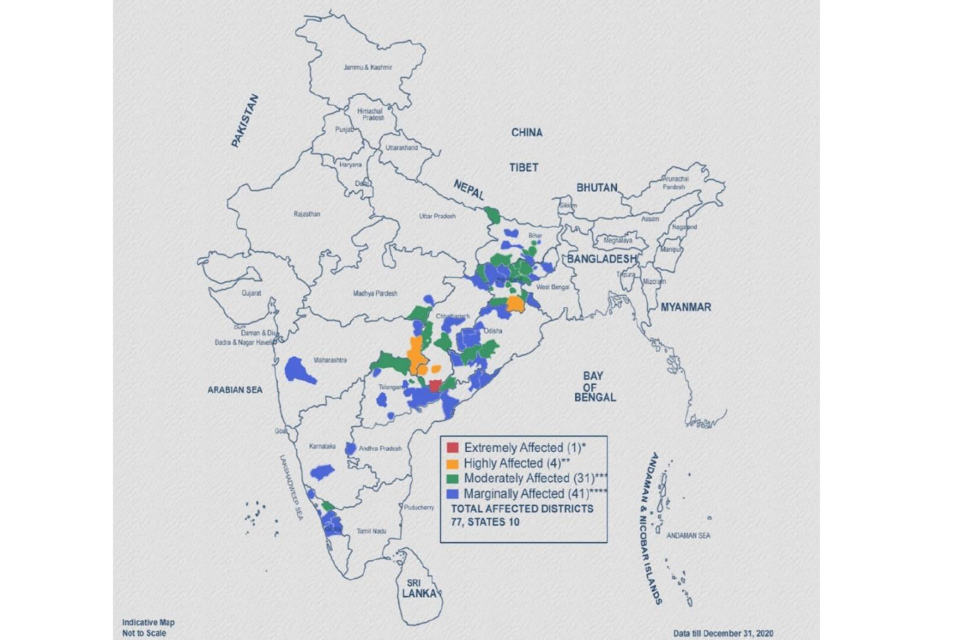
17.3.4 The Hindustan Times reported in January 2022: ‘… Abhujhmaad [Narayanpur district is] the firmest citadel of the Maoists, where they are safest from security forces, and where the top leadership of the party, its Central Committee lives, operates and recruits.’[footnote 137]
17.3.5 ACLED (Armed Conflict Location & Event Data Project) noted on 11 March 2023: ‘The [Naxal-Maoist insurgency] gained significant momentum with the establishment of the Communist Party of India-Maoist (CPI-Maoist) in 2004. At its peak, the insurgency was active in 40% of India’s land mass, with the “Red Corridor” spanning eastern, central, and southern India… However, in its current form, Naxal-Maoist activity has been limited to around a dozen states. In 2019 and 2020, ACLED data indicate[d] that 80% of all Naxal-Maoist activity was concentrated in just four states – Chhattisgarh, Jharkhand, Odisha, and Maharashtra.’[footnote 138]
17.4 Treatment of the CPI (Maoist)
17.4.1 According SATP, a total of 4,287 Maoist fighters, 2,656 security force members and 3,970 civilians lost their lives in this conflict between 6 March 2000 and 3 June 2023[footnote 139]. In 2022, 67 Maoist fighters,15 security force members and 53 civilians were killed. During 2022, 602 ‘terrorism-related incidents’ involving Maoists were recorded, down from a peak of 1,393 incidents/engagements in 2010[footnote 140] (See the full datasheet on the SATP website).
17.4.2 The Indian Express, in an article of 17 July 2022, reported:
‘A special court in Chhattisgarh [state] has acquitted all 121 accused arrested by the state police in connection with the 2017 Burkapal Maoist ambush in Sukma in which 25 CRPF men lost their life.
‘The NIA special court, which pronounced the judgement on Friday, said the prosecution could not prove that the accused, tribals who were behind bars for almost five years, were either on the spot of the incident, were in possession of any arms or explosives or were even members of the CPI(Maoist). “Thus it is clear that the prosecution has failed to prove its case against the accused beyond reasonable doubt,” the court of Justice Dipak Kumar Deshlahare said while acquitting all the accused.
‘The Burkapal ambush had occurred when a team of 70 soldiers of the CRPF’s 74th Battalion had gone to provide security cover for road building in Burkapal in Sukma on April 24, 2017. The CRPF contingent had been surrounded and attacked by a group of 150 CPI(Maoist) cadres.’[footnote 141]
17.4.3 Outlook (India) reported on 15 October 2022:
‘Former Delhi University Professor GN Saibaba was convicted in 2017 and was sentenced for life. The Supreme Court on Saturday suspended the Bombay High Court’s order releasing former Delhi University (DU) Professor GN Saibaba and others.… Saibaba and others were in 2017 convicted on terrorism and criminal conpsiracy [sic] charges under various sections of the Indian Penal Code (IPC) and Unlawful Activities (Prevention) Act — UAPA. They were found to have links with Maoists.’[footnote 142]
17.4.4 The South Asia Terrorism Portal (SATP) noted in its Maoist Insurgency:
Assessment- 2023
‘[Security Forces] arrested 395 Naxalites in 2022, in addition to 409 in 2021, according to partial data compiled by SATP. In the current year, as on April 6, 2023, 122 arrests had been recorded. Significantly, since March 6, 2000, a total of 15,993 [arrests have] been recorded.
‘The mounting pressure on Naxalites has yielded a large number of surrenders over the past few years. According to SATP, at least 2,855 Naxalites surrender[ed] through 2022, in addition to 533 in 2021. During the current year [2023], as of April 6, 2023, the number of surrenders was 97.
Since March 6, 2000, a total of 16,581 [left-wing extremists] have surrendered.’[footnote 143]
17.4.5 This SATP report did not specify how many of those who surrendered and/or were arrested were armed combatants, as against non-armed activists. However, a detailed summary of press reports for 2022[footnote 144] and 2023[footnote 145] compiled by SATP indicate that most of those arrested were armed fighters. CPIT could not find information on the treatment of suspects after their arrest or surrender in the sources consulted (see Bibliography).
17.4.6 Al Jazeera reported in January 2021:
‘The police in the Bastar region [in the state of Chhattisgarh in Central India] confirm that Naxalite cadres – or Naxalites, as members of the Maoist outfit are often called – can “surrender” to the authorities…
‘Bastar’s Inspector General Sundarraj Pattilingam told Al Jazeera: “Disenchanted local cadres have started to shun violence and have decided to join the national mainstream. Rehabilitation policy of the government provides economic assistance and other facilities for those surrendered Maoist cadres, who want to lead a normal, peaceful life. So far in the last five years, more than 2,458 Maoist cadres have surrendered.
‘“After observing the activities of these surrendered cadres for a reasonable time period, their criminal charges against them are withdrawn by adopting due legal procedures. A few of the surrendered cadres have joined the police and have immensely contributed to the anti-Naxalite operations being conducted against the left-wing extremists.”’[footnote 146]
17.4.7 The USSD HR Report 2022, noted:
‘The country’s armed forces, the security forces of individual states, and paramilitary forces engaged with terrorist groups in several northeastern states and Jammu and Kashmir, and with Maoist terrorists in the northern, central, and eastern parts of the country. The intensity of violence in these areas continued to decline. … The use of force by all involved resulted in deaths and injuries. There were reports that government security forces committed extrajudicial killings. According to human rights groups, police sometimes refused to release bodies. Authorities did not require the armed forces to report custodial deaths to the NHRC. There were few investigations and prosecutions of human rights violations or abuses arising from these situations.’[footnote 147]
17.4.8 ACLED in their report for April 2023, noted:
‘Clashes in India between Naxal-Maoist rebels and Indian security forces continued at elevated levels in April, following increased activity in March. On 26 April, Naxal-Maoist rebels targeted a police convoy with an IED in Chhattisgarh state, reportedly killing at least 10 security personnel. This was the deadliest attack on security forces in the “Red Corridor” in two years. Earlier in the month, security forces reportedly killed five high-ranking CPI (Maoist) cadres…’[footnote 148]
17.4.9 The Times of India reported on 28 April 2023:
‘The NIA [National Investigation Agency] special court in Guwahati [the capital city of Assam state] has convicted five persons in connection with a 12-year-old People’s Liberation Army (PLA)-Maoist nexus case related to “a criminal conspiracy to threaten the unity, integrity, security and sovereignty of India”. The court on Wednesday sentenced them to eight years in prison. Three of the convicted belonged to the PLA and two to the Communist Party of India (Maoist).’[footnote 149]
17.4.10 The South Asia Intelligence Review (SAIR) of the South Asia Terrorism Portal (SATP), reported on 2 October 2023:
‘On September 20, 2023, two women Maoists, Kumari Lakkhe and Mangli Padami, jointly carrying a reward of INR 700,000, were killed in an encounter with a joint team of Security Forces [SFs], including District Reserve Guards (DRG), carrying out an anti-Maoist operation in the forests of Aranpur in Dantewada District. The bodies of the two women, along with an INSAS (Indian Small Arms System) assault rifle, a 12-bore gun, a tiffin bomb, Improvised Explosive Device (IED) wires, ammunition, documents, and items of daily use were recovered from the incident site. Lakkhe was the “militia commander-in-chief” of the ‘Malangir Area Committee’ and carried an INR 500,000 [£5000[footnote 150]] cash reward on her head, while Padami, who carried an INR 200,000 cash reward, was an active as a member of ‘Platoon 24’…
‘On September 2, 2023, four lower-rung CPI-Maoist cadres – Rava Muka (25), Muka Kalmu (23), Hidma Rava (32), and Madvi Bheema (30) – were arrested by SFs during a search operation in a forest near Gonderas village under Aranpur Police Station limits in Dantewada District. The arrested Maoists were reportedly involved in an encounter between the SFs and the Maoists on the intervening nights of February 19 and 20, 2022, in the Aranpur area of Dantewada District, which resulted in the killing of one Maoist, Arjun alias Lakhma Sodi (34), carrying a reward of INR 500,000 on his head. While Sodi was killed, other Maoists escaped into the dense forest area.’[footnote 151] (See The Unlawful Activities (Prevention) Act, 1967)
Section updated: 9 October 2023
18. Liberation Tigers of Tamil Eelam (LTTE)
18.1 Overview
18.1.1 Encyclopaedia Britannica, in its article on the LTTE, dated 27 April 2023, described the Liberation Tigers of Tamil Eelam (LTTE) as a ‘guerrilla organization that sought to establish an independent Tamil state, Eelam, in northern and eastern Sri Lanka.’[footnote 152] The LTTE is a proscribed terrorist organisation under The Unlawful Activities (Prevention) Act, 1967[footnote 153]. The ban was extended in May 2019 until 2024[footnote 154].
18.2 Sympathisers, members, or people with suspected links to the LTTE in India
18.2.1 On 14 May 2019, The Times of India, reported:
‘The separatist Tamil chauvinist groups and pro-LTTE groups continue to foster a separatist tendency amongst the masses and enhance the support base for LTTE in India and particularly in Tamil Nadu, [the Indian government] said. It will ultimately have a strong disintegrating influence over the territorial integrity of India, hence, the strong need continues to exist to control all such separatist activities by all possible lawful means, the notification said.
‘The Home Ministry said that the cases were registered under the Unlawful Activities (Prevention) Act 1967, against LTTE, pro-LTTE elements and chauvinist groups between May 2014 and May 2019 besides cases under the provisions of Explosive Substances Act 1908 and Indian Penal Code, etc.’[footnote 155]
18.2.2 In September 2021, Al Jazeera reported:
‘Sri Lankan Tamil refugees have been coming to India since the late 1980s… Among the refugees were [Sri Lankan] former members of the LTTE,… The ex-LTTE members were kept in special camps, two of which have been closed, leaving only the overcrowded Tiruchirappalli camp for all the detained former rebels, who share the space with other Tamil refugees. These camps are supervised by the Q Branch, an anti-terror wing of the Tamil Nadu police. The detainees say they are living under constant threat of deportation to Sri Lanka and face an uncertain future…
‘Former Tamil rebels deported to Sri Lanka have been known to disappear under suspicious circumstances. Rights groups, including Amnesty International and Human Rights Watch, have accused the island nation’s government of the abduction, torture and extrajudicial killing of vocal members of the Tamil minority.’[footnote 156]
18.2.3 The Federal, an Indian digital news platform, reported on 30 December 2022:
‘Over 13 years after the Liberation Tigers of Tamil Eelam (LTTE) was disbanded by the Sri Lankan government, it is believed to be making attempts to revive itself by generating funds through drugs and arms supplies in South India, the National Investigation Agency (NIA) has said.
‘LTTE, the terror group which has been extinct in Tamil Nadu and South India for decades, is reportedly involved in drug peddling in cahoots with Pakistan’s Inter-Services Intelligence. The latter is supposedly helping to revive the LTTE, the NIA said, days after it arrested 9 Sri Lankan nationals from the special camp for Tamil refugees at Tiruchirappalli for their alleged involvement in the smuggling of drugs and arms.
‘Revealing its investigations, the NIA said that the case pertains to the activities of a Sri Lankan drug mafia controlled by C Gunashekharan alias Guna and Pushparajah alias Pookutti Kanna, the Sri Lankan nationals based in Chennai, in association with Haji Salim, a drug and arms supplier based in Pakistan. Haji Salim has been operating in India and Sri Lanka in illegal drugs and arms for the revival of LTTE in India and Sri Lanka, it alleged.
Sources said it is known that Pakistan’s ISI [Inter-Services Intelligence] has been planning to strengthen terrorism in South India…
‘The NIA said the LTTE is trying to evolve in Sri Lanka and Southern states, mainly Tamil Nadu. According to sources, the accused who was arrested in Bengaluru, revealed that there are thousands of LTTE sympathisers and followers in the Tamil Nadu coast and Sri Lanka. But, after it was destroyed and its leader V Prabhakaran and the team were killed in military operations by the Sri Lankan government in 2009, they wanted new leadership.’[footnote 157]
(See The Unlawful Activities (Prevention) Act, 1967)
Section updated: 9 October 2023
19. Non-governmental organisations
19.1 Popular Front of India (PFI)
19.1.1 On 28 September 2022, the BBC reported: ‘Formed in 2006, the PFI describes itself “as a non-governmental social organisation whose stated objective is to work for the poor and disadvantaged people in the country and to oppose oppression and exploitation”. … At present, the PFI, which has a strong presence in Kerala and Karnataka, is active in more than 20 Indian states and says its cadre strength is in the “hundreds of thousands”.’[footnote 158]
19.1.2 In its World Human Rights report covering the human rights situation in India in 2022, Amnesty International noted that:
‘On 27 and 28 September, mass raids were carried out against the NGO Popular Front of India (PFI) and its affiliates across India. More than 300 of PFI’s senior leaders and members were arrested. Subsequently, the Ministry of Home Affairs declared PFI to be an “unlawful association” under the Unlawful (Activities) Prevention Act (UAPA), a counterterrorism law, for its alleged involvement in the “funding of terrorism and terrorist activities”, despite there being no charges brought against those arrested and no trials conducted.’[footnote 159]
19.1.3 The BBC article of 28 September 2022 further added:
‘The Indian government has banned the Popular Front of India (PFI) - a controversial Muslim group - for five years for allegedly having links with terror groups. The ban, announced on Wednesday morning, comes amid a crackdown on the organisation - over the past week, authorities have twice raided its offices across several states and arrested many of its leaders. The PFI, which denies the allegations against it, has held nationwide protests against the raids in recent days.
‘The government says it has banned the PFI and its associate groups for allegedly undertaking “unlawful activities” which are “prejudicial to the integrity, sovereignty and security of the country”. It has cited the group’s alleged links with banned Islamist groups - the Students Islamic Movement of India (Simi) and the Jamat-ul-Mujahideen Bangladesh (JMB) - as well as the Islamic State of Iraq and Syria (ISIS).’[footnote 160]
19.1.4 The Government of India Ministry of Home Affairs, reported on 28 September 2022:
‘The Popular Front of India (PFI) and its associates or affiliates or fronts have been found to be involved in serious offences, including terrorism and its financing, targeted gruesome killings, disregarding the constitutional set up of the country, disturbing public order etc. which are prejudicial to the integrity, security and sovereignty of the country.
‘Therefore, the Ministry of Home Affairs found it necessary to curb the nefarious activities of the organization and has hence declared the Popular Front of India (PFI) along with its associates or affiliates or fronts including Rehab India Foundation (RIF), Campus Front of India (CFI), All India Imams Council (AIIC), National Confederation of Human Rights Organization (NCHRO), National Women’s Front, Junior Front, Empower India Foundation and Rehab Foundation, Kerala as an “unlawful association” under the provisions of the Unlawful Activities (Prevention) Act, 1967.’[footnote 161]
Section updated: 9 October 2023
20. Freedom of expression and assembly
20.1.1 DFAT, in its Country Information Report India, 10 December 2020, noted:
‘India’s constitution provides for freedom of speech and expression, freedom of assembly, and the right to form associations (Articles 19-22). The Government of India can impose reasonable restrictions to these freedoms in the interests of sovereignty and integrity of India, national security and public order, and to maintain decency and morality. India has laws on sedition and criminal defamation, and laws regulating the use of the internet.’[footnote 162]
20.1.2 Freedom House (FH), in its report - Freedom in the World 2023, noted:
‘Political parties are generally able to form without interference, and a wide variety of parties representing a range of views and interests compete in practice. However, the ruling BJP has used various tools to limit campaigning by opposition parties.
‘The opaque financing of political parties is a serious source of concern. A system of electoral bonds, introduced in 2017, allows donor identities to be known to the State Bank of India but obscured from the public. It has contributed to major fundraising advantages for the BJP. In addition, the government, through the Central Bureau of Investigation (CBI), has selectively pursued anticorruption investigations against opposition politicians while overlooking allegations against political allies. In September 2022, the Indian Express reported that the CBI investigated opposition politicians since the BJP came to power far more often, while fewer members of the ruling party were targeted.’[footnote 163]
20.1.3 FH further opined:
‘While India is a multiparty democracy, the government led by Prime Minister Narendra Modi and the Hindu nationalist Bharatiya Janata Party (BJP) has presided over discriminatory policies and a rise in persecution affecting the Muslim population. The constitution guarantees civil liberties including freedom of expression and freedom of religion, but harassment of journalists, nongovernmental organizations (NGOs), and other government critics has increased significantly under Modi. The BJP has increasingly used government institutions to target political opponents.’[footnote 164]
20.1.4 USSD HR Report 2022
‘Individuals routinely criticized the government publicly and privately via online platforms, television, radio, or in print media. The government generally respected freedom of expression, but there were instances in which the government or actors considered close to the government allegedly pressured or harassed media outlets critical of the government, including through online trolling. There were also reports of terrorists and extremists perpetrating killings, violence, and intimidation against journalists critical of the government.’[footnote 165]
20.1.5 Amnesty International (AI), in its annual report covering events in 2022, noted: ‘On 14 July the lower house of parliament banned a number of ordinary words from being spoken during parliamentary debates including, among others, “corrupt”, “sexual harassment”, “criminal”, “eyewash”, “incompetent” and “hypocrisy”. The ban was an attempt to police the speeches of opposition members of parliament.’[footnote 166]
20.1.6 The USSD HR Report 2022 further stated:
‘There were government restrictions on access to the internet, disruptions of access to the internet, and censorship of online content, and there were reports the government occasionally monitored users of digital media such as chat rooms and person-to-person communications. The law permits the government to block internet sites and content and criminalizes sending messages the government deems inflammatory or offensive. Both central and state governments have the power to issue directives for blocking, intercepting, monitoring, or decrypting computer information. Court rulings and laws specify conditions and procedures that must attend suspension of internet access. Some civil society organizations asserted that authorities did not consistently meet these requirements.
‘The government repeatedly imposed temporary internet shutdowns and blocked telecommunications, including the internet in certain regions, particularly during periods of political unrest. For example, on June 28, the Rajasthan government suspended mobile internet service across the state due to tensions between religious communities following the killing of a Hindu tailor in Udaipur.’[footnote 167]
20.1.7 The IRB response of 3 June 2020 noted: ‘In correspondence with the Research Directorate, a representative of the Centre for Public Affairs (CPA), a Noida-based research centre on public policies, indicated that any party that accepts the Indian constitution and the unity of the country “has full rights to organize rallies, conferences, meetings and seminars to express its views and political opinions, howsoever critical it is of the government and of the ruling party.”’[footnote 168]
20.1.8 The USSD HR Report 2022 stated:
‘Authorities often required permits and notification before parades or demonstrations, and local governments generally respected the right to peacefully assemble and express opinions. Jammu and Kashmir was an exception, where the state government sometimes denied permits to separatist political parties for public gatherings, and security forces reportedly detained and assaulted members of political groups engaged in peaceful protest. During periods of civil unrest in Jammu and Kashmir, authorities used the law to ban public assemblies and impose curfews.’[footnote 169]
20.1.9 Freedom House reported: ‘While peaceful demonstrations regularly take place, the national government and some state governments are known to employ assembly bans, internet disruptions, and force to quell protests, while protesters have faced harsh treatment and have been denied access to legal counsel.’[footnote 170]
Section updated: 6 September 2023
21. Freedom of association
21.1.1 The USSD HR Report 2022, noted:
‘The constitution provides citizens the ability to choose their government in free and fair periodic elections held by secret ballot and based on universal and equal suffrage… There are no restrictions placed on the formation of political parties or on individuals of any community from participating in the election process. The election law bans the use of government resources for political campaigning, and the Election Commission effectively enforced the law.’[footnote 171]
21.1.2 Freedom House (FH), in its report - Freedom in the World 2023 – India, noted: ‘Political parties are generally able to form without interference, and a wide variety of parties representing a range of views and interests compete in practice. However, the ruling BJP has used various tools to limit campaigning by opposition parties.’[footnote 172]
Research methodology
The country of origin information (COI) in this note has been carefully selected in accordance with the general principles of COI research as set out in the Common EU [European Union] Guidelines for Processing Country of Origin Information (COI), April 2008, and the Austrian Centre for Country of Origin and Asylum Research and Documentation’s (ACCORD), Researching Country Origin Information – Training Manual, 2013. Namely, taking into account the COI’s relevance, reliability, accuracy, balance, currency, transparency and traceability.
All the COI included in the note was published or made publicly available on or before the ‘cut-off’ date(s). Any event taking place or report/article published after these date(s) is not included.
Sources and the information they provide are carefully considered before inclusion. Factors relevant to the assessment of the reliability of sources and information include:
- the motivation, purpose, knowledge and experience of the source
- how the information was obtained, including specific methodologies used
- the currency and detail of information
- whether the COI is consistent with and/or corroborated by other sources
Wherever possible, multiple sourcing is used and the COI compared and contrasted to ensure that it is accurate and balanced, and provides a comprehensive and up-to-date picture of the issues relevant to this note at the time of publication.
The inclusion of a source is not, however, an endorsement of it or any view(s) expressed.
Each piece of information is referenced in a footnote.
Full details of all sources cited and consulted in compiling the note are listed alphabetically in the bibliography.
Terms of Reference
A ‘Terms of Reference’ (ToR) is a broad outline of the issues relevant to the scope of this note and forms the basis for the country information.
The Home Office uses some standardised ToR, depending on the subject, and these are then adapted depending on the country concerned.
For this particular CPIN, the following topics were identified prior to drafting as relevant and on which research was undertaken:
- Map of states and union territories
- Political system
- Overview
- Constitution
- Laws regulating terrorist (militant political activities) activities
- The Unlawful Activities (Prevention) Act, 1967
- Parliamentary elections
- General elections
- Participation
- Political parties
- Bharatiya Janata Party (BJP)
- Main opposition parties
- Indian National Congress (Congress party)
- Dravida Munnetra Kazhagam (DKM)
- All India Trinamool Congress (AITC or TMC)
- Yuvajana Sramika Rythu Congress Party (YSR)
- Political opponents
- Politically motivated violence
- Harassment, arrest and detentions
- Sikh separatism
- Overview
- The Khalistan movement and its ideology
- Proscription
- Pro-Khalistan militant/extremist groups
- Babbar Khalsa International (BKI)
- Khalistan Commando Force (KCF)
- Khalistan Zindabad Force (KZF)
- International Sikh Youth Federation (ISYF)
- Other militant groups
- Support for the Khalistan movement
- Treatment of suspected Sikh separatists
- Maoist Left Wing Extremist (LWE) groups
- Maoist parties and groups
- Communist Party of India (Maoist)
- Areas with active Maoist rebels
- Treatment of the CPI (Maoist)
- Liberation Tigers of Tamil Eelam (LTTE) and affiliated groups
- Overview
- Sympathisers, members, or people with suspected links to the LTTE in India
- Non-governmental organisations
- Popular Front of India (PFI)
- Freedom of expression and assembly
- Freedom of association
Bibliography
Sources cited
Amnesty International (AI),
‘Amnesty International Report 2022/23; The State of the World’s Human Rights; India 2022’, 28 March 2023. Last accessed:25 September 2023
‘India: Opposition politician Jignesh Mevani re-arrested amid ‘escalating crackdown’, 25 April 2022. Last accessed: 26 September 2023
Armed Conflict Location & Event Data Project (ACLED):
‘Naxal-Maoist Insurgency Trends in India During the Coronavirus Pandemic’, 11 March 2013. Last accessed: 13 June 2023
‘Regional Overview Asia-Pacific’, April 2023. Last accessed: 13 June 2023
Adda247, ‘Khalistan Movement: An Exploration of Its Origins’, 23 March 2023. Last accessed: 26 May 2023
Al Jazeera,
‘India’s Maoist rebels: An explainer’, 26 April 2017. Last accessed: 13 June 2017
‘India’s Supreme Court suspends Rahul Gandhi’s defamation conviction’, 4 August 2023
‘‘INDIA’: What you need to know about India’s opposition alliance’, 26 July 2023. Last accessed: 17 August 2023
‘Living in the shadow of rebellion: India’s Gond tribe’, 21 January 2021. Last accessed: 15 June 2023
‘Who was Hardeep Singh Nijjar whose killing triggered India-Canada tensions?’ 19 September 2023. Last accessed: 26 September 2023
‘Why Sri Lankan Tamil refugees in India attempted mass suicide’, 21 September 2021. Last accessed: 2 June 2023
Australian Government Department of Foreign Affairs and Trade, ‘DFAT Country Information Report India’, 10 December 2020. Last accessed: 2 June 2023
Baaz, ‘Balpreet Singh: Sikhs Denounce India’s Draconian Operation Against Amritpal Singh’, 18 March 2023. Last accessed: 26 May 2023
Baaz, @BaazNewsOrg, ‘Internet freedom NGO’, 22 March 2023. Last accessed: 16 August 2023
BBC News,
‘Amritpal Singh: Sikh separatist arrested after weeks on the run’, 23 April 2023. Last accessed: 26 May 2023
‘Is India seeing a decline in violence?’, 16 January 2023. Last accessed: 12 June 2023
‘Lok Sabha: India general election results 2019’, 23 May 2019
‘PFI ban: What is Popular Front of India and why has India outlawed it?’, 28 September 2022. Last accessed: 9 October 2023
Bertelsmann Stiftung, ‘BTI 2022 Country Report – India’, 2022. Last accessed: 5 June 2023
Carnegie Endowment for International Peace (CEIP),
‘Political Violence in South Asia: The Triumph of the State?’, 3 September 2020. Last accessed: 12 June 2023
‘The Politics of Opposition in South Asia’, 2023. Last accessed: 5 June 2023 ‘The Story Of The Carnegie Endowment For International Peace’, no date. Last accessed: 5 June 2023
Central Intelligence Agency (CIA), ‘World Factbook – India’, 13 June 2023. Last accessed: 3 August 2023
Chatham House, ‘Democracy in India’, 7 April 2022. Last accessed: 5 June 2023
Citizens for Justice and Peace (CJP), ‘Situation for Christians in India deteriorating as attacks by Hindutva groups increase’, 6 April 2023. Last accessed: 6 June 2023
CNN, ‘Khalistan: The outlawed Sikh separatist movement that has Indian authorities on edge’, 22 March 2023. Last accessed: 26 May 2023
Coda Media, ‘India reopens its Khalistan wounds’, 24 April 2023. Last accessed: 26 May 2023
Communist Party of India (Marxist), Home page, no date. Last accessed: 13 June 2023
Communist Party of India (Marxist-Leninist) Liberation, Home page, no date. Last accessed: 13 June 2023
Congressional Research Service (CRS),
‘India’s Domestic Political Setting’, 1 June 2023. Last accessed: 9 August 2023
‘India’s 2022 State Elections: A Preview’, 21 February 2022. Last accessed: 5 June 2023
The Conversation, ‘Is a Sikh separatist movement seeing a resurgence four decades after sparking terror in India?’, 11 May 2023. Last accessed: 26 May 2023
Deccan Herald, ‘Badal, other Akali leaders briefly detained during protest over Centre’s BSF jurisdiction order’, 14 October 2021. Last accessed: 14 August 2023
Deutsche Welle, ‘India: Can the new opposition alliance oust Modi in 2024?’, 24 July 2023. Last accessed: 17 August 2023
D’Souza, Shanthie Mariet, Encyclopaedia Britannica ‘Dravidian Progressive Federation: political party, India’, 30 June 2023. Last accessed: 9 August 2023
The Economic Times,
‘India now has 2,293 political parties, 149 registered between February & March’, 17 March 2019. Last accessed: 23 May 2023
‘Khalistan Commando Force chief Paramjit Singh Panjwar killed in Lahore: Sources’, 6 May 2023. Last accessed: 1 June 2023
‘Khalistan Commando Force militant and associate of Bhinderwale arrested: Delhi Police’, 14 March 2019. Last accessed: 2 June 2023
The Editors of Encyclopaedia, Encyclopaedia Britannica,
‘Bharatiya Janata Party: political party, India’, 8 August 2023. Last accessed: 9 August 2023
‘”Indian National Congress”’, 7 August 2023. Last accessed: 9 August 2023
‘Khalistan: Sikh political ideology’, 23 April 2023. Last accessed: 9 August 2023
‘Tamil Tigers: revolutionary organization, Sri Lanka’, 20 June 2023. Last accessed: 9 August 2023
Election Commission of India, ‘Political Parties and Election Symbols’, 16 July 2019. Last accessed: 8 November 2023
Election Guide, ‘Republic of India: Election for Lok Sabha (Indian People’s Assembly)’, 11 April 2019. Last accessed: 15 August 2023
Elections.in, ‘Dravida Munnetra Kazhagam (DMK)’, 20 July 2021. Last accessed: 18 August 2023
The Federal, ‘Is ISI helping LTTE to make a comeback in South India? NIA thinks so’, 30 December 2022. Last accessed: 2 June 2023
First Post, ‘Simranjit Singh Mann stokes row, dedicates Sangrur win to Jarnail Singh Bhindranwale: Know about pro-Khalistan leader’, 27 June 2023. Last accessed: 17 August 2023
Foreign Policy (FP), ‘Modi’s Party Deals Its Main Opposition a Final Blow’, 7 April 2023. Last accessed: 8 June 2023
Freedom House (FH), ‘Freedom in the World 2023 – India’, 2023. Last accessed: 23 May 2023
Government of India (GoI), Ministry of Home Affairs (MoHA), ‘Unlawful Activities (Prevention) Act, 1967’, as amended. Last accessed: 18 August 2023
Government of India (GoI), Ministry of Law and Justice (MoLJ), ‘The Constitution Of India: As on May 2022’, 2022. Last accessed: 5 June 2023
Government of India (GoI), National Crime Records Bureau (NCRB), ‘Crime in India 2020’, no date. Last accessed: 16 August 2023 ‘Crime in India 2021’, no date. Last accessed: 16 August 2023
The Guardian,
‘How Hindu supremacists are tearing India apart’, 20 February 2020. Last accessed: 6 June 2023
‘Indian police arrest Sikh separatist preacher Amritpal Singh after weeks on run’, 23 April 2023. Last accessed: 26 May 2023
‘India’s supreme court suspends Rahul Gandhi’s two-year defamation jail term’, 4 August 2023. Last accessed: 26 September 2023
‘Rahul Gandhi could face jail and loss of seat after Indian court rejects plea’, 20 April 2023. Last accessed: 8 June 2023
‘What is Hindu nationalism and how does it relate to trouble in Leicester?’, 20 September 2022. Last accessed: 2 June 2022
The Hindustan Times,
‘In Bastar, a fear that school shutdowns help Maoist recruitment’, 21 January 2022. Last accessed: 16 August 2023
‘Sangrur Bypoll Results Highlights: SAD-A wins by 5,822 votes’, 26 June 2022. Last accessed: 17 August 2023
HindutvaWatch @HindutvaWatchIn
‘Location: Indore, Madhya Pradesh’, 1 April 2023. Last accessed: 16 August 2023
‘Location: Ghazipur, Uttar Pradesh’, 3 April 2023. Last accessed: 16 August 2023
‘Location: Raibareli, Uttar Pradesh’, 3 April 2023. Last accessed: 16 August 2023
Immigration and Refugee Board (IRB) of Canada: India: The Shiromani Akali Dal (Amritsar) (SAD(A)), including origin, structure, leadership, objectives, and activities; treatment of party members and supporters by authorities (2017–June 2020)’, 3 June 2020. Last accessed: 19 June 2023
Indian American Muslim Council (IAMC),
‘Hindu extremists lynch Dalit man, spark anti-Muslim violence in Maharashtra’, 17 May 2023. Last accessed: 6 June 2023
‘Hindu Extremist outfit Bajrang Dal assault opposition party politicians’, 4 May 2023. Last accessed: 5 June 2023
‘Indian Americans condemn Hindu extremist violence against Muslims across India during the holy month of Ramadan’, 19 April 2022. Last accessed: 5 June 2023
The Indian Express,
‘121 tribals, arrested for 2017 Maoist ambush in Chhattisgarh, acquitted after five years in jail’, 17 July 2022. Last accessed: 15 June 2023
‘Wanted in India, Khalistan Commando Force chief Panjwar shot dead in Lahore’, 7 May 2023. Last accessed: 1 June 0223
India Today,
India Today, ‘Manish Sisodia’s arrest, CBI remand, bail plea, resignation: Story so far’, 1 March 2023. Last accessed: 26 September 2023
‘What happened during 1984 Operation Blue Star?’, 6 June 2018. Last accessed: 26 May 2023
Institute of Peace and Conflict Studies (IPCS), ‘The CPI-Maoist under Basavaraj’s Leadership’, 15 July 2019. Last accessed: 13 June 2023
Khalistan Extremist Monitor (KEM),
‘Babbar Khalsa International (BKI)’, no date. Last accessed: 31 May 2023 ‘International Sikh Youth Federation (ISYF)’, no date. Last accessed: 2 June 2023
‘Khalistan Commando Force (KCF)’, no date. Last accessed: 1 June 2023
Kumar A, and other, Observer Research Foundation (ORF), ‘Understanding the Unique Nature of Political Violence in Bengal’, 28 March 2022. Last accessed: 8 June 2023
The Mackenzie Institute, ‘International Sikh Youth Federation (ISYF)’, 7 January 2016. Last accessed: 2 June 2023
Maps of India,
‘India General (Lok Sabha) Election Results Update 2019’, no date. Last accessed: 19 June 2023
‘India Map’, 2020. Last accessed: 19 June 2023
Mint,
‘As TMC loses national party status, here’s what it stands to lose’, 11 April 2023. Last accessed: 25 May 2023
‘Pakistan reluctant to give visa to KCF chief’s sons, calls the murder ‘routine killing of a Sikh’’, 7 May 2023. Last accessed: 1 June 2023
The National, ‘’Major breakthrough’ in Jagtar Singh Johal case after court ruling’, 8 August 2023. Last accessed: 26 September 2023
National Public Radio (NPR),
‘Modi’s Hindu nationalist party loses India’s Karnataka state ahead of national vote’, 13 May 2023. Last accessed: 24 May 2023
‘The Powerful Group Shaping The Rise Of Hindu Nationalism In India’, 3 May 2019. Last accessed: 6 June 2023
Newsroom Post, ‘Explained: Is the Khalistani movement reviving in Punjab?’, 5 June 2022. Last accessed: 8 June 2023
Outlook (India),
‘Delhi: Police Complaint Against 26 Opposition Parties For ‘Improper Use’ Of Name ‘INDIA’, 19 July 2023. Last accessed: 26 September 2023
‘Explained: Who Is GN Saibaba, What’s The Maoist-Links Case He Is In Jail For?’, 15 October 2022. Last accessed: 15 June 2023
‘Khalistan Movement Has Little Traction In Punjab But Kept Alive Abroad’, 13 April 2023. Last accessed: 26 May 2023
The Print,
‘Pak-based International Sikh Youth Federation terrorist Lakhbir Singh Rode planned 2021 Ludhiana court blast: NIA chargesheet’, 8 January 2023. Last accessed: 2 June 2023
‘72 years of ABVP, student body where Amit Shah, Nadda, Rajnath began their political careers’, 9 July 2020. Last accessed: 5 June 2023
Reuters, ‘Indian court orders Rahul Gandhi to two years in jail for Modi comment’, 23 March 2023. Last accessed: 8 June 2023
South Asia Terrorist Portal (SATP),
‘Babbar Khalsa International (BKI)’, no date. Last accessed: 31 May 2023
‘Datasheet - Maoist Insurgency’, updated 3 June 2023. Last accessed: 13 June 2023
‘India - Terrorist, insurgent and extremist groups’, no date. Last accessed: 16 August 2023
‘International Sikh Youth Federation (ISYF)’, no date. Last accessed: 1 June 2023
‘Khalistan Zindabad Force (KZF)’, no date. Last accessed: 1 June 2023
‘Maoist Insurgency: Assessment- 2023’, April 2023. Last accessed: 13 June 2023
‘Maoist Insurgency: Conflict Map’, 2020. Last accessed: 16 August 2023
‘Maoist insurgency: Terrorist, insurgent and extremist groups’, no date. Last accessed: 13 June 2023
‘Maoist Insurgency: Timeline (Terrorist Activities) -2022, 31 December 2022. Last accessed: 13 June 2023
‘Maoist Insurgency: Timeline (Terrorist Activities) -2023’, 10 June 2023. Last accessed: 13 June 2023
‘Number of Terrorism Related Incidents Year Wise’, updated 3 June 2023. Last accessed: 13 June 2023
‘Punjab: Assessment- 2023’, no date. Last accessed: 31 May 2023
‘Strategy and Tactics of the Indian Revolution’, 21 September 2004. Last accessed: 13 June 2023
South Asia Intelligence Review (SAIR) of the South Asia Terrorism Portal (SATP), ‘Dantewada: The Remains of Rebellion’, 2 October 2023. Last accessed:9 October 2023
The Spiritual Life, ‘Khalistan Movement’, no date. Last accessed: 1 June 2023 Swarajya,
‘Understanding the Maoist Challenge in India (Part 1)’, 16 October 2015. Last accessed: 13 June 2023
‘Understanding The Maoist Challenge in India (Part 2)’, 27 October 2015. Last accessed: 13 June 2023
Times of India,
‘Countering attempts to revive militancy in Punjab’, 19 March 2023. Last accessed: 8 June 2023
‘Govt extends ban on LTTE for five more years: Home ministry’, 14 May 2019. Last accessed: 2 June 2023
‘Three Sikh youths get life term for waging war against the state’, 7 February 2019. Last accessed: 2 June 2023
‘Trinamool Congress’, no date. Last accessed: 25 May 2023
‘Mamata Banerjee’, no date. Last accessed: 25 May 2023
‘NIA court convicts five in PLA-Maoist nexus case’, 28 April; 2023. Last accessed: 15 June 2023
United Nations Human Rights Council (UNHRC), ‘Summary of Stakeholders’ submissions on India: Report of the Office of the United Nations High Commissioner for Human Rights’, 22 July 2022. Last accessed: 16 August 2023
US State Department, ‘2022 Country Report on Human Rights Practices: India’ (USSD HR Report 2022), 20 March 2023. Last accessed: 2 June 2023
Voice Of America (VoA),
‘India Arrests Prominent Rights Activist, Triggering Outrage’, 27 June 2022
‘Search in India for Separatist Demanding Sikh Independence’, 23 March 2023. Last accessed: 26 May 2023
The Washington Post, ‘India sees signs of renewed Sikh separatism and sounds the alarm’, 16 April 2023. Last accessed: 26 May 2023
The Wire, ‘Despite the Loss of National Party Status, TMC Is Unwilling to Let Go of its Expansion Dream’, 13 April 2023. Last accessed: 6 June 2023
YSR Congress Party, ‘Why YSR Congress?’, no date. Last accessed: 6 June 2023 Xe.com,
‘100,000 INR to GBP - Convert Indian Rupees to British Pounds’. Last accessed: 14 August 2023
‘500,000 INR to GBP - Convert Indian Rupees to British Pounds’. Last accessed: 9 October 2023
Sources consulted but not cited
Al Jazeera,
‘Amritpal Singh: Who is he and why was he arrested?’, 23 April 2023. Last accessed: 8 June 2023
‘What is India’s Muslim group PFI?’, 29 September 2022. Last accessed: 9 October 2023
BBC News, ‘Why women join India’s Maoist groups’, 20 November 2013. Last accessed: 13 June 2023
The Conversation, ‘Who are the Sikhs and what are their beliefs?’, 9 August 2018. Last accessed: 25 May 2023
Deutsche Welle (DW),
‘India: ‘Internet shutdown capital of the world’’, 15 March 2023. Last accessed: 26 May 2023
‘Sri Lanka Tamils fleeing to India to escape economic crisis’, 24 May 2022. Last accessed: 2 June 2023
The Economic Times, ‘Government bans pro-Khalistani group Sikhs for Justice for anti-national activities’, 10 July 2019. Last accessed: 8 June 2023
Encyclopaedia Britannica, ‘”Dravidian Progressive Federation”’, 7 April 2023. Last accessed: 19 June 2023
The Federal, ‘Why the BJP juggernaut is not on a roll in Punjab’, 28 March 2022. Last accessed: 19 June 2023
Foreign Policy (FP), ‘Conspiracy Theories Swirl Around Sikh Separatist Amritpal Singh Sandhu’, 1 May 2023. Last accessed: 1 June 2023
The Guardian, ‘India’s Congress party defeats Narendra Modi’s BJP in Karnataka state elections’, 13 May 2023. Last accessed: 24 May 2023
The Hindustan Times, ‘The rise of ABVP and why it attracts the youth’, 9 March 2017. Last accessed: 18 August 2023
Human Rights Watch (HRW), ‘India: Government Policies, Actions Target Minorities’, 19 February 2021. Last accessed: 18 August 2023
The Indian Express,
‘BJP now has 11 million followers on Twitter, almost twice as many as Congress’’, 8 June 2023. Last accessed: 8 June 2023
‘LTTE ban extended for another five years: MHA’, 14 May 2019. Last accessed: 16 August 2023
‘Punjab: Sukhbir Badal detained amid protest outside CM Amarinder Singh’s residence’, 15 June 2021. Last accessed: 14 August 2023
The Law Library of Congress, ‘India: Feasibility of Relocation of Sikhs and Members of the Shiromani Akali Dal (Mann) Party’, June 2018. Last accessed: 19 June 2023
Mukhopadhyay, J., and other, Springer, New Delhi, ‘Miseries of the Red Corridor Region of India: What Do the Data Tell Us?’ (Abstract), 1 January 2015. Last accessed: 13 June 2023
New Delhi Television (NDTV), ‘Two Maoists, Who Killed 6 Policemen, Given Death Sentence In Jharkhand’, 27 September 2018. Last accessed: 15 June 2023
Observer Research Foundation (ORF), ‘A Catch-22: The ban on the Popular Front of India’, 2 January 2023. Last accessed: 9 October 2023
Oxford Reference, ‘Dravida Munnetra Kazhagam’, 2019. Last accessed: 18 August 2023
The Print, ‘Membership puzzle for Modi: 7 cr ‘new BJP members’ enrolled but not many voting in elections’, 12 December 2022. Last accessed: 19 June 2023
Reuters, ‘After Gandhi’s conviction, signs of India’s opposition uniting against Modi’, 30 March 2023. Last accessed: 19 June 2023
SikhPressAssociation, @SikhPA, ‘Khalistan’, 22 October 2021. Last accessed: 16 August 2023
Scroll.in, ‘Punished without trial: How India’s political prisoners are being denied basic rights in jail’, 9 August 2022. Last accessed: 21 September 2023. Last accessed: 9 October 2023
Times Now, ‘Pak-based Khalistani terrorist Lakhbir Singh Rode planned 2021 Ludhiana court blast’, 8 January 2023
The Tribune, ‘Pak-based Lakhbir Singh Rode booked under UAPA’, Arms Act, 12 April 2022. Last accessed: 2 June 2023
UK House of Commons Library, ‘The imprisonment of Jagtar Singh Johal’, 18 January 2023. Last accessed: 21 September 2023
Voice Of America (VoA), ‘Sikh Separatist Leader Arrested in India After Weeks on the Run’, 23 April 2023. Last accessed: 26 May 2023
The Washington Post, ‘Opinion India’s crackdown at college campuses is a threat to democracy’, 21 June 2017. Last accessed: 19 June 2023
Version control and feedback
Clearance
Below is information on when this note was cleared:
- version 1.0
- valid from 4 December 2023
Official – sensitive: Not for disclosure – Start of section
The information on this page has been removed as it is restricted for internal Home Office use.
Official – sensitive: Not for disclosure – End of section
Changes from last version of this note
This is a new CPIN v1.0
Feedback to the Home Office
Our goal is to provide accurate, reliable and up-to-date COI and clear guidance. We welcome feedback on how to improve our products. If you would like to comment on this note, please email the Country Policy and Information Team cipu@homeoffice.gov.uk.
Independent Advisory Group on Country Information
The Independent Advisory Group on Country Information (IAGCI) was set up in March 2009 by the Independent Chief Inspector of Borders and Immigration to support him in reviewing the efficiency, effectiveness and consistency of approach of COI produced by the Home Office.
The IAGCI welcomes feedback on the Home Office’s COI material. It is not the function of the IAGCI to endorse any Home Office material, procedures or policy. The IAGCI may be contacted at:
Independent Advisory Group on Country Information
Independent Chief Inspector of Borders and Immigration
1st Floor
Clive House
70 Petty France
London
SW1H 9EX
Email: chiefinspector@icibi.gov.uk
Information about the IAGCI’s work and a list of the documents which have been reviewed by the IAGCI can be found on the Independent Chief Inspector’s pages of the gov.uk website.
-
FH, ‘Freedom in the World 2023 – India’ (Overview), 2023 ↩
-
USSD, ‘2022 Country Report on Human Rights Practices: …’ (Executive Summary), 20 March 2023 ↩
-
DFAT, ‘DFAT Country Information Report India’ (paragraph 2.52), 10 December 2020 ↩
-
CIA, ‘World Factbook – India’ (People and Society), 13 June 2023 ↩
-
USSD, ‘2022 Country Report on Human Rights Practices: …’ (Executive Summary), 20 March 2023 ↩
-
CRS, ‘India’s Domestic Political Setting’ (Overview), updated 1 June 2023 ↩
-
CRS, ‘India’s Domestic Political Setting’ (Overview), updated 1 June 2023 ↩
-
Chatham House, ‘Democracy in India’, 7 April 2022 ↩
-
USSD, ‘2022 Country Report on Human Rights Practices: …’ (Executive Summary), 20 March 2023 ↩
-
DFAT, ‘DFAT Country Information Report India’ (paragraph 2.56), 10 December 2020 ↩
-
BBC News, ‘Lok Sabha: India general election results 2019’, 23 May 2019 ↩
-
Election Guide, ‘Republic of India: Election for Lok Sabha (Indian People’s …’, 11 April 2019 ↩
-
CRS, ‘India’s Domestic Political Setting’ (Overview), updated 1 June 2023 ↩
-
CRS, ‘India’s Domestic Political Setting’ (Overview), updated 1 June 2023 ↩
-
BTI, ‘BTI 2022 Country Report – India’ (page 8), 2022 ↩
-
The Economic Times, ‘India now has 2,293 political parties, 149 registered …’, 17 March 2019 ↩
-
The Economic Times, ‘India now has 2,293 political parties, 149 registered …’, 17 March 2019 ↩
-
CRS, ‘India’s Domestic Political Setting’ (Overview), updated 1 June 2023 ↩
-
Election Commission of India, ‘Political Parties and Election Symbols’ (pages 6-7), 16 July 2019 ↩
-
DFAT, ‘DFAT Country Information Report India’ (paragraphs 3.84 and 3.85), 10 December 2020 ↩
-
Deutsche Welle, ‘India: Can the new opposition alliance oust Modi in 2024?’, 24 July 2023 ↩
-
Al Jazeera, ‘‘INDIA’: What you need to know about India’s opposition alliance’, 26 July 2023 ↩
-
CRS, ‘India’s Domestic Political Setting’ (Leading Parties), updated 1 June 2023 ↩
-
The Guardian, ‘What is Hindu nationalism and how does it relate to trouble …’, 20 September 2022 ↩
-
The Editors of Encyclopaedia, EB, ‘Bharatiya Janata Party: political party, India’, 8 August 2023 ↩
-
The Editors of Encyclopaedia, EB, ‘“Indian National Congress”’, 7 August 2023 ↩
-
CEIP, ‘The Politics of Opposition in South Asia’ (page 62), 2023 ↩
-
FP, ‘Modi’s Party Deals Its Main Opposition a Final Blow’, 7 April 2023 ↩
-
Elections.in, ‘Dravida Munnetra Kazhagam (DMK)’, 20 July 2021 ↩
-
D’Souza, Shanthie Mariet, EB, ‘Dravidian Progressive Federation: political party, …’, 30 June 2023 ↩
-
CRS, ‘India’s Domestic Political Setting’ (page 2), 1 June 2023 ↩
-
Times of India, ‘Trinamool Congress’, no date ↩
-
Times of India, ‘Mamata Banerjee’, no date ↩
-
Mint, ‘As TMC loses national party status, here’s what it stands to lose’, 11 April 2023 ↩
-
The Wire, ‘Despite the Loss of National Party Status, TMC Is Unwilling to Let Go …’, 13 April 2023 ↩
-
CRS, ‘India’s Domestic Political Setting’ (page 2), 1 June 2023 ↩
-
YSR Congress Party, ‘Why YSR Congress?’, no date ↩
-
YSR Congress Party, ‘Why YSR Congress?’, no date ↩
-
Election Guide, ‘Republic of India: Election for Lok Sabha (Indian People’s …’, 11 April 2019 ↩
-
Kumar A, and other, ORF, ‘Understanding the Unique Nature of …’ (page 9), 28 March 2022 ↩
-
GoI NCRB, ‘Crime in India 2021’ (Volume III, page 1255), no date ↩
-
GoI NCRB, ‘Crime in India 2020’ (Volume III, pages 1220 & 1221), no date ↩
-
VoA, ‘India Arrests Prominent Rights Activist, Triggering Outrage’, 27 June 2022 ↩
-
UNHRC, ‘Summary of Stakeholders’ submissions on India: …’ (paragraph 50), 22 July 2022 ↩
-
USSD, ‘2022 Country Report on Human Rights Practices: India’ (section 1E), 20 March 2023 ↩
-
India Today, ‘Manish Sisodia’s arrest, CBI remand, bail plea, resignation: Story …’, 1 March 2023 ↩
-
AI, ‘The State of the World’s Human Rights; India 2022’, 27 March 2023 ↩
-
AI, ‘India: Opposition politician Jignesh Mevani re-arrested amid ‘escalating …’, 25 April 2022 ↩
-
Reuters, ‘Indian court orders Rahul Gandhi to two years in jail for Modi comment’, 23 March 2023 ↩
-
Reuters, ‘Indian court orders Rahul Gandhi to two years in jail for Modi comment’, 23 March 2023 ↩
-
FP, ‘Modi’s Party Deals Its Main Opposition a Final Blow’, 7 April 2023 ↩
-
The Guardian, ‘Rahul Gandhi could face jail and loss of seat after Indian court …’, 20 April 2023 ↩
-
The Guardian, ‘India’s supreme court suspends Rahul Gandhi’s two-year …’, 4 August 2023 ↩
-
Al Jazeera, ‘India’s Supreme Court suspends Rahul Gandhi’s defamation …’, 4 August 2023 ↩
-
Outlook (India), ‘Delhi: Police Complaint Against 26 Opposition Parties For …’, 19 July 2023 ↩
-
Adda247, ‘Khalistan Movement: An Exploration of Its Origins’, 23 March 2023 ↩
-
CNN, ‘Khalistan: The outlawed Sikh separatist movement that has Indian …’, 22 March 2023 ↩
-
SATP, ‘South Asia Terrorism Portal’, updated 2016 ↩
-
SATP, ‘Babbar Khalsa International (BKI)’, no date ↩
-
GoI, ‘The Unlawful Activities (Prevention) Act, 1967’, no date ↩
-
SATP, ‘Babbar Khalsa International (BKI)’, no date ↩
-
KEM, Babbar Khalsa International (BKI), no date ↩
-
KEM, Babbar Khalsa International (BKI), no date ↩
-
KEM, Babbar Khalsa International (BKI), no date ↩
-
KEM, Babbar Khalsa International (BKI), no date ↩
-
KEM, Babbar Khalsa International (BKI), no date ↩
-
KEM, Babbar Khalsa International (BKI), no date ↩
-
KEM, Babbar Khalsa International (BKI), no date ↩
-
The Times of India, ‘Countering attempts to revive militancy in Punjab’, 19 March 2023 ↩
-
SAPT, ‘Punjab: Assessment- 2023’, no date ↩
-
KEM, ‘Khalistan Commando Force (KCF)’, no date ↩
-
The Economic Times, ‘Khalistan Commando Force militant and associate of …’, 14 March 2019 ↩
-
The Indian Express, ‘Wanted in India, Khalistan Commando Force chief Panjwar …’, 7 May 2023 ↩
-
Mint, ‘Pakistan reluctant to give visa to KCF chief’s sons, calls the murder ‘routine …’, 7 May 2023 ↩
-
The Economic Times, ‘Khalistan Commando Force chief Paramjit Singh Panjwar …’, 6 May 2023 ↩
-
The Indian Express, ‘Wanted in India, Khalistan Commando Force chief Panjwar …’, 7 May 2023 ↩
-
SAPT, ‘Khalistan Zindabad Force (KZF)’, no date ↩
-
SATP, ‘Khalistan Zindabad Force (KZF)’, no date ↩
-
SAPT, ‘International Sikh Youth Federation (ISYF)’, no date ↩
-
KEM, ‘International Sikh Youth Federation (ISYF)’, no date ↩
-
The Mackenzie Institute, ‘International Sikh Youth Federation (ISYF)’, 7 January 2016 ↩
-
The Print, ‘Pak-based International Sikh Youth Federation terrorist Lakhbir …’, 8 January 2023 ↩
-
Newsroom Post, ‘Explained: Is the Khalistani movement reviving in Punjab?’, 5 June 2022 ↩
-
CRS, ‘India’s 2022 State Elections: A Preview’ (page 2), 21 February 2022 ↩
-
Outlook, ‘Khalistan Movement Has Little Traction In Punjab But Kept Alive Abroad’, 13 April 2023 ↩
-
The Times of India, ‘Countering attempts to revive militancy in Punjab’, 19 March 2023 ↩
-
The Times of India, ‘Countering attempts to revive militancy in Punjab’, 19 March 2023 ↩
-
Adda247, ‘Khalistan Movement: An Exploration of Its Origins’, 23 March 2023 ↩
-
SAPT, ‘Punjab: Assessment- 2023’, no date ↩
-
CNN, ‘Khalistan: The outlawed Sikh separatist movement that has Indian …’, 22 March 2023 ↩
-
The Guardian, ‘Indian police arrest Sikh separatist preacher Amritpal Singh after …’, 23 April 2023 ↩
-
The Guardian, ‘Indian police arrest Sikh separatist preacher Amritpal Singh after …’, 23 April 2023 ↩
-
The Conversation, ‘Is a Sikh separatist movement seeing a resurgence four …’, 11 May 2023 ↩
-
Xe.com, ‘100,000 INR to GBP - Convert Indian Rupees to British Pounds’, 14 August 2023 ↩
-
The Times of India, ‘Three Sikh youths get life term for waging war against …’, 7 February 2019 ↩
-
IRB of Canada, ‘India: ‘The Shiromani Akali Dal (Amritsar)…’ [IND200258.E], 3 June 2020 ↩
-
IRB of Canada, ‘India: ‘The Shiromani Akali Dal (Amritsar)…’ [IND200258.E], 3 June 2020 ↩
-
Deccan Herald, ‘Badal, other Akali leaders briefly detained during protest …’, 14 October 2021 ↩
-
First Post, ‘Simranjit Singh Mann stokes row, dedicates Sangrur win to Jarnail …’, 27 June 2023 ↩
-
Hindustan Times, ‘Sangrur Bypoll Results Highlights: SAD-A wins by 5,822 votes’, 26 June 2022 ↩
-
The Guardian, ‘Indian police arrest Sikh separatist preacher Amritpal Singh after …’, 23 April 2023 ↩
-
VoA, ‘Search in India for Separatist Demanding Sikh Independence’, 23 March 2023 ↩
-
CNN, ‘Khalistan: The outlawed Sikh separatist movement that has Indian …’, 22 March 2023 ↩
-
Baaz, ‘Balpreet Singh: Sikhs Denounce India’s Draconian Operation Against …’, 18 March 2023 ↩
-
Baaz @BaazNewsOrg, ‘Internet freedom NGO’, 22 March 2023 ↩
-
BBC, ‘Amritpal Singh: Sikh separatist arrested after weeks on the run’, 23 April 2023 ↩
-
The Washington Post, ‘India sees signs of renewed Sikh separatism and sounds …’, 16 April 2023 ↩
-
The Conversation, ‘Is a Sikh separatist movement seeing a resurgence four …’, 11 May 2023 ↩
-
The National, ‘’Major breakthrough’ in Jagtar Singh Johal case after court ruling’, 8 August 2023 ↩
-
Al Jazeera, ‘Who was Hardeep Singh Nijjar whose killing triggered …’ 19 September 2023 ↩
-
Al Jazeera, ‘India’s Maoist rebels: An explainer’, 26 April 2017 ↩
-
Swarajya, ‘Understanding the Maoist Challenge in India (Part 1)’, 16 October 2015 ↩
-
Swarajya, ‘Understanding The Maoist Challenge in India (Part 2)’, 27 October 2015 ↩
-
SATP, ‘South Asia Terrorism Portal’, updated 2016 ↩
-
SATP, ‘Maoist insurgency: Terrorist, insurgent and extremist groups’, no date ↩
-
Al Jazeera, ‘India’s Maoist rebels: An explainer’, 26 April 2017 ↩
-
Al Jazeera, ‘India’s Maoist rebels: An explainer’, 26 April 2017 ↩
-
SATP, ‘Maoist insurgency: Terrorist, insurgent and extremist groups’, no date ↩
-
BBC, ‘Is India seeing a decline in violence?’, 16 January 2023 ↩
-
USSD, ‘2022 Country Report on Human Rights Practices: India’ (section 1G), 20 March 2023 ↩
-
Communist Party of India (Marxist-Leninist) Liberation, Home page, no date ↩
-
Communist Party of India (Marxist), Home page, no date ↩
-
Al Jazeera, ‘India’s Maoist rebels: An explainer’, 26 April 2017 ↩
-
CPI (Maoist) Central Committee, [‘Strategy and Tactics](https://www.satp.org/document/paper-acts-and-oridinances/strategy–tactics-of-the-indian-revolution–central-committee-(p-cpi-(maoist)…’, 21 September 2004 (via SATP) ↩
-
IPCS, ‘The CPI-Maoist under Basavaraj’s Leadership’, 15 July 2019 ↩
-
Swarajya, ‘Understanding The Maoist Challenge in India (Part 2)’, 27 October 2015 ↩
-
Al Jazeera, ‘India’s Maoist rebels: An explainer’, 26 April 2017 ↩
-
CEIP, ‘Political Violence in South Asia: The Triumph of the State?’, 3 September 2020 ↩
-
SATP, ‘Maoist Insurgency: Assessment- 2023’, April 2023 ↩
-
SATP, ‘Maoist Insurgency: Conflict Map’, 2020 ↩
-
The Hindustan Times, ‘In Bastar, a fear that school shutdowns help Maoist …’, 21 January 2022 ↩
-
ACLED, Naxal-Maoist Insurgency Trends in India during…’, 11 March 2013 ↩
-
SATP, ‘Datasheet - Maoist Insurgency’, updated 3 June 2023 ↩
-
SATP, ‘Number of Terrorism Related Incidents Year Wise’, updated 3 June 2023 ↩
-
The Indian Express, ‘121 tribals, arrested for 2017 Maoist ambush in …’, 17 July 2022 ↩
-
Outlook (India), ‘Explained: Who Is GN Saibaba, What’s The Maoist-Links … ’, 15 October 2022 ↩
-
SATP, ‘Maoist Insurgency: Assessment- 2023’, April 2023 ↩
-
SATP, ‘Maoist Insurgency: Timeline (Terrorist Activities) -2022, 31 December 2022 ↩
-
SATP, ‘Maoist Insurgency: Timeline (Terrorist Activities) -2023’, 10 June 2023 ↩
-
Al Jazeera, ‘Living in the shadow of rebellion: India’s Gond tribe’, 21 January 2021 ↩
-
USSD, ‘2022 Country Report on Human Rights Practices: India’ (section 1G), 20 March 2023 ↩
-
ACLED, ‘Regional Overview Asia-Pacific’, April 2023 ↩
-
The Times of India, ‘NIA court convicts five in PLA-Maoist nexus case’, 28 April; 2023 ↩
-
Xe.com, ‘500,000 INR to GBP - Convert Indian Rupees to British Pounds’, 9 October 2023 ↩
-
SAIR, ‘Dantewada: The Remains of Rebellion’, 2 October 2023 ↩
-
The Editors of Encyclopaedia, EB, ‘‘Tamil Tigers: revolutionary organization, Sri …’, 20 June 2023 ↩
-
GoI, ‘The Unlawful Activities (Prevention) Act, 1967’, no date ↩
-
The Times of India, ‘Govt extends ban on LTTE for five more years: Home ministry’, 14 May 2019 ↩
-
The Times of India, ‘Govt extends ban on LTTE for five more years: Home ministry’, 14 May 2019 ↩
-
Al Jazeera, ‘Why Sri Lankan Tamil refugees in India attempted mass suicide’, 21 September 2021 ↩
-
The Federal, ‘Is ISI helping LTTE to make a comeback in South India? NIA …’, 30 December 2022 ↩
-
BBC, ‘PFI ban: What is Popular Front of India and why has India outlawed it?’, 28 September 2022 ↩
-
AI, ‘The State of the World’s Human Rights; India 2022’, 27 March 2023 ↩
-
BBC, ‘PFI ban: What is Popular Front of India and why has India outlawed it?’, 28 September 2022 ↩
-
GoI, ‘Ministry of Home Affairs declares Popular Front of India (PFI) and its …’, 28 September 2022 ↩
-
DFAT, ‘DFAT Country Information Report India’ (Paragraph 3.80), 10 December 2020 ↩
-
FH, ‘Freedom in the World 2023 – India’ (B1), 2023 ↩
-
FH, ‘Freedom in the World 2023 – India’ (B1), 2023 ↩
-
USSD, ‘2022 Country Report on Human Rights Practices: India’ (section 2A), 20 March 2023 ↩
-
AI, ‘The State of the World’s Human Rights; India 2022’, 27 March 2023 ↩
-
USSD, ‘2022 Country Report on Human Rights Practices: India’ (section 2A), 20 March 2023 ↩
-
IRB of Canada, ‘India: ‘The Shiromani Akali Dal (Amritsar)…’ [IND200258.E], 3 June 2020. ↩
-
USSD, ‘2022 Country Report on Human Rights Practices: India’ (section 2B), 20 March 2023 ↩
-
FH, ‘Freedom in the World 2023 – India’ (E1), 2023 ↩
-
USSD, ‘2022 Country Report on Human Rights Practices: India’ (section 3), 20 March 2023 ↩
-
FH, ‘Freedom in the World 2023 – India’ (E1), 2023 ↩