Country policy and information note: gangs, Honduras, February 2026 (accessible)
Updated 3 March 2026

© Crown copyright 2026
This publication is licensed under the terms of the Open Government Licence v3.0 except where otherwise stated. To view this licence, visit nationalarchives.gov.uk/doc/open-government-licence/version/3 or write to the Information Policy Team, The National Archives, Kew, London TW9 4DU, or email: psi@nationalarchives.gov.uk.
Where we have identified any third party copyright information you will need to obtain permission from the copyright holders concerned.
This publication is available at https://www.gov.uk/government/publications/honduras-country-policy-and-information-notes/country-policy-and-information-note-gangs-honduras-february-2026-accessible
Version 2.0, February 2026
Executive summary
Honduras has a diverse criminal landscape, with many organised criminal groups operating throughout the country. The most prominent are Mara Salvatrucha (MS-13) and Barrio 18 (18th Street), which are mainly present in marginalised urban areas, particularly in the cities of Tegucigalpa and San Pedro Sula and their surroundings.
A person fearing persecution from an organised criminal group is unlikely to fall within the Refugee Convention on the grounds of political opinion. However:
- women
- former gang members
- LGBT+ persons
- those who make a public or visible stand against the group
are likely to form of a particular social group.
In general, a person living in an area controlled by an organised criminal group who is (perceived to be) one or more of the following:
- Someone who collaborated with security forces
- Someone who has not complied with a group’s rules or demands, or otherwise openly opposes the gang
- Someone who belongs to a particularly vulnerable group (for example a woman or LGBT+ person)
- A family member of a targeted person
is likely to face persecution or serious harm in that area.
The state is likely to be willing but not able to provide protection.
In general, internal relocation is likely to be reasonable depending on the facts of the case and the profile of the person.
Where a claim is refused, it is unlikely to be certifiable as ‘clearly unfounded’ under section 94 of the Nationality, Immigration and Asylum Act 2002.
All cases must be considered on their individual facts, with the onus on the person to demonstrate they face persecution or serious harm.
Assessment
Section updated: 13 January 2026
About the assessment
This section considers the evidence relevant to this note – that is the country information, refugee/human rights laws and policies, and applicable caselaw – and provides an assessment of whether, in general:
- a person faces a real risk of persecution/serious harm by organised criminal groups in Honduras
- the state (or quasi state bodies) can provide effective protection
- internal relocation is possible to avoid persecution/serious harm
- a claim, if refused, is likely or not to be certified as ‘clearly unfounded’ under section 94 of the Nationality, Immigration and Asylum Act 2002.
Decision makers must, however, consider all claims on an individual basis, taking into account each case’s specific facts.
1. Material facts, credibility and other checks/referrals
1.1 Credibility
1.1.1 For information on assessing credibility, see the instruction on Assessing Credibility and Refugee Status.
1.1.2 Decision makers must also check if there has been a previous application for a UK visa or another form of leave. Asylum applications matched to visas should be investigated prior to the asylum interview (see the Asylum Instruction on Visa Matches, Asylum Claims from UK Visa Applicants).
1.1.3 Decision makers must also consider making an international biometric data-sharing check, when one has not already been undertaken (see Biometric data-sharing process (Migration 5 biometric data-sharing process)).
1.1.4 In cases where there are doubts surrounding a person’s claimed place of origin, decision makers should also consider language analysis testing, where available (see the Asylum Instruction on Language Analysis).
Official – sensitive: Not for disclosure – Start of section
The information on this page has been removed as it is restricted for internal Home Office use.
Official – sensitive: Not for disclosure – End of section
1.2 Exclusion
1.2.1 Decision makers must consider whether there are serious reasons to apply one (or more) of the exclusion clauses. Each case must be considered on its individual facts.
1.2.2 If the person is excluded from the Refugee Convention, they will also be excluded from a grant of humanitarian protection (which has a wider range of exclusions than refugee status).
1.2.3 For guidance on exclusion and restricted leave, see the Asylum Instruction on Exclusion under Articles 1F and 33(2) of the Refugee Convention, Humanitarian Protection and the instruction on Restricted Leave.
Official – sensitive: Not for disclosure – Start of section
The information on this page has been removed as it is restricted for internal Home Office use.
Official – sensitive: Not for disclosure – End of section
2. Convention reason(s)
2.1.1 A person who fears either of the 2 dominant gangs in Honduras, MS-13 and Barrio 18, or a smaller organised criminal group, is unlikely to be able to demonstrate a link to the Refugee Convention on the grounds of political opinion.
2.1.2 However, a person who fears a gang may belong to a particular social group (PSG) under the Refugee Convention where they have:
- an innate characteristic or a common background that cannot be changed, or share a characteristic or belief that is so fundamental to identity or conscience that a person should not be forced to renounce it and
- have a distinct identity in Honduras because the group is perceived as being different by the surrounding society.
2.1.3 The following groups are likely to form a PSG:
- women
- LGBT+ persons
- former gang members
- those who make a public or visible stand against the gangs
2.1.4 Although the above groups form a PSG, establishing such membership is not sufficient to be recognised as a refugee. The question to be addressed is whether the person has a well-founded fear of persecution on account of their membership of such a group.
2.1.5 In the country guidance case of EMAP (Gang violence, Convention Reason), heard on 27 April and 9 June 2022 and promulgated on 16 November 2022, the Upper Tribunal (UT) considered whether persons who fear a gang in El Salvador fall within the scope of the Refugee Convention on the grounds of political opinion and membership of a particular social group (PSG).
2.1.6 The UT in EMAP held that the main gangs operating in El Salvador, MS-13 and Barrio 18, are ‘political actors’ and that:
‘(ii) Individuals who hold an opinion, thought or belief relating to the gangs, their policies or methods hold a political opinion about them.
‘(iii) Whether such an individual faces persecution for reasons of that political opinion will always be a question of fact. In the context of El Salvador, it is an enquiry that should be informed by the following:
‘(a) The major gangs of El Salvador must now be regarded as political actors;
(b) Their criminal and political activities heavily overlap;
(c) The less immediately financial in nature the action, the more likely it is to be for reasons of the victim’s perceived opposition to the gangs.’ (Headnote, paragraphs (ii) and (iii))
2.1.7 The UT in EMAP provided further analysis of the applicability of political opinion in paragraphs 112 to 122 of the determination.
2.1.8 With regard to PSGs, the UT held in EMAP that the following are members of a PSG:
- women
- LGBTI persons
- former gang members
- those who make a public or visible stand against the gangs (paragraphs 123 to 124)
2.1.9 The UT’s findings in EMAP were specific to the situation in El Salvador at the time of the judgement, but the then situation in El Salvador and the current situation in Honduras merit comparison. Both have high levels of organised crime dominated by the same gangs, MS-13 and Barrio 18, which have de facto control over parts of the country and have sought to influence the state (see Risk, Protection).
2.1.10 However, there are significant differences between the 2 countries:
- Honduras has a more diverse criminal landscape with a number of organised criminal groups working and competing with MS-13 and Barrio 18. As a result, MS-13 and Barrio 18 are not as dominant as their counterparts were in El Salvador (see Risk).
- MS-13 and Barrio 18 are reported to be absolutely and relatively smaller in Honduras (up to 40,000 members, or 0.4% of the population) than they were in El Salvador (60,000 members, or 1% of the total population). As a consequence, gangs in Honduras exert less control. While there are no detailed figures on the extent of MS-13 and Barrio 18’s influence in Honduras, by taking gang-linked crime as a proxy for control, 74% of municipalities had between 0 and 8 reported homicides in 2024. In comparison, sources described gangs having control or exerting influence in over 94% of El Salvador (see EMAP, Risk).
- MS-13, Barrio 18, and other organised criminal groups have sought to influence the state. However, MS-13 and Barrio 18’s influence on political affairs is not as extensive as it was in El Salvador. Whilst there is limited detailed information about the areas that MS-13 and Barrio 18 exert influence over, sources indicated that they are mainly present in marginalised urban areas. Although there have been reports of MS-13 using their territorial control to influence the electoral process, evidence does not suggest that this influence extends outside of the areas under their control or that it is widespread or systematic (see EMAP, Risk).
2.1.11 On the available evidence, the situations are sufficiently different to conclude that gangs in Honduras are not ‘political actors’ and that the UT’s findings in EMAP do not apply to a fear of gangs in Honduras. Therefore, a person who fears a gang in Honduras does not fall within scope of the Refugee Convention on grounds of political opinion.
2.1.12 However, the UT’s findings in EMAP with regard to women, LGBTI persons, former gang members and those who make a public or visible stand against the gangs forming PSGs are likely to apply to Honduras (see Risk).
2.1.13 For further guidance on the 5 Refugee Convention grounds, see the Asylum Instruction, Assessing Credibility and Refugee Status.
3. Risk
3.1.1 Those living in communities dominated by organised criminal groups (OCGs), including gangs, are not, in general, likely to face treatment amounting to persecution or serious harm solely by virtue of living there.
3.1.2 In general, a person living in an area controlled by MS-13 or Barrio 18 who is (perceived to be) one or more of the following:
- Someone who (is perceived to have) collaborated with security forces
- Someone who has not complied with a gang’s rules or demands (including someone who resists extortion), or otherwise openly opposes the gang
- Someone who belongs to a particularly vulnerable group (for example a woman or LGBTI person)
- A family member of a targeted person is likely to face persecution or serious harm in that area.
3.1.3 Whether a person is at risk from a criminal group will depend on:
- Their profile, actions and reason(s) for the group’s interest
- The area the person usually resides in and will return to
- The group’s intent, size, reach and capability.
3.1.4 Honduras has a diverse criminal landscape, with many organised criminal groups operating throughout the country including street gangs, family-based clans and drug trafficking organisations. The most prominent are Mara Salvatrucha (MS-13) and Barrio 18 (18th Street). Smaller, localised criminal groups operate in specific areas and are increasingly involved in drug trafficking. Transnational actors, including Colombian and Mexican cartels, also have a presence in Honduras (see Types of OCGs, Other OCGs).
3.1.5 There are no reliable statistics regarding the number of gang members in Honduras, with estimates ranging between 5,000 and 40,000 (0.05% and 0.4% of the population). MS-13 reportedly has more members than Barrio 18. As of August 2025, authorities reported that 63 organised criminal groups, other than street gangs such as MS-13 and Barrio 18, were active nationwide (see Types of OCGs, Number of OCGs and members).
3.1.6 Whilst there is limited detailed information about the areas that MS-13 and Barrio 18 exert influence over, sources indicated that they are mainly present in marginalised urban areas, particularly in the cities of Tegucigalpa and San Pedro Sula and their surroundings, and in the cities of Choloma, La Ceiba, and Tela. Sources also indicated that they are expanding into rural, coastal, and border regions, particularly along the borders with El Salvador and Guatemala, as well as to strategic drug trafficking areas in Colón, Olancho, and La Mosquitia. In rural areas, other criminal organisations operate drug trafficking routes (see Location of OCGs, Territorial control).
3.1.7 In areas controlled by MS-13 and Barrio 18, the gangs exercise significant social control, imposing their own rules, settling disputes between residents and giving businesses permission to operate. The MS-13 has reportedly financed local government candidates and controlled who residents vote for in national elections (see Territorial control).
3.1.8 Criminal groups including gangs are considered to be significant perpetrators of violent crimes, including torture, kidnapping, human trafficking and homicide. Although the homicide rate is not broken down to show which proportion is caused by gang-related activities, it has been steadily decreasing since 2021 and, according to official reports, in 2024 was 26.8 per 100,000 of the population, the lowest level in 20 years. Additionally, according to official sources, in 2024, 19% of municipalities had no recorded homicides, while 74% had recorded between 0 and 8 homicides. A corresponding decline in gang violence was reported in Tegucigalpa and San Pedro Sula in 2025, although these cities still lead in total homicides alongside La Ceiba. In rural departments such as Colón and Olancho, organised crime violence reportedly increased between 2022 and 2025 (see Violence and homicides, Impact of state of emergency). Sources also noted that whilst homicides decreased, disappearances increased (see Forced disappearances). Areas which are contested by two groups, or border an area controlled by a different group, often experience violence (see Territorial control).
3.1.9 Drug trafficking in Honduras is controlled by several organised criminal groups, including gangs, and is concentrated in remote regions, particularly Colón, Olancho, Atlántida, Yoro, and Gracias a Dios, as well as along the Caribbean coast and border areas with Guatemala. Sources reported that criminal groups seize land, destroy crops, build illegal airfields, and forcibly displace families in these areas to secure trafficking routes and production zones (see Drug trafficking).
3.1.10 Sources noted that smaller gangs and imitators increasingly commit extortion, which is most prevalent in gang-controlled urban areas, particularly Tegucigalpa and San Pedro Sula. Extortion predominantly affects public transport workers and small businesses. One survey indicated that extortion affected over 300,000 households in 2024 (around 11% of households), in both urban and rural departments, and multiple sources reported that extortion has increased since 2022. However, formal complaints have declined since 2022 (see Extortion). Sources reported that MS-13 increasingly invests in legitimate business to launder money, rather than extorting populations under its control, while Barrio 18 continues to use extortion as its main source of income (see Mara Salvatrucha (MS-13) and Barrio 18 (18th Street))).
3.1.11 Gang violence is reportedly a primary contributor to violence-related internal displacement, with gang members and drug traffickers forcing residents to leave in order to take over their homes. People were also reported to flee due to extortion, forced recruitment, sexual violence, and threats. In 2024, there were approximately 4,300 new internal displacements resulting from conflict and violence, which was 800 less than in 2023, although this figure was considered an underestimate. In 2024, there were around 101,000 persons internally displaced by violence in total in Honduras. Complaints were highest in the Central District (Tegucigalpa and its surroundings) and San Pedro Sula, though displacement was reported across many municipalities (see Internally displaced persons (IDPs)).
3.1.12 MS-13 and Barrio 18 recruit children and youth, mainly those between 12 and 17 years old but sometimes as young as 6, to act as lookouts and collect extortion money. Recruits are primarily from impoverished urban areas of Tegucigalpa and San Pedro Sula, with little formal education or previous employment and troubled family backgrounds. Some join voluntarily and some are forcibly recruited, including from within schools, where pupils are targeted by peers with gang associations. Some sources reported that gangs have offered to finance university education for potential recruits (see Recruitment and membership profile). MS-13 reportedly banned women from joining in the early 2000s, permitting them mainly to administer assets or sell drugs, but Barrio 18 still allows them to be gang members (see Women in gangs). In the sources consulted CPIT could not find specific figures on how many people are recruited by gangs or on the recruitment of women into smaller criminal groups.
3.1.13 Sources noted that it is possible to leave a gang, usually to join a church. However, this often requires the permission of the gang leader, and those entering the church are tracked to ensure their religious calling is genuine. It is reportedly easier for a lower-ranking member to get permission to leave as they would not have access to as much information about the gang’s operations. Those who leave without permission are threatened with murder. Sources reported that Barrio 18 are less likely than MS-13 to permit a member to leave (see Leaving gangs).
3.1.14 Gangs threaten and use violence, including murder, against persons who they consider to be a threat or who do not comply with their demands. Persons targeted include:
- People who (are perceived to have) collaborated with security forces, such as: informants, witnesses, and current and former gang members who (are perceived to have) leaked information (see Current and former gang members, Informants, witnesses and those resisting gangs).
- People who oppose the gang and/or do not comply with their demands, such as: rival gang members; current gang members who have broken the gang’s rules; young people who refuse to join a gang; business people (particularly those in the transport industry) who resist extortion; journalists who report on organised crime; environmental activists who oppose the activities of criminal groups (especially in the departments of Colón and Olancho) (see Current and former gang members, Environmental activists, Journalists and human rights defenders, Transportation sector workers and other extorted businesses, Children and young people, Informants, witnesses and those resisting gangs)
- LGBTI people living in gang-controlled territories, who may be forcibly recruited, harassed or discriminated against (see LGBTI persons)
- Women and girls who live in gang-controlled areas face risks of violence, including sexual assault, exploitation, forced relationships, trafficking, and femicide. Gangs use sexual violence to punish resistance, enforce control, or retaliate against those who defy gang demands (see Women and girls)
- Family members of those targeted who may also become targets, in order to force a person to comply with their demands (see Territorial control, Recruitment and membership profile, Extortion, Women and girls, Informants, witnesses and those resisting gangs)
3.1.5 Each case will need to be considered on its facts, with the onus on the person to demonstrate a risk of persecution or serious harm.
3.1.6 For further guidance on assessing risk, see the Asylum Instruction on Assessing Credibility and Refugee Status.
4. Protection
4.1.1 A person who has a well-founded fear of persecution or serious harm from an organised criminal group is unlikely to obtain protection from the state. In general, the state is willing but due to a lack of resources and high levels of corruption, not able to offer effective protection against organised criminal groups. Each case must be considered on its facts, taking into account the nature, capability and intent of the gang and profile of the person.
4.1.2 Honduras has a domestic legal framework addressing organised crime and gangs and is party to various international conventions and regional initiatives on organised crime. Enforcement is reportedly inconsistent and affected by corruption (see Anti-gang laws).
4.1.3 Since December 2022, some areas of Honduras have been under a state of emergency to combat extortion and gang violence. The measures now cover over 90% of municipalities, granting authorities broad powers of arrest and search (see Overview of state of emergency). Reported numbers of arrests made during the state of emergency vary, and official estimates have been questioned by observers which have also noted that a large proportion of those arrested have been released due to lack of evidence. However, in August 2025 the Honduran National Police reported that since the state of emergency was imposed, over 5,000 people connected to gangs were arrested and several smaller gangs and criminal groups were dismantled. Additionally, in 2023, yearly detentions of MS-13 and Barrio 18 members were at their highest since 2018 (see Arrest and detention statistics). Homicide rates in Honduras have also declined from 41.2 per 100,000 people in 2021 to around 26.1 per 100,000 in 2024. Despite this extortion and gang activity remain prevalent (see Impact of state of emergency).
4.1.4 Although the Honduran National Police have a specialised anti-gang unit, police remain under-equipped with high levels of corruption. Reportedly in part due to a lack of resources, many crimes are not fully investigated, and when investigations do take place, they are lengthy and inefficient leading to high levels of impunity. There are also reports that police agents have been involved in criminal activity and collaborated with gangs. Some people are reluctant to file complaints for fear of reprisal or retaliation from gangs, and lack confidence in security forces (see Police, Judiciary), though a reluctance to seek protection does not mean it is not available.
4.1.5 The government has also implemented a range of prison-focused security measures, including military control of prisons and proposals for a large new high-security facility. However, sources report that gangs continue to operate inside prisons and violence remains high (see Policy initiatives).
4.1.6 Honduras’ judiciary is under-resourced and affected by corruption and intimidation, resulting in high levels of impunity. International and regional bodies report that serious crimes including homicide and extortion have impunity rates at around 85% or higher. However, there have been some high-profile investigations and prosecutions against senior gang figures (see Judiciary).
4.1.7 A witness protection programme exists, which provides support to witnesses and their families including relocation, police protection and identity protection. Honduras also has a protection mechanism for human rights defenders, journalists, and justice officials, which provides measures similar to the witness protection programme. Sources report that both programmes are under-resourced and ineffective, with some protected persons experiencing reprisals after protection measures are granted (see Witness and victim protection).
4.1.8 Honduras’ Law for the Prevention, Care and Protection of Internally Displaced Persons entered into force in April 2023, and provides for early warning systems and contingency planning, humanitarian assistance, and the protection of rights such as housing, education and property (see Internally displaced persons (IDPs)).
4.1.9 High levels of corruption are reported in Honduras’ security forces and across all levels of government, with gangs and drug trafficking networks maintaining influence over some politicians, police and judges, undermining the state’s ability to combat criminal groups (see Corruption). Honduras has a semi-autonomous National Human Rights Commission that receives and investigates complaints of human rights abuses committed by state agents, and the state has been working to establish a UN-backed International Commission against Corruption and Impunity. Corrupt police officers have also been purged and some have been arrested (see Oversight and accountability).
4.1.10 Honduras has an active civil society, with numerous local and international NGOs providing assistance to victims of violence, including support for children, women, displaced people, and at-risk youth (see NGO support).
4.1.11 For further guidance on assessing state protection, see the Asylum Instruction on Assessing Credibility and Refugee Status.
5. Internal relocation
5.1.1 Where a person has a well-founded fear of persecution or serious harm from an organised criminal group, they are in general likely to be able to internally relocate to escape that risk. Some people may be tracked by a gang after a perceived betrayal, leaving the gang, or if they have information about the gang. Decision makers must therefore consider the profile of the person, their previous experiences, the reasons why the gang has an interest in them, and the size, capability and intent of the gang they claim to fear.
5.1.2 Honduras is about half the size of the UK. Approximately 60% of its around 10 million population live in urban areas, with Tegucigalpa and San Pedro Sula being the cities with the highest populations (see Geography and population). Barrio 18 and MS-13 are mainly present in marginalised urban areas on the Honduran mainland, particularly in Tegucigalpa and San Pedro Sula and their surroundings, and in the cities of Choloma, La Ceiba, and Tela. They are reportedly also expanding into rural, coastal, and border regions, where other criminal organisations operate drug trafficking routes. The Bay Islands and Roatán reportedly experience less gang activity than the mainland (see Location of OCGs, Violence and homicides).
5.1.3 By using the distribution of homicides and extortion as proxies, available information supports that there are parts of the country where gangs do not appear to have control, or exert influence: according to official sources, in 2024, 19% of municipalities had no recorded homicides, while 74% had recorded between 0 and 8 homicides (see Location of OCGs, Impact of state of emergency). The prevalence of extortion also varies by department (see Extortion). However, low levels of reported violence may reflect a lack of gang influence, or in contrast, stable control by a particular group which reduces overt violence (see Territorial control). Decision makers should avoid inferring control solely from these indicators and should rely instead on all relevant, locality-specific information where available.
5.1.4 Sources reported that a person may be tracked by gangs and criminal groups, due to communication networks between their different factions in different parts of the country. People who are reportedly more likely to be tracked are: those who the group believes have betrayed them; those with important information about the gang; and former gang members. Family members of these groups may also be tracked (see Tracking of persons by gangs).
5.1.5 Freedom of movement in Honduras is generally possible. However, it can be restricted in gang-controlled territories. Some gangs establish roadblocks in their territories and limit residents’ ability to move from one area to another. Movement of those within gang territory is monitored. Transport companies reportedly cut their hours of operation and avoid gang-controlled communities, which makes it difficult for residents to travel to school and work (see Freedom of movement).
5.1.6 LGBTI persons, women, girls and youths, without support networks, may be particularly vulnerable to abuse and may find it difficult to support themselves in areas of relocation (see Targets of gang violence).
5.1.7 While the onus is on the person to establish a well-founded fear of persecution or real risk of serious harm, decision makers must demonstrate that internal relocation is reasonable (or not unduly harsh) having regard to the individual circumstances of the person.
5.1.8 For further guidance on internal relocation and factors to consider, see the Asylum Instruction on Assessing Credibility and Refugee Status.
6. Certification
6.1.1 Where a claim is refused, it is unlikely to be certifiable as ‘clearly unfounded’ under section 94 of the Nationality, Immigration and Asylum Act 2002.
6.1.2 For further guidance on certification, see Certification of Protection and Human Rights claims under section 94 of the Nationality, Immigration and Asylum Act 2002 (clearly unfounded claims).
Country information
About the country information
This section contains publicly available or disclosable country of origin information (COI) which has been gathered, collated and analysed in line with the research methodology. It provides the evidence base for the assessment which, as stated in the About the assessment, is the guide to the current objective conditions.
The structure and content follow a terms of reference which sets out the general and specific topics relevant to the scope of this note.
This document is intended to be comprehensive but not exhaustive. If a particular event, person or organisation is not mentioned this does not mean that the event did or did not take place or that the person or organisation does or does not exist.
The COI included was published or made publicly available on or before 9 December 2025. Any event taking place or report published after this date will not be included.
Decision makers must use relevant COI as the evidential basis for decisions.
Some country information quoted in this CPIN was published in Spanish and has been translated using free online translation tools, therefore 100% accuracy cannot be guaranteed. Translated information is clearly signposted throughout.
NOTE: The maps in this CPIN are not intended to reflect the UK Government’s views of any boundaries.
7. Geography and population
7.1 Geography and map
7.1.1 Honduras is located in ‘Central America situated between Guatemala and El Salvador to the west and Nicaragua to the south and east. The Caribbean Sea washes its northern coast, the Pacific Ocean its narrow coast to the south. Its area includes the offshore Caribbean department of the Bay Islands.’[footnote 1] Honduras has a surface area of 112,492 square kilometres[footnote 2], just under half the size of the United Kingdom.[footnote 3]
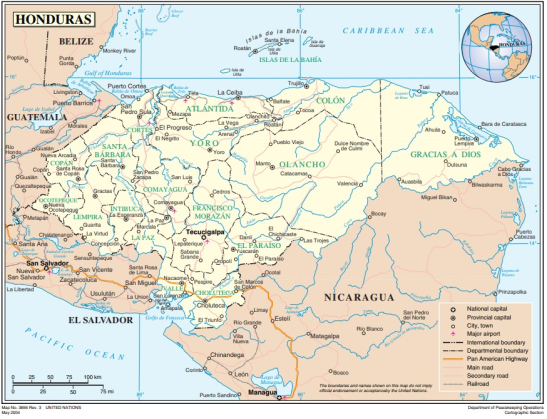
7.1.2 Honduras consists of 18 departments: Atlántida, Choluteca, Colón, Comayagua, Copan, Cortes, El Paraiso, Francisco Morazán, Gracias a Dios, Intibucá, Islas de la Bahia, La Paz, Lempira, Ocotepeque, Olancho, Santa Barbara, Valle and Yoro[footnote 4], and the United States State Department (USSD)’s Travel Advisory for Honduras noted that the country has 298 municipalities.[footnote 5]
7.1.3 The United Nations (UN) map below shows the capital (Tegucigalpa), departments and major cities[footnote 6]:
7.2 Population and demography
7.2.1 In 2025, UN data estimated the population of Honduras to be 11,006,000[footnote 7] and Encyclopaedia Britannica estimated the population to be 10,044,000.[footnote 8]
7.2.2 Encyclopaedia Britannica noted that, based on 2023 estimates, 55.6% of the population lived in urban areas, and 44.4% lived in rural areas.[footnote 9]
7.2.3 The same source stated: ‘The capital is Tegucigalpa (with Comayagüela) but … another city, San Pedro Sula, is equally important industrially and commercially, although it has only half the population of the capital …
‘The bulk of the population of Honduras lives a generally isolated existence in the mountainous interior …’[footnote 10]
7.2.4 Citypopulation.de, a website which provides ‘population figures … mostly based on census results and on official estimates’[footnote 11], noted, citing Honduras’ National Institute of Statistics, that based on 2023 estimates, approximately 1.13 million people live in Tegucigalpa and approximately 701,200 live in the second city, San Pedro Sula.[footnote 12]
7.2.5 Based on 2000 estimates, Encyclopaedia Britannica stated that Honduras’ ethnic groups comprised: mestizo (mixed Indigenous and European[footnote 13] 86.6%, Amerindian 5.5%, black 4.3%, white 2.3% and other 1.3%.[footnote 14] Minority Rights Group, a ‘human rights organization working with ethnic, religious and linguistic minorities, and indigenous peoples worldwide’[footnote 15], noted that ‘[a]ccording to the 2013 Census … nearly 9 per cent of the total population, self-identify as a member of either an indigenous or minority community. However, according to a 2007 census conducted by indigenous organizations, people who self-identified as indigenous or of African descent accounted for 20 per cent of the Honduran population.’[footnote 16]
7.2.6 Population data by department, municipality and city, based on data and projections from Honduras’ National Institute for Statistics (Instituto Nacional de Estadística Honduras; HNIS) is available on citypopulation.de.
8.Organised Criminal Groups (OCGs), including gangs
8.1 Definitions
8.1.1 This note primarily focuses on the activities of gangs, or maras, in particular the two dominant groups operating in Honduras: Mara Salvatrucha (MS‑13) and Barrio 18 (18th Street). Numerous other domestic and international criminal groups operate in Honduras, which are mainly involved in drug trafficking (see Types of OCGs). While gangs constitute one type of organised criminal group, the term OCG therefore encompasses a broader range of actors and structures.
8.2 Types of OCGs
8.2.1 The Bertelsmann Stiftung’s Transformation Index assesses movements toward democracy and market economy around the world.[footnote 17] Its 2024 iteration (BTI 2024) covers the period from 1 February 2021 to 31 January 2023.[footnote 18] This report stated: ‘The monopoly on the use of force continues to be contested in the country by a variety of groups ranging from street gangs, such as the MS-13 and the 18th Street Gang, to more organized international drug trafficking groups.’[footnote 19]
8.2.2 In its September 2024 profile on Honduras, InSight Crime, a think tank and media organization focused on organised crime in the Americas[footnote 20], stated that ‘the primary gangs present in Honduras are the MS13 and Barrio 18.’[footnote 21]
8.2.3 In February 2025, InSight Crime noted that ‘archetypal family-based clan[s]’ are ‘a type of criminal group that has increasingly supplanted the role of large cartels in Honduras’ drug trafficking landscape … Without centralized control, these clans work together to form networks that are more resistant to incursions from the security forces.’[footnote 22]
8.2.4 The Global Organized Crime Index is a ‘multi-dimensional tool that assesses the level of criminality and resilience to organized crime for 193 countries’.[footnote 23] Its 2025 iteration (Global Organized Crime Index 2025), covering events of 2024[footnote 24], stated that:
‘Mafia-style groups in Honduras exert significant control over criminal markets … The most prominent groups, Mara Salvatrucha (MS-13) and Barrio 18, dominate illicit activities … Despite government crackdowns, their influence remains entrenched … Beyond urban gangs, Honduras hosts influential narco-trafficking organizations deeply embedded in the cocaine trade. These groups collaborate with international cartels …
‘Loosely structured yet highly effective, criminal networks in Honduras collaborate with both domestic and international actors …
‘Foreign criminal groups have a substantial presence in Honduras, primarily in drug trafficking and human smuggling. Colombian and Mexican cartels play a dominant role, collaborating with local actors to facilitate cocaine and arms trafficking … they maintain strong influence over transnational trafficking routes.’[footnote 25]
8.2.5 The USSD Overseas Security Advisory Council’s Honduras Country Security Report, updated in May 2025 (USSD OSAC 2025 report), stated: ‘The two largest criminal groups in Honduras that continue to impact average citizens are the MS-13 (Mara Salvatrucha) and Barrio 18 street gangs …
‘Transnational criminal organizations are also involved in narcotics trafficking and other illicit commerce.’[footnote 26]
8.3 Number of OCGs and members
8.3.1 In 2016, InSight Crime noted: ‘Estimates for the number of gang members in Honduras range widely, mostly because authorities have a poor understanding of the differences between gang collaborators versus full-fledged members …
‘Part of the problem is that Honduran law does not have a legal definition of what constitutes a “gang member”.’[footnote 27]
8.3.2 The same source noted:
‘The United Nations Office on Drugs and Crime says, for example, that there are 12,000 gang members in Honduras, while the Honduras police (who shared numbers with InSight Crime researchers) stated there are an estimated 25,000 gang members in the country. Meanwhile, the government’s prevention program says there are just under 5,000 members, and only 500 or so in jail. The US government’s estimate is on the other end of the spectrum: 36,000 gang members in Honduras.’[footnote 28]
8.3.3 In its World Report 2022, covering events of 2021, Human Rights Watch (HRW) noted that ‘Estimates of the number of active gang members range from 5,000 to 40,000.’[footnote 29]
8.3.4 The BTI 2024 noted: ‘The MS-13 and the 18th Street gangs have between 35,000 and 40,000 members, according to estimates by InSight Crime and the Association for a More Just Society (AJS), the Honduran Chapter of Transparency International.’[footnote 30]
8.3.5 In January 2022, InSight Crime reported: ‘The MS13 has … more members in Honduras than rivals Barrio 18.’[footnote 31]
8.3.6 Originally in Spanish, in September 2025, Criterio.hn reported that, as of August 2025, ‘Honduran authorities counted 63 organized criminal groups active nationwide.’ [footnote 32] The source reported that the spokesperson of Honduras’ Anti-Gang Police Division (DIPAMPCO) differentiated between gangs and organised criminal groups, describing OCGs as ‘smaller groups than criminal structures as such … unlike the 18th Street Gang or the MS-13 … OCGs are located in specific places and are made up of deserters from the maras and gangs.’[footnote 33]
8.3.7 In November 2025, Armed Conflict Location & Event Data (ACLED) ‘an independent, impartial global monitor that collects, analyses, and maps data on conflict and protest.’[footnote 34] stated: ‘MS-13’s expanding business has … implied taking out or co-opting several smaller criminal outfits … reducing the number of competing groups in Honduras’ criminal landscape.’[footnote 35]
8.4 Location of OCGs
8.4.1 The BTI 2024 stated: ‘The state does not have control over all its territory. Several regions of the country are controlled, or at least infiltrated by, criminal gangs and other criminal organizations like drug cartels.’[footnote 36]
8.4.2 Citing correspondence with sources from 2022, the Immigration and Refugee Board of Canada (IRB) noted, regarding gang presence on the island of Roatán:
‘In an interview with the Research Directorate, an independent researcher based in the US whose work focuses on MS-13 and Barrio 18 in northern Central America indicated that there are “very rare cases” of criminal groups in Roatán, and that there is no recent published information regarding a presence of MS-13 or Barrio 18 on the island … In correspondence with the Research Directorate, an assistant professor of political science at the University of Toronto who focuses on violence and transnational gangs in Latin America stated that MS-13 and Barrio 18 have a presence in Roatán, but on “a small scale,” and that the island is a “refuge” for gang members and leaders who are evading the police and/or rival gang members … The Associate Professor of IR [International Relations[footnote 37]] noted that MS-13 and Barrio 18 “operate mostly” in mainland Honduras, and that there is “no concrete evidence of their organized presence [in] Roatán” (Associate Professor of IR 19 Oct. 2022).’[footnote 38]
8.4.3 In its 2023 Country Conditions Bulletin, Stanford University’s Migration and Asylum Lab, which aims to ‘conduct impartial analysis of country conditions based on a wide range of sources’[footnote 39], noted: ‘While street gangs are generally understood to be an urban phenomenon in Honduras, research on rural areas demonstrates that drug trafficking operations are concentrated in primarily rural communities, creating significant insecurity issues throughout the country.’[footnote 40]
8.4.4 In July 2023, International Crisis Group noted:
‘MS-13 and the 18th Street gang are prevalent mostly in suburbs of the capital Tegucigalpa and San Pedro Sula, the country’s second largest city, but they are reportedly expanding into coastal regions and along the borders with Guatemala and El Salvador.
‘… myriad groups, including gangs … reportedly hold a tight grip over remote parts of the country, particularly La Mosquitia, a stretch of land along the eastern coast …
‘Early in 2022, new groups emerged in the San Pedro Sula transport terminal. Humanitarian workers say Salvadoran gang members, fleeing President Nayib Bukele’s crackdown, have settled in Honduran cities, particularly those along the border but also the industrial centre of Choloma outside San Pedro Sula … Extortion has started to occur more often in border departments like Ocotepeque, Copán and Santa Bárbara, as well as in the central region of Colón, all places where it was once quite rare.’[footnote 41]
8.4.5 In August 2023, InSight Crime noted, referring to the Pacific coast of Honduras near the Nicaraguan border, that: ‘Some cliques, or cells, of the MS13 operate in this area. But they tend to be overshadowed by drug trafficking organizations … They do not have the same power as the cliques in Tegucigalpa or San Pedro Sula …’[footnote 42]
8.4.6 In December 2023, ACLED reported:
‘Francisco Morazán and Cortés departments are traditional hotspots of organized crime … particularly the national capital Tegucigalpa … and San Pedro de Sula …
‘… Criminal organizations have … known operations in the coastal city of La Ceiba … in the Mosquitia forest area in Gracias a Dios department, in the coca-growing departments of Colón and Olancho, and also departments bordering Guatemala along strategic drug trafficking routes.’[footnote 43]
8.4.7 In June 2024, Contra Corriente, ‘a communication platform that believes in in-depth journalism, and producing transmedia content that speaks to the reality of life in Honduras and the region’[footnote 44], reported that: ‘According to data from the Secretariat of Security … Eight criminal groups operate in Tegucigalpa, Honduras’ capital, in addition to the Barrio 18 and MS-13 gangs. Seven groups operate in San Pedro Sula besides those two gangs. Six, four and three criminal groups operate in Choluteca, Atlántida and Olancho, respectively.’[footnote 45] The source did not elaborate on who these criminal groups were.
8.4.8 The same source also described San Pedro Sula as ‘Honduras’ second largest city, industrial capital and one of its main epicenters of violence.’[footnote 46]
8.4.9 In June 2024, InSight Crime referred to ‘the eastern departments of Olancho and Gracias a Dios’ as ‘long-time bastions of organized crime and violence.’[footnote 47]
8.4.10 In its September 2024 profile on Honduras, InSight Crime stated: ‘Remnants of [the Cachiros group] still hold considerable power in the west of the country, according to InSight Crime’s field research …
‘… the MS13 and Barrio 18 … operate mainly in urban areas like Tegucigalpa or San Pedro Sula, as well as in rural zones close to the border with El Salvador.’[footnote 48]
8.4.11 The USSD OSAC 2025 report stated that MS-13 and Barrio 18’s ‘activity focuses on cities such as Tegucigalpa, Choloma, La Ceiba, Tela, and San Pedro Sula, but they have a presence throughout the country.’[footnote 49]
8.4.12 In March 2025, InSight Crime noted that the departments of Colón and Olancho are ‘strongholds for powerful criminal organizations like the Montes Bobadilla Clan, one of two criminal groups prosecutors have linked to coca production in Honduras.’[footnote 50]
8.4.13 In April 2025, InSight Crime noted that ‘MS13 … remains a significant threat to citizen security in urban hubs in Honduras’[footnote 51]
8.4.14 In June 2025, InSight Crime interviewed Juan José Martínez d’Aubuisson, an author who spent 10 years doing fieldwork on ‘the complex dynamics between local gangs and the MS13 and Barrio 18.’[footnote 52] He stated: ‘MS13 has achieved near-total domination. When I returned to Rivera Hernández [a neighbourhood in San Pedro Sula[footnote 53]] a few months ago, I saw that dozens of local gang groups that once operated there had been wiped out.’[footnote 54]
8.4.15 Originally in Spanish, in September 2025, La Tribuna, an independent Honduran daily tabloid[footnote 55], reported that:
‘… violence in Colón is partly explained by the presence of clans dedicated to drug trafficking, including:
‘Montes Bobadilla Clan (Los Montes): historically linked to international drug and land dispossession networks.
‘Los Camellos: a local gang linked to homicides and extortion.
‘Transnational gangs (MS-13 and Barrio 18): which dispute territorial control in the coastal zone.’[footnote 56]
8.4.16 Originally in Spanish, in September 2025, Criterio.hn reported that: ‘Francisco Morazán, Choluteca and Cortés concentrate the largest presence of criminal structures, according to the records of the Ministry of Security …
‘According to the information provided … 63 criminal organizations are concentrated in 12 of the country’s 18 departments … Intibucá, Gracias a Dios, Islas de la Bahía, Santa Bárbara, Ocotepeque and La Paz … to date have not reported a presence according to the Secretary of State …’[footnote 57]
8.4.17 In November 2025, ACLED stated: ‘in the country’s most violent cities, San Pedro Sula and Tegucigalpa, and their surroundings … Mara Salvatrucha (MS-13), 18th Street, and several other gangs vie for the control of drug peddling and extortion activities.’[footnote 58]
8.4.18 The same source stated: ‘A mix of government policies and gang re-accommodation contributed to reducing violence significantly in the metropolitan areas of San Pedro Sula and Tegucigalpa. To the contrary, armed violence linked to organized crime continued to thrive in Honduras’ rural departments, historically affected by a mix of land disputes and drug trafficking activities.’[footnote 59]
8.4.19. In May 2025, Riley Sentinel, ‘a global security risk analysis and reporting service’[footnote 60], stated: ‘The forced displacement of gang members from El Salvador has intensified territorial disputes and led to the strengthening of MS-13 and Barrio 18 operations in Honduras, especially in border areas and urban slums.’[footnote 61]
8.5 Mara Salvatrucha (MS-13) and Barrio 18 (18th Street)
8.5.1 InSight Crime’s June 2025 interview with Juan José Martínez d’Aubuisson noted:
‘As part of its Westernization and capitalization process, MS13 now operates as a much more sophisticated structure with state backing and political ties …
‘… MS13 has come to fully understand its role as a criminal enterprise. It has diversified its investments — it now controls funeral homes, recycling centers, houses, hospitals, and gas stations.
‘A key point is that extortion is no longer its lifeline. Violence is no longer the default tool — it is now utilitarian. MS13 uses it only when its economic mechanisms for generating revenue fail.’[footnote 62]
8.5.2 The Global Organized Crime Index 2025 stated that ‘MS-13 … increasingly invest in legitimate businesses, such as gas stations, bars and hotels, to launder illicit proceeds.’[footnote 63]
8.5.3 Originally in Spanish, in February 2025, Honduran print and digital newspaper La Prensa[footnote 64] noted: ‘In the case of the Mara Salvatrucha, money laundering is positioned as the cornerstone of its economy, through apparently legal businesses they hide large sums of money from illicit activities.’[footnote 65]
8.5.4 InSight Crime’s June 2025 interview with Juan José Martínez d’Aubuisson stated: ‘Barrio 18, by contrast [to MS-13], is on the verge of extinction. It lacks institutional support and remains tied to more traditional gang practices that prevent it from evolving into a criminal enterprise …
‘Barrio 18 … continues to use violence impulsively, which leads to frequent clashes with authorities and has blocked its transition to a more business-like model — limiting its chances of survival.’[footnote 66]
8.5.5 Originally in Spanish, in February 2025, La Prensa noted: ‘For the 18th Gang, extortion stands as their main source of income …’[footnote 67]
8.5.6 For information on the organisation and structure of MS-13 and Barrio 18, see previous iteration of the Country Policy and Information Note Honduras: Gangs (Version 1.0) published in November 2023.
8.6 Other OCGs
8.6.1 The Global Organized Crime Index 2025 stated ‘Honduran criminal networks range from extortion groups like Banda Independiente and El Combo Que No Se Deja to drug trafficking networks such as Los Valle Valle and Los Olanchos … Despite targeted operations, they continue to expand into new territories, reinforcing their position in Honduras’s criminal landscape …’[footnote 68]
8.6.2 Originally in Spanish, in February 2023 Contra Corriente reported that: ‘“Los Chirizos” is a criminal gang that … has not spread nationwide, [but] it is a group that the police have in their sights for the crime of extortion along with other new structures such as “El Combo que no se deja”, “los Puchos” and “los Aguacates” …’[footnote 69]
8.6.3 In its September 2024 profile on Honduras, InSight Crime stated: ‘The Valle Valle drug trafficking organization … has … almost been dismantled after various members were prosecuted in the United States. Nevertheless, field investigations conducted by InSight Crime found that relatives of the group’s former leaders continue to operate as the country’s criminal landscape is reconfigured …’[footnote 70]
8.6.4 In September 2024, InSight Crime noted:
‘The Cachiros were one of Honduras’ largest drug transport groups …
‘The Cachiros had large business and political interests that reached to the top of the Honduran elite. They had strong contacts in the military and the police at their service …
‘The group operated in the Colón department on the northeastern coast of Honduras. Its territory stretched east to Gracias a Dios, south to Olancho and west to the region’s criminal hub, the city of San Pedro Sula …
‘With both leaders imprisoned in the United States, the reign of the Cachiros as a major drug transport group is over.’[footnote 71]
8.6.5 In February 2025, InSight Crime noted:
‘The Montes Bobadilla clan is a Honduran drug trafficking organization based in the remote village of Francia, in Honduras’ northern department of Colón …
‘Members of the Montes and Montes Bobadilla families have led the clan since it emerged in the 1980s, though they have frequently recruited high-level members from outside the family to manage the group’s logistical operations …
‘… they control large swathes of Honduras’ Caribbean coast …
‘While key members of the Montes Bobadilla family have been detained, the group has continued to operate and diversify their activities, pointing to their continued strength.’[footnote 72]
8.6.6 In a September 2025 interview with Honduran journalist Oscar Estrada, by online news agency El Faro[footnote 73], the interviewer asked who the main players are in drug trafficking in Honduras today. Oscar Estrada replied: ‘The same ones. Nothing has changed. Anywhere. Los Cachiros, the Valle family, the Ardón family, the Pinto family … Some are even returning to take control of their structures again with complete impunity … Nothing has changed.’[footnote 74]
9. Gangs in prison
9.1.1 In June 2023, InSight Crime reported
‘Throughout the state of exception [see State of emergency], gangs have rioted in an attempt to gain control of all or parts of prisons. In April [2023], riots occurred — almost simultaneously — in four prisons, demonstrating the efficient communication channels that exist between gangs, the high levels of coordination in different penal centers, and the power these criminal structures maintain. In April [2023], gangs managed to overrun prison authorities and take control of the National Penitentiary in Támara.’[footnote 75]
9.1.2 In July 2023, International Crisis Group noted: ‘Most … extortion calls originate in prisons, where inmates exercise a sort of “self-government” in the words of one high-level prison official.’[footnote 76]
9.1.3 In November 2023, El Faro reported:
‘In Santa Bárbara Prison, a maximum-security penitentiary known as “El Pozo” (The Pit), evidence of numerous armed confrontations that erupted between the 18th Street and Mara Salvatrucha gangs from March to June 2023 is still visible. “There were nineteen confrontations in total,” says an employee of the prison. One inmate insisted this was exaggeration, though he did admit that fights between 18th Street —the largest gang in Honduras — and MS-13 had become increasingly common at the prison this year.’[footnote 77]
9.1.4 In December 2023, ACLED reported:
‘Armed clashes and violence targeting civilians have continued unabated throughout 2023 due to persisting competition among gangs, especially in the country’s overcrowded prisons where violence has surged …
‘Criminal groups have garnered significant power within the penitentiary system, with imprisoned members running illicit operations on the outside. In April [2023], simultaneous riots in four prisons involving incarcerated members of criminal groups resulted in several injuries and the killing of one inmate. Gang rivalries … have often been identified as [one of] the main causes of prison violence … Despite the introduction of new measures to curb corruption and violence, another 46 women were killed on 20 June [2023] after members of the Barrio-18 gang attacked rivals inside a women’s prison in Támara, Francisco Morazán.’[footnote 78]
9.1.5 In its September 2024 profile on Honduras, InSight Crime stated ‘the MS13 and Barrio 18 … exert substantial control within the country’s prisons.’[footnote 79]
9.1.6 The same source noted that ‘Prisons have become centers of criminal activity for gangs due to authorities’ lack of control in many facilities.’[footnote 80]
9.1.7 The Global Organized Crime Index 2025 stated: ‘Inside the prison system, they [gangs] maintain strongholds, with MS-13 reportedly controlling the Tamara national prison and negotiating power-sharing agreements in the El Pozo maximum-security facility. The prison system remains a hub for gang coordination, where inmates possess firearms and conduct illicit transactions.’[footnote 81]
9.1.8 The same source stated: ‘The prison system is in crisis, with frequent riots and gang dominance over detention facilities.’[footnote 82]
9.1.9 However, in November 2025, ACLED stated that: ‘Violence in prisons has … reached historic lows: In 2024, it was the lowest since ACLED started recording violence in Honduras in 2018, and not a single violent event has been recorded so far in 2025.’[footnote 83]
10. OCG activities
10.1 Violence and homicides
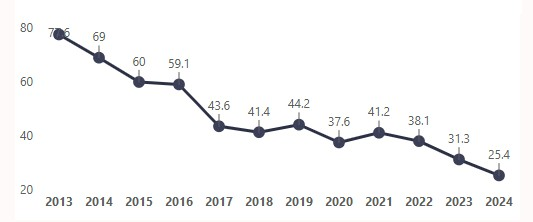
10.1.1 The below graph was taken from the Association for a More Just Society (Asociacion para una Sociedad mas Justa, ASJ), ‘a Honduran civil society organization … with the mission of working for a society where justice prevails’.[footnote 84] Citing official sources including Honduras’ National Institute of Statistics and the Honduran National Police, it shows the yearly homicide rate between 2013 and 2024, per 100,000 of the population[footnote 85]:
10.1.2 The USSD’s 2023 Country Report on Human Rights Practices: Honduras, published in 2024 and covering events of 2023 (USSD 2023 report) stated: ‘Criminal groups, including local and transnational gangs and narcotics traffickers, were significant perpetrators of violent crimes and committed acts of homicide, torture, kidnapping, extortion, human trafficking, intimidation, and other threats and violence.’[footnote 86]
10.1.3 In its September 2024 profile on Honduras, InSight Crime stated that ‘The primary drivers of violence are gangs like the Barrio 18 and MS13.’[footnote 87]
10.1.4 The USSD OSAC 2025 report stated that ‘Drug trafficking and gang activity are the main causes of violent crime in Honduras’[footnote 88] and noted that ‘Gangs are not reluctant to use violence, and specialize in murder-for-hire, carjacking … and other violent street crime.’[footnote 89]
10.1.5 The Global Organized Crime Index 2025 stated ‘drug trafficking networks such as Los Valle Valle and Los Olanchos … engage in contract killings …’[footnote 90]
10.1.6 In March 2025, InSight Crime noted that ‘Colón and Olancho … departments … consistently register the country’s highest homicide rates.’[footnote 91]
10.1.7 The USSD OSAC 2025 report noted that ‘The Honduran departments of Colón, Olancho, Islas de la Bahia [Bay Islands], Yoro and Atlantida … tend to see higher rate of violent crime.’[footnote 92]
10.1.8 However, the same source also noted that: ‘Roatán and the Bay Islands are geographically separate from the mainland and experience lower crime rates even when compared with other Caribbean islands.’[footnote 93]
10.1.9 Citing correspondence with sources from 2022, the IRB noted, regarding gang activities on the island of Roatan: ‘Sources note … that “overall crime rates” on Roatán “seem to be lower than in most of Honduras” (Associate Professor of IR 19 Oct. 2022) … In an interview with the Research Directorate, an assistant professor of security studies at New Jersey City University who focuses on gangs, organized crime, and drug trafficking in northern Central America stated that in general, Roatán is a “safe and quiet place” that is considered a “safe haven” from gangs, including MS-13 and Barrio 18 (Assistant Professor of security studies 13 Oct. 2022).’[footnote 94]
10.1.10 In a June 2024 article discussing decreasing homicides in the Chamelecon district of San Pedro Sula, Contra Corriente reported: ‘According to Pineda [security consultant and analyst Leonardo Pineda[footnote 95]], the drop in homicides is due to several factors: a) criminal groups imposing rules, which residents have adopted, in new territory; b) de-escalation of conflicts between gangs, especially Barrio 18 and MS-13.’[footnote 96]
10.1.11 In June 2024, Contra Corriente reported:
‘… multiple disappearances have been registered in the Rivera Hernández district, San Pedro Sula, since the state of emergency was imposed in December 2022 …
‘In April [2024], pastor Daniel Pacheco, who has been raising awareness of security issues in the Rivera Hernández district for over a decade, told Contra Corriente that 12 disappearances were registered in 15 days, stressing that “those are the ones we know about.”
‘A source from Chamelecón who asked to remain anonymous said that groups who control that area remove victims from communities “to avoid heating up the area and undermining their most profitable business: drug trafficking.” The person also said there are clandestine cemeteries in Chamelecón and Rivera Hernández.
‘A couple of days later, authorities found a clandestine cemetery in Lomas del Carmen, where by May 27 [2024] forensic medicine personnel and special prosecutors had found the remains of 10 people …
‘Pacheco opined that the reduction of homicides in 2023… could be owed to the disappearances. “Some homicides have not been reported because there is no system to keep track of disappearances, most of which are not reported by family members,” he explained.’[footnote 97]
10.1.12 In August 2025, Al Jazeera reported:
‘In Bonitillo, a low-income neighbourhood in the city of La Ceiba, community leader Rely Mencilla feels that security has worsened under the state of exception.
‘He told Al Jazeera that, in the week when April [2025] turned into May [2025], nine people were killed in the area — five in a single day.
‘“The state of exception in Honduras is a farce. It doesn’t work,” Mencilla said. “In La Ceiba, there are killings in every colonia, every day.”
‘Some speculate that the state of exception has encouraged criminal gangs to better hide the bodies of their victims, in order to reduce the homicide tallies that could invite further government crackdowns.
‘“The main difference is that, instead of killing you, they disappear you,” one resident in the Honduran city of Villanueva said on condition of anonymity. The resident identified as living in an area controlled by MS-13.’[footnote 98]
10.1.13 In November 2025, ACLED stated:
‘… testimonies of people living or having carried out research in gang-ridden communities suggest that the reduction in homicides owes more to shifts in gangs’ dynamics and tactics.
‘… To avoid attracting public attention and raids in the neighborhoods they operate in, MS-13 and other gangs have used violence more surgically. This means resorting more often to forced disappearances than homicides, which are usually much more public displays of violence. The Directorate of Police Investigations records 1,523 disappearances in 2024, up from 1,230 in 2023.’[footnote 99]
10.1.14 The same source noted that ‘This may also show why the reduction has not been met with an improvement in public perception: Roughly one-fourth of the interviewees of an early 2025 public opinion survey identified insecurity and organized crime as the main problems facing the country, and seven in 10 people believed that homicides had been rising over the previous year.’[footnote 100]
10.1.15 The same source also stated: ‘… most disappearances go unreported due to distrust in authorities or fear of gang reprisals: According to an evangelical pastor working on violence prevention in an area of San Pedro Sula with a strong gang presence: “The only people who dare to file complaints are those who leave the country and use the complaint as evidence to seek political asylum.”’[footnote 101]
10.1.16 Originally in Spanish, in March 2024, the Inter-American Commission on Human Rights (IACHR), ‘a principal and autonomous organ of the Organization of American States (“OAS”) whose mission is to promote and protect human rights in the American hemisphere’[footnote 102] reported:
‘… official crime figures usually present under-recording, so they do not reflect the extent of the violence … According to the 2022 survey of The World Justice Project, almost one out of five Honduran persons has experienced at least one crime in a period of one year. It is noteworthy that 35% of the persons surveyed indicated not having reported to the corresponding authorities. Among the principal reasons for the lack of reporting is the belief that the report would not help, fear or shame to report, or distrust in the police authorities.’[footnote 103]
10.1.17 See Targets of violence for more information on victims, and Impact of state of emergency for information on the decline in homicides and gang violence since the state of emergency was declared in December 2022.
10.2 Extortion
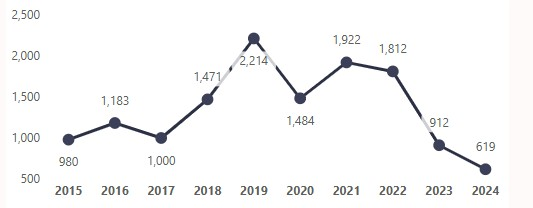
10.2.1 The below graph, produced by ASJ and citing as its source responses to requests for information made to Honduras’ Ministry of Security, shows the yearly number of extortion complaints made between 2015 and 2024[footnote 104]:
10.2.2 However, a 2025 report by the ASJ (originally in Spanish), reported that the total number of households subject to extortion per year between 2022 and 2024 were:
- 2022: 266,262
- 2023: 286,533
- 2024: 304,388[footnote 105]
10.2.3 As its sources for these figures, the ASJ cited the Permanent Multipurpose Household Survey which is carried out yearly by the Honduran National Institute of Statistics and is designed to show ‘the current state of the population’[footnote 106], as well as national telephone surveys conducted for ASJ by polling firm Le Vote[footnote 107] in 2022, 2023 and 2024. This survey asked respondents whether they or someone in their immediate family (children or spouse) had been a victim of extortion in the previous 12 months. Further survey parameters were not given, including the number of respondents.[footnote 108]
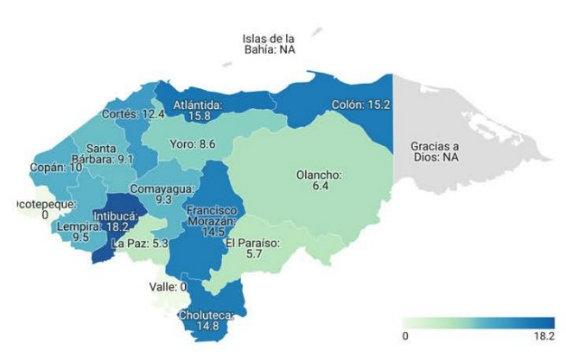
10.2.4 The same report shared the below graphic, showing what percentage of those questioned reported being a victim of extortion in each department of Honduras in 2024. As its source for these figures, the ASJ cited a national telephone survey conducted for ASJ by Le Vote in 2024. This survey asked respondents whether they or someone in their immediate family (children or spouse) had been a victim of extortion in the previous 12 months. Further survey parameters were not given, including the number of respondents[footnote 109]:
10.2.5 The BTI 2024 noted: ‘In some parts of [Tegucigalpa and San Pedro Sula], it is impossible to run a small business without having to pay a “war tax” to street gangs …
‘… small businesses in particular are subject to almost constant threats from criminal gangs. Extortion is endemic, especially in and around urban centers.’[footnote 110]
10.2.6 Originally in Spanish, in March 2024, the IACHR reported:
‘… extortion constitutes one of the central security problems associated with organized criminality in Honduras. Civil-society organizations indicated that the impacts of extortion go beyond the economic harms that the victim suffers, since it triggers a series of more violent crimes such as threats, kidnappings, and homicides … frequently people who are merchants, whether of small businesses or of large companies, are objects of extortion and find themselves forced to make payments to criminal organizations under threat of suffering harms against their businesses or against their life, integrity, or personal freedom or those of their relatives.’[footnote 111]
10.2.7 In June 2024, Contra Corriente reported: ‘It seems that extortion has dwindled in some areas [of San Pedro Sula], while increasing (including higher fees) in others, [security consultant and analyst Leonardo Pineda[footnote 112]] said. Gangs are the main actors, but there are criminal groups that cannot compete with the Barrio 18 or MS-13 gangs, so they strike deals with their much powerful counterparts to carry out certain criminal activities.’[footnote 113]
10.2.8 In July 2024, Contra Corriente reported that ‘Sixty-two percent of the 1,824 [extortion] complaints [in 2022] came from the Central District and San Pedro Sula, the two cities with the strongest gang influence in the country’[footnote 114]
10.2.9 In December 2024, InSight Crime reported:
‘Extortion appears to be increasing in Honduras as smaller gangs fill the gap left by larger groups who are retreating from the criminal economy …
‘Over 300,000 households reported that they paid extortion to one or more criminal groups in Honduras during 2024, according to a new report from the Association for a More Just Society (Asociación para una Sociedad más Justa – ASJ), a non-governmental organization. The findings correspond to a national victimization rate of 11.6%, up from 9% in 2022.
‘This is the fourth extortion study implemented by the organization in the last two years … The responses of around 1,000 people surveyed have consistently shown an upward trend in the number of Honduran households paying extortion, with high rates in both urban and rural departments.
‘Although ASJ registered an increase in extortion in its unofficial survey, formal complaints made to the authorities fell from 942 in 2023 to 484 in the first nine months of the year [2024], according to data from the Security Ministry …
‘Honduras’ largest gang, the MS13, largely stopped participating in extortion before the government imposed the state of emergency, experts say …
‘However, when MS13 stopped running rackets, “two or three structures came to collect in their place,” Wilmer Calix, an urban transport leader, told InSight Crime. “These groups are new and old. But there hasn’t been an investigation into who is behind these structures.”
‘There are also signs that the country’s second-largest gang, Barrio 18, could be retreating from extortion in the transport sector, according to security experts consulted by InSight Crime.
‘Transport companies with routes crossing areas controlled by specific cliques of the gang are no longer paying the group, according to Calix, though many transport groups continue to pay extortion to Barrio 18, as do the communities under the gang’s control.
‘And while extortion stopped in some places, it quickly flared up in others. “Extortion is mutating,” said Calix. “It’s moving throughout the country.”’[footnote 115]
10.2.10 In its 2025 Freedom in the World report, covering events of 2024 (Freedom House 2025 report), Freedom House stated that ‘Those living in gang-controlled territories face extortion’[footnote 116] and that ‘Criminal groups … control all or parts of schools in some areas and subject staff to extortion schemes.’[footnote 117]
10.2.11 In September 2025, the Orion Policy Institute, ‘an independent non-profit think tank based in Washington D.C’[footnote 118], reported that:
‘The decentralized structure of the gang [MS13] enables each clique to set its own extortion rates, determine collection strategies, and enforce compliance. In many cases, clique leaders dictate both the targets and the terms of payment, which can include daily “gota a gota” (“drop by drop”) loansharking schemes with exorbitant interest rates, as reported in Honduras. Compliance is rarely voluntary. Property destruction, physical assaults, and targeted killings stand as the implicit penalties for refusal, reinforcing the perception that resistance is futile and survival depends on accommodation with the gang.
‘Beyond immediate financial gain, extortion also provides MS-13 with a platform for laundering money and deeper integration of funds into local economies. In some instances, cliques secure partial ownership stakes or complete control of businesses, allowing them to embed illicit profits within legitimate financial systems.’[footnote 119]
10.2.12 The Global Organized Crime Index 2025 stated:
‘Honduras has one of the most entrenched extortion markets in Central America … Nearly all sectors of society are affected, with the transport industry particularly vulnerable. Recently, public transport workers were killed and dozens of buses burned after refusing to pay extortion demands. Most extortion operations are coordinated from within prisons. While cash payments remain common, digital extortion is rising, with bank transfer and electronic wallet-based extortion increasing. One method, gota a gota lending, allows gangs to extort victims through high-interest microloans. Extortion has also driven internal displacement, with many affected families forced to relocate.’[footnote 120]
10.2.13 The USSD OSAC 2025 report stated that ‘The public transportation sector is a regular target of extortion,’[footnote 121] and that ‘the State of Exception does not seem to have had a large impact on crime as in the streets, new groups have emerged, and extortion of the transport industry has expanded.’[footnote 122]
10.2.14 In September 2025, the US Congressional Research Service (CRS) noted that ‘extortion reportedly increased by 14% between 2022 and 2024.’[footnote 123]
10.3 Territorial control
10.3.1 In August 2023, InSight Crime reported that ‘In the peripheries of large Honduran cities, gang members are often the ones who settle disputes between neighbors, in addition to giving organizations and businesses permission to operate …’[footnote 124]
10.3.2 Originally in Spanish, in February 2023, Contra Corriente reported:
‘“… [MS-13] take care of the area, and when there are thieves who assault people, they control them themselves. They warn the first time; the second, they kill … it is the law. Sometimes I have come to think that they protect more than the police … it seems that it’s the gangs that make citizens more secure.” [quoting a market leader in Comayaguela[footnote 125]] …
‘… “They [gang members] do justice. If I have a fight, I can talk about it and they’re going to find who’s right. They correct those who have bad behavior. Those in the gang investigate, seek the truth and when they punish it is not for nothing. They have their ups and downs, but their law is fairer.” [quoting a resident of La Peña, a neighbourhood of Tegucigalpa[footnote 126]].’[footnote 127]
10.3.3 In a June 2024 article, referring to gang-controlled neighbourhoods of San Pedro Sula, Contra Corriente reported: ‘People are afraid of gangs, he [pastor Daniel Pacheco[footnote 128]] said. They live in fear and must adapt to the rules of an “invisible government” within neighborhoods. And as long as they adapt and are aware of criminal groups’ security protocols, “they will be more or less fine and survive.”’[footnote 129]
10.3.4 In July 2024, Contra Corriente quoted a Barrio 18 hitman:
‘“If someone steals, rapes or rats, we kill them. That’s why you could leave your phone anywhere and no one would steal it. People leave keys on their motorcycles and don’t lock the doors of their homes. We don’t just kill because we can. There has to be a reason, and processes have to be followed.”
‘This has led to the community relying on gangs to solve internal problems. “The boys are the government here,” said Giovani, a resident of the La Planeta neighborhood …
‘According to Jason, a leader of Barrio 18, every gang has undergone a significant transformation. “It’s no longer smart to be violent and kill people on the streets … We focus on … maintaining better control over the area …
‘“No one is going to help them [the police] because they don’t solve any problems or take responsibility for the neighborhood. We are the only ones who do.” …
‘However, according to gang members and residents, gangs maintain control through violent governance, and the absolute authority over neighborhoods is owed to the constant marginalization and lack of trust in the police and armed forces.’[footnote 130]
10.3.5 In August 2024, international news channel France24[footnote 131] reported: ‘Gangs and drug traffickers maintain “a mini-government” in the territories they control, according to the national ombudsman’s office’[footnote 132]
10.3.6 In September 2024, the UN High Commissioner for Refugees (UNHCR) reported that ‘In Honduras, criminal groups exert social and territorial control through violence, intimidation and by imposing restrictions to freedom and mobility such as curfews, dress codes, invisible borders, and extortion.’[footnote 133]
10.3.7 In May 2025, Riley Sentinel reported: ‘MS-13 and Barrio 18 … wield de facto control over many urban and rural communities …
‘Today, they … serve as informal authorities in many communities, where state presence is minimal.’[footnote 134]
10.3.8 The Global Organized Crime Index 2025 stated that ‘[MS-13 and Barrio 18’s] territorial control is evident in urban centres, with certain neighbourhoods in San Pedro Sula fully under gang dominance.’[footnote 135]
10.3.9 In its 2023 Country Conditions Bulletin, the Migration and Asylum Lab noted:
‘Evidence published by the National Defense University shows that gangs in Honduras have exercised significant control over national politics since at least 2014, both by using their members as a voting bloc and their vast territorial control to subvert electoral processes. For example, both MS-13 and Calle 18 [Barrio 18] have charged candidates with extortion fees in order to set up party organizations and campaign in neighborhoods the gang controls. The gangs also ban certain politicians or political parties they view as enemies from campaigning in those areas … MS-13 specifically has also directly financed mayors and local legislatures throughout Honduras, allowing the gang to move some of their members into municipal strongholds, and in some documented cases the mayors have hired gang members as municipal employees. In growing areas in Honduras, the more powerful “clicas” of MS-13 and Calle 18 have also filled the void of an absent national government by carrying out state functions.’[footnote 136]
10.3.10 In December 2025, The Intercept, a non-profit investigative outlet focused on exposing corruption and abuses of power[footnote 137], published an article detailing MS-13 voter intimidation during the Honduran general election held on 30 November 2025. Referring to information received from ten residents from four MS‑13 controlled working‑class neighbourhoods, and six additional sources including government officials, human rights investigators, and individuals with direct contact with gang members, the article stated that MS‑13 members issued ultimatums directing residents to vote for Nasry Asfura and threatened to kill people and their families who voted for the Liberty and Refoundation (LIBRE) party.[footnote 138] The article noted that gang members transported voters to the polling stations while prohibiting mototaxi businesses from transporting LIBRE voters, and that ‘… members of MS-13 passed through Cortés warning that those who voted for LIBRE “had three days to leave …”’[footnote 139] A resident of San Pedro Sula is quoted as stating: ‘“… given the fact that they have a lot of presence, they tell the people that they’re going to vote for so-and-so, and the majority follow the orders.”’[footnote 140]
10.4 Drug trafficking
10.4.1 In its September 2024 profile on Honduras, InSight Crime stated that ‘gangs like the Barrio 18 and MS13 … often exert influence over entire neighborhoods … running local drug sales and kidnapping rings.’[footnote 141]
10.4.2 In its Honduras Travel Advisory, updated 10 December 2024, the USSD stated that ‘Gracias a Dios, the most eastern department … is an isolated region with high levels of criminal activity … large portions of the department are particularly vulnerable to drug trafficking organizations. Infrastructure is weak, government services are limited, and police and military presence is scarce.’[footnote 142]
10.4.3 In February 2025, InSight Crime noted, referring to Honduras’ Caribbean coast: ‘The region is a transshipment center for cocaine, with traffickers frequently cutting hidden runways into surrounding jungle, crash landing planes on rural roads, or beaching drug-laden speedboats onto nearby shores …’[footnote 143]
10.4.4 In March 2025, International Crisis Group noted:
‘Groups in Honduras … forcibly displace locals to consolidate new drug routes and territory, as well as to protect their trafficking assets. A resident of the department of Colón recounted how an armed group used escalating pressure on her neighbours’ family to kick them off their farmland. First, armed men destroyed their crops; then they returned to ransack the property. Other Colón residents described destroying clandestine airstrips, only to be expelled by the criminal groups that had built them. Economic elites in the area “use those lands for drug trafficking and protect them with criminal groups”, residents said.’[footnote 144]
11. Recruitment and leaving gangs
11.1 Recruitment and membership profile
11.1.1 In its 2023 Country Conditions Bulletin, the Migration and Asylum Lab noted: ‘Local human rights defenders in San Pedro Sula have noted that boys and young men between 12-17 years old are the most vulnerable population to gang recruitment …’[footnote 145]
11.1.2 The same source noted that:
‘… Honduran news reports have shown how children in grades as young as kindergarten have been targeted at school by gang members, receiving threats of violence or even death if they refuse to cooperate … Ninety-one percent of teachers surveyed by United Nations officials in five Tegucigalpa secondary schools reported gang violence and harassment as a major problem. According to figures from the National Directorate of Criminal Investigation (DNIC), up to one in ten Honduran students could be gang members and up to 40 percent “sympathize” with the gangs …
‘Family members and caretakers of youth who refuse gang recruitment or otherwise defy gangs are often targeted for revenge violence as a way to force the youth to comply with their demands.’[footnote 146]
11.1.3 In July 2023, International Crisis Group noted: ‘Young people in gang-controlled areas lack job opportunities, as employers often will not hire them due to their place of origin. As a result, young people may feel excluded from mainstream society. “Marginalisation locks you up in a world where only gangs open their doors to you”, observed a civil society representative working with at-risk youth …’[footnote 147]
11.1.4 Originally in Spanish, in March 2024, the IACHR reported:
‘… the Commission, on several occasions, has expressed its concern regarding the greater exposure faced by girls, boys, and adolescents to being forcibly recruited for criminal purposes by maras and gangs … Civil society pointed out to the Commission that it is … marginalized youth, without any social or family support, who tend to join these criminal groups from a very early age.
‘In this context, girls, boys, and adolescents face two possible scenarios: i) becoming part of the criminal groups under the risk of being captured by public security forces … or ii) refusing to become part of the group or withdrawing from it, being forced to flee in order to save their own lives and those of their families.’[footnote 148]
11.1.5 The same source stated: ‘… civil society organizations reported to the IACHR that some gangs in Honduras, such as the Chirizos and their offshoots, are composed mostly of children and youth … According to what was reported, the gangs view schools as a fundamental element for their organization and control many public schools in the urban areas where they would operate with impunity.’[footnote 149]
11.1.6 Originally in Spanish, in February 2025, La Prensa reported on the profile of MS-13 members:
‘Most of their members emerge from impoverished neighborhoods in San Pedro Sula and Tegucigalpa, areas where the lack of opportunities makes the gangs a tempting option. For many young people, entry into these groups begins in adolescence …
‘The backdrop is a repetitive pattern: most have dropped out of school or college, come from dysfunctional families or face a present without prospects.’[footnote 150]
11.1.7 The same article then detailed the various roles within the gang, and typical age groups for fulfilling these roles (table compiled by CPIT) [footnote 151]:
| Role | Age | Tasks |
|---|---|---|
| Banderas | 10-15 years | Lookout |
| Compas | 14-30 years | Selling/transporting drugs/weapons; physical violence |
| Tracas | 15-25 years | Associated with the gang but not members; sell drugs or carry out illicit businesses |
| Soldiers | 16-35 years | Recruitment; criminal discipline |
| Ranfleros | 25-45 years | Logistics; transporting weapons, drugs and people; often grew up in mechanic shops; have leadership skills |
| Gunmen | 18-30 years | Murders; violent attacks |
| Palabreros | 20-35 years | Co-ordinate activities; manage areas; track record of loyalty and organisational skills |
11.1.8 The same source reported that Barrio 18 ‘follows a similar structural model to that of the MS.’[footnote 152]
11.1.9 The same source also noted that ‘According to investigations carried out by the Police, both groups have the support of external collaborators, a kind of position made up of individuals outside the internal structure of the organization, but who play a crucial role as administrators and responsible for managing the flow of money from money laundering, extortion and drug trafficking.’[footnote 153]
11.1.10 In May 2025, Riley Sentinel reported:
‘… young people face widespread unemployment, limited access to education, and unstable family environments. These conditions provide fertile ground for gang recruitment, as many youths perceive membership as a means of survival or social belonging …
‘… data shows that between 2015 and 2024, over 2,500 minors were recruited into gang structures, demonstrating the persistent appeal of these groups among youth populations facing poverty, exclusion, and a breakdown of community institutions.’[footnote 154]
11.1.11 Originally in Spanish, in August 2025, Contra Corriente reported: ‘[Migdonia Ayestas, coordinator of the National Violence Observatory of the University Institute for Democracy, Peace and Security, of the National Autonomous University of Honduras[footnote 155]] indicated that “when the State or private companies do not provide opportunities, illicit groups do. Criminal gangs … or drug traffickers open their arms to young people.”
‘“Many get involved knowingly, others are recruited because they have no other choice in the environment where they live,”’[footnote 156]
11.1.12 USSD’s ‘2025 Trafficking in Persons Report: Honduras’ noted: ‘Criminal organizations, including gangs, exploit girls in sex trafficking, force children into street begging, and coerce and threaten children and young adults to transport weapons, produce and sell drugs, commit extortion, or serve as lookouts; these acts occur primarily in urban areas.’[footnote 157]
11.1.13 Originally in Spanish, in September 2025, Criterio.hn reported that: ‘In relation to recruitment, the spokesperson [of the Anti-Gang Police Division DIPAMPCO, Mario Fu[footnote 158]] explained that it occurs through different mechanisms, ranging from persuasion with gifts or inclusion in social spaces, to coercion and intimidation.’[footnote 159]
11.1.14 In January 2022, InSight Crime reported, referring to MS-13: ‘According to Roto [a former gang member[footnote 160]], intelligence agents and two lawyers linked to the MS13, Porky [the foremost MS13 leader in Honduras[footnote 161]] financed the careers of law students and recruited accountants and administrators to start and oversee businesses.’[footnote 162]
11.1.15 In January 2024, international news agency El Pais[footnote 163] reported the story of a 27-year-old who was offered to be a gang member, stating that the hang had offered to pay for his university degree.’[footnote 164]
11.2 Women in gangs
11.2.1 In its 2023 Country Conditions Bulletin, the Migration and Asylum Lab stated: ‘Young girls and women are more vulnerable to gang recruitment than men and are often recruited at a higher rate to perform certain tasks, taking advantage of their image of innocence to avoid suspicion. While men are generally beaten as an initiation ritual after being recruited by gangs, women are often given the choice between a beating or being raped by several gang leaders. Such treatment reflects the pervasive culture of machismo and sexism that permeates gang dynamics … The structure and character of gangs, which privilege hypermasculinity, take these norms to a further extreme.’[footnote 165]
11.2.2 In August 2023, InSight Crime stated: ‘The majority of women linked to the MS13 in Honduras are not active members, but rather “collaborators.” This is because since the early 2000s, the gang has prohibited women from joining its ranks. Under this dynamic, women may receive payment for the tasks they perform and protection from other criminal groups, but are not formally considered part of the gang.’[footnote 166]
11.2.3 The same article noted that: ‘Unlike the MS13, the Barrio 18 still allows women to be part of the gang and assigns them prominent roles …
‘The level of authority they can achieve depends on the relationship each woman has with the men in the gang, according to multiple testimonies from Barrio 18 members and collaborators…’[footnote 167]
11.2.4 In November 2023, El Faro reported: ‘… in the case of 18th Street, women take on a number of significant responsibilities …
‘In the case of female members of the Mara Salvatrucha … they are better known for administering the gang’s assets or selling drugs … women live under unequal and patriarchal conditions within the gang …’[footnote 168]
11.3 Leaving gangs
11.3.1 The Kimberly Green Latin American and Caribbean Center, part of the Florida International University (FIU), and the American Institutes for Research (AIR), ‘a nonpartisan, not-for-profit organization that conducts behavioral and social science research’[footnote 169], conducted a 2020 study (AIR/FIU 2020 study) on gang disengagement in Honduras. The research is based on a survey with a sample of 1,021 respondents with a record of gang membership, and 38 in-depth interviews with former gang members and community members conducted between October and December 2019.[footnote 170] This study stated:
‘For smaller gangs, asking the leader for permission to leave the gang seems to be a more viable option than for the two major gangs …
‘Pastors and experts indicated that gangs … respected one’s decision to leave for religious reasons, but potentially would retaliate against those whom they determined were not following a religious lifestyle …
‘… Respondents said it is easier for a lower ranking gang member to get permission to leave the gang or to disengage from gang activities … lower ranking members are less likely to pose a threat to the gang or reveal information to rival gangs or the police. In contrast, the path to disengagement is difficult for someone who ranks higher in the gang.’[footnote 171]
11.3.2 The same source stated that ‘women are more likely to be able to leave the gang when they become mothers.’[footnote 172]
11.3.3 The same source noted: ‘… Members of the 18th Street gang answered more frequently (42.6 percent) than MS-13 (35 percent) that it is impossible to leave … A subject-matter expert provided the following explanation: “MS[-13] has always been more open to that … In the case of the 18th [Street gang], the thing is that not everyone is given that permission because they are more closed in their membership. It is difficult for anyone who become an active member of the 18th [Street gang] to leave.”’[footnote 173]
11.3.4 In January 2023, referring to interviews with Barrio 18 leaders, InSight Crime reported:
‘I ask the bosses gathered whether a member can leave the gang. The answer is a resounding “No.” …
‘Allowing members to leave would be problematic, they say, because it could lead to information leaks and destabilize the gang.
‘I ask them if they would be willing to stop killing defectors. I mention evangelical churches — becoming a priest has often been the only acceptable way out for a gang member in the rest of Central America …
‘… but they tell me … that … It is a sensitive topic that must be dealt with by higher powers within the gang.’[footnote 174]
11.3.5 The same article refers to another interview with ‘Tacoma’, the leader of Barrio 18 in Honduras. When asked about whether gang members were allowed to leave, Tacoma reportedly responded: ‘“That will never happen. Never. The gang is for life. We will never allow that …”’[footnote 175]
11.3.6 In August 2023, InSight Crime noted: ‘Being part of the Barrio 18 implies a lifelong debt. The options for leaving the gang are extremely limited: flee the country, convert to evangelical Christianity, or die.’[footnote 176]
11.3.7 The same article referred to evangelical Christianity as ‘the most common and accepted’ way to leave MS-13.[footnote 177]
11.3.8 The BTI 2024 noted that religious groups ‘often represent the only viable means for gang members to leave criminal life and return to society through engagement with, and within, the church.’[footnote 178]
11.3.9 In November 2023, El Faro reported:
‘In the PNFAS prison in Támara … one “peseta” (a retired gang member, or alternatively, traitor) tells me she is afraid to leave. She … says that as soon as she sets foot outside, the gang [Barrio 18] will kill her …
‘There are many cases of male “pesetas” who left the gang to submit their life to God and, in this way, are granted permission to live. Why couldn’t she leave, I ask … She says women aren’t allowed to leave because they are considered weaker and more likely to talk once on the outside —about everything they did in the gang, how the gang operates— and that’s why they kill them …
‘MS-13 inmates … also dream of leaving, but … several of them say, that when they do leave, the only job opportunity available to them will be the one offered by the gangs: selling drugs …
‘“Some compañeras were granted release and then killed before they got out; others were killed once they got outside …” says a survivor of the massacre [referring to a massacre in the prison whereby Barrio 18 members attacked MS-13 members[footnote 179]].’[footnote 180]
11.3.10 Originally in Spanish, in March 2024, the IACHR reported that ‘cases have been documented of adolescents who distanced themselves from the gangs who, once released from prison, were killed by the very same members of the criminal bands.’[footnote 181]
11.3.11 For more information on leaving a gang in Honduras, see Country Policy and Information Note Honduras: Gangs (Version 1.0).
12. Targets of violence
12.1 Current and former gang members
12.1.1 On an undated webpage, ASJ noted: ‘Gangs have strict codes for their members that, if broken, are punishable by death.’[footnote 182]
12.1.2 In January 2023, referring to the experiences of a Barrio 18 member, InSight Crime reported: ‘Failure to meet … quotas would not be met with dismissal but a series of beatings and even death …
‘The Barrio 18 leadership … see their homeboys as potential traitors or informants. They must prove their loyalty every day and any mistake carries the potential penalty of death.’[footnote 183]
12.1.3 In August 2023, InSight Crime noted: ‘If the Barrio 18 gang members disobey the rules, their own leaders impose punishments … if a gang member disobeys or betrays the gang … these punishments have even resulted in death.[footnote 184]
12.1.4 The USSD OSAC Honduras Country Security Report, updated in May 2025, stated: ‘Most crime victims are members of rival gangs …’[footnote 185]
12.1.5 For more detail on the targeting of current and former gang members, see Leaving gangs, Tracking of persons by gangs, and the previous iteration of the Country Policy and Information Note Honduras: Gangs (Version 1.0) published in November 2023.
12.2 LGBTI persons
12.2.1 In September 2022, the UNHCR noted: ‘Discrimination against people with diverse sexual orientation and gender identities is widespread in Central America, including due to a strong macho ethos among gangs. Individuals identifying as or perceived to be LGBTIQ+ are thus more susceptible to experiencing harm.’[footnote 186]
12.2.2 The USSD’s 2022 Country Reports on Human Rights Practices: Honduras, published in 2023 and covering events of 2022, stated: ‘NGOs reported gangs engaged in “corrective rape” of lesbian or transgender individuals.’[footnote 187]
12.2.3 In its 2023 Country Conditions Bulletin, the Migration and Asylum Lab noted:
‘When speaking with Ezra Lopez of the Tertiary Prevention unit of USAID [United States Agency for International Development[footnote 188]] Honduras on a recent fact finding mission, he explained how LGBT Hondurans are often recruited by gangs to perform certain tasks such as distributing drugs and entering prisons to distribute and communicate with incarcerated gang members. According to Lopez, these recruitment requests are not optional, with dire consequences for LGBT individuals that refuse the gang’s demands.’[footnote 189]
12.2.4 F&M Global Barometers, an ‘LGBT+ human rights research project housed at Franklin & Marshall College in Lancaster, Pennsylvania’[footnote 190], noted in its 2024 Asylum Profile: Honduras: ‘LGBT individuals [in Honduras] frequently face discrimination and harassment at the hands of … gangs.’[footnote 191]
12.2.5 The BTI 2024 stated: ‘… groups, such as street gangs, commit violent acts against members of the LGBTQ+ community, which virtually never lead to criminal prosecution, less so convictions.’[footnote 192]
12.2.6 For more detail on the targeting of LGBTI persons, see previous iteration of the Country Policy and Information Note Honduras: Gangs (Version 1.0) published in November 2023.
12.3 Environmental activists
12.3.1 In December 2023, ACLED reported:
‘Organized crime groups, in collusion with political elites, have targeted activists opposed to mining projects and their negative impact on water resources … Between January and November 2023, armed men killed at least 11 land defenders and environmental activists in the country, which surpasses levels recorded in previous years …
‘… in Colón department, reported civilian targeting and clashes between armed groups in 2023 have also exceeded levels recorded in 2022. Some of the violence in this department has occurred as part of the Bajo Aguán environmental conflict. Organized crime groups, in collusion with political elites, have targeted activists opposed to mining projects and their negative impact on water resources…’[footnote 193]
12.3.2 The USSD OSAC 2025 report stated: ‘Most crime victims are … those involved in land disputes.’[footnote 194]
12.3.3 In August 2025, the UN Human Rights Council (UN HRC) published a ‘Compilation of information prepared by the Office of the United Nations High Commissioner for Human Rights’. This report stated that ‘The Special Rapporteur on climate change recommended that Honduras take urgent steps to protect environmental rights defenders from attacks by … corrupt police and gang members …’[footnote 195]
12.3.4 In November 2025, ACLED stated:
‘… Colón and Olancho experienced a 27% and 44% increase in violence, with a worrying trend involving the targeting of farmers …
‘… farmers cooperatives … often confront criminal groups seeking to expand their activities to accommodate illegal airstrips, coca crops, and intensive livestock or palm oil cultivation …
‘… ACLED records 76 events of violence targeting or involving farmers during Castro’s term [Xiomara Castro became President of Honduras in January 2022[footnote 196]], most of them related to land disputes, compared to 49 during Hernández’s term [Juan Orlando Hernández was president of Honduras from January 2014 to January 2022.[footnote 197] These incidents led to over 105 deaths, almost double those under Hernández. Over half of these events took place in Colón and Olancho, where the number of organized crime groups active in these two departments has also gone up from four under Hernández to 14 under Castro. Land and environment defenders in these departments have also been fighting against mining and hydroelectric projects, which are often linked to contested appropriation of land and have ties with agribusiness and organized crime groups. According to Global Witness reports, 73 land and environment defenders were killed or forcibly disappeared in Honduras between 2018 and 2024 …
‘More recently, armed groups acting on behalf of private interests appear to have taken on a more prominent role: Los Cachos gang is believed to be responsible for the killing of 18 farmers in the Bajo Aguán region just between 2024 and August 2025, according to local organizations …’[footnote 198]
12.4 Journalists and human rights defenders
12.4.1 The USSD’s 2024 Country Report on Human Rights Practices: Honduras (USSD 2024 report), published in 2025 and covering events of 2024, stated: ‘Criminal groups, including local and transnational gangs and narcotics traffickers, were significant perpetrators of violent crimes and committed acts of homicide, torture, kidnapping, extortion, human trafficking, intimidation, and other threats and violence directed against human rights defenders … journalists, bloggers ….’[footnote 199]
12.4.2 The same source stated: ‘Media members and nongovernmental organizations (NGOs) stated the press self-censored due to fear of retaliation from criminal groups or drug trafficking organizations …
‘Some journalists and other members of civil society reported threats from members of criminal groups. It was unclear how many of these threats were related to the victims’ professions or activism.’[footnote 200]
12.4.3 In May 2024, Civicus Monitor, a ‘global civil society alliance,’[footnote 201] reported:
‘Journalists are targets of attacks for exposing human rights abuses, in particular when reporting corruption, organised crime, public security, migration and agrarian and mining conflicts …
‘According to the National Human Rights Ombudsman’s Office of Honduras (CONADEH), at least 97 killings of journalists and media workers have been recorded, and 90 per cent of these cases remain in impunity. In 2023, the Committee for Free Expression (Comité por la Libre Expresión, C-Libre), a Honduran press freedom organisation, recorded the highest number of incidents since 2018, revealing a persistent pattern of violence, predominantly perpetrated by non-state actors and unidentified individuals.’[footnote 202]
12.4.4 The Global Organized Crime Index 2025 stated that ‘journalists face high levels of violence and harassment … Freedom of expression is restricted, particularly for those reporting on corruption or organized crime.’[footnote 203]
12.4.5 On 4 June 2025, the Committee to Protect Journalists (CPJ), ‘an independent, nonprofit organization that promotes press freedom worldwide’[footnote 204], reported on the death of journalist Javier Hércules, who reported on organized crime:
‘On the evening of May 31 [2025], Hércules … was shot and killed by two unidentified assailants …
‘“The killing of Javier Hércules tragically illustrates … the severe risks faced by reporters covering organized crime,” said Cristina Zahar, CPJ’s Latin America program coordinator, in São Paulo …
‘Angelica Cárcamo, director of the Central American Network of Journalists, told CPJ that the organization believes he was targeted because of his reporting …
‘Honduras remains one of the most dangerous countries in the region for journalists. CPJ has documented numerous cases of threats, harassment, criminalization, and killings of members of the press, many of which remain unsolved.’[footnote 205]
12.4.6 For further information on the targeting of these groups, see Witness and victim protection.
12.5 Informants, witnesses and those resisting gangs
12.5.1 In 2023, the Migration and Asylum lab noted that:
‘“Gang resisters” are unlikely to find state sanctioned protection and are a particularly vulnerable population because they stand out in society for defying the recruitment and extortion process and “disrespecting” or “insulting” the gang. In addition, people who have witnessed gang-related crimes or report gang members to the police are often threatened, beaten or killed by the gang, because their ability to report these crimes would betray the gang’s rules to ver, oir, callar (see, hear, stay mute.)’[footnote 206]
12.5.2 Originally in Spanish, in March 2024, the IACHR reported: ‘On repeated occasions, the Commission received testimonies about persons who would not go to present the corresponding reports after being victims of some crime for fear of reprisals.’[footnote 207]
12.5.3 In September 2024, the UNHCR reported that ‘Those living in areas controlled by gangs face persecution or serious harm if perceived as a threat, as informants to the police or enemy groups, or if they fail to comply with the gangs’ rules.’[footnote 208]
12.5.4 The USSD 2024 report stated: ‘Criminal groups, including local and transnational gangs and narcotics traffickers, were significant perpetrators of violent crimes and committed acts of homicide, torture, kidnapping, extortion, human trafficking, intimidation, and other threats and violence directed against … judicial authorities, lawyers …’[footnote 209]
12.5.5 See also Territorial control.
12.6 Transportation sector workers and other extorted businesses
12.6.1 On an undated webpage, ASJ noted: ‘If extorted businesses do not pay “war taxes” (payments demanded by the gangs), gang members may kill them.’[footnote 210]
12.6.2 In June 2023, InSight Crime reported that ‘local media reported the murders of 27 transportation sector workers in 2023.’[footnote 211]
12.6.3 The USSD 2024 report stated: ‘Criminal groups, including local and transnational gangs and narcotics traffickers, were significant perpetrators of violent crimes and committed acts of homicide, torture, kidnapping, extortion, human trafficking, intimidation, and other threats and violence directed against … business community members … union members …’[footnote 212]
12.6.4 The Freedom House 2025 report stated that ‘Taxi and bus drivers are notable targets of gangs.’[footnote 213]
12.6.5 The USSD OSAC 2025 report stated: ‘Most crime victims are … small business owners who resist gang extortion …’[footnote 214]
12.6.6 In November 2025, ACLED stated: ‘ACLED records 267 incidents of violence against private and public transportation workers — one of the most targeted sectors for extortion — during the 45 months of the Castro administration [Xiomara Castro became President of Honduras in January 2022[footnote 215]]. While still worryingly high, the number of events was 37% lower than those recorded during the same period of the second Hernández administration [Juan Orlando Hernández was president of Honduras from January 2014 to January 2022[footnote 216]].’[footnote 217]
12.6.7 See also Extortion.
12.7 Women and girls
12.7.1 In its 2023 Country Conditions Bulletin, the Migration and Asylum Lab stated:
‘Some parents no longer let their girls go to school for fear of their being kidnapped, says Luis López, an educator with Asociación Compartir, a nonprofit in Nueva Suyapa. Many gangs in the Northern Triangle use sexual violence and rape as part of the “price” or “rent” demanded of girls in their communities. Girls are targeted as revenge for their male family members refusing recruitments or other demands, as well as for prostitution or sex trafficking by criminal organizations. Girls living in gang-controlled neighborhoods receive clear messages that they and their bodies belong to the gang, and that gang members have power to exercise sexual violence with complete impunity. Gang members have raped and tortured girls and left their mutilated and dismembered bodies in public places to demonstrate their dominance of the area and instill [sic] fear in the community. In other cases, women and girls who live in gang-controlled areas have gone missing; their bodies have been found in clandestine graves, with evidence of sexual violence and torture. Gangs use sexual violence to control women and girls, frequently using rape to punish women and girls suspected of reporting gang activity to the police.’[footnote 218]
12.7.2 The same source also stated: ‘Women are often targeted for resisting gang demands, especially surrounding demands for sex. Women and girls who face forced recruitment or who do not otherwise heed to gangs’ demands are commonly raped or experience some other form of sexual violence. Threats of sexual violence are used to maintain control and domination specifically over women and girls in Honduras by the gangs.’[footnote 219]
12.7.3 Originally in Spanish, in March 2024, the IACHR noted, without providing figures on the scale of the increase of disappearances, that:
‘… the Commission … expresses concern about the disappearance of women, girls, and adolescents in the country, and the absence of official figures. Between May 2019 and May 2021, 1,178 reports of missing women were registered, most of whom were located alive. According to civil society data, around 270 cases were recorded in 2022. There was also reporting on an increase in the disappearances of women in the country, particularly in departments co‑opted by organized crime.’[footnote 220]
12.7.4 In September 2024, the UNHCR reported that ‘Women and girls residing in gang-controlled areas are at heightened risk of experiencing sexual violence, sexual exploitation, human trafficking and forced marriages.’[footnote 221]
12.7.5 The USSD 2024 report stated: ‘Criminal groups, including local and transnational gangs and narcotics traffickers, were significant perpetrators of violent crimes and committed acts of homicide, torture, kidnapping, extortion, human trafficking, intimidation, and other threats and violence directed against … women …’[footnote 222]
12.7.6 In its 2025 Trafficking in Persons Report, the USSD stated: ‘Criminal organizations, including gangs, exploit girls in sex trafficking … primarily in urban areas.’[footnote 223]
12.7.7 Originally in Spanish, in August 2025, Contra Corriente reported:
‘… human trafficking is latent in Honduras and mainly affects girls and adolescents, who are victims of … criminal recruitment …
‘According to the ASJ report, between 2019 and June 2025, 769 complaints of human trafficking were reported. However, [Nelson Castañeda, director of the Security and Justice Sector of the ASJ[footnote 224]] assured that the real figure is much higher. “… The low number of complaints responds to the lack of a focus on combating this crime, but also to the distrust of citizens towards institutions,” he explained.’[footnote 225]
12.7.8 Originally in Spanish, in July 2025, Contra Corriente reported that ‘the Women’s Human Rights Observatory (ODHM) of the Women’s Rights Center (CDM), established that in 2024 there were 231 violent deaths of women, of which 156 were femicides [‘the killing of women and girls because of their gender’[footnote 226]].
‘Of the femicides registered by the ODHM … 48 [were] linked to organized crime [approximately 31%].’[footnote 227]
12.8 Children and young people
12.8.1 In its 2025 Trafficking in Persons Report, the USSD stated: ‘Criminal organizations, including gangs … force children into street begging, and coerce and threaten children and young adults to transport weapons, produce and sell drugs, commit extortion, or serve as lookouts; these acts occur primarily in urban areas.’[footnote 228]
12.8.2 Originally in Spanish, in August 2025, Contra Corriente reported:
‘Between January and March 2025, Honduras registered 206 homicides of children, adolescents and young people, of which 84% correspond to people between 19 and 30 years of age … Although the figure represents a reduction compared to previous years, violence against young people persists and is reinforced by structural factors such as … territorial control by criminal groups …
‘The departments with the highest incidence of homicides [of young people] are Cortés and Francisco Morazán, which reported 35 homicides each, which represents 33.9%; followed by Olancho with 23 homicides, and the departments of Colón and Yoro with 16 each …
‘According to the report, homicidal violence most often affects young men …
‘[Director of the NGO Warriors Zulu Nation, Juan Enamorado[footnote 229]] also explained that many of the homicides of young people are related to organized crime. “Among the possible motives has to do with settling scores, they send them to kill,” he said …
‘Enamorado stressed that Honduran youth face a high risk of being victims or perpetrators of violence. “They are the ones who are being killed the most and they are also being recruited,” he said.’[footnote 230]
12.8.3 Originally in Spanish, in August 2025, Criterio.hn reported:
‘Honduran children and adolescents are exposed to multiple phenomena … which leaves them … at the mercy of criminal organizations.
‘One of the problems that most affects this vulnerable sector of the population is violent deaths. According to data from the Online Police Statistical System (SEPOL), from January 1 to August 16, 2025, 199 homicides have been registered nationwide, most of which correspond to victims between the ages of 0 and 21.’[footnote 231]
12.8.4 See also Recruitment and membership profile.
13. Internally displaced persons (IDPs)
13.1.1 The USSD 2023 report stated:
‘Gang activity, including attacks on and exploitation of nonmembers, was the primary contributor to violence-related internal displacement. Official data on forced displacement, especially displacement due to violence, was limited in part because gangs controlled many of the neighborhoods where individuals were forced from their homes and communities. NGOs reported IDPs were at increased risk of victimization and exploitation by criminal groups.
‘… Despite incremental progress, government capacities to respond to the needs of IDPs was limited.’[footnote 232]
13.1.2 In July 2023, International Crisis Group noted: ‘Gang threats have reportedly displaced dozens of families in Tegucigalpa, Chamelecón and Tocoa, among other places.’[footnote 233]
13.1.3 In June 2024, Contra Corriente reported: ‘[Pastor Daniel Pacheco[footnote 234]] denounced that people who don’t file complaints are forced out of their homes by criminal organizations in some districts like Rivera Hernández and Chamelecón [neighbourhoods of San Pedro Sula[footnote 235]]. This is a by-product of gang violence. The homes are later used to house members or as torture chambers, also known as “casas locas” (madhouses)’.[footnote 236]
13.1.4 In August 2024, France24 reported:
‘Honduras … has … seen high levels of forced displacement due to gangs taking over families’ homes.
‘People flee because of “threats, extortion, the murder of a family member, the dispossession of goods and properties and the recruitment of children,” said Elsy Reyes, head of human mobility at the National Commissioner for Human Rights.
‘“They even give them 24-hour deadlines to leave,” …
‘In 2023, the office received 1,761 complaints of forced displacement …’[footnote 237]
13.1.5 In August 2024, Costa Rican English-language newspaper The Tico Times[footnote 238] reported: ‘… thousands of families have abandoned their homes to escape violence. Gang members and drug traffickers force them to leave to use their homes as surveillance points, to sell drugs retail, or as “crazy houses,” places of death and horror where they commit the most perverse crimes.’[footnote 239]
13.1.6 In September 2024, the UNHCR noted: ‘Internal displacement in Honduras stems from generalized violence and rights violations, including (i) social and territorial control by gangs, drug trafficking or organized crime groups, (ii) extortion, (iii) forced recruitment, use and association, particularly targeting youth; (iv) dispossession and destruction of housing, land, and property; (v) gender-based violence; and (vi) political violence.’[footnote 240]
13.1.7 The Internal Displacement Monitoring Centre (IDMC)’s 2024 Global Report on Internal Displacement, referring to 2023 events, noted that ‘Data from Honduras … was difficult to obtain. Honduras recorded 5,100 internal displacements [as a result of conflict and violence], which should be considered a conservative estimate as it only includes beneficiaries of humanitarian support in some parts of the country.’[footnote 241]
13.1.8 The IDMC also noted that, as of the end of 2023, there were 101,000 IDPs in Honduras due to conflict and violence.[footnote 242]
13.1.9 The 2025 version of the same report noted that during 2024, there were 4,300 internal displacements in Honduras as a result of conflict and violence.[footnote 243] However, the IDMC noted on its webpage that:
‘This figure is considered an underestimate due to a lack of systematic monitoring of violence displacements in the country. It is also considered an underestimate as it only includes the displacements of persons who received assistance from NRC [Norwegian Refugee Council[footnote 244]]. This is further aggravated by the sensitivity of displacement associated with violence, which may deter those displaced from seeking assistance … IDMC has low confidence in this figure.’[footnote 245]
13.1.10 The IDMC also noted that, as of the end of 2024, there were 101,000 IDPs in Honduras due to conflict and violence.[footnote 246]
13.1.11 Originally in Spanish, in its 2024 Annual Report, covering events of 2024 and published in March 2025, Honduras’ National Commission on Human Rights (Comisionado Nacional de los Derechos Humanos, CONADEH)[footnote 247] stated:
‘… the INDH [National Human Rights Institute[footnote 248]] identified more than 136 municipalities in the country affected by internal forced displacement, with the Central District having the highest number of complaints at 225, followed by San Pedro Sula with 91 cases, Choluteca with 33, Danlí with 30, La Ceiba with 17, Juticalpa with 17, Catacamas with 14, Cortés with 10, Choloma with 10 complaints, and El Progreso with 10 cases. All these municipalities are characterized by greater economic development and a higher presence of gangs, maras, and organized crime …
‘According to the factual framework of the complaints, CONADEH observes that the main cause of forced displacement is violence perpetrated by organized crime structures, that is, violence coming from gangs and maras’[footnote 249]
13.1.12 The Freedom House 2025 report stated: ‘… violent crime and gang violence remain serious problems and have prompted large-scale internal displacement and migration.’[footnote 250]
13.1.13 In April 2023, the UNHCR stated:
‘… on 21 December, 2022, the National Congress of Honduras approved the Law for the Prevention, Care and Protection of Internally Displaced Persons … This is the first legal framework adopted by the Honduran State to offer a comprehensive response to internal displacement caused by generalized violence in a context of organized crime.
‘The Law contemplates a series of comprehensive measures to prevent internal displacement, through early warning systems, prevention and contingency plans; humanitarian assistance and protection of affected rights, such as education, housing, abandoned or dispossessed land and property; as well as seed capital and access to justice to achieve lasting solutions.’[footnote 251]
13.1.14 The Comprehensive Regional Protection and Solutions Framework (Marco Integral Regional para la Protección y Soluciones, MIRPS), is ‘a framework for regional cooperation’ between 7 North- and Central American countries ‘that promotes mechanisms of shared responsibility, protection, and durable solutions for refugees, asylum seekers, internally displaced persons’ and others.[footnote 252] In an August 2025 report, MIRPS stated:
‘The Law for the Prevention, Care, and Protection of Internally Displaced Persons entered into force in Honduras in April 2023 …
‘At the municipal level, initiatives such as “Cities of Solidarity” seek to guarantee access to essential services and promote the integration of IDPs, strengthening social cohesion. In addition, in collaboration with international organizations such as UNHCR, the Honduran State has implemented prevention strategies, including institutional strengthening and improving livelihood opportunities in affected communities …
‘To strengthen response capacities for forced displacement at the municipal level, an eight-day training series took place with the municipalities of Distrito Central, Choluteca, Juticalpa, Catacamas, San Pedro Sula, El Progreso, Choloma, and La Ceiba … A total of 106 municipal officials participated in these training sessions.
‘Likewise, since 2023, the National Statistics Institute (INE), in coordination with the Secretariat for Human Rights (SEDH) and with the support of UNHCR, has worked on the collection and analysis of data on forced displacement in the country. It is currently in the preparation phase of the report for 2023, which will address the main causes of displacement, such as crime and violence … The report will also include maps that reflect situations of internal displacement, from their place of origin to their potential return.’[footnote 253]
13.1.15 The UNHCR noted on its Honduras webpage that ‘Honduras is characterized by a complex context of violence that disproportionately affects women, children, adolescents, and youth, who often find themselves forced to flee their homes in search of protection and humanitarian assistance.’[footnote 254] However, the same webpage also noted that ‘Honduras set an example in preventing and responding to internal displacement with the ground-breaking Law for the Prevention, Care, and Protection of internally displaced persons, which came into effect in April 2023’.[footnote 255] In its 2026 Strategy, the UNHCR noted that, in relation to that law, ‘implementing regulations remain pending.’[footnote 256]
14. Tracking of persons by gangs
14.1.1 Referring to a 2018 report by the IRB, and a 2019 report by the IDMC, in 2022 the Austrian Centre for Country of Origin and Asylum Research and Documentation’s (ACCORD) stated that:
‘IRB reports on information provided by local stakeholders about cases where people have been persecuted by the gang throughout the country and even abroad … Reportedly, gangs have communication networks between clicas of the same gang operating in different countries across the Northern Triangle, including “communication networks inside state institutions” … Similarly, IDMC notes that:
‘“If gangs and other criminal groups believe someone is guilty of betrayal or enmity or they have another serious grievance, they may track that person down in their place of displacement. Their extensive network of lookouts, strong communications networks and the fact that Honduras is a relatively small country combine to mean that internal displacement may not be a viable option for many people.”’[footnote 257]
14.1.2 The 2020 AIR/FIU study stated: ‘Pastors and experts indicated that gangs would track former members as they integrated into a community of faith to ensure they did so “with sincerity”; the gang … potentially would retaliate against those whom they determined were not following a religious lifestyle.’[footnote 258]
14.1.3 On 17 November 2022, the IRB published a response to a query on the tracking of individuals by criminal groups in Roatan, Honduras. The response stated, referring to sources interviewed by the IRB in 2022:
‘According to the Assistant Professor of political science, individuals “more likely to be tracked” are current or former gang members … The independent researcher noted that gangs track individuals who have “important information” about the gang, or if the individual has “violated gang rules” … The Associate Professor of IR [international relations[footnote 259]] stated that individuals who have betrayed or “tried to leave” gangs “have been tracked down and killed, both inside and outside Honduras” …’[footnote 260]
14.1.4 In its 2023 Country Conditions Bulletin, the Migration and Asylum Lab stated:
‘When an individual or their family member has been threatened by gang members in Honduras, they would be at risk of continued gang targeting or violence, including murder, if returned … individuals … in many cases are found by … the gangs in different areas of the country. As explained by community organizers in San Pedro Sula at Casa Alianza, an NGO working in gang-affected communities, gang threats have different levels, varying from, “Don’t come around here again,” to a green light, which means the gang will kill an individual or their family member no matter where they are, and regardless of how much time has elapsed.’[footnote 261]
15. State of emergency
15.1 Overview of state of emergency
15.1.1 In July 2023, International Crisis Group noted:
‘In December 2022, [President Castro] imposed a state of exception in 162 districts of the country’s most populous cities, Tegucigalpa and San Pedro Sula, as part of what she dubbed a “war on extortion”. The state of exception restricts freedom of movement and assembly and allows authorities to search homes and make arrests without a warrant. Castro also called on banks and telecommunications companies to place stricter controls on accounts and sim cards that could be used for extortion payments, as part of a more comprehensive plan the police launched in parallel to the temporary measures.
‘… In late March [2023], the government launched a parallel Solution against Crime Plan, dividing the country into civilian and military police areas of operation and mobilising over 3,000 military officers in seven rural departments where drug trafficking is prevalent. On 22 June [2023], the presidency announced that the state of exception would be broadened to encompass still more areas and that the military would be assuming security responsibilities alongside the police throughout the country.’[footnote 262]
15.1.2 In June 2023, InSight Crime noted:
‘President Xiomara Castro announced new security measures on June 22 [2023] and June 25 [2023], bolstering a state of exception in place since December 2022 that aims to curb gang violence and extortion.
‘The government put the military police in charge of the prisons and implemented curfews in Choloma and San Pedro Sula, the two largest cities after the capital Tegucigalpa.
‘Rafael Sarmiento, head of Castro’s party in Congress, also vowed to legally designate all gang members as terrorists …’[footnote 263]
15.1.3 In June 2024, InSight Crime reported: ‘Originally planned for 45 days in Tegucigalpa and San Pedro Sula, Honduras’ capital and second-largest city, the government has repeatedly renewed and expanded the state of emergency. The measures are now in force in 226 of the country’s 298 municipalities and affect over 90% of the country’s population.’[footnote 264]
15.1.4 In November 2025, ACLED stated: ‘By the end of 2022, [President Castro] had imposed a state of exception, which restricts freedom of movement and assembly and allows authorities to search homes and make arrests without a warrant. Her government renewed this measure 24 times ever since — often without formal congressional ratification — eventually expanding it from 162 neighborhoods in the country’s two main cities to 226 of the country’s 298 municipalities’[footnote 265]
15.1.5 The same source shared the below map of Honduras, showing in blue the location of municipalities under the state of exception as of 31 October 2025, and in orange the municipalities that are not under state of exception measures as of 31 October 2025. The graphic notes that implementation dates vary; some municipalities have been under the state of exception since early 2023, others later[footnote 266]:
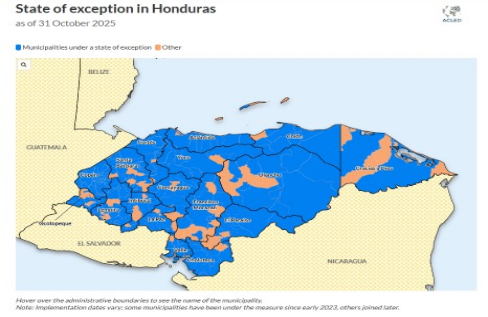
15.2 Arrest and detention statistics
15.2.1 Originally in Spanish, in February 2023, Contra Corriente reported:
‘At the beginning of January [2023], a month after its establishment, Adonay Hernández Vásquez, head of the Operational Unit of the northern zone, announced the capture of more than 600 members of criminal structures, the issuance of 700 arrest warrants, the dismantling of 40 criminal gangs and the seizure of 500 weapons.
‘According to the National Police, in almost two months, 3,954 people had been captured for “crimes related to extortion” (robbery, drug trafficking, trafficking and carrying of weapons, homicides), according to the institution’s spokesman, Miguel Martínez …
‘But these figures were harshly questioned by [National Human Rights Ombudsman’s Office of Honduras] CONADEH … The institution … states that, despite the fact that the government claims to have arrested 652 ‘members of maras and gangs’ in the first month of the measure, observers could only confirm 159 arrests in Tegucigalpa. And among them, there were “a considerable number of people who had been arrested for misdemeanors (which could not really be understood as ‘related’ to extortion) and, consequently, were released within 24 hours.” …
‘In Honduras, two courts have jurisdiction to hear extortion cases, one is in the capital Tegucigalpa and the other in San Pedro Sula, the country’s second largest city … Unlike the figures promoted by the government, only 25 cases of extortion have arrived in San Pedro Sula and 24 in Tegucigalpa.’[footnote 267]
15.2.2 In July 2023, International Crisis Group noted: ‘The Honduran police claim to have captured 4,000 people in the first six months of the state of exception, but 81 per cent had to be released due to lack of evidence.’[footnote 268]
15.2.3 On 13 July 2023, The Rio Times, an independent English-language news source covering Latin America[footnote 269], reported: ‘According to Security Secretary Gustavo Sanchez, the police forces have successfully dismantled 176 criminal gangs this year …
‘As a result, the Police Directorate of Maras and Gangs against Organized Crime arrested 1,273 individuals.
‘The arrested individuals are primarily charged with crimes such as extortion, drug trafficking, criminal association, and illegal possession of weapons.’[footnote 270]
15.2.4 In June 2024, Contra Corriente reported: ‘According to data from the Secretariat of Security, between December 2022 and April 2024, 34,064 people were detained for various crimes; drug trafficking being the most frequent offense for which 6,989 people were detained. However, only 503 people were detained for extortion.’[footnote 271]
15.2.5 In June 2024, Contra Corriente shared the below graph showing annual detentions of MS13 and Barrio 18 members in Honduras between 2015 and 2024, noting that the 2024 total covers only January to April.[footnote 272] The graphic notes that the ‘State of emergency did not increase annual detentions of MS-13 and Barrio 18 gang members. Although detentions increased in 2023, compared to the previous year, the total number of detained gang members (MS-13 and Barrio 18) that year was three less than that of 2018…’[footnote 273] However, the graph also shows that the yearly number of detentions of MS-13 and Barrio 18 members declined between 2020 and 2022, before increasing sharply in 2023 to the highest amount since 2018:
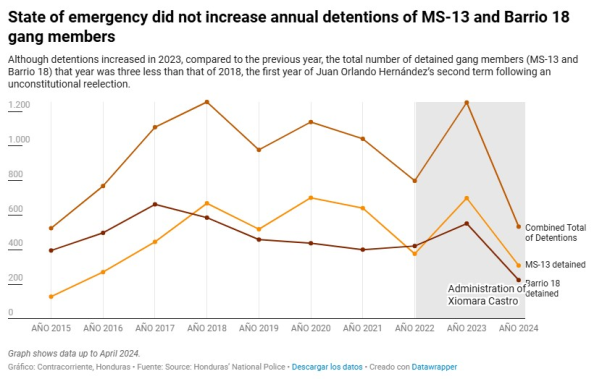
15.2.6 In a July 2024 report, covering events of 2023, the UN Office of the High Commissioner for Human Rights (UN OHCHR) noted: ‘According to official sources, under the state of emergency, the National Police made around 24,563 arrests … and carried out more than 16,988 searches.
‘Furthermore, the Public Order Unit of the Military Police made 1,333 arrests …. The lack of a single registry of detained persons makes it difficult to monitor the lawfulness of arrests.’[footnote 274]
15.2.7 In December 2024, InSight Crime reported: ‘… arrests for extortion are falling, indicating growing impunity for this predatory criminal activity …
‘Additionally, the number of detainees for extortion-related crimes tumbled 38% to 175 during … [January – September 2024], according to Security Ministry data.’[footnote 275]
15.2.8 Originally in Spanish, in August 2025, the Honduran National Police reported that, since the implementation of the state of exception, 5,069 detentions had been made, of which over 81% were in pretrial detention. Of the 5,069 detainees, 1,086 (21%) were reportedly Barrio 18 members; 899 (18%) were MS-13 members; and 3,084 (61%) belonged to other criminal groups. The same source noted that the authorities had dismantled various criminal groups, including Los Cuchos, El Combo que no se deja and Los Aguacates, and that the majority of detainees were aged between 18 and 39.[footnote 276]
15.2.9 Originally in Spanish, in September 2025, Criterio.hn reported that:
‘Between 2020 and 2025, the National Police reports the capture of more than 7,000 Hondurans linked to criminal organizations, mainly from MS-13 and Pandilla 18 …
‘The police official [spokesman of the Anti-Gang Police Division DIPAMPCO, Mario Fu[footnote 277]] also reported that during 2025 DIPAMPCO managed to dismantle 50 organized criminal groups and explained that the dismantling of these is usually easier because they are smaller groups and because their presence is limited …
‘According to figures from the Ministry of Security, arrests increased from 2023, with 2024 being the year with the highest number of 1,701 …
‘At the departmental level, Francisco Morazán and Cortés concentrated most of the arrests with 2,452 and 2055 respectively, while Gracias a Dios and La Paz, register the lowest number of cases with two and zero …
‘The information requested by this digital media indicates that the Mara Salvatrucha (MS-13) and the 18 Gang comprise most of the arrests with 3821 and 2914 respectively.’[footnote 278]
15.2.10 In November 2025, ACLED stated: ‘Since the imposition of the state of exception, security forces claim to have carried out over 60,000 searches, leading to the arrest of more than 5,000 people for extortion and other serious crimes.’[footnote 279]
15.3 Impact of state of emergency
15.3.1 In its 2023 Country Conditions Bulletin, the Migration and Asylum Lab stated that the state of emergency ‘has not led to a decline in violence or gang activity.’[footnote 280]
15.3.2 Originally in Spanish, in February 2023, Contra Corriente reported: ‘Despite the thousands of arrests, in the specialized courts the cases do not even reach half a hundred … And while the numbers don’t add up, violence in Honduras continues.’[footnote 281]
15.3.3 In June 2023, InSight Crime noted:
‘… the application of an El Salvador-style security strategy in Honduras has thus far failed to significantly curtail crime because of the countries’ differing criminal dynamics, Jennifer Ávila, director of Honduran news site Contra Corriente, told InSight Crime.
‘In Honduras, “drug cartels play a fundamental role in territorial control, in the control of other crimes and in the politics of the country itself,” she said. “It is totally simplistic to copy [Salvadoran President] Bukele’s propaganda of the ‘iron fist’ or ‘war’ against the gangs when in Honduras the criminal structures are more complex and diverse.”’[footnote 282]
15.3.4 In June 2023, InSight Crime reported:
‘The state of exception in Honduras has now been in place for six months. But contrary to government claims and National Police figures, the policy has done little to reduce criminal activity in the country …
‘… In prisons, violence between gangs continues. In the streets, new groups have emerged, and extortion of the transport industry has expanded to the point that truck drivers say that the state of exception “has not had any positive results.”’[footnote 283]
15.3.5 However, the same source quoted a member of a local community board in Choloma, San Pedro Sula, as stating that people feel safer thanks to the state of exception, and that ‘it has decreased delinquency and violence.’[footnote 284]
15.3.6 In July 2023, International Crisis Group noted ‘Even in gang-controlled neighbourhoods the government identified as priorities for its clampdown, religious and community leaders said they had witnessed no increase in police operations following imposition of the emergency measures.’[footnote 285]
15.3.7 In November 2023, El Faro reported: ‘Under the state of exception, the government has made mass arrests, but has not incarcerated massive numbers of people, and the rate of prosecutions has remained relatively low.’[footnote 286]
15.3.8 In June 2024, Contra Corriente reported:
‘Security consultant and analyst Leonardo Pineda says the results of the state of emergency are barely noticeable …
‘He maintains that only 5 percent of arrests have been effective during this time. “I’ve heard that some criminal groups, who have very good lawyers, successfully presented their case to judges, who acquitted and released them,” he concluded …
‘While the pro-government discourse on security … highlights the decrease in homicides, insecurity is still one of Hondurans’ main concerns, according to a poll by Equipo de Reflexión, Investigación y Comunicación (ERIC-SJ). Nineteen percent of respondents say crime and insecurity is the country’s most pressing problem, and only 3 percent thinks that the government’s fight against crime is a success …’[footnote 287]
15.3.9 In June 2024, InSight Crime reported: ‘In Rivera Hernández, a community in San Pedro Sula where several gangs are locked in an ongoing territorial conflict driven by extortion revenues, community leader Daniel Pacheco told InSight Crime that the state of emergency had “no impact” on the way criminal groups … operated inside the neighborhood.’[footnote 288]
15.3.10 Originally in Spanish, in January 2025, Swissinfo.ch reported: ‘The opposition and human rights groups say that the measure has not been effective in the fight against crime, because extortion of transporters and merchants at the hands of gang members persists.’[footnote 289]
15.3.11 Regarding homicide levels since the state of emergency was declared, in December 2023, ACLED reported:
‘… government data suggest a 17% drop in the number of homicides in the first semester of 2023 compared to the previous year. However, the disaggregated results of the government data for the first half of 2023 indicate that the decline significantly affected homicides linked to interpersonal violence rather than homicides attributed to gangs and extortion activities only. Hence, even when considering the government’s reported statistics, it could be misleading to exclusively link the drop in homicides to a significant decrease in gang violence.’[footnote 290]
15.3.12 In December 2023, ACLED also reported: ‘The government’s implementation and progressive expansion of its state of exception has coincided with a drop in violence in some of the most violent areas of Honduras, including Tegucigalpa and San Pedro Sula. However, at the countrywide level … inter-gang violence has continued posing threats to civilians and the violence has spread beyond the main areas targeted by the security measures.’[footnote 291]
15.3.13 Elaborating on the above, the same source reported that in Intibucá, Colón and Santa Barbara departments, violent incidents increased in 2023, in comparison with 2022.[footnote 292]
15.3.14 In June 2024, InSight Crime reported that ‘homicide rates in Honduras have fallen in recent months’, noting that ‘declines were recorded in both municipalities subject to the state of emergency and those that were not.’[footnote 293]
15.3.15 In July 2024, Contra Corriente reported that ‘In … San Pedro Sula, Honduras’ second largest city … the homicide rate has significantly decreased and reached the lowest point since 2004. However, the population still perceives that violence is prevalent …’[footnote 294]
15.3.16 In August 2025, Honduras reported to the UN General Assembly that: ‘For 2024, the Ministry of Security reported that, out of 298 municipalities, 57, or 19 per cent, had recorded no homicides, while 74 per cent had recorded between 0 and 8 homicides. In comparison with the rates in 2023, there were 847 fewer homicides, representing a 25 per cent reduction, for a rate of 26.8 per 100,000 inhabitants, the lowest in 20 years.’[footnote 295]
15.3.17 The USSD OSAC 2025 report stated: ‘Efforts from the Honduran government have seen some progress in reducing homicide rates in recent years. Media reporting has suggested that 2024 closed with a national homicide rate of around 25.3 homicides per 100,000 residents. This is a decline from a rate of 34.4 in 2023 and 38.1 in 2022.’[footnote 296]
15.3.18 The same report stated that ‘Tegucigalpa, which makes up the majority of the Distrito Central municipality, and San Pedro Sula, saw homicide rates nearly cut in half from 2022 to 2024.’[footnote 297] However, the report also noted that as of 1 May 2025, Tegucigalpa, San Pedro Sula and La Ceiba still ‘lead in total homicides.’[footnote 298]
15.3.19 In September 2025, the US CRS noted that ‘Honduras experiences high levels of violent crime, much of which appears to be attributable to transnational criminal organizations and gangs seeking to control illicit markets … the country’s homicide rate reportedly declined from 41.7 per 100,000 in 2021 to 26.1 per 100,000 in 2024 …’[footnote 299]
15.3.20 The Global Organized Crime Index 2025 stated: ‘Despite a decline in homicides … a significant percentage of assassinations have been attributed to organized crime.’[footnote 300]
15.3.21 In November 2025, ACLED stated:
‘… organized crime violence has progressively decreased … particularly in 2024. The reduction was higher in the country’s most violent cities, San Pedro Sula and Tegucigalpa, and their surroundings … These cities recorded 50% and 44% reductions in violent events, reflected in similar drops in the respective departments of Cortés and Francisco Morazán … despite an initial uptick in clashes between security forces and gangs shortly after the imposition of the state of exception, these decreased significantly, too.’[footnote 301]
15.3.22 The same source stated: ‘While gang violence levels have substantially decreased in urban settings, other coastal and rural areas have experienced an increase in organized crime activity during Castro’s presidency [Xiomara Castro became President of Honduras in January 2022[footnote 302]]. For example, the departments of Colón and Olancho experienced a 27% and 44% increase in violence.’[footnote 303]
15.3.23 The same source also stated: ‘While gangs have been using violence more selectively in the main urban centers, their presence and territorial control have not been dented by more frequent police patrols and raids.’[footnote 304]
16. State protection
16.1 Anti-gang laws
16.1.1 In July 2015, InSight Crime reported that:
‘On July 22 [2015], Honduras’ Congress approved reforms to Article 332 of the country’s Penal Code — known as the “anti-gang law” — that increase potential prison terms for gang members to between 20 and 30 years …
‘Those deemed by judges and prosecutors to be a gang leader also now face up to 50 years behind bars …
‘The reforms … also increase prison sentences by up to one-third for gang members who have conspired to attack state officials, as well as those who have used minors, the elderly, or pregnant women to commit crimes.
‘Convicted gang members who collaborate with the investigations of authorities, however, can now also receive a reduction of up to two-thirds of their prison term. Gang leaders are not eligible for reductions.’[footnote 305]
16.1.2 Originally in Spanish, a June 2024 article in Criterio.hn noted:
‘… Article 587 of the Penal Code … as well as the Law on the Financing of Terrorism … states that individuals who belong to a criminal association (such as maras and gangs) are classified as terrorists …
‘Criminal law establishes sentences of 15 to 20 years for the association’s directors, promoters and financiers. On the other hand, “mere members” of the terrorist association should be punished with prison sentences of 10 to 15 years.’[footnote 306]
16.1.3 The Global Organized Crime Index 2025 stated:
‘Honduras has engaged in various international efforts to combat organized crime, including signing multiple UN conventions on human trafficking, drug control and arms smuggling. However, adherence to these commitments has been inconsistent … the country remains active in regional anti-crime initiatives, including intelligence-sharing agreements with Guatemala and El Salvador.
‘Honduras has established legislative frameworks addressing organized crime, including laws on drug trafficking, human smuggling, money laundering and environmental crimes. However, weak enforcement mechanisms and systemic corruption hinder their effectiveness …’[footnote 307]
16.2 Policy initiatives
16.2.1 In June 2023, InSight Crime reported:
‘… the government has implemented a 10-point intervention plan to reduce violence in prisons. The plan … outlines actions like removing all weapons from prisons, blocking cell phone signals, and evaluating all prison staff to remove corrupt officials.
‘The Honduran government has also considered grouping members of the same gang together in prisons. Past investigations by InSight Crime have shown that while this tactic decreases violence, it also strengthens gangs internally by facilitating communication and organization between leaders and members …’[footnote 308]
16.2.2 In February 2024, InSight Crime reported:
‘The Honduran government has taken drastic measures to address the security crisis in its prisons.
‘In June 2023, following the massacre at the PNFAS [Penitenciaría Nacional Femenina de Adaptación Social, a woman’s prison in Honduras[footnote 309]], President Xiomara Castro transferred control of the prisons to the Military Police of Public Order …
‘… evidence suggests Barrio 18 operations in the PNFAS have continued despite the measures imposed by Honduran authorities …’[footnote 310]
16.2.3 In June 2024, InSight Crime reported: ‘Honduran President Xiomara Castro unveiled a raft of “radical actions” the government intends to implement to tackle organized crime …
‘The most eye-opening was the proposed construction of a prison with a capacity of 20,000 between the eastern departments of Olancho and Gracias a Dios …’[footnote 311]
16.2.4 In its September 2024 profile on Honduras, InSight Crime stated: ‘For more than 20 years, Honduras has pursued an “iron fist” security strategy against gangs. These policies … have not addressed the root causes of gang membership or provided rehabilitation for gang members …’[footnote 312]
16.2.5 The Global Organized Crime Index 2025 stated:
‘[The government’s] policies have failed to significantly reduce gang-related violence, as evidenced by a rise in armed clashes between security forces and gang members. The administration has increasingly distanced itself from civil society, the private sector and international partners, undermining broader policy efforts against organized crime … The Honduran government’s iron-fist strategy against crime, though extensive, has been criticized for failing to address structural drivers of criminality, such as poverty and corruption. Despite these challenges, political will for reform persists, albeit constrained by entrenched interests and institutional weaknesses …’[footnote 313]
16.3 Police
16.3.1 In its September 2024 profile on Honduras, InSight Crime stated: ‘Honduras’ national police force … consists of a variety of divisions and special units focused on anti-gang and anti-narcotics operations, investigations, intelligence, and community police …’[footnote 314]
16.3.2 The USSD OSAC 2025 report stated that: ‘the government … formed groups such as the National Inter-Agency Security Task Force (FUSINA) and the new National Anti-Gang Task Force (DIPAMPCO) to help combat crime. However, it remains to be seen how effective these new organizations will be in combatting crime.’[footnote 315]
16.3.3 In July 2023, International Crisis Group noted:
‘… President Castro … handed the police a far bigger role in taking on gangs and running the prisons … the police appear to have been ill prepared … the police were operating with the previously allocated budget, with which they had to do old and new jobs alike. “You gave the police a whole lot of tasks, and there are no police officers”, a civil society representative observed … A community leader reckons that the police were left with only three patrol cars for the whole Rivera Hernández neighbourhood in San Pedro Sula, home to around 200,000 people: “I can’t blame the police for not acting if they don’t have the means” …
‘Besides being short on personnel, the police are often under-equipped to attend to crime victims. Crisis Group heard testimonies of people who had suffered extortion and could not file a police report due to “lack of paper” at the station. Jails, now under police command, have too little money for routine repairs. “Of 500 cameras [we have installed], 300 are out of service”, a high-level prison commissioner observed. The government also faces disputes with contractors handling security cameras in the streets and emergency telephone lines serving the general public … seriously affecting the police’s ability to receive complaints from the public and act on them.’[footnote 316]
16.3.4 In December 2023, ACLED reported:
‘Recognizing criminal groups’ wider reach, the government has announced military police operations in Atlántida, Copán, and Yoro, and the deployment of additional military forces in Colón, Olancho, El Paraíso, and Gracias a Dios in April 2023. However, the effort is contrasted by reports that residents have not felt increased state forces’ presence in targeted areas, and that law enforcement’s lack of resources and personnel, especially in rural areas, have likely limited the efficiency of security measures.’[footnote 317]
16.3.5 In December 2023, InSight Crime reported: ‘The lack of resources available to the police has also hindered efforts under the state of exception …
‘With an insufficient number of officers, the impact police could make against gangs in every reach of the country was limited. The country is mountainous, difficult to patrol, and large …’[footnote 318]
16.3.6 In June 2024, Contra Corriente reported: ‘[Security consultant and analyst Leonardo Pineda[footnote 319]] added that the Secretariat of Security has tried to recruit more police officers, but such attempts have fallen short … with 90 agents assigned to Chamelecón, which has a population of 150,000 inhabitants, “there isn’t even one officer per 1,000 inhabitants, and the median should be three. The same goes for the Rivera Hernández district: police officers try to get some things done, but they’re stretched thin.”’[footnote 320]
16.3.7 The USSD OSAC 2025 report stated: ‘The government lacks resources to investigate and prosecute cases; police often lack vehicles/fuel to respond to calls for assistance. Police may take hours to arrive at the scene of a violent crime or may not respond at all.’[footnote 321]
16.3.8 Originally in Spanish, referring to the Alvarez market in Comayaguela, in February 2023 Contra Corriente reported that: ‘According to the merchants, a group of police officers patrolled once before Christmas [2022]; they promised to make rounds, took photos, left a phone number on which now “they do not answer.” Since that day, they have not returned.’[footnote 322]
16.3.9 In June 2023, InSight Crime reported: ‘Currently, the police pursue and imprison “the people who move extortion money in cash, thus only catching the lower ranking members and never reaching the leaders.” [quoting Andreas Daugaard, research coordinator for the Association for a More Just Society[footnote 323]’[footnote 324]
16.3.10 The same source reported that: ‘Even with the state of exception, truck drivers across the nation continue to live in fear because “they make complaints about the extortion that they face but there is no adequate response from the authorities,” [Nelson Fernández Toro, president of the Transportation Association of Honduras[footnote 325]] said.’[footnote 326]
16.3.11 The same source also reported: ‘Fernández also pointed out that there are no police patrols or military contingents monitoring the areas and neighborhoods of San Pedro Sula included in the state of exception.’[footnote 327]
16.3.12 The BTI 2024 noted that ‘in large parts of the country, the state’s presence is rudimentary, and its ability to act is severely limited. This is illustrated by its failure to put an end to the numerous extortion rackets criminal gangs run, particularly in Tegucigalpa and San Pedro Sula.’[footnote 328]
16.3.13 The same source noted that: ‘In terms of law enforcement and access to justice, Honduras’s security and judicial institutions are centralized, and access to these institutions in rural areas is compromised by criminal structures … Women and other vulnerable communities are most affected by the lack of access to … justice and security.’[footnote 329]
16.3.14 In June 2024, InSight Crime reported:
‘[Community leader Daniel Pacheco[footnote 330]] added that there had been a spike in kidnappings in Rivera Hernández, though security authorities had so far been unable to help. Last week, he recounted, a family was left negotiating with a gang for access to the body of a disappeared relative.
‘“It’s clear that the Minister of Security doesn’t understand what happens in these barrios,” Pacheco concluded. “The authorities keep saying they’ve had huge successes [but criminal groups] continue doing what they’ve always done.”’[footnote 331]
16.3.15 The same source noted that ‘Many police officers were reluctant to enter the area [Rivera Hernández], according to Pacheco, preferring to remain on the main roads on the outskirts of the community.’[footnote 332]
16.3.16 In July 2024, Contra Corriente quoted a resident of La Planeta, a gang-controlled neighbourhood in San Pedro Sula: ‘“… The police don’t dare come here, and if they do, they damage property, harass locals and then leave.”’[footnote 333]
16.3.17 The Global Organized Crime Index 2025 stated:
‘Honduras’s law enforcement agencies include specialized units targeting organized crime, yet resource shortages and internal corruption hinder their effectiveness. The dissolution of the anti-gang force and its replacement with a new police unit have not yielded significant improvements, with reports of misconduct among officers. Despite crackdowns on extortion, crime rates remain high, with many arrests failing to result in convictions. Public confidence in law enforcement is low, and militarized policing approaches have raised human rights concerns. Drug interdiction efforts have led to significant seizures, yet overall trafficking activity remains robust due to persistent demand and corruption within enforcement agencies.’[footnote 334]
16.3.18 In December 2023, InSight Crime reported that ‘Honduras’ police force … is chronically unstable and corrupt …
‘Though … purges had some success in ridding the force of corruption, steps needed to rebuild a strong and resilient force were never taken, ultimately undermining the potential effectiveness of the state of exception, according to Eric Olson, director of policy and strategic initiatives for the Seattle International Foundation …’[footnote 335]
16.3.19 In March 2024, Contra Corriente reported:
‘Hundreds of Hondurans have filed complaints of abuse, robbery, kidnappings, torture and disappearances against alleged police officers since the state of emergency was declared in December 2022. Authorities claim that criminal groups impersonating police officers are responsible, while victims say the State is to blame. Both the National Human Rights Commission (CONADEH) and the Office of the United Nations High Commissioner for Human Rights (OHCHR) have documented hundreds of complaints against State security forces.’[footnote 336]
16.3.20 The same article noted:
‘We spoke to a former commissioner who was dismissed after working for 22 years. He says the police provide uniforms and guns to criminal groups, who take care of the dirty work for them …
‘We met with an active member of Dipampco in a coffee shop in Tegucigalpa … He says he cannot trust his colleagues: “Nobody knows who’s working for criminal groups. We all suspect one another … When there’s suspicion about an agent, they’re simply reassigned, he adds.
‘Before joining Dipampco, the police officer was in another division in a different part of the country, where he was head of a unit. He says … “Criminal groups always try to bribe high-ranking officials, and that’s why some of them are part of those groups. When high-ranking officials are involved, there’s not much that can be done.’[footnote 337]
16.3.21 In June 2024, InSight Crime reported: ‘An official … who wished to remain anonymous … told InSight Crime that the state’s ability to create long-term security policies was jeopardized because key institutions, including … the police, remained “captured and weakened” by organized criminal groups.
“Elements within the police play an important role in criminal groups and not just gangs,” the official said …’[footnote 338]
16.3.22 In June 2024, Contra Corriente reported:
‘[Pastor Daniel Pacheco[footnote 339]] says the dispossession of homes and disappearances are not reported by anyone. “No one trusts authorities … I’m not saying all police officers are bad … but how can you tell the difference?”…
‘Pacheco’s outlook is sustained by the National Police’s shady past, considering several of its members have been actively involved in all kinds of crimes, including drug trafficking …
‘… “I have never seen organized crime infiltrate an institution so deeply,” he said and affirmed that the police leadership is well aware of this situation …
‘… [Analyst Leonardo Pineda[footnote 340]] says he’s still trying to understand what’s going on. “It seems like the administration is doing things right, but … there are five arrest warrants against five Dipampco agents.”’[footnote 341]
16.3.23 In July 2024, Contra Corriente reported, quoting a Barrio 18 leader:
‘“… If they [police] take one of our boys, we are usually able to buy their freedom. That’s how the police make extra money.”
‘Jason’s account reveals that the National Police capture gang members and demand a ransom to relatives for their freedom. Such negotiations and corruption are not sporadic or exclusive to territories controlled by Barrio 18, said María, who carries out murders for the MS-13 gang. “The police sometimes come and take one of our boys, so we have to buy their freedom. But we have people in the police.”’[footnote 342]
16.3.24 In its September 2024 profile on Honduras, InSight Crime stated:
‘Honduran police have been known as one of the most corrupt forces in the region. Agents have been accused of a range of corrupt acts, from passing information to criminal groups, to letting drug shipments pass through without inspection, protecting drug trafficking activities, participating in violent criminal operations, and in some cases even directing them … scandals involving relations between organized crime and police leadership continue to put the legitimacy of the police into question …’[footnote 343]
16.3.25 In December 2024, InSight Crime reported: ‘Pamela Ruiz, a Central America security expert, told InSight Crime that corruption within the security forces had fed widespread mistrust of police institutions …
‘“There are a bunch of different actors conducting extortion,” including corrupt police officials, said Ruiz. “But you do not have solid investigations, so there remain questions regarding who exactly is behind the rackets.”’[footnote 344]
16.3.26 In November 2025, ACLED stated: ‘Some security experts consulted for this report argue that the police’s institutional overhaul began with the appointment of figures with a recognized track record in the fight against organized crime to leadership positions … They suggest that the new leadership’s professional integrity contributed to reducing security forces’ participation in criminal activities, which has been fueling violence in recent years.’[footnote 345]
16.4 Judiciary
16.4.1 In its September 2024 profile on Honduras, InSight Crime stated:
‘Honduras’ highest judicial body is the Supreme Court of Justice, which includes chambers for constitutional, criminal, and civil cases. Below this are an appeals court, first instance trial courts for criminal and civil cases, and municipal and district-level justices of the peace. Honduras has an Attorney General’s Office (Fiscalía General) that functions as part of the independent Public Ministry (Ministerio Publico) and handles criminal investigations.
‘Honduras’ judiciary is widely considered to be weak, ineffective, and highly corrupt … The World Justice Project’s 2023 Rule of Law Index ranked Honduras as one of the countries with the most corrupt and least effective criminal justice systems in Latin America and the Caribbean. Given the weakness of Honduras’ judiciary, many high-profile drug trafficking suspects have been extradited to the United States.’[footnote 346]
16.4.2 The USSD 2023 report stated:
‘The law provided for an independent judiciary, but the justice system was poorly staffed, inadequately equipped, often ineffective, and subject to intimidation, corruption, politicization, and patronage. Low salaries and a lack of internal controls rendered judicial officials susceptible to bribery. Powerful special interests, including criminal groups, exercised influence on the outcomes of some court proceedings …
‘Credible observers noted problems in trial procedures, such as … judicial corruption, witness intimidation …’[footnote 347]
16.4.3 The same source stated, referring to crimes committed by criminal groups: ‘The government investigated and prosecuted some of these crimes, but impunity was widespread…’[footnote 348]
16.4.4 In July 2023, International Crisis Group noted that ‘impunity for serious crimes … stands at well over 90 per cent’[footnote 349]
16.4.5 In a July 2024 report, covering events of 2023, the UN OHCHR noted: ‘High rates of impunity resulting from a lack of effective investigations, unjustified procedural delays, limited opportunities for victims to participate in criminal proceedings, and lack of adequate protection for victims, family members and witnesses continue to constitute challenges that hinder access to justice.’[footnote 350]
16.4.6 In its 2024 Annual Report, covering events of 2024, the IACHR stated, referring to the decrease in Honduras’ homicide rate in 2024: ‘Despite this drop, there is a general perception that crime rates have increased because crimes are not prosecuted.’[footnote 351]
16.4.7 Originally in Spanish, a 2025 report by ASJ shared the below graphic showing yearly rates of impunity for homicide between 2014 and 2024, citing Honduras’ Ministry of Security, Public Prosecutor’s Office and judiciary as its sources: [footnote 352]
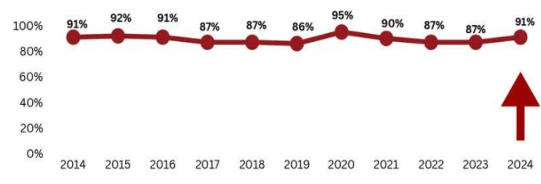
16.4.8 Originally in Spanish, in December 2023, La Prensa noted that:
‘On the 25th September 2023, the boss of the Mara Salvatrucha, José Hernández, alias the Fat Apocalypse, was found guilty of five crimes by a sentencing court.
‘Cristian David Contreras Santos, leader of the 18th Street Gang, was found guilty on January 11 of this year for the murder of four women in the Chamelecón sector.
‘On May 25, 2022, a sentencing court issued a guilty verdict against Carlos Alberto Álvarez Cruz, alias “Cholo Houston,” leader of MS-13, for the crime of murder.’[footnote 353]
16.4.9 In December 2023, InSight Crime reported: ‘From January to November 20, 2023, there have been just 19 people sentenced for extortion nationwide, the ASJ [Association for a More Just Society[footnote 354] report found, citing figures from Honduras’ Attorney General’s Office.’[footnote 355]
16.4.10 In February 2024, InSight Crime reported:
‘In January [2024], Honduras’ Special Prosecutor’s Office for Crimes Against Life (Fiscalía Especial de Delitos Contra la Vida de Honduras – FEDC) indicted nine Barrio 18 gang members for their alleged participation in the June 2023 massacre of 46 women at the National Penitentiary for Female Social Adaptation (Penitenciaría Nacional Femenina de Adaptación Social – PNFAS) – the first steps toward bringing the perpetrators of the massacre to justice …
‘Shortly after the indictment was filed, a judge ordered authorities to hold the nine accused gang members in pre-trial detention …’[footnote 356]
16.4.11 In June 2024, InSight Crime reported:
‘… several extensions of the state of emergency were not ratified by Congress, something that is jeopardizing prosecutions and potentially allowing criminals to evade justice. Just eight people were convicted of extortion in the first three months of 2024, according to [a report by the Association for a More Just Society (ASJ) [footnote 357], compared to 105 for the entirety of 2022.
‘“Honduras has rarely had so few people tried for extortion,” said Daugaard [Andreas Daugaard, Research Coordinator at the ASJ[footnote 358]], adding that there were prosecutions that had been scuppered because lawyers representing the detained had successfully argued that the state of emergency was illegal.’[footnote 359]
16.4.12 In December 2024, InSight Crime reported: ‘Of the 8,000 arrests announced as part of the government’s “war on extortion,” just 86 cases were prosecuted before extortion courts.’[footnote 360]
16.4.13 The Global Organized Crime Index 2025 stated: ‘The Honduran judiciary continues to struggle with inefficiency, political interference and resource constraints. While convictions in human trafficking cases have increased, impunity remains prevalent in other crime sectors, such as arms trafficking.’[footnote 361]
16.4.14 Originally in Spanish, in June 2025, Criterion.hn reported that ‘According to data presented by the director of Security and Justice of the Association for a More Just Society (ASJ), in 2024 90% of the crimes of extortion, homicide and micro-trafficking went unpunished.’[footnote 362]
16.4.15 Originally in Spanish, in August 2025, Contra Corriente reported: ‘human trafficking – which mainly affects girls and adolescents – shows an alarming pattern of state negligence: nine out of ten cases remain unpunished, and in 2025 barely one conviction has been issued, according to the Association for a More Just Society (ASJ).’[footnote 363]
16.4.16 In the sources consulted (see Bibliography), CPIT could not find further information or statistics on convictions or prosecutions of OCG members in Honduras since the imposition of the state of emergency.
16.5 Oversight and accountability
16.5.1 In 2023, the USSD noted that ‘The National Human Rights Commission in Honduras (CONADEH) is a semiautonomous commission for human rights, in charge of investigating complaints of human rights abuses. It is generally considered an independent body, and not part of civil society.’[footnote 364]
16.5.2 Originally in Spanish, in a 2024 document detailing its complaints procedure, CONADEH stated: ‘A complaint to CONADEH is a procedural act that any person or group of persons may resort to when their human rights, their fundamental freedoms, or those of another person are being threatened or violated by a State authority, or when a certain conduct constitutes an illegitimate, arbitrary, abusive, defective, negligent, or discriminatory exercise by the public administration.’[footnote 365]
16.5.3 The same document stated that a complaint to CONADEH has 5 phases: reception; admissibility; investigation; closure; follow-up. The closure phase ‘begins once the investigation is completed, and involves analyzing all the information gathered and available in the file, with the aim of issuing a Report.’[footnote 366] The follow up phase ‘is to monitor those matters that conclude with the issuance of a report containing recommendations and suggestions for adopting new measures, so that the authorities and bodies involved rectify their actions and take new steps.’[footnote 367]
16.5.4 CONADEH’s contact details can be found on its website, and complaints can be submitted online, as well as in person or by telephone.[footnote 368] CONADEH also ‘makes available to the inhabitants of Honduras, the Rapid Attention and Response Line with the number 132 from their cell phone and landline.’[footnote 369]
16.5.5 In July 2023, International Crisis Group noted that: ‘[former President] Hernández had moved to rid the [police] force of corrupt officers and others who did not meet age, physical fitness and education requirements. Eventually, the Hernández administration let a third of the force go … Of more than 6,500 officers dismissed, only 2,100 faced formal investigation by prosecutors for alleged criminal collusion.’[footnote 370]
16.5.6 In March 2024, Contra Corriente reported that ‘[Gustavo Sánchez, secretary of security[footnote 371]] … explained that 2,531 officers were removed from the National Police between 2022 and 2023. However, he didn’t comment on the crimes for which these officers were purged …’[footnote 372]
16.5.7 The same source reported: ‘[A] Dipampco [Police Directorate against Gangs and Organized Crime[footnote 373]] officer said that two police officers and an official “kidnapped and murdered” a young boy in San Pedro Sula a couple of years ago. The perpetrators were sent to prison, but that is not always the case. “Sometimes police officers are arrested and they say they know the prosecutors and the judges, who are going to release them,” he said.’[footnote 374]
16.5.8 The same source also noted that ‘… complaints rarely lead to changes within the National Police and the Armed Forces, or to a judicial process. Only 28 members of State security forces were indicted in 2023 and none in 2024.’[footnote 375]
16.5.9 In June 2024, Contra Corriente reported: ‘According to reports by Asociación para una Sociedad más Justa (ASJ), 6,168 police officers have been purged, and about 33 percent of these cases were forwarded to the Attorney General’s Office for investigation …
‘In April [2024], the Attorney General’s Office arrested five Dipampco agents accused of aggravated kidnapping and other crimes…’[footnote 376]
16.5.10 In December 2024, InSight Crime reported: ‘In October [2024], Honduran prosecutors charged one of the country’s top organized crime judges, Marco Antonio Vallecillo, with extortion …’[footnote 377]
16.5.11 The BTI 2024 noted:
‘Xiomara Castro, elected president, ran on a platform of change and anti-corruption. Her tenure has seen notable achievements, including the extradition of her predecessor, Juan Orlando Hernández, to the United States on drug trafficking charges and the repeal of the Secrets Law, which allowed officials to conceal corrupt activities. However, she also passed an amnesty law shortly after taking office that could shield powerful figures in her party from prosecutions for corruption, raising questions about her commitment to combating it.[footnote 378]
16.5.12 In December 2023, ACLED reported: ‘Castro’s government pledged to establish an anti-corruption body, the International Commission on Corruption and Impunity, to investigate and prosecute crimes, although reform requirements of Honduras’ national law have stalled its installation’[footnote 379]
16.5.13 In its September 2024 profile on Honduras, InSight Crime stated: ‘… leftist opposition candidate Xiomara Castro … won the 2021 presidential election in part on a promise to root out corruption. Her administration proposed a United Nations-backed anti-corruption mission known as the International Commission against Corruption and Impunity in Honduras (Comisión Internacional contra la Corrupción e Impunidad en Honduras – CICIH), but that commission has yet to come to fruition.[footnote 380]
16.5.14 HRW’s World Report 2025 stated:
‘In September, President Castro presented to the United Nations Secretary-General António Guterres a second draft agreement to create an International Commission against Corruption and Impunity in Honduras (CICIH). The revised proposal would ensure CICIH’s independence and autonomy, allow it to independently prosecute cases, investigate high-profile cases, propose legislative changes, and train personnel to fight corruption. However, progress on establishing the CICIH remains slow.’[footnote 381]
16.5.15 The US CRS noted in September 2025 that: ‘Castro has yet to fulfill her campaign pledge to establish a UN-backed anti-corruption mission.’[footnote 382]
16.6 Witness and victim protection
16.6.1 For information on Honduras’ Witness Protection Programme, see November 2023 (v1.0) iteration of this Country Policy and Information Note.
16.6.2 The USSD 2023 report stated: ‘Credible observers noted … an ineffective witness protection program.’[footnote 383]
16.6.3 The Global Organized Crime Index 2025 stated: ‘Efforts to support crime victims have been inconsistent, with inadequate resources allocated to protection programmes … Official witness protection programmes remain minimal, with only basic measures available to ensure anonymity in legal proceedings. Outside the courtroom, long-term protection mechanisms are virtually non-existent, leaving victims vulnerable to reprisals.’[footnote 384]
16.6.4 In addition to the Witness Protection Programme, in 2015 Honduras’ National Protection Mechanism for Human Rights Defenders, Journalists, Social Communicators and Justice Actors was established.[footnote 385]
16.6.5 Regarding the National Protection Mechanism, Peace Brigades International (PBI) USA, an organisation that ‘provides protection, support and recognition to human rights defenders’[footnote 386], reported:
‘Protected individuals and organizations report that their measures are primarily related to police and infrastructure. Police liaisons and guards, panic buttons, and CCTV …
‘Mechanism beneficiaries also report that assigned police liaisons lack awareness of their situation of risk, details of their protective measures, and the operations of the National Protection System … The low reactive capacity of police during emergencies in addition to the potential for sexist and suggestive comments towards women defenders from the majority-male police liaisons are further challenges.
‘The lack of awareness of the Mechanism among authorities, noted by the IACHR in August 2018, is even greater in rural areas. The institution’s centralization means that local authorities are not informed and lack training in human rights, gender, and protective measures. This is particularly concerning in light of the fact that nearly 40% of beneficiaries are land and territory defenders in rural areas …’[footnote 387]
16.6.6 In October 2023, the UN OHCHR quoted Irene Khan, UN Special Rapporteur on freedom of opinion and expression, at the end of an official visit to Honduras:
‘“Almost every journalist I spoke to – whether in mainstream media, online media, or community radio, male, female or gender diverse – claimed that intimidation has reached such a high level and the measures offered by the Protection Mechanism are so inadequate that they feel compelled to self-censor in order to protect themselves and their families,” she said.
‘The expert called for a major overhaul of the Protection Mechanism, which was created in 2015. “Many of the individuals I met gave concrete examples of long delays in response or no response at all, risk assessments that fail to take into account the context and environment in which people live, work and are endangered, and the absence of gender considerations although many of those seeking support are women or LGBTQI individuals,” she said.’[footnote 388]
16.6.7 Originally in Spanish, in September 2024, Honduran digital newspaper Hondudiario[footnote 389] reported:
‘The National System for the Protection of Human Rights Defenders, Journalists, Social Communicators and Justice Operators in Honduras is facing a profound crisis …
‘In addition, there are reports of … the murder of seven activists in 2023, six of whom had received protection measures …
‘In 2023, although the largest budget allocation since the creation of the Mechanism was achieved, the Inter-American Commission on Human Rights (IACHR) questioned whether the current government weakened it with massive layoffs of trained personnel for political reasons and the disproportionate budget allocation in protection measures, as six cases absorbed 83% of the budget …
‘In this context of institutional weakness, the murders of defenders have increased. Prior to the installation of the Protection Mechanism, there were an average of 12 murders of defenders per year, a figure that increased to 17 after the creation of the Mechanism …’[footnote 390]
16.6.8 In April 2024, Contra Corriente reported on the experiences of two journalists who documented environmental crimes:
‘Jorge … is … enrolled in the Protection Mechanism for Human Rights Defenders and Journalists. As part of this program, areas where journalists under threat of violence live are patrolled, and they also have id cards which they can show to the National Police if they find themselves in danger, Jorge explained …
‘Both Yalile and Jorge feel vulnerable … Although she has filed complaints with representatives of the protection mechanism and has been in contact with them, she knows she is in an extremely vulnerable situation; “I haven’t had any protection,” she says.’[footnote 391]
16.6.9 Originally in Spanish, in November 2024, Criterio.hn reported that ‘The situation is alarming: between 2019 and 2023, at least 16 human rights defenders linked to the Mechanism have been killed in Honduras.’[footnote 392]
16.6.10 On 4 June 2025, the Committee to Protect Journalists reported on the death of journalist Javier Hércules:
‘Hércules, who reported on organized crime for the local television outlet ATN a Todo Noticias, had been enrolled in Honduras’ National Protection System for Journalists, which has provided protection measures like police escort, relocation, and risk assessments since 2023, according to local news outlet Proceso Digital. He had previously received threats and, in November 2023, was abducted by two armed men, beaten, and left in a remote area.
‘Despite being placed under state protection after this, the government did not assign Hércules bodyguards.
‘“The killing of Javier Hércules tragically illustrates the failure of Honduras’ journalist protection mechanism …” said Cristina Zahar, CPJ’s Latin America program coordinator, in São Paulo.’[footnote 393]
16.6.11 For more information on the targeting of journalists and human rights defenders, see Journalists and human rights defenders.
17. NGO support
17.1.1 The Global Organized Crime Index 2025 noted: ‘Honduras has a vibrant civil society sector, yet civic space remains constrained … Despite challenges, civil society organizations continue to advocate for policy reforms and human rights protections.’[footnote 394]
17.1.2 Some NGOs working to assist victims of violence in Honduras include:
- Association for a More Just Society: a Christian organization focused on the fight against corruption and violence in Honduras
- Casa Alianza Honduras: offers shelter, legal services and other assistance to children and adolescents from 12-18 years old who have been victims of violence
- Jovenes Contra la Violencia (Youth Against Violence): an organisation working towards violence prevention among young people. It can be contacted via social media (links available here)
- Warriors Zulu Nation: a youth organisation in Chamelecon (San Pedro Sula) using art, dance and music to provide community activities to children as an alternative to gang involvement
- International Rescue Committee: assists people and families who are at risk of displacement and violence
- Asociacion Calidad de la Vida: an organisation aiming to protect women victims of violence, including through providing legal, social and psychological care, operating in 6 departments of Honduras
18. Corruption
18.1.1 In July 2023, International Crisis Group noted that: ‘… drug trafficking groups … have penetrated the highest echelons of state …
‘Extraditions of police and military officers as well as politicians on drug trafficking charges point to the influence of criminal interests inside the state, including at its commanding heights.’[footnote 395]
18.1.2 In December 2023, ACLED reported:
‘Over the years, criminal groups have wielded considerable influence across Honduras … They have penetrated state institutions, as evidenced by frequent cases of collusion between organized crime and high-level politicians …
‘… the state of exception fails to include reforms that focus on the fight against corruption within police and judicial institutions to ensure the end of impunity and the prosecution of the perpetrators of violence …
‘Corruption within state institutions continues to reduce the state’s ability to effectively tackle gangs, including cases covering the participation of anti-gang forces in extortion and extrajudicial executions – some allegedly in collusion with criminal actors.’[footnote 396]
18.1.3 The USSD 2023 report stated:
‘The government took credible steps to identify and punish officials who may have committed human rights abuses or engaged in corruption, but a weak judicial system and corruption were major obstacles to obtaining convictions …
‘The law provided for criminal penalties for corruption by officials, but authorities did not implement the law effectively, and officials continued to engage in corrupt practices with impunity. There were numerous reports of government corruption.’[footnote 397]
18.1.4 The BTI 2024 noted, referring to criminal groups ‘ranging from street gangs, such as the MS-13 and the 18th Street Gang, to more organized international drug trafficking groups’ that ‘these groups are linked to state institutions at both the local and national levels …’[footnote 398]
18.1.5 The same source described ‘endemic corruption at all levels, involving gangs, other criminal organizations, the police and other state actors’ as a ‘key problem’ confronting the government of Honduras.[footnote 399]
18.1.6 In March 2024, Contra Corriente reported: ‘The Honduran State, which has protected criminals, reached the highest level of corruption during Hernández’s two presidential terms. But corruption is still present. Criminal groups’ choke hold on the National Police remains, and authorities resist admitting the depth of such a systemic problem.’[footnote 400]
18.1.7 The same source also reported: ‘We asked [Gustavo Sánchez, secretary of security[footnote 401]] about the current collusion between members of the National Police and organized crime, and he responded, “We’re not denying the corruption, but the problem is across the board and affects multiple institutions in the country …”’[footnote 402]
18.1.8 In March 2024, InSight Crime reported:
‘Honduran ex-President Juan Orlando Hernández was found guilty of drug trafficking in New York on March 8 [2024] …
‘Hernández’s trial highlighted, not for the first time, just how entangled the Honduran state had become with criminal organizations. Three former presidents were implicated in accepting drug money, including [President] Castro’s husband, Manuel Zelaya. Drug traffickers also testified to bribing any political party that could win, underscoring how illicit financing in Honduras is a systemic challenge and not just limited to Hernández.’[footnote 403]
18.1.9 In May 2024, Contra Corriente reported that:
‘A recent poll by Equipo de Reflexión, Investigación y Comunicación (ERIC-SJ) found that the Honduran population profoundly distrusts public institutions and believes the drug trade remains deeply entrenched in them…
‘For example … 70 percent have little to no trust in Congress, and 84 percent don’t trust political parties …
‘Hondurans attribute the perpetuation of drug trafficking within public institutions to the police, military, judges, magistrates, businessmen and prosecutors, according to the poll … 33 percent of respondents answered “none” to the question: “Which of the State security forces do you trust the most?”’[footnote 404]
18.1.10 InSight Crime’s September 2024 profile on Honduras described ‘every branch of government and its armed forces’ as ‘plagued by corruption’[footnote 405]
18.1.11 The same source stated: ‘The Honduran government tried to counter the gangs’ power within the prisons … Nevertheless, repeated instances of violence within these facilities has made it evident that gang members continue corrupting security guards to pass them contraband like drugs and high-caliber weapons.’[footnote 406]
18.1.12 In February 2025, InSight Crime noted: ‘The Montes Bobadilla clan has long corrupted elements of the Honduran state …’[footnote 407]
18.1.13 Originally in Spanish, a February 2025 article in La Prensa stated: ‘For the academic Juan Albarracín, the advances of organized crime are due, above all, to the cooperation between criminal groups and state actors … to the point that criminal gangs have the same or greater weapons than the police forces. bought abroad or from corrupt military elements.’[footnote 408]
18.1.14 In February 2025, InSight Crime noted that:
‘… organized crime groups continue to exploit loopholes in existing laws to influence the electoral process …
‘… each of Honduras’ major political parties has been accused of receiving funds from organized crime groups in past election cycles …
‘On paper, electoral authorities sanctioned over half of the candidates whose finances went unreported or had inconsistencies – including more than 1,200 mayoral and 474 congressional hopefuls – but the unit found that officials did not actually follow through on implementing any of those penalties …
‘“When candidates seeking office do not have the support of business leaders or other sources of financing, they use drug trafficking money,” the former MACCIH [now-defunct Mission to Support the Fight against Corruption and Impunity in Honduras[footnote 409]] investigator told InSight Crime.
‘“And this is not free, it is in exchange for impunity.”’[footnote 410]
18.1.15 In March 2025, International Crisis Group noted: ‘Criminal groups are most comfortable when “they have judges and prosecutors at their disposal”, said a resident of a violence-afflicted community in Honduras. Traffickers seek to corrupt “police and soldiers, who can give the group a heads-up or look the other way if the groups pass by”’[footnote 411]
18.1.16 The USSD OSAC 2025 report stated: ‘Corruption remains a pervasive problem, especially at the local level given the strong presence of armed gangs who often target local officials for corruption.’[footnote 412]
18.1.17 In September 2025, the Orion Policy Institute reported that ‘There is no evidence in the available reporting of a formal pact with [MS13 and] the Honduran state. Rather, MS-13’s economic flexibility allowed it to adapt to enforcement pressure and maintain influence, even as state institutions attempted to disrupt its operations.’[footnote 413]
18.1.18 The Global Organized Crime Index 2025 stated: ‘Corruption is widely perceived to be pervasive in Honduras … Previous anti-corruption initiatives, including the Mission to Support the Fight Against Corruption and Impunity in Honduras, backed by the Organization of American States, faced political obstruction and eventual dissolution.’[footnote 414]
18.1.19 The same source reported:
‘At low levels, corrupt officials enable smuggling, illicit border crossings and protection for criminal networks. High-ranking figures, including mayors and congress members, play a more direct role, influencing drug trafficking routes and extortion schemes. In 2024, video evidence surfaced showing drug traffickers meeting with a presidential family member, allegedly offering campaign funding in exchange for political favours. This scandal led to resignations, including the vice president of the national congress and the secretary of defence. The high levels of corruption in the country’s political system are perpetually draining available resources and eroding public trust in state institutions.’[footnote 415]
19. Freedom of movement
19.1.1 The USSD 2023 report stated: ‘The law provided for freedom of internal movement, foreign travel, emigration, and repatriation, and the government generally respected these rights.
‘… There were areas where authorities could not assure freedom of movement due to criminal activity and a lack of significant government presence…’[footnote 416]
19.1.2 In July 2023, International Crisis Group noted: ‘… transport companies have cut back their hours of operation and changed their routes, in particular skirting gang-controlled communities, to avoid falling victim to shakedowns or attacks for missed [extortion] payments. People living in these areas subsequently had difficulty travelling to work and school.’[footnote 417]
19.1.3 In August 2023, The New Humanitarian reported: ‘Health and aid workers told The New Humanitarian that recurring conflicts between gangs overload the public health system, and that the control of the Maras over entire urban spaces halts the provision of basic services as well as access to work opportunities.’[footnote 418]
19.1.4 The same source quoted an employee of the Honduran Red Cross:
‘Martínez … said navigating the streets of Tegucigalpa to reach patients has become increasingly difficult.
‘“Though our status in Honduras … has allowed us to cross between gang territories, there is always a risk,” he told The New Humanitarian. “Some gangs have established roadblocks within their territories, so if we operate in these neighbourhoods, we need to request permission to go through. The police will not even enter these spaces.” …
‘Some of Martínez’s colleagues have had gangs stop their ambulance and take the patient away or even kill him. “It is not uncommon,” he said.’[footnote 419]
19.1.5 In December 2023, Amnesty International stated: ‘Honduras has undoubtedly endured a very real, and extremely serious security problem with gangs terrorizing the population, including by limiting their ability to move from one area to another.’[footnote 420]
19.1.6 Originally in Spanish, in March 2024, the IACHR reported: ‘Religious leaders … find themselves … being forced to pay quotas in order to travel through certain territories, or else to guarantee their security…’[footnote 421]
19.1.7 In September 2024, the Norwegian Refugee Council noted: ‘Maras, gangs and organised crime are a permanent threat to a large part of the population and are a real obstacle for leading a normal life and even moving freely through the territory.’[footnote 422]
19.1.8 In its 2025 Freedom in the World report, Freedom House stated:
‘Ongoing violence and impunity have reduced personal autonomy and freedom of movement. Those living in gang-controlled territories face … dangerous conditions limit[ing] free movement and options for education and employment. The 2022 state of emergency … [allows] authorities to restrict movement in areas covered by the declaration …
‘Corruption, crime, and gang activity inhibit the ability to conduct business activities freely and dissuade entrepreneurs from establishing new businesses.’[footnote 423]
19.1.9 The USSD OSAC 2025 report stated: ‘There have been multiple incidents of gang members destroying city buses and taxis, and reports that gang members rob, assault, rape, kidnap, or murder passengers. Passengers on public buses have been the victims of robbery at roadblocks and bus stops, during daytime and nighttime hours.’[footnote 424]
19.1.10 The same source stated: ‘Some passengers opt to travel armed when using public transportation, which has resulted in armed confrontations where innocent bystanders are injured or killed in the crossfire. Some would-be muggers and gang members keep to a daily schedule, riding city buses from one stop to the next, committing criminal acts with impunity along the way.’[footnote 425]
19.1.11 In December 2025, The Intercept reported that: ‘The gang members closely monitor the movements of those within their territories, in many cases by co-opting or controlling mototaxi services to keep track of who comes and goes. Three … sources in San Pedro Sula and one in Tegucigalpa confirmed MS-13’s co-optation of mototaxis in the area.’[footnote 426]
Research methodology
The country of origin information (COI) in this note has been carefully selected in accordance with the general principles of COI research as set out in the Common EU [European Union] Guidelines for Processing Country of Origin Information (COI), April 2008, and the Austrian Centre for Country of Origin and Asylum Research and Documentation’s (ACCORD), Researching Country Origin Information – Training Manual, 2024. Namely, taking into account the COI’s relevance, reliability, accuracy, balance, currency, transparency and traceability.
Sources and the information they provide are carefully considered before inclusion. Factors relevant to the assessment of the reliability of sources and information include:
- the motivation, purpose, knowledge and experience of the source
- how the information was obtained, including specific methodologies used
- the currency and detail of information
- whether the COI is consistent with and/or corroborated by other sources
Commentary may be provided on source(s) and information to help readers understand the meaning and limits of the COI.
Wherever possible, multiple sourcing is used and the COI compared to ensure that it is accurate and balanced, and provides a comprehensive and up-to-date picture of the issues relevant to this note at the time of publication.
The inclusion of a source is not, however, an endorsement of it or any view(s) expressed.
Each piece of information is referenced in a footnote.
Full details of all sources cited and consulted in compiling the note are listed alphabetically in the bibliography.
Terms of reference
The ‘Terms of Reference’ (ToR) provides a broad outline of the issues relevant to the scope of this note and forms the basis for the country information.
The following topics were identified prior to drafting as relevant and on which research was undertaken:
- OCGs including gangs
- Types, number, location of OCGs
- MS-13, Barrio 18, other gangs
- OCG activities
- Gang recruitment, leaving gangs, membership profile
- Targets of gang/OCG violence
- State of emergency
- State protection
- Laws and policies
- Police
- Judiciary
- Witness protection
- Corruption
- Freedom of movement
Bibliography
Sources cited
Al Jazeera
- How an emergency declaration deepened Honduras’s crime crisis, 15 August 2025. Accessed: 12 January 2026
American Institutes for Research (AIR)
- About, no date. Accessed: 12 January 2026
American Institutes for Research (AIR) and the Kimberly Green Latin American and Caribbean Center of Florida International University (AIR/FIU)
- A Study of Gang Disengagement in Honduras, November 2020. Accessed: 12 January 2026
Americas Quarterly
- Demystifying the Maras, 21 January 2009. Accessed: 12 January 2026
Amnesty International
- A year on, Honduras’ ‘Bukele-like’ approach to security is putting everybody in danger, 11 December 2023. Accessed: 12 January 2026
Armed Conflict Location & Event Data (ACLED)
-
About ACLED, no date. Accessed: 12 January 2026
-
Fighting gangs under the state of exception in Honduras, 5 December 2023. Accessed: 12 January 2026
-
Violence has gone down during Xiomara Castro’s term, but has security improved in Honduras?, 17 November 2025. Accessed: 12 January 2026
Association for a More Just Society (ASJ)
-
About Us, no date. Accessed: 12 January 2026
-
Violence in Honduras, no date. Accessed: 12 January 2026
-
Homicide rate per 100,000 inhabitants, no date. Accessed: 13 January 2026
-
Extortion complaints, no date. Accessed: 13 January 2026
-
Seguridad y Justicia 2025, 2025. Accessed: 13 January 2026
Austrian Centre for Country of Origin and Asylum Research and Documentation’s (ACCORD)
- Honduras: Gang-based violence, criminality and human rights violations against specific groups, December 2022. Accessed: 12 January 2026
Bertelsmann Stiftung’s Transformation Index (BTI)
-
Honduras Country Report 2024, 2024. Accessed: 12 January 2026
-
Who we are, no date. Accessed: 12 January 2026
Citypopulation.de
-
Help & Information, no date. Accessed: 19 February 2026
-
Honduras, 17 May 2023. Accessed: 19 February 2026
Civicus Monitor
-
About us, no date. Accessed: 12 January 2026
-
Attacks on journalists escalate; crackdown on protesters in Choluteca; another social leader killed in the Bajo Aguán region, 6 May 2024. Accessed: 12 January 2026
Committee to Protect Journalists (CPJ)
-
What We Do, no date. Accessed: 12 January 2026
-
Salvadoran organized crime reporter shot dead in Honduras, 4 June 2025. Accessed: 12 January 2026
Comprehensive Regional Protection and Solutions Framework (MIRPS)
-
ABC on Internal Displacement, August 2025. Accessed: 12 January 2026
-
Statutory Charter, November 2025. Accessed: 12 January 2026
Contra Corriente
-
Beyond drugs – Gangs’ control over urban areas in Honduras, 25 July 2024. Accessed: 12 January 2026
-
Honduras: A narco-state where the majority of the population don’t consider drug trafficking the country’s main problem, 29 May 2024. Accessed: 12 January 2026
-
Journalists threatened for denouncing deforestation in western Honduras, 8 April 2024. Accessed: 12 January 2026
-
Organized crime and impunity stalk Honduran children and youth, 1 August 2025. Accessed: 12 January 2026
-
The Real State of Exception in Honduras: Arbitrary Arrests, Abuses and 49 Cases Prosecuted, 24 February 2023. Accessed: 12 January 2026
-
The uniform of criminals and the state of emergency in Honduras, 21 March 2024. Accessed: 12 January 2026
-
Violence on the streets of San Pedro Sula during the state of emergency, 10 June 2024. Accessed: 12 January 2026
-
Violence against women in Honduras continues, with justice stalled and a system collapsed, 17 July 2025. Accessed: 12 January 2026
-
Who we are, no date. Accessed: 12 January 2026
Criterio.hn
About us, no date. Accessed: 12 January 2026
-
Defense Council Instructs Congress to Reform Penal Code to Classify Maras and Gangs as Terrorists, 17 June 2024. Accessed: 12 January 2026
-
IACHR Stresses the Urgency of Strengthening the National Protection Mechanism in Honduras, 4 November 2024. Accessed: 12 January 2026
-
More than 60 criminal groups operate in Honduras, 4 September 2025. Accessed: 12 January 2026
-
Recruitment by maras and gangs: a reality forgotten by the Honduran authorities, 19 August 2025. Accessed: 12 January 2026
-
Two years of state of emergency without effectiveness, 13 June 2025. Accessed: 12 January 2026
El Faro
-
“I believe every presidential candidate in Honduras since 2013 has taken drug money”, 15 September 2025. Accessed: 12 January 2026
-
Homepage, no date. Accessed: 12 January 2026
-
Honduras Joins the Trend of Punitive Populism, 10 November 2023. Accessed: 12 January 2026
El Pais
-
Homepage, no date. Accessed: 12 January 2026
-
In Honduras, gangs recruit children by offering affection: ‘I received my first hug from a gang member’, 7 January 2024. Accessed: 12 January 2026
Encyclopaedia Britannica
- Honduras, updated 13 February 2026. Accessed: 19 February 2026
F&M Global Barometers
-
About, no date. Accessed: 12 January 2026
-
Asylum Profile: Honduras, 2024. Accessed: 12 January 2026
Forbes
- Profile Xiomara Castro, no date. Accessed: 12 January 2026
France24
-
Honduras gang violence forces thousands from their homes, 7 August 2024. Accessed: 12 January 2026
-
Who are we?, no date. Accessed: 12 January 2026
Freedom House
- Honduras: Freedom in the World 2025 Country Report, 2025. Accessed: 12 January 2026
Global Initiative Against Transnational Organized Crime (GI-TOC)
-
Community resilience to extortion, July 2024. Accessed: 12 January 2026
-
Our Story, no date. Accessed: 12 January 2026
Global Organized Crime Index
Hondudiario
-
About Us, no date. Accessed: 12 January 2026
-
Press and human rights defenders vulnerable to the dismantling of the Protection Mechanism, 10 September 2024. Accessed: 12 January 2026
Honduras National Institute of Statistics
- EPHPM Household Survey, 13 November 2024. Accessed: 28 January 2026
Honduran National Police
- The New Face of Security in Honduras, August 2025. Accessed: 12 January 2026
Human Rights Watch (HRW)
-
Word Report 2025: Honduras, 16 January 2025. Accessed: 12 January 2026
-
World Report 2024: Honduras, 11 January 2024. Accessed: 12 January 2026
-
World Report 2022: Honduras, 10 January 2022. Accessed: 12 January 2026
Immigration and Refugee Board of Canada (IRB)
- Honduras: Criminal groups in Roatán, including Mara Salvatrucha (MS-13) and Barrio 18 [18th Street Gang]; cases of individuals being tracked by criminal groups in Roatán, 17 November 2022. Accessed: 12 January 2026
InSight Crime
-
How Narco Money Could Influence the Presidential Elections in Honduras. Again., 10 February 2025. Accessed: 12 January 2026
-
‘He Who’s Afraid to Die Shouldn’t Be Born’: The Changing Nature of Gangs in Honduras, 11 June 2025. Accessed: 12 January 2026
-
About Us, no date. Accessed: 12 January 2026
-
Barrio 18, 14 November 2023. Accessed: 12 January 2026
-
Cachiros, 3 September 2024. Accessed: 12 January 2026
-
Extortion in Northern Triangle Worth Over $1 Billion Annually: Report, 3 October 2022. Accessed: 12 January 2026
-
Extortion Rise in Honduras Signals New Criminal Players, 18 December 2024. Accessed: 12 January 2026
-
Honduras and El Salvador: Two States of Emergency With Very Different Results, 6 December 2023. Accessed: 12 January 2026
-
Honduras Anti-Gang Crackdown Targets Only One Source of Violence, 28 June 2023. Accessed: 12 January 2026
-
Honduras Doubles Down on Flawed Mano Dura Strategy, 25 June 2024. Accessed: 12 January 2026
-
Honduras Makes Few Advances Against Crime During 6-Month State of Exception, 5 June 2023. Accessed: 12 January 2026
-
Honduras profile, 6 September 2024. Accessed: 12 January 2026
-
Honduras Sees Record Number of Municipalities Growing Coca, 4 March 2025. Accessed: 12 January 2026
-
Honduras’ State of Exception May Set Worrying Precedent, 29 November 2022. Accessed: 12 January 2026
-
Honduras Toughens Up Anti-Gang Law, 24 July 2015. Accessed: 12 January 2026
-
How the MS13 Became Lords of the Trash Dump in Honduras, 19 January 2022. Accessed: 12 January 2026
-
Montes Bobadilla Clan, 25 February 2025. Accessed: 12 January 2026
-
MS13, 3 April 2025. Accessed: 12 January 2026
-
Security Concerns Persist Despite Indictments for Honduras Prison Massacre, 5 February 2024. Accessed: 12 January 2026
-
The Fallout After Honduras’ Narco-State Trial, 15 March 2024. Accessed: 12 January 2026
-
The Inescapable Prison of Barrio 18 in Honduras, 18 January 2023. Accessed: 12 January 2026
-
The Problem With Counting Gang Members in Honduras, 17 February 2016. Accessed: 12 January 2026
-
The Timebomb That Exploded Twice: Behind the Massacres in Honduras’ Women’s Prison, 16 August 2023. Accessed: 12 January 2026
Inter-American Commission on Human Rights (IACHR)
-
2024 Annual Report, 8 May 2025. Accessed: 12 January 2026
-
Situation of Human Rights in Honduras, 24 March 2024. Accessed: 12 January 2026
-
What is the IACHR?, no date. Accessed: 12 January 2026
Internal Displacement Monitoring Center (IDMC)
-
2024 Global Report on Internal Displacement, 14 May 2024. Accessed: 12 January 2026
-
2025 Global Report on Internal Displacement, 13 May 2025. Accessed: 12 January 2026
-
Honduras, no date. Accessed: 12 January 2026
International Crisis Group
-
Curbing Violence in Latin America’s Drug Trafficking Hotspots, 11 March 2025. Accessed: 12 January 2026
-
New Dawn or Old Habits? Resolving Honduras’ Security Dilemmas, 10 July 2023. Accessed: 12 January 2026
-
Who we are, no date. Accessed: 12 January 2026
La Prensa
-
From “soldiers” to grandparents: the family that the MS and Barrio 18 manufacture, 24 February 2025. Accessed: 12 January 2026
-
Gangs: 40,000 members and action in seven regions of Honduras, 3 December 2023. Accessed: 12 January 2026
-
Organized crime and corruption, 10 February 2025. Accessed: 12 January 2026
-
Who We Are, no date. Accessed: 12 January 2026
La Tribuna
-
Who are Los Montoya? The criminal gang behind the ambush in Colón, 30 September 2025. Accessed: 12 January 2026
-
Who we are, no date. Accessed: 12 January 2026
Le Vote International
- About, no date. Accessed: 28 January 2026
Merriam-Webster
- mestizo, no date. Accessed: 19 February 2026
Migration & Asylum Lab
-
About, no date. Accessed: 12 January 2026
-
Honduras Country Conditions Bulletin, 2023. Accessed: 12 January 2026
Minority Rights Group
National Human Rights Commission in Honduras (CONADEH)
-
Annual Report 2024, March 2025. Accessed: 12 January 2026
-
CONADEH Attributions and Complaint Process 2024, 4 March 2024. Accessed: 12 January 2026
-
Homepage, no date. Accessed: 12 January 2026
-
Transparency Portal, no date. Accessed: 12 January 2026
Norwegian Refugee Council
- What is happening in Honduras?, 20 September 2024. Accessed: 12 January 2026
Orion Policy Institute
-
About Us, no date. Accessed: 12 January 2026
-
MS-13 Unmasked: Anatomy of a Decentralized Network, 2 September 2025. Accessed: 12 January 2026
Pastoral de Movilidad Humana
- Homepage, no date. Accessed: 12 January 2026
Peace Brigades International (PBI) USA
-
Homepage, no date. Accessed: 12 January 2026
-
Honduras National Protection Mechanism, five years later, 30 April 2021. Accessed: 12 January 2026
Riley Sentinel
-
About Us, no date. Accessed: 12 January 2026
-
Honduras Special REPORT MAY 2025, 23 May 2025. Accessed: 12 January 2026
Swissinfo.ch
-
Honduras recorded the lowest homicide rate in its history in 2024, according to the government, 8 January 2025. Accessed: 12 January 2026
-
Who we are, no date. Accessed: 12 January 2026
The Economist
- What to read to understand El Salvador and the Northern Triangle, 24 January 2024. Accessed: 12 January 2026
The Intercept
-
About, no date. Accessed: 12 January 2026
-
MS-13 and Trump Backed the Same Presidential Candidate in Honduras, 9 December 2025. Accessed: 12 January 2026
The New Humanitarian
-
How aid workers are learning to adapt to gang violence in Honduras, 22 August 2023. Accessed: 12 January 2026
-
What we do, no date. Accessed: 12 January 2026
The Rio Times
-
About, no date. Accessed: 12 January 2026
-
Honduran police break up 176 criminal gangs in 2023, 13 July 2023. Accessed: 12 January 2026
The Tico Times
-
About, no date. Accessed: 12 January 2026
-
Honduras’ Hidden Crisis: The Epidemic of Forced Displacement, 14 August 2024. Accessed: 12 January 2026
United Nations (UN)
- Honduras, 1 May 2004. Accessed: 12 January 2026
United Nations data
-
Honduras, no date. Accessed: 26 January 2026
-
United Kingdom, no date. Accessed: 19 February 2026
United Nations Educational, Scientific and Cultural Organization (UNESCO)
- National Safety Mechanisms - Honduras, no date. Accessed: 12 January 2026
United Nations (UN) General Assembly
- National report submitted pursuant to Human Rights Council resolutions 5/1 and 16/21* Honduras, 28 August 2025. Accessed: 12 January 2026
United Nations High Commissioner for Refugees (UNHCR)
-
Honduras, no date. Accessed: 12 January 2026
-
Protection Brief Honduras, 30 September 2024. Accessed: 12 January 2026
-
The Law for the Prevention, Care and Protection of Internally Displaced Persons in Honduras and the work of the UNHCR, 25 April 2023. Accessed: 12 January 2026
-
UNHCR’s Views on Asylum Claims from Individuals Fleeing Violence by Gangs and Other Organized Criminal Groups in Central America and Mexico, September 2022. Accessed: 12 January 2026
United Nations Human Rights Council
- Honduras; Compilation of information prepared by the Office of the United Nations High Commissioner for Human Rights, 29 August 2025. Accessed: 19 February 2025
United Nations Office of the High Commissioner for Human Rights (UN OHCHR)
-
Honduras National Protection Mechanism must address violence, smear campaigns and criminalisation of human rights defenders and journalists: UN expert, 31 October 2023. Accessed: 12 January 2026
-
Situation of human rights in Honduras, 23 July 2024. Accessed: 12 January 2026
United Nations Office on Drugs and Crime (UNODC)
- Symposium on Femicide: A Global Issue that Demands Action!, no date. Accessed: 19 February 2025
United States Agency for International Development (USAID)
- USAID, no date. Accessed: 28 January 2026
United States Congressional Research Service (US CRS)
- Honduras: An Overview, 24 September 2025. Accessed: 12 January 2026
United States State Department (USSD)
-
2022 Country Reports on Human Rights Practices, 20 March 2023. Accessed: 12 January 2026
-
2023 Country Reports on Human Rights Practices, 22 April 2024. Accessed: 12 January 2026
-
2023 Report on International Religious Freedom, 26 June 2024. Accessed: 12 January 2026
-
2024 Country Reports on Human Rights Practices, 12 August 2025. Accessed: 12 January 2026
-
2025 Trafficking in Persons Report, June 2024. Accessed: 12 January 2026
-
Honduras Travel Advisory, 10 December 2024. Accessed: 12 January 2026
United States State Department Overseas Security Advisory Council (USSD OSAC)
- Honduras Country Security Report, 16 May 2025. Accessed: 12 January 2026
World Bank
- Population, total - Honduras, 2024. Accessed: 12 January 2026
Xe.com
-
USD to GBP, 12 January 2026. Accessed: 12 January 2026
-
HNL to GBP, 9 January 2026. Accessed: 12 January 2026
Sources consulted but not cited
Amnesty International
- The State of the World’s Human Rights, 13 October 2025. Accessed: 12 January 2026
Armed Conflict Location & Event Data (ACLED)
- Latin America and the Caribbean Overview: November 2025, 7 November 2025. Accessed: 12 January 2026
Contra Corriente
-
Honduras continues in a state of emergency that has already become the rule, 30 January 2025. Accessed: 12 January 2026
-
The Bible and the Tattoos of the Past, 6 September 2023. Accessed: 12 January 2026
Criterio.hn
- State of Emergency: Illegality Endorsed by Congress, 4 February 2025. Accessed: 12 January 2026
Deutsche Welle
- The Honduran state of emergency: a terrible idea, 12 December 2024. Accessed: 12 January 2026
El Heraldo
- Honduran government extends state of emergency again; It’s been more than a thousand days, 27 September 2025. Accessed: 12 January 2026
InSight Crime
-
GameChangers 2024: Networks Replace Cartels in Cocaine Trade, 2 January 2025. Accessed: 12 January 2026
-
GameChangers 2024: Resistance to Organized Crime Withers, 23 December 2024. Accessed: 12 January 2026
-
Honduras Misses Reform Opportunities Amid Drug Scandal Turmoil, 17 September 2024. Accessed: 12 January 2026
-
Juan Orlando Hernández Declared Guilty on Drug Trafficking Charges, 8 March 2024. Accessed: 12 January 2026
Proceso Digital
- The government once again extends the state of emergency in Honduras, 27 September 2025. Accessed: 12 January 2026
United Nations Office of the High Commissioner for Human Rights (UN OHCHR)
- 15 May – The OHCHR, concerned about the continued extensions of the state of emergency in Honduras, calls for an end to this measure ahead of the general elections., 15 May 2025. Accessed: 12 January 2026
Version control and feedback
Clearance
Below is information on when this note was cleared:
- version 2.0
- valid from 27 February 2026
Official – sensitive: Not for disclosure – Start of section
The information on this page has been removed as it is restricted for internal Home Office use.
Official – sensitive: Not for disclosure – End of section
Changes from last version of this note
Country of origin information updated.
Feedback to the Home Office
Our goal is to provide accurate, reliable and up-to-date COI and clear guidance. We welcome feedback on how to improve our products. If you would like to comment on this note, please email the Country Policy and Information Team.
Independent Advisory Group on Country Information
The Independent Advisory Group on Country Information (IAGCI) was set up in March 2009 by the Independent Chief Inspector of Borders and Immigration to support them in reviewing the efficiency, effectiveness and consistency of approach of COI produced by the Home Office.
The IAGCI welcomes feedback on the Home Office’s COI material. It is not the function of the IAGCI to endorse any Home Office material, procedures or policy. The IAGCI may be contacted at:
Independent Advisory Group on Country Information
Independent Chief Inspector of Borders and Immigration
3rd Floor
28 Kirby Street
London
EC1N 8TE
Email: chiefinspector@icibi.gov.uk
Information about the IAGCI’s work and a list of the documents which have been reviewed by the IAGCI can be found on the Independent Chief Inspector’s pages of the GOV.UK website.
-
Encyclopaedia Britannica, Honduras, updated 13 February 2026 ↩
-
UN data, United Kingdom, no date ↩
-
USSD, Honduras Travel Advisory, 10 December 2024 ↩
-
Encyclopaedia Britannica, Honduras: Facts & Stats, updated 8 January 2026 ↩
-
Encyclopaedia Britannica, Honduras, updated 13 February 2026 ↩
-
Encyclopaedia Britannica, Honduras, updated 13 February 2026 ↩
-
Citypopulation.de, Help & Information, no date ↩
-
Encyclopaedia Britannica, Honduras, updated 13 February 2026 ↩
-
BTI, Who we are, no date ↩
-
BTI, Honduras Country Report 2024 (page 2), 2024 ↩
-
BTI, Honduras Country Report 2024 (Stateness), 2024 ↩
-
InSight Crime, Honduras profile, 6 September 2024 ↩
-
InSight Crime, Montes Bobadilla Clan, 25 February 2025 ↩
-
Global Organized Crime Index, Honduras (Criminal Actors), 2025 ↩
-
USSD OSAC, Honduras Country Security Report, 16 May 2025 ↩
-
InSight Crime, The Problem With Counting Gang Members in Honduras, 17 February 2016 ↩
-
InSight Crime, The Problem With Counting Gang Members in Honduras, 17 February 2016 ↩
-
Human Rights Watch, World Report 2022: Honduras, 10 January 2022 ↩
-
BTI, Honduras Country Report 2024 (Stateness), 2024 ↩
-
InSight Crime, How the MS13 Became Lords of the Trash Dump in Honduras, 19 January 2022 ↩
-
Criterio.hn, More than 60 criminal groups operate in Honduras, 4 September 2025 ↩
-
Criterio.hn, More than 60 criminal groups operate in Honduras, 4 September 2025 ↩
-
ACLED, About ACLED, no date ↩
-
ACLED, Violence has gone down during Xiomara Castro’s term …, 17 November 2025 ↩
-
BTI, Honduras Country Report 2024 (Consensus Building), 2024 ↩
-
IRB, … cases of individuals being tracked by criminal groups in Roatán, 17 November 2022 ↩
-
IRB, … cases of individuals being tracked by criminal groups in Roatán, 17 November 2022 ↩
-
Migration & Asylum Lab, Honduras Country Conditions Bulletin (pages 8-9), 2023 ↩
-
International Crisis Group, … Resolving Honduras’ Security Dilemmas, 10 July 2023 ↩
-
InSight Crime, … Behind the Massacres in Honduras’ Women’s Prison, 16 August 2023 ↩
-
ACLED, Fighting gangs under the state of exception in Honduras, 5 December 2023 ↩
-
Contra Corriente, Who we are, no date ↩
-
Contra Corriente, Violence on the streets of San Pedro Sula …, 10 June 2024 ↩
-
Contra Corriente, Violence on the streets of San Pedro Sula …, 10 June 2024 ↩
-
InSight Crime, Honduras Doubles Down on Flawed Mano Dura Strategy, 25 June 2024 ↩
-
InSight Crime, Honduras profile, 6 September 2024 ↩
-
USSD OSAC, Honduras Country Security Report, 16 May 2025 ↩
-
InSight Crime, Honduras Sees Record Number of Municipalities Growing Coca, 4 March 2025 ↩
-
InSight Crime, … The Changing Nature of Gangs in Honduras, 11 June 2025 ↩
-
InSight Crime, … The Changing Nature of Gangs in Honduras, 11 June 2025 ↩
-
InSight Crime, … The Changing Nature of Gangs in Honduras, 11 June 2025 ↩
-
La Tribuna, Who we are, no date ↩
-
La Tribuna, Who are Los Montoya? …, 30 September 2025 ↩
-
Criterio.hn, More than 60 criminal groups operate in Honduras, 4 September 2025 ↩
-
ACLED, Violence has gone down during Xiomara Castro’s term …, 17 November 2025 ↩
-
ACLED, Violence has gone down during Xiomara Castro’s term …, 17 November 2025 ↩
-
Riley Sentinel, Honduras SpecialREPORT MAY 2025, 23 May 2025 ↩
-
InSight Crime, … The Changing Nature of Gangs in Honduras, 11 June 2025 ↩
-
Global Organized Crime Index, Honduras (Criminal Actors), 2025 ↩
-
La Prensa, Who We Are, no date ↩
-
La Prensa, … the family that the MS and Barrio 18 manufacture, 24 February 2025 ↩
-
InSight Crime, … The Changing Nature of Gangs in Honduras, 11 June 2025 ↩
-
La Prensa, … the family that the MS and Barrio 18 manufacture, 24 February 2025 ↩
-
Global Organized Crime Index, Honduras (Criminal Actors), 2025 ↩
-
Contra Corriente, … Arbitrary Arrests, Abuses and 49 Cases Prosecuted, 24 February 2023 ↩
-
InSight Crime, Honduras profile, 6 September 2024 ↩
-
InSight Crime, Montes Bobadilla Clan, 25 February 2025 ↩
-
El Faro, “I believe every presidential candidate in Honduras … “, 15 September 2025 ↩
-
InSight Crime, Honduras Makes Few Advances Against Crime …, 5 June 2023 ↩
-
International Crisis Group, … Resolving Honduras’ Security Dilemmas, 10 July 2023 ↩
-
El Faro, Honduras Joins the Trend of Punitive Populism, 10 November 2023 ↩
-
ACLED, Fighting gangs under the state of exception in Honduras, 5 December 2023 ↩
-
InSight Crime, Honduras profile, 6 September 2024 ↩
-
InSight Crime, Honduras profile, 6 September 2024 ↩
-
Global Organized Crime Index, Honduras (Criminal Actors), 2025 ↩
-
Global Organized Crime Index, Honduras (Criminal Justice and Security), 2025 ↩
-
ACLED, Violence has gone down during Xiomara Castro’s term …, 17 November 2025 ↩
-
ASJ, Homicide rate per 100,000 inhabitants, no date ↩
-
USSD, 2023 Country Reports on Human Rights Practices: Honduras, 22 April 2024 ↩
-
InSight Crime, Honduras profile, 6 September 2024 ↩
-
USSD OSAC, Honduras Country Security Report, 16 May 2025 ↩
-
USSD OSAC, Honduras Country Security Report, 16 May 2025 ↩
-
Global Organized Crime Index, Honduras (Criminal Actors), 2025 ↩
-
InSight Crime, Honduras Sees Record Number of Municipalities Growing Coca, 4 March 2025 ↩
-
USSD OSAC, Honduras Country Security Report, 16 May 2025 ↩
-
USSD OSAC, Honduras Country Security Report, 16 May 2025 ↩
-
IRB, … cases of individuals being tracked by criminal groups in Roatán, 17 November 2022 ↩
-
Contra Corriente, Violence on the streets of San Pedro Sula …, 10 June 2024 ↩
-
Contra Corriente, Violence on the streets of San Pedro Sula …, 10 June 2024 ↩
-
Contra Corriente, Violence on the streets of San Pedro Sula …, 10 June 2024 ↩
-
Al Jazeera, How an emergency declaration deepened Honduras’s crime crisis, 15 August 2025 ↩
-
ACLED, Violence has gone down during Xiomara Castro’s term …, 17 November 2025 ↩
-
ACLED, Violence has gone down during Xiomara Castro’s term …, 17 November 2025 ↩
-
ACLED, Violence has gone down during Xiomara Castro’s term …, 17 November 2025 ↩
-
IACHR, What is the IACHR?, no date ↩
-
IACHR, Situation of Human Rights in Honduras (page 97), 24 March 2024 ↩
-
ASJ, Extortion complaints, no date ↩
-
ASJ, Seguridad y Justicia 2025 (page 10), 2025 ↩
-
Honduras National Institute of Statistics, EPHPM Household Survey, 13 November 2024 ↩
-
ASJ, Seguridad y Justicia 2025 (page 10), 2025 ↩
-
ASJ, Seguridad y Justicia 2025 (page 10), 2025 ↩
-
BTI, Honduras Country Report 2024 (Political participation, Private property), 2024 ↩
-
IACHR, Situation of Human Rights in Honduras (pages 78-79), 24 March 2024 ↩
-
Contra Corriente, Violence on the streets of San Pedro Sula …, 10 June 2024 ↩
-
Contra Corriente, Violence on the streets of San Pedro Sula …, 10 June 2024 ↩
-
Contra Corriente, Beyond drugs – Gangs’ control over urban areas in Honduras, 25 July 2024 ↩
-
InSight Crime, Extortion Rise in Honduras Signals New Criminal Players, 18 December 2024 ↩
-
Freedom House, Honduras: Freedom in the World 2025 Country Report (G1), 2025 ↩
-
Freedom House, Honduras: Freedom in the World 2025 Country Report (D3), 2025 ↩
-
Orion Policy Institute, MS-13 Unmasked: Anatomy of a Decentralized Network, 2 September 2025 ↩
-
USSD OSAC, Honduras Country Security Report, 16 May 2025 ↩
-
USSD OSAC, Honduras Country Security Report, 16 May 2025 ↩
-
US CRS, Honduras: An Overview, 24 September 2025 ↩
-
InSight Crime, … Behind the Massacres in Honduras’ Women’s Prison, 16 August 2023 ↩
-
Contra Corriente, … Arbitrary Arrests, Abuses and 49 Cases Prosecuted, 24 February 2023 ↩
-
Contra Corriente, … Arbitrary Arrests, Abuses and 49 Cases Prosecuted, 24 February 2023 ↩
-
Contra Corriente, … Arbitrary Arrests, Abuses and 49 Cases Prosecuted, 24 February 2023 ↩
-
Contra Corriente, Violence on the streets of San Pedro Sula …, 10 June 2024 ↩
-
Contra Corriente, Violence on the streets of San Pedro Sula …, 10 June 2024 ↩
-
Contra Corriente, Beyond drugs – Gangs’ control over urban areas in Honduras, 25 July 2024 ↩
-
France24, Who are we?, no date ↩
-
France24, Honduras gang violence forces thousands from their homes, 7 August 2024 ↩
-
UNHCR, Protection Brief Honduras (page 6), 30 September 2024 ↩
-
Riley Sentinel, Honduras SpecialREPORT MAY 2025, 23 May 2025 ↩
-
Global Organized Crime Index, Honduras (Criminal Actors), 2025 ↩
-
Migration & Asylum Lab, Honduras Country Conditions Bulletin (page 11), 2023 ↩
-
The Intercept, MS-13 and Trump Backed the Same Presidential Candidate …, 9 December 2025 ↩
-
The Intercept, MS-13 and Trump Backed the Same Presidential Candidate …, 9 December 2025 ↩
-
The Intercept, MS-13 and Trump Backed the Same Presidential Candidate …, 9 December 2025 ↩
-
InSight Crime, Honduras profile, 6 September 2024 ↩
-
USSD, Honduras Travel Advisory, 10 December 2024 ↩
-
InSight Crime, Montes Bobadilla Clan, 25 February 2025 ↩
-
International Crisis Group, … Latin America’s Drug Trafficking Hotspots, 11 March 2025 ↩
-
Migration & Asylum Lab, Honduras Country Conditions Bulletin (page 16), 2023 ↩
-
Migration & Asylum Lab, Honduras Country Conditions Bulletin (page 22-23), 2023 ↩
-
International Crisis Group, … Resolving Honduras’ Security Dilemmas, 10 July 2023 ↩
-
IACHR, Situation of Human Rights in Honduras (pages 217-218), 24 March 2024 ↩
-
IACHR, Situation of Human Rights in Honduras (pages 258-259), 24 March 2024 ↩
-
La Prensa, … the family that the MS and Barrio 18 manufacture, 24 February 2025 ↩
-
La Prensa, … the family that the MS and Barrio 18 manufacture, 24 February 2025 ↩
-
La Prensa, … the family that the MS and Barrio 18 manufacture, 24 February 2025 ↩
-
La Prensa, … the family that the MS and Barrio 18 manufacture, 24 February 2025 ↩
-
Riley Sentinel, Honduras SpecialREPORT MAY 2025, 23 May 2025 ↩
-
Contra Corriente, Organized crime and impunity stalk Honduran children and youth, 1 August 2025 ↩
-
Contra Corriente, Organized crime and impunity stalk Honduran children and youth, 1 August 2025 ↩
-
USSD, 2025 Trafficking in Persons Report: Honduras, June 2024 ↩
-
Criterio.hn, More than 60 criminal groups operate in Honduras, 4 September 2025 ↩
-
Criterio.hn, More than 60 criminal groups operate in Honduras, 4 September 2025 ↩
-
InSight Crime, How the MS13 Became Lords of the Trash Dump in Honduras, 19 January 2022 ↩
-
InSight Crime, How the MS13 Became Lords of the Trash Dump in Honduras, 19 January 2022 ↩
-
InSight Crime, How the MS13 Became Lords of the Trash Dump in Honduras, 19 January 2022 ↩
-
El Pais, In Honduras, gangs recruit children by offering affection …, 7 January 2024 ↩
-
Migration & Asylum Lab, Honduras Country Conditions Bulletin (page 42-43), 2023 ↩
-
InSight Crime, … Behind the Massacres in Honduras’ Women’s Prison, 16 August 2023 ↩
-
InSight Crime, … Behind the Massacres in Honduras’ Women’s Prison, 16 August 2023 ↩
-
El Faro, Honduras Joins the Trend of Punitive Populism, 10 November 2023 ↩
-
AIR/FIU, A Study of Gang Disengagement in Honduras (pages 1, 5), November 2020 ↩
-
AIR/FIU, A Study of Gang Disengagement in Honduras (pages 38, 40, 43), November 2020 ↩
-
AIR/FIU, A Study of Gang Disengagement in Honduras (pages 43-44), November 2020 ↩
-
AIR/FIU, A Study of Gang Disengagement in Honduras (page 44), November 2020 ↩
-
InSight Crime, The Inescapable Prison of Barrio 18 in Honduras, 18 January 2023 ↩
-
InSight Crime, The Inescapable Prison of Barrio 18 in Honduras, 18 January 2023 ↩
-
InSight Crime, … Behind the Massacres in Honduras’ Women’s Prison, 16 August 2023 ↩
-
InSight Crime, … Behind the Massacres in Honduras’ Women’s Prison, 16 August 2023 ↩
-
BTI, Honduras Country Report 2024 (Stateness), 2024 ↩
-
El Faro, Honduras Joins the Trend of Punitive Populism, 10 November 2023 ↩
-
El Faro, Honduras Joins the Trend of Punitive Populism, 10 November 2023 ↩
-
IACHR, Situation of Human Rights in Honduras (page 218), 24 March 2024 ↩
-
ASJ, Violence in Honduras, no date ↩
-
InSight Crime, The Inescapable Prison of Barrio 18 in Honduras, 18 January 2023 ↩
-
InSight Crime, … Behind the Massacres in Honduras’ Women’s Prison, 16 August 2023 ↩
-
USSD OSAC, Honduras Country Security Report, 16 May 2025 ↩
-
UNHCR, UNHCR’s Views on Asylum Claims from Individuals Fleeing Violence …, September 2022 ↩
-
USSD, 2022 Country Reports on Human Rights Practices: Honduras (Section 6), 20 March 2023 ↩
-
Migration & Asylum Lab, Honduras Country Conditions Bulletin (page 52), 2023 ↩
-
F&M Global Barometers, Asylum Profile: Honduras, 2024 ↩
-
BTI, Honduras Country Report 2024 (Welfare Regime), 2024 ↩
-
ACLED, Fighting gangs under the state of exception in Honduras, 5 December 2023 ↩
-
USSD OSAC, Honduras Country Security Report, 16 May 2025 ↩
-
UNHRC, Honduras; Compilation of information… (page 5), 29 August 2025 ↩
-
Forbes, Profile Xiomara Castro, no date ↩
-
Encyclopaedia Britannica, Honduras, updated 8 January 2026 ↩
-
ACLED, Violence has gone down during Xiomara Castro’s term …, 17 November 2025 ↩
-
USSD, 2024 Country Reports on Human Rights Practices: Honduras, 12 August 2025 ↩
-
USSD, 2024 Country Reports on Human Rights Practices: Honduras (Section 2), 12 August 2025 ↩
-
Civicus Monitor, Attacks on journalists escalate …, 6 May 2024 ↩
-
Global Organized Crime Index, Honduras (Civil Society and Social Protection), 2025 ↩
-
Committee to Protect Journalists, What We Do, no date ↩
-
CPJ, Salvadoran organized crime reporter shot dead in Honduras, 4 June 2025 ↩
-
Migration & Asylum Lab, Honduras Country Conditions Bulletin (page 11), 2023 ↩
-
IACHR, Situation of Human Rights in Honduras (page 97), 24 March 2024 ↩
-
UNHCR, Protection Brief Honduras (page 6), 30 September 2024 ↩
-
USSD, 2024 Country Reports on Human Rights Practices: Honduras, 12 August 2025 ↩
-
ASJ, Violence in Honduras, no date ↩
-
InSight Crime, Honduras Makes Few Advances Against Crime …, 5 June 2023 ↩
-
USSD, 2024 Country Reports on Human Rights Practices: Honduras, 12 August 2025 ↩
-
Freedom House, Honduras: Freedom in the World 2025 Country Report (G2), 2025 ↩
-
USSD OSAC, Honduras Country Security Report, 16 May 2025 ↩
-
Forbes, Profile Xiomara Castro, no date ↩
-
Encyclopaedia Britannica, Honduras, updated 8 January 2026 ↩
-
ACLED, Violence has gone down during Xiomara Castro’s term …, 17 November 2025 ↩
-
Migration & Asylum Lab, Honduras Country Conditions Bulletin (page 42), 2023 ↩
-
Migration & Asylum Lab, Honduras Country Conditions Bulletin (page 43), 2023 ↩
-
IACHR, Situation of Human Rights in Honduras (pages 174-176), 24 March 2024 ↩
-
UNHCR, Protection Brief Honduras (page 6), 30 September 2024 ↩
-
USSD, 2024 Country Reports on Human Rights Practices: Honduras, 12 August 2025 ↩
-
USSD, 2025 Trafficking in Persons Report: Honduras, June 2024 ↩
-
Contra Corriente, Organized crime and impunity stalk Honduran children and youth, 1 August 2025 ↩
-
Contra Corriente, Organized crime and impunity stalk Honduran children and youth, 1 August 2025 ↩
-
UNODC, Symposium on Femicide: A Global Issue that Demands Action!, no date ↩
-
Contra Corriente, Violence against women in Honduras continues …, 17 July 2025 ↩
-
USSD, 2025 Trafficking in Persons Report: Honduras, June 2024 ↩
-
Contra Corriente, Organized crime and impunity stalk Honduran children and youth, 1 August 2025 ↩
-
Contra Corriente, Organized crime and impunity stalk Honduran children and youth, 1 August 2025 ↩
-
Criterio.hn, Recruitment by maras and gangs …, 19 August 2025 ↩
-
USSD, 2023 Country Reports on Human Rights Practices: Honduras (Section 2), 22 April 2024 ↩
-
International Crisis Group, … Resolving Honduras’ Security Dilemmas, 10 July 2023 ↩
-
Contra Corriente, Violence on the streets of San Pedro Sula …, 10 June 2024 ↩
-
Contra Corriente, Violence on the streets of San Pedro Sula …, 10 June 2024 ↩
-
Contra Corriente, Violence on the streets of San Pedro Sula …, 10 June 2024 ↩
-
France24, Honduras gang violence forces thousands from their homes, 7 August 2024 ↩
-
The Tico Times, Honduras’ Hidden Crisis: The Epidemic of Forced Displacement, 14 August 2024 ↩
-
UNHCR, Protection Brief Honduras (page 2), 30 September 2024 ↩
-
IDMC, 2024 Global Report on Internal Displacement (page 90), 14 May 2024 ↩
-
IDMC, 2025 Global Report on Internal Displacement (page 110), 13 May 2025 ↩
-
CONADEH, Annual Report 2024 (page 9), March 2025 ↩
-
CONADEH, Annual Report 2024 (pages 112, 114), March 2025 ↩
-
Freedom House, Honduras: Freedom in the World 2025 Country Report (F3), 2025 ↩
-
UNHCR, … Protection of Internally Displaced Persons in Honduras …, 25 April 2023 ↩
-
MIRPS, Statutory Charter (Articles 2, 4), November 2025 ↩
-
MIRPS, ABC on Internal Displacement (pages 8-9), August 2025 ↩
-
ACCORD, Honduras: Gang-based violence, criminality … (page 57), December 2022 ↩
-
AIR/FIU, A Study of Gang Disengagement in Honduras (page 44), November 2020 ↩
-
IRB, … cases of individuals being tracked by criminal groups in Roatán, 17 November 2022 ↩
-
IRB, … cases of individuals being tracked by criminal groups in Roatán, 17 November 2022 ↩
-
Migration & Asylum Lab, Honduras Country Conditions Bulletin (page 23-24), 2023 ↩
-
International Crisis Group, … Resolving Honduras’ Security Dilemmas, 10 July 2023 ↩
-
InSight Crime, … Anti-Gang Crackdown Targets Only One Source of Violence, 28 June 2023 ↩
-
InSight Crime, Honduras Doubles Down on Flawed Mano Dura Strategy, 25 June 2024 ↩
-
ACLED, Violence has gone down during Xiomara Castro’s term …, 17 November 2025 ↩
-
Contra Corriente, … Arbitrary Arrests, Abuses and 49 Cases Prosecuted, 24 February 2023 ↩
-
International Crisis Group, … Resolving Honduras’ Security Dilemmas, 10 July 2023 ↩
-
The Rio Times, Honduran police break up 176 criminal gangs in 2023, 13 July 2023 ↩
-
Contra Corriente, Violence on the streets of San Pedro Sula …, 10 June 2024 ↩
-
Contra Corriente, Violence on the streets of San Pedro Sula …, 10 June 2024 ↩
-
Contra Corriente, Violence on the streets of San Pedro Sula …, 10 June 2024 ↩
-
Contra Corriente, Violence on the streets of San Pedro Sula …, 10 June 2024 ↩
-
UN OHCHR, Situation of human rights in Honduras, 23 July 2024 ↩
-
InSight Crime, Extortion Rise in Honduras Signals New Criminal Players, 18 December 2024 ↩
-
Honduran National Police, The New Face of Security in Honduras, August 2025 ↩
-
Criterio.hn, More than 60 criminal groups operate in Honduras, 4 September 2025 ↩
-
Criterio.hn, More than 60 criminal groups operate in Honduras, 4 September 2025 ↩
-
Migration & Asylum Lab, Honduras Country Conditions Bulletin (page 4), 2023 ↩
-
Contra Corriente, … Arbitrary Arrests, Abuses and 49 Cases Prosecuted, 24 February 2023 ↩
-
Contra Corriente, … Arbitrary Arrests, Abuses and 49 Cases Prosecuted, 24 February 2023 ↩
-
InSight Crime, … Anti-Gang Crackdown Targets Only One Source of Violence, 28 June 2023 ↩
-
InSight Crime, Honduras Makes Few Advances Against Crime …, 5 June 2023 ↩
-
InSight Crime, Honduras Makes Few Advances Against Crime …, 5 June 2023 ↩
-
International Crisis Group, … Resolving Honduras’ Security Dilemmas, 10 July 2023 ↩
-
El Faro, Honduras Joins the Trend of Punitive Populism, 10 November 2023 ↩
-
Contra Corriente, Violence on the streets of San Pedro Sula …, 10 June 2024 ↩
-
InSight Crime, Honduras Doubles Down on Flawed Mano Dura Strategy, 25 June 2024 ↩
-
Swissinfo.ch, Honduras recorded the lowest homicide rate in its history in 2024 …, 8 January 2025 ↩
-
ACLED, Fighting gangs under the state of exception in Honduras, 5 December 2023 ↩
-
ACLED, Fighting gangs under the state of exception in Honduras, 5 December 2023 ↩
-
ACLED, Fighting gangs under the state of exception in Honduras, 5 December 2023 ↩
-
InSight Crime, Honduras Doubles Down on Flawed Mano Dura Strategy, 25 June 2024 ↩
-
Contra Corriente, Beyond drugs – Gangs’ control over urban areas in Honduras, 25 July 2024 ↩
-
UN General Assembly, National Report … Honduras (page 9), 28 August 2025 ↩
-
USSD OSAC, Honduras Country Security Report, 16 May 2025 ↩
-
USSD OSAC, Honduras Country Security Report, 16 May 2025 ↩
-
USSD OSAC, Honduras Country Security Report, 16 May 2025 ↩
-
US CRS, Honduras: An Overview, 24 September 2025 ↩
-
ACLED, Violence has gone down during Xiomara Castro’s term …, 17 November 2025 ↩
-
Forbes, Profile Xiomara Castro, no date ↩
-
ACLED, Violence has gone down during Xiomara Castro’s term …, 17 November 2025 ↩
-
ACLED, Violence has gone down during Xiomara Castro’s term …, 17 November 2025 ↩
-
InSight Crime, Honduras Toughens Up Anti-Gang Law, 24 July 2015 ↩
-
Criterio.hn, … Reform Penal Code to Classify Maras and Gangs as Terrorists, 17 June 2024 ↩
-
Global Organized Crime Index, Honduras (Leadership and Governance), 2025 ↩
-
InSight Crime, Honduras Makes Few Advances Against Crime …, 5 June 2023 ↩
-
InSight Crime, Honduras Makes Few Advances Against Crime …, 5 June 2023 ↩
-
InSight Crime, Security Concerns Persist Despite Indictments …, 5 February 2024 ↩
-
InSight Crime, Security Concerns Persist Despite Indictments …, 5 February 2024 ↩
-
InSight Crime, Honduras profile, 6 September 2024 ↩
-
Global Organized Crime Index, Honduras (Leadership and Governance), 2025 ↩
-
InSight Crime, Honduras profile, 6 September 2024 ↩
-
USSD OSAC, Honduras Country Security Report, 16 May 2025 ↩
-
International Crisis Group, … Resolving Honduras’ Security Dilemmas, 10 July 2023 ↩
-
ACLED, Fighting gangs under the state of exception in Honduras, 5 December 2023 ↩
-
InSight Crime, … Two States of Emergency With Very Different Results, 6 December 2023 ↩
-
Contra Corriente, Violence on the streets of San Pedro Sula …, 10 June 2024 ↩
-
Contra Corriente, Violence on the streets of San Pedro Sula …, 10 June 2024 ↩
-
USSD OSAC, Honduras Country Security Report, 16 May 2025 ↩
-
Contra Corriente, … Arbitrary Arrests, Abuses and 49 Cases Prosecuted, 24 February 2023 ↩
-
InSight Crime, Honduras Makes Few Advances Against Crime …, 5 June 2023 ↩
-
InSight Crime, Honduras Makes Few Advances Against Crime …, 5 June 2023 ↩
-
InSight Crime, Honduras Makes Few Advances Against Crime …, 5 June 2023 ↩
-
InSight Crime, Honduras Makes Few Advances Against Crime …, 5 June 2023 ↩
-
InSight Crime, Honduras Makes Few Advances Against Crime …, 5 June 2023 ↩
-
BTI, Honduras Country Report 2024 (Political participation, Private property), 2024 ↩
-
BTI, Honduras Country Report 2024 (Stateness), 2024 ↩
-
InSight Crime, Honduras Doubles Down on Flawed Mano Dura Strategy, 25 June 2024 ↩
-
InSight Crime, Honduras Doubles Down on Flawed Mano Dura Strategy, 25 June 2024 ↩
-
InSight Crime, Honduras Doubles Down on Flawed Mano Dura Strategy, 25 June 2024 ↩
-
Contra Corriente, Beyond drugs – Gangs’ control over urban areas in Honduras, 25 July 2024 ↩
-
Global Organized Crime Index, Honduras (Criminal Justice and Security), 2025 ↩
-
InSight Crime, … Two States of Emergency With Very Different Results, 6 December 2023 ↩
-
Contra Corriente, The uniform of criminals …, 21 March 2024 ↩
-
Contra Corriente, The uniform of criminals …, 21 March 2024 ↩
-
InSight Crime, Honduras Doubles Down on Flawed Mano Dura Strategy, 25 June 2024 ↩
-
Contra Corriente, Violence on the streets of San Pedro Sula …, 10 June 2024 ↩
-
Contra Corriente, Violence on the streets of San Pedro Sula …, 10 June 2024 ↩
-
Contra Corriente, Violence on the streets of San Pedro Sula …, 10 June 2024 ↩
-
Contra Corriente, Beyond drugs – Gangs’ control over urban areas in Honduras, 25 July 2024 ↩
-
InSight Crime, Honduras profile, 6 September 2024 ↩
-
InSight Crime, Extortion Rise in Honduras Signals New Criminal Players, 18 December 2024 ↩
-
ACLED, Violence has gone down during Xiomara Castro’s term …, 17 November 2025 ↩
-
InSight Crime, Honduras profile, 6 September 2024 ↩
-
USSD, 2023 Country Reports on Human Rights Practices: Honduras (Section 1), 22 April 2024 ↩
-
USSD, 2023 Country Reports on Human Rights Practices: Honduras, 22 April 2024 ↩
-
International Crisis Group, … Resolving Honduras’ Security Dilemmas, 10 July 2023 ↩
-
UN OHCHR, Situation of human rights in Honduras, 23 July 2024 ↩
-
IACHR, 2024 Annual Report (page 591), 8 May 2025 ↩
-
ASJ, Seguridad y Justicia 2025 (page 16), 2025 ↩
-
La Prensa, Gangs: 40,000 members and action in seven regions of Honduras, 3 December 2023 ↩
-
InSight Crime, … Two States of Emergency With Very Different Results, 6 December 2023 ↩
-
InSight Crime, … Two States of Emergency With Very Different Results, 6 December 2023 ↩
-
InSight Crime, Security Concerns Persist Despite Indictments …, 5 February 2024 ↩
-
InSight Crime, Honduras Doubles Down on Flawed Mano Dura Strategy, 25 June 2024 ↩
-
InSight Crime, Honduras Doubles Down on Flawed Mano Dura Strategy, 25 June 2024 ↩
-
InSight Crime, Honduras Doubles Down on Flawed Mano Dura Strategy, 25 June 2024 ↩
-
InSight Crime, Extortion Rise in Honduras Signals New Criminal Players, 18 December 2024 ↩
-
Global Organized Crime Index, Honduras (Criminal Justice and Security), 2025 ↩
-
Criterio.hn, Two years of state of emergency without effectiveness, 13 June 2025 ↩
-
Contra Corriente, Organized crime and impunity stalk Honduran children and youth, 1 August 2025 ↩
-
USSD, 2023 Report on International Religious Freedom: Honduras, 26 June 2024 ↩
-
CONADEH, CONADEH Attributions and Complaint Process 2024, 4 March 2024 ↩
-
CONADEH, CONADEH Attributions and Complaint Process 2024, 4 March 2024 ↩
-
CONADEH, CONADEH Attributions and Complaint Process 2024, 4 March 2024 ↩
-
CONADEH, Transparency Portal, no date ↩
-
CONADEH, Transparency Portal, no date ↩
-
International Crisis Group, … Resolving Honduras’ Security Dilemmas, 10 July 2023 ↩
-
Contra Corriente, The uniform of criminals …, 21 March 2024 ↩
-
Contra Corriente, The uniform of criminals …, 21 March 2024 ↩
-
Contra Corriente, The uniform of criminals …, 21 March 2024 ↩
-
Contra Corriente, The uniform of criminals …, 21 March 2024 ↩
-
Contra Corriente, The uniform of criminals …, 21 March 2024 ↩
-
Contra Corriente, Violence on the streets of San Pedro Sula …, 10 June 2024 ↩
-
InSight Crime, Extortion Rise in Honduras Signals New Criminal Players, 18 December 2024 ↩
-
BTI, Honduras Country Report 2024 (Executive summary), 2024 ↩
-
ACLED, Fighting gangs under the state of exception in Honduras, 5 December 2023 ↩
-
InSight Crime, Honduras profile, 6 September 2024 ↩
-
HRW, Word Report 2025: Honduras, 16 January 2025 ↩
-
US CRS, Honduras: An Overview, 24 September 2025 ↩
-
USSD, 2023 Country Reports on Human Rights Practices: Honduras (Section 1), 22 April 2024 ↩
-
Global Organized Crime Index, Honduras (Civil Society and Social Protection), 2025 ↩
-
UNESCO, National Safety Mechanisms - Honduras, no date ↩
-
PBI USA, Honduras National Protection Mechanism, five years later, 30 April 2021 ↩
-
UN OHCHR, Honduras National Protection Mechanism must address violence …, 31 October 2023 ↩
-
Hondudiario, Press and human rights defenders vulnerable …, 10 September 2024 ↩
-
Contra Corriente, Journalists threatened for denouncing deforestation …, 8 April 2024 ↩
-
Criterio.hn, … Urgency of Strengthening the National Protection Mechanism …, 4 November 2024 ↩
-
CPJ, Salvadoran organized crime reporter shot dead in Honduras, 4 June 2025 ↩
-
Global Organized Crime Index, Honduras (Civil society and social protection), 2025 ↩
-
International Crisis Group, … Resolving Honduras’ Security Dilemmas, 10 July 2023 ↩
-
ACLED, Fighting gangs under the state of exception in Honduras, 5 December 2023 ↩
-
USSD, 2023 Country Reports on Human Rights Practices: Honduras, 22 April 2024 ↩
-
BTI, Honduras Country Report 2024 (Stateness), 2024 ↩
-
BTI, Honduras Country Report 2024 (Consensus building), 2024 ↩
-
Contra Corriente, The uniform of criminals …, 21 March 2024 ↩
-
Contra Corriente, The uniform of criminals …, 21 March 2024 ↩
-
Contra Corriente, The uniform of criminals …, 21 March 2024 ↩
-
InSight Crime, The Fallout After Honduras’ Narco-State Trial, 15 March 2024 ↩
-
Contra Corriente, Honduras: A narco-state …, 29 May 2024 ↩
-
InSight Crime, Honduras profile, 6 September 2024 ↩
-
InSight Crime, Honduras profile, 6 September 2024 ↩
-
InSight Crime, Montes Bobadilla Clan, 25 February 2025 ↩
-
La Prensa, Organized crime and corruption, 10 February 2025 ↩
-
InSight Crime, How Narco Money Could Influence the Presidential Elections …, 10 February 2025 ↩
-
InSight Crime, How Narco Money Could Influence the Presidential Elections …, 10 February 2025 ↩
-
International Crisis Group, … Latin America’s Drug Trafficking Hotspots, 11 March 2025 ↩
-
USSD OSAC, Honduras Country Security Report, 16 May 2025 ↩
-
Orion Policy Institute, MS-13 Unmasked: Anatomy of a Decentralized Network, 2 September 2025 ↩
-
Global Organized Crime Index, Honduras (Leadership and Governance), 2025 ↩
-
Global Organized Crime Index, Honduras (Criminal Actors), 2025 ↩
-
USSD, 2023 Country Reports on Human Rights Practices: Honduras, 22 April 2024 ↩
-
International Crisis Group, … Resolving Honduras’ Security Dilemmas, 10 July 2023 ↩
-
The New Humanitarian, … learning to adapt to gang violence in Honduras, 22 August 2023 ↩
-
The New Humanitarian, … learning to adapt to gang violence in Honduras, 22 August 2023 ↩
-
Amnesty International, A year on, Honduras’ … approach to security …, 11 December 2023 ↩
-
IACHR, Situation of Human Rights in Honduras (page 78), 24 March 2024 ↩
-
Norwegian Refugee Council, What is happening in Honduras?, 20 September 2024 ↩
-
Freedom House, Honduras: Freedom in the World 2025 Country Report (G1, G2), 2025 ↩
-
USSD OSAC, Honduras Country Security Report, 16 May 2025 ↩
-
USSD OSAC, Honduras Country Security Report, 16 May 2025 ↩
-
The Intercept, MS-13 and Trump Backed the Same Presidential Candidate …, 9 December 2025 ↩