Homelessness, Rough Sleeping and Domestic Abuse Grant: supporting guidance
Updated 14 May 2026
Applies to England

© Crown copyright 2026
This publication is licensed under the terms of the Open Government Licence v3.0 except where otherwise stated. To view this licence, visit nationalarchives.gov.uk/doc/open-government-licence/version/3 or write to the Information Policy Team, The National Archives, Kew, London TW9 4DU, or email: psi@nationalarchives.gov.uk.
Where we have identified any third party copyright information you will need to obtain permission from the copyright holders concerned.
This publication is available at https://www.gov.uk/government/publications/homelessness-rough-sleeping-and-domestic-abuse-grant-supporting-guidance/homelessness-rough-sleeping-and-domestic-abuse-grant-supporting-guidance
The purpose of this document is to support grant recipients and partner organisations to deliver the homelessness and rough sleeping portion of the Homelessness, Rough Sleeping and Domestic Abuse Grant. This document is designed to accompany the Local Government Finance explanatory note and the Grant Determination 2026-27.
For further support, please contact your homelessness and rough sleeping adviser or contact HRSFunding@communities.gov.uk.
1. Introduction
1.1 From 2026/27, the government is providing £3.6 billion for homelessness and rough sleeping over 3 years. This includes just over £2.2 billion for the homelessness and rough sleeping part of the new Homelessness, Rough Sleeping and Domestic Abuse Grant (total grant worth £2.7 billion). This new Grant brings together the largest of the 2025/26 homelessness and rough sleeping revenue grants: £1,131 million for the Prevention, Relief and Staffing element of the Homelessness Prevention Grant (HPG); £879 million for the Rough Sleeping Prevention and Recovery Grant (RSPARG) and the Rough Sleeping Accommodation Programme (RSAP). It also includes just under £50 million for the Renters’ Rights Act New Burdens, £499 million for the Domestic Abuse Safe Accommodation Grant, and £159 million of targeted funding for some authorities for supported housing support services.
1.2 Alongside this, £969 million over the multi-year settlement (£323 million per year) has been rolled into the Revenue Support Grant (RSG) for temporary accommodation funding (previously part of the Homelessness Prevention Grant). In addition, councils are able to draw from their wider funding in the Local Government Finance Settlement to support homelessness and rough sleeping services.
1.3 Following the Fair Funding Review consultation, temporary accommodation funding has been separated out from the Homelessness, Rough Sleeping and Domestic Abuse Grant to end the current tension that forces local authorities to choose between investment in prevention and meeting temporary accommodation costs – creating dedicated ringfenced funds for the prevention of homelessness and rough sleeping.
1.4 These changes are part of the government’s commitment to simplify the funding landscape and to enable local authorities to act flexibly according to local priorities, across all forms of homelessness. To support this approach, we have introduced a set of metrics to measure progress and delivery, as part of the Local Outcomes Framework.
1.5 With this multi-year investment and new approach to funding, alongside the new cross-government strategy: A National Plan to End Homelessness and Local Outcomes Framework – central and local government can take the opportunity to think differently about how we maximise resources to support those most in need. An opportunity to invest in preventing homelessness, reducing reliance on expensive temporary accommodation and targeting resources to support people facing the worst forms of homelessness and facing the most complex needs.
1.6 The increased funding certainty and flexibility, offers the chance to review and refresh prevention strategies, invest in long-term services and strengthen partnerships – all focussed on delivering progress against the Local Outcomes Framework. Outcomes that move away from a system where homelessness and rough sleeping services are disjointed and where crisis response takes precedence over prevention – and move towards a system that prioritises prevention and provides holistic support to people based on assessment of need. This is ultimately better for those we serve and those delivering services.
Purpose of this document
1.7 This document is designed to support local authorities and Mayoral Strategic Authorities to transition to a new funding model and understand their responsibilities under the Homelessness, Rough Sleeping and Domestic Abuse Grant funding conditions.
1.8 To help provide support when developing spending and delivery plans, this document provides examples of how the funding may be spent. This is not intended to be a mandatory or an exhaustive list of interventions.
1.9 The Homelessness, Rough Sleeping and Domestic Abuse Grant includes funding for homelessness, rough sleeping, additional targeted funding for supported housing support services and domestic abuse. The scope of this guidance document is for homelessness and rough sleeping (including targeted funding for supported housing support services) funding only. Grant conditions and reporting relevant to domestic abuse will be provided in the Grant Determination Letter. Further information can be found in the statutory guidance for the domestic abuse safe accommodation duty. The domestic abuse duty is out of scope for this guidance.
2. Funding reform - 2026/27 onwards
Fair Funding Review 2.0 and changes to homelessness and rough sleeping
2.0 On 20 June 2025, government launched an open consultation into proposed reforms to the local government finance landscape. The consultation set out proposals to update funding formulas to ensure that they properly reflect need, better account for areas’ ability to raise resources locally and consolidate multiple funding streams to provide local authorities with more flexibility and certainty over a greater portion of their income.
2.1 The consultation concluded on 15 August 2025, and the consultation response was published 20 November alongside the Local Government Finance Policy Statement 2026/27 to 2028/29. This set out government’s position on the changes – including that government would go ahead with proposals to simplify the grant landscape from 2026-27. In total, as set out at the Local Government Finance Settlement, we are simplifying 38 funding streams, worth almost £57 billion over 3 years.
2.2 Provisional allocations for the Local Government Finance Settlement were published on 17 December 2025. Following further consultation on provisional allocations, final allocations for the Local Government Finance Settlement were published on 9 February 2026. All of the relevant documents can be found on the main Settlement page.
2.3 For homelessness and rough sleeping, changes to the local government funding landscape include:
- Bringing together homelessness, rough sleeping and domestic abuse funding into a new ring-fenced consolidated grant. The Homelessness, Rough Sleeping and Domestic Abuse Grant brings together the Prevention, Relief and Staffing element of the Homelessness Prevention Grant (HPG), Rough Sleeping Prevention and Recovery Grant (RSPARG), Rough Sleeping Accommodation Programme (RSAP), and Domestic Abuse Safe Accommodation Grant.
- Rolling Temporary Accommodation funding, currently part of Homelessness Prevention Grant, into the Revenue Support Grant.
- The consolidation of the Rough Sleeping Drug and Alcohol Treatment component of the Drug and Alcohol Treatment and Recovery Grant into the Public Health Grant.
- For the final Settlement, further funding has also been provided as part of the grant for homelessness new burdens arising from the implementation of the Renters’ Rights Act 2025, to support local housing authorities towards meeting their homelessness duties; and targeted funding for supported housing support services. If you are one of the receiving authorities for the targeted funding for supported housing support service, further detail is contained in your allocation letter sent in February 2026.
Further detail on the targeted funding for supported housing support services is included in Section 3 and 4 of this guidance. Mayoral Strategic Authorities with an Integrated Settlement that have received this funding, and local authorities within those Mayoral Strategic Authorities, are encouraged to read the relevant parts of this guidance.
2.4 This new simplified grant structure aims to:
- End the current tension that forces local authorities to choose between investment in prevention and meeting temporary accommodation costs - creating dedicated ringfenced funds for the prevention of homelessness and rough sleeping.
- Provide local authorities with greater flexibility to manage their funding to meet needs. Local authorities are experts in their local area and are best place to decide how funding is spent to meet the needs of their individual cohort. This simplified funding, delivered through the Local Government Finance Settlement, will provide authorities with the opportunity to think differently about how services are delivered – and to provide a more joined-up end-to-end system that supports those experiencing or at risk of homelessness and rough sleeping.
2.5 Local authorities should consider how these conditions offer flexibility to meet seasonal demands, including winter and other surge provision (with no expectation of additional funding from the Department for this purpose in year).
Greater devolution
2.6 In addition to funding reform, government is also making major changes to provide local areas with more power and say over how their funding is spent and their communities are run. This includes reforming how some authorities receive funding for homelessness and rough sleeping from 2026/27.
2.7 As set out in the English Devolution White Paper, Mayoral Strategic Authorities who meet specified eligibility criteria may be designated as Established Mayoral Strategic Authorities. This unlocks further devolution, most notably an Integrated Settlement. Once designated, Established Mayoral Strategic Authorities will automatically be conferred with the relevant powers and functions available at that level of the framework by right. In line with the framework, Established Mayoral Strategic Authorities will be eligible to receive an Integrated Settlement, which will commence at the following Spending Review provided a sufficient preparation period has passed.
2.8 The Integrated Settlement provides significant new funding flexibilities, allowing Mayors to spend money in a way that better reflects their local priorities and empowering them to make the strategic policy decisions necessary to foster growth and deliver better outcomes for their residents. Please see the link below for further details on Integrated Settlements. The Combined Authorities representing: Greater London, Greater Manchester, Liverpool City Region, North East Combined Authority, South Yorkshire, West Midlands and West Yorkshire, have met these criteria and will receive Integrated Settlements. These Mayoral Strategic Authorities will also receive targeted support for supported housing support services as part of the Homelessness Rough Sleeping and Domestic Abuse Grant funding through the Integrated Settlement.
2.9 The Local Government Finance Policy Statement 2026-27 to 2028-29 set out the government’s position on creating greater alignment between Mayoral Strategic Authority Funding and the Local Government Finance Settlement, to create a more cohesive local government funding landscape. We set out that for funding lines where Mayoral Strategic Authorities and local authorities receive an allocation, these will now be included in the Local Government Finance Settlement, and the Integrated Settlement where applicable.
2.10 There are seven Mayoral Strategic Authorities who do not yet have Integrated Settlements and will receive funding for homelessness and rough sleeping through the Local Government Finance Settlement – Homelessness, Rough Sleeping and Domestic Abuse Grant. These authorities are: East Midlands, Cambridge and Peterborough, Greater Lincolnshire, Hull and East Yorkshire, Tees Valley, West of England, York and North Yorkshire. Please see Chapter 3 and 4 for further information on how Mayoral Strategic Authorities can use this grant.
2.11 The government is aware of the challenges facing London and the work that has been done over the last few years on greater join-up and co-ordination across London Boroughs to ensure better outcomes for service users across the capital. Going forward, an individual allocation will be provided directly to London boroughs, as well as an allocation for the Greater London Authority. Previous sub-regional funding has been accounted for in the Greater London Authority baseline. We recognise that over the past year London Councils, the London Housing Directors’ Group and the Greater London Authority have been working closely together to develop the London Ending Homelessness Accelerator Programme – and we encourage London partners to continue and to build on this collaboration as part of these new funding arrangements.
Needs-based allocations
Local authorities
Funding Formulas:
2.12 We have introduced significant reforms to how we deliver this funding to councils, to provide greater flexibility to provide the services their communities need, with a stronger focus on prevention. This includes moving away from bidding, towards our updated assessment of need and direct allocations.
2.13 Allocations tables for all consolidated grants from 2026-2027 to 2028-29: final provides final allocations for the Local Government Finance - Homelessness Rough Sleeping and Domestic Abuse Grant. A breakdown of the allocation between homelessness and rough sleeping funding has not been provided, as local authorities are expected to design services holistically across all forms of homelessness. Targeted funding for supported housing support services has been listed separately for information.
2.14 Allocations for Domestic Abuse allocations are listed in the publication (see link above). This reflects MHCLG’s commitment to enable local authorities to meet their statutory obligations under Part 4 of the Domestic Abuse Act 2021, to ensure victims of domestic abuse and their children can access support in safe accommodation. The consolidated grant provides an opportunity for local and regional authorities to join up services for homelessness, rough sleeping and domestic abuse safe accommodation services where appropriate.
2.15 The homelessness and rough sleeping part of the Homelessness, Rough Sleeping and Domestic Abuse Grant has been distributed via the following formulas.
a. The Prevention, Relief and Staffing element of the Homelessness Prevention Grant formula, which the government consulted on in early 2025, with the response published in June 2025. This formula uses the number of Housing Benefit / Universal Credit claimants and the number of duties owed to working households to measure demand; and average 2-bed Private Rented Sector rents combined with a Labour Cost Adjustment to measure cost. The previous prevention, relied and staffing element of the previous Homelessness Prevention Grant, £45 million uplift between provisional and final allocations and funding for the Renters’ Rights Act New Burdens have been distributed using this element of the funding formula.
b. A separate funding formula for rough sleeping and single homelessness was developed with a targeted group of local authorities and independent experts this year. This formula uses data on single Housing Benefit / Universal Credit claimants, single people leaving public sector institutions who present as homeless and MHCLG’s rough sleeping management information to measure demand. 1-bed private rented sector mean rents and the Labour Cost Adjustment have been used to measure cost. The previous Rough Sleeping Prevention and Recovery Grant and Rough Sleeping Accommodation Programme support funding have been distributed using this element of the funding formula.
2.16 Allocations for the targeted funding for support housing support services are also listed in the publication (see link above). These allocations are to selected local authorities only, targeted at the top 40 local authority areas in terms of need using the Single Homelessness and Rough Sleeping formula (see also paragraph 2.29 on funding for selected Mayoral Strategic Authorities).
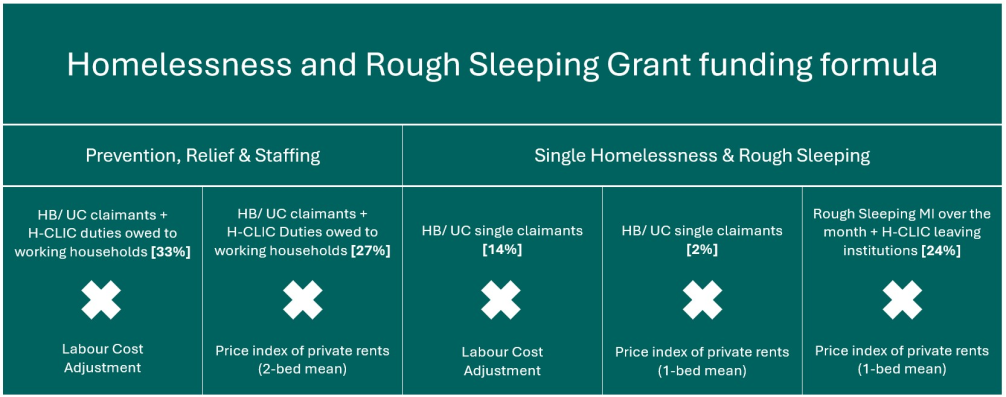
The percentages indicated refer to the weighting for each metric within the overall formula and have been rounded to 1 decimal place.
Image alt text:
Homelessness and Rough Sleeping Grant funding formula
Prevention, Relief and Staffing
- HB/UC claimants + H-CLIC duties owed to working households [33%] x Labour Cost Adjustment
- HB/UC claimants + H-CLIC duties owed to working households [27%] x Price index of private rents (2-bed mean)
Single Homelessness and Rough Sleeping
- HB/UC single claimants [14%] x Labour Cost Adjustment
- HB/UC single claimants [2%] x Price index of private rents (1-bed mean)
- Rough Sleeping MI over the month + H-CLIC leaving institutions [24%] x Price index of private rents (1-bed mean)
Temporary Accommodation:
2.17 As temporary accommodation funding is now part of the Fair Funding Assessment, this means local authorities will not have a named separate allocation for temporary accommodation. We recognise that knowing your indicative share will be important for budgeting planning. To work this out, local authorities can use the ‘Fair Funding Share’ calculator.
Homelessness Prevention Grant Temporary Accommodation Funding Formula
2.18 The ‘Relative Need Formulae’ sheet in the calculator shows the proportion of national need for different service areas of each authority (the ‘unweighted need shares’), including for temporary accommodation (TA) services. The unweighted need share for temporary accommodation has been calculated using the temporary accommodation element of the Homelessness Prevention Grant formula which government consulted on earlier this year. The government response to the consultation was published in June 2025. A technical note has also been published alongside the Settlement.
Overall Fair Funding assessment
2.19 As temporary accommodation is only one element of all local services in scope of the Settlement, a weighting is applied to the ‘unweighted need share’ (referenced above) to reflect the share each service area contributes to overall national-level service need. Therefore, when considering total funding allocations, local authorities should look at the ‘Calculator’ sheet. Authorities can use the ‘Calculator’ sheet to calculate an illustrative estimate of the notional amount of income available for homelessness and temporary accommodation from their Fair Funding Assessment (FFA).
2.20 Since funding is un-ringfenced, it is at the local authority’s discretion to determine how best to use it for different services.
Transitional arrangements
2.21 In line with feedback received in both the Fair Funding Review 2.0 and consultation on Homelessness Prevention Grant funding arrangements, transitional arrangements have been included when calculating allocations.
2.22 Transitional arrangements for the homelessness and rough sleeping elements of the Homelessness, Rough Sleeping and Domestic Abuse Grant mean authorities do not lose funding in 2026/27 compared to their baselined allocation in 2025/26. Losses are capped at 5% in 2027/28 and 15% in 2028/29. How baseline allocations have been calculated is explained below. This approach to transitioning mitigates against significant changes, whilst enabling allocations to move towards the updated assessment of need.
2.23 Because funding simplification is changing how we fund local government, we must set a funding baseline for each local authority. This amount is broadly based on local authority allocations in 2025/26, however there are a few differences from local authority cash allocations in 2025/26 to their funding baselines. These are set out below:
2.23.1 In-year top-ups for homelessness and rough sleeping in 2025/26 are excluded from local authority baselines. For example, this means both the £84 million top-up for homelessness and rough sleeping, announced on 10 October 2025, and the £50 million top-up to the Homelessness Prevention Grant announced, on 11 December are excluded.
2.23.2 For local authorities who produced joint bids for the original Rough Sleeping Initiative funding and Accommodation for Ex-Offenders, we have calculated their share of the joint-bid using the Rough Sleeping and Single Homelessness allocations formula, as we believe this formula is the best measure of cost and need. Alternative methods for splitting joint bids, for example via population, disproportionately favour certain areas.
2.24 Collaboration across local authority areas is still very much encouraged. Our expectation is that local authorities have the flexibility to decide where best to commission joint services or posts, and individual allocations should not preclude them from doing so.
2.25 Funding for the Rough Sleeping Accommodation Programme (RSAP) has been reflected in the baseline for individual local authorities that currently receive funding through specific local authority led schemes. For local authorities who have had RSAP funding directed to registered providers or local authorities via Homes England, this funding has been reflected in the baseline for the relevant local authority. Where funding has previously been issued to Mayoral Strategic Authorities – this has been maintained in Mayoral Strategic Authority baselines – except for in London, where some of the funding for regional schemes has been reflected in the baseline for Greater London Authority, and some devolved to the borough baselines where the schemes are led at borough level. This has been done using 2025/26 allocations, which represents a full year cost for RSAP units – except for where there have been scheme withdrawals or known errors in original allocations (e.g., overpayment that is being recovered). Where there have been known withdrawals / overpayments, these have been removed from the baselines.
2.26 Separate to the Homelessness, Rough Sleeping and Domestic Abuse Grant in paragraph 2.21, transitional arrangements have also been applied to the Local Government Finance Settlement more broadly. To enable local authorities to plan for changes, we will move local authorities to their new allocations in increments of one third over the multi-year settlement. In addition, for local authorities which would see their income fall because of changes, we will protect their income, including locally retained business rates growth, through a range of funding floor levels appropriate to specific groups of authorities’ circumstances. Find further information on transitional arrangements in the Settlement.
Mayoral Strategic Authorities
2.27 Homelessness, Rough Sleeping and Domestic Abuse Grant also provides funding for Mayoral Strategic Authorities. Mayoral Strategic Authority allocations have been calculated using the Single Homelessness and Rough Sleeping formula to reflect where Mayoral Strategic Authority funding has previously been predominately directed. However, Mayoral Strategic Authorities are expected to take a holistic approach to reducing all forms of homelessness, in line with the aims of this consolidated grant. Mayoral Strategic Authority allocations are drawn from the total national funding on homelessness and rough sleeping and are not taken directly from constituent local authorities’ allocations within the Mayoral Strategic Authority area.
2.28 As per the approach taken with local authorities, transitional arrangements have been applied to Mayoral Strategic Authorities. Mayoral Strategic Authorities do not lose funding in 2026/27 compared to their baseline allocation. Losses are capped at 5% in 2027/28 and 15% in 2028/29. Mayoral Strategic Authority baseline allocations are calculated using total Rough Sleeping Prevention and Recovery Grant (RSPARG) and Rough Sleeping Accommodation Programme (RSAP) funding in 2025/26, excluding in-year top-ups for 2025/26 and subject to the RSAP paragraph above. Funding for London sub-regions has been included in the Greater London Authority baseline.
2.29 The targeted funding for supported housing support services, for relevant local authorities within a Mayoral Strategic Authority with an agreement on setting strategic priorities for the Social and Affordable Homes Programme in their area, is (where needed aggregated and) allocated to the relevant Mayoral Strategic Authority. This funding will also form part of these authorities’ Integrated Settlement as part of the Health, Wellbeing and Public Service Reform pillar.
3. Purpose of the Grant and delivery measures
3.0 This section refers to the homelessness and rough sleeping element of the Grant. For further information on Domestic Abuse, see the Homelessness, Rough Sleeping and Domestic Abuse Grant Determination 2026 to 2027. This funding is to support councils deliver the vision in the cross-government strategy on homelessness and rough sleeping: A National Plan to End Homelessness, published on 11 December 2025. The strategy sets out how government will drive long-term sustainable change to address the root causes of homelessness. The strategy also sets out how we will move the system away from crisis response and towards preventing homelessness as much as possible, and where it cannot be prevented it should be rare, brief and non-recurring. To deliver this system change we have set new national targets and proposed new duties on services, supported by freedoms and accountability for councils to make changes locally. These targets, to be achieved this parliament, are to:
- increase the proportion of people who are supported to stay in their own home or helped to find alternative accommodation when they approach their local council for support
- eliminate the use of B&B accommodation for families, other than very short-term use in emergencies
- halve the number of people sleeping rough long-term
Local authorities
3.1 The Homelessness, Rough Sleeping and Domestic Abuse Grant is designed to be flexible for authorities to determine the most effective services and support, driven by local need, to tackle homelessness.
3.2 For further information on compliance, see the information under Homelessness, Rough Sleeping and Domestic Abuse Grant set out in the Final Local Government Finance Settlement: England, 2026-2027 to 2028-2029.
3.3 For homelessness and rough sleeping, the grant is to support local authorities in England to:
a. Discharge their duties under the Housing Act 1996, as set out in the Homelessness Code of Guidance for local authorities, and provide support for rough sleeping. This includes costs towards prevention, relief and main duty activities and staffing – except for costs directly related to temporary accommodation (see definition and exemptions below). Funding is expected to deliver support to all individuals who are facing homelessness – including single homeless households in non-priority need and delivering rough sleeping services that are driven by assessment of an individual’s support needs.
b. Deliver against local homelessness strategies and the metrics set out in the Local Outcomes Framework. These metrics are set out in A National Plan to End Homelessness (section 7.2), the cross-government Homelessness and Rough Sleeping Strategy which include:
- rate of households with children in temporary accommodation per 1,000 households
- number of families in B&B over 6 weeks
- percentage of duties owed where homelessness was prevented or relieved
- percentage of duties owed where homelessness was prevented or relieved for those experiencing multiple disadvantage (with 3 or more support needs)
- number of people sleeping rough on a single night
- number of people sleeping rough over the month who are long-term
To deliver progress against each metric, we must consider changing the way services are delivered across all forms of homelessness. Reducing levels of homelessness requires a whole systems approach. For example, reducing the number of people sleeping rough long-term can be achieved through focusing resources on preventing new rough sleeping and moving away from a system where people may sleep on the streets as a means of accessing support. Similarly, reducing the use of temporary accommodation and the worst forms of accommodation requires funding to be moved upstream to prevent a continued reliance on intervening at the point of crisis. Successful prevention involves responding early and holistically to people’s support needs, by working with core partners across a range of services – such as probation and health.
c. Focus on early intervention and maximising prevention activities. This includes working with landlords to support households to retain private rented tenancies and reduce reliance upon temporary accommodation - particularly reducing the use of unsuitable B&Bs for families. Maximising prevention also includes effective engagement and collaboration with voluntary, community and frontline sector partners including faith organisations, and ensuring that support is driven by assessment of the needs of the individuals.
d. This grant may not be spent on costs directly related to temporary accommodation. Temporary accommodation costs mean the cost of the provision of the accommodation. There are some exceptions to this. Please see Chapter 4 of this supporting guidance for further information on the definition of temporary accommodation costs and exemptions.
3.4 Targeted funding for supported housing support services: The purpose of this funding is to support selected authorities in receipt of this funding, in the commissioning of support services and to increase the supply of good quality supported housing. The funding may not be spent on accommodation or accommodation services (including housing management costs) – the definition of which is set out in paragraph 4.18, Further detail for this funding is set out at paragraph 4.18.
3.5 Renters’ Rights Act 2025: The Homelessness, Rough Sleeping and Domestic Abuse Grant is also intended to cover the additional costs for homelessness services stemming from the Renters’ Rights Act 2025, since the abolition of section 21 “no fault” evictions will broaden the scope of the prevention duty. This additional funding is being provided to support services with managing the impact of this change.
Mayoral Strategic Authorities
3.6 For Mayoral Strategic Authorities in England the purpose of the funding is to assist local authorities by providing strategic support and leading partners across the region to tackle homelessness and rough sleeping by:
a. Setting the regional ambition on homelessness, in partnership with local authorities, and develop regional structures to deliver these ambitions.
b. Encouraging a preventative approach to homelessness and rough sleeping.
c. Convening homelessness and rough sleeping partners, including in the voluntary, community and faith sectors, to strengthen services across the region.
d. Delivering, as appropriate, region-specific interventions that will enhance the statutory work of local authorities and relevant public sector partners with regard to homelessness and rough sleeping.
e. This grant may not be spent on costs directly related to temporary accommodation. The definition of which, excluding exceptions, can found in Chapter 4.
3.7 Chapter 4 includes examples of how funding could be used to meet these objectives and report on them.
4. Illustrative uses of funding
4.1 The new Homelessness and Rough Sleeping Strategy: A National Plan to End Homelessness sets out how we will move the system away from crisis response and towards prevention. Local authorities are at the front line of the response to homelessness and must lead the way in putting prevention at the core of their services. We know that this is better for the people we serve and better for councils delivering services.
4.2 Local and regional authorities know their cohorts and local need best. This is why the grant funding provides flexibility for areas to determine the services and support that would be most effective to help their local areas.
4.3 This section provides examples of how funding could be used. This is not intended to be a mandatory or exhaustive list. We encourage local and Mayoral Strategic Authorities to work with their MHCLG expert homelessness and rough sleeping advisers to identify and develop services and pathways to meet the individualised needs of their cohort and area.
4.4 Examples below cover the following categories:
- prevention and relief
- staffing
- accommodation and support
These aim to mirror information that will be required as part of the end of year spend declarations.
Prevention and relief
4.5 Where possible, funding should be used to ensure that households or individuals at risk of homelessness and rough sleeping are identified and are prevented in the first place, and where prevention is not possible, they are supported quickly through the relief duty, preventing them from experiencing long-term or repeated homelessness or rough sleeping.
4.6 Activities could include:
- Financial incentives to access and / or sustain accommodation.
- Money advice and financial training or financial assistance and support to assist households sustain accommodation.
- Working with landlords to resolve issues and secure existing properties or help transition to a new property as required.
- Interventions focused on early engagement – for example specialist services for young people, upstream prevention or services co-located in public institutions.
- Support for individuals leaving public sector institutions at risk of homelessness – for example prisons, other justice accommodation, general and psychiatric hospitals, discharge from the UK Armed forces or asylum support.
- Specialist housing advice - on property rights and landlord and tenant law.
- Mediation services - within family and friends’ accommodation settings to resolve issues and sustain accommodation.
- Individualised funding to support people during the main duty – such as bespoke solutions to meet individual needs to encourage a sustainable route out of homelessness.
- Focussed support for long-term rough sleepers or those at risk of returning to rough sleeping.
- Partnership building with voluntary, faith and community organisations – services that encourage building relationships with partners within the voluntary, faith and wider community sector.
- Work to support better use of evidence and data to help prevent and reduce homelessness.
- Working with partners to support the safety of households experiencing domestic abuse through the ability to stay in their homes with support, security and injunctions, or to relocate as required.
- Cover the additional costs for homelessness services stemming from the Renters Rights Act 2025, since the abolition of section 21 “no fault” evictions will broaden the scope of the prevention duty. This additional funding is being provided to support services with managing the impact of this change.
4.7 To help councils identify those most at risk of long-term rough sleeping, and who need an accommodation-based intervention, we are currently piloting an Ending Rough Sleeping Risk Assessment Tool with 22 local councils across England.
4.8 As well as providing a framework for decisions on service offers to individuals, the tool will assist in identifying and understanding cohorts. This will help local authorities to make decisions regarding activities, including:
- interventions focused on early engagement
- focussed support for people sleeping rough long-term or those at risk of returning to rough sleeping
- support for individuals leaving public sector institutions at risk of homelessness
- partnership building with voluntary, faith and community organisations
- work to support better use of evidence and data
Staffing
4.9 Ensuring a skilled workforce is fundamental to delivering effective homelessness services and achieving the government’s aim to tackle homelessness.
4.10 To meet statutory duties (as set out under the Housing Act 1996 and in the Homelessness Code of Guidance), local authorities should maintain manageable workloads across key roles such as housing options officers, homelessness assessors, outreach workers, navigator and case workers.
4.11 Service provision should offer availability to meet individuals in person and conduct visits which is vital to building trust, identifying risks early and providing tailored support. Strategic investment in staffing capacity is therefore essential to enable meaningful prevention and off the street responses to those at risk or experiencing homelessness.
4.12 Where a local authority is funding any specialist roles, such as a mental health worker, we expect that this is part of a wider system approach and will have the full involvement and support of relevant partners. Local authorities should ensure that interventions integrate and build on partnerships, to avoid stand-alone interventions (and, where appropriate, should consider the suitability of other funding streams for these specialist roles).
4.13 Activities may include:
- Homelessness staff costs related to prevention, relief and management of homelessness pressures.
- Multi-agency support – posts such as multi-agency system leads, administrative support, joint commissioning roles, and independent chairs of multi-agency panels that build and support cross-professional working, including with children’s and adult social care.
- Street based responses – outreach and in reach services, as well as services to identify those at risk of homelessness and rough sleeping.
- Services that provide community-based support to individuals once housed to prevent returns to rough sleeping.
- Specialist roles to support the needs of differing cohorts - such as dedicated roles to focus support on preventing homelessness for women, victims of domestic abuse, LGBTQ+ individuals, care leavers, young people, and those experiencing multiple disadvantage. This may include facilitating access to trauma-informed, safe, and single-sex spaces where required, with outreach to those experiencing hidden homelessness.
- Care leavers – housing staff focused on young people leaving care, including roles supporting young people through their journey to independence and working closely with Leaving Care teams to identify early risks of homelessness and work with other professionals to provide holistic support. It could also include a strategic housing role to lead and strengthen joint housing pathways between housing and children’s services to deliver improved local accommodation offers to care leavers and prevent homelessness.
- Prison leavers and ex-offenders – staffing focussed on supporting individuals who are leaving or have left prison who are at risk of or experiencing homelessness. This could include roles such as prison navigators focused on early engagement with prison leavers to identify potential accommodation options, with a focus on clear join up with prison and probation services.
- Asylum accommodation leavers – staffing focussed on targeted interventions for individuals transitioning from asylum accommodation, with a focus on preventing rough sleeping and facilitating access to sustainable onward housing solutions.
- Health needs – staffing focussed on mental health, physical health and substance misuse. This could include roles such as specialist women’s health workers that support more women into treatment, clinical roles such as psychologists, harm reduction initiatives such as inpatient detox preparation work and clinical staff that base themselves within outreach teams.
- Employment – staffing focussed on supporting people to gain employment or the skills needed for employment.
- Arrangements to enable face-to-face engagement, such as in assessment centres or hubs or through home visiting.
- Training, travel and subsistence costs.
Accommodation and support
4.14 Access to suitable and supported accommodation is essential for both preventing and resolving homelessness. Accommodation services should not only meet the immediate needs of individuals but also provide tailored support for those with complex needs and support long-term solutions to homelessness.
4.15 Activities may include:
- Supported housing / supported accommodation – accommodation where support and/ or supervision is provided. This can include staff and accommodation costs.
- Housing First and housing led models – services that fit both Housing First models and services which adopt Housing First principles.
- Rough Sleeping Accommodation Programme (RSAP) – Funding for the Rough Sleeping Accommodation Programme has now been incorporated into this Grant. Funding can be used to support the ongoing operation of accommodation and support services provided to individuals in the units as previously funded through RSAP. See prospectus for out of London, and prospectus for London for further information.
- Quality and Standards: Funding may be used to secure and assure the standards of sustainable options for people at risk or experiencing homelessness and rough sleeping.
4.16 This grant may not be spent on costs directly related to temporary accommodation. This may include (noting the exceptions):
- actual (net) temporary accommodation costs
- temporary accommodation rent
- temporary accommodation subsidy loss
- payment of bad debt related to temporary accommodation
- maintenance costs of temporary accommodation (Maintenance is routine and should be factored into the cost of temporary accommodation. It is different to investment to improve quality of life in temporary accommodation. See bullet under exceptions in the next paragraph.)
- payment of arrears of temporary accommodation
- incentive payments towards temporary accommodation
- any upfront costs of temporary accommodation – deposits or rent in advance costs
4.17 The exceptions to this are:
- where temporary accommodation has already been provided through section 189B or section 190(2) of the Housing Act 1996, local authorities may use this grant to provide temporary accommodation for a period of a year from 1 April 2026 to 31 March 2027
The Grant will allow a transition period of a year for providing temporary accommodation under section 189B – this is temporary accommodation provided to people who are eligible for assistance under the Relief Duty. This duty (section 189B) is often used to provide discretionary accommodation for those not in priority need, such as people sleeping rough, assisting them with emergency off the street accommodation. This exception is only for people already accommodated under the Duty, not for new placements from 1 April 2026 when the 2026/27 grant conditions come into force.
Funding will allow a transition period of a year for providing temporary accommodation under section 190(2) – this is temporary accommodation provided to people who are eligible for assistance and in priority need, but are deemed intentionally homeless - and are owed a duty to be provided with accommodation while they have a reasonable opportunity for them to find their own accommodation (no specific period of time). This exception is only for people already accommodated under the Duty, not for new placements from 1 April 2026 when the 2026/27 grant conditions come into force.
Please note the exemption below that sets out how the Grant can be used in relation to supported housing / supported accommodation. Please speak to your MHCLG homelessness adviser if you require further clarification.
- local authorities and Mayoral Strategic Authorities may use this grant to provide supported housing / supported accommodation, Housing First and housing-led models as part of a designated housing pathway out of homelessness and rough sleeping
As referenced in the list of activities above, the conditions allow for accommodation costs that are associated with supported accommodation.
- local authorities and Mayoral Strategic Authorities may use this fund for the costs of temporary accommodation improvement and inspection of standards
These interventions are aimed at improving the quality of life in temporary accommodation. Funded activities could include:
- access to basic facilities such as laundry services, wi-fi and storage
- improvement of spaces e.g., to enable children to complete homework or have play space
- provision of specialist support roles e.g. out of area, attendance, safeguarding and welfare posts. Staff training on managing temporary accommodation (including impacts on education)
4.18 Targeted funding for supported housing support services: as set out in paragraph 3.4, the purpose of this funding is to support selected local authorities to fund the delivery and commissioning and to increase the supply of good quality housing-related support services in supported housing. The funding has primary focus on single homelessness prevention and relief and preventing and reducing rough sleeping, but with flexibility to support other vulnerable groups in supported housing including disabled and older people in longer term housing. The authorities in receipt of this specific funding are encouraged to use it to unlock the delivery of supported housing through the Social and Affordable Homes Programme where feasible, although there is flexibility to commission support services in existing accommodation schemes and to support the viability of existing stock to avoid decommissioning and disposal of vital good quality services.
4.19 Local authorities will want to consider the best use of this funding to meet need locally. This is likely to include identifying opportunities to encourage new supply, as well as identifying opportunities to recommission and reshape existing provision to best meet local need, and increase the overall supply of high-quality supported housing. Local authorities may also wish to review plans in line with any local supported housing strategy already in place or under development. The Department has now published guidance for local authorities on developing local supported housing strategies, as required by the Supported Housing (Regulatory Oversight) Act 2023.
4.20 This funding is to fund support services and may not be spent on accommodation or accommodation services (including housing management costs), such as the costs indicated below:
- actual (net) accommodation costs or accommodation-related service charges
- rent
- intensive housing management costs in supported housing
- supported accommodation subsidy loss
- payment of bad debt related to supported accommodation
- maintenance costs of supported accommodation (Maintenance is routine and should be factored into the cost of accommodation. It is different to investment to improve quality of life for people in supported accommodation)
- payment of arrears of supported accommodation
- incentive payments towards supported accommodation
- any upfront costs of supported accommodation – deposits or rent in advance costs.
Mayoral Strategic Authorities
4.21 For Mayoral Strategic Authorities to achieve the purpose of the grant to tackle homelessness and rough sleeping, they could undertake interventions such as:
- Developing strategies and outcomes frameworks to unify efforts across all local authorities within the sub-region or strategic authority area.
- Working across public sector partners to embed a prevention first approach, sharing information and working jointing to identify early intervention opportunities, this could include setting up a prevention task force.
- Fostering collaboration through shared ideas and casework across local authorities to support their work with hard to reach individuals, for example establishing panels to co-ordinate support or prioritise placements across the region.
- Initiating gaps/needs assessments across local authorities to inform future commissioning and service planning.
- Centrally coordinated recruitment, to streamline hiring processes where local authorities seek to recruit multiple candidates for the same roles.
- Strengthening strategic relationships with registered providers to facilitate housing solutions and explore opportunities for institutional investment into housing.
- Testing innovative pilot approaches specific to local context and needs, in partnership with local authorities and community-based services.
4.22 All Mayoral Strategic Authorities will receive their portion of the Homelessness, Rough Sleeping and Domestic Abuse Grant through the Local Government Finance Settlement. Mayoral Strategic Authorities who receive Integrated Settlements will be able to treat these allocations as part of their wider Integrated Settlement. This means the Integrated Settlement Outcomes Framework and associated accountability and controls arrangements will be the mechanism through which central government retains oversight of this funding stream.
4.23 Targeted funding for supported housing support services: is also applicable to some Mayoral Strategic Authorities. If you are a recipient of this funding, it will be detailed in your allocation letter February 2026.
4.24 Mayoral Strategic Authorities have been allocated funding for supported housing support services where they both have an agreement to set the strategic direction of the Social and Affordable Homes Programme, and where local authorities within their area were identified as high need using the Single Homelessness and Rough Sleeping Formula. We expect Mayoral Strategic Authorities to engage with local authorities in their area, and in particular with local authorities with high need for supported housing for people experiencing or at risk or homelessness or rough sleeping, to consider the best use of this funding to meet need locally and sub-regionally. This is likely to include identifying opportunities to encourage new supply and alignment with the Social and Affordable Homes Programme, as well as identifying opportunities to recommission and reshape existing provision to increase the overall supply of high-quality supported housing and best meet local need. Local authorities and Mayoral Strategic Authorities may also wish to review plans in line with any local supported housing strategy already in place or under development. The Department has now published guidance for local authorities on developing local supported housing strategies, as required by the Supported Housing (Regulatory Oversight) Act 2023.
5. Restricted eligibility
5.1 We recognise the continued work of local and strategic authorities working with those who are ineligible for statutory homelessness assistance due to their immigration status and the challenges of working with this cohort. This does not mean that you should not offer any support to this group as long as you are acting within the law in doing so. We would encourage local and strategic authorities to continue to work with the Home Office to further support their interactions with this cohort.
5.2 To help with this, local and strategic authorities should assess this group on an individual basis, considering that person’s specific circumstances and support needs to identity the most effective interventions. Examples of these interventions are listed below, noting that this is not an exhaustive list:
- funding to support individuals on voluntary reconnections to home country
- funding for support workers/navigators to provide specialist support to enhance an individual’s move-on options, including resolving an individual’s immigration status
- funding for faith and community sector organisations
- funding for immigration and legal services to support regularisation of status
- funding for translation services and/or specialist outreach
5.3 Alongside using funding available to support this cohort, local and strategic authorities should also consider how they can work with Home Office to support individuals to regularise their status, as well as encouraging voluntary returns where a person does not have a legal right to remain in the UK. For further support please do get in touch with the Home Office Homelessness Team on: HOHomelessnessTeam@homeoffice.gov.uk.
6. Reporting requirements
6.1 As a condition of funding the grant recipients must engage with the Department and submit all required data on the Homelessness, Rough Sleeping and Domestic Abuse Grant during the funding period. These returns must be comprehensive, accurate, publishable and submitted within stated deadlines.
For further information on compliance, see the information under Homelessness, Rough Sleeping and Domestic Abuse Grant.
End of year reporting – spend declarations and reports
6.2 An end of year declaration will be required ahead of the end of each financial year.
6.3 The Chief Executive or the local authority’s Section 151 Officer or, in Mayoral Strategic Authorities without an Integrated Settlement, a Section 73 Officer of the recipient payment authority, is required to sign an end of year declaration of spend and return this to MHCLG for each financial year of the grant.
6.4 Spend must be reported against the spend declaration categories set out at Annex B.
6.5 The relevant officer of each of the recipient authorities are required to sign and return to: HomelessnessandRoughSleepingFinanceTeam@communities.gov.uk in the Homelessness and Rough Sleeping Directorate of the Ministry of Housing, Communities and Local Government, a declaration (to be received for financial year 2026/27 no later than 30 April 2027) in the following terms: “To the best of our knowledge and belief, and having carried out appropriate investigations and checks, in our opinion, in all significant respects, the conditions attached to Homelessness, Rough Sleeping and Domestic Abuse Grant [No. 31/**] have been complied with”.
6.6 Spend declarations may also include an estimate of spend to date and forecast outturn to be provided by first week of September requested by the Department.
6.7 For relevant selected authorities in receipt of targeted funding for supported housing support services, local authorities are expected to submit a short report as soon as reasonably practicable after the end of each financial year to MHCLG. For the financial year 2026/27, MHCLG would expect this to be submitted by 30 June 2027.
6.8 The data and information submitted to MHCLG should include the following: a) detailed breakdown on the authority’s spending on supported housing support services funded specifically through this Grant and the number of individuals (full year equivalent) supported. Data on the number of individuals supported should include a break-down by cohort. B) evidence that the spending aligned with any local strategic needs assessment and any local supported housing strategy, including any administrative or geographical cross-boundary coordination or cooperation including at a sub-regional or regional level.
6.9 For Mayoral Strategic Authorities with an Integrated Settlement, oversight and reporting are via the Integrated Settlement Outcomes Framework rather than end of year spend declarations or reporting.
Local Outcomes Framework
6.10 The Local Outcomes Framework contains a series of existing metrics taken from data already reported by local authorities and is designed to support local authorities to use funding strategically to meet local need to meet these outcomes.
- rate of households with children in temporary accommodation per 1,000 households
- number of families in B&B over 6 weeks
- percentage of duties owed where homelessness was prevented or relieved
- percentage of duties owed where homelessness was prevented or relieved for those experiencing multiple disadvantage (with 3 or more support needs)
- number of people sleeping rough on a single night
- number of people sleeping rough over the month who are long-term
6.11 MHCLG will measure local authority delivery via the Local Outcomes Framework. These will be reported via the H-CLIC data collection and Rough Sleeping Management Information.
6.12 MHCLG advisers will also use these metrics to further support local authorities to meet the outcomes in our cross-government Strategy on Homelessness and Rough Sleeping: A National Plan to End Homelessness. Where outcomes are not being met, we may deploy escalation measures such as intensified adviser engagement and improvement plans and, if necessary, formal intervention levers to drive outcomes.
Homelessness and rough sleeping action plans
6.13 As a condition of this funding, local authorities must have an action plan in line with paragraph 2.11 of the Homelessness Code of Guidance which must be published (except where specified below or in guidance) by Autumn 2026 and regularly updated. This action plan should comply with relevant guidance and include, at a minimum:
-
Targets which, taking into account local context and the ambition set out in national targets, will improve performance against each of the homelessness and rough sleeping metrics in the Local Outcomes Framework by the end of the Parliament. Action Plans should include a description of how the local authority, working with partners, will achieve these targets.
-
Local governance structures that hold authorities and partners accountable for delivering the plan.
-
How partnerships work across the local area to manage homelessness and rough sleeping pressures to shift from crisis response to a culture rooted in prevention.
-
Reference to specific plans for the following metrics in the Local Outcomes Framework where appropriate:
- B&B use for families over six weeks – where published data shows a local authority has five or more families in B&B (bed and breakfast) accommodation for longer than 6 weeks, the local authority must produce and agree a B&B elimination plan. As it will contain sensitive information, this plan does not need to be published.
-
Long-term rough sleeping – areas with high pressures of long-term rough sleeping, based on total numbers and/or proportions of total people sleeping rough, must produce and agree a Long-Term Rough Sleeping Partnership Plan. MHCLG advisers will be in contact with those areas that this applies to. The Long-Term Rough Sleeping Partnership Plan must be produced in collaboration with local partners ideally including statutory stakeholders, commissioned and non-commissioned service providers. The plan should be co-produced and co-signed by partner agencies and agreed with your MHCLG adviser. This should be published, unless agreed with MHCLG adviser.
-
Policy for ensuring suitability of temporary accommodation, following an assessment, including procuring sufficient units of temporary accommodation and allocating them. Depending on local circumstances, this may include regular audits of temporary accommodation and discussions with occupants to identify and address patterns or issues which may lead to unsuitable placements. Policies may outline approaches to value for money in the procurement of accommodation when considering nightly paid and longer-term opportunities but should ensure suitability is at the heart of decisions. This policy should reflect (as applicable to local circumstances):
- The authority’s statutory duties, including to safeguard and promote the welfare of children under the Children Act 2004 and, where relevant, the factors which will be taken into account in offering accommodation within the authority, close to the authority or further away, pursuant to Nzolameso v City of Westminster. This should reflect that, wherever possible, authorities should seek to place homeless households within their area and avoid multiple moves, except where there are clear benefits for the person seeking assistance.
- Policies should set out action to mitigate disruption of support and essential services – in particular health services, education and other vital support networks (where relevant) and to ensure temporary accommodation is always suitable. It should include how the authority will ensure it complies with s208 of the Housing Act 1996 to provide notification to the receiving authority and engage as necessary to minimise disruption. Furthermore, where vulnerabilities or safeguarding issues have been identified that will require services to be provided by the receiving authority, the placing authority should liaise with the receiving authority (or authorities in two tier areas) prior to the placement being made, in order to ensure the necessary services or provision can be delivered.
6.14 Whilst Action Plans should demonstrate how to improve performance against each of the metrics in the Local Outcomes Framework, local authorities may also want to include bespoke targets using other performance indicators – for example using additional data from H-CLIC or rough sleeping management information.
6.15 Mayoral Strategic Authorities without an Integrated Settlement must publish by Autumn 2026 a high-level action plan setting out how they will use the funding to meet the purpose of the grant and develop their regional approach to tackling homelessness and rough sleeping, and how they will work in partnership with local authorities to support them to deliver against the Local Outcomes Framework. The action plan should be regularly updated over the multi-year settlement. For those Mayoral Strategic Authorities with an Integrated Settlement, there is no need for an action plan as their work will be set out through the Integrated Settlement Outcomes Framework.
6.16 More detail and guidance on action plans, including deadline for submission to MHCLG and publication, will follow in a toolkit in due course.
Homelessness Case Level Information Collection (H-CLIC)
6.17 The local authority must submit all H-CLIC returns for each financial year, including full temporary accommodation figures. These returns must be comprehensive and publishable. If this is not possible due to factors outside of the authority’s control, they must notify their homelessness adviser.
6.18 H-CLIC data must be uploaded during the following collection windows. Any changes needing to be made to collection dates by MHCLG will be clearly communicated to local authorities.
| Quarterly dataset | H-CLIC opens | Quality assurance opens | H-CLIC closes | Quality assurance closes |
|---|---|---|---|---|
| April – June 2026 | Wed 1 July 2026 | Tue 7 July 2026 | Fri 31 July 2026 | Wed 05 August 2026 |
| July – September 2026 | Mon 1 October 2027 | Tue 6 October 2026 | Fri 30 October 2026 | Wed 4 November 2026 |
| October – December 2026 | Mon 4 January 2027 | Thu 7 January 2027 | Tue 2 February 2027 | Fri 5 February 2027 |
| January – March 2027 | Thu 1 April 2027 | Tue 6 April 2027 | Fri 30 April 2027 | Fri 7 May 2027 |
6.19 The data pertaining to January to March 2027, will be due for return in the next financial year and will be included in the grant conditions for the Homelessness, Rough Sleeping and Domestic Abuse Grant 2027-28, along with all other collections due that year.
6.20 MHCLG will monitor compliance with this condition. The Department tracks and monitors H-CLIC submissions quarterly and escalates where there has been data missing or unpublishable data for consecutive and/or multiple quarters. Local authorities will be notified by the Department if they have not met the condition after every quarter. Local authorities can view their data dashboard.
6.21 If data is not provided by the agreed dates specified in the table above, MHCLG is maintaining the penalty of recovery of up to 10% of in year funding. Please therefore make sure your Director of Homelessness (or equivalent) is aware of this condition to ensure data for your local authority is accurate and uploaded on time.
6.22 We recognise that there may occasionally be exceptional circumstances which affect local authorities’ ability to meet this condition. We expect these to be rare. Where such circumstances occur and are outside of the control of the authority and the authority can evidence demonstrable steps taken to rectify gaps in reporting adherence, MHCLG may at its discretion agree to waive the financial deduction.
6.23 Please contact the H-CLIC team as soon as you become aware of any factors affecting your local authority’s ability to submit H-CLIC data and comply with this condition: homelessnesstats@communities.gov.uk.
Rough sleeping data
6.24 We require local authorities to submit regular and timely management information as part of the Rough Sleeping Data Framework, confirming their rough sleeping numbers and which cohorts they fall under. This management information is regularly published to provide transparency of local progress in tackling rough sleeping.
6.25 Local authorities are required to complete an annual snapshot every autumn, independently quality assured by Homeless Link. We would encourage you to use your annual count (conducted in October or November) to provide your management information for the relevant month.
Homelessness and rough sleeping adviser engagement
6.26 Authorities must continue to work collaboratively with their MHCLG homelessness and rough sleeping advisers to ensure delivery of successful outcomes defined under ‘purpose of the grant’. This includes regular engagement to update on delivery, resolve issues and explore what changes or improvements could be made, and may also include being invited to engage in a ‘deep dive’ extended meeting with advisers, targeted on a specific issue relevant to the authority, and collaborating on targeted initiatives or interventions.
Compliance with grant conditions
6.27 Authorities will be notified in writing by the department where they are judged to be in breach of the grant conditions and/ or reporting requirements. Notifications will be sent formally in writing by MHCLG officials or, where necessary, from the relevant Minister. Failure to comply or demonstrate improvement following formal notification may result in action such as withholding, reducing or suspending funding.
Annex A: Reporting timetable
| Report Title | Required of | Frequency of collection | Due date | Submitted Via | S151 officer (or equivalent) sign off required? |
|---|---|---|---|---|---|
| H-CLIC statutory homelessness statistics | Local authorities only | Quarterly | 4 weeks after the collection opens at the end of the quarter | Delta | No |
| Rough Sleeping Management Information (MI) | Local authorities only | Regular – the frequency of collection will be confirmed in 2026 | tbc | Delta | No |
| Annual Rough Sleeping Street Count | Local authorities only | Annual | October or November | Delta | No |
| Local Outcomes Framework metrics | Mayoral and local authorities | N/A | N/A | N/A | No |
| End of Year Declaration | Mayoral and local authorities | Annual | 30 April 2027 | Delta | Yes |
| Mid-year Estimate of Spend (optional) | Mayoral and local authorities | Annual | First week of September 2027 | Delta | No |
| Homelessness and Rough Sleeping Action Plan | Mayoral and local authorities | Regularly updated | Autumn (deadline TBC) | Published on authority website and MHCLG informed | N/A |
| B&B Elimination Plans | Local authorities where the number of families in B&B is 5 or more over 6 weeks at any point in the reporting period | As required | To be agreed with adviser | N/A | No |
| Long-term rough sleeping partnership plan | Local authorities with high rough sleeping pressures based on number and/or proportion* | As required | To be agreed with adviser | N/A | No |
| Adviser Engagement (including deep dives) | Mayoral and local authorities | Ongoing throughout the reporting period and dependant on local need and performance against Local Outcomes Framework metrics | To be discussed with adviser | N/A | N/A |
*MHCLG advisers will be in contact for areas where this applies
Annex B: Spend declarations
1. Staffing
A. Administration, Prevention, Relief & Main Duty: All staffing expenditure incurred in delivering statutory homelessness assessment, prevention and relief and main housing duties, including activity directly related to securing or sustaining accommodation for households owed a homelessness duty. This includes training, travel and subsistence costs.
B. Specialist Services and Support: All staffing expenditure incurred in providing homelessness-related support, specialist services and interventions that sit outside the core statutory assessment, prevention and relief and main housing duties. This includes training, travel and subsistence costs
2. Accommodation
A. Temporary Accommodation spend related to Section 189B or Section 190(2) of the Housing Act 1996
B. Spend related to providing supported housing/supported accommodation, Housing First and housing-led models as part of a designated pathway out of homelessness and rough sleeping.
C. Spend related to Temporary Accommodation improvement and inspection of standards
D. Other Accommodation Related Costs
3. Prevention and Relief Activity
A. Administration, Prevention, Relief & Main Duty: All non-staffing expenditure incurred in delivering statutory homelessness assessment, prevention and relief and main housing duties, including activity directly related to securing or sustaining accommodation for households owed a homelessness duty.
B. Specialist Services and Support: All non-staffing expenditure incurred in providing homelessness-related support, specialist services and interventions that sit outside the core statutory assessment, prevention and relief and main housing duties.
4. Domestic Abuse
A. Total amount spent on support in Domestic Abuse Safe Accommodation
B. Total amount spent on admin costs associated with the delivery of the Part 4 duty
5. Other
Any other expenditure that is not in categories 1, 2 3 or 4