A National Plan to End Homelessness
Published 11 December 2025
Applies to England

© Crown copyright 2025
This publication is licensed under the terms of the Open Government Licence v3.0 except where otherwise stated. To view this licence, visit nationalarchives.gov.uk/doc/open-government-licence/version/3 or write to the Information Policy Team, The National Archives, Kew, London TW9 4DU, or email: psi@nationalarchives.gov.uk.
Where we have identified any third party copyright information you will need to obtain permission from the copyright holders concerned.
This publication is available at https://www.gov.uk/government/publications/a-national-plan-to-end-homelessness/a-national-plan-to-end-homelessness
Presented to Parliament by the Secretary of State for Housing, Communities and Local Government by Command of His Majesty.
December 2025
© Crown copyright 2025
CP 1452
ISBN 978-1-5286-6118-8
Lived Experience foreword
Foreword by members of the Homelessness and Rough Sleeping Lived Experience Forum
Homelessness is spoken about as a policy problem, but we know it as something more personal. We know the reality behind the numbers: the pain and trauma that led us into homelessness. A system that should support us out of homelessness, instead compounding that trauma. The ongoing effects of that trauma for us and for our children.
This strategy recognises the scale of the crisis, setting out a path towards a better future for people like us – individuals and families experiencing homelessness and at risk of homelessness.
We’ve repeatedly experienced a system at odds with how it’s supposed to be. We’ve been failed by individuals and organisations that should have helped us. We’ve been trapped in a labyrinthine system without support. And we haven’t got here overnight: this is decades of under-investment.
We’ve known what needs to be done, but homelessness has never been seen as a priority. If proposed solutions had been implemented, we wouldn’t be walking past rows of tents on our streets. Children would not be living in substandard temporary accommodation.
We therefore welcome the Government’s increased investment, new targets – for example, preventing discharge from hospital and prison into homelessness – and commitment to greater accountability. We welcome the continued leadership of the Inter-Ministerial Group and the new “duty to collaborate”. Taking this strategy from words to action requires leadership, engagement and collaboration at all levels.
We also welcome the commitment to lived experience involvement in this strategy’s implementation. We are pleased that what we and countless others shared has been heard and is reflected here. We also welcome the publication of our report alongside this strategy. People with lived experience and frontline workers must be involved, co-creating solutions from the ground up to ensure this strategy delivers what it promises. Our input isn’t just the right thing to do. It’s the best way to get value for money. We are uniquely qualified to know what works, not just what looks good on a page.
Finally, we offer hope. We are the proof that with the right support at the right time, things can change. This strategy is about more than providing a roof. It’s about building a system that understands and responds to people’s needs before they hit rock bottom, recognising the trauma behind homelessness, and supporting people to rebuild their lives with compassion and dignity.
We welcome this strategy’s ambition. Now, let’s put it into action.
Charlotte Manning, Jamesy Dillon, Joanne, Robin, Sahar Khan and Tony
Members of the lived experience core group, who co-designed and delivered the four lived experience forums.
Ministerial foreword: Secretary of State for Housing, Communities and Local Government
A good life, based on an affordable, secure and stable home, should be available to everyone in this country.
There’s no more shameful testament to the housing crisis we inherited than the near record numbers of people sleeping in shop doorways and the 170,000 children stuck in temporary accommodation.
Homelessness and rough sleeping doubled under the previous Conservative government and some of the most vulnerable people in our society and families who deserve better are now paying the price.
This is a failure of a government who put policies in place which meant families had to deal with skyrocketing cost of energy, housing and food bills.
The same government whose policies drove almost a million more children into poverty, left families struggling to pay the rent, knowing at any point they could be unfairly evicted, and who failed to build enough secure, affordable homes for hard-working families.
This is taking not just a terrible human toll, but costing British taxpayers dearly – government spending on temporary accommodation last year was £2.8 billion, almost five times higher than in 2010.
The last Labour government made a choice. They were determined to end homelessness and rough sleeping.
We saw that, where there was a desire from across government to bring down temporary accommodation numbers and get people off the street and out of shop door fronts, there was a way. Families living in temporary accommodation halved and rough sleeping was cut by two thirds.
We know that when things go wrong, lives can deteriorate quickly.
Preventing homelessness and tackling the root causes of homelessness is not only the right thing to do, it is also the smart thing.
It is much more effective and cost-effective than a never-ending crisis response.
We will break this cycle through our new, cross-government homelessness strategy so that homelessness becomes rare and brief, people can access support quickly and no-one experiences homelessness more than once in their life.
We’re building more social and affordable homes and backing this with a record £39 billion investment.
We’re reforming the Private Rented Sector to ban no-fault evictions, giving renters more housing security.
We’re investing in homelessness services to act early, supporting councils with the tools and flexibility they need and ensuring there’s join up between public services to prevent rather than just manage crises.
This is an ambitious and comprehensive plan, taking essential action now – eliminating the unlawful use of B&Bs for families, improving the quality of temporary accommodation and testing innovative approaches to halve long-term rough sleeping – and tackling the complex causes of homelessness.
We won’t fix the dire situation we inherited overnight.
And we can’t do it alone.
That’s why we are introducing new national and local targets, strengthening accountability and ensuring lived experience of homelessness informs every step we take, so that councils, charities and other homelessness organisations can join us in delivering for Britain.
It’s now time for us all to join forces; pulling together across central and local government, civil society, sectors and agencies, to prevent homelessness and end this crisis for good.
Working together, we’ll consign homelessness and rough sleeping where it belongs – to history.
The Rt Hon Steve Reed OBE MP
Secretary of State for Housing, Communities and Local Government
Ministerial foreword: Minister for Local Government and Homelessness
Homelessness is a painful reminder of how politics can fail people.
But for 14 years the previous Conservative government were content to look the other way while this national emergency deepened and worsened.
I have seen, first-hand, the human cost of this inaction which is, often, hidden.
In my constituency – and across the country – too many families are living in squalid, overcrowded conditions with no hope of a secure home, whilst others are sleeping rough, abandoned by a system that should protect them.
In London alone, on average, one child in every classroom does not have a permanent place to call home.
For some, this is literally a case of life or death.
Between 2019 and 2024, 74 children died in circumstances where living in temporary accommodation potentially contributed to their death. Of these, 58 were babies under the age of one.
Every one of these children was a precious human – deserving of dignity.
They are the victims of a crisis made worse because of choices.
The previous government were content to patch over the problems rather than prevent or solve them.
But this Labour Government is choosing, instead, to make ending homelessness and rough sleeping the priority it should be. We will do this by catching people before they fall by addressing the root causes of homelessness, not just managing its consequences.
This is about more than funding and legislation. It is about ensuring that every part of government – from health to justice to education – plays its role in prevention.
This is the only way we’ll break the cycle of failure we inherited.
Ultimately, it means building many more homes.
And we are aiming high, with plans to build 1.5 million new homes, including the biggest boost in social and affordable housing in a generation.
We’re also ending no-fault evictions through the Renters’ Rights Act.
But we know that we also must act now to help those who can’t wait.
That’s why we’re investing £3.5 billion in homelessness and rough sleeping services over the next 3 years, with new, more flexible multi-year funding arrangements that will enable councils to invest more in prevention.
The benefits of this funding will be felt in every region and come on top of almost £1 billion investment we have already committed to tackling homelessness this year.
This includes the largest ever investment in prevention services.
We’re seeing progress already, with fewer households in bed and breakfast accommodation.
But we know there is much more we need to do.
This strategy won’t fix things as quickly as we’d like.
But it marks an important step towards making sure we really do catch people before they reach crisis point and that every child gets the start in life that they deserve.
Alison McGovern MP
Minister of State for Local Government and Homelessness
Executive summary
A national mission: getting back on track to ending homelessness and rough sleeping
Every day last year, around 900 households, including almost 300 families with children, were newly made homeless or threatened with homelessness.[footnote 1] We need an urgent response to get back on track to ending homelessness and rough sleeping, tackling the root causes and investing in long-term solutions.
The best way to end homelessness and rough sleeping is to prevent it before it happens. That is why we are focusing on building more homes that are affordable, raising living standards, supporting individuals through crises and reforming public services to put prevention at their heart. We are also giving councils greater freedoms and accountability to make changes locally.
At the same time, this strategy recognises the scale of the current crisis and outlines immediate action to help councils address the most unacceptable forms of homelessness and rough sleeping: eliminating unlawful Bed & Breakfast (B&B) use for families, tackling poor-quality temporary accommodation more widely, and halving the number of people experiencing long-term rough sleeping.
The need for change
In the UK, everyone should be able to have a good life regardless of their background or circumstances. This means access to a safe, decent and secure home that provides stability, alongside the opportunity to reach their full potential. Instead, for too long, we have seen the blight of homelessness affect hundreds of thousands of people’s lives.
The number of people sleeping rough on our streets in England is at near-record levels; two and a half times higher than 2010.[footnote 2] People across the country are rightly concerned about the impact of this issue on their communities, as well as on the individuals affected.
But homelessness is not always visible. There are a record 132,410 households, including 172,420 children, living in temporary accommodation in England.[footnote 3] While this type of homelessness is hidden, it is all too common. In London, on average, one child in every classroom does not have a permanent place to call home.[footnote 4] Whilst some temporary accommodation is of decent quality, much is not. At the worst extreme, 2,070 families are currently living in B&B-type accommodation and hotels beyond the 6-week statutory limit. This is both unlawful and deeply damaging.
The Government has inherited a housing and homelessness crisis. Not enough social and affordable housing has been built for decades. Alongside this, poverty and cost-of-living pressures have contributed to financial strain for many people, leading to higher levels of rent arrears and housing insecurity. As a result, the gap between housing costs and incomes has placed many individuals and families at risk of homelessness.
Whilst experiences of homelessness and rough sleeping differ across the country, the core challenges remain consistent. Too little truly affordable housing means that councils in England are too often having to rely on poor-quality, high-cost options to house homeless households, and are increasingly unable to support less vulnerable people who they do not have a duty to accommodate. This can significantly impact on people’s lives, especially those left sleeping rough on the streets or housed in unsuitable accommodation. Councils are caught in a cycle of crisis response rather than prevention. Not only does this come at a cost to society but also to the taxpayer; £3.7 billion was spent on homelessness in England in 2024/25 and the cost to local councils of temporary accommodation has doubled in just two years.[footnote 5]
This crisis response is reflected across the public sector, with vulnerable people often finding themselves shunted from one service to the next rather than receiving the support they need. As a result, their needs worsen and costs to the public grow. Increasingly, there is evidence of people having to sleep rough in order to access services.[footnote 6] This, in turn, puts these services under further pressure and reduces their ability to help the most vulnerable and marginalised people. This is unacceptable and must change. Our approach must never mean someone has to sleep rough in order to get help, and we must ensure support is provided based on need.
Breaking the cycle
Our long-term vision is to end homelessness and rough sleeping and make sure that everyone has access to a safe, decent and secure home. This means that, where homelessness does occur, these experiences should be rare – because homelessness is prevented wherever possible, brief – in that people should have access to support quickly, and non-recurring – because no-one should have to experience homelessness more than once in their life.
However, the scale of crisis we have inherited means we cannot end homelessness and rough sleeping overnight. There will be a transition period as the situation stabilises and services move away from crisis response towards longer-term, preventative solutions, including a more housing-led response. That is why this strategy, and the Action Plan accompanying it, sets out the actions we are taking to drive change across the short, medium and long term. It outlines the tangible actions and targets we have set ourselves for delivery this parliament, which will act as milestones on the way to achieving our long-term vision. This strategy aligns with the long-term housing strategy, which will be published in the first quarter of next year.
This strategy has been shaped by people with lived experience of homelessness, frontline housing officers, experts in the homelessness sector, parliamentarians and Mayors. We have reflected their insights and recommendations throughout. Our action plan includes:
Long-term sustainable change to address the root causes of homelessness:
-
Building 1.5 million homes, including a generational increase in new social and affordable homes backed by £39 billion investment.
-
Making sure that social homes go to people who need them, by updating social housing allocations guidance and making best use of the current stock.
-
Reforming the private rented sector via the Renters’ Rights Act, banning Section 21 evictions and improving security for tenants.
-
Tackling poverty and boosting living standards by scrapping the two-child limit to lift 450,000 children out of poverty, increasing the National Living Wage by 4.1% from next April and making a sustained, above inflation increase to the standard rate of Universal Credit.
Medium-term change to shift away from crisis and put prevention at the heart of public services:
-
Setting a new national target to prevent homelessness for more households and to help more people into stable homes quickly, this parliament.
-
Investing £3.5 billion in homelessness and rough sleeping services over the next three years, supporting over 300,000 households each year[footnote 7] via new, more flexible multi-year funding arrangements that enable councils to invest more in prevention.
-
Placing new legal duties on public services to identify, act and collaborate to prevent and address homelessness.
-
Outlining our ambition that no one should leave a public institution into homelessness – something that happened to almost 34,000 households last year[footnote 8] – underpinned by new cross-government targets to reduce homelessness from prisons, care and hospital.
-
Ending the perceived need to sleep rough before getting help by building on the work of the Mayor of London and other councils to support all areas to develop plans that move away from verification towards assessment based on need.
Immediate action on temporary accommodation, particularly B&B use:
-
Setting a new target to eliminate the use of B&Bs for families, other than very short-term use in emergencies, by the end of this parliament.
-
Increasing the supply of good-quality temporary accommodation, both through the £950 million fourth round of the Local Authority Housing Fund, and through exploring options for partnerships with social impact and institutional investors.
-
Improving experience for people living in temporary accommodation, including action on standards, schooling, healthcare and out-of-area placements.
-
Supporting local models via updated guidance, toolkits and expanded £30 million Emergency Accommodation Reduction Programme.
Action to address rough sleeping, focussed particularly on those who have slept on the streets the longest:
-
Setting a new national target to halve long-term rough sleeping[footnote 9] by the end of this parliament.
-
Launching a £124 million supported housing programme, reaching over 2,500 people, both to prevent homelessness and to help people off the streets and into more stable housing.
-
Launching a £15 million programme to tackle long-term rough sleeping, working with targeted areas to test innovative approaches and spread learning.
-
Providing £37 million for the Ending Homelessness in Communities Fund, working with the voluntary, community and faith sector to improve support given to people experiencing long-term rough sleeping.
-
Working with councils and wider public services to define consistent expectations on effective and proportionate engagement and enforcement to address persistent anti-social or harmful behaviour in a rough sleeping context, where necessary.
Everyone has a role to play in preventing homelessness and delivering this action plan. That is why we are transforming how we hold ourselves and partners to account, by:
-
Introducing new national targets for this parliament, as outlined above.
-
Requiring every council to publish an action plan to accompany their local homelessness strategy, and setting a new requirement that these should include local targets aligned with the metrics in the new Outcomes Framework for local government.
-
Calling on Mayors to ensure real ambition across their regions on these outcomes, giving them funding to drive coordination and collaboration between local councils, services and other partners.
-
Strengthening oversight and support for councils on delivery – including closely monitoring areas with particular challenges, providing targeted expert support and taking action to strengthen improvement when progress is not good enough.
-
Funding a new National Workforce Programme to provide essential training, expert housing and homelessness advice, and skills for the homelessness and rough sleeping workforce.
-
Publishing progress reports at least every two years to track progress at a national level against our actions and targets, overseen by the Inter-Ministerial Group, which will continue to meet to drive action and learn lessons from frontline delivery.
-
Continuing to convene our Lived Experience Forum and Expert Group to help us monitor impact on the ground and to ensure the interventions we set out are facilitating the much-needed shift towards prevention, responding to emerging issues, adapting as necessary and supporting continuous improvement across the system.
-
Continuing to build on our high-quality data and evidence, adopting a test and learn approach, and where local areas trial innovative practice, roll it out where it is effective and share learning.
Through this strategy, we have made the extent of Government’s ambition clear and will hold ourselves to account to deliver this. Now we need our partners to join us in this mission – local councils, frontline public services, homelessness organisations, voluntary, community and faith groups. Together, if we join forces, this strategy will set us on the path to ending homelessness and deliver immediate action to help people and families experiencing homelessness and rough sleeping today.
1. Introduction
1.1 The current situation
We inherited a situation where homelessness in England has reached crisis point. Every day last year, 900 households, including almost 300 families with children, were made homeless or threatened with homelessness.[footnote 10] The number of people sleeping rough is at near-record levels, up by over 150% since 2010.[footnote 11]
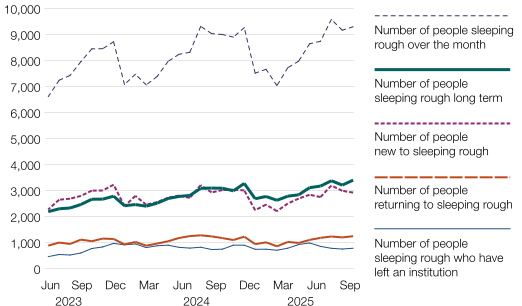
Over a third of all those sleeping rough each month are also long-term homeless, and this number has increased by almost 30% over the last two years. Around 13% of all people sleeping rough have returned to the streets after moving into settled accommodation,[footnote 12] often when their underlying needs, such as poor health, lack of support networks or difficulty managing a tenancy, have not been properly addressed.
Figure 1.1a The estimated number of people sleeping rough on a single night in autumn, 2010 - 2024[footnote 13]
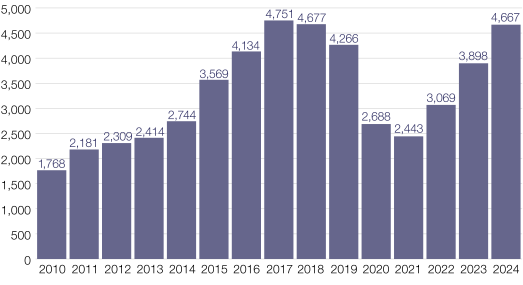
Figure 1.1b Estimated number of people sleeping rough over the month, by those who were long term, new, returning, or had left institutions, from May 2023 to September 2025[footnote 14]
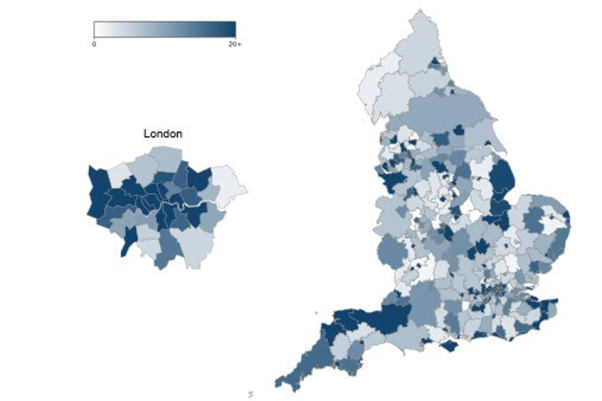
Rough sleeping is concentrated in London, alongside other major cities and coastal areas. In recent years rough sleeping has been rising nationally, but these rises have been concentrated in certain areas. Indeed, in half of all areas, the number of people sleeping rough over the month has stayed the same or fallen compared to last year.[footnote 15]
Figure 1.1c Estimated number of people sleeping rough over the month per 100,000 people in the population, September 2025
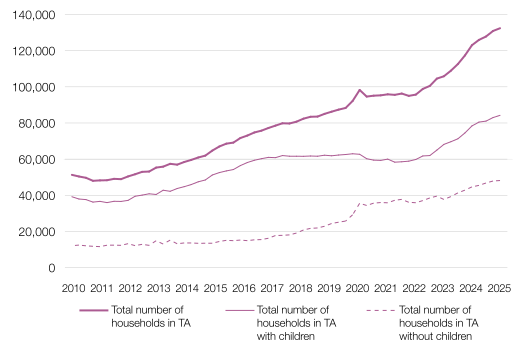
Alongside rough sleeping, temporary accommodation pressures are also rising at a record rate. As of 30 June 2025, 132,410, households were living in temporary accommodation, of which 84,240 were families, including 172,420[footnote 16] children. Whilst a significant proportion of temporary accommodation is relatively stable and self-contained, this is not the case universally. B&B accommodation – often insecure, poor quality and hugely expensive – is meant only for emergencies. However, in the latest statistics, 2,070 families had been living in this type of accommodation for longer than the 6-week statutory limit.[footnote 17] This practice is unacceptable and must stop.
Figure 1.1d Total number of households in temporary accommodation, 31st March 2010 to 30th June 2025[footnote 18]
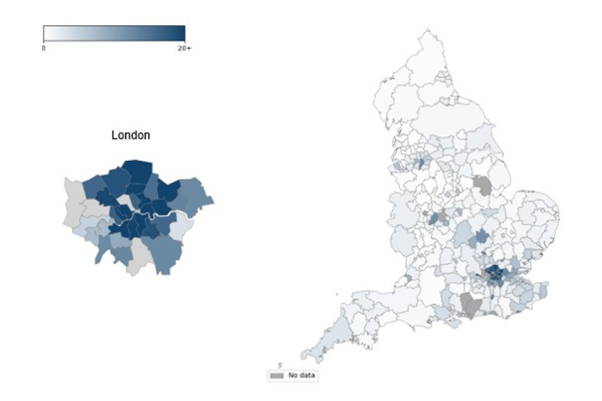
Whilst homelessness affects every part of the country, temporary accommodation pressures are concentrated in London, the South East and South West, as well as major cities such as Manchester and Birmingham. Almost two thirds of all families in temporary accommodation live in London[footnote 19] – 20 households in 1,000, compared to 3 in 1,000 across the rest of England.[footnote 20]
Pressures on temporary accommodation can lead to households being placed in accommodation outside their local area – sometimes away from support networks, jobs and schools. Over 42,000 households are currently placed in a different area, with 81% of these from London boroughs.[footnote 21] While most out-of-area moves are within the same region, they still disrupt children’s education and parents’ jobs, adding to the stress and instability faced by families.
Figure 1.1e Households with children in Temporary Accommodation Per 1,000 Households by LA in England – 30 June 2025
1.2 Why act now?
As highlighted in our Child Poverty Strategy, homelessness is one of the deepest forms of poverty, with profound and lasting impacts on children’s life chances. A stay in temporary accommodation is linked to worse outcomes for children’s education, health and future:
-
Over half of school age children who are homeless have missed days of school because of living in temporary accommodation. Of these, over a third have missed more than a month, leading to a knock-on impact on their education.[footnote 22]
-
There is a direct correlation between home moves and attainment at GCSE, just half (50%) of children with three home moves over their school career achieved 5 GCSEs including English and maths; and just over one-in-ten (11%) children who experienced ten moves[footnote 23].
-
Over half of parents reported a negative impact of temporary accommodation on their children’s physical or mental health.[footnote 24]
-
Devastatingly, between 2019 and 2024, 74 children – of whom 58 were under the age of one – died in circumstances where temporary accommodation has been recorded as potentially having contributed to their death.[footnote 25]
Over half of school age children who are homeless have missed days of school because of living in temporary accommodation. Of these, over a third have missed more than a month, leading to a knock-on impact on their education.
Over half of parents reported a negative impact of temporary accommodation on their children’s physical or mental health.
74 - Devastatingly, between 2019 and 2024, 74 children – of whom 58 were under the age of one – died in circumstances where temporary accommodation has been recorded as potentially having contributed to their death.
It is not simply children who experience poor outcomes because of homelessness. Shockingly, in 2024, 1,142 people died while experiencing homelessness in England, with an average age of death for those who died whilst sleeping rough or using emergency or temporary accommodation in England of 48 for men and 45 for women.[footnote 26] More widely, over a quarter of people living in temporary accommodation report having to reduce their working hours as a result of their housing situation, and 11% report having to stop work completely. The Analytical Annex published alongside this strategy explores the impact of homelessness and rough sleeping in more detail.
Homelessness is also extremely expensive for taxpayers. In 2024/25, total government expenditure on homelessness was £3.7 billion,[footnote 27] of which £2.8 billion was spent on temporary accommodation – almost five times higher than in 2010/11.[footnote 28] More concerningly, spend on B&B and nightly-paid accommodation is rising rapidly, from £309 million in 2023/24 to £620 million in 2024/25[footnote 29], and now accounts for nearly half of councils’ spend on temporary accommodation.[footnote 30] Furthermore, people sleeping rough use public services more than the average individual, at a cost on average of around £14,000 per person sleeping rough in 2024/25, largely in costs to the NHS and prisons.[footnote 31]
1.3 Why people become homeless
Poverty, housing availability and affordability are the root causes of homelessness and rough sleeping. 4.5 million children are living in relative poverty, a 900,000 increase since 2010/11.[footnote 32] For generations, not enough homes have been built and there has been too little investment in social and affordable housing. One in three households lived in social housing in the 1980s, now it is closer to one in six.[footnote 33]
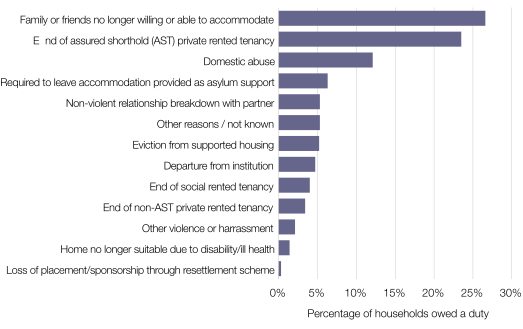
This shortage has left many people on low incomes struggling to afford rising rents in an increasingly insecure private rental market.[footnote 34] The end of a private rented tenancy is currently the second most frequently cited reason for homelessness, after friends/family no longer being willing to accommodate an individual. Private renters in England spend far more of their income on housing in comparison to homeowners; particularly those on the lowest incomes, 71% of whom spend more than 30% of their income on rent. [footnote 35] People who are privately renting also have not had the same stability as others, with over 6,500 households threatened with homelessness and owed a prevention duty as a result of “No Fault” Section 21 eviction notices between April – June 2025.[footnote 36]
Figure 1.3a The percentage of households owed a prevention or relief duty by reasons for homelessness or threat of homelessness, April to June 2025
Housing insecurity is exacerbated when individuals face financial hardship, whether because of low-paid and insecure work, barriers to increasing employment, constrained government support or cost of living challenges. Childhood poverty is one of the strongest indicators of homelessness later in life.Tackling child poverty is essential in preventing future homelessness and is a key part of our Child Poverty Strategy.[footnote 37]
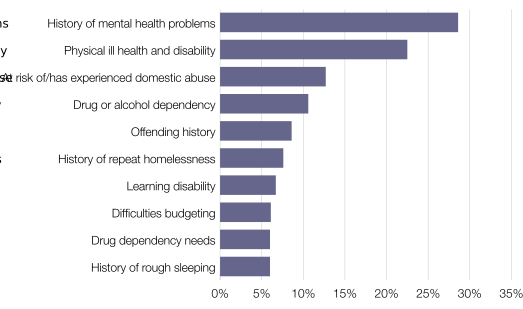
In addition to poverty and a lack of affordable housing, life events such as a relationship breakdown, domestic abuse or leaving care or prison can put people at risk of homelessness and rough sleeping.[footnote 38] This is particularly the case where households have support needs – as is the case for over half of the households who receive help from homelessness services, as highlighted in Figure 1.3b. Such needs also put individuals at greater risk of repeat homelessness– particularly drug dependency (repeat homelessness identified in 51% of households), a history of offending (50%) and alcohol dependency (46%).[footnote 39]
People who sleep rough are more likely to have complex and overlapping support needs. 84% of women and 65% of men who reported having slept rough within the last year had had three or more of the following experiences: homelessness, substance (either drugs or alcohol) use problems, mental health issues, domestic abuse, and interaction with the criminal justice system.[footnote 40]
Figure 1.3b The percentage of households owed a prevention or relief duty by the top 10 support needs of households in April to June 2025
1.4 Ending homelessness – our long-term vision and short-term priorities
Although government funding for homelessness and rough sleeping has increased consistently since 2018, the number of people in temporary accommodation and on the streets has continued to rise. There are many reasons for this, including:
-
A lack of affordable housing – as outlined above, without enough genuinely affordable homes, prevention efforts can only go so far.
-
Rising poverty – making it harder for households to meet their basic needs and housing costs, pushing more people to the brink of homelessness.
-
Over-emphasis on crisis response – recent government activity has focussed on crisis relief rather than longer-term prevention or the causes of homelessness. Efforts have centred on responding to immediate need and getting people off the streets quickly, often into expensive, short-term accommodation, rather than long-term solutions we know work, such as Housing First.[footnote 41] In many areas it is only possible to get help once you have been verified as sleeping rough.[footnote 42]
-
Reduced prevention activity – attention and resources have been diverted away from genuine prevention activity, resulting in less early intervention and more families stuck in unsuitable temporary accommodation.
-
Poor coordination across public services – the NHS, prisons and asylum system each trying to manage their own pressures has led to vulnerable people falling between the cracks without getting the help they need.
This strategy seeks to learn from these approaches and apply them to the challenge we now face, with a greater focus on preventing homelessness before it happens and supporting people whose homelessness has previously been hidden, or who are harder to reach. This underpins our commitment to get back on track to ending homelessness and rough sleeping.
We have a clear vision for change: homelessness should not be an accepted part of our society. Our long-term goal is for homelessness to be rare because it is prevented wherever possible. Where homelessness does occur, those experiences should be brief, people should have access to support quickly and no-one should have to experience homelessness more than once in their life.
As highlighted in the Executive Summary, this strategy sets out both actions we are taking now, alongside the steps that will drive change in the medium and long term. This includes:
-
Long-term sustainable change to address the root causes of homelessness: building more homes, reforming renters’ rights, and tackling poverty.
-
Medium-term change to support councils and public services to shift from crisis to prevention: new national targets, new duties on services, and focussing investment on prevention, where possible.
-
Short-term change to tackle the worst forms of homelessness this parliament:
-
Eliminating the use of B&Bs for families and tackling unacceptable temporary accommodation by increasing supply, improving quality and experience, and supporting local models.
-
Halving the number of people with complex needs who spend years on the street, through new programmes and targeted funding.
-
These aims will be underpinned by transformed accountability through national and local targets, alongside stronger oversight and support for councils to deliver better outcomes.
1.5 Structure of the strategy
These actions and others are set out in more detail in the following chapters, which are structured around the five pillars of prevention, reflecting their relevance to frontline practitioners working to support individuals and families at risk of homelessness:
| Pillar 1 | Pillar 2 | Pillar 3 | Pillar 4 | Pillar 5 |
|---|---|---|---|---|
|
Universal Prevention Tackling the root causes of homelessness |
Targeted Prevention Support for people at higher risk of homelessness |
Preventing Crisis Helping people stay in their homes |
Improving Emergency Responses Improving temporary accommodation and making people’s experiences better if they do become homeless |
Recovery and Preventing Repeat Homelessness Ensuring people don’t experience homelessness more than once and halving long-term rough sleeping |
|
Foundations for delivery Clear roles and responsibilities, sustainable funding, a skilled and supported workforce, and a new accountability framework |
||||
1.6 Our approach to partnership working in the strategy
This strategy is shaped by both those who work in homelessness services and those who are experiencing homelessness now. We have listened to housing officers, Mayors, experts in the homelessness sector and people with lived experience of homelessness, including through numerous roundtables, our Homelessness and Rough Sleeping Expert Group and Lived Experience Forum. Their insights and recommendations are reflected throughout this strategy.
Through our Lived Experience Forum, we convened four dedicated forums with people who have experienced homelessness and rough sleeping, and are grateful to our partners Revolving Doors, Justlife and Groundswell, who facilitated the forum and produced a detailed report and recommendations that informed our approach to this strategy. Their insights and recommendations have guided decisions and their words appear throughout the strategy to ensure their perspectives are not just heard but embedded in our response. By listening to these voices, we have designed actions that reflect what matters most to those directly affected. We will continue to convene a Lived Experience Forum to help us monitor the impact of the strategy on the ground and adapt our response as necessary. We set out further detail of how we expect councils and other organisations supporting those at risk of homelessness to embed lived experience insight into their services in the Foundations Chapter.
This strategy is a core part of our broader vision for national renewal, supporting economic growth, safer communities, and opportunity for all, underpinned by a stable economy and secure borders. It is a whole-government effort. Spearheaded by the Inter-Ministerial Group on Homelessness and Rough Sleeping, ministers from the Ministry of Housing, Communities and Local Government, Home Office, Department for Education, Department for Work and Pensions, Department of Health and Social Care, Ministry of Defence, Ministry of Justice, Cabinet Office, and His Majesty’s Treasury have come together and agreed clear commitments that put preventing homelessness at the heart of government.
1.7 Devolved administrations
Housing and homelessness policy and legislation are devolved across the United Kingdom, with Scotland, Wales and Northern Ireland responsible for the delivery of their own legislation, development of strategies and work with councils. While housing and homelessness is devolved, tackling homelessness is a cross-government effort, including several areas of reserved policy, and we are committed to working with our counterparts in the devolved governments to share learning from the different approaches that have been adopted across the four nations. Whilst this strategy applies to England only, the action the UK Government is taking to boost living standards and tackle child poverty will contribute to getting all parts of the United Kingdom back on track to ending homelessness.
2. Pillar 1 – Universal prevention
Tackling the root causes of homelessness
Summary: Universal Prevention aims to make homelessness rare by reducing risk across the whole population through early action. This chapter covers how the government, through both this strategy and the long-term housing strategy, is tackling the root causes of homelessness such as housing affordability and poverty.
2.1 Increasing the supply of social and affordable housing
Social housing provides vital support and security for low-income households, but decades of under-investment mean that supply is significantly lacking. Our plan to deliver a decade of renewal for social and affordable housing[footnote 43] sets out how we will meet our two core objectives: the biggest increase in social and affordable housebuilding in a generation, and a transformational and lasting change in the safety and quality of homes.
We will work in partnership with councils, housing associations, and partners across the sector to build their capacity and help us deliver the homes England needs. We have already taken steps to boost supply, particularly of social and affordable housing that makes the biggest difference for people who are homeless or at risk of homelessness. Shortly after coming into office, this Government increased funding for the legacy Affordable Homes Scheme by £2.8 billion and launched a new 10-year Social and Affordable Homes Programme, backed by £39 billion of investment. This new programme could deliver around 300,000 social and affordable homes over its lifetime, with around 180,000 for Social Rent.
We have also announced further reforms to boost the supply of new social homes that will create certainty for housing associations and local councils, so they know how much government subsidy is available and how much rent revenue they can expect. This allows them to plan their development, and in the case of housing associations, borrow from private markets to develop. These reforms include:
-
£2.5 billion for low-interest loans to support new affordable housing development. These will be open to private registered providers. A substantial allocation of the loans will be targeted at London in light of the acute challenges facing registered providers in the capital. The loans will be awarded through a bidding process that is closely aligned with the Social and Affordable Homes Programme, and will be administered by the National Housing Bank and by the Greater London Authority in London.
-
A 10-year social housing rent settlement from 2026-36, during which rents will be permitted to increase by up to CPI+1% each year for Social Rent and Affordable Rent housing. To boost financial capacity and support long-term planning, government also consulted on how to implement a Social Rent convergence mechanism over the summer and confirmed at Autumn Budget that a decision will be announced in January 2026, before the launch of the Social and Affordable Homes Programme.
-
Reforms to the Right to Buy to make it fairer and more sustainable, protecting existing stock while supporting long-standing tenants into home ownership.
We are also committed to strengthening the existing system of developer contributions, including Section 106 (S106) planning obligations, to ensure that new developments provide appropriate affordable homes and infrastructure. S106 enables local planning authorities in England to secure binding agreements with developers as part of granting planning permission to mitigate the impacts of new development. These obligations are a critical mechanism for securing affordable housing, alongside infrastructure and community facilities.
2.2 Making sure social housing reaches the people who need it most
While new homes are being built, we will take immediate action to ensure that existing and new social housing stock best serves the people who need it most. We will review how effectively social housing providers use their properties, including exploring ways to reduce the time homes are left empty and encourage greater movement within the sector to address under-occupancy and overcrowding, and support people to move into more suitable properties.
Housing providers should be consistently and fairly allocating social housing. The systems-wide evaluation of homelessness and rough sleeping, which looked at existing social housing allocations, reported a range of ways in which existing legislation, policy and practice around social housing allocations could be adapted to better relieve or prevent homelessness.[footnote 44]
-
We have already started taking action to address allocation barriers by ensuring that local connection tests for social housing, where these apply, do not disadvantage veterans of the regular UK Armed Forces, victims of domestic abuse or care leavers under the age of 25, who often, through no fault of their own, cannot establish a local connection.[footnote 45]
-
We will work with partners to update statutory guidance on social housing allocations to ensure that allocations reflect local need and effectively support vulnerable households.
-
We expect social housing landlords to cooperate with councils in housing statutory homeless households.
-
For homes funded by the Social and Affordable Housing Programme, we expect providers to have nomination agreements (or their equivalent) in place with councils and for these to include 100% of first lets to go to the local council for nomination, unless otherwise agreed with the council.[footnote 46] This will ensure that the social and affordable homes funded by the new programme go to those who need them most.
-
Where joint working is not operating effectively, we will consider levers to require social housing landlords to rehouse statutory homeless households referred by the council, including legislating if necessary. This could be similar to the provision in section 5 of the Housing (Scotland) Act 2001 which has proved to be an important tool in providing access to housing for people owed a statutory homelessness duty.
While evictions from social housing resulting in homelessness are relatively low (8.9% of prevention and relief duties owed in 2024-25, compared to 27.5% from the private rented sector),[footnote 47] every case matters. Following consultation, we will update the tenure Direction to the Regulator of Social Housing which will reiterate Government’s clear expectations that providers are transparent with tenants about their approach to granting and ending tenancies as well as their approach to supporting tenants to find alternative accommodation before an eviction takes place. We will also support providers with best practice guidance to reduce tenancy failure. A new toolkit for local partners on prevention will provide advice for providers and councils on strengthening tenant engagement to reduce homelessness risks. Tenants’ need for clarity and support was reflected in the Lived Experience Forum:
I’ve had no support and I actually came from supported housing. And they offered me no support. They literally were like, right. You’re outbound. Bye. See ya.[footnote 48]
2.3 Supported Housing and housing for people with additional needs
Some people with additional or specialist needs – ranging from young people needing support with life skills, to people with mental health needs, to people with chronic physical conditions – will need more than just a housing solution. Providing the right support and safeguards, alongside housing, can improve health, wellbeing and socio-economic outcomes to enable these individuals to access and retain housing, reducing their risk of homelessness and rough sleeping.
However, the systems-wide evaluation of homelessness and rough sleeping system found that funding cuts, removal of ringfencing, and short-term funding cycles have significantly reduced supported housing availability.[footnote 49]
-
To both prevent and relieve rough sleeping and homelessness, we will invest £124 million over 2026/27 to 2028/29 in supported housing services for over 2,500 people, working with targeted local areas. We will expect the relevant mayoral strategic authorities to play a role, and that funding will unlock the delivery of supported housing, including through the Social and Affordable Homes Programme. It will also bolster our work to support people with the most complex needs, those who experience long-term rough sleeping. This will also build on the cross-government work being led by the Chief Secretary to the Treasury to improve the value for money of homelessness services and supported housing.
-
The new Social and Affordable Homes Programme includes new flexibility on grant rates for accommodation where the level of design and adaptation results in higher costs, and calls on providers to produce ambitious bids for new supported housing. Increasing the supply will not only ensure that appropriate housing with care and support is available to those who need it in the long term, but will also help to free up existing social housing general needs stock, helping to address some of the current pressure within the system.
-
To improve standards and tackle rogue supported housing providers, we will introduce a new licensing regime following the consultation on the Supported Housing (Regulatory Oversight) Act 2023. Under the Act, councils will be required to develop a supported housing strategy, ensuring they target their interventions where they are most needed. As required by the Act, we are also appointing the new independent Supported Housing Advisory Panel, which includes a diverse membership from across supported housing, including providers, councils and residents, to advise the government on matters related to supported housing, including how to future proof and grow this important sector.
These actions form vital steps to start to address issues in a sector that supports some of the most vulnerable in society. But this is not enough – we recognise the significant challenges faced by the supported housing and homelessness sector, which is why, as announced at Autumn Budget 2025, the Chief Secretary to the Treasury will work across government to improve the value for money of homelessness services. This will consider how existing funding that supports homelessness and rough sleeping objectives can be optimised to achieve the best outcomes, including ways to improve the supply of good-value-for money and good-quality supported housing. The findings of this process will support future spending decisions.
Case study:
Manchester City Council’s Homelessness Service has a dedicated Commissioning Team that procures and manages all supported housing and related support contracts, including both in-house temporary accommodation and externally commissioned supported accommodation. The team operates the Manchester Access and Support Gateway as the single point of access for all supported housing services, including those delivered by approved partners and the voluntary, community and faith sector. The Gateway also monitors service outcomes, with each commissioned service having a lead officer responsible for managing vacancies, referrals and move-on, and for monitoring performance against service specifications.
Daily panels attended by managers from across homelessness services consider vacancies and referrals across supported housing, including for people in temporary accommodation or rough sleeping. The matching process is designed to ensure services work collaboratively, to maximise resources. Additionally, a weekly ‘Struggle to Find Accommodation panel’ considers placement requirements for those at risk of eviction or who need to move-on, but where suitable provision has not been identified. These panels bring together homelessness officers, commissioning leads, accommodation providers, and partners such as social care and mental health to ensure that individual support is agreed alongside appropriate placements. Since moving to this panel model a 23% reduction in evictions and abandonments across commissioned schemes has been achieved when compared to 2024/25.
Additionally, for some disabled homeowners, residents and tenants, making adaptations to their homes, without delay, can enable them to live comfortably and independently without fear or risk of losing their homes, avoiding homelessness where possible. We will reform the Disabled Facilities Grant, to ensure that this vital funding reaches those who need it most, allowing more homes to be adapted to meet the needs of individuals.
2.4 Reforming the private rented sector to improve security
As highlighted in the Introduction, evictions from the private rented sector are a significant cause of homelessness.
Case study:
Derek* is in his 50s and lives in London. He had a stroke last year, which has left him unable to continue working. He lives in a rented property with significant disrepair issues, including erratic hot water supply and severe mould. His housing benefit payments do not cover the cost of his rent, and he is currently living on a negative budget, using his savings to get by. His landlord recently told him that he wanted to increase the rent. Derek told him that he was unable to afford the increase and that the condition of the property did not warrant this increase. Four hours later, he was served a Section 21 eviction notice. The landlord has been using intimidatory tactics, such as late night phone calls, to try to deter him from challenging the eviction.
*Name has been changed.
The Renters’ Rights Act will give more security to tenants [footnote 50] by abolishing section 21 ‘no fault’ evictions.[footnote 51] The Act will also strengthen tenants’ rights, including:
-
Empowering private renters to challenge unreasonable rent increases, preventing unscrupulous landlords from using rent increases as a backdoor form of eviction.
-
Bringing an end to rental bidding.
-
Outlawing discrimination against prospective tenants with children or those who receive social security benefits.
-
Preventing landlords from demanding large amounts of rent in advance.
Tackling these issues will help address the stigma that households who receive benefits face from landlords in the private rented sector and give lower-income households a fairer chance of securing a home.
There needs to be more properties that landlords will accept payments from the Jobcentre because a lot of landlords won’t accept it.[footnote 52]
Making sure that both landlords and tenants understand their rights and responsibilities under the new legislation will play an important role in reducing the risk of homelessness. We will introduce a comprehensive private landlords database alongside clear guidance for both landlords and tenants. We will also undertake a communication campaign to raise awareness of new rights and responsibilities across the sector. These steps are key to giving renters much greater security and stability so they can stay in their homes for longer, build lives in their communities, and avoid the risk of homelessness.
Where illegal evictions do take place, we have also legislated to strengthen the Protection from Eviction Act 1977 so that, for the first time, local councils will be able to issue civil penalties against landlords who evict their tenants illegally.
2.5 Supporting people to increase their earnings and incomes, and tackling child poverty
In addition to building more homes and providing tenants with security and stability, supporting low-income households to increase their income through good-quality employment or in-work progression is key to ensuring people can pay their rent and other essential living costs, and become more resilient to changes in circumstances when they arise.
The government is taking active steps to stimulate economic growth by investing in employment, skills and local labour market initiatives.
-
On 1 April 2026, the National Living Wage will increase by 4.1% to £12.71 per hour for eligible workers aged 21 and over. This represents an increase of £900 to the gross annual earnings of a full-time worker on the National Living Wage. Around 2.4 million workers are expected to receive a pay rise due to the increase to the National Living Wage on 1 April 2026. The National Minimum Wage for 18–20-year-olds will also increase by 8.5% to £10.85 per hour.
-
The Get Britain Working White Paper and the Pathways to Work Green Paper outline plans to tackle the root causes behind economic inactivity and support more people into work.
-
These reforms include a new Youth Guarantee which will ensure all young people have access to education, training, or help finding a job or an apprenticeship. To ensure the Youth Guarantee is shaped and informed by the voices of young people, at both a local and national level, we have launched our Youth Guarantee Advisory Panel established in partnership with the Department for Education, Youth Futures Foundation and Youth Employment UK.
-
To support our Get Britain Working reforms, we have increased funding for employment support to over £3.7 billion by 2028-29.
-
The Employment Rights Bill and our plan to Make Work Pay will modernise employment rights, expand flexible working, and improve workplace protections to help individuals retain more of their earnings, ensuring people can keep their money in their pockets while benefitting from a growing economy.
Rather than writing people off, our reforms seek to address the root causes behind why people are not working, by joining up work, health and skills support, based on the needs of local people and local places.
We are taking action to tackle the root causes of child poverty and strengthen the safety net for low-income households. Our Child Poverty Strategy sets out targeted action to increase incomes, reduce essential costs, and improve local support. Alongside this, we will ensure social security continues to provide vital support for households at risk of homelessness, including help with housing costs. We will:
-
Take immediate action to remove the two-child limit, lifting 450,000 children out of relative poverty within this parliament. Over one and a half million children live in households that will see an increase in income as a result of removing the two-child limit, including 600,000 children in households in deep material poverty.
-
Launch a Better Futures Fund, which will support up to 200,000 struggling children, young people and their families through innovative impact funding projects seeking to break down barriers to opportunity and give children the best start in life. Through this Fund we will look to improve outcomes for youth and family homelessness.
-
Review Universal Credit to ensure it is reducing poverty, and making work pay, and therefore supporting people who are homeless or at risk of homelessness.
-
We have already taken action and made important changes including implementing the Fair Repayment Rate from 30 April 2025. This enables approximately 1.2 million Universal Credit households, with deductions, to retain an average of £420 per year.
-
Address the basic adequacy of Universal Credit by spending £1.9 billion to make a sustained, above inflation increase to the standard rate, for the first time ever. This will benefit around 4 million households and is estimated to be worth around £760 annually in cash terms by 2029/30, for a single household aged 25 or over.
We recognise some private renters need support with their rent. That is why we will work across government to keep Local Housing Allowance rates under review in order to deliver on the government’s priorities, including maintaining the long-term fiscal sustainability of the welfare system. In the short term, in 2025/26, those who need additional support with their housing costs can approach their council and apply for Discretionary Housing Payments.
We are also providing £842 million per annum to reform crisis support. From 1 April 2026, we are introducing a new Crisis and Resilience Fund in England. This is the first ever multi-year settlement for locally delivered crisis support enabling councils to provide preventative support to communities, working with the voluntary and community sector. The Fund will provide immediate support to people in crisis, including those at risk of homelessness. Councils will also be able to use funding to invest in local financial resilience to enable communities to better deal with crises in the long-term, reducing dependence and repeat need. This includes helping people to reduce or manage priority debts such as rent, council tax and utilities arrears.
Discretionary Housing Payments will be integrated into the Crisis and Resilience Fund in a phased approach, with full integration taking place in the third year of the scheme. This will give councils time to plan, ensuring that crucial housing support can continue to be delivered to those in need to sustain tenancies and prevent homelessness. Funding for the housing element of the Crisis and Resilience Fund will be maintained at £100 million per annum (which includes Discretionary Housing Payment funding for Wales).
3. Pillar 2 – Targeted prevention
Support for people at higher risk of homelessness
Summary: Some people are more likely to face homelessness because of difficult life experiences or crises, such as leaving institutions like the care system, prison or hospital. Additionally, some individual factors may mean people have needs which put them at an increased risk of homelessness, for example survivors of domestic abuse and exploitation, young people and migrants. Targeted prevention means giving tailored support to people who are more likely to face homelessness.
3.1 Cross-government targets
Last year, almost 34,000 households were homeless or threatened with homelessness after leaving a public institution, including prison, care, hospital or asylum accommodation[footnote 53]. Those are experiences which could have been prevented had better coordination and planning been in place. Through the Inter-Ministerial Group, we have agreed a long-term ambition that no one should leave a public institution into homelessness. This parliament we will take the first steps towards this through joint cross-government targets to reduce the number of people leaving institutions into homelessness, such as prisons, hospitals and care to improve information sharing for people leaving asylum accommodation, and to improve awareness of local support for former members of the Armed Forces at risk of homelessness. This is a coordinated effort built on strong partnerships across government and with councils, wider public services and the voluntary and community sector.
3.2 Working together to prevent homelessness
In addition to setting cross-government targets, tackling homelessness must be a shared responsibility, with all relevant public services, including councils and the voluntary and community sector, collaborating to prevent homelessness. We have set out how roles and responsibilities should be divided across central and local government, wider public services and homelessness partners such as charities in the annex at the end of the Foundations chapter. This includes services such as public health, the NHS, adult and children’s social care, the police, jobcentres, prisons and immigration services. By working together, these services can ensure that people at risk of or experiencing homelessness are identified early, referred into the right support pathways and connected to housing services.
To support this, we intend to introduce a new ‘duty to collaborate’ for key public services, acting on the recommendations of the Expert Group, compelling public services to work together to prevent homelessness and support those who are at crisis point. We will consult on the new duty and legislate as soon as the parliamentary timetable allows.
Whilst local councils ultimately have the legal responsibility for preventing and relieving homelessness, Mayors and Strategic Authorities also play an important role in targeted prevention and leading place-based interventions. We are calling on Mayors to leverage their convening power to set ambitions for their region, align priorities across housing, health and employment, champion early intervention approaches, and use devolved funding streams to address upstream drivers of homelessness such as poverty, insecure work, and poor housing conditions. Mayors can use their leadership at regional level to unite housing, health, and other public services to meet the needs of their communities. Further detail on the role of Mayors and Strategic Authorities is in the Foundations Chapter.
3.3 Addressing barriers to accessing services
Some groups of people, particularly women, young people, care leavers, people from ethnic minority backgrounds, disabled people and LGBT+ people, face barriers to accessing public services due to discrimination or because services do not meet their needs. Councils and other public services should work with people with lived experience, and use data to design accessible, inclusive and culturally-sensitive services, supported by targeted interventions, which meet the needs and experiences of all people who need their help. This means trauma-informed, safe, and single-sex spaces where required, with outreach to those experiencing hidden homelessness, including women, young people and LGBT+ people in particular.
People from ethnic minority backgrounds may face additional barriers, including discrimination, language barriers, and lack of culturally appropriate services. Services should be responsive to the specific needs of these communities, helping to build trust and improve engagement. Recent reports have highlighted a growing evidence base regarding the impact of racism on risk and experience of homelessness in the UK[footnote 54], and we will continue to work with partners to identify the best ways to improve our understanding of the impacts and how to improve outcomes.
3.4 Interventions to prevent discharge from public institutions into homelessness and support for groups at increased risk of homelessness
3.4.1 Prison leavers
People leaving prisons represent the largest group at risk of rough sleeping upon discharge from a public institution and are very likely to be owed a homelessness duty. Supporting people into stable accommodation from their first night out is critical to reducing homelessness and reoffending, as those without stable accommodation are nearly 50% more likely to reoffend.[footnote 55]
That is why we have committed, by the end of this parliament, to a 50% reduction in the proportion of people who become homeless on their first night out of prison and are subject to probation supervision, alongside an overall increase by the end of this parliament in the number of prison leavers in settled accommodation at 3 months after release and thereafter. To achieve this, we will:
-
Continue investing in Community Accommodation Service models, which provide up to 84 nights of temporary accommodation and floating support for prison leavers at risk of homelessness subject to probation supervision, ensuring people have a stable home after release.
-
Embed as standard practice local partnerships, co-location and pre-release planning, building on the learning from joint advance planning that took place following the Standard Determinate Sentences scheme in late 2024.
-
Continue to invest in integrating digital community accommodation services, maximising artificial intelligence opportunities and automating information sharing to make it easier to identify and match individuals to the right housing-related support and accommodation at the right time.
-
Work to ensure changes being implemented from the Independent Sentencing Review support us in preventing homelessness by minimising the number of people on short prison sentences, with these types of sentences disrupting tenancies and the continuity of support. We will also work to make sure the right provision exists in the community for those who will instead be on community sentences.
3.4.2 Hospital Discharge, Substance Use and Adult Social Care Support
Discharge from hospital into poor quality, insecure housing or, in the worst cases, onto the streets is a deeply harmful outcome. When combined with unmet mental health and substance use needs, it can severely undermine people’s recovery and increase the risk that their health deteriorates further and makes them even more vulnerable. We are committing to a target that no one eligible for homelessness assistance is discharged to the street after a hospital stay. To help achieve this we will:
-
Work with the NHS and councils to implement the guidance published in 2024: Discharging people at risk of or experiencing homelessness. This includes promoting early identification of housing issues and planning from admission both for accommodation needs and for any ongoing health and care needs. For example, through dedicated housing officers in care transfer hubs that arrange discharges and a designated lead for discharge of patients at risk of or experiencing homelessness. Health and care needs should be approached holistically, considering intermediate care needs after a hospital stay, but also wider support such as registration with a GP, and in-reach from mental health and drug and alcohol services, as appropriate.
-
Work with councils and Integrated Care Boards to improve how funding streams, including the reformed Better Care Fund and the new Homelessness, Rough Sleeping and Domestic Abuse Grant from 2026/27, can be used to fund intermediate care services tailored for those experiencing homelessness, to improve continuity of care and access to post-discharge rehabilitation, recovery and reablement.
While the Recovery Chapter sets out action on mental health and substance use support to help people recover from homelessness, we are also taking targeted action on substance use to prevent homelessness in the first place. We will invest £60 million from 2026 to 2029 into the Housing Support programme, expanding its reach and continuing to support the housing needs of people in treatment and recovery from substance use. This targeted funding aims to strengthen the evidence on person-centred housing support that reduces the risk of homelessness and increases the likelihood that people stay in a safe and stable home. The programme will enable the continued delivery of innovative services including specialist housing workers embedded in treatment and housing services, floating support roles, and personalised budgets to help individuals meet housing-related needs.
In addition to interventions to prevent discharge from hospital into homelessness, we will also take action to strengthen the way that housing, social care and safeguarding services work together to prevent homelessness, particularly for people with complex needs. To support this, we will:
-
Review and update the relevant areas of the Care Act 2014 statutory guidance, particularly in relation to councils’ safeguarding responsibilities and how they should act on these to support people at risk of homelessness and rough sleeping.
-
Publish new support guidance, alongside consulting on the statutory guidance, to help staff working across these services to respond to common challenges.[footnote 56] This will clarify relevant statutory responsibilities under the Care Act 2014, promote legal literacy, and offer practical reflections to support more confident, coordinated safeguarding practice.
3.4.3 Care leavers
I always had a bag packed ready in case I became homeless’ “I came into foster care aged 10 where I did my own washing, cooking and earned pocket money to help pay for a phone and some of my food but still I needed nurturing. At age 16 I was in a relationship with an older man who was threatening and the foster carer eventually kicked me out. I was moved into a house share but had no guidance and support. I got in with the wrong crowd; the property was trashed by the person I considered my boyfriend and his friends and I was beaten. I left and sofa surfed. Children’s Social Care moved me to a very dirty hostel at age 17 with prison leavers, drug users and sex workers who I heard enduring frequent attacks; I was afraid for my safety and felt very alone.[footnote 57]
To facilitate access to social housing we have made changes to regulations in England to exempt care leavers under the age of 25 from social housing local connection and residency tests, where these apply. We have also strengthened statutory guidance to strongly encourage councils to give the same level of priority to those care leavers who have been placed in their local area and wish to stay as their own care leavers.
In the long term, no young person leaving care should experience homelessness. The homelessness system should never be used as a pathway to house young people following the end of a Looked After Child Placement. To help achieve this, we will:
-
Develop, by summer 2026, a cross-government action plan to reduce the proportion of care leavers under 25 experiencing homelessness, with measurable targets to be achieved by the end of this parliament. Central to this action plan will be new measures introduced through the Children’s Wellbeing and Schools Bill, which will strengthen councils’ statutory duties to better support care leavers and prevent homelessness.
-
Introduce a new duty for councils to provide Staying Close support up to age 25 where their welfare requires it, helping care leavers to find and keep suitable accommodation and access wider support.
-
Amend the local offer duty, so councils will also be required to publish information on their arrangements to support care leavers in their transition to adulthood and independent living. This will include arrangements for future housing needs, to co-operate with local housing authorities, and assist those at risk of homelessness.
-
Introduce corporate parenting responsibilities for government departments and relevant public bodies, to recognise the vulnerabilities and better meet the needs of care leavers when designing policies and delivering services.
-
Legislate so that care leavers who are in scope of the corporate parenting duty will be exempt from intentional homelessness decisions, and statutory guidance will be strengthened to help councils support care leavers at risk of accommodation breakdown.
-
Continue to provide targeted funding to prevent homelessness and rough sleeping among care leavers.
-
Work with councils to extend good practice on how councils can provide rent deposit support to young people, including through Rent Guarantor schemes, starting with care leavers and extending to other young people.
3.4.4 Young People
In addition to care leavers, other young people face distinct risks of homelessness, due to factors such as family breakdown, insecure housing, and limited support. Around half of adults in the 2025 Rough Sleeping Questionnaire who had slept rough within the previous year first experienced homelessness by the age of 25.[footnote 58]
Early support is vital to give young people the best start in life. Schools, family support services and youth programmes are important in helping young people and their families build stable lives and strong support networks. Targeted support within schools can play a major role in identifying young people at higher risk of homelessness and providing support to them and their families at a much earlier stage. Early findings from Upstream England pilots in Manchester, London and Sheffield demonstrate promising results. We are exploring opportunities to build on this success with Centrepoint, alongside The Royal Foundation of The Prince and Princess of Wales’ Homewards programme.
To further support action to help young people at an earlier stage, we will:
-
Deliver the National Youth Strategy which sets out a long-term vision to give young people the skills, opportunities and connections in their communities they need to thrive and promote safe and healthy lives. The strategy includes funding for more in-person activities and support, access to trusted adults, alongside opportunities to connect with their peers in new or improved youth spaces.
-
Invest £500 million a year in the Families First Partnership Programme to shift children’s social care towards early intervention. This includes holistic support to keep families safely together and help identify risks – including homelessness – at the earliest point. Reforms to Family Help will provide targeted support to children and families facing multiple and or complex needs. This can include support with issues which may contribute to the risk of homelessness, such as access to benefits, worklessness and drug and substance use. Families will be appointed a dedicated lead practitioner, who will draw on a wider multi-disciplinary team to provide holistic whole-family support.
-
Continue to invest in Family Hubs, which play a crucial role in identifying emerging problems, such as signs that a family is struggling to maintain their tenancy, and act as a gateway for Family Help teams to wrap support around families who need more targeted support.
-
Expand Mental Health Support Teams in schools and colleges to reach full national coverage by 2029. Recent data shows that over 1 in 4 young adults (aged 16 to 24) now have a common mental health condition. By supporting young people with their mental health, we will help put them on a positive trajectory to thrive in life, reduce their risk of becoming NEET (not in Employment, Education or Training), and prevent the likelihood of them becoming homeless.
-
Drive down risk factors like school absence via establishing 90 attendance and behaviour hubs to improve school practice, and roll out one-to-one attendance mentoring in 10 councils, reaching 10,000 young people over three years.
-
Pilot new multi-agency Young Futures Panels to proactively identify young people before they get caught up in criminal activity and refer them to support services much earlier. Panels bring together a range of services supporting young people, including from children’s services, health, and housing, to assess needs holistically and refer young people to support. This might include referrals to Young Futures Hubs, which bring together vital services in the local community.
To further strengthen support for young people at higher risk of homelessness, we will:
-
Develop a national Youth Homelessness Prevention Toolkit and develop a dedicated chapter of the Homelessness Code of Guidance on young people, to support councils to work collaboratively with other public services to prevent youth homelessness.
-
Update the National Standards for the Provision of Children and Young People’s Advocacy Services to highlight the importance of independent advocacy to support young people, where appropriate, including 16- and 17-year-olds who are homeless or threatened with homelessness.
Case study:
Youth mediation services such as Roundabout’s Talk It Out show how upstream family support can prevent homelessness and keep young people safely at home.
Roundabout is a youth homelessness prevention charity that delivers Talk It Out, a mediation service jointly funded with Sheffield City Council. The service supports young people and their families to resolve conflict and find healthy ways to keep families together. The mediators are impartial and work from a counselling-based, non-judgemental perspective. They guide conversations without taking sides, beginning with individual sessions for the young person and their family members. This gives everyone the space to share their concerns openly and explore solutions that feel fair and workable for all.
The team takes a flexible approach, offering sessions by phone, video call, in a private setting, or even while taking a walk in the park. When everyone feels ready, they bring people together to discuss issues, rebuild communication, and agree on practical next steps.
Talk It Out consistently helps to prevent youth homelessness, with most young people returning home or remaining at home successfully.
3.4.5 Veterans
Instances of veteran homelessness are thankfully low. Nonetheless, we recognise the significant contributions of veterans to our country, and that their experiences may mean their needs are different to civilians. Councils should have appropriate services in place, according to local need, to give veterans the specialist support they need to help prevent them from becoming homeless. To support this, we have committed to ensuring that all councils are aware of service provision in their area to support veterans at risk of homelessness. Alongside this commitment, we will:
-
Commit an additional £12 million to continue the Reducing Veteran Homelessness programme for a further three years.
-
Extend funding for Op FORTITUDE, the single referral pathway to connect individual veterans at risk of or experiencing homelessness with housing help and support.
-
Deliver VALOUR, which aims to cohere and coordinate the delivery of local services for veterans, develop veterans’ support centres and gather timely data to ensure veterans’ needs are being met.
-
Commit to ensuring all veterans with a housing need have access to support, building on changes to regulations in England to exempt veterans of the regular UK Armed Forces from social housing local connection and residency tests to facilitate access to social housing for those who need it.
-
Deliver the Veterans Strategy to ensure veterans receive the support they need as part of a wider effort to celebrate their service and realise their full potential. Alongside this, the Defence Housing Strategy will accelerate new housing developments on unused military land, giving priority to Service families and veterans through a new ‘Forces First’ approach.
-
Improve data on veteran homelessness and rough sleeping in consultation with local partners.
3.4.6 Refugees and migrant homelessness
People leaving the asylum system represent the second biggest group of people sleeping rough after leaving a public institution.[footnote 59] Newly granted refugees may be at higher risk of homelessness due to limited support networks and barriers to integration, such as lack of housing knowledge or employment opportunities. Supporting integration early is critical to reducing the risk of homelessness and enabling refugees to contribute fully to the communities that provide them sanctuary.
To enable early intervention for refugees at risk of homelessness, the Home Office has committed to ensuring councils receive information from asylum accommodation providers for 100% of newly granted refugees at risk of homelessness, to enable councils to commence a homelessness assessment. This will be received within two days of an asylum discontinuation of support notification,[footnote 60] and within 14 days of family reunion visa issuance. To achieve this, we will:
-
Introduce quality assurance monitoring of positive asylum support discontinuation data being sent to councils, and structured feedback mechanisms to ensure issues can be resolved promptly.
-
Work with councils, Strategic Migration Partners and accommodation providers to ensure all parties understand their role in the data sharing process and are clear on responsibilities.
-
Introduce a standardised single notification point for all asylum accommodation providers to notify councils of newly granted refugees at risk of homelessness.
Alongside this, we will continue to improve processes over this parliament to ensure refugees receive early, targeted support to integrate through advice and guidance on securing onward housing and employment, so we can build a system that is both responsible and sustainable.
We will also deliver long-term reform to create an asylum system that works for both new refugees and the communities they become part of. This includes ending the use of hotels to house asylum seekers by the end of this parliament with an ambition to do so as soon as possible before that date, and a move towards large sites, including military sites, for asylum accommodation.
As 27% of people sleeping rough are non-UK nationals, it is important that services can appropriately respond to migrant homelessness more broadly.[footnote 61] That is why we are:
-
Funding a homeless migrants capability training package for councils and voluntary sector organisations.
-
The Ministry of Housing Communities and Local Government and the Home Office are running a pilot in four council areas on access to immigration advice, short term accommodation and a named point of contact within the Home Office. This pilot provides more support to councils to help people sleeping rough with restricted or unknown eligibility to public funds.
For some people, returning to their home country can sometimes be the most viable route out of homelessness. The Voluntary Returns Service will work in partnership with trusted and willing civil society organisations to support this, establishing a clear and accessible process for identifying and assisting individuals who would benefit from being supported to return to their country of origin.
3.4.7 Domestic Abuse
Domestic abuse is a significant driver of homelessness, affecting 16.5% of households owed the homelessness relief duty[footnote 62]. New research from the Rough Sleeping Questionnaire 2025 shows that nearly 70% of women experiencing rough sleeping in the past year had experienced domestic abuse since age 16.[footnote 63] The Government has set a target of halving violence against women and girls within a decade, and tackling domestic abuse will be a vital part of this. We will be setting out a transformative, cross-government plan in the upcoming Violence Against Women & Girls Strategy. We will also take steps to prevent homelessness for survivors.
-
The simplification of local government funding, which includes bringing together funding for homelessness and rough sleeping, and the Domestic Abuse Safe Accommodation duty into a single grant (see Preventing Crisis chapter for further details) will enable councils to plan holistically across homelessness and domestic abuse services, including adopting new approaches to preventing homelessness due to domestic abuse while continuing to provide support to victim-survivors who need to flee.
-
To support councils and improve consistency in support available to victim-survivors, we will develop a toolkit on homelessness prevention and support for survivors of domestic abuse, including drawing on the Whole Housing Approach piloted by Standing Together Against Domestic Abuse[footnote 64].
-
The toolkit will draw on a forthcoming evaluation of sanctuary schemes, which provide solutions for survivors who wish to remain in their homes, and provide guidance and best practice support on how to keep survivors safe in their homes wherever possible, and how to deliver trauma-informed homelessness support for victims of domestic abuse.
-
Where homelessness due to domestic abuse cannot be prevented, it is vital victim-survivors are supported into suitable accommodation with appropriate safeguarding in place. We are continuing to fund the Support in Safe Accommodation Duty.
-
To help survivors move on into settled accommodation when they are ready, we have made it easier for victim-survivors of domestic abuse to access social housing by exempting them from local connection and residency tests where these apply, and we will seek to strengthen protections available to women in co-habiting couples, including better support to victims in joint tenancies. As part of updating statutory guidance on social housing allocations, mentioned in the Universal Chapter, we will address the barriers faced by survivors of domestic abuse with debt when applying for social housing, highlighted by recent research.[footnote 65]
3.4.8 Exploitation and Human Trafficking (Modern Slavery)
Exploitation and trafficking (modern slavery) encompass a range of serious crimes including sexual exploitation, criminal exploitation, forced labour or servitude, and human trafficking. Adults and children of all nationalities and backgrounds can be victims of these crimes. Many victims become homeless after escaping their exploiters; 280 households owed a homelessness duty were victims of modern slavery in April – June 2025.[footnote 66] Without timely assistance and stable housing victims remain at risk of re-exploitation and further abuse. Local councils play a critical role as first responders in identifying and referring victims of exploitation and trafficking.
- To strengthen councils’ awareness of exploitation and trafficking, helping frontline services to better recognise victims and assess their vulnerabilities within the context of homelessness, we will update the Homelessness Code of Guidance chapter on modern slavery, promote Modern Slavery Coordinators in our practice toolkits, and review the Modern Slavery Statutory Guidance to improve local practice.
3.4.9 People experiencing multiple disadvantage
People experiencing multiple disadvantage (combinations of homelessness and rough sleeping, poor mental health, substance use, domestic abuse and contact with the criminal justice system) often face many years of precarious housing circumstances.[footnote 67] Of those engaged by the Changing Futures programme, which provides targeted support for multiple disadvantage, over half had been homeless or slept rough in the month prior to starting the programme,[footnote 68] and of those in settled accommodation, more than a third had little to no confidence of staying housed for the next six months.[footnote 69]
When life is this complex, single-issue services and responses do not work. People need flexible, person-centred support and co-ordinated specialist services to help with chronic co-occurring needs. Building on learning from the successful Changing Futures programme, we are therefore investing £55.8m in a new multiple disadvantage programme. This is a collaboration between the Ministry of Housing, Communities and Local Government, the Department for Health and Social Care, the Ministry of Justice, the Home Office and the Department for Work and Pensions and will transform the way local public service systems respond to people facing or at risk of multiple disadvantage, helping them regain control over their lives with the right support at the right time. Through intensive casework, peer support, and by joining up services, data and funding across partners, this programme will prevent some of our most vulnerable citizens – including women experiencing domestic abuse and with complex needs – from ever facing homelessness or rough sleeping, and support others with their recovery to prevent repeat homelessness and long-term rough sleeping.
4. Pillar 3 – Preventing crisis
Helping people stay in their homes
Summary: This chapter sets out the steps needed to ensure people at imminent risk of homelessness are given as much help as possible to stay in their homes. Doing this well means moving funding away from crisis response towards early identification of people who need help and putting in place personalised interventions that meet their needs. No one should have to sleep rough or become homeless before receiving assistance. Where preventing homelessness is not possible, services need to work together to ensure it is as brief as possible, and in particular, take steps to prevent people experiencing long-term homelessness or rough sleeping.
4.1 A system that prioritises prevention
Achieving this vision requires a culture change across homelessness services and the wider public sector. Whilst we have a strong legislative framework in place, in some areas practices such as turning people away when they are seeking help and making services difficult to access continue to prevent people from getting the support they need.[footnote 70] Services need to transition away from discouraging people from making homelessness applications, to encouraging them to seek help early, before their needs escalate. Too often, households are known to one service, such as a voluntary or community organisation, without that information being shared with the council or other relevant partners. To deliver truly coordinated and preventative support, everyone must work together, with clear referral pathways and shared responsibility for identifying and responding to risk early.
This strategy commits to a new national target to increase the proportion of households who are supported to stay in their own home or helped to find alternative accommodation when they approach their local council for support, rather than entering temporary accommodation or becoming homeless. The level of investment in homelessness services is a key part of this, but so – critically – is how that investment is delivered in order to prioritise prevention.
Since coming into Government, we have taken action to ensure councils have the funding they need to prevent homelessness.
-
This year, we have made available over £1 billion for homelessness and rough sleeping services, including £694 million through the Homelessness Prevention Grant. To encourage investment in prevention we also introduced a ringfence to ensure a minimum amount of this grant is spent on prevention, relief and staffing activity. The £1 billion investment also includes a total of £255.5 million in the Rough Sleeping Prevention and Recovery Grant which consolidates the main rough sleeping and single homelessness-focussed grants into a single pot of money, giving councils more flexibility.
-
We will be providing £3.5 billion in funding for homelessness prevention and rough sleeping services from 2026/27 to 2028/29. Over £3 billion of this funding will be delivered to councils through the multi-year local government finance settlement. This sustained investment means councils can do more to prevent homelessness, reduce reliance on expensive temporary accommodation and target resources where they are needed most.
This funding will support hundreds of thousands of households experiencing or at risk of homelessness. Last year, over 330,000 households received help from council homelessness services, and over 74,000 households at risk of homelessness and over 67,000 homeless households were helped to secure settled accommodation[footnote 71]. With the increase in funding flexibility to councils and action set out in this strategy, we expect the proportion of people securing settled accommodation to increase. The rate was just 42.3% of households when we took office, is already up to 46.5% and our target is for it to increase further across the parliament.[footnote 72]
We are introducing significant reforms to how we deliver this funding to councils, in order to provide multi-year certainty and greater flexibility to help plan more effectively, provide the services their communities need and put a stronger focus on prevention.
-
Our new funding arrangements will bring an end to the current tension that forces councils to choose between investment in prevention and meeting temporary accommodation costs, by creating dedicated ringfenced funds for prevention.
-
To do this, we are rolling the funding for temporary accommodation that is currently part of the Homelessness Prevention Grant into the Revenue Support Grant (£969 million over 3 years). The Local Government Finance Settlement Policy Statement sets out how the Fair Funding Review 2.0 will deliver a local government funding system fit for the future. This funding will be distributed using the new Settlement Funding Assessment which, with a new built-in formula, will now reflect proportional need for temporary accommodation across the country.
-
The Prevention, Relief and Staffing element of the Homelessness Prevention Grant will be consolidated with the Rough Sleeping Prevention and Recovery Grant and Rough Sleeping Accommodation Programme resource funding into the new Homelessness, Rough Sleeping and Domestic Abuse Grant. This grant will provide almost £2 billion over three years to prevent and address homelessness and rough sleeping, alongside at least £480 million for delivery of support in Domestic Abuse Safe Accommodation.
These changes are part of the government’s commitment to funding simplification to enable councils to act flexibly according to local circumstances and needs across all forms of homelessness. This approach recognises that local areas are best placed to assess their own need, and that challenges and responses can vary between – for example – towns and cities, and rural and coastal areas. To support this approach, we have introduced a set of metrics to measure progress, as part of the Outcomes Framework for local government (see Foundations Chapter).
Councils should take the opportunity of these changes in their funding, alongside increased funding certainty through the multi-year settlement, and the greater flexibility on offer, to review and refresh their prevention strategies, invest in multi-year services and strengthen long-term partnerships focussed on delivering progress against the Outcomes Framework metrics. Multi-year budgets enable councils to invest in recruiting and training homelessness prevention officers, many of whom might previously have had single-year contracts due to the short-term funding settlements under the previous government, contributing to challenges with retaining expertise.
4.2 Supporting people to access the right help at the right time
The lived experience forum told us that many people struggle to get the help they need when at risk of homelessness. Services can be difficult to navigate and the policies and legislation that exist are not always being acted upon:
Councils are so overwhelmed they will make up any excuse not to help or do their duty.[footnote 73]
The homeless services use their own specialist language, you have to learn how it works and what to ask for because the services aren’t forthcoming at first contact.[footnote 74]
Ensuring people who are at risk of homelessness understand their rights and the support available to them is imperative. To support people to know where to go and what to expect if they are homeless or at risk, we will produce “know your rights” materials to explain common misconceptions about homelessness legislation and the realities of making a homelessness application.
-
It is important that people can access the professional support they need when at high risk of homelessness. Government funded legal advice and representation is available through legal aid for possession, homelessness, or disrepair claims subject to financial means and a merit test.
-
We have undertaken a comprehensive review of civil legal aid and announced uplifts to housing, and debt and immigration and asylum legal aid fees. This will inject an additional £20 million into the sector each year, helping to make sure vulnerable people forced into housing legal battles and at risk of losing their home have access to legal advice.
-
Non-means tested support is also available through the Housing Loss Prevention Advice Service, which provides government-funded free legal advice on housing, welfare benefits, and debt issues to people facing the loss of their home.
-
In addition, in 2025/26 we are providing over £6 million to 60 frontline organisations to improve access to legal support and information both in person and online and to help people resolve their problems as early as possible.
Case study:
The Sustaining Tenancies at Risk Panel is Newcastle City Council’s multi-agency panel that helps prevent evictions into homelessness by supporting tenants at risk of losing their home due to rent arrears. It brings together partners including the Housing Advice Centre, Money Matters, Financial Inclusion, Support and Progression and Income Collection Teams. The panel works together to support customers to sustain their tenancy when eviction is imminent. It focuses on early intervention to help people sustain their tenancy, maximise their income and resolve problem debt before reaching crisis point
William, a 60-year-old refugee, faced eviction from his long-term council tenancy after rent arrears rose to £5,700 during the pandemic. Despite multiple referrals and engagement attempts, underlying issues such as unstable employment and personal stress prevented resolution, leading to eviction.
William presented for housing advice and a multi-agency response was initiated, involving housing services, financial inclusion teams, and welfare support. He was assisted to claim Universal Credit, complete an income and expenditure assessment, and develop a financial plan to make his tenancy sustainable.
This coordinated approach enabled William to return to his home and stabilise his financial situation, preventing long-term homelessness and reducing future risk.
4.3 A shift towards early intervention
There are many steps that councils can take to prevent homelessness both ahead of, and within, the 56-day statutory duty which would ultimately reduce pressure later down the line. To support them to do this we will develop a Prevention Toolkit to help councils understand and access best practice.
The Renters’ Rights Act 2025 will expand the scope of the homelessness prevention duty, which will apply to any household served with a valid ‘section 8’ eviction notice. This presents more opportunities to intervene early and prevent homelessness. We have carried out a new burdens assessment and will fund councils for any additional costs. Training will be provided for councils to help familiarise themselves with the Renters’ Rights Act and continue to meet their homelessness prevention duties.
Councils should also proactively build relationships with landlords in their areas, for example establishing local private landlord forums, so landlords can understand how to work with the council if they do have a tenant at risk of homelessness, and how their properties could be used to provide a home for a household in need. For providers of social housing, this may include establishing pre-eviction protocols to agree joint ways of working and establishing data sharing agreements for tenants at risk of tenancy failure.
Case Study:
Oxford City Council have an established pre-eviction protocol with registered social landlords, who have committed to work together to prevent homelessness. The protocol gives a clear guide for officers and landlords working with households at risk of homelessness and details the actions to take to avoid eviction, including agreement to notify the Council’s new Early Intervention Team.
In one case a tenant was referred to the council following court order, where she had almost £8,000 of rent arrears. The Council’s officer provided holistic homelessness advice and support including assistance with budgeting, help to apply for Disability Living Allowance for her daughter, assistance to engage with her GP and exploring benefit maximisation, such as council tax support. In tandem, the tenant’s landlord successfully applied for a grant to clear the tenant’s arrears and agreed a payment plan for court costs. Positively, because of this joint approach, the tenant was no longer at risk of homelessness and able to manage her tenancy moving forward.
Several councils are taking innovative approaches to using data to identify households at risk of homelessness before they ask for support. For example, through our test and learn programme, we are currently funding the Centre for Homelessness Impact and Xantura to work with local areas to identify households at risk of homelessness. This involves combining data from across a council, building a predictive model of the characteristics most closely associated with homelessness, and targeting support at high-risk households 3-6 months before they could reach crisis point.
Case Study:
Maidstone Borough Council have developed data analytics software to identify and target residents at early risk of homelessness. Working with Xantura and Kent County Council, the system uses a predictive analytics system and advanced data matching, where algorithms identify risk which are used to target interventions to residents with tailored support before they reach crisis stage. Between June 2023 - January 2025 this approach delivered temporary accommodation savings of £440,000, increased prevention effectiveness by 65%, avoided 96 homelessness cases, and avoided 44 temporary accommodation placements.
4.4 Person-centred support to prevent rough sleeping
To reduce long-term rough sleeping, councils need to deliver a shift in their approach to single homelessness, away from one-size-fits-all reactive responses. The evidence on what works, outlined in Section 4 of the Analytical Annex, is clear that services should focus on identifying people who have additional needs and are likely to sleep rough long term, providing tailored support to help them into accommodation that meets their needs and avoids their situation from worsening. Councils should not make access to services conditional on having been seen sleeping rough.
-
To help councils identify those most at risk of long-term rough sleeping, and who need an accommodation-based intervention, we are currently piloting an Ending Rough Sleeping Risk Assessment Tool with 22 local councils across England. We will share the tool with all councils in England for use alongside guidance.
-
The Ending Rough Sleeping Risk Assessment Tool takes account of the experiences of women and their complex needs, with the new research from the Rough Sleeping Questionnaire 2025 showing multiple disadvantage was identified in considerably more women with experience of rough sleeping (84%) than men (65%). Therefore, this tool will also provide an opportunity to identify how these experiences can indicate risks of long-term rough sleeping.[footnote 75] It provides opportunities to identify the challenges women have experienced such as domestic abuse, having children taken into care and using Violence Against Women and Girls services.
-
We will update the Homelessness Code of Guidance, to clarify how the legislation applies to people at risk of, or experiencing, rough sleeping, ensure people sleeping rough have a timely assessment, and highlight how councils should work jointly with local partners, for example adult safeguarding teams and Safeguarding Adults Boards.
Councils should use their flexible funding to deliver tailored services to help tackle long-term rough sleeping. This includes commissioning a mix of outreach services and accommodation models, such as Housing First, supported accommodation, and well-designed hostels with clear move-on pathways, alongside specialist support services.
-
To support councils we will produce an Outreach Toolkit, alongside a Single Homelessness and Complex Needs Toolkit. Together these will provide advice on designing and delivering services, including on effective outreach, accommodation pathways including the role of housing-led solutions, including Housing First, and enforcement.
-
The toolkit will include advice on identifying and engaging women sleeping rough, such as visiting the most common spaces women choose to stay in overnight, such as in cafés, waiting rooms or walking around at night. We continue to gather information from a variety of sources, such as the Women’s Census, and work with multiple organisations to gain insight into the challenges faced by women and how we can support them, reviewing and refining our tools.
-
To help councils to identify and engage with people experiencing rough sleeping, we are continuing to support the funding of StreetLink, an essential tool for the general public to use to alert councils and outreach services and connect people experiencing rough sleeping into support services. Good-quality alerts through StreetLink support the work of outreach services, improve their prioritisation and identification of people that are not known to local services and or need support the most.
Case Study:
Bradford Metropolitan District Council have established a Homeless Outreach Partnership through MHCLG funding, bringing together services to help people experiencing rough sleeping. This includes a Housing Options Officer who supports people to move on from rough sleeping. The Officer takes part in the regular outreach sessions to conduct assessments including on the streets, in emergency accommodation and in hospital settings resulting in an increase in people being supported off the streets.
In one case, a supported accommodation provider called the Officer as they were worried about a resident who had disappeared for several days. He was living with paranoid schizophrenia, using crack heavily, and had fled his property after experiencing violence. With no way to reach him, the usual process for a homelessness assessment couldn’t happen – but leaving him on the streets was not an option. Understanding the urgency, the officer took immediate action. They located him in the city centre and because of the trust built over time, he agreed to complete the homelessness assessment in the car – a creative solution that ensured he could be placed in temporary accommodation that day and prevented him from returning to rough sleeping. It also meant his support from Probation and Mental Health services continued without interruption. The officer said: “I would not be able to conceive doing this role while office based and am proud of making a difference day to day to the most marginalised homeless group.”
5. Pillar 4 – Improving emergency responses
Improving temporary accommodation and making people’s experiences better if they do become homeless
Summary: Improving emergency responses is about ensuring that, if people do become homeless, they receive high-quality support. In the long term, as services shift from crisis response to prevention, there will be less need for emergency responses, and by providing high-quality support we will deliver our vision that where homelessness does occur, it is brief. In the short term, we will eliminate the unlawful use of B&Bs for families this parliament, improve the quality of temporary accommodation and reduce the cost.
5.1 Temporary accommodation
In the long term, our aim is to reduce the need for temporary accommodation by making homelessness rare. However, some temporary accommodation will always be needed as a safety net. Where it is, we are clear it must be safe, decent and stable.
Temporary accommodation includes a range of housing types. Many households are placed in self-contained housing, either owned by the housing association or owned or leased by the council, for extended periods. These can offer stability and decent living conditions. However, too many are in poor-quality or overcrowded accommodation. As highlighted in the Introduction, there is also variation in pressures across the country, with particular challenges in urban areas such as London and Birmingham.
The cost of temporary accommodation has increased rapidly.[footnote 76] Most concerningly, spend on B&Bs and nightly-paid accommodation is increasing at a faster rate, with some landlords and private firms taking advantage of the crisis – cashing in on councils’ statutory duty to house people in temporary accommodation by switching from long-term lets to nightly paid because it commands a higher rent. While some of this nightly-paid accommodation may be good quality, such arrangements are not usually an efficient way to meet a long-term need, can make it hard for councils to hold the landlord to account for addressing maintenance and quality issues, and for residents provide little stability as they risk being moved at short notice.
While we deliver our long-term reforms to reduce the demand for temporary accommodation, we are focused on stamping out the worst forms of temporary accommodation and supporting councils to develop better alternatives. We will deliver a package of interventions to improve the quality and value for money of temporary accommodation that will:
-
Increase the supply of good-quality, affordable temporary accommodation;
-
Improve the physical quality of temporary accommodation and experience of households living in it; and,
-
Support and drive temporary accommodation models that address specific challenges in local areas and share good practice.
We are clear that B&B accommodation is never suitable for families with children. We recognise there will be instances when B&B accommodation may be the only immediate option, for example emergency placements made out of hours, however such placements should be rare and very short. While the number of families in B&B accommodation is now reducing, it still remains far too high and we must see faster progress to ending this practice. That is why we are setting a national target to eliminate the unlawful use of B&Bs for families, other than very short-term use in emergencies.
The actions below set out our expectations and the tools we are giving councils to deliver. The Foundations Chapter outlines the support available and how we will respond where councils repeatedly breach their duties or fall behind on meeting this target.
5.2 Increasing the supply of good-quality, affordable temporary accommodation
We cannot improve the quality of temporary accommodation without also increasing supply. We also recognise the potential to get better outcomes for taxpayers’ money: government is currently spending more on temporary accommodation than ever before, but the standard of housing does not reflect this.
We are committed to helping councils invest in good-quality temporary accommodation.
-
Successive rounds of investment in the Local Authority Housing Fund have allowed councils to acquire housing that is better value for money and better quality, supporting homeless families, alongside Afghan and Ukrainian households. We are continuing this support through a fourth funding round of £950 million – the largest investment in the fund to date. This will deliver up to 5,000 homes by 2030.[footnote 77]
-
We will continue to explore options to support councils to access good-quality temporary accommodation, providing homes for homeless households to reduce the need for expensive B&Bs and nightly paid accommodation. This includes options for partnering with social impact and institutional investors to use private finance and support from the National Housing Bank.
-
We recognise that councils need a stable revenue stream to support innovative finance models, which allows them to lease good-quality properties or to unlock investment in new supply. However, as mentioned in the Child Poverty Strategy, the government is currently spending more on temporary accommodation support than ever before and the quality and standard of housing does not reflect this spending. This includes significant spend through Legacy Housing Benefit, with systems and funding approaches that have not been updated in years. There is an opportunity to improve the value for money that is being spent and improve the outcomes for vulnerable citizens. We are therefore committed to considering the best way to sustainably fund good-quality temporary accommodation and drive down the use of poor-quality temporary accommodation. This includes looking at how costs are managed through different funding streams across the system. We will continue to engage with councils and sector partners to identify the most appropriate ways to balance certainty for councils, value for money, and support for vulnerable people.
-
Alongside investment in new supply, councils can reduce reliance on expensive and poor-quality temporary accommodation by improving sourcing and procurement practices. This includes better use of data, demand forecasting, planning and stock management to anticipate future need and minimise voids. To support this, we will develop a Temporary Accommodation Toolkit to help councils review and enhance their sourcing strategies.
We are aware that in a pressured housing market, councils can find themselves in competition for accommodation with other parts of the public sector.[footnote 78] The Office for Value for Money report on Procuring Short Term Residential Accommodation[footnote 79] has considered how the public sector can better coordinate procurement of accommodation to achieve better value for money and reduce competition between departments. The government has already taken steps to work with councils to develop more locally-led accommodation models which could deliver better outcomes for communities and taxpayers into the future, including through Government’s Afghan resettlement pilots and a new £500 million fund for a more sustainable model of asylum accommodation.
5.3 Improving physical quality of temporary accommodation and the experience of households living in it
5.3.1 Physical standards and action on poor conditions
People living in temporary accommodation should expect strong protections against poor housing conditions and, in line with existing guidance, any housing being provided should meet the household’s basic needs. We are committed to improving standards across all types of housing, including temporary accommodation.
-
The Renters’ Rights Act introduces powers to apply the Decent Homes Standard to the private rented sector and a power to bring private housing let as temporary accommodation into scope of the Decent Homes Standard. The government’s intention is that the Decent Homes Standard should apply to temporary accommodation wherever possible. We have recently consulted[footnote 80] on the detail of the new standard and are considering the feedback.
-
The Act also enables the extension of Awaab’s Law to the private rented sector, allowing us to set clear legal expectations about the timeframes within which landlords in the private rented sector must make homes safe where they contain serious hazards, such as damp and mould. It also allows us to apply Awaab’s Law to temporary accommodation occupied under licence through regulations. We will consult on the approach to applying Awaab’s Law to temporary accommodation. Alongside this, we will engage with councils and homelessness organisations to determine how best to strengthen protections against poor housing conditions in temporary accommodation.
-
We are committed to ensuring that temporary accommodation quality standards are met and that landlords who are providing poor-quality and excessively expensive homes cannot exploit the current crisis. Nightly-paid accommodation is now the most common form of temporary accommodation and, while useful and necessary in certain circumstances, is often significantly more expensive and of more variable quality than other options. We will consider how best to ensure that nightly-paid temporary accommodation is used appropriately, including via regulation.
5.3.2 Improving households’ experience when living in temporary accommodation
Even where temporary accommodation is of reasonable quality, families may still face disruption to education and health services and not have access to the right support when placed in temporary accommodation.[footnote 81]
Keeping children safe is a priority for this Government. Councils have a legal duty to safeguard and promote the welfare of children when making temporary accommodation placements, but our Lived Experience Forum highlighted how inappropriate and unsafe it can be for families sharing accommodation with individuals with complex needs:
So somebody’s coming in with a lot of issues, but there are kids there as well and they’re already scared about why they’re here and the accommodation situation is so, so, so bad… like middle of the night, it’s a fight going on there and you know, like banging on the doors and that’s not good for anyone, especially when a lot of people had a few traumas. Then that can trigger and that can make it very unsafe.[footnote 82]
When making temporary accommodation placements, the law requires councils to ensure they are suitable[footnote 83] and that the individual circumstances of each household are taken into account. In addition to ending the unlawful use of B&Bs for families, we will take action to improve the suitability of temporary accommodation and where households are placed.
-
In the Foundations Chapter, we set out our requirement for councils to publish action plans. These must include their policy for procuring sufficient units of temporary accommodation and allocating them. They must reflect their duties to safeguard and promote the welfare of children, and the action they will take to mitigate disruption of support and essential services.
-
Councils should, wherever possible, seek to place homeless households within their area, except where there are clear benefits for the person seeking assistance (for example, in cases of domestic abuse). Any placements out of area should seek to minimise disruption, in particular to health services, education and vital support networks. We are aware of instances of poor practice and will engage with stakeholders early next year to set out how we will address this. We will clarify what is suitable and make expectations on placing and receiving local councils clear, including that:
-
multiple moves must be avoided unless there are clear benefits for the household;
-
out-of-area placements should never be determined on the basis of cost alone, and should not be used where closer, more suitable accommodation is available and the placement does not benefit the household;
-
school attendance should be supported by minimising travel distance and maintaining established links with schools wherever possible;
-
authorities receiving out-of-area placements must be notified in accordance with the law: this is not a tick-box exercise but should involve engagement with the receiving authority where necessary to minimise disruption and promote the welfare of any children.
-
Through our Temporary Accommodation Toolkit, we will provide good practice guidance on management of placements. For example, identifying and meeting support needs, as well as managing out-of-area placements and preventing unnecessary multiple moves.
-
We have published new data on out-of-area placements to improve transparency, setting out which areas have received placements, the composition of the household being placed out of area and the type of accommodation they are placed into. We will use this data to drive out the use of unsuitable placements.
We will engage with councils experiencing the highest pressures and other stakeholders to develop new metrics to improve the monitoring and suitability of placements, and test proposed changes to guidance to target improvements to quality and experience.
We want to get to the position where families in temporary accommodation have access to key facilities, including cooking and laundry facilities, secure storage and Wi-Fi. As a minimum requirement, accommodation for families with babies under the age of two must have adequate space for their cot. Following Citizens UK’s campaign on access to basics[footnote 84] for households whilst in temporary accommodation, we announced £10.9 million in 2025/26 for 61 councils with the highest levels of children in temporary accommodation[footnote 85]. This funding will be used to increase access to support and services for families and make a tangible impact on their quality of life whilst they remain in need. This will deliver positive benefits for education and health outcomes, including school attendance.[footnote 86]
5.3.3 Improving health and education outcomes for children
As highlighted in the Child Poverty Strategy, we will take action across government and public services to address the impact that temporary accommodation can have on children’s education and health outcomes (as highlighted in the Introduction).
Through the Children’s Wellbeing and Schools Bill, we are introducing a single unique identifier for children nationally to help improve information sharing and safeguarding, which means practitioners and services working with families and children must receive and share relevant information about children and families they support, including to assess safeguarding risks effectively.
Our long-term ambition is to reduce the number of days lost at school for children living in temporary accommodation. Thanks to our world leading attendance data tools, schools, trusts and local authorities can already track disadvantaged children’s attendance in near real time. This enables them to spot trends early, benchmark school outcomes to close gaps and drive down school absence rates, including for children eligible for free school meals. Building on this existing data we will improve transparency on the number of school days lost for children in temporary accommodation so that targeted support can be provided more effectively. We will introduce a new duty on councils to notify schools, health visitors and GPs that a child is in temporary accommodation. This builds on the success of Shared Health Foundation’s SAFE Protocol Campaign working with pilot councils.
-
This will help improve partnership working and ensure services are not aware of the household’s status so they are able to provide appropriate support.
-
Staff supporting vulnerable children, such as school pastoral teams, should work closely with families to provide the right support when a child is living in temporary accommodation. In addition to pastoral support, practical assistance might include breakfast clubs, after school activities and support with homework.
-
We have put in place a strong framework to prevent pupils being removed from a school’s roll unlawfully.
It is imperative that we prevent deaths caused by poor-quality accommodation or gaps in health care provision. As set out above, we will strengthen protections against poor housing conditions in temporary accommodation. Alongside this and the new duty on councils to notify GPs and health visitors when a child is in temporary accommodation, we will:
-
Work with health services to ensure families in temporary accommodation are proactively contacted by health services.
-
Introduce a clinical code for children in temporary accommodation to improve data on accidents and admissions to better identify and prevent incidents.
-
End the practice of discharging newborn babies into B&Bs or other unsuitable shared accommodation. We will work with councils, supported by robust NHS pathways, to make sure safe and appropriate alternatives are available and used.
5.4 Supporting and driving place-based temporary accommodation models and sharing good practice
Temporary accommodation challenges are different across the country, therefore place-based responses are essential to ensure that councils are responding to local needs and learning from others experiencing similar challenges. Our Emergency Accommodation Reduction Pilots are working with 20 target areas with some of the highest use of B&Bs to identify solutions that address their own local circumstances. Since implementation of the pilots in January 2025, target areas have seen the number of families with children in B&Bs for more than the 6 week limit decrease by 41% year-on-year, compared to non-pilot areas which saw a 17% reduction.[footnote 87] This work is backed by an £8 million investment to date and has funded additional procurement activity to identify suitable move-on options for families currently in B&B, training for staff to improve advice and support (including trauma-informed practice and family reconciliation) and increased prevention activity. We now plan to scale this up to deliver an Emergency Accommodation Reduction Programme with £30 million funding to tackle a wider range of poor practice – including B&B and unsuitable out-of-area placements.
We have committed to over £2 million additional funding for 15 councils in 2025/26 to carry out additional ‘occupancy audits’ which build on best practice from the current programme and will fund audits of temporary accommodation. These will consider suitability for the households, including identifying any property issues and broader support needs.
Case Study: Waltham Forest Emergency Accommodation Reduction Pilot
The London Borough of Waltham Forest is one of the twenty Emergency Accommodation Reduction Pilot areas. Within just 6 months, the council successfully reduced their B&B use for families from more than 90 placements over 6 weeks to zero. This was accomplished through a bold, mission driven, whole council approach that embedded shared accountability to reduce placements across departments and focused collective efforts on three strategic pillars of homelessness prevention, expansion of temporary and supported accommodation and enhanced wraparound support.
Central to this success was work of the Housing Options and Support Service which embedded early intervention practices and broadened access to welfare support for households at risk of homelessness, ensuring that prevention was at the heart of every interaction with residents. A borough-wide homelessness training programme reached over 300 frontline officers, instilling a “no wrong door” ethos and equipping staff to identify and support those at risk of homelessness more effectively. Alongside this, the council launched an ambitious temporary accommodation acquisitions programme and increased the supply of private rented sector offers. This significantly reduced reliance on costly commercial hotels. A refreshed approach to private rented sector lettings, featuring regular property newsletters, resulted in homes being let within 72 hours of listing.
Recognising the pressures in the private rented market, the council also intensified landlord engagement efforts. This included the development of an enhanced support package and a strategic review of landlord incentives. These measures aimed to both retain and attract landlords, mitigating the impact of market contraction and increasing the number of private rented sector homes available for the discharge of statutory homelessness duties.
Central government cannot tackle the temporary accommodation crisis alone, but it has a vital role in setting expectations and sharing what works. Through our Temporary Accommodation Toolkit we will work alongside councils and homelessness organisations to share good local practice and support national improvements in cost, quality and standards. Examples of action to improve quality and bring down costs locally can be seen in the following case studies:
Case Study: Setting the Standard
Setting the Standard was launched in September 2020 as a cross-London inspection membership service to improve the quality of temporary accommodation. This service focuses on the quality of nightly-paid bed & breakfast and studio flats used by local authorities, and is supported and funded by London Councils and the 31 London boroughs where the scheme operates.
The service operates through a central inspections team and utilises a bespoke IT system so that boroughs can share inspection data transparently. Inspections look at a range of quality and safety standards, with properties then graded from A to E. Those graded A-C are considered acceptable, and those graded D-E indicate failures due to missing documentation or serious hazards. Grade E properties trigger automatic alerts to environmental health teams with placing boroughs then ensuring unsafe accommodation is not used. The system allows local authorities to verify property standards before placing vulnerable households, improving both the safety and quality of temporary accommodation used.
Case Study: Bristol Emergency Accommodation Framework
An Emergency Accommodation Framework was first established by Bristol City Council in 2015, as a route through which private landlords and other organisations could supply properties for use as temporary accommodation. Due to escalating costs and inconsistent practices in temporary accommodation, a new framework was commissioned in 2024, jointly with neighbouring authority South Gloucestershire. This aimed to set ceiling prices by property size, cap costs against annual inflationary uplifts, and improve accountability and standards.
The revised approach standardised pricing and conditions across all Council services, removed utility costs from most placements, and strengthened compliance through regular audits and performance monitoring. And despite initial provider resistance, firm negotiation ensured adoption, with 22 providers now on the framework and 15 more expected to follow.
The use of this framework has delivered estimated savings of £2.2 million annually, whilst significantly increasing the supply of temporary accommodation. Furthermore, hotel use has fallen from 145 households to just three, extended shared accommodation stays have been eliminated, and quality assurance and strategic reviews ensure ongoing compliance against the area’s standards of delivery.
6. Pillar 5 – Recovery and preventing repeat homelessness
Ensuring people don’t experience homelessness more than once and halving long-term rough sleeping
Summary: Recovery and preventing repeat homelessness means more than finding a home; it is about helping people rebuild their lives with the right support. A settled home is the foundation, but lasting recovery requires coordinated help from public services and communities. Nearly one sixth of homeless people may experience homelessness more than once, and for some it may be many times, often due to poor health, lack of support or trauma. [footnote 88] Our new target to halve long-term rough sleeping demonstrates our commitment to supporting the most vulnerable individuals.
Housing won’t keep you housed unless you have other things around you to support that.[footnote 89]
6.1 Supporting people furthest from services and halving long-term rough sleeping
We know that the increased number of people sleeping rough, alongside previous national ambitions to reduce the overall prevalence of street homelessness, have resulted in councils using ever more of their resources to support people with lower needs. It remains our long-term ambition to end rough sleeping; however we also want to do things differently to ensure that all individuals receive the help they need. As set out in the Preventing Crisis Chapter, councils should seek to identify people at risk of sleeping rough early and intervene to divert them from the street into suitable accommodation. We expect this to free up outreach and support services to work differently, and more intensively, with people experiencing long-term rough sleeping.
We know that our target to halve long-term rough sleeping is ambitious. While in some areas we will see larger reductions, in others the scale of change means that this will be more of a challenge. However, we are committed to doubling down our efforts to support those people who need it most.
-
To support this change in approach, we will introduce the Long-Term Rough Sleeping Innovation Programme, a £15 million investment that will enable councils with the greatest pressures to deliver more personalised and comprehensive support for people with complex needs. By investing in innovative local solutions, we aim to create a stronger, more responsive system.
-
This work will learn the lessons from Changing Futures and work in tandem with the new £55.8 million multiple disadvantage programme.
-
We will also be introducing Long-Term Rough Sleeping Partnership Plans for areas with high numbers of people sleeping rough long term. These plans will need to be written in collaboration with, and co-signed by, partner agencies.
6.2 Responding to harmful behaviours – support first, enforcement where necessary
For too long, some of the most vulnerable people sleeping rough long term have not got the help they need. No one should be criminalised for sleeping rough. The Vagrancy Act has no place in a just society, which is why we have made a commitment to repeal it by Spring 2026. [footnote 90]
This does not mean that we will accept behaviours by people who are sleeping rough that pose a risk of harm to themselves or others, and we expect councils to be proactive in addressing any behaviour which negatively impacts our local communities, including the most visible signs of rough sleeping such as tents and encampments. We must ensure support goes to those who are vulnerable, while at the same time – where necessary – ensuring local areas make use of the range of tools available under existing legislation to address persistent anti-social or harmful behaviour in a rough sleeping context. As part of the suite of toolkits we are producing to help councils and other partners address homelessness, we will define consistent expectations on what effective and proportionate engagement and enforcement looks like.
We are very clear that councils should be actively responding to the use of tents for people sleeping rough. Tents are not an acceptable form of housing solution; neither a safe nor dignified place to sleep, and not a home. Tents can also create additional risk of harm for other vulnerable people and staff offering support. There are unique challenges in supporting people sleeping in tents to move away from the streets, but that should not mean that local services do not act. A safeguarding-led approach should be the first response, but where a risk of harm and anti-social behaviour to individuals sleeping rough or others is present, local areas should respond to harmful behaviours and, where necessary and proportionate, consider enforcement action to ensure our streets are safe.
6.3 Access to services – verification
We know that, in some places, people at risk of homelessness feel that they have to sleep rough to get help[footnote 91]. This is because many areas have used ‘verification’ (being seen sleeping rough by an outreach worker) as a way of targeting services and support. While the intentions behind this approach are to protect resources, we believe that – in some areas – it has had the unintended consequence of increasing rough sleeping. In the long term, with the shift to prevention set out in this strategy, local areas should not need to use verification. Instead, they should direct their resources at identifying and supporting people at risk of rough sleeping, based on need, as well as focussing on those sleeping rough who are hardest to reach. We will work with councils to build on the work of the Mayor of London and other councils to support services to move away from verification and towards assessment based on need. We will also promote consistent use of the Ending Rough Sleeping Risk Assessment Tool, or similar diagnostic models.
6.4 Access to specialist services - mental health, substance use and physical health
What needs to be considered is the traumatic experience of being homeless. And that doesn’t stop the moment you come out of homelessness… Even if you didn’t have mental health issues going into homelessness, you are guaranteed 100 million percent [to have mental health issues after experiencing homelessness]. I have no doubt in my mind at all that everybody goes through a homelessness journey will experience trauma if being homeless and that needs to be considered because even if you’ve got no recovery to deal with, no official mental health diagnosis or any compound need, you are going to have an adjustment and, you know, adjustment from that trauma.[footnote 92]
Mental ill health can be a cause or consequence of all forms of homelessness.[footnote 93] Through the new 10 Year Health Plan, the Government is driving a radical shift towards prevention and early intervention. Alongside this, we recognise the need for specialist mental health support for individuals who are, or are at risk of becoming, homeless.
The NHS England Mental Health Rough Sleeping programme is supporting better access to specialist homelessness mental health support. Across the country, 37 multi-agency teams have developed new models of care, helped improve access to psychological therapies, and improved physical health care, access to employment support, trauma-informed care, and support for those with self-harm and substance use problems. The services have significantly reduced mental health crisis admissions to emergency departments as well as the length of stay in hospital.
Case Study:
The Shropshire, Telford and Wrekin Rough Sleeper Team aims to provide rapid assessment and follow-on mental health support to people experiencing homelessness with mental health needs. The nursing staff have provided support that goes beyond just mental health care, including court attendances, police liaison, arranging crisis food bank referrals and working with housing services. One service user said “[The Rough Sleeper Team] are the ones that matter because they’re the only ones who are really there for you. [My key worker] is my saviour.”[footnote 94]
To make sure that people have access to the right mental health support we will:
-
Publish the independent evaluation of the NHS England Mental Health Rough Sleeping programme and engage with local system leaders to share the full findings, further improving access to mental health care for people experiencing homelessness and rough sleeping.
-
Test a new model of community care for people living with severe mental illness in six pilot sites and 16 associate sites. The 24/7 Neighbourhood Mental Health Centres offer round the clock community-based care without the need for a GP referral, and integrate mental health, housing, benefits and employment support. 24/7 Neighbourhood Mental Health Centres aim to remove barriers to support people, including those experiencing homelessness, to receive mental health care. They will connect to and work alongside specialist homelessness services where necessary for individuals with severe mental illness, entrenched rough sleeping and complex trauma.
-
Invest £473 million of capital funding into local systems across 2026-27 to 2029-30 and encourage them to use this funding to establish 24/7 Neighbourhood Mental Health Centres, alongside other capital priorities such as Mental Health Emergency Departments. We will share learnings from the pilot site evaluation next summer as we continue our journey to reform the mental health system to embed neighbourhood models of care.
-
Invest up to £120 million to develop more dedicated Mental Health Emergency Departments, to ensure patients get fast, same-day access to specialist support in an appropriate setting. Whilst we strive to support more people in their local communities, far too many people – particularly people experiencing homelessness[footnote 95]– are still presenting to A&E in mental health crisis. In 2026/27, all Integrated Care Boards must develop a plan for delivering their local approach to establishing mental health emergency departments by 2029.
Our ambition is to improve health access and remove stigma for people experiencing homelessness and rough sleeping, ensuring full alignment with the 10-Year Health Plan for England and the Men’s Health Strategy. This means transforming both healthcare and homelessness systems to be preventative with tailored and integrated health services, particularly for disadvantaged and deprived communities. As part of this, we will establish Neighbourhood Health Centres in areas with the lowest healthy life expectancy, acting as ‘one-stop shops’ for patient care and hubs for multi-disciplinary teams delivering holistic, trauma-informed services.
It’s like you’re being dropped into a deep hole and you can’t get out… You can’t get out of this hole, and all you’re going to do is you’re going to back to that default setting of, well, I’ll go back to what I know and I’ll start using drugs because I cope better with trauma that way.[footnote 96]
Alongside ill health, some people may also have other needs, such as substance dependence, which make them vulnerable to both repeat homelessness and appalling outcomes, including death.[footnote 97] It is therefore vital that we not only provide the right specialist services to address these needs, but also that these services support people with co-occurring needs. That is why we will:
-
Invest £185 million from 2026-29 and continue to fund the Rough Sleeping Drug and Alcohol Treatment programme, expanding to a small number of additional councils with high levels of need. This will enable the continued delivery of targeted and specialist drug and alcohol treatment and support, as well as wraparound support for those with multiple and complex needs who have experienced substance dependence, mental ill health and/or trauma at the same time.
-
Implement the Co-occurring Mental Health and Substance Use Delivery Framework, developed by the Department for Health and Social Care and NHS England, which aims to improve treatment for people dealing with substance misuse and mental ill health at the same time. This framework sets out national commitments and guidance for the health sector on improving the delivery of joined-up, person-centred care across drug and alcohol treatment, and mental health services.
The overall number of deaths related to drug poisoning in England and Wales are the highest on record[footnote 98], and 44% of homelessness deaths are attributed to drug and alcohol causes[footnote 99]. This is unacceptable. To tackle, and accurately record these deaths, we will:
-
Work closely across government and with the Office for National Statistics, to reinstate its report on homelessness deaths.
-
Consult on proposals to expand access to naloxone, a lifesaving medication used to reverse opioid overdoses. These proposals include enabling services supporting people experiencing homelessness and rough sleeping to distribute supplies of naloxone to vulnerable people in their care.
6.5 Embedding person-centred support in the community
Beyond specialist services, many people need help to rebuild or create support networks that foster belonging, resilience, and stability. Loneliness and isolation can undermine recovery.
I felt incredibly isolated when I moved… I didn’t know how to become part of a new community.[footnote 100]
I was getting lonelier and lonelier, and I joined a writing group in a community centre. And I’ve made two amazing friends.[footnote 101]
Local councils and voluntary, community and faith sector organisations play an important role in helping people rebuild social networks, access practical support, and reconnect with services.
Case Study:
“The Thursday Club” is a space for people who have previously been rough sleeping in Bournemouth, Christchurch, and Poole. It is run by Faithworks Wessex, a small, local, voluntary based charity who previously ran a winter night shelter but now offer an appointment-based service for those sleeping rough called Half-Time, alongside foodbanks, community meals and finance support. Their strapline points to their focus: changing homelessness together - one life at a time.
“The Thursday Club” supports people with personal progression, life skills and social networks to sustain their recovery from rough sleeping by providing activities and building community and friendship in a safe and encouraging space. The club runs out of a church in Bournemouth with a sign on the door reading “Thursday Club; Life scores, Bingo, Toasties Together, Weekly Planner, Hope Talk”. Volunteers build relationships with members of the club and staff provide weekly goal setting and review sessions and support with appointments and admin. Members of the club are people who were either previously guests at Half Time or referred by the commissioned outreach team and they have built relationships over the course of their journey out of rough sleeping with the staff and volunteers. The aim is to help guests create and keep a home for as long as possible and prevent repeating street homelessness.
A member of the club, previously sleeping rough long term describes the project as;
“A safe space…There is something about knowing that the people here are volunteers… they’re not just ticking a box. They are here because they care. It is the first time in my life I have felt like someone cares for me, like I am worth something. I know I have to make changes, and it is hard sometimes, but coming here gives me the confidence and support from [the centre manager] holds me to account”.
For many, especially those least likely to engage with mainstream support, rebuilding trust takes time. Voluntary, community and faith groups can act as a bridge, offering connection and support. Community services, such as night shelters, day centres and other services, can complement wider council support through additional homelessness prevention work and forming partnerships with other local services. These organisations are key partners in supporting recovery and preventing homelessness, especially for people sleeping rough, both during and after their time on the streets.
-
Through the £37 million Ending Homelessness in Communities Fund, we will invest in these services to help people rebuild their lives and stay off the streets for good. This will support over 100 voluntary sector organisations and reach over 60,000 people a year.
-
Peer support workers use their lived experience to help others engage with services, reduce harm, and sustain housing. They are especially effective for people facing repeated or long-term homelessness and are well established in drug and alcohol treatment. Councils should embed peer roles and lived experience in service design and delivery, in line with National Institute for Health and Care Excellence guidance.[footnote 102]
6.6 Supporting councils to provide housing-led support and specialist housing for people with complex needs
As outlined in the Preventing Crisis chapter, we have consolidated and simplified funding, including funding for accommodation-based support services that can help recovery from homelessness and rough sleeping. Councils should review the accommodation and support they currently provide and consider how they continue to use this funding for accommodation and support services that meet all local needs, including housing-led models, access to mental health services, employment support and personalised budgeting support.
-
The Homelessness, Rough Sleeping and Domestic Abuse Grant consolidates previous revenue funding for the Rough Sleeping Accommodation Programme, and there is separate ongoing revenue funding for the Single Homelessness Accommodation Programme to ensure units delivered through those programmes continue to support more vulnerable people to rebuild their lives.
-
The Homelessness, Rough Sleeping and Domestic Abuse Grant also supports the delivery of Housing First and other housing-led models, where these are needed. Housing First is an important model that can successfully support individuals with very high needs whilst including them in shaping their support. It also reduces pressure on other public sector services such as the NHS, the criminal justice system and social care.
Case Study: Housing First Greater Manchester
Tammy was referred to the Housing First service in Greater Manchester whilst living in supported housing but remained reluctant to engage with her support workers. She moved on from this placement into her own housing association tenancy, before abandoning the property and returning to rough sleeping with her partner.
There were serious concerns for Tammy’s safety due to a history of physical abuse & self-harming along with previous misdiagnosis of her mental health needs and history of class A drug use. Tammy refused multiple offers of accommodation and continued to sleep rough, despite becoming pregnant, and was reluctant to engage with the Housing First Support worker due to her lack of trust in services. Following arrest and being remanded to prison, Tammy then began to build a relationship with the Housing First worker who visited regularly. She then began to work with drug treatment and mental health services, which resulted in a diagnosis of PTSD from childhood trauma, which was then treated.
While in prison Tammy was supported to establish letterbox contact with her two children, who were both removed at birth, she voluntarily engaged with agency professionals to develop a plan for her future, which included signing a Housing First tenancy which was available upon release. Tammy’s support worker continues to work with her and will help her transition into her new home and to move forwards. Tammy also completed a work programme whilst in prison which led to job offer upon release. The period from initial referral into her Housing First home was five years, demonstrating the quality & consistency of support, and accommodation, required for individuals like Tammy to rebuild their lives.
Not everyone with experience of homelessness and rough sleeping will require the intensive level of support that the Housing First model provides. Therefore, councils should have a range of accommodation models to meet the differing levels of need in their communities.
-
We will produce a Supported Housing Toolkit to help councils consider the range of accommodation with support options, including housing-led models, and develop effective strategies that provide the right types of accommodation with support to best meet their local area’s needs.
-
Registered housing providers are essential partners in this and should work with their councils to be ambitious with bids submitted for new supported homes in the new £39 billion Social and Affordable Homes Programme.
Case study:
The Harbour Project is a Pan-London congregate housing first service developed by Your Place and the Greater London Authority and demonstrates how traditional hostel models can be innovatively adapted at scale to provide an option for those with the most complex needs. The scheme comprises of 23 self-contained, fully furnished studio flats with balconies. Four are fully accessible for those with significant mobility needs. Crucial to the model is a communal lounge and kitchen, where residents can socialise and participate in a range of activities including weekly specialist sessions for education, training and employment, recovery drop-in provided by the local substance misuse agency, as well as access to a range of health-related support and interventions hosted within Your Place’s main building.
Whilst specialist housing is vital for some, most households can recover through access to social or private rented homes. As set out in the Universal Prevention chapter, we are updating social housing allocations guidance, including to remove barriers to access for households that have experienced homelessness. The Renters’ Rights Act reforms will improve housing quality and security in the private rented sector and help to reduce the risk of repeat homelessness for households moving out of temporary accommodation into settled private rented homes.
6.7 Support to access employment
I think the employment side is so destabilising when you lose work in your career and then having to explain to an employer, oh, you know, I had a three-year gap because I was homeless.[footnote 103]
Experiencing homelessness or rough sleeping can mean that individuals lose their job and struggle to access or get back into employment, particularly if they are moved into temporary accommodation and away from their support networks.[footnote 104] The Universal Chapter outlines the actions we are taking to help people increase their earnings and income, supporting long-term stability. However, specific action is also needed to help people recover from homelessness and prevent it happening again.
-
We will address the work disincentive for people living in temporary and supported accommodation, caused by the interaction between receiving housing support through Housing Benefit and personal allowance through Universal Credit. Currently, people may be financially better off limiting the hours they work to ensure they retain a small amount of Universal Credit entitlement, which passports them to full Housing Benefit. We will introduce four new earned income disregards into Housing Benefit for supported housing and temporary accommodation residents. This will reduce the financial cliff edge for individuals when moving into or progressing in work, ensuring work pays when they increase their income, and people are always better off in work.
-
Voluntary and community organisations also play a key role, offering pathways into work and volunteering. Through our Voluntary, Community and Faith Sector grant, Homeless Link have produced resources to support homelessness services increase access to employment and volunteering opportunities for people with lived experience of homelessness.[footnote 105]
Case Study:
The Archer Project offers non-judgemental support to people experiencing all stages of homelessness in Sheffield and the wider region. A part of their offer is offering paid employment opportunities through their social enterprise, Archer Project Enterprises, with a real living wage. The initiative supports people with lived experience to build on their skills, confidence, and professional development to make progress towards achieving long-term employment and leading a more fulfilling life.
Due to the complexity of some individuals benefitting from the project, employer adjustments have been pivotal to its success. Some examples of the challenges faced by individuals using APE have included lack of trust of organisations and agencies which have led to self-sabotage, depression and low self-esteem, along with the very difficult transition of moving from sleeping rough and into a structured routine and work. In recognition, the support required by employers needs to be tailored and to include person-centred adjustments for individuals to be able to secure, settle into and maintain employment and to move forward with their lives.
As such, employers working with the project have understood that traditional recruitment and early stages of employment and support, both provided by themselves and Archer Project Enterprises, require specific adjustments for individuals in order to be successful. One example included an employer providing support to enable a young woman to present her skills and abilities at interview to secure the role, along with making ongoing adjustments which were made through having a clear understanding of her individual vulnerabilities. This led to the adapting of processes and practices normally followed. These adjustments and understanding have successfully resulted in this individual being able to transition into work well and to maintain her employment, including moving into a new home, and has provided the basis of her having a positive outlook for the future.
Work and employment-related activity is an important step in recovery. As well as providing an income, good-quality work provides social interaction and a sense of fulfilment and purpose. There is strong evidence that good work improves health and wellbeing.
-
We are committed to ensuring all homeless people are offered tailored support to address barriers to employment and find work, offering the right opportunities at the right time, according to individual needs and circumstances.
-
The new Jobs and Careers Service announced in the Get Britain Working White Paper will see work coaches focusing more on those with the greatest barriers to work.
-
Through the roll out of the new five-year Connect to Work programme, we are strengthening specialist employment support for those furthest from the labour market. The programme will help people with disabilities, health conditions and complex barriers – including homelessness – get into and sustain employment.
6.8 Managing finances and debt support
Access to a bank account is the first step towards building financial independence. However, many people still face barriers, especially those without standard forms of ID or a fixed address. This can create a vicious cycle: without an address, it is more difficult to open a bank account; without a bank account, it is harder to access benefits and secure employment or stable housing.
- As part of the Government’s Financial Inclusion Strategy, we are working with the largest banks to pilot a cross-sector partnership to make it easier for individuals without standard forms of ID to open a bank account. This will build on the work of HSBC and Shelter, who coordinate a network of local charities to certify the identity of people they support and, if needed, provide them with an address for the purposes of opening an account.
Support with debt is also a key area of recovery support. It is important that local councils and homelessness services recognise the common scenarios that can cause people financial difficulties, including leading them into debt, and that for some it may be the reason for repeat homelessness.[footnote 106]
- For victims of domestic abuse, economic abuse could be the reason for debt. We are committed to tackling domestic abuse in all its forms, including economic abuse. We fund the expert charity Surviving Economic Abuse to strengthen financial systems against this abuse, raise awareness and support victims. [footnote 107] Surviving Economic Abuse, in partnership with Money Advice Plus, runs the Financial Support Line for victims of domestic abuse, which offers specialist advice to victims of economic abuse.
7. Foundations for delivery
Summary: Delivering this strategy will require a robust foundation and collaboration between all services. In the short term, we are driving rapid change through clear national targets and immediate actions to improve safety, responsiveness and outcomes for those most at risk. To deliver long-term transformation of services we are investing £3.5 billion in homelessness and rough sleeping services over three years, supported by strong governance and accountability, as well as a new workforce support programme which will make sure that staff working throughout homelessness services and in the voluntary sector have the skills and knowledge they need to deliver the best possible services. Councils will be equipped with the flexibility, tools, and support needed to design effective, locally tailored services that deliver better outcomes and reduce reliance on emergency interventions.
7.1 National accountability
Central government has a critical role in influencing how homelessness services operate. We will use our responsibility for national policy, funding and the statutory framework to work differently to focus efforts on prevention. That means setting a clear strategic direction, leading by example and holding ourselves to account. We have been bold in setting national targets throughout this strategy, because we are serious about getting back on track to ending homelessness. These targets, to be achieved this parliament, are to:
a) increase the proportion of people who are supported to stay in their own home or helped to find alternative accommodation when they approach their local council for support;
This means, when people approach their local council for support because they are homeless or are at risk of homelessness, more people will be supported to stay in their own home or be helped to find alternative accommodation, rather than entering temporary accommodation or becoming homeless. Success will mean we see an increase in the percentage of households whose homelessness prevention or relief duty ends because they have secured accommodation, up from 42.3%, which was the level when we took office.[footnote 108]
b) eliminate the use of B&B accommodation for families, other than very short-term use in emergencies;
When a household is placed in temporary accommodation it will be suitable, safe and decent. We will measure success on this target by monitoring the number of families in a B&B or hotel for longer than the statutory six-week limit.
c) halve the number of people sleeping rough long term.
We will measure progress in reducing long-term rough sleeping by seeing a reduction in the number of people estimated to be sleeping rough over the month who have been sleeping rough long-term, as measured in the new Outcomes Framework for local government.
The Inter-Ministerial Group on Homelessness and Rough Sleeping will continue to work across government to maintain collaboration and assure delivery of the commitments in this strategy. The group will receive quarterly data updates, tracking progress against the targets. It will also publish reports at least every two years that monitor progress on the implementation of measures set out in this strategy, including our national cross-government targets. We will continue to convene a Lived Experience Forum and Expert Group to help us monitor impact on the ground and ensure that the interventions we set out are facilitating the much-needed shift towards prevention. Through these forums we will respond to emerging issues, adapt as necessary and support continuous improvement across the system.
As outlined in Universal Prevention Chapter, at Autumn Budget 2025, the Chief Secretary to the Treasury announced he will work across government to improve the value for money of homelessness services and achieve better outcomes so that we can improve the supply of good-value-for-money and good-quality temporary accommodation and supported housing.
7.2 Local accountability
Local councils are at the front line of the response to homelessness and must lead the way in putting prevention at the core of their services. Whilst we will set national targets for central government, strengthening accountability for the decisions made by local councils will be critical to achieving those targets.
The new Outcomes Framework for local government will set out the national priority outcomes that we want to work with local councils to deliver across all service areas, including homelessness, rough sleeping and multiple disadvantage. It will give councils greater flexibility in how they prioritise and deliver services based on the needs of communities. Data on these outcomes will also support an assessment of progress on national homelessness and rough sleeping targets, setting out council-level progress to end the unlawful use of B&B accommodation for families, halve long-term rough sleeping, and increase the proportion of people who are supported to stay in their own home or helped to find alternative accommodation when they approach their local council for support.
Figure 7.2a Outcomes Framework for local government
| Priority outcome | To prevent and reduce homelessness and rough sleeping | ||||
|---|---|---|---|---|---|
| Priority outcome metrics | Households with children in temporary accommodation | Families in B&B over 6 weeks | Success at preventing and relieving homelessness Sub metric: for those experiencing multiple disadvantages |
People sleeping rough on a single night | People sleeping rough over the month who are long term |
| Standardisation | Rate; per 1,000 households | Number o fhouseholds | Percentage of all duties owned where homelessness was prevented or relieved | Number of people | |
Local councils must critically assess their homelessness strategies and shift from reactive crisis responses to a culture rooted in prevention. As part of this, councils will be required as a condition of funding to publish and regularly update their action plans.
Action plans must include local targets which improve performance against each of the Outcomes Framework metrics (taking into account local context) and set out how the council will achieve those targets. Embedding these plans into strategic planning will enable councils to deliver targeted, outcome-focused initiatives, supported by strong accountability, transparency and continuous improvement. Councils can set further indicators beyond these outcomes, if appropriate to account for their specific local context.
We expect councils that have a significantly high homelessness and rough sleeping population to have strong local governance in place to effectively scrutinise actions plans and targets, and to be open to challenge and support from the Ministry of Housing, Communities and Local Government’s adviser team. We will review performance, including the effectiveness of these governance structures, regularly. If we have sustained and unaddressed concerns with progress, the expectation is likely to be that a local panel is established with an independent chair that reports to government against the proposed targets, unless suitable alternative models are agreed.
Where there are significant concerns about a council’s performance, despite local efforts to improve, the Ministry of Housing, Communities and Local Government will be implementing a stronger, more rigorous escalation route to ensure performance improves. We will work closely with councils to ensure they are aware of required standards and measures that could be taken if their performance does not improve. This will include:
-
Increased transparency of council performance via the Outcomes Framework for local government. We will not shy away from calling out councils whose performance on homelessness and rough sleeping outcomes is lacking, especially if they are not taking adequate steps to improve.
-
The Ministry of Housing Communities and Local Government’s adviser team intervening earlier and engaging more frequently with councils of concern including, where we judge beneficial, seconding one of our advisers to sit in a council’s homelessness team.
-
Where there are significant concerns, direct Ministerial engagement with council leaders to discuss performance and what is required to improve.
We will work across the Ministry of Housing, Communities and Local Government, and with other government departments as relevant, to understand if performance on homelessness and rough sleeping is reflective of wider concerns about a local council’s performance. Where there is additional evidence that service failure is a result of systemic weaknesses in leadership, governance and culture, we will consider whether there has been a failure to meet the Best Value Duty.
7.2.1 Mayors and Strategic Authorities
Mayors and Strategic Authorities are well placed to provide strong local leadership to tackle homelessness. Whilst councils hold the statutory duties for tackling homelessness, Mayors and Strategic Authorities have an important role to play in convening local partners to deliver strategic and joined-up responses, tailored to the needs of their regions. Central government is committed to supporting Mayors and Strategic Authorities to adopt best practice, maximise their impact and complement the role of local councils. In 2025/26 Government allocated £800,000 to eight further Mayoral Strategic Authorities for the first time, in addition to existing funding for Greater Manchester, West Midlands, Liverpool City Region Combined Authorities and the Greater London Authority. Over the next three years we will provide £114 million to support Strategic Authorities to take on a new role to help us get back on track to reducing homelessness. With this funding, we expect Mayors and Strategic Authorities to:
-
Set the regional ambition on homelessness, working in partnership with councils to develop regional structures;
-
Encourage a preventative approach to homelessness and rough sleeping;
-
Convene homelessness and rough sleeping partners, including in the voluntary, community and faith sectors, to strengthen services across the region; and,
-
Deliver, as appropriate, region-specific interventions that will enhance the statutory work of councils and relevant public sector partners.
We also expect them to use the strong housing, planning and regeneration powers we are bringing in for Mayoral Strategic Authorities – from the duty to produce a Spatial Development Strategy to the ability to set strategic direction for the Social and Affordable Homes Programme (in Established Areas) - to make the delivery of affordable housing a priority.
Mayoral Strategic Authorities who meet clear and transparent eligibility criteria, have a strong track record of delivery and exemplary stewardship of public finances, can access a deeper level of devolution, namely an Integrated Settlement. From April 2026, homelessness and rough sleeping funding will be consolidated into the Integrated Settlement[footnote 109] and the Local Government Finance Settlement. Government will work with eligible Mayoral Strategic Authorities to jointly agree outcomes frameworks for their Integrated Settlement with outcomes, outputs, indicators, and targets, and these will be published by central government and each of the Mayoral Strategic Authorities.
In London and Greater Manchester, we have seen how Mayors can lead on early intervention and set a strategic approach to tackling homelessness.
-
In London, the Mayor has committed to end rough sleeping by 2030,[footnote 110] with the Greater London Authority publishing the Rough Sleeping Plan of Action to achieve this in partnership with central government, London Councils, boroughs and civil society. This is part of the London Ending Homelessness Accelerator Programme which will support London government to work together and improve services for Londoners at risk of all forms of homelessness.
-
In Greater Manchester, the Mayor is leading a strategic response to improve the quality and reduce the cost of temporary accommodation. Working closely with local councils, the Greater Manchester Combined Authority has co-produced an action plan across the city-region that improves data and intelligence on temporary accommodation placements, promotes collaboration, draws on lived experience and uses evidence-led approaches to reduce reliance on B&Bs and identify opportunities for prevention.
7.3 Supporting partners to deliver change
We celebrate the hard work and dedication of frontline staff and recognise the pressures facing councils, public services and the homelessness sector. However, as this strategy has outlined, it is clear that – collectively – our current approach is not always working. We are committed to delivering change. We will start by giving councils funding certainty and placing renewed emphasis on all public services working together more effectively.
There just isn’t enough of the right types of accommodation and support that would support people with complex needs available - there isn’t even enough for people who don’t have any needs. […] This makes the work very difficult, and this has an impact on your own mental wellbeing - burn out is a high risk.[footnote 111]
In line with the Civil Society Covenant,[footnote 112] which sets a shared expectation for how government and civil society work together, we recognise the vital role of the voluntary, community and faith sector in supporting people experiencing homelessness, especially those who are most vulnerable, hard to reach and at higher risk of long-term rough sleeping and repeat homelessness. With its deep roots in communities, the sector is well positioned to work with councils and wider public services to share insights, promote good practice, and strengthen local homelessness strategies. Their trusted relationships with individuals enable them to design and deliver innovative, trauma-informed, and person-centred interventions that complement council services.
While the voluntary, community and faith sector has traditionally focused on rough sleeping, there is a clear opportunity to broaden its contribution to tackling homelessness in all its forms. Beyond emergency support, organisations should consider how they can support long-term recovery and prevention, helping people to sustain a life away from homelessness, including those in temporary accommodation, at risk of eviction, or facing hidden homelessness. This shift will be key to building a more holistic and resilient homelessness response across local systems.
Case Study:
The West Midlands Combined Authority Homelessness Taskforce established a Faith & Communities Development Officer role in 2020. This position has strengthened collaboration between the Combined Authority and faith-based, community, and smaller voluntary groups, helping to coordinate services across the region. It has also encouraged greater integration with local authority and statutory pathways, while highlighting the unique contribution that faith communities can make to designing out homelessness for people at risk of rough sleeping. The overarching aim has been to co-produce a paradigm shift from crisis to prevention activity, supported by the development of resources that promote partnership working and shared learning across the sector, for example Preventing Homelessness with Faith Communities.
7.3.1 Support for the homelessness workforce
We have provided funding for skills, advice and training for the sector, which has gone some way to tackling the key workforce issues of retention, capacity, resilience, wellbeing and support; for example, this year, we funded Shelter to deliver a training package focused on support for homeless migrants, which has reached over 2,000 people so far.
We now want to go further by helping to strengthen and grow the sector, meet the needs of the future and ensure staff and volunteers across the country are able to support people with some of the most complex needs in society.
We have launched a new National Workforce Programme to ensure the homelessness and rough sleeping workforce has the right skills and capacity to support people at risk of and experiencing homelessness. The programme will provide essential skills, training and advice for people working in local councils and the wider sector. It will be a comprehensive national programme of capacity-building support, advisory services, training and skill development, including launching a range of new accredited qualifications (Level 3 to Level 7 postgraduate) to meet growing demands. Through the programme we will also look to better understand the workforce and develop a range of career pathways to encourage retention and attract the workforce of the future.
7.4 Using lived experience, data, evidence and artificial intelligence (AI) to deliver change
7.4.1 Lived experience
We are committed to embedding lived experience at the heart of homelessness policy and service design both nationally and locally. Councils and partners should actively engage people with lived experience in shaping their programmes to ensure services reflect real needs and challenges. The Lived Experience Forum’s recent report has provided valuable insights that have directly informed our strategy, and we will work with councils to ensure they are also shaping their local plans with people with lived experience. We will continue to work with people who have experienced homelessness, including renewing our Lived Experience Forum for the next three years, to help us monitor progress of the Strategy, and through our research, to co-design solutions that are effective, inclusive and grounded in reality.
7.4.2 Artificial intelligence (AI)
AI has the potential to transform how the Government delivers for its citizens. In addition to building on our data and evidence base we will explore opportunities to responsibly use AI to help tackle homelessness. Early work has looked at using AI within temporary accommodation services. Using a problem-driven approach, and working closely with councils and the wider sector, we aim to harness AI to deliver meaningful change through driving greater efficiency and effectiveness in service delivery.
7.4.3 Data and evidence
We have taken significant steps to improve the evidence base around homelessness and rough sleeping, which has underpinned this strategy. The evidence makes a strong case for the preventative approach at the heart of this strategy and highlights the strong evidence underpinning approaches like Housing First and person-centred, trauma-informed support. This is fully set out in our Analytical Annex published alongside this strategy.
To deliver our vision, we must continue to build on our high-quality data and evidence and apply the learning from it to current and future challenges to improve outcomes. We want to adopt a test and learn approach to evidence, where local areas trial innovative practice, roll this out where it is effective, and subsequently share learning with others. Local areas are best placed to assess their own need, and we know that challenges can also vary between towns and cities and rural and coastal areas, for example.
We want to help councils and the wider sector better understand who is affected by homelessness and rough sleeping, what support they need and how services can be improved. This means working in partnership with them and collecting better data, sharing insights more quickly and making it easier for councils to use evidence in their decisions. With the right information, councils can design services that prevent homelessness earlier and support people more effectively – especially those who are hardest to reach. That is why we will:
-
Work with councils and the wider sector to identify the data needed to better understand who is experiencing homelessness, why it is happening, and what support they need. For example, the work led by Solace Women’s Aid on the Women’s Census has shown we need to do more to improve the data and our understanding of how women experience rough sleeping. This is why we encourage all councils to carry out a women’s census. More widely, we are continuing to improve our data, exploring ways to collect data that reduce the burden on councils, and aiming to shorten the time between data collection, analysis, and publication. This will help councils respond more quickly and confidently to local needs.
-
Fill key evidence gaps such as prevention, family and single homelessness, and accommodation quality, via both research and evaluation. This will support delivery across the five Pillars of the strategy, building evidence on how universal prevention measures are contributing to homelessness outcomes (Pillar 1), what targeted and early prevention is working (Pillar 2) and where improvements are most needed to better support families and single homeless people (Pillars 3, 4 and 5).
-
Through the Test and Learn programme, we are evaluating innovative approaches to tackling homelessness, including their economic impact. One example is the Using Data trial, which has helped councils combine and use data to identify people at greater risk of homelessness. In partnership with local councils and the sector, we will continue to evaluate innovative approaches and, where trials show clear benefits, will work with councils to support implementation in their areas.
Our research and evaluation will strengthen understanding of the homelessness system and give councils and the wider sector timely access to the practical evidence they need on what is working and how to apply it. To support this, we will also develop toolkits and frameworks that help councils plan, assess and deliver services with greater consistency and confidence.
-
We will create publicly-available performance dashboards to support councils, their partners and the general public to monitor their performance and improve local scrutiny and accountability.
-
Ministry of Housing, Communities and Local Government adviser teams will help councils make better use of data and evidence by building skills, sharing findings and demonstrating how to use dashboards and tools to understand and compare performance, supporting data and evidence-driven early identification and service improvement.
-
We will assess the impact of increased flexibilities in homelessness and rough sleeping funding, including mechanisms set out in this strategy. This will include place-based evaluations tailored to local contexts, helping councils understand what is working and make informed decisions about future investments.
-
Our research will support councils in making lasting changes to how they work across services such as housing, health, and social care, to prevent homelessness and support people facing multiple disadvantage. We will also explore how regional and national government can create better conditions for change, helping councils deliver more joined-up and effective support.
Annex: Roles and responsibilities
The roles and responsibilities across all parts of the system
| Central government | Central government sets the strategic direction on homelessness, provides funding and maintains the statutory framework. Our role is to create the conditions for success – through long-term investment, system reform and joined-up working across departments, so local councils and partners can deliver effective, prevention-focused services. |
| Local councils | Councils in England have statutory duties to support households who are at risk of or experiencing homelessness, as set out in Part 7 of the Housing Act 1996.(1) Councils are legally responsible for delivering a range of statutory duties including preventing homelessness, providing assistance to those already experiencing homelessness, and securing temporary and settled accommodation for households with priority need. |
| Mayors and Strategic Authorities | Mayors and Strategic Authorities do not have statutory duties on homelessness, but they have a powerful convening role with local partners in their regions. They can set up partnership working, develop regional homelessness strategies, deliver and extend pilots across their area and share best practice and data to improve services. Mayors provide leadership to coordinate strategic approaches to tackle homelessness at a system-wide level, which may include cross-borough commissioning of services and accommodation. |
| Wider public services | Wider public services can support with early identification and provide access to support services as early as possible to prevent a crisis and someone becoming at risk of homelessness. This includes mental health support, substance use support, housing advice and support for care leavers or people leaving public institutions such as prisons and the asylum system. |
| Voluntary, Community and Faith Sector | Through commissioned and non-commissioned services, the voluntary, community and faith sector provide valuable support to those who are experiencing homelessness, partnering with central government, local councils and public services such as housing and health providers. With strong geographical and cultural roots in local communities, the sector provides invaluable complementary support to statutory services, as well as supporting people who may not engage with mainstream services. Their services engage with many of the most excluded and marginalised individuals experiencing homelessness such as people experiencing long-term rough sleeping and non-UK nationals who are not eligible for statutory support. |
| Social and Private Landlords | Landlords help to prevent and address homelessness by providing and maintaining suitable, safe and stable homes and working with households and councils to address issues that might lead to a risk of homelessness. |
| General public | The public can support local outreach and homelessness services by notifying services of someone experiencing homelessness and, for those that are able, donating and/or volunteering at local homelessness services. Homeowners that are able may consider participating in community-based hosting schemes. |
| 1) Housing Act 1996, available: https://www.legislation.gov.uk/ukpga/1996/52/contents |
-
MHCLG (2025) Statutory Homelessness in England, available: Statutory homelessness in England: April to June 2024 – January to March 2025 ↩
-
MHCLG (2025) Rough Sleeping Snapshot 2024, available: Rough sleeping snapshot in England: autumn 2024 - GOV.UK ↩
-
MHCLG (2025) Statutory Homelessness in England, available: Statutory homelessness in England: April to June 2025 - GOV.UK ↩
-
London Councils (2025), Response to parliamentary report on children in temporary accommodation, available: Response to parliamentary report on children in temporary accommodation / London Councils – Home ↩
-
MHCLG (2025) Local authority revenue expenditure and financing England: 2024 to 2025 individual local authority data – outturn, and MHCLG (2023) Local authority revenue expenditure and financing England: 2022 to 2023 individual local authority data – outturn, available: Local authority revenue expenditure and financing - GOV.UK ↩
-
Mayor of London (2025) Ending rough sleeping in London, available: The Mayor’s Rough Sleeping Plan of Action 2025 / London City Hall ↩
-
MHCLG (2025), Statutory Homelessness in England, available: Statutory homelessness in England: financial year 2024-25 - GOV.UK ↩
-
MHCLG (2025), Statutory Homelessness in England, available: Statutory homelessness in England: financial year 2024-25 - GOV.UK ↩
-
Long-term rough sleeping means someone has been seen sleeping rough recently and has also been seen on at least three separate months over the past year. ↩
-
MHCLG (2025) Statutory Homelessness in England, available: Statutory homelessness in England: April to June 2024 – January to March 2025 ↩
-
MHCLG (2025) Annual Rough Sleeping Snapshot, available: Annual Rough Sleeping Snapshot Autumn 2024 ↩
-
MHCLG (2025) Rough sleeping data framework, July to September 2025, available: Rough sleeping data framework, July to September 2025 - GOV.UK ↩
-
MHCLG (2025) Annual Rough Sleeping Snapshot, available: Annual Rough Sleeping Snapshot Autumn 2024 ↩
-
MHCLG (2025) Rough Sleeping Data Framework, July to September 2025, available: Rough sleeping data framework, July to September 2025 - GOV.UK ↩
-
MHCLG (2025) Rough Sleeping Data Framework, July to September 2025, available: Rough sleeping data framework, July to September 2025 - GOV.UK ↩
-
MHCLG (2025) Statutory homelessness in England, available: Statutory homelessness in England: April to June 2025 - GOV.UK ↩
-
MHCLG (2025) Statutory homelessness in England, available: Statutory homelessness in England: April to June 2025 - GOV.UK ↩
-
MHCLG (2025) Statutory homelessness in England: England Time Series, Quarterly, and Annual Data Sets, available: Tables on homelessness - GOV.UK. Changes in collection systems, legislation and increased imputation for missing data make direct comparisons imperfect. Full detail of limitations is available at: Statutory homelessness: Annual technical note - GOV.UK ↩
-
MHCLG (2025) Statutory Homelessness in England, available: Statutory homelessness in England: April to June 2025 - GOV.UK ↩
-
MHCLG (2025) Statutory Homelessness in England, available: Statutory homelessness in England: April to June 2025 - GOV.UK ↩
-
MHCLG (2025) Statutory homelessness in England, available: Statutory homelessness in England: April to June 2025 - GOV.UK ↩
-
Shelter (2023) Still Living in Limbo, available: Still_Living_in_Limbo.pdf ↩
-
Children’s Commissioner (2025), The impact of housing instability on children’s GCSE grades, available: The impact of housing instability on children’s GCSE grades / Children’s Commissioner for England ↩
-
UCL (2021) Barriers to Optimal Health for Under 5s Experiencing Homelessness and Living In Temporary Accommodation in High-Income Countries, available: Barriers to Optimal Health for Under 5s Experiencing Homelessness and Living In Temporary Accommodation in High-Income Countries: A Scoping Review - UCL Discovery ↩
-
Households in Temporary Accommodation All Party Parliamentary Group (2025), Child Mortality in Temporary Accommodation, available: Child_Mortality_in_TA_2025_APPG_Report.pdf ↩
-
Taylor, G., Vale, J., Gay Jackson, B., and Turtle, M. (2025) Dying Homeless Project 2024, Museum of Homelessness, available: About the Dying Homeless Project — Museum of Homelessness ↩
-
MHCLG (2025) Local authority revenue expenditure and financing collection, available: Local authority revenue expenditure and financing - GOV.UK ↩
-
MHCLG (2025) Local authority revenue expenditure and financing England: 2024 to 2025 individual local authority data – outturn, and MHCLG (2023) Local authority revenue expenditure and financing England: 2010 to 2011 individual local authority data – outturn, available: Local authority revenue expenditure and financing - GOV.UK. Note: changes in data categories make direct comparisons imperfect. ↩
-
MHCLG (2025) Local authority revenue expenditure and financing England: 2024 to 2025 individual local authority data – outturn, and MHCLG (2023) Local authority revenue expenditure and financing England: 2022 to 2023 individual local authority data – outturn, available: Local authority revenue expenditure and financing - GOV.UK ↩
-
MHCLG (2025) Statutory Homelessness in England, available: Statutory homelessness in England: April to June 2025 - GOV.UK ↩
-
MHCLG (2025) Rough Sleeping Questionnaire 2025, available: Rough Sleeping Questionnaire 2025: Findings - GOV.UK ↩
-
DWP (2025) Households Below Average Income, available: Households Below Average Income: an analysis of the UK income distribution: FYE 1995 to FYE 2024 - GOV.UK ↩
-
MHCLG (2024) English Housing Survey Annex, available: Annex tables for English Housing Survey 2023 to 2024 headline findings on demographics and household resilience - GOV.UK ↩
-
MHCLG (2025) Cross Government Homelessness and Rough Sleeping Strategy, Analytical Annex ↩
-
MHCLG (2025) English Housing Survey 2023 to 2024: experiences of the ‘housing crisis’, available: English Housing Survey 2023 to 2024: Experiences of the ‘housing crisis’ - GOV.UK ↩
-
MHCLG (2025) Statutory Homelessness in England, available Statutory homelessness in England: April to June 2025 - GOV.UK ↩
-
Cabinet Office (2025) Child Poverty Strategy, Our Children, Our Future: Tackling Child Poverty, available: Our Children, Our Future: Tackling Child Poverty - GOV.UK ↩
-
MHCLG (2025) Cross Government Homelessness and Rough Sleeping Strategy, Analytical Annex ↩
-
MHCLG (2025) Better Outcomes through Linked Data: Repeat homelessness report, available: Better Outcomes through Linked Data: Repeat homelessness report - GOV.UK ↩
-
MHCLG (2025) Rough Sleeping Questionnaire, available: Rough Sleeping Questionnaire 2025: Findings - GOV.UK ↩
-
MHCLG (2025) Systems-wide evaluation of homelessness and rough sleeping: preliminary findings, available: Systems-wide evaluation of homelessness and rough sleeping: preliminary findings - GOV.UK ↩
-
Mayor of London (2025) Ending rough sleeping in London, available: The Mayor’s Rough Sleeping Plan of Action 2025 / London City Hall ↩
-
MHCLG (2025) Delivering a decade of renewal for social and affordable housing, available: Delivering a decade of renewal for social and affordable housing - GOV.UK ↩
-
MHCLG (2025) Systems-wide evaluation of homelessness and rough sleeping: Social housing allocations, available: Systems-wide evaluation of homelessness and rough sleeping: Social housing allocations – GOV.UK ↩
-
MHCLG (2025) Delivering a decade of renewal for social and affordable housing, available: Delivering a decade of renewal for social and affordable housing - GOV.UK ↩
-
MHCLG (2025), Social and Affordable Homes Programme 2026-2036, available: Social and Affordable Homes Programme 2026-2036: MHCLG policy statement to accompany guidance to bidders from Homes England and the Greater London Authority - GOV.UK ↩
-
MHCLG (2025) Statutory Homelessness in England 2024-25, available: Statutory homelessness in England: financial year 2024-25 - GOV.UK ↩
-
MHCLG (2025) Lived Experience Forum Report, recommendations from people with lived experience for the cross-Government homelessness strategy, Revolving Doors, Groundswell, Justlife Foundation ↩
-
MHCLG (2025) Systems-wide evaluation of homelessness and rough sleeping: Supported housing, available Systems-wide evaluation of homelessness and rough sleeping: Supported housing – GOV.UK ↩
-
MHCLG (2025) Guide to the Renters’ Rights Act, available: Guide to the Renters’ Rights Act - GOV.UK ↩
-
MHCLG (2025) Statutory Homelessness in England, available: Statutory homelessness in England: April to June 2025 - GOV.UK ↩
-
MHCLG (2025) Lived Experience Forum Report, recommendations from people with lived experience for the cross-Government homelessness strategy, Revolving Doors, Groundswell, Justlife Foundation. ↩
-
MHCLG (2025) Statutory Homelessness in England, available: Statutory homelessness in England: financial year 2024-25 - GOV.UK ↩
-
Fitzpatrick, S., Bramley, G., McIntyre, J., Ayed, N., & Watts-Cobbe, B. (2025). Race, Ethnicity and Homelessness in the UK: Final report of a knowledge and capacity building programme, available: https://doi.org/10.17861/D78C-M498 ↩
-
MoJ (2025) Statistics on reoffending, available: Proven reoffending statistics: October to December 2023 - GOV.UK ↩
-
MHCLG (2025) Working across housing, social care and safeguarding to tackle long-term rough sleeping, available: Working across housing, social care and safeguarding to tackle long-term rough sleeping: webinar - GOV.UK ↩
-
Voice of care-experienced young person from local council Youth Homelessness Adviser visit (2021) ↩
-
MHCLG (2025) Rough Sleeping Questionnaire, available: Rough Sleeping Questionnaire 2025: Findings - GOV.UK ↩
-
MHCLG (2025) Rough sleeping snapshot in England: autumn 2024, available: Rough sleeping snapshot in England: autumn 2024 - GOV.UK ↩
-
An Asylum Discontinuation Notification (often referred to as a “discontinuation letter”) is an official communication issued by the Home Office to inform an individual that their asylum support will end following a decision on their asylum claim. It advises them on how long they are eligible to remain in asylum support and when they must vacate the accommodation. ↩
-
MHCLG (2025) Rough sleeping snapshot in England: autumn 2024, available: Rough sleeping snapshot in England: autumn 2024 - GOV.UK ↩
-
MHCLG (2025) Statutory homelessness in England: April to June 2025, available: Statutory homelessness in England: April to June 2025 - GOV.UK ↩
-
MHCLG (2025) Rough Sleeping Questionnaire: Expanded Findings on Women, available: Rough Sleeping Questionnaire 2025: Expanded Findings on Women - GOV.UK ↩
-
Standing Together (2025) The Whole Housing Approach, available: Whole Housing — Standing Together ↩
-
Katherine Brickell, Mel Nowicki (2025), Debt Trap Nation: Family Homelessness in a Failing State ↩
-
MHCLG (2025) Statutory homelessness in England: April to June 2025, available: Statutory homelessness in England: April to June 2025 - GOV.UK ↩
-
MHCLG (2025) Cross-Government Homelessness and Rough Strategy, Analytical Annex ↩
-
MHCLG (2023) Evaluation of the Changing Futures Programme: Baseline report, available: Evaluation of the Changing Futures Programme - Baseline report ↩
-
MHCLG (2024) Evaluation of the Changing Futures Programme: Second interim report, available: Evaluation of the Changing Futures programme - second interim report ↩
-
MHCLG (2025) Systems-wide evaluation of homelessness and rough sleeping: preliminary findings available: Systems-wide evaluation of homelessness and rough sleeping: preliminary findings - GOV.UK and; Public Interest Law Centre (2022) “Abused Twice” The ‘gatekeeping’ of housing support for domestic abuse survivors in every London borough, available: PILC-Housing-DA-Report_September-2022-Final-3-2-corrected-v2.pdf ↩
-
MHCLG (2025), Statutory homelessness in England: financial year 2024 –25, available: Statutory homelessness in England: financial year 2024-25 - GOV.UK ↩
-
MHCLG (2025), Statutory homelessness in England: July-Sept 2024, and Statutory homelessness in England: April-June 2025, available: Homelessness statistics - GOV.UK ↩
-
MHCLG (2025) Lived Experience Forum Report, recommendations from people with lived experience for the cross-Government homelessness strategy, Revolving Doors, Groundswell, Justlife Foundation ↩
-
MHCLG (2025) Lived Experience Forum Report, recommendations from people with lived experience for the cross-Government homelessness strategy, Revolving Doors, Groundswell, Justlife Foundation ↩
-
MHCLG (2025) Rough Sleeping Questionnaire: Expanded Findings on Women, available: Rough Sleeping Questionnaire 2025: Expanded Findings on Women - GOV.UK ↩
-
MHCLG (2025) Local authority revenue expenditure and financing England: 2024 to 2025 individual local authority data – outturn, and MHCLG (2023) Local authority revenue expenditure and financing England: 2022 to 2023 individual local authority data – outturn, available: Local authority revenue expenditure and financing - GOV.UK ↩
-
MHCLG (2025), Local Authority Housing Fund: Round 4 prospectus and guidance, available: Local Authority Housing Fund: Round 4 prospectus and guidance - GOV.UK ↩
-
National Audit Office (2024), The effectiveness of government in tackling homelessness, available: The effectiveness of government in tackling homelessness - NAO report ↩
-
HMT (2025) The Office for Value for Money Report on Procuring Short Term Residential Accommodation: Office for Value for Money (OVfM): procuring short-term residential accommodation - GOV.UK ↩
-
MHCLG (2025) Consultation on a reformed Decent Homes Standard for social and privately rented homes, available: Consultation on a reformed Decent Homes Standard for social and privately rented homes - GOV.UK ↩
-
Housing, Communities and Local Government Committee (2025), England’s Homeless Children, available: England’s Homeless Children – Government must tackle crisis in temporary accommodation, say MPs - Committees - UK Parliament ↩
-
MHCLG (2025) Lived Experience Forum Report, recommendations from people with lived experience for the cross-Government homelessness strategy, Revolving Doors, Groundswell, Justlife Foundation ↩
-
Legislation (2012), The Homelessness Suitability of Accommodation, available: The Homelessness (Suitability of Accommodation) (England) Order 2012 ↩
-
Citizens UK (2025) A long way from home: improving the experiences of people in temporary accommodation, available: CitizensUK_TemporaryAccommodation_DIGITAL_9May2025.pdf ↩
-
MHCLG (2025), Supporting Children Experiencing Homelessness: funding allocations, available: Supporting Children Experiencing Homelessness: funding allocations - GOV.UK ↩
-
MHCLG (2025) Supporting Children Experiencing Homelessness, available: Supporting Children Experiencing Homelessness: funding allocations - GOV.UK ↩
-
MHCLG (2025) Statutory Homelessness in England, available: Statutory homelessness in England: April to June 2025 - GOV.UK ↩
-
MHCLG (2025) Better Outcomes Through Linked Data, Repeat Homelessness Report, available: Better Outcomes through Linked Data: Repeat homelessness report - GOV.UK ↩
-
MHCLG (2025) Lived Experience Forum Report, recommendations from people with lived experience for the cross-Government homelessness strategy, Revolving Doors, Groundswell, Justlife Foundation ↩
-
Repeal by next spring remains our ambition. This remains subject to Royal Assent and commencement timings of replacement measures in the Crime and Policing Bill ↩
-
Mayor of London (2025) Ending rough sleeping in London, available: The Mayor’s Rough Sleeping Plan of Action 2025 / London City Hall ↩
-
MHCLG (2025) Lived Experience Forum Report, recommendations from people with lived experience for the cross-Government homelessness strategy, Revolving Doors, Groundswell, Justlife Foundation ↩
-
Alma Economics (2019) Homelessness: Rapid Evidence Assessment, available: Homelessness: Rapid Evidence Assessment ↩
-
Lived Experience Service User of the Shropshire, Telford and Wrekin Rough Sleeper Team part of the NHS England Rough Sleeping Mental Health Programme ↩
-
Homeless Link (2025) The Unhealthy State of Homelessness 2025, available: Homeless_Health_Needs_Audit_Report_2025.pdf ↩
-
MHCLG (2025) Lived Experience Forum Report, recommendations from people with lived experience for the cross-Government homelessness strategy, Revolving Doors, Groundswell, Justlife Foundation ↩
-
MHCLG (2025) Better Outcomes Through Linked Data, Repeat Homelessness Report, available: Better Outcomes through Linked Data: Repeat homelessness report - GOV.UK ↩
-
ONS (2024) Drug and alcohol deaths 2024, available: Deaths related to drug poisoning in England and Wales - Office for National Statistics ↩
-
Museum of Homelessness (2025) Dying Homeless Project, 2024 findings, available: MoH_DHR2025.pdf ↩
-
MHCLG (2025) Lived Experience Forum Report, recommendations from people with lived experience for the cross-Government homelessness strategy, Revolving Doors, Groundswell, Justlife Foundation ↩
-
MHCLG (2025) Lived Experience Forum Report, recommendations from people with lived experience for the cross-Government homelessness strategy, Revolving Doors, Groundswell, Justlife Foundation ↩
-
NICE (2022) Integrated health and social care for people experiencing homelessness, available: Integrated health and social care for people experiencing homelessness, NICE guideline ↩
-
MHCLG (2025) Lived Experience Forum Report, recommendations from people with lived experience for the cross-Government homelessness strategy, Revolving Doors, Groundswell, Justlife Foundation ↩
-
Public Health England (2017) Movement into Employment, available: Movement into employment: ROI Tool ↩
-
Homeless Link (2024) Involving and recruiting people with lived experience, available: Involving and recruiting people with lived experience / Homeless Link ↩
-
Shared Health Foundation (2023), The Debt Trap, available: The-Debt-Trap.pdf ↩
-
Surviving Economic Abuse (2025), available: Surviving Economic Abuse: Transforming responses to economic abuse ↩
-
MHCLG (2025), Statutory homelessness in England: July-Sept 2024, available: Homelessness statistics - GOV.UK ↩
-
MHCLG (2025) Functional responsibilities for the Integrated Settlements 2026 to 2030, available: Functional responsibilities for the Integrated Settlements 2026 to 2030 - GOV.UK ↩
-
The Mayor of London (2025), The Mayor ‘s Rough Sleeping Action Plan 2025, available: The Mayor’s Rough Sleeping Plan of Action 2025 / London City Hall ↩
-
St Martin in the Fields (2025) Frontline Worker Survey, available: St Martin in the Fields Frontline Worker Survey 2025 ↩
-
DCMS (2025) Civil Society Covenant, available: Civil Society Covenant - GOV.UK ↩