HMRC's annual report and accounts 2025 to 2026: Performance analysis
Published 9 July 2026

© Crown copyright 2026
This publication is licensed under the terms of the Open Government Licence v3.0 except where otherwise stated. To view this licence, visit nationalarchives.gov.uk/doc/open-government-licence/version/3 or write to the Information Policy Team, The National Archives, Kew, London TW9 4DU, or email: psi@nationalarchives.gov.uk.
Where we have identified any third party copyright information you will need to obtain permission from the copyright holders concerned.
This publication is available at https://www.gov.uk/government/publications/hmrc-annual-report-and-accounts-2025-to-2026/hmrcs-annual-report-and-accounts-2024-to-2025-performance-analysis
Close the tax gap
This chapter reports on our work to close the tax gap — the difference between tax collected and theoretical tax liabilities — including what we did to make it easier for our customers to meet their tax obligations and prevent non-compliance.
“Our aim is for everyone to pay the tax that is legally due, no matter who they are. We are here to support customers to get their taxes right and make it hard for the dishonest minority to cheat the system. Our strategy is to fix problems before they arise, removing opportunities for error and fraud, while educating and prompting customers before they submit their tax return. And where we find deliberate non-compliance taking targeted action using the full range of powers to tackle evasion and fraud.
We aim to put HMRC’s Charter at the heart of everything we do: our Compliance Professional Standards embed the Charter in our compliance work, setting out clearly the way we will behave and act when conducting any form of compliance work. We are focused on building expertise and consistency across teams. This focus on professionalism underpins the investment in our workforce, where we have surpassed our growth targets, welcoming over 1,600 new colleagues in 2025 to 2026.
We are also making significant investments in the technology we need to prevent non-compliance, support customers, and counter the most serious attacks on the system, all of which will help us in our efforts to close the tax gap.”
Penny Ciniewicz
Director General, Customer Compliance Group
Lead metric: tax gap 2024 to 2025 (provisional)
6.4% The difference between tax collected and theoretical tax liabilities.
Lead metric: compliance yield delivered in 2025 to 2026 (target £50.4 billion)
£50.2 billion Money that would have been lost to the Exchequer without our intervention.
Closing the tax gap
We are committed to making compliance as easy as possible for those who are trying to get their tax right, while making it harder for those who seek to deliberately underpay or try to undermine the tax and customs system.
In 2025 to 2026, we raised £966.4 billion in tax revenue and brought in £50.2 billion that would have been lost if HMRC hadn’t stepped in. The provisional tax gap for 2024 to 2025 remains low relative to estimates published by other tax authorities, at 6.4%. The tax gap is not driven by a single issue, but by long-standing structural factors within a changing economy. With an increasing number of taxpayers in the system, and more of those customers having complex tax affairs, maintaining the tax gap at current levels will require sustained compliance activity, policy change and improved HMRC productivity.
However, the additional investment set out in recent fiscal events and in our Transformation Roadmap supports our plan to reduce the tax gap over the coming years.
We are expanding our compliance workforce by recruiting an additional 5,500 officers through 2025 to 2030, ranging from trainees to more experienced tax specialists, who will continue to strengthen HMRC’s expertise in managing complex tax risks and ensure businesses meet their tax obligations. This recruitment is ahead of our plan, with over 1,600 additional compliance officers joining us in 2025 to 2026, taking us up to a total over 2,100 so far.
To build the capability of new and existing colleagues, in 2025 to 2026 we set up the Tax, Customs and Compliance Academy. Alongside existing learning opportunities, the Academy provides training built around HMRC’s Charter and Compliance Professional Standards and is at the heart of our commitment to meet professional standards consistently in everything we do.
We are also investing in technology and capabilities to prevent non-compliance happening in the first place, to support customers in getting it right, and counter attacks on the system, including from organised crime. We are deploying data analytics in new ways to improve how we identify where non-compliance is likely to happen and detect more accurately where it has already occurred, to make our investigations ever more targeted and effective. Our enhanced analytical and intelligence capabilities better exploit the opportunities offered by third party data and artificial intelligence.
Overall, the government’s investment in HMRC’s people, technological transformation and wider policy change, will improve our productivity and enable us to deliver on our priority to reduce the tax gap by 2030 — with additional revenue expected from measures announced by the government of £10 billion per year by 2029 to 2030.
Read our latest tax gap report on GOV.UK.
Figure 1: Compliance yield
In 2025 to 2026, we brought in £50.2 billion of compliance yield — revenue that would have been lost to the Exchequer without our interventions. This is the most compliance yield we have ever delivered, but marginally below our annual target of £50.4 billion, primarily due to the impact of changes to international tax rules (known as ‘Pillar 2’) following recent international agreements. This follows 2 consecutive years where we exceeded our target by £1.3 billion and £2.6 billion. Our compliance work returned, on average, £22 for every £1 spent on our compliance workforce in 2025 to 2026.
Making it as easy as possible for customers to get their tax right first time, and reducing the need for corrections after they have filed their tax return, is known as ‘upstream compliance’. Compliance yield from upstream activities has grown as a proportion of our overall compliance yield target from 23.9% in 2019 to 2020 to 41.8% in 2025 to 2026.
Part of our ‘upstream operational’ compliance yield category recognises the wider deterrent effect of litigation outcomes that uphold HMRC’s position on tax disputes, which prevent significant losses and discourage other taxpayers entering similar arrangements. This activity delivered £8.2 billion of compliance yield in 2025 to 2026, up from £7.1 billion in 2024 to 2025.
Compliance yield (note): revenue that would have been lost to the Exchequer without out interventions
Compliance yield reached record levels in 2026 to 2026.
Compliance yield from upstream activities grown (as a proportion of our target) from 23.9% in 2019 to 2020 to 41.8% in 2025 to 2026.
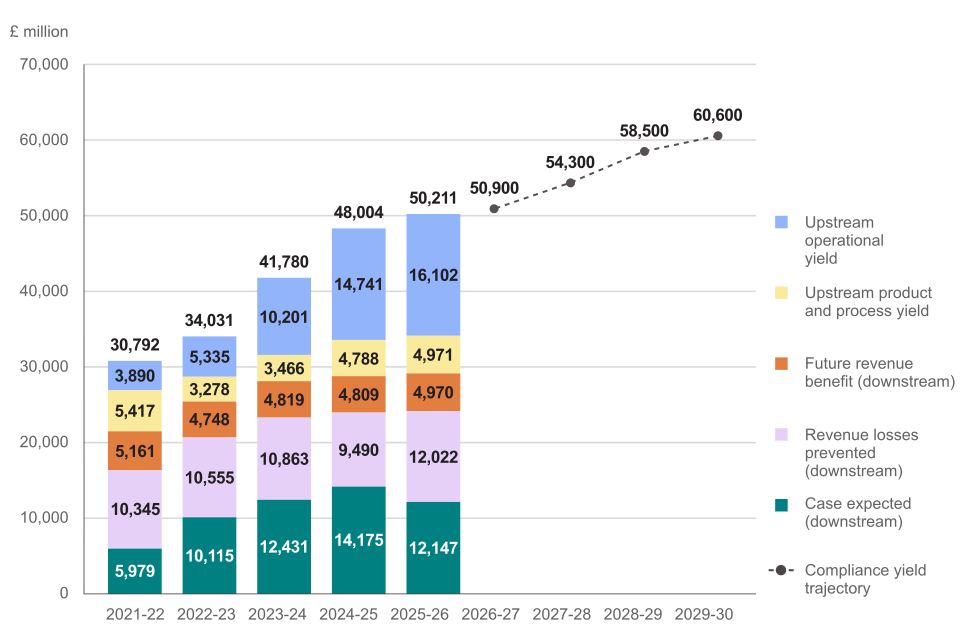
Note: Compliance yield trajectory is based on a range of factors such as inflation and future policy decisions, and is therefore subject to change.
Upstream product and process yield: estimated annual impact on net tax receipts of legislative changes to close tax loopholes and changes to our processes which reduce opportunities to avoid or evade tax.
Future revenue benefit: estimated effect of our past compliance work on customers’ compliance in the current tax year.
Revenue losses prevented: revenue that we prevented from being lost to the Exchequer through our compliance work, such as where a fraudulent or erroneous claim to a relief or repayment is either reduced or refused. It also recognises the estimated value of refused registrations, disruption of criminal activity and the revenue value of seized goods.
Upstream operational yield: estimated impact of operational activities undertaken to promote compliance and prevent non-compliance before it occurs. Does not include yield from legislative or process changes.
Cash expected: additional revenue due when we identify past non-compliance, with a reduction to reflect revenue that we estimate will not be collected. Cash expected for 2020 to 2021 also includes accelerated payments.
Read our technical note on GOV.UK.
How we are helping customers to get their tax right
Our aim is to make it as easy as possible for our customers to get their tax right and we understand the tax system can be difficult to navigate. We recognise the importance of reassuring taxpayers who are trying to do the right thing, which will help us to continue building trust.
Modernisation
Our aim is to make it as easy as possible for our customers to get their tax right and we understand the tax system can be difficult to navigate. We recognise the importance of reassuring taxpayers who are trying to do the right thing, which will help us to continue building trust.
One way we are making it easier for people is through modernising how they interact with HMRC. For example, many small businesses struggle to understand which expenses they can claim, as identified through our engagement with external stakeholders. That’s why, throughout 2025 to 2026, we worked with commercial software providers and agents to support 3.2 million small businesses to correctly claim business expenses by setting digital nudges that provided advice whilst the customer completed their return. This approach, alongside targeted communications to 1.2 million customers, led to more accurate reporting and brought in £36.4 million additional revenue in 2025 to 2026, with the full impact of around £250 million over 5 years. We are upgrading our IT and data infrastructure so that we can deliver more of these digital nudges in real time.
Making Tax Digital for Income Tax is also a key element of our modernisation, as set out in our Transformation Roadmap. It will help businesses stay on top of their tax affairs and get their tax right first time, while allowing us to offer a more supportive and efficient customer experience.
To give customers more flexibility and control when making tax payments, in March 2026, we launched the Budget Payment Plan service that enables customers to make voluntary weekly or monthly payments in advance of their next Income Tax Self Assessment return. Looking ahead into 2026 to 2027 and beyond, we will further develop this service for individuals by introducing enhanced forecasting.
We’re also supporting customers with Individual Savings Accounts (ISAs) by creating a modern digital reporting system for financial institutions operating ISAs, which will help to identify investors that have exceeded ISA limits more quickly. In 2025 to 2026, we engaged the ISA industry to ensure that the new digital system is practical and user friendly, and we will learn from user feedback and testing to ensure it is ready for phased introduction by 2028.
Guidance and education
Ensuring customers receive straightforward, accurate and consistent information is a key element of the HMRC Charter. That’s why we continue to improve the clarity and accessibility of our guidance. In 2025 to 2026, this included updates to help:
- customers starting their first job — working with people aged 19 to 25 to design clear and practical guidance
- pensioners understand how tax applies to their pension and where to get support
- businesses better understand when and how they need to register for VAT
- companies to work out the correct amounts to deduct from their accounts
Our GOV.UK guidance was viewed 672 million times during 2025 to 2026, and more than 96% of customers did not navigate to our ‘contact us’ pages in the following 5 days. In 2025, 59% of small businesses answered positively when asked about how easy it was to find information from HMRC, an increase compared to 2024.
To help customers get their tax right first time, we also delivered a number of targeted tax education campaigns. These include:
- Get Tax Confident, aimed at small businesses and pensioners
- Don’t Get Caught Out, helping customers protect themselves from tax avoidance schemes or making ineligible tax claims
- Side Hustles campaign, encouraging those with additional incomes to check their tax obligations and comply voluntarily
- Cryptocurrency compliance campaign, increasing customers’ understanding of tax obligations among wealthy cryptocurrency asset users
To provide certainty for individuals and businesses undertaking complex transactions, we also publish ‘Guidelines for Compliance’ with examples, practical steps to follow, and use of images and diagrams to improve clarity on how to comply with the rules. In 2025 to 2026, we published 6 new or updated guidelines on topics such as freeports, investment zones and sharing group structure information.
Transformation Roadmap progress — closing the tax gap
The Transformation Roadmap, published in July 2025, set out how we will make it easier for customers to get their tax right and to close the tax gap, focussing on process and policy changes, increasing and strengthening HMRC’s compliance and debt interventions, tackling fraud and economic crime, and raising the standards of advisers and intermediaries in the tax and customs system. We have made several changes in line with these commitments across 2025 to 2026, including:
Supporting customers
-
to help protect our customers from being caught up in tax avoidance schemes, the government has introduced legislation that comes into effect from April 2026 to stop the use of fraudulent umbrella companies
-
to provide better guidance and support for customers, we are improving how we manage and store data. In 2025 to 2026, we rolled out a new Central Customer Registry that connects records from across HMRC’s tax and benefit systems into one trusted source which holds unified customer and organisation records, including Corporation Tax, Value Added Tax (VAT), Pay As You Earn (PAYE), and Self Assessment. With this more accurate and accessible customer data, it will be easier for everyone to get their tax right first time
Setting adviser and intermediaries standards
- we have mandated the registration of tax advisers who interact with HMRC from May 2026, which will stop advisers who are not fit to act, from interacting with HMRC on a client’s behalf. We have set out intermediary standards through our published Strategic Approach to Third Party Software and Strategic Approach to External Integration
Reducing tax debt
- we are focussing on reducing tax debt as a proportion of receipts as set out in our updated tax debt strategy. We are trialling collecting more aged debts with private sector debt agencies and restarting the use of existing powers to directly recover tax debts owed by individuals and companies who have the ability to pay but deliberately choose not to do so.
Helping customers to not get caught out by tax avoidance
Tax avoidance involves ‘bending’ tax rules to try to gain a tax advantage that was never intended by Parliament, undermining fairness and trust in the tax system. Most tax avoidance schemes fail to deliver the promised savings, and those who use them often end up paying more, through penalties and interest.
To challenge promoters and others involved in the tax avoidance supply chain, we use a range of legislative powers and tools. This has led to several promoters exiting the market, and when new schemes emerge, we act quickly to shut them down. We also publish regular updates on schemes and those linked to them, helping customers recognise, avoid, or leave avoidance arrangements.
In 2025 to 2026, we published the details of 69 tax avoidance schemes, 68 promoters, and 58 connected persons, such as directors and those in control of the promoting entity. We also issued 8 stop notices to promoters, requiring them to stop promoting the tax avoidance scheme specified in the notice. This is lower than the 40 issued last year, largely due to arrangements being stopped at an earlier stage where we’ve used other available powers. Promoters may face penalties of over £1 million if they do not comply with the stop notice, and possible criminal sanctions if they continue to sell the scheme after receiving a stop notice. Since 2021, we have imposed around £42 million of penalties on promoters for failing to comply with a stop notice.
In March 2025, the government launched a consultation on a package of measures to close in on promoters of tax avoidance. Following this, new powers were introduced in the Finance Act 2026 to strengthen existing deterrents and make it riskier to continue promoting tax avoidance schemes.
We publish the names of tax avoidance schemes, promoters, enablers and suppliers on GOV.UK.
Read about the litigation decisions where HMRC considered tax avoidance was involved on GOV.UK.
Managing large businesses and tackling non-compliance
Our Large Business directorate works with around 2,000 of the UK’s largest businesses through the Customer Compliance Manager (CCM) model, as their size, complexity and the tax at stake mean this is the most cost-effective way of ensuring they pay the right amount of tax.
Each large business has a dedicated CCM, who are experts in their field and build an in-depth knowledge of the business and the sectors it operates in. CCMs are supported by tax specialists and can call on expert resource depending on the issue being addressed.
We subject large businesses to an exceptional level of scrutiny, actively investigating the tax affairs of around half of the UK’s largest businesses at any one time.
In February 2026, the National Audit Office (NAO) published a report concluding that our approach to taxing large businesses offers good value for money. They highlighted that our work with the largest and most complex businesses generated £15.8 billion in additional tax during 2024 to 2025, double the amount achieved in 2021 to 2022. This work brings in £95 for every pound spent.
Read our large business compliance technical note on GOV.UK.
Raising standards in the tax advice market
Approximately 85,000 firms provide tax advice and services to millions of taxpayers in the UK. We want taxpayers to have confidence that any adviser they choose will help them get their tax right, and we want to stop the minority who cause disproportionate harm to the tax system by assisting the non-compliance of their clients.
In line with our Charter commitment to make things easy and support customers to get things right, we are taking action to raise standards in the tax advice market and improve the service HMRC provides to tax advisers. Starting in May 2026, all tax advisers who interact with HMRC on behalf of a client must register and meet minimum standards before doing so, fulfilling a Transformation Roadmap commitment. In 2025 to 2026, we worked closely with professional bodies and tax advisers to refine the legislation and design the new IT system.
We continue to take action against breaches of our Standard for Agents. In 2025 to 2026, we suspended or blocked access to HMRC services 3,828 times and made 34 public interest disclosures concerning misconduct to the relevant professional body. We also conducted 188 investigations into the tax affairs of advisers, generating £7.45 million in compliance yield.
The government announced at Autumn Budget 2025 that, from April 2026, HMRC can take stronger and swifter action to investigate and penalise advisers who intentionally facilitate non-compliance in their clients’ tax affairs.
Read HMRC’s Standard for Agents on GOV.UK.
Addressing non-compliance
We use HMRC’s civil powers and pursue criminal investigations where necessary to protect revenue for public services, enforcing the rules of the tax system and tackling those who choose to not pay what they owe. In 2025 to 2026, we carried out 306,000 compliance checks to ensure the right tax is paid, a decrease of 10,000 compared to 2024 to 2025.
Strengthening the reward scheme for high-value tax fraud
In 2025 to 2026, we received 170,992 reports alleging non-compliance. We assess all reports and take relevant action. There are times when it is in the public interest for us to make payments to people for providing us with information, and this year we made payments worth a total of £1.388 million.
At the Autumn Budget 2025, the government announced a strengthened reward scheme that increases the amount that eligible informants could expect to receive for reporting high-value tax fraud and tax avoidance. Under this scheme, informants could receive between 15% to 30% of the value of the additional tax collected by HMRC that results from information provided by the informant, subject to meeting eligibility criteria. This strengthened reward scheme will help us to tackle serious non-compliance involving large companies, wealthy individuals, offshore structures and avoidance schemes.
To report tax fraud or avoidance to HMRC, please visit GOV.UK.
Tackling serious fraud and economic crime
We use our extensive powers and specialist investigative capabilities to uncover some of the most complex and determined fraud, including organised criminal attacks on the tax system. We focus our resources where they will deliver the greatest impact.
Usually, this involves using our civil powers to assess tax and impose penalties and fines of up to 200% of the tax liable. In 2025 to 2026, our Fraud Investigation Service opened over 8,600 new investigations, securing and protecting £2.09 billion from civil work to tackle fraud. Where appropriate, we will pursue criminal investigations, seeking prosecutions and confiscations to recover the proceeds of crime. In 2025 to 2026:
- we opened 494 new criminal investigations, an increase of 10.8% compared with 2024 to 2025
- we achieved 468 positive charging decisions, with 300 prosecutions brought as a result of our criminal investigations, and over 1,100 individuals awaiting trial in respect of an HMRC investigation
- we secured 260 convictions with an 87% success rate in court
- £2.11 billion was secured and protected by our criminal investigations
As announced at Spring Statement 2025 and in the Transformation Roadmap, we are expanding our counter-fraud capability to increase the number of annual charging decisions for the most harmful fraud to 600 per year by 2029 to 2030.
This enhanced capability will focus on tackling fraud that harms legitimate trade and small businesses, fraud committed by the wealthy, fraud facilitated by those in large corporations, and by individuals and companies that enable money to be hidden offshore. It will also address organised criminal attacks, focusing on illicit finance and complex money laundering.
To help tackle the growing threat of cyber-attacks on HMRC systems, in 2025 to 2026 we also invested in new specialised teams to bolster existing capabilities, whilst deploying a range of enhanced digital tools.
HMRC also works with partner organisations to combat tax fraud and protect the UK’s economic security. We collaborate with law enforcement agencies such as the National Crime Agency and National Economic Crime Centre, Border Force, financial institutions, professional bodies, the Financial Conduct Authority, the UK intelligence community, as well as international tax and customs authorities. We work with devolved governments through joint enforcement, legislative measures, and shared expertise to prevent and investigate tax fraud across the UK.
Read about our Fraud Investigation Service’s approach to tax compliance and fraud in our technical note on GOV.UK.
Tackling VAT fraud — Operation Barbados
A network of corrupt company directors were jailed for more than 70 years, after they were caught planning an elaborate £20 million tax fraud during clandestine meetings. The company at the heart of the fraud deliberately understated how much VAT was owed to HMRC on largely fictitious supplies of telecommunications and internet airtime to UK suppliers.
Critical evidence was secured when key conspirators were caught openly discussing at hotel meetings how they could just ‘invent the numbers’ to falsely offset VAT claims. The complex fraud was dismantled by HMRC investigators, which ultimately led to 20 convictions. In addition to the prison sentences, the case resulted in Director disqualifications of more than 100 years.
Tackling illegal activity on the high street
Some types of high street businesses facilitate illegal activity, causing significant harm and making it difficult for legitimate businesses to compete. We are committed to tackling this problem, and we are actively involved in cross-government initiatives targeting high risk, cash-intensive businesses on the high street. Through Operation Machinize, an initiative led by the National Crime Agency targeting the criminal exploitation of high street businesses, in partnership with other law enforcement organisations, HMRC carried out visits to 362 premises in 2025 to 2026, resulting in the seizure of £55,000 of cash and £244,000 of goods.
We also issued more than £2 million in penalties in relation to seizures made by Trading Standards as part of Operation CeCe, a joint initiative between HMRC and Trading Standards to target illicit tobacco at local retail level. In 2025 to 2026, this operation saw Trading Standards seize over 35 million cigarettes and over 8 tonnes of hand rolling tobacco, preventing revenue losses to the exchequer of more than £25 million.
We are participating in the Home Office-led, cross-government taskforce (now called the High Street Organised Crime Unit), to tackle illegal activity on the high street and have secured funding from the Home Office to expand our high street focused operations. We are increasing our operational focus on high-risk, cash-intensive businesses on the high street, which will include wider investment in additional criminal investigators.
Using Automatic Exchange of Information to address offshore non-compliance
The UK plays a leading role in international cooperation on tax transparency. In 2025 to 2026, we received Common Reporting Standard (CRS) information relating to calendar year 2024 on over 11 million financial accounts from 104 jurisdictions.
We analyse this alongside other data and intelligence that we hold and compare it with customers’ data. This deters non-compliance and helps us support customers, by prompting those who may have got it wrong to correct any undeclared offshore tax.
We have secured £1.13 billion in compliance yield directly from international automatic exchange of information agreements since we first started receiving CRS data in 2016 to 2017.
Increasing transparency and collaboration on cryptoassets
In January 2026, the UK implemented the Organisation for Economic Co-operation and Development’s Cryptoasset Reporting Framework (CARF), with the extension of the rules to domestic reporting taking effect at the same time.
UK cryptoasset service providers are now required to undertake due diligence and collect specified information on users and transactions and report it to HMRC annually. We will exchange that information on non-UK tax residents with relevant international partners and receive information from them on UK tax residents. This helps to improve tax transparency and reduce the risk of cryptoasset related tax non-compliance.
In 2025 to 2026, we published detailed guidance to support cryptoasset businesses and cryptoasset users in the UK, and we will continue to engage the industry directly through working groups, social media campaigns and direct technical support.
AI focus — close the tax gap
The use of AI and advanced analytic tools across HMRC supported the protection and recovery of £10 billion in tax in 2025 and 2026. This reflects tax protected and recovered from compliance interventions directly enabled by the use of AI and advanced analytical tools and techniques.
We are continually innovating — the examples below demonstrate how we’re using modern technologies to help us reduce the tax gap:
-
improving targeting of compliance activity: we are using AI and advanced analytics to highlight where tax returns may contain inaccuracies, which remains one of the main ways we identify cases for further investigation and intervention
-
supporting complex casework with document analysis tools: we are deploying Natural Language Processing to assist complex cases, enabling caseworkers to efficiently scan large volumes of documents and identify key information relevant to investigations
-
using external expertise to tackle evasion: HMRC’s Data Competition brings together expertise and innovation from across the UK’s private sector to explore novel analytical techniques and data to identify deliberate tax evasion. We will work with our 2 successful finalists to explore how their proposed ideas can be developed and tested, to help us close the tax gap
-
improving casework efficiency and targeting non-compliance: we’re trialling and beginning to adopt Copilot, which will allow caseworkers to summarise information more efficiently. New AI tools are being designed to allow caseworkers to quickly access guidance, receive rapid summaries of cases, and efficiently query large datasets and documents to unpick the key issues in some of our most complex casework.
Tackling repayment fraud
Repayment systems are a target for organised criminals, so we aim to prevent fraud by strengthening our security controls to stop fraudulent access to our systems, by having effective risk-based controls at the point of registration and repayment and by targeting the criminal groups behind these types of fraud. We have continued to see attempts to exploit both PAYE and VAT repayment routes, activity that puts customers at risk and challenges the fairness of the tax system we work to protect.
VAT is a particular focus as repayments are a normal part of the VAT system, with HMRC reporting £115.7 billion in repayments in 2025 to 2026 (read more on repayment revenue from page 203). During this period, HMRC has seen a significant increase in VAT fraud attempts relating to criminals taking control of recently registered VAT accounts before legitimate customers could.
Revenue losses relating to VAT repayments in 2025 to 2026 were £46 million, 0.04% of the total amount repaid across the same period, while our actions prevented further losses of £921 million. We estimate that fraudulent PAYE repayment claims have resulted in revenue losses for the exchequer of £8 million in 2025 to 2026, while our enhanced repayments and identity verification controls have prevented further PAYE losses of around £150 million over the same period.
We acted quickly to respond to these attacks, securing affected customer accounts, providing direct support to those affected and delivering IT changes to reduce opportunities for this type of fraud. These are attempts to claim money fraudulently from HMRC and no customer has suffered financial loss as a result, though some experienced delays while accounts were secured and reset.
We are also taking action to speed up the processing of legitimate repayments. We have increased the capacity and flexibility of key teams, for example, so we can respond more quickly to changing patterns of customer demand; and we have established a dedicated team to accelerate the clearance of older repayment cases.
Tackling abusive phoenixism
Phoenixism is where the same business or directors trade successively through a series of companies that liquidate or dissolve, leaving unpaid debts. Abusive phoenixism occurs when individuals use companies repeatedly to evade debts or for fraudulent purposes. We estimate that phoenixism accounted for around £750 million of tax losses in 2023 to 2024, compared to £910 million in 2022 to 2023. The 2022 to 2023 estimate is marginally higher than what was included in the 2024 to 2025 Annual Report and Accounts, primarily due to adjustments to the underlying data — as debts require time to be finalised.
An estimate for 2024 to 2025 will be published once a more complete dataset is available, with estimates subject to revision as we refine and improve our methodology.
We work closely with Companies House and the Insolvency Service to tackle the misuse of the insolvency regime, including abusive phoenixism and the rogue directors behind it. We are strengthening this collaboration through increased data and intelligence sharing, so that all appropriate tools can be used to help recover tax and target those responsible. The government has also announced funding for a new Abusive Phoenixism Taskforce within the Insolvency Service, which will investigate directors who deliberately liquidate or dissolve companies to evade tax and write-off debts.
We have also increased the use of up-front payment demands called securities in 2025 to 2026, protecting £255 million of tax revenue, and used our legal powers to hold directors personally liable in cases of tax avoidance, evasion, or repeated non-payment of tax — making them joint and severally liable for £97.7 million of tax owed by companies. We work closely with the Insolvency Service to take action against misconduct, who obtained 110 enforcement outcomes related to abusive phoenixism in 2025 to 2026.
Collecting debt
Our published tax debt strategy explains how we manage the money owed to HMRC and is built around four strategic pillars:
- preventing tax debt
- tailoring interventions to customers’ circumstances
- resolving debt effectively and efficiently
- being adaptable to changing economic conditions
We are a responsible creditor — we take firm action against those who can afford to pay but choose not to, and support customers who need help with their payments. At Budget 2025 we published an updated tax debt strategy, setting out what we have done so far and what we plan to do next. Our goal is to reduce tax debt each year as a proportion of the tax we collect (referred to as tax receipts), so that our progress reflects changes in the tax system and the wider economy.
We have already made good progress, but we know there is more to do. That’s why we are:
- transforming how we manage tax debt by automating more processes and expanding our digital services, so customers can manage their own tax affairs more quickly and easily and get things right first time
- making better use of data to target our activity and use our existing powers more effectively
- continuing to support those who engage with us, while considering new tools and powers to remove the unfair advantage from those who deliberately choose not to meet their responsibilities
In 2025 to 2026, we resolved around £102 billion of debt. A resolution is when a debt is concluded during the year, most commonly through payment or losses — it does not include outstanding debt in a payment plan. The vast majority, around 82%, of resolutions in 2025 to 2026 were due to the debt being paid.
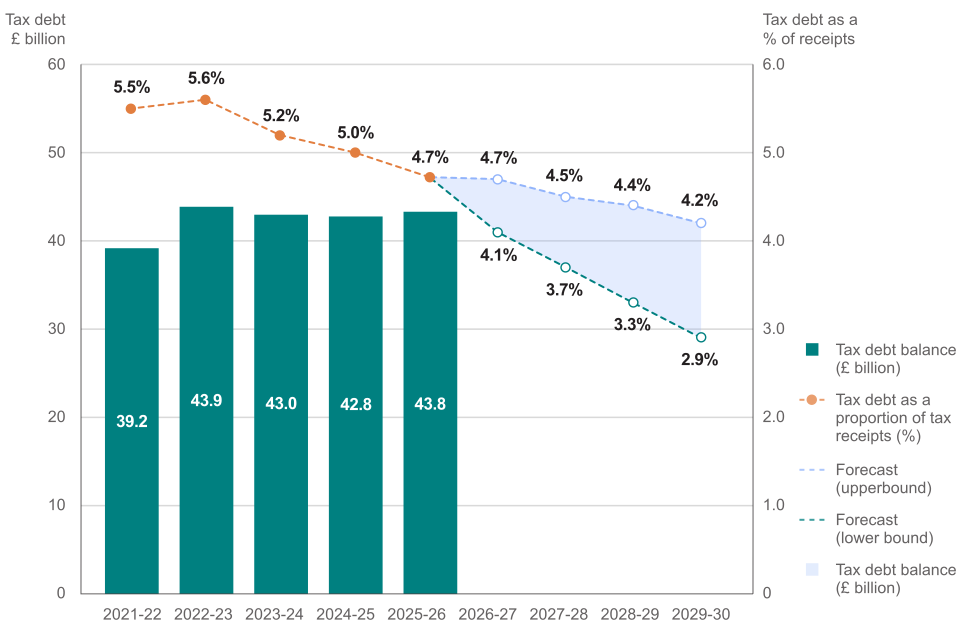
As a result of the actions we are taking, tax debt as a proportion of total tax receipts fell from 5.0% in 2024 to 2025, to 4.7% in 2025 to 2026, which was within our forecast range. By the end of 2025 to 2026, the total debt balance had increased to £44.7 billion, from £44.0 billion at the end of March 2025. This reflects continued pressure on the debt balance, driven by rising tax liabilities and wider financial pressures affecting customers.
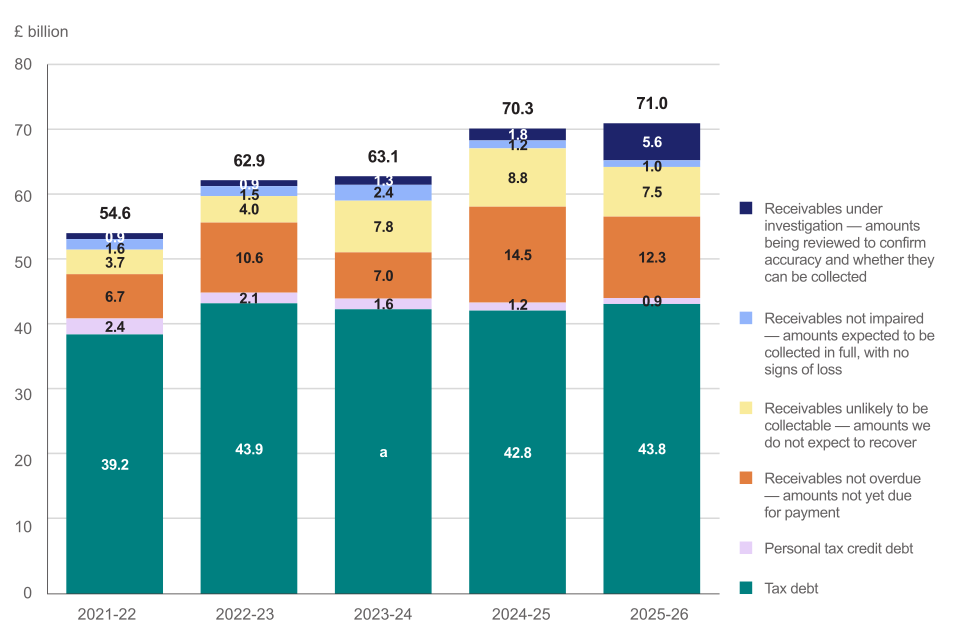
Figure 2: Receivables and tax debt as a percentage of receipts
‘Receivables’ include all amounts that customers are due to pay but have not yet paid, even if the payment deadline has not passed. They only become classed as ‘debt’ once the amount owed is not under appeal.
-
At the end of March 2026, gross receivables amounted to £71.0 billion, compared to £70.3 billion at the same point in 2025.
-
This includes our total debt balance of £44.7 billion, which is made up of tax debt (£43.8 billion) and personal tax credit debt (£0.9 billion).
-
Around 15% of the total debt balance is currently being paid through a payment plan.
Receivables
Tax debt as a percentage of receipts
Our tax debt strategy includes an illustrative trajectory for tax debt as a proportion of tax receipts, which suggests a range of around 3% to 4% by 2029 to 2030 due to the impact of our planned interventions.
Read our tax debt strategy update on GOV.UK.
Taking action against those who choose not to pay or engage with us
When customers can pay some debt, but choose not to meet their responsibilities, we must use our powers to protect the public purse. This ensures fairness for the vast majority who pay on time.
HMRC enforces the payment of overdue tax through measures such as taking control of goods, pursuing debts through the courts, and insolvency proceedings. We are also restarting direct recovery from bank accounts after successfully testing our processes in recent months, and we will be increasing volumes in phases across 2026 to 2027. We give customers many opportunities to engage with us before we use these powers and there are safeguards to ensure that our actions are fair and proportionate. Customers have a right of appeal if they dispute the amount owed.
We continually consider ways to go further to ensure the timely payment of tax and help customers to recognise their responsibilities. It is important for us to look at all types of debts and ensure that we are collecting as much as possible, no matter the size or tax regime.
Supporting customers who are in debt
In line with our Charter standards, we take a supportive approach to customers who need help with their payments, considering our customers’ personal situations and providing extra support if needed. We offer flexible Time to Pay plans for businesses and individuals who are unable to pay their tax on time due to temporary financial difficulties, supporting customers to pay their liabilities in affordable and sustainable instalments. These are tailored to individual circumstances and, in line with our commitment to be a responsible creditor, we won’t agree a payment plan if we think the customer cannot afford it.
We know how important it is for customers to have control over their tax affairs and to be able to resolve their debt position themselves. To make it easier and faster to pay, customers can set up their own payment plans online for Income Tax Self Assessment, PAYE and VAT debts, provided certain criteria are met — and in 2025 to 2026, 138,000 payment plans were set up online. We continue to enhance this service, and in 2025 to 2026, we extended it to Simple Assessment customers.
Over 90% of Time to Pay plans are completed successfully and by the end of 2025 to 2026, we were supporting over 884,000 customers in this way, a decrease of around 29,000 compared with the end of 2024 to 2025. This primarily reflects a change in customer population following the closure of tax credits in April 2025, rather than a reduction in the use of Time to Pay for tax debts.
Read more about how to set up a Time to Pay payment plan on GOV.UK.
If we cannot collect the debt
It’s not always possible to collect debts, and when we can’t, they become ‘tax losses’ — which can be classed as ‘write-offs’ or ‘remissions’.
Money owed, but for which there are no means of pursuing the debt, is called a write-off. This includes debts owed following a company liquidation or personal bankruptcy. Most insolvencies are voluntary, with customers responsibly using insolvency procedures to resolve their financial affairs. We define remissions as money owed to us which we have decided not to pursue any further, because it doesn’t represent value for money to do so.
Tax losses increased from £7.2 billion in 2024 to 2025, to £12.8 billion in 2025 to 2026. This reflects growth in tax debt above historic levels and the lag before HMRC concludes its recovery activity, meaning losses often materialise some time after the debt is first incurred. We also continue to manage the unwinding of delays to formal insolvency caused by court restrictions in 2020 and 2021, alongside the knock on effect of support measures at the time — where HMRC paused most of its debt collection activity during the COVID-19 pandemic, sending fewer letters, and ceased court action and other enforcement activity almost entirely. Tax losses in 2025 to 2026 represented 1.4% of total tax receipts, compared with 0.8% in the previous year.
Investment in debt management
As outlined in the Transformation Roadmap, government investment has allowed us to retain around 1,200 existing debt management colleagues until March 2030 and recruit a further 1,200 debt management staff by the end of 2028 to 2029. In 2025 to 2026 we accelerated our plans and recruited 540 additional colleagues - helping us collect as much debt as we can, as quickly as possible.
Following a successful trial to collect more tax debt through private sector debt collection agencies (DCAs), launched after Spring Statement 2025 and highlighted in the Transformation Roadmap, we secured further funding at Budget 2025. The DCAs we work with are regulated by the Financial Conduct Authority, and we undertake regular reviews to make sure they follow our strict processes and guidance.
These investments are expected to help us collect over £12 billion more debt by the end of 2030 to 2031. We have collected £1.4 billion to the end of 2025 to 2026, putting us approximately £400 million ahead of where we expected to be at this stage. We are confident that the actions we are taking will deliver sustained reductions in tax debt as a proportion of receipts.
Improve day-to-day performance and the overall experience of our customers
This chapter reports on the progress made in 2025 to 2026 on improving day-to-day performance and the experience of our customers, by building a more effective, agile and digitally focused HMRC.
“Improving our customers’ experience remains a key priority, with a strong focus on making it simpler and quicker to deal with HMRC. More customers are choosing our digital services, which provide a fast and convenient way to manage their tax affairs, with the HMRC app used 158.8 million times in 2025 to 2026.
We’ve enhanced our guidance and redesigned key services so customers can feel more confident and get things right first time. And These changes are already making a difference. When customers do need to speak to us by phone their calls are being answered, on average, more quickly than last year.
There is more to do, but the progress made this year is helping us to deliver our Charter standards and build a more modern, reliable service that customers can trust.”
Myrtle Lloyd
Chief Customer Officer and Director General, Customer Services
Lead metric: digital shift
78.0% Proportion of customer interactions through automated or digital self-serve channels.
Lead metric: customer satisfaction (target 80%)
79.4% Survey-based measure of the percentage of HMRC customers who were ‘satisfied’ or ‘very satisfied’ having interacted with us.
A digital-first experience for customers
Whether they are fulfilling their own or their clients’ tax obligations, claiming benefits, or trading across the UK border — our customers rightly expect interacting with HMRC to be straightforward and convenient. Evolving into a more modern, digital-first organisation will enable us to better meet those expectations, improve the customer experience and earn public trust.
More customers are getting a better service by using our digital services to manage their tax affairs and resolve issues. Table 1 demonstrates our digital shift over time:
Table 1: Digital shift over time (note)
| Measure | 2021-22 | 2022-23 | 2023-24 | 2024-25 | 2025-26 |
|---|---|---|---|---|---|
| Unique users of the HMRC app (million) | 1.6 | 2.3 | 3.8 | 5.9 | 7.6 |
| New app users added (million) | - | 1.0 | 1.8 | 2.8 | 2.8 |
| Proportion of Self Assessment returns filed online (%) | 95.9% | 96.4% | 97.0% | 97.3% | 97.3% |
| Self Assessment payments made through the app (£ million) | - | 30.3 | 602.5 | 1,129.9 | 1,892.9 |
| Proportion of HMRC app and Personal Tax Account users who do not call HMRC within 7 days of using their digital account | - | 93.8% | 95.0% | 97.1% | 97.4% |
Note: Some metrics not available for 2021 to 2022.
Figure 3: Digital shift
Self-serving via the HMRC app or GOV.UK allows individuals and businesses to manage their tax affairs quickly and conveniently, without needing to call us. This frees up our advisers to spend more time supporting vulnerable customers and those who cannot access online services, or who have more complex needs. In 2025 to 2026, around two-thirds of our inbound calls handled by advisers could have been resolved by our digital services or guidance.
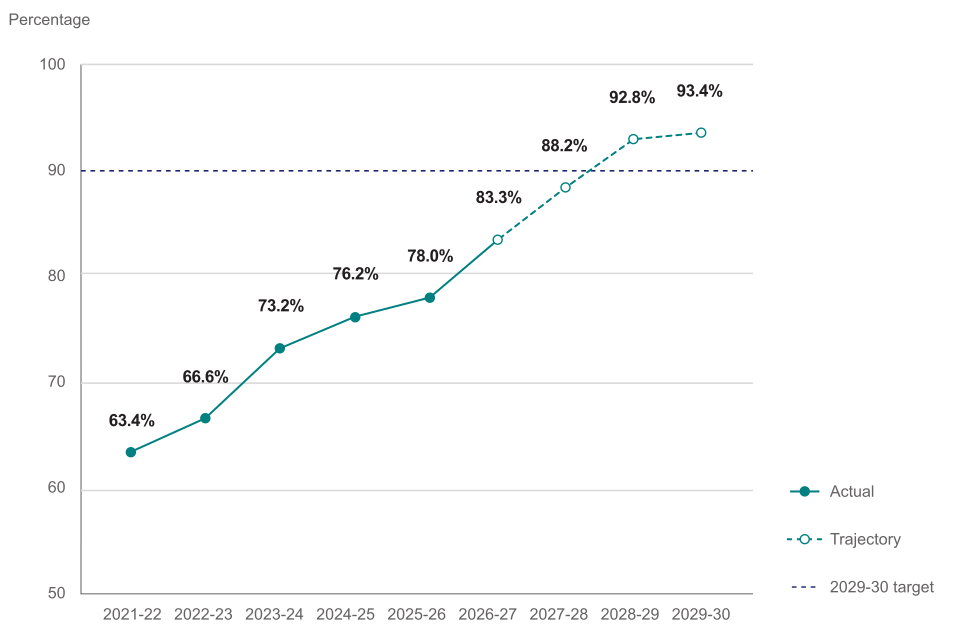
Most interactions are already through our digital or automated services and we continue to expand and improve them, so that routine tasks are faster and simpler to complete. In 2025 to 2026, 78.0% of our interactions with customers were through digital or automated channels, building on the upward trend of recent years and helping us move towards our aim of at least 90% by 2029 to 2030.
We are building on this progress through planned enhancements over the next four years, giving customers more reliable and convenient options for managing their tax affairs, while ensuring tailored support remains available for those who need it. The charts below show our planned digital shift over time.
Digital shift and analogue interactions
| Year | Adviser led (analogue) interactions | Automated or digital self-serve interactions |
|---|---|---|
| 2021-22 | 182 | 316 |
| 2022-23 | 190 | 379 |
| 2023-24 | 175 | 476 |
| 2024-25 | 167 | 533 |
| 2025-26 | 165 | 586 |
Adviser led (analogue) interactions (millions)
| Year | Telephony adviser attempts | Inbound post | Outbound post | Other |
|---|---|---|---|---|
| 2021-22 | 27 | 16 | 137 | 1 |
| 2022-23 | 29 | 20 | 141 | 1 |
| 2023-24 | 24 | 18 | 129 | 4 |
| 2024-25 | 22 | 17 | 123 | 4 |
| 2025-26 | 19 | 16 | 126 | 4 |
Automated or digital self-serve interactions (millions)
| Year | HMRC App sessions | Personal Tax Account sessions | Business Tax Account sessions | Other |
|---|---|---|---|---|
| 2021-22 | 43 | 82 | 54 | 136 |
| 2022-23 | 57 | 95 | 48 | 180 |
| 2023-24 | 88 | 111 | 49 | 229 |
| 2024-25 | 125 | 129 | 49 | 231 |
| 2025-26 | 159 | 144 | 48 | 235 |
Proportion of digital interactions
| Year | Actual (%) | Trajectory (%) | 2029-30 target (%) |
|---|---|---|---|
| 2021-22 | 63.4 | – | 90 |
| 2022-23 | 66.6 | – | 90 |
| 2023-24 | 73.2 | – | 90 |
| 2024-25 | 76.2 | – | 90 |
| 2025-26 | 78.0 | 77.4 | 90 |
| 2026-27 | – | 83.3 | 90 |
| 2027-28 | – | 88.2 | 90 |
| 2028-29 | – | 92.8 | 90 |
| 2029-30 | – | 93.4 | 90 |
How customers rate our online services
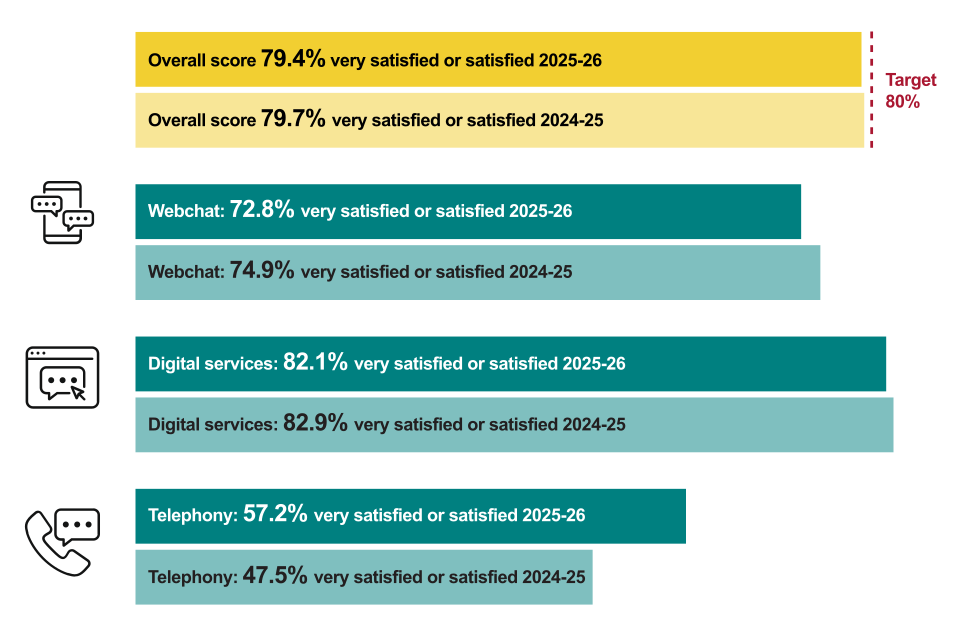
Customers rate our app highly — with a rating of 4.8 out of 5 on the Apple App store, 4.6 out of 5 on the Google Play store in April 2026 — and satisfaction with our digital services is consistently over 80% (see figure 4). Customers using our digital services generally find them easy to use (see figure 4).
Figure 4: Customer satisfaction and ease: digital, webchat and telephony contact
Customer satisfaction was 79.4% in 2025 to 2026, marginally below our target of 80%. 82.1% of customers using our digital services were satisfied or very satisfied with them, broadly stable when compared to 2024 to 2025.
We also measure how easy customers find dealing with us. This is based on a survey offered to customers after their interaction which asks: ‘how easy was it to deal with us today?’ The score is calculated as the total number of positive responses minus the total number of negative responses.
Our overall score of +61.8 was below our service standard of +65, with our digital services rated as the easiest way to deal with us.
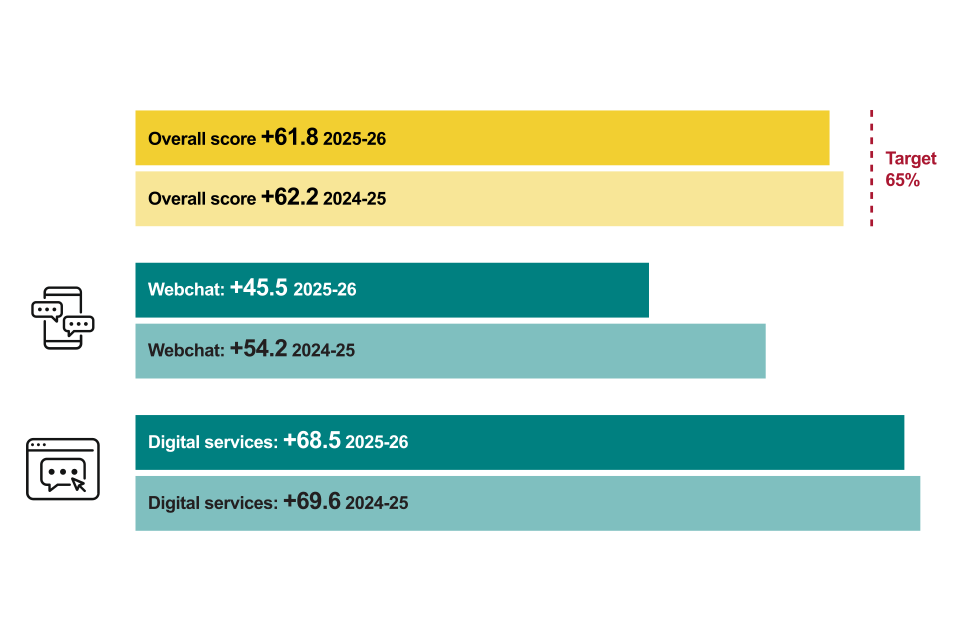
As part of our Spending Review settlement, we plan to deliver our service standard for customer satisfaction and net easy each year to 2029 to 2030.
In 2025 to 2026, 85.6% of customers responded ‘yes’ when asked whether they were able to achieve what they needed to after interacting with us, maintaining our performance when compared to 2024 to 2025 (85.5%).
Transformation Roadmap progress — becoming a digital-first service
The Transformation Roadmap sets out how we will continue to improve our digital services for individuals, small business and agents, while improving targeted support where required. Customers are already starting to benefit from a range of new guidance, services and functionality that we delivered or began working to deliver in 2025 to 2026, including:
Viewing and managing PAYE details online
The online PAYE service allows customers to more easily understand their tax position. They can now use it to view information about their PAYE income, allowances, benefits and deductions, as well as a timeline of activity and information about employments and pensions. They can also add or end income sources and access detailed support and explainers.
Modernising the digital Self Assessment service
We have improved the digital Self Assessment registration and opt-out processes, with the new registration service used by over 41,000 customers at the end of 2025 to 2026, and over 86,000 customers using a digital service to inform HMRC that they no longer need to file a return. We have also improved the late filing and late payment penalties online appeals process, with a digital appeals process replacing paper processes and speeding up decisions for customers.
One Login for government services
Individual customers who are new to HMRC can now access our digital services using GOV.UK One Login, which is a simple, joined-up and secure way of accessing government services. In line with our Transformation Roadmap, we will begin moving existing HMRC customers to GOV.UK One Login in phases, followed by agents and businesses, as the service continues to expand.
Paying the High Income Child Benefit Charge through PAYE
The new High Income Child Benefit Charge (HICBC) digital service launched in September 2025, which allows eligible customers to pay the HICBC through their tax code, so they no longer need to register for Self Assessment or file a tax return.
Improving our guidance and education
We continue to raise awareness and understanding of tax among children and young people through our Young Enterprise accredited Tax Facts Programme. In 2025 to 2026, our Tax Facts materials were downloaded 4,390 times, and colleagues delivered 217 sessions to an estimated 15,706 young people.
As set out in the Transformation Roadmap, we also developed and tested a new module for students aged 16 and over in vocational settings, which will be rolled out further in 2026 to 2027. This new resource will specifically support students studying vocational courses, many of whom are likely to start their careers as self-employed or small business owners.
Improving phone and correspondence performance
While more customers are getting a better service by using our digital services to manage their tax affairs and resolve issues, we recognise that this isn’t always the right option for everyone. In April 2025, to improve performance across our telephone and correspondence services, we set up our Customer Experience Directorate, bringing together customer-focused teams from across HMRC to improve the experience at every touchpoint, in line with our Charter standards.
Customers calling us received a better service with more attempts to speak to an adviser being answered in 2025 to 2026 and calls answered more quickly, compared to 2024 to 2025 (see figure 5). This progress was achieved due to the work we’ve been doing to reduce the need for customers to contact us — including improving our digital services and guidance — and the additional funding we received, which enabled us to deploy more customer service advisers. While this represents clear progress compared to previous years, we recognise there is more to do to consistently meet our service standards year-on-year.
2025 to 2026 also saw us begin sourcing new IT platforms to improve how we manage customer contact. These will help us create a single, streamlined contact centre that links service channels and directs people to the right adviser or automated support.
We also continued to strengthen our correspondence handling after a challenging start to 2025 to 2026 (see figure 6) The main drivers of correspondence include paper Self Assessment returns, agent authorisation requests, Childcare Services eligibility queries and the use of the Tax Estimation Service.
But there is more to do as backlogs remain in several areas. These can create uncertainty for customers and lead to avoidable contact and complaints, particularly where customers are waiting for repayments.
For 2026 to 2027 we intend to move from reactive ‘recovery’ activity to ongoing sustained control, in line with our Charter standard of ‘being responsive’. We have already increased capacity in key teams, increased workforce flexibility to move between priority areas, and are setting up a dedicated team to speed up the clearing of older repayment cases. Taken together these actions will improve customer experience, help customers receive the money they’re owed more quickly, and stop new backlogs building.
Case study: Self Assessment Saturday
In 2025 to 2026, the Self Assessment deadline (31 January) fell on a Saturday. To make sure our customers were supported we delivered an enhanced service — opening the Self Assessment and Online Services helplines. Advisers answered around 10,400 calls and made over 1,200 callbacks to customers. We also increased webchat capacity with around 315 advisers on hand to help customers across Self Assessment, Agent Dedicated line, Extra Support, Bereavement and Online Service Helpdesk – handling over 5,400 webchats on the day.
Together, this strengthened the multichannel support available and ensured customers could access help when they needed most. It was a collective effort, made possible by HMRC colleagues who volunteered to ensure sure every customer could get the support they needed.
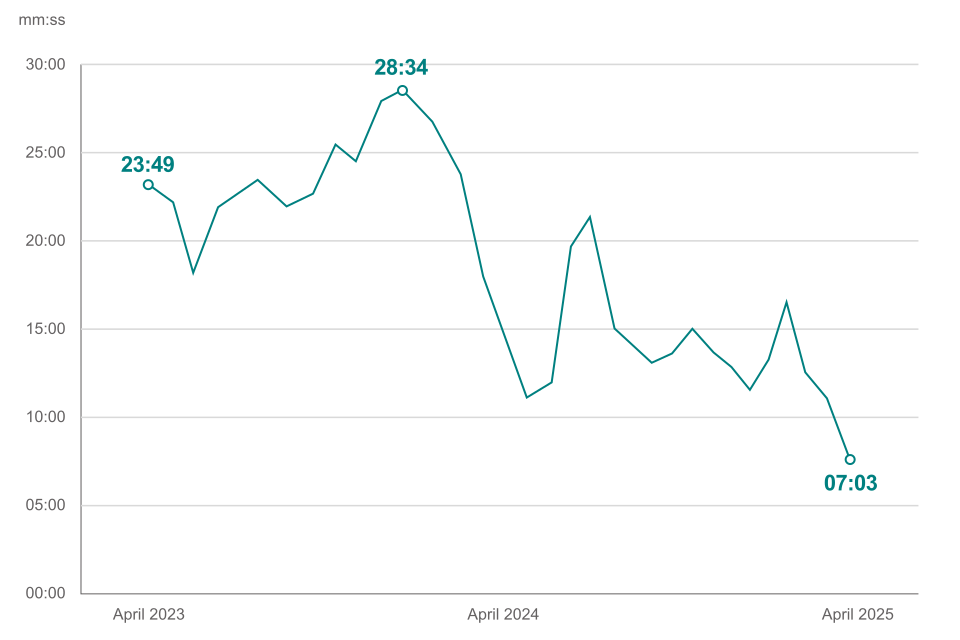
Figure 5: average call answering times and telephony adviser attempts handled
Average call answering times fell during 2025 to 2026.
The average amount of time customers spent waiting in a call queue fell to under 10 minutes in March 2026, demonstrating further progress from the peak wait times in 2023 to 2024. The average across the year was 12 minutes and 35 seconds. We remain focused on continuing this improved performance in 2026 to 2027.
Average time to answer
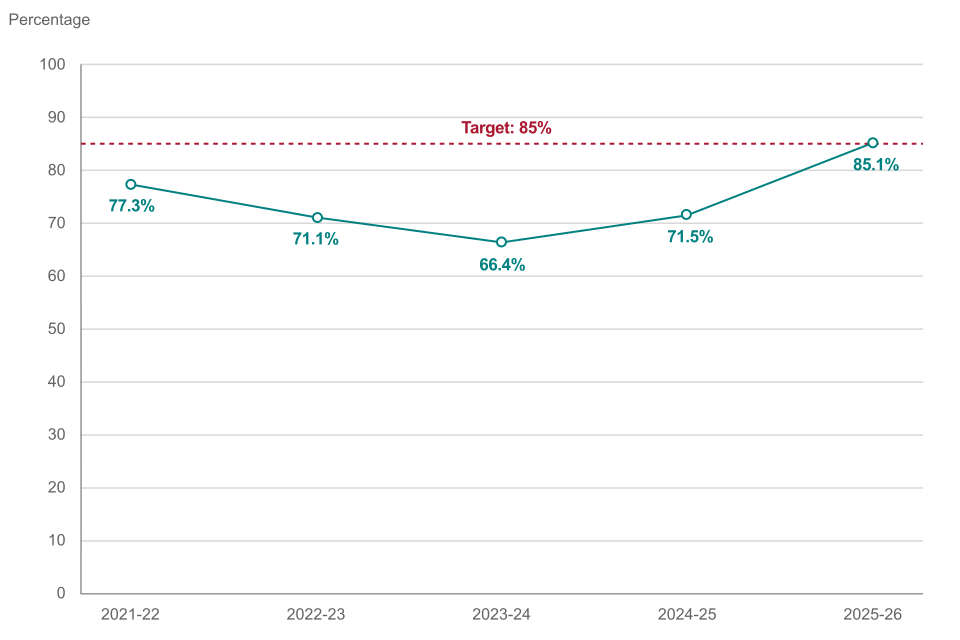
Adviser attempts handled target met in 2025 to 2026 as call volumes declined.
We also measure telephony ‘adviser attempts handled’, which shows the proportion of callers who got through to an adviser after hearing the automated messages and choosing to speak to an adviser. Our performance in 2025 to 2026 was 85.1%, meeting our target of 85% and an improvement on 2024 to 2025 (71.5%).
Proportion of adviser attempts handled
Call volumes (millions)
| Year | Total calls to HMRC | of which, calls to an adviser |
|---|---|---|
| 2021-22 | 35.2 | 26.9 |
| 2022-23 | 38.3 | 28.8 |
| 2023-24 | 36.7 | 24.4 |
| 2024-25 | 33.5 | 22.0 |
| 2025-26 | 29.1 | 19.2 |
We balance the volume of incoming calls with the number of advisers available to them. Call volumes fluctuate throughout the year, especially around tax administration milestones like the Self Assessment deadline; so resourcing to answer every call during peak periods of customer demand would leave advisers underused during quieter periods, making it an inefficient use of taxpayers’ money. That’s why we aim to handle 85% of attempts to speak to our advisers – which we met this year. As part of our Spending Review settlement, we plan to deliver our telephony service standard each year to 2029 to 2030.
In 2025 to 2026, we also answered 95.6% of webchats (where the customers took up a webchat offer) with an average wait time of 1 minutes and 21 seconds across the year.
Figure 6: Percentage of customer correspondence responded to within 15 and 40 working days of receipt
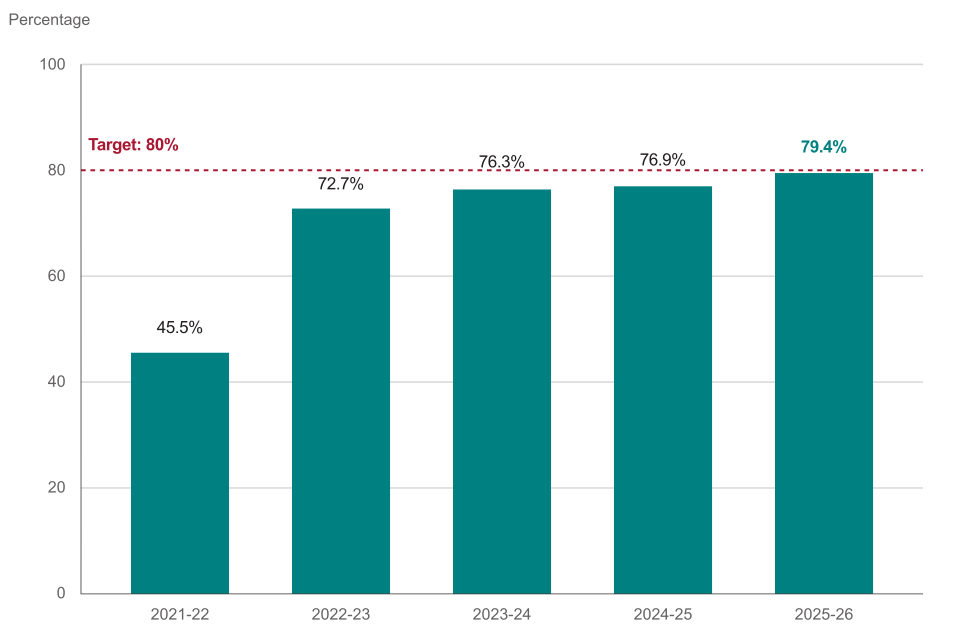
Response times for priority correspondence steadily improved throughout 2025 to 2026. The proportion responded to within 15 working days was 79.4%, up from 76.9% in 2024 to 2025, against a service standard of 80%.
Responded to within 15 days
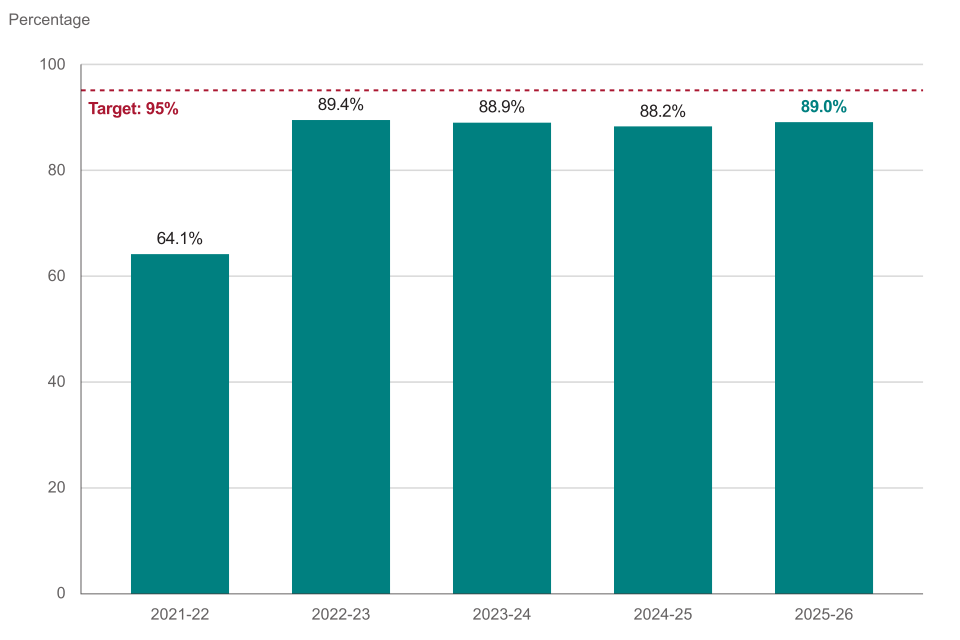
We responded to 89% of customer correspondence within 40 days, a slight improvement on our 2024 to 2025 levels, but below our service standard of 95%.
As part of our Spending Review settlement, we plan to deliver our correspondence service standards each year to 2029 to 2030.
Responded to within 40 days
Improving the experience for tax advisers
We recognise that tax advisers, such as accountants and bookkeepers play an important role in the tax system, performing a range of functions on behalf of their clients and helping them pay the right amount of tax at the right time. It is therefore important to provide advisers with the services they need, both analogue and digital, to enable them to support their clients effectively and fulfil our Charter standard of ‘recognising that someone can represent you’.
We are working closely with the Agent Digital Design Advisory Group to modernise HMRC’s tax adviser registration services, as we committed to in the Transformation Roadmap. Through this work we’re making registration simpler, more efficient and increasingly automated. Registration is due to start from May 2026, using a staggered approach with different sectors.
We continue to listen to what tax advisers want from us, and in 2025 to 2026 we created the Tax Agent’s Handbook to help them more easily find the guidance, services and information they need and continued to make improvements to our technical manuals based on their feedback.
We also made a number of improvements to our digital services for tax advisers in 2025 to 2026, for example:
- allowing customers to authorise more than one tax adviser in Making Tax Digital for Income Tax
- introducing a webchat service for tax advisers in Self Assessment and PAYE
- introducing a pre-complaint resolution service for tax advisers with business and individual clients
- giving agents with clients who are signed up to Making Tax Digital for Income Tax greater access to see and manage their client’s affairs, through a new ‘Manage your Self Assessment’ service for agents
Through the ‘Manage your Self Assessment’ service, agents can view client obligations, payments and tax return calculations — and we plan to add further new services, such as adjusting a payment on account and claiming a repayment.
In 2025, 62% of surveyed agents reported a positive experience dealing with tax issues, unchanged from 2024. So, while we are making progress, we recognise there is still more to do to provide tax advisers with the services they need. We remain committed to working with them and their representative bodies to continue improving our services.
Adhering to our Charter Standards to build trust
Our customers rightly expect a high standard of customer service and our Charter explains how we aim to get things right, make things easy and be fair, responsive and aware of their personal situations. Our Charter also recognises that customers may want someone else to represent them and provides reassurance that we will always aim to keep their data secure.
Meeting our Charter Standards is essential to building and earning trust, and we know we have more to do to embed these standards into everything we do.
Understanding and building trust
In the 2025 customer survey, 70% of small businesses and 44% of individuals said that HMRC is an organisation they trust (see figure 7). To build trust in HMRC, we know we must demonstrate fairness, competence and transparency in the way we deliver services for our customers.
We have taken actions to help strengthen public trust, including improving our day-to-day performance, redesigning the HMRC app around common customer tasks and improving guidance to help customers identify avoidance schemes. We remain focused on improving the customer experience and supporting compliance, while being transparent about how we perform.
Figure 7: Trust in HMRC — proportion of small, mid-sized and large businesses and individuals who answered positively when asked whether HMRC is an organsiation they trust (note)
2024 saw positive improvements — trust ratings improved for for small and mid-sized businesses and agents.
2025 shows stability — changes across all groups were small, both positive and negative, and none were statistically significant.
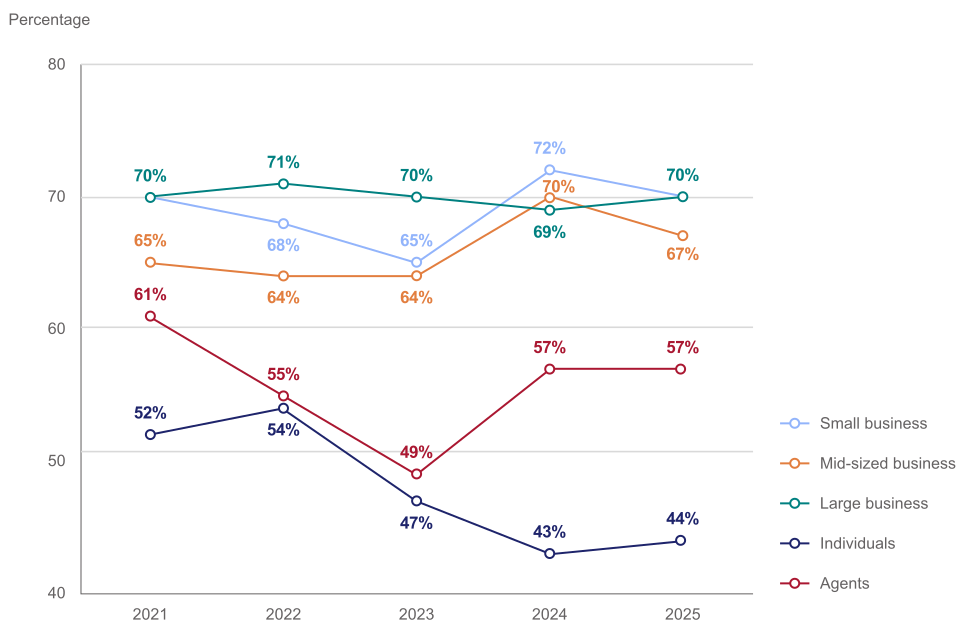
Note: 2023 mid-sized score has been revised to exclude ‘not applicable’ answers and therefore differs from the previously published figure.
Being transparent about our performance
We aim to build trust by openly sharing clear, accessible information about how we are performing and publishing our performance data each month and quarter. Alongside this Annual Report, we have also published a supplementary note setting out the progress made in delivering the commitments outlined in our 2025 to 2026 business plan.
We also share findings from our external research programme, our evaluations and a range of official and national statistics. In 2025 to 2026, we published 104 research reports covering issues such as customers’ experience of dealing with HMRC and evaluations of policy changes. This external insight helps us understand how well we are delivering the HMRC Charter and where we need to improve the experience for customers. Some of the results of our customer surveys, relating to specific Charter Standards, are shown below.
Read quarterly performance updates on GOV.UK.
Read our annual statistics publication plan on GOV.UK.
Read our supplementary note on delivering our commitments on GOV.UK.
Read our research reports on GOV.UK.
Customer experience and the HMRC Charter
1. Core experience
Getting things right — HMRC gets transactions right:
| Group | 2025 | change from 2024 |
|---|---|---|
| Individuals | 61 | +2 |
| Small business | 74 | +2 |
| Agents | 54 | +2 |
Making things easy — how easy you found dealing with taxes:
| Group | 2025 | change from 2024 |
|---|---|---|
| Individuals | 47 | +3 |
| Small business | 76 | +3 |
| Agents | 62 | 0 |
Being responsive — time taken to reach end result is acceptable:
| Group | 2025 | change from 2024 |
|---|---|---|
| Individuals | 51 | +2 |
| Small business | 63 | +3 |
| Agents | 24 | +1 |
2. Fairness and trust
Treating customers fairly — HMRC treats customers/your business fairly:
| Group | 2025 | change from 2024 |
|---|---|---|
| Individuals | 62 | +1 |
| Small business | 78 | +2 |
| Agents | 63 | +2 |
Recognising that someone can represent customers — HMRC made it easy for someone to act on your behalf:
| Group | 2025 | change from 2024 |
|---|---|---|
| Individuals | 54 | +8 |
| Small business | 71 | -2 |
Keeping cstomers’ data secure — HMRC ensures data and personal information is treated confidentially:
| Group | 2025 | change from 2024 |
|---|---|---|
| Individuals | 60 | +1 |
3. Overall outcomes
Overall experience of dealing with HMRC — over the last 12 months:
| Group | 2025 | change from 2024 |
|---|---|---|
| Individuals | 55 | +3 |
| Small business | 70 | +2 |
| Agents | 35 | +2 |
Being aware of your personal situation — HMRC communicates in a way that is easy for me to understand:
| Group | 2025 | change from 2024 |
|---|---|---|
| Individuals | 47 | +3 |
Source: HMRC Customer Surveys 2024 and 2025.
Improving support for customers who need extra help
We appreciate that dealing with tax, financial hardship, or debt can be stressful — and we want to make sure that we’re treating our customers fairly. We have improved our external and internal guidance and invested in education resources to help customers self-serve where they can. We will always provide extra support if customers need it.
HMRC advisers are trained to recognise when someone might benefit from additional help or tailored support and to offer that help directly or connect them with a specialist team. This could include using alternative communication formats like Braille, large print or translation services, involving a third party to act on their behalf, or simply giving people more time and guidance to support them when completing forms.
Our dedicated Extra Support teams are there to ensure that customers can get what they need from us, even when their circumstances are challenging. In 2025 to 2026, around 210,000 customers were given extra support by our dedicated teams.
Alongside this support, if a customer is unable to use HMRC’s digital services, has a disability, a language barrier, or a complex enquiry, help is also available through a network of voluntary and community sector (VCS) organisations.
Funded directly by HMRC, these organisations offer personalised support to help customers understand their tax obligations and make claims with confidence. During 2025 to 2026, about 44,000 customers were supported by HMRC-funded VCS organisations. To reinforce our commitment to extra support as we evolve into a more modern, digital-first organisation we have more than doubled our funding allocated for VCS organisations, starting from April 2027.
To help every customer feel safe, all new customer service staff are trained and provided with guidance on recognising and supporting those who need extra support and those affected by economic abuse. This means advisers and caseworkers are now better equipped to understand customers’ individual needs and provide the right support during calls and through correspondence. Colleagues can also refer people to specialist support from the Samaritans when needed.
During times of bereavement, our customers can now access support more easily through a dedicated guidance tool and a helpline that connects them directly to HMRC’s bereavement service. This service offers a streamlined, once-and-done approach that is delivered by highly trained professionals. In 2025 to 2026 our bespoke service, for those dealing with the affairs of someone who has passed away, handled over 720,000 interactions.
In 2026 to 2027 we plan to increase resource within our dedicated extra support teams, review our outbound communications to ensure our extra support services are clearly signposted, and trial new outreach activity to raise awareness of the range of support on offer.
Read our principles of support for customers who need extra help on GOV.UK.
Handling and learning from complaints
We are committed to delivering good customer experience in line with our Charter standards. If a customer feels we have not met these standards, they can raise a complaint through our complaints process.
In 2025 to 2026, we received around 87,000 new complaints with our average response time increasing from 27 days to 40 (see table 2 below):
Table 2: Complaint receipts and our response rate over the last 3 years
| Measure | 2023-24 | 2024-25 | 2025-26 |
|---|---|---|---|
| New complaints received | 92,206 | 93,589 | 87,353 |
| Average response time (days) | 35.7 | 26.7 | 40.0 |
Throughout the second half of 2025 to 2026, customers continued to experience longer wait times. This was due to high numbers of new complaints coming in, alongside work to resolve existing complaints, and older cases taking a longer time to resolve. We are sorry that some customers waited too long to have their complaint resolved. When customers have already had a poor experience, it is important for us to rebuild trust.
We want to reduce wait times, particularly for the oldest outstanding complaints. To do this, we have secured extra resources, and we are trying new ways of working.
So that customers who complain have a better experience, in 2025 to 2026 we expanded our automated text message and email services to keep customers updated as we process their complaint. We also introduced dedicated Customer Resolution Teams, who are able to speak to customers who have enquired about the progress of their complaints, to help resolve their issue more quickly.
The complaints section of our GOV.UK pages has been updated too, helping customers reach the right team first time, alongside giving extra training and support to these teams. This will allow issues to be resolved earlier, before they become complaints.
Our complaints process has two tiers. If a customer is not satisfied with our second-tier response, they can escalate their complaint to the independent Adjudicator. The Adjudicator’s Office resolves complaints, providing an accessible and flexible service and making fair, trusted and impartial decisions.
The Adjudicator’s Office also uses its expert knowledge to support HMRC to learn from complaints, so that we can improve our services in line with our Charter commitments.
Customers can also ask their Member of Parliament to refer their complaint to the Parliamentary and Health Service Ombudsman (PHSO) if they are not satisfied with the Adjudicator’s response. In 2025 to 2026, 2 complaints about HMRC were accepted by the PHSO for further detailed investigation, a decrease of 66% on last year. Of 5 detailed investigations closed, 3 were partially upheld and 2 were not upheld.
We acted on all recommendations that the PHSO made to HMRC during the year and use their findings to improve our services.
The Adjudicator Annual Report and our response will be published later in Summer 2026.
Reform and modernise the tax and customs administration
This chapter looks at how we are reforming and modernising tax and customs administration, in line with our Transformation Roadmap. This includes improving our IT infrastructure, making innovative use of technology and AI, and ensuring the organisation has robust data capabilities and a highly skilled workforce.
“We have a bold IT strategy, which includes getting the most from technology, accelerating innovation to improve the customer experience and becoming more efficient through the use of new platforms and technologies, such as generative AI. This helps to make more of our services quick and straightforward to use online, so customers can get things done easily and get their tax right first time.
Security and resilience are top priorities for HMRC and we have invested to make our systems more reliable for customers. We continuously review and improve how we protect the data we hold and we’ve done a lot of work to discover, understand, and manage any risks and the impacts these could have on customers and colleagues.”
Daljit Rehal
Chief Digital and Information Officer
Lead metric: technical health maturity score
3.3 out of 5 The overall condition and resilience of our technology systems and infrastructure.
Modernising HMRC’s IT infrastructure and workforce
HMRC runs a vast 24/7 operation, supported by one of the largest and most complex IT estates in the UK. Our Transformation Roadmap explains how our ability to reform and modernise at pace depends on improvements in our technology infrastructure and data capabilities. Modernising our systems and working in a more agile way is critical to providing customers with the modern services they expect, and to keeping their data secure.
Why we are modernising our IT estate and the progress made
We are moving to a technology landscape that is much simpler, with fewer separate systems and more software services that we buy rather than build, with AI capabilities built in. This will help keep customer information safe, strengthen our protection against cyber threats and make our services easier to update. It will also improve how it feels to deal with HMRC, as we simplify processes and make it easier for people to use our digital services.
In 2025 to 2026, we made several IT system improvements to benefit customers, including:
-
Reducing downtime through more resilient, modern systems: we migrated services from legacy data centres to modern cloud platforms, improving their reliability and security. Our customer facing systems were available 99.948% of the time in 2025 to 2026
-
Moving goods across the border faster and more easily: as set out in HMRC’s Transformation Roadmap, we improved the Customs Declaration Service, so traders can access their own data more easily, make changes faster and complete routine tasks with fewer delays. We also enhanced the Goods Vehicle Movement Service (GVMS), which manages the flow of lorries through ports, and upgraded the New Computerised Transit System, which supports goods moving across multiple countries, helping businesses move goods more smoothly and more easily meet international requirements
-
Retiring the legacy VAT system so we can provide a more reliable service for customers: we marked the end of a 50-year-old mainframe system this year. Our new VAT system gives customers a more reliable service and allows for faster updates and fixes to be made
-
Improving the legacy Corporation Tax system to improve system reliability: building on a Transformation Roadmap commitment, we strengthened the platform to keep it secure and ensure it continues to run reliably for businesses filing their tax returns. These changes will help prevent fraud and ensure that businesses can continue to meet their tax obligations without disruption, while laying the groundwork for a future cloud-based service that is faster, easier to use, and more responsive to changes in customer expectations
-
Improving our core platforms: we continued to upgrade the Enterprise Tax Management Platform, which is one of our core IT systems for managing and accounting for tax. By moving to a modern, cloud-based service, the platform allows us to monitor and predict usage, which helps us to ensure a stable and reliable service and more easily meet the evolving needs of our customers
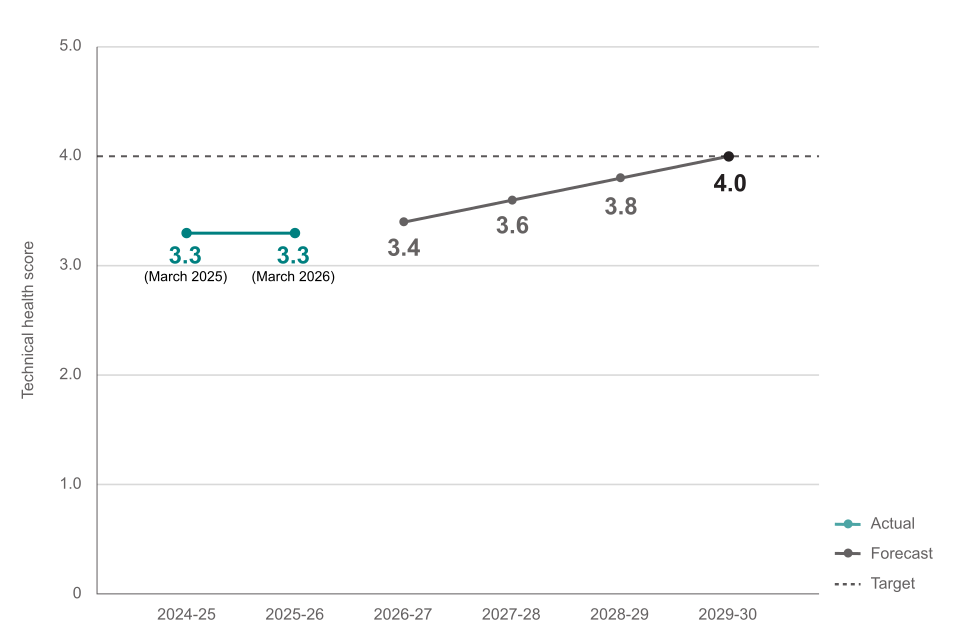
Figure 8: measuring progress in modernising our IT estate
As set out in our Transformation Roadmap, we are simplifying our technology landscape by reducing the number of technologies delivering our IT platforms, making them easier to scale up and more cost efficient to run. We are also increasing our use of IT services provided by suppliers, enabling us to focus less on delivering IT and more on securing value out of the services we use.
We use a measure called ‘technical health’ to assess progress in modernising our IT estate. This assesses the overall condition and resilience of our technology systems and infrastructure, based on regulatory frameworks.
In 2025 to 2026 we achieved a technical health maturity score of 3.3 out of 5, and we remain focused on moving towards our desired IT architecture and achieving our target of 4.0 in 2029 to 2030.
Technical health score and forecast
Scale: 1 (lowest) to 5 (highest)
4.0 Our technical health forecast aim by 2029 to 2030.
+0.7 The increase required over 4 years.
A simpler and more personalised customer experience
Our customers expect our systems to be joined up, so they don’t need to give us the same information multiple times through different channels. But because our systems and data have built up over several decades, we’ve not been able to bring all the records we hold on a customer together in one place, to give us a full view of each customer’s information. Addressing this is central to delivering the HMRC Charter, particularly the commitment to make things easy for customers, while keeping their information secure.
Our Unique Customer Record programme is tackling this by bringing together data across HMRC. By the end of 2025 to 2026, we had consolidated previously separate data sources into 97 million unique records in the new Central Customer Registry (CCR), enabling us to view customer data across 54 different taxes, benefits and duties.
This will save customers time and effort, reducing the need for them to contact us about basic issues like incorrect or missing names and addresses for example, which results in around 500,000 telephone calls to HMRC annually. The CCR is also connected to HMRC’s customer call handling system, allowing our telephony advisers to view this data when handling customer calls. This means they can correct any data quality issues in real time or refer the query to a specialist team for further action.
Alongside improving our internal view of customers, we also supplement this with external data sources, including data purchased from credit reference agencies. This helps us more accurately categorise our customers, so we can better identify their risks and needs. This enabled us to tailor our approach when contacting around 1.6 million Self Assessment customers about their payments on accounts in 2025 to 2026. Receiving more relevant and timely communications helps our customers understand their tax obligations and reduces the need for them to contact us.
AI focus — supporting our customers
We are embracing the potential of AI to create a tax system that works better for everyone. In 2025 to 2026, our work in this area included:
-
supporting customers contacting us by phone: we piloted real-time call summaries to help customers get quicker responses and spend less time waiting. This enables advisers to focus more on resolving customer queries during calls, improving the speed and quality of support
-
improving access to information for customers: we continued to support the Government Digital Service with developing their generative AI-powered ‘GOV.UK Chat’ product. As outlined in the Transformation Roadmap, this chatbot aims to help customers get quick, personalised answers to their questions, pulling content from across GOV.UK guidance as its source material
-
exploring new AI tools to enhance services: we launched a new testing environment to access cutting edge generative AI large language models, helping us to safely explore how AI can improve both internal operations and customer-facing services. This lays the groundwork for developing faster, more intuitive digital experiences for customers in the future and is part of HMRC’s Transformation Roadmap approach to replacing its legacy systems
Using AI and advanced technologies safely and responsibly
Our Transformation Roadmap set out our ambitions for AI and other innovative technologies to modernise HMRC. Harnessing AI helps our people work smarter, faster and more effectively — so they can spend more time on complex and impactful work.
We’re leading one of the biggest roll-outs of internal AI tools in government, issuing 28,000 Copilot licences to colleagues in 2025 to 2026, supported by our Digital Academy, where 38,000 colleagues completed AI-focused training in the same period.
We know that customers and the wider public want to feel confident about how HMRC uses AI and we’re committed to adopting it responsibly, through careful implementation, robust safeguards and continuous learning. So, while AI supports some of our processes, it never replaces human judgement — final decisions are always made by experienced, trained caseworkers, with results remaining explainable and compliant with data protection, security and ethical standards.
We also use ‘synthetic’ data in testing environments, allowing new tools to be developed and assessed securely, without using actual customer information. And our approach is underpinned by a well-developed AI assurance, ethics and risk management framework, tested with external ethics experts on our Professional Standards Committee. The adoption of AI across the department is coordinated by HMRC’s dedicated AI Board and delivery team, which provides rigorous oversight and draws on external expertise.
We are fully aligned with central government AI frameworks, HMRC’s Charter Standards, the Data Protection Act 2018 and UK GDPR, and we maintain strict guardrails around any AI that customers interact with directly, such as chatbots.
Protecting customer data and strengthening resilience
Keeping customer data secure and strengthening the resilience of our systems are central to maintaining trust in the tax and customs system.
Being responsible with data
HMRC uses data transparently, proportionately, and in line with data protection laws, so that customers can trust their information is handled responsibly and with care. This is essential to maintaining public trust (read more on our Charter Standards, and whether customers thought HMRC treated their data securely on page 37). Completing departmental data protection learning is mandatory for our workforce and we continually monitor this, to ensure our staff have completed this training.
We liaise regularly with the Information Commissioner’s Office on data protection matters and we process Subject Access Requests (SARs), where customers can request copies of their personal information held by HMRC. In 2025 to 2026, we responded to over 120,000 requests. We have significantly increased the resource for responding to SARs, as well as introducing new processes and technologies that allow customers direct access to their personal data.
Strengthening resilience
We continue to strengthen the resilience of the IT systems that support our critical services. This includes improving how we plan for and respond to incidents, carrying out regular testing and assurance on key platforms, and working across government to ensure we are prepared for both emerging and long-term risks. Our aim is to ensure that essential services remain available when customers need them and that our systems can withstand disruption.
In 2025 to 2026, we took significant steps to modernise and strengthen HMRC’s long-term digital archive. The archive holds 1.7 billion records exactly as they were originally submitted, supporting our compliance work and our efforts to reduce the tax gap.
All new records are now stored within Crown Hosting, a secure, cross-government hosting service. We moved more than 1.48 billion historic records into Crown Hosting by the end of 2025 to 2026, with the remaining records moving over in 2026 to 2027. This eases our reliance on ageing infrastructure, improves the long-term resilience of the archive and materially reducing the risk of data loss. In 2025 to 2026, the service that provides access to legacy records was also fully restored after several years of operating at reduced capacity — improving the reliability of multiple critical services and lowering the overall risk of operational disruption.
To strengthen HMRC’s resilience to identity related fraud, in 2025 to 2026, we established a Fraud Prevention Centre (FPC), which is a multifunctional capability focused on the protection, detection and response to identity related security issues, improving coordination across HMRC. In 2025 to 2026, the FPC introduced new services to make it easier for customers to report suspected fraud and security concerns, and strengthened underlying services, processes and controls to improve prevention, incident handling and customer outcomes.
Protecting customers
We know our customers are at risk from criminals pretending to be HMRC and launching phishing scams by email, text and phone, but we remain vigilant and have a dedicated team working around the clock on cyber and phone crime, to protect the public and the integrity of the tax system. Our cyber security operations identify and close down scams every day and we block around 1.95 billion suspicious or malicious events every month.
In 2025 to 2026, we responded to 134,309 referrals of suspicious contact from the public, with 25,398 of these offering bogus tax rebates. We delivered a range of improvements to our fraud controls, strengthened our digital security and acted quickly to secure affected customer accounts where needed, ensuring no customer suffered financial loss as a result.
While we already have robust defences in place to protect public funds from organised criminals who try to fraudulently exploit the system, significant additional funding secured in the 2025 Spending Review enables us to continue modernising our systems, further strengthen our digital security and keep preventing, detecting and responding to changing threats. To protect the public from being deceived into giving personal information to criminals masquerading as HMRC, we take corrective action and work with the Office of Communications to report suspicious telephone numbers to telecommunication providers for removal.
In 2025 to 2026, we:
- responded to and intervened in 31,476 vishing (voice phishing) scams, which attempt to trick victims into giving up sensitive information over the phone
- took down 24,864 phishing websites, a decrease compared to the year before as stronger controls disrupt those who carry out the phishing
- used an innovative machine learning solution to develop a new tool to identify unauthorised use of HMRC’s name or branding on social media sites. In 2025 to 2026, we identified 1,279 HMRC-branded infringements on social media sites by unauthorised use of HMRC’s name or branding, an increase from 56% in 2024 to 2025
We have also made it easier for customers to report suspicious activity through their online account on GOV.UK, with 2,840 customers doing so via this route and subsequently receiving support from HMRC in 2025 to 2026.
Find out how to report phishing scams to HMRC on GOV.UK.
Modernising how customers interact with HMRC
It is vital for the tax and customs system to keep pace with evolving customer expectations. To achieve our digital-first ambitions, we need to continue modernising how customers interact with HMRC.
Modernising through Making Tax Digital
Making Tax Digital (MTD) is a key element of how we are modernising the tax system, by helping businesses and individuals manage their tax more easily through secure, digital tools.
Under MTD, qualifying VAT and Income Tax Self Assessment customers use compatible software to keep digital records and send regular updates to HMRC, giving them a clearer, more up to date view of their tax position.
We have previously delivered MTD for VAT and our published research found that it helps customers keep more accurate digital records and reduce errors, as well as making it easier to manage their tax obligations.
In April 2026, we rolled out MTD for Income Tax to sole traders and landlords with income over £50,000, which we committed to in the Transformation Roadmap.
This followed extensive testing and engagement with customers and stakeholders, with 10,450 customers and 62 software providers signing up to take part in a public testing phase in 2025 to 2026. The launch was supported by a nationwide awareness-raising campaign and clear guidance published on GOV.UK to help customers understand the changes and prepare for the new requirements.
We expect MTD for Income Tax to support business productivity by helping businesses stay on top of their tax affairs and provide real-time insights for better decision-making. At launch, in April 2026, there were 76 software vendors offering a total of 94 products for MTD for Income Tax customers, ranging from simple free tools for straightforward affairs to more comprehensive solutions that integrate with existing business software.
Making Tax Digital in practice
“Having talked to my clients over the last 2 years about Making Tax Digital, I’m confident they’re going to see a number of benefits — not just that their bookkeeping is up to date but just the very fact that within that 3-month period we can check those queries.
The benefits are that it’s instant, if there’s a problem it gets corrected the next month and it’s live and ready.
For practices that have clients who are going to come in from 2027 to 2028 at the £30,000 level, I would suggest that they bring them in early if the client is willing, so you can get familiar with the process, and the client gets used to it and then they’re ready to go.
The bookkeeping is going to be key to this and keeping up to date accurate records is going to be beneficial to you.”
Kirsty St John
Kirsty’s Counting Service
Transformation Roadmap progress — modernising the tax and customs administration
We’ve delivered changes throughout 2025 to 2026, as promised in our July 2025 Transformation Roadmap, to modernise the tax and customs administration.
Digitalisation of Inheritance Tax
We are designing the digital Inheritance Tax service around clear and evidenced user needs. Throughout 2025 to 2026, we worked closely with executors, agents, trustees and HMRC caseworkers to understand their requirements and the challenges they face. This included building and testing early prototypes with users to ensure the service is shaped by real feedback. This user‑centred approach is guiding our technical design and will underpin the modern, fully digital service scheduled to launch from 2027 to 2028.
Modernising customer services
In 2025 to 2026, we prioritised modernising the services our customers use the most, such as pre-populating forms and introducing improvements that save time and effort. This included expanding our online process to make it faster and easier to register for Self Assessment, with forms that pre-populate customer data. More than 41,000 customers have successfully used the new service in 2025 to 2026.
In May 2025, we began procuring a new, more modern, cloud-based contact centre platform to replace our legacy systems. This new platform will make it easier for customers to get help quickly and provide a holistic view of customer contact across phone, email, VAT and social media channels. It will also make it easier to introduce new technologies that improve the customer experience.
In July 2025 we started the procurement process for a new Enterprise Customer Relationship Management platform, which will bring together a single, trusted customer record to support a more complete view of a customer’s interactions across HMRC. This will support our compliance work and enable us to provide a more joined‑up and consistent experience for customers.
Electronic invoicing
At Budget 2025, the government announced that all VAT invoices for business-to-business and business-to-government transactions will need to be issued electronically from 2029. This accompanied the publication of our response to the consultation on promoting e‑invoicing across UK businesses and the public sector. We are working closely with stakeholders to shape the new requirements, with an implementation roadmap set to be published at Budget 2026 to give businesses clarity and time to prepare.
Simplifying and modernising the legislative and administrative framework
We recognise that tax administration places real burdens on businesses. That’s why we’re focused on simplifying tax and customs administration — in line with our Charter standard of ‘Making things easy’ — to reduce the time customers spend managing their tax and customs affairs and enabling them to focus on adding value to the economy. A simpler modern tax system also helps to reduce non-compliance, improve fairness and address the risks associated with tax policy and processes complexity.
Reducing the burden on our customers
In April 2025, the government published an update on simplification, administration and reform, setting out a range of measures, including 26 simplification measures to make processes easier for customers. These included simplifying the operation of certain schemes, such as the Capital Goods Scheme and Spirit Drinks Verification Scheme.
The government also announced that the Income Tax Self Assessment reporting thresholds for trading, property and other taxable income would be aligned and changed to £3,000 each, by the end of the current Parliament — meaning an estimated 300,000 customers will no longer be required to file a tax return. Those with taxable income below these new thresholds will be able to report their income through a new digital reporting service.
In June 2026, further measures to streamline processes and improve the taxpayer experience were announced. This included simplifying reporting requirements, such as reducing the need to submit Inheritance Tax returns for certain non-taxpaying trusts and preventing companies from being brought into the Quarterly Instalment Plans regime solely from receiving Audio-Visual, Video Game and Research and Development Expenditure credits. The package also digitised paper processes including the Option to Tax process through developing a new online submission channel.
We will continue to engage extensively with business representatives including working closely with the Administrative Burdens Advisory Board, so that we listen to taxpayer priorities for simplifying tax administration. We’re committed to continuing to engage widely with stakeholders on further interventions to reduce the burden on our customers.
Build a high-performing organisation, with a skilled and engaged workforce
This chapter reports on how we are investing in our people to foster an innovative and inclusive culture; and to ensure we have the digital skills and leadership capabilities we need to support our transformation into a digital-first organisation.
“We remain committed to building a skilled and empowered workforce, who feel proud of the role we play in powering public services, and supported to deliver an excellent experience for our customers.
We are prioritising where we deploy our resources, to increase the number of colleagues working in frontline compliance and debt management roles. And we continue to build a workforce with the right skills and capability, through a combination of recruiting, retaining and reskilling colleagues.
This year, our focus has remained on developing colleagues’ skills and capabilities, and strengthening how we manage change at all levels. I’m pleased to see the progress we’ve made on improving how it feels to work here, as reflected in our People Survey results for 2025, which included a 3 percentage point rise in our Employee Engagement Index to 60%, the highest level we’ve seen.”
Helen Pickles
Chief People Officer and Director General for People and Place
Lead metric: leaders’ ability to manage change
33% Percentage of positive responses to the question “I feel that change is managed well in my organisation” from the latest ‘people survey’.
Lead metric: making HMRC a great place to work
61% Percentage of responses to the question “I would recommend my organisation as a great place to work” from the latest ‘people survey’.
How we’re building a high-performing organisation
To close the tax gap, improve day-to-day performance and the customer experience and reform and modernise the tax and customs administration, requires us to have the right technical and professional capability and capacity.
Our People Strategy sets out the areas we are focused on:
- learning, skills and capability
- change agility and leadership
- employee experience
- building a high-performing digital organisation
- resourcing and recruitment
Learning, skills and capability
We are building on strong foundations, as we already have very capable and professional colleagues. And we plan to continue developing the right skills and nurturing a culture of continuous learning.
In 2025 to 2026, we continued developing our learning academies. In line with our Transformation Roadmap commitments on closing the tax gap, we launched our Tax, Customs and Compliance Academy. This will help ensure we have the tax knowledge and expertise to operate a highly skilled Tax Profession that maintains consistently high professional standards.
This academy allows us to train new colleagues who are joining our compliance function, including those recruited through existing backfill activity as well as additional colleagues following the government’s investment, whilst also supporting experienced colleagues through continuing professional development. In 2025 to 2026, 2,700 joined our formal learning programmes.
Our Digital Academy continues to strengthen HMRC’s digital, data and AI capability. Since launch in 2023, the Academy has seen more than 1 million visits to the learning platform. In 2025 to 2026, 80% of HMRC colleagues have completed at least one digital, data technology course, completing more than 10 courses on average. Since May 2025, 52% of HMRC colleagues have attended at least one live Digital Academy webinar covering a wide range of digital, data and technology topics from prompt engineering to digital culture.
Building capability through apprenticeships
Through our Apprenticeship Strategy, we are embedding apprenticeships into our workforce planning, which is helping us to build the capabilities we need and close any critical capability gaps. We are embedding apprenticeships into our workforce planning through our Apprenticeship Strategy, helping us build the capabilities we need and close any critical capability gaps. We are proud to be ranked among the UK’s top 50 public and private apprenticeship employers, with around 88% of our apprentices successfully completing their apprenticeship in 2025 to 2026 and learner satisfaction rates of 59% — an increase of 5 percentage points on the previous year.
In 2025 to 2026, we:
- strengthened our digital capability, by launching our Data Foundation Apprenticeship to help grow data handling skills
- expanded the number of digital apprenticeships we offer, to meet the growing demand for data, cyber and AI skills
- widened access to specialist careers in project delivery within the department, through the launch of a new external Project Delivery apprenticeship. This will be expanded and run annually to build the skills and capability needed to support reliable, high‑quality services for customers in the long term
- launched a new Customer Service Apprenticeship entry route, to continue building our customer service capability in line with our Charter Standards
- continued to deliver our award‑winning Counter Fraud Investigator Apprenticeship, which has trained 448 apprentices since 2021 and gained recognition through the 2025 Princess Royal Training Award
Change agility and leadership
Transforming our organisation requires us to have strong leadership and the ability to manage change effectively.
Our Leadership and Management Capability Academy, launched in May 2025, provides a comprehensive suite of learning resources, programmes and tools designed to build these skills across HMRC, with 5,000 colleagues accessing the academy in 2025 to 2026.
Our bespoke ‘Leadership Within the Enterprise’ programme supports senior leaders across the Civil Service to develop the capability needed to lead teams through change and work more effectively across government. Since its launch, around 215 senior civil servants in HMRC have taken part, with colleagues from the Department for Work and Pensions also joining the programme, further deepening cross-government collaboration.
In 2025 to 2026 we built on this, by deploying 177 into a new Collective Leadership of Change programme. Designed to support leaders lead through transformation, this programme focuses on developing the right mindset for change, enabling innovation and storytelling. In December 2025, to help embed learning and provide ongoing support, we also launched learning through Skillsoft, which gives leaders the opportunity to practise leading through change in a virtual environment and receive live feedback to help them improve.
Employee experience
We are committed to building an inclusive, respectful, and representative workforce that reflects the communities we serve. This will help us to attract and retain talent and deliver better outcomes for the public. Offering an attractive and competitive employment package is key to supporting this and in 2025 to 2026, we provided an average pay award increase of 3.75%, reflecting Civil Service Pay Remit Guidance.
We continue to support the Places for Growth programme, which aims to strengthen the government’s presence across the country by basing half of all UK senior civil service roles outside London by 2030, with 59% of HMRC SCS roles based outside London at the end of March 2026. We are building regional communities that support collaboration and innovation, as well as enabling great career development opportunities. We have opened 12 of our 14 new regional centres, with our newest regional centre, Pilgrim’s Quarter in Newcastle, due to open in 2027.
We are also transforming the systems and processes used by our colleagues, by bringing together shared services across HMRC, the Department for Transport, and the Ministry of Housing, Communities and Local Government. By using a single set of shared systems across departments, we will reduce duplication, simplify ways of working and reduce time spent navigating different processes — and in 2025 to 2026, we worked closely with colleagues from all three departments to continue designing the new processes.
Building a high-performing digital organisation
As more of our interactions with customers become digital-first, we need our colleagues to have excellent digital skills, access to the latest technology and a reliable and secure IT estate. We are delivering this in a variety of ways — from embedding the safe use of AI across our organisation, to launching projects that will make our systems more efficient and improving the technical health of our IT estate.
AI focus — using AI to improve how we work
In 2025 to 2026, we continued to embed the use of AI across our operations, as part of a longer-term programme to expand its use and impact. Supported by tailored learning and guidance, we focused on using AI to deliver better outcomes for our customers while continuing to build our own capability to extend its application in future.
- automating routine tasks: as set out in our Transformation Roadmap, we are empowering our workforce by increasing their access to AI tools. We have provided more than 28,000 additional Microsoft 365 Copilot licenses to support search, summarisation and content creation. With one of the largest rollouts of AI tools across government, this will enable colleagues to focus on resolving more complex customer queries and helping those who need extra support
- handling complaints more efficiently: the Valuation Office uses an AI‑enabled complaints handler, which processed nearly 2,000 complaints at minimal cost and demonstrated strong performance in live trials, helping colleagues to address them quickly
- improving training materials: we have harnessed AI to keep training materials accurate and relevant, making them more engaging and interactive. This helps our colleagues learn faster and apply new skills with confidence, so customers receive clearer guidance and better support from us
- building colleagues’ confidence in AI: our ‘One Big Thing: AI for All’ campaign that launched in October 2025 added real momentum to our AI learning with 1 in 3 HMRC colleagues completing core AI learning, and over 32,000 colleagues completing Copilot learning to support our phased rollout. We also launched our new AI simulation learning tool in Autumn 2025, allowing 2,600 colleagues to use AI to help build their communication and influencing skills in a range of areas including digital service design, project delivery and digital channel shift.
Resourcing and recruitment
We are recruiting and training large numbers of new compliance colleagues, following recent government investment. In 2025 to 2026, we recruited 1,824 tax specialists in both permanent and secondment roles, doubled the intake of candidates on the Tax Specialist Programme from 250 to 500, and recruiting a further 84 to expand HMRC’s Fraud Prevention Centre.
We are mitigating recruitment risk in locations where it has traditionally been harder to recruit, with targeted outreach activities, and in 2025 to 2026, this included more than 40 events focused on reaching underrepresented groups and widening access to HMRC compliance careers. Extending our reach beyond traditional recruitment channels allowed us to engage earlier with more diverse talent pools and support individuals who may face barriers to accessing our roles.
Support wider government economic aims through HMRC’s work
This chapter covers the progress we made in 2025 to 2026 on supporting the government’s wider economic aims, through our work on modernising trade at the UK border and our role as a critical partner in economic security and cross-government data sharing.
“We continue to strengthen and modernise the UK’s customs regime — supporting economic growth and innovation.
This year, we implemented key elements of the Windsor Framework, streamlined processes for moving goods from Great Britain to Northern Ireland, supported businesses to prepare for a new Import Control System and enabled a major Budget measure — removing de minimis duty relief for the import of low value goods.
HMRC’s Transformation Roadmap sets out our plans to enhance the Customs Declaration Service, Online Trade Tariff Tool and the GVMS, while integrating more automation and using AI to improve our systems and services for trade.
Together, these reforms are modernising critical border infrastructure, reducing administrative burdens and strengthening the UK’s ability to manage risks at the border — ensuring a more stable, digital and future facing customs regime.”
Carol Bristow
Director General, Borders and Trade and Head of the Tax Profession
Supporting growth through a modernised UK border
Our vision is to be a trusted, modern tax and customs department and we are focused on easing the burdens on traders, so they can thrive and contribute to economic growth. In 2025 to 2026, over £1 trillion of goods imports and exports crossed the UK border, and we helped keep trade flowing smoothly, with 98.9% of customs declarations selected for documentary checks cleared within 2 hours. We do this while ensuring the customs regime remains robust and effective in facilitating the smooth flow of legitimate trade, improving the stability and resilience of our systems and simplifying our processes.
How we’re modernising to better support traders
The UK customs regime has already undergone major transformation, with the introduction of the Customs Declaration Service (CDS) helping businesses and people to trade through increasingly modern and resilient systems and processes. Our Transformation Roadmap sets out our ambition to build on this, by developing a more automated and integrated customs regime that includes enhancements to CDS and the GVMS.
In 2025 to 2026 we made it easier for customers to submit information to the GVMS, such as uploading multiple safety and security references, adding new movement types to support Windsor Framework delivery and allowing export declarations to be reused if goods need to leave the UK through a different GVMS location than originally planned.
We have also improved the customer experience of using CDS, by introducing new tools like the ‘Get Customs Declaration Data for Imports and Exports Service’, which allows traders and declarants to generate their own reports directly, saving them time and avoiding charges for HMRC produced reports. We will continue to explore further improvements for customers in 2026 to 2027.
In September 2025 we successfully updated the New Computerised Transit System, which enables the UK to continue to meet its international legal obligations under the Common Transit Convention (CTC) and maintains the transit customs facilitation. This allows businesses to move goods through various customs territories with minimal customs interventions, instead of requiring those movements to operate full import and export procedures.
Supporting the smooth flow of trade
HMRC supported over £17 billion of goods movements from Great Britain to Northern Ireland in 2024 (latest published data), helping to ensure the smooth flow of trade within the UK internal market.
The new customs arrangements for goods moving from Great Britain to Northern Ireland via parcels and freight under the Windsor Framework, were fully implemented from 1 May 2025. This delivered on the government’s commitment to ensure that goods move smoothly and efficiently within the UK’s internal market. As part of this, HMRC introduced new arrangements to ensure that parcels to or from a consumer in Northern Ireland do not require a customs declaration or duty.
We also made it easier for businesses moving eligible goods between Great Britain and Northern Ireland, by expanding the UK Internal Market Scheme and simplifying the information they need to provide - avoiding the need to make a full customs declaration.
To help traders prepare for these changes, HMRC delivered an extensive readiness programme, providing clear guidance, targeted communications, webinars and tailored assistance through the Trader Support Service (TSS).
The TSS continues to help businesses navigate the Windsor Framework requirements, supporting around 90% of goods movements between Great Britain and Northern Ireland. In 2025 to 2026 we secured a new supplier for the TSS to ensure a seamless service beyond 31 December 2025, when the previous contract ended. By the end of 2025 to 2026, more than 67,000 businesses had registered for TSS.
In Northern Ireland, these improvements were supported by wider system changes to support the movement of goods. At the end of 2025, we introduced the Import Control System 2 for goods arriving into Northern Ireland from Great Britain by road. This new system gives HMRC earlier information about goods entering the UK, helping us identify risks sooner and keep legitimate trade moving smoothly, allowing us to fully deliver our Safety and Security Windsor Framework obligations. As part of this upgrade, the previous system used for Northern Ireland movements was switched off in January 2025.
Low value imports
In April 2025, the government announced a review of how low value imports are treated at the border, recognising that the current relief no longer fully reflects how people shop or how businesses operate. As announced at Autumn Budget 2025, the government will remove the relief by March 2029 at the latest, to make the system fairer and strengthen controls, ensuring retailers pay the right customs duty on goods sold to UK consumers.
To help design the new arrangements, the government has consulted on what information should be collected, how tariffs should apply, whether to charge a small administration fee and how VAT collection should work. It sought views from consumers and businesses of all sizes to help design a system that is practical, proportionate and easy to understand.
HMRC is working closely with stakeholders to codesign the future model. The aim is to create a simpler and clearer process that ensures duties are charged and gives customers greater confidence in how low value imports are treated at the border.
Improving the business experience by reducing wider regulatory burdens
Whilst we are focused on easing the burden on traders, the government has also committed to improving the business experience of the tax and customs system in its Regulatory Action Plan. This sits alongside the wider commitment to reduce regulatory burdens by 25% by the end of the Parliament.
We are measuring business experience using our customer surveys — the latest results show that the proportion of small businesses and of mid-size businesses who report the ease of dealing with their tax affairs and obligations as ‘easy’ is 76% and 75% respectively. Also, 70% of large businesses report that HMRC is easy to deal with.
Read the government’s Regulation Action Plan — Progress Update and Next Steps on GOV.UK.
Data sharing
Customers benefit when government decisions are informed by accurate, timely data, which helps to shape policies and services that address their needs. As one of the UK government’s largest data controllers, we share information securely across the public sector through our legal gateways. The commitment to keeping our data secure is enshrined in our Charter Standards because we recognise how fundamental this is to building trust.
To deliver better outcomes for individuals and businesses, we’ve helped introduce new legal gateways to make it easier to share data responsibly. For example, we’re working closely with the new Football Regulator to share data to promote sustainability in English football and improve tax compliance in the sector.
We share data and analysis with other government departments, prioritising those that drive strategic economic outcomes, and in 2025 to 2026, this included:
- faster access to support: we shared data with the Department for Work and Pensions to help automate benefit claims for the Bereavement Payment Support Service, streamlining the service for families during difficult times
- combatting fraud: we supported a series of pilot exercises to tackle fraud and improve debt recovery in the public sector, including a pilot that helped local authorities recover council tax debt more effectively
- enabling innovative policy development: we provided tailored analysis to the Department for Science, Innovation and Technology, to enable reporting on the performance of businesses in high-growth technology sectors
- cross government partnerships: we developed our partnership with Companies House, with whom we are building a shared understanding of risk in corporate entities, with a framework for sharing data, intelligence and risking capabilities
We also receive data from outside HMRC to support our work. To help us better target Child Benefit compliance enquiries, we had 6 active data sharing agreements with other government departments in 2025 to 2026. In addition to delivering around £37 million in savings, using data in this way allows HMRC to focus its enquiries on less than 0.5% of Child Benefit customers, rather than the more burdensome approach of asking all customers to reconfirm their eligibility periodically.
While effective data sharing delivers important benefits for customers and the wider public sector, we know it also carries risks when complex datasets are brought together and our recent experiences have reinforced the importance of using data carefully. We recognise that our expansion of Child Benefit compliance controls, relating to unreported changes to residency status, resulted in a number of child benefit payments being suspended incorrectly. We apologised for this, took swift action to resolve the position for affected customers, and strengthened the process and safeguards going forward for this work. We no longer suspend payments at the outset of an enquiry and instead give customers at least one month to respond before any payments are paused. We remain committed to resolving issues quickly when they arise and are embedding this learning into future data sharing and compliance activities.
In 2025 to 2026, we opened enquiries on around 32,000 cases, successfully closing around 16,000 of these as being non-compliant in failing to notify HMRC that their Child Benefit payments should have stopped due to a change in circumstance. This protected around £46 million in taxpayers’ money.
Working internationally
International partnerships help HMRC support wider government economic aims and deliver better outcomes for UK taxpayers. By working globally, we can share expertise, learn from others and more effectively tackle fraud.
Each year, we contribute to the International Survey on Revenue Administration, which gathers comparable data from tax administrations worldwide. These contributions also feed directly into the Tax Administration Series, a report that draws on data from 58 jurisdictions to track longterm trends in how tax authorities operate. This gives us valuable insight from our international counterparts, helping us learn from other tax administrations.
As well as learning from others, we also share our own knowledge, such as through our work with the Foreign, Commonwealth and Development Office. Together we help low and middle-income countries develop stronger tax and customs administrations. International cooperation is also vital in tackling non-compliance. HMRC works with overseas tax authorities to combat fraud and offshore tax evasion, protecting the UK’s economic security and upholding tax transparency standards worldwide.
Read the Organisation for Economic Co-operation and Development’s (OECD) Tax Administration 2025 report on the OECD website.
Supporting devolved governments and other departments
To ensure effective tax administration for customers right across the UK, we support the Westminster and devolved governments and administer Income Tax on behalf of the UK, Scottish and Welsh governments. We work closely with the devolved revenue authorities in Scotland and Wales to support each other in administering the taxes for which we each have responsibility, as well as considering the impact on devolved nations and their policies when developing our own policies.
We work with other UK government departments and devolved governments to understand the tax, National Insurance and child support scheme implications of a range of policies, including support and compensation schemes for people, to ensure that all liabilities are understood during the policy making process.
The wider social and economic impacts of what we do
HMRC’s role goes beyond collecting tax. We help individuals and families by giving them access to vital financial support and we support businesses by administering tax reliefs. And we contribute to a range of wider government priorities including by enforcing the National Minimum Wage on behalf of the Department for Business and Trade and helping tackle economic crime through our work on anti-money laundering supervision.
Delivering financial support
We supported around 11.7 million children in 2025 to 2026, by providing Child Benefit to 6.9 million eligible families. This included awarding around 715,000 new claims, 91% of which were submitted through our app or online service. We also administer Tax Free Childcare (TFC) and Free Childcare for Working Parents (FCWP).
Eligibility for FCWP was further expanded in 2025 to 2026 to provide eligible parents of children aged from 9 months with 30 hours of funded childcare support. Approximately 868,000 families used TFC for 1.15 million children in 2025 to 2026. In April 2025, we completed the closure of tax credits, which supported over 6.3 million low-income individuals and families at its peak, with customers migrated to Universal Credit or Pension Credit.
Our approach to tackling error and fraud in welfare products remains focused on prevention. This includes having strong pre-award controls in place, improving education and making our processes simpler for customers to reconfirm their eligibility.
Supporting innovation
HMRC plays a key role in creating the right conditions for businesses to thrive and grow, which is at the heart of the government’s Plan for Change. One way we do this is by administering Corporation Tax Research and Development (R&D) tax relief schemes — which help innovative businesses to invest in innovative science and technology projects. Expenditure on R&D reliefs during 2025 to 2026 was £8.0 billion.
It is important that the support these schemes provide is timely and well targeted — and that we actively balance our work to reduce error and fraud with the need to pay legitimate claims promptly. In 2025 to 2026, we processed 89% of payable credit claims within 40 days, exceeding our published customer service aim of processing 85% of claims within 40 days.
HMRC’s approach to managing the R&D tax reliefs is in line with our overall compliance strategy, which focuses on preventing error and fraud from entering the system, promoting compliance and responding to non-compliance where it happens. This includes taking firm action against agents who have sought to abuse the relief and delivering education campaigns to increase awareness of the eligibility conditions.
COVID-19 financial support schemes
HMRC remains committed to COVID-19 scheme compliance activity and will continue to prioritise and pursue the most serious cases of abuse.
Since the start of the schemes - and up to the end of March 2026 — our compliance effort on the HMRC administered COVID-19 schemes had prevented the payment, or recovered overpayment, of £1.7 billion worth of grants, which includes £8.23 million recovered during 2025 to 2026. By the end of March 2026, we had opened 53 criminal investigations into suspected fraud within the schemes and made a total of 100 arrests. There have been 5 convictions so far and further ongoing criminal investigation activity has yet to be concluded. Across the COVID-19 support schemes, over 94% of payments made by HMRC were paid correctly.
Protecting customers from harm
In 2025 to 2026, we strengthened support for customers who need extra help, including expanding our dedicated Extra Support teams, improving specialist training and guidance for advisers, and working with voluntary and community sector partners to provide tailored help for customers who need it.
Alongside our tailored support, our enforcement activity helps support wider government economic aims, by levelling the playing field for businesses and protecting individuals. As a statutory supervisor, we play a vital role in protecting society from the impacts of illicit finance by ensuring that businesses comply with the Money Laundering Regulations in the sectors we supervise.
We help businesses to protect themselves and their services from being exploited for the purposes of money laundering, terrorist financing and proliferation financing, working closely with them to uphold standards and maintain public trust. In 2025 to 2026, we carried out 2,158 supervisory interventions, used our powers to suspend or cancel the registration of seriously non-compliant businesses 39 times, refused 545 applications to register and issued 627 financial penalties for non-compliance totalling £3.2 million.
We also help protect workers by enforcing the National Minimum Wage (NMW) on behalf of the Department for Business and Trade. Every business, regardless of size or sector, is required to pay at least the minimum wage. In 2025 to 2026, we proactively engaged 12.3 million employers, workers, and their representatives — raising awareness of rights and responsibilities and making it easier for people to seek help if they’re concerned.
To ensure workers received the pay they were entitled to, in 2025 to 2026, we completed 2,749 interventions and spoke directly with 4,482 employers about their business practices and potential risks to NMW compliance. Through our proactive and supportive approach, we identified £11.6 million in wage arrears for more than 62,000 workers.
If you believe you’re not receiving the correct wage, you can contact the Advisory, Conciliation and Arbitration Service or submit a query online on GOV.UK. We consider every complaint made.
Looking to the future
So, while this year saw us make some really solid progress, our focus in 2026 to 2027 will be all about delivery. We have lots more to do, from continuing to strengthen our capacity to close the tax gap, to improving things for our customers and taking the next steps forward on our transformation journey. Our Strategic Plan for 2026 to 2027 sets out how we intend to navigate that journey, and includes some new wording in some of our strategic objectives to reflect our evolving priorities.
As a critical part of the UK’s national infrastructure, the scale and impact of our work is huge and I’m looking forward to seeing us make further progress next year across everything we do. We will keep recruiting the new compliance officers we need to help us deliver on our commitment to close the tax gap, while strengthening our resilience and doubling-down on tackling those who threaten the security and integrity of the tax and customs system.
We will continue to place a strong focus on reforming and modernising the tax and customs administration, including modernising our core infrastructure and continuing to improve how customers interact with HMRC through more seamless and efficient digital services.
We will do all we can, in line with our Charter Standards, to support the majority of taxpayers who are trying to get things right — whether that’s through sustaining improvements to the day-to-day customer experience, or by continuing to exploit technology to make it easier to meet tax obligations, through Making Tax Digital and our ‘always on’ digital services, like the HMRC app.
I’m also looking forward to further embedding the Valuation Office into HMRC, helping it to become faster, more transparent and more digital, as it fulfils its important mission of making sure that every property valuation is accurate, every service is accessible and every customer is treated fairly. Performance reporting for the Valuation Office will be incorporated into HMRC’s future Annual Report and Accounts from 2026 to 2027.
We have lots to do and I have every confidence in our ability to do it.
John-Paul Marks
Chief Executive and First Permanent Secretary
1 July 2026