HPR volume 20 issue 2: news (26 February and 5 March 2026)
Updated 24 September 2026

© Crown copyright 2026
This publication is licensed under the terms of the Open Government Licence v3.0 except where otherwise stated. To view this licence, visit nationalarchives.gov.uk/doc/open-government-licence/version/3 or write to the Information Policy Team, The National Archives, Kew, London TW9 4DU, or email: psi@nationalarchives.gov.uk.
Where we have identified any third party copyright information you will need to obtain permission from the copyright holders concerned.
This publication is available at https://www.gov.uk/government/publications/health-protection-report-volume-20-2026/hpr-volume-20-issue-2-news-26-february-2026
Outbreak of monophasic Salmonella Typhimurium in the UK, January 2026
On 26 January 2026, the Gastrointestinal Infections, Food Safety and One Health (GIFSOH) team at UKHSA identified an increase in the number of cases of monophasic Salmonella Typhimurium caused by a single strain, identified through the analysis of whole genome sequencing (WGS) data. Following identification, the UKHSA, together with Public Health Scotland (PHS), Public Health Wales (PHW), Food Standards Agency (FSA) and Food Standards Scotland (FSS) initiated an outbreak investigation, to identify additional cases, and began considering potential sources of the outbreak to enable control measures to be implemented, to prevent further cases. To gather information on severity of illness, and on risk factors for infection, cases were interviewed with a standardised questionnaire.
Salmonella Typhimurium is the second most common salmonella serovar in England and a leading cause of salmonellosis in humans. Like all non-typhoidal salmonella, it is spread via consumption of contaminated food, contact with the environment, or person-to-person transmission. Symptoms of salmonella infection include diarrhoea, stomach cramps and sometimes vomiting and fever. Salmonella generally causes a self-limiting gastroenteritis, although immunocompromised individuals and those in vulnerable groups (young children and older adults) may experience more severe illness such as blood stream infections, infection of metastatic sites, sepsis and multi-organ failure.
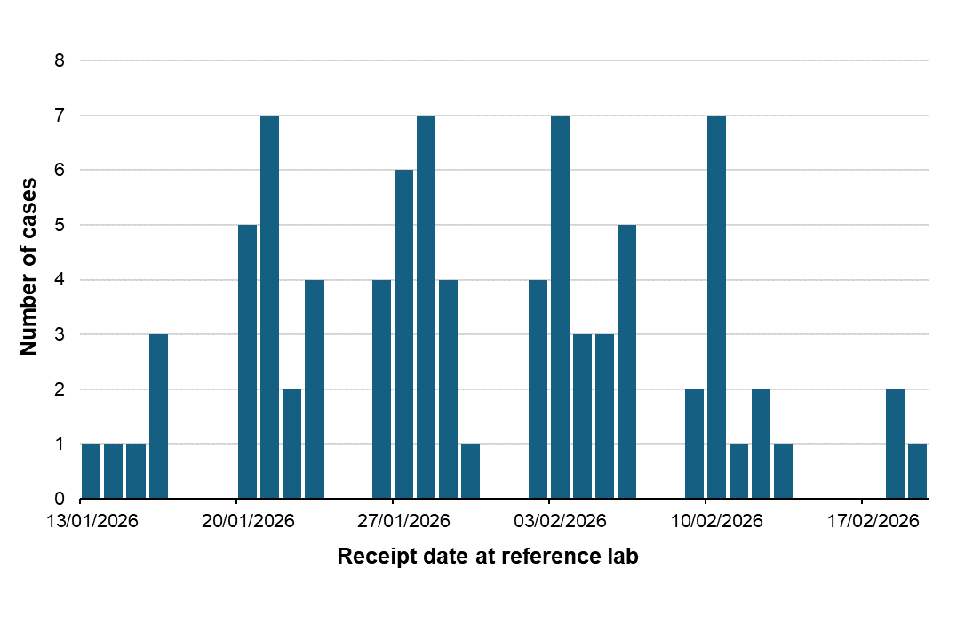
As of 26 February 2026, 84 confirmed cases had been detected within this outbreak, with salmonella isolates from cases falling within a single nucleotide polymorphism (SNP) single linkage cluster based on WGS, suggestive of a common source of contamination.
Confirmed cases have been identified with specimen dates between 7 January 2026 and 11 February 2026. Cases were resident in England (n=69), Wales (n=10) and Scotland (n=5). For cases resident in England, the regions with the highest number of cases to date were the South East (n=23) and East of England (n=16).
Temporal distribution of monophasic Salmonella Typhimurium outbreak cases based on sample receipt date at reference laboratory
Cases range in age from 2 years to 91 years with a median age of 33. Across all age groups, 54% (n=45) were male and 44% (n=39) were female.
Most people affected in this outbreak experienced self-limiting gastrointestinal illness; however, 38% of people with information available were hospitalised and 2 people had blood stream infections. There have been no deaths linked to this outbreak.
Epidemiological investigations to date have identified a higher-than-expected proportion of cases reporting consumption of cured pork products during the 7 days before they became unwell. Of those cases who were interviewed, 64% (23 cases) reported consuming a cured pork product. Analysis of epidemiological and supermarket loyalty card data highlighted a link to a specific imported, ready-to-eat, cured pork product which is likely the source of infection in this outbreak; this product is sold in one large UK supermarket retailer.
Government and industry partners have worked together to identify the source and origin of the contamination responsible for illness. Based on the epidemiological evidence provided by UKHSA, the supermarket retailer undertook a voluntary and precautionary withdrawal of the implicated product while further food chain investigations were ongoing. Sampling undertaken by the supplier identified salmonella in a batch of the product, which was then subject to a product recall on 2 March 2026; WGS results are awaited to establish if the salmonella isolated from the batch of imported cured pork product is related to the outbreak strain identified in human cases. The FSA are continuing further investigations with international partners to identify the root cause of the outbreak.
Cold mortality monitoring report: winter 2024 to 2025
Estimates of the number of cold-associated deaths that occurred in England as a result of three ‘cold weather episodes’ during the winter of 2024/25 are presented in the first of a new series of UKHSA statistical reports on cold mortality monitoring.
Key findings of the report are that:
- an estimated 2,544 cold-associated deaths occurred across 3 cold weather episodes (95% CI: 1,965 to 3,131) in 2024/25
-
the strongest cold-mortality risk relationship was observed in adults aged 85 years and over, for whom the mortality risk vs temperature gradient was steepest
- where cold-associated mortality risk was broken by place of death (care homes, hospitals, people’s own homes and hospices), the cold-mortality risk relationship was most strongly observed in care homes and own homes
In the statistical analysis of mortality data underpinning the report, cold-associated deaths were defined as deaths attributable to exposure to cold temperatures over and above the number expected without cold weather; the analysis captured both immediate effects (deaths occurring during a cold weather episode) and delayed effects (those occurring after).
In contrast to the statistical model used for the Agency’s annual heat-associated mortality report, which considers observed daily deaths in a single summer, the model used for cold mortality monitoring considers deaths over 5 recent winters; this takes account of the longer observed delays between ‘cause and effect’ for cold-related mortality.
The strongest relationship between cold weather and mortality in 2024/25 was seen in those aged 85 years and over. Deaths in this age group increased with colder temperatures, and increased more rapidly below 5° Celsius. Deaths in those aged 75 to 84 years, aged 65 to 74 years and aged 45 to 64 years also followed this pattern, though more gradually.
Impact of influenza circulation on cold-related deaths
The report mainly considers cold-related deaths from all causes occurring during the reporting period and includes a figure showing mortality broken down according to different groups of underlying causes of death recorded on death certificates.
However, previous statistical analyses of cold-weather related mortality have shown that influenza incidence contributes significantly to overall mortality, particularly when influenza circulation coincides with low temperatures. Accordingly, the new analysis presents data for overall cold-related mortality adjusted for changes in influenza activity during the reporting period (see figure). In this respect, the report concludes:
“When influenza activity is adjusted for in the analysis, the relationship between temperature and mortality becomes less steep, especially at colder temperatures. This means that deaths rise less sharply as temperatures fall, once influenza is taken into account. This suggests that a significant proportion of the extra deaths seen during cold periods occur at the same time as increased influenza activity. This does not mean that influenza causes cold-related deaths, but rather that cold weather and influenza tend to overlap and affect the same vulnerable people. The similar timing may be driven in part by cold weather causing increases in influenza transmission […].”
Taken together, these estimates show both (a) the overall impact of cold weather on mortality, and (b) the impact on mortality more directly linked to cold temperatures, alone, that would still be expected to occur even if no influenza was circulating.
Cold-associated deaths by cold episode, England, winter 2024 to 2025
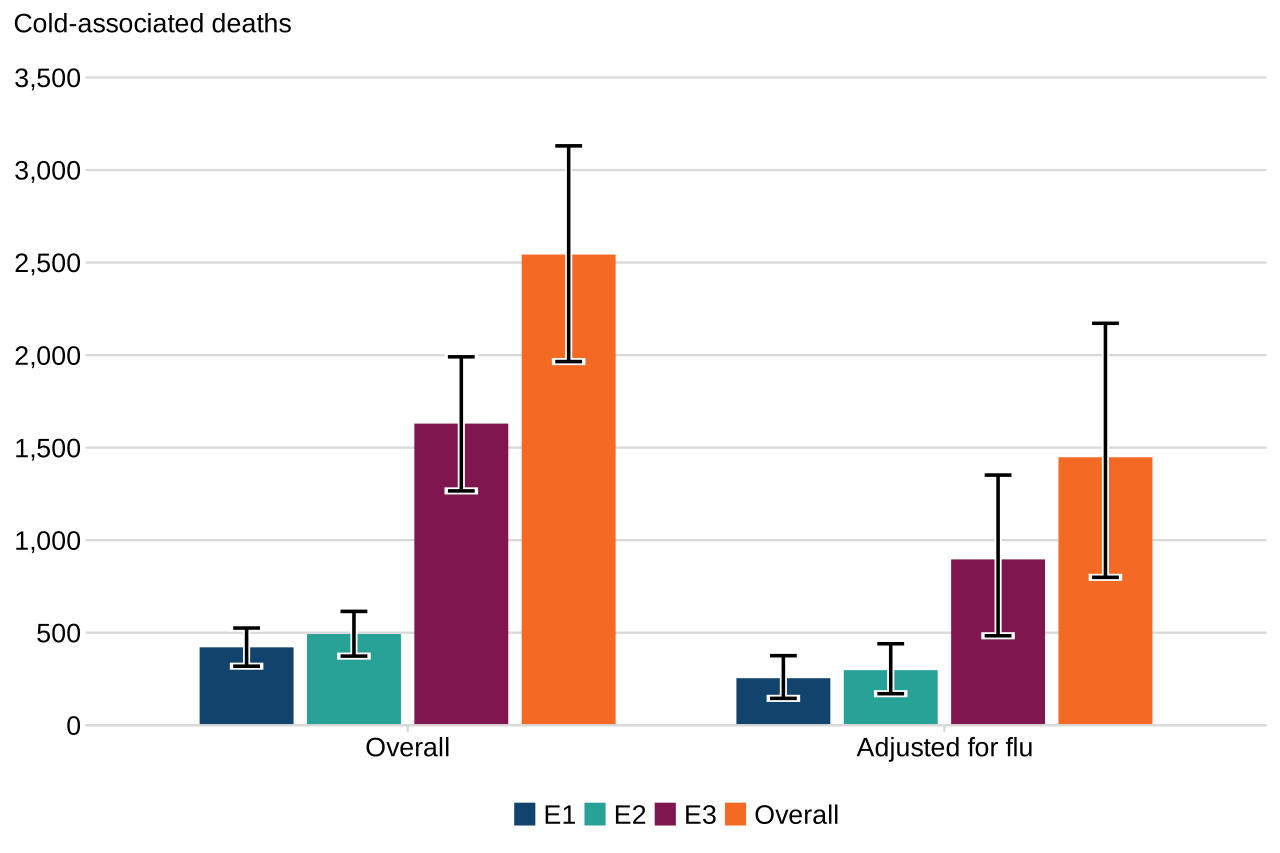
Note. Error bars show 95% confidence intervals.
Further information about the new report and the UKHSA-MetOffice e Weather Health Alerting System is available at:
- ‘How does cold weather affect health?
- ‘What is the difference between Weather-Health Alerts and Severe Weather Warnings?’
Investigation of infant formula recalls due to possible cereulide toxin contamination: an update
On 5 January 2026, the Food Standards Agency confirmed that Nestlé® was undertaking a product recall of several batches of 12 SMA Infant Formula and Follow-On Formula products in the UK due to the possible presence of cereulide toxin (Nestlé recall 1). The recall was updated with new product expiry dates on 3 February 2026 (Nestlé recall 2). On 23 January 2026, Danone® – another widely distributed infant formula manufacturer – recalled one batch of Aptamil® First Infant Formula because of cereulide contamination (Danone recall 1). The recall of Danone® products was extended on the 6 February 2026 to include 15 products of Cow & Gate® First Infant Milk and Follow on Milk formula, as well as further Aptamil® products (Danone recall 2).
The recall of contaminated infant formula has been conducted in multiple countries and the extent of the contamination is worldwide across more than 60 countries (1,2). The source of the contamination has been traced back to an ingredient, arachidonic acid (ARA) oil, manufactured by a third-party producer (3).
The UK Health Security Agency (UKHSA), Public Health Scotland, Public Health Wales, Public Health Agency Northern Ireland (PHA) and Public Health Agency Ireland have been supporting the Food Standards Agency (FSA), Food Standards Scotland (FSS), Food Safety Authority Ireland (FSAI) and local authorities who are continuing monitoring to assess the public health impact of cereulide contamination (4,5).
Healthcare professionals in England have been advised to notify suspected cases to UKHSA (and similarly elsewhere in UK to public health agencies) and to undertake clinical assessment and stool culture for toxigenic B. cereus in individuals presenting to hospitals with compatible symptoms. Testing has also been requested for targeted batches of recalled formula from notified cases for cereulide toxin. Direct cereulide toxin testing without culture in clinical samples is not available currently in the UK and UKHSA is in the process of introducing an assay to enable testing of faecal samples from the cases.
As of 2 March 2026, UKHSA and partner agencies have received 61 notifications where children who have consumed implicated batches and have symptoms consistent with cereulide toxin poisoning in England (43), Scotland (13), Wales (3), Northern Ireland (1) and the Crown Dependencies (1). Thirty-five children were male and 26 female. Confirmed infections with seasonal viruses, which are co-circulating widely, have been noted in some of the children.
The testing of recalled formula has confirmed that some batches contained cereulide toxin. The European Food Safety Authority (EFSA) (6) has recently proposed acute reference doses (ARfD) for cereulide toxin in infants. EFSA and FSA have identified toxin levels in infant and follow-on formula that would exceed this limit and pose a potential health risk, with the FSA sharing this information with industry in England. UKHSA is closely surveilling multiple healthcare systems and will continue to investigate the incident with other public health and food standard agencies and international partners in order to reduce the potential public health impact of this contamination.
References
1. Nestlé (January 2026). Infant formula product advisory
2. ECDC (January 2026). Communicable disease threats report: week 5, 24 to 30 January, 2026
3. ECDC (January 2026) Multi-country foodborne event caused by cereulide in infant formula products
4. Na Li, Abubakar Siddique, Ningjun Liu, Lin Teng, Abdelaziz Ed-Dra, Min Yue, Yan Li (2025). ‘Global epidemiology and health risks of Bacillus cereus infections: special focus on infant foods’, Food Research International: volume 201.
5. Hananeh Rahnama, Rahim Azari, Mohammad Hashem Yousefi, Enayat Berizi, Seyed Mohammad Mazloomi, Saeid Hosseinzadeh, and others (2023). ‘A systematic review and meta-analysis of the prevalence of Bacillus cereus in foods.’ Food Control: volume 143.
6. EFSA (2026). EFSA provides rapid risk assessment on cereulide in infant formula
Infection reports in this issue
Laboratory confirmed cases of pertussis in England: July to September 2025
Vaccine coverage reports
Shingles vaccine coverage in England: annual report September 2024 to August 2025