HPR volume 20 issue 1: news (29 January and 5 February 2026)
Updated 24 September 2026

© Crown copyright 2026
This publication is licensed under the terms of the Open Government Licence v3.0 except where otherwise stated. To view this licence, visit nationalarchives.gov.uk/doc/open-government-licence/version/3 or write to the Information Policy Team, The National Archives, Kew, London TW9 4DU, or email: psi@nationalarchives.gov.uk.
Where we have identified any third party copyright information you will need to obtain permission from the copyright holders concerned.
This publication is available at https://www.gov.uk/government/publications/health-protection-report-volume-20-2026/hpr-volume-20-issue-1-news-29-january-2026
Investigation of Infant Formula and Follow-On Formula recall due to possible cereulide toxin contamination
On 5 January 2026, the Food Standards Agency confirmed that Nestlé was undertaking a precautionary product recall of several batches of 12 SMA Infant Formula® and Follow-On Formula products in the UK due to the possible presence of cereulide toxin (Nestlé recall 1). The recall was updated with new product expiry dates on 9 January 2026 (Nestlé recall 2). On 24 January 2026, Danone – another widely distributed infant formula retailer – recalled one batch of Aptamil First Infant Formula® because of cereulide contamination (Danone recall).
The UK Health Security Agency (UKHSA), Public Health Scotland, Public Health Wales, Public Health Agency Northern Ireland (PHA) and Public Health Agency Ireland has been supporting the Food Standards Agency (FSA), Food Standards Scotland (FSS) and local authorities with their investigations responding to the recall of infant formula products potentially contaminated with cereulide toxin.
Bacillus cereus is a spore-forming bacterium that can contaminate a range of food products and when allowed to grow, certain strains can produce cereulide toxin. Cereulide is an emetic, heat-stable toxin that is unlikely to be deactivated or destroyed by heat treatment. Symptoms of Bacillus cereus food poisoning and cereulide toxin poisoning are most commonly vomiting but may include stomach cramping and diarrhoea. Symptoms usually have a rapid onset between 15 minutes to up to 6 hours after ingestion. The condition is mostly self-limiting, and symptoms usually resolve within 24 hours, without ongoing exposure to the cereulide toxin. Ingestion of the toxin rarely causes more significant illness; however, a few cases of liver or kidney injury, muscle breakdown and multi-organ failure have been reported. Individuals at high risk of complications include young children and the immunocompromised (1,2).
The FSA is investigating the source of contamination with international partners. The recall of contaminated infant formula has been conducted in multiple countries (3,4).
UKHSA and its partners are actively monitoring the public health impact of possible contamination. Healthcare professionals have been advised to undertake clinical assessment and stool culture for toxigenic B. cereus in individuals presenting to the hospitals with compatible symptoms, along with testing of recalled formula for cereulide toxin if available. Direct cereulide toxin testing without culture in clinical samples is not available currently in the UK.
As of 3 February 2026, UKHSA and partner agencies have received 36 clinical notifications where children who have consumed implicated batches have symptoms consistent with cereulide toxin poisoning in England (24), Scotland (7), Wales (3), Northern Ireland (1) and the Crown Dependencies (1). Seventeen children were male and 16 female, 3 unknown. Confirmed infections with seasonal viruses, which are co-circulating widely, have been noted in a few children. Syndromic surveillance indicators do not show an unusual increase in reports of vomiting in children under 1 year of age from hospitals, primary care or NHS111 for this time of year.
UKHSA is closely surveilling multiple healthcare systems and will continue to investigate the incident with other public health and food standard agencies and international partners in order to reduce the potential public health impact of this contamination.
References
1. Na Li, Abubakar Siddique, Ningjun Liu, Lin Teng, Abdelaziz Ed-Dra, Min Yue, Yan Li (2025). ‘Global epidemiology and health risks of Bacillus cereus infections: special focus on infant foods’, Food Research International: volume 201.
2.Hananeh Rahnama, Rahim Azari, Mohammad Hashem Yousefi, Enayat Berizi, Seyed Mohammad Mazloomi, Saeid Hosseinzadeh, and others (2023). ‘A systematic review and meta-analysis of the prevalence of Bacillus cereus in foods.’ Food Control: volume 143.
3. Nestlé (January 2026). Infant formula product advisory
4. ECDC (January 2026). Communicable disease threats report: week 5, 24-30 January, 2026
Update on the outbreak of Shigella sonnei and identification of non-typhoidal salmonella clusters associated with travel to Cape Verde
This is an update to the previously published Health Protection Report describing an outbreak of Shigella sonnei associated with travel to Cape Verde. In this update we provide updated case numbers within the Shigella sonnei outbreak and provide details following the identification of Salmonella clusters which have also been linked to travel to Cape Verde.
Since 1 October 2025, 158 confirmed Shigella sonnei outbreak cases have been identified (see figure), with cases falling within a Single Nucleotide Polymorphism (SNP) single linkage cluster based on whole genome sequencing (WGS), suggestive of a common source. Whilst cases have declined since the peak in late-October, cases continued throughout 2025 and into 2026.
Trend over time of Shigella sonnei outbreak cases based on sample submission date at reference laboratory
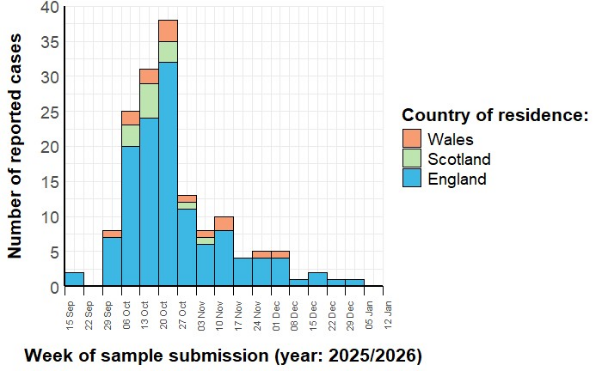
S. sonnei outbreak cases are resident across all regions in England (n=131), Scotland (n=13), and Wales (n=14). Cases range in age from 0 to 81 years with a median age of 54 years. The age group most affected are those aged 50-59 years (n=62, 39.2%). Across all age groups, 69.6% (n=110) are female.
Evidence gathered to date suggests that this outbreak is associated with travel to Cape Verde. Of the 158 confirmed cases reported since 1 October 2025, 118 cases reported international travel – of which 112 (94.9%) travelled to Cape Verde, the majority to the Santa Maria and Boa Vista areas. For the remaining cases, travel information is not known.
This strain of S. sonnei does not have any genomic resistance determinants against common antimicrobials used to treat traveller’s diarrhoea.
International communications and investigations are ongoing. Travellers seeking advice can visit the NaTHNaC (National Travel Health Network and Centre) website TravelHealthPro for up-to-date travel health guidance, including specific information for Cape Verde: NaTHNaC – Cape Verde. Advice on traveller’s diarrhoea can be found here: NaTHNaC – Travellers’ diarrhoea
An increase in clusters of non-typhoidal salmonellosis associated with travel to Cape Verde
In addition to the above-mentioned outbreak of Shigella sonnei in UK travellers associated with travel to Cape Verde, UKHSA has identified increased reports within the following 3 clusters of non-typhoidal Salmonella, identified using WGS, that are associated with travel to Cape Verde.
Salmonella Enteritidis (t5.8449)
There have been increased reports of cases in this cluster, with 32 cases reported since 1 October 2025. Cases are resident across England (n=27), Scotland (n=4) and Wales (n=1). Cases range in age from 1 to 79 years with a median age of 52 years. The age group most affected are those aged 50-59 years (n=11, 34.4%). Across all age groups, 59.4% (n=19) are male.
Evidence gathered to date suggests that this cluster is associated with travel to Cape Verde. Of the 32 confirmed cases reported since 1 October 2025, 28 cases reported international travel. Twenty-seven (96.4%) of these travelled to Cape Verde, the majority to the Santa Maria and Boa Vista areas. For the remaining cases, travel information is not known.
Salmonella Enteritidis (t5.8255)
There have been increased reports of cases in this cluster, with 7 cases reported since 1 October 2025. Cases are resident across England (n=6) and Wales (n=1). Cases range in age from 22 to 69 years with a median age of 35.5 years. The age group most affected are those aged 60-69 years (n=4, 57.1%). Across all age groups, 57.1% (n=4) are male.
Evidence gathered to date suggests that this cluster may be associated with travel to Cape Verde. Of the 7 confirmed cases reported since 1 October 2025, 2 cases reported international travel – both cases travelled to Cape Verde. For the remaining cases, travel information is not known.
Salmonella Virchow (t5.712)
There have been increased reports of cases in this cluster, with 4 cases reported since 1 October 2025. All cases are resident in England. Cases range in age from 21 to 59 years with a median of 40.5 years, all cases are female.
Evidence gathered to date suggests that this cluster is associated with travel to Cape Verde. Of the 4 confirmed cases reported since 1 October 2025, 3 cases reported international travel – of which, all cases travelled to Cape Verde. For the remaining case, travel information is not known.
UK loses measles-free status
The World Health Organization (WHO) Europe has confirmed that the UK has lost its ‘measles elimination’ status based on data submitted for 2024. The announcement follows a decade of declining vaccination rates in the UK with coverage for 2 measles, mumps and rubella (MMR) doses in 5-year-olds now at just 83 .7%.
In 2024, 2,911 laboratory confirmed cases of measles cases were reported in England, the highest in decades. Measles activity has been declining since July 2025, but there is a continued risk of further measles outbreaks in areas and communities where vaccine uptake is low.
The UK situation mirrors a resurgence of measles across the WHO European Region (1). In 2024, there were 127,350 cases reported, double that reported in 2023 (n=61,070) and the highest since 1977 (2,3). Measles remains endemic in many countries round the world and so importations into communities with low uptake can lead to further outbreaks occurring.
Because measles is so highly infectious, elimination can only be achieved and sustained when childhood vaccination coverage levels are high, around the WHO 95% target. In order to prevent measles spreading within communities we also need to ensure that older children and adults who missed out when they were younger are caught up.
The UK previously lost elimination status in 2018 due to outbreaks linked to a measles resurgence across Europe. It was regained in 2021 based on a significant decline in measles circulation globally due to the COVID-19 pandemic.
Regaining measles elimination status and protecting children in the UK from this serious illness will take a concerted effort across the health system to improve vaccine uptake.
From 1 January 2026 the second measles, mumps, rubella and varicella, MMRV, dose is now being offered at a new earlier appointment when all children reach 18 months, which evidence shows can help improve vaccine uptake. This change aims to ensure more children are fully protected before starting school, when they mix with larger groups.
Further information
UK measles and rubella elimination indicators and status
References
1. Muscat M, Ben Mamou M, Reynen-de Kat C, Jankovic D, Hagan J, Singh S, Datta SS (2024). ‘Progress and challenges in measles and rubella elimination in the WHO European Region’. Vaccines: volume 12, number 6, page 696.
2. WHO Europe (March 2025). ‘European Region reports highest number of measles cases in more than 25 years’ (media release).
3. UNICEF (May 2024). Measles cases across Europe continue to surge, putting millions of children at risk.
Infection reports in this issue
Group A Streptococcal infections: first update on seasonal activity in England, 2025 to 2026
Laboratory confirmed cases of measles, rubella and mumps in England: July to September 2025
Acute hepatitis B (England): enhanced surveillance reports: Q1, Q2 and Q3, 2024
Vaccine coverage reports
Meningococcal ACWY (MenACWY) vaccine coverage for adolescents in England, academic year 2024 to 2025