Guidance on developing business cases for projects and programmes
Updated 30 June 2026

© Crown copyright 2026
This publication is licensed under the terms of the Open Government Licence v3.0 except where otherwise stated. To view this licence, visit nationalarchives.gov.uk/doc/open-government-licence/version/3 or write to the Information Policy Team, The National Archives, Kew, London TW9 4DU, or email: psi@nationalarchives.gov.uk.
Where we have identified any third party copyright information you will need to obtain permission from the copyright holders concerned.
This publication is available at https://www.gov.uk/government/publications/guidance-on-developing-business-cases/guidance-on-developing-business-cases-for-projects-and-programmes
Introduction
What are business cases?
A business case contains the information needed to make a decision on a public sector spending proposal. The Welsh Government and the UK Government both use business cases to decide on public spending. A well-developed business case identifies what is needed to deliver government objectives successfully and to achieve the greatest value for taxpayers’ money.
The process of developing a business case matters as much as the final document. It is not merely a writing exercise or something to complete in order to obtain approval. The business case process is a way of thinking through a proposal in a structured and disciplined way. Through this process, practitioners collect and assess evidence, consider different options, understand costs, benefits and risks, and plan the arrangements needed for successful delivery.
What is the purpose of this guidance?
This guidance is intended to help practitioners to develop business cases for projects and programmes. It sets out the Five Case Model methodology, which is the standard framework used for developing business cases in the Welsh Government and the UK Government. It is based on five ‘cases’ or ‘dimensions’. These five ‘cases’ are distinct, but closely linked, perspectives on the same proposal. These are the strategic case, the economic case, the commercial case, the financial case and the management case.
The Five Case Model helps to ensure that business cases present a holistic assessment of proposals. It helps to provide best value for money, avoiding proposals that are unaffordable, unfeasible, or simply not a priority for ministers. Practitioners will need to work with different professions, and draw on different sources of expertise, throughout the business case process.
This guidance refers to ‘practitioners’ throughout. This is a generic term referring to all those involved in developing, reviewing and approving spending proposals. It also refers to ‘proposals’ as a generic term for both projects and programmes.
Who is this guidance for?
This guidance is intended for anyone involved in developing, reviewing or approving proposals that use public money. It is mandatory for officials in the Welsh Government and UK Government to follow this guidance when developing proposals that involve significant public spending.
The business case guidance is also used by the devolved governments in Scotland and Northern Ireland. Many local authorities in England and Wales stipulate in their local assurance frameworks that appraisal must be conducted in line with the Five Case Model. Non-government organisations, such as charities, may be required to adhere to this guidance when bidding for government funding. The National Infrastructure and Service Transformation Authority (NISTA) has published guidance for producing business cases for infrastructure projects, for use by other countries.
All those in the Welsh Government and UK Government who are engaged in developing, reviewing or approving spending proposals must receive training and accreditation through the Better Business Cases programme. Two training courses are currently available: Foundation and Practitioner.
Proportionality
This guidance should be used proportionately. Business cases should contain sufficient detail to support robust decision making, but they should not take up more time and resources than is necessary. The effort involved in developing a proposal should correlate to its scale, cost, complexity and risk.
How is this guidance structured?
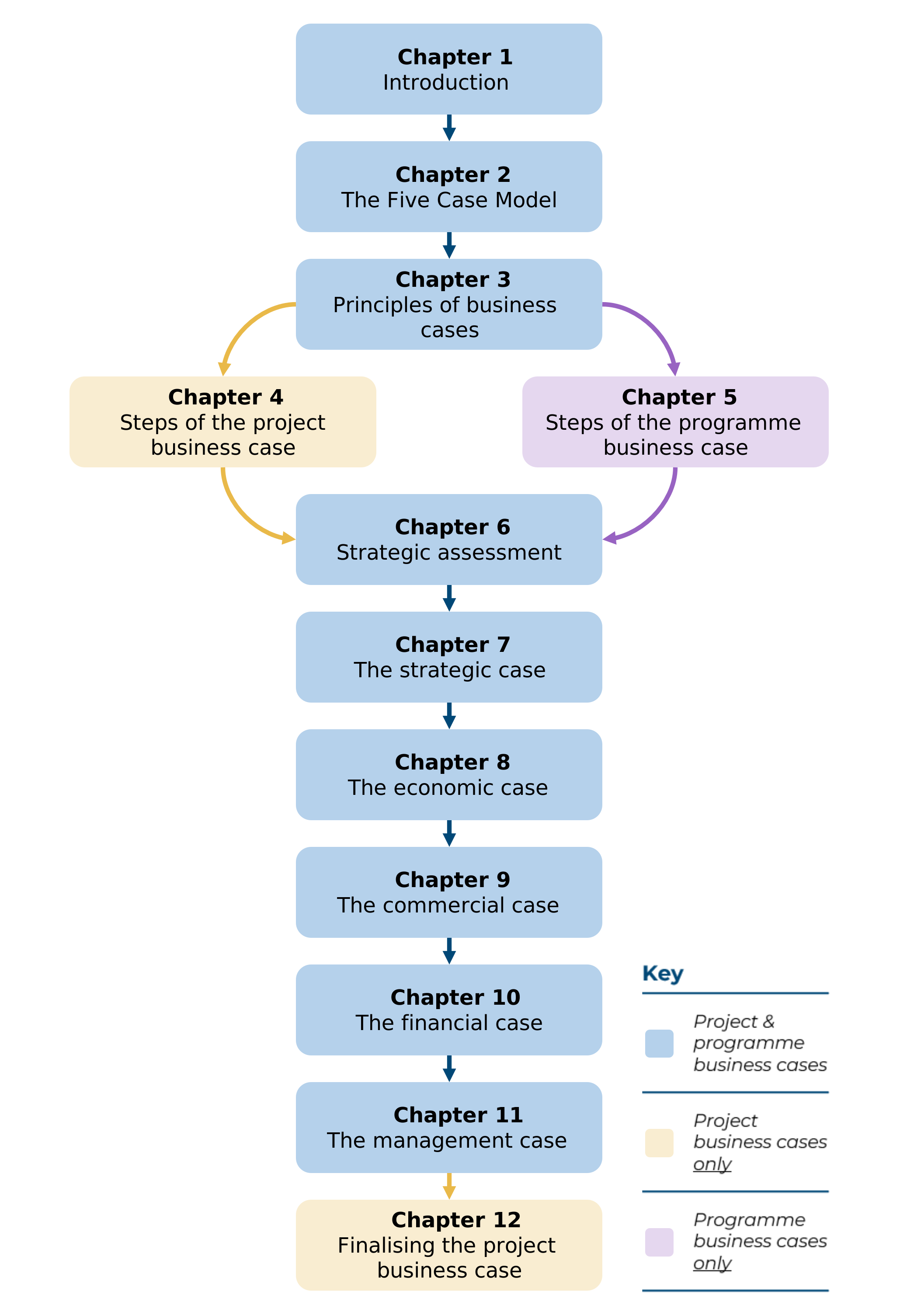
This guidance sets out the processes for two types of business case: project business cases and programme business cases. This guidance should be read in a slightly different way depending on whether the reader is interested in project business cases or programme business cases. The structure of the guidance is shown in Figure 1. In summary:
- Chapters 1 to 3 cover the core principles of the business case process. These are relevant to both projects and programmes.
- Chapter 4 covers the structure of project business cases.
- Chapter 5 covers the structure of programme business cases.
- Chapters 6 to 11 cover the Five Case Model. These chapters are relevant to both projects and programmes.
- Chapter 12 covers the Full Business Case. This chapter is relevant only to projects.
In Chapters 6 to 11, some guidance is specific to project business cases only, while some guidance is specific to programme business cases only. In these instances, text will be shown in coloured boxes. This is shown below.
Guidance for project business cases:
- Orange boxes contain guidance that is only relevant for developing project business cases.
Guidance for programme business cases:
- Purple boxes contain guidance that is only relevant for developing programme business cases.
Figure 1. The structure of this guidance
The Five Case Model
Introduction
The Five Case Model methodology is the standard framework for developing business cases and is recommended best practice in the UK public sector. It is based on five ‘cases’ or ‘dimensions’. These are five distinct, but closely linked, perspectives on the same proposal.
The five cases are the strategic case, the economic case, the commercial case, the financial case and the management case. A business case that has been developed in line with these five cases will demonstrate that the underlying proposal:
- Provides strategic fit and is supported by a compelling case for change
- Provides the best value for money
- Involves viable commercial agreements with suppliers
- Is affordable and has agreed sources of funding
- Is set up for successful delivery
The five dimensions of the Five Case Model cannot be developed or viewed in isolation. They are not five separate business cases, but closely interconnected perspectives on the same proposal. Practitioners should develop the five cases together, through an iterative process, refining each case with reference to the others. For example, the objectives that are defined in the strategic case of a proposal will influence the options that are assessed in the economic case.
Strategic case
The first dimension of the Five Case Model is the strategic case. It sets out why a particular proposal is needed. It sets out the rationale and objectives for the intervention. It establishes the case for change and demonstrates how a proposal aligns with the objectives of the organisation, as well as the other projects and programmes being undertaken by that organisation. The strategic case is fundamental to the business case process. It drives the identification and appraisal of options in the economic case.
Box 1: Contents of the strategic case
- Strategic assessment
- Case for change
- SMART objectives
- Existing arrangements
- Business needs
- Potential scope and service requirements
- Benefits, risks, constraints and dependencies
Economic case
The second dimension of the Five Case Model is the economic case. The purpose of the economic case is to assess the costs, benefits and risks of different options for achieving the objectives of the proposal.
The economic case begins by identifying a wide range of realistic options, known as the ‘longlist’. The most promising of these options are taken forward as the ‘shortlist’ and analysed in further detail. This enables practitioners to identify the ‘preferred option’ that represents the best value for money.
Box 2: Contents of the economic case
- Critical success factors
- Longlist of options
- Preferred way forward
- Shortlist of options
- Analysis of social costs, social benefits and risks
- Optimism bias
- Summary metrics of social value
- Sensitivity analysis
- Preferred option
Commercial case
The third dimension of the Five Case Model is the commercial case. It describes how the government will source the inputs required for delivering the preferred option. It sets out who will manage the risks associated with operational delivery.
Box 3: Contents of the commercial case
- Procurement strategy
- Required inputs and outputs
- Risk allocation
- Payment mechanisms
- Contractual arrangements
Financial case
The fourth dimension of the Five Case Model is the financial case. It is concerned with the affordability of the proposal. It sets out how the proposal will be funded and how it will affect the expenditure, income, assets and liabilities of the public bodies involved. The financial case describes how the proposal will affect the capital and revenue budgets of those public bodies.
Box 4: Contents of the financial case
- Budgeting treatment
- Accounting treatment
- Funding statement
- Contingency
Management case
The fifth dimension of the Five Case Model is the management case. This sets out the practical arrangements for implementation. It demonstrates that the preferred option can be delivered successfully.
Box 5: Contents of the management case
- Governance, management, assurance and approvals
- Plan for delivery
- Change management
- Benefits management
- Risk management
- Contract management
- Monitoring and evaluation
Principles of business cases
Introduction
This chapter provides an introduction to business cases. It addresses a number of key questions around business cases and the business case process.
What is a business case?
Practitioners should distinguish between a business case and the business case process. These are defined as:
- Business case: The document that provides the information, evidence and options appraisal that a decision maker needs to assess a spending proposal.
- Business case process: The ‘thinking’ process that involves collecting and testing the information that forms the business case.
Why are business cases important?
Business cases are a mandatory requirement for significant spending decisions in the Welsh Government and the UK Government. Business cases ensure:
- Value for money: A business case reflects ministers’ policy objectives and identifies the best option for achieving them. It shows where proposals do not represent value for money and thus should be halted or reset.
- Objectivity: A business case assists decision makers in understanding the key issues around a proposal and the available evidence base.
- Transparency: A business case explains the basis for decision making to ministers, councillors, officials, legislators, stakeholders and the public.
- Deliverability: A business case sets a proposal up for success by explaining the arrangements for procurement, management, monitoring and evaluation during the delivery stage.
A robust business case process, developed using the Five Case Model, ensures:
- Thinking, not writing: A business case process provides a clear framework for thinking about a proposal. It helps practitioners to consider the different options for delivering a project or programme.
- Participation: A business case process enables different professionals and stakeholders to understand the proposal and provide their expertise.
What are the differences between projects and programmes?
The Government Functional Standard for Project Delivery provides formal definitions of projects and programmes. These are:
- Project: A unique, temporary management environment, undertaken in stages, created for the purpose of delivering one or more business products or outcomes.
- Programme: A unique, temporary, flexible organisation created to co-ordinate, direct and oversee the implementation of a set of projects (and related activities) to deliver outcomes and benefits related to a set of objectives. Programmes can be undertaken in one or more tranches (phases).
The Teal Book provides a more informal sense of the key differences between projects and programmes. These are:
- Projects normally have a shorter, clearly defined life cycle. They are designed to deliver specific outputs and outcomes. A project must either be standalone within a portfolio, or part of a programme.
- Programmes are usually longer and have a more complex life cycle. They provide an umbrella for co-ordinating delivery of multiple projects and/or activities over time to achieve wider outcomes and objectives. A programme should always form part of a portfolio.
The Teal Book also discusses portfolios. These are defined as:
- Portfolio: Comprises part or all of an organisation’s investment required to achieve its objectives. Governed through its portfolio (or business) plan, a portfolio comprises work components, such as other portfolios, programmes, projects, other related work and work packages.
It is not necessarily the cost of a proposal that determines whether it should be a programme or a project. In other words, a project with a high cost does not necessarily need to be a programme. The decision should be based on the work that is needed, and how best to manage that work.
The existence of a programme does not eliminate the need for developing business cases for the constituent projects. While a programme business case sets out the overall case for the programme, the individual projects within the programme will generally require their own business cases.
How do business cases support the government’s objectives?
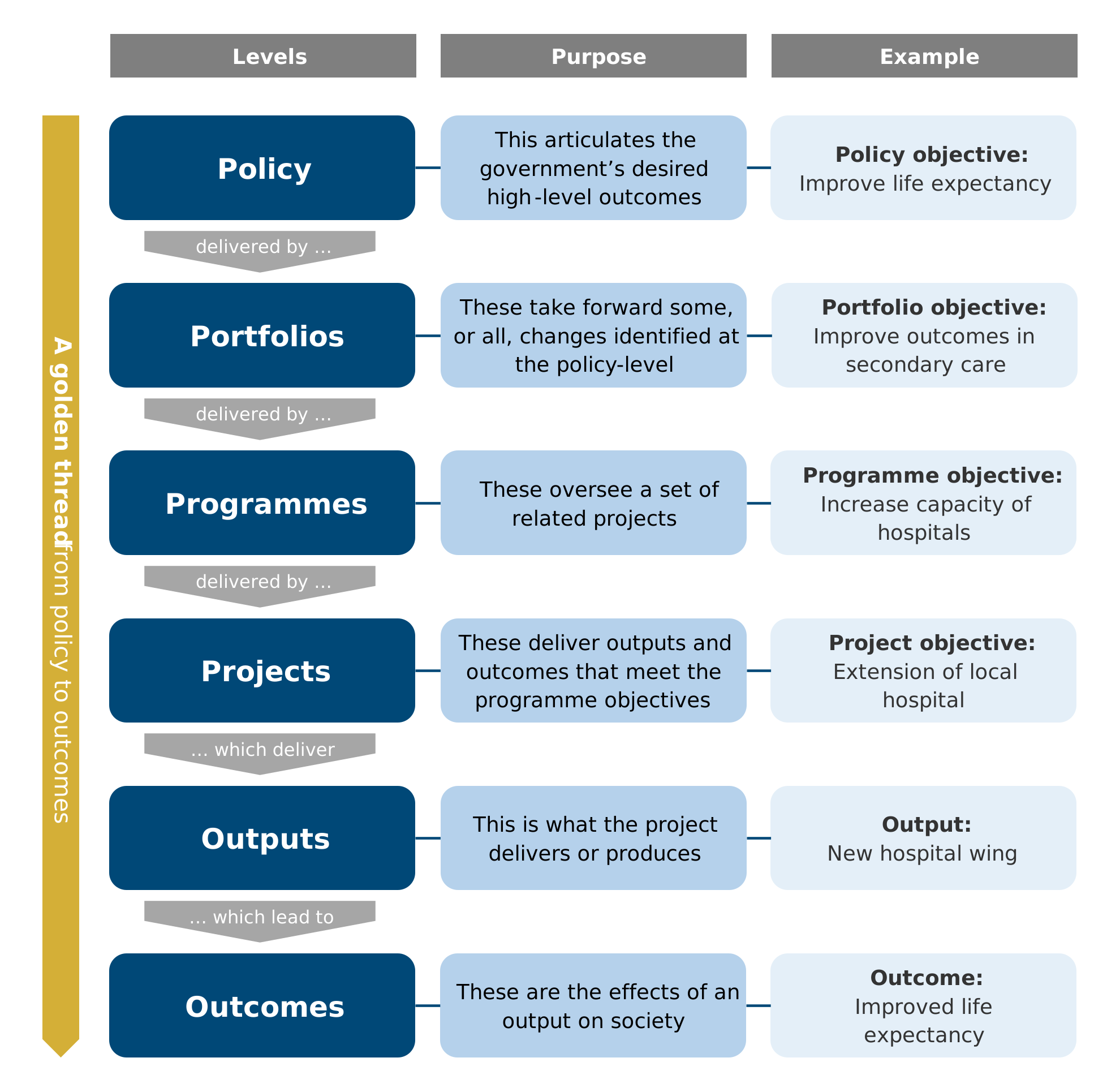
Government objectives vary in their scope. Some objectives are about broad visionary changes to society. Other objectives are specific changes to particular services or systems. This spectrum of objectives – from high-level and visionary, to specific and targeted – is known as the ‘policy hierarchy’. Practitioners should understand how their proposal fits into this hierarchy.
The policy hierarchy has four main levels: policies, portfolios, programmes and projects. Each level of the policy hierarchy sets its objectives with reference to the level above it. This means that:
- A policy establishes broad long-term objectives. Achieving these objectives will likely involve delivering changes through a wide range of teams or public bodies.
- The changes identified at the policy level are implemented by one or more portfolios. Each portfolio establishes objectives with reference to the changes stipulated at the policy level. Portfolios consist of a group of programmes and projects required to achieve these portfolio objectives.
- Longer-term and more complex objectives are delivered via programmes, which oversee a series of constituent projects. These programmes and projects deliver outcomes to meet the objectives that are set out at the portfolio level.
- Shorter-term objectives may be delivered via projects that do not have an overarching programme.
- At each level of the hierarchy, practitioners should consider different options for achieving that level’s objectives.
The alignment between the objectives at policy, portfolio, programme and project levels is known as the ‘golden thread’. Practitioners must describe this golden thread in the strategic dimension of the business case. Figure 2 provides an illustration and example of the policy hierarchy and the golden thread.
Figure 2. From policies to outcomes: the golden thread
Who is involved in business cases?
The business case process involves several different key roles:
- Practitioners: The professionals who are responsible for developing the business case.
- The senior responsible owner (SRO): The person who is accountable for the development of the business case, and then delivering the ensuing project or programme.
- The originating organisation: The organisation that is sponsoring or leading the development of the proposal. This organisation will normally also be the contracting authority that signs contracts with suppliers.
- The approving authority: The decision makers who are responsible for approving or rejecting the business case. Paragraph 3.14 sets out potential approving authorities.
- Suppliers: The organisations that provide the inputs for delivering the proposal.
- External consultants: Public bodies should only utilise external consultants to fill capability gaps, such as for complex economic appraisals or feasibility studies, and should seek to build in-house capacity where possible. External consultants working on business cases should be engaged with a clear and targeted brief. They must have received training and accreditation through the Better Business Cases programme.
Practitioners should identify the approving authority for their proposal. In the Welsh Government and the UK Government, the approving authority may be:
- Ministers: Many proposals receive final approval from ministers. A business case should be put to a minister only after it has been reviewed and approved by the departmental accounting officer or an investment committee.
- An accounting officer: They are accountable to legislators for the management of public spending. In some cases, ministers will delegate decision-making authority to their accounting officer.
- An investment committee: Accounting officers may delegate authority for spending decisions to other senior public servants. These public servants may form an investment committee, normally chaired by the senior finance officer or another executive board member.
- HM Treasury: Most business cases in the UK Government are approved within their originating departments. However, a limited number of significant projects and programmes must also be approved by HM Treasury. The Treasury Approvals Process guidance provides more detail on this.
Departments in the Welsh Government and the UK Government should maintain a pipeline of upcoming business cases. This early engagement helps to support good financial planning. In the UK Government, departments should share their pipeline with HM Treasury and the National Infrastructure and Service Transformation Authority (NISTA). The Treasury Approvals Process guidance sets out more detail on business case pipelines.
In local government, the approving authority for a proposal may be mayors or councillors. These politicians may delegate decision-making authority to chief executives or other officers.
What are the different types of business case?
The different types of business case are:
- Programme Business Case (PBC): A programme is developed using a PBC. The process of developing a PBC is described in greater detail in Chapter 5.
-
Project Business Case: A project is developed using a project business case. This is typically developed in three iterative stages, each of which concludes with an approval point. The process of developing a project business case is described in greater detail in Chapter 4. The three stages are:
- Strategic Outline Case (SOC): The first stage in the development of a project business case. It is the scoping phase of the project. It makes the case for change, identifies objectives and sets out an initial longlist and shortlist of options to identify a ‘preferred way forward’.
- Outline Business Case (OBC): The second stage in the development of a project business case. It is the planning phase of the project. It comes after the approval of the SOC. The OBC revisits the options in the SOC and analyses them in more detail. This helps decision makers to identify the ‘preferred option’. The OBC also outlines the commercial, financial and management arrangements for the project.
- Full Business Case (FBC): The third stage in the development of a project business case. It is the procurement phase of the project. It comes after the approval of the OBC and the identification of the preferred option. The FBC captures the outcome of the procurement process. It sets out the full details of the commercial, financial and management arrangements that are required to deliver the project successfully.
- Business Justification Case (BJC): Practitioners may develop smaller, less expensive and less risky spending proposals using a single-stage BJC. This may be appropriate where there is already a pre-competed framework arrangement in place. The Government Commercial Agency publishes a full list of these agreements. BJCs must not be used for spending proposals that are either novel, contentious or repercussive. These three terms are defined in Managing Public Money.
Templates for these different types of business case are available on GOV.UK. Practitioners should accompany the business case with a clear and concise executive summary that summarises the proposal, its ‘ask’, and the key information from each of the five cases.
A business case is a ‘living’ document. It should be revisited and updated as the proposal develops. As new information and new analysis is generated in the business case process, practitioners may need to review and adjust their previous assumptions.
In the UK Government, if a proposal meets certain criteria, it may join the Government Major Projects Portfolio (GMPP). These criteria are set out in the Treasury Approvals Process guidance. The GMPP covers the UK Government’s largest and most complex projects, as well as programmes with multi-year life spans. GMPP projects are subject to additional requirements, such as conducting a feasibility study before developing the business case. Practitioners should contact NISTA as early as possible if they believe that their proposal may meet the criteria for inclusion in the GMPP.
What is proportionality?
Business cases should be proportionate. They should contain sufficient detail to support sound decision making, but they should not take up more time and resources than is necessary. The effort involved in developing a proposal should correlate to its scale, cost, complexity and risk.
The Five Case Model is scalable. It should be applied intelligently and proportionately. There are several ways to ensure that a business case is proportionate. For example:
- Engaging the approving authority at the outset of the business case process: They should agree the type of business case that will be developed and the extent to which costs, benefits and risks will be measured. Annex B contains a scoping document template, which can be used to support this discussion and capture the agreed expectations of a proposal.
- Focusing on the most significant costs, benefits and risks: It may not be feasible or cost-effective to estimate every impact that arises from a proposal. Practitioners should discuss with the approving authority to understand the costs, benefits and risks that they believe will be most significant to the value for money of a proposal. This helps to focus the appraisal and avoid extensive analysis of insignificant impacts.
- Selecting the right type of business case: Practitioners should anticipate the type of procurement that will result from a proposal. A single procurement will typically align with a single project. If an open procurement of sufficient scale is expected, then this would indicate a three-stage business case (i.e. SOC, OBC, FBC). If a project is low value and low risk, and a pre-competed framework is available from which to source a commercial partner, then practitioners may instead opt for a single-stage BJC. If a project business case has a well-defined strategic case that has been ‘handed down’ from an overarching programme business case, then practitioners may find it appropriate to combine the SOC and the OBC stages. This is described further in Chapter 4.
How do we ensure that business cases are high quality?
A business case is high quality if it gives decision makers the information that they need to meet their objectives and achieve value for money. To develop a high-quality business case, practitioners should keep six key principles in mind. They are:
- Managing Public Money: This guidance sets out the standards for the use of public money in the Welsh Government and the UK Government.
- Collaboration across functions: Public sector organisations employ experts representing different functions. Different functional experts may be involved in different aspects of a business case, but they should not work in isolation. Practitioners should ensure that functional experts work together closely throughout the business case process.
- Quality of evidence and analysis: Evidence is rarely unambiguous. Practitioners should explain the sources of evidence that are used to inform the assumptions of the business case, as well as their confidence in this evidence. Practitioners should be transparent about any gaps in the evidence and discuss how these gaps might be addressed.
- Use of evaluation evidence: Practitioners should consider whether similar interventions have previously been subject to evaluation. They should use relevant evaluation evidence to inform the business case. This includes not just how the proposal should be designed, but how it should be delivered and implemented. The Magenta Book is the government guidance on evaluation. The Evaluation Registry contains evaluation evidence from previous interventions.
- Stakeholder engagement: Practitioners should engage early with relevant stakeholders, both inside and outside of government. This ensures that the views and expertise of those stakeholders are reflected in the business case process. It ensures that everyone involved with a business case has a shared understanding of the objectives of the proposal and the trade-offs involved.
- Risk management: Every proposal will involve some degree of risk. Practitioners should ensure that proposals take ‘good risks’, risks that are well-estimated and well-managed. A business case should clearly articulate the key risks of the proposal and the chances of different degrees of success or failure in achieving the proposal’s objectives. Practitioners should explicitly state how these risks have been assessed and controlled. The Orange Book is the government guidance on risk management.
Practitioners should convene formal meetings to bring together different professionals, stakeholders and experts. These meetings are referred to as ‘workshops’. This guidance describes five workshops that might be convened over the course of the business case process. These workshops are fully described at the relevant points in the document. They are:
- Workshop 1: Case for change
- Workshop 2: Identifying and assessing the options
- Workshop 3: Assessing the shortlist of options
- Workshop 4: Developing the procurement
- Workshop 5: Successful delivery arrangements
Some larger proposals may need additional workshops to address specific elements of the proposal (e.g. risk management).
Business cases must be assured. Assurance provides independent and impartial confirmation that the information in the business case is accurate. Business cases in the Welsh Government and the UK Government are typically assured in line with the Gate Review process. This process examines proposals at key decision points and affirms whether they can progress successfully to the next stage.
In the UK Government, NISTA arranges and manages the assurance reviews of major projects. They publish an assurance review toolkit to support this process.
In the Welsh Government, the Strategic Project Delivery Office operates the Gate Review function. They can provide practitioners with the risk potential assessment form that is used in Wales.
What statutory duties are relevant in developing business cases?
Business cases in the Welsh Government and the UK Government must meet the obligations set out in the following statutory duties:
- Public sector equality duty (PSED): The PSED requires decision makers to have due regard to the need to eliminate conduct prohibited by the Equality Act 2010, advance equality of opportunity and foster good relations for those sharing protected characteristics. The general duty ensures that public authorities consider how their functions will affect people with different protected characteristics. Practitioners should assess whether those sharing such characteristics would be differentially impacted by different options, compared to the general population. Practitioners should consider whether the identified impacts would make a difference to the assessment of those options. Where there are negative impacts, practitioners should consider whether there is scope for mitigating those impacts.
- Duty to have due regard to the environmental principles policy statement (EPPS): The Environment Act 2021 places a duty on Ministers of the Crown to have due regard to the EPPS when making policies. The EPPS sets out five environmental principles that ministers need to consider when making policy. Practitioners must identify the potential environmental effects, either positive or negative, of different options, and must apply the five principles as appropriate to inform the design of the proposal. The EPPS should be considered throughout the business case process, as the duty extends to making, developing, adopting, revising or repealing policy. Chapter 8 of the Green Book contains more information on assessing impacts on the environment.
- Biodiversity duty: The biodiversity duty requires public authorities in England and Wales to consider what they can do to conserve and enhance biodiversity. Defra has produced guidance on complying with the biodiversity duty.
In Wales, business cases must meet the obligations set out in the Well-being of Future Generations (Wales) Act 2015:
- The Well-being of Future Generations (Wales) Act 2015: The Act is about improving the social, economic, environmental and cultural well-being of Wales. It gives a legally-binding common purpose – the 7 well-being goals – for national government, local government, local health boards and other specified public bodies. It details the ways in which specified public bodies must work, and work together to improve the well-being of Wales. It requires the public bodies listed in the Act think more about the long-term, work better with people and communities and each other, look to prevent problems and take a more joined-up approach.
Steps for developing a project business case
Introduction
This chapter explains how to develop a project business case. The guidance in this chapter does not apply to programme business cases. Practitioners who are developing a programme business case should proceed to Chapter 5.
Process for developing a project business case
The process for developing a project business case involves 9 steps which together comprise 32 actions. Table 1 shows the stages, steps and actions that are involved in developing a project business case.
Table 1. The process of developing a project business case
| Stage | Step | Actions | |
|---|---|---|---|
| Stage 0. Strategic assessment | Step 1 – Strategic assessment | Action 1 – Undertake strategic assessment | |
| Stage 1. Strategic Outline Case (SOC) | Step 2 – Rationale and objectives (Case for change) | Action 2 – Revisit strategic assessment Action 3 – Determine SMART Action 4 – Determine potential scope and service requirements Action 5 – Determine the benefits, risks, constraints and dependencies of the proposal |
|
| Step 3 – Options generation and longlist appraisal | Action 6 – Agree critical success factors (CSFs) Action 7 – Generate a longlist of options Action 8 – Use longlist appraisal to identify the shortlist and the preferred way forward Action 9 – Make an initial consideration of the proposal’s commercial, financial and management arrangements |
||
| Stage 2. Outline Business Case (OBC) | Step 4 – Shortlist appraisal | Action 10 – Revisit Steps 2 and 3 and update as necessary Action 11 – Identify the social costs, social benefits and risks Action 12 – Analyse the social costs, social benefits and risks Action 13 – Identify the preferred option |
|
| Step 5 – Commercial arrangements | Action 14 – Determine procurement strategy Action 15 – Determine required inputs and outputs Action 16 – Outline risk allocation Action 17 – Outline payment mechanisms Action 18 – Outline contractual arrangements |
||
| Step 6 – Affordability and funding | Action 19 – Prepare financial model and assess public finance implications Action 20 – Produce funding statement and identify contingency |
||
| Step 7 – Delivery arrangements | Action 21 – Confirm how the proposal will be governed, managed, assured and approved Action 22 – Prepare the outline plan for delivery Action 23 – Plan change management Action 24 – Plan benefits management Action 25 – Plan risk management Action 26 – Plan monitoring and evaluation |
||
| Stage 3. Full Business Case (FBC) | Step 8 – Procurement | Action 27 – Revisit the strategic case Action 28 – Revisit the preferred option Action 29 – Describe the procurement process and compare offers from suppliers |
|
| Step 9 – Final arrangements | Action 30 – Finalise the commercial arrangements Action 31 – Finalise the financial implications Action 32 – Finalise the delivery arrangements |
Combining the stages of the project business case
Some simple project business cases may have a well-defined strategic case that has been ‘handed down’ from the overarching programme business case. If practitioners believe that a compelling case for change has already been made at the programme level, then they may judge it proportionate to combine the SOC and OBC stages of the project business case.
Combining the SOC and OBC stages does not mean that practitioners can skip over steps of the business case process. It simply means that Steps 1 to 3 do not need to be reviewed at a dedicated approval point. Practitioners should consider whether it is proportionate to omit this important opportunity for scrutiny.
This SOC-OBC approach is not appropriate for more significant projects or for projects that do not have an overarching programme. In both these instances, the business case must have a standalone SOC stage. Practitioners may also adopt an SOC-OBC approach for a project business case that plans and scopes a re-procurement, provided that the strategic case for the original procurement is still valid.
Assuring project business cases
Project business cases in the Welsh Government and the UK Government are typically assured using a Gate Review process. This is explained in Table 2. NISTA has produced further guidance on Gate Reviews.
Table 2. Gate Reviews for project business cases
| Gate | When | Purpose |
|---|---|---|
| Gate 1: Business Justification | Prior to Strategic Outline Case (SOC) approval | Investigates the SOC and the preferred way forward to confirm that the project scope is clear and achievable, and that the project is likely to deliver what is required. |
| Gate 2: Delivery Strategy | Prior to Outline Business Case (OBC) approval | Investigates the assumptions in the OBC and the proposed approach for delivering the project. |
| Gate 3: Investment Decision | Prior to Final Business Case (FBC) approval | Investigates the FBC and the governance arrangements for the investment decision to confirm that the project is still required, affordable and achievable within the proposed time. |
| Gate 4: Readiness for Service | Prior to ‘going live’ with a solution, service or scheme | Investigates the organisation’s readiness to make the transition from the solution to implementation. |
| Gate 5: Operational Review and Benefits Realisation | Repeated throughout the life of the service following delivery, establishment and/or decommissioning of the service | Confirms that the benefits set out in the business case are being achieved and that the service is running smoothly and the agreed outcomes are being met. |
Gate Reviews should not be the only means of assuring a project business case. Practitioners should work with their approving authority to establish a proportionate plan for reviewing and assuring the business case.
Stage 0: Strategic assessment
This is the initial planning phase of the project business case. Practitioners should assess the strategic fit of the project. They should demonstrate how the project aligns with the organisation’s objectives and with other programmes and projects. Practitioners should also take an initial view on the feasibility of the project.
The approving authority should review the strategic assessment and decide whether the project business case should progress to the next stage. If this approval is granted, then practitioners can begin preparing the SOC.
Stage 1: Strategic Outline Case
The Strategic Outline Case (SOC) is the scoping phase of the project. It makes the case for change and identifies the preferred way forward. Practitioners should generate a wide range of potential options that might feasibly meet the proposal’s objectives. This is the longlist. Practitioners then assess these options against the project’s objectives and critical success factors. This enables the options to be narrowed down to a shortlist.
The SOC should be predominantly focused on the strategic case and the economic case. However, practitioners must also begin developing the commercial, financial and management cases at the SOC stage. This does not need to be overly detailed but should be sufficient to provide the approving authority with a good understanding of the feasibility, affordability and deliverability of the proposal.
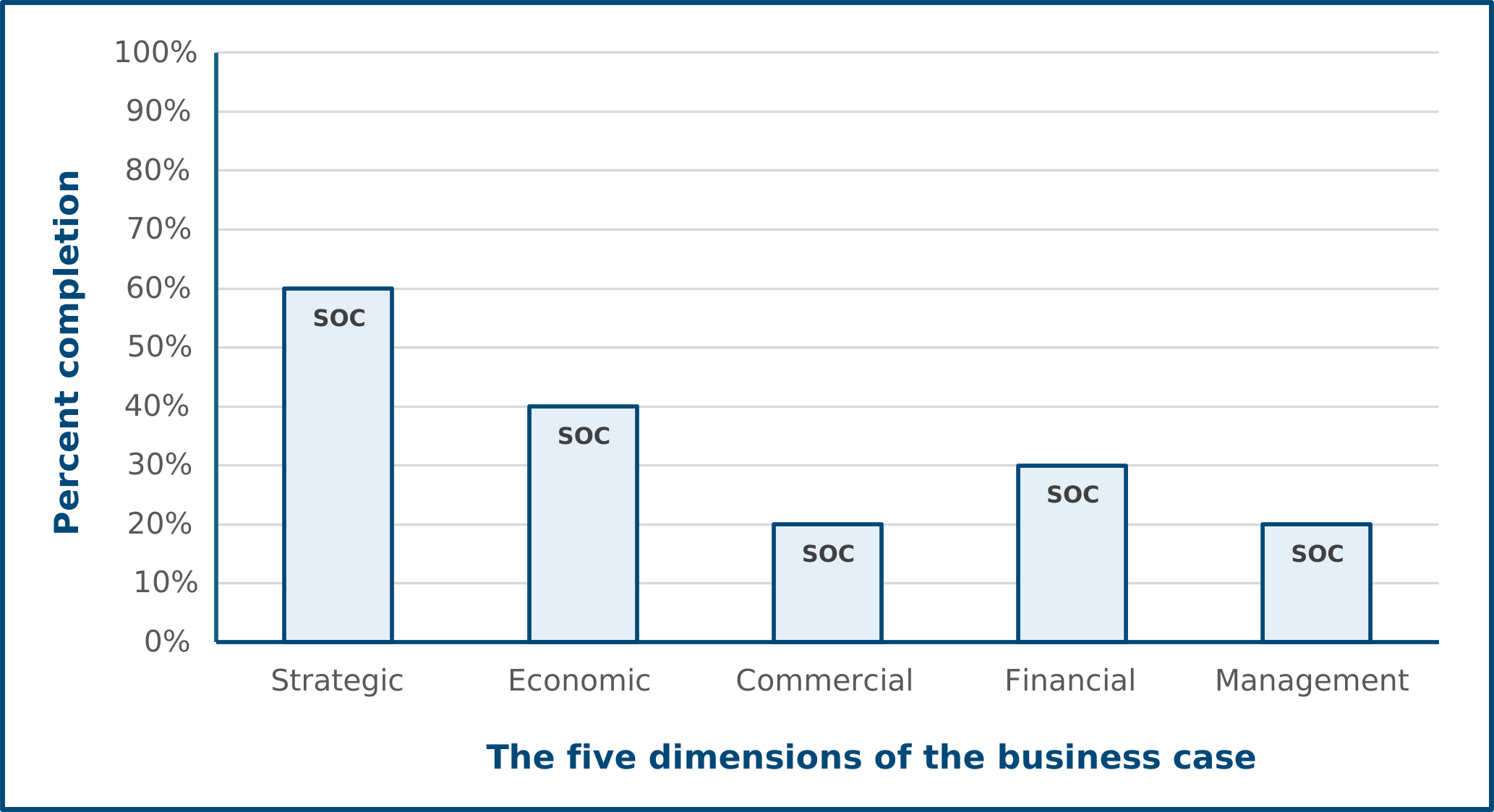
The SOC should explain what has been done to meet Actions 1 to 9. Figure 3 provides an outline of the approximate level of completion of each case at the conclusion of the SOC.
Figure 3. The approximate percentage completion of each of the five cases at the conclusion of the SOC
The SOC is assured through Gate Review 1. This takes place prior to the formal submission of the SOC to the approving authority. Gate Review 1 confirms that the project scope is clear and achievable, and that the project is likely to deliver what is required.
The approving authority should review the SOC and the conclusions of Gate Review 1. They may decide to:
- Approve the SOC and allow the business case to progress to the OBC stage.
- Modify the scope of the project.
- Require different options to be considered as part of the shortlist.
- Commission a pilot exercise, or further feasibility work, to test key assumptions.
- Postpone or abandon the project if it is considered to be too high risk, too expensive or too ambitious.
If the SOC is approved, then practitioners can begin preparing the Outline Business Case.
Stage 2: Outline Business Case
The Outline Business Case (OBC) is the planning phase of the project. It sets out further analysis of the shortlist of options that was identified in the SOC. It identifies the option that best represents best value for money. This is known as the preferred option. The OBC sets out more detail on the commercial, financial and management arrangements for the successful delivery of the project.
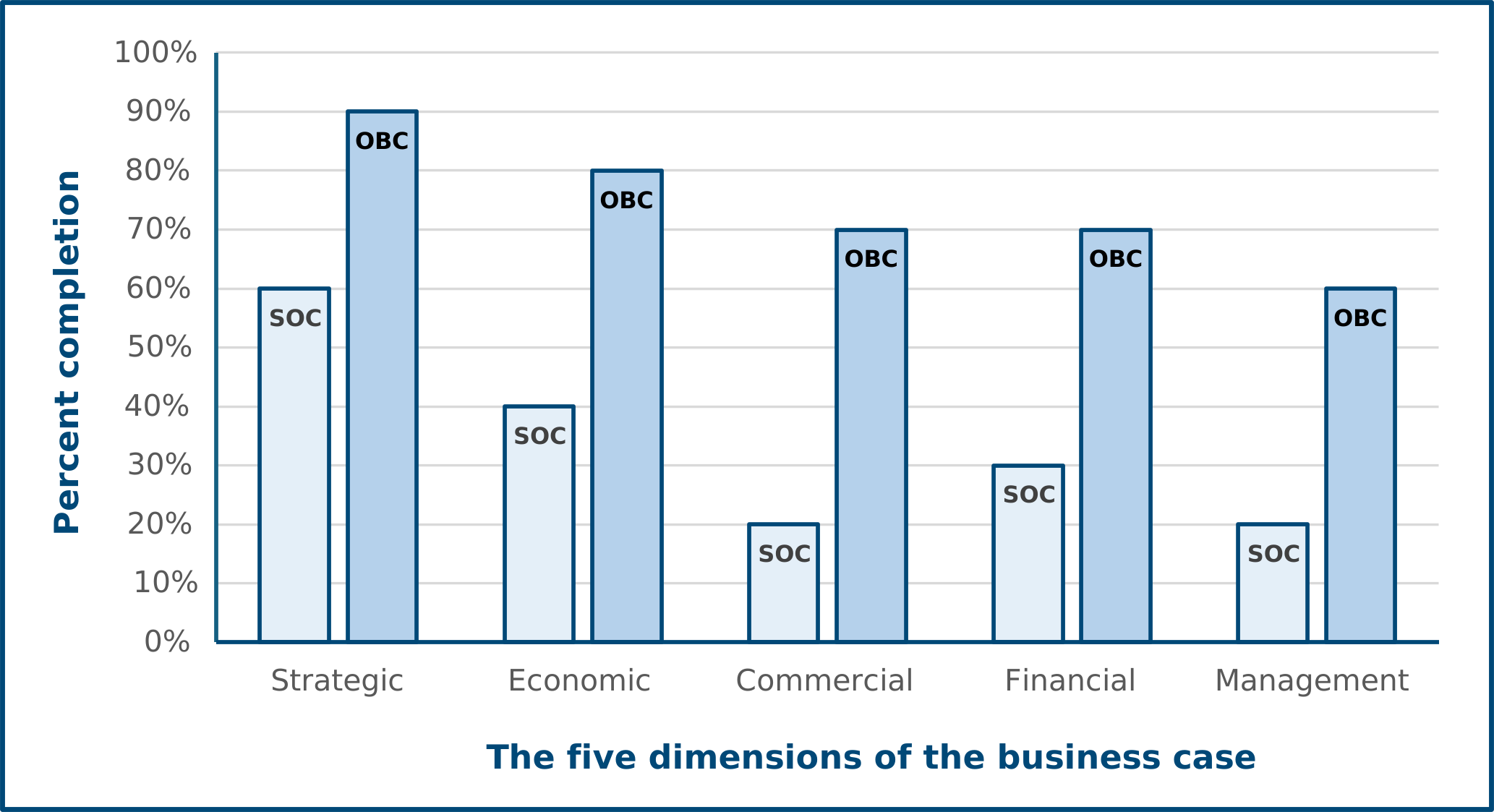
The OBC should explain what has been done to meet Actions 1-26. Figure 4 provides an outline of the approximate level of completion of each case at the conclusion of the OBC.
Figure 4. The approximate percentage completion of each of the five cases at the conclusion of the OBC
The OBC is assured through Gate Review 2. This takes place prior to the formal submission of the OBC to the approving authority. Gate Review 2 investigates the assumptions in the OBC and the proposed approach for delivering the project.
The approving authority should review the OBC and the conclusions of Gate Review 2. The approving authority should approve the proposal if:
- They are confident that the preferred option does indeed represent best value for money.
- They are confident that the preferred option meets the standards set out in Managing Public Money on propriety, regularity and feasibility.
Once the OBC has been approved by the approving authority, practitioners should begin preparing the Full Business Case.
Stage 3: Full Business Case
The Full Business Case (FBC) stage is the procurement phase for the project. It contains full details of all five of the dimensions of the business case. This is shown in Figure 5.
Figure 5. The percentage completion of each case at the conclusion of the FBC
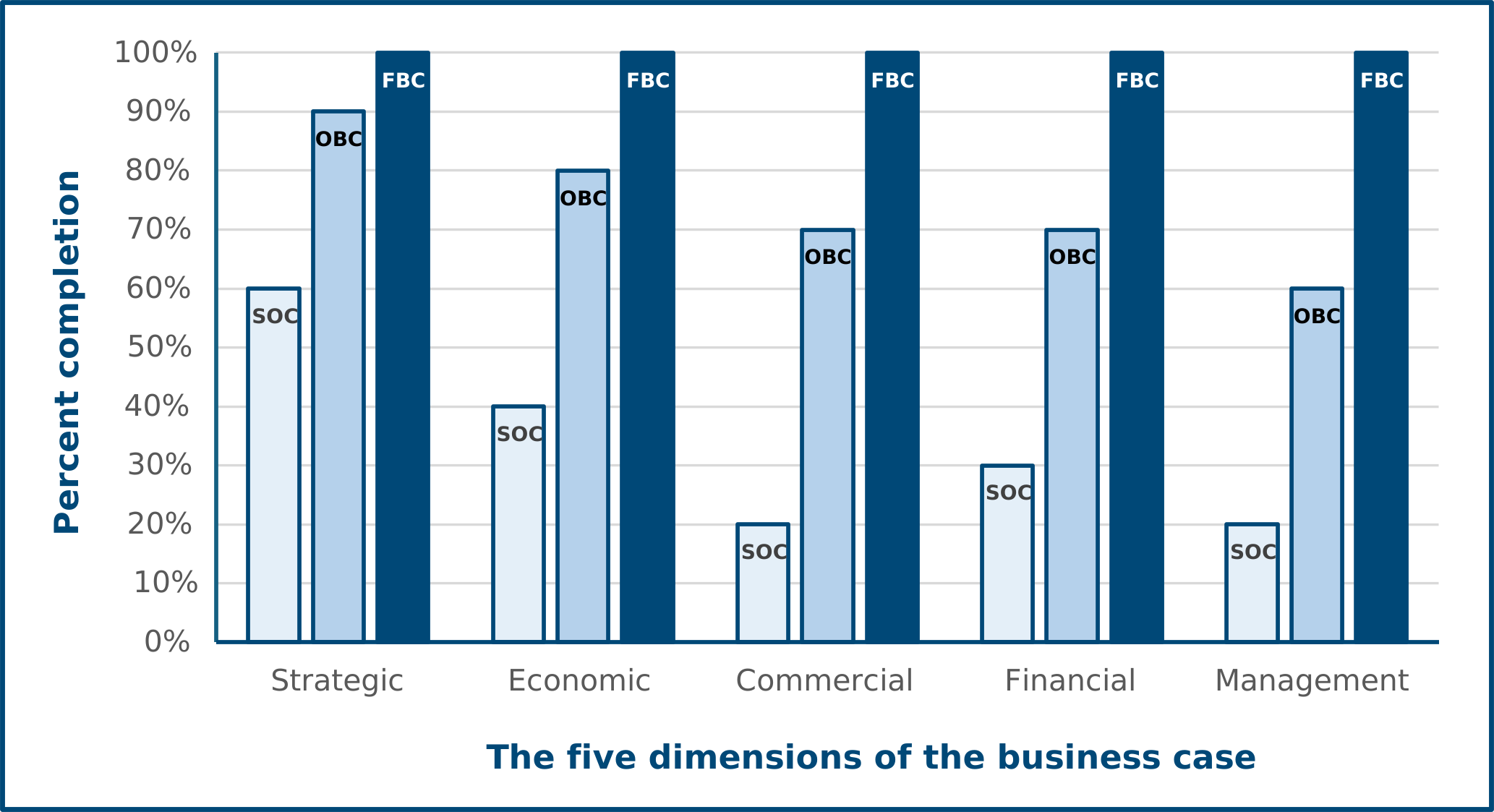
The contents of a Full Business Case should broadly be as follows:
- Strategic case: The FBC confirms that the project’s objectives and critical success factors remain accurate.
- Economic case: The FBC confirms the final estimates of the social costs, social benefits and risks of the preferred option, in light of the contracts that have been negotiated with suppliers.
- Commercial case: The FBC describes the procurement process that has been undertaken and the outcomes of that process. It sets out the potential contracts that will be signed with suppliers, pending the approval of the business case. The FBC affirms that these contracts represent value for money.
- Financial case: The FBC confirms that the proposal remains affordable. It sets out the accountancy and budgeting implications of the proposal.
- Management case: The FBC confirms the arrangements that have been put in place for the governance, management, monitoring and evaluation of the project.
The FBC is assured through Gate Review 3. This takes place prior to the formal submission of the FBC to the approving authority. Gate Review 3 investigates the governance arrangements for the investment decision to confirm that the project is still required, affordable and achievable within the proposed time.
The approving authority should review the FBC and the conclusions of Gate Review 3 to decide whether to give final approval to the business case. It is only following this approval point that the contracting authority can sign contracts with suppliers.
The process of developing the project business case has now been completed. However, the business case should continue to play an important role as the proposal is implemented. This is for three reasons:
- Delivery arrangements: The business case is an authoritative document for how the proposal will be delivered. It sets out the commercial, financial and management arrangements that will be enacted over the lifetime of the project.
- Reference point: The business case should be used as a reference point for logging any material changes to the project. The delivery plan, the benefits register and the risk register should be updated as the project is implemented.
- Monitoring and evaluation: The business case sets out how the objectives will be achieved, and the associated costs and benefits. Practitioners should use monitoring and evaluation to understand whether these expectations prove to be accurate.
Steps for developing a programme business case
Introduction
This chapter explains how to develop a Programme Business Case (PBC). The guidance in this chapter does not apply to project business cases. Practitioners who are developing a project business case should proceed to Chapter 6.
Practitioners should use programmes to achieve objectives that require multiple projects. The purpose of a programme is to scope and plan the delivery of that set of projects.
A PBC considers the set of constituent projects as a collective. It does not explain the best way of delivering each of the individual projects that make up the programme. Once the PBC has been approved, practitioners will typically develop project business cases for each of the individual projects that make up the programme. These project business cases must also receive approval before they are delivered.
The projects that make up a programme may be initiated at different times. This means that programme delivery is undertaken in a set of delivery phases or ‘tranches’. Chapter 14 of the Teal Book sets out more detail on programme life cycles.
Practitioners should identify the critical path for the programme. This is the sequencing of the constituent projects that enables the programme to be completed in the shortest possible time.
Process for developing a programme business case
The process of developing a PBC involves 7 steps which together comprise 26 actions. These are set out in Table 3.
Table 3. The process of developing a programme business case
| Step | Actions |
|---|---|
| Step 1 – Strategic assessment | Action 1 – Undertake strategic assessment |
| Step 2 – Rationale and objectives (Case for change) | Action 2 – Revisit strategic assessment Action 3 – Determine SMART objectives, existing arrangements and business needs Action 4 – Determine potential scope and service requirements Action 5 – Determine the benefits, risks, constraints and dependencies of the proposal |
| Step 3 – Options generation and longlist appraisal | Action 6 – Agree critical success factors (CSFs) Action 7 – Generate a longlist of options Action 8 – Use longlist appraisal to identify the shortlist and the preferred way forward Action 9 – Make an initial consideration of the proposal’s commercial, financial and management arrangements |
| Step 4 – Shortlist appraisal | Action 10 – Revisit Steps 2 and 3 and update as necessary Action 11 – Identify the social costs, social benefits and risks Action 12 – Analyse the social costs, social benefits and risks Action 13 – Identify the preferred option |
| Step 5 – Commercial arrangements | Action 14 – Determine procurement strategy Action 15 – Determine required inputs and outputs Action 16 – Outline risk allocation Action 17 – Outline payment mechanisms Action 18 – Outline contractual arrangements |
| Step 6 – Affordability and funding | Action 19 – Prepare financial model and assess public finance implications Action 20 – Produce funding statement and identify contingency |
| Step 7 – Delivery arrangements | Action 21 – Confirm how the proposal will be governed, managed, assured and approved Action 22 – Prepare the outline plan for delivery Action 23 – Plan change management Action 24 – Plan benefits management Action 25 – Plan risk management Action 26 – Plan monitoring and evaluation |
Reviewing and assuring programme business cases
The PBC is not a static document. It is an iterative and living document. It remains in effect from the beginning of the first project under its purview, through to the end of the last project under its purview. During that time, the PBC should be regularly reviewed to confirm that the programme is on track to meet its objectives and represents good value for money in doing so.
PBCs in the Welsh Government and the UK Government are typically assured using a Gate Review process. There is only a single Gate for PBCs, which is Gate Review 0. The purpose of the Gate 0 Review is explained in Table 4. NISTA has produced further guidance on Gate Review 0.
Table 4. Gate Reviews for programme business cases
| Gate | When | Purpose |
|---|---|---|
| Gate 0: Strategic Assessment | Following the strategic assessment and repeated through implementation as necessary | Considers the programme in the wider policy context and investigates the direction and planned outcomes of the programme, together with the progress of its constituent projects |
The initial Gate Review 0 focuses on the strategic assessment. This is Step 1 of the PBC development process. This is the initial planning phase, in which practitioners should assess the strategic fit and feasibility of the programme. Practitioners should, however, be sure to progress through the other six steps of the process for developing a PBC.
Practitioners should undertake a Gate 0 Review when the PBC is first completed, ahead of the first approval point for the programme. Practitioners should then hold successive Gate 0 reviews at appropriate key decision points over the lifetime of the programme. This ensures that the PBC remains up-to-date and that the programme is on track to achieve its objectives.
At each approval point, the approving authority should review the PBC and the conclusions of the latest Gate Review 0. They should then decide whether the PBC should progress. The approving authority should confirm that:
- The outcomes and objectives for the programme make a necessary contribution to the overall strategy of the organisation
- The programme has clear arrangements for leading, managing and monitoring and it is supported by key stakeholders
- The programme is likely to be feasible
Gate Reviews should not be the only means of reviewing and assuring a PBC. Practitioners should work with their approving authority to establish a proportionate plan for reviewing and assuring the business case throughout its lifecycle.
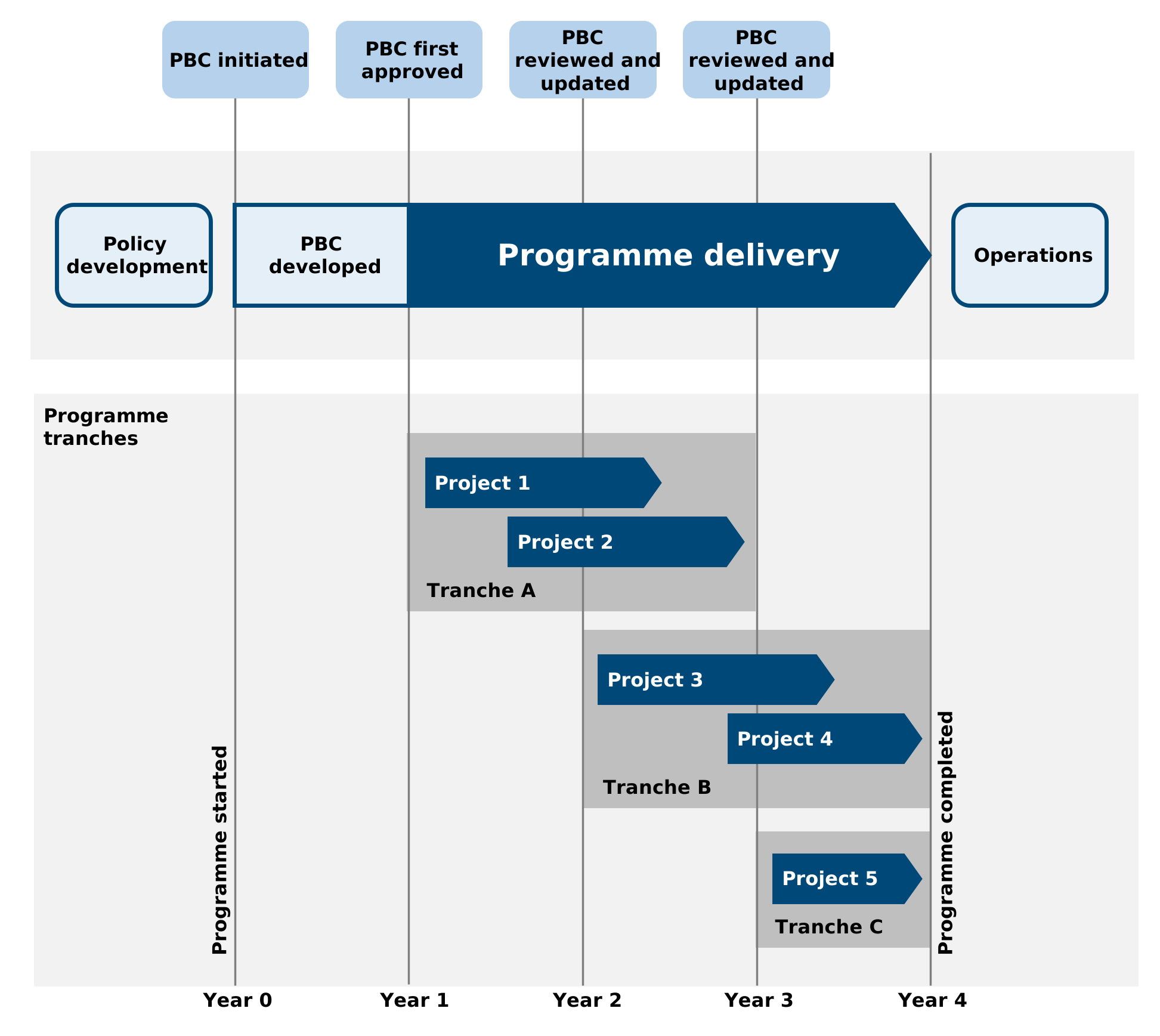
Practitioners must review and validate the PBC before the delivery of each new tranche begins. Figure 6 shows an example of how this review process may look for a programme composed of five projects spanning three tranches.
The approving authority may request the right to review the PBC during the implementation of the programme. These review points may take place over specified periods of time. Alternatively, they may take place when certain conditions are fulfilled, such as at the completion of a tranche.
UK government departments must review PBCs at least annually and update them as required. Practitioners should also review and update the PBC when one of the programme’s underlying project business cases receives FBC approval. For programmes that qualify for the Treasury Approvals Process, UK government departments should agree with their HM Treasury spending team on how often they will submit the PBC to HM Treasury for scrutiny.
Figure 6. An example of the PBC review process
Strategic assessment
Introduction
The business case process for a project or programme should begin with a strategic assessment. This forms an initial understanding of why the proposal is being undertaken and whether it is feasible.
The output of the strategic assessment stage is a scoping document. Practitioners can find a template for a scoping document in Annex B. It is designed to record the key information that is needed to ensure the proportional application of the Five Case Model during the business case process. The conclusions of the strategic assessment are carried forward into the next steps of the business case development process.
Step 1 of the business case process involves a single action. This is set out below.
| Step 1 | Strategic assessment |
|---|---|
| Action 1 | Undertake strategic assessment |
Action 1: Undertake strategic assessment
The purpose of the strategic assessment is to ensure that the business case process is set up in such a way that it will lead to the development of a high-quality business case. A strategic assessment should set out the following elements:
- The mandate for the proposal: This is sometimes known as the authority for initiation. It provides the trigger to start developing the business case for the proposal. The mandate should identify the senior responsible owner (SRO) and the approving authority.
- The strategic fit of the proposal: This provides the rationale and context for the proposal. It explains what the proposal is, and why it is needed to meet the organisation’s objectives.
- The brief for the proposal: This sets out the broad, high-level objectives for the proposal. It explains how the proposal will achieve the desired outputs and outcomes. The brief provides the starting point for work to assess feasibility and develop the business case. Chapter 15 of the Teal Book provides further guidance on initiating projects and programmes.
- The plan for the business case process: The SRO and the approving authority should agree on how the business case will be produced. This should include roles and responsibilities within the business case process, as well as the extent to which costs and benefits will be measured. The plan should include arrangements for reporting key milestones and monitoring progress. It should set out regular review meetings with the approving authority.
- The results of any feasibility studies: Depending on the scale and complexity of the proposal, practitioners may need to conduct an initial feasibility study to support the strategic assessment. This is a requirement for projects and programmes that are expected to join the Government Major Projects Portfolio (GMPP). Government Project Delivery provides more guidance on feasibility studies. If a feasibility study shows that a proposal is not feasible, then practitioners should revise the brief, or recommend halting the proposal.
- The results of the risk potential assessment (RPA): This provides a standard set of high-level criteria for assessing the risk potential of a proposal. An RPA is good practice for all proposals. It is mandatory for projects and programmes joining the GMPP. In the UK Government, NISTA publishes a form to help practitioners to conduct this assessment. The Strategic Project Delivery Office can provide the relevant RPA form for the Welsh Government.
The strategic fit of a proposal may be described with reference to:
- The organisation’s strategy: This sets out the wider objectives of the organisation. Practitioners should consider how the proposal interacts with the organisation’s other projects and programmes.
- The organisation’s risk management framework: This sets out the organisation’s overall tolerance for risk. The Orange Book provides further guidance on risk management in public bodies.
- The relevant overarching programme, portfolio or policy: A proposal should align with the programme, portfolio or policy that sit above it in the policy hierarchy. Chapter 3 of this guidance describes this ‘golden thread’ in more detail. If a business case cannot demonstrate a ‘golden thread’, then practitioners should work with the approving authority to better understand their priorities. If a project business case is being developed to implement an overarching programme, then the business case should refer to the relevant programme business case.
- The objectives of other public bodies in the United Kingdom: Practitioners should consider how the proposal may support the objectives of other UK public bodies, be they national, regional or local.
NISTA has developed a Project Set Up Toolkit to assist practitioners with the early phases of project development. Practitioners might hold an Opportunity Framing workshop, to confirm the value of the proposal and what success might look like.
Practitioners might hold a workshop to discuss the strategic fit of the proposal and take an initial view on feasibility. This workshop should be attended by the SRO and the approving authority, as well as practitioners and stakeholders. Practitioners may hold this workshop in conjunction with Workshop 1 on the case for change.
Guidance for programme business cases:
- The strategic assessment is reviewed at Gate 0. Paragraphs 5.7-5.11 provide further guidance on conducting a Gate Review 0.
| Checklist – Step 1: Strategic assessment | |
|---|---|
| Step 1 of the business case process is now complete. There should be: | |
| - A clear demonstration of the proposal’s strategic fit. | |
| - A high degree of confidence that the proposal is required and feasible. |
The strategic case
Introduction
The first case of the Five Case Model is the strategic case. It builds on the strategic assessment to set out why a particular proposal is needed. It sets out the rationale and objectives for the intervention. It establishes the case for change and demonstrates the proposal’s strategic fit. The strategic case is fundamental and drives the rest of the business case process.
The strategic case is developed in Step 2 of the business case process. The actions for Step 2 are set out below:
| Step 2 | Rationale and objectives (Case for change) |
|---|---|
| Action 2 | Revisit strategic assessment |
| Action 3 | Determine SMART objectives, existing arrangements and business needs |
| Action 4 | Determine potential scope and service requirements |
| Action 5 | Determine the benefits, risks, constraints and dependencies of the proposal |
Practitioners should convene at least one facilitated workshop for the completion of Step 2. The details of this workshop – Workshop 1: Case for change – can be found at the end of this chapter.
Action 2: Revisit strategic assessment
Practitioners should revisit the strategic assessment that was developed in Action 1. They should consider whether it needs to be updated to reflect any changes or new developments. Practitioners should summarise this strategic assessment and use it as the basis for the strategic case.
Action 3: Determine SMART objectives, existing arrangements and business needs
Practitioners should develop a case for change. This explains why the government needs to act, and why the intended outcomes are worth pursuing.
A robust case for change requires a clear understanding of:
- Objectives: These define the outcomes that the organisation is hoping to achieve.
- Existing arrangements: This is the outcome that is expected if current arrangements continue and the proposal is not implemented. This is sometimes known as the business as usual (BAU).
- Business needs: This is what is required to close the gap between existing arrangements and where we need to be in the future. In the Green Book, this is referred to as ‘theory of change’.
SMART objectives
A proposal’s objectives define the exact outcomes that the government is hoping to achieve. Objectives should:
- Be SMART: The objectives of the proposal should be specific, measurable, achievable, realistic, and time-limited (SMART). Making objectives SMART ensures that they can be robustly monitored and evaluated. An example of a SMART objective for a transport proposal may be ‘to reduce peak-time journey times on a strategic road by 15% by June 2030’.
- Achieve strategic fit: The objectives of the proposal should be aligned with the objectives of the overarching programme or portfolio, and, more broadly, the objectives of the organisation.
- Be expressed in terms of outcomes, rather than outputs: There is often more than one type of output that can be used to deliver an outcome. The use of outcome-based objectives encourages practitioners to think through different potential outputs that might achieve their goals. Practitioners should take care not to confuse objectives with benefits, which are defined later.
- Support genuine options appraisal: The objectives of the proposal should be broad enough to allow for a range of viable options for delivery, but not so broad as to include options that are unrealistic.
- Be few in number: A proposal should ideally have as few objectives as possible. A small set of objectives ensures that the proposal is focused.
The proposal’s objectives will typically address one or more of the following five generic reasons for intervention. These are:
- Effectiveness: Achieving better social outcomes. For example, by meeting new operational targets.
- Efficiency: Achieving a better use of inputs relative to outputs. For example, through spending on cost-reducing technology
- Economy: Reducing the cost of public services in terms of the required inputs and outputs. For example, through invest-to-save schemes.
- Compliance: Meeting statutory, regulatory or policy requirements. For example, complying with new environmental regulations.
- Replacement: Re-procuring services. For example, re-procuring an IT contract that is nearing its expiry date.
Practitioners should define the objectives of the proposal before assessing the existing arrangements of the organisation. This helps to prevent practitioners from defining their objectives in terms of the existing systems and processes that are currently used within the organisation.
Existing arrangements
The existing arrangements are the outcomes that are expected if current arrangements continue and the proposal under consideration is not implemented. This is sometimes known as the business as usual (BAU).
The existing arrangements are the baseline against which practitioners can compare different proposals and measure future improvements. Practitioners should describe existing systems and processes, and their associated costs, benefits and risks. Describing this baseline helps practitioners to convey the changes that come about in the absence of new intervention.
Practitioners should not assume that the organisation will do nothing under existing arrangements. In the absence of the new proposal, the organisation will still act to try to achieve its objectives. The BAU still involves costs, benefits and risks.
Business needs
The business needs are what is required to close the gap between existing arrangements and where we need to be in the future (i.e. the SMART objectives). In the Green Book, this is referred to as theory of change.
Specifying the business needs helps to identify the scope for the proposal, and to ensure that it is predicated on operational needs rather than potential benefits. This requires a clear understanding of the problems that are associated with the existing arrangements, and a clear understanding of the opportunities for bridging any existing or future service gaps.
Practitioners should specify the organisation’s business needs in terms of the improvements and changes that are required for the proposal to fulfil its agreed objectives. This analysis should include:
- Confirmation of the continued need for existing business operations with supporting evidence.
- Projections of the nature and level of demand for future services, including customer demographics and alternative sources of supply.
The Green Book describes the concept of a ‘theory of change’. This is a similar concept to business needs. A theory of change explains how the inputs and outputs that are defined in the proposal will lead to the desired outcomes. It is the logical chain of cause and effect that shows how outcomes will be achieved.
Action 4: Determine potential scope and service requirements
Practitioners should consider the potential scope and service requirements that are necessary to satisfy the business needs of the proposal. These are defined as follows:
- Scope: The potential coverage of the proposal. This might be defined in terms of the geographical location, or demographics, of users.
- Service requirements: The requirements for the quality of the proposal. This might be defined in terms of the different services or facilities available to users.
Practitioners might categorise different options as follows:
- Core changes: The changes brought about by a proposal that are needed to achieve its objectives.
- Desirable changes: The changes brought about by a proposal, which would be beneficial, and which seem likely to be justified on a value for money basis when later assessed in detailed appraisal.
- Optional changes: The changes brought about by a proposal, which would be beneficial, but which could potentially be justified on a value for money basis when later assessed in detailed appraisal.
The purpose of Action 4 is to better define the objectives of the proposal and reduce the risk of scope creep later in the proposal. Practitioners should avoid describing potential solutions at this stage.
In the economic case, practitioners will generate different options for achieving the objectives of the proposal. These options will have different levels of ambition, ranging from ‘do minimum’ through to ‘intermediate’ and then up to ‘do maximum’. The early identification of core, desirable and optional changes helps to inform this later options generation.
Action 5: Determine the benefits, risks, constraints and dependencies of the proposal
Practitioners should, with reference to the proposal’s SMART objectives, describe:
- The benefits that will come about if the objectives are achieved
- The risks that might affect the achievement of the objectives
- The constraints that might affect the ability of different options to achieve those objectives
- The dependencies that might affect the achievement of the objectives
The purpose of Action 5 is to think generally about the proposal’s objectives and intended outcomes. Practitioners compare the specific costs, benefits and risks for individual options in later stages of the business case process.
Benefits
A benefit is the value, or other positive impact, resulting from an outcome, which is perceived as an advantage by one or more stakeholders. The Green Book contains more detail on identifying benefits.
For each of the benefits that arise from the proposal, practitioners should describe the following characteristics:
- Category: A benefit might be cash-releasing, non-cash-releasing, quantifiable or qualitative. The Green Book provides definitions of these categories. Table 5 sets out some examples of benefits from each category.
- Beneficiary: The individuals or organisations that benefit from the achievement of the SMART objectives.
- Metric: How the benefit will be measured.
- Baseline: The value of the benefit under business as usual conditions. Depending on the category, this might be expressed in monetary terms, quantitative terms or qualitative terms.
Table 5. Examples of different benefit categories
| Benefit category | Definition | Example |
|---|---|---|
| Cash-releasing | • A monetisable social benefit that affects the income or expenditure of a public body. | • Lower operating costs • Increased fee revenue |
| Non-cash-releasing | • A monetisable social benefit that does not affect the income or expenditure of a public body. | • Redeployment of existing staff within the organisation |
| Quantifiable | • A social benefit that can be expressed in numerical terms, but not in monetary terms. | • Improved scores on customer satisfaction survey • Higher staff retention |
| Qualitative | • A social benefit that cannot be feasibly expressed in numerical terms and can only be understood using words. | • Increased pride in place |
Risks
Risk is the effect of uncertainty on objectives. It is the possibility of events occurring, either individually or cumulatively, that could impact the successful delivery or realisation of a proposal.
Identifying, assessing and controlling key risks increases the chances of successful delivery. The Orange Book is the UK government guidance on risk management. Annex 4 of the Orange Book contains a detailed list of different types, or ‘categories’, of risk. The National Audit Office has produced guidance on decision making in an uncertain environment.
Constraints
Constraints are the conditions and agreed parameters within which the proposal must be delivered, over which the proposal has little or no control.
Spending proposals typically have affordability constraints that put an upper limit on the amount of spending involved. A proposal might also be constrained by timescale requirements, laws, regulations or other government policies.
Dependencies
Dependencies are external factors on which the proposal is reliant to be successful, but which are beyond the direct control of the proposal. There are two types of dependency:
- Dependencies on the organisation’s other projects and programmes: For example, a delay in one of the organisation’s projects may have knock-on implications for the delivery of others.
- Dependencies that lie outside the direct control of the organisation: For example, a proposal might be dependent on the availability of a piece of public infrastructure, or a service provided by a private company.
Workshop 1: Case for change
| Workshop 1: Case for change | Practitioners are recommended to hold at least one workshop while they complete Step 2 of the business case process. The participants of the workshop should ideally be at the decision making level. The objectives, participants and outputs of the workshop(s) should be as follows. |
|---|---|
| Objectives | • To agree the proposal’s SMART objectives, existing arrangements, business needs, and potential scope • To identify the proposal’s key service requirements, benefits, risks, constraints and dependencies |
| Participants | • Senior responsible owner (SRO) • Approving authority • Key members of the project/programme team • External stakeholders • Customer and/or user representatives • Technical adviser(s) and analysts • Financial adviser(s) • Workshop facilitator |
| Outputs | • Agreed SMART objectives, scope and service requirements. • Shared assessment of existing arrangements, business needs, benefits, risks, constraints and dependencies. |
| Checklist – Step 2: Rationale and objectives (Case for change) | |
|---|---|
| Step 2 of the business case process is now complete. There should be a clear understanding of the following elements of the proposal: | |
| - SMART objectives, existing arrangements and business needs | |
| - Scope and service requirements | |
| - Benefits, risks, constraints and dependencies |
The economic case
Introduction
The second case of the Five Case Model is the economic case. The purpose of the economic case is to assess the social costs, social benefits and risks of different options for achieving the objectives of the proposal. The economic case concludes with a preferred option that is most likely to offer best value for money.
The Green Book is the UK government guidance on appraisal. Practitioners must refer to the Green Book when developing the economic case. This chapter of the business case guidance summarises the appraisal process set out in the Green Book.
The analysis in the economic case differs from that done in the financial case. The economic case focuses on value for money from the perspective of society. The financial case focuses on affordability from the perspective of the public purse. Table 10 in Chapter 10 summarises the key differences between the economic case and the financial case.
The economic case considers the social, economic and environmental impacts of different options. It should be developed with input from economists and analysts, as well as other relevant professions and experts. This collaboration helps to establish a rounded understanding of different costs, benefits and risks.
The economic case begins by generating a wide range of potential options that might feasibly meet the proposal’s objectives. This is known as the ‘longlist’. The most promising of these options are taken forward as the ‘shortlist’ and analysed in further detail. Practitioners should think creatively about the different options for meeting ministers’ objectives. This prevents the business case being ‘rigged’ or ‘retrofitted’ towards a predetermined solution.
As the proposal continues through the commercial, financial and management cases, new information may arise that affects the assumptions made in the economic case. For example, commercial engagement with suppliers might yield new information about the costs of a proposal. If this new information is significant, then practitioners may need to revisit the economic case and reassess the preferred option.
Practitioners should consider evaluation evidence from previous interventions when developing their appraisals and identifying options for delivery. The Evaluation Registry contains evaluation evidence from previous interventions. The plan for monitoring and evaluating the proposal should be set out in the management case.
Some business cases will include options that use private finance models. Practitioners should refer to the Balance Sheet Framework and Annex A of the Green Book for further guidance on appraising private finance models.
The economic case is developed over Step 3 and Step 4. Step 3 is options generation and longlist appraisal. This involves four actions, which are set out below:
| Step 3 | Options generation and longlist appraisal |
|---|---|
| Action 6 | Agree critical success factors (CSFs) |
| Action 7 | Generate a longlist of options |
| Action 8 | Use longlist appraisal to identify the shortlist and the preferred way forward |
| Action 9 | Make an initial consideration of the proposal’s commercial, financial and management arrangements |
Practitioners should convene at least one facilitated workshop for the completion of Step 3. The details of this workshop – Workshop 2: Identifying and assessing the options – can be found after the section of this guidance that describes Action 9.
The second step of the economic case is shortlist appraisal. This involves four actions, which are set out below:
| Step 4 | Shortlist appraisal |
|---|---|
| Action 10 | Revisit Steps 2 and 3 and update as necessary |
| Action 11 | Identify social costs, social benefits and risks |
| Action 12 | Analyse social costs, social benefits and risks |
| Action 13 | Identify the preferred option |
Guidance for programme business cases:
- In options appraisal for programmes, practitioners should focus on analysing and selecting the optimal mix of constituent projects that are required to deliver the programme’s SMART objectives.
- Practitioners should identify the critical path for the delivery of a programme’s projects and related activities. They should reflect this in the plan for delivery in the management case.
- Detailed cost-benefit analysis will typically take place at the project level. Practitioners may therefore undertake analysis at a higher level in an initial PBC. Following the approval of the PBC, that analysis should be regularly updated as practitioners develop economic appraisals for the programme’s constituent projects and as more robust data becomes available.
Practitioners should convene at least one facilitated workshop for the completion of Step 4. The details of this workshop – Workshop 3: Assessing the shortlist of options – can be found at the end of this chapter.
Action 6: Agree critical success factors (CSFs)
Critical success factors are the attributes that are essential for the successful delivery of the proposal. These critical success factors are used in longlist appraisal to identify options that would not result in successful delivery.
Practitioners should agree a set of critical success factors for the proposal. The Green Book provides more guidance on how to do this.
The critical success factors for the proposal must be crucial, not merely desirable. They should not be set in such a way that could unnecessarily exclude options at an early stage of identification and appraisal.
Table 6 sets out five critical success factors that can be applied to all proposals. They broadly correspond to the five dimensions of the Five Case Model.
Table 6. Examples of critical success factors
| Critical success factor | Description |
|---|---|
| 1. Objectives and strategic fit | • The proposal meets its SMART objectives. • The proposal has strategic fit with other policies, portfolios, programmes and projects being undertaken in the public sector. |
| 2. Value for money | • The proposal represents the optimal use of public resources to achieve its objectives. |
| 3. Supplier capacity and capability | • Potential suppliers can feasibly provide the inputs that are required for the proposal. • The contracting authority and its suppliers can reach a mutually acceptable agreement on payments and risk transfers. |
| 4. Affordability | • The proposal is affordable for all of the public bodies involved. |
| 5. Achievability | • There are robust arrangements in place to deliver, monitor and evaluate the proposal. |
Action 7: Generate a longlist of options
A longlist is a wide range of potential options for achieving the objectives of the proposal. The purpose of generating a longlist is to help practitioners to think broadly and creatively about the different ways of achieving the proposal’s objectives. A sufficiently broad longlist helps to avoid thinking too narrowly and reduces the risk of overlooking better options for achieving those objectives.
Practitioners should generate a longlist of options. Chapter 5 of the Green Book provides guidance on how to do this.
Practitioners might generate options through research and analysis. They might get ideas from stakeholders and experts. They might look at solutions that have been adopted elsewhere in the public sector, the private sector or internationally. Practitioners might consider the following examples of options:
- An asset might be built, leased or purchased, or an existing asset could be refurbished.
- A piece of equipment might be designed for a particular purpose or bought ‘off the shelf’ from a supplier.
- The public body might provide a service itself, or the service might be contracted out to a private sector organisation.
Practitioners should not restrict their options just to public spending. It may be possible to achieve the proposal’s intended outcomes through other means, such as tax policy or regulation policy.
Action 8: Use longlist appraisal to identify the shortlist and the preferred way forward
Longlist appraisal is the process of assessing a longlist of options, in order to narrow those options down into a shortlist. Longlist appraisal involves assessing which options best meet the objectives and critical success factors of the proposal.
Practitioners should use longlist appraisal to start identifying those options that represent optimal value for money. This does not necessarily require extensive research and analysis of costs, benefits and risks just yet. That takes place at the shortlist appraisal stage. Longlist appraisal instead typically uses indicative estimates and ranges, which should support an informed judgement about what options are viable for shortlisting, but are not necessarily precise enough to identify the final preferred option at this stage.
Practitioners should use the results of longlist appraisal to identify around five shortlisted options for further appraisal. This should include options labelled ‘business as usual’, ‘do minimum’, ‘preferred way forward’, ‘more ambitious preferred way forward’, and ‘less ambitious preferred way forward’. These options are explained in greater detail in Paragraph 8.45.
The Green Book recommends conducting options generation and longlist appraisal using the options framework filter. The options framework filter involves breaking viable options into their basic components and recombining these components in different ways to create and test different options. The options framework filter is explained in more detail later in this chapter.
Another potential approach to longlist appraisal is multi-criteria decision analysis (MCDA). This method is used to inform complex technical trade-offs at the longlist stage. It makes use of swing weighting to objectively weigh the balance of informed expert and stakeholder opinion. There is Green Book supplementary guidance on MCDA. Practitioners looking to use MCDA must make sure that they are supported by an expert facilitator.
Practitioners may also consider conducting longlist appraisal using SWOT analysis. This is where practitioners assess different options against the objectives and critical success factors of the proposal. Each option can then be described and compared based on its respective strengths, weaknesses, opportunities and threats.
The options framework filter
The options framework filter (OFF) is the recommended technique for generating options and conducting longlist appraisal.
An essential feature of the OFF is structured, facilitated workshops. These workshops are important to elicit communication and collaboration between different professions, key stakeholders and experts. Participants in these workshops go through the OFF together. They work jointly to generate options, assess the longlist, and decide which options should progress to shortlist appraisal. These workshops must be carried out in a way that is proportionate to the proposal’s likely costs and risks.
Another essential feature of the OFF is explicit deliberation. Participants must explain the evidence, research and assumptions that underpin their views. This captures the rationale behind the judgements being made and helps participants avoid falling into the trap of making unconscious, implicit and unconsidered assumptions.
Options, categories and option choices
Before using the OFF, practitioners should distinguish between categories, option choices and options:
- Option: A potential way of meeting the objectives of the proposal. For example, there might be multiple different options for building a flood barrier.
- Category: A particular attribute that varies between different options. For example, the different options for building a flood barrier might differ in the type of construction. One category in this appraisal is therefore ‘construction type’.
- Option choice: One of the different possibilities for a particular category. For example, option choices for ‘construction type’ might include ‘natural’ and ‘man-made’.
Each option generated using the OFF will have an option choice from each of the categories.
Using the options framework filter
There are three main steps to using the OFF, as illustrated in Figure 7. These steps are detailed further down, but are summarised as:
- Practitioners identify a set of categories that capture the different ways that the proposal might be achieved. They then identify different option choices for the different possibilities within each category, starting with the mandatory do minimum option and incrementally increasing in ambition.
- Each option choice is considered and rated against the objectives and critical success factors. Those option choices that do not meet the critical success factors are rated ‘red’ and dropped from the process. The remaining option choices in that category are assessed to identify which best meets the critical success factors. One option choice from each category is rated ‘green’ to indicate that it is preferred. The remaining options are rated ‘amber’ and are carried forward for further examination.
- Options are then generated by combining the amber-rated and green-rated option choices in different combinations to produce the shortlist.
Figure 7. Overview of longlist appraisal with the options framework filter
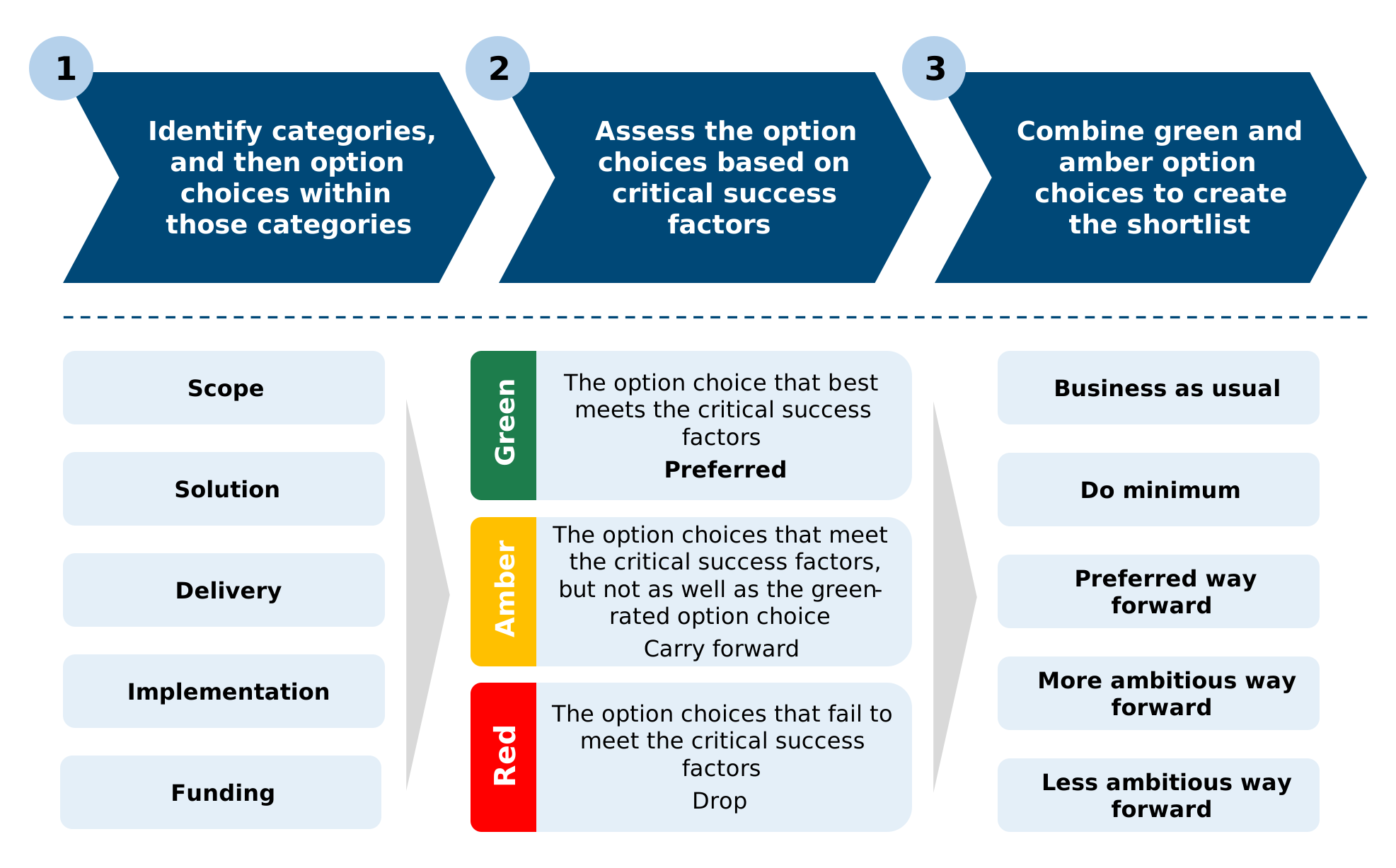
Identifying categories
Practitioners start by identifying a set of categories relevant to their proposal. They then consider a range of potential option choices within each category. Five recommended categories are:
- Scope: This is the ‘what’ in terms of the potential coverage of the proposal. The potential scope is driven by business needs, service requirements and the scale of organisational change required. Option choices might include varying the coverage by geography, demographic characteristics or quality.
- Solution: The ‘how’ in terms of delivering the preferred scope of the proposal. The potential solutions are driven by available technologies, recognised best practice and what the market can deliver. Option choices might include developing new infrastructure, refurbishing existing facilities, regulations, taxes, grants, subsidies or public information campaigns.
- Delivery: The ‘who’ in terms of delivering the preferred scope and solution for the proposal. The potential options for service delivery are driven by available resources, competencies and capabilities. Option choices might include direct public sector provision, public-private partnerships, not-for-profit providers or private sector providers.
- Implementation: The ‘when’ in terms of delivering the preferred scope, solution and service delivery for the proposal. The potential implementation options are driven by deadlines, dependencies between outputs, benefits realisation and risk mitigation. Option choices might include an initial pilot, a phased rollout or a rapid implementation approach.
- Funding: The ‘funding’ required for delivering the preferred scope, solution, service delivery and implementation path for the proposal. The potential funding options are driven by the nature of the proposal and the availability and opportunity cost of public funding. Option choices might include the department itself, other public bodies, private financing or service charges.
Practitioners may require additional categories under scope and solution, depending on the nature of the proposal.
Rating option choices
The options framework filter is an iterative process. Importantly, practitioners should consider a broad range of option choices for each of the categories in turn. They should take into account the decisions made in prior categories each time.
For each category, practitioners give each of the potential option choices a rating: green, amber or red. These are defined as follows:
- Green: The option choice in its category that best meets the objectives and critical success factors. Green ratings represent the preferred option choice within a category. They are taken forward to generate options.
- Amber: An option choice that meets the objectives and critical success factors, but not as well as the green-rated option choice, or in a way that requires further examination during shortlist appraisal. Amber option choices can be taken forward to generate options.
- Red: An option choice that does not meet the objectives or critical success factors. Red option choices are dropped from further consideration.
Practitioners must record the reason for each rating in a brief paragraph, explaining the underlying evidence, assumptions and sources. Practitioners should use SWOT analysis to support these decisions.
With reference to the five categories above, the options framework filter process begins with an initial consideration of scope. Participants discuss and identify different option choices for scope, ranging from minimum to maximum. The minimum is the scope that just meets the objectives. The maximum is a much more ambitious scope. Participants should consider different option choices, of different levels of ambition, that fall between the minimum and the maximum. All of these option choices are then rated green, amber or red.
The next choice concerns the solution. Practitioners should begin by taking the green option choice for scope that was identified in the previous stage. They should identify the minimum solution required to meet the scope. They should also identify a much more ambitious maximum solution. Practitioners should then consider a range of option choices between these two parameters. They should rate these option choices green, amber or red.
The next choice concerns delivery. This uses the green-rated option choices for scope and solution that were identified in the two previous stages. Participants should consider the option choices for delivery and rate each green, amber or red.
The next choice concerns implementation. This is considered in relation to the green-rated option choices for scope, solution and delivery that were identified in the previous three stages. The option choices for implementation are rated green, amber or red.
The next choice concerns funding. This is considered in relation to the green-rated option choices for scope, solution, delivery and implementation that were identified in the previous four stages. The option choices for funding are rated green, amber or red.
Generating options
Practitioners should then present the ranking of option choices in an options summary matrix. This matrix provides an overview of option choices considered and the decisions made during the options framework filter process. It must be accompanied by a record of the workshop attendance, the decisions made and the rationale for them.
Table 7 contains an example options summary matrix for a road construction project between five cities labelled A to E. To create a summary matrix, practitioners should:
- List all categories requiring a decision in the first column.
- Use the second column to describe the BAU position for each category, where applicable.
- Use subsequent columns to list the potential option choices, in order of increasing ambition, for each category, noting their rating of green, amber or red.
- Combine the green and amber option choices in different ways to create a variety of complete options.
- Take the most viable potential options forward as a shortlist, which can then be appraised in greater depth. Practitioners should aim to assemble around five options.
Table 7. Example options summary matrix for a project business case
| Category | Business as usual | Potential option choices | |||
|---|---|---|---|---|---|
| 1. Scope | 1.0 No links Carry forward | 1.1 Linking Cities A and B (minimum) Carry forward | 1.2 Linking Cities A, B and C (intermediate option) Preferred | 1.3 Linking Cities A, B, C and D (intermediate option) Carry forward | 1.4 Linking all Cities, A, B, C, D and E (maximum) Drop |
| 2. Solution | 2.0 Current services for road maintenance etc. Carry forward | 2.1 Refurbish existing highways (minimum) Carry forward | 2.2 Combination of refurbished & new highway (intermediate option) Preferred | 2.3 Completely new highway (intermediate option) Carry forward | 2.4 New highway & facilities (maximum) Drop |
| 3. Delivery | 3.0 Current arrangements Carry forward | 3.1 Local contractor Drop | 3.2 National contractor Carry forward | 3.3 International contractor Preferred | |
| 4. Implementation | 4.1 Phased over 3 years Carry forward | 4.2 Phased over 2 years Preferred | 4.3 Big bang over 1 year Drop | ||
| 5. Funding | 5.1 Public funding Drop | 5.2 Mixed public and private funding Preferred | 5.3 Private finance – service charge Drop | 5.4 Private finance – toll Drop |
Assembling the shortlist
Practitioners should identify around five shortlisted options for further appraisal. These should include:
- Business as usual (BAU): This is the outcome that is expected if current arrangements continue and the proposal is not implemented. Practitioners must take forward the BAU to shortlist appraisal, regardless of whether it meets the objectives of the proposal. This is because the BAU acts as a benchmark against which other options are compared. When using the OFF, this is the option that is made by combining the BAU option choices.
- Do minimum: This is the option that just achieves the proposal’s objectives and goes no further in generating additional benefits. Practitioners must take forward the do minimum option to shortlist appraisal, regardless of whether it represents value for money. When using the OFF, this is the option that is made by combining the option choices that are labelled as ‘minimum’.
- Preferred way forward: This is the option that appears to best meet the objectives and critical success factors, and which is judged to represent the best value for money in doing so. This may or may not be the same as the do minimum. When using the OFF, this is the option that is made by combining the green option choices.
- A more ambitious preferred way forward: This is a version of the preferred way forward that delivers more social benefits, but either at higher social costs or with increased risks. When using the OFF, this will involve taking forward one or more amber option choices to the right of the green option choice (i.e. demonstrating greater ambition).
- A less ambitious preferred way forward: This is a version of the preferred way forward that delivers lower social benefits, but with either lower social costs or lower risks. This may be excluded if the preferred way forward is also the do minimum. When using the OFF, this will involve taking forward one or more amber option choices to the left of the green option choice (i.e. demonstrating lesser ambition).
Options that do not meet the objectives of the proposal must not be taken forward to shortlist appraisal. The exception is the BAU, which should always be taken forward.
| Workshop 2: Identifying and assessing the options | Practitioners are recommended to hold at least one workshop while they complete Step 3 of the business case process. The participants of the workshop should ideally be at the decision making level. The objectives, participants and outputs of the workshop(s) should be as follows. |
|---|---|
| Objectives | • Identify the critical success factors. • Identify and appraise the longlist of options. • Identify the shortlist of options. |
| Participants | • Senior responsible owner • Approving authority • External stakeholders • Finance director • Commercial director • Economic adviser • Technical adviser(s) and analysts • Customer and/or user representatives • Key members of the project/programme team |
| Outputs | • Longlist of options • Shortlist of options • Record of decisions, assumptions and supporting information |
Action 9: Make an initial consideration of the proposal’s commercial, financial and management arrangements
Practitioners should begin to develop the proposal’s commercial, financial and management arrangements. This helps to provide early assurance of the feasibility, affordability and deliverability of the proposal and the preferred way forward. It provides an indicative and proportionate outline of the arrangements, which will be further developed in later steps of the business case process.
The broad considerations for each case should be:
- Commercial case: Practitioners should explain the inputs that might be required for the proposal and the different options for sourcing these. Practitioners should undertake initial market engagement, assessing the ability of suppliers to provide the required inputs for the proposal. They should outline the commercial strategy of the originating organisation.
- Financial case: Practitioners should produce an initial estimate of the whole life cost of the proposal and identify the capital and revenue requirements. They should consider different ways of funding the proposal, and the assurances that would be required to have confidence that this funding is forthcoming.
- Management case: Practitioners should set out indicative governance and management arrangements. They should provide an initial delivery plan, including timescales for the proposal. Practitioners should explain key delivery risks and issues and consider how they will be managed. Practitioners should provide an indicative summary of the monitoring and evaluation plan.
| Checklist – Step 3: Options generation and longlist appraisal | |
|---|---|
| Step 3 of the business case process is now complete. There should be a clear understanding of the proposal’s: | |
| Critical success factors | |
| Longlist of options | |
| Shortlist of options, including the preferred way forward | |
| Potential commercial, financial and management arrangements |
Guidance for project business cases:
- Practitioners should conclude the Strategic Outline Case (SOC) when Step 3 has been completed. Practitioners should submit the SOC for approval at this stage. Following approval, a project business case resumes Step 4 in the Outline Business Case (OBC). Paragraphs 4.13-4.15 provide further guidance on finalising the SOC.
Action 10: Revisit Steps 2 and 3 and update as necessary
The business case process is iterative. Practitioners should use this opportunity to revisit the actions that have been completed so far. Practitioners should revisit the case for change in the strategic case, as well as the options that were appraised in the economic case. Practitioners should review the shortlisted options and reaffirm that they seem likely to achieve the proposal’s objectives and critical success factors.
Guidance for project business cases:
- This action is particularly important for project business cases because it is the first action that takes place after the approval of the Strategic Outline Case (SOC).
- The approval of the SOC may have been conditional on adjustments being made to the proposal. Additionally, the circumstances around the proposal may have changed in the time between approval of the SOC and commencement of the Outline Business Case (OBC). Practitioners should make sure that these adjustments are addressed in the OBC.
Action 11: Identify the social costs, social benefits and risks
Practitioners should think broadly about the potential impacts that might arise from their proposal. This includes not only impacts on the public sector, but for UK society as a whole. These impacts for UK society are known as social costs and social benefits. Chapter 6 of the Green Book provides guidance on identifying social costs and social benefits.
Practitioners should describe social costs, social benefits and risks in the following terms:
- Monetisable costs and benefits: Many social costs and social benefits are monetisable. This means that they can be valued in monetary terms and aggregated together. Practitioners should monetise social costs and social benefits wherever possible. Chapter 8 of the Green Book provides guidance on a range of non-market valuation techniques for social costs and social benefits.
- Unmonetisable costs and benefits: Many social costs and social benefits are unmonetisable. This means that they cannot be valued in monetary terms and thus cannot be aggregated together. Practitioners should describe the unmonetisable costs and benefits that they expect over the lifetime of the proposal. This can be done in numerical terms for quantifiable costs and benefits.
- Public sector financial impact: Many social costs and social benefits will have impacts on the public sector finances. Practitioners should explain these impacts. Chapter 10 on the financial case provides more details on this.
- Distributional and place-based impacts: A proposal might bring about different costs, benefits and risks to different groups or different places. Practitioners should assess and describe these effects, where relevant.
- Risks and uncertainties: The social costs and social benefits of a proposal may end up being significantly different than was anticipated in appraisal. There might also be uncertainty around the public sector financial impact and distributional effects of an option. Practitioners should assess and describe these risks and uncertainties.
Benefits management is a key part of the management case. Practitioners should produce a benefits register, describing each benefit arising from the proposal and how it will be monitored. The benefits register should include all benefits of the proposal, regardless of whether they are monetisable or unmonetisable. Chapter 11 provides further guidance on benefits registers.
Action 12: Analyse the social costs, social benefits and risks
Practitioners should use one of two methods to analyse the social value of the shortlisted options:
- Social cost-benefit analysis: This involves analysing the main social costs and social benefits of different options in monetary terms. It is the recommended approach for detailed comparison of shortlisted options.
- Social cost-effectiveness analysis: This method is used when the social benefits of a proposal are unmonetisable. It involves analysing only the social costs of different options in monetary terms.
The Green Book recommends the use of social cost-benefit analysis where social costs and social benefits can be monetised. CEA may be appropriate when the social benefits of a proposal are not easily quantified or monetised.
Practitioners should seek advice from economists and analysts when preparing their appraisals. Chapter 6 of the Green Book provides guidance on analysis in shortlist appraisal.
Practitioners should adjust their estimates of monetisable social costs and social benefits to remove the effect of general price inflation. Monetisable costs and benefits should also be discounted using the Social Time Preference Rate. Discounting reflects the principle of time preference: people generally prefer to receive benefits sooner and incur costs later.
Practitioners should note the sources and assumptions underpinning the analysis in an appraisal spreadsheet. A template for economic appraisal is available on GOV.UK.
When undertaking shortlist appraisal, practitioners should:
- Consider similar interventions that have previously been evaluated and use this evaluation evidence in appraisal where relevant. The Evaluation Registry contains evaluation evidence from previous interventions.
- Be transparent about the evidence used to estimate the proposal’s benefits. The business case should cite the important sources of evidence that have informed the appraisal.
- Be explicit about any assumptions or subjective judgements that underpin the appraisal. Practitioners should explain why these assumptions or judgements are justified and highlight any key sources of uncertainty they introduce.
- Show how their central, lower, and upper estimates of social benefits were calculated, and how different sources of evidence were weighted and aggregated to produce these estimates. Practitioners should also explain how likely they deem their lower and upper benefit scenarios to be.
- Assess the chances of different degrees of success or failure in achieving the proposal’s objectives. This includes the costs that would arise if risks materialise, and the possibility that costs, benefits and distributional impacts could differ from those anticipated in appraisal. Practitioners should ensure that they have assessed the risks identified in the strategic case.
Optimism bias
Practitioners must account for optimism bias in their analysis. Optimism bias is the demonstrated systematic tendency for practitioners to be over-optimistic about key assumptions in appraisal, such as social costs, social benefits or project duration. Optimism bias means that:
- The capital costs and operating costs of interventions are typically higher in reality than practitioners originally anticipated in appraisal
- The social benefits of an intervention are typically lower in reality than practitioners originally anticipated in appraisal
- The time taken to deliver an intervention is typically longer in reality than practitioners originally anticipated in appraisal
Practitioners must account for optimism bias by making explicit adjustments at the outset of an appraisal. This means increasing estimated costs and timeframes, and decreasing estimated benefits, to provide a more realistic view of the proposal. Chapter 6 of the Green Book describes optimism bias further and provides recommended adjustments for different types of proposal.
As the proposal develops, the quality and accuracy of data on key assumptions (e.g. costs) will improve. Practitioners can design the proposal to mitigate the risks around these key assumptions. Practitioners should reduce the optimism bias adjustments in proportion to this reduction in risk.
Summary metrics of social value
Practitioners should calculate the relevant summary metrics of social value. These are defined in the Green Book. They include:
- Net present social value (NPSV): This is the difference between the total monetisable social benefits and total monetisable social costs
- Benefit-cost ratio (BCR): This is the social return of a proposal. It captures the monetisable social benefits that are generated for each pound sterling of monetisable social costs
- Return on public sector cost (RPSC): This compares different options on the basis of how effectively they optimise social value relative to their cost to the public sector
- Net present unit cost (NPUC): This compares options in terms of whether their different levels of social benefit are worth the associated social costs when using cost-effectiveness analysis
Action 13: Identify the preferred option
Practitioners should identify which of the shortlisted options is the preferred option. This is the option that is expected to represent the best value for money.
Box 1 of the Green Book provides a definition of value for money. It makes clear that value for money is the balanced judgement about the optimal use of public resources to achieve the objectives of a proposal. This judgement is based on consideration of the following factors:
- The performance of a proposal against its objectives and critical success factors. Options that do not deliver a proposal’s objectives cannot represent value for money.
- The costs and benefits to society that are ‘monetisable’, and which can be expressed in monetary terms.
- The costs and benefits to society that are ‘unmonetisable’, and which cannot be expressed in monetary terms.
- The public sector financial impact of the proposal.
- How costs and benefits are distributed among different social groups and different places, where relevant.
- The risk inherent in the proposal including the chances of different degrees of success or failure in achieving the organisation’s objectives, and the possibility that costs, benefits and distributional impacts will differ from those anticipated.
Practitioners should not make a decision on the preferred option based only on a single summary metric of social value. This is not enough to make a balanced judgement about the value for money of an option. Practitioners should draw on a range of information when making decisions, in line with the factors described in the list above. The approving authority must consider how to balance the different factors of value for money when deciding on a proposal.
A proposal with a BCR of less than one may still represent value for money. It may have a low BCR but significant unmonetisable benefits. Proposals with relatively low BCRs should be subject to rigorous scrutiny to ensure that they do indeed represent value for money.
Summary metrics of social value should only be used for comparing different options to meet the same objectives. They should not be used to compare different proposals with different objectives.
Sensitivity analysis
Sensitivity analysis tests how changes in key assumptions might affect the results of a proposal. It is an important part of assessing value for money. It might examine, for instance, how different estimates of input costs, or service demand change the social value of different options. It helps to test how outcomes might vary if things do not turn out as expected. Practitioners should stress-test assumptions that are uncertain or susceptible to change. This might include, for example, testing the ‘worst case scenario’. Chapter 6 of the Green Book provides more detail on sensitivity analysis.
Appraisal summary tables
Practitioners should present the results of shortlist appraisal using an appraisal summary table (AST). This is explained in Chapter 9 of the Green Book. An AST provides a summary of the key factors relevant to the identification of the preferred option. It sets out, for each shortlisted option, the monetisable costs and benefits, the unmonetisable costs and benefits, the risks and uncertainties, the public sector financial impact, and the distributional impact. Table 8 provides an AST template.
Table 8. Generic template for an appraisal summary table (AST)
| Description of option | Summary measures of social value | Unmonetisable social costs and social benefits | Public sector financial impact | How impacts are distributed among different groups and places (where relevant) | |
|---|---|---|---|---|---|
| Why is this the preferred option, or inferior to the preferred option? | Expected values and key uncertainties | Expected values and key uncertainties | Expected values and key uncertainties | Expected effects on groups and places, and key uncertainties | |
| 1. Business as usual | |||||
| 2. Do minimum | |||||
| 3. Preferred option (if not do minimum) | |||||
| 4. More ambitious option | |||||
| 5. Less ambitious option (unless preferred option is do minimum) |
Workshop 3: Assessing the shortlist of options
| Workshop 3: Assessing the shortlist of options | Practitioners are recommended to hold at least one workshop while they complete Step 4 of the business case process. The participants of the workshop should ideally be at the decision making level. The objectives, participants and outputs of the workshop(s) should be as follows. |
|---|---|
| Objectives | • Validate the findings of the cost-benefit analysis (CBA) or cost-effectiveness analysis (CEA) used to appraise the shortlisted options. • Appraise the unmonetisable costs, benefits and risks of the shortlisted options. • Identify the preferred option for the proposal that offers best value for money. |
| Participants | • Senior responsible owner • Approving authority • External stakeholders • Finance director • Commercial director • Economic adviser • Technical adviser(s) and analysts • Customer and/or user representatives • Key members of the project/programme team • Workshop facilitator |
| Outputs | • Identification of the preferred option for the delivery of the proposal. |
| Checklist – Step 4: Shortlist appraisal | |
|---|---|
| Step 4 of the business case process is now complete. There should be a clear understanding of: | |
| The summary metrics of social value for the shortlisted options | |
| The unmonetisable social costs, social benefits and risks for the shortlisted options | |
| The distributional impacts and place-based impacts for the shortlisted options | |
| The risks and uncertainties associated with the shortlisted options | |
| The preferred option, identified from the shortlist |
The commercial case
Introduction
The third case of the Five Case Model is the commercial case. It describes how the organisation will source the inputs that are required for delivering the preferred option.
There are generally two ways that a public body might engage with other organisations:
- Contract: A legally binding agreement that sets out obligations between parties.
- Grant: Funding is provided as a sum of money that is transferred permanently, though usually with an option to ‘claw it back’.
This business case guidance is predominantly focused on proposals which use contracts. This is not always the case, and many proposals involve grants. Grant funding involves its own distinct considerations, especially in setting the right incentives to induce external organisations to achieve government objectives. The Grants Centre for Excellence provides guidance on the management of grants.
The commercial case must, at a minimum, address six specific aspects. These are:
- Adherence to relevant government commercial policies: The commercial case should, where relevant, reflect policies relating to small-to-medium enterprises, the social value model, prompt payments, and modern slavery.
- Commercial options appraisal and maximising competition: The commercial case needs to demonstrate a robust options analysis, which considers how the opportunity will be presented to the market.
- Markets and suppliers: The commercial case should identify the key suppliers in the market and ensure that they have been engaged.
- Risk allocation and payment mechanisms: The commercial case should specifically discuss how the contract will appropriately allocate risk and determine how suppliers will be paid.
- Contract management and delivery: The commercial case should discuss how the contracts will be managed throughout their life.
- Process and planning: The commercial case should align with the delivery plan that is set out in the management case.
The Government Commercial Function provides best practice guidance on planning, procuring and managing contracted services in the public sector. These are set out in five different guidance documents. They are the:
- Sourcing Playbook: This guidance outlines the key procurement policies involved in the process of sourcing inputs, either through insourcing, outsourcing or a mixed economy approach.
- Construction Playbook: This guidance outlines the procurement process of public works proposals.
- Consultancy Playbook: This guidance outlines how to commission consultants and work with them effectively.
- Digital Playbook: This guidance outlines the procurement process for proposals involving digital, data and technology.
- Contract Management Playbook: This guidance outlines best practice in managing public sector contracts.
Practitioners can engage different sources of expertise to help them develop the commercial case. This includes:
- Government Functional Standard GovS 008: The functional standard underpins the government guidance on commercial practices in the public sector.
- Teal Book: Chapter 25 of the Teal Book provides guidance on contracts and procurement in the context of project management.
- UK Government: The Cabinet Office Central Commercial Teams and the Government Commercial Agency can advise on business cases. If a proposal has complex requirements, then practitioners should contact the Complex Transactions team and the Markets, Sourcing, and Suppliers team in the Government Commercial Agency.
- Devolved governments: They have their own commercial teams that can provide advice on business cases.
The commercial case is developed through Step 5. It comprises five actions, which should be followed with reference to the preferred option that was identified at the end of the economic case.
| Step 5 | Commercial arrangements |
|---|---|
| Action 14 | Determine procurement strategy |
| Action 15 | Determine required inputs and outputs |
| Action 16 | Outline risk allocation |
| Action 17 | Outline payment mechanisms |
| Action 18 | Outline contractual arrangements |
Guidance for programme business cases:
- Programmes procure through underlying projects. Practitioners should consider both the overarching commercial strategy and how the inputs of its constituent projects will be sourced.
- For Actions 16 to 18, the initial PBC may necessarily be at a higher level as most of the detail will be established at the project level. The PBC should be regularly updated as commercial arrangements for its constituent projects are developed, in line with Chapter 5.
Practitioners should convene at least one facilitated workshop for the completion of Step 5. The details of this workshop – Workshop 4: Developing the procurement – can be found at the end of this chapter.
Action 14: Determine procurement strategy
A procurement strategy considers how the required inputs can best be procured. It should align with the broader commercial strategy of the originating organisation.
Practitioners should determine the procurement strategy for the proposal. They should identify possible procurement routes for the proposal’s key inputs. Practitioners should consider the choice of procurement method and the level of early market engagement required.
Practitioners should engage early with potential suppliers. Chapter 1 of the Sourcing Playbook contains more information on pipelines and market management. This early market engagement serves several purposes:
- It helps to promote the organisation’s upcoming procurement opportunities.
- It provides a forum to discuss delivery challenges and risks with potential suppliers.
- It enables practitioners to understand the deliverability of their requirements, the feasibility of alternative options, and whether there are innovative solutions to help them deliver better public services.
Early on during the business case process, practitioners should assess the health and capability of the market. Chapter 1 of the Sourcing Playbook contains more detail on doing this. A market health and capability assessment enables practitioners to identify potential limitations in the market. Practitioners should consider whether actions, such as contract disaggregation, are required to increase competition and improve market health.
Practitioners should conduct a delivery model assessment before deciding whether to outsource a service. Chapter 3 of the Sourcing Playbook contains further guidance on doing this. A delivery model assessment involves assessing different delivery options. These should include:
- Outsourcing: The input is provided by an external supplier. This typically involves a contract to govern the relationship. External suppliers can be an important source of skills and technologies that are not readily available in the public sector.
- Insourcing: The input is provided by staff who are employed within the originating organisation itself. Insourcing typically does not require a contract. However, the principles of good procurement and contract management support organisations in delivering high-quality public services in-house.
- Mixed economy approach: Proposals with multiple inputs will often combine insourcing and outsourcing across their different components.
A delivery model assessment compares different delivery options in terms of both cost factors and non-cost factors. A delivery model assessment leads to more informed decisions as to when it is best to deliver public services in-house and when there is benefit to drawing on the capacity and know-how of the private sector.
All outsourced contracts should include performance measures that are relevant and proportionate to the objectives, size and complexity of the contract. Chapter 5 of the Sourcing Playbook contains further guidance on writing key performance indicators (KPIs).
In the UK Government, public contracts with an estimated value above £5 million must set at least three KPIs. This information should be published on the Central Digital Platform, also known as Find a Tender. The equivalent ‘find a tender’ services in Wales, Scotland and Northern Ireland are also available via this platform.
Practitioners should understand the financial health of the specific suppliers with whom they are making contracts. Chapter 9 of the Sourcing Playbook discusses how to do this. All suppliers contracting with the public sector must have sufficient financial standing to deliver their contracts. Practitioners must have proportionate contingency plans in place for the rare occasions that suppliers get into financial difficulty.
Practitioners should consider whether the contracting authority should act as a single procurement entity, or whether the contracting authority should procure more collaboratively with other public bodies. Collaborative procurements can help to secure economies of scale and improved value for money by combining the demand of several different organisations.
Action 15: Determine required inputs and outputs
Practitioners should identify the proposal’s required inputs and outputs, and the scope and content of the potential procurement with suppliers. A proposal’s inputs may be goods, works or services. Practitioners should:
- Specify the quality attributes of the services and outputs required, together with the performance measures against which they will be assessed.
- Scope the contract in terms of outcomes to enable potential suppliers to suggest innovative ways of meeting the proposal’s requirements.
Action 16: Outline risk allocation
Risk allocation describes who is contractually responsible for bearing each of the risks associated with the proposal. A contract might stipulate that suppliers are responsible for bearing a particular risk. Otherwise, the risk might remain with the contracting authority to manage.
If the contracting authority transfers a risk to a supplier, then the contracting authority will normally have to pay compensation to the supplier. This is known as the ‘risk premium’.
Practitioners should not aim to maximise the number of risks that are transferred to suppliers. Practitioners should instead allocate risks to the organisation that is best able to manage them, subject to consideration of the risk premium. Chapter 8 of the Sourcing Playbook contains more detail on effective risk allocation.
Practitioners should identify how the risks in the proposal may be allocated between the public and private sectors. Practitioners should consider the following principles:
- The public sector should consider transferring risk to the private sector when the supplier is better able to influence the outcome than the contracting authority.
- The private sector should take the risks it can manage more effectively than the public sector, particularly where it has clear ownership, responsibility and control.
- The transfer of risks can generate incentives for the private sector to provide more timely, cost-effective and innovative solutions.
- The public and private sectors can share risk where joint ownership would result in a mutually beneficial reduction in the overall level of risk. These risks are typically complex, lack a natural owner and would have widespread consequences if they occur.
The choice of risk allocation is important for the financial dimension of the business case. If a proposal involves significant transfer of financial risk to suppliers, then practitioners should have greater certainty in their estimates of the public sector financial cost of the proposal. However, that risk transfer will likely involve a substantial risk premium that raises the overall cost of the proposal.
Table 9 includes an indicative risk allocation for a proposal. Practitioners should express the amount of risk to be shared as a percentage, if possible.
Table 9: An indicative table showing an example of risk allocation
| Risk category | Potential allocation | ||
|---|---|---|---|
| Public sector | Private sector | Shared | |
| 1. Design risk | |||
| 2. Construction risk | |||
| 3. Transition and implementation risk | |||
| 4. Availability and performance risk | |||
| 5. Operating risk | |||
| 6. Variability of revenue risk | |||
| 7. Termination risk | |||
| 8. Technology and obsolescence risk | |||
| 9. Control risk | |||
| 10. Residual value risk | |||
| 11. Financing risk | |||
| 12. Legislative risk | |||
| 13. Other risk |
Action 17: Outline payment mechanisms
A payment mechanism is the formula that the contracting authority will use to pay for the inputs from suppliers.
The Sourcing Playbook is supplemented by a guidance note on pricing approaches. This note explains various common pricing approaches, including, but not limited to:
- Cost-plus mechanism: Payments to the supplier are calculated based on the cost of the inputs, plus an extra amount to allow the supplier to make a profit.
- Volume-based payments: Payments to the supplier are based on how much the resulting output is used.
- Payment-by-results: Payments to the supplier are based on the size of the outcome that arises from the proposal.
Practitioners should consider different payment mechanisms for the proposal. They should design the pricing mechanism to:
- Incentivise suppliers to provide value for money, by relating payments to the delivery of outputs and the performance of the supplier.
- Reflect the optimum balance between risk and return in the contract.
The choice of payment mechanism is important for the financial implications of the proposal. Practitioners should carefully consider how different payment mechanisms might result in different amounts of spending for the contracting authority.
Action 18: Outline contractual arrangements
Practitioners should outline the contractual arrangements for the proposal. This should include a draft of the contract that will be used, the key issues for that contract and its personnel implications.
Practitioners should make clear the form of contract that will be used. If this is a standard contract, they should state the title of that model contract. If they are using a bespoke contract, they should explain why this is more advantageous than using a standard contract.
Practitioners should outline:
- The duration of the contract(s) and any break clauses
- The respective roles and responsibilities of the supplier and the contracting authority
- The arrangements for resolving disputes between the supplier and the contracting authority
- The remedies available to the contracting authority if the supplier fails to deliver the contracted inputs on time, to specification, and at the agreed price
- The treatment of intellectual property rights
- The end of the contract and any options for extension
Practitioners should identify any personnel implications arising from the proposal. Public bodies should involve their staff, and their representatives, in a process of continuous dialogue when undertaking internal change.
Practitioners should consider the Transfer of Undertakings (Protection of Employment) Regulations 2006 (TUPE). This legislation is relevant to proposals where there is a requirement to outsource or insource a service. Where TUPE applies, the employment of those employees doing work that is outsourced or insourced will transfer automatically by operation of law from their current employer to the new supplier. Chapter 3 of the Sourcing Playbook contains more detail on TUPE.
| Workshop 4: Developing the procurement | Practitioners are recommended to hold at least one workshop while they complete Step 5 of the business case process. The participants of the workshop should ideally be at the decision making level. The objectives, participants and outputs of the workshop(s) should be as follows. |
|---|---|
| Objectives | • Determine the procurement strategy for the proposal • Understand the inputs and outputs required for the proposal • Allocate risks and determine the payment mechanisms • Develop the contractual arrangements |
| Participants | • Senior responsible owner (SRO) • Approving authority • External stakeholders • Finance director • Commercial director • Customer and/or user representatives • Key members of project/programme team • Workshop facilitator |
| Outputs | • Procurement strategy for the proposal • Outline contractual arrangements |
| Checklist – Step 5: Commercial arrangements | |
|---|---|
| Step 5 of the business case process is now complete. There should be a clear understanding of the proposal’s: | |
| - Procurement strategy | |
| - Required inputs and outputs | |
| - Risk allocation | |
| - Payment mechanisms | |
| - Contractual arrangements |
The financial case
Introduction
The fourth case of the Five Case Model is the financial case. It describes the spending associated with the preferred option. It explains how the preferred option will be funded, and the implications for the capital and revenue budgets of the public bodies involved. The financial case also describes how the preferred option will affect the organisation’s income, its assets and its liabilities.
The financial case and the economic case focus on different things. The economic case focuses on the social value of the proposal. The financial case focuses on the affordability of the proposal and whether it is fully funded. The key differences are summarised in Table 10.
Table 10. The key differences between the economic case and the financial case
| Economic case | Financial case |
|---|---|
| - Costs and benefits are presented in real terms, and so are adjusted to remove the effects of general inflation. | - Costs and benefits are presented in nominal terms, and so are not adjusted to remove the effects of general inflation. |
| - Costs and benefits are discounted, in order to show them at ‘present value’. | - Costs and benefits are not discounted. |
| - Economic transfers (e.g. VAT) can be included or excluded. | - Economic transfers (e.g. VAT) are included, if they affect the public finances. |
| - Wider social costs and benefits, such as environmental impacts, are included. | - Wider social costs and benefits, such as environmental impacts, are not included. |
Practitioners should work with their organisation’s finance team to develop the financial case of a proposal. Chapter 29 of the Teal Book provides further guidance on finance in project delivery.
The financial case is developed in Step 6. It comprises two actions, which are set out below.
| Step 6 | Affordability and funding |
|---|---|
| Action 19 | Prepare financial model and assess public finance implications |
| Action 20 | Produce funding statement and identify contingency |
Guidance for programme business cases:
- Detailed financial modelling will typically take place at the project level. The initial PBC may necessarily be at a higher level. The PBC should be regularly updated as financial models for its constituent projects are developed, and as more robust data becomes available.
Action 19: Prepare financial model and assess public finance implications
A strong financial case needs to demonstrate that the preferred option is affordable for the public bodies involved. Practitioners should do this by considering two ‘treatments’. These are:
- Accounting treatment: This examines the impact of a proposal on expenditure, income, assets and liabilities. The accounting treatment is determined by following the Government Financial Reporting Manual (FReM).
- Budgeting treatment: This examines the impact of a proposal for the budgets of different public bodies. This process is guided by the Consolidated Budgeting Guidance.
A key concept in the financial case is the whole life cost, or the public sector financial cost, of the proposal. This is defined as follows:
- Whole life cost: This is the financial cost of the proposal to the public sector, shown in nominal, undiscounted terms. It should cover the whole lifetime of the proposal. This extends from project initiation, construction or system development, through to steady-state operation, and then winding-down or decommissioning.
The whole life cost of a proposal is not simply the upfront capital costs of construction or development. An option may have a higher upfront cost than another option, but may still have a lower whole life cost, if it has considerably lower costs of operation, maintenance and decommissioning.
The financial case may not just concern the originating organisation. The proposal may have financial implications for other public bodies, such as by creating new assets. Practitioners should explicitly address these wider impacts in the business case.
Accounting treatment
Practitioners should set out the public sector expenditure associated with the preferred option. They should also describe any effects on public sector income, assets and liabilities. This is known as the ‘accounting treatment’.
The accounting treatment shows how the proposal is expected to be represented in financial statements and disclosures. The Government Financial Reporting Manual (FReM) provides further guidance on accounting.
Practitioners should summarise the impact of the proposal on three primary financial statements:
- Statement of Comprehensive Net Expenditure or Income (SOCNE): This describes the income and expenditure of a public body. It is tantamount to a ‘profit and loss’ statement used in the private sector.
- Statement of Financial Position: This describes the assets and liabilities of a public body. It is also known as the balance sheet.
- Statement of Cashflows: This describes the cash inflows and outflows of an organisation and shows the amount of cash that a public body has to spend.
Budgeting treatment
Practitioners should examine the impact of a proposal on the budgets of different public bodies. Practitioners should refer to the Consolidated Budgeting Guidance for further detail on the budgeting treatment of specific transactions.
Public spending is split into resource and capital categories:
- Resource spending: Current expenditure, such as pay and procurement.
- Capital spending: New infrastructure investment and financial transactions.
Spending proposals in the UK Government and in devolved governments are typically constrained by departmental expenditure limits (DEL). These are limits that are placed on departmental spending at Spending Reviews. Departments typically have two such limits: one for capital DEL and one for resource DEL. These are known as the CDEL control limit and the RDEL control limit.
Practitioners should set out how the spending set out in the proposal will count towards the CDEL control limit and RDEL control limit. This statement should demonstrate that the department has sufficient budget to cover the expenditure associated with the proposal.
The CDEL control limit and the RDEL control limit are typically the main budgetary control limits that constrain spending proposals in the UK Government and in devolved governments. Practitioners should consider whether the proposal will affect other control limits. In the UK Government, for example, spending is also constrained by the Annually Managed Expenditure (AME) control limit. This captures spending that is subject to budgets that are set by HM Treasury (e.g. social security). This AME limit may not apply to proposals outside of the UK Government and so practitioners should seek further guidance from their finance team.
The Consolidated Budgeting Guidance sets out complete guidance on whether expenditure qualifies as CDEL, RDEL, or AME. It also provides guidance on departments’ retention of income.
Practitioners might present the budgeting treatment using a figure such as that depicted in Table 11. This shows the expenditure and funding in each financial year (FY) of the proposal, starting from the first financial year (FY-0). It should be extended with further columns as needed. Practitioners might also itemise the spending lines, for example, showing the budgeting implications of construction, operation and maintenance. This ensures that each line of spending is visible for proper scrutiny.
Table 11: Budgeting treatment for a proposal
| Expenditure | FY-0 | FY-1 | FY-2 | FY-3 | FY-4 | FY-5 | … | Total |
|---|---|---|---|---|---|---|---|---|
| CDEL | ||||||||
| RDEL | ||||||||
| CAME | ||||||||
| RAME | ||||||||
| Total |
| Funded by: | FY-0 | FY-1 | FY-2 | FY-3 | FY-4 | FY-5 | … | Total |
|---|---|---|---|---|---|---|---|---|
| Existing | ||||||||
| Additional | ||||||||
| Total |
Practitioners should take particular care when assessing the budgeting impact of major projects and programmes. These large spending proposals can affect public sector debt and borrowing requirements. The budgeting impact of major projects and programmes may therefore depend on the national accounts treatment of those transactions by the Office for National Statistics. The Consolidated Budgeting Guidance sets out when this is the case.
Financial transactions are an exchange of financial assets, or financial liabilities, between the public sector and the private sector or the rest of the world. The Financial Transaction Control Framework provides guidance on managing financial transactions. If a proposal involves financial transactions, then practitioners may need to complete the Financial Transaction Control Checklist.
A proposal may involve creating an organisation. If that organisation is classified to the public sector, then it will have budgeting consequences. Departments that are setting up a new organisation should contact the Budgeting and Classification branch of HM Treasury with their proposals. HM Treasury will pass the information on to the Office for National Statistics, who will classify the new organisation.
Action 20: Produce funding statement and identify contingency
Funding statement
The funding statement sets out how the proposal will be funded. A proposal may have different sources of funding, such as:
- Existing funding that has already been allocated to the public body
- New funding that has been promised, pending approval of the business case
- Funding contributions by other public bodies
- Funding contributions by organisations outside the private sector
- Fees and charges paid by users
Practitioners should explain the amounts of funding provided by these different sources. They should confirm that there is sufficient funding for the proposal to be affordable throughout its lifespan.
Practitioners may need to obtain letters of agreement from funding sources. These letters should confirm the conditions under which funding will be made available. It should state the margins of leeway beyond which support might be revalidated. It should demonstrate that suitable contingency arrangements are in place to address any unforeseen affordability pressures.
Contingency
Spending proposals typically have risks. These risks mean that the public sector expenditure on a proposal may be greater than anticipated. Alternatively, the public sector income generated by a proposal may fall short of what is expected.
Public bodies should make arrangements that can be used to cover these financial risks if they materialise. This is known as contingency. The Green Book sets out guidance on calculating the appropriate contingency for a proposal. Practitioners should consider the following key questions:
- Would the proposal be affordable if capital costs were higher than expected?
- What if the expected savings were lower than expected?
- What circumstances might cause saving targets to be breached?
- What if income to the organisation were to be lower than expected?
- Is there a robust strategy in place to guard against these outcomes?
Contingent liabilities are commitments to use public funds if uncertain future events occur. For example, the government might guarantee to pay the debt of a third party if they default. If a proposal involves contingent liabilities, then practitioners should follow the guidance set out in the Contingent Liability Approval Framework.
| Checklist – Step 6: Affordability and funding | |
|---|---|
| Step 6 of the business case process is now complete. There should be a clear understanding of the proposal’s: | |
| - Accounting treatment | |
| - Budgeting treatment | |
| - Funding statement | |
| - Contingency arrangements |
The management case
Introduction
The fifth case of the Five Case Model is the management case. This sets out the practical arrangements for implementing the proposal. It demonstrates that the preferred option can be delivered successfully.
Practitioners can draw on several different sources of support and guidance when developing the management case. For example:
- The development of the management case will typically be led by a member of the Government Project Delivery function.
- The National Infrastructure and Service Transformation Authority (NISTA) supports departments in promoting best practice on project delivery.
- The Teal Book provides guidance on managing portfolios, programmes and projects in government.
- The Government Functional Standard GovS 002 on Project Delivery sets required standards for managing portfolios, programmes and projects.
The management case should set out arrangements for other activities that are not explicitly referenced in this guidance, where applicable. This may include health and safety, security, information, or asset management.
The management case is developed in Step 7. It comprises six actions, which are set out below.
| Step 7 | Delivery arrangements |
|---|---|
| Action 21 | Confirm how the proposal will be governed, managed, assured and approved |
| Action 22 | Prepare the outline plan for delivery |
| Action 23 | Plan change management |
| Action 24 | Plan benefits management |
| Action 25 | Plan risk management |
| Action 26 | Plan monitoring and evaluation |
Practitioners should convene at least one facilitated workshop for the completion of Step 7. The details of this workshop – Workshop 5: Putting in place arrangements for successful delivery – can be found at the end of this chapter.
Guidance for programme business cases:
- Detailed delivery arrangements will typically be planned at the project level. An initial PBC may necessarily be at a higher level until it is approved. The PBC should be regularly updated as delivery arrangements for its constituent projects are developed and more robust data becomes available.
Action 21: Confirm how the proposal will be governed, managed, assured and approved
Practitioners should develop a governance and management framework for the proposal. The Teal Book defines this as follows:
- Governance and management framework: This sets out the authority limits, decision-making roles and rules, degrees of autonomy, assurance needs, reporting structure, accountabilities and roles, together with the appropriate management practices and associated documentation needed to meet this standard.
The Teal Book provides further guidance on developing a governance and management framework, as well as on assurance and approvals. In the UK Government, NISTA arranges and manages the assurance reviews of major projects. They publish an assurance review toolkit to support this process. In the Welsh Government, the Strategic Project Delivery Office operates the Gate Review function. They can provide practitioners with the risk potential assessment form that is used in Wales.
Practitioners should record the senior responsible owner (SRO) for the delivery of the proposal in the management case. The SRO is accountable for the delivery of the project or programme, and for ensuring that it meets its objectives. Typically, the SRO for the delivery of the proposal will be the same SRO who developed the original business case. The SRO must have sufficient seniority and authority to provide leadership and take on accountability for delivery.
Projects and programmes should be governed by a board. The board supports the SRO in undertaking their responsibilities. Practitioners should prepare a terms of reference document for the board, which will form part of the governance and management framework. Chapter 13 of the Teal Book provides further guidance on programme boards and project boards.
Practitioners should develop an integrated assurance and approval plan (IAAP). Integrated assurance and approval is the co-ordination and provision of assurance activities and approval points throughout the project or programme lifecycle. An IAAP sets out how integrated assurance and approvals will be undertaken for the project or programme. It describes the scope, purpose, types and sequencing of assurance and approval activities in support of critical decision and transition points.
Action 22: Prepare the outline plan for delivery
A delivery plan sets out how objectives, outcomes and outputs are to be delivered within agreed constraints, such as time, cost, quality and risk. The outline plan brings together different aspects of the work and is built up progressively into an integrated plan for delivery, which is used to support decisions on investment. It controls and tracks the progress of the work and the delivery of its outcomes. Chapter 16 of the Teal Book sets out further guidance on planning.
The delivery plan describes how, when, and by whom, elements of the work will be delivered. It should ultimately set out a complete view of how work, funding and resources are to be scheduled. It should describe the key decision points, milestones, and dependencies for delivery. It should also explain how change will be managed, and how and when benefits will be realised. Change management and benefits management are explained further in Actions 23 and 24.
The outline delivery plan should be developed to provide an overall view of how the work will be organised and sequenced, and the associated timescales and resourcing requirements. This provides the basis for costing the work and planning for other activities such as procurement and resourcing.
Resourcing plans may include the need to bring in specialist expertise to support planning and development of the business case. This section of the management case should indicate where this is proposed, why it is necessary, and the associated costs.
Responsibility for the business case must be retained by the programme or project board. For this reason, outsourcing the development of the business case in its entirety to consultants is discouraged. Further guidance on planning and scheduling resourcing, and use of external resources, is in Chapter 28 of the Teal Book.
Action 23: Plan change management
Change management means planning and embedding the change needed to enable the desired outcomes to be delivered. Management of organisational and societal change is critical in making sure that the changes work as intended. Practitioners should explain the proposed approach to change management in the management case. Chapter 35 of the Teal Book provides more detail on managing organisational and societal change.
Change management focuses particularly on human behaviours. People may resist change, even if minor, because they feel uncertain or threatened, or are dealing with other things. They may also not notice the changes.
Communications and engagement are always a key element of change management. The change management plan should set out a systematic approach to helping people understand the changes. Practitioners should also consider the need for other interventions, such as training, which may help those affected to learn and adapt.
Practitioners should use a systematic, planned approach to engaging with stakeholders, understanding the impact of the changes, and working with others to ensure the changes are introduced successfully. This should be maintained and updated through the proposal’s lifecycle. The cost of change management activities should be included in the economic and financial cases.
Action 24: Plan benefits management
Benefits are critical to decisions on investment. Benefits management provides a structured way to identify, plan, track and verify the benefits of a proposal. The approach to benefits management should be tailored to the proposal, using the guidance set out in Chapter 19 of the Teal Book.
Practitioners should develop a benefits register. They should describe how the benefits will be monitored. They should record the initial baseline against which these benefits will be measured. Practitioners should also record who is responsible for managing these benefits. Each benefit in the register should be assigned an owner who is responsible for its realisation. A template benefits register is available in the benefits management in government collection that is maintained by Government Project Delivery.
The benefits register is an iterative document which should be maintained and updated into the proposal’s operational delivery. The benefits register should be attached to the business case.
Action 25: Plan risk management
Risk management is a structured approach to identifying, assessing and controlling risks that emerge during the proposal’s lifecycle. It supports effective decision making through an understanding of the risks inherent in a proposal. It considers how those risks may affect the proposal’s chances of different degrees of success or failure. Public bodies should not avoid risk at all costs. They should take ‘good risks’ in pursuit of opportunities.
The management case should set out the potential risks that might affect the successful delivery of the proposal and the achievement of its objectives. Practitioners should describe the arrangements in place to manage these risks.
Practitioners should draw on three sources of guidance to plan their risk management:
- Many UK government departments have functional experts who are members of the Government Risk Profession. They can provide advice and help practitioners to use the Risk Assessment Toolkit to support risk management.
- The Orange Book is the government guidance on risk management.
- Chapter 20 of the Teal Book provides guidance on risk management in project delivery.
Practitioners should refer to their organisation’s risk management framework when planning the risk management for a proposal. The Orange Book provides guidance on the contents of these frameworks.
Practitioners should put in place proportionate and adequately resourced arrangements for managing risks during key phases of the proposal. Practitioners in the UK Government should assess the potential risk of the proposal using the NISTA Risk Potential Assessment form. The Strategic Project Delivery Office can provide the RPA form that is used in the Welsh Government.
Practitioners should ensure that the risk management plan sets out:
- Roles and responsibilities: The roles and responsibilities for risk management should be clear and support effective governance and decision making. Each risk should have a risk owner who is responsible for monitoring and mitigating the risk.
- Risk identification: Setting out how risks are to be identified (e.g. horizon scanning), assessed and captured.
- Risk monitoring: Defining and communicating processes to monitor, escalate and close risks, and ensuring access to reliable, up-to-date information about risks.
- Risk mitigations: The selection, design and implementation of risk treatment options that support achievement of intended outcomes and manage risks to an acceptable level.
Practitioners should develop a risk register. A risk register captures information on each risk. This includes the likelihood of the risk materialising and the impact if it does materialise. It also explains who is responsible for ‘owning’ and managing the risk. The risk register should be regularly reviewed and maintained throughout the course of the project or programme. Chapter 20 of the Teal Book sets out the details that might be captured in a risk register and details potential risk mitigations. A copy of the risk register should be attached to the business case.
Practitioners might develop a RAID log. A RAID log records the risks, assumptions, issues and dependencies associated with a proposal. The Strategic Project Delivery Office can provide a template RAID log for business cases in the Welsh Government.
Practitioners should pay particular attention to fraud risk. The Government Fraud Risk Assessment Standard can help to provide an initial assessment of how fraud may occur and its potential impacts.
Some proposals may involve debt risk. This occurs when a proposal unintentionally leads to debts or arrears being owed to the government with associated implications for value for money. Practitioners should engage the Government Debt Management Function if their proposal is likely to involve debt risk.
Action 26: Plan monitoring and evaluation
Practitioners should provide an initial indication of how the proposal will be monitored and evaluated. These terms are defined as follows:
- Monitoring: The process of continuously tracking the progress and performance of an intervention, to provide data on whether it is being delivered as intended.
- Evaluation: The systematic assessment of the design, implementation and outcomes of an intervention. It helps to understand what works, why, and for whom, and to build the evidence base for future proposals.
Monitoring and evaluation are important for two reasons:
- Learning: During implementation, the government will use monitoring data to identify whether progress is on track, and to decide whether the intervention needs to be adapted. Evidence from evaluation informs the development of future proposals.
- Accountability: Monitoring and evaluation provide assurance that public money is being used effectively.
Monitoring and evaluation typically involve costs. The costs associated with monitoring and evaluation should be reflected both in the economic case and in the financial case.
Monitoring
Practitioners should monitor progress of the proposal against the delivery plan. They should report progress to the SRO, the project or programme board, other key stakeholders, and ministers. The frequency of monitoring and reporting should be agreed in advance and set out in this section of the management case. Chapter 18 of the Teal Book provides further guidance on reporting.
Regular monitoring may be supplemented by in-depth reviews. These are usually scheduled by the project/programme team before critical points in delivery, after go-live or before transition to operations and closure. These are not the same as Gate Reviews, or other formal assurance, but should be included in the integrated assurance and approvals plan (IAAP).
Evaluation
Evaluation is the systematic assessment of the design, implementation and outcomes of an intervention. It takes place during and after implementation. Practitioners should set out an evaluation plan in the management case. The Magenta Book is the government guidance on evaluation and recommended evaluation methods. It explains how to develop an evaluation plan.
There are three types of evaluation, each of which produces ‘lessons learned’. These are:
- Process evaluation: This assesses how an intervention was delivered. It considers what worked well and less well, and why. The results can help practitioners think through the different options when developing future proposals.
- Impact evaluation: This assesses the difference that an intervention has made. The results can be used to inform the development of future spending proposals.
- Value for money evaluation: This assesses whether the intervention was a good use of resources. The results can be used to inform the value for money evaluations in future proposals to inform their estimates of costs and benefits in longlist appraisal and shortlist appraisal.
The evaluation plan should describe:
- The objectives and intended outcomes of the evaluation
- The types of evaluation that are being planned (i.e. process, impact and/or value for money)
- The data that is required for the evaluation to achieve its objectives, and a plan for how that data will be collected
- The methods that might be used for the evaluation, and why these are proportionate
- The risks and uncertainties that are associated with the evaluation
- The timeline for the evaluation, from launch to publication of results, including milestones at which progress of the intervention should be reviewed
- The scope for early testing or piloting of the proposal before it is fully rolled out
- The budget and resources that are required for the evaluation
- The governance arrangements for the evaluation, including the lead analyst accountable for delivering the evaluation
Practitioners should consider the amount of resourcing that is needed for evaluation. There is no fixed proportion of a proposal’s value that should be dedicated to evaluation. The budget for evaluation should be proportionate to the cost and risk of the proposal. New and untested proposals will generally need to commit more funding to evaluation, in order to generate evidence of impact and robustly assess summary metrics of social value.
Practitioners might choose to conduct an evaluation in-house, or to commission the evaluation to an external organisation. If practitioners choose the latter, then they should seek advice from commercial experts on the procurement route and any invitation to tender. The Magenta Book provides more guidance on commissioning an evaluation.
| Workshop 5: Putting in place arrangements for successful delivery | Practitioners are recommended to hold at least one workshop while they complete Step 7 of the business case process. The participants of the workshop should ideally be at the decision making level. The objectives, participants and outputs of the workshop(s) should be as follows. |
|---|---|
| Objectives | • Agree arrangements for the governance, management, assurance and approvals of the proposal • Agree an outline delivery plan • Agree plans for change management, benefits management, risk management and monitoring and evaluation. |
| Participants | • Senior responsible owner • Approving authority • Customer and/or user representatives • Key members of the project/programme team • Project/programme leads on planning, change, benefits, risk, monitoring and evaluation • Workshop facilitator |
| Outputs | • Arrangements for governance, management, assurance and approvals • Outline delivery plan, including the plans for change management, benefits management, risk management, and monitoring and evaluation |
| Checklist – Step 7: Delivery arrangements | |
|---|---|
| Step 7 of the business case process is now complete. There should be a clear understanding of the proposal’s: | |
| - Governance, management, assurance and approvals arrangements | |
| - Delivery plan | |
| - Change management plan | |
| - Benefits management plan | |
| - Risk management plan | |
| - Monitoring and evaluation plan |
Guidance for programme business cases:
- A Programme Business Case (PBC) is completed after it has progressed from Step 1 to Step 7.
- Practitioners should now seek approval of the PBC from the approving authority. Following the approval of the PBC, practitioners can start to develop the programme’s constituent projects.
Guidance for project business cases:
- Practitioners should conclude the Outline Business Case (OBC) when Step 7 has been completed. Paragraphs 4.18 to 4.20 provide further guidance on finalising the OBC. Practitioners should submit the OBC for approval at this stage. Following approval, a project business case commences its procurement process. Following the conclusion of this procurement process, practitioners can begin developing the Full Business Case (FBC).
Finalising the project business case
Introduction
Project business cases and programme business cases involve different steps:
- A project business case is complete after it has progressed through Actions 1 to 32. This is detailed in Chapter 4.
- A programme business case is complete after it has progressed through Actions 1 to 26. It should be iteratively reviewed and updated as its constituent projects progress. This is detailed in Chapter 5.
This chapter provides guidance on completing Actions 27 to 32. This chapter is therefore only relevant to project business cases. The Full Business Case (FBC) sets out the work that is undertaken in Actions 27 to 32. Practitioners should develop the FBC once the procurement process has been concluded.
The purpose of the FBC is to:
- Revisit the conclusions of the OBC
- Set out the commercial and contractual arrangements for the preferred option
- Confirm that the preferred option is still affordable
- Put in place the detailed management arrangements for the successful delivery, monitoring and evaluation of the preferred option
| Step 8 | Procurement |
|---|---|
| Action 27 | Revisit the strategic case |
| Action 28 | Revisit the preferred option |
| Action 29 | Describe the procurement process and compare offers from suppliers |
Step 9 involves revisiting and updating the commercial, financial and management cases to reflect the negotiated contract. It comprises three actions, which are set out below.
| Step 9 | Final arrangements |
|---|---|
| Action 30 | Finalise the commercial arrangements |
| Action 31 | Finalise the financial implications |
| Action 32 | Finalise the delivery arrangements |
Action 27: Revisit the strategic case
Practitioners should confirm that the strategic case remains as set out in the OBC. This ensures that neither the rationale nor scope of the project have changed substantially since the approval of the OBC. Practitioners should clearly explain any changes to:
- The SMART objectives
- The existing arrangements
- The business needs
- The scope and service requirements
Action 28: Revisit the preferred option
Practitioners should confirm that the preferred option identified at the OBC stage still represents best value for money. This is important because the procurement process may have revealed new information affecting the value for money of the preferred option. For example, commercial engagement with suppliers may reveal that costs are different than previously expected.
Commercial engagement with suppliers should offer greater certainty on costs. For example, the main risks in the design, build, funding and operational phases of the project should be fully identified and quantified at the FBC stage. Practitioners should reduce the ranges around their cost estimates appropriately. They should also update the values of the risk costs and optimism bias associated with the preferred option. Practitioners should then reassess the residual risks that were calculated in the financial case. Chapter 6 of the Green Book provides further guidance on residual risks and optimism bias.
If any of the proposal’s key assumptions have altered, the FBC must demonstrate that the preferred option continues to optimise value for money. If the preferred option no longer represents best value for money, then practitioners might revisit the shortlist. They should clearly identify any new options in that shortlist and explain any changes to existing options.
Action 29: Describe the procurement process and compare offers from suppliers
Practitioners should confirm that the procurement strategy, route and evaluation criteria were followed as set out in the OBC. They should explain any changes.
At the final stage of the tender process, suppliers will submit their best and final offer (BAFO) for the contract. This BAFO stage of the procurement process is intended to drive a focus on price and to ensure that the contracting authority is maximising value for money.
Practitioners should list the suppliers who expressed interest in the procurement process, those who were taken forward into the longlist, and those who were taken forward to the shortlist (BAFO) stage of the procurement. Practitioners should explain why they have selected the shortlist of suppliers, and why other suppliers were rejected.
Practitioners should prepare economic appraisals for each of the shortlisted suppliers. The economic appraisals must account for the full cost of the scheme, including any attributable costs falling to the organisation and other parts of the public and private sectors, over the contractual lifespan of the service. This is required because different suppliers offer different levels of service provision, leading to different levels of cost, benefit and risk.
Practitioners should identify the recommended supplier. They should explain why this represents the ‘most advantageous tender’ in relation to other suppliers.
Practitioners should update the preferred option to reflect the most advantageous tender, and its associated costs, benefits and risks. This should then be appraised against the business as usual (BAU), the do minimum option and other insourced options, as required. The option offering best value for money should be the choice recommended for approval, subject to affordability.
| Checklist – Step 8: Procurement | |
|---|---|
| Step 8 of the business case process is now complete. There should be a clear understanding of: | |
| - Any changes to the strategic case | |
| - Any changes to the economic case | |
| - The procurement process and offers from suppliers | |
| - The most advantageous tender |
Action 30: Finalise the commercial arrangements
Practitioners should update the commercial case to confirm the final commercial arrangements for the project. This means finalising the decisions and documents that were agreed in Actions 14 to 18. This action links to the contract management arrangements that are finalised in Action 32.
Practitioners should finalise the:
- Required inputs and outputs: The FBC should specify the inputs and outputs that are being contracted for, and the associated costs.
- Risk allocation: The FBC should confirm the allocation of risks between the contracting authority and its suppliers.
- Payment mechanism: The FBC should confirm the payment mechanisms that have been agreed in the contract. This should include the premiums for risk transfer.
- Contractual arrangements: The FBC should specify the type of contract used, as well as key contractual terms and issues.
Action 31: Finalise the financial implications
Practitioners should update the financial case to reflect the contracts that have now been negotiated with suppliers. This means finalising the decisions and documents that were agreed in Actions 19 and 20. Practitioners should describe the final expectations for:
- Accounting treatment: The FBC should confirm the spending associated with the project, as well as any effects on government income, assets and liabilities.
- Budgeting treatment: The FBC should confirm how the project will impact on the capital and revenue budgets of different public bodies.
- Funding statement: The FBC should confirm that the project is fully funded, and provide evidence of this.
- Contingency: The FBC should confirm that sufficient contingency is in place to cover potential financial risks.
Action 32: Finalise the delivery arrangements
Practitioners should update the management case to record and explain the detailed arrangements that have been put in place to ensure the successful delivery and evaluation of the project. This means finalising the decisions and documents that were agreed in Actions 21 to 26. This should include:
- Governance and management framework: The FBC should confirm the finalised plan for governance, management, assurance and approvals.
- Delivery plan: The FBC should confirm the finalised delivery plan for the project, that reflects the outcome of commercial negotiations. A plan should include the overall schedule, key delivery dates and milestones, dependencies, resourcing requirements, contract start and end dates, key contractual milestones and review points.
- Change management: The FBC should confirm how change will be managed during and after transition to operational delivery. Practitioners should consider the plan for communicating the changes, as well as the resourcing requirements and training needs for those affected by the change.
- Benefits management: The FBC should confirm the finalised benefits management plan. This should include an updated benefits register.
- Risk management: The FBC should confirm the finalised risk management plan. It should include contingency plans for key delivery risks and an updated risk register. The risk register should be maintained into operational delivery.
- Contract management: Practitioners should agree contract management arrangements to reflect the contracts that have been negotiated. They should record the finalised arrangements in the FBC. The FBC should explain how any contract changes will be handled, as well as the contingency arrangements in the event of poor supplier performance. It should also cover what happens at the end of the contract. The Contract Management Playbook outlines best practice in managing public sector contracts.
- Monitoring and evaluation: The FBC should finalise the monitoring and evaluation plan. The FBC should confirm the final evaluation design, methods, timeline and budget. It should also confirm that the evaluation plan has been approved by a senior analyst.
Practitioners in the UK Government should publish evaluation plans on the Government Evaluation Registry. There are exemptions to this requirement, which are set out in the Evaluation Registry guidance.
| Checklist – Step 9: Final arrangements | |
|---|---|
| Step 9 of the business case process is now complete. There should be a clear understanding of: | |
| - The commercial arrangements for the project | |
| - The financial implications of the project | |
| - The management arrangements for the project |
Concluding the Full Business Case
Practitioners should conclude the FBC when Step 9 has been completed. They should submit the FBC for approval at this stage. Once the approving authority has approved the project, practitioners can sign contracts with suppliers and begin project delivery. Paragraphs 4.23 to 4.25 provide further guidance on finalising the FBC.
There may be new information that comes to light after an FBC is approved, but before the contract is signed. The costs, benefits or contractual terms may change significantly from those that were anticipated at FBC. If this is the case, then practitioners should revise the FBC and re-submit it for approval.
Annex A. Checklists for reviewing business cases
Introduction
This annex provides some basic criteria that can be used for reviewing business cases. Reviewers may use this checklist to test whether a proposal is high quality.
The effort involved in developing a proposal should correlate to its scale, cost, complexity and risk. Practitioners should work with their approving authority to establish the expected level of detail for each action, which would support robust decision making.
Project Business Case
Strategic Outline Case
The Strategic Outline Case (SOC) is the first stage in the development of a project business case. It is the scoping phase of the project. It makes the case for change, identifies objectives and sets out an initial longlist and shortlist of options to identify a ‘preferred way forward’.
| Action | Elements to review |
|---|---|
| Action 1. Strategic assessment | Mandate Strategic fit Project brief Plan for the development of the business case Results of any feasibility studies Results of the risk potential assessment |
| Action 2 Strategic context | Confirmation that the strategic assessment remains accurate |
| Action 3. SMART objectives, existing arrangements and business needs | SMART objectives Description of existing arrangements Description of business needs |
| Action 4. Potential scope and service requirements | Potential scope Service requirements Core, desirable and optional changes |
| Action 5. The project’s benefits, risks, constraints and dependencies | Indicative estimates of the benefits and risks associated with the intended outcomes Key constraints and dependencies that might affect the achievement of the intended outcomes |
| Action 6. Critical success factors | Critical success factors |
| Action 7. Longlist generation | Generation of a broad longlist of options (Recommended) Use of options framework filter |
| Action 8. Identification of the shortlist and the preferred way forward | Assessment of longlisted options against the SMART objectives and critical success factors Clear record of decisions, assumptions and relevant information Shortlist of around five options, including a BAU, do minimum, and a preferred way forward (Recommended) Use of options framework filter |
| Action 9. Initial assessment of commercial, financial and management arrangements | Description of the required inputs and sourcing options Initial assessment of supplier capability Description of organisation’s commercial strategy Explanation of the likely financial impacts Description of organisation’s financial position and potential funding options Indicative governance, risk management and evaluation plans Indicative timescales |
Outline Business Case
The Outline Business Case (OBC) is the second stage in the development of a project business case. It is the planning phase of the project. It comes after the approval of the SOC. The OBC revisits the options in the SOC and analyses them in more detail. This helps decision makers to identify the ‘preferred option’. The OBC also details the commercial, financial and management arrangements for the project, ahead of the procurement process.
| Key review criteria | Main evidence required |
|---|---|
| Action 10. Revisit Steps 2 and 3 | Description of any updates to information that was previously contained in the Strategic Outline Case |
| Action 11. Social costs, social benefits and risks of the shortlisted options | Social costs and social benefits, expressed in monetary terms where possible Numerical estimates for quantifiable impacts Descriptions of qualitative impacts |
| Action 12. Analysis of social costs, social benefits and risks of the shortlisted options | Cost-benefit analysis or cost-effectiveness analysis Optimism bias Distributional analysis or place-based analysis |
| Action 13. Preferred option | Description of value for money of each shortlisted option Justification of preferred option Sensitivity analysis Appraisal summary table |
| Action 14. Procurement strategy | Defined procurement approach, including route, delivery model, and market considerations Evidence of early market engagement |
| Action 15. Required inputs and outputs | Scope and content of the potential procurement Draft of potential contracts |
| Action 16. Risk allocation | Risk allocation |
| Action 17. Payment mechanisms | Payment mechanisms |
| Action 18. Contractual arrangements | Outline of contractual arrangements |
| Action 19. Public finance implications | Accounting treatment Budgeting treatment |
| Action 20. Funding statement and contingency | Funding statement Contingency |
| Action 21. Governance, management, assurance and approvals | Roles and responsibilities Details of project assurance and approvals, including the integrated assurance and approval plan (IAAP) |
| Action 22. Delivery plan | Timeline and delivery sequencing |
| Action 23. Change management | Outline of change management plan |
| Action 24. Benefits management | Outline of benefits management plan |
| Action 25. Risk management | Outline of risk management plan |
| Action 26. Monitoring and evaluation | Outline of monitoring and evaluation plan |
Full Business Case
The full business case (FBC) is the third stage in the development of a project business case. It is the procurement phase of the project. It comes after the approval of the OBC and the identification of the preferred option. The FBC captures the outcome of the procurement process. It sets out the full details of the commercial, financial and management arrangements that are required to deliver the project successfully.
| Key review criteria | Main evidence required |
|---|---|
| Action 27. Revisit the strategic case | Confirmation that the details of the strategic case remain correct Confirmation that the negotiated contracts meet the objectives and critical success factors of the proposal |
| Action 28. Revisit preferred option | Confirmation that the preferred option still represents optimal value for money following the contract negotiation |
| Action 29. Procurement process | Overview of procurement process Longlist and shortlist of bids Reasons for selecting preferred bidder and rejecting others |
| Action 30. Finalised commercial arrangements | Finalised procurement strategy Finalised risk allocation Finalised payment mechanisms Final details of negotiated contracts |
| Action 31. Finalised financial implications | Final accounting treatment Final budgeting treatment Final funding statement Final estimate of contingency |
| Action 32. Finalised delivery arrangements | Final governance and management framework Final integrated assurance and approval plan (IAAP) Final delivery plan Final change management plan Final benefits management plan Final contract management plan Final risk management plan Final monitoring and evaluation plan |
Programme Business Case
Practitioners should use programmes to achieve objectives that require multiple projects. The purpose of a programme is to scope and plan the delivery of that set of projects. A Programme Business Case (PBC) considers the set of constituent projects as a collective. It does not explain the options for delivering each of the individual projects that make up the programme. Once the PBC has been approved, practitioners will typically develop project business cases for each of the individual projects that make up the programme.
| Action | Elements to review |
|---|---|
| Action 1. Strategic assessment | Mandate Strategic fit Programme brief Plan for the development of the business case Results of any feasibility studies Results of the risk potential assessment |
| Action 2. Strategic context | Confirmation that the strategic assessment remains accurate |
| Action 3. SMART objectives, existing arrangements and business needs. | SMART objectives Description of existing arrangements Description of business needs |
| Action 4. Potential scope and service requirements. | Potential scope Service requirements Core, desirable and optional changes |
| Action 5. The project’s benefits, risks, constraints and dependencies | Indicative estimates of the benefits and risks associated with the intended outcomes Key constraints and dependencies that might affect the achievement of the intended outcomes |
| Action 6. Critical success factors | Critical success factors |
| Action 7. Longlist generation | Generation of a broad longlist of options |
| (Recommended) Use of options framework filter | |
| Action 8. Identification of the shortlist and the preferred way forward | Assessment of longlisted options against the SMART objectives and critical success factors Clear record of decisions, assumptions and relevant information Shortlist of around five options, including a BAU, do minimum, and a preferred way forward (Recommended) Use of options framework filter |
| Action 9. Initial assessment of commercial, financial and management arrangements | Description of the required inputs and sourcing options Initial assessment of supplier capability Description of organisation’s commercial strategy Explanation of the likely financial impacts Description of organisation’s financial position and potential funding options Indicative governance, risk management and evaluation plans Indicative timescales |
| Action 10. Revisit Steps 2 and 3 | Description of any updates to information that was previously contained in the programme business case |
| Action 11. Social costs, social benefits and risks of the shortlisted options | Social costs and social benefits, expressed in monetary terms where possible Numerical estimates for quantifiable impacts Descriptions of qualitative impacts |
| Action 12. Analysis of social costs, social benefits and risks of the shortlisted options | Cost-benefit analysis or cost-effectiveness analysis Optimism bias Distributional analysis or place-based analysis |
| Action 13. Preferred option | Description of value for money of each shortlisted option Justification of preferred option Sensitivity analysis Appraisal summary table |
| Action 14. Procurement strategy | Defined procurement approach, including route, delivery model, and market considerations Evidence of early market engagement |
| Action 15. Required inputs and outputs | Scope and content of the potential procurement(s) |
| Action 16. Risk allocation | Outline of approach to risk allocation for the constituent projects |
| Action 17. Payment mechanisms | Outline of approach to payment mechanisms for the constituent projects |
| Action 18. Contractual arrangements | Outline of approach to contractual arrangements for the constituent projects |
| Action 19. Public finance implications | Accounting treatment |
| Budgeting treatment | |
| Action 20. Funding statement and contingency | Funding statement |
| Contingency | |
| Action 21. Governance, management, assurance and approvals | Roles and responsibilities Details of programme assurance and approvals, including the integrated assurance and approval plan (IAAP) |
| Action 22. Delivery plan | Timeline and delivery sequencing |
| Action 23. Change management | Outline of change management plan |
| Action 24. Benefits management | Outline of benefits management plan |
| Action 25. Risk management | Outline of risk management plan |
| Action 26. Monitoring and evaluation | Outline of monitoring and evaluation plan |
Annex B. Scoping document
The scoping document is the output of the strategic assessment stage of a proposal. It fosters agreement on how practitioners will undertake the business case process. It sets up the business case process to meet the expectations of the approving authority. Figure 8 provides a scoping document template.
The scoping document should be approved by the senior responsible owner (SRO) and the approving authority. Practitioners should review the scoping document regularly as the proposal develops and update it as required.
Figure 8. Scoping document template
| Organisation: | |
|---|---|
| Proposal title: | |
| Senior Responsible Owner (SRO): | |
| Relevant qualifications | |
| Date | |
| Version | |
| Reviewer |
| Type of business case | • Programme business case (PBC) • Project business case (SOC-OBC-FBC) • Project business case (Combined SOC-OBC) • Business justification case (BJC) |
|---|---|
| Why has this type of business case been chosen? |
| Case | Description and explanation |
|---|---|
| Strategic case | • The mandate for the proposal • The strategic fit of the proposal • The brief for the proposal • The plan for the business case process • The results of any initial feasibility studies |
| Economic case | • An indication of whether practitioners should use social cost-benefit analysis (CBA) or social cost-effectiveness analysis (CEA) |
| Commercial case | • The commercial strategy for the organisation • The type of procurement anticipated, where relevant |
| Financial case | • An indication of the available budget for the proposal |
| Management case | • The results of the risk potential assessment |
| Completed by | Signature | Date |
|---|---|---|
| Senior responsible owner (SRO) | ||
| Name: | ||
| Approving authority | ||
| Name: | ||
| Date agreed for next review (if required) |