Government Response to the 2025 Fiscal Risks and Sustainability Report
Published 26 November 2025

© Crown copyright 2025
This publication is licensed under the terms of the Open Government Licence v3.0 except where otherwise stated. To view this licence, visit nationalarchives.gov.uk/doc/open-government-licence/version/3 or write to the Information Policy Team, The National Archives, Kew, London TW9 4DU, or email: psi@nationalarchives.gov.uk.
Where we have identified any third party copyright information you will need to obtain permission from the copyright holders concerned.
This publication is available at https://www.gov.uk/government/publications/government-response-to-the-2025-fiscal-risks-and-sustainability-report/government-response-to-the-2025-fiscal-risks-and-sustainability-report
1. Summary
The government is committed to ensuring the public finances are sustainable for the long term. Fiscal sustainability is important because it reduces the burden passed on to future generations, allows the government to support households and businesses when economic shocks occur, supports lower government borrowing costs, and helps to drive economic growth by strengthening stability and confidence in the UK.
Since the start of the Parliament, the government has taken action across the fiscal framework, its macroeconomic-fiscal strategy and long-term policymaking to ensure the public finances are on a sustainable path. This includes:
- Setting the government’s fiscal strategy to reduce borrowing and debt in the medium term at Autumn Budget 2024. The International Monetary Fund (IMF) noted that the government’s plans strike “a good balance between supporting growth and safeguarding fiscal sustainability”[footnote 1]
- Setting non-negotiable fiscal rules that keep debt on a sustainable path while allowing the step change needed in investment, which will boost long-term growth.
- Reforming the fiscal framework to increase transparency and accountability. This includes legislating for the fiscal lock and requiring the Office for Budget Responsibility (OBR) to report on the long-term economic impacts of capital investment and government policies in its forecast.
- Maintaining public investment at the highest level in four decades, supported by an increase in departmental capital spending of over £120 billion over the Parliament, compared to previous plans[footnote 2] The OBR estimates that, if sustained, investment announced at Autumn Budget 2024 will raise the level of GDP by over 0.4% after 10 years, and by 1.4% in the long run (50 years)[footnote 3]
- Strengthening balance sheet management by broadening the measure of debt used in the fiscal rules to capture all the financial assets and liabilities recognised in the national accounts, alongside introducing a Financial Transaction Control Framework to manage the stock of financial assets.
- Acting now to address long-term sustainability challenges. This includes, but is not limited to, areas examined by this year’s Fiscal Risks and Sustainability (FRS) report which was published by the OBR in July[footnote 4] The government’s response to the 2025 FRS sets out the actions the government is taking to improve fiscal sustainability over time and address long-term sustainability challenges, including pensions and climate change.
Budget 2025 continues this strategy, by taking responsible and necessary decisions which maintain stability and investing to drive growth, while not borrowing beyond our means. This Budget goes further to secure fiscal sustainability by:
- Strengthening the tax base including introducing eVED to respond to the long-term decline in fuel duty receipts, which the OBR noted in the FRS is the “single-largest component of the fiscal cost of net zero across both tax and spending”.
- Ensuring income from assets is taxed fairly by increasing taxes on property income, dividends and savings to help to close the gap between tax paid on work and tax paid on income from assets, as well as reforming existing tax reliefs such as changes to salary sacrifice arrangements for pension contributions.
- More than doubling the buffer against the non-negotiable fiscal rules, to support stability and certainty for businesses and households, and helping to ensure the UK remains resilient to future changes in the outlook.
- Protecting the over £120 billion increase in departmental capital spending over the Parliament, enabled by the government’s new fiscal rules at Autumn Budget 2024.
- Introducing a series of major, innovative reforms to balance sheet management, which contribute to ensuring long-term fiscal sustainability, including the Balance Sheet Framework and Guidance on Managing Government’s Implicit Liabilities.[footnote 5]
These actions keep the public finances on a sustainable path and mean that the government is better placed to respond to unexpected changes in the economic outlook, helping to protect public services.
2. Government response
2.1 Why fiscal sustainability matters
The government is building a stronger economy both now and for future generations, that improves livings standards across all regions of the UK. Fiscal sustainability is a central part of this because it is critical for the UK’s long-term prosperity and fairness. Fiscal sustainability means keeping the public finances on a path where government debt and borrowing levels are affordable, credible and fair across generations. Fiscal sustainability helps to:
- Strengthen intergenerational fairness. Today’s fiscal decisions shape the burdens and opportunities future generations inherit. Every additional £1 billion the government borrows to spend today means £150 million more spent on debt interest each year in 30 years’ time[footnote 6] By borrowing less now and carefully managing the balance between spending on public services, taxation and debt, the government will ensure that both current and future generations are supported fairly.
- Improve the government’s ability to protect the economy and public from economic shocks. The government will only be able to support households and businesses when necessary by having sufficient fiscal space to adapt to unpredictable global shocks. As set out later in the response, the government has increased its fiscal buffers at this Budget.
- Reduce the amount the government spends on debt interest, by reducing borrowing and giving investors confidence in the UK to keep the costs of that borrowing low. The UK faces a significant debt interest bill – £1 in every £10 the public sector spends goes on debt interest[footnote 7] A focus on improving fiscal sustainability therefore helps avoid spending ever more taxpayer money on debt servicing, which means more money available to invest in public services without having to raise taxes or increase borrowing.
- Drive economic growth. Sustainable fiscal policy helps to keep interest rates and inflation stable. Stability creates a more predictable macroeconomic environment. This encourages private sector investment which creates more jobs and contributes to higher household incomes. Lower borrowing costs could also enable the government to invest more in growth-enhancing areas such as technology and infrastructure. The IMF recently highlighted that high public debt can lower growth, as it can lead to higher interest rates on government bonds, including by stoking inflation expectations, which tightens financing conditions and crowds out productive investment[footnote 8]
The UK’s medium-term public debt levels and consolidation plans compare favourably against G7 peers. UK debt is forecast to be lower than all G7 peers other than Germany out to 2030 and, from 2025 to 2030, the UK is forecast to consolidate more than any other G7 country[footnote 9] However, like other advanced economies, the UK faces a set of long-term pressures, including spending pressures from an ageing population.[footnote 10] Historically low growth rates and high interest rates meant that the UK’s debt dynamics worsened in recent years and the UK is currently facing the highest borrowing costs in the G7[footnote 11] Although conditions are such that the debt-stabilising primary balance is especially high (at £54.2 billion in 2025-26), the government’s fiscal strategy nevertheless sets a credible plan for exceeding it[footnote 12]
Against this difficult backdrop, the UK is well placed to meet these challenges. The UK has strong institutions and a macroeconomic framework that delivers stability and protects working people, including independent operation of monetary policy by the Bank of England, targeting low and stable inflation. As noted by the IMF and others, the UK’s risk of fiscal stress is mitigated by having long-dated maturity of gilts (where the average maturity of the total stock of gilts is significantly higher than other G7 countries)[footnote 13] lack of foreign currency public debt, a sizeable stock of public sector liquid financial assets and a large institutional investor base[footnote 14]
The UK has a sustainable fiscal position over the medium term and, although risks are present, the government is acting to monitor and address them. Across key sustainability indicators, the UK sits within the range of G7 peers[footnote 15] As noted, the UK faces relatively high net interest costs and debt dynamics, both historically and internationally, which highlights the sustainability rationale for reducing debt. Key debt metrics - including net financial debt (public sector net financial liabilities) and public sector net debt - are falling as a share of GDP by the end of the OBR’s forecast. Net financial debt is lower as a share of GDP in 2030-31 than in 2025-26, which reflects in part the positive impact of policy decisions on fiscal sustainability by the end of the forecast[footnote 16]
2.2 A responsible fiscal strategy
The government is committed to improving fiscal sustainability. From 2025 to 2030, the UK is forecast to consolidate more than any other G7 country. This is why, alongside the fiscal framework, macroeconomic-fiscal strategy and existing policy, the government is taking further long-term decisions at the Budget that support a sustainable fiscal position, as part of a multi-pronged strategy in line with external recommendations[footnote 17] This Budget helps to secure fiscal sustainability by:
- Strengthening the tax base including introducing eVED to respond to the long-term decline in fuel duty receipts as more people choose to switch to cleaner, greener electric cars; ensuring income from assets is taxed fairly by increasing taxes on property income, dividend and savings to help to close the gap between tax paid on work and tax paid on income from assets; reforming existing tax reliefs such as changes to salary sacrifice arrangements for pension contributions; and introducing a new High Value Council Tax Surcharge (HVCTS).
- More than doubling the buffer against the non-negotiable fiscal rules, supporting stability and certainty for businesses and households and helping to ensure the UK remains resilient to future changes in the outlook. This approach is consistent with recommendations from the IMF, the Institute for Fiscal Studies, the Resolution Foundation and the National Institute of Economic and Social Research, who have noted the benefits of increased fiscal buffers.[footnote 18]
- Protecting the over £120 billion increase in departmental capital spending over the Parliament, enabled by the government’s new fiscal rules at Autumn Budget 2024. A permanently higher capital stock leads to higher potential output, with these effects building beyond the OBR forecast horizon. The OBR estimates that, if sustained, investment announced at Autumn Budget 2024 will raise the level of GDP by over 0.4% after 10 years, and by 1.4% in the long run (50 years).
When faced with a forecast for higher borrowing in the medium term at the Budget, the government introduced measures to more than offset the deterioration in borrowing from 2029-30. This action has not usually been taken in the past, as the OBR noted in the FRS that “reductions in fiscal space generated by forecast deteriorations have generally not been counterbalanced by tighter fiscal policy”. This government is taking the responsible approach to reduce borrowing and repair the public finances.
The actions the government is taking at the Budget build on decisions taken at Autumn Budget 2024. For example, to provide stability and predictability for business, the government published the Corporate Tax Roadmap. This set out the government’s approach to Corporation Tax for the coming years, committing to ensuring a competitive and sustainable main rate of corporation tax by capping it at 25% for the duration of this Parliament, confirming the UK as the jurisdiction with the lowest Corporation Tax rate in the G7. This is supplemented by some of the most generous business investment tax reliefs and allowances in the OECD which directly support investment, including Full Expensing for plant and machinery.[footnote 19]
The fiscal framework explicitly prioritises sustainability
These decisions help to fulfil the government’s commitment “to seek to improve sustainability over time” and monitor a wide range of metrics, which is set out in the Charter for Budget Responsibility that was published alongside Autumn Budget 2024.[footnote 20]
This commitment to improve sustainability is supported by wider changes the government has made to the fiscal framework, which the OBR noted in the FRS have strengthened fiscal policymaking and reduced fiscal risks. This includes legislating for the fiscal lock to ensure that no government can announce fiscally significant measures without being subject to an independent assessment by the OBR, as well as requiring the OBR to report on the long-term economic impacts of capital investment and government policies in its forecast.
Effective risk management is another important part of the government’s fiscal framework. This includes the requirement for the OBR to produce an annual sustainability report, looking at the “sustainability of the public finances and the risks thereto”. The FRS fulfils this obligation and the government’s response increases the transparency of the decisions taken to manage risks to the public finances, improving accountability to Parliament and the public.
The Budget is further strengthening the fiscal framework to deliver on the government’s commitment to hold one major fiscal event per year, supporting the economy with greater policy certainty. Responding to recommendations made by the IMF, the government will legislate to ensure the OBR assesses performance against the fiscal rules once a year at the Budget[footnote 21] The OBR will continue to publish a second five-year forecast in the spring, providing an interim update on the economy and public finances, and to inform the Debt Management Office’s (DMO) financing remit. The government will not normally respond with fiscal policy, unless there is a significant change to the economic outlook that requires a response.
The government’s non-negotiable fiscal rules are a core part of the fiscal framework. The stability rule requires the current budget to move into balance so day-to-day spending is met by revenues, which ensures that, over the medium term, borrowing is only for investment. This means that future generations will not be burdened with the costs of public services today. The investment rule supports a step change in investment in the economy to drive growth, while maintaining a strong fiscal anchor so that debt is on a sustainable trajectory. By making this change to the fiscal rules, the government is able to maintain public investment at the highest level in four decades, supported by an increase in departmental capital spending of over £120 billion over the Parliament, compared to previous plans.
The government has shortened the horizon of the fiscal rules, enhancing fiscal discipline. The rules initially targeted the fifth year of the OBR forecast and move to target the third year over time. This approach improves on previous fiscal rules which targeted the fifth rolling year of the forecast and enabled continual delays to fiscal consolidation while still providing space for macroeconomic adjustment and the operation of the automatic stabilisers in the first two years of the forecast.
The macroeconomic-fiscal position sets the groundwork for sustainable long-term outcomes
Long-term productivity and economic growth is a critical element of any fiscal sustainability strategy. Faster growth will significantly improve debt dynamics and alleviate pressures on the public finances. Previous periods of sustained debt reduction have been supported by favourable macroeconomic trends, including strong economic growth.
The government’s macroeconomic-fiscal strategy prioritises economic growth, while aiming to get borrowing and debt down in the medium term. The IMF has highlighted that reforms to boost growth and medium-term fiscal consolidation measures are necessary across Europe to “keep the fiscal situation under control”[footnote 22]
However, UK productivity has been a long-standing challenge, which has hampered growth for nearly 20 years. This has been largely driven by historic under-investment, compounded by a series of economic shocks including a rise in trade barriers, COVID-19 and leaving the EU. Lower forecast productivity growth than at previous fiscal events has weakened the public finances by reducing forecast tax receipts. The OBR highlights that receipts are £16 billion lower in 2029-30 than they would have been if productivity growth had remained the same as in the OBR’s March forecast[footnote 23]
Tackling historic under-investment is critical to boosting productivity, which will support growth and fiscal sustainability. The OBR’s 2024 FRS showed that an increase in annual productivity growth to 2.5%, equivalent to a return to pre-financial crisis rates of productivity growth, could keep debt below 100% of GDP throughout the next 50 years. That is why the government is protecting the over £120 billion increase in departmental capital spending over the Parliament, as set out earlier in this response.
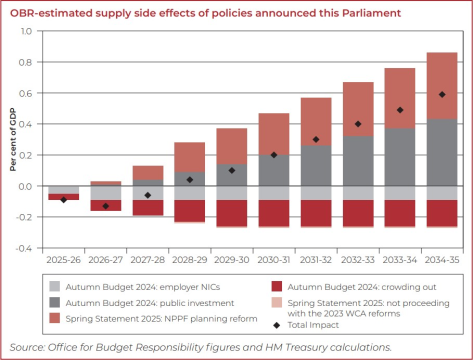
The government is taking action to drive long-term growth. Decisions taken across this Parliament, including planning reform, planned increases in public investment, and trade deals struck with other countries will raise output in the medium and longer term (see chart below). The OBR estimates that the combined supply-side effects of policy announced across the Parliament will raise the level of GDP by over 0.6% after 10 years.[footnote 24]
The government’s strategy has been welcomed by the IMF who noted that “the new spending plans are credible and growth-friendly” and “they are expected to provide an economic boost over the medium-term”, while striking “a good balance between supporting growth and safeguarding fiscal sustainability”.[footnote 25]
Policy action today strengthens the public finances now and for the long term
The government is acting now to deliver on its Charter commitment to improve sustainability over time and address long-term sustainability challenges. This includes, but is not limited to, areas examined by this year’s FRS: the public sector balance sheet, climate change and the pensions system. The OBR also published an update of its fiscal risk register, last updated in 2023.
To strengthen balance sheet management, the government moved to target net financial debt in its fiscal rules, broadening its measure of debt to capture all the financial assets and liabilities recognised in the national accounts, alongside introducing a Financial Transaction Control Framework to manage the stock of financial assets[footnote 26]
The government is going further at Budget 2025 by introducing a series of major, innovative reforms to balance sheet management. Together with the reforms introduced at Autumn Budget 2024, these contribute to ensuring long-term fiscal sustainability through a strong balance sheet and put the UK at the forefront of balance sheet management internationally:
- Balance Sheet Framework: The government has published a new framework which for the first time sets out a comprehensive approach to management of public sector assets, liabilities and entities. It will guide decisions on new transactions, use of private finance, and disposal of assets, alongside ensuring existing assets are well managed. It will underpin a Strategic Asset Review in support of a £1 billion asset efficiency target and a value for money review of maintenance of public sector assets, which will be conducted ahead of the next Spending Review.
- Guidance on Managing Government’s Implicit Liabilities: Implicit liabilities are private sector liabilities which government may be compelled, morally or economically, to meet in crisis events. For example, the £137 billion of public funds used to bail out banks after the financial crisis.[footnote 27] The guidance provides a toolkit to identify implicit liabilities and mitigate costs. This will ensure government takes the broadest possible view of costs that may fall to the taxpayer, reducing its fiscal exposure to economic shocks. This is supported by a £15 million fund, which will be allocated to priority projects to develop mitigations.
-
Financial Investment Report: This report was committed to as part of the change in government’s fiscal rules to improve the transparency of government’s financial investments. It provides a detailed overview of the government’s £203 billion portfolio of financial investments into the private sector and explores the value, performance and risk of the portfolio. The report also introduces the government’s public financial institutions and provides detailed analysis of their investments.
- Contingent Liability Approval Framework (CLAF): Contingent liabilities are commitments to use public funds if certain risks occur, and in most cases do not incur spending or fiscal impacts unless risks crystallise. The CLAF ensures that these commitments are well-designed and follow the same constraints as standard government spending, which will help to strengthen fiscal sustainability and credibility.
The government is undertaking a comprehensive programme of long-term reform across the pensions landscape which seeks to build a strong, fair and sustainable pension system that is fit for the future. In May, the final report of the Pensions Investment Review was published, setting out the government’s plans to drive investment and higher returns through large Defined Contribution schemes and reforming the Local Government Pension Scheme to improve sustainability and support regional growth[footnote 28]
Following this, the government announced the launch of the Pensions Commission in July[footnote 29]This will explore the long-term questions of sustainability and retirement outcomes and will build on the findings of the Pensions Investment Review and the measures in the Pension Schemes Bill, which focused on boosting investment and economic growth. Alongside this, the government also published ‘Finishing the job: Launching the Pensions Commission’, which is an assessment of the state of the Britain’s pensions landscape, including the progress made in the two decades since the first Pensions Commission (2002 to 2006)[footnote 30] It draws together evidence of the challenges facing current and future pensioners, which the new Pensions Commission will consider and make recommendations to address.
The government announced the launch of the third review of State Pension age in July[footnote 31] This fulfils the requirement in the Pensions Act 2014 for the government to regularly review State Pension age. This review will consider whether the rules around pensionable age are appropriate, based on the latest life expectancy data and other evidence.
On climate change, making Britain a clean energy superpower is one of the missions in the government’s Plan for Change. The government published its Carbon Budget and Growth Delivery Plan in October[footnote 32] This sets out how the UK will continue to reduce emissions in a way that lowers bills and secures good jobs, in line with the 2008 Climate Change Act. This included the government’s Response to the Climate Change Committee’s (CCC) 2025 Progress in Reducing Emissions Report, setting out the government’s plans to respond to the CCC’s recommendations[footnote 33]
The government’s Response to the CCC’s 2025 Adaptation Progress Report was also published alongside the delivery plan[footnote 34] This reiterates the government’s commitment to exploring how stronger adaptation objectives can be set to support an impactful fourth National Adaptation Programme, due in 2028.
The government is also taking action to address risks included on the OBR’s fiscal risk register:
- The FRS highlights that recent global shocks have resulted in greater uncertainty amid a shifting international landscape. The government recognises these challenges and has acted decisively to strengthen international partnerships and grow the economy, including through trade deals with the US, EU and India. These deals support the government’s core mission to grow the economy, back British jobs and put more money in people’s pockets.
- National security is the foundation of the government’s Plan for Change and that is why the government is committed to increasing spending on defence to 2.6% from 2027, funded from reductions in the Official Development Assistance (ODA) budget, with an ambition to reach 3% in the next Parliament when economic and fiscal conditions allow. The government also published the Strategic Defence Review (SDR) in June, which sets a path for the next decade and beyond to transform defence[footnote 35] The SDR will help make defence an engine for growth – boosting prosperity, jobs and security for working people across the UK.
- The government is providing record investment in the NHS, to support getting the elective waiting list down. Since July last year there has been a reduction in the waiting list of 230,000 and in the government’s first year an extra 5.2 million NHS appointments were delivered[footnote 36] The 10 Year Health Plan, published in July, lays the foundations for the future of healthcare in England, delivering on the three shifts from analogue to digital, hospital to community, and sickness to prevention[footnote 37] The plan will help secure the financial sustainability of the NHS and provide more transparency for patients and the public.
- The government is committed to ensuring welfare spending is sustainable. At the Budget, reforms to improve the administration of the system and reduce fraud and error saved £2 billion in 2030-31. The Timms Review of Personal Independence Payment and Milburn Review of young people and work are also considering how the welfare system can deliver greater value for money[footnote 38]
- In the face of long-term changes to gilt demand, including the risks highlighted in the pensions chapter of this year’s FRS, the government is committed to maintaining as diversified an investor base as possible, to enhance the resilience of the government’s financing programme. In keeping with this, HMT and the DMO will launch a consultation in January 2026 on expanding and deepening the Treasury bill market. As noted in the government’s Response to the 2023 FRS, the average duration to maturity of the total stock of gilts is significantly higher than other G7 countries and this significantly reduces the UK government’s exposure to refinancing risks.[footnote 39]
-
United Kingdom: Staff Concluding Statement of the 2025 Article IV Mission, International Monetary Fund, May 2025. ↩
-
Spending Review 2025, HM Treasury, June 2025; Budget 2025, HM Treasury, November 2025. ↩
-
Economic and Fiscal Outlook, Office for Budget Responsibility, October 2024. ↩
-
Fiscal Risks and Sustainability report, Office for Budget Responsibility, July 2025. ↩
-
Balance Sheet Framework, HM Treasury, November 2025; Guidance on managing government’s implicit liabilities, HM Treasury, November 2025. ↩
-
HMT calculations based on OBR long-term economic determinants, June 2025. ↩
-
Public sector finances (PSF) publication, public sector debt interest over total public sector expenditure (TME). For CDIDs: KX5Q over JW2P. ↩
-
How Can Europe Pay for Things That It Can’t Afford?, International Monetary Fund, November 2025. ↩
-
World Economic Outlook, International Monetary Fund, October 2025. Debt comparisons are made using general government gross debt. ↩
-
Fiscal Risks and Sustainability report, Office for Budget Responsibility, September 2024. ↩
-
10-year government bond yields, Bloomberg. ↩
-
Economic and Fiscal Outlook, Office for Budget Responsibility, November 2025. ↩
-
Government response to the 2023 Fiscal Risks and Sustainability Report, HM Treasury, November 2023; Fiscal Monitor, International Monetary Fund, October 2025. ↩
-
United Kingdom: 2025 Article IV Consultation-Press Release; Staff Report; and Statement by the Executive Director for United Kingdom (Annex V), International Monetary Fund, July 2025; National debt: it’s time for tough decisions, Lords Economic Affairs Committee, September 2024. ↩
-
Fiscal Monitor, International Monetary Fund, October 2025. This includes metrics such as general government gross debt (2024), general government net borrowing (2024), projected interest rate-growth differential (2025-30), gross financing need (2025), non-resident holding of general government debt (2024), net present value of pension spending change (2024-50), net present value of health care spending change (2024-50). ↩
-
Economic and Fiscal Outlook, Office for Budget Responsibility, November 2025. ↩
-
How Can Europe Pay for Things That It Can’t Afford?, International Monetary Fund, November 2025. ↩
-
United Kingdom: Staff Concluding Statement of the 2025 Article IV Mission, International Monetary Fund, May 2025.; Green Budget 2025, Institute for Fiscal Studies, October 2025; Black holes and consolidations, Resolution Foundation, November 2025; Economic Outlook: Stability First, National Institute of Economic and Social Research, Autumn 2025. ↩
-
Corporate Tax Roadmap, HM Treasury, October 2024. ↩
-
Charter for Budget Responsibility, HM Treasury, October 2024. ↩
-
2025 Article IV consultation, International Monetary Fund, July 2025. ↩
-
How Can Europe Pay for Things That It Can’t Afford?, International Monetary Fund, November 2025. ↩
-
Economic and Fiscal Outlook, Office for Budget Responsibility, November 2025. ↩
-
Economic and Fiscal Outlook, Office for Budget Responsibility, March 2025. ↩
-
United Kingdom: Staff Concluding Statement of the 2025 Article IV Mission, International Monetary Fund, May 2025. ↩
-
Financial Transaction Control Framework, HM Treasury, March 2025. ↩
-
Bank rescues of 2007-09: outcomes and cost, House of Commons, October 2018. ↩
-
Pensions Investment Review: Final Report, HM Treasury, Department for Work and Pensions and Ministry of Housing, Communities and Local Government, May 2025. ↩
-
The Pensions Commission, Department for Work and Pensions, July 2025. ↩
-
Finishing the job: Launching the Pensions Commission, Department for Work and Pensions, July 2025. ↩
-
Third State Pension age review, Department for Work and Pensions, July 2025. ↩
-
Carbon budget and growth delivery plan, Department for Energy Security and Net Zero, October 2025. ↩
-
Government response to the Climate Change Committee’s (CCC) 2025 progress report, Department for Energy Security and Net Zero, October 2025. ↩
-
Government response to the Climate Change Committee 2025 adaptation progress report, Department for Environment, Food & Rural Affairs, October 2025. ↩
-
The Strategic Defence Review 2025 - Making Britain Safer: secure at home, strong abroad, Ministry of Defence, June 2025. ↩
-
Consultant-led Referral to Treatment Waiting Times Data 2024-25, NHS England; Recovery of Elective Activity, NHS England. ↩
-
10 Year Health Plan for England: fit for the future, Department of Health and Social Care, July 2025. ↩
-
The Timms Review, Department for Work and Pensions, October 2025; Independent investigation to be launched to tackle rising youth inactivity, Department for Work and Pensions, November 2025. ↩
-
Government response to the 2023 Fiscal Risks and Sustainability Report, HM Treasury, November 2023. ↩