GDA Step 2 of the Holtec International SMR-300: Fundamental Assessment public summary
Published 31 March 2026
Applies to England and Wales

© Crown copyright 2026
This publication is licensed under the terms of the Open Government Licence v3.0 except where otherwise stated. To view this licence, visit nationalarchives.gov.uk/doc/open-government-licence/version/3 or write to the Information Policy Team, The National Archives, Kew, London TW9 4DU, or email: psi@nationalarchives.gov.uk.
Where we have identified any third party copyright information you will need to obtain permission from the copyright holders concerned.
This publication is available at https://www.gov.uk/government/publications/gda-step-2-of-the-holtec-smr-300-fundamental-assessment/gda-step-2-of-the-holtec-international-smr-300-fundamental-assessment-public-summary
Executive summary
The UK government’s recently published National Policy Statement for nuclear energy generation (EN-7) says that:
nuclear energy provides an abundant, safe and reliable source of low carbon energy that will play a vital role in ensuring a secure, stable and affordable energy system for the future. As a low carbon energy source, nuclear energy offers a cleaner source of energy that will contribute to net zero ambitions.
As regulators of the nuclear industry, the Environment Agency, Natural Resources Wales (NRW) and the Office for Nuclear Regulation (ONR) are working together to make sure that any new nuclear power stations built in the UK meet high standards of safety, security, environmental protection and waste management.
The generic design assessment (GDA) process allows the UK’s nuclear regulators to assess new nuclear power station designs at an early stage of the regulatory process and provide confidence that these new designs can be constructed, operated and decommissioned in the UK. Early assessment of the design allows us to identify any potential regulatory concerns or design issues and ask the reactor design company to address them. This will help to avoid potentially costly and time-consuming changes arising from resolving regulatory concerns that are identified after construction of the nuclear power station has begun.
Holtec International submitted its design for a small modular reactor (SMR), the Holtec SMR-160, to the UK government for entry into GDA in January 2023. The government decided that Holtec International was ready to enter GDA and asked the regulators (the Environment Agency, ONR and NRW) to begin the assessment process with Step 1 starting on 18 October 2023. Following a design change, the reactor was renamed the SMR-300 in January 2024.
The SMR-300 is a pressurised water reactor (PWR) which is capable of generating 320 megawatts (MW) of electricity.
Holtec International, also known as the Requesting Party (RP) for this GDA, is the company that is designing the reactor. Holtec Britain Limited, a wholly owned UK subsidiary of Holtec International, is managing the GDA process in the UK.
Holtec International specialises in nuclear power station design, engineering and manufacturing. Its SMR-300 was designed in the United States of America (USA). The company is proposing to build its first SMR-300 reactor units at a site in the USA. Holtec Britain Limited’s work includes the Sizewell B Dry Storage Project.
In 2025, Holtec International, EDF in the UK and Tritax announced plans to work together to construct SMR-300 SMRs at the former Cottam coal-fired power station in Nottinghamshire. This is to provide power to new, advanced data centres on the site.
We completed Step 1, ‘Initiation’, of the GDA in August 2024. We have now completed Step 2, ‘Fundamental Assessment’ of the GDA and concluded that there are no fundamental environmental protection shortfalls in the design of the SMR-300 at this stage of assessment. We have not been asked to carry out Step 3 of GDA, ‘Detailed Assessment’, and so this conclusion is without prejudice to us identifying further regulatory concerns and shortfalls during a future detailed assessment, which could be carried out in an extension of GDA or in site-specific pre-application and permitting activities.
This document summarises our main report and provides background on the GDA process, consents, our public engagement and next steps.
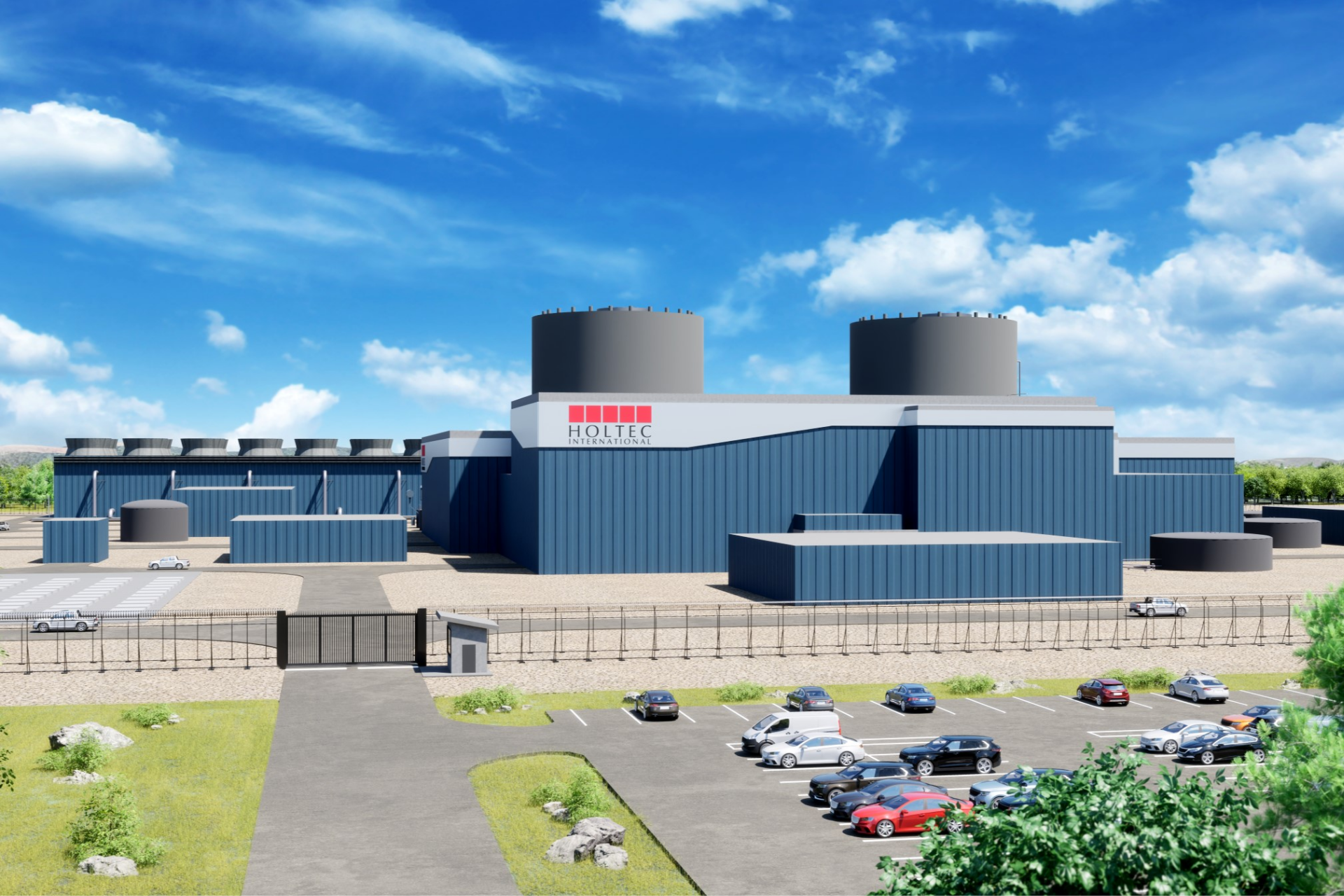
Illustration of SMR-300. Copyright Holtec Britain.
1. New nuclear power stations – government policy
UK energy policy, including the use of nuclear power, is a matter for government. The previous government’s policy was set out in the energy white papers that it published, including ‘Powering our Net Zero Future’ in 2020. This set out the need for nuclear power, among other measures, to help the UK achieve net zero by 2050.
In 2022, the then government published the British energy security strategy. This states an aim that by 2050, up to 24 gigawatts or a quarter of the electricity used in Great Britain will be from nuclear. This ambition was reinforced through the Civil nuclear roadmap, published in January 2024, which sets out the vision for the sector and important enabling policies to achieve this.
The proposed National Policy Statement for nuclear energy generation (EN-7) was consulted on by the current government in February 2025. The policy came into force on 18 December 2025. It states that:
nuclear energy provides an abundant, safe and reliable source of low carbon energy that will play a vital role in ensuring a secure, stable and affordable energy system for the future. As a low carbon energy source, nuclear energy offers a cleaner source of energy that will contribute to net zero ambitions.
In November 2025, the Prime Minister published a strategic steer to the nuclear sector, which set out the government’s priorities for modernising and expanding the UK’s civil and defence nuclear programmes.
2. New nuclear power stations – the environment agencies
The Environment Agency has published its own strategy EA2030 change for a better environment to guide its activities.
The 5-year strategy (EA2030) sets out how the Environment Agency will fulfil its responsibilities over the next 5 years against its long-term goals for England. These are:
- healthy air, land and water supporting nature’s recovery
- sustainable growth
- a nation resilient to climate change
NRW has published a corporate plan to 2030, with a vision of nature and people thriving together. This will be achieved through collective action towards:
- nature’s recovery
- resilience to climate change
- minimising pollution
As enabling regulators, we will continue to engage with the government, regulatory partners, industry and others on nuclear energy matters, including policies, proposals and projects. We will make sure that people and the environment are properly protected.
Our processes align with the goals in EA2030 because they help make sure that new nuclear power stations are designed, constructed and operated in ways that would minimise waste, consider sustainability and properly protect the environment.
3. Regulating nuclear power stations
The Environment Agency and NRW regulate the potential impacts of nuclear sites in England and Wales on people and the environment. We do this by issuing environmental permits which cover activities required for:
- preparing the site and constructing the power station
- operating and decommissioning the power station
The Environment Agency and NRW also regulate other new and existing nuclear facilities in England and Wales. These can include fuel manufacturing sites, uranium enrichment plants, and waste management and disposal facilities.
We work closely with ONR, which regulates nuclear safety, conventional health and safety, security and safeguards at nuclear licensed sites.
Our process for assessing new power station designs and permitting new nuclear sites has several possible stages, including early engagement, GDA and environmental permitting.
3.1 Generic design assessment (GDA)
GDA is where we assess the environmental protection aspects of a power station design that would be relevant to any site. This is based on a ‘generic site’ with characteristics defined by the RP. Later, when we assess applications for environmental permits, we use the actual characteristics of the specific site where the developer proposes building the power station. The site-specific characteristics may be different from those of the GDA generic site.
The Environment Agency and ONR developed the GDA process. NRW participates in GDA where the company designing the nuclear power station advises that its design might be proposed for construction in Wales.
The GDA of a new design is not a mandatory requirement. Developers of nuclear power stations may choose to apply to the government to enter GDA to get an early view from regulators on their design. This helps to reduce risks to the developer over an entire project and enables the regulators to identify regulatory concerns and issues early so that these can be resolved before construction begins. The government asks the regulators to start a GDA if it decides that the nuclear power station design company is ready to enter GDA.
We’ve designed GDA as a flexible process with up to 3 steps. The assessment becomes increasingly more detailed with each step. At the end of each step, we will issue statements and reports about our findings. If the reactor design company still has significant issues to resolve after we have completed our planned assessments, we can add further steps to the process for resolving those remaining issues.
Step 1: Initiation
This is the preparatory part of the design assessment process when we make agreements with the reactor design company and agree the scope and the information it needs to provide. As part of this step, we carry out a readiness review and confirm that the reactor design company has put in place the arrangements and resources needed for the GDA process.
Holtec International completed Step 1 in August 2024.
Step 2: Fundamental Assessment
This is when the first technical assessments begin. It focuses on the environmental protection features of the design. The regulators will issue a Step 2 Statement at the end of the step. An RP may wish to stop the GDA at the end of Step 2 or proceed to Step 3.
This is the step that we have just completed for Holtec International. The company applied for a 2-step GDA and no detailed assessment of the SMR-300 design has been requested. Options for carrying out detailed assessment are available if requested by Holtec International.
Step 3: Detailed Assessment
This is a detailed assessment of the environment case. Where a full GDA is being carried out, we will run a public consultation, where we ask for comments on our assessment in Step 3. We consider all relevant responses before completing our assessments and making our decision on whether to issue a Statement of Design Acceptability (SoDA). If a full Step 3 is not being carried out, we will issue a Step 3 Statement.
Where a full Step 3 is being carried out (including public consultation), we will publish a decision document that sets out our decision on the design. Potential outcomes include:
Issuing a Statement of Design Acceptability (SoDA)
We will issue a SoDA if the design is acceptable. This means we:
- have not found any GDA Issues
- consider that the design is capable of being constructed, operated and decommissioned in a way that complies with our regulatory requirements and expectations
- believe that people and the environment will be properly protected
Issuing an interim Statement of Design Acceptability (iSoDA)
We will issue an iSoDA if we are broadly content with the environmental protection aspects, but there are still issues to be resolved and the RP has provided credible plans for addressing them. Normally, once it addresses these issues, we will issue a full SoDA.
Not issuing a SoDA or iSoDA
We will not issue a SoDA or iSoDA if the design is unsuitable and would not provide the right levels of environmental protection. This could also be because there are GDA Issues but no credible plan to resolve them. We would issue a Step 3 Statement if this was the case. Also, we issue a Step 3 Statement if we have not carried out a public consultation.
Our GDA guidance for the reactor design company sets out in detail the process that we follow.
Completed GDAs
We have carried out GDA on these reactor designs:
- EDF-Areva’s UK EPR, completed a 3-step GDA in December 2012, and there are 2 reactors currently under construction at Hinkley Point C in Somerset and 2 at Sizewell C in Suffolk
- Westinghouse’s AP1000, completed a 3-step GDA in March 2017
- Hitachi-GE’s Advanced Boiling Water Reactor (ABWR), completed a 3-step GDA in December 2017
- General Nuclear System Limited’s UK HPR1000, completed a 3-step GDA in February 2022
- GE Vernova Hitachi’s BWRX-300, completed a 2-step GDA in December 2025
- Holtec International’s SMR-300, completed a 2-step GDA in March 2026
Current GDAs
We are currently assessing the following reactor designs:
- Rolls-Royce SMR Limited’s small modular reactor (3-step GDA)
Early engagement process
The regulators have introduced a new additional process that enables early engagement with reactor vendors. We are engaging with several companies in this process:
- Last Energy (Preliminary Design Review completed July 2025)
- Moltex Flex
- Newcleo
- TerraPower
- X-energy
3.2 Environmental permits
In order to build and operate a new power station at a specific site, a company must apply for environmental permits from the Environment Agency in England or NRW if the site is in Wales.
These permits cover site investigation and preparation, construction works and associated developments such as workers’ accommodation, operation and decommissioning.
Site preparation and construction-related permits include activities such as:
- drilling boreholes
- abstracting groundwater (such as from dewatering of excavations)
- discharging effluents (including groundwater and concrete batching plant waters)
- using mobile diesel electricity generators
- flood risk activity permits (for work near rivers and flood defence assets)
Operational permits are needed to:
- dispose of and discharge radioactive waste
- operate standby power supply systems using diesel generators
- discharge returned abstracted water (from the cooling water system and fish recovery and returns system) and other liquid trade effluents (including treated sewage effluent) to the sea or inland water body
If we receive permit applications, we will decide whether or not to grant the permits and, if so, what conditions we should apply. When making decisions about site-specific permit applications, we will take account of matters relevant to the specific site as well as the GDA for the design proposed for the site.
We will also carry out a public consultation before deciding whether to grant permits for a specific site. We will make our decision once we have considered the comments we receive in the consultation. We may also receive applications for changes (variations) to the environmental permits and, where appropriate, we will consult on these.
4. The SMR-300 Small Modular Reactor
There are currently over 400 nuclear reactors operating around the world. One of the most common types is the PWR, with 305 PWRs operating worldwide. There are also 56 PWRs under construction, 4 PWRs not generating currently and 74 in permanent shutdown.
There are a range of sizes and uses for PWRs, including power generation and marine propulsion.
The SMR-300 is a PWR which is capable of generating 320 MW of electricity (MWe).
The SMR-300 is still being designed and is therefore not yet in operation. The United States Nuclear Regulatory Commission began pre-licensing interactions with Holtec International initially on the SMR-160 design and currently on the SMR-300 design. Holtec International plans to construct the first SMR-300 at its Palisades site in Michigan, USA.
In the UK, Holtec International, EDF in the UK and Tritax announced plans to work together to construct SMR-300 SMRs at the former Cottam coal-fired power station in Nottinghamshire.
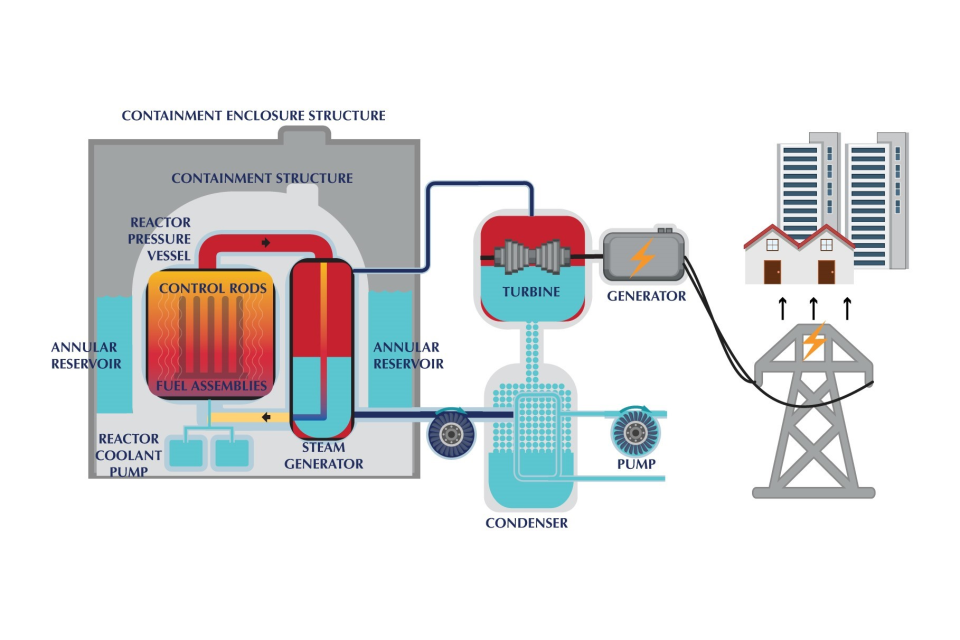
Figure 1: An illustration of the reactor
Copyright Holtec Britain.
4.1 How does a PWR reactor work?
When a uranium-235 atom absorbs a neutron, it can split into 2 or more smaller atoms, release energy and emit several neutrons. This is the fission process. In a reactor, these fissions happen in a controlled process called a chain reaction, which provides a continuous heat source.
The SMR-300 is a PWR with a single steam generator, that provides energy from the fission heat from low-enriched uranium fuel. Nuclear fission occurs when atoms are split apart, which releases energy and heats pressurised water which is carried through the coolant loops to the steam generator. Once inside the steam generator, the heat boils the water in a secondary loop, creating steam. This steam is then used to run the turbine, powering the generator.
The steam then enters the condenser, where it undergoes condensation and transforms back into water. This resulting water is then pumped out of the condenser and returns to the steam generator to be heated again.
There is a third water circuit which is used to cool the condenser of the turbine.
In the UK existing nuclear power stations are in coastal areas (except Trawsfynydd). Sea water is used in the third water circuit, but this can be replaced by water from rivers, lakes (as at Trawsfynydd) or estuaries. Cooling towers can also be used.
The SMR-300 SMR has features in common with other types of nuclear power station including:
- a spent (used) fuel storage pond
- spent fuel dry store
- water treatment systems for maintaining the chemistry of the water circuit
- radioactive waste treatment and storage facilities
- back-up systems for providing power in the event of loss of electrical supply from the grid
Find out more on the Holtec Britain website.
5. About Step 1 (Initiation) and our decision
We began GDA on the SMR-300 SMR in October 2023. We completed Step 1, the initiation stage and published our report on 1 August 2024.
6. About Step 2 (Fundamental Assessment) and our decision
We began Step 2 in August 2024. We have now completed Step 2, the Fundamental Assessment stage and published our Step 2 Statement and our assessment report.
The objectives of Step 2 were:
- for the Environment Agency to carry out an assessment to identify any fundamental environmental protection shortfalls in the design
- for the RP to complete the submissions needed for Step 2 (and Step 3, if necessary)
- to confirm if the RP has understood the regulatory approach used in the UK and whether the design can comply with UK regulations and Environment Agency guidance
- to identify the additional work the RP may need to carry out as part of a future assessment stage
During Step 2, we continued the joint assessment with ONR of the GDA project management arrangements to give us confidence in the quality of the GDA submissions.
With the RP we:
- provided feedback on the content and structure of its submissions
- raised Regulatory Queries (RQ) where we needed clarification on content
The RP captured these clarifications in the safety, security and environment case (SSEC), which is made up of the preliminary safety report (PSR), preliminary environmental report (PER) and generic security report uploaded to the RP’s GDA website in August 2025.
Overall, the SMR-300 design appears to be capable of meeting relevant environmental regulatory requirements, provided that the RP delivers on its commitments and resolves identified gaps post GDA and at the site-specific permitting stage. While the design is still evolving, the frameworks and approaches presented give us confidence that environmental protection objectives can be achieved. Based on our assessment across all topic areas, we have found no fundamental environmental protection shortfalls at this stage in the development of the SMR-300, that could prevent the design from being acceptable for future deployment in England or Wales.
A summary of our views on the 7 assessment topics for the environment following our fundamental assessment is as follows.
6.1 Management arrangements and quality assurance
The RP has established robust governance and quality management systems, ensuring control over design development and GDA submissions. We are satisfied these arrangements are adequate for this stage of GDA.
6.2 Best available techniques (BAT) and radioactive waste management arrangements
The RP’s BAT approach and radioactive waste management strategy meet our expectations for Step 2. We are satisfied that the RP has a systematic optimisation process and that the structure of the demonstration of BAT provides a suitable basis to be taken forward by any future developer. While some evidence gaps remain due to design immaturity, the RP has committed to addressing these through GDA commitments and future evidence.
6.3 Solid waste, spent fuel and disposability
The RP has presented sufficient information about the management of solid wastes and spent fuel to satisfy the requirements of Step 2 of GDA, noting that further work is required at the pre-application and site-specific permitting stage, to provide a full disposability case. We recommend continued consideration of decommissioning throughout the detailed design work to ensure there is sufficient information for any future permit application.
6.4 Discharges of liquid and gaseous radioactive waste
Calculation of discharges and proposed limits for gaseous and liquid discharges presented in GDA is thorough, systematic and appropriate for this stage, subject to refinement as the design matures. GDA commitments and future evidence are in place to address aspects that will need to be reviewed when reactor-specific design values and site-specific considerations are available.
6.5 Sampling and monitoring
Sampling and monitoring provision is still in the early stages of development. However, we are satisfied that the RP understands the requirements associated with sampling and monitoring and that its considerations are adequate for this stage of GDA.
6.6 Generic site and radiological impact assessment
Methods presented for calculating dose impacts for members of the public and wildlife are adequate for this stage of GDA and we found no fundamental shortfalls in the RP’s submissions. The initial assessment undertaken using the preliminary discharge limits for a single SMR-300 unit resulted in doses to people and dose rates to wildlife that were all below the relevant dose limits and source and site dose constraints. We are satisfied with the RP’s response to RQ-02464, and our assessment findings are not changed by doubling the doses to the public and wildlife.
6.7 Other environmental regulations
The twin-unit SMR-300 will require 4 diesel generators and one auxiliary boiler and will therefore likely require an environmental permit under the Medium Combustion Plant Directive (MCPD) as the thermal input is above one MW thermal (MWth) and below 50 MWth. Further specification of conventional environmental systems, chemical inventories and combustion plant details will be required at the site-specific permitting stage.
6.8 Conclusion
We have not been asked to carry out Step 3 of GDA, Detailed Assessment, and so these conclusions are subject to carrying out a detailed assessment and any future developer gaining the necessary site-specific permissions. The detailed assessment work would include the further work identified in the RP’s commitments, assumptions and requirements register. Our conclusions are without prejudice to identifying any further regulatory concerns and shortfalls during any future detailed assessment. Our Step 2 Fundamental Assessment Report provides more detail.
7. Permissions and consents for a nuclear power station
Any company that wants to build and operate a new nuclear power station must obtain several site-specific permissions. These include:
- environmental permits from the Environment Agency or NRW
- a nuclear site licence and relevant consents from ONR
- planning permissions from the Planning Inspectorate
In September 2025, Holtec International announced it would work together with EDF in the UK and Tritax to develop SMR-300 SMRs at the former Cottam coal-fired power station site in Nottinghamshire. Currently, no developers have applied for environmental permits to use the SMR-300 in the UK.
7.1 Environmental permits
We provide information on these in section 3.2.
7.2 Nuclear site licence
ONR regulates the nuclear safety, conventional health and safety, security and safeguards at nuclear sites. Any organisation that wants to carry out nuclear activities must apply to ONR for, and obtain, a nuclear site licence. It must do this before it starts building a new nuclear power station. Granting a nuclear site licence is a significant step, but, on its own, it does not give an organisation permission to start nuclear-related construction. For that, it must get further regulatory permission from ONR.
7.2 Planning permission
A developer using the SMR-300 SMR needs a Development Consent Order from the Secretary of State for the Department for Energy Security and Net Zero. The Secretary of State makes a decision having received recommendations from the Planning Inspectorate.
The environment agencies are consultees in this process and provide advice throughout.
7.3 Electricity generation licence
An operator would need an electricity generation licence from Ofgem, the regulator for the gas and electricity markets.
7.4 Regulatory justification
Regulatory justification is required for any process involving radiation exposure. In essence, regulatory justification requires that the net benefits of that process exceed health detriments. This is not a site-specific requirement but is carried out for new nuclear power station designs. The justifying authority for new nuclear power stations is the Secretary of State for the Department for Environment, Food and Rural Affairs (Defra). No application for regulatory justification has yet been made for the SMR-300 SMR.
7.5 Other permissions
An operator will also need a government approved Funded Decommissioning and Waste Management Plan before nuclear construction begins at its site. This is to ensure that there are funds to decommission and dispose of the waste from a site at the end of its life.
Other regulatory permissions can also be required depending on the location and local environment of a site and a developer’s proposals. This could include marine licences from the Marine Management Organisation (England), species licences from Natural England (England) and the equivalent permissions in Wales from NRW.
8. Public and stakeholder engagement for this GDA
We designed our GDA process to be open and transparent.
We expect nuclear reactor design companies to set up a GDA website, publish the information they send to us as part of the assessment process (its safety, security and environmental submissions), and update it as new information becomes available.
We ask the company to set up and manage a public comments process so that stakeholders and the public can look at the published information, provide comments and receive a response from the company to relevant questions.
Regulators see the questions and the responses, and, where relevant, use these to help inform our assessments. Comments can also be made to the nuclear regulators’ Joint Programme Office.
Our process guidance for public engagement is shared and discussed with the company and its communications team.
8.1 Public comments process review
Holtec Britain set up an accessible GDA website and comments process, published design information on it and updated it as new information became available.
Holtec International (the RP) and its UK subsidiary Holtec Britain Limited were asked to promote the website, the documents and comments process when it was launched (at the start of Step 2 on 1 August 2024) and throughout Step 2. We noted that publicity of the process by the company was limited.
Holtec Britain was required to respond to questions and comments about the design. The comments process closed on 14 November 2025 after receiving 9 comments.
We considered any comments received up to 14 November 2025 and the RP’s responses to those comments during the Step 2 assessments. We noted that several of the comments related to matters not within the remit of our GDA. The comments received covered:
- technical queries on aspects of the design, including heat removal systems, the performance of natural circulation, construction regulation principles and the use of a combined steam generator and pressuriser in the design
- the overall design of the SMR-300
- future deployment of SMRs in the UK
- security
- a request for documents which were already published on the website
Two of the comments related to environmental matters. One asked about radioactive waste management arrangements and the other about the potential impact of the reactor on protected species. The second comment is outside the scope of GDA and would be considered as part of a site-specific assessment prior to or during the application for an environmental permit.
None of the comments directly impacted our assessment of the SMR-300 or our GDA process.
As part of their joint communications plan, the nuclear regulators publicised Step 2 of GDA and the comments process being available through the media and directly to stakeholders.
Information about GDA and the comments process is widely available on:
- the joint regulators’ webpage
- the ‘get involved’ webpage
- the Environment Agency webpage on assessing reactor designs for new nuclear power stations
- ONR’s webpage on new reactors
- NRW’s webpage on how it regulates the nuclear industry
8.2 Get involved
This GDA has now ended. You can continue to get involved by:
- taking part in engagement and consultations should this SMR-300 SMR design be taken forward by a developer at a site in England or Wales, such as Cottam in Nottinghamshire
- talking to us at public, stakeholder and industry events
- engaging in our other new nuclear build work, including any other GDAs
The regulators published an approach to engagement for this GDA on their joint webpages.
9. GDA timetable and next steps
The RP proposed a 2-step GDA taking 24 months.
Step 1 (Initiation) started on 18 October 2023 and finished on 1 August 2024.
Step 2 (Fundamental Assessment) started on 1 August 2024 and ended on 31 March 2026.
In addition to this public summary, we have published a Step 2 Statement and a Fundamental Assessment report.
We have not been asked to carry out Step 3 of GDA. Currently this is the end of the GDA process for the SMR-300 SMR.
10. Contact us
You can feed back on this document or our work on assessing this design.
Environment Agency
Email: nuclear@environment-agency.gov.uk