Country bulletin, Ethiopia: security situation in Tigray, October 2026 (accessible)
Updated 17 November 2026

© Crown copyright 2026
This publication is licensed under the terms of the Open Government Licence v3.0 except where otherwise stated. To view this licence, visit nationalarchives.gov.uk/doc/open-government-licence/version/3 or write to the Information Policy Team, The National Archives, Kew, London TW9 4DU, or email: psi@nationalarchives.gov.uk.
Where we have identified any third party copyright information you will need to obtain permission from the copyright holders concerned.
This publication is available at https://www.gov.uk/government/publications/ethiopia-country-policy-and-information-notes/country-bulletin-ethiopia-security-situation-in-tigray-october-2026-accessible
Reference: ETH-001-10-26
October 2026
Summary: Security situation in Tigray following the resumption of conflict
Summary
A breakdown in law and order or uncertain security situations do not in themselves give rise to a well-founded fear of persecution for a Refugee Convention reason.
In the absence of a link to one of the 5 Refugee Convention grounds necessary to be recognised as a refugee, the question to address is whether the person will face a real risk of serious harm in order to qualify for Humanitarian Protection (HP).
In the case of Elgafaji (C-465/07), the Grand Chamber of the European Court of Justice (ECJ) set out that
‘– the existence of a serious and individual threat to the life or person of an applicant for subsidiary protection is not subject to the condition that that applicant adduce evidence that he is specifically targeted by reason of factors particular to his personal circumstances;
‘– the existence of such a threat can exceptionally be considered to be established where the degree of indiscriminate violence characterising the armed conflict taking place … reaches such a high level that substantial grounds are shown for believing that a civilian, returned to the relevant country or, as the case may be, to the relevant region, would, solely on account of his presence on the territory of that country or region, face a real risk of being subject to that threat.’ (para 43).
Whilst a country guidance case on Iraq, in QD (Iraq) v Secretary of State for the Home Department [2009] EWCA Civ 620 (24 June 2009) the Court of Appeal held that ‘We would accept UNHCR’s submission that, for the purposes of article 15(c), there is no requirement that the armed conflict itself must be exceptional. What is, however, required is an intensity of indiscriminate violence – which will self-evidently not characterise every such situation – great enough to meet the test spelt out by the ECJ [in Elgafaji, above].’ (para 36).
Tigray experienced a major armed conflict from 2020 to 2022, which formally ended with the Pretoria Agreement. However, continuing disputes over the Agreement’s implementation, divisions within the Tigray People’s Liberation Front (TPLF), and tensions involving the federal government and TPLF contributed to renewed violence in early 2026, with fighting intensifying in August. In October 2026, the Ethiopian National Defence Force (ENDF) and the Tigray Peace Force (TPF) recaptured Mekelle from the TPLF and subsequently gained control of much of Tigray. A new caretaker regional administration was installed on 16 October 2026 (see Security development).
Although ENDF and TPF appeared to control most of Tigray, territorial control remained fluid and contested in some areas. Reporting in late October 2026 indicated that fighting continued in central Tigray, including around Rama and along the Abiy Addi axis, and in north-western Tigray, particularly north-west of Shire. Earlier reporting also placed TPLF forces in rural mountainous areas around Chila after withdrawing from Aksum (see Territorial control, Maps of territorial control and Fighting and geographic spread of conflict).
Between 1 January and 21 October 2026, the Armed Conflict Location and Events Data Project (ACLED) recorded 212 incidents of political violence and 253 combined civilian and combatant fatalities. A marked deterioration occurred in September, when incidents rose nearly fourfold from 15 in August to 59 events and fatalities surged from 17 to 115. During the same period ACLED’s civilian targeting filter identified 53 events and 19 fatalities. Civilian targeting captures events classified under other event types—such as explosions/remote violence and riots—where civilians were the main or only target (see Conflict dynamics, incidents and fatalities, Violence against civilians and ACLED ‘civilian targeting’ filter).
Even allowing for the spike in both total fatalities and civilian fatalities in September and October 2026, the levels of indiscriminate violence involving civilians are so low, relative to the size of the respective populations, that it cannot be said that the levels:
a. reach such a high level that substantial grounds are shown for believing that a civilian faces a real risk of serious harm simply by being present; and/or
b. are ‘great enough to meet the test spelt out by the ECJ’ [in Elgafaji].
Therefore, there are not substantial grounds for believing there is a real risk of serious harm in Tigray because of a serious and individual threat to a civilian’s life or person by reason of indiscriminate violence in a situation of international or internal armed conflict, as defined in paragraphs 339C and 339CA(iv) of the Immigration Rules. The onus is on the person to demonstrate otherwise.
Even where there is not a real risk of serious harm by reason of indiscriminate violence in a situation of armed conflict in general, a person may still face a real risk of serious harm if they are able to show that there are specific reasons over and above simply being a civilian affected by indiscriminate violence.
However, paragraphs 339C and 339CA(iv) of the Immigration Rules only apply to civilians who must be non-combatants. This could include former combatants who have genuinely and permanently renounced armed activity.
Decision makers must consider each case on its facts.
Country information
About this bulletin
This standalone bulletin contains information regarding the security situation in Tigray following resumption of conflict in early 2026 between the Tigray People’s Liberation Front (TPLF)/Tigray Defence Forces (TDF) and their respective allies and the impact of fighting on civilians. It provides relevant country-of-origin information (COI) and an assessment on whether there are substantial grounds for believing there is a real risk of serious harm because there exists a serious and individual threat to a civilian’s life or person by reason of indiscriminate violence in a situation of international or internal armed conflict, as defined in paragraphs 339C and 339CA(iv) of the Immigration Rules.
The COI provides the basis for the assessment. Decision makers must use relevant COI as the evidential basis for decisions.
The cut-off date for COI included in this bulletin is 28 October 2026.
For details on how CPIT makes its assessments, gathers and presents COI, its research methodology and disclaimers and explainers on coverage, source selection, maps, translations and the use of Artificial Intelligence (AI) in developing CPIT products, see About country policy and information notes.
1. Background to the current conflict
1.1.1 According to Tesfa and Van Reisen 2025, the TPLF became increasingly fragmented following the 2022 Pretoria Agreement and its exclusion from federal political processes, including the National Electoral Board of Ethiopia’s (NEBE) rejection of the party’s registration. The authors noted that competing factions emerged within the TPLF as leaders sought to maintain political relevance and influence. One faction, led by Debretsion Gebremichael, the TPLF chairman and former president of Tigray, and Fetlework Gebregziabher, the party’s deputy chairperson, was described as pursuing closer alignment with Eritrean President Isaias Afwerki as a means of increasing leverage over the federal government. In contrast, another faction, associated with figures such as Alem Gebrewahid, was reported to favour re-engagement with Ethiopia’s political system and reintegration within the federal framework. The source suggested that these divisions reflected broader disagreements within the TPLF regarding the region’s future political direction and relations with both Addis Ababa and Eritrea.[footnote 1]
1.1.2 On 14 February 2025, the Ethiopian News Agency (ENA), Ethiopia’s state-owned news agency, reporting on political, economic, social and security developments and publishing official government statements and announcements[footnote 2], reported that the National Election Board of Ethiopia (NEBE) had suspended the Tigray People’s Liberation Front (TPLF) from all political activities for three months. According to NEBE the suspension was due to the party’s failure to hold a general assembly, approve its bylaws and elect its leadership within six months of its registration under “special circumstances” in August 2024, despite repeated notifications from the Board. NEBE stated the suspension would be lifted if the TPLF remedied the violations within three months but warned that the party’s registration would otherwise be revoked.[footnote 3]
1.1.3 A February 2026 analysis by the International Crisis Group, an independent, non-profit organisation that conducts field-based research and policy analysis to prevent and resolve violent conflict worldwide (ICG February 2026)[footnote 4], noted that divisions within the Tigray People’s Liberation Front (TPLF) deepened following the 2022 Pretoria Agreement. A faction led by Debretsion Gebremichael opposed the agreement and criticised Getachew Reda and the Tigray Interim Regional Administration (TIRA) over post-war recovery and the implementation of key provisions, including the continued Amhara control of Western Tigray (Welkait) and the return of displaced Tigrayans. Competition over economic resources, including gold mining and control of the Endowment Fund for the Rehabilitation of Tigray (EFFORT), also contributed to tensions. The split intensified after an August 2024 TPLF congress sought to remove Getachew from the party and TIRA, while the federal government continued to support him. In January 2025, the Tigray Defence Forces (TDF) reportedly sided with Debretsion’s faction, further weakening Getachew’s position. In March 2025, Getachew and General Tsadkan Gebretensae left Tigray for Addis Ababa, accusing their TPLF opponents of mounting a coup.[footnote 5]
1.1.4 A March 2026 report by the Rift Valley Institute (RVI), an independent, non-profit research and educational organization whose work focuses on eastern and central Africa[footnote 6] (RVI March 2026 report) observed:
‘Within Tigray, the most significant development in 2025 had been a leadership change at the interim administration that was designed to heal internal divisions and improve federal relations. Although the [Cessation of Hostilities Agreement] CoHA did not specify a duration, the understanding was that the IRA would be in place for two years until regional elections, setting March 2025 as the presumed end of its mandate. Recognizing that key tasks were unfinished … the federal parliament on 1 April 2025 amended the law to extend the interim administration by up to one year. This was immediately applied to Tigray and the IRA’s mandate was extended to March 2026…
‘Along with the extension came a major reshuffle. On 8 April [2025], Abiy replaced Getachew with Tadesse as president of the IRA. The former TDF supremo who had been serving as an IRA vice-president, was seen as a relatively neutral, unifying figure above TPLF’s factional fray. In fact, his nomination to lead the IRA had been quietly supported by TPLF as a solution to remove Getachew without violence … Tadesse immediately assumed eight commitments upon taking office, including to facilitate IDP returns, complete disarmament, participate in the national dialogue, cease any unconstitutional foreign relations (presumed to refer to growing TPLF-Eritrea ties), lay groundwork for elections and uphold the rule of law.’[footnote 7]
1.1.5 The Stiftung Wissenschaft und Politik - German Institute for International and Security Affairs (SWP) is an independent German research institute that provides policy analysis on global political and security developments.[footnote 8] In a July 2026 article SWP stated that tensions between the Tigray People’s Liberation Front (TPLF) and the Ethiopian federal government stem primarily from unresolved issues arising from the implementation of the Pretoria Agreement. These include disputes over the status of territories occupied during the war, particularly areas claimed by both Tigray and the neighbouring Amhara region; the return of large numbers of internally displaced persons; the stalled demobilisation and reintegration of Tigray fighters; and the absence of agreed political arrangements to reintegrate Tigray into Ethiopia’s constitutional and electoral framework. The article also notes growing disagreements over the legitimacy and governance of the Tigray Interim Regional Administration (TIRA), the legal status of the TPLF, and competing efforts by both Addis Ababa and Tigrayan political actors to shape the region’s future political order. As a result, the region remains in what the author describes as a “grey zone” between war and peace, characterised by political confrontation, sporadic armed clashes, and mutual accusations between the parties.[footnote 9]
1.1.6 International IDEA, an intergovernmental organisation that produces research and analysis on democracy, elections, governance, and constitutional processes, and provides technical support for democratic institutions worldwide[footnote 10] reported on its Global State of Democracy Initiative Ethiopia webpage:
‘On 8 April, Prime Minister Abiy Ahmed extended the mandate of Lieutenant-General Tadesse Werede as head of the Tigray Interim Regional Administration by one year. The Tigray People’s Liberation Front (TPLF) rejected the move the next day as a unilateral breach of the 2022 Pretoria Agreement, which ended the two-year war in northern Ethiopia. On 19 April, the TPLF announced it would reinstate the region’s pre-war government, suspended under the deal, and accused the federal government of repeated violations. Tadesse, the region’s interim president, countered that reinstating the assembly would itself breach the deal, exposing a party rift. On 29 April, the TPLF urged Tadesse to cede power. The standoff has frozen the transition: the 1 June elections, meant to replace the interim administration with an elected Tigray government, are not expected to proceed there, freezing what Pretoria made temporary. The federal government has amassed forces along the region’s borders and restricted fuel and fiscal transfers, though international commentators noted these shortages, and the polls, may temper escalation.’[footnote 11]
1.1.7 Africa Confidential, an independent Africa-focused publication that provides political, security and economic reporting and analysis on developments across the continent[footnote 12] reported on 8 May 2026:
‘… [A]n emboldened Tigray People’s Liberation Front (TPLF) is stepping up its struggle with Ethiopia’s Prime Minister Abiy Ahmed. Angry at Addis Ababa’s unilateral one-year extension of the term of Tigray’s interim leader Lieutenant General Tadesse Werede, the TPLF’s Central Committee has restored the regional legislative council deemed unconstitutional by the federal government in the run-up to the Tigray-Addis Ababa war in 2020.
‘The TPLF now regards the 2022 Pretoria peace accord as defunct. On 5 May, the restored legislative council elected TPLF chairman Debretsion Gebremichael as regional president, Kiros Hagos as speaker and Mihret Berhe as deputy speaker. Yet Addis Ababa has responded carefully, suggesting that despite the eroding Pretoria peace deal, it doesn’t favour immediate military escalation. The TPLF may have been confident of that when it made its provocative move …
‘The TPLF’s formal objection to extending Tadesse’s mandate was the absence of consultation stipulated by the Pretoria Agreement. Addis Ababa’s decision to sidestep talks with TPLF follows a pattern of denying the party legitimacy, following the banning of the party by the National Election Board of Ethiopia in May 2025 for non-compliance with regulatory requirements.
‘From TPLF’s perspective, approving Tadesse’s extension would confirm Addis Ababa’s authority over the region, stripping away any residual claim to Tigrayan self-administration, a pillar of the party’s identity.
‘Rejecting Tadesse’s extension, the TPLF described a pattern of violations, such as withholding budgetary transfers, fuel restrictions, and failure to return its territories. The party characterised it as a final rupture in the Pretoria deal.’[footnote 13]
1.1.8 On 14 May 2025, ENA reported that NEBE had revoked the legal status of the TPLF. NEBE stated the TPLF had failed to hold a general assembly, approve its bylaws, and elect its leadership, despite repeated notices to comply. The Board further stated that the party had continued to reject the legitimacy of its new registration and had not addressed the issues identified during the suspension period. As a result, NEBE revoked the party’s legal status and stated that the consequences provided for under the electoral law would apply to the party and its leadership.[footnote 14]
1.1.9 On 19 May 2026, Mekelle Central, an online publication hosted on Substack focusing on Tigray-related affairs[footnote 15] reported that in May 2026 a coalition of opposition political parties and armed actors established the Council for Peace and Change in Tigray that was intended to consolidate political forces opposed to the TPLF under a unified structure. The council brought together five opposition parties, including Simret, Baytona and Arena Tigray, as well as representatives of the Hara Maret Fighters. Mekelle Central noted that the initiative emerged amid growing divisions within Tigray’s post-war leadership, particularly following the split between factions aligned with Debretsion Gebremichael and former interim administration president Getachew Reda, who reportedly participated in the council’s launch.[footnote 16]
1.1.10 Critical Threats Project (CTP), a project of The American Enterprise Institute that conducts intelligence analysis on unclassified information to produce continuous assessments of threats to the U.S. and its allies[footnote 17] publishes the Africa File. The Africa File provides regular analysis and assessments of major developments in Africa that undermine regional stability and threaten US personnel and interests.[footnote 18] The June 2026 CTP Africa File report stated:
‘… The federal government revoked the Tigray People’s Liberation Front’s (TPLF’s) legal standing as a political party in May 2025, preventing the TPLF from contesting federal and regional elections …
‘The federal government did not hold any elections in Tigray amid the escalating political dispute with the TPLF …Tigray is currently outside of institutional control, as the federal government revoked the TPLF’s legal standing in May 2025, and the TPLF fully sidelined the TIA by reinstating its prewar regional government and appointing a new cabinet in May and June 2026. The election board cited “unfavorable conditions” resulting from the dispute between the federal government and TPLF when explaining the lack of elections in Tigray.’[footnote 19]
2. Security developments
2.1 2020-2022 Tigray conflict
2.1.1 For information on the Cessation of Hostilities agreement (CoHA) also known as the Pretoria Agreement including its provisions and implementation see the archived CPIN: Tigrayans and the Tigrayan People’s Liberation Front).
2.2 Current Tigray conflict : 2026 -
2.2.1 The ICG February 2026 report noted:
‘The risk of a new war involving Ethiopia, its neighbour Eritrea and its northernmost Tigray region remains palpable just three years after the last round of deadly conflict. That war ended with the Tigrayans’ defeat by a coalition including Ethiopia, Eritrea and local forces, an alliance that disintegrated soon after a peace deal was inked in November 2022 …
‘Today’s jockeying among Ethiopia, Eritrea, and Tigray stems from the messy aftermath of the 2020-2022 war …
‘A peace agreement signed in Pretoria, South Africa in November 2022 stilled the fighting, but opened new fault lines in its wake …’[footnote 20]
2.2.2 On 17 February 2026, Arab News, a Saudi Arabian English-language daily newspaper providing coverage and commentary on Saudi, regional and international affairs[footnote 21], citing anonymous diplomatic and local sources, reported a significant military build-up along the border of Ethiopia’s Tigray region, with both the Ethiopian National Defence Force (ENDF) and Tigrayan forces deploying large numbers of troops. The sources stated that federal forces were “encircling” Tigray and described the situation as a “massive mobilization,” raising concerns about the risk of renewed conflict.[footnote 22]
2.2.3 On 26 February 2026, BBC reported that concerns about a possible return to conflict in Tigray were increasing amid growing political and security tensions in northern Ethiopia. The BBC reported that tensions had been heightened by disagreements between the Ethiopian government and the TPLF over the implementation of the 2022 Pretoria Agreement, including the status of disputed territories and areas occupied by Amhara forces. The BBC also reported disputes relating to the TPLF’s legal status and participation in forthcoming elections, internal divisions within the TPLF, and accusations concerning links between the TPLF and Eritrea. According to the BBC, these issues had increased distrust between the parties and raised concerns about the durability of the post-conflict settlement.[footnote 23]
2.2.4 The 25 February 2026 CTP Africa File report observed:
‘The Ethiopian National Defense Force (ENDF) has massed forces and equipment at multiple locations along the Tigray regional border. Videos on social media show convoys transporting heavy artillery, tanks, and troops toward Tigray. The ENDF has redeployed forces from across the country toward Tigray, including units stationed in Amhara and Oromia … The ENDF has also declared a mobilization of former soldiers. TPLF head Debretsion Gebremichael said on February 17 that the ENDF is preparing to launch a war in Tigray, and the TPLF has since warned the international community of the risk of war …
‘The Tigray Defense Forces (TDF) —the TPLF’s military force—has responded to the buildup by massing forces across the border from where ENDF units are stationed. The TDF has also reportedly deployed heavy artillery and tanks. TDF and Tigray Interim Administration (TIA) head Tadesse Worede stated on February 18 that only a “slim chance” for peace remains …
‘The buildups and statements follow recent clashes between the ENDF and TDF, which were the first large-scale hostilities between the two parties since the Tigray war ended …’[footnote 24]
2.2.5 On 8 July 2026 Geeska, a Horn of Africa-focused media platform with Somali, Arabic and English language editions[footnote 25] reported that Prime Minister Abiy Ahmed accused forces in Tigray of carrying out daily provocations that could lead to renewed conflict and defended the 2022 Pretoria Agreement. The report also noted that Abiy expressed concern about alleged forced recruitment of Tigrayan youths to fight in Sudan. According to Geeska, senior Ethiopian officials had previously warned that deteriorating political and security conditions in northern Ethiopia could lead to renewed conflict, accusing hardline elements within the TPLF of undermining the Pretoria Agreement and weakening Tigray’s interim administration. The officials also alleged that Eritrea was supporting anti-peace actors, claims which Eritrea denied.[footnote 26]
2.2.6 The 6 August 2026 CTP Africa File reported that the ENDF had reportedly deployed reinforcements to western Tigray and that both the ENDF and the TPLF had mobilised forces near Alamata in Southern Tigray. According to the report, the TPLF accused the ENDF of preparing a new military offensive and reiterated its readiness for renewed conflict.[footnote 27]
2.2.7 On 14 August Martin Plaut reported:
‘Reports from Eritrean public media sources claim that Eritrean-supplied tanks and heavy artillery have been moved towards the Raya front in southern Tigray, raising fresh concerns that the emerging Tsimdo alignment between the PFDJ and TPLF is developing into an increasingly militarised pact.
‘According to the reports, the military hardware travelled through Adigrat, May Mekeda and Mekelle before continuing south towards Raya, potentially positioning it in the direction of the Alamata–Kobo front.
‘The reported deployment includes seven tanks, five ZU-23 anti-aircraft guns, long-range weapons and other heavy artillery said to have originated in Eritrea. These specific numbers and the origin and route of the weapons have not yet been independently verified.
‘The reports come amid mounting military tension along the Raya–Alamata front. Earlier this month, residents reported substantial deployments of TPLF forces and heavy equipment around Chercher, Bisober and the Waja line towards Kobo. Fighting has also recently occurred between TPLF-affiliated and Ethiopian federal forces in western Tigray, reportedly involving heavy artillery and mechanised units.’[footnote 28]
2.2.8 On 25 August 2026, BBC Monitoring reported that according to the opposition-affiliated outlet Anchor Media, the Ethiopian government was conducting a large-scale conscription campaign in Oromia and Amhara regions amid rising tensions with the TPLF and Eritrea. Anchor Media alleged that youths, including some below military age, had been rounded up and taken to military training camps. The report noted that the government had not publicly responded to the allegations. It also stated that the TPLF had been accused separately of undertaking its own recruitment and conscription efforts in Tigray as fears of renewed conflict increased.[footnote 29]
2.2.9 BBC Monitoring reported on 2 September 2026 that the pro-TPLF Zara Media Network (ZMN) accused the Ethiopian government of deploying more than 250,000 troops to areas bordering Tigray amid rising tensions with the TPLF. According to the report, ZMN claimed that military forces were establishing a strong presence in Raya Kobo district, on the border between the Tigray and Amhara regions. BBC Monitoring further noted reports alleging a large-scale conscription campaign and mobilisation of troops towards Tigray.[footnote 30]
2.2.10 BBC Monitoring reported on 4 September 2026 that the pro-government outlet Lualawi Media reported that General Yimer Mekonnen, head of the Ethiopian National Defence Force’s training department, had instructed army officers to “prepare” and “teach a lesson” to the TPLF during a meeting with senior military officials. The report also noted that senior TPLF officials had repeatedly stated that the federal government should be overthrown.[footnote 31]
2.3 Fighting and geographic spread of conflict
2.3.1 According to the RVI March 2026 report fighting between Tigrayan factions occurred on several occasions between July 2025 and February 2026. The first armed confrontation between the TPF and Tigray Security Force (TSF) took place on 1 July 2025 in Wejerat woreda, Southeastern Tigray, after a TPF unit crossed from Afar into the area. Further clashes occurred in Milazat on 29 July 2025, Dederba TibTam on 8 August 2025, and along the Tigray/Afar border between 2 and 7 November 2025. Fighting resumed between 29 January and 4 February 2026 in the Wajirat, Bala and Chercher border areas with TPF forces supported by ENDF drone strikes and artillery. TSF and ENDF forces also clashed in Tselemti between 26 and 31 January 2026, during which TSF regained control of large parts of Tselemti before subsequently withdrawing following an escalation in ENDF operations, including drone strikes inside Tigray.[footnote 32]
2.3.2 On 13 August 2026 ACLED reported clashes involving the TDF, the ENDF, Tekeze Zeb and Amhara security forces near the Ethiopia–Sudan border on 1 August 2026, with the ENDF reportedly securing control of the area. The ENDF and TDF subsequently reinforced their military positions. The TDF deployed additional forces in Southern Tigray and along the Tigray -Afar border while the ENDF conducted multiple drone strikes against TDF positions in Raya Alamata on 10 August. According to the ACLED report these developments reflected a significant escalation in hostilities and fears of renewed war between federal and Tigrayan forces had begun to materialise.[footnote 33]
2.3.3 The 27 August 2026, CTP Africa File reported that, following renewed fighting in Western Tigray on 1 August 2026, the ENDF conducted multiple drone strikes across Tigray, including in Mekelle and areas of Eastern, North-Western and Southern Tigray. Reportedly some strikes caused civilian casualties and damage to civilian objects. CTP also reported localised clashes between ENDF and TPLF forces during August 2026, including around Kobo in North Wollo Zone, Amhara region, Alamata in Southern Tigray, and May-Gaba in Western Tigray.[footnote 34]
2.3.4 On 1 September 2026, ACLED Senior Analyst Jalale Getachew Birru assessed that the renewed conflict in Tigray, which began in August 2026, was more localised and had not reached the scale or geographic spread of the 2020 to 2022 war. However, targeted armed clashes and aerial attacks continued to cause fatalities, with violence concentrated mainly in border areas and drone strikes reportedly focused on Mekelle.[footnote 35]
2.3.5 On 3 September 2026, the Economist, a UK-based subscription based international weekly news magazine covering global political, economic, and social issues[footnote 36] reported that Ethiopia carried out a series of airstrikes on Mekelle and other locations in Tigray during August 2026. The Economist also reported several clashes between the Ethiopian army and TPLF-affiliated forces.[footnote 37] On 12 September 2026, BBC Monitoring reported allegations from Tigrayan sources that Ethiopian government drone strikes had increased in southern Tigray. A reported drone strike on a primary school in Korem damaged school property, while 7 drone strikes in Hintalo District on 8 September 2026 reportedly killed 3 civilians and injured several others.[footnote 38]
2.3.6 On 24 September 2026, Deutsche Welle (DW), Germany’s state-funded international broadcaster[footnote 39] reported that TPLF forces had taken control of several airports in Tigray, including Mekelle Airport, amid continued clashes with government forces in Tigray, Afar and Amhara. Ethiopian Airlines suspended flights to Mekelle, Axum and Shire because of the security situation.[footnote 40] By 3 October 2026, ACLED reported that government and allied TPF forces had regained control of Mekelle and its airport after the TDF withdrew from the city following its encirclement the previous day.[footnote 41]
2.3.7 On 24 September 2026, AFP reported that the TPLF stated it was in a ‘full-blown war’ with the federal government. The TPLF reportedly seized 3 airports from federal police on 23 September and launched attacks into Afar and Amhara, taking control of Abala on the Tigray/Afar border, with further fighting reported around Yallo in Afar and Weldiya in Amhara.[footnote 42]
2.3.8 On 25 September 2026, ACLED reported that fighting had expanded across several fronts in northern Ethiopia, including along the Tigray-Amhara border, in Afar and western Tigray, with repeated drone strikes reported across Tigray and northern Amhara. Fighting involving federal forces, the Amhara Fano National Movement and TDF was reported in North Wello and Wag Hamera zones in Amhara and around the Tekeze River, Tslimoy and May Gaba in western Tigray. Drone strikes were also reported in southern and north-western Tigray. The fighting resulted in the suspension of flights at Lalibela Airport in Amhara on 24 September 2026.[footnote 43]
2.3.9 On 28 September 2026 Ethiopia Observer reported the International Committee of the Red Cross (ICRC) evacuated 161 people from Mekelle to Semera in Afar. The evacuees included Ethiopian Federal Police personnel and their families, Ethiopian Airlines staff and their families, African Union monitors, and members of the Ethiopian Red Cross Society.[footnote 44]
2.3.10 On 30 September 2026 ACLED reported that suicide drones suspected to be linked with the Alliance for Survival targeted ENDF facilities in Bishoftu, Kombolcha and Bahir Dar. In response to the attacks and wider security concerns, the National Intelligence and Security Service (NISS) announced a prohibition on the use of drones in Addis Ababa.[footnote 45]
2.3.11 On 1 October 2026 BBC reported explosions in Addis Ababa, including near the military headquarters and in the south of the city. A person linked to opposition forces claimed responsibility for alleged drone strikes, although there was no official confirmation of their cause, locations, or any casualties or damage.[footnote 46]
2.3.12 On 27 October 2026, CTP reported continued fighting between the ENDF and TDF across central and north-western Tigray. The forces clashed around Azeba, south-west of Adigrat, on 24 October and at Chila, north of the B30 between Axum and Shire, on 26 October. Northwest of Shire, the TDF had reportedly halted ENDF advances towards Sheraro, while artillery and small-arms fire was reported near Adi Hageray on 26 October. Federal forces also reportedly surrounded and captured TPLF central command member Major General Yohannes Woldegiyorgis (John Medid) and several other TDF commanders in Central Tigray on 26 October, although sources cited by CTP stated that they had surrendered.[footnote 47]
2.3.13 For background information on location, demography and language see CPIN: Tigrayans and the Tigrayan People’s Liberation Front and Report of a fact-finding mission, Ethiopia: situation of the Tigrayans, December 2024
3. Key actors in the conflict
3.1 Overview
3.1.1 The SWP July 2026 report identified the following armed groups as key actors in the Tigray conflict:
- ENDF: Ethiopian National Defense Forces (regular armed forces)
- TDF: Tigray Defense Forces (Tigray’s regular security forces)
- TIRA: Tigray Interim Regional Administration (stripped of power since May 2026)
- TPLF: Tigray People’s Liberation Front (political party)
- TPF: Tigray Peace Force (a splinter group of the TDF, pro-Addis Ababa).[footnote 48]
3.1.2 The Cedoca report of 22 July 2026 noted that the TPLF remained the central actor in Tigray and retained de facto influence within interim institutions and the security services. The TDF remained an important actor and sought to retain its autonomy and avoid integration into the ENDF or dissolution. The ENDF remained deployed along Tigray’s borders and retained an air-power advantage, while federal forces also relied on Tekeze Zeb [an Amhara militia based in Western Tigray] to restrict TDF movement towards Western Tigray. The Cedoca report also mentioned the TPF, or Hara Maret, comprised fighters and former officials dissatisfied with TPLF rule and sought to compel the TPLF to relinquish or share power. The report further noted alleged ENDF support to the TPF, reported contacts between the TPLF and Eritrea, and opportunistic cooperation between the TDF and Fano.[footnote 49]
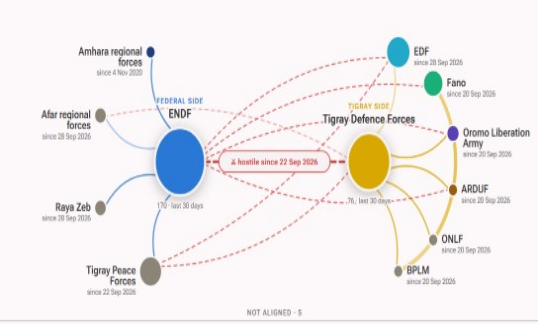
3.1.3 Frontlines.et is an open-source platform that aggregates, verifies and maps reported conflict events in Ethiopia. It uses a published confidence-grading methodology that distinguishes independently sourced information from claims by conflict parties and unverified reports and provides links to underlying sources.[footnote 50] In an update of 28 October 2026, Frontlines.et provided the following figure[footnote 51] showing the actors and relationships involved in the Tigray conflict:
3.2 Ethiopian National Defense Forces (ENDF)
3.2.1 The Ethiopian National Defense Forces (ENDF) is Ethiopia’s national armed force. For further information on ENDF see the archived CPIN Ethiopia: Actors of protection
3.3 Tigray Peoples’ Liberation Front (TPLF)
3.3.1 For information on TPLF see CPIN Tigrayans and the Tigrayan People’s Liberation Front, Ethiopia, December 2024.
3.4 Tigray Defence Forces (TDF)/Tigray Security Forces
3.4.1 For information on TPLF see CPIN Tigrayans and the Tigrayan People’s Liberation Front, Ethiopia, December 2024 and CPIN Sufficiency of protection, Ethiopia, October 2026.
3.5 Tigray Peace Force (TPF)
3.5.1 The ICG February 2026 report observed:
‘This political rift [within the TPLF] has also emboldened an embryonic armed opposition group – the Tigray Peace Forces (TPF, known as Hara Meret in Tigrinya) – that split from the TDF earlier in 2025 and is active in the lands connecting Tigray to the Afar region. The group, which allegedly receives support from the federal government, has clashed with the TDF on several occasions. In early November, TPF-TDF skirmishes on the Tigray/Afar boundary reportedly prompted the federal government to carry out drone strikes on TDF units, which it claims had crossed into Afar territory.’[footnote 52]
3.5.2 The RVI March 2026 report stated:
‘The most consequential security development [in Tigray], … was the emergence of a new Tigrayan insurgent force. By 2025, dissident Tigrayans—including former mid-level TDF officers and disaffected local officials—lost faith in both TPLF and the interim setup. They united into the Tigray Peace Force (TPF), an armed resistance movement vowing to ‘liberate’ Tigray from TPLF’s one-party rule. The first hint of this came in April 2025 when Shewit Bitew, a young former TDF fighter, appeared in a widely circulated post announcing the TPF’s formation and denouncing TPLF leaders as corrupt authoritarian warlords. Shewit quickly became the TPF’s mouthpiece, framing it as a reformist movement seeking a more democratic and peaceful future for Tigray. Behind him stood Brigadier General Gebreegzabeher Beyene (‘Wedi Antiru’), a former TDF commander who had fallen out with the TPLF hierarchy.
‘TPF established bases in parts of Afar just across Tigray’s south-eastern border, with either overt or covert acceptance by federal authorities. By mid-2025 they had gathered a small but battle-hardened force. On 1 July 2025, the conflict within Tigray turned hot. A TPF unit crossed from Afar into Wejerat woreda in Southeastern Tigray zone and clashed with TSF units in what was the first armed confrontation between Tigrayan factions. The TSF repelled the incursion, but the brief firefight signalled a dangerous new phase—an incipient intra-Tigrayan conflict.’[footnote 53]
3.6 Eritrea Defence Forces
3.6.1 A June 2026 report by the Armed Conflict Location & Events Data Project (ACLED), an independent, impartial conflict monitor providing real-time data and analysis on violent conflict and protest in all countries and territories across the world[footnote 54] noted that Eritrea provided support to the TPLF and other opposition groups through an initiative referred to as Tsimdo, which ACLED described as a framework for cooperation among actors opposed to the Ethiopian federal government. According to the report a Tsimdo-linked conference was held in Port Sudan in May 2026 which reportedly brought together individuals associated with the Eritrean government, Sudanese actors, Amhara nationalists and other peripheral opposition groups, representing what ACLED characterised as an overt alignment of regional state and non-state actors against Addis Ababa.[footnote 55]
3.6.2 A July 2026 report by the Stiftung Wissenschaft und Politik (SWP – the German Institute for International and Security Affairs), an independent German research institute specialising in international relations and security studies that provides policy analysis on global political and security developments[footnote 56] noted that relations between the TPLF and Eritrea have shifted significantly since the 2020–2022 conflict, with the parties reportedly engaging in cooperation based on shared opposition to the Ethiopian federal government. The report noted that Eritrea’s Tsimdo Selam initiative, launched in 2025 and presented by its organisers as a grassroots peace movement, is viewed by the Ethiopian government as part of a broader anti-government alliance involving the TPLF, Eritrea, Fano elements and other opposition actors.[footnote 57]
3.6.3 BBC reported on 7 October 2026:
‘Eritrean soldiers have crossed into northern Ethiopia heading towards an area where clashes have been taking place between national army troops and regional forces, residents in the Tigrayan town of Adigrat have told the BBC…
‘According to multiple accounts, Eritrean troops have moved from the border town of Zalambessa towards central Tigray, with convoys reportedly passing through Adigrat and heading toward Edaga Hamus, a town between Adigrat and Mekelle …
‘Images circulating on social media appear to show heavily loaded military trucks carrying uniformed personnel towards Adigrat, Edaga Hamus and possibly Wukro, another key town along the corridor between Adigrat and Mekelle. The BBC has not independently verified the images.’[footnote 58]
3.6.4 According to an Africa Confidential report of 23 October 2026, the Eritrean Defence Forces (EDF) became directly involved in the renewed conflict, with local sources reporting the deployment of mechanised and infantry units into northern Tigray as the ENDF advanced towards the Eritrean border. EDF units reportedly advanced as far as Idaga Hamus and towards Atsbi from late September 2026 before withdrawing north of Adigrat under pressure from air strikes. Although some mechanised units reportedly began leaving Tigray on 12 October, local sources stated that Eritrean infantry remained in several border areas alongside TPLF forces and that the EDF continued to control Irob district. The source also reported artillery exchanges between the ENDF and EDF near Rama and Bure, indicating the EDF’s continued presence and involvement along the Ethiopia-Eritrea border.[footnote 59]
3.7 Alliance for Survival
3.7.1 On 21 September 2026, Al Jazeera reported that seven Ethiopian armed groups had announced the formation of the Ethiopian Peoples’ Forces Alliance for Survival, with the stated aims of removing Prime Minister Abiy Ahmed’s government and establishing an inclusive transitional government. The alliance comprised the TPLF, the Amhara Fano National Movement (AFNM) and the Oromo Liberation Army (OLA), as well as four smaller armed groups: the Ogaden National Liberation Front (ONLF), the Afar Revolutionary Democratic Unity Front (Ugugumo), the Benishangul Peoples’ Liberation Movement, and the Gumuz Peoples’ Democratic Movement.[footnote 60]
3.7.2 On 26 September 2026 ACLED reported that membership of the Alliance for Survival was contested. The Gumuz Peoples Democratic Movement denied being a member, while different wings of the Ogaden National Liberation Front gave conflicting accounts of their involvement. The OLF stated that its main aim within the alliance was to remove the federal government rather than undertake coordinated military operations. ACLED assessed that only the TPLF, Amhara Fano National Movement and Afar Revolutionary Democratic Unity Front (Ugugumo) were actively fighting security forces in Tigray, Amhara and Afar respectively.[footnote 61]
3.7.3 BBC Monitoring reported on 19 October 2026:
‘An alliance of seven rebel groups formed on 20 September 2026 - the Amhara Fano National Movement (AFNM), Oromo Liberation Army (OLA), Tigray People’s Liberation Front (TPLF), Ogaden National Liberation Front (ONLF), Afar National Unity Revolutionary Front (ANURF), Benishangul People’s Liberation Movement (BPLM) and Gumuz People’s Democratic Movement (GPDM). The alliance says that it aims to jointly overthrow the federal government led by Prime Minister Abiy Ahmed.
‘The alliance brings together groups from Tigray, Oromia, Amhara, Somali, Afar and Benishangul-Gumuz.
‘Some members are former adversaries, having fought on opposing sides during Ethiopia’s 2020-22 Tigray war.
‘The alliance says on 20 September 2026 that the federal government has imposed ‘‘dictatorial rule” that has pushed the country towards break-up.
‘In a statement broadcast on Ethiopia’s Tigray Regional State Tigray TV on 20 September 2026, the alliance says that its members have agreed to resolve their differences peacefully and establish an inclusive transitional government guided by a transitional charter.
‘According to pro-opposition Ethiopian news website Borkena on 20 September 2026, alliance member Oromo Liberation Army (OLA) says that its participation reflects an effort to coordinate politically rather than the creation of a unified military command.’[footnote 62]
3.8 Tekeze Zeb
3.8.1 The TPLF, in an Aide-Mémoire addressed to diplomatic missions and international partners and dated 28 November 2025, which was published by Martin Plaut, claimed that: ‘The Federal Government has been actively training, arming, and directing thousands of militia members—known as the Tekeze Zeb (Tekeze Guard)—with the explicit aim of preventing internally displaced persons (IDPs) and other Tigrayans from returning to areas west of the Tekeze River. Beyond obstructing returns, these militias are being positioned as a force for potential future operations against Tigray.’[footnote 63]
3.8.2 A July 2025 opinion article by Ethiopia Insight stated that ‘the federal government has actively armed proxy forces like the Tekeze Zeb militia in Western Tigray’[footnote 64]
3.8.3 Addis Standard reported on 25 November 2025 that Salsay Weyane Tigray party accused the federal government of training and supporting Tekeze Zeb, also referred to as the ‘Tekeze River Guards’, in Western Tigray. The party alleged that the group was linked to ENDF structures and was being deployed to prevent the return of internally displaced Tigrayans and refugees. It further described Tekeze Zeb as a paramilitary force loyal to the federal government and reported that its inauguration was attended by senior officials, including ENDF 63rd Division Commander Colonel Tilahun Namaga.[footnote 65]
3.8.4 The HRW April 2026 report noted since 2024, authorities in Western Tigray have been organizing and training militias known as “Tekeze Zeb,” to defend the territory.[footnote 66]
3.8.5 A 2 June 2026 ACLED report described Tekeze Zeb as ‘a local militia established by the current local government to protect the disputed western Tigray — in Tsegede, western Tigray.’[footnote 67]
3.8.6 A 14 October 2026 opinion article in Borkena refers to Tekeze Zeb and Raya Zeb as localised security structures associated with the Amhara populations in the contested areas of Wolkait, Tsegede, Tselemt, Setit Humera and Raya.[footnote 68]
4. Territorial control
4.1 Areas of control by ENDF and TPLF/TDF
4.1.1 On 30 September 2026 Kulu Media, an Ethiopian digital media outlet which reports on political, security and humanitarian developments in Ethiopia[footnote 69], reported that ENDF and TPF forces had reportedly encircled Samre and claimed control of Yechila and Korem in central and southern Tigray, following the recapture of Alamata by federal and allied forces. A TPF commander claimed opposing forces had withdrawn from several positions, while a commander aligned with the TPLF disputed the reported territorial gains and stated that fighting was continuing.[footnote 70]
4.1.2 On 1 October 2026 ACLED reported that ‘Government forces and Tigray Peace Forces regained control of Abala, Erebti, and Magale areas in Zone 2 of Afar region’.[footnote 71]
4.1.3 On 23 October 2026, Africa Confidential reported that federal forces had regained most territory lost earlier in the conflict, including Mekelle and its airport, and by mid-October controlled nearly all major highways and urban areas in Tigray. The TPLF had withdrawn from Shire, Adwa and Axum following federal advances and air strikes, but most of its forces reportedly remained intact and had regrouped as mobile units. By 20 October, federal forces had withdrawn from some positions near the Eritrean border, including Rama and Zalambessa, while TPLF forces had regained some areas in central Tigray, including Abiy Addi.[footnote 72]
4.1.4 On 27 October 2026, CTP reported federal gains in central Tigray, with the ENDF consolidating control of Adet and Zana districts following a TDF withdrawal towards Kola Tembien. Further south, after the TDF reportedly captured Abergele by 23 October, federal forces advanced south from Abiy Addi and took control of Yechila on 25 October. However, northwest of Shire the ENDF reportedly made no notable gains and lost ground between Adi Dairo and Adi Hageray.[footnote 73]
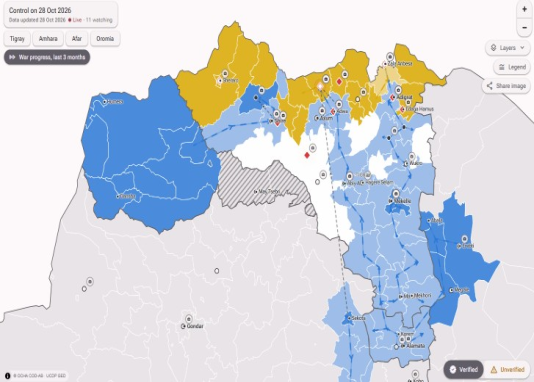
4.1.5 Frontlines.et noted on its website that as of 28 October 2026, the ENDF controlled 53 woredas, TDF controlled 19 woredas and 6 woredas – Alamata town, Cherecher, Korem town, Ofla, Raya Alamata and Zata remained contested.[footnote 74]
4.2 Maps of territorial control
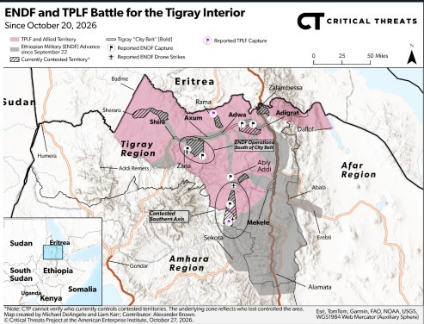
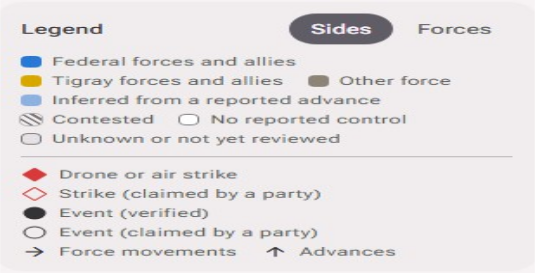
4.2.1 A map produced by CTP showing control as of 28 October 2026:[footnote 75]
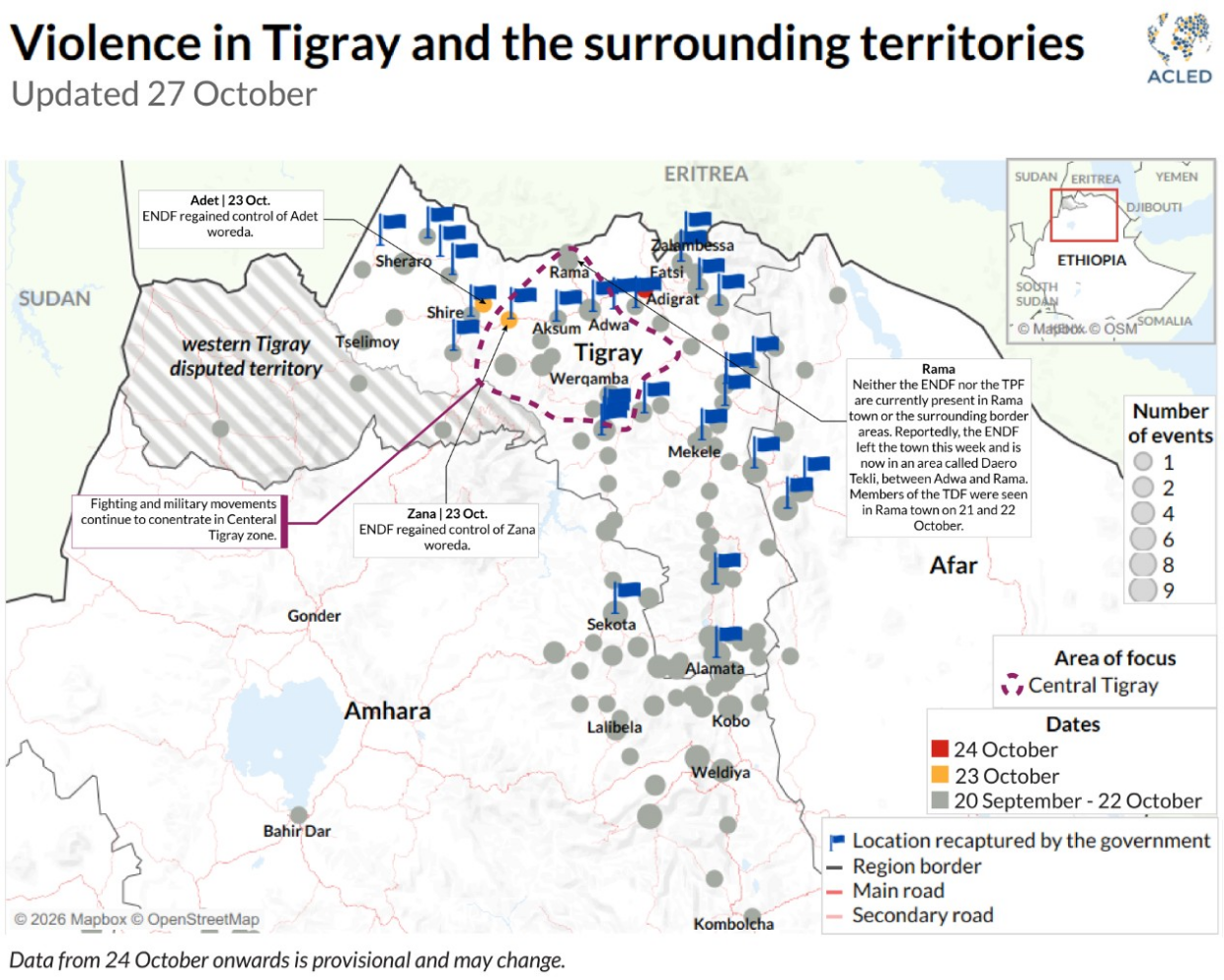
4.2.2 A map produced by ACLED showing control as of 24 October 2026:[footnote 76]
4.2.3 A map produced by Frontlines.et showing control as of 28 October 2026:[footnote 77]
5. Conflict dynamics, incidents and fatalities
5.1 Overview
5.1.1 On 24 September 2026, Al Jazeera reported that ENDF stated it had killed at least 272 TPLF fighters during a counter-offensive in Amhara region. According to the ENDF, a further 260 TPLF fighters were wounded and several others captured. The military said the operation was launched in response to attacks by the TPLF and allied groups on several areas of North Wollo in the Amhara region, which borders Tigray, and resulted in significant personnel and equipment losses for the TPLF.[footnote 78] The source did not provide further information on ENDF casualties.
5.1.2 On 28 September 2026, Médecins Sans Frontières (MSF) reported a sharp increase in conflict-related casualties following the resumption of fighting between TPLF-aligned forces and the ENDF. MSF stated that the number of war-wounded patients treated at hospitals in Korem and Alamata increased from around 180 within 48 hours to more than 420 between 22 and 25 September 2026. In north-western Tigray, MSF also reported that more than 300 war-wounded patients had arrived at Suhul Hospital in Shire by 25 September. Owing to the security situation, MSF suspended activities at Alamata Hospital and redirected staff to support hospitals experiencing a significant influx of wounded patients.[footnote 79]
5.1.3 Between 1 January and 28 October 2026, Frontlines.et recorded 148 violent events and an estimated 239 to 242 fatalities in Tigray. Of these, Frontlines.et verified 92 events and 86 fatalities. A further 56 events and 156 fatalities were reported by one of the parties to the conflict but could not be independently verified by Frontlines.et. the 156 fatalities represents the upper estimate.[footnote 80]
5.2 ACLED data on political violence events and fatalities
5.2.1 The ACLED dataset records information on political violence which it defines as the use of force by a group for a political purpose, motivation, or effect. It records incidents as individual events involving identified actors occurring at a specific location and date.[footnote 81] Political violence events include battles, violence against civilians, explosions and remote violence and protests where there is intervention by another actor.[footnote 82]
5.2.2 Between 1 January and 21 October 2026 (latest available data), ACLED recorded 212 political violence incidents in Tigray that resulted in 253 fatalities. These comprised 111 battles (52.4%), 56 incidents of explosions and remote violence (26.4%), 44 incidents of violence against civilians (20.8%), and one riot (0.5%).[footnote 83]
5.2.3 CPIT has produced the graph below, based on ACLED data, showing monthly trends in political violence during the period under review:[footnote 84]
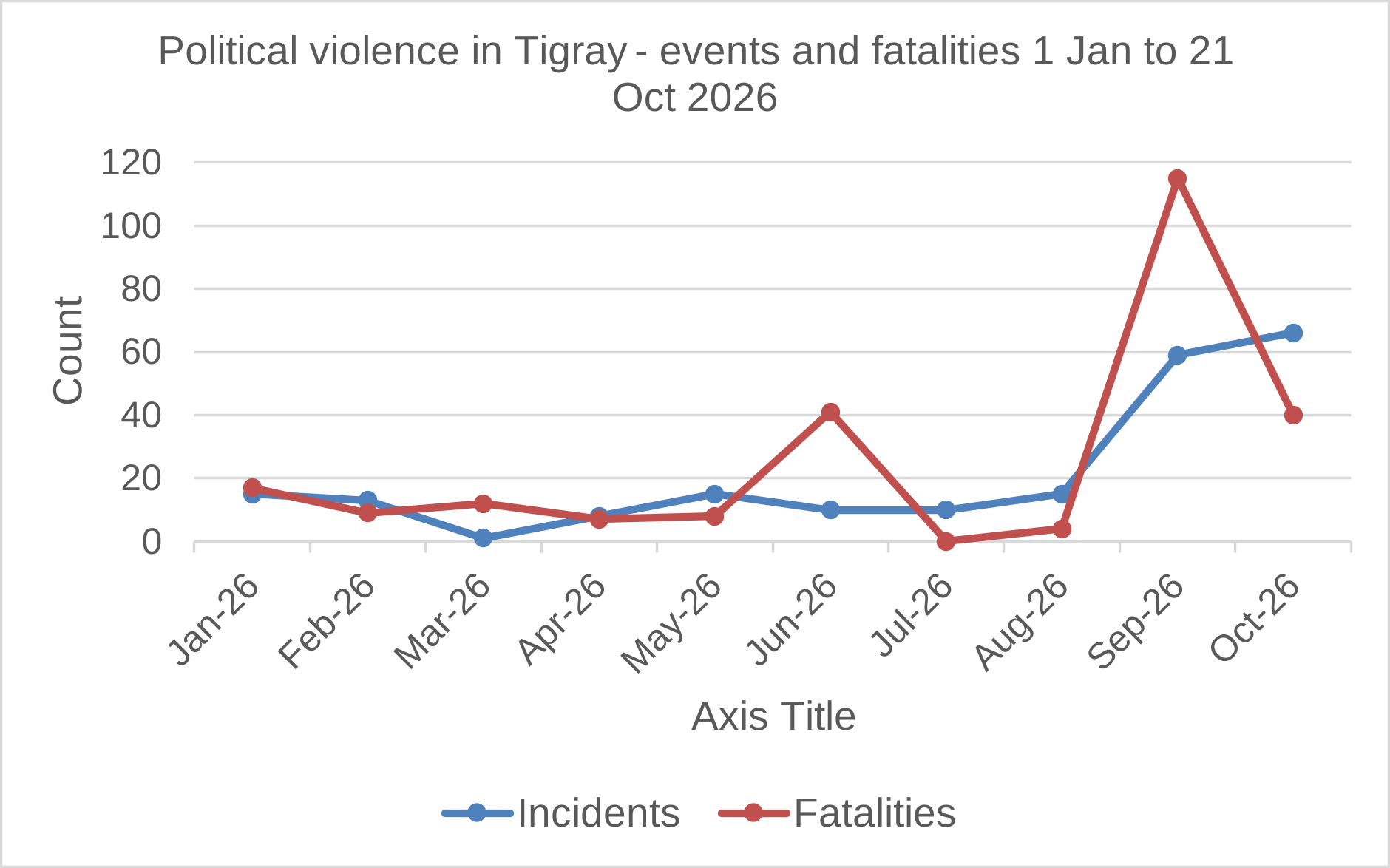
5.24 CPIT analysis of the graph indicates:
- Political violence events remained at relatively low to moderate levels between January and August 2026, fluctuating between approximately 1 and 15 incidents per month. Following a decline from 15 events in January to a low of 1 event in March, incident levels recovered gradually, stabilising at around 10–15 events between May and August.
- A marked escalation occurred from September 2026, when reported events increased sharply from 15 in August to 59 in September, representing the most significant month-on-month rise during the reporting period. Violence continued to increase in October, reaching 66 events, the highest monthly total recorded.
5.2.5 The ACLED dataset also contains information on political violence by event type and associated fatalities. CPIT has produced the table below, based on the ACLED data[footnote 85], showing political violence and associated fatalities by event type between 1 January and 21 October 2026:
| Event Type | Events: count | Events: as % of total | Fatalities: count | Fatalities: as % of total |
|---|---|---|---|---|
| Battles | 111 | 52.4% | 167 | 66.0% |
| Explosions/Remote violence | 56 | 26.4% | 80 | 31.6% |
| Violence against civilians | 44 | 20.8% | 6 | 2.4% |
| Riots | 1 | 0.5% | 0 | 0% |
| Total | 212 | 100% | 253 | 100% |
5.2.6 CPIT analysis of the ACLED dataset indicates that battles were the most common form of political violence in Tigray, accounting for 111 events (52.4%) and 167 fatalities (66.0%). Explosions/remote violence represented the second-largest event category, comprising 56 events (26.4%) and 80 fatalities (31.6%). Violence against civilians accounted for 44 events (20.8%) but resulted in a comparatively low number of reported fatalities (6 fatalities; 2.4% of the total). Riots were rare, with only one recorded incident and no associated fatalities. Overall, battles and explosions/remote violence together accounted for 78.8% of all political violence events and 97.6% of reported fatalities, indicating that violence was predominantly characterised by armed confrontations and the use of explosive weapons.
5.2.7 ACLED data also contains information on event types and fatalities associated with conflict actors. The table below based on ACLED data[footnote 87], shows the number of events between 1 January and 21 October 2026. The table assigns each event and associated fatalities to the actor category used in CPIT’s analysis rather than counting every actor appearing in an event.
| Event Type | Events: count | Events: as % of total | Fatalities: count | Fatalities: as % of total |
|---|---|---|---|---|
| Alliance for Survival | 4 | 1.9% | 0 | 0% |
| Amhara Ethnic militia | 2 | 0.9% | 3 | 1.2% |
| Fano youth militia | 6 | 2.8% | 21 | 8.3% |
| ENDF | 120 | 56.6% | 163 | 64.4% |
| TDF | 59 | 27.8% | 53 | 20.9% |
| TPF | 15 | 7.1% | 13 | 5.1% |
| Tigray state police | 2 | 0.9% | 0 | 0% |
| Rioters | 1 | 0.5% | 0 | 0% |
| Unidentified armed groups | 3 | 1.4% | 0 | 0% |
| Total | 212 | 100% | 253 | 100% |
5.2.8 CPIT analysis of the table indicates political violence heavily concentrated among a limited number of conflict actors. The ENDF accounted for more than half of all recorded incidents (56.6%), while the TDF was associated with over a quarter (27.8%). Together, these actors were responsible for 84.4% of all political violence events, indicating that the security situation was largely driven by confrontations involving the principal state and Tigrayan armed forces.
5.2.9 The table below, based on ACLED data[footnote 89], shows political violence by zone between 1 January and 21 October 2026:
| Zone | Events: Count | Events: As % of total | Fatalities: Count | Events: As % of total |
|---|---|---|---|---|
| Central Tigray | 40 | 18.9% | 27 | 10.7% |
| Eastern Tigray | 20 | 9.4% | 3 | 1.2% |
| Mekelle | 13 | 6.1% | 1 | 0.4% |
| North Western | 30 | 14.2% | 71 | 28.1% |
| South East | 25 | 11.8% | 20 | 7.9% |
| Southern | 76 | 35.8% | 99 | 39.1% |
| Western | 8 | 3.8% | 32 | 12.6% |
| Total | 212 | 253 |
5.2.10 CPIT analysis of the table indicates that the conflict was concentrated in a small number of areas.
- The Southern Zone was the most affected, accounting for over one-third of all recorded events (35.8%) and fatalities (39.1%), making it the principal hotspot of violence during the reporting period.
- Central Tigray recorded the second-highest number of events (18.9%), although its share of fatalities (10.7%) was considerably lower.
- North Western Zone accounted for only 14.2% of recorded events but recorded more than a quarter of all fatalities (28.1%), indicating a higher intensity of violence. A similar pattern was observed in Western Zone, which accounted for just 3.8% of events but 12.6% of fatalities.
- By contrast, Eastern Tigray and Mekelle experienced comparatively low levels of violence, together accounting for 15.5% of recorded events and only 1.6% of fatalities.
6. Impact of conflict on civilians
6.1 Violence against civilians
6.1.1 A 25 September 2026 press release by the OHCHR stated: ‘UN Human Rights Chief Volker Türk on Friday expressed alarm at the widening impact of the escalating fighting in Ethiopia on civilians. Airstrikes by the Ethiopian National Defence Force (ENDF), some carried out using drones, reportedly hit five schools in Tigray on 22 September, resulting in deaths and injuries. A mortar strike on 23 September in Kobo town in Amhara reportedly by the ENDF also resulted in civilian deaths.’[footnote 90]
6.1.2 On 25 September 2026, HRW reported that an apparent Ethiopian government airstrike struck a residential compound in the Daero neighbourhood of Mekelle on 20 August 2026. HRW reported that residents and witnesses said there were no Tigrayan fighters or other military personnel present at the compound or in the surrounding area before or after the strike. HRW further stated that it found no evidence to support reports that the attack was intended to target nearby Tigrayan military or civilian leaders. Victims were taken to Ayder Referral Hospital, where medical staff reported treating 13 people for injuries sustained in the strike, including three people with severe injuries and a 12-year-old girl who required surgery for a leg fracture.[footnote 91]
6.1.3 On 30 September 2026, BBC reported that hospital sources stated that at least 52 civilians were killed during three days of fighting in and around Alamata. A doctor at Alamata General Hospital told the BBC that heavy explosives and artillery were used during the fighting, some of which struck residential areas. The doctor stated that those killed included children, mothers, and cattle herders, and that 12 people were killed in a strike on the town’s marketplace. Separately, MSF reported that more than 700 war-wounded people had been admitted to hospitals it supported in Tigray.[footnote 92]
6.2 ACLED ‘civilian targeting’ filter
6.2.1 ACLED’s codebook explained: ‘In order to facilitate the analysis of all events in the ACLED dataset that feature violence targeting civilians, the ‘Civilian targeting’ column allows for filtering of events in which civilians were the main or only target of an event. Besides events coded under the ‘Violence against civilians’ event type, civilians may also be the main or only target of violence in events coded under the ‘Explosions/Remote violence’ event type (e.g. a landmine killing a farmer), ‘Riots’ event type (e.g. a village mob assaulting another villager over a land dispute), and ‘Excessive force against protesters’ sub-event type (e.g. state forces using lethal force to disperse peaceful protesters). Events in which civilians were incidentally harmed are not included in this category.’[footnote 93]
6.2.2 To analyse the nature of events targeting civilians CPIT filtered the ACLED data by ‘civilian targeting’ in Tigray between 1 January and 21 October 2026 (latest available figures). Between 1 January and 21 October 2026 ACLED recorded 53 civilian targeting incidents and 19 fatalities.[footnote 94] CPIT has produced the graph below, based on the ACLED data[footnote 95] showing monthly trends in civilian targeting events and fatalities during the period under review.
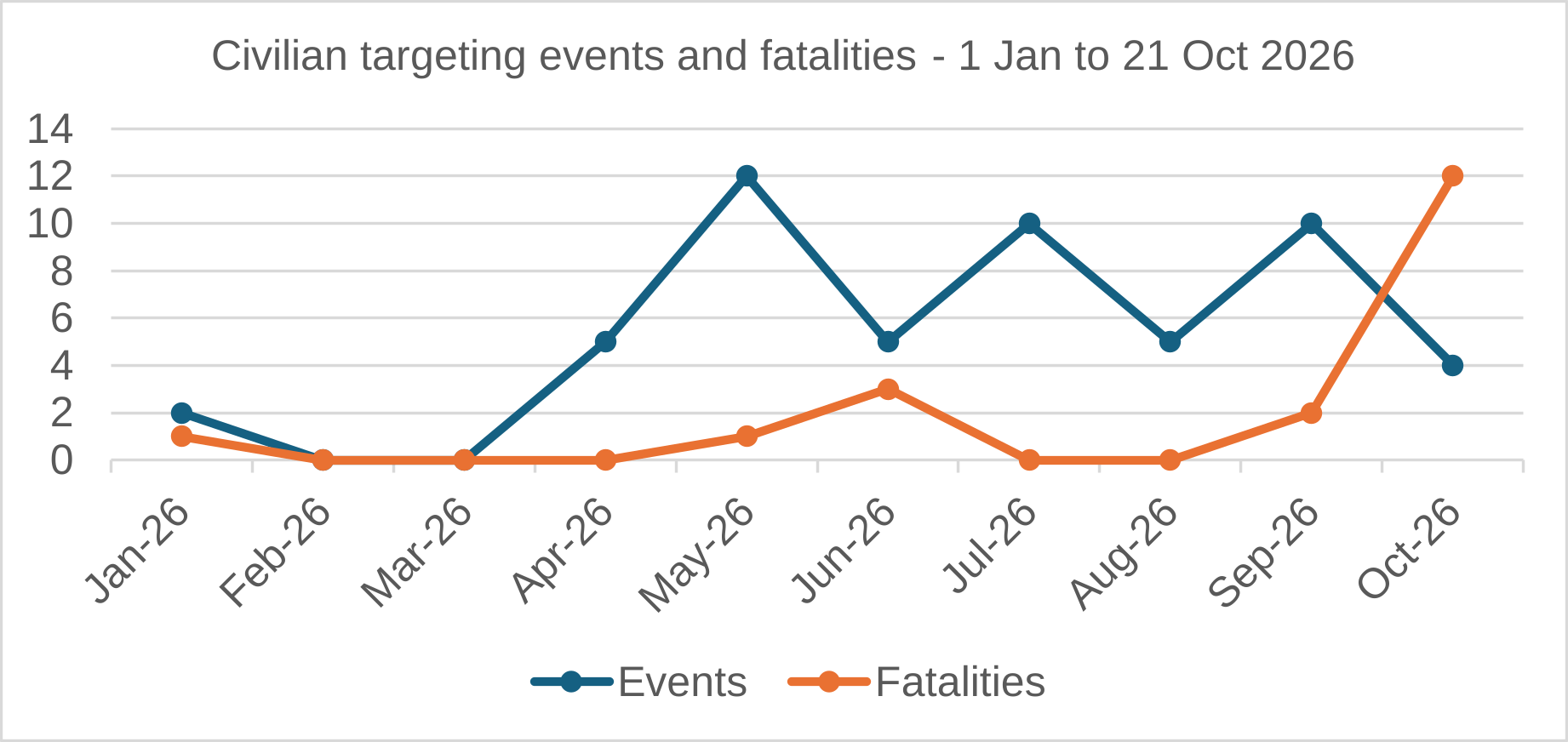
6.2.3 CPIT analysis of the graph indicates that:
- Incidents of civilian targeting occurred throughout the reporting period but at relatively low levels compared to overall political violence. Following low activity during the first quarter of 2026, the number of civilian targeting incidents increased from April onwards, peaking at 12 events in May, before fluctuating between 5 and 10 incidents per month between June and September. Reported incidents then declined to 4 events in October.
- Fatalities associated with civilian-targeting incidents remained generally low for most of the period, with no reported fatalities recorded in several months. A small increase was observed in June (3 fatalities) and September (2 fatalities). However, fatalities rose sharply in October, reaching 12 deaths, despite the number of incidents falling to one of the lowest levels recorded during the reporting period.
6.2.4 The table below, based on the ACLED data, shows the types of event recorded by ACLED as ‘civilian targeting,’ Explosions/ remote violence, Violence against civilians, and Protests (excessive force against protesters) and riots.
| Event Type | Events: Count | Events: % of total | Fatalities: Count | Fatalities: % of total |
|---|---|---|---|---|
| Violence against civilians | 44 | 83.0% | 6 | 31.6% |
| Explosions/Remote violence | 8 | 15.1% | 13 | 68.4% |
| Riots | 1 | 1.9% | 0 | 0% |
| Total | 53 | 100% | 19 | 100% |
6.2.5 CPIT analysis of the table indicates that violence against civilians was the predominant event type, accounting for 44 of 53 incidents (83.0%) recorded during the reporting period. However, these incidents accounted for less than one-third (31.6%) of all reported fatalities. By contrast, explosions/remote violence accounted for only 8 incidents (15.1%) but resulted in 13 fatalities (68.4%). Only one riot-related incident targeting civilians was recorded and no fatalities were reported.
6.3 Actors involved in violence against civilians
6.3.1 CPIT has produced the table below based on ACLED data[footnote 96], showing civilian targeting by actor between 1 January and 21 October 2026:
| Actor | Events: Counts | Events: % of total | Fatalities: Counts | Fatalities: % of total |
|---|---|---|---|---|
| TDF | 40 | 75.5% | 5 | 26.3% |
| ENDF | 8 | 15.1% | 13 | 68.4% |
| Tigray State Police | 2 | 3.8% | 0 | 0% |
| Fano Youth Militia | 1 | 1.9% | 1 | 5.3% |
| Rioters | 1 | 1.9% | 0 | 0% |
| Unidentified Armed Group | 1 | 1.9% | 0 | 0% |
| Total | 53 | 100% | 19 | 100% |
6.3.2 CPIT analysis of the table indicates that the TDF was the principal actor involved, accounting for 40 of 53 incidents (75.5%). However, incidents involving the Ethiopian military were more lethal, accounting for 13 of the 19 reported fatalities (68.4%) despite representing only 15.1% of recorded incidents.
6.4 Violence against civilians by location
6.4.1 The table below, based on ACLED data[footnote 98], shows civilian targeting by zone between 1 January and 21 October 2026:
| Zone | Events: Count | Event: % of total | Fatalities: Count | Fatalities: % of total |
|---|---|---|---|---|
| Southern Tigray | 18 | 34.0% | 5 | 26.3% |
| Central Tigray | 16 | 30.2% | 2 | 10.5% |
| North Western Tigray | 8 | 15.1% | 8 | 42.1% |
| Mekelle | 6 | 11.3% | 0 | 0% |
| South Eastern Tigray | 3 | 5.7% | 4 | 21.1% |
| Eastern Tigray | 2 | 3.8% | 0 | 0% |
| Total | 53 | 100% | 19 | 100% |
6.4.2 CPIT analysis of the table indicates that geographically, civilian targeting was concentrated in Southern Tigray (34.0%) and Central Tigray (30.2%), which together accounted for nearly two-thirds (64.2%) of all recorded incidents. However, North Western Tigray, which accounted for only 15.1% of incidents, recorded the highest proportion of fatalities (42.1%), indicating that incidents in this zone were comparatively more lethal. Mekelle and Eastern Tigray recorded relatively low levels of civilian targeting and no reported fatalities during the reporting period.
6.5 Forced recruitment of civilians
6.5.1 On 28 May 2026, Addis Standard, an independent tri-lingual media outlet that publishes content in English, Afaan Oromoo and Amharic[footnote 99], reported allegations of forced recruitment of young people in several parts of Tigray, including Central and North Western Tigray, Adwa, and areas around Edaga Hamus Tsedya. Sources cited by the publication alleged that recruitment involved house-to-house searches and detention, including, in some cases, of relatives when targeted individuals could not be found. Recruits were reportedly taken to military training sites, and opposition groups alleged that forced conscription was occurring across Tigray. Addis Standard stated that it was unable to independently verify the allegation.[footnote 100]
6.5.2 On 5 June 2026, Addis Standard reported that Human Rights First Ethiopia (HRFE) alleged coercive recruitment across Tigray, including in Axum, Adwa, Shire, Adigrat, Mekelle and Wukro, as well as rural areas of the Central and North Western zones. Young men were reportedly detained at checkpoints, markets, transport terminals, and other public places and transferred to military training sites, while some individuals reportedly went into hiding or moved to avoid recruitment. Tigrayan opposition parties also criticised the reported recruitment, with the Tigray Independence Party accusing the TPLF and associated military structures of forced recruitment and of detaining relatives when targeted individuals could not be found.[footnote 101]
6.5.3 On 23 June 2026, Human Rights Watch (HRW) reported that local authorities and Tigrayan forces were implementing a mobilisation programme involving alleged forced recruitment, including of children. Former fighters were ordered to report to their units, while forces reportedly conducted door-to-door searches and mass roundups of potential recruits. HRW also received reports that relatives of those evading mobilisation were punished and that some residents had fled Tigray because of fears of forced recruitment and renewed hostilities.[footnote 102]
6.5.4 On 9 June 2026, Addis Standard reported that a draft proclamation prepared by Tigray’s reinstated pre-war council would establish a legal framework for mobilisation and make compliance with mobilisation orders compulsory. The draft reportedly provided penalties for evading military service, failing to report when summoned, assisting others to evade mobilisation or obstructing recruitment. It proposed prison sentences of up to 25 years for discouraging, intimidating, or misleading members of mobilisation structures, or encouraging them to abandon service or surrender weapons. Other offences could attract life imprisonment or, in the most serious cases, the death penalty. The draft was published amid reports of forced recruitment in parts of Tigray.[footnote 103]
6.5.5HRW also reported on the proclamation on 23 June 2026. According to the HRW report the proclamation established compulsory military mobilisation for those whose ‘health and age permit’ and contained what HRW described as vague and overly broad offences. It provided for the death penalty for some offences, including collaborating with the enemy or seriously threatening Tigray’s peace and security, prison sentences of up to 25 years for criticising or advocating resistance to the recruitment campaign, and fines of up to 50,000 Ethiopian Birr (approximately US$315) for evading mobilisation orders or deserting from service. HRW stated that the proclamation had reportedly been adopted without public scrutiny amid increasing tensions between the TPLF and the federal government.[footnote 104]
6.5.6 On 6 July 2026, HRW reported that Tigrayan authorities and forces had forcibly recruited civilians, including children as young as 15, since at least April 2026. HRW documented 6 cases based on interviews with 18 people and reported that former combatants and other men and boys were taken during street and market roundups, house-to-house searches and from gold-mining sites. Recruits were reportedly detained in administrative offices, jails, or schools before being transferred to military training camps, while former fighters were also returned to their units. HRW further reported that some people went into hiding or fled Tigray to avoid recruitment and that, in some cases, relatives of those evading service were detained.[footnote 105]
6.6 Conflict related arrest and detention
6.6.1 On 10 February 2026, UN News reported that the UN High Commissioner for Human Rights, Volker Türk, stated that both the TSF and the ENDF had reportedly arrested civilians suspected of having links to the opposing side. According to the High Commissioner, such arrests formed part of ongoing human rights concerns in the context of tensions and insecurity in Tigray.[footnote 106]
6.6.2 HRW April 2026 report stated that security forces and local militia groups in Western Tigray, including the Tekeze Zeb militia, continued to arbitrarily detain Tigrayans in police stations and at Bet Hintset prison in Humera. According to HRW, arbitrary arrests increased following clashes in Tselemti in January 2026, with reports that men and individuals returning from other parts of Tigray were particularly affected.[footnote 107]
6.6.3 ACLED also recorded abductions/forced disappearance which were linked to forced recruitment and conscription. Between 1 January and 21 October 2026, ACLED recorded 29 abduction/forced-disappearance events in Tigray between 2 April and 2 October 2026. Twenty-seven of these events were explicitly linked in the notes to forced recruitment or conscription. The incidents were attributed overwhelmingly to the TDF, with one event led by the Tigray State Police. The event narratives contain numerical references to approximately 1,074 abducted persons, although only 834 can be supported using strict lower-bound counts. The actual number of victims was higher because several events involved ‘hundreds’, ‘several’, or otherwise unspecified numbers of people. Additionally, ACLED recorded 10 arrest events 3 of which were linked to recruitment or conscription. In total 10 individuals were arrested: 9 after allegedly opposing, criticizing, or discouraging recruitment efforts, including 7 members of the Salsay Woyane Tigray Party and 2 senior Orthodox archbishops and the other, a hospital executive on allegations of assisting recruitment for the TPF. Two of the recruitment-related arrests were attributed to the Tigray state police and one to the TDF.[footnote 108]
6.7 Population displacement
6.7.1 The number of internally displaced persons increased from an estimated 710,000 individuals in June 2025[footnote 109] to approximately 761,284 at the end of July 2026.[footnote 110]
6.7.2 The February 2026 Global Protection Cluster monthly overview reported that an estimated 2,500 people had been displaced in Tigray’s North Western Zone and 37,000 in the South Eastern Zone. Of those displaced in the South Eastern Zone, around 30,000 had reportedly returned to their areas of origin, while approximately 7,000 remained displaced and in urgent need of assistance.[footnote 111]
6.7.3 On 27 April 2026, the United Nations Population Fund (UNFPA) reported that renewed hostilities in Alamata, Raya Alamata and Raya Bala (Southern Tigray) in February 2026 resulted in the displacement of an estimated 78,450 people to Kobo in North Wollo Zone.[footnote 112]
6.8 Civilian infrastructure and access to services
6.8.1 The Protection Cluster reported in March 2026 that humanitarian access in Tigray had deteriorated due to insecurity, reduced operational movement, and severe fuel and cash shortages. The report noted that fuel shortages restricted humanitarian operations and affected the populations’ access to services, while bank withdrawal restrictions in Tigray impeded cash-based assistance programmes. Despite these constraints, protection partners reached 46,704 people through awareness activities and provided over ETB 5.7 million in cash assistance to 759 vulnerable women and girls.[footnote 113] The situation remained the same in July 2026 with the Protection Cluster reporting that insecurity and continued fuel and cash shortages were affecting humanitarian operations, while the non-payment of salaries, including those of teachers, continued to disrupt service delivery.[footnote 114]
6.8.2 According to the World Food Programme (WFP) August 2026 situation report, insecurity in Tigray continued to hamper humanitarian operations, constraining supply routes and delaying the timely delivery of assistance.[footnote 115]
6.8.3 On 10 September 2026, the Global Centre for the Responsibility to Protect (GCR2P), an international NGO that advocates on atrocity prevention and response[footnote 116], reported that, following the resumption of fighting on 1 August 2026, the Ethiopian government had reportedly carried out near-daily drone strikes in Tigray, affecting civilians and civilian infrastructure, including schools, farms and residential homes.[footnote 117]
6.8.4 On 21 September 2026, Addis Standard reported that a humanitarian aid truck carrying 41 metric tonnes of food assistance for internally displaced persons (IDPs) in Sheraro, north-western Tigray, was reportedly struck by a drone the previous day. The strike reportedly injured a 13-year-old girl and destroyed the food consignment, which was intended for an IDP camp hosting more than 56,000 displaced people.[footnote 118]
6.8.5 On 28 September 2026, the UN Secretary-General’s Spokesperson reported that worsening insecurity across northern Ethiopia was increasing humanitarian needs and disrupting humanitarian operations. Humanitarian access to Tigray was severely restricted by disrupted telecommunications, suspended flights, and restrictions on key roads, limiting the movement of humanitarian personnel, relief supplies, and civilians. Funding shortages had placed further pressure on the response, with several humanitarian partners scaling back or suspending operations despite increasing needs.[footnote 119]
6.8.6 On 8 October 2026, The New Humanitarian, an independent, non-profit newsroom that reports on humanitarian crises, conflicts, and disasters worldwide[footnote 120] reported a breakdown in law and order in Mekelle following the withdrawal of TPLF forces and the advance of federal troops. Armed groups reportedly looted civilian and humanitarian facilities, including government and post offices, humanitarian premises, and aid warehouses, resulting in the loss of vehicles, medical equipment, and relief supplies. The Organisation for Social Services, Health and Development (OSSHD-Ethiopia) reportedly lost around 60 computers and tablets, nearly all its vehicles, approximately US$1 million of non-food items and tens of thousands of dollars’ worth of medical equipment intended for its clinic in Mekelle. The source reported that police had withdrawn as federal forces approached, leaving no effective policing presence to maintain public order.[footnote 121]
6.9 Freedom of movement
6.9.1 HRW reported in April 2026 that freedom of movement for Tigrayans in Western Tigray remained restricted. According to the report Tigrayans were required to obtain temporary travel permits from local authorities to travel outside their immediate locality, including for employment, medical treatment, and family visits. HRW stated that permits were generally limited in duration and geographical scope, with travel documents reviewed by the organisation indicating that movement outside authorised areas could result in prosecution. The report also described the presence of official and ad hoc checkpoints operated by security forces, where individuals were reportedly required to present identification documents or travel permits. HRW further reported that some interviewees limited their movements because of concerns about arrest, detention, or harassment.[footnote 122]
6.9.2 On 20 April 2026, Ethiopia Today, citing reporting by Wazema, reported restrictions on the movement of young people attempting to leave Tigray. According to the source, authorities had established checkpoints on routes leading to the Amhara and Afar regions, where vehicles carrying groups of young people were reportedly intercepted and turned back. The same source reported that the Tigray Police Commission stated that the police had intercepted and returned more than 150 people in one week and that 171 individuals had been detained while attempting to leave the region. The source stated that concerns about recruitment by Tigrayan forces and fears of renewed conflict were among the reasons cited by some young people for leaving the region.[footnote 123]
6.9.3 On 25 September 2026, the Associated Press (AP) reported that roads connecting Tigray with the neighbouring Afar region had been closed to civilian traffic. AP also reported that air travel to Tigray had been suspended after TPLF-affiliated fighters reportedly seized Mekelle airport, leading Ethiopian Airlines to cancel flights to and from the region.[footnote 124]
6.9.4 On 25 September 2026, the Ethiopia Human Rights Commission (EHRC) reported that flights to and from Tigray had been suspended after TPLF-affiliated fighters captured the airports at Mekelle, Shire and Axum. EHRC further reported that land routes linking Tigray to other parts of Ethiopia had been completely cut off, affecting freedom of movement and disrupting the supply of basic goods and services triggering subsequent price inflation.[footnote 125]
Bibliography
Unless otherwise stated, all sources were accessed between 8 September 2026 and 28 October 2026.
Addis Standard:
-
‘If They Find You, They Take You’: Rights Report Details Alleged Forced Recruitment Campaign Across Tigray, 5 June 2026
-
Latest Drone Strike Hits Humanitarian Aid Truck Carrying 41 Tons of Food in Northwestern Tigray, 21 September 2026
-
Reports of Forced Conscription Emerge Across Tigray as Residents, Parties and Rights Groups Raise Alarm, 28 May 2026
-
Trapped, Sold, Silenced: Traffickers Exploit Tigrayans, People Smugglers’ Networks, 24 May 2025
-
News: Salsay Weyane Tigray accuses federal government of breaching Pretoria deal, backing armed groups in Western Tigray, 25 November 2025
Africa Confidential:
-
TPLF buries the Pretoria peace deal as Washington courts Asmara, 8 May 2026
-
Abiy’s gains intensify frontier pressure, 23 October 2026
Agence France-Presse (AFP) Tigray Rebels in ‘Full-Blown’ War with Government, 24 September 2026
Al Jazeera:
-
Ethiopian Armed Groups Forge Alliance Against Government, 21 September 2026
-
Ethiopian Army Says 272 Tigrayan Fighters Killed in Amhara, 24 September 2026
Arab News, Ethiopian Troops Mobilize on Tigray Border, 17 February 2026
Armed Conflict Location and Events Data project (ACLED):
-
ACLED Codebook (ACLED events), no date
-
Data Export Tool, 28 October 2026
-
Ethiopia, accessed 1 October 2026
-
Ethiopia Conflict: Expert Insights, 26 September 2026
-
Has Conflict Resumed Between the Ethiopian Federal Government and the TPLF?, 13 August 2026
-
Is the New Conflict Between the TPLF and the Ethiopian Government Mimicking the Scale of the 2020–2022 War?, 1 September 2026
-
Northern Ethiopia’s War Is Opening on Multiple Fronts, 25 September 2026
-
The TPLF’s Move to Fully Control Tigray Poses a Growing and Expanding Threat to the Horn of Africa, 2 June 2026
-
Conflict in Ethiopia – Violence in Tigray and surrounding territories, 28 October 2026
-
The TPLF’s move to fully control Tigray poses a growing and expanding threat in the Horn of Africa, 2 June 2026
Associated Press (AP), Residents of largest city in northern Ethiopia express fear after eruption of fighting, 25 September 2026
BBC Monitoring:
-
Ethiopian General Tells Army to ‘Prepare’ for Attack Against Tigray Forces, 4 September 2026
-
Ethiopian Media Claims Deployment of Over 250,000 Troops, 2 September 2026
-
Ethiopia Said in ‘Major’ Conscription Drive as War Looms in North, 25 August 2026
-
Ethiopia’s Tigray Says Federal Government Behind Hit on Strategic Site, 12 September 2026
-
Armed Organisation Ethiopia Ethiopian Peoples’ Forces Alliance for Survival (EPFAS), 19 October 2026
BBC News:
-
Ethiopia Fighting Escalates in Tigray, killing 52 Civilians, Medic Tells the BBC, 30 September 2026
-
Explosions Heard in Ethiopia’s Capital After Drone Flights Banned, 1 October 2026
-
Is Ethiopia Heading Back to War in Tigray?, 26 February 2026
-
Tigray Party Says Ban Threatens Ethiopia Peace Deal, 16 May 2025
-
Eritrean troops move deep into Ethiopia’s Tigray region, residents tell BBC, 7 October 2026
Bojang Jnr, S., Tsimdo: The Mysterious Coalition Putting Ethiopia on Edge, 15 June 2026
Borkena, The Cost Of Making Oneself A Political Pawn: The Demise Of The Wolkait Administration, The Tekeze And Raya Zeb, 14 October 2026
Cedoca, COI Focus: Ethiopia — Security Situation in Tigray (section 3), 22 July 2026
Critical Threats Project (CTP):
-
Ethiopia Prepares for War: Africa File Special Edition, 25 February 2026
-
Ethiopia Holds Elections; IS in Northwestern Nigeria: Africa File, June 4, 2026, 4 June 2026
-
Sustained Conflict in Tigray; North African Mediation in the Sahel: Africa File, August 27, 2026, 27 August 2026
-
Tigray on the Precipice; New FDLR Demobilization Plan; Saudi Red Sea Developments: Africa File, August 6, 2026, 6 August 2026
-
Ethiopia War Security Review, 27 October 2026
Deutsche Welle, Fighting Resumes in Ethiopia’s Tigray Region, 24 September 2026
The Economist, Ethiopia’s Undeclared Drone War, 3 September 2026
Ethiopia Insight, Abiy’s War Script: Déjà Vu for Tigray, Ominous for Ethiopia, 29 July 2025
Ethiopia Observer, Ethiopian Federal Forces Capture Town of Alamata, 28 September 2026
Ethiopia Today, Exodus from Tigray: Youth Flee to Addis Ababa Amid Fears of Renewed Conflict and Forced Conscription, 20 April 2026
Ethiopian Human Rights Commission, Tigray Region: The Armed Conflicts in the Border Areas of Tigray and Amhara, as Well as Tigray and Afar Regions, Have the Potential for Human Rights Violations and Must Be Resolved Immediately, 25 September 2026
Ethiopian News Agency (ENA):
-
Election Board Revokes Legal Status of Tigray People’s Liberation Front, 14 May 2025
-
NEBE Suspends TPLF from Political Activities for Three Months, 14 February 2025
Fana Media Corporation (FMC), Tsimdo Is a Hollow Alliance of Forces United by Destruction, Not by Trust or a Shared Political Vision, 13 August 2026
Frontlines.et, The War in Ethiopia, updated 28 October 2026
Geeska, Abiy Says Tigray Provocations Risk Renewed War, 8 July 2026
Global Centre for the Responsibility to Protect (GCR2P), Ethiopia: Renewed Escalation Demands Urgent International Action to Prevent Further Atrocities, 10 September 2026
Global Organised Crime Index, Ethiopia 2025, 2025
Global Protection Cluster:
-
Ethiopia Monthly Protection Overview: March 2026, March 2026
-
Ethiopia Monthly Protection Overview: July 2026, 10 August 2026
The Guardian, Power Struggle Leads to Coup in Tigray as War Looms in Ethiopia, 21 March 2025
Human Rights Watch (HRW):
-
Ethiopia: Indiscriminate Airstrike in Tigray, 25 September 2026
-
Ethiopia: Persecution of Tigrayans Unrelenting, 22 April 2026
-
Ethiopia: Tigray Authorities Should Withdraw Abusive Law, 23 June 2026
-
Ethiopia: Tigray Authorities Forcibly Recruiting Civilians, 6 July 2026
International Crisis Group (ICG), Ethiopia, Eritrea and Tigray: A Powder Keg in the Horn of Africa, 8 February 2026
International IDEA, Ethiopia, April 2026
International Organization for Migration (IOM), DTM Ethiopia: Solutions Index — Measuring Parity and Progress Towards Durable Solutions at Household Level, 20 June 2025
Kulu Media, Federal Forces Reportedly Encircle Samre as Tigray Offensive Expands, 30 September 2026
Martin Plaut:
-
Reports of Eritrean Heavy Artillery Moving Towards Raya Raise Fears of Wider War, 14 August 2026
-
TPLF: “Alarming Deterioration of Relations between the Federal Government and Tigray”, 29 November 2025
Médecins Sans Frontières, MSF Ethiopia: Renewed Fighting in North Drives Surge in War-Wounded, 28 September 2026
Mekelle Central, New Political and Military Coalition Emerges to Challenge TPLF, 19 May 2026
The New Humanitarian, Tigray Faces a Double Catastrophe: War and Worsening Hunger, 8 October 2026
Office of the United Nations High Commissioner for Human Rights (OHCHR), Ethiopia: Türk Alarmed by Civilian Impact of Hostilities, Urges De-escalation, 25 September 2026
Rift Valley Institute (RVI), Peace and Instability: Tigray Since the Pretoria Agreement, March 2026
Stiftung Wissenschaft und Politik (SWP), The Tigray Region in the Grey Zone Between War and Peace, 22 July 2026
Tesfa, D and van Reisen, M, The Ximdo Gamble: TPLF–Eritrea Alliance and the Fragile Peace in Tigray and the Horn of Africa, 21 July 2025
UN News, Ethiopia: Türk Fears New Crisis in Tigray Amid Renewed Fighting, 10 February 2026
United Nations, Daily Press Briefing by the Office of the Spokesperson for the Secretary-General, 28 September 2026
United Nations Children’s Fund, Ethiopia Humanitarian Situation Report No. 3 (Mid-Year), 30 June 2026
United Nations High Commissioner for Refugees (UNHCR):
-
Ethiopia: Refugees and Internally Displaced Persons as of 31 July 2026, 28 August 2026
-
UNHCR Ethiopia Tigray Protection Monitoring and Solutions: Tigray Region, 27 November 2025
-
PMS Report Ethiopia Tigray Adigrat December 2025, 2 March 2026
United Nations Population Fund, UNFPA Ethiopia Humanitarian Situation Report, January–March 2026, 27 April 2026
World Food Programme, Ethiopia Country Brief, August 2026, 28 August 2026
Version control and feedback
Clearance
Below is information on when this note was cleared:
- valid from 10 November 2026
Official – sensitive: Not for disclosure – Start of section
The information in this section has been removed as it is restricted for internal Home Office use.
Official – sensitive: Not for disclosure – End of section
Feedback to the Home Office
Our goal is to provide accurate, reliable and up-to-date COI and clear guidance. We welcome feedback on how to improve our products. If you would like to comment on this note, please email the Country Policy and Information Team.
Independent Advisory Group on Country Information
The Independent Advisory Group on Country Information (IAGCI) was set up in March 2009 by the Independent Chief Inspector of Borders and Immigration to support them in reviewing the efficiency, effectiveness and consistency of approach of COI produced by the Home Office.
The IAGCI welcomes feedback on the Home Office’s COI material. It is not the function of the IAGCI to endorse any Home Office material, procedures or policy. The IAGCI may be contacted at:
Independent Advisory Group on Country Information
Independent Chief Inspector of Borders and Immigration
8th Floor
10 South Colonnade
London
E14 4PU
Email: chiefinspector@icibi.gov.uk
Information about the IAGCI’s work and a list of the documents which have been reviewed by the IAGCI can be found on the Independent Chief Inspector’s pages of the GOV.UK website.
-
Tesfa and van Reisen, The Ximdo Gamble: TPLF–Eritrea Alliance … (page 8), 21 July 2025 ↩
-
ENA, NEBE Suspends TPLF from Political Activities for Three Months, 14 February 2025 ↩
-
ICG, Who we are, no date ↩
-
ICG, Ethiopia, Eritrea and Tigray: A Powder Keg in … (pages 8 to 9), 18 February 2026 ↩
-
RVI, Peace and Instability: Tigray since the Pretoria Agreement (pages 10 to 11), March 2026 ↩
-
SWP, The Tigray Region in the Grey Zone between War and Peace (pages 2 to 4), 22 July 2026 ↩
-
International IDEA, About International IDEA, no date ↩
-
Africa Confidential, TPLF buries the Pretoria peace deal as Washington courts …, 8 May 2026 ↩
-
ENA, Election Board Revokes Legal Status of Tigray People’s Liberation Front, 14 March 2025 ↩
-
Mekelle Central, Mekelles’ Substack, no date ↩
-
Mekelle Central, New Political and Military Coalition Emerges to Challenge TPLF …, 19 May 2026 ↩
-
Critical Threats, The project, no date ↩
-
CT, Africa File, no date ↩
-
CT, Ethiopia Holds Elections; IS in Northwestern Nigeria: Africa File, June 4, 2026, 4 June 2026 ↩
-
ICG, Ethiopia, Eritrea and Tigray: A Powder Keg in … (pages 1 to 2), 18 February 2026 ↩
-
Arab News, Ethiopian troops mobilize on Tigray border, 17 February 2026 ↩
-
BBC News, Is Ethiopia heading back to war in Tigray?, 26 February 2026 ↩
-
CTP, Ethiopia Prepares for War: Africa File Special Edition, 25 February 2026 ↩
-
Geeska, Abiy says Tigray provocations risk renewed war, 8 July 2026 ↩
-
CT, Tigray on the Precipice; New FDLR Demobilization Plan; Saudi Red Sea …, 6 August 2026 ↩
-
Martin Plaut, Reports of Eritrean Heavy Artillery Moving Towards Raya Raises …, 14 August 2026 ↩
-
BBC Monitoring, Ethiopia said in ‘major’ conscription drive as war looms in north, 25 August 2026 ↩
-
BBC Monitoring, Ethiopian media claims deployment of over 250,000 troops …, 2 September 2026 ↩
-
BBC Monitoring, Ethiopian general tells army to ‘prepare’ for attack against …, 4 September 2026 ↩
-
RVI, Peace and Instability: Tigray since the Pretoria Agreement (pages 6 to 7, 8), March 2026 ↩
-
ACLED, Has conflict resumed between the Ethiopian federal government…, 13 August 2026 ↩
-
CTP, Sustained Conflict in Tigray; North African Mediation in the Sahel…, 27 August 2026 ↩
-
ACLED, Is the new conflict between TPLF and the Ethiopian government …, 1 September 2026 ↩
-
The Economist, Ethiopia’s undeclared drone war, 3 September 2026 ↩
-
BBC Monitoring, Ethiopia’s Tigray says federal government behind hit on …, 12 September 2026 ↩
-
DW, Who we are, no date ↩
-
DW, Fighting resumes in Ethiopia’s Tigray region, 24 September 2026 ↩
-
AFP, Tigray rebels in ‘full-blown’ war with govt, 24 September 2026 ↩
-
ACLED, Northern Ethiopia’s war is opening on multiple fronts, 25 September 2026 ↩
-
Ethiopia Observer, Ethiopian federal forces capture town of Alamata, 28 September 2026 ↩
-
BBC, Explosions heard in Ethiopia’s capital after drone flights banned, 1 October 2026 ↩
-
CTP, Ethiopia War Security Review, 27 October 2026 ↩
-
SWP, The Tigray Region in the Grey Zone between War and Peace (page 3), 22 July 2026 ↩
-
Cedoca, COI Focus Ethiopia Security situation in Tigray, (section 3), 22 July 2026 ↩
-
Frontlines.et, Methodology, no date ↩
-
Frontlines.et, Actors and relations, updated 28 October 2026 ↩
-
ICG, Ethiopia, Eritrea and Tigray: A Powder Keg in … (pages 13 to 14), 18 February 2026 ↩
-
RVI, Peace and Instability: Tigray since the Pretoria Agreement (page 9), March 2026 ↩
-
ACLED, About ACLED, no date ↩
-
ACLED, The TPLF’s move to fully control Tigray poses a growing and expanding…, 2 June 2026 ↩
-
SWP, The Tigray Region in the Grey Zone between War and Peace (page 3), 22 July 2026 ↩
-
BBC, Eritrean troops move deep into Ethiopia’s Tigray region, residents tell BBC, 7 October 2026 ↩
-
Africa Confidential, Abiy’s gains intensify frontier pressure, 23 October 2026 ↩
-
Al Jazeera, Ethiopian armed groups forge alliance against government, 21 September 2026 ↩
-
ACLED, Ethiopia Conflict - Expert Insights, 26 September 2026 ↩
-
BBC Monitoring, Armed Organisation Ethiopia Ethiopian Peoples’ Forces …, 19 October 2026 ↩
-
Martin Plaut, TPLF: “Alarming Deterioration of Relations between the …, 29 November 2025 ↩
-
Ethiopia Insight, Abiy’s War Script: Déjà Vu for Tigray, Ominous for Ethiopia, 29 July 2025 ↩
-
Addis Standard, News: Salsay Weyane Tigray accuses federal government…, 25 November 2025 ↩
-
HRW, Ethiopia: Persecution of Tigrayans Unrelenting, 22 April 2026 ↩
-
ACLED, The TPLF’s move to fully control Tigray poses a growing and expanding threat in the Horn of Africa, 2 June 2026 ↩
-
Borkena, The Cost Of Making Oneself A Political Pawn: The Demise Of The Wolkait Administration, The Tekeze And Raya Zeb, 14 October 2026 ↩
-
Kuku media, About Kulu Media, no date ↩
-
Kulu News, Federal Forces Reportedly Encircle Samre as Tigray Offensive…, 30 September 2026 ↩
-
Africa Confidential, Abiy’s gains intensify frontier pressure, 23 October 2026 ↩
-
CTP, Ethiopia War Security Review, 27 October 2026 ↩
-
Frontlines.et, Actors (the forces/ENDF, TDF. TPF), 28 October 2028 ↩
-
CTP, Ethiopia War Security Review, 27 October 2026 ↩
-
ACLED, Conflict in Ethiopia – Violence in Tigray and surrounding territories, 28 October 2026 ↩
-
Frontlines.et, Actors (the forces/ENDF, TDF. TPF), 28 October 2028 ↩
-
Al Jazeera, Ethiopian army says 272 Tigrayan fighters killed in Amhara, 24 September 2026 ↩
-
MSF, MSF Ethiopia: Renewed fighting in north drives surge in war-wounded, 28 September 2026 ↩
-
Frontlines.et, Methodology (what we publish and what we don’t), no date ↩
-
ACLED, ACLED Code Book (ACLED events), no date ↩
-
ACLED, ACLED Code Book (ACLED events), no date ↩
-
ACLED, Data Export tool (Ethiopia/Political Violence/Tigray/), 28 October 2026 ↩
-
ACLED, Data Export tool (Ethiopia/Political Violence/Tigray/), 28 October 2026 ↩
-
ACLED, Data Export tool (Ethiopia/Political Violence/Tigray/), 28 October 2026 ↩
-
ACLED, Data Export tool (Ethiopia/Political Violence/Tigray/), 28 October 2026 ↩
-
ACLED, Data Export tool (Ethiopia/Political Violence/Tigray/), 28 October 2026 ↩
-
ACLED, Data Export tool (Ethiopia/Political Violence/Tigray/), 8 October 2026 ↩
-
ACLED, Data Export tool (Ethiopia/Political Violence/Tigray/), 8 October 2026 ↩
-
OHCHR, Ethiopia: Türk alarmed by civilian impact of hostilities, urges …, 25 September 2026 ↩
-
HRW, Ethiopia: Indiscriminate Airstrike in Tigray, 25 September 2026 ↩
-
BBC, Ethiopia fighting escalates in Tigray killing 52 civilians, medic tells the…, 30 September 2026 ↩
-
ACLED, ACLED Codebook (Civilian targeting), no date ↩
-
ACLED, Data Export tool (Ethiopia /Tigray/Demonstrations), 28 October 2026 ↩
-
ACLED, Data Export tool (Ethiopia /Tigray/Demonstrations), 28 October 2026 ↩
-
ACLED, Data Export tool (Ethiopia /Tigray/Demonstrations), 28 October 2026 ↩
-
ACLED, Data Export tool (Ethiopia /Tigray/Demonstrations), 28 October 2026 ↩
-
ACLED, Data Export tool (Ethiopia /Tigray/Demonstrations), 28 October 2026 ↩
-
Addis Standard, About us, 5 May 2016 ↩
-
Addis Standard, News: Reports of forced conscription emerge across Tigray as …, 28 May 2026 ↩
-
Addis Standrd, News: ‘If they find you, they take you’: Rights report details alleged …, 5 June 2026 ↩
-
HRW, Ethiopia: Tigray Authorities Should Withdraw Abusive Law, 23 June 2026 ↩
-
Addis Standard, Draft Tigray proclamation mandates compulsory mobilization … 9 June 2026 ↩
-
HRW, Ethiopia: Tigray Authorities Should Withdraw Abusive Law, 23 June 2026 ↩
-
HRW, Ethiopia: Tigray Authorities Forcibly Recruiting Civilians, 6 July 2026 ↩
-
UN News, Ethiopia: Türk fears new crisis in Tigray amid renewed fighting, 10 February 2026 ↩
-
HRW, Ethiopia: Persecution of Tigrayans Unrelenting, 22 April 2026 ↩
-
ACLED, Data Export tool (Ethiopia /Tigray/Demonstrations), 28 October 2026 ↩
-
IOM, DTM Ethiopia —Solutions Index —Measuring Parity and … (page 13), 20 June 2025 ↩
-
UNHCR, Ethiopia: Refugees and Internally Displaced Persons as of 31 July 2026, 28 August 2026 ↩
-
Global Protection Cluster, Ethiopia Monthly Protection Overview – February 2026, 2026 ↩
-
UNFPA, UNFPA Ethiopia Situation Report (Jan - Mar 2026), 27 April 2026 ↩
-
Protection Cluster, Ethiopia Monthly Protection Overview-March 2026 , March 2026 ↩
-
Protection Cluster, Ethiopia Monthly Protection Overview – July 2026, 10 August 2026 ↩
-
WFP Ethiopia country brief, August 2026, 28 August 2026 ↩
-
GCR2P, Ethiopia: Renewed Escalation Demands Urgent International …, 10 September 2026 ↩
-
Addis Standard, News Analysis: Latest drone strike hits humanitarian aid …, 21 September 2026 ↩
-
UN, …Briefing by the Office of the Spokesperson for the Secretary-General 28 September 2026 ↩
-
The New Humanitarian, Tigray faces a double catastrophe: War and worsening …, 8 October 2026 ↩
-
HRW, Ethiopia: Persecution of Tigrayans Unrelenting, 22 April 2026 ↩
-
Ethiopia Today, Exodus from Tigray: Youth Flee to Addis Ababa Amid Fears of …, 20 April 2026 ↩
-
AP, Residents of largest city in northern Ethiopia express fear after …, 25 September 2026 ↩
-
EHRC, Tigray Region: The armed Conflicts in the Border areas of Tigray …, 25 September 2026 ↩