Country bulletin, Ethiopia: humanitarian situation in Tigray (accessible)
Updated 17 November 2026

© Crown copyright 2026
This publication is licensed under the terms of the Open Government Licence v3.0 except where otherwise stated. To view this licence, visit nationalarchives.gov.uk/doc/open-government-licence/version/3 or write to the Information Policy Team, The National Archives, Kew, London TW9 4DU, or email: psi@nationalarchives.gov.uk.
Where we have identified any third party copyright information you will need to obtain permission from the copyright holders concerned.
This publication is available at https://www.gov.uk/government/publications/ethiopia-country-policy-and-information-notes/country-bulletin-ethiopia-humanitarian-situation-in-tigray-accessible
Reference: ETH-002-10-2026
October 2026
Summary: Humanitarian situation in Tigray, covering displacement, livelihoods, access to essential services, humanitarian assistance and movement restrictions, including the impact of renewed fighting in 2026.
Summary
Tigray continues to face a severe humanitarian situation due to the lasting effects of the 2020–2022 conflict, renewed fighting in 2026, prolonged displacement, climatic shocks and disrupted livelihoods. Essential services and humanitarian assistance remain available, but their coverage, accessibility and reliability vary. The available evidence indicates that conditions vary by location and population group.
In general, the humanitarian situation in Tigray is not so severe that there are substantial grounds for believing there is a real risk of serious harm because conditions amount to torture or inhuman or degrading treatment as defined in paragraphs 339C and 339CA(iii) of the Immigration Rules/Article 3 of the European Convention on Human Rights (ECHR).
Even where there is not, in general, a real risk of serious harm because of the general humanitarian situation, a person may still face a real risk of serious harm because of their specific circumstances. Each case must be considered on its individual facts.
When considering this, decision makers should note the Upper Tribunal (UT)’s findings and general approach to assessing humanitarian conditions in OA (Somalia) (CG) [2022] UKUT 33 (IAC) (2 February 2022):
‘In an Article 3 “living conditions” case, there must be a causal link between the Secretary of State’s removal decision and any “intense suffering” feared by the returnee. This includes a requirement for temporal proximity between the removal decision and any “intense suffering” of which the returnee claims to be at real risk. This reflects the requirement in Paposhvili [2017] Imm AR 867 for intense suffering to be “serious, rapid and irreversible” in order to engage the returning State’s obligations under Article 3 ECHR. A returnee fearing “intense suffering” on account of their prospective living conditions at some unknown point in the future is unlikely to be able to attribute responsibility for those living conditions to the Secretary of State, for to do so would be speculative.’ (Headnote 1)
‘… There will need to be a careful assessment of all the circumstances of the particular individual in order to ascertain the Article 3, humanitarian protection or internal relocation implications of an individual’s return.’ (Headnote 12).
Based on the findings in OA, the threshold for granting humanitarian protection under paragraphs 339C and 339CA(iii) of the Immigration Rules in an Article 3 ECHR “living conditions” case is very high. Applying these findings in relation to Tigray, the onus is on the person to demonstrate that they would be unable to obtain food, water, accommodation and other essentials on return (including through their support networks and any financial assistance) and that this would cause intense suffering which would be ‘serious, rapid and irreversible.’
When determining this, decision makers must carefully consider the person’s individual circumstances. These include, but are not limited to, factors such as gender, age, marital status, dependants (e.g. children), work experience/skills, financial savings, remittances, and medical conditions. Conditions are particularly challenging for internally displaced persons (IDPs), IDP returnees and in the contested areas disputed between Tigray and Amhara (see Conditions in IDP settlements and for IDP returnees). Another key consideration is whether the person will have access to a support network upon return that could help them to meet their basic needs. Humanitarian aid organisations operate in Tigray but are unable to reach all of those in need, leading them to prioritise those with the most severe needs (see Humanitarian assistance).
Internal relocation is location- and person-specific. Relocation is possible to Addis Ababa and Mekelle. Relocation is unlikely to be reasonable to contested areas and those undergoing active hostilities. The reasonableness of relocation must be assessed on the facts of the individual case.
All cases must be considered on their individual facts, with the onus on the person to demonstrate they face persecution or serious harm.
Displacement remains substantial in Tigray. Although approximately 1.12 million IDPs had returned to their areas of origin, around 761,000 people remained internally displaced as of August 2026, with many, particularly those from contested areas, unable to return. IDPs and returnees continue to face difficulties accessing adequate shelter, livelihoods, healthcare, education and other essential services (see Forced population displacement, IDP returns and Conditions in IDP settlements and for IDP returnees).
Economic recovery remains limited, with employment below the national average and cash, fuel and salary shortages reducing households’ ability to afford essentials (see Economy).
Food insecurity and malnutrition remain significant, particularly among IDPs, returnees and households in drought- and conflict-affected areas. In January 2026, the Famine Early Warning Systems Network (FEWS NET) assessed that some households in Tigray, especially IDPs in camps, were likely experiencing at least household-level Crisis (IPC Phase 3) outcomes, indicating food consumption gaps or an ability to meet minimum food needs only through depletion of livelihood assets or crisis coping strategies. Separately, The New Humanitarian reported in October 2026 that a September overview by the Tigray Disaster Risk Management Commission estimated that 3.9 million people required emergency food assistance (Access to food).
Essential services remain available, but their accessibility, affordability and reliability are constrained. The Ethiopian government reported that by the end of 2023, nearly all hospitals and health centres and over 90% of health posts in Tigray had been restored. However, shortages of medicines, supplies, fuel and staff, high medical costs and conflict related disruptions continue to hamper access and service delivery (see Access to health). The Global Education Cluster recorded approximately 1.35 million children out of school as of November 2025. Ethiopian Ministry of Education data for 2024/25 showed enrolment ratios below national levels for pre-primary and Grades 1–8, but above national levels for Grades 9–12 (see Access to education). An estimated 54% of Tigray’s population has access to basic drinking water, broadly similar to the national level of 57%. However, access to basic sanitation is substantially lower, at 10.4% compared with 31% nationally (see Access to WASH). Displacement and return assessments describe inadequate and overcrowded shelter and damaged or destroyed homes (see Access to shelter). UN agencies, national and international NGOs provide humanitarian assistance but is not sufficient or accessible to everyone in need. Insecurity, ongoing violence, funding constraints, fuel and cash shortages, movement restriction, disruptions in banking and telecommunications, constrain operations and access (see Humanitarian assistance and Freedom of movement).
Country information
About this bulletin
This standalone bulletin focuses on the humanitarian situation in Tigray, including economic conditions, displacement, access to food, healthcare, education, water and sanitation, shelter, humanitarian assistance, and freedom of movement. It examines the impact of ongoing insecurity, displacement, climatic shocks, and service disruptions on the civilian population. The bulletin considers developments between 2025 and October 2026, including the humanitarian consequences of renewed fighting in 2026 and the continuing effects of conflict-related displacement and service disruption.
The COI provides the basis for the assessment. Decision makers must use relevant COI as the evidential basis for decisions.
The cut-off date for COI included in this bulletin is 22 October 2026.
For details on how CPIT makes its assessments, gathers and presents COI, its research methodology and disclaimers and explainers on coverage, source selection, maps, translations and the use of Artificial Intelligence (AI) in developing CPIT products, see About country policy and information notes.
1. Economy
1.1 Overview
1.1.1 A March 2026 report by the Rift Valley Institute, an independent, non-profit research organisation whose work focuses on political, social, economic and security issues in eastern and central Africa[footnote 1] (RVI March 2026 report) noted that Tigray’s economy had not fully recovered from the destruction caused by the 2020–2022 conflict, with markets and farms continuing to be affected in early 2026. RVI reported extremely high unemployment, particularly among demobilised youth, which it linked to illegal mining, smuggling, banditry, migration, and vulnerability to recruitment into insurgencies and political violence. It further noted that clashes between the TDF and ENDF in January and February 2026 contributed to rising prices for essential goods and a severe cash shortage. RVI characterised the continuing situation in Tigray as a human security crisis marked by hunger, unemployment, fear, migration, and damaged infrastructure[footnote 2].
1.1.2 In March 2026, the Global Protection Cluster, a humanitarian coordination body responsible for coordinating protection activities for people affected by conflict, displacement, disasters and other emergencies[footnote 3], reported a further decline in fuel supplies and a shortage of physical cash in banks, resulting in daily queues. The report noted that banks were reportedly providing a maximum of ETB 1,000 (£4.63[footnote 4]) or less per day, and that cash was often unavailable which affected humanitarian interventions[footnote 5].
1.1.3 On 24 August 2026 Addis Standard reported:
‘The Tigray Finance and Resource Cooperation Bureau has warned that an 8.5 billion [£39.38 million[footnote 6]] birr budget shortfall has plunged the region into a severe financial crisis, disrupting salary payments for civil servants and halting development projects, according to a formal letter sent to Ethiopia’s Ministry of Finance.
‘In the letter, the bureau said funds expected to be disbursed between October and March have not been released, creating “an acute fiscal pressure that is affecting core government functions” across the region …
‘The bureau said the funding gap has made it impossible to pay salaries for more than 141,000 civil servants …
‘According to the bureau, the budget disruption has also affected development spending, with more than 844 million birr [£3.91million[footnote 7]] allocated for development objectives yet to be disbursed, while over 20 major projects across the region have reportedly stalled due to lack of funding.
‘The letter said that under the 2018 Ethiopian fiscal year budget, Tigray was allocated 23.6 billion birr [£109.33 million[footnote 8]] with 17.1 billion birr [£79.22 million[footnote 9]] expected to have been transferred by March. However, the region said it has so far received only 8.5 billion birr [£0.03 billion[footnote 10]], roughly half of the expected disbursement for the period.’[footnote 11]
1.1.4 According to an April 2026 article by Eurafrica Press & News, an online news and analysis platform reporting on political, economic and security issues in Africa and Europe[footnote 12], Tigray’s post-war economic recovery remained largely stalled three years after the Pretoria Agreement. The report cited business representatives as describing severe shortages of cash and finance, limited access to credit, fuel shortages and a lack of reconstruction, with much of the war-damaged industrial base remaining non-operational. It noted that factories which had previously been major employers and contributors to exports had not resumed normal operations. According to the report industry accounted for 26.3% of Tigray’s regional GDP in 2016/17, but that the sector’s contribution had fallen to an estimated 2% to 3% following the conflict due to destruction, displacement and stalled recovery. Business representatives interviewed by the report attributed continuing economic difficulties to both war-related damage and ongoing political instability, which they said had hindered economic recovery and investment[footnote 13].
1.2 Employment
1.2.1 The June 2026 Ethiopian Statistical Service (ESS) Ethiopia Demographic and Health Survey (EDHS) report based on data collected between 1 August 2024 and 14 April 2025[footnote 14] (ESS EDHS 2024/25 June 2026 report) stated that 41% of women aged 15–49 and 87% of men were currently employed nationally. In Tigray 37.5% of women and 79.6% of men were employed[footnote 15].
1.2.2 The September 2026 Ethiopia Statistical Services (ESS) key findings report of the National Integrated Household Survey (ESS NIHS September 2026 report) stated the employment to population ratio in Tigray was 52.7%, compared with 61.3% nationally. Employment rates were lower for both men and women in Tigray than nationally, with 63.7% of men and 42.7% of women employed, compared with national rates of 71.8% and 50.9% respectively[footnote 16].
1.2.3 In terms of numbers, the same source indicated that in Tigray, 88.0% of the economically active population was employed, equivalent to 2,184,319 people out of 2,480,972 economically active individuals. Employment was concentrated in rural areas, where 1,561,862 people were employed, compared with 622,458 in urban areas. [The rural and urban employment figures sum to 2,184,320, one more than the source’s reported total of 2,184,319. Figures are reproduced as published]. Nationally, the employment rate among the economically active population was slightly higher at 90.4%, with 49,093,745 people employed out of an economically active population of 54,331,979[footnote 17].
1.3 Unemployment
1.3.1 The ESS EDHS 2024-5 June 2026 report noted that 55.8% of women and 14.5% of men in Tigray had not been employed during the 12 months preceding the survey[footnote 18]. Nationally, the corresponding figures were 50% for women and 8% for men[footnote 19].
1.3.2 The ESS NIHS September 2026 survey data indicated that Tigray accounted for approximately 5.7% of the country’s unemployed population (296,653 out of 5.24 million unemployed persons nationally) in 2024/25[footnote 20]. The data also showed that unemployment in Tigray was proportionately higher than the national average. Tigray’s unemployment rate stood at 12.0%, compared with 9.6% nationally. The data further indicated that Tigray had the third-highest unemployment rate among Ethiopia’s regions, behind Addis Ababa (19.1%) and Dire Dawa (14.5%), and above other large regions such as Oromia (10.5%)[footnote 21].
1.3.3 The same source noted that the female unemployment rate in Tigray was 12.5%, compared with 11.2% for males. Nationally, female unemployment was similar, at 12.8%, but male unemployment was lower, at 7.2%[footnote 22]. Youth unemployment in Tigray was 16.3%, compared with 12.9% nationally, the third-highest regional rate after Addis Ababa (20.3%) and Dire Dawa (17.7%). Oromia (14.4%) and Somali (13.1%) also recorded rates above the national average [footnote 23]. Unlike the national pattern, where female youth unemployment (17.4%) was almost twice the male rate (9.1%), youth unemployment in Tigray was broadly similar for young men (16.9%) and women (15.6%), with both rates exceeding the national average[footnote 24].
1.3.4 The ESS September 2026 report reported that unemployment was consistently higher in urban areas than in rural areas throughout Ethiopia. Nationally, urban unemployment stood at 17.2%, compared with 7.4% in rural areas. In Tigray, the urban-rural divide was particularly pronounced among young people. Youth unemployment in urban areas reached 23.0%, compared with 12.8% in rural areas, a gap of more than 10 percentage points. Tigray’s urban youth unemployment rate was also higher than the national urban average of 20.6%, while its rural youth unemployment rate exceeded the national rural average of 10.2%[footnote 25].
2. Security situation
2.1.1 For information on outbreak of conflict, geographic spread and extent of fighting see BLTN ETH: Tigray security situation.
3. Impact of conflict on civilians
3.1 Civilian targeting
3.1.1 On 10 September 2026, the Global Centre for the Responsibility to Protect (GCR2P), an international NGO that conducts research and advocacy on the prevention of genocide, war crimes, ethnic cleansing and crimes against humanity[footnote 26], published a statement by several civil society organisations expressing grave concern over escalating violence, instability and mass atrocity crimes across Ethiopia. It stated:
‘In Tigray, communities are once again facing the risk of large-scale conflict as violence escalates and prospects for de-escalation diminish. Fighting between the Ethiopian National Defense Force (ENDF) and Tigrayan forces resumed on 1 August, and the government has reportedly launched near-daily drone strikes in Tigray since then, including attacks affecting civilians and civilian infrastructure such as schools, river banks, farms and residential homes. The renewed fighting has also reportedly forced hundreds of civilians to flee into Sudan. These developments follow earlier government drone attacks in January 2026, as well as troop mobilizations and clashes.’[footnote 27]
3.1.2 A 25 September 2026, OHCHR press release stated: ‘UN Human Rights Chief Volker Türk on Friday expressed alarm at the widening impact of the escalating fighting in Ethiopia on civilians. Airstrikes by the Ethiopian National Defence Force (ENDF), some carried out using drones, reportedly hit five schools in Tigray on 22 September, resulting in deaths and injuries. A mortar strike on 23 September in Kobo town in Amhara reportedly by the ENDF also resulted in civilian deaths.’[footnote 28]
3.1.3 On 25 September 2026, HRW reported that an apparent Ethiopian government airstrike struck a residential compound in the Daero neighbourhood of Mekelle on 20 August 2026. HRW reported that residents and witnesses said there were no Tigrayan fighters or other military personnel present at the compound or in the surrounding area. HRW further stated that it found no evidence to support reports that the attack was intended to target nearby Tigrayan military or civilian leaders. Victims were taken to Ayder Referral Hospital, where medical staff reported treating 13 people for injuries sustained in the strike[footnote 29].
3.1.4 On 28 September 2026, Médecins Sans Frontières (MSF) reported a sharp increase in conflict-related casualties following the resumption of fighting between TPLF-aligned forces and the ENDF. According to MSF, the number of war-wounded patients treated at hospitals in Korem and Alamata rose from around 180 within a 48-hour period to more than 420 between 22 and 25 September 2026. In north-western Tigray, more than 300 war-wounded patients had arrived at Suhul Hospital in Shire by 25 September. MSF also suspended its activities at Alamata Hospital due to the security situation and redeployed staff to hospitals receiving large numbers of wounded patients[footnote 30].
3.1.5 On 30 September 2026, BBC reported that hospital sources stated that at least 52 civilians were killed during three days of fighting in and around Alamata. A doctor at Alamata General Hospital told the BBC that heavy explosives and artillery were used during the fighting, some of which struck residential areas. The doctor stated that those killed included children, mothers and cattle herders, and that 12 people were killed in a strike on the town’s marketplace. Separately, MSF reported that more than 700 war-wounded people had been admitted to hospitals it supported in Tigray[footnote 31].
3.1.6 The Armed Conflict Location and Events Data Project (ACLED) provides information on civilian targeting. ACLED defines civilian targeting as ‘events in which civilians were the main or only target of an event’[footnote 32]. Between 1 January and 4 October 2026, ACLED recorded 52 civilian-targeting events in Tigray, resulting in 14 reported fatalities. The highest number of incidents was recorded in Southern Tigray (18 events; 5 fatalities) and Central Tigray (16 events; 1 fatality). North Western Tigray recorded fewer incidents (8 events) but the highest number of fatalities (8). Mekelle (6 events), Eastern Tigray (2 events), and South Eastern (2 events) recorded no associated fatalities[footnote 33]. Civilian-targeting events do not encompass all civilian casualties in conflict.
3.1.7 ACLED also recorded violence against civilians defined ‘as events where an organised armed group inflicts violence on unarmed non-combatants.’ It includes attempted or actual physical harm and forced disappearance. Its sub-event types are ‘Attack,’ ‘Abduction/forced disappearance’ and Sexual violence’[footnote 34]. Between 1 January and 4 October 2026, ACLED reported 43 incidents of violence against civilians resulting in 6 fatalities. These consisted of abductions/forced disappearances (29 events; no fatalities), attacks (11 events; 6 fatalities) and sexual violence (3 events; no fatalities). ACLED attributed all but 3 events of violence against civilians to the TDF[footnote 35]. ACLED also reported 10 conflict related arrest events of which the TDF was responsible for 5, the Tigray state police for 4 events and Kebele community police for one[footnote 36].
4. Humanitarian situation
4.1 Overview and people in need of humanitarian assistance
4.1.1 The European Commission noted on its Ethiopia webpage: ‘As in 2025, there are no updated official figures on the number of people in need in Ethiopia in 2026 due to the lack of agreed humanitarian analysis with the authorities. The last official figures available date back to 2024, where there were 21.4 million people in need of humanitarian aid, with 15.8 million in need of food assistance.’[footnote 37]
4.1.2 UNICEF noted in its 2026 funding appeal:
‘Ethiopia is facing a deepening crisis driven by ongoing conflict, climate shocks and public health emergencies. Humanitarian needs are expected to rise in 2026, particularly as conflict persists in regions including Amhara, Oromia and Tigray. In Tigray, the projected return of more than 500,000 people to their places of origin in Western Tigray will take place in a context of severely disrupted basic services. Hundreds of thousands of internally displaced persons remain in overcrowded camps with limited access to essential services, and the situation in Western Tigray remains particularly complex and sensitive. Adults and children with disabilities in Ethiopia face heightened vulnerabilities due to stigma, discrimination and limited access to services. The 2025 national disability survey found that 20 per cent of households include a person with a disability, with the highest prevalence in Tigray (30 per cent).
‘In 2026, UNICEF is appealing for $401.5 million to address the most critical humanitarian needs of children, women and men affected by multiple and overlapping shocks in Ethiopia. This funding will support urgent humanitarian assistance for 8.9 million people, including 6.3 million children.’[footnote 38]
4.1.3 A March 2026 analytical report by the Swedish International Development Cooperation Agency (SIDA), Sweden’s government agency for development cooperation[footnote 39] observed:
‘Ethiopia is one of the most complex humanitarian crises in Africa, with needs driven by multiple conflicts, disease outbreaks, worsening socioeconomic conditions and climate-related shocks such as floods and droughts. The crisis is multi-sectoral and affects most parts of the country, with overlapping needs including, protection, health, education, water, sanitation and hygiene, food security and nutrition. There are pockets of hard-to-reach populations in a few regions, especially Amhara and so-called contested areas between Amhara and Tigray, due to security risks for aid workers. Whilst the overall figure of people in need has not been officially published for almost two years, Sida estimates that 15.5 million people are in need of humanitarian aid.’[footnote 40]
4.1.4 The same source added regarding Tigray:
‘Despite the signing of Cessation of Hostilities (CoHA) in November 2022, the situation in Tigray remains dire for millions of people due to limited access to basic services, disruptions of livelihoods, and displacements. The reconstruction and rehabilitation plan for the region is severely underfunded and there is a need to restore trust in the judicial system. Humanitarian organisations have limited access to disputed areas between Tigray and Amhara, and border areas where Eritrean forces are allegedly still present. Meanwhile, internal conflicts and ethnic tensions continue to cause displacements and protection risks in other parts of the country.’[footnote 41]
4.1.5 UNICEF reported in August 2026 that, during the first six months of 2026, Ethiopia continued to face a complex humanitarian crisis driven by conflict, climate-related shocks, disease outbreaks and economic challenges. Tigray was among the regions where insecurity, violence, climatic stresses and public health emergencies exacerbated humanitarian needs, contributing to displacement, increased food insecurity and significant disruptions to essential services. According to the report, many affected communities experienced difficulties accessing safe drinking water, healthcare, adequate shelter and education. Vulnerable populations, including the urban poor and historically underserved communities, continued to face gaps in essential services, livelihood opportunities and social protection. UNICEF noted that millions of people across Ethiopia remained in urgent need of humanitarian assistance, including support relating to food security, nutrition, health, protection, education, water, sanitation and hygiene (WASH), and emergency shelter and non-food items[footnote 42].
4.1.6 Similarly, WHO reported in August 2026, that renewed insecurity in Tigray was disrupting livelihoods, restricting humanitarian access and increasing displacement. The organisation further stated that food and nutrition insecurity were worsening during the June to September lean season, while humanitarian operations remained constrained by significant funding gaps[footnote 43].
4.1.7 The August 2026 Ethiopia Protection Cluster protection analysis noted:
‘Increasing fuel shortages, liquidity constraints, and inflation are emerging as significant drivers of protection risks across Ethiopia, affecting civilian access to essential services, livelihoods, and humanitarian assistance. Rising fuel prices and reduced availability have increased cost of transportation and essential items, constrained movement, disrupted supply chains, and affected the delivery of life-saving assistance, with disproportionate impacts on women, children, older persons, persons with disabilities, and those in remote or displacement-affected areas. In Tigray, where fuel supplies have been severely disrupted since early 2026, black-market fuel prices exceeded ETB 800 (approximately USD 5) [£3.71[footnote 44]] per litre, contributing to the suspension of 148 humanitarian interventions across 84 woredas, affecting approximately 1.8 million people. Fuel shortages have also constrained ambulance services, health facility operations, water trucking, telecommunications, and access and protection monitoring in hard-to-reach communities …
‘Cash liquidity challenges have further compounded vulnerabilities, limiting households’ ability to meet basic needs and reducing the effectiveness of cash-based humanitarian assistance. In Tigray, cash shortages and limited liquidity in banks and ATMs have constrained the delivery of humanitarian cash assistance. Across affected areas, reduced purchasing power and disrupted access to markets have increased reliance on harmful coping mechanisms, including child labour, early marriage, exploitation, and negative survival strategies. These constraints are weakening community protection mechanisms, limiting safe access to services, and increasing protection risks.’[footnote 45]
4.2 Forced population displacement
4.2.1 A June 2025 report by the International Organization for Migration (IOM) stated that as of January 2025, there were an estimated 710,000 internally displaced persons (IDPs) in Tigray and a further 40,000 in the Contested Areas - zone 2 (Mai Tsebri and surrounding areas) and zone 3 (Alamata and surrounding areas)[footnote 46].
4.2.2 A December 2025 UNICEF report noted:
‘In Tigray, living conditions for displaced populations remain dire and have worsened due to reduced humanitarian presence, funding shortages, and pipeline breaks. More than 740,000 people remain displaced, nearly 80 percent originating from contested areas between Amhara and Tigray. To address internal displacement, UNICEF launched the Multisectoral IDP Return Support Plan for Tigray in October 2025, supporting the Government of Ethiopia to facilitate the voluntary, safe, dignified, and sustainable return of an estimated 574,000 IDPs …to areas of origin in Western Tigray. No large‑scale movements back to areas of origin have occurred due to a range of persisting constraints.’[footnote 47]
4.2.3 The Global Protection Cluster February 2026 monthly overview reported the displacement of an estimated 2,500 people in the North Western and another 37,000 people in South Eastern Tigray. According to the report around 30,000 people of those displaced returned to their areas of origin, while around 7,000 remained displaced and were reported to be in urgent need of assistance[footnote 48].
4.2.4 On 27 April 2026, the United Nations Population Fund (UNFPA) reported that renewed hostilities in Alamata, Raya Alamata and Raya Bala (Southern Tigray) in February 2026 led to the displacement of an estimated 78,450 people[footnote 49].
4.2.5 The United Nations Higher Commissioner for Refugees (UNHCR) reported that as of 31 July 2026, there were 761,284 IDPs in Tigray which represented 39.7% of total IDP population in Ethiopia which was estimated at 1,919,993. Of the IDP population in Tigray, 309,906 (40.7%) originated from North Western Tigray, 196,229 (25.8%) from Central Tigray and 116,571 (15.3%) from Mekelle[footnote 50]. A UNHCR update indicated that the number of IDPs in Tigray had not changed as of 31 August 2026[footnote 51].
4.2.6 On 3 August 2026, the BBC reported that fighting between regional forces and the ENDF in Tigray had displaced civilians, with hundreds of people crossing into neighbouring Sudan[footnote 52]. The source did not provide an estimate of the total number of people displaced by the fighting.
4.3 IDP returns
4.3.1 In September 2025, the Global Protection Cluster reported that 12,155 displaced households, comprising 62,707 individuals, had returned to their areas of origin across six woredas in Tigray, reflecting ongoing self-organised returns by IDPs. However, the individual woreda figures provided in the same report total 52,707 people, comprising 638 in Irob, 1,189 in Gulomekada, 17,839 in Zala-Anbassa, 1,835 in Egela, 1,814 in Central Adiyabo and 29,392 in Tahtay Adiyabo[footnote 53]. The reason for the 10,000-person discrepancy between the reported overall total and the sum of the woreda figures is unclear.
4.3.2 In September 2026, UNHCR reported that, as of 31 July 2026, there were 1,123,137 IDP returnees in Tigray[footnote 54].
4.3.3 In February 2026, the Global Protection Cluster Ethiopia monthly report stated that 30,000 people displaced in February 2026 returned to their areas of origin[footnote 55].
4.3.4 In April 2026, HRW reported that the Ethiopian government continued to support the return of displaced persons to contested areas of Tigray, including Western Tigray. Prime Minister Abiy Ahmed stated in February 2026 that displaced persons should be able to return to their homes while disputes over the area’s status remained unresolved. The report further noted that the UN had initiated a plan with the Ethiopian government for possible returns to Western Tigray in 2025. However, according to HRW, previous returns to the contested areas of Raya and Tselemti in 2024 were affected by a lack of humanitarian assistance, insecurity and violence by armed groups, which resulted in further displacement[footnote 56].
4.4 Conditions in IDP settlements and for IDP returnees
4.4.1 An April 2025 report by IOM and Shelter Cluster noted:
‘The humanitarian situation in Tigray remains critical, with 760,406 IDPs still living in precarious conditions across various settlement options. While the overall number of displaced persons has not significantly increased, living conditions continue to deteriorate due to dwindling resources and overcrowding. Many IDPs who previously lived in rental homes within host communities are now being forced into already overcrowded collective centers as they can no longer afford rent.
‘According to DTM SA R37, the Northwestern Zone alone hosts 309,906 IDPs (40% of the total displacement in Tigray), while the Central Zone hosts 196,229 IDPs (25.7%). These two zones together account for nearly 506,000 displaced individuals, yet shelter capacity remains critically low.
‘The strain on collective centers, particularly schools, remains a critical concern. EHF multisectoral funding, complemented by IOM shelter item donations, has enabled the relocation of IDPs from 21 schools. However, 92 schools across the region continue to house displaced families, with 67% located in the Northwest and Central Zones.
‘In addition to poor living conditions, the continued use of schools as shelters is severely disrupting education, leaving thousands of children unable to attend classes and further exacerbating the crisis. This situation is also straining relationships between the host community and IDPs, as local residents face disruptions to essential services, particularly education.’
‘Displaced families in sites such as May Hanse, Hitsats, Adi Mahameday, Adi Nebried, Tahtay Adiyabo, and all collective centers in Shire are living in unsafe, unplanned, and deteriorating conditions. Overcrowding has reached alarming levels, and shelters are collapsing under the pressure of continuous new arrivals.
‘In Endabaguna Collective Center, more than five families are packed in to a single room or makeshift shelters that are at high risk of collapse with no privacy and little protection from the elements. Meanwhile, in May Hanse, newly arrived IDPs are forced to erect ad hoc shelters and improvise sleeping arrangements due to a severe lack of household essentials. Basic items such as mattresses, blankets, and cooking supplies remain scarce.
‘In Adi Mahameday and Tahtay Adiyabo, the constant influx of new arrivals has overwhelmed the available space, pushing displaced families into even more precarious living conditions. The already limited resources are being stretched beyond capacity, worsening sanitation and exposing IDPs to greater health and protection risks.’[footnote 57]
4.4.2 A 2026 UNICEF humanitarian action appeal for Ethiopia noted:
‘In Tigray, the projected return of more than 500,000 people to their places of origin in Western Tigray will take place in a context of severely disrupted basic services. Hundreds of thousands of internally displaced persons remain in overcrowded camps with limited access to essential services, and the situation in Western Tigray remains particularly complex and sensitive. Adults and children with disabilities in Ethiopia face heightened vulnerabilities due to stigma, discrimination and limited access to services. The 2025 national disability survey found that 20 per cent of households include a person with a disability, with the highest prevalence in Tigray (30 per cent).’[footnote 58]
4.4.3 In August 2025, the International Organization for Migration (IOM) assessed the household needs among internally displaced persons (IDPs) in contested areas zone 1 (Humera and surrounding areas), zone 2 (Mai Tsabeli and surrounding areas) and zone 3 (Alamata and surrounding areas). In March 2026, IOM published 2 snapshot reports setting out the findings, one covering zone 1[footnote 59] and the other covering zones 2 and 3[footnote 60].
4.4.4 A March 2026 IOM household needs assessment of IDPs in Tigray, conducted in August 2025, found that:
-
The three most reported needs were access to food (96.0%), access to water (52.4%) and non-food items, specifically bedding sets (44.5%).
-
57.5% of households reported that only some or none of their household members felt safe leaving their shelter.
-
Regarding WASH, households took an average of 28 minutes for a round trip to collect drinking water, while 69.5% had access to basic sanitation.
-
Regarding healthcare, the average round-trip travel time to the nearest health facility or service was 25 minutes, while 80.1% of households reported being unable to pay for health services.
-
Regarding education, 22.1% of children aged 5 to 17 years were not attending school regularly[footnote 61].
4.4.5 In March 2026, UNHCR published 2 reports on protection monitoring and solutions assessments conducted in Sheraro woreda, Northwestern Tigray and Adigrat woreda, Eastern Tigray. The assessments considered the situation, and protection concerns of internally displaced person (IDP) returnees following their return to their places of origin.
4.4.6 Regarding Sheraro woreda, UNHCR reported that, of the basic facilities recorded in the areas visited, including schools, health centres, markets and civil registration offices, 16.7% were fully damaged and 8.3% were partially damaged[footnote 62]. The most reported priority needs were food and nutrition (20.93%), dignity kits (17.44%), clothing (16.28%), health services (13.95%) and education (11.63%). Regarding basic services and infrastructure, electricity was the most reported need (22%), followed by primary and secondary healthcare (19%) and drinking water (15%). Other reported gaps included internet access and general service availability (11% each), as well as fuel, sexual and reproductive health services, psychosocial support, shelter materials and grain mills[footnote 63]. The barriers returnees faced in accessing essential services, included shortages of food and cash, high food prices and irregular food access; shortages of medicines, damaged health facilities and high medical fees; and shortages and unaffordability of school materials and damaged schools; a lack of WASH services, sanitary pads and storage capacity, with other barriers including insufficient facilities and hygiene items, unsafe latrines and the cost or safety of water[footnote 64].
4.4.7 Regarding shelter, the same source reported that 54% of returnees were living in their pre-displacement homes, while 17% were staying with relatives and 15% were renting accommodation. It reported that 76% of respondents’ homes were fully or partially damaged. Other shelter concerns included unaffordable rent, lack of access due to armed presence, unavailable services, high costs, lack of shelter materials and destroyed shelters[footnote 65].
4.4.8 In Adigrat woreda, Eastern Tigray, the UNHCR assessment recorded 93 basic facilities, including schools, health centres, markets and civil registration offices, of which 14% were fully damaged and 62.4% partially damaged[footnote 66]. The assessment identified food and nutrition as the most reported need (32.35%), followed by drinking water (26%), shelter, including construction materials (22%), and health services (19.12%). Other reported needs included employment opportunities (11.03%), non-food items (9.56%), psychosocial support, sexual and reproductive health services, security, education and child protection[footnote 67]. The main barriers in accessing services included high food prices, food and cash shortages; high medical fees, medicine and staff shortages, and damaged facilities; unaffordable or unavailable school materials, occupied schools and damaged schools; lack of WASH facilities, limited storage, lack of sanitary pads and unsafe latrines[footnote 68]. On access to education, 68.75% of respondents reported that all children were attending school, 24.11% reported that some children were attending, and 7.14% reported that no children were attending[footnote 69].
4.4.9 According to a March 2026 report by The New Humanitarian, an independent, non-profit newsroom that reports on humanitarian crises, conflicts and disasters worldwide[footnote 70], since 2022, more than 300 people out of an IDP population of approximately 16,000 had died in Hitsats, an IDP site near the Eritrean border, from hunger and a lack of medical care. The source further reported that an additional 50 deaths had been recorded since July 2025, with around 1,700 people described as at risk. It also reported that displaced Tigrayans were living in 90 overcrowded camps with limited services, while obstacles to return remained in parts of Western Tigray[footnote 71].
4.4.10 Sources differed on the reported timeframe and number of deaths at Hitsats. Addis Standard, citing camp officials, reported on 19 March 2026 that 333 IDPs had died at Hitsats since May 2025[footnote 72]. The same source further reported that 125 people had died in Adwa since October 2025 reportedly due to hunger, lack of medicine and deteriorating living conditions. According to the report, food rations had been reduced from 15kg to 12kg, with delays in distributions and cuts to free medical treatment and other assistance. Camp officials also cited food shortages, inadequate shelter, limited access to clean water and healthcare, and overcrowding[footnote 73].
4.4.11 On 24 March 2026, Addis Standard, citing a regional official from Tigray’s Social Affairs Office, reported that at least 1,309 internally displaced persons (IDPs) had died in camps across Tigray since 2022 due to hunger and lack of medical care. The source stated that humanitarian conditions had worsened amid declining assistance and reduced support from the federal government and international aid organisations. According to the report, IDPs continued to face shortages of food, healthcare, water and shelter, while delays in returns contributed to ongoing displacement. The report further stated that approximately 80% of the IDP population in 146 camps across Tigray originated from Western Tigray and that fuel shortages were constraining the distribution of humanitarian assistance[footnote 74].
4.4.12 In April 2026, UNFPA reported that displaced populations were living in overcrowded sites with limited access to food, water and sanitation. The report further noted that the influx of displaced persons placed additional pressure on already overstretched health services. Women and girls reportedly faced significant barriers in accessing sexual and reproductive healthcare, including safe delivery services and clinical management of rape[footnote 75].
4.4.13 Similarly, HRW noted in an April 2026 report that Tigrayans displaced to central Tigray were living in precarious conditions, including in overcrowded IDP camps, schools and host communities. Reductions in international humanitarian funding and UN funding shortfalls had reduced access to aid and increased pressures on displaced populations reliant on assistance for food and essential services[footnote 76].
4.4.14 The UNHCR November 2025 report noted in respect to Adigrat woreda, Eastern Tigray: ‘Lack of access to WASH facilities is identified as the leading obstacle to Water/WASH service at 29.01%. Other significant barriers include low storage (16.79%), lack of sanitary pads (11.45%), and unsafe latrines (9.92%), while a variety of other factors such as long wait times, low hygiene awareness, and high prices for soap and water make up the remaining percentages.’[footnote 77] A subsequent UNHCR report published in March 2026 noted that 96% of water points in Adigrat required repair, significantly restricting essential services[footnote 78].
4.4.15 UNHCR March 2026 report noted with respect to Sheraro: ‘Lack of WASH services is reported by quarter of the respondents (25)% as the most significant barrier to accessing WASH services. Other significant barriers reported include the unavailability of sanitary pads (21.25%) and limited storage capacity (18.75%). Less common, but still relevant, obstacles are high soap price (7.50%), insufficient WASH facilities (6.25%), lack of hygiene items (6.25%), low hygiene awareness (5%), unsafe latrines (5%), and the high cost or unsafe nature of water both 2.5%.’[footnote 79]
4.5 Access to food
4.5.1 The UNICEF Ethiopia Humanitarian Action for Children (HAC) Appeal 2026 reported that malnutrition in Tigray was worsening due to conflict and climate shocks. Nutrition assessments found acute malnutrition levels above 15% in Tigray, while an estimated 19.8% of children in four assessed woredas were acutely malnourished[footnote 80].
4.5.2 In January 2026, the Famine Early Warning Systems Network (FEWS NET), an early warning and analysis network established by USAID to monitor and assess food security conditions[footnote 81] reported: ‘Currently, some households in Tigray – especially internally displaced persons (IDPs) in camp settings – are facing more severe constraints on food access, likely resulting in household-level Crisis (IPC Phase 3) outcomes at minimum. More widespread deterioration to Crisis (IPC Phase 3) is expected along Tigray’s borders between February and May.’[footnote 82]
4.5.3 In September 2026, FEWS NET reported that poor kiremt rainfall (main rainfall season typically running from June to September) in parts of Tigray had delayed meher planting (main planting season which relies on kiremt rainfall) which adversely affected crop establishment and development. In eastern Tigray, rainfall was less than 60% of average, with some areas receiving only limited rainfall during the season. Some farmers replanted more than once due to poor crop establishment, while crop failure was reported in some of the worst-affected areas particularly along the Tekeze River and in the Eastern and Southern zones of Tigray. FEWS NET also reported deteriorating pasture and water availability in lowland areas of Tigray, resulting in localised water shortages and pressure on grazing resources[footnote 83].
4.5.4 In September 2026 FEWS NET reported that humanitarian food assistance in Tigray was constrained by limited resources[footnote 84].
4.5.5 An October 2026 report by The New Humanitarian described Tigray as facing a ‘catastrophic food crisis’, linked to displacement, reduced humanitarian assistance, shortages of agricultural inputs and poor rainfall. It reported that hundreds of thousands of people displaced from Western Tigray remained unable to return, leaving an estimated 44% of the region’s cultivable land inaccessible, while returnees to Northwestern, central, and eastern zones elsewhere found farms and communities devastated. Below-expected rainfall was also reported to have contributed to crop losses. Citing regional multi-agency assessments, the report stated that over 252,500 hectares of crops had been damaged, 140 districts were affected by severe drought, and more than 3.5 million livestock were at risk from shortages of pasture and water. According to a September 2026 overview by the Tigray Disaster Risk Management Commission, cited by the report, 3.9 million people required emergency food assistance[footnote 85].
4.5.6 In October 2026, the International Federation of Red Cross and Red Crescent Societies (IFRC) reported that El Niño-driven drought and below-average rainfall during the Belg (February to May) and Kiremt (June to September) rainy seasons had contributed to crop failure, livestock losses and reduced livelihoods in parts of Tigray. Tigray was among the regions affected by damage to 250,035 hectares of cropland, although the IFRC did not provide a Tigray-specific figure. The IFRC also reported deteriorating food security and livelihoods in drought-affected areas following consecutive rainfall deficits[footnote 86].
4.5.7 For information on food conditions for returnees and IDPs see section on Conditions in IDP settlements and for IDP returnees
4.6 Access to health
4.6.1 The Government of Ethiopia, in its fourth periodic report submitted to the UN Committee on Economic, Social and Cultural Rights in August 2026, stated that by the end of 2023 nearly all hospitals and health centres, and more than 90% of health posts in the Tigray region, had been restored[footnote 87].
4.6.2 According to the EDHS 2024-25 June 2026 report, Tigray recorded higher infant and child mortality rates than the national average. The under-five mortality rate was 66 deaths per 1,000 live births in Tigray, compared with 51 nationally, while the infant mortality rate was 54 deaths per 1,000 live births compared with 39 nationally[footnote 88].
4.6.3 Regarding access to national health insurance, the same source noted:
‘Since 2011, Ethiopia has implemented the community-based health insurance (CBHI) scheme, aimed at reaching and covering the very large rural agricultural sector and small and informal sectors in urban settings. The overall objective of insurance coverage is to promote equitable access to sustainable, quality health care; increase financial protection; and enhance social inclusion for the majority of Ethiopian families via the health sector. The CBHI benefit package covers all outpatient and inpatient services at the health centre and hospital levels other than services related to dentures, eyeglasses, and cosmetic procedures (USAID 2019a).’[footnote 89]
4.6.4 The ESS EDHS 2024-25 June 2026 report noted that health insurance coverage in Tigray was substantially lower than the national average. While 45% of women and 51% of men nationally were covered by community-based or mutual health insurance schemes, only 10.6% of women and 7.9% of men in Tigray reported having any form of health insurance. Accordingly, 89.4% of women and 92.1% had no health insurance, compared with 54% of women and 49% of men nationally[footnote 90].
4.6.5 In August 2026 the Physicians for Human Rights (PHR), a non-governmental organisation that uses medical and scientific evidence to investigate and document alleged human rights violations[footnote 91], and the Organization for Justice and Accountability in the Horn of Africa (OJAH), an independent organisation that documents and preserves evidence relating to alleged human rights violations in the Horn of Africa[footnote 92] published a report on attacks on healthcare in Tigray, Amhara and Afar. According to the report Tigray’s health system remained affected by attacks on and damage to healthcare facilities and workers, alongside severe shortages of fuel, medicines and medical supplies, and financial restrictions. Citing the Tigray Regional Health Bureau, the report stated that fuel restrictions had affected ambulances, medical transport and vaccine cold-chain maintenance, while shortages of medicines and supplies had resulted in rationing and delayed procedures. Healthcare workers were also reported to have been without salaries since January 2026. The report stated that attacks on and damage to healthcare facilities, together with the loss of medicines, supplies and equipment, had impeded the ability of affected communities to access necessary healthcare[footnote 93].
4.6.6 On 28 September 2026, MSF reported that it suspended activities at Alamata Hospital due to the security situation following the resumption of fighting between TPLF-aligned and federal forces. According to MSF, staff were redeployed to support hospitals treating increasing numbers of war-wounded patients[footnote 94].
4.7 Access to education
4.7.1 A June 2025 report by the Norwegian Refugee Council, a global humanitarian organisation helping people forced to flee[footnote 95] reported that 61 primary and 6 secondary schools operating before the conflict in Mai-Tsebri, Tselemti and Dima woredas had been damaged, looted or used as shelters. The NRC reported that more than 41,000 children were out of school and had no access to learning, nearly half of whom were girls[footnote 96].
4.7.2 A 23 September 2025 ACAPS report stated that, by September 2025, around 1.2 million children, approximately 46% of the school-age population, were out of school in Tigray, according to the regional Bureau of Education. The report attributed this primarily to the continuing social and economic impacts of the conflict[footnote 97].
4.7.3 The Global Education Cluster Dashboard updated September 2026 indicated that as of November 2025, 360 schools in Tigray were closed and 1.35 million children were out of school[footnote 98].
4.7.4 The Ethiopia Ministry of Education annual education statistics for 2025/25 provides data on gross national enrolment and net national enrolment rations at primary and secondary level nationally and regionally. GER measure indicates total enrolment at a given education level, regardless of age, as a percentage of the population of the official age group for that level at a level, all ages per population in the official age group as a percentage[footnote 99]. NER shows enrolment of children of the official age for that education level, as a percentage of the population in that same age group[footnote 100].
4.7.5 The table below, based on data from the Ethiopian Ministry of Education’s Annual Abstract for the 2024/25 academic year[footnote 101], compare school enrolment in Tigray with national enrolment rates:
| School age | Total school aged children | Gross enrolment [footnote 102] - Tigray | Gross enrolment [footnote 102] - National | Net enrolment [footnote 103] - Tigray | Net enrolment [footnote 103] - National |
|---|---|---|---|---|---|
| Age 4-6 | 412,133 | Gross: 168,437 , GER: 40.9% | GER: 59.8% | Net: 161,964, NER: 39.3% | NER: 58.1% |
| Grade 1 to 8 | 1,049,383 | Gross: 962,910, GER: 91.8% | GER: 98.1% | Net: 906,213, NER: 86.4% | NER: 91.9% |
| Grade 9 to12 | 489,459 | Gross: 234,786, GER: 48.0% | GER: 30.4% | Net: 158,875, NER: 32.5% | NER: 22.9% |
4.7.6 CPIT analysis of the table indicates that education access in Tigray remains below national levels for most school-age groups.
-
Pre-primary enrolment is particularly low, with a GER of 40.9% and NER of 39.3%, compared to 59.8% and 58.1% nationally.
-
For Grades 1 to 8, enrolment remains relatively high but still lags national figures (GER 91.8% vs. 98.1%; NER 86.4% vs. 91.9%). In contrast, Tigray recorded higher secondary school enrolment rates (Grades 9–12) than the national average. The GER was 48.0%, compared with 30.4% nationally, while the NER was 32.5%, compared with 22.9% nationally.
4.7.7 The below table based on data from the Ethiopian Ministry of Education’s Annual Abstract for the 2024/25 academic year shows number of schools in Tigray:
| School type | Government | Private | Total |
|---|---|---|---|
| Kindergarten[footnote 104] | 29 | 313 | 342 |
| Primary and middle school[footnote 105] | 1,848 | 105 | 1,953 |
| Secondary schools[footnote 106] | 222 | 23 | 245 |
4.7.8 For information on access to education for IDPs and returnees see Conditions in IDP settlements and for IDP returnees.
4.8 Access to WASH
4.8.1 The IFRC October 2026 report noted that drought had resulted in the drying of water points in affected areas, including parts of Tigray, creating risks for both people and livestock. Across the affected regions, more than 319 water points were either completely or partially dried out. However, the report did not disaggregate this figure by region and therefore did not specify how many of the affected water points were in Tigray[footnote 107].
4.8.2 According to EDHS 2024/2025 report 54% of the population in Tigray has access to at least basic drinking water services, slightly below the national average (57%) but higher than in Afar (30%), South West Ethiopia (38%), and Somali (40%). However, access remains constrained by service quality and availability: 17.8% of the population rely on limited services, 24.8% on unimproved sources, and 3% on surface water. In addition, 73.2% of households do not have drinking water on their premises and only 63.5% reported having sufficient drinking water available during the previous month, compared with 68% nationally[footnote 108]. Sanitation indicators in Tigray are substantially worse than national averages. Nationally, 31% of the population has access to at least basic sanitation services, while in Tigray only 10.4% use basic sanitation facilities. A further 17.0% rely on shared improved facilities, 7.8% use unimproved sanitation, and 64.8% practise open defecation[footnote 109].
4.8.3 For information on access to WASH for IDPs and returnees see Conditions in IDP settlements and for IDP returnees.
4.9 Access to shelter
4.9.1 In April 2025, IOM and Shelter reported that 760,406 IDPs were living in Tigray, including 309,906 (40%) in the Northwestern Zone and 196,229 (25.7%) in the Central Zone, with shelter capacity remaining limited. Some IDPs who could no longer afford rented accommodation had moved into overcrowded collective centres. Although IDPs had been relocated from 21 schools, 92 schools continued to accommodate displaced families, 67% of which were in the Northwest and Central Zones. The report described unsafe and overcrowded conditions in several displacement sites, including collective centres in Shire, and noted that in Endabaguna more than 5 families shared a single room or lived in makeshift shelters at risk of collapse, while IDPs in May Hanse lacked adequate shelter and basic household items.
4.9.2 A May 2026 ES/NFI Cluster report identified Tigray as having one of the highest concentrations of shelter, NFI, camp management and housing, land and property needs in Ethiopia. Priority 1 locations, representing the most acute needs and response gaps, were concentrated particularly in Northwestern and Central Tigray. For shelter/NFI assistance, Priority 1 locations included Tahtay Adiyabo, Sheraro and Endabaguna in the Northwestern Zone, Abiy Adi in the Central Zone, and Zalambessa in the Eastern Zone. A further 11 locations across Northwestern, Central and Eastern Tigray and Mekelle were designated Priority 2. The prioritisation took account of factors including humanitarian severity, shelter conditions, displacement, service and coordination gaps, protection concerns and operational feasibility[footnote 110].
4.9.3 For information on access to shelter and housing for IDPs and returnees see Conditions in IDP settlements and for IDP returnees.
4.10 Other services
4.10.1 An April 2026 HRW report stated that Tigrayan residents of Western Tigray reported being denied identity documents through local administrative processes. According to interviewees cited by HRW, obtaining an identity card required approval from local officials, and some Tigrayans said they were unable to obtain the necessary authorisations. The report stated that the absence of identity documents restricted access to services, including banking, and prevented participation in administrative and other activities. HRW also noted that Welkait and Amhara interviewees said they had been able to obtain identity cards[footnote 111].
4.10.2 On 25 September 2026, Ethiopia Observer reported disruptions in mobile and internet services provided by Ethio Telecom in Tigray amid escalating fighting in the region and surrounding areas. However, the report stated that Safaricom Ethiopia continued to provide mobile services[footnote 112]. Subsequently, on 4 October 2026, Agence France-Presse (AFP) reported that internet and telephone services had resumed in Mekelle following its recapture by federal forces. According to AFP, the restoration of telecommunications enabled mobile payment services to resume, while residents expressed hope that banking services would also reopen[footnote 113].
4.10.3 On 28 September 2026, Ethiopia Today reported that a freeze imposed on bank accounts in Tigray from 26 September 2026 without notice had prevented account holders from accessing funds and conducting transactions. According to the source, the Commercial Bank of Ethiopia instructed customers in Addis Ababa to apply in person to reactivate frozen accounts and transfer them to local branches. The report stated that accounts were restored within 24 hours of verification[footnote 114].
4.10.4 On 8 October 2026, The New Humanitarian reported that renewed fighting in Tigray disrupted access to essential services and humanitarian assistance. According to the report, the capture of regional airports, telecommunications outages and restrictions affecting financial services disrupted aid operations, resulting in a temporary suspension of humanitarian activities coordinated from Mekelle. The source also reported that a drone strike on a food aid convoy in North Western Tigray hindered the delivery of assistance. During a period of lawlessness in Mekelle in early October 2026, humanitarian facilities and warehouses were looted, including those belonging to the Tigray Disaster Risk Management Commission (DRMC) and the Organisation for Social Services, Health and Development (OSSHD-Ethiopia). The loss of vehicles, medical equipment and other operational assets prevented OSSHD from providing protection services, monitoring displaced persons, and delivering medical treatment, cash assistance and psychosocial support to vulnerable beneficiaries[footnote 115].
4.10.5 An August 2026 Ethiopia Protection Cluster analysis noted that the conflict had significantly disrupted courts, civil registration offices and administrative institutions in Tigray, with services damaged, looted, suspended or inaccessible in many areas. It reported that the suspension of civil servant salaries in 2026, including those of judges, prosecutors and administrative staff, had further reduced access to formal justice. The Protection Cluster also identified housing, land and property (HLP) disputes, lost or damaged documentation and limited institutional capacity as barriers to return. Returnees could face occupied or destroyed homes, disputed ownership, missing documentation and limited access to formal dispute-resolution mechanisms, increasing the risk of secondary displacement, prolonged HLP disputes and tensions with host communities and other affected populations.[footnote 116]
5. Humanitarian assistance
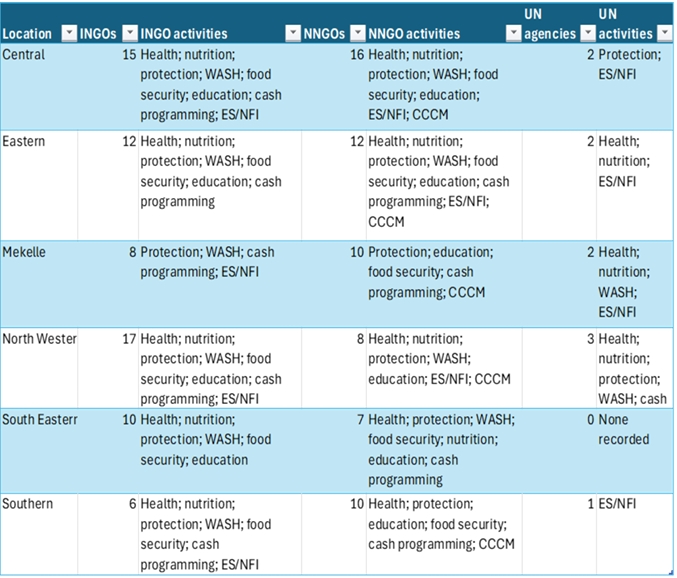
5.1.1 The below table, based on OCHA HDX data[footnote 117] shows the number of humanitarian organisations operating in Tigray as of 21 October 2026:
5.1.2 The RVI March 2026 report noted: ‘During the post-CoHA period, millions of people have been provided with food, clean water and medical care. This is not to say humanitarian needs are fully met, but compared to the wartime blockade, the improvement is dramatic. Also, essential services were gradually restored with federal cooperation. This enabled schools to reopen and farmers to plant again. These steps helped normalize daily life and are concrete successes attributable to the Pretoria Agreement.[footnote 118]
5.1.3 In August 2026 UNICEF published a midyear humanitarian situation report covering the first six months of 2026 (UNICEF August 2026 report). It stated in respect to Tigray:
‘UNICEF, in partnership with the Bureau of Social Affairs and Rehabilitation (BoSAR) and with funding from FCDO and SIDA, provided Shock-Responsive Cash Transfers (SRCTs) to drought- and conflict-affected households across 11 woredas. A total of 10,670 households … received two rounds of multipurpose cash assistance valued at ETB 12,050 [£55.82[footnote 119]] per round, amounting to ETB 24,100 [£111.65][footnote 120] per household. Overall, the programme reached 44,198 individuals, including 8,305 men, 8,160 women, 13,759 boys, and 13,974 girls. In addition, 1,067 households with persons with disabilities received disability top-up support, with 925 households in FCDO-supported woredas receiving ETB 4,000 [£18.53[footnote 121]]and 142 households in SIDA-supported woredas receiving ETB 2,500 (£11.58[footnote 122]) … Post-Distribution Monitoring (PDM) findings demonstrated significant improvements in household food security and reductions in hunger. Under the SIDA-supported cash response, the proportion of households reporting little to no hunger increased from 0.3 per cent at baseline to 95.7 per cent at endline, while moderate hunger declined from 83.3 per cent to 4.2 per cent and severe hunger was eliminated entirely, decreasing from 16.3 per cent to 0 per cent.’[footnote 123]
5.1.4 The same source further observed that during the reporting period:
-
547,988 children under five years of age were screened for acute malnutrition with UNICEF support. A total of 22,552 children aged 6-59 months with Severe Acute Malnutrition (SAM) were admitted for treatment
-
to address micronutrient deficiencies and promote optimal infant feeding practices a total of 456,018 children received vitamin A supplementation, while 104,470 pregnant and breastfeeding women received iron and folic acid supplementation through antenatal care services
-
44,691 caregivers were reached with Infant and Young Child Feeding in Emergencies (IYCF-E) counselling
-
729,988 women and children across 29 project woredas received health interventions including medical consultations for pneumonia, diarrhoea, malaria, and other childhood illnesses as well as antenatal, delivery and postnatal care for women, and
-
rehabilitation of 46 health facilities was ongoing, with most facilities reaching 94 per cent completion by June 2026[footnote 124].
5.1.5 In September 2026, FEWS NET reported that food aid distributions resumed in Tigray in July 2026 following a suspension in June and reached approximately 922,000 people, the majority of whom were internally displaced persons (IDPs)[footnote 125].
5.1.6 In October 2026, OCHA reported that the UN Emergency Relief Coordinator allocated US$8.5 million (£6.4 million[footnote 126]) from the Central Emergency Response Fund (CERF) for life-saving humanitarian assistance and civilian protection in northern Ethiopia, including Tigray. The funding is intended to support more than 202,700 people across Tigray, Amhara, Afar and Benishangul-Gumuz, and other areas of acute humanitarian need, prioritising people affected by new or secondary displacement, disruptions to essential services, and limited humanitarian response capacity. Assistance will cover WASH, shelter, health, nutrition and protection, among other services. OCHA did not specify how much of the US$8.5 million allocation, or how many of the intended beneficiaries, were allocated specifically to Tigray[footnote 127].
5.1.7 A 21 October 2026 UN News report stated that the World Health Organization (WHO) had strengthened emergency health coordination and expanded operational support in conflict-affected areas of northern Ethiopia to help maintain essential health services. Working with regional authorities and partners, including UNICEF and UNHCR, WHO supported disease surveillance, outbreak response, vaccine distribution, emergency referrals, and public health monitoring in areas affected by insecurity and displacement. Mobile health teams and health facilities were reported to be continuing to provide primary healthcare, disease prevention, and maternal and reproductive health services in affected areas. The report noted that WHO had delivered more than 71 metric tonnes of health supplies to Tigray, Amhara and Afar[footnote 128]. However, the report did not specify what proportion of these supplies was allocated to Tigray.
5.1.8 A 20 October 2026 ICRC report noted:
‘Renewed hostilities in northern Ethiopia have heightened humanitarian concerns for communities already affected by years of armed conflict, displacement and disruption to essential services. In Tigray, reports of drone strikes and fighting have raised concerns about the safety of civilians and their access to essential services.
‘The ICRC also continued to support health facilities caring for the wounded and sick. Between 13 and 16 October, in coordination with the Ethiopian Red Cross Society (ERCS), essential medical equipment and medicines were delivered to Suhul-Shire Hospital in northwestern Tigray, as well as to Lemlem Karl Hospital in Maychew, Mehoni Hospital, Alamata Hospital and Chercher Health Centre in southern Tigray, and Ayder Referral Hospital in Mekelle. In total, 33 health facilities in Tigray received support, with supplies intended to help health personnel provide care for wounded and sick people. The ICRC also supported the transport of blood supplies to Suhul Hospital in Shire and continued to assist emergency medical care and physical rehabilitation services.
‘Working closely with the Ethiopian Red Cross Society (ERCS) and other International Red Cross and Red Crescent Movement partners, the ICRC has also pre-positioned essential household items and provided cash assistance to help health workers and patients affected by the conflict meet their most urgent needs. A total of 6,000 essential household kits were pre-positioned in Tigray …
‘More than ETB 7 million has been allocated for preparedness activities by the Tigray Branch of the ERCS, and over ETB 5 million has been transferred to the Amhara Branch for emergency preparedness activities. These include the provision of hygiene materials, ensuring ambulance readiness, and supplying first-aid and medical supplies.’[footnote 129]
6. Freedom of movement
6.1.1 HRW reported in April 2026 that freedom of movement for Tigrayans in Western Tigray remained restricted. According to HRW, Tigrayans were required to obtain temporary travel permits from local authorities to travel outside their immediate locality, including for employment, medical treatment and family visits. HRW stated that permits were generally limited in duration and geographical scope, with travel documents reviewed by the organisation indicating that movement outside authorised areas could result in prosecution. The report also described the presence of official and ad hoc checkpoints operated by security forces, where individuals were reportedly required to present identification documents or travel permits. HRW further reported that some interviewees limited their movements because of concerns about arrest, detention or harassment. The organisation contrasted these accounts with testimony from an Amhara resident who reported being able to travel without significant difficulty, including when not carrying identification documents[footnote 130].
6.1.2 On 20 April 2026, Ethiopia Today, citing reporting by Wazema, reported restrictions on the movement of young people attempting to leave Tigray. According to the source, authorities had established checkpoints on routes leading to the Amhara and Afar regions, where vehicles carrying groups of young people were reportedly intercepted and turned back. The same source reported that the Tigray Police Commission stated that it had intercepted and returned more than 150 people in one week and that 171 individuals had been detained while attempting to leave the region. According to the report some people sought to avoid checkpoints by travelling on foot and that individuals apprehended while attempting to leave at night were reportedly held in temporary detention facilities. The source stated that concerns about recruitment by Tigrayan forces and fears of renewed conflict were among the reasons cited by some young people for leaving the region[footnote 131].
6.1.3 An August 2026 Ethiopia Protection Cluster analysis reported that, across conflict affected and environmentally fragile areas of Ethiopia, checkpoints, insecurity along transport routes, armed actors, explosive ordnance contamination and localised restrictions limited civilians’ freedom of movement and their ability to access livelihoods, essential services and humanitarian assistance. Some communities also reported harassment, intimidation, extortion and arbitrary restrictions while travelling. The Protection Cluster noted that weak, contested or disrupted administrative presence created additional barriers to accessing markets, healthcare, education, humanitarian assistance and protection services, with some groups, including older people and persons with disabilities, disproportionately affected[footnote 132].
6.1.4 On 23 September 2026 Ethiopia Today reported that Ethiopian Airlines had cancelled scheduled flights to Mekelle, Axum and Shire[footnote 133]. On 25 September 2026, the Associated Press (AP) reported that roads connecting Tigray with the neighbouring Afar region had been closed to civilian traffic. AP also reported that air travel to Tigray had been suspended after TPLF-affiliated fighters reportedly seized Mekelle airport, leading Ethiopian Airlines to cancel flights to and from the region[footnote 134].
6.1.5 On 25 September 2026, the Ethiopia Human Rights Commission (EHRC) reported a suspension of flights to and from Tigray after TPLF captured the airports at Mekelle, Shire and Axum. EHRC also reported that the complete closure of land routes linking Tigray with other parts of Ethiopia restricted freedom of movement, disrupted the supply of basic goods and services, and contributed to subsequent price inflation[footnote 135].
6.1.6 A 25 September 2026 press release by the OHCHR stated: ‘Internet and telecommunication have reportedly been disrupted or are non-functional in Mekelle, the capital of Tigray, and in parts of Amhara, and roads have reportedly been blocked in parts of Afar. Air travel has been significantly affected in Tigray after Ethiopian Airlines flights to Mekelle, Axum and Shire were suspended following the TPLF’s takeover of all three airports on 23 September.’[footnote 136]
6.1.7 On 16 October 2026, Addis Standard reported that the TPLF warned civilians against movement around airports in Tigray, alleging that the federal government was using airport facilities for military purposes. The TPLF also warned against travelling to areas where the Tigray army was operating without its permission[footnote 137]
Bibliography
Unless otherwise stated, all sources were accessed between 6 October and 22 October 2026
Sources cited
ACAPS, Ethiopia: Latest updates on country situation, 23 September 2025
Armed Conflict Location & Events Data project (ACLED),
ACLED Codebook, no date
Data Export Tool, downloaded 20 October 2026
Addis Standard,
More than 330 IDPs reported dead in Hitsats,125 in Adwa, as coordinators warn of worsening humanitarian crisis, 19 March 2026
News: More than 1,300 IDPs died of hunger in Tigray camps, official says, 24 March 2026
News: Tigray Interim Admin says 8.5 billion birr budget shortfall has triggered severe financial crisis, 24 August 2026
News: TPLF warns against movement around Tigray airports, rejects caretaker administration, 16 October 2026
Agence France-Presse (AFP), ‘I fear it could drag on’: anxiety takes hold in Ethiopian city wrested from rebels, 4 October 2026
Associated Press (AP), Residents of largest city in northern Ethiopia express fear after fighting resumes, 25 September 2026
BBC News,
Hundreds flee fighting in northern Ethiopia as fears rise of return to war, 3 August 2026
Ethiopia fighting escalates in Tigray, killing 52 civilians, medic tells the BBC, 30 September 2026
Ethiopia Human Rights Commission (EHRC), Tigray Region: The armed conflicts in the border areas of Tigray and Amhara, as well as Tigray and Afar regions, have the potential for human rights violations and must be resolved immediately, 25 September 2026
Emergency Shelter & Non Food Items Cluster (ES&NFI), Ethiopia Shelter/NFI, CCCM and HLP – 2nd Round Prioritization and Strategic Response Overview 2026: Responses and Priority Woredas, 25 May 2026.
Ethiopia Observer, Internet, mobile networks shut down in Tigray since yesterday, 25 September 2026.
Ethiopia Protection Cluster,
Protection Cluster Ethiopia, Ethiopia Monthly Protection Overview, March 2026
Protection Analysis Update, August 2026
Ethiopia Statistical Service (ESS),
Ethiopia Demographic and Health Survey (EDHS) 2024–25: Detailed Report, June 2026
National Integrated Household Survey (2024/25), Labour Force Module: Key Findings Report on Labour Market Indicators (pages 24–31, 34 and 38), September 2026
Ethiopia Today,
Exodus from Tigray: Youth flee to Addis Ababa amid fears of renewed conflict and forced conscription, 20 April 2026
Ethiopian Airlines cancels flights to Mekelle, Axum and Shire, 23 September 2026
Mass freezing of Tigray-opened bank accounts causes public distress, 28 September 2026
Eurafrica, Ethiopia: Why Tigray’s industrial heart has failed to restart, 2 April 2026
Famine Early Warning Systems Network (FEWS NET),
Ethiopia Key Message Update: Emergency (IPC Phase 4) likely as food access declines in lowland East Hararghe , January 2026
Ethiopia Food Security Outlook Update: Historically poor kiremt rainfall linked to El Niño drives meher crop losses, August 2026–January 2027, 10 September 2026
Federal Democratic Republic of Ethiopia (FDRE), Ethiopian Ministry of Education Annual Abstract 2024–2025, October 2025
Global Centre for the Responsibility to Protect (GCR2P), Ethiopia: Renewed escalation demands urgent international action to prevent further atrocities, 10 September 2026
Global Education Cluster, Ethiopia Education Cluster Dashboard, September 2026.
Global Protection Cluster,
Ethiopia Monthly Protection Overview, September 2025.
Ethiopia Monthly Protection Overview – February 2026, 2026
Human Rights Watch (HRW),
Ethiopia: Persecution of Tigrayans Unrelenting, 22 April 2026
Ethiopia: Indiscriminate Airstrike in Tigray, 25 September 2026
International Federation of Red Cross and Red Crescent Societies (IFRC), Ethiopia Drought 2026 – DREF Operation (MDRET042), 12 October 2026
ICRC, Ethiopia: ICRC responds to humanitarian needs amid renewed hostilities in the north, 21 October, 20 October 2026
International Organization for Migration (IOM),
DTM Ethiopia – Contested Areas (Two and Three) Snapshot Report: Household Needs Assessment (HNA), Round 1, 17 March 2026
DTM Ethiopia – Solutions Index: Measuring Parity and Progress towards Durable Solutions, Household Survey (page 13), 20 June 2025
International Organization for Migration/ Shelter (IOM/Shelter), Unsafe and Overcrowded: The Shelter Crisis Facing Displaced Families in Tigray, 4 April 2025
Médecins Sans Frontières (MSF), MSF Ethiopia: Renewed fighting in north drives surge in war-wounded, 28 September 2026
The New Humanitarian,
Ethiopia’s blame game after videos reveal starving displaced people in Tigray, 10 March 2026
Tigray faces a double catastrophe: War and worsening hunger, 8 October 2026
Norwegian Refugee Council (NRC), Six years without school in Ethiopia, 15 June 2025
Office of the United Nations High Commissioner for Human Rights (OHCHR), Ethiopia: Türk alarmed by civilian impact of hostilities, urges de-escalation, 25 September 2026
Physicians for Human Rights and the Organization for Justice and Accountability in the Horn of Africa (PHR and OJAH), Stolen, Broken, Destroyed: How Impunity Has Fueled Ongoing Attacks on Health Care in Ethiopia, August 2026
Rift Valley Institute (RVI), Peace and Instability: Tigray since the Pretoria Agreement, March 2026
Swedish International Development Cooperation Agency (Sida), Humanitarian Crisis Analysis 2026: Ethiopia, 31 March 2026
UN Committee on Economic, Social and Cultural Rights (CESCR), Fourth periodic report submitted by Ethiopia under articles 16 and 17 of the International Covenant on Economic, Social and Cultural Rights, 3 August 2026
UNESCO, Glossary, no date
UN News, World News in Brief: Aid for Ethiopia, Abyei drone strikes condemned, extreme heat and newborn health, 21 October 2026
UN Office for the Coordination of Humanitarian Affairs (OCHA), Press Release: UN Allocates US$8.5 Million from Emergency Fund to Address Humanitarian Needs in Ethiopia’s Northern Regions, 14 October 2026
UN Office for the Coordination of Humanitarian Affairs Humanitarian Data Exchange (OCHA HDX), Coordination & Context: Operational Presence for Ethiopia, no date
UN Population Fund (UNFPA), UNFPA Ethiopia Humanitarian Situation Report, January–March 2026, 27 April 2026
UN High Commissioner for Refugees (UNHCR),
Ethiopia: Refugees and Internally Displaced Persons as of 31 July 2026, 28 August 2026
Ethiopia: Refugees and IDPs statistics, 31 August 2026, 30 September 2026
PMS Report: Ethiopia, Tigray, Adigrat, December 2025, 2 March 2026
Protection Monitoring and Solutions Report: Ethiopia, Tigray Region, 27 November 2025
UNHCR Ethiopia: PMS Report, Ethiopia, Tigray, Shiraro, December 2025, 2 March 2026
UN Children’s Fund (UNICEF),
Ethiopia Humanitarian Situation Report No. 3 (Mid-Year), 30 June 2026, 30 June 2026
Humanitarian Action for Children 2026: Ethiopia, 2026
Humanitarian Situation Report No. 6 End-Year Report, 31 December 2025
World Health Organization (WHO), Weekly Bulletin on Outbreaks and Other Emergencies, Week 31, 27 July–2 August 2026, 2 August 2026
Xe, Exchange Rate and Currency Converter Tool, accessed 6 October 2026
Version control and feedback
Clearance
Below is information on when this note was cleared:
- valid from 10 November 2026
Official – sensitive: Not for disclosure – Start of section
The information in this section has been removed as it is restricted for internal Home Office use.
Official – sensitive: Not for disclosure – End of section
Feedback to the Home Office
Our goal is to provide accurate, reliable and up-to-date COI and clear guidance. We welcome feedback on how to improve our products. If you would like to comment on this note, please email the Country Policy and Information Team.
Independent Advisory Group on Country Information
The Independent Advisory Group on Country Information (IAGCI) was set up in March 2009 by the Independent Chief Inspector of Borders and Immigration to support them in reviewing the efficiency, effectiveness and consistency of approach of COI produced by the Home Office.
The IAGCI welcomes feedback on the Home Office’s COI material. It is not the function of the IAGCI to endorse any Home Office material, procedures or policy. The IAGCI may be contacted at:
Independent Advisory Group on Country Information
Independent Chief Inspector of Borders and Immigration
8th Floor
10 South Colonnade
London
E14 4PU
Email: chiefinspector@icibi.gov.uk
Information about the IAGCI’s work and a list of the documents which have been reviewed by the IAGCI can be found on the Independent Chief Inspector’s pages of the gov.uk website.
-
RVI, Peace and Instability: Tigray since the Pretoria Agreement (page 16), March 2026 ↩
-
Global Protection Cluster, Who we are, no date ↩
-
Xe, Xe currency converter, 6 October 2026 ↩
-
Protection Cluster, Ethiopia Monthly Protection Overview (page 1), March 2026 ↩
-
Xe, Xe currency converter, 6 October 2026 ↩
-
Xe, Xe currency converter, 6 October 2026 ↩
-
Xe, Xe currency converter, 6 October 2026 ↩
-
Xe, Xe currency converter, 6 October 2026 ↩
-
Xe, Xe currency converter, 6 October 2026 ↩
-
Addis Standard, News: Tigray Interim Admin says 8.5 billion birr budget …, 24 August 2026 ↩
-
Eurafrica, About Eurafrica, no date ↩
-
Eurafrica, Ethiopia: Why Tigray’s industrial heart has failed to restart, 2 April 2026 ↩
-
ESS, Ethiopia Demographic and Health Survey (EDHS) 2024–25 … (page 1), June 20 ↩
-
ESS, Ethiopia Demographic and Health Survey (EDHS) 2024–25 … (pages 53 to 56), June 2026 ↩
-
ESS, National Integrated Household Survey (2024/25) Labour force … (page 34), September 2026 ↩
-
ESS, National Integrated Household Survey (2024/25) Labour force … (page 38), September 2026 ↩
-
ESS, Ethiopia Demographic and Health Survey (EDHS) 2024–25 … (pages 53, 54), June 2026 ↩
-
ESS, Ethiopia Demographic and Health Survey (EDHS) 2024–25 … (pages 53 to 56), June 2026 ↩
-
ESS, National Integrated Household Survey(2024/25) Labour … (page 24), September 2026 ↩
-
ESS, National Integrated Household Survey(2024/25) Labour … (page 24 to 25), September 2026 ↩
-
ESS, National Integrated Household Survey(2024/25) Labour … (page 34), September 2026 ↩
-
ESS, National Integrated Household Survey(2024/25) Labour … (pages 29 to 31), September 2026 ↩
-
ESS, National Integrated Household Survey(2024/25) Labour … (pages 29 to 30), September 2026 ↩
-
ESS, National Integrated Household Survey(2024/25) Labour … (pages 26 to 28), September 2026 ↩
-
GCR2P, Ethiopia: Renewed Escalation Demands Urgent International …, 10 September 2026 ↩
-
OHCHR, Ethiopia: Türk alarmed by civilian impact of hostilities, urges …, 25 September 2026 ↩
-
HRW, Ethiopia: Indiscriminate Airstrike in Tigray, 25 September 2026 ↩
-
MSF, MSF Ethiopia: Renewed fighting in north drives surge in war-wounded, 28 September 2026 ↩
-
BBC, Ethiopia fighting escalates in Tigray killing 52 civilians, medic tells the…, 30 September 2026 ↩
-
ACLED, ACLED Codebook (Civilian targeting), no date ↩
-
ACLED, Data Export tool (Ethiopia /Tigray/Demonstrations), downloaded 20 October 2026 ↩
-
ACLED, ACLED Codebook (Violence against civilians), no date ↩
-
ACLED, Data Export tool (Ethiopia /Tigray/Demonstrations), downloaded 20 October 2026 ↩
-
ACLED, Data Export tool (Ethiopia /Tigray/Demonstrations), downloaded 20 October 2026 ↩
-
SIDA, About Sida, no date ↩
-
SIDA, Humanitarian Crisis Analysis 2026 Ethiopia, 31 March 2026 ↩
-
SIDA, Humanitarian Crisis Analysis 2026 Ethiopia, 31 March 2026 ↩
-
UNICEF, Ethiopia Humanitarian Situation Report No. 3 (Mid-Year) , 3 August 2026 ↩
-
WHO, Weekly bulletin on outbreaks and other emergencies 27 July … (page 11), 2 August 2026 ↩
-
Xe, Exchange Rate and Currency Converter Tool, 6 October 2026 ↩
-
Ethiopia Protection Cluster, Protection Analysis Update (pages 5 to 6), August 2026 ↩
-
IOM, DTM Ethiopia —Solutions Index —Measuring Parity and … (page 13), 20 June 2025 ↩
-
UNICEF, Ethiopia Humanitarian Situation Report … End-Year Report (page 2), 31 December 2025 ↩
-
Global Protection Cluster, Ethiopia Monthly Protection Overview – February 2026, 2026 ↩
-
UNFPA, UNFPA Ethiopia Situation Report (Jan - Mar 2026), 27 April 2026 ↩
-
UNHCR, Ethiopia: Refugees and Internally Displaced Persons as of 31 July 2026, 28 August 2026 ↩
-
UNHCR, Ethiopia : Refugees and IDPs statistics 31 August 2026, 30 September 2026 ↩
-
BBC News, Hundreds flee fighting in northern Ethiopia as fears rise of return to …, 3 August 2026 ↩
-
Global Protection Cluster, Ethiopia Monthly Protection Overview, (page 1) September 2025 ↩
-
UNHCR, Ethiopia: Refugees and Internally Displaced Persons as of 31 July 2026, 28 August 2026 ↩
-
Global Protection Cluster, Ethiopia Monthly Protection Overview – February 2026, 2026 ↩
-
HRW, Ethiopia: Persecution of Tigrayans Unrelenting 22 April 2026 ↩
-
IOM/Shelter, Unsafe and Overcrowded: The Shelter Crisis Facing …, 4 April 2025 ↩
-
IOM, DTM Ethiopia — Tigray Region Snapshot Report, Household Needs …, 17 March 2026 ↩
-
IOM, DTM Ethiopia — Contested Areas (Two and Three) Snapshot Report … , 17 March 2026 ↩
-
IOM, DTM Ethiopia — Tigray Region Snapshot Report, Household Needs …, 17 March 2026 ↩
-
UNHCR, UNHCR Ethiopia PMS Report Ethiopia Tigray Shiraro … (page 1) 2 March 2026 ↩
-
UNHCR, UNHCR Ethiopia PMS Report Ethiopia Tigray Shiraro … (pages 6, 9) 2 March 2026 ↩
-
UNHCR, UNHCR Ethiopia PMS Report Ethiopia Tigray Shiraro … (page 2), 2 March 2026 ↩
-
UNHCR, UNHCR Ethiopia PMS Report Ethiopia Tigray Shiraro … (pages 7 to 8), 2 March 2026 ↩
-
UNHCR, PMS Report Ethiopia Tigray Adigrat December 2025 (page 1), 2 March 2026 ↩
-
UNHCR, PMS Report Ethiopia Tigray Adigrat December 2025 (page 10), 2 March 2026 ↩
-
UNHCR, PMS Report Ethiopia Tigray Adigrat December 2025 (pages 2, 6), 2 March 2026 ↩
-
UNHCR, PMS Report Ethiopia Tigray Adigrat December 2025 (page 9), 2 March 2026 ↩
-
The New Humanitarian, Ethiopia’s blame game after videos reveal starving … , 10 March 2026 ↩
-
Addis Standard, More than 330 IDPs reported dead in Hitsats, 125 in Adwa…, 19 March 2026 ↩
-
Addis Standard, More than 330 IDPs reported dead in Hitsats, 125 in Adwa…, 19 March 2026 ↩
-
Addis Standard, News: More than 1,300 IDPs died of hunger in Tigray camps …, 24 March 2026 ↩
-
UNFPA, UNFPA Ethiopia Situation Report (Jan - Mar 2026), 29 April 2026 ↩
-
HRW, Ethiopia: Persecution of Tigrayans Unrelenting 22 April 2026 ↩
-
UNHCR, Ethiopia Protection Monitoring and Solutions Tigray Region …, 27 November 2025 ↩
-
UNHCR, PMS Report Ethiopia Tigray Adigrat December 2025, 2 March 2026 ↩
-
UNHCR, UNHCR Ethiopia, PMS Report Ethiopia Tigray Shiraro …. (page 2)2 March 2026 ↩
-
FEWS NET, About FEWS NET, no date ↩
-
FEWS NET, Ethiopia Key Message Update Emergency … (pages 1 to 2), January 2026 ↩
-
FEWS NET, Historically poor kiremt rainfall linked to El Niño … (page 4), 10 September 2026 ↩
-
FEWS NET, Historically poor kiremt rainfall linked to El Niño … (page 3), 10 September 2026 ↩
-
The New Humanitarian, Tigray faces a double catastrophe: War and worsening…, 8 October 2026 ↩
-
IFRC, Ethiopia Drought 2026 - DREF Operation (MDRET042), 12 October 2026 ↩
-
CECR, Fourth periodic report submitted by Ethiopia under articles … (para 300), 3 August 2026 ↩
-
ESS, Ethiopia Demographic and Health Survey 2024–25 … (pages 150, 154), June 2026 ↩
-
ESS, Ethiopia Demographic and Health Survey 2024–25 … (page 40), June 2026 ↩
-
ESS, Ethiopia Demographic and Health Survey 2024–25 … (pages 40 to 41, 58 to 59), June 2026 ↩
-
PHR and OJAH, Stolen, Broken, Destroyed How Impunity … (Acknowledgments), August 2026 ↩
-
PHR and OJAH, Stolen, Broken, Destroyed How Impunity… (Acknowledgments), August 2026 ↩
-
PHR and OJAH, Stolen, Broken, Destroyed How Impunity Has Fueled … (page 5), August 2026 ↩
-
MSF, MSF Ethiopia: Renewed fighting in north drives surge in war-wounded, 28 September 2026 ↩
-
NRC, About the Norwegian Refugee Council, no date ↩
-
NRC, Six years without school in Ethiopia, 15 June 2025 ↩
-
Acaps, Ethiopia: Latest updates on country situation, 23 September 2025 ↩
-
Global Education Cluster, Ethiopia Education Cluster Dashboard 2026, September 2026 ↩
-
Ethiopia MoE, Annual Abstract 2024-2025, October 2025 ↩
-
Ethiopia MoE, Annual Abstract 2024-2025, (pages 5, 10, 15, 39), October 2025 ↩ ↩2
-
Ethiopia MoE, Annual Abstract 2024-2025 (pages 7, 11, 17,41), October 2025 ↩ ↩2
-
FDRE, Ethiopian Ministry of Education Annual Abstract 2024-2025 (page 8), October 2025 ↩
-
FDRE, Ethiopian Ministry of Education Annual Abstract 2024-2025 (page 18), October 2025 ↩
-
FDRE, Ethiopian Ministry of Education Annual Abstract 2024-2025 (page 45), October 2025 ↩
-
IFRC, Ethiopia Drought 2026 - DREF Operation (MDRET042), 12 October 2026 ↩
-
ESS, Ethiopia Demographic and Health Survey (EDHS) … (pages 425, 428, 437), June 20 ↩
-
ESS, Ethiopia Demographic and Health Survey (EDHS) … (pages 439), June 2026 ↩
-
ES&NFI Cluster, Ethiopia Shelter/NFI, CCCM, and HLP … (pages 4, 12 to 14), 25 May 2026 ↩
-
HRW, Ethiopia: Persecution of Tigrayans Unrelenting, 22 April 2026 ↩
-
Ethiopia Observer, Internet, mobile networks shut down in Tigray since …, 25 September 2026 ↩
-
AFP, ‘I fear it could drag on’: anxiety takes hold in Ethiopian city wrested from …, 4 October 2026 ↩
-
Ethiopia Today, Mass Freezing of Tigray-Opened Bank Accounts Causes …, 28 September 2026 ↩
-
The New Humanitarian, Tigray faces a double catastrophe: War and worsening r, 8 October 2026 ↩
-
Ethiopia Protection Cluster, Protection Analysis Update (pages 5 to 6), August 2026 ↩
-
OCHA HDX, Coordination & Context: Operational Presence for Ethiopia ↩
-
RVI, Peace and Instability: Tigray since the Pretoria Agreement (page 16), March 2026 ↩
-
Xe, Exchange Rate and Currency Converter Tool,6 October 2026 ↩
-
Xe, Exchange Rate and Currency Converter Tool, 6 October 2026 ↩
-
Xe, Exchange Rate and Currency Converter Tool, 6 October 2026 ↩
-
Xe, Exchange Rate and Currency Converter Tool, 6 October 2026 ↩
-
UNICEF, Ethiopia Humanitarian Situation Report No. 3 … (pages 11 to 12), 3 August 2026 ↩
-
UNICEF, Ethiopia Humanitarian Situation Report No. 3 (Mid-Year) (page 3), 3 August 2026 ↩
-
FEWS NET, Historically poor kiremt rainfall linked to El Niño … (page 3), 10 September 2026 ↩
-
Xe Exchange Rate and Currency Converter Tool, 19 October 2026 ↩
-
OCHA, UN Allocates US$8.5 Million from Emergency Humanitarian Needs … 14 October 2026 ↩
-
UN News, World News in Brief: Aid for Ethiopia, Abyei drone strikes …, 21 October 2026 ↩
-
ICRC, Ethiopia: ICRC responds to humanitarian needs amid renewed …, 20 October 2026 ↩
-
HRW, Ethiopia: Persecution of Tigrayans Unrelenting, 22 April 2026 ↩
-
Ethiopia Today, Exodus from Tigray: Youth Flee to Addis Ababa Amid Fears of …, 20 April 2026 ↩
-
Ethiopia Protection Cluster, Protection Analysis Update (page 10), August 2026 ↩
-
Ethiopia Today, Ethiopian Airlines Cancels Flights to Mekelle, Axum …, 23 September 2026 ↩
-
AP, Residents of largest city in northern Ethiopia express fear after …, 25 September 2026 ↩
-
EHRC, Tigray Region: The armed Conflicts in the Border areas of Tigray …, 25 September 2026 ↩
-
OHCHR, Ethiopia: Türk alarmed by civilian impact of hostilities, urges …, 25 September 2026 ↩
-
Addis Standard, News: TPLF warns against movement around Tigray airports …, 16 October 2026 ↩