Country policy and information note: national service and illegal exit, Eritrea, December 2025 (accessible)
Updated 10 December 2025

© Crown copyright 2025
This publication is licensed under the terms of the Open Government Licence v3.0 except where otherwise stated. To view this licence, visit nationalarchives.gov.uk/doc/open-government-licence/version/3 or write to the Information Policy Team, The National Archives, Kew, London TW9 4DU, or email: psi@nationalarchives.gov.uk.
Where we have identified any third party copyright information you will need to obtain permission from the copyright holders concerned.
This publication is available at https://www.gov.uk/government/publications/eritrea-country-policy-and-information-notes/country-policy-and-information-note-national-service-and-illegal-exit-eritrea-december-2025-accessible
Version 7.0, December 2025
Executive summary
Eritrea is a highly militarised, authoritarian state with a closed political system and limited civil liberties.
The country maintains compulsory national service system for all citizens aged 18 to 40. Following a 6-month period of military training, conscripts are assigned to either a military or a civilian role. Although the legal requirement caps service at 18 months in total, in practice it is open-ended. It is coercive and marked by abuse and inhuman treatment. It has also been likened to forced labour and slavery.
Many Eritreans attempt to evade or escape national service, sometimes by leaving the country illegally. As of 2025 Eritrea had an estimated population of 6.4 million, of which 679,346 Eritreans (11%) were outside the country as refugees and asylum seekers. The penalties for evasion, desertion and not performing national service through conscientious objection include imprisonment, detention and other forms of mistreatment.
In the 2016 Country Guidance case of MST and Others, the Upper Tribunal held that where there is a real risk of persecution linked to military or national service, it is very likely to be on account of an imputed political opinion. Those of, or approaching, draft age who are perceived as draft evaders or deserters and those who left Eritrea illegally face a real risk of persecution or serious harm.
There is little information on the treatment of failed asylum seekers return to Eritrea. Returnees face significant and unpredictable risks, but their treatment varies. Those who have acquired diaspora status, paid the diaspora tax, signed a “regret form” and are on a temporary visit are not likely to be forced to undertake national service or face punishment for evasion. However, those who leave the country illegally, evade or desert national service, oppose the government abroad, are forcibly returned or deported, do not have diaspora status or have not paid the diaspora tax are likely to be at risk. However, even those who sign a “regret form” or pay the diaspora tax are not guaranteed protection from punishment. The Eritrean government views claiming asylum or refusing to perform national service as acts of disloyalty or treason, which can further increase the risk of mistreatment.
Where the person has a well-founded fear of persecution from the state they will not, in general, be able to obtain protection from the authorities nor will it be reasonable to expect them to internally relocate.
If a claim is refused, it is generally not likely to be certified as ‘clearly unfounded’ under section 94 of the Nationality, Immigration and Asylum Act 2002.
All cases must be considered on their individual facts, with the onus on the person to demonstrate they face persecution or serious harm.
About the assessment
Section updated: 5 November 2025
About the assessment
This section considers the evidence relevant to this note – that is the country information, refugee/human rights laws and policies, and applicable caselaw – and provides an assessment of whether, in general:
- a person faces a real risk of persecution and/or serious harm by the state because the person evaded or deserted from national service and/or left Eritrea illegally
- the state (or quasi state bodies) can provide effective protection
- internal relocation is possible to avoid persecution/serious harm
- a claim, if refused, is likely or not to be certified as ‘clearly unfounded’ under section 94 of the Nationality, Immigration and Asylum Act 2002.
Decision makers must, however, consider all claims on an individual basis, taking into account each case’s specific facts.
1. Material facts, credibility and other checks/referrals
1.1 Credibility
1.1.1 For information on assessing credibility, see the instruction on Assessing Credibility and Refugee Status.
1.1.2 Decision makers must also check if there has been a previous application for a UK visa or another form of leave. Asylum applications matched to visas should be investigated prior to the asylum interview (see the Asylum Instruction on Visa Matches, Asylum Claims from UK Visa Applicants).
1.1.3 Decision makers must also consider making an international biometric data-sharing check, when one has not already been undertaken (see Biometric data-sharing process (Migration 5 biometric data-sharing process)).
1.1.4 In cases where there are doubts surrounding a person’s claimed place of origin, decision makers should also consider language analysis testing, where available (see the Asylum Instruction on Language Analysis).
Official – sensitive: Not for disclosure – Start of section
The information in this section has been removed as it is restricted for internal Home Office use only.
Official – sensitive: Not for disclosure – End of section
1.2 Exclusion
1.2.1 Decision makers must consider whether there are serious reasons to apply one (or more) of the exclusion clauses. Each case must be considered on its individual facts.
1.2.2 If the person is excluded from the Refugee Convention, they will also be excluded from a grant of humanitarian protection (which has a wider range of exclusions than refugee status).
1.2.3 For guidance on exclusion and restricted leave, see the Asylum Instruction on Exclusion under Articles 1F and 33(2) of the Refugee Convention, Humanitarian Protection and the instruction on Restricted Leave.
Official – sensitive: Not for disclosure – Start of section
The information in this section has been removed as it is restricted for internal Home Office use only.
Official – sensitive: Not for disclosure – End of section
2. Convention reason(s)
2.1.1 Actual or imputed political opinion.
2.1.2 In the country guidance case of MST and Others (national service – risk categories) Eritrea CG [2016] UKUT 443 (IAC), heard on 2, 3, 6, 7, 8, 10 & 20 June 2016 and promulgated on 7 October 2016, the Upper Tribunal (UT) held: ‘Where … there is a real risk of persecution in the context of performance of military/national service, it is highly likely that it will be persecution for a Convention reason based on imputed political opinion.’ (Paragraph 431(10))
2.1.3 Establishing a convention reason is not sufficient to be recognised as a refugee. The question is whether the person has a well-founded fear of persecution on account of an actual or imputed Refugee Convention reason.
2.1.4 In the absence of a link to one of the 5 Refugee Convention reasons necessary for the grant of asylum, the question is whether the person will face a real risk of serious harm to qualify for Humanitarian Protection (HP).
2.1.5 For further guidance on the 5 Refugee Convention grounds, see the Asylum Instruction, Assessing Credibility and Refugee Status.
3. Risk
3.1 Country guidance case
3.1.1 In MST and Others, the UT gave guidance on those persons leaving Eritrea illegally and avoiding national service. The UT reconfirmed parts of the country guidance given in MA (Draft evaders – illegal departures – risk) Eritrea CG [2007] UKAIT 59 and MO (illegal exit – risk on return) Eritrea CG [2011] UKUT 190 (IAC), replacing that with the findings in (see paragraph 431(1)) of MST and Others. Detailed discussion of MST is set out below.
3.2 National service
3.2.1 In general, a person who is of, or is approaching, national service age and who has left Eritrea illegally and is not i) perceived to have given valuable service to the government; ii) a member of a family that belongs to the military / political leadership; and/or iii) a person who fled Eritrea during the war of independence (or the person’s child), is likely to be perceived as having evaded or deserted from national service. Such persons are likely to be subject to treatment that by its nature and repetition is likely to amount to persecution or serious harm.
3.2.2 To date, Eritrea has not taken any measures to reform national service and it remains a feature of Eritrean society. It continues to be open-ended, involving both military and civilian placements (see Reform of national service and Recent history).
3.2.3 Eritrea is a closed society with restrictions on entry and exit, foreign media, and the internet and all domestic media is under state control. It has irregular interaction with the international community and has refused to cooperate with the UN’s Special Rapporteur for Eritrea or to allow human rights groups to enter the country. All of these factors contribute to limitations regarding the availability and reliability of information about Eritrea’s national service system (see Limitation of information).
3.2.4 National Service is compulsory for all citizens aged 18 to 40. During the Tigray conflict in Ethiopia (2020 to 2022) - in which Eritrea was involved - and subsequently there have been reports of people aged between 15 and 18 and over 60 being conscripted although it is unclear how commonplace such recruitment has been (see Eligibility). Following a 6-month period of military training, conscripts are assigned to either a military or a civilian role (see Framework of national service).
3.2.5 The school system is designed to channel conscripts into national service with all students – including minors – being required to complete their final year of studies at the Sawa military camp. However, less than one third of pupils remain in school until year 12 (when most pupils are age 17 or 18). Upon graduation, the government assigns the vast majority of students to civilian or military roles. Those who drop out of school before year 12 are recruited through other means, including summons from the local administration, roundups (giffas) or as a consequence of arrest. These are usually assigned to the military component of the national service. A proportion of school dropouts avoid enrolment either through exemption, bribing the local administration, private connections, evasion or leaving the country (see Recruitment and Framework of national service).
3.2.6 Accurate data on the total level of enrolment in national service is not available but there were an estimated 300,000 to 400,000 conscripts in 2019. No recent estimates were found in the sources consulted (see Bibliography). The relative size of the military and civilian components of national service is disputed; estimates suggest that a bit less than half of all conscripts serve in the military (see Level of participation in national service).
3.2.7 The law lists a limited number of exemptions from service including for those with a disability or health grounds. Additional exemption categories exist, although they are inconsistently applied. Exemption from military service does not necessarily preclude compulsory civilian service (see Exemptions).
3.2.8 Laws exist which set out the conditions and length of service and also discharge from service. In practice the duration of service is not limited to the 18 months set out in law. The arbitrary and inconsistent application of the rules means that conscripts’ experience of national service – and length of service – varies greatly and in extreme cases, a conscript may serve up to 30 years (see Duration, Discharge from national service).
3.2.9 The conditions experienced by those who are conscripted into the military tend to be harsher than for those in the civilian service. Conditions include severe punishments, including arbitrary detention and torture, the use of conscripts for forced labour, and sexual and gender-based violence (see Treatment during national service).
3.2.10 Conscripts who are released from national service often find it difficult to obtain formal discharge papers and therefore have no official documentation to demonstrate that they have met their national service obligation. Similarly, people who have obtained de facto exemptions – rather than exemptions under the law – also have difficulty obtaining the required papers. Completion of national service is a precondition for access to basic services and legal entitlements. Official documentation is required in order to gain formal employment, to apply for ID documents, to receive educational qualifications and also to avoid the risk of being mistaken for an evader or deserter. Official documentation to show a person is either exempt or has been released from national service is also needed in order to obtain a visa to legally exit the country (see Discharge from national service, Exemptions)
3.2.11 The law lists punishments for evading or deserting from service, but these are not treated in the formal justice system. Punishments are imposed by military commanders instead, and are meted out arbitrarily and inconsistently. In some cases, no action is taken, while other offenders may be returned to their original posting or reassigned from a civilian position to a military position. In other cases, offenders are forcibly disappeared, held on incommunicado detention, and imprisoned where they may be subjected to interrogation or torture or sexual abuse. Conscientious objectors in particular Jehovah’s Witnesses are imprisoned for their refusal to participate in military service (see Deserters, evaders and conscientious objectors).
3.2.12 Commanders and employers have the power to make decisions about a conscript’s treatment and punishment during service and decisions about when a conscript is to be released from service. With no oversight, the system is arbitrary and prone to abuse, for example, through the payment of bribes or through pressure exerted by influential families. In some cases, commanders and employers may use their position of power to harass conscripts, with female recruits being particularly vulnerable to abuse, including sexual abuse. As a consequence, some teenage girls and young women choose to marry and have children in order to avoid conscription (see Treatment during national service).
3.2.13 In MST and Others, the UT held that ‘The Eritrean system of military /national service remains indefinite’ and that national service starts at 18 years old, or younger in some cases (paragraph 304), with the upper limit for men being 54 years old, and for women 47 (paragraph 431(3)).
3.2.14 The UT also held that children aged 5 years or above are not likely to be issued an exit visa because the government believes it has lost too many young people, although this is with the exception of some adolescents who have applied for family reunification with relatives outside of Eritrea (paragraphs 322 and 431(3 and 4)).
3.2.15 Therefore, in general, children aged 5 and over may be considered by the government to be approaching national service age and by leaving the country perceived as seeking to evade it.
3.2.16 While accepting that the length of national service is ‘indefinite’ (paragraph 431(2)), the UT held that release from national service is likely to be commonplace (paragraph 306) and many Eritreans are effectively ‘reservists’, not in active national service. However, although such reservists are unlikely to face recall it also remains unlikely that they have received or are able to receive official confirmation to demonstrate that their national service is formally complete (paragraphs 306 and 431(8)).
3.2.17 In practice, while many people may not be in active national service, officially they remain subject to national service and are likely to be considered as such by the authorities on return.
3.2.18 The UT went on to hold that: ‘…if a person of or approaching draft age will be perceived on return as a draft evader or deserter, he or she will face a real risk of persecution, serious harm or ill-treatment contrary to Article 3 or 4 of the ECHR.’ (paragraph 431(7))
3.2.19 The Tribunal also held that:
i) ‘A person who is likely to be perceived as a deserter/evader will not be able to avoid exposure to such real risk merely by showing they have paid (or are willing to pay) the diaspora tax and/have signed (or are willing to sign) the letter of regret.
ii) ‘Even if such a person may avoid punishment in the form of detention and ill-treatment it is likely that he or she will be assigned to perform (further) national service, which, is likely to amount to treatment contrary to Articles 3 and 4 of the ECHR unless he or she falls within one or more of the three limited exceptions set out immediately below in (iii).
iii) ‘It remains the case (as in MO) that there are persons likely not to face a real risk of persecution or serious harm notwithstanding that they left illegally and will be perceived on return as draft evaders and deserters, namely:
‘(1) persons whom the regime’s military and political leadership perceives as having given them valuable service (either in Eritrea or abroad);
‘(2) persons who are trusted family members of, or are themselves part of, the regime’s military or political leadership. A further possible exception, requiring a more case specific analysis is
‘(3) persons (and their children born afterwards) who fled (what later became the territory of) Eritrea during the War of Independence [i.e. persons or their descendants who left the territory of Eritrea before 1991].’ (para 431(7))
3.2.20 The UT ultimately found that, aside from the exceptions above: ‘… it remains the case, as in MO, that “(iv) The general position adopted in MA, that a person of or approaching draft age … and not medically unfit who is accepted as having left Eritrea illegally is reasonably likely to be regarded with serious hostility on return, is reconfirmed…”’ (paragraph 431(8))
3.2.21 The UT also considered the situation of persons who were able to obtain an exit visa and leave lawfully: ‘While likely to be a rare case, it is possible that a person who has exited lawfully may on forcible return face having to resume or commence national service. In such a case there is a real risk of persecution or serious harm by virtue of such service constituting forced labour contrary to Article 4(2) and Article 3 of the ECHR.’ (para 431(9).
3.2.22 While there have been significant developments in Eritrea’s relationship with Ethiopia which might impact on the need for national service since MST and Others was promulgated, the available country evidence does not indicate that there has been a significant change in the Eritrean government’s approach to, or treatment of, persons in national service. Given the absence of very strong grounds supported by cogent evidence to depart from existing country guidance, the findings of MST and Others continue to apply.
3.2.23 Each case must be considered on its facts with the onus on the person to show that they evaded national service and left the country illegally and would be at risk of being punished and/or compelled to undertake national service on return.
3.3 People’s militia (aka People’s Army or Hizbawi Serawi)
3.3.1 Being a member of the People’s Militia does not, in itself, establish a real risk of persecution or serious harm. The onus is on the person to demonstrate otherwise.
3.3.2 The UT in MST and Others found that since 2012 national / military service has been ‘expanded to include a people’s militia programme, which although not part of national service, constitutes military service’ (para 431(2)) with upper age limits ‘likely to be 60 for women and 70 for men’ (para 431(3)).
3.3.3 However, unlike for national service, the UT found that: ‘A person liable to perform service in the people’s militia and who is assessed to have left Eritrea illegally, it [sic] not likely on return to face a real risk of persecution or serious harm.’ (paragraph 431(8))
3.3.4 The available country evidence does not indicate that there has been a significant change in the Eritrean government’s approach to, or treatment of, persons in the People’s Militia since MST and Others was promulgated. Given the absence of very strong grounds supported by cogent evidence to depart from existing country guidance, the findings continue to apply (see People’s militia (aka People’s Army or Hizbawi Serawit).
3.4 Failed asylum seekers
3.4.1 Being a refused asylum seeker does not, in itself, establish a risk of persecution or serious harm. The onus is on the person to demonstrate otherwise.
3.4.2 Information about persons returned to Eritrea is scarce and their treatment upon arrival in Eritrea is largely unknown and undocumented. Anecdotal accounts report that deportees are detained and screened, with the final outcome depending upon the person’s profile, specifically, their age and conscription status (see Returnees and Treatment of failed asylum seekers).
3.4.3 In MST and Others, the UT held that: ‘It remains the case (as in MO) that failed asylum seekers as such are not at risk of persecution or serious harm on return’ (paragraph 431(6)).
3.4.4 The UT in MO at [133(v)] also nuanced the guidance given in MA regarding failed asylum seekers as follows: “(v) Whilst it also remains the position that failed asylum seekers as such are not generally at real risk of persecution or serious harm on return, on present evidence the great majority of such persons are likely to be perceived as having left illegally and this fact, save for very limited exceptions, will mean that on return they face a real risk of persecution or serious harm.” (paragraph 22)
3.4.5 The available country evidence does not indicate that there has been a significant change in the Eritrean government’s approach to, or treatment of, refused asylum seekers since MST and Others was promulgated. Given the absence of very strong grounds supported by cogent evidence to depart from existing country guidance, MST and Others continues to apply.
3.5 Family members
3.5.1 A family member of a person of draft age who has deserted from or evaded national service may be at risk of persecution or serious harm depending on the facts of the case.
3.5.2 The UT in MST and Others provided no specific country guidance on the risk to family members of deserters or evaders but observed: ‘We would accept… that punishment of family members or associates may not be as common as it was.’ (paragraph 281). However, the situation since MST was promulgated has deteriorated primarily as a result of the tensions between Eritrea and Ethiopia (see Relations with Ethiopia).
3.5.3 Eritrean authorities continue to impose reprisals on families of persons who evade or desert compulsory national service. Measures include aggressive questioning, threats, arbitrary detention, denial of essential services, evictions, confiscation of property and livestock and closure of businesses. Neighbours who assist affected families risk intimidation, reinforcing a climate of fear and social isolation. Sources consistently describe these practices as systematic and coercive, aimed at compelling draft evaders to surrender (see Family members of evaders and deserters).
3.6 Illegal exit
3.6.1 Illegal exit is not of itself enough to place a person at risk of persecution or serious harm. The onus is on the person to demonstrate otherwise.
3.6.2 Exit from Eritrea is tightly controlled with most people unable to obtain passports or exit visas. A person may be able to leave Eritrea lawfully, using their own passport and valid exit visa but the categories of person who is able to do so are limited. Most people leave the country without a passport or exit visa (illegally) (see Requirements to leave the country and Illegal exit).
3.6.3 In MST and Others, the UT found that categories of people who can lawfully exit were likely to be:
- ‘Men aged over 54
- ‘Women aged over 47
- ‘Children aged under five (with some scope for adolescents in family reunification cases)
- ‘People exempt from national service on medical grounds
- ‘People travelling abroad for medical treatment
- vi) ‘People travelling abroad for studies or for a conference
- ‘Business and sportsmen
- ‘Former freedom fighters (Tegadelti) and their family members
- ‘Authority representatives in leading positions and their family members.’ (paragraph 431(4))
3.6.4 The UT held:
‘It continues to be the case (as in MO) that most Eritreans who have left Eritrea since 1991 have done so illegally. However, since there are viable, albeit still limited, categories of lawful exit especially for those of draft age for national service, the position remains as it was in MO, namely that a person whose asylum claim has not been found credible cannot be assumed to have left illegally. The position also remains nonetheless (as in MO) that if such a person is found to have left Eritrea on or after August / September 2008, it may be that inferences can be drawn from their health, history or level of education or their skills profile as to whether legal exit on their part was feasible, provided that such inferences can be drawn in the light of adverse credibility findings. For these purposes a lengthy period performing national service is likely to enhance a person’s skill profile’ (para 431(5)).
3.6.5 The UT further held:
‘… a person whose asylum claim has not been found credible, but who is able to satisfy a decision-maker (i) that he or she left illegally, and (ii) that he or she is of or approaching draft age is likely to be perceived on return as a draft evader or deserter from national service and as a result face a real risk of persecution or serious harm. While likely to be a rare case, it is possible that a person who has exited lawfully may on forcible return face having to resume or commence national service. In such a case there is a real risk of persecution or serious harm by virtue of such service constituting forced labour contrary to Article 4(2) and Article 3 of the ECHR . (paragraph 431(9)
3.6.6 On illegal exit per se, the UT held that: ‘… the totality of the evidence continues to support the view that the fact of illegal exit is not of itself enough to place an individual at risk.’ (paragraph 345). Rather 2 further elements are required to place a person at risk, namely: ‘(i) that the person will be perceived on return as evaders / deserters; and (ii) that they will be subject to forcible return’ (paragraph 347). Even if these additional elements are met, the UT identified certain exceptions:
(1) ‘persons whom the regime’s military and political leadership perceives as having given them valuable service (either in Eritrea or abroad);
(2) ‘persons who are trusted family members of, or are themselves part of, the regime’s military or political leadership. A further possible exception, requiring a more case specific analysis
(3) ‘persons (and their children born afterwards) who fled (what later became the territory of) Eritrea during the War of Independence.’ (paragraph 347)
3.6.7 For further guidance on assessing risk, see the instruction on Assessing Credibility and Refugee Status.
4. Protection
4.1.1 Where the person has a well-founded fear of persecution from the state they will not, in general, be able to obtain protection from the authorities.
4.1.2 For further guidance on internal relocation and factors to consider, see the Asylum Instruction on Assessing Credibility and Refugee Status.
5. Internal relocation
5.1.1 Where the person has a well-founded fear of persecution or serious harm from the state, they are unlikely to be able to internally relocate to escape that risk.
5.1.2 For further guidance on internal relocation and factors to consider, see the Asylum Instruction on Assessing Credibility and Refugee Status.
6. Certification
6.1.1 Where a claim is refused, it is unlikely to be certifiable as ‘clearly unfounded’ under section 94 of the Nationality, Immigration and Asylum Act 2002.
6.1.2 For further guidance on certification, see Certification of Protection and Human Rights claims under section 94 of the Nationality, Immigration and Asylum Act 2002 (clearly unfounded claims).
Country information
About the country information
This section contains publicly available or disclosable country of origin information (COI) which has been gathered, collated and analysed in line with the research methodology. It provides the evidence base for the assessment which, as stated in the About the assessment, is the guide to the current objective conditions.
The structure and content follow a terms of reference which sets out the general and specific topics relevant to the scope of this note.
This document is intended to be comprehensive but not exhaustive. If a particular event, person or organisation is not mentioned this does not mean that the event did or did not take place or that the person or organisation does or does not exist.
The COI included was published or made publicly available on or before 5 November 2025. Any event taking place or report published after this date will not be included.
Decision makers must use relevant COI as the evidential basis for decisions.
7. Limitation of information
7.1.2 Relevant and reliable information on the current situation in Eritrea is limited by 3 main factors. Firstly, the reluctance of the Eritrean government to engage with the international community. Secondly, restrictions on access to the country. Thirdly, government control over internal information sources.
7.1.2 While attempts have been made to source information as widely as possible (see Bibliography) four main documents form a significant proportion of this CPIN:
- Government of Netherlands (GoN), General Country of Origin Information Report on Eritrea, December 2023
- UN Human Rights Council, Situation of human rights in Eritrea Report of the Special Rapporteur on the situation of human rights in Eritrea … A/HRC/59/24, 12 May 2025
- US Department of State (USSD), 2025 Trafficking in Persons Report: Eritrea, 29 September 2025
- Belgium Office of the Commissioner General for Refugees and Stateless Persons (CGRS) (Cedoca) ERITREA Mobilization after the war in Tigray 9 September 2025, 19 September 2025
7.1.3 These reports draw upon existing country of origin information (COI) and combine it with new information, collected from interviews. Interviewees were chosen from a range of backgrounds including refugees, academics, diplomats, government officials and representatives of human rights and international organisations. The majority of interviews took place outside of Eritrea. CEDOCA conducted a fact finding mission (FFM) in Eritrea From 29 January to 6 February 2025, during which it met with representatives from various Western and non-Western diplomatic missions with a permanent presence in Asmara, as well as representatives from UN institutions, the Eritrean Ministry of Foreign Affairs and the National Union of Eritrean Women (NUEW), and other Eritrean sources. The UN Special Rapporteur was denied access and, therefore, all interviews conducted as part of his report took place outside of Eritrea.
7.1.4 The UN Special Rapporteur for Eritrea – Mohamed Abdelsalam Babiker – given a mandate to report on the human rights situation in the country, stated in his May 2025 report:
‘The Government of Eritrea continued to reject the mandate of the Special Rapporteur, refusing to engage with the Special Rapporteur or to grant him access to the country. Consequently, the Special Rapporteur was unable to conduct an official visit to Eritrea.
‘The present report is based on extensive research and remote monitoring of the human rights situation in Eritrea. It draws on first-hand accounts gathered through interviews with survivors and witnesses, victims’ families and other confidential sources. The report is also informed by 12 civil society submissions received in response to the Special Rapporteur’s call for inputs, and by analysis of documents, photographs, videos and other materials. Civil society and experts also provided valuable information.’[footnote 1]
7.1.5 The Office of the Commissioner General for Refugees and Stateless Persons (CGRS) of Belgium September 2025 country of origin report Eritrea: Mobilization after the war in Tigray (Cedoca 2025 report), observed:
‘It is difficult to ascertain the facts about conditions in Eritrea. There are no independent media outlets, national human rights organisations or interest groups that can monitor the situation in the country. Access to the country for academic researchers, journalists, and human rights organizations is restricted. The authorities disclose little to no information about the conditions of national service, the number of conscripts, or how demobilisation and discharge from national service are practised. There is also a lack of transparency regarding the implementation of legislation on conscription and illegal exit. Furthermore, the authorities do not publish any guidelines or implementing regulations. Most of the available information about national service originates from statements made by Eritreans who have left the country or is anecdotal information gathered by representatives of the international community in Asmara.’[footnote 2]
7.2 Demography
7.2.1 Estimates of Eritrea’s population vary widely. The UN World Population Prospects estimate it at 3.5 million[footnote 3] while the CIA World Factbook estimated it to be 6.3 million in 2024[footnote 4].
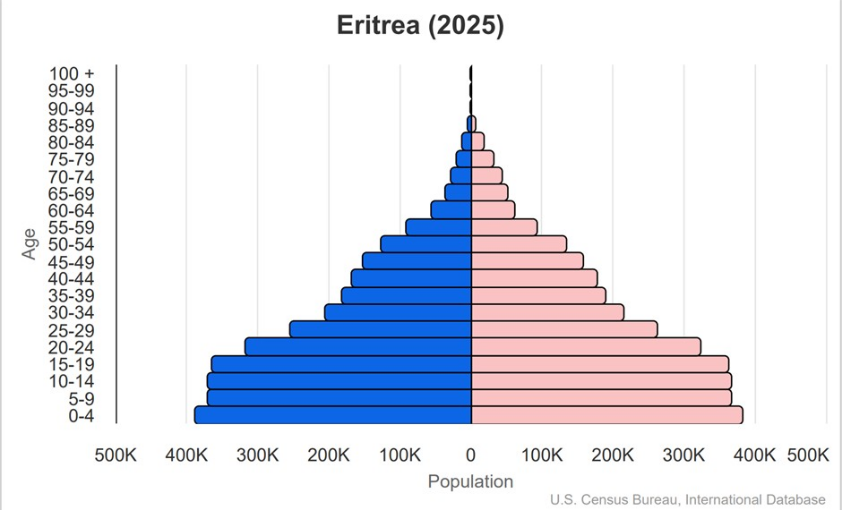
7.2.2 As of 2025 the US Census Bureau estimated the country’s population to be 6.4 million of which about 35% was aged between 18 to 40[footnote 5] (the official national service age range). The male and female population broken down in 4-year age cohorts are set out in the population pyramid below:
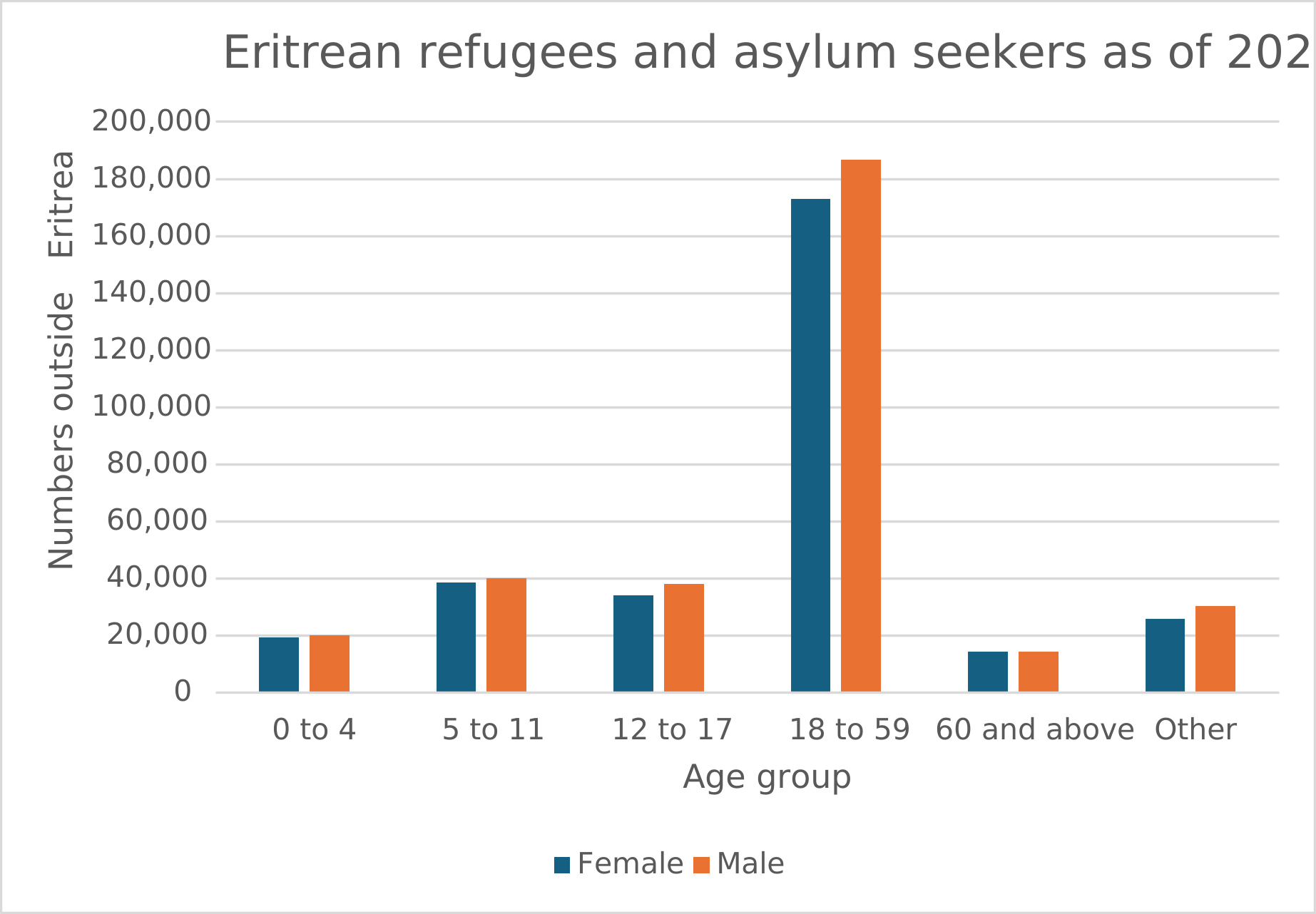
7.2.3 According to the UNHCR the number of Eritreans outside the country as refugees increased by 2.5% from 663,078 in 2024 to 679,346 (560,146 refugees, 119200 asylum seekers) in 2025. Eritreans were outside the country as refugees and asylum.[footnote 7] The figure below based on the UNHCR data shows the number of Eritreans outside the country as refugees and asylum seekers:
8. Political context
8.1 Establishment of national service
8.1.1 The National Service Proclamation No 82/1995 (hereafter the National Service Proclamation) was issued by the Eritrean government on 23 October 1995 and sets out the conditions of national service.[footnote 8]
The Government of Netherlands Ministry of Foreign Affairs general country of origin report on Eritrea covering May 2022 to November 2023 and based on published public sources and interviews or correspondence with expert confidential sources in and outside Eritrea (GoN 2023 report) noted:
‘… In 1992, Eritrea introduced a compulsory national service … Eritrea defined the objectives of compulsory national service in the 1995 National Service Proclamation. Since then, men and women have been subject to compulsory national service in either a military or civil role … In 2002, the Eritrean authorities launched the Warsay Yikaalo National Development Programme, which merged military and civilian service. A year later, the education system was also integrated into the programme, so that the final (twelfth) school year, which always takes place at the Sawa National Training and Education Centre(hereafter Sawa), started to coincide with military training.’[footnote 9]
8.1.2The National Service Proclamation has provided these definitions:
- ‘“National Service” will mean the general service that a citizen will give in active national service and in reserve military service.’ (Article 2(2))
- ‘“Active National Service” will mean the training and service that a citizen fir for national service under article 8 of this proclamation will undergo for 18 months.’ ( Article 2(3))
- ‘“Reserve Army” will mean a reserve army held to serve along a regular army composed of all those who have the obligation of service under … be it in times of mobilization or in emergency situation.’ (Article 2 (5))
- “’Trainee” means the citizen ‘who under this Proclamation under-goes a six months of military training in the national Service training Center.’ Article (7))’.[footnote 10]
8.1.3 The 12 May UN Special Rapporteur’s report on human rights in Eritrea covering 17 April 2024 to 15 April 2025 (HRC 2025 report) noted:
‘The national service programme systematically deprives individuals of their fundamental freedoms – including freedom of movement, and the rights to pursue education, employment and family life. It subjects the entire population to a system of social control where human rights violations and coercion are widespread, resulting in a climate of fear, mistrust, and enforced compliance under threat of punishment …
‘National service also serves a central ideological and political role. Pursuant to the National Service Proclamation, it was intended, among other things, go “to create a new generation characterized by love of work, discipline, ready to participate and serve in the reconstruction of the nation” and “to foster national unity among our people by eliminating subnational feelings”’[footnote 11]
8.1.4 The Cedoca 2025 report observed: ‘Eritrea introduced national service in 1994, shortly after independence. The purpose of national service goes beyond national defense and includes post-independence reconstruction and promoting national ideology.’[footnote 12]
8.2 Recent history
8.2.1 Bertelsmann Stiftung, a German private foundation that supports evidence based non-profit projects, publishes the Transformation Index (BTI). The BTI 2024 Eritrea country report is based on country expert analysis of Eritrea’s progress towards democracy and a market economy covering February 2021 to 31 January 2023 (BTI report 2024 report). It observed:
‘Eritrea gained de facto independence in 1991 and de jure independence in 1993 after a 30-year struggle for independence (1961 – 1991). The Eritrea People’s Liberation Front (EPLF) dominated the struggle since the early 1980s and later became the government of the independent state of Eritrea. In 1994, the EPLF held its third and final organizational congress and changed its name to the People’s Front for Democracy and Justice (PFDJ). Isaias Afewerki, the former secretary-general of the EPLF, has been the president of Eritrea since independence, never having been confirmed in his office by a popular vote. He has solidified his power base through his tough and authoritarian style of rule with totalitarian tendencies, although his popularity has sharply declined due to the continuous deterioration of the economic situation, gross human rights violations, the forced military conscription of a significant portion of the productive-age population, and the complete absence of civil liberties in the country …
‘There were no internal political reforms during the period under review, and the constitution ratified in 1997 was not implemented. The small ruling elite, composed of high-ranking PFDJ cadres and military officers, continued to dominate political and economic affairs …’[footnote 13]
8.2.2 The Government of Netherlands Ministry of Foreign Affair country of origin report on Eritrea which covers the period from May 2022 to November 2023 GoN 2023 report observed:
‘The domestic political situation in Eritrea has remained more or less unchanged for many years now. The current reporting period also saw little change in the political situation. Since taking office in 1993, President Isaias Afwerki (hereafter: Isaias) has been at the head of the legislative and executive government. The judiciary is largely controlled by the executive government. A separation of powers is thus lacking. In 2023, Freedom House gave Eritrea a score of 3 on a scale of 100 for political and civil liberties. The annual Democracy Index of the Economist Intelligence Unit (EIU) ranked Eritrea 152 out of a total of 167 countries in 2022. This qualified the Eritrean administration as ‘authoritarian’.
‘A single national election has been held since Eritrea declared independence in 1993. On 8 June 1993, President Isaias won an election organised by the Transitional National Assembly with 95% of the vote. That assembly was already dominated by the Eritrean People’s Liberation Front (EPLF), which became the People’s Front for Democracy and Justice (PFDJ) in 1994.
‘The PFDJ is the only political party and president Isaias has been in power since independence. He shows no willingness to hold elections or accept changes in the country’s political status quo. The country is still led by the old generation of independence fighters with a strong war mentality. He rules along with a small number of advisers to the PFDJ leadership … The army and the security service have considerable political power, and the National Assembly (the parliament) has not met since 2002. The constitution of 1997 has not yet entered into force.’[footnote 14]
8.2.3 An April 2025 article by professors Amanda Poole of Indiana University of Pennsylvania and Jennifer Rigan of Arcadia University[footnote 15] published for the Migration Policy Institute, a US ‘independent, nonpartisan think tank’[footnote 16] (Poole and Riggan 2025) observed:
‘Eritrea’s 30-year war of independence from Ethiopia, which ended in 1991, created a political culture oriented towards militarization. Two years after the war ended, Eritreans in a referendum voted overwhelmingly in favor of independence and the ruling militia group transformed into the People’s Front for Democracy and Justice (PFDJ), which became the sole legal political party. Despite early signs of movement towards a constitutional democracy, the government was generally repressive and engaged in swift crackdown on criticism by former fighters.’ The government began requiring national service and in 1994 introduced mandatory military training with very few exemptions.’[footnote 17]
8.2.4 The CIA World Factbook noted:
‘Isaias Afwerki has been Eritrea’s only president since independence; his rule, particularly since 2001, has been characterized by highly autocratic and repressive actions. His government has created a highly militarized society by instituting an unpopular program of mandatory conscription into national service - divided between military and civilian service - of indefinite length.
‘A two-and-a-half-year border war with Ethiopia that erupted in 1998 ended under UN auspices in 2000. Ethiopia rejected a subsequent 2007 Eritrea-Ethiopia Boundary Commission (EEBC) demarcation. More than a decade of a tense “no peace, no war” stalemate ended in 2018 when the newly elected Ethiopian prime minister accepted the EEBC’s 2007 ruling, and the two countries signed declarations of peace and friendship.’[footnote 18]
8.3 Relations with Ethiopia
8.3.1 The HRC 2025 report noted:
‘Escalating tensions between Eritrea and Ethiopia raised serious concerns. In February 2025, the Special Rapporteur received information indicating that the Eritrean authorities had initiated nationwide mobilization. In March 2025, both countries reportedly strengthened their military presences along joint border areas. Eritrean and Ethiopian officials have denied plans for direct military confrontation. The Special Rapporteur calls on Eritrea and Ethiopia to halt military build-up and urges the international community to proactively engage to help de-escalate tensions in the region.’[footnote 19]
8.3.2 The Cedoca 2025 report observed:
‘The rivalry between Eritrea and … Tigray dates back to the civil war that began in the mid-1970s and ended in 1991, when the Eritrean People’s Liberation Front (EPLF) and the Tigray People’s Liberation Front (TPLF) jointly defeated the Ethiopian Derg regime. This resulted in the independence of Eritrea and the TPLF taking power as the primary actor within the Ethiopian People’s Revolutionary Democratic Front (EPRDF), in Ethiopia.
‘A growing power struggle and unresolved territorial disputes between the two parties led to a border war that lasted from 1998 to 2000. During this period, until the rise of Prime Minister Abiy Ahmed in Ethiopia in 2018, the neighbouring countries became increasingly estranged from each other. The countries maintained a tense relationship for almost two decades, with occasional incidents occurring. Although there was no direct war, Eritrea supported Ethiopian opposition groups in exile, and Ethiopia diplomatically isolated Asmara on the international stage.
‘The relationship between Ethiopia and Eritrea changed after Abiy Ahmed came to power in Ethiopia in 2018. In September 2018, representatives of Ethiopia and Eritrea signed an agreement in Jeddah titled Peace, Friendship and Comprehensive Cooperation …
‘The rapprochement developed in 2020 into a military alliance against the TPLF and escalated into open hostilities in Tigray in November of that year. For Eritrean President Isaias Afwerki, the conflict represented an opportunity to destroy the TPLF, which he considers a significant security threat to Eritrea, and to take revenge for the border war. During the conflict, the Eritrean Defence Forces (EDF) gained control over border areas they had long claimed, including Badme.
‘The Cessation of Hostilities Agreement (CoHA)—also known as the Pretoria Agreement—signed on 2 November 2022, ended the war. It is an agreement between the Ethiopian federal authorities and the TPLF. Eritrea … [was] not involved in the negotiations or the agreement … [It] felt betrayed by Abiy after the signing of the Pretoria Agreement …’[footnote 20]
8.3.3 The same report further observed:
‘A significant deterioration in relations between the two countries occurred after a speech by Abiy Ahmed in October 2023, in which he stated that securing access to the Red Sea is crucial for Ethiopia’s survival …
‘The ongoing Eritrean presence in parts of Tigray also places pressure on the already strained relationship between the two countries … Eritrea claims that it has only occupied the border areas with Tigray that the Boundary Commission awarded to the country in 2002 …
‘Addis Ababa accuses Asmara not just of interference in Tigray. Although difficult to substantiate, persistent rumors since 2023 suggest that Eritrea has been providing military training to Amhara security forces and Fano groups, and maintains links with Fano insurgents. At the same time, Addis Ababa allows Eritrean opposition groups to operate in Ethiopia …
‘In March 2025, various sources reported signs that both Addis Ababa and Asmara were preparing for war, notably troop movements on both sides of the border. Anonymous sources reported a significant deployment of heavy weaponry and mechanized units in the Afar region, near the Eritrean border. Meanwhile, the Human Rights Concern – Eritrea (HRCE) reported that Eritrea was in a state of the highest alert. Although Abiy stated to parliament on 20 March 2025 that Ethiopia had no intention of waging war against Eritrea over access to the Red Sea, he demanded negotiations to secure that right. Asmara perceived this as intimidation. In May 2025, Eritrean President Isaias Afwerki claimed that Ethiopia was engaged in large-scale arms purchases. Ethiopia responded in June 2025 with a diplomatic letter accusing Eritrea and the TPLF of planning a joint offensive in Ethiopia …’[footnote 21]
8.3.4 On 8 October 2025, BBC News reported:
‘Ethiopia has accused Eritrea of preparing to wage war against it in collusion with an opposition grouping, in the latest sign of escalating tensions between the two neighbours over control of the Red Sea. Ethiopia’s accusation is contained in a letter sent by its Foreign Minister Gedion Timothewos to UN chief Antonio Guterres, warning that the collusion had become “more evident over the past few months”. Eritrea has not yet commented on the letter, but its relationship with Ethiopia has become increasingly strained in recent months.’[footnote 22]
8.4 Reform of national service
8.4.1 The Report of the Special Rapporteur on the situation of human rights in Eritrea, Mohamed Abdelsalam Babiker dated 7 May 2024 (HRC 2024 report) observed:
‘No measures were taken during the reporting period to reform the national service, as recommended by international human rights mechanisms, including the Human Rights Committee, the Committee on the Rights of the Child, the Committee on the Elimination of Discrimination against Women, the commission of inquiry on human rights in Eritrea, and the Special Rapporteur. Eritrea received 21 recommendations regarding the national service during its universal periodic review in 2019; however, these were not accepted by the State.
‘The duration of the national/military service continued to be indefinite, and the Special Rapporteur received no indication of any improvement in the conditions of service … This situation is further exacerbated by the absence of independent rule of law institutions or judicial mechanisms for Eritreans to challenge or review the legality of indefinite national service indefinite, and the Special Rapporteur received no indication of any improvement in the conditions of service.’[footnote 23]
8.4.2 In a speech delivered at the 58th session of the Human Rights Council on 27 February 2025, Ilze Brands-Kenris, the Assistant Secretary General United Nations Office of the High Commissioner for Human Rights (Brands-Kenris 2025) , stated: ‘Eritrea has so far not heeded this Council’s call to limit the national service to the statutory period of 18 months. In addition, no steps have been taken to stop the inhumane practice of punishing family members for the actions of draft deserters.’[footnote 24]
8.4.3 The HRC 2025 observed:
‘Eritrea has not taken any steps to reform elements of its national service programme that are inconsistent with international human rights standards. These include the indefinite duration of service, the use of conscripts for forced labour, inhuman or degrading conditions of service, the high prevalence of rape, sexual and gender-based violence and torture, and the requirement for all students, including minors, to complete their final year of schooling at the Sawa military training camp. Eritrea did not accept any of the 21 recommendations [see above] regarding national/military service received during the fourth cycle of its universal periodic review.’[footnote 25]
8.4.4 The Cedoca 2025 report noted:
‘The 2018 peace agreement between Eritrea and Ethiopia did not lead to reforms regarding the duration or content of national service. There are no indications of demobilisation or discharge campaigns. Following the peace agreement, the Eritrean authorities justified the continuation of indefinite national service by pointing to the tense situation in Ethiopia’s Tigray region along the Eritrean border, as well as the country’s economic and employment situation.’[footnote 26]
9. Framework of national service
9.1 General
9.1.1 The GoN 2023 report observed:
‘During the reporting period [May 2022 to November 2023] compulsory national service continued to consist of military or civilian service, which both fell under the Ministry of Defence (as did secondary, higher and vocational education). In turn, this ministry fell directly under the authority of the PFDJ, Isaias’ political party (and the only political party in Eritrea). This party also controlled several companies, including the Red Sea Trading Corporation, a group of the largest and most important companies in Eritrea, all owned by confidants of President Isaias. These companies controlled by the political elite used conscripts for labour.’[footnote 27]
9.1.2 The HRC 2025 report observed:
‘… While some conscripts are drafted directly into the military and perform purely military duties, others are assigned to work in civilian roles after completing military training.
‘The education system has been woven into the national service, requiring all students – including minors – to complete their final year of studies at the Sawa military camp, an institution under military command where students undergo military training alongside their academic studies. Upon completion of the final year of schooling, students sit for the National School Leaving Examination, the results of which will determine their future: students who pass may go on to continue their education and later join the civil service, while those who fail are conscripted into military service. The courses that students enrol in are chosen by the Government, based on available places and the Government’s needs.’[footnote 28]
9.1.3 The HRC 2025 report further explained: Completion of the national service is a precondition for access to basic services and legal entitlements. Families can only access ration coupons – allowing them to buy essential products at discounted prices – upon certifying that all family members of draft age are serving in national service.[footnote 29]
9.1.4 The USSD 2025 TiP report covering the period between 1 April 2024 and 31 March 2025 observed:
‘The government requires all 12th-grade students to complete their final year of high school education at the Warsay-Yikealo Secondary School, which is embedded in the Sawa military and training academy; those who refuse to attend cannot receive high school graduation certificates, attain higher education, or obtain certain types of jobs in Eritrea. The program comprises four months of basic military training, followed by seven months of academic instruction. It remains likely some students are age 17 at the time of their participation in the military training component of the Warsay-Yikealo/Sawa academy. Upon graduation from Sawa, the government assigns the vast majority of students to civilian or military roles in the National Service.’[footnote 30]
9.1.5 The CEDOCA 2025 report noted: ‘National service can take many forms. As well as active military service, it can include office work in government institutions and companies. Positions range from lawyers and diplomats to mid-level managers, skilled technicians and mechanics, administrative staff, maintenance staff, cleaners, medical personnel, teachers and labourers (for example, in construction).’[footnote 31]
9.2 Military service
9.2.1 The GoN 2023 report noted: ‘… Persons conscripted by local authorities – often school dropouts and people who evaded compulsory national service [see Giffas (Round-ups)] – were usually, but not exclusively, assigned to the military component of the national service.’ The report further noted that ‘… persons in compulsory military service were sometimes assigned to civilian tasks, such as working on a farm.’[footnote 32]
9.2.2 The HRC 2025 report observed that students who fail the National School Leaving Examination ‘are conscripted into military service’[footnote 33] and that ‘young persons who drop out of school before reaching the twelfth grade join the ranks of the military directly through periodic draft calls and mass round-ups in towns and villages.’[footnote 34]
9.2.3 The Cedoca 2025 report stated:
‘From the onset of the Tigray conflict, the frequency and intensity of giffas (round-ups) increased, alongside reports of house searches. In January 2021, Eritrean authorities issued a general call for all citizens to report for military service. On 28 January 2021, Martin Plaut [a journalist specializing in the Horn of Africa and Southern Africa and Fellow at the Institute of Commonwealth Studies] reported that, according to a source with strong connections in Eritrea, the Eritrean offensive involved the mobilisation of 200,000 new troops. This number was achieved by enrolling previously exempt categories, such as women with young children, retired soldiers, and children as young as 16, according to Plaut.’[footnote 35]
9.2.4 The same source further observed:
‘During a telephone conversation with Cedoca in July 2024, two academic researchers mentioned that the mobilisation campaign during the war in Tigray echoed the border war between Eritrea and Ethiopia two decades earlier. The risk of mobilisation was being felt by groups that had previously faced little risk, including highly educated individuals…
‘However, two Eritrean sources interviewed by Cedoca during the FFM in Eritrea contradicted the above information. They indicated that there was no need for mobilisation and that only part of the Eritrean army was deployed in the war in northern Ethiopia. When asked whether the mobilisation reported by several sources had not taken place, two representatives of the Eritrean Ministry of Foreign Affairs stated that reservists up to the age of 50 were mobilised, but had returned to civilian life …
‘Two sources interviewed by Cedoca during the FFM also pointed out that the recently graduated classes in Sawa were not mobilised …
‘Asked whether the People’s Army was mobilised during the war in Tigray, Eritrean source L also replied that it had not. “They were collected and put in camps, but were not sent to the front, they stayed in the camps.”
‘Diplomatic source I indicated … that the militia, referring to the People’s Army or the reservists, was mobilized. This applied to men up to 60 years …
‘Other diplomatic sources with whom Cedoca spoke … reported having seen or heard about giffas. However, they did not know where the apprehended persons were taken, and therefore also did not know whether they were deployed in the war in Tigray …’[footnote 36]
9.2.5 The Cedoca 2025 report further observed:
‘After the ceasefire and the 2 November 2022 peace agreement between the Ethiopian government and the TPLF, sources initially continued to report ongoing mobilisation …
‘In June 2024, Cedoca asked a number of contacts whether Eritrea was still experiencing a situation of heightened mobilisation in mid-2024. To this question, a military source responded by email on 2 July 2024 as follows:
‘“There is no further information on a mobilisation in ERI at this moment. The last information about mobilisation process dates from the end of 2022. […] In the current situation of mistrust between ERI and ETH, and given the internal conflicts in ETH where ERI would have an influence, the ERI troops remain on alert.”
‘In a phone call with Cedoca on 10 July 2024, two academic researchers on Eritrea pointed out the siege mentality in the country:
‘“ICG talked about the siege state in an article of 2013. I think that covers it very well. The country always feels under siege by something or someone, it is never at peace. That mentality drives everything. And it has been reinvigorated recently.[”]
‘The same academic researchers indicated that mobilisation did not stop after the war … However, they stated that the pressure their contacts experienced during the war had decreased …
‘Asked which profiles were concerned, the academic researchers specified the following:
“Women with young kids, my friends with young kids in Asmara never voiced any concern about themselves being mobilised. Also people with high education, some individuals who have shops – having a shop points to a special status anyways, few professional athletes.”
‘Several contacts interviewed by Cedoca during the FFM in Eritrea indicated that giffas were still going on for a short period after the war ended in November 2022 …
‘Asked whether and when the mobilisation that started in the context of the Tigray war came to an end, diplomatic source H replied: “It’s very difficult, there are seasonal mobilisations that have nothing to do with war, but are meant to temporarily increase the workforce.”[footnote 37]
9.2.6 In February 2025, Human Rights Concern - Eritrea (HRCE), a UK based human rights organization,[footnote 38] reported:
‘The Eritrean government has issued a directive to all regional administrations to register and mobilise citizens under the age of 60 for military re-training and practice. This sweeping measure includes demobilized conscripts and those previously granted special arrangements while serving, requiring them to remain on standby. Furthermore, married female conscripts and those with children have been ordered to return to their respective military units…fears are growing that the regime is preparing for another round of armed conflict.’[footnote 39]
9.2.7 The Cedoca 2025 report noted:
‘A few days after the HRCE report [cited above], BBC Tigrinya also reported the call-up of reservists for military training. According to the BBC, the directive required citizens under 60 who have served in the Eritrean army to register and undergo training. It also forbade citizens under 50 to leave the country without authorisation from the competent government authority. Residents of the city of Asmara told BBC Tigrinya that this order from the Eritrean government had not been officially announced. This call-up for training, which the Eritrean government sent to regional administrations and was implemented through the kebeles [the lowest administrative units in Ethiopia, roughly comparable to neighbourhoods or villages[footnote 40]], ordered soldiers to return to their units and stipulated that other citizens of the country working in various sectors were strictly monitored when leaving the country. During meetings, Eritrean citizens received information about the current situation in the kebeles, which showed that women could also be called up for military training. Regarding the ban on leaving the country, BBC Tigrinya reported that government employees under the age of 70, as well as former soldiers who were discharged from the army before the age of 60, needed to present a supporting letter from the People’s Army Office when they wished to leave the country. According to the new directive, women under the age of 50 were prohibited from leaving the country.
‘Following these reports, international media and think tanks reported on a nationwide military mobilisation in Eritrea in February 2025.
‘While drafting this COI Focus, Cedoca requested information about these reports and events in Asmara from several contacts it had spoken with during the FFM in Eritrea. All sources contacted said that there was no mobilisation taking place in the city, only periodic training and refresher courses.’[footnote 41]
9.2.8 The CIA World Factbook noted that Eritrean military and security forces, the Eritrean Defence Forces (EFD), consisted of: Eritrean Ground Forces, Eritrean Navy, Eritrean Air Force and People’s Militia (aka People’s Army or Hizbawi Serawit). The same source noted that available information on military and security personnel strengths varies widely with estimates ranging from 150,000-200,000 active Defense Forces in 2025.[footnote 42]
9.2.9 The table below has been compiled using data provided by Global Firepower (GFP), a website which tracks defence-related information from 140 military nations. Where official data is not available, GFP uses estimates. The table provides an indication of the approximate size of Eritrea’s active and reserve military, relative to population size.[footnote 43] The source indicated that figures are partly drawn from the CIA World Factbook, with some values being estimates.[footnote 44]
| 2025 | Number | Ranking |
|---|---|---|
| Total Population | 6,343,956 | 103/145 |
| Available manpower | 2,220,385 | 113/145 |
| Population reaching military age annually | 76,127 | 108/145 |
| Total military personnel | 250,000 | |
| Active military manpower | 120,000 | 40 |
| Reserve military manpower | 130,000 | 75 |
9.3 Civilian service
9.3.1 The GoN 2023 report noted:
‘ … [C]ompulsory national service consists of military and civilian service. In Sawa students were selected for military or civilian service based on their study results. Generally, after completing military training and education, students with good grades entered compulsory civilian service and got better jobs, for example as teachers or nurses, but this was not always necessarily the case. According to one source, most of them were trained at Sawa to be teachers, as there was said to be a huge shortage of these due to the brain drain. The tasks these individuals were assigned in compulsory civilian service varied enormously. Government officials, teachers and nurses all fell under the civilian service, but persons in national civilian service could also be employed as hotel cleaning staff, in agriculture, or as workers in state-owned enterprises, such as in the infrastructure sector.
‘These persons in civilian service still fell under the authority of the military hierarchy, even if they worked for other ministries such as Education or Foreign Affairs. Partly because of this, the distinction between compulsory civilian and military service, which were merged in 2002, is not always clear … Persons in compulsory civilian service were also deployed for military tasks, could be assigned tasks with a military component, or had to perform work for the army or security forces …
‘Some persons were conscripted into compulsory civilian service after they had completed their compulsory military service. The persons affected and the conditions and duration of service were arbitrary.’[footnote 45]
9.3.2 The BTI 2024 report stated: ‘[national service] recruits are expected to enhance the country’s infrastructure by constructing dust roads, micro-dams and similar projects.’[footnote 46]
9.3.3 The HRC 2025 report observed:
‘… some conscripts … are assigned to work in civilian roles after completing military training. They typically work in government ministries, schools, hospitals, the judiciary, or companies owned by the military or the People’s Front for Democracy and Justice, in sectors including developmental work, infrastructure, agriculture, mining and construction…
‘The education system has been woven into the national service, requiring all students – including minors – to complete their final year of studies at the Sawa military camp, an institution under military command where students undergo military training alongside their academic studies. Upon completion of the final year of schooling, students sit for the National School Leaving Examination, the results of which will determine their future: students who pass may go on to continue their education and later join the civil service, while those who fail are conscripted into military service …’[footnote 47]
9.3.4 The USSD 2025 TiP report noted:
‘National Service takes a wide variety of forms, including office work in government agencies and enterprises (functions ranging from lawyers, diplomats, and midlevel managers to skilled technicians and mechanics to clerical, maintenance, and janitorial work); medical professionals; elementary and secondary school teachers; construction or other types of jobs requiring physical labor; and active military duty. Reports also allege officials force National Service workers to work in mining enterprises partially owned by the government; allegations include white collar occupations in mine management, technical analysis, and/or government oversight responsibilities.’[footnote 48]
9.4 People’s militia (aka People’s Army or Hizbawi Serawit)
9.4.1 The GoN 2023 report noted:
‘The People’s Army (Hizbawi Serawit) was formed in March 2012 – after the Ethiopian incursion into the Afar region – and was reinforced after the Ethiopian army invaded the area around the town of Badme in June 2012. Civilians were given weapons […] (such as AK47 rifles) and ammunition, and had to meet every Sunday morning to do exercises on sports fields. Both men and women aged between 18 and 70 were required to participate in these exercises. According to the 2019 EASO/EUAA report, the People’s Army became part of the national reserve army in 2015. Since then, the activities of the People’s Army have merged with those of the national army. All persons formally discharged from military service had to serve in the People’s Army for a few days or weeks per year. The activities consisted of military training and work assignments.
‘Little information was discovered about the People’s Army and to what extent it was still active during the current reporting period. A few sources described the People’s Army as reservists who were called up to serve in the national army. This would suggest it was part of the national army. People could not refuse to serve, but there was some flexibility to negotiate. Reservists who refused to join the national army/People’s Army ran the risk of punishment.’[footnote 49]
9.4.2 The Austrian Centre for Country of Origin and Asylum Research and Documentation (ACCORD) Eritrea - Country Briefing, 15 March 2024 (ACCORD 2024 report) observed: ‘For all men who are not in the military, including many who have been released from national service, had previously been excused from military service, or are older, there is also an obligatory militia.’[footnote 50]
9.4.3 The USSD 2025 TiP report noted:
‘In addition to National Service, the government instituted a compulsory citizen militia in 2012, requiring medically fit adults, up to age 70 and not currently in the military, to join their local militia. This requirement compels individuals to carry firearms and attend military training. Local militia leaders assign individuals to additional unpaid forced labor in agricultural work, guard duties, or national development programs, such as soil and water conservation projects, on a part-time basis. Eritrean Defense Forces (EDF) officials and local militias continue to forcibly mobilize Eritreans of military age (18 to 60 years old).[footnote 51]
9.4.2 The Cedoca 2025 report observed:
‘In addition to national service, the Eritrean authorities established a mandatory civilian militia in 2012, the People’s Army, also known as Hezbawi Serawit or the (People’s) Militia. Medically fit adults up to the age of 70 who are not in the army are required to join a local militia and undergo regular military refresher training. Diplomatic source (L) stated in a conversation with Cedoca during the FFM in Eritrea that the militia includes men up to the age of 60. Local militia leaders assign individuals to additional unpaid forced labour in agriculture, security duties, or national development programmes. According to an Eritrean source (B), as of 2024, Hezbawi Serawit refers to (a part of) the reserve army. Their duties are varied: from providing security at events, to agriculture and surveillance. In peacetime, they fall under the authority of the kebabi. These are not full-time positions but rather short assignments or work periods. Hezbawi Serawit reservists are not paid for their activities as reservists, but by their respective employers, as they usually have other jobs.’[footnote 52]
9.5 Summer work programme (Maetot)
9.5.1 The USSD 2025 TiP report observed:
‘The Ministry of Education and the Ministry of Agriculture implement a national mandatory summer work program, locally known as Maetot. In 2024, the government continued to mobilize children, primarily in grades nine and 10, for compulsory labor in public works projects, usually in the agricultural sector, during the summer. The government potentially imposed fines on children who did not participate in the program and reportedly refused school enrollment in the next academic year to students who did not pay fines.’[footnote 53]
9.5.2 The US Department of Labor 2024 annual report on child labor, published in September 2025 (USDOL 2024 report), stated: ‘…high school students are forced to participate in maetot, a government-mandated month-long agricultural work program, for little to no pay. Failure to participate in the program results in immediate expulsion from school.’[footnote 54]
9.6 Eligibility
9.6.1 The National Service Proclamation specifies the eligibility criteria for national service: Article 6 provides: ‘… any Eritrean citizen from 18 to 50 years of age has the obligation of carrying out national service.’ Under Article 8 ‘…all Eritrean citizens from the age of 18 to 40 years have the compulsory duty of performing Active National Service.’ (Article 8)’[footnote 55]
9.6.2 The HRC 2025 report observed: ‘In recent years, particularly in the context of the Tigray war, children between 15 and 18 years of age as well as persons over 60 years of age were also conscripted.’[footnote 56]
9.6.3 The Cedoca 2025 report observed: All Eritreans between 18 and 40 years old are required to perform national service.’[footnote 57] However, according to the same source, ‘In practice, the upper age limit for completing national service seems to have risen to 50–57 years for men and 47 years for women’[footnote 58]
9.6.4 The same source further observed:
‘During the FFM in Eritrea, Cedoca inquired about the risk of mobilisation for individuals aged 60 and older. Diplomatic source F replied that the practice is arbitrary:
‘“Every case is different […]. When you are 60, you start to feel safer, but you are not necessarily safe. There’s no fixed age, it varies.”
‘Diplomatic source H stated that almost all men under 60 can be mobilised: “Anyone who qualifies, and I mean people under 60. They do not mobilize those with medical issues.” Source H clarified in an email that persons exempted for medical reasons are not mobilised into military service but are required to serve in other ways.
‘Eritrean source L stated that certain groups face little risk of military mobilisation because they are needed in their current capacities:
‘“People with skills and investments are free from mobilisation. People with normal jobs can be called – they’re on standby. […] Doctors but also plumbers, technicians - skilled people, are free from mobilisation.”’[footnote 59]
10. Exemptions
10.1 Law
10.1.1 Article 12 of the Proclamation identified citizens who are exempt from Active National Service: ‘(1) The citizens who have performed National Service before the promulgation of this proclamation; (2) All Fighters and Armed peasants who have proved to have spent all their time in the liberation struggle.’[footnote 60]
10.1.2 Article 15 of the Proclamation states: ‘The Board gives decisions on exemption from National Service to citizens who suffer from disability such as invalidity, blindness, psychological derangement… [citizens who are declared exempt under this article] will receive from the Ministry of Defence a certificate of exemption.’ [footnote 61]
10.1.3 Article 13 of the Proclamation relates to citizens who are unable to undergo military training: ‘Those citizens who have been declared unfit for military service] … will undertake 18 months of National Service in any public and Government organ according to their capacity and profession.’ [footnote 62]
10.1.4 Under Article 14 of the Proclamation, temporary exemptions from Active National Service are available on the grounds of poor health or in the case of certain types of study, such as university or professional school. However: ‘The student will be awarded with a Certificate, Diploma or Degree only upon completion of Active National Service.’[footnote 63]
10.2 Practice
10.2.1 Human Rights Watch (HRW), in their February 2023 report ‘Eritrea: Crackdown on Draft Evaders’ Families’, which was based on interviews with 14 people who had fled Eritrea their relatives, 11 journalists and other unidentified analysts (HRW 2023 report), stated:
‘… only rare exemptions are granted for people with a disability and, temporarily, on health grounds, although these exemptions are not systematically applied …
‘Media have also reported that the authorities called for those previously exempted from military service to undergo new medical tests. However, Human Rights Watch received accounts of people with chronic health issues and disabilities, including injuries sustained during the 1998-2000 border war, being rounded up in [footnote 64]
10.2.2 The GoN 2023 report noted:
‘Only people who fought in the liberation struggle against Ethiopia (article 12) and the disabled, visually impaired and mentally ill (article 15) are fully exempted. Those unfit for military service are exempted from the military programme, but must instead perform compulsory civilian service (article 13). According to one source, people with severe medical problems, such as HIV, were also exempted from national service.
‘In practice, these grounds for exceptions were strictly examined and only rarely approved. The exemptions were issued following a review by the medical board in Sawa, which consisted of officers and medical experts. The result of this review could be that a person would be able to perform compulsory civilian service (partially or fully) if they were not fit for military service.
‘In addition to these de jure exemptions, de facto exemptions also applied to some categories of persons. Although these exemptions were generally respected by the responsible authorities, they were not legally obliged to do so, and sometimes alternative policies applied at the individual level. Women with a child were reportedly exempted from national service in most cases, but this was apparently not always the case and sometimes applied only temporarily. Married women who had no children and were not pregnant were sometimes also exempted from national service, although this was applied inconsistently.
‘One source indicated that some persons whose nationality was disputed by the Eritrean authorities were only eligible for compulsory military service (and so not for compulsory civilian service). Individuals who belonged to a family that was widely known to have made certain sacrifices for the fatherland could be exempted from national service by the local district head, or allowed to perform some other (often lighter) form of service, such as agricultural work. It is important to realise here that the context in which exemptions were requested – whether or not they were granted – was that of a country without rule of law. It was therefore difficult to obtain reliable and generally applicable information about how exemptions were applied. Because there is no rule of law, exemptions may have been easier to obtain for individual members of prominent families.’[footnote 65]
10.2.3 The same source added:
‘The lack of a functional legal system, including regarding national service, made it difficult to obtain a document of exemption. Such a document was reportedly still easier to obtain for those who had been exempted than for those who had been discharged, due to the indefinite duration of national service. A person who was exempt could obtain a document, that also stated the reason for the exemption, from the Ministry of Defence. Women with children could also request this document. The document did not guarantee that the person would not be called up for national service.’[footnote 66]
10.2.4 The US Commission on International Religious Freedom (USCIRF), a US government agency monitoring freedom of religion, in their 2025 Annual Report covering 2024 (USCIRF 2025 report) observed: ‘Authorities … grant exemptions to service to pregnant women and people with a physical disability.’[footnote 67]
10.2.5 The Cedoca 2025 report noted:
‘… Sources also indicate that exceptions to the obligations of the People’s Army are possible. A source stated in 2017 to the Organisation suisse d’aide aux réfugiés (OSAR) that wealthy individuals could buy their way out of service in the People’s Army. According to a source interviewed by the Swedish COI Service during a mission to Eritrea in 2018, certain categories of persons with medical problems may be exempt from the Hezbawi Serawit. Another source interviewed during the same 2018 mission was of the opinion that a person’s status plays a role, that connections with the government are important and that the elite enjoy benefits. An Eritrean source (L) told Cedoca that exceptions exist and gave the example of businessmen or people working for an international mining company:
‘“When you reach the age of 40, 41, 42: you’re not regular military, you become a reservist. You work for two days a week, for example in construction, water provision. You work for your community […] Everybody who is not in the military, is in the reserve army or the militia. […] people with investments – who sometimes have to travel, or diplomats are not in the militia. Also, if you work in a mining company, you are not in the militia because you work for a company.”’[footnote 68]
10.2.6 The same source further observed:
‘In addition to the de jure exemptions, there are also de facto exemptions. While the relevant authorities usually honour these exceptions, they have no legal basis. Inconsistent application is possible. For example, women with children are usually exempt from national service, but this is not always the case and can sometimes be only temporary. The [National Union of Eritrean Women] NUEW stated in a conversation with Cedoca in early February 2025 that women are more likely to be exempted from service because of their reproductive role. Asked whether marriage is sufficient for demobilisation, the NUEW indicated that a woman may choose to leave the army due to marriage. She may also, if she wishes, continue working in civil service. Those with children generally do not remain in the army. A diplomatic source (I) indicated that women are more likely to be exempted or discharged from service due to marriage or pregnancy, and that they more easily obtain a discharge letter than men:
‘“When women are released – because of marriage or pregnancy or another reason – they get a release paper. When men are released, they are obligated to sign up for the militia in their neighbourhood. If there is a call to come, and you don’t come, you can get in trouble, you are subject to round-ups.”
‘Source L, on the other hand, stated that women with children are certainly exempt from national service. Women over the age of 30 are also exempt, according to this source.
‘According to diplomatic source F:
‘“Men above 60 can leave the country more easily; they are released from service. For women, it’s different; it depends on marital status and children. At the age of 30–40, they are out.”
‘Because Eritrea is not a rule-of-law state, exemptions are likely easier to obtain for individuals from prominent families. People who are de facto exempt from conscription generally do not receive exemption letters. As such documents are required in the formal labour market, their activities are limited to the informal economy. Moreover, there is a risk of being apprehended during giffa raids.’ [footnote 69]
10.2.7 Furthermore, the same source noted:
‘Individuals formally exempted or discharged from national service cannot, in principle, be recalled, but they are not exempt from the duty to defend the country during wartime. Both Eritreans performing civilian tasks as part of national service and those formally or informally exempted can be mobilised in wartime and assigned tasks deemed necessary by the authorities. Anyone who has received military training and is between 18 and 50 years old can be mobilised, regardless of whether they are currently in service.’[footnote 70]
11. Conscientious objectors
11.1.1 The Eritrean National Service Proclamation does not mention exemption or allowance for conscientious objection.[footnote 71]
11.1.2 The US State Department 2023 Report on International Religious Freedom: dated 26 June 2024 (USSD 2023 IRF report) noted: ‘The law does not provide for conscientious objector status for religious reasons, nor are there alternative activities for persons willing to perform national service but unwilling to engage in military or militia activities.’[footnote 72]
11.1.3 The HRC 2025 report observed that: ‘Eritrea does not recognize the right to conscientious objection and offers no alternative civilian service for individuals who object to military service on religious, ethical or other grounds.’[footnote 73]
11.1.4 For information about treatment see Deserters, evaders and conscientious objectors .
12. Recruitment
12.1 Registration
12.1.4 Article 11 of the 1995 Proclamation on National Service states: ‘… any youth who has completed the age 17 years is called upon to appear before the Registration Center of his area and register himself in advance to ensure his readiness … The Head of the Registration Center after recording the identity of the person, he issues him with the National Service Registration Card.’[footnote 74]
12.2 School
12.2.1 The FH 2024 report stated: ‘Students in their last year of secondary school must perform military service at the Sawa military training center. In 2019, Human Rights Watch (HRW) reported that widespread physical and sexual abuse took place at Sawa.’[footnote 75]
12.2.2 The HRC 2025 report noted:
‘The education system has been woven into the national service, requiring all students – including minors – to complete their final year of studies at the Sawa military camp, an institution under military command where students undergo military training alongside their academic studies. Upon completion of the final year of schooling, students sit for the National School Leaving Examination, the results of which will determine their future: students who pass may go on to continue their education and later join the civil service, while those who fail are conscripted into military service. The courses that students enrol in are chosen by the Government, based on available places and the Government’s needs.
‘Notably, only 24 per cent of the candidates who took the school-leaving exam in 2024 were female. The relatively lower enrolment of women and girls at Sawa is in contrast with the higher enrolment rates for girls at the secondary level (19.6 per cent as compared to 17.1 per cent for boys in 2019), suggesting that girls are dropping out in significant numbers in the final years of schooling. This could point to structural inequalities, gender-based discrimination, and child marriage. Additionally, the heightened risk of sexual harassment and abuse at Sawa leads girls and their families to seek ways to prevent their attendance, including by arranging early marriages, seeking pregnancies or attempting to flee the country. It is therefore apparent that the national service may contribute to perpetuating these realities.’[footnote 76]
12.2.2 The USSD 2025 TiP report noted:
‘The government requires all 12th-grade students to complete their final year of high school education at the Warsay-Yikealo Secondary School, which is embedded in the Sawa military and training academy; those who refuse to attend cannot receive high school graduation certificates, attain higher education, or obtain certain types of jobs in Eritrea. The program comprises four months of basic military training, followed by seven months of academic instruction … Upon graduation from Sawa, the government assigns the vast majority of students to civilian or military roles in the National Service.’[footnote 77]
12.2.3 The Cedoca 2025 report observed:
‘The twelfth school year, which takes place at the Sawa National Training and Education Centre, has since included several months of military training. The results students achieve in the final exams determine their further educational opportunities. Recruits with the highest scores are eligible for higher education at one of the country’s eight colleges, which offer two- and four-year programmes. After completing their education, their national service mainly consists of civilian work tasks. Those with average scores may attend vocational training. After completing vocational training, students are assigned to either civilian or military service. Those with the lowest scores usually enter military service immediately
‘An Eritrean source (L) told Cedoca during the FFM that in the past five to six years, no one from Sawa has been sent directly to military service. Two other sources indicated that the cohorts (often referred to as “rounds”) of recruits who graduated from Sawa during the Tigray war were not deployed to that war but remained at the Sawa base. One of these sources noted that approximately half of each Sawa cohort normally joins the army.
‘The Eritrean authorities present conscription through the school system as the regular method. However, according to EASO, official statistics show that only a small proportion of each age group actually reaches the twelfth grade. Others, such as school dropouts and draft evaders, are conscripted by local authorities or captured at checkpoints or during targeted search operations and raids, known as giffa, and sent to training camps for military training.[footnote 78]
12.3 Round-ups (giffas)
12.3.1 The HRW 2023 report noted:
‘… Eritrean authorities have conducted waves of roundups in Eritrea to identify people it considers draft evaders or deserters …
‘The latest conscription drive started mid-2022, with the authorities targeting people considered draft evaders, including students who have dropped out of school to evade military training, as well as army deserters, some of whom already had served for years. Then, in mid-September, the government mobilized reservists, primarily men aged 50 through to 60, many of whom had been officially discharged from active military duty but continue to hold arms and are required to conduct guard duties. On September 17 [2022], Eritrea’s information minister told the media that only “a tiny number” of reservists were being called up, denying that the entire population was being called up.
‘During the latest mobilization drive, especially from September onward, the security forces have set up checkpoints throughout urban and rural areas. In addition, by working with the local officials, security forces have gone door to door, ostensibly to confirm eligibility for coupons that grant people access to subsidized goods, but in fact, to also identify draft evaders. They used the visits, people interviewed said, to identify discrepancies between the number of family members the coupon system said should be in a particular home and those of conscription age who were living there, often retaliating against family members who the authorities claimed had failed to track the missing people down.’[footnote 79]
12.3.2 The HRC 2024 report noted that: ‘…The authorities continued to conduct giffa, or mass round-ups, in towns and villages across the country, with the purpose of identifying and gathering draft evaders …’[footnote 80]
12.3.3 The FH 2024 report stated: ‘Since 2022, Eritrean authorities have engaged in a nationwide forced conscription campaign in order to send more troops to Tigray, with security forces deployed to track down those attempting to escape being drafted.’[footnote 81]
12.3.4 The USSD 2025 TiP report noted: ‘Eritrean Defense Forces (EDF) officials and local militias continue to forcibly mobilize Eritreans of military age (18 to 60 years old).’[footnote 82]
12.3.5 Poole and Riggan 2025 noted that: ‘The government periodically uses gifa (mass roundups) to seek out people who may be attempting to evade military service, and in 2022 and 2023 called up both reservists in their 50s and 60s as well as school-age children.’[footnote 83]
12.4 Underage recruitment
12.4.1 The HRC 2025 report noted: ‘In recent years, particularly in the context of the Tigray war, children between 15 and 18 years of age … were also conscripted.’[footnote 84]
12.4.2 The UN Committee on the Rights of the Child (CRC) in their ‘Concluding observations on the combined fifth and sixth periodic reports of Eritrea’ dated 5 March 2025 noted: ‘… students are required to complete national service and military training at the Sawa Education and Training Center immediately preceding and following the final year of their secondary education, and that it did not receive confirmation from the State party during the dialogue that there are no persons under the age of 18 years who in practice receive military training at the Center, or about information on the measures taken to prevent such a possibility.’[footnote 85]
12.4.3 The USSD 2025 TiP report noted:
‘Government policy bans persons younger than 18 from military conscription; however, there are no reports of an age verification procedure being applied before sending new Sawa graduates to active military service. Reports indicate officials potentially detain or force children who attempt to leave Eritrea or who fail or refuse to attend school into military training, including unaccompanied children and children as young as 14 years old. Authorities generally do not inform parents of their underage children’s forced conscription into military training. An international NGO reports officials exploit some Sawa students in forced labor on either privately owned commercial farms or Sawa-owned farms.’[footnote 86]
12.4.4 The USDOL 2024 report stated: ‘Each year, 11,000 to 15,000 students enter grade 12 at Sawa, and while many of these students have typically reached age 18 by the time they participate in the military training component of 12th grade schooling, some are reportedly as young as age 16. The mandatory military training includes military discipline and procedures, weapons training, a survival exercise, and a 2-to 4-week war simulation, and some conscripts are force.[footnote 87] The same source further noted: Homeless and unaccompanied children in Eritrea are particularly vulnerable to child labor. These children, especially those above the age of 14, are also disproportionately forced into military training or conscription by government officials.’ [footnote 88]
12.5 Duration
12.5.1 The Proclamation on National Service No 82 of 23 October 1995 establishes the duration of national service. According to Article 8 national service is set at 18 months, comprising 6 months of military training followed by 12 months of military and development service. However, the law allows for an indefinite extension during periods of war or national mobilization. In such cases, individuals may be required to serve beyond the 18-month term unless formally discharged by the authorities (Article 21(1)). Even after completing active service, citizens are subject to compulsory service in the National Reserve Army until the age of 50 (Article 23).[footnote 89]
12.1.2 Poole and Riggan 2025 noted that: ‘In 2002, the government indefinitely extended national service for [then] current enlistees—many of whom had already been serving for up to six years—and future entrants.’[footnote 90]
12.1.3 The USSD 2025 TiP report observed:
‘Proclamation 82 of 1995 requires all persons aged 18 to 40 years to perform compulsory active National Service ostensibly for a period of 18 months – six months of military training followed by 12 months of duty in a variety of military, security, or public service positions. However, since the 1998-2000 Eritrean-Ethiopian border conflict, the 18-month limit has been suspended; the government does not demobilize most individuals from government work units after their mandatory period of service but rather forces citizens to serve indefinitely under threats of detention, torture, or familial reprisal.’[footnote 91]
12.1.4 The HRC 2025 report observed: ‘The length of an individual’s national service is arbitrary and left to the discretion of the authorities, with no clear criteria or conditions for release. In practice, most Eritreans are forced to serve for periods spanning from several years to more than two decades, in both military and civil service roles. The service has also extended far beyond the statutory limit of 40 years of age …’[footnote 92]
12.6 Discharge from national service
12.6.1 The HRW 2023 report observed: ‘Once conscripted into the military, young men and women, some still minors, have very few options for discharge …’[footnote 93]
12.6.2 The GoN 2023 report observed:
‘… It was impossible to predict when someone would be discharged from national service, and such discharges generally occurred infrequently. Since 2002, when the indefinite national service was introduced, hardly anyone has been officially discharged from service. Also, a discharge from service was never definite: anyone discharged could always be recalled. Since the Tigray conflict in November 2020, exemptions and discharges are said to have been even further curtailed. Alongside young people (including minors), people who had been discharged from military service or exempted were also rounded up and remobilised in practice … Previously issued exemptions were then reevaluated.’[footnote 94]
12.6.3 However, the USSD 2025 TiP report observed:
‘The government may release some Eritreans from National Service after an indefinite number of years; however, the government requires individuals to submit a petition to the government based on criteria that shift periodically, are not transparent, and often involve corrupt practices. Policies and practices for obtaining release from National Service are inconsistent across organizations and job fields, but officials generally release expectant mothers, individuals who can prove they have become the sole or primary source of familial support, or individuals with medical conditions hindering their ability to work.’[footnote 95]
12.6.4 The Cedoca 2025 report noted:
‘… EASO noted that there are two different forms of discharge from Eritrean national service. Demobilisation (mitiyas in Tigrinya) refers to the transfer from the military to the civilian component of national service while retaining an obligation to serve in the military reserve, usually in the form of periodic military refresher courses. Discharge (mifinaw) means full exemption from national service. Since 2012, exempted individuals usually join the People’s Army. According to the Dutch Ministry of Foreign Affairs, since 2002, when indefinite conscription was introduced, very few people have been officially discharged from service. Discharge is also never final, as individuals relieved from conscription may be remobilised in case of necessity.
‘Regarding demobilisation, Eritrean source (L) stated that the applicant must provide a valid reason, such as caring for their parents. Concerning discharge, this source indicated that it is important to demonstrate that the applicant can secure an income outside national service: “What the government wants to know: can you sustain yourself? If yes, you can be released.” However, multiple sources insist that this is not easy, especially outside the major cities, partly because the private market in Eritrea is very limited.
‘Diplomatic source J indicated in a conversation with Cedoca that for certain professions, it is very difficult to obtain discharge from national service: “Doctors, engineers, gynaecologists etc. have no chance to be demobilised, as they are needed.” The same source also pointed out that the siege mentality prevents general demobilisation:
‘“Eritrea is still in a war-mindset – the fact they have a big hostile neighbour, the idea they have to be ready, and that if they are not Ethiopia will invade for sure. There is no perspective on evolution.”
‘Diplomatic source I also stated that the current relationship with neighbouring Ethiopia means that general demobilisation is not yet feasible:
‘“In 2018–2019 they were looking at demobilizing, in 2020, with Tigray conflict, this stopped. There is also Abiy Ahmed who said they would take the port by force if necessary. The Eritrean government feels they have to be ready. […] A lot of the Eritrean government’s decisions are driven by the will to hold on to territory.”’[footnote 96]
13. Level of participation in national service
13.1.1 There is limited information available in the sources consulted about the number of people in active national service, either the civilian or military sectors, or who have been officially discharged or exempted (see Bibliography).
13.1.2 Human Rights Concern Eritrea (HRCE) in its submission to the UN Human Rights Council as part of Eritrea’s Universal Periodic Review of its human rights record, dated 16 February 2024 noted that ‘Many young Eritreans had found ways of escaping from national service.’[footnote 97]
13.1.3 The BTI 2024 report stated:
‘Large segments of the population are still conscripted into unlimited-term national service …
‘The 12th year of schooling takes place at the Sawa military training camp for all students nationwide … Only a small minority of students who pass the 12th grade are granted access to tertiary education at what are known as colleges, while the majority are directly conscripted into the army and national service…
‘Approximately 2% of each age cohort … proceed to tertiary education, while the remainder are compelled to join the open-ended national service, which offers vocational training to some individuals. Consequently, a considerable number of Eritrean youths prefer to drop out of school or flee to neighboring countries as unaccompanied minors before reaching the age of 18, to evade conscription.
‘Due to the Tigray war, there has been an even greater number of students going into hiding in late 2020 to 2022 to avoid being conscripted as soldiers.’[footnote 98] The source did not provide exact numbers of students who are conscripted.
13.1.4 The HRC 2025 report observed:
‘… According to the National Institute for Quality Standards in Education, in 2024, 74.8 per cent of the 18,638 students who sat for the exam did not pass. Only 25.2 per cent were eligible to pursue further studies, with 15.5 per cent qualifying to enrol in degree programmes and 9.7 per cent in vocational training. These statistics not only raise serious concerns regarding the quality of education at Sawa and across the national education system, but also point to a deliberate structuring of the system to channel the majority of students into open-ended military conscription with no prospects for further development. Additionally, young persons who drop out of school before reaching the twelfth grade join the ranks of the military directly through periodic draft calls and mass round-ups in towns and villages.’[footnote 99]
13.1.5 The Cedoca 2025 report observed: ‘The Eritrean authorities do not publish official figures on the number of citizens registered for national service. In 2019, EASO noted that the majority of sources consulted estimated the number of conscripts to be between 300,000 and 400,000. There is also uncertainty about the respective share of the military and civilian components of national service.’[footnote 100]
14. Treatment during national service
14.1 General conditions
14.1.1 Sources reporting on conditions in national service sometimes refer to the situation in educational and training camps, such as Sawa, military service and civilian service collectively. Sources which report on circumstances in training camps and military and civilian service respectively are referred to in the sub-sections below.
14.1.2 The HRC 2024 report observed:
‘… Living and working conditions during military service may amount to inhuman or degrading treatment. Severe punishments, including arbitrary detention and torture, are also commonplace. Conscripts are also subjected to forced labour in a variety of economic activities, without choice over the nature or conditions of work for meagre pay. They often conduct arduous work in very harsh conditions. The circumstances under which Eritreans are forced to work as part of the national service amount to forced labour and slavery, as documented by the commission of inquiry on human rights in Eritrea. Female conscripts suffer sexual harassment and sexual violence, especially, but not limited to, during military training and service. Conscripts in the military service are often denied permission to visit their families, sometimes for years, thereby infringing on their right to family life …
‘It is estimated that thousands of Eritrean conscripts have perished or sustained severe injuries in Tigray since the conflict broke out in November 2020. However, the Government of Eritrea has not released any official information regarding the identities of the deceased, the missing or the disappeared …’[footnote 101]
14.1.3 On 27 February 2025, Ms lze Brands-Kehris, the UN Assistant Secretary General for Human Rights in a speech at the 58th session of the Human Rights Council (Brands-Kenris 2025) stated: ‘… Within the context of the system of indefinite forced conscription other grave human rights violations are also of concern, including torture, sexual and gender-based violence and abusive labour practices.’[footnote 102]
14.1.4 The USSD 2025 TiP report observed:
‘Conditions are often harsh for those in military service or jobs requiring physical labor, although some National Service members experience normal civilian workplace conditions, albeit with low pay and, in many cases, lack of freedom to pursue alternative employment opportunities. International organizations report the government often subjects conscripts in the National Service to inhumane and degrading punishment, including torture, without recourse and punishes individuals that conscientiously object to service; the government continues to force conscripts to serve for indefinite or otherwise arbitrary periods. Additionally, the government broadly restricts recruitment of Eritreans for work abroad, denying travel to most of its citizens … National Service workers without educational or vocational qualifications continue to receive extremely low wages, and the government often substitutes food or non-food rations for wages.’[footnote 103]
14.1.5 The HRC 2025 report noted:
‘Conscripts have no right to choose their place of deployment, and are deployed according to the Government’s needs, often far from their homes, sometimes in remote locations. They are granted permission to visit their families at their place of residence for a limited period – typically several weeks to a month. However, leave is granted at the discretion of supervisors, with conscripts, particularly those serving in military units, often denied family visits for several years. Absence without permission is harshly punished …
‘While the hardship and working conditions vary depending on the nature of the assignment, the common denominator is that conscripts work indefinitely under threat of severe punishment, have no choice over the nature of their work or the location of their assignment …’[footnote 104]
14.1.6 HRCE noted in submissions to the UN Human Rights Council as part of Eritrea’s 2024 UPR: ‘… the abuse of women, especially during national service, was widespread and appeared to be tolerated at the highest level of government. Girls as young as 16 years of age were detained for compulsory military service and military officers were notorious for sexual and physical abuses of women and girls, who suffered a wide range of violations, including psychological abuse, systematic sexual harassment and rape.’[footnote 105]
14.1.7 Poole and Riggan 2025 noted: ‘Conscripts are prevented from practicing religion…’[footnote 106]
14.2 Conditions in training camps and military service
14.2.1 The GoN 2023 report stated the following regarding conditions in training camps:
‘Persons conscripted by local authorities – often school dropouts and people who evaded compulsory national service – were usually, but not exclusively, assigned to the military component of the national service. Their training did not usually take place in Sawa, but in smaller training camps, such as Wia or Met’r. These military training camps also partly served as prisons. Conditions in these camps were said to be worse than those in Sawa. They were situated in very remote areas with temperatures as high as around fifty degrees Celsius … According to one source, conditions in the camps had not improved during the current reporting period, and many persons, including the elderly, were placed in these camps during the forced recruitment round-ups. According to one source, it was not clear how the situation in the camps had evolved since the Tigray ceasefire.
‘According to sources, conscripts were often subjected to beatings, sexual and gender-based violence, forced labour and other types of abuse … They were also given little leave. Some were allowed to go home for a few days once every few months, others only every few years. Conscripts who returned late from leave could face imprisonment or another punishment, such as having to work overtime, losing leave in subsequent years, or having part of their salary withheld. The freedom of movement of conscripts was severely restricted. During the Tigray conflict, women were reportedly more often deployed to do heavy labour, such as road construction, as the men had been sent to the front.
‘… Eritrea is not a constitutional state with rules that apply to everyone. Local and lower rulers have complete scope to use their discretionary power as long as they represent the president’s interests. As a result, there is much arbitrariness and impunity, and conscripts were at the mercy of their commander or superior.’[footnote 107]
14.2.2 The BTI 2024 report stated: ‘The 12th year of schooling takes place at the Sawa military training camp…where female students often experience sexual harassment. This unfortunate reality discourages female students from attending school.’[footnote 108]
14.2.3 The USDOL 2024 report noted: ‘During their time at Sawa, students endure notoriously harsh conditions and corruption, including allegations of military commanders offering food and better treatment to female students in exchange for sexual acts.’[footnote 109] Similarly the USSD 2025 TiP report observed: ‘An international NGO reports officials exploit some Sawa students in forced labor on either privately owned commercial farms or Sawa-owned farms. NGOs also report military commanders regularly exploit female students in military training or women in military service in domestic servitude and sex trafficking, often coercing female students into having sex in order to receive food or easier treatment during trainings.’[footnote 110]
14.2.4 The HRC May 2024 report observed:
‘… Female conscripts suffer sexual harassment and sexual violence, especially, but not limited to, during military training and service. Conscripts in the military service are often denied permission to visit their families, sometimes for years, thereby infringing on their right to family life.
‘The Special Rapporteur found no evidence or indication of any measures taken to address the human rights violations, including sexual violence, committed against conscripts in the national service, to investigate the alleged violations or to bring the perpetrators of such abuse to justice.’[footnote 111]
14.2.5 In a March 2025 report HRCE observed:
‘Many female conscripts face sexual violence, harassment, and exploitation by military officials. Women conscripts are not treated as equals with the male soldiers, but used as sex objects by the military officers and made to work as housemaids and slaves.
‘They are subjected to abuses and sexual harassment by officers in training camps, prisons and the army. Refusal to meet the demands of the officers usually results in torture and reassignment to places with extremely hostile living and working conditions. Sexual violence, including rape, is widespread, particularly in military training camps and detention centres. Many victims of rape in the military contract sexual transmitted diseases, including HIV/AIDS, and end up as single mothers …’[footnote 112] The report did not explain what it meant by ‘widespread’ or number of victims of rape who contracted diseases.
14.3 Conditions in civilian service
14.3.1 The GoN 2023 report stated:
‘Conscripts could be employed for personal interests, either economic or sexual, such as unpaid work in officers’ personal businesses or as personal servants of officers … The incidence of coercion, inhuman treatment, sexual or other violence, or cruel disciplinary punishment in compulsory civilian service varied greatly depending on the deployment, and on where and under whom conscripts were deployed … Another factor was that there were no controls of national (including civilian) service deployments, and there was no access to legal protection for people in national service. As a result, supervisors (the vast majority of whom were members of the security service) had a free hand … Conscripts had no say in the type of work they performed, nor where they were deployed … Many forms of exploitation occurred in compulsory civilian service in the context of this impunity. There were also other characteristics that could increase the likelihood of exploitation, such as belonging to a lower political or social class, or the age of the conscript (the younger, the more vulnerable) …
‘In Eritrea, it is very much taboo to discuss sexual topics, which made it difficult to ascertain the extent to which sexual abuse occurred during military training or compulsory civilian service … However, sources agreed that women were at risk of sexual violence even if they only performed compulsory civilian service … This risk, as discussed above, was very much dependent on where the person performed their compulsory civilian service and who the supervisor was … The sexual violence women faced is thought to have usually started during military training and mostly also occurred there … Students accused of minor offences at Warsei-Yikealo school and conscripts at Sawa training camp were subjected to physical punishments comparable to torture and other forms of ill-treatment … They had no means of claiming protection against such treatment …
‘Besides the conditions conscripts could face in compulsory civilian service, many of their other rights were also restricted, such as the right to start a family or begin a business … This caused many mental problems among conscripts …’[footnote 113]
14.3.2 The USSD 2025 TiP report noted that: ‘some National Service members experience normal civilian workplace conditions, albeit with low pay and, in many cases, lack of freedom to pursue alternative employment opportunities.’[footnote 114]
14.4 Pay
14.4.1 The BTI 2024 report observed that national service conscripts continued to be used ‘as forced laborers in return for only minimal pay.’[footnote 115]
14.4.2 The USSD 2025 TiP report noted: ‘National Service workers without educational or vocational qualifications continue to receive extremely low wages, and the government often substitutes food or non-food rations for wages.’[footnote 116]
14.4.3 The HRC 2025 report stated that conscripts received ‘minimal compensation’.[footnote 117]
14.4.4 The Cedoca 2025 report observed: Due to the low wages, many Eritreans in national service who live in Asmara hold a second or third job alongside their duties under conscription.’[footnote 118]
14.4.5 See also Conditions.
15. Deserters, evaders and conscientious objectors
15.1 Law
15.1.1 Article 37 of the Eritrean National Service Proclamation No 82/1995 stipulates the punishment for evading national service. Four penalties are set out:
- 2 years imprisonment or fine or both for anyone who violates the Proclamation (Article 37(1)
- 2 years imprisonment or a fine followed by national service for anyone who attempts to avoid Active National Service by deceit, self-inflicted injury or other means or 3 years imprisonment if the self-inflicted injury makes the person unfit for national service (Article 37 (2)
- 5 years imprisonment and suspension of the person’s right to work, obtain a visa and hold land tenure or a licence where a person escapes abroad to avoid national service and does not return to perform their service before age 40 (Article 37 (3)
- 2 years imprisonment or a fine or both for any person who attempts to avoid or delay national service through any means, for example, by avoiding registration or providing false information[footnote 119]
15.1.2 Article 119 of the Eritrean Penal Code (2015) also criminalises evasion of military service. This includes avoiding or attempting to avoid conscription, as well as assisting or encouraging others to do so. The offence is classified as ‘interference with military service’ and is punishable by a fixed term of imprisonment ranging from one to 3 years. Under Article 120 of the same code, if the offence described in Article 119 is committed during a state of emergency, general mobilisation, or wartime, it is considered aggravated evasion of military service. This carries a more severe penalty of 7 to 10 years’ imprisonment.[footnote 120]
15.2 Enforcement of the law and treatment
15.2.1 The HRW 2023 report stated:
‘Many presumed draft evaders, rounded up [in early 2023] near Asmara, were initially taken to the notorious, military-run Adi Abeito prison, northeast of the capital… Relatives reported that many men were taken from the prison to their assigned military unit headquarters in this time period… Rights groups and the media have previously documented inhumane and degrading conditions and treatment in Adi Abeito. In 2021, the US-based Public Broadcasting Service (PBS) released a documentary with leaked footage that they said was from the facility that showed prisoners lying on top of each other, unable to stretch out, inside a warehouse and reported regular torture inside the compound.’[footnote 121]
15.2.2 The GoN 2023 report observed:
‘No clear pattern was evident in the way the authorities applied proclamation and the punishments; the nature of the punishment for refusing to perform compulsory national service and desertion was arbitrary. According to one source, in the army, the military committee of the relevant division decided which disciplinary punishments to impose. In compulsory civilian service, disciplinary punishments were imposed by the head of the local branch of the responsible ministry.
‘The situation and treatment of people who refused to perform compulsory national service and deserters allegedly worsened during the Tigray conflict. Sources indicated that they were generally detained and then sent back to their unit or to a military training camp. According to a confidential source, conscripts generally had to spend double the time they had been absent in detention. According to another source, detained conscripts were exposed to forced labour on state plantations and projects. Other punishments could also be imposed, from disciplinary measures and mistreatment to indefinite imprisonment.’[footnote 122]
15.2.3 The US State Department 2023 country reports on human rights dated 19 April 2024 (USSD 2023 human rights report) noted:
‘… There were reports from local sources and international advocacy organizations of enforced disappearances by or on behalf of government authorities. The disappeared included … individuals suspected of evading national service and militia duties … The government did not make efforts to prevent disappearances or to investigate or punish those responsible …
‘Former detainees and other sources reported harsh detention conditions … in prisons for persons held for evading national service and militia duties …
‘Security force personnel detained individuals for reasons that included suspicion of intent to evade national and militia service … Authorities sometimes arrested persons whose papers were not in order and detained them until they were able to provide evidence of their militia status or demobilization from national service. The government contacted places of employment to identify those unwilling to participate in the militia.’[footnote 123]
15.2.4 The same source noted the following regarding prison and detention centre conditions, though it should be noted that this is general information regarding conditions and not specifically relating to treatment of persons evading national service in detention:
‘Detainees reportedly died from harsh conditions, including lack of adequate basic or emergency medical care and use of excessive force by prison officials. Observers believed authorities continued the practice of holding some detainees incommunicado in metal shipping containers and underground cells without toilets or beds. Food, sanitation, heating, ventilation, and lighting were inadequate, and potable water was sometimes available only for purchase. Former prisoners described prolonged food shortages, which sometimes led to anemia or the need for hospitalization. In some military prisons, the families of detainees had to provide food. Some military prisons were reported to be grossly overcrowded to the point that detainees had to sleep in turns due to lack of space.’[footnote 124]
15.2.5 The USSD 2024 human rights report has a reduced scope of coverage and made no comment on the treatment of draft evaders or deserters.[footnote 125] Multiple news outlets and NGOs reported that the USSD’s scaled back its 2024 annual reports across all countries, and cited concerns that the content of the reports had been politically influenced.[footnote 126]
15.2.6 The USSD 2024 TiP report stated that those who refuse to attend the Warsay-Yikealo Secondary School, which is embedded in the Sawa training camp, ‘cannot receive high school graduation certificates, attain higher education, or obtain certain types of jobs in Eritrea.’[footnote 127]
15.2.7 Brands-Kehris 2025 stated that ‘draft deserters are held in incommunicado detention. Detention without trial remains the norm in Eritrea.’[footnote 128]
15.2.8 Poole and Riggan 2025 observed that individuals perceived as refusing to perform national service are ‘routinely’ subjected to severe and degrading treatment, including arbitrary imprisonment, torture, and sexual abuse. [footnote 129]
15.2.9 The HRW World Report 2025 noted: ‘Unlawful detentions and enforced disappearances, notably of …alleged draft evaders [amongst others], is widespread’.[footnote 130]
15.2.10 The HRC 2025 report observed:
‘Deserting or evading national service and exiting the country without permission are criminal offences. Those who attempt to desert or avoid the draft are regarded by the authorities as being disloyal to Eritrea and treated as traitors. They are punished accordingly, by prolonged arbitrary detention, enforced disappearance, torture and inhuman or degrading treatment. Their families and communities are also punished in order to elicit compliance.
‘Completion of the national service is a precondition for access to basic services and legal entitlements. Families can only access ration coupons – allowing them to buy essential products at discounted prices – upon certifying that all family members of draft age are serving in national service.’[footnote 131]
15.2.11 See also Diaspora and ‘letter of regret’
15.3 Treatment of conscientious objectors
15.3.1 The HRW World Report 2025 report noted: ‘In 1994, the Isaias regime revoked all Jehovah’s Witnesses’ Eritrean citizenship and imprisoned them for not voting on the independence referendum and for claiming their conscientious objection to military service.’[footnote 132]
15.3.2 The USSD 2023 IRF report stated that 32 Jehovah’s Witnesses were in detention for refusing to participate in military service.[footnote 133]
15.3.3 The USCIRF 2025 report stated: ‘The government justifies some detentions of Jehovah’s Witnesses on the basis of their refusal to serve in the military and imposes egregiously long sentences on community members who conscientiously object on religious grounds …’[footnote 134]
15.3.4 The HRC 2025 report observed:
‘… Individuals who refuse to participate in political or patriotic activities or to perform the national service on such grounds [conscientious objection] are labelled as traitors and face persecution.
‘… Children of Jehovah’s Witnesses … are unable to graduate from high school due to the requirement to attend the Sawa military camp. Jehovah’s Witnesses have been imprisoned for their refusal to participate in the national service …’[footnote 135]
16. Family members of evaders and deserters
16.1.1 The GoN 2023 report noted:
‘The previous country report mentioned that the consequences for family members of people who refused to perform compulsory national service and deserters could include questioning (sometimes aggressive), threats and detention, as well as fines, denial of access to government services (such as the provision of documents or food stamps), or restricted access to agricultural land. Such negative consequences for family members also occurred during the current reporting period. These consequences are reported to have become much worse since the Tigray conflict, especially after the recruitment campaign intensified in September 2022. Relatives of people who evaded compulsory national service faced retaliatory measures such as arbitrary detention, confiscation of property, and evictions of family members, including children, pregnant women and the elderly. This was not limited to individual family members; collective punishment of entire families was increasingly common. There were cases of entire families being evicted from their homes during the reporting period. Neighbours who helped or housed affected people were also threatened by the authorities, so evicted families had to survive on the streets …’[footnote 136]
16.1.2 The HRW 2023 report observed:
‘Since September 2022, when Ethiopian and Eritrean forces carried out joint offensives in the Tigray region, the Eritrean government has inflicted further repression, punishing family members of those seeking to avoid conscription or recall, to enforce widespread forced mobilization, including of older men. Such punishment has included arbitrary detentions and home expulsions …
‘Older parents as well as women with young children have been temporarily detained for days, some reportedly longer, and have been expelled from their homes during the government’s searches … Several people said that on occasion the local authorities threatened other people if they sheltered those evicted … There is no limit to how many members of a family can be conscripted …
‘The authorities have also targeted people’s means of livelihood and income. Human Rights Watch received reports of government forces confiscating livestock in rural communities and preventing people from harvesting their crops to get people to hand themselves in, particularly in southern Eritrea … Media reported that local administrations have also been withholding ration coupons from families whose members have not heeded the call. Two people said that their relatives’ shops were shut down to punish them for failing to hand over missing relatives.’[footnote 137]
16.1.3 The USSD 2023 human rights report observed:
‘The government seized properties, businesses, and livestock from the families of draft evaders without due process or, in some cases, adequate restitution. The homes and businesses were returned to the families after evaders turned themselves in to authorities, but livestock generally were not returned … The government used an extensive informant system to gather information, particularly on suspected national service evaders.
‘Without notice, authorities reportedly entered homes and threatened individuals without explanation. Security forces reportedly detained and interrogated the parents, spouses, or siblings of individuals who evaded national service, militia service, or had fled the country.
‘Ruling party administration offices and their associated local militia units, composed of persons who had finished their national service but were still required to assist with security matters, reportedly checked homes or whole neighborhoods to confirm residents’ attendance at national service projects.’[footnote 138]
16.1.4 The BTI 2024 report stated: ‘… draft dodging is severely penalized. Even family homes were seized, and entire families were left homeless if one of their relatives evaded military service and went into hiding.’[footnote 139] Regarding the arbitrary confiscation of land and property in general, the same report stated: ‘…due to the lack of a constitution or the rule of law, there is no protection against arbitrary confiscation of land and property …’[footnote 140]
16.1.5 The HRC May 2024 report noted:
‘The families and communities of draft evaders continued to be subjected to proxy punishment as well … during organized operations, the Eritrean army has stormed towns and villages, searching for draft evaders, punishing their families and threatening them to force draft evaders to report for duty. When they failed to do so, the relatives of draft evaders were imprisoned, their families were evicted and, in several cases, their family homes were demolished, their crops destroyed and their cattle starved.’[footnote 141]
16.1.6 The USCIRF 2025 report stated that the government ‘… harass the family members of those who seek to evade military service by enforcing severe penalties on them.’[footnote 142]
16.1.7 The Cedoca 2025 report observed:
‘Family members of deserters or draft evaders are sometimes imprisoned or fined to pressure the wanted individuals to report to their unit …
‘According to the UN Special Rapporteur’s report, the authorities forced families to hand over their relatives for conscription. Collective punishments were imposed on families to compel draft evaders to report. If the individuals in question were not found, the authorities in rural areas targeted the families’ income by, for example, confiscating livestock, closing shops or preventing people from harvesting their crops. Failure by a family member to respond to a conscription call could result in the denial of food rations for the entire household. Where the government initially fined families, after mid-2022 it resorted to evicting families from their homes, confiscating their property and livestock, and detaining family members. Neighbours who offered assistance were threatened. Several sources reported that parents and relatives of fugitives had been held in improvised detention facilities, while their homes were sealed, and that they were only released once the fugitive surrendered.’[footnote 143]
17. Freedom of movement
17.1 Domestic travel
17.1.1 The GoN 2023 report observed:
‘The Eritrean government continued to restrict the freedom of movement of its citizens during the current reporting period. During the Tigray conflict, civilians faced travel restrictions and had to inform the authorities or seek permission to travel domestically. One source said that the requirement to inform the authorities about domestic travel was lifted after the ceasefire agreement with the[Tigray People’s Liberation Front] TPLF in November 2022. Other sources also reported that citizens not subject to compulsory national service could travel domestically relatively freely, and without a travel permit, during the reporting period. However, other sources reported that citizens in fact did still require a travel permit for this purpose. So, it was not clear from the information provided by the sources whether citizens not subject to compulsory national service needed a permit to travel domestically.
‘Nevertheless, citizens still had to explain the reason for their domestic travel at checkpoints, especially when travelling to remote areas or areas near borders. Controls at checkpoints were reported to be especially strict on younger people, as they were expected to perform compulsory national service. At the checkpoints, people of national service age who had been exempted or discharged had to show a document proving they had completed their compulsory national service and had been demobilised. Older persons and women with children were reportedly less likely to be questioned at the checkpoints …
‘Conscripts continued to require a permit to travel domestically. The division commander would issue them the required travel permit when they leave the garrison. People in compulsory civilian service … required a travel permit issued by their ministry (e.g. the Ministry of Education). People who were not actively conscripted had to apply for travel permits through the local civilian authorities. These permits were valid for a certain period and route.’[footnote 144]
17.1.2 The USSD 2023 human rights report noted: ‘The law did not provide for freedom of internal movement … The government required citizens to notify local authorities when they changed residence, although many did not. When traveling within the country, particularly in remote regions or near borders, citizens were required to provide justification for travel at checkpoints.’[footnote 145]
17.1.3 The UPR stakeholder report 2024 stated: ‘freedom of movement was not guaranteed or provided for in national law. Citizens were consistently required to inform local authorities when changing their place of residence and providing justification for travel at check points …’[footnote 146]
17.1.4 Freedom House Freedom in the World Report 2024 noted: FH 2024 report observed: ‘Individuals also require permits to travel within the country.’[footnote 147]
17.1.5 The HRC May 2025 report observed: ‘Freedom of movement is severely restricted, with internal travel subject to a permit system. Individuals are required to obtain government authorization to move between regions, and enforcement is carried out through checkpoints, sporadic checks and surveillance networks.’[footnote 148]
17.2 Requirements to leave the country
17.2.1 Proclamation No 24/1992 among other things ‘regulates the issuing of travel documents, entry and exit visa from Eritrea’. Paragraph 6 provides:
- ‘No person can get out of Eritrea through spots [sic] other than the ones authorized by the Secretary under revisions issued from time to time’. (Article 10 (1)).
- ‘No one can leave Eritrea without being in possession of a: valid Travel Document, valid exit visa and valid international health certificate.’ (Article 11).[footnote 149]
17.2.2 Article 17 of the 1995 Proclamation on National Service provides:
‘Any Eritrean citizen under the obligation of National Service in compliance of this Proclamation may be allowed to travel abroad:
- ‘Upon giving evidence that he is exempted from National Service or that he has completed his service by producing a Certificate of Service or
- ‘By producing a registration card and entering into a bond of 60,000 Birr [£962[footnote 150]] as security that he will return to resume his duty when called upon to do so.[footnote 151]
17.2.3 The May 2023 Report of the Special Rapporteur on the situation of human rights in Eritrea noted:
‘The right to leave and to enter one’s own country continues to be highly restricted. Eritreans are still required to obtain an exit visa in order to leave their own country. The vast majority of Eritreans do not have access to an exit visa, as this requires justification for travel. They are often issued based on personal connections and they are denied to persons of conscription age, which in practice, in recent years, encompasses those aged between 15 and 70 years of age. Most Eritreans do not own a passport and its issuance also requires validation by the authorities.’[footnote 152]
17.2.4 The GoN 2023 report observed:
‘… [T]he government severely restricted foreign travel for its citizens … One source described Eritrea’s current exit policy as a “de facto exit ban considered by many to be an official exit ban” … For decades, the Eritrean authorities purportedly applied a strict exit policy aimed at preventing those who could contribute to the development of the country (in particular through compulsory military or civilian service) from leaving the country … To leave the country legally, people … needed both a passport and an exit visa, which were issued only in exceptional cases. Those with a passport and exit visa could only leave Eritrea by plane, as the country’s borders were closed …
‘It was very difficult to obtain a passport, which was presented more as a privilege than a right. Obtaining a passport was linked to international travel, which also required an exit visa … The conditions for obtaining a passport and exit visa were both arbitrary and untransparent … Officials had unlimited discretion in the issuance of passports and exit visas. According to a source, this was an area where corruption was particularly prevalent in Eritrea …’ [footnote 153]
17.2.5 The GoN 2023 report further observed:
‘To obtain an exit visa, the applicant had to be able to prove that they had completed compulsory national service or were officially exempted. However, even these individuals apparently had very little chance of obtaining a passport and exit visa. Among the people who might qualify for a legal exit visa were men and women who were no longer of national service age and had been formally discharged from compulsory national service, and people travelling for medical reasons. Exit visas were also said to be inconsistently and arbitrarily issued to students, businesspeople, sportspeople, people who bribed officials responsible for issuing exit visas, and people with personal connections. Exit visas were most often issued to people with personal connections. Government officials and PFDJ members who travelled to festivals organised by the Eritrean government were also said to have easier access to exit visas. One article mentioned that conscripts in compulsory civilian service could leave the country legally, but only if they paid a deposit (200,000 nakfa, or the proof of ownership of their house) and with the permission of their ministry. Special rules applied to men and women married to Eritreans who had left the country illegally. Partners had to submit a ‘regret form’ signed by the partner abroad, and they had to have paid the diaspora tax for the past five years. In addition, the couple had to have been married for at least two years.
‘Travel for medical reasons was subject to strict criteria. A medical board of doctors decided whether medical treatment abroad was necessary and whether it was likely to succeed or not. Reasons often given for rejecting exit visas were: failure to complete compulsory national service, unpaid income tax, or other, arbitrary and unspecified reasons. Children above 7 years generally were not issued exit visas. Other people whose exit visa applications were often rejected were men under 40, even if they had completed compulsory military service, and women under 30. Another source cited the ages of 25 years old for women and 30 years old for men. Married women and women with children were more likely to secure an exit visa.’[footnote 154]
17.2.6 The GoN 2023 report also noted:
‘The exit visa of persons who left the country legally also mentioned the date of exit. The validity period of an exit visa varied and was very inconsistently and arbitrarily applied … Generally, an exit visa would be issued for a single visit abroad, with a validity period of one month. However, it was reportedly also possible to issue exit visas for multiple visits abroad, with a total validity period of three months … According to one source, exit visas were initially issued for a short period, but this period was lengthened the more often an exit visa was issued, as the authorities gained more trust in the applicant. According to a confidential source, persons who returned from abroad later than permitted could face adverse consequences, including detention … According to another report, returning to the country after an exit visa had expired did not necessarily imply an illegal residence abroad, unless there were exceptional circumstances. Persons who travelled abroad for an official visit were expected to return to Eritrea after this visit (the period for which the exit visa was issued). If they did not return after the visit, their stay abroad might be considered to be illegal.’[footnote 155]
17.2.7 The USSD 2023 human rights report noted:
‘The government restricted foreign travel. The government required citizens, including dual nationals, to obtain exit visas. Requirements for obtaining passports and exit visas were inconsistent and nontransparent. The government often denied citizens passports and exit visas because they had not completed their military, national service, or militia duties; had unpaid income taxes; or for arbitrary or unstated reasons. Authorities generally did not give exit visas to children older than age seven and only permitted one child to travel abroad with a parent. Categories of persons commonly denied exit visas included men younger than 40, regardless of whether they had completed the military portion of national service, and women younger than 30. Authorities were more likely to approve exit visas for married women, women with children, and persons who had been discharged from national service. All land borders were closed, preventing legal overland travel for most citizens …’[footnote 156] [The USSD 2024 did not comment on freedom of movement. See paragraph 14.2.3].
17.2.8 FH 2024 report noted: ‘Freedom of movement is heavily restricted. Eritreans young enough for national service are rarely given permission to go abroad, and those who try to travel outside the country without obtaining an exit visa face imprisonment.’[footnote 157]
17.2.9 The Cedoca 2025 report observed:
‘Eritrean[s] … face significant restrictions when trying to leave the country …
‘The government often refuses citizens passports and exit visas because they have not completed their military service, national service, or militia duty, have not paid income tax, or for arbitrary or unstated reasons. To obtain an exit visa, Eritreans must be able to demonstrate that they have completed their national service or have been officially exempted. According to the 2016 EASO report, they must also provide a reason for their intended departure. The authorities consider travel abroad for medical treatment unavailable in Eritrea, study abroad, and attendance at sports events or conferences as valid reasons.
‘… During the FFM in Eritrea, Cedoca asked several interlocutors whether members of the People’s Army could leave the country. Two sources (Eritrean source B and diplomatic source H) stated that members of the People’s Army have access to passports and can travel. A third source, diplomatic source I, explained that the militia commander must confirm with a signed statement that the person is not needed:
‘“It is difficult for everybody over age of 5 to get a passport and an exit visa. It is more difficult for men because they are in the militia. It’s gender and age specific. In case of medical problems passport and exit visa is a possibility. Usually, for men to have an exit visa: the militia commander has to sign that they are not needed.”[footnote 158]
17.3 Illegal exit
17.3.1 The GoN 2023 report noted:
‘In the previous country report of May 2022, it was reported that while crossing the border illegally by land was difficult and risky, it was not impossible. This report further mentioned that border crossings for family visits or trade by people who lived in the border regions were sometimes tolerated, while persons who lived in the more central parts of the country often needed the help of people smugglers to cross the border. Various sources reported that this was still the case during the current reporting period.’[footnote 159]
17.3.2 The same source further explained:
‘Eritrea deliberately made it difficult for its residents to leave the country legally. Due to this exit policy, the vast majority of Eritreans were unable to obtain passports and exit visas and could only leave the country illegally.
‘Persons who left Eritrea while it was not at war (i.e. after the border conflict with Ethiopia between 1998 and 2000) also mostly did so illegally and were seen as disloyal to the Eritrean authorities. The fact that persons had signed the “regret form” did not alter the fact that Eritrea considered leaving the country illegally a crime.’[footnote 160]
17.3.3. The USSD 2025 TiP report noted:
‘Eritrea’s strict exit control procedures and limited issuance of passports compel those who cannot obtain exit visas or passports to travel clandestinely … Perennially, thousands of Eritreans flee the country to reunite with family members already overseas; escape human rights abuses, including arbitrary arrest and detention, lack of due process, and religious persecution; search for better economic opportunities; or avoid indefinite periods of service in the government’s National Service program.’[footnote 161]
17.3.4 The Cedoca 2025 report observed: ‘Eritreans must obtain an exit visa, but various sources indicate that the requirements for obtaining both passports and exit visas are inconsistent and non-transparent. Many therefore leave the country through illegal channels.’[footnote 162]
17.4 Penalties for leaving without an exit visa
17.4.1 Under Article 29 (2) of Proclamation 24/1992 any individual who attempts to enter or leave Eritrea illegally or assist another person in doing so, or is found in possession of any type of visa or residence permit obtained by deception, shall upon conviction be sentenced up to 5 years imprisonment or to a fine of 10,000 Bir [sic], [£53[footnote 163]] or to both imprisonment and fine.[footnote 164]
17.4.2 The GoN 2023 report noted:
‘Eritrea considers leaving the country illegally as a crime, and those who left the country illegally were therefore considered disloyal …
‘Persons who left Eritrea while it was not at war (i.e. after the border conflict with Ethiopia between 1998 and 2000) also mostly did so illegally and were seen as disloyal to the Eritrean authorities. The fact that persons had signed the “regret form” did not alter the fact that Eritrea considered leaving the country illegally a crime.’[footnote 165]
17.4.3 The USSD 2023 human rights report stated: ‘Security force personnel detained individuals for reasons that included … attempting to leave the country without an exit visa or passport.’[footnote 166]
17.4.4 FH 2024 report noted that ‘… Eritreans young enough for national service are rarely given permission to go abroad, and those who try to travel outside the country without obtaining an exit visa face imprisonment.’[footnote 167]
17.4.5 The Cedoca 2025 report observed:
‘Article 37 of the proclamation punishes desertion and draft evasion with imprisonment of two years and/or a fine. Article 297 of the 1991 Penal Code imposes imprisonment of five years for evasion of national service during wartime. Article 300 prescribes a maximum of five years for desertion. During wartime, imprisonment can range from five years to life, and in severe cases, the death penalty may apply. In its 2019 report EASO indicated that in practice, military commanders determine penalties for national service violations arbitrarily, and offenders may be subjected to detention, torture, and inhumane or degrading treatment. Family members of deserters or draft evaders are sometimes imprisoned or fined to pressure the wanted individuals to report to their unit.’[footnote 168]
18. Returnees
18.1 Number of returnees
18.1.1 Eurostat has published data on third country nationals returned from EU27 countries following an order to leave.[footnote 169] The data does not identify if the returns were of (unsuccessful) asylum seekers or non-asylum cases. The table below shows the number returnees between from Q1 2023 to Q3 2025.
| - | 2023-Q1 | 2023-Q2 | 2023-Q3 | 2023-Q4 | 2024-Q1 | 2024-Q2 | 2024-Q3 | 2024-Q4 | 2025-Q1 | 2025-Q2 | 2025-Q3 |
|---|---|---|---|---|---|---|---|---|---|---|---|
| EU - 27 | 10 | 5 | 5 | 15 | 10 | 10 | 15 | : | 25 | 20 | : |
| Sweden | 10 | 5 | 5 | 15 | 5 | 5 | 10 | 15 | 20 | 20 | 25 |
18.1.2 The HRC 2024 report noted that in June 2023, Ethiopia forcefully returned around 400 Eritreans that consisted of asylum-seekers and recognized refugees, without individual risk assessments.[footnote 170] The HRC 2025 report stated that in December 2024, Ethiopia deported more than 200 Eritreans.[footnote 171] In February 2025, Amnesty International reported that more than 600 Eritrean refugees had been forcibly repatriated from Ethiopia between December 2024 and February 2025.[footnote 172]
18.1.3 In September 2024, Amnesty International reported that Turkey deported 180 Eritreans ‘in the past weeks’[footnote 173] while HRC 2025 report stated that over 203 Eritreans had been deported from Turkey on 6th August 2024.[footnote 174]
18.1.4 The HRC 2025 report also noted that Egypt deported an unspecified number of Eritreans stating: ‘This included individuals registered with UNHCR, long-term residents with established legal status, and parents, who became separated from their children.’[footnote 175] In a March 2025 letter to the UNHCR, HRCE stated that over 150 Eritrean asylum seekers and refugees had been forcibly returned from Egypt as part of a ‘wave of roundups, detentions and forced deportations of Eritrean refugees and asylum seekers’.[footnote 176]
18.2 Diaspora tax and ‘letter of regret’
18.2.1 The Website of the Embassy of the State of Eritrea, Washington DC stated:
‘The Eritrean diaspora’s contributions towards strengthening Eritrea’s political, economic, and social development dates back to the days of the armed struggle for independence. Inspired by this history and in an effort to make this noble practice systematic and sustainable, the Government in 1995 issued the Proclamation on the Recovery and Rehabilitation Tax.
‘In accordance with the provisions of the Proclamation, eligible Eritreans who live abroad contribute 2% of their net income to rebuilding Eritrea. Payment of the tax gives them political and economic rights on par with those who reside in the country and have fulfilled their obligations. These include the right to obtain land for business or residential purposes.
‘You may not be required to make a payment if you do not have earned income. However you are still responsible for providing the necessary supporting documents and obtaining your RRT clearance every year.’[footnote 177]
18.2.2 The GON 2023 report noted:
‘It is almost impossible to use consular services, including to apply for documents such as a travel document, birth certificate or marriage certificate, without paying the diaspora tax and signing a “regret form” or “letter of regret” [‘Regret form’ and ‘letter of regret’ are the popular terms used to describe form 4/4.2 in which the person expresses regret for leaving the country illegally.[footnote 178] In a “regret form”, the signatory expresses regret for committing the crime of refusing to perform compulsory national service, and accepts the measures taken by the authorities, if they so decide. What these measures will be is unclear at the time of signing; the authorities can order them as they see fit. The diaspora tax is regulated in proclamation 67/1995 and was initially introduced through proclamation 17/1991. Formally, the tax is two percent of the “net income” from “employment, rental of moveable or immovable property, or any other commercial, professional or service-rendering activity or employment”, but in practice, consular staff at Eritrean embassies have a large degree of discretion to determine the actual level of this tax. As a result, there were occurrences of people being exempted from the diaspora tax, or charged a greatly reduced amount. In practice, the tax was also levied if the person did not have income from employment but, for example, from a benefit. Persons who had never paid the tax before but still needed consular services could face huge arrears.’[footnote 179]
18.1.3 The HRC 2025 report noted:
‘The enforcement of the 2 per cent “Recovery and Rehabilitation” tax is central to control by Eritrea of its expatriates, as well as a key financial tool for the Government to secure offshore revenue from its global diaspora. The system for collecting the tax is coercive, and Eritrean diplomatic missions refuse to provide vital consular services such as the issuance of passports, birth and marriage certificates, academic records, and other critical documents, and to allow burial in Eritrea, unless the tax is paid in full. The ability to travel to or re-enter the country is also restricted, and family members in Eritrea may face legal and administrative barriers, including in relation to the execution of wills, the registration of property, renewal of licences and business transactions.’[footnote 180]
18.3 Treatment of returns - general
18.3.1 The GoN 2023 report observed:
‘According to [European Union Asylum Agency] EUAA, prior to the current reporting period [May 2022 to November 2023], the following factors were relevant to how the Eritrean authorities treated returnees to Eritrea:
- ‘the manner of return (voluntary or forced)
- ‘the manner of departure from Eritrea (legally or illegally)
- ‘the year the person left Eritrea (e.g. before or after independence, before or after the border war with Ethiopia)
- ‘payment of the diaspora tax and signing of the “regret form” (officially, form 4/4.2)
- ‘political activities outside Eritrea (none, pro-government or anti-government)
- ‘the status with regard to compulsory national service prior to leaving Eritrea
- ‘the length of stay in Eritrea (short stay or permanent return)
- ‘personal contacts with the responsible authorities arbitrariness.
‘As confirmed by sources, this situation continued in the current reporting period. In general, it was difficult to find out what the risks were for persons who returned, as the sources interviewed were not aware of many cases of persons who had returned. Nonetheless, sources confirmed that Eritrea had no institutions or mechanisms that could offer protection to returnees. As a result, returnees – even supporters of the regime – were subject to arbitrary and inconsistent treatment, just as all other Eritrean citizens.’[footnote 181]
18.3.2 The Cedoca 2025 report noted:
‘In general, sources are unable to provide information on cases of individuals returning to Eritrea, and consequently on the risks they face. Returnees, including regime supporters, are subject to the arbitrary and inconsistent treatment characteristic of Eritrea, as are all other Eritrean citizens. Individuals returning to Eritrea who are of conscription age must fulfil their national service upon arrival, unless they have already done so or have an exemption. However, an important distinction exists between permanent and temporary return.’[footnote 182]
18.4 People with diaspora status
18.4.1 The GoN 2023 report observed:
‘Sources reported that the risks persons faced upon their return primarily depended on their diaspora status and whether they had expressed negative views on the Eritrean government.
‘An important distinction among returnees to Eritrea was whether they had diaspora status. This status was primarily intended for Eritreans who lived abroad and were visiting Eritrea for a short stay. Eritreans with diaspora status could return for a fixed period, with relatively few restrictions on their freedom of movement, and without being called up for compulsory national service. However, if they stayed longer than the permitted period (generally twelve months), they were treated like any other Eritrean citizen.
‘Diaspora status offered no protection against prosecution for political activities or insufficient loyalty to the Eritrean authorities (whether or not alleged). A past arrest, escape from prison, illegal exit, failure to pay the diaspora tax, or any association with an opposition group or banned religious group could be seen as a dissonant political opinion. According to an article [from 2022] that addresses the diaspora status, it was not uncommon for returnees with that status to be arrested or prosecuted. The article cited a few examples of this …
‘People who had left the country illegally could, in principle, return if they had obtained diaspora status. Persons who had left the country illegally and returned without diaspora status risked detention, ill-treatment and being sent back into compulsory national service.’[footnote 183]
18.4.2 The Cedoca 2025 report noted:
‘According to figures from the Eritrean Ministry of Foreign Affairs from 2017, on average about 95,000 Eritreans living abroad travel to Eritrea each year. This includes Eritreans who have lived abroad for decades and acquired other nationalities. Short visits by diaspora members to Eritrea under these conditions are generally unproblematic.
‘Georgia Cole and Milena Belloni [two academic researchers with expertise on Eritrea with which Cedoca had phone conversation on 0/07/2024] highlight the distinction between permanent and temporary return. Eritreans who meet certain conditions, such as staying outside Eritrea for two to three years, signing a formal letter of apology expressing regret for their illegal departure (Form 4/4.2) and paying 2% of their income to the Eritrean government, can temporarily return as ‘diaspora citizens.” According to EASO [in 2019], an Eritrean identity card and an international travel document are also required to obtain this preferential status from the Department of Immigration and Nationality.
‘The legal status of diaspora citizens differs from that of other citizens upon return to Eritrea. For example, they are exempt from national service and can leave the country without an exit visa.
‘Diaspora citizens can only return to Eritrea on a temporary basis (six to twelve months, sometimes extended to two or three years), as permanent return would nullify their diaspora status, thereby making them again liable for national service. There are few known cases of Eritreans whose diaspora status has expired, possibly because they deliberately leave the country before the status lapses …’[footnote 184]
18.4.3 The same source further observed:
‘Interviews with Eritrean sources during Cedoca’s FFM in Eritrea revealed that the length of time someone spends abroad is a key factor in determining whether they are required to serve upon their return. For example, Eritrean source B stated that a person who was conscription-eligible upon departure would no longer be so if he or she has lived abroad for more than three years, has a residence permit abroad, and has also signed a letter of apology. If these conditions are met, the person can apply for a document from the Department of Immigration and Nationality that is valid for seven years, referred to by the source as a “seven-year card.” During that period, the person can come and go at will. However, they cannot settle permanently in Eritrea, as they would then once again become subject to national service.
‘The two representatives of the Eritrean Ministry of Foreign Affairs related these conditions to Eritrea’s migration law:
‘“We have a migration law. For Eritreans to be considered resident abroad, they should stay three years outside Eritrea. […] If they did not stay three years outside, they are considered residents of Eritrea. They can join family, anything, but are not allowed to exit Eritrea. […] After three years, there is the ability to go back and forth, they are considered residents of the host country.”
‘These sources stated that a foreign residence permit is not required, as long as the person can prove that they have lived abroad for more than three years. It is unclear at what point the stay of a person holding a “seven-year card” is considered as having become permanent. According to Eritrean source B, this depends on the call for national service, which occurs once a year, and thus there is no fixed time limit that determines when a stay is considered permanent. According to the two representatives of the Ministry of Foreign Affairs, a person with a “seven-year card” can remain in Eritrea for up to three years before once again being considered a resident and consequently losing the privileges tied to diaspora status. To prevent this, they only need to briefly cross the border, after which they can re-enter Eritrea …’[footnote 185]
18.5 Returnees subject to national service
18.5.1 The GoN 2023 report further observed:
‘Persons who returned to Eritrea and were still subject to compulsory national service were still required to perform this national service on arrival if they did not have an exemption … Persons returning with diaspora status were exempted from compulsory national service, mostly for a period of twelve months. That period could be extended to twenty-four months in some cases … Persons who were subject to compulsory national service and forced to return risked detention or disappearance. The consequences for that person purportedly also depended on the relevant commander (for example whether the commander needed that person), and whether the family was able to buy the person’s freedom.’[footnote 186]
18.5.2 The Cedoca 2025 report noted:
‘During Cedoca’s FFM in Eritrea, an Eritrean source said that a returnee will not be punished for an illegal flight upon return. However, if he or she is still of conscription age and has not yet completed their national service, he or she will have to do so. Asked whether returnees are punished for their evasion or desertion, the source replied that this is not the case. Source B added: “They are rehabilitated. Also in case of desertion. After rehabilitation they are sent back to their unit. […] The rehabilitation is to make you accept reality. It takes about one month.” Two representatives of the Eritrean Ministry of Foreign Affairs stated that no measures or punishment follow after return following evasion: “Evasion of National Service – almost everyone did that. There is no action against them.”
‘Cedoca’s contacts, who were either written to or interviewed during the FFM, have no recent information about the treatment of returnees following illegal flight, draft evasion or desertion. In general, it is difficult to determine the risks for returnees because sources are not aware of persons of conscription age who have returned. Known cases of return are limited to the organised forced return of a small number of individuals who had been convicted of a criminal offence in the country that repatriated them and who did not have the right to reside there. There are no local or international organisations or other entities that monitor returnees after their arrival.’[footnote 187]
18.6 Forced returns and treatment of failed asylum seekers
18.6.1 The GoN 2023 report observed:
‘Those forcibly returned to Eritrea risked human rights violations, including arbitrary detention, ill-treatment, inhumane treatment, and being made to do compulsory national service … Nothing more was heard from many of those who had forcibly returned. They faced many risks, for example because they had left the country illegally, fled compulsory national service, or had resisted the Eritrean government. Sources indicated that voluntary returns could not always be considered voluntary. This was because Eritreans in certain countries sometimes signed up for voluntary return because no other options were available, for instance because they were in detention or had no chance of obtaining a residence permit. If they did not have diaspora status, they were treated the same as people who had been forcibly returned, and could on their return be subjected to arbitrary detention, ill-treatment and compulsory national service…’[footnote 188]
18.6.2 A 13 July 2023 press release by the UN Office of the High Commissioner for Human Rights (OHCHR) noted: ‘Patterns of human rights violations against forcibly returned Eritreans, including torture, ill-treatment, enforced disappearance, trafficking and arbitrary detention, have been well documented in previous reports by the UN Commission of Inquiry on Eritrea and the UN Special Rapporteur on the situation of human rights in Eritrea. “There is no information on the fate or whereabouts of those deported since their return to Eritrea,” the experts said.’[footnote 189]
18.6.3 The USSD 2025 TiP report noted: ‘Eritreans fleeing the country and Eritrean refugees in neighboring countries, many of whom face forced deportation without assessment for protection needs, remain particularly vulnerable to the government indiscriminately arresting, detaining, harassing, or forcibly recalling them into the National Service.’[footnote 190]
18.6.4 The HRC May 2025 report observed:
‘The Special Rapporteur received reliable information from multiple sources indicating that upon their deportation to Eritrea, returnees were subjected to interrogation, arbitrary detention, enforced disappearance and indefinite conscription. The Special Rapporteur stresses the serious human rights consequences of forced removals to Eritrea, noting that torture, inhuman and degrading treatment, and extremely punitive conditions, have been extensively documented in the context of detention and of national service. He urges Member States to ensure access to asylum procedures, and to refrain from detaining and forcibly returning Eritrean asylum-seekers and refugees without assessing the individual human rights risks …’[footnote 191]
18.6.5 Amnesty International, in a standard letter as part of a campaign to prevent the forced return of 300 Eritreans from Turkey to Eritrea in September 2024, stated: ‘Amnesty International has found that the Eritrean authorities regard the act of applying for asylum abroad as evidence of treason, and a reason to detain anyone forcibly returned to Eritrea …’ [footnote 192]
18.6.6 The Amnesty International 2024 report noted: ‘The [Eritrean] government regarded claiming asylum abroad as evidence of treason, and anyone forcibly returned to Eritrea could be detained.’ [footnote 193] This excerpt from the report is referenced to the earlier campaign letter referred above. It is not clear from either source when or how Amnesty ‘found’ that asylum seekers were at risk for having sought asylum – there is no direct reference to an underlying source. The campaign letter, does, however cites UNHCR guidelines from 2009, which refer to asylum seekers, amongst others, as being detained and ill-treated on arrival.[footnote 194]
18.6.7 The FH 2024 report stated: ‘Eritrean refugees and asylum seekers who are repatriated from other countries are subject to detention under harsh conditions.’[footnote 195] FH did not provide further details regarding the grounds for these detentions, but stated earlier in the report that ‘Arbitrary detention is commonplace.’[footnote 196]
18.6.8 The Cedoca 2025 report observed:
‘It is unclear how the authorities view asylum applications lodged abroad. Two representatives of the Eritrean Ministry of Foreign Affairs said in a conversation with Cedoca: “In principle we believe they are economic migrants.” Asked what happens to them upon return, one of them replied: “Generally, internal security registers them when entering. Then they can go to their village, family.” When asked for their assessment of the risk upon return for people who were able to leave Eritrea legally with a passport and exit visa, the academic researchers said the following:
‘“Having a passport and exit visa does not necessarily mean one is exempted from national service. For example, academics, they can travel with passport and exit visa. Civil servants can sometimes too – they are not exempted from national service, they are in national service. They are just not sent on the military stream. […] If that person is on the government radar for the wrong behavior for example traveling abroad on a passport and exit visa but asking for asylum -, he would be particularly exposed to risks. A passport and exit visa is not an indicator that you are safe. People try to get a passport and exit visa to be able to travel and ask asylum service abroad, therefore they have to be on good standing with the authorities, it is a gray scale and it should not be confused with loyalty.”’ [footnote 197]
Research methodology
The country of origin information (COI) in this note has been carefully selected in accordance with the general principles of COI research as set out in the Common EU [European Union] Guidelines for Processing Country of Origin Information (COI), April 2008, and the Austrian Centre for Country of Origin and Asylum Research and Documentation’s (ACCORD), Researching Country Origin Information – Training Manual, 2024. Namely, taking into account the COI’s relevance, reliability, accuracy, balance, currency, transparency and traceability.
Sources and the information they provide are carefully considered before inclusion. Factors relevant to the assessment of the reliability of sources and information include:
- the motivation, purpose, knowledge and experience of the source
- how the information was obtained, including specific methodologies used
- the currency and detail of information
- whether the COI is consistent with and/or corroborated by other sources
Commentary may be provided on source(s) and information to help readers understand the meaning and limits of the COI.
Wherever possible, multiple sourcing is used and the COI compared to ensure that it is accurate and balanced, and provides a comprehensive and up-to-date picture of the issues relevant to this note at the time of publication.
The inclusion of a source is not, however, an endorsement of it or any view(s) expressed.
Each piece of information is referenced in a footnote.
Full details of all sources cited and consulted in compiling the note are listed alphabetically in the bibliography.
Terms of reference
The ‘Terms of Reference’ (ToR) provides a broad outline of the issues relevant to the scope of this note and forms the basis for the country information.
The following topics were identified prior to drafting as relevant and on which research was undertaken:
- Limitations of available evidence on the country situation in Eritrea
- Background
- Context of national service programme
- Establishment and purpose
- Relevance and impact of recent events
- National service – structure
- Types of service
- Levels of participation
- National service – law
- Eligibility
- Exemptions
- Duration
- Penalties for evasion and desertion
- National service – practice
- Types of recruitment
- Conditions including postings, pay and treatment
- Length of service
- Discharge
- Penalties for evasion and desertion
- Illegal exit
- Law
- Practice
- Association with national service
- Returnees
- Diaspora tax
- Treatment
Bibliography
Sources cited
Amnesty International (AI)
-
The State of the World’s Human Rights; Eritrea 2024, 29 April 2025. Accessed: 5 November 2025
-
Türkiye: Eritreans at imminent risk of forced return, 6 September 2024. Accessed: 5 November 2025
-
Oral Statement Enhanced Interactive Dialogue on the Situation of Human Rights in Eritrea 27 February 2025 Accessed: 5 November 2025
Austrian Centre for Country of Origin and Asylum Research and Documentation (ACCORD)
- Eritrea - Country Briefing, 15 March 2024. Accessed: 5 November 2025
Brands-Kehris, I
- Speech delivered at the 58th session of the Human Rights Council, Enhanced Interactive Dialogue on Human Rights in Eritrea, 27 February 2025
BBC
-
Eritrea media guide, 25 April 2023. Accessed: 5 November 2025
-
Ethiopia accuses Eritrea of preparing for war as Red Sea tensions rise, 8 October 2025. Accessed: 5 November 2025
Belgium Country of origin information research unit of the Office of the Commissioner General for Refugees and Stateless Persons (CEDOCA)
- Mobilisation after the war in Tigray, 19 September 2025. Accessed: 5 November 2025
Bertelsmann Transformation Index (BTI
- Eritrea Country Report 2024, 19 March 2024. Accessed: 5 November 2025
Danish Immigration Services (DIS)
- Eritrea National service, exit and entry, January 2020. Accessed: 5 November 2025
Editors of the Encyclopaedia Britannica (EoEB)
- Eritrea, updated 9 June 2025. Accessed: 5 November 2025
Eritrea Government
-
‘Proclamation on National Service No. 82/1995 of 1995’, 23 October 1995. Accessed: 5 November 2025
Eritrea Ministry of Education (MoE)
- Summer work: A Healthy Morning Habit for the Youth 4 August 2021. Accessed: 5 November 2025
Eurostat
- Third-country nationals returned following an order to leave, by type of return, citizenship, country of destination, age and sex - quarterly data 27 June 2025. Accessed: 5 November 2025
Federal Foreign Office (Germany)
- Eritrea: Political Portrait, 17 February 2025. Accessed: 5 November 2025
Freedom House (FH)
- Freedom in the World Report 2024 - Eritrea, 2024. Accessed: 5 November 2025
Global Centre for the Responsibility to Protect (GCR2P)
Global Firepower (GFP)
- 2025 Eritrea Military Strength, 8 January 2025. Accessed: 5 November 2025
Government of Netherlands (GoN)
- General Country of Origin Information Report on Eritrea, December 2023. Accessed: 5 November 2025
Human Rights Concern - Eritrea (HRCE)
-
About – Who is Human Rights Concern – Eritrea?, no date. Accessed: 5 November 2025
-
Eritrea Orders Nationwide Military Mobilization, Raising Fears of Renewed Conflict, 18 February 2025. Accessed: 5 November 2025
-
Letter to UN High Commissioner for Refugees Regarding Illegal Removal of Eritrean Refugees in Egypt, 25 March 2025
Human Rights Watch (HRW)
-
Eritrea: Crackdown on Draft Evaders’ Families, 9 February 2023. Accessed: 5 November 2025
-
Eritrea: Crackdown on Draft Evaders’ Families, 9 February 2023. Accessed: 5 November 2025
-
World Report 2025- Eritrea, 16 January 2025. Accessed: 5 November 2025
Jehovah’s Witness (JW.org)
- October 2024 Marks Thirty Years of Intense Persecution for Jehovah’s Witnesses in Eritrea, 25 October 2024. Accessed: 5 November 2025
Overseas Security Advisory Council (OSAC)
- Eritrea Country Security Report 2024, 10 June 2024. Accessed: 5 November 2025
Poole, A and Riggan, J
- Severe Repression in Eritrea Has Prompted Decades of Exodus, Migration Policy Institute, 9 April 2025. Accessed: 5 November 2025
Reporters Without Borders (RSF)
-
Eritrea, 2025
Shiker, Z R, and Tsegay, S M
- (Mis)Education in Authoritarian Regimes: The Case of Eritrea, Education Sciences, 22 June 2025. Accessed: 5 November 2025
UN Committee on the Rights of the Child (CRC)
- Concluding observation on the combined fifth and sixth periodic report of Eritrea CRC/C/ERI/5-6, 5 March 2025
UN Department of Economic and Social Affairs
- World Population Prospects 2024: Summary of Results, 2024. Accessed: 5 November 2025
UN Human Rights Council (HRC)
-
Situation of human rights in Eritrea Report of the Special Rapporteur on the situation of human rights in Eritrea, Mohamed Abdelsalam Babiker A/HRC/59/24, 9 May 2025. Accessed: 5 November 2025
-
Situation of human rights in Eritrea Report of the Special Rapporteur on the situation of human rights in Eritrea, Mohamed Abdelsalam Babiker A/HRC/53/20 9 May 2023. Accessed: 5 November 2025
-
Situation of human rights in Eritrea Report of the Special Rapporteur on the situation of human rights in Eritrea, Mohamed Abdelsalam Babiker A/HRC/56/24, 7 May 2024. Accessed: 5 November 2025
-
Summary of stakeholders’ submissions on Eritrea* Report of the Office of the United Nations High Commissioner for Human Rights, 16 February 2024. Accessed: 5 November 2025
-
Report of the Working Group on the Universal Periodic Review Eritrea A/HRC/57/14, 19 June 2024. Accessed: 5 November 2025
UN Office of the High Commission for Human Rights (OHCHR)
-
OHCHR, Committee on the Rights of the Child: Concluding observations on the combined fifth and sixth periodic reports of Eritrea (Advance Unedited Version), 31 January 2025. . Accessed: 5 November 2025
-
Enhanced Interactive Dialogue on Human Rights in Eritrea, 27 February 2025. Accessed: 5 November 2025
US Central Intelligence Agency
- World Factbook, Eritrea, last updated 1 October 2025. Accessed: 5 November 2025
US Commission on International Religious Freedom (USCIRF)
* Annual Report 2025 Eritrea, March 2025. Accessed: 5 November 2025
- Religious Freedom Challenges for Jehovah’s Witnesses November 2024. Accessed: 5 November 2025
US Department of Labour (SDOL)
- 2023 Findings on the Worst Forms of Child Labor: Eritrea, 5 September 2024. Accessed: 5 November 2025
US Department of State (USSD)
-
2021 Country Report on Human Rights Practices: Eritrea ,12 April 2022. Accessed: 5 November 2025
-
2022 Report on International Religious Freedom: Eritrea, 15 May 2023. Accessed: 5 November 2025
-
2023 Report on International Religious Freedom: Eritrea, 26 June 2024. Accessed: 5 November 2025
-
2025 Trafficking in Persons Report: Eritrea, 2024. Accessed: 5 November 2025
World Bank (WB)
-
Eritrea, 7 October 2021. Accessed: 5 November 2025
-
Macro Poverty Outlook for Eritrea, 3 April 2024. Accessed: 5 November 2025
-
Data, Eritrea, no date. Accessed: 5 November 2025
Xe.com
- Xe Currency Converter, 27 June 2025. Accessed: 27 June 2025
Version control and feedback
Clearance
Below is information on when this note was cleared:
- version 7.0
- valid from 3 December 2025
Official – sensitive: Not for disclosure – Start of section
The information in this section has been removed as it is restricted for internal Home Office use only.
Official – sensitive: Not for disclosure – End of section
Changes from last version of this note
Updated COI.
Feedback to the Home Office
Our goal is to provide accurate, reliable and up-to-date COI and clear guidance. We welcome feedback on how to improve our products. If you would like to comment on this note, please email the Country Policy and Information Team](mailto:cipu@homeoffice.gov.uk).
Independent Advisory Group on Country Information
The Independent Advisory Group on Country Information (IAGCI) was set up in March 2009 by the Independent Chief Inspector of Borders and Immigration to support them in reviewing the efficiency, effectiveness and consistency of approach of COI produced by the Home Office.
The IAGCI welcomes feedback on the Home Office’s COI material. It is not the function of the IAGCI to endorse any Home Office material, procedures or policy. The IAGCI may be contacted at:
Independent Advisory Group on Country Information
Independent Chief Inspector of Borders and Immigration
3rd Floor
28 Kirby Street
London
EC1N 8TE
Email: chiefinspector@icibi.gov.uk
Information about the IAGCI’s work and a list of the documents which have been reviewed by the IAGCI can be found on the Independent Chief Inspector’s pages of the GOV.UK website.
-
HRC, Situation of human rights in Eritrea Report of the … (paragraphs 4 to 5), 12 May 2025 ↩
-
Cedoca, Eritrea: Mobilization after the war in Tigray (page 5), 19 September 2025 ↩
-
UN, World Population Prospects 2024: Summary of Results (page 59), 2024 ↩
-
CIA World Factbook Eritrea (people and society), updated 1 October 2025 ↩
-
US Census Bureau, International Database (Eritrea), no date ↩
-
US Census Bureau, International Database (Eritrea), no date ↩
-
UNHCR, Refugee Data Finder (Eritrea), no date ↩
-
Government of Eritrea, Proclamation on National Service No. 82/1995 of 1995, 23 October 1995 ↩
-
GoN, General Country of Origin Information Report on Eritrea (page 37), December 2023 ↩
-
Government of Eritrea, Proclamation on National Service No. 82/1995 of 1995, 23 October 1995 ↩
-
HRC, Situation of human rights in Eritrea Report of the… (paragraphs 26 to 27), 12 May 2025 ↩
-
Cedoca, Eritrea: Mobilisation after the war in Tigray (page 16),19 September 2025 ↩
-
BTI, Eritrea Country Report 2024, (Recent history), 19 March 2024 ↩
-
GoN, General Country of Origin Information Report on Eritrea (page 7), December 2023 ↩
-
Poole, A and Riggan, J Severe Repression in Eritrea Has Prompted … (Authors), 9 April 2025 ↩
-
Poole and Riggan, Severe Repression in Eritrea Has Prompted Decades of Exodus, 9 April 2025 ↩
-
CIA World Factbook, Eritrea (Background), updated 1 October 2025 ↩
-
HRC, Situation of human rights in Eritrea Report of the… (paragraph 20), 12 May 2025 ↩
-
Cedoca, Eritrea: Mobilization after the war in Tigray (pages 7 to 8), 19 September 2025 ↩
-
Cedoca, Eritrea: Mobilization after the war in Tigray (pages 8, 9 ), 19 September 2025 ↩
-
BBC News, Ethiopia accuses Eritrea of preparing for war as Red Sea tensions rise, 8 October 2025 ↩
-
HRC, Situation of human rights in Eritrea Report of the … (paragraphs 27 to 28), 7 May 2024 ↩
-
Brands-Kehris, I. Speech delivered at the 58th session of the Human Rights …, 27 February 2025 ↩
-
HRC, Situation of human rights in Eritrea: Report of the Special … (paragraph 24), 12 May 2025 ↩
-
Cedoca, Eritrea: Mobilisation after the war in Tigray (page 21),19 September 2025 ↩
-
GON, General Country of Origin Information Report on Eritrea (page 37), December 2023 ↩
-
HRC, Situation of human rights in Eritrea Report of the … (paragraphs 30 to 32), 12 May 2025 ↩
-
HRC, Situation of human rights in Eritrea Report of the … (paragraph 29), 12 May 2025 ↩
-
USSD, 2025 Trafficking in persons report: Eritrea (trafficking profile), 29 September 2025 ↩
-
Cedoca, Eritrea: Mobilisation after the war in Tigray (pages 16 to 17),19 September 2025 ↩
-
BZ, General Country of Origin Information Report on Eritrea (page 37), December 2023 ↩
-
HRC, Situation of human rights in Eritrea: Report of the Special … (paragraph 31), 12 May 2025 ↩
-
HRC, Situation of human rights in Eritrea: Report of the Special … (paragraph 32), 12 May 2025 ↩
-
Cedoca, Eritrea: Mobilisation after the war in Tigray (page 22),19 September 2025 ↩
-
Cedoca, Eritrea: Mobilisation after the war in Tigray (pages 24 to 26),19 September 2025 ↩
-
Cedoca, Eritrea: Mobilisation after the war in Tigray (pages 26 to 29),19 September 2025 ↩
-
HRCE, About – Who is Human Rights Concern – Eritrea?, no date ↩
-
HRCE, Eritrea Orders Nationwide Military Mobilization, Raising Fears of …, 18 February 2025 ↩
-
Cedoca, Eritrea: Mobilisation after the war in Tigray (page 13),19 September 2025 ↩
-
Cedoca, Eritrea: Mobilisation after the war in Tigray (page 30),19 September 2025 ↩
-
CIA World Factbook, Eritrea (military and security forces) ↩
-
GFP, 2025 Eritrea Military Strength, 8 January 2025 ↩
-
GFP, 2025 Eritrea Military Strength (notes), 8 January 2025 ↩
-
GoN, General Country of Origin Information Report on Eritrea (pages 38 to 39), December 2023 ↩
-
BTI, Eritrea Country Report 2024, (Steering capability), 19 March 2024 ↩
-
HRC, Situation of human rights in Eritrea Report of the … (paragraphs 30 to 31), 9 May 2025 ↩
-
USSD, 2025 Trafficking in Persons Report: Eritrea (Trafficking profile), 2024 ↩
-
GON, General country of origin information report on Eritrea (pages 44), 31 December 2023) ↩
-
ACCORD, Eritrea Country Briefing, 15 March 2024 ↩
-
USSD, 2025 Trafficking in persons report: Eritrea (trafficking profile), 29 September 2025 ↩
-
Cedoca, Eritrea: Mobilisation after the war in Tigray (page 18),19 September 2025 ↩
-
USSD, 2025 Trafficking in persons report: Eritrea (trafficking profile), 29 September 2025 ↩
-
USDOL, 2024 Findings on the Worst Forms of Child Labor: Eritrea, September 2025 ↩
-
Eritrea Government, Proclamation on National Service No. 82/1995 of 1995, 23 October 1995 ↩
-
HRC, Situation of human rights in Eritrea: Report of the Special … (paragraph 25), 12 May 2025 ↩
-
Cedoca, Eritrea: Mobilisation after the war in Tigray (page 16 ),19 September 2025 ↩
-
Cedoca, Eritrea: Mobilisation after the war in Tigray (page 16, footnote 92),19 September 2025 ↩
-
Cedoca, Eritrea: Mobilisation after the war in Tigray (page 22),19 September 2025 ↩
-
Eritrea Government, Proclamation on National Service No. … (Articles 12 to 15) 23 October 1995 ↩
-
Eritrea Government, Proclamation on National Service No. … (Articles 12 to 15) 23 October 1995 ↩
-
Eritrea Government, Proclamation on National Service No. … (Articles 12 to 15) 23 October 1995 ↩
-
Eritrea Government, Proclamation on National Service No. … (Articles 12 to 15) 23 October 1995 ↩
-
HRW, Eritrea: Crackdown on Draft Evaders’ Families, 9 February 2023 ↩
-
GON, General country of origin information report on Eritrea (pages 40 to 41), 31 December 2023) ↩
-
GON, General country of origin information report on Eritrea (pages 41 to 42), 31 December 2023) ↩
-
USCIRF, Annual Report 2025 Eritrea (page 21), March 2025 ↩
-
Cedoca, Eritrea: Mobilisation after the war in Tigray (page 18),19 September 2025 ↩
-
Cedoca, Eritrea: Mobilisation after the war in Tigray (page 18),19 September 2025 ↩
-
Cedoca, Eritrea: Mobilisation after the war in Tigray (pages 21 to 22),19 September 2025 ↩
-
Eritrea Government, Proclamation on National Service No …, 23 October 1995 ↩
-
USSD, 2023 Report on International Religious … (section on legal framework), 26 June 2024 ↩
-
HRC, Situation of human rights in Eritrea: Report of the Special …(paragraph 51), 12 May 2025 ↩
-
Eritrea Government, Proclamation on National Service No. 82/1995 of 1995, 23 October 1995 ↩
-
FH, Freedom in the World Report 2024 - Eritrea (section D3), 2024 ↩
-
HRC, Situation of human rights in Eritrea Report of the … (paragraphs 31, 33), 12 May 2025 ↩
-
USSD, 2025 Trafficking in Persons Report: Eritrea, (trafficking profile), 29 September 2025 ↩
-
Cedoca, Eritrea: Mobilisation after the war in Tigray (pages 16 to 17),19 September 2025 ↩
-
HRW, Eritrea: Crackdown on Draft Evaders’ Families, 9 February 2023 ↩
-
HRC, Situation of human rights in Eritrea Report of the Special… (paragraph 29), 7 May 2024 ↩
-
FH, Freedom in the World Report 2024 - Eritrea (Key Developments), 2024 ↩
-
USSD, 2025 Trafficking in Persons Report: Eritrea, (trafficking profile)29 September 2025 ↩
-
Poole and Riggan, Severe Repression in Eritrea Has Prompted Decades of Exodus, 9 April 2025 ↩
-
HRC, Situation of human rights in Eritrea Report of the Special … (paragraph 25), 12 May 2025 ↩
-
CRC, Concluding observation on the combined fifth and sixth … (paragraph 47), 5 March 2025 ↩
-
Eritrea](https://www.state.gov/reports/2025-trafficking-in-persons-report/eritrea/), (trafficking profile), 29 September 2025 ↩
-
USDOL, 2024 Findings on the Worst Forms of Child Labor: Eritrea, September 2025 ↩
-
USDOL, 2024 Findings on the Worst Forms of Child Labor: Eritrea, September 2025 ↩
-
Eritrea Government, Proclamation on National Service No. 82/1995 of 1995, 23 October 1995 ↩
-
Poole and Riggan, Severe Repression in Eritrea Has Prompted Decades of Exodus, 9 April 2025 ↩
-
USSD, 2025 Trafficking in Persons Report: Eritrea (trafficking profile), 2024 ↩
-
HRC, Situation of human rights in Eritrea: Report of the Special … (paragraph 25), 12 May 2025 ↩
-
HRW, Eritrea: Crackdown on Draft Evaders’ Families, 9 February 2023 ↩
-
GoN, General country of origin information report on Eritrea (page 41), 31 December 2023 ↩
-
USSD, 2025 Trafficking in Persons Report: Eritrea (section on trafficking profile), 24 June 2024 ↩
-
Cedoca, Eritrea: Mobilisation after the war in Tigray (page 19 to 20),19 September 2025 ↩
-
HRC, Summary of stakeholders’ submissions on Eritrea … (paragraph 15), 16 February 2024 ↩
-
BTI, Eritrea Country Report 2024, (Rule of law, welfare regime and …), 19 March 2024 ↩
-
HRC, Situation of human rights in Eritrea: Report of the Special … (paragraph 32), 12 May 2025 ↩
-
Cedoca, Eritrea: Mobilisation after the war in Tigray (page 21),19 September 2025 ↩
-
HRC, Situation of human rights in Eritrea Report of the … (paragraphs 30, 32), 7 May 2024 ↩
-
Brands-Kehris, I, Speech Delivered at 58th Session of the Human Rights…, 27 February 2025 ↩
-
USSD, 2025 Trafficking in Persons Report: Eritrea (section on Trafficking profile), 2024 ↩
-
HRC, Situation of human rights in Eritrea: Report of the … (paragraphs 28, 30), 12 May 2025 ↩
-
HRCE, Summary of stakeholders’ submissions on Eritrea* … (paragraph 55), 16 February 2024 ↩
-
Poole and Riggan, Severe Repression in Eritrea Has Prompted Decades of Exodus, 9 April 2025 ↩
-
GoN, General Country of Origin Information Report on Eritrea (pages 37 to 38), December 2023 ↩
-
BTI, Eritrea Country Report 2024 (section on Welfare Regime),19 March 2024 ↩
-
USDOL, 2024 Findings on the Worst Forms of Child Labor: Eritrea, September 2025 ↩
-
USSD, 2025 Trafficking in Persons Report: Eritrea (section on Trafficking profile), 2024 ↩
-
HRC, Situation of human rights in Eritrea Report of the… (paragraphs 30 to 31), 7 May 2024 ↩
-
HRCE, Eritrea: Violations of Women’s Rights, 8 March 2025 ↩
-
GoN, General country of origin information report on Eritrea (pages 39 to 40), 31 December 2023 ↩
-
USSD, 2025 Trafficking in Persons Report: Eritrea (section on Trafficking profile), 2024 ↩
-
BTI, Eritrea Country Report 2024 (section on economic transformation),19 March 2024 ↩
-
USSD, 2025 Trafficking in Persons Report: Eritrea (section on trafficking profile),24 June 2024 ↩
-
HRC, Situation of human rights in Eritrea: Report of the Special … (paragraph 30), 12 May 2025 ↩
-
Cedoca, Eritrea: Mobilisation after the war in Tigray (page 18),19 September 2025 ↩
-
Eritrea Government, Proclamation on National Service No. 82/1995 of 1995, 23 October 1995 ↩
-
Eritrea Government, Penal Code of the State of Eritrea 2015, May 2015 ↩
-
HRW, Eritrea: Crackdown on Draft Evaders’ Families, 9 February 2023 ↩
-
GoN, General country of origin information report on Eritrea (page 43), 31 December 2023 ↩
-
USSD, 2023 Country Report on Human Rights Practices … (sections 1 and 1d), 23 April 2024 ↩
-
USSD, 2023 Country Report on Human Rights Practices … (section 1c), 23 April 2024 ↩
-
USSD, 2024 Country Reports on Human Rights Practices: Eritrea, 12 August 2025 ↩
-
Asylos, New USDOS reports downplay human rights abuses…, August 2025 ↩
-
USSD, 2024 Trafficking in Persons Report: Eritrea (trafficking profile), 2024 ↩
-
Brands-Kehris, I. Speech delivered at the 58th session of the Human Rights …, 27 February 2025 ↩
-
Poole and Riggan, Severe Repression in Eritrea Has Prompted Decades of Exodus, 9 April 2025 ↩
-
HRW, World Report 2025 – Eritrea, 16 January 2025 ↩
-
HRC, Situation of human rights in Eritrea: Report of the … (paragraphs 27, 29), 12 May 2025 ↩
-
HRW, World Report 2024 – Eritrea April 2025 ↩
-
USSD, 2023 Report on International Religious … (executive summary) 26 June 2024 ↩
-
USCIRF, Annual Report 2025 Eritrea (page 21), March 2025 ↩
-
HRC, Situation of human rights in Eritrea: Report of the … (paragraphs 51 to 52), 12 May 2025 ↩
-
GoN, General country of origin information report on Eritrea (pages 43 to 44), 31 December 2023 ↩
-
HRW, Eritrea: Crackdown on Draft Evaders’ Families, 9 February 2023 ↩
-
USSD, 2023 Country Report on Human Rights Practices: Eritrea (sections 1 g, 1 h), 23 April 2024 ↩
-
BTI, Eritrea Country Report 2024 (section on rule of law), 19 March 2024 ↩
-
BTI, Eritrea Country Report 2024 (section on private property), 19 March 2024 ↩
-
HRC, Situation of human rights in Eritrea Report of the Special … (paragraph 33), 7 May 2024 ↩
-
USCIRF, Annual Report Eritrea 2025 (page 21), March 2025 ↩
-
Cedoca, Mobilisation after the war in Tigray (pages 21, 23) 19 September 2025 ↩
-
GON, General Country of Origin Information Report on … (pages 16 to 17 ), 31 December 2024 ↩
-
USSD, 2023 Country Report on Human Rights Practices: Eritrea (section 2 D), 23 April 2024 ↩
-
HRC, Summary of stakeholders’ submissions on Eritrea … (paragraph 44), 16 February 2024 ↩
-
FH, Freedom in the World Report 2024 - Eritrea (section G1), 2024 ↩
-
HRC, Situation of human rights in Eritrea Report of the Special … (paragraph 28), 7 May 2024 ↩
-
Eritrean Government, Proclamation No. 24/1992 issued to regulate the issuing of … 1 April 1992 ↩
-
Xe.com, Xe Currency Converter, 27 June 2025 ↩
-
Government of Eritrea, Proclamation on National Service No. 82/1995 of 1995, 23 October 1995 ↩
-
HRC, Situation of human rights in Eritrea Report of the Special … (paragraph 62), 9 May 2023 ↩
-
GoN, General Country of Origin Information Report on Eritrea (page 18), December 2023 ↩
-
GoN, General Country of Origin Information Report on Eritrea (pages 19 to 20), December 2023 ↩
-
GoN, General Country of Origin Information Report on Eritrea (page 20), December 2023 ↩
-
USSD, 2023 Country Report on Human Rights Practices: Eritrea (section 2 D), 23 April 2024 ↩
-
FH, Freedom in the World Report 2024 - Eritrea, (section G1)2024 ↩
-
Cedoca, Mobilisation after the war in Tigray (pages 31 to 32), 19 September 2019 ↩
-
GoN, General country of origin information report on Eritrea (page 22), 31 December 2023 ↩
-
GoN, General country of origin information report on Eritrea (pages 57, 58), December 2023) ↩
-
USSD 2025 Trafficking in Persons Report: Eritrea (section on trafficking profile), 24 June 2024 ↩
-
Cedoca, Mobilisation after the war in Tigray (pages 31 to 32), 19 September 2019 ↩
-
Xe.com, Xe Currency converter, 27 June 2025 ↩
-
Eritrean Government, Proclamation No. 24/1992 issued to regulate the issuing…, 5 August 1992 ↩
-
GoN, General country of origin information report on Eritrea (pages 57, 58), December 2023) ↩
-
USSD, 2023 Country Report on Human Rights Practices: Eritrea (section D), 23 April 2024 ↩
-
FH, Freedom in the World Report 2024 - Eritrea, (section G1)2024 ↩
-
Cedoca, Mobilisation after the war in Tigray (pages 21), 19 September 2019 ↩
-
Eurostat, Third-country nationals returned following an order to leave, by type of …, 27 June 2025 ↩
-
HRC, Situation of human rights in Eritrea: Report of the Special… (paragraph 74), 7 May 2024 ↩
-
HRC, Situation of human rights in Eritrea: Report of the … (paragraphs 82 to 85), 12 May 2025 ↩
-
Amnesty International, Oral statement to the UNHRC’s 58th session, 27 February 2025 ↩
-
AI, Türkiye: Eritreans at imminent risk of forced return, 6 September 2024 ↩
-
HRC, Situation of human rights in Eritrea: Report of the … (paragraph 84), 12 May 2025 ↩
-
HRC, Situation of human rights in Eritrea: Report of the … (paragraphs 82 to 85), 12 May 2025 ↩
-
HRCE, Letter to UN High Commissioner for Refugees Regarding Illegal… , 25 March 2025 ↩
-
Embassy of Eritrea Washington DC, General information, no date ↩
-
GON, General country of origin information report on Eritrea (page 24 note 6) 31 December 2023 ↩
-
GoN, General country of origin information report on Eritrea (pages 24 to 25), 31 December 2023 ↩
-
HRC, Situation of human rights in Eritrea Report of the Special … (paragraph 72), 12 May 2025 ↩
-
GoN, General country of origin information report on Eritrea (page 55), December 2023) ↩
-
Cedoca, Mobilisation after the war in Tigray (page 2), 19 September 2025 ↩
-
GoN, General country of origin information report on … (pages 55, 57 to 58), 31 December 2023 ↩
-
Cedoca, Mobilisation after the war in Tigray (pages 35 ), 19 September 2025 ↩
-
Cedoca Mobilisation after the war in Tigray (pages 35 to 36), 19 September 2025 ↩
-
GoN, General country of origin information report on Eritrea (page 56), December 2023) ↩
-
Cedoca, Mobilisation after the war in Tigray (page 33), 19 September 2025 ↩
-
GoN, General country of origin information report on Eritrea (pages 57 to 58), December 2023) ↩
-
OHCHR, Press Release UN experts urge Ethiopia to halt mass deportation …, 13 July 2023 ↩
-
USSD 2025 Trafficking in Persons Report: Eritrea (trafficking profile), 24 June 2024 ↩
-
HRC, Situation of human rights in Eritrea: Report of the … (paragraph 85), 12 May 2025 ↩
-
AI, Türkiye: Eritreans at imminent risk of forced return, 6 September 2024 ↩
-
AI, The State of the World’s Human Rights; Eritrea 2024, 25 April 2025 ↩
-
UNHCR, Eligibility Guidelines …, April 2009 ↩
-
FH, Freedom in the World Report 2024 - Eritrea (section G1) 2024 ↩
-
FH, Freedom in the World Report 2024 - Eritrea (Overview), 2024 ↩
-
Cedoca, Mobilisation after the war in Tigray (page 34), 19 September 2025 ↩