Country policy and information note: fear of gangs, El Salvador, December 2025 (accessible)
Updated 12 December 2025

© Crown copyright 2025
This publication is licensed under the terms of the Open Government Licence v3.0 except where otherwise stated. To view this licence, visit nationalarchives.gov.uk/doc/open-government-licence/version/3 or write to the Information Policy Team, The National Archives, Kew, London TW9 4DU, or email: psi@nationalarchives.gov.uk.
Where we have identified any third party copyright information you will need to obtain permission from the copyright holders concerned.
This publication is available at https://www.gov.uk/government/publications/el-salvador-country-policy-and-information-notes/country-policy-and-information-note-fear-of-gangs-el-salvador-december-2025-accessible
Version 5.0, December 2025
Executive summary
On 27 March 2022, in response to a surge in gang violence, El Salvador’s President Bukele declared a state of emergency. The state of emergency expanded powers to arrest individuals suspected of gang affiliation or support and suspended several constitutional rights. The state of emergency, which must be renewed monthly, has been extended continuously since its inception. The government justifies the ongoing extensions by citing its success in reducing crime and preventing gang reorganisation. There has been no indication of a timeframe for ending the state of emergency.
In the country guidance case of EMAP (Gang violence, Convention Reason), heard on 27 April and 9 June 2022 and promulgated on 16 November 2022, the Upper Tribunal (UT) held that gangs in El Salvador are political actors and that the following were particular social groups in the context of gang violence in El Salvador:
- women
- LGBTI persons
- former gang members
- those who make a public or visible stand against the gangs
The country information in this note indicates that there are ‘very strong grounds supported by cogent evidence’ to depart from these findings. In the context of gang violence, these individuals are no longer considered to form particular social groups. The decline in gangs’ power, territory, and influence suggests they can no longer be regarded as political actors.
Persons are, in general, unlikely to face a real risk of persecution or serious harm from gangs in El Salvador. The state of emergency has significantly weakened gang structures, with over 86,000 arrests and a decrease in territorial control and lethal violence by gangs.
A person who has a well-founded fear of persecution or serious harm from a gang in El Salvador is likely to obtain protection from the state.
Where a person has a well-founded fear of persecution or serious harm from a gang in El Salvador, they are likely to be able to internally relocate to escape that risk.
Where a claim is refused, it is unlikely to be certifiable as ‘clearly unfounded’ under section 94 of the Nationality, Immigration and Asylum Act 2002.
All cases must be considered on their individual facts, with the onus on the person to demonstrate they face persecution or serious harm.
Assessment
Section updated: 14 October 2025
About the assessment
This section considers the evidence relevant to this note – that is the country information, refugee/human rights laws and policies, and applicable caselaw – and provides an assessment of whether, in general:
- a person faces a real risk of persecution/serious harm by gangs in El Salvador
- the state (or quasi state bodies) can provide effective protection
- internal relocation is possible to avoid persecution/serious harm
- a claim, if refused, is likely or not to be certified as ‘clearly unfounded’ under section 94 of the Nationality, Immigration and Asylum Act 2002.
Decision makers must, however, consider all claims on an individual basis, taking into account each case’s specific facts.
1. Material facts, credibility and other checks/referrals
1. Credibility
1.1.1 For information on assessing credibility, see the instruction on Assessing Credibility and Refugee Status.
1.1.2 Decision makers must also check if there has been a previous application for a UK visa or another form of leave. Asylum applications matched to visas should be investigated prior to the asylum interview (see the Asylum Instruction on Visa Matches, Asylum Claims from UK Visa Applicants).
1.1.3 Decision makers must also consider making an international biometric data-sharing check, when one has not already been undertaken (see Biometric data-sharing process (Migration 5 biometric data-sharing process)).
1.1.4 In cases where there are doubts surrounding a person’s claimed place of origin, decision makers should also consider language analysis testing, where available (see the Asylum Instruction on Language Analysis).
Official – sensitive: Not for disclosure – Start of section
The information on this page has been removed as it is restricted for internal Home Office use.
Official – sensitive: Not for disclosure – End of section
1.2 Exclusion
1.2.1 Decision makers must consider whether there are serious reasons to apply one (or more) of the exclusion clauses. Each case must be considered on its individual facts.
1.2.2 If the person is excluded from the Refugee Convention, they will also be excluded from a grant of humanitarian protection (which has a wider range of exclusions than refugee status).
1.2.3 For guidance on exclusion and restricted leave, see the Asylum Instruction on Exclusion under Articles 1F and 33(2) of the Refugee Convention, Humanitarian Protection and the instruction on Restricted Leave.
Official – sensitive: Not for disclosure – Start of section
The information on this page has been removed as it is restricted for internal Home Office use.
Official – sensitive: Not for disclosure – End of section
2. Convention reason(s)
2.1.1 The country information in this note indicates that there are ‘very strong grounds supported by cogent evidence’ to depart from the country guidance case of EMAP (Gang violence, Convention Reason), heard on 27 April and 9 June 2022 and promulgated on 16 November 2022.
2.1.2 In the country guidance case of EMAP, the Upper Tribunal (UT) considered whether persons who fear a gang fall within the scope of the Refugee Convention on the grounds of political opinion and membership of a particular social group (PSG).
2.1.3 The UT in EMAP held that the main gangs operating in El Salvador, MS-13 and Barrio 18, are ‘political actors’ and that:
‘(ii) Individuals who hold an opinion, thought or belief relating to the gangs, their policies or methods hold a political opinion about them.
‘(iii) Whether such an individual faces persecution for reasons of that political opinion will always be a question of fact. In the context of El Salvador, it is an enquiry that should be informed by the following:
‘(a) The major gangs of El Salvador must now be regarded as political actors;
(b) Their criminal and political activities heavily overlap;
(c) The less immediately financial in nature the action, the more likely it is to be for reasons of the victim’s perceived opposition to the gangs.’ (Headnote, paragraphs (ii) and (iii))
2.1.4 The UT in EMAP provided further analysis of the applicability of political opinion in paragraphs 112 to 122 of the determination.
2.1.5 With regard to PSGs, the UT held in EMAP that the following are members of a PSG:
- women
- LGBTI persons
- former gang members
- those who make a public or visible stand against the gangs (paragraphs 123 to 124)
2.1.6 In March 2022, the government of El Salvador enacted a state of emergency in response to an increase in gang violence. The state of emergency has significantly weakened and disrupted gang structures, with the majority of known gang members detained. This has led to a significant decrease in territorial control by gangs and in lethal violence (see Risk).
2.1.7 While some remnants of gangs and gang activity may persist, sources generally described residents of formerly gang-controlled communities as feeling safe, and the consensus among analysts, civil society, and even opposition politicians was that the gangs no longer operate as they once did. It was indicated that only 36% of all known gang members and collaborators (around 42,000 people) remain at large, with many of these reportedly in hiding or having fled the country. The number of active armed gang factions fell from 107 in 2020 to 53 in 2023 (see Risk).
2.1.8 The available evidence as to their loss of power, territory and influence indicates that the situation in El Salvador is sufficient to conclude that gangs are no longer ‘political actors’, and that the UT’s finding in EMAP no longer applies to a fear of such groups.
2.1.9 Regarding PSGs, CPIT could not find evidence of systematic targeting of persons by gangs since the crackdown began.
2.1.10 Decision makers must also note that the UT in EMAP considered whether the definition of a PSG required a ‘disjunctive’ or ‘conjunctive’ interpretation, and utilised the disjunctive approach in its reasoning. However, the Nationality and Borders Act 2022 (NABA 2022) which became law on 28 June 2022 states that a PSG is formed only where it meets
‘… both of the following conditions.
… The first condition is that members of the group share—
‘(a) an innate characteristic,
‘(b) a common background that cannot be changed, or
‘(c) a characteristic or belief that is so fundamental to identity or conscience that a person should not be forced to renounce it.
‘(4) The second condition is that the group has a distinct identity in the relevant country because it is perceived as being different by the surrounding society.’ (Part 2, Interpretation of Refugee Convention, Section 33, paragraphs 2 to 4)
2.1.11 Decision makers must apply the ‘conjunctive’ definition of a PSG as set out in the NABA 2022, not the ‘disjunctive’ approach proposed by the UT in EMAP.
2.1.12 Establishing a convention reason is not sufficient to be recognised as a refugee. The question is whether the person has a well-founded fear of persecution on account of an actual or imputed Refugee Convention reason.
2.1.13 In the absence of a link to one of the 5 Refugee Convention grounds necessary to be recognised as a refugee, the question to address is whether the person will face a real risk of serious harm in order to qualify for Humanitarian Protection (HP).
2.1.14 For further guidance on the 5 Refugee Convention grounds, see the Asylum Instruction, Assessing Credibility and Refugee Status.
3. Risk
3.1.1 People are, in general, unlikely to face a real risk of persecution or serious harm from gangs in El Salvador. The onus is on the person to demonstrate otherwise.
3.1.2 The state of emergency (also referred to as the state of exception), enacted in March 2022, has significantly weakened gang structures, with over 86,000 arrests and a decrease in territorial control by gangs. Although some gang structures may remain, particularly in rural areas, territorial control by gangs, extortion and lethal violence have decreased since the state of emergency was enacted. CPIT could not find evidence of systematic targeting of persons by gangs since the crackdown began. The state of emergency, which must be renewed monthly, has been extended continuously since its inception. The government of El Salvador has not indicated how long the state of emergency may continue, and only a small proportion of those arrested have been released (see Protection). Each case must be considered on its facts, with the onus on the person to demonstrate a risk of persecution or serious harm.
3.1.2 Two main gangs operate in El Salvador: Mara Salvatrucha (MS-13), and Barrio 18, which divided into 2 rival groups in 2005: the Barrio 18 Sureños, and Barrio 18 Revolucionarios. Estimates of the numbers of gang members vary, but sources suggested that the MS-13 has approximately 78,000 members and the Barrio 18 Sureños and Revolucionarios have approximately 20,000 members each. This equates to approximately 2% of El Salvador’s total estimated population (see Gangs’ size and reach, Population and demography).
3.1.4 As of late 2023, the Salvadoran government had arrested the majority of known gang members, with over 52,000 MS-13 members, 13,000 Barrio 18 Sureños, and 10,000 Barrio 18 Revolucionarios detained. Many of those who remain at large are reportedly in hiding in rural areas or have fled the country. This was a significant disruption to gang structures, with only 36% of gang members and collaborators (around 42,000 individuals) remaining at large. The number of active armed gang factions fell from 107 in 2020 to 53 in 2023, which are mostly present in rural areas. Some fleeing gang members reportedly sought to conceal themselves among Salvadoran migrants, with certain individuals claiming asylum abroad by posing as victims of the violence in El Salvador (see Number of gang members at large, Location of gangs and gang members).
3.1.5 Sources reported that, as of September 2023, gangs had been hit the hardest in the departments of Cuscatlán, Santa Ana, San Miguel, La Unión, and Usulután, but that there had been less impact in San Salvador, Ahuachapán, Morazán, Cabañas, La Libertad, and La Paz. In Chalatenango and San Vicente the number of armed groups had remained the same, and in Sonsonate the number of armed groups had increased since before the state of emergency (see Location of gangs and gang members).
3.1.6 Since the introduction of the state of emergency in March 2022, communication between imprisoned leaders and street-level gang members has been cut off. Sources reported a marked reduction in gang presence and territorial control in communities, noting that people could generally move in and between areas previously controlled by gangs without fearing violence and surveillance. While some remnants of gangs and gang activity may persist, particularly in rural areas, sources generally described residents of formerly gang-controlled communities as feeling safe, and the consensus among analysts, civil society, and even opposition politicians was that the gangs no longer operate as they once did (see Gangs’ capabilities, Territorial control and presence in communities).
3.1.7 Prior to the state of emergency, extortion was the primary source of income for gangs in El Salvador. While extortion has not been eradicated entirely, particularly in rural areas such as Usulután and La Unión, its prevalence has decreased. Police data showed a 54% reduction in extortion complaints in 2023 compared to the previous year, and although there was a slight increase in reports in early 2025, extortion remained far below the levels reported prior to the state of emergency. Residents in former gang strongholds reported that they were no longer receiving threats or making payments, and services such as taxis and delivery apps operated in areas previously off-limits (see Extortion).
3.1.8 El Salvador has also experienced a significant decrease in homicides, with official figures reporting a decline of over 98% from 2015 to 2024. The homicide rate fell from 106 per 100,000 people in 2015 to 1.9 in 2024, a reduction widely attributed to the government’s crackdown on gangs. Sources have noted that, as of 2019 El Salvador does not follow regional guidelines for homicide reporting, meaning that certain categories of deaths (those stemming from confrontations between the authorities and suspected gang members, murders where bodies have been found in mass graves) are not included in the official numbers (see Gang violence and homicides).
3.1.9 For detailed information on the reach, activities, impact, membership profile and recruitment practices of gangs, and targets of gang violence in El Salvador before the state of emergency was enacted in March 2022, see previous iteration of the Country Policy and Information Note El Salvador: Fear of gangs (version 4.0) published in December 2022.
3.1.10 For further guidance on assessing risk, see the Asylum Instruction on Assessing Credibility and Refugee Status.
4. Protection
4.1.1 A person who has a well-founded fear of persecution or serious harm from a gang in El Salvador is likely to obtain protection from the state. The onus is on the person to demonstrate otherwise.
4.1.2 In response to a surge in gang violence between 25 and 27 March 2022, during which at least 87 people were killed in a wave of attacks attributed to MS-13 and Barrio 18, President Bukele declared a national state of emergency on 27 March 2022 (see Events of 25 to 27 March 2022).
4.1.3 The state of emergency expanded powers to arrest persons suspected of gang affiliation or support, and suspended several constitutional rights, including the guarantee of a defence lawyer and the right to be informed of the reason for detention. Legal reforms made shortly after its enactment increased prison sentences for gang membership, and permitted indefinite pretrial detention and mass trials of up to 900 people if they are accused of belonging to the same criminal group. The state of emergency, which must be renewed monthly, has been extended continuously since its inception. The government justifies the ongoing extensions by citing its success in reducing crime and preventing gang reorganisation. At the time of writing, there has been no indication of a timeframe for ending the state of emergency (see Overview of state of emergency, Related changes to legal framework).
4.1.4 As of late 2023, the Salvadoran government had arrested the majority of known gang members, with over 52,000 MS-13 members, 13,000 Barrio 18 Sureños, and 10,000 Barrio 18 Revolucionarios detained (see Number of gang members at large, Location of gangs and gang members). As of June 2025, approximately 86,000 people had been detained under the state of emergency (approximately 1.5% of El Salvador’s population). Of those, approximately 8,000 have been released. As of August 2025, 90% of those detained during the state of emergency were reportedly still in pretrial detention (see Arrest and detention statistics, Population and demography).
4.1.5 Laws allow prosecution for a wide range of conduct linked to gangs, including indirect forms of support. However, sources report that the increase in arrests under the state of emergency has strained the judicial system. Court hearings were conducted in groups, at times with hundreds of people in each (see Related changes to legal framework, Judiciary).
4.1.6 El Salvador’s witness protection programme is managed by the Executive Technical Unit (UTE) and provides protective measures for victims, witnesses, and their families, including relocation, housing, health care, and legal assistance. Sources noted that protection is limited to the duration of the relevant trial, with little or no support afterwards, and the program has been criticized for inadequate resources. The programme has reportedly been depleted during the state of emergency, as reliance on witness testimony has declined. Witness protection is not determinative of whether the state is willing and able to provide effective protection (see Witness protection).
4.1.7 Reports indicated that successive Salvadoran governments, including current President Bukele’s, engaged in secret negotiations with gang leaders, offering incentives in exchange for political support or reduced violence. Allegations of state corruption, collusion with criminal actors, obstruction of investigations, and manipulation of the judiciary have persisted. However, the government has pursued anti-corruption actions, including investigations and prosecutions of officials from both opposition and governing parties (see Corruption). Corruption, sympathy or weakness of some individuals in the system of justice does not mean that the state is unwilling to afford protection.
4.1.8 Under the state of emergency, civil society actors and journalists reportedly face harassment and intimidation, although a number of organisations continue to provide support to vulnerable communities and victims of crime (see Assistance for vulnerable groups).
4.1.9 For further guidance on assessing state protection, see the Asylum Instruction on Assessing Credibility and Refugee Status.
5. Internal relocation
5.1.1 Where a person has a well-founded fear of persecution or serious harm from a gang in El Salvador, they are likely to be able to internally relocate to an urban area of Cuscatlán, Santa Ana, San Miguel, La Unión, or Usulután to escape that risk, but each case must be considered on its facts.
5.1.2 Since the implementation of the state of emergency in March 2022, freedom of movement has significantly improved in many areas that were formerly under gang control. Residents report being able to travel freely between communities, access public spaces and participate in inter-community activities. Children in formerly gang-controlled areas reportedly feel safer going to school and playing outside. While gang-imposed restrictions appear to have decreased, some limitations on movement remain due to police and military checkpoints in low-income areas with a history of gang activity (see Freedom of movement).
5.1.3 For further guidance on internal relocation and factors to consider, see the Asylum Instruction on Assessing Credibility and Refugee Status.
6. Certification
6.1.1 Where a claim is refused, it is unlikely to be certifiable as ‘clearly unfounded’ under section 94 of the Nationality, Immigration and Asylum Act 2002.
6.1.2 For further guidance on certification, see Certification of Protection and Human Rights claims under section 94 of the Nationality, Immigration and Asylum Act 2002 (clearly unfounded claims).
Country information
About the country information
This section contains publicly available or disclosable country of origin information (COI) which has been gathered, collated and analysed in line with the research methodology. It provides the evidence base for the assessment which, as stated in the About the assessment, is the guide to the current objective conditions.
The structure and content follow a terms of reference which sets out the general and specific topics relevant to the scope of this note.
This document is intended to be comprehensive but not exhaustive. If a particular event, person or organisation is not mentioned this does not mean that the event did or did not take place or that the person or organisation does or does not exist.
The COI included was published or made publicly available on or before 29 August 2025. Any event taking place or report published after this date will not be included.
Decision makers must use relevant COI as the evidential basis for decisions.
Some country information quoted in this CPIN was published in Spanish and has been translated using free online translation tools, therefore 100% accuracy cannot be guaranteed. Translated information is clearly signposted throughout.
NOTE: The maps in this CPIN are not intended to reflect the UK Government’s views of any boundaries.
Some sources refer to the state of emergency as the state of exception. The terms are used interchangeably.
7. Geography and population
7.1 Geography and map
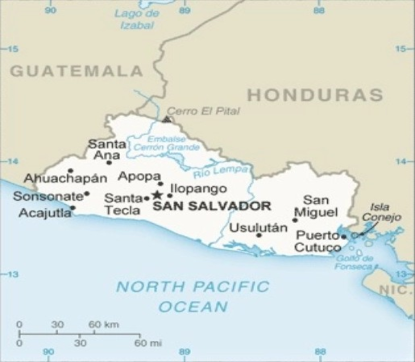
7.1.1 El Salvador is located in Central America, bordering Guatemala, Honduras and the North Pacific Ocean.[footnote 1] It has a land mass covering 20,721 square kilometres, plus a further 320 sq km of water.[footnote 2]
7.1.2 Minority Rights Group, a ‘human rights organization working with ethnic, religious and linguistic minorities, and indigenous peoples worldwide’[footnote 3], stated that ‘El Salvador is the smallest country in Latin America … [it] is made up of 262 municipalities which are divided into 14 departments.’[footnote 4] The United States Central Intelligence Agency (US CIA) noted in its World Factbook that the 14 departments are ‘Ahuachapan, Cabanas, Chalatenango, Cuscatlan, La Libertad, La Paz, La Union, Morazan, San Miguel, San Salvador, San Vicente, Santa Ana, Sonsonate, [and] Usulutan.’[footnote 5]
7.1.3 The map below, published by the US CIA, shows the capital (San Salvador), other cities, major rivers and international boundaries[footnote 6]:
7.2 Population and demography
7.2.1 In 2024, the CIA World Factbook estimated El Salvador’s population to be 6,628,702.[footnote 7] However, in the same year, the World Bank estimated the population to be 6,338,193.[footnote 8] El Salvador’s National Bureau of Statistics and Census (NBSC), using 2021 data, estimated that by 2024 the population would be 6,350,969, rising to 6,366,086 in 2025.[footnote 9]
7.2.2 The CIA World Factbook stated that El Salvador has a ‘high population density country-wide, with particular concentration around the capital of San Salvador.’[footnote 10]
7.2.3 According to the CIA World Factbook, as of 2007, El Salvador’s ethnic groups comprised: ‘Mestizo 86.3% [‘mixed’ in Spanish, and is generally used throughout Latin America to describe people of mixed ancestry with a white European and an indigenous background[footnote 11]], White 12.7%, Indigenous 0.2% (includes Lenca, Kakawira, Nahua-Pipil), Black 0.1%, other 0.6%.’[footnote 12]
7.2.4 Minority Rights Group stated that ‘According to the 2007 census there are 13,319 indigenous people living in El Salvador, comprising approximately 0.2 per cent of the nation’s population of 6.2 million people … Indigenous organizations rejected the findings of the census and pointed to separate estimates by the Economy Ministry that as many as 17 per cent of the population may be indigenous.’[footnote 13]
8. Gangs before March 2022
8.1.1 For detailed information on the reach, activities, impact and recruitment practices of gangs, and targets of gang violence in El Salvador before the state of emergency was enacted in March 2022, see previous iteration of the Country Policy and Information Note El Salvador: Fear of gangs (version 4.0) published in December 2022.
9. State of emergency
9.1 Events of 25 to 27 March 2022
9.1.1 InSight Crime, a think tank and media organization focused on organised crime in the Americas[footnote 14], reported on 28 March 2022:
‘A killing spree unlike anything seen since El Salvador’s civil war has delivered a macabre message from the country’s street gangs, which have learned that spikes in homicides speak to the government.
‘The country’s main gangs, the MS13 and Barrio 18, appeared to indiscriminately kill people – including vendors, bus passengers and market-goers – during three days of bloodshed that began with 14 killings on March 25 [2022].
‘The next day, authorities had tallied 62 further homicides, marking the deadliest day on record since the country’s civil war ended three decades ago. Eleven more people were murdered on March 27 [2022], for a total of 87 homicides in 72 hours.’[footnote 15]
9.1.2 US-based Foreign Policy Magazine[footnote 16] reported on 1 April 2022:
‘Last weekend, El Salvador experienced the bloodiest 24-hour period since the end of its civil war in 1992. Beginning on Friday [25 March 2022] and throughout the day on Saturday [26 March 2022], suspected gang members carried out attacks across the country, killing shoppers, bus passengers, and other passersby [sic]. By Sunday [27 March 2022], more than 70 people were dead, and President Nayib Bukele declared a national state of emergency.’[footnote 17]
9.1.3 On 11 April 2022, a Harvard University PhD candidate wrote on Lawfare, a non-profit multimedia publication with a focus on national security[footnote 18]: ‘Between March 25 and March 27 [2022], no fewer than 87 Salvadorans were murdered. According to El Faro, most of the victims had no known connection to the maras, El Salvador’s deadly street gangs.’[footnote 19]
9.2 Overview of state of emergency
9.2.1 The United States State Department (USSD)’s Country Report on Human Rights Practices: El Salvador, published in 2023 and covering events of 2022 (USSD 2022 report), stated:
‘On March 27 [2022], the Legislative Assembly declared a state of exception … Under the state of exception, which must be renewed monthly, security forces were empowered to arrest anyone suspected of belonging to a gang or providing support to gangs. In addition, the state of exception suspended the rights to be informed immediately of the reason for detention, to legal defense during initial investigations, to privacy in conversations and correspondence, and to freedom of association. Numerous reports of arbitrary arrests, invasion of homes, unfair judicial procedures, and deaths of detainees followed the declaration.’[footnote 20]
9.2.2 Freedom House, in their Freedom in the World 2023 report, covering events of 2022, noted:
‘In March [2022] the government instituted an open-ended, unconstitutional state of exception. Along with the state of exception, authorities suspended constitutional protections of assembly and association … Authorities eliminated arrested people’s due process guarantees and quashed access to public information regarding the crackdown. Criminal courts have remanded virtually all detainees to indefinite custody, without individual scrutiny or respect for due process.’[footnote 21]
9.2.3 In December 2023, InSight Crime reported that:
‘In March 2022, the government of El Salvador launched one of the most relentless security crackdowns in its history in its latest attempt to debilitate the country’s three main gangs – the Mara Salvatrucha (MS13), the Barrio 18 Revolucionarios (18R), and the Barrio Sureños (18S). Past crackdowns spanning multiple decades had failed to quell the gangs, which had long terrorized communities throughout the country and beyond …
‘President Nayib Bukele, who took office in 2019, is the architect of this effort. Following a sudden spike in gang violence in March 2022, the legislative assembly, at Bukele’s request, declared a month-long régimen de excepción (state of emergency), suspending constitutional rights and loosening rules on making arrests …
‘The state of emergency has suspended constitutional rights to defense, meaning detainees can be held indefinitely on vague charges, without the need for an arrest warrant or evidence to back up criminal allegations. Under the emergency laws, detainees also lose the right to a court hearing within 72 hours of arrest. Uncorroborated raw intelligence, rumors, and information sourced from social media profiles have formed the basis of arrests.’[footnote 22]
9.2.4 The USSD’s Country Report on Human Rights Practices: El Salvador, published in 2024 and covering events of 2023 (USSD 2023 report) stated:
‘The state of exception, itself a legal mechanism, suspended the right to legal defense, as well as the requirement that persons be informed of the reason of their arrest at the time of their detention, and increased the number of days an individual could be held in detention before being formally charged. The government did not always observe the requirements of the law …
‘The state of exception decree suspended the right to legal counsel, and law enforcement agents did not wait for suspects to obtain counsel before questioning them.’[footnote 23]
9.2.5 A November 2024 report (DPLF November 2024 report) on the state of emergency, compiled by 7 non-governmental organisations including the Due Process of Law Foundation (DPLF), ‘a regional organization comprised of professionals … with a mandate to promote human rights and the rule of law in Latin America …’[footnote 24], stated:
‘… since March 27, 2022, El Salvador has been under a state of exception decreed by the Legislative Assembly at the request of President Nayib Bukele to restore order, citizen security, and territorial control, and to address serious disturbances of public order “by criminal groups that threaten the life, peace, and security of the population.”
The rights formally suspended by the decree are, among others:
- the right to association and peaceful assembly;
- the right to be informed immediately of their rights and reasons for detention;
- the right against self-incrimination;
- the right to the assistance of counsel in court proceedings and in proceedings before auxiliary bodies of the justice system;
- the right not to be administratively detained for more than 72 hours before being brought before a competent judge;
- the right to the inviolability of correspondence and the prohibition of the interception of communications and the use of unlawfully obtained information.
‘… the government of El Salvador has maintained that the state of exception is justified because “the tools for combating crime have not been sufficient to contain the increasing wave of violent homicides.”’[footnote 25]
9.2.6 On 26 March 2025, El Salvador Info, ‘a website that provides relevant information and opinions about El Salvador’[footnote 26], reported:
‘The Bukele government justifies its continued extensions of the security measure by pointing to the success in reducing crime and preventing gangs from reorganizing.
‘Officials insist that lifting the measure too soon could allow criminals to regain control …
‘NGOs state that without rehabilitation efforts, imprisoned gang members may regroup upon release. However, Salvadoran authorities say that arrested gang members will never be set free to terrorize communities.’[footnote 27]
9.2.7 Originally in Spanish, on 25 November 2025, La Prensa Grafica, a Salvadoran daily newspaper[footnote 28], reported that: ‘The Legislative Assembly approved on Monday [24 November 2025] the 45th extension of the state of emergency …
‘With this approval, the state of emergency will remain in force throughout the next month, while discussions continue on its impact on the security and fundamental rights of the population.’[footnote 29]
9.2.8 In the sources consulted (see Bibliography), CPIT found no information regarding the state of El Salvador’s plans, or timeframe in which it would intend, to end the state of exception.
9.3 Related changes to legal framework
9.3.1 A December 2023 InSight Crime report noted that, alongside the suspension of constitutional rights under the state of emergency, El Salvador’s government introduced legal reforms as part of its security crackdown:
‘In March 2022, the legislative assembly passed legal reforms increasing jail sentences for gang membership and eliminating the possibility of house arrest for detainees belonging to “terrorist groups.” Gangs are considered terrorist organizations under Salvadoran law. The reforms also lowered the age to 12 for which people can be tried for gang-related crimes.
‘At the same time, the administration has reformed existing anti-gang laws so they can apply them to a broader range of targets. Most notably, on March 30, 2022, the legislative assembly modified the law regarding agrupaciones ilícitas (unlawful association), expanding its purview to include anyone who “promotes, helps, facilitates or favors” the activities of a criminal organization. In effect, the law, which was already broad in scope, now gives authorities the power to arrest not just suspected members, or homeboys, but also aspiring members (chequeos) and suspected “collaborators.”
‘The government provides no clear definition of any of these positions nor the methodology about how it arrives at these conclusions regarding who is a member, who is an aspiring member, and who is a collaborator. Nonetheless, it is a major pretext for arrests in the current state of emergency …’[footnote 30]
9.3.2 In December 2022, Human Rights Watch (HRW) reported:
‘El Salvador has broadly defined “terrorist organizations” to include those that use “violent or inhumane methods with the express purpose of instilling terror, insecurity, or alarm within the population,” or to “assume the exercise of powers that belong to the sovereignty of the states or systematically affect the fundamental rights of the population or part of it.” The March 2022 amendments expanded the definition of “terrorist organizations” to explicitly include gangs, including Mara Salvatrucha (MS-13) and the Eighteenth Street Gang (Barrio 18) …
‘Sentences for people convicted of leading a “terrorist” gang were increased from 10 to 15 years to between 30 and 40 years in prison. The sentence for people who “take part” in these groups with the “intention of” carrying out “acts of terrorism” was increased to 15 to 20 years, up from 8 to 12.
‘Under legislation in effect since 2016, gang members in El Salvador can also be prosecuted for membership in “unlawful association” (agrupaciones ilíctas), under provisions that target anyone who “takes part” in gangs, is the “creator, organizer, chief, leader [or] financer” of a gang, or “promotes, helps, facilitates or favors the creation or presence” of these groups or, knowing that these groups are unlawful, “receives direct or indirect benefit” by having relations “of any nature” with gangs “even without being a part of them.” Such a broad definition could be used to charge family members, lawyers, journalists, and civil society members.
‘The March [2022] amendments drastically increased the penalties for these crimes, regardless of whether an alleged member committed any other crime. Prison terms for “taking part” in gangs were increased to between 20 and 30 years, up from 3 to 5. Terms for “supporting” gangs were also increased to between 20 and 30 years, up from 3 to 6.’[footnote 31]
9.3.3 The USSD 2023 report stated:
‘A July 2022 change in the law provided that hearings for gang membership charges could proceed without the detainees’ physical presence, although with defense counsel participating in person. Many detainees’ hearings were conducted virtually and en masse, often with one defense lawyer in the courtroom representing hundreds of persons appearing by video, unable to consult with their defense lawyers in real time or hear the proceedings because of technical problems, complicated by the number of participants.
‘In July [2023] the Legislative Assembly approved legislation for the prosecution of detainees under the state of exception cases, eliminating the previous provision that a criminal process could not exceed 24 months. As of November [2023], no case from the state of exception had gone to trial.’[footnote 32]
9.3.4 The DPLF November 2024 report noted:
‘In March 2022, the Legislative Assembly amended the Code of Criminal Procedure to allow indefinite pretrial detention for all crimes committed by gang members. Previously, Salvadoran criminal procedure allowed for a maximum term of twelve months of pretrial detention for less serious offenses and 24 months, with the possibility of an additional 24-month extension, for serious offenses.
‘… legislative reforms barred the use of alternative, noncustodial measures for a broad catalog of offenses. This means that, for certain offenses, judges are prevented from trying defendants while they remain on release, thus ensuring their indefinite detention. In March 2022, the Legislative Assembly also expanded mandatory pretrial detention to apply to all crimes committed by gang members.
‘… The legislative reforms also allow the courts to conceal the names and identities of judges to protect their safety … to make it impossible to identify justice authorities.
‘… Reforms to the criminal justice system also included the creation of courts with specialized jurisdiction - multi-judge courts and appellate chambers - to hear criminal cases against people detained under the emergency regime …
‘… In August 2023, the Legislative Assembly enacted special transitional provisions that allow for defendants to be grouped together in a single criminal proceeding based on their belonging to the same criminal organization or “other criteria requested by the prosecutor.” These provisions set no limit on the number of people that may be tried in a single criminal case, and they allow for the introduction of evidence without an individual determination of the criminal responsibility of each person charged …
‘… In September 2022, the authorities passed a law that allows judges and prosecutors to try people in absentia’[footnote 33]
9.3.5 HRW’s World Report 2025, covering events of 2024, stated: ‘In 2022, the Assembly passed a set of criminal law amendments that increased the maximum prison sentence for the crime of “unlawful association” to 10 years for children aged 12 to 15, and up to 20 years for those aged 16 to 18.’[footnote 34]
9.3.6 See also 2 December 2022 response to an information request compiled by the Immigration and Refugee Board of Canada for translations of certain legal reforms made since the imposition of the state of emergency.
9.4 Arrest and detention statistics
9.4.1 A February 2023 article by online news agency El Faro[footnote 35] stated: ‘Everything related to the state of exception is veiled in state secrecy; the only source for the detention count are the tweets of the Security Ministry and the Police. Basic data from these detentions like age, place of arrest, accusations, or gang affiliations have been kept withheld, as have all of the case files related to the emergency regime.’[footnote 36]
9.4.2 The same source stated that ‘Zaira Navas, former inspector general of the Police and coordinator of the NGO Cristosal … insists: “The investigations that we have undertaken give us the preliminary perception that the gang members captured during the state of exception doesn’t even reach 30 percent [of their ranks]. The rest are mostly civilians …”’[footnote 37]
9.4.3 In March 2023, El Faro reported:
‘… if the official arrest figures are … reliable, the country now has the highest incarceration rate in the world, according to the World Prison Brief (WPB), a database hosted by the Institute for Crime and Justice Policy Research at the University of London. According to the WPB, in March 2022, before the state of exception went into effect, El Salvador had imprisoned 605 people for every 100,000 inhabitants. Under the state of exception, that rate has reached 1,540 per 100,000, meaning roughly 2% of the entire population of El Salvador is now behind bars.’[footnote 38]
9.4.4 The same source reported: ‘The government has not provided disaggregated data or any official reports on prisoners who have been released.
‘In January of this year [2023], the Minister of Justice and Public Security, Gustavo Villatoro, stated in a television interview that the government had released 3,313 individuals arrested under the state of exception, or 5.4% of the total number of officially registered detainees …’[footnote 39]
9.4.5 In December 2023, InSight Crime reported:
‘The government claims to have arrested 52,541 members of the MS13, 13,682 members of the Barrio 18 Sureños, and 10,741 members of the Barrio 18 Revolucionarios, according to a police intelligence report dated October 1 [2023] obtained by InSight Crime. These figures refer to homeboys [gang members[footnote 40]], chequeos [aspiring members[footnote 41]], and collaborators …
‘The data also reveals that more than half of reported state of emergency detainees are not fully-fledged gang members. Homeboys [gang members[footnote 42]] accounted for 32,331 arrests (42%) as of September 30, 2023, compared to 41,733 for suspected collaborators (54%) and 3,435 for chequeos [aspiring members[footnote 43]](4%).’[footnote 44]
9.4.6 In December 2023, InSight Crime also reported that:
‘… arrests of gang leaders accounted for just 1,232 of more than 77,000 reported arrests (around 1.5%) made during the state of emergency as of September 30 2023, according to an El Salvador police intelligence report obtained by InSight Crime and arrest figures announced by Salvadoran officials. Authorities reported the arrests of 945 MS13 cabecillas [leaders[footnote 45]] during that time-frame, compared to 287 for the two factions of Barrio 18 and other gangs, according to the same intelligence report.’[footnote 46]
9.4.7 In July 2024, HRW reported:
‘The state of emergency, announced in March 2022, led to an unprecedented surge in the detention and conviction of children. While government figures are inconsistent, CONAPINA [El Salvador’s National Council of Early Childhood, Children and Adolescents] told US authorities that 3,319 children were detained between March 2022 and December 2023. Of these, 841 were reported to remain in prison as of January 2024 - 262 in pretrial detention and 579 serving sentences. The Public Defender’s Office told Human Rights Watch that it had provided legal representation to 2,928 children detained between March 2022 and April 2024. On February 22, 2024, Justice and Security Minister Gustavo Villatoro said in a press conference that 1,065 children had been convicted during the state of emergency, without providing a specific timeframe for when these detentions occurred.’[footnote 47]
9.4.8 In August 2024, print and digital news magazine TIME[footnote 48] reported: ‘One in every 57 Salvadorans is now incarcerated - triple the rate of the U.S. and the highest in the world … Suspected gang members or collaborators were arrested at school, at work, on the street. “We were arresting more than 1,000 people per day,” says René Merino, the Defense Minister.’[footnote 49]
9.4.9 The DPLF November 2024 report noted that: ‘As of September 2024, 82,000 people have been detained during the state of exception, including 3,300 children and adolescents … The arrests have tripled the country’s prison population … Today, over 107,000 people remain in detention.’[footnote 50]
9.4.10 In December 2024, Amnesty International reported: ‘According to media reports, 1.8% of the Salvadoran population is behind bars, the highest incarceration rate on the continent. Based on figures from the latest population census, 3 out of every 100 men are in prison.’[footnote 51]
9.4.11 In its 2025 report ‘The State of the World’s Human Rights’, covering events of 2024, Amnesty International stated: ‘Since the state of emergency began in 2022 up to the end of 2024, according to the authorities there had been 83,900 detentions. Most detainees had been charged with “illicit associations” and other gang-related crimes.’[footnote 52]
9.4.12 On 27 March 2025, the Washington Office on Latin America (WOLA), a ‘research and advocacy organization advancing human rights in the Americas’[footnote 53], reported that ‘There are currently more than 110,000 people in prison, with 85,000 people detained, since the state of exception was enacted in March 2022.’[footnote 54]
9.4.13 On 27 June 2025, HRW reported: ‘Since the start of the state of emergency, Salvadoran authorities have detained over 86,000 people.
‘El Salvador has one of the highest rates of pretrial detention in Latin America and the Caribbean. According to a World Bank report from April 2025, only 23 percent of people in prison have been convicted and sentenced: the lowest proportion in Latin America.’[footnote 55]
9.4.14 Considering the number of ‘wrongful’ detentions, in October 2022, International Crisis Group, an organisation ‘providing independent analysis and advice on how to prevent, resolve or better manage deadly conflict’[footnote 56], reported that ‘President Bukele acknowledged on Twitter that he expected around 1 per cent of detentions to be wrongful.’[footnote 57]
9.4.15 On 17 February 2023, Al Jazeera reported: ‘By mid-January [2023], about 3,745 people arrested during the state of exception – but who Bukele has said are innocent – had been released, according to the most recent government statistics.’[footnote 58]
9.4.16 The USSD 2023 report stated: ‘The vice president acknowledged it was possible persons with no gang ties were arrested but noted that courts released more than 3,000 detainees after determining they had no such ties. On August 22 [2023], the minister of justice and public security reported that of the more than 71,000 persons arrested under the state of exception, approximately 7,000 had been released.’[footnote 59]
9.4.17 On 4 December 2024, WOLA reported:
‘President Bukele recently acknowledged that 8,000 people detained under the state of emergency are innocent and have been released. To date, according to official data, there are 80,000 people deprived of liberty as a result of the exception, which means that at least one out of every ten people detained are innocent. The release of these people is difficult to corroborate because the lack of transparency, reliable data and access to information is a serious problem. The state security forces, the prosecutor’s office, and the judiciary, act without any control or counterweight, with confidentiality being the rule … documentation work of human rights organizations and complaints from many relatives of those detained indicate that there are probably many other innocent people who have been detained under the state of emergency.’[footnote 60]
9.4.18 Originally in Spanish, on 29 March 2025, Associated Press reported:
‘Since the state of emergency was approved on March 27, 2022, more than 85,500 people have been arrested on charges of gang membership or association. But the government itself has acknowledged that 90% of them are in prison without being convicted and that 8,000 innocent people have had to be released due to lack of evidence against them.
‘The director of the NGO Humanitarian Legal Aid, Ingrid Escobar, says that in prisons “there are about 30,000 people who have no ties to gangs.”’[footnote 61]
10. Gangs’ size and reach
10. Total number of gang members
10.1.1 Estimates of the total number of gang members in El Salvador differ. In April 2022, HRW noted that ‘On April 4 [2022], President Bukele said that the country had 86,000 gang members’[footnote 62], whereas in December 2022 the same source reported that ‘According to unverified figures that Minister of Justice and Public Safety Gustavo Villatoro shared during an interview, there are 76,000 gang members in El Salvador’.[footnote 63]
10.1.2 A 2024 paper published by Columbia University’s Center for Mexico and Central America[footnote 64] stated that ‘By the time President Bukele was inaugurated for the first time in 2019, estimates of gang membership ranged from 60,000 to 200,000 members with a presence in roughly 95 percent of El Salvador’s 262 municipalities in all 14 of the country’s departments (provinces).’[footnote 65]
10.2 Number of gang members at large
10.2.1 A September 2023 InSight Crime report discussed El Salvador’s Police Information System (Sistema de Información Policial – SIP), its information gathering system for police intelligence relating to gang members. It stated: ‘As of August 31, 2023, according to reports accessed by InSight Crime, the SIP estimated there were 120,187 total gang members and associates. They broke them down as follows: 53,973 homeboys (gang members), 5,454 chequeos (aspiring members), and 60,760 collaborators. This estimate did not include gang members who were in prison at the time, which totaled close to 20,000.’[footnote 66]
10.2.2 In September 2023, InSight Crime reported, referring to confidential reports from El Salvador’s National Civil Police, that: ‘While the MS13 and the Barrio 18 Sureños have been hit the hardest [by the state of emergency], 33% and 35% of their members remain at large, respectively … Across all gangs, the report indicates that 42,826 active gang members, aspirants, and collaborators remain free, 36% of all those registered. The highest percentage of free members are the homeboys [gang members[footnote 67]], with 40% at large.’[footnote 68]
10.2.3 The same source stated: ‘The Barrio 18 Revolucionarios … seems to have resisted the offensive better, or its dismantling has not been as high a priority. Either way, 46% of its members are free.’[footnote 69]
10.2.4 The Global Organized Crime Index is a ‘multi-dimensional tool that assesses the level of criminality and resilience to organized crime for 193 countries’.[footnote 70] Its 2023 iteration (Global Organized Crime Index 2023), covering events of 2022, stated that: ‘The state of exception reduced gang operations … but thousands of members, collaborators and relatives remain at large, making gang presence considerable …’[footnote 71]
10.2.5 In December 2023, InSight Crime reported:
‘… while the crackdown’s impact has been transformative, the gangs are not finished in El Salvador. In fact, the government’s own data contradicts the Bukele administration’s narrative that the gangs have been completely defeated …
‘[A police intelligence report dated October 1 [2023] obtained by InSight Crime] says the number of “armed groups of gangs” (grupos armados de pandillas) is 53, down from 97 in 2022, and 107 in 2020. Of these cells, 43 correspond to the MS13 (80%), while six belong to the Barrio 18 Sureños (11%), and four to the Barrio 18 Revolucionarios (9%).
‘But the same police intelligence reports say that 36% of gang members and collaborators - over 42,000 - remained at large as of the end of September 2023.’[footnote 72]
10.2.6 The below tables were created by CPIT using data from a December 2023 InSight Crime report, which cited El Salvador’s national civil police. They show the total number of members of MS13, Barrio 18 Surenos and Barrio 18 Revolucionarios, divided by rank, and how many members of each gang remained at large as of the end of September 2023[footnote 73]:
| MS-13 rank | Total members | Members at large | % members at large |
|---|---|---|---|
| Homeboys (gang members) | 30,381 | 11,340 | 37.3% |
| Chequeos (aspiring gang members) | 4,547 | 1,633 | 35.9% |
| Collaborators | 43,347 | 12,761 | 29.4% |
| Total | 78,275 | 25,734 | 32.9% |
| Barrio 18 Sureños rank | Total members | Members at large | % members at large |
|---|---|---|---|
| Homeboys (gang members) | 11,306 | 4,326 | 38.3% |
| Chequeos (aspiring gang members) | 225 | 99 | 44.0% |
| Collaborators | 9,500 | 2,924 | 30.8% |
| Total | 21,031 | 7,349 | 34.9% |
| Barrio 18 Revolucionarios rank | Total members | Members at large | % members at large |
|---|---|---|---|
| Homeboys (gang members) | 11,513 | 5,562 | 48.3% |
| Chequeos (aspiring gang members) | 677 | 287 | 42.4% |
| Collaborators | 7,579 | 3,179 | 41.9% |
| Total | 19,769 | 9,028 | 45.7% |
10.2.7 Originally in Spanish, in May 2025, BBC Mundo reported:
‘As of April 30, 2025, and after three years of state of emergency, the number of gang members registered in police files as Mara Salvatrucha homeboys and who have not yet been arrested is 4,682.
‘“Of that figure, those who remain in the country are 40%,” speculates Minister Villatoro …
‘Salvadoran Luis Enrique Amaya is an international consultant who has been researching the phenomenon of gangs for more than a decade, doing fieldwork.
‘He is convinced that “of MS-13 there is nothing left but its remains, its vestiges, its ashes.”
‘”There are still people who identify themselves and who are identified by others as gang members, but that does not mean that the gang structure continues to exist,” he says.
‘As an investigator, Amaya believes that we are at a point where it is no longer necessary to prove that MS-13 and Barrio 18 are current criminal structures. “Now we would have to provide evidence that contradicts that the gangs are dismantled,” he stresses.
‘”Nayib Bukele solved the gang problem,” Amaya says. He has achieved it at a very high cost … but we must admit that he has solved it.”’[footnote 74]
10.2.8 The same source stated: ‘BBC Mundo had access to the report ”Current situation of gangs in El Salvador”, prepared by the Intelligence Subdirectorate of the National Civil Police (PNC) and dated May 1, 2025 … The intelligence report states that MS-13 still has 29 “armed groups”…’[footnote 75]
10.2.9 On 3 October 2025, ContraCorriente, a digital journalism site covering Central America[footnote 76], reported that, according to El Salvador’s government, 17,500 gang members remain in at large within El Salvador.[footnote 77]
10.2.10 For details of the security measures enacted in March 2022, see State of emergency.
10.3 Location of gangs and gang members
10.3.1 In October 2022, International Crisis Group reported: ‘Residents in gang-controlled communities observed that the highest-profile gang members are hiding in the hills, by the rivers or even in sewers. Those who can afford it are fleeing.’[footnote 78]
10.3.2 A February 2023 El Faro article stated: ‘Zaira Navas, former inspector general of the Police and coordinator of the NGO Cristosal, asks: “Where are they [the gang members]?.” According to the government, those who aren’t in prison are hidden or fled the country.’[footnote 79]
10.3.3 In September 2023, InSight Crime reported:
‘The Mara Salvatrucha (MS13), Barrio 18 Sureños, and Barrio 18 Revolucionarios still maintain 54 armed groups, mostly in rural areas …
‘The police reports details … their uneven presence across El Salvador …
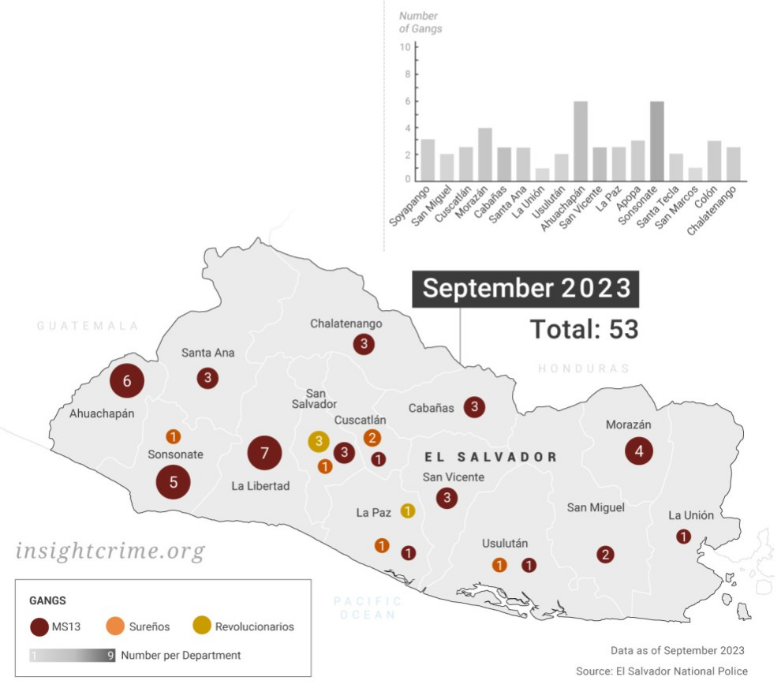
‘… progress in dismantling these gang structures has not been consistent throughout the country. The PNC [El Salvador’s National Civil Police] and armed forces have hit the gangs hardest in the departments of Cuscatlán, Santa Ana, San Miguel, La Unión, and Usulután. But there has been markedly less impact in San Salvador, Ahuachapán, Morazán, Cabañas, La Libertad, and La Paz.
‘In two departments - Chalatenango and San Vicente - the number of groups has remained the same. But the most surprising case is Sonsonate, where the number of groups has increased from five to six …
‘The Barrio 18 Revolucionarios - a gang with a strong presence in the eastern half of the San Salvador metropolitan area and in the departments of La Libertad and La Paz - seems to have resisted the offensive better …
‘The crackdown has also seen varying efficiency in different parts of the country. San Vicente, Cabañas, La Paz, La Libertad, and San Salvador are the departments with the most gang members who avoided capture. Although in the case of the latter two - the most urban parts of El Salvador - this could be because gang members have gone into hiding in the interior of the country or abroad.
‘On the other hand, the government’s attack has been more forceful in Cuscatlán and in the four eastern departments of El Salvador.’[footnote 80]
10.3.4 A November 2023 InSight Crime profile on Barrio 18 stated that: ‘Security forces have jailed over 10,000 alleged Barrio 18 members during the crackdown … Those still at large have gone into hiding or fled the country …
‘The crackdown has decimated the Barrio 18’s rank-and-file, sending thousands fleeing or into exile.’[footnote 81]
10.3.5 In December 2023, InSight Crime stated:
‘[A] security official told InSight Crime that schools are now housing minors linked to the gangs and may provide the only public space where remnants of these groups can still operate. Mario Vega, a prominent evangelical pastor who has spent decades working in gang communities, also flagged the possible presence of gang structures in schools. But residents interviewed by InSight Crime in Apopa and San Miguel did not consider this a pressing issue …
‘The situation may be different in rural areas that initially provided refuge for gang members after security forces began raiding gang-controlled neighborhoods in major cities.’[footnote 82]
10.3.6 In December 2023, InSight Crime reported that:
‘The whereabouts of many gang leaders remain unknown …
‘An internal intelligence report compiled by the Salvadoran anti-gang police unit at the state of emergency’s onset concluded that the MS13’s top leadership ring in El Salvador, known as the ranfla, had ordered gang bosses and fully-fledged gang members (homeboys) to either seek refuge in safe houses, mountainous areas, and private residences, or attempt to flee to neighboring countries and wait for the crackdown to subside.
‘… gang members have scattered. Some street-level members and gang collaborators have seemingly remained in El Salvador, lying low with relatives or seeking refuge in areas outside of major urban hubs with associates or allies …
‘The threat of detention has also led many active and semi-retired (often termed, calmado) gang members to flee to nearby countries …’[footnote 83]
10.3.7 In December 2023, citing El Salvador’s National Police, InSight Crime shared the below graphic showing the number and presence of factions of the 3 main gangs in different departments and major cities of El Salvador in August 2022 and September 2023[footnote 84]:

10.3.8 Originally in Spanish, in May 2025, BBC Mundo reported:
‘BBC Mundo had access to the report ”Current situation of gangs in El Salvador”, prepared by the Intelligence Subdirectorate of the National Civil Police (PNC) and dated May 1, 2025 …
‘The intelligence report states that MS-13 still has 29 “armed groups” in desolate, mountainous rural areas of the country; most operate in the departments of Sonsonate (5), La Libertad (4), Cabañas (3), Morazán (3) and San Salvador (3).’[footnote 85]
10.3.9 On 3 October 2025, ContraCorriente reported:
‘Since then [March 2022], hundreds of gang members have fled the country: some went to Honduras and Nicaragua; others north to Guatemala, Mexico and the US; while others across the ocean to Spain. For more than two years, journalists have interviewed – by phone and in person – over twenty gang members who fled to six countries and are part of the MS-13 diaspora.
‘The gang members said their instinct was to escape and hide among Salvadoran migrants, who for decades have fled from hunger and violence caused by the gangs themselves. They looked for illegal crossing points, used gangs’ contacts in other countries, paid smugglers, bribed police officers and some even claimed asylum; taking advantage of the corruption in institutions and legal loopholes while posing as victims of the violence in El Salvador. The overwhelming majority of individuals who had a grip on 90 percent of the country and the lives of millions of people are hiding …
While gangs have been dismantled in El Salvador, it doesn’t mean they have disappeared entirely … Most of them are in prison or on the run. Some were detained while fleeing … Those who remain at large within the borders – 17,500 people, according to the government – are hiding in woodlands, holes that they have dug on the ground or inside houses.’[footnote 86]
10.3.10 For details of the security measures enacted in March 2022, see State of emergency.
11. Gangs’ activities after March 2022
11.1 Territorial control and presence in communities
11.1.1 In June 2022, The Guardian reported, regarding the state of emergency, that: ‘Many of El Salvador’s 6 million citizens are delighted at the assault on … gangs … Polls show Bukele has become even more popular since the state of exception started, with approval ratings of more than 90%.’[footnote 87]
11.1.2 In October 2022, International Crisis Group reported: ‘The government has undeniably cleared much of the gangs’ manpower from El Salvador’s streets.’[footnote 88]
11.1.3 A February 2023 article in Associated Press noted that, according to President Bukele: ‘… the measures have broad support in El Salvador, violence has dropped precipitously and people are returning to neighborhoods that were long controlled by the gangs.’[footnote 89]
11.1.4 In February 2023, The Guardian reported on the experience of a resident of El Pepeto, a neighbourhood in Soyapango, El Salvador, stating:
‘“It was really dangerous. They’d [MS-13 and Barrio 18-Surenos] have shootouts just outside,” said the 40-year-old homemaker …
‘“They’ve completely vanished,” she said …
‘In recent days, the Guardian visited eight communities in and around El Salvador’s capital to explore the unexpected pacification. Until recently, five had been the dominion of the Mara Salvatrucha, two the Barrio 18-Sureños, and one the Barrio 18-Revolucionarios group. In none was there any sign of gang members, who before would loiter on street corners, drinking, smoking marijuana and constantly observing locals and outsiders.
‘During those visits, the Guardian spoke to more than 20 sources including shopkeepers, police officers, community leaders, residents and taxi and bus drivers. All agreed that the criminal groups were a shadow of their former selves, although many suspected some had absconded or fled abroad …’[footnote 90]
11.1.5 A February 2023 article by El Faro stated:
‘The Mara Salvatrucha-13, the Revolucionarios or Sureños factions of 18th Street and other smaller gangs … no longer operate in the streets of El Salvador - or at least not as they had before …
‘To verify this, El Faro visited 14 communities who for years lived under gangs’ ironclad control in the west, center, and east of the country … [and] in the Center District of San Salvador; spoke to a veteran gang leader on the run and no longer in El Salvador; interviewed business people of different levels who for years were extorted by these groups; and conversed with police officers, religious leaders, NGOs, and political parties. The conclusion is that the gangs do not exist in this moment as El Salvador knew them for decades …
‘When asked directly whether the Bukele administration had destroyed the gangs … [a veteran gang leader] responded unequivocally: “Yes, they have ruined the gangs as you knew them. If what you mean to ask is whether there are no longer any cipotes [gang members] with presence in these places, it’s true. They’re no longer there…” …
‘In the colonia Las Cañas, in the municipality of Ilopango: The leaders of both sides of the community, once controlled by rival gangs, met and even organized a youth soccer game, as part of the start of a unification process in the colonia.
‘… Marvin Reyes is a police officer with 20 years’ experience who as founding leader of the Police Workers’ Movement (MTP) receives reports from hundreds of current and former unionized police officers across the country. “The gangs as we knew them, as a national structure, no longer exist. What’s left is a vestige,” he said …
‘El Faro also visited the colonias 10 de Octubre, Santa María, and El Cenizal, in the municipality of San Marcos, five miles from San Salvador. “… nothing will happen to you, because the chamacos [gang members] who caused problems here were taken away at the start of the state of exception,” [quoting a resident] …
‘… “…The leaders have left for the United States, Mexico, Guatemala, or the state of exception took them away, but there are still some eight cipotes in the Tinetti zone, between 11 and 22 years old. All of them are armed, move drugs, and report to those [same] leaders over the phone. There are still eyes keeping watch,” [quoting a vendor in the Tinetti Market in downtown San Salvador] …
‘Five blocks north … another vendor agreed to speak. “The only one left selling is the woman of one of the leaders …” he claimed. “They [the police and soldiers] came with lists in hand to grab people …”
‘Claudia Ortiz, legislator of the Vamos party, says that various constituents told her they feel an improvement in security …’[footnote 91]
11.1.6 An article published by the BBC in May 2023 noted:
‘”On a scale of one to ten, it’s a twelve,” jokes one local resident when asked how much calmer the neighbourhood has become over the past year. “It’s incredibly quiet.”
‘Not prepared to give his real name, such is the ingrained fear of speaking about gangs, “Joel” [a resident of Soyapango] says his neighbourhood is unrecognisable under the tighter security conditions: “Things were so bad here before, so ugly.”’[footnote 92]
11.1.7 On 23 August 2023, Context, ‘a media platform … powered by original reporting from the Thomson Reuters Foundation’[footnote 93], noted: ‘The shift has brought a newfound freedom to people living and working in neighborhoods where gang members once controlled the streets, imposing curfews and other restrictions.
‘Football matches are now played at dusk and families can spend time at the park or order fast food delivery, while businesses can distribute and sell their products in other neighborhoods - all unthinkable when the gangs reigned.’[footnote 94]
11.1.8 A November 2023 InSight Crime profile on Barrio 18 stated that: ‘For the first time in decades, the gang has lost control of key territories … in areas it once ruled with an iron fist.’[footnote 95]
11.1.9 In December 2023, InSight Crime reported:
‘The gangs’ sudden disappearance was corroborated by dozens of residents in former gang strongholds in San Salvador, Apopa, Soyapango, Illopango, Mejicanos, Ciudad Delgado, San Julián, Tonacatepeque, and San Miguel. None of the residents said they had witnessed any kind of response from gang members, armed or otherwise, aimed at protecting territories or securing their criminal economies.
‘One community worker in Apopa said some gang lookouts, once a ubiquitous presence in the area, were now monitoring the territory from their residences to avoid arrest.
‘Residents in Mejicanos told InSight Crime that children and adolescents who once collaborated with the gangs still roam the streets. But they are no longer feared by locals, and it is unclear whether they are still patrolling on behalf of the gangs.’[footnote 96]
11.1.10 In December 2023, InSight Crime reported: ‘Over our nine-month investigation into … the régimen de excepción (state of emergency) … Residents spoke freely in community centers and soccer pitches previously off limits — a testament to how the gangs’ rapid decline has radically changed life for people who weathered years of terror … The gangs’ demise has also radically altered the country’s criminal landscape, liberating swathes of territory from criminal control.’[footnote 97]
11.1.11 In December 2023, InSight Crime stated, regarding the territorial control exerted by gangs since the state of emergency began:
‘The clearest indicator of decreased gang presence in El Salvador is the absence of the MS13 and Barrio 18 in neighborhoods once dominated by the gangs …
‘The situation has changed radically following the enactment of the state of emergency. InSight Crime visited 15 former gang strongholds in the municipalities of San Salvador, Apopa, Soyapango, Ilopango, Mejicanos, Ciudad Delgado, San Julián, Tonacatepeque, and San Miguel, where gang structures have ceased to operate almost entirely …
‘Now, residents say they no longer face near-constant surveillance from gangs … They have reclaimed recreational and community spaces previously used by the gangs and have initiated new community projects with no gang resistance for the first time in years …
‘Few residents reported seeing remnants of the gangs in their neighborhoods. Some mentioned the return of active gang members who were released from jail, but they said these actors held far less power than before the state of emergency …
‘A police officer stationed in San Salvador’s Historic Center, where expansive informal markets were once a hive of gang activity, said gang members disappeared just two weeks into the state of emergency.’[footnote 98]
11.1.12 In a December 2023 report, InSight Crime stated that the state of emergency has: ‘… helped drive violence to historic lows and given breathing space to communities previously overrun by the gangs, something no past crackdown has achieved.’[footnote 99]
11.1.13 In April 2025, The Guardian reported: ‘The mass arrests broke the gangs’ territorial grip …and gave many Salvadorians a kind of freedom they hadn’t known for years. The great majority approve of Bukele’s government.’[footnote 100]
11.1.14 Originally in Spanish, on 6 August 2025, without stating whether the crimes were perpetrated by gang members, La Prensa Grafica reported:
‘… Minister of Security, Gustavo Villatoro … reflected the figures of the ten crimes … that report the most complaints at the national level. These are: theft, injuries, rape, extortion, vehicle theft, robbery, aggravated theft, homicide, aggravated robbery and vehicle theft …
‘… at the national level, so far in 2025, the authorities have received 3,371 complaints of these crimes with the highest incidence and Morazán is the only department in the country where there is a 24% increase, going from 104 to 129 reported crimes …
‘… Attempts were made to obtain more details on this from both the Ministry of Justice and Public Security and the National Civil Police (PNC), but there was no response.
‘San Salvador Norte and San Miguel Norte are two other municipalities where statistics report slight increases in reports of criminal acts.’[footnote 101]
11.1.15 For details of the security measures enacted in March 2022, see State of emergency.
11.1.16 For further details of the situation in gang-controlled communities since March 2022, see Freedom of movement.
11.2 Extortion
11.2.1 The Global Organized Crime Index 2023 noted:
‘Extortion is the primary source of income for gangs in El Salvador. The gangs use the money to buy weapons, pay lawyers, and support the families of murdered and jailed members. It is estimated that El Salvador loses hundreds of millions of US dollars in extortion to gangs each year. Many shop owners still pay or contribute in other ways to gangs for fear of retribution. The transport sector is one of the most affected, and even food and beverage suppliers must pay extortion money to pass through certain communities to restock local shops. Some companies have designated people to make the payments, include extortion in their operational costs, or require their employees to bear the costs of extortion …
‘Gangs have typically reinvested extortion revenues by setting up their own car wash businesses, storehouses, or private transportation activities, displacing competitors by force. However, the mass arrest campaign launched under the state of exception has partially hindered gangs’ capacity to collect extortion money.’[footnote 102]
11.2.2 In October 2022, International Crisis Group reported:
‘… some shop and restaurant owners say they have stopped making extortion payments, although in certain places gangs still force merchants to provide food and mobile phone top-ups free of charge, and even shake them down for money, through low-ranking members or collaborators. In these circumstances, some businesspeople do what they are told on the understanding that the state’s clampdown may be temporary, and gangs will come back to retaliate against those who refused to pay.’[footnote 103]
11.2.3 In February 2023, The Guardian reported:
‘“You basically had to pay a tax in order to live,” [a local community leader in San Salvador’s 10 de Octubre community] said of the crippling extortion payments Mara Salvatrucha members had demanded of businesses and residents.
‘But such shakedowns stopped after Bukele declared a state of emergency in March [2022] …
‘“So far, with the state [of emergency] this has changed,” said the community leader, although, like many interviewees, he was uncertain how long the calm would last …’[footnote 104]
11.2.4 A February 2023 article by El Faro quoted a gang leader who is no longer based in El Salvador:
‘“Extortion has already gone to hell. Some might still pay it just out of fear …” he added. He believes that there are still some small gang cells or individuals who could act on their own …
‘In the last several weeks, El Faro verified the absence of gang members in communities where their power was strongest. Residents, teachers, and communal leaders told El Faro that the gangs had largely disappeared and that their power had dissipated since the start of the state of exception in March 2022. They pointed to palpable signs like the suspension of extortion and other “taxes” on parking, real estate rentals, or cable TV contracts. Some marveled that restaurants, taxies, and ride hailing apps like Uber now offer services in their communities.
‘The main business associations in the country have not kept statistics on extortion in recent months, but their members report that something is changing. “Partners engaged in mass distribution have commented to us that they have extended coverage to colonias and sectors where they were previously unable to enter,” responded the Salvadoran Chamber of Commerce and Industry …
‘“[The gangs] have been left with diffuse control in a few places …” he [Marvin Reyes, a police officer[footnote 105]] adds, citing the municipality of Santa Tecla … “They still pose as food runners there to collect extortion money in some places,” he explains …
‘“The gang was like the police: They charged you $20 [approx. £14.75[footnote 106]] for every vehicle, and if you didn’t pay, they’d steal it. If a relative wanted to visit, you had to ask for permission from the bichos [gang members]. If you had a business, you had to pay them. Now none of them are left,” he [a resident of Las Margaritas, a neighborhood in Soyapango] said …
‘“In October [2022] I paid rent [extortion] but at the beginning of November [2022] detectives came here to interview business managers and owners. After the detectives’ visit, the muchachos [gang members] didn’t come around anymore, and they haven’t even called me to demand their quota,” said the owner of a restaurant in San Salvador who had paid $275 [approx. £202[footnote 107]] every month since 2015 …
‘… “… I would say that extortion has been reduced by 95 percent. In the metropolitan area they’ve been hit the hardest. Today, if I have problems in Las Margaritas, I file a report and the government goes and shakes them up. The gangs no longer even dare to call you,” he [Juan Pablo Álvarez, union director of Salvadoran Routes United, which represents 5,000 public transportation units] said …
‘According to Álvarez, the problem remains in rural areas: “Outside the capital, extortion has been reduced by 70 percent”, he admits, but “in the east, in Usulután, in the area of Jiquilisco and the departmental capital of La Unión, people are still in trouble. Along the border of Sonsonate and La Libertad, there are still problems. People show up with weapons.” …
‘A hair salon owner in the Center District of San Salvador said that he opened his business 14 years ago and had paid $20 [approx. £14.75[footnote 108]] weekly to the Centrales Locos Salvatrucha. “… In December [2022] I didn’t pay, and they didn’t come to ask me for money.” By January 18 [2023], when he spoke with El Faro, he still hadn’t paid the quota.’[footnote 109]
11.2.5 In August 2023, HRW stated that ‘Extortion, which was the main source of gang financing, seems to have … significantly decreased.’[footnote 110]
11.2.6 On 23 August 2023, Context noted:
‘For nearly 20 years, Antonio Ventura has been handing over $100 [approx. £75[footnote 111]] a month from the till of his small grocery store in El Salvador’s capital to gangsters in extortion payments …
‘“I had to pay up or if not they could make me disappear. It’s not that I wanted to pay, I just had to if I wanted to continue with my business,” Ventura, 49, told Context inside his store, where steel mesh and bars protect the windows and doors.
‘Then, about a year ago, the gangsters stopped coming by and the extortion demands stopped …
‘Extortion rackets have not completely disappeared but many residents say gangs and their hitmen no longer roam the streets collecting payments.
‘By August of last year [2022], the transportation minister estimated that bus companies had already saved about $50 million [approx. £37.4 million[footnote 112]] from not paying …
‘In another part of the capital, street trader Victor Ramirez said Barrio 18 had all but disappeared from his area after controlling it for nearly two decades…
‘Today, he runs a fruit stall, is free to buy stock from whoever he wants and never has to hand over extortion money.’[footnote 113]
11.2.7 Regarding extortion since the state of emergency began, InSight Crime stated in December 2023 that:
‘With the extensive loss of manpower and territory, it is clear that the gangs can no longer operate the criminal economies that have long kept them afloat …
‘Operating these rackets relied on an extensive network of gang members and collaborators to patrol gang territories and collect payments. Previous crackdowns focused on gang members, but Bukele’s has focused on the gangs’ broader networks, according to police data. This means the gangs can no longer rely on proxies to continue operating criminal economies while weathering state crackdowns …
‘… residents of … former gang strongholds visited by InSight Crime said they no longer received extortion threats from the gangs. And some residents said they had not witnessed any gang retaliation for not paying extortion fees during the state of emergency.
‘Extortion in the transport sector also appears to have come to a standstill. Bus company representatives working in San Salvador told InSight Crime the gangs had quickly stopped charging extortion in the days and weeks following the onset of the state of emergency.
‘One bus company owner who previously paid around $6,000 [approx. £4,426[footnote 114]] in monthly extortion fees to the three main gang factions said he stopped paying rent to the MS13 immediately after the crackdown began. His payments to the Barrio 18 fizzled out in the following days and weeks.
‘The inability to maintain extortion rackets, which primarily targeted the informal economy, represents a seismic financial blow to the gangs.
‘El Salvador police reported a 54% reduction in extortion complaints between the start of the year [2023] and September 11 [2023], compared to the same period in 2022. As of September 11 [2023], the police had processed 572 reports of extortion; in 299 of those cases, the plaintiff identified the perpetrators as members of the MS13 and Barrio 18 …
‘Still, multiple sources - including police officials, politicians, and gang members - told InSight Crime that extortion persists in some areas, albeit on a smaller scale.
‘Police and municipal employees in San Miguel, for example, told InSight Crime that some individuals are still extorting vendors in the city’s main markets, despite a near-complete disappearance of gang presence in these establishments. They said these people may belong to remnants of the gangs or may be individuals acting on their own.
‘The city’s longtime mayor, Will Salgaldo, told InSight Crime extortion has not been eradicated entirely, and that some gang members are now asking for “collaboration” from households as an alternative, small-scale revenue stream.’[footnote 115]
11.2.8 In July 2024, HRW reported: ‘There has … been a significant decrease in … crimes, such as extortion …’[footnote 116]
11.2.9 In its 2025 Freedom in the World report, covering events of 2024 (Freedom House 2025 report), Freedom House stated that ‘… the state of emergency in effect since March 2022 vastly reduced the prevalence of extortion and gangs’ broader impact on the operating environment of businesses.’[footnote 117]
11.2.10 Originally in Spanish, on 6 August 2025, La Prensa Grafica reported:
‘According to figures from the Ministry of Justice and Public Security, extortion increased by 13% in the first half of 2025, compared to the same period in 2024 …
‘… of the ten crimes [with the most reports at national level] … extortion is the only one that reports an increase in 2025, in relation to the first half of 2024.
‘The complaints for this crime between January and July of last year were 273, while for the same period this year there are 309 …’[footnote 118]
11.2.11 For details of the security measures enacted in March 2022, see State of emergency.
11.3 Gang violence and homicides
11.3.1 Citing El Salvador’s National Civil Police as its data source, the United States Congressional Research Service (US CRS) shared the below graph showing El Salvador’s yearly homicide rate per 100,000 people between 2014 and 2024[footnote 119]:
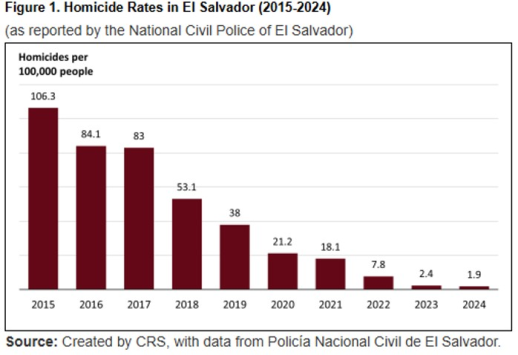
11.3.2 Commenting on the above data, the US CRS noted that:
‘Data from Salvadoran police authorities suggest the state of exception has contributed to a measurable reduction in homicides in the country. From 2015 through 2024, the homicide rate declined by more than 98%, according to Salvadoran security officials … The Bukele government claimed its crackdown on gang activity reduced El Salvador’s homicide rate to 1.9 homicides per 100,000 people in 2024 …
‘Some analysts have argued that the Bukele government has not included police killings, prison deaths, or the discovery of remains as homicides in recent data collection. If these incidents were added to the government’s reported homicides, these analysts noted, the 2023 homicide rate would be up to 47% higher than the government’s reported rate.’[footnote 120]
11.3.3 Elaborating on the Bukele government’s approach to recording homicides, InSight Crime noted in April 2025 that: ‘Bukele’s tough-on-crime approach may have shown short-term results, but part of the homicide rate decline is also tied to a change in El Salvador’s recording methodology. In 2019, the National Police said it would stop including deaths from clashes between security forces and alleged gang members, as well as bodies found in mass graves. That year, the homicide rate dropped from 53 to 38 per 100,000.’[footnote 121]
11.3.4 A February 2023 article in Associated Press noted that: ‘Last year [2022], El Salvador reported 495 homicides, the lowest figure in recent decades. The official number did not include at least 120 suspected gang members killed in confrontations with authorities.’[footnote 122]
11.3.5 The USSD 2023 report stated:
‘The government reported that widespread killings by criminal gangs decreased significantly in comparison with previous years. The Attorney General’s Office reported intentional homicides of a criminal nature (excluding ones resulting from a family or social dispute) decreased from 366 during the first half of 2022 to 32 during the first half of 2023. The government and observers widely attributed the decrease to the government’s policies under the state of exception … Despite the reduction, the Observatory for Human Rights at the University of Central America, a human rights think tank, argued the government homicide figures could have been undercounted, as they did not take into consideration the number of human remains located or disappearances reported …’[footnote 123]
11.3.6 The same source stated: ‘Under the state of exception, reports of gang violence decreased significantly, allowing citizens to exercise their right to life, liberty, and security of person, and to engage in daily activities and commerce without the constant threat of violence and extortion.’[footnote 124]
11.3.7 The same source also stated: ‘Unlike in previous years, there were no reports that journalists who reported on gangs and narcotics trafficking were subject to threats from criminal groups.’[footnote 125]
11.3.8 In December 2023, InSight Crime stated ‘Those who reported gang members to the police during the state of emergency said they fear possible retribution from gang members released from prison, though there have been no reports of revenge attacks against civilians.’[footnote 126]
11.3.9 In July 2024, HRW reported:
‘The country’s longstanding high homicide rate, which peaked at 106 per 100,000 people in 2015, has sharply declined, reaching a historic low of 2.4 homicides per 100,000 people in 2023, according to official figures … However, lack of transparency about crime rates and reports of manipulation make it hard to precisely assess the extent of the reduction of violence …
‘… gangs appear to use disappearances to kill, lowering official homicide counts, particularly during negotiations with governments …
‘… government restrictions on accessing homicide and other data and changes in the ways killings are counted make it hard to estimate the extent of the reduction and the prevalence of other crimes.’[footnote 127]
11.3.10 Originally in Spanish, on 29 January 2025, El Salvador’s legislative assembly reported that:
‘… since March 27, 2022, when the Legislative Branch approved the state of emergency for the first time, the authorities have counted 709 days without murders …
‘The joint work between the Executive and Legislative branches has also made it possible for the homicide rate in El Salvador to be the lowest in the region. In 2015, the murder rate per 100,000 inhabitants maintained an average of 106.3, but last year it fell to 1.9.’[footnote 128]
11.3.11 In February 2025, InSight Crime reported: ‘El Salvador saw yet another drop in homicides in 2024, continuing a historic reduction in violence that has coincided with a multi-year crackdown on gangs. With a record-low murder rate of 1.9 per 100,000 inhabitants, El Salvador now finds itself with one of the lowest rates in Latin America.
‘The sustained reduction in violence suggests El Salvador’s gangs are yet to recover from Bukele’s ruthless security crackdown …’[footnote 129]
11.3.12 However, the same source noted:
‘The data may overstate how comprehensive the reduction in violence has been. The government does not follow the Bogotá Protocol, the standard for measuring homicides in the region, so its murder rate cannot be directly compared to other countries that do. The government’s homicide data does not count deaths stemming from confrontations between the authorities and suspected gang members, nor does it include murders where bodies have been found in mass graves. Government transparency has also decreased under Bukele, making it harder to access data on homicides … according to El Salvador-based human rights group Cristosal.’[footnote 130]
11.3.13 On 4 August 2025, citing El Salvador’s national civil police (PNC), El Salvador Info reported that: ‘Thus far in 2025, El Salvador homicide rate is at 0.20 per day or 1.18 homicides per 100,000 people. Furthermore, this year, the country has achieved 180 days with no murders.
‘These figures mark a slight improvement from the same period in 2024, further solidifying the country’s ongoing security transformation.’[footnote 131]
11.3.14 However, in another article published 1 February 2025, El Salvador Info reported that:
‘El Salvador’s approach to homicide reporting is also problematic because it does not adhere to the Bogotá Protocol, a widely recognized standard for counting homicides in Latin America …
‘By failing to adopt this methodology, El Salvador risks misrepresenting the actual levels of violence …
‘As long as crime data remains selectively reported by the Salvadoran Government, the true extent of violence in El ‘Salvador will remain uncertain.’[footnote 132]
11.3.15 Originally in Spanish, on 13 August 2025, La Prensa Grafica reported that the ‘veracity’ of ‘the achievements in terms of security, such as the days that the Police report without homicides or the drop in crime figures’ ‘cannot be evaluated due to the declaration of confidentiality that the authorities have placed on these records.’[footnote 133]
11.3.16 For details of the security measures enacted in March 2022, see State of emergency.
11.3.17 In the sources consulted, (see Bibliography), CPIT could not find evidence of systematic targeting of persons by gangs since the state of emergency was enacted.
11.4 Gangs’ capabilities
11.4.1 In October 2022, International Crisis Group reported:
‘Although murder rates have reached historical lows, clashes between gangs and security personnel are on the rise. Gangs have leaked statements threatening to hit back harder if the government does not return to dialogue …
‘In an audio recording obtained by Crisis Group, an 18th Street Southerners leader warned: “We reiterate that we want to be part of the solution … but we cannot tolerate all these violations against our peers or civilians. If this continues, the country will know real terrorism” …
‘Any pushback from the gangs would – at least initially – probably take the shape of scattered acts of violence … Already, clashes between gangs and security forces, which had steadily fallen from 2019 onward, have doubled since the state of exception was put in place. Since late June [2022], the 18th Street Southerners have killed three police officers in Santa Ana, while another attack left a soldier dead in a rural community with a strong MS-13 presence in Chalatenango.’[footnote 134]
11.4.2 The same source reported that ‘“The MS-13 ranfla [leadership] is the most weakened”, said a gang expert, arguing that the jailed bosses have lost face following the crackdown … The dominance exerted by imprisoned leaders over the past two decades may have been severely compromised.’[footnote 135]
11.4.3 In February 2023, The Guardian reported:
‘José Miguel Cruz, a Salvadoran gang expert at Florida International University, suspected claims the gangs had been fully dismantled were overstated, despite anecdotal evidence that such groups no longer commanded many neighbourhoods. The underlying problems that helped spawn and sustain the groups – poverty, inequality and discrimination – had not miraculously disappeared …
‘Benjamin Lessing, a University of Chicago expert in drug cartels, prison gangs and paramilitary groups, said there were many unanswered questions over the supposed dissipation of El Salvador’s once-mighty gangs.
‘What had happened to their top leaders, and who was now calling the shots in the areas they had ruled?
‘Was their purported defeat simply the result of overwhelming government repression, or had – as some commentators claim – Bukele’s administration struck secret deals with some of their top chiefs, leaving the criminal rank and file leaderless and disillusioned?’[footnote 136]
11.4.4 A February 2023 article by El Faro stated, referring to an interview with a veteran gang leader who was now based outside of El Salvador: ‘Of all his certainties, he most stressed that the gang chapters operating throughout the country had become disconnected from their leaders in prison … the source asserts that in the past year the gangs received no guidance from their leaders.’[footnote 137]
11.4.5 The same source stated:
‘Verónica Reyna, deputy director of human rights at the Passionist Social Service, an institution that for years has had presence in sectors affected by gangs, accepts the effects of the state of exception: “Yes, I think that the gangs have been dismantled and weakened,” she says …
‘Representatives of the main opposition parties Arena and FMLN [Farabundo Marti National Liberation Front] doubt the sustainability of the results. The head of the right-wing Arena legislative bloc, René Portillo Cuadra, concedes that Bukele’s government delivered a serious blow to the gangs: “Your perception is one we all share. You can circulate in communities that were controlled by gangs and feel calm in public spaces. Regardless of whether we agree with the president’s vision, it’s unobjectable. It appears that the gangs have been dismantled.” …
‘Legislator Anabel Belloso, of the left-wing FMLN party, has more reservations. “I think that it’s very premature, given how deeply this problem has reached over the years, for us to say that it has ended,” she said. She acknowledged that many feel safer, but expressed doubts: “There seems to be no structured plan for the future.”’[footnote 138]
11.4.6 In March 2023, Associated Press reported ‘[A police] officer said that in Bukele’s ranks, there is a widespread fear that the gangs are biding their time, and that they will then become targets.
‘And inside prisons, officials and former prisoners say, gang members simmer with a sort of vengeful rage. The second official who spoke to AP on condition of anonymity, a social worker, called it “a time bomb.”’[footnote 139]
11.4.7 In September 2023, InSight Crime reported that:
‘More than a dozen confidential reports from El Salvador’s National Civil Police [PNC] obtained by InSight Crime reveal that, although “weakened” after a year and a half under a state of exception, the three main gangs operating in El Salvador remain a subtle threat …
‘The police reports … show that the anti-gang crackdown has achieved notable success in dismantling these groups, but they also hint at the possibilty that the gangs may have decided against carrying out a violent response, as opposed to being unable to do so …
‘Research and public security consultant, Luis Enrique Amaya, agreed that the government’s so-called war on gangs had dealt them an unprecedented blow.
‘“People have a perception of better security, and that perception is not false, it is not the result of a publicity campaign by the president,” Amaya told InSight Crime.
‘However, he explained that it is a step too far to assert that gangs are a thing of the past, as the government and even some opposition parties have done.
‘The gangs “are no longer as we knew them, with the strength they had, with a public presence in large parts of the country,” said Amaya.
‘Instead, he pointed to “sleeper cells” of gang members, who have decided to be “temporarily and intentionally inactive.” …
‘Another indicator is that only 83 rifles have been seized by police so far in 2023, as compared to 242 last year. Prior to the state of exception, the numbers were much higher, with police seizing 321 rifles in 2020 and 508 in 2019.
‘This indicates that the gangs may have hidden a large part of their arsenals …
‘But the government has tightly controlled its data, declaring far and wide that it has eliminated the country’s gangs …
‘PNC Intelligence Sub-Directorate believes it is still too early to say that the regime has dismantled the gangs in El Salvador. “They are weakened, but there are [still] cliques that can carry out murders as ordered,” said the report.’[footnote 140]
11.4.8 In December 2023, InSight Crime reported: ‘Multiple accounts from people detained during the state of emergency suggest security forces have established near-total control in jails … Repression behind bars has also restricted communications between gang members in jail, with no signs that members of the MS13 and Barrio 18 can plan criminal activities or impose rules outside individual cells, according to multiple accounts from people detained in jails housing gang members.’[footnote 141]
11.4.9 In December 2023, InSight Crime stated: ‘The gangs have been neutralized, for now. The speed and scale of arrests made during the state of emergency have decimated gang ranks … The gangs, as they existed before the state of emergency, may never return. Barring a radical shift in government security policy, the chance of a swift comeback seems remote, given the legal tools at the government’s disposal for arresting gang members and keeping them behind bars.’[footnote 142]
11.4.10 Whilst acknowledging that ‘[t]he gangs have been weakened, but they are not defeated … MS13 and Barrio 18 structures, though dormant, still exist in some form’[footnote 143], the same source also stated that:
‘InSight Crime did not find any indication to support police claims that these groups [MS-13 and Barrio 18] are still involved in armed violence …
‘Accounts from former gang strongholds gathered during field research for this report overwhelmingly suggest that gang members and collaborators “at large” do not remain active or able to coordinate criminal activities, despite military, police, and gang sources all agreeing that some remnants of the gangs remain.’[footnote 144]
11.4.11 The same report stated that the: ‘… controversial crackdown appears to have at least temporarily crippled the gangs.’[footnote 145]
11.4.12 In its June 2024 profile of El Salvador, InSight Crime reported that ‘… little has been done to address the root causes of gang violence – particularly poverty and social exclusion. Some also question whether the government can sustain such aggressive security policies in the long term, or whether remnants of the gangs may regroup if the crackdown eventually subsides.’[footnote 146]
11.4.13 For details of the security measures enacted in March 2022, see State of emergency.
12. State protection
12.1 Anti-gang law and policy
12.1.1 For information on anti-gang law and policy in El Salvador before the state of emergency was enacted in March 2022, see previous iteration of the Country Policy and Information Note El Salvador: Fear of gangs (version 4.0) published in December 2022.
12.1.2 For more detail on anti-gang law and policy since the state of emergency was enacted in March 2022, see State of emergency.
12.2 Police
12.2.1 The Global Organized Crime Index 2023 stated that:
‘The police force is limited by inadequate resources and faces considerable obstacles in building public trust due to a lack of investigation and reliance on anonymous complaints. The government’s approach to security has included an “iron fist” policy that has led to a high number of extrajudicial killings and human rights abuses. Although there have been improvements in police work conditions and technological equipment, overall law enforcement remains weak and under-resourced.’[footnote 147]
12.2.2 In July 2024, HRW reported: ‘Under the Salvadoran constitution, responsibility for public safety is assigned to the National Civil Police (PNC). However, subsequent governments have blurred the line between the police and the military, involving the armed forces in internal security matters through joint patrols. Eroding the distinction between law enforcement and military roles has led to militarization of policing and an increased risk of excessive force.’[footnote 148]
12.2.3 Originally in Spanish, in August 2025, La Prensa Grafica reported:
‘At least 14 people were arrested for different crimes in an operation carried out by the National Civil Police (PNC) and the Armed Forces during the last four days in the districts that make up the municipality of Ahuachapan Norte: Atiquizaya, El Refugio, San Lorenzo, and Turín …
‘So far this year, the Security authorities have already carried out at least three operations in this municipality after complaints from citizens of the increase in assaults, extortion and groups of people who apparently tried to reorganize a criminal structure in the area. and for which there have already been captures.’[footnote 149]
12.2.4 For further information on arrests and detentions in the context of the state of emergency, see Arrest and detention statistics.
12.3 Judiciary
12.3.1 On 17 February 2023, Al Jazeera reported: ‘The Salvadoran government has not provided data on how many … cases have reached a verdict, which typically can take years in the country’s justice system …’[footnote 150]
12.3.2 In December 2023, InSight Crime reported:
‘… legislators aligned with Bukele ousted the attorney general who was leading … corruption probes … They replaced him with an attorney general with questionable ties to criminal operators, including one with close ties to the MS13.
‘Bukele’s party also … reshuffle[d] the composition of the country’s highest court … The high courts have also made controversial decisions, such as overturning a money laundering case against an alleged criminal figure and refusing to extradite gang leaders wanted on terrorism charges in the United States.’[footnote 151]
12.3.3 The Global Organized Crime Index 2023 stated that: ‘The judicial system in El Salvador has long struggled with inefficiency and corruption, creating major obstacles in the fight against organized crime. While the president’s control over the judiciary has reduced corruption surrounding the release of suspected criminals, it has also raised concerns about the independence of the judiciary …’[footnote 152]
12.3.4 The USSD 2023 report stated: ‘The law provided for an independent judiciary. The government held approximately 72,000 detainees to try under the state of exception but presented no plan to accomplish this. The government indicated it likely would resort to mass trials …’[footnote 153]
12.3.5 On 9 April 2024, HRW noted: ‘… “unlawful association,” the crime of belonging to a gang, does not require proving the defendant has committed a violent or other unlawful act. The crime is defined so broadly under El Salvador’s law that anyone who has interacted with gang members, willingly or not, may be prosecuted.’[footnote 154]
12.3.6 A June 2024 profile of El Salvador by InSight Crime stated: ‘A weak judicial system has long exacerbated El Salvador’s general insecurity. Most crimes go unresolved …
‘The government has also passed legislation to introduce mass trials for groups of up to 900 suspected gang members, raising further concerns about access to fair trials. The first such trial – implicating almost 500 defendants – began in February 2024.’[footnote 155]
12.3.7 In February 2025, Amnesty International reported: ‘Human rights organisations indicate that more than 1 000 children and adolescents have been convicted, mainly on charges of unlawful association, in proceedings characterised by a lack of sufficient evidence, pressure to plead guilty …’[footnote 156]
12.3.8 On 15 August 2025, Associated Press reported that:
‘El Salvador’s Congress voted Friday [15 August 2025] to give government prosecutors two more years to hold the more than 80,000 people swept up under the state of emergency while they investigate alleged ties to the country’s gangs …
‘Attorney General Rodolfo Delgado said that with the extension authorities could carry out more complete investigations, present solid evidence and win sentences against members of organized crime.
‘Lawmakers also gave the government the option of extending for another 12 months if necessary …
‘Since then [the imposition of the state of emergency], more than 88,000 people have been arrested for alleged ties to gangs, with 90% still awaiting trial …
‘Delgado said the plan is to carry out hundreds of mass trials as they’ve been able to sort the accused into groups.’[footnote 157]
12.3.9 Similarly, originally in Spanish, La Prensa Grafica reported on 13 August 2025 that:
‘Special Transitory Decree 803 (August 25 [2023]) … granted the FGR [Attorney General’s Office] a period of two years - from 2023 - so that it could group those captured by criminal structures and gather sufficient evidence to support their stay in prison …
‘With the expiration of Decree 803, the Prosecutor’s Office had to present indictments for those captured by the regime, otherwise the judges could order that the accused continue the proceedings outside prison.
‘With the proposed reforms, there will no longer be a decree that regulates the waiting period for accusations, but the law itself will dictate that the Prosecutor’s Office will have another 24 months to make the opinions, which would expire in August 2027 …
‘… the reform also proposes a change in Article 18 of the Law against Organized Crime. This is the concept of a single open hearing, which basically consists of a hearing that could remain active for up to two years, as long as the Prosecutor’s Office continues to add defendants to the structure that is being tried.
‘“An open hearing will be understood as the continuous judicial procedure established for the trial of the organized criminal structure and its members, which remains active as long as there are defendants linked to said structure who have not been tried, allowing the incorporation of new defendants based on evidence that demonstrates their membership in the organization,” says the proposal sent by Villatoro [Minister of Justice and Public Security, Gustavo Villatoro] …’[footnote 158]
12.3.10 The Freedom House 2025 report stated that ‘Judicial independence has long been under pressure, and the judicial system is hampered by corruption … powerful individuals can evade justice by exerting pressure on the judiciary.’[footnote 159]
12.3.11 Originally in Spanish, on 29 March 2025, Associated Press reported: ‘El Salvador’s first mass trial of gang members on Friday [28 March 2025] resulted in the sentencing of up to 45 years in prison for 52 members of the Barrio 18 gang, who were captured in the first days of the three-year state of emergency and remained imprisoned until now without a sentence.’[footnote 160]
12.3.12 For further detail on reforms affecting the judiciary that have been enacted since March 2022, see Overview of state of emergency, Related changes to legal framework.
12.4 Witness protection
12.4.1 A 2018 report by the United Nations Special Rapporteur on the human rights of internally displaced persons in El Salvador noted:
‘In 2006, the Supreme Court of Justice passed a Special Law for the Protection of Victims and Witnesses … The Law provides for measures to protect the identity and location of victims or witnesses; temporary or permanent protection through the provision of police escorts, temporary housing, or change of domicile or employment; and support measures to provide health care, psychological support and legal services, and help with housing, food, maintenance and employment. Urgent measures can be applied immediately and temporarily according to the risk, before a permanent solution is found.’[footnote 161]
12.4.2 In an Information Gathering Mission Report on ‘Gangs in El Salvador and the Situation of Witnesses of Crime and Corruption’ dated September 2016, the Immigration and Refugee Board of Canada (IRB) stated:
‘The witness protection program, which is run by the Executive Technical Unit (Unidad Técnica Ejecutiva, UTE), is available for victims and witnesses of crime only during the trial process, after which the person loses government protection. According to the PDDH [Office of the Ombudsperson for Human Rights], there are no program to assist witnesses once they leave the program. In order to access the program, the person has to be referred by the FGR [Attorney General’s Office]. The Vice-Minister of Justice and Public Security indicated that the due to lack of resources, protection is only offered during trial. The Vice-Minister of Justice and Public Security indicated, and without providing further details, that, in some cases, the UTE facilitates exit from the country, but the economic resources to fund these initiatives are limited.’[footnote 162]
12.4.3 In a 2021 blog post on ILW.com, a forum discussing immigration issues[footnote 163], Robert Kirkland, a scholar on Latin America[footnote 164], stated:
‘In 2007 the President of El Salvador issued the follow-on Regulation for the Special Law for the protection of victims and witnesses. This regulation develops and facilitates the application of the regulations contained in the Special Law for the Protection of Victims and Witnesses.
‘Enforcement of the law is under the direction and coordination of the Executive Technical Unit (Unidad Técnica Ejecutiva, UTE) which aims to provide protection to witnesses in the criminal process. The protection of the program can be extended to the spouse, domestic partner, family members, or other people related to the witness, who, by virtue of their testimony, are at risk. As of 2020, there are 903 persons in the program.’[footnote 165]
12.4.4 A September 2018 report by the Internal Displacement Monitoring Centre (IDMC) noted that ‘the state provides victim and witness protection schemes’, but opined that they ‘tend not to include appropriate accommodation, particularly for family units to whom the individual’s threat may extend. Nor is it necessarily secure from perpetrators.’[footnote 166]
12.4.5 The USSD’s 2024 Trafficking in Persons report, covering events between 1 April 2023 and 31 March 2024[footnote 167], stated:
‘The government reported granting victim-witness protection measures, relative to individual safety risks, for participating victims and witnesses through the duration of a trial … Local experts reported a lack of adequate security measures and lengthy investigations and prosecutions led many victims to cease participation before the conclusion of criminal justice processes. In addition, inadequate economic and livelihood assistance led victims and witnesses to leave the country in search of economic opportunity before authorities completed investigations.’[footnote 168]
12.4.6 A February 2023 article by El Faro stated: ‘[Marvin Reyes, a police officer and founding leader of the Police Workers’ Movement] asserts that the state of exception not only changed the criminal dynamics but also the state itself. He recalls that on December 23 of last year [2022] 300 police agents were fired from the Victim and Witness Protection Unit: “They dismantled the unit, because with the state of exception they are condemning everyone and don’t need witnesses as they did before.”’[footnote 169]
12.4.7 In the sources consulted (see Bibliography) CPIT was unable to find further recent information on the effectiveness of the witness protection programme.
12.5 Corruption
12.5.1 In January 2023, HRW reported: ‘The abuses committed during the state of emergency have been enabled by President Bukele’s swift dismantling of democratic institutions since taking office in 2019.’[footnote 170]
12.5.2 In February 2023, The Guardian reported: ‘In a recent article for the Washington Post, the Salvadoran anthropologist and journalist Juan Martínez d’Aubuisson noted how one prominent gangster known as “El Crook” had been escorted over the border to neighbouring Guatemala by a top government official.’[footnote 171]
12.5.3 The Global Organized Crime Index 2023 stated that:
‘… there are numerous instances of state actors facilitating criminal acts, protecting criminal actors, obstructing criminal investigations, and selling weapons and ammunition to criminal actors on a systematic basis. The release of a top gang leader from prison demonstrates the extent to which the relationship between state-embedded actors and criminal actors is intertwined. Recent accusations suggest that state-embedded actors not only use their positions to facilitate criminal activities, but are also allegedly directly involved in illicit activities, including human smuggling and corrupt schemes.’[footnote 172]
12.5.4 The same source stated that ‘El Salvador has an ineffective strategy for combating organized crime. This is due to high-level corruption and collusion with criminal groups.’[footnote 173]
12.5.5 The same source also noted that ‘Although El Salvador has ratified major treaties on organized crime, high-level corruption and impunity impede the country’s compliance with international standards. El Salvador has implemented several laws to investigate, prosecute and punish organized crime. However, corruption in judicial institutions and state cooperation with criminal actors hamper the implementation of anti-organized crime legislation.’[footnote 174]
12.5.6 In December 2023, InSight Crime reported:
‘… Top gang leaders have spent years cultivating strategic ties with successive El Salvador governments, at times negotiating payments in exchange for political support. The connections include some of Bukele’s closest political allies, such as prison director Luna, blacklisted by the US government for his alleged role in facilitating secret gang negotiations before the state of emergency.
‘The Bukele administration also released a series of MS13 leaders from jail … prior to the state of emergency and has failed to extradite gang leaders wanted by the United States.’[footnote 175]
12.5.7 In August 2024, TIME reported:
‘Like his predecessors, Bukele allegedly sought to broker a truce with the gangs. Early in his presidency, according to U.S. officials and audio recordings published by Salvadoran media, he cut deals that provided financial incentives to MS-13 and Barrio 18 “to ensure that incidents of gang violence and the number of confirmed homicides remained low,” according to the U.S. Treasury Department, which sanctioned two Bukele associates for their involvement in 2021. (Bukele denies this.).’[footnote 176]
12.5.8 The USSD 2023 report stated: ‘The law provided criminal penalties for corruption by officials, and the government implemented the law, prosecuting officials from both the opposition and the governing party …
‘… Allegations of corruption among sitting officials persisted, however …
‘As of July 26 [2023], the Attorney General’s Office opened investigations into 285 cases involving corruption’[footnote 177]
12.5.9 A June 2024 profile of El Salvador by InSight Crime stated:
‘Corruption within El Salvador’s judicial system has been another key issue. Some judges have been discovered to be accepting bribes from organized crime groups in exchange for favoritism. Additionally, the selection process for appointing Supreme Court judges has previously been obstructed by congressional representatives with links to corruption and organized crime.
‘Under President Bukele, key justice institutions have aligned with the government’s interests. In 2021, the president leveraged his party’s overwhelming majority in the country’s legislative assembly to reshuffle Supreme Court justices to his favor. Lawmakers aligned with Bukele also fired the country’s top prosecutor, who was investigating government corruption. The legislative assembly also purged the judiciary in late 2021, firing dozens of judges. Many of the replacements had links to the Bukele administration.’[footnote 178]
12.5.10 The Bertelsmann Stiftung’s Transformation Index assesses movements toward democracy and market economy around the world.[footnote 179] Its 2024 iteration (BTI 2024) covers the period from 1 February 2021 to 31 January 2023.[footnote 180] This report stated:
‘A long-standing characteristic of electoral campaigns has been the engagement between political parties and urban gangs. Because gangs held influence over significant voter groups, the main parties, including Bukele’s New Ideas party, have sought their support in the run-up to the 2019 and 2021 elections. This involved negotiating improved conditions for incarcerated gang leaders in exchange for votes and a reduction in the number of homicides.’[footnote 181]
12.5.11 The Freedom House 2025 report stated: ‘High-level politicians from all major parties have been accused of links to organized crime. Journalists have regularly uncovered evidence of covert negotiations between the Bukele government and gang leaders, chiefly to rein in gang-related crimes in exchange for various concessions. A criminal investigation into the government’s negotiations was shut down when the government-controlled legislature replaced the attorney general in 2021.’[footnote 182]
12.5.12 The same report stated: ‘Corruption remains a problem in government, and anticorruption bodies and prosecutions have been systematically dismantled since 2020 … Alejandro Muyshondt, Bukele’s former national security advisor, became a whistleblower in mid-2023, accusing government officials of links with drug traffickers. He was swiftly arrested, and - after suffering physical abuse - died in state custody in February 2024.’[footnote 183]
13. Assistance for vulnerable groups
13.1.1 In December 2023, InSight Crime reported:
‘The MS13 and Barrio 18 emerged in urban or rural areas with precarious socioeconomic conditions, including widespread poverty, high unemployment, limited education, fractured families, and high levels of domestic violence and abuse …
‘The government does not appear to have a comprehensive plan for addressing these root causes of gangs. This places a disproportionate burden on community, and civil-society and religious organizations to fill these social and economic needs, something they have not been able to do in the past.[footnote 184]
13.1.2 The Global Organized Crime Index 2023 stated:
‘The government of El Salvador is failing to adequately support victims of organized crime, particularly women, children and LGBT+ victims of human trafficking. Civil society actors are taking the leading role in providing victim support, as the government has not provided resources to address this issue. The government’s territorial control plan (PCT) includes crime prevention measures, such as the construction of youth centres to prevent gang involvement, but it does not offer support for victims or witnesses. Although there is a promise to create a national system of attention to victims, El Salvador does not have a specific law focused on providing support and reparation to victims of extortion, which results in a lack of mechanisms to encourage victims to report this crime …
‘Civil society organizations and churches play a crucial role in filling the gaps left by the government, but their work was made more difficult during the state of exception. The government discredits NGOs, including international human rights NGOs, by implying they are affiliated with opposition parties or criminal gangs.’[footnote 185]
13.1.3 In May 2023, The Carnegie Endowment for International Peace, an institute that aims to ‘promote international cooperation by advancing knowledge and building relationships around the world’[footnote 186], noted: ‘The government has already slashed the budget of the state women’s institute and the highly praised Ciudad Mujer project, which assists women victims of violence … According to the official narrative, violence against women is no longer a priority now that the gang problem has been “eliminated.”’[footnote 187]
13.1.4 The 2025 Freedom House report stated: ‘Members of the active civil society sector and dynamic press risk harassment and violence in connection with their coverage of organized crime, corruption, and criticism of government policy.’[footnote 188]
13.1.5 The same source stated: ‘Under the state of emergency that began in March 2022, authorities have cracked down on programs that support the rehabilitation and reintegration of formerly incarcerated individuals.’[footnote 189]
13.1.6 In August 2024, TIME reported: ‘NGOs say the government has intimidated, surveilled, or attacked them, spurring many to flee.’[footnote 190]
13.1.7 Some notable NGOs in El Salvador include:
- MOVIR (Movimiento de Víctimas del Régimen) ‘supports victims of arbitrary detention under the country’s State of Exception’[footnote 191] and is reachable via social media channels
- FESPAD (Foundation for Studies for the Application of Law), a non-profit organisation which provides support for returnees and legal services
- SSPAS (Servicio Social Pasionista), a non-profit organisation working towards violence prevention in vulnerable communities
- IDHUCA (Institute of Human Rights of the Central American University José Simeón Cañas), provides legal advice
- Socorro Jurídico Humanitario, a ‘Salvadoran social justice and legal justice NGO dedicated to humanitarian assistance and legal defense’[footnote 192]
- Cristosal, a non-profit human rights organisation whose work includes ‘legal services, social and emotional support, organizing, training, and community development’[footnote 193]
- For further charities and NGOs offering assistance to vulnerable people in El Salvador, see The Borgen Project’s April 2024 blog post detailing 5 Charities Operating in El Salvador and NGO Base’s list of NGOs, Charities and Non-profits in El Salvador.
13.1.8 On 17 July 2025, NPR, ‘an independent, nonprofit media organization’[footnote 194], reported, regarding the work of Cristosal:
‘… [El Salvador’s] most prominent human rights group, Cristosal, announced on Thursday [17 July 2025] that it’s being forced to shut down its operations in the Central American country.
‘… the organization says escalating threats from the government of President Nayib Bukele … have made it unsafe for them to operate inside El Salvador. It will now continue its work in exile in neighboring Guatemala and Honduras.
‘The organization accuses Bukele’s government of legal and administrative harassment, espionage, monitoring of their activities as well as defamation campaigns …
‘The group’s decision to suspend its operations in El Salvador comes less than three months after the arrest and imprisonment of human rights activist Ruth López, who leads Cristosal’s anti-corruption and justice program.’[footnote 195]
13.1.9 On 30 July 2025, the Latin America Bureau (LAB), ‘a digital and in-print publisher for independent news and analysis about Latin America, focusing on struggles for social and environmental justice’[footnote 196], reported regarding the work of MOVIR: ‘MOVIR has been on the receiving end of government repression. While Ramirez [a founding member of MOVIR[footnote 197]] remains in El Salvador, one of his colleagues has been forced to flee to Costa Rica. MOVIR has also faced ‘defamations, accusations, attacks on all sides’, including harassment on social media and attempts to capture people during protest events.’[footnote 198]
13.1.10 In July 2025, El Faro reported on the situation of other human rights defenders and journalists who have fled El Salvador due to government repression.
14. Freedom of movement
14.1.1 The USSD 2023 report stated: ‘The constitution provided for freedom of internal movement … security forces occasionally restricted movement around and into certain, mostly low-income, neighborhoods with a history of gang activity. In contrast with previous years, gangs did not restrict movement between neighborhoods and areas’[footnote 199]
14.1.2 In February 2023, The Guardian reported:
‘“Before you wouldn’t have even made it past the community’s entrance without them intercepting you. It was unthinkable to get in without their permission,” one police source said of La Campanera, another notoriously violent Soyapango community …
‘“It’s excellent because we feel safer. We can move around more freely … people visit us more, people who didn’t come over now do,” [quoting a resident]’[footnote 200]
14.1.3 A February 2023 article by El Faro stated, based on visits to 14 different communities and interviews with residents:
‘Gang turf borders are also dissolving. For example, residents of Villa de Jesús, Soyapango, have returned to Ilopango Lake after nearly a decade’s prohibition by MS-13 …
‘“Only gang members could enter this soccer field,” said a resident of Las Margaritas, a neighborhood in Soyapango, pointing to kids locked in a heated soccer match on an afternoon in January [2023] …
‘In Nahuizalco, in the western department of Sonsonate, the central park was a constant battlefield between three gangs … [a resident] says he has now seen tourists visit the park.
‘In Santa Ana, the Emmanuel community near the city soccer stadium spent years under MS-13 control. For the mere reason of living there, 480 families couldn’t visit nearby vicinities controlled by rival gangs. “We’re happy that now we can go anywhere,” said Margarita [a resident] …
‘The same relief can be felt in Panamericana … A bricklayer said he had to forfeit well-paying jobs located in rival territories. “The biggest change now is that you can work anywhere,” he said …
‘“I hadn’t walked down Third Street East in years …” says a vendor in the Tinetti Market, deep in downtown San Salvador … “… They would kill me if they saw me walk by.”’[footnote 201]
14.1.4 An article published by the BBC in May 2023 quoted a resident of Soyapango: ‘”This [area] was run by the MS-13. If we went into the neighbourhood next to ours, run by the 18th Street [gang], you might never come back. Now we can come and go as we please,”’[footnote 202]
14.1.5 On 20 November 2023, The New Humanitarian (TNH), ‘an independent, non-profit newsroom’[footnote 203], stated: ‘Salvadorans now work and move around freely in many public spaces they had long abandoned.’[footnote 204]
14.1.6 In December 2023, InSight Crime stated:
‘The situation has changed radically following the enactment of the state of emergency. InSight Crime visited 15 former gang strongholds in the municipalities of San Salvador, Apopa, Soyapango, Ilopango, Mejicanos, Ciudad Delgado, San Julián, Tonacatepeque, and San Miguel …
‘Now, residents say they no longer face … strict rules on moving between different communities … The revival of inter-community soccer tournaments in San Miguel and San Salvador, previously hamstrung by territorial boundaries set by rival gangs, is just one example of how gang restrictions on civilian movement have evaporated since the state of emergency began.’[footnote 205]
14.1.7 A June 2024 report by the Inter-American Commission on Human Rights (IACHR) noted: ‘… [non governmental] organizations pointed out that the military sieges carried out in different areas of the country imposed de facto restrictions on circulation, entry into, and exit from the territories under military control that were not contemplated by the emergency decrees and other national regulations.’[footnote 206]
14.1.8 The BTI 2024 stated: ‘While the government does not exercise complete control over the entire national territory, anecdotal evidence suggests that Salvadorans are considerably freer and more secure to move around their neighborhoods.’[footnote 207]
14.1.9 In July 2024, HRW reported:
‘The improvements in public safety have been welcomed by many Salvadorans who have long suffered pervasive gang violence in their communities. Many children in formerly gang-controlled areas now feel safer going to school and playing outside … The relative of a detained child told Human Rights Watch:
‘I live in a village where we were besieged by gangs. They existed in the area, and we used to live in terror … People feared them. You couldn’t even look at them. The situation has improved for moving around; they used to ask for your ID. In that sense, it has gotten better. You can walk freely now.’[footnote 208]
14.1.9 In August 2024, TIME reported that:
‘After decades of violence, fear, and extortion, citizens can move freely in former gang-controlled “red zones,” lounge in parks, and go out at night …
‘Anyone who did not live through the terror of life under the gangs will never understand how much things have changed, says Alvaro Rodriguez, a 39-year-old taxi driver. “Thanks to Bukele, the most dangerous thing here are these pigeons,” he says, gesturing at a plaza in downtown San Salvador that citizens used to have to pay gang members to enter.’[footnote 209]
14.1.10 The Freedom House 2025 report stated: ‘While freedom of movement within El Salvador was long been complicated by gang activity, since the government implemented a state of emergency in March 2022, the degree of gang territorial control has dropped sharply. Conversely, certain population groups - especially young men - limit their movements, are internally displaced, or are exiled due to fear of police harassment or arbitrary arrest.’[footnote 210]
14.1.11 The same source noted that ‘Since 2022 … Salvadorans - especially youth - tend to restrict their movements in public space for fear of arbitrary harassment or arrest by the police or military.’[footnote 211]
14.1.12 For further detail on freedom of movement within and between communities that were under gang control, see Territorial control and presence in communities.
Research methodology
The country of origin information (COI) in this note has been carefully selected in accordance with the general principles of COI research as set out in the Common EU [European Union] Guidelines for Processing Country of Origin Information (COI), April 2008, and the Austrian Centre for Country of Origin and Asylum Research and Documentation’s (ACCORD), Researching Country Origin Information – Training Manual, 2024. Namely, taking into account the COI’s relevance, reliability, accuracy, balance, currency, transparency and traceability.
Sources and the information they provide are carefully considered before inclusion. Factors relevant to the assessment of the reliability of sources and information include:
- the motivation, purpose, knowledge and experience of the source
- how the information was obtained, including specific methodologies used
- the currency and detail of information
- whether the COI is consistent with and/or corroborated by other sources
Commentary may be provided on source(s) and information to help readers understand the meaning and limits of the COI.
Wherever possible, multiple sourcing is used and the COI compared to ensure that it is accurate and balanced, and provides a comprehensive and up-to-date picture of the issues relevant to this note at the time of publication.
The inclusion of a source is not, however, an endorsement of it or any view(s) expressed.
Each piece of information is referenced in a footnote.
Full details of all sources cited and consulted in compiling the note are listed alphabetically in the bibliography.
Terms of reference
The ‘Terms of Reference’ (ToR) provides a broad outline of the issues relevant to the scope of this note and forms the basis for the country information.
The following topics were identified prior to drafting as relevant and on which research was undertaken:
- Gangs (MS-13 and Barrio 18)
- History and origins
- Structure
- Size and reach
- Activities before March 2022
- Number of gangs and gang members
- Locations of gangs and gang members
- Gangs’ activities after March 2022
- Territorial control
- Extortion
- Homicides
- Recruitment and leaving gangs
- Membership profile
- Recruitment strategies
- Leaving gangs
- Role of women
- Victims of gang violence
- Before March 2022
- After March 2022
- State of emergency
- Connected events
- Legal impact
- Practical impact
- Anti-gang law and policy
- Police response to gangs
- Criminal justice system
- Witness protection
- Freedom of movement
Bibliography
Sources cited
Al Jazeera
- El Salvador prisoner ‘rearrests’ fuel new concerns, 17 February 2023. Accessed: 9 September 2025
Amnesty International
-
El Salvador: A thousand days into the state of emergency. “Security” at the expense of human rights., 20 December 2024. Accessed: 9 September 2025
-
El Salvador: Criminal law reforms exacerbate human rights violations against children and adolescents, 28 February 2025. Accessed: 9 September 2025
-
The State of the World’s Human Rights, April 2025. Accessed: 9 September 2025
Associated Press
-
52 Barrio 18 Gang Members Convicted in El Salvador’s First Mass Trial, 29 March 2025. Accessed: 9 September 2025
-
El Salvador extends pretrial detention for 80,000 gang suspects 2 more years, 15 August 2025. Accessed: 9 September 2025
-
El Salvador extends special powers in fight against gangs, 15 February 2023. Accessed: 9 September 2025
-
War on gangs forges new El Salvador. But the price is steep., 22 March 2023. Accessed: 9 September 2025
BBC News Mundo
- What remains of the gangs in El Salvador after more than 3 years of Bukele’s state of emergency, 22 May 2025. Accessed: 9 September 2025
BBC
- El Salvador gangs: Mass arrests bring calm but at what price?, 19 May 2023. Accessed: 9 September 2025
Bertelsmann Stiftung’s Transformation Index (BTI)
-
El Salvador Country Report 2024, 2024. Accessed: 9 September 2025
-
Who we are, no date. Accessed: 9 September 2025
Carnegie Endowment for International Peace
-
About us, no date. Accessed: 5 December 2025
-
El Salvador’s “State of Exception” Makes Women Collateral Damage , 4 May 2023. Accessed: 5 December 2025
Context
-
About, no date. Accessed: 5 December 2025
-
El Salvador’s controversial gang crackdown stamps out extortion, 23 August 2023. Accessed: 5 December 2025
ContraCorriente
-
Homepage, no date. Accessed: 5 December 2025
-
Gang members on the run: MS-13’s exodus from El Salvador, 3 October 2025. Accessed: 5 December 2025
Cristosal
- Who We Are, no date. Accessed: 9 September 2025
Due Process of Law Foundation (DPLF)
- Our Story, no date. Accessed: 9 September 2025
Due Process of Law Foundation (DPLF) and others
- Arbitrary detentions in the context of the state of emergency in El Salvador, November 2024. Accessed: 9 September 2025
El Faro
-
Bukele Government Dismantled Gang Presence in El Salvador, 3 February 2023. Accessed: 9 September 2025
-
Homepage, no date. Accessed: 9 September 2025
-
One Year under a Police State in El Salvador, 31 March 2023. Accessed: 9 September 2025
El Salvador Info
-
About El Salvador info, no date. Accessed: 9 September 2025
-
El Salvador Excludes Key Data From Homicide Tally: Implications for Crime Statistics, 1 February 2025. Accessed: 9 September 2025
-
El Salvador Homicide Rate: From the World’s Most Violent Country to a Regional Security Model, 1 September 2025. Accessed: 9 September 2025
-
El Salvador State of Exception: a security measure implemented to fight gangs, 26 March 2025. Accessed: 9 September 2025
Foreign Policy,
-
Homepage, no date. Accessed: 9 September 2025
-
The open secret of government-gang talks, 1 April 2022. Accessed: 9 September 2025
Freedom House
-
El Salvador: Freedom in the World 2023, February 2023. Accessed: 9 September 2025
-
El Salvador: Freedom in the World 2025, 2025. Accessed: 9 September 2025
Global Organized Crime Index
-
El Salvador profile, 2023. Accessed: 9 September 2025
-
About, no date. Accessed: 9 September 2025
Human Rights Watch
-
“We Can Arrest Anyone We Want”: Widespread Human Rights Violations Under El Salvador’s “State of Emergency”, 7 December 2022. Accessed: 9 September 2025
-
“Your Child Does Not Exist Here”: Human Rights Abuses Against Children Under El Salvador’s “State of Emergency”, 16 July 2024. Accessed: 9 September 2025
-
El Salvador: Leaked Database Points to Large-Scale Abuses, 27 January 2023. Accessed: 9 September 2025
-
El Salvador: Police Officers Speak Out About Abuses, 27 June 2025. Accessed: 9 September 2025
-
El Salvador: Sweeping New Laws Endanger Rights, 8 April 2022. Accessed: 9 September 2025
-
Latin America Urgently Needs an Alternative to Bukele’s Security Plans, 7 August 2023. Accessed: 9 September 2025
-
World Report 2025: El Salvador, 16 January 2025. Accessed: 5 December 2025
-
El Salvador’s Cycles of Violence Through a Teenager’s Eyes, 9 April 2024. Accessed: 5 December 2025
ILW.com
- Homepage, no date. Accessed: 9 September 2025
Immigration and Refugee Board of Canada (IRB)
- Information Gathering Mission Report - Part 1 - Gangs in El Salvador and the Situation of Witnesses of Crime and Corruption, September 2016. Accessed: 9 September 2025
InSight Crime
-
‘Too Many Soldiers’: How Bukele’s Crackdown Succeeded Where Others Failed, 6 December 2023. Accessed: 9 September 2025
-
About Us, no date. Accessed: 9 September 2025
-
Barrio 18, 14 November 2023. Accessed: 9 September 2025
-
El Salvador Police Reports Contradict Bukele’s Triumphalism, 22 September 2023. Accessed: 9 September 2025
-
El Salvador profile, 17 June 2024. Accessed: 9 September 2025
-
Gang murder rampage sends shockwaves through El Salvador Government, 28 March 2022. Accessed: 9 September 2025
-
Gangs on the Run: How Bukele’s Crackdown Drove Gangs Underground, 6 December 2023. Accessed: 9 September 2025
-
How Bukele’s Government Overpowered Gangs in El Salvador, December 2023. Accessed: 9 September 2025
-
How El Salvador’s Police Creates, Uses Its Gang Database, 22 September 2023. Accessed: 9 September 2025
-
InSight Crime’s 2024 Homicide Round-Up, 26 February 2025. Accessed: 9 September 2025
-
The Future Looks Bleak for El Salvador’s Gangs, 6 December 2023. Accessed: 9 September 2025
-
The Decade-Long Evolution of Latin America’s Homicide Rates, 24 April 2025. Accessed: 5 December 2025
Inter-American Commission on Human Rights (IACHR)
- State of Emergency and Human Rights in El Salvador, 28 June 2024 Accessed: 9 September 2025
Internal Displacement Monitoring Center (IDMC)
- An Atomised Crisis, 25 September 2018. Accessed: 9 September 2025
International Crisis Group
-
A Remedy for El Salvador’s Prison Fever, 5 October 2022. Accessed: 9 September 2025
-
Who we are, no date. Accessed: 10 October 2025
La Prensa Grafica
-
14 arrested in police and military operation, 7 August 2025. Accessed: 9 September 2025
-
Captured in a state of emergency would wait two more years to be charged, for reforms to the Law against Organized Crime, 13 August 2025. Accessed: 9 September 2025
-
Extortion is the only crime that increased between 2024 and 2025 in El Salvador, according to official data, 6 August 2025. Accessed: 9 September 2025
-
Homepage, no date. Accessed: 9 September 2025
-
Security Work Report Contradicts Number of Arrests Under Emergency Regime, 13 August 2025. Accessed: 9 September 2025
-
Assembly approves extension 45 of the state of emergency, 25 November 2025. Accessed: 5 December 2025
Latin America Bureau
-
What is LAB, no date. Accessed: 31 October 2025
-
El Salvador: helping victims of the State of Exception, 30 July 2025. Accessed: 31 October 2025
Lawfare
-
About Lawfare, no date. Accessed: 9 September 2025
-
What’s Behind the Spike of Violence in El Salvador?, 11 April 2022. Accessed: 9 September 2025
Legislative Assembly of El Salvador
- Extension of the state of emergency will allow security levels to be maintained in El Salvador, 29 January 2025. Accessed: 9 September 2025
Minority Rights Group
-
About us, no date. Accessed: 9 September 2025
-
El Salvador, updated September 2017. Accessed: 9 September 2025
National Bureau of Statistics and Census (NBSC) El Salvador
- Estimaciones y Proyecciones de Poblacion Nacional 2005-2050 (rev2021), 27 October 2022. Accessed: 9 September 2025
NPR
-
Facing threats, leading human rights group exits El Salvador, 17 July 2025. Accessed: 9 September 2025
-
Who we are, no date. Accessed: 9 September 2025
Pew Research Center
- ‘Mestizo’ and ‘mulatto’: Mixed-race identities among U.S. Hispanics, 10 July 2015. Accessed: 9 September 2025
Robert Kirkland
- Salvadoran Witness Protection and Its Shortcomings, 17 May 2021. Accessed: 9 September 2025
Share Foundation
- Socorro Juridico Humanitario para El Salvador, no date. Accessed: 9 September 2025
SpanishDictionary.com
- cabecillas, no date. Accessed: 9 September 2025
The Guardian
-
‘It’s a war on the people’: El Salvador’s mass arrests send thousands into despair, 8 June 2022. Accessed: 9 September 2025
-
El Salvador crackdown breaks the gangs – at huge cost to human rights, 20 February 2023. Accessed: 9 September 2025
-
The El Salvador mega-prison at the dark heart of Trump immigration crackdown, 30 April 2025. Accessed: 9 September 2025
The New Humanitarian (TNH)
-
About us, no date. Accessed: 9 September 2025
-
The human and humanitarian fallout of El Salvador’s gang crackdown, 20 November 2023. Accessed: 9 September 2025
TIME
-
About TIME, 26 March 2023. Accessed: 9 September 2025
-
How Nayib Bukele’s ‘Iron Fist’ Has Transformed El Salvador, 29 August 2024. Accessed: 9 September 2025
UK Upper Tribunal Immigration and Asylum Chamber (UK UTIAC)
- EMAP (Gang violence, Convention Reason), 16 November 2022. Accessed: 9 September 2025
United Nations Office of the High Commissioner for Human Rights (UN OHCHR)
- Report of the Special Rapporteur on the human rights of internally displaced persons on her visit to El Salvador, 23 April 2018. Accessed: 9 September 2025
United States Central Intelligence Agency (US CIA)
- El Salvador - The World Factbook, last updated 27 June 2025. Accessed: 9 September 2025
United States Congressional Research Service (US CRS)
- Untitled, no date. Accessed: 9 September 2025
United States State Department (USSD)
-
2022 Country Report on Human Rights Practices: El Salvador, 20 March 2023. Accessed: 9 September 2025
-
2023 Country Reports on Human Rights Practices: El Salvador, 22 April 2024. Accessed: 9 September 2025
-
2024 Trafficking in Persons Report: El Salvador, June 2024. Accessed: 9 September 2025
Washington Office on Latin America (WOLA)
-
About Us, no date. Accessed: 9 September 2025
-
Mass Incarceration and Democratic Deterioration: Three Years of the State of Exception in El Salvador, 27 March 2025. Accessed: 9 September 2025
-
State of Exception in El Salvador: From a Security Measure to a Government Policy, 4 December 2024. Accessed: 9 September 2025
World Bank
- World Development Indicators, 2025. Accessed: 9 September 2025
Xe.com
-
20 USD to GBP, 9 September 2025. Accessed: 9 September 2025
-
275 USD to GBP, 9 September 2025. Accessed: 9 September 2025
-
6,000 USD to GBP, 9 September 2025. Accessed: 9 September 2025
-
100 USD to GBP, 5 December 2025. Accessed: 5 December 2025
-
50,000,000 USD to GBP, 5 December 2025. Accessed: 5 December 2025
Sources consulted but not cited
Amnesty International, El Salvador: Government deepens authoritarian pattern in the face of social discontent, 20 May 2025. Accessed: 9 September 2025
BBC, El Salvador: The people caught up in the gang crackdown, 4 December 2022. Accessed: 9 September 2025
El Faro, No Gangs, but No More Democracy, 3 February 2023. Accessed: 9 September 2025
El Pais, Salvadoran Police Acknowledge Arbitrary Detentions Under Bukele Government: “First Detain, Then Investigate”, 27 June 2025. Accessed: 9 September 2025
La Prensa Grafica, Cases of inmates who die in regime increase, 3 June 2022. Accessed: 9 September 2025
Washington Office on Latin America (WOLA):
-
El Salvador: State of Exception Contradicts International Human Rights Standards, 28 March 2022. Accessed: 9 September 2025
-
States of Exception: The New Security Model in Central America?, 22 February 2023. Accessed: 9 September 2025
Version control and feedback
Clearance
Below is information on when this note was cleared:
-
version 5.0
-
valid from 8 December 2025
Official – sensitive: Not for disclosure – Start of section
The information on this page has been removed as it is restricted for internal Home Office use.
Official – sensitive: Not for disclosure – End of section
Changes from last version of this note
Assessment and COI updated to reflect the differences in the country situation since the state of emergency being imposed in March 2022.
Feedback to the Home Office
Our goal is to provide accurate, reliable and up-to-date COI and clear guidance. We welcome feedback on how to improve our products. If you would like to comment on this note, please email the Country Policy and Information Team.
Independent Advisory Group on Country Information
The Independent Advisory Group on Country Information (IAGCI) was set up in March 2009 by the Independent Chief Inspector of Borders and Immigration to support them in reviewing the efficiency, effectiveness and consistency of approach of COI produced by the Home Office.
The IAGCI welcomes feedback on the Home Office’s COI material. It is not the function of the IAGCI to endorse any Home Office material, procedures or policy. The IAGCI may be contacted at:
Independent Advisory Group on Country Information
Independent Chief Inspector of Borders and Immigration
3rd Floor
28 Kirby Street
London
EC1N 8TE
Email: chiefinspector@icibi.gov.uk
Information about the IAGCI’s work and a list of the documents which have been reviewed by the IAGCI can be found on the Independent Chief Inspector’s pages of the GOV.UK website.
-
US CIA, El Salvador - The World Factbook (Geography), last updated 27 June 2025 ↩
-
US CIA, El Salvador - The World Factbook (Geography), last updated 27 June 2025 ↩
-
Minority Rights Group, El Salvador, updated September 2017 ↩
-
US CIA, El Salvador - The World Factbook (Geography), last updated 27 June 2025 ↩
-
US CIA, El Salvador - The World Factbook (Map), no date ↩
-
US CIA, El Salvador - The World Factbook (People and Society), last updated 27 June 2025 ↩
-
World Bank, World Development Indicators, 2025 ↩
-
NBSC, Estimaciones y Proyecciones de Poblacion Nacional 2005-2050 (rev2021), 27 October 2022 ↩
-
US CIA, El Salvador - The World Factbook (People and Society), last updated 27 June 2025 ↩
-
Pew Research Center, ‘Mestizo’ and ‘mulatto’…, 10 July 2015 ↩
-
US CIA, El Salvador - The World Factbook (People and Society), last updated 27 June 2025 ↩
-
Minority Rights Group, El Salvador, updated September 2017 ↩
-
InSight Crime, Gang murder rampage sends shockwaves through El Salvador…, 28 March 2022 ↩
-
Foreign Policy, The open secret of government-gang talks, 1 April 2022 ↩
-
Lawfare, About Lawfare, no date ↩
-
Lawfare, What’s Behind the Spike of Violence in El Salvador?, 11 April 2022 ↩
-
USSD, 2022 Country Report on Human Rights Practices… (Executive summary), 20 March 2023 ↩
-
Freedom House, El Salvador: Freedom in the World 2023, February 2023 ↩
-
InSight Crime, How Bukele’s Government Overpowered Gangs… (page 4, 32), December 2023 ↩
-
USSD, 2023 Country Reports on Human Rights Practices: El Salvador (Section 2), 22 April 2024 ↩
-
DPLF and others, Arbitrary detentions in the… state of emergency… (page 4), November 2024 ↩
-
El Salvador Info, About El Salvador INFO, no date ↩
-
El Salvador Info, El Salvador State of Exception…, 26 March 2025 ↩
-
La Prensa Grafica, Assembly approves extension 45 of the state of emergency, 25 November 2025 ↩
-
InSight Crime, How Bukele’s Government Overpowered Gangs… (page 31, 32), December 2023 ↩
-
Human Rights Watch, “We Can Arrest Anyone We Want”…, 7 December 2022 ↩
-
USSD, 2023 Country Reports on Human Rights Practices: El Salvador (Section 1), 22 April 2024 ↩
-
DPLF and others, Arbitrary detentions in the… state of emergency… (pages 7-9), November 2024 ↩
-
Human Rights Watch, World Report 2025: El Salvador, 16 January 2025 ↩
-
El Faro, Bukele Government Dismantled Gang Presence in El Salvador, 3 February 2023 ↩
-
El Faro, Bukele Government Dismantled Gang Presence in El Salvador, 3 February 2023 ↩
-
El Faro, One Year under a Police State in El Salvador, 31 March 2023 ↩
-
El Faro, One Year under a Police State in El Salvador, 31 March 2023 ↩
-
InSight Crime, How El Salvador’s Police Creates, Uses Its Gang Database, 22 September 2023 ↩
-
InSight Crime, How El Salvador’s Police Creates, Uses Its Gang Database, 22 September 2023 ↩
-
InSight Crime, How El Salvador’s Police Creates, Uses Its Gang Database, 22 September 2023 ↩
-
InSight Crime, How El Salvador’s Police Creates, Uses Its Gang Database, 22 September 2023 ↩
-
InSight Crime, …How Bukele’s Crackdown Succeeded Where Others Failed, 6 December 2023 ↩
-
SpanishDictionary.com, cabecillas, no date ↩
-
InSight Crime, …How Bukele’s Crackdown Drove Gangs Underground, 6 December 2023 ↩
-
Human Rights Watch, “Your Child Does Not Exist Here”…, 16 July 2024 ↩
-
TIME, About TIME, 26 March 2023 ↩
-
TIME, How Nayib Bukele’s ‘Iron Fist’ Has Transformed El Salvador, 29 August 2024 ↩
-
DPLF and others, Arbitrary detentions in the… state of emergency… (page 11), November 2024 ↩
-
Amnesty International, …A thousand days into the state of emergency…, 20 December 2024 ↩
-
Amnesty International, The State of the World’s Human Rights, April 2025 ↩
-
Washington Office on Latin America (WOLA), About Us, no date ↩
-
WOLA, Mass Incarceration and Democratic Deterioration…, 27 March 2025 ↩
-
Human Rights Watch, El Salvador: Police Officers Speak Out About Abuses, 27 June 2025 ↩
-
International Crisis Group, Who we are, no date ↩
-
International Crisis Group, A Remedy for El Salvador’s Prison Fever, 5 October 2022 ↩
-
Al Jazeera, El Salvador prisoner ‘rearrests’ fuel new concerns, 17 February 2023 ↩
-
USSD, 2023 Country Reports on Human Rights Practices: El Salvador (Section 1), 22 April 2024 ↩
-
WOLA, State of Exception in El Salvador…, 4 December 2024 ↩
-
Associated Press, 52 Barrio 18 Gang Members Convicted…, 29 March 2025 ↩
-
Human Rights Watch, El Salvador: Sweeping New Laws Endanger Rights, 8 April 2022 ↩
-
Human Rights Watch, “We Can Arrest Anyone We Want”…, 7 December 2022 ↩
-
Columbia Institute of Latin America Studies, Center for Mexico…, no date ↩
-
Columbia Institute of Latin America Studies, Intentional Injustice…, August 2024 ↩
-
InSight Crime, How El Salvador’s Police Creates, Uses Its Gang Database, 22 September 2023 ↩
-
InSight Crime, How El Salvador’s Police Creates, Uses Its Gang Database, 22 September 2023 ↩
-
InSight Crime, El Salvador Police Reports Contradict Bukele’s Triumphalism, 22 September 2023 ↩
-
InSight Crime, El Salvador Police Reports Contradict Bukele’s Triumphalism, 22 September 2023 ↩
-
Global Organized Crime Index, El Salvador profile (Criminal actors), 2023 ↩
-
InSight Crime, …How Bukele’s Crackdown Succeeded Where Others Failed, 6 December 2023 ↩
-
InSight Crime, …How Bukele’s Crackdown Succeeded Where Others Failed, 6 December 2023 ↩
-
BBC News Mundo, What remains of the gangs in El Salvador…, 22 May 2025 ↩
-
BBC News Mundo, What remains of the gangs in El Salvador…, 22 May 2025 ↩
-
ContraCorriente, Gang members on the run: MS-13’s exodus from El Salvador, 3 October 2025 ↩
-
International Crisis Group, A Remedy for El Salvador’s Prison Fever, 5 October 2022 ↩
-
El Faro, Bukele Government Dismantled Gang Presence in El Salvador, 3 February 2023 ↩
-
InSight Crime, El Salvador Police Reports Contradict Bukele’s Triumphalism, 22 September 2023 ↩
-
InSight Crime, …How Bukele’s Crackdown Succeeded Where Others Failed, 6 December 2023 ↩
-
InSight Crime, …How Bukele’s Crackdown Drove Gangs Underground, 6 December 2023 ↩
-
InSight Crime, …How Bukele’s Crackdown Succeeded Where Others Failed, 6 December 2023 ↩
-
BBC News Mundo, What remains of the gangs in El Salvador…, 22 May 2025 ↩
-
ContraCorriente, Gang members on the run: MS-13’s exodus from El Salvador, 3 October 2025 ↩
-
The Guardian, …El Salvador’s mass arrests send thousands into despair, 8 June 2022 ↩
-
International Crisis Group, A Remedy for El Salvador’s Prison Fever, 5 October 2022 ↩
-
Associated Press, El Salvador extends special powers in fight against gangs, 15 February 2023 ↩
-
The Guardian, El Salvador crackdown breaks the gangs…, 20 February 2023 ↩
-
El Faro, Bukele Government Dismantled Gang Presence in El Salvador, 3 February 2023 ↩
-
BBC, El Salvador gangs: Mass arrests bring calm but at what price?, 19 May 2023 ↩
-
Context, El Salvador’s controversial gang crackdown stamps out extortion, 23 August 2023 ↩
-
InSight Crime, …How Bukele’s Crackdown Drove Gangs Underground, 6 December 2023 ↩
-
InSight Crime, The Future Looks Bleak for El Salvador’s Gangs, 6 December 2023 ↩
-
InSight Crime, …How Bukele’s Crackdown Succeeded Where Others Failed, 6 December 2023 ↩
-
InSight Crime, How Bukele’s Government Overpowered Gangs… (page 5), December 2023 ↩
-
The Guardian, The El Salvador mega-prison…, 30 April 2025 ↩
-
La Prensa Grafica, Extortion is the only crime that increased…, 6 August 2025 ↩
-
Global Organized Crime Index, El Salvador profile (People), 2023 ↩
-
International Crisis Group, A Remedy for El Salvador’s Prison Fever, 5 October 2022 ↩
-
The Guardian, El Salvador crackdown breaks the gangs…, 20 February 2023 ↩
-
El Faro, Bukele Government Dismantled Gang Presence in El Salvador, 3 February 2023 ↩
-
Xe.com, 20 USD to GBP, 9 September 2025 ↩
-
Xe.com, 275 USD to GBP, 9 September 2025 ↩
-
Xe.com, 20 USD to GBP, 9 September 2025 ↩
-
El Faro, Bukele Government Dismantled Gang Presence in El Salvador, 3 February 2023 ↩
-
Human Rights Watch, Latin America Urgently Needs an Alternative…, 7 August 2023 ↩
-
Xe.com, 100 USD to GBP, 5 December 2025 ↩
-
Xe.com, 50,000,000 USD to GBP, 5 December 2025 ↩
-
Context, El Salvador’s controversial gang crackdown stamps out extortion, 23 August 2023 ↩
-
Xe.com, 6,000 USD to GBP, 9 September 2025 ↩
-
InSight Crime, …How Bukele’s Crackdown Succeeded Where Others Failed, 6 December 2023 ↩
-
Human Rights Watch, “Your Child Does Not Exist Here”…, 16 July 2024 ↩
-
Freedom House, El Salvador: Freedom in the World 2025 (G2), 2025 ↩
-
La Prensa Grafica, Extortion is the only crime that increased…, 6 August 2025 ↩
-
United States Congressional Research Service (US CRS), Untitled, no date ↩
-
United States Congressional Research Service (US CRS), Untitled, no date ↩
-
InSight Crime, The Decade-Long Evolution of Latin America’s Homicide Rates, 24 April 2025 ↩
-
Associated Press, El Salvador extends special powers in fight against gangs, 15 February 2023 ↩
-
USSD, 2023 Country Reports on Human Rights Practices: El Salvador (Section 1), 22 April 2024 ↩
-
USSD, 2023 Country Reports on Human Rights Practices… (Executive summary), 22 April 2024 ↩
-
USSD, 2023 Country Reports on Human Rights Practices: El Salvador (Section 2), 22 April 2024 ↩
-
InSight Crime, …How Bukele’s Crackdown Succeeded Where Others Failed, 6 December 2023 ↩
-
Human Rights Watch, “Your Child Does Not Exist Here”…, 16 July 2024 ↩
-
Legislative Assembly of El Salvador, Extension of the state of emergency…, 29 January 2025 ↩
-
InSight Crime, InSight Crime’s 2024 Homicide Round-Up, 26 February 2025 ↩
-
InSight Crime, InSight Crime’s 2024 Homicide Round-Up, 26 February 2025 ↩
-
El Salvador Info, El Salvador Homicide Rate…, 1 September 2025 ↩
-
El Salvador Info, El Salvador Excludes Key Data From Homicide Tally…, 1 February 2025 ↩
-
La Prensa Grafica, Security Work Report Contradicts Number of Arrests…, 13 August 2025 ↩
-
International Crisis Group, A Remedy for El Salvador’s Prison Fever, 5 October 2022 ↩
-
International Crisis Group, A Remedy for El Salvador’s Prison Fever, 5 October 2022 ↩
-
The Guardian, El Salvador crackdown breaks the gangs…, 20 February 2023 ↩
-
El Faro, Bukele Government Dismantled Gang Presence in El Salvador, 3 February 2023 ↩
-
El Faro, Bukele Government Dismantled Gang Presence in El Salvador, 3 February 2023 ↩
-
Associated Press, War on gangs forges new El Salvador. But the price is steep., 22 March 2023 ↩
-
InSight Crime, El Salvador Police Reports Contradict Bukele’s Triumphalism, 22 September 2023 ↩
-
InSight Crime, The Future Looks Bleak for El Salvador’s Gangs, 6 December 2023 ↩
-
InSight Crime, How Bukele’s Government Overpowered Gangs… (page 5-6), December 2023 ↩
-
InSight Crime, …Bukele’s Government Overpowered Gangs… (page 6), December 2023 ↩
-
InSight Crime, …Bukele’s Government Overpowered Gangs… (pages 30, 34), December 2023 ↩
-
InSight Crime, How Bukele’s Government Overpowered Gangs… (page 5), December 2023 ↩
-
InSight Crime, El Salvador profile, 17 June 2024 ↩
-
Global Organized Crime Index, El Salvador profile (Criminal justice and security), 2023 ↩
-
Human Rights Watch, “Your Child Does Not Exist Here”…, 16 July 2024 ↩
-
La Prensa Grafica, 14 arrested in police and military operation, 7 August 2025 ↩
-
Al Jazeera, El Salvador prisoner ‘rearrests’ fuel new concerns, 17 February 2023 ↩
-
InSight Crime, The Future Looks Bleak for El Salvador’s Gangs, 6 December 2023 ↩
-
Global Organized Crime Index, El Salvador profile (Criminal justice and security), 2023 ↩
-
USSD, 2023 Country Reports on Human Rights Practices: El Salvador (Section 1), 22 April 2024 ↩
-
Human Rights Watch, El Salvador’s Cycles of Violence Through a Teenager’s Eyes, 9 April 2024 ↩
-
InSight Crime, El Salvador profile, 17 June 2024 ↩
-
Amnesty International, …law reforms exacerbate human rights violations…, 28 February 2025 ↩
-
Associated Press, El Salvador extends pretrial detention for 80,000…, 15 August 2025 ↩
-
La Prensa Grafica, …two more years to be charged…, 13 August 2025 ↩
-
Freedom House, El Salvador: Freedom in the World 2025 (F1), 2025 ↩
-
Associated Press, 52 Barrio 18 Gang Members Convicted…, 29 March 2025 ↩
-
UN OHCHR, Report of the Special Rapporteur… (paragraph 34), 23 April 2018 ↩
-
IRB, …Gangs in El Salvador… Situation of Witnesses of Crime and Corruption, September 2016 ↩
-
Robert Kirkland, Salvadoran Witness Protection and Its Shortcomings, 17 May 2021 ↩
-
Robert Kirkland, Salvadoran Witness Protection and Its Shortcomings, 17 May 2021 ↩
-
IDMC, An Atomised Crisis (page 24), 25 September 2018 ↩
-
USSD, 2024 Trafficking in Persons Report (Methodology), June 2024 ↩
-
USSD, 2024 Trafficking in Persons Report: El Salvador, June 2024 ↩
-
El Faro, Bukele Government Dismantled Gang Presence in El Salvador, 3 February 2023 ↩
-
Human Rights Watch, …Leaked Database Points to Large-Scale Abuses, 27 January 2023 ↩
-
The Guardian, El Salvador crackdown breaks the gangs…, 20 February 2023 ↩
-
Global Organized Crime Index, El Salvador profile (Criminal actors), 2023 ↩
-
Global Organized Crime Index, El Salvador profile (Leadership and governance), 2023 ↩
-
Global Organized Crime Index, El Salvador profile (Leadership and governance), 2023 ↩
-
InSight Crime, The Future Looks Bleak for El Salvador’s Gangs, 6 December 2023 ↩
-
TIME, How Nayib Bukele’s ‘Iron Fist’ Has Transformed El Salvador, 29 August 2024 ↩
-
USSD, 2023 Country Reports on Human Rights Practices: El Salvador (Section 4), 22 April 2024 ↩
-
InSight Crime, El Salvador profile, 17 June 2024 ↩
-
BTI, Who we are, no date ↩
-
BTI, El Salvador Country Report 2024 (page 2), 2024 ↩
-
BTI, El Salvador Country Report 2024 (Political transformation), 2024 ↩
-
Freedom House, El Salvador: Freedom in the World 2025 (B3), 2025 ↩
-
Freedom House, El Salvador: Freedom in the World 2025 (C2), 2025 ↩
-
InSight Crime, The Future Looks Bleak for El Salvador’s Gangs, 6 December 2023 ↩
-
Global Organized Crime Index, El Salvador profile (Civil society and social protection), 2023 ↩
-
Carnegie Endowment, El Salvador’s “State of Exception” Makes Women Collateral… , 4 May 2023 ↩
-
Freedom House, El Salvador: Freedom in the World 2025 (Overview), 2025 ↩
-
Freedom House, El Salvador: Freedom in the World 2025 (Overview), 2025 ↩
-
TIME, How Nayib Bukele’s ‘Iron Fist’ Has Transformed El Salvador, 29 August 2024 ↩
-
LAB, El Salvador: helping victims of the State of Exception, 30 July 2025 ↩
-
Share Foundation, Socorro Juridico Humanitario para El Salvador, no date ↩
-
Cristosal, Who We Are, no date ↩
-
NPR, Who we are, no date ↩
-
NPR, Facing threats, leading human rights group exits El Salvador, 17 July 2025 ↩
-
LAB, What is LAB, no date ↩
-
LAB, El Salvador: helping victims of the State of Exception, 30 July 2025 ↩
-
LAB, El Salvador: helping victims of the State of Exception, 30 July 2025 ↩
-
USSD, 2023 Country Reports on Human Rights Practices: El Salvador (Section 2), 22 April 2024 ↩
-
The Guardian, El Salvador crackdown breaks the gangs…, 20 February 2023 ↩
-
El Faro, Bukele Government Dismantled Gang Presence in El Salvador, 3 February 2023 ↩
-
BBC, El Salvador gangs: Mass arrests bring calm but at what price?, 19 May 2023 ↩
-
TNH, The human and humanitarian fallout of El Salvador’s gang crackdown, 20 November 2023 ↩
-
InSight Crime, …How Bukele’s Crackdown Succeeded Where Others Failed, 6 December 2023 ↩
-
IACHR, State of Emergency and Human Rights in El Salvador (page 100), 28 June 2024 ↩
-
BTI, El Salvador Country Report 2024 (Stateness), 2024 ↩
-
Human Rights Watch, “Your Child Does Not Exist Here”…, 16 July 2024 ↩
-
TIME, How Nayib Bukele’s ‘Iron Fist’ Has Transformed El Salvador, 29 August 2024 ↩
-
Freedom House, El Salvador: Freedom in the World 2025 (G1), 2025 ↩
-
Freedom House, El Salvador: Freedom in the World 2025 (F3), 2025 ↩