Country policy and information note: Christians, Egypt, August 2026 (accessible)
Updated 14 August 2026

© Crown copyright 2026
This publication is licensed under the terms of the Open Government Licence v3.0 except where otherwise stated. To view this licence, visit nationalarchives.gov.uk/doc/open-government-licence/version/3 or write to the Information Policy Team, The National Archives, Kew, London TW9 4DU, or email: psi@nationalarchives.gov.uk.
Where we have identified any third party copyright information you will need to obtain permission from the copyright holders concerned.
This publication is available at https://www.gov.uk/government/publications/egypt-country-policy-and-information-notes/country-policy-and-information-note-christians-egypt-august-2026-accessible
Version 6.0, August 2026
Executive summary
Christians are estimated to make up around 10% of Egypt’s population. Christians, most of whom belong to the Coptic Orthodox Church, live throughout the country, with larger concentrations in Upper Egypt (southern Egypt) and major cities such as Cairo and Alexandria.
The Egyptian Constitution guarantees freedom of belief and Egyptian law does not prohibit religious conversion or proselytising. Sources indicate that Christians can practice their religion freely without government interference and President Al-Sisi is publicly supportive of the Christian community.
Sectarian violence has decreased significantly since its peak in 2013, and no large-scale terrorist attacks against Christians have been reported since 2018. Christians are well integrated into local communities and generally do not suffer discrimination. Available evidence indicates that when violence does occur, including assaults and the burning or looting of property, it is often linked to land or business disputes, the construction of new churches, or rumours of interfaith relationships, particularly in rural areas.
Despite arrests being made under a range of charges, available evidence does not indicate the systematic arrest or prosecution of Christians. Sources report that Christians may face arrest, prosecution, or conviction under blasphemy, cybercrime, terrorism, or national security legislation, with blasphemy charges frequently overlapping with cybercrime related offences.
Christians, in general, are unlikely to face a real risk of persecution or serious harm from the state or non-state actors. However, Christians with certain profiles are likely to be at higher risk of persecution or serious harm. These may include individuals living in some rural areas; converts; those involved in church construction or reconstruction; those accused of proselytising; Christian men who are, or are perceived to be, in relationships with Muslim women; and young Christian women without family protection.
However, individuals who fall into one of these higher risk profiles will not automatically qualify for refugee status. Each case must be considered on its facts with the onus on the person to show that they would be at risk of serious harm or persecution on account of their religion and that they would not be able to internally relocate within Egypt in order to escape that risk.
A person who has a well-founded fear of persecution or serious harm from the state, a rogue state actor and/or a non-state actor is unlikely to obtain protection.
Where a person has a well-founded fear of persecution or serious harm from non-state or rogue state actors, internal relocation is likely to be reasonable, depending on the individual’s circumstances.
If a claim is refused, it is unlikely to be certifiable as “clearly unfounded” under section 94 of the Nationality, Immigration and Asylum Act 2002.
All cases must be considered on their individual facts, with the onus on the person to demonstrate they face persecution or serious harm.
Assessment
Section updated: 23 July 2026
About the assessment
This section considers the evidence relevant to this note – that is the country information, refugee/human rights laws and policies, and applicable caselaw – and provides an assessment of whether, in general:
- a person is reasonably likely to face a real risk of persecution/serious harm by the state and/or non-state actors because the person is a Christian.
- a person is able to obtain protection from the state (or quasi-state bodies).
- a person is reasonably able to relocate within a country or territory.
- a grant of asylum, humanitarian protection or other form of leave is likely, and
- if a claim is refused, it is likely or unlikely to be certifiable as ‘clearly unfounded’ under section 94 of the Nationality, Immigration and Asylum Act 2002.
Decision makers must, however, consider all claims on an individual basis, taking into account each case’s specific facts.
The Country Guidance in MS relates to Coptic Christians but the UT did not define ‘Copt’ or ‘Coptic’, terms which are variously used to denote the following in Egypt:
- Members of the Coptic Orthodox Church specifically, or
- Members of the Coptic Orthodox Church, Coptic Evangelical Church and Coptic Roman Catholic Church, or
- Christians of all denominations (see Terminology).
The sources consulted in this note do not suggest differences in treatment between the various Christian denominations by state or non-state actors. Therefore, for the purposes of this note the findings of MS are considered applicable to all Christian denominations recognised under Egyptian law (see Background and Bibliography).
Similarly, the assessment considers the general situation for Christians of all denominations and refers to them as ‘Christians’ throughout. It does not consider the situation for Jehovah’s Witnesses and the Church of Jesus Christ of Latter-day Saints (the Mormon Church), which are very small minorities not recognised by the Egyptian government.
For details on how CPIT makes its assessments, gathers and presents country information, its research methodology and disclaimers and explainers on coverage, source selection, maps, translations and the use of Artificial Intelligence (AI) in developing CPIT products, see About country policy and information notes.
1. Material facts, credibility and other checks/referrals
1.1.1 Decision makers must:
- assess credibility see the Asylum Instruction on Assessing Credibility and Refugee Status.
- check if there has been a previous application for a UK visa or another form of leave. Asylum applications matched to visas should be investigated prior to the asylum interview (see the Asylum Instruction on Visa Matches, Asylum Claims from UK Visa Applicants).
- consider making an international biometric data-sharing check, when one has not already been undertaken (see Biometric data-sharing process (Migration 5 biometric data-sharing process)).
- consider language analysis testing, where available, in cases where there are doubts surrounding a person’s claimed place of origin (see the Asylum Instruction on Language Analysis).
Official – sensitive: Not for disclosure – Start of section
The information in this section has been removed as it is restricted for internal Home Office use.
Official – sensitive: Not for disclosure – End of section
2. Exclusion
2.1.1 Decision makers must consider whether there are serious reasons to apply one (or more) of the exclusion clauses. Each case must be considered on its individual facts.
2.1.2 If the person is excluded from the Refugee Convention, they will also be excluded from a grant of humanitarian protection, which has a wider range of exclusions than refugee status.
2.1.3 For guidance on exclusion and restricted leave, see the Asylum Instruction on Exclusion under Articles 1F and 33(2) of the Refugee Convention, Humanitarian Protection and the instruction on Restricted Leave.
Official – sensitive: Not for disclosure – Start of section
The information in this section has been removed as it is restricted for internal Home Office use.
Official – sensitive: Not for disclosure – End of section
3. Convention reason(s)
3.1.1 Actual or imputed religion.
3.1.2 Establishing a convention reason is not sufficient to be recognised as a refugee. The question is whether the person has a well-founded fear of persecution on account of an actual or imputed Refugee Convention reason.
3.1.3 For further guidance on the 5 Refugee Convention grounds, see the Asylum Instruction, Assessing Credibility and Refugee Status.
4. Risk
4.1.1 In general, Christians are unlikely to face a real risk of persecution or serious harm from the state or non-state actors.
4.1.2 In the country guidance case of MS (Coptic Christians: Egypt) CG [2013] UKUT 611 (IAC) (MS), heard on 17 and 18 September 2013 and promulgated on 3 December 2013, the Upper Tribunal (UT) held:
‘Coptic Christians in Egypt notwithstanding that there is inadequate state protection of Coptic Christians in Egypt, they are not at a general risk of persecution or ill-treatment contrary to Article 3, ECHR.
‘However, on current evidence there are some areas where Coptic Christians will face a real risk of persecution or ill-treatment contrary to Article 3. In general these will be (a) areas outside the large cities; (b) where radical Islamists have a strong foothold; and (c) where there have been recent attacks on Coptic Christians or their churches, businesses or properties.
‘On the evidence before the Upper Tribunal, the following are particular risk categories in the sense that those falling within them will generally be able to show a real risk of persecution or treatment contrary to Article 3, at least in their home area:
- converts to Coptic Christianity;
- persons who are involved in construction or reconstruction/repair of churches that have been the target for an attack or attacks;
- those accused of proselytising where the accusation is serious and not casual;
- those accused of being physically or emotionally involved with a Muslim woman where the accusation is made seriously and not casually.
‘Coptic Christian women in Egypt are not in general at real risk of persecution or ill-treatment, although they face difficulties additional to other women, in the form of sometimes being the target of disappearances, forced abduction and forced conversion.
‘However, depending on the particular circumstances of the case, Coptic Christian women aged between 14-25 years who lack a male protector may be at such risk.
‘If a claimant is able to establish that in their home area they fall within one or more of the risk categories identified in 3 (i)-(iv) above or that they come from an area where the local Coptic population faces a real risk of persecution, it will not necessarily follow that they qualify as refugees or as beneficiaries of subsidiary protection or Article 3 ECHR protection. That will depend on whether they can show they would not have a viable internal relocation alternative. In such cases there will be need for a fact-specific assessment but, in general terms, resettlement in an area where Islamists are not strong would appear to be a viable option.
‘None of the above necessarily precludes a Coptic Christian in Egypt from being able to establish a real risk of persecution or ill-treatment in the particular circumstances of their case, e.g. if such an individual has been the target of attacks because he or she is a Coptic Christian’ (paras 151(1-7)).
4.1.3 The UT in MS considered evidence largely based on events in the first half of 2013 and in the immediate aftermath of the ousting of President Mohamed Morsi by the military in July 2013, which was followed by a rise in sectarian violence. The situation for Christians in Egypt has improved in the 13 years since MS was promulgated. Morsi was replaced by President Al-Sisi who has since consolidated his and the military’s hold over government and the country more generally, and taken a hard line against armed groups, including those that have targeted Christian communities (see the Country Policy and Information Note on Egypt: Opposition to the State).
4.1.4 Despite these improvements, in the absence of sufficient confirmation of positive treatment, the country information in this note does not indicate that there are ‘very strong grounds supported by cogent evidence’ to depart from these findings.
4.1.5 The following are likely to be at higher risk of persecution or serious harm:
- Christians in some rural areas where radical Islamists continue to have a foothold – notably Upper Egypt in governorates such as Minya and Assiut, although there is no recent evidence of systematic attacks against Christians.
- Christian converts.
- Christians involved in church construction or the reconstruction/repair of churches which were previously attacked, or those protesting church demolitions.
- Christians who are accused of proselytising, where the accusation is serious rather than casual.
- Christian men who are in a physical or emotional relationship with a Muslim woman, or rumoured to be in such a relationship.
- Christian women aged 14 to 25 years old without a male protector.
4.1.6 However, a person who fall into one of these higher risk profiles will not automatically qualify for refugee status. Each case must be considered on its facts with the onus on the person to show that they would be at risk of serious harm or persecution on account of their religion, and that they would not be able to internally relocate within Egypt in order to escape that risk.
4.1.7 Egypt is a majority Muslim country – Christians constitute around 10% of the 111.2 million population, with approximately 90% of Christians in Egypt belonging to the Coptic Orthodox Church. Copts are an indigenous ethno-religious community who reside throughout the country but are concentrated in Upper Egypt (southern Egypt) and in major cities such as Cairo and Alexandria. Copts are present across social classes and in Egyptian politics and business (see Background).
4.1.8 The constitution names Islam as the state religion and states that ‘freedom of belief is absolute’, while the practice of religious rituals for the Abrahamic religions (Islam, Christianity and Judaism) is a right regulated by law. The penal code states that disrespecting any of the Abrahamic religions or using religion to promote ‘extremist ideology’ is punishable with imprisonment (see Legal framework).
4.1.9 The law states that a person may change their religion. However, the government generally does not recognise conversions from Islam to any other religion. Neither the constitution, nor the civil or penal codes, prohibit proselytising (see Christian conversion and proselytising laws).
4.1.10 Different personal status laws govern Muslims and Christians. Christian canonical law forms the basis of legislation that governs some aspects of Christians’ personal status, including divorce and inheritance. In interfaith marriages, Sharia law governs disputes over children and inheritance, and custody is likely to be granted to the Muslim parent. As of July 2026, the Egyptian Parliament was debating a draft personal status law which, if enacted, would introduce the principle of gender-based equality in Christian inheritance cases and permit Egyptian courts to adjudicate Christian divorce cases, with the role of the Coptic Orthodox Church limited to granting permission for a second marriage. At the time of writing, CPIT could not find any further information on the progress and implementation of the draft law (see Personal status, adoption and custody laws and Bibliography).
4.1.11 Sources indicated that Christians practice their religion freely without government interference. President Al-Sisi appears to be supportive of the Christian community, having attended religious celebrations and given speeches about interfaith tolerance. The government has also introduced initiatives to encourage religious inclusivity, including the restoration of some Coptic monasteries and archaeological sites, and the partial removal of religiously discriminatory content from schools (see State policies and initiatives, State attitude).
4.1.12 Although under-represented in the military and security services, and reportedly restricted from joining intelligence institutions, representation of Christians in government increased in 2024. A US State Department report noted a legal quota of 24 Christian members of parliament, which has been exceeded in practice with 31 reported in the 2025 parliamentary term. In 2026, Egypt granted paid religious leave to Christian employees for Easter for the first time (see Christians in public life and Employment).
4.1.13 Under the Church Construction Law enacted in 2016, a church representative must obtain approval from a provincial governor to build or renovate a church. As of October 2025, the government issued 3,613 permits out of 5,540 requests submitted since the law was enacted. Outstanding requests have caused tension and localised violence between Christian and Muslim populations. Newly built cities and suburbs must include a Coptic Christian church to receive planning approval (see Church building law and Church building law in practice).
4.1.14 Available evidence does not indicate the systematic arrest or prosecution of Christians solely on account of their faith. Sources report that Christians may face arrest, prosecution, or conviction under blasphemy, cybercrime, terrorism, or national security legislation, with blasphemy charges frequently overlapping with cybercrime‑related offences. There is evidence of some Christians being arrested under vaguely worded charges, including spreading false news, violating family values, joining a terrorist organisation, or expressing political views online that are viewed as contrary to the government. These cases should be considered in the broader context of the Egyptian authorities’ approach to online content perceived as being threatening to the state, and the wider approach to protest and political activism (for more information, see the Country Policy and Information Note Egypt: Opposition to the state). CPIT was unable to find information on the treatment of Christians who proselytise (see Arrests, prosecution and treatment in detention).
4.1.15 Available evidence indicates that Christians can at times face violence from societal actors. However, sectarian violence has decreased significantly since its peak in 2013, and no large‑scale terrorist attacks against Christians have been reported since 2018. Occasional small-scale sectarian violence occurs but is localised to rural areas. In 2026, the World Watch List published by the Christian organisation Open Doors ranked Egypt 42 out of 50 countries, with 1 being the most severe in terms of treatment of Christians (see Societal violence and discrimination).
4.1.16 In 2025, the Australian Department of Foreign Affairs and Trade (DFAT) assessed that most Christians are well integrated into local communities and generally do not suffer overt discrimination. Available evidence indicates that when violence does occur, it is often linked to land or business disputes, the construction of new churches, or rumours of inter‑faith relationships, particularly in rural areas. The extent to which a person may face discrimination depends on factors such as gender, socio‑economic status, and location. Women, particularly those from lower socio‑economic backgrounds, are more likely to face discrimination in poorer urban or rural areas (see Societal violence and discrimination).
4.1.17 There have been reports of disappearances, coercive relationships, and alleged forced conversion and forced marriage involving Christian women, including vulnerable women and minors under the age of 18. However, the available evidence indicates these incidents mainly took place in rural areas and are not widespread. Open Doors reporting noted a marked decrease in such incidents since 2022. DFAT assessed that forced conversions and forced marriages of Coptic Christian women had largely ceased by 2014, and that families of Christians who convert to Islam may characterise conversions and marriages as forced due to societal stigma (see Treatment of Christian women, disappearance, forced conversion and trafficking).
4.1.18 Limited recent information indicates that converts to Christianity may face discrimination, including rejection, ostracism, and in some cases violence, primarily from their communities and family members. While Christian women may convert to Islam and marry Muslim men, it is generally not possible, in law or in practice, for Christian men to marry Muslim women. Although sources report that incidents of sectarian violence can occur, including in response to rumours of relationships between Christian men and Muslim women, such incidents are not widely reported (see Converts from Islam, Interfaith relationships).
4.1.19 In 2025, Egypt adopted a new Labour Law that prohibits discrimination on the basis of religion in relation to training, recruitment, and conditions of employment. There have also been recent improvements to the school curriculum, with most intolerant religious content removed from textbooks (see Employment and Education).
For further guidance on assessing risk, see the Asylum Instruction on Assessing Credibility and Refugee Status.
5. Protection
A person who has a well-founded fear of persecution or serious harm from the state is unlikely to be able to obtain protection.
5.1.1 A person who has a well-founded fear of persecution or serious harm from a non-state and/or rogue state actor is unlikely to obtain protection from the state.
5.1.2 In MS, while the UT found that there were some examples of the police and security forces being willing and able to prevent attacks, and instances of Copts effectively availing themselves of legal remedies (paragraph 122), it observed that ‘[t]he situation of Coptic Christians is such, in our opinion, that where an individual appellant can establish a real risk of serious harm, by virtue of some characteristic additional to merely being a Coptic Christian, it is quite unlikely he or she will have available protection, even when we limit that to mean protection against violations of non-derogable rights [because Egypt had been under a state of emergency]’ (paragraph 121). The UT went on to hold ‘… there is inadequate state protection of Coptic Christians in Egypt …’ (paragraph 151(1)).
5.1.3 The current context is different. The most recent state of emergency was lifted in 2021. Available evidence indicates that the authorities’ willingness and ability to provide effective protection to Coptic Christians is mixed. While there are examples of state intervention, including arrests and prosecutions of perpetrators and instances where security forces have responded to incidents of violence, several sources report failures by local authorities to prevent attacks, investigate incidents adequately, or respond promptly. In particular, some reporting indicates that police have been reluctant to investigate cases involving harassment or disappearance of Coptic women, and that, especially in rural Upper Egypt, authorities have at times failed to protect communities or hold perpetrators to account (see State response).
5.1.4 Reconciliation committees are informal dispute resolution mechanisms used by local authorities and community and religious leaders to address communal tensions, particularly between Muslim and Christian communities. They are most commonly used in rural and poorer areas where access to the formal justice system has historically been more limited. Though the evidence suggests their use may be declining, with some sources noting improvements in the formal court system leading to fewer delays and a reduced reliance on such mechanisms (see Reconciliation committees).
5.1.5 Given that the country information in this note indicates that police protection is inconsistently applied, there are not ‘very strong grounds supported by cogent evidence’ to depart from the findings in MS.
5.1.6 For further guidance on assessing state protection, see the Asylum Instruction on Assessing Credibility and Refugee Status.
6. Internal relocation
6.1.1 Where the person has a well-founded fear of persecution or serious harm from the state, they are unlikely to be able to internally relocate to escape that risk.
6.1.2 Where the person has a well-founded fear of persecution or serious harm from a non-state or rogue state actor, they are likely to be able to internally relocate to escape that risk, depending on their individual circumstances. This is because, in general, there are parts of Egypt, such as Cairo or Alexandria, where it will be reasonable to expect Christians to relocate to. However, single women with no male guardian are unlikely to be able to internally relocate.
6.1.3 The UT held in MS that whether internal relocation is viable is ‘a fact-specific assessment but, in general terms, resettlement in an area where Islamists are not strong would appear to be a viable option…’ (para 151(7)). The country information in this note does not indicate that there are ‘very strong grounds supported by cogent evidence’ to depart from these findings.
6.1.4 While the onus is on the person to establish a well-founded fear of persecution or real risk of serious harm, decision makers must demonstrate that internal relocation is reasonable (or not unduly harsh) having regard to the individual circumstances of the person.
6.1.5 Article 62 of the Constitution guarantees freedom of movement and people are generally able to move freely within Egypt, although movement is restricted in North Sinai and to a lesser extent in other governorates along Egypt’s borders. Sources noted that a woman may need the permission of her husband or other male guardian to relocate and may be vulnerable to harassment when travelling alone (see Freedom of movement).
6.1.6 Christians affected by sectarian violence in Upper Egypt are generally resettled by the government locally, often relocating to nearby villages where family support is available. Relocation to major cities such as Cairo or Alexandria is possible, but the ability to relocate will be dependent on individual resources and circumstances (see Freedom of movement).
6.1.7 Women, especially single and divorced women, and those from poorer or more conservative backgrounds, may encounter social and practical restrictions in relocating independently, including difficulties accessing housing and employment. Elderly persons may be less able to relocate due to dependence on local support networks (see Freedom of movement).
6.1.8 For further guidance on internal relocation and factors to consider, see the Asylum Instruction on Assessing Credibility and Refugee Status.
7. Certification
7.1.1 Where a claim is refused, it is unlikely to be certifiable as ‘clearly unfounded’ under section 94 of the Nationality, Immigration and Asylum Act 2002.
7.1.2 For further guidance on certification, see Certification of Protection and Human Rights claims under section 94 of the Nationality, Immigration and Asylum Act 2002 (clearly unfounded claims).
Country information
About the country information
The COI provides the basis for the assessment and the executive summary. Decision makers must use relevant COI as the evidential basis for decisions.
The cut-off date for COI included in this note is 24 June 2026.
For details on how CPIT gathers and presents country information, its research methodology and disclaimers and explainers on coverage, source selection, maps, translations and the use of Artificial Intelligence (AI) in developing CPIT products, see About country policy and information notes.
8. Background
8.1 Terminology
8.1.1 Encyclopaedia Britannica defined a Copt as ‘a member of Egypt’s indigenous Christian ethno-religious community. The terms Copt and Coptic are variously used to denote either the members of the Coptic Orthodox Church, the largest Christian body in Egypt, or as generic terms for Egyptian Christians …’[footnote 1]
8.2 Christian community
8.2.1 In 2013, the academic journal QScience Connect[footnote 2], published an article entitled ‘Characterizing the Copts in Egypt: Demographic, socioeconomic and health indicators’, authored by Yousra A. Mohamoud[footnote 3], Diego F. Cuadros[footnote 4], and Laith J. Abu-Raddad[footnote 5], which included the following map of the geographic clusters of Copts in Egypt. The clusters are identified as: 1: Minya-Assuit, 2: Assuit-Souhag, 3: Cairo-Giza-Kalyubia, 4: Luxor.
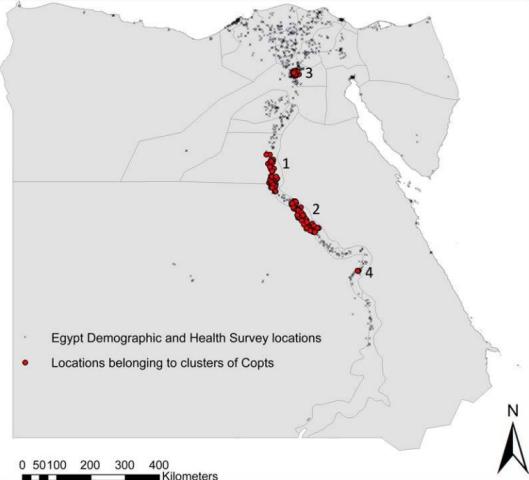
8.2.2 Minority Rights Group International (MRG), an organisation campaigning on behalf of minorities and indigenous peoples[footnote 7], on its web page for Egypt, last updated in June 2019, stated that:
‘The Copts are indigenous Egyptian Christians, the vast majority belonging to the Coptic Orthodox Church. They live throughout Egypt but are concentrated in Alexandria, Cairo and the urban areas of Upper Egypt (southern Egypt). … Most Copts are working class peasants and labourers, although there is a Coptic business upper class and a middle class of urban professionals and small landowners. Copts are present in most institutions of the state, and there are Coptic members of all registered political parties.’[footnote 8]
8.2.3 The Australian Department of Foreign Affairs and Trade (DFAT) Country Information Report on Egypt, published in December 2025 (DFAT 2025 report) stated:
‘There are twelve officially recognised Christian denominations in Egypt (four Orthodox, seven Catholic and one Protestant). The vast majority of Christians in Egypt are members of the Coptic Orthodox Church. Christians reside throughout the country but are concentrated in Upper Egypt and in major cities such as Cairo and Alexandria. Christians are diverse in terms of socio-economic status and political views. They range from the very poor to the very rich, have attained a range of education levels and hold varied professions. At the time of writing, Christians were prominent and influential in Egyptian politics and business. Christians generally dress similarly to Muslim Egyptians, except in some urban areas where Christian women are more likely than Muslim women to leave their hair uncovered. Christians tend to have identifiable names. Some tattoo small crosses on the inside of their wrists or between their thumb and forefinger as a mark of identity. Not all Christians have these tattoos and it is not a mandatory religious practice. All those belonging to recognised Christian denominations are identified as Christian on their national identity cards.’[footnote 9]
8.3 Demography
8.3.1 The US State Department (USSD) in their 2023 Report on International Religious Freedom (USSD 2023 IRF report), published in June 2024 and the latest version at the time of writing, stated:
‘Approximately 90 percent of Christians belong to the Coptic Orthodox Church, according to Christian leaders. In an April [2023] meeting with journalists, Pope Tawadros [leader of the Coptic Orthodox Church[footnote 10]] estimated that 15 million Copts live in the country. Other Christian communities together constitute less than 2 percent of the population. These include Armenian Apostolic, Catholic (Coptic Catholic, Armenian Catholic, Chaldean, Melkite, Maronite, Latin, and Syrian rites), Orthodox (Greek and Syrian), and Anglican/Episcopalian and other Protestants. Most Protestant denominations are members of the umbrella group the Protestant Churches of Egypt, also known as the General Evangelical Council. There are an estimated 1,000 to 1,500 Jehovah’s Witnesses and fewer than 100 members of The Church of Jesus Christ of Latter-day Saints (Church of Jesus Christ), the vast majority of whom are expatriates. Christians reside throughout the country.’[footnote 11]
8.3.2 Encyclopaedia Britannica stated: ‘Copts constitute up to 10 percent of the population of Egypt.’[footnote 12]
8.3.3 The DFAT 2025 report stated that ‘The Egyptian Government estimates there are approximately 5 million Copts in Egypt, while the Coptic Orthodox Church states it has between 15 and 18 million adherents.’[footnote 13] It should be noted that the last official Government census that included religious affiliation was in 1986.[footnote 14]
8.3.4 The same source stated that ‘There are approximately 1000 to 1,500 Jehovah’s Witnesses living in Egypt. Jehovah’s Witnesses are not officially recognised by the Egyptian Government but are allowed by authorities to meet privately and worship in gatherings of fewer than 30 people.’[footnote 15]
8.3.5 The United States Commission on International Religious Freedom (USCIRF) annual report published in March 2026 and covering events in 2025 (USCIRF March 2026 report) stated:
‘Egypt’s population is approximately 111.2 million, an estimated 90 percent of whom are Sunni Muslims. Shi’a, Qur’anist, and other non-Sunni Muslims comprise less than one percent. Egypt’s Christians account for about 10 percent of the population, constituting the largest Christian minority in the Middle East and North Africa region. Over 90 percent of Christians belong to the Coptic Orthodox Church, while a minority belong to Evangelical, Catholic, and some smaller denominations.’[footnote 16]
9. Legal framework
9.1 Constitution
9.1.1 The USSD 2023 IRF report stated:
‘The constitution states that “freedom of belief is absolute” and “the freedom of practicing religious rituals and establishing worship places for the followers of divine [Abrahamic] religions [i.e. Islam, Christianity and Judaism] is a right regulated by law.” The constitution also states citizens “are equal before the law,” prohibits discrimination on the basis of religion, and makes “incitement to hatred” based upon “religion, belief, sex, origin, race…or any other reason” a crime.’[footnote 17]
9.1.2 The DFAT 2025 report stated that ‘The Egyptian Government recognises the right of Christians to practice their religion publicly.’[footnote 18]
9.1.3 The USCIRF March 2026 report stated that ‘Article 2 of Egypt’s constitution names Islam as the state religion, with the “principles of Shari’a” constituting the primary source of legislation. Although Article 64 ostensibly provides for freedom of belief, only followers of the three “heavenly religions” (Islam, Christianity, and Judaism) have a legal basis to publicly practice religion and build places of worship.’[footnote 19]
9.1.4 For more information, see a translated version of the Egyptian Constitution.
9.2 Blasphemy laws
9.2.1 The USSD 2023 IRF report stated:
‘The penal code, while not addressing blasphemy by name, states that “disdaining and disrespecting” any of the “heavenly religions” (Islam, Christianity, and Judaism) is punishable by six months’ to five years’ imprisonment or fines of at least 500 EGP [£7.16[footnote 20]]. Using religion to promote “extremist ideology” with the aim of inciting strife or contempt of the “heavenly religions” or their branches or harming national unity carries penalties ranging from six months’ to five years’ imprisonment. The law is commonly applied in cases alleging contempt of Sunni Islam and Christianity. The cybercrime law penalizes “violating the family principles of Egyptian Society” with a minimum imprisonment of six months and a fine of 50,000-100,000 EGP [£720- £1,441[footnote 21]]. According to civil society organizations, the term “family principles” is vague and is often invoked by authorities to punish perceived blasphemy.’[footnote 22]
9.2.2 The same source stated:
‘The Prime Minister has the authority to stop circulation of books that “denigrate religions,” referring to the three recognized Abrahamic faiths. Ministries may obtain court orders to ban or confiscate books and works of art. The cabinet may ban works it deems offensive to public morals, detrimental to religion, or likely to cause a breach of the peace. The Islamic Research Academy of al-Azhar has the legal authority to censor and confiscate any publications dealing with the Quran and the authoritative Islamic traditions (sunnah) and to confiscate publications, tapes, speeches, and artistic materials deemed inconsistent with Islamic law.’[footnote 23]
9.2.3 The DFAT 2025 report stated:
‘Article 98(f) of the Penal Code (No. 58) 1937 provides for prison sentences of up to five years and/or fines of at least EGP500 [£7.16[footnote 24]] for “exploiting and using religion in advocating and propagating extremist thoughts with the aim of instigating sedition and division or disdaining and contemplating any of the heavenly religions or prejudicing national unity or social peace”. Articles 160 and 161 proscribe various acts connected with religion, including disturbing religious ceremonies, violating the sanctity of religious buildings or cemeteries, printing adulterated versions of holy books or imitating religious ceremonies for the purpose of ridicule.’[footnote 25]
9.2.4 Note: A new Code of Criminal Procedures was ratified by President Al-Sisi in November 2025 and is scheduled to take effect on 1 October 2026.[footnote 26] An English translation of the new Code of Criminal Procedures can be viewed here.
9.2.5 For information on arrests and prosecutions under blasphemy laws, see Arrests, prosecutions and treatment in detention.
9.3 Christian conversion and proselytising laws
9.3.1 The USSD 2023 IRF report stated:
‘Neither the constitution nor the civil or penal codes prohibit renunciation of Islam, nor do they outlaw efforts to proselytize. The law states individuals may change their religion. The government recognizes conversion to Islam, but generally does not recognize conversions from Islam to any other religion, except in the case of individuals who were not born Muslim but later converted to Islam, according to a Ministry of Interior decree pursuant to a court order. Reverting to Christianity requires presentation of a document from the receiving church, an identity card, and fingerprints. After a determination is made that the intent of the change – which often also entails a name change – is not to evade prosecution for a crime committed under the Muslim name, a new identity document is issued with the Christian name and religious designation. In cases in which Muslims not born Muslim convert from Islam, their minor children, and in some cases adult children who were minors when their parents converted, remain classified as Muslims. When these children reach the age of 18, they have the option of converting to Christianity and having that reflected on their identity cards.’[footnote 27]
9.3.2 The DFAT 2025 report stated:
‘There is no prohibition on converting from Christianity to Islam. Authorities often require a certificate of conversion provided by a mosque, as well as identity documents and fingerprints. Criminal history checks are made as conversion often requires a change in name. Conversion to Islam is generally recognised and national identity cards changed without difficulty or delay. A 2011 court ruling allowed Christians who converted to Islam and then back to Christianity (generally to more easily access divorce) to amend their identity cards to reflect the return to their original faith. At the time of writing only a small number of such individuals had been permitted to do so.’[footnote 28]
9.3.3 The same source stated that ‘The Egyptian Government recognises conversion to Islam but not generally conversions from Islam to any other religion.’[footnote 29]
9.4 Anti-discrimination laws
9.4.1 The USSD 2023 IRF report stated:
‘The penal code criminalizes discrimination based on religion and defines it as including “any action, or lack of action, that leads to discrimination between people or against a sect due to… religion or belief.” The law applies to religions “whose rituals are publicly held,” which technically applies only to the three Abrahamic religions. The law stipulates imprisonment for a term determined by the judge, a fine of no less than 30,000 EGP [£432[footnote 30]] and no more than 50,000 EGP [£721[footnote 31]], or both as penalties for discrimination. If the perpetrator is a government employee, the law states that the imprisonment should be no less than three months and the fine no less than 50,000 EGP [£721[footnote 32]] and no more than 100,000 EGP [£1,442[footnote 33]].’[footnote 34]
9.4.2 CPIT has been unable to find any information regarding the application of anti-discrimination laws in practice (see Bibliography).
9.5 Hate speech
9.5.1 MRG, in a report entitled ‘The State of Cultural Citizenship for Egyptian Minorities’ (MRG 2023 culture report), published in February 2023, based on various sources, stated:
‘Egypt is committed to prohibiting hate speech under the Constitution. This follows on from the country’s ratification of two binding international legal texts concerning the prohibition of hate speech. These are the ICCPR [International Covenant on Civil and Political Rights[footnote 35]] and the International Convention on the Elimination of All Forms of Racial Discrimination (ICERD). ‘Thus, Egypt is obliged to implement a ban on hate speech under Article 93 of the Egyptian Constitution. The article stipulates that the state’s adherence to international human rights conventions should be given force of law. Moreover, Article 53 of the Constitution criminalizes discrimination and incitement to hatred. The Constitution recognizes diversity within society, since it bans discrimination based on religion, belief, sex, origin, race, colour, language, social level or disability.
‘The Penal Code does not devote a chapter or section to acts of hatred, nevertheless, it restricts some hate speech forms[,] Article 176 clearly stipulating the prohibition of incitement to discrimination based on their religion, belief, sex, origin, race, colour or language …
‘Hate speech that constitutes incitement to discrimination or violence falls under the provisions of Articles 95 and 96 …’[footnote 36]
9.5.2 CPIT has been unable to find further information on hate speech in the sources consulted (see Bibliography).
9.6 Personal status and custody laws
9.6.1 The US State Department (USSD) in their 2023 country report on human rights (USSD HR report 2023), published in 2024 and covering events of 2023, stated about inheritance in interfaith relationships: ‘… Christian widows of Muslim men had no inheritance rights.’[footnote 37]
9.6.2 In April 2024, MRG and the Egyptian Front for Human Rights (EFHR), an independent human rights organisation[footnote 38], submitted a joint report to the UN Committee on the Rights of the Child (MRG and EFHR April 2024 joint report), which stated:
‘In legal custody claims concerning children with parents of different faiths – specifically Muslim men and Christian women – custody is typically granted to the father. It is believed that if the mother is non-Muslim, her custody over the child can end when they become “religiously aware”, previously determined by a court ruling to be seven years of age if it is thought that the mother will be a negative influence over the child’s religion. In the case of interfaith marriages where there is an absence of civil marriage, Sharia law is applied to legal disputes relating to the child. As a result, in cases of dispute over child custody, the child is likely to be placed under the custody of the Muslim parent (often father) over the non-Muslim parent (often mother).’[footnote 39]
9.6.3 In February 2025, the USCIRF published a report entitled ‘Egypt Country Update: State Restrictions on Religious Freedom in Egypt’ (the USCIRF February 2025 report) which stated:
‘The Egyptian government’s personal status policy has posed particular restrictions on Coptic women. Instead of applying Christian inheritance standards that make no distinction between male and female potential heirs, some courts have instead applied Shari’a-based personal status laws, which has denied Coptic women of inheritance shares equal to those of their brothers or other male relatives.
‘The government has made some positive steps regarding its personal status policy, including the passage of a 2017 law guaranteeing the right for women to receive their legal inheritance and a 2019 Court of Appeals decision in favor of a Coptic Orthodox female plaintiff. However, personal status law reform and consistent legal enforcement of these laws remain crucial areas of improvement.’[footnote 40]
9.6.4 In November 2025, the Austrian Centre for Country of Origin and Asylum Research and Documentation (ACCORD) published an Egypt COI Compilation, citing various sources, which stated:
‘While a new draft of the country’s Personal Status Law was finalized at the beginning of 2025 …, it has not been submitted to the House of Representatives as of September 2025.
‘… The draft law introduces the principle of (Christian) equality into inheritance, giving women and men the right to inherit equally. In contrast, the current law is based on Islamic sharia law, which grants a woman only half of the inheritance granted to a man.
‘… By law, a Christian man wishing to marry a Muslim woman must convert to Islam, while a Christian woman marrying a Muslim man can keep her faith.’[footnote 41]
9.6.5 The DFAT 2025 report stated:
‘The Constitution states Christian canonical law forms the basis of legislation governing Christians personal status, religious affairs and selection of spiritual leaders. The Coptic Orthodox Church has the sole legal right to marry Coptic Christians and is responsible for granting approval to complete the sacrament of marriage and documenting the contract in the Ministry of Justice. The Coptic Orthodox Church rarely permits divorce, which may only occur under very limited circumstances such as proven adultery or in cases of a change of faith (apostasy). In-country sources said as a result of the difficulties in obtaining a divorce, Coptic Christian women often converted to Islam when they wanted to annul a marriage. If one spouse converts to Islam, Egypt’s court system applies Islamic law and a ruling can be obtained invalidating the marriage performed by the Coptic Orthodox Church on the basis of a change in religion. Converting to Islam also permits the option to re-marry which is restricted by the Coptic Orthodox Church in cases of divorce.’[footnote 42]
9.6.6 The same source stated:
‘A new Personal Status Law for Christians was being debated in Parliament at the time of writing. The Coptic Orthodox Church, along with representatives from other Christian churches (including Catholic, Evangelical and Anglican), contributed to drafting laws related to Christian marriage, divorce, child custody and inheritance. Under the draft law, the courts would make decisions on divorce with the Coptic Orthodox Church’s role limited to granting permission for a second marriage. Grounds for marriage annulment would expand to include “deception regarding a chronic illness” (including infertility) and “separation lasting three years or more”. The practice of changing religion solely to obtain a divorce would be restricted. The new Personal Status Law for Christians would also introduce gender equality into official inheritance procedures.’[footnote 43]
9.6.7 The USCIRF in the March 2026 annual report stated that ‘Although President Abdel Fattah el-Sisi’s administration previously solicited draft personal status laws from Christian denominations, the government took no further action in 2025.’[footnote 44]
9.6.8 In May 2026, the new personal status law was referred to a joint parliamentary committee for review.[footnote 45] CPIT could not find any further information regarding the progress of the personal status law within the sources consulted (see Bibliography).
9.7 Identity cards
9.7.1 The USCIRF February 2025 report stated that ‘The Ministry of Interior issues national identity cards for citizens that include their official religious designations. Designation options are limited to “Muslim,” “Christian,” or “Jewish.” Although the government designates Jehovah’s Witnesses as “Christian” on identity cards, a presidential decree bans their religious activities.’[footnote 46]
9.7.2 The DFAT 2025 report stated that ‘The applicant’s religion (Christianity, Judaism, Islam or a ‘dash’) is generally included on national identity cards because courts in Egypt apply religious laws in personal status matters and require the individual’s religious affiliation to determine which jurisdiction applies.’[footnote 47]
9.7.3 The same source stated that ‘Courts have ruled Jehovah’s Witnesses have the legal right to obtain identification cards with a dash listed in the space for religious affiliation.’[footnote 48]
9.8 Church building law
9.8.1 The European Centre for Law and Justice (ECLJ), a Christian legal advocacy group[footnote 49], in its Submission to the United Nations Universal Periodic Review (UPR) ahead of its 48th session, published in July 2024 and citing various sources (ECLJ 2024 Submission to the UPR), stated that ‘… [U]nder the Church Construction Law, a church representative must obtain approval from a provincial governor to build or renovate a church.’[footnote 50]
9.8.2 The MRG article ‘MRG urges action on minority and indigenous rights in Egypt’, published in January 2025, stated:
‘The Church Building Law 80/2016 imposes discriminatory requirements that adds restrictive conditions to obtain permits to build or repair churches. Furthermore, requests for construction of new Churches have been administratively mismanaged, with a few cases in which requests have received neither an approval nor rejection.
‘In some instances, churches that have been granted a permit to renovate, or were awaiting licensing by the committee established by the 2016 law to look into the status of unlicensed churches, saw renovation work prevented by attacks from mobs. Incitement and attacks by mobs against churches and are regular occurrences in Egypt, happening several times a year. They have rarely led to prosecutions or trials.’[footnote 51]
The source did not provide any further information regarding attacks on churches or their frequency.
9.8.3 The DFAT 2025 report stated:
‘Under the Constitution, Christians are legally allowed to build churches. Egypt’s Church Construction Law (No. 80) 2016 created a formal process for Christian denominations to submit a request for the “building, expanding, enhancement, reinforcement, destruction, or external detailing of a church, church annex, services building, or retreat house”. A legal representative of the church must submit a request with the appropriate permits and documentation to the relevant provincial governor. Law 80 also created a ministerial committee to review applications for churches built without permission before the law was ratified in 2016. Prior to the passage of Law 80, the construction of churches had been governed by the Hamayouni Law 1856, which required the president (and previously the Egyptian King and Ottoman Sultan) to approve the construction of every new church.’[footnote 52]
9.8.4 For further information, see Church building law in practice.
10. State treatment
10.1 State attitude
10.1.1 In August 2024, the ECLJ published an article entitled ‘ECLJ Report Exposes Ongoing Human Rights Violations Against Christians in Egypt Ahead of UN Review’, which stated:
‘Since 2014, President Sissi has attended Christmas mass every year, a first for an Egyptian president.
‘… “Where there is a mosque, there must also be a church,” said President Sissi in March 2022, in the context of various large-scale national housing and construction projects. In June 2024, Aid to the Church in Need[footnote 53]] summarized: “Probably never in the history of the Middle East have so many churches been built at the same time as this year in Egypt. …”’[footnote 54]
10.1.2 The DFAT 2025 report stated that ‘In-country sources said Coptic Christians were able to practice their religion freely and without government interference. President El-Sisi is supportive of Egypt’s Coptic Christian community and has attended religious celebrations at Easter and Christmas since 2015. He also regularly makes public statements referencing the Coptic Christian community as part of Egypt’s “values of unity and coexistence that define the nation’s identity”.’[footnote 55]
10.2 State policies and initiatives
10.2.1 The USSD 2023 IRF report stated:
‘The quasigovernmental National Council for Human Rights (NCHR), whose members are by law appointed by parliament, is charged with strengthening protections, raising awareness, and ensuring the observance of human rights and fundamental freedoms, including religious freedom. It also is charged with monitoring enforcement and application of international agreements pertaining to human rights. The council’s mandate includes investigating reports of alleged violations of religious freedom.
‘The constitution mandates that the state eliminate all forms of discrimination through an independent commission, to be established by parliament; parliament has not established such a commission.’[footnote 56]
10.2.2 The USCIRF March 2025 report stated:
‘Multiple state agencies continued efforts to revive the Holy Family Trail, which includes landmarks sacred to the Coptic community. The government also continued collaborating with the U.S. Agency for International Development (USAID) on interreligious programming to promote tolerance between Muslim and Christian women and girls. Prime Minister Mostafa Madbouly appointed a Coptic woman to the new Cabinet as minister of local development and two other Christians to head the Beheira and Port Said governorates, increasing that community’s representation in government. The Egyptian government continued its long-term project of removing religiously discriminatory content, although state textbooks continue to reflect some of that concerning material.’[footnote 57]
10.2.3 The USCIRF March 2026 report stated:
‘Egypt’s government maintained some initiatives to encourage religious inclusivity. In January [2025], President el-Sisi delivered a message of interfaith tolerance and respect at the Coptic Orthodox Nativity Cathedral. In March [2025], Al-Azhar Grand Imam Ahmed el-Tayyeb emphasized the need for interreligious dialogue. In October [2025], President el-Sisi expressed Egypt’s commitment to religious freedom while meeting with the World Council of Churches after the group concluded its Sixth Assembly, hosted by the Coptic Orthodox Church. Multiple state agencies continued efforts to revive the Holy Family Trail, which includes landmarks sacred to the Coptic community.’[footnote 58]
10.3 Christians in public life
10.3.1 The USCIRF February 2025 report stated that ‘In 2024, representation of Copts in government increased. A Coptic woman was appointed to the new cabinet as minister of local development, a position that oversees local governance across the country. Two Coptic Christians were also appointed as governors of Beheira and Port Said governorates. In January 2025, President el-Sisi delivered a message of interfaith tolerance and respect at the Coptic Orthodox Nativity Cathedral.’[footnote 59]
10.3.2 In August 2025, the US Department of State published a report entitled ‘Report to Congress on Steps the Egyptian Government is Taking to Ensure Proper Treatment and Justice for Christian Communities in Egypt’ (USSD 2025 Report to Congress), which stated:
‘One member of Egypt’s 30-member cabinet, the Minister of Immigration and Expatriate Affairs, is a Christian. Two of Egypt’s 27 governors, the Governors of Damietta and Ismailia Governorates - both appointed by President Sisi, are Christians, as is the deputy governor of Alexandria Governorate. There are 31 Christians in the House of Representatives, out of a total of 596 representatives (with a legal quota of 24 Christian MPs).
‘There are 24 Christian senators – 17 elected, and seven appointed by President Sisi – out of 300 seats, including the Deputy Speaker of the Senate. President Sisi appointed Coptic Christian Boules Fahmy as head of the Constitutional Court in February 2022. Based on their estimated ten percent share of Egypt’s population, Christians are underrepresented in the military and security services and in university administration. There are no Christian presidents of the country’s 27 public universities.’[footnote 60]
10.3.3 In January 2026, El Watan News, an Egyptian Arabic language news platform[footnote 61], published the article entitled ‘Representation of Copts in Parliament: Success of 24 MPs. Activating the principle of citizenship and consolidating the principle of positive discrimination’ which stated: ‘The representation of Copts in the Egyptian parliament has undergone many transformations over the past seven decades, as at first their presence was limited, but gradually expanded, especially in recent years … In the 2025 elections, this trend continued, as the number of Copts in the Senate reached 20 members … and the number of winners during the 2025 House of Representatives elections reached 24 Copts.’[footnote 62]
10.4 Arrests, prosecutions and treatment in detention
10.4.1 The ECLJ 2024 Submission to the UPR provided the following examples of Christians being arrested, citing numerous sources between July 2020 and July 2023:
‘On July 18, 2023, Zaki, a Christian graduate student, was sentenced to three years in prison for allegedly inciting violence. Zaki was initially arrested on February 7, 2020, after he wrote an opinion piece describing what it is like to live as a persecuted Christian in Egypt. Thankfully, soon after he was sentenced, he was pardoned by the President of Egypt.
‘… In February 2022, a twenty-two-year-old Christian was sentenced to two years in prison with hard labor after he had engaged in a debate with an individual over Islamic scripture. When he was initially arrested, he was told to convert to Islam. After he refused to renounce his faith, he was charged with having “contempt for the Islamic religion.”
‘On January 30, 2022, Egyptian security forces arrested nine Coptic Christians who were protesting the government’s refusal to allow for the rebuilding of a church that had burned down. They were released from prison in April 2022.
‘On November 1, 2021, Christian pastor Sameh was taken by Egyptian national security officers as he was heading home from work. According to Sameh’s family, after he was arrested, he was tortured with “beatings, electrocution, stripping and dragging.” Sameh led a church in Cairo and posted sermons and encouraging messages to his Facebook group called Converts Ministry Group.
‘On July 15, 2020, a seventeen-year-old Coptic Christian was arrested for blasphemy over comments he made on Facebook. While in prison, he was subjected to unsanitary conditions and extreme temperatures. He was released from prison one year later, but was told that he must leave his village, as it was no longer safe for him to live there.’[footnote 63]
10.4.2 The USCIRF February 2025 report stated that ‘The government commonly uses other charges in combination with the blasphemy statute to suppress religious identity or dissent. These charges include “spreading false news” as well as “joining a terrorist group” and similar counterterrorism provisions.’[footnote 64]
10.4.3 The same source additionally stated:
‘In April 2024, Abdulbaqi Saeed Abdo, who was held in pre-trial detention under counterterrorism and blasphemy charges for his involvement with a Facebook group for people wishing to convert to Christianity, was denied medical treatment by authorities at the 10th Ramadan Prison after reporting chest pains. In May [2024], another prisoner reported Abdo for copying Bible verses on scraps of paper. As punishment, Egyptian prison authorities placed him in solitary confinement, denied his family from attending routine monthly visits, and prevented Abdo from showering or changing his clothes for a full week. In August [2024], Abdo began a hunger strike in protest of his prolonged arbitrary detention. In January 2025, Egyptian authorities released Abdo, as well as Christian activist Nour Gerges who was sentenced on blasphemy charges for promoting his faith online. However, Egyptian judicial authorities did not formally drop the charges against them.’[footnote 65]
10.4.4 The same source stated:
‘In July [2024], a military court sentenced Yusuf Sa‘d Hanin, a Coptic Christian conscript, to three years in prison for “blasphemy” against Islam. A military court charged Hanin with “committing behavior that is harmful to discipline, order, and military requirements” after he exchanged “statements offensive to Islam” in a private conversation via text. Yusuf allegedly made these statements in May [2024] while he was on leave and celebrating Easter with his family in Beni Suef governorate. Egyptian security later arrested him from a military camp and reportedly beat him and interrogated him about his Coptic identity, asking for the names of Christian preachers he follows and for details on his involvement in any Coptic organizations.’[footnote 66]
10.4.5 CPIT has been unable to find further information on Christians sentenced for blasphemy in private conversation (see Bibliography).
10.4.6 The USSD 2025 Report to Congress stated:
‘On February 24, 2023, the Supreme State Security Prosecution released George Farouk Zaki Gerges, arrested in November 2022 on charges of joining a terrorist group and spreading false news. Gerges was arrested based on a post to his Facebook page, in which he criticized the political positions of church leaders.
‘In May [2023], the Cairo Criminal Court renewed the detention of Yemeni refugee Abdel-Baqi Saeed Abdo Ali for 45 days on charges of “joining a terrorist group and contempt for Islam,” following his conversion from Islam to Christianity, exceeding the two year maximum period of pretrial detention permitted by law [he has since been released on 23 January 2025[footnote 67]].
‘February 2024, a criminal court renewed the detention of Nour Fayez Ibrahim for a 45-day period pending investigations into a case against him before the Supreme State Security. Authorities ultimately charged Ibrahim – a Coptic Christian – with “leading a terrorist group” and “showing disrespect to Abrahamic religions.
‘On July 20, 2023, the day after he was sentenced by a court to three years in prison for “spreading false news,” researcher Patrick Zaki was pardoned and released under the authority of President Sisi more than three years after his 2020 arrest following a 2019 article he wrote about discrimination Copts faced in Egypt.’[footnote 68]
10.4.7 The DFAT 2025 report stated:
‘In-country sources said Article 98(f) was being used considerably less since 2019 as legal justification for arresting blasphemy suspects.
‘… Christians publicly discussing Islam were sometimes arrested under Article 98(f) of the Penal Code (No. 58) 1937 or Article 19 of the Anti-Cyber and Information Technology Crimes Law (No. 175) 2018. Most were later released without convictions after a period of pre-trial detention. In-country sources said penalties imposed for convictions for “violating the family principles of Egyptian Society” were inconsistent and depended on a judge’s opinion of what family principles and values had been offended. Gender and socio-economic status were also unofficially considered during sentencing.’[footnote 69]
10.4.8 The same source stated:
‘Penal Code (No. 58) 1937 Article 98(f) on blasphemy has been used selectively against Coptic Christians for insulting religion but in-country sources said its use was rare in recent years. For example, Marco Gerges was found guilty of contempt of Islamic religion and violating family values in February 2022 for having images on his mobile telephone considered offensive to Islam. At the time of writing, DFAT was not aware of recent instances of Article 98(f) on blasphemy used against Coptic Christians.’[footnote 70]
10.4.9 In January 2026, The Foundation for Defense of Democracies (FDD), a US-based nonpartisan research institute[footnote 71], published an article entitled ‘Egypt Sentences Christian Researcher Under Blasphemy Law, Underscoring a Recurrent Breach in U.S.-Egypt Relations’, which stated: ‘An Egyptian court has sentenced Christian researcher Aughustinos Samaan to five years of hard labor under Egypt’s blasphemy law, following months of pretrial detention. Samaan, who runs a YouTube channel with more than 100,000 subscribers, was convicted of “contempt of religion” and “misuse of social media” for content defending Christianity.’[footnote 72]
10.4.10 In January 2026, Amnesty International published an article entitled ‘Egypt: Authorities must end crackdown on individuals discussing religious beliefs online’. The article, which did not specifically state the religions of those arrested, stated:
‘Over the past six months, security forces have arbitrarily arrested at least 29 people, including one woman, aged between 18 and their late fifties, across six governorates for having posted online content expressing religious views that do not align with state-sanctioned religious narratives, or simply for being members of social media groups discussing atheism and agnosticism and criticising mainstream religious beliefs. They are being investigated in connection with … charges of “contempt of religions” and “joining a group established in violation of law”. If convicted, they face up to five years in prison.
‘“Posting religious views online or taking part in discussions about belief or non-belief is not a crime. Yet the Egyptian authorities have intensified their crackdown on those discussing religious matters online in breach of the country’s international human rights obligations and more specifically the commitments the authorities made regarding freedom of religion during the country’s 2025 Universal Periodic Review at the UN Human Rights Council,” said Mahmoud Shalaby, Egypt and Libya Researcher at Amnesty International.
‘… Between mid-July 2025 and 1 January 2026, security officials subjected those arrested to enforced disappearance for periods ranging between four and 56 days. At least four detainees reported to prosecutors during their pretrial detention renewal sessions that they had been subjected to torture and other ill-treatment following arrest, while at least 11 were denied their right to legal counsel of their choosing during the interrogation phase. One detainee died in custody, according to statements his fellow inmates made to prosecutors during a pretrial detention renewal session in early January 2026. Amnesty International was unable to obtain information about the cause of death.
‘Five were released in early December 2025 pending investigations. The remaining 23 people are held in pretrial detention [at the time Amnesty’s article].
‘Amnesty International spoke with a relative of one detainee, two lawyers at the Egyptian Initiative for Personal Rights, the Egyptian Commission for Rights and Freedoms and two other lawyers representing 13 of the defendants.
‘Police arrested most detainees at their homes and seized their laptops and mobile phones, including some devices belonging to family members, without presenting arrest warrants or explaining the reasons for arrest.
‘Upon arrest, security forces concealed the fate and whereabouts of those detained, thereby subjecting them to enforced disappearance. They were held outside the protection of the law in unknown National Security Agency (NSA) facilities for periods ranging from four to 56 days, at heightened risk of torture and other ill-treatment, before security forces brought them before the Supreme State Security Prosecution (SSSP). During their enforced disappearance in NSA facilities, agents interrogated detainees while blindfolded for hours about their religious beliefs, including whether they were Muslim or Christian and whether they prayed.
‘Among those arrested, was one man who ran a YouTube channel featuring debates or critical discussions about religious ideas; for instance discussing commonly held beliefs in Islam and Christianity, including on the occurrence of signs ahead of Judgement Day. Another posted online content critical of a popular Islamic preacher, while another discussed cosmic justice. A third man shared content satirizing certain religious practices.
‘… SSSP prosecutors opened investigations against detainees on a range of charges, including joining a group established in violation of the law, exploiting religion to promote ideas harmful to national unity, contempt of religions, insulting religions through public means, and spreading false news. Prosecutors subsequently ordered their pretrial detention.’[footnote 73]
10.4.11 The same source additionally stated that ‘Religious minorities, including Coptic Christians … consistently face discrimination in law and/or practice in Egypt. Members of religious minorities, atheists and others not espousing state-sanctioned religious beliefs face threats and harassment including abusive summons and interrogations by the NSA and in some cases prosecution over vague “contempt of religions” charges.’[footnote 74]
10.4.12 ACLED (Armed Conflict Location & Event Data) is ‘an independent, impartial global monitor that collects, analyses, and maps data on conflict and protest.’[footnote 75] The ACLED Data Export Tool[footnote 76] has been used to run and filter data queries relating to events in Egypt between 1 January 2024 and 28 February 2026. Filtering for events involving Christians, ACLED recorded 2 events on 3 February 2026. The source for both events is listed as the Egyptian Initiative for Personal Rights (EIPR), an organisation that aims to ‘strengthen and protect basic rights and freedoms in Egypt’[footnote 77], and the notes for each event are as follows:
‘On 3 February 2026, police forces arrested 58 Christians, including children and a priest, in Cairo - 15 May City (15th of May, Cairo) after dispersing a demonstration held against the demolition of a wall built around the plot designated for the construction of a church. Some of those arrested, including women, were physically and verbally assaulted during detention. All but 13 individuals were released on bail on 4 February [2026].
‘On 3 February 2026, police forces physically and verbally assaulted Christian women and men who remained detained at the Central Security Forces camp in Cairo - Tura (Torah, Cairo). All of them had been detained after a demonstration held against the demolition of a wall built around the plot designated for the construction of a church was dispersed in Cairo’s 15 May district. Police officers first physically and verbally assaulted a number of the arrested women. When a group of men attempted to defend them, officers also beat and verbally assaulted them. It was unknown whether the victims of the physical assaults sustained serious injuries.’[footnote 78]
10.4.13 CPIT was not able to find any further information or sources to corroborate the ACLED events listed above within the sources consulted (see Bibliography).
10.4.14 The USCIRF March 2026 report stated:
‘Egyptian authorities subjected to prolonged pretrial detention those suspected of violating Law 98(f), which punishes “ridiculing or insulting a heavenly religion or a sect.” After the January [2025] release of Christian convert Nour Fayez Ibrahim Gerges, imprisoned in 2021 on blasphemy and terrorism charges, state security summoned him for interrogations in March [2025]. In July [2025], judicial authorities charged Said Abdelrazek, a Christian convert, with “contempt for Islam” and joining a banned terrorist organization. In October, authorities arrested Dr. Augustin Samaan, a researcher specializing in Christian apologetics, for allegedly promoting “contempt of Islam” online.’[footnote 79]
10.4.15 The same source stated that ‘The government continued to detain and charge individuals under religiously grounded provisions of the Cybercrime Law (175/2018), which the government uses to censor the expression of religious beliefs and other ideas considered threatening to the state’s interpretation of Islam.’[footnote 80]
10.4.16 In April 2026, ADF International, a Christian faith-based legal advocacy organisation based in Geneva[footnote 81], published a press release entitled ‘Christian YouTuber in Egypt Faces Five Years’ Imprisonment and Hard Labor for Teaching His Faith Online’, which stated:
‘Egyptian authorities have sentenced Augustinos Samaan, a Coptic Christian scholar, and YouTuber, to five years in prison and hard labor for his online videos teaching about and defending the Christian faith.
‘Samaan, who regularly posts videos to a channel with over 100,000 subscribers, was charged under Article 98(f) of the Egyptian Penal Code, the country’s primary blasphemy provision, through allegations of “misuse of social media” and “contempt of religion.”
‘… Samaan was first arrested in October 2025 for his online videos, which are largely academic in nature, seeking to answer common questions about Christianity. Some of Samaan’s videos explore the differences between Christianity and Islam, often including philosophical and theological criticisms of Islam.
‘His case is part of a broader pattern rather than an isolated incident. Since August 2025, dozens of individuals have been arrested in Egypt in connection with online religious content, including young people posting on social media, converts speaking about their faith, and individuals engaging in religious discussion or critique.’[footnote 82]
10.4.17 The source does not give further details of the ‘dozens of individuals’ arrested in connection with posting online religious content.
10.4.18 CPIT was also unable to find any information regarding the treatment faced by Christians who proselytise within the sources consulted (see Bibliography).
10.5 Christian converts
10.5.1 The USCIRF’s Frank R. Wolf Freedom of Religion or Belief Victims List is ‘a database that catalogues select victims targeted due to their freedom of religion or belief.’[footnote 83] An entry for Egyptian national, Said Abdelrazek, stated:
‘After converting from Islam to Christianity in 2018, Abdelrazek was subject to various legal, social, and civil obstacles that presented significant challenges to his right to freedom of religion. In 2019, Abdelrazek left Egypt for Russia, where he sought asylum on religious grounds.
‘… In 2024, he was refouled to Egypt and detained by Egyptian authorities. He was held incommunicado for approximately 10 days. When communication resumed, Egyptian authorities interrogated him about his religious beliefs and pressured him to reconsider his faith, monitor other converts, and asked him to delete his social media accounts. Authorities ultimately released him with instructions not to speak publicly or proselytize.
‘In July 2025, Egyptian authorities detained Abdelrazek again without a warrant after he resumed posting about his religious beliefs online. On July 22 [2025], Egypt’s Supreme State Security Prosecution charged him with “contempt for Islam,” joining a banned terrorist organization, inciting unrest, and disseminating false information. During detention, authorities and inmates physically and psychologically abused Abdelrazek for his conversion.’[footnote 84]
10.5.2 The ECLJ 2024 Submission to the UPR stated that ‘Government authorities have also reportedly detained and questioned converts to intimidate them into keeping their faith a secret.’[footnote 85]
10.5.3 The source did not provide any further information on government authorities detaining and intimidating converts, nor did it provide any specific examples.
10.5.4 In January 2025, Open Doors International, an evangelical Christian rights and advocacy organisation[footnote 86], published a report entitled ‘Egypt: Persecution Dynamics’ (Open Doors January 2025 report), covering events between 1 October 2023 and 30 September 2024 and citing various sources, which stated: ‘During the WWL [World Watch List] 2025 reporting period, several converts from Islam to Christianity were arrested and mistreated by the security services.’[footnote 87]
10.5.5 The source did not provide any further information regarding the numbers of people that were arrested or the treatment they subsequently faced. See paragraph 10.1.13 for information regarding the Open Doors World Watch List.
10.5.6 Christian Solidarity Worldwide (CSW), a UK-based Christian advocacy organisation promoting freedom of religion[footnote 88], stated in a July 2025 article on the same individual:
‘Saeid Mansour Abdulraziq, a Christian convert, was charged with joining a terrorist organisation, stirring unrest and spreading false news by Egypt’s state security court on 22 July [2025].
‘Mr Abdulraziq converted to Christianity in 2016 and joined the Russian Orthodox Church in Egypt. He endured family rejection, societal hostility and police intimidation whenever he shared his new faith publicly.
‘… Mr Saeid Fayaz, a Christian lawyer based in Cairo, told CSW: “Thousands of Christian converts in Egypt have no rights and they receive little support. They live in isolation and constant fear. Saeid believed in the Egyptian constitution which provides for religious freedom, not realising that it is a one-way freedom.”
‘CSW’s Founder President Mervyn Thomas said: “Mr Abdulraziq has committed no crime and is being penalised for exercising his right to change religion and for asking for this change to be registered in his official documentation, which is permitted under the Egyptian constitution. Despite positive steps taken by the Egyptian authorities to advance the right to freedom of religion or belief in recent years, and the personal commitment of President Sisi to fight injustice and promote equality of citizenship, an unacceptable culture of intimidation and discrimination towards converts persists”.’[footnote 89]
10.5.7 As of May 2026, Saeid Abdelrazek reportedly remained in detention. Amnesty International reported that his first court hearing took place on the 21 April 2026.[footnote 90]
10.5.8 The DFAT 2025 report stated that ‘Converts from Islam to other religions are not subject to officially sanctioned violence or detention …’[footnote 91]
10.5.9 CPIT was unable to find any information regarding the treatment faced by those who proselytise within the sources consulted (see Bibliography).
10.6 Church building law in practice
10.6.1 The ECLJ 2024 Submission to the UPR stated: ‘Egypt’s law requiring approval for church construction has led to tension and violence between Christians and Muslims. Since the law was enacted in 2016, more than 2,500 requests have been approved. However, approximately 3,000 applications are still waiting to receive word from the government.’[footnote 92]
10.6.2 The USCIRF February 2025 report stated:
‘As of December 2024, the government has yet to act on roughly 2,300 legalization requests for churches and Christian facilities. In May 2024, church leaders in the Cairo suburb of Nasr City confronted the Ministry of Defense after the government authorized construction for a residential compound on property previously granted permits for the church’s expansion. After campaigning on their legal rights to the land, community leaders prevailed in stalling the residential construction. However, the incident underscored the systemic problem of the Egyptian government reneging on obligations under the Church Construction Law to prioritize urban planning at the expense of Egypt’s Christian community.’[footnote 93]
10.6.3 The DFAT 2025 report stated:
‘Newly built cities and suburbs must include a Coptic Christian church to receive planning approval. President El-Sisi stated in 2022, “where there is a mosque, there must also be a church”. He clarified “even if they will be attended by only 100 people, it [churches] must be built anyway… so no one will have to meet in an apartment and present that private house as a church”. In-country sources said the government was allocating land in all new cities and suburbs for the construction of Christian churches. Christian churches in Egypt are well protected, including by armed guards, concrete barriers and security gates.
‘… In-country sources said Law 80 was being upheld by authorities, with Coptic Christian churches receiving permission to be built and renovated, even if decisions could be slow.’[footnote 94]
10.6.4 The USCIRF March 2026 report stated that ‘In October [2025], a Cabinet-appointed committee approved 160 church building permits pursuant to the Church Construction Law, bringing the total number of permits to 3,613 since the law’s 2016 adoption. However, the government has yet to act on roughly 2,000 legalization requests for churches and Christian facilities.’[footnote 95]
10.6.5 In April 2026, Amnesty International published their annual report on Egypt, covering events of 2025, which stated that ‘The right to build or repair Coptic churches remained restricted under a 2016 law requiring approval from security agencies and other state bodies. In October [2025], the government announced that 3,613 churches had been legalized out of 5,540 requests submitted since the law was enacted.’[footnote 96]
10.7.5 State media and social media
10.7.1 The website of Coptic TV (CTV) stated that ‘CTV is the Coptic Orthodox Church channel operating under the auspices of His Holiness Pope Tawadros II.’[footnote 97] It is listed as a free satellite tv channel.[footnote 98]
10.7.2 The MRG 2023 culture report stated:
‘Not one of the nine state television channels is dedicated to Copts and their cultural identity, and coverage of Coptic affairs is confined to broadcasts of Christmas and Easter mass.
‘Four private satellite channels represent the official Coptic Orthodox Church (the main church in Egypt), broadcasting on various satellite channels whose signal overlaps via Nilesat [a satellite operator company in Egypt[footnote 99]]. One is Aghapy TV, which started broadcasting in 2005 on the American satellite Telstar, then on a Chinese satellite station. Aghapy focuses on Coptic heritage and art and aims to “spread Christian awareness and spread the Coptic heritage of the church, including history, language, and arts.” MarMarkos TV has been broadcast from the papal headquarters in Cairo since 2011, in addition … CTV and Koogi children TV.’[footnote 100]
10.7.3 The same source additionally stated:
‘Some newspaper pages are allocated to church news, but there are several private newspapers that represent Copts and their cultural identity, namely Watani, Al-Tariq wa Al-Haqq. According to the Supreme Press Council, there are 16 newspapers published by Christian churches and sects, including El-Kirazah. The Youth Bishopric of the church puts out 3 magazines: El Kalema, Resalet El Shabab, and Aghsan. Some businessmen also put out newspapers dealing with the situation of Christians in Egypt, such as ‘Aalem El Meshaheer, Nida’ El Watan, and Agras El Watan. Egyptian churches do not have official news agencies; there was a Christian news agency called Middle East Christian News Agency, but it stopped working.’[footnote 101]
10.7.4 In January 2024, Open Doors published a report entitled ‘Egypt: Full Country Dossier’, covering events between 1 October 2022 and 30 September 2023 and citing various sources (Open Doors 2024 country dossier), which stated:
‘Despite the anti-cyber laws restricting the press and all other media channels (thus limiting freedom of speech), Christians in Egypt report that modern communications technology is nevertheless widely used in Egypt. Social media (especially Facebook) is used to mobilize public opinion. However, all social media is monitored by the government and criticism of the government or Islam is not tolerated. Most churches are currently using little modern technology in youthwork or for evangelistic purposes.’[footnote 102]
10.7.5 The dossier additionally stated: ‘Churches can print and import Christian material including Bibles, as long as the material is not deemed offensive to Islam. Christian books and other items can be sold in public places in some parts of Egypt, but is in general only sold to Christians to avoid accusations of proselytizing.’[footnote 103]
10.7.6 CPIT has been unable to find further recent information on the representation of the Coptic church in state media or social media in Egypt within the sources consulted (see Bibliography).
10.7.7 For information regarding the state’s treatment of perceived critics in the media see the Country Policy and Information Note Egypt: Opposition to the State.
11. Societal treatment
11.1 Societal violence and discrimination
11.1.1 The Open Doors 2024 country dossier stated:
‘Christians in Egypt report that freedom of religion violations occur mostly at the community level, with many Christians regularly facing discrimination. In addition, incidents take place such as Christian women being harassed in the street (especially in rural areas), Christian children being bullied at state schools or in rare incidents, Muslim mobs forcing Christians to leave their homes after an alleged blasphemy accusation.
‘These sort of incidents take place mostly in Upper Egypt, where Salafist movements are active in the rural communities.
‘… [T]he lack of serious law enforcement and the unwillingness of local authorities to protect Christians leave them vulnerable to attacks, especially in Upper Egypt.’[footnote 104]
11.1.2 In April 2024, the New Arab, an English language news and current affairs website covering the Middle East and North Africa (MENA) region[footnote 105], published an article entitled ‘Muslim extremists reportedly burn down Christian homes in southern Egypt’, which stated:
‘Several houses belonging to local Christians were set on fire at a late hour on Tuesday [23 April 2024] in Egypt’s southern Minya province, the most recent of similar acts of sectarian violence against the religious minority, which erupted less than two weeks before the Coptic Orthodox Easter celebrations.
‘”The attacks are believed to have been triggered by an attempt to build a new church in Al-Fawakher village in Minya met by the violent rejection of their Muslim neighbours,” a source inside Egypt’s Coptic Orthodox Church told The New Arab.
‘”When religious fanatics failed to expel Christians from their homes as a form of punishment, the extremists [reportedly] burned down their houses while they were still inside,” added the source, who asked to remain anonymous due to the sensitivity of the subject.
‘… Discrimination against Christians is relatively subtle in main cities like the capital, Cairo, or Alexandria but becomes much more pronounced in the south.’[footnote 106]
11.1.3 In April 2024, EIPR published an article entitled ‘EIPR holds the security authorities responsible for the sectarian attacks in the villages of “Al-Fawakhir” and “Al-Kom Al-Ahmar” in Minya’, which stated:
‘Sectarian attacks erupted in the village of Al-Fawakhir in Minya on 23 April 2024 when a rumour had it that Christians had turned a house into a church. A few hundred Muslim residents staged a march where they chanted hostile slogans and fired shots in the air, then hurled stones and Molotov cocktails at the homes of Christians in the village, which led to the burning of three houses. Three other houses were looted. During the attacks, Copts were prevented from leaving their homes by force of arms. The attackers also beat some women, causing minor injuries to three of them.’[footnote 107]
11.1.4 The ECLJ 2024 Submission to the UPR provides the following examples of mistreatment faced by Christians by non-state actors:
‘On January 8, 2023, a Muslim mob attacked homes belonging to Coptic Christians, looted their shops, and threw rocks at a church. The attack began after there was a car accident involving a Muslim and a Coptic Christian.
‘On Christmas Eve, 2022, a group of Muslims attacked a Christian church. The attack happened after authorities approved the church’s application to fix the roof. The mob threw rocks at the individuals working on the roof and even set fire to a Christian farmhouse located next to the church.’[footnote 108]
11.1.5 CSW, in a November 2024 article titled ‘Three Christian men hospitalised after stabbing’, stated:
‘Three Christian men were hospitalised after suffering multiple stab wounds in an attack on 5 November [2024].
‘The attack took place in Ashruba village in Bani Mazar, Minya province in Upper Egypt, the region where most sectarian attacks occur.
‘CSW’s sources report that four Muslim men attacked the three Christians with knives and machetes inside a local pharmacy. The three men were taken to the University Hospital in Minya, while some of the attackers were arrested by the police.
‘Christians in Ashruba village report living in a constant state of fear as sectarian tension is high and incidents of intimidation are now a regular occurrence following similar attacks on people and properties in the last year.
‘Following such incidents of sectarian violence, members of the Christian community are generally obliged to accept the ad-hoc outcomes of “customary reconciliation sessions”, which tend to deprive victims of justice, preventing them from seeking effective redress via legal means, and thereby contributing to a culture of impunity. According to the news outlet Copts United, local Christians have demanded long term solutions to this violence through implementation of the law and holding perpetrators accountable, rather than through such sessions.’[footnote 109]
11.1.6 The Open Doors January 2025 report stated: ‘Islamic society in Upper Egypt, the southern part of the country, is known to be more conservative and radical than the north. Most incidents and mob attacks take place in this region, with the Minya Governate being the most notorious and having the highest number of attacks on Christians per capita.’[footnote 110]
11.1.7 The same report defined persecution as ‘Any hostility experienced as a result of one’s identification with Christ. This can include hostile attitudes, words and actions towards Christians.’[footnote 111] This definition is not adopted by CPIT, and the inclusion of the below information should not be taken as an endorsement that the treatment described amounts to persecution. The report, which cited various sources, listed examples of incidents involving Christians that took place during the reporting period (1 October 2023 to 30 September 2024):
‘• December 2023: Several houses belonging to Coptic Christians in Al-Azeeb in the Upper Egypt governate of Minya, were set on fire by a village mob. The attack followed after the Christian villagers received a permit to build a church and started to lay the foundations for the building.
‘• January 2024: On 6 January 2024 (the Coptic Orthodox Christmas Eve), a temporary church building was set on fire in Misha’at Zaafaranah, Abou Qarqas, Minya governate …
‘• April 2024: On 13 April 2024, in the Imbaba district of Giza, Cairo, 34 year old father-of-two Walid Mamdouh was stabbed to death by a neighbor and his cousins in front of his wife and children. Walid objected to the dumping of waste in front of his shop by his attacker. The perpetrator is known to be an Islamic extremist and had previously caused trouble with Christians in the area.
‘• April 2024: On 23 April 2024, Christians in the village of Al-Fawakher were beaten and several houses set on fire, following a rumor that a church building would be established in the village. A similar incident happened on 25 April 2024 in the village of Al-Kom Al-Ahmar, were Copts were attacked by an Islamic mob after the evangelical church reportedly received an official building permit.
‘• March/May 2024: Other incidents of mob violence in Upper Egypt were reported by local sources in March and May 2024. In Assiut governate, a Christian family became the victim of mob violence after they complained about the harassment of their minor daughter. Both mother and daughter were stripped off their clothes, while the husband and father was severely mistreated. They decided to leave their village after the father received even more abuse from the police when he made an official complaint. Similarly, in Minya, a Christian woman was grabbed by a young Muslim man. A cousin that came to her defense was severely mistreated and needed hospital treatment. Later on, a mob returned and attacked the local Christian community in the village, resulting in injuries and damage to several Copts and their houses.’[footnote 112]
11.1.8 The same source also stated that ‘During the … reporting period, no major violent attack was carried out by Islamic militants targeting the Christian Coptic community.’[footnote 113]
11.1.9 The USCIRF February 2025 report stated: ‘In 2024, Copts in Minya Province were subject to a spate of violent attacks by Muslim extremists. In April [2024], days ahead of the Coptic Orthodox Church’s Holy Week, Christian villages were attacked and homes were burned while residents were still inside in the village of Al-Kom Al-Ahm after reports that an Evangelical church had obtained a permit to construct a building.’[footnote 114]
11.1.10 The DFAT 2025 report stated that ‘Sectarian violence against Coptic Christians has been rare since 2018, including in the Upper Egyptian governorates of Assiut and Minya.’[footnote 115]
11.1.11 The same source stated:
‘In-country Coptic Christian sources said most conflict involving Coptic Christians and Muslims was due to land or business disputes, not religious issues. However, these localised disputes over non-religious matters were sometimes reported as “sectarian disputes” by Coptic Christian advocacy groups based overseas. For example, local media reported in May 2025 some Coptic Christians were assaulted in the village of Manshyiat El-Hawaslya in Minya governorate, with Bishop Macarius of Minya stating the incident was not sectarian but instead stemmed from a disagreement over the installation of a mobile phone tower on a Coptic-owned house. The incident damaged some equipment but no one was harmed after police successfully contained the situation.
‘In-country sources said most Coptic Christians were well integrated into local communities and generally did not suffer discrimination. The majority of Egyptian Muslims accepted Coptic Christians as members of the wider community according to in-country sources. Whether or not individual Coptic Christians reported feeling discrimination in Egypt often depended on their socio-economic status, with those from a lower socio-economic status stating it occurred more frequently than others. Discrimination, when it occurred, often related to reduced employment opportunities within the private sector.’[footnote 116]
11.1.12 The USSD 2025 Report to Congress stated:
‘Attacks on Christian churches have decreased since their peak in 2013, following the revolt against Mohamed Morsi. Following several years of rising attacks, the Muslim Brotherhood accused Christians of complicity in the removal of Morsi, which led to widespread church burnings. A January [2025] report from a leading Egyptian civil society organization (CSO) described three violent sectarian clashes in Upper Egypt’s Minya governorate since September 2023 stemming from Muslim residents’ objections to new church construction. Since the CSO’s report, mobs set fire to Coptic homes and businesses (over rumors of an unregistered church) on April 23 [2025] and attacked the construction site for an officially registered Church in two villages in Minya on April 26 [2025]; in both attacks, police responded promptly and arrested suspected attackers and instigators.’[footnote 117]
11.1.13 The Open Doors’ World Watch List (WWL) is an ‘annual ranking of the 50 countries where Christians face the most extreme persecution’[footnote 118] (see paragraph 10.1.7 for Open Doors’ definition of persecution, and for the caveat that CPIT does not define persecution in the same way). Open Doors stated that the WWL is compiled using ‘real-world data from experts on the ground in 100 countries’ and that it measures the treatment of Christians ‘with a comprehensive points system which tracks violence and pressure.’[footnote 119] For more information, see the Open Doors Complete World Watch List Methodology. In the 2026 WWL, Open Doors ranked Egypt 42 of 50 (with 1 being the worst in terms of treatment faced by Christians).[footnote 120]
11.1.14 Alongside the WWL, Open Doors also published Country Dossiers for each of the countries that featured in the list. The 2026 Egypt Country Dossier, covering events between 1 October 2024 and 30 September 2025, stated:
‘In Egypt, most religious freedom violations happen within local communities. These include Christian women being harassed or mobs forcing Christian families to leave after someone is accused of blasphemy. These incidents mostly occur in rural parts of Upper Egypt and in poorer urban areas, especially where Islamist radicals are active.
‘… There have been several major violent attacks against Christians in the recent past, perpetrated by militant Islamist groups. However, no such large-scale attacks have occurred since 2018, although jihadists have killed and attacked individual Christians in recent years.’[footnote 121]
11.1.15 The same source additionally provided the following details of incidents of violence during the reporting period:
‘• 3 June 2025: Nadia Youssef Nakhnoukh, aged 52, was killed in broad daylight by a Muslim neighbor in Ezbet, Assiut Governorate, Upper Egypt. The murder followed years of sectarian harassment.
‘• Church properties violations: In Rashid, Beheira Governorate, the authorities demolished a church’s newly built cemetery wall despite a valid permit, later reissuing approval without explanation. In Warraq, Giza Governorate, a Muslim man seized church land, built illegal shops, and faced no removal despite legal proceedings.
‘• Sectarian violence: In May 2025, mob violence took place in Manshiyat Al-Hawasliya, Minya governate. A Coptic villager’s mobile station installation led to a quarrel after which a violent mob wounded at least five Copts and damaged and looted at least nine houses.
‘• Communal violence: Several other incidents were reported, including the pelting of a young Christian girl in Alexandria during Ramadan because she was eating in public. Several other killings occurred, but it remains unclear if they were faith related.’[footnote 122]
11.1.16 Using the ACLED Data Export Tool and filtering for events involving Christians, ACLED recorded 2 events between 1 January 2024 and 28 February 2026. The notes for each event are as follows:
‘On 23 April 2024, a mob of Muslim people burned three houses of Coptic people and destroyed three others in Al-Fawakher (Menia City, Menia). The attack came after a rumor spread that a house was to be turned into a church, as the village has none. Security forces arrested the perpetrators.
‘On 26 April 2024, a mob of Muslim people threw stones at Coptic-owned houses and security forces in El Kom El Ahmar (Menia City, Menia) over plans to build a church in the town. Security forces arrested several rioters.’[footnote 123]
11.1.17 The table below was produced by CPIT to show the number of Christians reportedly killed or mistreated and the number of churches and other Christian buildings destroyed or damaged, as recorded by Open Doors International in its World Watch List and reported in its Egypt dossiers for 2021[footnote 124] , 2022[footnote 125] , 2023[footnote 126] 2024[footnote 127] , 2025[footnote 128] and 2026[footnote 129].Open Doors stated that these were minimum figures, and that a ‘symbolic round figure’, marked with an asterisk from its WWL 2022 onwards, was provided where a precise number could not be given. It noted that the actual number in such cases could be at least 10 times greater than the symbolic figure. All figures in the table pertain to violence for faith-related reasons.[footnote 130] Reporting periods are from 1 October to the 30 September of the following year.
| 2021 | 2022 | 2023 | 2024 | 2025 | 2026 | |
|---|---|---|---|---|---|---|
| Christians killed (including state-sanctioned executions) | 8 | 8 | 5 | 3 | 2 | 1 |
| Christians raped or sexually harassed | 10 | 10* | 10* | 10* | 10* | No data |
| Christians otherwise physically or mentally abused (including beatings and death threats) | 19 | 51 | 19 | 44 | 46 | 14 |
| Churches or Christian buildings (schools, hospitals, etc.) attacked, damaged, burned down, etc. | 10 | 2 | 1 | 3 | 2 | 2 |
| Shops or businesses of Christians which have been attacked, damaged, burned down, etc. | 9 | 15 | 0 | 16 | 4 | No data |
| Christians forced to leave their homes or go into hiding in-country | 10 | 117 | 2 | 11 | 5 | No data |
| Christians forced to leave the country | 7 | 0 | 7 | 7 | 2 | No data |
11.2 Hate speech
11.2.1 The 2023 MRG report noted: ‘Copts are subjected to different form[s] of hate speech, in addition to the incitement of hatred by religious elites who portray them as unbelievers and “kafirs”. This in turn exposes them to different forms of verbal and physical assault. Additionally, the repeated calls to avoid congratulating Christians on their holy feasts and disallow prayers for their deceased contribute to further incitement to enmity …’[footnote 131]
11.2.2 The same report stated:
‘Many forms of hate speech that fuel aggression and violence are tied to sectarian assaults on Christians … These statements are often intertwined with conflicts between local minority communities and their majority neighbours that take on a sectarian form through incitement and hatred. While monitoring many incidents of sectarian violence against Copts, it is clear that speech inciting violence is commonplace in Egyptian society, not least in the form of rumours, calls on social media platforms and preaching carried out within mosques.’[footnote 132]
11.2.3 In February 2026, the Eternal World Television Network (EWTN News), a global Catholic news network based in the USA[footnote 133], published an article entitled ‘Egypt’s blasphemy law back in focus after boycott call targets Christian-owned shops’ which stated:
‘A video by Egyptian content creator Mahmoud Dawoud has reignited public controversy after he called for a boycott of shops owned by Christians, claiming that purchasing from them “contributes to insulting Islam.” Dawoud also accused Pope Tawadros II, head of the Coptic Orthodox Church, of inciting insults against the Islamic faith.
‘The call drew widespread condemnation, most notably from Egyptian businessman Naguib Sawiris, who argued that what Dawoud said in the video falls, under Egyptian law, within the scope of incitement and contempt of religion.’[footnote 134]
11.2.4 CPIT has been unable to find any further recent information on hate speech directed towards Christians in Egypt within the sources consulted (see Bibliography).
11.3 Converts from Islam
11.3.1 The ECLJ 2024 Submission to the UPR stated that ‘Christian converts also face persecution from their own family and friends. One Christian convert shared that “[f]anatics, or even my own family, would kill me if they saw my picture online and read I rejected Islam.” In Egypt, converting from Islam is viewed as a shameful act that brings dishonor to the family. Because of this, many converts are pressured by their families to renounce their Christian faith.’[footnote 135]
It should be noted that the source did not clarify how it defines ‘persecution’. The inclusion of this information should not be taken as an endorsement that CPIT also considers the treatment faced by Christians amounts to persecution.
11.3.2 The Open Doors January 2025 report stated:
‘There is a small but growing number of Christian converts who bear the brunt of violations, most often at the hands of family members …[who] punish converts for abandoning the Islamic faith, often by means of beatings or expulsion from the family home.
‘… There are several Evangelical and Pentecostal groups in the country, some of them being 2nd, 3rd or even further generations of converts from a Muslim background. Others come from an Orthodox background. They face pressure from both the Islamic society and to a lesser extent from the Coptic Orthodox Church.
‘… Radical Islamic preachers who propagate hatred play a crucial role in sustaining a climate of intolerance and in fueling hostility against Christians. Their influence is most keenly felt in the rural and poorer urban areas of the country. Their impact has been reduced somewhat by the strict government monitoring of preaching in mosques which aims at reducing sectarianism.’[footnote 136]
11.3.3 The DFAT 2025 report stated that ‘Converts from Islam to other religions … face significant societal discrimination in the form of rejection, ostracism and sometimes violence from their families and communities. … At the time of writing there were no official statistics or details on the numbers of Coptic Christians who had converted to Islam, voluntarily or otherwise.’[footnote 137]
11.3.4 CPIT has been unable to find further information regarding the societal treatment of Christian converts in general, or those who proselytise, within the sources consulted (see Bibliography).
11.4 Interfaith relationships
11.4.1 The Open Doors January 2025 report stated:
‘[T]here is a striking imbalance between the faiths: Whereas a Christian women can easily convert to Islam and marry a Muslim man, it is culturally and legally impossible for a Christian man to marry a Muslim woman. The latter is in the first place forbidden by law, but more importantly, women are considered the bearers of (family) honor and (Islamic) pride. The slightest rumor that a Christian man is in a relationship with a Muslim woman is often enough to cause mob violence against Christians.’[footnote 138]
The source provided no further information or examples of violence targeting Christians as a result of interfaith relationships.
11.4.2 In October 2025, CSW published an article entitled ‘Sectarian violence breaks out in Upper Egypt following rumours of interreligious relationship’ which stated:
‘Sectarian violence erupted in the village of Nazlat Jalf, Beni Mazar, in Upper Egypt’s Minya Province on 23 October [2025], prompted by rumours of a relationship between a Christian boy and a Muslim girl.
‘As these rumours circulated online, members of the Muslim community gathered outside Christian homes and properties, throwing stones and incendiary objects at them. CSW sources report that several houses and fields were damaged. Threats and hate speech were also shared on social media.
‘The police were deployed quickly, and a number of assailants were arrested. A local source reported that a reconciliation session was being organised by local authorities.’[footnote 139]
11.4.3 In October 2025, EIPR published the article entitled ‘Beni Mazar Attacks: State Officials’ Participation in Imposing ‘Customary’ Punishments Entrenches Sectarianism’, which stated:
‘EIPR condemns the state’s handling of the sectarian tensions that erupted in the village of Nazlet Gelf in the Beni Mazar district of Minya Governorate on Wednesday, 22 October [2025]. The incident was triggered by the search for a Muslim girl who was found to have been present for several hours at the home of a Christian family. The girl’s family accused a Christian youth of kidnapping her, and angry marches through the village streets ensued. The marches turned into a mob that started throwing bricks at Christian homes and setting fire to a number of Christian families’ huts on agricultural land. Following this, a “customary tribunal” was held, which fined the Christian family one million Egyptian pounds [£15,320 GBP[footnote 140]] and ordered them to leave the village after selling their property.
‘… [T]he way these events are handled reveals a pattern of treating Christians as a “tribe”, in which all members are held responsible for the perceived mistakes of any one of them, even if they are not related or did not know each other beforehand.
‘… Dozens of people gathered and hurled stones at the homes of Christians who had no connection to the young man’s family, smashing some windows. Meanwhile, fires were set in some huts on agricultural land owned by Christians … Security forces quickly dispersed the crowd and arrested the young Christian man, while his family and the family of his uncle and grandfather left the village as tensions and incitement escalated.’[footnote 141]
11.4.4 CPIT has been unable to find any further information regarding the treatment of Christians as a result of interfaith relations within the sources consulted (see Bibliography).
11.5 Treatment of Christian women, disappearance, forced conversion and trafficking
11.5.1 The Open Doors January 2024 country dossier stated:
‘Coptic women and girls appear to be particularly vulnerable for exploitation across Egypt, with reports of forced marriages, disappearances and occasionally abductions. While some are kidnapped directly off the street, this tends to be a rare occurrence. More commonly, they are approached by Muslim men who groom them into romantic relationships and into eloping with them, promising they would convert to Christianity; in those cases girls can then be forced to marry and forcibly converted to Islam. Captors have reportedly filmed the girls being sexually abused and used the footage as blackmail material to deter them from returning to their families, utilizing the strong shame culture in Egypt to their advantage. The response by Egyptian police has been dismissive and ineffective, particularly in instances where Christian girls displayed initial willingness to elope.’[footnote 142]
11.5.2 The MRG and EFHR April 2024 joint report stated:
‘A number of incidents of enforced disappearances of Coptic Christian underage girls have been reported by Coptic families. In many cases, abducted children have only been found only after they have reached adulthood and converted to Islam. Police forces frequently fail to respond adequately to reports of disappearances of Christian girls, often failing to investigate cases brought before them and to take steps to assist the families of the victims. Similarly, in instances where forced religious conversions are alleged to have taken place, little is done by law-enforcement authorities to determine whether the conversion was free or forced.’[footnote 143]
The ECLJ 2024 Submission to the UPR stated: ‘On January 22, 2024, a twenty-one-year-old Christian woman was kidnapped in Asyut, Egypt. When the family reported it to the police, the police were initially dismissive of the accusation and told the family that she willingly ran off with a Muslim man. Authorities eventually arrested and charged a man potentially involved with her kidnapping, but the woman herself has not been returned. As her family continued to search for her, it was discovered that her government ID was changed against her will to indicate that she was Muslim. As of this writing, there have been no updates on her whereabouts.’[footnote 144]
11.5.3 The FDD, in a November 2024 article entitled ‘Egypt’s disappearing women’, stated:
‘Earlier this year [2024], 21-year-old medical student Irene Ibrahim Shehata disappeared in Asyut, Egypt. Her father said he reported her disappearance, but police claimed she had willingly run off with a Muslim man. The family later tracked Shehata to the southern city of Sohaj, only to encounter police resistance.
‘“The police officers threatened to arrest the family [of Irene Ibrahim Shehata] if they tried to rescue her and warned them that the kidnappers are armed,” an anonymous source recounted. Weeks later, Egypt’s electronic records showed that Shehata’s religion on her national ID card had been changed from “Christian” to “Muslim.” As of Sept. 4 [2024], Irene was still in captivity, according to the American Center for Law and Justice, a nonprofit organization that promotes religious freedom.
‘In August 2023, 25-year-old graduate student Mariam Samir Fayez was taken en route to a bus station in Cairo. Her family filed a report, but no action was taken. Days later, a video surfaced showing Fayez in a hijab, reciting the Shahada, the Muslim declaration of faith, under the supervision of an Islamist preacher. Fortunately, Fayez was rescued and returned to her family a few days later.
‘The reality is grim for many Coptic women who do not escape their captors, leaving their families in agony for months, or even years. A culture of impunity ensures that not many return home, and the authorities continue to look the other way.’[footnote 145]
11.5.6 In January 2025, Coptic Solidarity, a Coptic advocacy organisation based in the US[footnote 146], published a report entitled ‘Hidden crimes, public deception: The epidemic of the disappearance of Coptic Girls & Women in Egypt’. The report included details of 25 alleged cases of abduction and grooming of Coptic girls in 2024. CPIT could not find any additional information to corroborate these cases. For more information, see the full report.
11.5.7 The Open Doors January 2025 report stated:
‘During the WWL 2025 reporting period, a number of young Coptic women were reported missing, of whom some were later returned to their families. It often remains unclear whether the young woman in question escaped from an abusive home or a forced marriage, fell in love with a (Muslim) man and voluntarily ran away or if someone was groomed and converted to Islam by force. There are indications, though, that Salafi groups specifically target (young) Coptic women to convert them to Islam and that financial incentives are offered to (young) Muslim men to marry them. Although the number of cases is comparatively low compared to the overall number of Copts, there are numerous legal and cultural elements that make female Christians particularly vulnerable to such practices, including the (legal) difficulty to reconvert to Christianity and family honor preventing Christian women from returning to their families.’[footnote 147]
11.5.8 The DFAT 2025 report stated:
‘In-country sources said forced conversions and marriages of Coptic Christian women had all but ceased since 2014. Coptic Christians chose to voluntarily convert to Islam for a number of reasons, including to obtain a legal divorce, in cases of interfaith marriages and occasionally for economic reasons. Coptic Christian families of converts often portrayed these voluntary conversions and marriages as forced, due to stigma, disapproval from the community and fear their relative would face eternal punishment. Coptic Christian organisations primarily located outside Egypt reported forced conversions and marriages sometimes occurred but the means of converting Coptic Christian women and girls had shifted from “abduction to deception, luring or grooming”.’[footnote 148]
11.5.9 The table below was produced by CPIT to show the number of Christians reportedly abducted for faith-related reasons and the number forced into marriage to non-Christians, as recorded by Open Doors International in its World Watch List and reported in its Egypt dossiers for 2021[footnote 149], 2022[footnote 150], 2023[footnote 151] 2024[footnote 152], 2025[footnote 153] and 2026.[footnote 154] Open Doors stated that these were minimum figures, and that a ‘symbolic round figure’, marked with an asterisk from WWL 2022 onwards, was provided where a precise number could not be given. It noted that the actual number in such cases could be at least 10 times greater than the symbolic figure.[footnote 155] The reporting period runs from 1 October to 30 September of the next year.
| 2021 | 2022 | 2023 | 2024 | 2025 | 2026 | |
|---|---|---|---|---|---|---|
| Christians abducted for faith-related reasons (including Christians missing in a persecution context) | 10 | 5 | 3 | 0 | 0 | No data |
| Forced marriages of Christians to non-Christians | 1 | 10* | 2 | 2 | 2 | No data |
11.6 Employment
11.1.6 Soliman, Hashish & Partners (SH&P), an Egyptian corporate law firm[footnote 156], stated in an article about the New Labour Law No. 14 of 2025:
‘The Egyptian Government has adopted the New Egyptian Labour Law No. 14 of 2025 (“New Labour Law”), representing significant effort toward modernizing the labour framework.
‘… September 1st, 2025. This New Labour Law shall replace the long-standing Labour Law No. 12 of 2003 (the “Old Labour Law”).
‘… While the Old Labour Law limited the prohibition of discrimination to salaries, the New Labour Law expands this prohibition to encompass any act, conduct, or procedure that results in discrimination or differentiation among employees.
‘Specifically, it prohibits discrimination related to training, job advertisements, recruitment, conditions or terms of employment, as well as the rights and obligations arising from the employment contract. Discrimination based on religion, belief … or any other reason that undermines the principles of equality and equal opportunity is strictly prohibited.’[footnote 157]
11.1.2 The DFAT 2025 report stated:
‘Whether or not individual Coptic Christians reported feeling discrimination in Egypt often depended on their socio-economic status, with those from a lower socio-economic status stating it occurred more frequently than others. Discrimination, when it occurred, often related to reduced employment opportunities within the private sector … At the time of writing, Coptic Christians were restricted from joining certain national security and intelligence institutions but could become police officers. In-country sources reported some discrimination within the public service but said this was related to individual prejudices rather than official policy. Coptic Christians have served in senior government roles, including as governors, ambassadors, ministers and currently as President of the Supreme Constitutional Court. DFAT understands the percentage of Christians in the Egyptian public service is broadly representative of the religious breakdown of the population.’[footnote 158]
11.1.3 In January 2026, ADF International published an article entitled ‘Egypt Grants Paid Easter Leave to Christian Workers, Marking Step Forward for Religious Freedom’, which stated:
‘Egypt has taken a step toward advancing religious freedom by granting paid religious leave to Christian employees for Easter, following a ministerial decision issued on Dec 30 [2025]. The move marks an important acknowledgment of the place of Christianity in Egyptian society and of the central role of Easter in Christian life and worship.
‘Prior to this decision, Christians in Egypt have often been forced to choose between observing Easter and fulfilling work, academic, or civic obligations. In Egypt, Sunday constitutes part of the five-day work week, and public institutions have continued to operate as normal on Easter Sunday.’[footnote 159]
11.1.4 The Open Doors 2026 Egypt Country Dossier stated that ‘Christian men in Egypt face systemic discrimination, with few in senior military or government roles. In rural areas, unemployment and bias against Christian names leave young men disadvantaged and vulnerable to financial incentives to convert to Islam. Economic strain undermines family stability, contributing to domestic violence and divorce. Conscripts face pressure to renounce their faith.’[footnote 160]
11.7 Education
11.7.1 The USCIRF February 2025 report stated:
‘The Egyptian education system in 2018 began a year-by-year reform of its curriculum, starting with the first grade and proceeding a grade each year. A November 2023 report from the textbook monitoring NGO IMPACT-SE examined curriculum from al-Azhar, the country’s preeminent Sunni institution, which administers a government-sanctioned K-12 school system with its own textbooks. The report noted that problematic content remains regarding non-Muslim minorities and other vulnerable groups.
‘These textbooks defame … Christians and others who refuse to convert to Islam as “infidels” … Other passages teach that violence is permitted against those who do not conform with a particular interpretation of religion, raising religious freedom concerns.
‘… Most recently, a December 2024 report on Egypt’s general school curriculum notes a gradual improvement in removing intolerant religious content from textbooks up to the sixth grade … Reformed textbooks have also improved the portrayal of Copts, emphasizing their contribution as a community to Egyptian society and history.’[footnote 161]
11.7.2 The Open Doors 2026 Egypt Country Dossier stated that ‘Coptic Christians in Egypt face challenges in education, often being required to study Islamic content, with Christian classes sometimes unavailable unless they can afford private schooling.’[footnote 162]
11.7.3 The USCIRF March 2026 report stated: ‘In June [2025], lawmakers submitted draft amendments to the education law that would mandate state schools to increase the amount of religious education. Even though Muslim and Christian students take separate religious courses, the new law would systematically disadvantage Christian students, given a shortage of Christian religious education instructors and resources.’[footnote 163]
12. Protection
12.1 State response
12.1.1 In August 2023, the USCIRF published an Egypt Country Update report which stated:
‘Although church leaders maintain good relations with government officials, Copts’ protection remains heavily dependent on personal relationships between the church and the government, without the benefit of an institutionalized policy. While the government supports church building efforts, local Coptic community leaders still feel pressure to engage in sensitive negotiations with local Muslim leaders to avoid conflict as well as vandalism of churches.’[footnote 164]
12.1.2 The Open Doors January 2025 report stated that ‘If Copts try to defend themselves, be it verbally or by asking the police to intervene, they can easily become the victim of excessive mob violence. Police intervention is usually characterized by indifference or by restoration of public peace, with the arrest of both perpetrators and victims.’[footnote 165] The source provided no further information on Christians being targeted or victims of mob violence.
12.1.3 The same source stated that ‘Perpetrators of violence against Christians are sometimes left unpunished.’[footnote 166] The source did not quantify what it meant by ‘sometimes’ and provided no further information.
12.1.4 The USCIRF February 2025 report stated:
‘Coptic families have consistently reported local police and other authorities’ reluctance or refusal to undertake investigations into young women’s disappearances, including potential evidence of abduction or coercion. This refusal denies Coptic women equal protection under the law on account of their gender and religious identity. In January [2025], police were reportedly hostile and dismissive when the family of Irene Ibrahim Shehata, a 21-year-old medical student at Asyut National University, reported her disappearance to authorities. In February [2025], electronic records showed that the religion field on Shehata’s national identity card had been changed to “Muslim,” purportedly against her will. In May [2025], Martina Mamdouh Wadih Saad Abu Hanna, a Coptic Christian young woman, was reportedly kidnapped by a Muslim religious extremist and forcibly converted. Soon after reports of her abduction circulated, she was returned to her family. In August [2025], 20-year-old Coptic woman Karim Aziz was reported missing to police, who allegedly did not open an investigation after her family filed a report.’[footnote 167]
12.1.5 In April 2025, ADF International published an article entitled ‘Why Christians Face Persecution in Egypt and How There’s Hope’ which stated that ‘While Egyptian President el-Sisi often calls for unity and support for Christians, progress on the ground remains slow. Local authorities often overlook attacks and rarely offer protection, particularly in the south. This means that challenging religious freedom injustices can also pose risks to personal safety.’[footnote 168]
12.1.6 In April 2025, Amnesty International published in their annual report on Egypt, covering events of 2024, which stated that ‘In April [2024], security forces failed to protect Coptic Christian residents in two villages in al-Minya governorate from sectarian attacks. The attacks followed reports of the establishment of Christian places of worship in the two villages, and involved Muslim residents marching, chanting anti-Christian slogans and damaging the homes of Coptic Christians.’[footnote 169]
12.1.7 The DFAT 2025 report stated:
‘In-country sources said police and security forces were effective in protecting Coptic Christians from violence and swiftly made arrests when incidents occurred. For example, after some Coptic Christians were assaulted in the village of Al-Kom Al-Ahmar in Minya governorate in April 2024, security forces made arrests to bring the situation under control. In another instance, Christians in the village of Al-Fawakher in Minya governorate were assaulted and several houses set on fire by extremists following rumours a church was to be built in the area. Security forces arrived, arrested the perpetrators and reportedly restored calm to the area.
‘… Some Coptic Christians complained anti-discriminatory laws and legal protections were not enforced fairly, reporting instances of police siding with Muslims in legal disputes.’[footnote 170]
12.1.8 The USSD 2025 Report to Congress stated:
‘President Sisi’s administration has prosecuted perpetrators of crimes targeting Christians. In June 2023, the Supreme State Security Court sentenced four ISIS [Islamic State of Iraq and Syria] militants to death, two in absentia, for their role in a pair of 2017 and 2018 attacks on buses carrying visitors to the St. Samuel Christian Monastery in Minya Governorate that killed 35. In July 2023, the Court of Cassation upheld a 2019 death sentence against police officer Rabei Mustafa Khalifa, convicted of murder in the killing of two Copts in 2018. In November [2024], a criminal court in El Dabaa sentenced six individuals to prison terms ranging from six years to life for their role in the religiously motivated killing of Christian Rani Raafat in April 2021.’[footnote 171]
12.1.9 The USCIRF March 2026 report stated:
‘In rural Upper Egypt, local authorities have failed to protect communities from violent attacks, and hostile attitudes towards Christians are more pronounced than in urban areas. While security services sometimes moved expeditiously to quell violent incidents against churches in Upper Egypt, authorities often failed to sufficiently investigate such incidents and hold perpetrators to account. In February [2025], authorities neglected to pursue a full investigation into a fire that broke out in the Church of Archangel Michael in Qena Governorate. In May [2025], after security forces extinguished a fire at St. George Church in Qift, local authorities attributed the event to a candle placed in an incense holder, even though this defies Coptic ritual practice. Anti-Coptic harassment - including the disappearances of young Coptic women - persisted, with reports that authorities were reluctant or unwilling to investigate potential cases of religiously motivated abduction or coercion.’[footnote 172]
12.1.10 The Open Doors January 2026 country dossier stated that ‘The President of Egypt speaks positively about the country’s historical Christian community, but weak law enforcement leaves them vulnerable to attack, with security services sometimes being complicit.’[footnote 173]
12.1.11 CPIT has been unable to find any further information on prosecutions for crimes against Christians in Egypt within the sources consulted (see Bibliography).
12.2 Reconciliation committees
12.2.1 The USSD 2025 Report to Congress stated:
‘Local governmental and Christian and Muslim religious authorities continue to use “customary reconciliation sessions” to address threats or attacks against Christians and churches – particularly in rural areas. These sessions are a form of dispute resolution that predates modern judicial and legal systems and are recognized in the law in instances that do not involve serious crimes, serious injury, or theft. While the Coptic Orthodox Church does not bar participation in customary reconciliation sessions, the church’s spokesman has said the sessions should not be used in lieu of application of the law and should be restricted to “clearing the air and making amends” following sectarian disputes or violence. One regional Coptic leader noted officials had historically forced Christians to participate in these councils in lieu of relying on the justice system and were often forced to accept “humiliating” results unfavorable to their interests. In April [2025], a Coptic member of parliament noted that customary reconciliation removed a key deterrent discouraging attacks on Christians homes and businesses, which would in turn encourage future incidents.’[footnote 174]
12.2.2 The DFAT 2025 report stated:
‘Reconciliation committees are a form of traditional justice authorities use to resolve communal incidents between Muslims and Christians, including in land and business disputes. The process typically involves victims accepting a negotiated apology and compensation for abandoning any claim to legal remedy. Reconciliation committees are more common in rural and poorer areas, where people historically had greater difficulty accessing the justice system. In-country sources said reconciliation committees were being used less frequently due to improvements within the common court system, which had resulted in fewer adjournments, speedier trials and reduced backlogs of cases. DFAT was not aware at the time of writing of recent instances of reconciliation committees forcing Christians to withdraw charges against Muslims or apologise to them unjustly in order to resolve issues at the local level.’[footnote 175]
13. Internal relocation
13.1 Freedom of movement
13.1.1 In May 2022, the Immigration and Refugee Board of Canada (IRBC) published a response to information request entitled ‘Situation of Coptic Christians and treatment by authorities and society; ability to access housing, employment, education, health care, and support services, particularly in Cairo and Alexandria; state protection’. The report, citing various sources including a professor of political and international studies at Trinity Western University in British Columbia, and a postdoctoral research associate at an unnamed university in the United States, stated:
‘Coptic Christians who are resettled by the government to escape sectarian violence in Upper Egypt tend to relocate to other villages where they have family and that, to [the research associate’s] knowledge, such individuals are “never resettled” in Cairo or Alexandria (Postdoctoral Research Associate 11 Apr. 2022). The same source added that while Upper Egypt is connected by rail to Cairo and Alexandria, the ability to travel to these cities “depends” on a family’s circumstances and resources (Postdoctoral Research Associate 11 Apr. 2022).
‘The Professor further stated that, for Coptic Christians, resettlement in Cairo or Alexandria is “feasible but not easy” (Professor 1 Apr. 2022) …
‘…The Professor further indicated that women in particular, both Christian and Muslim, are subject to more “limitations” on their freedom of mobility since they need permission from the “ranking male member of their family (typically their father, brother, or husband),” making it “more challenging” for them to relocate from rural areas into cities. The same source added that Christian women face “more acute” “discrimination,” since unlike Muslim women, they are “not likely” to be veiled, which makes them “more vulnerable to harassment” in public. The Postdoctoral Research Associate similarly stated that single Coptic Christian women are “very rare[ly]” able to travel by themselves to Cairo and Alexandria; “conceivably,” upper-middle-class women might travel by themselves to Cairo or Alexandria and stay there in church housing while completing post-secondary studies. The same source added that elderly people also face barriers to travelling and relocating to cities like Cairo and Alexandria; “most” will not resettle after a sectarian attack due to their reliance on existing family networks.’[footnote 176]
13.1.2 Human Rights Watch (HRW), in a report entitled ‘Trapped: How Male Guardianship Policies Restrict Women’s Travel and Mobility in the Middle East and North Africa’, dated 18 July 2023 and based on various sources, stated:
‘Women across the Middle East and North Africa region face varying restrictions preventing them from moving freely in their own country and from traveling abroad without the permission of their male guardians—typically their fathers or brothers, and when married, their husbands.
‘… Egypt’s personal status laws provide that women can be deemed disobedient or recalcitrant by a court and lose the right to spousal maintenance (nafaqa) from their husbands if they leave the marital home or work without their husbands’ consent, with some exceptions. A husband may file an obedience notice against his wife to return to the marital home. If she fails to file an objection to court specifying the legal grounds for why she did not return to the home within thirty days of receiving the notice, she is considered recalcitrant and is denied spousal maintenance from her husband. Christian and Jewish persons can have their own personal status laws apply to them, but they have similar provisions that a woman must obey her husband or remain in the marital home in return for spousal maintenance from the husband.’[footnote 177]
13.1.3 The same report stated: ‘In practice, single unmarried women face discrimination trying to rent apartments and if they do, they can still face intrusion and monitoring by landlords, building personnel, or neighbors. Women have also reported in recent years that hotel staff prevented them from checking into a hotel room if they were alone or without a male spouse or relative …’[footnote 178]
13.1.4 In March 2025, Freedom House (FH) published its annual Freedom in the World report, covering events in 2024, which stated: ‘The constitution guarantees freedom of movement, but internal travel and access are restricted tightly in North Sinai and to a lesser extent in other governorates along Egypt’s borders. Sinai residents are subject to curfews, checkpoints, and other obstacles to travel. … Individuals seeking to change their place of employment or education can encounter bureaucratic barriers and scrutiny from security officials.’[footnote 179]
13.1.5 The DFAT 2025 report stated:
‘Article 62 of the Constitution guarantees freedom of movement, residence and emigration. There are no legal impediments to internal movement within Egypt. Egyptians can and do relocate for a variety of reasons. Major cities, such as Cairo and Alexandria, offer Egyptians greater opportunities for employment. Some Egyptians from the poorer parts of Upper Egypt have moved to the north coast of the country in search of better jobs and living conditions. … For women escaping situations of violence, those from the middle and upper classes are likely to have a greater ability to find work and shelter in new locations.
‘… DFAT assesses migrating to large urban areas like Cairo and Alexandria may mitigate against potential risks posed by GBV [gender-based violence]. However, vulnerable groups such as single and divorced women from poorer and more rural areas leaving family violence situations may face additional barriers to relocation, including accessing employment and housing.’[footnote 180]
Terms of Reference
The ‘Terms of Reference’ (ToR) provides a broad outline of the issues relevant to the scope of this note and forms the basis for the country information.
The following topics were identified prior to drafting as relevant and on which research was undertaken:
- Background
- Terminology
- Christian community
- Demography
- Legal framework
- Constitution
- Blasphemy laws
- Christian conversion and proselytising laws
- Anti-discrimination laws
- Hate speech
- Personal status and adoption laws
- Identity cards
- Christian denominations without legal recognition
- Church building law
- State treatment
- State attitude
- State policies and initiatives
- Interfaith dialogue
- Protection from and prosecution of actions against Christians
- State treatment and non-blasphemy prosecution
- Prosecution under blasphemy laws
- Church building law in practice
- Reconciliation committees
- Media and social media
- Societal treatment
- Societal violence and discrimination
- Converts from Islam
- Interfaith relationships, abductions and coerced conversion to Islam
- Christians in public life
- Privately-owned media
- Employment
- Housing
- Education
- Healthcare
- Media and social media
- Culture
- Internal relocation
- Overview
- Freedom of movement
- Relocation to Cairo and Alexandria
- Male guardianship
Bibliography
Sources cited
ACCORD, Egypt: COI Compilation, November 2025. Accessed: 2 March 2026
ADF International:
-
About us, no date. Accessed: 2 March 2026
-
Christian YouTuber in Egypt Faces Five Years’ Imprisonment and Hard Labor for Teaching His Faith Online, 27 April 2026. Accessed: 24 June 2026
-
Egypt Grants Paid Easter Leave to Christian Workers, Marking Step Forward for Religious Freedom, 16 January 2026. Accessed: 2 March 2026
-
Why Christians Face Persecution in Egypt and How There’s Hope, 9 April 2025. Accessed: 2 March 2026
Amnesty International:
-
Egypt: Authorities must end crackdown on individuals discussing religious beliefs online, 26 January 2026. Accessed: 2 March 2026
-
Egypt: Further Information: Yemeni Asylum Seeker Released from Prison: Abdul-Baqi Saeed Abdo, 30 May 2025. Accessed: 2 March 2026
-
The State of the World’s Human Rights; Egypt 2024, 29 April 2025. Accessed: 2 March 2026
-
The State of the World’s Human Rights; Egypt 2025, 29 April 2026. Accessed: 24 June 2026
-
Egypt: Tortured Convert on Trial for His Religious Beliefs: Said Abdelrazek, 7 May 2026. Accessed 24 June 2026
Armed Conflict Location & Event Data (ACLED):
-
About, no date. Accessed: 2 March 2026
-
Data Export Tool, 2 March 2026. Accessed: 2 March 2026
Cairo Institute for Human Rights Studies (CIHRS):
-
About us, no date. Accessed: 2 March 2026
-
Subject: Urgent Appeal for the Release and Protection of Mr. Said Mansour Rezk Abdelrazek, 26 January 2026. Accessed: 2 March 2026
Christian Solidarity Worldwide (CSW):
-
About, no date. Accessed: 2 March 2026
-
Christian convert charged with terrorism after requesting new identification documents, 24 July 2025. Accessed: 2 March 2026
-
Sectarian violence breaks out in Upper Egypt following rumours of interreligious relationship, 24 October 2025. Accessed: 2 March 2026
-
Three Christian men hospitalised after stabbing, 8 November 2024. Accessed: 2 March 2026
Coptic Orthodox Church, Pope Tawadros II, no date. Accessed: 2 March 2026
Coptic Solidarity, About, no date. Accessed: 2 March 2026
Coptic TV (CTV), About, no date. Accessed: 2 March 2026
Cornell University, Laith Jamal Abu-Raddad, no date. Accessed: 2 March 2026
Department for Foreign Affairs and Trade (Australia) (DFAT), Country Information Report: Egypt, 1 December 2025. Accessed: 2 March 2026
Dialogue Across Borders, Christian Statistics in Egypt: A look at the 1986 CAPMAS Census, 30 December 2023. Accessed: 20 March 2026
Egyptian Initiative for Personal Rights (EIPR):
-
Beni Mazar Attacks: State Officials’ Participation in Imposing ‘Customary’ Punishments Entrenches Sectarianism, 27 October 2025. Accessed: 24 June 2026
-
EIPR holds the security authorities responsible for the sectarian attacks in the villages of “Al-Fawakhir” and “Al-Kom Al-Ahmar” in Minya, 29 April 2024. Accessed: 2 March 2026
-
Who We Are, no date. Accessed: 2 March 2026
El Watan:
-
About, no date. Accessed: 23 July 2026
-
Representation of Copts in Parliament: Success of 24 MPs. Activating the principle of citizenship and consolidating the principle of positive discrimination, 12 January 2026. Accessed: 23 July 2026
Encyclopaedia Britannica, Copt, updated 11 February 2026. Accessed: 2 March 2026
European Centre for Law & Justice (ECLJ):
-
About, no date. Accessed: 2 March 2026
-
ECLJ Report Exposes Ongoing Human Rights Violations Against Christians in Egypt Ahead of UN Review, 28 August 2024. Accessed: 2 March 2026
-
Submission to the 48th session of the United Nations Universal Periodic Review, 15 July 2024. Accessed: 2 March 2026
EWTN News:
-
About us, no date. Accessed 20 March 2026
-
Egypt’s blasphemy law back in focus after boycott call targets Christian-owned shops, 28 February 2026. Accessed 20 March 2026
Foundation for Defense of Democracies (FDD):
-
About, no date. Accessed: 2 March 2026
-
Egypt Sentences Christian Researcher Under Blasphemy Law, Underscoring a Recurrent Breach in U.S.-Egypt Relations, 15 January 2026. Accessed: 2 March 2026
-
Egypt’s disappearing women, 14 November 2024. Accessed: 2 March 2026
Freedom House (FH), Freedom in the World 2025, 10 March 2025. Accessed: 2 March 2026
Human Rights Watch (HRW):
-
Trapped: How Male Guardianship Policies Restrict Women’s Travel and mobility in the Middle East and North Africa, 18 July 2023. Accessed: 2 March 2026
-
World Report 2026, 4 February 2026. Accessed: 2 March 2026
Immigration and Refugee Board of Canada (IRBC), Egypt: Situation of Coptic Christians and treatment by authorities and society; ability to access housing, employment, education, health care, and support services, particularly in Cairo and Alexandria; state protection, 6 May 2022. Accessed: 2 March 2026
Library Of Congress (LOC), Egypt: President Ratifies New Code of Criminal Procedures, 17 December 2025. Accessed: 2 March 2026
LyngSat.com, Egypt, no date. Accessed: 2 March 2026
Manassa, Parliament refers family law bills to joint committee, 4 May 2026. Accessed: 23 June 2026
Middle East Forum (MEF):
-
About, no date. Accessed: 2 March 2026
-
What Egypt’s Coordinated Islamization Program Means for Coptic Christians, 23 October 2025. Accessed: 2 March 2026
Minority Rights Group (MRG):
-
About us, no date. Accessed: 2 March 2026
-
Egypt, June 2019. Accessed: 2 March 2026
-
MRG urges action on minority and indigenous rights in Egypt, 20 January 2025. Accessed: 2 March 2026
-
Submission to the committee on the rights of the child 6-24 May 2024, 19 April 2024. Accessed: 2 March 2026
-
The State of Cultural Citizenship for Egyptian Minorities’, February 2023. Accessed: 2 March 2026
Mohamoud, Cuadros & Abu-Raddad, Characterizing the Copts in Egypt: Demographic, socioeconomic and health indicators, 22 June 2013. Accessed: 2 March 2026
New Arab, Muslim extremists reportedly burn down Christian homes in southern Egypt, 24 April 2024. Accessed: 2 March 2026
Nilesat, About us, no date. Accessed: 20 March 2026
Open Doors:
-
About, no date. Accessed: 2 March 2026
-
Egypt Country Dossier – 2026, January 2026. Accessed: 2 March 2026
-
Egypt Full Country Dossier - 2022, January 2022. Accessed: 2 March 2026
-
Egypt Full Country Dossier - 2023, January 2023. Accessed: 2 March 2026
-
Egypt Full Country Dossier – 2024, January 2024. Accessed: 2 March 2026
-
Egypt: Persecution Dynamics, January 2025. Accessed: 2 March 2026
-
World Watch List 2026, 2026. Accessed: 2 March 2026
QScience, QScience Connect, no date. Accessed: 2 March 2026
Soliman, Hashish & Partners (SH&P):
-
About, date. Accessed: 2 March 2026
-
New Labour Law No. 14 of 2025, 25 May 2025. Accessed: 2 March 2026
United States Commission on International Religious Freedom (USCIRF):
-
2025 Annual Report, March 2025. Accessed: 2 March 2026
-
2026 Annual Report, March 2026. Accessed: 31 March 2026
-
About USCIRF’s Frank R. Wolf Freedom of Religion or Belief Victims List, no date. Accessed: 2 March 2026
-
Egypt Country Update: Religious Freedom Conditions in Egypt, 4 August 2023. Accessed: 2 March 2026
-
Egypt Country Update: State Restrictions on Religious Freedom in Egypt, February 2025. Accessed: 2 March 2026
-
FoRB victim list: Said Abdelrazek, no date. Accessed: 2 March 2026
United States Department of State (USSD):
-
2023 Report on International Religious Freedom, 26 June 2024. Accessed: 2 March 2026
-
Report to Congress on Steps the Egyptian Government is Taking to Ensure Proper Treatment and Justice for Christian Communities in Egypt, August 2025. Accessed: 2 March 2026
University of Cincinnati, Diego F Cuadros, no date. Accessed: 2 March 2026
University of Wisconsin-Madison, Yousra A. Mohamoud, no date. Accessed: 2 March 2026
Sources consulted but not cited
ADF International, Abdulbaqi Saeed Abdo now freed from prison for sharing his religious beliefs, Updated 2 February 2025. Accessed: 2 March 2026
African Arguments, How Cairo’s “Garbage City” became the envy of the world, 14 February 2025. Accessed: 2 March 2026
Al-Azhar, Grand Imam of Al-Azhar Visits Pope Tawadros and congratulates Orthodox Christians on Christmas, 7 January 2026. Accessed: 2 March 2026
Amnesty International, Egypt: New law threatens to reduce access to healthcare for millions, 30 July 2024. Accessed: 2 March 2026
The Century Foundation, Excluded and Unequal: Copts on the Margins of the Egyptian Security State, May 2019. Accessed: 2 March 2026
Christian Post:
-
Christian convert in Egypt charged with terrorism over ID request, 28 July 2025. Accessed: 2 March 2026
-
Yes, honor the 21 martyrs but what about Egypt’s living persecuted Copts?, 24 February 2026. Accessed: 2 March 2026
Christian Solidarity International (CSI), Blocked churches, blasphemy laws: Egypt’s Christians face systemic discrimination, 25 August 2025. Accessed: 2 March 2026
Congressional Research Service (CRS), Egypt: Background and U.S. Relations, 2 June 2025. Accessed: 2 March 2026
Coptic Orthodox Church, POP Kimi Program, no date. Accessed: 2 March 2026
Coptic Orthodox Cultural Center, The Ninth International Conference of Dar Al-Ifta, attended by His Grace Bishop Anba Ermia and delegates from 104 countries, 29 July 2024. Accessed: 2 March 2026
Coptic Solidarity:
-
Converts to Christianity in Egypt: Crises Without End, 9 October 2025. Accessed: 2 March 2026
-
Coptic Solidarity Laments IOC Indifference to Egypt’s Systematic Religious-based Discrimination Against Athletes, 12 Aug 2024. Accessed: 2 March 2026
-
‘Jihad of the Womb’: Trafficking of Coptic Women & Girls in Egypt, 10 September 2020. Accessed: 2 March 2026
-
USCIRF wants a lobbying ban on religious freedom violators; Egypt is “Exhibit A”, 23 February 2026. Accessed: 2 March 2026
Egypt Embassy, Strengthening National Unity: Religious Freedom and Diversity In Egypt, 25 January 2021. Accessed: 2 March 2026
Egypt Family House, The Decision to Establish the Egyptian Family House, 12 October 2011. Accessed: 2 March 2026
Egypt Today, Egypt approves legalization of 293 churches, religious buildings, 30 October 2024. Accessed: 2 March 2026
Egyptian Initiative for Personal Rights (EIPR), Military court sentences conscript to three years in prison over remarks “offensive to Islam”, EIPR files a grievance, 29 July 2024. Accessed: 2 March 2026
Equal Rights Trust, A Past Still Present: Addressing Discrimination and Inequality in Egypt, 2018. Accessed: 2 March 2026
European Conservative, How the West Enables the Persecution of Egypt’s Copts, 29 January 2026. Accessed: 2 March 2026
Fanack, The Constant Struggle of Egypt’s Coptic Christians, 25 April 2022. Accessed: 2 March 2026
Federal Office for Migration and Refugees (Germany) (BAMF), Länderreport 75 Ägypten: Lage der Koptinnen und Kopten sowie anderer religiöser Minderheiten, 15 August 2025. Accessed: 2 March 2026
Geopolitical monitor, Timeless Struggle: Copts in Egypt, 12 April 2023. Accessed: 2 March 2026
IMPACT-se, Review of Changes and Remaining Problematic Content Egyptian Textbooks: Selected Examples 2023, 24 December 2024. Accessed: 2 March 2026
Media Diversity, The Absence of Independent Media in Egypt Is Behind the Lack of Representation of Coptic Christian Issues, 19 August 2022. Accessed: 2 March 2026
Middle East Institute, The Decline of Coptic Activism in Egypt, 4 February 2015. Accessed: 2 March 2026
Minority Rights Group (MRG):
-
Criminalizing blasphemy: Implications for Egypt’s religious minorities, 29 February 2024. Accessed: 2 March 2026
-
Understanding barriers to health care for minorities and indigenous peoples in Egypt, Iraq and Tunisia, 28 June 2023. Accessed: 2 March 2026
Mission Network news, A Special Watch List for Egypt? What it could mean for Christians, 2 Feb 2026. Accessed: 2 March 2026
New Arab, Church fires in Egypt highlight discrimination against Copts, 1 September 2022. Accessed: 2 March 2026
Premier Christian:
-
Anti-Christian violence erupts in Egypt, after rumoured interfaith relationship, 25 October 2025. Accessed: 2 March 2026
-
Religion on Egyptian ID Cards Fuels Christian Persecution, says multifaith network, 29 Dec 2025. Accessed: 2 March 2026
Raymond Ibrahim, Islamists and State Collude in Abducting and Islamizing Coptic Christian Girls in Egypt, 6 March 2024. Accessed: 2 March 2026
Sara Allam Shaltout, The Price of Patronage: Coptic Marginalization and Egypt’s Church-State Alliance, 8 July 2025. Accessed: 2 March 2026
UNICEF, Interfaith-Intergenerational Dialogue for Long Term Commitment to End Violence Against Children, 28 May 2018. Accessed: 2 March 2026
Version control and feedback
Clearance
Below is information on when this note was cleared:
- version 6.0
- valid from 12 August 2026
Official – sensitive: Not for disclosure – Start of section
The information in this section has been removed as it is restricted for internal Home Office use.
Official – sensitive: Not for disclosure – End of section
Changes from last version of this note
Update of country of information and assessment.
Feedback to the Home Office
Our goal is to provide accurate, reliable and up-to-date COI and clear guidance. We welcome feedback on how to improve our products. If you would like to comment on this note, please email the Country Policy and Information Team.
Independent Advisory Group on Country Information
The Independent Advisory Group on Country Information (IAGCI) was set up in March 2009 by the Independent Chief Inspector of Borders and Immigration to support them in reviewing the efficiency, effectiveness and consistency of approach of COI produced by the Home Office.
The IAGCI welcomes feedback on the Home Office’s COI material. It is not the function of the IAGCI to endorse any Home Office material, procedures or policy. The IAGCI may be contacted at:
Independent Advisory Group on Country Information
Independent Chief Inspector of Borders and Immigration
3rd Floor
28 Kirby Street
London
EC1N 8TE
Email: chiefinspector@icibi.gov.uk
Information about the IAGCI’s work and a list of the documents which have been reviewed by the IAGCI can be found on the Independent Chief Inspector’s pages of the GOV.UK website.
-
Encyclopaedia Britannica, Editors, Copt, updated 11 February 2026 ↩
-
QScience, QScience Connect, no date ↩
-
University of Wisconsin-Madison, Yousra A.Mohamoud, no date ↩
-
University of Cincinnati, Diego F Cuadros, no date ↩
-
Cornell University, Laith Jamal Abu-Raddad, no date ↩
-
Mohamoud et al. Characterizing the Copts in Egypt: Demographic, … (figure 5), 22 June 2013 ↩
-
DFAT, Country Information Report: Egypt (page 19), 1 December 2025 ↩
-
Coptic Orthodox Church, Pope Tawadros II, no date ↩
-
USSD, 2023 Report on International Religious Freedom (section 2), 26 June 2024 ↩
-
Encyclopaedia Britannica, Editors, Copt, updated 11 February 2026 ↩
-
DFAT, Country Information Report: Egypt (page 19), 1 December 2025 ↩
-
Dialogue Across Borders, Christian Statistics in Egypt: … , 30 December 2023 ↩
-
DFAT, Country Information Report: Egypt (page 21), 1 December 2025 ↩
-
USCIRF, Annual Report (page 60-61), March 2026 ↩
-
USSD, 2023 Report on International Religious Freedom (section 2), 26 June 2024 ↩
-
DFAT, Country Information Report: Egypt (page 19), 1 December 2025 ↩
-
USCIRF, Annual Report (page 60-61), March 2026 ↩
-
Xe.com, Egyptian pounds to Great British pounds, calculated 18 March 2026 ↩
-
Xe.com, Egyptian pounds to Great British pounds, calculated 18 March 2026 ↩
-
USSD, 2023 Report on International Religious Freedom (section 2), 26 June 2024 ↩
-
USSD, 2023 Report on International Religious Freedom (section 2), 26 June 2024 ↩
-
Xe.com, Egyptian pounds to Great British pounds, calculated 18 March 2026 ↩
-
DFAT, Country Information Report: Egypt (page 17), 1 December 2025 ↩
-
LOC, Egypt: President Ratifies New Code of Criminal Procedures, 17 December 2025 ↩
-
USSD, 2023 report on International Religious Freedom (section 2), 26 June 2024 ↩
-
DFAT, Country Information Report: Egypt (page 20), 1 December 2025 ↩
-
DFAT, Country Information Report: Egypt (page 17), 1 December 2025 ↩
-
Xe.com, Egyptian pounds to Great British pounds, calculated 18 March 2026 ↩
-
Xe.com, Egyptian pounds to Great British pounds, calculated 18 March 2026 ↩
-
Xe.com, Egyptian pounds to Great British pounds, calculated 18 March 2026 ↩
-
Xe.com, Egyptian pounds to Great British pounds, calculated 18 March 2026 ↩
-
USSD, 2023 Report on International Religious Freedom (section 2), 26 June 2024 ↩
-
UN OHCHR, Background to the International Covenant on…, no date ↩
-
MRG, The State of Cultural Citizenship for Egyptian Minorities (page 22), February 2023 ↩
-
USSD, 2023 Country Report on Human Rights (section 6), 22 April 2024 ↩
-
MRG and EFHR, Submission to the committee on the rights of the child… (page 5), 19 April 2024 ↩
-
USCIRF, Egypt Country Update: State Restrictions on Religious Freedom in Egypt, February 2025 ↩
-
ACCORD, Egypt: COI Compilation (page 32), November 2025 ↩
-
DFAT, Country Information Report: Egypt (page 20), 1 December 2025 ↩
-
DFAT, Country Information Report: Egypt (page 20), 1 December 2025 ↩
-
USCIRF, Annual report (page 60-61), March 2026 ↩
-
Manassa, Parliament refers family law bills to joint committee, 4 May 2026 ↩
-
USCIRF, Egypt Country Update: State Restrictions on Religious Freedom in Egypt, February 2025 ↩
-
DFAT, Country Information Report: Egypt (page 40), 1 December 2025 ↩
-
DFAT, Country Information Report: Egypt (page 21), 1 December 2025 ↩
-
ECLJ, Submission to the 48th session of the United Nations Universal… (page 3), 15 July 2024 ↩
-
MRG, MRG urges action on minority and indigenous rights in Egypt, 20 January 2025 ↩
-
DFAT, Country Information Report: Egypt (page 19), 1 December 2025 ↩
-
Aid to the Church in Need, Our Mission, no date ↩
-
ECLJ, ECLJ Report Exposes Ongoing Human Rights Violations Against …, 28 August 2024 ↩
-
DFAT, Country Information Report: Egypt (page 19), 1 December 2025 ↩
-
USSD, 2023 Report on International Religious Freedom (section 2), 26 June 2024 ↩
-
USCIRF, Annual report (page 50-51), March 2025 ↩
-
USCIRF, 2026 Annual Report (Key Findings), March 2026 ↩
-
USCIRF, Egypt Country Update: State Restrictions on Religious Freedom in Egypt, February 2025 ↩
-
USSD, Report to Congress on Steps the Egyptian Government is … (page 3), August 2025 ↩
-
El Watan, Representation of Copts in Parliament …, 12 January 2026 ↩
-
ECLJ, Submission to the 48th session of the United Nations Universal… (page 6-7), 15 July 2024 ↩
-
USCIRF, Egypt Country Update: State Restrictions on Religious … (page 2), February 2025 ↩
-
USCIRF, Egypt Country Update: State Restrictions on Religious … (page 2), February 2025 ↩
-
USCIRF, Egypt Country Update: State Restrictions on Religious Freedom in Egypt, February 2025 ↩
-
AI, Egypt: Further Information: Yemeni Asylum Seeker Released from Prison…, 30 May 2025 ↩
-
USSD, Report to Congress on Steps the Egyptian Government… (page 3), August 2025 ↩
-
DFAT, Country Information Report: Egypt (page 17), 1 December 2025 ↩
-
DFAT, Country Information Report: Egypt (page 20), 1 December 2025 ↩
-
FDD, Egypt Sentences Christian Researcher Under Blasphemy Law, …, 15 January 2026 ↩
-
Amnesty International, Egypt: Authorities must end crackdown on individuals…, 26 January 2026 ↩
-
Amnesty International, Egypt: Authorities must end crackdown on individuals…, 26 January 2026 ↩
-
ACLED, Data Export Tool, no date ↩
-
EIPR, Who We Are, no date ↩
-
ACLED, Data Export Tool: 1 January 2024 – 28 February 2026, available upon request ↩
-
USCIRF, Annual report (page 60-61), March 2026 ↩
-
USCIRF, Annual report (page 60-61), March 2026 ↩
-
ADF, Christian YouTuber in Egypt Faces Five Years’ Imprisonment…, 27 April 2026 ↩
-
USCIRF, About USCIRF’s … victim list, no date ↩
-
USCIRF, FoRB victim list: Said Abdelrazek, no date ↩
-
ECLJ, Submission to the 48th session of the United Nations Universal… (page 4), 15 July 2024 ↩
-
ACCORD, Egypt: COI Compilation (page 34), November 2025 ↩
-
Open Doors, Egypt: Persecution Dynamics (page 10), January 2025 ↩
-
CSW, Christian convert charged with terrorism after requesting new identification…, 24 July 2025 ↩
-
Amnesty International, Egypt: Tortured Convert on Trial for His Religious Beliefs…, 7 May 2026 ↩
-
DFAT, Country Information Report: Egypt (page 17), 1 December 2025 ↩
-
ECLJ, Submission to the 48th session of the United Nations Universal… (page 3), 15 July 2024 ↩
-
USCIRF, Egypt Country Update: State Restrictions on Religious Freedom in Egypt, February 2025 ↩
-
DFAT, Country Information Report: Egypt (page 20), 1 December 2025 ↩
-
USCIRF, Annual report (page 60-61), March 2026 ↩
-
Amnesty International, The State of the World’s Human Rights; Egypt 2025, 29 April 2026 ↩
-
MRG, The State of Cultural Citizenship for Egyptian Minorities (page 9), February 2023 ↩
-
MRG, The State of Cultural Citizenship for Egyptian Minorities (page 9), February 2023 ↩
-
Open Doors, Egypt Full Country Dossier - 2024 (page 20), January 2024 ↩
-
Open Doors, Egypt Full Country Dossier - 2024 (page 36,37), January 2024 ↩
-
Open Doors, Egypt Full Country Dossier - 2024 (page 6), January 2024 ↩
-
New Arab, Muslim extremists reportedly burn down Christian homes in southern…, 24 April 2024 ↩
-
EIPR, EIPR holds the security authorities responsible for the sectarian attacks…, 29 April 2024 ↩
-
ECLJ, Submission to the 48th session of the United Nations Universal … (page 4), 15 July 2024 ↩
-
CSW, Three Christian men hospitalised after stabbing, 8 November 2024 ↩
-
Open Doors, Egypt: Persecution Dynamics (page 11), January 2025 ↩
-
Open Doors, Egypt: Persecution Dynamics (page 5), January 2025 ↩
-
Open Doors, Egypt: Persecution Dynamics (page 9), January 2025 ↩
-
Open Doors, Egypt: Persecution Dynamics (page 10), January 2025 ↩
-
USCIRF, Egypt Country Update: State Restrictions on Religious Freedom in Egypt, February 2025 ↩
-
DFAT, Country Information Report: Egypt (page 21), 1 December 2025 ↩
-
DFAT, Country Information Report: Egypt (page 21), 1 December 2025 ↩
-
USSD, Report to Congress on Steps the Egyptian Government… (page 3), August 2025 ↩
-
Open Doors, World Watch List 2026, 2026 ↩
-
Open Doors, World Watch List 2026, 2026 ↩
-
Open Doors, World Watch List 2026, 2026 ↩
-
Open Doors, Egypt Country Dossier – 2026 (page 1, 4), 2026 ↩
-
Open Doors, Egypt Country Dossier – 2026 (page 6), 2026 ↩
-
ACLED, Data Export Tool: 1 January 2024 – 28 February 2026, available upon request ↩
-
Open Doors, Egypt: Country Dossier, 13 January 2021 ↩
-
Open Doors, Egypt Full Country Dossier - 2022 (page 36), January 2022 ↩
-
Open Doors, Egypt Full Country Dossier - 2023 (page 38), January 2023 ↩
-
Open Doors, Egypt Full Country Dossier - 2024 (page 41), January 2024 ↩
-
Open Doors, Egypt: Persecution Dynamics (page 25), January 2025 ↩
-
Open Doors, Egypt Country Dossier - 2026 (page 6), January 2026 ↩
-
Open Doors, Egypt Full Country Dossier - 2023 (page 37-38), January 2023 ↩
-
MRG, The State of Cultural Citizenship for Egyptian Minorities’ (pages 22-23), February 2023 ↩
-
MRG, The State of Cultural Citizenship for Egyptian Minorities’ (page 23), February 2023 ↩
-
EWTN, Egypt’s blasphemy law back in focus after boycott call targets…, 28 February 2026 ↩
-
ECLJ, Submission to the 48th session of the United Nations Universal … (page 4), 15 July 2024 ↩
-
Open Doors, Egypt: Persecution Dynamics (page 14), January 2025 ↩
-
DFAT, Country Information Report: Egypt (page 17, 20), 1 December 2025 ↩
-
Open Doors, Egypt: Persecution Dynamics (page 10), January 2025 ↩
-
CSW, Sectarian violence breaks out in Upper Egypt following rumours of …, 24 October 2025 ↩
-
Xe.com, Egyptian pounds to Great British pounds, calculated 24 June 2026 ↩
-
EIPR, Beni Mazar Attacks: State Officials’ Participation in Imposing…, 27 October 2025 ↩
-
Open Doors, Egypt Full Country Dossier - 2024 (page 22), January 2024 ↩
-
MRG and EFHR, Submission to the committee on the rights of the child… (page 6), 19 April 2024 ↩
-
ECLJ, Submission to the 48th session of the United Nations Universal… (page 5), 15 July 2024 ↩
-
FDD, Egypt’s disappearing women, 14 November 2024 ↩
-
Open Doors, Egypt: Persecution Dynamics (page 10), January 2025 ↩
-
DFAT, Country Information Report: Egypt (page 20), 1 December 2025 ↩
-
Open Doors, Egypt: Country Dossier, 13 January 2021 ↩
-
Open Doors, Egypt Full Country Dossier - 2022 (page 36), January 2022 ↩
-
Open Doors, Egypt Full Country Dossier - 2023 (page 38), January 2023 ↩
-
Open Doors, Egypt Full Country Dossier - 2024 (page 41), January 2024 ↩
-
Open Doors, Egypt: Persecution Dynamics (page 24), January 2025 ↩
-
Open Doors, Egypt Country Dossier - 2026 (page 6), January 2026 ↩
-
Open Doors, Full Country Dossiers Egypt (page 37-38), January 2023 ↩
-
SH&P, New Labour Law No. 14 of 2025, 25 May 2025 ↩
-
DFAT, Country Information Report: Egypt (page 21), 1 December 2025 ↩
-
ADF, Egypt Grants Paid Easter Leave to Christian Workers, Marking Step…, 14 January 2026 ↩
-
Open Doors, Egypt Country Dossier – 2026 (page 1, 4), 2026 ↩
-
USCIRF, Egypt Country Update: State Restrictions on Religious Freedom in Egypt, February 2025 ↩
-
Open Doors, Egypt Country Dossier - 2026 (page 7), January 2026 ↩
-
USCIRF, 2026 Annual Report (page 61), March 2026 ↩
-
USCIRF, Egypt Country Update: Religious Freedom Conditions in Egypt, 4 August 2023 ↩
-
Open Doors, Egypt: Persecution Dynamics, January 2025 ↩
-
Open Doors, Egypt: Persecution Dynamics (page 10), January 2025 ↩
-
USCIRF, Egypt Country Update: State Restrictions on Religious Freedom in Egypt, February 2025 ↩
-
ADF, Why Christians Face Persecution in Egypt and How There’s Hope, 9 April 2025 ↩
-
Amnesty International, The State of the World’s Human Rights; Egypt 2024, 29 April 2025 ↩
-
DFAT, Country Information Report: Egypt (page 21), 1 December 2025 ↩
-
USSD, Report to Congress on Steps the Egyptian Government… (page 3), August 2025 ↩
-
USCIRF, 2026 Annual Report (Key Findings), March 2026 ↩
-
Open Doors, Egypt Country Dossier – 2026 (Key Findings), 14 January 2026 ↩
-
USSD, Report to Congress on Steps the Egyptian Government is … (page 6), August 2025 ↩
-
DFAT, Country Information Report: Egypt (page 36), 1 December 2025 ↩
-
IRBC, Situation of Coptic Christians and treatment by authorities and society …, 6 May 2022 ↩
-
HRW, Trapped: How Male Guardianship Policies Restrict Women’s Travel…, 18 July 2023 ↩
-
HRW, Trapped: How Male Guardianship Policies Restrict Women’s Travel…, 18 July 2023 ↩
-
FH, Freedom in the World 2025, 19 March 2025 ↩
-
DFAT, Country Information Report: Egypt (page 38-39), 1 December 2025 ↩