Applications of non-use values in the context of culture and heritage report
Published 7 January 2026

© Crown copyright 2026
This publication is licensed under the terms of the Open Government Licence v3.0 except where otherwise stated. To view this licence, visit nationalarchives.gov.uk/doc/open-government-licence/version/3 or write to the Information Policy Team, The National Archives, Kew, London TW9 4DU, or email: psi@nationalarchives.gov.uk.
Where we have identified any third party copyright information you will need to obtain permission from the copyright holders concerned.
This publication is available at https://www.gov.uk/government/publications/culture-and-heritage-capital-applications-of-non-use-values/applications-of-non-use-values-in-the-context-of-culture-and-heritage-report
1. Executive summary
Study context and motivations
The Department for Media, Culture and Sport (DCMS) commissioned Alma Economics to conduct exploratory research into the application of non-use value in the context of UK culture and heritage. This research is part of a wider programme of work called Culture and Heritage Capital (CHC), which DCMS is leading in partnership with its Arm’s Length Bodies and the Arts and Humanities Research Council. The aim of the CHC programme is to ensure that the economic, social and cultural value of creative, cultural and heritage sectors are included in appraisals and evaluation, following best practice guidance set out by HM Treasury’s Green Book.
Without an agreed method for valuing the flow of services that CHC assets provide, the impact of proposals on specific groups, households, communities and businesses is underestimated, particularly during social cost-benefit analysis (SCBA). For further background on the CHC programme, please see the CHC portal and Embedding a Culture and Heritage Capital Approach [footnote 1].
Individuals attribute value to culture and heritage even if they do not directly consume it themselves, known as “non-use value”. This typically includes the value people get from the existence of a cultural good (existence value) and from others being able to benefit from a good or service, in the present (altruistic value) or for future generations (bequest value). These types of value are particularly important for culture and heritage assets and can make up a substantial part of their value but are often overlooked in decision making.
Understanding why individuals hold non-use value is therefore important, as well as determining whether non-use values in the context of culture and heritage should be considered differently to non-use values in other contexts (e.g., the environmental and transport domains).
In our experiments, we found that individuals who had not visited the Natural History Museum in the past three years were willing to pay an average of £11.95 as an (indefinite) annual donation to preserve the museum. This provides a clear illustration that non-use value is not only conceptually important but also economically significant, with meaningful implications for public policy and investment decisions.
This research also provides new insights into the theoretical underpinnings and drivers of non-use value for UK culture, creative and heritage sectors, as well as providing practical guidance on how best to quantify and monetise it for social cost-benefit analysis (SCBA). The study explores how non-use value varies across the population, motivations and drivers of value, appropriate catchment areas, bias mitigating strategies, and marginal non-use values.
HM Treasury’s Green Book explicitly allows for non-use benefits to be included in SCBA, yet, to date, practitioners have lacked clear evidence on how to do so for culture and heritage. The findings in this report therefore provide a first step towards consistent, Green-Book-compliant appraisal of cultural non-use values for cultural, creative and heritage sectors. In the future, DCMS intends to issue more formal guidance on applying both use and non-use values in SCBA.
Approach
The figure below summarises the main stages involved in the delivery of this research into non-use value in the context of UK culture and heritage. The research commenced with a Rapid Evidence Assessment (REA) where we reviewed the current evidence base to ensure our study built on existing evidence and was targeted toward addressing evidence gaps. We then developed and deployed four survey-based experiments which were focussed on three UK-based museums – the Natural History Museum (NHM), the World Museum (Liverpool), and the Museum of Liverpool – and tested with a large sample of the UK general public (capturing responses from over 13,000 UK adults). Statistical analysis was conducted to ensure robust conclusions were drawn from the survey data. The experiments were followed by two focus groups, used to understand the motivations and drivers of non-use value. As an extension to the four experiments, we also applied wellbeing valuation to non-use value, using the data collected through the four survey-based experiments.
Figure 1. Summary of overarching study approach

Key findings and takeaways
All four of the experiments elicited substantial positive non-use value (as measured by average respondent WTP), indicating that large amounts of economic welfare would be omitted from SCBA of museums (and potentially other CHC assets) if non-use value is not captured.
Drivers of non-use value
The literature reviewed as part of this study indicated that culture and heritage assets generate all three commonly cited forms of non-use value: existence, bequest, and altruism. Our experiment exploring the non-use value associated with marginal changes to the Natural History Museum elicited positive estimates of non-use value for changes focussed on each of the three forms of non-use value. When exploring drivers of non-use value qualitatively with individuals through the surveys and focus groups, motivations for holding non-use value were found to include the role of museums in preserving and facilitating access to heritage for current and future generations, their educational value, their contributions to research, and their value as heritage sites in and of themselves (including buildings and exhibits). Whilst the drivers cited in the qualitative research did not always cleanly align with the established definitions, arguably they are all captured within the three forms of non-use value.
Experiment 1: exploring the impact of bias mitigation strategies
A range of biases may arise within willingness-to-pay (WTP) calculations for non-use value, including hypothetical bias, anchoring biases, payment vehicle biases, and income effects. This experiment, with a focus on the Natural History Museum, explored the impact of entreaty scripts (namely, cheap talk and oath scripts), levels of information, and payment cards on the elicitation of non-use value for non-visitors and associated biases [footnote 2]. Our research provides new insights into the impact of contingent valuation questionnaire design on the magnitude, certainty, and perceived consequentiality of non-user WTP. These results can be factored into practical guidance around the measurement of non-use value for policy appraisal. The findings from this experiment suggest the following recommendations.
Recommendation 1: Cheap talk and oath scripts should routinely be included in the contingent valuation questionnaire.
The absence of a cheap talk script was found to increase non-visitor WTP by 30% whilst decreasing respondent certainty by around 9%. The absence of an oath script was not found to have a statistically significant impact on elicited WTP, but it also decreased respondent certainty by around 9%. These results suggest that the acts of priming individuals about the existence of biases and committing to an oath can encourage non-visitors to more carefully consider their WTP.
Recommendation 2: Researchers should pay particular attention to payment card order when designing their contingent valuation questionnaire, with a conservative approach being to either use an ascending order payment card or randomising the order of the payment card options.
Our study found that non-visitor WTP was highly sensitive to the ordering of the payment card, with a descending order payment card found to increase WTP by 36% compared with an ascending order payment card. Respondents were also around 4% less certain about their WTP responses with a descending payment card, possibly reflecting the fact that the WTP amounts they were selecting were significantly higher. We hypothesise this may be evidence of starting point bias, with respondents anchoring their WTP response to earlier options on the payment card. We did not find any evidence of range effects with respect to the payment card WTP amounts.
Recommendation 3: Consider including policy news in the study design to improve the certainty of non-user WTP responses [footnote 3].
Whilst the inclusion of policy news was not found to have an impact on the level of non-user WTP, it was found to increase respondent certainty and perceived consequentiality, particularly when there were low levels of information on the asset being valued. We hypothesise that policy news, by emphasising the policy relevance of the scenario being valued, acts to prompt non-users to take more care when specifying their willingness to pay, which in turn increases the confidence of their response.
Recommendation 4: Certainty and consequentiality scripts are useful tools for testing and monitoring the quality of non-user WTP responses [footnote 4].
These scripts were found to provide valuable insights into the accuracy and realism of the scenarios being valued, providing feedback which can support the robust elicitation of non-use value in contingent valuation studies.
Experiment 2: duration and frequency
This experiment, again with a focus on the Natural History Museum, was motivated by the need to understand how contingent valuation survey design choices – specifically the payment vehicle (voluntary donation and increase in taxes), the duration of payments (one-off, annual, and indefinite), and the frequency of payments (monthly, annual) – influence elicited non-use values. Choosing the optimal payment vehicle, duration, and frequency is generally not a straightforward decision and involves the balancing of many factors to ensure the presented payment scenario is as realistic and accurate as possible within the context of the asset being valued.
Recommendation 5: Where possible, opt for shorter durations and lower payment frequencies for the most conservative estimates of non-user WTP.
The results from this study showed that non-visitor WTP is highly sensitive to both the duration and frequency defined in the payment vehicle framing:
- Implied non-visitor WTP was found to be highly sensitive to payment frequency, with monthly frequencies found to be associated with WTP amounts many multiples higher than for annual frequencies when aggregated.
- The one-off donation arm (shortest duration) was found to elicit lower non-visitor WTP values than both the 3-year duration and indefinite duration arms when aggregated.
We also found there to be no difference in non-use WTP values for voluntary versus mandatory payment mechanisms, finding that the WTP from an annual donation for three years was not statistically different to the WTP from an annual tax for three years.
Experiment 3: Distance-decay effects and household framing
There are many uncertainties when applying non-use values in business cases, including that the catchment area is subjective and may vary from site to site, which risks under or overestimating the non-use value if unrealistic catchment areas are chosen. This experiment, with a focus on three UK-based museums (the Natural History Museum, the Museum of Liverpool, and the World Museum), has sought to explore how non-use value varies with proximity to museum assets to determine if this provides any insights into appropriate catchment. To our knowledge, this is the first application of distance-decay analysis to non-use value in the context of culture and heritage in the UK, providing new insights into how non-use value varies in relation to proximity to assets. The study further explores how elicited non-use value varies depending on whether a household or individual level framing for the payment is used.
Recommendation 6: Consider fitting a distance-decay function when defining catchment areas for non-use value and adopt a conservative approach by aggregating only up to the distance where non-use value stabilises after its initial decline.
Our analysis of distance-decay of non-use value indicates that the relationship between non-use value and distance is complex and non-linear; whilst non-use does generally decrease with proximity for the first 100-200 kms, it can then increase again with greater distances to the three museums studied here. The reasons behind this non-linearity are currently unclear and may benefit from further research. We anticipate that the rate and profile of distance-decay for non-use value is likely to be asset-specific which makes it challenging to come up with a hard rule around the cut-off for catchment, although a conservative approach could be to draw the boundary at the point at which the non-use value taper fully levels off.
Recommendation 7: Consider whether a household or individual framing is more realistic for a given payment vehicle (e.g., council tax is paid on a household basis) but adopt household framing for more conservative non-user WTP estimates.
Our analysis of household versus individual framing for the WTP elicitation found that framing the WTP question on a household basis elicited more conservative estimates of non-use value. We theorise that by requesting that respondents answer on behalf of others, including dependents, it may prompt them to more carefully consider their budget constraints (in a similar way to cheap talk scripts), which may in turn lead to more conservative WTP responses. Realism may also factor into the decision between household and individual framing.
Experiment 4: Non-use value for marginal changes
This experiment explored the elicitation of non-use value for three marginal change scenarios based on reductions in the NHM’s scope (existence), reductions in the scale of community and outreach services (altruistic), and changes in the duration of future museum maintenance (bequest). Survey arms also explored the impact of doubling the size of each marginal change and how non-use value differs between users and non-users.
The experiment yielded the following headline results:
- Positive estimates of non-use value were elicited for all three marginal change scenarios.
- Non-use value for users was found to be higher than that for non-users across all survey arms.
- Doubling the magnitude of each marginal change was not found to have a statistically significant impact on non-use value for any of the three scenarios valued.
These results provide evidence that individuals hold positive WTP for all three of the existence, altruistic, and bequest forms of non-use value.
Recommendation 8: Treat marginal change valuations for non-use with caution, using qualitative evidence or alternative approaches (e.g., discrete choice modelling) to validate the results.
A lack of consistency in respondents’ valuations of marginal changes suggests that individuals struggle to disentangle their valuation for aspects of an asset from that of the whole asset, potentially providing evidence of scoping effect or warm glow effect inherent in the wider stated preference valuation literature. We recommend exploring discrete choice modelling as a potential option for quantifying the non-use value associated with marginal changes to culture and heritage assets and further qualitative research to more fully understand issues related to scoping and warm glow effects.
Wellbeing valuation for non-use value
One method for measuring value in culture and heritage that has been growing in popularity, particularly through the past decade, is wellbeing valuation. Although wellbeing valuation has not previously been used to isolate non-use value, it presents a potential avenue to capture non-use value in future research. As far as we are aware, this is the first study to attempt to directly value non-use through the wellbeing valuation method. The results suggest that it is possible to collect robust data on wellbeing in online studies and we find, in line with the literature, that visiting cultural sites has a positive association with life satisfaction.
Recommendation 9: Further methodological development is needed before wellbeing valuation can be robustly applied to non-use value.
Measuring non-use value is difficult in wellbeing valuation due to the fact that it is difficult to observe changes in non-use of cultural assets in wellbeing data. In this study, we used a novel approach to non-use value in wellbeing valuation by assessing the effect on wellbeing of the permanent closure of cultural sites that people know about but do not use. However, we did not find any meaningful statistical effect on life satisfaction, which means that we cannot value non-use using this method, and therefore we tentatively conclude that wellbeing valuation cannot be used to robustly value non-use of cultural and heritage sites and assets without further significant developments.
2. Introduction
Context
The Culture and Heritage Capital (CHC) programme, led by the Department for Culture, Media and Sport (DCMS), in collaboration with its Arm’s Length Bodies (ALBs) and the Arts and Humanities Research Council (AHRC), aims to develop a formal welfare approach for articulating and valuing the full range of benefits provided by culture and heritage assets. This encompasses not only market-based economic returns but also social and cultural values that are often overlooked in traditional decision-making processes.
One of these values is non-use value, whereby individuals attribute value to assets even if they do not directly consume them. This typically includes the value people get from the existence of a good (existence value) and from others being able to benefit from it in the present (altruistic value) and in future generations (bequest value). These types of value are particularly important for culture and heritage assets and can make up a substantial part of their value but are often overlooked in decision making.
The Green Book explicitly allows for non-use benefits to be included in SCBA, yet, to date, practitioners have lacked clear evidence on how to do so for culture and heritage. As highlighted in Embedding a Culture and Heritage Capital Approach (Sagger and Bezzano, 2024), the absence of a consistent, Green Book-compliant valuation framework means that many benefits offered by culture and heritage assets are implicitly valued at zero. This can lead to suboptimal investment decisions, particularly where cultural assets generate significant intangible or non-market value.
The aim of the CHC programme is to ensure the economic, social and cultural value is included in appraisals and evaluation, following best practice guidance set out by HM Treasury’s Green Book. Without an agreed method for valuing the flow of services that CHC assets provide, the impact of proposals on specific groups, households, communities and businesses is underestimated, particularly during social cost-benefit analysis (SCBA).
Incorporating CHC into appraisal supports a range of policy goals. The purpose of estimating monetary values of impacts on benefits of CHC is to place all costs and benefits of the policy or project into the same ‘unit of account’ to assess the impact on welfare, meaning pounds and pence, to ensure they can be compared on an equivalent basis. Contingent valuation is a valuation technique whereby individuals are asked directly how much they would be willing to pay (WTP) or willing to accept (WTA) for specific outcomes related to culture and heritage assets. This can be used to measure welfare value, and in this case, non-use value.
For further background on the CHC programme, please see the CHC portal and Embedding a Culture and Heritage Capital Approach (Sagger and Bezzano, 2024).
Non-use value in the context of culture and heritage
Applying a CHC approach to valuing culture and heritage assets for use in SCBA is complicated by the fact that the value placed on culture and heritage services is affected by how a person interprets or feels about an asset. The components of non-use value are integral to the broader welfare value generated by cultural and heritage assets. They are particularly significant in this context as many services provided by such assets – such as aesthetic pleasure, authenticity, inspiration and cultural continuity – are non-market in nature.
Evidence from previous studies suggests that non-use value may represent a substantial share of the total value of culture and heritage assets. Understanding why individuals hold non-use value is important, as well as whether non-use values in the context of culture and heritage should be considered differently to non-use values in other contexts. However, quantifying non-use value involves unique challenges, with the absence of market prices for non-users generally making the application of revealed preference methods, such as hedonic pricing, infeasible. Sagger and Bezzano (2024) advocate for contingent valuation and discrete choice modelling as preferred methodologies for capturing the non-use value embedded in culture and heritage assets and services.
This research project responds directly to these complexities through a combination of an evidence review and primary research to improve understanding of non-use value in the culture and heritage context and inform the design of non-use survey questions to apply these concepts to SCBA. Through this work, we have contributed to the development and application of robust approaches to measuring non-use value for the appraisal of culture and heritage interventions in support of the broader CHC research programme. In the future, DCMS intends to issue more formal guidance on applying both use and non-use values in SCBA; the present study provides an empirical foundation for that guidance.
Motivations and research avenues
To support the derivation of more accurate non-use value estimates for CHC assets, this research aims to ascertain how non-use values vary across the population and how these values should be used in practice, particularly as part of SCBA. At present, there are many limitations and unknowns when applying non-use values in appraisal that this project is exploring.
While HM Treasury’s Green Book permits the inclusion of non-use values in social cost-benefit analysis (SCBA), several challenges hinder their practical application in the context of culture and heritage:
- Lack of empirical evidence: There is a scarcity of robust, UK-specific empirical studies quantifying non-use values for cultural and heritage assets, making it difficult to inform policy decisions confidently.
- Methodological uncertainties: Existing valuation methods, such as contingent valuation and choice experiments, face challenges in accurately capturing non-use values due to issues like hypothetical bias and the difficulty of disentangling use and non-use values.
- Catchment area determination: Defining appropriate geographical boundaries for aggregating non-use values is complex. Overly broad or narrow catchment areas can lead to significant over- or underestimation of total non-use value.
- Aggregation challenges: Aggregating individual non-use values to a population level involves assumptions that can introduce uncertainty, particularly when accounting for overlapping user and non-user groups.
- Limited guidance on application: There is a need for clearer guidelines on how to apply non-use value estimates in practice, including how to adjust for factors like asset uniqueness, public awareness and demographic variations in value perception.
This research seeks to understand the components of non-use value at a conceptual level and develop a more nuanced construction of non-use survey questions at a design level. More specifically, this research aimed to provide insight into the following research themes:
- Investigating the meaning of non-use value in the context of culture and heritage. This study explores the extent to which non-use value for culture and heritage includes the “traditional” non-use value elements of existence, altruistic and bequest, and potentially other forms of non-use value. In doing so, we have sought to understand why individuals hold non-use value, including the influences of cultural motivations on the formation of people’s preferences for museums and other types of culture and heritage.
- Developing guidance on the appropriate payment vehicle and framing to use when eliciting non-use value in contingent valuation. Stated preference method best practice advocates for the payment vehicle and framing through which valuations are elicited to be selected in a way which encourages the most accurate and realistic responses. We explore the extent to which the payment vehicle, the duration of payments, and the frequency of payments impact the level and robustness of elicited non-use value. Non-use value can be elicited at either a household or individual payment level. We further explore which of these payment level framings is most appropriate for the elicitation of non-use value and the implications this has for the aggregation of non-use value.
- Providing guidance on the appropriate catchment area to use when aggregating non-use values at different sites. Determining an appropriate catchment area for the non-use value associated with a site is a key methodological decision, driving how non-use value is aggregated when included in SCBA. Despite this, Sagger and Bezzano (2024) conclude that catchment area is an uncertainty when applying non-use value in business cases, citing the subjective and variable nature of the catchment area, which may result in under- or overestimating non-use value in policy appraisal. This study explores how non-use value for a series of museums varies with proximity, providing new insights into how the catchment area for non-use value should be determined.
- Determining if non-use value is marginal and, if so, how does one construct and measure non-use value for marginal changes. Business cases and SCBA commonly involve understanding the impact of marginal changes to an intervention rather than understanding the value of an asset or intervention as a whole. For example, expanding or closing segments of a museum or restoring a historic building would represent marginal changes to an asset. In such cases, it should therefore be just the non-use value associated with those marginal changes which are quantified. This study seeks to quantify the non-use value associated with a series of marginal changes to the Natural History Museum, providing insights into how this can be quantified.
- Understanding if biases also exist for the elicitation of non-use willingness to pay values, and if so, providing guidance on how they can be addressed and remedied. Sagger and Bezzano (2024) highlight the biases that are commonly associated with willingness to pay calculations, which can include hypothetical biases, anchoring biases, and payment vehicle biases, amongst others. This study tests a range of bias mitigation survey design features for the elicitation of non-use value with the aim of providing practical guidance for the robust quantification of non-use value.
- Exploring alternative methods to stated preference valuation for quantifying non-use value. To date, the vast majority of studies have focussed on stated preference valuation methods – including contingent valuation and discrete choice modelling – to quantify non-use value. Our study explores the extent to which wellbeing valuation may be a suitable alternative to such methods.
3. Study design
Overarching approach
The figure below summarises the main stages involved in the delivery of this research into non-use value in the context of UK culture and heritage. The research commenced with a Rapid Evidence Assessment whereby the current evidence base was reviewed to ensure this research built on existing evidence and was targeted toward addressing evidence gaps.
Four survey-based experiments were developed and deployed, focussing on three UK-based museums – the Natural History Museum (NHM), the World Museum (Liverpool), and the Museum of Liverpool – and tested with a large sample of the UK general public. Statistical analysis was conducted to ensure robust conclusions were drawn from the survey data (capturing responses from over 13,000 UK adults). The experiments were followed by two focus groups to better understand the motivations and drivers behind the non-use value held by the UK population. As an extension to the four experiments, wellbeing valuation was applied to non-use value using the data collected through the four survey-based experiments.
Figure 1. Summary of overarching study approach
Methodology
The methodologies used to deliver the various elements of this research are summarised below.
Rapid Evidence Assessment
The project commenced with an evidence review, in the form of a Rapid Evidence Assessment, which aimed to synthesise the existing evidence base on the application and interpretation of non-use values within the culture and heritage sector. The review focused on drawing insights from papers addressing key methodological and theoretical issues around non-use values and contingent valuation, as well as alternative methodologies such as wellbeing-based approaches. It also considered learnings and best practice from other sectors in their coverage of non-use values (e.g., from the environmental and transport literature). The purpose of this research was to provide a baseline understanding of current literature, best practices, emerging techniques, and biases, allowing us to target the experiment design toward addressing key evidence gaps relating to the estimation and application of non-use value for policy appraisal. Our full Rapid Evidence Assessment protocol can be found in Appendix 2.
The methodology for this REA was designed to ensure a focused, transparent and rigorous synthesis of relevant evidence from both academic and grey literature. A predefined search protocol was developed and implemented, identifying studies across multiple databases and relevant institutional sources. In addition to implementing the pre-defined search protocol, further sources were identified through snowballing (where citations and references in the sources reviewed were used to identify further sources). The REA utilised inclusion and exclusion criteria, focusing on research from the UK and comparable countries, and in select cases from the environmental and transport sectors, where non-use values have received significant attention.
Approach to experiment design and development
This study involved four experiments, each designed to address specific research questions relating to non-use value in the context of culture and heritage. All studies utilised a contingent valuation approach with structured questionnaires distributed to representative samples of the UK adult population. The experiments covered the following topics:
- Experiment 1: Exploring the impact of bias-mitigation strategies. This experiment examined the effectiveness of survey features intended to mitigate common biases associated with stated preference valuation methods, specifically in the context of eliciting non-use value using the NHM as a case study. The features explored included oath scripts, cheap talk scripts, varying levels of informational detail, and different forms of payment card.
- Experiment 2: Payment vehicles, duration, and frequency. This experiment investigated how non-use value for the NHM is impacted by different payment vehicles (voluntary donations vs compulsory taxes), payment durations (one-off vs 3 years vs indefinite) and payment frequencies (monthly vs annual).
- Experiment 3: Distance-decay effects and household framing. This experiment explored how non-use value varies with respondent proximity for three UK-based museums, as well as whether non-use value should be elicited at the household or individual level.
- Experiment 4: Quantifying non-use value for marginal changes. This experiment explored the non-use value held by both users and non-users in the context of marginal changes to the NHM, examining the existence, altruism and bequest dimensions of valuations through separately constructed scenarios.
Each experiment was structured with multiple survey arms, randomly allocating respondents to different experimental conditions to isolate and measure the impacts of varying study characteristics. The data collected are broadly representative of the UK population in terms of age, sex and ethnicity, enabling generalisable conclusions on best practice for studies of non-use value.
Case study site selection
A selection of thematic case studies was used as the subject for the experiments, with museums chosen as the asset of focus. This was due to their established use in contingent valuation studies, the fact that they represent compelling examples of publicly accessible assets that hold significant intangible values, and their large collections kept in storage and therefore not always seen by users. These features make them ideal candidates for studying non-use value.
The Natural History Museum in South Kensington, London was selected as one of the assets of focus, due to its national importance, widespread public recognition, and relevance to a broad cross-section of the UK population. Additionally, two museums in Liverpool – the Museum of Liverpool and the World Museum – were selected as case study sites for Experiment 3, to test distance decay in non-use value. The Museum of Liverpool represents a cultural asset with predominantly local significance, whereas the World Museum exemplifies a museum of national significance located outside of London. The descriptions presented to survey respondents of each museum are provided in Appendix 3.
Questionnaire design
Each experiment was explored through a contingent valuation survey which was deployed with members of the UK general public. Contingent valuation is a stated preference valuation method which relies on respondents’ stated willingness to pay or willingness to accept in relation to a given asset or service. It is primarily used in circumstances where there is no market price and thus revealed preference methods are infeasible or challenging.
This approach involved constructing hypothetical scenarios that clearly described the museum assets and a payment scenario involving the asset (which may relate to preservation of the asset in its entirety or changes to one or more of its aspects). Respondents were then asked directly about their willingness to pay (WTP) for these scenarios.
As the surveys were answered by members of the UK public, international non-use value, which may provide another use-case for non-use value (e.g. soft power impacts, consideration for World Heritage status and internationally significant assets), was outside the scope of this study.
The questionnaire design for each experiment followed a consistent and rigorous approach to ensure comparability and validity across experiments, while also addressing the specific research questions relevant to each experiment. The questionnaires incorporated best-practice guidance from the contingent valuation literature and underwent iterative development based on internal and external testing. Each questionnaire consisted of the following core components:
- Where applicable, a screening question was used to admit only respondents who had not visited the asset for a set time period. This was to ensure, in the relevant studies, that WTP estimates captured non-use value held by non-visitors only.
- Attitudinal questions around their views regarding the asset, cultural engagement more generally and public spending priorities. These provide control variables for econometric analysis and enable the performance of validation checks (see Appendix 1).
- Valuation sections included tailored descriptions of each asset and hypothetical scenario and employed payment cards to elicit WTP. Respondents were also asked about their certainty of paying their stated WTP amounts, along with additional experiment-specific follow-up questions.
- Socio-demographic questions to collect data on respondent characteristics such as age, gender, ethnicity, income, education level and employment status. These were used for more detailed analysis of WTP estimates (as with attitudinal questions), for verifying sample representativeness, and in the wellbeing valuation analysis.
- Subjective wellbeing questions to enable wellbeing valuation.
- High-level postcode data to explore distance-decay effects. These were a central focus of Experiment 3, but distance-decay analysis was also conducted for the other experiments.
Quality assurance and cognitive testing
Each survey questionnaire was tested extensively by a researcher external to the immediate project team to ensure that survey logic was working as intended and that question framing was clear and neutrally phrased. Each questionnaire was then piloted with a sample of 80-100 respondents with feedback gathered through a series of cognitive testing questions to collect feedback on respondents’ understanding and interpretation of the scenarios being presented. Based on this feedback the surveys were refined and finalised ahead of full-scale roll-out.
Approach to sampling and data collection
Sampling approach
The experiment sample was recruited using the online survey platform Prolific, which allowed us to recruit a sample of the UK-based adult population. We used the platform’s representative sampling feature to recruit a sample which was broadly representative of the UK population across the characteristics of age, gender, and ethnicity, with broad representativeness being verified through comparison of the recruited sample with population benchmarks (see Appendix 1 for more detail).
Three of the four surveys included a screening question which sought to ensure only “non-visitors” of the relevant museums were captured within the sample, defined as those who had not visited the museum within the previous three years. Those who had visited within the past three years were screened out and excluded from the subsequent analysis. As such, the population sampled can be interpreted as being a representative sample of “non-visitors”.
The table below summarises the sample characteristics for each of the four experiments, including the number of survey arms in each case. Survey arms refer to distinct strands of the questionnaire or parts of it, each incorporating a specific experimental treatment (e.g. payment vehicle, information level), to which respondents were randomly assigned. A more detailed explanation of the samples is included in the discussion for each experiment.
Table 1. Sample characteristics by experiment
| Experiment | Sample size | Number of survey arms | Case study site(s) used |
|---|---|---|---|
| Experiment 1: Exploring the impact of bias-mitigation strategies. | 4,054 | 8 | Natural History Museum |
| Experiment 2: Payment vehicle, duration and frequency. | 4,574 | 6 | Natural History Museum |
| Experiment 3: Distance-decay effects and household framing. | 3,041 | 4 | Museum of Liverpool World Museum, Liverpool[footnote 5] |
| Experiment 4: Quantifying non-use value for marginal changes. | 1,990 | 4 | Natural History Museum |
Focus groups
We conducted two focus groups with members of the general public in April 2025 to understand how participants thought about and valued museums, regardless of whether they used them or not. Each group was comprised of participants with a range of demographic and background characteristics, including age, gender, location (within the UK) and attitudes towards museums. Participants were assigned to each focus group based on whether they had visited the Natural History Museum in the last three years, with six participants in focus group one and seven participants in focus group two.
Both focus groups took place online, with a moderator leading the sessions according to a discussion guide covering different dimensions of non-use value for museums. We used key findings from the analysis of the thematic experiments as prompts to structure the discussion and elicit participants’ thoughts on non-use value. We used the transcripts from the focus group recordings to conduct thematic analysis of participants’ views, identifying key patterns and themes. The analysis explored to what extent participants valued different dimensions of museums, regardless of whether they used them and their views on paying to support museums.
4. Museum experiments
Experiment 1: Exploring the impact of bias-mitigating survey strategies
Motivations for this experiment
Since contingent valuation surveys ask respondents to state a hypothetical willingness to pay (WTP), they are vulnerable to well-documented issues affecting stated preference techniques. There is a large evidence base covering the biases prevalent in conducting stated preference studies, as well as strategies for mitigating such bias, including within the culture and heritage domain. According to the CHC Framework, the biases that may arise within WTP calculations can include hypothetical bias, anchoring biases, payment vehicle biases, and income effects. Despite this, we have identified no evidence relating to such biases and how they can be mitigated specifically within the context of estimating non-use value. This experiment tested the existence of biases and impact of bias-mitigating features for estimating non-use value to provide new insights into these issues, supporting researchers and policymakers in the development of more robust estimates of non-use value in the context of culture and heritage.
Summary of experiment setup
Experiment 1 explored the impact of bias-mitigating survey features in the context of a contingent valuation study of the National History Museum (NHM) in South Kensington, London. Specifically, we tested (i) the inclusion of entreaty scripts, (ii) different levels and types of information about the asset, and (iii) different payment cards. We did so by structuring our survey in terms of eight survey arms, each of which received an equally sized, randomly assigned sample of respondents (see sampling approach below). The eight survey arms are described in the table below. Each arm used a one-off voluntary donation payment vehicle, with amounts elicited via an ascending payment card unless otherwise stated.
Table 2. Description of Experiment 1 survey arms
| Arm | Description |
|---|---|
| 1. Baseline “best-practice” arm | Respondents were presented with a baseline, “best-practice” survey arm against which all other arms were compared. This included the following elements: (i) oath and cheap talk scripts[footnote 6], (ii) a high level of information on the asset along with additional text that stressed the significance and urgency of the study for future funding decisions affecting the NHM (“policy news”), and (iii) an ascending payment card (from low to high amounts) ranging from £0 to £120. |
| 2. No oath script | This survey arm allowed us to explore the impact of oath scripts by removing this element while retaining all other aspects of the baseline arm. The key research question in doing so was whether this affects hypothetical bias when attempting to elicit non-use value. |
| 3. No cheap talk script | This arm tested the removal of the cheap talk script, while otherwise mirroring the baseline arm. This allowed us to isolate the effect of cheap talk scripts on hypothetical bias. |
| 4. Low info with policy news [footnote 7] | This arm provided respondents with a lower level of information about the asset, keeping all other elements the same. This tested whether the amount of information presented influences non-use value. |
| 5. High info without policy news | This arm removed text (“policy news”) highlighting the importance of the study for future funding decisions to the high-information version of the asset description used in the baseline arm. This assessed whether policy relevance or urgency affects non-use value as well as strategic or protest responses. |
| 6. Low info without policy news | Respondents to this arm were presented with an absence of policy news but to the low-information version of the asset description. This was tested for an interaction effect between information level and the inclusion of policy news on non-use value. |
| 7. Payment card with wider range and increments | This survey arm deployed an ascending payment card with double the range and increments double the size of the baseline arm, thus allowing us to investigate whether a more expansive scale induces range bias. |
| 8. Payment card in descending order | Respondents to this arm were presented with the same payment card as the baseline arm (with a range of £0 to £120) but in descending rather than ascending order in terms of the values presented, allowing us to test for starting point bias when eliciting non-use value. |
Sampling approach
Survey recruitment was conducted via Prolific, with a broadly representative sample of approximately 4,000 UK adults (in terms of age, sex and ethnicity) receiving a screening question on whether they have visited the NHM in the past three years. Only those meeting our screening criterion of not having visited the NHM in this time were admitted to the full survey. Screened-in respondents were then randomly assigned to one of the eight survey arms described above. The final sample size for each survey arm is summarised in the table below.
Table 3. Sample size by survey arm [footnote 8]
| Arm | Sample size |
|---|---|
| 1. Baseline “best-practice” arm | 506 |
| 2. No oath script | 474 |
| 3. No cheap talk script | 509 |
| 4. Low info with policy news | 511 |
| 5. High info without policy news | 511 |
| 6. Low info without policy news | 526 |
| 7. Payment card with wider range and increments | 514 |
| 8. Payment card in descending order | 503 |
| Total | 4,054 |
Key findings
The section below presents the results from the experiment against three outcome measures:
- Outcome measure 1: Average willingness to pay, testing the impact of bias mitigation features on the magnitude of elicited WTP.
- Outcome measure 2: Respondent certainty, providing an indication of the certainty respondents perceived they were able to respond with when stating their WTP, thus testing the impact of bias-mitigation features on the perceived accuracy of responses.
- Outcome measure 3: Perceived consequentiality, providing an indication of the extent to which respondents perceived that their stated WTP would lead to real-world consequences, thus testing the ability of the WTP scenario to reflect a real-world situation (as opposed to a hypothetical one).
Outcome measure 1: Average willingness to pay
The average WTP estimates from each survey arm are summarised in the table below. The results presented in this section are obtained from a total sample of 3,981 survey respondents. This is the final sample after excluding 73 speedsters from an initial sample of 4,054 respondents.
Table 4. Average WTP across survey arms
| Survey arm | Average WTP (£) | Change vs baseline arm (%) |
|---|---|---|
| 1. Baseline “best-practice” arm | 8.43 | N/a |
| 2. No oath script | 9.02 | 7.0 |
| 3. No cheap talk script | 10.95 | 30.0** |
| 4. Low info with policy news | 8.70 | 3.2 |
| 5. High info without policy news | 7.64 | -9.3 |
| 6. Low info without policy news | 7.72 | -8.3 |
| 7. Payment card with wider range and increments | 9.69 | 15.0 |
| 8. Payment card in descending order | 11.46 | 36.0*** |
Note: * , ** and *** denote statistical significance at the 10%, 5% and 1% levels, respectively.
We observed notable differences in average WTP across the eight survey arms in this experiment. The no cheap talk and descending payment card arms produced considerably higher average WTP values relative to the baseline arm (by 30% and 36%, respectively), with these differences statistically significant at the 5% and 1% levels, respectively. However, the observed differences in average WTP from the baseline of the other arms are not statistically significant. This suggests a lesser role for including an oath script, increasing the level of information provided on the asset, stressing the urgency of the scenario for policymaking, and varying the range and increments of the payment card presented to respondents in shaping respondents’ WTP.
With respect to the no cheap talk arm, closer inspection of the distribution of WTP values suggested that the difference in average WTP with baseline was largely due to fewer respondents selecting a WTP of zero, as well as more high-range WTP values. In particular, a few respondents in the ‘no cheap talk’ arm selected WTP values as high as £240, whereas the maximum WTP selected by respondents in the baseline arm was £120. It is plausible that removing the cheap talk script, which seeks to reduce hypothetical bias by encouraging respondents to consider the scenario as if they were making a real donation, while remaining wary of overestimating their WTP, explains these differences. The comparison, therefore, provides suggestive evidence of hypothetical bias, which serves to inflate respondents’ stated WTP, as well as the implication that the use of cheap talk scripts is an effective survey feature for mitigating this bias.
Compared with the baseline arm, respondents in the descending payment card arm were less likely to select the lowest WTP amounts and more inclined to select higher values, with a maximum WTP of £160. This suggests that presenting the payment scale in descending order – starting from higher amounts and progressing downwards – may anchor respondents towards selecting larger WTP values; an example of starting point bias. The statistically significant increase of 36% in average WTP relative to the baseline arm thus supports the idea that the format of payment elicitation influences valuation, with descending payment cards encouraging higher stated WTP amounts. One possible way to mitigate such anchoring effects could be to randomise the order in which the payment card is presented (e.g., between ascending and descending), ensuring that no particular response pattern is systematically encouraged, although it would need to be tested whether respondents would struggle to make WTP choices under such a format. Future surveys could pilot both randomised and non-randomised approaches and monitor completion times.
Outcome measure 2: Respondent certainty
We also explored the impact of each survey arm on the perceived certainty of respondents in their stated WTP, using data collected from a certainty script embedded in the survey questionnaire. As shown in the table below, the average certainty of respondents in their stated WTP was found to be statistically significantly different from the baseline arm in all but one arm, which was the low level of information without policy news. Notably, the arms that omitted the oath and cheap talk scripts had an 8-9% lower average certainty, and in both cases were found to be statistically significant at the highest conventional level (1%). A possible explanation for this result is that oath and cheap talk scripts are effective in prompting respondents to think more carefully when formulating their WTP response, which is reflected in higher average certainty.
On the other hand, the arm that reduced the level of information while leaving in the policy news did not result in statistically significantly different average certainty, whereas removing the policy news, either with the same or reduced information, resulted in statistically significantly lower average certainty. This may suggest that policy news, which stresses the urgency of the scenario at hand for policymaking, is more important than the level of information provided on the asset for respondent certainty in their stated WTP. Again, the mechanism could be because policy news prompts respondents to think more carefully about the WTP question.
Table 5. Average certainty across survey arms
| Survey arm | Average certainty (%) | Change vs baseline arm (%) |
|---|---|---|
| 1. Baseline “best practice” arm | 77.8 | N/A |
| 2. No oath script | 71.0 | -8.8*** |
| 3. No cheap talk script | 70.8 | -8.9*** |
| 4. Low info with policy news | 77.5 | -0.3 |
| 5. High info without policy news | 74.8 | -3.9* |
| 6. Low info without policy news | 73.7 | -5.3** |
| 7. Payment card with wider range and increments | 74.7 | -4.0* |
| 8. Payment card in descending order | 74.5 | -4.2* |
Notes: * , ** and *** denote statistical significance at the 10%, 5% and 1% levels, respectively. Respondents’ certainty refers to how certain they are that they would pay their stated WTP amount. This is presented as a percentage, where the least certain is 0% and the most is 100%.
Outcome measure 3: Perceived consequentiality
The table below presents the averages of respondents’ perceived consequentiality for each survey arm, defined as how confident the respondent is that the results of the study will be used by policymakers. We found that all but the survey arm corresponding to a low level of information without policy news were not statistically significantly different from the baseline arm in average perceived consequentiality. However, arms 2 to 5 – which removed the oath script, removed the cheap talk script, and reduced the level of information while leaving in the policy news – were all associated with a 3-4% decrease in perceived consequentiality, although none of the differences were statistically significant. The arm where the difference was statistically significant (at the 5% level), however, suggests that dropping policy news may dampen perceived consequentiality but only in conjunction with a reduced level of information. That is, a high level of information may be seen somewhat as a substitute for policy news in boosting respondents’ perceived consequentiality of the study.
Table 6. Average perceived consequentiality across survey arms
| Arm | Average perceived consequentiality (%) | Change vs baseline arm (%) |
|---|---|---|
| 1. Baseline “best practice” arm | 45.8 | N/A |
| 2. No oath script | 43.9 | -4.3 |
| 3. No cheap talk script | 43.9 | -4.3 |
| 4. Low info with policy news | 44.4 | -3.1 |
| 5. High info without policy news | 44.5 | -3.0 |
| 6. Low info without policy news | 43.1 | -5.9** |
| 7. Payment card with wider range and increments | 45.7 | -0.3 |
| 8. Payment card in descending order | 45.9 | 0.0 |
Notes: * , ** and *** denote statistical significance at the 10%, 5% and 1% levels, respectively. Perceived consequentiality refers to the degree to which respondents are confident that the results of the study will be used by policymakers. This is presented as a percentage, where the least confident is 0% and the most confident is 100%.
Takeaways from Experiment 1
Our research provides new insights into the impact of contingent valuation questionnaire design on the magnitude, certainty, and perceived consequentiality of non-user WTP. We hypothesise that this represents evidence that the biases present in the elicitation of non-use value from members of the public can be at least partially mitigated through appropriate questionnaire design. The results from our study can be factored into practical guidance around the measurement of non-use value for policy appraisal, including that:
- Cheap talk and oath scripts should routinely be included in the contingent valuation questionnaire. Cheap talk scripts were found to reduce non-visitor WTP for the NHM by around 30%, whilst also improving respondent certainty in their stated valuation. We theorise that this represents evidence that the cheap talk script, by priming respondents about the existence of biases such as hypothetical bias, causes respondents to consider their WTP more carefully, reducing their likelihood of overstating WTP. Whilst the oath script did not have an impact on elicited WTP, it was found to increase respondent certainty, suggesting that the commitment of respondents to an oath can act to encourage respondents to more carefully consider their WTP.
- Researchers should pay particular attention to payment card order when designing their contingent valuation questionnaire, with a conservative approach being to either use an ascending order payment card or randomise the order of the payment card options. Our study found that non-visitor WTP was sensitive to the ordering of the payment card, with a descending order payment card found to increase WTP by 36% compared with an ascending order payment card. Respondents were also less certain about their WTP responses with a descending payment card, possibly reflecting the fact that the WTP amounts they were selecting were significantly higher. We hypothesise this may be evidence of starting point bias, with respondents anchoring their WTP response to earlier options on the payment card. We did not find any evidence of range effects of the payment card WTP amounts.
- Policy news can improve the certainty of non-user WTP responses. Whilst the inclusion of policy news was not found to have an impact on the level of non-user WTP, it was found to increase respondent certainty in their response. We hypothesise that policy news, by emphasising the policy relevance of the scenario being valued, acts to prompt non-users to take more care when specifying their willingness to pay, which in turn increases their confidence in their response.
- Certainty and consequentiality scripts are useful tools for testing and monitoring the quality of non-user WTP responses. Given the high risk of bias when attempting to elicit non-use value, this study has demonstrated how certainty and consequentiality scripts can be embedded in questionnaire design to help researchers monitor respondents’ confidence in their WTP responses and perceptions of consequentiality of the valuation scenario. Such data can provide useful feedback with which to understand the robustness of WTP results – by providing insights into accuracy and realism – and can also allow the WTP to be discounted based on the level of certainty (an approach taken by some studies in the literature – e.g. Champ et al.’s (1997) Certainty calibration method).
Experiment 2: Payment vehicle, duration and frequency
Motivations for this experiment
Experiment 2 was motivated by the need to understand how key contingent valuation survey design choices – specifically the payment vehicle, duration and frequency – influence elicited non-use values. As noted in the CHC Framework, the method of payment used in a contingent valuation study can shape respondents’ willingness to pay (known as “payment vehicle bias”). For example, a voluntary donation versus a compulsory tax may trigger different perceptions of realism and consequentiality. Likewise, the time format of payments is important. Respondents might value a one-off contribution differently from an ongoing commitment over a definite or indefinite duration and for different frequencies of payment. Little empirical evidence was identified by the REA on how these factors affect non-use value elicitation for culture and heritage assets. Experiment 2 sought to address this gap by providing robust experimental evidence on these features in the context of a contingent valuation study of non-visitors to the NHM.
Summary of experiment setup
Experiment 2 investigated the impact of three aspects of payment vehicle framing, including:
- Type of payment vehicle, exploring voluntary donation vs an increase in annual taxes.
- Payment duration, exploring one-off, three-year duration, and an indefinite duration (with an additional follow-up question clarifying the duration the respondent had in mind).
- Payment frequency, exploring monthly vs annual payment frequencies.
The experiment consisted of six survey arms, to which respondents were randomly assigned, with each arm described in the table below. All arms used a voluntary donation payment vehicle except Arm 6, which framed the payment as a compulsory annual tax. Payment durations and frequencies were varied as listed in the table.
Table 7. Description of Experiment 2 survey arms
| Arm | Description |
|---|---|
| Voluntary donation, one-off | Participants were asked for their WTP as a one-off voluntary donation. |
| Voluntary donation, 3-year duration, monthly frequency | Participants were asked for their WTP as a monthly payment in the form of a voluntary donation over a duration of 3 years, elicited using a payment card that has been adjusted in line with a monthly payment frequency. |
| Voluntary donation, 3-year duration, annual frequency | Arm 3 was identical to Arm 2 except that payments were annual rather than monthly, using a proportionately adjusted payment card. |
| Voluntary donation, indefinite duration, monthly frequency | A fourth arm similar to the second in featuring a monthly payment frequency, but without specifying the duration when WTP is elicited. Respondents were instead asked a follow-up question to establish what duration they had in mind when answering the WTP question. By comparing with arm 2, this arm tested whether an indefinite payment duration affected WTP relative to specifying a duration of 3 years, while keeping the payment vehicle and frequency constant. |
| Voluntary donation, indefinite duration, annual frequency | Arm 5 was identical to Arm 4 except that the payment frequency was annual rather than monthly. |
| Increase in taxes, 3-year duration, annual frequency | This arm replaced the voluntary donation with an increase in taxes, keeping payment duration and frequency at 3 years and annual, respectively for ease of comparison with Arm 3. |
Sampling approach
The sampling for Experiment 2 consisted of respondents being randomly assigned to each of the six survey arms, with only those meeting a screening criterion of not having visited the NHM in the past 3 years completing the full survey. The total sample, which consisted of respondents screened in from a broadly nationally representative sample in terms of age, sex and ethnicity, was comprised of approximately 4,500 respondents, as shown in the table below.
Table 8. Sample size by survey arm
| Arm | Arm dimension 1: Payment vehicle | Arm dimension 2: Payment duration | Arm dimension 3: Payment frequency | Sample size |
|---|---|---|---|---|
| 1 | Voluntary donation | One-off | N/A | 735 |
| 2 | Voluntary donation | 3 years | Monthly | 769 |
| 3 | Voluntary donation | 3 years | Annual | 767 |
| 4 | Voluntary donation | Indefinite | Monthly | 746 |
| 5 | Voluntary donation | Indefinite | Annual | 781 |
| 6 | Increase in taxes | 3 years | Annual | 776 |
| Total sample | 4,574 |
Notes: Final sample sizes are after excluding substantially incomplete responses but before excluding “speedsters”, defined as those completing the survey in 3 minutes or less (approximately one-third of the estimated completion time). Arms 4 and 5 did not specify a duration when eliciting WTP but included an additional follow-up question to establish the duration the respondent had in mind when answering the WTP question.
Key findings
Experiment 2 included four focused sub-experiments to explore the effects of each payment design element on respondent WTP, certainty, and consequentiality. These included:
- A comparison of a one-off payment versus recurring payments to understand how results for a single lump-sum donation compare to payments (either donations or a tax) at regular frequencies over time.
- An examination of payment frequency, testing monthly contributions versus annual contributions while holding the payment vehicle and duration constant to determine if a higher frequency of payment alters the total amount people are willing to pay.
- An examination of payment duration, comparing a fixed multi-year payment period (3 years) with an indefinite payment period while holding payment vehicle and frequency constant to gauge whether people have a different WTP when no end date is specified at the point of elicitation.
- A comparison of a voluntary versus a compulsory payment vehicle, contrasting donations with a tax paid at the same frequency and over the same duration to determine the effect on WTP. If free riding is a problem in non-use value estimation, then we would expect voluntary payment vehicles to exhibit lower WTP values than compulsory ones. Each sub-experiment addresses a specific aspect of the survey design, allowing us to understand its impact on non-use value elicitation before combining insights for overall recommendations.
Discounting – which refers to adjusting a stream of future payments to reflect the fact that people generally value money paid today more than the same amount paid in the future – was applied to recurring payments in this experiment to enable comparison between payments of different durations as well as with a one-off payment. Our approach to discounting is discussed in Box 1 below and in Appendix 1.
Box 1. Approach to equivalisation of stated WTP values
In Experiment 2, respondents were randomly assigned to survey arms with different payment frequencies (monthly vs annual), durations (one-off, three-year or indefinite) and vehicles (voluntary donation vs tax). To ensure results were comparable across arms, we applied an equivalisation process to convert stated WTP into discounted total values over the relevant time horizon. This involved three key steps:
- Annualising monthly payments where relevant (e.g. multiplying monthly WTP by 12).
- Discounting recurring payments beyond 1 year using HM Treasury’s Green Book discount rate of 3.5% per annum, to account for time preferences and allow comparison with one-off payments.
- Assuming a duration for indefinite payments based on follow-up responses. Where respondents selected “for as long as the Museum needs support,” we conservatively assumed a 30-year duration, consistent with the Green Book’s standard maximum time horizon for long-lived assets.
This equivalisation approach ensures that comparisons across different payment formats reflect the total economic value respondents placed on supporting the museum, while remaining consistent with Green Book valuation practice.
The table below summarises the average non-equivalised WTP estimate, the average WTP per year (where WTP estimates from monthly payment arms have been annualised) and the average discounted total WTP obtained from each arm of Experiment 2.
| Arm | Average non-equivalised WTP (£) | Average WTP per year (£) | Average discounted total WTP (£) |
|---|---|---|---|
| 1. One-off donation | 13.39 | 13.39 | 13.39 |
| 2. 3-year monthly donation | 2.05 | 24.62 | 71.38 |
| 3. 3-year annual donation | 12.45 | 12.45 | 36.09 |
| 4. Indefinite monthly donation | 1.89 | 22.67 | 144.09 |
| 5. Indefinite annual donation | 11.95 | 11.95 | 112.59 |
| 6. 3-year annual tax | 14.02 | 14.02 | 40.64 |
Notes: The average non-equivalised WTP column presents the raw WTP figure provided by respondents to the survey. This corresponds to the one-off payment amount in the one-off donation arm, WTP per month in the monthly donation arms, and WTP per year in the annual donation arms. The average WTP per year column provides annualised WTP estimates for monthly payment arms, corresponding to step 1 of Box 1. The WTP figures provided in the final column have undergone equivalisation according to all steps in Box 1 (as applicable).
Sub-experiment 1: One-off vs recurring payment
Comparing the one-off donation arm to the five recurring payment scenarios, we observed material increases – all statistically significant at the highest conventional level – in total discounted WTP when payments were recurring rather than one-off. We found that with respect to a one-off single payment, the longer the duration of the payments being made and the higher the frequency of the payments, the greater the level of WTP even after discounting. This can be seen in Tables 9 through 13 below, with our approach to equivalisation of WTP and scaling of payment cards for different payment durations and frequencies discussed in Boxes 1 and 2, respectively.
Box 2. Approach to scaling of payment cards
The payment card for a one-off donation ranged to £1,200. For the arms featuring a monthly payment frequency, this was decreased to £30 with the remaining values scaled appropriately. This reflects the fact that a one-off payment, which in theory amounts to the discounted total value of all future payments, should take significantly higher values than a monthly, recurring payment. Using a similar rationale, the arms featuring an annual payment frequency had a payment card ranging to £360 (i.e. 12 times £30), with the remaining values scaled appropriately.
$CTA The average total discounted WTP in the 3-year monthly donation arm (£71.38) corresponded to a roughly fivefold increase (+433%) in the average WTP of the one-off donation (£13.39). A similar pattern held for the 3-year annual donation arm, which yielded an average discounted total WTP approximately 170% higher than the one-off arm. When the payment was open-ended in duration, the implied totals were even larger. The indefinite monthly donation arm resulted in an average discounted total WTP of £144.09 (nearly 10 times the one-off amount), while the indefinite annual donation arm had an average discounted total WTP of £112.59 (about 8.4 times the one-off). These large differences underscore that asking people to pay in recurring intervals – especially with no defined end date – leads to much higher cumulative contributions than asking for a one-off donation. This finding stands even after switching the recurring payment to a compulsory tax paid annually for 3 years (Table 13), which saw a tripling of the average discounted total WTP (+203%) compared to the one-off donation.
Table 9. Average discounted total WTP, certainty and perceived consequentiality in Arm 1 (one-off donation) vs Arm 2 (3-year monthly donation)
| Arm | Average discounted total WTP (£) | Average certainty (%) | Average perceived consequentiality (%) |
|---|---|---|---|
| 1. One-off donation | 13.39 | 72.2 | 45.3 |
| 2. 3-year monthly donation | 71.38 | 63.2 | 44.2 |
| Percentage difference | 433.0%*** | -12.6%*** | -2.5% |
Notes: * , ** and *** denote statistical significance at the 10%, 5% and 1% levels, respectively. For WTP, Arm 2 is annualised and then the discounted total WTP over the duration of payment is taken for both arms.
Table 10. Average discounted total WTP, certainty and perceived consequentiality in Arm 1 (one-off donation) vs Arm 3 (3-year annual donation)
| Arm | Average discounted total WTP (£) | Average certainty (%) | Average perceived consequentiality (%) |
|---|---|---|---|
| 1. One-off donation | 13.39 | 72.2 | 45.3 |
| 3. 3-year annual donation | 36.09 | 66.0 | 45.5 |
| Percentage difference | 169.5%*** | -8.7%*** | 0.5% |
Notes: * , ** and *** denote statistical significance at the 10%, 5% and 1% levels, respectively. For WTP, the discounted total WTP over the duration of payment is taken for both arms.
Table 11. Average discounted total WTP, certainty and perceived consequentiality in Arm 1 (one-off donation) vs Arm 4 (indefinite monthly donation)
| Arm | Average discounted total WTP (£) | Average certainty (%) | Average perceived consequentiality (%) |
|---|---|---|---|
| 1. One-off donation | 13.39 | 72.24 | 45.3 |
| 4. Indefinite monthly donation | 144.09 | 66.40 | 44.1 |
| Percentage difference | 975.9%*** | -8.1%*** | -2.6% |
Notes: * , ** and *** denote statistical significance at the 10%, 5% and 1% levels, respectively. For WTP, Arm 4 is annualised and then the discounted total WTP over the duration of payment is taken for both arms. The duration of payment for Arm 4 is determined by the follow-up question asking respondents what duration they had in mind when providing their WTP (see Table 7).
Table 12. Average discounted total WTP, certainty and perceived consequentiality in Arm 1 (one-off donation) vs Arm 5 (indefinite annual donation)
| Arm | Average discounted total WTP (£) | Average certainty (%) | Average perceived consequentiality (%) |
|---|---|---|---|
| 1. One-off donation | 13.39 | 72.2 | 45.3 |
| 5. Indefinite annual donation | 112.59 | 65.4 | 44.9 |
| Percentage difference | 740.7%*** | -9.5%*** | -0.9% |
Notes: * , ** and *** denote statistical significance at the 10%, 5% and 1% levels, respectively. For WTP, the discounted total WTP over the duration of payment is taken for both arms. The duration of payment for Arm 5 is determined by the follow-up question asking respondents what duration they had in mind when providing their WTP (see Table 7).
Table 13. Average discounted total WTP, certainty and perceived consequentiality in Arm 1 (one-off donation) vs Arm 6 (3-year annual tax)
| Arm | Average discounted total WTP (£) | Average certainty (%) | Average perceived consequentiality (%) |
|---|---|---|---|
| 1. One-off donation | 13.39 | 72.2 | 45.3 |
| 6. 3-year annual tax | 40.64 | 79.8 | 38.0 |
| Percentage difference | 203.5%*** | 10.4%*** | -16.3%*** |
Notes: * , ** and *** denote statistical significance at the 10%, 5% and 1% levels, respectively. For WTP, the discounted total WTP over the duration of payment is taken for both arms.
An important caveat to the WTP estimates provided for Arms 4 and 5 in Tables 11 and 12 is that responses to the indefinite duration follow-up question selecting the option “For as long as the Museum needs support” were assumed as being willing to donate for a period of 30 years, in line with the maximum period in the Green Book for applying a 3.5% discount rate. As this is a significant assumption, it is possible that the average discounted total WTP estimates presented for the indefinite duration arms are inflated.
However, both greater payment frequency and duration were associated with lower respondent certainty about their stated WTP in the recurring donation arms. In the one-off donation arm, respondents’ average certainty in their WTP was about 72%. In the recurring donation arms, certainty levels were significantly lower. For example, certainty dropped by 12.6% in the 3-year monthly donation arm and by 8.7% in the 3-year annual donation arm, with both differences statistically significant at the 1% level. The indefinite duration donations likewise saw statistically significantly lower certainty (e.g. the indefinite monthly donation arm had 8.1% lower average certainty than the one-off donation arm, significant at 1%). This suggests that while people are willing to pledge more in total when making donations over time, they do so with increased uncertainty, perhaps due to the longer time commitment involved. In contrast, average perceived consequentiality did not change much between the one-off and recurring donation scenarios – differences in the average confidence that the survey would lead to real policy action were small and statistically insignificant.
In contrast, as depicted in Table 13, we found that respondents in the tax arm are considerably more certain, by 10.4% (statistically significant at the 1% level), in their stated WTP than in the one-off donation arm. Moreover, we observed that the average perceived consequentiality of the tax arm is statistically significantly lower (by 16.3%) than the one-off donation arm. Taken together, these findings suggest that a donation-based scenario may be seen as more plausible – and therefore associated with lower hypothetical bias – but answered with lower average certainty than a tax-based scenario.
Sub-experiment 2: Varying payment vehicle
As shown in the table below, switching the payment vehicle from a voluntary donation to a compulsory tax, while holding payment duration and frequency constant, had no statistical effect on the amount that people were willing to pay (£12.45 per year vs £14.02 per year, respectively, with the difference not statistically significant at conventional levels). However, as we saw in sub-experiment 1, changing the payment vehicle to a tax again influenced respondents’ certainty in their stated WTP and perception of whether the scenario is likely to be implemented. Those in the tax arm reported being 20.9% more certain in their WTP (statistically significant at 1%) but 16.7% less confident that the survey results would be used by policymakers (also statistically significant at 1%). An interpretation for this is that for a tax, people may think more seriously about their WTP as there is a greater sense that they will have to pay it (as it is compulsory). On the other hand, a tax seems unlikely and less realistic as museums currently ask for donations for preservation.
Table 14. Average WTP per year, certainty and perceived consequentiality in Arm 3 (3-year annual donation) vs Arm 6 (3-year annual tax)
| Arm | Average WTP per year (£) | Average certainty (%) | Average perceived consequentiality (%) |
|---|---|---|---|
| 3. 3-year annual donation | 12.45 | 66.0 | 45.5 |
| 6. 3-year annual tax | 14.02 | 79.8 | 38.0 |
| Percentage change | 12.6% | 20.9%*** | -16.7%*** |
Notes: * , ** and *** denote statistical significance at the 10%, 5% and 1% levels, respectively. The WTP for each arm is the amount per year.
Sub-experiment 3: Varying payment duration
We also tested whether specifying a finite payment duration versus leaving it indefinite, while holding the payment vehicle and frequency constant, would affect valuations. As per Tables 15 and 16 below, we found that average WTP was not sensitive to duration in this case. The average WTP in the indefinite monthly arm was £1.89 per month versus £2.05 per month in the 3-year monthly arm – a -7.9% difference which is not statistically significant. Correspondingly, the indefinite annual arm elicited a very similar average yearly contribution as the 3-year annual arm (£11.95 per year vs £12.45 per year) – a -4% difference that was once again not statistically significant. These results suggest that whether or not a cutoff date is specified may not materially change how much respondents are willing to pay, provided the vehicle and frequency of payment are the same.
Table 15. Average WTP per month and certainty in Arm 2 (3-year monthly donation) vs Arm 4 (indefinite monthly donation)
| Arm | Average WTP per month (£) | Average certainty (%) |
|---|---|---|
| 2. 3-year monthly donation | 2.05 | 63.2 |
| 4. Indefinite monthly donation | 1.89 | 66.4 |
| Percentage difference | -7.9% | 5.1%* |
Notes: * , ** and *** denote statistical significance at the 10%, 5% and 1% levels, respectively. The WTP for each arm is the amount per month.
Table 16. Average WTP per year and certainty in Arm 3 (3-year annual donation) vs Arm 5 (indefinite annual donation)
| Arm | Average WTP per year (£) | Average certainty (%) |
|---|---|---|
| 3. 3-year annual donation | 12.45 | 66.0 |
| 5. Indefinite annual donation | 11.95 | 65.4 |
| Percentage difference | -4.0% | -0.9% |
Notes: * , ** and *** denote statistical significance at the 10%, 5% and 1% levels, respectively. The WTP for each arm is the amount per year.
Comparing the 3-year and indefinite monthly arms (Table 13), we do see a slight indication that not specifying an end date can increase respondents’ certainty in their answer (by 5.1%), but this finding is only statistically significant at the 10% level.
Sub-experiment 4: Varying payment frequency
Finally, we examined the effect of payment frequency by comparing monthly versus annual payment frequencies while keeping the total duration and payment vehicle constant. As shown in the two tables below, payment frequency proved to have a significant impact on the magnitude of stated WTP. When the payment was framed as a monthly contribution over 3 years, the implied total per year was much higher than when the same scenario was presented as an annual donation over 3 years. In particular, respondents in the 3-year monthly arm were willing to pay about £24.62 per year, which is roughly double the £12.45 per year in the 3-year annual arm (statistically significant at the 1% level). We see a very similar pattern when comparing the monthly and annual indefinite arms, where average WTP per year is £22.67 in the former and £11.95 in the latter – a reduction of 47.3% which is statistically significant at the 1% level. These findings indicate that asking for monthly donations leads to substantially higher total contributions than asking for yearly donations over the same duration. This may be because smaller, more frequent amounts feel less onerous, so respondents underweight the cumulative cost. In contrast to its large effect on WTP, payment frequency did not statistically significantly affect respondent certainty.
Table 17. Average WTP per year and certainty in Arm 2 (3-year monthly donation) vs Arm 3 (3-year annual donation)
| Arm | Average WTP per year (£) | Average certainty (%) |
|---|---|---|
| 2. 3-year monthly donation | 24.62 | 63.2 |
| 3. 3-year annual donation | 12.45 | 66.0 |
| Percentage difference | -49.4%*** | 4.4% |
Notes: * , ** and *** denote statistical significance at the 10%, 5% and 1% levels, respectively. For WTP, Arm 2 is annualised, so the WTP for each arm is the amount per year.
Table 18. Average WTP per year and certainty in Arm 4 (indefinite monthly donation) vs Arm 5 (indefinite annual donation)
| Arm | Average WTP per year (£) | Average certainty (%) |
|---|---|---|
| 4. Indefinite monthly donation | 22.67 | 66.4 |
| 5. Indefinite annual donation | 11.95 | 65.4 |
| Percentage difference | -47.3%*** | -1.5% |
Notes: * , ** and *** denote statistical significance at the 10%, 5% and 1% levels, respectively. For WTP, Arm 4 is annualised, so the WTP for each arm is the amount per year.
As noted earlier, the indefinite-duration arms included a follow-up question after WTP elicitation to ask what duration the respondent had in mind when they provided their WTP. Based on the figure below, we can see that the annual frequency received a markedly higher number of responses indicating that they would be willing to pay for as long as the Museum needs support than the monthly frequency (209 vs 125, respectively). Indeed, this is the most commonly selected duration in the indefinite annual arm, whereas the most common duration in the indefinite monthly arm is 1 year (i.e. 12 donations).
Figure 2. Most common durations specified in Arm 4 (indefinite monthly donation) vs Arm 5 (indefinite annual donation)
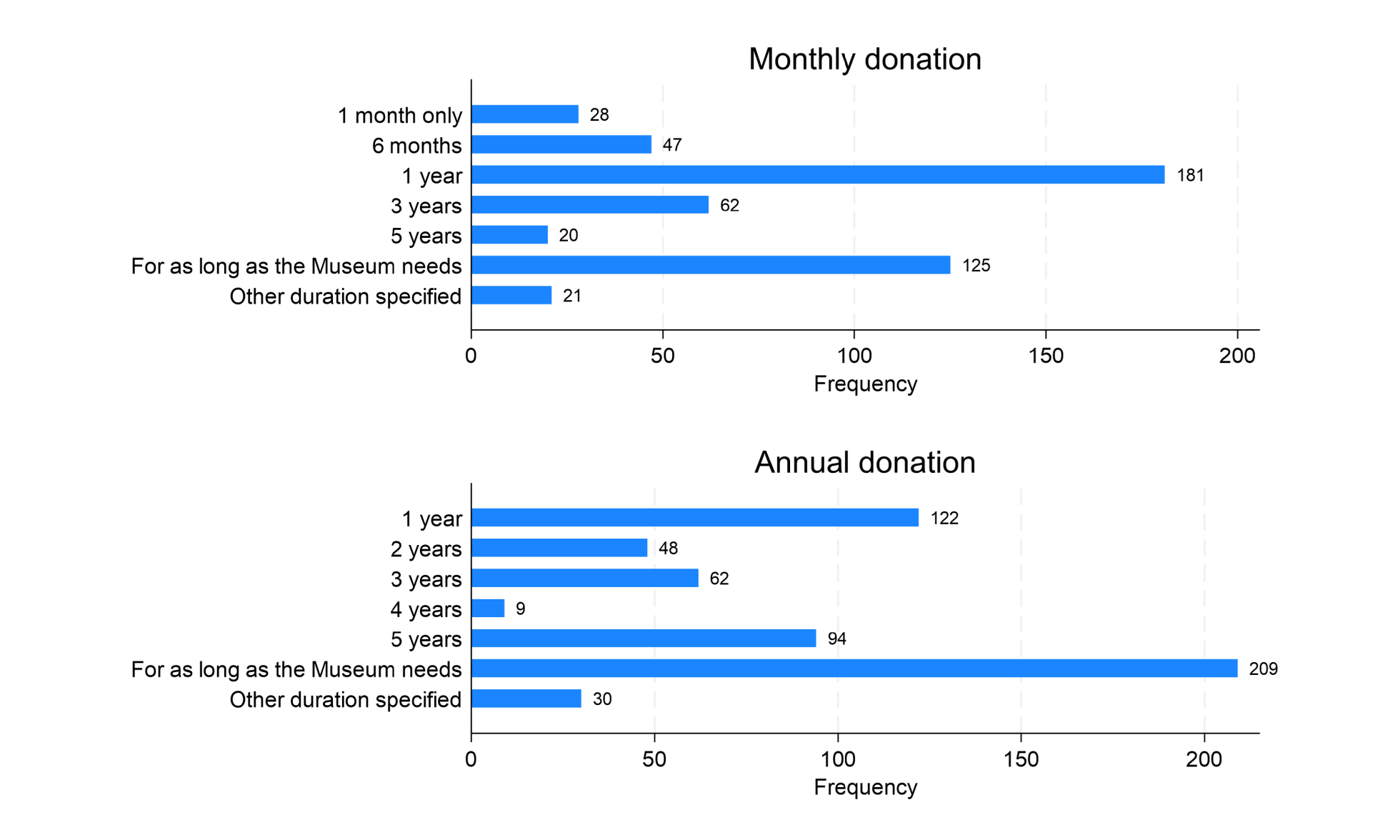
Takeaways from Experiment 2
The results from this study show that non-visitor WTP is highly sensitive to both the duration and frequency of the payments included in the payment vehicle framing. We found that non-visitor WTP for the NHM was highly sensitive to payment frequency, with higher frequencies found to be associated with substantially higher implied WTP amounts when aggregated. Choosing the optimal payment duration and frequency is generally not a straightforward decision and involves the balancing of many factors to ensure the presented payment scenario is as realistic and accurate as possible within the context of the asset being valued. That being said, in the context of the NHM, our results suggest that opting for shorter durations and lower payment frequencies may yield more conservative estimates of non-user WTP.
We also found there to be no difference in non-use WTP values for voluntary versus mandatory payment mechanisms, as we found that the WTP from an annual donation for three years was not statistically different to the WTP from an annual tax for three years. It is worth noting that, from the REA, donation vehicles may be preferred in valuations of UK museums as it is how many of them currently solicit public support. Moreover, compulsory payment vehicles such as taxes may induce higher rates of protest votes if respondents disagree with the payment mechanism used.
Experiment 3: Distance-decay effects and household framing
Motivations for this experiment
DCMS’s CHC Framework describes that to accurately aggregate non-use value for physical assets in appraisal, an appropriate catchment area for which the non-use value applies should be obtained. It goes on to highlight that there are many uncertainties when applying non-use values in business cases, including that the catchment area is subjective and may vary from site to site, which risks under or overestimating the non-use value if unrealistic catchment areas are chosen.
This experiment has sought to explore how non-use value varies with proximity to museum assets to determine if this provides any insights into appropriate catchment. The study further explores how elicited non-use value varies depending on whether a household or individual level framing for the payment is used.
Summary of experiment setup
Experiment 3 investigated how non-use value varies based on two key aspects of contingent valuation study design: (1) distance-decay effects on non-use WTP (i.e., testing the profile of distance decay with different statistical models), and (2) elicitation of WTP on behalf of the respondent’s whole household as opposed to themselves as individuals.
The experiment was structured as two parallel surveys – one relating to a locally significant asset (the Museum of Liverpool) and the other as a nationally significant asset based in the same location and with similar visitor numbers (Liverpool’s World Museum). Respondents to each survey were randomly assigned to one of two arms, as described in the table below, with distance-decay specifications tested econometrically on the collected data as part of the analysis phase.
Table 19. Description of Experiment 3 survey arms
| Arm | Description |
|---|---|
| 1.Museum of Liverpool (Household framing) | Participants were asked for their WTP for the Museum of Liverpool – a Liverpool-based asset with local scope and significance – on behalf of their whole household. |
| 2.Museum of Liverpool (Individual framing) | Participants were asked for their WTP for the Museum of Liverpool – a Liverpool-based asset with local scope and significance – without specifying if the elicitation is with respect to their household or themselves as individuals. This same approach is used in the other experiments for elicitation at the individual level. |
| 3.World Museum of Liverpool (Household framing) | Participants were asked for their WTP for the World Museum – a Liverpool-based asset with national scope and significance – on behalf of their whole household, as in arm 1 (Museum of Liverpool, household framing). |
| 4.World Museum of Liverpool (Individual framing) | Participants were asked for their WTP for the World Museum – a Liverpool-based asset with national scope and significance – without specifying if the elicitation is with respect to their household or themselves as individuals, as in arm 2 (Museum of Liverpool, individual, framing). |
Sampling approach
As in Experiments 1 and 2, only those who stated they had not visited the museum of focus in the past 3 years were admitted to the two surveys. To ensure a sufficient sample size for the distance-decay analysis in close proximity to the museums (where we expected distance-decay of WTP would be most rapid), we oversampled respondents based in Merseyside and the North West. This resulted in sample shares of 5-7% for Merseyside residents and 34-35% for North West residents in the two surveys, compared with 2% and 9% shares, respectively, in the actual population. The table below summarises the final sample sizes for Experiment 3. Every arm employed a one-off voluntary donation payment vehicle, elicited via an ascending payment card which was identical across the arms.
Table 20. Sample size by survey arm
| Arm | Arm dimension 1: Asset | Arm dimension 2: Household or individual framing | Sample size |
|---|---|---|---|
| 1 | Museum of Liverpool | Household | 792 |
| 2 | Museum of Liverpool | Individual | 733 |
| 3 | World Museum, Liverpool | Household | 762 |
| 4 | World Museum, Liverpool | Individual | 754 |
| Total sample | 3,041 |
Note: Final sample sizes are after excluding substantially incomplete responses but before excluding “speedsters”, defined as those completing the survey in 3 minutes or less (approximately one-third of the estimated completion time).
Key findings
We summarise below our findings in relation to the two main avenues of exploration for this experiment: (i) Distance-decay effects, exploring how WTP varies depending on the geographic proximity and the characteristics of the asset being valued, and (ii) Household vs individual framing, exploring how the framing of the payment scenario influences respondent WTP.
Outcome 1: Distance-decay effects
Model specifications
To estimate the impact of proximity on WTP for the three museums, we first observed the scatter of the data of distance vs WTP and then tested the following four econometric specifications, which we felt had the best chance of statistically modelling the distance-WTP relationship, for each museum:
Equation 1 (linear model): WTPi=α+β1disti+γXi+εi
Equation 2 (distance-squared): WTPi=α+β1disti+β2disti2+γXi+εi
Equation 3 (distance-squared and cubed): WTPi=α+β1disti+β2disti2+β3disti3+γXi+εi
Equation 4 (lin-log): WTPi=α+βln(disti)+γXi+εi
Where WTPi was the stated WTP of respondent i, disti was respondent i’s geographic distance (as inferred from postcode data) from the location of the asset, and Xi was a vector of values for respondent i of a set of control variables. For comparability, the set of control variables included was the same for both museums (i) whether the respondent is a member of a museum, (ii) their stated likelihood of visiting the NHM in the future, and (iii) their annual household income before tax.
Equation 1 was used to test whether the distance-decay effect could be modelled as a linear model in any of the data. The three subsequent specifications were deployed to model a non-linear relationship between distance and WTP. In plain terms, Equation 1 tests a straight-line decline in value with distance; Equation 2 lets the line curve; Equation 3 allows an S-shape (initial fall, rebound and then another fall); and Equation 4 checks whether values fall by a constant percentage with each doubling of distance. If we find that Equations 2 to 4 work better, then it suggests that distance-decay should not be modelled as a linear function for non-use value.
For each asset, the first step was to apply Lowess smoothing to a scatterplot of each observation with WTP on the y-axis and distance from the site of the asset on the x-axis [footnote 9]. The plots then informed the choice of models to estimate (Equations 1-4), based on which functional forms would represent the best fit to the data. It is important to note that there are many fewer observations and therefore more noise at the furthest distances from the asset (approaching the right on the x-axis). To maximise sample size and thereby the precision of the estimated relationships, the data on which these equations were estimated and the plots presented in the next section combine responses to both the household and individual framing survey arms.
Empirical results
Museum of Liverpool
We found clear evidence that distance from the museum influences non-use WTP in the case of the locally significant asset (the Museum of Liverpool) and that the relationship is non-linear with a counterintuitive S-shaped relationship signifying that as one moves further away from the asset the WTP amount initially falls (as expected) but then increases again once before falling again (see figure below). The linear model (Equation 1) and linear-log model (Equation 4) were not statistically significant, and they were unable to model the distance-decay relationship, and the model of best fit was Equation 3. The estimated coefficients on distance (-ve), distance2 (+ve) and distance3(-ve) were all statistically significant with signs in the right direction to be consistent with an S-shaped relationship, as shown in the table below. All three coefficient estimates were statistically significant.
Figure 3. Line plot of WTP against distance for Museum of Liverpool
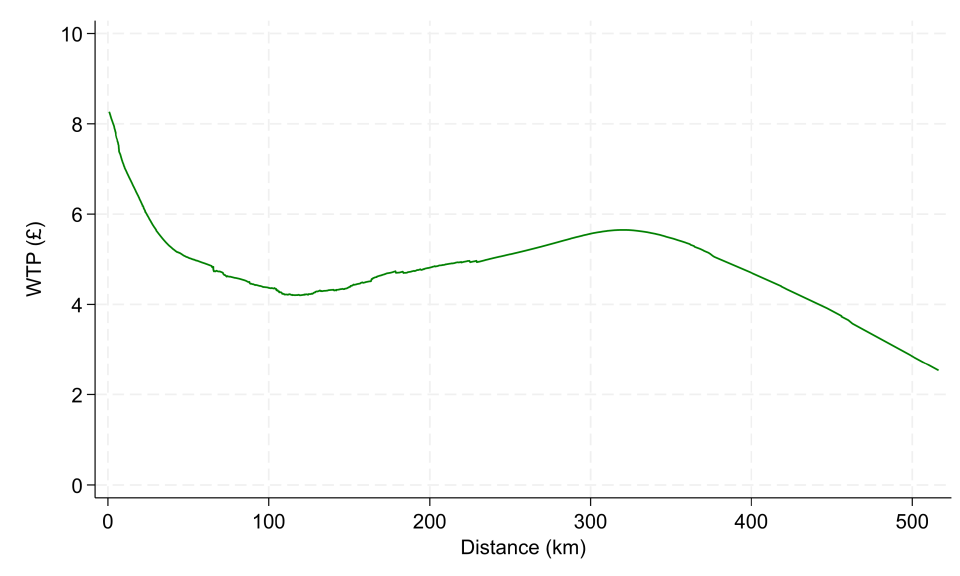
Table 21. Estimates from regressing WTP on distance (10s of km) for Museum of Liverpool
| Specification | Coefficient on ln(distance) | Coefficient on distance | Coefficient on distance2 | Coefficient on distance3 |
|---|---|---|---|---|
| Equation 3 (distance-squared and cubed) | n/a | -0.43** | 0.03*** | -0.00*** |
| Equation 4 (lin-log) | 0.40 | n/a | n/a | n/a |
Notes: See list of controls above. * , ** and *** denote statistical significance at the 10%, 5% and 1% levels, respectively. Distance is in 10s of km for ease of depiction of small estimates. The statistically significant coefficients appearing as 0.00 or -0.00 are non-zero – just very small. Full regression output is provided in Appendix 1.
World Museum (Liverpool)
Although the line plot of WTP against distance for Liverpool’s World Museum (see figure below) suggests a slight U-shaped relationship, the estimated regressions do not provide statistically significant evidence for respondents’ WTP varying systematically with distance from the asset (see table below). In other words, the estimated coefficients in both specifications suggest that someone living hundreds of kilometres away valued the World Museum nearly as much as someone living nearby. This stark difference between the two museums aligns with expectations: a museum of primarily local significance sees its highest non-use value concentrated closer to home, whereas a museum of national significance based in the same location maintains its non-use value across the country with minimal decay over distance.
Figure 4. Line plot of WTP against distance for the World Museum
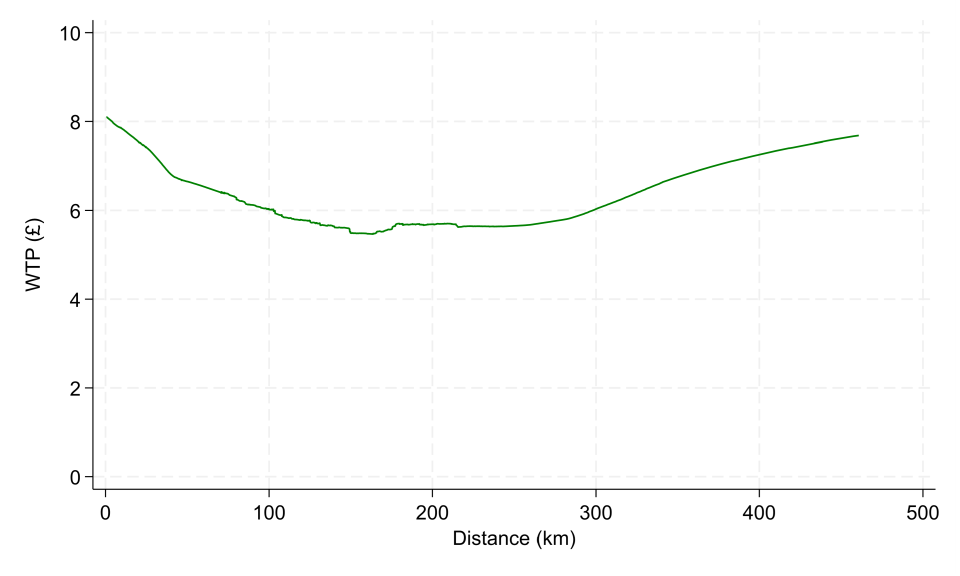
Table 22. Estimates from regressing WTP on distance (10s of km) for World Museum
| Specification | Coefficient on ln(distance) | Coefficient on distance | Coefficient on distance2 |
|---|---|---|---|
| Equation 2 (distance-squared) | n/a | -0.05 | 0.00 |
| Equation 4 (lin-log) | 0.24 | n/a | n/a |
Notes: See list of controls above. * , ** and *** denote statistical significance at the 10%, 5% and 1% levels, respectively. Distance is in 10s of km for ease of depiction of small estimates. Full regression output is provided in Appendix 1.
Natural History Museum (London)
The data from Experiment 1 allowed us to explore distance-decay effects in a comparable survey context to the two Liverpool-based museums, but instead in the context of a nationally significant asset located in the UK’s capital city. As per Table 23, we found evidence of a statistically significant S-shaped relationship between WTP and distance from the asset for the NHM (using individually framed WTP elicitation). Comparing the estimated coefficients with those found for the Museum of Liverpool, we find that the distance decay profile is considerably flatter for the NHM compared with the two Liverpool-based museums. This suggests that, in line with expectations, WTP for a nationally significant asset located in the UK capital is comparably less dependent on where the respondent is based than WTP for a regionally located locally significant asset.
Figure 5. Line plot of WTP against distance for Natural History Museum (survey from Experiment 1)
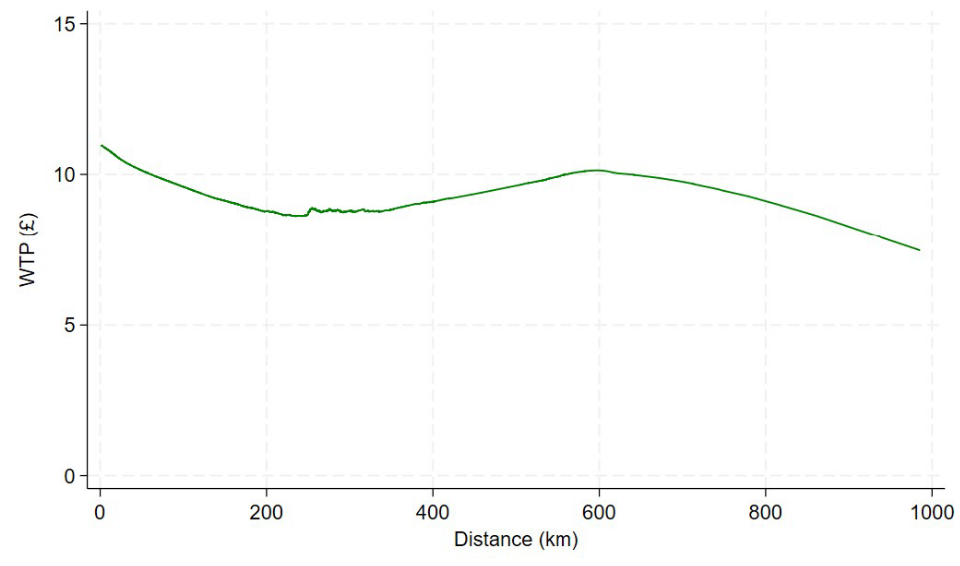
Table 23. Estimates from regressing WTP on distance (10s of km) for Natural History Museum (survey from Experiment 1)
| Specification | Coefficient on ln(distance) | Coefficient on distance | Coefficient on distance2 | Coefficient on distance3 |
|---|---|---|---|---|
| Equation 3 (distance-squared and cubed) | N/A | -0.23** | 0.01** | -0.00** |
| Equation 4 (lin-log) | -0.13 | n/a | n/a | n/a |
Notes: See list of controls above. * , ** and *** denote statistical significance at the 10%, 5% and 1% levels, respectively. Distance is in 10s of km for ease of depiction of small estimates. The statistically significant coefficient appearing as -0.00 is non-zero – just very small. The full regression output is provided in Appendix 1.
Outcome 2: Household vs individual framing
The experiment also revealed that the framing of the valuation (whether WTP is elicited on behalf of the whole household or the respondent as an individual) has a marked effect on stated WTP. The table below shows that for both the Museum of Liverpool and Liverpool’s World Museum, respondents who were asked for their WTP on behalf of their household gave lower values on average than those asked for their WTP as an individual. This was without equalising household WTP values by dividing the stated value by the number of household members, which would have resulted in substantially lower values than average WTP under the individual framing.
For the Museum of Liverpool, the average WTP under the individual framing was £5.70, which was 20.7% higher than the £4.72 average unequalised WTP under household framing (a statistically significant difference at the 1% level). Similarly, for the World Museum, individual framing respondents stated an average WTP of £6.42, about 24.4% higher than the £5.16 unequalised average under household framing (also statistically significant at 1%). These WTP estimates were obtained after applying survey weights to correct for sample representativeness (see Appendix 1 for detail).
Table 24. Average WTP (weighted) across survey arms
| Asset | Survey arm | Average WTP (£) | % change vs household framing |
|---|---|---|---|
| Museum of Liverpool | Household framing | 4.72 | N/A |
| Individual framing | 5.70 | 20.71*** | |
| World Museum | Household framing | 5.16 | N/A |
| Individual framing | 6.42 | 24.43*** |
Note: * , ** and *** denote statistical significance at the 10%, 5% and 1% levels, respectively.
In both cases, these findings suggest that when people answer as individuals, they state higher levels of non-use value than when they answer on behalf of their household. Importantly, this difference in WTP does not appear to stem from a lack of confidence on the part of respondents to answer on behalf of their household, with the average confidence of respondents to answer on behalf of their whole household relatively high at around 90%. One interpretation is that when speaking for their household’s willingness to contribute towards the asset, respondents err on the side of caution and the household framing acts as a further reminder that there are a range of other things that people need to spend their money on, leading to a somewhat more conservative valuation than when they value the asset purely as individuals but with a high level of confidence in the answer that they gave.
Takeaways from Experiment 3
This experiment is, to our knowledge, the first application of distance-decay analysis to non-use value in the context of culture and heritage in the UK, providing new insights into how non-use value varies in relation to respondent proximity for three UK museums. Our analysis suggests that the relationship between non-use value and distance is complex and non-linear; whilst non-use does generally decrease with proximity for the first 100-200 kms it can then increase again with greater distances for the three museums studied here. We also find that substantial levels of non-use value are held by non-visitors, many hundreds of kilometres away from the site of the asset. In all cases, the profile of distance-decay was found to be non-linear in nature, although the reason behind this non-linearity is currently unclear and may benefit from further research.
We anticipate that the rate and profile of distance-decay for non-use value is likely to be asset-specific, which makes it challenging to come up with a hard rule around the cut-off for catchment, although a conservative approach could be to draw the boundary at the point at which the non-use value taper fully levels off. Embedding distance-decay analysis within the contingent valuation questionnaire design with non-linear econometric models, such as those deployed here, may provide researchers with evidence which enables them to take a less conservative approach to catchment area for aggregation purposes (for example, expanding catchment where non-use value tapers off relatively slowly with distance). Box 3 outlines a step-by-step procedure for calculating total non-use value using distance-decay models.
Box 3. Using distance-decay models to estimate aggregate non-use value
The results of Experiment 3 suggest that non-use value varies non-linearly with distance to a cultural asset. Below, we outline practical steps for applying distance-decay models to estimate aggregate non-use value for a given site.
Step 1: Collect location data and control variables
In a contingent valuation survey eliciting non-use value, collect partial postcode information from the respondents, ideally asking for the first part of their postcode (i.e., the letters and numbers before the space) and only the first digit of the second part of their postcode (i.e., the first digit after the space) to avoid disclosure of personal data. Ensure that relevant socio-demographic and attitudinal controls are included in the survey (e.g., household income, cultural engagement) to support robust estimation of the distance-decay function.
Step 2: Compute distance to the asset
Calculate the straight-line (“as the crow flies”) distance between each respondent’s location and the cultural asset being valued. This can be done through computational methods using a programming language such as Python or, if this is not possible, manually using a web-based calculator (e.g. www.driving-distances.com).
Step 3: Estimate distance-decay function
Use regression or semi-parametric techniques to model WTP as a function of respondents’ distance from the site, controlling for covariates which may be plausibly related to both WTP and distance from the site.
Investigate non-linear forms (e.g. squared or cubed terms, natural logs) to capture the observed variation in non-use value by distance.
Check for model fit and whether WTP tapers off at a certain range (i.e. the “cut-off” for aggregation).
Step 4: Conservative aggregation of non-use value
Using the point at which WTP tapers off after its initial decline, sum predicted WTP across individuals or households within the catchment boundary. This should yield a conservative estimate of total non-use value associated with the asset, which can be incorporated into SCBA.
Our analysis of household versus individual framing for the WTP elicitation found that framing the WTP question on a household basis elicited more conservative estimates of non-use value. Whilst this result appears counterintuitive, we theorise that requesting respondents to answer on behalf of others, including dependents, may prompt them to more carefully consider their budget constraint (in a similar way to cheap talk scripts), which may in turn lead to a more conservative WTP response. We anticipate that the appropriate framing should also consider whether a household or individual framing is more realistic for a given payment vehicle (e.g., council tax is paid on a household basis) and so may vary based on the scenario being valued. We suggest more research is needed in this area to draw firmer conclusions around the most appropriate framing.
Experiment 4: Quantifying non-use value for marginal changes
Motivations for this experiment
The CHC Framework specifies that it is the marginal impacts and changes to benefits with respect to the counterfactual which should be the focus of valuation in appraisal of culture and heritage assets and services. For instance, if an intervention is focused on improving the services provided by an asset, only the additional benefit provided by the proposal above the status quo (or ‘do nothing’ option) should be considered. As such, developing methods to quantify the non-use value associated with marginal changes to a culture or heritage asset is of high importance.
Our REA identified a few studies which explored the valuation of marginal changes in culture and heritage assets (using a choice modelling approach), although to our knowledge, this has not previously been done in the context of UK culture and heritage for non-use value specifically or using a contingent valuation approach. This experiment was developed to determine if marginal changes in assets and services have implications for non-use value and how these can be best captured as part of SCBA.
Experiment design
Experiment 4 explored the marginality of non-use value through a contingent valuation study of the Natural History Museum (NHM) in South Kensington, London. The experiment explored the following:
- Whether non-users exhibit positive non-use value in relation to a negative marginal change to the NHM’s cultural offer. Three different changes were explored in the experiment relating to different elements of non-use value: existence, altruism, and bequest.
- If non-use value for the respective marginal changes differs on average between non-users and users; and
- Whether the non-use value elicited from respondents is sensitive to the size of the marginal change.
To provide insights into the elicitation of different types of non-use value, respondents were asked for their willingness to pay for three marginal changes framed through scenarios described in the table below. Each arm presented respondents with the same one-off voluntary donation payment vehicle and an ascending payment card to ensure valuation differences reflected only the marginal change scenarios.
Table 25. Description of Experiment 4 scenarios
| Scenario | Description |
|---|---|
| Changes to the scale of the museum exhibits (existence) | Respondents are asked their WTP to avoid the permanent closure of either three or six galleries in the NHM’s Blue Zone, with the former corresponding to a low marginal change and the latter to a high marginal change. |
| Changes to the scale of community and outreach activities (altruism) | Respondents are asked their willingness to pay to support the NHM in delivering outreach activities aimed at schoolchildren. The low marginal change reduces the number benefitting from these activities from 220,000 to 110,000 schoolchildren, while the high marginal change reduces the number of schoolchildren benefitting from 220,000 to zero. |
| Changes to future museum maintenance (bequest) | Respondents are asked their willingness to pay towards a designated maintenance fund for the preservation of the NHM. The marginal change examined is changes to the duration of guaranteed maintenance for the museum’s activities, with a decrease from 60 to 50 years representing a low marginal change and a decrease from 60 to 30 years representing a high marginal change. |
These scenarios were stacked into the survey so every respondent was presented with all three scenarios in succession, but with randomisation of the order in which the scenarios were presented to each respondent.
For each scenario, respondents were randomly assigned to see either the low or high marginal change in each of the three scenarios. As randomisation took place separately for each scenario, a respondent may have been assigned a low marginal change in one scenario and a high marginal change in another. Moreover, both respondents who have recently visited the NHM and those who have not were admitted to the survey, allowing us to designate the former as “users” and the latter as “non-users” for comparison purposes. Effectively, this resulted in a contingent valuation study design where all three scenarios were presented to a respondent who was assigned to one of four distinct survey arms, as described in the table below.
Table 26. Description of Experiment 4 survey arms per scenario
| Arm | Description |
|---|---|
| Non-user, low marginal change | Participants who have not recently visited the NHM are presented with the low marginal change version of that scenario. |
| Non-user, high marginal change | Participants who have not recently visited the NHM are presented with the high marginal change version of that scenario. |
| User, low marginal change | Participants who have recently visited the NHM are presented with the low marginal change version of that scenario. |
| User, high marginal change | Participants who have recently visited the NHM are presented with the high marginal change version of that scenario. |
This was the only experiment out of the four experiments which was open to respondents regardless of whether they had visited the NHM recently, allowing us to elicit WTP for both users and non-users. Respondents were allocated to either the non-user group or the user group depending on when they last visited the NHM, if at all. It is important to note that while the survey sought to elicit non-use value held by users – namely, existence value derived from the knowledge that the full collection remains intact, altruism value derived from others benefiting from the asset, and bequest value placed on the asset’s preservation for future generations – it is possible that some use value was captured in the WTP estimates as well. For example, some users may have provided a WTP in the existence scenario based on how the permanent closure of some of the galleries would directly impact their user experience, which is inextricably linked to their use value of the asset. Separating these empirically is beyond the scope of this study.
Sampling approach
A total sample of approximately 2,000 was recruited via Prolific, with the resulting sample being broadly nationally representative in terms of age, sex and ethnicity. The final distribution of the sample across the various survey arms is summarised in the table below.
Table 27. Sample size by survey arm
| Arm (per scenario) | Scenario | Arm dimension 1: User or non-user | Arm dimension 2: Size of (negative) marginal change | Sample size |
|---|---|---|---|---|
| 1 | Existence value (n= 1,989) | Non-user | Low | 448 |
| 2 | Existence value (n= 1,989) | Non-user | High | 430 |
| 3 | Existence value (n= 1,989) | User | Low | 559 |
| 4 | Existence value (n= 1,989) | User | High | 552 |
| 1 | Altruism value (n= 1,990) | Non-user | Low | 451 |
| 2 | Altruism value (n= 1,990) | Non-user | High | 428 |
| 3 | Altruism value (n= 1,990) | User | Low | 555 |
| 4 | Altruism value (n= 1,990) | User | High | 556 |
| 1 | Bequest value (n= 1,990) | Non-user | Low | 461 |
| 2 | Bequest value (n= 1,990) | Non-user | High | 418 |
| 3 | Bequest value (n= 1,990) | User | Low | 547 |
| 4 | Bequest value (n= 1,990) | User | High | 564 |
Notes: For the purposes of this study, a user is defined as someone who has visited the NHM at least once in the past 5 years. Accordingly, respondents who have not visited the NHM in the past 5 years are considered non-users, achieving a relatively equal proportion of users and non-users in our sample. Final sample sizes are after excluding substantially incomplete responses but before excluding “speedsters”, defined as those completing the survey in 5 minutes or less (approximately one-third of the estimated completion time).
The results presented in the following section were obtained from a total sample of 1,906 survey respondents, which was the final sample after excluding 124 speedsters from an initial sample of 2,030 respondents.
Key findings
Headline willingness to pay results
The table below shows the average WTP for both non-users and users across the three marginal change scenarios (existence, altruism and bequest), distinguishing in each case between two different sizes of marginal change (low or high).
Table 28. Average WTP across survey arms
| Arm dimension 1: User or non-user | Scenario | Arm dimension 2: Size of marginal change | Average WTP (£) | Percentage change of high vs low (%) |
|---|---|---|---|---|
| Non-users | Existence | Low | 5.55 | 11.4 |
| Non-users | Existence | High | 6.18 | 11.4 |
| Non-users | Altruism | Low | 4.96 | 4.5 |
| Non-users | Altruism | High | 5.18 | 4.5 |
| Non-users | Bequest | Low | 5.73 | -3.1 |
| Non-users | Bequest | High | 5.56 | -3.1 |
| Users | Existence | Low | 8.12 | -11.2 |
| Users | Existence | High | 7.22 | -11.2 |
| Users | Altruism | Low | 7.06 | 9.7 |
| Users | Altruism | High | 7.74 | 9.7 |
| Users | Bequest | Low | 7.67 | -1.2 |
| Users | Bequest | High | 7.58 | -1.2 |
Note: * , ** and *** denote statistical significance at the 10%, 5% and 1% levels, respectively.
As anticipated, users were found to have a higher average WTP than non-users across all survey arms. While some of the differences in average WTP between a low and high marginal change in the same scenario were notable in magnitude, none were found to be statistically significant at conventional significance levels. We did obtain a few unexpected results where respondents stated a higher WTP to the low marginal change than the high marginal change in the same scenario (the bequest scenario among non-users and both the existence and bequest scenarios among users), but the differences were not statistically significant. The largest differences in average WTP between the two marginal change sizes were in the existence value scenario – where WTP was 11.4% higher and 11.2% lower in the high marginal change arm compared to the low marginal change arm for non-users and users, respectively.
The fact that respondents’ average WTP in a given scenario did not statistically significantly differ when presented with marginal changes of different sizes may imply that respondents struggle to cognitively grasp the magnitude of a marginal change that they are asked to consider. An alternative hypothesis is that WTP is simply not that sensitive to the size of the marginal change or that non-use value represents a ‘warm glow’ value where people simply get some satisfaction out of contributing to a public good, regardless of the actual size of the impact, which is especially relevant for non-use (Kahneman & Knetsch, 1992). We also observe that at most non-user WTP for the marginal changes presented is 41% lower than the WTP for the whole asset in Experiment 1 (£8.43), which is not proportionate to the scale of loss being considered. This could be explained by either of the hypotheses.
Explaining differences between users and non-users
The table below presents coefficient estimates for the association between WTP and whether the respondent is a non-user rather than a user (“non-user status”) from regressing respondent WTP on non-user status. The coefficients represent the magnitude and direction of influence associated with being a non-user on WTP. Positive values indicate increased WTP, while negative values indicate a reduction. Statistical significance levels indicate confidence in these relationships.
In the specification with controls, we incorporated the following as additional explanatory variables:
- Whether the respondent is a member of a museum.
- Their stated likelihood of visiting the NHM in the future.
- Whether they consider heritage/arts/museums/culture a public spending priority.
- Whether they are educated to college level or above.
- Their annual household income before tax.
- Whether they live in London.
The above control variables were all correlated with non-user status at a 1% level of statistical significance. Incorporating them as additional explanatory variables in our regressions allowed us to account for the fact that non-users in our sample differ systematically from users, which could otherwise bias our estimates of the coefficient on being a non-user if these factors also impact on WTP.
Table 29. Estimates from regressing WTP on being a non-user by scenario
| Specification | Scenario | Coefficient on non-user status |
|---|---|---|
| Without controls | Existence | -1.81*** |
| Altruism | -2.34*** | |
| Bequest | -1.98*** | |
| With controls | Existence | -0.22 |
| Altruism | -0.91** | |
| Bequest | -0.23 |
Note: See list of controls above. * , ** and *** denote statistical significance at the 10%, 5% and 1% levels, respectively.
In the regressions without controls, non-user status was associated with lower WTP than users in all three scenarios, by £1.81 in the existence scenario to £2.34 in the altruism scenario. In all three cases, the estimate was statistically significant at the highest conventional level (1%). This suggests that non-users are, on average, willing to pay around £2 less than users given the same marginal change scenario. However, once controls were included, the differences in WTP by non-user status were no longer statistically significant in the existence and bequest scenarios. This suggests that the differences in WTP between users and non-users in these scenarios were largely due to systematic differences in observable characteristics, rather than non-user status itself. In the altruism scenario, non-users still showed a somewhat lower WTP (£0.91 less) even after including controls, with the difference retaining statistical significance at the 5% level. This implies that altruism-based WTP is more sensitive to whether the respondent has experienced the asset themselves than WTP based on existence or bequest. Estimating the same regressions with entropy balancing [footnote 10] did not alter these conclusions.
Rationale for valuing or not valuing the marginal changes
Figures 6 to 8 present the most common reasons selected by non-users for holding either positive or zero non-use value in each scenario. Across all three scenarios, the most commonly selected reason for holding positive non-use value was the importance of the asset for current and future generations, highlighting the importance of altruism and bequest value for shaping non-user WTP. Other common reasons included personal importance and support for natural history, outreach or preservation activities more broadly. In contrast, motivations relating to social desirability (e.g. others doing it and seeming right) and the belief that one would not actually have to pay were cited far less frequently. These patterns were broadly consistent across all three scenarios, suggesting that respondents’ motivations for holding positive non-use value are quite similar regardless of the scenario.
Figure 6. Most common WTP reasons among non-users in existence scenario
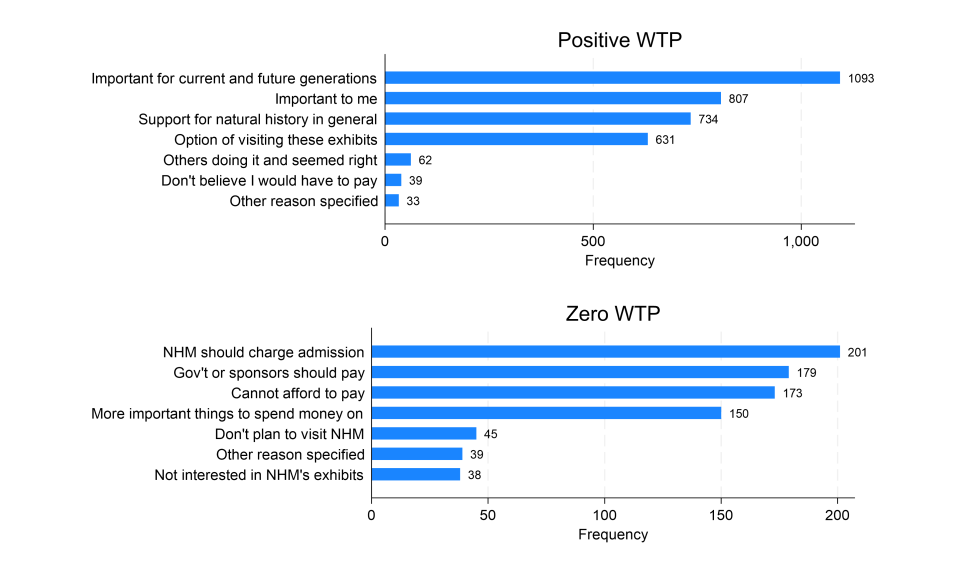
Figure 7. Most common WTP reasons among non-users in altruism scenario
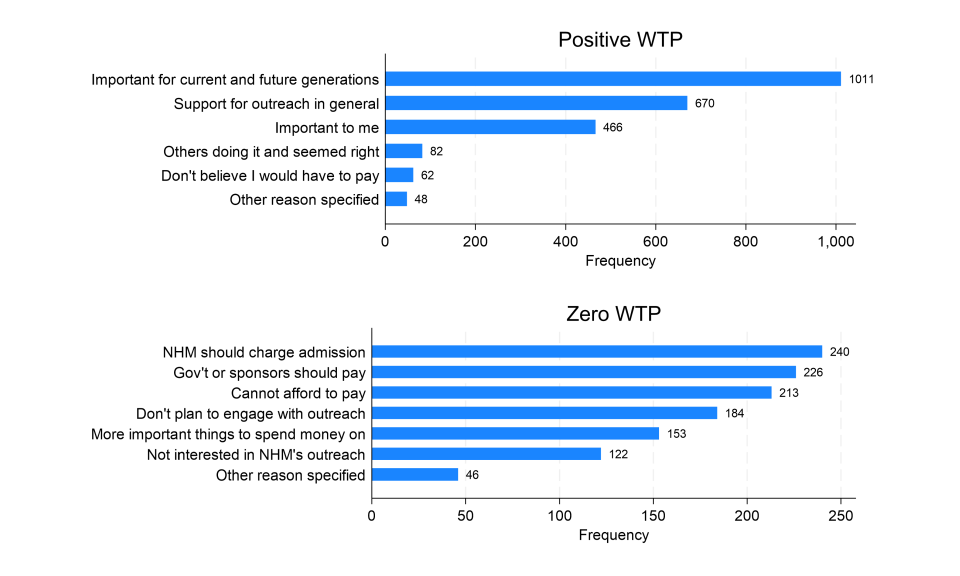
Figure 8. Most common WTP reasons among non-users in bequest scenario
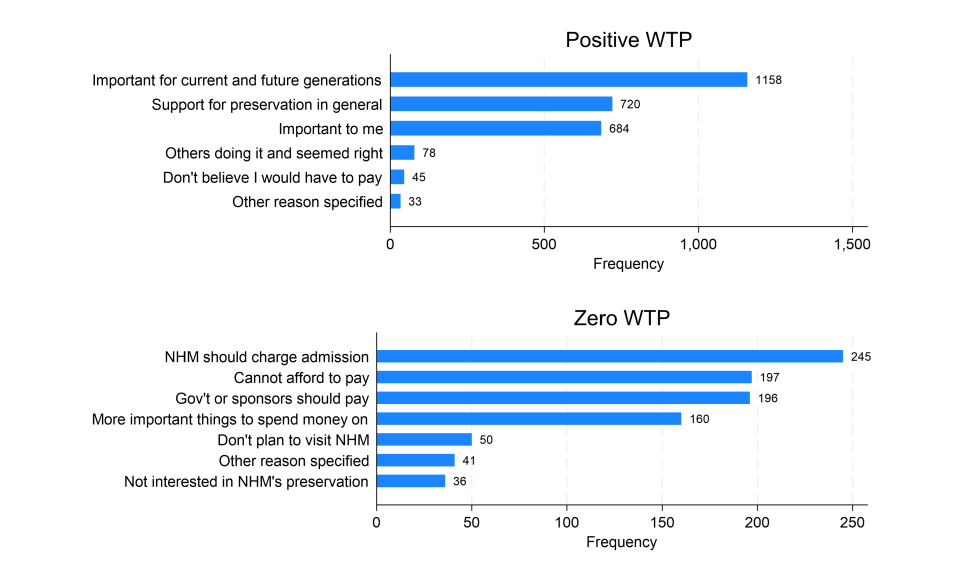
Across all three scenarios, the most frequently cited reason for not holding non-use value (i.e. zero WTP) was that the NHM should charge for admission, with the view that government or corporate sponsors should pay for the asset instead. The high incidence of these protest-type motivations suggests that many respondents who did not express a willingness to pay viewed that its funding should be the responsibility of others. That is, they disagreed with the premise of placing responsibility for financing the asset with the general, non-visiting public, rather than necessarily disagreeing with the value of the asset (or the marginal change being considered) in itself.
In all three scenarios, a lack of interest in the asset was the single least frequently cited reason for not holding non-use value. Particularly in the existence and bequest scenarios, a lack of option value – whereby respondents hold zero non-use value because they do not intend to visit the NHM in the future – was also not frequently cited. The lack of option value was relatively more frequently cited in the altruism scenario, but this can likely be explained by the fact that most respondents would not have the option of engaging with the scenario’s outreach programme given that it is targeted at schoolchildren.
Average certainty in whole-asset vs marginal valuation
Both Experiments 1 and 4 concerned valuations of the NHM, but with the former valuing the asset as a whole and the latter valuing marginal changes to the asset. Comparing average certainty among respondents in their stated WTP between the experiments revealed that respondents valuing the NHM as a whole were considerably more certain in their responses than those valuing marginal changes to the NHM. Specifically, respondents in Experiment 1 reported an average certainty of 74% compared to 67% in Experiment 4 – a difference of around 7%, which is statistically significant at the 1% level. This may suggest that respondents may find marginal valuations relatively more abstract and less intuitive than whole-asset valuations in a contingent valuation setting.
Takeaways from Experiment 4
The results from this study provide evidence that individuals hold positive WTP related to the three main aspects of non-use value, indicating that museum non-use value has existence, altruism, and bequest elements. Our study also highlighted challenges in eliciting non-use value for marginal changes in these elements of non-use value, with elicited non-use value not varying significantly with the magnitude of the marginal change, and with all marginal change valuations being disproportionately close to the elicited value of the whole museum. This lack of consistency in stated preferences suggests that individuals struggle to disentangle their valuation for aspects of an asset from that of the whole asset, potentially providing evidence of the scoping effect or warm glow effect inherent in the wider stated preference valuation literature. We recommend that discrete choice modelling be explored as a potential option for quantifying the non-use value associated with marginal changes to culture and heritage assets and further qualitative research to more fully understand issues related to scoping and warm glow effects.
When responding to stated preference surveys, it has been found that it can be hard for the general public to cognitively express their view and value of different states of an asset (therefore making marginal decisions relating to non-use value). Alternative approaches to combining non-use value with the condition of the asset could draw inspiration from Sagger and Bezzano (2023), who set out how heritage science and risks-based approaches can be used to overcome this issue. This is being taken forward by UCL as part of an AHRC/DCMS funded research project, entitled Integrating Lifetimes in Heritage Capital.
5. Drivers of non-use value
The literature reviewed as part of this study (see Appendix 2) indicates that culture and heritage can exhibit all three commonly cited forms of non-use value: existence, bequest, and altruism. The literature was generally inconclusive as to whether option value should be considered part of non-use value, and so for completeness we have included option value within our exploration of non-use value drivers. This chapter goes beyond the literature review to explore in more detail the drivers and determinants of non-use value within the context of the museum-focussed experiments, drawing on insights from the survey questionnaires and two focus groups with members of the public.
It is important to note that the surveys and focus groups conducted for this study did not explore in detail the drivers of non-use value in terms of the cultural role played by the asset, which may, for example, relate to providing a sense of communal belonging or source of cultural pride. This represents an area for further research, to be at least partly addressed through a project on non-use value currently being funded by DCMS and AHRC. For more information, see the Culture Heritage, People and Place: Understanding value via a regional case study led by Dr Tamara West.
Insights from surveys
All of the survey questionnaires underpinning the analysis for the four museum-focussed experiments included designated questions aimed at understanding the rationale for individuals holding or not holding non-use value. The insights from the analysis of the responses by the public to these questions are detailed below.
In summary, across the experiments we found that people who assign a non-use value to cultural heritage do so mainly out of concern for future generations (bequest) and current generations (altruism) with respect to the wider public, whereas people who do not assign a monetary value may still care about the asset but feel unable to pay or believe that they should not be paying as non-visitors. This implies that measured non-use values are grounded in genuine public-spirited motives – preserving cultural goods for society and future generations. At the same time, zero valuations should be interpreted with caution, since they frequently reflect budget constraints or protest motivations rather than a true lack of value.
Motivations for holding or not holding non-use value
Natural History Museum
Figures 9, 10 and 11 below show the most common reasons indicated by respondents in Experiment 1 (concerning bias mitigation) and Experiment 2 (concerning the payment vehicle, duration and frequency) for holding or not holding non-use value for the NHM (positive and zero WTP, respectively).
Figure 9. Most common reasons for holding non-use value in Experiment 1
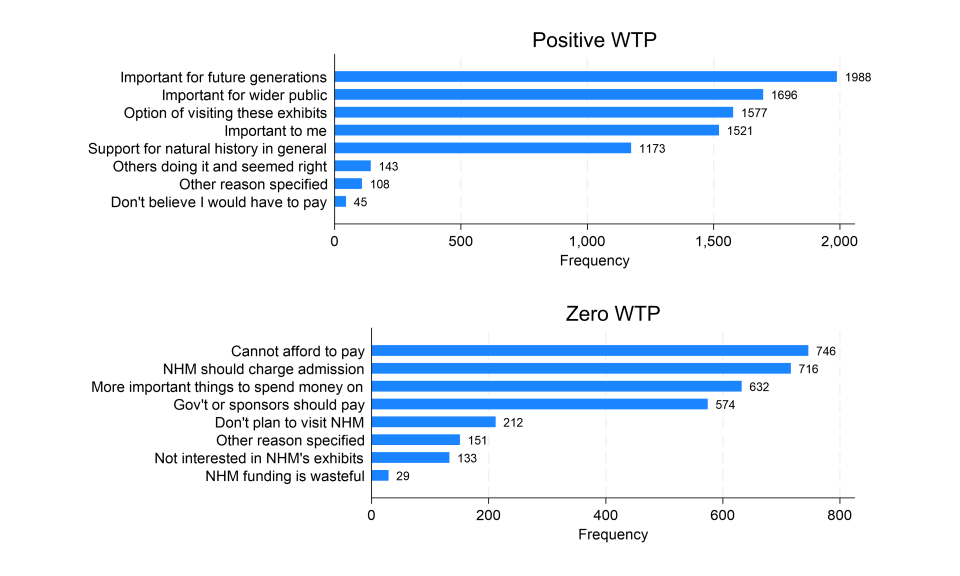
Figure 10. Most common reasons for holding non-use value in donation arms of Experiment 2
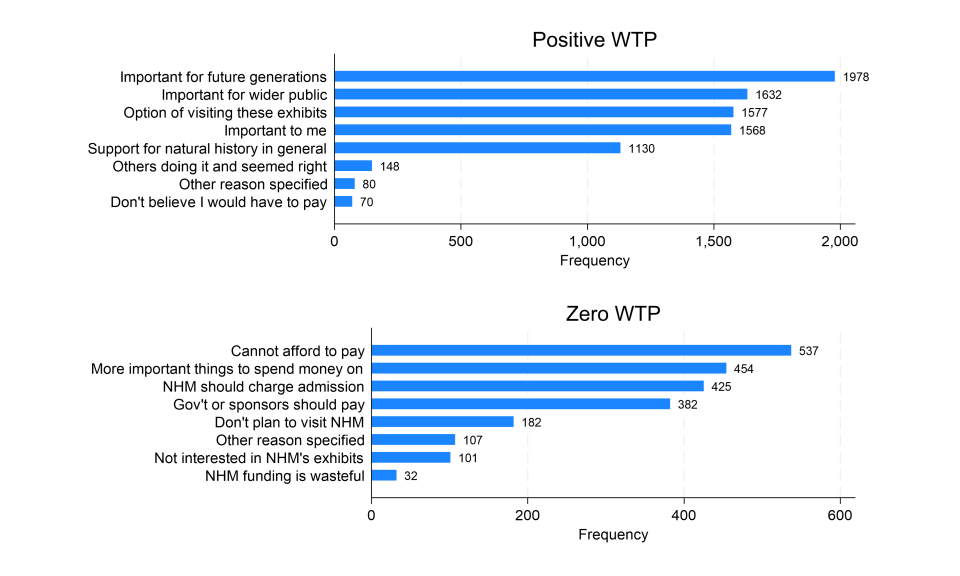
Figure 11. Most common reasons for holding non-use value in tax arm of Experiment 2
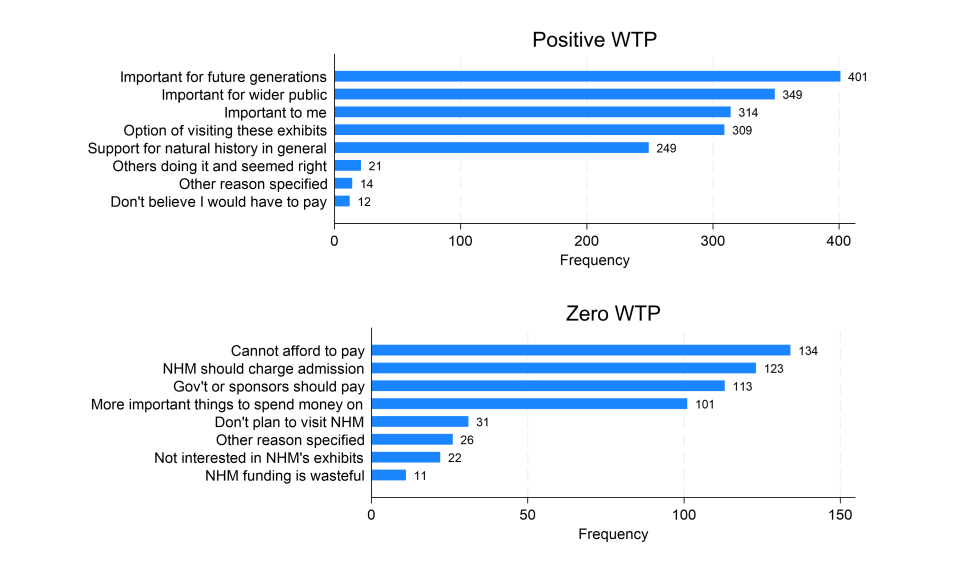
In both experiments, the most frequently selected reason for holding positive non-use value was the importance of the asset for future generations, which relates to bequest value [footnote 11], with the second-most common reason relating to altruism value [footnote 12]. Option value [footnote 13] was third-most commonly cited in Experiment 1 and the donation arms of Experiment 2 and fourth-most commonly cited in the tax arm of Experiment 2. In contrast, social desirability motivations (the view that others are donating and that it seems like the right thing to do) were not commonly cited in either experiment. At face value, this may suggest that social desirability bias was less of a concern for these experiments, but it may also be the case that respondents were reluctant to openly express where they were influenced by concerns of social desirability in their stated WTP.
In both experiments, those stating zero non-use value most commonly cited affordability concerns as motivating their valuation. Also commonly cited were protest-type motivations – namely, the view that the NHM should charge admission and that the government or corporate sponsors should be paying instead – and having more important things to spend money on. It is noteworthy that the latter was relatively less cited in the tax arm of Experiment 2 (Figure 11) than in the donation arms (Figure 10), where it is the second-most commonly cited reason. It should also be noted that many of the reasons cited for holding zero non-use value do not necessarily entail that they do not value the asset. For example, someone citing affordability as their rationale for zero WTP may still hold non-use value for the asset while believing they are currently unable to afford a donation.
Museum of Liverpool and World Museum (Liverpool)
Figures 12 and Figure 13 show the most common reasons cited by respondents in Experiment 3 (concerning the Museum of Liverpool and the World Museum) for holding or not holding non-use value. These counts are after applying survey weights to correct for sample representativeness (see Appendix 1). As in the other experiments, bequest and altruism motivations dominated among respondents expressing positive non-use value; in both cases, the most commonly selected reason was the importance of the asset for future generations, followed by the asset’s importance for the wider public. The latter was relatively more frequently selected for the World Museum than for the Museum of Liverpool, which may reflect that the broader scope of the World Museum’s exhibits is perceived as more valuable to the wider public than the more local scope of the Museum of Liverpool. Support for the preservation of cultural heritage also featured among the more frequently cited reasons. As with the other experiments, social desirability motivations were not commonly selected.
Among those stating a zero WTP, the most common reasons, as shown in Figures 12 and 13, were once again affordability. However, it is notable that having more important things to spend one’s money on was nearly as commonly selected as affordability in the case of both these assets, whereas it tended to be less commonly selected in the NHM-focused experiments (including Experiment 4, concerning marginal non-use value). This difference may be due to the salience of the NHM as an asset of national significance, which could plausibly elevate its importance relative to other causes in the eyes of some respondents. Protest-type motivations and a lack of option value were also commonly selected.
Figure 12. Most common reasons (weighted) for holding non-use value for MoL in Experiment 3
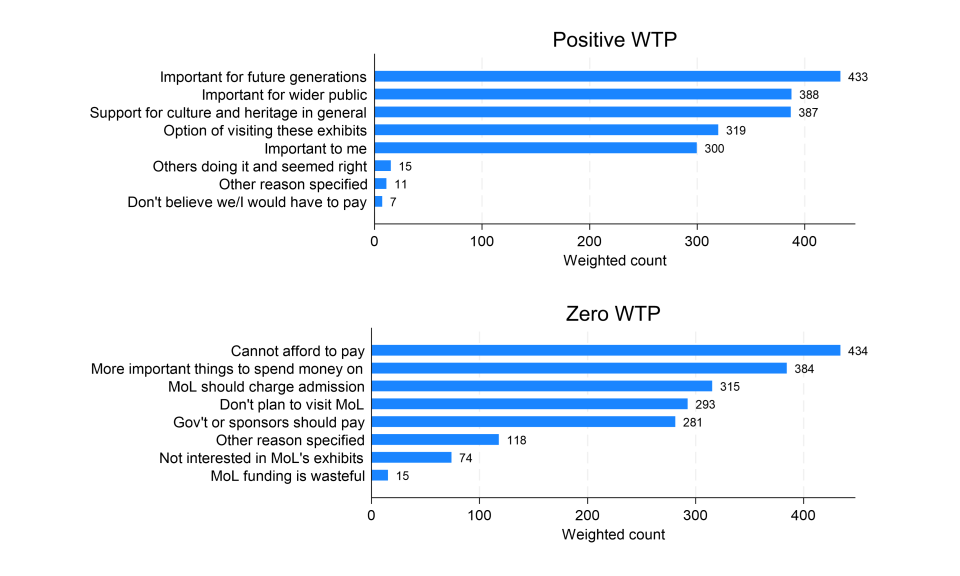
Figure 13. Most common reasons (weighted) for holding non-use value for WM in Experiment 3
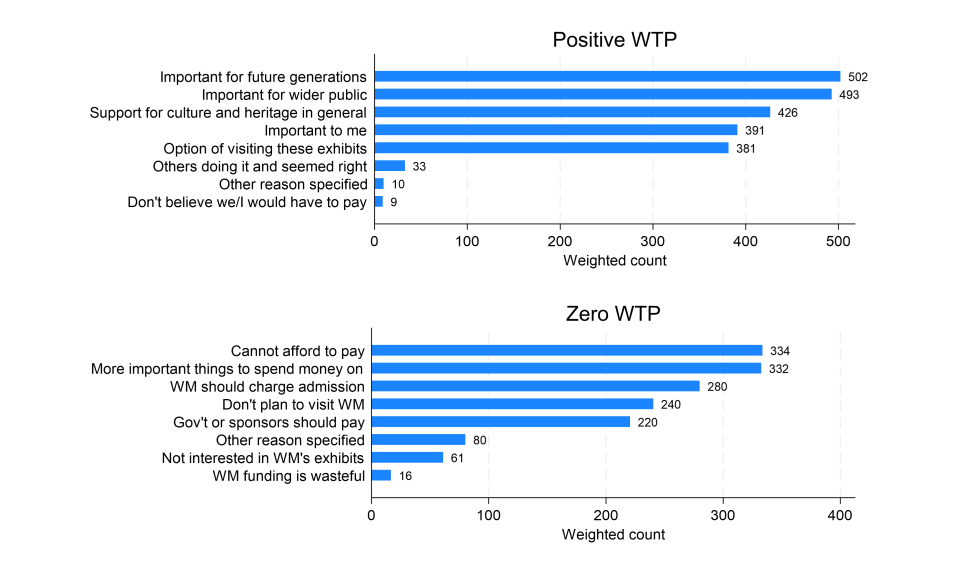
Focus group analysis
This section covers the views of participants in two focus groups about the value they place on museums, regardless of whether they use museums or not (non-use value). The focus groups were held in April 2025 with a diverse sample of the UK general public (see Chapter 3 for more detail on approach). Participants exhibited varying degrees of non-use value for museums, with all participants exhibiting at least some non-use value. Participants were asked to discuss their views on different dimensions of non-use value and to what extent they would be willing to pay for them. This included the value they hold in museums continuing to exist, community outreach programmes from museums, and preserving and maintaining museums. Participants also discussed their views on the non-use value of museums compared to libraries and theatres as examples of other heritage and culture institutions.
Non-use value of museums continuing to exist
Participants who held a positive non-use value for museums highlighted their importance for ensuring that society retains its heritage and history, with future generations having the opportunity to learn about them. Children were a top-of-mind priority, with participants attributing the positive role of museums in presenting information and developing interests in the wider world. These participants also acknowledged that it was important to have a range of museums covering the breadth of UK culture and heritage to ensure that they serve as many people’s interests as possible.
[Museums] spark that enthusiasm, plant that seed of the thirst for knowledge and you need to expose children to all sorts of things, from art museums to Natural History, military museums, industrial museums so they can get a whole taste of what life’s about and see what appeals to them.
– Male, 65+, East of England
Participants also highlighted that museums had a distinct role in ensuring the UK public had access to authoritative research and education. They noted that museums hold collections of artefacts and enable research to be conducted that provides accurate, trustworthy interpretation of culture and heritage. Some participants contrasted the value of this against online information and education, noting that reading about something online is less engaging or informative than seeing it in a museum.
[Museums] exist as central repositories for information. You can find it on the Internet. You can look it up, but you cannot see the artefacts. You cannot see the story that the artefact gives you and draw your own conclusions.
– Male, 55-64, West Midlands
Within both focus groups, participants typically held an initial normative belief that museums should be free. However, when reflecting on the implications of not paying for museums, participants acknowledged they would be willing to pay if it meant artefacts would be available for research in the future and museums continued to promote learning and understanding in the present. Participants who were willing to pay underlined the importance of ensuring as many people as possible in society have access to museums and that institutions have the funding they need to continue.
Non-use value of museums’ community and outreach programmes
Participants who held a positive non-use value of museums in the context of community and outreach noted it was closely linked to museums’ role in promoting learning through engaging people in heritage. Participants highlighted the value of making learning interactive as a means to ensuring research and interpretation of heritage is open to the community. One participant emphasised that engagement activities can enable museums to learn how artefacts and exhibitions are interpreted by different communities, so these perspectives can be included in museums’ work.
You’d hope that the ways in which we interpret objects and exhibit them is kind of iterative and informed by others. So taking those things out to different communities and learning from how people respond to them feels really important.
– Male, 25-34, South East England
Participants also felt that community outreach activities such as initiatives that bring artefacts and exhibitions around the country were important for ensuring people across the UK could access museums’ resources. These participants framed these activities as an equalising measure for people who live far away from large museums such as the Natural History Museum. They felt it reduced the distance people needed to travel to see specific artefacts and exhibitions, and therefore enabled people to engage with them.
[Dippy the Dinosaur tour] has made it more accessible, hasn’t it? Because people who wouldn’t have had the opportunity to see it have now got the opportunity.
– Female, 35-44, Yorkshire and Humber
While participants generally agreed with the principle of paying to support museums to continue providing community outreach programmes, views were divided on what the value would be for other people. Some participants felt that community and outreach programmes should be funded by the communities that would benefit from them because they were wary of people in specific locations, such as London, disproportionately benefiting from initiatives funded by the rest of the country. Other participants disagreed with this position, either because they felt they could afford to support initiatives that benefit other people or because they felt that an outreach programme in one area might lead to similar programmes in other areas in the future.
For [museums] to access the community and get everyone involved is good because it’s not just like certain researchers in a lab doing something, It’s actually involving a lot more people, so knowledge is expanding and it’s actually making it like a social thing.
– Female, 25-34, East Midlands
Non-use value of maintaining and preserving museums
Participants who valued maintenance and preservation activities typically did so because they wanted exhibitions and artefacts to be displayed in settings that emphasise their importance. These participants linked this view to the importance of ensuring future generations engage with museum collections. Participants also noted that museum buildings and grounds add to the overall visitor experience by providing somewhere for the public to access culture and heritage while ’making a day of it’ and enjoying museums’ facilities such as cafes, parks and gardens.
[The Dippy exhibition] was much better in the foyer of the Natural History Museum with all that beautiful architecture and the sense of presence than it was in the entrance foyer of the Herbert Gallery in Coventry.
– Male, 55-64, West Midlands
Participants also felt maintenance and preservation of museums was important to ensure future generations had artefacts that were kept in good condition so they could continue to be researched and contribute to knowledge about the past. These participants noted that failing to maintain museum buildings could put collections at risk of damage. Participants typically supported maintaining museum buildings to protect collections, even if they were expensive and complicated. They felt such museums were examples of heritage value for the UK in their own right.
I don’t even think future generations would even know what dinosaurs are, if we didn’t have the museums. And I think that there are so many aspects that go into it, like the temperature and the humidity.
– Female, 18-24, Scotland
Non-use value compared with other culture and heritage institutions
Participants who valued museums, regardless of whether they themselves used them, considered museums to have a unique role in holding collections and managing access to them for the public. These participants also felt that libraries provided important access to information and culture through their book collections and that theatres provided a platform for culture and heritage. However, they highlighted that libraries and theatres were not the only sources of information, culture and heritage, noting that people can also access these online or through other types of media.
I would say probably [I would be willing to pay] more for museums… just because it’s more inherently unique. You know there’s only one Elgin marbles that you can see. Whereas a library inherently kind of holds copies of books which are the same as any other books.
– Male, 25-34, South West England
Participants held non-use value for libraries and theatres for reasons similar to holding non-use value for museums. However, their rationale for these reasons was distinct from explaining non-use value for museums. Participants believed libraries had a social importance rooted in altruism, highlighting their importance for older people and those on low incomes to have free access to a wide range of books, access the internet and to meet other people. Participants emphasised that, in contrast to museums, libraries’ value lay in their accessibility within local communities. While museums were valued for holding unique access to specific collections, libraries were valued for their prevalence and accessibility within and across communities. Participants also noted that theatres can enhance the experience of a theatrical production and prompt people to engage in stories.
There’s not really much stopping you from going [to libraries]. When I was younger I didn’t really have access to certain things at home, but I was able to go to the library and access those things, which is very important. Whereas museums I can really go in like that.
– Female, 35-44, Yorkshire and Humber
Key takeaways
Across the surveys and focus groups, respondents consistently emphasised the importance of preserving cultural heritage assets for future and current generations. This suggests that bequest and altruism values are core drivers of non-use valuation in the culture and heritage context. Although option value – value derived from the possibility of future personal use – was acknowledged, it was notably less frequently cited than altruism and bequest motivations. It is also noteworthy that respondents commonly provided zero valuations due to affordability concerns or protest motivations, which do not necessarily equate to a genuine absence of value. This suggests caution in interpreting zero WTP figures as a definitive lack of non-use value.
Focus group participants highlighted museums’ distinctive roles in providing educational experiences, preserving unique artefacts, and promoting community engagement and widening access to museum collections through outreach activities. They emphasised that preservation efforts and maintaining museum infrastructure significantly enhance both the experience and the accessibility of cultural heritage. Moreover, many participants expressed a normative view that museums should ideally remain freely accessible, but acknowledged they would be willing to pay if it was necessary for museums to continue to exist. These findings reinforce the survey results and suggest avenues for future research into broader social and cultural motivations driving non-use value.
6. Wellbeing valuation for non-use value
The wellbeing valuation (WV) approach is a relatively newer approach to valuing non-market goods that has arisen out of the growth in interest in wellbeing data in economics and policy making.
The premise of the WV approach is to estimate monetary values from the implied trade-off between non-market goods and money from wellbeing data; in this respect, WV broadly follows the analytical approach of discrete choice modelling. Monetary values are estimable from two effects: firstly, the impact of the non-market good on wellbeing and secondly, the impact of income or money on wellbeing. Once these effects have been estimated, it is possible to estimate compensating and equivalent welfare measures from the marginal rate of substitution (MRS) between the non-market good and money.
The main wellbeing measure used in the WV approach is life satisfaction, as it provides a broad measure of overall wellbeing and is available in many large datasets. In all of our surveys we included the Office for National Statistics’ life satisfaction question as follows:
“Overall, how satisfied are you with your life nowadays?”, where respondents answer on a scale from 0 (“not at all satisfied”) to 10 (“completely satisfied”).
Sampling approach
The WV analysis was performed on a pooled sample of responses from the surveys of Case Studies 1 (bias mitigation), 2 (payment vehicles, duration and frequency), and 4 (marginal non-use value). Regardless of which survey people were in, they were asked the life satisfaction question and then two questions about culture to ascertain non-use as follows:
- “What culture and heritage sites have you visited in the past 12 months? Select all that apply.”
- “Which of the culture and heritage sites you have visited in the past 12 months are you aware have since permanently closed? Select all that apply.”
In both questions respondents chose from the following list of sites:
- Archaeological site
- Art Gallery
- Cinema
- Historic building
- Historic landscape or habitat (e.g. coastline, countryside with unique features)
- Historical monument or archaeological site
- Library
- Music venue or festival
- Other live music venue
- Public gardens or parks with historic or artistic features
- Sports venue
- Theatre
We dropped Experiment 4 respondents completing the survey in 5 minutes or less, and Experiment 1 and 2 respondents completing the survey in 3 minutes or less, which is consistent with how we dealt with “speedsters” in the WTP analysis above. This provided us with a final sample size of 10,469 for the statistical WV analysis.
Methodology
The difficulty in assessing non-use in WV, and why it has not yet been explored in the literature, is that the method relies on the existence of a physical impact on people’s wellbeing; in statistical analysis this will require some change to have occurred. With use values this is reasonably easy to capture since we can look at the wellbeing of visitors versus non-visitors or the wellbeing of people who start or stop visiting cultural sites. The existence or presence of a cultural site, however, does not naturally create this type of change and so in this study we look at the closure of cultural sites to assess the viability of measuring non-use value in the WV approach.
These two questions about cultural sites allowed us to first determine non-users of these sites and then to assess whether non-use value can be captured in WV by looking at the impact of closures of the sites. If there is a negative impact on wellbeing of the closure of a site that the individual has not visited then this would indicate that life satisfaction is picking up some form of non-use value.
We employ the following statistical model with the data which is estimated using Ordinary Least Squares (OLS) regression as is common in the WV literature (e.g. McDonald and Powdthavee, 2018; Ambrey and Fleming, 2011; Menz and Welsch, 2012; Clark and Oswald, 2002).
Equation 5: LSi=α+β1Mi+β2Qi+β3Xi+εi
Where the subscript 𝑖 denotes individual 𝑖 and Mi is the income of 𝑖; Qi is the non-market good we are trying to value for 𝑖; Xi is a vector of control variables for 𝑖; and 𝜀 is the standard error term. We control for marital status; education; employment status; age; gender; health; number of children; and region.
The results from Equation 5 are used to estimate wellbeing values from the marginal rate of substitution (MRS) between 𝑄 and 𝑀 such that:
Equation 6: Wellbeing Value (for Q)= β2∙∆Qiβ1
In the analysis we looked at the impact of visits and closures of the cultural sites to assess both use and non-use values.
We use the WELLBY approach (2022) which provides a substitute estimate of β1, rather than estimate it from the regression model in Equation 5. This is because estimating the causal effect of changes in income on wellbeing is extremely difficult due to issues of reverse causality, measurement error and confounding factors, which lead to a downward bias in the effect of income on wellbeing (Fujiwara and Campbell, 2011). The WELLBY states that every one-point change in life satisfaction is worth approximately £13,500 using the WELLBY central estimate for 2022. After adjusting for inflation, the 2025 WELLBY value is £15,900.
Non-use value analysis
Two models were run. In the first model we looked at the impact on life satisfaction of closure of each of the sites that people had not visited. This meant that Qi took on a value of 1 if a site that the individual had not visited in the past 12 months had closed (and zero otherwise). For the second model we looked at an overall site closure variable whereby Qi took on a value of 1 if at least one site that the individual had not visited in the past 12 months had closed (and zero otherwise).
Results
Wellbeing values for non-use value
We find that closures of sites (that people do not visit) do not have any statistically significant effect on life satisfaction as measured by WV. In terms of the closures of individual sites, only some of them have a negative (but statistically insignificant) effect on life satisfaction and the overall variable for the closure of any of the sites has a positive (although statistically insignificant) effect on life satisfaction. The control variables and the R-squared value are in line with previous studies. These results should not be taken as evidence of no impact on the wellbeing of non-visitors, but rather that the methodology used was not able to determine this impact, if any.
The lack of statistical significance means that we cannot value non-use for any of the sites using the WV approach in this study. Results may differ with larger sample sizes and a different methodology, however. The methodology we have used here to try to uncover non-use value in WV is just one possible way of doing this. The variables could have been defined in different ways, for example, focusing on a more recent closure (e.g. in the last 3 months) or a different type of study could have looked at the closure of a known site and data collected directly from local residents before and after closure. Therefore, there are further areas of research that could be performed in this area to understand whether it is possible to measure non-use values employing WV.
We believe that this is the first study to have tried to develop non-use values using WV, specifically a novel approach to identify non-users and site closures. However, the conclusion from our research is that the type of methodology used here to assess non-use value within WV is not a viable method with these levels of sample size. We are unaware of any other study to the contrary that has managed to value non-use using WV, and so our tentative conclusion is that WV cannot be used to robustly value non-use of cultural and heritage sites and assets.
Table 30. Regression coefficients for non-use value wellbeing valuation
| Variable or statistic | (1) Overall life satisfaction | (2) Overall life satisfaction |
|---|---|---|
| Closure of archaeological site they have not visited in last 12 months | -0.189 | - |
| Closure of art gallery they have not visited in last 12 months | 0.173 | - |
| Closure of cinema they have not visited in last 12 months | -0.160 | - |
| Closure of historic building they have not visited in last 12 months | 0.328 | - |
| Closure of historic landscape/habitat/monument/site they have not visited in last 12 months | 0.201 | - |
| Closure of library they have not visited in last 12 months | -0.0975 | - |
| Closure of music venue/festival they have not visited in last 12 months | -0.0776 | - |
| Closure of other live music venue they have not visited in last 12 months | -0.325 | - |
| Closure of public gardens/parks they have not visited in last 12 months | 0.282 | - |
| Closure of sports venue they have not visited in last 12 months | 0.311 | - |
| Closure of theatre they have not visited in last 12 months | -0.0937 | - |
| Married | 0.660*** | 0.660*** |
| Educated to degree level or higher | 0.0393 | 0.0406 |
| Employed or self-employed (including part-time and underemployment) | 0.137*** | 0.137*** |
| Retired | 0.577*** | 0.577*** |
| Self-reported health status | 0.755*** | 0.755*** |
| Natural log of annual household income before tax | 0.436*** | 0.436*** |
| Number of children under 16 in household | 0.0125 | 0.0143 |
| England - East Midlands | 0.297*** | 0.298*** |
| England - East of England | 0.157* | 0.161* |
| England - North East | 0.336*** | 0.338*** |
| England - North West | 0.241*** | 0.246*** |
| England - South East | 0.266*** | 0.267*** |
| England - South West | 0.394*** | 0.397*** |
| England - West Midlands | 0.206** | 0.210** |
| England – Yorkshire | 0.480*** | 0.482*** |
| Northern Ireland | 0.359*** | 0.358*** |
| Scotland | 0.397*** | 0.398*** |
| Wales | 0.313*** | 0.316*** |
| Age | -0.0627*** | -0.0631*** |
| Age squared | 0.000825*** | 0.000829*** |
| Female | 0.235*** | 0.235*** |
| Closure of any culture/heritage site they have not visited in last 12 months | - | 0.0408 |
| Constant | -0.574* | -0.572* |
| Observations | 10,310 | 10,310 |
| R-squared | 0.272 | 0.272 |
*** p<0.01, ** p<0.05, * p<0.1
7. Takeaways for the CHC Programme and future research
Overarching conclusions
This research provides new insights into the theoretical underpinnings and drivers of non-use value in the context of UK culture and heritage, as well as providing practical guidance on how best to quantify it for social cost-benefit analysis. Our study has explored how non-use value varies across the population, motivations and drivers of value, appropriate catchment areas, bias mitigating strategies, and marginality. We expect the results from this work to support practitioners in developing more robust appraisal of non-use value in the future, as well as providing a foundation for further research in this area.
All four of the experiments we explored elicited substantial positive non-use values (as measured by average respondent WTP), indicating that large amounts of economic welfare would be omitted from social-cost benefit analysis of museums if non-use value is not captured. We view there to be good grounds for inclusion of estimates of non-use value for whole culture or heritage assets within government policy appraisal, although at present more research would need to be conducted to enable the elicitation of robust estimates of the non-use value associated with marginal changes in cultural offerings.
Our analysis provides evidence that the three main components of non-use value prevalent in the economic literature – existence, altruism, and bequest value – are all relevant to UK museums, although there is nuance behind each of these which is specific to museums. When exploring drivers of non-use value qualitatively with individuals through the surveys and focus groups, motivations for holding non-use value were found to include the role of museums in preserving and facilitating access to heritage for current and future generations, their educational value, their contributions to research, and their value as heritage sites in their own right (including buildings and exhibits). Whilst the drivers cited in the qualitative research did not always cleanly align with the established definitions, arguably they are all captured within the three common forms of non-use value. Further research into this area may shed light on less established drivers of non-use value, for example relating to cultural or communal identity.
Conclusions from the experiments
Taken together, the four survey experiments provide a practical blueprint for valuing non-use benefits in future CHC appraisals. Experiment 1 shows that a “best-practice” questionnaire featuring cheap talk and oath scripts, text to highlight the policy relevance and pertinence of the study, and an ascending payment card – yields conservative WTP estimates with high respondent certainty and should therefore be adopted as the default template for contingent valuation studies. Experiments 2 and 3 demonstrate how design choices may translate into aggregation rules: short, one-off payment vehicles and household framing produce cautious WTP figures for non-use values, to which distance-decay profiles can be fitted and used to set evidence-based catchment cut-offs. Experiment 4 confirms that people assign positive, measurable non-use value to marginal changes in heritage provision, although respondents may not be able to adequately distinguish between marginal changes of different sizes and valuations of the asset as a whole.
We recommend that practitioners: (i) adopt the full bias-mitigation package from Experiment 1; (ii) opt for shorter payment durations and lower payment frequencies for more conservative estimates; (iii) fit a simple distance-decay function and aggregate only within the point where the curve levels off; (iv) consider whether a household or individual framing is more realistic for a given payment vehicle (e.g., council tax is paid on a household basis) but adopt household framing for more conservative estimates; and (v) treat marginal change valuations with caution, using qualitative evidence or alternative approaches (e.g. discrete choice modelling) to verify the results. Applying these principles will ensure that non-use benefits are captured in a transparent, Green-Book-compliant manner and will lay a consistent foundation for formal guidance issued by DCMS in the future.
Other methods for quantifying non-use value
As far as we are aware this is the first study to attempt to directly value non-use through the wellbeing valuation method. The results suggest that it is possible to collect robust data on wellbeing in online studies. The literature already demonstrates that visiting cultural sites has a positive association with life satisfaction.
Measuring non-use value, on the other hand, is difficult in wellbeing valuation due to the fact that it is difficult to observe changes in non-use of cultural assets within wellbeing data. In this study we used a novel approach to non-use value in wellbeing valuation by assessing the effect on wellbeing of the permanent closure of cultural sites that people know about but do not use. However, we did not find any meaningful statistical effect on life satisfaction, which means that we cannot value non-use using this method, and therefore we tentatively conclude that wellbeing valuation cannot be used to robustly value non-use of cultural and heritage sites and assets without further significant developments. It is important to note that the results are not evidence of a lack of impact on the wellbeing of non-visitors but suggest that the methodology used was inadequate for detecting any such impact.
Limitations and future research
To allow non-use value to be more widely included within the social cost-benefit analysis of culture and heritage assets, we recommend that further research should be conducted to support the robust quantification of the non-use value associated with marginal changes to assets, which are commonly the focus of government policy appraisal. Related to this, we view there to be a strong case for exploring discrete choice modelling as a viable option for more robustly quantifying the non-use value associated with marginal changes to culture and heritage assets.
Given the experimental nature of this research and particular focus on museums, we anticipate that not all of the results and recommendations from this study may generalise to all categories of culture and heritage assets or even to all museums. That is to say, the drivers and behaviour of non-use value may be dependent on the specific characteristics of the asset or service being valued. As such, we recommend that the drivers of non-use value be explored in more detail for other culture and heritage assets and services of interest from a policy perspective (for example, libraries or museums). Replicating some of the novel analysis from this study for other types of assets may also help test the generalisability of our findings to other museums or categories of assets. For example, it may prove insightful to explore distance-decay profiles for different categories of culture and heritage to understand if they differ substantially by asset type, which may provide category-specific insights into catchment.
Lastly, the distance-decay findings from this study may benefit from follow-up research to explore the reasons behind the non-linear relationship between proximity and the non-use value held by respondents. This might be explored through qualitative methods, for example, by engaging with a geographically diverse sample of the UK population to better understand how and why proximity impacts non-use value for various culture and heritage assets.
Appendix 1: Technical details
Data cleaning steps
The table below summarises the main data cleaning steps and adjustments made to ensure that only high-quality data was included in the data analysis for the four experiments explored:
| Step | Description |
|---|---|
| General data cleaning steps (All experiments) | Before undertaking analysis, general data cleaning was performed for each of the survey datasets collected for the four experiments. This included checking the randomisation of respondents into survey arms and excluding any unrealistically high WTP amounts (none were found). |
| Adjusting samples for “speedsters” (All experiments) | In all four experiments, we defined “speedsters” as respondents completing the survey in one-third of the estimated completion time or less. On this basis, the threshold for determining speedsters was set at 3 minutes in Case Studies 1-3 and 5 minutes in Experiment 4 (where the questionnaire was substantially longer). Individuals at or below the threshold were excluded from central results for each experiment. |
| Identification of “protest bids” (All experiments) | Protest bids were not excluded from the central results of each experiment, although we did exclude them as part of the sensitivity analyses conducted for each experiment (see validation checks below). In Case Studies 1-3, protest responses (or “protest bids”) were defined as respondents picking the following reasons for zero WTP and no other reasons (not accounting for “Other (specify)” responses): (i) NHM should charge admission, (ii) Government or sponsors should pay, or (iii) Funding to NHM is wasteful. In Experiment 4, protest bids were defined as respondents picking the following reasons for having a zero WTP and no other reasons (not accounting for “Other (specify)” responses): (1) NHM should charge admission, and (2) Government or sponsors should pay. |
| Discounting of respondent future payments (Experiment 2) | For Experiment 2, to discount total WTP in the arms with recurring payments (all survey arms apart from the one-off donation), we used HM Treasury’s Green Book standard STPR discount rate of 3.5% for year 2 onwards only. For Arms 4 and 5, which presented indefinite monthly and indefinite annual donation scenarios, we used responses to the follow-up question asking respondents what duration they had in mind when they provided their WTP to calculate the appropriate discounted total WTP for each WTP response. For responses to the follow-up question which selected the option “For as long as the Museum needs support”, we assumed that they would be willing to donate for a period of 30 years, in line with the maximum period in the Green Book for applying a 3.5% discount rate. |
| Sample weights (Experiment 3) | For Experiment 3, to ensure a sufficient sample size for the distance-decay analysis in close proximity to the museums (where we expected distance-decay of WTP would be most rapid), we oversampled respondents based in Merseyside and the North West of England. This resulted in sample shares of 5-7% for Merseyside residents and 34-35% for North West of England residents in the two surveys, compared with 2% and 9% shares, respectively, in the actual population. To ensure that our headline WTP estimates were not biased as a result, we applied survey weights to each response based on whether the respondent was based in (1) Merseyside, (2) North West of England minus Merseyside, or (3) UK minus North West of England (rest of the UK). In each case, a separate weight was applied to correct for the fact that respondents from that group were either over- or underrepresented in our sample. For example, for the Museum of Liverpool survey, respondents based in Merseyside made up 7.2% of the sample, whereas 2.1% of the UK population lives in Merseyside. So, we down-weighted Merseyside-based responses to that survey using a weight of 0.3 (approximately 0.021 / 0.072). |
Validation checks
The tables below list the validation checks and sensitivity analyses performed in addition to the core analysis, along with key observations and any unexpected results.
Table 1. Validation checks and sensitivity analyses performed for Experiment 1
| Validation check or sensitivity analysis performed | Key observations |
|---|---|
| Summary statistics to check sample representativeness | Broadly in line, although our sample has a greater proportion with degree-level education, higher median income, higher mean age and a greater proportion with white ethnicity than the UK population. |
| Split sampling of average WTP by (i) museum membership, (ii) likelihood of future visit to NHM, (iii) agreement with notion of non-visitor value, and (iv) whether they consider culture/heritage a top three public spending priority | All differences are statistically significant and in expected direction (e.g. museum members have higher average WTP). |
| Regressing WTP on (i) museum membership, (ii) likelihood of future visit to NHM, (iii) agreement with notion of non-visitor value, (iv) whether they consider culture/heritage a top-3 public spending priority, (v) existing familiarity with the asset description provided, (vi) whether they are educated to degree level or above, and (vii) annual household income before tax | All estimated coefficients except museum membership and degree-level education are highly statistically significant and in expected direction (e.g. WTP is increasing in household income). |
| Re-estimating WTP but including speedsters | Changes to average WTP in each arm are minor with no change in statistical significance when comparing with baseline arm. |
| Re-estimating WTP but excluding responses with lowest certainty on scale of 1-3 | Changes to average WTP in each arm are minor with no change in statistical significance when comparing with baseline arm. |
| Re-estimating WTP but excluding protest bids | Average WTP increases across arms but with no change in statistical significance when comparing with baseline arm. |
Table 2. Validation checks and sensitivity analyses performed for Experiment 2
| Validation check or sensitivity analysis performed | Key observations |
|---|---|
| Summary statistics to check sample representativeness | Broadly in line although our sample has a greater proportion with degree-level education, higher median income, higher mean age and greater proportion with white ethnicity than the UK population. |
| Split sampling of average WTP by (i) museum membership, (ii) likelihood of future visit to NHM, (iii) agreement with notion of non-visitor value, and (iv) whether they consider culture/heritage a top-3 public spending priority | All differences are highly statistically significant and in expected direction (e.g. museum members have higher average WTP). |
| Regressing WTP on (i) museum membership, (ii) likelihood of future visit to NHM, (iii) agreement with notion of non-visitor value, (iv) whether they consider culture/heritage a top-3 public spending priority, (v) existing familiarity with the asset description provided, (vi) whether they are educated to degree level or above, and (vii) annual household income before tax | All estimated coefficients except degree-level education are statistically significant and in expected direction (e.g. WTP is increasing in household income). |
| Re-estimating WTP but including speedsters | Changes to average WTP in each arm are minor with no change in statistical significance when comparing between arms (sub-experiments 1-4). |
| Re-estimating WTP but excluding responses with lowest certainty on scale of 1-3 | Changes to average WTP in each arm are minor with no change in statistical significance when comparing between arms (sub-experiments 1-4). |
| Re-estimating WTP but excluding protest bids | Average WTP increases across arms and that of the 3-year annual tax arm (£13.07) becomes statistically significantly different (at 10%) from the 3-year annual donation arm (£15.18). |
Table 3. Validation checks and sensitivity analyses performed for Experiment 3 (Museum of Liverpool)
| Validation check or sensitivity analysis performed | Key observations |
|---|---|
| Summary statistics to check sample representativeness | Broadly in line, although our sample has a greater proportion with degree-level education, higher median income and a greater proportion of females than the UK population. |
| Split sampling of average WTP (weighted) by (i) museum membership, (ii) likelihood of future visit to Museum of Liverpool, (iii) agreement with notion of non-visitor value, and (iv) whether they consider culture/heritage a top-3 public spending priority | All differences are statistically significant and in expected direction (e.g. those considering culture/heritage a public spending priority have higher average WTP) except museum membership, which is in opposite direction to expected but not statistically significant. |
| Regressing WTP (weighted) on (i) museum membership, (ii) likelihood of future visit to Museum of Liverpool, (iii) agreement with notion of non-visitor value, (iv) whether they consider culture/heritage a top-3 public spending priority, (v) existing familiarity with the asset description provided, (vi) whether they are educated to degree level or above, and (vii) annual household income before tax | All estimated coefficients except museum membership, degree-level education and considering culture/heritage a public spending priority are statistically significant and in expected direction (e.g. WTP is increasing in household income). |
| Re-estimating WTP (weighted) but including speedsters | Changes to average WTP in each arm are minor with no change in statistical significance when comparing between arms. |
| Re-estimating WTP (weighted) but excluding responses with lowest certainty on scale of 1-3 | Changes to average WTP in each arm are minor with no change in statistical significance when comparing between arms. |
| Re-estimating WTP (weighted) but excluding protest bids | Changes to average WTP in each arm are minor with no change in statistical significance when comparing between arms. |
Table 4. Validation checks and sensitivity analyses performed for Experiment 3 (World Museum)
| Validation check or sensitivity analysis performed | Key observations |
|---|---|
| Summary statistics to check sample representativeness | Broadly in line, although our sample has a greater proportion with degree-level education, higher median income and a greater proportion of females than the UK population. |
| Split sampling of average WTP (weighted) by (i) museum membership, (ii) likelihood of future visit to World Museum, (iii) agreement with notion of non-visitor value, and (iv) whether they consider culture/heritage a top-3 public spending priority | All differences are statistically significant and in expected direction (e.g. museum members have higher average WTP). |
| Regressing WTP (weighted) on (i) museum membership, (ii) likelihood of future visit to World Museum, (iii) agreement with notion of non-visitor value, (iv) whether they consider culture/heritage a top-3 public spending priority, (v) existing familiarity with the asset description provided, (vi) whether they are educated to degree level or above, and (vii) annual household income before tax | All estimated coefficients except museum membership, degree-level education and household income are statistically significant and in expected direction (e.g. WTP is increasing in considering culture/heritage a public spending priority). |
| Re-estimating WTP (weighted) but including speedsters | Changes to average WTP in each arm are minor with no change in statistical significance when comparing between arms. |
| Re-estimating WTP (weighted) but excluding responses with lowest certainty on scale of 1-3 | Changes to average WTP in each arm are minor with no change in statistical significance when comparing between arms. |
| Re-estimating WTP (weighted) but excluding protest bids | Changes to average WTP in each arm are minor with no change in statistical significance when comparing between arms. |
Table 5. Validation checks and sensitivity analyses performed for Experiment 4
| Validation check or sensitivity analysis performed | Key observations |
|---|---|
| Summary statistics to check sample representativeness | Broadly in line although our sample has a greater proportion with degree-level education, higher median income and higher mean age than the UK population. |
| Split sampling of average WTP by (i) museum membership, (ii) likelihood of future visit to NHM, (iii) agreement with notion of non-visitor value, and (iv) whether they consider culture/heritage a top-3 public spending priority | All differences are statistically significant and in expected direction (e.g. those considering culture/heritage a public spending priority have higher average WTP) except museum membership, which is in expected direction but not statistically significant in the existence and altruism scenarios. |
| Regressing WTP on (i) museum membership, (ii) likelihood of future visit to NHM, (iii) agreement with notion of non-visitor value, (iv) whether they consider culture/heritage a top-3 public spending priority, (v) existing familiarity with the asset description provided, (vi) whether they are educated to degree level or above, and (vii) annual household income before tax | Of covariates tested, only agreement with the notion of non-visitor value, likelihood of visiting NHM in the future and, except in the bequest scenario, considering culture/heritage a public spending priority are statistically significant and in expected direction (e.g. WTP is increasing in likelihood of future visit). |
| Re-estimating WTP but including speedsters | Changes to average WTP in each arm are minor with no change in statistical significance when comparing low vs high marginal changes in each scenario for users and non-users separately. |
| Re-estimating WTP but excluding responses with lowest certainty on scale of 1-3 | Changes to average WTP in each arm are minor with no change in statistical significance when comparing low vs high marginal changes in each scenario for users and non-users separately. |
| Re-estimating WTP but excluding protest bids | Average WTP increases in each arm but with no change in statistical significance when comparing low vs high marginal changes in each scenario for users and non-users separately. |
Regression results (Experiment 3)
The tables below provide full regression results for the key specifications discussed under Experiment 3: Distance-decay effects and household framing.
Table 6. Regression coefficients from regressing WTP on distance (10s of km) for Museum of Liverpool
| Variable or statistic | (1) WTP (£) | (2) WTP (£) |
|---|---|---|
| Distance | -0.429** | 0.402 |
| Distance squared | 0.0301*** | - |
| Distance cubed | -0.000483*** | - |
| Likelihood of visiting in future | 2.45*** | 2.42*** |
| Member of a museum | 0.471 | 0.435 |
| Annual household income before tax | 0.147 | 0.157* |
| Constant | -2.10 | -3.52** |
| Observations | 1,468 | 1,468 |
| R-squared | 0.0607 | 0.0538 |
*** p<0.01, ** p<0.05, * p<0.1
Table 7. Coefficients from regressing WTP on distance (10s of km) for World Museum
*** p<0.01, ** p<0.05, * p<0.1
| Variable or statistic | (1) WTP (£) | (2) WTP (£) |
|---|---|---|
| Distance | -0.0464 | 0.238 |
| Distance squared | 0.00197 | - |
| Likelihood of visiting in future | 2.70*** | 2.74*** |
| Member of a museum | 3.40 | 3.42 |
| Annual household income before tax | 0.242 | 0.243 |
| Constant | -2.56* | -3.22* |
| Observations | 1,432 | 1,432 |
| R-squared | 0.0532 | 0.0530 |
Table 8. Regression coefficients from regressing WTP on distance (10s of km) for Natural History Museum (survey from Experiment 1)
| Variable or statistic | (1) WTP (£) | (2) WTP (£) |
|---|---|---|
| Distance | -0.230** | -0.135 |
| Distance squared | 0.00783** | - |
| Distance cubed | -0.000066** | - |
| Likelihood of visiting in future | 2.16*** | 2.12*** |
| Member of a museum | 1.29 | 1.59 |
| Annual household income before tax | 0.146 | 0.158** |
| Constant | 2.69** | 1.78 |
| Observations | 3,853 | 3,853 |
| R-squared | 0.0346 | 0.0326 |
*** p<0.01, ** p<0.05, * p<0.1
Appendix 2: Rapid Evidence Assessment
Summary findings
A Rapid Evidence Assessment (REA) was conducted to provide a baseline of evidence on the application of valuation techniques to measure non-use value in the context of culture and heritage. The review also considered literature from other domains – including from the environmental and transport literature – to identify any examples of best practice that could be applied in the context of culture and heritage. The full REA protocol outlining the study’s approach and parameters is detailed at the end of this Appendix. The key findings from the REA are summarised below:
1. What is non-use value in the context of culture and heritage? Does it include any elements that differ from the “traditional” elements of non-use value (i.e. existence, altruistic and bequest)?
The evidence did not agree upon a single definition of non-use value, with a lack of consensus on whether both users and non-users hold non-use value and if option value should be included within non-use. In addition to the traditional elements of non-use value – altruistic, bequest and existence value – there was also some evidence which argued that non-use value in the cultural sector exhibits additional unique and important aspects such as prestige and educational value (although arguably these may already be captured within the traditional three elements).
2. What is the appropriate payment vehicle to use to elicit non-use values in contingent valuation, and should this be elicited at a household or at an individual payment level?
Several important considerations were put forward for selecting a payment vehicle when measuring non-use value, including trade-offs in the choice between compulsory vehicles (e.g. taxes, entry fees) and voluntary vehicles (e.g. donations) with respect to consequentiality, realism and free riding. Entry fees, different forms of tax, and donations are commonly used payment vehicles in contingent valuation studies of cultural assets where non-use valuation is captured but not specifically isolated. Some studies have also sought to isolate non-use value through the use of specific payment vehicles, with donations most commonly used to do so.
3. Over what duration should non-use value be measured (i.e. annual, monthly, etc.), and does payment frequency matter?
The REA did not identify any papers which specifically considered payment duration or frequency for non-use values as distinguished from use values. However, there was some evidence which suggested a broader conclusion for contingent valuation studies that choices over payment frequency and duration should be guided by realism and ideally in the form of one-off payments or annual payments over a fixed period of time.
4. What is the most appropriate catchment area to use when aggregating non-use values at different sites?
The REA identified limited evidence providing insights into appropriate catchment areas for aggregation of non-use values specifically. Some sources suggested that the choice of catchment area should be informed by characteristics of the site in question, such as its national significance, but cautioned that it may be advisable to restrict aggregation to the local area surrounding the site to avoid overestimation in the aggregate. A broader finding from the environmental and transport literature was that willingness to pay declines with distance from the asset in question for both users and non-users, which has ramifications for aggregation.
5. Are non-use values marginal, and if so, how does one construct and measure them?
The REA identified a limited evidence base on how non-use value can be estimated for marginal changes to a culture or heritage asset. These studies typically used a choice modelling approach and sought to value additions to cultural assets such as new buildings, galleries, cafes and improved accessibility. Attempts to isolate non-use value within these estimates appear to lack robustness or sufficient levels of disaggregation.
- Do biases (e.g. hypothetical bias) also exist for the elicitation of non-use willingness to pay values, and if so, how can they be addressed and remedied?
As is the case for stated preferences methods more generally, estimation of non-use value can be subject to a range of different biases. The literature highlights hypothetical, social desirability, anchoring and selection biases as some of the main challenges encountered in studies measuring non-use value. Studies address these biases with a range of mitigation methods, including appropriate choice of payment vehicle, oath, cheap talk and consequentiality scripts, follow-up questions, and excluding responses that are likely to be invalid.
- Why do individuals hold non-use values? Specifically, what are the influences of cultural motivations on the formation of people’s preferences for different types of culture and heritage?
A range of factors were found that give rise to value in cultural assets in general, with the aesthetic appearance, age, and social significance of an asset all found to be drivers of value. The review found that non-use value specifically is often motivated by a person’s sense of pride in culture and a duty to protect it for the future.
- What are the normative foundations of non-use value? Should non-use value be categorised as welfarist (i.e. that it matters because it impacts human wellbeing) or is it deontological in nature or in some circumstances (which has implications for how it is incorporated in Cost-Benefit Analysis)?
Non-use value is thought to have both consequentialist and deontological elements when considering the ethical theories behind its valuation. Consequentialist approaches focus on the outcomes or consequences of an action for valuing its benefits to society, whereas deontological approaches argue that an action guided by moral or social principles can be considered valuable regardless of whether it leads to tangible benefits. Consequentialist approaches have most commonly been adopted given the ease with which costs and benefits can be compared.
9. Have methods other than stated preference valuation been used to measure non-use values, including wellbeing valuation?
A limited number of studies have looked at using non-stated preference techniques to measure non-use value. The most common alternative to stated preference valuation methods identified was wellbeing valuation, which seeks to estimate value through measurement of the effect of cultural heritage on subjective wellbeing measures. Although we did not identify examples of wellbeing valuation techniques explicitly isolating non-use value, it may be possible to test such techniques to avoid some of the challenges associated with stated preference techniques.
Background and approach
Objectives
The overall objective of the commissioned research is to support DCMS in accessing and developing best-practice methodologies for valuing culture and heritage assets. Towards this overall objective, the research sought to address key challenges around the complexity of capturing and applying the concept of non-use values to understand the total value that culture and heritage provide to society. The REA supported this objective by reviewing techniques to capture non-use and provide an overview of current research and key limitations to the application of non-use values. It aimed to provide baseline evidence to support all of the study’s research questions (see below), setting a foundation for the primary research into how non-use values can be estimated and the sort of biases that are likely to be present. The REA aimed to provide new insight into key research priorities, including bias-mitigating features, payment vehicles, duration of measurement, marginal effects, and catchment areas for aggregation. It also investigated the main drivers of non-use value and the estimation methods that enable robust calculation of non-use value.
Methods
This REA has synthesised the existing evidence base on the application and interpretation of non-use values within the culture and heritage sector. It has also considered learnings and best practice from other sectors in their coverage of non-use values (e.g., from the environmental and transport literature). The review focused on drawing insights from papers addressing key methodological and theoretical issues around non-use values and contingent valuation, as well as alternative methodologies such as wellbeing-based approaches. The purpose of this research was to provide a solid understanding of current literature, best practices, emerging techniques, and biases, forming a foundation for developing innovative and reliable value estimates for public investment decisions.
The methodology for this REA was designed to ensure a focused, transparent and rigorous synthesis of relevant evidence from both academic and grey literature. A predefined search protocol was developed and implemented, identifying studies across multiple databases and relevant institutional sources. In addition to implementing the pre-defined search protocol, further sources were identified through snowballing (where citations and references in the sources reviewed were used to identify further sources). The REA utilised inclusion and exclusion criteria, focusing on research from the UK and comparable countries, and in select cases from the environmental and transport sectors, where non-use values have received significant attention.
Detailed findings
The following section describes the key insights from the reviewed literature, organised by the following research questions.
1. What is non-use value in the context of culture and heritage? Does it include any elements that differ from the “traditional” elements of non-use value (i.e. existence, altruistic and bequest)?
This section outlines what non-use values are, their importance in the culture and heritage sector, and how non-use values for culture and heritage assets and services may incorporate unique elements compared to other sectors where non-use values are commonly considered, such as in the environmental and transport domains. The section also outlines the definition of non-use value, paying attention to conflicting views on whether non-use values are held by both users and non-users and whether option value ought to be classed as use or non-use. The REA identified 14 relevant papers, including six from academic sources and eight from grey literature sources.
There is variation in how non-use values are defined
Many of the reviewed sources differed in their definition of non-use values in the context of culture and heritage. For example, Fujiwara et al. (2018) uses a contingent valuation approach to elicit use and non-use values for four English museums and defines non-use value as “the willingness to pay stated by those who have not visited the cultural institution within a designated time period”. This definition allows non-use value to be measured by determining the average willingness to pay for an asset by a non-user group. Lawton et al. (2021) and Fujiwara et al. (2019) adopted similar definitions of non-use value when measuring willingness to pay for historical cities and cathedrals, and libraries respectively. Both studies measured non-use value as willingness to pay for the cultural asset by individuals who have not visited the asset within a given time frame.
As an extension to the above, Lawton et al. (2022b) also differentiated between non-use willingness to pay among “pure” and “impure” non-users. The authors defined “impure non-users” as those who have not used a particular museum but have visited other similar museums in the local area, whilst “pure non-users” were those who have not visited any local museum in the past five years.
Lawton et al. (2022a) argued that users of an asset can hold non-use value in addition to use value, as part of efforts to isolate user non-use value in a valuation of digital film archives. This approach broadly aligned with the definition outlined by DCMS in Sagger et al. (2021), which defined non-use value as “the benefit values derived by individuals which are not associated with direct or indirect use of a resource”.
Components of non-use value
Sagger and Bezzano (2024) note that non-use value is particularly important in the culture and heritage sector and often makes up a large part of the total value of cultural assets. The authors outlined the three distinct categories that non-use values are traditionally divided into: existence, altruistic and bequest value. Existence was said to refer to the value an individual may have through simply knowing that a particular asset exists, which may originate from a sense of pride or identity that an asset confers to a person even if they do not use it. Altruistic value was said to refer to the benefit one might have for an asset due to it being enjoyed by other members of society, whilst bequest value has been said to reflect the value attached to an asset from its preservation and availability for future generations (O’Brien, 2010; Lawton et al., 2021).
Within the literature, a further category of option value can be interpreted as either use or non-use value, with option value referring broadly to the value to a user or non-user of an asset from the possibility of using it in the future. The papers reviewed in this REA provided no clear consensus on whether option value should be classified within non-use value, with Ateca-Amestoy (2021) and Brooks (2004) categorising option value as a type of non-use value, whilst Sagger et al. (2021) and Fujiwara et al. (2018) place it in the category of use value. Lawton et al. (2022b) also categorised option value as a type of use value, but note that option value may be recorded in non-use value estimates when eliciting willingness to pay by non-users.
What does non-use value mean in the context of culture and heritage
De la Torre (ed.) (2002) provided a theoretical overview of value in the context of cultural capital and gave Venice as an example to highlight the traditional elements of non-use value in the context of cultural assets. The authors argued that it is likely that people who have never been to Venice and perhaps have no intention of ever visiting the city will also derive benefit from its continued existence. It was argued that this value could also come through the possibility of visiting Venice in the future in the form of option value, whilst people could benefit from knowing that other people, both in the present and future, can visit the city (i.e. as altruistic or bequest value). It was further theorised that people may value Venice purely for the fact that it exists and would be willing to pay for its continued existence (i.e. existence value).
Non-use value in the context of culture and heritage may have distinct features compared to other areas such as the environmental sector, where non-use values are commonly estimated. Bille (2024) divides cultural assets into two categories.
- Cultural heritage such as historical buildings and monuments, and
- Cultural institutions and activities, such as theatre shows and libraries.
The author suggested that the non-use benefits of cultural heritage can be similar to environmental assets and typically manifest themselves through bequest and existence values. Cultural institutions and activities, however, were said to differ from environmental assets in that although they typically produce value to the user, their consumption of the asset also generates positive externalities that bring about benefits to non-users. It was further argued that consumers of cultural activities become more enlightened, connected and empowered, which has a positive impact on society at large through strengthening democracy, diversity and innovation.
Provins et al. (2005) argued that there may also be a higher degree of irreversibility of cultural assets compared to other sectors, which may have implications for non-use value. Whilst a piece of woodland that has been built upon could feasibly be returned to something like its original state, many cultural assets once destroyed can never be recovered. In a similar vein, there is often an element of irreplaceability in culture and heritage assets whereby there do not exist any close substitutes to many assets.
In line with these differences, a number of authors have suggested additional categories of non-use value that may apply to cultural assets.[^14] Brooks (2004) and Elkins et al. (2017) argued that cultural assets can also generate educational and prestige elements of non-use value that may be distinct from the traditional categories. Cultural assets may provide intellectual spillovers that provide educational benefits to the general public even if they have not experienced the asset themselves. Prestige value refers to a benefit that individuals may gain through knowing that a prestigious cultural asset exists and is appreciated by others even if they do not use it. It was said that this may be particularly pronounced for cultural assets that are world-renowned and come from the individual’s place of origin. It is important to note, however, that these elements could also be considered subsets of the three traditional elements of non-use value.
2. What is the appropriate payment vehicle to use to elicit non-use values in contingent valuation, and should this be elicited at a household or at an individual payment level?
Payment vehicles refer to the mechanisms through which respondents to contingent valuation studies can indicate their hypothetical willingness to pay. This can typically come through compulsory means such as increased taxes, or through voluntary vehicles such as donations. The type of payment vehicle chosen to elicit non-use values is a key decision in contingent valuation as respondents’ willingness to pay values can be strongly influenced by the type of payment vehicle used (Ardeshiri, 2019). The literature has identified a number of different vehicles to capture both use and non-use values for cultural assets, including different forms of taxes, levies, donations or entrance fees. This decision is significant because it impacts both how realistic the payment vehicle is, as perceived by survey respondents, and the level at which values should be aggregated. The search in relation to this research question identified three relevant sources from academic literature and nine sources from grey literature.
The importance of realistic payment vehicles
Arber et al. (2023) highlighted the importance of choosing a realistic payment vehicle when conducting a contingent valuation study, arguing that the payment mechanism should be chosen in response to the type of asset that is being valued. In their valuation of digital content provided by galleries and museums, the authors used a monthly subscription fee to elicit willingness to pay. They argued that this added realism to the scenario presented in the survey as the payment mechanism is in line with the way that people would pay for similar services such as online streaming platforms. This choice of payment vehicle should be context dependent, with entrance fees or donations being more realistic for valuations of museums (Bakhshi et al., 2015). Arber et al. (2023) suggests that using follow-up questions, particularly in the survey testing phase, can be useful to obtain feedback on how realistic respondents perceive the payment vehicle to be. There are some examples of different types of payment vehicle being used to capture use and non-use value within the same study, for example, when valuing four museums in England, Fujiwara et al. (2018) used an entry fee as the payment vehicle for users, whilst using an annual donation for conservation for non-users.
Merits of compulsory vs voluntary payment vehicles
A major consideration when selecting a payment vehicle in general is the choice between a compulsory or voluntary payment vehicle for assessing non-use values in the culture and heritage sectors, although there is little guidance on which is most appropriate for eliciting non-use value in isolation. Lawton et al. (2022b) suggested that, when possible, a compulsory payment vehicle such as taxes should be used to encourage a perception of consequentiality (the perceived belief that the payment vehicle will be implemented), thereby reducing hypothetical biases.
Compulsory payment forms have also been viewed as being more incentive compatible as they create a hypothetical scenario in which respondents cannot avoid the payment (Provins, 2005). De la Torre (ed) (2002) expanded on this point by adding that voluntary payment vehicles such as donations to charity may incentivise free riding. Respondents were said to have the incentive to overstate their willingness to pay in order to ensure the provision of an asset, but then freeride once the asset had been provided.
Lawton et al. (2020) explained that although a compulsory payment vehicle may generally be preferred, there may also exist a trade-off between realism and consequentiality. Many cultural and heritage assets have public good properties whereby people cannot be excluded from the benefits of the asset even if they do not contribute towards it. For many cultural assets, it may therefore be reasonable to adopt a voluntary payment scheme, such as a donation, which more realistically mirrors the free entry possibility that these types of assets generally offer to the public. Furthermore, compulsory payment vehicles such as taxes may induce higher rates of protest votes if respondents disagree with the payment mechanism used, as suggested by Provins (2005).
Innovative non-use payment vehicles in the environmental literature
A number of innovative payment vehicles have been developed in the environmental literature, which could potentially be explored in the context of culture and heritage through future research. For example, in a study by Martínez-Espiñeira (2007), respondents were asked how much they would be willing to sponsor a ‘problem’ coyote in Canada that is threatened by farmers. The resources collected from this sponsorship would be used to compensate farmers who are negatively impacted by the presence of the coyote. The author discussed the value of adopting this type of payment vehicle, which resembles a market scenario and may therefore enhance its perceived realism. A potential analogue to this type of payment mechanism in culture and heritage could be compensation to local communities or businesses that experience temporary disruptions – such as noise, limited access or decreased tourism – during the restoration of a historical site.
The purchase of property rights in a hypothetical market has also been used as a payment vehicle in the environmental literature. In a contingent valuation study focusing on the conservation of the giant panda species, Kontoleon and Swanson (2002) derived significant willingness to pay values for property rights for the panda’s habitat. They find that existence value accounted for roughly 73% of the total valuation. In the culture and heritage sectors, an analogous application of this type of payment mechanism could be to measure willingness to pay for cultural property rights, such as funding the protection of unique architectural features or historical artefacts.
Individual vs household-level elicitation of non-use value
Another important issue to consider alongside the choice of payment vehicle is whether willingness to pay should be elicited at the individual or household level. Whilst there is no clear guidance in the context of culture and heritage non-use, some studies provided more general insights. In an REA on culture and heritage valuation studies by Lawton et al. (2020), it was found that 23 of the 89 studies reviewed did not define whether payments were done at an individual or a household level. This was said to be particularly problematic because of the risk that the estimated values from these studies were subsequently aggregated at the wrong level, i.e. using the number of adults in the population rather than the number of households or vice versa. The study also suggested that best practice is for surveys to elicit payment at the household level and aggregate to the number of households in the population, as this will reduce the risk of overestimating values. However, they also noted that willingness to pay in some situations, such as for access to sites that are currently free, may be more closely related to individual experiences of the asset rather than those of the household.
Sagger and Bezzano (2024) suggested that further research is needed on whether willingness to pay should be elicited at the individual or household level, noting that household-elicited payments may result in an underestimation of total non-use value.
3. Over what duration should non-use value be measured (i.e. annual, monthly, etc.), and does payment frequency matter?
Frequency of payment refers to how often the hypothetical payments in a contingent valuation scenario are made (for example, a donation could be on a one-off, monthly, or annual basis). The duration of measurement refers to how long the hypothetical payments would go on for (for example, payments could be a one-off, extended for a fixed period, or go on indefinitely). Due to the hypothetical nature of scenarios used for estimating non-use values, the resulting estimates are likely to be sensitive to the duration and payment frequency that respondents are presented with. This evidence review identified four relevant academic sources and three grey literature studies.
Duration of non-use value assessment
From the environmental literature, a number of papers investigated the stability of willingness to pay preferences over time. Bithas et al. (2023) found that information provision (e.g. information campaigning) to respondents to raise general environmental awareness can lead to higher willingness to pay for conservation which although decays over time for use values, instead remains stable over the study’s six-month period for non-users. Similarly, research by Bliem and Getzner (2012) investigated willingness to pay estimates for river restoration in Austria using identical surveys in different years. They found similar magnitudes for respondents’ willingness to pay in both years, suggesting that individuals’ preferences for ecosystem conservation and restoration generally remained stable over time.
Despite the environmental literature suggesting that preferences may remain stable over time, Lawton et al. (2020) argued that, if possible, one-off or fixed term payments should be used when conducting contingent valuations. They noted that a large proportion of papers analysed in their REA of culture and heritage valuation studies either do not specify or use an indefinite payment term. They discussed how it cannot be assumed that respondents’ willingness to pay values will continue year on year and that it is important that the duration of payment terms is explicitly stated to respondents during the survey. They also noted that participants in contingent valuations may be insensitive to the scope of the payment terms and that an explicit end of the payments may be needed in order for them to factor the payments into their budget. They suggested that if a defined duration of payments is not included, then follow-up questions should be used to find out for how long respondents would be willing to make the payments.
Arber et al. (2023) also argued that in general it is preferable to include a one-time or fixed period duration. However, they noted that there may be a trade-off between this ideal and creating a realistic hypothetical scenario. They conducted a contingent valuation study of online content from four galleries and museums based in England and used a monthly subscription fee with no specified duration as the payment vehicle. They argued that this is appropriate in their study due to the nature of the asset they are valuing, with an indefinite payment duration being more in line with similar online streaming services and hence being more realistic than having a fixed duration of payments. They did however acknowledge the limits that an indefinite duration imposes on their study, noting that their estimates should not be aggregated beyond one month.
Insights into payment frequency
The literature identified in this REA provided little discussion on the choice behind the payment frequency used in contingent valuation, either generally or in the context of non-use value in isolation. Studies identified used one-off payments (Choi et al., 2010), monthly payments (Arber et al., 2023) and yearly payments, (Fujiwara et al., 2019). The papers reviewed did not tend to discuss the payment frequency used, but appeared to reflect what is realistic when valuing the asset. Lawton et al. (2020) noted that payment frequency may be an important factor in understanding variation in willingness estimates. They suggested that respondents may be insensitive to the frequency of payments as they did not distinguish between monthly and yearly payments when stating their willingness to pay.
4. What is the most appropriate catchment area to use when aggregating non-use values at different sites?
Once non-use value estimates at the individual level have been derived, many studies aim to aggregate the values of all non-users to arrive at a total non-use value estimate for the asset in question. Defining an appropriate catchment area that encompasses the non-users of an asset represents a key methodological decision in contingent valuation studies, although in practice studies that aggregate value over geographical areas such as nationally or over more local regions typically do not discuss the reasoning behind their choice of catchment area. The REA search yielded two relevant sources from academic literature and two sources from grey literature.
Distance decay in non-use value estimation
Distance decay is an established approach in the environmental and transport valuation literature, and is relevant to both use and non-use value, referring to the notion that an individual’s value of an asset falls the further away they live from the site. The significance of distance decay in aggregation of values is that, as noted by Provins et al. (2005), simply assuming the same willingness to pay value across the population being considered will likely lead to overestimates of total value if distance decay effects are present.
Hanley et al. (2003) estimated distance-decay functions for a reduction in low flow problems on the River Mirram in England. They found that the distance-decay effect occurs for both users and non-users, but that it occurred more rapidly for the former group than the latter. Johnson et al. (2013) explored user and non-user values for rail services in the UK and examined the effect of distance from the local station on these values. They found that although user values remain relatively stable with distance, non-user values decline rapidly as they get farther away from their local station. The authors suggested that their results may be explained by altruistic non-use value being highly localised.
Catchment areas for aggregation of cultural heritage
De la Torre (ed,) (2002) highlighted how certain cultural assets may have national or even international significance, which can lead to extensive catchment areas and large aggregate non-use values even if individual willingness to pay is small. Maddison and Mourato (2002) conducted a contingent valuation to determine willingness to pay for a road tunnel to improve the landscape around Stonehenge. They used a national survey and found that willingness to pay was largely driven by non-users across the UK population, with over half of the sample having never actually visited the site. This non-use value was found to be predominantly comprised of a bequest value to protect the site for future generations. De la Torre (ed.) (2002) also cited findings from the environmental literature that suggest non-use values decline with distance and with the availability of substitute sites.
Sagger and Bezzano (2024) considered the choice of catchment area and noted that this would typically consist of the geographical area over which residents are more likely to have heard of the cultural asset in question than a different asset. They cautioned that catchment areas for aggregation of non-use values should be restricted to the local area to avoid overestimation. At the same time, they acknowledged that the appropriate catchment area is subjective and will vary from site to site, and that sensitivity analysis may be appropriate to understand the degree to which the aggregated value would change as the catchment area increases. In the case of museums, they suggested that existing audience and community engagement research may offer a sense of the appropriate catchment area. In the case of digital assets, they noted that catchment areas are incapable of capturing aggregate non-use values and that further research is required for aggregation of non-use value for digital assets.
5. Are non-use values marginal, and if so, how does one construct and measure them?
An important distinction should be made between total willingness to pay for a whole cultural asset and marginal willingness to pay for an improvement (de la Torre, 2023). Whilst total willingness to pay was said to measure the value of an entire asset, marginal willingness to pay was said to relate to the increase or decrease in the value of an asset due to some kind of change, with the paper giving restoration work on the Sistine Chapel as an example of a marginal change in a cultural asset. This distinction is particularly important for SCBA and investment appraisals, as these typically assess the value of proposed improvements or interventions against a counterfactual scenario. Marginal analysis allows policymakers and practitioners to evaluate whether the incremental benefits of a specific improvement – such as restoration work or museum expansions – justify its costs, making it an essential consideration in economic valuations in the culture and heritage sector.
A limited number of studies set out to investigate and measure marginal non-use value in the context of culture, heritage and environment, with two relevant academic sources and two grey literature sources being identified. Among the studies identified, discrete choice modelling was the most common approach to measuring marginal non-use value, for example, Morrisson and Bennett (2004), which used a choice modelling approach to find the use and non-use values associated with changes to attributes of river health in New South Wales. Through varying the attributes over which respondents make trade-offs, they showed how a choice modelling approach allowed the marginal value of each individual attribute to be calculated.
Within the culture and heritage sector, Lawton et al. (2023) estimated marginal use and non-use value for improvements to the National Railway Museum in York, highlighting a number of methodological challenges to estimating marginal non-use value. The proposed improvements included the addition of a new entrance building, a new gallery, better accessibility and a café. They made use of the point estimates of willingness to pay for the museum in Fujiwara et al. (2018) as baseline values for their discrete choice modelling methodology. The authors asked both users and non-users for their likelihood to visit or revisit the museum based on a number of differing improvement scenarios. Using the baseline willingness to pay for the museum estimates and likelihood to visit scores, they were able to calculate the non-user marginal willingness to pay for the improvements as between £0.64 and £0.86, which represented 27.4% of the baseline non-user willingness to pay. The authors, however, noted that their likelihood-to-visit discrete choice model design did not provide reliable marginal willingness to pay estimates for the non-user group, acknowledging that if non-users have no intention to visit the museum either before or after the improvements, then no change in willingness to pay will be detected. The authors noted, however, that it is plausible that non-users see an increase in altruistic, bequest or existence value due to knowledge of the improvements even if they remained equally unlikely to visit the museum. The paper hence highlighted the measurement of marginal non-use values as an area for further research, arguing for exploration of alternative research designs to calculate marginal non-use values, such as other quantitative index scales, follow-up analysis, and qualitative approaches such as focus groups.
Choi et al. (2010), in a valuation of marginal willingness to pay for changes to the Old Parliament House in Canberra (Australia), implemented a choice modelling approach which used a nationwide survey on a nationally significant landmark to capture both use and non-use value for the site. The survey asked respondents to respond to several choice sets where they were asked to choose between the current baseline situation and several alternatives in which various attributes of the Old Parliament House are reduced. Through these choices, they calculated the average willingness to pay for different attributes and found that there was a significant positive willingness to pay for certain attributes, such as the shop, café and fine dining facilities, whilst attributes such as replica items and interactive audiovisual displays did not generate any additional willingness to pay. Although the authors were not able to disaggregate their marginal willingness to pay estimates, they suggested that these estimates included a non-use element.
6. Do biases (e.g. hypothetical bias) also exist for the elicitation of non-use willingness to pay values, and if so, how can they be addressed and remedied?
In this section, we provide a discussion of the different types of biases that commonly emerge when estimating non-use values. Measuring non-use values typically requires working with hypothetical scenarios, which can result in biased estimates of willingness to pay. The search retrieval provided ten sources from academic literature and ten sources from grey literature.
Hypothetical bias
There are various types of biases affecting the estimation of non-use values, as discussed in the reviewed literature. Hypothetical bias, in particular, has received significant attention (Hausman, 2012), although studies typically only considered this as a general issue with stated preference methods rather than for non-use in isolation. Lawton et al. (2022a) argued that this bias is more prevalent when a voluntary payment mechanism is used. On this basis, they used a compulsory payment vehicle involving continuous payment over time, so as to create a more realistic scenario and thereby minimise hypothetical bias. In addition, they used cheap talk and oath scripts – in which respondents were informed of the potential for overestimated willingness to pay and were encouraged to give realistic and honest responses, respectively.
A compulsory payment approach alongside cheap talk and oath scripts was found to be frequently applied in the culture and heritage literature, as shown by an assessment of the state of the art literature valuing culture and heritage services (Lawton et al., 2020), an economic assessment of cultural institutions (Bakhshi et al., 2015), and by a study that used a benefit transfer approach in England (Fujiwara et al., 2018). Further mitigation strategies, adopted by Arber et al. (2023), for hypothetical bias were: including a consequentiality script, in the form of a Likert-scale question asking respondents ‘How confident are you that the results of this survey will be used by policymakers?’; and excluding respondents indicating in a follow-up question that they “did not believe they would really have to pay”, and those who completed the survey in an unrealistically fast time (“speedsters”).
Social desirability bias
Whilst not considered for non-use value in isolation, a general issue that was identified for stated preference methods (including both use and non-use value) is social desirability bias, which involves respondents providing more positive responses in the belief that they will be more favourably viewed by society, which can skew willingness to pay estimations upwards (Grimm, 2010). Strategies applied in research to reduce this bias include inferred-type questions (e.g. indirectly asking about a respondent’s behaviour in response to a pressing environmental issue). Inferred-type questions with referendum schemes (voting) have been shown to reduce social desirability bias in stated preference research (Entem et al., 2022). This was done by providing inferred and non-inferred questions to elicit willingness to pay for animal conservation. The non-inferred type questions addressed the respondent’s own willingness to pay, whilst the inferred ones addressed what the respondent believed the willingness to pay of others would be. The differences in both types of willingness to pay collected (i.e., from inferred and non-inferred questions) were used as proof of social desirability bias. This approach was also addressed in a study that estimated the benefit of protecting a coastal Natura 2000 site (Lopez-Becerra & Alcon, 2021). In this study, by means of a choice experiment methodology, respondents were presented with both inferred and non-inferred questions (to obtain both the respondent’s individual willingness to pay and the willingness to pay the respondent believed others had). The difference between both results was proof of the social desirability bias, which, according to the authors, overestimated the benefits of the environmental asset).
Starting point or anchoring bias
Starting point or anchoring bias can emerge when specific initial values are provided as different options for the respondent to choose for eliciting willingness to pay, although this has also not been explored as an issue for non-use valuation in isolation. Many studies have used payment cards to address this issue by presenting multiple values at the same time. For example, Fujiwara et al. (2019), which focused on valuing public library services in England, used payment cards with 20 different values for respondents to choose from (including £0, which allows the study to obtain non-users who are not willing to pay), plus an open-ended response option for values not presented. Similar strategies were adopted in studies that examined the economic value of cultural asset and service by means of benefit transfer and choice modelling approaches to deal with biases present in individual and aggregated estimations (Fujiwara et al., 2018; Concu, 2004).
Selection effects bias
A further bias in non-use value estimation is selection effects bias, which can exist when a segment of non-users who have greater knowledge and interest in culture and heritage can state a higher willingness to pay, resulting in overestimation of average non-use willingness to pay (Lawton et al., 2020). Methods adopted by researchers to alleviate this bias include screening questions at the beginning of questionnaires to determine the level of knowledge respondents have on the specific subject, using control and treatment groups, and propensity score matching (Fujiwara et al., 2014; Bakhshi et al., 2015).
Other relevant biases: protest bids, recollection, payment vehicle and left-survey biases
Respondents can also refuse to provide their willingness to pay for the asset being valued for ethical or other reasons – a phenomenon referred to as protest bids bias. Including open-response and follow-up questions can be useful for identifying these respondents by asking them to confirm their refusal and provide reasons (Fujiwara et al., 2014).
Recollection bias arises when respondents do not exactly recall the time when previous experiences happened with respect to the asset being valued. In a culture and heritage context, this may be linked, for example, to past visits to a particular museum, in which case this inaccurate recalling of past experiences can lead to over- or underestimation willingness to pay (Fujiwara et al., 2018). To reduce this bias, researchers have employed follow-up questions that guide the respondent to better recall the time of past experiences (Bakhshi et al., 2015; Lawton et al., 2022).
Payment vehicle bias refers to the respondent’s reaction to the payment scheme being presented influencing their stated willingness to pay. As discussed in Section 2, the inclusion of cheap talk and oath scripts before presenting the payment vehicle to respondents can prevent or at least minimise this bias. The purpose then is to make the payment vehicle as clear and realistic as possible to the respondent, thereby improving the accuracy of the willingness to pay estimates obtained (Lawton et al., 2022).
Another form of bias present in the literature is the left-right survey bias, which can emerge when the sets of questions are presented in the same ordering to multiple respondents and across different surveys. This can be problematic when conducting choice experiments, and the issue is generally solved by randomising the order in which questions are presented (Throsby et al., 2021).
7. Why do individuals hold non-use values? Specifically, what are the influences of cultural motivations on the formation of people’s preferences for different types of culture and heritage?
This section reviews the literature relating to the motivations behind why people hold non-use value for cultural and heritage assets, with ten relevant sources being reviewed, including five academic and six grey literature sources.
What attributes drive non-use value in culture and heritage assets?
A number of papers have explored the various attributes that give rise to value in the context of culture and heritage assets (Throsby et al., 2010; Sagger and Bezzano, 2024; Vinod et al., 2024; de la Torre, ed., 2002). These sources described how the physical and architectural appearance, uniqueness, historical relevance and authenticity of cultural assets are key determinants in understanding both use and non-use value for cultural assets. The different attributes can be categorised, including but not limited to:
- Aesthetic value derived from an appreciation of the physical beauty and design of an asset and the relationship with its surroundings.
- Symbolic value whereby the asset represents a national or local identity. This may create a narrative and contain an associated shared meaning within a community.
- Social value which originates from the community engagement and social interaction that may be supported through cultural assets. This may lead to improvement in social cohesion and create a sense of unity and belonging.
- Historical value which encompasses the age of the asset, the links it has to historical figures and events, and the connection it creates between the past and present.
- Educational value from the use of the asset to teach people about the past and the potential to gain further knowledge from the asset in the future.
- Spiritual or religious value in both the relevance of cultural assets to organised religion as well as through more secular meaning such as generating a sense of awe or wonder.
- Architectural or artistic value through its originality, influence on contemporary trends, and use as an example of architecture or art from a particular historical period.
Throsby et al. (2021) empirically investigated the relative importance of some of these varying aspects of value. They used a choice experiment in the Australian context to examine preferences for the conservation of different classes of cultural heritage, finding that architectural and social significance are the two most prominent factors behind valuing cultural heritage. Aesthetic appearance is also a significant driver, as is the age of the asset, with a clear preference for older heritage buildings that date from prior to the 20th century.
Motivational drivers underpinning non-use value
The motivations behind non-use value specifically have also been investigated. Existence values may be motivated by a number of reasons. Allan et al. (2013) and Mouate and Travers (2024) note how many people may value the existence of cultural assets and believe it is important to preserve them even if they do not experience them themselves. This non-use value may be motivated through valuing what an asset symbolises to their cultural identity and its importance in celebrating culture or through a sense of prestige and pride through being from a region associated with the asset. Bequest and altruistic value may incorporate more elements of ethical and social values. Provins et al. (2005) note how values may be influenced by a sense of duty to protect cultural and heritage assets as people view themselves as stewards of the heritage of their country or local area. Inversen et al. (2022) found that altruistic values are a substantial part of non-use value and make a distinction between pure altruistic motivations and warm glow value. Whilst pure altruism refers to a genuine concern for others, they note that much of the stated altruism may originate through warm glow value, which refers to the satisfaction that one might obtain through the act of giving.
Several studies in the REA asked respondents to provide a reason behind their stated willingness to pay estimates, which provides a useful insight into the motivations behind non-use value. Lawton et al. (2022b) obtained willingness to pay estimates for 24 local museums in England and found that the most popular reason given among non-users was a desire to preserve the museum for other people, including both current and future generations. The option to visit the museums in the future and a belief that they are important cultural sites were also important factors, with a small number of respondents also citing the museum’s contribution to their town’s identity as a reason. Kaszynska et al. (2022), however, emphasise that the motivations behind non-use value, particularly in the context of culture and heritage, remain an area for further research. They suggest the use of socio-cultural valuation techniques to better understand the reasons behind the holding of non-use values for cultural assets.
8. What are the normative foundations of non-use value? Should non-use value be categorised as welfarist (i.e. that it matters because it impacts human wellbeing) or is it deontological in nature or in some circumstances (which has implications for how it is incorporated in Cost-Benefit Analysis)?
This section explores the philosophical underpinnings of non-use value through looking at consequentialist and deontological approaches to valuing cultural assets, with six relevant academic sources identified and four from the grey literature. Consequentialist approaches focus on the outcomes or consequences of an action for valuing its benefits to society. These approaches are well-aligned with Green Book guidance on SCBA for central government appraisals, which emphasises a welfarist perspective where policy appraisal entails measurement of all significant costs and benefits that affect social welfare. In contrast, deontological approaches argue that an action guided by moral or social principles can be considered valuable in and of itself, regardless of whether it leads to measurable benefits.
Davidson (2013) investigated how the intrinsic value of environmental assets may be seen as having either consequentialist or deontological foundations, describing consequentialism as an ethical approach focused on the outcomes of an action, whereby the morally right action is the one that generates the greatest total utility. Consequentialism was often contrasted to a deontological approach, which instead places emphasis on a moral duty to follow certain social norms and rules, regardless of the consequences. In his paper, he put forward the view that whilst deontological ethics does not allow for economic valuation, a consequentialist approach does.
Lawton et al. (2022a) outlined how standard economic policy evaluation is typically founded in a welfarist approach, which seeks to maximise total social welfare. This is a form of consequentialism as the main focus for judging an action or policy is ultimately on its impact on wellbeing. This approach is popular in policy analysis as monetising outcomes allows the costs and benefits of an action to be easily compared in order to determine whether the action is worthwhile. Beyond being a purely practical choice, non-use values, particularly in the culture sector, may be viewed as consequentialist in nature as they contribute to the end outcome of increasing welfare and wellbeing. This positive link between cultural engagement and measures of wellbeing has been evidenced in a number of papers (Fujiwara et al., 2019; Ateca-Amestoy et al., 2021; Lawton et al., 2022a).
Non-use values could however be viewed at least to some extent as deontological in nature. Some papers, such as Hull (2011), consider some cultural assets to have an intrinsic value component, which is an end in and of itself, and is separate from any implications for human welfare and is important even if it cannot be quantified. Davidson (2013) related the deontological view of intrinsic value to the concept that some assets have a moral status that should be respected even if this means less overall wellbeing to others. Pearson et al. (2012) discuss the idea of protected values that many people hold for assets both in the environmental and heritage sectors. These protected values are seen to transcend monetary valuations and hence cannot be compared to the monetary costs of conserving the asset. They highlight the issue of protest bids that are a common issue in contingent valuations as evidence that many people do not view value in welfarist terms. Often, respondents have refused to provide their willingness to pay on the basis that they believe a certain asset is priceless or cannot be put in monetary terms. This may suggest that non-use values are at least in part deontological in nature. A common motivation behind non-use value is said to be that of a sense of moral duty to protect certain assets and that future generations may have a right to access them (Provins et al., 2005). This notion of duty and rights is at the very core of the deontological viewpoint. O’Brien (2010) summarised a number of additional philosophical criticisms that have been placed on the consequentialist approach of utilitarianism. These included behavioural economics critiques of traditional models of utility maximisation as well as suggesting that utilitarian approaches cannot capture certain values, such as the social aspects of culture.
Provins et al. (2005), however, discussed that even if cultural and heritage items contain a non-consequentialist element in their value, it is often impractical to make decisions based on any other normative approach. They noted how society cannot know how much to spend on certain assets if the costs and benefits cannot be compared in monetary terms. They suggested that if benefits cannot be converted into monetary terms, then resources will have to be allocated through political judgment, which entails a host of additional problems. Fujiwara (2015) described some of the non-consequentialist ethical approaches that could potentially be used in government policy analysis, including deontological, virtue ethic and non-cognitivism approaches. He noted, however, that only consequentialist approaches enable monetary comparisons between costs and benefits to be made.
9. Have methods other than stated preference valuation been used to measure non-use values, including wellbeing valuation?
This final section of the report explores insights from the literature on how non-use values can be measured through techniques other than stated preference ones, including consideration of revealed preference and wellbeing valuation approaches. Ten relevant sources were reviewed as part of this study, including three academic and seven grey literature sources. Whilst measurement of non-use value with alternative methods to stated preference techniques is uncommon within the literature, there are several examples of wellbeing valuation approaches being used to measure both use and non-use values.
Applications of wellbeing valuation methods to estimate non-use value
One method for measuring value in culture and heritage that has been growing in popularity, particularly through the past decade, is wellbeing valuation. Although wellbeing valuations has not yet been used to isolate non-use value, it presents a potential avenue to capture non-use value in future research. Fujiwara et al. (2014) outlined how the wellbeing valuation approach attempts to determine the effect that cultural and heritage assets have on self-reported wellbeing measures. Through determining how much an asset increases wellbeing, the value of that asset in monetary terms can then be calculated through finding the amount of money that would generate the equivalent increase in subjective wellbeing.
Bakhshi et al. (2015) provided an overview of the strengths and weaknesses of the wellbeing valuation approach. Since willingness to pay is not directly elicited from respondents, wellbeing valuation can be said to avoid many of the issues affecting stated preference techniques as outlined in Section 6. In their valuation study of the Natural History Museum and Tate Liverpool, the authors implemented three differing approaches to the wellbeing valuation method to measure use value:
- A standard approach in which they model life satisfaction as a function of engagement with the museum to determine the effect of museum visits on wellbeing.
- A hybrid contingent-wellbeing valuation method which asked respondents how much they would need to be compensated to keep their life satisfaction unchanged in the face of a one-year closure of the museum.
- A vignette-based wellbeing approach which asked respondents how their life satisfaction would be affected under hypothetical scenarios in which they visited the museum more frequently.
The authors found, however, that both the standard approach and the vignettes approach to wellbeing valuations produced implausibly high estimates and suggest that caution be taken when implementing wellbeing valuations. They noted how wellbeing valuations suffer from a number of different issues such as imperfect recollection, insensitivity to small changes in wellbeing, and the influence of contextual factors. Furthermore, statistical analysis is argued to be required in wellbeing valuations to determine the causal impact of both the asset and income on subjective wellbeing. Lawton et al. (2020) highlighted the number of issues this creates such as omitted variables causing biased estimates. They pointed out a number of novel solutions used in the wellbeing valuation literature. Panel data approaches can control for variables that are fixed over time whilst instrumental variables that are correlated with income, such as lottery wins in Fujiwara et al. (2014), have been used to remedy endogeneity issues with the income variable.
The wellbeing valuations explored in this REA have typically focused on the measurement of the use value of assets rather than non-use value, although there is potential for such approaches to be explored for non-use value specifically. Lawton et al. (2022a), for example, conducted a wellbeing valuation of digital film archives. The authors compared respondent’s perceived subjective wellbeing in the past hour between users who had just accessed the film archives and those who had not (non-users). They found that accessing the archives has a substantial positive effect on self-reported wellbeing. Whilst most wellbeing valuations have not attempted to measure non-use value, Lawton et al. (2020) argued that non-use values could, in theory, be captured through wellbeing valuation techniques. This could, for example, entail an appropriately designed study which asks non-users of an asset how a change in the particular asset would affect their wellbeing, (Bakhshi et al., 2015).
Two additional papers identified in the REA have also attempted to measure non-use value by regressing life satisfaction on different variables to represent cultural and heritage assets. Ateca-Amestoy et al. (2021) use data from 28 EU countries to model life satisfaction as a function of different types of cultural engagement, including living near cultural sites, access to tangible, intangible or digital heritage and volunteering. They used an individual’s proximity to heritage sites as a proxy for the non-use value derived from the asset. The authors were unable, however, to find any evidence for non-use value affecting wellbeing in this context. Colwill (2024) employed a similar approach, exploring the relationship between proximity to cultural assets and life satisfaction measures. The author used an OLS regression to model life satisfaction as a function of heritage density and a number of control variables. He found that an increase in the number of heritage sites in the local vicinity is associated with a small but significant rise in subjective wellbeing. This effect was not, however, disaggregated into use and non-use value.
Other approaches to measuring non-use value
Brooks (2004) provided a different approach to measuring non-use value, focusing on estimating the bequest element. He developed an intergenerational model to determine if people value the benefits of public art beyond their own lifetimes. The model was fit empirically by combining data on stated support for government arts subsidies and actual private donations towards the arts with data on the expected number of years remaining in respondents’ lives. The study found evidence that the value people hold for art depends on the expected number of years of life they have left and cannot find evidence to suggest the existence of bequest value. Brooks did however note that the bequest effect may be hidden if people’s preferences for art change over their lifetime or if support for art is dependent on factors related to age, such as ability to attend art events.
Rapid Evidence Assessment protocol
By conducting an REA, our evidence review will be targeted to maximise the relevance of findings under the agreed time and resource constraints. The proposed search will be systematic and allow us to prioritise research from a variety of sources across the literature, using a transparent and well-defined protocol and search strategy.
This section sets out the research questions, search strategy and inclusion/exclusion criteria that will be used to decide if the retrieved studies fit into the evidence review. Once the protocol is finalised, the next step is to search the literature and arrive at a “longlist” of relevant studies. The studies included in the longlist will be subject to a review of titles and abstracts and will be screened based on the inclusion/exclusion criteria.
The screening process will lead to a “shortlist” of studies that will be read in detail. While reading the shortlist, we will record relevant information on the selected studies using a Research Extraction Sheet (RES). The information recorded will be used to synthesise and summarise the evidence related to the research questions.
Research questions
To address the objectives discussed in the previous section, the REA will provide baseline evidence to underpin the following research questions for the project as a whole:
- What is non-use value in the context of culture and heritage?** Does it include any elements that differ from the “traditional” elements of non-use value (i.e. existence, altruistic and bequest)?
- What is the appropriate payment vehicle to use to elicit non-use values in contingent valuation, and should this be elicited at a household or at an individual payment level?
- Over what duration should non-use value be measured (i.e. annual, monthly, etc.), and does payment frequency matter?
- What is the most appropriate catchment area to use when aggregating non-use values at different sites?
- Are non-use values marginal, and if so, how does one construct and measure them?
- Do biases (e.g. hypothetical bias) also exist for the elicitation of non-use willingness to pay values, and if so, how can they be addressed and remedied?
- Why do individuals hold non-use values? Specifically, what are the influences of cultural motivations on the formation of people’s preferences for different types of culture and heritage?
- What are the normative foundations of non-use value?** Should non-use value be categorised as welfarist (i.e. that it matters because it impacts human wellbeing) or is it deontological in nature or in some circumstances (which has implications for how it is incorporated in Cost-Benefit Analysis)?
- Have methods other than stated preference valuation been used to measure non-use values including wellbeing valuation?
Search strategy
We have designed the search strategy to ensure it is targeted at thoroughly answering the research questions. Tables 1 and 2 illustrate the keywords that will be used to identify relevant sources for the REA.
The keywords have been decided on the basis of initial testing, assessing different combinations of search terms across information sources to determine those that generate the most relevant pieces of literature for our research questions. Keywords will be combined into search strings using Boolean operators (AND/OR/NOT) and other database-specific search operators. Using these strings, we will arrive at a longlist of studies, which will then be screened to see if they meet the inclusion criteria (set out below).
Table 1. List of keywords (research questions 1, 4 and 9)
| List of keywords for the search strategy | |
|---|---|
| Primary search terms | non-use value |
| Subtopics | marginal, altruis\, existence, bequest, consequential\, stock, flow, catchment, method, welfar*, wellbeing |
| Sectors | culture, heritage |
Note: Asterisks () in keywords denote a truncation operator. This is used in database searches to find words with multiple endings or variations. For example, ‘altruis’ will capture both ‘altruism’ as well as ‘altruistic’.
Table 2. List of keywords (research questions 2, 3, 5, 6, 7 and 8)
| List of keywords for the search strategy | |
|---|---|
| Primary search terms | non-use value |
| Subtopics | bias, frequency, payment vehicle, donation, duration |
| Sectors | culture, heritage, environment, transport |
Different combinations of search terms and keyword fields (e.g. title, abstract, whole record) will be used to identify relevant evidence. The chosen search strings and keyword fields will be ones that return a substantial, but manageable, number of relevant results (see proposed strings at end).
Inclusion and exclusion criteria
We will use inclusion and exclusion criteria to decide if the materials identified from our search are suitable for answering the core research questions of this project. The criteria that will be used to move from a longlist of materials towards a shortlist of studies that will be included in our technical review are listed in the table below.
Table 3. Inclusion and exclusion criteria
| Inclusion and Exclusion Criteria | ||
|---|---|---|
| Theme | Inclusion Criteria | Exclusion Criteria |
| Jurisdiction of the study | UK and comparable jurisdictions (USA, Australia, New Zealand, Canada). Comparable EU and EEA countries may be considered if needed. | Non-comparable jurisdictions, e.g. in Africa, Asia and Latin America. |
| Sector | Culture, Heritage, Art (environment and transport for some research questions) | Other sectors |
| Methodologies | Contingent valuation studies, evidence reviews, meta-analyses | Other methodologies |
| Elements of non-use value | All elements, including existence value, altruistic value, bequest value, retrospective value, etc. | N/A |
| Date of research | 2000 onwards | Before 2000 |
| Language | English | Any other language |
| Type of studies | Peer-reviewed journal articles, non-peer-reviewed academic outputs (e.g. working papers), government-commissioned research, publications by research organisations, evidence by providers of interventions/support, and government publications. | Newspaper articles and editorials/opinion pieces, magazine articles, theses and dissertations, book chapters, and books or other works of equivalent length. |
Information sources
For searches of academic literature, we will focus on the following established databases: SpringerLink, ScienceDirect, JSTOR and IDEAS. In addition, we will explore academic studies included in the CHC Evidence Bank. For grey literature, we will target policy and guidance documents from relevant institutions, including UK and overseas government departments and leading arts and heritage organisations. To identify these, we will conduct (i) manual online searches based on our search strategy, and (ii) more targeted searches of institutions’ websites based on studies included in the aforementioned Evidence Bank.
In addition to our systematic search strategy for identifying literature, we recommend retaining the flexibility to include studies obtained through backward snowballing (i.e. considering the literature cited in the references of an identified paper) and forward snowballing (i.e. tracking the literature that cites a paper that is reviewed). This will apply in cases when we identify significant gaps in the design of methods or their implications to ensure a comprehensive understanding of existing techniques of interest.
Study records
Data management
To ensure the search process is comprehensive and transparent, we will use a Research Activity Sheet (RAS) to record all searched terms, accessed sources, the date of the search, and the number of search results.
We will record and maintain a list of the retrieved references in a specialist software package called Zotero. Zotero is a free, open-source reference management tool that stores citation information (e.g. author, title and publication fields) and has the ability to organise, tag and perform advanced searches.
Screening process
We will begin by screening the titles of initial search results and removing any duplicate studies to compile a longlist of relevant research papers and reports. Our interdisciplinary team will then screen the abstracts to decide which studies to include in the shortlist. The screening process to select shortlisted papers will be carried out according to the inclusion and exclusion criteria listed in Table 3. An independent researcher will check a random sample of decisions to verify agreement with the screening process. If the members of the screening team are not in consensus about a decision, this will be escalated to the Project Director, who will make a final decision, potentially in discussion with DCMS. The screening process will result in a final shortlist of papers to be read in full.
Research extraction
To capture the key findings of each study included in the shortlist we will use a Research Extraction Sheet (RES) that will include the following details for each study:
- Title
- Authors
- Type of publication
- Publication date
- Source
- Country / region of focus
- Abstract / executive summary
- Methodology (e.g. contingent valuation study, systematic review)
- Research question(s) addressed
- Summary of findings
- Quality score
Assessing quality and relevance
Finally, our team will assess the quality of the research. It is important that quality is carefully considered for research potentially forming an evidence base for policymaking. We recognise that the assessment framework will need to be flexible to accommodate a varied evidence base which may range from contingent valuation studies to evidence review methods. To allow for this, we propose assessing the quality of our shortlisted papers using the criteria listed in the table below, emphasising their credibility, methodological soundness, and relevance to answering our research questions. This approach ensures that the studies included provide robust evidence relevant to the project’s objectives and contribute meaningfully to our understanding of non-use values in culture and heritage.
Each study will be assigned a score from 1 to 3 in each category, with 1 representing the lowest score and 3 the highest. Studies receiving a score of 1 in all categories will be excluded from further analysis.
Table 4. Quality assessment framework
| Category | Description | Score |
|---|---|---|
| Credibility | Is the study coherent? Can findings be trusted? Does the author consider study limitations or alternative interpretations of the analysis? Has the study been peer-reviewed? 1 = Study has not been peer-reviewed, with conclusions drawn from limited data or theoretical discussion. Lack of transparency around data and no discussion of data quality. Study focuses on an ongoing intervention with no discussion around assumptions made. 2 = Study is unpublished or study is informally published as a working paper/research report by a reliable source. Limited discussion around sources, information and data quality, or alternative interpretations of research findings. Study focuses on an ongoing intervention with adequate discussion around assumptions made. 3 = Study is published in a peer-reviewed academic journal. Grey literature may also be assigned this rating if the study is from a reliable source and discusses information quality, sampling decisions and other aspects of the methodology. | 1-3 |
| Methodology | How methodologically robust is the study? Given the nature of studies that would be shortlisted in our review, we will apply the insight and expertise of our senior team members to assess the soundness of survey and estimation designs used in valuation studies, and draw on established standards for assessing literature reviews and meta-analyses (e.g. the CEBMa Critical Appraisal Questionnaire for meta-analyses and systematic reviews). 1 = Methodology is weak and relies on uninformed opinions or unreliable data. 2 = Methodology of analysis is adequate and relates to a moderately robust survey/estimation design or evidence review methodology. For example, level 2 may be assigned to studies with robust study design features but where the sample is relatively small or non-representative (see below). 3 = High-quality methodology. This may take the form of contingent valuation studies with a sufficiently large sample size (i.e., at least 250, as per the Pearce et al., 2002 guidance on sample sizes for contingent valuation studies). For evidence reviews and meta-analyses, level 3 studies would incorporate multiple relevant studies with careful consideration of bias. | 1-3 |
| Relevance | Does the study help to answer the research questions? We will also consider geographic relevance, with a primary focus on studies from the UK and comparable countries. 1 = The research question or hypothesis is not directly related to the research questions. 2 = The research question or hypothesis of the study is only somewhat related to our research questions. Alternatively, the external validity of the study is not guaranteed (e.g. if it relates to a non-representative population such as university students). 3 = The study focuses on relevant settings within the UK or comparable countries and is highly relevant to the project’s research questions. | 1-3 |
| Overall judgment | Considering the above categories, what is the overall judgment? | 3-9 |
This quality score aims at ensuring a comprehensive understanding of best practices, approaches and discussion on the topics, maximising the relevance of the papers included in the review while decreasing the number of studies to a manageable amount, if necessary.
Research synthesis
The final stage of the REA is to synthesise key findings from the literature to develop a narrative that answers the research questions specified by DCMS, for feeding into an interim report corresponding to the REA chapter of the final report and informing the subsequent primary research. We will combine evidence using the Research Extraction Sheet (RES) to divide findings into key themes. Written summaries in the interim report will present the key themes identified along with indications of how common the themes are and the arguments underpinning them. For example, we may use wording such as “the most common bias mitigation strategies advocated in the reviewed evidence are X and Y on the basis of Z”.
Our synthesis will also seek to understand whether findings apply across different culture and heritage assets (e.g. art collections, historic buildings), which may inform our choice of institutions for the primary research. More generally, we will describe key findings and considerations generated by the evidence review, provide an assessment of the overall consistency and quality of reviewed evidence, and identify any evidence gaps where research should be devoted in the future.
Search Strings
SpringerLink
[Using keywords in Table 1] Whole record: (“non-use value”) AND (culture OR heritage) AND (marginal OR altruis* OR existence OR bequest OR stock OR flow OR catchment OR method* OR welfar*)
[Table 2] Whole record: (“non-use value”) AND (culture OR heritage OR environment) AND (donation OR “payment vehicle” OR bias OR frequency OR duration)
ScienceDirect
[Table 1] “non-use value” in title, abstract or keywords, Whole record:(culture OR heritage) AND (marginal OR catchment OR method OR welfare OR altruistic OR bequest OR existence)
[Table 2] “non-use value” in title, abstract or keywords: Whole record (culture OR heritage OR environment) AND (donation OR “payment vehicle” OR bias OR frequency OR duration)
JSTOR
[Table 1] Whole record: (“non-use value”) AND (culture OR heritage) AND (marginal OR altruis* OR existence OR bequest OR stock OR flow OR catchment OR method* OR welfar*)
[Table 2] Whole record: (“non-use value”) AND (culture OR heritage OR environment) AND (donation OR “payment vehicle” OR bias OR frequency OR duration)
IDEAS
[Table 1] Whole record: (“non-use value”) AND (marginal OR altruis* OR existence OR bequest OR consequential* OR stock OR flow OR culture OR heritage OR catchment OR method* OR welfar*)
[Table 2] Whole record: (“non-use value”) AND (donation OR “payment vehicle” OR bias OR frequency OR duration)
Appendix 3: Key survey features
Experiment 1: Natural History Museum
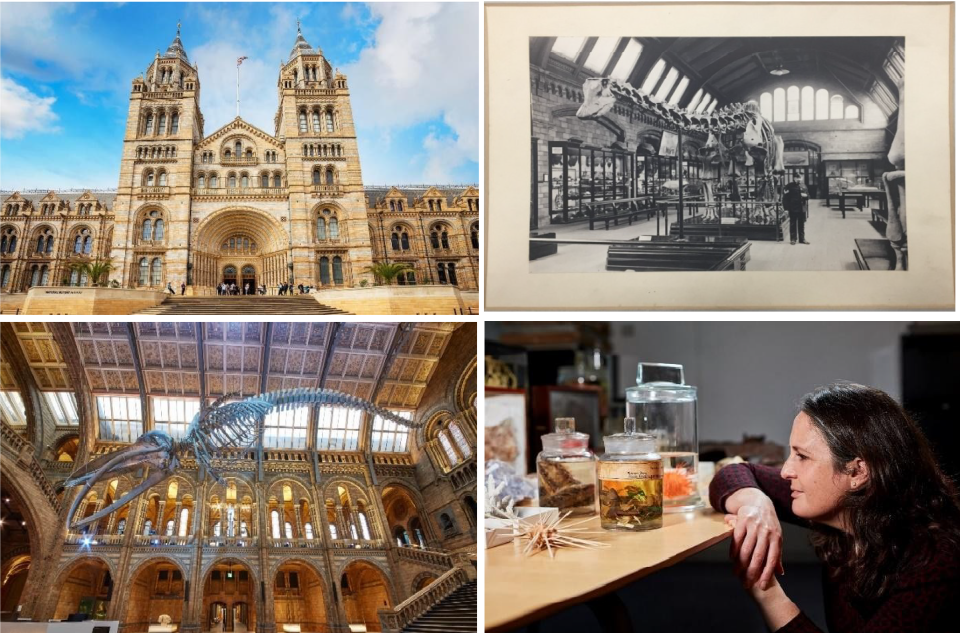
High level of information
In this section, we would like to find out your preferences regarding the future of the Natural History Museum. Please carefully read the following information presented about the Museum.
The Natural History Museum, in South Kensington London, is the second most popular free UK visitor attraction, with 5.7 million visits in 2023. A finalist for the Museum of the Year in 2023, the Museum is consistently one of the top two most visited indoor attractions in the UK and one of the top five most visited museums in the world.
The Museum’s vision is of a future where both people and the planet thrive; this involves using its unique collections and world-class expertise to help tackle the biggest challenges facing the world today and create advocates for the planet.
It is home to the largest and most important natural history collection in the world, with 80 million specimens, covering all groups of animals, plants, minerals and fossils from across the world, ranging from microscopic cells to dinosaur skeletons. Here you can find giant dinosaur fossils, items from the voyages of discovery by Charles Darwin and James Cook, material from the extinct dodo and meteorites from Mars.
As well as a world-class visitor attraction, the Natural History Museum is also a leading science research centre, employing some 370 scientists and 150 PhD students. They care for and develop the museum’s unique collection of more than 80 million specimens or items, gathered over 400 years.
The Museum’s research provides deep understanding and practical solutions for today’s challenges, including the search for resources for a green future, the battle against parasitic disease, the need to restore nature, and new ways of involving society in understanding and connecting with nature.
The museum is also involved in a range of national and local community and outreach programmes designed to engage diverse audiences, promote sustainability, and encourage the appreciation of nature and science.
Low level of information
In this section, we would like to find out your preferences regarding the future of the Natural History Museum. Please carefully read the following information presented about the Museum.
The Natural History Museum, in South Kensington London, is the second most popular free UK visitor attraction. It is home to the largest and most important natural history collection in the world and is a leading science research centre. The Museum is also involved in a range of community and outreach programmes.
Cheap talk script
Studies have shown that in surveys such as this one, when people are asked about how much they would be willing to pay for something, they sometimes give answers that are higher than what they would actually pay in real life. This is because it can be hard to imagine paying real money when you’re only answering a hypothetical question. So please think about this question as if it were a real decision and you were making an actual donation.
Please consider thoroughly how the annual extra costs will affect your budget and do not agree to pay an amount if you think you cannot afford it, have other things to spend your money on, or other ways to fund conservation and research. Also, note that this question is just about the work of the Natural History Museum and not about other museums.
Oath script
Do you feel you can promise to answer the questions that will follow as truthfully as possible?
- Yes, I promise to answer the questions as truthfully as possible
- No, I cannot promise this
Policy news
In recent decades, the Natural History Museum has faced the sector-wide impact of the Covid-19 pandemic as well as substantial reductions in government funding. At the same time, visitor numbers have surged, reaching 5.7 million visits in 2023, significantly increasing maintenance and operational costs.
The Museum does not currently charge an entry fee, relying instead on voluntary donations, commercial activities, and sponsorships to supplement government funding. However, these efforts have not fully bridged the funding gap, leaving the Museum increasingly vulnerable to financial strain.
If government funding were to cease, the Museum would face serious financial hardship, potentially requiring drastic measures such as the introduction of mandatory entry fees. Survey respondents are encouraged to consider these challenges when determining their willingness to support the Museum, as low levels of support could directly impact its future.
Willingness to pay question framing
Please think about how much the continued existence of the Natural History Museum is worth to you, if anything. This includes the Museum’s collections, conservation work, scientific research, and community and outreach programmes. What is the maximum you would be willing to pay as an annual donation to secure the future of the Museum’s collections, conservation work, and community programmes?
Experiment 2: Natural History Museum
In this section, we would like to find out your preferences regarding the future of the Natural History Museum. Please carefully read the following information presented about the Museum.
The Natural History Museum, in South Kensington London, is the second most popular free UK visitor attraction, with 5.7 million visits in 2023. A finalist for the Museum of the Year in 2023, the Museum is consistently one of the top two most visited indoor attractions in the UK and one of the top five most visited museums in the world.
The Museum’s vision is of a future where both people and the planet thrive; this involves using its unique collections and world-class expertise to help tackle the biggest challenges facing the world today and create advocates for the planet.
It is home to the largest and most important natural history collection in the world, with 80 million specimens, covering all groups of animals, plants, minerals and fossils from across the world, ranging from microscopic cells to dinosaur skeletons. Here you can find giant dinosaur fossils, items from the voyages of discovery by Charles Darwin and James Cook, material from the extinct dodo and meteorites from Mars.
As well as a world-class visitor attraction, the Natural History Museum is also a leading science research centre, employing some 370 scientists and 150 PhD students. They care for and develop the museum’s unique collection of more than 80 million specimens or items, gathered over 400 years.
The Museum’s research provides deep understanding and practical solutions for today’s challenges, including the search for resources for a green future, the battle against parasitic disease, the need to restore nature, and new ways of involving society in understanding and connecting with nature.
The museum is also involved in a range of national and local community and outreach programmes designed to engage diverse audiences, promote sustainability, and encourage the appreciation of nature and science.
Willingness to pay question framing – one-off donation
Please think about how much the continued existence of the Natural History Museum is worth to you, if anything. This includes the Museum’s collections, conservation work, scientific research, and community and outreach programmes. What is the maximum you would be willing to pay as a one-off donation to secure the future of the Museum’s collections, conservation work, and community programmes? Note that you would only pay this donation once and never again.
Willingness to pay question framing – monthly donation for 3 years
Please think about how much the continued existence of the Natural History Museum is worth to you, if anything. This includes the Museum’s collections, conservation work, scientific research, and community and outreach programmes. What is the maximum you would be willing to pay as a monthly donation for the next 3 years to secure the future of the Museum’s collections, conservation work, and community programmes? Note that this is an amount you will pay each month for a period of 3 years.
Willingness to pay question framing – annual donation for 3 years
Please think about how much the continued existence of the Natural History Museum is worth to you, if anything. This includes the Museum’s collections, conservation work, scientific research, and community and outreach programmes. What is the maximum you would be willing to pay as an annual donation for the next 3 years to secure the future of the Museum’s collections, conservation work, and community programmes? Note that this is an amount you will pay each year for a period of 3 years.
Willingness to pay question framing – monthly donation indefinitely
Please think about how much the continued existence of the Natural History Museum is worth to you, if anything. This includes the Museum’s collections, conservation work, scientific research, and community and outreach programmes. What is the maximum you would be willing to pay as a monthly donation to secure the future of the Museum’s collections, conservation work, and community programmes?
Willingness to pay question framing – annual donation indefinitely
Please think about how much the continued existence of the Natural History Museum is worth to you, if anything. This includes the Museum’s collections, conservation work, scientific research, and community and outreach programmes. What is the maximum you would be willing to pay as an annual donation to secure the future of the Museum’s collections, conservation work, and community programmes?
Willingness to pay question framing – annual tax increase for 3 years
Please think about how much the continued existence of the Natural History Museum is worth to you, if anything. This includes the Museum’s collections, conservation work, scientific research, and community and outreach programmes. What is the maximum you would be willing to pay as an increase to your annual taxes for the next 3 years to secure the future of the Museum’s collections, conservation work, and community programmes? Note that this is an amount you will pay each year for a period of 3 years.
Experiment 3: Museum of Liverpool
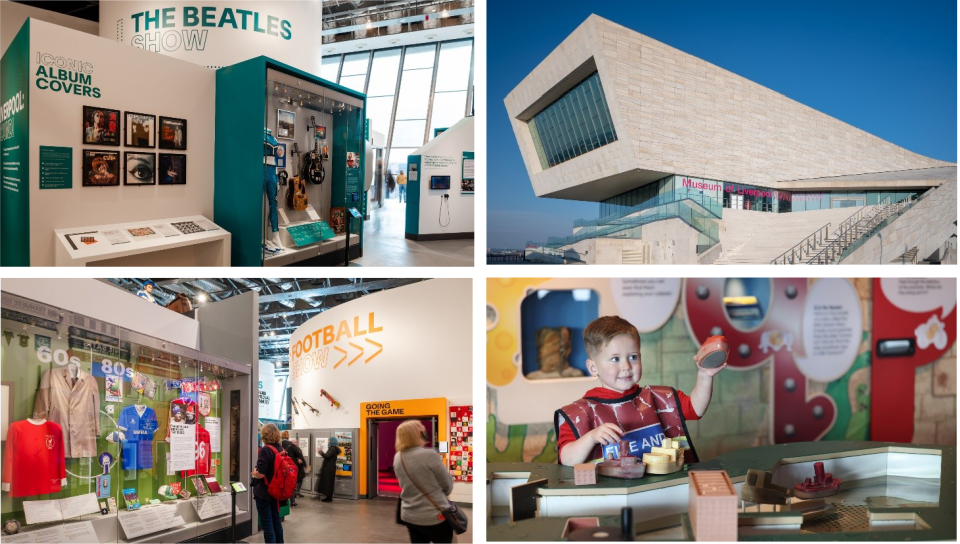
In this section, we would like to find out your preferences regarding the future of the Museum of Liverpool. Please carefully read the following information presented about the Museum.
The Museum of Liverpool tells the story of the City of Liverpool – a city that has shaped the world, celebrating its people, industries and cultural legacy. With interactive displays, digital media and engaging storytelling, the Museum of Liverpool provides an in-depth look at the city’s past and present through items often donated by the Liverpool communities themselves.
The Museum highlights Liverpool’s music scene, from the Beatles to contemporary artists, celebrating the city’s enduring influence on global pop culture. Its sports displays honour Liverpool and Everton football clubs, reflecting the city’s deep passion for the game.
Visitors can also explore Liverpool’s maritime and industrial heritage, showcasing how its port and industries helped shape modern Britain. The land transport collection includes more than 200 vehicles, including an original railway carriage from the historic Liverpool Overhead Railway.
The People’s Republic gallery focuses on the everyday lives of Liverpudlians, featuring personal stories, community voices and objects that illustrate the city’s social history. The Museum also addresses Liverpool’s complex history, including its role in the transatlantic slave trade, through thought-provoking exhibits designed to promote awareness and discussion.
The regional archaeology collection includes objects which date from the Mesolithic to the modern periods, and provide evidence about how life in Merseyside has changed through its long history. The wide-ranging collection reflects the changing landscape, settlement-pattern, lifestyles and experiences of people living in the region over the last 10,500 years.
For families with children, the Museum features Little Liverpool, a hands-on gallery designed especially for younger visitors. This interactive space allows children under six to explore and play in a miniature version of the city, engaging with water play, building activities and sensory experiences.
Museum of Liverpool is also the base for House of Memories – an award-winning, museum-led programme that helps people living with dementia and their loved ones through conversations, training and support.
Welcoming nearly 700,000 visitors in 2023, the Museum of Liverpool ensures that visitors from all backgrounds can experience and appreciate Liverpool’s rich cultural identity from its unmissable home on the city’s iconic waterfront at no cost.
Willingness to pay question framing – household version
Please think about how much the continued existence of the Museum of Liverpool is worth to you and your household, if anything. This includes the Museum’s collections, conservation work, and community and outreach programmes. What is the maximum you would be willing to pay on behalf of your household as an annual donation to secure the future of the Museum’s collections, conservation work, and community and outreach programmes?
Willingness to pay question framing – individual version
Please think about how much the continued existence of the Museum of Liverpool is worth to you, if anything. This includes the Museum’s collections, conservation work, and community and outreach programmes. What is the maximum you would be willing to pay as an annual donation to secure the future of the Museum’s collections, conservation work, and community and outreach programmes?
Experiment 3: World Museum (Liverpool)
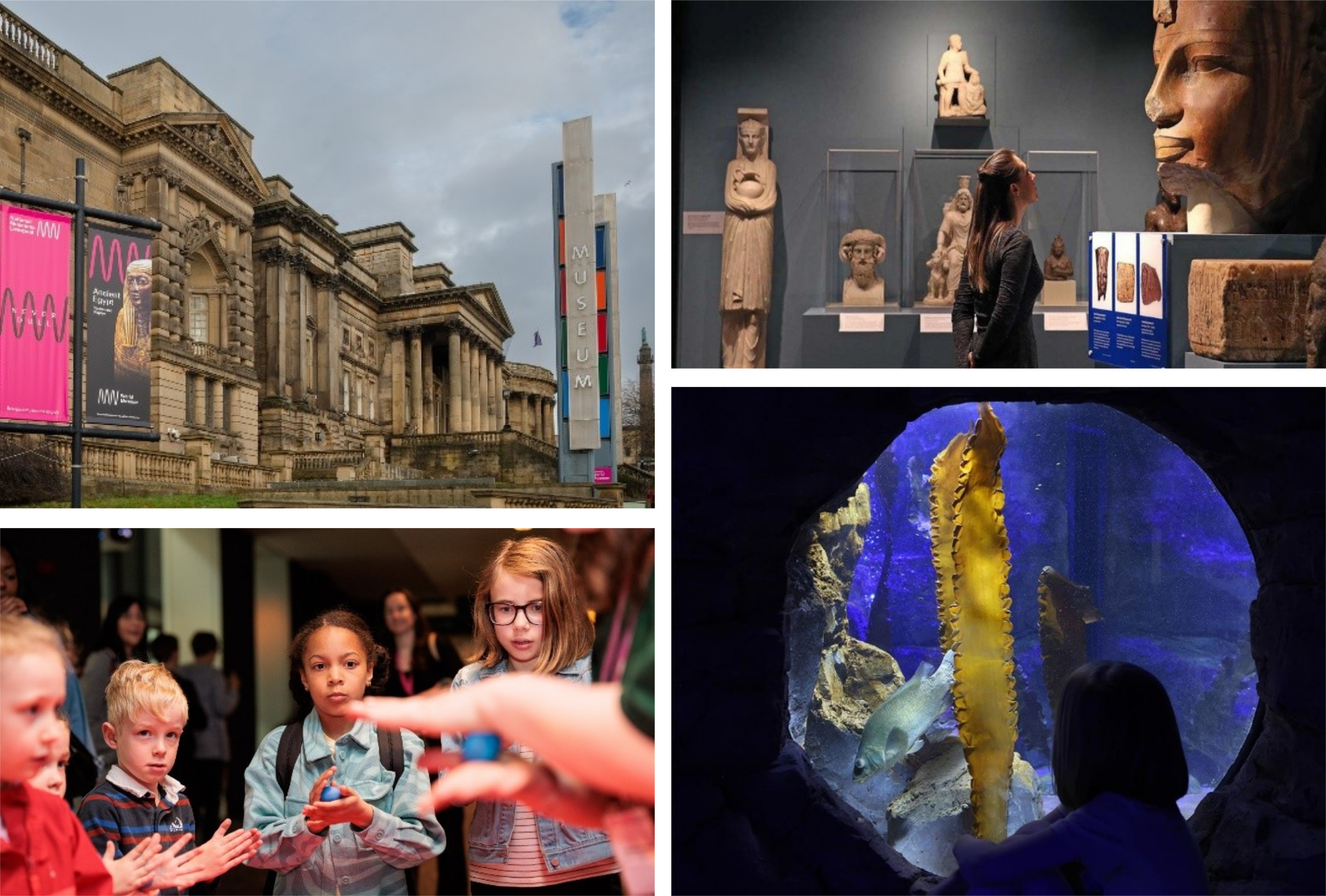
In this section, we would like to find out your preferences regarding the future of Liverpool’s World Museum. Please carefully read the following information presented about the Museum.
Liverpool’s World Museum is a dynamic centre for exploration, bringing science, culture and history to life through its diverse and globally significant collections. From ancient civilisations to space and time, the Museum offers immersive experiences for visitors of all ages.
The Museum holds over 1.7 million artefacts in its collection from across the ancient world including Egyptian, Greek, Roman and Anglo-Saxon items. The Museum’s ancient Egypt collection – the UK’s largest outside of the British Museum – contains around 20,000 objects, including mummified people, sarcophagi and everyday artefacts from ancient times. Additionally, the Museum’s world cultures galleries feature artefacts from Africa, Asia and the Americas, offering insight into diverse traditions, beliefs and histories.
Its natural history displays include preserved specimens of rare and extinct species, an extensive collection of minerals and fossils, and interactive exhibits that explore the evolutionary history of life on Earth. The botany section showcases plant specimens from around the world, including examples of rare and endangered flora. The aquarium and bug house provide close-up encounters with marine life and insects from across the globe, offering insights into biodiversity and conservation efforts.
World Museum aims to inspire curiosity and learning, engaging visitors through hands-on exhibits, live science demonstrations and interactive galleries. One of the highlights of the Museum is its planetarium, which offers visitors the opportunity to journey through space with expert-led shows on astronomy and space exploration.
For young visitors, World Museum offers a variety of engaging activities, including the Clore Natural History Centre. Here, children can touch real animal specimens and fossils and take part in interactive workshops and storytelling sessions. With almost 56,000 school children visiting World Museum in 2023, it has a varied and exciting schools programme for local, national and international learners.
Its community and outreach programmes also include the recently launched Cuerpos del Tiempo (Bodies of Time) project, which works with Latin American communities in north-west England to reshape the interpretation of the Latin American collections at World Museum.
Welcoming nearly 700,000 visitors in 2023, the World Museum provides free access to a wealth of knowledge, making science, history and culture accessible to all.
Willingness to pay question framing – household version
Please think about how much the continued existence of the Liverpool’s World Museum is worth to you and your household, if anything. This includes the Museum’s collections, conservation work, and community and outreach programmes. What is the maximum you would be willing to pay on behalf of your household as an annual donation to secure the future of the Museum’s collections, conservation work, and community and outreach programmes?
Willingness to pay question framing – individual version
Please think about how much the continued existence of Liverpool’s World Museum is worth to you, if anything. This includes the Museum’s collections, conservation work, and community and outreach programmes. What is the maximum you would be willing to pay as an annual donation to secure the future of the Museum’s collections, conservation work, and community and outreach programmes?
Experiment 4: Natural History Museum
Full asset description
In this section, we would like to find out your preferences regarding the future of the Natural History Museum. Please carefully read the following information presented about the Museum.
The Natural History Museum, in South Kensington London, is the second most popular free UK visitor attraction, with 5.7 million visits in 2023. A finalist for the Museum of the Year in 2023, the Museum is consistently one of the top two most visited indoor attractions in the UK and one of the top five visited museums in the world.
The Museum’s vision is of a future where both people and the planet thrive; this involves using its unique collections and world-class expertise to help tackle the biggest challenges facing the world today and create advocates for the planet.
It is home to the largest and most important natural history collection in the world, with 80 million specimens, covering all groups of animals, plants, minerals and fossils from across the world, ranging from microscopic cells to dinosaur skeletons.
This includes giant dinosaur fossils, items from the voyages of discovery by Charles Darwin and James Cook, material from the extinct dodo and meteorites from Mars.
As well as a world-class visitor attraction, the Natural History Museum is also a leading science research centre, employing some 370 scientists and 150 PhD students. They care for and develop the museum’s unique collection of more than 80 million specimens or items, gathered over 400 years.
The Museum’s research provides deep understanding and practical solutions for today’s challenges, including the search for resources for a green future, the battle against parasitic disease, the need to restore nature, and new ways of involving society in understanding and connecting with nature.
The museum is also involved in a range of national and local community and outreach programmes designed to engage diverse audiences, promote sustainability, and encourage the appreciation of nature and science.
Existence value marginal change description
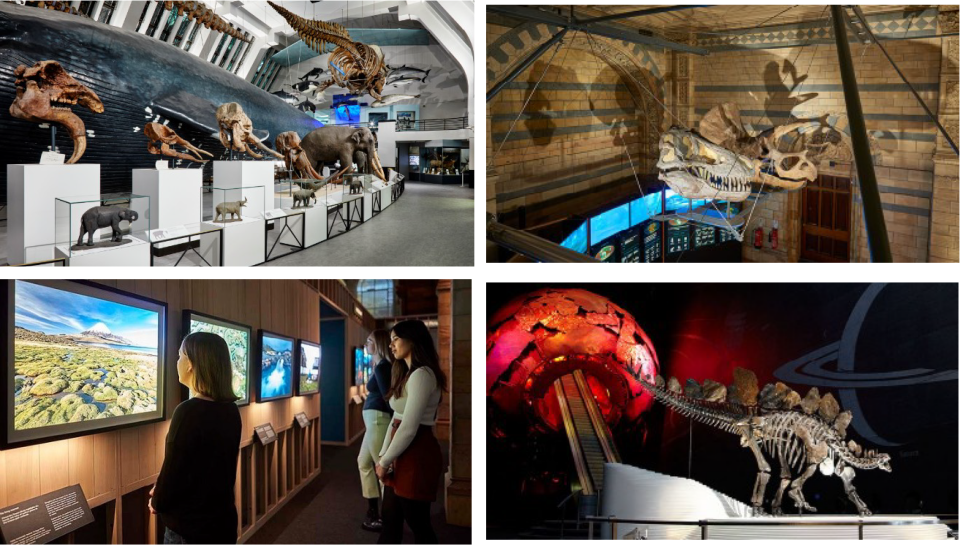
The Natural History Museum is currently divided into four main thematic zones, with each zone offering a unique way to engage with the natural world, combining education, research, and entertainment. These four zones include:
- Red Zone: Focusing on showcasing the Earth’s physical forces and geology, including exhibits of rocks, minerals, gemstones, and plants.
- Blue Zone: Exploring the diversity of life on the planet, including exhibits of dinosaurs and marine mammals.
- Green Zone: Focusing on showcasing the planet’s biodiversity, ecology, and collections of birds and minerals.
- Orange Zone: Showcasing natural history research and fieldwork, whilst also providing spaces for relaxation and contemplation.
The Blue Zone
One of these zones – the Blue Zone – houses exhibits focusing on life forms, including dinosaurs, mammals, and marine life. Within this zone, there are four major galleries, each with its own thematic focus, including:
- Dinosaurs Gallery. The iconic display of dinosaur skeletons including parts of the first dinosaurs ever discovered and animatronic models, including the famous T. rex.
- Marine Invertebrates, Fish, Amphibians and Reptiles Gallery and Corridor. Displays a wide range of species from aquatic and amphibious environments.
- Mammals Gallery and Whale Hall. Features land mammals alongside the spectacular life-sized model of a blue whale and other marine mammals.
- Images of Nature Gallery. Showcasing more than 100 images spanning 350 years from the Museum’s extensive art collection to show how artists and scientists view the natural world.
The Blue Zone also provides access to the Museum gardens which have recently been redesigned to provide an educational outdoor urban space for wildlife and people.
Willingness to pay question framing
Please think about how much the continued existence of the Blue Zone in the Natural History Museum means to you, if anything.
What is the maximum you would be willing to pay, as an annual donation towards a designated continuance fund (and on top of any future fees you pay to enter the museum), to avoid the permanent and immediate closure of [Randomise between: marginal change of “2” and “4”] of the galleries in the Blue Zone listed above?
Altruistic value marginal change description

The Natural History Museum is involved in a range of national and local community and outreach programs designed to engage diverse audiences, promote sustainability, and encourage the appreciation of nature and science. These initiatives often focus on education, conservation, and community science.
Examples of these initiatives are:
- Free and subsidised accessible activities, including workshops, shows, tours, talks and other learning resources for around 220,000 schoolchildren and families each year, helping young learners explore topics about nature and natural history such as biodiversity, climate change and evolution as well as meeting scientists, exploring the collections and the gardens.
- Generation Hope, a week of activity that empowers young people to become advocates for the planet by fostering collaboration between scientists, activists, and creatives to explore solutions to the climate crisis.
- A free identification and advisory service to answer queries about insects, fossils, plants and other wildlife and natural history specimens found in the UK.
- Free-to-take-part community science projects, which encourage people to get out into nature and take actions such as recording observations of wildlife and collecting samples to help gather data and grow a deeper understanding of the natural world.
Willingness to pay question framing
Please think about how much the continued delivery of the Natural History Museum’s community and outreach programs are worth to you, if anything.
Imagine a scenario in which the museum’s free workshops and learning resources, currently provided to around 220,000 schoolchildren per year, are instead available to [Randomise between: “110,000” & “zero”] school children per year due to cuts in funding.
What is the maximum you would be willing to pay, as an annual donation towards a designated community and outreach fund, to avoid the cut-backs in the community program summarised above so that it can continue to operate as it is now? This donation would be on top of any future fees you pay to enter the museum.
Bequest value margin change description
The Natural History Museum’s ability to maintain its facilities is crucial to its ongoing mission, ensuring the preservation of its historic building, its vast collection, and the overall visitor experience. Maintenance and preservation activities that are key to the ongoing operations of the museum include:
- Care and conservation of the museum’s collections.
- Preservation of the internal and external structures of the museum’s building.
- Maintenance of IT and technological systems.
- Upkeep of the museum’s outdoor spaces and gardens.
- Sustainability initiatives focused on reducing waste and carbon emissions.
- Emergency and corrective maintenance** to make repairs after unexpected issues and damages.
The absence of maintenance and preservation activities will, over time, result in a deterioration in the size, range, and quality of the museum’s collections as well as a worsening in the condition of the museum’s facilities and buildings.
Maintenance and preservation activities will therefore be vital in the years to come to ensure the Museum’s large natural history collection remains freely accessible to future generations of visitors.
Willingness to pay question framing
Please think about how much continued access to the Natural History Museum for future generations is worth to you, if anything.
Assume that the ongoing maintenance of the Natural History Museum is funded and guaranteed for a set number of years into the future. What is the maximum you would be willing to pay, as an annual donation towards a designated maintenance fund, to avoid a reduction in the duration of the museum’s guaranteed maintenance from 60 years to [Randomise between: “50” & “30”] years? This donation would be on top of any future fees you pay to enter the museum.
Appendix 4: References
Allan, Corey and Grimes, Arthur and Kerr, Suzi, Value and Culture (2013). Motu Working Paper No. 13-09. Available at SSRN: https://ssrn.com/abstract=2319202.
Arber et al. (2023) ‘Measuring the Value of the Digital Offer of Galleries and Museums’. https://www.gov.uk/government/publications/measuring-the-value-of-the-digital-offer-of-galleries-and-museums. GOV.UK
Ardeshiri, A., J. Swait, E. C. Heagney, and M. Kovac. (2019) ‘Willingness-to-Pay for Coastline Protection in New South Wales: Beach Preservation Management and Decision Making’. Ocean & Coastal Management 178 (1 August 2019): 104805. https://doi.org/10.1016/j.ocecoaman.2019.05.007.
Ateca-Amestoy, Victoria, Anna Villarroya, and Andreas Joh Wiesand. (2021) ‘Heritage Engagement and Subjective Well-Being in the European Union’. Sustainability 13, no. 17 1–16.
Bakhshi et al. (2015). ‘Economic Value in Cultural Institutions’, Culture Forum North. https://cultureforumnorth.co.uk/resources/economic-value-in-cultural-institutions/.
Bille, Trine. (2024): ‘The Values of Cultural Goods and Cultural Capital Externalities: State of the Art and Future Research Prospects’. Journal of Cultural Economics 48, no. 3 347–65. https://doi.org/10.1007/s10824-024-09503-3.
Bithas, Kostas, Dionysis Latinopoulos, Charalampos Mentis, and Theodoros Chatzivasileiadis. (2023) ‘Reshaping Preferences over Coastal and Marine Environment. Evaluating Temporal Effects on Preferences Raised by Information Campaigns’. Ocean & Coastal Management 243 106740. https://doi.org/10.1016/j.ocecoaman.2023.106740.
Bliem, M. and Getzner, M. (2012). ‘Willingness-to-pay for river restoration: differences across time and scenarios’. Environmental economics and policy studies. 14(3), pp.241–260.
Bliem, M., Getzner, M. and Rodiga-Laßnig, P. (2012). ‘Temporal stability of individual preferences for river restoration in Austria using a choice experiment’. Journal of environmental management. 103, pp.65–73.
Brooks, Arthur. (2004) ‘Do People Really Care About the Arts for Future Generations?’ Journal of Cultural Economics 28, no. 4 275–84.
Brouwer, R. (2006). ‘Do stated preference methods stand the test of time? A test of the stability of contingent values and models for health risks when facing an extreme event’. Ecological economics. 60(2), pp.399–406.
Choi, A.S., Ritchie, B.W., Papandrea, F. and Bennett, J. (2010). ‘Economic valuation of cultural heritage sites: A choice modeling approach’. Tourism management. 31(2), pp.213–220.
| Colwill (2024) ‘The Wellbeing Impact of Cultural Heritage on England’s Economy | Historic England’. https://historicengland.org.uk/research/current/social-and-economic-research/culture-and-heritage-capital/life-satisfaction/. |
Concu, G. (2004) ‘A Choice Modelling Approach to Investigate Biases in Individual and Aggregated Benefit Estimates Due to Omission of Distance’. Working Paper CRENoS. https://ideas.repec.org//p/cns/cnscwp/200412.html.
Davidson, Marc D. (2013) ‘On the Relation between Ecosystem Services, Intrinsic Value, Existence Value and Economic Valuation’. Ecological Economics 95 171–77. https://doi.org/10.1016/j.ecolecon.2013.09.002.
de la Torre (ed) (2002) ‘Assessing the Values of Cultural Heritage: Research Report’. The Getty Conservation Institute.
Entem, Alicia, Patrick Lloyd‐Smith, Wiktor (Vic) L. Adamowicz, and Peter C. Boxall (2022). ‘Using Inferred Valuation to Quantify Survey and Social Desirability Bias in Stated Preference Research’. American Journal of Agricultural Economics 104, no. 4: 1224–42.
Fujiwara et al. (2014). ‘Quantifying and Valuing the Wellbeing Impacts of Culture and Sport’. https://www.gov.uk/government/publications/quantifying-and-valuing-the-wellbeing-impacts-of-culture-and-sport. GOV.UK
Fujiwara et al. (2018). ‘The Economic Value of Culture: A Benefit Transfer Study’. https://www.gov.uk/government/publications/the-economic-value-of-culture-a-benefit-transfer-study. GOV.UK
Fujiwara, D. (2015). ‘The Seven Principle Problems of SROI’. Simetrica Ltd, London, UK.
Fujiwara, Daniel, Ricky N. Lawton, and Susana Mourato. (2019) ‘More than a Good Book: Contingent Valuation of Public Library Services in England’. Journal of Cultural Economics 43, no. 4: 639–66. https://doi.org/10.1007/s10824-019-09369-w.
Hanley, Nick, Felix Schläpfer, and James Spurgeon. (2003) ‘Aggregating the Benefits of Environmental Improvements: Distance-Decay Functions for Use and Non-Use Values’. Journal of Environmental Management 68, no. 3: 297–304. https://doi.org/10.1016/S0301-4797(03)00084-7.
Hausman, J. (2012). ‘Contingent Valuation: From Dubious to Hopeless’. The Journal of economic perspectives. 26(4), pp.43–56.
Hull (2011). ‘Assessing the Value and Impact of Museums’. Northern Ireland Assembly https://www.niassembly.gov.uk/assembly-business/committees/2011-2016/committee-for-culture-arts-and-leisure/archive/research-papers/research-papers-2011/assessing-the-value-and-impact-of-museums/.
Iversen, Endre Kildal, Kristine Grimsrud, Yohei Mitani, and Henrik Lindhjem (2022). ‘Altruist Talk May (Also) Be Cheap: Revealed Versus Stated Altruism as a Predictor in Stated Preference Studies’. Environmental & Resource Economics 83, no. 3 681–708.
Johnson, Daniel, James Jackson, and Chris Nash (2013). ‘The Wider Value of Rural Rail Provision’. Transport Policy 29: 126–35. https://doi.org/10.1016/j.tranpol.2013.04.007.
Kaszynska et al. (2022). ‘Scoping Culture and Heritage Capital Report’. https://www.gov.uk/government/publications/scoping-culture-and-heritage-capital-report. GOV.UK
Kim, D. (2011). ‘Saving National Heritage: Cost-Benefit Analysis for Policy Alternatives of Protecting Cape Hatteras Lighthouse in North Carolina’. Journal of Safety and Crisis Management. 1(1), pp.17–34.
Kontoleon, A. and Swanson, T. (2003). ‘The Willingness to Pay for Property Rights for the Giant Panda: Can a Charismatic Species Be an Instrument for Nature Conservation?’ Land economics. 79(4), pp.483–499.
Lawton et al. (2020). ‘Rapid Evidence Assessment: Culture and Heritage Valuation Studies’. https://www.gov.uk/government/publications/rapid-evidence-assessment-culture-and-heritage-valuation-studies. GOV.UK
Lawton et al. (2022a) ‘The Value of Digital Archive Film History: Willingness to Pay for Film Online Heritage Archival Access’. Journal of Cultural Economics 46, no. 1 (1 March 2022): 165–97. https://doi.org/10.1007/s10824-021-09414-7.
Lawton et al. (2022b). ‘Culture & Heritage Capital’. https://www.artscouncil.org.uk/culture-heritage-capital. Arts Council England.
Lawton, Ricky, Christopher C. Moore, Mnjula Bhudiya, Henry Evans, and Sean Doherty (2023). ‘Choice Modelling Research and Methodology for the CHC Programme’. GOV.UK. https://www.gov.uk/government/publications/choice-modelling-research-and-methodology-for-the-chc-programme.
Lawton, Ricky, Daniel Fujiwara, Susana Mourato, Hasan Bakhshi, Augustin Lagarde, and John Davies (2021). ‘The Economic Value of Heritage in England: A Benefit Transfer Study’. City, Culture and Society, Recent developments in urban heritage valuation: Concepts, methods and policy application, 26 100417. https://doi.org/10.1016/j.ccs.2021.100417.
Lopez-Becerra, E. I., and F. Alcon (2021). ‘Social Desirability Bias in the Environmental Economic Valuation: An Inferred Valuation Approach’. Ecological Economics 184: 106988. https://doi.org/10.1016/j.ecolecon.2021.106988.
Maddison, David and Mourato, Susana (2001). ‘Valuing different road options for Stonehenge. Conservation and Management of Archaeological Sites’, 4 (4). pp. 203-212. ISSN 1350-5033
Martínez-Espiñeira, R. (2007). ‘“Adopt a Hypothetical Pup”: A Count Data Approach to the Valuation of Wildlife’. Environmental and Resource Economics 37, no. 2 335–60. https://doi.org/10.1007/s10640-006-9051-x.
Morrison, Mark and Bennett, Jeffrey W. (2004). ‘Valuing New South Wales rivers for use in benefit transfer’. Australian Journal of Agricultural and Resource Economics, Australian Agricultural and Resource Economics Society, vol. 48(4), pages 1-21.
Mouate, Olivier and Muriel Travers. (2024). ‘The Impact of Cultural Amenities on Inter-Urban Location: A Discrete Choice Experiment on French Students’. Journal of Cultural Economics, 1 August. https://doi.org/10.1007/s10824-024-09516-y.
O’Brien, D. (2010). ‘Measuring the Value of Culture: A Report to the Department for Culture Media and Sport’. https://www.gov.uk/government/publications/measuring-the-value-of-culture-a-report-to-the-department-for-culture-media-and-sport. GOV.UK.
Pate, J. and Loomis, J. (1997). ‘The effect of distance on willingness to pay values: a case study of wetlands and salmon in California’. Ecological economics. 20(3), pp.199–207.
Pearson, Leonie J., Yoshihisa Kashima, and Craig J. Pearson (2012). ‘Clarifying Protected and Utilitarian Values of Critical Capital’. Ecological Economics 73 206–10. https://doi.org/10.1016/j.ecolecon.2011.10.027.
| Provins et al. (2005). ‘Valuation of the Historic Environment | Historic England’. https://historicengland.org.uk/images-books/publications/valuation-historic-environment/. |
Sagger and Bezzano (2024). ‘Embedding a Culture and Heritage Capital Approach’. DCMS. https://www.gov.uk/government/publications/embedding-a-culture-and-heritage-capital-approach/embedding-a-culture-and-heritage-capital-approach.
Sagger et al. (2021). ‘Valuing Culture and Heritage Capital: A Framework towards Informing Decision Making’. https://www.gov.uk/government/publications/valuing-culture-and-heritage-capital-a-framework-towards-decision-making. GOV.UK
Throsby, David, Anita Zednik, and Jorge E. Araña (2021). ‘Public Preferences for Heritage Conservation Strategies: A Choice Modelling Approach’. Journal of Cultural Economics 45, no. 3: 333–58. https://doi.org/10.1007/s10824-021-09406-7.
Throsby, David, Vinita Deodhar, Bronwyn Hanna, Bronwyn Jewell, Zena O’Connor, and Anita Zednik (2010). ‘Measuring the Economic and Cultural Values of Historic Heritage Places’. Research Reports, Research Reports,. https://ideas.repec.org//p/ags/eerhrr/107584.html.
Veisten, Knut, Hans Hoen, and Jon Strand (2004). ‘Sequencing and the Adding-up Property in Contingent Valuation of Endangered Species: Are Contingent Non-Use Values Economic Values?’ Environmental & Resource Economics 29, no. 4 419–33.
Vinod, Varsha, Satyaki Sarkar, and Supriyo Roy (2024). ‘An Overview of Key Indicators and Evaluation Tools for Assessing Economic Value of Heritage Towns: A Literature Review’. Journal of The Institution of Engineers (India): Series A 105, no. 3: 783–91.
-
DCMS (2024), ‘Embedding a Culture and Heritage Capital Approach’ ↩
-
A cheap talk script is text added to a contingent valuation survey to remind respondents to treat the hypothetical payment as if it were a real scenario whilst highlighting the risk of over-statement of WTP. An oath script is a text-based prompt added to a contingent valuation survey which asks respondents to commit to answering truthfully before stating their WTP. ↩
-
Policy news is text added to a contingent valuation survey to highlight the policy implications of the valuation scenario being presented. In the context of this study, policy news highlighted the importance of ongoing funding for continued access to museums by the general public. ↩
-
Certainty and consequentiality scripts are follow-up questions used to measure a respondent’s confidence in their stated WTP response, both in terms of perceived certainty in their WTP response and the extent to which their response is consequential (i.e., leads to real-world action). ↩
-
While the Natural History Museum was not included as a case study in the surveys administered for Experiment 3, data from Experiment 1, which used the Natural History Museum as a case study, was used to explore distance-decay effects in a comparable survey context to the two Liverpool-based museums. ↩
-
An oath script is a text-based prompt added to a contingent valuation survey which asks respondents to commit to answering truthfully before stating their WTP. A cheap talk script is text added to a contingent valuation survey to remind respondents to treat the hypothetical payment as if it were a real scenario whilst highlighting the risk of over-statement of WTP. ↩
-
Policy news is text added to a contingent valuation survey to highlight the policy implications of the valuation scenario being presented. In the context of this study, policy news highlighted the importance of ongoing funding for continued access to museums by the general public. ↩
-
Final sample sizes are after excluding substantially incomplete responses but before excluding “speedsters”, defined as those completing the survey in 3 minutes or less (approximately one-third of the estimated completion time). ↩
-
A method in regression analysis for smoothing data by fitting a curve through a scatterplot. ↩
-
Entropy balancing is a re-weighting technique that gives each respondent a weight so that users and non-users are more similar in terms of key characteristics (in the analysis conducted, whether they were college-educated, their household income and whether they live in London). ↩
-
Bequest value refers to value placed on the asset’s preservation for future generations. ↩
-
Altruism value refers to value derived from others benefiting from the asset. ↩
-
Option value refers to value derived from having the option of engaging with the asset in the future. ↩