
How to comply with the Energy Savings Opportunity Scheme (ESOS) phase 4
Published 30 July 2026

© Crown copyright 2026
This publication is licensed under the terms of the Open Government Licence v3.0 except where otherwise stated. To view this licence, visit nationalarchives.gov.uk/doc/open-government-licence/version/3 or write to the Information Policy Team, The National Archives, Kew, London TW9 4DU, or email: psi@nationalarchives.gov.uk.
Where we have identified any third party copyright information you will need to obtain permission from the copyright holders concerned.
This publication is available at https://www.gov.uk/government/publications/comply-with-the-energy-savings-opportunity-scheme-esos-phase-4/how-to-comply-with-the-energy-savings-opportunity-scheme-esos-phase-4
This guidance will help you understand and comply with your obligations under the Energy Savings Opportunity Scheme (ESOS) which was introduced in the UK on 17 July 2014. These obligations are set out in the Energy Savings Opportunity Scheme Regulations 2014, most recently amended in 2026.
About this guidance
This guidance is published by the Environment Agency as the UK scheme administrator for ESOS, on behalf of all the UK regulators which are:
- Environment Agency for organisations whose registered office is in England
- Natural Resources Wales for organisations whose registered office is in Wales
- Northern Ireland Environment Agency for organisations whose registered office is in Northern Ireland
- Scottish Environment Protection Agency for organisations whose registered office is in Scotland
- Secretary of State for Department for Energy Security and Net Zero for organisations whose activities consist wholly or mainly of offshore activities
The Environment Agency as scheme administrator is responsible for guidance, communications, helpdesk and collection of notifications of compliance throughout the UK. The regulators are individually responsible for checking compliance and enforcement activities in relation to qualifying participants. The Department for Energy Security and Net Zero is responsible for developing ESOS policy.
This guidance applies to England, Wales, Scotland, Northern Ireland and Offshore activities.
Contact information is provided in Appendix D.
Stages required for completion of ESOS
1. Identify if your organisation qualifies for ESOS.
2. If it does not, no further action is required, although you can still carry out an ESOS assessment on a voluntary basis. If it does, then:
- identify all parts of your organisation – section 2
- identify the deadlines for completing the ESOS assessment – section 3
- identify your total energy consumption – section 4
- identify your areas of significant energy consumption (at least 95% of your total energy consumption) – section 5
- calculate your energy intensity ratios – section 6
- consider your route to compliance – section 7
- carry out an audit on all your significant energy consumption and identify energy savings opportunities – section 8 and/or
- use an deemed compliance route (ISO 50001) – section 9
- complete the ESOS report, which includes an action plan review, and share details with group undertakings where relevant – section 10
- get the report signed off by board level directors – section 11
- submit a compliance notification of compliance through Managing your Energy Savings Opportunity Scheme (MESOS), the online ESOS compliance and notification system (this notification of compliance contains the required compliance information about your organisation and your ESOS assessment) – section 11
MESOS has replaced the previous Smart Survey system used in the first and second compliance periods. MESOS launched in April 2024 for the third compliance period. It enables users to create an account, and once verified by the Scheme Administrator, to enter, save and submit information.
The deadline for submitting a notification of compliance for the current (fourth) compliance period is 5 December 2027.
3. Following submission of the notification of compliance:
- complete an ESOS action plan by the action plan deadline of 5 December 2028 – section 12
- complete the annual progress updates required for the action plan, in 2029 and 2030 – section 13
1. What ESOS is and who it applies to
ESOS is an energy assessment and energy saving scheme and is established by the Energy Savings Opportunity Scheme Regulations 2014 (ESOS Regulations), as amended. Information on relevant legislation can be found in Appendix D.
The scheme applies to large undertakings and groups containing large undertakings in the UK. An undertaking, as defined in the Companies Act 2006, is:
- a corporate body or partnership
- an unincorporated association carrying on a trade or business, with or without a view to profit
The definition of an undertaking includes partnerships, limited liability partnerships (LLP), joint ventures and in many cases charities. The scheme has resulted in estimated annual efficiency energy savings of 1.65 TWh from buildings, 1.51 TWh savings for industrial processes, and 0.52 TWh of fuel efficiency savings across the ESOS population. (Data is from the ESOS post implementation review.)
Changes were introduced to the scheme through the amendments to the regulations in 2023 from the third compliance period onwards. These are estimated to lead to an additional 28 TWh across all participants over 2024 to 2037, which equates to an estimated £1.12 billion in energy bill savings for participants over that period. (Data is from the Energy Security Bill factsheet: Powers to strengthen the energy savings opportunity scheme). The 2026 Regulations implement some changes which, due to time limitations, were postponed instead of being included in the 2023 Regulations.
ESOS is separate to the Streamlined Energy and Carbon Reporting (SECR) framework which came into force on 1 April 2019 through The Companies (Directors’ Report) and Limited Liability Partnerships (Energy and Carbon Report) Regulations 2018. Many of the organisations in scope of ESOS will also have SECR obligations which apply to all quoted companies, large unquoted companies and large LLP incorporated in the UK and require disclosure in annual reports of specified energy, emissions and energy efficiency action taken. Systems in place to collect and audit energy consumption to meet ESOS obligations and progress with implementation of ESOS recommendations can help organisations to meet their SECR requirements.
If after reading this guide you are still unsure about particular aspects of how to comply with ESOS then you should contact the Environment Agency ESOS helpdesk esos@environment-agency.gov.uk
1.1 Who qualifies for ESOS
You must take part in ESOS if your organisation, or any UK undertakings in your organisation’s group, qualifies as a large undertaking on the qualification date.
The qualification date for the fourth compliance period is 31 December 2026.
A large undertaking is any UK undertaking that meets either one or both of the following conditions:
-
It employs 250 or more people. For a UK registered undertaking, this includes all employees contracted to the undertaking either in the UK or abroad, irrespective of the number of hours for which they are employed. For ESOS purposes, the definition of an employee for a non-UK registered undertaking with a UK registered establishment is someone directly contracted to the undertaking who is subject to income tax in the UK.
-
It has an annual turnover in excess of £44 million and an annual balance sheet total in excess of £38 million.
For more information on the details of these thresholds, including rules around organisations which have recently grown or shrunk, see sections 1.4 to 1.6.
Undertakings that can qualify for ESOS
Examples include:
- limited companies
- public companies
- trusts
- partnerships
- private equity companies or LLP
- unincorporated associations
- not-for-profit bodies (many larger charities will be a corporate body and as such are considered to be an undertaking)
- universities which get more than half their funding from private sources.
- care homes that do not qualify as public bodies
Higher education institutions (HEIs)
Public bodies are generally excluded from the scope of ESOS, as defined in section 1.2. However public body status in the HEI sector does not universally apply. This reflects different funding levels from public and private sources. ESOS has been implemented on the basis that it applies to HEIs that self-declare as private sector and therefore meets the other requirement triggering ESOS qualification.
1.2 Who does not qualify for ESOS
You are not required to participate in ESOS if:
- your undertaking is defined as a public body (contracting authority) in:
- Regulation 3 of the Public Contracts Regulations 2006 in England, Wales and Northern Ireland for the first compliance period, replaced by Regulation 2(1) of the Public Contracts Regulations 2015 for the second and subsequent compliance periods
- Regulation 3 of the Public Contracts (Scotland) Regulations 2012 in Scotland for the first compliance period, replaced by Regulation 2(1) of the Public Contracts (Scotland) Regulations 2015 for the second and subsequent compliance periods
- your undertaking is subject to an insolvency procedure between the qualification date and the compliance date
- you are a small or medium undertaking that is part of a group and the group’s large undertaking has an insolvency procedure applied between the qualification date and the compliance date and there is no other large undertaking in the group
- you do not meet the qualification criteria outlined in section 1.1
Where you are part of a corporate group and only parts of the group fall into these categories then the rest of the group will be required to participate in ESOS if they qualify.
The Public Contracts Regulations broadly state that undertakings are public bodies if:
-
(a) they are established for the specific purpose of meeting needs in the general interest, not having an industrial or commercial character
-
(b) they have legal personality, and
-
(c) they have any of the following characteristics:
-
(i) they are financed, for the most part, by the State, regional or local authorities, or by other bodies governed by public law
-
(ii) they are subject to management supervision by those authorities or bodies, or
-
(iii) they have an administrative, managerial or supervisory board, more than half of whose members are appointed by the State, regional or local authorities, or by other bodies governed by public law
-
In other words, the undertaking must satisfy the criteria described in (a) and (b) and either (c) (i), (ii) or (iii) in order for it to be classed as a public body (contracting authority) excluded from the scope of ESOS.
Whether an undertaking meets all of the requirements to be classed as a public body is not necessarily straightforward to determine. If you are not sure, the Environment Agency recommend you obtain specialist legal or tax advice. For example, many undertakings provide products and services for a fee on a regular basis based on a tender application and these arrangements often develop into commercial trading with consequential tax implications. The Public Contracts Regulations only apply to your undertaking if you award public contracts.
The Public Contracts Regulations define an economic operator as a contractor, a supplier or a service provider who sought, who seek or who would have wished to be a person to whom a public services contract, public works contract or public supply contract was awarded. As such if the undertaking is under contract to a contracting authority it ‘may’ not be classed as a contracting authority as it would not meet the criteria in (a) above in that there is most likely to be an industrial or commercial character associated with the undertaking.
If you claim public body status you must explain how you comply with the Public Contracts Regulations when you submit your notification of compliance. When you notify online that you do not qualify for ESOS you must also keep proof in an evidence pack in case of future enquiries by your regulator.
If a large undertaking only voluntarily complies with the Public Contracts Regulations it must still participate in ESOS.
Where a private organisation is carrying out work as a subcontractor for an undertaking subject to the Public Contracts Regulations they will still need to assess their qualification in the normal way. If they qualify they must participate in the scheme and include energy supplies which are deemed to be their responsibility (see section 4.1).
1.2.1 Overseas organisations with UK energy supplies but no qualifying UK establishment
Where an overseas organisation has UK energy supplies but no UK establishment that employs at least 250 people in the UK it will not need to participate in ESOS unless any other part of its global corporate group activities in the UK meets the ESOS qualifying criteria.
Even if you do not qualify for ESOS, for example if you are a Small or Medium Enterprise (SME), you may wish to complete an ESOS assessment to identify ways to reduce energy consumption. Non-qualifying organisations should publish information on ESOS assessments through their own reports or websites, as MESOS does not enable submissions for voluntary participants.
1.2.2 Zero energy supplies
If you have zero energy supplies (for example, you exceed the financial thresholds to participate in the scheme but have no physical assets or employees using energy), you must still:
- participate in the scheme
- submit a notification of compliance to confirm that, although your undertaking qualifies for the scheme, it has no energy responsibility
See section 4.7 for further details.
1.3 Calculating whether you meet the qualification thresholds
To find out if you qualify, you will need to use your total employee numbers (calculated in accordance with section 1.4), and your turnover and balance sheet totals (see section 1.5) used in your accounts for the financial year ending either:
- on the qualification date of 31 December 2026
- in the 12 months immediately preceding the qualification date of 31 December 2026
These criteria apply to the individual undertakings in your group, so if you report using consolidated accounts you will need to ensure you consider whether any of the individual undertakings is a large undertaking in its own right.
As the rules for being a large undertaking or not require you to have exceeded the threshold, or falling under it for 2 consecutive years, if your undertaking is close to the qualification thresholds, or has grown or shrunk recently, read section 1.6 which includes additional information to help you establish if you qualify.
1.4 Definition of an employee
A person is employed by an undertaking if they are:
- an employee
- an owner or manager
- a partner
An ‘employee’ is a person employed under a contract of service or employment contract. Their contracted hours and status (full time or part time) are irrelevant to their classification as an employee. Other workers, such as those engaged under a contract for services which does not meet the definition of an employment contract, do not fall within the definition of an employee for the purposes of ESOS.
If your undertaking is reporting the number of its employees under the Companies Act 2006 requirements in its annual reports to Companies House, the rules used to calculate the figures for the annual report should be used for the purpose of determining qualification with ESOS.
The number of employees means the average number of people employed by the undertaking in the year, on a monthly basis.
To determine whether you meet the employee criteria you need to work out your average number of employees in the relevant accounting period:
- note the number of people employed by the company for each month of the financial year (whether for the whole month or part of it)
- add together the monthly totals
- divide by the number of months in the financial year
1.4.1 Overseas employees
If you are a UK undertaking which directly (not through a foreign subsidiary) employs people who are based overseas, you must still include them in your employee count.
If you are an overseas undertaking with a UK establishment you should determine your qualification based on the number of UK employees who are eligible to pay income tax in the UK.
1.4.2 Agency workers
You usually do not have to count agency workers as employees but you should check their contracts with a legal advisor to confirm this.
If you sub-contract work then you should talk to HM Revenue & Customs to find out if the sub- contractors are considered your employees.
If you are a sub-contractor and you take on work for an organisation that’s subject to the Public Contracting Regulations, this does not necessarily mean that the work you do for them is excluded from ESOS.
Example of calculating employees
Company A’s financial year runs from 1 April to 31 March the following year.
At the qualification date (31 December 2026) for the fourth ESOS compliance period, Company A’s most recent set of financial statements are those for the year to 31 March 2026.
This means Company A must calculate the number of employees during that period.
On 1 April 2025, Company A had 5 directors and 235 employees. On 10 July 2025 Company A hired 20 more employees.
There were no further changes in employee or director numbers before the end of the year. For 3 months in its financial year (April, May and June) Company A had a total of 240 staff (5 directors plus 235 employees).
For 9 months of the year (July 2025 to March 2026) the company had a total 260 staff (5 directors and 255 employees).
For ESOS purposes, Company A’s number of employees for the year is: [(240 × 3) + (260 × 9)] ÷ 12 = 255.
Company A exceeds the employee threshold of 250 at the qualification date. (However since they have recently gained staff they would need to look back over previous years’ totals to establish if they qualify for ESOS – see section 1.6).
1.5 Meeting the financial conditions
To find out if you meet the financial threshold, you must calculate your turnover and balance sheet total.
You should start by checking your organisation’s annual financial statements, ending on or in the 12 months before 31 December 2026.
If you are unsure whether your corporate group contains a large undertaking, based on financial criteria, each entity in a corporate group may need to look at the accounts required under the Companies Act 2006 Section 394 (duty to prepare individual accounts) or 395 (individual accounts: applicable accounting framework). Where an undertaking is not required under the Companies Act 2006 to produce individual accounts they may need to estimate the annual turnover and annual balance sheet total for the undertaking for a 12-month period including the qualification date.
In summary, ‘turnover’ in relation to an undertaking means the amounts derived from the provision of goods and services falling within the company’s ordinary activities, after deduction of:
- trade discounts
- value added tax
- any other taxes based on the amounts so derived
Most investment companies are simply investment vehicles for their shareholders.
As such, they do not supply goods or services to customers and have no turnover.
Where investment companies do not have turnover and also employ fewer than 250 persons they fall outside the scope of ESOS in their own right. However investment companies with at least one group member that provides goods and or services, and meets the definition of a large undertaking, qualify for ESOS.
This means all the group’s activities within the UK, including the investment companies, fall within the scope of ESOS.
‘Balance sheet total’ means the aggregate of the amounts shown as assets in the company’s balance sheet (that is before deducting both current and long-term liabilities). Therefore it is the gross figure, not the net figure.
1.5.1 Overseas activities
If your undertaking is registered in the UK but directly owns or runs overseas activities which are not overseas registered subsidiaries, then you should include the turnover and balance sheet total contributions of these activities when assessing whether that undertaking is a large undertaking.
If a UK undertaking owns overseas registered subsidiaries then the turnover and balance sheet totals of those companies are not included in the assessment of qualification for the UK undertaking.
1.6 Organisations which are very close to the qualification thresholds or have recently shrunk or grown
If your organisation is very close to the threshold for qualification or has recently grown or shrunk then you may need to look back over several accounting periods to establish if you qualify. This is because the status of an organisation is determined by whether they have maintained their size for at least 2 consecutive accounting periods. The exact wording can be found at Schedule 1 paragraph 11 of the ESOS Regulations 2014 as amended which state:
Where, in any accounting period, an undertaking is a large undertaking (or a small or medium undertaking, as the case may be), it retains that status until it falls within the definition of a small or medium undertaking (or a large undertaking, as the case may be) for 2 consecutive accounting periods.
So for example, an organisation that was over the ESOS qualification threshold every year for the last 10 years and then shrunk in the accounts ending in April 2026 would still qualify for ESOS. This is because it has not maintained the smaller size for 2 consecutive accounting periods, so it is still considered as a large undertaking.
Conversely, if for the last 5 years a company did not meet the qualification thresholds and then has grown in its accounts ending in December 2026 (and now meets the qualification thresholds) then it would not qualify for ESOS. This is because it has not maintained the large undertaking size for 2 consecutive accounting periods, so it is still counted as a small or medium undertaking.
The table shows 2 scenarios of when Company A and Company B met the qualification thresholds over the past 5 year accounting period and if they qualify.
| Company | 2022 | 2023 | 2024 | 2025 | 2026 | Qualified for ESOS |
|---|---|---|---|---|---|---|
| A | Yes | Yes | No | No | Yes | No |
| B | Yes | Yes | No | Yes | No | Yes |
Company A is an SME and is not in scope of ESOS – although it meets the criteria of a large undertaking in the 2023 and 2026 accounting periods, it is not in scope of ESOS because on the qualification date it has not met the large undertaking criteria for 2 consecutive accounting periods.
Company B is a large undertaking and is in scope of ESOS – although it does not fall under the criteria of a large undertaking in 2024 and 2026, it is in scope of ESOS because on the qualification date, the last time it had 2 consecutive accounting periods at the same size it met the large undertaking criteria.
If an undertaking has been fluctuating higher and lower than the threshold year-on-year then it will have to go back as far as is takes to find 2 consecutive years where the same status exists. This will then determine the qualification status for the purpose of ESOS. There is no end date for how far back undertakings may have to go to determine this information (meaning they may have to go back to before the current ESOS compliance period).
If, since the undertaking was formed, it has never maintained 2 consecutive years at the same size then the size in the year it was formed will be what determines the undertakings qualification for the purpose of ESOS. If an undertaking has only been in existence for a few months it will take the average number of employees during that period and consider its finances on a pro-rata basis to determine its qualification status.
The figures relevant for compliance period (phase) 4 are an annual turnover in excess of £44 million and an annual balance sheet total in excess of £38 million.
2. Corporate groupings for qualification and participation
If a corporate group contains at least one undertaking in the UK which meets the qualification conditions, its entire UK operation must take part in ESOS.
A corporate group is defined in the Companies Act 2006. Sections 1158 to 1162 of that Act explain how to identify if an undertaking is a parent to, or subsidiary of, another undertaking.
The highest UK parent of a group is the undertaking which has no parent, or only has parents which are overseas undertakings. All subsidiary undertakings of that highest UK parent are by default part of the same participant for ESOS.
By default the highest UK parent acts as the responsible undertaking – this means it will complete the ESOS assessment and notify the Environment Agency of compliance for itself and subsidiary undertakings. The responsible undertaking is the organisation responsible for ensuring the group complies with the requirements of ESOS.
Another undertaking within the highest parent group can be chosen to act as the responsible undertaking provided all undertakings in the highest parent group agree this in writing, and keep a copy of this agreement in their evidence pack.
Undertakings within a highest UK parent group can disaggregate from one another for the purposes of compliance with ESOS, provided they agree in writing with their highest parent, again keeping a copy of this agreement in their evidence pack.
Undertakings that disaggregate must each report compliance as 2 or more separate participants. See section 2.6 for more details.
If a corporate group contains overseas parent undertakings, the corporate group may consist of more than one highest UK parent group. In this instance, if one highest UK parent group is in scope of ESOS then every other highest UK parent group in the same global group must also participate in ESOS. However, the default in this circumstance is that each highest UK parent group will participate separately.
If the highest UK parent groups within the same corporate group wish to comply as one participant (to ‘aggregate’), all highest parents in those highest parent groups must agree in writing which of them is to be the responsible undertaking in relation to the participant’s compliance with the scheme. See section 2.7 for more details.
2.1 Examples of how to identify the corporate groupings for qualification
Example 1: when all companies are UK undertakings
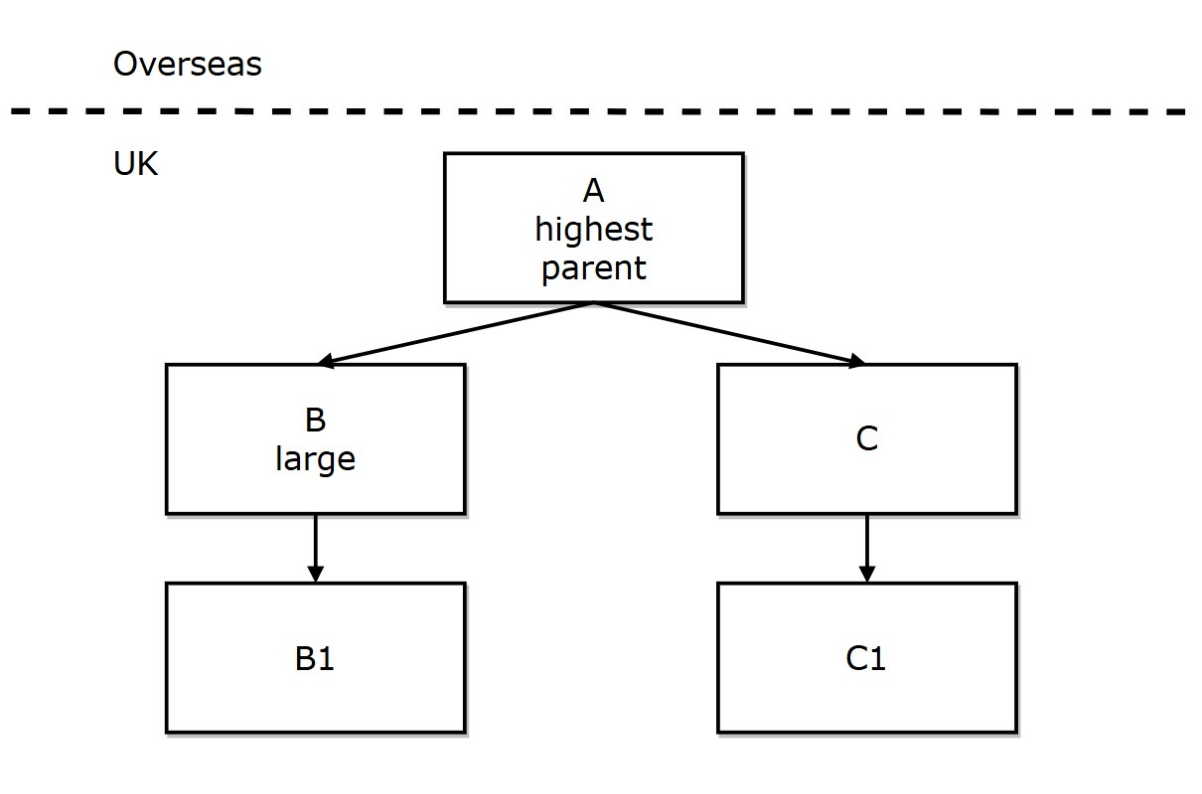
Company A has 2 subsidiaries: B and C. Company B has one subsidiary, B1, and Company C has one subsidiary, C1.
These companies make up a corporate group. All the companies are UK undertakings.
B qualifies as a large undertaking and so all companies within the corporate group must participate in ESOS.
Here, Company A is the highest parent and the companies jointly make up a highest UK parent group since they share a common highest UK parent.
For participation all the companies would form one participant (by default with the highest UK parent reporting), unless one or more of the subsidiary undertakings agree to disaggregate.
Example 2: corporate group with overseas parent
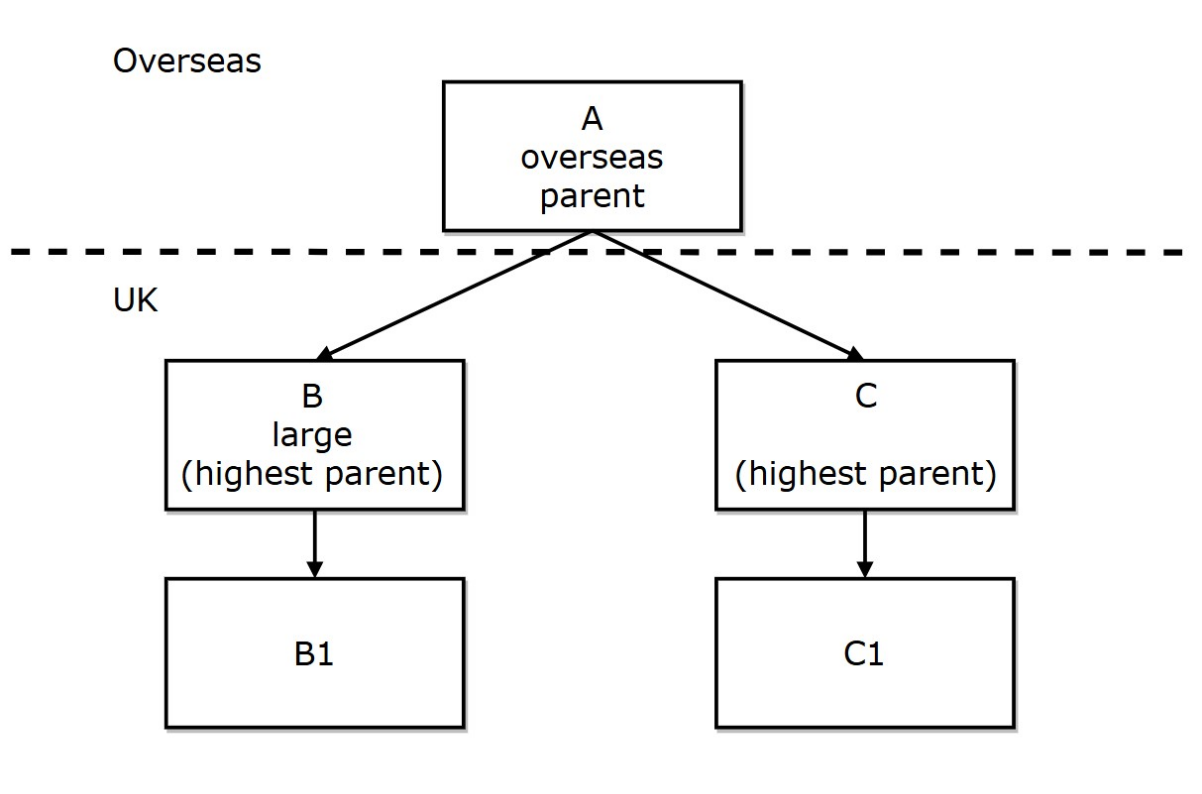
A is an overseas undertaking. Both B and C are highest UK parents since neither has a UK based parent.
In this case there are 2 highest parent groups in the overall corporate group. Even though B is the only large undertaking in the group, C and C1 must comply with ESOS since they are part of the same corporate group as B as they share the same overseas parent.
The fact they are not in the same highest UK parent group as B is irrelevant to their ESOS qualification.
For participation B and B1 would form one participant (highest UK parent group), while C and C1 would form another unless one or more of the subsidiary undertakings agree to disaggregate.
A would not be required to participate because it is not an undertaking in the UK.
Example 3: corporate group with UK establishments and UK large undertakings
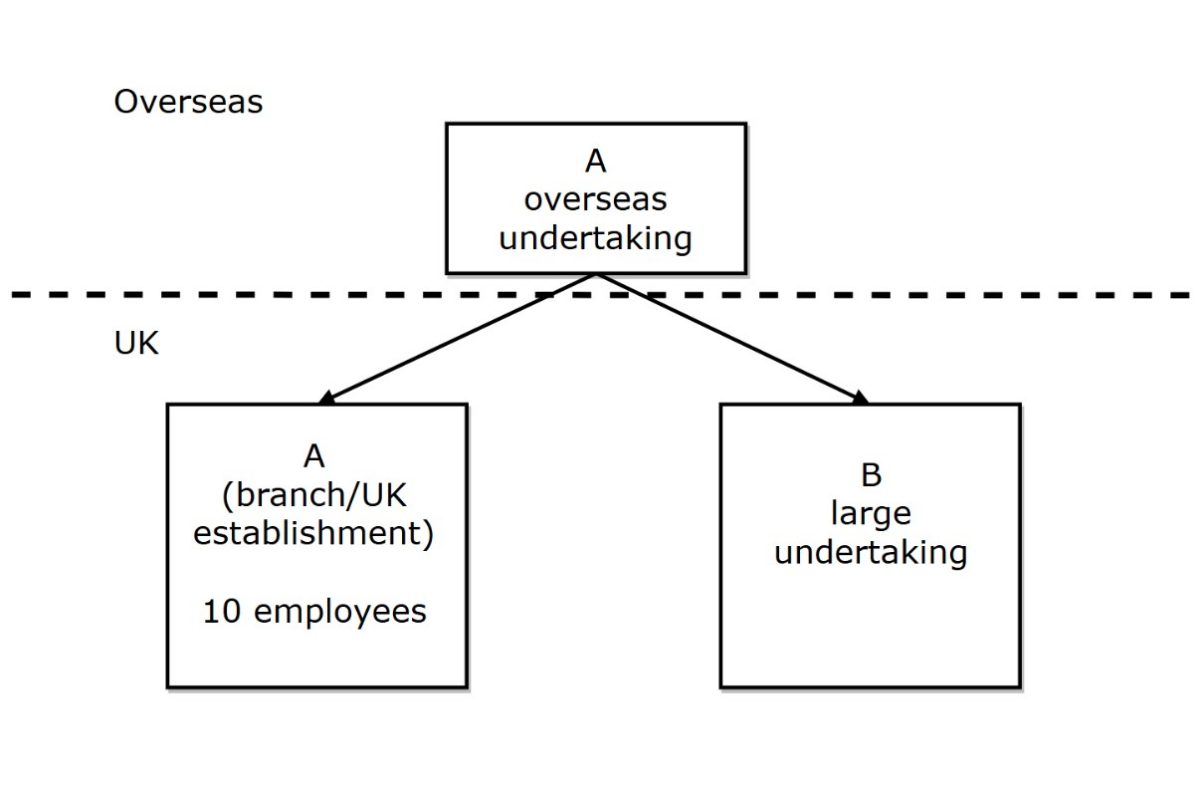
A is an overseas undertaking with a branch in the UK which is registered at Companies House as a UK establishment. As B is a large undertaking both A and B qualify for ESOS, by virtue of having a common overseas parent, and they are both highest UK parents since neither has a UK based parent.
In this case there are 2 highest parent groups in the overall corporate group. They can agree to aggregate or participate separately to meet their obligations under ESOS.
Example 4: corporate group with UK large establishment
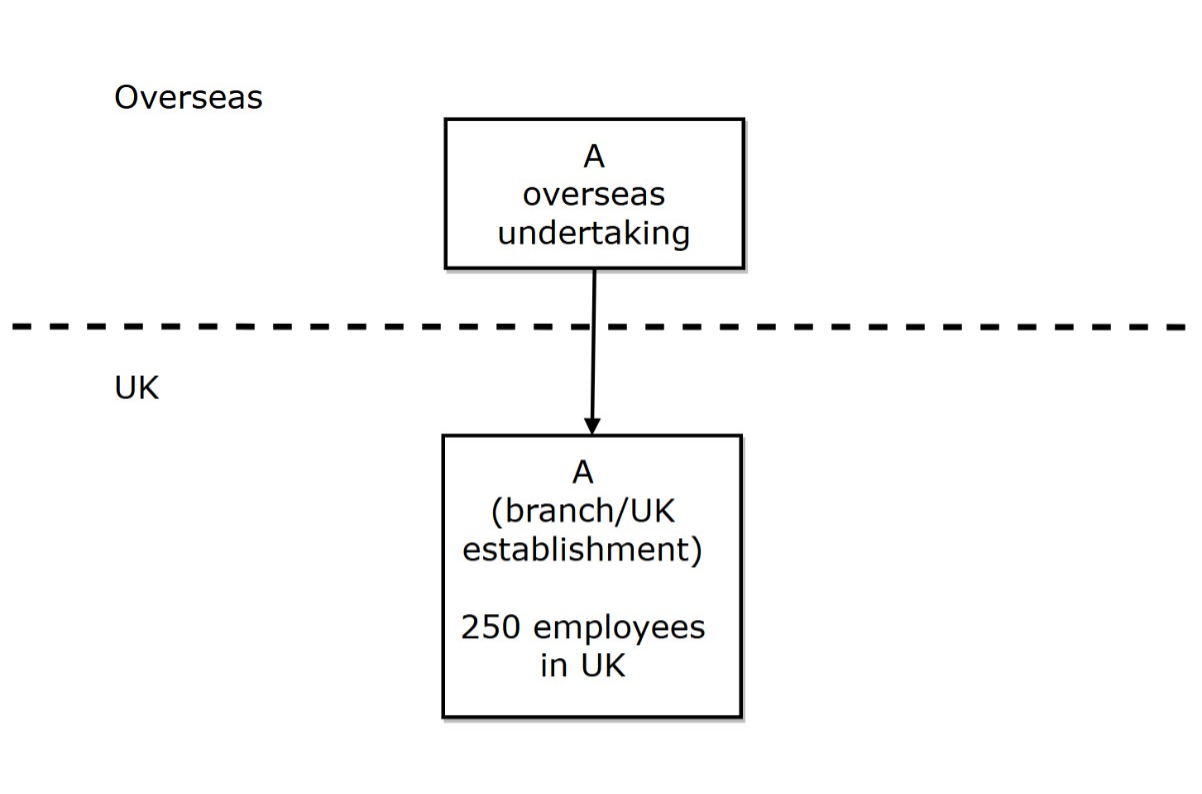
A is an overseas undertaking with a branch in the UK which is registered at Companies House as a UK establishment. A employs 250 staff in the UK. A therefore must comply with ESOS.
2.2 Joint ventures
An undertaking is a parent undertaking to another undertaking (known as a subsidiary undertaking), if any of the following apply:
- it holds a majority of the voting rights in the subsidiary undertaking, or
- it is a member of the subsidiary undertaking and has the right to appoint or remove a majority of its board of directors, or
- it has the right to exercise a dominant influence over the subsidiary undertaking
- by virtue of provisions contained in the undertaking’s articles, or
- by virtue of a control contract, or
- it is a member of the subsidiary undertaking and controls alone, pursuant to an agreement with other shareholders or members, a majority of the voting rights in the undertaking
For the purpose of ESOS qualification assessment and compliance, an investor (undertaking) will only be deemed to be in the same corporate group as a company it invests in where it meets one of the points previously stated.
Joint ventures will need to assess their qualification for ESOS on their own and will participate in the scheme in their own right if they qualify where either:
- no organisation holds a majority of the voting rights in the undertaking
- no organisation is a member of the undertaking and has the right to appoint or remove a majority of its board of directors
- no organisation has the right to exercise a dominant influence over the undertaking, either:
- by virtue of provisions contained in the undertaking’s articles, or
- by virtue of a control contract
- no organisation is a member of the undertaking and controls alone, pursuant to an agreement with other shareholders or members, a majority of the voting rights in the undertaking
In the Companies Act 2006, ‘undertaking’ means either:
- a body corporate or partnership
- an unincorporated association carrying on a trade or business, with or without a view to profit
2.3 Franchises
For the purpose of determining ESOS qualification, franchisors are not grouped with their franchisees (unless they are also a parent undertaking of the franchisee undertaking).
If a franchisor and one or more franchisees all individually qualify and wish to comply as one participant, this is allowed.
This is subject to a written agreement between all parties, and one undertaking becoming the responsible undertaking.
You must keep all details relating to which organisations are participating together in your evidence pack.
2.4 Trusts
Assets held in trust must be included in ESOS if the organisation that is party to the agreement for the supply of energy to the assets qualifies for ESOS.
The qualification of these parties is determined in the normal way.
Where there is no energy supply, the trust assets will not need to be included in an ESOS assessment because trust assets only fall into ESOS if an energy supply agreement is held. The concept of a supply agreement being in place only affects the qualification of trusts for ESOS, all other types of undertaking which meet the qualification criteria will be required to participate in ESOS if they meet the qualification criteria.
The table summarises how responsibility for ESOS compliance for a trust asset is determined.
| Asset responsibility | Arranges the supply of energy to the asset | Qualifies for ESOS in their own right | Include the asset as part of their own ESOS assessment | Include the asset as a separate ESOS notification of compliance |
|---|---|---|---|---|
| Dominant beneficiary | Yes | Yes | Yes | No |
| Alternative Investment Fund Manager (AIFM) | Yes | Yes | No | Yes |
| Operator (Op) | Yes | Yes | No | Yes |
| Trustee (where a AIFM or Op exist) | Yes | Yes | No | Yes |
| Trustee | Yes | Yes | Yes | No |
Trustees, operators, AIFMs and third-party undertakings which have a responsibility to undertake an ESOS assessment in relation to assets held in trust must participate separately in relation to the trust, themselves and any other trust for which they have ESOS responsibilities.
2.5 Private equity firms and private finance initiatives (PFI)
Private equity firms and their portfolio companies are treated in the same way as other undertakings. They will need to establish whether they are legally part of the same corporate group in accordance with Sections 1158 to 1162 of the Companies Act 2006.
If having established the groupings the private equity firm is deemed the parent undertaking and at least one undertaking qualifies then the whole group would need to comply with ESOS. The parent could take responsibility for all the subsidiaries or it could choose to disaggregate them.
Undertakings involved in PFI arrangements will also have to determine whether they are legally part of any corporate group in accordance with the Companies Act 2006 or whether they are a standalone undertaking. If the undertaking qualifies in their own right or is part of a qualifying corporate group, then they will need to participate in ESOS.
Having established whether an undertaking qualifies, the responsibility for energy supplies is determined in the normal manner. See section 4.1 onwards.
2.6 Disaggregation of undertakings from the highest UK parent group
Undertakings within a highest UK parent group can disaggregate from the rest of the group if they wish.
This allows them to participate in ESOS individually, or as smaller groupings. When undertakings choose to disaggregate:
- individual undertakings participating on their own act as their own responsible undertaking
- undertakings participating as smaller groups must agree which one will act as the responsible undertaking
To disaggregate, an undertaking must have an agreement in writing with the highest parent.
The agreement in writing should be made between individuals with management control of the undertakings involved (board directors or equivalent) and copies kept in the evidence pack.
Disaggregation may help you manage ESOS participation, for example, if parts of your group operate separate energy management processes or company finances.
Disaggregation does not exempt subsidiaries from participating in ESOS. Each resulting participant, after disaggregation has been agreed, must fully comply on their own behalf including working out their total energy consumption and ensuring that at least 95% of their energy is covered by a compliance route.
The answers you provide to the questions in the ESOS notification of compliance will show your regulator that disaggregation has occurred.
Where there is no agreement in writing from both parties, the liability for compliance will rest with the organisation that has been determined as the responsible undertaking for the participant containing the highest UK parent in the group (either the highest UK parent itself or another agreed undertaking).
Where agreement in writing for the disaggregation for both parties can be evidenced and one party has not complied then liability for compliance will rest with the responsible undertaking of the participant that has not complied.
2.7 Aggregation of highest UK parent groups
If there’s more than one highest UK parent in a corporate group, the highest UK parent groups can choose to aggregate if they want to comply as one participant. Aggregation between highest UK parents and their undertakings requires the mutual consent of the highest parents.
The aggregation of 2 or more highest UK parent groups does not prevent parts of any of those groups from disaggregating from the larger group for the purposes of compliance, as long all the UK organisations in the overall corporate group comply.
The diagram illustrates aggregation.
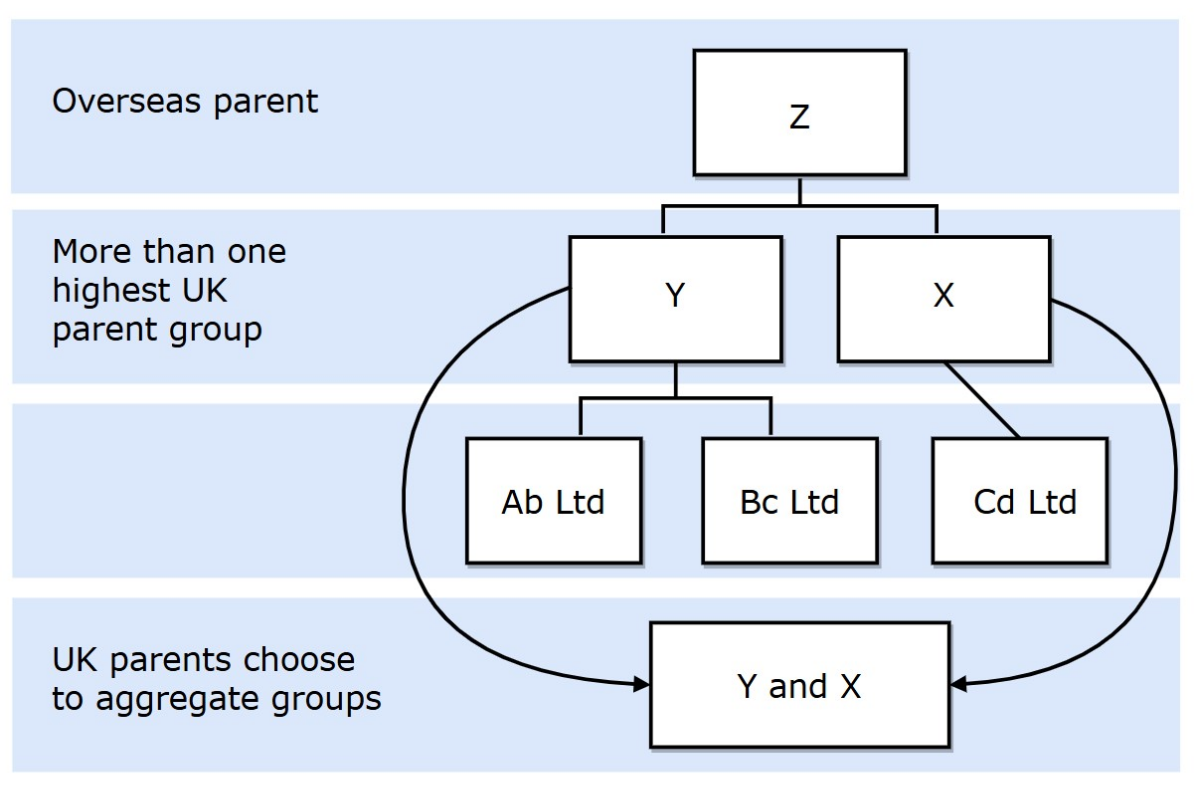
Y and X are both highest UK parent groups If they choose to aggregate one of the group members will take responsibility for the whole group of undertakings.
2.8 Changes to groups of undertakings
If one or more undertakings leave a qualifying group between the ESOS qualification date (31 December 2026 for the fourth compliance period) and the compliance date (5 December 2027 for the fourth compliance period, see section 3.1) the undertakings must still comply with ESOS.
An undertaking can comply:
- with its previous group
- with its new group
- on its own, in the absence of a written agreement with the previous or new group
If a qualifying group purchases an undertaking (between the qualification date and the compliance date) from an organisation that did not qualify for ESOS then the energy supplies do not need to be included in your total energy consumption calculation and will not need to be audited or covered by an alternative route to compliance.
If a qualifying group sells an undertaking to an organisation that did not qualify for ESOS then the energy supplies of the purchaser do not need to be included in ESOS. Only the energy supplies of the undertaking that has been purchased will be subject to ESOS.
3. Deadlines
3.1 Compliance periods and compliance dates
Qualification is based on the status of your organisation on the relevant qualification date. If your organisation qualifies, you must participate in ESOS and notify compliance to the Environment Agency by the last date of each compliance period (‘the compliance date’).
In the third compliance period the compliance date was extended for 6 months to 5 June 2024. However, the fourth compliance period started on 6 December 2023.
| Compliance period | Qualification date | Compliance period | Compliance date |
|---|---|---|---|
| 1 | 31 December 2014 | From 17 July 2014 to 5 December 2015 | 5 December 2015 |
| 2 | 31 December 2018 | From 6 December 2015 to 5 December 2019 | 5 December 2019 |
| 3 | 31 December 2022 | From 6 December 2019 to 5 December 2023 | 5 June 2024 |
| 4 | 31 December 2026 | From 6 December 2023 to 5 December 2027 | 5 December 2027 |
| 5 | 31 December 2030 | From 6 December 2027 to 5 December 2031 | 5 December 2031 |
The ESOS Regulations came into force on 17 July 2014. The first compliance period can only be specified as starting from the date of the regulations coming into force. However, energy audits and alternative compliance routes conducted up to 4 years before the first compliance date (meaning since 6 December 2011) were able to be used towards compliance for the first compliance period.
If you believe that you will not meet the compliance deadline for the fourth compliance period, read section 15 which outlines the steps you need to take.
3.2 Organisational status changes after the qualification date
If your status changes after the qualification date for a compliance period, this will not affect your eligibility for ESOS. You must still comply by the compliance date for the period if you qualified for the scheme on the qualification date.
For example, if you qualify for the fourth compliance period based on your organisational status on 31 December 2026 you must still comply by 5 December 2027 regardless of any changes to your size or structure during the intervening 11 months.
Your status at the next qualification date, 31 December 2030, will determine whether you qualify for the fifth compliance period.
4. Steps for carrying out an ESOS assessment
All organisations that fall under the qualification requirements set out previously are required to complete an ESOS assessment.
Here is a checklist outlining participants requirements with details added on each requirement. You will need to:
- measure total energy consumption
- identify areas of significant energy consumption (if you have chosen to do so)
- calculate your energy intensity ratios
- consider available routes to compliance
- ensure areas of significant energy consumption (or total energy consumption if you have chosen not to identify areas of significant energy consumption) are covered by a route to compliance
- appoint a lead assessor (unless you have zero energy consumption, use less than 40,000kWh of energy or have ISO 50001 energy management system which covers at least 95% of your total energy consumption – see section 7.2)
- carry out energy audits or use a deemed route for compliance
- complete the ESOS report, including the action plan review
- share the ESOS report and any relevant documentation relating to deemed compliance routes, with group undertakings
- get one or more directors to review the findings of the assessment
- submit an ESOS notification of compliance through MESOS
- keep a record in your evidence pack of the ESOS notification of compliance (either by printing it or retaining an electronic copy), a copy of your ESOS report and any other records of the assessment
Changes for participants complying using ISO 50001
Since the third compliance period, all ESOS participants must calculate energy intensity ratios, based on either their total or significant energy consumption calculation, as applicable. Section 4.6 provides information on using estimates if verifiable data is not available during the reference period for the purpose of making the calculation.
4.1 Measuring your total energy consumption
All ESOS participants must calculate their total energy consumption during the reference period (see section 4.4). This must be calculated in a common unit, which can either be an energy unit (such as kWh) or energy spend in pounds sterling. CO2 is not an energy unit.
When considering which units to use for your total energy consumption calculation, you may wish to consider that energy intensity ratios (see section 6) must be calculated in terms of kWh used over the reference period. You may still wish to calculate your total energy consumption in cost terms, for the purpose of identifying, should you elect to do so, your areas of significant energy consumption (see section 5).
The calculation of total energy consumption must be based on the energy supplied to and consumed by the participant’s assets and activities, for example buildings, transport and industrial processes. All energy consumed in the UK by a participant (the qualifying group unless otherwise agreed – see section 2) must be included. This is regardless of whether the asset is held directly by an overseas undertaking within the qualifying group rather than a UK undertaking or UK establishment.
Use the government conversion factors for company reporting to help you measure energy consumption in common units.
If a fuel you use is not listed, you should contact your fuel provider to get information about its properties.
The calculation of total energy consumption will enable you to identify which assets or activities you will subsequently need to ensure are covered by a route to compliance.
All ESOS participants need to report their total energy consumption in their ESOS notification of compliance. If you are audited by your regulator, you may be required to provide the evidence used to determine it.
You are required to cover assets and activities accounting for not less than 95% of your total energy consumption by a route to compliance. See section 5 on identifying areas of significant energy consumption for further details on this.
4.2 How energy is defined
Under ESOS, energy is defined as all forms of energy products, including:
- combustible fuels
- heat (excluding your organisation’s surplus heat from industrial processes)
- renewable energy
- electricity
- fuel used in transport
There are no fuel type exemptions in ESOS.
4.3 What energy supplies to include in your total energy consumption calculation
Energy that is both supplied to and consumed by a participant is in scope of ESOS.
For the purposes of the calculation, you only need to consider input energy. Only include heat where you are importing the heat to your site or process. Where the heat is obtained by converting another source of energy such as gas into heat (on site) measure energy relating to the gas but not the heat produced to avoid double counting.
‘Energy supplied’ means any energy that the participant uses under an agreement with a supplier or third party. This includes energy that is supplied to assets it holds or activities it carries out, and includes buildings, installations, transport and construction activities. It also includes any energy the participant generates itself, except capturing and consuming surplus heat from an industrial process.
Energy used in the gas and oil industry in the UK offshore area is included in ESOS – see the ESOS Regulations 2014, as amended, for the definition of the offshore area if you are unsure.
Only energy consumed in the UK, including the offshore area, by a participant is required to be included. Do not include energy used outside this area unless it involves international travel in which case special rules can apply (see section 4.3.4).
4.3.1 Assets you hold and activities you carry out
Your calculation of total energy consumption must include energy consumed in relation to activities carried out and assets that you held on the qualification date. You may elect to exclude energy consumed by any asset which is no longer held, or any activity which is no longer carried out on the compliance date (which for the purpose of the fourth compliance period is 5 December 2027). Holding an asset does not mean you have to own the asset (for example you may be borrowing, using, renting or leasing the asset).
4.3.2 Buildings
All energy use in buildings is included in ESOS.
In relation to multi-tenanted buildings and landlord-tenant relationships, the responsibility to include energy within a participant’s total energy consumption calculation is determined by whether the participant are both:
- supplied with that energy
- consume that energy by the assets it holds or by the activities it carries out
Where the participant supplies energy to another organisation, that amount of energy should be measured or reasonably estimated and excluded from the calculation of the total energy consumption calculation.
The landlord and tenant should determine between themselves who is responsible for the energy based on the information previously stated. They will need to bear in mind that the organisation with the ability to control the energy use should:
- take responsibility for the energy supply
- audit it to identify energy saving opportunities (if the qualification criteria for ESOS are met)
Keep copies of any notes or emails to support what you exclude from your total energy consumption. This should go in your evidence pack.
Where an ESOS participant moves from one building or asset to another during the compliance period it must include activities carried out in the original building on the qualification date which are being moved to the new building in its total energy consumption calculation.
This applies where the energy is measured or can reasonably be estimated, and includes use of computers, copiers, and manufacturing processes. If it no longer holds the original building on the compliance date, the energy use associated with it may be excluded from the calculation of total energy consumption. For example, this may refer to the heating, ventilation, air conditioning and lifts. However, if it remains in possession of the building on the compliance date, even if unoccupied, it will need to include any energy used in the building in the calculation of total energy consumption.
Where an employee works from home, you do not need to include the energy used by them within their homes in your total energy consumption calculation.
4.3.3 Installations, including combined heat and power plants (CHP)
Large installations generating or using energy are included in your total energy consumption calculation.
In a combined heat and power (CHP) or other power generation process, only the incoming fuel and mains electricity need to be included in the calculation of your total energy consumption for the purpose of ESOS. You do not need to include the heat created and used and electricity created in the calculation.
4.3.4 Transport
Energy consumption from transport is included in ESOS.
You are required to include transport where your organisation is supplied with the fuel for business purposes. However, this does not apply where you procure a transportation service that includes an indirect payment for the fuel consumption.
The calculation, as either energy measurement units or energy spend, must be based on verifiable data where reasonably practicable. Where verifiable data is not available for all of the reference period, the calculation may be based on reasonable estimates – see section 4.6.
For instance, you could use the number of expensed miles multiplied by an average fuel consumption factor to estimate the usage (See Appendix C, section C9 for a worked example).
Where estimates are used you must notify the scheme administrator, and the reasons and method of estimation must be kept in your evidence pack.
Energy consumed for the purposes of transport means energy used by a road going vehicle, a vessel, an aircraft or a train:
- ‘aircraft’ means a self-propelled machine that can move through the air other than against the earth’s surface
- ‘road going vehicle’ means any vehicle in respect of which a vehicle licence is required under the Vehicle Excise and Registration Act 1994 or which is an exempt vehicle under that Act
- ‘train’ has the meaning given in section 83 of the Railways Act 1993
- ‘vessel’ means any boat or ship which is self-propelled and operates in or under water
A participant’s energy consumption includes energy consumed for the purposes of transport by an aircraft or a vessel during any journey which starts, ends, or both starts and ends within the UK. For the purposes of ESOS, the definition of a ‘journey’ for both aircraft and sea vessels is the travel which takes place between the departure from one point, and arrival at the next point.
A participant may elect to include:
- energy consumed for the purposes of transport by an aircraft or a vessel, during a journey which both starts, and ends, outside the UK
- energy consumed outside the UK for the purposes of transport by a road going vehicle or a train
In your calculation of your total energy consumption, include fuel used in:
- company cars on business use
- fleet vehicles which you operate on business use (see Appendix C, C8)
- personal or hire cars on business use
- private jets, fleet aircraft, trains, ships or drilling platforms which you operate
In your calculation of your total energy consumption, do not include fuel associated with:
- train travel of your employees where you do not operate the train
- flights your employees take where you do not operate the aircraft
- taxi journeys your employees take where you do not operate the taxi firm
- transportation of goods where you subcontract a firm or self-employed individual to undertake this work for you (this fuel will be included in the subcontractor’s total energy consumption calculation if they qualify for ESOS)
4.3.5 Construction activities
In your total energy consumption calculation, you must include the energy consumption of assets which you hold on the qualification date and still hold on the compliance date. For the fourth compliance period the compliance date is 5 December 2027. These could include portable buildings and machinery regardless of which site they are on.
In your total energy consumption calculation, you may choose not to include show homes or office buildings under construction. This applies where you use grid electricity in the building and during their construction, but which you will no longer have responsibility for on the compliance date. However, if you are using generators on sites then you must include the input fuels in your total energy consumption if you hold them on the qualification date and the compliance date.
Energy audits need to lead to the most benefit to the participant in terms of identifying energy saving opportunities. This may mean that you need to look at the overall activities you undertake and identify policies and opportunities that would lead to energy efficiency savings if applied across the whole of your business. This would be preferable to targeting specific sites because construction sites are temporary, and energy consumption is directly related to the stage of construction. Hence for a range of construction activities where energy is your responsibility, such as excavation, site cabin use, on-site generators and so on, you will need to complete an audit. Also, where it is practicable you should identify cost-effective opportunities for energy savings.
4.3.6 Energy that is not in scope
The following types of energy are not in scope of ESOS:
- unconsumed energy that your organisation does not use, and supplies to a third party
- energy consumed outside the UK or offshore area
- energy consumed for international travel or shipping where the journey does not start or end in the UK (unless the organisation wishes to include their international travel)
- energy used in flares at petrochemical works
You can deduct unconsumed supplies from your total energy consumption provided:
- the supply is measured (for example with metering)
- the supply can be calculated based on verifiable data, or
- it can be reasonably estimated
Where a reasonable estimate is made, you must record the details of the method and data used in your evidence pack.
4.4 Reference period
You must calculate your total energy consumption over a reference period of 12 consecutive months.
The reference period must include the qualification date and end before the compliance date.
You must use verifiable data, where reasonably practicable, for a full 12 months for the calculation.
If this is not possible, you may use reasonable estimates for your calculation to fill in any gaps. You must notify the scheme administrator and record the reasons and the estimation method used in your evidence pack.
The reference period should be the same 12-month period for all energy consumption.
4.5 Using verifiable data
When calculating your total energy consumption, you must use verifiable data where reasonably practicable.
Verifiable data is data you can prove, for example:
- an invoice or delivery note
- meter reading records and schedules for electricity or natural gas
- stock records and readings for stored liquid, solid fuels and waste
- automatic meter reading or smart and half hourly meter data outputs, for electricity and natural gas
If you cannot obtain verifiable data for energy consumption or spend you must:
- use a reasonable estimate for the calculation (based on other verifiable data, if possible), and show how you got this figure (estimation method)
- record the reasons for using an estimate
- keep records in your evidence pack of methods and data used for the purposes of making an estimate
- notify the scheme administrator
ESOS participants may also be part of other energy management or energy/emissions reporting schemes, like:
- the UK Emissions Trading Scheme (UK ETS)
- Climate Change Agreements (CCAs)
- mandatory greenhouse gas (GHG) reporting for quoted UK companies
- SECR
- mandatory climate-related financial disclosures by publicly quoted companies, large private companies and LLP
- Green Deal Assessment (GDA)
- Display Energy Certificate (DEC)
Participation in these other schemes does not automatically count as ESOS compliance for the energy covered by those regimes. You can use energy data you collect as part of your compliance with these schemes to calculate your total energy consumption for your ESOS assessment, but you are likely to have to do additional work to ensure you are also compliant with ESOS.
The scope of energy you must include in your total energy consumption under ESOS is broader than that covered by these mandatory and voluntary schemes. This means that it is unlikely you will be able to calculate your total energy consumption based on the data you collect for these schemes alone.
4.6 How to estimate
If you cannot get verifiable data, you can fill in the gaps by estimating data. To do this, you could use:
- direct comparison
- pro-rata extrapolation
- benchmarking
Direct comparison means using figures from another comparable time period to fill the gap. For example, you may use figures from the same day, week or month in another year.
Pro-rata extrapolation means using figures you have for one period of time to get average consumption figures for a shorter period.
For example, you could use the average daily rate of energy consumption for 1 March 2027 to 25 March 2027 to estimate the energy used between 26 and 30 March 2027.
Benchmarking means using the energy consumption of one asset or activity as a proxy to estimate the consumption of another asset. For example, you could use the annual energy consumption of one retail outlet to estimate how much energy another retail outlet uses, particularly if they were similar size, age, or build.
If you use any estimates for the purpose of complying with ESOS you must record details of the method and data used in your evidence pack. Furthermore, where it relates to the calculation of total energy consumption, you must record the reasons for using an estimate in the evidence pack and notify the scheme administrator.
4.7 Zero energy supplies
If you have zero energy supplies during a compliance period then you do not need to carry out any further stages of the ESOS assessment for that compliance period. For example, you may exceed the financial thresholds to participate in the scheme, but have no physical assets or employees using energy. In these circumstances you must:
- get 2 directors (or equivalent) to confirm that although the participant qualifies for the scheme, it has no energy responsibility (section 12)
- submit a notification of compliance to the Environment Agency to specify that this is the case (section 12)
- keep records in your evidence pack that you have no energy consumption and keep records of your notification of compliance data (section 11)
You do not need to appoint a lead assessor or complete an ESOS report, action plan or annual progress updates.
5. Identifying areas of significant energy consumption
After you have calculated the total energy consumption, you may elect to identify assets and activities that amount to at least 95% of your total energy consumption. These are your areas of significant energy consumption and comprise the assets and activities you will audit or ensure are covered by an alternative route to compliance. The energy used by these assets and activities is termed your significant energy consumption.
If you do not choose to identify your areas of significant energy consumption then you must carry out an energy audit, or use another route to compliance, in relation to your total energy consumption.
The maximum 5% of total energy consumption that may be excluded from any audit or alternative compliance measures is known as your ‘de minimis’ energy consumption.
You can classify whichever activities you choose as de minimis energy consumption. However, it is suggested that you include the energy consumption from all of your largest consuming undertakings in your areas of significant energy consumption.
This means you can exclude energy on:
- a group basis – for example excluding the consumption of a one or more undertakings
- a site basis – for example excluding the consumption of a particular site or number of sites
- an asset or activity basis – for example excluding the consumption of an asset or activity, or a defined list of assets or activities
- a fuel basis – for example excluding consumption associated with the use of a particular fuel or fuels
You could also exclude energy using a combination of these bullet points.
Supplies which were not required to be included in the total energy consumption calculation (in accordance with the rules set out in section 4.3) are excluded from all future calculations. As a result, these supplies would not have to be included in your significant energy consumption, and would not need to be covered by a route to compliance or included in the de minimis energy consumption.
You must keep records in your evidence pack detailing the energy uses that you have chosen to exclude and include details of your total and significant energy consumption in the notification of compliance you submit.
You will need to also exclude data relating to these supplies from your energy intensity ratio (see section 6.5).
6. Calculating energy intensity ratios
An energy intensity ratio is a measurement which relates an organisation’s energy consumption to an appropriate indicator of activity. The organisation must measure this in a way that allows comparison of energy efficiency performance over time and against similar organisations. For example, a larger building will tend to use more energy than a smaller one. Comparing the energy consumption per unit of floor area between 2 buildings provides a better comparison of energy efficiency than comparing their total energy consumption.
You must calculate at least one energy intensity ratio for each of the following areas (termed ‘organisational purposes’):
- buildings
- transport
- industrial processes
- other energy uses outside these 3 categories
Energy intensity ratios should be based on the total energy consumption, or the significant energy consumption, reported over the reference period. You do not need to calculate an energy intensity ratio for an organisational purpose where you have used no energy for the organisational purpose during the reference period.
The purpose of requiring energy intensity ratios for ESOS is to allow participants to compare their own performance from one ESOS compliance period to the next. For this reason, it is expected that the ratios you chose to calculate and report on in the third compliance period (6 December 2019 to 5 December 2023) will act as a baseline for future comparison. If you choose to report against different ratios in the fourth compliance period, it is recommended that your notification of compliance for that period includes an explanation of the reasons why.
To calculate your energy intensity ratios, you must:
- convert your calculation of total energy consumption or, as applicable, significant energy consumption, into kWh if you have not already calculated it in kWh
- identify the amount, in kWh, of the total energy consumption or significant energy consumption which relates to buildings, transport, industrial processes and/or other energy uses
- calculate at least one ratio for each organisational purpose which is based on each of the subtotals for total energy consumption or, as applicable, significant energy consumption, divided by an indicator of activity relevant to each organisational purpose
Each of these steps is described in more detail in sections 6.1 to 6.5.
An ‘indicator of activity’ has the same meaning as ‘quantifiable factor’ in paragraph 25C(3) of the ESOS Regulations 2014, as amended. The indicators of activity are not prescribed in legislation. You may choose from indicators recommended in section 6.5 of this guidance, or you are free to decide on different ones. Turnover is not recommended as an appropriate indicator of activity because it is influenced by many variables, and as such, it does not provide consistency as a point of reference against which to measure energy efficiency.
If verifiable data is not available, you can use estimated data to calculate your energy intensity ratios. Section 6.6 of the guidance includes more information on using estimated data.
6.1 Calculating your total and significant energy consumption in kWh
You will need to have calculated the total energy consumption or, as applicable, significant energy consumption, as described in the guidance at section 4 and 5, to calculate energy intensity ratios for your organisation.
Your calculation of the total energy consumption, or significant energy consumption, may be based on a reasonable estimate where verifiable data is not available for all of the reference period. For example, you could use the kWh figures calculated for the purpose of the energy audit (see section 8.3) or the deemed compliance route, ISO 50001 certification (see section 9), to estimate your total energy consumption or significant energy consumption in kWh.
Where you have calculated the total energy consumption or significant energy consumption in either energy measurement units other than kWh, or as energy spend, the calculation must be converted into kWh in order to calculate energy intensity ratios. Conversions into kWh from other energy measurement units are recommended over conversions from energy spend, where possible, as they are likely to produce a more accurate figure. Where reasonably practicable, conversions must be based on verifiable data. If verifiable data is unavailable, you must base the calculation on a reasonable estimate of the energy consumed in kWh. You must include any methods and data used for the conversion in the evidence pack.
You may use the government conversion factors for company reporting to convert energy measurement units into kWh if they are not already in these units. To find the relevant conversion factors, you can download the Greenhouse gas reporting conversion factors spreadsheet for the appropriate time period. You will need to open the tab Fuel properties to find conversion factors to kWh from other units. For converting petrol and diesel in litres to kWh, the ‘average biofuel blend’ is the relevant figure for forecourt fuel.
Your notification of compliance must include your total energy consumption or, as applicable, significant energy consumption in kWh, and confirm whether you used an estimation method to calculate it or convert it into kWh. You must also record details of the estimation method and data used, as well as the reasons why estimates were used in the evidence pack.
From the fourth compliance period, the Environment Agency will publish the amount of your total energy consumption, and where applicable your significant energy consumption, that is attributable to each organisational purpose.
6.2 Calculating energy subtotals for buildings, transport, industrial processes and other energy uses
You must calculate the amount of total energy consumption or, as applicable, where you have chosen to identify areas of significant energy consumption (see section 5) that is attributable to each of the following organisational purposes:
- buildings
- transport
- industrial processes
- other energy uses outside the previous categories
‘Other energy uses’ includes any energy used by the organisation that is not covered under buildings, transport or industrial processes, and could include but is not limited to:
- oil rigs
- construction sites
- lighting or street furniture (such as parking meters) that makes up a site, but is not attached to the buildings
- diesel fuelled generators for uses other than buildings
The calculations must, where reasonably practicable, be based on verifiable data. Otherwise, you must base calculations on reasonable estimates (see section 6.3).
The breakdown of your total energy consumption or, as applicable, significant energy consumption for each organisational purpose must be in kWh. The sum of the energy consumption attributable to each organisational purpose must equal your total energy consumption or, as applicable, significant energy consumption in kWh. You must include your breakdown in your notification of compliance.
6.3 Using estimates when calculating energy subtotals
In some cases it may not be reasonably practicable to use verifiable data to calculate the amount of total energy consumption, or as applicable, significant energy consumption (see section 5) attributable to each by organisational purpose. Instead you must use reasonable estimates.
For example, estimates may be necessary, where a metered supply is used for more than one purpose and there is no submetering in place, or where a bulk fuel is purchased for more than one purpose.
You must keep a record within the evidence pack with details of the methods and data used and the reason for using an estimate and notify the scheme administrator that an estimate was used.
Worked example
Company A only needs to calculate energy consumption for transport and buildings as it has no industrial processes or other energy use not covered by these organisational purposes. It has one electricity supply which covers transport and buildings, as the same electricity supply covers a building and electric vehicle chargers outside the building and there is no submetering.
Company A estimates consumption for the electric vehicle chargers based on a separately metered supply for similar chargers elsewhere. It then subtracts this transport estimate from the total electricity consumption for the metered supply to determine the consumption for the building.
Company A records details of the estimation method and data used, and the reasons why the estimate was used, in its evidence pack. It reports these energy subtotals in kWh by organisational purpose in its notification of compliance along with the fact that it used an estimate.
6.4 Which energy intensity ratios to calculate
You must calculate at least one energy intensity ratio for each of the following organisational purposes, where your organisation uses energy for that purpose:
- buildings
- transport
- industrial processes
- any other energy uses
Where your organisation does not use energy for any of these purposes you do not need to calculate a ratio for that purpose or report it in your notification of compliance.
The energy intensity ratio for each organisational purpose must be based on the amount of your total energy consumption or, as applicable, significant energy consumption, attributable to the organisational purpose. Refer to sections 6.2 and 6.3 for details of how to calculate this.
You do not need to calculate energy intensity ratios relating to both total energy consumption and significant energy consumption. You will only need one of these depending on whether you have chosen to identify areas of significant energy consumption or not.
If you consider more detail is needed to represent all of the assets and activities relating to an organisational purpose, you may calculate more than one ratio. The ratio(s) you calculate for each organisational purpose must cover all the energy used for that organisational purpose, calculated as described in sections 6.2 and 6.3. For example, you could calculate a single energy intensity ratio which covers all of the significant energy consumption for transport.
Alternatively, you could choose to calculate separate energy intensity ratios for freight and passenger transport which together cover all of the energy used for transport (for example, the freight and passenger energy consumption totals must add up to your significant energy consumption for transport). However, if you have both freight and passenger transport you cannot provide only one energy intensity ratio which covers only freight and leaves out passenger transport entirely.
It may be appropriate to calculate multiple energy intensity ratios to reflect differences in the types of assets and activities that relate to the organisational purpose. You have flexibility to decide how to break down the energy use between activities and assets to calculate multiple energy intensity ratios. For example, if your organisation is a hotel chain which includes energy use in hotels and office buildings, you could opt to provide separate energy intensity ratios for hotel energy use and office energy use. Or you may have only office buildings but decide to calculate separate energy intensity ratios for electricity, gas and heating oil energy consumption.
It is recommended that the energy intensity ratios each relate to separate portions of the total or significant energy consumption. If there are assets or activities that you find difficult to include within an energy intensity ratio, you may wish to take this into account and use significant energy consumption rather than the total. You may choose to exclude these as part of your 5% de minimis. This is the maximum of 5% of your total energy consumption that may be excluded from the audit or alternative compliance route – see section 5.
Energy intensity ratios are intended to allow the organisation’s energy intensity performance to be tracked and compared between compliance phases. Therefore, it is expected that the ratios you choose to calculate and report on in one compliance period will be those you report against in all subsequent compliance periods. If you choose to report against different ratios in the subsequent compliance period, it is recommended that your notification of compliance for that period includes an explanation of the reasons why.
6.5 How to calculate energy intensity ratios
The energy intensity ratio is a metric which relates the energy consumption you have calculated for each organisational purpose in section 6.2 and 6.3 to an appropriate indicator of activity for each organisational purpose. The energy intensity ratio is calculated as follows:
Energy intensity ratio = energy consumption in kWh for the organisational purpose ÷ indicator of activity for the organisational purpose
The indicator of activity is a quantifiable factor associated with the assets or activities that relate to the specific organisational purpose over the 12-month reference period.
The units for any energy intensity ratio must be expressed in kWh/x, where x is the unit that relates to the indicator used, for example kWh/m2 where the indicator is floor area in m2.
You may use the Environment Agency’s recommended indicators of activity set out in the table for the calculation, but you are free to decide on different ones that you consider to be the most appropriate to the circumstances. It is recommended that you keep a record of the reasons for your choice of indicators in the evidence pack.
The recommended indicators are summarised in this table. For full details see sections 6.5.1 to 6.5.4.
| Organisational purpose | Indicator |
|---|---|
| Buildings | Floor area |
| Transport | Person mile travelled (for passenger transport) or tonne mile travelled (for freight transport) |
| Industrial processes | Unit of industrial output |
| Other | A quantifiable output of the organisational activity |
Where reasonably practicable, you must use verifiable data to determine the value of the indicators of activity. Where verifiable data is not available, you may use an estimation method. See sections 6.5.1 to 6.5.4 and section 6.6 for information on what is considered verifiable data and how to estimate data where verifiable data is not available. You must record details of the method and data used to make any estimates.
Your indicators of activity should relate only to the assets and activities used for your calculation of total energy consumption or significant energy consumption. This excludes any assets or activities that you elected not to include in that calculation as being no longer held or carried out on the compliance date (5 December 2027 for the fourth compliance period) – see section 4.3.1. For example, where there are variations in the building stock held by the organisation over the reference period, you may elect to exclude those buildings no longer held on the compliance date from the calculation of the total energy consumption. In this case, the indicator of activity chosen (floor area) should relate to only those buildings that were held on the qualification date and which are still held on the compliance date.
You will need to ensure for the purpose of calculating the indicators of activity that they relate only to assets and activities that consumed energy for which your organisation is responsible. For example, you may have a building where tenant energy use is sub-metered and recharged and only the energy paid for by the landlord in communal areas is included in your total energy consumption. You would need to calculate or estimate (see section 6.6) the floor area for the parts of the building covered by the landlord supplies. You should keep records in your evidence pack in relation to any exclusions from the calculation of the relevant indicator.
Where you have excluded an asset or activity as falling within the de minimis energy consumption (see section 5), do not calculate an indicator of activity for that excluded asset or activity. For example, if you have 5 buildings A to E and you exclude building A as part of your de minimis, then you will not include energy consumption from building A as part of your significant energy consumption. As a result, you should not include the floor area of building A in the total floor area you calculate for the energy intensity ratio. This is to ensure that you are comparing like with like.
Where part of the energy for an asset or activity has been excluded as de minimis, you must choose indicators that relate to the relevant areas of significant energy consumption. For example, for buildings where LPG is excluded under de minimis but electricity is included, calculate the energy intensity ratio using the relevant electricity use and building floor areas.
6.5.1 Energy intensity ratio for buildings
The Environment Agency recommend that you calculate the energy intensity ratio for buildings as follows:
Energy intensity ratio = building energy consumption in kWh ÷ total useful floor area in m2 for buildings using energy
The total useful floor area should be the Gross Internal Area (GIA), measured in accordance with guidance published by the Royal Institution of Chartered Surveyors (RICS).
Sources of verifiable data could be:
- Energy Performance Certificates (EPCs)
- valuation office data on floor areas
- any other survey or report which clearly states the GIA as measured in accordance with the guidance issued by the RICS
Display Energy Certificates (DECs) and Green Deal Assessments (GDAs) have been removed as alternative compliance routes in the fourth compliance period, meaning they cannot be used as a substitute for an energy audit for those buildings to which they apply. This is because an energy audit supports more tailored recommendations on reducing energy consumption. However, DECs and GDA reports may still be used as a source of data for the purpose of calculating energy intensity ratios for ESOS.
The floor area figure for some of these sources may exclude parts of the buildings which are neither heated nor cooled, whereas others may include these areas. You can choose either to include or exclude parts of the building which are neither heated nor cooled from the floor area you use for calculating energy intensity ratios. You must make clear in your evidence pack which approach you have used.
Some EPCs may cover only part of a building, such as an internal building unit, so it is recommended that you check which part of a building an EPC covers if this is unclear.
If you do not have verifiable data for the GIA, the Environment Agency suggest that you use other data on floor area. This may be floor plans or other surveys or measurements to estimate the GIA (for some examples of estimation methods see section 6.6). Alternatively, you may use a different indicator based on data you do have as long as it is quantifiable and is relevant to the energy used by your buildings.
You must keep records in your evidence pack of any estimates, and the methods and data used, for calculating the energy intensity ratio.
Worked example – buildings
Company A is a leisure provider and has 5 leisure centres and an office building. It has DECs for its leisure centres, now used for data collection not ESOS compliance. However, it does not have one for its office building, which also does not have an EPC. Company A uses the floor areas from the DECs as verifiable data for the 5 leisure centres and uses a building survey for the office building. As the building survey only includes the Gross External Area, Company A estimates the GIA. They keep a record of the estimation method in its evidence pack. Company A would be able to report one energy intensity ratio for all of its buildings, or separate energy intensity ratios for each building using the data on floor areas.
6.5.2 Energy intensity ratio for transport
The Environment Agency recommend that you calculate the energy intensity ratio for transport as follows:
Energy intensity ratio = transport energy consumption in kWh ÷ sum across all journeys of (miles travelled for each journey multiplied by loading indicator for each journey)
This approach is expected be relevant for most participants’ transport use which can be categorised as freight or passenger transport. This is because the main aspects that determine the amount of energy used for transport are likely to be the mass of freight or passengers that is being transported and the distance travelled.
For the calculation to be meaningful you should calculate, for each journey, the miles travelled multiplied by the loading indicator. Then add up each of those figures to produce a total. Calculating the sum of the miles travelled and a sum of the loading indicators and multiplying these 2 results does not produce the same result.
Whatever loading factor you use, you should use the same one for each journey within the calculation. This is so that you will produce a meaningful indicator.
The loading indicator used for each freight transport journey should be the mass of the freight being transported for that journey, in tonnes. The number of miles travelled for a journey multiplied by the mass in tonnes that is transported for that journey is termed the ‘tonne miles’ for that journey.
The loading indicator used for each passenger transport journey should be the number of people being transported for that journey. The number of miles travelled for a journey multiplied by the number of passengers that are transported for that journey is termed the ‘person miles’ for that journey.
The reason for not simply using miles is that the energy consumed by freight transport is predominantly dependent on the mass of the freight being transported.
For example, a container ship will use more energy than a lorry, but is able to transport a much greater mass of freight). Also, the energy consumed by passenger transport is related to the number of people being transported. For example, a bus will use more energy than a car. Simply calculating energy consumption per mile travelled is not appropriate. This is because the energy consumption is dependent on the mass that is being transported, for which the number of passengers is a proxy.
If you do not have verifiable data for the split of energy consumption between freight and passenger transport you may need to estimate it using similar methods to those set out in section 6.3.
If you have transport that is not easily classed as freight or passenger transport, for example a forklift which is licensed for use on public roads (and hence classed as transport), you have several options:
- use an estimated average payload and include this as freight
- include this with passenger transport and use the number of passengers as one
- use an alternative approach
In all cases you should make clear in your evidence pack what approach you have used and the reasons for this, along with details of the methods and data used to make any estimates. When entering data for the notification of compliance you will need to make clear what approach you have used.
Verifiable data for mileage could be:
- MOT records, which include mileage readings
- outputs of any vehicle telematic system or recording system which accurately records mileage
- records of manual odometer readings
You could use data from employee mileage claims to gather mileage data. However, this would not be counted as verifiable data unless the method of reporting includes submissions from odometer readings, so should be treated as an estimate.
Most organisations are unlikely to have accurate information on occupancy for individual journeys. In these cases, you could use an average occupancy to estimate occupancy for each journey. If an average is used this does not count as verifiable data and so should be treated as an estimate.
Verifiable data for freight tonnage could be outputs of any fleet management system which records tonnage per journey.
Average payload estimates can be used but are not classed as verifiable data and so should be treated as an estimate.
If you do not have verifiable data for the methods described, you can estimate missing data based on data you do hold (for some examples of estimation methods see section 6.6). Alternatively, you can use an indicator based on data you do have as long as it is quantifiable and is relevant to the energy used by your transport assets and activities.
Worked example – passenger transport
Company A is a long-distance coach company and has detailed records for each coach journey of how many passengers there were, as these were booked in advance. They also record the mileage for each route. For each journey, it multiplies the number of passengers by the distance of the journey to calculate the person miles for each coach. It then adds these together to get the total person miles travelled. It reports a single passenger energy intensity ratio and keeps records of all estimates and methods used to make the estimates in the evidence pack.
Company B is a local bus company. It knows the distance of each bus route but does not record mileage. It does not have verifiable data on the number of passengers for each journey. It estimates the mileage based on the length of each bus route and calculates an estimate of the average number of passengers for each bus route. It multiplies the average passengers for each route by the length of each route. Then, they add the estimated person miles for each route together to get the total person miles. It reports a single passenger energy intensity ratio and keeps records of all estimates, and the methods used to make the estimates, in the evidence pack.
Worked example – freight transport
Company C is a logistics company and has 10 HGVs and one van which it uses for some short distance goods transport. Company C keeps detailed records of each HGV journey which includes the mass of freight transported for each journey and the distance of each journey. This allows it to interrogate its fleet database to calculate the individual tonne miles for each of the journeys each HGV takes during the reference period and add these together to calculate the total tonne miles travelled by the fleet during the period. It has mileage records for the van but does not have information on what was transported. It therefore estimates an average freight tonnage for the van and multiplies this by the total mileage and keeps records of this estimation in its evidence pack. It reports a single freight energy intensity ratio that covers the energy use of the 10 HGVs and the van.
Worked example – mixed transport
Company D is a local delivery company, and it has a fleet of twenty vans, 2 road-registered forklifts, and one fleet car. Company D decides to calculate its energy intensity ratio using tonne miles. It has records of what was transported for each van journey from which it can estimate the mass transported. It also has records of mileage for each van. It does not record mileage for the fleet car, so it estimates mileage over the reference period based on MOT records. It does not record mileage for the forklifts so estimates mileage based on the size of its warehouse, average speed and average hours of operation. It estimates the average mass transported by the forklifts based on other operational data. It assumes an average occupancy of one for the fleet car and uses an estimate for the average weight of a person for the mass transported. It reports a single freight energy intensity ratio to cover all its transport and keeps records in its evidence pack of all estimates made.
6.5.3 Energy intensity ratio for industrial processes
The Environment Agency recommend that the energy intensity ratio for industrial processes is calculated as:
Energy intensity ratio = industrial process energy consumption in kWh ÷ total industrial output for processes using energy
Industrial output could be expressed in terms of mass in tonnes, volume in litres or individual production units (such as cars, fridges and so on) or another relevant unit. Where you have processes with output measured in more than one type of unit and intend to report a single ratio, it is suggested that you convert the outputs to be in the same unit so they can be added together. Alternatively, you could report separate ratios for processes with outputs measured in different units.
If you have a number of industrial facilities where the output of one facility is the input of another facility you will need to use only the final output from the chain of processes for the calculation of the energy intensity ratio This will avoid double counting. See worked example for an industrial product chain.
Verifiable data could be:
- any automated system that records output from a process (this should be stated in the evidence pack)
- any manual system of recording output from a process as long as accurate and detailed records are kept (this should be stated in the evidence pack)
If you do not have verifiable data on output, you can estimate missing data based on data you do hold (for some examples of estimation methods see section 6.6). Alternatively, you can use an indicator based on data you do have as long as it is quantifiable and is relevant to the energy used by your industrial process assets and activities.
You must keep records in your evidence pack of any estimates used for calculating the energy intensity ratio.
Worked examples – differentiated industrial products
Company A produces honey and beeswax. It measures its beeswax output in tonnes and its honey output in litres. It converts its measured honey output into tonnes based on the verifiable data it holds on the mass of a litre of honey. It calculates one energy intensity ratio in kWh/tonne that includes energy use for both beeswax and honey production.
Company B prints books and sells printing ink. It measures its printing output in units of one hundred pages printed and its ink output in litres. It reports separate energy intensity ratio figures for printing in kWh/hundred pages printed and ink sold in kWh/litre of ink.
Worked example – industrial product chain
Participant C is a corporate group that makes beer and measures its production by the number of crates of beer produced. Company X makes beer and measures its production in litres, and Company Y prints labels and bottles up the beer for distribution.
If participant C calculated both the beer production from Company X and the volume of beer packed into crates from Company Y in tonnes and added them up to create a total output figure it would be double-counting the tonnes of beer in its total output.
Participant C therefore only uses the number of crates of beer produced as its indicator of industrial output but includes the energy use from both Company X and Company Y.
6.5.4 Energy intensity ratio for other energy uses
There may be cases where you have energy uses that do not fall under the main organisational purposes (buildings, transport and industrial processes).
You must use a quantifiable factor associated with the assets or activities that relate to those energy uses over the 12-month reference period.
If you provide an energy intensity ratio in the category of ‘other’, you should record details of the quantifiable factor used to calculate the energy intensity ratio, and the reason why it was relevant.
If you do not have verifiable data for calculating an appropriate indicator you can estimate missing data based on data you do hold (for some examples of estimation methods see section 6.6).
You must keep records in your evidence pack of any estimates used for calculating the energy intensity ratio.
Worked example – other energy uses
Company A considers that the main factor which determines how much energy they use in these operations is the volume of exported hydrocarbons. They therefore use as their energy intensity ratio kWh/barrels of oil equivalent exported.
Energy intensity ratio = energy consumption from offshore hydrocarbon extraction and export in kWh ÷ barrels of oil equivalent
The energy consumption for offshore extraction and export of hydrocarbons excludes energy consumption that would be categorised as for buildings, transport or industrial processes, for example energy used by marine vessels. Company A divides the energy consumption by the volume of exported hydrocarbons, which includes by pipeline or tanker offloading, in barrels of oil equivalent for the reference period. This calculation provides the energy intensity ratio.
Company A would separately report its energy consumption from oil refineries as industrial processes. It would report its energy consumption from any marine vessels such as mobile offshore drilling units as part of its offshore operations as transport, as appropriate (see section 6.5.2).
A similar approach could be used for onshore compressor stations for onwards transmission of hydrocarbons, to use the volume of hydrocarbons that goes through the stations as the indicator of activity.
6.6 Estimates for indicators of activity
When calculating the energy intensity ratio, you must use verifiable data where possible to calculate the value of the indicator of activity for the organisational purpose. This is your total useful floor area, transport mileage, industrial output or other indicator.
If verifiable data is not available, you should use a reasonable estimate and keep a record of the method used to estimate the indicator in your evidence pack. Some possible methods include:
- direct comparison
- pro-rata extrapolation
- benchmarking
These are similar to the methods used in section 4.6 for estimating energy consumption where verifiable data is not available. You can use other methods if appropriate.
You must keep records in your evidence pack of the calculation method and data for any estimates you used.
Worked example – direct comparison
This is where you use partial data to estimate complete data.
Example: Company J does not have verifiable data for the whole floor area of Building J, so uses the verifiable floor area it has for one floor of Building J to estimate the other floors of the building.
Worked example – pro rata extrapolation
This is where you have figures for a period of time and use this information to estimate data for a different period of time.
Example: Company K does not have access to verifiable data on industrial output from process K for the first 3 months of the reference period, so it uses figures for months 4 to 9 to estimate the first 3 months of the reference period.
Worked example – benchmarking
This is where you use data from one asset as an estimate for the data for another asset.
Example: Company L does not have verifiable floor area data for retail outlet M, but does have verifiable data for retail outlet N, which is a similar size and build. It uses the floor area for retail outlet M as a benchmark to estimate the floor area for retail outlet N.
7. Considering available routes to compliance and appointing a lead assessor
All energy consuming participants (zero energy users being exempt) must choose routes to compliance that cover all your areas of significant energy consumption (or, total energy consumption, where you have chosen not to identify areas of significant consumption) (see sections 4 and 5).
You can demonstrate that you have carried out a compliant ESOS assessment using:
- one or more energy audits (section 8)
- ISO 50001 certification (section 9.1)
- a combination of energy audit(s) and ISO 50001 certification
ISO 50001 is an international standard which specifies requirements for establishing, implementing, maintaining and improving an energy management system. If you are using an ISO 50001 as a route to compliance then the energy management system must be certified by one of the following:
- a United Kingdom Accreditation Service (UKAS) accredited certification body
- a body accredited by an EU member state’s national accreditation body
- a body accredited by a member of the International Accreditation Forum
DECs and Green Deal GDAs have been removed as alternative compliance routes from the fourth compliance phase (6 December 2023 onwards).
You must set out information in relation to the compliance routes used for your areas of significant energy consumption (or total energy consumption) in your ESOS report (see section 10), except if you are not required to provide one. The exemption from the requirement to provide an ESOS report applies where an ISO 50001 certification covers either the total or significant energy consumption.
You must, including participants with ISO 50001 covering either the total or significant energy consumption, also keep records about the assessment in your evidence pack (section 11).
7.0.1 Energy audits
Previous audit work, for instance performed as part of other energy audit schemes, can be used towards compliance with ESOS provided they:
- were conducted within the compliance period (6 December 2023 to 5 December 2027 for the third compliance period)
- meet the minimum requirements of an ESOS energy audit (see section 8)
7.0.2 ISO 50001 Deemed compliance routes
If you choose to comply with ESOS using the ISO 50001 route, a certificate must have been issued on or after the start date of the compliance period. This is 6 December 2023 for the fourth compliance period. In addition, the certificate must remain valid on the compliance date. This is 5 December 2027 for the fourth compliance period.
DECs and GDAs have been removed as alternative compliance routes from the fourth compliance period.
7.0.3 ISO 50001 certification covering all energy supplies
You will not be required to appoint a lead assessor where either:
- an ISO 50001 certification covers energy consumed by assets and activities that relates to either the total energy consumption (calculated as described in section 4)
- the significant energy consumption (calculated as described in section 5)
Where an ISO 50001 certification does not cover either the significant or total energy consumption, you must also carry out an energy audit to the extent that both those compliance routes together cover the significant or total energy consumption, as applicable. In this circumstance, you are required to appoint a lead assessor to review your ESOS assessment.
7.1 Requirements relating to all compliance routes
Regardless of the route or combination of routes used for ESOS compliance all energy consuming participants must:
- calculate your total energy consumption (section 4) and, as applicable, significant energy consumption (section 5)
- calculate energy intensity ratios (section 6)
- get a director (or equivalent) to confirm that the information required for the notification of compliance is correct (section 12)
- submit a notification of compliance through MESOS (section 12) as detailed in the ESOS Regulations, Regulation 29(1)
- keep an evidence pack (section 11)
The following requirements apply only to energy consuming participants that comply using energy audit(s) only, or a combination of both energy audit(s) and ISO 50001 certification, to cover either the significant or total energy consumption, as applicable:
- appoint a lead assessor to review the ESOS assessment (section 7)
- get a director (or equivalent) to confirm that they have seen and considered recommendations from the audit(s), and any ISO 50001 certification used in addition to audit(s), and that the participant is compliant (section 10)
- complete an ESOS report and share it (or relevant parts of it) with the participant’s group undertakings (section 10)
Depending on the compliance route used, specific requirements apply in relation to the ESOS report, the notification of compliance, and the evidence pack. These are explained in the section references provided previously. For example, where ISO 50001 certification has been used, ESOS participants are required to disclose parts of the evidence pack that are relevant to their group undertakings (unless prohibited by law from doing so).
7.2 Finding and appointing a lead assessor
You must appoint a lead assessor from an approved register at the time of the energy assessment to consider whether the assessment meets the ESOS requirements. This requirement does not apply where the participant’s total energy consumption (section 4) is less than 40,000kWh, or where either the participant’s total or significant energy consumption is covered by an ISO 50001 certification. Where energy use is zero, there is no requirement to carry out an ESOS assessment or appoint a lead assessor (although a notification of compliance is still required).
You must record details of your lead assessor, as well as personnel who carry out a significant proportion of the ESOS assessment, in your ESOS report, where one is required (see section 10), and notification of compliance (see section 12).
Your lead assessor must be a member of an approved register of individuals who meet the competence requirements for ESOS lead assessors. The approved registers are maintained by a number of professional bodies, which determine who should be on their register by virtue of meeting competency requirements.
It is the undertaking’s responsibility to ensure that the appointed lead assessor is accredited and has sufficient knowledge of your business area to undertake the ESOS assessment. For example, choose a lead assessor with expertise in transport if your energy use is mostly from transport.
Failure to appoint an accredited lead assessor may result in further enforcement action, which may lead to a civil penalty.
You can find an accredited lead assessor using the hyperlinks to the websites of the professional bodies, through the ESOS overview page on GOV.UK. The websites include information on how to apply to be a lead assessor and lists of contact details and specialisms of lead assessors.
A lead assessor can be an employee of the participant (internal) or a third party (external).
If you appoint an external lead assessor, one director from the participant is required to provide confirmation that:
- the participant qualifies for and complies with ESOS
- the notification of compliance is accurate
- a director (or equivalent) has reviewed recommendations from any energy audit or ISO 50001 certification used
If your lead assessor is an employee of the participant 2 directors must provide these confirmations.
When deciding which lead assessor to use, the responsible undertaking should ensure they:
- have energy auditing experience in the right sector
- are familiar with the technology and processes in your industry
- have experience of auditing against particular standards (for example ISO standards)
It is the undertaking’s responsibility to choose an individual with appropriate skills for your business.
7.3 What lead assessors do
The lead assessor is required to review the ESOS assessment (compliance routes used and the evidence pack) and notify the responsible undertaking whether they consider it meets the requirements of the ESOS regulations. The responsible undertaking must report the outcome in the notification of compliance.
The lead assessor’s role in relation to energy audits could involve undertaking the following activities, or reviewing the work of others who undertake these activities for the responsible undertaking, and providing advice on them:
- developing an audit timetable
- developing a site sampling approach
- determining energy use profiles
- identifying energy saving opportunities as part of energy audit recommendations
- calculating the potential energy savings and costs of implementing measures identified – life-cycle cost analysis (LCCA) or another method such as simple payback period (SPP)
- developing a process for how new audits should be done
- pulling together data for the evidence pack – this is an information pack that shows how you carried out the ESOS assessment
The review of the ESOS assessment by the lead assessor will include:
- reviewing the calculation of total energy consumption and, as applicable, significant energy consumption
- reviewing, as applicable, the determination of assets and activities that make up areas of significant energy consumption (at least 95% of the total energy consumption measured during the reference period)
- reviewing other calculations such as the total or significant energy consumption attributable to different organisational purposes and the energy intensity ratios
- confirming that any energy audits undertaken meet the minimum requirements for ESOS
- confirming that the necessary certifications are in place for any alternative routes to compliance
The responsible undertaking is still solely responsible for:
- compliance with ESOS (your lead assessor will not be held responsible for compliance by the compliance bodies)
- appointing a lead assessor (where required)
- highlighting any audit work that has already been carried out and which you wish to have reviewed by a lead assessor for the purposes of ESOS compliance
- agreeing the work that the lead assessor is undertaking
- sharing the ESOS report and any other supporting information with other group undertakings
- getting directors (or equivalent) to confirm (sign off) that they have reviewed the recommendations of the audit and any alternative routes to compliance used
- ensuring that an accurate notification of compliance is submitted
- maintaining records of your ESOS assessment in an evidence pack for 2 subsequent compliance periods
On this basis you should ensure that someone from the organisation understands the ESOS requirements and works together with the lead assessor to agree the approach your organisation is taking to its ESOS compliance.
If you are dissatisfied with your Lead Assessor, you may wish to make a complaint to their certifying body, who will have a complaints procedure in place. For further information, visit the relevant certifying body’s website as hyperlinked on the ESOS overview page on GOV.UK.
In MESOS the lead assessor can be granted access rights by the responsible undertaking to fill in information for the notification of compliance on its behalf. Alternatively, the responsible undertaking can, if it wishes, fill in the information requirements itself. It will always be necessary for the notification to include confirmation that a lead assessor (where required) has reviewed the ESOS assessment, in either case. The responsible undertaking is required to submit the notification of compliance.
The notification of compliance is required to state whether the lead assessor considers the ESOS assessment to be compliant with the ESOS regulations.
From the fourth compliance period, the lead assessor must notify their certifying body of the completion of the ESOS assessment. This must be done within one week of a notifying you of whether your ESOS assessment meets the requirements of the regulations. The lead assessor must provide the:
- date of completion
- registered name and address of the responsible undertaking
- name, postal address, email address and telephone number of 2 contacts for the responsible undertaking, one of whom must be a director (or equivalent) who confirms that the information required for the notification of compliance is correct
The certifying body may contact you to ask for a copy of your ESOS report and evidence pack. This is to check the quality of the audit and whether any key information is missing. You are not obliged to provide your ESOS report and evidence pack to the certifying body. Although it will be helpful for the certifying bodies to know more about the reports and evidence packs, if you are able to provide this information if asked.
8. Carrying out an ESOS energy audit
8.1 Auditing areas of significant energy consumption or total energy consumption
You must carry out an energy audit of the participant’s areas of significant energy consumption (or total energy consumption, where you have chosen not to identify areas of significant energy consumption) unless they are fully covered by an ISO 50001 certification.
If you have an ISO 50001 certification that does not cover either all of the significant energy consumption, or the total energy consumption, you must carry out energy audit(s) for the energy consumption that is not covered in order to make up the difference.
You can carry out energy audits specifically to comply with ESOS, or you can use previously undertaken energy audits to contribute to ESOS compliance provided they were not relied upon for ESOS compliance in any previous compliance period. Your energy audits can cover different areas of significant consumption (or, as applicable, total energy consumption) and these may cover different time periods.
Any audits you use must meet the minimum requirements on energy audits set out in the following section.
8.2 Minimum energy audit requirements
The ESOS energy audit is an assessment of your energy consumption and energy efficiency to identify tailored and cost-effective measures which the participant could implement to save energy.
Any energy audits carried out must:
- so far as reasonably practicable, be based on verifiable energy consumption data over a 12-month period (section 8.3)
- include visits to a representative selection of the participant’s sites (section 8.4)
For the identification of energy saving opportunities, the energy audit must, so far as reasonably practicable:
- analyse the participant’s energy consumption and energy efficiency using energy consumption profiles where appropriate and reasonably practicable (section 8.5)
- identify measures for the participant to improve its energy efficiency (section 8.6)
- recommend which of those measures are reasonably practical and cost-effective energy saving – these are termed energy saving opportunities (section 8.6)
- categorise each energy saving opportunity (section 8.7)
- estimate the costs and benefits of each energy saving opportunity (section 8.8)
- identify considerations relevant to the implementation of each energy saving opportunity (section 8.9)
- recommend a programme for implementing the energy savings opportunities (section 8.10)
ISO 14001 certified participants may use their certified environmental management system (EMS) to support ESOS compliance (section 8.11).
ESOS does not mandate specific energy auditing methodologies that must be used. Further guidance on some potential methodologies you may choose to use, for instance ISO 50002 or BS EN 16247, is included in Appendix C, section C4.4.
All energy audits must be reviewed by an ESOS lead assessor except where the participant’s total energy consumption is calculated to be less than 40,000kWh (see section 7.2).
8.3 Energy consumption data
So far as reasonably practicable, you must base the energy audit on energy consumption data which:
- is measured in energy measurement units and not by energy spend
- is verifiable and evidences the participant’s energy consumption
- covers a period of 12 consecutive months’ energy consumption
The 12-month period over which energy consumption is measured for each audit must:
- begin no earlier than 12 months before the start of the compliance period (for the fourth compliance period it must begin no earlier than 6 December 2022)
- begin no earlier than 24 months before the start of the ESOS energy audit by the participant in the compliance period (for example, for an ESOS energy audit which starts on 1 April 2027, data must begin no earlier than 1 April 2025)
- end on or before the compliance date (that is, not extend beyond 5 December 2027 for the third compliance period)
- not have been relied upon for energy audits for a previous compliance period
You must record (separately for each audit where you carry out more than one):
- the period when the audit was carried out
- the dates of the 12-month period to which the energy audit relates
- the energy consumption (in energy measurement units) that relates to areas of significant energy consumption or, as applicable, the total energy consumption
Where you are unable to use 12 months’ verifiable data, you may base the energy audit on verifiable data over a shorter time period, or on a reasonable estimate of energy consumption over the 12-month period – see section 4.6.
If you base the energy audit on verifiable data over a shorter time period, you are required to record details of the extent to which, and the reasons why, 12 months’ verifiable data was not used.
If you use a reasonable estimate, you must notify the scheme administrator and provide reasons in your evidence pack (see section 11, section 12 and Appendix B).
While your calculation of total energy consumption must use data for a 12-month period which includes the qualification date (the ‘reference period’) and is the same period for all assets and activities, you can use 12 months’ data from other periods for the energy audits. Your energy audits may use different 12-month consecutive periods for different assets or activities.
For the energy audits, energy consumption must be analysed in energy measurement units such as kWh. You can use whichever units of energy are most suitable for the area of energy use being assessed.
Energy cost data cannot be used for ESOS energy audits. The use of cost units when measuring energy consumption is only appropriate for the initial measurement of total energy consumption and identification of areas of significant energy consumption.
You must audit all energy supplied and consumed by the participant that relates to total energy consumption (as covered in section 4.3) areas of significant energy consumption (section 5), as applicable.
8.4 Site visits
For site visits for the energy audits, you must record the following information:
- the number of sites to which the energy audit relates
- the number of sites visited
- reasons why the sites visited are considered representative
The sites visited must be those considered by the responsible undertaking to be representative of how energy is used by the range of assets and activities at the sites covered by the audit during the 12-month period. There is no prescribed method for identifying which sites are representative and the responsible undertaking may wish to discuss and decide on the sampling approach with the lead assessor. Participants with multiple sites, assets and activities that are identical or very similar would be expected to need fewer site visits in order for their site sampling to be considered representative.
You must collect and analyse data for all your areas of significant energy consumption (or where applicable your total energy consumption) regardless of the number of site visits.
In a compliance audit the regulator will look for well-reasoned and documented justifications for the site sampling approach you took and why conclusions from your sample of site visits would be applicable to other sites to which the sample relates.
In a multi-tenanted building where several parties may have responsibilities for ESOS compliance, one site visit and audit could be done for the whole building and all the supplies consumed within it. This audit could be used as evidence of compliance in relation to a number of participants who had ESOS compliance responsibilities in relation to the building. If this approach were adopted, each participant would remain responsible for their own compliance with ESOS and would need to identify relevant data from the site visit and audit and any energy saving opportunities which are relevant to them. This arrangement is something that will have to be agreed, as appropriate, between the parties involved. Alternatively, individual participants can carry out their own audits of their specific energy use in the building.
8.5 Analysis of energy consumption and energy consumption profiles
Your energy audit must, so far as reasonably practicable, analyse the participant’s energy consumption and energy efficiency. This analysis must, where appropriate and reasonably practicable, use energy consumption profiling.
Energy consumption profiles are a breakdown of how energy is used by a particular asset or activity and how that energy use varies. For example, in an office building, the energy consumption profile could include energy used for heating, ventilation, air conditioning, lighting and appliances.
ESOS provides flexibility in the use of energy consumption profiles for ESOS energy audits, as it may not always be possible or proportionate to develop energy consumption profiles. However, energy profiling is a valuable tool in energy management.
Where you do not use analysis based on energy consumption profiles in an energy audit, you must notify the scheme administrator and record details of the alternative method of analysis used. You must also share the extent to which and the reasons why analysis did not use energy consumption profiles. Different types of profiles that may be useful are:
- static profiles – these are useful in situations where there are many different energy uses within an asset or activity (for example at a manufacturing site) at any given time and the profile of energy use is poorly understood
- time profiles – these are useful in situations where there is a cyclical or identifiable pattern of energy use over time within an asset or activity and you want to further understand what is driving that pattern (for example seasonal demand, weather, or human behaviour, such as shift patterns)
- time interval profiles – this is where 2 or more time profiles are undertaken at intervals to identify any changes in energy use highlighted by the changing profiles (for example conducting short time profiles before and after the implementation of an energy saving measure)
8.6 Identifying energy saving opportunities
Following the analysis of energy consumption and energy efficiency, the energy audit must, so far as is reasonably practicable:
- identify any measures by which the participant can improve its energy efficiency
- of those measures, recommend which are reasonably practicable and cost-effective for the participant to implement – these are termed energy saving opportunities
To determine whether a measure is cost-effective, you will need to consider an estimate of both the cost of implementing it and the reduction in energy consumption that would be achieved, either in kWh, or as energy spend (see section 8.8).
Recommendations for energy saving opportunities must be considered in relation to all aspects of the participant’s energy consumption (including efficiencies in generating energy, and the use of the energy).
Examples of recommendations include:
- installing smart meters and energy monitoring tools where they are part of a monitoring and energy reduction strategy
- changing the service and maintenance strategy to ensure vehicles or machinery operate more efficiently
- replacing business travel with video conferencing where cost-effective
- capital investment projects
- behaviour change projects
8.7 Categorising energy savings opportunities
You will not be required to report in your notification of compliance a list of all energy savings opportunities identified. However, you will be required to report on the estimated energy savings that could be achieved by implementing energy savings opportunities, broken down by organisational purpose and energy saving category.
Your energy audit must, so far as reasonably practicable, relate each of the energy saving opportunities you have identified to the organisational purpose and the energy saving category to which it most closely relates. ‘Most closely relates’ may be interpreted to mean the main organisational purpose and the main energy saving category applicable to the opportunity, rather than any ancillary designation that may be relevant. For example, an energy saving opportunity to deliver behavioural change through staff training may be considered to relate to the energy saving category ‘behavioural change’ as the main energy saving category, rather than as ‘training’ where this would be considered an ancillary category.
Only one organisational purpose and one energy saving category is required to be identified for each opportunity.
The organisational purposes from which you may select are:
- buildings
- transport
- industrial processes
- other
The energy saving categories from which you may select are:
- energy management practices
- behaviour change interventions
- training
- controls improvements
- capital investments
- other measures not covered by one of the previous bullet points
There is no dependency between the identification of an energy saving opportunity with an organisational purpose and its identification with an energy saving category. Once you have carried out identification according to one of these requirements, the other should be carried out without any reference to the former.
8.8 Identifying costs and benefits
For each energy saving opportunity identified, the energy audit must, so far as reasonably practicable:
- estimate the expected financial costs and benefits from implementing the opportunity
- identify any non-financial costs and benefits
- estimate the potential annual reduction in energy spend from implementing the opportunity
- estimate the potential annual reduction in energy consumption, in kWh, from implementing the opportunity
- calculate a payback period for the opportunity
Whenever practicable, the cost of implementing an opportunity must be based on life cycle cost analysis (LCCA) (see Appendix C section C6 for more details). Financial costs can include one-off costs such as equipment costs or installation costs, as well as ongoing costs such as maintenance costs. When considering financial benefits, you should consider not just energy costs that may be reduced from implementing a measure, but other financial benefits such as reduced maintenance costs or longer product lifetimes before replacement (for example, for LED lighting compared to fluorescent tubes).
Non-financial benefits may include improved workforce conditions, improved product quality on production lines, improved staff productivity and wellbeing, better customer experience, earlier identification of equipment failures, or reduced noise from production lines.
Estimates of the annual reduction in energy spend and annual reduction in energy consumption that would be achieved as a result of implementing opportunities should be provided in, respectively, pounds and kWh.
The payback period is calculated as the estimated cost of implementing the opportunity divided by an estimate of the annual energy cost saving from implementing it, to give an approximation of the number of years over which the implementation costs are recouped.
You must keep records in your evidence pack of the method and data used to make any estimates.
8.9 Information relevant to implementing energy savings opportunities
The energy audit must, so far as reasonably practicable, identify considerations relevant to implementing each energy saving opportunity, including, if applicable:
- relevance of Minimum Energy Efficiency Standards (as set out in the Energy Efficiency (Private Rented Property) (England and Wales) Regulations 2015) (“the MEES Regulations”) for privately rented domestic and non-domestic buildings used by the participant
- availability of UK or devolved government funding to support implementation of energy savings opportunities
8.9.1 Minimum Energy Efficiency Standards (MEES) Regulations
From 1 April 2020 for domestic properties, and from 1 April 2023 for non-domestic properties, landlords must not let a property with an EPC lower than an E rating, unless they have registered a valid exemption.
The energy audit must, so far as reasonably practicable, identify any considerations relevant to the implementation of each energy saving opportunity where the ESOS participant is:
- a landlord (either domestic or non-domestic) and pays for energy supplies in its leased properties
- a tenant
Where the participant (including any relevant undertakings) is a landlord, you should confirm that it has complied with Part 3 of the Energy Efficiency (Private Rented Property) (England and Wales) Regulations 2015 (“the MEES Regulations”) in relation to its leased buildings. You must also take into account whether any of the leased buildings are included on the (PRS) exemptions register.
Tenants have the right to see the EPC, including where it may not be registered on the public EPC register, and if the property does not meet the minimum standards the tenant can report this to the local authority who are responsible for enforcing them.
For the MEES Regulations, an ESOS report is not classed as a report prepared by a surveyor, so cannot be provided to a landlord as a source of relevant energy efficiency improvements for the purpose of meeting MEES requirements. However, Green Deal Reports are listed in the MEES Regulations as a source of relevant energy efficiency improvements.
Further information on MEES regulations for privately rented non-domestic properties can be found in landlord guidance and for domestic properties in domestic landlord guidance.
8.9.2 Funding and support
Your energy audit must identify, where reasonably practicable, whether there are any grants or public funds which could support implementation of any of the energy savings opportunities identified that may be available from:
- UK government funding and financial support for businesses
- Scottish government
- Welsh government
- Northern Ireland government
Some potential sources of funding are provided in Appendix C C7.4, but this may not be an exhaustive list.
You may also wish to consider other possible sources of support or finance, which could include:
- information on the availability of local or regional funding or charitable funds – one source of information is the UK Business and Climate Hub
- information on financing options to implement energy saving opportunities, for example through energy performance contracting, the UK Infrastructure Bank or Green Bonds
8.10 Recommending a programme for implementation
The energy audit must, so far as reasonably practicable, also provide a suggested programme for implementing any energy savings opportunities identified. This includes:
- a timescale for implementing the opportunities
- the estimated costs and benefits of implementing the programme
- a payback period calculated for the programme
It is recommended that timings identified for implementing opportunities are linked to relevant events, which could include for example:
- renewal of building, transport or equipment leases
- the expected end of life of vehicles or equipment
For example, the suggested timing for implementing an opportunity on improving insulation in a leased building could be linked to the date of renewal of the building’s lease, so the participant can avoid the risk of making an investment which might not pay back. Another example would for the replacement of leased vehicles with more energy-efficient models to be linked to the renewal date of the lease for the vehicles. Further examples are to link the upgrade of lighting ballast to its end-of-life date, or a controls upgrade to the replacement date for a boiler.
Include the estimated costs and benefits of implementing opportunities in the programme – section 8.8 explains how to do this.
You may also wish to include the following additional information in the programme, to support the participant to make decisions on which opportunities to implement:
- information on how other existing legislation or planned legislative changes may affect implementation of recommended energy savings opportunities, for example planned technology phase-outs or changes to local or national regulations, such as low emissions zones or planning regulations, which may affect the longer-term benefits of energy savings opportunities
- guidance on potential next steps for action, where this is useful for the participant, for example, what type of contractor, and terms of reference, might be required to implement recommendations
8.11 ISO 14001:2015
ISO 14001 certified participants may wish to use their certified EMS to support ESOS compliance. You can integrate ESOS compliance into the EMS by:
- establishing objectives relating to energy use
- providing a structure for capturing and managing relevant ESOS energy data as documented information
- doing energy audits as part of an internal EMS audit programme that meet the minimum ESOS requirements described
- making sure in-house energy managers are qualified and competent
- sharing audit findings with top management though a forum
9. Using a deemed compliance route
This section provides information about how certified ISO 50001 energy management system (section 7 and 9.1) and can be used as a deemed compliance route in relation to ESOS compliance.
DECs and GDAs have been removed as alternative compliance routes for Phase 4.
9.1 ISO 50001 certification
ISO 50001 is an international standard which specifies requirements for establishing, implementing, maintaining and improving an energy management system.
If you are using an ISO 50001 as a route to compliance then the energy management system must be certified by one of the following:
- a UKAS accredited certification body
- a body accredited by an EU member state’s national accreditation body
- a body accredited by a member of the International Accreditation Forum
Refer to section 7 for the different requirements that apply where the ISO 50001 covers either the total energy consumption, or any amount of energy consumption lower than the total energy consumption.
10. Completing the ESOS report
As an energy consumer, you must complete an ESOS report that records details of your ESOS assessment, unless either:
- you have zero energy supplies (see section 4.7)
- you have an ISO 50001 certification that covers either your significant or total energy consumption, as applicable
An ESOS report is a record of your ESOS assessment, including records of any ESOS audits and any ISO 50001 certification used in addition to your energy audit(s).
The ESOS report is used to record specific information needed for compliance. The ESOS report also forms an output of the assessment and any audit(s) as well as any ISO 50001 certification used in addition to audit(s), which together cover the significant or total energy consumption. From the fourth compliance period, the ESOS report must include an action plan review and details of individual measures that were implemented to achieve any energy savings during the compliance period.
This ESOS report enables information to be easily reviewed by a director (or equivalent) for the purpose of confirming (signing off) that the participant has complied with all the requirements of the scheme. It also enables relevant information to be shared within the corporate group, as well as providing a summary of all the important information in one place.
You must produce the ESOS report before the compliance date for the compliance period to which the ESOS assessment relates, which for the fourth compliance period is 5 December 2027.
All ESOS reports must contain certain standard information. The report must include further additional information depending on whether the responsible undertaking is complying on its own behalf or for one or more other relevant undertaking, whether a lead assessor was required to be appointed, and the compliance routes used. It is recommended to include any additional information that you think is relevant to your ESOS assessment, energy audit or alternative compliance routes.
The content requirements for the ESOS report relate to the following information (and are elaborated in the following sections):
10.01 Requirements applicable to compliance achieved through energy audits and/or partial ISO 50001 and/or ISO 50001
These are the requirements:
- details of the responsible undertaking and individuals
- relevant undertakings (number and relationship between them where there is more than one)
- lead assessor details (where one is required to be appointed)
- calculations relating to the ESOS assessment (total energy consumption and, as applicable, significant energy consumption; and energy intensity ratios for each organisational purpose)
- energy saving opportunities and measures (for each opportunity or measure: the organisational purpose and energy saving category to which it most closely relates, considerations relevant to implementation of each, and, estimates of savings that would be achieved for each; a recommended programme for implementing all opportunities or measures)
- estimates of potential savings from implementing energy saving opportunities and measures (annual reduction in energy spend and energy consumption in kWh for, respectively, all energy audits and any ISO 50001 certification used
- an estimate of energy savings achieved in the compliance period, with details of each implemented measure to which they relate
10.02 Additional requirements for participants complying using an energy audit
In addition to Section 10.01, 10.03 and 10.1, the energy audit must include:
- the date or period of each audit and the 12-month period to which it relates
- the energy consumption in relation to, as applicable, areas of significant energy consumption or total energy consumption
- the number of sites and site visits covered by each audit, and reasons they are considered representative
10.03 Additional requirements for participants complying using ISO 50001 in addition to energy audit(s)
Information about the ISO 50001 certification (the assets and activities relating to it; and the percentage of the total energy consumption covered by it) must be included.
The ESOS report, or parts of the report, and evidence pack where applicable must be shared by the responsible undertaking with other undertakings within its corporate group, as set out in section 10.7.
10.1 Requirements for all participants
All ESOS participants must include in their ESOS report the information contained in this section, as applicable.
10.1.1 Details of the responsible undertaking and individuals
All ESOS reports must contain the following information:
- name of the responsible undertaking
- the name and full title or position in the participant of the director (or equivalent) responsible for confirming the organisation’s compliance with the ESOS regulations
- where recorded, the names of any other personnel who have carried out a significant proportion of site visits and/or a significant proportion of data collection for any energy audit and/or drafted significant sections of the ESOS report
‘Significant’ is not defined in legislation but it is recommended that this should include any person who has made a contribution of at least 5% of the total time spent on site visits, at least 5% of the total data collected for the ESOS audit and/or at least 5% of the total text of the report.
10.1.2 Relevant undertakings
Where a responsible undertaking is complying on behalf of one or more other undertakings (for example, undertakings in its highest parent group, or franchisees who have agreed to comply with it as one participant) your ESOS report must also include:
- the number of relevant undertakings comprising the participant and information setting out the relationship between the undertakings, including:
- identification of the responsible undertaking
- any franchisees that have elected to be included within the participant group
- information on any group undertakings which disaggregated from the participant after the qualification date but which have agreed to comply with the participant, as covered by section 2.6
- information on any group undertakings which ceased to be part of the participant after the qualification date but which have agreed to comply with the participant, as covered by section 2.8
- any parent undertaking of the responsible undertaking to which the ESOS regulations do not extend (an overseas or global parent)
10.1.3 Lead assessor details
Where a lead assessor is required to be appointed your ESOS report must include:
- the name of the lead assessor
- the approved register of the lead assessor
You are not required to appoint a lead assessor if your total energy consumption is below 40,000kWh, or you have an ISO 50001 certification covering either your significant or total energy consumption.
10.1.4 Calculations relating to the ESOS assessment
All participants must also include details of the following energy consumption figures calculated for the assessment:
- total energy consumption in kWh (see sections 4 and 6.1)
- (if applicable) significant energy consumption in kWh (see sections 5 and 6.1)
- (if applicable) percentage of total energy consumption which the significant energy consumption represents (see section 5)
- energy intensity ratios for each organisational purpose (see section 6)
10.1.5 Details of energy saving opportunities and energy saving measures
The following information must be included in the ESOS report, so far as it has been reasonably practicable to obtain the information through energy audits, or to the extent that it has been obtained through an ISO 50001 certification.
You must include any way for the participant to improve its energy efficiency through recommended energy saving opportunities or measures.
Potential improvements in the participant’s energy efficiency identified through recommended energy-saving opportunities and measures.
You must include for each energy saving opportunity or measure:
- the organisational purpose and energy saving category to which it most closely relates
- any considerations relevant to implementation of each energy saving opportunity or measure. This includes obligations in relation to buildings where the ESOS participant is a landlord or tenant (see section 8.9.1) and schemes under which grants or public funds could support implementation (see section 8.9.2)
- estimate of the annual reduction in energy spend and the annual reduction in energy consumption, in kWh, which would be achieved as a result of implementing each energy saving opportunity or measure
You must also include a recommended programme, including a timescale, for implementing the energy saving opportunities or measures.
10.1.6 Estimates of the potential annual reduction in energy spend and energy consumption from implementing energy saving opportunities and measures
So far as it has been reasonably practicable to obtain the information through energy audits, or to the extent that the information has been obtained through compliance with ISO 50001 used in addition to the energy audit(s), you must include in the ESOS report the following estimates.
You must include:
-
the total potential annual reduction in energy spend and energy consumption from carrying out all energy saving opportunities or measures
- the potential annual reduction in energy spend and energy consumption for carrying out energy saving opportunities or measures, broken down by organisational purpose:
- buildings
- transport
- industrial processes
- other energy uses
- the potential annual reduction in energy spend and energy consumption for carrying out energy saving opportunities or measures, broken down by energy saving category:
- energy management practices
- behaviour change interventions
- training
- controls improvements
- capital investments
- other measures not covered by one of the previous bullet points
These estimates must be calculated in both pounds sterling and in kWh for, respectively, all energy audits and any ISO 50001 used in addition to energy audits.
10.2 Additional requirements for participants complying using an energy audit
Where you have carried out one or more energy audits for the purpose of complying with ESOS, you must provide the following information in the ESOS report in relation to each separate audit carried out, the:
- date or period over which the energy audit was carried out
- 12-month period to which the energy audit relates (see section 8.3)
- energy consumption in relation to, as applicable, areas of significant energy consumption or total energy consumption, calculated for the purpose of the audit (see section 8.3)
- total number of sites covered by the audit (see section 8.4)
- number of sites visited for the audit (see section 8.4)
- reasons why the sites visited for the energy audit are considered to be representative (see section 8.4)
You must also include in your ESOS report a description of the analysis carried out of the participant’s energy consumption and energy efficiency, as set out in section 8.5.
So far as it has been reasonably practicable to do so through the energy audit, the ESOS report must also include the following.
For each energy saving opportunity:
- an estimate, in pounds, of the costs and benefits of implementing the energy saving opportunity
- any other non-financial costs and benefits of implementing the energy saving opportunity
- the payback period calculated for the energy saving opportunity
For the recommended programme for implementing the energy saving opportunities:
- estimated costs and benefits of implementing the programme
- the payback period calculated for the programme
10.3 Additional requirements for participants complying using ISO 50001 as a deemed compliance route
Where you have complied with ESOS using a certified ISO50001 energy management system in addition to energy audit(s), you must provide the following information in the ESOS report:
- which assets and activities fall under the ISO 50001 certification
- the percentage of the total energy consumption covered by the ISO 50001 certification
10.4 Estimating energy savings since the previous ESOS assessment
You must also include in your ESOS report an estimate of energy savings achieved since the end of the previous compliance period up to the current compliance date. So, for the fourth compliance period you must include energy savings achieved between 6 December 2023 and 5 December 2027.
The savings are those that you can attribute specifically to energy efficiency measures that you have implemented during the compliance period. Energy savings do not include reductions in energy consumption for other reasons such as selling assets or reduced production output.
The savings can relate to:
- measures identified through ESOS energy audits
- measures identified through alternative compliance routes (ISO 50001 certification) – reference can also be made to DECs and GDAs which were available as compliance routes in the third compliance period
- other measures not identified through ESOS
There is no prescribed estimation method you should follow to estimate savings. Some possible methods are:
- data comparison – comparing energy consumption for the relevant energy supply point between 2 comparable periods before and after the implementation of the measure, accounting for any other variables which might affect energy consumption (for example, weather patterns, production output) to the extent this is reasonably practicable
- rated power – where you have replaced equipment or components with a higher rated power with those that have a lower rated power, you can estimate the difference based on the difference between the rated powers. For example, when replacing a 100W light fitting with a 40W fitting the reduction in power is approximately 60W. The annual energy saving can therefore be estimated as approximately: 0.06kWh x 8760h (in a year) = 525.6kWh, which can then be multiplied by the number of fittings to estimate the savings for the project
- estimate produced through a feasibility study or quote produced prior to the measure being implemented with subsequent validation, where reasonably practical, that the expected savings have been achieved
- validated estimate from previous ESOS report – where you have implemented an energy saving opportunity identified in a previous ESOS report, you can use the estimate of savings in the ESOS report. Where reasonably practical you should confirm using the data comparison method previously stated that the approximate energy savings predicted have been achieved
You must identify the measures implemented to achieve the energy savings.
If you implemented a large number of measures under a single programme for which you only have aggregated data on energy savings, you should report the programme as a single measure.
You must keep records in your evidence pack of the calculation method and data for any estimates you used.
Worked example – energy savings estimate
Participant A replaced all of the electric water heaters in a building with a more energy efficient model in April 2025. Participant A estimates the energy savings by comparing monthly average energy consumption from the 12 months prior to installation with the monthly average after installation, based on submetering data. This provides an estimate of the monthly savings from replacing the heaters. It then multiplies the monthly savings figure by the number of months that the water heaters were installed for during the compliance period, for example, the number of months from April 2025 to December 2027, which is 20 months, to get the total estimated energy savings for the compliance period. Participant A keeps records in its evidence pack of the details of the method and data used to make the estimate.
10.4.1 Categorising energy savings and calculating subtotals
You must include in your ESOS report an estimate of the proportion of energy savings achieved during the compliance period that most closely relates to each organisational purpose:
- buildings
- transport
- industrial processes
- other energy uses
From the fourth compliance phase, you must identify the energy saving category to which each of the measures identified as achieving energy savings during the compliance period most closely relates (previously, in the third compliance phase, this requirement was provisional). From the fourth compliance period, you must also identify the energy savings achieved by the implementation of each measure, in kWh.
The energy saving categories are:
- energy management practices
- behaviour change interventions
- training
- controls improvements
- capital investments
- other measures not covered by one of the previous bullet points
The previous provisional requirement to identify the payback period for each measure has been removed from the fourth compliance phase.
10.5 ESOS action plan review
From the fourth compliance period you must include an action plan review in your ESOS report for all relevant undertakings which were required to submit an action plan in relation to the previous (third) compliance period.
If you were required to submit an action plan for phase 3, your phase 4 action plan review must also include a review of all relevant undertakings included in the Phase 3 action plan.
This review must:
- identify measures in all the relevant undertakings’ action plan that have not been implemented, and are not expected to be implemented, before the end of the compliance period (5 December 2027 for the fourth compliance period)
- provide an explanation of why those measures were not implemented
You do not have to complete an action plan review in relation to any relevant undertakings which you were not required to comply with a previous action plan requirement in the third compliance period or if your total energy consumption is zero.
The information must be included in the ESOS report and submitted in the notification of compliance, but will not be published.
10.6 ESOS report sign off requirements
A director or equivalent is required to provide confirmation in relation to the participant’s compliance with ESOS. They must affirm that they have seen and considered recommendations (energy saving opportunities and measures) that are included in the ESOS report as part of that process. Their confirmation must be notified in MESOS.
You must keep a copy of the ESOS report in the evidence pack.
The responsible undertaking must also share a copy of the ESOS report, or relevant parts of the report, and evidence pack where applicable, with its group undertakings (see section 10.7).
10.7 Sharing the report with other undertakings in a participant group
The responsible undertaking must share information relating to the ESOS assessment with any undertaking that formed part of the group on the qualification date for the compliance period to which the ESOS report relates. This includes a parent or subsidiary of the responsible undertaking, or a subsidiary of the responsible undertaking’s parent.
The responsible undertaking may also be complying with ESOS on behalf of an undertaking that has changed its highest parent group between the qualification date and the compliance date – see section 10.8. The responsible undertaking should share information as if it were any other group undertaking.
Both in respect of compliance through an energy audit and any ISO 50001 certification used, the responsible undertaking must share parts of the ESOS report that are relevant to the group undertaking. Where an ISO 50001 certification was used, it must, in addition, disclose those parts of the evidence pack that are relevant to the group undertaking. The requirements do not apply to any parts of the ESOS report or evidence pack that the responsible undertaking is prohibited by law from disclosing.
The purpose of the requirements is to enable decision makers for group undertakings to access relevant information about energy efficiency and take forward recommendations in the ESOS report (energy saving opportunities and measures). There is no specific format required for the information shared.
The parts of an ESOS report and evidence pack which must be disclosed to a group undertaking unless prohibited by law are those identifying –
In relation to an energy audit:
- any energy saving opportunity that relates to energy consumption, assets or activities of the group undertaking, and the estimated costs and benefits of implementing it and any considerations relevant to implementing it
- any analysis of energy consumption and energy efficiency including any energy consumption profiles which relate to energy consumption, assets or activities of the group undertaking
In relation to ISO 50001 certification used, information relating to the group undertaking on each of the following:
- any energy reviews under an ISO50001 energy management system
- any energy saving measure which relates to energy consumption, assets or activities of the group undertaking
- any considerations relevant to the implementation of the energy saving measure
Recommendations that you share with the group undertaking do not have to be specific only to that undertaking’s energy consumption, assets or activities. However, they may include those that also apply to other group undertakings.
For example, if a recommendation is made in the ESOS report to improve driver training for fleet vehicles across the organisation, this recommendation should be shared with all group undertakings which have fleet vehicles. In addition, you should share any other information relevant to that recommendation such as costs, benefits and implementation considerations.
The responsible undertaking must notify the scheme administrator of any parts of the ESOS report or evidence pack that it is prohibited by law from disclosing to any group undertaking, and the reasons why it considers disclosure to be prohibited. This must be done through MESOS.
10.7.1 Exemptions from requirement to share the report with other undertakings in a participant group
You are not required to share information in an ESOS report or evidence pack with any group undertaking where doing so would conflict with any other legal requirements or prohibitions.
This may be the case where information from the ESOS report or evidence pack is subject to competition law. For example, where group undertakings include manufacturers and distributors of materials, there may be grounds not to disclose the energy-related opportunities and risks of the manufacturer with the distributor, especially in relation to the cost of products.
You are recommended to take legal advice if you are unclear whether prohibitions apply. If you consider that there is a legal reason why any information must not be shared with any group undertaking, you must state in your notification of compliance. This needs to include:
- which parts of the ESOS report or evidence pack the responsible undertaking is prohibited by law from disclosing to the group undertaking(s) in question
- the reasons why the responsible undertaking considers that disclosure of those parts of the ESOS report or evidence pack is prohibited by law
Even in the case that some information may not be shared, you should consider whether you can share limited or summary information from the information set out in section 10.6.
10.8 Changes to groups of undertakings after the qualification date
The responsible undertaking may be complying with ESOS on behalf of an undertaking that was not a group undertaking in relation to it on the qualification date. This will occur where either of the following applies:
- an undertaking joined a highest parent group from a different qualifying group between the qualification date and the compliance date (for example, as a result of being purchased) and agreed with the new highest parent to comply as a member of its group
- an undertaking has left a qualifying highest parent group between the qualification date and the compliance date (for example, as a result of being sold) but has agreed to comply as if still member of that group
In each case, the responsible undertaking is still required to share the ESOS report and any relevant part of the evidence pack.
10.9 Templates for collating ESOS data and reporting findings
To aid understanding of the requirements on what to include in the ESOS report a checklist has been included in Appendices A1 and A2. Additionally, a suggested template for presenting the recommendations from an ESOS audit has been included in Appendix A3 but it is not mandatory to use this format. Appendix B sets out the information which is required to be notified in a specified format through MESOS. Some of this relates to information included in the ESOS report. Appendices A1 and A2 may assist in getting the information ready to be entered.
You will also need to maintain additional information in your evidence pack, such as copies of ESOS audits, to demonstrate compliance if you are asked to do so by the scheme regulators.
11. Evidence pack
You must keep an ESOS evidence pack that records information about the ESOS assessment. This must include the information set out in this section where relevant to the participant.
In relation to the participant, you must include:
- records of data used for specified calculations – see section 11.1
- evidence of any ISO 50001 certification used
- written agreements relating to compliance in a group structure – see section 11.1
- if applicable, a record of the lead assessor’s notification of whether the ESOS assessment meets the scheme requirements
- information recorded on estimation methods or alternative methods of analysis used – see section 11.1
- ESOS report
- information submitted in the notification of compliance
- action plan
- progress updates
You may download information relating to the last 3 bulleted items from MESOS, once you have submitted them through that system, and either print or retain electronic copies.
If you are subject to a compliance audit by a scheme regulator, you may be asked to provide evidence from your evidence pack to demonstrate you are compliant. It is therefore important that you keep these records up to date and have access to them when needed.
Further details on some of these requirements are set out in section 11.1.
11.1 Keeping records of data, estimation and analysis methods, and written agreements
11.1.1 Data
You must keep records in your evidence pack of data used, where applicable, in relation to the following activities:
- the calculation of total energy consumption over the 12-month reference period
- the identification of areas of significant energy consumption
- the energy audit, particularly the identification of energy saving opportunities
- the calculation of the total or significant energy consumption, as applicable, broken down by organisational purpose
- the calculations of energy intensity ratios attributable to each organisational purpose
- the conversion (where applicable) of total energy consumption or significant energy consumption into kWh
- the preparation of your ESOS report
- the calculation of estimated energy savings since the previous compliance date
- the preparation of your ESOS action plan
- the preparation of your ESOS progress updates
11.1.2 Written agreements relating to compliance in a group structure
A participant in ESOS is by default a single highest UK parent which complies with the ESOS requirements, as the responsible undertaking, on behalf of itself and all other undertakings in its group. You are required to include in your evidence pack any written agreements that vary that arrangement for the purposes of compliance with ESOS, either:
- an undertaking that is not the highest UK parent being made the responsible undertaking
- aggregation of 2 or more highest UK parent groups to comply as one participant
- disaggregation of any undertaking(s) to comply other than as a member of their highest UK parent group
- an undertaking being made the responsible undertaking where it is one of 2 or more disaggregated undertakings complying as one participant
- an undertaking that has changed group, complying either as if still a member of its previous group (or participant), or with its new group, in order to submit a notification of compliance, action plan or progress update.
- 2 or more franchise undertakings agreeing to comply as one participant with one of them acting as the responsible undertaking.
11.1.3 Estimates and analysis
Information must be recorded in the evidence pack where estimates and analysis have been used for ESOS compliance, either generally, or in certain defined circumstances relating to carrying out an audit, or producing an action plan, action plan review, or progress update. You must record information on:
- any methods and data used to make estimates in relation to any aspect of ESOS compliance
- details of the alternative method of analysis used for any audit which does not include an analysis based on energy consumption profiles, and the reasons and extent to which energy consumption profiles are not used
- a brief description of, and the reasons for using, any reasonable estimation method, other than one based on an energy audit or ISO 50001 certification, to calculate energy savings in relation to any action reported in an action plan or progress update
11.1.4 Reasons for using estimates
If you have used estimates where verifiable data was not available, you need to include your reasons in your evidence pack in the following defined circumstances:
- the calculation of total energy consumption during the reference period (in either energy measurement units or energy spend)
- conversion of total energy consumption or, as applicable, significant energy consumption, into kWh
- the calculation of total energy consumption or, as applicable, significant energy consumption subtotals in kWh for buildings, transport, industrial processes and other energy uses
- the calculation of energy consumption, in energy measurement units, over the 12-month period covered by any energy audit
11.2 Retention period
You must keep the evidence pack for the compliance period to which it relates and the 2 subsequent compliance periods. So, an evidence pack produced for the fourth compliance period must be kept until the end of the sixth compliance period (5 December 2035).
12. Notification of compliance, sign-off and publication of data
Once you have completed your ESOS assessment and ESOS report, you must submit a notification of compliance through MESOS. This includes those that exempt from carrying out an ESOS assessment (zero energy users) or from producing an ESOS report (participants with ISO 50001 certification covering either their total or significant energy consumption) are required to submit a notification of compliance.
The statutory deadline for submitting a notification of compliance for the current (fourth) compliance period is 5 December 2027. As part of the submission process a director (or equivalent) of an undertaking of the participant must sign off that you are compliant (see section 12.2).
In the notification of compliance, you need to provide information about:
- your organisation and contact details
- the group structure of the organisation
- the director signing off the notification
- the lead assessor (where you were required to appoint one)
- other people involved in carrying out the ESOS assessment
- the compliance routes used
- high level energy consumption data (including energy intensity ratios) calculated as part of your ESOS assessment
- information relating to energy saving opportunities identified
- summary information relating to energy savings achieved since the previous compliance date, and measures implemented and an action plan review
Some of this information will be published. A list of information you will be required to provide in your notification of compliance, and the elements that will be published, is provided in Appendix B.
12.1 MESOS
You must submit a notification of compliance through MESOS by the compliance date. This will enable you to check you have met the requirements of ESOS and submitted them correctly. For the fourth compliance period, the compliance date is 5 December 2027.
Further guidance on how to submit the required notification of compliance information is provided within the MESOS system.
Further information will be provided for submitting the notification of compliance for Phase 4 through MESOS.
The Environment Agency, as Scheme Administrator, will collate the notifications of compliance from all participants on behalf of all the regulators for publication.
There will be no charge for submitting your ESOS notification of compliance.
As part of the notification of compliance, you are required to confirm that a director (or equivalent) of an undertaking in the participant has confirmed compliance with the scheme. It will be possible to edit and save the information entered. After it is submitted, you will be able to download and print out a copy for your records.
You must include the notification of compliance in your evidence pack, either as a printed record or by retaining an electronic copy.
If you believe that you will not meet the deadline for notifying compliance, read section 15 which outlines the steps you need to take.
12.2 Director sign off
Before submitting the notification of compliance, you must get one or more directors (or equivalent individuals with management control) of one of the undertakings in the participant to sign-off. This needs to be on both the ESOS assessment and the content of the notification of compliance.
Where the lead assessor is external to the participant, one director will need to provide the sign-off of the ESOS assessment and notification of compliance in writing. Where the lead assessor is internal, 2 directors will need to provide the sign-off. All sign off documentation should be kept in the evidence pack. This is also the case when or where a lead assessor has not been appointed because the participant’s total energy consumption over the reference period was less than 40,000kWh. The director(s) must confirm that they:
- are satisfied, to the best of their knowledge, that the participant is within the scope of the scheme
- are satisfied, to the best of their knowledge, that the participant is compliant with the scheme requirements
- are satisfied, to the best of their knowledge, that the information provided in the notification of compliance is correct
- have seen and considered the recommendations of the participant’s audit and any alternative routes to compliance
The director(s) will need to see the ESOS report and evidence pack to fulfil these obligations.
12.3 After you’ve submitted
You should keep a copy in your evidence pack as a record of your submission.
If you later discover the information you submitted was inaccurate, you must email esos@environment-agency.gov.uk for advice on how to correct it.
After the compliance date, you may be selected by a regulator to check your compliance with the scheme. In the event of a compliance check you will be required to provide evidence of how you have complied with the scheme.
12.4 Publication of data
The Environment Agency will publish most of the information provided in your notification of compliance. However, the Environment Agency will not keep personal or commercially sensitive details. Information that must be published is identified in the tables in Appendix B.
The Environment Agency will publish information submitted through the notification of compliance system within 6 months of the compliance date. The publication date for the fourth compliance period is 10 June 2028. Later submissions, and those that have been submitted or revised, will be published within 6 months after receipt of the submission.
13. ESOS action plan
ESOS includes additional requirements following the submission of the notification of compliance. These are ESOS action plans and ESOS annual progress updates. These enable organisations to set out how they are taking forward their ESOS recommendations.
Following the submission of the notification of compliance, you must produce an action plan setting out what measures you intend to implement to improve energy efficiency. For each measure, you should specify:
- when you intend to do it
- whether it was recommended through an ESOS audit
- what energy savings you expect to achieve over the four-year period covered by the action plan by implementing the measure (read further for more information)
- a breakdown of those savings by organisational purpose (buildings, transport, industrial processes and other energy use)
- how you estimated these savings
The action plan must be signed off by one or more directors (or equivalent) and submitted through MESOS by the action plan deadline. For the fourth compliance period, the deadline is 5 December 2028.
You do not need to justify why you included any measure in the action plan. However, you will be required to identify measures you have implemented from the action plan in annual progress updates.
You will also have to identify, in your progress updates, measures you have not implemented by the deadline set for them in the action plan. Both the action plan and the progress updates will be published by the scheme administrator.
The purpose of the action plan and progress updates is to increase participants’ accountability for taking action to reduce their energy use. Participants must provide updates on any energy saving measures they intend to implement by the end of the compliance period which follows submission of their notification of compliance.
For example, organisations required to submit notifications of compliance by the end of the fourth compliance period would submit an action plan and progress updates by the end of the fifth compliance period. The end of the fifth compliance period is 5 December 2031. The measures can be drawn from the ESOS audit or ISO 50001 certification, but do not have to come from one of these sources.
If you do not intend to take any action to reduce energy consumption before the next compliance date, you can submit an action plan that states you do not propose to implement any measures. If your published action plan does not propose any measures, but you choose to implement measures to reduce energy consumption, you can still include those measures in your annual progress updates.
All participants that qualified for ESOS in each compliance period are required to produce an action plan and report against it unless they submitted a notification of compliance stating that they had zero total energy consumption.
The responsible undertaking is responsible for producing, submitting and updating the action plan. Guidance in the event any undertaking changes its highest parent group, or participant is provided at section 13.2.1.
From the fourth compliance period, you must include an action plan review as part of your ESOS report and your notification of compliance, unless you were not required to complete an action plan in the previous compliance period or if you have a total energy consumption of zero (see section 10.5).
13.1 Action plan and annual progress update timings
You must submit an ESOS action plan in the 12 months following the end of each compliance period. The action plan for the fourth compliance period is due by 5 December 2028.
The action plan covers the 4 years following the compliance period (which coincides with the subsequent compliance period). So, for the fourth compliance period, the subsequent action plan covers the period from 6 December 2027 to 5 December 2031.
You must:
- submit a first (initial) progress update within 12 months of the action plan deadline. This means that for the fourth compliance period the deadline for the first progress update is 5 December 2029
- submit a second progress update in the 12 months following this deadline, by 5 December 2030
- from Phase 4 onwards, submit a third progress update 12 months after the second progress update, by 5 December 2031, which coincides with the compliance date for the fifth compliance period
Each progress update relates to the 12-month period preceding its deadline.
Action plans and annual progress updates will be published by the Scheme Administrator, the Environment Agency, within 6 months of the deadline for notifying them, or within 6 months of them being received, whichever is later.
For ESOS action plans which relate to the fourth compliance period, the following table provides a summary of the relevant milestones.
| Milestone | Dates relating to fourth compliance period |
|---|---|
| Compliance period | 6 December 2023 to 5 December 2027 |
| Second progress update (third compliance period) | 5 December 2026 |
| Qualification date | 31 December 2026 |
| Compliance date – the date by which the notification of compliance is required to be submitted | 5 December 2027 |
| Action plan submission deadline | 5 December 2028 |
| Relevant compliance period covered by the action plan (4 years) | 6 December 2027 to 5 December 2031 |
| First progress update deadline | 5 December 2029 |
| Relevant reporting period (12 months) for first progress update – estimates of energy savings during this period must be reported for measures implemented since the last notification (see section 14.1) | 6 December 2028 to 5 December 2029 |
| Second progress update deadline | 5 December 2030 |
| Relevant reporting period (12 months) for second progress update – estimates of energy savings during this period must be reported for measures implemented since the last notification (see section 14.1) | 6 December 2029 to 5 December 2030 |
| Third progress update deadline | 5 December 2031 |
| Relevant reporting period (12 months) for third progress update – estimates of energy savings during this period must be reported for measures implemented since the last notification (see section 14.1) | 6 December 2030 to 5 December 2031 |
13.2 Who needs to submit an action plan
ESOS participants whose notification of compliance reported zero total energy consumption during the reference period do not need to submit an action plan. All other ESOS participants must, following submission of their notification of compliance, submit an action plan and updates against the action plan. The action plan covers the subsequent 4 years, termed the relevant compliance period. The responsible undertaking which submitted the participant’s notification of compliance is responsible for producing and updating the action plan.
Any active undertakings that leave their qualifying highest parent group or participant during the relevant compliance period must still comply with these requirements. This applies if they met the criteria for ESOS on the qualification date – see section 13.2.1.
13.2.1 Changes to group structure in relation to the action plan
If any undertaking leaves a highest parent group or participant between the compliance date and the action plan submission deadline, the undertaking is still required to produce an action plan. For the fourth compliance period, this was between 5 December 2027 and 5 December 2028.
The undertaking can comply with its previous group or participant, or with the new group. There must be a written agreement from the highest parent. In the absence of a written agreement with the previous or new group it must comply on its own behalf as the responsible undertaking.
If a participant acquires a new undertaking between the compliance date and the action plan deadline, it may decide whether to include the undertaking in its action plan by agreement with the undertaking. Where a qualifying undertaking is acquired by a non-qualifying group between the compliance date and action plan deadline, there is currently no requirement for the highest parent of the new group to provide an action plan. In the absence of an agreement, the undertaking must comply with the requirement to provide an action plan on its own behalf.
Responsible undertakings are required to disclose to their group undertakings the parts of the ESOS report that are relevant to them (unless prohibited by law) – see section 10.7 If an undertaking leaves a group or participant and there is no agreement to comply with either the previous or new group, it may still produce an action plan on its own behalf. Subject to any necessary commercial agreements, it can use relevant parts of the original responsible undertaking’s ESOS report. Alternatively, it may choose to submit an action plan based on other information or stating that it proposes to implement no measures.
Any changes to the members of the participant between the compliance date and the deadline for submitting the action plan should be notified alongside the submission of the action plan. It is otherwise assumed that the members of participant remain the same as set out in the notification of compliance, and this is how information will be published.
13.3 Completing the action plan
An action plan may include one or more measures that you intend to take after you have notified the action plan, to save energy during the relevant compliance period (which for action plans relating to the fourth compliance period ends on 5 December 2031). Alternatively, you may choose to submit an action plan that states that you will not implement any measures to save energy during the relevant compliance period.
If you choose to include one or more measures in your action plan, you must include the following basic information for each measure:
- the month and year by which you intend to have implemented the measure
- whether the measure was recommended by an energy audit
- an estimate of the total energy savings (in energy measurement units) you reasonably expect to achieve during the relevant compliance period through implementing the measure
- an estimated breakdown of the total energy savings you reasonably expect to be achieved for each measure during the relevant compliance period by organisational purpose (buildings, transport, industrial processes and other energy use)
- the method and source of data used for the estimated energy savings
The measures set out in the action plan may be energy savings opportunities recommended in the ESOS audit, measures recommended through an ISO 50001 certification, or any other measures that participants may decide to carry out. Participants must make clear in the action plan whether the measures they include in it are recommendations from an energy audit.
Action plan requirements are the same for all participants, regardless of compliance route.
13.3.1 Identifying measures to include
Any measures included in the action plan are for the benefit of the organisation to make public its commitment to save energy and you must be prepared to provide annual progress updates against them (see section 14).
To identify what to include in your action plan, look at the recommendations in your ESOS report and other outputs of your energy audit or alternative compliance routes. You can then consider what measures you wish to implement. You can discuss this with your ESOS lead assessor or carry out additional feasibility studies. However, this is not required for the action plan. You can also consider whether there are any other measures which were not identified through your ESOS assessment that you want to take to save energy.
You also need to decide on the dates by which you expect to implement each measure included in the action plan.
If you have committed to targets or action plans to reduce your energy consumption under other mandatory or voluntary schemes besides ESOS, the Environment Agency recommend that you include measures that relate to those in the action plan. This is so that by the end of the relevant compliance period there is a single source for all the measures you are taking and the energy savings expected. These schemes could include:
- CCAs
- SECR
- UK ETS
- UN Race to Zero
- Science-Based Targets Initiative (SBTi)
- Carbon Reduction Plans (required in the procurement of major government contracts)
- EPCs
- GDAs
Where you describe any measure that relates to reducing your energy consumption under other mandatory or voluntary schemes, the Environment Agency recommend you refer to the name of the relevant non-ESOS scheme. You should ensure any measures (including any you have aggregated for the purpose of describing them as a single measure) are only recorded once. This will avoid double counting of the energy savings.
You may include only measures from other schemes that are proposed to be carried out during the relevant compliance period. Any measure which has already been carried out before the start of the relevant compliance period (6 December 2027 for the fourth compliance period) will not meet the requirements for inclusion.
In some situations, a measure may be implemented until after the compliance period ends (5 December 2031 for the fourth compliance period). Therefore, the Environment Agency recommend breaking the measure down to identify any smaller measures that are due to be delivered and result in energy savings within the relevant compliance period. As a result, the work due to be completed can be included in the action plan. For example, a measure to install energy efficient lighting across all buildings could be broken down on a site basis. This would enable you to identify the sites where the lighting will be installed and achieve energy savings within the relevant compliance period.
If a large measure cannot be broken down this way, you should not include it in the action plan. However, it could be included in a future action plan relating to a different four-year relevant compliance period. For example, it may have a lengthy development time and so will not be completed and achieve savings until after the relevant compliance period.
13.3.2 Estimating savings
Having considered what measures to take, for each measure you must estimate the total energy that you would reasonably expect to save from implementing that measure. Energy savings must be stated in kWh.
The savings must be estimated for the whole of the relevant compliance period. For the fourth compliance period this is 6 December 2027 to 5 December 2031. Where you plan to implement a measure part way through the relevant compliance period, you should estimate the energy savings from date of implementation until the end of the relevant compliance period. For example, you would calculate a pro-rata saving based on estimated annual savings.
You must identify in your action plan whether the estimate of expected energy savings is based on:
- data from the ESOS audit
- data relating to an ISO 50001 certification, as required by the ESOS Regulations, Regulation 34A
- another reasonable estimation method (for example, survey data or quotes)
You must keep records in your evidence pack of the calculation method and data for any estimates you used. Where you have used a reasonable estimation method that is not based on data from an energy audit or ISO certification, you must record a brief description of the estimation method and data in the action plan. You must also record the reason for using this method in the evidence pack. This may be necessary if you do not have access to quantified savings. The estimated savings from measures are expected to be indicative.
When you provide an ESOS report and submit a notification of compliance for the fifth compliance period, 5 December 2031, you will be required to report:
- an estimate of the energy savings achieved, in kWh, in the compliance period
- information about each of the measures you implemented to achieve the savings – see sections 10.4 and 12
See section 13.3.3 for a worked example including calculating estimates.
13.3.3 Calculating estimated savings by organisational purpose
Once you have calculated the total estimated savings for each measure you intend to take, you must estimate a breakdown of the savings for each measure by organisational purpose (buildings, transport, industrial processes and other energy use) in kWh.
Worked example
Company A’s energy audit for the fourth compliance period included 10 potential energy savings opportunities. After discussing the options with its lead assessor, it decides to take forward 2 of these opportunities:
- upgrading its lighting through installing motion sensors by June 2029
- improving insulation in its walls, roofs and windows by June 2030
Company A also identifies a measure to reduce energy consumption which it had committed to under the CCA scheme which is controls improvements across its industrial sites by 5 December 2029.
Company A then estimates the potential energy savings for all these measures during the relevant compliance period, 6 December 2027 to 5 December 2031:
- lighting upgrade – the estimated saving in the ESOS report was 25,000kWh per year, so the saving during the relevant compliance period is 25,000 x 2.5 yrs = 62,500kWh.
- insulation project – the estimated saving in the ESOS report was 60,000kWh per year This figure is revised to 50,000kWh due to an additional survey finding that some walls will be difficult to insulate, as a result of which they are removed from the project. The estimated saving during the relevant compliance period is 50,000 x 1.5 yrs = 75,000kWh
- controls improvements – estimated saving based on previous CCA data is 4,000,000kWh per year. The estimated saving during the relevant compliance period is 4,000,000 x 2yrs = 8,000,000kWh
Company A includes the following in its action plan.
Upgrade to lighting using motion sensors by June 2029:
- total estimated saving of 62,500kWh during the relevant compliance period
- all savings relate to business energy use
- the recommendation and estimate came from the energy audit
Install insulation in its walls, roofs and windows, by June 2030:
- total estimated saving of 75,000kWh during the relevant compliance period
- all savings relate to business energy use
- the recommendation came from the energy audit, and the estimate came from an additional survey
Controls improvements across industrial sites under CCA scheme by December 2029:
- total estimated saving of 8,000,000kWh during the relevant compliance period
- 300,000kWh of savings relate to building energy use and 7,700,000kWh to industrial processes
- the estimate was based on extrapolation from previous CCA data
Company A includes all its calculations in an evidence pack. They also include a copy of its insulation survey, the reasons for completing it, and the reasons why the insulation estimate is different from that in the ESOS report.
13.3.4 Evidence pack
The Environment Agency recommend that you include information in the evidence pack to give context to the measures in your action plan. This could include information on why the measures have been chosen. This information is for the benefit of the participant to give context to the action plan.
You may also include any measures in the evidence pack that you intend to take or have taken during the relevant compliance period which do not fit the format set for the action plan. For example, these might be:
- energy saving or GHG emissions reduction targets which you intend to meet but for which you are not committing to specific measures
- measures to reduce GHG emissions you intend to take during the action plan period which do not have an energy saving attached
13.3.5 Optional information
You are only required to include future measures in the action plan that you intend to implement from the date the plan is produced. However, you can volunteer to apply the information requirements on action plans to any measures you have implemented between the ESOS compliance date and the date you notify the action plan. For the fourth compliance period, this is between 6 December 2027 and the date the action plan is notified. You will be able to add this voluntary information to your action plan in MESOS.
If you included any measure in your action plan that was not a recommendation from an energy audit, you may state whether the measure came from an alternative compliance route or another source.
The voluntary information will be published by the Environment Agency.
13.3.6 Sign off and action plan submission
The number of directors (or equivalent individuals with management control) required to sign off the finalised action plan before it is submitted is the same as for the ESOS notification of compliance. However, they do not need to be the same individuals. Two directors are required where an internal ESOS lead assessor reviewed the ESOS assessment or where a lead assessor was not appointed due to the total energy consumption being less than 40,000kWh.
The director(s) must confirm that they:
- have seen and considered the action plan
- are satisfied, to the best of their knowledge, that the organisation has complied with the requirements relating to the action plan
You must submit your action plan by the action plan submission deadline through MESOS, as for the submission of the notification of compliance. The deadline for submission of the action plan relating to the fourth compliance period is 5 December 2028.
Further guidance on submitting the action plan through MESOS will be provided closer to the time.
14. Annual progress updates
Following submission of the action plan, you must submit an annual progress update against your action plan commitments in the 3 subsequent years for progress updates relating to the fourth compliance period. This requirement applies even if your action plan stated you did not propose that you implement any measures. Your annual progress update is a report of measures taken against your action plan which will be published by the Environment Agency. It may include measures that were not included in the original action plan.
The deadline for submitting the first progress update is 12 months after the action plan submission deadline (by 5 December 2029) and for the second progress update it is 12 months after the submission deadline for the initial progress update (by 5 December 2030). The third progress update, a new requirement introduced for action plans for the fourth compliance period, must be submitted by 5 December 2031. That is 12 months after the submission deadline for the second progress update.
While you may notify a progress update at any time during the 12-month relevant reporting period, you are encouraged to do so close to the deadline. This will avoid the update potentially leaving out energy savings from measures you may implement between the notification date and notification deadline, which will otherwise be eligible for inclusion.
The progress update must be signed off by a director(s) (or equivalent) and submitted through MESOS. Each progress update will be published by the scheme administrator.
See section 14.3 for information on dealing with changes to the group following the submission of the action plan.
14.1 Completing a progress update
Your annual progress update is a report of measures taken against your action plan. It may also include measures that were not included in the original action plan.
Each annual progress update must include information identifying:
- all the energy saving measures that you implemented (including any not in the original action plan) since the action plan was notified (for the first progress update), or the first progress update was notified (for the second progress update) or since the second progress update was notified (for the third progress update)
- whether you implemented each measure in your action plan by the date set
- any measures in the action plan that you did not implement by the date set for it in the action plan
- an estimate of the energy savings that have been, or will be achieved during the 12-month relevant reporting period (see the next section), as a result of the measures identified in the progress update (including those not in the original action plan)
- the method and data used for each estimate (including in relation to measures not in the original action plan)
In relation to the fourth compliance period, the 12-month relevant reporting period to which the energy savings estimates must relate is 6 December 2028 to 5 December 2029 for the first progress update. For the second progress update, it is 6 December 2025 to 5 December 2026. For the third progress update, it is 6 December 2030 to 5 December 2031. The estimates must be provided in energy measurement units (see section 14.2 for how to estimate).
The Environment Agency recommend that you submit your progress update near to the notification deadline to ensure you report on all relevant measures implemented. This will also allow you to report energy savings using actual data, rather than estimates, as far as possible.
14.2 Estimating savings for the progress update
When estimating savings, you must calculate the savings that have been, or will be, achieved in the 12-month period up to the progress update deadline (the relevant reporting period).
For notification purposes, you do not need to distinguish between actual energy savings realised, and those expected to be realised. For example, estimates based on a pro-rata of actual savings where you do not have data during the 12-month period. However, you do need to provide details of the method used to produce estimates.
You must identify whether the savings estimate for each measure is based on:
- the prior estimate of savings included in the action plan
- data from the ESOS audit or alternative compliance route
- any other reasonable estimation method (see section 10.4 for some examples of methods for estimating energy savings achieved)
The estimates of energy savings must relate only to measures implemented since either the action plan, or as applicable, previous progress update was notified before this period. Your energy savings estimates are required to cover only the 12-month period regardless of whether your measures were implemented before or during it.
You must keep records in your evidence pack of the calculation method and data for any estimates you used.
14.2.1 Worked example
Company A submitted in its action plan that it intended to:
- upgrade its lighting using motion sensors by June 2029
- install insulation in its walls, roofs and windows by June 2030
- controls improvements across industrial sites by December 2029
14.2.2 First progress update
Since submitting its action plan, company A has implemented the first of these previously stated measures. It has not updated the other 2 as the proposed implementation dates are in the future. Therefore, it only needs to report on the first measure from its action plan. Company A states in its first progress update (relevant reporting period 6 December 2028 to 5 December 2029) that the upgrade of lighting was implemented as planned in June 2029. The results show that:
- estimated energy saving during the relevant reporting period was 12,500kWh
- estimate is based on comparison of actual electricity meter readings before and after the installation
Company A also reports on a further measure which was not in its original action plan. They replaced a boiler with a more efficient model in May 2029. The results show that the:
- estimated energy saving during the relevant compliant period was 18,999kWh
- estimate is based on comparison of actual meter readings before and after the replacement
14.2.3 Second progress update
For the second progress update (relevant reporting period 6 December 2029 to 5 December 2030), Company A identifies that it has implemented one further measure from its action plan since it submitted its initial progress update at the end of November 2029. The implementation of this measure was delayed by 6 months beyond the date originally proposed for it. Company A also identifies a measure from the action plan that has not been implemented due to significant delays to the delivery timetable.
Company A therefore submits a further progress update which states that controls improvements have been implemented. The update shows that the:
- total estimated saving during the relevant reporting period was 2,000,000kWh
- estimate is based on that included in the original action plan
- proposed implementation date (December 2029) was not met
- installation of insulation has not been implemented – this had a proposed implementation date of June 2030 in the action plan
14.2.4 Third progress update
For the third progress update (relevant reporting period 6 December 2030 to 5 December 2031), Company A has implemented the outstanding measure from its action plan since it submitted its second progress update at the end of November 2030. The measure is installation of insulation, which was delayed by 13 months beyond the date originally proposed for it.
Company A therefore submits a third progress update which states that the installation of insulation has been implemented. The update shows that the:
- total estimated saving during the relevant reporting period was 30,000kWh
- estimate is based on comparison of actual meter readings before and after the installation of insulation in walls, roofs and windows
- proposed implementation date (June 2030) was not met, but has been in place since August 2031
Company A keeps records in its evidence pack of all data, such as meter readings. These are used for calculations of energy savings reported in the all the progress updates.
This is a new requirement, as laid out in the ESOS Regulations, Regulation 34B(1)(c) and Regulation 28(1)(a)(ix).
14.2.5 Optional information
Progress updates are required to relate only to measures implemented since the date the action plan was notified (first progress update) or the first progress update was notified (second progress update) or the second progress update was notified (third progress update). You will be given the opportunity to volunteer to apply the information requirements on progress updates to any measures implemented before these dates as follows:
In relation to the first progress update, measures added to the action plan on a voluntary basis which had been implemented before the action plan was notified.
In relation to the second progress update:
- any measures which you reported on in the first progress update (including any that had been added to the original action plan on a voluntary basis)
- any measures voluntarily added to the original action plan which were not reported upon in the first progress update
In relation to the third progress update:
- any measures which you reported on in the second progress update (including any that had been added to the original action plan on a voluntary basis)
- any measures voluntarily added to the original action plan which were not reported upon in the first or second progress update
You can volunteer to report any energy savings achieved during the 12 months between 6 December 2027 and 5 December 2028 for any measures implemented between those dates.
Any of the voluntary information that you choose to provide through MESOS, will be added to your progress update. This will then be published by the Environment Agency.
14.3 Changes to the group structure in relation to progress updates
Where an undertaking has submitted an action plan but leaves a qualifying highest parent group or participant between the submission of the action plan and the annual progress update. In this situation, the undertaking must still comply with the requirement to produce a progress update. For action plans relating to the fourth compliance period, the submission deadline is 5 December 2028, and the deadline for the submission of an annual progress update is 5 December 2029 and 5 December 2030.
The undertaking can comply:
- with its previous group or participant, by written agreement with the highest parent
- with its new group, by written agreement with the highest parent
- in the absence of a written agreement with the previous or new group, it must comply on its own behalf as the responsible undertaking
If a participant acquires a new undertaking between the compliance date and the action plan deadline, it may decide whether to include the undertaking in its progress update. This needs to in agreement with the undertaking.
Where a qualifying undertaking is acquired by a non-qualifying group between the compliance date and action plan deadline, the highest parent of the undertaking is not required to submit a progress update. The new group may still agree in writing to submit a progress update on behalf of the undertaking. However, in the absence of such an agreement, the undertaking must comply with the requirement to provide a progress update on its own behalf.
Action plans and progress updates will be published, so undertakings that leave a group or participant will still be able to view the published action plan, and any progress update they were included in.
Any changes to the members of the participant during the relevant compliance period should be notified alongside submission of the progress update.
14.4 Submitting annual progress updates
Each finalised progress update must be signed off by the same number of directors (or equivalent individual with management control) as were required to sign off the ESOS notification of compliance. They are not required to be the same individuals who signed off the ESOS notification of compliance and/or the action plan.
The director(s) must confirm that they:
- are satisfied, to the best of their knowledge, that the responsible undertaking has complied with the requirements relating to the progress updated
- have seen and considered the progress update
The responsible undertaking must submit the progress update by the relevant progress update submission deadline through MESOS as for the submission of the notification of compliance.
The deadline for submission of the first progress update relating to the fourth compliance period is 5 December 2029. The deadlines for submission of the second and third progress update relating to the fourth compliance period are 5 December 2030 and 5 December 2031, respectively.
14.5 Publication of progress updates
After you have submitted each annual progress update, the Environment Agency will publish it within 6 months of the relevant submission deadline or receipt of the annual progress update, whichever is later.
If you later discover the information you submitted was inaccurate, you should email esos@environment-agency.gov.uk to explain the inaccuracy in your original submission so that revised information may be published.
15. Compliance, enforcement and appeals
15.1 Compliance and enforcement
Organisations that are subject to ESOS, but do not meet the requirements of the scheme by completing a compliant ESOS assessment and submitting a notification of compliance, may be liable to compliance and enforcement activities. Regulators have the power to issue 3 types of notice under the 2023 amended ESOS Regulations. These are:
-
A compliance notice – this is an information request from the regulator to the participant. The compliance notice asks for information so the regulator can determine if the participant is complying with its obligations under ESOS.
-
An enforcement notice – this tells you what you must do to comply with a requirement of ESOS.
-
A penalty notice – this imposes civil penalties for breaches of the 2023 amended ESOS Regulations.
It is for the regulator to decide whether to issue a notice. They also have the ability to waive or modify enforcement action and penalties relating to non-compliance.
Regulators will not take enforcement action or issue a penalty relating to the non-submission of an action plan or progress update. However, any such failure will be published by the Scheme Administrator.
The Environment Agency has published its approach to enforcement of ESOS in its enforcement and sanctions policy (Annex 2 section D).
The deadline for compliance was revised by the 2026 amendment to the ESOS Regulations. The scheme regulators cannot amend this deadline. Qualifying organisations that do not complete a compliant ESOS assessment and notification of compliance by the compliance deadline will be at risk of enforcement action including the possibility of civil penalties.
If you cannot submit your notification of compliance by the compliance date, contact your regulator.
The following list sets out possible non-compliances with the associated regulation and range of penalties that could apply.
15.1.2 Failure to notify – Regulation 43
- a fixed penalty of up to £5,000
- an additional £500 for each working day starting on the day after service of the penalty notice until the notification of compliance is completed, subject to a maximum of 80 days
- publication
15.1.3 Failure to maintain records – Regulation 44
- a fixed penalty of up to £5,000
- the cost to the compliance body for undertaking sufficient auditing activity to confirm that an organisation has complied with ESOS publication
- the penalty notice may specify steps to remedy the breach
15.1.4 Failure to undertake an energy audit – Regulation 45
- a fixed penalty of up to £50,000
- an additional £500 for each working day starting on the day after service of the compliance notice, until the breach is remedied, subject to a maximum of 80 days
- publication
- the penalty notice may specify a requirement to undertake an ESOS assessment
15.1.5 Failure to comply with a compliance notice, an enforcement notice or a penalty notice – Regulation 46
- a fixed penalty of up to £5,000
- an additional £500 for each working day starting on the day after service of the penalty notice, until the breach is remedied, subject to a maximum of 80 days
- publication
15.1.6 False or misleading statement – Regulation 47
- a fixed penalty of up to £50,000
- publication
If you’re subject to the publication penalty, the regulator will publish details on their webpages of:
- the person on whom the penalty was imposed
- the legal requirement that was not complied with
- the amount of any financial penalty imposed
15.2 Appeals
You have the right to appeal against enforcement actions by the regulators. However, if you think the enforcement notice has been served incorrectly, contact your regulator to see if it can be resolved.
You can appeal any determination, enforcement notice or penalty notice that you consider to be based on an error of fact, wrong in law or unreasonable.
If enforcement action is taken the relevant notice will include details on how you can appeal as appropriate.
If the registered office of the responsible undertaking for the participant is based in England, Wales or UK Offshore, you can appeal to the first-tier tribunal.
If the registered office of the responsible undertaking for the participant is based in Scotland, you can appeal to the Scottish Minister.
If the registered office of the responsible undertaking for the participant is based in Northern Ireland, you can appeal to the Planning Appeals Commission.