Government Functional Standard - GovS 008: Commercial (HTML)
Updated 14 May 2026

© Crown copyright 2026
This publication is licensed under the terms of the Open Government Licence v3.0 except where otherwise stated. To view this licence, visit nationalarchives.gov.uk/doc/open-government-licence/version/3 or write to the Information Policy Team, The National Archives, Kew, London TW9 4DU, or email: psi@nationalarchives.gov.uk.
Where we have identified any third party copyright information you will need to obtain permission from the copyright holders concerned.
This publication is available at https://www.gov.uk/government/publications/government-functional-standard-govs-008-commercial-and-commercial-continuous-improvement-assessment-framework/government-functional-standard-govs-008-commercial-html
This functional standard is part of a suite of management standards that promotes consistent and coherent ways of working across government, and provides a stable basis for assurance, risk management and capability improvement.
The suite of standards, and associated guidance, can be found at Functional Standards.
Functional standards cross-refer to each other where needed, so can be confidently used together.
They contain both mandatory and advisory elements, described in consistent language (see the table below).
| Term | Intention |
|---|---|
| shall | denotes a requirement: a mandatory element. |
| should | denotes a recommendation: an advisory element. |
| may | denotes approval. |
| might | denotes a possibility. |
| can | denotes both capability and possibility. |
| is/are | denotes a description. |
The meaning of words is as defined in the Shorter Oxford English Dictionary, except where defined in the Glossary in Annex B.
It is assumed that legal and regulatory requirements are always met.
Version 2.2 of GovS 008 replaces version 2.1 and has the same purpose, scope and intent. The main changes relate to the introduction of HMT’s Reforming the spending control and accountability framework.
© Crown copyright 2026
Produced by Government Commercial Function
You may re-use this information (excluding logos) free of charge in any format or medium, under the terms of the Open Government Licence. To view this licence, visit http://www.nationalarchives.gov.uk/doc/open-government-licence/ or
email: psi@nationalarchives.gsi.gov.uk
Where we have identified any third-party copyright material you will need to obtain permission from the copyright holders concerned
1. About this government functional standard
1.1 Purpose of this government standard
The purpose of this standard is to set expectations and drive consistency in the planning and management of buying goods, works and services, ensuring contracts and relationships with suppliers realise value for money and result in delivery of high quality public services.
This standard provides direction and guidance for:
- permanent secretaries, accounting officers, director generals, chief executive officers of arm’s length bodies, ensuring an environment exists which integrates with their other activities and promotes commercial continuous improvement
- senior officers accountable for commercial activity at government and organisational levels, ensuring the breadth of practices required for
- successful commercial management are planned for and used
- owners of commercial processes and guidance, to ensure consistency in scope across government
- commercial specialists and their teams
- assurance and audit bodies, for testing best practice
- business owners, including senior responsible owners and those responsible for contracts
1.2 Scope of this government standard
This standard applies to the planning, delivery and management of government commercial activity in government departments and their arm’s length bodies, regardless of the commercial approach used.
Other public sector organisations, devolved or local, may adopt this standard in full, or use it to support benchmarking and continuous improvement. Where other public sector organisations use the standard to support benchmarking and continuous improvement, mandatory elements in this standard may be treated as advisory.
The following work is out of scope of this standard:
- the management of property commercial leases, which is covered in GovS 004, Property
- the management of grants, which is covered in GovS 015, Grants
- commercial activities relating to income generation
This standard should also be of interest to suppliers and contractors and it is expected that they follow similar principles in relation to their commercial work.
Note: an organisation, in the context of government functional standards, is the generic term used to describe a government department, arm’s length body, or any other entity that is identified as being within scope of a functional standard
1.3 Government standards references
The following standards are directly necessary for the use of this standard:
- GovS 002, Project delivery
- GovS 004, Property
- GovS 005, Digital, data and technology
- GovS 006, Finance
- GovS 007, Security
- GovS 010, Analysis
- GovS 013, Counter fraud
- GovS 014, Debt
A functional standard supports achievement of the outcomes sought by an organisation. It sets expectations for what needs to be done and why relating, to the functional work within its scope, in order to achieve those organisational outcomes and value for money.
Note: for expectations relating to management of a function across government, and management of functional standards, see GovS 001, Government functions.
2. Principles
Those engaged in commercial activities shall ensure:
- objectives are aligned to government policy and organisational objectives
- goods, works and services are procured using legally compliant, fair and transparent processes, guarding against corruption and fraud
- value for money is obtained, to secure the right combination of economy, efficiency and effectiveness to achieve the intended outcome defined in the business case
- they act in a way that promotes trust between government, its suppliers and the public
- governance, management frameworks and controls are proportionate and appropriate to the work and the level of prevailing risk
- accountabilities and responsibilities are defined, mutually consistent and traceable across the levels of management with appropriate separation of duties
- continuous improvement is promoted through capturing, sharing and using experience and lessons learned
- work is undertaken in multi-disciplinary teams and is assigned to people who have the required capability and capacity
- public service codes of conduct and ethics and those of associated professions are upheld
3. Context
3.1 Introduction
This section provides essential background information for the use of this functional standard.
3.2 Government commercial practices
Commercial practices support the procurement of goods, works and services to meet business requirements from the third-party supply market. The decision to procure commercial services is taken when the supply market is better placed to provide those goods, works or services than the organisation
Effective commercial activities enable government to secure value for money when buying goods, works and services and deliver government policies. The primary components of commercial activity include:
- defining the requirements to meet the business need
- procuring those goods, works and services from the supply market
- managing the subsequent contracts and suppliers to deliver maximum benefit to the organisation
Commercial specialists work with the organisation’s business unit that requires the third-party services to maximise value and manage commercial risks. The procurement phase for a contract is often led by commercial specialists. When a contract has been formally agreed, the overall responsibility for management of the contract may reside with the business unit that requires the services, but ongoing commercial support is usually required. The extent of commercial support required is
driven by the complexity, value and risk of the contract. Defining commercial options to support organisational objectives is a core element of project and programme strategies (see GovS 002, Project delivery). A primary objective of the commercial strategy within a project or programme is to evaluate the benefits and risks of third-party delivery against the option for delivery by the organisation (see 5.2.1).
3.3 Contracts
A contract is a legally binding obligation by one party to fulfil an obligation to another party in return for remuneration for the services, works or goods provided.
Within government, commercial agreements with third-party suppliers are usually formalised by written contracts (which are assumed as the primary vehicle for commercial agreements in this standard). Verbal contractual agreements can have the same legal standing as written contracts but the additional complexities associated with commercial disputes over verbal contracts generally disqualifies them as the appropriate vehicle for government contracts.
English contract law is used for many international commercial agreements and covers commercial agreements in England and Wales. There are some differences in contract law in Scotland and Northern Ireland but this standard does not distinguish between them due to the general complexities of commercial law.
In English contract law, it is generally accepted that the following five elements are in place before a contract is entered into:
- offer - an offer from one party to another with defined terms and conditions
- acceptance – the party receiving the offer accepts without qualification (if there are qualifications the negotiations continue)
- consideration – each party agrees to mutual obligations, including the payment terms for the provision of goods, works or services
- intention – both parties agree that the contract is legally enforceable
- capacity – the parties entering into the contract have appropriate legal status
3.4 Working with suppliers and accessing the market
Commercial relationships with third-party suppliers (which can include private organisations, charities, voluntary and social enterprises or other public sector organisations) can vary depending on the complexity and duration of the relationship. Simple transactional commercial relationships might be suitable when the requirements are well understood with limited risks. In these circumstances, it is often possible to procure from a pre-existing framework, catalogue or dynamic purchasing system. Frameworks are often administered by the Government Commercial Agency and are available to public sector organisations to procure goods, works and services with pre-determined terms, conditions and prices.
Catalogues contain a pre-determined list of typically low cost items that can often be purchased with limited commercial specialist input. Dynamic purchasing systems are similar to electronic frameworks but the list of available suppliers’ changes and the procurement is conducted digitally.
For complex or high risk requirements it is necessary to establish a bespoke contract with a third-party supplier or suppliers.
Attributes of complex requirements include:
- first generation outsourcing
- significant transformation of service delivery obtaining services from markets with limited competition or where government is the only customer
- any service obtained by contract that is considered novel or contentious
3.5 Commercial policy
Commercial activities are conducted within a published set of commercial policies, which reflect the government’s priorities.
These commercial policies are published as Procurement Policy Notes together with supporting guidance for implementation.
Procurement policy notes detail the actions to be taken by contracting authorities when undertaking public sector procurement.
The National Procurement Policy Statement sets out the strategic priorities for public procurement to be considered by contracting authorities. These priorities are focused on the core standards of delivering procurement, as well as the social value benefits that can be achieved. Commercial activities are planned to deliver tangible, measurable commercial policy outcomes.
4. Governance
4.1 Governance and management framework
4.1.1Overview
Commercial governance comprises prioritising, authorising, directing, empowering and overseeing management of commercial activities and assuring and reviewing performance.
4.1.2 Cross-government commercial governance and management framework
A cross-government commercial and governance management framework shall be defined and established, and should include:
- development and monitoring of commercial policies (see 6.8)
- approaches or processes to be used for specific commercial activities
- provision of cross-government commercial guidance
4.1.3 Commercial governance and management framework in an organisation
The governance of commercial activities should be an integrated part of the organisation’s overall governance.
Each organisation shall have a senior officer accountable for commercial activity (see 4.6.4).
Each organisation shall maintain a defined and established commercial governance and management framework, which:
- complies with government and organisational policies and directives, and with this standard
- defines which commercial activity should be included and how it should be managed
- should be reflected in the respective accounting officer system statement
- should be periodically reviewed to ensure it is still valid
The framework shall include:
- organisational commercial policies
- the criteria for the tiering and segmentation of commercial agreements and suppliers
- authority limits (in alignment with HM Treasury published DALs and departmental MOUs).
- decision-making roles and rules
- degree of autonomy
- assurance needs
- reporting structure
- accountabilities and responsibilities – together with management frameworks for undertaking the practices in sections 4, 5 and 6 of this standard.
Tiers may be aligned to value, risk and/or business impact.
4.2 Strategy and planning
4.2.1 Cross-government commercial strategy
A cross-government commercial strategy should be developed and maintained to guide the management of government commercial interests in order to:
- ensure delivery of cross-government policies and priorities
- maximise synergy and efficiency between different government organisations, including the Government Commercial Agency
- set expectations for significant programmes and projects within government organisations
- set expectations for capability and capacity
- indicate key responsibilities, processes and accountabilities by which the strategy should be implemented
Note: commercial policy is set out in Procurement Policy
4.2.2 Commercial strategy and plan in an organisation
Each organisation shall have a commercial strategy and plan that sets out their vision and objectives. It should be maintained and approved by the Accounting Officer (see 4.6.3). The commercial strategy and plan should align with the organisation’s business strategy and business plan, reflect the cross-government commercial strategy and include how the organisation plans to deliver defined commercial policy outcomes.
Organisations should develop and have approved a commercial blueprint or equivalent operational plan, which sets out a forecast of future commercial activity (derived from the commercial pipeline, [see 4.3), required resources and operating model, forecast budget and any transformation or business improvement plans.
Note: in central government, the commercial blueprint is updated and approved on a cyclical basis.
4.3 Commercial pipeline
A commercial pipeline provides a forward view of commercial activity so that sufficient time and resources can be allocated to develop commercial strategies, make recommendations, and act upon them in good time.
Each organisation shall prepare, maintain and communicate an annual pipeline of their planned public procurement and commercial activity. This pipeline should look at least 18 months, but ideally, three to five years.
This should include new commercial activity and changes to existing contracts.
The pipeline should be used to ensure that contracts are extended only after undertaking a review of available commercial options (see 4.5).
A subset of the organisation’s commercial pipeline (known as the commercial projection) should be created in accordance with commercial policy and guidance.
This projection shall be published in the public domain, to provide the market with the opportunity to participate.
Note: see commercial pipeline guidance.
4.4 Assurance
4.4.1 Overview
The purpose of assurance is to provide, through a systematic set of actions, confidence to senior leaders and stakeholders that work is controlled and supports safe and successful delivery of the government’s policy, and the organisation’s strategy and objectives.
Organisations should have a defined and established approach to commercial assurance, which should be applied proportionately to the risk and value of the activity, and integrated with the organisation’s overall assurance framework.
Commercial assurance should ensure at least three separate and defined levels of assurance are applied that are proportionate to the risk and value of the commercial activity. Typically, these include:
- 1st line: carried out by, or on behalf of, the operational management that own and manage risk
- 2nd line: carried out by, or on behalf of, those who have no first line responsibilities, but oversee management of the risk to ensure the first line of defence is properly designed, in place and operating as intended
- 3rd line: carried out by independent audit, or another independent body, to provide senior management with an objective opinion on the effectiveness of governance, risk management and internal controls, including the effectiveness of the second and first lines of defence
Note: see assurance frameworks for more on three lines of defence.
The work of internal and external assurance providers should be planned to minimise disruption to other work, avoiding overlaps with other assurance activities and duplication of effort, whilst remaining rigorous and meeting the needs of stakeholders. Where assurance includes formal review activity, the customer for the review should be clearly identified.
For eligible contracts, commercial assurance reviews and audits should be scheduled to take place prior to significant decisions, including, as a minimum, before awarding a contract to provide decision makers with an assessment of the status and outlook for the work.
Assurance reviews should continue to take place after contract award, to monitor contract delivery, and planned to minimise impact on the work by combining them, where applicable, with programme, project or other related assurance reviews.
The requirements of the Orange Book: management of risk principles and concepts, shall be met.
4.4.2 Managing industry security
The purpose of managing industry security is to protect the government from threats relating to contractors and suppliers having access to classified information, assets and estates, all of which are vulnerable to compromise by adversaries.
Where contracts and suppliers are involved with sensitive national security, organisations should conduct additional assurance controls. GovS 007, Security shall be followed.
4.4.3 Commercial assurance
Decisions should typically be delegated to a single point of accountability at the lowest appropriate level and approvals should typically be done once and done well, by those accountable for decision-making.
Where spend is above the Delegated Authority Limit (DAL) and for any cases flagged as Novel, Contentious or Repercussive (NCR) or specifically by HMT as requiring approval, the HM Treasury single, integrated approval point shall be consulted in a timely manner, to facilitate commercial assurance activity and ministerial approvals
4.4.4 Counter fraud
Fraud is a significant risk to the UK public sector and has far-reaching financial and reputational consequences. In addition, serious and organised economic crime is a national security issue.
Organisations shall manage the risk of fraud, bribery and corruption in accordance with GovS 013, Counter fraud.
4.5 Decision making
4.5.1 Commercial Decision Making
Decisions should be made and approvals given in a timely manner, in accordance with the organisation’s commercial governance and management framework, financial management controls (including delegations of authority), government and commercial policy and the commercial strategy and plan.
Decisions should be made by assessing options against defined criteria and in consultation with stakeholders and subject matter experts. GovS 010, Analysis shall be followed.
Decisions should relate to:
- approving commercial strategy including the commercial policy outcomes to be delivered
- approval to invite offers from the market
- approving a contract award recommendation
- authorising payments
- raising contractual notice
- approving a contract extension or contract change
- claims and dispute resolution
- suspending or terminating a contract
- approving the completion of a contract
Expenditure above delegated limits requires approval from the HM Treasury single approval point before certain expenditure is made or committed.
Organisations should take advice from relevant subject matter experts in advance of planned expenditure.
Commercial assurance, where required, may be conditional provided responsibility for fulfilling such conditions is assigned.
Decisions should be:
- holistic, taking account of the external context, broad commercial considerations, potential negative impact and the relevant functional standard
- communicated to the relevant stakeholders
Where commercial activity is cross-functional (for example, for digital or property), it shall be subject to the single, integrated HM Treasury multi-disciplinary approval process. In these instances, relevant functional experts will provide advice to the single approval point, in accordance with the reformed public spending control and accountability framework, developed by the Office for Value for Money (OVfM).
For specialised contracts, such as leases the support of professional legal services should be sought. Decisions relating to property contracts shall be undertaken in accordance with GovS 004, Property.
Analysis relating to decisions shall be undertaken in accordance with GovS 010, Analysis.
4.5.2 Commercial justification and business cases
To facilitate governance and scrutiny, commercial activity shall be justified and documented throughout the commercial life cycle (see 5). Such justification shall be in accordance with HM Treasury requirements (see Green Book). Justification may be documented either in the form of a business case or as a separate commercial strategy or other proportionate format, which should be defined in the organisation’s commercial governance and management framework.
For contracts required as part of a programme or project, a commercial case should be prepared as input to the project or programme’s overall business case. This case should be developed in stages throughout the project life cycle, in accordance with GovS 002, Project delivery.
Decision points should be aligned such that the commercial decisions are made as part of the project’s or programme’s decision making. No commercial decision should be made which presumes the outcome of a decision relating to a programme or a project.
Note: for an example showing the linkage between the contract life cycle and project life cycle, showing the timing of the business cases, see Annex C.
4.6 Roles and accountabilities
4.6.1 Overview
Roles and accountabilities shall be defined in the relevant governance and management framework and assigned to people with appropriate seniority, skills and experience. This should include, but is not limited to, the activities, outputs or outcomes they are responsible for, and the person they are accountable to. Those involved in procurement should apply commercial policy in line with procurement legislation.
4.6.2 Senior officer accountable for commercial activity across government
The senior officer accountable for commercial activity across government, the Government Chief Commercial Officer (GCCO), is accountable to the Chief Operating Officer of the Civil Service for the development and implementation of the
cross-government commercial vision and strategy, and should:
- provide specialist advice to the HM Treasury single approval point for major transactions.
- provide leadership and direction for improving commercial practice across government
- develop commercial policy
- improve the management of contracts across government
- strengthen commercial capability across government
- ensure that government acts as a responsible and intelligent client
Note: the Government Chief Commercial Officer also leads the commercial function across government.
4.6.3 Accounting Officer
The permanent head of a government department is usually its Principal Accounting Officer. An organisation’s Accounting Officer is accountable (via a Principal Accounting Officer where appropriate) to Parliament and the public for the stewardship of public resources, ensuring they are used effectively and to high standards of probity.
The Principal Accounting Officer generally appoints the most senior executive in the arm’s-length bodies within the department’s ambit as an Accounting Officer.
Note: see Managing Public Money, Cabinet Office controls, Assurance framework, accounting officer system statements and accounting officer assessments.
4.6.4 Senior officer accountable for commercial activity in an organisation
The senior officer accountable for commercial activity in an organisation is accountable to a defined higher authority for the direction and governance of an organisation’s commercial activity, and should:
- provide leadership and direction for commercial activity within the organisation
- advise senior business owners over commercial strategies, contract risks and obtaining value for money from commercial relationships
- be responsible for signing contracts prior to contract mobilisation (see 5.4.1) (or in line with your individual organisations scheme of delegation)
- ensure the implementation of commercial policy (see 6.8) and compliance to this standard
- own the organisation’s commercial strategy and plan
- ensure the required benefits (financial and non-financial) from commercial activities are consistently measured and realised, at an acceptable level of risk and cost
- engage, at senior level, with those accountable for commercial activity in the organisation’s commercial pipeline
- provide commercial advice, guidance and assurance to senior business owners and their teams
- promotes continuous improvement with external organisations
- allocate appropriate commercial resources to commercial activity
- ensure internal assurance processes are robust and sufficiently resourced.
- enable transparency over pipeline and performance data, where required, supporting scrutiny of value for money and efficiency
Note: the senior officer accountable for commercial activity in an organisation is a specialist commercial role, often called a Commercial Director or Organisation Chief Commercial Officer.
Note: the higher authority depends on the context and might be the accounting officer, a departmental, arm’s-length body or executive board or a portfolio board.
4.6.5 Senior business owner
The senior business owner is accountable to a defined higher authority in the organisation for their assigned contracts (or group of related contracts) and/or their assigned supplier relationship and associated commercial activity, and should:
- own the justification for the contract(s)
- be accountable for aspects of contract governance and management
- ensure commercial and other specialists are involved throughout the commercial life cycle
- evidence the effectiveness of contract management plans
- if applicable, be accountable for effective management of a strategic supplier relationship
Note: in a programme or project context this role might be undertaken by a Senior Responsible Owner or other person assigned by them. In other contexts it might be a senior manager in the organisation.
4.6.6 Contract manager
The contract manager is accountable to the senior business owner for managing the day-to-day delivery of a contract, including production and maintenance of the contract management plan (see 5.3.6).
The contract manager should work with and be supported by others, including commercial specialists, to deliver the best possible outcome from the contract.
Note: in a programme or project context this role can be undertaken by a programme manager, project manager or team manager. In other contexts, it might be a line manager.
Note: the Contract Management Professional Standards provide further guidance on required competencies and scope of this role.
4.6.7 Commercial specialists
Other specialist commercial roles should be defined to suit the needs of the commercial activity being undertaken. This can be for managing a variety of aspects of commercial practice and for advice on writing contracts in accordance with this standard and the organisation’s commercial governance and management framework.
Such roles may be either advisory as part of a team, or taking a leadership or executive role with accountability assigned.
Note: People Standards for the Profession includes the professional standards for a range of commercial management and specialist roles.
4.6.8 Use of third parties for commercial roles
Employment of private sector agents to undertake commercial roles on behalf of the organisation should be subject to approval in accordance with the commercial governance and management framework.
Such agents should be skilled and competent to carry out their tasks. Clear allocation of responsibilities and, where appropriate, indemnity against costs should be defined and established.
5. Commercial life cycle
5.1 Overview
The primary practices required for GovS 008, Commercial are shown in Figure 3. The commercial life cycle (figure 2) provides a framework for defining commercial strategies and the efficient delivery and management of contracts in support of organisational, and governmental objectives.
Re-procure
| Define | Procure | Manage |
|---|---|---|
| Shaping the business need and choosing the delivery model assessment (5.2.1) Supply market analysis and early engagement (5.2.2) Analysis of commercial options (5.2.3) Set criteria for selecting suppliers (5.2.4) |
Agreeing the route to market and procurement procedure (5.3.1) Selecting form of contracts (5.3.2) Prepare draft contract (5.3.3) Inviting offers (5.3.4) Evaluation of offers and selection of suppliers (5.3.5) Contract award (5.3.6) |
Mobilisation (5.4.1) Contract management plan (5.4.2) Managing delivery and performance (5.4.3) Payments to suppliers (5.4.4) Contract change control (5.4.5) Contract risk management (5.4.6) Contract transition and exit (5.4.7) |
Figure 2 The components of the commercial life cycle
5.2 Define
5.2.1 Shaping the business need and choosing the delivery model assessment
Options for commercial delivery should be evaluated at the outset of a new project to inform the business need and provide sufficient time to select the commercial delivery model to be used.
Complex outsourcing projects shall go through a gateway commercial project validation and assurance review at the outset of a new project or programme. Mega projects (>£10bn) shall follow a bespoke approach to governance and budgeting arrangements via the Mega Projects Decision Pane;, with streamlined decision-making processes and integrated assurance plans.
Note: for guidance on commercial project validation reviews.
Shaping the business need and choosing whether to deliver the requirement in-house or to contract with a third party helps to ensure the commercial strategy delivers the organisation’s objectives and aligns to the supply market capacity and capability.
An assessment of the delivery model should be undertaken to provide an analytical, evidenced-based recommendation on whether an organisation should deliver a service or part of a service in-house, procure from the market or adopt a hybrid solution.
Delivery model assessments should be proportionate to the complexity of the work, and value of the proposed contract and include a ‘should cost model’ to evaluate the whole life costs of a project.
The assessment shall be evidence based, and in accordance with GovS 010, Analysis.
Commercial specialists should be appointed early to support definition of the business need and oversee the commercial project validation review and delivery model assessment. Intelligence gathered from analysis of the market should be used to help shape the need and inform the assessment.
Note: a delivery model assessment is also called a ‘make-buy assessment’; see guidance for information on delivery model assessments and commercial project validation reviews.
The business need should be translated into commercial requirements which can be defined in a contract or equivalent commercial format. Demand analysis should be carried out to fully quantify the requirement and identify opportunities for consolidation. Data, asset registers and other information applicable to the requirement should be gathered and used to ensure accurate specification of the need.
Commercial requirements shall align to business need, and should:
- meet the requirements of commercial policy notes on a comply or explain basis
- be output or outcome based
- be accessible to the targeted supply market and aligned to market place capability
- be sufficiently flexible to allow for possible future changes or innovation
- take account of how delivery will be managed
- enable performance and outcomes to be measured
- take into account whole-life costs and supplier cost drivers
- be based on a ‘should cost’ model that provides a forecast of what a contract will cost
- take account of mobilisation, transition and exit if relevant
- take account of implementation and delivery risks
Note: see guidance for information on should cost modelling and HM Treasury’s guidance on producing quality analysis for government.
When a complex service is outsourced for the first time and there is limited information available about the requirements and risks, a pilot should be run as part of a programme of testing for a limited period to test viability and make any necessary changes.
Options for running pilots include:
- trial programmes and proofs of concept
- identifying potential innovation
- identifying lessons learned
Note: see guidance on testing and piloting services.
5.2.2 Supply market analysis and early engagement
Early market engagement can lead to increased competition, promote innovation and improve value for money in contracts. Commercial specialists should ensure that potential suppliers have sufficient time to appropriately influence, understand and prepare to make an offer against the contract requirements, and the outcomes that are expected to be delivered.
Note: early market engagement might include publication of Prior Information Notices, Requests for Information and conducting supplier information sessions.
Effective engagement supports the diversification of supply chains, helping to develop mixed economies across the public and private sector.
Organisations shall ensure that commercial opportunities are accessible and visible, including for under-represented suppliers through:
- active market engagement
- procurement methods that remove barriers to the participation of smaller organisations
- increasing the visibility of supply chain opportunities
Note: under-represented suppliers include small and medium enterprises, voluntary and community organisations, and social enterprises.
A commercial specialist should assess the business need by conducting supply market analysis (including an assessment of market health and capability), to recommend the most appropriate market engagement approach.
Outcomes from the market analysis and market engagement should be used to shape the business need, define the contract requirements and develop the commercial options. Where available, supply market intelligence contained in existing category strategies should be utilised (see 6.2.1).
5.2.3 Analysis of commercial options
Identifying and analysing commercial options enables effective appraisal and selection of the optimum commercial approach to delivering the intended outcome.
Note: refer to the Green Book and associated guidance for detail on options appraisal and developing the commercial elements of a business case.
For eligible contracts, justification for choosing a particular commercial option should be documented. This should be done through cross-functional analysis, and the timely production of commercial cases with options for appraisal and a recommendation for a preferred commercial option.
The analysis of commercial options should take account of:
- characteristics of the requirement and demand analysis
- opportunities and constraints in the supply market
- opportunities for cross-government collaboration
- findings from market analysis and engagement
- the delivery of commercial policy outcomes
- existing category strategies
- risk allocation and risk premiums
- payment mechanisms
- whole-life costs
- possible routes to market
- options for forms of contract and payment models
- how the contract should be managed
- opportunities for innovation and continuous improvement
- future consideration of intellectual property
- early termination and exit requirements
Note: see guidance on general key performance indicators.
Commercial options should be chosen to maximise competition unless there is a clear justification for selecting an alternative approach.
Risks applicable to a contract should be identified and apportioned within the contract to the parties best placed to
manage the risk (see 5.4.5). The approach to risk allocation should be agreed as part of the commercial strategy and inform the contract model, and pricing mechanism and should be reviewed throughout the life of the contract.
Analysis should be conducted in accordance with GovS 010, Analysis.
Note: refer to relevant government guidance on risk allocation and payment mechanisms.
5.2.4 Set criteria for selecting suppliers
The criteria for selecting suppliers and offer evaluation method shall be established before inviting offers from the supply market.
Note: see the guidance on assessing economic and financial standing of suppliers.
Offer evaluation criteria enables differentiation between supplier offers and should consider both priced and unpriced elements to identify the most economically advantageous offer, including but not limited to:
- quality
- deliverability
- capability, knowledge and skills (only where critical to the delivery of a service)
- social value
- whole-life cost
Selection criteria should favour suppliers who have a good record of operating in an ethical and legal way, including but not limited to diversity and inclusion, modern slavery, countering fraud and bribery and corruption.
Where the contract is high risk (for example complex requirements, unproven market capability, uncertain policy environment), methods such as ‘should cost modelling’ should be used to assess the risks relating to different offers.
5.3 Procure
5.3.1 Agreeing the route to market and procurement procedure
Organisations should evaluate options for accessing the supply market in order to conduct efficient procurements that maximise competition between suppliers, provide value for money and deliver the intended business outcomes.
The appropriate route to the market is informed by the selected commercial approach (see 5.3.2) and the commercial complexity and risks. For common goods and services, it may be suitable to procure from a pre-existing framework, catalogue or dynamic purchasing system (see 3.4).
For novel, high value or high risk contracts, an organisation should conduct a bespoke procurement process to obtain targeted responses from the supply market that meet the business needs.
Note: routes to market might include using existing government framework agreements, open competition, restricted competition, direct award and changes to an existing contract.
The organisation should draw on the expertise of commercial specialists (see 4.6.7) to agree the route to the market for non-transactional contracts. Additional advice from the senior officer accountable for the organisation’s commercial activity (see 4.6.2) may be required for the most complex contracts.
The selected route to market should be justified and aligned to the selected commercial option (see 5.2.3) and comply with current prevailing commercial policy and applicable regulations.
The selected route to market should ensure that commercial opportunities are accessible and visible (including supply chain opportunities), and barriers to participation are removed.
Depending on the route to market, organisations shall follow commercial policy requirements to advertise eligible commercial opportunities on the relevant procurement portals; either the UK e-notification service (Find a Tender) and/or Contracts Finder.
Note: see Procurement Policy Notes for more information.
5.3.2 Selecting form of contracts
A form of contract should be selected prior to inviting offers from the market. Model forms of contracts shall be used, except when otherwise justified, to facilitate more efficient sourcing and contract management and to avoid prejudicing the position of either party.
The model service contract should be used as a reference for which terms and conditions should be used for major services contracts. It is intended for use by commercial specialists and lawyers and aims to reduce administration, legal costs and negotiation time.
Proportionate key performance indicators shall be refined and defined and included in contracts and should be developed in consultation with relevant stakeholders and are published in line with policy (see 4.3).
5.3.3 Prepare draft contract
A draft contract and supporting tender documentation shall be prepared using the chosen form of contract (see 5.3.2).
Contracts should set out terms and conditions which should include but not be limited to:
- definitions of terms used
- service or product requirements, description or specification
- required standards and performance levels
- insurance requirements
- handling of commercially sensitive information
- arrangements for charges and invoicing
- handling financial distress
- handling non-performance
- controlling changes to contracts
- managing exit or termination
- key personnel to be used
Contracts may be output or outcome based.
Where appropriate, contracts should include provision for:
- liquidated damages
- appointment of sub-contractors
- flow-down of contract terms for sub-contractors
Commercial contracts should be designed and implemented to promote proactive commercial assurance through the inclusion of terms and conditions that may include measures, such as:
- open-book arrangements
- right to audit clauses
- obligations to provide management information
- contingency and/or resolution plans
- debt and recovery clauses
5.3.4 Inviting offers
Supplier(s) should be invited to submit documented offers to deliver the requirement in accordance with processes and controls defined in the organisation’s commercial procedures or equivalent and in compliance with regulations.
Counter fraud risk assessments should be used when selecting suppliers for complex contracts and after the award of the contract to ensure payments are made in line with agreed contractual terms (see 4.4.2).
For more information on Counter fraud, see GovS 013, Counter fraud.
Note: refer to the Sourcing Playbook for further guidance on supplier dialogue and negotiation.
5.3.5 Evaluation of offers and selection of suppliers
Effective supplier selection and evaluation of offers ensures the appropriate supplier is chosen to undertake the work to deliver the required outcomes and that value for money is achieved.
Proportionate due diligence, including financial testing, and consideration of any debt owed to the organisation, should be carried out on the selected supplier prior to recommending a contract award.
The evaluation of supplier proposals should be carried out using the criteria defined in supplier selection criteria (see 5.2.4).
Evaluation should be conducted with cross-functional support and bid evaluators should have no conflicts of interest that could prejudice the evaluation process and award of contracts.
‘Should cost modelling’ shall be used to evaluate and compare supplier price submissions if there is an abnormally low cost supplier proposal for complex procurements.
Contract award recommendations should be justified and approved in accordance with relevant approvals (see 4.4).
Note: refer to Sourcing Playbook for further guidance on bid evaluation techniques, ‘should cost modelling’ and supplier due diligence.
Further guidance assessing supplier financial standing is also available.
5.3.6 Contract award
The purpose of contracting is to manage expectations and set boundaries between the contracting parties and minimise the likelihood of disputes.
Each contracting parties’ liabilities and obligations should be documented and communicated to relevant stakeholders.
Eligible contracts should include transition responsibilities for each party and allow for the modification or expansion of the transition arrangements.
Finalised contracts shall reflect negotiations with the prospective supplier and be signed by authorised representatives from the contracting party. The supplier should not undertake work until a contract exists between the supplier and the contracting authority (see 3.3).
Contract mobilisation obligations should be understood by the parties prior to contract commencement (see 5.4.1).
Organisations shall publish details of the awarded contract on the relevant procurement portals; either the UK e-notification service (Find a Tender) and/or Contracts Finder.
Note: see Procurement Policy Notes for more information.
5.4 Manage
5.4.1 Mobilisation
Mobilisation begins delivery against the contract, to ensure business needs are delivered, value for money is obtained and commercial risks are managed.
Arrangements should establish use of the contract management plan (see 5.4.2) and be tailored to the allocated contract tier for supplier payment (see 5.4.5).
The support required from commercial specialists (see 4.6.7) should be proportionate to the complexity and risks of the contract:
- for simple, low cost contracts the organisation’s operational team may not need any commercial specialist support for mobilisation and ongoing contract delivery
- for more complex contracts the roles and responsibilities in managing the contract should be confirmed during mobilisation, including assignment of the senior business owner (see 4.6.5), contract manager (see 4.6.6)
- commercial specialists (see 4.6.7) and other roles as required at the point of initial approval.
5.4.2 Contract management plan
A contract management plan should be established that defines the roles and the responsibilities of each party, and should be reviewed periodically throughout the life of the contract.
The plan should be produced by the contract manager (see 4.6.6) and be approved by the senior business owner (see 4.6.5).
The contract management plan should include, but not be limited to:
- definition of the contract management team, including roles and responsibilities
- contract risk management approach, including set up of risk and issue logs
- contingency options
- the plan for exit or transition
- plan for re-procurement or contract extension if applicable (see 4.4)
- the processes and tools required to support contract administration, monitor delivery and manage performance
Contracts should be allocated a tier in accordance with definitions set out in the organisation’s commercial governance framework.
The budget for the contract shall be set up and processes for committing and monitoring contract spend established.
GovS 006, Finance shall be followed.
5.4.3 Managing delivery and performance
Delivery of goods, works and services should be managed proportionately to complexity, value and risk of the contract and supplier performance monitored to ensure intended outcomes and benefits from contracts are realised.
The contract manager should ensure the necessary resources, processes and systems are established to:
- instruct the supplier to provide the goods, works or services
- track delivery against contractual obligations, including key performance indicators
- monitor performance, assure quality and realise benefits
- manage operational service and supply issues
- drive continuous improvement
- ensure prompt payments; including through the supply chain
- track and manage invoices and payments
- review and resolve debt considerations
- and service credits where applicable
- regularly review opportunities for innovation
- manage contract disputes
Contract managers should ensure supplier performance management information is available to relevant stakeholders and regular reviews of supplier performance are carried out and are proportionate to the contract value and risks. This may include audits and sample testing of delivery against supplier obligations.
Proportionate key performance indicators should be included in contracts, and are developed from the outline business case (or equivalent) in consultation with relevant stakeholders and published in line with commercial policy for applicable contracts to promote transparency.
The contract manager should regularly report contract performance to the senior business owner to monitor the effective application of the contract management plan and the performance of the supplier.
Where performance is unlikely to, or does not meet the requirements of the contract, preventative and/or corrective action should be taken, within the terms of the contract, to remediate the situation, such as through formal notice or a performance improvement plan.
The status of ongoing contract disputes should be monitored and reported.
Periodically through the life of a contract, the senior business owner, supported by the contract manager and commercial specialists, should ensure that the contract accurately reflects the parties’ relationship, current risks, and market conditions and that the contract continues to deliver the organisation’s business needs and provides value for money.
Organisations should benchmark prices against the market and other public sector organisations to ensure prices represent value for money. Internal benchmarking of comparable products and services should be carried out to ensure the same, or similar prices and commercial terms are in place across the organisation.
5.4.4 Payments to suppliers
Organisations shall ensure that their third-party payment processes are in line with GovS 006, Finance. A purchase to pay system should be used for making
payments to suppliers and this should have sufficient assurance and controls relative to the complexity and volume of commercial transactions within the organisation.
Payments to suppliers should be routinely subject to approval by financial, commercial and operational staff to ensure they accurately reflect financial governance processes, commercial contract arrangements and supplier performance.
Payments should be made to suppliers on time and in line with contractual requirements. Organisations should monitor payment terms within the supply chain, particularly from prime contractors to their supply chains. Payments should be audited periodically to ensure they reflect the contract terms and service levels received from suppliers.
Note: for more information on financial management refer to GovS 006, Finance.
Note: for more information on payments to suppliers see 23.
Note: for more information on prompt payments Procurement see Policy Notes 2.
5.4.5 Contract change control
Contract changes shall be justified and controlled to ensure the requirements continue to meet the organisation’s business needs and align with the organisation’s financial processes
Contractual change control should ensure:
- there is an audit trail of contractual changes defined in a change register
- the cost of change is quantified and justified with reference to the business case
- required approvals are received prior to implementation (see 4.4)
- evidence is retained to inform future procurement and in case of a later dispute
- the changes represent value for money and adhere to applicable regulations
5.4.6 Contract risk management
Contract and supply chain risks should be identified, logged and maintained in a risk register and risks managed in accordance with the organisation’s commercial risk management approach (see 6.4).
For high risk contracts, stress testing and scenario analysis should be used to identify and classify risks. Organisations should have in place contract contingency plans for high risk contracts to mitigate against contract failure.
Where applicable, organisations should ensure suppliers have agreed resolution plans in place to ensure continuity of service provision and mitigate against sub-contractor insolvency. For critical public services organisations shall have resolution plans. The plans should be reviewed throughout the life of the contract to ensure fitness for purpose.
Note: for more guidance refer to the Sourcing Playbook and guidance on resolution planning.
The financial health of suppliers can change during the life of a contract and organisations should have mechanisms in place to monitor and ensure early warning of changes to financial standing, including debt considerations of its key suppliers and respond accordingly. Debt shall be managed in accordance with GovS 014, Debt.
5.4.7 Contract transition and exit
Contract transition ensures, in cases where a service is passed from one party to another, that handover is conducted smoothly with no unplanned interruption to service.
Transition goals and responsibilities should be defined in a transition plan and activities allocated to the responsible parties including, but not limited to:
- knowledge asset and data handover
- supplier staff transition
- contingency plans Commercial knowledge assets include:
- intellectual property
- research
- data
- expertise
- other intellectual resources that may have been developed by third- party suppliers when delivering a contract.
A mechanism should be in place to identify commercial knowledge assets at the outset of a contract to avoid disputes over ownership during exit or termination and to maximise the long-term benefit for the organisation (see 5.2.3).
Note: for more information see Knowledge Asset guidance.
Note: for more information on managing knowledge assets in contracts see the Model Service Contract.
Modification or expansion of the transition arrangements should be considered where necessary. Contracts may be exited either when completed or when terminated early.
An exit plan may be separate or included in the contract management plan, and should include:
- clear outline of activities
- milestones and required resources
- roles, responsibilities and accountabilities for each activity
- joint risk register
- defined timelines
- criteria and standards that each activity is required to meet relationship and behavioural expectations
- key interfaces and dependencies
- asset registers and transfers
Early termination of a contract should be a last resort only enacted after other provisions for the delivery of the contract, including contractual remedies for improving performance, have been exhausted. When early termination provisions are enacted the cost and impact of the termination should be considered.
On contract closure, information systems should be updated, staff and facilities (if any) reassigned and the contract documentation archived in accordance with the organisation’s information retention policy and procedures.
5.5 Re-procure
The senior business owner (see 4.6.5) should ensure that the approach to re-procurement, if required, is agreed early and commercial options are analysed in accordance with 5.2.3.
Contracts should only be extended after undertaking a review of available commercial options. The commercial pipeline should be used to ensure such reviews occur in sufficient time prior to a contract extension notification date to allow time for analysis, selection and implementation of the best option (including running a new competition and subsequent mobilisation).
6. Commercial management practices
6.1 Overview
This section includes practices which supplement those in section 5 and which can be used throughout the commercial cycle.
6.2 Category and market strategies
6.2.1 Category strategies and expertise
The purpose of managing third-party spend by category is to:
- develop and utilise category and supply market expertise
- realise opportunities for collaborative sourcing
- access innovation and secure supply from the market
- co-ordinate effective sourcing and supplier management
- assist market development where required
- determine how to deliver social value, economic and environmental benefits
Note: example categories include technology, professional services, facilities and utilities.
An organisation can segregate its third-party spend into categories and may appoint category experts to manage this spend through the development and implementation of category strategies and plans
6.2.2 Collaborative procurement
Organisations should maximise purchasing power by aggregating demand and using collaborative procurement channels including, where it represents value for money, the use of the Government Commercial Agency collaborative procurement arrangements.
Contracting authorities should consider opportunities for working with each other to deliver best value for money both at national and local levels. By collaborating on procurement and on contract and supplier management, contracting authorities can: make best use of commercial and procurement skills; benefit from economies of scale; achieve efficiencies in the use of resources and realise savings and wider community benefits. These opportunities can provide a means of aggregating spend and securing the best commercial deals for common goods and services. Collaboration and place-based procurement can deliver significant benefits and contracting authorities should work in partnership to secure value for money.
Where contracting authorities identify gaps in their capability they should plan to fill these, through developing their own team’s capacity and capability, through collaboration with other contracting authorities or through making use of shared services and professional buying organisations.
Note: the Government Commercial Agency provides a collaborative procurement service, particularly for common goods and services, so that public sector organisations with similar needs achieve value for money by buying as a single customer. The Government Commercial Agency also develops and delivers government wide category strategies and plans for common categories.
6.2.3 Market development
Market making or development might be required in constrained markets and in areas where first generation outsourcing is being considered to ensure a capable and sustainable supply market exists to service the business need.
Organisations should conduct analysis of their key supply markets to understand the key characteristics including but not limited to:
- strengths, weaknesses, opportunities and threats in the market
- key existing and emerging suppliers
- market trends and projections
Market analysis should be used to inform whether market making or market development is required. Where market making or development is required, organisations should produce a market development plan.
Market development activities may be delivered through a category team, supplier relationship management team or as part of the commercial life cycle.
Note: for further guidance on market development and first generation outsourcing considerations, refer to the Sourcing Playbook.
6.3 Supplier relationship management
The purpose of supplier relationship management is to:
- engage collaboratively with suppliers to improve delivery of organisation objectives
- increase mutual value beyond that contracted
- manage risk and ensure security of supply
- engage collaboratively with suppliers to improve delivery of organisation objectives
- increase mutual value beyond that contracted
- manage risk and ensure security of supply
Supplier relationships should be developed and maintained with key suppliers at both a government (see figure 3) and organisational level. The appropriate relationship to develop and maintain with a supplier is dependent on the complexity, value and risks associated with the contract the supplier is responsible for delivering (see 3.4). High impact suppliers should be selected based on their criticality, value and potential impact on government policy and organisational objectives. Some suppliers may require no relationship management by an organisation when the goods, works or services are low cost and low risk and are procured from a catalogue or common framework that is accessible to all public sector providers.
Cross-Government - Senior Supplier relationship owner for supplier A
- Organisation 1 - Senior supplier relationship owner for Supplier A
- Strategic supplier A
- Contract 1.1
- Contract 1.2
- Contract 1.3
- Contract 1.4
- Strategic supplier A
- Organisation 2 - Senior supplier relationship owner for supplier A
- Strategic supplier A
- Contract 2.1
- Contract 2.2
- Contract 2.3
- Contract 2.4
- Strategic supplier A
Figure 3 Example of a strategic supplier being managed across government and within a number of organisations
Each supplier selected for relationship management shall have an assigned senior business owner (see 4.6.5). Suppliers should be segmented according to their commercial and business impact. A list of suppliers to be managed should be maintained at government and organisational levels, referenced by category and tier.
Supplier relationships should be collaborative and of mutual benefit to both parties.
A supplier relationship plan should be developed, aimed at:
- improving relationships
- reducing risk
- maximising delivery of government policy outcomes
- securing supply
- improving operational efficiency
- improving value for money
A process for handling and resolving commercial or legal disputes with suppliers should be defined and subject to governance controls in line with organisational policy.
Benefits from supplier relationship management should be defined in the plan and measured on an ongoing basis.
Note: management of cross-government suppliers is delivered through the strategic partnering programme.
Note: see guidance on supplier relationship management and guidance on Supplier Code of Conduct.
6.4 Commercial risk and issue management
The purpose of commercial risk and issue management is to ensure government contracts are awarded and completed successfully in support of government policy or organisation objectives, taking into account the extent of identified threats and opportunities. Overall risk shall be managed within the organisation’s risk appetite and tolerance and in accordance with the Orange Book.
Risks and issues should be:
- responded through mitigating actions to eliminate, reduce or avoid
- consequences or reduce the possibility of occurrence; risks may be accepted
- monitored to resolution and closed when no longer valid
Risk controls should be reviewed to ensure they are still effective.
Commercial risks might relate to:
- the ability of the market to provide the quantity and quality of services or goods required
- interruptions to public services which rely on suppliers
- poor performance by suppliers
- impact of uncertainties in volume of service or goods provided
- failure of a supplier to meet all or part of their obligations
- contract provision for risk allocation organisations shall ensure effective risk management is established in their assurance and governance processes
Risk registers should be defined, maintained and regularly reviewed by senior business owners (4.6.5) and the senior officer accountable for commercial activity (4.6.4) in an organisation.
Risk registers should include key risks and associated mitigations relating to the commercial portfolio.
Organisational contingency and business continuity planning should be defined for contracts where failure presents a clear risk to organisational objectives. Ownership for enacting plans should be defined.
For critical outsourced services, risk management and contingency planning should be conducted in accordance with the Sourcing Playbook and additional guidance.
The financial and economic standing of strategic suppliers shall be monitored on an ongoing basis and should be proportionate to complexity risk of the commercial relationship.
6.5 Commercial capability and resourcing
The management of commercial capability, capacity, resourcing and competency ensures that an organisation has the right commercial resources and skills in place when needed.
Organisations should have in place a commercial operating model capable of delivering the scope of this standard, including the pipeline of future commercial activity and other activities necessary to manage and respond to risks and issues.
The resource baseline should include the target cost of the function, staff grade mix and resourcing plan in the context of its scope, which may include grants and revenue generation as well as procurement.
Commercial activity should be planned in sufficient time to enable resources to be identified and mobilised.
Commercial work should be assigned to people who are competent, experienced and, where applicable, are accredited to carry out their assigned role. The appropriate level and number of commercial specialists, who are trained and have proven competency, should be assigned to each eligible contract.
Note: details of the commercial skills and competencies are outlined in the Commercial Career Framework which describes common role types, capabilities and learning opportunities for commercial professionals across government.
Organisations should provide guidance and support to staff across the organisation who are undertaking commercial activities, and promote effective contract management and commercial delivery.
6.6 Systems and management information
6.6.1 Commercial systems and data
Organisations should make use of appropriate commercial systems and data to enable process efficiency, robust controls and effective decision making. Commercial systems might be used to enable sourcing processes, requisition to pay processes, contract management, supplier and market relationship management and commercial planning, and where applicable systems should be integrated to improve efficiency.
A framework for data governance should support the management, control and security of data, and ensure compliance with applicable organisational and legal data standards
Training should be made available to those using commercial systems to ensure adequate understanding to maximise the intended benefits.
Management information should be used to support the development of the commercial strategy and plan and the undertaking of the practices defined in this standard.
Systems, data and management information shall be conducted in line with GovS 005, Digital, data and technology.
6.6.2 Document management and record keeping
Document management and record keeping ensures necessary information, documentation, data and other records (both physical and electronic) are securely stored, distributed and retrievable when needed to support and evidence commercial management practices.
Information, documents, data and records relating to contracts which need to be managed should be defined and understood by responsible owners.
Contract information shall be retained to meet statutory and contractual requirements, in accordance with organisational information retention policies and legal requirements.
Records and data relating to a specific contract should be readily available.
6.6.3 Reporting
Reporting ensures management teams and interested parties are aware of the current status and outlook regarding aspects of commercial management defined in this standard.
A reporting framework should be defined as part of the commercial governance and management framework which meets the needs of report recipients in a timely
manner, and promotes transparency. This should be:
- for government, as a whole
- for each organization
- for each contract
Reporting to the public on suppliers and contracts shall reflect government policy.
Organisations should be able to report on commercial activity and contracts on their pipelines in line with relevant guidance.
Efficiencies in administrative and transactional processes may be enabled by using appropriate systems, automation, machine learning and artificial intelligence.
Note: the listing of current contracts is often called a contract register.
6.7 Continuous improvement
Continuous improvement ensures government commercial practices at government and organisational levels become more effective, deliver improved outcomes and value for money.
At the start of commercial work, those involved should identify and apply relevant lessons learned from previous commercial work (see 5.2.3). Throughout the commercial life cycle, lessons learned, including feedback from suppliers and organisational customers, should be captured, evaluated and shared to facilitate continuous improvement in commercial practices.
Organisations should have a continuous improvement plan in place as part of their overall commercial strategy and plan.
Progress should be reported regularly to relevant stakeholders. Organisations shall collaborate to facilitate continuous improvement including:
- accessing best practice
- sharing lessons learned
- peer reviewing commercial practices
- completing periodic assessments of current practices using the Commercial Continuous Improvement Assessment Framework
Organisational leaders and owners of standards, processes, methods, commercial policy, tools and training should update their knowledge sources and communicate learning as appropriate.
Best practice and innovation should be captured and shared with other public sector commercial organisations
6.7.1 Assessment Framework & Support
The Commercial Continuous Improvement Assessment Framework supports departments to self-assess their maturity.
Insights from those self-assessments, together with performance and delivery against agreed key performance indicators, will enable the centre to provide targeted support to high priority areas, where the capability or capacity gaps are widest; and - specialist support: where a department does not have the appropriate capability or the required expertise, particularly for novel and complex activity, they will draw upon the specialist, expert support provided from the relevant central function.
6.8 Commercial policy implementation
Commercial policy is set out in Procurement Policy Notes (see 3.5) including defined commercial policy outcomes.
A process (including an appropriate reporting mechanism) should be defined and established to monitor compliance with new and existing commercial policy. Non-compliance should be justified and recorded. Where non- compliance is confirmed, the organisation should assign senior accountability.
A process to inform and build capability should be defined, by the organisation, and offered to those involved in implementing new and existing commercial policy.
Commercial policy objectives should be promoted across the organisation and integrated into an organisation’s wider business plans and processes.
A. References
All references are correct at the time of publication, users should check for updated versions.
B. Glossary
See also the common glossary of definitions which includes a list of defined terms and phrases used across the suite of government functional standards. This glossary includes the term and definition.
| Term | Definition |
|---|---|
| assurance | A general term for the confidence that can be derived from objective information over the successful conduct of activities, the efficient and effective design and operation of internal control, compliance with internal and external requirements, and the production of insightful and credible information to support decision making. Confidence diminishes when there are uncertainties around the integrity of information or of underlying processes. |
| blueprint | A document that sets out the commercial operating model, required resources, organisation structure and core transformation/ improvement activities. |
| category management | Category management is the strategic approach for buying specific categories of goods and services that aligns organisational spend and requirements with supply market capability and capacity. Note: The majority of organisational external spend can be grouped into common categories. |
| category plan | A category plan defines how the category strategy should be delivered. Category plans include performance reporting for the category, project management approach and risk management. |
| category strategy | A category strategy defines the overall approach to managing the category, including the strategic objectives and how the category should support the wider business objectives. |
| commercial | Commonly used term in central government to describe broad procurement and commissioning activities. |
| commercial pipeline | A commercial pipeline provides an ongoing view of commercial activity so that sufficient time and resources can be allocated to develop commercial strategies, make recommendations and act upon them. |
| commercial policy outcome | The most important commercial policy outcomes that government is seeking to achieve for the benefit of users and citizens through its activities and spending. |
| commercial specialists | Staff, of any rank, with particular expertise in the undertaking of commercial activities as defined in this standard. |
| complex outsourcing | First generation outsourcing; significant transformation of service delivery; obtaining services from markets with limited competition or where government is the only customer; and any service obtained by contract that is considered novel or contentious. |
| contingency planning / plans | A course of action and resulting document(s) that prepares the organisation to respond effectively to future significant events, incidents and risks. |
| contract | A legally binding agreement that sets out obligations between parties. A contract can take any form, such as a licence agreement, memorandum, service agreement. (For the purpose of this standard the term is used to describe a broad range of commercial arrangements but does not include grants which are covered in GovS 015, Grants.) |
| contract management plan | Documented plan which sets out the resources, risks and contract management activities required to effectively manage a contract. |
| contract segmentation | A process through which the contract portfolio is categorised according to the organisations’ judgement of risk, value and criticality. |
| defined (way of working) | In the context of standards, ‘defined’ denotes a documented way of working which people are expected to use. Note: this can apply to any aspect of a governance or management framework for example processes, codes of practice, methods, templates, tools and guides. |
| demand analysis / management | An approach to understanding, forecasting and influencing the requirements of the organisation through alignment with market capacity and capability. |
| dynamic purchasing system | An electronic system used to procure commonly used goods, works or services, and which allows suppliers to apply to join at any time. |
| established (way of working) | In the context of standards, ‘established’ denotes a way of working that is implemented and used throughout the organisation. This can apply to any aspect of a governance or management framework for example processes, codes of practice, methods, templates, tools and guides. |
| flow-down term | A clause that binds a subcontractor to the general contractor in the same fashion as the general contractor is bound under its contract with their client. Note: also referred to as a pass-through or conduit clause. |
| governance | Governance defines relationships and the distribution of rights and responsibilities among those who work with and in the organisation. It determines the rules and procedures through which the organisational objectives are set, and provides the means of attaining those objectives and monitoring performance. Importantly, it defines where accountability lies throughout the organisation. |
| governance and management framework | A governance and management framework sets out the authority limits, decision making roles and rules, degrees of autonomy, assurance needs, reporting structure, accountabilities and roles and the appropriate management practices and associated documentation needed to meet this standard. |
| issue | A relevant event that has happened, was not planned and requires management action. It could be a problem, benefit, query, concern, change request or risk that has occurred. |
| lines of defence | An assurance model that defines three distinct groups of stakeholders involved with separate but complimentary assurance activity (see Functional Standard). |
| liquidated damages | A fixed or determined sum agreed by the parties to a contract to be payable on breach by one of the parties. |
| market structure | The interconnected characteristics of a market. Note: examples include the number and relative strength of buyers and sellers and degree of collusion among the market, level and forms of competition; extent of product or service differentiation; and ease of entry into and exit from the market. |
| mobilisation plan | A plan detailing how a supplier intends to mobilise their resources ready for undertaking their contract obligations. |
| organisation | An organisation, in the context of government functional standards, is the generic term used to describe a government department, arm’s length body, or any other entity that is identified as being within scope of a functional standard. |
| plan | A plan ensures that desired outputs and outcomes are likely to be delivered within defined constraints, to meet an agreed strategy. |
| resolution plans | A component of contingency planning that defines how a significant incident is planned to be resolved and who is accountable and responsible for the plan within the organisation. |
| risk | The effect of uncertainty on objectives. Risk is usually expressed in terms of causes, potential events, and their consequences: a cause is an element which alone or in combination has the potential to give rise to risk; an event is an occurrence or change of a set of circumstances and can be something that is expected which does not happen or something that is not expected which does happen. Events can have multiple causes and consequences and can affect multiple objectives; the consequences should the event happen – consequences are the outcome of an event affecting objectives, which can be certain or uncertain, can have positive or negative direct or indirect effects on objectives, can be expressed qualitatively or quantitatively, and can escalate through cascading and cumulative effects. |
| route to market | The route to market is the approach selected to invite an offer or offers from the supply market. Example routes to market include using existing government framework agreements, open competition, restricted competition, direct award and changes to an existing contract. Note: permitted routes to market are often restricted by public procurement regulations. |
| scenario analysis | A process through which potential future requirements are explored with cross functional stakeholders to ensure contracts are sufficiently flexible to remain fit for purpose if demands and business objectives change. |
| should cost modelling | A financial modelling technique to determine the expected cost of goods or services that are provided by suppliers. |
| strategic supplier | A supplier that is considered critical to delivery of an organisation’s objectives and strategy. |
| strategy | A strategy sets objectives and desired delivery outputs and outcomes, to inform future decisions and choices about how objectives are delivered. |
| supplier segmentation | A process through which suppliers are categorised according to the organisations’ judgement over risk, value and criticality. |
| tier | The level a contract is assigned to in the organisation’s hierarchy of criticality, as defined by its risk assumptions. |
| transition plan | Documented plan detailing how an incumbent service provider is to hand over their responsibilities to an in-coming service provider. |
| whole-life costs (commercial) | A financial estimate to define all of the direct and indirect costs associated with a procurement or commercial arrangement. This includes costs contract management costs incurred by the contracting party. Also known as ‘total cost of ownership’. |
C. Example of aligning decisions between commercial work and a project’s life cycle
A simple single contract project
When a contract is part of a project or programme, the decision points should be aligned such that the commercial decisions are made as part of project decision making.
No commercial decision should be made which presumes the outcome of a project decision. For example, referring to Figure 4, while a recommendation to award a contract to a particular supplier happens in the ‘define’ stage of a project, the actual award should not happen until after the full business case has been approved and start of the ‘deliver’ stage authorised.
Mobilisation would start at the beginning of the ‘deliver’ stage.
The example below concerns the letting of a major contract, such as for the construction of a road – where the first three stages of the project are concerned with defining and designing the road scheme and the final two stages with the construction and handover, and use of the road, during its maintenance period. Such a project might also include other contracts, say for consultants to design the road, which would be let during the first stage of the project and run throughout the project’s life cycle.
For more information on project management see GovS 002, Project delivery.
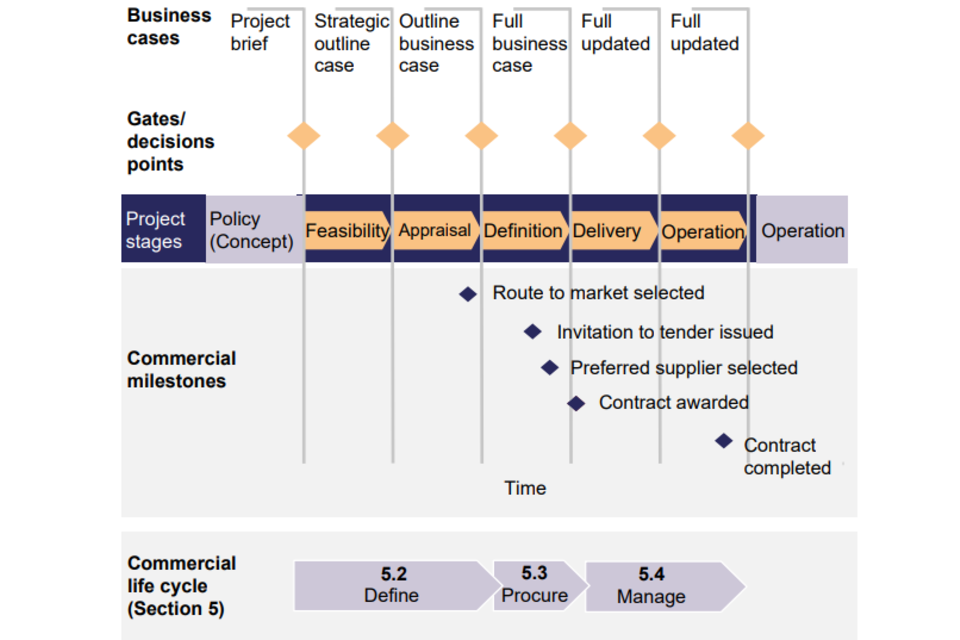
Figure 4 Example of comparative decision points between typical project and commercial life cycle