Office for Value for Money: Reforming the spending control and accountability framework
Published 26 November 2025

© Crown copyright 2025
This publication is licensed under the terms of the Open Government Licence v3.0 except where otherwise stated. To view this licence, visit nationalarchives.gov.uk/doc/open-government-licence/version/3 or write to the Information Policy Team, The National Archives, Kew, London TW9 4DU, or email: psi@nationalarchives.gov.uk.
Where we have identified any third party copyright information you will need to obtain permission from the copyright holders concerned.
This publication is available at https://www.gov.uk/government/publications/reforming-the-spending-control-and-accountability-framework/office-for-value-for-money-reforming-the-spending-control-and-accountability-framework
Executive summary
This publication sets out the government’s plans to reform the public spending control and accountability framework, developed by the Office for Value for Money (OVfM) working in partnership with others in HM Treasury, including the National Infrastructure and Service Transformation Authority (NISTA), and across government.
The fundamental objective of reforming the current system is to create a framework that achieves better outcomes for better value – driving value for money and enabling the public sector to deliver the government’s priorities efficiently and effectively.
The current system of public spending control and accountability is guided by a complex set of rules and behaviours. This reflects both major reforms and incremental changes that have been made by successive governments over recent years, to address ministerial priorities or risks of the day. No system as complex as this one can remain fit-for-purpose forever, and periodic reviews are necessary to ensure the whole system is as efficient as possible.
The OVfM’s review revealed significant scope to remove duplication of controls and strengthen accountability, to deliver more effective and efficient spending control, while freeing up capacity to focus on delivery of citizens’ priorities.
The overlapping nature of the control frameworks exercised by the centre of government and departments has diluted accountability, weakening Parliament’s ability to hold departmental Secretaries of State and Accounting Officers (AOs) responsible for the value for money of day-to-day decision-making. It also limits the centre of government’s ability to ruthlessly focus on the biggest strategic and cross-cutting priorities of the day.
A reformed system will see the business of government become more efficient and effective by reducing the time and therefore cost of activities and increasing the speed of delivery. This ultimately means better and faster outcomes for citizens. The new approach will be underpinned by five principles:
- decisions should be delegated to those closest to delivery, at the lowest appropriate level, with ultimate accountability to Parliament remaining with Secretaries of State and AOs;
- the centre of government should be responsible for oversight of the biggest strategic risks and cross-cutting priorities;
- functional expertise should be embedded in departments and their Arm’s Length Bodies (ALBs) as required, with central functions focused on setting common standards and frameworks; supporting capability; dealing with issues that are best done once on behalf of the whole of government; and providing specialist support up front;
- approval of decisions should typically be done once and done well, by those accountable for those decisions; and
- trust, openness and collaboration should be the foundation of cross-government relationships.
In undertaking this review, the OVfM has been guided by the principle that value for money is driven by the centre of government putting the right frameworks and processes in place, not by micro-managing the decisions of those closest to delivery. Informed by advice from the OVfM, the government will introduce reforms to address three key areas.
First, the reforms will reinforce accountability by making the rules and frameworks more streamlined and effective. This includes resetting controls and approval limits set by the centre of government, so departments are responsible for day-to-day decision-making and can be held accountable for those decisions. In parallel, departments will need to streamline their own internal approval processes to speed up delivery. The reforms will require predictable transparency from departments to Parliament, to support better scrutiny of value for money and efficiency. The centre of government will be freed up to focus on oversight of the biggest risks and priorities, ensuring a stronger central grip on the government’s overall strategy.
Second, the reforms will enable the central functions to focus more of their efforts on building capability across government. They will set consistent standards and provide support on the biggest and most complex issues - including the setting of functional strategies, providing guidance to inform departmental decision-making and dealing with issues that are best done once on behalf of the whole of government, rather than approving individual transactions. The size of the Government Major Projects Portfolio will be reduced, so central expertise is focused on the most strategically important projects, programmes and portfolios.
Third, the reforms will need to be supported by open and collaborative ways of working across government, which are underpinned by high levels of transparency and trust. This means departments engaging openly and early with the centre of government on emerging risks to priorities, and the centre of government responding through timely, constructive, and strategic interventions rather than micro-management. Where there are challenges, there will be a clear and predictable escalation mechanism, ensuring issues are addressed quickly and in a constructive way.
These reforms will be implemented in a phased way, with an expectation that the rules and guidance will be updated at the start of the 2026-27 financial year. Building capability and improving ways of working will take time, and will therefore be a key focus for the whole of government over the Spending Review period.
Table 0.1 Current and reformed control framework
| Current control framework | Reformed control framework |
|---|---|
| Main Delegated Authority Limits (DALs) | |
| Delegated Authority Limits are set for each department, below which explicit consent for expenditure is typically not required from HM Treasury. Current limits for each department are set out at Annex B. | DALs for the majority of departments will be raised for 2026-27 and these new limits will be published. HM Treasury and departments will agree memoranda of understanding, which will set out clear expectations about ways of working alongside higher DALs. |
| DALs for smaller areas of spend | |
| Some spend below main DALs requires HM Treasury approval. There is significant variation in the level of spend requiring HM Treasury approval, ranging from £0 for novel, contentious and repercussive spend, to £3 million for guarantees and indemnities not in the normal course of business. | These DALs will be simplified. Some spend below main DALs which previously required HM Treasury approval will be entirely delegated to departments, including for admin expenditure, endowments and special payments. |
| Controls exercised by the central government functions | |
| Thresholds above which central government functional approval is required vary from £0 for crypt-key spend to £20 million for commercial spend. | For expenditure above main DALs there will be a multi-disciplinary single approval point in HM Treasury, with advice to the Chief Secretary to the Treasury informed by the central functions where appropriate. For spend below main DALs, departments will be responsible for ensuring they draw on appropriate functional expertise (either in their department or from the central function) in their decision-making processes. Given the importance of ensuring coordination on government communications, specific arrangements for the advertising, marketing and communications control will be detailed before the start of the next financial year. |
| Planning and performance | |
| Outcome delivery plans for departments were last published in 2021. | In Spring 2026, departments will publish the outcomes that were funded at SR25 and the first in a set of annual strategic plans. |
| Major projects | |
| Government Major Projects Portfolio (GMPP) of over 200 projects, programmes and portfolios. | The GMPP will be significantly reduced to 80-100 projects. These projects will benefit from enhanced central support and streamlined decision-making processes. |
| Internal department approval processes | |
| Departments have internal processes to inform the decisions of their Accounting Officers and departmental ministers. | Departments will be expected to streamline their internal approval processes, to ensure decisions can be reached more efficiently. |
Box 0.1 External Feedback
We have received feedback on the reforms in this report from people with firsthand experience of the controls and accountability framework and close observers of it.
There is a world of difference between generating mounds of paperwork and maintaining real control of public expenditure. We should therefore welcome this attempt by the Treasury to reduce bureaucratic processes and increase real accountability for the spending decisions made by Departments and government agencies.
Rt Hon Sir Oliver Letwin, former Chancellor of the Duchy of Lancaster and Minister for Government Policy
I hope that the reforms set out in this report will give departments space to take appropriate risks and innovate. Of all the changes, the integration of controls exercised by the Cabinet Office into a single approval point with the Treasury is a potentially very significant prize.
Rt Hon Lord Willetts FRS, President of the Resolution Foundation, Chair of the Regulatory Innovation Office, and former Minister of State for Universities and Science
The proliferation of central controls has increased bureaucracy, reduced innovation and weakened accountability. This report clarifies the respective roles of the Treasury and Cabinet Office, and should enable the centre of government to play a more strategic role in managing fiscal risks. It should also enhance the pace and effectiveness of spending departments’ decision-making.
Lord Macpherson of Earl’s Court, former Permanent Secretary to the Treasury
These reforms are very welcome, aiming to reduce some of the bureaucracy that has grown up around spending control and accountability, especially as it relates to the interaction between the Treasury and departments. Of course we must make sure that value for money, consistency and accountability are embedded in the system, but hopefully these steps will ensure that while enabling more efficient use of time and resources and making accountability clearer.
Dan Corry, Chief Economist at the Future Governance Forum and former civil servant and special adviser
These reforms address problems our work has identified in the current control system which slow down decision-making, fail to incentivise good financial management and muddy accountability. We welcome the government’s proposed changes which should drive faster delivery and clearer accountability.
Nick Davies, Programme Director at the Institute for Government
Reform of the spending framework is long overdue, and these changes are a step in the right direction. We need to return to a model underpinned by democratic accountability for how public money is used, with deep scrutiny by Parliament, and the Treasury spending less time approving small sums and more time focusing on the biggest areas of cost and inefficiency.
Joe Hill, Policy Director, Re:State and former civil servant
1. The current system
The control and accountability framework for the use of public money developed in the late 19th century. It is designed to ensure the appropriate and effective allocation of resources within government, as well as ensuring funds provided to government by Parliament are used in line with Parliamentary expectations and respect the principles of Parliamentary Sovereignty.
At its core, HM Treasury obtains Parliamentary authority for public spending on behalf of government, and Parliament expects HM Treasury to exercise control over the use of public money within government. HM Treasury does this by providing ‘authority’ for all expenditure, and by appointing the most senior official in each department as its Accounting Officer (AO). AOs are directly and personally accountable to Parliament for their organisation’s use of resources.
The details of this system are set out in Managing Public Money. Ministers are accountable to Parliament for government policy, while AOs are accountable to Parliament for ensuring the resources to deliver that policy are used in line with Parliament’s wider expectations, including obtaining HM Treasury authority.
Historically, explicit HM Treasury consent was required for every line of expenditure. Over time, in the interests of efficiency, HM Treasury introduced a system that delegated authority to spend to AOs by setting Delegated Authority Limits (DALs), thresholds below which explicit consent was not required. As these controls were delegated, some specific types of expenditure were identified as requiring continued separate approval. Expenditure in these categories, and above DAL thresholds, still requires direct HM Treasury consent. Under the current system, HM Treasury sets DALs for overall RDEL and CDEL[footnote 1] spending, as well as other sub-categories of spend. In some cases, these controls are delegated by HM Treasury to the government’s central functions. In other cases, HM Treasury retains those controls, such as on pay and reward, jointly with the relevant function.
The DALs that apply to sub-categories of spend can drive an amount of activity in the centre of government that is disproportionate to the value of the transactions in question. For example, the Chief Secretary to the Treasury had to consider an estimated 200 approvals last year each with a value of less than £1 million.
While the requirement for HM Treasury consent is long established, the controls exercised by the central functions are a more recent innovation. In the early 2010s the government introduced a centralised “functional model” to address inefficiency, fragmentation and a lack of deep expertise in departments. In practice, this meant the centre of government established centres of technical expertise in different areas, empowered to set common standards, develop capabilities across departments, enforce cross-cutting strategies, and act as a central authority for the heads of functions in departments. Some of the central functions delivered this mandate, in part, by exercising new spending controls to add greater rigour to decision-making undertaken within departments.
Like DALs, some central functions approve spend above a given threshold in the area for which it is responsible. These thresholds vary widely – with crypt-key[footnote 2] expenditure subject to a threshold of £0, and commercial expenditure £20 million, for example.
Three of the largest central functions are the Government Commercial Function based in the Cabinet Office, the Government Digital Service, based in the Department for Science, Innovation and Technology, and Project Delivery led by the National Infrastructure and Service Transformation Authority (NISTA), based in HM Treasury. In addition to functional guidance, supporting capability and exercising controls and approvals, these organisations have other responsibilities. For example, NISTA also considers strategic questions, such as those related to long-term infrastructure planning and provides independent advice and assurance for specific major projects.
Pay controls are another sub-set of controls which operate in addition to a department’s DALs. The historic path to the current system of pay controls is complex, as responsibility for public sector pay policy has moved around government over the past century. The Bradbury Report of 1919 formally established HM Treasury‘s remit over public sector pay policy at large and it has retained this function ever since, apart from the 1968-82 period, during the existence of the Civil Service Department. Following the Fundamental Expenditure Review in 1994, HM Treasury delegated the setting of Civil Service pay for delegated grades to departments.
HM Treasury has three main roles in pay: a coordinating role in the Pay Review Body process, working closely with departments; working with the Cabinet Office on the Pay Remit Guidance for civil service delegated grades; and approval for the most senior salaries across central government where it must approve almost all senior salaries over a certain threshold. The salary threshold was increased to £174,000 in June 2025 to reflect the increase in salaries in the relevant labour markets over time and reduce the number of individual pay cases requiring central approval. In May 2021, to reflect the priorities of the government at the time, HM Treasury also introduced additional controls over special severance payments.
Assessment of the current system
No system as wide-ranging and complex as the public spending control and accountability framework can be expected to remain fit-for-purpose forever as the demands placed upon it, and the context in which it is used, gradually change. The piecemeal nature of its evolution has led to an accretion of controls, which up to now have not been reviewed as a whole to ensure they are proportionate and form a cogent system when taken together.
The impact of the extensive, overlapping system of controls most often reported by departments is delay. The delivery of a single priority programme will involve many routine, operational decisions for the delivery body. If even a few of these routine decisions involve not only the satisfaction of sensible internal controls, but also multiple, sequential and duplicative approvals from their parent department, and then the centre of government, the delay driven by each of those additional approvals can compound to mean weeks or months of delay.
Box 1.1 HMRC and controls exercised by the centre of government
HMRC is modernising its digital backend systems and the way it interacts with customers through eight interlinked programmes. Under the current control framework, the programmes were considered individually, rather than as a cluster, and, when combined, went through up to 40 approval and assurance points with the centre of government (including through the commercial and digital functions, NISTA and HM Treasury). Approvals were required from three ministers in different departments, in addition to the major programmes being signed off by the Exchequer Secretary to the Treasury as the departmental minister responsible for HMRC. The sequential nature of the existing business case approval process meant that one technology programme was required to wait for at least two months following the conclusion of its commercial negotiation with the supplier before it could proceed to award the contract.
Duplicative and sequential bureaucracy, which requires departments to wait for approval from the centre of government before they can forge ahead with delivery, often comes with costs beyond delay. This can range from the need to keep legacy IT systems running until critical digital spend is approved, to increased risk premium being required by suppliers due to the slow pace of government decision-making. The sequential nature of the approvals process also usually results in the centre of government being engaged too late in the planning process to shape or influence decision-making. These issues around sequential and duplicative processes are also a feature of some departments’ internal control frameworks.
This complex, duplicative system has also led to a dilution of accountability. Parliament’s ability to hold specific AOs and Secretaries of State responsible for the value for money of decisions has been weakened, as the system obfuscates when a final decision has been taken, and who is truly responsible for it. It also limits the centre of government’s ability to ruthlessly focus on the biggest strategic and cross-cutting priorities of the day, as it has to undertake a disproportionate number of approvals on the day-to-day business of departments.
Box 1.2 HS2 decision-making processes
Decision-making processes for High Speed 2 (HS2) developed into a complex system which slowed progress and failed to prevent poor outcomes. Decisions on HS2 were subject to HS2 Ltd’s internal assurance and governance arrangements ahead of approval points within the Department for Transport, a review by the Infrastructure and Projects Authority, and finally approvals from Cabinet Office and HM Treasury, often sequentially. This could lead to up to nine months of governance decisions with few material changes. As part of the full programme reset, and in line with the Office for Value for Money’s recommendations on mega projects, these processes are being streamlined to make them quicker, more effective, and more robust. For the reset cost and schedule ranges there will be one integrated assurance process, with plans to secure a decision from initial advice to final approval in around three months.
The central functions have evolved considerably since the early 2010s, but the controls they apply have not changed commensurately. The functions have made progress in developing, embedding and accrediting functional expertise within departments and their internal control frameworks. That means that now, in practice, spend is approved by functional experts within departments, and then again by experts in the same fields in the central functions. This ‘double tick’ system was not one of the intentions of the 2012 reforms.
The digital function received c.2,400 cases between January and October 2025 - an average of 12 per day. The central Government Digital Service team triages cases to assess the level of risk and prioritise its resources against the highest risk cases. Lower risk cases are assured by internal department teams. Around 1,900 cases (79%) were approved without conditions, with 757 approved in a day or less, reflecting the assurance processes already undertaken in departments.
Alongside this, Cabinet Office exercises control over pay for contingent labour, such as contractors, agency workers, and temps, where day rates exceed £1,000. In 2024, the Cabinet Office approved all of the 246 requests it received, with its only intervention being to ask for more information in a sub-set of cases. This shows the maturity of departmental capability in such decisions.
Box 1.3 MHCLG DALs
In 2023-24 the Ministry of Housing, Communities and Local Government’s (MHCLG’s) delegated RDEL limit was £10 million, meaning 94% of the department’s activity was subject to HM Treasury approval. Micromanaging the department in this way hampered the delivery of government priorities, often adding six weeks or more to the approval process, with no evidence for value added by the additional control. This placed a burden on both MHCLG and the HM Treasury spending team. The burden this placed on the spending team impacted its capacity to engage on large, complex and expensive programmes and how they fit with the government’s long-term strategy, where the centre of government can add the most value.
Ministers in the centre of government have historically chosen to direct departments to deliver specific priorities through imposing new controls, rather than through setting policies and expecting departments’ own internal control frameworks to ensure compliance. One example of this was the introduction of HM Treasury controls on special severance payments over £100,000,[footnote 3] introduced in May 2021.
In individual cases, the introduction of these new controls could be rational. But the accumulation of these types of controls has led to a system that is difficult and slow to navigate. It also takes decision-making away from the expertise in departments who best understand the markets in which they are operating, and away from AOs and Secretaries of State who remain ultimately accountable to Parliament.
These case studies provide a strong case for reform of the framework as a whole, supporting the business of government to become more efficient and delivering better outcomes for citizens.
2. A reformed framework
A reformed spending control and accountability framework will see the business of government become more efficient by reducing the cost of activities and speeding up delivery. It will do this by reinforcing the accountability of departments for day-to-day decision-making to Parliament and the public, removing the time and cost of sequential approvals of decisions, while freeing up the centre of government to focus on strategic oversight.
The fundamental objective of reforming the current system is to create a framework that drives better value for money, and enables the public sector to deliver the government’s priorities efficiently and effectively. The reformed framework is underpinned by five key principles:
- decisions should typically be delegated to a single point of accountability at the lowest appropriate level, as those closest to delivery will make the best-informed decisions, with Accounting Officers (AOs) and Secretaries of State retaining ultimate accountability to Parliament;
- the centre of government should be responsible for oversight of the biggest strategic risks and cross-cutting priorities. This is likely to result in the centre of government engaging where issues are particularly large, complex, or cross-cutting, or have an impact over the long-term;
- functional expertise should be embedded in departments and their Arm’s Length Bodies (ALBs), with central functions focused on setting standards and strategies; supporting capability; providing early specialist support; and dealing with issues that are best done once on behalf of the whole of government;
- approvals should typically be done once and done well, by those accountable for decision-making. Any weaknesses in approval processes should be addressed through capability building, rather than the creation of duplicative processes; and
- trust, openness, and collaboration will be at the heart of cross-government relationships, with early and constructive engagement, supported by transparency over pipeline and performance data. Where this is not possible, government should follow a clear and predictable remediation plan.
Informed by advice from the Office for Value for Money (OVfM), the government will introduce reforms to: reinforce accountability by streamlining and strengthening rules and frameworks; focus central expertise on capability-building across government; and embed trust, openness and collaboration.
A reformed framework will lead to tangible differences in how quickly and efficiently delivery takes place. For example, where HMRC faced up to 40 approval points to deliver its digital and customer programmes (see Box 1.1), it would now only face two. Commercial negotiations and business case approvals, for example, will be able to run in parallel, saving at least two months of delivery time.
Changing the role of the centre of government and ending the micro-management of departments will also give them more freedom to innovate. This will mean faster iteration through testing and learning and allow the government to take an integrated approach to risk management in delivery.
These reforms will make a measurable difference to how much time the centre of government has to spend on the biggest, most strategically important issues of the day. Under the updated Delegated Authority Limit (DAL) regime, for example, the number of spending approval decisions coming to the Chief Secretary to the Treasury for central government approval (see paragraph 1.5) will be reduced by c.55%.
Sharpening accountability
The reforms will reinforce accountability, so that departments and their Arm’s Length Bodies (ALBs) can be more easily held to account for day-to-day delivery, the centre of government can be more easily held to account for the most strategic issues and risks, and Parliament can more easily undertake scrutiny of the value for money of decision-making. This will be achieved through streamlining rules and frameworks, ensuring greater transparency to Parliament, and clarifying the respective roles of departments and the centre of government.
The role of the centre of government
By stripping away nugatory or duplicative individual controls and engendering a new culture of accountability and openness, HM Treasury will enhance its strategic control of public spending as a whole. Fundamental HM Treasury controls over expenditure will remain in place. Departments will not, for example, have the ability to commit large amounts of expenditure for years in which they do not have agreed budgets, or make extremely expensive or highly repercussive decisions like making a pay award to a large public sector workforce without HM Treasury being closely involved.
The centre of government will continue to be responsible for cross-government risks and opportunities. In particular:
- the centre of government will remain responsible for setting overall strategy and objectives where it makes sense for there to be a consistent approach across departments to the benefit of citizens.
For example, HM Treasury will retain its strategic role in public sector pay policy;
- HM Treasury will remain accountable for overall spending control. This includes overseeing the HM Treasury Reserve, the fund set aside for unexpected government spending. It also includes HM Treasury’s responsibility to use its convening power to manage spend that significantly impacts multiple departments, and to protect the fiscal position by working with departments to understand and mitigate the impact of policies that may lead to long-term spending pressures;
- HM Treasury will also remain accountable for the government’s overall fiscal and economic policy. This means retaining approval over the biggest expenditure commitments as well as setting the framework for cross-cutting issues like the management of public assets;
- central functions will remain accountable for setting professional standards and cross-cutting principles that support the interoperability of systems. They will deal with issues that are best done once on behalf of the whole of government, for example, in setting cross-government functional strategies; and
- the centre of government will remain accountable for oversight of cross-government risks, such as exposure to strategically important companies or sectors. In addition to identifying those risks, the centre of government will be responsible for intervening to address them where they either exceed ministers’ risk appetite, or fall significantly short of it and therefore risk impeding overall government objectives.
In line with the principle that the centre of government should focus on strategic issues and risks rather than individual decisions, HM Treasury will retain its existing responsibilities for overall public sector pay policy.
To ensure control over particularly high salaries, central government sign-off will remain for all salaries over £174,000. Reforms will be implemented to reduce the number of routine roles needing approval and the associated administrative burden, including inviting organisations to apply for bespoke delegations (e.g. agreement with HM Treasury on a total number of senior roles or a total senior pay budget that can be allocated without requiring further HM Treasury approval), and delegating decisions on Pivotal Role Allowances for Senior Civil Servants to departments.
In addition, Special Severance Payments which are not novel, contentious, or repercussive will be further delegated to departments.
The role of departments
These reforms aim to ensure departments can get on with delivery of the government’s priorities, there is no duplication of work, and there is clear accountability for decisions. This will allow departments to refocus their time and efforts on doing what they do best – delivering citizens’ priorities.
HM Treasury will set new DALs for departments for the 2026-27 financial year, in line with the following criteria:
- they should be proportionate to the size of the department and based on a percentage of overall resource and capital budgets with absolute upper and lower limits;
- they should reflect the department’s outturn performance on financial management and outcome delivery, as well as the longer term risks the department faces; and
- they should be informed by the quality of data, analysis and insight the department shares with the centre of government and its openness to challenge and engagement.
As a result, the main DALs for the majority of departments will increase. In addition, HM Treasury will remove the need for departments to seek approval for spend in a number of areas below main DALs. For example, departments will no longer be required to seek HM Treasury approval for spend below main DALs on endowments, admin or payments in advance of need (the full list is set out in Annex A).
The government will remove duplication of approvals by integrating the controls exercised by the central functions into a single approval point within HM Treasury. Where expenditure exceeds new, increased DALs, there will be a multi-disciplinary single approval point which is informed by expertise from the central functions. Advice to HM Treasury ministers will include the assessment of the relevant central functions where appropriate, allowing HM Treasury ministers to reach a decision which draws on all the relevant expertise. This will ensure that those approvals by the centre of government which continue to be necessary in the reformed system will be done once and well, in line with the principles of these reforms, and not sequentially or in a duplicative manner.
The government’s intention is therefore to move to a single delegated limit for both HM Treasury and Cabinet Office controls. However, given the importance of ensuring coordination on government communications, specific arrangements for the advertising, marketing and communications control will be detailed before the start of the next financial year.
Individual departments have an important role in aligning their internal processes with the principles set out in this report to ensure that system wide improvements and end-to-end change are achieved. Departments and their ALBs will be expected to streamline their own internal decision-making processes to enable quicker delivery. This will include removing duplication in internal controls and approvals.
The government will be more transparent with Parliament to support full and rigorous scrutiny of the performance of government on outcome delivery and financial management. The government will publish the new departmental DALs for 2026-27. Under the government’s new planning and performance framework, departments will publish the outcomes that were funded at Spending Review 2025 and the first in a set of annual strategic plans.
Building capability
These reforms are intended to deliver more efficient and more effective public expenditure. Streamlining rules and guidance will support efficiency. Effectiveness will depend, in part, on the robustness of internal controls and decision-making, delivery processes, and data quality within departments. In practice, financial and performance management capability varies across departments, including the degree to which high-quality internal functional expertise informs advice to ministers.
Therefore, the centre of government, including HM Treasury and the central functions, will work with departments to identify capability gaps and support AOs and ministers to address them through publishing updated guidance, and providing ongoing support and capability building.
Spending and finance
HM Treasury will publish new guidance on spending in some particularly complex areas. This will include updated guidance on how AOs should assess whether spend is novel, contentious or repercussive. In place of some current controls, HM Treasury will issue new guidance to inform departmental decision-making, including on payments in advance of need and special payments[footnote 4]
Commercial, digital, and other functions
The central functions will provide ongoing support and capability building through: - professional capability: the central functions, engaging with departments and professions, will set expectations for the capability and performance of functional leaders, including the skills and qualifications required by all engaged in functional work. Work to increase professional accreditation will continue, as will assessments of the level of departments’ functional capability overall. This will ensure ministers and AOs receive high quality, expert advice from their department; - setting standards: each function sets expectations for the standard of functional work in departments and their ALBs. This drives consistency across government. The standards are supported by frameworks which enable departments to self-assess their maturity. Insights from those self-assessments, together with performance and delivery against agreed key performance indicators, will enable the centre to provide targeted support to high priority areas, where the capability or capacity gaps are widest; and - specialist support: where a department does not have the appropriate capability or the required expertise, particularly for novel and complex activity, they will draw upon the specialist, expert support provided from the relevant central function. For example, the complex transactions team in the Government Commercial Function will continue to support departments with some of their most technically complex commercial issues. In line with multi-disciplinary single approval points, there will also be specialist support offered to HM Treasury ministers in taking decisions on approvals for expenditure above DALs.
Major project delivery
The National Infrastructure and Service Transformation Authority (NISTA) was launched in 2025 as the new centre of expertise in government on delivering major projects, programmes and portfolios, bringing together the strategic expertise of the National Infrastructure Commission and the project delivery expertise of the Infrastructure and Projects Authority. Sitting within HM Treasury, it will play a crucial role in advising ministers on major projects and infrastructure and will support departments to deliver these in line with best practice. In particular, it will set standards and improve the government’s project capabilities, by developing best-in-class guidance and tools and delivering leadership and learning programmes, as well as drawing on industry expertise and best practice in the UK and internationally.
NISTA will reform the wider system to ensure project delivery is effective. On the advice of the Office for Value for Money (OVfM), the government announced in June 2025 the creation of a new category of major projects – ‘mega projects’ – which have transformational impacts on the economy, society or national security, involve multiple government departments and agencies, take over 10 years to deliver, and have whole life costs of over £10 billion. In recognition of their size and complexity, NISTA will oversee the implementation of a bespoke approach to governance and budgeting arrangements for these mega projects, with streamlined decision-making processes and integrated assurance plans. This will include the requirement for a Mega Projects Decision Panel, comprising the government’s Chief Operating Officer and senior officials in HM Treasury, including the CEO of NISTA. The panel will agree advice to the Prime Minister, Chancellor of the Exchequer and relevant Secretaries of State on any material decisions related to those projects.
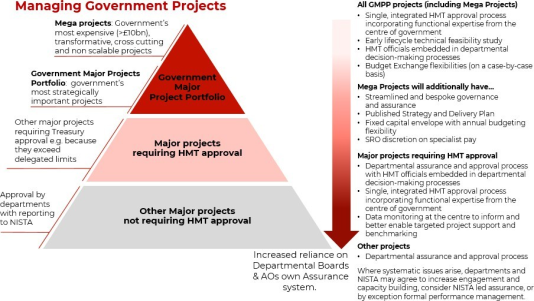
NISTA has subsequently reviewed the Government Major Projects Portfolio (GMPP), which currently comprises over 200 projects, programmes and portfolios. It will significantly reduce the number of major projects the centre of government actively supports, and place more reliance on accountable officials and Boards across government. This will ensure central expertise and ministerial bandwidth is focused on the government’s most strategically important, complex and risky projects, programmes and portfolios.
The new GMPP will focus on the 80-100 most strategically important projects that are critical to delivery of economic growth and the government’s highest priority outcomes, beyond the small subset of mega projects. These projects will benefit from specialist support from NISTA to ensure they have the right leadership capability and capacity for delivery, and independent assurance commissioned through NISTA to inform critical decision points.
Where appropriate, these projects may also benefit from limited budget flexibilities. This may include the ability to move up to 20% of a project’s CDEL budget in a given year between two financial years in exceptional circumstances where that would speed up delivery or reduce costs. This will be on a case-by-case basis subject to approval from HM Treasury. This will allow projects to develop and deliver against longer-term plans, removing perverse incentives to spend money unnecessarily at the end of the financial year for fear of losing it.
Projects will also be subject to a set of new requirements to support delivery bodies in ensuring projects are set up for success. This includes undertaking technical feasibility studies, improving the likelihood that potential GMPP projects will only proceed if they can be delivered, that decisions are based on realistic forecasts, and to provide clarity around objectives and key risks during important early stages. Feasibility studies should be proportionate to the scale of the project and should set out the technical approach to delivering the key requirements or outcomes.
GMPP approvals by HM Treasury will be informed by a streamlined, coordinated scrutiny process that brings together all relevant parts of the centre of government, rather than having separate, sequential approval points.
NISTA will support Senior Responsible Owners to determine how best to deliver efficient and effective independent assurance of the GMPP by those technically qualified, working in partnership with other functions as required. This will be captured in integrated assurance and approval plans agreed across functions. The outputs of assurance will be shared, as appropriate, with other parties with a decision-making role in the project, so assurance is only done once rather than replicated across multiple organisations.
Other projects that are not deemed critical but still require HM Treasury approval will continue to provide regular reporting to NISTA and others in the centre of government, to support AOs’ oversight and understanding of cross-portfolio trends, and ensure sufficient data to conduct analysis to identify system wide issues and features to better support targeted intervention in GMPP projects.
The different tiers of major projects and the role of the centre of government as a result of the changes introduced here and by the OVfM work on mega projects is set out in Figure 2.1 below.
Figure 2.1: Major project tiers
Embedding trust, openness and collaboration
Implementation of the reforms will need to be supported by a culture of openness and collaboration across government, underpinned by high levels of trust. This includes the relationship between departments and the centre of government, including HM Treasury and the central functions.
This starts with changes in behaviour and a commitment to new ways of working by both HM Treasury and departments. To embed this approach, HM Treasury and departments will agree memoranda of understanding (MOUs), which set out clear expectations about ways of working and how early engagement and openness to challenge will operate in practice. Necessarily, the MOUs will be bespoke to the relevant department, but would be informed by behavioural changes from HM Treasury. HM Treasury will:
- engage early on the biggest decisions departments are taking, so the approvals process is as predictable as possible;
- ensure data, analysis and modelling asks are limited to those necessary to support HM Treasury responsibilities and will explain the rationale for the ask upfront;
- work with No.10 and Cabinet Office to support alignment on policy aims and direction, so departments can have a joined-up conversation with the centre of government as far as possible;
- provide challenge in a constructive way, based on evidence and analysis and openness about strategic objectives; and
- respond to emerging risks by focusing on solutions, rather than by seeking to micro-manage.
In turn, MOUs will be based on behavioural changes in departments. Departments will:
- engage openly and early about emerging risks, or strategic priorities, share analysis and insight at an early stage, and invite HM Treasury into internal debate;
- respond constructively to challenge from the centre of government, whether that is focused on long-term risks, capability gaps or delivery concerns;
- seek specialist support from the centre of government proactively where issues are particularly complex or risky;
- be transparent about internal controls and approvals processes, be willing to develop a shared assessment of capability, and commit to address any capability gaps that are identified; and
- provide timely data and analysis and undertake joint modelling in the biggest priority areas where a shared understanding of performance and underlying drivers is required. Data sharing will include departments’ business case pipeline and progress against outcomes.
In addition to these changes in behaviour, departments will need to undertake concrete changes in their day-to-day ways of working, and data sharing, with the centre of government. These will include:
- strengthening internal financial risks management. In practice, this will require continued compliance with Consolidated Budgeting Guidance and detailed new information sharing standards ranging from the level of contingency the department holds, to a business case pipeline and analysis of long-term spending commitments;
- strengthening internal functional capabilities and streamlining approval processes. This will mean complying with standards set by the central functions, and departments setting out their new and streamlined internal approval processes for the centre of government;
- building a strong project delivery culture. Senior leaders will be expected to champion a culture of accountability and proactive risk management. Departments will engage NISTA proactively and seek their expert assurance; and
- building an outcome-focused culture. This will include departments tracking their progress against commitments from their spending review settlement and strategic objectives.
If there are cases of poor performance, issues identified through analysis of business case pipelines, or of departments not meeting their enhanced obligations, HM Treasury will retain a range of measures to incentivise improvement.
There will be three tiers of measures HM Treasury will undertake where necessary, with each tier also having clear entry and exit criteria so it is clear to departments why they are subject to these measures. The tiers would involve actions such as:
- Tier 1: where there is a capability gap in a department HM Treasury could put in place targeted support to improve that capability. Where issues are driven by a department failing to meet its enhanced obligations, this would trigger enhanced official and ministerial engagement with the department;
- Tier 2: temporary reintroduction of some controls, with the possibility of notification to Parliament and the National Audit Office, and of an external review of performance; and
- Tier 3: formal performance management measures for key decision-makers and reopening of spending review settlements.
This new model of working will enable the centre of government to understand key areas for engagement, such as where spend will have significant implications for government priorities, and the key risks to delivery, allowing the centre of government to intervene earlier and more strategically where required.
3. Next steps
These reforms to the public spending control and accountability framework will help to deliver a more productive and agile state, where the decisions that are critical to delivering government business can be taken quickly, efficiently, and without duplication.
Implementing these reforms is a whole-of-government endeavour, with all departments working collaboratively together. Implementation will be overseen by the Second Permanent Secretary to the Treasury, the Director General Public Spending jointly with the Chief Operating Officer for the Civil Service and Permanent Secretary to the Cabinet Office, the Director General Civil Service Reform and Efficiency and the Chief Executive Officer of the National Infrastructure and Service Transformation Authority (NISTA). They will report to the Chief Secretary to the Treasury and the Chief Secretary to the Prime Minister.
These reforms will be implemented in a phased way, with an expectation that the rules and guidance will be reviewed and updated as required at the start of the 2026-27 financial year, with some reforms implemented earlier where possible. The government will work with other organisations with ambitions to improve financial management in government, including the National Audit Office, to support departments to improve their processes and capability
It is a fundamental constitutional principle that governments must obtain authorisation from Parliament for any expenditure and then account to Parliament for that expenditure. Parliamentary scrutiny and oversight will therefore continue to be a cornerstone of the public spending control and accountability framework.
The National Audit Office and the Public Accounts Committee will retain their important roles in holding departments to account for the effectiveness, value for money, and probity of public spending. Departments will continue to report transparently to Parliament and in places report more information than under the previous framework, with departmental DALs for 2026-27, outcomes and annual strategic plans published. This will enable effective scrutiny and ensure the government upholds the commitments to improvement it has made in this report.
Annex A
Table A.1 Summary of reforms
| Current control framework | Reformed control framework |
|---|---|
| Main Delegated Authority Limits | |
| The current main Delegated Authority Limits (DALs) for each department are set out in Annex B. | The majority of DALs for departments will be raised for 2026-27. New DALs for 2026-27 will be published. HM Treasury and departments will agree memoranda of understanding, which set out clear expectations about ways of working alongside increasing DALs. |
| Delegated authority limits for smaller areas of spend | |
| Novel, contentious or repercussive spend (NCR): zero delegation (all expenditure requires HM Treasury approval). | Zero delegation. |
| Spend in line with the UK Internal Market Act: zero delegation. | Zero delegation. |
| Charitable grants: varies by department. | Retain and continue to set by department. |
| Guarantees and indemnities not in the normal course of business: £3 million delegation limit. | £3 million delegation limit. |
| Gifts: £300,000 delegation limit. | Typically, £300,000 delegation limit with some variation by department. |
| Consolatory payments for financial loss: above £500 considered NCR. | Above £500 considered NCR. |
| Losses: varies by type of loss and department. | Retain department specific limit for ‘constructive losses’ and ‘claims waived or abandoned’. For all others, remove requirement for approval below main DALs and replace with guidance to support Accounting Officer decisions. |
| Stock write-offs and impairments: varies by department. | Combines with losses, as above. |
| Endowments: zero delegation | No requirement to seek HM Treasury approval below main DALs. HM Treasury will provide additional guidance in some areas to support Accounting Officer decisions. |
| Admin expenditure: varies by department | |
| Special payments: varies by department, usually less than £1 million | |
| Payments in advance of need: zero delegation | |
| Subsidies: varies by department | |
| Special severance payments which are a) over £100,000, b) are novel, contentious, or repercussive (NCR) or c) to an individual earning over £174,000 require HM Treasury approval. Approval from the Chief Secretary to the Treasury is required for payments over £100,000. | Only require HM Treasury approval if NCR. Approval from the Chief Secretary to the Treasury is only required for payments which are NCR and over £300,000. |
| Controls exercised by the central government functions | |
| Commercial: £20 million | For expenditure above main DALs, there will be a multi-disciplinary single approval point, with advice to the Chief Secretary to the Treasury informed by the central functions where appropriate. |
| Digital & technology: general £1 million; public-facing £100,000; crypt-key zero delegation | For spend below main DALs, there will be no functional spending controls administered by the centre of government. Departments will be responsible for ensuring they draw on appropriate functional expertise (either in their department or from the central function) in their decision-making processes. |
| Contingent labour: day rate (excluding fees) £1,000 | |
| National property control: £500,000 | |
| Facilities management: £500,000 (approval via form); £20 million (approval by the Office of Government Property and the Commercial Function) | |
| Redundancy & compensation: approval required for bulk exits of more than 20 staff and individual exit payments of more than £95,000 | |
| Learning & development: £10,000 | |
| Advertising, marketing & communications: £100,000 per year threshold | Specific arrangements will be detailed before the start of the next financial year. |
| Major projects | |
| Government Major Projects Portfolio (GMPP) of over 200 projects, programmes and portfolios. Some projects on the GMPP receive independent scrutiny and assurance by NISTA. Approval through an HM Treasury Approvals Process panel or Major Project Review Group panel. | The GMPP will be significantly reduced to 80-100 projects. These projects will benefit from enhanced oversight by the centre of government, including specialist support from NISTA. |
| Where appropriate, the projects in the GMPP will benefit from limited budget flexibilities on a case-by-case basis. They will be required to conduct proportionate feasibility studies. | |
| Approvals by HM Treasury will be informed by a streamlined, coordinated scrutiny process, rather than separate, sequential approvals. | |
| The government has introduced a new category of ‘mega projects’ with bespoke budgeting and governance arrangements. | |
| Pay controls exercised by HM Treasury and Cabinet Office | |
| HM Treasury guidance for the approval of senior pay sets out that salaries over £174,000 require approval by the Chief Secretary to the Treasury unless an exception or delegation applies. | Further amendments to the HM Treasury guidance for the approval of senior pay will reduce the number of routine cases requiring HM Treasury approval (such as regularly updating the threshold in line with the PM’s salary and increasing the level salaries of existing roles can be increased by on re-advertising from 2% to 5%). Organisations will be encouraged to apply to HM Treasury for a delegation from the senior pay controls where helpful as part of their senior pay strategy. |
| Pivotal Role Allowances for Senior Civil Servants of any value require Cabinet Office approval. Those above £15,000 must also be approved by the Chief Secretary to the Treasury. The non-consolidated allowances are strictly controlled within a notional central pot set at 0.5% of the overall SCS pay bill. | Decisions on Pivotal Role Allowances for Senior Civil Servants will be delegated to departments, without approval by the centre of government. Departments should continue to follow the guidance and criteria set out by Cabinet Office in making decisions. Payments cannot exceed 0.5% of a department’s SCS paybill, without approval from Cabinet Office. Cabinet Office will set out details on implementation in due course. |
| Planning and performance | |
| Outcome delivery plans for departments were last published in 2021. | The government’s new planning and performance framework focuses on delivering the Plan for Change and securing strong outcomes for taxpayers. In Spring 2026, departments will publish the outcomes that were funded at SR25 and the first in a set of annual strategic plans. |
| Internal department approval processes | |
| Departments have internal processes to inform the decisions of their Accounting Officers and departmental ministers. | Departments will be expected to streamline their internal approval processes, to ensure decisions can be reached more quickly and efficiently. |
Annex B
Table B.1 Current Delegated Authority Limits
| Department | Current RDEL ‘Main’ DAL (£ million) | Current CDEL ‘Main’ DAL (£ million |
|---|---|---|
| Cabinet Office | 25 | 25 |
| Department for Culture, Media and Sport | 60 | 60 |
| HM Treasury | 15 | 15 |
| Department for Energy Security and Net Zero | 50 | 265 |
| Foreign, Commonwealth and Development Office | Non-ODA: 30, ODA:200 | Non-ODA: 30, ODA: 200 |
| Department for Business and Trade | 50 | 50 |
| HM Revenue and Customs | 150 | 150 |
| Department for Environment, Food and Rural Affairs | 110 | 125 |
| Ministry for Housing, Communities and Local Government | Communities: 80, Local government: 30 | Communities: 250, Local government: 0 |
| Department for Transport | 200 | 200 |
| Department for Work and Pensions | 170 | 163 |
| Home Office | 300 | 150 |
| Department for Education | 30 | 30 |
| Ministry of Justice | 90 | 60 |
| Department of Health and Social Care | 150 | 300 |
| Ministry of Defence | 800 | 1,000 |
| Department for Science, Innovation and Technology | 30 | 300 |
-
RDEL (Resource Departmental Expenditure Limit) and CDEL (Capital Departmental Expenditure Limit) are two types of multi-year spending limits set by HM Treasury. RDEL covers day-to-day running costs and resource-based spending, while CDEL covers investment in physical assets like buildings and infrastructure. ↩
-
“Crypt-Key” is the term for government’s high-assurance cryptographic capabilities, including the systems, processes, and expertise used to protect sensitive information, national security, and critical infrastructure from cyber threats. ↩
-
Or where a payment of any level which is novel contentious, or repercussive, or involves a member of the Senior Civil Service, a Special Adviser, a board level individual of an Arm’s Length Body, or anyone earning over the senior pay threshold of £174,000. ↩
-
Special payments are those which fall outside of normal statutory or contractual obligations, such as special severance payments, compensation, and ex gratia payments. ↩