Country policy and information note: Christians, China, June 2026 (accessible)
Updated 1 September 2026

© Crown copyright 2026
This publication is licensed under the terms of the Open Government Licence v3.0 except where otherwise stated. To view this licence, visit nationalarchives.gov.uk/doc/open-government-licence/version/3 or write to the Information Policy Team, The National Archives, Kew, London TW9 4DU, or email: psi@nationalarchives.gov.uk.
Where we have identified any third party copyright information you will need to obtain permission from the copyright holders concerned.
This publication is available at https://www.gov.uk/government/publications/china-country-policy-and-information-notes/country-policy-and-information-note-christians-china-june-2026-accessible
Version 5.0
Executive summary
The Chinese constitution guarantees freedom of religion for ‘normal religious activities’ but does not define what these include.
There are five officially recognised religions, including Catholicism and Protestantism. Since 2012, the government has introduced a program of Sinicization of religion. This requires religions to adapt their practices and doctrines to conform to traditional Chinese culture and values. Religious groups need to register with the government’s Patriotic Associations to operate and undertake religious activities.
Estimates of the number of Christians, both in registered and unregistered groups, vary between 38 million and 130 million.
Christians, whether they belong to a state-registered church or not, are in general unlikely to be at risk of persecution or serious harm on the basis of their faith alone.
In state-registered churches, dissident bishops or prominent Christians who challenge, or who are perceived to challenge, public order and the legal conditions under which churches and leaders may operate, may be at risk of persecution or serious harm, but this is likely to be exceptional. Each case must be considered on its facts.
Underground Protestant and Catholic house churches exist, although information on their numbers and size of congregations is limited. Members of such churches face harassment including pressure to join Chinese Communist Party-approved churches, disruption to meetings, and closure and restriction on activities.
Some religious groups are considered by the government to be cult organisations, or xie jiao. Membership of any group considered to be a cult is illegal, and individuals can face criminal charges and sentences of up to life in prison.
Christians who worship in unregistered churches or as part of an illegal cult and conduct themselves in such a way as to attract the local authorities’ attention to them, or their political, social or cultural views, may face a real risk of persecution or serious harm.
Where the person has a well-founded fear of persecution from the state they will not, in general, be able to obtain protection from the authorities.
Where the person’s fear relates to local officials, the March 2014 country guidance case of QH applies. In that case, the Upper Tribunal held that unless a person is the subject of an arrest warrant, their name is on a blacklist, or they have a pending sentence, they will generally be able to internally relocate.
Where a claim is refused, it is unlikely to be certifiable as ‘clearly unfounded’ under section 94 of the Nationality, Immigration and Asylum Act 2002.
Each case must be considered on its individual facts. The onus is on the person to demonstrate they face persecution or serious harm.
Assessment
Section updated: 29 June 2026
About the assessment
This section considers relevant evidence – including country information, refugee and human rights law and policy, and case law – to assess whether, in general:
- a person faces a real risk of persecution/serious harm by the state because they are a Christian
- the state (or quasi state bodies) can provide effective protection
- internal relocation is possible to avoid persecution or serious harm
- if refused, a claim is likely or not to be certified as ‘clearly unfounded’ under section 94 of the Nationality, Immigration and Asylum Act 2002.
Each case must be considered on its individual facts.
For details on how CPIT makes its assessments, and information on disclaimers (including the use of Artificial Intelligence (AI) in developing CPINs), see About country policy and information notes.
1. Material facts, credibility and other checks
1.1.1 Decision makers must:
- assess credibility (see the Asylum Instruction on Assessing Credibility and Refugee Status).
- check if there has been a previous application for a UK visa or another form of leave. Asylum applications matched to visas should be investigated prior to the asylum interview (see the Asylum Instruction on Visa Matches, Asylum Claims from UK Visa Applicants).
- consider making an international biometric data-sharing check, when one has not already been undertaken (see Biometric data-sharing process (Migration 5 biometric data-sharing process)).
- consider language analysis testing, where available, in cases where there are doubts surrounding a person’s claimed place of origin (see the Asylum Instruction on Language Analysis).
Official – sensitive: Not for disclosure – Start of section
The information in this section has been removed as it is restricted for internal Home Office use.
Official – sensitive: Not for disclosure – End of section
1.2 Exclusion
1.2.1 Decision makers must consider whether there are serious reasons to apply one (or more) of the exclusion clauses. Each case must be considered on its individual facts.
1.2.2 If the person is excluded from the Refugee Convention, they will also be excluded from a grant of humanitarian protection, which has a wider range of exclusions than refugee status.
1.2.3 For guidance on exclusion and restricted leave, see the Asylum Instruction on Exclusion under Articles 1F and 33(2) of the Refugee Convention, Humanitarian Protection and the instruction on Restricted Leave.
2. Convention reason(s)
2.1.1 Actual or imputed religion.
2.1.2 Establishing a convention reason is not sufficient to be recognised as a refugee. The question is whether the person has a well-founded fear of persecution on account of an actual or imputed Refugee Convention reason.
2.1.3 For further guidance on the 5 Refugee Convention grounds, see the Asylum Instruction, Assessing Credibility and Refugee Status.
3. Risk
3.1 Registered groups
3.1.1 In general, a person belonging to a state registered Christian group is unlikely to face a real risk of persecution from the state for that reason alone.
3.1.2 Dissident bishops or prominent Christians who challenge, or who are perceived to challenge, public order and the legal conditions under which churches and leaders may operate, may be at risk of persecution or serious harm, but this is likely to be exceptional.
3.1.3 In the country guidance case of QH (Christians - risk) China CG [2014] UKUT 86 (IAC), heard 6 June 2013 and promulgated March 2014, the Upper Tribunal (UT) held that:
‘In general, the risk of persecution for Christians expressing and living their faith in China is very low, indeed statistically virtually negligible…There has been a rapid growth in numbers of Christians in China, both in the three state-registered churches and the unregistered or “house” churches. Individuals move freely between State-registered churches and the unregistered churches, according to their preferences as to worship.’ (paragraph 137 (1 and 2))
3.1.4 On Christians practising in state-registered churches, the UT in QH held:
‘Worship in State-registered churches is supervised by the Chinese government’s State Administration for Religious Affairs (SARA) under the [Religious Affairs Regulations] RRA.
‘The measures of control set out in the [Religious Affairs Regulations] RRA, and their implementation, whether by the Chinese state or by nonstate actors, are not, in general, sufficiently severe as to amount to persecution, serious harm, or ill-treatment engaging international protection.
‘Exceptionally, certain dissident bishops or prominent individuals who challenge, or who are perceived to challenge, public order and the operation of the Religious Affairs Regulations 2005 – which set out the conditions under which Christian churches and leaders may operate within China – may be at risk of persecution, serious harm, or ill-treatment engaging international protection, on a fact-specific basis.’ (paragraph 137 (3i to iii))
3.1.5 The constitution guarantees freedom of religion for ‘normal religious activities’ but does not define these. In practice the state only recognises five religions, including Catholicism and Protestantism. Religious organisations must register with the state through one of the five government-controlled patriotic associations. For Christianity, these are the Chinese Catholic Patriotic Association (CCPA) and the Three-Self Patriotic Movement (TSPM). There is no legal mechanism for independent religious groups outside these associations to obtain legal status (see Registration process, Treatment of all religious groups and General state approach to Christianity).
3.1.6 Since 2012, the government has pursued a program of Sinicization of religion. This requires religions to adapt their practices and doctrines to conform to traditional Chinese culture and values. As part of this, registered religious organisations must support the leadership of the Chinese Communist Party (CCP) and socialist values (see Sinicization of religion).
3.1.7 Legislation introduced since 2018 has strengthened state oversight of religious activity. Regulations govern the organisation and function of registered religious groups, stipulating that religious organisations must support the CCP. Other regulations control the conduct of religious groups and clergy, restrict unapproved religious activity, and impose controls on online religious content and places of worship. Regulations provide the authorities with broad scope to monitor, regulate, and, where considered necessary, restrict religious practice (see Religious regulations and policies).
3.1.8 Christians are estimated to number, by various sources, between 38 million and 130 million (between 2.7% and 9% of the population). Discrepancies exist in official figures due to the government’s non-recognition of those belonging to religious groups outside of the five sanctioned patriotic associations (see Demography).
3.1.9 The appointment of Catholic leaders is controlled by the Catholic hierarchy, headquartered in the Vatican. However, the CCPA does not recognise the authority of the Vatican. In 2018 the Sino-Vatican agreement was signed to regularise the status of some of the Chinese appointed bishops. This also allowed for unregistered Catholic groups/bishops to join the CCPA. However, since 2018 only about 10 bishops have been appointed and some bishops have been appointed without papal approval, including 2 who were appointed during the period following Pope Francis’s death (see The Sino-Vatican agreement and Registered groups, clergy and places of worship).
3.1.10 Registered Protestant groups operate under the TSPM, the only state-sanctioned Protestant organisation. Sources indicate that registered Protestant churches are generally able to operate, provided they comply with CCP requirements. The degree of interference varies by location, but churches are expected to align with state policies and reduce foreign influence (see Protestants- State treatment of registered groups.)
3.1.11 The government has continued to impose restrictions on Christians linked to registered groups. Whilst they have intensified since QH was heard in 2013, the available evidence does not indicate that there are very strong grounds supported by cogent evidence to depart from the UT’s findings in QH.
3.1.12 For further guidance on assessing risk, see the Asylum Instruction on Assessing Credibility and Refugee Status
3.2 Unregistered groups and illegal ‘cults’
3.2.1 In general, a person belonging to an un-registered Christian group or illegal cult is unlikely to face a real risk of persecution from the state for that reason alone.
3.2.2 Christians who worship in unregistered churches or as part of an illegal cult and conduct themselves in such a way as to attract the local authorities’ attention, or to their political, social or cultural views, may face a real risk of persecution or serious harm. Each case must be considered on its facts.
3.2.3 With regard to unregistered or house churches, the UT in QH held:
- ‘In general, the evidence is that the many millions of Christians worshipping within unregistered churches are able to meet and express their faith as they wish to do.
- ‘The evidence does not support a finding that there is a consistent pattern of persecution, serious harm, or other breach of fundamental human rights for unregistered churches or their worshippers.
- ‘… in general, any adverse treatment of Christian communities by the Chinese authorities is confined to closing down church buildings where planning permission has not been obtained for use as a church, and/or preventing or interrupting unauthorised public worship or demonstrations.
- ‘There may be a risk of persecution, serious harm, or ill-treatment engaging international protection for certain individual Christians who choose to worship in unregistered churches and who conduct themselves in such a way as to attract the local authorities’ attention to them or their political, social or cultural views’ (paragraph 137 (4i to iv)).
3.2.4 In line with religious regulations, unregistered religious groups are not allowed to operate. However, there are national laws which provide discretion to local governments to allow followers of unregistered religions to practise their faith. It is unclear from sources if and how discretion is applied, but is likely to depend on the motivations of the local authorities at the time and may vary by area (see Religious regulations and policies and State treatment- general treatment)
3.2.5 Some Catholics remain loyal to the Vatican and therefore only practise their faith discreetly in underground churches. According to a 2024 report by the Australian Government’s Department for Foreign Affairs and Trade (DFAT), around 60% of the estimated 10 million Catholics belong to unregistered churches. The authorities closely monitor the activities of these underground Catholic groups and pressure priests and bishops to join the state approved CCPA (see Catholics - Treatment of unregistered groups).
3.2.6 There is limited information on the number of unregistered bishops working. However, according to Pew Center research, as of 2018, there were an estimated 30 to 40 underground bishops nationally. Comprehensive data on the number of Catholics detained is not available, but information compiled by the US Commission on International Religious Freedom indicates that there were five bishops detained for their religious activity or for not being recognised by the state as of May 2026 (see Registered groups, clergy and places of worship and Catholics - Treatment of unregistered groups).
3.2.7 Most of China’s estimated number of Protestants worship in unofficial house churches. Many meetings occur in homes or discreet venues. The government continues to try to force those who belong to unregistered Protestant groups to join the state-approved Three-Self Patriotic Movement (TSPM). Churches that refuse to align with TSPM have been threatened with closure and leaders and pastors have been arrested and detained for subverting the law. According to Bitter Winter, a religious liberty magazine, in 2024, 2000 house churches were shut down and at least 12,000 Christians were investigated, detained or threatened for participating in house church activities, equating to approximately 0.05-0.015% of the Christian population (see Protestants - State treatment of unregistered groups).
3.2.8 Larger, more visible unregistered Protestant groups and those perceived by the CCP as having more influence are more likely to attract adverse attention. Arrests of unregistered Protestants occurred more in the north, central and southwest areas of the country. In mid-2025 courts convicted 12 people for their affiliation to the underground Protestant Linfen Golden Lampstand Church. The church’s cofounders were initially arrested for refusing to join the state sanctioned TSPM but were later indicted for fraud and sentenced to 9 years and 15 years in prison, respectively. In October 2025, authorities arrested members of the Zion Church across multiple provinces and charged members with ‘illegal dissemination of online information’ (see Protestants - State treatment of unregistered groups).
3.2.9 According to the US Commission on International Religious Freedom (USCIRF), at the time of writing, there were 42 Protestants from unregistered groups detained. Seventeen of those were arrested across various provinces in China in October 2025 and belonged to the Zion Church. Four of those listed were arrested in February 2026 and belonged to Early Rain church in Sichuan (see Protestants - State treatment of unregistered groups).
3.2.10 Some Christians groups are considered by the government as ‘cult’ organisations or ‘xie jiao’. Membership of such is illegal under Article 300 of the criminal law, which prohibits individuals from organising cult organisations to “undermine the implementation of the nation’s laws” and allows for sentences up to life in prison (see Cults (xie jiao)), Criminal code).
3.2.11 Christian groups considered to be cults include Church of Almighty God (also known as COAG or CAG) and The Local Church (Shouters). There is no data on the number of people who belong to groups considered to be cults. Although the law provides a list of those groups considered as xie jiao, it also allows for the law to be applied to any religious movement, including smaller groups operating at a local level and some Christian house churches which are deemed by the authorities to behave like a xie jiao. Some members of other groups that are not included on the list, such as Jehovah’s Witnesses, have been charged under Article 300 of the criminal law (see Other unregistered Christian groups).
3.2.12 The Church of Almighty God (COAG) was banned as a xie jiao in 1995. Arrest data shows that most members of COAG were located in the northeast and southeast of the country. Members of the COAG have allegedly been involved in criminal activities. Information is unclear on whether police action against some of these members is related to their membership of the church or to their alleged criminal activity. Statistics from the Church of Almighty God state that in 2025 19,191 members of the church were arrested, although CPIT were unable to find any other source to corroborate those numbers (see Church of Almighty God (COAG/CAG) or Eastern Lightning).
3.2.13 Various groups labelled as ‘Shouters’, referring to their loud and energetic worship practices, encompass a range of Protestant movements. A person may be classified as a member by the authorities regardless of self-identification. There was no specific data on arrests or detentions of those identified as ‘Shouters’ (see The Local Church (Shouters or The Assembly)).
3.2.14 Data on the number of those detained on charges relating to their membership of a cult vary. Statistics from the Church of Almighty God state that in 2025, 2,291 members of the church were given prison sentences, although CPIT were unable to find any other source to corroborate those numbers. According to USCIRF data, at the time of writing in May 2026, there were 220 individuals detained on charges related to being a member of a cult. Of those 220, 176 belong to the Church of Almighty God. Dui Hua, a non-profit humanitarian organisation which focuses on criminal justice and treatment of detainees, noted that as of March 2025, 2,538 individuals were detained on cult charges (see Cults (xie jiao)) and Church of Almighty God (COAG/CAG) or Eastern Lightning).
3.2.15 The government has continued to harass unregistered Christians, put pressure on them to join registered groups and disrupt services since QH was heard in 2013. However, the situation for most Christians has not changed significantly. Therefore, there are not ‘very strong grounds supported by cogent evidence’ to justify a departure from QH.
3.2.16 For further guidance on assessing risk, see the Asylum Instruction on Assessing Credibility and Refugee Status.
4. Protection
4.1.1 Where the person has a well-founded fear of persecution or serious harm from the state, they are unlikely to be able to obtain protection.
4.1.2 For further guidance on assessing state protection, see the Asylum Instruction on Assessing Credibility and Refugee Status.
5. Internal relocation
5.1.1 In general, there are parts of the country where a person would not have a well-founded fear of persecution, and it will be reasonable for them to relocate there.
5.1.2 While the onus is on the person to establish a well-founded fear of persecution or real risk of serious harm, decision makers must demonstrate that internal relocation is reasonable (or not unduly harsh) having regard to the individual circumstances of the person.
5.1.3 Where the person’s fear relates to local officials, the UT in QH held:
‘… unless such individual is the subject of an arrest warrant, his name is on a blacklist, or he has a pending sentence, such risk will be limited to the local area in which the individual lives and has their hukou.
‘The hukou system of individual registration in rural and city areas, historically a rigid family-based structure from which derives entitlement to most social and other benefits, has been significantly relaxed and many Chinese internal migrants live and work in cities where they do not have an urban hukou, either without registration or on a temporary residence permit (see AX (family planning scheme) China CG [2012] UKUT 97 (IAC) and HC & RC (Trafficked women) China CG [2009] UKAIT 00027).
‘In the light of the wide variation in local officials’ response to unregistered churches, individual Christians at risk in their local areas will normally be able to relocate safely elsewhere in China. Given the scale of internal migration, and the vast geographical and population size of China, the lack of an appropriate hukou alone will not render internal relocation unreasonable or unduly harsh (Paragraph 137(4) v, vi and vii)’
5.1.4 Since QH was heard in 2013 the situation for most Christians has not changed significantly. There continue to be Christian populations within China, particularly in the central and eastern areas of the country, and their treatment continues to be influenced by the motivations of local authorities. Therefore, there are not ‘very strong grounds supported by cogent evidence’ to justify a departure from QH (see Treatment of all religious groups, Catholics- Treatment of unregistered groups and Protestants - State treatment of unregistered groups).
5.1.5 For further guidance on internal relocation and factors to consider, see the Asylum Instruction on Assessing Credibility and Refugee Status.
6. Certification
6.1.1 Where a claim is refused, it is unlikely to be certifiable as ‘clearly unfounded’ under section 94 of the Nationality, Immigration and Asylum Act 2002.
6.1.2 Each case must be considered on its individual facts.
6.1.3 For further guidance on certification, see Certification of Protection and Human Rights claims under section 94 of the Nationality, Immigration and Asylum Act 2002 (clearly unfounded claims).
Country information
About the country information
For details on how CPIT gathers and presents country information, including the research methodology, see About country policy and information notes.
The COI included in this note was published or made publicly available on or before 10 June 2026. Any event that took place or reports published after this date are not included.
Maps, where included, are not intended to reflect the UK Government’s views on any boundaries.
This CPIN contains data from sources regarding arrests and detentions. Available data on the number of arrests and details of those detained in China varies significantly between sources. This reflects differences in methodology, definitions, and access to information. Given the limited transparency and restrictions on independent monitoring in China figures are difficult to verify and should be considered indicative rather than comprehensive.
Decision makers must use relevant COI as the evidential basis for decisions.
7. Legal and policy framework
7.1 Constitution
7.1.1 Article 36 of the Constitution states that:
‘Citizens of the People’s Republic of China enjoy freedom of religious belief.
‘No State organ, public organization or individual may compel citizens to believe in, or not to believe in, any religion; nor may they discriminate against citizens who believe in, or do not believe in, any religion.
‘The State protects normal religious activities. No one may make use of religion to engage in activities that disrupt public order, impair the health of citizens or interfere with the educational system of the State.
‘Religious bodies and religious affairs are not subject to any foreign domination.’[footnote 1]
7.1.2 The Australian Government’s Department for Foreign Affairs and Trade (DFAT)’s Country Information Report – People’s Republic of China, dated 27 December 2024 (2024 DFAT report), based on public and non-publicly available sources including on-the-ground knowledge and discussions with a number of sources, noted that:
‘Article 36 of China’s Constitution states that citizens enjoy “freedom of religious belief” and “no State organ, public organization or individual may compel citizens to believe in, or not to believe in, any religion; nor may they discriminate against citizens who believe in, or do not believe in, any religion”. The government is officially obliged to protect “normal religious activities”, while ensuring that individuals do not “make use of religion to engage in activities that disrupt public order, impair the health of citizens or interfere with the educational system of the state”. The Constitution explicitly states that “religious bodies and religious affairs are not subject to any foreign domination”.’[footnote 2]
7.2 Criminal code
7.2.1 Article 300 of the Criminal Law notes that:
‘Organizing or exploiting mystic sects or cult organizations, or using superstition to undermine the implementation of the nation’s laws and administrative provisions is sentenced to between three and seven years imprisonment and a concurrent fine; where circumstances are especially serious the sentence is seven or more years imprisonment and a concurrent fine; where circumstances are relatively minor, the sentence is up to three years imprisonment, short-term detention or controlled release and/or a fine.’[footnote 3]
7.2.2 The 2024 DFAT report noted:
‘Article 300 of China’s Criminal Code (2020) states, “whoever organizes or exploits a secret society or an evil organization, a cult, or a superstitious belief to undermine the enforcement of laws and administrative regulations shall be sentenced to fixed-term imprisonment of not less than 3 years but not more than 7 years, and concurrently, a fine”. If the circumstances were especially serious, an offender could be sentenced to fixed term imprisonment of not less than 7 years or life imprisonment, and concurrently, a fine or confiscation of property. If the circumstances were relatively minor, the offender could be sentenced to fixed-term imprisonment of not more than 3 years, short-term custody, non-custodial correction, or deprivation of political rights, and concurrently, a fine. Article 300 of China’s Criminal Code (2020) can be used in cases where “superstitious beliefs” are used to “deceive another person”, resulting in serious injuries or death. In some cases, being found in possession of literature of a xie jiao [cults] had been regarded as sufficient for the application of Article 300. According to research conducted by Dui Hua, an American human rights research foundation, there were 3,550 people tried for violating Article 300 in 2018 (the most recent information available).’[footnote 4]
7.2.3 The Dui Hua Foundation, a non-profit humanitarian organisation which focuses on criminal justice and treatment of detainees, based in the US and Hong Kong[footnote 5], noted in their article looking into detailed court statistics on Article 300 between 1998-2016, that: ‘Since coming into force in 1997, Article 300 of the Criminal Law—“using or organizing a cult to undermine implementation of the law”—has frequently been used to criminalize non-mainstream religious groups.’[footnote 6]
7.3 Sinicization of religion
7.3.1 Sinicization of religion requires religions to adapt their practices and doctrines to conform to traditional Chinese culture and values.[footnote 7]
7.3.2 The 2024 DFAT report noted:
‘President Xi launched a campaign in 2016 to tighten CCP [Chinese Communist Party] control over religious communities by “integrat[ing] religious belief with Chinese culture”. Under this 2016 campaign, the CCP tasked the [United Front Work Department] UFWD with the “Sinicisation of religions” to ensure “socialist core values” played a leading role. In practice, according to the 2023 US Department of State Report on International Religious Freedom in China, the State Administration for Religious Affairs (SARA) was responsible for ensuring all clergy register with the government and avoided all political activity, except for demonstrating support for the CCP. The 2023 US Department of State Report on International Religious Freedom in China further stated that clerical staff in 2021 were officially required to “love the motherland” and “support the socialist system”. Clergy may have been directed by SARA to change elements of worship, such as hymns, clerical attire or architecture to better align with Chinese cultural, aesthetic or political traditions. Finances of religious groups were also strictly regulated and monitored by the state.’[footnote 8]
7.3.3 Interpret: China, a project by the Center for Strategic & International Studies (CSIS), a bipartisan, nonprofit policy research organisation[footnote 9], noted in September 2025:
‘At the September 2025 study session, Chinese leader Xi Jinping asserted that since the 18th Party Congress in 2012, the Party has placed religious affairs at a prominent position in state governance. He pointed to the ongoing “Sinicization” of religions in China, improved institutional mechanisms for religious work, and enhancement of “rule of law” in religious affairs as the Party’s key achievements in this area.
‘Xi asserted the Sinicization of religions is inevitable, as China is a socialist country under the CCP leadership. Therefore, he reiterated the importance of guiding religious communities to establish “correct views” on Chinese nation and history, with the goal of fostering a stronger sense of cultural identity with the Chinese civilization.
‘Xi underscored the need to improve relevant laws and policies, deepen legal education, and promote strict law enforcement, in what he called “law-based” governance in religious work.’[footnote 10]
7.3.4 The US Commission on International Religious Freedom (USCIRF)’s 2026 Annual Report, covering events in 2025, noted:
‘Authorities continued to pursue the state’s coercive “sinicization of religion” policy, which seeks to integrate the Chinese Communist Party’s (CCP) political ideology into every aspect of religious life and forcibly assimilate ethnic minorities, including through co-opting or prohibiting their unique religious traditions and destroying or modifying their houses of worship. Chinese President Xi Jinping touted the sinicization of Tibet and Xinjiang during his visits to the regions in 2025.’[footnote 11]
7.3.5 The Congressional Executive Commission on China (CECC), chaired by US politicians and established by US Congress in 2000 to monitor China’s compliance with international human rights standards[footnote 12], noted in its 2025 annual report, covering the period from 1 July 2024 to 30 June 2025, that:
‘The Chinese Communist Party and government continued to constrain individuals and groups from freely forming and practicing their religious beliefs, instead seeking to order religious observance around loyalty to the Party and state. Since 2015, Xi has touted “sinicization” (zhongguohua, 中国化)—which emphasizes the need for PRC [People’s Republic of China]-based religious groups to “actively guide religion to adapt to socialist society”—as a major policy priority for religious affairs management. To this end, during the 2025 reporting year, PRC authorities pursued several policy initiatives focused on more closely controlling religious groups, such as launching trainings in the “strict governance of religion” for clergy in the official or “patriotic” religious associations and imposing new and invasive restrictions on foreign religious believers based in China. Consistent with the Patriotic Education Law of 2024, religious affairs officials also continued to emphasize the necessity of ideological and national identity formation in state- and Party-run religious higher education.
‘… During the 2025 reporting year, the Commission observed the launch of a coordinated campaign, led by the United Front Work Department (UFWD), to train religious personnel in the “strict governance of religion.” According to one former unregistered Protestant or “house” church pastor, the UFWD instituted the “strict governance” training program based on a December 2021 conference on religious affairs work, where Xi Jinping proposed that religious groups should “comprehensively and strictly govern religion.” Since that time, Chinese People’s Political Consultative Conference chair Wang Huning, whom PRC observers and experts have characterized as highly influential, has promoted the “strict governance” of religion across official religious groups. UFWD head Shi Taifeng emphasized the importance of the “strict governance of religion” and called for strengthening ideological and political education during his visits to two ethnic minority regions in Gansu province: Linxia City, Linxia Hui Autonomous Prefecture, and Kanlho (Gannan) Tibetan Autonomous Prefecture.
‘The UFWD reportedly pioneered the “strict governance” trainings in the official Protestant church context, holding its first training in Guangzhou municipality, Guangdong province for 100 head pastors of 100 “major churches” from around the country in July 2024. According to the China Christian Council and the Three-Self Patriotic Movement (the joint governing bodies of the registered Protestant church in the PRC), the training focused on implementing the five year plan for the sinicization of Christianity, including rooting out Western “colonial” influences from the Chinese Christian church, and on the importance of “strict governance of religion” to a Chinese model of church management. Additional regional trainings were held throughout the reporting year, including in August [2024], by the Ningde Municipal Taoist Association in Fujian province; in February [2025], by the Guangzhou municipality, Guangdong province Catholic Patriotic Association; and in April [2025], by the Sichuan province Islamic Association.’[footnote 13]
7.4 Religious regulations
7.4.1 The US State Department’s 2023 Report on International Religious Freedom (the 2023 USSD RIRF), noted that:
‘The 2020 Administrative Measures for Religious Groups regulate the organization, function, offices, supervision, projects, and economic administration of communities and groups at the national and local levels. The measures state that only registered groups may operate legally and stipulate that religious organizations must support the leadership of the CCP, adhere to the direction of Sinicization, and implement the values of socialism. They state specifically that religious organizations shall “follow the path of socialism with Chinese characteristics, abide by laws, regulations, rules, and policies, correctly handle the relationship between national law and canon, and enhance national awareness, awareness of the rule of law, and citizenship.”
‘… National laws allow each provincial administration to issue its own regulations concerning religious affairs, including penalties for violations. In addition to the five officially recognized religions, local governments may, at their discretion, permit followers of certain unregistered religions to carry out religious practices.’[footnote 14]
7.4.2 The 2024 DFAT report noted:
‘The Revised Regulations on Religious Affairs (2018) were introduced to ensure national unity and protect against “dangerous behaviours”. The Revised Regulations on Religious Affairs (2018) specified that citizens were still entitled to the right of freedom of religious belief, however Article 3 was amended to state that the management of religious affairs should adhere to the principles of protecting legitimate religious activities, curbing, and preventing illegal and extreme practices, resisting infiltration and fighting crime. Another new article, Article 4, prohibited individuals and organisations from creating contradictions and conflict between different religions, within a single religion, or between religious and non-religious citizens; from advocating, supporting, or funding religious extremism; and from using religion to undermine ethnic unity, divide the nation, or carry out terrorist activities. In-country sources told DFAT in 2023 that Revised Regulations on Religious Affairs (2018) explicitly prioritised national security considerations, aimed at countering “harmful” foreign influences on China’s officially recognised religions, over individuals’ religious freedoms.
‘The Measures for the Administration of Internet Religious Information Services (2022) came into effect on 1 March 2022, banning the use of the internet to promote extremism, “religious fanaticism” or messages that were not consistent with the CCP’s wishes. A permit was now required to proselytise online. In-country sources told DFAT in 2023 that even registered churches were forced to cease streaming their popular online services after these measures came into effect.
‘SARA’s Measures for the Administration of Places of Religious Activity (2023) came into force on 1 September 2023 and govern the establishment and operation of religious venues in China. The Measures for the Administration of Places of Religious Activity (2023) formalised: existing obligations placed on religious venues and their management to teach and promote political orthodoxy (including upholding the CCP’s leadership and Xi Jinping Thought); adherence to the Sinicisation of religion (by enforcing the use of Mandarin at services and ensuring the architecture complies with the classical “Chinese” style); limits on religious activities to the confines of government-approved venues, and; prevention of foreign forces from “using religion for infiltration”. According to in-country sources, these changes in 2023 sought to isolate religious venues from each other to reduce the influence of individual leaders, who may have threatened the authority of the CCP. To support these changes, religious management personnel had term limits imposed on their rule and all major decisions must now be made by a committee vote, not an individual leader.’[footnote 15]
7.4.3 According to the CECC 2025 annual report: ‘Since 2018, the Party and government have issued several key legal provisions to tighten control over religious activities, including the revised Regulations on Religious Affairs (2018), Measures for the Administration of Religious Personnel (2021), Measures for the Administration of Internet Religious Information Services (2022), and Measures for the Management of Venues for Religious Activities (2023).’[footnote 16]
7.4.4 Religion Unplugged, a non-profit news organisation[footnote 17], noted in September 2025 that:
‘In an escalation of its already tight grip on religious freedom, China introduced a sweeping set of regulations that strictly control how clergy of officially recognized religions can operate online.
‘The new rules – released by the State Administration for Religious Affairs on Sept, 15 [2025] – are a continuation of Beijing’s long-term campaign to control religious practices in an effort to reshape faith so it aligns with the Chinese Communist Party.
‘The 18-article document, titled “Code of Conduct for Religious Clergy on the Internet,” outlines what religious leaders in China are allowed to do in the digital space. More significantly, it focuses on what they are forbidden from doing.
‘The rules apply to clergy of all five officially recognized religions — Buddhism, Taoism, Islam, Catholicism and Protestantism — allowed to practice within China.
‘… Among the most restrictive elements is a widespread ban on religious leaders acting as online influencers. It criminalizes clergy who engage in livestreams, host religious discussions in chat groups, publish sermons in short-video form or post to social media channels in order to promote or raise money, including for the construction of places of worship.
‘Such activities — once a rare avenue for religious outreach and building community — are now off-limits unless conducted through government-approved platforms.
‘The government claims the new restrictions are meant to “maintain order in the religious sphere” and prevent the spread of what they deem “illegal religious content.”
‘The rules also prohibit clergy from using AI [Artificial Intelligence] tools for religious purposes. This includes using AI to preach, publish or produce content — a move that closes another potential loophole where digital tools might have allowed some limited autonomy in expression and outreach.
‘… One of the most significant aspects of the new code is its specific prohibition against targeting minors with religious content. In fact, the rules say clergy must not “induce minors to believe in religion via the Internet” or organize online activities for children, such as religious education, camps or youth prayer meetings.
‘While restrictions on minors attending religious services are not new in China, the digital crackdown signals an intensified effort to prevent the transmission of faith to the next generation.
‘The crackdown also warned against what the CCP called “collusion with foreign forces” and strictly forbids participation in “foreign religious infiltration activities.” This language reflects Beijing’s ongoing paranoia about external influence — particularly from the Vatican, Islamic nations and Christian missionary organizations abroad — which it perceives as threats to the state and ideological unity.’[footnote 18]
7.4.5 Open Doors, in their World Watch List 2026 China report, noted:
‘Regulations mandate ideological training emphasizing Xi Jinping Thought, forcing clergy to demonstrate loyalty to the CCP. Since 2024, mandatory “patriotic education” and “red tours” reinforce political alignment. According to new rules on “Online behavior of religious clergy”, published 15 September 2025, clergy not only has to “support the leadership of the Chinese Communist Party, uphold the socialist system” and “core socialist values”, they may also not say anything religious on unofficial channels like their private social media (Bitter Winter, 18 September 2025).’[footnote 19]
7.5 Registration
7.5.1 The 2023 USSD RIRF report noted:
‘Regulations require religious organizations to register with the government. Only religious groups belonging to one of the five state-sanctioned religious associations are permitted to register, and only these organizations may legally hold worship services. The five associations, which operate under the direction of the CCP’s United Front Work Department (UFWD), are the Buddhist Association of China (BAC), Taoist Association of China, Islamic Association of China, [Three Self-Patriotic Movement, the official governing body for Protestant churches in China[footnote 20]] TSPM, and [Chinese Catholic Patriotic Association] CCPA. Other religious groups, such as Protestant groups unaffiliated with the official TSPM or Catholics professing loyalty to the Holy See [government of the Roman Catholic Church[footnote 21]] but not affiliated with the CCPA, are not permitted to register as legal entities. The law does not provide a mechanism for religious groups independent of the five official patriotic religious associations to obtain legal status.’[footnote 22]
7.5.2 The USCIRF 2026 Annual Report noted:
‘Although China is officially an atheist state, the government recognizes Buddhism, Catholicism, Islam, Protestantism, and Taoism as religions and regulates them through state-controlled religious organizations that enforce the CCP’s ideological requirements. Religious communities must register with the government to practice their religion legally. Major restrictions remain in place for registered religious communities, including a prohibition on minors engaging in religious activities or receiving religious education.’[footnote 23]
7.6 Proselytising
7.6.1 The 2024 DFAT report noted: ‘Regulations prohibiting proselytisation were generally enforced across China in 2023-24, and religious education for those under 18 years was not permitted.’[footnote 24]
8. Demography
8.1 Religious groups in general
8.1.1 The Dui Hua Foundation report, ‘The Persecution of Unorthodox Religious Groups in China’, updated in April 2025, reported that: ‘The Chinese government’s tally of religious adherents, as of 2018, was around two hundred million, or approximately 14 percent of its population. This number only covers those who belong to the so-called “Five Great Religions”—Buddhism, Catholicism, Daoism, Islam, and Protestantism …’[footnote 25]
8.1.2 The USCIRF 2026 Annual Report noted: ‘According to U.S. government estimates, 18 percent of China’s 1.4 billion population are Buddhist (including Tibetan Buddhist), five percent are Christian, and two percent are Muslim. Other significant religious traditions include Falun Gong, folk religious practices, and Taoism.’[footnote 26]
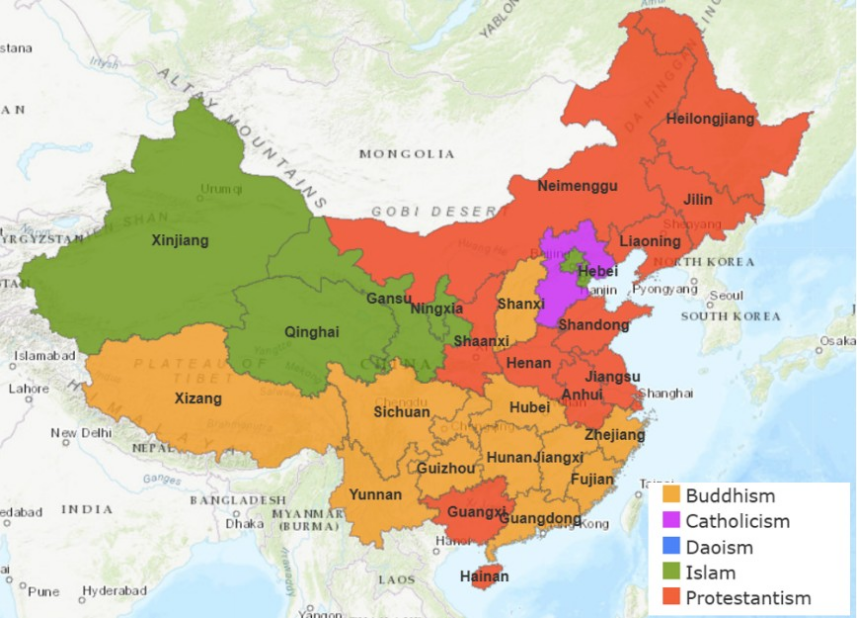
The Online Spiritual Atlas of the Global East (OSAGE), ‘created by the Center on Religion and the Global East (CRGE) at Purdue University’[footnote 27], produced the map below showing the predominant religion in each province.[footnote 28]
8.2 Christians
8.2.1 Pew Research Center, a nonpartisan fact tank that conducts ‘… public opinion polling, demographic research, content analysis and other data driven social science research’[footnote 29], noted in their report ‘Measuring Religion in China’, published in August 2023, that:
‘There is a range of estimates for the number of Christians in China, partly because different researchers use varying sources and methods, and partly because some analyses make adjustments to account for limitations in survey and government data.
‘One perspective is provided by responses to the Chinese General Social Survey (CGSS) question “What is your religious belief (zongjiao xinyang 宗 教信仰)?” In 2018, the CGSS found that roughly 2% of Chinese adults, or about 20 million people, self-identify with Christianity in this way. According to this survey, Protestants account for roughly 90% of Chinese Christians, or about 18 million adults, while the remainder are mostly Catholics. Smaller groups, which include Orthodox Christians, are fewer than 1% of Christian adults in China.
‘… Some media reports and academic papers have suggested the Christian share may be larger, with estimates as high as 7% (100 million) or 9% (130 million) of the total population, including children. No national surveys that measure formal Christian affiliation – by asking people which religion (zongjiao) they identify with – come close to these figures.
‘However, survey questions that measure Christian beliefs and practices provide evidence that the number of people with some connection to Christian faith is greater than zongjiao measures reveal.
‘For example, the cumulative share of Chinese adults who say they “believe in” (xiangxin) Jesus Christ and/or Tianzhu (天主, the word Chinese Catholics use for God) is 7%, or roughly 81 million adults, according to the 2018 [China Family Panel Studies] CFPS survey.’[footnote 30]
8.2.2 The Dui Hua Foundation in their report updated in April 2025 noted that of the 200 million (14%) of the population who the government noted are religious adherents in 2018:
‘… 44 million were Christians (6 million Catholics and 38 million Protestants). Observers generally believe that the official figures are a vast underestimate of the actual number of religious adherents. Independent estimates of the Christian population alone vary widely, but they all far outnumber the official tallies and could number as many as 80 million of those who worship in house churches and “underground” Catholic congregations alone.
‘Much of the discrepancy between official numbers and expert estimates can be attributed to China’s non-recognition of religious adherents outside of the five state-sanctioned patriotic associations. The official numbers would be much higher if, in addition to unregistered Christians, a rich array of communal practices that Chinese officials call “superstition,” were taken into account. Most, if not all, of these people are adherents of unorthodox religious groups, many of whose beliefs and practices are at odds with mainstream religious practices.’[footnote 31]
8.2.3 The 2024 DFAT report noted that:
‘Official Government of China statistics show that there are 38 million Christians [2.6% of the population] who worship at officially registered churches, however, due to this narrow definition, estimates of the Christian population in China vary significantly in practice. By contrast, the 2023 US Department of State International Religious Freedom Report estimated that 5.1 per cent of the population of China was Christian (about 72 million people), although higher estimates (more than 100 million) [7% of the population] also exist.’[footnote 32]
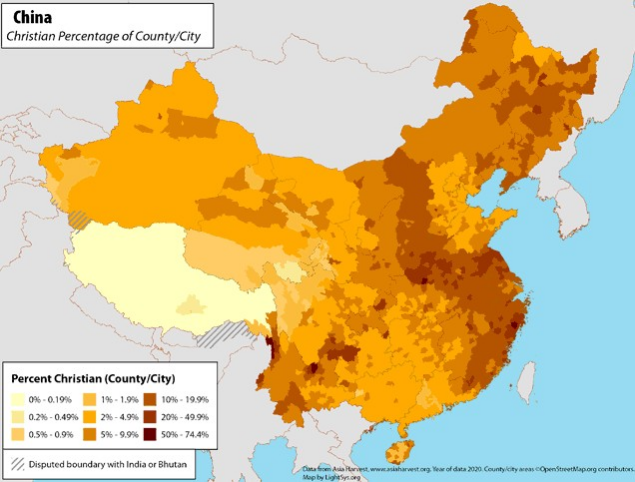
8.2.4 The below map by Mission Info Bank, a site offering research resources from and for missional Christian leaders[footnote 33] shows the percentage of Christians per county/city.[footnote 34]
8.2.5 The 2024 DFAT report additionally noted that there were around 10 million Catholics.[footnote 35] Open Doors, a US based Christian group[footnote 36], noted in 2026 that: ‘Catholics represent a minority of China’s Christian population, concentrated mainly in Hebei province and northern/central regions.’[footnote 37]
9. State treatment - general treatment
9.1 Treatment of all religious groups
9.1.1 The 2024 DFAT report noted that:
‘Professor Fenggang Yang of Purdue University described religious groups in China in 2019 as operating in a “red”, “grey” or “black” market. The “red market” groups were the officially sanctioned churches, such as the “patriotic associations”, the name used for officially sanctioned organisations that represented the five recognised religions. “Grey markets” included unofficial but tolerated (to a degree) religious gatherings. “Black markets” included underground movements and xie jiao. However, according to in-country sources in 2023, space for religious freedom had shrunk considerably since 2019. Following the lifting of COVID-19 restrictions in 2023, in-country sources reported that there was even less scope for autonomy for all religious activities in China. More vigorous efforts to enforce the Sinicisation of religions had reversed any trend of tolerance towards “grey market” unofficial religious gatherings.
‘Private forums operating outside of officially sanctioned religious organisations (including so-called “house”, “family” and “underground” churches) have come under heavy pressure to align their activities with those of the CCP. In-country sources told DFAT in 2023 that unregistered religious organisations had begun to pragmatically include pro-CCP messaging in their sermons to come into line with new regulations and ensure their ongoing survival, and noted that those who failed to cooperate with authorities had been closed down.
‘Increased state efforts to exert control over religious movements occurring under President Xi are just one facet of a broader CCP-led campaign to assert more control over society, ensuring that citizens’ first loyalty is to China, not to a religious community, ethnicity or social group. Religions with a cultural centre outside China, such as Christianity and Islam, are viewed by the CCP with additional suspicion due to concerns that their “foreign influence” could threaten the Party’s interests. Adherents of Buddhism (except Tibetan Buddhism), Confucianism, Daoism, folk religions, and syncretic combinations of these that the Government of China considers not to have influences from “foreign religions”, and are not associated with other foreign influences, were unlikely to experience significant government-related restrictions.
‘Overall, an individual’s ability to practise religion is dependent on whether they worship in registered or unregistered institutions, whether they practise openly or privately, and whether an individual’s religious expression or the religion itself is perceived by the CCP to be closely tied to other ethnic, political and security issues. In-country sources told DFAT in 2023 that there was generally more religious freedom in Southern China, with less onerous restrictions placed on religions operating in the provinces of Guangdong and Fujian. However, religious leaders of both registered and unregistered religious institutions were subject.[footnote 38]
9.1.2 The USCIRF Spotlight Podcast, a series produced by the USCIRF featuring USCIRF commissioners, staff, and external experts, published an episode titled ‘China’s Religious Freedom Violations on the Basis of Article 300’ in September 2025. In this episode, Commissioner Mohamed Elsanousi speaks with Massimo Introvigne, editor-in-chief of religious liberty magazine Bitter Winter.[footnote 39] A transcript of this podcast was generated using online video-editing platform ClipChamp.[footnote 40] In discussing the difference between registered, unregistered and illegal religious groups, Massimo Introvigne noted:
‘In all of these three segments, the red segment- the communities, parts of the recognized state-controlled umbrella organization, the grey market- the groups which are illegal but not listed as xie jiao, and the black market- the xie jiao. Black market, we have seen you go to jail. What happens to the other two groups?
‘You may believe you are very safe if your community affiliates with one of the umbrella organizations. So if you are a Protestant, if your community affiliates with the so-called 3 self [Three-Self Patriotic Movement], but you are not totally safe, because you still have limitation. For instance, you cannot allow minors of 18 to enter your church, not even infants in the arms of the mother. So, if you do it, you can be punished even if yours is a perfectly legal organization affiliated with a state-controlled umbrella group. The same, and it happened recently, if you import the Bibles or print Bibles without an explicit authorization of the Communist Party or the local authorities, even if you are part of the red market, the groups recognized by the state.
‘But most of the religions in China are in the grey market. They are not members of the xie jiao, but they don’t want to affiliate with the government-controlled organisation.’[footnote 41]
9.1.3 The USCIRF 2026 Annual Report noted: ‘Authorities have destroyed, shut down, and forcibly modified churches, mosques, temples, and other houses of worship under China’s “sinicization of religion” policy. Religious leaders and community members who refuse to submit to the CCP’s intrusive system of control face harassment, fines, detention, political reeducation, forced labor, imprisonment, enforced disappearance, torture, and other abuse.’[footnote 42]
9.2 Surveillance
9.2.1 The USCIRF 2026 Annual Report noted: ‘Authorities surveil houses of worship and use other authoritarian means to ensure compliance with government regulations.’[footnote 43]
9.2.2 The 2024 DFAT report noted that:
‘According to testimony from the 2020 US Commission on International Religious Freedom’s Hearing on Technological Surveillance of Religion in China, religious gatherings in China were subject to close monitoring by authorities. Technical surveillance, including CCTV cameras and audio recording equipment was overtly installed in all registered religious buildings and places of worship to monitor leaders and their congregations. Religious sites and those attending them were monitored using technical, biometric surveillance which leverages artificial intelligence (AI) to identify individuals, meaning that people could be specifically identified among crowds. Smartphone location data, vehicle location data and checkpoint logs could also be combined with facial recognition technology, and video feeds from buses, streets, and drones to identify when individuals in the same religious network met together covertly.’[footnote 44]
9.2.3 Bitter Winter, an online magazine on religious liberty and human rights in China, published by the Center for Studies on New Religions, headquartered in Italy[footnote 45], reported in 2025 that: ‘The Chinese government uses facial recognition technology to monitor religious activities, with over 40,000 new surveillance cameras installed in 2024 specifically for monitoring churches, temples, and religious schools.’[footnote 46]
9.2.4 An article by The Diplomat describes how American technology is being used to monitor worshippers:
‘…Christian worshippers across China must use an app that contains their biometric data and other personal information to enter state-sanctioned churches. Services are recorded by surveillance cameras as Chinese authorities analyze and censor the content of sermons. Voice recognition and digital surveillance software tracks their activity and conversations in and out of church.
‘…In Wenzhou, the epicenter of China’s Christian population – colloquially dubbed “China’s Jerusalem” – officials ordered state-sanctioned Christian groups to install “anti-terrorism” cameras in and outside of churches. Congregants who resisted were beaten. These cameras fed into local Public Security Bureau (PSB) command centers, where analysts monitored attendance patterns, sermon content, and interactions between members.
‘…In state-approved churches in Hubei, officials installed facial-recognition kiosks, fingerprint readers, and ID-scanning gates at entrances. Churches in Huangshi were instructed to gather congregants’ biometric and household details for government files. In Jiangxi, authorities installed more than 200 cameras in churches and temples as part of the CCP’s “Sharp Eyes” program. Even bathrooms in some churches were outfitted with cameras marketed as anti-vandalism devices.’[footnote 47]
9.2.5 According to Open Doors, in their World Watch List 2026 China report, covering the period from 1 October 2024 to 30 September 2025:
‘Surveillance through CCTV, neighborhood committees, and security guards is pervasive. Active local church leaders can face constant monitoring and police interrogation, with the CCP operating a reward system encouraging reporting of religious activities. The grid management system enables comprehensive neighborhood monitoring. Employment discrimination affects Christians particularly in public sector positions requiring Party membership. Christian converts from other religions face intense family and community pressure to renounce Christianity, including forced participation in non-Christian religious ceremonies or ancestor worship rituals.’[footnote 48]
9.3 Conditions of arrests, trials and detention
9.3.1 Freedom House, in their 2026 Freedom in the World report, covering events of 2025, noted:
‘Violations of due process are widespread in practice. Trials of … religious dissidents … are routinely held in secret, with even family members being denied information or entry. Criminal prosecutions in general rely heavily on confessions, many of which are obtained through torture despite laws prohibiting such practices. Forced confessions are often televised. While adjudication of routine civil and administrative disputes is considered more fair, cases that touch on politically sensitive issues or the interests of powerful groups are subject to decisive “guidance” from party political-legal committees.
‘… Conditions in places of detention are harsh, with reports of inadequate food, regular beatings, and deprivation of medical care. In addition to their use to extract confessions, torture and other forms of coercion are widely employed in efforts to force political and religious dissidents to recant their beliefs.’[footnote 49]
9.4 General state approach to Christianity
9.4.1 According to Open Doors, in their World Watch List 2026 China report, the Three-Self Patriotic Movement and the Patriotic Catholic Association are the only officially recognised Christian organisations.[footnote 50]
9.4.2 The 2024 DFAT report noted:
‘Official regulation of Christianity in China is in accordance with broader policies towards the Sinicisation of religions. In-country sources told DFAT in 2023 that official church services were required to begin with patriotic messages to “love the Party, love the homeland and love socialism”. While CCP approved Bibles were available for personal use, all content contradicting socialism was censored. Those who sold or distributed non-CCP approved bibles without authorisation faced arrest and prolonged detention. … Online Bible references were also censored and often, sacred images and representations, such as those of the Virgin Mary, had been replaced with portraits of Xi Jinping. Censorship of religious materials was prolific in 2023 and enforced by several government entities, including the SARA and the Cyberspace Administration.’[footnote 51]
9.4.3 In March 2025, Bitter Winter reported that: ‘In 2024, the Chinese government continued its systematic persecution of Christians, particularly targeting unregistered “underground” churches, pastors, believers, and clergy members. The most heavily persecuted groups included house church leaders, as well as underground Catholic bishops and Catholics who refused to join the Chinese Patriotic Catholic Association (CPCA).’[footnote 52] The source did not clarify how it defines ‘persecution’. The inclusion of this information should not be taken as an endorsement that CPIT considers the treatment faced by Christians to amount to persecution.
9.4.4 The CECC 2025 annual report noted: ‘As in previous years, while the Party and government closely supervised official groups, they also worked to suppress unsanctioned expressions of religious faith, including unregistered Protestant “house” churches, underground Catholic bishops, and members of groups that the government designates as “cult organizations,” or xiejiao (邪教) a historical term used by the Party to refer to new religious movements it perceives as threatening.’[footnote 53]
9.4.5 Open Doors, in their World Watch List 2026 China report, noted: ‘Government-controlled TSPM and CPA churches operate under state influence, with leaders carefully self-censoring. Both organizations have published five year “Sinicization” plans (China Source, 3 April 2024).’[footnote 54]
9.5 Christian practices
9.5.1 Open Doors, in their World Watch List 2026 China report, noted: ‘Unregistered churches face increased harassment, fragmenting into mobile groups to evade authorities, particularly in major cities. State sanctioned churches are often merged into larger entities for easier control. A country expert notes the complete absence of channels to voice concerns about religious policies. Local authorities now have zero tolerance for dissent within religious communities (Bitter Winter, 18 September 2025)’[footnote 55]
10. Catholics
10.1 The Sino-Vatican agreement
10.1.1 The 2024 DFAT report noted:
‘Under the Holy See-China: Provisional Agreement on Nomination of Bishops (2018), China agreed to recommend bishops before they were appointed by the Pope. Until this time, the Holy See had appointed its own bishops in China from among the unregistered “underground” churches, who were often harassed, detained, and jailed by authorities. After further consultation and assessment, the Agreement was renewed in 2022.
‘In-country sources told DFAT in 2023 that the Holy See-China: Provisional Agreement on Nomination of Bishops (2018) had experienced significant implementation difficulties. For example, the government unilaterally appointed President of CCPA, Shen Bin, as Bishop of Shanghai in April 2023 in direct contravention of the Agreement under which the Pope would choose the successors of Christ’s apostles. Pope Francis acceded to the government’s appointment in July 2023, as a “pastoral gesture for the sake of the Catholics of Shanghai”, despite it being a violation of the 2018 agreement.’[footnote 56]
10.1.2 On 22 October 2024, the Holy See Press Office announced that the Holy See, and the People’s Republic of China have agreed to extend the Sino-Vatican agreement for 4 years.[footnote 57]
10.1.3 National Catholic Register, a Catholic news source which provides news and reporting from the US, Vatican and around the world[footnote 58], noted in October 2024:
‘The Vatican announced Tuesday [22 October 2024] that it has renewed its agreement with China on the appointment of Catholic bishops for an additional four years.
‘… With the extension, the Sino-Vatican agreement will now remain in effect until Oct. 22, 2028.
‘… Originally signed in September 2018, the provisional agreement was previously renewed for a two-year period in 2020 and again in October 2022.
‘… The Vatican’s dialogue with China has not always been smooth. The Holy See has acknowledged that China violated the terms of the agreement by unilaterally appointing Catholic bishops in Shanghai and the “diocese of Jiangxi,” a large diocese created by the Chinese government that is not recognized by the Vatican.
‘Pope Francis expressed satisfaction with the ongoing dialogue with China during a press conference in September [2024]. However, the Vatican’s foreign minister, Archbishop Paul Richard Gallagher, has been more cautious, calling the agreement “not the best deal possible” and noting ongoing efforts to improve its implementation.
‘Since 2018, “about 10 bishops” have been appointed and consecrated under the terms of the Sino-Vatican agreement, according to Vatican News.’[footnote 59]
10.2 Registered groups, clergy and places of worship
10.2.1 The Pew Research Center’s 2023 report, ‘Measuring Religion in China’, noted that:
‘Government statistics on the numbers of officially registered Catholic venues and personnel – which include only those affiliated with the Catholic Patriotic Association (CPA) – point in slightly different directions.
‘On the one hand, the number of official Catholic personnel (bishops, priests and nuns) declined from 8,800 in 2009 to 8,000 in 2018. On the other hand, according to official statistics, the number of Catholic venues has grown slightly. In 2022, there were 6,440 officially registered venues (including 4,202 churches and 2,238 sites of worship), up from 6,000 in 2009. (Estimates of churches and worship sites for other years are unavailable.)
‘… As of 2018, there were seven CPA bishops whom the Vatican had not approved, and an estimated 30 to 40 underground bishops whom the Chinese government did not recognize.
‘In 2018, China’s relationship with the Vatican was recalibrated when the Vatican signed an agreement allowing the Chinese government to appoint bishops while giving the pope veto power. Since then, Pope Francis has recognized seven previously excommunicated “self-elected and self-ordained” Chinese bishops, while China has appointed eight underground bishops as CPA clergy, bringing the total number of bishops to 66 as of 2022.
‘Since signing the deal with the Vatican, the government has stepped up efforts to bring Catholic churches into the CPA and intensified its pressure on those that refuse to join.’[footnote 60]
10.2.2 GCatholic.org, ‘a non-profit website aimed at providing comprehensive and useful information of the Universal Catholic Church’[footnote 61], provides a list of Bishops of China.
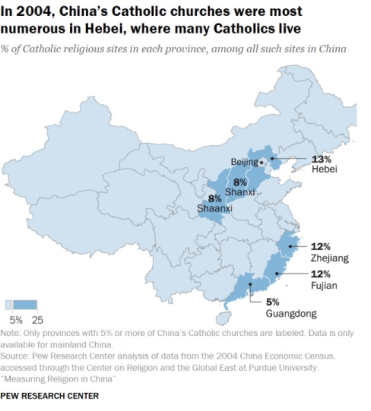
10.2.3 The map below was taken from the Pew Research Center’s report Measuring Religion in China and shows the distribution of registered Catholic churches. The Pew Research Center used data from the 2004 National Economic Census, but observed that whilst the number of Catholic churches has quadrupled since 2004 the data still gives a good snapshot of geographical patterns.[footnote 62]
10.2.4 The 2024 DFAT report noted: ‘Catholic doctrine, ecclesiastical law, and the appointment of leaders (bishops) around the world are managed directly by the Catholic hierarchy headquartered in the Vatican. In China, however, the Chinese Catholic Patriotic Association (CCPA) is the sole “official” government body responsible for the Catholic Church. As of 2024, the CCPA did not recognise the authority of the Holy See or its supreme pontiff, the Pope.
‘… Under the Holy See-China: Provisional Agreement on Nomination of Bishops (2018), Pope Francis subsequently appointed Father Taddeo Wang Yuesheng as the Bishop of Zhengzhou on 16 December 2023, Father Pietro Wu Yishun as Bishop of Shaowu (Minbei) in Fujian Province on 16 December 2023, and Father Anthony Sun Venjun as Bishop of the Diocese of Weifang on 29 January 2024. In August 2024, the Government of China recognised the authority of the Bishop of Tianjin, Melchior Shi Hongzhen, who had previously been placed under house arrest for refusing to join the CCPA.’[footnote 63]
10.2.5 The CECC 2025 annual report noted:
‘The Chinese Communist Party continued to assert its ultimate authority over the Chinese Catholic Church, in particular by appointing bishops without papal approval, despite the renewal of the Sino-Vatican Agreement, which established a process for appointing bishops mutually recognized by both parties. In October 2024, the Holy See announced that it would provisionally extend the Agreement for four more years. During the Commission’s 2025 reporting year, the Bishops’ Conference of the Catholic Church in China ordained two bishops under the terms of the Agreement: Bishop Zhen Xuebin, coadjutor bishop of Beijing diocese, Beijing municipality in October 2024, and Bishop Ji Weizhong, bishop of Luliang diocese, Luliang municipality, Shanxi province in January 2025. PRC officials also ordained two bishops in apparent contravention of the Agreement during the period following Pope Francis’s death and preceding the appointment of a new pope, making Vatican approval impossible. In April [2025], the Asia-focused Catholic website AsiaNews said that, according to its sources, leaders in the Shanghai municipality Party-controlled official Church “summoned” local clergy and religious figures to ratify the “election” of Father Wu Jianlin as auxiliary bishop. In Xinxiang municipality, Henan province, officials reportedly facilitated the unopposed “election” of Father Li Jianlin as bishop, also during the interregnum period between popes. Senior clerics in the PRC told another Catholic outlet that the decision to proceed with Father Li’s “election” after the death of Pope Francis reflected the PRC’s “policy of not officially acknowledging Rome in relation to episcopal appointments.” The Chinese Catholic Patriotic Association (CCPA) offered little acknowledgment of Pope Francis’s death, removing its brief condolence message from its home page after four days, and in Wenzhou municipality, Zhejiang province, authorities prevented even CCPA clergy from offering a Mass in memory of Pope Francis.’[footnote 64]
10.2.6 Union Catholic Asia News (UCA News), an ‘independent Catholic media service in Asia’[footnote 65], noted in February 2026 that:
‘China’s state-sanctioned Catholic bishops’ body has issued a statement supporting the government’s ban on unregistered clergy engaging in pastoral work and using unapproved sites for worship
‘The statement from the Bishops’ Conference of the Catholic Church in China (BCCCC) referred to the government’s Regulations on Religious Affairs, saying religious affairs relate to “vital interests” of believers and must adhere to “the national and public interests.”
‘The statement posted on Feb. 4 [2026] on the conference’s official site noted that religious activities are a concrete manifestation of citizens’ right to freedom of religious belief, which should be exercised “in accordance with the law.”’[footnote 66]
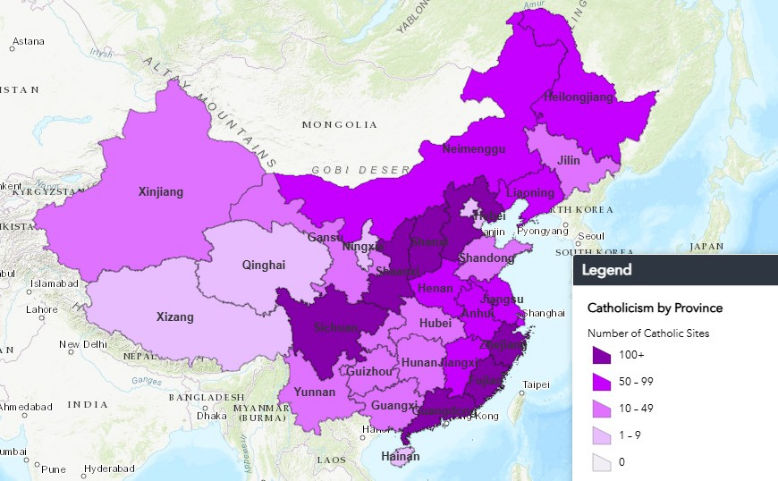
10.2.7 OSAGE produced the map below showing the number of Catholics sites in each province; areas shaded in darker colours indicate higher concentrations of Catholic sites.[footnote 67]
10.3 State treatment of registered groups
10.3.1 The 2024 DFAT report noted:
‘In-country sources told DFAT in 2023 that tightening restrictions were placed on those permitted to worship in churches, bans applied on proselytising online, and repression intensified against those whose “primary focus” was on following the Pope instead of the CCP and Xi Jinping. Despite being forced to join the CCPA, in-country sources reported in 2023 that “unjust restrictions” were still often applied to the operation of Catholic churches, including restricting congregants’ access, limiting times of worship, and installing visible CCTV cameras and audio recording equipment on their premises. According to in-country sources, the number of active parishioners had drastically reduced in 2023 as a result of restrictions placed on Catholics.’[footnote 68]
10.3.2 The National Catholic Register noted in October 2024 that:
‘Chinese officials have reportedly ordered the removal of crosses from churches and have replaced images of Christ and the Virgin Mary with images of President Xi Jinping, according to a recent report from the United States Commission on International Religious Freedom (USCIRF).’[footnote 69]
10.3.3 The CECC 2025 annual report noted: ‘Authorities have maintained ongoing pressure on both registered and unregistered Catholic churches, clergy, and laity in Wenzhou; in August 2024, Wenzhou public security officers raided a CCPA church, preventing priest Father Jin Mengxiu from celebrating Mass there.’[footnote 70]
10.4 State treatment of unregistered groups
10.4.1 The 2024 DFAT report noted that around 60% of the estimated 10 million Catholics belong to unregistered churches.[footnote 71]
10.4.2 Open Doors noted that: ‘Beyond the CPA, independent Catholic churches maintain allegiance to Rome.’[footnote 72]
10.4.3 The 2024 DFAT report noted:
‘There was no single unregistered Catholic Church in China, as churches tended to be “underground”, uncoordinated, and hard to unify. Depending on the region and provinces, unregistered churches may be dominant or work closely with registered churches. Several Vatican-approved but CCPA-unapproved bishops were still operating “underground”, in a capacity separate from the CCPA in 2023 according to in-country sources.
‘For some of China’s Catholics, allegiance to the Catholic Church hierarchy in the Vatican is an important part of their faith because of their belief in a succession of authority that can be traced back to St Peter, a contemporary of Jesus. For these Catholics, CCP-appointed priests and bishops are unable to validly confer sacraments that are central to their beliefs. On this basis, they refuse to participate in religious activities associated with the CCPA and are not able to practice their religion freely.
‘… According to international media, under the Holy See-China: Provisional Agreement on Nomination of Bishops (2018), some priests serving at unregistered churches were demoted from their positions as bishops and were pressured to join the CCPA. International media reports from 2019 stated that these priests had experienced torture and disappearance due to acts of resistance. … In-country sources noted that if Catholics were discovered to be attending unregistered churches in 2023, they would likely be warned verbally by authorities to change their behaviour and instructed to only attend official places of worship.’[footnote 73]
10.4.4 The USCIRF noted in their 2026 annual report that: ‘Despite increased engagement between the Vatican and China, underground Catholic clergy faced government pressure to align with state-controlled Catholic organizations.’[footnote 74]
10.4.5 The CECC 2025 annual report noted:
‘During the Commission’s 2025 reporting year, authorities continued to harshly suppress bishops in the unregistered Catholic Church who have refused to join the CCPA. Authorities have repeatedly targeted Bishop Peter Shao Zhumin, appointed bishop of Wenzhou diocese in Wenzhou municipality, Zhejiang province by Pope Benedict XVI. In March 2025, Wenzhou public security officials reportedly took Bishop Shao into custody in connection with a December 2024 Mass he celebrated for the Catholic Church’s “Jubilee Year,” which authorities said was illegal. Local officials initially fined Shao for the Mass and ordered the demolition of his building, later detaining him after he refused to pay the fine.
‘… Public security officers have conducted regular surveillance of unregistered churches in Wenzhou, and Wenzhou religious affairs officials reportedly prevented local Catholics from participating in a planned pilgrimage. Party and government authorities also continued to restrict the unregistered Catholic bishop of Mindong diocese, Fujian province, Guo Xijin, to his residence, sealing his chapel. According to local sources, authorities have increased restrictions on Guo since Christ mas as part of an effort to pressure clergy to join the CCPA.’[footnote 75]
10.4.6 UCA News reported in December 2025 that:
‘The Vatican has replaced an underground Catholic bishop in China who has spent years in and out of detention for resisting government religious policies, in a move that drew both official praise and criticism from within the underground Church.
‘The Vatican accepted the resignation of 69-year-old Bishop Joseph Zhang Weizhu as head of the Apostolic Prefecture of Xinxiang and agreed to the installation of 51-year-old Bishop Francis Li Jianlin in his place at an ordination ceremony on Dec. 5 [2025], Vatican-run Fides news agency reported.
‘Chinese authorities barred Bishop Zhang from attending the ceremony, according to U.S.-based Catholic Vote.
‘Bishop Zhang, secretly ordained with Vatican approval in 1991 and never recognized by Beijing, has been detained since his arrest in May 2021. He and several priests and seminarians were detained for allegedly violating regulations requiring clergy to register with the state. While the others were later released, Bishop Zhang’s whereabouts remain unknown.’[footnote 76]
10.4.7 USCIRF produce the ‘Frank R Wolf Freedom of Religion or belief Victims List’ (USCIRF list), which records victims targeted due to their religion or belief and includes those currently detained, those released, those who have died in custody and those whose whereabouts are unknown. According to their website, the list is compiled using USCIRF ongoing monitoring, communication with those affected and organisations that focus on religious freedom. USCIRF note, however, that: ‘… due to the policies of foreign governments and the lack of independent news and human rights organizations in the countries represented in this database, it is difficult to obtain, confirm, and verify comprehensive information about all victims.’[footnote 77]
10.4.8 At the time of writing, the USCIRF list records the details of eight Catholics. The whereabouts of two are currently unknown. The remaining six were recorded as detained at the time of writing. One of the detained, Jimmy Lai, was detained following the introduction of the National Security Law in Hong Kong (see the Country Policy and Information Note: Hong Kong national security legislation China for more information on his case).[footnote 78] The table below was produced using information from the list and gives the details of the other five Catholics currently detained and the two whose status is unknown[footnote 79]:
| Name | Province | Date of arrest | Current status | Details |
|---|---|---|---|---|
| James Su Zhimin | Hebei | 08/10/97 | Unknown | Su, an unregistered bishop in Baoding, Hebei Province, has refused to join the government-sanctioned Chinese Catholic Patriotic Association (CCPA) since the 1950’s. |
| Liu Honggeng | Hebei | 07/05/15 | Unknown | Liu, a priest at an underground church in Baoding, was reportedly arrested to ”prevent pilgrimages to his church.” |
| Joseph Zhang Weizhu | Henan | 21/05/21 | Detained | Zhang, a Vatican-approved bishop of the Xinxiang Diocese in Henan, was arrested for violating the revised Regulation on Religious Affairs which require state approval of clergy |
| Cui Tai | Hebei | 19/06/20 | Detained | Cui Tai, a Catholic bishop, was reportedly arrested in relation to his religious leadership activities as a bishop unrecognized by the government. |
| Ma Xianshi | Zhejiang | Nov 24 | Detained | Ma, a Catholic priest was accused of “illegal business activity” after he and another Catholic sold copies of an officially approved hymn book. |
| Zhuang Qiantuan | Zhejiang | Nov 24 | Detained | Arrested alongside Ma Xianshi (see above). |
| Guo Xijin | Fujian | Dec 24 | Detained | Guo, an ordained priest in the unregistered Mindong diocese under house arrest for his religious activities and leadership role. |
11. Protestants
11.1 Registered groups and places of worship
11.1.1 The map below was taken from the Pew Research Center’s 2023 report ‘Measuring Religion in China’ and shows the distribution of registered Protestant churches. The Pew Research Center used data from the 2004 National Economic Census but observed that whilst the number of Protestant Churches has quadrupled since 2004, the data still gives a good snapshot of geographical patterns.[footnote 80]
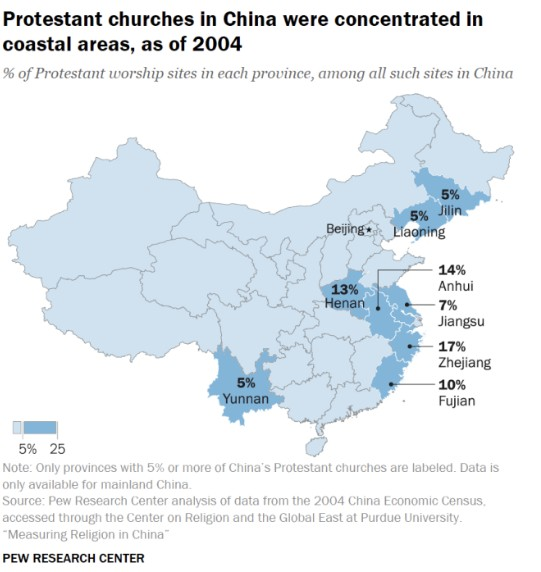
Protestant churches in China were concentrated in coastal areas, as of 2004. % of Protestant worship sites in each province, among all such sites in China.
11.1.2 The 2024 DFAT report noted:
‘The Three-Self Patriotic Movement (TSPM), established in 1949, is the official governing body for Protestant churches in China. “Three-Self” is a Chinese abbreviation for the church’s three principles of self-administration, self-financing and self-evangelisation, taken from 19th century missionary philosophies, and does not refer to the Trinity. The Three-Self Church, officially registered and recognised under the TSPM, comes under the authority of the CCP’s UFWD and is the single state-sanctioned Protestant church in mainland China.’[footnote 81]
11.1.3 OSAGE produced the map below showing the number of Protestant sites in each province; areas shaded in darker colours indicate higher concentrations of Protestant sites.[footnote 82]
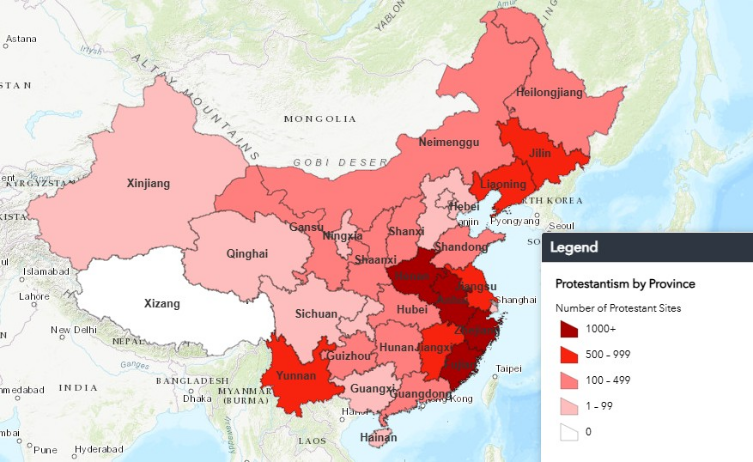
11.2 State treatment of registered groups
11.2.1 The 2024 DFAT report noted:
‘While the degree to which Protestants can practice their religion freely without discrimination differed from place to place and community to community in 2023, freedom to practice their religion tended to be more favourable in Southern China, especially Guangdong and Fujian. In-country sources told DFAT in 2023 that Protestants did not face much government interference in their freedom to practice their religion, as compared with other Christian denominations. Due to the nature of Protestant Christianity in China, with its churches not linked to a central hierarchy or authority besides the TSPM, Protestants were less likely to be seen as a threat to the state and targeted. International academics reported that Protestants had for years been reducing “outside influence” on their churches to achieve more self-sufficiency, with many pastors finding and training more domestic staff so Chinese congregants could take on positions once held by foreign missionaries. In 2023, registered Protestant churches appeared to be well funded, and operated religious shops and publishing houses, as long as they conformed with CCP directives.’[footnote 83]
11.2.2 At the time of writing there was one Protestant from a registered group recorded on the USCIRF list. Zhang Shaojie, who belonged to the state sanctioned Three-Self Patriotic Movement (TSPM), was a pastor of the Nanle TSPM and was arrested following a series of land disputes with local authorities. USCIRF noted that Zhang was released from prison in November 2025 after serving his 12-year prison sentence.[footnote 84]
11.3 State treatment of unregistered groups
11.3.1 The 2024 DFAT report noted:
‘Historically, many Protestants in China worshiped in unregistered private forums operating outside of TSPM control (mainly in unofficial “house” churches). COVID-19 restrictions led many house churches to move their services online, which increased the size of their congregations. In 2021, the Government of China significantly increased its ongoing efforts to force unregistered churches to submit to the authority of the TSPM, teach Party-aligned doctrine, cut off association with foreign churches, and subject the appointment of pastors to rules set out by the TSPM.
‘Churches that refuse to align with the TSPM have been threatened with official closure or already closed, and have had their leaders (pastors and congregation elders) arrested and detained for subverting the law. In-country sources told DFAT that between 2021 and 2023, authorities had placed pressure on unregistered churches to comply with official CCP regulations by cutting off electricity, forcing landlords to evict members, or using procedural grounds to shut them down. Members of unregistered churches were unlikely to face arrest or detention in 2023, and in most instances were warned verbally by authorities to only worship at registered churches.’[footnote 85]
11.3.2 Bitter Winter reported in March 2025 that during 2024: ‘At least 12,000 Christians were investigated, threatened, or detained by the government for participating in house church activities, with more than 1,000 individuals sentenced or sent to “re-education camps”. More than 2,000 house churches were shut down …’[footnote 86]
11.3.3 In the September 2025 USCIRF Spotlight podcast, Massimo Introvigne noted:
‘… very often now it [Article 300 of China’s Criminal Law] is used against Christian house churches, which are said to behave like a xie jiao.
‘… they [house churches] are not xie jiao, but they are nonetheless illegal. So, they can be punished under a number of other laws, not Article 300. There are other norms, for instance, punishing religious fraud or illegal gatherings, even outside of Article 300. But what is happening recently is sometimes Article 300 is applied by some local courts, not only to groups in the black market, those who listed in the xie jiao, but also to groups in the grey market, those who are not affiliated with the red market, government-controlled umbrella organizations, but are not listed in the xie jiao. But some courts will apply Article 300 to them as well.’[footnote 87]
11.3.4 The CECC 2025 annual report noted:
‘Authorities continued to raid unregistered Protestant “house” churches and detain their members this reporting year, including:
- Beijing Zion Church. In July 2024, authorities in Beijing municipality took into custody Preacher Zhou Sirui of Zion Church and held her in administrative detention for 14 days for the crime of “illegally carrying out activities in the name of an association with voided registration.” In September [2024], authorities raided Zion Church again, detaining Zhou for another 15 days, along with Elders Cai Jing and Wu Qiong. In October [2024], authorities once again raided multiple meeting locations of Zion Church and held Elder Qin Guoliang in administrative detention for 14 days for “illegally organizing a gathering.”
- Early Rain Covenant Church. In September 2024, authorities in Chengdu municipality, Sichuan province, raided Early Rain Covenant Church and administratively detained Elder Li Yingqiang, Elder Li Youhong, also known as Yan Hong, Preacher Wu Wuqing, and Deacon Zeng Qingtao for 14 days. Local police accused them of “illegally carrying out activities in the name of an association.”
- Xinyi Village Church. In February 2025, authorities in Panji district, Huainan municipality, Anhui province, criminally detained pastor Zhao Hongliang and three members of Xinyi Village Church. Although Xinyi Village Church is registered with the official Three-Self Patriotic Movement, the church reportedly had refused to comply with requirements issued by local officials.
11.3.5 The same report also provided examples of Christians being charged with fraud and illegal business operations:
‘This past year [1 July 2024 - 30 June 2025], PRC authorities continued to employ charges of “fraud” and “illegal business operations” to project a veneer of criminality onto activities that fall within the scope of normal religious activities, including establishing church-affiliated institutions and fundraising. For example, in August 2024, the Yijiang District People’s Court in Wuhu municipality, Anhui, held a closed trial for three Christians from Mount Carmel Church charged with “illegal business operations” for running an affiliated school. The court sentenced both Han Yanlei and Xie Zhifeng to nine months in prison and sentenced Lu Zhaojin to nine months’ imprisonment with a one year suspended sentence. In June 2025, the Yaodu District People’s Court in Linfen municipality, Shanxi province, handed down harsh sentences in two major “fraud” cases against house church clergy and laypeople, both premised upon donations made by church members. While the court has not yet sentenced Linfen Golden Lampstand pastors Yang Rongli and Wang Xiaoguang, it sentenced 10 lay members of the church to sentences ranging from 1 year and 10 months to 9 years and 2 months in prison. On the same day, the court also sentenced Linfen Covenant Church pastors Li Jie and Han Xiaodong to three years and eight months in prison.
‘This reporting year, PRC authorities also employed exit bans to restrict the freedom of movement of Protestants associated with “house” churches, including:
- In July 2024, customs police in Macau intercepted Pastor Jin Mingri of Beijing Zion Church, preventing him from going abroad to visit his family in the United States. Jin had previously been under a five-year border control period which should have ended in March 2024.
- In September 2024, authorities in Dongguan municipality, Guangdong province, harassed unregistered house church pas tor Xing Jinfu, asking him whether he had plans to go abroad. They also pressured him to hand over his passport. One leader of a U.S.-based religious freedom nongovernmental organization (NGO) speculated that this was related to worries that Xing intended to attend the Lausanne Congress, an international Christian gathering focused on missionary work, which took place later that month.
11.3.6 The same report noted:
‘Also this year, the Commission observed PRC authorities employing various methods to censor and surveil Protestants’ online expression of their religious beliefs. For example, in August 2024, authorities in Guangzhou municipality, Guangdong, took into custody Christian Xin Ruoyu, reportedly holding her in extrajudicial detention. Xin had been involved in the development of the app “Song of Songs,” which provides Chinese language hymns and sheet music. Also in August 2024, Christian lawyer Xie Qida posted a Christian hymn onto his TikTok account. The Ethnic and Religious Affairs Bureau of Xishan district, Kunming municipality, Yun nan province, issued him a notice requiring him to “delete videos of singing Christian hymns on all online media.”’[footnote 88]
11.3.7The USCIRF 2025 report noted: ‘Law enforcement also ramped up its targeting of independent Protestant religious leaders and house church congregations. In June [2025], authorities sentenced around a dozen members of the Golden Lampstand Church for alleged fraud, including 15 years’ imprisonment for its pastor Yang Rongli. In October [2025], law enforcement detained more than 20 members of Zion Church, including its pastor Ezra Jin, for “unlawfully using online information.”’[footnote 89]
11.3.8 Open Doors, in their World Watch List 2026 China report, noted: ‘Independent house churches, though more numerous, often operate with minimal pastoral leadership after being forced to split into smaller groups, meeting in changing locations. Most follow Pentecostal practices (China Source, 13 June 2023).’[footnote 90]
11.3.9 Human Rights Watch (HRW) reported in January 2026 that:
‘The Early Rain Covenant Church posted on social media that on January 6, 2026, police raided the home of its current leader, Li Yingqiang (李英强), in Deyang and took him away. It said that other key church members were similarly taken into custody.
‘… Those detained include Dai Zhichao (戴志超), Ye Fenghua (叶丰华), Yan Hong (晏鸿), and Zeng Qingtao (曾庆涛). Another Early Rain adherent, Shu Qiong (舒琼), was summoned by police in Chengdu, Sichuan’s provincial capital, for “picking quarrels and provoking trouble.” Wu Wuqing (吴五清) was also summoned by the police, then released and warned against “being involved in the case.”
‘… The crackdown on Early Rain Covenant Church occurred just weeks after authorities reportedly arrested approximately 100 members of another unofficial Protestant church, Yayang Church in Wenzhou, Zhejiang province, between December 13 and 18, 2025. At least two dozen members remain in detention. Local authorities surrounded the church on January 5 [2026] with hundreds of armed and special police, as well as bulldozers and other machinery, apparently to demolish part or all of the church, according to the US-based religious freedom organization China Aid.
‘… In mid-2025, courts in China convicted about a dozen people affiliated with the Linfen Golden Lampstand Church, an underground Protestant church in Shanxi province, for fraud. The church’s cofounder and pastor, Wang Xiaoguang, and his wife, Yang Rongli, were sentenced to 9 and 15 years in prison, respectively.’[footnote 91]
11.3.10 In January 2026 several news agencies[footnote 92] [footnote 93] [footnote 94] reported that the church in Yayang Town near Wenzhou in the Zhejiang province had its cross removed. UCA News noted that the Yayang Church: ‘… is the central place of worship for a network of 12 independent house churches in the area …’[footnote 95]
11.3.11 Bitter Winter reported in January 2026 that:
‘House churches originated as a refusal to accept the Three-Self Church’s politicization. Many Christians, unwilling to submit their faith to government censorship, chose to meet in private homes or discreet venues, continuing to preach the whole Bible and the pure gospel. These churches are not clandestine, yet the authorities brand them “illegal,” subjecting them to raids, dispersing their gatherings, and even labeling believers as “reactionaries.” The derogatory term “underground church” not only tarnishes their legitimacy but also provides a pretext for violent intervention. For years, house church believers have endured layers of surveillance: phones tapped, cameras installed in their homes, meetings infiltrated. Even a small Bible study or prayer gathering can suddenly turn into a mass arrest.
‘On the evening of October 10, 2025, persecution reached a new height. Police in Beihai, Guangxi Province, raided the home of Zion Church’s founding pastor, Ezra Jin (Jin Mingri), and took him away. Dozens of church leaders were also arrested. At least 18 pastors and staff members were formally charged with “illegal use of information networks.” Zion Church, one of the largest house churches in China, counts tens of thousands of believers across multiple provinces. This large-scale crackdown signaled an escalation in the government’s campaign against house churches, with those arrested facing up to three years in prison. The operation was not isolated but the culmination of years of systematic pressure: surveillance, harassment, property seizures, forced closures of meeting places, and repeated short-term detentions. The October 2025 action was highly coordinated across provinces, sweeping up pastors, elders, and co-workers, revealing the authorities’ meticulous planning and determination.’[footnote 96] The source did not clarify how it defines ‘persecution’. The inclusion of this information should not be taken as an endorsement that CPIT considers the treatment faced by Christians to amount to persecution.
11.3.12 At the time of writing, the USCIRF list recorded the details of 68 Protestants. One of those listed belonged to the state sanctioned Three-Self Patriotic Movement (TSPM) and two were arrested on cult charges. Of the remaining 65, the current status of three Protestants was recorded as unknown. Twenty Protestants, from unregistered Protestant groups, were recorded as released from detention. This included:
- Six Protestants from the Early Rain Covenant Church in Sichuan Province who were detained together in 2018.
- Five individuals from a bible study group in the Yunnan province who were detained together in 2022.
- Four belonging to the Zion Church, three from Guangxi and one from Sichuan province, who were all arrested in October 2025.
There are 42 Protestants from unregistered groups on the list who were detained at the time of writing. Seventeen of those detained were arrested in October 2025. They came from various provinces, but all belonged to the Zion Church. Four others were arrested in February 2026 and belonged to the Early Rain Church in Sichuan province.[footnote 97]
The chart below was produced by CPIT, based on information from the USCIRF list. It shows the yearly numbers of recorded arrests of Protestants from unregistered groups between 2016 and 2026.[footnote 98]
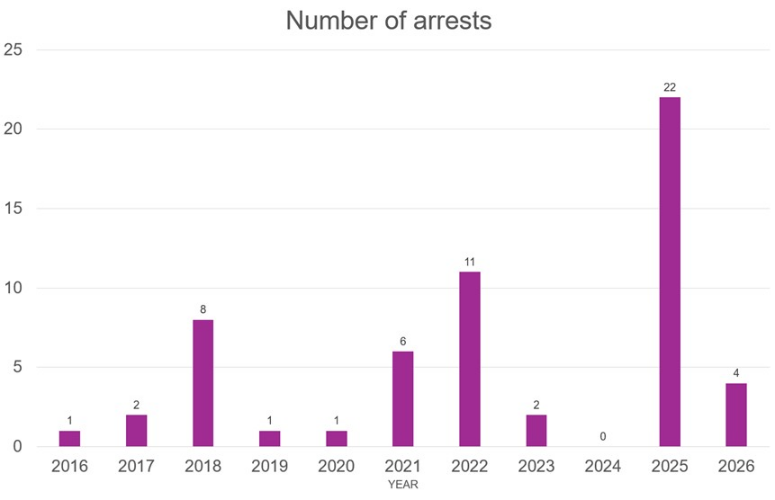
11.3.14 Using information from the USCIRF list, CPIT has produced the map below. The map shows the geographic distribution of Protestants from unregistered groups who had been arrested between 2016 and 2026, for whom a province was recorded in the source material. The province listed may refer either to the individual’s place of arrest or their place of residence.[footnote 99] [The BBC notes that: ‘China is governed as 22 provinces, five “autonomous” regions, four municipalities - considered so important they are under central government control (Beijing, Shanghai, Tianjin and Chongqing) - and two special administrative regions.’[footnote 100]]
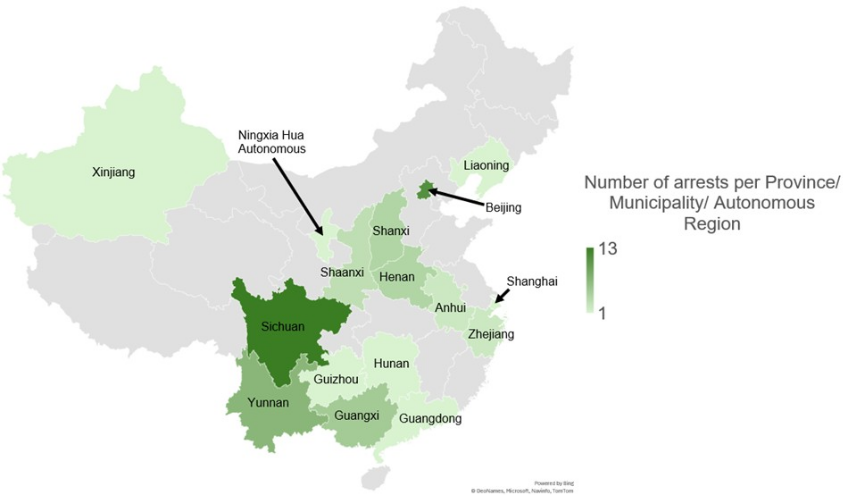
12. Other unregistered Christian groups
12.1 Cults (xie jiao)
12.1.1 The 2024 DFAT report noted:
‘Some new religious movements, known as xie jiao, are illegal in China. The translation of the term xie jiao is debated, with scholars pointing to its historic translation as “heterodox religion”, however it has negative connotations when used by the Government of China (akin to “evil cult”) and is unlikely to be used by adherents of new religions themselves. Restrictions against xie Jiao date back to the Ming Dynasty. The China Anti-xie jiao Association publishes an unofficial list of xie jiao, which includes 23 movements. There is an official list of xie jiao published by the government, which can change quickly, making it difficult to determine at any time whether a particular religious movement is banned.
‘… Many xie jiao began as a formal expression of a syncretic mix of Buddhism, Daoism and Confucianism (“three religions in one”) along with cultural practices, which from a Western perspective are sometimes difficult to separate from religious practices. Some later incorporated foreign religions into their mix of beliefs, especially Christianity and Islam, in essence becoming “five religions in one”. Many of these religions obscure their historic background, and adherents might not recognise their new religious movement as influenced by other religions.
‘Membership in a xie jiao is illegal in China, and the profile of a person who is a member – whether they are a leader or an ordinary believer – was not relevant in 2023 to the chances of arrest once detected. Even low-profile worshippers in a xie jiao were subject to arrest to in 2023 …’[footnote 101]
12.1.2 The Dui Hua Foundation noted in their article looking into detailed court statistics on Article 300 between 1998-2016, that: ‘Acquittals are rare in China. In cult cases, only 69 men and women [of 40,000 people] who stood trial from 1998-2016 were acquitted. About 99.8 percent of cult trials ended with a conviction. Among them, 384, or 1.3 percent, were exempt from criminal punishment, and 219, or 0.8 percent, were sentenced to criminal detention or public surveillance.’[footnote 102]
12.1.3 The Dui Hua Foundation noted in their report ‘The persecution of Unorthodox Religious Groups in China’, updated in April 2025, that:
‘The exact number of unorthodox religious groups that exist in China is contested. It cannot be accurately answered just by looking at the various “cult lists” issued by the Chinese government. Back in 1995, China’s State Council and the CCP’s Central Committee issued a circular labelling seven religious organizations “sects” and making them illegal. Beginning in that year and continuing thereafter, seven other groups were also banned and identified as “reactionary sects” or “heretical organizations.”
‘Today, the longest and most circulated list names 20 “cult” organizations. It was compiled by the China Anti-Cult Association in 2014 following the McDonald’s killing allegedly committed by Almighty God members. Of the 20, the first eleven were listed as being “dangerous.” The public has also been urged “to be on guard against” the remaining nine groups:
- Falun Gong
- Church of Almighty God
- Shouters
- Society of Disciples
- Unification Church
- Guanyin Famen
- Evangelical Gospel Mission Armored with Blood and Holy Spirit
- Full Scope Church
- Three Grades of Servants
- True Buddha School
- Mainland China Administrative Deacon Station
- Spirit Church
- South China Church
- Anointed King
- Lord God Church
- World Elijah Evangelic Mission
- Yuandun Famen
- New Testament Church
- Dami Mission
- Children of God.
‘It must be noted, however, that the number of groups that have been targeted in anti-cult campaigns across the nation varies from place to place and totals more than 20.
‘… Several unorthodox religious groups are absent on the “cult” lists despite them being active targets of state crackdowns in recent years.’[footnote 103]
12.1.4 In discussing the list of activities that would be considered illegal under Article 300 of China’s Criminal Law, Massimo Introvigne noted in the September 2025 USCIRF Spotlight podcast that:
‘… the Chinese Embassy say we don’t punish membership in xie jiao, we punish only using the xie jiao to violate the law, which is true, but just participating in a gathering of three, four people of an organisation labelled as a xie jiao or telling other people you are a member of a Xie jiao and perhaps the other people will be interested, all this is violation of the law. So, all this may send you to jail up to life imprisonment.
‘… there is a very, very long list of violating the law on behalf of a xie jiao, as I say, illegally holding assemblies. That means even a meeting to pray, meeting to study the Bible or another scripture, a sacred scripture, that’s illegally holding assemblies. So that’s violating the law. And also advertising a xie jiao through the internet, that’s illegal. Proselyting, trying to convert another to a xie jiao is illegal. Printing books and newspaper or preparing videos or audio tapes or banners, this is also illegal and collecting donation is also illegal … basically being active on behalf of a group regarded as a xie jiao in any capacity is illegal …’[footnote 104]
12.1.5 Bitter Winter reported in March 2025 that:
‘According to an article published by the Ministry of Public Security of the People’s Republic of China on February 13, 2025, Chinese security agencies “increased efforts in 2024 to dismantle xie jiao organizations,” claiming that they are “committed to curbing the development and spread of xie jiao organizations to reduce potential threats to national political security.” However, it is important to note that the term “xie jiao” (邪教) has no fixed definition in official discourse, and the government frequently uses it as a pretext to suppress any religious organizations that are not under state control.’[footnote 105]
12.1.6 Using mainly open-source reporting, the Dui Hua Foundation compiled its ‘Political Prisoner Database’, which contains information on ‘political and religious prisoners incarcerated in China since 1980.’[footnote 106] The database is not searchable. However, they reported that, as of 31 March 2025, there were 49,589 individuals in the database, with 7,157 currently in custody.[footnote 107] They went on to note that the top crime of those detained was ‘Organising/using a cult to undermine implementation of the law’, for which they reported 2,538 people were detained. It is not clear from the source how many of these were linked to Christian groups or other religions.[footnote 108]
12.1.7 At the time of writing, the USCIRF list recorded the details of 340 individuals who had been arrested on cult charges. Of the 340 people, 220 are listed as currently detained. 176 of those currently detained belong to the Church of Almighty God (see Church of Almighty God (COAG/CAG) or Eastern Lightning), 41 are Falun Gong practitioners (see the Country Policy Information Noted on China: Falun Gong), two are from Protestant groups and one has no Christian group specified. Of the remaining 120, all of which are Falun Gong practitioners, five are recorded as released and 115 are recorded as status unknown.
| Year | Number of Arrests |
|---|---|
| 2017 | 2,930 |
| 2018 | 11,111 |
| 2019 | 6,132 |
| 2020 | 7,055 |
| 2021 | 11,156 |
| 2022 | 10,895 |
| 2023 | 12,520 |
| 2024 | 19,053 |
| 2025 | 19,191 |
12.2.10 Using information from the same report, CPIT has produced the map below. The map shows the 10 provinces with the most recorded arrests of COAG members in 2025.[footnote 119]
12.2 Church of Almighty God (COAG/CAG) or Eastern Lightning
12.2.1 The 2024 DFAT report noted:
‘The Church of Almighty God (also known as Eastern Lightning, among other names, and often abbreviated in English to “COAG” or “CAG”) was banned as a xie jiao in November 1995. COAG operates in secret, both to avoid detection and as a general matter of faith practice. There are no authoritative estimates of the population of COAG adherents in China, however adherents live predominantly in northeast and southeast of the country. COAG receives academic attention from a small number of foreign researchers, who mostly take a sympathetic view of the religion. Mainstream Western media occasionally reports on COAG, but based on reports from Christian groups that are often critical of the Church.
‘COAG adherents believe Jesus returned to earth in the 20th century as a woman referred to as “Almighty God”. The central COAG text is called the Word Appears in the Flesh, a 2,400-page book presenting the Almighty God’s sayings, which must be studied by every member. COAG adherents believe they are in a constant mortal struggle against the “Great Red Dragon” (thought to be a reference to the CCP according to scholars) and that membership of the group will bring salvation from an impending apocalypse. COAG adherents believe that “Almighty God” came to inaugurate the “third and final age of humanity”, or “the Age of Kingdom”, which follows “the Age of Law” (the Old Testament) and “the Age of Grace” (of Jesus).
‘Little is known about the identity of the central female figure, “Almighty God,” which may be because of secrecy enforced by the religion. In 2021, Protestant-linked sources reported that she never existed at all, and the Church had denied claims that she was called “Yang” or “Deng” or that she came from Henan Province. International academics reported in 2021 that different beliefs about her identity existed amongst Church followers and were aware of some members denying that any such figure existed at all. International academics also stated in 2021 that some followers paid little attention to the female Christ figure, without denying her existence. Similarly, some COAG texts referred to “Almighty God” using male pronouns. Some adherents believe that a woman came to earth as a new incarnation of Christ and the “ordinariness” of this woman appealed to some rural female adherents.
‘There are no formal liturgy or sacraments in the COAG movement, but weekly study meetings occur. While international academics in 2021 reported that COAG followed a hierarchy, some COAG adherents may not understand the hierarchy or leadership of the religion, or deny that it exists. Due to the secrecy that surrounds COAG, a common understanding may not be reached by members, and questions about practice could be genuinely answered differently by different adherents. COAG religious texts were available on the internet in 2023 and could be downloaded within China by those with a virtual private network (VPN) to bypass China’s internet censorship (the “Great Firewall”).
‘COAG is controversial. International media has reported on COAG involvement in homicides and kidnappings. International media also reported in 2020 that COAG adherents were forced to break away from families and sell their possessions to give the proceeds to the Church. These media reports have been disputed by COAG and some international academics. For example, reports that COAG had run a Hebrew-language websites to push right-wing propaganda and interfere with the 2019 Israeli election were described by US academic Holly Folk as “outside their normal practice”. In 2019, Folk told Buzzfeed that COAG was a victim of propaganda and impersonation at the hands of the Government of China.
‘While small Protestant groups have often come out strongly against COAG, their criticisms could be inaccurate. Antagonisms may stem from COAG efforts in the early 1990s to convert Christian believers from both unregistered “house” and [Three-Self Patriotic Movement] TSPM churches. International academics reported in 2021 that converting members of Protestant churches to the COAG remained a key priority for its evangelisation work, which was illegal in China. International scholars reported in 2021 that some Protestants were cooperating with authorities to help identify COAG activity and arrest members.’[footnote 109]
12.2.2 The Dui Hua Foundation report updated in April 2025 noted that:
‘Despite being outlawed since 1995, Almighty God did not become a major target of religious suppression until late December 2012, when media sources reported that Almighty God preachers “showed up on the street, in company offices and school campuses warning non believers that their righteous path offers the only salvation from the end of the world.” Some media sources have also reported that the unorthodox Christian group adopts aggressive recruitment practices in Hong Kong, where religious groups banned in mainland China can still operate. Chinese government sources confirm Almighty God’s widespread influence across mainland China. For instance, a 2019 indictment statement from Jiangsu revealed that there were 28,000 Almighty God members in Jiangsu’s Xuzhou Prefecture alone as of the end of August 2018
‘A portion of Chinese asylum seekers who have fled overseas are known to be members of Almighty God. As of June 2019, 2,322 members of Almighty God were seeking asylum in the European Union …
‘… some observers have suggested that the practice of organ harvesting has been extended to Almighty God, albeit to a smaller extent when compared to reported figures for Falun Gong. This argument was put forward in a book titled Tortured to Death: The Persecution of The Church of Almighty God in China. Published in 2018 by Brussels-based Human Rights Without Frontiers, the book documents 21 cases of Almighty God members who died in custody in suspicious circumstances, with tell-tale signs that their internal organs had been removed.’[footnote 110]
12.2.3 The CECC 2025 annual report noted:
‘Authorities have engaged in a protracted and apparently nationwide crackdown against … the Church of Almighty God (CAG), also called Eastern Lightning, launching consecutive campaigns to eradicate the religious group. According to a report issued by CAG, in 2024 the Party Central Committee Political and Legal Affairs Commission coordinated the launch of a three-year “Tough Battle” campaign targeting CAG, following on the heels of its previous “General Battle” campaign. In the year since the “Tough Battle” was launched, CAG reported a more than 50 percent rise in arrests.’[footnote 111]
12.2.4 Available data on the number of arrests of members of The Church of Almighty God (COAG) in China varies significantly between sources. This reflects differences in methodology, definitions, and access to information. For example, figures reported by the USCIRF are typically derived from a range of open-source reporting, including government statements, media reports and human rights organisations[footnote 112], whereas COAG’s own annual reports rely on internally collected information, including testimonies from members and affiliated networks.[footnote 113] Given the limited transparency and restrictions on independent monitoring in China, both sets of figures are difficult to verify, and should be considered indicative rather than comprehensive.
12.2.5 At the time of writing, the USCIRF list recorded the details of 264 members of the Church of Almighty God. Of the 264, the whereabouts of 88 were unknown. The remaining 176 were recorded as detained. All of those listed were charged with ‘organizing or using a cult to undermine implementation of the law’.[footnote 114]
12.2.6 Based on information from the USCIRF list, CPIT has produced the chart below, which shows the number of recorded arrests of COAG church members from 2016 - 2022. At the time of writing there were no recorded arrests after 2022 in the USCIRF list.[footnote 115]
Number of CAG Christians Arrested, 2017–2025
| Year | Number of Arrests |
|---|---|
| 2016 | 18 |
| 2017 | 72 |
| 2018 | 88 |
| 2019 | 6 |
| 2020 | 0 |
| 2021 | 9 |
| 2022 | 19 |
12.2.7 According to the USCIRF list, Xinjiang was the region where the greatest number of arrests took place. Using information from the USCIRF list, CPIT has produced the map below. The map shows the geographic distribution of the 28 COAG members who were arrested in 2021 and 2022, for whom a province was recorded in the source material. The province listed may refer either to the individual’s place of arrest or their place of residence.[footnote 116]
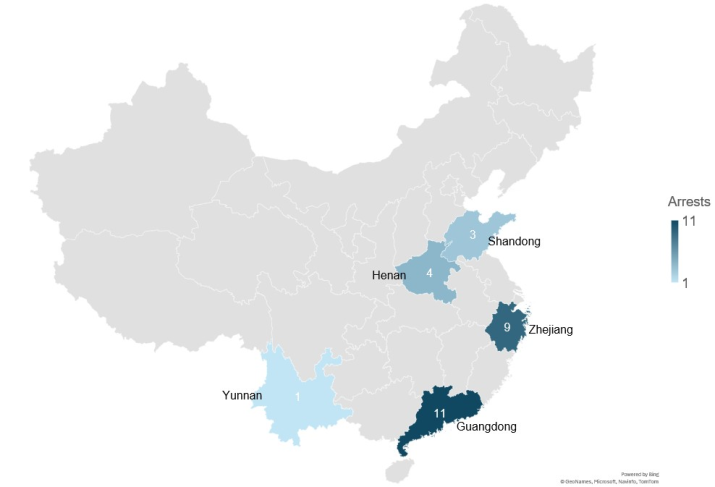
12.2.8 The Church of Almighty God (COAG) publishes reports on the arrests, sentencing and deaths of its members in China based on cases reported to the organisation. COAG states that the figures are incomplete and represent minimum estimates, citing restrictions on access to information, surveillance, and loss of contact with detained members.[footnote 117] The reports do not set out a detailed methodology for verification or data aggregation, and the information is not independently verified.
12.2.9 The below graph, taken from the COAG’s annual report ‘Exposing the CCP’s persecution of the Church of Almighty God (2025)’, published on 13 February 2026, shows the number of arrests of COAG Christians from 2017-2025.[footnote 118]
Number of COAG Christians Arrested (2016–2022)
| Year | Number of Arrests |
|---|---|
| 2017 | 2,930 |
| 2018 | 11,111 |
| 2019 | 6,132 |
| 2020 | 7,055 |
| 2021 | 11,156 |
| 2022 | 10,895 |
| 2023 | 12,520 |
| 2024 | 19,053 |
| 2025 | 19,191 |
12.2.10 Using information from the same report, CPIT has produced the map below. The map shows the 10 provinces with the most recorded arrests of COAG members in 2025.[footnote 119]
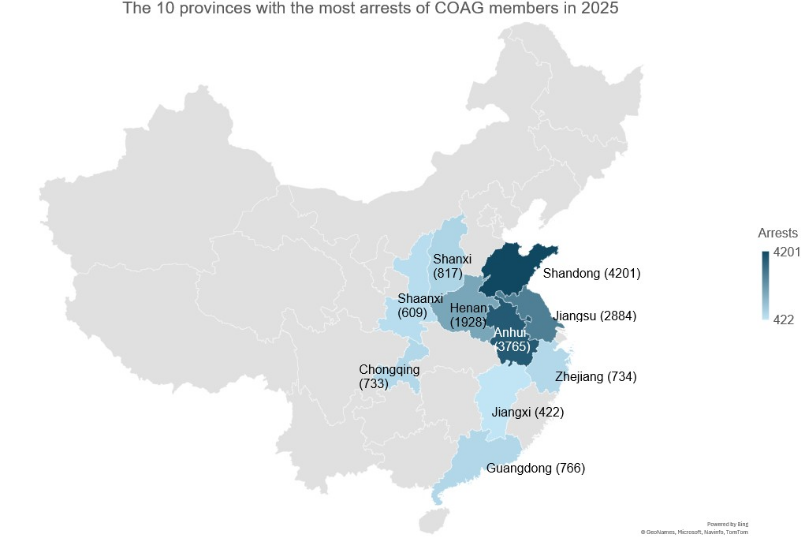
12.2.11 The COAG 2025 report also noted that:
‘According to incomplete statistics, at least 2,291 CAG Christians were sentenced in 2025—the highest annual total in recent years (see figure 7). Among them, 973 received sentences of over three years, and 110 were sentenced to over seven years. The youngest person sentenced was 21 years old, the longest sentence reached ten years and six months, and the highest fine imposed reached RMB 100,000 (approx. USD 14,000) [£10,961[footnote 120]]. Due to the CCP’s strict information blockade, the actual sentencing situation is far more severe.
Number of CAG Christians Sentenced, 2020–2025
| Year | Number of Persons Sentenced |
|---|---|
| 2020 | 1,098 |
| 2021 | 1,452 |
| 2022 | 1,901 |
| 2023 | 2,212 |
| 2024 | 2,175 |
| 2025 | 2,291 |
12.3 The Local Church (Shouters or The Assembly)
12.3.1 The 2024 DFAT report noted:
‘The term “Local Church” refers to the descendants of a Christian-based religious movement from the 1960s. They are often collectively referred to as “Shouters”, which refers to the loud and energetic worship practices of the various groups. Shouters are congregationally based, not led by a hierarchy or as part of a communion of churches and have experienced multiple splits and schisms.
‘Groups collectively designated as “Shouters” often have little or nothing to do with each other, except for perhaps a shared history. They were of Protestant Christian origin but may now be indistinguishable from other small Protestant groups or share little resemblance with them. Members of these groups may not call themselves “Shouters”, instead using “Local Church” or “the Assembly” or another name. The term “Shouters” has sometimes been used pejoratively by critics or the government.
‘Shouters may or may not be treated by the Government of China as a xie jiao. Some groups have been absorbed by TSPM, while others operate independently. Bitter Winter published an article in May 2021 in which American scholar J. Gordon Melton claimed groups that accepted the teachings of founder “Chairman Nee” (in Mandarin, “the Old Local Church”) were not xie jiao but those groups who recognised the teachings of later leader “Watchman Lee” or “Witness Lee” (in Mandarin “Local Church” or perhaps “New Local Church”) were xie jiao. DFAT was unable to verify this claim in 2023, however, understands that distinctions between different groups were not well understood by authorities, and arrests of either group was possible.
‘A 2020 reference in China’s media consistent with anti-xie jiao messaging, quoted Xining (the capital of Qinghai in Western China) police as saying that Shouters were illegal and “pretend to be Christianity”. In 2020, Beijing-based leaders of “the Assembly” were sentenced to three years in prison for “organising a cult to undermine implementation of the law”. Bitter Winter reported in 2021 that a crackdown was occurring aimed at Shouters in Beijing, Jiangsu and Guangxi. DFAT was unable to verify these claims in 2023, however considered them plausible.’[footnote 122]
12.3.2 The Dui Hua Foundation report updated in April 2025 noted, in relation to the Protestant group referred to as the ‘Assembly’ or ‘Local Church’ that:
‘This Protestant movement was initiated in China by Watchman Nee (倪柝声) in the 1920s and is referred to with different names in China and overseas. According to J. Godron Melton, the retired Distinguished Professor of American Religious History at the Institute for Studies of Religion at Baylor University, Nee’s movement has been called Little Flock (小群, a name derived from their hymnal), Christian Assembly, the Church Assembly Hall, Lord’s Recovery, or “Local Church” in the West. In China, this unorthodox group is more often called the “Assembly.”
‘… In China, three sub-factions of Nee’s movement had emerged by 1980. The first faction consisted of believers who agreed with Nee that a city only needs one church to solve the problems of denominational divisions. They were largely absorbed by the Three Self-Patriotic Church. The Shouters, the second faction, operates independently of the CCP and accepts Li as Nee’s legitimate successor. The third faction largely follows Nee’s original teachings, rejects Li’s leadership, and remains independent of the CCP.
‘While the Chinese government outlawed the Shouters in 1983, the Assembly has never been named on any official lists of cult organizations. That said, Melton noted that the Assembly is a network of independent congregations, each of which is different from the others, and remains part of the unregistered Christian congregations about which the Chinese government is concerned. There are occasions where the Chinese government treats the Assembly and the Shouters as an identical group, accusing Assembly followers of spreading Li Changshou’s heterodox teachings. Members of the Assembly have refuted the allegations and stated that the Assembly is not part of the Shouters. Cases of imprisonment involving leaders of the Assembly have also been reported. In May 2020, Beijing-based leaders were each sentenced to three years in prison for “organizing a cult to undermine implementation of the law.”’[footnote 123]
12.3.3 The Dui Hua Foundation distinguishes between the Local Church/Assembly and the Shouters. In relation to the Shouters, they note in their report updated in April 2025 that:
‘The Shouters were founded by Witness Li Changshou (李常受) in 1962 in the United States. It was brought to China in 1979. By 1983, this unorthodox Protestant group had spread to 360 counties and cities in 20 provinces and autonomous regions and had up to 200,000 believers. They are called Shouters because members engage in public shouting as part of their worship. There are government reports that Li proclaimed himself to be Christ and asked believers to shout out his name in place of the name of Jesus. This accusation is hotly disputed by Shouters who have gained political asylum in the West. Christian groups, particularly members of the Assembly, who prayed openly without registering with the Three Self-Patriotic Church could earn the appellation of joining the “Shouters sect.”
‘The Shouters were declared a “counterrevolutionary group” shortly before the first Strike Hard Campaign began in August 1983. During the four years when the campaign was in effect, thousands of Shouters were detained, with the result that many either joined other groups or went further underground. Dui Hua’s prisoner database indicates that by 1987—the last year of the first Strike Hard Campaign—the number of Shouters had begun to stabilize in China. The majority of arrests documented in the database took place in the early 1980s.
‘In the 1990s, multiple offshoots of the Shouters appeared, some of the best known of which are the Anointed King, Lord God Church, and Almighty God. While the number of Shouters cases has declined in recent years, overseas rights groups continue to report that the leaders face arrest and imprisonment. In September 2020, six alleged members of the Shouters were sentenced to prison sentences ranging from 18 months to five years for violating Article 300(1). In February 2021, the Justice Court of Rome granted asylum to a male member of the Shouters, quoting precedents of refugees from Almighty God who face high risk of religious persecution and imprisonment in China.’[footnote 124]
12.4 Jehovahs’s Witnesses
12.4.1 For background information on Jehovah’s Witnesses see the Jehovah’s Witnesses website or the BBC.
12.4.2 The Dui Hua Foundation report updated in April 2025 noted that:
‘Emerging from the Bible Student movement in the late 1870s by American pastor Charles Taze Russell, Jehovah’s Witnesses claim a worldwide membership of 8.6 million across 240 countries. The group is best known for preaching door-to-door about the imminent destruction of the world. Some religious scholars and organizations outside China have also called it a “cult” for making doctrinal reversals, false prophecies, and erroneous biblical translations. Additionally, it has been criticized for coercive recruitment and fear-mongering, as well as for prohibiting blood transfusions.
‘There was no information about the group’s activity in China until news media sources reported the first known case of imprisonment involving 18 members in Korla City, Xinjiang, in June 2020. They received prison sentences ranging from two years and six months to six years and six months. According to the indictment statement, the group discourages members from “joining the CCP, joining the military, raising or saluting the national flag, singing the national anthem, and participating in elections.”’[footnote 125]
14.4.3 The 2024 DFAT report noted:
‘There are a small number of Jehovah’s Witnesses in China. While in-country sources confirm some Jehovah’s Witnesses reside across China, access to detailed population information is very limited due to the risks they face as an illegal religion. Jehovah’s Witnesses report that their adherents throughout China have experienced home raids, physical abuse, separation from families (including visa cancellation and deportation of foreign spouses), interrogation, detention and placement in re-education centres. Bitter Winter reported in 2019 that Jehovah’s Witnesses had been prosecuted under laws that criminalise xie jiao.
‘Jehovah’s Witnesses are politically neutral but practise proselytization as an expression of their faith, which is illegal in China. They are linked to a worldwide religion headquartered in the United States. Bitter Winter reported in 2020 that Jehovah’s Witnesses had been questioned about their links to foreign actors and their political views.’[footnote 126]
12.4.4 In the September 2025 USCIRF Spotlight podcast, Massimo Introvigne noted: ‘However, there are groups which are not listed [as xie jiao] against which Article 300 [of China’s criminal law] is routinely employed. The one example is the Jehovah’s Witnesses. The Jehovah’s Witnesses are not in the list of said xie jiao, but there are several court decisions where their members are sent to jail by applying Article 300.’[footnote 127]
12.4.5 At the time of writing there are no details of any Jehovah’s Witnesses on the USCIRF list.[footnote 128]
12.4.6 The official Jehovah’s Witness website highlights, cases of Jehovah’s Witnesses imprisoned around the world. At time of writing, the site does not list any members imprisoned in China.[footnote 129]
12.5 Church of Jesus Christ of Latter-day Saints (Mormons)
12.5.1 The Church of Jesus Christ of Latter-day Saints’ website contains specific information regarding the religion in China. It also provides information to followers wishing to pursue the religion in China. Under their Frequently Asked Questions (FAQs) section they state that: ‘The Church follows established official guidelines for the activities of its members in China. Within established guidelines, Church members are able to pursue personal individual belief and practice.’[footnote 130]
12.5.2 In answer to a question regarding activities that should be avoided in China, the same FAQs state:
‘Please do not distribute any Church literature or other religious materials; please do not seek to attend Church meetings with foreign Church members, and please do not set up religious-based social media accounts, blogs, microblogs, WeChat public number, video site internet accounts, etc., that could be misunderstood as trying to promote the Church in China. Church members can take only one copy of each Church magazine or Church material for personal use in China. To avoid any misunderstanding, please do not send Church magazines or Church materials by mail or through the internet.’[footnote 131]
12.5.3 The 2024 DFAT report noted:
‘There are a small number of Church of Jesus Christ of Latter-day Saints (Mormons) in China. The Church’s website notes the large worldwide Chinese diaspora has exposed many Chinese people to their faith. Mormons practice prosletysation, which is illegal in China. In accordance with laws against prosletysation, the Church’s website cautions members in China to be careful to comply with local laws and not to distribute church literature or materials or set up social media accounts to discuss their faith. The Church’s website states that there are local Sunday worship meetings in China.
‘… The construction of a Mormon Temple in Shanghai was announced in April 2020. As at the time of publication, construction had not begun. CNN reported in June 2020 that authorities in Shanghai had “suggested” that “prior approval” for the announcement had not been sought by the Church. DFAT was unable to source further information about this project, however social media posts from 2021 suggested that the project was not likely to go ahead.’[footnote 132]
12.5.4 In July 2025 The Salt Lake Tribune, a US based non-profit newspaper[footnote 133], reported that:
‘In recent months, several Chinese municipalities across the giant Asian nation have shut down congregations of The Church of Jesus Christ of Latter-day Saints without warning, citing a failure to register with the government.
‘The closed branches ranged from Nanjing in the eastern province of Jiangsu to Jilin Province in the north. The most recent “banning,” however, was aimed at the two branches in the capital of Beijing — one for expatriates and one for Chinese worshippers.
‘On June 22 [2025], the Civil Affairs Bureau of the Chaoyang District in Beijing announced that “the ‘Mormon Beijing Branch’ carried out activities in the name of social organizations without registration, which violated the provisions of the … ‘Regulations on the Administration of Social Organization Registration.’”
‘Accordingly, the edict declared, “the Beijing Branch is hereby banned.”
‘… The June 22 [2025] Beijing edict appeared to be primarily aimed at the branch for Chinese nationals, experts say. But because the congregation for Chinese members and the branch for foreign ones meet in the same facility at different times, their underlying lease was affected.
‘…Members say the church’s signage — subtle though it was — has already been removed.’[footnote 134]
12.5.5 At the time of writing, the USCIRF had no documented members of the Church of Jesus Christ of the Latter-day Saints who had been targeted due to their religion or belief and includes those detained, released, who have died in custody and whose whereabouts are unknown.[footnote 135]
12.5.6 For further background information on the Church of Jesus Christ of the Latter-day Saints see the previous version on this CPIN.
Terms of Reference
The ‘Terms of Reference’ (ToR) provides a broad outline of the issues relevant to the scope of this note and forms the basis for the country information.
The following topics were identified prior to drafting as relevant and on which research was undertaken:
- Legal framework
- Constitution
- Criminal code
- Religious regulations
- Registration process
- Proselytising
- Demography
- State treatment- general treatment
- Treatment of all religious groups
- Surveillance
- Conditions of arrest, trials and detention
- General state approach to Christianity
- Christian practices
- Catholics
- Registered groups, clergy and places of worship
- The Sino-Vatican agreement
- State treatment of registered groups
- Treatment of unregistered groups
- Protestants
- Registered groups and places of worship
- State treatment of registered groups
- State treatment of unregistered groups
- Other unregistered Christian groups
- Cults (xie jiao)
- Church of Almighty God (COAG/CAG) or Eastern Lightning
- The Local Church (Shouters of the Assembly)
- Jehovah’s Witnesses
- Church of the Jesus Christ of Latter-day Saints (Mormons)
Bibliography
Sources cited
AFP, Arrests reported, cross removed as China crackdown on unofficial churches grows, 10 January 2026. Accessed via France24: 21 April 2026
Australian Department of Foreign Affairs and Trade (DFAT), Country Information Report- China, 27 December 2024. Accessed: 14 April 2026
BBC:
- Religion: Jehovah’s Witnesses, no date. Accessed: 6 May 2026
*How China is ruled: Provinces and townships, 8 October 2012. Accessed: 10 June 2026
Bitter Winter:
-
About, no date. Accessed: 20 May 2026
-
Editorial Board, no date. Accessed: 10 June 2026
-
China’s Religious Freedom Crisis Escalates: Christian Churches Face Comprehensive Suppression, 25 March 2025. Accessed: 12 May 2026
-
A Chinese Christian Reflects on the House Churches’, 19 January 2026. Accessed: 21 April 2026
-
China’s New “Illegal Activity”: Providing Legal Defense to Christians, 23 March 2026. Accessed: 21 April 2026
Britannica, Holy See: Definition, Vatican City, Roman Catholicism, History, Governance, & Facts, 25 May 2026. Accessed: 10 June 2026
ChinaAid, ChinaAid Urges International Action to Prevent the Imminent Destruction of Yayang Christian Church in Wenzhou, China, 5 January 2026. Accessed: 21 April 2026
China Law Translate, Criminal Law (2021 edition), 28 December 2020. Accessed: 11 May 2026
Church of Almighty God (COAG), Annual Report Exposing the CCP’s Persecution of The Church of Almighty God (2025), 13 February 2026. Accessed: 30 April 2026
The Church of Latter-day Saints, The Church of Jesus Christ of Latter-day Saints in China, no date. Accessed: 12 May 2025
ClipChamp, About, no date. Accessed: 10 June 2026. Accessed: 12 May 2026
The Diplomat, How American Technology Helps China Persecute Its Christians, 6 February 2026. Accessed: 29 June 2026
Congressional Executive Commission on China (CECC):
-
Frequently Asked Questions, no date. Accessed: 20 April 2026
-
2025 Annual Report, 12 December 2025. Accessed: 20 April 2026
Dui Hua Foundation:
-
Who We Are, no date. Accessed: 29 April 2026
-
Detailed Court Statistics on Article 300, Part I, no date. Accessed: 11 May 2026
-
Political Prisoner Database, 31 March 2025. Accessed: 22 April 2026
-
The Persecution of Unorthodox Religious Groups in China: A Report, updated April 2025. Accessed: 29 April 2026
Freedom House, China: Freedom in the World 2026 Country Report, 2026. Accessed: 11 May 2026
GCatholic:
-
About This Site, no date. Accessed: 18 May 2026
-
Bishops of China, last updated 11 April 2026. Accessed: 18 May 2026
Holy See Press Office, Communiqué on the extension of the Provisional Agreement between the Holy See and the People’s Republic of China regarding the appointment of bishops, 22 October 2024. Accessed: 15 April 2026
Human Rights Watch (HRW), China: New Arrests at Underground Protestant Churches, 6 January 2026. Accessed: 21 April 2026
Interpret: China, At the 22nd collective study session of the CCP Politburo, Xi Jinping stressed the need for systematic advancement of Sinicization of religions in China and active guidance for religions to adapt to a socialist society, 29 September 2025. Accessed: 15 April 2026
Jehovah’s Witnesses:
-
Jehovah’s Witnesses—Official Website, no date. Accessed: 6 May 2026
-
Where Jehovah’s Witnesses Are Imprisoned for Their Faith, no date. Accessed: 6 May 2026
Mission Info Bank:
-
Mission Info bank, no date. Accessed: 10 June 2026
-
China - Christian Percentage of County/City, 2019. Accessed: 10 June 2026
National Catholic Register:
-
About Us, no date. Accessed: 15 April 2026
-
Vatican-China Bishop Deal Renewed for Four More Years, 22 October 2024. Accessed: 15 April 2026
The National People’s Congress of the People’s Republic of China, Constitution, 14 March 2004. Accessed: 14 April 2026
Online Spiritual Atlas of the Global East (OSAGE):
-
Online Spiritual Atlas of the Global East About, no date. Accessed: 12 May 2026
-
China Map, no date. Accessed: 12 May 2026
Open Doors:
-
About Us, no date. Accessed: 10 June 2026
-
World Watch List 2026 China Country Dossier, 2026. Accessed:10 June 2026
Pew Research Center:
-
About Pew Research Center, no date. Accessed: 12 May 2026
-
Measuring Religion in China, 30 August 2023. Accessed: 12 May 2026
-
Christianity in China, 30 August 2023. Accessed: 29 April 2026
Religion Unplugged:
-
About Us, no date. Accessed: 15 April 2026
-
China Tightens Digital Grip on Clergy with Sweeping New Rules, 19 September 2025. Accessed: 15 April 2026
The Salt Lake Tribune:
-
About The Salt Lake Tribune, no date. Accessed: 12 May 2026
-
LDS branches shut down in Beijing and elsewhere in China, 4 July 2025. Accessed: 12 May 2025
Union Catholic Asia News (UCA News):
-
About Us, no date. Accessed: 21 April 2026
-
Vatican replaces detained bishop in China, 9 December 2025. Accessed: 21 April 2026
-
‘Official’ Chinese Church backs ban on unregistered clergy, 9 February 2026. Accessed: 21 April 2026
-
The Church’s silence on China’s egregious violations of religious freedom, 14 January 2026. Accessed: 21 April 2026
US State Department (USSD), 2023 Report on International Religious Freedom: China, 26 June 2024. Accessed: 12 May 2026
US Commission on International Religious Freedom (USCIRF):
-
2026 Annual Report, 4 March 2026. Accessed: 14 April 2026
-
About USCIRF’s Frank R. Wolf Freedom of Religion or Belief Victims List, no date. Accessed: 28 April 2026
-
Frank R Wolf Freedom of Religion or belief Victims List, no date. Accessed: 28 April 2026
-
Spotlight Podcast China’s Religious Freedom Violations on the Basis of Article 300, 12 September 2025. Accessed: 11 May 2026
Xe.com, Chinese Yuan Renminbi to British Pound, no date. Accessed: 19 May 2026
Sources consulted but not cited
ABC News, China ramps up crackdown on Christians amid global political pressures, 19 January 2026. Accessed: 21 April 2026
Asia News, New arrests of house church members in China, 9 January 2026. Accessed: 21 April 2026
BBC News, China’s crackdown on underground churches intensifies with new arrests, 8 January 2026. Accessed: 21 April 2026
Bertelsmann Stiftung’s Transformation Index (BTI), BTI 2026 China Country Report, 2026. Accessed: 20 April 2026
Bitter Winter:
-
Zhejiang: Five-Day Police Operation in Wenzhou Targets Christians, 22 December 2025. Accessed: 21 April 2026
-
China’s New “Illegal Activity”: Providing Legal Defense to Christians, 23 March 2026. Accessed: 21 April 2026
Catholic Review, Vatican and China renew, extend agreement on naming bishops, 22 October 2024. Accessed: 15 April 2026
China Aid, 2025 Annual Report, 1 January 2026. Accessed: 12 May 2026
FSSPX News, The Sino-Vatican Agreement Will Be Renewed, 25 June 2024. Accessed: 15 April 2026
Human Rights Watch, World Report 2026: China, 4 February 2026. Accessed: 11 May 2026
Radio Veritas Asia, China and the Vatican renewed the third extension of the accord, 23 October 2024. Accessed: 15 April 2026
UCA News, China intensifies crackdown on unregistered churches, 10 January 2026. Accessed: 21 April 2026
Vatican News, Holy See and China extend Provisional Agreement on appointment of bishops, 22 October 2024. Accessed: 15 April 2026
Version control and feedback
Clearance
Below is information on when this note was cleared:
- version 5.0
- valid from 30 June 2026
Official – sensitive: Not for disclosure – Start of section
The information in this section has been removed as it is restricted for internal Home Office use.
Official – sensitive: Not for disclosure – End of section
Changes from last version of this note
Updated country information.
Feedback to the Home Office
We welcome feedback on how to improve our products. If you would like to comment on this note, please email the Country Policy and Information Team.
Independent Advisory Group on Country Information
The Independent Advisory Group on Country Information (IAGCI) was set up in March 2009 by the Independent Chief Inspector of Borders and Immigration to support them in reviewing the efficiency, effectiveness and consistency of approach of COI produced by the Home Office.
The IAGCI welcomes feedback on the Home Office’s COI material. It is not the function of the IAGCI to endorse any Home Office material, procedures or policy. The IAGCI may be contacted at:
Independent Advisory Group on Country Information
Independent Chief Inspector of Borders and Immigration
3rd Floor
28 Kirby Street
London
EC1N 8TE
Email: chiefinspector@icibi.gov.uk
Information about the IAGCI’s work and a list of the documents which have been reviewed by the IAGCI can be found on the Independent Chief Inspector’s pages of the GOV.UK website.
-
The National People’s Congress of the People’s Republic of China, Constitution, 14 March 2004 ↩
-
DFAT, Country Information Report- China (paragraph 3.50), 27 December 2024 ↩
-
China Law Translate, Criminal Law (2021 edition), 28 December 2020 ↩
-
DFAT, Country Information Report- China (paragraph 3.97), 27 December 2024 ↩
-
The Dui Hua Foundation, Who We Are, no date ↩
-
The Dui Hua Foundation, Detailed Court Statistics on Article 300, Part I, no date ↩
-
DFAT, Country Information Report- China (paragraph 3.51), 27 December 2024 ↩
-
DFAT, Country Information Report- China (paragraph 3.51), 27 December 2024 ↩
-
Interpret: China, At the 22nd collective study session of the CCP Politburo …, 29 September 2025 ↩
-
USCIRF, 2026 Annual Report, 4 March 2026 ↩
-
CECC, Frequently Asked Questions, no date ↩
-
CECC, 2025 Annual Report, 12 December 2025 ↩
-
USSD, 2023 Report on International Religious Freedom: China, 26 June 2024 ↩
-
DFAT, Country Information Report- China (paragraph 3.52- 3.54), 27 December 2024 ↩
-
CECC, 2025 Annual Report (page 80), 12 December 2025 ↩
-
Religion Unplugged, China Tightens Digital Grip On Clergy With Sweeping …, 19 September 2025 ↩
-
Open Doors, World Watch List 2026 China Country Dossier, 2026 ↩
-
DFAT, Country Information Report- China (paragraph 3.82), 27 December 2024 ↩
-
Britannica, Holy See: Definition, Vatican City, Roman Catholicism, History, …, 25 May 2026 ↩
-
USSD, 2023 Report on International Religious Freedom: China, 26 June 2024 ↩
-
USCIRF, 2026 Annual Report, 4 March 2026 ↩
-
DFAT, Country Information Report- China (paragraph 3.55), 27 December 2024 ↩
-
The Dui Hua Foundation, The Persecution of Unorthodox Religious Groups …, updated April 2025 ↩
-
USCIRF, 2026 Annual Report, 4 March 2026 ↩
-
OSAGE, Online Spiritual Atlas of the Global East About, no date ↩
-
Pew Research Center, About Pew Research Center, no date ↩
-
Pew Research Center, Measuring Religion in China, 30 August 2023 ↩
-
The Dui Hua Foundation, The Persecution of Unorthodox Religious Groups …, updated April 2025 ↩
-
DFAT, Country Information Report- China (paragraph 3.64), 27 December 2024 ↩
-
Mission Info Bank, Mission Info bank, no date ↩
-
Mission Info Bank, China - Christian Percentage of County/City, 2019 ↩
-
DFAT, Country Information Report- China (paragraph 3.68), 27 December 2024 ↩
-
Open Doors, World Watch List 2026 China Country Dossier, 2026 ↩
-
DFAT, Country Information Report- China (paragraph 3.58- 3.61), 27 December 2024 ↩
-
Bitter Winter, Editorial Board, no date ↩
-
USCIRF, Spotlight Podcast (17.21 min), 12 September 2025 ↩
-
USCIRF, 2026 Annual Report, 4 March 2026 ↩
-
USCIRF, 2026 Annual Report, 4 March 2026 ↩
-
DFAT, Country Information Report- China (paragraph 3.56), 27 December 2024 ↩
-
Bitter Winter, China’s Religious Freedom Crisis Escalates: Christian Churches …, 25 March 2025 ↩
-
The Diplomat, How American Technology Helps China Persecute Its Christians, 6 February 2026 ↩
-
Open Doors, World Watch List 2026 China Country Dossier, 2026 ↩
-
Freedom House, Freedom in the World 2026, 2026 ↩
-
Open Doors, World Watch List 2026 China Country Dossier, 2026 ↩
-
DFAT, Country Information Report- China (paragraph 3.65), 27 December 2024 ↩
-
Bitter Winter, China’s Religious Freedom Crisis Escalates: Christian Churches …, 25 March 2025 ↩
-
CECC, 2025 Annual Report, 12 December 2025 ↩
-
Open Doors, World Watch List 2026 China Country Dossier, 2026 ↩
-
Open Doors, World Watch List 2026 China Country Dossier, 2026 ↩
-
DFAT, Country Information Report- China (paragraph 3.70- 3.71), 27 December 2024 ↩
-
Holy See Press Office, Communiqué on the extension of the Provisional …, 22 October 2024 ↩
-
National Catholic Register, Vatican-China Bishop Deal Renewed for Four More…, 22 October 2024 ↩
-
Pew Research Center, Measuring Religion in China (section 4- Christianity), 30 August 2023 ↩
-
GCatholic, About This Site, no date ↩
-
Pew Research Center, Christianity in China, 30 August 2023 ↩
-
DFAT, Country Information Report- China (paragraph 3.67 and 3.71), 27 December 2024 ↩
-
CECC, 2025 Annual Report, 12 December 2025 ↩
-
UCA News, ‘Official’ Chinese Church backs ban on unregistered clergy, 9 February 2026 ↩
-
DFAT, Country Information Report- China (paragraph 3.73 ), 27 December 2024 ↩
-
National Catholic Register, Vatican-China Bishop Deal Renewed for Four More…, 22 October 2024 ↩
-
CECC, 2025 Annual Report, 12 December 2025 ↩
-
DFAT, Country Information Report- China (paragraphs 3.68), 27 December 2024 ↩
-
Open Doors, World Watch List 2026 China Country Dossier, 2026 ↩
-
DFAT, Country Information Report- China (paragraphs 3.68-3.69 & 3.72 ), 27 December 2024 ↩
-
USCIRF, 2026 Annual Report, 4 March 2026 ↩
-
CECC, 2025 Annual Report, 12 December 2025 ↩
-
UCA News, Vatican replaces detained bishop in China, 9 December 2025 ↩
-
USCIRF, About USCIRF’s Frank R. Wolf Freedom of Religion or Belief Victims List, no date ↩
-
USCIRF, Frank R Wolf Freedom of Religion or belief Victims List, no date ↩
-
USCIRF, Frank R Wolf Freedom of Religion or belief Victims List, no date ↩
-
Pew Research Center, Christianity in China, 30 August 2023 ↩
-
DFAT, Country Information Report- China (paragraph 3.82), 27 December 2024 ↩
-
DFAT, Country Information Report- China (paragraph 3.85), 27 December 2024 ↩
-
USCIRF, Frank R Wolf Freedom of Religion or belief Victims List, no date ↩
-
DFAT, Country Information Report- China (paragraphs 3.83- 3.84), 27 December 2024 ↩
-
Bitter Winter, China’s Religious Freedom Crisis Escalates: Christian Churches …, 25 March 2025 ↩
-
USCIRF, Spotlight Podcast (12:41 min and 19:14 min), 12 September 2025 ↩
-
CECC, 2025 Annual Report, 12 December 2025 ↩
-
USCIRF, 2026 Annual Report, 4 March 2026 ↩
-
Open Doors, World Watch List 2026 China Country Dossier, 2026 ↩
-
HRW, China: New Arrests at Underground Protestant Churches, 6 January 2026 ↩
-
UCA News, The Church’s silence on China’s egregious violations of religious…, 14 January 2026 ↩
-
ChinaAid, ChinaAid Urges International Action to Prevent the Imminent …, 5 January 2026 ↩
-
AFP, Arrests reported, cross removed as China crackdown on unofficial …, 10 January 2026 ↩
-
UCA News, The Church’s silence on China’s egregious violations of religious…, 14 January 2026 ↩
-
Bitter Winter, A Chinese Christian Reflects on the House Churches’ Bitter Winter, 19 January 2026 ↩
-
USCIRF, Frank R Wolf Freedom of Religion or belief Victims List, no date ↩
-
USCIRF, Frank R Wolf Freedom of Religion or belief Victims List, no date ↩
-
USCIRF, Frank R Wolf Freedom of Religion or belief Victims List, no date ↩
-
BBC News, How China is ruled: Provinces and townships, 8 October 2012 ↩
-
DFAT, Country Information Report- China (paragraphs 3.96, 3.98-3.99), 27 December 2024 ↩
-
The Dui Hua Foundation, Detailed Court Statistics on Article 300, Part II, no date ↩
-
The Dui Hua Foundation, The Persecution of Unorthodox Religious Groups …, updated April 2025 ↩
-
USCIRF, Spotlight Podcast (9:04 min and 13:24 min), 12 September 2025 ↩
-
Bitter Winter, China’s Religious Freedom Crisis Escalates: Christian Churches …, 25 March 2025 ↩
-
Dui Hua Foundation, Political Prisoner Database, 31 March 2025 ↩
-
Dui Hua Foundation, Political Prisoner Database, 31 March 2025 ↩
-
Dui Hua Foundation, Political Prisoner Database, 31 March 2025 ↩
-
COAG, Annual Report Exposing the CCP’s Persecution of The Church of …, 13 February 2026 ↩ ↩2
-
DFAT, Country Information Report- China (paragraphs 3.100- 3.105), 27 December 2024 ↩
-
The Dui Hua Foundation, The Persecution of Unorthodox Religious Groups …, updated April 2025 ↩
-
CECC, 2025 Annual Report, 12 December 2025 ↩
-
USCIRF, About USCIRF’s Frank R. Wolf Freedom of Religion or Belief Victims List, no date ↩
-
COAG, Annual Report Exposing the CCP’s Persecution of The Church of …, 13 February 2026 ↩
-
USCIRF, Frank R Wolf Freedom of Religion or belief Victims List, no date ↩
-
USCIRF, Frank R Wolf Freedom of Religion or belief Victims List, no date ↩
-
USCIRF, Frank R Wolf Freedom of Religion or belief Victims List, no date ↩
-
COAG, Annual Report Exposing the CCP’s Persecution of The Church of …, 13 February 2026 ↩
-
COAG, Annual Report Exposing the CCP’s Persecution of The Church of …, 13 February 2026 ↩
-
Xe.com, Chinese Yuan Renminbi to British Pound, no date ↩
-
[COAG, Annual Report Exposing the CCP’s Persecution of The Church of …, 13 February 2026 ↩
-
DFAT, Country Information Report- China (paragraphs 3.118- 3.121), 27 December 2024 ↩
-
The Dui Hua Foundation, The Persecution of Unorthodox Religious Groups …, updated April 2025 ↩
-
The Dui Hua Foundation, The Persecution of Unorthodox Religious Groups …, updated April 2025 ↩
-
The Dui Hua Foundation, The Persecution of Unorthodox Religious Groups …, updated April 2025 ↩
-
DFAT, Country Information Report- China (paragraphs 3.79- 3.80), 27 December 2024 ↩
-
USCIRF, Spotlight Podcast (12:12 min), 12 September 2025 ↩
-
USCIRF, Frank R Wolf Freedom of Religion or belief Victims List, no date ↩
-
Jehovah’s Witnesses, Where Jehovah’s Witnesses Are Imprisoned for Their Faith, no date ↩
-
The Church of Latter-day Saints, The Church of Jesus Christ of Latter-day Saints in China, no date ↩
-
The Church of Latter-day Saints, The Church of Jesus Christ of Latter-day Saints in China, no date ↩
-
DFAT, Country Information Report- China (paragraphs 3.75 & 3.77), 27 December 2024 ↩
-
The Salt Lake Tribune, About The Salt Lake Tribune, no date ↩
-
The Salt Lake Tribune, LDS branches shut down in Beijing and elsewhere in China, 4 July 2025 ↩
-
USCIRF, Frank R Wolf Freedom of Religion or belief Victims List, no date ↩