Country policy and information note: Rohingya including Rohingya in Bangladesh, Burma, January 2026 (accessible)
Updated 8 January 2026

© Crown copyright 2026
This publication is licensed under the terms of the Open Government Licence v3.0 except where otherwise stated. To view this licence, visit nationalarchives.gov.uk/doc/open-government-licence/version/3 or write to the Information Policy Team, The National Archives, Kew, London TW9 4DU, or email: psi@nationalarchives.gov.uk.
Where we have identified any third party copyright information you will need to obtain permission from the copyright holders concerned.
This publication is available at https://www.gov.uk/government/publications/burma-country-policy-and-information-notes/country-policy-and-information-note-rohingya-including-rohingya-in-bangladesh-burma-january-2026-accessible
Executive summary
In general, the nature, repetition, and cumulative effect of the denial of rights, state discrimination and human rights violations against the Rohingya in Myanmar is such that it amounts to persecution and/or serious harm.
The Rohingya are a self-identified minority of around 500,000 to 600,000, residing predominantly in Myanmar’s northern Rakhine State. The majority are Sunni Muslim. There are estimated to be around 145,000 Rohingya living in displacement camps in Rakhine State. Security operations in Rakhine State in 2017, described by the UN and international governments as ethnic cleansing, forced over 700,000 Rohingya to flee to Bangladesh where many remain in refugee camps in Cox’s Bazar.
The Rohingya are not recognised as citizens of Myanmar unless they can prove residence in the country prior to 1948. In practice, the discriminatory and arbitrary application of the 1982 Citizenship Law has denied citizenship rights to Rohingya, effectively rendering them stateless and undocumented. As a result, their rights to study, work, travel freely, marry, practise their religion and access health services are severely restricted.
The Rohingya face systematic discrimination and human rights violations, including enforced disappearance, detention, torture, indiscriminate killings, rape, destruction of property and forced displacement. Rohingya civilians in Rakhine state have been forcibly recruited by both the Arakan Army and the military junta to fight in the conflict there, reportedly being used as ‘human shields’.
The Arakan Army has taken control in northern Rakhine including IDP camps however, the Rohingya continue to face discrimination, restrictions on movement, including the need to pay bribes for permission to travel, arbitrary arrests and detention. Human rights abuses against Rohingya in Rakhine State by the AA also include killings, targeted drone and mortar attacks, burning of villages, enforced disappearances, denial of humanitarian access, torture and sexual violence.
The Rohingya are likely to face a real risk of persecution or serious harm from non-state actors, namely the Arakan Army in Rakhine state.
A person who has a well-founded fear of persecution or serious harm from a non-state actor is unlikely to obtain protection from the military regime and internal relocation is unlikely to be reasonable.
Where a claim is refused, it is unlikely to be certifiable as ‘clearly unfounded’ under section 94 of the Nationality, Immigration and Asylum Act 2002.
All cases must be considered on their individual facts, with the onus on the person to demonstrate they face persecution or serious harm.
Assessment
Section updated: 5 January 2026
About the assessment
This section considers the evidence relevant to this note – that is the country information, refugee/human rights laws and policies, and applicable caselaw – and provides an assessment of whether, in general:
- a person faces a real risk of persecution/serious harm by because they are Rohingya
- the state (or quasi state bodies) can provide effective protection
- internal relocation is possible to avoid persecution/serious harm
- a claim, if refused, is likely or not to be certified as ‘clearly unfounded’ under section 94 of the Nationality, Immigration and Asylum Act 2002.
Decision makers must, however, consider all claims on an individual basis, taking into account each case’s specific facts.
The names Myanmar and Burma are both used internationally. Sources in this document sometimes refer to the military regime in Myanmar as the ‘government’. The inclusion of this reference in these sources is not an indication of the UK Government’s position. The UK Government has a longstanding policy and practice of recognising States, not Governments.
1. Material facts, credibility and other checks/referrals
1.1 Credibility
1.1.1 For information on assessing credibility, see the instruction on Assessing Credibility and Refugee Status.
1.1.2 Decision makers must also check if there has been a previous application for a UK visa or another form of leave. Asylum applications matched to visas should be investigated prior to the asylum interview (see the Asylum Instruction on Visa Matches, Asylum Claims from UK Visa Applicants).
1.1.3 Decision makers must also consider making an international biometric data-sharing check, when one has not already been undertaken (see Biometric data-sharing process (Migration 5 biometric data-sharing process)).
1.1.4 In cases where there are doubts surrounding a person’s claimed place of origin, decision makers should also consider language analysis testing, where available (see the Asylum Instruction on Language Analysis).
Official – sensitive: Not for disclosure – Start of section
The information on this page has been removed as it is restricted for internal Home Office use.
Official – sensitive: Not for disclosure – End of section
1.2 Exclusion
1.2.1 Decision makers must consider whether there are serious reasons to apply one (or more) of the exclusion clauses. Each case must be considered on its individual facts.
1.2.2 Ethnic Armed Organisations (EAOs) operate predominately in the border areas in Myanmar, with some controlling large areas of territory. In Rakhine State, where the majority of Rohingya live, many areas are controlled by the Arakan Army (AA). Armed resistance groups also exist alongside, and independently of the junta, including Rohingya insurgent groups Both the state-led junta and associated militia, and opposition armed groups have been accused of human rights abuses, including attacks on civilians (see Military operations in Rakhine State and Country Policy and Information Note Myanmar: Critics of the military regime).
1.2.3 If the person is excluded from the Refugee Convention, they will also be excluded from a grant of humanitarian protection (which has a wider range of exclusions than refugee status).
1.2.4 For guidance on exclusion and restricted leave, see the Asylum Instruction on Exclusion under Articles 1F and 33(2) of the Refugee Convention, Humanitarian Protection and the instruction on Restricted Leave.
Official – sensitive: Not for disclosure – Start of section
The information on this page has been removed as it is restricted for internal Home Office use.
Official – sensitive: Not for disclosure – End of section
2. Convention reason(s)
2.1.1 Actual or imputed race or religion.
2.1.2 Establishing a convention reason is not sufficient to be recognised as a refugee. The question is whether the person has a well-founded fear of persecution on account of an actual or imputed Refugee Convention reason.
2.1.3 For further guidance on the 5 Refugee Convention grounds, see the Asylum Instruction, Assessing Credibility and Refugee Status.
3. Risk
3.1 State actors - the military regime
3.1.1 The Rohingya are likely to face a real risk of persecution or serious harm from the military regime. In general, the nature, repetition, and cumulative effect of the denial of citizenship rights, discrimination and human rights violations against the Rohingya is such that it amounts to persecution and/or serious harm.
3.1.2 The Rohingya are a self-identified minority living predominantly in Myanmar’s northern Rakhine State. The majority are Sunni Muslim. The Myanmar military regime do not recognise them as one of the country’s 135 official ethnic groups, but refer to them as ‘Bengali’, incorrectly implying they are migrants from Bangladesh (Origin of the Rohingya, Demography, and Citizenship).
3.1.3 The Rohingya are not recognised as citizens of Myanmar unless they can prove residence in the country prior to 1948. In practice, the discriminatory and arbitrary application of the 1982 Citizenship Law has denied citizenship rights to Rohingya, effectively rendering them stateless and undocumented. As a result, their rights to study, work, travel freely, marry, practise their religion and access health services are severely restricted (see Legal rights, Freedom of movement and Access to services).
3.1.4 The Rohingya face systematic discrimination and human rights violations, including enforced disappearance, detention, torture, indiscriminate killings, rape, destruction of property and forced displacement, particularly since 2012. Security operations in 2016 and 2017, forced over 700,000 Rohingya to flee to Bangladesh where many remain in refugee camps in Cox’s Bazar. This has been recognised as ethnic cleansing by the UN and international governments, including the UK and to date, there has been no accountability in Myanmar for violence against the Rohingya. The international community made some progress in seeking justice via the International Criminal Court which issued an arrest warrant for the military junta leader Min Aung Hlaing due to, amongst other allegations, violence against the Rohingya people. Additionally, a court in Argentina issued an international arrest warrant against Min Aung Hlaing due to his role in the 2017 genocide. However, at the time of writing, no arrest warrants had been enforced or any proceedings commenced (see State treatment and attitudes, Avenues of redress and Accountability).
3.1.5 Follow the mass exodus in 2017, there are estimated to be around 500,000 to 600,000 Rohingya remaining in Myanmar, the majority of whom live in Rakhine State, with up to 145,000 living in displacement camps without adequate access to food, health care, education and livelihoods, and where widespread discrimination persists. Rohingya in Rakhine face severe restrictions on their movements, frequent harassment and violence at checkpoints, and arbitrary detention and fines if they fail to produce identification documents, which many of them lack (see Internally displaced persons (IDPs)).
3.1.6 Violence in Rakhine State, primarily between the Arakan Army and the military junta has increased since November 2023, with both parties facing accusations of human rights violations against the Rohingya and civilians. The conflict has affected the delivery of humanitarian aid to the state capital Sittwe, controlled by the military, affecting provision of supplies to Rohingya. Rohingya civilians in Rakhine state have been conscripted by the military junta to fight in the conflict, reportedly being used as ‘human shields’ and to undertake forced labour in military bases in poor conditions (see Military operations in Rakhine State).
3.1.7 For further guidance on assessing risk, see the Asylum Instruction on Assessing Credibility and Refugee Status.
3.2 Non-state actors – the Arakan Army
3.2.1 The Rohingya are likely to face a real risk of persecution or serious harm from non-state actors, namely the Arakan Army in Rakhine state.
3.2.2 Hostilities in Rakhine State escalated from November 2023, after a brief halt in earlier clashes between the AA and the military in 2020 and 2022. Due to rising levels of conflict, Rohingya civilians have been forcibly recruited by the AA and are reportedly being used as ‘human shields’ against military regime forces. Those released and returned to IDP camps are often severely injured. Some Rohingya armed groups have forged alliances with the junta, resulting in retaliation by the AA through targeted attacks on Rohingya villages. Due to violence, up to 200,000 Rohingya have fled to Bangladesh over 2024 and 2025 (see Military operations in Rakhine State).
3.2.3 The AA has taken control in northern Rakhine including IDP camps however, the Rohingya continue to face discrimination, restrictions on movement, including the need to pay bribes for permission to travel, arbitrary arrests and detention. One source, International Crisis Group noted in June 2025 some improvement in more stable areas of Northern Rakhine where some Rohingya displaced by fighting were permitted to return to their homes in Maungdaw and Buthidaung (see Conflict, Human rights violations by the Arakan Army, Freedom of movement and IDPs).
3.2.4 Human rights abuses against Rohingya in Rakhine State by the AA also include killings, targeted drone and mortar attacks, burning of villages, enforced disappearances, denial of humanitarian access, torture and sexual violence. While the AA deny such treatment and verification is difficult due to security and communication restrictions, multiple reports from sources and available satellite images indicate that they are committing human rights abuses against the Rohingya in Rakhine State (see Human rights violations by the Arakan Army).
3.2.5 For further guidance on assessing risk, see the Asylum Instruction on Assessing Credibility and Refugee Status
4. Protection
4.1.1 Where the person has a well-founded fear of persecution or serious harm from the state, they are unlikely to be able to obtain protection.
4.1.2 A person who has a well-founded fear of persecution or serious harm from a non-state actor is unlikely to obtain protection from the military regime. This is because, in general, the military regime is able but is not willing to offer effective protection.
4.1.3 Security forces act with impunity, with no information to suggest the investigation, prosecution or punishment of acts committed against Rohingya (see Avenues of redress and Accountability).
4.1.4 For further guidance on assessing state protection, see the Asylum Instruction on Assessing Credibility and Refugee Status
5. Internal relocation
5.1.1 Where the person has a well-founded fear of persecution or serious harm from the state, they are unlikely to be able to internally relocate to escape that risk.
5.1.2 Identity documents and travel permits are required for internal movement and the ability for a Rohingya to obtain such documents is severely restricted (see Identity documents and Freedom of movement).
5.1.3 For further guidance on internal relocation and factors to consider, see the Asylum Instruction on Assessing Credibility and Refugee Status
6. Certification
6.1.1 Where a claim is refused, it is unlikely to be certifiable as ‘clearly unfounded’ under section 94 of the Nationality, Immigration and Asylum Act 2002.
6.1.2 For further guidance on certification, see Certification of Protection and Human Rights claims under section 94 of the Nationality, Immigration and Asylum Act 2002 (clearly unfounded claims).
Country information
About the country information
This section contains publicly available or disclosable country of origin information (COI) which has been gathered, collated and analysed in line with the research methodology. It provides the evidence base for the assessment which, as stated in the About the assessment, is the guide to the current objective conditions.
The structure and content follow a terms of reference which sets out the general and specific topics relevant to the scope of this note.
This document is intended to be comprehensive but not exhaustive. If a particular event, person or organisation is not mentioned this does not mean that the event did or did not take place or that the person or organisation does or does not exist.
The COI included was published or made publicly available on or before 5 January 2025. Any event taking place or report published after this date will not be included.
Decision makers must use relevant COI as the evidential basis for decisions.
7. Background
7.1 Political context
7.1.1 For background information on the past and present governance of Myanmar, see the Country Policy and Information Note, Myanmar: Critics of the military regime.
7.2 Origin of Rohingya
7.2.1 In regard to Rohingya origins in Myanmar, the Council on Foreign Relations (CFR), an American think-tank specialising in U.S. foreign policy and international relations, reported in an article dated 23 January 2020:
‘The Rohingya trace their origins in the region to the fifteenth century, when thousands of Muslims came to the former Arakan Kingdom. Many others arrived during the nineteenth and early twentieth centuries, when Rakhine was governed by colonial rule as part of British India. Since independence in 1948, successive governments in Burma, renamed Myanmar in 1989, have refuted the Rohingya’s historical claims and denied the group recognition as one of the country’s 135 official ethnic groups. The Rohingya are considered illegal immigrants from Bangladesh, even though many trace their roots in Myanmar back centuries.
‘Neither the central government nor Rakhine’s dominant ethnic Buddhist group, known as the Rakhine, recognize the label “Rohingya,” a self-identifying term that surfaced in the 1950s, which experts say provides the group with a collective political identity. Though the etymological root of the word is disputed, the most widely accepted theory is that Rohang derives from the word “Arakan” in the Rohingya dialect and ga or gya means “from.” By identifying as Rohingya, the ethnic Muslim group asserts its ties to land that was once under the control of the Arakan Kingdom, according to Chris Lewa, director of the Arakan Project, a Thailand-based advocacy group.’[footnote 1]
7.2.2 The Australian Department for Foreign Affairs and Trade published a country information report on Myanmar published 7 April 2025, based on ‘… DFAT’s on-the-ground knowledge and discussions with a range of sources in Myanmar and third-country locations. It takes into account information from government and non-government sources …’[footnote 2], stated: ‘… The Rohingya trace their origins to Muslim traders and bodyguards who lived in north-western Myanmar since the Mrauk-U period (1430-1784), although many migrated from Bangladesh more recently, especially during the British colonial period (1784-1948) …’[footnote 3]
7.2.3 Encyclopaedia Britannica’s entry on Rohingya, last updated 11 November 2025 noted:
‘The use of the term Rohingya is highly contested in Myanmar. Rohingya political leaders have maintained that theirs is a distinct ethnic, cultural, and linguistic community that traces its ancestry as far back as the late 7th century (See also Arakanese). However, the broader Buddhist populace in general rejected the Rohingya terminology, referring to them instead as Bengali, and considered the community to be largely composed of illegal immigrants from present-day Bangladesh. During the 2014 census—the first to be carried out in 30 years—the Myanmar government made an 11th-hour decision to not enumerate those who wanted to self-identify as Rohingya and would count only those who accepted the Bengali classification. The move was in response to a threatened boycott of the census by Rakhine Buddhists.’[footnote 4]
7.3 Demography
7.3.1 In regard to the estimated number of the Rohingya in Myanmar, the New Lines Institute, described as a ‘… non-partisan think tank …focused on research in international affairs’[footnote 5], article noted in July 2024: ‘… After the … genocide of August 2017, only 600,000 out of the total Rohingya population is left in Myanmar …’[footnote 6]
7.3.2 The same article noted: ‘… In Rakhine state, apart from a few hundred Hindus and Christians, the vast majority of Rohingyas are Muslims, and they constitute 4% of Rakhine’s population. The Rohingyas constituted 1% of the total population of Myanmar, and 45% of the country’s total Muslim population. However, this estimate was made before 2017 …’[footnote 7]
7.3.3 In regard to the number and location of the Rohingya in Myanmar, the DFAT 2025 report noted: ‘The Rohingya are a predominantly Sunni Muslim ethnic group that traditionally lives in Rakhine State in north-western Myanmar, near Bangladesh … An estimated1.2 million Rohingya lived in Myanmar before August 2017 …’ [footnote 8]
7.3.4 The same report noted: ‘An estimated 100,000 Rohingya live in isolated villages in central Rakhine, surrounded by security forces and other ethnic communities …A further 400,000 or so Rohingya live in northern Rakhine, where they make up the majority of the population …’[footnote 9]
7.3.5 In regard to the population of Muslim communities, the same report noted: ‘There are a number of distinct Muslim communities living throughout Myanmar, including the Kaman, Pantay, Pashu, Rohingya and Zerbadee. Most are Sunni. Census data shows Muslims make up approximately 4 per cent of the population, although this figure underrepresents Rohingya Muslims, who were effectively excluded from participating. The majority of Muslims live in northern Rakhine State, but there are also Muslim communities in Yangon, Ayeyarwady, Magway and Mandalay.’[footnote 10]
7.3.6 The June 2025 International Crisis Group report noted: ‘Some 400,000 Rohingya are still thought to reside in Rakhine State, most of them in Arakan Army-controlled areas’. [footnote 11]
7.4 Language/culture
7.4.1 The DFAT 2025 report noted: ‘The Rohingya speak an Indo-Aryan language closely related but not identical to the dialect of Bengali spoken in the Chittagong region of Bangladesh.’[footnote 12]
7.4.2 In relation to the Rohingya language, on 21 June 2025, the Dhaka Tribune, a Bangladesh newspaper, opinion piece which interviewed Razia Sultana, a Rohingya lawyer and founder of the Rights for Women Welfare Society[footnote 13], noted: ‘… The Rohingya speak Ruáingga, whose deepest literary roots lie in Puti – a Sanskrit-inflected court idiom once used across coastal Arakan and southern Chittagong. Its script resembles Bengali, but structurally it is far closer to Chittagonian and even Chakma …’[footnote 14]
7.4.3 In relation to the culture of naming, the United Nations High Commissioner for Refugees (UNHCR), in its 2018 report - Culture, Context and Mental Health of Rohingya Refugees: A review for staff in mental health and psychosocial support programmes for Rohingya refugees stated:
‘Rohingya do not have surnames and names do not change when individuals get married. The use of names is dictated by custom, for example, it is cultural practice that younger persons do not address older persons by their name, but according to their age, gender, and position in the family and society. In Myanmar, particularly in central Rakhine, Rohingya may have two names, one Muslim and one Burmese. Rohingya often abbreviate names: for example, Mohamed will be pronounced as “Mammad”, Hussein as “Hussaun” or “Hussinya”, Ahmed as “Ammad”, Mohamed Ullah as “Madullah” and Hafiz as “Habes”.’[footnote 15]
7.4.4 In regard to the Rohingya language, on 11 October 2025, Seasia, described as an independent Indonesian media outlet[footnote 16], article noted:
‘The Rohingya language has a long and rich history rooted in the cultural exchanges and migrations of the Arakan region (now Rakhine State in Myanmar) … Although similar to Chittagonian in some aspects, the Rohingya language maintains its own phonology and vocabulary, distinguishing it from Burmese and serving as a key marker of ethnic identity and cultural solidarity … The Rohingya language is notable for its unique phonological patterns and loanwords from Arabic and Persian. It can be written in both Arabic and Latin scripts, allowing flexibility and accessibility across various communities … The Rohingya language plays a vital role in maintaining the cultural continuity and collective memory of the community …’[footnote 17]
8. Legal rights
8.1 Citizenship
8.1.1 Article 345 of Myanmar’s Constitution of 2008 states:
‘All persons who have either one of the following qualifications are citizens of the Republic of the Union of Myanmar:
‘a. person born of parents both of whom are nationals of the Republic of the Union of Myanmar;
‘b. person who is already a citizen according to law on the day this Constitution comes into operation.’[footnote 18]
8.1.2 The US State Department human rights report for Myanmar, published 22 April 2024 and covering events in 2023 (the USSD 2023 report), noted:
‘The law defined a “national ethnic group” as a racial and ethnic group that could prove origins in the country dating back to 1823, a year prior to British colonization, and the regime officially recognized 135 “national ethnic groups” whose members were automatically granted full citizenship. The law also established two forms of citizenship short of full citizenship: associate and naturalized. Citizens in these two categories were unable to run for political office; form a political party; serve in the military, police, or public administration; inherit land or money; or pursue certain professional degrees, such as medicine and law. Only members of the third generation of associate or naturalized citizens were able to acquire full citizenship.
‘Rohingya, most of whom were Muslim, were not recognized as a “national ethnic group,” and the vast majority were stateless as a result… . Some Rohingya could have been technically eligible for full citizenship. The process involved additional official scrutiny and was complicated by logistical difficulties, including travel restrictions and significant gaps in understanding the Burmese language. The process also required substantial bribes to regime officials and, even then, did not result in equality with other full citizens …’[footnote 19] The most up-to-date USSD human rights report for Myanmar, published 12 August 2024 did not include general information on citizenship. However, the 2024 report is notably shorter than in previous years and provides less coverage of certain topics.[footnote 20]
8.1.3 The same report stated: ‘The law did not provide any form of citizenship (or associated rights) for children born in the country whose parents were stateless. The regime issued birth certificates to Rohingya children born in Rakhine State but did not grant citizenship.’[footnote 21]
8.1.4 The July 2024 New Lines Institute article noted: ‘The authorities in Myanmar accepted the Rohingyas as a separate indigenous ethnic group immediately after the country’s independence in 1948. The Rohingyas then enjoyed all rights as citizens. However, the Rohingyas’ miseries ensued after the military takeover in the 1960s. Over the years, military governments have created, pursued, and implemented various discriminatory policies to legally exclude the Rohingyas from their citizenship rights …’[footnote 22]
8.1.5 In regard to citizenship rights for the Rohingya, the Freedom House annual report (FH report 2024) published on 26 February 2025, covering events in 2024, produced by in-house and external analysts who used a range of sources from news articles to on-the-ground research to inform the report[footnote 23], in its Myanmar country profile stated:
‘The 1982 Citizenship Law does not allow for anyone who entered the country or is descended from someone who entered the country after 1948 to become a full citizen with political rights. Naturalization of spouses is only allowed if the spouse holds a Foreigner’s Registration Certificate from before the law’s enactment. Most members of the mainly Muslim Rohingya ethnic group were rendered stateless by the 1982 Citizenship Law, which also dictates that only those who are descended from ethnic groups deemed to be native to the country prior to 1823 are considered full citizens …’[footnote 24]
8.1.6 In regard to citizenship legislation, the DFAT 2025 report noted:
‘The Burma Citizenship Law (1982), establishes a hierarchy of citizens on the basis of ethnicity, a situation the International Commission of Jurists said in 2019 ‘enable[d] widespread discrimination throughout the country and undermine[d] the rule of law’. Citizenship by birth is only granted to people who are born to two parents from ethnic groups considered ‘taingyintha’ (meaning ordinarily resident in Myanmar prior to 1823), most of whom belong to the Bamar, China Kachin, Kayin, Kayah, Mon, Rakhine and Shan ethnic groups. ‘Full citizenship’ is granted both to those who qualify for citizenship by birth by being of taingyintha descent and those who are born to two citizen parents. ‘Associate’ citizenship is granted to those who had previously applied under the Union Citizenship Act (1948) and had a pending application when the Burma Citizenship Act (1982) became law. A final category, naturalised citizens, includes those resident in Myanmar prior to independence in 1948 and their descendants born and resident in Myanmar who are not considered taingyintha, and have not previously applied under the pre-1982 citizenship legislation. The International Commission of Jurists reported the ‘key distinction between these two categories [associate and naturalised citizens] was whether or not the applicant, or their parent/s, had applied for citizenship under the Union Citizenship Act (1948) prior to the enactment of the 1982 Law.’[footnote 25]
8.1.7 On recognition of the Rohingya in Myanmar, the same DFAT report stated:
‘In 1990, the military government of Myanmar, known as the ‘State Law and Order Restoration Council’ (SLORC), published a list of ethnic groups comprising ‘135 national races’ it considered to be taingyintha ethnicities ordinarily resident in Myanmar before the British colonial period. The 135 ethnic groups were categorised into eight ‘Major National Ethnic Races’: Bamar, Kachin, Kayin, Kayah, Mon, Rakhine and Shan. The Rohingya were not formally recognised as taingyintha by the government. The current Myanmar regime still recognises this list of ethnic groups, with some small additions, but continues to exclude the Rohingya.’[footnote 26]
8.1.8 In regard to non ‘taingyintha’ group citizenship, the same report noted: ‘Groups not considered taingyintha have to furnish considerable proof of residency and genealogy to apply for citizenship, and many wait for years. Rohingya … are excluded from citizenship by birth and are required to undergo a lengthy citizenship scrutiny process when applying for citizenship as teenagers or adults.’[footnote 27]
8.1.9 In relation to protections in the constitution, the same report noted ‘Section 347 of Myanmar’s 2008 Constitution guarantees ‘any person to enjoy equal rights’ and protections before the law, but many people are denied these rights in law and practice. People without full citizenship are excluded from certain professions, including medicine and law.’[footnote 28]
8.1.10 Regarding the effect of these laws on the Rohingya, the same report noted: ‘… The Rohingya are particularly affected by the Burma Citizenship Law (1982) and the Race and Religion Protection Laws (2015) (see Religion), which simultaneously exclude them from citizenship and single them out for discrimination …’[footnote 29]
8.1.11 In regard to the Rohingya’s access to citizenship, on 19 November 2025, the Burmese Rohingya Organisation UK, described as a London-based NGO focused on the Rohingya community[footnote 30], report on sustained breaches of the International Court of Justice’s legally-binding order to protect the Rohingya covering the period 23 May 2025 to 9 November 2025 and primarily based on first-hand information in Rakhine State, supplemented with information from news outlets and human rights organisations (the BROUK 2025 report), stated: ‘The regime continues to deny the Rohingya their identity, consistently referring to them as ‘Bengali’. It also persists with upholding the 1982 Citizenship Law, which was designed to strip Rohingya of citizenship.’[footnote 31]
8.2 Identity documents
8.2.1 The July 2024 New Lines Institute article noted ‘Since Myanmar’s independence, the Rohingyas have been issued different types of identity cards. However, after the 1962 military coup, the Rohingya identity cards were either declared invalid or taken away from them. Each replacement card carried fewer rights and more restrictions …’[footnote 32]
8.2.2 The same article noted: ‘… The Rohingya repatriation of 1979 was followed by the new Citizenship Law in 1982 that made the Rohingyas legally stateless. This law is the central legal instrument to render Rohingyas’ stateless. In 1989, color-coded Citizens Scrutiny Cards (CRCs) were introduced in Myanmar: pink cards for full citizens, blue cards for associate citizens, and green cards for naturalized citizens. The Rohingyas did not receive any cards. In 1995, following UNHCR advocacy, the Myanmar authorities issued the white-colored Temporary Registration Card (TRC) to the Rohingyas. This white card allowed the Rohingyas to cast their votes in the 2010 general elections and 2012 by-elections. However, these white cards were subsequently revoked in early 2015, barring cardholders from voting or standing for parliament seats in the 2015 elections. Thus, the Rohingyas lost their voting rights, their last human right in Myanmar, in 2015.’[footnote 33]
8.2.3 In relation to the Rohingya’s access to identity documents, the FH 2025 report noted: ‘… A 2015 presidential decree revoked the temporary identification cards that had allowed Rohingya to vote, and most of the 600,000 Rohingya then remaining in Myanmar were unable to vote in the 2020 elections.’[footnote 34]
8.2.4 In relation to citizenship and residency documents the DFAT 2025 report outlined the below:
- ‘National Registration Card (NRC): Often referred to as the ‘three-folding card’, NRCs were issued under the Registration of Residents Act (1949) in the period from 1949–1989. NRCs offer full access to citizenship rights and do not record ethnicity or religion. They were later replaced by CSCs which are still colloquially called ‘NRCs’. In 2017, the government launched a pilot project to replace paper-based NRCs with an electronic card in Nay Pyi Taw, Mandalay and Yangon regions, and Rakhine State. Rohingya and Rakhine Muslims who surrendered their NRCs as part of the citizenship scrutiny process in the early 1990s did not receive CSCs in return.
- ‘Temporary Registration Card (TRC): Known as the ‘white card’, the TRC was intended as a temporary replacement for people whose NRC was lost or damaged. However, from 1995 Myanmar authorities began issuing TRCs to Rohingya and other minorities not officially recognised by the state for birthright citizenship under the 1982 Burma Citizenship Law, supposedly while their citizenship status was being determined. TRCs were revoked in 2015, and replaced with a Temporary Approval Card (TAC) or ‘white card receipt’. The TAC’s legal basis is unclear, and it does not confer any citizenship rights.
- ‘Citizenship Scrutiny Card (CSC): Introduced under the Myanmar Citizenship Law in 1982, CSCs were issued in accordance with the three categories of citizenship: full (‘pink card’), associate (‘green card’) and naturalised (‘blue card’). CSCs include ethnicity and religion information. These are still colloquially called ‘NRCs’. Very few CSCs have been issued to Rohingya. See Race/Nationality.
- ‘National Verification Card (NVC): Previously known as Identity Cards for National Verification (ICNVs), NVCs (‘turquoise card’) have been issued since 2016 to people undergoing citizenship verification, but are not considered an identity document or proof of citizenship. The NVC does not include ethnicity or religion information. UNHCR has reported although many Hindus are eligible for naturalised CSCs, many remain undocumented, and those who are documented are generally required by the government to obtain an NVC. Biometric data has been collected with the issuance of NVCs since October 2017. NVCs have been issued in Rakhine State by the Immigration and National Registration Department, accompanied by security forces. This has largely been implemented through a door-to-door process, as many Muslims remain reluctant to approach authorities directly and apply for the card. Many Rohingya continue to be unwilling to engage in the NVC process, due to a deep distrust of the government. DFAT is aware of reports of individuals who did not voluntarily participate in the process being issued NVCs
- ‘Unique Identification Card (UID) aka ‘smart card’: In May 2024, the military regime announced the introduction of a new 10-digit Unique Identification (UID) ‘smart card’. This card is required to cross land borders between Myanmar and Thailand, China and India. According to the Ministry of Immigration and Population, the new UID cards are free and applicants can file a complaint if they are charged to obtain one. However, there are widespread reports of months-long delays in issuing the cards and demands for bribes of up to AUD 200 (£99.77)[footnote 35] for same-day issuance.’[footnote 36]
8.2.5 In relation to identity cards for the Rohingya in Myanmar, the DFAT 2025 report stated: ‘… Up until the late 1980s, many Rohingya held National Registration Cards (NRCs) identifying them as Burmese citizens, but following a ‘citizenship scrutiny’ exercise in 1989, these were replaced with Citizenship Scrutiny Cards (CSCs), of which very few were issued to Rohingya. In 1995, the government began issuing Temporary Registration Cards (TRCs, also known as ‘white cards’) to Rohingya, but these were declared invalid in 2015, leaving most Rohingya undocumented and effectively stateless.’[footnote 37]
8.2.6 The same report noted: ‘… As of 2023, some Rohingya outside Rakhine were reportedly able to improve their situation by obtaining documentation identifying them as ‘Bamar Muslim’ or Kaman (another Muslim ethnic group), but they still faced significant discrimination on the basis of their skin colour and religion.’[footnote 38]
8.2.7 The USSD 2023 report stated: ‘… only Rohingya were required to go through an additional step of applying for the National Verification Card, through which they received identity documents that described them as “Bengali.” …’[footnote 39]
8.3 Marriage and the ‘two-child policy’
8.3.1 In regard to restrictions on marriage and family planning, the FH 2024 report stated: ‘… The Rohingya in Rakhine State have faced particularly harsh restrictions, including limits on family size and the ability and right to marry …’[footnote 40] The FH 2024 report did not detail how these restrictions are enforced in practice.
8.3.2 In regard to restrictions on family planning, the US State Department report on human rights in Myanmar, covering events in 2024 and published 12 August 2025 (USSD 2024 report), noted: ‘… In Rakhine State… local authorities imposed regulations that prohibited Rohingya families from having more than two children, although the regulations were not enforced.’[footnote 41]
8.3.3 In the sources consulted by CPIT, there was limited information on marriage and the two-child policy affecting the Rohingya in Myanmar (see Bibliography).
9. State treatment
9.1 Arrest, detention and prisoner release
9.1.1 The DFAT 2025 report stated: ‘Rohingya in Rakhine face severe restrictions on their movements, frequent harassment and violence at checkpoints, and arbitrary detention and fines if they fail to produce identification documents, which many of them lack …’ [footnote 42]
9.1.2 The BROUK 2025 report noted:
‘Rohingya who attempt to flee the appalling conditions of life inflicted on them in Rakhine State are routinely arrested and imprisoned for travelling without identity documents or travel authorisations - documents the Myanmar State itself makes almost impossible for them to obtain. Cases against the Rohingya are usually brought under the 1949 Residents of Burma Registration Act (and 1951 Resident of Burma Registration Rules), which carries a maximum penalty of two years in jail with hard labour, or under Article 13(1) of the 1947 Burma Immigration (Emergency Provisions) Act) for a jail term of five years …’[footnote 43]
9.1.3 Radio Free Asia (RFA) reported on 17 February 2025:
‘Myanmar’s military government has released from prison nearly 1,000 members of the mostly Muslim Rohingya minority, a human rights group said on Monday, a rare gesture of goodwill towards the persecuted community.
‘The junta has not announced the release and there has been no explanation as to why they were set free but it comes days after a court in Argentina called for arrest warrants for the junta chief and 22 other military officials…
‘Most of the 936 people being released on Sunday from prison in the main city of Yangon, including 267 women and 67 children, were arrested after the military overthrew an elected government in 2021, Thike Htun Oo [from Political Prisoners Network Myanmar] said. They were due to be sent by boat from Yangon, to the Rakhine state capital of Sittwe in western Myanmar, he said.
‘On Saturday, officials from the military’s Immigration Department entered Insein Prison in Yangon to issue the Rohingya with identity documents, Thike Htun Oo said, though adding he could not confirm exactly what type of documents they were given.
‘Details of what those being released had done to be locked up in the first place were not available but most were believed to have been imprisoned for violating restrictions on their movements.
‘RFA tried to telephone the Prison Department spokesperson and the office of the department’s deputy director general for information about the release but they did not answer.’[footnote 44]
9.1.4 In relation to the same prison release, Karen News, a news website with articles by Karen journalists in Karen state[footnote 45], in its article of 16 February 2025 noted ‘[according to Political Prisoners Network Myanmar (PPNM)].. at about 3:00 am on 16 February military and police personnel removed the 936 Rohingya from Insein Prison. All had been kept illegally imprisoned after completing their sentences, with some having been imprisoned for more than one-and-a-half years after the completion of their sentence. Some had also been moved from other junta prisons in Myanmar to Insein Prison before the transfer.’[footnote 46]
9.1.5 Independent news service Myanmar Now noted in its article dated 20 February 2025: ‘Close to 1,000 Rohingya people arrive in Sittwe after prison release. Humanitarian workers and activists said that the junta authorities’ motives for releasing the prisoners were suspect, noting that they were returning to a conflict zone and were vulnerable to forced recruitment or use as human shields.’[footnote 47]
See also Freedom of movement and Forced military recruitment.
9.2 Discrimination and violence against women and girls
9.2.1 The OHCHR 2025 reported on difficulties faced by women in general:
‘Female-headed households were most frequently landless and reliant on daily labour, making them among the most food-insecure groups. Women have reportedly also resorted to negative coping strategies, such as borrowing money, selling assets, reducing food consumption or becoming sex workers, with heightened risks of exploitation. Conflict and displacement have further limited women’s access to income-generating opportunities, increasing their vulnerability to abuse, exploitation, gender-based violence and starvation.’[footnote 48]
9.2.2 In relation to sexual violence, the DFAT 2025 report noted:
‘The Myanmar military has long been accused of GBV and using rape as a weapon of war. Human Rights Watch reported ‘dozens or sometimes hundreds’ of rapes by regime soldiers against the Rohingya in Rakhine State in 2017, and actual figures were likely much higher. In 2021, Myanmar was listed by the UN Secretary General as being ‘credibly suspected of committing or being responsible for patterns of rape or other forms of sexual violence in armed conflict’. In-country sources told DFAT in 2023 regime soldiers continued to commit rape with impunity in conflict zones. Details are scarce, but one NGO recorded 20 reports of rapes by regime forces in Sagaing between January 2022 and April 2023.’[footnote 49]
In sources consulted, no other specific information on the treatment of Rohingya women and girls in Myanmar could be found (see Bibliography). For information on women and girls in Bangladesh see Rohingyas in Bangladesh.
9.3 Military conscription
9.3.1 On 8 May 2024, the United States Institute of Peace, described as an ‘… independent, nonpartisan institute that supports the Executive Branch in resolving violent conflict abroad …’[footnote 50], published analysis which stated: ‘In February this year, the junta reenacted a dormant mandatory conscription law to boost troop numbers as its ranks spread increasingly thin amid fighting across Myanmar. Though Rohingya are still denied citizenship rights, Rohingya male youth have been heavily targeted for conscription. They are sent to the frontlines after only a few days of training, essentially used as human shields …’[footnote 51]
9.3.2 In regard to increased military recruitment, on 10 May 2024, International Crisis Group (ICG), described as an independent research and advocacy organisation[footnote 52] report stated: ‘As the Arakan Army has ramped up its offensive in Muslim-majority Maungdaw and Buthidaung townships, along the border with Bangladesh, the military has intensified this recruitment. While exact figures are difficult to confirm, especially given the internet outage imposed on Rakhine State since fighting resumed, thousands of Rohingya are now likely serving in the Myanmar military as militia members. Most of this recruitment is forced …’[footnote 53]
9.3.3 The same report noted:
‘… On 10 February, junta chief Min Aung Hlaing announced that the regime had activated a dormant conscription law, making all young men and women across the country eligible for compulsory military service. In other parts of Myanmar, hundreds of thousands – mostly young men – have fled abroad or to areas beyond the junta’s control to avoid having to fight for the widely hated regime. The Rohingya, however, have few places to run to. Although authorities in Myanmar have long persecuted the Rohingya, including by denying citizenship to the vast majority of them and constraining their freedom of movement, the military has no qualms about using them as cannon fodder against the Arakan Army. Facing the prospect of further defeats in Rakhine, the regime has conscripted Rohingya men from villages across the state’s north, where the Rohingya still make up most of the population, and from internment camps near Sittwe, where some 130,000 continue to live after being forcibly displaced following the 2012 violence.’[footnote 54]
9.3.4 On 6 September 2024, a Reuters article noted: ‘… Some Rohingya have been forcibly conscripted by the military to fight the Arakan Army, which accuses sections of the Muslim minority, including the RSO [Rohingya Solidarity Organisation], of collaborating with the junta.’[footnote 55]
9.3.5 Human Rights Watch annual report on human rights in Myanmar, covering events in 2024 and published 16 January 2025 (HRW 2024 report) stated: ‘… Since February, the junta has recruited in violation of domestic law thousands of Rohingya men and boys from Rakhine State …’[footnote 56]
9.3.6 The DFAT 2025 report noted ‘…In April 2024, reports emerged in local and international media of the Myanmar military forcibly recruiting Rohingya in Rakhine State …’[footnote 57]
9.3.7 On 18 June 2025, International Crisis Group published a report based on field research in Bangladesh in February and March 2025 and remote interviews conducted over a 6-month period with a range of stakeholders:
‘As the Arakan Army began advancing into Rohingya-dominated northern Rakhine in early 2024, the Myanmar military sought to mobilise Muslims against it. Though the vast majority of Rohingya are not recognised as Myanmar citizens, the junta used the pretext of national conscription to recruit thousands of them into militia units… At first, most Rohingya recruitment into the army was forced or the result of inducement, but later some Rohingya men volunteered out of anger at the Arakan Army, which had by then been accused of widespread human right violations against Rohingya in Buthidaung.’[footnote 58]
For more information see Human rights violations by the Arakan Army
9.3.8 In regard to forced military recruitment, the advance unedited report of the UN Special Rapporteur on the situation of human rights in Myanmar published 20 October 2025 (the most up-to-date version at the time of writing) (Special Rapporteur 2025 report) report, noted: ‘Junta forces have forcibly recruited thousands of Rohingya men and boys, many of whom have been deployed to the frontlines of the fight against the Arakan Army or used as human shields. Rohingya recruits have also been ordered to attack Rakhine civilian populations and destroy Rakhine property, escalating tensions between Rakhine and Rohingya populations.’[footnote 59]
9.3.9 The BROUK 2025 report stated:
‘Against the backdrop of the appalling living conditions inflicted on the Rohingya in Rakhine State, the Myanmar military has systematically targeted Rohingya men and youth for forced recruitment since February 2024.
‘On 25 June 2025, Rakhine State Minister for Security and Border Affairs Colonel Kyaw Thura - who appears to be overseeing forced recruitment of Rohingya in Sittwe - summoned Rohingya IDP committee members and host community village heads to a meeting at one of the IDP sites. He ordered that previously trained recruits who had been returned to the IDP sites must be rounded up and sent to Sittwe military bases to report for duty. He made it clear that failure to do so would result in punishment for those Rohingya leaders.
‘In the days that followed, some committee members told the military that they were facing difficulties with rounding up the trainees. They were arrested, held in lock-up for two days, and badly beaten. At least 122 Rohingya men and youth were taken away by police and soldiers from three different camp settings, including both previously trained individuals and new recruits.
‘The military appears to be operating a rotational system for Rohingya forced recruits. According to ground reports, at least 1,000 military-trained Rohingya from the IDP sites must be on duty at Sittwe military bases and are summoned on a monthly or quarterly basis, according to the military’s demands. While ‘on duty’ forced recruits are not allowed to use mobile phones, so their families cannot contact them. The military exacts forced labour from the recruits, ordering them to carry water and cook meals for soldiers, clean the military base area, dig holes, build bunkers and sandbag walls, porter, and fight on the frontlines. Those who survive return to the IDP camps only to face being summoned again, while others carry gunshot wounds and blast injuries. One source told BROUK [:]
‘[“] Forced recruits come back from the military base with horrifying injuries…some were taken by force to fight in the battlefields, causing deaths and severe injuries… some lost their full legs. It’s extremely sad and traumatic for their families. [”]’[footnote 60]
9.3.10 In regard to extortion by authorities, the BROUK 2025 report stated:
‘As previously reported by BROUK, forced recruitment orders are accompanied by extortion demands. Every family in the IDP camps and host communities must pay between 10,000 – 40,000 MMK every month to pay the salaries of forced recruits. This scheme is reportedly administered through the Camp Management Committees and village administrators. It is unclear whether all the money collected is distributed to the families of forced recruits, or if some is withheld by the military …
‘… Families in these areas [urban Sittwe] also have to pay 20,000 MMK per family for the salaries of forced recruits …’[footnote 61]
9.4 Anti-Muslim rhetoric and Buddhist nationalism
9.4.1 In regard to ultranationalist Buddhist monks, the Bertelsmann Stiftung Index, a German private foundation, in its Transformation Index 2024 country report on Myanmar (BTI 2024 Myanmar report), covering the period from 1 February 2021 to 31 January 2023 which assesses the transformation toward democracy and a market economy as well as the quality of governance in 127 countries through country experts[footnote 62], noted:
‘Many high-profile ultranationalist monks have also aligned themselves with the military. For instance, hard-line monk Sitagu Sayadaw accompanied Deputy Prime Minister Soe Win on his state visit to Russia in September 2021. The ultranationalist monk defended the military’s so-called clearance operations of the Rohingya in 2016, referred to as expulsions with genocidal intent by the United Nations. Ashin Wirathu, another hard-line monk, who was jailed on sedition charges in 2020, was released from jail in September 2021. Some monks have even rallied militia groups to counter opposition forces.’[footnote 63]
9.4.2 In regard to anti-Muslim attitudes, the DFAT 2025 report noted:
‘In-country Muslim sources told DFAT anti-Muslim sentiment in Myanmar had declined since the 2021 coup, as the regime shifted focus to repressing the armed resistance…Nevertheless, in 2023 Islamophobic material continued to circulate through social media, state institutions and news websites. …Muslims are generally able to worship without interference, although no new mosques have been approved in Myanmar since 1962, and Muslims are often forced to worship in private homes due to a lack of mosques in their local area.’[footnote 64]
9.4.3 The same report stated:
‘Prior to the 2021 coup, ultranationalist Buddhist movements such as Ma Ba Tha and the 969 Movement were influential in fomenting anti-Muslim hatred in Myanmar. In-country sources told DFAT the influence of these groups had waned as of 2023, but strong links remained between ultranationalist Buddhism and the military regime. Military regime soldiers are reported to receive anti-Islamic indoctrination, and the regime reportedly continues to carry out anti-Muslim disinformation campaigns. Pro-military Facebook users have made false statements linking PDFs [People’s Defence Force] and the political opposition to foreign Islamic terrorist groups.’[footnote 65]
9.5 Avenues of redress
9.5.1 In regard to the national human rights commission, the USSD 2023 report stated: The Myanmar National Human Rights Commission did not, in the view of many organizations and independent observers, operate as a credible, independent mechanism, despite its mandate to conduct independent inquiries on alleged human rights abuses. According to the Asian NGO Network on National Human Rights Institutions’ 2023 report, the commission was complicit “in the junta’s grave human rights violations and atrocit[ies]” and “aligned … with the military junta.”’[footnote 66]
9.5.2 In regard to a national human rights commission, the DFAT 2025 report stated:
‘Myanmar established the government-funded Myanmar National Human Rights Commission (MNHRC) in 2011, with a broad legal mandate to protect and promote human rights. The Myanmar National Human Rights Commission Law enables the MNHRC to receive public complaints, investigate human rights abuses, hold the government accountable for the treaties and conventions to which Myanmar is a party, and make recommendations on additional treaties and conventions for accession. It also allows the MNHRC to undertake inspections of prisons, detention centres and other places of confinement.’[footnote 67]
9.5.3 In relation to outcomes of investigations by the MNHRC, the same source reported: ‘Following its investigations, the MNHRC refers its recommendations to the relevant government department for action but has no power to ensure recommendations are implemented. The MNHRC has failed to hold anyone to account for mistreatment of the Rohingya or abuses following the 2021 coup… In-country sources told DFAT the MNHRC was highly politicised and ineffective.’[footnote 68]
9.6 Accountability for human rights violations
9.6.1 In regard to the international community’s response to the ethnic cleansing in 2016 and 2017, the BTI 2024 report noted:
‘… the military’s expulsion of the Rohingya in 2016/2017 led to the establishment of the Independent Investigative Mechanisms for Myanmar (IIMM) in September 2018. The IIMM has the mandate to collect, consolidate, preserve and analyze evidence of the most serious international crimes and violations of international law committed in Myanmar since 2011. Since the military authorities in Myanmar do not cooperate with the international community, the IIMM has also broadened its mandate to collect evidence of gross human rights violations since the military takeover in 2021 …’[footnote 69]
9.6.2 On 27 November 2024, the International Criminal Court (ICC) Prosecutor released a statement which announced an application for an arrest warrant for the current Senior General and Acting President Min Aung Hlaing which noted Hliang: ‘…bears criminal responsibility for the crimes against humanity of deportation and persecution of the Rohingya, committed in Myanmar, and in part in Bangladesh. My Office alleges that these crimes were committed between 25 August 2017 and 31 December 2017 by the armed forces of Myanmar, the Tatmadaw, supported by the national police, the border guard police, as well as non-Rohingya civilians.’[footnote 70]
9.6.3 In relation to international arrest warrants, on 14 February 2024, Voice of America (VOA), described as the largest U.S international broadcaster[footnote 71] in its article reported:
‘A court in Argentina has issued an international arrest warrant for Senior General Min Aung Hlaing, the commander in chief of Myanmar’s military, for his role in the 2017 genocide against the Rohingya.
‘The court’s decision, announced Thursday, also lists two civilian leaders, including Aung San Suu Kyi, and 22 other military officials…
‘The charges against him [Hlaing] include aggravated murder, torture and sexual violence linked to the military’s brutal crackdown on the Rohingya population in Rakhine State…
‘Since the case was filed in 2019 under the principle of universal jurisdiction, the junta has consistently rejected Argentina’s involvement, maintaining that foreign courts have no authority to prosecute Myanmar’s leaders over the Rohingya issue. The principle of universal jurisdiction allows national courts to prosecute individuals for serious crimes that violate international law.’[footnote 72]
9.6.4 On 14 July 2025, the Independent Investigative Mechanism for Myanmar published a report on activities carried out by the mechanism between 1 July 2024 and 30 June 2025 (IIMM 2025 report), which noted:
‘During the reporting period, the Mechanism continued its investigations into crimes associated with the 2016 and 2017 clearance operations, which resulted in mass killings, widespread sexual and gender-based violence, large-scale destruction of Rohingya villages and the displacement of hundreds of thousands of Rohingya into Bangladesh. Investigations have also continued into the events preceding the clearance operations, including the violence of 2012….’[footnote 73]
For more information on the evidence collated by the IMMM in relation to events of 2016 and 2017, see the full report.
9.6.5 On 3 October 2025 an OHCHR article noted:
‘Tun Khin [President of the Burmese Rohingyas Organisation UK] has led efforts to pursue legal action against Myanmar’s military leadership. His organization filed a universal jurisdiction case in Argentina, seeking prosecution for crimes committed during the 2017 military violence, in which thousands of Rohingyas were killed and 700,000 were forced to flee to Bangladesh.
‘The Rohingya case in Argentina joins other international efforts, including proceedings at the International Criminal Court (ICC) and the International Court of Justice.
‘However, Tun Khin expressed concern over the slow pace of these mechanisms …[and] emphasized the need for comprehensive accountability, including for non-state actors. He said the Arakan Army, which now controls parts of Rakhine State, is contributing to the displacement of Rohingya civilians.’[footnote 74]
9.6.6 In regard to ongoing investigations into post-coup crimes, the IIMM report stated: ‘… the Mechanism is monitoring complaints regarding post-coup crimes, which have been filed in national courts on the basis of universal jurisdiction, including complaints filed in the Philippines and Türkiye. The Mechanism has taken proactive steps to engage with additional jurisdictions for potential future investigations and justice opportunities. Notably, … with relevant authorities in the United Kingdom to share information related to crimes … including with the War Crimes Team…’[footnote 75]
9.6.7 Regarding the UN International Court of Justice case against the Myanmar government, on 20 December 2025 Al Jazeera reported:
‘The International Court of Justice (ICJ) will hold public hearings in a landmark case next month accusing Myanmar of committing genocide against its Rohingya community, the top United Nations court said …
‘In the first week of hearings, The Gambia, a predominantly Muslim West African country which brought the case to the ICJ, will outline its arguments from January 12 to 15.
‘Backed by the Organisation for Islamic Cooperation, The Gambia filed the case at the ICJ in 2019, accusing Myanmar of committing genocide against the mostly Muslim Rohingya ethnic group.
‘Myanmar, which has denied carrying out genocide, can then present its case before the court from January 16 to January 20 …
‘Filed by The Gambia to the UN’s top court in 2019, the case accuses authorities in Myanmar of violating the UN genocide convention during a brutal crackdown by the country’s army and Buddhist militias on the Rohingya in 2017.’[footnote 76]
10. Military operations in Rakhine State
The information in this section focuses on conflict in Rakhine state, where the majority of the estimated 500,000 to 600,000 Rohingya in Myanmar reside. Where possible CPIT has sought to focus on information that details the experiences of Rohingya, however some reports refer only to civilians without specified ethnicity. Given the number of Rohingya in this area it is likely to include Rohingya but may also include other civilians.
For general information on Ethnic Armed Organisations including the Arakan Army, see the Country Policy and Information Note Myanmar: Critics of the military regime.
For information on the military operations in Rakhine state in 2016 and 2017, see the archived Country Policy and Information Notes on Burma: Rohingya, March 2019 and Myanmar: Rohingya (including Rohingya in Bangladesh) June 2023.
10.1 Conflict
10.1.1 On 10 May 2024, International Crisis Group in its, article noted: ‘The hostilities in Rakhine State constitute the third round of combat between the Arakan Army and the Myanmar military, following a brutal two-year war that ended with a ceasefire in November 2020 and a brief, but intense outbreak of fighting in the second half of 2022 …’[footnote 77]
10.1.2 In regard to Arakan Army territory in Rakhine State, the same report noted:
‘… the Arakan Army has created what is in effect the largest ethnic armed group-controlled mini-state in the country, home to more than a million people …The Arakan Army’s recent gains, however, mean that it has seized or is on the verge of seizing almost all the areas where the Rohingya live, as well as those where around 750,000 who fled to Bangladesh following the military crackdown on the community in 2017 would return if conditions allowed …’[footnote 78]
10.1.3 In regard to the impact of the increased conflict in Rakhine State, the USIP May 2024 analysis noted:
‘The current situation has immediate and long-term implications for relations between Rohingya and Rakhine communities. The use of Rohingya as human shields by both the SAC [State Administrative Council] and AA [Arakan Army], and inflammatory rhetoric from their leaders have undermined trust. In March [2024], AA commander-in-chief Twan Mrat Naing posted provocative comments on social media defending the use of the term “Bengali” for Rohingya, who see it as a deeply offensive slur used to justify their outsider status.’[footnote 79]
10.1.4 On 6 September 2024 Reuters article noted: ‘… the Arakan Army in May set alight parts of Buthidaung, until then Myanmar’s largest Rohingya settlement, after the town had also been scorched by arson attacks led by the military.’[footnote 80]
10.1.5 In regard to violence in Rakhine State, the HRW 2024 report stated:
‘Rohingya have been caught between the junta and ethnic Arakan Army forces since hostilities resumed in November 2023, ending a year-long unofficial ceasefire. As the Arakan Army has rapidly expanded its control of Rakhine State, the military has responded with indiscriminate attacks on civilians using helicopter gunships, artillery, and ground assaults. After junta forces and allied Rohingya armed groups attacked Rakhine areas in mid-April, the Arakan Army responded with a month of attacks on Rohingya villages. On May 17 [2024], Arakan Army forces shelled, looted, and burned Rohingya neighborhoods during their capture of Buthidaung town.
‘On August 5 [2024], approximately 180 people were reportedly killed following drone strikes and shelling on civilians fleeing fighting in Maungdaw town.’[footnote 81]
10.1.6 On 18 June 2025, the ICG published a report which noted: ‘… Though there are no official figures, thousands of fighters from the Arakan Army, the Myanmar military, and Rohingya armed groups and militia forces are likely to have been killed or injured in the fighting in Buthidaung and Maungdaw.’[footnote 82]
10.1.7 On 29 August 2025 the UN Office of the High Commissioner for Human Rights published a report on the situation of human rights of the Rohingya in Myanmar, based on 289 interviews with witnesses and victims and analysis of primary sources between 1 April 2024 and 31 May 2025 (OHCHR 2025 report), which noted: ‘Hostilities in Rakhine State have escalated since November 2023, creating profound protection concerns for communities of all ethnicities, including the Rohingya. According to open sources, at least 1,633 conflict-related incidents occurred during the reporting period, including 409 air strikes and 274 artillery barrages. Credible sources verified 374 civilian casualties, almost certainly an underestimation …’[footnote 83]
10.1.8 The DFAT 2025 report stated: ‘Throughout Rakhine, Rohingya are vulnerable to human trafficking and exploitation by criminal gangs, as well as violence at the hands of security forces and other ethnic groups….’ [footnote 84]
10.1.9 On 29 September 2025, Amnesty International published an article, based on interviews with 15 Rohingya refugees up to July 2025 and information from NGOs and researchers, which noted: ‘The northern part of Myanmar’s Rakhine State, which borders Bangladesh, is now under the control of the Arakan Army, while the Myanmar military still controls the state capital Sittwe, a key entry point for aid and transportation.’[footnote 85]
10.1.10 The same article noted: ‘Due to the armed conflict, Rohingya and Rakhine civilians have been caught between the Arakan Army and the Myanmar military, which has blocked the delivery of humanitarian aid via the state capital Sittwe, and carried out deadly indiscriminate air strikes …’[footnote 86]
10.1.11 In relation to violence against civilians, the Special Rapporteur 2025 report noted: ‘In Rakhine State, where the Arakan Army is battling junta forces and Rohingya armed groups, civilians are trapped in a vortex of violence and oppression. All parties to the conflict stand accused of committing grave human rights abuses against civilian populations. Desperate Rohingya families are again crossing the border in large numbers, with approximately 150,000 having arrived in refugee camps in Bangladesh in 2024 and 2025 …’[footnote 87]
See also Rohingyas in Bangladesh
10.1.12 The BROUK 2025 report highlighted:
‘From November 2023 to August 2025, at least 2,351 conflict-related incidents were reported in Rakhine State. These included 554 airstrikes by the Myanmar military and 330 artillery bombardments by both the Myanmar military and the Arakan Army, underscoring the conflict’s intensity. The junta’s 31 July declaration of martial law across all 14 townships under AA control heightened fears of intensified airstrikes by the Myanmar military, putting already vulnerable civilians at even greater risk …
‘In central Rakhine, civilian populations are at particular risk from ongoing airstrikes and artillery bombardments by the Myanmar military. On 25 August, regime airstrikes in Mrauk U township are reported to have killed at least 12 civilians and injured 20. On 12 September, Myanmar military airstrikes on two boarding schools in Kyauktaw township killed 20 Rakhine students and injured 22 others, most of them under the age of 18.’[footnote 88]
See also Human rights violations by the Arakan Army
10.2 Human rights violations by the Arakan Army
10.2.1 OCHCR in its report Update on the Human Rights Situation in Myanmar Overview of developments in 2024, dated January 2025 noted: ‘This reporting period was characterized by the resurgence of grave protection risks for the Rohingya population…However, unlike 2017 when the Myanmar military was the main perpetrator, dynamics shifted as the [Arakan Army] AA took control of northern Rakhine, where the majority of the country’s Rohingya population lives, and became key perpetrators of violence.’[footnote 89]
10.2.2 The same report noted ‘Despite AA’s denial of allegations against it, Rohingya continued to face violence in AA-controlled territories, including denial of humanitarian access, killings, arbitrary arrest and detention, torture, enforced disappearances and mass displacement. Reports of AA soldiers perpetrating sexual violence against Rohingya in Maungdaw and Buthidaung emerged, although verification remains challenging.’ [footnote 90]
10.2.3 On 28 April 2025, Amnesty International published their annual report on human rights in Myanmar covering the 2024 period (AI 2024 report), which noted: ‘On 5 August [2024], a drone and mortar attack on Rohingya people fleeing fighting in northern Rakhine State killed an estimated 200 men, women and children, the worst attack against the Rohingya since 2017. Members of the community blamed the Arakan Army, one of the three groups involved in Operation 1027 against the military. In an official response to Amnesty International, it denied the allegation.’[footnote 91]
10.2.4 The same report stated: ‘There were mounting allegations of abuses carried out by opposition armed groups. Rohingya refugees who fled Myanmar told Amnesty International that the Arakan Army burned down their homes, drove them out, killed civilians and stole their possessions. The Arakan Army denied carrying out abuses during fighting against the military, which carried out an extensive bombing campaign in the Arakan Army’s home base of Rakhine State…’[footnote 92]
10.2.5 The June 2025 ICG report noted:
‘… Arakan Army soldiers have …been accused of unleashing violence on Rohingya civilians. In April-May 2024, thousands of Rohingya houses were destroyed in rural and urban Buthidaung township; satellite images show that more than 30 villages in the area were almost totally razed. Rohingya residents say Arakan Army soldiers are responsible, which the group denies. In Maungdaw, meanwhile, the group was accused of attacking fleeing Rohingya civilians in early August, resulting in heavy casualties.’[footnote 93]
10.2.6 The same report noted:
‘‘Rohingya in Maungdaw and Buthidaung have accused the group of human rights violations, including arbitrary arrests. The allegations are most common in areas where Rohingya armed groups, particularly ARSA [Arakan Rohingya Salvation Army], are or have been active … Rohingya who had recently arrived in Bangladesh from Buthidaung township said they had left Rakhine because the Arakan Army had not allowed them to return to their villages since the May 2024 fighting and they feared being detained by the group. “They are abducting, killing many people, accusing them of being members of ARSA”, a refugee told Crisis Group.’[footnote 94]
10.2.7 The Special Rapporteur 2025 report stated:
‘Rohingya eyewitnesses described widespread and indiscriminate violence by the Arakan Army during its successful offensive to wrest control of northern Rakhine State from the junta in mid-2024. UN investigators reported that Arakan Army soldiers killed “scores” of Rohingya civilians from Htan Shauk Khan in Buthidaung Township in May 2024. Rohingya advocates have suggested far higher numbers of victims. Arakan Army spokespersons have vehemently denied responsibility for the killings, suggesting that images of the purported victims show the bodies of junta soldiers, not Rohingya civilians.’[footnote 95]
10.2.8 Regarding further incidents in 2024, the same report noted:
‘Also in May 2024, the Arakan Army reportedly burned Rohingya wards of Buthidaung town after junta forces fled. The destruction of large parts of Buthidaung town … has been confirmed by satellite imagery analysis that strongly suggests the Arakan Army’s responsibility. According to Rohingya eyewitnesses, Arakan Army soldiers fired on residents as they fled and set alight homes while inhabitants were still inside. Rohingya civilians told the Special Rapporteur that they saw scores or hundreds of dead bodies as they fled Buthidaung in May 2024
‘In June 2024, the Arakan Army ordered civilians to evacuate Maungdaw town in advance of its attack on junta forces in the city. Rohingya eyewitnesses told the Special Rapporteur that they were targeted in drone strikes and ground attacks as the Arakan Army battled the military and Rohingya armed groups in the area in the weeks that followed.
‘In August 2024, over 100 Rohingya civilians were killed during a drone attack on a beach on the Naf River, where they had fled to avoid attacks by the Arakan Army. Rohingya eyewitnesses said that the attack involved drones that appeared to come from the direction of Arakan Army positions near Maungdaw. The Special Rapporteur spoke to several Rohingya who lost friends or family members in the attack.’[footnote 96]
10.2.9 The same source reported:
‘In August 2025, the Special Rapporteur spoke with new arrivals to the refugee camps in Bangladesh. Many told the Special Rapporteur about family and community members who had been taken by the Arakan Army and whose whereabouts and condition remain unknown. Rohingya men who have escaped Arakan Army custody have described severe deprivation and brutal torture. Some detainees have reportedly been executed and beheaded.
‘There are reports that Arakan Army officers threatened or coerced Rohingya civilians to leave Rakhine State for Bangladesh, with many forced to pay fees to the Arakan Army to facilitate their travel to Bangladesh. Some Rohingya who returned from Bangladesh have reportedly been arrested and detained.’[footnote 97]
10.2.10 Regarding verification of the report of human rights abuses, the same report outlined:
‘The Special Rapporteur has not been able to independently verify the facts relating to specific events in Rakhine State. He has spoken to dozens of Rohingya people, however, whose accounts are consistent with the accusations made by UN investigators, human rights organizations and Rohingya advocates. Given the security situation in Rakhine State and telecommunications restrictions, collecting evidence concerning the situation in Rakhine State is extremely difficult. Even organizations with networks in Rakhine State admit having scant information about the situation on the ground …’[footnote 98]
10.2.11 The OHCHR 2025 report noted:
‘In northern Rakhine State, the Rohingya continued to suffer many human rights violations and abuses, some of which were reminiscent of the 2017 atrocities. Both the military and the Arakan Army reportedly carried out air and artillery strikes, resulting in the killing of civilians and the destruction of civilian objects, and killings, enforced disappearances, torture and ill-treatment, arbitrary deprivation of liberty and the damage and destruction, looting and occupation of civilian property, in addition to the forced recruitment of Rohingya …’[footnote 99]
10.2.12 In regard to violence conducted by the Arakan Army, the BROUK 2025 report noted: ‘In northern Rakhine, the Arakan Army has routinely raided Rohingya villages and homes, on the pretext of searching for Rohingya armed groups. These operations have instilled deep fear among Rohingya communities, who face the constant threat of arbitrary arrest and detention by AA soldiers. Civilian populations live under the constant threat of airstrikes, with military jets routinely flying over northern Rakhine State day and night.’[footnote 100]
10.2.13 In regard to massacres of the Rohingya, the BROUK 2025 report noted:
‘The Arakan Army has exploited the collaboration between Rohingya armed groups and the Myanmar military to inflict collective punishment on entire Rohingya communities …
‘During the reporting period, photographic evidence emerged of a massacre of Rohingya civilians committed by the Arakan Army in Htan Shauk Khan village, known locally as Hoyar Siri, in early May 2024. BROUK previously highlighted credible reports of several mass killings of Rohingya civilians allegedly carried out by the Arakan Army in Buthidaung township during the first two weeks of May 2024 as the AA completed its takeover of the area.’[footnote 101]
10.2.14 In regard to the attitude of the Arakan Army towards the Rohingya, the BROUK 2025 report stated: ‘The Arakan Army continues to enforce highly discriminatory policies and practices against the Rohingya on the grounds of their identity …The AA’s ban on the term ‘Rohingya’ remains in place. BROUK has received multiple reports of AA soldiers referring to Rohingya collectively as ‘Bengali’, ‘kalar’, and even ‘terrorists’. These slurs often come with threats demanding that Rohingya leave, insisting that they “don’t belong” in Arakan [Rakhine State].’[footnote 102]
10.2.15 In relation to threats against the Rohingya, the same report noted: ‘In Maungdaw township, Rohingya residents report that curfews imposed by the AA in various village tracts are enforced with a shoot-on-sight policy. In October, the AA summoned Rohingya leaders and reinforced that the Naf river was strictly out of bounds, warning, “If any of you go near the river, you will be shot.” In September, the AA banned Rohingya from importing goods from Bangladesh or travelling there to seek medical treatment and threatened that they would shoot at any boat crossing the river. The AA typically summons Rohingya leaders to meetings at the village tract level to deliver these orders and threats.’[footnote 103]
10.2.16 In regard to extortion by the Arakan Army, the same report stated: ‘BROUK continues to receive reports of extortion and arbitrary taxation by the AA. In Maungdaw township, virtually every item of property owned by Rohingya is taxed by the AA – homes (on a monthly basis), shops, boats, fishing nets, cattle, rice paddies etc.199 In Buthidaung, the AA denies that Rohingya own their rice paddies and has demanded that Rohingya farmers pay tax on each and every rice field.200 The AA has also demanded extremely high taxes from Rohingya households who have installed small antennae to boost mobile phone signal strength for Bangladeshi sim cards, threatening to arrest those who don’t pay.’[footnote 104]
10.2.17 The same report noted:
‘The AA continues to threaten acts of collective punishment against Rohingya communities. In Maungdaw township, the AA summoned village tract leaders to meetings in July and October, warning them not to have any contact with Rohingya armed groups and to report any sightings of armed groups immediately. The AA’s area chief is reported to have said, “If you do not inform us immediately, we will burn down your villages.”203 In Buthidaung township, AA station chiefs summoned Rohingya leaders from surrounding villages to a series of similar meetings in late September. They threatened to burn down their villages and to expel Rohingya from the township if they did not comply with the order.
‘The pattern of AA soldiers surrounding Rohingya villages and ordering residents out of their homes to be investigated has continued in Maungdaw township. As many as 200 AA soldiers are reported to be part of these operations, which have taken place in multiple villages during the reporting period. They typically involve all the villagers being corralled in one place for the whole day under the hot sun, without access to food or water, while the soldiers conduct house-to-house searches. BROUK has received reports that AA soldiers are verbally and physically abusive doing these operations, slapping and kicking Rohingya villagers and calling them ‘kalar’ and ‘terrorists’. Rohingya residents describe these investigations as terrifying. Rohingya villagers live in constant fear that their loved ones will be arbitrarily arrested and disappeared by the AA on false accusations of supporting Rohingya armed groups.’[footnote 105]
10.2.18 In regard to the arbitrary detention and arrest of the Rohingya by the Arakan Army, the same report noted:
‘Over the reporting period, BROUK has documented the AA’s arbitrary arrest and detention of 149 Rohingya men in youth in 25 separate incidents across Buthidaung, Maungdaw, Pauktaw and Kyauktaw townships. In addition, 35 families – including women and children - who returned from the camps in Bangladesh to their homes in Maungdaw township were also reported to have been detained by the AA.
‘Some of the Rohingya men and youth were arrested on false allegations of supporting the Myanmar military or Rohingya armed groups during the AA’s ‘investigative operations’. However, most were arrested while trying to earn a living or feed their families. In one case in Buthidaung in July, a column of 50 AA soldiers detained 50 farmers who were working in their rice fields. They were held for a month and reportedly investigated for alleged connections with ARSA. While in AA custody, they were beaten, verbally abused and not given enough food to eat. By the time they were released, they were emaciated.
‘In May, the AA abducted 23 Rohingya men and boys in Buthidaung township while they were foraging in the forest for bamboo shoots to eat. The AA forced them to march to a detention centre in Maungdaw township and subjected them to horrific abuse, described below.
‘In August, before the AA enforced its fishing ban on the Naf river, 12 Rohingya fishermen who had an AA permit and presented it at an AA coastguard post were later summoned back to shore. They were detained and brutally beaten, sustaining serious injuries.
‘In September, after 10 Rohingya men from Buthidaung township were abducted from their homes and fields by the AA, a Rohingya man said, “We cannot work, cannot travel, and now our neighbours are disappearing. People are afraid to leave their homes and don’t know who will be next.”’[footnote 106]
10.2.19 In relation to reports of enforced disappearances by the Arakan Army, the same BROUK report noted:
‘BROUK recently received information that on 6 July 2024, the Arakan Army arrested 15 Rohingya men from seven villages in Buthidaung township during ‘investigative operations’… These arrests took place two months after the AA seized control of the township and expelled the Myanmar military and allied Rohingya armed groups. Their families have not been able to contact the detainees since their arrest. They have no idea of their whereabouts or whether they are alive or dead. This emblematic case is one of hundreds, with family members living in a constant state of fear and worry for their loved ones.’[footnote 107]
10.2.20 In regard to torture and extrajudicial killings by the AA, the same report stated:
‘Rohingya detainees remain at high risk of torture while in AA custody.216 In July, the body of a Rohingya IDP was found on the riverbank near the camp where he had been living in Pauktaw township. He had been arrested by the AA on suspicion of theft and held in their custody for nearly two weeks. The AA claimed he had escaped, but he is believed to have been tortured to death.217 In August, the AA refused to release the body of a Rohingya detainee held in Buthidaung jail to his family. The man had been arrested in 2023 on a false accusation of supporting the Myanmar military. Sources believe the AA denied permission for an Islamic burial to conceal evidence that he had been tortured to death.218 Rohingya also face ill-treatment and torture while performing forced labour imposed by the AA. In August, a Rohingya man from Maungdaw township was beaten to death after he refused to carry alcohol for AA soldiers, citing his religious beliefs. His body was later found in the Naf river, showing clear signs of torture.219 In September, the body of a Rohingya motorcycle taxi driver was found in Buthidaung township. He had been beheaded. Eyewitnesses saw AA soldiers detain him a few hours beforehand, on the false accusation of belonging to a Rohingya armed group.220 In late September, the AA released 21 of the 23 Rohingya men and boys it had abducted in Buthidaung township while they were foraging in the forest for bamboo shoots to eat. During the march to a detention centre in Maungdaw township, the AA allegedly shot and killed a 10-year-old Rohingya boy and a man. The released detainees - including children - were emaciated, suffering from acute malnutrition, and bore scars and wounds consistent with torture endured while in AA custody.’[footnote 108]
10.3 Forced recruitment by Ethnic Armed
10.3.1 Regarding forced recruitment by the Arakan Army, the Special Rapporteur 2025 report noted: ‘… the Arakan Army has reportedly abducted large numbers of Rohingya civilians, predominantly young men. Some have reportedly been forced to carry out military duties or provide labor to the Arakan Army, have been used as human shields in military operations, or have simply disappeared.’[footnote 109]
10.3.2The BROUK 2025 report noted:
‘According to ground reports, the AA has stepped up its forced recruitment campaign of Rohingya men and youth in Maungdaw township since early October. The AA summoned Rohingya village administrators to a series of meetings in different village tracts across northern Maungdaw township and in wards of Maungdaw town. AA leaders are reported to have issued recruitment quotas of between 50 and 200 recruits, according to village population size. Rohingya residents reported that the soldiers warned them that if they failed to provide the recruits, they would be forced to leave their village and flee to Bangladesh
‘During the meetings, AA leaders also stated that conscription was mandatory under their National Defence Emergency Provision. Every family is required to contribute one member - male or female - to serve. If a family has no men, a woman must be sent instead. Men aged 18 to 45 and women aged 18 to 35 are eligible for recruitment. Recruits must complete 45 days of training before being assigned to ‘defence and security duties’. According to ground reports, during the 45-day training period, as well as during subsequent duty assignments, Rohingya forced recruits are barred from contacting their families. When they return home, some are assigned to AA patrols, while others are kept on standby for frontline deployment or other forms of forced labour in northern Rakhine State.’[footnote 110]
10.3.3 Amnesty International noted: ‘Rohingya militant groups also stood accused of forcibly recruiting child soldiers …’[footnote 111]
For more information on EAOs see the CPIN Myanmar: Critics of the military regime
11. Humanitarian situation
11.1 General socio-economic situation
11.1.1 In regard to economic development prior to the 2021 coup, the BTI 2024 report noted:
‘… The country made significant progress in reducing poverty in the decade leading up to the coup. Based on World Bank data, the proportion of people living below the poverty line decreased from 48.2% in 2005 to 24.8% in 2017. However, the progress in poverty reduction was uneven, with rural areas (30%) being much more affected by poverty than urban ones (11%). Chin State (60%) and Rakhine State (40%) had the highest poverty rates. Ethnic minority groups, who face widespread poverty, have long been structurally excluded…’[footnote 112]
11.1.2 In regard to development after the 2021 coup, the same report stated: ‘The military coup in February 2021 has severe consequences for both development and poverty. Although no new national household surveys are currently available, World Bank simulations show that poverty doubled in 2022. According to these simulations, the coup and its consequences will erase the progress made between 2010 and 2020 within only two years. Accordingly, World Bank simulations indicate that 40% of the population lived below the poverty line in 2022.’[footnote 113]
11.1.3 On 11 April 2024, the UN Development Programme (UNDP) published a report on the economy in Myanmar based on the 2023 People’s Pulse Survey (telephone interviews seeking public perception on a range of issues, including economic conditions, conducted between 15 June and 1 October 2023 with participants in every state and region in Myanmar[footnote 114], which noted:
‘Nearly half of Myanmar’s population (49.7 percent) was living below the national poverty line of 1590 Kyats [£0.56 GBP[footnote 115]] a day by the end of 2023. This compares to 46.3 percent in 2022 and 24.8 percent in 2017. Thus, over the last six years, the share of Myanmar’s population living in poverty has doubled.
‘Moreover, not only are there more poor people today, but they are also more deeply poor. The poverty gap - a measure of the average income shortfall of all those who are poor – stands at 24.4 percent. This compares to 18.5 percent in 2022 and 5.2 percent in 2017, an increase of over 6 percentage points since 2022. Poverty is deepening faster.
‘The situation is likely to have deteriorated further by the time of this report’s release. An additional 25 percent of the population were hanging by a thread as of October 2023, just above the poverty line. Since that time, the intensified conflict has led to more displaced people losing their livelihoods, businesses shutting down, and supply chains disrupted in several parts of the country.’[footnote 116]
11.1.4 In regard to employment opportunities for Rohingya, the DFAT 2025 report noted: ‘… Employment opportunities for Rohingya in central Rakhine are scarce, and workers such as fishermen often pay bribes to be allowed to work …’[footnote 117]
11.1.5 In relation to property law, the FH 2025 report stated: ‘… Stateless residents, including the Rohingya, cannot legally buy or sell property or set up a business.’[footnote 118]
For more information on the socio-economic situation for Rohingya, see Internally displaced persons (IDPs)
11.2 Internally displaced persons (IDPs)
11.2.1 The BTI 2024 report stated: ‘… Approximately 200,000 members of the Rohingya community who remain inside Myanmar are confined in internally displaced persons (IDP) camps in Rakhine State, where they lack access to health care, other social services and employment.’[footnote 119]
11.2.2 The HRW 2024 report stated: ‘The conflict has internally displaced more than 380,000 people in Rakhine State and southern Chin State since November 2023 …’[footnote 120]
11.2.3 The DFAT 2025 report noted: ‘As of 2023, approximately 130,000 Rohingya were living in ‘temporary’ camps in central Rakhine, having been there since state-sponsored violence displaced them in 2012. In-country and international sources told DFAT in 2023 conditions in these camps were dire, shelter was inadequate and deteriorating, and residents were entirely dependent on limited outside aid for food, medical care and education …’[footnote 121]
11.2.4 The same report stated: ‘A resurgence in conflict in northern Rakhine state in 2024 further displaced large numbers of Rohingya people from their villages and residences in Buthidaung and Maungdaw townships …’[footnote 122]
11.2.5 In regard to conditions in IDP camps in northern Rakhine, the AI September 2025 article noted:
‘A 60-year-old man who fled Myanmar with his family in July 2025 described life in an IDP camp in Buthidaung Township, where he was moved after the Arakan Army took Buthidaung from the Myanmar military in May 2024. He said the Arakan Army were searching for members of Rohingya armed groups at the camp and that they “randomly took people from the crowd and disappeared them”.
‘People living in the camp were also forced to work, including in frontline conflict areas.
‘“They would make us carry stones and bricks to their checkpoints and stack them there while we were hungry. Since I was old, they did not make me do all of that work, but my children had to do it more than 10 times…if we refused to work, [members of the Arakan Army] would beat us severely, forcing us to lie face down while they beat us.”
‘People who lived in IDP camps in Myanmar before fleeing to Bangladesh said they ate infrequently, relying on rice and water from a muddy well, and that children died after getting diarrhea.
‘“They [the Arakan Army] did not provide anything; instead, they seemed happy when anyone died,” the 60-year-old man said. “They would say, ‘This is not your country. This is our country, our land, our water, our air – nothing here belongs to you. Get out of our country.’”
‘People were told by the Arakan Army that if they did not follow their rules or refused to work, they would be kicked out of Myanmar.’[footnote 123]
11.2.6 Regarding these allegations, the same article reported:
‘Responding to these allegations, Arakan Army representatives told Amnesty International that it did not practise forced labour against civilians, but that detainees such as convicted criminals or prisoners of war would sometimes be put to work, or given tasks as “exercise”. They said that any clean-up activities following the conflict were voluntary community work, and that while there were fees for travel authorization documents, they were around 2,000 to 3,000 Myanmar kyats [0.70p[footnote 124] to £1.07 GBP[footnote 125], equivalent to $1 to $1.50 USD.’[footnote 126]
11.2.7 The BROUK 2025 report noted: ‘Rohingya continue to be confined to camps under apartheid conditions in Pauktaw and Myebon, which are also under the control of the Arakan Army. The most recent publicly available data (September 2024) indicated that nearly 145,000 Rohingya were confined to internment camps in central Rakhine State. More than 112,000 of them were in Sittwe township, which remains under regime control at the time of writing.’[footnote 127] At the time of writing, Sittwe township remains under the control of the military junta.
11.2.8 The same report noted:
‘Since 2012, an estimated 7,000 Rohingya have been living under apartheid-like conditions in five adjoining quarters of Sittwe (Ka Thae, Kondan, Maw Leik, Kyaung Gyi Lan, and Aung Mingalar) …
‘There are five camps in Pauktaw township, where over 25,000 Rohingya IDPs remain confined. According to UN data, almost 60 percent of the Rohingya population at four out of the five Pauktaw camps are children …’[footnote 128]
11.2.9 The same report stated: ‘… in April and May this year [2025] the [Arakan Army] AA ordered Rohingya IDPs in rural areas of Buthidaung to relocate to other places, effectively consolidating Rohingya villages. Many IDP families continue to live in makeshift shelters made of tarpaulin. The AA has denied Rohingya IDPs the right to return to 41 different Rohingya villages in Buthidaung township, and at least one village in Maungdaw township. To date, BROUK has confirmed that at least three of these Rohingya villages are locations where killings or arson attacks are alleged to have been perpetrated by the AA in 2024.’[footnote 129]
11.2.10 The UNHCR Myanmar data portal last updated 22 December 2025 estimated there are currently 3,626,600 IDPs in Myanmar.[footnote 130] The UNHCR Myanmar data portal did not provide a breakdown of how many IDPs were Rohingya.
11.2.11 The HRW 2024 report noted: ‘About 630,000 Rohingya remain in Rakhine State, subject to systematic abuses that amount to the crimes against humanity of apartheid, persecution, and deprivation of liberty, including about 150,000 held in open-air detention camps.’[footnote 131]
11.2.12 In regard to arbitrary detention, the BROUK 2025 report stated:
‘The Rohingya in central Rakhine State have endured 13 years of indefinite, arbitrary detention in camps - an ongoing violation of international law. The last publicly available UN data from September 2024 showed that there were almost 145,000 Rohingya in camps, of whom over 112,000 were in Sittwe township. Around half of the Rohingya confined to the camps are children - a generation who have only ever known the brutality of indefinite detention and deplorable living conditions.’[footnote 132]
11.3 Humanitarian aid
11.3.1 The ICG June 2025 report stated: ‘Naypyitaw has blocked essential goods from entering Rakhine State, restricted the delivery of humanitarian assistance and shut down electricity, communications and banking services …’[footnote 133]
11.3.2 On 29 October 2025, the UN Office for the Coordination of Humanitarian Affairs [UN OCHA], published a Humanitarian Access Screenshot for September 2025, which noted: ‘In September, delivery of assistance to an estimated 130,000 people was affected due to 108 access-related incidents reported across 13 states and regions. This marks a 22 per cent increase compared to August and remains above the monthly average for 2025. Rakhine had the highest number of reported incidents for the third consecutive month, followed by Southern Shan and Sagaing.’[footnote 134]
11.3.3 In regard to the reasons for delays in humanitarian assistance, the same report noted conflict-related incidents, administrative obstructions such as delays and scrutiny at checkpoints and transport restrictions, and threats against humanitarian personnel and assets affected the delivery of humanitarian aid.[footnote 135]
11.3.4 The same report included the below graph highlighting the number of reports of delays in humanitarian assistance since January 2023[footnote 136]:
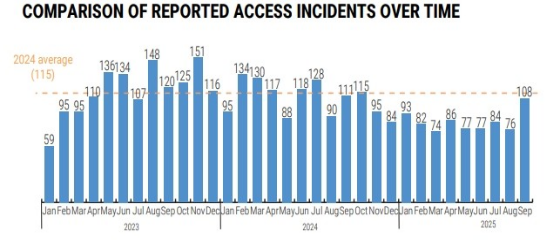
Comparison of reported access incidents over time
2024 average: 115
| Year | Month | Reported Access Incidents |
|---|---|---|
| 2023 | Jan | 59 |
| 2023 | Feb | 95 |
| 2023 | Mar | 95 |
| 2023 | Apr | 110 |
| 2023 | May | 136 |
| 2023 | Jun | 134 |
| 2023 | Jul | 148 |
| 2023 | Aug | 120 |
| 2023 | Sep | 125 |
| 2023 | Oct | 151 |
| 2023 | Nov | 116 |
| 2023 | Dec | 95 |
| 2024 | Jan | 134 |
| 2024 | Feb | 130 |
| 2024 | Mar | 117 |
| 2024 | Apr | 118 |
| 2024 | May | 88 |
| 2024 | Jun | 128 |
| 2024 | Jul | 90 |
| 2024 | Aug | 111 |
| 2024 | Sep | 115 |
| 2024 | Oct | 95 |
| 2024 | Nov | 84 |
| 2024 | Dec | 93 |
| 2025 | Jan | 82 |
| 2025 | Feb | 74 |
| 2025 | Mar | 86 |
| 2025 | Apr | 77 |
| 2025 | May | 77 |
| 2025 | Jun | 84 |
| 2025 | Jul | 76 |
| 2025 | Aug | 108 |
11.3.5 In regard to restrictions on humanitarian aid, the BROUK 2025 report noted:
‘Despite the provisional measures order, the regime continues to weaponize its complex bureaucratic apparatus in Rakhine State. It requires UN agencies to negotiate MoUs, imposes restrictive registration and reporting rules on INGOs and NGOs, and enforces arbitrary travel authorization procedures. This system serves a clear and deliberate purpose: to deny members of the Rohingya group in Rakhine State the basic necessities of life …
‘The junta has imposed a blockade on aid deliveries and trade - including to areas under AA control - by restricting land and sea routes into Rakhine State. As the de facto authority in northern Rakhine State, the AA also bears responsibility for access restrictions. UN OCHA reported that ‘additional administrative requirements introduced by local authorities in southern Buthidaung and Maungdaw affected planned assistance to Rohingya communities.’ As the AA is in control of these townships, ‘local authorities’ refers to the AA.
‘Security concerns and access restrictions by both the junta and the Arakan Army mean that [the World Food Programme] WFP is unable to move food beyond Sittwe into central and northern parts of Rakhine State. WFP head Michael Dunford told Reuters, “This is obviously contributing to the spike in hunger that we are seeing… We’re desperately frustrated because we know that there are populations that require our support.”
‘The regime’s wide-ranging access restrictions in Rakhine State continue to defy UN Security Council Resolution 2669, which urged ‘full, safe and unhindered humanitarian access’ as well as provisional measure (1) ordered by the ICJ. The Arakan Army has adopted similar bureaucratic tactics as the regime to restrict humanitarian access to vulnerable Rohingya populations.’[footnote 137]
11.3.6 In regard to humanitarian assistance from the WFP to IDPs in Rakhine State, the same report noted in Sittwe (capital of Rakhine) the WFP cash assistance rose to 45,000 MMK (£16.34 GBP[footnote 138]) per month which did not cover basic commodities. In urban Sittwe WFP provided 10kg of rice and 25,000 MMK (£9.01 GBP[footnote 139]) to the most vulnerable families. In Pauktaw IDPs received 35,000 MMK (£12.71 GBP[footnote 140]) per month between July and August 2025 which rose to 45,000 MMK (16.34 GBP[footnote 141]) per month in September and October 2025 and Kyauwktaw township was not receiving assistance from WFP.[footnote 142]
12. Access to services
12.1 Overview
12.1.1 The BTI 2024 report noted: ‘Ethnic and religious minorities face severe de facto discrimination. For instance, they have less access to higher education, health and employment opportunities than non-minorities. This is especially the case for the Rohingya minority …’[footnote 143]
12.1.2 The DFAT 2025 report stated: ‘Due to their exclusion from citizenship, the Rohingya are denied fundamental rights and basic services in Myanmar, including access to healthcare and education, employment opportunities, freedom of movement, freedom to choose the timing and number of their children, freedom to marry whom they choose, and freedom to run for political office …’[footnote 144]
12.2 Education
12.2.1 In regard to literacy in children, the New Lines Institute July 2024 article stated: ‘…The Rohingyas… do not have access to education… The illiteracy rate among Rohingya children is nearly 80%, as they are excluded from accessing formal education …’[footnote 145]
12.2.2 The DFAT 2025 report noted that Rohingya who live in northern Rakhine have some access to education, however Rohingya who live in central Rakhine generally cannot access schools.[footnote 146]
12.3 Healthcare
12.3.1 The USSD 2023 report noted: ‘… NGOs regularly reported throughout the year that humanitarian access and movement restrictions among Rohingya limited access to health-care services and contributed to maternal mortality rates in Rakhine State higher than the national average. Complications resulting from unsafe abortions were also a leading cause of maternal deaths.’[footnote 147]
12.3.2 On 2 August 2024, Doctors without Borders published a report on the Rohingya community based on a review of internal reports, external information and external meeting minutes between February 2023 and April 2024, which noted
‘Prior to October 2023, MSF supported access to healthcare for Rohingya in central Rakhine, where we witnessed the tedious and cumbersome bureaucratic process that Rohingya patients are required to navigate to access hospitals. This includes obtaining permission to travel, covering travel costs by boat and road, passing through checkpoints, and navigating layers of extortion and exploitation by state and non-state actors.
‘Until recently, those who did manage to reach Sittwe General Hospital were treated at a segregated ward for Rohingya people, where patients reportedly experienced humiliating treatment, extortion by guards, verbal abuse, or even physical violence. In one particularly painful example, patients told MSF that they could not receive blood transfusions because donors had refused to allow their blood to be given to Rohingya patients.’[footnote 148]
12.3.3 In regard to the impact of limited freedom of movement on healthcare, the same report noted:
‘Denial of freedom of movement is the main barrier for Rohingya people in the camps. All emergency patients supported by MSF must obtain recommendation letters from camp or village administrators based on an MSF referral to Sittwe General Hospital. In the case of people travelling without MSF referral assistance, travel costs and bribes at checkpoints are additional burdens for seeking higher-cost medical care in private clinics in Sittwe. A long-standing military naval checkpoint between the Pauktaw camps and Sittwe General Hospital has caused delays due to which MSF has witnessed numerous adverse health outcome.’[footnote 149]
For more information on freedom of movement see Freedom of movement: Restrictions
12.3.4 The DFAT 2025 report stated Rohingya in northern Rakhine have some access to healthcare, however Rohingya in central Rakhine generally cannot access healthcare.[footnote 150]
13. Freedom of movement
13.1 Restrictions
13.1.1 The USSD 2023 report noted: ‘Limitations on freedom of movement for Rohingya in Rakhine State were unchanged. Rohingya could not move freely; they were required to obtain travel authorization to leave their township. The regime’s General Administration Department made it illegal for Rohingya to travel without permission in Sittwe and Kyauktaw Townships, Rakhine State.’[footnote 151]
13.1.2 The Doctors without Border August 2024 report stated: ‘In northern Rakhine, Rohingya are contained in village settings, and they can travel to schools and markets within their villages or townships. However… there is a curfew at night and if someone lives in a rural remote village far from downtown, they must pass checkpoints where they may face intimidation, demands for paperwork and/or bribes, even in an emergency.’[footnote 152]
13.1.3 The HRW 2024 report stated: ‘The junta has imposed new movement restrictions and aid blockages in Rakhine State.’[footnote 153]
13.1.4 The FH 2024 report noted: ‘… Myanmar’s large population of stateless residents are subject to significant restrictions on their movement, particularly the 600,000 Rohingya who remain in Rakhine State and are confined to designated camps and villages; those who attempt to travel outside these areas are regularly detained.’[footnote 154]
13.1.5 In regard to the Rohingya who live in central Rakhine, the DFAT 2025 report noted: ‘… In-country sources told DFAT in 2023 that Rohingya living in these areas are among the most vulnerable populations in Myanmar. They are not allowed in towns …’[footnote 155]
13.1.6 In regard to the Rohingya who live in northern Rakhine, the same source reported: ‘…. Rohingya in these areas are not allowed to enter other townships, but could travel within their own townships …’[footnote 156]
13.1.7 The AI September 2025 article noted: ‘ According to testimony gathered by Amnesty International, Rohingya communities in northern Rakhine state face severe restrictions on movement by the Arakan Army …[footnote 157]
13.1.8 The same report stated: ‘The descriptions of restrictions on movement imposed by the Arakan Army match details of travel documents obtained by Amnesty International that show the permissions needed to move from place to place. One interviewee said mandatory travel documents had to be paid for, and some were only good for two days. Another said that the Arakan Army would allow only a limited number of people to leave their homes for basic errands and only for one hour.’[footnote 158]
13.1.9 The same article reported:
‘Arakan Army representatives told Amnesty International that movement and livelihood restrictions were not discriminatory and applied to Rakhine communities too. They said due to the armed conflict the restrictions were necessary for the security of the community. They also added that the Rohingya – whom they referred to as Muslims – were given jobs and that their rights and freedoms would be fulfilled and protected, pointing to the recent opening of a long-closed mosque in Maungdaw.’[footnote 159]
13.1.10 In regard to restrictions put in place by the Arakan Army, the Special Rapporteur 2025 report stated:
‘Rohingya who remain in Rakhine State reportedly suffer severe movement and livelihood restrictions imposed by the Arakan Army, including confinement in displacement camps. Those seeking to travel must reportedly pay a fee and obtain permission from Arakan Army officials. Many have allegedly been prevented from fishing or farming, contributing to severe food shortages. Restrictions appear to be most severe in areas of northern Rakhine State where Rohingya militants have operated. At the same time, Rohingya civilians who live in parts of central Rakhine State that are under the control of the Arakan Army report fewer restrictions.’[footnote 160]
13.1.11 In regard to restrictions on movement in Rakhine State, the BROUK 2025 report stated: ‘Rohingya in regime-controlled areas of Rakhine State, including Kyaukphyu, Sittwe, and Manaung townships, remain subject to extensive restrictions on freedom of movement. In northern Rakhine State, those living under Arakan Army control also face severe movement restrictions …. By contrast, movement appears to be somewhat less restricted in central Rakhine townships under AA control, such as Mrauk-U and Kyauktaw …’[footnote 161]
13.1.12 In regard to restrictions enforced by the Arakan Army, the same source noted:
‘Since its takeover of Buthidaung and Maungdaw, the AA has set up numerous checkpoints across northern Rakhine, including at the entrances and exits of Rohingya villages. These checkpoints are part of the AA’s apparatus to enforce movement restrictions on the Rohingya population. Rohingya must pay the AA for a letter of recommendation for permission to travel. This was suspended in Buthidaung township for several weeks in August and Rohingya were temporarily prohibited from travelling. Rohingya residents described this as a form of collective punishment, following the early-August exposure of the Htan Shauk Khan massacre’.[footnote 162]
14. Societal treatment and attitudes
14.1 General societal treatment and attitudes towards Rohingya
14.1.1 The FH 2024 report noted: ‘Ethnic minority groups such as … Rohingya and non-Rohingya Muslims, have also faced some societal discrimination, with the ethnic Bamar and Buddhist majority retaining a privileged position, though societal opposition to the coup has been accompanied by more positive views toward ethnic groups that play an important role in the resistance movement.’[footnote 163]
14.1.2 The ICG June 2025 report noted:
‘… the Arakan Army has made attempts to improve relations with Rohingya in more stable areas of northern Rakhine. For example, the group has incorporated Rohingya into the lower rungs of its administration and permitted some of those displaced by fighting to return to their homes in Maungdaw and Buthidaung … In areas of central Rakhine that the Arakan Army also controls but where Muslims are a minority and Rohingya armed groups are not present, communal relations appear to be much better, and Rohingya face less harsh treatment. “There is much less tension because no Rohingya there took the side of the regime”, said a Rohingya researcher with extensive contacts in Rakhine State. Getting a clear picture of the state of communal tensions across Rakhine State is difficult, however, as the regime has cut almost all telephone and internet service.’[footnote 164]
15. Rohingyas outside Rakhine State
15.1.1 In the sources consulted, CPIT could not find recent information on the population or conditions for Rohingyas in Myanmar outside Rakhine State (see Bibliography).
16. Rohingyas in Bangladesh
16.1 Population
16.1.1 The July 2024 New Lines Institute article noted: ‘… Currently, the highest number of Rohingyas – more than 1.6 million – live in Bangladesh. Among them about million are sheltering at the 33 camps of Cox’s Bazar, the South-Eastern district of the country, and thousands live in Bhashan Char, an island at the Bay of Bengal.’[footnote 165]
16.1.2 The Doctors without Border August 2024 report noted: ‘Bangladesh is now home to a third of the global Rohingya population … Official data from UNHCR and the government of Bangladesh lists 965,467 Rohingya living in Cox’s Bazar refugee camps. UNHCR estimated 200,000 Rohingya lived informally within Bangladesh prior to 2017, and there are now approximately 1.2 million Rohingya in Bangladesh …’[footnote 166]
16.1.3 The ICG June 2025 report noted: ‘… Up to 200,000 Rohingya have fled to Bangladesh, the majority over the past year …’[footnote 167]
16.1.4 The BROUK 2025 report stated: ‘… In the last week of August 2025 alone, BROUK received reports of 1,000 Rohingya fleeing Buthidaung township for Bangladesh …’[footnote 168]
16.1.5 The UNHCR operational data portal last updated on 31 August 2025 estimated the Rohingya refugee and asylum seeker population in Bangladesh as 1,156,001.[footnote 169]
16.2 Cross-border travel
16.2.1 The HRW 2024 report noted: ‘Since January 2023, more than 11,000 Rohingya have attempted dangerous boat journeys from Myanmar and Bangladesh, over 800 of whom have died or gone missing.’[footnote 170]
16.2.2 The same source stated: ‘… Tens of thousands have fled across the border into Bangladesh, while thousands more have been pushed back by Bangladesh border guards.’[footnote 171]
16.2.3 The same BROUK report stated:
‘The journey in search of safety is extremely dangerous. UN data indicates that in the first five months of 2025, about one in seven Rohingya died enroute while fleeing Myanmar by sea. Rohingya who survive are in danger of being picked up by the Myanmar Navy at sea or arrested onshore or inland. Rohingya survivors of the two deadly maritime disasters that claimed the lives of over 400 Rohingya in May this year have been imprisoned. Sixty-six survivors from the first boat were reportedly sentenced to two years in Mawlamyine Prison, Mon State, while the 21 survivors from the second boat were detained in Yangon. 15 adults received six-month sentences and six children were given two-year terms in a juvenile detention centre …
‘On 19 July, the bodies of seven Rohingya were seen floating in the Naf river near an AA checkpoint in Maungdaw township, after the boat they were fleeing in sank. The deceased were reported to be from Buthidaung township …’[footnote 172]
16.2.4 Doctors Without Borders published a report on Rohingya refugees in Bangladesh in September 2025 based on a consultation and structured questionnaire with 427 Rohingya refugees living in camps in the Cox Bazar district between 26 August and 2 September 2025[footnote 173], which noted:
‘For many people, crossing the Naf River into Bangladesh became an ordeal that lasted for days or even weeks, as they made numerous attempts to escape the violence. Survey findings indicate that 71% of new arrivals made multiple attempts to reach Bangladesh, with 22 participants reporting pushbacks by Bangladeshi authorities. New arrivals reported that some boat operators refused to ferry passengers across for fear of reprisals from Bangladeshi authorities stationed on the opposite bank. Several people reported being stranded on Jalia Dwip, a small island between Myanmar and Bangladesh, where they were acutely short of food, had no safe drinking water and succumbed to various illnesses, including severe diarrhoea. Others reported incidents involving abduction and detention after crossing into Bangladesh, with relatives held for ransom by criminal gangs.’[footnote 174]
16.2.5 In regard to risks associated with cross-border travel, the OHCHR August 2025 report stated:
‘… desperate conditions and the persistent state of fear and insecurity continued to compel Rohingya to attempt to flee abroad, often with tragic results. Hundreds of Rohingya, if not thousands, left Pauktaw and Kyauktaw in 2025, quite possibly trying to reach Malaysia or Thailand. On 12 February 2025, in Ye Township, Mon State, the military opened fire on a boat carrying Rohingya, killing six people. Their bodies were found ashore the following morning. Rohingya travelling on foot to Bangladesh are at risk of becoming victims of shootings, drone attacks, landmines, unexploded ordnance and trafficking in persons. Rohingya in Bangladesh reported having had to pay fees of up to 2.5 million kyats (approximately $1,200) to Arakan Army personnel and to smugglers associated with them to flee. While United Nations figures estimate that 118,000 Rohingya have fled to Bangladesh since November 2023, local sources indicated that the numbers may be twice as high.’[footnote 175]
16.3 Refugee camps
16.3.1 In regard to conditions in refugee camps, the Doctors without Borders August 2024 report stated:
‘The camps in Bangladesh are a dystopian nightmare. Cox’s Bazar, the world’s largest refugee camp, is also perhaps the world’s largest bamboo makeshift slum. The main mega-camp in Kutupalong is a maze of twisting alleyways and stairs that can take over an hour for a fit individual to traverse and prove a taxing hike in sweltering humidity and heat. With a near ban on localized transportation in the camp, this means the majority of the residents struggle to leave their home block and whatever services are available close to their home. The further Rohingya go from their home block, the greater the risks of extortion, violence, abduction, or other ill treatment.’[footnote 176]
16.3.2 The HRW 2024 report stated the military junta in Myanmar has recruited men and boys from refugee camps in Bangladesh.[footnote 177]
16.3.3 In regard to transnational abductions, the USSD 2024 report noted:
‘The human rights NGO Fortify Rights, in a July 26 news release, implicated the regime military in transnational abductions of Rohingya men as part of its mandatory conscription program. According to the release, the organization spoke with at least four men who reported being abducted by members of Rohingya armed groups operating in refugee camps in Bangladesh. One youth, age 17, said he was taken by his abductors to the Myo Tku Gyi border police headquarters in Burma, where he was handed over to Burmese regime military. Another man reported being one of a group of 11 abductees handed over to Burmese regime forces on May 3 at Tiknaf on the Burmese-Bangladeshi border.’[footnote 178]
See also Forced military recruitment
16.3.4 The ICG June 2025 report stated:
‘In late 2024, with the fall of Maungdaw seemingly imminent, the four largest Rohingya armed groups began negotiations to pause the turf war that had engulfed Bangladesh’s refugee camps for more than two years. On 8 November, they reached an informal agreement, dubbed “mission harmony”, that amounts to a truce in the camps and a loose commitment to work together against the Arakan Army in Rakhine State… The November agreement has led to a large reduction in violent incidents within the camps. After rising sharply through 2023 and 2024, killings linked to armed groups stopped almost completely for around four months, while reported violent incidents more than halved. All categories of violent crime have fallen except for abductions and kidnappings for ransom, which have increased markedly in recent months. By some estimates, around half of these cases are thought to be linked to the armed groups, in what appears to essentially be a fundraising drive.’[footnote 179]
16.3.5 In regard to aid for refugees, the same report noted:
‘Large cuts to food support were narrowly averted in late March, but funding has only been secured until September. This uncertainty comes as Bangladesh and its partners are trying to accommodate up to 200,000 newly arrived Rohingya who have fled northern Rakhine in the last eighteen months. To date, around 119,000 have been biometrically identified so they can get support, and none of the new arrivals have received housing assistance. As a result, most are staying with relatives, adding to the overcrowding and putting women at risk of gender-based violence.’[footnote 180]
16.3.6 The DFAT 2025 Bangladesh report noted:
‘The environment in Cox’s Bazar is prone to natural disasters like floods, cyclones and landslides. Conditions are considered to be deteriorating, including because of reduced donor contributions to deliver assistance, essential services and manage the camps. Refugees are not allowed to build permanent shelters. Houses and communal buildings are made from materials such as bamboo and tarpaulins and are easily damaged in extreme weather. Fires are common. The Interim Government has approved the use of more permanent materials for housing, which was being rolled out in targeted areas at the time of writing. In-country sources reported some improvements in the number and quality of roads and paths. They said efforts to curb deforestation, land degradation and fire-related pollution through the provision of liquefied petroleum gas to replace cooking fires had been partially successful.’[footnote 181]
16.3.7 In regard to NGOs support Rohingya women and girls, on 17 June 2025 a UN Women article noted Refugee Women for Peace and Justice, the first registered refugee-led nonprofit ‘… works to prevent gender-based violence and child marriage, and to promote refugee women’s leadership. Its volunteers offer literacy classes, legal awareness training, and human rights sessions to help women and girls access education and services.’[footnote 182]
16.3.8 The same article stated: ‘Rohingya women and girls faced widespread and systematic sexual and gender-based violence in 2017 in Myanmar – and meet new risks as refugees. While they make up more than half of the population in Bangladeshi refugee camps, conservative gender norms and the lack of opportunities put them at risk of exploitation, sexual abuse, forced marriages, and human trafficking. Many women report feeling unsafe, and domestic violence trends higher in congested conditions …’[footnote 183]
16.3.9 In relation to access to health services, on 25 August 2025 a UN Population Fund update noted: ‘In 2024 alone, over 335,000 people accessed life-saving sexual and reproductive health and rights services in Rohingya camps and host communities. Nearly 92,000 adolescents and caregivers in Cox’s Bazar were reached with adolescent and youth programmes, while 535,000 individuals were engaged in community mobilization efforts against gender-based violence.’[footnote 184]
16.3.10 In regard to funding concerns for humanitarian aid in Bangladesh refugee camps, the same update reported:
‘In the densely populated camps, pregnancy and childbirth are fraught with risk. With donor support, UNFPA has been able to support skilled midwives, emergency obstetric care and safe delivery services … Concerningly, funding for these critical services is running short. Only one third of the 2025 joint appeal for humanitarian funding, issued by the Government, United Nations and other humanitarian organizations, has yet been secured.
‘If these funding gaps are not filled, an estimated 315,000 women of reproductive age could lose access to antenna tal, family planning and safe delivery services in 2026. An additional 300,000 survivors of gender-based violence could lose access to clinical management of rape and mental and psychosocial support. An estimated 55,000 young people and their caregivers risk losing essential learning opportunities that include adolescent health and life skills.’[footnote 185]
16.3.11 In regard to conditions in refugee camps in Bangladesh, on 26 August 2025, Doctors Without Borders article stated:
‘People in the camps continue to face serious health issues—including mental health, from traumatic memories of the violence they experienced in Myanmar, but also from fighting between armed groups in the camps. These groups are increasingly carrying out attacks, kidnappings, and forced recruitment, adding to people’s anxiety and fear…
‘Cox’s Bazar now hosts over 1.3 million Rohingya refugees—some have lived there for decades, others just months. The camp has become a bamboo and tarpaulin slum where babies are born and people grow old, living lives in limbo.
‘As years pass, the needs are shifting… Aid cuts by the US and other donors mean further reduced services and a deepening crisis. Large epidemics of diphtheria, scabies, and hepatitis C menace the community.’[footnote 186]
16.3.12 In regard to the location of refugee camps in Bangladesh, the Doctors without Borders September 2025 report stated:
‘Bangladesh now hosts an estimated 1.1 million Rohingya refugees in the camps around Coxʼs Bazar, which are home to well over one-third of the global Rohingya population. The arrival of at least 150,000 new refugees in 2024-25 has put further strain on already overstretched services within the camps …
‘The camps in Coxʼs Bazar district…have become the largest refugee settlement in the world…’[footnote 187]
16.3.13 In regard to access to healthcare in refugee camps, the Doctors without Borders September 2025 report noted:
‘Healthcare is available both inside and outside the camps, but access patterns vary. 61% of respondents report usually seeking care inside the camps, while 39% report also seeking healthcare outside the camps. Patients often seek care outside the camps for specific or advanced medical needs, most commonly for complex and chronic conditions such as cancerous tumours, heart disease, kidney stones, diabetes and X-rays for broken bones. Other reasons for seeking care outside the camps include concerns over the quality of care, long waiting times and the lack of proper diagnostic capacity at health facilities within the camps.’[footnote 188]
16.3.14 The same report stated:
‘New arrivals from Myanmar began to increase significantly in Bangladesh in 2024 due to an escalation of violence in Rakhine state that started in late 2023. After an initial reluctance to register the new refugees, the Bangladeshi government eventually permitted biometric registration, granting new arrivals access to basic rations, cooking fuel and essential services. By July 2025, UNHCR had biometrically registered 150,000 newly arrived refugees, though the actual number of new arrivals is likely higher, with some unregistered refugees living both in and outside the camps.
‘The latest influx of refugees has taken place in an extremely constrained funding environment, …As a result, new arrivals remain severely under-supported in the camps, which includes their having no official access to housing assistance …’[footnote 189]
16.3.15 In regard to overcrowding in camps, the same report noted: ‘96% of new arrivals surveyed reside inside the camps. They describe housing conditions as extremely overcrowded, with multiple families often sharing a single makeshift shelter with little privacy or ventilation. As new arrivals are not eligible for housing assistance, many are forced to stay with relatives, while others are split across different camps, with family members separated …’[footnote 190]
16.3.16 Regarding funding, the Special Rapporteur 2025 report noted:
‘The dire funding situation has already led to the suspension of key services for Rohingya refugees in Bangladesh, with the threat of more severe cuts looming on the horizon…Rohingya “volunteers,” who received stipends from humanitarian agencies, have been let go, cutting off a vital source of income for many refugee families. UNICEF education programs have been severely curtailed …Medical services, mental health care, programs on gender-based violence, camp maintenance activities, and services for persons with disabilities have also experienced cuts.
…Given the Bangladesh government’s restrictions on refugee movement and livelihoods, Rohingya in Bangladesh are almost completely dependent on rations for survival.’[footnote 191]
16.3.17 In regard to camp conditions, on 5 November Crux, described as an English language Catholic news agency[footnote 192], article noted: ‘The population density of the camps is staggering: About 103,600 per square mile, more than 40 times the average population density in Bangladesh as a whole – and it is one of the most crowded countries on earth. Refugees live in side-by-side plastic huts, each just a little larger than 100 square feet, and some holding a dozen residents.’[footnote 193]
16.4 Discrimination and legal rights
16.4.5 In regard to Rohingya refugee’s legal status in Bangladesh, the Doctors without Borders August 2024 report noted:
‘Due to lack of legal status Rohingya have no right to live and work in Bangladesh, and informal livelihood opportunities and remittances are the primary source of income generation for a majority, beyond the limited and insufficient assistance received via the humanitarian response. A 2020 survey of 1611 households conducted by Centre for Peace and Justice (CPJ), BRAC University, offers a more complex narrative. According to their results, 45% of all households had no income beyond what was provided by the humanitarian response. Furthermore, 74% of households took on new debt after arriving in Bangladesh because the average income from all sources (remittances, informal labour, etc.) was not enough to meet monthly expenses.’[footnote 194]
16.4.2 In regard to identification, the DFAT 2025 Bangladesh report stated: ‘UNHCR provides camp residents identification cards confirming their refugee status. All births and marriages are required to be registered with UNHCR. Cardholders are entitled to food and cooking fuel rations. The previous government placed a moratorium on registration of new arrivals in 2022 … UNHCR is conducting a biometric registration exercise, although Bangladeshi authorities have stipulated this does not equate to full UNHCR registration.’[footnote 195]
16.4.3 The same source reported: ‘The vast majority of Rohingya cannot legally work, own property, or sell or buy goods or services inside or outside the camps. … Around 50,000 Rohingya, most of whom arrived before 2017, are recognised as refugees by Bangladeshi authorities and permitted to work and own businesses outside the camps …’[footnote 196]
16.4.4 In relation to registration in refugee camps, the Doctors without Borders September 2025 report stated:
‘In the initial period after arriving in Bangladesh, new arrivals report experiencing long delays – sometimes lasting several months – before completing biometric registration with UNHCR. Biometric registration is a pre-requisite for Rohingya refugees to receive identity cards, which are essential for accessing formal support in the camps, including food distributions, medical care and cooking fuel. As a result, delays in registration leave families without access to vital assistance during their first months in Bangladesh. In this period, many rely on support from within the community, including sharing rations or having to purchase food …’[footnote 197]
16.4.5 In the sources consulted by CPIT, there was no recent information on the use or availability of fraudulent documents by the Rohingya in Bangladesh (see Bibliography).
16.5 Repatriation
16.5.1 On 4 April 2025 an Al Jazeera news article reported:
‘Myanmar has confirmed that 180,000 Rohingya refugees living in Bangladesh since fleeing their homeland are eligible to return, the Bangladeshi government has said …
‘The 180,000 names were part of a list of 800,000 Rohingya that Bangladesh submitted to Myanmar in six batches between 2018 and 2020. Myanmar has also indicated that final verification of another 70,000 refugees is pending further review of photographs and identity details.
‘The statement said Myanmar had pledged to expedite the verification process for the remaining 550,000 names on the original list …
‘Attempts to begin repatriation in 2018 and 2019 failed as the refugees, fearing persecution, refused to go back …’[footnote 198]
16.5.2 The ICG June 2025 report noted:
‘Bangladesh’s main objective when it comes to Myanmar is repatriation of Rohingya refugees, who now number well over one million. Political upheaval on both sides of the border has not altered this goal. Since taking office in early August 2024, following Sheikh Hasina’s overthrow, Nobel laureate Muhammad Yunus’s administration has acknowledged the need to engage the Arakan Army, given the group’s control of the border. In November 2024, it appointed a former UN official, Khalilur Rahman, as high representative for Rohingya affairs and “other priority issues”. In February, he held talks with counterparts from the Arakan Army’s political wing.
‘The interim government has proposed establishing a humanitarian corridor into Rakhine State and lobbied the UN successfully to convene a “high-level conference” on the Rohingya in late September, on the sidelines of the General Assembly, with the aim of drawing up solutions to the crisis. Dhaka has also permitted the UN to biometrically identify new Rohingya arrivals, and Yunus has spoken several times of the need to establish a “safe zone” for the Rohingya in northern Rakhine State. Bangladesh has even continued dialogue with Myanmar’s military regime on the issue of refugee returns; at a meeting in Bangkok in early April, Naypyitaw told Dhaka it had verified 180,000 Rohingya for repatriation.’[footnote 199]
16.5.3 The September 2025 AI article reported that AI have warned against ‘…dangerously premature decisions to repatriate refugees from Bangladesh.’ due to the violence in Rakhine state and the restrictions placed on the Rohingya.[footnote 200]
16.5.4 In regard to viability of Rohingya refugees returning to Myanmar, Amnesty International noted:
‘“Existing conditions in Myanmar’s northern Rakhine State are nowhere near ready for Rohingya to return safely,” Amnesty International’s Myanmar Researcher Joe Freeman said. “The Arakan Army has, to many Rohingya, replaced the Myanmar military as their oppressor. The military are using Rohingya civilians as cannon fodder to fight against the Arakan Army, and Rohingya armed groups are launching new attacks into the territory. The dramatic reduction of US aid has further contributed to a humanitarian crisis in which supplies are scarce and prices are skyrocketing.’[footnote 201]
16.5.5 In regard to viability of Rohingya refugees returning to Myanmar, the Special Rapporteur 2025 report noted:
‘The Bangladesh government has consistently emphasized its chief objective of facilitating Rohingya refugees’ return to their homeland in Rakhine State, a goal shared by the Rohingya themselves. However, it is clear that the current situation in Rakhine State is not conducive to the safe, dignified and voluntary return of Rohingya refugees. At the conference in New York, Rohingya representatives described the conditions necessary for their return to Rakhine State, including the restoration of citizenship, the return of their land and property, respect for fundamental human rights, and guarantees of safety. None of these conditions exist.’[footnote 202]
17. Rohingya in India, Indonesia, Malaysia and Thailand
17.1 India
17.1.1 On 15 May 2025, the OHCHR issued a press release which stated:
‘Alarmed by credible reports that Rohingya refugees were forced off an Indian navy vessel and into the Andaman Sea last week, a UN expert has begun an inquiry into such “unconscionable, unacceptable acts” while urging the Indian government to refrain from inhumane and life-threatening treatment of Rohingya refugees, including their repatriation into perilous conditions in Myanmar …
‘Late last week Indian authorities reportedly detained dozens of Rohingya refugees living in Delhi, many or all of whom held refugee identification documents. Approximately 40 members of this group were reportedly blindfolded and flown to the Andaman and Nicobar Islands and then transferred to an Indian naval ship. After the boat crossed the Andaman Sea, the refugees were reportedly given life jackets, forced into the sea, and made to swim to an island in Myanmar territory. The refugees are reported to have survived the swim to shore, but their current whereabouts and condition are unknown.
‘Indian authorities have also reportedly removed a group of approximately 100 Rohingya refugees from a detention center in Assam State and transferred them to an area along the border with Bangladesh. The current whereabouts and condition of this group are also unknown.’[footnote 203]
17.1.2 On 20 May 2025, Religion Unplugged, described as a non-profit news organisation based in the U.S[footnote 204], article reported:
‘Indian authorities have allegedly “abandoned” — rather than deported — 40 Rohingya refugees in international waters near the Myanmar maritime border, forcing women, children and the elderly to swim to safety using life jackets …
‘The refugees, holding valid refugee cards issued by the United Nations High Commissioner for Refugees, were detained by police in New Delhi’s Uttam Nagar area on May 6.
‘Two days later, the Supreme Court of India refused to intervene in the deportation. The court ruled that under the Foreigners Act, 1946 — which governs the entry, stay and exit of foreigners in India — those found to be foreign nationals can be deported … The court stated that the right to reside in India is available only to its citizens.
… The Tanintharyi region, where the deported refugees currently are, is controlled by the National Unity Government, a shadow government in exile that oversees a loose coalition of anti-junta groups known as the People’s Defence Force (PDF). The NUG has confirmed that the deportees are safe and being protected.’[footnote 205]
17.1.3 The same report noted:
‘India does not have a specific refugee law, nor has it signed the U.N. Refugee Convention of 1951, or its 1967 Protocol, which protect those fleeing persecution. The Foreigners Act does not mention the terms “refugee” or “deportation” even once. Yet it continues to be applied to people who are not ordinary migrants, but victims of mass violence.
‘In the absence of a formal legal framework, the treatment and protection of refugees in India are governed by administrative decisions and policies, leading to inconsistencies and uncertainties in their status and rights. However, even administrative decisions and policies are often disregarded in practice, like in this case.’[footnote 206]
17.1.4 The OHCHR August 2025 report stated: ‘… In May 2025, credible reports indicated that an Indian naval vessel had transported approximately 40 Rohingya to a point off the southern coast of Myanmar in the Andaman Sea and forced the passengers to disembark and swim ashore. The refouled Rohingya were then stranded in Tanintharyi, where they were taken into the custody of an armed group operating there.’[footnote 207]
17.1.5 The UNHCR operational data portal last updated on 30 June 2025 estimated the Rohingya refugee and asylum seeker population in India as 23,300.[footnote 208]
17.2 Indonesia
17.2.1 In regard to Rohingya refugees travelling to Indonesia, on 6 November 2024, Save the Children published an article which noted:
‘The number of Rohingya refugees arriving in Indonesia by boat in October rose more than 700% compared to a year ago, said Save the Children, with boat journeys predicted to increase to record highs in coming months as monsoon winds drop and seas are calmer.
‘At least 395 Rohingya refugees, including 173 children, arrived in Indonesia by boat in October, compared with 49 recorded in the same month in 2023, according to figures from the UNHCR. Three boats arrived in October, with the latest landing in Aceh on 31 October carrying 90 Rohingya refugees, including seven children. Six people are reported to have died, with bodies found on the shore and floating in the sea.
‘At least 221 Rohingya refugees have lost their lives or were reported missing at sea so far this year. Since February 2022, 985 people have died or gone missing during boat journeys from Bangladesh or Myanmar.’[footnote 209]
17.2.2 The same report stated:
‘One of the factors driving Rohingya people onto boats is deteriorating security in the refugee camps in Cox’s Bazar, Bangladesh … Those attempting sea journeys are at the mercy of traffickers and at risk of abuse at sea. Smugglers often use boats that are poorly equipped for the long sea journeys and often carry insufficient supplies of food and water which run out before they land … Around 1,000 Rohingya refugees who arrived in Indonesia are still living in temporary shelters and camps …’[footnote 210]
17.2.3 In regard to conditions for refugees in Indonesia, the IOM-T website page noted:
‘The arrival of Rohingya refugees in Indonesia has presented several challenges, not least the risks of such dangerous boat journeys and the threats associated with the smuggling and trafficking of persons, typically resulting in irregular travel and entry, rights violations, and physical abuse. The demand for support for the Rohingya refugees remains high, underscoring the urgency to scale up humanitarian efforts.
‘The growing influx of Rohingya refugees is placing significant pressure on Indonesia’s already strained resources. With 2,550 individuals still residing in disembarkation sites and some urban areas, overcrowded and inadequate shelters are reaching critical limits. The remote and geographically dispersed nature of boat arrivals further complicate the response, leaving vulnerable groups - especially women and children, who make up nearly 75 per cent of new arrivals - at risk of not receiving the support they need.’[footnote 211]
17.2.4 In regard to the Rohingya refugee population in Indonesia, the Doctors without Borders August 2025 report noted: ‘The situation in Indonesia has recently become more dynamic. As of October 2023, UNHCR reported only 900 Rohingya refugees registered in Indonesia. However, 1,752 individuals arrived in Indonesia on 11 boats between November 14, 2023, and the end of the year. Of those, 243 have “spontaneously departed” and are suspected of traveling onwards to Malaysia.’[footnote 212]
The UNHCR operational data portal last updated on 30 June 2025 estimated the Rohingya refugee and asylum seeker population in Indonesia as 2,500.[footnote 213]
17.3 Malaysia
17.3.1 In regard to the population of Rohingya refugees in Malaysia, the Doctors without Borders August 2024 report stated: ‘Based on official data, population growth rates, and figures on new arrivals, MSF estimates there are at least 210,000 Rohingya living in Malaysia. Of those, 106,390 are registered with UNHCR. This also includes multigenerational families who began arriving in significant numbers in the 1980s and 1990s who settled mostly in Penang and in and around Kuala Lumpur.’[footnote 214]
17.3.2 In regard to protection, the same report noted:
‘Protection is very limited for refugees and asylum seekers in Malaysia. According to domestic law, they are considered undocumented migrants. As such, they are criminalized for violating the Immigration Act 1959/63 under Section 6(1)c for entering the country without a valid pass.
‘Punishments for the violation of this law include imprisonment, fine, and/or whipping. Rohingya and other refugees have no freedom, and they constantly live in fear. UNHCR documents do not provide absolute protection for registered refugees, as these documents are often not recognized as valid by state agencies because there is no law regulating refugees in Malaysia. This means that refugees and asylum seekers, including new arrivals, are constantly exposed to the risk of arrest and detention.
‘As a result of deterrence-based policies, refugees with and without UNHCR documents have been detained for immigration offenses and placed in immigration detention centres indefinitely and arbitrarily, especially since UNHCR was denied regular access to immigration detention centres in August 2019. As of April 2022, there were 2,264 Rohingya refugees in immigration detention centres. Despite being denied access to these facilities, UNHCR continues to advocate for registered Rohingya refugees. However, the release process has been made increasingly challenging by deliberate administrative barriers that complicate tracing of refugee detainees.’[footnote 215]
17.3.3 In regard to Rohingya refugees in Malaysia, the ICG June 2025 report noted: ‘Another option is paying people smugglers to reach third countries, with Malaysia the most popular destination. Rohingya refugees told Crisis Group that departures from southern Bangladesh and Rakhine have risen since the start of 2025; unusually, boats were continuing to leave into late May, outside the usual “sailing season”. “People used to avoid travelling at this time of year because of the weather, but now they are leaving continuously, in any season”, said one refugee. “From Teknaf, they take a small boat out to a big boat”. The rougher seas during the monsoon make these crossings far more dangerous for those on board; the UN High Commissioner for Refugees said it had received reports that 427 Rohingya had died in May when two boats capsized off the coast of Myanmar.’[footnote 216]
17.3.4 In regard to Rohingya travelling to Malaysia, the BROUK 2025 report noted: ‘… On 9 November, a boat carrying around 70 Rohingya fleeing Buthidaung township sank off the coast of Malaysia. The passengers were reported to be part of a larger group of 300, on separate boats. So far at least 27 bodies have been recovered, with dozens still missing.’[footnote 217]
17.3.5 The International Organisation for Migration in Thailand (IOM-T) website page on their response to Rohingya refugees, updated on 18 June 2025 noted some refugees in Malaysia have faced evictions from homes and other societal discrimination:
‘… [Rohingya refugees face] struggles with house evictions, joblessness, and the constant stigma and isolation of being treated as outsiders. Once settled in a small community in Selangor, they now face homelessness, with landlords unwilling to rent to Rohingyas or even enroll their children in school and misinformation fueling discrimination.
‘“It isn’t just landlords who are now reluctant to rent houses. It’s also employers not recruiting us and schools not accepting our children to enroll,” says Abdul [a Rohingya refugee]. “A lot of this reluctance comes from the negative information and false news portraying the Rohingyas as criminals on media.”’[footnote 218]
17.3.6 The UNHCR operational data portal last updated on 30 June 2025 estimated the Rohingya refugee and asylum seeker population in Malaysia as 119,100.[footnote 219]
17.4 Thailand
17.4.1 Regarding conditions for Rohingya refugees in Thailand, the IOM-T website page noted: ‘… hopes of finding refuge often collide with a harsh reality. Without legal recognition, Rohingya arrivals are frequently detained in overcrowded immigration detention centers, where they face prolonged confinement, uncertainty and limited access to essential services. Even children and families transferred to government-run shelters live with severe restrictions - unable to move freely, work, or access education - leaving them dependent on humanitarian aid for even their most basic needs.’[footnote 220]
17.4.2 The same source reported IOM with the support of EU Humanitarian Aid, they provide humanitarian assistance to over 2300 Rohingya refugees across Indonesia, Thailand and Malaysia.[footnote 221]
17.4.3 In regard to the situation for Rohingya in Thailand, the Doctors without Borders August 2025 report noted:
‘The situation for Rohingya in Thailand is not widely reported. Population estimates vary and lack substantiation, with estimates ranging between 3,000 and 40,000—though 3,000 seems the more likely figure based on discussions with several key experts. Rohingya living in Thailand hide their identity to avoid the attention of authorities. Many may obtain localized residency cards or Myanmar migrant work permits, but most resort to small bribes and arrangements to live on the margins of society in self-employment situations with whatever real or fake documentation they can manage. For many Rohingya, Thailand’s jungles are known as a dangerous transit route used by smugglers to take them from Myanmar to Malaysia and beyond.’[footnote 222]
17.4.4 The Special Rapporteur 2025 report stated: ‘In August [2025], the Thai government adopted a resolution allowing a majority of camp-based refugees to work outside the camps. The new policy, which involves registration with Thai authorities and safeguards against the exploitation of refugee laborers, went into effect in October, offering a vital lifeline to refugee families.’[footnote 223]
17.4.5 Regarding funding, the same report noted:
‘Funding cuts have similarly impacted support for the more than 100,000 refugees from Myanmar who live in camps in Thailand. In the first half of 2025, inadequate funding led to rations reductions and the suspension or disruption of medical, mental health, protection, water and sanitation programs. The United States government’s decision to end most refugee resettlement through its U.S. Refugee Admissions Program also impacted refugees in Thailand, some of whom had already been approved for resettlement and were awaiting their dates of departure.
‘In July [2025], a lack of funding forced The Border Consortium—the organization coordinating services for residents of refugee camps along the Thailand-Myanmar border— to suspend rations distribution to more than 80 percent of camp residents, preserving rations only for the most vulnerable households. In September, the United States government renewed a grant that restores rations through the end of the year, but the grant is not expected to be extended further.’[footnote 224]
17.4.6 The UNHCR operational data portal last updated on 31 August 2025 estimated the Rohingya refugee and asylum seeker population in Thailand as 500.[footnote 225]
Research methodology
The country of origin information (COI) in this note has been carefully selected in accordance with the general principles of COI research as set out in the Common EU [European Union] Guidelines for Processing Country of Origin Information (COI), April 2008, and the Austrian Centre for Country of Origin and Asylum Research and Documentation’s (ACCORD), Researching Country Origin Information – Training Manual, 2024. Namely, taking into account the COI’s relevance, reliability, accuracy, balance, currency, transparency and traceability.
Sources and the information they provide are carefully considered before inclusion. Factors relevant to the assessment of the reliability of sources and information include:
- the motivation, purpose, knowledge and experience of the source
- how the information was obtained, including specific methodologies used
- the currency and detail of information
- whether the COI is consistent with and/or corroborated by other sources
Commentary may be provided on source(s) and information to help readers understand the meaning and limits of the COI.
Wherever possible, multiple sourcing is used and the COI compared to ensure that it is accurate and balanced, and provides a comprehensive and up-to-date picture of the issues relevant to this note at the time of publication.
The inclusion of a source is not, however, an endorsement of it or any view(s) expressed.
Each piece of information is referenced in a footnote.
Full details of all sources cited and consulted in compiling the note are listed alphabetically in the bibliography.
Terms of reference
The ‘Terms of Reference’ (ToR) provides a broad outline of the issues relevant to the scope of this note and forms the basis for the country information.
The following topics were identified prior to drafting as relevant and on which research was undertaken:
- Background
- Origin of the Rohingya
- Demography
- Language/culture
- Myanmarese names
- Legal rights
- Citizenship
- Identity documents
- Marriage and the ‘two-child policy’
- State treatment and attitudes
- General socio-economic conditions
- Human rights violations
- Clashes with security forces – 2016 / 2017
- Extortion and harassment
- Anti-Muslim rhetoric and Buddhist nationalism
- Accountability
- Avenues of redress
- Women and girls
- Discrimination
- Sexual violence
- Humanitarian situation
- Internally displaced persons (IDPs)
- Humanitarian aid
- Access to services
- Overview
- Education
- Healthcare
- Freedom of movement
- Restrictions
- Societal treatment and attitudes
- General societal treatment and attitudes towards Rohingya
- Inter-communal violence
- Rohingyas outside Rakhine State
- Rohingyas in Bangladesh
- Population
- Cross-border travel
- Refugee camps
- Documentation and legal rights
- Repatriation
- Fraudulent documents
- Rohingya in Malaysia and Thailand
- India
- Indonesia
- Malaysia
- Thailand
Bibliography
Sources cited
Al Jazeera
-
Myanmar confirms 180,000 Rohingya eligible to return, Bangladesh says, 4 April 2025. Accessed: 1 December 2025
-
Myanmar’s military honours anti-Muslim monk, frees prisoners, 4 January 2023. Accessed: 1 December 2025
-
UN’s top court to hold Myanmar genocide hearings in January, 20 December 2025. Accessed: 30 December 2025
Amnesty International
-
Amnesty International Report 2024/25: Myanmar 2024, 28 April 2025. Accessed: 1 December 2025
-
Myanmar: Rohingya repatriation ‘catastrophic’ under existing conditions in northern Rakhine State, 9 September 2025. Accessed: 1 December 2025
Australian Department of Foreign Affairs and Trade (DFAT)
-
DFAT Country Information Report: Myanmar, 7 April 2025. Accessed: 19 November 2025
-
DFAT Country Information Report: Bangladesh, 23 July 2025. Accessed: 1 December 2025
Bertelsmann Stiftung Index
-
Methodology, no date. Accessed: 1 December 2025
-
Myanmar Country Report 2024, 19 March 2024. Accessed: 1 December 2025
Brookings
-
About Us, no date. Accessed: 1 December 2025
-
While the world sleeps, Myanmar burns, 4 October 2017. Accessed: 1 December 2025
Burmese Rohingya Organisation UK (BROUK)
-
Who we are, undated. Accessed: 1 December 2025. Accessed: 1 December 2025
-
The Rohingya genocide: starvation and forced labour as tools of erasure, 19 November 2025. Accessed: 25 November 2025
Council on Foreign Relations
- The Rohingya Crisis, 23 January 2020.
Crux
-
About us, no date. Accessed: 1 December 2025
-
Cardinal highlights situation of Rohingya refugees during visit to Bangladesh, 5 November 2025. Accessed: 26 November 2025
Dhaka Tribune
Doctors without Borders (MSF)
-
A timeline of the Rohingya crisis, 26 August 2025. Accessed: 25 November 2025
-
Behind the Wire: Impact of State Containment and Exclusion Strategies on the Rohingya, 2 August 2024. Accessed: 1 December 2025
-
The Illusion of Choice: Rohingya Voices Echo from the Camps, 29 September 2025. Accessed: 25 November 2025
Encyclopaedia Britannica
- Rohingya, 11 November 2025. Accessed: 1 December 2025
Freedom House
-
Freedom in the World Research Methodology, no date. Accessed: 1 December 2025
-
Freedom in the World 2025: Myanmar, 26 February 2025. Accessed: 1 December 2025
Government of Myanmar
- Constitution of the Republic of the Union of Myanmar, September 2008. Accessed: 1 December 2025
Human Rights Watch
- World Report 2025: Myanmar, 16 January 2025. Accessed: 1 December 2025
International Criminal Court (ICC)
- Statement of ICC Prosecutor Karim A.A. Khan KC: Application for an arrest warrant in the situation in Bangladesh/Myanmar, 27 Nov 2024. Accessed: 1 December 2025
International Crisis Group
-
Bangladesh/Myanmar: The Dangers of a Rohingya Insurgency, 18 June 2025. Accessed: 1 December 2025
-
War in Western Myanmar: Avoiding a Rakhine-Rohingya Conflict, 10 May 2024. Accessed: 1 December 2025
-
Who we are, no date. Accessed: 1 December 2025
Independent Investigative Mechanism for Myanmar (IIMM)
International Organisation for Migration Thailand (IOM-T)
- Rohingya Response (Malaysia), 13 June 2025. Accessed: 1 December 2025
Karen News
-
About us. No date. Accessed: 2 December 2025.
-
918 Rohingya Prisoners Who Completed Their Sentences Moved to Sittwe Town, 19 February 2025. Accessed: 2 December 2025.
Myanmar Now
- Close to 1,000 Rohingya people arrive in Sittwe after prison release, 20 February 2025. Accessed: 2 December 2025
New Lines Institute
-
About. no date. Accessed: 26 November 2025
-
Statelessness – the Root Cause of the Rohingya Crisis – Needs to Be Addressed, 9 July 2024. Accessed: 26 November 2025
Radio Free Asia (RFA)
- Myanmar junta frees nearly 1,000 Rohingya from prison, group says – Radio Free Asia, 17 February 2025. Accessed: 2 December 2025
Religion Unplugged
-
About Us, no date. Accessed: 1 December 2025
-
Special Report: India Abandons Rohingya Refugees Near Myanmar’s Border, 20 May 2025. Accessed 1 December 2025
Reuters
- Exclusive: On Myanmar’s frontline, Rohingya fighters and junta face a common enemy, 6 September 2024. Accessed: 1 December 2025
Save the Children
- Rohingya Refugees Arriving In Indonesia By Boat Surge 700% As Sea Crossings Predicted To Reach A New High This Year, 6 November 2024. Accessed: 1 December 2025
Seasia
-
About Us, no date
-
The Rohingya Language: Identity, Resilience, and the Struggle of a Stateless Nation, 11 October 2025
UN Development Programme (UNDP)
- Poverty and the Household Economy of Myanmar: a Disappearing Middle Class ,11 April 2024. Accessed: 1 December 2025
UN Office of the High Commissioner for Human Rights (OHCHR)
-
Alarmed by reports of Rohingya cast into the sea from Indian navy vessels, UN expert launches inquiry of “unconscionable, unacceptable acts”, 15 May 2025. Accessed: 1 December 2025
-
Myanmar’s civilians demand justice amid worsening crisis, 3 October 2025. Accessed: 1 December 2025
-
Report of the Special Rapporteur on the situation of human rights in Myanmar, Thomas H. Andrews, 20 October 2025. Accessed: 1 December 2025
-
Situation of human rights of Rohingya Muslims and other minorities in Myanmar , 29 August 2025. Accessed: 1 December 2025
-
Update on the Human Rights Situation in Myanmar Overview of developments in 2024, January 2025. Accessed: 2 December 2025
UN Office for the Coordination of Humanitarian Affairs (UN OCHA)
- Myanmar: Humanitarian Access Snapshot – September 2025, 29 October 2025. Accessed: 1 December 2025
UN Population Fund (UNFPA)
- Eight Years On: Rohingya Women and Girls Need the World’s Support More Than Ever, 25 August 2025. Accessed: 1
UN Refugee Agency (UNHCR)
-
Culture, Context and Mental Health of Rohingya Refugees: A review for staff in mental health, 2018. Accessed: 1 December 2025
-
Myanmar situation, 30 December 2025. Accessed: 30 December 2025
-
Rohingya Refugee Crisis Explained, 22 August 2024. Accessed: 27 November 2025
UN Women
- For ALL Women and Girls: ‘Work with us, not just for us’, urges Rohingya activist, 17 June 2025. Accessed: 10 December 2025
US Holocaust Memorial Museum
- Atrocities Against Burma’s Rohingya Population, 29 March 2022. Accessed: 25 November 2025
US Institute of Peace (USIP)
-
About Us, no date. Accessed: 1 December 2025
-
Rohingya Face Fresh Uncertainty in Myanmar, 8 May 2024. Accessed: 1 December 2025
US State Department (USSD)
-
2023 Country Reports on Human Rights Practices: Burma, 22 April 2024. Accessed: 1 December 2025
-
2024 Country Reports on Human Rights Practices: Burma, 12 August 2025. Accessed: 1 December 2025
VOA
-
Argentina court issues international arrest warrant for Myanmar military leader, 14 February 2025. Accessed: 1 December 2025
-
VOA Mission, no date. Accessed: 1 December 2025
Xe.com
- MMK to GBP - Convert Burmese Kyats to British Pounds, 25 November 2025. Accessed: 25 November 2025
Sources consulted but not cited
Kolås, Å., Rohingya identity, nationhood and the census, Journal for the Study of Race, Nation and Culture Volume 31, 2025 - Issue 4, 12 February 2025
The Diplomat, Myanmar’s Resistance Must Be Transparent Regarding ICC Arrest Warrants, 22 January 2025. Accessed: 25 November 2025
London School of Economics, From Refugee to Slur: ‘Rohingya’ as Signifier of Otherness in Everyday Bangladesh, 30 June 2025. Accessed: 27 November 2025
OpIndia, India’s IB launches crackdown on Rohingya infiltration: 5,000 recruits sought with local, Rohingya language skills, 24 July 2025. Accessed: 27 November 2025
United States Institute of Peace, The Current Situation in Burma, 10 February 2025. Accessed: 27 November 2025
Version control and feedback
Clearance
Below is information on when this note was cleared:
- version 4.0
- valid from 6 January 2026
Official – sensitive: Not for disclosure – Start of section
The information on this page has been removed as it is restricted for internal Home Office use.
Official – sensitive: Not for disclosure – End of section
Changes from last version of this note
Update to country information.
Feedback to the Home Office
Our goal is to provide accurate, reliable and up-to-date COI and clear guidance. We welcome feedback on how to improve our products. If you would like to comment on this note, please email the Country Policy and Information Team.
Independent Advisory Group on Country Information
The Independent Advisory Group on Country Information (IAGCI) was set up in March 2009 by the Independent Chief Inspector of Borders and Immigration to support them in reviewing the efficiency, effectiveness and consistency of approach of COI produced by the Home Office.
The IAGCI welcomes feedback on the Home Office’s COI material. It is not the function of the IAGCI to endorse any Home Office material, procedures or policy. The IAGCI may be contacted at:
Independent Advisory Group on Country Information
Independent Chief Inspector of Borders and Immigration
3rd Floor
28 Kirby Street
London
EC1N 8TE
Email: chiefinspector@icibi.gov.uk
Information about the IAGCI’s work and a list of the documents which have been reviewed by the IAGCI can be found on the Independent Chief Inspector’s pages of the GOV.UK website.
-
CFR, The Rohingya Crisis, 23 January 2020 ↩
-
DFAT, DFAT Country Information Report: Myanmar (paragraph 1.4), 7 April 2025 ↩
-
DFAT, DFAT Country Information Report: Myanmar (paragraph 3.25), 7 April 2025 ↩
-
New Lines Institute, Statelessness – the Root Cause of the Rohingya Crisis…, 9 July 2024 ↩
-
New Lines Institute, Statelessness – the Root Cause of the Rohingya Crisis…, 9 July 2024 ↩
-
DFAT, DFAT Country Information Report: Myanmar (paragraph 3.25), 7 April 2025 ↩
-
DFAT, DFAT Country Information Report: Myanmar (paragraph 3.29), 7 April 2025 ↩
-
DFAT, DFAT Country Information Report: Myanmar (paragraph 3.29), 7 April 2025 ↩
-
ICG, Bangladesh/Myanmar: The Dangers of a Rohingya Insurgency (section II.C), 18 June 2025 ↩
-
DFAT, DFAT Country Information Report: Myanmar (paragraph 3.25), 7 April 2025 ↩
-
Dhaka Tribune, The Rohingya are mispronounced, mislabelled, and misunderstood, 21 June 2025 ↩
-
Dhaka Tribune, The Rohingya are mispronounced, mislabelled, and misunderstood, 21 June 2025 ↩
-
UNHCR, Culture, Context and Mental Health of Rohingya Refugees: A review … (page 20), 2018 ↩
-
Seasia, The Rohingya Language: Identity, Resilience, and the Struggle of a…, 11 Oct 2025 ↩
-
GoM, Constitution of the Republic of the Union of Myanmar, September 2008 ↩
-
USSD, 2023 Country Reports on Human Rights Practices: Burma (section 1g), 22 April 2024 ↩
-
USSD, 2024 Country Reports on Human Rights Practices: Burma, 12 August 2025 ↩
-
USSD, 2023 Country Reports on Human Rights Practices: Burma (section 1g), 22 April 2024 ↩
-
New Lines Institute, Statelessness – the Root Cause of the Rohingya Crisis…, 9 July 2024 ↩
-
Freedom House, Freedom in the World Research Methodology, no date ↩
-
Freedom House, Freedom in the World 2025: Myanmar (section B4), 26 February 2025 ↩
-
DFAT, DFAT Country Information Report: Myanmar (paragraph 3.3), 7 April 2025 ↩
-
DFAT, DFAT Country Information Report: Myanmar (paragraph 3.4), 7 April 2025 ↩
-
DFAT, DFAT Country Information Report: Myanmar (paragraph 3.5), 7 April 2025 ↩
-
DFAT, DFAT Country Information Report: Myanmar (paragraph 3.6), 7 April 2025 ↩
-
DFAT, DFAT Country Information Report: Myanmar (paragraph 3.27), 7 April 2025 ↩
-
BROUK, Who we are, undated ↩
-
BROUK, The Rohingya genocide: starvation and forced labour as… (pages 11&12), 19 Nov 2025 ↩
-
New Lines Institute, Statelessness – the Root Cause of the Rohingya Crisis…, 9 July 2024 ↩
-
New Lines Institute, Statelessness – the Root Cause of the Rohingya Crisis…, 9 July 2024 ↩
-
Freedom House, Freedom in the World 2025: Myanmar (section B4), 26 February 2025 ↩
-
Xe.com, 200 AUD to GBP - Convert Australian Dollars to British Pounds, 9 December 2025 ↩
-
DFAT, DFAT Country Information Report: Myanmar (paragraph 5.32), 7 April 2025 ↩
-
DFAT, DFAT Country Information Report: Myanmar (paragraph 3.26), 7 April 2025 ↩
-
DFAT, DFAT Country Information Report: Myanmar (paragraph 3.31), 7 April 2025 ↩
-
USSD, 2023 Country Reports on Human Rights Practices: Burma (section 1g), 22 April 2024 ↩
-
Freedom House, Freedom in the World 2025: Myanmar (section C4), 26 February 2025 ↩
-
USSD, 2024 Country Reports on Human Rights Practices: Burma (section 1b), 12 August 2025 ↩
-
DFAT, DFAT Country Information Report: Myanmar (paragraph 3.31), 7 April 2025 ↩
-
BROUK, The Rohingya genocide: starvation and forced labour as… (page 20), 19 Nov 2025 ↩
-
RFA, Myanmar junta frees nearly 1,000 Rohingya from prison, group says, 17 February 2025 ↩
-
Karen News, 918 Rohingya Prisoners … Moved to Sittwe Town, 19 February 2025 ↩
-
Myanmar Now, Close to 1,000 Rohingya people arrive in Sittwe…, 20 February 2025 ↩
-
OHCHR, Situation of human rights of Rohingya Muslims and other… (paragraph 33), 29 Aug 2025 ↩
-
DFAT, DFAT Country Information Report: Myanmar (paragraph 3.110), 7 April 2025 ↩
-
USIP, Rohingya Face Fresh Uncertainty in Myanmar, 8 May 2024 ↩
-
ICG, Who we are, no date ↩
-
ICG, War in Western Myanmar: Avoiding a Rakhine-Rohingya Conflict, 10 May 2024 ↩
-
ICG, War in Western Myanmar: Avoiding a Rakhine-Rohingya Conflict, 10 May 2024 ↩
-
Reuters, Exclusive: On Myanmar’s frontline, Rohingya fighters and junta…, 6 September 2024 ↩
-
Human Rights Watch, World Report 2025: Myanmar, 16 January 2025 ↩
-
DFAT, DFAT Country Information Report: Myanmar (paragraph 3.31), 7 April 2025 ↩
-
ICG, Bangladesh/Myanmar: The Dangers of a Rohingya Insurgency (section II.B), 18 June 2025 ↩
-
OHCHR, Report of the Special Rapporteur on the situation of… (paragraph 50), 20 Oct 2025 ↩
-
BROUK, The Rohingya genocide: starvation and forced labour as… (page 21), 19 Nov 2025 ↩
-
BROUK, The Rohingya genocide: starvation and forced labour as… (page 22), 19 Nov 2025 ↩
-
BTI, Methodology, no date ↩
-
BTI, Myanmar Country Report 2024 (Political Transformation), 19 March 2024 ↩
-
DFAT, DFAT Country Information Report: Myanmar (paragraph 3.52), 7 April 2025 ↩
-
DFAT, DFAT Country Information Report: Myanmar (paragraph 3.53), 7 April 2025 ↩
-
USSD, 2023 Country Reports on Human Rights Practices: Burma (section 5), 22 April 2024 ↩
-
DFAT, DFAT Country Information Report: Myanmar (paragraph 2.40), 7 April 2025 ↩
-
DFAT, DFAT Country Information Report: Myanmar (paragraph 2.41), 7 April 2025 ↩
-
BTI, Myanmar Country Report 2024 (Governance), 19 March 2024 ↩
-
ICC, Statement of ICC Prosecutor Karim A.A. Khan KC: Application for an…, 27 Nov 2024 ↩
-
VOA, VOA Mission, no date ↩
-
VOA, Argentina court issues international arrest warrant for Myanmar military leader, 14 Feb 2025 ↩
-
IIMM, Report of the Independent Investigative Mechanism for… (paragraph 23), 14 July 2025 ↩
-
OHCHR, Myanmar’s civilians demand justice amid worsening crisis, 3 October 2025 ↩
-
IIMM, Report of the Independent Investigative Mechanism for… (paragraph 31), 14 July 2025 ↩
-
Al Jazeera, UN’s top court to hold Myanmar genocide hearings in January, 20 December 2025 ↩
-
ICG, War in Western Myanmar: Avoiding a Rakhine-Rohingya Conflict, 10 May 2024 ↩
-
ICG, War in Western Myanmar: Avoiding a Rakhine-Rohingya Conflict, 10 May 2024 ↩
-
USIP, Rohingya Face Fresh Uncertainty in Myanmar, 8 May 2024 ↩
-
Reuters, Exclusive: On Myanmar’s frontline, Rohingya fighters and junta…, 6 September 2024 ↩
-
Human Rights Watch, World Report 2025: Myanmar, 16 January 2025 ↩
-
ICG, Bangladesh/Myanmar: The Dangers of a Rohingya Insurgency (section II.B), 18 June 2025 ↩
-
OHCHR, Situation of human rights of Rohingya Muslims and other… (paragraph 35), 29 Aug 2025 ↩
-
DFAT, DFAT Country Information Report: Myanmar (paragraph 3.31), 7 April 2025 ↩
-
AI, Myanmar: Rohingya repatriation ‘catastrophic’ …, 9 September 2025 ↩
-
AI, Myanmar: Rohingya repatriation ‘catastrophic’…, 9 September 2025 ↩
-
OHCHR, Human Rights Situation in Myanmar … 2024 (page 7), January 2025 ↩
-
BROUK, The Rohingya genocide: starvation and forced labour as… (pages 8&9), 19 Nov 2025 ↩
-
OCHCR, Human Rights Situation in Myanmar … 2024 (page 7), January 2025 ↩
-
OCHCR, Human Rights Situation in Myanmar … 2024 (page 7), January 2025 ↩
-
Amnesty International, Amnesty International Report 2024/25: Myanmar 2024, 28 April 2025 ↩
-
Amnesty International, Amnesty International Report 2024/25: Myanmar 2024, 28 April 2025 ↩
-
ICG, Bangladesh/Myanmar: The Dangers of a Rohingya Insurgency (section II.C), 18 June 2025 ↩
-
ICG, Bangladesh/Myanmar: The Dangers of a Rohingya Insurgency (section II.C), 18 June 2025 ↩
-
OHCHR, Report of the Special Rapporteur on the situation of… (paragraph 61), 20 Oct 2025 ↩
-
OHCHR, Report of the Special Rapporteur on the situation of… (paragraph 62 to 64), 20 Oct 2025 ↩
-
OHCHR, Report of the Special Rapporteur on the situation of… (paragraph 66&67), 20 Oct 2025 ↩
-
OHCHR, Report of the Special Rapporteur on the situation of… (paragraph 71), 20 Oct 2025 ↩
-
OHCHR, Situation of human rights of Rohingya Muslims and other… (paragraph 36), 29 Aug 2025 ↩
-
BROUK, The Rohingya genocide: starvation and forced labour as… (page 9), 19 November 2025 ↩
-
BROUK, The Rohingya genocide: starvation and forced labour as… (pages 9&10), 19 Nov 2025 ↩
-
BROUK, The Rohingya genocide: starvation and forced labour as… (page 30), 19 Nov 2025 ↩
-
BROUK, The Rohingya genocide: starvation and forced labour as… (page 31), 19 Nov 2025 ↩
-
BROUK, The Rohingya genocide: starvation and forced labour as… (page 31), 19 Nov 2025 ↩
-
BROUK, The Rohingya genocide: starvation and forced labour as… (pages 31&32), 19 Nov 2025 ↩
-
BROUK, The Rohingya genocide: starvation and forced labour as… (page 32&33), 19 Nov 2025 ↩
-
BROUK, The Rohingya genocide: starvation and forced labour as… (page 33), 19 Nov 2025 ↩
-
BROUK, The Rohingya genocide: starvation and forced labour as… (pages 33&34), 19 Nov 2025 ↩
-
OHCHR, Report of the Special Rapporteur on the situation of… (paragraph 65), 20 Oct 2025 ↩
-
BROUK, The Rohingya genocide: starvation and forced labour as… (page 35), 19 Nov 2025 ↩
-
Amnesty International, Amnesty International Report 2024/25: Myanmar 2024, 28 April 2025 ↩
-
BTI, Myanmar Country Report 2024 (Economic Transformation) ,19 March 2024 ↩
-
BTI, Myanmar Country Report 2024 (Economic Transformation) ,19 March 2024 ↩
-
UNDP, Poverty and the Household Economy of Myanmar: a Disappearing…(page 8), 11 April 2024 ↩
-
Xe.com, 1,590 MMK to GBP - Convert Burmese Kyats to British Pounds, 9 December 2025 ↩
-
UNDP, Poverty and the Household Economy of Myanmar…(pages 5&6), 11 April 2024 ↩
-
DFAT, DFAT Country Information Report: Myanmar (paragraph 3.29), 7 April 2025 ↩
-
Freedom House, Freedom in the World 2025: Myanmar (section G2), 26 February 2025 ↩
-
BTI, Myanmar Country Report 2024 (Economic Transformation), 19 March 2024 ↩
-
Human Rights Watch, World Report 2025: Myanmar, 16 January 2025 ↩
-
DFAT, DFAT Country Information Report: Myanmar (paragraph 3.28), 7 April 2025 ↩
-
DFAT, DFAT Country Information Report: Myanmar (paragraph 3.30), 7 April 2025 ↩
-
AI, Myanmar: Rohingya repatriation ‘catastrophic’ under existing conditions in…, 9 Sept 2025 ↩
-
Xe.com, 2,000 MMK to GBP - Convert Burmese Kyats to British Pounds, 9 December 2025 ↩
-
Xe.com, 3,000 MMK to GBP - Convert Burmese Kyats to British Pounds, 9 December 2025 ↩
-
AI, Myanmar: Rohingya repatriation ‘catastrophic’ under existing conditions in…, 9 Sept 2025 ↩
-
BROUK, The Rohingya genocide: starvation and forced labour as… (page 12), 19 Nov 2025 ↩
-
BROUK, The Rohingya genocide: starvation and forced labour as… (pages 17 to 19), 19 Nov 2025 ↩
-
BROUK, The Rohingya genocide: starvation and forced labour as… (pages 36&37), 19 Nov 2025 ↩
-
UNHCR, Myanmar situation, 30 December 2025 ↩
-
Human Rights Watch, World Report 2025: Myanmar, 16 January 2025 ↩
-
BROUK, The Rohingya genocide: starvation and forced labour as… (page 17) , 19 Nov 2025 ↩
-
ICG, Bangladesh/Myanmar: The Dangers of a Rohingya Insurgency (section I), 18 June 2025 ↩
-
UN OCHA, Myanmar: Humanitarian Access Snapshot – September 2025, 29 October 2025 ↩
-
UN OCHA, Myanmar: Humanitarian Access Snapshot – September 2025, 29 October 2025 ↩
-
UN OCHA, Myanmar: Humanitarian Access Snapshot – September 2025, 29 October 2025 ↩
-
BROUK, The Rohingya genocide: starvation and forced labour as… (pages 12&13), 19 Nov 2025 ↩
-
Xe.com, 45,000 MMK to GBP - Convert Burmese Kyats to British Pounds, 25 Nov 2025 ↩
-
Xe.com, 25,000 MMK to GBP - Convert Burmese Kyats to British Pounds, 25 Nov 2025 ↩
-
Xe.com, 35,000 MMK to GBP - Burmese Kyats to British Pounds Exchange Rate, 25 Nov 2025 ↩
-
Xe.com, 45,000 MMK to GBP - Convert Burmese Kyats to British Pounds, 25 Nov 2025 ↩
-
BROUK, The Rohingya genocide: starvation and forced labour as… (pages 19), 19 Nov 2025 ↩
-
BTI, Myanmar Country Report 2024 (Economic Transformation), 19 March 2024 ↩
-
DFAT, DFAT Country Information Report: Myanmar (paragraph 3.27), 7 April 2025 ↩
-
New Lines Institute, Statelessness – the Root Cause of the Rohingya Crisis…, 9 July 2024 ↩
-
DFAT, DFAT Country Information Report: Myanmar (paragraph 3.29), 7 April 2025 ↩
-
USSD, 2023 Country Reports on Human Rights Practices: Burma (section 6), 22 April 2024 ↩
-
MSF, Behind the Wire: Impact of State Containment and Exclusion… (page 62), 2 August 2024 ↩
-
MSF, Behind the Wire: Impact of State Containment and Exclusion… (page 63), 2 August 2024 ↩
-
DFAT, DFAT Country Information Report: Myanmar (paragraph 3.29), 7 April 2025 ↩
-
USSD, 2023 Country Reports on Human Rights Practices: Burma (section 2d), 22 April 2024 ↩
-
MSF, Behind the Wire: Impact of State Containment and Exclusion… (page 64), 2 August 2024 ↩
-
Human Rights Watch, World Report 2025: Myanmar, 16 January 2025 ↩
-
Freedom House, Freedom in the World 2025: Myanmar (section G1), 26 February 2025 ↩
-
DFAT, DFAT Country Information Report: Myanmar (paragraph 3.29), 7 April 2025 ↩
-
DFAT, DFAT Country Information Report: Myanmar (paragraph 3.29), 7 April 2025 ↩
-
AI, Myanmar: Rohingya repatriation ‘catastrophic’ under existing conditions in…, 9 Sept 2025 ↩
-
AI, Myanmar: Rohingya repatriation ‘catastrophic’ under existing conditions in…, 9 Sept 2025 ↩
-
AI, Myanmar: Rohingya repatriation ‘catastrophic’ under existing conditions in…, 9 Sept 2025 ↩
-
OHCHR, Report of the Special Rapporteur on the situation of… (paragraph 68), 20 Oct 2025 ↩
-
BROUK, The Rohingya genocide: starvation and forced labour as… (page 12), 19 Nov 2025 ↩
-
BROUK, The Rohingya genocide: starvation and forced labour as… (page 30), 19 Nov 2025 ↩
-
Freedom House, Freedom in the World 2025: Myanmar (section F4), 26 February 2025 ↩
-
ICG, Bangladesh/Myanmar: The Dangers of a Rohingya Insurgency (section II.C), 18 June 2025 ↩
-
New Lines Institute, Statelessness – the Root Cause of the Rohingya Crisis…, 9 July 2024 ↩
-
MSF, Behind the Wire: Impact of State Containment and Exclusion… (page 18), 2 August 2024 ↩
-
ICG, Bangladesh/Myanmar: The Dangers of a Rohingya Insurgency (section II.C), 18 June 2025 ↩
-
BROUK, The Rohingya genocide: starvation and forced labour as… (page 10), 19 Nov 2025 ↩
-
UNHCR, Myanmar Situation, 30 December 2025 ↩
-
Human Rights Watch, World Report 2025: Myanmar, 16 January 2025 ↩
-
Human Rights Watch, World Report 2025: Myanmar, 16 January 2025 ↩
-
BROUK, The Rohingya genocide: starvation and forced labour as… (page 20), 19 Nov 2025 ↩
-
MSF, The Illusion of Choice: Rohingya Voices Echo from the Camps (page 7), 29 September 2025 ↩
-
MSF, The Illusion of Choice: Rohingya Voices Echo from the Camps (page 20), 29 Sept 2025 ↩
-
OHCHR, Situation of human rights of Rohingya Muslims and other… (paragraph 51), 29 Aug 2025 ↩
-
MSF, Behind the Wire: Impact of State Containment and Exclusion… (page 18), 2 August 2024 ↩
-
Human Rights Watch, World Report 2025: Myanmar, 16 January 2025 ↩
-
USSD, 2024 Country Reports on Human Rights Practices: Burma (section 3e), 12 August 2025 ↩
-
ICG, Bangladesh/Myanmar: The Dangers of a Rohingya Insurgency (section III.C), 18 June 2025 ↩
-
ICG, Bangladesh/Myanmar: The Dangers of a Rohingya Insurgency (section III.C), 18 June 2025 ↩
-
DFAT, DFAT Country Information Report: Bangladesh (paragraph 3.20), 23 July 2025 ↩
-
UN Women, For ALL Women and Girls: ‘Work with us, not just for us’, urges…, 17 June 2025 ↩
-
UN Women, For ALL Women and Girls: ‘Work with us, not just for us’, urges…, 17 June 2025 ↩
-
UNFPA, Eight Years On: Rohingya Women and Girls Need the World’s Support…, 25 August 2025 ↩
-
UNFPA, Eight Years On: Rohingya Women and Girls Need the World’s Support…, 25 August 2025 ↩
-
MSF, A timeline of the Rohingya crisis, 26 August 2025 ↩
-
MSF, The Illusion of Choice: Rohingya Voices Echo from the Camps (page 10), 29 Sept 2025 ↩
-
MSF, The Illusion of Choice: Rohingya Voices Echo from the Camps (page 13), 29 Sept 2025 ↩
-
MSF, The Illusion of Choice: Rohingya Voices Echo from the Camps (page 15), 29 Sept 2025 ↩
-
MSF, The Illusion of Choice: Rohingya Voices Echo from the Camps (page 16), 29 Sept 2025 ↩
-
OHCHR, Report of the Special Rapporteur on the situation of… (paragraphs 85 to 87), 20 Oct 2025 ↩
-
Crux, Cardinal highlights situation of Rohingya refugees during visit to Bangladesh, 5 Nov 2025 ↩
-
MSF, Behind the Wire: Impact of State Containment and Exclusion… (page 18), 2 August 2024 ↩
-
DFAT, DFAT Country Information Report: Bangladesh (paragraph 3.21), 23 July 2025 ↩
-
DFAT, DFAT Country Information Report: Bangladesh (paragraph 3.25 & 3.26), 23 July 2025 ↩
-
MSF, The Illusion of Choice: Rohingya Voices Echo from the Camps (page 15), 29 Sept 2025 ↩
-
Al Jazeera, Myanmar confirms 180,000 Rohingya eligible to return, Bangladesh says, 4 April 2025 ↩
-
ICG, Bangladesh/Myanmar: The Dangers of a Rohingya Insurgency (section III.B), 18 June 2025 ↩
-
AI, Myanmar: Rohingya repatriation ‘catastrophic’ under existing conditions in…, 9 Sept 2025 ↩
-
AI, Myanmar: Rohingya repatriation ‘catastrophic’ under existing conditions in…, 9 Sept 2025 ↩
-
OHCHR, Report of the Special Rapporteur on the situation of… (paragraph 88), 20 Oct 2025 ↩
-
OHCHR, Alarmed by reports of Rohingya cast into the sea from Indian navy…, 15 May 2025 ↩
-
Religion Unplugged, Special Report: India Abandons Rohingya Refugees Near…, 20 May 2025 ↩
-
Religion Unplugged, Special Report: India Abandons Rohingya Refugees Near…, 20 May 2025 ↩
-
OHCHR, Situation of human rights of Rohingya Muslims and other… (paragraph 52), 29 Aug 2025 ↩
-
UNHCR, Myanmar Situation, 30 December 2025 ↩
-
Save the Children, Rohingya Refugees Arriving In Indonesia By Boat Surge…, 6 Nov 2024 ↩
-
Save the Children, Rohingya Refugees Arriving In Indonesia By Boat Surge…, 6 Nov 2024 ↩
-
IOM-T, Rohingya Response (Indonesia), 13 June 2025 ↩
-
MSF, Behind the Wire: Impact of State Containment and Exclusion… (page 84), 2 August 2024 ↩
-
UNHCR, Myanmar Situation, 30 December 2025 ↩
-
MSF, Behind the Wire: Impact of State Containment and Exclusion… (page 21), 2 August 2024 ↩
-
MSF, Behind the Wire: Impact of State Containment and Exclusion… (page 21), 2 August 2024 ↩
-
ICG, Bangladesh/Myanmar: The Dangers of a Rohingya Insurgency (section IV.A)), 18 June 2025 ↩
-
BROUK, The Rohingya genocide: starvation and forced labour as… (page 20), 19 Nov 2025 ↩
-
IOM-T, Rohingya Response (Malaysia), 13 June 2025 ↩
-
UNHCR, Myanmar Situation, 30 December 2025 ↩
-
IOM-T, Rohingya Response (Indonesia), 13 June 2025 ↩
-
IOM-T, Rohingya Response (Indonesia), 13 June 2025 ↩
-
MSF, Behind the Wire: Impact of State Containment and Exclusion… (page 84), 2 August 202 ↩
-
OHCHR, Report of the Special Rapporteur on the situation of… (paragraph 91), 20 Oct 2025 ↩
-
OHCHR, Report of the Special Rapporteur on the situation of… (paragraph 89&90), 20 Oct 2025 ↩
-
UNHCR, Myanmar Situation, 30 December 2025 ↩