Country policy and information note: political situation, Bangladesh, October 2026 (accessible)
Updated 22 October 2026

© Crown copyright 2026
This publication is licensed under the terms of the Open Government Licence v3.0 except where otherwise stated. To view this licence, visit nationalarchives.gov.uk/doc/open-government-licence/version/3 or write to the Information Policy Team, The National Archives, Kew, London TW9 4DU, or email: psi@nationalarchives.gov.uk.
Where we have identified any third party copyright information you will need to obtain permission from the copyright holders concerned.
This publication is available at https://www.gov.uk/government/publications/bangladesh-country-policy-and-information-notes/country-policy-and-information-note-political-situation-bangladesh-october-2026-accessible
Version 2.0, October 2026
Executive summary
In July and August 2024, widespread protests resulted in the resignation of Awami League (AL) Prime Minister Sheikh Hasina and the establishment of an interim government (IG) under the leadership of Chief Adviser Muhammad Yunus, who was not affiliated to any political party.
On 12 February 2026, Bangladesh held a general election, which was generally considered to be democratic, fair and transparent. The Bangladesh National Party (BNP) received a majority of votes, and leader Tarique Rahman was sworn in as Prime Minister on 17 February 2026. The transition of power was reported to be peaceful. Jamaat-e-Islami (JeI) received the second largest number of votes in the election and are serving within the opposition. The AL were prohibited from running in the elections and remain a banned political party.
District committees have been set up by the Ministry of Home Affairs to review politically motivated cases lodged under the AL regime and, where cases are found to be politically motivated, they are recommended for withdrawal. The Bangladesh police indicated that, so far, around 500,000 individuals have had their cases withdrawn through this process. Members of the BNP and JeI who were previously charged under the AL government on politically motivated grounds have had their convictions overturned.
Leaders, members, and supporters of political groups in Bangladesh are unlikely to face a real risk of persecution or serious harm from the state, or from non-state/rogue state actors, on the grounds of their actual or perceived political opinion. The onus is on the person to demonstrate otherwise.
In general, high profile and senior AL leaders, particularly those who held significant positions in the former government, are likely to face prosecution, rather than persecution, on the grounds of the actions committed under the former government, rather than due to their political opinion.
A person who has a well-founded fear of persecution or serious harm from a rogue state and/or non-state actor due to their actual or perceived political opinion is likely to obtain protection from the state and is likely to be able to internally relocate to escape that risk.
Where a claim from an actual or perceived BNP affiliate, supporter, member or leader, based on a fear of the state or non-state/rogue-state actors, is refused, it is likely to be certifiable as ‘clearly unfounded’ under section 94 of the Nationality, Immigration and Asylum Act 2002.
Other claims based on fear of the state or non-state/rogue-state actors are unlikely to be certifiable as ‘clearly unfounded’ under section 94 of the Nationality, Immigration and Asylum Act 2002.
All cases must be considered on their individual facts, with the onus on the person to demonstrate they face persecution or serious harm.
Assessment
Section updated: 30 September 2026
About the assessment
This section considers relevant evidence – including country information, refugee and human rights law and policy, and case law – to assess whether, in general:
- a person faces a real risk of persecution/serious harm by state and/or non-state actors because of their political or imputed political opinion
- the state (or quasi state bodies) can provide effective protection
- internal relocation is possible to avoid persecution/serious harm
- if refused, a claim is likely or not to be certified as ‘clearly unfounded’ under section 94 of the Nationality, Immigration and Asylum Act 2002.
Each case must be considered on its individual facts.
For details on how CPIT makes its assessments, gathers and presents country information, its research methodology and disclaimers and explainers on coverage, source selection, maps, translations and the use of Artificial Intelligence (AI) in developing CPIT products, see About country policy and information notes.
1. Material facts, credibility and other checks
1.1.1 Decision makers must:
- assess credibility (see the Asylum Instruction on Assessing Credibility and Refugee Status
- check if there has been a previous application for a UK visa or another form of leave. Asylum applications matched to visas should be investigated prior to the asylum interview (see the Asylum Instruction on Visa Matches, Asylum Claims from UK Visa Applicants).
- consider making an international biometric data-sharing check, when one has not already been undertaken (see Biometric data-sharing process (Migration 5 biometric data-sharing process)).
- consider language analysis testing, where available, in cases where there are doubts surrounding a person’s claimed place of origin (see the Asylum Instruction on Language Analysis).
Official – sensitive: Not for disclosure – Start of section
The information on this page has been removed as it is restricted for internal Home Office use.
Official – sensitive: Not for disclosure – End of section
2. Exclusion
2.1.1 Decision makers must consider whether there are serious reasons to apply one (or more) of the exclusion clauses. Each case must be considered on its individual facts.
2.1.2 Under the former Awami League (AL) government and during the student quota protests (July-August 2024), members of the security forces and AL members and affiliates have been accused of human rights abuses. The AL’s student wing, the Bangladesh Chhatra League (BCL) remains listed as a terrorist organisation under the current BNP government.
2.1.3 If the person is excluded from the Refugee Convention, they will also be excluded from a grant of humanitarian protection (which has a wider range of exclusions than refugee status).
2.1.4 For guidance on exclusion and restricted leave, see the Asylum Instruction on Exclusion under Articles 1F and 33(2) of the Refugee Convention, Humanitarian Protection and the instruction on Restricted Leave.
3. Convention reason(s)
3.1.1 Actual or imputed political opinion.
3.1.2 Establishing a convention reason is not sufficient to be recognised as a refugee. The question is whether the person has a well-founded fear of persecution on account of an actual or imputed Refugee Convention reason.
3.1.3 For further guidance on the 5 Refugee Convention grounds, see the Asylum Instruction, Assessing Credibility and Refugee Status.
4. Risk
4.1 Risk from the state
4.1.1 Leaders, members, and supporters of political groups in Bangladesh are unlikely to face a real risk of persecution or serious harm from the state on the grounds of their actual or perceived political opinion. The onus is on the person to demonstrate otherwise.
4.1.2 In general, high profile and senior AL leaders, particularly those who held significant positions in the former government, are likely to face prosecution, rather than persecution, on the grounds of the actions committed under the former government, rather than due to their political opinion. The Bangladeshi government has a legitimate right to act against criminal acts and to use all lawful and proportionate means to do so. This includes seeking to prosecute those who have committed human rights abuses.
4.1.3 Those fleeing prosecution or punishment for a criminal offence are not normally refugees. However, prosecution may amount to persecution if it involves victimisation in its application by the authorities; for example, if it is the vehicle or excuse for the persecution of an individual or if only certain groups are prosecuted for a particular offence and the consequences of that discrimination are sufficiently severe. Punishment which is cruel, inhuman, or degrading (including punishment which is out of all proportion to the offence committed) may also amount to persecution. For information on the death penalty see the Country Policy and Information Note, Bangladesh: Actors of protection and the Asylum Instruction on Considering human rights claims.
4.1.4 To qualify for protection on the basis of a breach of Article 6 of the European Convention on Human Rights (right to a fair trial), the person must demonstrate a real risk of a flagrant violation of that right. The onus is on the person to do this. For further information see the Asylum Instruction on Considering human rights claims and the Country Policy and Information Note, Bangladesh: Actors of protection.
4.1.5 Bangladesh is a parliamentary democracy, with politics historically dominated by the AL and the Bangladesh National Party (BNP). The AL, led by Sheikh Hasina, were in power from 2009 to August 2024. From July 2024 to August 2024, an uprising developed from student-led protests against the government’s job quota system. On 5 August 2024, Sheikh Hasina resigned and fled to India. On 8 August 2024, an interim government (IG), led by Chief Adviser Muhammad Yunus, who was not affiliated to any political party, was appointed (see Recent political events, Formation and tenure of the interim government (IG)).
4.1.6 On 17 July 2025, under the IG, Bangladesh acceded to the Optional Protocol to the UN Convention against Torture and Other Cruel, Inhuman or Degrading Treatment or Punishment. The IG also created 6 commissions to instigate electoral, judicial, police, constitutional and public administration reform and to tackle corruption. The report of the 6 reform commissions was published in February 2025. Between March and October 2025, the constitutional reform commission held meetings with over 30 political parties and alliances to forge an agreement on political reforms, resulting in the July Charter which featured 84 reform proposals. It was endorsed by 24 political parties in October 2025, including the BNP and Jamaat-e-Islami (JeI). Although some signatory parties disagreed with certain provisions, it has been described as a ‘watershed’ moment in Bangladeshi political history (see Legislative, constitutional and policy reform).
4.1.7 The IG’s priority was to arrange elections, which were held on 12 February 2026 and were generally regarded as free and fair by international election observers. Alongside the election of a new government, the July Charter was taken to referendum where a ‘yes’ vote was secured. The BNP won the general election with a majority of votes, and party leader Tarique Rahman, who had returned from 17 years in the UK on 25 December 2025, was sworn in as the new Prime Minister. Jamaat-e-Islami (JeI) received the second highest number of votes and entered parliament as the official opposition. The transition of power was reported to be peaceful. Political groups continue to operate and there is strong and legitimate opposition in parliament and within communities (see 2026 elections, Election results and government formation, Treatment of political groups).
4.1.8 At local level, support is garnered through auxiliary groups affiliated with the main parties, the largest of which are student ‘wings’ (which can also include former students). These groups are active throughout Bangladesh’s educational institutes. While affiliated with national political parties, they are run at a local or regional level and their priorities, activities and degree of control by central party leadership varies. The AL-affiliated Bangladesh Chhatra League (BCL) has been banned for its role in violence under Hasina’s regime and during the 2024 protests (see Role, profile and membership of auxiliary organisations).
4.1.9 The activities of the AL were banned under the IG, and its registration was suspended by the Election Commission on 11 May 2025. The AL were unable to compete in the 2026 elections, and the new BNP government has upheld the ban. Although the party is not represented in Parliament and is unable to undertake formal political activities in the same manner as registered political parties, it continues to have members, supporters and a recognised political identity. The AL have conducted rallies across Bangladesh, although some were reported to involve criminal activity, and some participants have been arrested by the police (see Awami League (AL) and auxiliary organisations, Inter-party violence, Conduct of law enforcement personnel, Arrest and prosecution of Awami League members and affiliates under the BNP government).
4.1.10 Many AL leaders fled or went into hiding after former PM Hasina left Bangladesh and international travel bans have been placed on former AL ministers, high level officials, and their families. Tens of thousands of cases were lodged shortly after the IG was formed, mostly against high level members and leaders of the AL, including former ministers, members of parliament and lawmakers, for actions that took place under the former regime and during the protests. Several mass cases, involving unnamed defendants, were lodged during this period. Between February 2025 and March 2025, under a police operation to curb unrest and ensure public safety, over 12,000 people, mainly AL supporters, were arrested, some arbitrarily. This operation was suspended on 1 March 2025, and according to in-country sources interviewed by the Australian Government’s Department of Foreign Affairs and Trade (DFAT), mass legal cases decreased in 2025 (see Awami League and affiliates, Arrest and prosecution of Awami League members and affiliates under the interim government, Accountability for corruption and abuses committed under the Awami League government).
4.1.11 Sources reported that there have been fewer arrests of AL members under the BNP government than under the IG. Sources told the Home Office FFM team in June 2026 that many AL members are being released on bail. The International Crime Tribunal (ICT), a domestic court which hears international crimes, and the regular justice system, continue to progress cases against AL members who committed human rights abuses under the AL government. In November 2025, the ICT reached its first verdict, sentencing Sheikh Hasina to death. On 15 September 2026, seven former ministers and senior officials of the AL received death sentences from the ICT (see Arrest and prosecution of Awami League members and affiliates under the BNP government, Accountability for corruption and abuses committed under the Awami League government).
4.1.12 The IG released thousands of prisoners detained during the July/August 2024 protests, alongside longer-term political prisoners who were detained under the AL regime. Sources told the Home Office FFM team in June 2026 that all of those detained for participating in the 2024 protests have since been released. On 8 April 2026, the July Mass Uprising (Protection and Liability Determination) Bill, providing legal protection for those who participated in the July 2024 uprising, was passed as law. Under this legislation, all civil and criminal complaints and legal proceedings relating to participation in the July 2024 uprising will be withdrawn and the filing of any new cases or complaints is legally prohibited. Cases relating to murder will be investigated (see Status of cases against participants in the July 2024 protests).
4.1.13 The Ministry of Home Affairs has set up District Committees (DC) to review alleged politically motivated cases lodged under the AL regime and, where cases are found to be politically motivated, recommend these for withdrawal. An affected person or their relatives can apply to the DC to have their case considered for withdrawal. On 30 April 2026, Bangladeshi media reported that 23,865 politically motivated cases lodged under the Hasina regime have been withdrawn. The Bangladesh police indicate that this is an ongoing process, and that, so far, around 500,000 individuals have had their cases withdrawn through this procedure. Members of the BNP and JeI who were previously charged under the AL government on politically motivated grounds have had their convictions overturned, including a senior leader of JeI, and BNP Prime Minister Tarique Rahman. Sources indicated to the Home Office FFM team that most of those detained on politically motivated charges made during the Hasina regime have been released, and most cases have been dismissed (see Status of politically-motivated criminal cases lodged under the Awami League government, BNP members and affiliates, Jamaat-e-Islami (JI or JeI) members and affiliates.
4.1.14 Arrest warrants in Bangladesh remain legally valid until they are executed or withdrawn during the judicial process, with no statutory time limits on their validity. According to the Bangladesh police, a person may go to court to request that a warrant is withdrawn. Sources indicate that, in practice, an arrest warrant for a politically motivated case under the AL regime may not be operationalised, or the person may be detained for a short period and then released while the case goes through the normal judicial process. Bail is possible, depending on the severity of the charges (see Status of politically-motivated criminal cases lodged under the AL government).
4.1.15 A small number of individuals have reportedly been arrested for criticising Prime Minister Tarique Rahman online. However, sources indicate that the surveillance of political opponents has decreased under the BNP government, and that generally, protests have been free from police interference. An MP from the National Citizen Party (NCP) told the Home Office FFM team in June 2026 that around 7 people had been arrested for publicly criticising the government in the previous 100 days, however it was not a widespread issue. Although journalists have been implicated in cases linked to the July 2024 uprising and, according to Reporters Without Borders, 5 were detained as of mid-2026, a local journalist told the Home Office FFM team that since the BNP government was elected, journalists could report freely (see Freedom of expression).
4.2 Risk from non-state actors
4.2.1 Leaders, members, and supporters of political groups are, in general, unlikely to face a real risk of persecution or serious harm from non-state actors and/or rogue state actors on the grounds of their actual or perceived political opinion. The onus is on the person to demonstrate otherwise.
4.2.2 There were reports of intra- and inter-party violence during the pre-election period, as different parties and factions within parties sought influence ahead election including some violent demonstrations, mob attacks, clashes, vandalism, arson and extortion. However, most campaign events observed by the EU Election Observation Mission were generally peaceful, as was election day itself (see Political violence under the interim government, Security and anti-corruption efforts).
4.2.3 Sources reported to the Home Office FFM team in June 2026 that limited incidents have occurred in the period following the February 2026 election, and political violence has generally decreased under the BNP. Sources note that most incidents have involved ‘low-level’ violence such as shouting or throwing eggs (see Political violence in the post-election period).
4.2.4 Data from ACLED (Armed Conflict Location and Event Data) shows that mob violence, which can occur both within and outside of a protest environment, has decreased since the February 2026 election, with around 80 incidents in August 2026 compared to around 150 incidents in February 2026. Violent demonstrations also decreased in the same period, from around 25 in February 2026 to around 15 in August 2026. The same data indicated that most protest activity is peaceful, with around 250 peaceful protests in taking place in August 2026 (see Political violence under the interim government: Levels and nature of violence, Political violence in the post-election period: Levels and nature of violence).
4.2.6 Reporting from local media sources indicates that political parties suspended and expelled members who were involved in violence (see Political violence under the interim government: Inter-party violence, Political violence in the post-election period: Inter-party violence, BNP members and affiliates).
4.2.7 Sources told the Home Office FFM team that, although public sentiment towards the AL can be negative, members and supporters of the AL are generally safe in their communities. Some members of the AL have been absorbed into other political parties. In 2026, some AL lawyers reportedly won lawyers’ association elections with little resistance. Those who publicly express support for the AL, such as via social media or in organised demonstrations may be more likely to face harassment or hostility in their communities, and those who engaged in corruption or human rights abuses during the AL’s rule may face violence. However, a representative of the HRSS told the Home Office FFM team that although some AL members may fear mob violence, they are more likely to be handed over to the police by community members (see Awami League and affiliates).
4.2.8 For further guidance on assessing risk, see the Asylum Instruction on Assessing Credibility and Refugee Status.
5. Protection
5.1.1 Where the person has a well-founded fear of persecution or serious harm from the state, they are unlikely to be able to obtain protection.
5.1.2 A person who has a well-founded fear of persecution or serious harm from a rogue state actor and/or a non-state actor on the grounds of their actual or perceived political opinion is likely to obtain protection from the state. The onus is on the person to demonstrate otherwise.
5.1.3 In general, Bangladesh takes reasonable steps to prevent persecution by operating an effective legal system for the detection, prosecution and punishment of acts constituting persecution and a person is generally able to access this protection. Corruption, sympathy or weakness of some individuals in the system of justice does not mean that the state is unwilling to afford protection.
5.1.4 For information on protection generally, see the Country Policy and Information Note Bangladesh: Actors of protection.
5.1.5 The IG pursued a wide‑ranging reform agenda, centred on constitutional restructure, electoral and judicial reform, and anti‑corruption measures. The July Charter, a document outlining constitutional reforms which was negotiated by political parties during the IG’s rule and included as a referendum during the 2026 election, received a majority of ‘Yes’ votes (see Legislative, constitutional and policy reform, Election results).
5.1.6 The newly elected BNP government reviewed the ordinances made under the interim government related to reform and, although they have allowed some to lapse, they have converted most into law, including changes to the Code of Criminal Procedure to safeguard against arbitrary arrest. Some of the lapsed ordinances have subsequently been re-drafted and admitted into law such as the Enforced Disappearance Prevention and Redress Bill, and the National Human Rights Commission (NHRC) Bill. These were passed in parliament on 7 September 2026, with some criticism from the opposition and civil society organisations, who considered them to provide weaker protections than the IG’s ordinances. Several sources told the UK Home Office Fact-Finding Mission (FFM) in June 2026 that progress on implementing the July Charter and broader reform recommendations has been limited, but many also acknowledged that it was still early in the new government’s tenure (see Reform of the security forces and judiciary and Reform agenda of the BNP government).
5.1.7 Sources indicate that concerns about politically motivated policing had reduced under the newly elected BNP government compared to the period of AL rule. Police representatives told the Home Office FFM team that all individuals, regardless of political affiliation, can access police protection and assistance, and that an individual can issue a complaint to police officials or the courts if they believe that police have not responded appropriately to their case. Non-governmental organisations also indicated that access to police protection is less politicised than during the AL government and that members and supporters of the political opposition are able to access police protection (see Conduct of law enforcement personnel).
5.1.8 Hundreds of senior officials and AL leaders under the former government have been arrested and remanded into custody in relation to deaths that occurred during the July/August 2024 protests and criminal acts that took place during the AL’s tenure in government. Other cases have been instigated against mayors, law enforcement personnel, and members of AL auxiliary organisations. Trials against those arrested are ongoing. The government has a legitimate right to act against criminal acts and to use all lawful and proportionate means to do so, including against those involved in criminal acts during the former regime and the protests (see Arrest and prosecution of Awami League members and affiliates under the interim government, Arrest and prosecution of Awami League members and affiliates under the BNP government, Accountability for corruption and abuses committed under the Awami League government).
5.1.9 For further guidance on assessing state protection, see the Asylum Instruction on Assessing Credibility and Refugee Status.
6. Internal relocation
6.1.1 Where the person has a well-founded fear of persecution or serious harm from the state, they are unlikely to be able to internally relocate to escape that risk.
6.1.2 Where the person has a well-founded fear of persecution or serious harm from a non-state or rogue state actor, due to their actual or perceived political opinion, they are likely to be able to internally relocate to escape that risk. This is because in general, there are parts of country, such as (but not limited to) Dhaka, where it will be reasonable to expect them to relocate.
6.1.3 Bangladesh is a large country with a population of over 177 million people. Dhaka is the most populous city in Bangladesh, with a large urban population of 23.21 million people. For further information, and consideration of the reasonableness of internal relocation generally, see the Country Policy and Information Note Bangladesh: Internal relocation.
6.1.4 For consideration of internal relocation for women, see also the Country Policy and Information Note on Bangladesh: Women fearing GBV.
6.1.5 Members of the political opposition can, in general, internally relocate within Bangladesh. Leaders, members and supporters of the AL, who have had problems within their local communities, have relocated to other districts within Bangladesh following the July/August 2024 uprising, and some have returned to their home areas following the February 2026 general election (see Awami League and affiliates).
6.1.6 Low-level AL members, particularly those who have joined or reached understandings with other political parties, and those who are not publicly associated with corruption or human rights abuses committed under the previous AL government, do not generally face harassment in areas of relocation (see Awami League and affiliates).
6.1.7 Higher-profile AL members, particularly those accused of corruption or human rights abuses during the period of AL rule are likely to face adverse public attention. Sources reported that high-profile AL members had gone into hiding, but a representative of a Bangladeshi human rights organisation advised that such individuals would be more likely to be handed over to the police than subjected to violence in the community (see Awami League and affiliates, Risk, Protection).
6.1.8 For further guidance on internal relocation and factors to consider, see the Asylum Instruction on Assessing Credibility and Refugee Status.
7. Certification
7.1.1 Where a claim from an actual or perceived BNP affiliate, supporter, member or leader, based on a fear of the state or non-state/rogue-state actors, is refused, it is likely to be certifiable as ‘clearly unfounded’ under section 94 of the Nationality, Immigration and Asylum Act 2002.
7.1.2 Other claims based on fear of the state or non-state/rogue-state actors are unlikely to be certifiable as ‘clearly unfounded’ under section 94 of the Nationality, Immigration and Asylum Act 2002.
7.1.3 Each case must be considered on its individual facts.
7.1.4 For further guidance on certification, see Certification of Protection and Human Rights claims under section 94 of the Nationality, Immigration and Asylum Act 2002 (clearly unfounded claims).
Country information
About the country information
The COI provides the basis for the assessment and the executive summary. Decision makers must use relevant COI as the evidential basis for decisions.
The cut-off date for COI included in this note is 21 September 2026.
Some country information quoted in this CPIN was published in Bengali and has been translated using free online translation tools, therefore 100% accuracy cannot be guaranteed. Translated information is clearly signposted throughout
For details on how CPIT gathers and presents country information, its research methodology and disclaimers and explainers on coverage, source selection, maps, translations and the use of Artificial Intelligence (AI) in developing CPIT products, see About country policy and information notes.
8. Political environment
8.1 Recent political events
8.1.1 The Awami League (AL), led by Sheikh Hasina, were in power from 2009 to August 2024.[footnote 1] From July 2024 to August 2024, an uprising developed from student-led protests against the government’s job quota system. Security forces cracked down on the protests, with around 1,400 deaths[footnote 2] and 20,000 injuries reported.[footnote 3] On 5 August 2024, Sheikh Hasina resigned and fled to India.[footnote 4]
8.1.2 On 8 August 2024, an interim government (IG), led by Chief Adviser Muhammad Yunus, was appointed.[footnote 5] The IG banned the AL’s student wing (Bangladesh Chhatra League, BCL) in October 2024[footnote 6], and in May 2025 it banned all activities of the AL and affiliated organisations.[footnote 7]
8.1.3 On 12 February 2026, parliamentary elections were held.[footnote 8] The Bangladesh National Party (BNP) won a majority, and, on 17 February 2026, its leader Tarique Rahman was sworn in as Prime Minister.[footnote 9] [footnote 10] For an overview of the political situation up to November 2024, see:
- the archived Country Policy and Information Note (CPIN) Bangladesh: Political parties and affiliation (September 2020)
- the archived Country Policy and Information Note Bangladesh: Political situation (December 2024)
- the European Union Agency for Asylum (EUAA) COI Report: Bangladesh - Country focus (August 2025)
- the Australian Department of Foreign Affairs and Trade (DFAT) Country Information Report: Bangladesh (July 2025)
- the Bertelsmann Stiftung Transformation Index (BTI): Bangladesh Country Report (2026).
8.2 Political system
8.2.1 For information on the structure of Bangladesh’s political system, see the archived Country Policy and Information Note Bangladesh: Political situation (December 2024).
9. Political parties
9.1 Role, profile and membership of auxiliary organisations
9.1.1 In its July 2025 Country Information Report on Bangladesh, based on various sources[footnote 11], the Australian government’s Department of Foreign Affairs and Trade (DFAT) noted:
‘The Awami League, the BNP and other political parties have large auxiliary organisations. They include ‘wings’ for students, volunteers, youth and professionals (e.g. doctors, lawyers and labourers). These organisations are sometimes known by other names, such as ‘fronts’ or ‘leagues’. The largest of these are the student wings, of which many former students are still members. Prior to the fall of the Hasina Government, the Awami League’s student wing, the Bangladesh Chhatra League (BCL), had millions of members. The BNP version, the Chhatra Dal, is also active …’[footnote 12]
9.1.2 The same report stated:
‘There are strong incentives to join an auxiliary organisation. For student organisations, members have access to better university accommodation, jobs upon graduation or business opportunities. Patronage is an important factor, attending protests or supporting a locally powerful person or politician offers protection. The poor are more vulnerable to these pressures (the rich can get opportunities without such networks), although membership of an auxiliary organisation does not guarantee employment.’[footnote 13]
9.1.3 Regarding a ban on student politics under the IG, on 9 August 2025 the Business Standard, a Dhaka based newspaper[footnote 14], reported that Dhaka University ‘… reaffirmed that the decision taken on 17 July last year to keep residential halls free from student politics remains in effect.’[footnote 15]
9.1.4 The Diplomat, an international current-affairs magazine covering Asia-Pacific[footnote 16], noted: ‘On September 19 [2024], the administration of the University of Dhaka decided to ban all kinds of student-teacher-staff politics on campus. Since the ouster of Prime Minister Sheikh Hasina’s autocratic regime … 33 higher education institutes have banned student politics. Among them are 18 government universities, four government colleges, and 10 government medical colleges.’[footnote 17]
9.1.5 Despite the ban on student politics in Dhaka University, on 20 July 2026, LawNews24, a Dhaka based newspaper[footnote 18], reported:
‘Nearly two years after the July 2024 uprising called for an end to partisan politics in Dhaka University’s residential halls, mainstream student organizations have quietly re-established their presence, raising fresh questions over whether the movement’s pledge to depoliticize campus has faded.
‘Although no group has regained the overwhelming dominance once enjoyed by the now-banned Bangladesh Chhatra League (BCL), most major student organizations have formed hall committees or alternative structures to maintain their influence …
‘Bangladesh Islami Chhatra Shibir, now the strongest force in recent campus elections, maintains that it has no hall committees.
‘However, leaders of other student organizations allege that Shibir ‘hiddenly’ operates activities at the hall level.’[footnote 19]
9.1.6 On implementation of the ban in Dhaka University, the same article noted:
‘When asked, the current Vice-Chancellor [of Dhaka University] Dr A B M Obaidul Islam told Media … that he doesn’t have any such statement, document, or paper regarding student politics being banned.
‘“This matter of banning student politics — if it doesn’t come from the government, then even if I want to, or we want to, we’re not operating in a situation where we can just implement something like that on our own,” he added.
‘When asked if the current student administration has any plans to interfere with student politics in dormitories, he said, “No, we don’t have any such plan right now. If that kind of situation arises, we’ll see then.”’[footnote 20]
9.1.7 The DFAT 2025 report noted: ‘In January 2025, the Election System Reform Commission recommended to the Interim Government the prohibition of all political auxiliary organisations. This had not been implemented at the time of writing. Several universities have banned political activities on their grounds since August 2024.’[footnote 21] In the sources consulted, CPIT could not find any information or statement from the new BNP government on the implementation of this recommendation.
9.1.8 In June 2026, UK Home Office (UK HO) officials conducted a fact-finding mission (FFM) to Bangladesh to gather information from a range of sources on the political situation since July 2024. Regarding the role of auxiliary organisations and students in political parties, a political analyst at an international NGO told the UK HO FFM team that: ‘The important ones are the student, labour, youth, voluntary and women’s wings. They work as ‘brotherly or sisterly’ organisations or wings. They are important as they provide significant mobilisation power to each party.’[footnote 22]
9.1.9 When asked by the UK HO FFM team to explain the role of auxiliary organisations/student wings in political parties, and how they are aligned with the main parties, Abu Shadat Md Sayem, Monitoring Officer at Human Rights Support Society (HRSS), a Bangladesh-based human rights organisation[footnote 23], responded that: ‘Most of the parties have student auxiliaries, especially those aspiring to gain state power. Their first priority is to catch people at the university campus, as that’s where protests begin and spread. They always try to have their student wing in each university. AL had BCL [Bangladesh Chhatra League] etcetera.’[footnote 24]
9.1.10 When asked whether these auxiliary organisations are based in universities, the political analyst at the international NGO responded:
‘They have a presence in all educational institutions, and also in communities … The student wings have units in all administrative units of the country … They are students when they join these organisations, and there was a time when they would continue to be in the student organisation even after they finished. However … they no longer have members who are not studying in the universities, this changed around 2016/2017 onwards. AL and the BNP were the ones who decided to change that … this change is mostly visible in their campus units. For the units in the communities this is a work in progress …’[footnote 25]
9.1.11 When asked by the UK HO FFM team if there are any specific membership requirements for student wings, Abu Shadat Md Sayem responded that: ‘Generally, any student can become member of these student wings….
‘… there was no age limit, but they do say a student wing person should be a student … In reality, this is not the case. They have to attend lots of programmes, lots of rallies … they cannot keep up with their studies. In practice, most of the senior wing leaders are not students, or they are waiting to take their exams for 10 years for example.’[footnote 26]
9.1.12 Regarding links between the student wings and their main political party, Mir Ahmad Bin Quasem, also known as Barrister Arman, a Jamaat-e-Islami (JeI) Member of Parliament (MP), told the UK HO FFM team that:
‘The BNP, AL and Jamaat all have student wings …
‘The BNP and AL’s constitutions specify the head of the student wing will be decided by the party leader. In terms of the student wing organisation, it is part and parcel of the wider party machine, in both law and practice …
‘The AL, unlike the BNP, has not changed its organisational practices in over 15 years, in either its main party or its student wings. In both the BNP and AL, the leaders of the student wings tend to be older, rarely change the leader, and are effectively chosen by the party leadership – even positions like the vice-president of the student wing.’[footnote 27]
9.1.13 When asked by the UK HO FFM team about the role of student wings in political parties, Ayesha Kabir, a local journalist, responded: ‘They are the muscle men for the political parties, and it’s always been like that. Before, they were very politicised but it was seen very positively …
‘The student wings weren’t hoodlums or extortionists but things slowly changed and they became corrupt. For example, contracts for repairing buildings were given to student leaders and they would make so much money.’[footnote 28]
9.1.14 When asked by the UK HO FFM team whether auxiliary organisations are focused on their own priorities, the political analyst from an international NGO responded:
‘They are not. We have asked these questions, why is the woman’s wing not focused on women’s issues, why are you only carrying out party programmes, not really working as independent organisations. The party leadership decides who will be the top leaders of these organisations. Even [PM] Tarique Rahman will choose the leader of the student wing of BNP, he is very fond of the student wing and he personally manages that, there are other leaders who manage each of the wings.’[footnote 29]
9.1.15 When asked if the influence of the main political parties has remained in auxiliary organisations, the same political analyst advised:
‘The practice has not changed yet, I don’t think that with the old political parties this is going to change soon. However, JeI is different, they will not run theirs by senior leadership, their student organisation is quite independent, but their women’s organisation is kind of more dependent on the main leadership. The student wing is very independent and important for them, based in universities and they have town/city-based communities. Many of the current BNP and JeI leaders have track records of student politics from the student wings. Student politics is very important in Bangladesh.’[footnote 30]
9.1.16 When asked by the UK HO FFM team about the role and activities of student wings in political parties, a Senior Fellow of Practice from BRAC Institute of Governance and Development (BIGD), a ‘… Bangladesh-based social science research and academic institute …’[footnote 31], responded that:
‘Student wings had elections at all universities [in 2025]. They seem to have been fair … the Jel student wing came out strongly … The BNP and AL wings were more about patronage and violence and not really working for the welfare of students …
‘Our research on student politics found it was a training ground for political parties. It really teaches them how to organise, how to do public speaking, reach out and build relations with mainstream parties. There are a number of people in mainstream parties who came through student politics.’[footnote 32]
9.1.7 Regarding members of student wings attaining positions in the main political parties, Abu Shadat Md Sayem told the UK HO FFM team that:
‘… if they don’t have proper linkage to their political leaders or funding from their family, they may not get an expected position in the main party after their student wing. A person would have to have proper backing/support from their leader and in their locality. ‘Muscle power’ works too …
‘There are different ways of functioning, i.e. JeI they have proper ranking in terms of their political posts, although personal influence, muscle power, and family background may still play a supportive role. All other parties rely on a political power structure from money, family linkage / power etc.’[footnote 33]
9.1.18 For further information on auxiliary organisations, see UK Home Office, Report of a Fact-Finding Mission Bangladesh: Political Situation.
9.2 Awami League (AL) and auxiliary organisations
9.2.1 For background information on the AL and affiliated student wings, see the archived Country Policy and Information Notes Bangladesh: Political parties and affiliation (September 2020) and Bangladesh: Political situation (December 2024).
9.2.2 The Diplomat described the Bangladesh Chhatra League (BCL) as ‘the 76-year-old pro-Awami League (AL) student wing’[footnote 34] and noted that ‘… over the past 15 years of AL rule, it has become common for the BCL to forcefully take students from the halls to attend political events on significant days.’[footnote 35]
9.2.3 The DFAT 2025 report noted: ‘Prior to the fall of the Hasina Government, the BCL maintained tight control over accommodation at many universities. It was impossible to secure a room without the BCL’s blessing and BCL membership was usually required …’[footnote 36]
9.2.4 The same source noted: ‘… In-country sources said BCL’s control of student accommodation had ended after the fall of the Hasina Government with rooms now generally allocated based on need and merit.’[footnote 37]
9.2.5 Regarding student halls in general, Ayesha Kabir told the UK HO FFM team that: ‘… Student halls have gone completely, that has been removed now – they were like torture chambers their halls, they would make 50 people stay in a small room until you pledged your loyalty to them, that has gone now.’[footnote 38]
9.2.6 The Diplomat noted in its October 2024 article: ‘… on October 23 [2024], the [interim] government banned the Bangladesh Chhatra League (BCL) … under the Anti-Terrorism Act of 2009. The decision came after allegations of the BCL’s violent role in the last regime and in suppressing student-led protests, including attacks during the July 2024 Movement.’[footnote 39]
9.2.7 The DFAT 2025 report stated: ‘In May 2025, the Interim Government banned the Awami League from all activity under the Anti-Terrorism Act 2009, citing national security concerns. The Interim Government said the ban would remain in place until legal cases against the party and its leaders over the deaths of protesters during the 2024 uprising had concluded. The Awami League described the ban as illegitimate.’[footnote 40]
9.2.8 Regarding the ban on the AL’s activities, on 12 May 2025, Bangladesh newspaper the Daily Star[footnote 41] reported:
‘The [interim] government yesterday [11 May 2025] banned all activities of the Awami League and its associated and affiliated organisations, on allegations of killings, genocide, crimes against humanity, and other grave offences during the July uprising.
‘Hours later, the Election Commission also suspended the party’s registration.
‘… The ministry issued the notification with immediate effect, stating that the government invoked the Anti-Terrorism Act, 2009, and the Anti-Terrorism (Amendment) Ordinance, 2025, to enforce the ban.
‘All their activities, including any form of publication, publicity on mass media, online and social media, processions, meetings, rallies, and conferences will remain banned until the International Crimes Tribunal completes the trial of the leaders, the notification said.
‘The [interim] government said it has sufficient information and evidence that the Awami League and all its associated, affiliated, and like-minded organisations are engaged in various criminal activities and conspiracies to destabilise the state and make it ineffective.’[footnote 42]
9.2.9 On 8 April 2026, Anadolu Ajansı, a Turkish newspaper[footnote 43], reported: ‘Bangladeshi lawmakers on Wednesday [8 April 2026] voted to maintain a ban on the [AL] …
‘The new law suspends the Awami League’s registration with the Election Commission … It also bans all political activity by the Awami League, including social media and online publications, printed press statements, and public assemblies.’[footnote 44]
9.2.10 Regarding the ban of the AL’s student wing, the political analyst at an international NGO told the UK HO FFM team that: ‘It is still banned. The BNP has passed a law in parliament, so it is more solid now, previously it was just an order of the president, but now it is a law. When the AL is banned, auxiliary organisations are also banned.’[footnote 45]
9.2.11 The Bertelsmann Stiftung Transformation Index (BTI) ‘… analyzes and compares transformation processes towards democracy and inclusive market economy worldwide …’[footnote 46] Its 2026 iteration (BTI 2026), covering 1 February 2023 to 31 January 2025[footnote 47], noted on the AL: ‘Since then [the July/August 2024 protests], although supporters and sympathizers have resurfaced online and protested in small groups, the party remains decimated …’[footnote 48]
9.2.12 Regarding the activities of the AL, the political analyst at an international NGO told the UK HO FFM team that the AL: ‘… have a strategy plan for the next 12 months or so which includes flash mob kind of rallies in places beyond significant police control. They also have plans for participating in local elections … Candidates would be billed as ‘independent’ candidates.’[footnote 49]
9.2.13 The Senior Fellow of Practice at BIGD told the UK HO FFM team that: ‘… We are hearing rumours that the AL is trying to organise and put money back into the organisation.’[footnote 50]
9.2.14 The political analyst at an international NGO told the UK HO FFM team that:
‘There are elections within lawyers’ associations (known as bar associations). Outside Dhaka, we see AL lawyers are winning in some places and there is not much resistance against that … This could be part of the AL’s comeback strategy as bar associations and social organisations have value in society, and it could help them to reintegrate into society. It could be part of their 1-year tactic, to gain space, and local elections might be another. The AL also has very strong online activism. Some activists who are not in Bangladesh are very vocal on Facebook, and those who are in Bangladesh are becoming more and more vocal every day.’[footnote 51]
9.2.15 When asked by the UK HO FFM team if those affiliated with the AL that remain in their community still have power and influence, Mir Ahmad Bin Quasem, JeI MP, responded:
‘Those in the AL had a long tenure in power and gained a significant amount of wealth and business. The BNP has resorted to the transactional approach to governing and are able to extract benefits from them because of this.
‘… During the interim government, members of the local community generally had the upper hand in land and business disputes, but now that AL figures are back out on bail, they are trying to reclaim that position, often bypassing the courts entirely.’[footnote 52]
9.2.16 For information on the treatment of Awami League members and affiliates, see Treatment of political groups: Awami League and affiliates, Arrest and prosecution of Awami League members and affiliates under the interim government, Arrest and prosecution of Awami League members and affiliates under the BNP government.
9.3 Bangladesh Nationalist Party (BNP) and auxiliary organisations
9.3.1 For background information on the BNP and affiliated student wings, see the archived CPINs Bangladesh: Political parties and affiliation (September 2020) and Bangladesh: Political situation (December 2024)
9.3.2 In relation to student wings, an undated page on the BNP’s website noted: ‘Bangladesh Jatiotabadi Chatrodal is affiliate Organization of Bangladesh Nationalist Party - BNP. Bangladesh Jatiotabadi Chatradal was founded in 1979. Chhatradal’s main slogan is - education, unity, progress. The head office of this organization is located in Naya Paltan, Dhaka. Many of those currently associated with BNP politics were associated with the Jatiotabadi Chatradal.’[footnote 53]
9.3.3 Voice7News, a Dhaka based online news agency[footnote 54], noted in October 2024: ‘Bangladesh Jatiyatabadi Jubo Dol, the youth wing of BNP … plays a significant role in BNP’s political activities and youth engagement … The organization remains committed to promoting BNP’s agenda among the youth and supporting the party’s broader political movement.’[footnote 55]
9.3.4 In relation to the BNP’s 2026 election manifesto, on 6 February 2026, the Business Standard reported: ‘The manifesto places strong emphasis on employment generation, good governance and institutional accountability. It also highlights key priorities, including healthcare, education, sports development, balanced regional growth, climate change mitigation, rule of law, and ensuring social and food security.’[footnote 56]
9.3.5 On 6 February 2026, the Dhaka Tribune, a Bangladesh based newspaper[footnote 57], reported: ‘According to the manifesto, the core philosophy of state governance under BNP will be humanity, justice, and economic inclusion.’[footnote 58]
9.3.6 For full text of the 2026 BNP manifesto, see BNP Election Manifesto 2026.
9.3.7 For information on the 2026 elections and results, see 2026 elections, Election results and government formation.
9.3.8 For information on the treatment of BNP members and supporters, see Treatment of political groups: BNP members and affiliates.
9.4 Jamaat-e-Islami (JI or JeI) and auxiliary organisations
9.4.1 For background information on JeI and affiliated student wings, see the archived 2020 Country Policy and Information Note (CPIN) Bangladesh: Political parties and affiliation and the archived Country Policy and Information Note Bangladesh: Political situation (December 2024).
9.4.2 Regarding JeI’s student wing, an undated page on Chhatrashibir’s website noted: ‘Chhatrashibir is an Islamic student organization that nurtures students’ moral character, leadership skills, and active involvement in social service through educational, social, and Dawah activities.’[footnote 59]
9.4.3 On 13 October 2025, Millennium Post, an English language newspaper based in India[footnote 60], published an article which noted: ‘Islami Chhatra Shibir (ICS), widely accepted as an anti-liberation force in Bangladesh due to its affiliations with Jamaat-e-Islami (JeI) and historical opposition to the 1971 Liberation War, has long operated on the fringes of mainstream politics … Shibir faced bans and restrictions for decades … culminating in a formal ban under the Anti-Terrorism Act on August 1, 2024, by the Sheikh Hasina government.’[footnote 61]
9.4.4 The same article noted that:
‘… [the] interim government lifted this ban on August 28, 2024, allowing Shibir to re-emerge … Shibir, which had conducted activities secretly … resurfaced strongly in Bangladesh’s political arena … This resurgence manifested dramatically in student union elections, with landslide victories in the recently held Dhaka University Central Students’ Union (DUCSU) and Jahangirnagar University Central Students’ Union (JUCSU). Even in the Chittagong University Central Students’ Union (CUCSU), Shibir introduced a Hindu candidate, signalling inclusivity. Minorities were included in panels and elected, challenging Shibir’s traditional image.’[footnote 62]
9.4.5 On 9 January 2026, the Print, an Indian news platform[footnote 63], published an article which noted: ‘Ahead of the upcoming polls in February [2026] … Islami Chhatra Shibir, the student wing of the Bangladesh Jamaat-e-Islami, has consolidated its hold over Bangladesh’s university campuses.
‘In the past five months, Shibir has swept off all the key student elections across five universities …’[footnote 64]
9.4.6 On 26 December 2025, the Daily Sun, a Bangladesh-based newspaper[footnote 65], published an article which noted: ‘The Bangladesh Islami Chhatrashibir on Friday [26 December 2025] formally elected Nurul Islam Saddam as its president for 2026, and nominated Sibgatullah Sibga as secretary general for the year. The election for the central committee for 2026 was held at the Bangladesh-China Friendship Conference Centre, Agargaon in the capital. Shibir activists from across the country cast ballots in the polls.’[footnote 66]
9.4.7 On 5 January 2026, the Dhaka Tribune reported: ‘The Dhaka University unit of Islami Chhatra Shibir, the student wing of Jamaat-e-Islami, formed its new committee for 2026 on Monday [5 January 2026], appointing Mohammad Mohiuddin Khan as president and Ashiqur Rahman as secretary.’[footnote 67]
9.4.8 Mir Ahmad Bin Quasem, JeI MP, told the UK HO FFM team that:
‘… Our student wing, Shibir, has no official organisational link to Jamaat. They are an independent organisation, even Jamaat cannot dictate who will be president … We don’t have organisational control over the student wing. In practice, when there are common issues or goals they join us together, for example at the moment we are protesting on freedom of speech so we may join together in protest.
‘… In our constitution they [Shibir and the party] are totally separate, Shibir is completely independent in practice.
‘Jamaat leaders allow its students to have a mind of their own. They are local observers, they can verify more, they are more politically agile and more locally connected …’[footnote 68]
9.4.9 Regarding the JeI 2026 election manifesto, on 4 February 2026, the Dhaka Tribune reported: ‘Bangladesh Jamaat-e-Islami … formally unveiled its election manifesto for the 13th national parliamentary election, presenting a comprehensive policy roadmap focused on governance reform, economic self-reliance, youth empowerment, and social justice … Jamaat leaders said the manifesto is inspired by the ideals of the July [2024] movement and aims to build a discrimination-free, just, and humane Bangladesh.’[footnote 69]
9.4.10 For the full Chhatrashibir constitution, see the Bangladesh Islami Chhatrashibir Constitution.
9.4.11 For the full JeI 2026 election manifesto, see the Jamaat-e-Islami 2026 Bangladesh Election Manifesto.
9.4.12 For information on the treatment of JeI members and affiliates, see Treatment of political groups: Jamaat-e-Islami (JI or JeI) members and affiliates.
9.5 National Citizen Party (Jatiya Nagorik Party, NCP)
9.5.1 The NCP’s website stated that ‘The Jatiya Nagorik Party (National Citizen’s Party or NCP) is a centrist political party in Bangladesh.’[footnote 70]
9.5.2 The same website also noted that ‘Born from the July 2024 uprising, the National Citizen Party (NCP) is Bangladesh’s first student-led political party. Founded on February 28, 2025, we are dedicated to eradicating corruption, fostering national unity, and ensuring progress for every citizen. Led by Nahid Islam and built on anti-fascism and anti-discrimination principles.’[footnote 71]
9.5.3 When asked by the UK HO FFM team to describe the profile of supporters and members of the NCP, Navid Nowroz Shah, NCP MP, responded:
‘Mostly the youth. During the [2026] election, we had a hard time convincing the older population as we are very young. The older generation have difficulty trusting the youth because they think they have more experience … civil society, senior politicians and senior activists have joined [our] party but it is mostly youth. Most of them are not voters yet which was a problem we faced during the election. I visited my local district Comilla [Cumilla, Southeastern Bangladesh], we had a political event within the upazilas [administrative districts]. 70% of those who willingly came to meetings and assemblies are under 18 and they have a huge interest in our party, think we are talking sense and could represent them well. From our perspective, we have to be in field for the next 4/5 years and then we will see if we have their votes.’[footnote 72]
9.5.4 When asked by the UK HO FFM team whether the NCP had a national presence, or particular areas where support was stronger, Navid Nowroz Shah responded: ‘Mostly, in Dhaka and urban areas. Our whole movement is based on universities, schools and colleges. Our supporters are more from urban areas. The rural areas are run by local senior citizens so we have to take some more time to reach them and gain trust but we [are] working on that.’[footnote 73]
9.5.5 An advisor at Bangladesh Legal Aid and Services Trust (BLAST), which provides human rights monitoring and legal assistance to communities[footnote 74], told the UK HO FFM team that ‘… after the [2026] election, they [the NCP] absorbed a number of political parties, and they are focused on building ground strength across different districts. Their numbers have quadrupled since the election.’[footnote 75]
9.5.6 For information on the treatment of NCP members and affiliates, see Treatment of political groups: National Citizen Party (NCP) members and affiliates.
10. July 2024 protests and political impact
10.1 Protests against the job quota system
10.1.1 For information on the July/August 2024 protests against the job quota system and subsequent violence and arrests, see the archived Country Policy and Information Note Bangladesh: Political Situation (December 2024) and the Home Office Report of a Fact-Finding Mission Bangladesh: Political Situation.
10.1.2 For more information on violence and human rights violations during the 2024 protests, see the UN OHCHR Fact-Finding Report Human Rights Violations and Abuses related to the Protests of July and August 2024 in Bangladesh, February 2025.
10.2 Resignation of Sheikh Hasina and downfall of the AL government
10.2.1 For detailed information on the 5 August 2024 resignation of Sheikh Hasina, the subsequent dissolution of parliament and the downfall of the Awami League, see the archived Country Policy and Information Note Bangladesh: Political Situation, December 2024.
11. Formation and tenure of interim government (IG)
11.1 Formation and mandate
11.1.1 For information on the formation and mandate of the interim government, following the resignation of Sheikh Hasina, see the archived Country Policy and Information Note Bangladesh: Political Situation, December 2024 and the 2025 EUAA Bangladesh Country Focus.
11.2 Legislative, constitutional and policy reform
11.2.1 In August 2025, the European Union Agency for Asylum (EUAA) published a COI report on Bangladesh, citing various sources. This report stated:
‘… There is … a reported uncertainty as regards the authority of the interim government to enact, amend or repeal laws, and the risk of future governments to declare its actions as invalid given its lack of constitutional basis. Legislative changes have been adopted by Presidential ordinances, that are equivalent to laws, which will be retroactively placed in Parliament to be ratified … The interim government’s primary task is to organise new elections. According to the Constitution, elections should be held within 90 days following the dissolution of Parliament. The interim government, however, formed several reform commissions following its installation, and [Chief Advisor (leader) of the IG, Mohammed Yunus[footnote 76]] Yunus has stressed the need to await necessary reform work before the next election …’[footnote 77]
11.2.2 Regarding legislative changes under the interim government, the same report noted:
‘Soon after the fall of the former [AL] government, the interim government ratified the International Convention for the Protection of All Persons from Enforced Disappearance (CED), and also issued an ‘immunity order’ for protesters, who ‘will not face prosecution, arrest, or harassment for their acts’ in the period 15 July–8 August 2024 … The Women and Children Repression Prevention Act has also been amended, inter alia to speed up trials on rape cases.’[footnote 78]
For an update on the ‘immunity order’, see Status of cases against participants in the July 2024 protests.
11.2.3 On 4 February 2026, Odhikar, a Bangladesh human rights organisation[footnote 79], published its Annual Human Rights report (Odhikar 2025 report), covering events in 2025 and based on ‘… reports sent by human rights defenders associated with Odhikar, as well as information and data published in various media outlets …’[footnote 80], which noted:
‘… the Interim Government ratified the International Convention for the Protection of All Persons from Enforced Disappearance on 29 August 2024. Prior to ratification of this Convention, there was no specific law in Bangladesh to prosecute cases of enforced disappearance. However, once the Convention was ratified and an obligation arose to enact domestic legislation against enforced disappearance, the Advisory Council of the Interim Government approved the Enforced Disappearance Prevention and Redress Ordinance, 2025 on 6 November [2025]. On 1 December 2025, the President issued a Gazette on the Enforced Disappearance Prevention and Redress Ordinance, 2025, with, predictably, the death penalty as the maximum punishment for enforced disappearance.’[footnote 81]
For an update on the Enforced Disappearance Prevention and Remedy Ordinance, see Reform agenda of the BNP government.
11.2.4 On 17 July 2025, Bangladesh acceded to the Optional Protocol to the United Nations Convention against Torture and Other Cruel, Inhuman or Degrading Treatment or Punishment (OPCAT). This entered into force for Bangladesh on 16 August 2025.[footnote 82]
11.2.5 Regarding reforms, the EUAA 2025 Bangladesh report stated: ‘The interim government has reshuffled hundreds of public officials to depoliticise government institutions. Officials in “constitutional and statutory institutions, public administration, the judiciary, law enforcement agencies, financial institutions, and service sectors” have been re assigned, transferred, forced into retirement or dismissed …’[footnote 83]
11.2.6 The DFAT 2025 report stated:
‘In September 2024, the Interim Government announced a Police Reform Commission to promote an impartial and transparent force and rebuild public trust. Handing down its findings in January 2025, the Commission recommended the creation of an independent body with representation from ruling and opposition parties to oversee police, strict use-of-force protocols, use of body cameras and GPS tracking systems, strengthened anti-corruption measures and enhanced police training.’[footnote 84]
11.2.7 The BTI 2026 stated:
‘Under the IG … Several commissions were formed to develop plans to strengthen government institutions and ensure checks and balances, including the Electoral System Reform Commission, the Commission for Judicial Reform, the Anti-Corruption Reform Commission, the Constitutional Reform Commission, the Police Reform Commission and the Public Administration Reform Commission. The full report of the six reform commissions was published in February 2025.’[footnote 85]
11.2.8 On 23 April 2026, International Crisis Group (ICG) published a briefing note (ICG 2026 report) which stated:
‘… a National Consensus Commission created a shortlist of recommendations [based on the reports of the six reform commissions]. Between March and October 2025, the commission held dozens of meetings with over 30 political parties and alliances to forge an agreement on political reforms. Notably absent from the talks was the Awami League …
‘Most parties signed the resulting July Charter, which featured 84 reform proposals, including 47 requiring constitutional amendments. As a whole, the charter aims to limit executive power, strengthen accountability in parliament, improve the rule of law and restore credibility to the electoral system. The talks leading up to the deal were often fraught. The BNP – the country’s largest political force in the AL’s absence– dissented on key proposals. The NCP [National Citizen Party], a new party formed by student leaders who had led the anti-Hasina protests, refused to sign the charter entirely due to a disagreement over how it would be put into effect. Only the approaching election brought a pause to the arguments over the document.’[footnote 86]
11.2.9 Regarding the interim government’s ability to carry out their mandate, the same report noted:
‘The bureaucracy also stood in the way of carrying out the interim government’s plans … [the IG] prevented Bangladesh from sliding into political instability or economic collapse, but it struggled to push through major changes and was forced to make compromises that undermined its objectives. The July Charter … was weakened by numerous notes of dissent, particularly from the BNP. The Yunus administration managed to make some meaningful changes of its own but was forced to drop others due to resistance from vested interests.’[footnote 87]
11.2.10 On 10 February 2026, International IDEA, ‘an intergovernmental organization that supports democracy worldwide’[footnote 88], noted that key reforms in the July National Charter included: ‘… increasing women’s political representation, imposing prime ministerial term limits, enhancing presidential powers, expanding fundamental rights, and protecting judicial independence.’[footnote 89]
11.2.11 The same article noted:
‘The July Charter, endorsed by 24 political parties in October 2025 after lengthy debate, still contains some unresolved issues. Some signatory parties disagreed with certain provisions, and these are expected to be taken up in subsequent debates. These issues primarily concern implementation details, including the composition and powers of the proposed upper house and degree of independence granted to oversight bodies. On a broader level, critics also warn that the referendum design reduces complex issues into a binary choice, with limited public understanding. However, [the] referendum’s design was chosen to reconcile conflicting demands of key political parties while maintaining voter engagement.’[footnote 90]
11.2.12 Sources noted that the BNP and JeI signed the July Charter on 17 October 2025, alongside other political parties, but the NCP and 5 other parties refrained from signing.[footnote 91] [footnote 92] [footnote 93]
11.2.13 The Diplomat described the July Charter as representing a ‘…watershed moment in Bangladesh’s political evolution. It is the first time in decades that such a broad coalition of parties has agreed on a framework for reform. It reflects a growing recognition that the status quo is untenable and that meaningful change requires collective action.’[footnote 94]
11.2.14 The EU Election Observation Mission (EU EOM) was present in Bangladesh from 29 December 2025 and involved 223 observers from all EU Member States, plus Canada, Norway and Switzerland, assessing the electoral process and observing 805 polling centres across Bangladesh on election day.[footnote 95] Its final report on the election process, published in April 2026, noted: ‘On 11 December 2025, the Bangladesh Election Commission (EC) announced that parliamentary elections would be held on 12 February 2026, concurrently with a referendum on the July National Charter.’[footnote 96]
11.2.15 The same report noted: ‘… All major political parties that contested these [February 2026] elections endorsed the [July] Charter, with some submitting reservations in the form of dissenting notes …’[footnote 97]
See also Election results and government formation.
11.2.16 Regarding reforms under the interim government, a human rights professional at an International NGO told the UK HO FFM team that:
‘… there were a lot of initiatives that were made by the Interim Government (IG), especially the ordinances, 133, not all related to human rights, but on a range of topics … Over the following year and a half, through both official engagement and discussions with a wide range of stakeholders, there appeared to be increased openness to reforms aimed at strengthening democratic governance and bringing legal and institutional frameworks more closely into line with international human rights standards.’[footnote 98]
12. 2026 elections
12.1 Electoral reform
12.1.1 The BTI 2026 report noted:
‘Upon assuming power, the IG formed the so-called Election Reform Commission to ensure transparency and greater electoral fairness. It ultimately made more than 150 recommendations across 16 key areas. For example, legislation should be enacted to establish a permanent national constitutional council responsible for appointing members to constitutional bodies such as the Election Commission. The Election Commission should also be empowered to suspend or cancel elections in cases of malpractice, appoint its secretaries independently and, with unanimous approval, delay elections for up to 90 days during anticipated crises. Another recommendation was for the Election Commission to declare the credibility of elections within 48 hours of the results, enabling aggrieved parties to file appeals with the Constitutional Council or the Appellate Division. Lastly, a specialized cadre for Election Commission officials should be established to ensure professionalism and independence in election management.’[footnote 99]
12.1.2 Regarding co-operation between political parties and the interim government, the same report stated:
‘… In recent months … political parties, the interim government (IG) and reform commissions have begun working together to implement reforms to strengthen internal democracy, increase transparency in candidate selection and limit the influence of dynastic leadership. These efforts also include proposals to enforce mandatory internal elections, introduce campaign finance regulations and establish codes of conduct for party operations to ensure greater accountability and reduce factionalism.’[footnote 100]
12.1.3 In February 2026, International IDEA interviewed Md Abdul Alim, a member of the Electoral Reform Commission. The article noted that:
‘… the interim government has taken important steps to bolster the credibility of the upcoming election. He [Alim] states that “roughly 50 of the Electoral Reform Commission’s 250 recommendations have already been adopted into Bangladesh’s legal framework. These include strengthening the Election Commission’s administrative powers, provisions for overseas voting and measures to increase polling transparency.” Moreover, the law now bans party figures from remaining inside polling stations throughout the voting process (previously a common practice …), giving the presiding officer authority to remove and take legal actions against them.
‘While these changes improve past electoral management practices, Alim notes that many electoral reforms remain pending, such as the independent appointment of election commissioners, among broader proposals in the July Charter.’[footnote 101]
12.1.4 For information on other reforms proposed by the IG, see Legislative, constitutional and policy reform.
12.2 Political participation
12.2.1 On 25 December 2025, BBC News reported:
‘Tarique Rahman, the front-runner to be the next prime minister of Bangladesh, has returned to the country after 17 years in exile ahead of landmark general elections… Rahman’s return comes in the wake of former Prime Minister Sheikh Hasina being ousted last year.
‘He had been the subject of various criminal investigations launched while her Awami League party was in power but was cleared of all charges when her regime fell.’[footnote 102]
12.2.2 The EU EOM April 2026 report stated: ‘On 11 December 2025, the Bangladesh Election Commission (EC) announced that parliamentary elections would be held on 12 February 2026, concurrently with a referendum on the July National Charter.’[footnote 103]
12.2.3 In relation to voter registration, the EU EOM 2026 report noted:
‘… more than 127.7 million voters registered for these elections, an increase of 8 million compared with the January 2024 poll …
‘Under the active registration system, eligible citizens must apply to be included on the lists …The voter lists closed on 31 October 2025, with voters who turned 18 before that date being eligible for inclusion. The completeness and accuracy of voter lists was assessed positively by most EU EOM interlocutors …’[footnote 104]
12.2.4 Regarding political party campaigning, the same report noted:
‘The campaign was pluralistic, dynamic and competitive, and voters were presented with a wide choice of distinct political agendas. Fundamental freedoms of assembly and expression were generally respected. While political parties were overall able to compete on a level playing field, in some constituencies some candidates benefited from close links with district or local authorities, as well as unequal access to financial resources. Of the 50 contesting parties, only four conducted nationwide campaigns, with the BNP and JeI being most visible, and the IAB [Islami Andolan Bangladesh] and NCP present to a lesser extent. Candidates relied on a wide range of campaign methods, including outdoor advertising, in-person events, street campaigning, and digital outreach. Senior party figures, such as BNP’s Tarique Rahman and JeI’s Shafiqur Rahman, led high-profile rallies attended by tens of thousands and followed live on Facebook by over 40 million viewers each. The EU EOM observed 190 in-person campaign events, most of which were peaceful, and had adequate police protection, although confrontational rhetoric emerged at times. In the digital space, official party and candidate pages were primarily used for self promotion, while unofficial supporting accounts were often used for attacking opponents. The tone of the campaign hardened closer to elections, with parties frequently accusing each other of creating an uneven playing field, and of threats and violence.’[footnote 105]
12.2.5 The Commonwealth Observer Group (COG), established to observe the February 2026 general election and the referendum on the July Charter, observed the election process in Bangladesh from 4 February 2026 to 18 February 2026.[footnote 106] In an interim statement, it noted:
‘… the Bangladesh Election Commission introduced a Code of Conduct with clear guidelines on campaigning, social media use, political parties and candidates’ campaign materials, which were designed to ensure that the elections were conducted in a neutral, orderly and peaceful political environment. The Group notes that, aside from isolated incidents, the campaign environment was generally vibrant, festive, and well attended by party supporters.’[footnote 107]
12.2.6 The International IDEA February 2026 article noted: ‘… Hasina’s Awami League (AL), which governed for 15 years, will not appear on the ballot following a ban on its political activities in 2025. While former AL figures may still stand as independents, the party’s absence marks a major break from the long-standing competition between AL and the Bangladesh Nationalist Party (BNP).’[footnote 108]
12.2.7 On 10 August 2025, a BBC News article noted: ‘… an exiled leader from the Awami League alleges that the party’s supporters are being silenced by not being allowed to contest the next poll - with most of its leaders in exile or in prison. “The elections will not be inclusive without the participation of the Awami League,” Mohammad Ali Arafat, former minister in Hasina’s cabinet, tells the BBC.’[footnote 109]
12.2.8 The Australian Institute of International Affairs (AIIA), a ‘private research institute on international affairs’[footnote 110], noted in a March 2026 article that: ‘… the ban of the Awami League in May 2025 … from contesting the election resulted in a political environment in which not all political preferences were represented on the ballot.’[footnote 111]
12.2.9 The EU EOM April 2026 report noted:
‘The AL and its affiliates continuously sought to undermine the IG and the legitimacy of the elections. In the pre-election period, social media accounts associated with the AL called for a boycott. This messaging intensified in January [2026] and, by election day, posts on TikTok using AL related hashtags had generated approximately 183 million views in total, indicating a significant online mobilisation despite the party’s absence from the electoral race. While the political transition and the elections enjoyed broad public support, the pre-election period was also marked by security concerns, limited public confidence in law enforcement agencies …’[footnote 112]
12.2.10 A human rights activist and political analyst associated with Ain O Salish Kendra (ASK), a Bangladeshi ‘legal aid and human rights organisation’[footnote 113], told the UK HO FFM team that ‘The political parties participated in the election, but the quality of the election can be questioned because AL were not part of the process.’[footnote 114]
12.2.11 On 14 February 2026, Al Jazeera reported: ‘Though the BNP and Jamaat were allies for years, they faced each other as rivals in this election. The campaign period saw sporadic violence and months of divisive online rhetoric.’[footnote 115]
12.2.12 The Senior Fellow of Practice from BIGD told the UK HO FFM team that:
‘Some Jel candidates put a religious angle on the election. For example, saying if you want to go to heaven you have to vote for us. The central leadership denied this and we don’t know if they gave any instruction to do this, but it happened more in rural areas.
‘There were also allegations of vote buying. All parties, except for left wing parties, spent a lot of money on votes.
‘In the election, so few women were nominated. The left wing parties did the best compared to other parties, about one thirds or half of their candidates were women.’[footnote 116]
12.1.13 Regarding freedom of the press and information during the election period, the EU EOM April 2026 report noted:
‘Pervasive self censorship has heavily impacted on electoral reporting and there was little analytical scrutiny of candidates’ manifestos, thus reducing the possibility for voters to make a fully informed choice.
‘Psychological, physical and digital harassment, as well as inadequate police protection from mob attacks further reduced freedom of reporting during the period leading up to election day …
‘Overall, many media stakeholders expressed satisfaction with a reduced level of interference by authorities and noted an improved working environment for the media compared with the situation under the previous AL government. However, inadequate police protection for media practitioners still negatively affected media freedom …’[footnote 117]
12.2.14 The COG’s election report, published 15 June 2026 (COG 2026 election report), noted: ‘The Bangladeshi media is vibrant and active, and the Group commends it for the depth and breadth of its coverage of these elections. Broadcast, online and print media provided extensive reporting on a range of election-related issues and broader political developments, contributing to public engagement. This enhanced media freedom strengthened the quality of political discourse.’[footnote 118]
12.2.15 Regarding the use of social media during the election process, the same report noted:
‘Stakeholders conveyed that social media was a major factor in shaping these elections. Social media platforms have been used to conduct campaigns and reach voters with minimal restrictions. While this has facilitated engagement, the proliferation of false information, hate speech, misogyny, and cyberbullying is of considerable concern. The emergence of AI-generated content poses a risk of misleading voters and distorting public debate.’[footnote 119]
12.2.16 The EU EOM April 2026 report stated:
‘Social media was the decisive communication channel swaying the 55.6-million strong youth vote, yet the quality of political debate was diminished by high volumes of disinformation. In the positive, a small number of fact-checking initiatives and digital media made real-time content verification, helping tech-savvy voters to navigate the dense information environment. Nationwide impact of these efforts was limited, due to the volume of disinformation that outpaced the debunking capacity and by overall low digital literacy levels, outside urban areas in particular.
‘… National, multi-pronged efforts to counter disinformation were constructive, marking an encouraging step towards a systemic approach in countering digital malice and hate. The EC’s Law and Order cell monitored harmful content in the capital, while sub-structures did the same at the district level. The page of the IG’s Press Wing and other government channels regularly published debunked and fact checked materials. The EC also contributed to an informed pre-election environment with some 200 posts on its Facebook page, reaching approximately 15 million views. Several fact-checking initiatives and media outlets exposed a wave of AI-generated political clickbait sites and developed a platform to monitor harmful content …
‘The responsiveness of social media platforms was insufficient, as global firms appeared ill-equipped or not committed to safeguard information integrity at scale throughout the election period … The digital-led December 2025 mob violence against the media houses exemplified lack of adequate safety mechanisms.’[footnote 120]
12.2.17 For information on the attacks against journalists in December 2025, see Mob violence.
12.2.18 For more information on the enforcement of campaign regulations, see the EU Election Observation Mission to Bangladesh 2026 report (page 21).
12.2.19 For more information on the use of social media in relation to political expression, see Freedom of expression.
12.3 Security and anti-corruption efforts
12.3.1 The COG 2026 election report stated:
‘Security arrangements were unprecedented in scale, with nearly 1 million personnel deployed through a joint security framework. Technological innovations, including drones, body-worn cameras, CCTV monitoring and a dedicated cybersecurity cell, supported real-time oversight without compromising ballot secrecy. Notwithstanding isolated incidents, these arrangements contributed to a peaceful environment for the elections. The Group lauds the professionalism within which the security agencies conducted themselves. The Group also applauds the people of Bangladesh for exercising their franchise in an orderly and peaceful manner.’[footnote 121]
12.3.2 The EU EOM April 2026 report noted: ‘The overall security environment enabled smooth nationwide campaigning and the orderly conduct of election day. At the same time, the pre-electoral period was volatile and marked by security incidents, alongside widespread concerns about weakened law enforcement capacity and alleged attempts by AL-affiliated structures to interfere with the political transition …’[footnote 122]
12.3.3 Regarding security incidents on election day, an EU EOM February 2026 preliminary statement noted:
‘No systematic violations were recorded on election day, despite social media teeming with allegations of malpractice. The EU EOM observed, was informed by parties and corroborated at least 60 isolated incidents across half of the districts. Those included physical altercations, attempts to capture polling centres, pressure on voters, and vote buying. Several people were arrested; some received prison sentences. To curb potential vote buying, the Bangladesh Bank imposed a 96-hour restriction on cash transfers. Security personnel were deployed in force in all PCs [polling centres] to deter violence and nearly 90 per cent of polling centres observed had CCTV cameras, a measure to uphold law and order, that was positively judged by all stakeholders. Judicial magistrates conducted at least 60 summary trials and imposed prison sentences for serious offences.’[footnote 123]
12.3.4 The EU EOM April 2026 report noted:
‘While the police publicly emphasised a preventive approach [during the election period] and provided protection to some candidates, many contestants saw these measures as insufficient and expressed limited confidence in the police’s capacity to ensure safety. Violent incidents peaked one day before the elections, when more than 20 disturbances were reported from 12 districts. These primarily involved attempts to unlawfully enter polling centres, interference with election officials, and clashes between rival supporters. In connection with these events, more than 30 individuals were detained or sentenced to imprisonment, and, in several cases, custodial penalties were imposed following summary proceedings.’[footnote 124]
12.3.5 The ICG 2026 report stated:
‘The election went ahead mostly smoothly, with few reports of violence or wrongdoing, marking a stark contrast with most polls in Bangladesh’s post-independence history …
‘Polling day itself went ahead with few reports of violence or malpractice… Several reasons lie behind the achievement of one the most peaceful elections in Bangladeshi history. The interim government and army both played important roles, including through close collaboration on security. The visible presence and proactive approach of security agencies helped defuse potential unrest and put voters at ease. Despite AL leaders’ insistence that the vote was undemocratic due to the party’s absence from the ballot sheet, they seemingly made little effort to disrupt it. Leaders of participating political parties, meanwhile, sought to restrain members …’[footnote 125]
12.3.6 The political analyst at an international NGO told the UK HO FFM team, when asked about violence during the 2026 election period, that:
‘There was no widespread political violence during the pre-election period. We promoted peaceful election processes across the parties. It was a realisation from opposition parties that if there was violence BNP, JeI etcetera would be the losers. We shared survey data with decision makers and campaign managers in political parties which found that 92% of people would not vote for a party engaged in violence. This enabled an understanding at grass roots levels.
‘We had a response system - if we suspected any violence was bubbling then we would contact the political parties to get them to internally resolve [the issue] …’[footnote 126]
12.3.7 The political analyst at an International NGO told the UK HO FFM team that ‘… because participating political parties did not want violence, it was one of the most peaceful election periods. Our interventions also helped to prevent political violence.’[footnote 127]
12.4 Election procedures
12.4.1 Regarding procedures on election day, the COG 2026 election report noted:
‘In all instances observed by our Group, ballot materials were distributed to polling stations in advance of the opening of polls. Polling staff followed pre-poll procedures in accordance with prescribed guidelines.
‘Polling stations opened on time. Opening procedures were implemented in a professional manner. Voting was conducted in a peaceful manner, with procedures largely followed. While a few isolated incidents were reported, these did not appear to affect the overall conduct of voting in a systemic manner …
‘Polling agents were observed in all polling stations. In general, they conducted themselves professionally throughout the voting process … The layout at polling stations ensured the secrecy of the ballot.
‘We observed the presence of police and other security officials in all polling stations. They were professional, and enabled an orderly and peaceful atmosphere. We observed the introduction of CCTV at polling stations, and body cameras on security personnel. These measures enhanced security, without compromising the integrity of the process.’[footnote 128]
12.4.2 An EU EOM February 2026 statement noted:
‘The election day was overall orderly, festive and calm, with competent polling staff efficiently facilitating voting in polling stations observed by the EU EOM …
‘Voting was orderly and professionally managed …
‘Counting was efficient in all EOM observations, but integrity safeguards were not uniformly implemented …
‘Results tabulation was transparent in all but three of the Mission’s 120 observations … The JeI and NCP publicly challenged results in several constituencies in Dhaka.’[footnote 129]
12.4.3 The AIIA March 2026 analysis article noted: ‘The election itself was administered competently. Voter turnout reached 59 percent, a significant increase from the previous parliamentary election, and Election Day was largely peaceful despite isolated incidents.’[footnote 130]
12.4.4 Regarding the counting of election ballots, the COG 2026 election report noted: ‘At the close of polls at 4:30 PM [12 February 2026], most polling stations we observed had no queues. We observed that polls generally closed on time and polling officials adhered to procedures. Our observers followed the results process, from polling stations to Returning Officers’ locations, in various constituencies. We observed the transparent nature of the count at polling stations, as well as the counting of postal ballots.’[footnote 131]
12.4.5 Regarding allegations of election tampering, on 13 February 2026, an Al Jazeera article reported:
‘Both the NCP and the BNP initially alleged irregularities and tampering with results, suggesting that some parties were benefitting from “election engineering”, though they provided limited specific evidence.
‘Jamaat also voiced its concern in a statement about the unofficial results, posted on its Facebook page.
‘“We are not satisfied with the process surrounding the election results. From candidates of the 11-party alliance [a Jel-led alliance, including the NCP[footnote 132]] narrowly and suspiciously losing in various constituencies, to repeated inconsistencies and fabrications in unofficial result announcements, the Election Commission’s reluctance to publish voter turnout percentages, and indications that a section of the administration leaned towards a major party – all of this undoubtedly raises serious questions about the integrity of the results process,” the statement said. However, on Saturday [14 February 2026], Jamaat’s Rahman conceded and said he would “serve as a vigilant, principled, and peaceful opposition”.’[footnote 133]
14.2.6 See also Security and anti-corruption efforts.
13. Election results and government formation
13.1 Election results
13.1.1 On 23 February 2026, the International Institute for Strategic Studies (IISS), an organisation publishing research, analysis and data on global security issues[footnote 134], published an online analysis which stated: ‘Tarique Rahman, the 60-year-old leader of the centre-right Bangladesh Nationalist Party (BNP), was sworn in as prime minister of Bangladesh on 17 February 2026 following a decisive victory … This marked the return to power of the BNP after a gap of nearly 20 years.’[footnote 135]
13.1.2 The ICG 2026 report noted:
‘… the BNP secured 209 seats in the 300-seat national parliament, with its allies winning a further three seats. The opposition alliance won 77, including 68 for Jamaat-e-Islami and six for the NCP. Overall, the BNP and its allies received just over 50 per cent of the vote share, while Jamaat and its alliance partners got over 37 per cent …
‘Doubts about the credibility of the election, particularly considering the ban on the AL, were largely dispelled by the high turnout, which was almost 60 per cent … While some of the AL’s supporters clearly boycotted the poll, many opted to vote. Most seem to have backed the BNP, which despite being the AL’s traditional rival is closer to it ideologically and culturally than Jamaat-e-Islami. Some BNP candidates also promised to protect AL supporters if elected, including by having criminal cases against them dropped. “There was both pressure and incentives for AL supporters to vote – both BNP and Jamaat were making offers [to secure the party’s votes]. Some [AL supporters] did vote, but it was out of pragmatism, not joy”, said an AL activist who declined to cast a ballot.
‘The losing parties largely accepted the result – an unusual occurrence in Bangladesh. Jamaat-e-Islami announced plans to appeal the results in 32 constituencies but did not attempt to disrupt the handover of power, either through legal processes or major street mobilisation. While the scale of the BNP’s victory helped quell any bid to dispute the outcome, the manner in which political leaders acted after the results was also important. As early as election night, Jamaat’s leader, Shafiqur Rahman, said the party would accept the overall tally, though it had complaints about possible irregularities in some places. Once the outcome became clear, BNP leader Tarique Rahman warned party activists not to celebrate the win on the streets, as is traditional in Bangladesh, encouraging them instead to head to the mosque for Friday prayers. He then personally visited the homes of Shafiqur Rahman and NCP leader Islam, an unprecedented step for a prime minister-elect …’[footnote 136]
13.1.3 The IISS February 2026 analysis stated:
‘After 17 years of self-imposed exile in London, [Tarique] Rahman returned to Dhaka in December 2025 to lead his party [the BNP] to win 50% of the total votes, which gave it 209 out of the 297 seats where the election was contested and a two-thirds majority in the Bangladeshi parliament, the Jatiya Sangsad. Claiming the centrist and liberal-secular space once occupied by the Awami League, the BNP campaigned for religious freedom, the protection of minorities, and law and order. Rahman apologised for the BNP’s past mistakes, the party having been heavily criticised during its previous tenure amid accusations of widespread corruption.
‘The largest Islamist party, the Jamaat-e-Islami (JeI), banned under the Sheikh Hasina regime, made considerable gains, winning 68 seats and around 32% of the vote, its best-ever electoral performance. JeI chief Dr Shafiqur Rahman, appointed as leader of the opposition, had attempted to transform the image of his party, which had been criticised for its advocacy of sharia law in Bangladesh, but it still aroused concerns among many about the resurgence of regressive Islamist politics. Meanwhile, the National Citizen Party (NCP), formed by student leaders in the aftermath of Hasina’s ouster, failed to mobilise support from young voters, winning only six seats. Even though Hasina, in self-imposed exile in New Delhi, had urged supporters to boycott the polls, it is likely that some Awami League members voted for the BNP, with the BNP gaining majorities in at least 62 constituencies previously considered Awami League strongholds.’[footnote 137]
13.1.4 The AIIA March 2026 analysis noted:
‘The election results reveal a fundamental reconfiguration of Bangladeshi politics. The BNP’s victory was widely expected, but the scale of the victory surprised many. The party swept even traditional Awami League strongholds. More striking was the performance of the Jamaat-e-Islami-led alliance, which secured 77 seats, nearly quadrupling the party’s previous best parliamentary showing of 18 seats in 1991. For a party whose registration was cancelled in 2013, whose top leaders were executed following war crimes trials, and which spent more than a decade barred from electoral politics, this represents a remarkable resurrection. Jamaat’s student wing swept university union elections, and its alliance with the youth-based National Citizen Party (NCP), which won six seats, signals a strategic effort to woo Gen Z voters. The NCP’s trajectory, however, illustrates the complexities of this transition. Born from the Students Against Discrimination movement that led the 2024 uprising, the party struggled to translate street legitimacy into electoral viability. After joining the Jamaat-led alliance, several progressive figures resigned, disillusioned by the partnership with Islamists.’[footnote 138]
13.1.5 The EU EOM April 2026 report stated: ‘The 2026 parliamentary elections were credible and competently managed, marking a pivotal step towards restoring democratic governance and the rule of law. For the first time since 2008, elections were genuinely competitive, with fundamental freedoms broadly respected …’[footnote 139]
13.1.6 The Commonwealth Observer Group report noted: ‘… the Group’s overall assessment is that the elections were peaceful, orderly and transparent. The voting, counting and results management processes were conducted in a professional manner.’[footnote 140]
13.1.7 Regarding the results of the referendum on the July National Charter, the February 2026 IISS analysis noted: ‘… in the referendum that accompanied the parliamentary elections on 12 February [2026], 60% of the electorate voted in support of the ‘July National Charter’ …’[footnote 141]
For further information on the July Charter, see Legislative, constitutional and policy reform and Reform agenda of the BNP government.
13.1.8 Regarding the consequences of the July Charter receiving a majority ‘Yes’ vote in the election, the ICG 2026 report stated:
‘Under a November 2025 implementation order for the July Charter, elected parliamentarians were to serve concurrently as members of a Constitution Reform Council for 180 days in order to enact the charter’s constitutional changes, so long as the referendum result was favourable. But when BNP lawmakers were sworn in to parliament on 17 February [2026], they refused to take a separate oath for the council, arguing that there was no constitutional basis for the reform body. The BNP has said it will instead make use of its two-thirds majority in parliament to pass ordinary constitutional amendments, while promising to honour the July Charter “exactly as it was signed”. This stance suggests that the party will not approve aspects on which it dissented, such as proportional representation in the new upper house.’[footnote 142]
13.1.9 A 14 April 2026 Business Standard article reported that Prime Minister Tarique Rahman reaffirmed that the July National Charter will be implemented: ‘“I want to clearly say that the July Charter signed by political parties at the invitation of Dr Muhammad Yunus at the South Plaza of Parliament will be implemented in its entirety – every word, every line and every provision – Inshallah,” the prime minister said.’[footnote 143]
13.1.10 Regarding the formation of Prime Minister Rahman’s cabinet, on 17 February 2026, an Al Jazeera article noted: ‘Twenty-five full ministers in the new cabinet took their oaths during a separate ceremony in Dhaka on Tuesday [17 February 2026] afternoon. The 25 have been drawn overwhelmingly from the BNP and its close allies. Among the state (junior) ministers appointed to Rahman’s government are Nurul Haque and Zonayed Saki, first-time parliamentarians, who were prominent voices during the 2024 protests.’[footnote 144]
13.1.11 The ICG 2026 report noted:
‘The top positions [in the cabinet] went to senior figures in the party, with General Secretary Mirza Fakhrul Islam Alamgir appointed minister for local government, rural development and cooperatives, and standing committee members Amir Khasru Mahmud Chowdhury and Salahuddin Ahmed named finance and planning minister and home minister, respectively. The biggest surprise was the appointment of Khalilur Rahman, who had served as high representative for Rohingya affairs and national security adviser under Yunus, as foreign minister; he was the only member of the interim government to be retained.’[footnote 145]
13.1.12 Regarding cabinet positions, on 18 February 2026, the Daily Star reported that Prime Minister Tarique Rahman would oversee the Cabinet Division, the Ministry of Defence and the Armed Forces Division.[footnote 146]
13.1.13 For a full breakdown of cabinet members and positions, see the Daily Star February 2026 article.
13.1.14 Regarding post-election remarks by the BNP, the 15 February 2026 Al Jazeera article reported: ‘In his first speech since the election, BNP leader Rahman appealed for unity in the country.
‘“I firmly believe that national unity is a collective strength, while division is a weakness. Our paths and opinions may differ, but in the interest of the country, we must remain united,” he said on Saturday [14 February 2026].’[footnote 147]
13.1.15 The ICG 2026 report noted:
‘At the new government’s first cabinet meeting on 18 February [2026], Tarique Rahman set out three focus areas under a 180-day priority plan: controlling the prices of essential goods; improving law and order; and maintaining stable electricity and gas supplies. Elaborating on the security issue, Home Minister Ahmed later said the new government would no longer tolerate “mob culture”, adding that protesters would not be allowed to block roads to press demands. Activists could hold meetings and rallies, and exercise other “lawful democratic rights”, and “logical demands will be met through due process”. The government would also work to burnish the image of the police, he said …’[footnote 148]
13.1.16 The advisor at BLAST told the UK HO FFM team that:
‘… Politically, it is a concern the way in which the BNP has consolidated power across the country. They have named administrators for the local government positions; these are elected positions … they are supposed to have elected representatives … This is concerning in different ways as the BNP has shored up influence across different areas and has complete control over local budgets and local organisation. The process is less than transparent and there are legal black holes in regard to electoral laws …
‘…. Jamaat were in charge of the Islami Bank until the AL regime. Now the BNP have removed the head and replaced [them] with a BNP loyalist. … We are seeing that the BNP is starting to consolidate some of these private assets amongst party members ….’[footnote 149]
13.1.17 The advisor at BLAST told the UK HO FFM team that: ‘… Primarily, BNP members now hold local government positions and have a degree of power in districts they never had before … In terms of the role of the election commission, positions have been politicised similar to the Bangladesh bank and other governance bodies. Statutory positions and constitutional bodies are now under the influence of BNP or BNP-leaning men …’[footnote 150]
13.1.18 When asked by the UK HO FFM team about the political environment since 2024, Zeeba Khan, a BNP Member of Parliament, responded: ‘The political environment hasn’t changed … But the political people have changed. The environment of corruption is still there, not everywhere and not to the extent that it was before … Our Prime Minister is being very stern and having zero tolerance for corruption. For example, the budget for food in the PM’s office is 100 Taka [0.60 GBP[footnote 151]], so it’s a small, simple meal. That is the way he is now trying to promote Bangladesh, he wants us to be frugal …’[footnote 152]
13.1.19 The Senior Fellow of Practice from BIGD told the UK HO FFM team that: ‘There is a problem with the whole politicisation of the local administration. Each new government when it comes in will recruit people who are party loyalists. They will have background checks, looking at family connections, etc …’[footnote 153]
13.2 Reform agenda of the BNP government
13.2.1 For information on reforms proposed by the IG, see Legislative, constitutional and policy reform.
13.2.2 Regarding the newly elected BNP government’s activities, the ICG 2026 report noted:
‘Notably, the BNP has also moved to reverse some of the interim government’s reforms. Constitutional constraints meant that Yunus’s administration could enact laws only as presidential ordinances, which lapse if not converted to laws by parliament within 30 days of its first session. After reviewing the 133 ordinances issued under the interim government, the BNP opted to retain 98 unchanged as laws and to retain fifteen in revised form; the remaining twenty were repealed or allowed to lapse … The government has also said it is letting a few key ordinances lapse only so it can have more time to redraft them as parliamentary bills.’[footnote 154]
13.2.3 When asked by the UK HO FFM team about the new government’s commitment to recommendations on reform and the July Charter, Navid Nowraz Shah, NCP MP, responded that: ‘… the government is not interested in implementing reforms … The people voted in favour [of the July Charter] which the government has totally ignored. In the last 100 days, there has been no sign of any reform or issue in favour of reform …’[footnote 155]
13.2.4 Regarding the implementation of the July Charter, the political analyst at an International NGO told the UK HO FFM team that:
‘…The BNP have backtracked saying they will apply their manifesto, not the July Charter. We are still waiting to see if they will apply their manifesto. They claim some progress against the core commitments for example about Family Card distribution (which they are piloting). In many other areas however, for example freedom of expression and of media, we are not seeing much movement towards reform, although it is still early in the new government.’[footnote 156]
13.2.5 Regarding progress on the implementation of recommendations from the commissions set up during the IG, the advisor at BLAST stated:
‘There has been negative progress. The BNP have done away with useful architecture the IG set up like the HR [Human Rights] commission. They have scrapped the enforced disappearance law, but they are coming up with their own version of that but it’s limited in scope. With the NHRC [National Human Rights Commission] Act, they have been trying to push to expand the commission’s power but are shielding security forces. The NHRC can’t investigate cops or military. It is the same for the Enforced Disappearance Act, it is going through parliament now. It has been very watered down … It is now going to take a lot more to prove that someone involved in law enforcement was involved in an enforced disappearance …
‘The BNP did set up a constitutional reform committee in parliament, which is different from the interim government which recommended a constitutional council … The constitutional reform committee will be a committee of parliamentarians who will decide how to change [enact reform], but the NCP and Jamaat are not involved as they want the July Charter.’[footnote 157]
13.2.6 Regarding reforms that have been implemented by the newly elected government, the advisor at BLAST told the UK HO FFM team that:
‘It is important to note the reforms the BNP have done. They have kept some useful things proposed by the IG. They kept a lot of criminal procedure revision, the biggest of which was section 54 amendments. The Code of Criminal Procedure allowed for arbitrary arrest and now there are stronger accountability and safeguarding measures, which is a positive. The BNP have also retained changes to the Violence Against Women Act, which provides protection for witnesses, and have retained good language in other acts like the Trafficking and Migration Act.’[footnote 158]
13.2.7 Regarding reforms, Saiful Islam of the HRSS told the UK HO FFM team that ‘It is concerning that the reforms instigated by IG have mostly been scrapped – HRC (Human Rights Commission), EDACT (Enforced Disappearance Act) have been scrapped. That remains a huge concern.’[footnote 159]
13.2.8 The human rights activist and political analyst associated with ASK told the UK HO FFM team that: ‘… the BNP, after coming into power, refused to implement the recommendations of the July Charter … The BNP said they would reform, but not as per the Charter, they said ‘we will reform on the issues for which we gave our consent’ [notes of dissent did not progress to referendum].’[footnote 160]
13.2.9 Regarding implementation of the recommendations put forward by reform commissions, Ayesha Kabir told the UK HO FFM team that:
‘…The BNP are saying that they will carry out reforms slowly.
‘… They have brought in certain positive things from their own manifestos. Under the previous government, ministers and MPs would get duty free cars cheap and that has now stopped. They also used to get huge plots of land for hardly any money but that has stopped. Lots of things like that have been stopped.
‘… The previous prime minister(s) had a lot of protocol that would cause public inconvenience. A huge entourage of cars accompanying them wherever they went. Roads being blocked for long periods of time when the Prime Minister was to pass. Huge accommodation and extravagant perks. The present Prime Minister is more down to earth in this regard. No fanfare of toadeaters [hangers on] following him around …
‘No reforms of the anti-corruption and information commission have been done yet. Nothing has been done about these institutions. I personally feel reforms are needed in the civil service. There has been a lot of corruption and politicisation in the civil service and police. The government is professing that they are reforming these, and they are making small steps, but they are not doing enough. In the judiciary and civil service, they are ostensibly removing one set of partisan people for another set of partisan people. Perhaps not as extreme in the past, but the remains the case.’[footnote 161]
13.2.10 Regarding implementation of reforms proposed by the interim government, Zeeba Khan, BNP MP, told the UK HO FFM team that: ‘The reforms have been discussed because we did sign the Charter (with a note of dissent). Reform has to come but it has to come with legality. It can’t be signed as a Charter and then be made law. We just now had the budget, and the budget is waiting to be approved. What we need now is for each point of the Charter to come up in parliament, for debate and then for a vote, like the laws that were enacted recently.’[footnote 162]
13.2.11 Regarding the implementation of reforms recommended by the IG commissions, Rasheda K. Choudry, Executive Director for the Campaign for Popular Education (CAMPE), a civil society organisation, told the UK HO FFM team that:
‘… most of the ordinances, other than 16, were passed by the parliament and came to effect as laws or acts, but the remaining ones, like the independence of the judiciary, civil society has problems in accepting why these did not go forward. It was a shock for us from this new government. And the independence of the anti-corruption commission, and the human rights commission, they were ignored totally. That was the first shock from this parliament.’[footnote 163]
13.2.12 Regarding reforms to the Anti-Corruption Commission (ACC), on 30 June 2026, an article published by Asian Age, an Indian newspaper[footnote 164], noted that:
‘… a new ACC commission has yet to be constituted. As a result, the ACC has remained without leadership for nearly four months-the first such occurrence in its history. In the absence of a commission, crucial decisions regarding inquiries, filing of cases, approval of charge sheets, arrest of accused persons, anti-corruption drives, seizure and freezing of movable and immovable assets, and imposing travel restrictions on suspects have all remained stalled …
‘Regarding legal reforms to strengthen the ACC, Dr. Iftekharuzzaman [Executive Director of Transparency International Bangladesh[footnote 165]] said that although initiatives have been taken to amend the law or issue ordinances, comprehensive implementation has yet to materialize …
‘He added that if future legal reforms are based on the recommendations of the ACC Reform Commission, it would be possible to establish a truly effective anti-corruption body. Otherwise, the reform process risks becoming merely symbolic …’[footnote 166]
13.2.13 On 18 August 2026, the Daily Star reported:
‘The newly appointed chairman and two commissioners of the Anti-Corruption Commission (ACC) joined the Cabinet Division today and will assume their responsibilities at the commission’s Segunbagicha headquarters tomorrow [19 August 2026] … The government yesterday appointed retired Appellate Division justice AKM Asaduzzaman as ACC chairman, while former secretary Dr Jahangir Alam Khan and former National Board of Revenue tax commissioner Dr Md Sazzad Hossain Bhuiyan were appointed commissioners.
‘The appointments reconstitute the ACC’s top decision-making body after it remained vacant for around five and a half months.’[footnote 167]
13.2.14 On 3 August 2026, Daily Waadaa, a Dhaka-based English language news platform[footnote 168], reported:
‘The Cabinet on Monday [3 August 2026] cleared the draft of the Enforced Disappearance Prevention and Redress Act, 2026 with a view to introducing a comprehensive legal framework to criminalise enforced disappearances, ensure justice, compensation and rehabilitation for victims …
‘… In the proposed law, enforced disappearance has been defined as a distinct criminal offence that will be cognisable, non-bailable and non-compoundable, with the aim of upholding human rights, human dignity, personal liberty and the rule of law.
‘According to a press release, the law will establish a comprehensive legal framework to prevent enforced disappearances, prosecute those responsible, locate disappeared persons, and ensure the rights, compensation and rehabilitation of victims and their families.’[footnote 169]
13.2.15 On 7 September 2026, the Daily Star reported:
‘Two major bills aimed at strengthening human rights protection were passed at the Jatiya Sangsad [Bangladesh Parliament[footnote 170]] amid an opposition walkout.
‘The bills – the Enforced Disappearance Prevention and Redress Bill, 2026, and the National Human Rights Commission (NHRC) Bill 2026 – were weaker than the ordinances drafted by the interim government and [the ordinances] were allowed to lapse, said opposition leader Shafiqur Rahman before staging the walkout.’[footnote 171]
13.2.16 The same article stated:
‘The NHRC bill states that the commission will consist of a chairperson and four commissioners, including at least one woman and one member from an ethnic minority or a disadvantaged community.
‘A selection committee will recommend appointments for the chairperson and commissioners. The committee will be headed by the Speaker (chair).
‘The earlier ordinance stipulated that the selection committee would be chaired by a judge of the Appellate Division nominated by the Chief Justice, with fewer political representatives.
‘Under the ordinance issued during the interim government, the NHRC had the authority to investigate allegations of enforced disappearances.
‘In the bill passed yesterday, that authority has not been retained. Instead, it states that such investigations will be conducted by a designated investigation officer, usually of sub-inspector rank.
‘However, the bill also specifies that if a complaint is lodged against a law enforcement agency or any of its members, that agency itself cannot carry out the investigation.
‘In such cases, either upon application by a party or on its own initiative, the government will assign the investigation to another law enforcement agency or to an inter‑agency investigation team, excluding the accused agency.
‘The enforced disappearance bill provides for the death penalty, as well as life imprisonment and fines, for the offence.
‘The bill also provides for a central database on enforced disappearances and international cooperation in such cases.
‘Following an investigation, an allegation of enforced disappearance is to be forwarded through a competent magistrate to the chief prosecutor of the International Crimes Tribunal.
‘The investigation must be completed within 120 days and the trial within another 120 days.
‘It also proposes up to five years’ rigorous imprisonment for making a false allegation of enforced disappearance.’[footnote 172]
13.2.17 On 22 September 2026, HRW reported:
‘The interim government sought to strengthen the NHRC with an ordinance that empowered it to investigate security agencies, created a more independent appointments process, and provided more robust and independent arrangements for funding and staffing … However … the ordinance had to be confirmed [by the elected government] or it would automatically lapse.
‘The BNP administration let it lapse. The new legislation, passed on September 6 [2026] … does not allow the NHRC to directly investigate alleged rights violations by security forces. It can only request a report from the agency facing the allegation, although a vaguely worded provision seems to allow the NHRC to open its own inquiries if that agency fails to respond, or its report is deemed unsatisfactory.
‘As with the NHRC that existed under the Awami League’s 2009 law, the law adopted by the current government does not appear to comply with standards for investigatory powers, political independence, or adequate resourcing under the Paris Principles, the minimum international standard for national human rights institutions.
‘Also on September 6 [2026], parliament adopted the Enforced Disappearance Prevention and Redress Act, which reverses reforms in another ordinance of the interim government. While the lapsed ordinance empowered the NHRC to investigate allegations of enforced disappearance, under the new act the government will appoint a security agency other than the agency implicated to investigate such allegations. While the ordinance empowered the NHRC to monitor, inspect, and investigate detention facilities, including if it suspects a secret detention facility, those powers have been removed.’[footnote 173]
14. Political violence under the interim government
14.1 Mob violence
14.1.1 The DFAT 2025 report stated:
‘… In February 2025, Awami League-affiliated properties, including the historic home of Hasina’s father and homes belonging to former Awami League MPs, were targeted following Sheikh Hasina’s denunciation of the Interim Government as ‘unconstitutional’ in an online address from India. DFAT is aware of reports of Awami League party workers being attacked and sometimes killed on the basis of their political affiliation. Local media reports indicate around 50 people have been killed in such circumstances.’[footnote 174]
In the sources consulted, CPIT could not find any information on arrests or prosecutions of the perpetrators (see Bibliography).
14.1.2 On 23 December 2025, India Today, described as one of the top Hindi magazines in India[footnote 175], published an article interviewing ousted Awami League leaders, which noted:
‘Following the ouster of Sheikh Hasina, Awami League leaders in Bangladesh say they are hiding in different parts of the country [India], facing constant threats to their lives. Many have experienced attacks, and their families are living under fear, making it impossible for them to participate in political programs.
‘“The situation has turned so dangerous that it has become very difficult for any Awami League member to survive in Bangladesh,” one leader, who has been in hiding for the past one and a half years, told India Today TV.
‘“Even if you have not committed any crime or have no corruption cases against you, they threaten your life, saying there will be mob justice, or even get you killed in mob violence,” he added.
‘Another Awami League leader, whose father was a freedom fighter, broke down talking to India Today TV recounting the ordeal.
‘“Almost a year and two months ago, our house was attacked, and he was attacked as well, despite having sacrificed everything for the country. I am emotional now. This has turned into an alien land for us. They are doing mob justice in the name of Allah,” he said.’[footnote 176]
14.1.3 The DFAT 2025 report noted: ‘… According to in-country sources, following the fall of the Hasina Government, Jamaat-e-Islami followers were emboldened and, in some cases, directed violence or threats at minorities, including Hindus, Christians and LGBTQIA+ people.’[footnote 177]
14.1.4 Regarding violence against AL members, the Senior Fellow of Practice at BIGD told the UK HO FFM team that ‘… if the AL, let’s say, makes itself visible on streets, they would be at risk. There has been violence against the AL. Sheikh Hasina’s house has been burnt down, there have been repeated burnings and attacks on symbolic AL places where there is nothing …’[footnote 178]
14.1.5 The AIIA March 2026 article noted: ‘Under the interim administration, civil society and the media have faced significant challenges. In December 2025, protesters set fire to the offices of Bangladesh’s two largest newspapers, Prothom Alo and The Daily Star, trapping journalists inside and forcing a temporary halt to their operations …’[footnote 179]
14.1.6 Regarding the above incident, on 19 December 2025, BBC News reported:
‘It is unclear why the hundreds of protesters targeted the Daily Star and Prothom Alo, which have long been regarded as secular and progressive. As a result of that, they regularly came under fire during Hasina’s administration.
‘However, since the July 2024 uprising, the two newspapers have maintained their critical stance on some of the policies of the interim government … which may have angered its supporters.
‘The interim government condemned the violence, vowing to hand perpetrators “full justice”.’[footnote 180]
14.1.7 Ayesha Kabir, a local journalist, told the UK HO FFM team that:
‘…During this time [when the IG was in power], we came under attack. There was the sprouting of mobs under the guise of religious elements. We don’t know absolutely for certain who was behind them but it would be good to know. Our building was burnt down, they smashed everything including valuable equipment, luckily there weren’t many journalists in the building and they were all safe. The mobs burnt down everything. It was really traumatic, financially too. They also attacked the [Bangladesh] Daily Star. During the interim government, there were other incidents of mob violence on a smaller scale.’[footnote 181]
14.1.8 When asked by the UK HO FFM team about accountability measures for mob violence under the IG, Ayesha Kabir told the UK HO FFM team that:
‘…. No law enforcement came forward to prevent this. We had got warning when the crowd naturally gathered at a distance beforehand. We reported this to the Home Ministry and police. Police only arrived very late and so did the fire engines. The fire engines were prevented from coming close. It was only after the damage had been done that the police actually came to the scene. People have been arrested but they were people who didn’t orchestrate it. The interim government had turned a blind eye to this. There are certain elements outside the country who use social media to incite violence. They incite religious elements, but they are not necessarily religious. There’s one man who is stationed in France, he’s a well-known Hindu man, but he incited the Islamic community by saying Prothom Alo is atheist. The incident was very traumatic. Everyone in the interim government was apologetic after the damage was done.
‘The cases are ongoing; there have been more people arrested but the actual matter hasn’t been totally solved.’[footnote 182]
14.1.9 The BTI 2026 report stated: ‘After the interim government took control, law and order were gradually restored, yet isolated cases of mob violence occurred, including … [on] the residences of AL leaders. Although the interim government did not encourage such incidents – in fact, it frequently tried to prevent them – the police and the administration were either reluctant or inactive and did not act adequately.’[footnote 183]
14.1.10 In March 2026, independent media organisation NPR[footnote 184] reported:
‘…violence against minorities surged after Hasina’s ouster in August 2024. One advocacy group says, since her ouster to December 2025, there were more than 2,500 violent incidents against religious minorities, including 66 people killed. The Nobel laureate Muhammad Yunus, who led an interim government after Hasina’s ouster, said most attacks were politically motivated because Hindus largely supported Hasina’s party …
‘Some attacks were religiously motivated … In other incidents, Hindus were attacked because they were loyalists of Sheikh Hasina. It’s also clear they were more vulnerable to attack than Muslims who also supported her.’[footnote 185]
14.2 Intra-party violence
14.2.1 Regarding pre-election violence, the DFAT 2025 report stated:
‘… there has been a spate of intra-party clashes involving members and supporters of the BNP, as different factions seek to assert their authority ahead of the … [2026] election …, establish community-level control and/or fight over properties and businesses previously owned by members of the Awami League. Local media reported at least 14 killings as a result of intra-party violence between 6 August [2024] and 22 September 2024. Sporadic intra-party clashes involving the BNP were reported in 2025. The BNP has expelled a number of members for violating party discipline since August 2024.’[footnote 186]
14.2.2 The Odhikar 2025 report noted:
‘In 2025, violent clashes occurred among leaders and activists of political parties due to internal factional disputes over issues such as establishing dominance in local areas and nominations for the [2026] national parliamentary elections. Among these, widespread clashes took place within the BNP. Firearms were used in these confrontations, and both party leaders-activists and ordinary citizens became victims of killings. Despite the ban on its activities, leaders and activists of the Awami League also became involved in internal factional conflicts. In addition, incidents of violence occurred within the NCP due to internal disputes.
‘The causes of internal conflicts within the BNP included disputes over nominations related to committee formation and party conferences; involvement in drug peddling; illegal occupation and extortion; land grabbing; control over bus counters; control of the scrap (waste) business; illegal control of sand quarries; leasing of ferry ghats; and distribution of TCB [Trading Corporation of Bangladesh (government benefit card)] cards and VGF [Vulnerable Group Feeding] rice, among other interest-driven conflicts. During these internal clashes, party offices and the homes of their own party leaders were vandalized and set on fire. BNP leaders and activists also allegedly planned and carried out killings of their own party leaders using hired assassins, and attacked the vehicle convoys of fellow party leaders. During this period, the administration in many areas was forced to impose Section 144 [of the Code of Criminal Procedure – a temporary order in urgent cases of disruption or danger[footnote 187], and clashes erupted between rival groups when they attempted to hold gatherings in violation of the Order [Section 144 of the Code of Criminal Procedure]. In one such clash between two BNP factions, the son of a Krishak League [farmers’ organisation] leader was killed.’[footnote 188]
14.2.3 The same report noted ‘Leaders and activists of the Awami League … due to intra party conflicts, even attacked processions of their own party leaders and activists …’[footnote 189]
14.2.4 On 17 June 2025, the Dhaka Tribune reported that ‘Between August 2024 and April 2025, the BNP saw 291 internal clashes, leaving 3,352 injured and 63 dead.’[footnote 190]
14.2.5 On 14 October 2025, The Business Standard reported that: ‘Between September 2024 and September 2025, HRSS recorded 1,047 incidents of political violence. Internal conflicts within the BNP and its affiliated organisations were the deadliest, leaving 5,337 people injured and 88 dead.’[footnote 191] The article stated that, in total, 8,050 people were injured and 160 killed in instances of political violence during that period[footnote 192] - meaning that intra-party violence from the BNP accounted for around 66% of injuries and 55% of deaths.
14.2.6 The ICG 2026 report stated: ‘While the election was highly competitive, there were few clashes between supporters of rival parties; much of the violence that did occur was between BNP factions.’[footnote 193]
14.2.7 Regarding violence during the 2026 pre-election period, HRSS published a press release (available on request) covering January 2026 to March 2026, based on ‘… news published in 16 national dailies of Bangladesh and data collected by the Human Rights Support Society …’.[footnote 194] This statement noted: ‘Out of the 610 violent incidents in the past three months, BNP factional clashes accounted for 194 incidents, leaving at least 1,585 injured and 24 killed …’[footnote 195]
14.2.8 The same press release noted: ‘An analysis of the nature of violence shows that internal party conflicts and mutual clashes further exacerbated the situation. BNP’s internal feuds accounted for 119 incidents, resulting in at least 905 injuries and 8 deaths …’[footnote 196]
14.2.9 Regarding intra-party violence, the advisor at BLAST told the UK HO FFM team that ‘The biggest standout during interim government in terms of political violence was intra-party form within the BNP … Most of the deaths from political violence were within the BNP.’[footnote 197]
14.3 Inter party violence
14.3.1 The Odhikar 2025 report noted: ‘During this reporting period [2025], clashes occurred between activists of the BNP and those of Jamaat-e-Islami, NCP, the Anti-Discrimination Student Movement, BJP [Bangladesh Jatiya Party], Gono Odhikar Parishad, and Awami League. Clashes also took place between leaders and activists of the Gono Parishad and Jatiya Party, as well as between leaders and activists of JCD [Chhatra Dal] and the Anti-Discrimination Student Movement.’[footnote 198]
14.3.2 Regarding inter-party clashes, the DFAT 2025 report noted: ‘Local media have reported inter-party violence between supporters of the Awami League and the BNP since the fall of the Hasina Government. In February 2025 and December 2024, at least 60 houses and businesses were vandalised and looted during clashes in Faridpur (southern Bangladesh). In April 2025, more than 50 people were injured in a fight over control of a fish farm in Habiganj (northeastern Bangladesh).’[footnote 199]
14.3.3 In relation to pre-election violence, the ICG 2026 report noted:
‘On 12 December 2025, just a day after the Election Commission announced the timetable for the poll, a gunman shot activist and independent candidate Sharif Osman Hadi on a busy Dhaka street. Police accused individuals linked to the AL, saying the shooter and an accomplice had fled to India … Hadi died in hospital six days later. News of his death triggered a wave of violence against Indian diplomatic outposts, as well as media outlets and cultural organisations, which police failed to control …
‘… the rest of the pre election period was largely peaceful, particularly compared to previous campaigns …’[footnote 200]
14.3.4 The Odhikar 2025 report stated: ‘Leaders and activists of the Awami League … attacked meetings and assemblies of the NCP and Jamaat …’[footnote 201] The report did not specify the time period in which these incidents occurred but included an example: ‘On 16 July [2025], leaders and activists of the Awami League and its affiliated organisations attacked a National Citizen Party (NCP) assembly held at the Municipal Park in Gopalganj town. As clashes spread across the city, confrontations between Awami League leaders and activists and the army and police resulted in four deaths and more than fifty injuries.’[footnote 202]
14.3.5 In relation to this attack, on 26 July 2025, Bangladeshi news site BDNews24[footnote 203] reported: ‘A fifth murder case has been registered over the violence … Police say 10,137 people have been accused across the cases – 687 by name, mostly affiliated with the Awami League and its associate bodies. The rest are unnamed. By Saturday [26 July 2025], 314 people had been arrested.’[footnote 204] In the sources consulted, CPIT could not find any information on prosecutions relating to this incident.
14.3.6 The Odhikar 2025 report further noted, referring to incidents in 2025:
‘… violence and criminal activities by leaders and activists of the Awami League continue … Awami League leaders and activists deliberately involved professional criminals in various criminal acts in the capital Dhaka and other parts of the country through different means. In addition, there have been allegations against leaders and activists of the Awami League and its affiliated organisations, of exploding hand bombs during processions; occupying roads and public land to construct buildings; vandalizing and looting BNP office; attacking and abducting BNP leaders and activists; oppressing ordinary citizens; cutting the wrist of a BNP leader; and forcibly snatching party activists from police custody.’[footnote 205]
14.3.7 The BTI 2026 report stated: ‘… With the Awami League now out of the picture, tensions between the BNP and the much smaller Jamaat-e-Islami have intensified in recent months …’[footnote 206]
14.3.8 The Odhikar 2025 report stated: ‘On 17 December [2025], an attack led by Sramik League [national trade union] leader Sulaiman Sadik—allegedly instigated by local BNP leaders—on a Jamaat-e-Islami workers’ meeting left 15 people injured in Patharghata, Barguna …’[footnote 207]
14.3.9 Although not making specific reference to this incident, on 17 January 2026, the Network Bangladesh, a Bangladeshi news site[footnote 208], reported:
‘In a bid to quell ongoing political violence, law enforcement authorities in Barguna have arrested seven individuals, including the local presidents of the Jamaat-e-Islami and the Bangladesh Nationalist Party (BNP), in connection with a series of recent clashes between supporters of the two parties in Patharghata … According to sources from the police and local administration, the area has witnessed several violent confrontations between the two rival political groups in recent times, resulting in injuries to individuals from both sides.’[footnote 209]
14.3.10 The Odhikar 2025 report noted ‘On 20 March [2025], BNP leaders and activists attacked a Jamaat-e-Islami human chain formed against extortion, injuring four activists in Bagha Upazila of Rajshahi.’[footnote 210]
14.3.11 Odhikar did not provide further detail on the outcome of the above case. However, the Daily Star noted on 31 March 2025, in relation to the same incident:
‘BNP men at the time allegedly attempted to obstruct the protest, leading to a confrontation between the two groups. The tensions of that incident, escalated into violent clashes on Sunday [30 March 2025]. Five motorcycles and a van were set on fire during the clash, while four shops were vandalised. Following a police-mediated resolution on March 23 [2025], Jamaat claimed that BNP-backed attackers again targeted their members, including an attempted murder of a student leader on March 30 [2025].
‘Additionally, they reported attacks on their activists’ homes and businesses, leading to injuries and financial losses. Jamaat demanded justice and urged authorities to take action against those responsible … Bagha Police Station Officer-in-Charge AFM Asaduzzaman said a case has been filed by Jamaat regarding the incidents. No arrests have been made yet. Police are investigating the matter to bring those responsible to justice, he added.’[footnote 211]
14.3.12 The Odhikar 2025 report noted further examples of political violence, including: ‘On 24 March [2025], when Abdul Hannan Masud, Joint Chief Coordinator of the National Citizen Party, brought out a procession in Hatiya, Noakhali, BNP leaders and activists attacked them from a counter-procession, injuring Abdul Hannan Masud and several others.’[footnote 212]
14.3.13 In relation to this attack, on 25 March 2025, Bangladeshi newspaper Prothom Alo[footnote 213] reported (originally in Bengali) that the NCP demanded the arrest of the attackers and stated they would file a written complaint to the police naming the attackers.[footnote 214] However, in the sources consulted, CPIT could not find any reference to arrests or charges in this case or any further action taken by the NCP.
14.3.14 The Odhikar 2025 report stated that: ‘On 29 May [2025], during a march in Chattogram by the Left-leaning Democratic Students’ Alliance protesting the Supreme Court Appellate Division’s acquittal of Jamaat leader Azharul Islam from the death sentence, leaders and activists of the Anti-Shahbagh Alliance [an informal political movement linked to supporters of Jel during this attack[footnote 215]] attacked the procession, injuring 12 people.’[footnote 216]
14.3.15 In relation to this attack, on 4 June 2025, the Daily Star reported that Akash Chowdhury was arrested and subsequently released on bail for kicking a protestor, and was expelled from JeI for kicking a female protestor, and Obaidur Rahman, Md Selim, and 15 to 20 unidentified individuals had a case filed against them in connection with the violence.[footnote 217] In the sources consulted, CPIT could not find information on prosecutions relating to this incident.
14.3.16 The Odhikar 2025 report noted:
‘During this reporting period [2025], various allegations were also reported against Jamaat leaders and activists, including violence and criminal activities.
- On 5 April [2025], leaders and activists of Islami Chhatra Shibir were accused of vandalizing and setting fire to the house of former Railways Minister Mujibul Haque [General Secretary of Comilla South District Awami League[footnote 218]] in Chauddagram of Cumilla …
- On 13 July [2025], a BNP leader named Rahim Uddin Sikder was killed in an attack by leaders and activists of Jamaat-e-Islami in Cox‘s Bazar.’[footnote 219]
14.3.17 On 5 February 2026, the Armed Conflict Location & Event Data (ACLED) project, described as ‘… an independent, impartial global monitor that collects, analyses, and maps data on conflict and protest …’[footnote 220], published a report which noted: ‘With the Awami League barred and its supporters engaging in minimal levels of violence, inter-party violence has mainly involved the BNP and the Jamaat-NCP alliance … Nearly 20% of the violence [between 11 December 2025 to 30 January 2026[footnote 221]] stemmed from factional disputes, as different BNP groups vie for candidature, party appointments, and the powers and perks that would follow a likely win at the polls.’[footnote 222]
14.3.18 Regarding political violence in the pre-election period (January 2026 to March 2026), the HRSS noted:
‘… Out of the 610 violent incidents in the past three months … Clashes between the BNP and Jamaat e-Islami totaled 260 incidents, resulting in 1,654 injuries and 7 deaths; BNP-Awami League clashes accounted for 36 incidents, with 219 injuries and 3 deaths. Clashes between the BNP and NCP accounted for 23 incidents with 204 injuries; Awami League-NCP clashes accounted for 3 incidents with 51 injuries; and BNP clashes with other parties accounted for 60 incidents with 169 injuries. Additionally, clashes among various other parties accounted for 34 incidents, resulting in 196 injuries and 2 deaths. Out of the 610 violent incidents, 573 (94%) occurred either within BNP factional infighting or between the BNP and other political parties. Among the 36 deceased, 28 (78%) belonged to the BNP, 4 (11%) to Jamaat-e-Islami, 1 to the Awami League, and 3 to other affiliations.’[footnote 223]
14.3.19 The same report included the below breakdown of incidents between political parties between January and March 2026 (table compiled by CPIT):[footnote 224]
| Political parties involved | Incidents | Wounded | Killed |
|---|---|---|---|
| BNP-BNP | 194 | 1,585 | 24 |
| BNP-Jamaat | 260 | 1,654 | 7 |
| BNP-Awami League | 36 | 219 | 3 |
| BNP-NCP | 23 | 204 | 0 |
| Awami League-NCP | 3 | 51 | 0 |
| BNP-other parties | 60 | 169 | 0 |
| Among other groups | 34 | 196 | 2 |
| Total | 610 | 4,078 | 36 |
14.3.20 Regarding election-related violence in the period January to March 2026, the same reported noted:
‘During the aforementioned three months [January to March 2026], at least 2,573 people were injured and 12 were killed in at least 395 election-centric violent incidents …
‘BNP-Jamaat clashes across 231 incidents left at least 1,424 injured and 3 dead. BNP-Awami League clashes in 3 incidents resulted in 3 injuries and 1 death. BNP NCP clashes in 16 incidents left 141 injured, while 17 clashes between the BNP and other parties injured 63. Ten clashes among other parties resulted in 38 injuries. An analysis of the political identities of the deceased shows that among the 12 total fatalities, 8 belonged to the BNP, 1 to the Awami League, 2 to Jamaat-e-Islami, and 1 had an unknown political identity …’[footnote 225]
14.4 Levels and nature of violence
14.4.1 ACLED collects information on political violence and protest events from multiple sources including media and local and international reporting.[footnote 226] In their recording of protests events, ACLED include ‘individuals and groups who peacefully demonstrate against a political entity, government institution, policy, group, tradition, business, or other private institution.’[footnote 227] A protest is defined by ACLED as: ‘…an in-person public demonstration of three or more participants in which the participants do not engage in violence, though violence may be used against them.’[footnote 228] The sub event type ‘violent demonstration’ is used when ‘demonstrators engage in violence and/or destructive activity’ and the sub-event type ‘mob violence’ is used ‘when rioters violently interact with other rioters, civilians or their property, or armed groups outside of demonstration contexts. A mob is considered a crowd of people that is disorderly and has the intention to cause harm or disruption through violence or property destruction. Note that this type of violence can also include spontaneous vigilante mobs clashing with other armed groups or attacking civilians.’[footnote 229] For more information on ACLED terminology, see its Methodology.
14.4.2 From July 2024 to 31 December 2024, ACLED recorded 1,282 protests and 835 riots. ACLED data showed that peaceful protests and mob violence peaked in August 2024 during the political uprising (for more information, see Protests against the job quota system). The below graph, compiled by CPIT, based on ACLED data, shows the number of violent demonstrations, protests with intervention, peaceful protests and mob violence during this time period:[footnote 230]
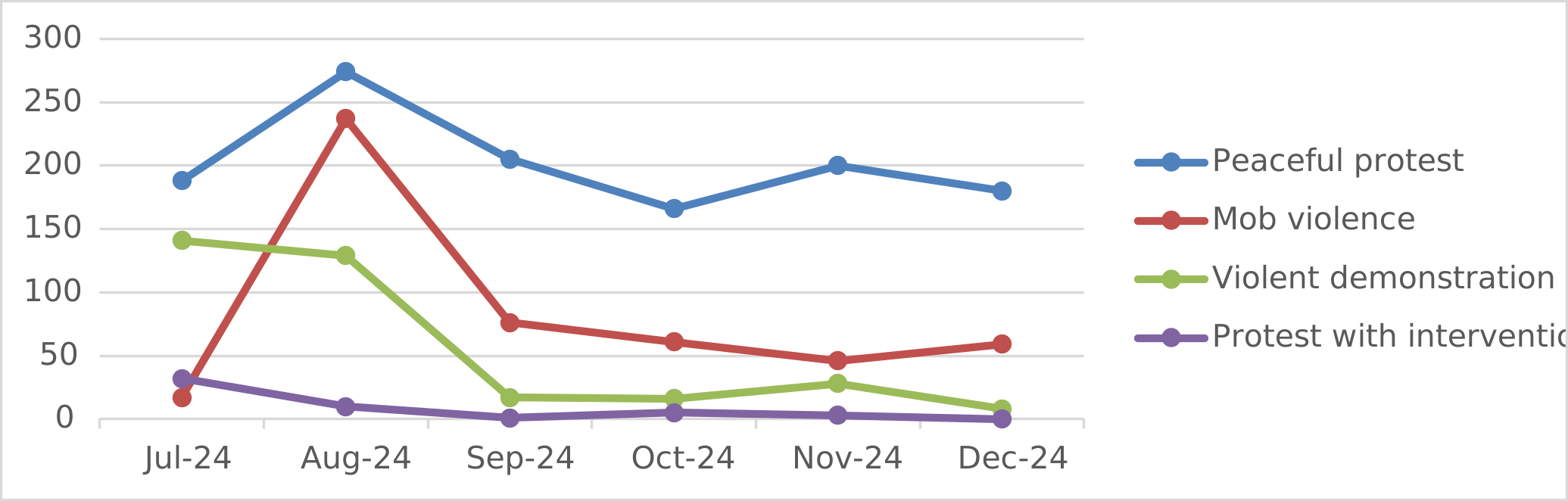
14.4.3 From 1 January 2025 to 31 December 2025, ACLED recorded 2,529 protests and 1,777 riots. ACLED data showed that peaceful protests were the most common type of protest in 2025. The below graph, based on ACLED data, shows the number of violent demonstrations, protests with intervention, peaceful protests and mob violence during this time period:[footnote 231]
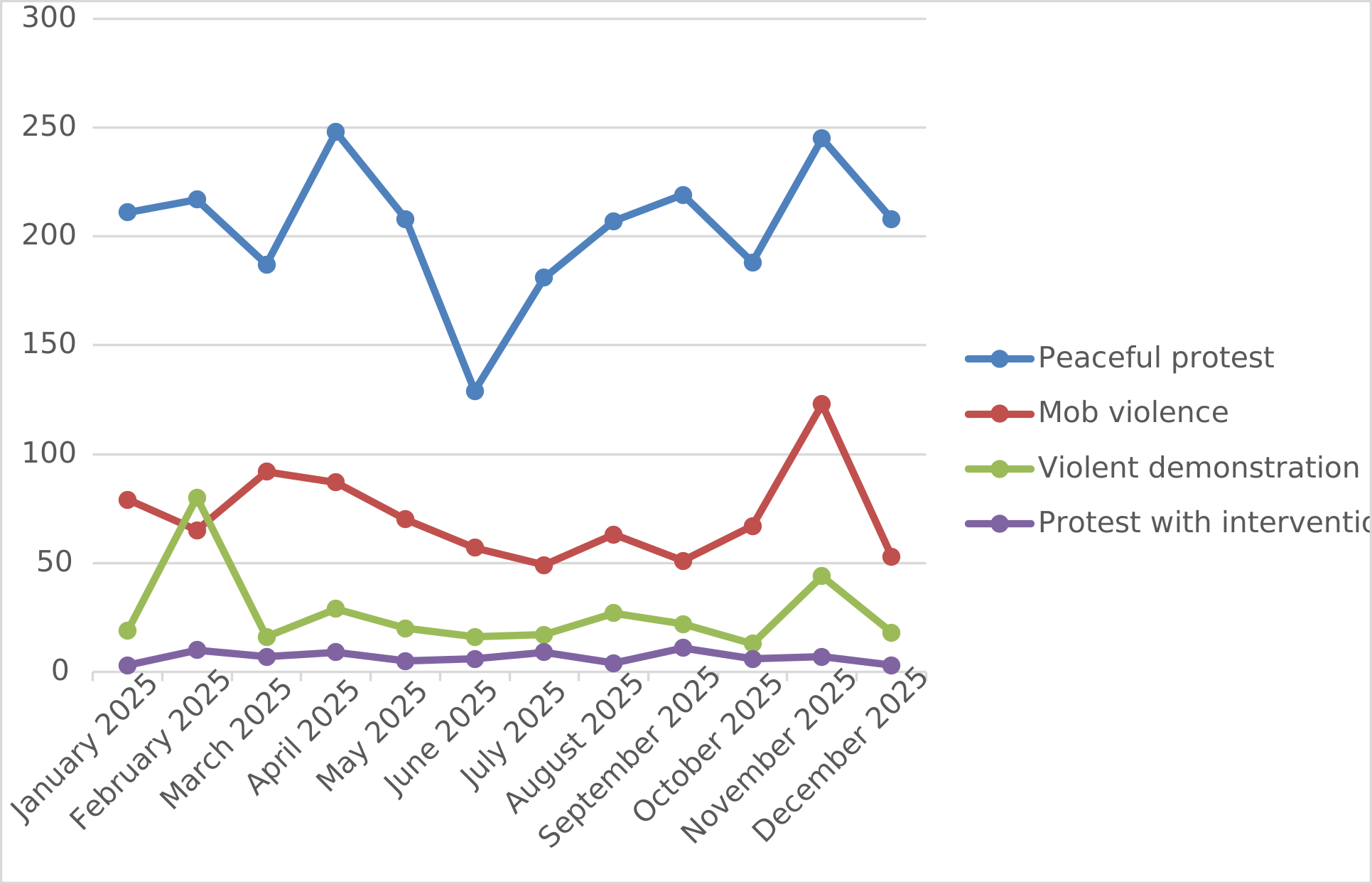
14.4.4 ACLED data showed that in the February 2026 pre-election period, there was a spike of violent demonstrations and a smaller spike in mob violence compared to January 2026. The below graph, compiled by CPIT, based on ACLED data, shows the number of violent demonstrations, protests with intervention, peaceful protests and mob violence during this time period:[footnote 232]
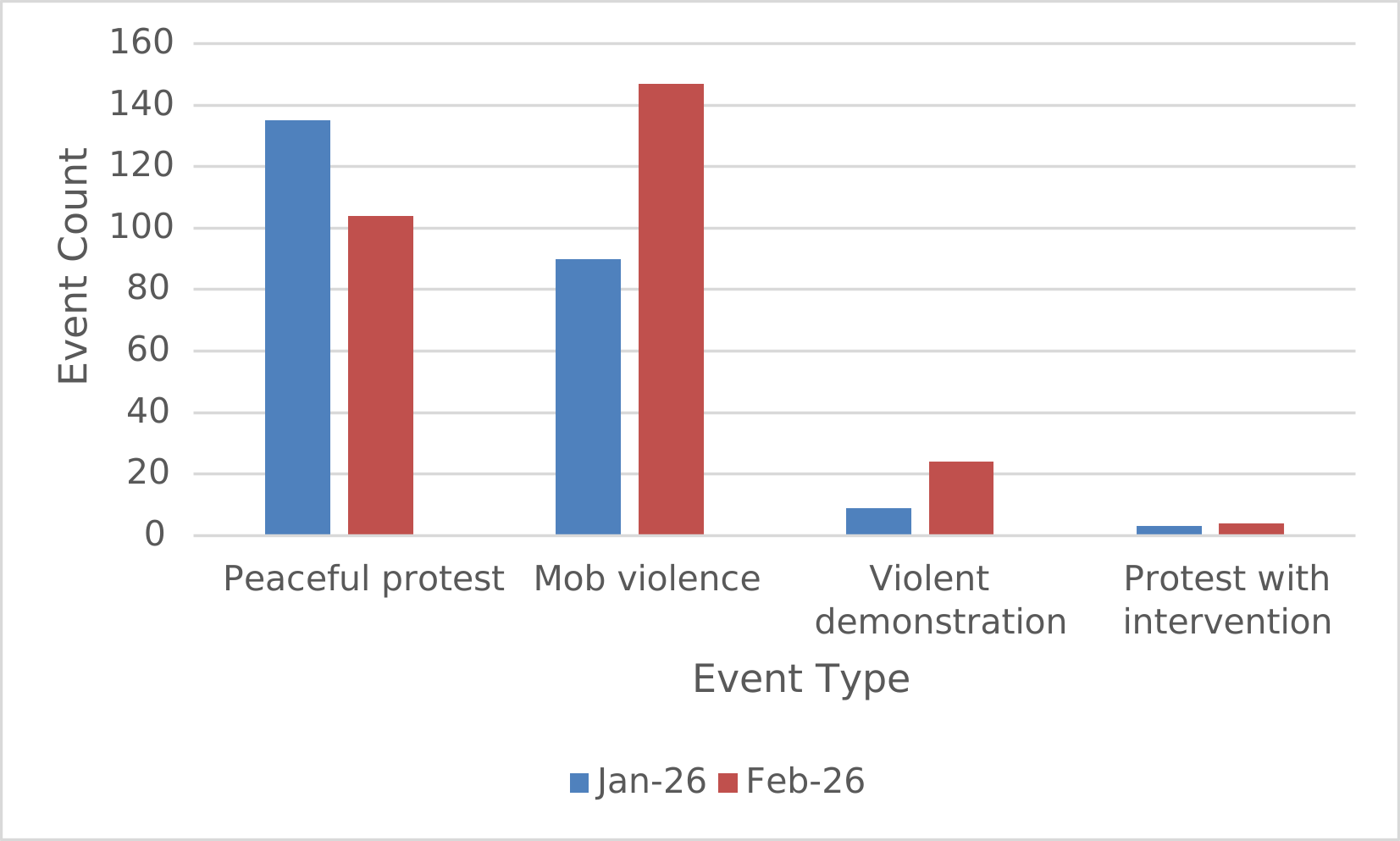
14.4.5 For an indication of the levels of violence under the BNP government, see Political violence in the post-election period: Levels and nature of violence.
14.4.6 The Odhikar 2025 report stated:
‘As per Odhikar’s findings, between 01 January [2025] to 11 December, 2025 at least 238 people were killed and 6,704 people were injured due to political violence. During this period, 422 incidents of internal conflict within the BNP, 12 incidents within the Awami League and two incidents within NCP were recorded. It is reported that 76 people were killed and 3,746 people were injured in BNP’s internal conflicts, while six people were killed and 65 were injured in internal conflicts within the Awami League and five people were injured in internal conflicts within the NCP.’[footnote 233]
14.4.7 The Odhikar 2025 report noted: ‘Since the announcement of the election schedule on 11 December 2025, incidents of political violence have been considered as electoral violence. As per Odhikar, between 11 and 31 December [2025], two persons were killed and 25 were injured due to electoral violence.’[footnote 234]
14.4.8 The same Odhikar report stated:
‘It has been alleged that, under the patronage of BNP leaders, juvenile gangs have emerged in localities, engaging in various crimes including extortion, rape, and sexual harassment. During this time [2025], allegations against BNP leaders and activists included the killing of ordinary citizens; the indiscriminate shooting and killing of a Juba Dal activist while attempting to free a BCL leader; the public beating to death of a scrap trader amid disputes over extortion; attacks on journalists and farmers; illegal occupation of houses; vandalizing buses and attacking workers for refusing to pay extortion; land grabbing; hijacking covered vans loaded with goods; involvement in drug trafficking and smuggling; fertilizer smuggling; illegal sand extraction; attacking students at universities allegedly under the guise of Chhatra League; and the taking control of cattle markets, marketplaces, launch terminals, bus terminals, chambers of commerce, and other institutions—among other criminal activities. There are allegations against BNP leaders and activists of attacking members of law enforcement agencies, assaulting police officers, and threatening government officials.’[footnote 235]
14.4.9 The ACLED February 2026 report noted:
‘Since the poll schedule was announced on 11 December [2025], ACLED data show that at least 18 people have been killed in around 80 acts of violence among groups affiliated with political parties. One week still remains till polling day, but this is already more people killed than during the pre-electoral period in 2024.
‘Notably, firearms were used in at least nine instances of political party-related violence. In a country where political violence typically takes the form of street clashes involving crude weapons, this is a relatively novel phenomenon …’[footnote 236]
14.4.10 The HRSS noted in its press release covering January 2026 to March 2026:
‘Over the past three months [January to March 2026], at least 36 people were killed and at least 4,078 others were injured in at least 610 incidents of “political violence.” Most of the violence stemmed from dominance struggles, political disputes, election-related clashes surrounding the 13th National Parliamentary Election, rally-related violence by various parties, clashes among candidate supporters, attacks, and the vandalism, arson, looting, and extortion targeting homes, vehicles, businesses, and political party offices. Furthermore, separate attacks and shooting incidents targeting political activists, along with nationwide vandalism and arson …’[footnote 237]
14.4.11 The same source also noted:
‘… In January [2026], a total of 151 political violence incidents left 8 people dead and 1,233 injured—a relatively lower figure that marked the onset of political tensions. However, violence spiked sharply in February [2026], with 346 incidents resulting in at least 10 deaths and 1,933 injuries. In contrast, while the total number of violent incidents dropped to 113 in March, the death toll rose to 18, with 912 injured, indicating that the nature of violence became more intense and lethal. Post-election retaliatory clashes, dominance struggles, and political rivalries served as the primary drivers of violence during this period.’[footnote 238]
14.4.12 The EU EOM April 2026 report stated: ‘… Between the calling of the elections on 11 December [2025] and election day, the IG reported five deaths related to political activities …’[footnote 239]
14.4.13 The EU EOM April 2026 report noted:
‘Politically motivated violence affected the campaign in some highly contested constituencies. These incidents were localised and did not indicate a systematic pattern. The EU EOM received and corroborated reports of at least 56 distinct incidents involving physical hostilities between supporters of rival candidates or party factions, resulting in at least 200 injuries across 27 districts. Additional incidents included threats and intimidation, harassment of supporters, targeted attacks on campaign offices, and arson. Most cases involved BNP and JeI candidates and campaigners, BNP factional disputes and, in some instances, the NCP and independent candidates.’[footnote 240]
14.4.14 The same report noted: ‘… Episodes of intimidation and harassment of campaigners, particularly women, and attacks on property, were also reported. Most incidents pitted BNP and JeI supporters against one another, with former BNP affiliates, contesting as independents, also frequently embroiled in confrontations.’[footnote 241]
14.4.15 The AIIA March 2026 article noted: ‘… The pre-election period saw hundreds of violent incidents across multiple districts, though they appeared localised rather than centrally coordinated.’[footnote 242]
14.4.16 The human rights activist and political analyst associated with ASK told the UK HO FFM team that ‘During the election period, violence was happening both inter- and intra-party. There was some violence within the BNP, and between the BNP and JeI, and we also saw some clashes with the NCP. So the clashes were multidimensional.’[footnote 243]
14.4.17 The same source also noted that ‘…violence was increasing in the approaching election period, so that was another big concern for us, the violence and whether that would disrupt the election, but … this didn’t happen and election was peaceful.’[footnote 244]
14.4.18 Regarding pre-election political violence, Navid Nowroz Shah, NCP MP, told the UK HO FFM team that ‘Many incidents happened but this has been one of the fairest elections in the history of Bangladesh. There were some incidents, in specific seats … we expect none to happen, but compared to other elections, there were very few.’[footnote 245]
14.4.19 An advisor at BLAST told the UK HO FFM team that ‘Around the … time of the [2026] election, we saw a marked decrease in incidents, most stakeholders were fighting a political battle and were concerned about votes …’[footnote 246]
14.4.20 When asked by the UK HO FFM team whether there were protests around the 2026 election period, Mir Ahmad Bin Quasem, JeI MP, responded: ‘It was a very peaceful election, we didn’t see any major violence’[footnote 247]
14.4.21 Regarding election-related violence, the Senior Fellow of Practice at BIGD told the UK HO FFM team that:
‘What has been coming out from our interviews is that the official reporting of violence is much less than what took place. The election complaints mechanism didn’t work very well. You will see in the EU report, they did a survey which found that people didn’t know they had a complaint office in their location, didn’t know about them at all or they didn’t know they could complain.
‘In interviews, people said that when they did lodge a complaint they weren’t taken seriously or that they took the complaint and nothing happened.
‘In Dhaka, this was reported in national media, a Jel candidate made a violent statement against women. There was a complaint filed that the speech was promoting violence against women. It went to the Chief Election Commissioner and nothing happened. This was a public incident of violence, we thought that because it was done publicly there would be some impact but there was no action from the election commission.
‘There was an incident where a rape by [a] BNP [member] was reported in Hatia due to the woman voting for the NCP. In the end, there was no evidence found to support this claim.
‘Compared to other elections, it has been more peaceful, and I haven’t heard of many incidents of violence against minorities.’[footnote 248]
14.4.22 The EU EOM April 2026 report noted that: ‘… EEACs [Electoral Appeals Commission] offices were located within district court premises, their visibility remained limited; many stakeholders therefore preferred to file complaints with Ros [Returning Officers] Assistant Returning Officers (AROs), or Executive Magistrates rather than approach the EEACs directly.’[footnote 249] In this report, CPIT could not find a reference to a survey carried out in regard to complaint mechanisms.
14.4.23 The ICG 2026 report noted, in relation to the immediate post-election period:
‘… efforts to avoid confrontation and maintain lines of communication, combined with the continued presence of security forces on the streets, also helped ensure that the five-day transition period after the vote was mostly – though not entirely – free of violence. A monitoring group, the Human Rights Support Society, said three people were killed and over 300 wounded in more than 200 clashes among members of the three parties on 13 and 14 February [2026]. Nonetheless, by Bangladeshi standards, the transition was smooth.’[footnote 250]
14.4.24 See also Security and anti-corruption efforts, Intra-party violence and Inter-party violence.
15. Political violence in the post-election period
15.1 Intra-party violence
15.1.1 Regarding intra-party violence, the advisor at BLAST told the HO FFM team in June 2026 that ‘A lot of the pre-election violence within the BNP has dissipated …’[footnote 251]
15.1.2 When asked by the UK HO FFM team about political violence since the February 2026 elections, Navid Nowroz Shah, NCP MP, responded that ‘Yes, there have been violent incidents, political incidents. It has calmed down and has not got worse yet. Most incidents are intra-party, BNP people fighting as they are a huge party. Of course, in the absence of the AL they are trying to control local powers and are fighting amongst themselves …’[footnote 252]
15.1.3 The analyst associated with ASK told the UK HO FFM team that ‘Since the elections, instances of political violence have decreased and the situation has improved in some places, to some extent. But political violence is still going on, but mostly within the BNP, intra-party clashes and control over business interests, a system of extortion, who will take control of which area, what types of business will they control etc.’[footnote 253]
15.1.4 The HRSS published a half-yearly human rights monitoring report, covering January 2026 to June 2026, based on ‘… analysis of news published by 16 national media outlets and HRSS’s own data collection, field-level observations and documented incidents.’[footnote 254] A copy of the report is available upon request. This report noted: ‘Of the 830 incidents of political violence recorded during the past six months, 273 incidents stemmed from internal conflicts within the Bangladesh Nationalist Party (BNP), resulting in at least 2,092 injuries and 31 deaths … Among the 56 people killed in political violence, 37 (66%) were members or supporters of the BNP …’[footnote 255]
15.1.5 For information on violence during the election period, see Security and anti-corruption efforts.
15.2 Inter-party violence
15.2.1 In relation to allegations of violence between political parties’ student wings, on 24 April 2026, Prothom Alo reported:
‘… the government has … unleashed Jatiyatabadi Chhatra Dal (JCD) against Islami Chhatra Shibir across the country, Bangladesh Jamaat-e-Islami secretary general Mia Golam Porwar has alleged.
‘He said leaders elected in the Dhaka University Central Students’ Union (DUCSU) by the votes of 30,000 students had been attacked and tortured “like hyenas” by the Chhatra Dal members.
‘He also alleged that Chhatra Dal had carried out brutal attacks on Chhatra Shibir in Chattogram, Cumilla, Pabna and Ishwardi.’[footnote 256]
15.2.2 Regarding inter-party violence between student wings, on 23 April 2026, Just News Bangladesh, a Dhaka based newspaper[footnote 257], reported:
‘A clash broke out between activists of Jatiyatabadi Chhatra Dal and Islami Chhatra Shibir at Shahbagh Police Station in the capital … today …
‘During the incident, Musaddiq, the literature and cultural affairs secretary of the Dhaka University Central Students’ Union (Ducsu), was reportedly assaulted.
‘According to eyewitnesses, the clash erupted when Abdullah Al Mahmud, who contested for the Ducsu executive member post from a Shibir-backed panel, went to the police station to file a general diary (GD) over a fake screenshot.’[footnote 258]
15.2.3 On 27 April 2026, the Daily Star reported:
‘Three leaders from the Bangladesh Nationalist Party (BNP) and its student wing, Bangladesh Jatiyatabadi Chhatra Dal, have been expelled following an attack on a member of parliament and the vandalism of his vehicle in Netrokona district …
‘The incident took place in the Netrokona-5 (Purbadhala) constituency, where MP Masum Mustafa [JeI MP] was assaulted at a filling station on Friday evening [24 April 2026], according to party sources.’[footnote 259]
15.2.4 On 17 May 2026, Prothom Alo reported:
‘A woman named Sayeda Begum allegedly died in an attack by leaders and activists of the Bangladesh Nationalist Party (BNP) in Ukhiya, Cox’s Bazar …
‘According to local residents, slogans reading ‘Joy Bangla, Joytu Sheikh Hasina’ were written on the wall of the local Taipalong madrasa a few days ago. Following the incident, local BNP leaders filed complaints with the police against several leaders and activists of the now-banned Awami League.
‘On Saturday evening [16 May 2026], Chhatra Dal activist Md Jisan made a Facebook post about the wall graffiti. Md Yunus, an activist of the now banned Chhatra League, reacted to the post with a “haha” emoji.
‘Eyewitnesses said several BNP and Chhatra Dal leaders and activists detained Yunus at night and began assaulting him over the Facebook reaction. At that time, his friend and local NGO worker SM Imran went to rescue him, but he too was severely beaten.
‘Hearing about the attack on Imran, his mother Sayeda Begum rushed to the scene. She was also attacked while trying to protect her son. She later lost consciousness at the scene. She was taken to the Upazila Health Complex, where physicians declared her dead.
‘SM Imran, son of the deceased Sayeda Begum, alleged that BNP and Chhatra Dal leaders and activists were involved in the attack. He specifically accused a BNP leader of assaulting his mother. He said his sister, an SSC [Secondary School Certificate] examinee, his wife and several other family members were also injured in the attack.
‘… the accused persons denied involvement in the attack … police detained banned Chhatra League activist Md Yunus following the incident. Asked about the matter, Ukhiya Police Station officer-in-charge Mujibur Rahman said local residents had confined Yunus inside a shop, from where police later detained him and took him to the station.
‘When asked about the death of Sayeda Begum, the officer-in-charge said she died at the hospital. He added that no visible injury marks were found on her body while preparing the inquest report. An investigation is underway to determine the cause of death.’[footnote 260]
15.2.5 NCP MP, Navid Nowroz Shah, told the UK HO FFM team that: ‘There was an incident before Eid [2026] in Jheinaidha district which is in the southern part of the country, 3 people from the NCP were attacked by BNP people but the police arrested NCP members and kept them in jail during Eid. Everyone knows it was a fake case and a political arrest from the government. In general, it is a better situation but it is not up to the mark we expected after the uprising, we were not expecting unlawful arrests …’[footnote 261]
15.2.6 Regarding political violence since the elections, the same source stated that ‘There are [a] few inter-party incidents, I already mentioned the one in Jheinaidha where 3 members of my party were arrested. There have been a few other incidents with the BNP. For example, there was an incident where the BNP vandalised the place where we arranged an assembly and are targeting top leaders and attacking them, so that we can’t expand our party across the region …’[footnote 262]
15.2.7 When asked by the UK HO FFM team about political violence in the post-election period, the political analyst at an International NGO responded that violence ‘… has not been widespread, and it has been low level, more disruption for example throwing eggs or stones or shouting at each other, low level violence.’[footnote 263]
15.2.8 The advisor at BLAST told the UK HO FFM team that:
‘… Now we are seeing some, again quite low numbers for Bangladesh, of inter-party political violence. Sometimes there will be skirmishes with political leaders. The NCP leader was subjected to attacks, heckling and the throwing of eggs from BNP members/supporters. There were no big clashes between student wings which was previously common. The AL and BNP student wings were not clashing violently on streets which is big positive. Student politics and violence has subsided over the past 2 years and a big reason for that is starting up of student union elections. When democratic pathways are opened, violence goes down. A lot of violence now is around localised issues around land grabbing and control over resources and using that in terms of political rhetoric to mobilise support.
‘After the election, there were documented incidents such as the sexual assault of a woman who voted NCP being turned into political ball game. It was said that the BNP was enacting sexual violence against the opposition. Most political violence is also located in areas where Jamaat and NCP have members of parliament. Obviously that struggle is between BNP-led administration, placed in different stages/areas of local government, and members of the opposition. We have been seeing skirmishes in Chuna, where Jamaat or NCP won.’[footnote 264]
15.2.9 Mir Ahmad Bin Quasem, JeI MP, told the UK HO FFM team that in recent by-elections, in April 2026, there was violence from ‘… the BNP against Jamaat e Islami. There was violence, and the physical expulsion of polling officers. Polling centres were occupied by ruling party-linked groups and they won the by-election.’[footnote 265]
15.2.10 The political analyst at an International NGO told the UK HO FFM team that ‘We are seeing a rise in AL rallies outside Dhaka, and they are sometimes turning into violent exchanges with BNP activists locally. Not many but at least a few recently, last week [June 2026].’[footnote 266]
15.2.11 The HRSS half-yearly report covering January 2026 to June 2026 provided the below breakdown of political violence between political actors (table compiled by CPIT):[footnote 267]
| Political Parties | Incident | Injured | Killed |
|---|---|---|---|
| BNP -BNP | 273 | 2,092 | 31 |
| BNP-Jamaat | 290 | 1,852 | 10 |
| BNP – Awami League | 77 | 464 | 7 |
| BNP - NCP | 33 | 250 | 0 |
| Awami League - NCP | 3 | 51 | 0 |
| BNP – ‘other’ parties | 97 | 251 | 0 |
| ‘Other’ party conflict | 57 | 286 | 8 |
| Total | 830 | 5,246 | 56 |
15.3 Levels and nature of violence
15.3.1 When asked by the UK HO FFM team whether there was a difference in the level of political violence pre- and post-2026 election, Abu Shadat Md Sayem of the HRSS responded that:
‘Violence spiked during the election. After and long before the election, the frequency appears normal. It normally spikes during election periods and without exception it happened with this election too … Generally, election-related violence remains high from the announcement of the election schedule until election day. Within a week after the election, the situation usually returns to normal. This is the common trend in almost every election in Bangladesh …’[footnote 268]
15.3.2 Saiful Islam of the HRSS told the UK HO FFM team that political violence ‘…is the same. In some cases it’s a bit worse. Especially regarding societal violence including mob violence and social conflict. Political conflict is also not decreasing – it is more or less the same.’[footnote 269]
15.3.3 Regarding incidents of violence, Abu Shadat Md Sayem told the UK HO FFM team that: ‘Another aspect of conflict at local level is because of disputes at a local government level such as business tenders. In those cases, BNP are quite powerful and get the tenders. Where JeI has more influence, there is some conflict to get tenders but it’s mostly peaceful.’[footnote 270]
15.3.4 When asked by the UK HO FFM team whether there were protests around the 2026 election period, Mir Ahmad Bin Quasem, JeI MP, responded: ‘… after the result, many were not happy as they believed people’s views were not reflected. We decided to accept the result for the sake of the stability of the country. Because of this more patient stance from the opposition, we haven’t seen much post-election violence.’[footnote 271]
15.3.5 The same source stated: ‘In Sherpur [during the 2026 pre-election period], one person died, and we saw serious problems – armed groups took control of polling stations, among other issues.’[footnote 272]
15.3.6 The advisor at BLAST told the UK HO FFM team that: ‘… Political violence has not reached levels seen under the AL when we saw horrific persecution … Locally, we haven’t seen violence. A lot of this is contingent on how local elections turn out and if we see a return to political violence. Locally, political violence has decreased.’[footnote 273]
15.3.7 The HRSS half-yearly report covering January to June 2026 noted:
‘Particularly in the post-election period, supporters of victorious candidates were reportedly involved in widespread attacks, looting, and arson targeting the homes, vehicles, and business establishments of supporters of defeated candidates. This retaliatory violence created an atmosphere of insecurity and fear at the local level, posing a serious challenge to the rule of law and the democratic process.
‘During the six-month reporting period, at least 396 incidents of election-related violence were recorded, resulting in at least 2,578 injuries and 13 deaths. In addition, more than 600 attacks involving vandalism, looting, and arson targeted business establishments, homes, and election offices during both the pre-election and post-election periods.’[footnote 274]
15.3.8 The below graph, compiled by CPIT, based on ACLED data, shows the number of violent demonstrations, protests with intervention, peaceful protests and incidents of mob violence between March 2026 and 21 September 2026:[footnote 275]
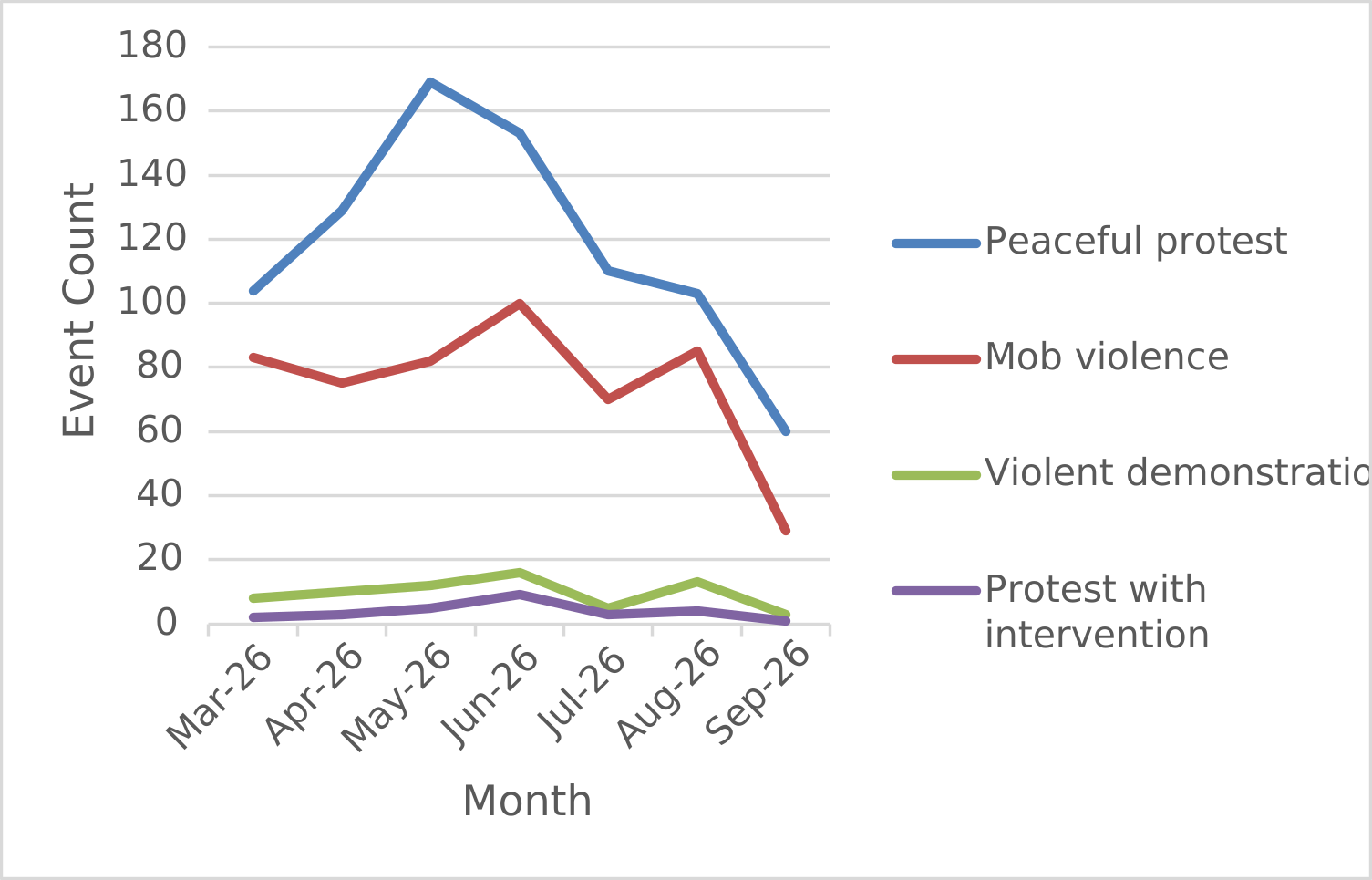
16. Treatment of political groups
16.1 Awami League and affiliates
16.1.1 For information on the ban of the activities of the Awami League and its student wing, see Awami League (AL) and auxiliary organisations, Political participation.
16.1.2 For information on the treatment of Awami League affiliates after the resignation of Sheikh Hasina, and before the 2026 elections, see Political violence under the interim government and the archived Country Policy and Information Note Bangladesh: Political situation (December 2024).
16.1.3 For information on arrests and prosecutions of Awami League members and affiliates, see Arrest and prosecution of Awami League members and affiliates under the IG, Arrest and prosecutions of Awami League members and affiliates under the BNP government.
16.1.4 The DFAT 2025 report noted, regarding the situation for AL civil servants under the IG: ‘According to in-country sources, in most cases civil servants with Awami League links were able to retain their jobs, although some had reportedly been sidelined or relocated. A smaller number have been fired … In-country sources told DFAT some senior officials and businesspeople with links to the Awami League had used their personal connections to successfully escape sanction following the fall of the Hasina Government.’[footnote 276]
16.1.5 Regarding restrictions on the movement of high-profile Awami League members, on 21 December 2025, the Business Standard reported:
‘A Dhaka court today (21 December [2025]) imposed a travel ban on ousted prime minister Sheikh Hasina … in a case filed over fraud and embezzlement …The ban was also imposed on 16 others, including several high-profile former Awami League MPs …
‘Since September 2024, courts have granted the [Anti-Corruption Commission] ACC’s requests to impose travel bans on nearly 250 former ministers, MPs, politicians, businessmen and government officials on allegations ranging from money laundering and embezzlement of bank loans and government project funds to accumulating illegal wealth.
‘However, over a hundred of the restricted individuals are already known to be abroad.’[footnote 277]
16.1.6 Regarding restrictions on the movement of former Awami League MPs, the DFAT 2025 report stated:
‘DFAT understands there is no blanket ban on former Awami League MPs travelling abroad. Yet, according to in-country sources, most were unable to do so as the diplomatic passports on which they formerly travelled were cancelled and passport offices reportedly instructed not to issue them ordinary passports. Separately, courts have imposed travel bans on several former ministers and MPs belonging to the Awami League, including for alleged irregularities and corruption while in government.’[footnote 278]
See also Accountability for corruption and abuses committed under the Awami League government.
16.1.7 The Senior Fellow of Practice from BIGD told the UK HO FFM team that: ‘Recently, there was a huge purge in the police of those perceived to be affiliated with the AL. There was a new batch of police officers supposed to be sworn in after one year of training, and the whole ceremony was cancelled the day before.’[footnote 279]
16.1.8 When asked by the UK HO FFM team if AL supporters or members can, since the 2026 elections, express their political opinion in their community, the political analyst at an international NGO responded:
‘… Pre-election [2026], JeI and BNP went to the AL leaders in their community and sought their support … So, most are safe due to negotiated deals and alliances with other groups …
‘There is no widespread persecution of AL people, they are generally safe. However, there are some that want to protest violently or be active in politics to demonstrate to Sheikh Hasina that they still support her and are doing something for her. It is those people who are getting into trouble.’[footnote 280]
16.1.9 When asked by the UK HO FFM team if a low-level AL supporter could express their political opinion, the advisor from BLAST responded that:
‘The expression of political opinion does exist, and it is usually ok to do so. But you cannot express openly your support for the AL. If you openly voice your support for the AL, there may be backlash. There could be public mobilisation and violence. The sentiment against the AL has not eroded and the anger is still there. People feel the justice process has not been sufficient. There has been the symbolic death penalty of the former Home Minister and the former Prime Minister, but other than that no one has seen any justice.’[footnote 281]
16.1.10 The Human Rights Activist and Political Analyst associated with ASK told the UK HO FFM team, regarding freedom of expression, that: ‘Now it is still a bit difficult to express opposition views, particularly if the view favours the AL in any way, so there are concerns about that, but the position until now has improved. Moving forward it will depend on the political strategy of BNP regarding whether they allow the AL to carry out their regular activities or not.’[footnote 282]
16.1.11 When asked by the UK HO FFM team if an AL member or supporter can express their opinion, the same source responded that:
‘They can but it is difficult to express it publicly. When we are discussing with an AL activist, we may not like their ideas, but we are not attacking them. The problem is when they are saying things on social media or in electronic media that is a problem. But at a community level, in day-to-day life, that is not a big problem. It is also true that sometimes people say we were doing good under Hasina’s regime, but when that belief is noticed in the public or in the media, then there is this case [it is difficult to express this view in public].’[footnote 283]
16.1.12 When the UK HO FFM team asked a follow-up question to clarify if there would be a difference in response to organised activities and the expression of political beliefs, the same source responded: ‘That is different. When 10 or 15 activists gather, use slogans, and place demands, that becomes difficult. But when they are separated and are talking (speaking privately) then that is not a big problem.’[footnote 284]
16.1.13 The Senior Fellow of Practice at BIGD told the UK HO FFM team that ‘… if people try to speak on behalf of the AL then they are labelled an AL supporter …’[footnote 285]
16.1.14 When asked by the UK HO FFM team whether a person who was a vocal AL supporter would be at risk of violence, Saiful Islam of the HRSS responded:
‘People who did not politically oppress others [under the AL government], they live in harmony. But people who did oppress, they faced a difficult situation during the IG. Some of them were charged with many cases, and many benign AL supports have also been arrested, but right now the situation has improved. So it depends on their past actions as to how they might be treated in the community.
‘An AL leader who highly oppressed opponents and grabbed lands illegally, he can’t enter the village right now, but many of my school friends, they were BCL members, they are still in the village, nothing has happened to them. They are fine as they weren’t oppressive.’[footnote 286]
16.1.15 When asked by the UK HO FFM team if there was societal violence against low-level AL supporters, the activist and analyst associated with ASK told the UK HO FFM team that ‘That is happening to some extent. Many low-level members are just silent, trying to live in this difficult time’ and clarified that ‘this mainly comes from political opponents …’[footnote 287]
16.1.16 The same source told the UK HO FFM team that: ‘At this moment, the overall sentiment is against the AL and it is very high, so protection inside Bangladesh is a bit difficult. But they are managing things in an understanding with the BNP and JeI. After the change in the government, these things are working differently.’[footnote 288]
16.1.17 Regarding the ability of AL members to internally relocate, the political analyst at an international NGO told the UK HO FFM team that ‘… many have shifted to other districts, perhaps living with relatives. Many thousands moved, some have started to come back to their areas after the election although not all.’[footnote 289]
16.1.18 The advisor from BLAST told the UK HO FFM team that:
‘… members of the political opposition can relocate. It seems to be fine and is definitely possible. If they are AL, it could be a problem. They may be liable to arrest and extortion, in exchange for not being arrested. The AL situation is not good. Really low-level members are not being persecuted. Student politicians engaged in the student league and involved in violence have been targeted. However, we’ve seen over course of last 5/6 weeks, for example, in Ranpur (Jamaat controlled), a big political personality who was AL is still there. Individuals have either switched sides or have come to an understanding with Jamaat or the BNP. If public sentiment isn’t against individuals, they are generally left alone.
‘Some AL union level chairmen are still there as the public didn’t have that feeling of resentment, especially if they have not been accused of corruption … I’ve seen at a local level those persecuted had negative public sentiment against them …’[footnote 290]
16.1.19 When asked by the UK HO FFM team whether a person facing a problem in one area of the country would be able to move to another, the activist and analyst associated with ASK told the UK HO FFM team that: ‘Yes, that is currently taking place, especially with AL cases. Leaders and activists facing cases in one district are trying to hide in another district or another area, and trying to pursue their business there. That is happening, they can move frequently, but it is a difficult situation.’[footnote 291]
16.1.20 When asked by the UK HO FFM team if someone, such as an AL member, who was being threatened in their community would be able to move to another area, Saneequdrat Saqee, a Program Officer at HRSS, responded that it ‘Depends on their level of seniority. If they were not senior or popular/known they can move to another area, as many are, but those who are very known, they have to flee the country …’[footnote 292]
16.1.21 Saiful Islam followed up, telling that UK HO FFM team that:
‘… They [AL] are now taking shelter in other countries, saying if they go to Bangladesh they will be mobbed, but right now we don’t have that problem, they will be passed to the police. People grab them and hand them over to the police, this is the situation. Nobody is willing to get involved in mob violence.
‘In general, they can go back to their community in Bangladesh. The situation is different for a criminal.’[footnote 293]
16.1.22 The Senior Fellow of Practice at BIGD told the UK HO FFM team that:
‘They [AL members] have relocated. When we have been doing interviews, people from different political backgrounds, women from minority Dalit communities and others like that, who had been elected under AL and seen as AL supporters, are no longer in this area. Some of the ones we contacted said that they can’t come and meet, a few we contacted said it’s better that we don’t come to meet them and that they can’t come to meet us as they are in hiding.
‘Others are much more open. They were previously with the AL but they are no longer with them as they have other identities, such as working with a NGO, even though people know they were elected to the local government as an AL supporter.
‘In one example, one of the women [associated with the AL] was attacked … They [she and her family] still live in the same city they lived in before but do not go back to stay the night in their village home and take precautions if they visit their village.
‘Some have gone totally underground. Some went to home to their in-laws’ area and there are those who left the country …’[footnote 294]
16.1.23 Regarding the ban of the AL, the political analyst at an international NGO told the UK HO FFM team that ‘… There is pressure from NCP and JeI to not allow AL to come back. We see that on the one hand the government have passed a law banning AL more permanently, at the same time we see they are not really strongly supressing AL at the grassroots …’[footnote 295]
16.1.24 The human rights activist and political analyst associated with ASK told the UK HO FFM team that ‘AL activities were banned. However, some activists and leaders have tried to join demonstrations together, and in these cases the police have tried to arrest them. There are some concerns that the activists of the BCL cannot pursue their education, some AL professionals cannot carry out their profession, or regular activities.’[footnote 296]
16.1.25 The same source also advised that: ‘[AL] people who made money through corruption or other means … most of them have escaped from Bangladesh or they are hiding but activists who couldn’t manage to escape, they are getting harassed at this moment.’[footnote 297]
16.1.26 In July 2026, Reuters reported that: ‘Bangladesh President Mohammed Shahabuddin, a former ally of ousted premier Sheikh Hasina, will resign on Friday [24 July 2026] halfway through his term …
‘Shahabuddin’s spokesperson did not give a reason for his resignation, but three sources familiar with the matter said the government had pressed him to step aside because of his longstanding ties to Hasina …’[footnote 298]
16.1.27 The BBC reported that former President Shahabuddin resigned due to ill health, but that he had ‘been under pressure to resign’ from BNP leaders.[footnote 299]
16.2 Arrest and prosecution of Awami League members and affiliates under the interim government
16.2.1 On 27 January 2025, Human Rights Watch published a special report (HRW January 2025 report) titled ‘After the Monsoon Revolution’, based on interviews with victims of the July-August 2024 protests, their relatives, eyewitnesses, officials in the interim government and security forces.[footnote 300] Regarding arrests of journalists perceived to be affiliated with the Awami League, this report noted:
‘… Police have pursued criminal charges against journalists for what was seen as backing the Hasina government in their reporting during the Monsoon Revolution [the July-August 2024 uprising] …
‘As of November [2024], authorities have filed murder charges against at least 140 journalists in relation to their reporting on the Monsoon Revolution … Police have especially targeted journalists from the privately owned, pro-Awami League broadcaster Ekattor TV …’[footnote 301]
16.2.2 In relation to arrests of Awami League officials after the end of Sheikh Hasina’s administration, the same report stated:
‘Between August 6 [2024] and September 25 [2024], police lodged cases against 92,486 people, most of them related to murder. Nearly 400 former ministers, members of parliament, and other Awami League officials have been named in over 1,170 cases, which include hundreds of unnamed individuals. Over 200 cases have been filed against Sheikh Hasina …
‘In interviews with Human Rights Watch, five plaintiffs in the eight cases said they did not know who was named as the accused when they filed the case. They said the police or local politicians simply told them to sign the papers.’[footnote 302]
For more testimonies, see the full Human Rights Watch January 2025 report.
16.2.3 On 12 February 2025, the Office of the United Nations High Commissioner for Human Rights (OHCHR) published a report of a fact-finding mission conducted in September 2024, which focused on human rights violations and abuses that occurred between 1 July 2024 and 15 August 2024, and which was based on more than 230 confidential in-depth interviews (OHCHR 2024 FFM report). In relation to access to the judicial system and the right to a fair trial under the IG, this report noted:
‘There are … concerns about undue pressure on defence lawyers, some of whom were refused access to court, assaulted and threatened, and permitted only limited access to their clients or case files, according to witnesses. The [Interim] Government … informed OHCHR that many lawyers who would have normally represented defendants linked to the former Government and Awami League had fled or no longer came to court, but that Bangladesh had a legal aid mechanism to ensure representation to any accused who would otherwise not be represented.’[footnote 303]
16.2.4 The DFAT 2025 report noted that, after the designation of the BCL as a terrorist organisation in October 2024, the IG initiated: ‘… criminal proceedings against hundreds of its members. Cases levelled against BCL members include murder, manslaughter and assault for alleged actions during the July and August 2024 protests. Many of these cases may be based on legitimate allegations …’[footnote 304]
16.2.5 The DFAT 2025 report stated: ‘In-country sources told DFAT 256 mass cases … were filed against 194,000 people belonging to or affiliated with the Awami Leage between 5 and 30 August 2024 …’[footnote 305]
16.2.6 Regarding police operation ‘Devil Hunt’, the same report noted:
‘In April 2025, around 12,700 people were arrested across Bangladesh as part of a police crackdown on supporters of the Awami League … These arrests followed, and expanded upon, ‘Operation Devil Hunt’, which … saw around 12,500 people (mostly Awami League supporters) arrested between 8 February [2025] and 1 March 2025 as part of a campaign to curb unrest and ensure public safety … DFAT understands, as of May 2025, more than 300 cases had been lodged with Bangladesh’s International Crimes Tribunal (a domestic court) relating to alleged crimes committed by Awami League members. The court commenced its first hearings in May 2025. According to in-country sources, it would likely be years before all cases were heard.’[footnote 306]
16.2.7 The DFAT 2025 report stated: ‘In-country sources said many arrests of Awami League supporters since August 2024, including as part of Operation Devil Hunt, were arbitrary. Operation Devil Hunt was discontinued on 1 March 2025.’[footnote 307]
16.2.8 The same report noted: ‘According to in-country sources, mass legal cases had reduced in 2025 and recent crackdowns on Awami League supporters did not appear to utilise mass case files to arrest suspects …’[footnote 308]
16.2.9 The same report noted, regarding the mass case files, that: ‘According to local media, people from various walks of life have been implicated, including actors, businesspeople, journalists, police officers, bureaucrats and even deceased persons. In April 2025, the Inspector-General of Police advised wrongfully implicated persons to seek police assistance. The Inspector-General acknowledged many cases had been filed with an intent to extort money and instil fear.’[footnote 309]
16.2.10 The EUAA 2025 Bangladesh report noted: ‘There were reports of security forces arbitrarily arresting Awami League affiliates, including journalists. Some misused the situation to file baseless cases against political opponents, and against perceived supporters of the former government. As a result, some have been arrested without a relevant connection to the crime.’[footnote 310]
16.2.11 Regarding high profile Awami League MPs under the Hasina Government, the DFAT report assessed in July 2025 that: ‘While, in some cases, these [MPs] … may have legitimate cases to answer … many face arbitrary detention. If arrested, they are unlikely to receive bail or a fair trial. DFAT is not aware of instances of Awami League figures being subjected to violence or other ill-treatment while in detention … DFAT is not aware of instances of Awami League figures seeking police protection when faced by threats.’[footnote 311]
16.2.12 On 10 August 2025, a BBC News article reported: ‘Several journalists and supporters of the Awami League have been jailed for months on murder charges. Their bail applications have been repeatedly rejected by courts. Critics say there is no thorough investigation over those murder accusations, and they have been kept in detention only because of their previous support for the Awami League.’[footnote 312]
16.2.13 The Odhikar 2025 report stated:
‘After the July 2024 mass uprising, numerous cases of murder and attempted murder were filed across Bangladesh. The filing of such cases continued throughout 2025. In the majority of these cases, the FIRs [First Information Reports] named not only the actual perpetrators and leaders and activists of the Awami League, but also individuals who had previously been subjected to politically motivated, fictitious cases during the Awami League period, accusing them as defendants in murder cases allegedly committed during the mass uprising. In some instances, even individuals who died due to illness were falsely shown as having been killed during the July [2024] movement, and fabricated murder cases were filed against a total of 768 accused persons, including 600 unnamed individuals.’[footnote 313]
The Odhikar report did not provide a breakdown of the filing of murder cases based on political affiliation.
16.2.14 On 13 November 2025, Prothom Alo reported on the arrest of 43 leaders and activists of the Awami League due to their alleged involvement in explosions and arson attacks. Another 44 were arrested in a separate operation.[footnote 314] In the sources consulted, CPIT could not find an update on these cases.
16.2.15 See also: Treatment of political groups: Awami League and affiliates; Arrest and prosecution of Awami League members and affiliates under the BNP government; Accountability for corruption and abuses committed under the Awami League government.
16.3 Arrest and prosecution of Awami League members and affiliates under the BNP government
16.3.1 When asked by the UK HO FFM team, in June 2026, about the current situation of arrests of AL members, the advisor at BLAST responded that:
‘I think prior to the elections, there were staggering numbers of arrests under the Anti-Terrorism Act. Many were arrested arbitrarily, there were around 15,000 every month, which led to the massive overcrowding of prisons. This is not happening anymore …
‘We are still seeing individuals getting detained under the Anti-Terrorism Act but there has been a noticeable decrease of that. There haven’t been any high-profile arrests since the arrest of the previous Speaker [Sharin Sharmin, in April 2026[footnote 315]], who has been bailed, but I don’t think that the BNP is targeting high profile individuals. However, they retain the capacity to do so under Anti-Terrorism Act.’[footnote 316]
16.3.2 The advisor at BLAST told the UK HO FFM team that:
‘… The BNP is … as firm as the interim government in terms of ensuring the Awami League remains heavily persecuted … The public has anger (justifiably) against those in a position of power who committed serious crimes. We are seeing some ridiculous results of that. For example, the 23rd Chief Justice has been behind bars for 2 years now … he was the architect of, or credited with, the changes to the constitution which benefited the Awami League and he is being punished for that.
‘There are a lot of individuals remaining behind bars, but they have not engaged in crimes. Not to say they weren’t engaged in crime, but they are not in prison for the crimes they have committed.’[footnote 317]
16.3.3 Regarding cases against AL members, the Senior Fellow of Practice at BIGD told the UK HO FFM team that: ‘The former Speaker [of the National Parliament], Sharin Sharmin, had a case brought against her where there was no evidence and it was alleged that she shot someone elsewhere in the country. There are these weak false cases brought against people.’[footnote 318]
16.3.4 Regarding high profile arrests, Saneequdrat Saqee told the UK HO FFM team that: ‘Two days ago, someone at the top of the AL was bailed. Someone else is being bailed today or tomorrow and the Speaker was also bailed. So I think, broadly, the consensus in our country is to follow the legal process for justice.’[footnote 319]
16.3.5 Regarding ongoing trials in the International Crimes Tribunal (ICT), ‘a domestic court to prosecute international crimes’[footnote 320], and accountability of those who committed human rights violations under Sheikh Hasina, Mir Ahmad Bin Quasem, JeI MP, told the UK HO FFM team:
‘… those who could afford a good lawyer and were not charged under the ICT, the majority of them have been released. After the BNP came to power, there were a significant amount of people linked with the Awami League who were granted bail. The assumption is that they somehow ended up manging to have a “back channel” with the ruling party.
‘In my area, local leaders who fired automatic weapons at protesters are now out on bail … That didn’t happen with ICT, as at that higher level there are more checks and balances, and the cases have lots of attention.
‘In the rural areas, a significant number of cases have been bailed. The former speaker of Awami League was released within 3 weeks, and 2 MPs who were jailed during the interim period are out. From what we hear from within the legal community, including a friend who is defending AL members, they are very optimistic they will get out on bail. The political urge that they don’t get bail is not there anymore. In short, those who can get a back channel into government [have the right connections] and those who can get a good lawyer can get out.’[footnote 321]
16.3.6 A human rights activist and political analyst associated with ASK told the UK HO FFM team that: ‘There are some trials going on in the ICT and in the regular trials court as well. Our experience of the justice process is that it is very long and we cannot say that this process will be unbiased. There is always an indication that the judges are looking at the signals of the government and want to deliver a judgement that the government likes.’[footnote 322]
16.3.7 When asked by the UK HO FFM about the independence of the judiciary in relation to politically motivated cases, Rasheda K Choudry responded that: ‘… Even some AL ministers, one was well known for their integrity, and had never been a person linked to anything bad, let alone murder … was accused of killing someone in their constituency, so people lost confidence in the trial …’[footnote 323]
16.3.8 In addition, Rasheda K Choudry told the UK HO FFM team that ‘… Others like the politicians, those cases where there was a lot of corruption, those were true actually … but the question is a fair trial, whether they are getting it …’[footnote 324]
16.3.9 When asked by the UK HO FFM team about the ongoing prosecutions of AL members, representatives from the Bangladesh Police responded:
‘… You come across a lot of events in the daily newspaper, some people who were connected to the previous government, and who had important roles during the uprising, oppressing, harassing people, have been brought to justice.
‘… Sometimes the offence is true, sometimes the grievance is higher than the offence itself, these are the issues we come across. Those who have played roles in torturing people have been brought to justice and they are facing trials now. Of course, in the trial the offences may be proved or not proved.’[footnote 325]
16.3.10 On 23 August 2026, Human Rights Watch published a news release which stated, regarding AL members detained after the July/August 2024 uprising: ‘… hundreds remain in prison without being charged with any crime … Their family members and lawyers allege that the detainees, many of them older people, some with serious health conditions, have been denied basic rights including bail and medical care. At least 10 Awami League office holders, most of whom were not charged with any crime, have died in prison since Prime Minister Tarique Rahman took office in February 2026.’[footnote 326]
16.3.11 The same source stated:
‘Prosecutors have repeatedly sought to deny bail in cases in which no evidence has been produced …
‘Lawyers … told Human Rights Watch that they now advise their clients not to seek bail, as if they succeed the police simply file a new case against them.
‘Bangladesh’s International Crimes Tribunal, a domestic court to prosecute international crimes, allows detention without charge beyond one year only in “exceptional circumstances” that are set out in writing. The tribunal has not released on bail any of the over 160 people it has detained, who have no right to appeal bail rejections.’[footnote 327]
For examples of individual cases relating to AL members, see the 23 August 2026 HRW news release: Bangladesh: End Indefinite Pretrial Detention of Political Opponents.
16.3.12 On 15 September 2026, The Hindu, an Indian newspaper[footnote 328], reported: ‘The International Crimes Tribunal (ICT) of Bangladesh has sentenced seven former ministers and senior officials of the Awami League and its allied outfits to death on Tuesday (September 15 2026). Among those who have received the death sentence is Obaidul Quader, former minister of road transport and bridges of Bangladesh, who also served as the General Secretary of the Awami League …’[footnote 329]
16.3.13 On 12 September 2026, Barta Bazar, a Dhaka based newspaper[footnote 330], reported (originally published in Bengali):
‘Police have arrested seven leaders and activists of banned Bangladesh Chhatra League (BCL) in Sherpur … According to police, the leaders and activists of the banned Chhatra League took out processions in Sherpur Sadar upazila at different times … Officer-in-Charge (OC) Khokon Chandra Ghosh said, “A case has been filed against the arrestees under the Special Powers Act. They were sent to court on Friday afternoon [11 September 2026] and the court ordered them to be sent to the district jail.’[footnote 331]
16.3.14 On 12 September 2026, an article published by online news site Dhaka Post[footnote 332] (article originally published in Bengali) stated: ‘Police have arrested eight people during a meeting of Bangladesh Chhatra League (BCL) leaders and activists in Mymensingh’s Bhaluka. They were arrested on Friday (September 11) … According to the police, the leaders and activists of the banned organization Chhatra League were holding a meeting in the Kharuwali area. At that time, they were arrested in a raid.’[footnote 333]
16.3.15 On 12 September 2026, another Dhaka Post article (originally published in Bengali) reported: ‘Police have arrested 13 people for allegedly trying to organise a procession of the banned Awami League and its affiliates in the capital’s Pallabi area … The incident took place on Friday (September 11) … Police said around 100 people tried to gather in the area to take out a shock procession … At that time, 13 people were arrested from the spot.’[footnote 334]
16.3.16 On 12 September 2026, another Dhaka Post article (originally published in Bengali) stated:
‘Police have arrested seven people in connection with a procession of Bangladesh Chhatra League (BCL) activists in Barishal city … Videos circulating on social media showed some people holding banners and shouting slogans. Police rushed to the spot after receiving information about the procession. Five people were arrested from the spot. Later, two more people were arrested … Police said the political identities, involvement and role of the detainees are being verified. After the initial verification, action will be taken against them according to the law.’[footnote 335]
16.3.17 On 13 September 2026, Bangladeshi news portal BanglaNews24[footnote 336] (originally published in Bengali) reported that ‘… 40 people were arrested for directly participating in a procession of banned organisations [Awami League] in the capital’s Gulshan area on Saturday (September 12) night. Legal action is being taken against the arrestees.’[footnote 337]
16.3.18 On 13 September 2026, a Dhaka Post article (originally published in Bengali) stated: ‘Police have arrested 8 leaders and activists of Jubo League, a banned organization, from secret meetings in the capital’s Uttarkhan … Cases against the arrested are under process.’[footnote 338]
16.3.19 On 14 September 2026, a statement by human rights organisation JusticeMakers Bangladesh in France (JMBF)[footnote 339] noted: ‘According to information compiled from reports published in various newspapers, more than 200 leaders and activists of the Awami League and its affiliated organisations have been arrested nationwide over the past three days, including 72 in Gulshan …’[footnote 340]
16.3.20 On 19 September 2026, a Dhaka Tribune article stated:
‘On September 11 [2025], before Friday prayers, more than 100 Awami League leaders and activists gathered in the Gulshan-1 and Uttara areas of Dhaka and brought out flash processions.
‘In Gulshan, police moved to disperse the procession after crude bombs were detonated. Police fired rubber bullets to bring the situation under control.
‘Two people were detained at the scene and several crude bombs were recovered. The two were later shown as arrested in an Anti-Terrorism Act case filed with Gulshan police station.
‘More than 100 Awami League leaders and activists have also been accused in the case.
‘Officials said another 81 people were later arrested after police reviewed CCTV footage from the scene and surrounding areas, as well as videos of procession participants circulated on social media.’[footnote 341]
16.3.21 On 19 September 2026, the Business Standard reported:
‘The Dhaka Metropolitan Police has so far arrested 179 leaders and activists of the activities-banned Awami League and its associate organisations over a procession in Dhaka’s Gulshan area … Police said leaders and activists of the Awami League and its student wing, Chhatra League, gathered near Police Plaza in Gulshan before Jumah prayers on 11 September [2026] and held a procession. The police dispersed the procession after the participants chanted various slogans and exploded crude bombs, according to police.’[footnote 342]
16.3.22 On 20 September 2026, Prothom Alo reported:
‘The Dhaka Metropolitan Police’s Detective Branch (DB) has said it arrested a leader of the Awami League, whose political activities are currently banned in the country, in connection with a crude boms [sic -bombs] explosion in front of Jatrabari police station in the capital.
‘According to the DB, central Awami League leaders are directing acts of violence from India through WhatsApp and Viber. They are also providing financial support through hundi, it said …
‘The DB identified the arrested man as Raihan Uddin, office secretary of Unit 6 of Ward 32 of the Awami League in the capital. Three others were also arrested … Four crude bombs were seized from them. A motorcycle allegedly used to carry out the crude bombs explosions was also seized …
‘According to the DB, leaders of the Awami League, whose activities are currently banned, have been attempting to carry out acts of sabotage in various parts of the capital, angered by death sentences handed down by the tribunal against some of the party’s leaders.’[footnote 343]
16.3.23 For more information, see Accountability for corruption and abuses committed under the Awami League government, Treatment on political groups: Awami League and affiliates, Arrest and prosecution of Awami League members and affiliates under the interim government.
16.4 BNP members and affiliates .
16.4.1 The DFAT 2025 report noted, regarding treatment of BNP members and affiliates under the IG:
‘According to in-country sources, BNP political prisoners were freed following the fall of the Hasina Government in August 2024 … [current Prime Minister] Tarique Rahman (the son of Ziaur Rahman [founder of the BNP and former President of Bangladesh[footnote 344]] and Khaleda Zia [Bangladesh’s first female Prime Minister[footnote 345]]), was acquitted of various charges, including relating to sedition and corruption, since the fall of the Hasina Government. In-country sources said the BNP … operated freely and was influential in the Interim Government.’[footnote 346]
16.4.2 The same report assessed that: ‘BNP leaders and supporters generally do not face official or societal violence or discrimination under the Interim Government.’[footnote 347]
16.4.3 In 2025, there were several reports in Bangladeshi media outlets of large numbers of BNP members and leaders being acquitted of previous political charges, including:
- A January 2025 article reporting that 173 BNP leaders had been acquitted in a sabotage case filed 6 years previously[footnote 348]
- A February 2025 article reporting that convicted leaders and activists had been acquitted of charges relating to a bomb attack on a train carrying Sheikh Hasina over 3 decades ago[footnote 349]
- A September 2025 article reporting that now-PM Tarique Rahman and others were acquitted regarding 21 August [2004] grenade attack cases[footnote 350]
- An October 2025 article reporting the acquittal of 163 leaders and activists in 2 separate cases filed under the Explosive Substances Act in 2023[footnote 351]
16.4.4 The Odhikar 2025 report stated: ‘On 13 March [2025], a Chhatra Dal leader named Shaon Kabi Riza was blindfolded and tortured by three constables … while in the custody of Faridganj Police Station in Chandpur District.’[footnote 352]
16.4.5 Regarding treatment of a BNP member after the 2026 general elections, on 22 February 2026, the Daily Star reported:
‘The Detective Branch today detained Ferdous Chowdhury Tushar, president of Bahubal upazila unit BNP in Habiganj, on charge of verbally abusing the local police station’s officer-in-charge over the phone …
‘Additional Superintendent of Police (Crime and Operations) Raki Rani Das said the next legal procedures against the BNP leader are underway, and further details will be provided later.
‘Recently, an audio clip went viral on social media in which the Tushar allegedly made offensive remarks at OC [Officer-in-Charge] Saiful Islam during a phone conversation …
‘Before his detainment, Tushar, however, spoke to local journalists and denied the allegation, claiming the audio had been manipulated.’[footnote 353]
16.4.6 On 28 February 2026, the Dhaka Tribune reported that the vice president of the Union unit of the BNP, Ahammad Ali Dewan, was expelled from his post by its Sadar Upazila committee following his arrest over alleged involvement in the rape and murder of a teenage girl.[footnote 354]
16.4.7 On 6 March 2026, BD Digest, a Bangladeshi newspaper[footnote 355], reported:
‘Police have arrested three people, including the organizing secretary of the Union BNP, for demanding a bribe of Tk 200,000 [£1,217 GBP[footnote 356]] at an agrovet factory in Saghata upazila of Gaibandha. Saghata Police Station Officer-in-Charge (OC) Mahbur Rahman confirmed the arrest on Wednesday [5 March 2026] evening …
‘Saghata Upazila BNP member secretary Selim Ahmed Tulip said, “It cannot be denied that the accused are leaders of BNP and its affiliated organizations. Samrat Mia [organizing secretary of Bonarpara Union BNP[footnote 357] has been expelled from the party after the allegations were found to be true. Organizational action will be taken against others as well.”’[footnote 358]
16.4.8 When asked by the UK HO FFM team if BNP members can now operate freely, Navid Nowroz Shah responded ‘The situation ok, I think. There are very few incidents but not like before.’[footnote 359]
16.4.9 For information on the BNP and its student wing, see Bangladesh Nationalist Party (BNP) and auxiliary organisations.
16.4.10 For general information on the status of political cases lodged under the Awami League government, see Status of politically motivated criminal cases lodged under the Awami League government.
16.4.11 For information on the status of cases against participants in the July 2024 protests, see Status of cases against participants in the July 2024 protests.
16.5 Jamaat-e-Islami (JI or JeI) members and affiliates
16.5.1 The DFAT 2025 report stated, regarding treatment of JeI members and affiliates during the period of IG rule, that members of JeI: ‘… now operate freely and wield more influence …’[footnote 360] and DFAT assessed that they ‘… are generally not at risk of official … discrimination or violence since the fall of the Hasina Government.’[footnote 361]
16.5.2 Regarding the banning of Jel, on 1 June 2025, an Al Jazeera article noted:
‘Bangladesh has restored the registration of [JeI] …
‘Sunday’s [1 June 2025] Supreme Court decision means the Jamaat-e-Islami party can now be formally listed with the Election Commission …
‘The … decision … came after it overturned a conviction against ATM Azharul Islam, one of the party’s key leaders, on Tuesday [27 May 2025]. ‘Islam was sentenced to death in 2014 for rape, murder and genocide during Bangladesh’s 1971 war of independence from Pakistan.’[footnote 362]
16.5.3 On 28 May 2025, Prothom Alo reported that ATM Azharul Islam had been released from jail, having been in custody since August 2016.[footnote 363]
16.5.4 In the recent February 2026 elections, ATM Azharul Islam was elected to parliament.[footnote 364]
16.5.5 On 12 October 2025, the Dhaka Tribune reported that 105 JeI student wing members had been acquitted for the February 2010 murder of a BCL activist, as the prosecution had failed to prove the allegations. A further 9 accused had died during the trial.[footnote 365]
16.5.6 Regarding recent political alliances, the International IDEA February 2026 article noted: ‘… the student-led National Citizen Party (NCP), born out of the July 2024 mobilizations, has … joined an alliance with [JeI] …’[footnote 366]
16.5.7 On 7 April 2026, the Dhaka Tribune reported:
‘A female activist of Jamaat-e-Islami, Bibi Sauda, was granted bail Tuesday [7 April 2026] by the Chief Judicial Magistrate Court in Bhola, a day after her arrest over alleged anti-state and anti-government posts on Facebook.
‘District Jamaat leaders held a press conference Monday [6 April 2026], claiming Sauda’s arrest was made without specific evidence and protesting her detention …
‘Her lawyer Ahmad Ullah confirmed that the court found no concrete allegations against her and granted unconditional bail.’[footnote 367]
16.5.8 On 23 April 2026, a Human Rights Watch news release stated:
‘On April 5 [2026], Sawoda Sumi, a supporter of the opposition Jamaat-e-Islami party, was arrested under section 54 of the Criminal Procedure Code in Bhola municipality, southern Bangladesh, for allegedly posting comments on Facebook that were deemed by police to be “anti-government.” … She was granted bail by a court two days later.
‘On March 31 [2026], Azizul Haque, another Jamaat party supporter, was arrested in Muktagachha, northern Bangladesh, after ruling party supporters complained about a controversial depiction of the prime minister that was shared on his Facebook page. The police arrested him under section 54 and later applied the Cyber Security Ordinance and the Anti-Terrorism Act, saying, “We can arrest him immediately. He has been spreading misinformation about the Prime Minister.” On April 1 [2026], a magistrate upheld his detention.’[footnote 368]
16.5.9 When asked by the UK HO FFM team about the BNP’s tolerance for JeI in the community, Mir Ahmad Bin Quasem, JeI MP, responded that:
‘Dhaka is different [from the rest of the country]. In other areas, government policies are fuelling divide. For example, when distributing government grants for members of parliament, it is meant to be equal. They are deliberately leaving MPs out of grants. Government grants are being given to ruling party people, even in areas where the MP is part of the opposition … They leave the opposition out of grants which is giving rise to tensions on the ground.’[footnote 369]
16.5.10 When asked by the UK HO FFM team about the relationship between Jel and BNP, Mir Ahmad Bin Quasem responded that: ‘… we still have a working relationship.’[footnote 370]
16.5.11 For more information on JeI and its student wing, see Jamaat-e-Islami (JI or JeI) and auxiliary organisations.
16.5.12 For general information on the status of political cases lodged under the Awami League government, see Status of politically motivated criminal cases lodged under the Awami League government.
16.5.13 For information on the status of cases against participants in the July 2024 protests, see Status of cases against participants in the July 2024 protests.
16.6 National Citizen Party (NCP) members and affiliates
16.6.1 Navid Nowroz Shah, NCP MP, told the UK HO FFM team that ‘… during the Awami League era opposition parties could not operate at all and now it is quite ok, the political situation is very normal … we are fulfilling our responsibility [as opposition] in criticising the government.’[footnote 371]
16.6.2 On 31 May 2026, a BDDigest article stated:
‘Locals have detained Anwar Hossain, the organizer of the central committee of the National Citizens Party (NCP) Sramik Shakti, on charges of spreading defamatory statements against Prime Minister Tarique Rahman and several ministers on Facebook and handed him over to the police. Later, a court ordered him to be sent to jail …
‘On Sunday [31 May 2026] afternoon, Jubo Dal leader Ruhul Amin Mizhi filed a case with Raipur Police Station under the Penal Code and Cyber Security Act. A total of 8 people, including Anwar Hossain, have been named as accused in the case …
‘The case statement states that Anwar circulated ugly and defamatory comments against Prime Minister Tarique Rahman, Home Minister Salahuddin Ahmed and Water Resources Minister Shahiduddin Chowdhury Annie on his Facebook ID. The statement further states that the accused also beat up the plaintiff Jubo Dal leader Ruhul Amin Mizhi.
‘After filing the case, the court ordered Anwar Hossain to be sent to prison.’[footnote 372] In the sources consulted, CPIT could not find information on the length of time Anwar Hossain spent in prison.
16.6.3 Regarding the same NCP local leader Anwar Hossain, on 28 June 2026, the Daily Sun reported:
‘A Dhaka court on Sunday [28 June 2026] placed a reported leader of the National Citizen Party (NCP), Anwar Hossain, on a two-day remand in a case filed over the attack, vandalism, looting, and arson at the office of the national daily The Daily Star …
‘On 22 June [2026], the same court placed Anwar on a three-day remand in a separate case filed over the attack on the Prothom Alo office.’[footnote 373] In the sources consulted, CPIT could not find any further updates on this case.
For information on the attacks against the Prothom Alo office, see Mob violence.
16.6.4 For information on the NCP, see National Citizen Party (NCP) members and affiliates.
16.6.5 For information on the status of cases against participants in the July 2024 protests, see Status of cases against participants in the July 2024 protests.
16.7 Status of politically-motivated criminal cases lodged under the Awami League government
16.7.1 HRW noted in January 2025 ‘…the IG It has said it will drop police investigations and charges against peaceful critics of Sheikh Hasina, her relatives and associates, and her administration …’[footnote 374]
16.7.2 The DFAT 2025 report noted: ‘… In April 2025, the Interim Government indicated it would publish a list of politically motivated cases (filed between 6 January 2009 and 5 August 2024, numbering in the thousands) it would recommend be withdrawn.’[footnote 375]
16.7.3 Regarding the publishing and withdrawal of politically motivated cases under the previous Awami League government, on 30 April 2026, Bangladesh Sangbad Sangstha (BSS News), a Bangladesh news agency[footnote 376], noted:
‘A total of 23,865 politically motivated harassment cases have so far been withdrawn, and the process to withdraw the remaining cases is currently underway, Law, Justice and Parliamentary Affairs Minister Md Asaduzzaman told the Jatiya Sangsad [Bangladesh Parliament] today …
‘… he said the government does not have precise statistics on the number of harassment cases filed against leaders and activists of BNP and Jamaat-e-Islami across the country.
‘The minister explained that political identity is not mentioned in the First Information Report (FIR) at the time of filing a case, making it difficult to determine such figures accurately.
‘However, citing information received from BNP’s central office, he said that from 2007 to 11 January, 2025, a total of 142,983 false and harassment cases were filed against BNP leaders and activists.
‘“No official data is available regarding such cases filed against Jamaat-e-Islami leaders and activists during the same period,” he added.
‘The minister further said that after assuming office, the current [BNP] government formed a four-member district-level committee on 5 March, 2026, headed by the district magistrate, to review and recommending for withdrawal of politically motivated cases.
‘The committee reviews applications for withdrawal along with FIRs, certified copies of charge sheets (where applicable), and opinions from Public Prosecutors (PPs).
‘“If a case is found to have been filed for political harassment, is not necessary in the public interest, and its continuation may harm the state, it recommends the case for withdrawal,” he added.
‘To facilitate the process, a six-member central committee, headed by the Law Minister, was formed on 8 March, 2026, to examine district-level recommendations and take necessary actions regarding case withdrawals.’[footnote 377]
16.7.4 The human rights activist and political analyst associated with ASK advised the UK HO FFM team that ‘In the past, there were hundreds and thousands of cases under the AL against Jamaat and BNP, the political opponents. After the IG came to power, they dismissed most of the cases, though a few cases are maybe still pending.’[footnote 378]
16.7.5 Representatives from the Bangladesh Police told the UK HO FFM team that: ‘… There were a lot of political cases which didn’t seem to be accurate. We agreed with our Ministry of Home Affairs to form a District Committee, which would allow someone who thought they had a false case to appeal to the committee who would look into matters. If it was found to be unjust then the Committee could recommend withdrawal of the case.’[footnote 379]
16.7.6 The UK HO FFM team asked whether they were referring to politically motivated cases lodged under the Hasina regime, to which representatives from the Bangladesh Police responded: ‘Yes, and soon after the AL’s departure there were some cases registered during the student uprising … Someone can claim a case is false and malicious, he can appeal to a District Committee, and they will decide to recommend it to MoHA [Ministry of Home Affairs] to withdraw.’[footnote 380]
16.7.7 When asked by the UK HO FFM team to explain the process of getting a politically motivated case withdrawn, the representatives from the Bangladesh Police responded that: ‘You go to the district committee and appeal to district level. You put in a plea for withdrawal, and they will examine the allegations.’[footnote 381]
16.7.8 When asked by the UK HO FFM team who would raise the issue of a politically motivated case and whether the government identifies these cases, the representatives from the Bangladesh Police responded that:
‘An accused person or their relatives may apply to have their warrant withdrawn.
‘We have a well-structured procedure. The accused person or relative may apply to the district. We have 64 districts, 64 committees. At district level, the application is reviewed within 15 working days through the public prosecutor. If it is identified as politically-motivated, or harassment-related, we withdraw the case, then a recommendation is forwarded to the Ministry of Home Affairs. Then if it goes back to the district magistrate, to the court, the court issues an order, and the process is complete and comes to an end.’[footnote 382]
16.7.9 Regarding the number of withdrawn politically motivated cases, the representatives from the Bangladesh Police told the UK HO FFM team that ‘… 21,585 cases have already been withdrawn …’ and ‘… More cases have been examined, and more cases will be withdrawn I believe.’[footnote 383]
16.7.10 In addition, representatives from the Bangladesh Police continued: ‘There have been recommendations by the government, from district level or committee which we have in metropolitan areas. We believe it has given relief to 500,000 individuals. It’s a continuous process and recommendations are still coming to districts, magistrates or the committee, to withdraw cases.’[footnote 384]
16.7.11 When asked by the UK HO FFM on the status of those held on politically motivated charges under the Hasina regime, the political analyst at an International NGO responded that ‘Most of those arrested have been released after August 2024, by early 2025, under the IG.’[footnote 385]
16.7.12 Regarding those who had been arrested on politically motivated charges under the Hasina government, Saiful Islam of the HRSS clarified that ‘Most of the political[ly motivated] cases filed during the Hasina regime were dismissed. Some of the major cases are pending but the accused got bailed.
‘Major accused and arrested persons were leaders and supporters of both BNP and BJI [Jamaat] and their student wings.’[footnote 386]
16.7.13 Abu Shadat Md Sayem of the HRSS told the UK HO FFM team that ‘The people who were arrested under the Hasina regime, most are free. Two who were on death row are now free.’[footnote 387]
16.7.14 When asked by the UK HO FFM team if those held on politically motivated charges remained in custody, Mir Ahmad Bin Quasem, JeI MP, responded:
‘Most people held on politically motivated charges under Sheikh Hasina’s government, including those with a political background, have been released. However, some people accused of crimes during the 1971 Liberation War are still in prison. The fate of these cases hasn’t changed much. Also, those held for the border guard mutiny during the AL, 175 have been executed so far, and those who were not executed but serving a life sentence are still inside.’[footnote 388]
16.7.15 When asked by the UK HO FFM team if a politically motivated arrest warrant issued under the Hasina government would still be enforced, the advisor at BLAST responded:
‘There were a number of false cases dismissed during the IG period. They did a whole exercise where a significant number of cases against these individuals were dismissed. There was obviously a procedure to go through to dismiss cases depending on the stage of the case and the judge etcetera.
‘There were a number of individuals who have cases against them but they are inactive and they are being not followed through. This is the same as the policy under the IG with cases that were politically motivated and enacted during the AL government. These are not prosecuted anymore. Cases are seen through. The person accused will appear at hearings and the case will run through and end, or the charges are dismissed.
‘Although it does depend of [sic] the charges/type of case, police cases can’t be dismissed. For example, if a criminal case was filed against me for murder, the police can’t show up to the judge and ask for the case to be dropped. There is a procedure to follow on certain cases, but the expectation [for politically motivated cases] is that it won’t amount to anything and the judge will close the case.’[footnote 389]
16.7.16 The UK HO FFM team asked if an arrest warrant issued under the Hasina government against a political opponent would still be valid. The human rights activist and political analyst associated with ASK responded that: ‘No, they won’t be operationalised at this moment, because the cases are lifted so the warrant won’t work at this moment. We are seeing most of the BNP activists who were hiding to dodge the process, they are now mostly free so they are walking around the streets, participating in the political activities of the BNP and JeI. Their concern has gone away …’[footnote 390]
16.7.17 When asked by the UK HO FFM team if an arrest warrant issued against a political opponent during the Hasina regime would still legally stand, and the process of executing a warrant, Mir Ahmad Bin Quasem, JeI MP, responded: ‘Legally, there is no time limit on the validity of a warrant, unless there is a revision by law or it is taken back by the relevant police department. If there [is] no action taken to withdraw the warrant, then it remains valid indefinitely. That is the legal position.
‘But, in practice, the police are understaffed, overburdened and underfunded. Even a valid warrant may never really be enforced.’[footnote 391]
16.7.18 Mir Ahmad Bin Quasem, JeI MP, told the UK HO FFM team that:
‘I know of 2 Jamaat leaders who, due to a fear of prosecution, fled during the AL rule and when they returned, they were detained at the airport. They were taken to court and released on bail. One warrant was in place for 7 years and now that there is a digital system, a warrant will remain there forever and you can get caught no matter how many years later. Those with existing warrants may get arrested on return, they may get bail or may be detained for a few days, or after a long time, it depends on the degree of severity of the charges.’[footnote 392]
16.7.19 The UK HO FFM team asked if the warrant would still go through the court process. Mir Ahmad Bin Quasem confirmed that ‘Yes, it has to go through the legal process and then they get bail. One of the senior religious leaders accused by the AL had to go through the legal process to get out. He spent time in jail but then got out and the case was closed.’[footnote 393]
16.7.20 The UK HO FFM team asked what was the legal status of arrest warrants that had not been executed. Representatives from the Bangladesh Police responded:
‘The arrest warrant is a part of the Code of Criminal Procedure. It remains valid until it is put into action. There are some exceptions; if the person goes to court and receives bail, the warrant is withdrawn because they have already appeared before court, or if someone is dead, or if any cases are withdrawn, that is the usual disposal. Some people have had cases withdrawn even if they haven’t appealed, but if the person did not go to the court then the arrest warrant is not withdrawn, so they have to proceed to the court to ask for it to be withdrawn. If a person goes to court with a recommendation for the case to be withdrawn they can keep a copy of that with them, so they have it in case law enforcement go to their house, so it can be mitigated but they have to go the court to get it withdrawn. We do not have the system in place to share this between police stations. This is the process. But even if someone is apprehended and taken to the court, he can show the papers to the court that the case has been withdrawn and they will be released.’[footnote 394]
16.7.21 For examples of cases relating to specific political parties, see BNP members and affiliates, Jamaat-e-Islami (JI or JeI) members and affiliates, National Citizen Party (NCP) members and affiliates.
16.8 Status of cases against participants in the July 2024 protests
16.8.1 The HRW report noted: ‘Within weeks of taking power, the Yunus administration [IG] released thousands of people who had been detained during the [July/August 2024] protests and made commitments to pursue accountability for torture, extrajudicial killings, and enforced disappearances, and ensure human rights protections.’ [footnote 395]
16.8.2 The EUAA 2025 Bangladesh report stated: ‘The Police Headquarters issued instructions in September 2024 for the police to ‘withdraw’ names of accused persons if preliminary investigations indicated that they were not involved [in the July 2024 protests].’[footnote 396]
16.8.3 Regarding the immunity order granted to participants of the July 2024 uprising by the interim government, the Business Standard reported on 8 April 2026 that:
‘Parliament today (8 April [2026]) ratified an ordinance promulgated by the immediate past interim government granting legal immunity to participants of the 2024 July Uprising.
‘The House passed the July Mass Uprising (Protection and Liability Determination) Bill…
‘The legislation provides a comprehensive legal shield for those who participated in the July [2024] uprising. Under the bill, all civil and criminal cases, complaints, or legal proceedings filed against participants for their involvement in the uprising will be withdrawn following prescribed procedures.
‘Furthermore, the filing of any new cases or complaints against participants is now legally prohibited.’[footnote 397]
16.8.4 Regarding the above legislation, the same source reported:
‘Public prosecutors or government-appointed lawyers will apply to the courts for the dismissal of any case based on a participant’s certification. Upon such application, courts must immediately cease proceedings and discharge or acquit the accused.
‘If a participant is accused of committing murder during the uprising, the case will be referred to the National Human Rights Commission (NHRC) for investigation.
‘If the NHRC finds that the act was part of political resistance, it may order the government to compensate the affected families. However, if the act is deemed a criminal abuse of a chaotic situation, the commission will submit a report to the court for trial.’[footnote 398]
16.8.5 When asked by the UK HO FFM team about the status of those arrested and detained during the July 2024 protests, Navid Nowroz Shah, NCP MP, responded that ‘Most cases have been withdrawn and no one has been detained. Some cases are pending but they will withdraw cases soon …’[footnote 399]
16.8.6 Regarding individuals who were arrested during the July 2024 protests, the human rights activist and political analyst associated with ASK told the UK HO FFM team that ‘They have been given an indemnity for all the protests … If there is a change of law, a new government could change this indemnity and could arrange a trial of the students.’[footnote 400]
16.8.7 The UK HO FFM team asked if any of the people who took part in the 2024 protests and who were arrested were still detained. Mir Ahmad Bin Quasem, JeI MP, stated: ‘No – all of them have been released.’[footnote 401]
16.8.8 When asked by the UK HO FFM team if those held under politically motivated charges during the 2024 protests have been released, Ayesha Kabir responded ‘Most of them have been released, I’m not aware of any cases where they have not been.’[footnote 402]
16.8.9 1. For information on the July 2024 protests, see July 2024 protests and political impact.
17. Freedom of expression
17.1 Assembly and association
17.1.1 In relation to the IG’s tenure, the BTI 2026 report noted:
‘… under the IG, no systematic interference with the rights of assembly and association was observed. Instead, the restoration of assembly rights prompted many groups to protest and voice long-suppressed demands, often by blocking roads and busy intersections in the capital. Students and professionals, along with religious and social groups who felt aggrieved or discriminated against under AL rule, began demonstrating for pay raises, benefits and changes to socio-religious policy.’[footnote 403]
17.1.2 When asked by the UK HO FFM if people were able to protest and assemble, Navid Nowroz Shah MP responded that ‘Yes, people can protest now, the situation is okay, but … there have been a few incidents … the BNP are not putting any pressure on police, but if we as a party organise a protest or assemble, some people have been attacked by the BNP. But the situation is not that bad …’[footnote 404]
17.1.3 When asked by the UK HO FFM team whether there was a difference in police response depending on the topic of protests (for example, land rights versus political), Navid Nowroz Shah responded: ‘No, I don’t think so … But if you … criticise the prime minister then the situation gets worse … A few people have spoken out against [PM] Tarique Rahman, they have been arrested, but this is not the general scenario.’[footnote 405]
17.1.4 Regarding freedom of expression in the post-election period, the political analyst at an International NGO told the UK HO FFM team that ‘In general, JeI and NCP … they are not protesting that much. However, we have seen them protest when they want, and some ‘soft’ protests. So far there is no evidence that they have been oppressed.’[footnote 406]
17.1.5 Zeeba Khan, BNP MP told the UK HO FFM team that: ‘I think all political parties can now operate freely. None of us could operate freely before … So, our whole politics changed.’[footnote 407]
17.2 Media and social media
17.2.1 Regarding charges against journalists under the interim government, on 6 May 2025, the Daily Star reported: ‘… This newspaper has found at least 266 journalists have been implicated in various cases related to the events of the July [2024] uprising.’[footnote 408]
17.2.2 On 15 June 2025, the Dhaka Tribune reported:
‘Addressing the issue of cases against journalists, Adviser Asif Nazrul [law adviser to the interim government] said: “A total of 266 journalists have been sued, but only 15 have been arrested. The cases were filed for insider crimes or for amendments.”
‘He added: “These were not initiated by the government—they were filed by ordinary citizens. However, we have made it clear that no arrests should be made unless there is substantial evidence.” …
‘When asked about the bail of two journalists from Ekattor TV, Asif Nazrul said: “I understand there are objections regarding the arrests. As far as I know, the charges against them were not filed for journalism.”
‘He added: “Whether they deserve bail is a valid question, but the case itself was filed by members of the public, and we have no role in that.”’[footnote 409]
17.2.3 In relation to murder charges against journalists relating to the July 2024 uprising, on 5 May 2026, the Economic Express, a Bangladeshi newspaper[footnote 410], reported: ‘Zahed Ur Rahman, prime minister’s adviser on information and broadcasting, has said that filing specific murder cases against journalists arrested over the July [2024] Uprising was a wrong move. However, he personally believes that some of the arrested journalists are partially responsible for crimes against humanity, which he considers a far graver offence than a murder charge.’[footnote 411]
17.2.4 Regarding charges against journalists who are perceived to be affiliated with the Awami League, on 15 May 2026, the Committee to Protect Journalists (CPJ) noted:
‘On May 14 [2026], the ICT in the capital Dhaka showed [Farzana] Rupa, a former chief reporter and presenter at privately owned Ekattor TV, and [Mozammel] Babu, the channel’s founder and former editor-in-chief, arrested in a case linked to the May 2013 crackdown on a rally by Islamist group Hefajat-e-Islam at Shapla Chattar. The tribunal sent the two journalists back to jail and set June 7 [2026] for submission of the investigation report …
‘Rupa and Babu have been held in pre-trial detention since August and September 2024, respectively, in connection with separate murder cases linked to deaths during the July 2024 mass uprising …’[footnote 412]
17.2.5 As of 21 September 2026, Reporters without Borders, an international non-profit organisation focussed on ‘… the defence and promotion of freedom of information …’[footnote 413], recorded that there are 5 journalists currently detained in Bangladesh.[footnote 414] Of these 5 journalists, 3 have been detained since the 17 September 2024 and 2 have been detained since 21 August 2024.[footnote 415] Journalists are only listed if ‘… RSF has established that their death or imprisonment was linked to their journalistic activity …’.[footnote 416]
17.2.6 Regarding the situation for journalists who had been arrested under the interim government, the activist and analyst associated with ASK told the UK HO FFM team in June 2026 that: ‘They got bail, but their cases are not withdrawn so they are awaiting trial.’[footnote 417]
17.2.7 Regarding journalists who were arrested under the interim government, Ayesha Kabir told the UK HO FFM team that: ‘… a lot of them are still in jail. Some have been released and some cases are still going on …
‘… Some journalists were known to have aided and abetted Sheikh Hasina by saying enforced disappearances didn’t happen and such … Maybe they deserve to be arrested for this but the cases against them are flimsy …
‘Recently, many of them have been released …’[footnote 418]
17.2.8 Regarding freedom of expression under the newly elected government, on 22 April 2026 Prothom Alo reported: ‘… [A] demonstration was organised demanding the release of AM Hasan Nasim, who was arrested by police on 18 April [2026] on allegations of spreading misleading information on Facebook about the Chief Whip of Parliament, Nurul Islam.
‘Protesters, however, claimed that his arrest was triggered merely by sharing a cartoon on Facebook. He was granted bail later the same afternoon.’ [footnote 419]
17.2.9 The same source reported: ‘A series of recent arrests linked to social media posts has once again raised concerns over freedom of expression. In the past month alone, at least four individuals were arrested under Section 54, the Anti-Terrorism Act, and the Cyber Security Act, while another person was taken into police custody …’[footnote 420]
17.2.10 On 23 April 2026, a Human Rights Watch news release stated: ‘On April 2 [2026], members of the ruling party’s youth wing, Jubo Dal, abducted Shaon Mahmud and handed him over to the police in Sreenagar, near Dhaka, for allegedly “insulting” the prime minister on Facebook. Mahmud was then arrested under the Anti-Terrorism Act, and the police said they are investigating multiple posts that could be “anti-state.”’[footnote 421]
17.2.11 Navid Nowraz Shah, NCP MP, told the UK HO FFM team that ‘… There have been some incidents in the past 100 days, 6 or 7 people have been arrested for criticising the government which has been a negative, but still the situation is better than before. The government is not autocratic yet, we can still say that things upset us.’[footnote 422]
17.2.12 When asked by the UK HO FFM team if the newly elected government are interested in social media posts, the political analyst at an international NGO responded: ‘… the BNP does not seem to have such a strict control [over social media posts]. Although there have been some arrests for expressing criticism against individuals such as the Prime Minister (PM), it was not widespread like previously. The PM and ministers have said that they believe in the democratic process and allow freedom of expression. Arrests of some activists, journalists, there are some issues, this is something to observe.’[footnote 423]
17.2.13 Regarding freedom of expression online, Saiful Islam of the HRSS stated:
‘… we have recently witnessed the arrest of someone who was an activist, who had a Facebook page covering the local news about many things, but he was criticising a parliament member. He was detained.
‘The Cyber Security ordinance passed under the IG is now the Cyber Security Act. If someone is malicious online, only the victim can file a complaint. The above case [involved] normal information about corruption. He was detained and then bailed.
‘… We have seen 2 cases … a man called Hasan Nasim and a woman called Sawda Sumi were detained, both were bailed but that was after their case went viral on the internet …
‘On the national level, political leaders are criticising each other, there is no problem. However, at the grassroots levels there have been some reports [that] it has been harder to criticise the government.’[footnote 424]
17.2.14 The AIIA 2026 article stated: ‘… Many journalists have reportedly curtailed their movements or stopped going to work altogether amid accusations of affiliation with the previous regime …’[footnote 425]
17.2.15 However, Ayesha Kabir, a local journalist, told the UK HO FFM team that since the BNP government was elected: ‘…We have been reporting again about certain weaknesses … we haven’t come under attack for our reporting. We are able to do it freely, with no repercussions.’[footnote 426]
17.2.16 When asked by the UK HO FFM team about any legal restrictions on journalistic activities, Ayesha Kabir responded: ‘Officially we haven’t got any warnings. The Prime Minister has been interacting with media houses and editors occasionally. We haven’t been threatened yet … so far, the vibe has been good.
‘The Prime Minister has been very positive … he hasn’t been abusive towards the previous government under Sheikh Hasina … Some of his ministers sometimes say things they shouldn’t.’[footnote 427]
17.2.17 When asked by the UK HO FFM team how the political environment has changed since August 2024, Mir Ahmad Bin Quasem, JeI MP, responded:
‘… Our country has never had a strong record on accountability or tolerating dissent, and unfortunately the new government has not been different so far …
‘We see the government is trying to portray tolerance in parliament when getting criticism from political leadership. We don’t see a political backlash just because we have criticised them. There is a semblance of tolerance there but there are signs of that moving away. For example, 7 online activists have been detained so far for criticising government officials or the work of the government. We are only 100 days in and there have been 7 arrests merely because they were critical of the government. As tensions grow and the government makes more politically driven decisions, we expect to criticise more, which increases the risk.’[footnote 428]
17.2.18 For information relating to specific political parties, see BNP members and affiliates, Jamaat-e-Islami (JI or JeI) members and affiliates, National Citizen Party (NCP) members and affiliates.
18. Protection
18.1 General information
18.1.1 For information on law and order under the interim government, see the archived Country Policy and Information Note Bangladesh: Political Situation, December 2024.
18.1.2 For information on law and order generally, see the Country Policy and Information Note Bangladesh: Actors of protection.
18.2 Conduct of law enforcement personnel
18.2.1 For information on the conduct of law enforcement personnel generally, see the Country Policy and Information Note Bangladesh: Actors of protection.
18.2.2 In relation to the conduct of police officers under the interim government period, the OHCHR 2024 FFM report, focused on human rights violations and abuses that occurred between 1 July 2024 and 15 August 2024, stated:
‘Many security officials in positions just below the top level, who could be directly affected by investigation and prosecution in respect of criminal conduct detailed in this report, remain in their posts. OHCHR has received information indicating that attempts by security sector officials to tamper with evidence and to intimidate victims, families, witnesses and lawyers have continued, though less overtly than up to 5 August [2024]. According to a witness with inside knowledge, security officials have sought to destroy evidence of torture facilities operated. In the aftermath of the protests, the family of one victim killed by police in July [2024] received an intimidating visit from a close family member of one of the accused officers, while intelligence officers tried to pressure the family’s lawyer. In relation to another police killing, a group of Detective Branch officers came to the home of the victim’s family to threaten them. Bangladesh’s authorities, including the ICT [International Crimes Tribunal], continue to lack a witness protection programme, making it easier for perpetrators in the security forces to intimidate victims and key witnesses.’[footnote 429]
18.2.3 When asked by the UK HO FFM team how the political environment has changed since 2024, Navid Nowoz Shah MP responded that ‘… police and other forces are behaving better than previously so there has been positive change and they are respecting people …’[footnote 430]
18.2.4 When asked by the UK HO FFM team about the police response to instances of political violence after the 2024 uprising, the Bangladesh Police representatives responded: ‘The response is good …’[footnote 431]
18.2.5 Regarding the police response to incidents of political violence in the post-2026 election period, the human rights activist and political analyst associated with ASK told the UK HO FFM team that: ‘Some victims have tried to file cases against BNP activists, and the police have offered mediation, and then the perpetrator has escaped, so no case has been filed.’[footnote 432]
18.2.6 Regarding the police response to violence around recent by-elections, Mir Ahmad Bin Quasem, JeI MP, stated: ‘They [the police] were bystanders and watched from afar, they simply did not act. The military were deployed during the general election and were more proactive in stopping problems and ensuring fair votes. In my area, out of 177 polls at least 30 were taken over by … [BNP-linked groups] during the general election, and the military was quick to expel these thugs; we didn’t see military taking any actions against miscreants in the by-elections.’[footnote 433]
18.2.7 Ayesha Kabir told the UK HO FFM team that:
‘… The government/central power have a difficult time controlling those at the grassroots. For example, my office is in the middle of a market, previously it was the AL or their student league who would collect tolls from shopkeepers and rickshaw drivers, now it’s the BNP men (though to a lesser extent). In the bigger cities they [central leadership/government] are managing to control it to an extent but at the grassroots it is more difficult to control. It’s not that the government aren’t trying to control this, but it’s not always possible.’[footnote 434]
18.2.8 Regarding human rights violations, Saiful Islam of the HRSS told the UK HO FFM team that ‘… enforced disappearance has nearly stopped – we only had one case (a month ago) since 2024, that is a huge development … Regarding state-sponsored extrajudicial killing, that is a bit lower. Other state-sponsored violations are happening, detention and imprisonment and death in custody …’[footnote 435]
18.2.9 Regarding police response to political opposition, Navid Nowroz Shah MP told the UK HO FFM team that ‘… We protested during the Awami League era and the police were in favour of the Awami League … the situation is not the same under the BNP, the BNP is showing some promise, so still we are hoping and waiting.’[footnote 436]
18.2.10 Regarding the police response to AL demonstrations, the political analyst at an International NGO told the UK HO FFM team that: ‘In Dhaka, AL rallies have been on a small scale because police disperse them quickly. The AL are now choosing different areas, for example in rural areas where there are 3 police officers and 1,000 people rallying. However, where there has been violence, there have been some arrests of AL people.’[footnote 437]
18.2.11 Regarding police conduct after August 2024, the same political analyst told the UK HO FFM team that ‘… we are seeing that police behaviour is a continuation of the misuse of power that they were using under the AL. Police behaviour did not change dramatically or improve.’[footnote 438]
18.2.12 When asked by the UK HO FFM team if police behaviour would be politically motivated (for example, if they would be acting on behalf of the BNP), the same political analyst responded: ‘Mostly officers will act on their own behalf. But they also need to show the new government that they are doing something, i.e. prove themselves.’[footnote 439]
18.2.13 When asked by the UK HO FFM team whether members of the AL who experienced problems would be able to seek protection from the police, the political analyst at an international NGO responded: ‘It’s unlikely but depending on the local context they may. It depends on the police officer himself and his intention, and the motive and intention of the local administration. Some may not want the trouble, in other areas it might be the opposite, so the context matters.’[footnote 440]
18.2.14 When asked by the UK HO FFM team if political opponents who were struggling with societal violence would be able to seek protection from the police, the advisor from BLAST responded that: ‘I don’t think the police is centralised enough under BNP for this to be a concern yet. If someone far away seeks protection, there will be a police response, it is not as politicised as under the AL. It might get there if the BNP is successful. It has removed people from key police posts like the Inspector General, which are now controlled by police individuals who are BNP aligned. We might see it again in time.’[footnote 441]
18.2.15 When asked by the UK HO FFM team if there were any barriers to members of the political opposition seeking protection, Saiful Islam of the HRSS responded that:
‘… in local police stations, police are short on manpower … Even if they are willing to provide protection, they don’t always have capacity. But we have seen the police provide protection.
‘In Dhaka University, members of Chhatra Dal (BCL) had put up malicious content online and then there was some mob violence … the victims were sheltered in the police station. They could deal with is because it was Dhaka but it depends on what is the ratio of people to police.
‘Under Hasina police would just shoot on sight. However now they are showing restraint, both during the interim government [and] since. They are actively seeking to avert harming protesters and do not want to use force.’[footnote 442]
18.2.16 Abu Shadat Md Sayem of the HRSS told the UK HO FFM team that ‘Mostly, the police will give protection to those who have power and the police also give protection if a victim’s content is on social media. [If there is media attention] it is in the interest of police. Unless there is political pressure, the police won’t react against the AL, for example.’[footnote 443]
18.2.17 Saiful Islam told the UK HO FFM team that ‘Surveillance had gone down a lot since AL. They would hunt opposition like criminals … During the IG and now, this strong monitoring has reduced.’[footnote 444]
18.2.18 When asked by the UK HO FFM team about police independence and any potential government influence, the human rights activist and political analyst associated with ASK responded that:
‘The police force usually try to figure out the sentiment of the government at the time, and if there is reward for loyalty then they will align with the government … One view is that the police force were trying to flatter the [interim] government so they found some people and filed cases against these thousands of [AL] people, then they reported back to the top to say we have done these things …; filed cases against AL leaders etc … That same thing is going on now, they can arrest some AL activists. The higher-ranking police officers they publicly crackdown, there is no change in the culture and practice.’[footnote 445]
18.2.19 The UK HO FFM team asked if this was a national or local issue within the police. The same source responded that: ‘Many things go from down to up [the chain of command] … the police forces who went to physically find false cases, this is a bottom-up idea. For example, this takes place in one or two places then the ‘high ups’ see this as an interesting thing that they are doing to help us, and say let us pick it up and make it policy, so then it comes from the top down.’[footnote 446]
18.2.20 When asked by the UK HO FFM team about how local AL influence played into the actions of the police both previously and now, Ayesha Kabir responded: ‘In the [2026] election, a lot of [AL] people sided with the BNP or even JeI, so they are still there, they are still active. The police, if they wanted to, could have done a lot with the grassroots but they are still corrupt, they might be working on behalf of the AL, or the BNP … the AL have got huge amounts of money and they are using that to keep up the corruption.’[footnote 447]
18.2.21 When asked by the UK HO FFM team whether someone in the local community from the political opposition would be able to seek protection from the police, Ayesha Kabir responded that ‘Yes they would be. I wouldn’t call the police inefficient. But they don’t have enough capacity even if they want to help, because many of them fled after AL was ousted from power.’[footnote 448]
18.2.22 When asked by the UK HO FFM team if a person’s political leaning would affect whether they can get police protection in their community, Ayesha Kabir responded that ‘It has been like that so far … a bit less than before [under the AL] … right now it’s a mixed bag so it’s not that bad, but the corruption is still there in the police.’[footnote 449]
18.2.23 When asked by the UK HO FFM team whether someone with a political dispute could seek help from the police, Mir Ahmad Bin Quasem, JeI MP, responded:
‘Honestly, it depends on the capacity of the victim. If the victim has the capacity to draw attention in practical means, i.e. through social media or financially, they might get relief. And the other factor is the attention given to the case by the ruling party, if they get involved nothing will help the victim.
‘In my constituency, one of my key campaign promises was to tackle corruption and extortion. In the downtown area, gangs were running an extortion racket. … I asked someone to help organise local businessmen against this – and he was subsequently charged by ruling party-linked individuals with intimidating local businesses … The only reason for this is that the gang have an informal alliance with the BNP-linked figures who take a cut of the proceeds. I called the police commissioner, and he couldn’t help because he couldn’t get back to the area and he has a warrant in his name … They said they are powerless and advised talking to local ruling party leaders in my area. The police force does not have a history of independence, and that has not changed.’[footnote 450]
18.2.24 Regarding mechanisms for victims of crime to report police officers who have not pursued their complaint or case, representatives of the Bangladesh Police told the UK HO FFM team that ‘… he can go to the higher ups, even if he is wrongly fined in the streets, he can appeal to the deputy commissioner … our police have a good reputation in keeping order in society.’[footnote 451]
18.2.25 When asked by the UK HO FFM team whether a person’s political opinion would affect their ability to seek protection from the police, the Bangladesh Police representatives responded: ‘Any individual can seek assistance from the police, he can go and file a case regarding troubles he faces, and the local police definitely will give him support and care; grievances will be addressed.’[footnote 452]
18.2.26 The UK HO FFM team asked whether, for example, someone from Jel with a political dispute in their community would be able to seek protection from the police. The Bangladesh Police representatives responded: ‘… whatever political identity you have, everyone is equal … If there is an incident, we go by the book and go by the code of criminal procedure. Whatever political opinions they have, it doesn’t make a difference … if someone [in the police] goes beyond and is delinquent, that is their individual responsibility. But anyone can solicit help from the police.’[footnote 453]
18.2.27 Regarding police response during the 2026 election period, the Senior Fellow of ractice from BIGD told the UK HO FFM team that ‘When people complained, the police didn’t take it seriously. Even BNP candidates complained that there was police bias towards Jel, and independent candidates complained there was a bias toward larger parties.’[footnote 454]
18.2.28 Regarding police response to protests, the Senior Fellow of Practice from BIGD told the UK HO FFM team that: ‘Now the police just stand and watch, they do not take action rather than attacking protestors. Under the AL, the police were joining AL leaders beating up Jel. After the elections we haven’t seen that kind of violence …’[footnote 455]
18.2.29 On 19 September 2026, the Dhaka Tribune reported, referring to the aftermath of the September 2026 Awami League processions:
‘Senior police officials told Dhaka Tribune that new instructions have since been issued at the field level, including increased patrols and surveillance, to prevent Awami League leaders and activists from carrying out political activities anywhere in the country.
‘They said deputy commissioners and officers-in-charge have been warned that they could be held responsible if flash processions or other Awami League activities take place in their areas despite the measures …’[footnote 456]
For information on police response to recent Awami League gatherings see Arrest and prosecution of Awami League members and affiliates under the BNP government.
18.3 Reform of the security forces and judiciary
18.3.1 Regarding the progress of police reforms recommended by the Interim Government, the advisor at BLAST told the UK HO FFM team that: ‘The recommendation of the [police reform] commission proposed the implementation of the Police Commission Act (PCA), an independent body to look over the Ordinance Act of Police. However, the BNP has completely shelved this PCA, so it is not in the works anymore. The BNP wants the Home Ministry to have complete control over law enforcement, and they are starting to shield lower level individuals accused of crime …’[footnote 457]
18.3.2 In relation to police reform, representatives of the Bangladesh Police told the UK HO FFM team in June 2026: ‘… we are not able to change everything overnight. It is a continuous process … no one wants to venture into reform because they think about the consequences …
‘Regarding police reform, we cannot reform by ourselves because we are controlled by the Ministry of Home Affairs, we are under their umbrella.’[footnote 458]
18.3.3 Regarding the justice system after the 2026 elections, the advisor at BLAST told the UK HO FFM team that:
‘… [The] BNP wanted control of the justice sector. They repealed justice reform acts that the IG set up. The control of the judiciary is back to party loyalists. This is significant as it allows the ministry to control which judges are assigned where, what bench. It allows the ministry to control proceedings in the High Court through the Attorney General. The biggest criticism is they have reverted back to [the] structure [that was in place] under AL.
‘There were elections across the Bar Association which ended with a clean sweep of BNP men everywhere. From the Supreme Court to lower courts, they were elected. It will be a highly politicised court. We haven’t yet seen it, but I imagine if someone wants to file case against the BNP leader somewhere, I don’t think it will be possible with how the Bar Council is set up. They won’t let lawyers from different political parties practice without their consent.’[footnote 459]
18.3.4 Regarding reform of the judiciary, the human rights activist and political analyst associated with ASK told the UK HO FFM team that:
‘Initially, there were some initiatives in the IG period, such as a separate secretariat for the Supreme Court, but the new government didn’t pass the ordinance in parliament, so this initiative is gone. The IG also made an ordinance on the Human Rights Commission (HRC), this was good and included many of our demands, but the new government also didn’t adopt it so we are back to an old 2009 law which is very restrictive and it actually sets a negative tone with the HRC …
‘Another thing about interfering with the judiciary during the IG period - on some occasions, some AL leaders and activists got bail. The law advisor was furious and said in public to go to the High Court and ask why they are granting bail to AL leaders and activists. There are still attempts to influence the position of the judiciary so it is not completely free.’[footnote 460]
18.3.5 Regarding judicial reforms, Mir Ahmad Bin Quasem, JeI MP, told the UK HO FFM team that:
‘… During the interim government, an independent judicial secretariat was set up but has now been dissolved. The ruling party promised to bring it back in a stronger form, but we are still waiting for that. Once in power, any executive is tempted to control everything, including the judiciary – and that is what has happened here; this reform has not moved forward.
‘Proposed laws from the interim government had to be approved by the full parliament and many of these have been allowed to lapse. The judicial community and human rights groups have been pushing for the reinstating of the law. The government have been saying they will bring it back in a “year or two” but based on what we are seeing, we doubt this will … happen …’[footnote 461]
18.4 Accountability for corruption and abuses committed under the Awami League government
18.4.1 For information on politically motivated abuses committed by the state under Sheikh Hasina’s AL government see the archived Country Policy and Information Note Bangladesh: Political situation (December 2024).
18.4.2 The HRW January 2025 report noted, regarding accountability for enforced disappearances committed under Sheikh Hasina’s government: ‘A commission of inquiry into all enforced disappearances, established on August 27 [2024], has made significant progress in identifying secret detention sites and has named some perpetrators, a monumental step after years of denials by the previous government.’[footnote 462]
18.4.3 The same report stated: ‘There are …troubling indications that security forces are obstructing the investigations by the newly formed commission of inquiry into enforced disappearances. The commission members said that while it had located eight new sites of unlawful detention, there were concerned over security forces “attempts to destroy evidence” linked to these secret cells.’[footnote 463]
18.4.4 The OCHCR 2024 FFM report stated: ‘… On 14 December 2024, the Commission [on enforced disappearances] presented its interim report to the Interim Government. Having already verified 758 disappearance cases, the Commission found that RAB [Rapid Action Batallion], Detective Branch, Counterterrorism and Transnational Crime (CTTC) branch and DGFI [Directorate General of Forces Intelligence] were implicated in enforced disappearances. It recommended, notably, the dissolution of the Rapid Action Battalion.’[footnote 464]
14.4.5 On 9 October 2025, a Human Rights Watch article noted:
‘On October 9 [2025], the Bangladesh authorities filed charges against 28 people for enforced disappearances, secret detention, and torture … [The IG’s] Commission of Inquiry on Enforced Disappearances … received at least 1,850 complaints, and found that over 300 victims were presumed killed in custody … Hasina and Khan [former Home Minister Asaduzzaman Khan[footnote 465]] were among those charged on October 9 [2025], as were several army officers, both former and serving …’[footnote 466]
14.4.6 Regarding prosecutions, the OHCHR 2024 FFM report noted:
‘The Interim Government has committed itself to ensuring accountability for serious violations. Its efforts to date have primarily focused on expeditiously bringing criminal cases before Bangladesh’s International Crimes Tribunal (ICT). The ICT is a domestic court, initially established by Sheikh Hasina’s Government in 2009 …
‘… In October [2024], the prosecution indicted former Prime Minister Sheikh Hasina, 46 former government ministers and other senior Awami League officials, and 17 law enforcement officials for alleged crimes against humanity. Twenty of them have reportedly been arrested, and the ICT has issued arrest warrants for the others.’[footnote 467]
14.4.7 The same OCHCR report stated:
‘A number of interlocutors … have expressed concern about these proceedings based on the ICT’s controversial legacy, its legal framework and continuing doubts … as to its capacity to conduct genuinely independent, fair and effective proceedings. OHCHR was informed that ICT prosecutors are under pressure to move complex cases forward quickly to respond to public demands for justice, while lacking the capacity and resources to investigate, gather evidence, protect witnesses and conduct fair prosecutions through to judgment.’[footnote 468]
14.4.8 In relation to the above concerns, the same OCHCR report noted:
‘… the Interim Government recently approved amendments to the ICT Act. These amendments address some … of the concerns raised … Other concerns, however, remain. The ICT Act still provides, for example, that the Tribunal may at “any stage of the trial without previously warning the accused person, put such questions to him as the Tribunal considers necessary,” and then draw inferences from the accused’s refusal to respond, in clear contravention of article 14(3) of the ICCPR [International Covenant on Civil and Political Rights]. The necessary fair trial guarantees related to trials in absentia, which the ICT Act permits, also remain lacking. The amended ICT Act also continues to authorize the Tribunal to hand down the death penalty. Positively, the Government has communicated to OHCHR that it would further amend the ICT Act, if needed …’[footnote 469]
14.4.9 The EUAA 2025 Bangladesh report noted:
‘The amendments of the ICT Act have inter alia brought the definitions of ‘crimes against humanity’, ‘genocide’ and ‘command responsibility’ in line with international law. They also allow foreign counsel and international observers attending its trials, and require the tribunal to ensure the safety, security and well-being of witnesses … The interim government has also reconstituted prosecutors and judges at the tribunal, and appointed Muhammad Tajul Islam as chief prosecutor. Islam served as defence lawyer for Jamaat-e-Islami during previous trials at the tribunal, which has caused concerns about his objectivity. There were also some reported concerns of the judges’ political affiliations.
‘The ICT-BD Prosecutor’s Office has reportedly received 278 complaints, and filed 18 criminal cases accusing 199 people in total for crimes committed under the former [AL] government. Most of the accused are presumed to have fled the country, but 39 have been detained, including the former minister for Law, Justice and Parliamentary Affairs, the former director general of the National Telecommunication Monitoring Centre, and the former head of the National Security Intelligence Agency … The ICT-BD has moreover requested India to extradite Hasina.’[footnote 470]
14.4.10 The ICG April 2026 report noted: ‘The ICT reached its first verdict in November 2025, sentencing Hasina and former Home Minister Asaduzzaman Khan to death (in absentia) for crimes against humanity. A third defendant, the country’s former police chief, received a lesser sentence after agreeing to testify for the prosecution. The court also concluded two other cases related to police killings of protesters. At least ten other cases were pending as of early March [2026].’[footnote 471]
14.4.11 Regarding cases against the Awami League officials and police officers responsible for abuses, the OHCHR 2024 FFM report stated:
‘Cases against police officers and Awami League officials are pending in the ordinary criminal justice system. Among those arrested were the former Inspector-General of Police, the former head of the Detective Branch of Dhaka Metropolitan Police and the former Director-General of the NTMC [National Telecommunication Monitoring Centre]. No information was received on criminal prosecutions in relation to protest-related violations that are being pursued against any personnel who served with the Army, DGFI or NSI [National Security Intelligence].
‘According to information OHCHR received from the Bangladesh Police on 30 January 2025, 458 police officers, including 259 senior officers, were among the accused in 1181 ongoing investigations. 35 police officers have been removed from their position and 163 had been temporarily suspected from duty. The BGB [Border Guard Bangladesh] reported to OHCHR that it had completed departmental investigations into all instances of BGB shooting and that “prosecutions are underway,” but provided no further specifics. BGB also reported that two mid-level officers had been removed from their positions on disciplinary grounds. In its information provided to OHCHR, RAB [Rapid Action Battalion] reported that eight RAB officers had been transferred back to the agencies that had seconded them. RAB also indicated that some RAB officers were named as parties in a number of criminal cases, without providing further details and while maintaining that RAB “did not take part in any activities that might be viewed as illegal or human rights violations”. DGFI, Ansar/VDP [Village Defence Party] and NSI had no investigations or accountability measures to report.’[footnote 472]
14.4.12 The DFAT 2025 report stated: ‘…At least 30 [police officers] were arrested for alleged use of unlawful force against protesters, others were dismissed for their association with the Awami League. In May 2025, eight police officers, including a former Commissioner, were charged with crimes against humanity for the deaths of protesters in July and August 2024, of whom four were being tried in absentia.’[footnote 473]
14.4.13 The EUAA 2025 Bangladesh report noted that ‘… Senior officials have been brought before courts for alleged murder amid the [2024] protests. There were, however, concerns of the accountability of police staff, given the lack of an independent mechanism investigating criminal complaints against security personnel, and as investigators may have been involved in the protest crackdowns, or may refrain from duly investigating colleagues.’[footnote 474]
14.4.14 The same report stated: ‘Trials against former officials involved in the crackdown on protesters, are ongoing, including former ministers, bureaucrats, a judge, and senior security officials. A former RAB commander, accused of enforced disappearance, rape and torture, was also brought before the tribunal. The chief prosecutor communicated to media that multiple cases of key figures of the former government would be concluded by December 2025 …’[footnote 475]
14.4.15 Regarding high profile arrests of members of security forces, on 8 January 2026, the Business Standard reported: ‘Ziaul Ahsan [former director general of the National Telecommunication Monitoring Centre[footnote 476]] is currently in custody and is facing trial in several cases involving allegations of abduction, torture, enforced disappearance, killings, and other crimes against humanity.’[footnote 477]
14.4.16 On 1 April 2026, a Human Rights Watch article stated that ‘Recent investigations have implicated senior military and police officers in extrajudicial killings and enforced disappearances under former Prime Minister Sheikh Hasina’s Awami League government’ and provided examples of related arrests.[footnote 478]
14.4.17 On 9 April 2026, Prothom Alo reported that ‘Two individuals have been sentenced to death in connection with the murder of Abu Sayed, a student of Begum Rokeya University in Rangpur, who became the first martyr of the July [2024] mass uprising.
‘The two convicts are: former Assistant Sub-Inspector (ASI) Amir Hossain and former constable Sujan Chandra Roy, both of whom are in custody.’[footnote 479]
14.4.18 Regarding ongoing trials against members of the AL, Navid Nowroz Shah, NCP MP, told the UK HO FFM team that ‘… the ruling party [BNP] are favouring AL ‘goons’. They are in the judicial process and are on trial, but they are favouring them and [AL members] are coming out of prison and obtaining positions even though their activities are banned… they are released and committing vandalism.’[footnote 480]
18.4.19 The political analyst at an International NGO told the UK HO FFM team that:
‘Trials are ongoing, and we are observing a few AL leaders and some people who had an understanding with the IG and BNP government, the court accepted bail and they were released. When a court grants bail, there is always a suspicion that there is a behind the scenes understanding.
‘Selina Hayat Ivy, a prominent leader of the Awami League and the former mayor of Narayanganj City Corporation has been released. The AL leader Saber Hossain Chowdhury’s bail was fast tracked. He secured bail within 48 hours of arrest in October 2024.
‘However, most of the leaders who were arrested are still in custody and trials are moving forward and will be heard soon.’[footnote 481]
18.4.20 Regarding accountability of police who committed human rights abuses during the July 2024 protests, the same political analyst told the UK HO FFM team that ‘Some policemen have been arrested but I have not seen any public article[s] or news about what is happening with their trials, so it’s hush hush. Maybe there is something happening, but it is not publicly talked about.’[footnote 482]
18.4.21 The advisor at BLAST told the UK HO FFM team that: ‘…We saw the police IGP [Inspector General of Police] was sentenced to 5 years in prison for acting as a state witness under Hasina …’[footnote 483]
14.8.22 The human rights and political analyst associated with ASK advised the UK HO FFM team that: ‘… cases in regular [Bangladesh] criminal courts pass through the trial court, then the High Court Division of the Supreme Court and finally the Appellate Division of the Supreme Court. However, the ICT is in the status of the High Court Division of the Supreme Court, and the appeals go to the Appellate Division of the Supreme Court. Thus, one tier of the court is removed for cases in the ICT.’[footnote 484]
14.8.23 The Senior Fellow of Practice at BIGD told the UK HO FFM team that ‘… Under the IG there were reformed rules for the ICT so that justice would be given in fairer way and follow different international standards. However, they are not following what has been agreed on in those rules and what there has been a discussion on. For example, charge sheets being delivered within a certain timeframe and if that’s not done then the person has to be released, they are not following that …’[footnote 485]
14.8.24 On 4 August 2026, the Daily Star reported that 2 former military/law enforcement officials were due to appear before the ICT regarding the enforced disappearance and extrajudicial killings of BNP leaders in 2013.[footnote 486]
14.8.25 For further information on the arrest and prosecution of Awami League members and affiliates under the IG and the BNP government, see Arrest and prosecution of Awami League members and affiliates under the IG, Arrest and prosecution of Awami League members and affiliates under the BNP government. 59]: HRW, After the Monsoon Revolution A Roadmap to Lasting… (pages 27, 28), 27 January 2025
Annex A: Responses to questions sent to British High Commission, Dhaka
Date of issue: 29 September 2026
How has the political environment changed since August 2024?
Since August 2024, Bangladesh has undergone a significant political transition. Following the student-led uprising and the departure of the previous government, an interim government led by Professor Muhammad Yunus was formed on 8 August 2024. The interim administration subsequently established a number of reform commissions covering the constitution, electoral system, judiciary, public administration, policing and anti-corruption institutions.
The reform process was accompanied by consultations with political parties and other stakeholders, leading to a broader consensus-building process and the July National Charter. Elections were subsequently held in February 2026, resulting in the formation of a Bangladesh Nationalist Party (BNP)-led government. The EU Election Observation Mission (EU EOM) described the elections as credible and genuinely competitive, noting a revitalised civic space and broad respect for fundamental freedoms during the campaign period.
How have the changes affected political groups?
The political transition has reshaped Bangladesh’s political landscape. The period has seen greater political participation by a range of political actors, including established opposition parties, newly formed political parties and student-led political movements. It has also created opportunities for political parties and civil society organisations to contribute to discussions on governance and institutional reform.
The impact has varied across different political groups. Parties that had previously been in opposition have assumed a more prominent role in political life and electoral politics. At the same time, the Awami League has faced significant legal and operational restrictions.
Has the newly elected BNP government implemented any recommendations from commissions formed under the interim government? If so, what?
The commissions established by the interim government informed a number of ordinances (laws or regulations) and reform proposals across areas including constitutional, electoral, judicial, public administration, police and anti-corruption reform. These recommendations were subsequently considered through the National Consensus Commission process and reflected in the July National Charter.
Following the election, Parliament reviewed 133 ordinances promulgated during the interim period. A special parliamentary committee recommended that 98 ordinances be approved, 15 be amended before enactment, and 20 not be approved in their existing form. Under Bangladesh’s constitutional framework, ordinances not approved by Parliament lapse, although revised legislation may subsequently be introduced through the normal legislative process.
What is the current status of the Awami League (legally, in theory and in practice)?
The Awami League’s political activities were prohibited under measures introduced during the interim administration in 2025, and the party’s registration was cancelled, preventing its participation in the February 2026 parliamentary elections. Parliament subsequently enacted legislation maintaining those restrictions.
The party is not represented in Parliament and is unable to undertake formal political activities in the same manner as registered political parties. However, the Awami League continues to have members, supporters and a recognised political identity.
While the party and its supporters continue to engage in political advocacy and commentary, including through statements from party leaders, online platforms and activities conducted from outside Bangladesh, these activities take place within the context of the legal and operational restrictions currently in force. Public organisational activity within Bangladesh remains limited by those restrictions.
What is the role of the auxiliary organisations (particularly student wings) in political parties?
Auxiliary organisations, including student, youth, labour and professional wings, have long been a feature of Bangladesh’s political landscape. They are typically affiliated with larger political parties and play an important role in political mobilisation, leadership development, advocacy and outreach. Student organisations in particular have often served as an entry point into politics, with many national political leaders beginning their political careers through student activism.
Following the events of 2024, student groups have received increased public attention given the prominent role played by students in the protests that preceded the political transition. The period since then has also seen the emergence of new student-led political initiatives and parties.
Any legal / legislative restrictions on operation for political parties?
Political parties are generally able to organise and participate in political activity within Bangladesh’s legal framework. Political parties remain subject to applicable laws governing registration, elections, public order and political activity.
The restrictions on Awami League are covered in an earlier question.
Are members / supporters of political organisations able to express their views / protest?
The Constitution of Bangladesh provides for freedom of expression, association and peaceful assembly. Members and supporters of political parties, civil society organisations and other groups continue to express their views through public statements, meetings, social media, rallies and protests.
Since the political transition of 2024, a broad range of political actors, including established parties, newly formed political groups, student-led movements, religious organisations, civil society groups and issue-based movements have participated in public debate and political activity.
The position of the Awami League is distinct, given the legal restrictions currently in force on the party’s activities. While Awami League leaders, members and supporters continue to express political views, the party is not able to organise and participate in political activities in the same manner as other political parties.
More broadly, domestic and international human rights organisations have reported human rights concerns in relation to detention, politically motivated arrests and prosecutions involving political actors. While many reported cases have involved individuals associated with the former Awami League administration, concerns have also been raised regarding the treatment of political opponents, activists and public figures more generally.
Political demonstrations and rallies continue to take place in Bangladesh. However, there are periodic reports of tensions and clashes between supporters of different political groups.
What is the police response to protest? Are there differences in response under the Awami League, the Interim Government and the current government?
The July-August 2024 protests were marked by significant unrest and the use of force by security forces, which subsequently became the subject of domestic and international scrutiny and prompted wide-ranging discussions on police reform and accountability.
Following the July 2024 Uprising and political transition, police reform was identified as a priority area by the interim government and examined through the Police Reform Commission. The EU Election Observation Mission found that the 2026 elections took place in a substantially different environment, describing the elections as credible and noting that polling day was peaceful. Nonetheless, it recorded sporadic localised political violence and highlighted concerns regarding protection from harassment and intimidation in some instances.
What were the levels of pre-election / election period intra- and inter-party violence? How does this compare to levels under the Awami League?
The EU Election Observation Mission (EU EOM) assessed the 2026 parliamentary elections as credible and genuinely competitive, noting that fundamental freedoms were broadly respected and that polling day was peaceful. The EU EOM nevertheless recorded sporadic localised incidents of political violence and intimidation during the campaign period.
Observers generally noted a more open and competitive political environment than during recent electoral cycles. The EU EOM described the polls as the first genuinely competitive parliamentary elections since 2008 and highlighted a revitalised civic space during the campaign period.
Any inter- / intra-party violence post-election? What was the police response?
There have continued to be reports of localised incidents of both inter-party and intra-party violence following the election, particularly in relation to local political rivalries, competition for influence and disputes within party structures. However, these incidents have generally been localised rather than indicative of widespread national unrest.
The police have continued to respond through their normal law enforcement responsibilities, including maintaining public order, providing security at political events, investigating allegations of violence and making arrests where offences are alleged to have occurred. However, a number of observers have noted continuing challenges in relation to law and order and public confidence in law enforcement following the events of 2024.
Any violence by the state? If so, by whom and, if security forces, which security forces?
Since the political transition of August 2024, allegations of violence or misconduct by state actors have continued to be reported, although the scale and nature of such allegations differ from those associated with the July-August 2024 protests. Reporting by human rights organisations and other observers has focused primarily on allegations relating to arrests, detention practices, treatment of individuals in custody, and the conduct of security forces in maintaining public order.
Where allegations have involved security forces, they have most commonly concerned the Bangladesh Police, including metropolitan and district police units responsible for law enforcement and public order functions. Human rights organisations have also continued to monitor the conduct of other security and intelligence agencies.
Questions relating to accountability, oversight of security institutions, police reform and public confidence in law enforcement remain part of the broader governance and reform agenda that emerged following the political transition.
Can journalists operate freely? Are there legal or practical barriers?
Journalists in Bangladesh continue to report on a wide range of political, social and economic issues. The 2026 EU Election Observation Mission noted a revitalised civic space and found that fundamental freedoms were broadly respected during the election period.
At the same time, journalists continue to face legal and practical challenges, including concerns relating to digital security legislation, online harassment, disinformation, self-censorship and pressures associated with reporting on politically sensitive issues. The EU EOM also highlighted incidents of digital violence and harassment and noted concerns regarding the adequacy of protection for media actors in some cases.
Domestic and international organisations have also raised concerns regarding criminal proceedings involving some journalists and the potential impact of such cases on media freedom and freedom of expression.
Women journalists may face additional challenges, including gender-based harassment and abuse, particularly in online spaces.
Can NGOs / CSOs operate freely? Are there legal or practical barriers?
Civil society organisations, NGOs, think tanks, professional associations and advocacy groups continue to operate in Bangladesh and play an active role in public life, development activities and policy discussions. Since the political transition of August 2024, civil society actors have participated in consultations on governance and institutional reform, and many observers have noted a more open civic environment than in previous years.
At the same time, NGOs and CSOs continue to operate within a regulatory framework that includes requirements relating to registration, funding, reporting and compliance. Organisations working on governance, human rights and politically sensitive issues may encounter administrative, legal or operational challenges.
Have people who took part in the July protests been arrested, detained, prosecuted or released?
During and immediately following the July-August 2024 protests, large numbers of individuals were arrested or detained. Following the political transition, the UN and other observers reported that thousands of detainees were released and that a number of cases were subsequently reviewed. At the same time, investigations and legal proceedings relating to allegations of violence and other offences connected to the events of 2024 have continued in some instances.
Is there an update on those held on allegedly politically motivated charges under Hasina? Do people remain in custody? What is the profile of such people?
Following the political transition in August 2024, the authorities reviewed a number of cases that had been criticised by political parties, civil society organisations and human rights groups as politically motivated. A significant number of opposition politicians, activists and other individuals who had been detained under the previous administration were subsequently released, granted bail, or had cases reviewed, withdrawn or dismissed.
However, outcomes have varied depending on the individual case, and some proceedings continue before the courts. Those affected have included politicians and activists from opposition parties, as well as journalists, civil society actors and other public figures.
Domestic and international organisations have continued to emphasise the importance of ensuring that all cases are assessed on the basis of evidence and in accordance with due process, fair trial guarantees and judicial independence.
Terms of reference
The ‘Terms of Reference’ are the main topics and issues relevant to the scope of this note and provides the framework for the country information. In this note, they were:
- Historical Context:
- Overview of the political environment to July 2024
- Political system
- Structure
- Main political parties, including organisation and membership
- Awami League
- Bangladesh National Party
- Jamiat-e-Islami
- Role of auxiliary groups
- Government Response to 2024 protests:
- Government’s actions in response to the protests, including legislative measures, security crackdowns, arrests, and censorship
- Documentation of any human rights concerns, including allegations of excessive force, detentions, restrictions on freedom of speech and assembly, and treatment of protestors
- Treatment of political groups post August 2024
- Awami League – status, activities, arrests, prosecutions, violence
- BNP - status, activities, arrests, prosecutions, violence
- Jel - status, activities, arrests, prosecutions, violence
- Political Impact of 2024 protests
- Changes in political leadership, party alliances, and the government’s public support
- Interim government mandate and actions
- Intra-party violence
- Inter-party violence
- 2026 elections
- Participation and results
- Election violence and irregularities
- Law and order
- Aftermath
- Reform, accountability, corruption and abuses
Bibliography
Sources cited
Ain o Salish Kendra (ASK):
-
About Us, no date. Accessed: 19 April 2026
-
Death by Law Enforcement Agencies Jan-Dec 2025, 31 December 2025. Accessed: 19 April 2026
Al Jazeera:
-
Who are Bangladesh’s new cabinet members?, 17 February 2026. Accessed: 21 September 2026.
-
Bangladesh election: Who are the key players and parties?, 7 February 2026. Accessed: 21 September 2026
-
Bangladesh election results 2026: Who won, who lost, what’s next?, 13 February 2026. Accessed: 15 April 2026
-
Bangladesh Supreme Court lifts ban on Jamaat-e-Islami party, 1 June 2025. Accessed: 15 April 2026
-
‘Bangladesh will be better’: BNP victory puts nation at crossroads, 14 February 2026. Accessed: 21 September 2026
Anadolu Anjanasi:
-
History, no date. Accessed: 1 May 2026
-
Bangladeshi lawmakers vote to keep ban on ousted Hasina’s party, 8 April 2026. Accessed: 1 May 2026
Armed Conflict Location and Event Data (ACLED):
-
About ACLED, no date. Accessed: 21 September 2026
-
Bangladesh heads toward a landmark election amid rising political violence, 5 February 2026. Accessed: 25 August 2026
-
Data Export Tool: Bangladesh, May 2026. Accessed: 1 May 2026
-
Methodology, no date. Accessed: 1 May 2026
The Asian Age:
-
About Us, no date. Accessed: 21 September 2026
-
Names being speculated for ACC top echelons, 30 June 2026. Accessed: 21 September 2026
Australian Department of Foreign Affairs and Trade (DFAT), Bangladesh Country Information Report, 23 July 2025. Accessed: 15 April 2026
Australian Institute of International Affairs (AIIA):
-
Bangladesh’s 2026 Election and the Prospects for Democratic Renewal, 12 March 2026. Accessed: 15 April 2026
-
About us, no date. Accessed: 28 September 2026
Bangladesh Nationalist Party (BNP), Bangladesh Jatiotabadi Chatradal , no date. Accessed: 21 September 2026
Bangladesh Sangbad Sangstha (BSS News):
-
23,865 political harassment cases withdrawn so far: Law Minister, 30 April 2026. Accessed: 21 September 2026
-
Dhaka court clears Fakhrul, Abbas and 161 others of explosive charges, 26 October 2025. Accessed: 1 May 2026
-
Former speaker Shirin Sharmin Chaudhury arrested in Dhanmondi, 7 April 2026. Accessed: 29 September 2026
-
BSS Profile, no date. Accessed: 29 September 2026
BanglaNews24:
-
7 more AL leaders, activists sent to jail over Gulshan procession, 13 September 2026. Accessed: 21 September 2026
-
About, no date. Accessed: 29 September 2026
BBC News:
-
Bangladesh newspaper staff recall ‘gasping for air’ as offices set ablaze, 19 Dec 2025. Accessed: 21 September 2026
-
Front-runner to be Bangladesh PM returns after 17 years in exile, 25 December 2025. Accessed: 21 September 2026
-
Jubilant scenes but bumpy road ahead in post-Hasina Bangladesh, 10 August 2025. Accessed: 1 May 2026
-
Sheikh Hasina ally resigns as Bangladesh’s president, 24 July 2026. Accessed: 29 September 2026
BD Digest:
-
BNP organizing secretary, Jubo Dal, Chhatra Dal leaders arrested for extortion in Gaibandha, 6 March 2026. Accessed: 1 May 2026
-
Ugly post about Tarique Rahman: NCP leader arrested, sent to jail, 31 May 2026. Accessed: 25 August 2026
BdLaws, The Code of Criminal Procedure, 1898 (Chapter XI, Section 144), 22 March 1898. Accessed: 21 September 2026
BDnews24:
-
Fifth murder case filed over Gopalganj violence as total arrests hit 314, 26 July 2025. Accessed: 25 August 2026
-
Goyeshwar, Rizvi, among 171 BNP leaders acquitted in sabotage case, 9 January 2025. Accessed: 1 May 2026
-
About us, no date. Accessed: 28 September 2026
Bertelsmann Stiftung Transformation Index (BTI):
-
BTI 2026 Country Report: Bangladesh, 26 March 2026. Accessed: 21 September 2026
-
Who we are, no date. Accessed: 28 September 2026
BRAC Institute of Governance and Development (BIGD), Our Work, no date. Accessed: 21 September 2026. Accessed: 21 September 2026
The Business Standard:
-
17 July decision on student politics remains effective, says DU VC Niaz, 9 August 2025. Accessed: 21 September 2026
-
179 arrested so far over activities-banned Awami League’s procession in Gulshan, 19 September 2026. Accessed: 21 September 2026
-
About Us, no date. Accessed: 15 April 2026
-
Another travel ban on Hasina, nearly 16 months after she fled to India, 21 December 2025. Accessed: 25 August 2026
-
Azharul’s acquittal: 5, including journo, injured in clashes between leftist students and ‘anti-Shahbaghis’ at RU, 27 May 2025. Accessed: 21 September 2026
-
Indictment order against Ziaul Ahsan over enforced disappearance, killings on 14 Jan, 8 January 2026. Accessed: 25 August 2026
-
Parliament ratifies ordinance granting immunity to July fighters, 8 April 2026. Accessed: 25 April 2026
-
PM vows full implementation of July Charter, warns against anarchy, 14 April 2026. Accessed: 15 April 2026
-
The referendum design: A plain-language guide to what Bangladesh’s vote authorises —and what happens next, 5 February 2026. Accessed: 15 April 2026
-
Read BNP’s 51-point manifesto to build ‘humane, inclusive and accountable state’, 6 February 2026. Accessed: 25 August 2026
-
160 killed, 8,000 hurt in political violence in 13 months of interim govt rule: Report, 14 October 2025. Accessed: 29 September 2026
Chhatrashibir, FAQ: What is Chhatrashibir?, no date. Accessed: 25 August 2026
Committee to Protect Journalists (CPJ), Bangladesh tribunal shows journalists Rupa and Babu arrested over 2013 reporting, 15 May 2026. Accessed: 25 August 2026
Commonwealth Observer Group (COG):
-
Bangladesh Parliamentary Elections and Referendum, 15 June 2026. Accessed: 21 September 2026
-
Interim Statement by HE Mr Nana Addo Akufo-Addo, 14 February 2026. Accessed: 28 September 2026
The Daily Star:
-
About us, no date. Accessed: 28 September 2026
-
Activities of AL, affiliates banned, 12 May 2025. Accessed: 17 April 2026
-
Awami League activity ban gets legal backing from parliament, 8 April 2026. Accessed: 26 August 2026
-
Expelled Jamaat activist who assaulted woman protester in Ctg gets bail, 4 June 2025. Accessed: 26 August 2026
-
Local BNP leader detained in Habiganj for ‘verbally abusing’ OC over phone, 22 February 2026. Accessed: 17 April 2026
-
‘Maj Gen Ziaul Ahsan left no trace while killing people’, 31 July 2026. Accessed: 25 August 2026
-
Tarique to head cabinet, armed forces divisions, defence ministry, 18 February 2026. Accessed: 29 September 2026
-
Three BNP, Chhatra Dal leaders expelled over attack on MP in Netrokona, 27 April 2026. Accessed: 1 May 2026
-
Several hurt, vehicles torched as BNP, Jamaat clash in Rajshahi, 31 March 2025. Accessed: 15 April 2026
-
UN experts concerned over journo arrests, 6 May 2025. Accessed: 25 August 2026
-
24 parties sign July Charter at Jatiya Sangsad Bhaban, 17 October 2025. Accessed: 25 August 2026
-
ICT orders jail authorities to produce Ziaul Ahsan, Tareque Sayeed on Aug 10, 4 Aug 2026. Accessed: 21 September 2026
-
New ACC chairman, commissioners join Cabinet Division, 18 August 2026. Accessed: 21 September 2026
-
NHRC, enforced disappearance bills passed, 7 September 2026. Accessed: 21 September 2026
Daily Sun:
-
‘NCP leader’ Anwar put on 2-day remand, 28 June 2026. Accessed: 25 April 2026
-
Shibir elects new leadership, 26 December 2025. Accessed: 25 August 2026
-
Contact Us, no date. Accessed: 21 September 2026
-
Family of Miraj Sheikh will not be denied justice: Law minister, 15 September 2026. Accessed: 21 September 2026
Daily Waadaa:
-
About Us, no date. Accessed: 21 September 2026
-
Cabinet clears law to criminalise enforced disappearances, ensure justice for victims, 3 August 2026. Accessed: 21 September 2026
Dhaka Post:
-
About us, no date. Accessed: 29 September 2026
-
7 arrested in Barisal, 12 September 2026. Accessed: 21 September 2026
-
8 BCL activists arrested during Mymensingh meeting, 12 September 2026. Accessed: 21 September 2026
-
AL prepares for Jhatika procession in Pallabi, 13 arrested, 12 September 2026. Accessed: 21 September 2026
-
Jubo League’s secret meeting held in Uttarkhan, 8 arrested, 13 September 2026. Accessed: 21 September 2026
Dhaka Tribune:
-
Homepage, no date. Accessed: 28 September 2026
-
All Jamaat-Shibir men acquitted in RU Chhatra League activist Faruque murder case, 12 October 2025. Accessed: 1 May 2026
-
Asif Nazrul: No cases filed despite false accusations against advisers, 26 June 2025. Accessed: 21 September 2026
-
BNP unveils election manifesto with nine key pledges, 6 February 2026. Accessed: 25 August 2026
-
DU Chhatra Shibir gets new president, secy for 2026, 5 January 2026. Accessed: 21 September 2026
-
Female Jamaat activist granted bail over ‘anti-govt’ posts on Facebook, 7 April 2026. Accessed: 25 August 2026
-
Jamaat-unveils detailed ‘People’s Manifesto’ ahead of Feb 12 polls, 4 February 2026. Accessed: 21 September 2026
-
Speaker nominates five-member presidium to conduct parliamentary sessions, 12 March 2026. Accessed: 1 May 2026
-
Police face accountability pressure over Awami League flash processions, 19 Sept 2026. Accessed: 21 September 2026
-
Prime accused in Narsingdi girl’s rape, murder arrested, 28 February 2026. Accessed: 21 September 2026
-
74 dead in BNP’s internal clashes since August 5, 17 June 2025. Accessed: 29 September 2026
The Diplomat:
-
About Us, no date. Accessed: 29 September 2026
-
Bangladesh’s Student Politics: Storied History, Brutal Violence, 25 October 2024. Accessed: 29 September 2026
-
The July Charter: A New Beginning for Bangladesh’s Democratic Future, 27 October 2025. Accessed: 17 September 2026
Economic Express:
-
Economic Express Homepage, no date. Accessed: 21 September 2026
-
Some arrested journalists ‘complicit in crimes against humanity’: Adviser Zahed, 5 May 2026. Accessed: 25 August 2026
European Union Agency for Asylum (EUAA), Bangladesh: Country Focus, 5 August 2025. Accessed: 17 April 2026
European Union Election Observation Mission (EU EOM), EU Election Observation Mission to Bangladesh 2026 Final Report, 28 April 2026. Accessed: 25 August 2026
The Finance Today, Parliament sees debate over July Charter, constitutional reform, 16 April 2026. Accessed: 17 April 2026
The Guardian, The exiled Awami league members plotting a political comeback in Bangladesh – from India, 3 February 2026. Accessed: 1 May 2026
UK Home Office, Report of a fact-finding mission Bangladesh: Political Situation, October 2026
Human Rights Support Society (HRSS):
-
About HRSS, no date. Accessed: 1 May 2026
-
Press Release: Human Rights Situation in Bangladesh January-March 2026, 11 April 2026. Accessed: 21 September 2026 (Copy available on request)
-
Human Rights Situation in Bangladesh (January–June 2026) HRSS Half-Yearly Human Rights Monitoring Report, 15 July 2026. Accessed: 21 September 2026 (Copy available on request)
Human Rights Watch (HRW):
-
After the Monsoon Revolution A Roadmap to Lasting Security Sector Reform in Bangladesh, 27 January 2025. Accessed: 19 April 2026
-
Bangladesh: 4 Arrested for ‘Insulting’ Government, 23 April 2026. Accessed: 25 August 2026
-
Bangladesh: End Indefinite Pretrial Detention of Political Opponents, 23 August 2026. Accessed: 25 August 2026
-
Bangladesh: First Enforced Disappearance Case Since July 2024 Uprising, 19 July 2026. Accessed: 25 August 2026
-
Former Army Spymasters Arrested in Bangladesh, 1 April 2026. Accessed: 1 May 2026
-
In Bangladesh a Step toward Justice, 9 October 2025. Accessed: 1 May 2026
-
Bangladesh: New Laws Reverse Rights Protections, Empower Abusers, 22 September 2026. Accessed: 29 September 2026
India Today:
-
Awami League members killed without reason: Hasina’s party leaders in Bangladesh, 23 December 2025. Accessed: 1 May 2026
-
About India Today Group, no date. Accessed: 1 May 2026
International IDEA:
-
About International IDEA, no date. Accessed: 21 September 2026
-
Explainer: A poll and referendum to define Bangladesh’s next chapter, 10 February 2026. Accessed: 15 April 2026
International Crisis Group (ICG), Bangladesh’s New Government Gets Down to Business, 23 April 2026. Accessed: 21 September 2026
International Institute for Strategic Studies (IISS):
-
Bangladesh: Rahman wins but faces challenges, 23 February 2026. Accessed: 21 September 2026
-
About us, no date. Accessed: 28 September 2026
JusticeMakers Bangladesh in France (JMBF):
-
BANGLADESH ALERT: Arbitrary Mass Arrests of More Than 200 Awami League Leaders and Activists Nationwide over Peaceful Processions in Three Days, 14 September 2026. Accessed: 21 September 2026
-
Welcome message, no date. Accessed: 29 September 2026
JustNews BD:
-
Clash between Chhatra Dal, Shibir at Shahbagh, 23 April 2026. Accessed: 1 May 2026
-
JustNews BD Homepage, no date. Accessed: 21 September 2026
LawNews24:
-
Homepage, no date. Accessed: 21 September 2026
-
Party-affiliated politics quietly returns to DU halls, 20 July 2026. Accessed: 21 September 2026
Millennium Post:
-
About MillenniumPost, no date. Accessed: 21 September 2026
-
Bangladesh’s ‘New’ Student Force, 13 October 2025. Accessed: 1 May 2026
National Citizen’s Party, Integrity, Unity, Progress, no date. Accessed: 28 September 2026
Network Bangladesh:
-
Jamaat Leader ATM Azharul Islam Credits July Uprising for His Freedom and Parliamentary Presence, 12 March 2026. Accessed: 1 May 2026
-
Police Arrest Seven, Including Local BNP and Jamaat Leaders, Following String of Clashes in Barguna, 17 January 2026. Accessed: 25 August 2026
New Age, Family demands return of enforced disappearance victim Miraj Sheikh, 24 August 2026. Accessed: 21 September 2026
NPR:
-
Who We Are, no date. Accessed: 29 September 2026
-
Hindu minority in Bangladesh faces surge in attacks after 2024 uprising, 25 March 2026. Accessed: 29 September 2026
Odhikar, Annual Report 2025 Human Rights in Bangladesh, 4 February 2026. Accessed: 1 May 2026
The Print, A 1st in Bangladesh’s history, major university campuses under Jamaat’s control in post-Hasina era, 9 January 2026. Accessed: 16 April 2026
Prothom Alo:
-
21 August grenade attack: Acquittal of Tarique Rahman, others upheld, 4 September 2025. Accessed: 5 May 2026
-
43 leaders and activists of banned Awami League arrested, 13 November 2025. Accessed: 16 April 2026
-
Abu Sayed murder case: 2 former police members sentenced to death, 9 April 2026. Accessed: 21 September 2026
-
AL leaders directing violence from India, 1 arrested: DB, 20 September 2026. Accessed: 21 September 2026
-
Alleged attack by BNP activists over Facebook ‘Haha’ reaction, woman dies, 17 May 2026, 17 May 2026. Accessed: 25 April 2026
-
Attack on train carrying Hasina in Ishwardi: 47 BNP men acquitted, 5 February 2025. Accessed: 21 September 2026
-
Concern resurfaces over arrests linked to social media posts, 22 April 2026. Accessed: 25 August 2026
-
Ex-railway minister’s house attacked in Chouddagram, 5 April 2025. Accessed: 21 September 2026
-
Jamaat leader ATM Azharul Islam walks out of jail, 28 May 2025. Accessed: 1 May 2026
-
July Charter signing ceremony: Chief Adviser, political leaders sign July National Charter, 17 October 2025. Accessed: 25 August 2026
-
NCP gives 24 hours to arrest Hannan Masood attackers, 25 March 2025. Accessed: 25 August 2026
-
Govt unleashes Chhatra Dal against Chhatra Shibir: Golam Porwar, 24 April 2026. Accessed: 1 May 2026
-
About us, no date. Accessed: 28 September 2026
Reporters without Borders (RSF):
-
Barometer, 21 September 2026. Accessed: 21 September 2026
-
Barometer: Bangladesh, 21 September 2026. Accessed: 21 September 2026
-
Who are we?, no date. Accessed: 21 September 2026
Reuters, Exclusive-Bangladesh President to Resign Friday as Pressure Grows Over Hasina’s Planned Return, 23 July 2026. Accessed: 29 September 2026
UK Political Studies Association (PSA), Jatiya Sangsad: The Parliament of Bangladesh, 30 April 2014. Accessed: 28 September 2026
UN News, UN rights chief urges Bangladesh to sustain ‘unprecedented’ momentum for change, 30 October 2024. Accessed: 21 September 2026
UN Office of the High Commissioner for Human Rights (OHCHR), Fact-Finding Report Human Rights Violations and Abuses related to the Protests of July and August 2024 in Bangladesh, 12 February 2025. Accessed: 1 May 2026
Voice7News:
-
Bangladesh Jatiyatabadi Jubo Dol Celebrates 46th Founding Anniversary, 27 October 2024. Accessed: 5 November 2024
-
Homepage, no date. Accessed: 21 September 2026. Accessed: 21 September 2026
Xe.com, BDT to GBP – Convert Bangladeshi Takas to British Pounds, 21 September 2026. Accessed: 21 September 2026
Sources consulted but not cited
Al Jazeera, What does BNP’s landslide mean for Bangladesh’s post-uprising order?, 13 February 2026. Accessed: 17 April 2026
Chatham House, Bangladesh election reveals a transformed political landscape, 10 February 2026. Accessed: 5 May 2026
The Daily Star:
-
Jamaat’s Azharul cleared of crimes against humanity, 27 May 2025. Accessed: 5 May 2026
-
Restoring rule of law, justice top priority: Asaduzzaman, 17 February 2026. Accessed: 5 May 2026
Eurasia Review, Bangladesh Election: BNP Victory Paves Way For Reforms, Democratic Consolidation – Analysis, 14 February 2026. Accessed: 1 May 2026
Fair Observer, Can Bangladesh’s Nationalist Party Transform the Country’s Foreign Policy?, 3 March 2026. Accessed: 5 May 2026
Manabadhikar Shongskriti Foundation, Annual Human Rights Report 2025, 1 January 2026. Accessed: 17 April 2026
Prothom Alo:
-
July violence: Flawed detentions and precarious trials, 4 August 2025. Accessed: 5 May 2026
-
Why a national security strategy is urgently needed right now, 2 December 2025. Accessed: 5 May 2026
Transparency International Bangladesh, One and Half Years after the Fall of the Authoritarian Regime: Expectations and Realities: Executive Summary, 2 February 2026. Accessed: 5 May 2026
UN OHCHR, Mandates of the Working Group on Enforced or Involuntary Disappearances; the Working Group on Arbitrary Detention; the Special Rapporteur on extrajudicial, summary or arbitrary executions and the Special Rapporteur on the promotion of truth, justice, reparation and guarantees of non-recurrence, 17 June 2026. Accessed: 21 September 2026
Version control and feedback
Clearance
Below is information on when this note was cleared:
- version 2.0
- valid from 8 October 2026
Official – sensitive: Not for disclosure – Start of section
The information on this page has been removed as it is restricted for internal Home Office use.
Official – sensitive: Not for disclosure – End of section
Changes from last version of this note
Update to country information.
Feedback to the Home Office
We welcome feedback on how to improve our products. If you would like to comment on this note, please email the Country Policy and Information Team.
Independent Advisory Group on Country Information
The Independent Advisory Group on Country Information (IAGCI) was set up in March 2009 by the Independent Chief Inspector of Borders and Immigration to support them in reviewing the efficiency, effectiveness and consistency of approach of COI produced by the Home Office.
The IAGCI welcomes feedback on the Home Office’s COI material. It is not the function of the IAGCI to endorse any Home Office material, procedures or policy. The IAGCI may be contacted at:
Independent Advisory Group on Country Information
Independent Chief Inspector of Borders and Immigration
3rd Floor
28 Kirby Street
London
EC1N 8TE
Email: chiefinspector@icibi.gov.uk
Information about the IAGCI’s work and a list of the documents which have been reviewed by the IAGCI can be found on the Independent Chief Inspector’s pages of the GOV.UK website.
-
EUAA, Bangladesh: Country Focus (page 64), 5 August 2025 ↩
-
OHCHR, Fact-Finding Report Human Rights Violations and… (page iii), 12 February 2025 ↩
-
UN News, UN rights chief urges Bangladesh to sustain ‘unprecedented’…, 30 October 2024 ↩
-
DFAT, Country Information Report Bangladesh (paragraph 2.32), 23 July 2025 ↩
-
DFAT, Country Information Report Bangladesh (paragraph 2.32), 23 July 2025 ↩
-
The Diplomat, Bangladesh’s Student Politics: Storied History, Brutal Violence, 25 October 2024 ↩
-
The Daily Star, Activities of AL, affiliates banned, 12 May 2025 ↩
-
EU EOM, EU Election Observation Mission to Bangladesh 2026 Final… (page 11), 28 April 2026 ↩
-
ICG, Bangladesh’s New Government Gets Down to Business (section II.B), 23 April 2026 ↩
-
IISS, Bangladesh: Rahman wins but faces challenges, 23 February 2026 ↩
-
DFAT, Country Information Report Bangladesh (paragraph 1.4), 23 July 2025 ↩
-
DFAT, Country Information Report Bangladesh (paragraph 3.106), 23 July 2025 ↩
-
DFAT, Country Information Report Bangladesh (paragraph 3.107), 23 July 2025 ↩
-
The Business Standard, 17 July decision on student politics remains effective, says…, 9 Aug 2025 ↩
-
The Diplomat, Bangladesh’s Student Politics: Storied History, Brutal Violence, 25 October 2024 ↩
-
LawNews24, Party-affiliated politics quietly returns to DU halls, 20 July 2026 ↩
-
LawNews24, Party-affiliated politics quietly returns to DU halls, 20 July 2026 ↩
-
DFAT, Country Information Report Bangladesh (paragraph 3.111), 23 July 2025 ↩
-
UK HO, Report of a fact-finding mission Bangladesh: Political Situation (page 17), October 2026 ↩
-
HRSS, About HRSS, no date ↩
-
UK HO, Report of a fact-finding mission Bangladesh: Political Situation (page 27), October 2026 ↩
-
UK HO, Report of a fact-finding mission Bangladesh: Political Situation (pages 17, 18), Oct 2026 ↩
-
UK HO, Report of a fact-finding mission Bangladesh: Political Situation (pages 27, 28), Oct 2026 ↩
-
UK HO, Report of a fact-finding mission Bangladesh: Political Situation (page 51), October 2026 ↩
-
UK HO, Report of a fact-finding mission Bangladesh: Political Situation (page 45), October 2026 ↩
-
UK HO, Report of a fact-finding mission Bangladesh: Political Situation (page 17), October 2026 ↩
-
UK HO, Report of a fact-finding mission Bangladesh: Political Situation (page 17), October 2026 ↩
-
UK HO, Report of a fact-finding mission Bangladesh: Political Situation (page 85), Oct 2026 ↩
-
UK HO, Report of a fact-finding mission Bangladesh: Political Situation (pages 27, 28), Oct 2026 ↩
-
The Diplomat, Bangladesh’s Student Politics: Storied History, Brutal Violence, 25 October 2024 ↩
-
The Diplomat, Bangladesh’s Student Politics: Storied History, Brutal Violence, 25 October 2024 ↩
-
DFAT, Country Information Report Bangladesh (paragraph 3.108), 23 July 2025 ↩
-
DFAT, Country Information Report Bangladesh (paragraph 3.108), 23 July 2025 ↩
-
UK HO, Report of a fact-finding mission Bangladesh: Political Situation (page 45), October 2026 ↩
-
The Diplomat, Bangladesh’s Student Politics: Storied History, Brutal Violence, 25 October 2024 ↩
-
DFAT, Country Information Report Bangladesh (paragraph 3.84), 23 July 2025 ↩
-
The Daily Star, Activities of AL, affiliates banned, 12 May 2025 ↩
-
Anadolu Ajansı, Bangladeshi lawmakers vote to keep ban on ousted Hasina’s party, 8 April 2026 ↩
-
UK HO, Report of a fact-finding mission Bangladesh: Political Situation (page 18), October 2026 ↩
-
BTI, Who we are, no date ↩
-
BTI, BTI 2026 Country Report: Bangladesh (page 2), 26 March 2026 ↩
-
BTI, BTI 2026 Country Report: Bangladesh (Political and Social Integration), 26 March 2026 ↩
-
UK HO, Report of a fact-finding mission Bangladesh: Political Situation (page 18), October 2026 ↩
-
UK HO, Report of a fact-finding mission Bangladesh: Political Situation (page 87), October 2026 ↩
-
UK HO, Report of a fact-finding mission Bangladesh: Political Situation (page 18), October 2026 ↩
-
UK HO, Report of a fact-finding mission Bangladesh: Political Situation (page 50), October 2026 ↩
-
BNP, Bangladesh Jatiotabadi Chatradal, no date ↩
-
Voice7News, Bangladesh Jatiyatabadi Jubo Dol, 27 October 2024 ↩
-
The Business Standard, Read BNP’s 51-point manifesto to build…, 6 February 2026 ↩
-
Dhaka Tribune, BNP unveils election manifesto with nine key pledges, 6 February 2026 ↩
-
Chhatrashibir, FAQ: What is Chhatrashibir?, no date ↩
-
Millennium Post, About MillenniumPost, no date ↩
-
Millennium Post, Bangladesh’s ‘New’ Student Force, 13 October 2025 ↩
-
Millennium Post, Bangladesh’s ‘New’ Student Force, 13 October 2025 ↩
-
The Print, A 1st in Bangladesh’s history, major university campuses under…, 9 January 2026 ↩
-
The Daily Sun, Contact Us, no date ↩
-
The Daily Sun, Shibir elects new leadership, 26 December 2025 ↩
-
Dhaka Tribune, DU Chhatra Shibir gets new president, secy for 2026, 5 January 2026 ↩
-
UK HO, Report of a fact-finding mission Bangladesh: Political Situation (page 51), October 2026 ↩
-
Dhaka Tribune, Jamaat-unveils detailed ‘People’s Manifesto’ ahead of Feb 12 polls, 4 Feb 2026 ↩
-
NCP, Integrity, Unity, Progress, no date ↩
-
NCP, Integrity, Unity, Progress, no date ↩
-
UK HO, Report of a fact-finding mission Bangladesh: Political Situation (page 11), October 2026 ↩
-
UK HO, Report of a fact-finding mission Bangladesh: Political Situation (page 12), October 2026 ↩
-
UK HO, Report of a fact-finding mission Bangladesh: Political Situation (page 19), October 2026 ↩
-
UK HO, Report of a fact-finding mission Bangladesh: Political Situation (page 20), October 2026 ↩
-
EUAA, Bangladesh: Country Focus (page 17), 5 August 2025 ↩
-
EUAA, Bangladesh: Country Focus (page 18), 5 August 2025 ↩
-
EUAA, Bangladesh: Country Focus (page 19), 5 August 2025 ↩
-
Odhikar, Annual Report 2025 Human Rights in Bangladesh (foreword), 4 February 2026 ↩
-
Odhikar, Annual Report 2025 Human Rights in Bangladesh (foreword), 4 February 2026 ↩
-
Odhikar, Annual Report 2025 Human Rights in Bangladesh (page 18), 4 February 2026 ↩
-
Odhikar, Annual Report 2025 Human Rights in Bangladesh (page 14), 4 February 2026 ↩
-
EUAA, Bangladesh: Country Focus (page 21), 5 August 2025 ↩
-
DFAT, Country Information Report Bangladesh (paragraph 5.7), 23 July 2025 ↩
-
BTI, BTI 2026 Country Report: Bangladesh (Political Transformation), 26 March 2026 ↩
-
ICG, Bangladesh’s New Government Gets Down to Business (section IA), 23 April 2026 ↩
-
ICG, Bangladesh’s New Government Gets Down to Business (section IB), 23 April 2026 ↩
-
International IDEA, About International IDEA, no date ↩
-
International IDEA, Explainer: A poll and referendum to define Bangladesh’s next…, 10 Feb 2026 ↩
-
International IDEA, Explainer: A poll and referendum to define Bangladesh’s next…, 10 Feb 2026 ↩
-
The Daily Star, 24 parties sign July Charter at Jatiya Sangsad Bhaban, 17 October 2025 ↩
-
Prothom Alo, July Charter signing ceremony…, 17 October 2025 ↩
-
The Diplomat, The July Charter: A New Beginning, 27 October 2025 ↩
-
The Diplomat, The July Charter: A New Beginning, 27 October 2025 ↩
-
EU EOM, EU Election Observation Mission to Bangladesh 2026 Final… (page 8), 28 April 2026 ↩
-
EU EOM, EU Election Observation Mission to Bangladesh 2026… (pages 11), 28 April 2026 ↩
-
EU EOM, EU Election Observation Mission to Bangladesh 2026… (pages 10, 11), 28 April 2026 ↩
-
UK HO, Report of a fact-finding mission Bangladesh: Political Situation (page 52), October 2026 ↩
-
BTI, BTI 2026 Country Report: Bangladesh (Political Transformation), 26 March 2026 ↩
-
BTI, BTI 2026 Country Report: Bangladesh (Political and Social Integration), 26 March 2026 ↩
-
International IDEA, Explainer: A poll and referendum to define Bangladesh’s next…, 10 Feb 2026 ↩
-
BBC News, Front-runner to be Bangladesh PM returns after 17 years in exile, 25 December 2025 ↩
-
EU EOM, EU Election Observation Mission to Bangladesh 2026 Final… (page 11), 28 April 2026 ↩
-
EU EOM, EU Election Observation Mission to Bangladesh 2026 Final… (page 17), 28 April 2026 ↩
-
EU EOM, EU Election Observation Mission to Bangladesh 2026 Final… (page 20), 28 April 2026 ↩
-
COG, Bangladesh Parliamentary Elections and Referendum (Executive Summary), 15 June 2026 ↩
-
COG, Interim Statement by HE Mr Nana Addo Akufo-Addo (page 6), 14 February 2026 ↩
-
International IDEA, Explainer: A poll and referendum to define Bangladesh’s next…, 10 Feb 2026 ↩
-
BBC News, Jubilant scenes but bumpy road ahead in post-Hasina Bangladesh, 10 August 2025 ↩
-
AIIA, Bangladesh’s 2026 Election and the Prospects for Democratic Renewal, 12 March 2026 ↩
-
EU EOM, EU Election Observation Mission to Bangladesh 2026 Final… (page 11), 28 April 2026 ↩
-
UK HO, Report of a fact-finding mission Bangladesh: Political Situation (page 34), October 2026 ↩
-
Al Jazeera, ‘Bangladesh will be better’: BNP victory puts nation at crossroads, 14 February 2026 ↩
-
UK HO, Report of a fact-finding mission Bangladesh: Political Situation (page 86), October 2026 ↩
-
EU EOM, EU Election Observation Mission to Bangladesh 2026… (pages 23, 24), 28 April 2026 ↩
-
COG, Bangladesh Parliamentary Elections and Referendum (page 72), 15 June 2026 ↩
-
COG, Bangladesh Parliamentary Elections and Referendum (page 72), 15 June 2026 ↩
-
EU EOM, EU Election Observation Mission to Bangladesh 2026… (pages 27, 28), 28 April 2026 ↩
-
COG, Bangladesh Parliamentary Elections and Referendum (page xi), 15 June 2026 ↩
-
EU EOM, EU Election Observation Mission to Bangladesh 2026… (pages 21), 28 April 2026 ↩
-
EU EOM, EU Election Observation Mission to Bangladesh… (page 10), 14 February 2026 ↩
-
EU EOM, EU Election Observation Mission to Bangladesh 2026… (pages 21, 22), 28 April 2026 ↩
-
ICG, Bangladesh’s New Government Gets Down to Business (section III, III.A), 23 April 2026 ↩
-
UK HO, Report of a fact-finding mission Bangladesh: Political Situation (page 14), October 2026 ↩
-
UK HO, Report of a fact-finding mission Bangladesh: Political Situation (page 15), October 2026 ↩
-
COG, Bangladesh Parliamentary Elections and Referendum (page 72, 73), 15 June 2026 ↩
-
EU EOM, EU Election Observation Mission to Bangladesh… (pages 9, 10), 14 February 2026 ↩
-
AIIA, Bangladesh’s 2026 Election and the Prospects for Democratic Renewal, 12 March 2026 ↩
-
COG, Bangladesh Parliamentary Elections and Referendum (page 72), 15 June 2026 ↩
-
Al Jazeera, Bangladesh election: Who are the key players and parties?, 7 February 2026 ↩
-
Al Jazeera, Bangladesh election results 2026: Who won, who lost, what’s next?, 15 February 2026 ↩
-
IISS, Bangladesh: Rahman wins but faces challenges, 23 February 2026 ↩
-
ICG, Bangladesh’s New Government Gets Down to Business (section II.B), 23 April 2026 ↩
-
IISS, Bangladesh: Rahman wins but faces challenges, 23 February 2026 ↩
-
AIIA, Bangladesh’s 2026 Election and the Prospects for Democratic Renewal, 12 March 2026 ↩
-
EU EOM, EU Election Observation Mission to Bangladesh… (page 7), 14 February 2026 ↩
-
COG, Bangladesh Parliamentary Elections and Referendum (page xi), 15 June 2026 ↩
-
IISS, Bangladesh: Rahman wins but faces challenges, 23 February 2026 ↩
-
ICG, Bangladesh’s New Government Gets Down to Business (section II.C), 23 April 2026 ↩
-
The Business Standard, PM vows full implementation of July Charter, warns…, 14 April 2026 ↩
-
Al Jazeera, Who are Bangladesh’s new cabinet members?, 17 February 2026 ↩
-
ICG, Bangladesh’s New Government Gets Down to Business (section II.C), 23 April 2026 ↩
-
The Daily Star, Tarique to head cabinet, armed forces divisions, defence ministry, 18 Feb 2026 ↩
-
Al Jazeera, Bangladesh election results 2026: Who won, who lost, what’s next?, 13 February 2026 ↩
-
ICG, Bangladesh’s New Government Gets Down to Business (section II.C), 23 April 2026 ↩
-
UK HO, Report of a fact-finding mission Bangladesh: Political Situation (page 19, 20), Oct 2026 ↩
-
UK HO, Report of a fact-finding mission Bangladesh: Political Situation (page 20), October 2026 ↩
-
Xe.com, 100 BDT to GBP - Convert Bangladeshi Takas to British Pounds, 19 September 2026 ↩
-
UK HO, Report of a fact-finding mission Bangladesh: Political Situation (page 75), October 2026 ↩
-
UK HO, Report of a fact-finding mission Bangladesh: Political Situation (page 86), October 2026 ↩
-
ICG, Bangladesh’s New Government Gets Down to Business (section II.C), 23 April 2026 ↩
-
UK HO, Report of a fact-finding mission Bangladesh: Political Situation (page 11), October 2026 ↩
-
UK HO, Report of a fact-finding mission Bangladesh: Political Situation (page 15), October 2026 ↩
-
UK HO, Report of a fact-finding mission Bangladesh: Political Situation (page 24), October 2026 ↩
-
UK HO, Report of a fact-finding mission Bangladesh: Political Situation (page 24), October 2026 ↩
-
UK HO, Report of a fact-finding mission Bangladesh: Political Situation (page 27), October 2026 ↩
-
UK HO, Report of a fact-finding mission Bangladesh: Political Situation (page 34), October 2026 ↩
-
UK HO, Report of a fact-finding mission Bangladesh: Political Situation (pages 41, 42), Oct 2026 ↩
-
UK HO, Report of a fact-finding mission Bangladesh: Political Situation (page 76), October 2026 ↩
-
UK HO, Report of a fact-finding mission Bangladesh: Political Situation (page 73), October 2026 ↩
-
The Asian Age, Names being speculated for ACC top echelons, 30 June 2026 ↩
-
The Asian Age, Names being speculated for ACC top echelons, 30 June 2026 ↩
-
The Daily Star, New ACC chairman, commissioners join Cabinet Division, 18 August 2026 ↩
-
Daily Waadaa, Cabinet clears law to criminalise enforced disappearances…, 3 August 2026 ↩
-
UK PSA, Jatiya Sangsad: The Parliament of Bangladesh, 30 April 2014 ↩
-
The Daily Star, NHRC, enforced disappearance bills passed, 7 September 2026 ↩
-
The Daily Star, NHRC, enforced disappearance bills passed, 7 September 2026 ↩
-
HRW, Bangladesh: New Laws Reverse Rights Protections…, 22 September 2026 ↩
-
DFAT, Country Information Report Bangladesh (paragraph 3.87), 23 July 2025 ↩
-
India Today Group, About India Today Group, no date ↩
-
India Today, Awami League members killed without reason: Hasina’s party leaders…, 23 Dec 2025 ↩
-
DFAT, Country Information Report Bangladesh (paragraph 3.99), 23 July 2025 ↩
-
UK HO, Report of a fact-finding mission Bangladesh: Political Situation (page 87), October 2026 ↩
-
AIIA, Bangladesh’s 2026 Election and the Prospects for Democratic Renewal, 12 March 2026 ↩
-
BBC News, Bangladesh newspaper staff recall ‘gasping for air’ as offices set ablaze, 19 Dec 2025 ↩
-
UK HO, Report of a fact-finding mission Bangladesh: Political Situation (page 40), October 2026 ↩
-
UK HO, Report of a fact-finding mission Bangladesh: Political Situation (page 40), October 2026 ↩
-
BTI, BTI 2026 Country Report: Bangladesh (Political Transformation), 26 March 2026 ↩
-
NPR, Who We Are, no date ↩
-
NPR, Hindu minority in Bangladesh faces surge in attacks after 2024 uprising, 25 March 2026 ↩
-
DFAT, Country Information Report Bangladesh (paragraph 2.49), 23 July 2025 ↩
-
BdLaws, The Code of Criminal Procedure, 1898 (Chapter XI, Section 144), 22 March 1898 ↩
-
Odhikar, Annual Report 2025 Human Rights in Bangladesh (pages 36, 37), 4 February 2026 ↩
-
Odhikar, Annual Report 2025 Human Rights in Bangladesh (pages 22, 24, 25), 4 February 2026 ↩
-
Dhaka Tribune, 74 dead in BNP’s internal clashes since August 5, 17 June 2025 ↩
-
The Business Standard, 160 killed, 8,000 hurt in political violence in 13 months…, 14 October 2025 ↩
-
The Business Standard, 160 killed, 8,000 hurt in political violence in 13 months…, 14 October 2025 ↩
-
ICG, Bangladesh’s New Government Gets Down to Business (section III, III.A), 23 April 2026 ↩
-
HRSS, Press Release: Human Rights Situation in Bangladesh: January–March 2026, 11 Apr 2026 ↩
-
HRSS, Press Release: Human Rights Situation in Bangladesh: January–March 2026, 11 Apr 2026 ↩
-
HRSS, Press Release: Human Rights Situation in Bangladesh: January–March 2026, 11 Apr 2026 ↩
-
UK HO, Report of a fact-finding mission Bangladesh: Political Situation (page 21), October 2026 ↩
-
Odhikar, Annual Report 2025 Human Rights in Bangladesh (page 35), 4 February 2026 ↩
-
DFAT, Country Information Report Bangladesh (paragraph 2.48), 23 July 2025 ↩
-
ICG, Bangladesh’s New Government Gets Down to Business (section II.A), 23 April 2026 ↩
-
Odhikar, Annual Report 2025 Human Rights in Bangladesh (page 22), 4 February 2026 ↩
-
Odhikar, Annual Report 2025 Human Rights in Bangladesh (page 24), 4 February 2026 ↩
-
BDNews24, Fifth murder case filed over Gopalganj violence as total arrests hit 314, 26 July 2025 ↩
-
Odhikar, Annual Report 2025 Human Rights in Bangladesh (page 33), 4 February 2026 ↩
-
BTI, BTI 2026 Country Report: Bangladesh (Governance), 26 March 2026 ↩
-
Odhikar, Annual Report 2025 Human Rights in Bangladesh (page 25), 4 February 2026 ↩
-
Network Bangladesh, Police Arrest Seven, Including Local BNP…, 17 January 2026 ↩
-
Odhikar, Annual Report 2025 Human Rights in Bangladesh (page 24), 4 February 2026 ↩
-
The Daily Star, Several hurt, vehicles torched as BNP, Jamaat clash in Rajshahi, 31 March 2025 ↩
-
Odhikar, Annual Report 2025 Human Rights in Bangladesh (page 24), 4 February 2026 ↩
-
Prothom Alo, NCP gives 24 hours to arrest Hannan Masood attackers, 25 March 2025 ↩
-
The Business Standard, Azharul’s acquittal: 5, including journo, injured in clashes…, 27 May 2025 ↩
-
Odhikar, Annual Report 2025 Human Rights in Bangladesh (page 24), 4 February 2026 ↩
-
The Daily Star, Expelled Jamaat activist who assaulted woman protester in…, 4 June 2025 ↩
-
Prothom Alo, Ex-railway minister’s house attacked in Chouddagram, 5 April 2025 ↩
-
Odhikar, Annual Report 2025 Human Rights in Bangladesh (pages 34, 35), 4 February 2026 ↩
-
ACLED, About ACLED, no date ↩
-
ACLED, Bangladesh heads toward a landmark election amid rising political violence, 5 Feb 2026 ↩
-
ACLED, Bangladesh heads toward a landmark election amid rising political violence, 5 Feb 2026 ↩
-
HRSS, Press Release: Human Rights Situation in Bangladesh: January–March 2026, 11 Apr 2026 ↩
-
HRSS, Press Release: Human Rights Situation in Bangladesh: January–March 2026, 11 Apr 2026 ↩
-
HRSS, Press Release: Human Rights Situation in Bangladesh: January–March 2026, 11 Apr 2026 ↩
-
ACLED, Methodology, no date ↩
-
ACLED, Methodology, no date ↩
-
ACLED, Methodology, no date ↩
-
ACLED, Methodology, no date ↩
-
ACLED, Data Export Tool: Bangladesh, May 2026 ↩
-
ACLED, Data Export Tool: Bangladesh, May 2026 ↩
-
ACLED, Data Export Tool: Bangladesh, 21 September 2026 ↩
-
Odhikar, Annual Report 2025 Human Rights in Bangladesh (page 36), 4 February 2026 ↩
-
Odhikar, Annual Report 2025 Human Rights in Bangladesh (page 36), 4 February 2026 ↩
-
Odhikar, Annual Report 2025 Human Rights in Bangladesh (pages 32, 33), 4 February 2026 ↩
-
ACLED, Bangladesh heads toward a landmark election amid rising political violence, 5 Feb 2026 ↩
-
HRSS, Press Release Human Rights Situation in Bangladesh: January-March 2026, 11 April 2026 ↩
-
HRSS, Press Release: Human Rights Situation in Bangladesh: January–March 2026, 11 Apr 2026 ↩
-
EU EOM, EU Election Observation Mission to Bangladesh 2026… (page 21), 28 April 2026 ↩
-
EU EOM, EU Election Observation Mission to Bangladesh 2026… (pages 21, 22), 28 April 2026 ↩
-
EU EOM, EU Election Observation Mission to Bangladesh 2026… (page 8), 28 April 2026 ↩
-
AIIA, Bangladesh’s 2026 Election and the Prospects for Democratic Renewal, 12 March 2026 ↩
-
UK HO, Report of a fact-finding mission Bangladesh: Political Situation (page 37), October 2026 ↩
-
UK HO, Report of a fact-finding mission Bangladesh: Political Situation (page 34), October 2026 ↩
-
UK HO, Report of a fact-finding mission Bangladesh: Political Situation (page 12), October 2026 ↩
-
UK HO, Report of a fact-finding mission Bangladesh: Political Situation (page 19), October 2026 ↩
-
UK HO, Report of a fact-finding mission Bangladesh: Political Situation (page 48), October 2026 ↩
-
UK HO, Report of a fact-finding mission Bangladesh: Political Situation (pages 85, 86), Oct 2026 ↩
-
EU EOM, EU Election Observation Mission to Bangladesh 2026… (page 38), 28 April 2026 ↩
-
ICG, Bangladesh’s New Government Gets Down to Business (section II.B), 23 April 2026 ↩
-
UK HO, Report of a fact-finding mission Bangladesh: Political Situation (page 21), October 2026 ↩
-
UK HO, Report of a fact-finding mission Bangladesh: Political Situation (page 12), October 2026 ↩
-
UK HO, Report of a fact-finding mission Bangladesh: Political Situation (page 37), October 2026 ↩
-
HRSS, Human Rights Situation in Bangladesh (January–June 2026) …, 15 July 2026 ↩
-
HRSS, Human Rights Situation in Bangladesh (January–June 2026) …, 15 July 2026 ↩
-
Prothom Alo, Govt unleashes Chhatra Dal against Chhatra Shibir: Golam Porwar, 24 April 2026 ↩
-
JustNews BD, Clash between Chhatra Dal, Shibir at Shahbagh, 23 April 2026 ↩
-
The Daily Star, Three BNP, Chhatra Dal leaders expelled over attack on MP in…, 27 April 2026 ↩
-
Prothom Alo, Alleged attack by BNP activists over Facebook ‘Haha’ reaction…, 17 May 2026 ↩
-
UK HO, Report of a fact-finding mission Bangladesh: Political Situation (page 10), October 2026 ↩
-
UK HO, Report of a fact-finding mission Bangladesh: Political Situation (page 12), October 2026 ↩
-
UK HO, Report of a fact-finding mission Bangladesh: Political Situation (page 16), October 2026 ↩
-
UK HO, Report of a fact-finding mission Bangladesh: Political Situation (page 22), October 2026 ↩
-
UK HO, Report of a fact-finding mission Bangladesh: Political Situation (page 48), October 2026 ↩
-
UK HO, Report of a fact-finding mission Bangladesh: Political Situation (page 15), October 2026 ↩
-
HRSS, Human Rights Situation in Bangladesh (January–June 2026) …, 15 July 2026 ↩
-
UK HO, Report of a fact-finding mission Bangladesh: Political Situation (page 27), October 2026 ↩
-
UK HO, Report of a fact-finding mission Bangladesh: Political Situation (page 26), October 2026 ↩
-
UK HO, Report of a fact-finding mission Bangladesh: Political Situation (pages 30, 31), Oct 2026 ↩
-
UK HO, Report of a fact-finding mission Bangladesh: Political Situation (page 48), October 2026 ↩
-
UK HO, Report of a fact-finding mission Bangladesh: Political Situation (page 25), October 2026 ↩
-
UK HO, Report of a fact-finding mission Bangladesh: Political Situation (page 20), October 2026 ↩
-
HRSS, Human Rights Situation in Bangladesh (January–June 2026) …, 15 July 2026 ↩
-
ACLED, Data Export Tool: Bangladesh, 21 September 2026 ↩
-
DFAT, Country Information Report Bangladesh (paragraph 3.89), 23 July 2025 ↩
-
The Business Standard, Another travel ban on Hasina, nearly 16 months after…, 21 Dec 2025 ↩
-
DFAT, Country Information Report Bangladesh (paragraph 3.88), 23 July 2025 ↩
-
UK HO, Report of a fact-finding mission Bangladesh: Political Situation (page 86), October 2026 ↩
-
UK HO, Report of a fact-finding mission Bangladesh: Political Situation (page 17), October 2026 ↩
-
UK HO, Report of a fact-finding mission Bangladesh: Political Situation (page 26), October 2026 ↩
-
UK HO, Report of a fact-finding mission Bangladesh: Political Situation (pages 36, 37), Oct 2026 ↩
-
UK HO, Report of a fact-finding mission Bangladesh: Political Situation (page 39), October 2026 ↩
-
UK HO, Report of a fact-finding mission Bangladesh: Political Situation (page 39), October 2026 ↩
-
UK HO, Report of a fact-finding mission Bangladesh: Political Situation (page 89), October 2026 ↩
-
UK HO, Report of a fact-finding mission Bangladesh: Political Situation (page 31), October 2026 ↩
-
UK HO, Report of a fact-finding mission Bangladesh: Political Situation (page 36), October 2026 ↩
-
UK HO, Report of a fact-finding mission Bangladesh: Political Situation (page 36), October 2026 ↩
-
UK HO, Report of a fact-finding mission Bangladesh: Political Situation (page 17), October 2026 ↩
-
UK HO, Report of a fact-finding mission Bangladesh: Political Situation (pages 25, 26), Oct 2026 ↩
-
UK HO, Report of a fact-finding mission Bangladesh: Political Situation (page 38), October 2026 ↩
-
UK HO, Report of a fact-finding mission Bangladesh: Political Situation (page 31), October 2026 ↩
-
UK HO, Report of a fact-finding mission Bangladesh: Political Situation (page 32), October 2026 ↩
-
UK HO, Report of a fact-finding mission Bangladesh: Political Situation (page 89), October 2026 ↩
-
UK HO, Report of a fact-finding mission Bangladesh: Political Situation (page 18), October 2026 ↩
-
UK HO, Report of a fact-finding mission Bangladesh: Political Situation (page 33), October 2026 ↩
-
UK HO, Report of a fact-finding mission Bangladesh: Political Situation (pages 36), Oct 2026 ↩
-
Reuters, Exclusive-Bangladesh President to Resign Friday as Pressure Grows…, 23 July 2026 ↩
-
BBC, Sheikh Hasina ally resigns as Bangladesh’s president, 24 July 2026 ↩
-
HRW, After the Monsoon Revolution A Roadmap to Lasting Security… (page 10), 27 Jan 2025 ↩
-
HRW, After the Monsoon Revolution A Roadmap to Lasting Security… (page 10), 27 Jan 2025 ↩
-
HRW, After the Monsoon Revolution A Roadmap to Lasting… (pages 25, 26), 27 January 2025 ↩
-
OHCHR, Fact-Finding Report Human Rights Violations and… (paragraph 260), 12 February 2025 ↩
-
DFAT, Country Information Report Bangladesh (paragraph 3.109), 23 July 2025 ↩
-
DFAT, Country Information Report Bangladesh (paragraph 3.85), 23 July 2025 ↩
-
DFAT, Country Information Report Bangladesh (paragraph 3.86), 23 July 2025 ↩
-
DFAT, Country Information Report Bangladesh (paragraph 4.17), 23 July 2025 ↩
-
DFAT, Country Information Report Bangladesh (paragraph 3.82), 23 July 2025 ↩
-
DFAT, Country Information Report Bangladesh (paragraph 3.81), 23 July 2025 ↩
-
EUAA, Bangladesh: Country Focus (pages 23, 24), 5 August 2025 ↩
-
DFAT, Country Information Report Bangladesh (paragraph 3.90), 23 July 2025 ↩
-
BBC News, Jubilant scenes but bumpy road ahead in post-Hasina Bangladesh, 10 August 2025 ↩
-
Odhikar, Annual Report 2025 Human Rights in Bangladesh (page 21), 4 February 2026 ↩
-
Prothom Alo, 43 leaders and activists of banned Awami League arrested, 13 November 2025 ↩
-
BSS News, Former speaker Shirin Sharmin Chaudhury arrested in Dhanmondi, 7 April 2026 ↩
-
UK HO, Report of a fact-finding mission Bangladesh: Political Situation (page 22), October 2026 ↩
-
UK HO, Report of a fact-finding mission Bangladesh: Political Situation (page 22), October 2026 ↩
-
UK HO, Report of a fact-finding mission Bangladesh: Political Situation (page 89), October 2026 ↩
-
UK HO, Report of a fact-finding mission Bangladesh: Political Situation (page 32), October 2026 ↩
-
HRW, Bangladesh: End Indefinite Pretrial Detention of Political Opponents, 23 August 2026 ↩
-
UK HO, Report of a fact-finding mission Bangladesh: Political Situation (page 46), October 2026 ↩
-
UK HO, Report of a fact-finding mission Bangladesh: Political Situation (page 35), October 2026 ↩
-
UK HO, Report of a fact-finding mission Bangladesh: Political Situation (pages 73), October 2026 ↩
-
UK HO, Report of a fact-finding mission Bangladesh: Political Situation (pages 73, 74), Oct 2026 ↩
-
UK HO, Report of a fact-finding mission Bangladesh: Political Situation (page 81), October 2026 ↩
-
HRW, Bangladesh: End Indefinite Pretrial Detention of Political Opponents, 23 August 2026 ↩
-
HRW, Bangladesh: End Indefinite Pretrial Detention of Political Opponents, 23 August 2026 ↩
-
The Hindu, Seven former Awami League ministers and functionaries…, 15 September 2026 ↩
-
Barta Bazar, 7 BCL leaders and activists arrested in Sherpur, 12 September 2026 ↩
-
Dhaka Post, 8 BCL activists arrested during Mymensingh meeting, 12 September 2026 ↩
-
Dhaka Post, AL prepares for Jhatika procession in Pallabi, 13 arrested, 12 September 2026 ↩
-
Dhaka Post, 7 arrested in Barisal, 12 September 2026 ↩
-
BanglaNews24, 7 more AL leaders, activists sent to jail over Gulshan…, 13 September 2026 ↩
-
: Uttarkhan, 8 arrested](https://www.dhakapost.com/national/482413), 13 September 2026 ↩
-
JMBF, Welcome message, no date ↩
-
JMBF, BANGLADESH ALERT: Arbitrary Mass Arrests of More Than 200 Awami…, 14 Sept 2026 ↩
-
Dhaka Tribune, Police face accountability pressure over Awami League flash…, 19 Sept 2026 ↩
-
The Business Standard, 179 arrested so far over activities-banned Awami…, 19 September 2026 ↩
-
Prothom Alo, AL leaders directing violence from India, 1 arrested: DB, 20 September 2026 ↩
-
DFAT, Country Information Report Bangladesh (paragraph 3.77), 23 July 2025 ↩
-
DFAT, Country Information Report Bangladesh (paragraph 3.94), 23 July 2025 ↩
-
DFAT, Country Information Report Bangladesh (paragraph 3.96), 23 July 2025 ↩
-
DFAT, Country Information Report Bangladesh (paragraph 3.97), 23 July 2025 ↩
-
Bdnews24, Goyeshwar, Rizvi, among 171 BNP leaders acquitted in sabotage case, 9 Jan 2025 ↩
-
Prothom Alo, Attack on train carrying Hasina in Ishwardi: 47 BNP men acquitted, 5 February 2025 ↩
-
Prothom Alo, 21 August grenade attack: Acquittal of Tarique Rahman, others upheld, 4 Sept 2025 ↩
-
BSS News, Dhaka court clears Fakhrul, Abbas and 161 others of explosive charges, 26 Oct 2025 ↩
-
Odhikar, Annual Report 2025 Human Rights in Bangladesh (page 14), 4 February 2026 ↩
-
The Daily Star, Local BNP leader detained in Habiganj for ‘verbally abusing’ OC…, 22 Feb 2026 ↩
-
Dhaka Tribune, Prime accused in Narsingdi girl’s rape, murder arrested, 28 February 2026 ↩
-
Xe.com, 200,000 BDT to GBP - Convert Bangladeshi Takas to British Pounds, 21 September 2026 ↩
-
BD Digest, BNP organizing secretary, Jubo Dal, Chhatra Dal leaders arrested for…, 6 March 2026 ↩
-
BD Digest, BNP organizing secretary, Jubo Dal, Chhatra Dal leaders arrested for…, 6 March 2026 ↩
-
UK HO, Report of a fact-finding mission Bangladesh: Political Situation (page 13), October 2026 ↩
-
DFAT, Country Information Report Bangladesh (paragraph 3.79), 23 July 2025 ↩
-
DFAT, Country Information Report Bangladesh (paragraph 3.100), 23 July 2025 ↩
-
Al Jazeera, Bangladesh Supreme Court lifts ban on Jamaat-e-Islami party, 1 June 2025 ↩
-
Prothom Alo, Jamaat leader ATM Azharul Islam walks out of jail, 28 May 2025 ↩
-
Network Bangladesh, Jamaat Leader ATM Azharul Islam Credits July…, 12 March 2026 ↩
-
Dhaka Tribune, All Jamaat-Shibir men acquitted in RU Chhatra League activist…, 12 October 2025 ↩
-
International IDEA, Explainer: A poll and referendum to define Bangladesh’s next…, 10 Feb 2026 ↩
-
Dhaka Tribune, Female Jamaat activist granted bail over ‘anti-govt’ posts…, 7 April 2026 ↩
-
HRW, Bangladesh: 4 Arrested for ‘Insulting’ Government, 23 April 2026 ↩
-
UK HO, Report of a fact-finding mission Bangladesh: Political Situation (page 47), October 2026 ↩
-
UK HO, Report of a fact-finding mission Bangladesh: Political Situation (page 47), October 2026 ↩
-
UK HO, Report of a fact-finding mission Bangladesh: Political Situation (page 10), October 2026 ↩
-
BDDigest, Ugly post about Tarique Rahman: NCP leader arrested, sent to jail, 31 May 2026 ↩
-
HRW, After the Monsoon Revolution A Roadmap to Lasting… (page 4), 27 January 2025 ↩
-
DFAT, Country Information Report Bangladesh (paragraph 3.82), 23 July 2025 ↩
-
BSS News, BSS Profile, no date ↩
-
BSS News, BSS Profile, no date ↩
-
BSS, 23,865 political harassment cases withdrawn so far: Law Minister, 30 April 2026 ↩
-
UK HO, Report of a fact-finding mission Bangladesh: Political Situation (page 35), October 2026 ↩
-
UK HO, Report of a fact-finding mission Bangladesh: Political Situation (pages 78, 79), Oct 2026 ↩
-
UK HO, Report of a fact-finding mission Bangladesh: Political Situation (page 79), October 2026 ↩
-
UK HO, Report of a fact-finding mission Bangladesh: Political Situation (page 82), October 2026 ↩
-
UK HO, Report of a fact-finding mission Bangladesh: Political Situation (page 82), October 2026 ↩
-
UK HO, Report of a fact-finding mission Bangladesh: Political Situation (page 81), October 2026 ↩
-
UK HO, Report of a fact-finding mission Bangladesh: Political Situation (page 81), October 2026 ↩
-
UK HO, Report of a fact-finding mission Bangladesh: Political Situation (page 16), October 2026 ↩
-
UK HO, Report of a fact-finding mission Bangladesh: Political Situation (page 29), October 2026 ↩
-
UK HO, Report of a fact-finding mission Bangladesh: Political Situation (page 30), October 2026 ↩
-
UK HO, Report of a fact-finding mission Bangladesh: Political Situation (page 49), October 2026 ↩
-
UK HO, Report of a fact-finding mission Bangladesh: Political Situation (page 23), October 2026 ↩
-
UK HO, Report of a fact-finding mission Bangladesh: Political Situation (page 36), October 2026 ↩
-
UK HO, Report of a fact-finding mission Bangladesh: Political Situation (page 49), October 2026 ↩
-
UK HO, Report of a fact-finding mission Bangladesh: Political Situation (page 50), October 2026 ↩
-
UK HO, Report of a fact-finding mission Bangladesh: Political Situation (page 50), October 2026 ↩
-
UK HO, Report of a fact-finding mission Bangladesh: Political Situation (page 79), October 2026 ↩
-
HRW, After the Monsoon Revolution A Roadmap to Lasting… (page 4), 27 January 2025 ↩
-
EUAA, Bangladesh: Country Focus (page 23), 5 August 2025 ↩
-
The Business Standard, Parliament ratifies ordinance granting immunity to…, 8 April 2026 ↩
-
The Business Standard, Parliament ratifies ordinance granting immunity to…, 8 April 2026 ↩
-
UK HO, Report of a fact-finding mission Bangladesh: Political Situation (page 13), October 2026 ↩
-
UK HO, Report of a fact-finding mission Bangladesh: Political Situation (page 35), October 2026 ↩
-
UK HO, Report of a fact-finding mission Bangladesh: Political Situation (page 50), October 2026 ↩
-
UK HO, Report of a fact-finding mission Bangladesh: Political Situation (page 44), October 2026 ↩
-
BTI, BTI 2026 Country Report: Bangladesh (Political Transformation), 26 March 2026 ↩
-
UK HO, Report of a fact-finding mission Bangladesh: Political Situation (page 13), October 2026 ↩
-
UK HO, Report of a fact-finding mission Bangladesh: Political Situation (page 13), October 2026 ↩
-
UK HO, Report of a fact-finding mission Bangladesh: Political Situation (page 15), October 2026 ↩
-
UK HO, Report of a fact-finding mission Bangladesh: Political Situation (page 75), October 2026 ↩
-
The Daily Star, UN experts concerned over journo arrests, 6 May 2025 ↩
-
Dhaka Tribune, Asif Nazrul: No cases filed despite false accusations…, 26 June 2025 ↩
-
Economic Express, Economic Express Homepage, no date ↩
-
Economic Express, Some arrested journalists ‘complicit in crimes against humanity’…, 5 May 2026 ↩
-
CPJ, Bangladesh tribunal shows journalists Rupa and Babu arrested over 2013…, 15 May 2026 ↩
-
RSF, Who are we?, no date ↩
-
RSF, Barometer: Bangladesh (Detained), 21 September 2026 ↩
-
RSF, Barometer: Bangladesh (Detained), 21 September 2026 ↩
-
UK HO, Report of a fact-finding mission Bangladesh: Political Situation (page 37), October 2026 ↩
-
UK HO, Report of a fact-finding mission Bangladesh: Political Situation (pages 43, 44), Oct 2026 ↩
-
Prothom Alo, Concern resurfaces over arrests linked to social media posts, 22 April 2026 ↩
-
Prothom Alo, Concern resurfaces over arrests linked to social media posts, 22 April 2026 ↩
-
HRW, Bangladesh: 4 Arrested for ‘Insulting’ Government, 23 April 2026 ↩
-
UK HO, Report of a fact-finding mission Bangladesh: Political Situation (page 10), October 2026 ↩
-
UK HO, Report of a fact-finding mission Bangladesh: Political Situation (page 18), October 2026 ↩
-
UK HO, Report of a fact-finding mission Bangladesh: Political Situation (pages 28, 29), Oct 2026 ↩
-
AIIA, Bangladesh’s 2026 Election and the Prospects for Democratic Renewal, 12 March 2026 ↩
-
UK HO, Report of a fact-finding mission Bangladesh: Political Situation (page 40), October 2026 ↩
-
UK HO, Report of a fact-finding mission Bangladesh: Political Situation (page 41), October 2026 ↩
-
UK HO, Report of a fact-finding mission Bangladesh: Political Situation (page 47), October 2026 ↩
-
OHCHR, Fact-Finding Report Human Rights Violations and… (paragraph 259), 12 February 2025 ↩
-
UK HO, Report of a fact-finding mission Bangladesh: Political Situation (page 10), October 2026 ↩
-
UK HO, Report of a fact-finding mission Bangladesh: Political Situation (page 80), October 2026 ↩
-
UK HO, Report of a fact-finding mission Bangladesh: Political Situation (page 37), October 2026 ↩
-
UK HO, Report of a fact-finding mission Bangladesh: Political Situation (page 48), October 2026 ↩
-
UK HO, Report of a fact-finding mission Bangladesh: Political Situation (page 41), October 2026 ↩
-
UK HO, Report of a fact-finding mission Bangladesh: Political Situation (page 27), October 2026 ↩
-
UK HO, Report of a fact-finding mission Bangladesh: Political Situation (pages 12, 13), Oct 2026 ↩
-
UK HO, Report of a fact-finding mission Bangladesh: Political Situation (page 15), October 2026 ↩
-
UK HO, Report of a fact-finding mission Bangladesh: Political Situation (page 15), October 2026 ↩
-
UK HO, Report of a fact-finding mission Bangladesh: Political Situation (page 15), October 2026 ↩
-
UK HO, Report of a fact-finding mission Bangladesh: Political Situation (page 16), October 2026 ↩
-
UK HO, Report of a fact-finding mission Bangladesh: Political Situation (page 23), October 2026 ↩
-
UK HO, Report of a fact-finding mission Bangladesh: Political Situation (page 30), October 2026 ↩
-
UK HO, Report of a fact-finding mission Bangladesh: Political Situation (page 31), October 2026 ↩
-
UK HO, Report of a fact-finding mission Bangladesh: Political Situation (page 31), October 2026 ↩
-
UK HO, Report of a fact-finding mission Bangladesh: Political Situation (page 38), October 2026 ↩
-
UK HO, Report of a fact-finding mission Bangladesh: Political Situation (page 38), October 2026 ↩
-
UK HO, Report of a fact-finding mission Bangladesh: Political Situation (page 42), October 2026 ↩
-
UK HO, Report of a fact-finding mission Bangladesh: Political Situation (page 44), October 2026 ↩
-
UK HO, Report of a fact-finding mission Bangladesh: Political Situation (page 45), October 2026 ↩
-
UK HO, Report of a fact-finding mission Bangladesh: Political Situation (page 51), October 2026 ↩
-
UK HO, Report of a fact-finding mission Bangladesh: Political Situation (page 79), October 2026 ↩
-
UK HO, Report of a fact-finding mission Bangladesh: Political Situation (page 79), October 2026 ↩
-
UK HO, Report of a fact-finding mission Bangladesh: Political Situation (page 80), October 2026 ↩
-
UK HO, Report of a fact-finding mission Bangladesh: Political Situation (page 86), October 2026 ↩
-
UK HO, Report of a fact-finding mission Bangladesh: Political Situation (page 87), October 2026 ↩
-
Dhaka Tribune, Police face accountability pressure over Awami League…, 19 September 2026 ↩
-
UK HO, Report of a fact-finding mission Bangladesh: Political Situation (page 23), October 2026 ↩
-
UK HO, Report of a fact-finding mission Bangladesh: Political Situation (page 80), October 2026 ↩
-
UK HO, Report of a fact-finding mission Bangladesh: Political Situation (page 25), October 2026 ↩
-
HRW, After the Monsoon Revolution A Roadmap to Lasting… (pages 27, 28), 27 January 2025 ↩
-
OHCHR, Fact-Finding Report Human Rights Violations and… (paragraph 265), 12 February 2025 ↩
-
Human Rights Watch, In Bangladesh a Step toward Justice, 9 October 2025 ↩
-
Human Rights Watch, In Bangladesh a Step toward Justice, 9 October 2025 ↩
-
OHCHR, Fact-Finding Report Human Rights Violations and… (paragraphs 252, 253), 12 Feb 2025 ↩
-
OHCHR, Fact-Finding Report Human Rights Violations and… (paragraph 254), 12 February 2025 ↩
-
OHCHR, Fact-Finding Report Human Rights Violations and… (paragraph 255), 12 February 2025 ↩
-
EUAA, Bangladesh: Country Focus (pages 22, 23), 5 August 2025 ↩
-
ICG, Bangladesh’s New Government Gets Down to Business (section IA), 23 April 2026 ↩
-
OHCHR, Fact-Finding Report Human Rights Violations and… (paragraph 256), 12 February 2025 ↩
-
DFAT, Country Information Report Bangladesh (paragraph 5.5), 23 July 2025 ↩
-
EUAA, Bangladesh: Country Focus (pages 24, 24), 5 August 2025 ↩
-
EUAA, Bangladesh: Country Focus (page 23), 5 August 2025 ↩
-
The Business Standard, Indictment order against Ziaul Ahsan over enforced…, 8 January 2026 ↩
-
EUAA, Bangladesh: Country Focus (pages 24, 24), 5 August 2025 ↩
-
EUAA, Bangladesh: Country Focus (page 23), 5 August 2025 ↩
-
The Business Standard, Indictment order against Ziaul Ahsan over enforced…, 8 January 2026 ↩
-
The Business Standard, Indictment order against Ziaul Ahsan over enforced…, 8 January 2026 ↩
-
Human Rights Watch, Former Army Spymasters Arrested in Bangladesh, 1 April 2026 ↩
-
Prothom Alo, Abu Sayed murder case: 2 former police members sentenced to death, 9 April 2026 ↩
-
UK HO, Report of a fact-finding mission Bangladesh: Political Situation (page 10), October 2026 ↩
-
UK HO, Report of a fact-finding mission Bangladesh: Political Situation (page 16), October 2026 ↩
-
UK HO, Report of a fact-finding mission Bangladesh: Political Situation (page 16), October 2026 ↩
-
UK HO, Report of a fact-finding mission Bangladesh: Political Situation (page 23), October 2026 ↩
-
UK HO, Report of a fact-finding mission Bangladesh: Political Situation (page 33), October 2026 ↩
-
UK HO, Report of a fact-finding mission Bangladesh: Political Situation (page 88), October 2026 ↩
-
The Daily Star, ICT orders jail authorities to produce Ziaul Ahsan, Tareque Sayeed…, 4 Aug 2026 ↩