Norfolk heath restored after decade of nature recovery work
Rare butterflies, birds, and wildflowers benefit from 1,200 acres of new, species-rich grassland, equivalent to around 680 football pitches
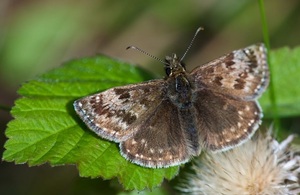
The dingy skipper butterfly one of many species thriving again on Norfolk's Massingham Estate after years of hard work to restore habitats. Photo: Allan Drewitt/Natural England
Rare species, some not recorded locally for more than 15 years, are returning to west Norfolk following a decade-long partnership between Natural England and local farmer Olly Birkbeck.
Massingham Heath, on the Little Massingham Estate, was once intensively-farmed arable land, heavily reliant on fertilisers and pesticides. With support from Natural England, the site has been transformed into a thriving mosaic of grassland, wildflowers and scrub that now supports a rich variety of wildlife. And the results have been striking.
John Ebbage, nature recovery manager at Natural England, said:
The wildlife response has been remarkable, with the return of species including skylarks, goshawk, hobby, woodlark and stonechat. The dingy skipper butterfly, absent from the area for 15 years, has returned, as have wasp spiders, oil beetles and the beautiful pyramidal orchid.
The grassland is carefully managed through conservation grazing using Konik ponies, Bagot goats and Tamworth pigs. This helps control invasive species, prevents aggressive plants from dominating, and allows habitats to develop naturally. We have also encouraged the growth of scrub and trees to support a wider range of wildlife.
Agri-environment schemes
The restoration was delivered through Natural England’s agri-environment schemes and led by Ed Cross, a tenant farmer on the Sandringham Estate. Working with botanists, he hand-collected seeds from ancient Norfolk grasslands and carefully matched them to different areas of the site.
This approach has helped re-establish plant species that had disappeared from the landscape, including rock-rose, wild thyme and field mouse-ear.
Olly Birkbeck, owner of the Massingham Estate, said:
I began working with Natural England around ten years ago to rethink how parts of the estate could be managed. Their support helped us move away from conventional cropping and towards large-scale habitat creation that has restored the landscape closer to its original character.
A bespoke wildflower seed mix, gathered from nearby sites, was used to create species-rich grassland suited to local conditions. Massingham Heath has now become a biodiverse landscape where nature can thrive.
Nature connection
Massingham Heath is also part of the proposed west Norfolk nature network, a landscape recovery project that aims to connect existing habitats, create new wildlife-rich areas and support nature-friendly farming across a much larger landscape. By improving connectivity, the project will help species move more freely and strengthen the resilience of wildlife populations.
The success of Massingham Heath demonstrates how long-term partnerships between landowners, farmers and Natural England can deliver large-scale nature recovery. Built on trusted relationships and sustained investment through agri-environment schemes, the project provides a model for restoring nature across England’s farmed landscapes.
Background:
- The Little Massingham Estate is also part of the west Norfolk nature network land recovery project.
- Other bird species to visit this spring were whinchats, whitethroats - lesser and greater - wheatears, yellow wagtail, quail, and ring ouzels.
- The original vision for the heath was to reinstate it to its original boundaries, taken from Faden’s map of Norfolk and first edition Ordnance Survey maps.
- An innovative and accessible approach to capturing landscape change has been delivered through a series of artist residencies, inviting members of the Society of Wildlife Artists to record transformation across the seasons. More information available: Massingham Heath Project/Society of Wildlife Artists
Contact us at the Natural England and Environment Agency press office:
Journalists only: 0800 141 2743 or communications_se@environment-agency.gov.uk.
If you are not a journalist and would like to contact Natural England: 0300 060 3900 or enquiries@naturalengland.org.uk.