Wholesale Contracts for Difference: consultation (HTML)
Published 28 October 2026
Applies to England, Scotland and Wales

© Crown copyright 2026
This publication is licensed under the terms of the Open Government Licence v3.0 except where otherwise stated. To view this licence, visit nationalarchives.gov.uk/doc/open-government-licence/version/3 or write to the Information Policy Team, The National Archives, Kew, London TW9 4DU, or email: psi@nationalarchives.gov.uk.
Where we have identified any third party copyright information you will need to obtain permission from the copyright holders concerned.
This publication is available at https://www.gov.uk/government/consultations/wholesale-contracts-for-difference/wholesale-contracts-for-difference-consultation-html
Ministerial foreword
The deployment of clean energy is key to protecting hardworking people from increased energy bills caused by volatile global gas markets. Investing in clean energy can help tackle the climate crisis, create good jobs, protect billpayers, and ensure energy security.
Recent instability abroad has shown how Great Britain’s reliance on international fossil fuel markets leaves families and businesses exposed to volatile gas prices, driving cost-of-living pressures even though much of the country’s electricity now comes from cheaper to operate renewables and nuclear.
Decarbonising the power system will increase energy security by reducing Great Britain’s dependence on imported fossil fuels and lowering exposure to volatile international energy prices. While wholesale electricity prices are currently strongly influenced by gas prices, increasing the share of low carbon generation can reduce the UK power system’s reliance on gas and therefore lessen consumers’ exposure to fluctuations in global gas markets. The extent of this effect will also depend on wider electricity market arrangements.
In April 2026, we set out decisive action to further our efforts to break the link between electricity and volatile gas prices. One measure we are exploring is a Wholesale Contract for Difference (WCfD), which would seek to transfer existing low carbon generators, which supply about a third of our power today, onto fixed-price contracts that deliver value for money for consumers. Twinned with the changes to the Electricity Generator Levy, we believe the WCfD could further weaken the link between wholesale electricity and gas prices. This will help ensure that the benefits of low-cost renewable power are better reflected in electricity prices and consumers’ exposure to gas price volatility is reduced.
This consultation is an opportunity to provide views on the value of the WCfD, shape key elements of the scheme’s design and in turn be part of the government’s mission to help protect families and businesses from higher bills when gas prices spike. We want to understand which assets would benefit most from fixed-price arrangements, what bid and contract structure represents clear value for money for consumers, and how moving large volumes of generation onto a WCfD would impact the wider electricity market. We welcome and encourage views from everyone with an interest in the UK’s approach to advancing the deployment of renewable generation. Through this consultation, we will gather evidence on whether and how a WCfD could support lower and more stable consumer bills, strengthen energy security, provide greater revenue certainty for generators, and help reduce consumers’ exposure to future gas price shocks.
Michael Shanks MP
Minister for Energy
General information
Why we are consulting
This consultation seeks views on a Wholesale Contract for Difference (WCfD) scheme, including the case for such a scheme, potential wider market implications, scheme design and the legislative framework. It also requests views on a potential alternative hybrid scheme for generators receiving Renewables Obligation (RO) payments. Through this consultation, government is seeking to:
- test the case for intervention and gather evidence on the expected benefits and costs of a Wholesale CfD for consumers, generators and the wider electricity market
- seek stakeholder input on key design choices, including how best to balance breaking the link between gas and electricity prices, value for money, and deliverability
- understand the practical, commercial and operational implications of the proposals for eligible generators, as well as suppliers
- inform the development of a scheme that is workable, proportionate and consistent with the government’s wider clean power and consumer protection objectives
Responses will inform the government’s final policy position, which will be set out in the government response.
This consultation sets out proposed legislative changes to enable the WCfD to be awarded to generators and proposes eligibility requirements to ensure that any scheme is deliverable, provides value for money for consumers, and supports the government’s objective of reducing the influence of gas prices on wholesale electricity prices.
Consultation details
Issued:
28 October 2026
Respond by:
9 December 2026
Enquiries to:
Strategic Projects Team
Department for Energy Security and Net Zero
6th Floor
3-8 Whitehall Place
London
SW1A 2AW
Email: WholesaleCfD@energysecurity.gov.uk
Consultation reference:
Wholesale Contracts for Difference Consultation
Audiences:
The UK and Scottish Governments are interested in the views of Ofgem, Citizens Advice, Consumer Scotland, NESO, LCCC, electricity suppliers, electricity generators, capacity providers, industry trade bodies, investors and any other parties with an interest in the proposals.
Territorial extent:
The consultation applies to Great Britain only. This is a joint consultation between the UK government and the Scottish Government. The Scottish Government’s consultation is limited to the proposed amendments to Scottish legislation.
How to respond
Please submit your response online using the dedicated online portal or by email, as indicated below. When responding, please state whether you are responding as an individual or representing the views of an organisation. Your response will be most useful if it is framed in direct response to the questions posed, though further comments and evidence are also welcome.
or
Email to:
WholesaleCfD@energysecurity.gov.uk
Write to:
Strategic Projects Team
Department for Energy Security and Net Zero
6th Floor
3-8 Whitehall Place
London
SW1A 2AW
Confidentiality and data protection
Information you provide in response to this consultation, including personal information, may be disclosed in accordance with UK legislation (the Freedom of Information Act 2000 (FOIA), the Data Protection Act 2018 (DPA) and the Environmental Information Regulations 2004).
If you want information you provide to be treated as confidential, please be aware that, under the FOIA, there is a statutory Code of Practice with which public authorities must comply and which deals, amongst other things, with obligations of confidence.
In view of this, it would be helpful if you could explain to us why you regard the information you have provided as confidential. If we receive a request for disclosure of the information we will take full account of your explanation, but we cannot give an assurance that confidentiality can be maintained in all circumstances. An automatic confidentiality disclaimer generated by your IT system will not be regarded by us as a confidentiality request.
We will process your personal data in accordance with all applicable data protection laws. See our privacy policy.
We will summarise all responses and publish this summary on GOV.UK. The summary will include a list of names or organisations that responded, but will not include respondents’ personal names, addresses or other identifiable contact details.
Quality assurance
This consultation has been carried out in accordance with the government’s consultation principles.
If you have any complaints about the way this consultation has been conducted, please email: bru@energysecurity.gov.uk.
Introduction
Electricity prices in Great Britain remain significantly influenced by movements in gas prices. To protect consumers from this volatility, the government is exploring offering existing low carbon electricity generators a Wholesale Contract for Difference (WCfD), replacing variable wholesale market revenues with a fixed-price contract.
A WCfD can reduce consumers’ exposure to future gas price shocks while providing generators with greater revenue certainty. Participation would be voluntary, and contracts would only be awarded where they represent value for money for consumers. For generators accredited under the Renewables Obligation (RO), the lead proposal is that the WCfD would apply only to wholesale market revenues and would not replace or extend existing RO support.
This consultation includes:
- the case for a WCfD (section 1) outlines the case for a WCfD, objectives, high-level scheme design, and amendments to the Electricity Generator Levy (EGL). This section seeks views on whether a WCfD is an effective way to meet the government’s objectives.
- wider market impacts (section 2) considers the potential wider market impacts of moving additional existing generation onto fixed-price arrangements, including effects on negative pricing and curtailment, forward market liquidity, muted time of use signals, and network constraints. This section seeks views on whether a WCfD could exacerbate these effects, and potential mitigations.
- WCfD scheme design (section 3) sets out the proposed scheme design, including eligibility (section 3.1), allocation (section 3.2), and commercial design (section 3.3). Section 3.1 covers which technologies could be eligible, including considerations around legacy nuclear assets, a minimum capacity threshold, co-located generation and storage, and interactions with the Capacity Market. Section 3.2 covers the allocation process for eligible generators, and section 3.3 covers commercial design of the contract, including contract length, start dates, metering, indexation, reference prices, negative pricing, and early exit.
- legislative framework (section 4) describes the legislative framework for the WCfD scheme. It sets out the legislative changes that may be needed to allow existing generators, including those receiving or having previously received support under the RO, to participate in the WCfD. It also considers changes relating to the Capacity Market, scheme administration, and Scottish RO legislation.
- extended option: hybrid scheme (section 5) considers a hybrid option as an extension to the WCfD. Under this approach, participating RO generators could exchange both their wholesale revenues and remaining RO revenues for separate fixed-price revenue streams under a single private law contract. This section seeks views on the potential benefits, risks, and delivery challenges of this hybrid option.
We are seeking views on the expected benefits, costs and practical implications of the proposals, including how different design choices could affect consumers, generators and the wider electricity market. Responses will inform the government’s final policy position and any subsequent detailed design of the scheme.
This consultation will be open for responses for 6 weeks, until 9 December 2026. The UK government will then analyse the consultation responses and aim to publish a government response shortly after.
An offer of a Wholesale Contract for Difference to existing low carbon generators (including RO assets) would sit alongside a wider package of reforms the government is taking forward, or actively considering, to ensure that electricity policy costs remain fair and deliver value for money. This includes the government’s commitment to relieve consumers from scheme costs by covering 75% of the RO’s GB domestic costs via Exchequer funding for 3 years, as well as revisions to indexation arrangements to better reflect current economic conditions. The Department for Business, Innovation, Science and Trade (BIST) has also introduced the British Industrial Competitiveness Scheme (BICS), which will exempt businesses from various levies, including the RO, with the aim of cutting industrial electricity bills by up to 25%. The government has also announced that it will be consulting on the proposed implementation of a Fixed-Price Certificate (FPC) system later this year as a means of ensuring the long-term stability and resilience of the RO as it matures.
Section 1 – the case for a Wholesale CfD scheme
Background
Electricity prices in Great Britain remain heavily influenced by the price of gas. In the day-ahead and intraday wholesale electricity markets, prices are determined through a marginal pricing system under which the market-clearing price is set by the most expensive generator required to meet demand at a given moment. In practice, this has meant that gas-fired generation frequently sets the market price. As a result, high international gas prices continue to have a disproportionate impact on electricity bills, even as the share of renewable and low carbon generation on the system has grown. This was particularly evident following Russia’s invasion of Ukraine, when wholesale electricity market prices increased significantly. In 2022/23, the average annual Intermittent Market Reference Price (IMRP) – a proxy for day-ahead wholesale market prices – reached around £190/MWh (nominal). This gas price shock led to an increase in the energy price cap of over £1,300 per year for a typical household.[footnote 1] More recently, Ofgem announced a £60 per year (4%) increase in the energy price cap for October to December 2026[footnote 2], with higher wholesale electricity costs associated with the conflict in the Middle East acting as the primary driver. This increase would have been greater if government had not intervened to remove VAT from household electricity bills.
Figure 1: Average IMRP over time (£/MWh)
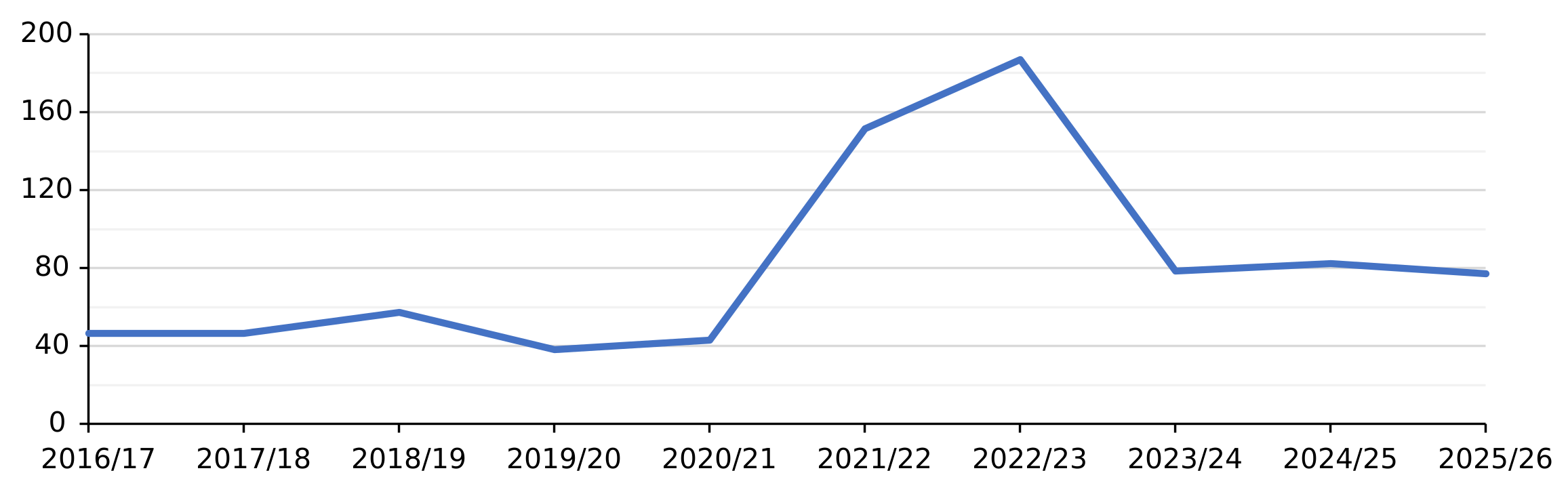
Source: LCCC: IMRP actuals - LCCC Data Portal
Description of figure 1: A line graph showing how the average IMRP increased significantly from around £40/MWh in 2020/21 to around £190/MWh in 2022/23, before falling back to around £80/MWh in 2023/24.
Deployment of clean power is already working to address this. We estimate that gas set the marginal price around 90% of the time in the early 2020s; this has already fallen by around a third and could be around half the time by the early 2030s. However, a significant proportion of existing low carbon generation continues to earn revenues linked to gas-driven wholesale electricity prices, meaning consumers remain exposed to volatility in international gas markets. Accelerating renewable deployment alone will not fully remove this exposure in the near term.
Wholesale Contracts for Difference (WCfD)
In April 2026, the UK government announced its intention to introduce measures to reduce consumers’ exposure to gas price volatility. A key approach under consideration is a Wholesale Contracts for Difference (WCfD) scheme, which would enable eligible low carbon generators, whose revenues are currently exposed to volatile wholesale electricity prices, to move onto a fixed-price arrangement. This would protect consumers from future crises where gas prices spike while providing generators with greater revenue certainty.
The WCfD would offer a fixed-price arrangement to replace the revenues generators would normally receive on the wholesale electricity market. For consumers, this would mean greater protection from future price shocks and more stable and predictable bills over the contract duration, with savings returned to consumers when the wholesale price exceeds the strike price, as under the standard CfD scheme. For generators, the WCfD would reduce exposure to wholesale price volatility, providing long-term revenue certainty and predictable returns over a fixed contract period. We would therefore expect bids to be lower than wholesale price expectations, reflecting the benefit of this revenue certainty to bidders. The WCfD would be voluntary, and government would only award contracts where they represent clear value for money for consumers. It is important that the value generators receive through a fixed-price arrangement is passed on to consumers through the competitive allocation process.
Scheme objectives:
- reduce consumer exposure to wholesale gas price volatility
- deliver an outcome that is beneficial for consumers
- maintain a well-functioning and investable market
WCfD scheme design
We would expect to follow much of the existing CfD framework closely, including the allocation process, contract terms and enabling legislation to deliver a WCfD, but would make changes where needed to deliver the scheme objectives, or following further consideration of the issues set out in section 2. Section 3 sets out the proposed scheme design in more detail, including eligibility, allocation, and commercial design considerations. Consultation responses, further analysis, deliverability, and value for money will inform the final design.
We expect a WCfD to offer a fixed price – known as the strike price – for the wholesale component of a generator’s electricity revenues. Payments between generators and the scheme counterparty would adjust for the difference between the strike price and the applicable wholesale market reference price: if the reference price is lower, the generator receives a top-up; if it is higher, the generator pays back the difference.
The amount of capacity that could be eligible to participate in the scheme depends on which technologies are in scope, whether merchant generators are eligible and whether a minimum capacity threshold is applied. We have provided an indicative upper estimate for capacity in Table 1 below based on the technologies we expect to be eligible (see Section 3.1 for further detail on eligibility). We would expect the eventual capacity awarded to a WCfD to be lower as contracts will be allocated via a competitive auction, with government applying a consumer value test.
Table 1: Upper estimate for capacity that could participate in the WCfD allocation process at differing minimum capacity thresholds
| No minimum capacity threshold (GW) | Minimum capacity threshold of >5 MW (GW) | Minimum capacity threshold of >10 MW (GW) |
|---|---|---|
| 33.2 | 29.8 | 26.9 |
While eligible generators currently accredited under the RO scheme would be able to participate, the RO subsidy itself is intended to remain separate, with the WCfD only covering the wholesale portion of a generator’s revenue. A WCfD contract is not intended to be an extension, replacement or successor for the RO or any other government scheme or support. Figure 2 shows that under a WCfD, wholesale electricity market prices are fixed, while existing RO revenue remains unchanged.
Figure 2: Change to revenue streams under the WCfD
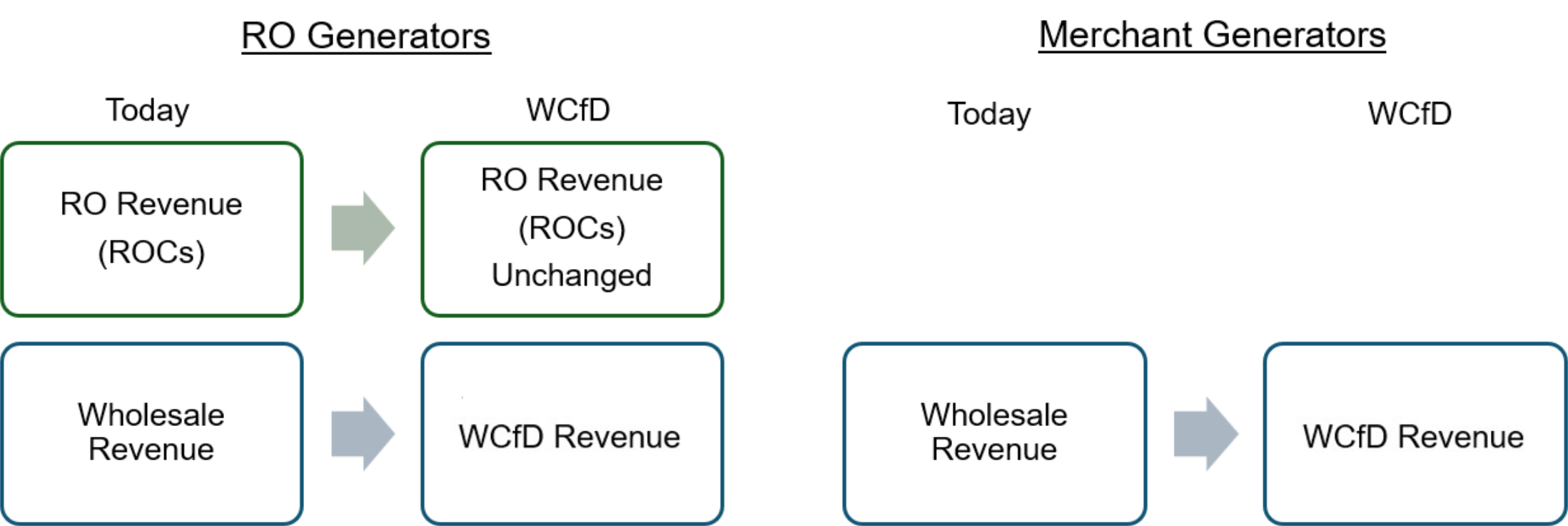
Description of figure 2: A diagram showing that under a WCfD, wholesale electricity market revenue is either topped up of paid back to an effective fixed price, while existing Renewable Obligation (ROC) revenue remains unchanged.
The revenue certainty the WCfD would provide could also support generators’ future operational decisions, such as the decision to extend the life of an asset by enabling necessary ongoing maintenance. We recognise this could be a secondary benefit of the policy; however, reducing consumer exposure to volatile wholesale gas prices is the primary objective.
We propose that to be eligible to participate in the WCfD allocation round, the asset must:
- be operational at the point of application
- not already be supported by a Contract for Difference (CfD) or Regulated Asset Base (RAB) model
- be located in Great Britain (England, Scotland and Wales)
For eligibility, we are also considering:
- excluding Advanced Conversion Technologies, Dedicated Biomass, Anaerobic Digestion, Biomass Combined Heat and Power, Energy from Waste and Sewage Gas generators due to the WCfD not being an appropriate mechanism for supporting these technologies
- excluding electricity storage assets as a WCfD would not provide operational signals to charge or discharge in times of system need
- whether to permit eligible co-located low carbon generation and storage assets to participate in the WCfD scheme
- allowing legacy merchant nuclear assets to participate, potentially through a bespoke direct award allocation route
- setting a minimum capacity threshold of either >5 MW or >10 MW for all technologies
- not permitting aggregated bids across different sites or operating through different metering arrangements
- whether generators should be allowed to bid only part of an asset’s output into a WCfD
- interactions with the Capacity Market and whether generators with Capacity Agreements should be eligible to bid for a WCfD
We are also looking for views on the following aspects of contract design:
- offering a choice of 5- or 10-year contract lengths
- whether there should be limited flexibility around start dates and delivery windows, alongside the general assumption that contracts will commence in 2028
- permitting early exit from WCfD contracts only in a finite set of circumstances, linked to decommissioning and repowering
- whether the WCfD strike price should include no indexation, partial indexation, or full Consumer Price Index (CPI) indexation
Details of each of the above policy considerations are set out in the following sections.
Subsidy control considerations
The government will ensure that any support provided through the WCfD is consistent with the requirements of the Subsidy Control Act 2022 and does not result in undue compensation.
The subsidy control assessment will consider how the WCfD’s overall design, including its approach to revenue stabilisation and its payment mechanism, complies with subsidy control principles. Any support provided through the WCfD would be designed to secure a voluntary move from volatile wholesale revenues to a fixed-price arrangement for eligible existing low carbon generators, whilst ensuring that support is necessary and proportionate.
The WCfD is intended to stabilise the wholesale revenues that generators would otherwise earn from the wholesale market and, in doing so, reduce consumers’ exposure to gas-driven electricity price shocks. The WCfD is not intended to directly compensate generators for historical construction costs, nor would construction costs be considered when setting support levels. The WCfD is also not intended to replace or extend the RO or any other existing support scheme.
In addition, whilst we recognise that the revenue certainty provided by a WCfD could support decisions to extend the operational life of an asset, this would be a secondary benefit of the policy rather than its primary purpose.
Question:
1. In principle, do you consider a WCfD to be an effective mechanism to achieve the scheme objectives outlined above?
[Yes / No]. Please provide reasons and evidence for your answer.
Electricity Generator Levy (EGL): interaction with the WCfD
The UK government has reviewed the design of the Electricity Generator Levy (EGL) in light of the ongoing conflict in the Middle East and its effects on global energy markets. In April, the government announced that the EGL rate would increase from 45% to 55% and that the levy would be extended beyond its previously scheduled conclusion in 2028. At Budget 2026, the government confirmed that the EGL would endure for the duration of the longest WCfD contracts, that the new investment exemption would remain and that a generator that secures a WCfD would not be subject to the EGL for the length of their contract, as is the case for other CfDs.
These changes are intended to retain a larger share of exceptional revenues associated with periods of high gas prices, while maintaining incentives for generators to participate in the WCfD and bid competitively in allocation processes.
For the period of its extension, the government will review the design of the EGL to ensure it operates effectively alongside, and in support of, the WCfD. Its design will be informed by the final structure of the WCfD mechanism established through this consultation process. A separate consultation on the post-March 2028 design of the EGL will follow this consultation.
Question:
2. Do you have any views on how the Electricity Generator Levy may interact with the WCfD?
Section 2 – wider market impacts
Increasing the proportion of renewable electricity generation on fixed-price contracts could have wider impacts on electricity market dynamics. This section considers those impacts in more detail and seeks evidence on the associated risks to inform the design of the WCfD scheme.
Many of the issues discussed in this section have been explored through the Review of Electricity Market Arrangements (REMA) and the Reformed National Pricing (RNP) programme with regard to the standard CfD scheme. This section focuses specifically on whether bringing existing assets onto a WCfD could materially alter the timing and significance of these effects.
Negative pricing and economic curtailment
As the share of low carbon generation increases, periods where available generation exceeds demand are expected to become more common. These periods can lead to negative wholesale prices. In 2025, there were 168 negative pricing hours (1.9% of all hours; based on data on CfD IMRP data).[footnote 3] When generators choose to turn off due to these economic conditions (because it is cheaper to turn off than to generate), this is known as economic curtailment.
Negative prices are a market signal that electricity supply exceeds demand and that some generation or consumption should adjust. REMA highlighted the growing importance of these signals in a renewables-dominated electricity system. Generation and demand decisions may not always reflect underlying costs and the merit order[footnote 4] may be affected as a result. Subsidy arrangements may contribute to this, by weakening incentives to respond to negative prices, potentially increasing system costs or leading to generation decisions that do not reflect underlying system needs.
The scale and mechanism of the negative pricing and economic curtailment effects described below are not yet certain, and we are exploring whether, and to what extent, bringing existing renewable assets onto a WCfD could impact these dynamics.
The standard CfD has a negative pricing rule which withholds CfD payments when the IMRP is below zero[footnote 5]. This aims to ensure CfD generators are not subsidised when the day-ahead market signals that their output is not required by the system. Extending this rule to existing assets could create incentives for WCfD generators to bid around zero at day ahead, in the same way that many CfD generators do today.
The standard negative pricing rule does not protect against negative pricing in the intraday market. Where the day-ahead price is non-negative, generators that have not secured a contracted position at day ahead have the opportunity to offer their output into the intraday market at a negative price (paying to generate). They then receive CfD payments on their metered output and make the difference between the negative bid and the CfD subsidy.
The contracting at intraday could also be between contracted generators with different strike prices, with generators that were successful at day ahead selling their positions to generators with a higher strike price and therefore a stronger incentive to generate. If we assume that some assets are able to curtail more cheaply, due to underlying technical advantages, this would represent a distorted merit order and impact prices.
A WCfD could increase the volume of output offered at negative intraday prices, which may benefit storage assets, flexible demand, or interconnectors, which are then effectively subsidised to increase consumption.
If the negative pricing rule was applied at intraday, this issue could also manifest itself in ‘real time’ (Balancing Mechanism or imbalance trading).
REMA considered how an output-based CfD and the negative pricing rule may affect bidding and curtailment incentives, including the possibility of strategic bidding around the day-ahead threshold and shifting activity into later markets. It found that outcomes depend on generator strategies and wider market developments. The WCfD raises the question of whether extending similar arrangements to existing assets, many of which would retain RO support, would materially change the scale or timing of these effects. RO assets that win a WCfD may bid differently into the wholesale market compared to standard CfD assets.
Questions:
- 3. Would a WCfD change how eligible generators sell their electricity in the day-ahead and intraday markets, compared with their current RO or merchant arrangements?
-
[Yes / No / Don’t know]
- a) If yes, how significant would this change be?
- [High / Medium / Low / Don’t know]
- b) Please explain your answers and provide supporting evidence, including any quantitative data you may have.
Reduced forward market liquidity and supplier forecasting risk
To avoid exposing consumers to short-term volatility in markets, suppliers typically hedge by procuring energy on forward markets. This enables them to provide fixed-price tariffs and align with the Ofgem energy price cap. The viability and cost of this hedging depends on the availability of forward contracts on the desired timeframes.
The vast majority of both domestic and non-domestic demand will be hedged – from quarterly to annual, and multi-annual durations for some power purchase agreement (PPA) arrangements – with consumers and businesses typically unwilling to accept the price volatility observed at day ahead.
A WCfD would reduce a generator’s exposure to wholesale market price volatility by swapping variable wholesale revenues for a fixed strike price. Because the IMRP is calculated using day-ahead prices, generators with a CfD are incentivised to trade at day ahead to avoid ‘basis risk’ (that is a difference between the IMRP and their contracted price). This allows them to better ensure that they obtain their strike price in each trading hour. The attractiveness of a WCfD from the generator’s perspective may therefore discourage generators from entering into long-term PPAs.
Subject to WCfD take-up, this could reduce forward market liquidity for both suppliers and businesses looking to hedge (noting that liquidity has many other drivers). In the case of suppliers, the fixed prices associated with the CfD do act as a partial hedge, but the suitability of this arrangement compared with traditional hedging requires further investigation.
Forward market liquidity can be important even to assets that are able to take advantage of volatile spot market prices. Debt funding for battery projects can be reliant on ‘tolling agreements’ and ‘revenue floors’ that provide some certainty around future revenues, and these methods may require contracting in the forward markets.
Buyers can be subject to volume and price risk when contracting with Variable Renewable Energy (VRE) generators. When contracting bilaterally, the balance of risk between the parties is subject to negotiation (our present understanding is that ‘pay as produce’ models are most typical but not necessarily the rule).
Moving existing generators onto a WCfD would transfer their volume and price risk to suppliers through the levy. Whether or not this arrangement can be improved upon requires further investigation, but we can describe what the problem looks like from the supplier perspective.
The CfD levy depends on future wholesale prices and CfD generation volumes. Suppliers have told us they therefore face uncertainty about the cost of the CfD levy when setting their tariffs. This could be exacerbated by the WCfD and could create a risk that suppliers have to manage this uncertainty through additional risk premiums in tariffs, increasing costs for consumers.
The standard CfD can provide suppliers with a partial natural hedge against wholesale electricity price volatility. However, supplier feedback indicates the hedge is imperfect because the levy is dependent on future wholesale prices, generation volumes, and demand, which are uncertain at the point tariffs are priced. Specifically, suppliers can use hedging strategies to manage some of the price risk from the levy (by trading in the same markets the CfD reference price is set in) but they cannot easily hedge the volume risk (meaning the uncertainty in the amount, and nature, of the renewable plant that is generating).
REMA considered the interaction between CfD reference prices, generators’ trading incentives and forward-market liquidity. It identified a concern but did not fully establish how much observed or prospective loss of forward liquidity is caused by CfD design rather than the characteristics of VRE or wider market trends. The main consideration for the WCfD is whether transferring existing RO or merchant generation onto day-ahead-referenced contracts would materially accelerate that effect.
Questions:
- 4. Do you think the introduction of the WCfD would reduce forward market liquidity, separate from the effect of increased Variable Renewable Energy deployment more generally?
-
[Yes / No / Don’t know]
- a) If yes, how significant is this effect?
- [High / Medium / Low]
- b) Would moving existing generation onto a WCfD materially add to supplier hedging costs or risk exposure?
- [Yes / No / Don’t know]
- c) If yes to (b), would these additional costs be passed onto consumers?
- [Fully / Partly / Not at all / Don’t know]
- d) Please explain your answers and provide supporting evidence, including any quantitative data on the hedged positions of RO, merchant and CfD generators that would effectively demonstrate similarities or differences in their behaviour in forward markets.
Muted time of use signals
The standard CfD levy is recovered based on suppliers’ shares of daily demand, both through a daily pre-payment on all electricity consumption and through the underlying price signal, which changes with CfD generation (meaning CfD payments on the day). This is then passed onto consumers, though we note that there is flexibility in how suppliers do this. However, the underlying signal is for levy payments to increase on windy/summer days. This would mean that WCfD cost recovery would not reward consumption (that is demand turn up) when there is high renewable output. This may be exacerbated by the fact that Energy Intensive Industries and interconnector exports are exempt from the levy, placing a higher proportion onto consumers.
Tariffs and products that reward flexibility need to be based on pricing that reflects system conditions if they are to drive the right behaviour (meaning through peak/off peak wholesale pricing, or through incentives provided by flexibility markets). If the WCfD causes wholesale costs to become a smaller part of the bill, and policy costs become larger, there is a risk that flexibility signals are dampened at a time when the system needs more flexibility.
Levy recovery currently means suppliers’ levy costs tend to be highest on the days when wholesale prices are lowest. This may impact the commercial case for suppliers to offer time of use tariffs and flexibility services. This in turn could impact the investment case for consumer-led flexibility technologies and services, including smart electric vehicle (EV) charging, vehicle-to-grid (V2G), battery storage and demand response. This could also reduce consumer participation in flexibility and increase reliance on curtailment and other supply-side measures to manage periods of high renewable output. Although this effect arises from levy recovery rather than WCfD contract design, the WCfD could bring forward the point at which it materially impacts flexibility signals. It may be possible to adjust the levy recovery mechanism to avoid this tight negative correlation between levy payments and wholesale prices.
Network curtailment
Merit order
Network curtailment is where renewables are not dispatched up to their available capacity due to constraints on the transmission network. The National Energy System Operator (NESO) manages network curtailment via the Balancing Mechanism (BM), as well as other dedicated constraint management services.
Turn downs are decided on the basis of a price merit order, where possible and with regard to operational considerations. The subsidy-related opportunity cost to a WCfD generator of not running could distort this merit order, meaning that turn downs are not always taken in consumer cost order. This could increase balancing costs and create knock-on wholesale market distortions (such as over incentivising storage build out). Balancing and Settlement Code (BSC) Modification Proposal P462 proposes to address this problem by removing subsidies from the BM merit order.[footnote 6] The WCfD’s impact will therefore depend on whether P462 applies to WCfD payments and when it is implemented.
Constraint cost exposure
Currently, in Great Britain, constraint costs are too high and are projected to rise in the short term.[footnote 7] The impact of the WCfD on BM bids is dependent on the relationship between the WCfD strike price and the wholesale market price at the time. When a generator is curtailed, it bases its BM bid on the revenues foregone due to being curtailed.
However, a generator with a WCfD would also factor its WCfD top-up or payback costs into its BM bid. The WCfD therefore affects the generator’s theoretical BM bid by the difference between the WCfD strike price and the wholesale market price. This means when wholesale prices are above strike prices, constraint management will be cheaper, however when wholesale prices are below strike prices, constraint management will be more expensive. We expect average wholesale electricity prices to fall over time as renewables penetration increases.
If the WCfD increases the proportion of generation receiving subsidy support, it may increase the compensation paid during constrained periods, particularly if constraints tend to occur during high-wind, low-wholesale-price periods when subsidy payments are most valuable to generators. We are seeking evidence to determine whether this represents a genuine increase in total system costs or primarily a transfer of costs between WCfD support payments and balancing mechanism costs, and the impact of design choices.
We are also seeking evidence on how the design and timing of the WCfD should take into account the evolving electricity market landscape, for example in relation to issues such as the Clean Power Mission, the Strategic Spatial Energy Plan (SSEP)[footnote 8] and Reformed National Pricing (RNP) Siting and Investment Levers (SIL)[footnote 9].
Chapter-wide questions:
- 5. Have we identified the correct market impacts in this section? Do you disagree with any of the impacts we have described? Are there others the WCfD could create or impact?
- 6. Which of these impacts are most relevant to the WCfD, and why? Please separate effects which may be caused by the WCfD itself from those caused by the existing CfD, wider renewables deployment or other market trends, and give evidence on likely scale and timing.
- 7. Are there WCfD design features, or wider reforms (for example P462, Reformed National Pricing, or cost recovery policies outside the WCfD), that could mitigate the impacts you consider most significant?
Section 3 – Wholesale CfD scheme design
This section sets out the proposed scheme design, including eligibility, allocation, and commercial design. As far as possible, we would look to use the existing CfD allocation and contract framework to implement a WCfD. However, we will make changes to this where needed to deliver the scheme objectives, including further consideration of the wider market impacts set out above.
3.1 Eligibility
The WCfD scheme is intended for generators and assets located in Great Britain (England, Scotland and Wales) only. This is due to Northern Ireland operating on a separate electricity market to Great Britain.
At this stage, the government is minded to allow eligible generators currently accredited under the RO to participate in the WCfD scheme, subject to meeting other eligibility requirements. The government is also considering the participation of eligible low carbon generators operating on a merchant basis and not currently receiving support under the RO. Allowing eligible merchant generators to participate could increase the complexity of the scheme and present deliverability challenges. However, their inclusion would broaden access to the scheme, support the policy objective of increasing exposure to stable, fixed-price revenues, and maximise the contribution that existing low carbon generation can make towards delivering a more resilient electricity market.
Assets currently supported through a CfD or RAB model will not be eligible for the WCfD scheme, as these assets already benefit from alternative revenue stabilisation arrangements.
The eligibility of assets previously supported by the Non-Fossil Fuel Obligation and Scottish Renewables Obligation is under consideration. Their inclusion would require legislative changes, more detail of which is given in section 4 – legislative framework. Interactions between the WCfD and Capacity Market, specifically the potential eligibility of assets with Capacity Agreements, are covered later in this section.
The government is seeking views through this consultation on the eligibility of specific technologies and asset types within the proposed scheme. The feedback received will inform the design of the WCfD and determine if changes are needed to the proposed scheme.
Technology eligibility criteria
At this stage, government is minded to include the following technology types in the WCfD, subject to generators meeting other eligibility criteria. However, this is subject to change following consultation feedback and further policy development. Legacy nuclear assets are covered separately in the next section.
- solar photovoltaic (PV)
- onshore wind
- remote island wind
- offshore wind
- floating offshore wind
- run-of-river hydro
- tidal stream
- wave
- geothermal
Other Deepwater Offshore Wind (ODOW) is not excluded from the WCfD. However, as it remains a nascent technology, we understand there are currently no operational projects that could participate in the scheme.
Government is also considering the inclusion of landfill gas and would welcome views on whether these generators would intend to bid for the wholesale revenue price swap offered by the WCfD. The government is separately exploring a long-term methane capture scheme with suitable transitional arrangements for the landfill gas sector.
Government is minded to exclude the following technologies for the given reasons:
- Advanced conversion technologies, dedicated biomass, anaerobic digestion, biomass combined heat and power, energy from waste and sewage gas – for these technologies, a relatively small amount of capacity remains after a proposed minimum capacity threshold is applied (see the capacity threshold section below), and enabling them to participate would introduce significant complexity and administrative burden for government and the contract counterparty. Considerable work would be required to design and deliver an auction and to develop appropriate sustainability criteria aligned with, for example, the Common Biomass Sustainability Framework.[footnote 10] Many of these technologies are also fuel-based and the WCfD would not take into account the potential for changes in fuel costs; the CfD fixed-price agreement runs the risk of leading to perverse outcomes for these technologies, such as a loss of capacity when fuel prices rise. Therefore, at this stage, government considers the complexity of enabling participation to be disproportionate to the amount of capacity that could be supported.
- Large-Scale Biomass (>100 MW) – these generators are already supported through a bespoke CfD.
- Electricity Storage Assets – a WCfD would not provide operational signals to charge or discharge in times of system need.
- Hybrid technologies – a WCfD bid should consist of one technology and could not have different types of assets behind the same meter. This is distinct from co-location of generation with storage which is addressed later in this section.
Legacy nuclear assets
The government is considering whether legacy nuclear assets should be eligible to participate in a WCfD. Whilst these assets do not receive support under the RO, they remain substantially exposed to wholesale electricity prices. Bringing these assets within scope could contribute to the government’s objective of reducing the link between gas prices and wholesale electricity prices.
However, legacy nuclear assets differ from most other generators as all eligible assets are owned by the same parent company, limiting the scope for effective competition through a standard auction process. In addition, we would want to encourage nuclear operators to continue to sell power in the forward market. As a result, government is considering whether a bespoke approach is required for legacy nuclear assets, such as direct award through bilateral negotiations, to ensure value for money for consumers and alignment with the scheme’s objectives. As with the broader WCfD policy, the intention would be to provide wholesale revenue stabilisation rather than additional financial support beyond that.
Questions:
8. Do you agree with the proposed eligibility criteria for the Wholesale CfD? Please provide reasons and evidence for your answer. What are your views on the eligibility of merchant generators, landfill gas and nuclear?
-
Minded to include:
- generators accredited under the RO [Agree / Disagree]
- solar PV [Agree / Disagree]
- onshore wind [Agree / Disagree]
- remote island wind [Agree / Disagree]
- offshore wind [Agree / Disagree]
- floating offshore wind [Agree / Disagree]
- run-of-river hydro [Agree / Disagree]
- tidal stream [Agree / Disagree]
- wave [Agree / Disagree] o geothermal [Agree / Disagree]
-
Minded to exclude:
- advanced conversion technologies, dedicated biomass, anaerobic digestion, biomass combined heat and power, energy from waste and sewage gas [Agree / Disagree]
- large-scale biomass (>100 MW) [Agree / Disagree]
- electricity storage assets [Agree / Disagree]
- hybrid technologies [Agree / Disagree]
-
Seeking views:
- merchant generators
- landfill gas
- nuclear
Capacity threshold
Government is minded to set a minimum capacity threshold for each asset participating in the WCfD. Setting a minimum capacity threshold would help ensure that the scheme remains proportionate and administratively efficient, whilst maximising participation from eligible low carbon generators. Any threshold should leave sufficient eligible capacity to participate in the scheme, supporting the government’s objective of increasing the proportion of low carbon generation operating under arrangements that reduce exposure to volatile wholesale electricity prices. The capacity that a generator puts forward for their asset’s bid should be calculated from generation figures.
Applying a minimum capacity threshold would help simplify the allocation process by limiting the number of eligible assets and focusing participation on larger generators. This would reduce the administrative burden associated with contract management and delivery. The lead options for a minimum capacity threshold are greater than 5 MW or greater than 10 MW. A >5 MW threshold would expand on the precedent set by the standard CfD for some technologies (Hydro, Onshore Wind and Solar PV) and keeps 90% of potentially eligible capacity across only 37% of sites. A >10 MW threshold would further reduce administrative burden but also the amount of eligible capacity, keeping 81% of capacity across only 23% of sites.
To demonstrate the impacts of differing capacity thresholds quantitatively, we have estimated the capacity and number of sites for RO and merchant generators in GB at varying thresholds. Firstly, with no minimum capacity threshold, and then with a threshold of >5 MW and >10 MW. Technologies are included based on the policy position set out in this consultation (see ‘Technology eligibility criteria’ in section 3.1 for a full list of WCfD eligible technologies[footnote 11]). Headline results are shown in Table 2.
Table 2: Upper estimate for RO and merchant capacity and number of sites in GB that could participate in the allocation process at differing minimum capacity thresholds[footnote 12]
| Generator type | No minimum capacity threshold (Capacity (GW)) |
No minimum capacity threshold (Number of sites) |
Minimum capacity threshold of >5 MW (Capacity (GW)) |
Minimum capacity threshold of >5 MW (Number of sites) |
Minimum capacity threshold of >10 MW (Capacity (GW)) |
Minimum capacity threshold of >10 MW (Number of sites) |
|---|---|---|---|---|---|---|
| RO | 26.2 | 1,981 | 23.4 | 868 | 21.0 | 538 |
| Merchant | 7.1 | 927 | 6.4 | 195 | 5.9 | 128 |
| Total | 33.2 | 2,908 | 29.8 | 1,063 | 26.9 | 666 |
The RO capacity in GB that could participate in the allocation process can be further broken down by technology, as shown in Table 3. This step was not repeated for GB merchant capacity due to greater uncertainty in the underlying data.
Table 3: Upper estimate for RO capacity and number of sites in GB per technology that could participate in the allocation process at differing minimum capacity thresholds
| Tech. type | No minimum capacity threshold (Capacity (GW)) |
No minimum capacity threshold (Number of sites) |
Minimum capacity threshold of >5 MW (Capacity (GW)) |
Minimum capacity threshold of >5 MW (Number of sites) |
Minimum capacity threshold of >10 MW (Capacity (GW)) |
Minimum capacity threshold of >10 MW (Number of sites) |
|---|---|---|---|---|---|---|
| Landfill gas[footnote 13] | 0.7 | 356 | 0.2 | 24 | 0.1 | 6 |
| Run-of-river hydro | 0.7 | 201 | 0.6 | 34 | 0.5 | 25 |
| Offshore wind (including floating) | 6.6 | 35 | 6.6 | 35 | 6.6 | 34 |
| Onshore wind (including remote island) | 11.2 | 528 | 10.9 | 391 | 10.0 | 271 |
| Solar PV | 6.9 | 858 | 5.1 | 383 | 3.8 | 202 |
| Tidal stream | 0.0 | 3 | 0.0 | 1 | 0.0 | 0 |
| Total | 26.2 | 1,981 | 23.4 | 868 | 21.0 | 538 |
Questions:
9. Do you agree that government should set a minimum capacity threshold for WCfD eligibility?
[Yes / No]
If so, which of the following thresholds should be applied? Please provide reasons for your answer.
- >5 MW threshold
- >10 MW threshold
- Another threshold (please specify)
Aggregated bids
The government has considered whether to permit aggregated bids, which would allow generators to submit a single WCfD application covering multiple eligible generating units across different sites or operating through different metering arrangements.
At this stage, the government’s minded-to position is not to permit aggregated bids. We consider that WCfD applications should relate to generating units at a single site and operating under a single metering arrangement. Allowing a single bid to cover multiple generating units across different sites or metering arrangements would increase the complexity of allocation, settlement, monitoring and contract management. It could also reduce transparency within the allocation process and make it more difficult to assess applications on a consistent basis. Requiring separate applications for different sites and metering arrangements would provide greater clarity over the capacity and output covered by each contract and support a scheme that is simple, transparent and efficient to administer.
Chunking bids
In the standard CfD scheme, developers can submit multiple applications for different portions of capacity associated with the same project within a single allocation round, a practice often referred to as ‘chunking’. This can increase auction complexity and enable bidding strategies that were not anticipated when the allocation framework was designed.
For the WCfD scheme, at this stage the government’s minded-to position is that each eligible generating asset should be permitted to submit only a single bid for each asset it wishes to place under a WCfD contract. Applicants would therefore be required to select a single contract length option for that bid and would not be permitted to submit multiple bids for the same generating asset, including bids under different contract lengths or for different portions of the asset’s capacity.
The government considers that a single bid approach would support a simpler and more transparent allocation process, make auction outcomes easier to administer and understand, and provide greater certainty over the volume of capacity seeking support through the scheme.
Questions:
10. Do you agree with the government’s minded-to position to not permit aggregated bids and chunking bids? Please provide reasons and evidence for your answer.
- Aggregated bids [Agree / Disagree]
- Chunking bids [Agree / Disagree]
Partial capacity
The government is considering whether participants should be permitted to bid a specified proportion of an eligible generating asset’s total capacity into a WCfD contract, rather than being required to contract the entirety of that asset’s capacity. Under this approach, a generator would specify the proportion of an asset’s eligible capacity to be covered by the WCfD. The government recognises that any such arrangement would need to be clearly identified, metered and settled, potentially through the identification of specific turbines, inverters, or other generating equipment associated with that proportion of capacity. The output associated with that contracted capacity would be settled under the WCfD, while the remaining output would continue to receive merchant wholesale market revenues.
Allowing partial capacity could provide generators with greater flexibility in managing commercial and operational risks. It could enable them to secure price stability for a proportion of their generation, whilst retaining some exposure to wholesale market revenues which would remain subject to the EGL. This may encourage participation from generators that would otherwise be unwilling to commit all eligible generation to a WCfD arrangement. The government is aware that flexible contracting arrangements already exist within the standard CfD framework and therefore does not expect the associated administrative and settlement impacts to be prohibitive, provided that contracted volumes can be clearly defined, measured, and verified.
The government also recognises that any approach would need to interact appropriately with any minimum capacity threshold that may apply for WCfD eligibility. The government would expect to apply any minimum eligibility threshold to the proportion of capacity proposed for a WCfD contract, rather than the generating asset’s total eligible capacity. For example, if a minimum threshold of 5 MW applies, only bids covering more than 5 MW of capacity would be eligible.
Partial capacity could increase the complexity of metering, settlement and contract administration, and could also present subsidy control risks when considered alongside parallel schemes. It may also reduce the extent to which generation revenues are delinked from wholesale electricity prices, depending on how generators choose to allocate capacity between contracted and non-contracted output. Allowing generators to bid part of their asset’s capacity would come with strict metering and settlement requirements as seen in recent rounds of the standard CfD, so there may be a financial impact if legacy generators need to update their metering equipment to comply. We are therefore seeking views on both the practical feasibility of partial capacity and its implications for the scheme’s objectives.
Questions:
11. Do you believe that partial capacity should be permitted for the WCfD?
[Yes / No].
Please provide evidence on how it would affect your participation in the scheme and bidding strategy, including the proportion of output you would expect to contract, and any cost involved with potential metering upgrades.
Co-located generation and storage
We recognise that some eligible generating stations may be co-located with electricity storage assets. At this stage, government is minded to align the treatment of these arrangements under the WCfD with the standard CfD, which permits electricity storage to be co-located with CfD-supported generation subject to specified contractual, metering and settlement requirements.
Under the standard CfD, metering arrangements must distinguish eligible generation from storage activity. CfD payments are calculated using metered volumes at the point of generation, rather than electricity exported from the storage facility. This ensures that payments are made only in respect of electricity generated by the eligible generating asset and not electricity subsequently exported from storage.
The standard CfD ordinarily requires the generating facility and storage facility to be either associated with separate Balancing Mechanism Units or, where they share a Balancing Mechanism Unit, to have metering arrangements accepted by the contract counterparty. Where the same Balancing Mechanism Unit is used, the storage facility must only store electricity generated by the associated CfD generating units and must not store electricity imported from another source. This requirement supports accurate metering and settlement by ensuring that electricity flows between the CfD generating unit and the storage facility can be clearly identified and verified where generation and storage share a Balancing Mechanism Unit.
The government is exploring whether to apply the same underlying principles to the WCfD. Co-location would not prevent an otherwise eligible generating asset from participating, provided that its metering and settlement arrangements can identify qualifying generation and ensure that WCfD payments are calculated only on eligible output. The detailed requirements would be set out in the WCfD contract and supporting guidance.
Questions:
12. Do you agree that co-located generation and storage assets should be treated in the same way as the existing CfD framework?
[Yes / No]. Please provide reasons and evidence for your answer.
Interactions with the Capacity Market
The government is considering whether generating assets with Capacity Agreements should be eligible to bid for a WCfD. Under current arrangements, generators are unable to hold both a Capacity Agreement and a CfD allocated through a competitive auction. This restriction applies whether the Capacity Agreement relates to a current or a future Delivery Year, and current regulations would disqualify generators from submitting a WCfD bid. Instead, generators would have to give notice 16 months prior to their committed Capacity Market Delivery Period that they wish to terminate their agreement ahead of bidding for a WCfD.
Allowing assets with Capacity Agreements to participate in a WCfD competitive auction would increase the pool of eligible merchant generation and could support the scheme’s objectives. Our initial analysis suggests that a significant proportion of merchant generation may be interested in participation in the WCfD. Excluding such assets would therefore reduce the potential pool of merchant bidders.
Eligibility would require changes to Capacity Market regulations and Capacity Market Rules to potentially allow generators to hold the 2 agreements in parallel, even if there is no overlap in payments under the support schemes. We also need to consider how the Capacity Market legislation and Capacity Market Rules could interact with the WCfD start date. Changes may be needed to the existing Capacity Market termination mechanism to enable generators to terminate their Capacity Agreements in order to join the WCfD payment scheme; this could include reducing the 16-month notice period to enable a faster termination. More detail on potential legislative changes is provided in section 4 – legislative framework. Any final decisions on how the Capacity Market interacts with the WCfD will need to account for security of supply, value for money and the deliverability of both schemes.
The government is interested in stakeholder views on whether assets with Capacity Agreements would wish to participate in a WCfD scheme, and the extent to which contract start-date flexibility and potential payment impacts would influence WCfD and bidding behaviour.
Questions:
13. Do you believe that generating assets with Capacity Agreements should be eligible for the Wholesale CfD?
[Yes / No]
Please provide reasons and evidence for your answer, and include views on:
- Terminating Capacity Agreements ahead of bidding for a WCfD
- Overlap of Capacity Payments and WCfD payments
- Forgoing Capacity Payments for WCfD payments
- Impact of the Capacity Market notice period on the WCfD contract start date
- Impact on bidding strategy for WCfD
- Impact on Capacity Market participation
3.2 Allocation
Approach to WCfD allocation
The WCfD could either be allocated competitively via an auction or by direct award.
At this stage, the government’s minded-to position is to allocate the WCfD to most generators via a one-off auction using a process similar to the standard CfD allocation round process. Competitive auctions have historically been the preferred mechanism for allocating CfDs because they promote value for money by requiring generators to compete on price for a share of a fixed budget. This creates an incentive to bid competitively, as lower bid prices enable a greater volume of capacity to be supported within the available budget. We also recognise alternative allocation options may be more appropriate in limited circumstances, such as for legacy nuclear assets – this is covered above in ‘Legacy nuclear assets’ in section 3.1.
Auctions are particularly well suited to circumstances where there are large numbers of potential applicants. Auctions help address information asymmetries by enabling generators to reveal information about their costs through competitive bidding, supporting effective price discovery and reducing the risk of providing more subsidy than is necessary to deliver value for consumers. Auctions are also consistent with the Subsidy Control Act 2022 requirement for a transparent, non-discriminatory, and effective competitive process.
At this stage, the government considers that a one-off auction would strike an appropriate balance between increasing the amount of low carbon generation protected from wholesale gas price volatility as soon as possible, and in a way that achieves value for money for consumers through competition. Running multiple auctions would be time and resource intensive and could delay the movement of existing low carbon assets onto the WCfD, prolonging consumers’ exposure to volatile gas prices. In addition, we acknowledge that generators may have existing commercial arrangements and may therefore require flexibility between contract award and the start of WCfD payments. Therefore, we are seeking views on start dates in section 3.3 on commercial design.
We have also considered alternative allocation options. For example, the WCfD could be allocated through bilateral negotiations or by directly offering contracts with government-determined terms, such as strike price and contract length.
Given the potential number of eligible assets, bilateral negotiations across all technologies would be resource intensive and are not likely to provide the same degree of competitive price discovery as an auction, increasing the risk of poorer value for money outcomes.
Bilateral negotiations may be more appropriate in limited circumstances, such as for legacy nuclear assets, where all eligible assets are owned by the same parent company and limited competitive tension is achieved. In these circumstances, the benefits of an auction are reduced. For other eligible technologies, the government considers that competition remains important for achieving effective price discovery and value for money outcomes.
Directly offering the WCfD to eligible generators at a government-determined strike price could be faster to implement and less complex to deliver than an auction or bilateral negotiations. However, it carries a greater risk of either over-compensating generators or setting prices too low to secure uptake. As a result, direct awards are less likely to deliver value for money and more likely to give rise to market distortions. A non-competitive approach would also need to be justified under Schedule 2 of the Subsidy Control Act 2022.
Overall, at this stage the government considers that a competitive auction is the most effective way to incentivise generators to bid at the lowest price they are willing to accept, reflecting both their expectations of future wholesale revenues and the level of revenue certainty provided by the contract. This has the potential to reduce overall scheme spend relative to the alternative options, supporting better value for money for consumers whilst ensuring generators receive fair compensation via the fixed strike price. We recognise, however, that alternative allocation options may be more appropriate in limited circumstances, such as for legacy nuclear assets, and are seeking views on allocation options for such assets through this consultation.
Roles and responsibilities:
Alongside DESNZ, the key bodies likely to be involved in allocation round delivery are:
- a delivery body, responsible for administering the application and allocation process. This would include providing guidance to applicants, making qualification decisions, running the auction, and issuing outcome notifications. NESO fulfils this role for the standard CfD scheme.
- Ofgem will likely act as the Tier 2 appeals body for qualification decisions. Ofgem may also provide data from the RO database to the delivery body and contract counterparty to support certain application and contract checks.
- a contract counterparty, which would enter into WCfD contracts with successful applicants, would undertake contract onboarding and assurance activities and make CfD payments. This would include carrying out the necessary contract checks before payments commence, and monitoring generators’ ongoing compliance with their contractual obligations. The Low Carbon Contracts Company (LCCC) fulfils this role for the standard CfD scheme.
Auction design:
We are considering running the WCfD as a pay-as-clear (rather than pay-as-bid), sealed bid auction, similar to the previous allocation rounds for the standard CfD. Government currently considers this to be the best design because it incentivises bidders to submit bids that reflect the minimum price at which they would be willing to enter a WCfD, rather than attempting to predict the clearing price. Under a pay-as-bid mechanism, bidders may instead be incentivised to bid strategically based on their expectations of the clearing price. This design also ensures the delivery body and other key stakeholders have familiarity with the auction process and reduces the need for changes to operational systems.
Pay-as-Clear Auction Explainer:
- each generator submits a sealed strike price bid
- any bids received above the Administrative Strike Price (ASP), the maximum strike price that can be awarded, are not eligible
- eligible bids are ranked from lowest to highest according to price
- the delivery body accepts bids, starting from the lowest, until the budget constraint is reached
- the clearing price is set by the marginal successful project (meaning the highest-priced project that still clears within the budget constraint)
- all successful bidders are awarded a CfD at the clearing price
- unsuccessful bids are not awarded a CfD
Pay-as-Bid Auction Explainer:
- each generator submits a sealed strike price bid
- any bids received above the ASP are not eligible
- eligible bids are ranked from lowest to highest according to price
- the delivery body accepts bids, starting from the lowest, until the budget constraint is reached
- each successful bidder is awarded the price they bid, rather than a clearing price that is the same across all bidders
- unsuccessful bids are not awarded a CfD
- bids that were not accepted are not awarded a CfD
The auction parameters and procedural detail, including budget setting and any associated governance steps, will be set out in a specific WCfD Allocation Framework, which will be published in advance of the auction.
As with the standard CfD, we are considering whether to divide the auction into different pots to allow projects to compete on a more level basis. Pot structure is under development and will consider how to ensure effective competition between projects.
Administrative Strike Price and budget publication:
Under the standard CfD allocation process, ASPs and budgets have been set and published prior to the auction being launched. The ASP sets the maximum strike price that an applicant may bid and is published in advance of an allocation round. The ASP provides a backstop to the auction to protect consumers from overpaying for a given technology and is not a forecast or signal of the price government is willing to pay. The budget is the monetary constraint per auction pot, capping the total available subsidy to encourage competitive prices.
For Allocation Rounds 1-6, the ASPs and budgets were used to determine winning auction bids. Recent amendments to the CfD framework have provided greater flexibility in budget setting. The Secretary of State now has the option in certain pots to view anonymised information about bids that did not fit within the initial budget and determine, with approval from HMT, if the budget should be increased to allow additional bids to be accepted if they are found to present value for money for the consumer.
For the allocation of the WCfD, the government is considering how to ensure maximum flexibility to maximise delinking whilst delivering value for money. We are therefore considering whether to refrain from publishing either or both ASPs or budgets for the WCfD allocation. This would enable the Secretary of State to view the anonymised bid stack and determine final budgets based on the competitiveness of bids. By granting appropriate flexibility over budget setting, government is aiming to ensure that the WCfD allocation secures sufficient participation whilst continuing to deliver value for money for consumers. The lack of a backstop that a published ASP would provide would be mitigated by this flexibility. Government is not seeking to maximise uptake at any cost, but rather to secure an appropriate balance between delinking benefits, competition, and consumer value. If the WCfD is designed to enable Secretary of State to view the anonymised bid stack, the government is minded to permit applicants to submit only a single sealed bid and to not permit flexible bids.
Further detail on this potential change, including the legislative amendments that may be required, is set out in section 4 – legislative framework.
Figure 3: Comparison of current CfD allocation rounds and a proposed WCfD process
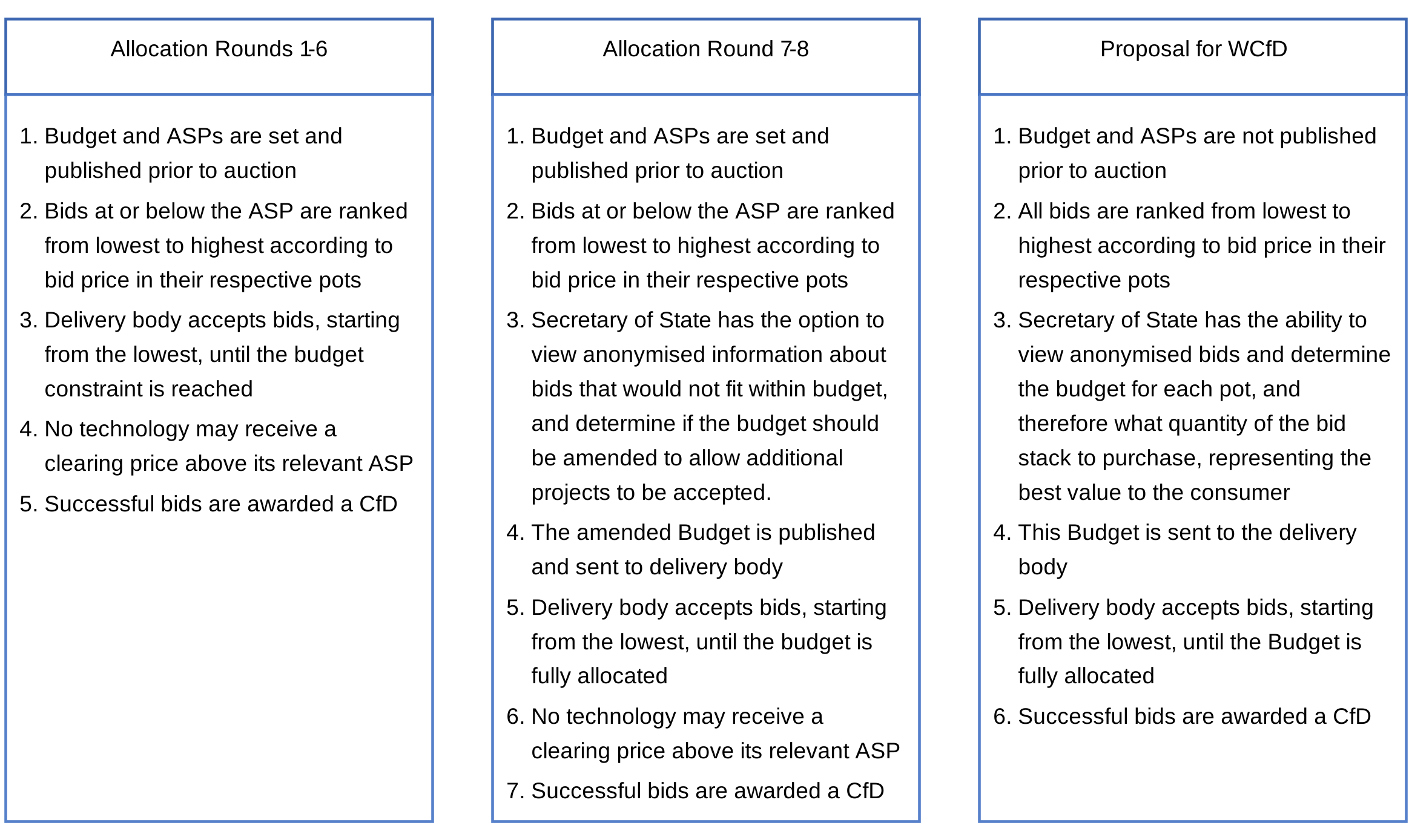
Description of figure 3: A diagram showing the process for CfD allocation rounds 1-6 and 7-8, compared to the proposed allocation round process for WCfDs.
Allocation Rounds 1-6:
- Budget and ASPs are set and published prior to auction
- Bids at or below the ASP are ranked from lowest to highest according to bid price in their respective pots
- NESO accepts bids, starting from the lowest, until the budget constraint is reached.
- No technology may receive a clearing price above its relevant ASP.
- Successful bids are awarded a CfD
Allocation Round 7-8:
- Budget and ASPs are set and published prior to auction
- Bids at or below the ASP are ranked from lowest to highest according to bid price in their respective pots
- SoS has the option to view anonymised information about bids that would not fit within budget, and determine if the budget should be amended to allow additional projects to be accepted.
- The amended Budget is published and sent to NESO.
- NESO accepts bids, starting from the lowest, until the budget is fully allocated
- No technology may receive a clearing price above its relevant ASP.
- Successful bids are awarded a CfD.
Proposal for WCfD:
- Budget and ASPs are not published prior to auction
- All bids are ranked from lowest to highest according to bid price in their respective pots
- SoS has the ability to view anonymised bids and determine the budget for each pot, and therefore what quantity of the bid stack to purchase, representing the best value to the consumer.
- This Budget is sent to the delivery body.
- NESO accepts bids, starting from the lowest, until the Budget is fully allocated
- Successful bids are awarded a CfD
Anticipated timetable:
We are designing a delivery process that would enable an auction to be delivered independently of the main CfD Allocation Rounds. Should government decide to proceed with the scheme and subject to the timing of relevant legislation and other CfD allocation rounds, we expect the WCfD Allocation Framework to be published and the allocation round to be run towards the end of 2027.
We expect to run the WCfD auction as a one-off round separate to the standard CfD Allocation Rounds. Given the number of potentially eligible generators, running the WCfD auction at a different time to the standard CfD will enable more effective management of applications, reducing the risk of delay or any adverse impact on the running of the standard CfD Allocation Rounds.
Allocation process
This section provides a summary of how the allocation process could look for the WCfD scheme from the application window to contract award. At this stage, we intend to follow the process under standard CfD Allocation Rounds where possible, which usually takes between 5 to 6 months to run.
Figure 4: Four-stage CfD allocation process: application, assessment, reviews and appeals, and sealed bidding and auction

Description of figure 4: A diagram showing the 4-stage application process.
- Application window: Applicants provide project information and qualification evidence.
- Assessment window: Delivery body assess applications; qualification results released.
- Review and appeals: Review window; appeals window.
- Sealed bids and auction: Sealed bid window; auction and audit; release results.
Application submission:
The application window would open for a set period, with opening and closing dates published in advance. During that window, applicants would submit an application form and supporting documentary evidence through the delivery body’s system.
In recent Allocation Rounds, NESO has published application guidance which provides step-by-step instructions for completing applications. We would expect the delivery body for the WCfD auction process to take a similar approach.
Qualification checks:
The delivery body would assess all applications, and conduct qualification checks for the WCfD scheme. Qualification requirements would be set out in advance of the application window and would be based on the finalised eligibility criteria published in the government response. Government anticipates these checks would be simpler than for the standard CfD as the assets will already be generating and many already receive government subsidy in the form of the RO.
Eligibility for the WCfD scheme was discussed earlier in this section. Once confirmed, the criteria will be set out in the WCfD Allocation Framework, and we also intend to publish a schedule of application checks as part of that Allocation Framework, including what requirement is being checked and the documentary evidence required.
Application outcomes and bidding process:
Following assessment, the delivery body would notify applicants whether their applications are qualifying or non-qualifying. Only applications that qualify would proceed into auction bidding. Where an applicant disputes a non-qualification outcome, there would be an appeals process which is set out in more detail in the next section.
Applicants with qualifying applications (either through initial application or appeal) would be able to submit sealed bids through the delivery body’s system during a defined bidding window, in accordance with the Allocation Framework’s auction rules and parameters. Following the bidding window, the auction will then be processed.
Appeals process:
Under the standard CfD, for qualification disputes, there is a two-tier system. After the application results are announced, any non-qualifying applicants can raise a Tier 1 or ‘non-qualification review’ with the delivery body. The delivery body may uphold or change the qualification decision and communicate the ‘non-qualification determination’. Applicants can appeal a non-qualification determination to Ofgem as a Tier 2 review or ‘qualification appeal’.
Where Ofgem upholds a non-qualification determination the applicant may appeal to the High Court on a point of law.
Auction results and contract award:
Applicants would be notified of the outcome of the allocation process, providing information on whether a bid has been accepted or rejected, and the strike price at which support has been awarded.
Government would expect to publish a summary of the auction results shortly after applicants have been notified, including information on successful applicants and the overall outcome of the allocation round.
Once contracts are processed and distributed, successful applicants must then return signed contracts to the contract counterparty within 10 working days.
Non-delivery disincentives
The standard CfD includes a non-delivery disincentive, intended to ensure successful applicants sign their CfD and deliver their project, and to deter speculative applications. Where a successful applicant fails to sign its CfD, or its CfD is terminated for failing to meet the Milestone Requirement by the Milestone Delivery Date, the project site is excluded from the next 2 allocation rounds.
As the WCfD is expected to be a one-off allocation round, this exclusion would provide little or no disincentive. Without an alternative, applicants could, in theory, bid low to secure a contract and then decide whether to sign once the clearing price is known. We are therefore considering alternatives, including the below.
Bid bonds:
Qualifying applicants would lodge financial security (for example cash or a letter of credit) before the sealed bid window. This would be forfeited if a successful applicant did not sign its WCfD, and otherwise returned on signature or after the auction. Bid bonds were considered but not introduced for Allocation Round 4. They would provide a direct incentive to sign but would add legal and administrative complexity and could deter smaller generators.
Requirement to sign the WCfD before the clearing price is known:
For example, qualifying applicants could sign a conditional contract before bidding, or the clearing price could be withheld until the signing window closes. If the auction is pay-as-clear, the contract would automatically become firm at the clearing price (assuming bid is successful). This removes the risk that bidders see the clearing price and then decide whether to commit to the contract or not. It also would encourage applicants to bid their minimum acceptable bid price.
We are also considering whether a disincentive is needed between the Agreement Date (when the WCfD is signed) and the Start Date (when payments begin), to deter a generator from failing to proceed with the contract in this period.
Capacity reduction
Under the standard CfD contract, generators may reduce their capacity via an adjustment to the Installed Capacity Estimate (ICE). This can be done via a ‘Relevant Construction Event and Relevant Planning Restriction’ or a ‘Permitted Reduction’. These provisions recognise the construction, planning and delivery risks faced by new-build projects and help ensure that projects remain deliverable where circumstances change following contract award.
The government’s minded-to position is that WCfD contracts should not include any capacity reduction mechanisms. Given that the scheme is designed for existing operational assets and the size of the site is known, we do not consider there to be a strong justification for providing post-award flexibility to reduce or relinquish contracted capacity. Allowing this could weaken auction discipline, create uncertainty over the volume of capacity secured through the scheme, and incentivise strategic bidding behaviour. The government therefore considers that successful participants should be required to honour the capacity commitments made at the point of bidding and award, except where specific provisions relating to repowering or decommissioning may apply.
Questions:
14. Do you agree with the proposed timings and approach on awarding a WCfD as set out in this section?
[Yes / No]. Please provide reasons and evidence, and include views on:
- Competitive pay-as-clear auction for most generators
- Alternative allocation for legacy nuclear assets
- Potentially withholding publication of either or both of the Administrative Strike Price (ASP) and budget
- Proposed non-delivery disincentives
- Not permitting capacity reduction
3.3 Commercial design
This consultation focuses on the high-level commercial policy design of the WCfD scheme. It does not seek views on detailed contractual drafting.
Subject to decisions taken following this consultation, the government will seek views on the detailed contractual terms and conditions required to implement the scheme. This will provide stakeholders with an opportunity to review and comment on proposed contractual provisions, including any consequential amendments to existing arrangements, before they are finalised.
This phased approach is intended to ensure that stakeholders have the opportunity to provide input both on the overall policy design of the scheme and on the detailed contractual framework through which it would be delivered.
Funding the WCfD
Standard CfDs are funded through the Supplier Obligation, a levy on licensed electricity suppliers that is ultimately recovered through consumer bills. We expect the WCfD to use the same mechanism. The levy is collected from electricity suppliers by the contract counterparty, which then uses the funds to settle CfD difference payments with generators. The contract counterparty forecasts and sets the levy in advance to give suppliers notice of expected levy costs when setting tariffs.
The contract counterparty will need to forecast WCfD payments when setting Supplier Obligation levy rates. However, a reliable forecast will not be available until after contracts have been awarded. A period of time between contract award and the contract start date, when WCfD payments can commence, will therefore be required. We are still considering the length of this period, but it is expected to be several months. Securing value for money is a key objective of the scheme and will help minimise impacts of the levy on consumer bills.
Contract length
The government considers that offering a limited choice of standardised contract lengths could provide flexibility for generators with different operational and commercial circumstances, while maintaining a relatively simple and competitive allocation process. It can help ensure bids remain broadly comparable, supporting effective competition and a transparent assessment of value for money. The government recognises that offering multiple contract lengths may create additional complexity for auction design, budget setting and delivery, and is seeking views on the extent to which these impacts would be outweighed by increased participation and competition.
We are therefore considering whether WCfD contracts should be offered with a single standardised contract length of either 5 years or 10 years, or whether eligible generators should be offered a choice between 5-year and 10-year contract lengths. Where multiple contract lengths are made available, applicants would submit only one bid in respect of each eligible generating asset and must select a single contract length (either 5 years or 10 years) for that bid. Applicants would not be permitted to submit multiple bids for the same generating asset under different contract lengths. This could help maintain a simpler allocation process, support bid comparability, and reduce opportunities for strategic bidding behaviour.
A shorter contract length, such as 5 years, may be more attractive to generators with shorter remaining operational lives or those seeking greater flexibility over future commercial arrangements. This may be particularly relevant for assets with greater uncertainty regarding future operation, refurbishment decisions or merchant market opportunities. However, a shorter contract would offer less long-term revenue certainty, which could influence the attractiveness of the scheme to some generators.
A longer contract length, such as 10 years, could provide greater long-term revenue certainty for generators and extend consumer protection against wholesale electricity price volatility over a longer period. However, longer contracts may reduce flexibility to respond to future market developments and could increase the risk of longer-term costs to consumers if market conditions change significantly over the duration of the contract.
The government is considering a range of approaches, including:
- A single 5-year contract length for all participants, which could provide greater flexibility for generators but may offer a more limited period of revenue certainty;
- A single 10-year contract length for all participants, which could offer greater revenue certainty but may provide less flexibility to respond to future market developments;
- Offering both 5-year and 10-year contract lengths, which could accommodate a wider range of asset and commercial circumstances but may increase auction and delivery complexity.
Questions:
15. What approach to WCfD contract length do you consider most appropriate?
- A single 5-year contract length
- A single 10-year contract length
- A choice between 5-year and 10-year contract lengths
- Another approach (please specify)
Please explain your answer, including how your preferred approach could affect participation, competition, bidding behaviour, auction design, value for money and overall scheme delivery.
Contract start provisions
Start date:
The government’s current assumption is that WCfD contracts would be awarded in 2028, with contract start/first payment commencing a period after (see ‘Funding the WCfD’ for more information on payments). We recognise that existing generators may have a range of commercial arrangements in place, including power purchase agreements, hedging arrangements and other commitments like Capacity Market agreements, which could affect their ability to transition onto a WCfD at a single point in time. The government is therefore considering whether some degree of flexibility in contract start dates may be appropriate to facilitate participation and enable generators to manage existing commercial commitments.
Any flexibility would need to be balanced against the benefits of a simpler and more administratively efficient scheme design, as well as the government’s objective of delivering the benefits of the WCfD as quickly as possible. We are also conscious that if the allowances are too flexible, generators could opt to delay their start date primarily to benefit from exposure to more periods of higher wholesale prices prior to the start of the contract, and/or fewer periods of lower wholesale prices at the end of the contract. The government therefore envisages that, if provided, flexibility would be subject to appropriate limits to ensure the effective and timely operation of the scheme.
Question:
16. Which approach to contract commencement do you consider most appropriate, and why?
- A single contract start date for all successful applicants; or
- A contract start date window within which successful applicants may elect to commence their contract
- Flexible start dates for generators with specific requirements – for example, those with Capacity Market agreements
In your response, please provide evidence on impacts for participation, existing commercial arrangements, competition, deliverability and value for money.
If a start date window is preferred, please suggest what length it should be and what conditions should apply.
Contractual checks:
Under the standard CfD contract, several checks must be completed before generators can begin receiving CfD payments. These checks have been designed around new-build projects. In that context, it is efficient for checks to be staggered: early checks focus on legal and contractual readiness (Initial Conditions Precedent, or ICPs), while later checks focus on operational, metering and settlement readiness (Operational Conditions Precedent, or OCPs), reflecting the project’s construction and commissioning timeline.
The WCfD scheme is intended to support existing generating assets that are already built and operational. As a result, many of the checks typically required for new-build projects may not be necessary in their current form. We are therefore exploring how assurance processes can be streamlined, while maintaining confidence that participating generators can comply with the contractual and settlement requirements of the scheme.
The majority of facilities that could qualify for a WCfD were originally accredited under the RO scheme. Existing evidence, regulatory approvals and operational arrangements may therefore provide assurance on matters that would otherwise need to be demonstrated through ICP and OCP processes. This could reduce the need for some of the checks and evidence requirements that apply to new-build generators.
We are minded to retain the standard CfD metering requirements set out in Part 7 of the AR8 Standard Terms and Conditions.[footnote 14] This would require compliance with established standard CfD metering and settlement standards, including BSC compliant metering, auditable Meter Technical Details and appropriate Balancing Mechanism Unit (BMU) registration arrangements.
However, we recognise that some participating assets may need to make changes to meet WCfD requirements. In particular, the RO scheme is generally based on boundary metering, supplemented by sub-metering where necessary, whereas the standard CfD scheme requires metering at the point of generation alongside specific settlement arrangements to evidence eligible output. A review into the additional metering equipment, telecommunications systems and data provision arrangements, that were not required under previous support schemes, is underway.
Subject to these requirements being met, we are considering opportunities to streamline the assurance process. Potential approaches could include relying on existing regulatory evidence where appropriate, making greater use of independent verification of metering equipment, accepting facility descriptions prepared by accredited third parties, or reducing the need for additional site inspections. We are also exploring whether compliance can be demonstrated without requiring the full suite of checks typically associated with new-build projects. We welcome views on how assurance requirements can be simplified while maintaining confidence in scheme integrity.
Question:
17. Do you see the metering requirements set out in this section affecting participation?
[Yes / No]. Please provide evidence on the scale, cost and lead times associated with any metering upgrades required to meet these requirements.
Contract exit provisions
The government’s minded-to position is that WCfD contracts should be fixed-term contracts, with early termination permitted only in limited circumstances with clear evidence required, such as permanent decommissioning or repowering. In alignment with the definitions outlined in the standard CfD legislation[footnote 15], repowering refers to the decommissioning of existing electricity generation assets and then replacing some or all of the existing electricity generation assets, whilst decommissioning refers to the permanent closure of a generating asset and cessation of generation. Implementing changes to contract exit provisions would involve changes to the standard CfD terms and conditions.
Repowering:
The WCfD is not intended to operate as a repowering scheme. The primary purpose of the WCfD is to reduce exposure to wholesale electricity price volatility. We therefore propose allowing generators to exit a WCfD contract early where the asset is going to be repowered, ensuring participation in the WCfD does not prevent investment in replacement generating capacity. The government recognises that partial repowering may also occur during the lifetime of a project and is considering whether specific provisions may be required to enable this.
Decommissioning:
The government’s minded-to position is that generators should be permitted to exit a WCfD contract where an asset is permanently decommissioned. The WCfD is intended to provide revenue certainty for operational generating assets and is not intended to require continued participation where generation has permanently ceased. We therefore propose including provisions within the WCfD contract that would allow for early termination in the event of decommissioning, subject to appropriate evidential requirements. The government also recognises that assets may be partially decommissioned during the contract term and is considering whether specific arrangements may be required in these circumstances.
Questions:
18. Do you agree that early exit from a WCfD should only be permitted where a generating station is being decommissioned or repowered?
[Yes / No].
If no, please identify any other circumstances in which early exit should be permitted.
What evidence should be considered when assessing decommissioning or repowering for the purposes of triggering an early exit provision?
Indexation
The government recognises that strike price indexation may increase revenue certainty and support participation in a WCfD. Under the existing CfD scheme, strike prices are indexed to the CPI, which supports the recovery of project costs and reduces inflation risk for generators. However, unlike the standard CfD scheme, the WCfD is a swap for wholesale revenues, which are not expected to move closely in line with inflation and do not reflect generators’ project costs. Therefore, the appropriate approach to indexation for a WCfD may differ from that adopted under the standard CfD regime. The government has not reached a final view on the appropriate approach to indexation and is seeking evidence through this consultation on whether WCfD strike prices should include no indexation, partial indexation, or full CPI indexation.
In considering the appropriate approach to indexation, the government is mindful of the trade-off between providing revenue certainty to generators in real terms and protecting consumers from inflation risk. The government is considering a range of potential approaches, including:
- no indexation
- partial CPI indexation
- full CPI indexation
No indexation:
Strike prices would remain fixed in nominal terms for the duration of the contract. This would reduce consumers’ exposure to inflation-related increases in scheme costs. However, because the real value of a fixed strike price would decline over time if inflation occurs, generators may seek higher initial strike prices to compensate for the absence of indexation and to maintain expected revenues over the contract term. This could result in higher payments in the earlier years of the contract, with the real value of support declining over time.
Partial CPI indexation:
Only a proportion of the strike price would be indexed to inflation. This could provide a balance between maintaining some protection against changes in inflation while limiting consumers’ exposure to inflation-related increases in payments. Partial indexation may also help reduce the impact of inflation assumptions on bidding behaviour by sharing the effect of inflation between generators and consumers.
Full CPI indexation:
Strike prices would be adjusted in line with CPI throughout the contract term, as under the standard CfD. This would maintain the real value of the strike price over time and reduce the need for generators to incorporate assumptions about future inflation into their bids. However, consumers would be exposed to higher nominal payments over the contract term if inflation proves higher than expected.
The government welcomes views on the advantages and disadvantages of these approaches, including evidence on how each option would affect expected bid prices, financing arrangements, participation decisions, value for money and consumer exposure to inflation-linked payments, and the extent to which inflation assumptions would be reflected in bid prices. Other indexation arrangements within the standard CfD contract, including the Transmission Loss Multiplier (TLM) and other settlement-related provisions, will be considered as part of the full contract terms and conditions.
Reference price
The WCfD will trigger a difference payment depending on whether the reference price is above or below the strike price. If the reference price is below the strike price, the generator receives a top-up payment equal to the difference. If the reference price is above the strike price, the generator pays back the difference.
The standard CfD uses the IMRP as the reference price for intermittent generators and the Baseload Market Reference Price (BMRP) for baseload generators. Government is minded to do the same for the WCfD, subject to further consideration of the wider market impacts this decision may have.
Negative pricing rule
As highlighted in section 2 – wider market impacts, under the standard CfD, intermittent generators have been subject to a negative pricing rule, under which CfD payments are not made for any hour when the IMRP falls below £0/MWh. This rule was introduced to ensure supported generators remain exposed to market signals and to protect consumers from paying support during negative price periods.
We are aware of the potential wider market impacts of the rule and are seeking to understand these further. However, our current working assumption is that the WCfD will adopt the existing CfD negative pricing rule. Aligning with the existing approach would facilitate faster implementation by limiting divergence from established CfD arrangements. This would still preserve generators’ exposure to negative price signals and protect consumers from support payments during these periods.
Questions:
19. Do you agree with the proposed approach to commercial design as set out in this section?
[Yes / No].
Please provide evidence where possible, including any expected impacts on financing arrangements or participation decisions.
- Indexation: none, partial or full?
- Reference price: IMRP for intermittent generators and BMRP for baseload generators?
- Negative pricing rule: apply the existing CfD negative pricing rule?
Appetite for participation
Based on the positions presented in this section, we are interested in understanding the appetite for participation in a WCfD from different types of eligible generating assets, including generators approaching the end of existing support arrangements, merchant generators, generators operating under PPAs, and other eligible technologies or asset configurations.
Renewables Obligation generators:
As generators leave the RO scheme from March 2027, they will no longer receive RO support and will instead rely on revenues earned from participating in the wholesale electricity market (potentially alongside other revenue streams like corporate PPAs and the Capacity Market). The government is aware of views expressed by some asset owners and investors that certain projects may face commercial pressures once RO support ends, including ageing equipment, increasing operating costs, changing market conditions and uncertainty over future wholesale revenues.
While the WCfD is not intended to be a successor to the RO, the government is seeking evidence on the expected commercial viability of generators after leaving the RO scheme, the factors that are most likely to influence operational decisions in the merchant market, and the extent to which a WCfD could support continued participation without providing further subsidy.
Questions:
For RO generators
20. Will your assets remain commercially viable after RO support ends and in the absence of a WCfD?
[Yes / No].
Include the key assumptions underpinning that outcome, the specific decision points (for example major refurbishment, life extension, refinancing, continued operation or closure) that are sensitive to future wholesale revenues, and whether a WCfD would materially alter those decisions. Support your response with evidence wherever possible.
For all generators
21. Based on the information provided in this consultation, would you be interested in bidding into a WCfD auction?
[Yes / No].
Please explain the factors that would influence your decision, including your technology, remaining operational life and existing commercial arrangements (for example merchant exposure, PPAs, repowering or depowering plans), and any other relevant considerations.
22. To what extent could the additional certainty over future revenues provided by a WCfD reduce strike price bids relative to expected wholesale market revenues in the absence of a WCfD?
Please comment on whether this effect would differ between 5-year and 10-year contracts and provide evidence, where available, to support your view and the likely magnitude of any impact.
23. Would the WCfD’s wholesale revenue price swap materially affect decisions to extend the operational life of your asset(s), undertake refurbishment or maintenance investment, repower, or defer decommissioning?
[Yes / No].
Please provide evidence where possible, including to what extent the life of your asset(s) could be extended, and the scale and timing of any required investment.
Section 4 – legislative framework
This section sets out the legislative framework required for implementation of the WCfD scheme. The Energy Act 2013 (‘EA 2013’) provides the legal framework for the Secretary of State to incentivise low carbon electricity generation, including through CfDs, which were introduced as part of the wider Electricity Market Reform (EMR) programme. The detail of the CfD scheme is largely set out in secondary legislation (‘CfD secondary legislation’) and changes to codes and licences. This includes:
- Contracts for Difference (Allocation) Regulations 2014 (‘CfD Allocation Regulations’) which sets out the process for awarding CfDs through allocation rounds and the roles and responsibilities of the delivery partner and the contract counterparty;
- Contracts for Difference (Definition of Eligible Generator) Regulations 2014 (‘Eligible Generator Regulations’) which defines which generators are eligible for a CfD;
- Contracts for Difference (Standard Terms) Regulations 2014 (‘Standard Terms Regulations’) which sets out the provisions to be included in standard terms of the CfD and the process of making an offer.
The EMR programme also introduced the Capacity Market, implemented via the Electricity Capacity Regulations 2014 (‘Electricity Capacity Regulations’). To deliver the WCfD, the UK government will need to make amendments to secondary legislation. We anticipate that this will primarily consist of amendments to the CfD secondary legislation. It may also be necessary to amend discrete aspects of the Electricity Capacity Regulations (and the Capacity Market Rules), to create carveouts for the WCfD allocation round only, and to the Renewables Obligation Order 2015.
The Scottish Government will need to lay secondary legislation to amend the Renewables Obligation (Scotland) Order 2009 and is consulting only on those legislative changes. The UK government is consulting on all other aspects of the proposals.
Proposed changes to UK legislation
Changes to enable generators to receive support under the RO and WCfD
We propose to amend the CfD Allocation Regulations to enable generators who have previously received RO subsidy and those which are still receiving RO subsidy to apply for and enter into a WCfD. We anticipate amending regulation 14 (excluded applications), which currently prohibits generators who are receiving or have received RO subsidy to apply for a CfD, and other provisions in the Regulations that deal with assurances to be provided by generators that the generating facilities are not receiving support under the RO.
The Renewables Obligation Order 2015 also prevents generators from receiving concurrent CfD and RO payments. We propose to amend the Renewables Obligation Order 2015 to amend this restriction.
In addition, regulation 14 of the CfD Allocation Regulations also prohibits generators from applying for a CfD if they have received funding under the predecessor schemes to the RO, the Non-Fossil Fuel Obligation (NFFO) and the Scottish Renewables Obligation (SRO).[footnote 16] Therefore, we may need to amend regulation 14 to enable generators that have received funding under the NFFO and SRO to apply for a WCfD.
Changes to enable Ofgem to provide the delivery body and contract counterparty with RO data
Under regulation 18 of the CfD Allocation Regulations, Ofgem is required to inform NESO whether or not an accreditation or an application for accreditation applies to a relevant CfD application. We are exploring whether this provision may need to be amended to make clear that Ofgem can be requested by NESO to provide evidence from the RO database to support qualification checks for CfD Allocation Rounds. We are also exploring whether the contract counterparty may need evidence from the RO database and what legislative changes would be required to support that.
Changes to enable existing generators to apply for CfD
To be awarded a CfD, generators must be an ‘eligible generator’ as defined in the Eligible Generator Regulations. As currently drafted, a generator cannot be considered an eligible generator if it is an existing generator which is already generating electricity. We propose to amend the Eligible Generator Regulations so that generators that are already generating electricity are eligible generators.
Changes to CfD additional qualification requirements
Chapter 4 of the CfD Allocation Regulations outlines various additional qualification requirements for certain generation technologies: offshore wind, floating offshore wind and remote island wind. We are assessing whether any changes are required to these requirements to ensure that all merchant generators and generators supported under the RO are able to qualify for the WCfD, and if necessary, may make changes to the requirements outlined in Chapter 4.
Changes to publication of the Administrative Strike Price for WCfD auction
The Administrative Strike Price (ASP) is the maximum strike price that an applicant may bid in a CfD allocation round. Bids above the ASP are not allowed. The ASP therefore sets the ceiling price that a particular technology can at most receive.
Regulation 13B CfD Allocation Regulations currently requires the publication of a price notice setting out the ASPs applicable to the allocation round. Under regulations 10A and 13B, this price notice must be published no later than 10 working days before the application opening date. We are exploring changes that would remove the requirement to publish the ASP.
Changes to enable Capacity Agreement holders to take part in the WCfD auction
Regulation 14(10) Allocation Regulations excludes a person from applying for a CfD if a Capacity Agreement applies or there is an outstanding application for a Capacity Agreement. As explained above in section 3.1 – eligibility, we are considering allowing generators with a Capacity Agreement to bid in the WCfD auction, therefore it may be necessary to amend to provide a carveout for the WCfD only. We may require generators to provide appropriate declarations that there will be no overlap in payments and may also need to make other consequential amendments. More detail on potential changes to the Capacity Market Rules and Electricity Capacity Regulations are given below.
Questions:
24. Do you agree with the proposed changes to the CfD secondary legislation and the Renewables Obligation Order to implement the proposals on eligibility?
[Yes / No]. Please provide reasons and evidence for your answer.
25. Do you agree with the proposed changes to the CfD secondary legislation to remove the requirement to publish the ASP?
[Yes / No]. Please provide reasons and evidence for your answer.
Changes to enable CfD agreement holders to pre-qualify for the Capacity Market
Changes to the Electricity Capacity Regulations:
Regulation 16 of the Electricity Capacity Regulations prevents a Capacity Market Unit (CMU) from prequalifying for the Capacity Market if it has been entered into an allocation round CfD that has not expired or terminated, or it is the subject of a pending allocation round CfD application (for any of the delivery period) which has not been withdrawn.[footnote 17]
A WCfD is an allocation round CfD, as opposed to a CfD awarded following a direction (‘direct award CfD’). By way of contrast, Regulation 16(2)(a) allows CMUs with direct award CfDs to prequalify for the Capacity Market, so long as there will be no overlap in CfD payments and its Capacity Market Delivery Period, which the generator declares via a non-support confirmation.
If we do not amend Regulation 16, then if generators are successful in an allocation round and enter into a WCfD, the same CMU will not be able to pre-qualify for a Capacity Auction. Therefore, it may be necessary to amend Regulation 16 of the Electricity Capacity Regulations to provide a similar carveout (as currently exists for direct award CfDs) for generators that hold a WCfD awarded via an allocation round, potentially on the condition that there is no overlap in payments. This would enable generators to be awarded a WCfD and to continue to pre-qualify for and hold Capacity Agreements concurrently.
Changes to the Capacity Market Rules:
The Capacity Market Rules provide the detail for implementing the operating framework set out in Regulations. There are various Rules that seek to ensure that generators cannot hold an allocation round CfD and participate in the Capacity Market at the same time.
Rule 6.10.1 of the Capacity Market Rules sets out termination events for Capacity Agreements for which the Capacity Provider must notify the Delivery Body if the event has occurred and is continuing. One of the termination events is that, at any time after the Capacity Agreement is awarded, the CMU becomes a CMU that (if an application for prequalification was to be made) the Delivery Body must not prequalify for a Capacity Auction under Regulation 16 of the Electricity Capacity Regulations.[footnote 18] Therefore, once a Capacity Agreement has been entered into, the same prequalification restrictions set out in Regulation 16 continue to apply, to restrict a Capacity Agreement and an allocation round CfD being held concurrently for the same CMU. Where a Capacity Provider already holds a Capacity Agreement and wants to also enter into a direct award CfD, it would still need to provide a non-support confirmation to the Delivery Body to comply with the relevant termination rules.
Potential changes to the Capacity Market Rules, including rule 6.10.1(d), to allow a WCfD carveout similar to the current exception made for a direct award CfD would depend on how the relevant regulations are amended to accommodate this, including Regulation 16.
Changes to enable transfer from Capacity Market to CfD
Changes to the Electricity Capacity Regulations:
Regulation 34 of the Electricity Capacity Regulations enables eligible Capacity Providers with a Capacity Agreement issued following a T-4 Capacity Auction to effectively voluntarily terminate their Capacity Agreement, in order to become eligible to apply for an allocation round CfD. Generators must provide a CfD transfer notice, as defined in Regulation 34(3). Capacity Providers must provide the CfD transfer notice no later than 16 months before the start of the Delivery Period. The Delivery Period means the Delivery Year or the period of Delivery Years for which a Capacity Agreement imposes a Capacity Obligation. For example, if a generator is obliged only to deliver in the Delivery Year commencing 1 October 2028, they must submit a CfD transfer notice by 1 June 2027. On the other hand, a generator with a multi-year Capacity Agreement must deliver a CfD transfer notice 16 months before the start of the first delivery year of the agreement.
We are considering amending Regulation 34 to broaden the scope of the termination mechanism (for WCfDs only), to allow Capacity Providers to terminate their Capacity Agreement in order to transfer to the WCfD and start receiving WCfD payments. For example, we could extend the right to T-1 auctions; we could have a different transfer notice for WCfDs; and/or a nominated termination date. We are also considering whether it is possible to reduce the gap between terminating the agreement and transferring to the WCfD, which could require reducing the 16-month transfer notice period for WCfDs and amending the definition of the delivery period in Regulation 34. We are still exploring how these changes would work and what a suitable replacement notice period would be.
Changes to the Capacity Market Rules:
Any changes made to the Regulations dealing with termination of Capacity Agreements to allow a transfer to a CfD would need to be reflected in the relevant complementary Capacity Market Rules. For example, Rule 6.10.4 deals with voluntary termination for Generating CMUs transferring to a CfD. It reiterates the requirements set out in Regulation 34, including the requirement for a CfD transfer notice at least 16 months before the start of the Delivery Period in the Capacity Agreement.
It may be necessary to make different or additional changes to the Electricity Capacity Regulations and the Capacity Market Rules to implement the outcome of the consultation on policy proposals in this document. For example, Rule 3.4 sets out the information to be provided in all applications, including certain Low Carbon Exclusion declarations (Rule 3.4.7) – this is another Rule that may need amending to reflect the potential Capacity Market legislative changes discussed above. As noted above, we anticipate that any changes to the Electricity Capacity Regulations and the Capacity Market Rules will apply for the WCfD round only.
Questions:
26. Do you agree with the proposed changes to the Electricity Capacity Regulations and the Capacity Market Rules?
[Yes / No].
Please provide reasons and evidence for your answer, and include views on:
- Enabling generators to apply for and be awarded a WCfD, whilst continuing to pre-qualify for and hold Capacity Agreements in parallel, including whether it should be on the condition that there is no overlap in payments
- Broadening Capacity Market termination mechanism to enable generators to transfer from a Capacity Agreement to a WCfD, including whether to amend the current 16-month notice period and other provisions to enable faster transfer
Other legislative changes
We are considering whether it may be necessary to amend the Standard Terms Regulations to implement any changes on indexation described above. In general, it may also be necessary to make additional legislative changes to implement the policy proposals described in this document.
Proposed changes to Scottish legislation
Changes to enable generators to receive support under the Scottish RO and CfD
The Scottish Government is consulting on amending the Renewables Obligation (Scotland) Order 2009 to remove the restriction on receiving support under both the Scottish Renewables Obligation (RO) and the WCfD. The Scottish Government proposes to make amendments to Renewables Obligation (Scotland) Order 2009. The proposed Scottish change is to remove restrictions that would otherwise prevent concurrent support under the Scottish RO and a WCfD.
27. Do you agree with the proposed changes to the Renewables Obligation (Scotland) Order 2009?
[Yes / No]. Please provide reasons for your answer.
Section 5 – extended option: hybrid scheme
Whilst we have prioritised development of a WCfD focused solely on wholesale revenues, we are aware of potential interest in a ‘hybrid scheme’. This would be a voluntary extension to the WCfD, where participating generators could exchange both wholesale revenues and Renewables Obligation (RO) revenues for a ‘hybrid WCfD’, offering additional revenue certainty. Importantly, the wholesale revenue component would remain as a separate payment stream from the RO component. The RO component would be discounted relative to expected RO revenues, reflecting the benefit of having it delivered by a private law contract. This section sets out the potential design of a hybrid scheme, including the benefits, risks and delivery challenges.
Background
Government has previously considered the Voluntary CfD (also known as ‘Pot Zero’) model. Under this model, generators would integrate their RO support with their wholesale revenues into a CfD-style contract, replacing both with a single strike price.
Whilst having potential benefits, the Voluntary CfD was assessed as highly challenging to deliver effectively. It would require designing an auction where around 3,000 diverse RO assets with different financial and technical circumstances, and different remaining years of RO subsidy payments, would be expected to competitively bid a single strike price. This poses significant delivery challenges and risks weak competitive tension. Additionally, incorporating RO revenues and wholesale revenues into a single strike price obscures the value of each revenue stream, thus making it more challenging to assess value for money and understand the level of subsidy provided to generators.
Government has therefore prioritised a WCfD model focusing solely on wholesale revenues, with RO support remaining in place as a separate, variable subsidy. This reflects the core policy objective of delinking eligible low carbon generation from volatile wholesale electricity prices, rather than replacing or continuing existing RO subsidy arrangements.
However, government recognises that some stakeholders remain interested in a model that includes RO payments within a CfD-style private law contract. One option could be to port future RO payments onto fixed-price payments at a discounted rate. Importantly, in contrast to the Voluntary CfD model, the RO would remain as a separate revenue stream from the WCfD, linked to the project specific RO end date. This would avoid some of the challenges created by merging them into a single strike price. We are seeking views on the benefits and risks of offering this extended ‘hybrid scheme’ option, and the potential delivery options.
Under a hybrid scheme, participating generators could exchange 2 existing revenue streams for payments under a single private law contract:
- Wholesale electricity market revenues, which would become subject to the WCfD mechanism; and
- RO revenues would be replaced by payments under the hybrid contract, which would provide generators with the same contractual protections as the CfD scheme. Generators would receive a fixed price (discounted relative to expected RO revenues) for the remainder of their RO support period.
Figure 5 shows the difference between the hybrid scheme and the wholesale CfD scheme.
Figure 5: Revenue streams under the wholesale CfD scheme and hybrid scheme
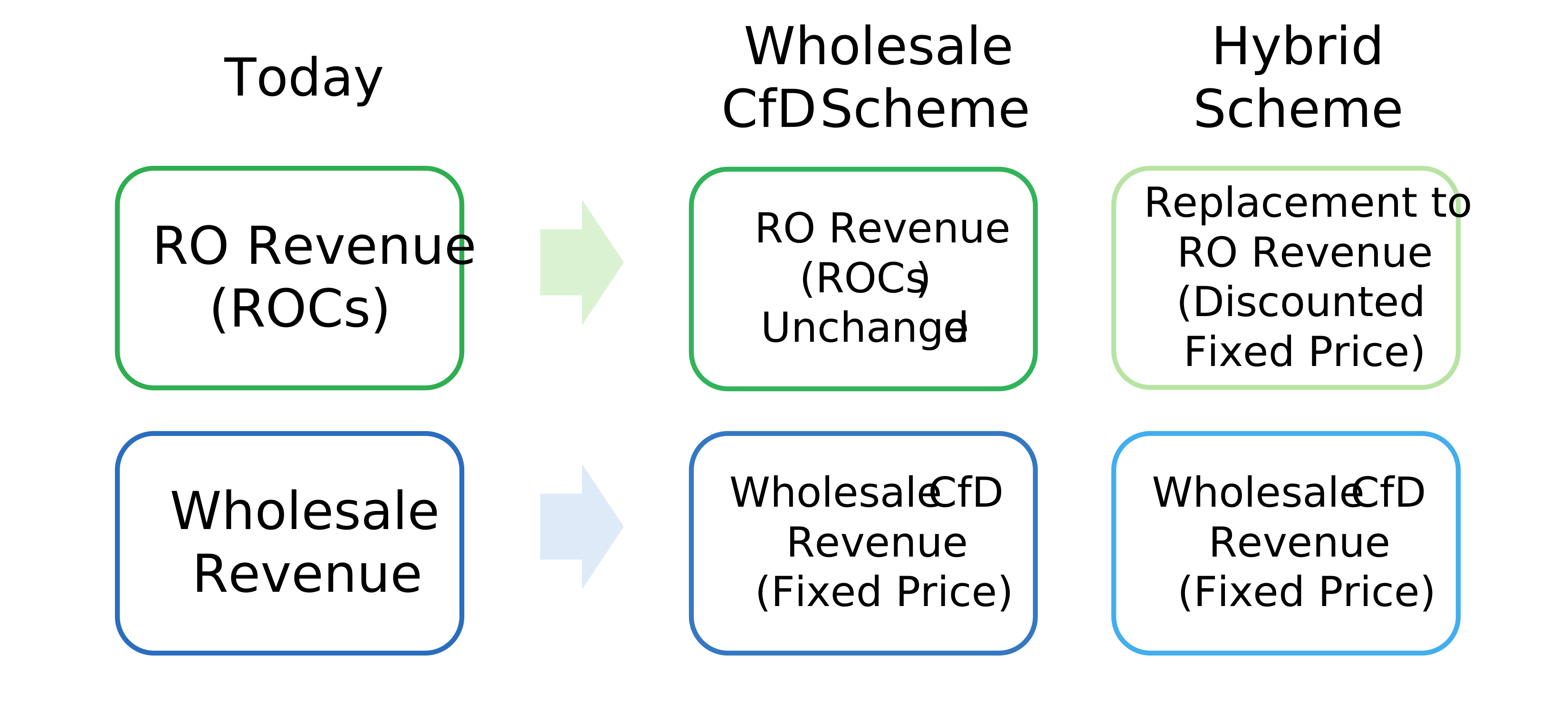
Description of figure 5: A diagram showing that under a WCfD, wholesale market revenue is replaced by fixed-price WCfD revenue while RO revenue remains unchanged. Under a Hybrid WCfD, wholesale market revenue is replaced by fixed-price WCfD revenue and the existing RO revenue stream is also replaced with an alternative revenue stream.
The RO revenue element would remain linked to the generator’s existing RO support period, meaning these payments would cease once the generator’s RO accreditation period would have ended. The wholesale revenue component of the WCfD would continue in accordance with the terms of the contract. This would ensure the hybrid model avoids extending support beyond the period originally envisaged under the RO, which was designed to provide support during the earlier stages of development and generation and to allow high capital costs to be recovered.
The government considers that, whilst a hybrid scheme has the potential to deliver a saving for consumers, as generators would need to accept a discount on their RO revenues in return for the private law contract, it would also introduce significant additional complexity to the delivery of the WCfD scheme. This could delay the delivery of benefits, noting that the savings potential depends partly on the speed of scheme delivery. We are therefore seeking clear evidence that any consumer benefits outweigh the associated costs and delivery challenges.
Delivery challenges
Future Fixed-Price Certificate system
The government recognises that lenders and private investors play an important role in supporting renewable generation under the RO, and that confidence in the stability and predictability of support arrangements is an important consideration for investment decisions. The Department has announced it will consult on the introduction of Fixed-Price Certificates (FPCs) as part of wider RO reform later this year as a means of ensuring the long-term stability and resilience of the RO as it matures. While a hybrid scheme could be implemented before FPCs are introduced, doing so would be more challenging. Without an established FPC price, generators would lack a clear benchmark against which to assess any discounted hybrid offer, potentially reducing participation and making it more difficult for government to assess consumer value for money. In addition, transferring generators out of the RO scheme before FPC implementation could reduce RO Certificate (ROC) market liquidity and increase price volatility. Delivering a hybrid scheme alongside an FPC framework could help address these challenges by providing a clear reference price and reducing the risk of market disruption. However, this approach could delay the realisation of consumer savings and create a delivery dependency between the 2 schemes.
Allocation and pricing complexity
A hybrid scheme presents significant design and delivery challenges, particularly in relation to allocation and pricing. Potential approaches could include a separate competitive allocation process where generators bid a discounted alternative to RO revenues, or the direct award of an administratively determined discount against expected RO revenues. Both approaches would require extensive analysis, as RO revenues are influenced by a range of market, technology and policy factors.
Operational delivery and implementation challenges
Delivering a hybrid model would require substantial operational and administrative changes beyond those needed for the WCfD. Government and delivery bodies would need to adapt systems, contractual arrangements and processes to administer both wholesale and subsidy-related elements of support, which could increase delivery risk and lead to implementation delays.
Questions:
28. [For RO generators] Would you be willing to accept a material discount on your RO payments in exchange for a hybrid scheme?
[Yes / No]. Please provide reasons and evidence for your answer, including quantitative evidence and details of any hybrid scheme delivery challenges.
29. Do you consider it necessary for the Fixed-Price Certificate system to be implemented before you can bid for the hybrid scheme?
[Yes / No]. Please provide reasons and evidence for your answer.
30. Would a hybrid WCfD alter any of your responses to the questions in section 2 – wider market impacts?
[Yes / No]. Please provide reasons and evidence for your answer.
Additional comments
We welcome any additional comments on the proposal set out in this consultation, including the analytical annex.
Questions:
31. Analytical Annex: The government welcomes views on the impacts considered in the assessment, any further evidence we should consider, and any material impacts not currently identified.
Consultation questions
Please see below for a list of all the questions found throughout this consultation.
1. In principle, do you consider a WCfD to be an effective mechanism to achieve the scheme objectives outlined above?**
[Yes / No]. Please provide reasons and evidence for your answer.
2. Do you have any views on how the Electricity Generator Levy may interact with the WCfD?
- 3. Would a WCfD change how eligible generators sell their electricity in the day-ahead and intraday markets, compared with their current RO or merchant arrangements?
- [Yes / No / Don’t know]
- a) If yes, how significant would this change be?
- [High / Medium / Low / Don’t know]
- b) Please explain your answers and provide supporting evidence, including any quantitative data you may have.
- 4. Do you think the introduction of the WCfD would reduce forward market liquidity, separate from the effect of increased Variable Renewable Energy deployment more generally?
- [Yes / No / Don’t know]
- a) If yes, how significant is this effect?
- [High / Medium / Low]
- b) Would moving existing generation onto a WCfD materially add to supplier hedging costs or risk exposure?
- [Yes / No / Don’t know]
- c) If yes to (b), would these additional costs be passed onto consumers?
- [Fully / Partly / Not at all / Don’t know]
- d) Please explain your answers and provide supporting evidence, including any quantitative data on the hedged positions of RO, merchant and CfD generators that would effectively demonstrate similarities or differences in their behaviour in forward markets.
- 5. Have we identified the correct market impacts in this section? Do you disagree with any of the impacts we have described? Are there others the WCfD could create or impact?
- 6. Which of these impacts are most relevant to the WCfD, and why? Please separate effects which may be caused by the WCfD itself from those caused by the existing CfD, wider renewables deployment or other market trends, and give evidence on likely scale and timing.
- 7. Are there WCfD design features, or wider reforms (for example P462, Reformed National Pricing, or cost recovery policies outside the WCfD), that could mitigate the impacts you consider most significant?
8. Do you agree with the proposed eligibility criteria for the Wholesale CfD? Please provide reasons and evidence for your answer. What are your views on the eligibility of merchant generators, landfill gas and nuclear?
- Minded to include:
- generators accredited under the RO [Agree / Disagree]
- solar PV [Agree / Disagree]
- onshore wind [Agree / Disagree]
- remote island wind [Agree / Disagree]
- offshore wind [Agree / Disagree]
- floating offshore wind [Agree / Disagree]
- run-of-river hydro [Agree / Disagree]
- tidal stream [Agree / Disagree]
- wave [Agree / Disagree] o geothermal [Agree / Disagree]
- Minded to exclude:
- advanced conversion technologies, dedicated biomass, anaerobic digestion, biomass combined heat and power, energy from waste and sewage gas [Agree / Disagree]
- large-scale biomass (>100 MW) [Agree / Disagree]
- electricity storage assets [Agree / Disagree]
- hybrid technologies [Agree / Disagree]
- Seeking views:
- merchant generators
- landfill gas
- nuclear
9. Do you agree that government should set a minimum capacity threshold for WCfD eligibility?
[Yes / No]
If so, which of the following thresholds should be applied? Please provide reasons for your answer.
-
5 MW threshold
-
10 MW threshold
- Another threshold (please specify)
10. Do you agree with the government’s minded-to position to not permit aggregated bids and chunking bids? Please provide reasons and evidence for your answer.
- Aggregated bids [Agree / Disagree]
- Chunking bids [Agree / Disagree]
11. Do you believe that partial capacity should be permitted for the WCfD?
[Yes / No].
Please provide evidence on how it would affect your participation in the scheme and bidding strategy, including the proportion of output you would expect to contract, and any cost involved with potential metering upgrades.
12. Do you agree that co-located generation and storage assets should be treated in the same way as the existing CfD framework?
[Yes / No]. Please provide reasons and evidence for your answer.
13. Do you believe that generating assets with Capacity Agreements should be eligible for the Wholesale CfD?
[Yes / No]
Please provide reasons and evidence for your answer, and include views on:
- Terminating Capacity Agreements ahead of bidding for a WCfD
- Overlap of Capacity Payments and WCfD payments
- Forgoing Capacity Payments for WCfD payments
- Impact of the Capacity Market notice period on the WCfD contract start date
- Impact on bidding strategy for WCfD
- Impact on Capacity Market participation
14. Do you agree with the proposed timings and approach on awarding a WCfD as set out in this section?
[Yes / No]. Please provide reasons and evidence, and include views on:
- Competitive pay-as-clear auction for most generators
- Alternative allocation for legacy nuclear assets
- Potentially withholding publication of either or both of the Administrative Strike Price (ASP) and budget
- Proposed non-delivery disincentives
- Not permitting capacity reduction
15. What approach to WCfD contract length do you consider most appropriate?
- A single 5-year contract length
- A single 10-year contract length
- A choice between 5-year and 10-year contract lengths
- Another approach (please specify)
Please explain your answer, including how your preferred approach could affect participation, competition, bidding behaviour, auction design, value for money and overall scheme delivery.
16. Which approach to contract commencement do you consider most appropriate, and why?
- A single contract start date for all successful applicants; or
- A contract start date window within which successful applicants may elect to commence their contract
- Flexible start dates for generators with specific requirements – for example, those with Capacity Market agreements
In your response, please provide evidence on impacts for participation, existing commercial arrangements, competition, deliverability and value for money.
If a start date window is preferred, please suggest what length it should be and what conditions should apply.
17. Do you see the metering requirements set out in this section affecting participation?
[Yes / No]. Please provide evidence on the scale, cost and lead times associated with any metering upgrades required to meet these requirements.
18. Do you agree that early exit from a WCfD should only be permitted where a generating station is being decommissioned or repowered?
[Yes / No].
If no, please identify any other circumstances in which early exit should be permitted.
What evidence should be considered when assessing decommissioning or repowering for the purposes of triggering an early exit provision?
19. Do you agree with the proposed approach to commercial design as set out in this section?
[Yes / No].
Please provide evidence where possible, including any expected impacts on financing arrangements or participation decisions.
- Indexation: none, partial or full?
- Reference price: IMRP for intermittent generators and BMRP for baseload generators?
- Negative pricing rule: apply the existing CfD negative pricing rule?
For RO generators
20. Will your assets remain commercially viable after RO support ends and in the absence of a WCfD?
[Yes / No]
Include the key assumptions underpinning that outcome, the specific decision points (for example major refurbishment, life extension, refinancing, continued operation or closure) that are sensitive to future wholesale revenues, and whether a WCfD would materially alter those decisions. Support your response with evidence wherever possible.
For all generators
21. Based on the information provided in this consultation, would you be interested in bidding into a WCfD auction?
[Yes / No]
Please explain the factors that would influence your decision, including your technology, remaining operational life and existing commercial arrangements (for example merchant exposure, PPAs, repowering or depowering plans), and any other relevant considerations.
22. To what extent could the additional certainty over future revenues provided by a WCfD reduce strike price bids relative to expected wholesale market revenues in the absence of a WCfD?
Please comment on whether this effect would differ between 5-year and 10-year contracts and provide evidence, where available, to support your view and the likely magnitude of any impact.
23. Would the WCfD’s wholesale revenue price swap materially affect decisions to extend the operational life of your asset(s), undertake refurbishment or maintenance investment, repower, or defer decommissioning?
[Yes / No]
Please provide evidence where possible, including to what extent the life of your asset(s) could be extended, and the scale and timing of any required investment.
24. Do you agree with the proposed changes to the CfD secondary legislation and the Renewables Obligation Order to implement the proposals on eligibility?
[Yes / No]. Please provide reasons and evidence for your answer.
25. Do you agree with the proposed changes to the CfD secondary legislation to remove the requirement to publish the ASP?
[Yes / No]. Please provide reasons and evidence for your answer.
26. Do you agree with the proposed changes to the Electricity Capacity Regulations and the Capacity Market Rules?
[Yes / No]
Please provide reasons and evidence for your answer, and include views on:
- Enabling generators to apply for and be awarded a WCfD, whilst continuing to pre-qualify for and hold Capacity Agreements in parallel, including whether it should be on the condition that there is no overlap in payments
- Broadening Capacity Market termination mechanism to enable generators to transfer from a Capacity Agreement to a WCfD, including whether to amend the current 16-month notice period and other provisions to enable faster transfer
27. Do you agree with the proposed changes to the Renewables Obligation (Scotland) Order 2009? [Yes / No]. Please provide reasons for your answer.
28. [For RO generators] Would you be willing to accept a material discount on your RO payments in exchange for a hybrid scheme?
[Yes / No]. Please provide reasons and evidence for your answer, including quantitative evidence and details of any hybrid scheme delivery challenges.
29. Do you consider it necessary for the Fixed-Price Certificate system to be implemented before you can bid for the hybrid scheme?
[Yes / No]. Please provide reasons and evidence for your answer.
30. Would a hybrid WCfD alter any of your responses to the questions in section 2 – wider market impacts?
[Yes / No]. Please provide reasons and evidence for your answer.
31. Analytical Annex: The government welcomes views on the impacts considered in the assessment, any further evidence we should consider, and any material impacts not currently identified.
Next steps
The UK government will review and analyse all consultation responses. The Scottish Government will review and provide input to the analysis of responses relating to the proposed amendments to the Renewables Obligation (Scotland) Order 2009. We will publish a joint response to the consultation, which will provide a summary of the views expressed by the respondents, how they have informed scheme design and delivery, and how we intend to proceed.
Subject to the outcome of this consultation, the UK Government and Scottish Government will lay secondary legislation to implement the changes necessary to deliver the scheme.
Annex – list of acronyms
| Acronym | Meaning |
|---|---|
| WCfD | Wholesale Contract for Difference |
| CfD | Contract for Difference |
| RO | Renewables Obligation |
| ROC | Renewables Obligation Certificate |
| EGL | Electricity Generator Levy |
| ASP | Administrative Strike Price |
| IMRP | Intermittent Market Reference Price |
| BMRP | Baseload Market Reference Price |
| CPI | Consumer Price Index |
| RAB | Regulated Asset Base |
| NESO | National Energy System Operator |
| Ofgem | Office of Gas and Electricity Markets |
| LCCC | Low Carbon Contracts Company |
| BM | Balancing Mechanism |
| BMU | Balancing Mechanism Unit |
| BSC | Balancing and Settlement Code |
| ICP | Initial Conditions Precedent |
| OCP | Operational Conditions Precedent |
| PPA | Power Purchase Agreement |
| P462 | Balancing and Settlement Code Modification Proposal P462 |
| LfG | Landfill Gas |
| FPC | Fixed-Price Certificate |
| SSEP | Strategic Spatial Energy Plan |
| RNP | Reformed National Pricing |
| SIL | Siting and Investment Levers |
| VRE | Variable Renewable Energy |
| NFFO | Non-Fossil Fuel Obligation |
| SRO | Scottish Renewables Obligation |
-
Ofgem (2022) ‘Default tariff cap update from 1 October 2022’ (viewed on 8 October 2026) ↩
-
Ofgem (2026) ‘Energy price cap will rise by 4% from October 2026’ (viewed on 8 October 2026) ↩
-
Based on analysis of: IMRP actuals (viewed on 8 October 2026). ↩
-
The merit order is the ranking of generators according to the price at which they offer electricity to the market, with lower-priced generation generally used first. ↩
-
The rule was introduced for Allocation Round 2 in 2017 – so AR1 assets do receive their full strike price when the IMRP is negative. AR2 and AR3 assets are only denied payments when prices are consistently negative for 6 hours. From AR4 onwards, any negative one-hour period triggers the rule. ↩
-
Elexon (2026) ‘P462 The removal of subsidies from Bid Prices in the Balancing Mechanism’ (viewed on 8 October 2026) ↩
-
DESNZ (2026) [Reformed National Pricing (RNP): delivery plan](Reformed National Pricing (RNP): delivery plan (accessible webpage) - GOV.UK, Figure 7 (viewed on 8 October 2026) ↩
-
NESO, Strategic Spatial Energy Planning (SSEP) (viewed on 8 October 2026) ↩
-
DESNZ (2026) ‘Reformed National Pricing (RNP): delivery plan’ (viewed on 8 October 2026) ↩
-
DESNZ (2026) ‘Common biomass sustainability framework: consultation document’ (viewed on 8 October 2026) ↩
-
The analysis includes solar PV, onshore wind, remote island wind, offshore wind, floating offshore wind, run-of-river hydro, tidal stream, geothermal and landfill gas. Although we are minded to include wave, it does not feature in our RO or merchant data. ↩
-
The analysis is based on our view of RO and merchant projects as of 2026/2027. Data for merchant sites is more uncertain than RO, meaning some sites may be incorrectly categorised and lead to over or underestimates of sites and capacity. ↩
-
Landfill gas RO capacity estimates are based on accredited nameplate capacity at the point of RO accreditation. As landfill gas volumes decline over time, sites typically reduce generation capacity, meaning the estimates presented here are likely to overstate the current operational capacity, and potentially the number of sites in each category. A number of landfill gas sites will also lose RO support from 2027 onwards and may continue operating on a merchant basis, although future merchant viability following RO expiry is uncertain. ↩
-
DESNZ (2026) ‘Contracts for Difference Allocation Round 8: standard terms and conditions’ (viewed on 8 October 2026) ↩
-
The Contracts for Difference (Miscellaneous Amendments) Regulations 2025 (viewed on 8 October 2026) ↩
-
These schemes operated from 1990 until replaced by the RO in 2002, and generators were allowed to transition onto the RO. ↩
-
A generator enters into an allocation round CfD at the point at which they sign the CfD, which must happen within 10 days of the offer, as per CfD Standard Terms Regulations regulation 10. ↩
-
Rule 6.10.1(d) of the Capacity Market Rules. ↩