Wholesale Contracts for Difference: analytical annex (HTML)
Published 28 October 2026
Applies to England, Scotland and Wales

© Crown copyright 2026
This publication is licensed under the terms of the Open Government Licence v3.0 except where otherwise stated. To view this licence, visit nationalarchives.gov.uk/doc/open-government-licence/version/3 or write to the Information Policy Team, The National Archives, Kew, London TW9 4DU, or email: psi@nationalarchives.gov.uk.
Where we have identified any third party copyright information you will need to obtain permission from the copyright holders concerned.
This publication is available at https://www.gov.uk/government/consultations/wholesale-contracts-for-difference/wholesale-contracts-for-difference-analytical-annex-html
1. Summary of proposal
The Wholesale Contracts for Difference (WCfD) proposal seeks to further weaken the link between the wholesale electricity and gas prices, to help ensure that the benefits of low-cost renewables are better reflected in electricity prices and consumers’ exposure to gas price volatility is reduced. Assets already supported through Contracts for Difference (CfD) or Regulated Asset Base (RAB) models benefit from alternative revenue stabilisation arrangements and therefore expose consumers less directly to wholesale gas price volatility than merchant generators. CfD assets already receive a fixed strike price, while RAB assets benefit from regulated revenue arrangements. Therefore, the policy focuses on legacy assets that are exposed to the wholesale market.
Recent global events have pushed gas prices in 2026 to their highest level since the 2022 to 2023 energy crisis[footnote 1], underscoring the continued pressure on consumers from high energy costs driven by volatility in global energy markets. Given gas prices are a major driver of electricity prices, changes to the Electricity Generator Levy (EGL) have been introduced, helping to ensure that a portion of exceptional revenues earned by legacy low-carbon generators during periods of unusually high electricity prices are returned to public finances.
Government has subsequently committed to further develop a WCfD mechanism as a longer-term measure to help protect consumers from the impact of future gas price shocks on electricity bills. Table 1 below shows the estimated upper bound of capacity eligible for a WCfD under the proposed policy design.
Table 1: Upper estimate for capacity that could participate in the WCfD allocation process at differing minimum capacity thresholds for an individual project
| No minimum capacity threshold (GW) | Minimum capacity threshold of >5 MW (GW) | Minimum capacity threshold of >10 MW (GW) |
|---|---|---|
| 33.2 | 29.8 | 26.9 |
This is an upper estimate of capacity that could participate, not an indication of what may be successful at auction.
2. Strategic case for proposed regulation
Policy context
Electricity prices in Great Britain remain significantly influenced by the price of gas. Under current wholesale market arrangements, the wholesale electricity price is determined by the highest-cost generator required to meet demand and, in practice, gas-fired generation frequently sets this price. As a result, changes in international gas prices can have a material impact on wholesale electricity prices and, ultimately, consumer electricity bills. This occurs even though an increasing proportion of electricity is generated from low-carbon technologies - including wind and solar PV - whose operating costs are not directly linked to gas prices.
The transition to a cleaner power system is expected to reduce the influence of gas on electricity prices over time. We estimate that gas sets the marginal price around 90% of the time in the early 2020s; this has already fallen by around a third and could be around half by the early 2030s. However, a substantial proportion of existing low-carbon generation remains exposed to wholesale electricity prices, meaning consumers continue to be affected by volatility driven by gas markets. The Russia-Ukraine war and recent conflict in the Middle East have illustrated the potential impact of this for electricity consumers. As evidence of this, the winter 2022/23 gas price shock helped drive increases in the electricity price cap of over £1,300 for a typical household.[footnote 2] More recently, Ofgem announced a £60 (4%) increase in the price cap for October to December 2026[footnote 3], with rising wholesale costs caused by the conflict in the Middle East as the primary driver. This increase would have been greater had government not intervened to remove VAT from household electricity bills.
In April 2026, government announced its intention to explore measures that could reduce consumer exposure to volatile gas prices. One potential approach under consideration is a Wholesale Contracts for Difference (WCfD) mechanism, which could enable eligible low-carbon generators, whose revenues are currently exposed to volatile wholesale electricity prices, to move onto a fixed-price arrangement. This would protect consumers from future crises if gas prices spike.
Problem under consideration and rationale for intervention
There are a range of reasons, both strategic and economic, why government may wish to intervene in order to reduce the extent to which wholesale electricity prices, and ultimately consumer bills, are influenced by gas prices. Government has an objective to deliver affordable and stable energy for households and businesses. Intervention may therefore be justified where it reduces consumer exposure to future gas price shocks, improves price stability and delivers better value for money relative to the counterfactual. Factors driving the rationale for intervention include:
- Equity and affordability: The current wholesale electricity market passes through gas-driven price shocks to electricity consumers irrespective of the underlying costs of much of the generation fleet. While this market arrangement helps ensure electricity is produced by the lowest-cost generators available at any given time, it can produce outcomes that are inconsistent with government objectives relating to affordability and fairness. Lower-income households spend a greater proportion of their income on energy and are less able to absorb unexpected bill increases, meaning periods of elevated gas prices can have disproportionate impacts on vulnerable consumers. Because many low-carbon generators receive revenues linked to the wholesale electricity price, consumers do not always directly benefit from the lower operating costs of those technologies during periods of high gas prices. Intervention can therefore help ensure that the benefits of growing low-carbon generation are more widely shared across consumers.
-
Risk allocation and market uncertainty: Both electricity consumers and generators are exposed to future wholesale electricity price risk. Consumers have limited ability to influence or manage this risk, while for generators, effectively managing it can be costly and may increase refinancing costs and risk premia faced across the sector. Consumers are primarily exposed to the risk of future energy crises increasing bills, while generators face uncertainty over future wholesale revenues, including from increased deployment of low marginal cost generation. Many consumers and generators are likely to be risk averse with respect to wholesale electricity price volatility and must make decisions under considerable uncertainty regarding future prices. Consumers may place a value on bill stability beyond the expected reduction in costs, while generators may be willing to accept a lower expected revenue stream in exchange for greater revenue certainty. In the presence of imperfect information about future market conditions, there may be gains from arrangements that facilitate a more efficient allocation of risk between consumers and generators.
This has the potential to benefit both domestic and non-domestic consumers. Volatile wholesale electricity prices can increase costs for businesses, and reduced certainty over future energy expenditure can affect their investment planning and growth. Reducing exposure to future gas price shocks could therefore support a more predictable environment for electricity consumers across the economy.
3. SMART objectives for intervention
Policy objectives
- There are 3 main objectives for the intervention:
- a) Objective 1: Decoupling and insurance: Reduce consumer exposure to wholesale gas price volatility – Reduce the extent to which movements in wholesale gas prices are reflected in consumer electricity bills, thereby lowering consumer exposure to future gas price shocks compared with the counterfactual over the lifetime of the policy.
- b) Objective 2: Net and distributional bill impacts: Deliver an outcome that is beneficial for consumers – Deliver the intervention in a manner that represents fair value for money for consumers relative to the counterfactual by providing a revenue swap, taking account of both the net impact on consumer bills and the distribution of costs and benefits across the appraisal period.
- c) Objective 3: Wider market impacts: Maintain a well-functioning and investable market – Implement the intervention in a way that preserves efficient market operation and maintains investor confidence in the Great British (GB) electricity market, with no material adverse impacts on competition, liquidity, or incentives for investment in new and existing generation assets.
- Intended outcomes:
- a) Objective 1: Decoupling and insurance: Reduce consumer exposure to wholesale gas price volatility – The WCfD will ensure that consumers are less exposed to sudden increases in electricity bills arising from volatility in international gas markets. As a larger proportion of low-carbon generation is insulated from wholesale market fluctuations, electricity bills become more stable and predictable, reducing the impact of future gas price crises on households and businesses.
- b) Objective 2: Net and distributional bill impacts: Consumer benefits from price certainty are realised – Consumers experience a revenue swap that represents fair value for money compared to the counterfactual. The intervention is designed to ensure that consumers share in the value created by low-marginal-cost renewable generation, taking account of both the overall impact on consumer bills and the distribution of costs and benefits across consumers, while considering wider system impacts.
- c) Objective 3: Wider market impacts: Continued investment and effective market operation – The scheme is designed and implemented in a way that maintains investor confidence and appropriately accounts for any material effects on wider market operation identified through consultation and further analysis.
4. Description of proposed intervention and explanation of the logical change process whereby this achieves SMART objectives
Preferred option and meeting policy objectives
- The following options are considered in the analytical annex.
- a) Do nothing (counterfactual): Under this option, no further intervention would be introduced, and existing market arrangements would continue unchanged. Electricity prices would continue to be determined through current wholesale market arrangements, with gas-fired generation often setting the market-clearing price. Over time, continued deployment of low-cost renewable generation may reduce the extent to which electricity prices are influenced by gas prices. However, in the meantime, consumers would remain exposed to periods where gas-fired generation sets wholesale electricity prices, and therefore to future gas price shocks, to a greater extent than under the intervention.
- b) Voluntary Wholesale CfD: This option would offer eligible existing low-carbon generators the opportunity to enter voluntary fixed-price contracts that replace or stabilise their exposure to wholesale electricity market revenues. By providing greater revenue certainty and reducing reliance on gas-driven wholesale power prices, the intervention aims to weaken the link between volatile gas prices and electricity prices, helping to protect consumers from shocks while maintaining support for existing renewable generation. The current working assumption is that the scheme would expect to follow much of the standard CfD framework closely, making changes where needed to deliver scheme objectives. Consultation responses, analysis, deliverability and value for money will inform final design.
- c) Voluntary Hybrid Wholesale CfD: This option builds on the voluntary wholesale CfD by allowing generators to port their current RO revenue into a private law contract alongside their wholesale revenue. This would involve generators leaving the RO scheme and entering into a contract to receive a fixed discounted price in place of their RO revenue for the remainder of their obligation period. The contract would therefore cover 2 revenue streams, treated separately. This would result in a reduction in consumer RO levy costs compared to the counterfactual, if generators accept a sufficient discount relative to expected RO revenues.
At consultation stage, the lead proposal is a voluntary fixed-price arrangement for existing low-carbon generators (option b), expected to follow much of the standard CfD framework closely. However, consultation responses, further analysis, deliverability considerations and assessment of value for money will inform the final design, including whether changes are needed to ensure the WCfD achieves its objectives and appropriately accounts for its potential wider market impacts. The government will consider carefully the trade-off between pursuing changes that address wider market impacts and delivering the consumer protection and revenue certainty of the scheme more quickly. We are also exploring option c through consultation.
This arrangement could provide consumers with greater protection from future wholesale price shocks while offering participating generators increased revenue certainty. Greater revenue certainty may also reduce the level of risk priced into generators’ offers, helping to improve value for money for consumers.
The detailed design of the scheme has not yet been determined. Consultation responses, further analysis, deliverability considerations and assessment of value for money will inform decisions on the final design, including payment arrangements, contract terms, eligibility, the treatment of existing support and the approach to allocation. Where appropriate, a competitive allocation process could help reveal the price generators are willing to accept in exchange for revenue certainty and support the award of contracts that represent value for money for consumers.
As this evidence develops, changes to the proposed WCfD design may be considered where these would better support the scheme objectives.
Theory of Change
A theory of change shows what a policy, programme or strategy is expected to achieve, including its benefits and outcomes, and explains how and why policy activities are expected to lead to these outcomes. It shows the causal links between activities, output, outcomes and objectives, helping to illustrate how change is expected to occur and how desired benefits will be realised. Developing a theory of change can help to create a shared understanding of the policy, its objectives and pathways to achieving them. It can also strengthen policy design by testing assumptions, identifying gaps and weaknesses and highlighting areas of uncertainty and risk.
The following theory of change sets out how the WCfD scheme is expected to achieve its objectives, including to reduce consumer exposure to gas price volatility by increasing the amount of low-carbon generation operating under fixed-price arrangements. The hybrid pathway is presented as an additional option within the theory of change.
Definitions:
Inputs: Enabling activities or conditions that allow the proposed activities and outputs to take place.
Actions and Outputs: What HMG does (activities) and the tangible things it delivers (output) with the financial resources, skills and knowledge at its disposal. They are within the direct control of HMG.
Outcome: Changes in behaviour and/or the decisions made by the stakeholders targeted by the policy. HMG has influence over these, but not direct control.
Impact: The longer-term social, economic and energy system changes and/or benefits that result from our outcomes being achieved and sustained.
Figure 1: WCfD scheme - theory of change
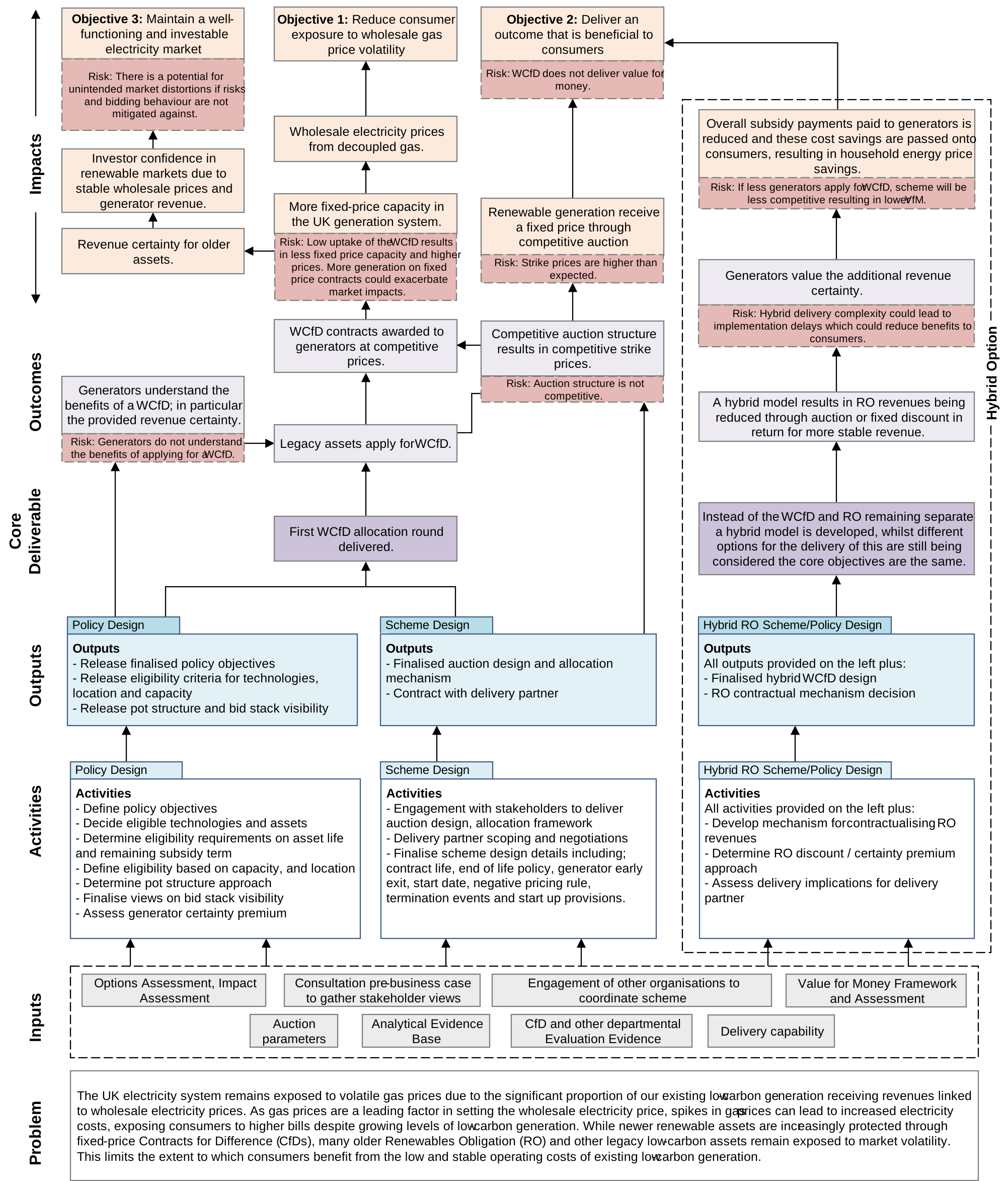
See a plain text version of Figure 1
5. Summary of long-list and alternatives
-
Long-list options
- a) Do nothing (counterfactual): Under this option, no further intervention would be introduced, and existing market arrangements would continue unchanged. Electricity prices would continue to be determined through current wholesale market arrangements, with gas-fired generation often setting the market-clearing price. Over time, continued deployment of renewable generation may reduce average wholesale electricity prices and the frequency with which gas-fired generation sets the market price, while consumer support costs associated with the RO will decline as existing accreditation periods expire. However, the timing and scale of these effects are uncertain, and generators remaining operational after RO support ends would continue to earn revenues linked to wholesale market prices, as they currently do. Consumers would therefore remain exposed to future gas-driven price shocks to a greater extent than under intervention. This option is taken forward to shortlist stage.
- b) Voluntary Wholesale CfD: This option would offer eligible existing low-carbon generators the opportunity to enter voluntary fixed-price contracts that replace or stabilise their exposure to wholesale electricity market revenues. By providing greater revenue certainty and reducing reliance on gas-driven wholesale power prices, the intervention aims to weaken the link between volatile gas prices and electricity prices, helping to protect consumers from shocks while maintaining support for existing renewable generation.
- We are currently considering:
- – CfD-style revenue stabilisation mechanism: A design drawing on elements of the existing Contracts for Difference mechanism, such as 2-way payments linked to wholesale market revenues.
- – Modifications to the CfD-based approach: Variations to specific WCfD design features may be considered where evidence suggests these are needed to achieve the scheme objectives, account for material wider market impacts or support deliverability and value for money.
- The current working assumption is that the scheme would expect to follow much of the standard CfD framework closely. However, the consultation seeks evidence on whether the proposed WCfD could materially affect wider electricity market outcomes and whether any WCfD design changes may be appropriate. This option is taken forward to shortlist stage.
- c) Voluntary Hybrid Wholesale CfD: This option builds on the voluntary wholesale CfD by allowing existing RO generators to port their current RO revenue into a private law contract alongside their wholesale revenue, potentially through a parallel allocation process. This would involve generators leaving the RO scheme and entering into a contract to receive a fixed discounted price in place of their RO revenue for the remainder of their obligation period. The contract would therefore cover 2 revenue streams, treated separately. Any discount that generators are willing to accept in exchange for this contract would result in a reduction in consumer RO levy costs compared to the counterfactual. This option is taken forward to shortlist stage.
- d) Voluntary CfD: Sometimes called ‘Pot Zero’, this would allow RO generators to voluntarily exchange both their existing RO support and their wholesale electricity revenues for a single CfD-style strike price. In effect, it would merge the 2 revenue streams into one long-term fixed-price contract. This approach was assessed as complex and unlikely to deliver strong consumer benefits. It would require designing a single auction across c.3,000 heterogeneous RO assets with differing expected RO revenues, creating significant delivery challenges and risking weak competitive tension. The department considered this option previously and discounted it on this basis. For the same reasons this option is not taken forward here.
- e) Mandatory CfD: This would force RO generators to exchange both their existing RO support and their wholesale electricity revenues for a single CfD-style strike price. This was ruled out due to major legal, delivery and commercial challenges, including serious risks to investor confidence.
6. Description of shortlisted policy options carried forward
Shortlisted assessment and preferred options
Options a), b) and c) are considered at the shortlisted stage.
Value for Money Framework
- To complement the 3 SMART objectives, there are 3 key analytical areas for consideration.
- a) Decoupling and insurance: Decoupling currently exposed capacity from wholesale electricity prices could provide value to the system and consumers by acting as a form of insurance against any future wholesale price spikes.
- b) Net and distributional bill impacts: Deliver a revenue swap that represents fair value for consumers.
- a. Net bill impacts: whether consumers are better off or no worse off overall once all costs and benefits are combined.
- b. Distributional impacts: how those costs and benefits are spread across consumers over time.
- c) Wider market impacts: Moving significant volumes of capacity onto a WCfD could have a range of impacts on the wider market (described below); any adverse effects should not outweigh objectives 1 and 2. In addition, the intervention should maintain investor confidence in the GB electricity market and avoid creating unintended effects that could undermine future investment in generation assets.
- Together, these criteria will inform the design of the analysis and the overall assessment.
Analytical Assessment
Expected impacts of the preferred option
While the precise scale of impacts will depend on future market conditions and participant behaviour, the proposal is expected to have a number of potential effects on consumers, generators and suppliers.
Domestic and non-domestic energy consumers:
Moving a significant proportion of generating capacity onto a fixed price has the potential to insulate consumers from potential future energy price shocks, providing greater certainty and predictability over energy bills. This insurance from future energy price shocks is expected to be the primary source of value for consumers, although the scale of this benefit remains contingent on the uncertainties described below. Additionally, as we progress towards a clean power system and deploy more renewable electricity capacity, wholesale electricity prices are expected to decline. This is the result of ‘price cannibalisation’.[footnote 4] Given this, the fixed price achieved through the WCfD could result in bill savings in earlier years and higher consumer bills in later years than under the counterfactual, particularly if future gas-driven price shocks are limited or short-lived and wholesale prices subsequently fall below the WCfD strike price. However, the timing and net impact on consumer bills are uncertain. While developers may be willing to bid at lower prices in exchange for greater revenue certainty, creating a potential saving for consumers, the costs and benefits of fixing a proportion of generation at a predetermined price will depend on future market conditions. These sensitivities are described below. The more competitive the WCfD auction is, and the lower the clearing price, the better the outcome for consumers; the auction will be designed to balance competitive tension with control over outcomes to ensure contracts are only awarded when judged to be in the interests of consumers, whilst taking into account the wider system impacts.
For domestic consumers, lower-income households may be more sensitive to changes in energy bills and could therefore experience proportionately larger benefits from any reduction in price volatility or bill savings. Equally, any net increase in consumer costs would be felt more acutely by households for whom energy expenditure represents a larger share of overall spending. Impacts on non-domestic consumers would likely vary depending on whether they are exempt from paying CfD levy costs or not.
Electricity generators and future investors:
The policy would exchange exposure to uncertain future wholesale market revenues for a more stable and predictable revenue stream. While generators would forego revenues in periods where wholesale prices exceed the contracted strike price, in return, they gain protection against lower-than-expected future wholesale prices. As a secondary impact, this could help to support investor confidence and efficient financing costs for future projects, although this impact is difficult to measure.
Wider market / whole system impacts:
Moving significant volumes of capacity onto a WCfD could have wider impacts on electricity market dynamics. Some related issues have previously been considered through REMA and the RNP programme in relation to the current CfD mechanism. The consultation seeks evidence on whether, and to what extent, bringing existing assets onto a WCfD could materially alter the timing, scale or significance of these effects. The consultation provides further detail on these potential impacts, the mechanisms through which they may arise, and the additional evidence being sought from stakeholders to inform our future assessment.
At this stage, we consider the following areas to be among the most relevant to assessing the impacts of the WCfD proposal:
- Negative pricing and economic curtailment: The fixed-price nature of a WCfD could affect incentives to generate or curtail during periods of low or negative prices. The extent to which moving existing RO or merchant assets onto a WCfD would materially change their incentives, relative to their current arrangements and wider market developments, is uncertain and is being tested through consultation.
- Forward market liquidity and supplier forecasting risk: A WCfD could influence how participating generators sell their electricity, including their use of forward markets. The consultation seeks evidence on whether moving existing generation onto a WCfD would materially reduce forward market liquidity or add to supplier hedging costs, separately from the effects of variable renewable deployment and other market trends.
- Muted time-of-use signals: Recovering WCfD costs through the Supplier Obligation could affect the signals faced by suppliers and consumers at times of high renewable output. The consultation seeks evidence on whether the additional generation brought onto fixed-price arrangements through the WCfD could materially bring forward or exacerbate this effect.
- Network curtailment: The WCfD could impact constraint management costs depending on scheme design and the location of assets successful in the allocation. The consultation seeks evidence on whether WCfD participation would create a material additional impact on total system costs or simply change the allocation of costs between different elements of the electricity bill.
Consultation responses and further analysis will be used to assess the likelihood and materiality of these and other potential effects, the extent to which they are attributable specifically to the WCfD, and their implications for the scheme’s value for money and final design.
Voluntary hybrid CfD:
In addition to the potential impacts described above, the hybrid model has the potential to provide further benefits for electricity consumers where certain conditions hold.
By transferring future RO revenues into a long-term private-law contract, the hybrid could provide generators with additional contractual certainty over that revenue stream. The consultation seeks evidence on whether generators would value this certainty sufficiently to accept a material discount relative to expected RO revenues. If so, this could reduce the total cost of the RO scheme to consumers.
However, some of the challenges previously identified with the Voluntary CfD (Pot Zero) mechanism remain with this option. This additional design and implementation complexity could delay the scheme, impacting benefits delivery. More significant divergence between generators around expectations for their future RO revenue streams creates additional auction design complexity which would need to be considered alongside potential impacts on the stability of the RO scheme. Mitigations would be needed for any corresponding consumer value risks. If this complexity led to a significant delay to WCfD scheme delivery, this could reduce net consumer benefits, particularly where greater value from the policy is realised in earlier years.
Primary uncertainties
The impacts described above, regarding consumers, generators and wider market, represent the expected direction of effects of the proposal. However, the scale of these impacts, and in some cases whether they are ultimately positive or negative for particular stakeholders, is subject to considerable uncertainty.
Given the uncertainty surrounding future electricity market conditions, participant behaviour and the early stage of policy development, a qualitative assessment has been considered more appropriate than a monetised analysis for this analytical annex. We will be doing further analysis to understand this better. The key uncertainties that will influence the scale and direction of impacts are set out below:
- Realised future wholesale electricity prices: The value delivered by the policy is highly sensitive to future wholesale electricity prices and, in particular, the frequency and severity of future gas-driven price spikes. If wholesale prices are significantly higher than forecast, the value of transferring price risk away from consumers and securing fixed-price generation is likely to increase, with the reverse also true.
- Participation and take-up of the policy: The proportion of eligible generation choosing to participate will determine the volume of generation moved onto fixed-price arrangements and therefore the extent of decoupling achieved, and the scale of any potential wider electricity market impacts (see below).
- Bidding behaviour and strike prices: The overall value for money of the policy will depend on the strike prices at which generators are willing to enter contracts. The degree to which generators value revenue certainty, the competitiveness of the allocation process and expectations of future market conditions will all influence bidding behaviour. A competitive allocation process would be designed to mitigate this uncertainty through price discovery. In addition, the scheme design may allow the Secretary of State to view anonymised bid information and be granted appropriate flexibility over budget setting, providing a further safeguard against poor value for money outcomes.
- Contract start date: The timing of contract entry will affect the value delivered to consumers. Delayed contract start during periods of high wholesale prices could reduce consumer benefits as consumers remain exposed to high wholesale prices. Scheme delivery timescales, the contract start date, and related contractual provisions will therefore be an important determinant of overall value for money.
- Wider market impacts: As discussed above, moving existing generation onto WCfD arrangements may have wider impacts on market incentives and system costs. The significance of these impacts will be considered in the value for money assessment.
Below we have looked to describe how the key sensitivities may influence the scale and direction of the identified impacts.
Electricity consumers
The table below summarises how key uncertainties could affect consumers under different market and participation scenarios. These impacts are illustrative and directional, reflecting the main factors likely to influence value for money to electricity consumers, including strike prices, realised wholesale electricity prices and level of generator participation.
While strike prices remain uncertain, the intention is that they would ultimately be determined through an auction process. The government is considering allowing the Secretary of State to view anonymised bids before determining the budget for each auction pot and therefore how much capacity to procure – this would provide greater control over auction outcomes and help to support value for money for consumers.
| Scenario | Potential impact on consumers |
|---|---|
| Higher / uncompetitive WCfD strike prices, lower realised wholesale electricity prices | Consumer value for money is likely to be low. The benefits of protection against wholesale price volatility are limited, while payments to participating generators may be relatively high. |
| Higher strike prices, higher realised wholesale electricity prices | Consumer protection from gas-driven price spikes is increased, but some of the benefits are offset by higher payments to generators. Net impacts would depend on the relationship between wholesale prices and strike prices. |
| Lower / competitive strike prices, lower realised wholesale electricity prices | Consumers benefit from lower scheme costs, while the realised bill impacts of protection from wholesale market volatility are relatively limited. Nevertheless, the scheme continues to provide value through protection and insurance. |
| Lower strike prices, higher realised wholesale electricity prices | Consumer benefits are likely to be highest. Consumers receive protection from elevated wholesale prices whilst generation is secured at comparatively low fixed prices. |
| High generator participation | A larger volume of generation operating under fixed-price arrangements would increase the degree of decoupling achieved and strengthen consumer protection from wholesale market volatility. |
| Low generator participation | A smaller volume of generation participates, limiting the degree of decoupling and reducing the potential scale of consumer benefits. |
| Delayed contract start date | Delayed participation reduces the volume of generation covered by fixed-price arrangements during the period of delay. Where wholesale prices are elevated, this could materially reduce consumer benefits by postponing protection from wholesale price volatility and limiting the extent of decoupling achieved. |
Electricity generators
The table below considers how the same uncertainties may affect generators’ incentives to participate in the scheme. The impact on generators will depend on how the value of revenue certainty compares with expected wholesale market revenues, and the extent to which fixed-price contracts protect against downside risk while limiting potential upside in periods of high wholesale prices.
Given that the WCfD scheme is voluntary, we assume that a generator would only enter into a WCfD if it considered the overall benefits of the contract - including the value of greater revenue certainty and reduced exposure to wholesale market risk - outweighed the foregone upside revenue potential during any future energy price spikes, and any wider costs it faces by participating. The following table should be interpreted in light of this important context.
| Scenario | Potential impact on generators |
|---|---|
| Higher / uncompetitive strike prices, lower realised wholesale electricity prices | Participating generators benefit from higher fixed revenues relative to wholesale market outcomes as well as revenue certainty. This outcome would imply generator overcompensation. |
| Higher strike prices, higher realised wholesale electricity prices | Generators benefit from revenue certainty but may forego some upside revenue opportunities in periods where wholesale prices significantly exceed strike prices. |
| Lower / competitive strike prices, lower realised wholesale electricity prices | Participation provides value through revenue certainty. |
| Lower strike prices, higher realised wholesale electricity prices | Generators may view participation less favourably as fixed revenues could be below potential wholesale market earnings. However, they have still secured the benefit of revenue certainty. |
| Delayed contract start date | Delayed contract start may allow generators to remain exposed to favourable wholesale market revenues for longer. It may also provide additional time to exit existing Power Purchase Agreements (PPAs) before transitioning onto a WCfD. |
The overall value for money of the proposal is expected to be most sensitive to future wholesale electricity prices, participation rates, the fixed prices achieved through the allocation process and any wider market impacts. The consultation seeks stakeholder views on the scale, direction and likelihood of these impacts, particularly where there may be effects that have not been identified in this assessment.
7. Monitoring and evaluation of preferred option
A Post Implementation Review (PIR) will assess progress against the 3 policy objectives identified for the WCfD. A light-touch process evaluation will also be undertaken shortly after the allocation round to assess implementation, participation and any emerging issues. The full PIR is expected to take place by 2030, allowing sufficient time for contracts to commence and for evidence on participation, strike prices, revenue certainty and wider market outcomes to emerge.
Objective 1: Reduce consumer exposure to wholesale gas price volatility
- The evaluation will assess whether the WCfD increased the proportion of eligible low-carbon generation operating under fixed-price arrangements and reduced exposure to wholesale electricity price volatility. Indicative research questions include:
- a) What proportion of eligible generation capacity entered into a WCfD?
- b) To what extent did the WCfD increase the proportion of low-carbon generation operating under fixed-price arrangements?
- c) What factors influenced generator decisions to participate or not participate in the scheme?
- d) What evidence is there that the WCfD reduced exposure to wholesale electricity price fluctuations?
- e) To what extent did the WCfD reduce consumer exposure to wholesale electricity and gas price volatility, and what alternative explanations could account for observed changes? Further, how did this differ across domestic and non-domestic consumer groups?
Objective 2: Consumer benefits from price certainty are realised
- The evaluation will assess whether the scheme delivered value for money for consumers and improved the predictability of costs associated with low-carbon generation. Indicative research questions include:
- a) Were strike prices achieved through the WCfD consistent with delivering value for money to consumers?
- b) How did realised wholesale electricity prices compare to WCfD strike prices over the evaluation period?
- c) To what extent did the WCfD improve the predictability and stability of consumer costs associated with low-carbon generation?
- d) Were there any wider impacts on consumer bills or consumer outcomes that were not anticipated at the time of implementation?
- e) How were the benefits and costs of the WCfD distributed across different groups of domestic and non-domestic consumers and were the distributional impacts consistent with those anticipated at implementation?
Objective 3: Continued investment and effective market operation
- The evaluation will assess whether the WCfD improved revenue certainty while maintaining investor confidence, competition and effective market operation. Indicative research questions include:
- a) To what extent did the WCfD improve revenue certainty for participating generators?
- b) What impact, if any, did the WCfD have on investor confidence in the GB electricity market?
- c) What did generators perceive as the key risks and benefits associated with participation in the WCfD?
- d) What impact, if any, did the WCfD have on competition and wider market operation?
- e) Were there any unintended consequences for generators, suppliers, households or other market participants, including disproportionate or unexpected administrative costs?
Monitoring and evaluation will draw on scheme administrative data, allocation and contract information, market monitoring data and primary research with generators and other relevant stakeholders. Data requirements for monitoring and evaluation will be considered as part of scheme design and implementation to ensure that relevant information is available where possible to support further assessment.
Key external factors likely to influence outcomes include wholesale electricity and gas prices, wider developments in the generation mix, electricity demand, network developments and other government policies affecting the electricity market. Existing and related evaluations, including future CfD evaluations and other CfD-related policy evaluations, will be considered when designing evidence collection to reduce duplication and maintain flexibility. The scheme may be reviewed earlier if significant implementation issues emerge, participation differs materially from expectations, unintended market impacts are identified, or wider market conditions change in ways that materially affect the rationale for intervention.
8. Minimising administrative and compliance costs for preferred option
The preferred option will be developed with the aim of minimising administrative and compliance costs for participating generators and delivery bodies wherever possible. The current working assumption is that the scheme would draw on relevant CfD processes, systems, governance arrangements and delivery expertise where this is practical and supports value for money. However, the extent of alignment will depend on the final design, and bespoke arrangements may be adopted where emerging evidence indicates that established CfD features are not appropriate for the WCfD.
Participation would remain voluntary, meaning generators would incur application and compliance costs only where they consider the benefits of participation to outweigh those costs. Strike prices are expected to be informed by generators’ expectations of future wholesale prices. As generators are likely to develop views of future revenues as part of their existing business and financial planning, the additional costs associated with forming a bid are expected to be limited. Reporting, monitoring and assurance requirements will be considered alongside the need for proportionate consumer protections.
The proposal would also seek to utilise existing delivery arrangements and expertise within the standard CfD contract counterparty and standard CfD delivery body where possible, reducing implementation costs and administrative complexity relative to creating an entirely new support mechanism.
Annex
Text version of theory of change diagram
Problem:
The UK electricity system remains exposed to volatile gas prices due to the significant proportion of our existing low-carbon generation receiving revenues linked to wholesale electricity prices. As gas prices are a leading factor in setting the wholesale electricity price, spikes in gas prices can lead to increased electricity costs, exposing consumers to higher bills despite growing levels of low-carbon generation. While newer renewable assets are increasingly protected through fixed-price Contracts for Difference (CfDs), many older Renewables Obligation (RO) and other legacy low-carbon assets remain exposed to market volatility. This limits the extent to which consumers benefit from the low and stable operating costs of existing low-carbon generation.
Inputs:
- Auction parameters
- Analytical Evidence Base
- CfD and other departmental Evaluation Evidence
- Delivery capability
- Options Assessment, Impact Assessment
- Consultation pre-business case to gather stakeholder views
- Engagement of other organisations to coordinate scheme
- Value for Money Framework and Assessment
Activities:
Policy Design:
- Define policy objectives
- Decide eligible technologies and assets
- Determine eligibility requirements on asset life and remaining subsidy term
- Define eligibility based on capacity, and location
- Determine pot structure approach
- Finalise views on bid stack visibility
- Assess generator certainty premium
Scheme Design:
- Engagement with stakeholders to deliver auction design, allocation framework
- Delivery partner scoping and negotiations
- Finalise scheme design details including; contract life, end of life policy, generator early exit, start date, negative pricing rule, termination events and start up provisions
Hybrid RO Scheme/Policy Design:
All activities provided on above plus:
- Develop mechanism for contractualising RO revenues
- Determine RO discount / certainty premium approach
- Assess delivery implications for delivery partner
Outputs:
Policy Design:
- Release finalised policy objectives
- Release eligibility criteria for technologies, location and capacity
- Release pot structure and bid stack visibility
Scheme Design:
- Finalised auction design and allocation mechanism
- Contract with delivery partner
Hybrid RO Scheme/Policy Design:
All outputs provided on the left plus:
- Finalised hybrid WCfD design
- RO contractual mechanism decision
Core Deliverable:
- First WCfD allocation round delivered
- Hybrid RO Scheme: Instead of the WCfD and RO remaining separate a hybrid model is developed, whilst different options for the delivery of this are still being considered the core objectives are the same
Outcomes:
- Generators understand the benefits of a WCfD; in particular the provided revenue certainty. (Risk: Generators do not understand the benefits of applying for a WCfD.)
- Legacy assets apply for WCfD.
- Competitive auction structure results in competitive strike prices. (Risk: Auction structure is not competitive.)
- WCfD contracts awarded to generators at competitive prices.
- Hybrid RO Scheme: A hybrid model results in RO revenues being reduced through auction or fixed discount in return for more stable revenue.
- Hybrid RO Scheme: Generators value the additional revenue certainty. (Risk: Hybrid delivery complexity could lead to implementation delays which could reduce benefits to consumers.)
Impacts:
Objective 1:
- More fixed-price capacity in the UK generation system (Risk: Low uptake of the WCfD results in less fixed price capacity and higher prices. More generation on fixed price contracts could exacerbate market impacts.)
- Wholesale electricity prices from decoupled gas.
- Objective impact: Reduce consumer exposure to wholesale gas price volatility
Objective 2:
- Renewable generation receive a fixed price through competitive auction. (Risk: Strike prices are higher than expected.)
- Objective impact: Deliver an outcome that is beneficial to consumers. (Risk: WCfD does not deliver value for money.)
Objective 3:
- More fixed-price capacity in the UK generation system (Risk: Low uptake of the WCfD results in less fixed price capacity and higher prices. More generation on fixed price contracts could exacerbate market impacts.)
- Revenue certainty for older assets.
- Investor confidence in renewable markets due to stable wholesale prices and generator revenue.
- Objective impact: Maintain a well-functioning and investable electricity market. (Risk: There is a potential for unintended market distortions if risks and bidding behaviour are not mitigated against.)
Hybrid RO Scheme (Objective 2):
- Overall subsidy payments paid to generators is reduced and these cost savings are passed onto consumers, resulting in household energy price savings. (Risk: If less generators apply for WCfD, scheme will be less competitive resulting in lower VfM.)
- Objective impact: Deliver an outcome that is beneficial to consumers. (Risk: WCfD does not deliver value for money.)
-
ONS, System Average Price (SAP) of gas (viewed on 8 October 2026) ↩
-
Ofgem (2022) ‘Default tariff cap update from 1 October 2022’ (viewed on 8 October 2026) ↩
-
Ofgem, Energy price cap unit rates and standing charges (viewed on 8 October 2026) ↩
-
Price cannibalisation is the reduction in electricity prices that can occur when large amounts of low marginal cost generation, such as wind or solar PV, produce electricity at the same time, increasing supply and lowering the market price they receive for their output. ↩