Reformed National Pricing (RNP): delivery plan (accessible webpage)
Published 21 April 2026

© Crown copyright 2026
This publication is licensed under the terms of the Open Government Licence v3.0 except where otherwise stated. To view this licence, visit nationalarchives.gov.uk/doc/open-government-licence/version/3 or write to the Information Policy Team, The National Archives, Kew, London TW9 4DU, or email: psi@nationalarchives.gov.uk.
Where we have identified any third party copyright information you will need to obtain permission from the copyright holders concerned.
This publication is available at https://www.gov.uk/government/publications/reformed-national-pricing-rnp-delivery-plan/reformed-national-pricing-rnp-delivery-plan-accessible-webpage
Ministerial foreword
Britain is taking back control of our energy so we can bring down bills for families and businesses for good.
Amidst current events in the Middle East, our government is determined to both fight people’s corner in difficult times and learn the right long-term lessons for our country. Once again, we are seeing what it means to be at the mercy of volatile international fossil fuel markets, which have caused half of the UK’s recessions since the 1970s. As the Prime Minister has said, our response must be to go further and faster in our drive for clean, homegrown power that we control.
That is why we are bringing forward our next renewables auction, building on 2 record-breaking auctions which have secured enough clean power for the equivalent of 23 million homes. We are accelerating our £15 billion Warm Homes Plan to upgrade homes, cut bills and shield families from fossil fuel shocks. And we are speeding up the building of nuclear power, as we continue to drive forward on projects from small modular reactors at Wylfa to Sizewell C.
This document sets out our plans to move ahead with Reformed National Pricing to maximise the benefits of the clean, homegrown power system we are building and secure the investment we need as cheaply as possible.
As we set out last July, this is about taking a much more strategic approach to planning and delivering energy infrastructure in this country, including reversing the failures of the past that have led to rising constraint costs and clean power going to waste.
This document sets out our plans for Reformed National Pricing in detail—with reforms to planning, network charging and the grid connections process to ensure we build the infrastructure we need in the places we need it; a comprehensive plan to cut constraint costs and reduce wasted power, from rapidly building the grid to trials of cheap or free energy on windy days; and steps to cut the cost of running the power system by operating it more efficiently.
Taken together this will help deliver a fair, affordable, secure and efficient electricity system that will get us off the fossil fuel rollercoaster and bring down bills for good.
As we drive forward on the reforms set out in this document, we know there is further to go to ensure our energy system is fit for the future and we look forward to working with those across the sector to take the next steps on this journey.
Together we will build a clean homegrown power system that will cut bills and protect families and businesses over the decades ahead.
Chapter 1: Summary of Reformed National Pricing
Clean Power 2030 is reshaping our electricity system, creating the physical infrastructure that will be the foundation for a more secure, affordable and sustainable electrified economy. But making good on that foundation will require reform that goes beyond any single policy or market mechanism. As we move into the 2030s and beyond, our focus must be on how we maintain clean power and maximise the benefits of a very different power system operating in an ever more electrified economy.
Through our renewables auctions, grid investment, and reform of the connections queue and planning system, we are well on our way to delivering a renewables-led system by 2030.We are driving down bills, too: in 2025, the price cap was lower than in 2024 in real terms and, from April, the price cap will be over £100 lower due to the action taken at the Budget.
A power system dominated by renewables brings great opportunity for lower costs and more control over energy use. Yet it also must operate in different ways, with new demands on planning, coordination and decision-making across the whole system. The Strategic Spatial Energy Plan (SSEP) will set out a geographical plan for generation and storage that meets the government’s objectives for the energy sector. It will feed into other spatial plans including the Centralised Strategic Network Plan (CSNP), which will support the transmission network needed to achieve this, reducing constraint costs and increasing certainty for investors.
The measures under Reformed National Pricing (RNP) are the next step in our reforms, changing how and where new investment happens across our power system, and improving the efficiency of how our system operates. They focus on making best use of the siting and investment levers at our disposal to bring the SSEP into reality whilst doing more to optimise operation of the system in a way that reduces costs to consumers.
However, we will also review what further steps may be needed to lower costs for consumers and ensure that the benefits of a clean power system are felt across the country. Our objective is a market in which developers have the long-term certainty needed to invest in and maintain projects with high fixed costs and low running costs, and in which the costs to consumers - of generation, network, and system balancing - are minimised as far as possible.
The mechanisms through which we procure new generation capacity and ensure it is as useful to the system as possible, how we incentivise consumer-led flexibility, and how we regulate networks to best drive the significant investment needed, all contribute to these objectives. This Government inherited a backlog of under-investment in our electricity grid, which is why Ofgem’s new 5-year price control period will allow up to £70bn of critical investment for the transmission network. This is a vital and long-overdue upgrade to our creaking energy system and will help drive down constraint costs. As further investment is required, and as we monitor delivery of this generational upgrade, we will work with Ofgem to explore whether and how our approach to network regulation could be improved to ensure ongoing consumer value.
Therefore, in addition to delivering the substantive reforms set out in this publication, we will continue to examine what further avenues and options for reform may be needed to complete the transition to a clean and low-cost power system and maximise its benefits.
In this context, having clear, effective and well aligned roles and responsibilities across our key central organisations is essential. Indeed, feedback received during the recent Ofgem Review outlined the confusion that exists over the respective roles of Ofgem, the National Energy System Operator (NESO), and DESNZ. This, in turn, generates inefficiencies and blurred accountability across the Great British energy system’s policy, regulatory, and operational landscapes. Improving how these different parts of the system work together is a critical part to deliver in the interests of consumers and the system as a whole.
In order to enable the system to evolve more rapidly in the future, the government is keen to provide greater clarity, building on the Ofgem review, including:
- Seeking to ensure there is clear strategic alignment because of Ministerial decisions, supported by independent regulation and delivery.
- Seeking to ensure that the support regimes for different technologies are developed in a coherent and integrated way.
- Aiming to publish a draft Strategy and Policy Statement (SPS) for consultation later this year and progressing new dedicated work on roles and responsibilities through the course of this year.
The government is pressing ahead with RNP as a necessary step towards a clean, low-cost power system, while recognising that it is not sufficient on its own, and we must think boldly about ensuring our power system is fit for the future as we deliver clean power and look to the 2030s and beyond.
The roles of strategic planning and markets
The government’s objectives for greater strategic planning alongside markets will help to decarbonise the energy system, provide energy security and lower total energy system costs, contributing to a more cost-effective and future-proofed system, ultimately reducing consumer bills. The proposed reforms, as set out in this document, build on the Clean Power 2030 Action Plan[footnote 1], published in December 2024, that outlined how clean power generation will match total annual electricity demand by 2030 backed up by unabated gas to be used only when essential. To help achieve this goal, the government’s recent CfD Allocation Round 7 secured a record 8.4GW of fixed and floating offshore wind at prices around 40% lower than the cost of building and operating a new gas plant, as well as another 4.9GW of solar and 1.3GW of onshore wind, keeping us on track for our 2030 ambitions. This, in turn, follows measures announced in the Autumn 2025 Budget to cut people’s energy bills in the near term, with the government removing an average £150 of costs off energy bills from April this year.
Overall, this Delivery Plan for RNP lays out a key part of our vision for a future clean energy system which harnesses the benefits of greater strategic planning while retaining an appropriate role for markets to drive innovation and efficiency.
The new SSEP is at the heart of this vision and will set out the blueprint for our future energy system with the primary objective to minimise total energy system costs. The SSEP will identify potential cost-effective locations for future Great Britain’s electricity and hydrogen infrastructure, (within energy security, decarbonisation, and environmental constraints), meeting energy system needs. This publication sets out our plans to turn the SSEP (subject to its endorsement by government) into real- world delivery, through our reforms to national pricing. It seeks views in particular on how the different policy levers which affect the siting of new investment should be reformed and combined to provide a coherent set of siting signals and deliver an appropriate balance between greater strategic planning and the role of markets.
Market-driven competition has served well to drive down the costs of generation technologies. However, over time it has become clear that the current market arrangements alone will not be sufficient to enable us to meet our objective for the UK to become a clean energy superpower. We know we not only need to deliver Clean Power by 2030 but also need to continue to deploy significant amounts of generation capacity to meet what is expected to be an increase of more than double our electricity demand in order to support electrification of the economy by 2050. Meeting this requires a range of dispatchable and other low-carbon solutions, such as carbon capture, long-duration storage, interconnectors and other technologies.
The Clean Power 2030 Action Plan set out the technology mix, including by location for several technologies, which we need over the coming 5 years, and we have already begun the work to align our different policy levers to support this overarching plan. In this document, we are setting out how we will build on this approach to deliver more far-reaching and ambitious changes for the longer term.
The government believes it is necessary to give a greater role to strategic planning to meet inter-linked challenges that markets alone cannot fully achieve:
- We are seeking to transform our power system at an unprecedented scale and pace. Given the extent of investment required, a strong government-led vision and supporting framework is required to provide adequate certainty to investors (including those in technology supply chains) to continue investing the necessary capital at the pace required. Without strategic planning, markets cannot provide investors with the clear, long-term visibility of future generation and network needs. Furthermore, strategic planning will help to provide Ofgem with the certainty it needs to approve anticipatory investment in the transmission system.
- One of the pressures that is currently adding to consumer bills is constraint costs, which arise because the electricity network cannot always transport power from zones where it is generated to where it is needed. This illustrates the need for significant coordination across different segments of the energy sector, with network investment requirements driven by generation development and the pace of growth of demand, and links between the fledgling hydrogen economy and the power sector. The provision of new grid infrastructure is a natural monopoly, where high fixed costs, economies of scale and system interdependencies mean it is most efficient for a single operator to manage assets. Focusing on electricity transmission in particular, the longer lead in times for new transmission infrastructure (which can take up to 14 years) compared to most generation and storage projects means that transmission projects need to be committed to before generation projects reach final investment decisions. In addition, as was clear from our previous work as part of the REMA Programme, locational questions will matter much more in our future system, with much more decentralised and geographically distributed generation, greater physical connections to other markets, and increased correlation across generation assets through shared weather patterns. Greater strategic planning across both generation and networks will allow network build and reinforcement to commence ahead of time and break the circular situation where network build delays generation projects developing or coming online. The SSEP will enable greater alignment between generation and network build, which would drive constraint costs down, and enable more efficient investment in both generation and network.
- There are limits as to the extent to which markets can be designed so that participants face signals that fully encompass wider system impacts, while also being predictable enough to not lead to excessive investor risk. For example, in the context of scarce geographic assets, the needs of the power sector must be traded off against other land and maritime uses. The market cannot be relied upon to efficiently make these trade-offs, as market prices do not always reflect wider externalities. There is therefore a unique role for government to address tensions and ensure that the direction and priorities for the power sector are aligned with wider economic, social and environmental goals.
- Our policy framework for low carbon power involves a range of tailored revenue support mechanisms for different technologies in recognition of their different characteristics, in terms of maturity and differing inherent risks. This limits the ability for competition between some technology types. It is therefore necessary to ensure that there is a robust, holistic assessment of the relative merits of the different technologies in deciding how much of each technology to support through their specific mechanism.
To address this, the National Energy System Operator (NESO) has been commissioned to produce a SSEP for Great Britain every 3 years, drawing on whole energy system modelling and spatial planning.
The first SSEP, subject to formal approvals, will be a Great Britain-wide plan that is endorsed by government, mapping potential zonal locations, quantities and types of electricity and hydrogen generation and storage. This will help accelerate and optimise the transition to clean, affordable and secure energy across Great Britain. The CSNP will then set out the necessary network needed to achieve this.
Alongside the benefits of greater strategic planning, there will continue to be a strong role for market-led interventions and competition. Markets can help guide investment towards projects that can bring most value and provide strong incentives to market participants to develop and operate new capacity as efficiently as possible, including through innovation and continuous improvements in technologies, processes and business models. Market pricing ensures that assets are allocated to their most valued uses, guiding investment and operation towards technologies, locations and practices that are most economically efficient. Competition between individual assets and across technologies provides ongoing incentives to minimise costs and drive efficiencies, provided there is sufficient market liquidity, comparability across participants and effective regulatory oversight.
Greater strategic planning through the SSEP complements markets as part of the framework for planning our energy system across Great Britain. This in turn can provide more clarity to industry, investors, consumers and the public on the shape of our future reformed energy system.
Markets also have an essential role in sending real-time operational signals across our system, ensuring that power supply continuously meets demand, and in providing other system services, through the wholesale market and the Balancing Mechanism (BM) overseen by NESO. Markets can also provide important real-time feedback to both market participants and system planners, between iterations of the SSEP which is due to be updated every3 years, so that the latest changes in technology costs and innovation can be taken into account on an ongoing basis. It is important that our market and wider policy design supports the delivery of the SSEP to influence the location of new generation projects where the SSEP calls for them. Therefore, we are consulting on potential reforms alongside this publication as part of RNP.
Taken together, an approach which harnesses the benefits of both greater strategic planning and of markets can deliver our vision for a future clean power system and keep bills as low as possible for consumers. We are clear that ‘no change’ is not an option.
Reformed National Pricing (RNP)
RNP is a portfolio of interventions spanning the whole of the power sector to:
- Reform siting and investment levers to support the delivery of the SSEP: aligning siting and investment levers across the power system behind the SSEP, to encourage the location and construction of new assets in optimal areas to reduce total energy system costs, in a way that achieves the best balance between the roles of greater strategic planning and markets.
- Further bear down on network constraint costs: additional action across our power system to further bear down on both the volume and cost of network constraints, including ahead of 2030.
- Improve system operability and efficiency: reducing the cost of running the power system in real-time, by reforming balancing and settlement arrangements, and considering the potential for further dispatch reforms.
Siting and Investment Levers
The SSEP is at the heart of RNP, setting out the optimal regional locations or ‘zones’, quantities and types of energy infrastructure to meet our future energy demands. However, on its own, the SSEP will not change what gets built in the real world. Instead, the SSEP needs to be translated into action by reforming the different policy levers which affect decisions on what gets built where and when across our power system. The levers will effectively influence decisions around siting of generation and storage so that they are aligned to delivering the SSEP and facilitating a low-cost electricity system.
Our aim for RNP is to reform and align these siting and investment levers so that together they deliver the SSEP with maximum confidence and at lowest cost. This will require reforms to the key siting and investment levers across the power sector, including the planning system, seabed leasing, network planning and build, the connections process, locational charging mechanisms (such as the current network charging regime), and government investment support mechanisms (such as the CfD scheme or Capacity Market (CM)).
Moving to a more strategically planned and directed power system, across generation, network and storage, is a major change for Great Britain. It requires us to consider more than just our market arrangements, but also how our energy system governance and regulation can be appropriately adapted to drive delivery in the interests of consumers.
This document therefore seeks stakeholder views on different options for how the siting and investment levers could be reformed as a coherent package of interventions, each delivering a different balance between the role of strategic planning and markets in driving new investment across the power system. We have an emerging preference for options 2a, 2b and 3 (as outlined in Chapter 2), which place different weight on the roles of the grid connections regime and locational charging mechanisms as the 2 primary levers to drive decisions on what investment happens where and when. Depending on how our connections regime and locational charging mechanisms are reformed, there could also be implications for the design of our investment support mechanisms for power generation, such as the CfD or CM schemes.
This document also sets out how the role of locational charging mechanisms in particular may need to evolve significantly in a more strategically planned power system, so that price signals complement and reinforce the plan rather than potentially contradicting it.
We are seeking stakeholder views on these questions, with the aim of taking final decisions on how to combine the siting and investment levers to deliver the SSEP in 2026. We recognise the importance of providing clarity to the owners and operators of existing assets, as well as to potential future investors, about how they might be affected by changes to the current policy levers which affect siting and investment decisions. We do not intend to make changes to pre-existing agreements made before reforms to the siting and investment levers are introduced. For instance, it is not our intention, as part of the RNP process, to make changes to existing connection offers or to retroactively make changes to CfD or CM agreements that have already been issued.
Transmission Network Use of System (TNUoS) charges differ from other siting and investment levers in that they continue to affect generators beyond the point of investment and throughout the lifetime of their assets, with variable annual charges impacting both new and existing generation. We are therefore prioritising developing legacy and transitional arrangements for TNUoS to safeguard investor confidence and ensure a fair transition, should significant changes to TNUoS be implemented as part of the RNP reform process. Further details on this process are outlined as part of Ofgem’s recent Call for Input publication[footnote 2], including different options for charging reform, which will provide an additional opportunity for stakeholders to review and provide feedback as part of the policy development process.
Constraint Management Action Plan
The historic failure to develop our network infrastructure has meant that consumers are not yet feeling the full benefits of the rapid expansion of new generation. Instead, consumers are currently making extra payments to gas and other generators to increase their output at times when the network is constrained. In 2024/25, two-thirds of the cost of network constraints was due to payments to gas and other generators. In the short-term (until 2030), NESO projections show that these constraint costs may peak at around £7 billion in 2030. However, these costs then fall beyond 2030 as our transmission network is reinforced.
Government is taking decisive action to bear down on constraints, in collaboration with NESO and Ofgem, reducing consumer costs as we accelerate the transition to a more flexible, efficient and clean power system.
Our internal estimates suggest that there could be up to £1 billion in savings in 2030 through the deployment of additional constraint reduction measures set out in this RNP Delivery Plan, although the final saving is highly dependent on policy design which is yet to be finalised. In addition, according to NESO, accelerating 3 key transmission infrastructure projects from 2031 to 2030 could reduce constraint costs by around £4 billion in 2030. If network build can be accelerated, this means savings of up to £40-50 a year.
As well as delivering the largest grid expansion in generations, reversing decades of underinvestment, we are getting more out of our existing network by bringing system operation into the 21st century. We are accelerating the rollout of ‘smart grid’ technologies like Dynamic Line Rating (DLR), that will ensure our existing network is used to its fullest potential, saving consumers up to £400m in 2030. We are taking measures to reduce the amount of time networks need to be out of service for essential new build and maintenance. And, building on our reforms to the planning system in the Planning and Infrastructure Act, we will look at ways of further accelerating end-to-end timelines for new critical network projects, including through streamlining their construction schedules.
Addressing the historic under-investment in our network and moving to a more strategically planned power system is the best long-term approach to reducing constraints. But we want to go even further to ensure electricity that would otherwise be wasted can be used, and to make our power system even more efficient.
We have recently announced a large-scale trial to give consumers in constrained areas in Scotland and the East of England access to cheaper or free power when there is surplus wind on the grid[footnote 3]. The trial will remove the Final Consumption Levies (FCLs) that currently add cost, making it easier for households to benefit. Its findings will inform a decision on whether to make this change permanent. Alongside this trial, we are also exploring measures to support large energy users, including data centres, to locate in areas with excess electricity, reducing constraints and supporting local opportunities for jobs and economic growth.
In partnership with NESO, we will also innovate and develop new and existing tools to balance the system, to reduce constraint costs even further. And we are investigating ways to harness flexible technologies, like batteries, so that they can be even more helpful in balancing the grid, charging and discharging energy as needed.
More details on our action plan to reduce network constraints are set out in Chapter 3. We will continue to engage industry and other stakeholders on these proposals, and will remain open to developing and implementing new policies should they provide potential to save consumers costs.
Balancing and settlement reforms
We have developed a package of reforms that together will improve current balancing and settlement arrangements, enabling the more efficient and cost-effective operation of the system in real-time. These options include:
- A lower mandatory BM participation threshold
- A requirement for physical notifications to match traded positions
- The alignment of gate closure and the market trading deadline
- Unit-bidding
- Shorter imbalance settlement periods (ISPs)
NESO recently published a Call for Input[footnote 4] on this package of reforms, which gave stakeholders the opportunity to provide their views on these reforms, and suggestions on the best way to deliver them.
We anticipate that Ofgem and the Secretary of State will make decisions on these reforms starting from the second half of 2026 onwards, and will commence delivery of the changes as soon as possible thereafter.
Alongside these areas of reform, NESO, Ofgem and others will continue to progress existing workstreams, such as the proposed P462 code modification, and consider further reforms to improve system operability with a view to reducing the costs associated with balancing the system – thereby delivering additional savings for electricity consumers. In addition, we are considering the case for reform to current dispatch arrangements, due to the benefits that could be realised for system operability and consumers. NESO, DESNZ and Ofgem will continue to explore a range of other dispatch reform options, as discussed in the NESO Call for Input.
The benefits of Reformed National Pricing (RNP)
Through the RNP policy reforms set out in this document, we expect to see:
- Reduced need for capital investment: a more efficient system will reduce the amount of additional investment required in new generation and network infrastructure.
- Lower constraint costs: better join-up between generation and network planning, and clearer signals to developers about which projects to invest in where and when, will help address the main underlying causes of network constraints. Reforms to our market arrangements and other measures to bear down on the volume and cost of constraints will improve the efficiency of how the power system operates in real-time, further reducing the impact of constraints.
- Reduced uncertainty for investors: a long-term strategic plan and clearer upfront policy signals ahead of the point of investment decision will provide more stability and predictability for investors, reducing their cost of capital and helping drive down costs for billpayers.
- Fairness: consumers across Great Britain continue to benefit from uniform wholesale market pricing.
Our early indicative analysis suggests that, over the 2030 to 2050 period, ensuring that investment happens in the right locations and at the right times across our power system could yield £10-20 billion (present value) in benefits. This analysis will be developed further, as the detailed RNP policy proposals are worked up. Whilst the timing and sequencing of reform will also drive the final impacts for consumers, our initial estimates suggest that consumers would see a gradual accumulation of savings post-2030, reaching £20-40 on the typical annual dual fuel household bill by 2040.
Further analysis of the economic impacts of RNP will be published as decisions are taken on individual workstreams.
Delivering the Reformed National Pricing (RNP) package
This document sets out a forward work programme with key milestones, decision points, and implementation timelines across the different elements of RNP (see Chapter 6 for details). Individual reforms will be implemented through the appropriate process, with relevant roles for DESNZ, NESO and Ofgem as set out throughout this document. Effective delivery of the RNP package of reforms will require coherence across policy levers, close monitoring of interdependencies, and careful sequencing. This will avoid conflicting signals and ensure that reforms work together as a package.
The different elements of RNP will be taken forward at pace, as individual reforms are finalised. In order to implement these reforms at the necessary pace, the government, subject to Parliament, intends to legislate for powers to amend industry codes and licences, so that consumers, market participants and investors experience the benefits these reforms will bring as soon as possible. The current process can be lengthy and complex, particularly for significant or cross-cutting modifications. This can make it challenging to implement urgent policy changes and coordinate modifications across multiple codes at the pace required for these reforms. Many of these issues are being resolved in the long-term through the introduction of the Code Governance Reform, however this will not be fully implemented in time to support delivery of these priorities. The reforms within RNP will also be reflected in future iterations of Ofgem’s Strategic Direction Statements which support consistent prioritisation of code changes.
The new legislative approach will, subject to Parliament, provide targeted powers to amend codes and licences where necessary to support the delivery of RNP. These powers are designed to ensure that reforms can proceed at the required speed while maintaining opportunities for stakeholder engagement and technical input where required to support development, proportionate to the complexity of the modifications.
More widely, we will continue to engage stakeholders as appropriate throughout the development and implementation of RNP with regular updates, workshops, and opportunities for feedback as reforms progress. The government is working closely with NESO and Ofgem to deliver RNP, and to ensure that we align our engagement with stakeholders across all 3 organisations, this extends to close engagement with Scottish and Welsh governments on related areas of the SSEP. NESO have recently concluded a Call for Input on balancing and settlement reforms and Ofgem have published their Call for Input on locational charging and related regulatory lever reforms.
Chapter 2: Siting and Investment Levers
The potential to reduce costs for billpayers
Historically, since the privatisation of the electricity system, decisions on what generation and network assets should be built where and when across our power system have been taken by a range of different organisations – both private developers and State bodies – without reference to a single over-arching plan. As a result, generation build has outpaced network build in many parts of the country, including in places with higher natural resource availability but which are further away from demand. For instance, much of the onshore wind capacity has been developed in Scotland, while the previous restrictions on onshore wind projects in England limited opportunities to build closer to areas with higher electricity demand. The onshore wind de facto ban in England was lifted in July 2024.
This misalignment between generation and network build, and the lack of an overall strategic plan, has resulted in additional costs for both consumers and investors[footnote 5].
Some investment has not been located in the areas which would deliver greatest benefits for billpayers, and developers have faced unpredictable and sometimes contradictory signals about what assets to build where and when. This has resulted in a power system which is unnecessarily expensive both to build and operate.
By changing how decisions on what investment happens where and when, we can deliver a better and cheaper power system for billpayers. Significant investment will be needed in both generation and network infrastructure in the decades ahead, as more of our economy is electrified. By reforming the policy levers which affect siting and investment decisions to align them behind an overarching strategic plan, we can make this investment cheaper by reducing:
- Transitional costs: better coordination between the build-out of network and generation assets across our power system can reduce:
- the risk of network constraints (any limit on the grid that prevents electricity being moved to where it is needed, requiring NESO to adjust generation to keep the system safe and stable); and
- the risk that network assets might be under-utilised initially (if network infrastructure is built ahead of the generation being available);
- Overall costs: better siting of new generation and network infrastructure can reduce the overall amount of investment needed, by ensuring that new assets are located efficiently. Ensuring the right mix of generation technologies can also reduce overall investment costs, by ensuring that output is used efficiently. Ensuring competition and value for money in how any government support is allocated to individual generation assets will also keep overall costs as low as possible, with careful design of investment support mechanisms. Ensuring that policy frameworks are predictable can reduce the cost of capital for investors, further reducing costs.
A more strategically planned and directed power system is the best approach to deliver these benefits for billpayers. As noted in Chapter 1 the results of actions delivering the SSEP could yield £10-20 billion (present value) in benefits based on our initial analysis. Savings would gradually accumulate post-2030, reaching a £20-40 saving on the typical annual dual fuel household bill by 2040, dependent on the timing and sequencing of reform. At the heart of this vision is the new Strategic Spatial Energy Plan, together with reforms to the policy levers which affect siting and investment decisions as set out in this RNP document.
The Strategic Spatial Energy Plan (SSEP)
The Clean Power 2030 Action Plan[footnote 6] was published in December 2024 and has already made a major step towards a more strategically planned and directed power system. By setting out a clear pathway towards clean power by 2030, the Clean Power 2030 Action Plan has guided decision-makers across the power system. It has helped drive action, including reforms to the grid connections process and queue, prioritising investments in our transmission network, and accelerating progress towards a UK energy system that can bring down consumer bills for good.
The government is also looking beyond 2030, to ensure that consumers continue to experience the benefits of clean power as demand grows in future and our electricity system plays an even more important role in our economy and society. Therefore, in October 2024 the UK, Scottish, and Welsh governments jointly commissioned NESO to develop the Strategic Spatial Energy Plan (SSEP) to help accelerate and optimise the transition to clean, affordable and secure energy across Great Britain. Building upon the more strategically planned approach introduced by the Clean Power 2030 Action Plan, the SSEP will be the first long-term spatial strategy for Great Britain’s energy generation and storage infrastructure.
The SSEP will provide a clear blueprint that will form the backbone of planning and spatially optimising our future energy system. It will guide decisions on how much capacity of a given technology type is built, where the location of that future capacity is located, and when it comes forward. It is intended to feed into other spatial plans, like the Centralised Strategic Network Plan (CSNP) and the Regional Energy Strategic Plans (RESPs) and should be compatible with existing spatial plans such as marine spatial plans.
The first iteration of the SSEP will focus on electricity and hydrogen production and storage. It will show the regional locations or ‘zones’, capacities and timings of electricity and hydrogen production and storage required to meet future energy demand from 2030 to 2050. This will enable better planning of the power grid.
The SSEP and its associated delivery levers and spatial plans will provide the necessary framework for coordinating the development and siting of energy assets, ensuring that investments are prioritised where they are most needed to reduce system costs, achieve Net Zero by 2050 and to establish a secure energy system. By ensuring greater co-ordination between planned generation, demand and network build, the SSEP is intended to enable more efficient investment across our future power system and reduce the costs of network constraints.
In this chapter we outline the delivery levers that influence siting and investment decisions for generation, network and storage and form part of our reforms to support the delivery of the SSEP. This will ensure a more efficient energy system, delivering benefits to consumers while providing clean power. This chapter also seeks stakeholder views on emerging options for how the siting and investment levers could align and work in combination to deliver the SSEP, as well as some of the key trade-offs to consider when aligning these policy levers.
Key elements of the SSEP
The UK, Welsh and Scottish governments have jointly commissioned NESO to produce the SSEP. NESO is developing different pathway options for the SSEP, using economic and geospatial modelling, environmental assessment, and public and stakeholder engagement. These pathways will be different, but plausible, options for how the energy system could look in the future. They will outline the technology type, zone, and timing of electricity and hydrogen generation and storage infrastructure needed to meet expected future demand and reach Net Zero by 2050. NESO will present a Pathway Options Report to the Secretary of State, who will then consider which pathway to choose as the basis for the “draft SSEP” that will be consulted on.
This pathway will have a “CSNP planning line” for generation capacity by SSEP technology and SSEP zone for 2030-2050 to inform the Centralised Strategic Network Plan (CSNP), as well as generation capacity ranges to reflect uncertainty, based on NESO’s modelling and spatial analysis. NESO plans to undertake a consultation on the draft SSEP in early 2027 and aims to publish the final version of the SSEP in autumn 2027, subject to government endorsement. This will form the blueprint for how the electricity and hydrogen systems will need to develop out to 2050. The SSEP will then be updated on a 3-year cycle. Our RNP policy framework will need to be sufficiently flexible to reflect this update cycle but in a way that does not undermine previous investment decisions.
Within this document when we refer to the “SSEP Pathway” we are referring to the totality of information that will be provided for the pathway, encompassing both the CSNP planning line and uncertainty ranges. We need to further develop our view of where within the SSEP Pathway we should target, through using the different siting and investment levers. This will reflect the trade-off between a narrow target providing greater certainty and a wider target allowing more scope to adjust for uncertainty, as well as the potential impacts on confidence and cost.
The first SSEP is predominately focused on spatially planning generation and storage, optimising this alongside network build requirements. It will set out a pathway across multiple land and marine (offshore) zones. NESO have confirmed the 19 land zones (see Figure 1) that will be used in the publication of the draft SSEP. For the land zones, these align with the RESPs’ nations and regions across Great Britain for coordinated energy planning, which reflect common geographical boundaries, and are then subdivided by key electricity system boundaries. They therefore align with democratic and administrative boundaries, supporting integration with local planning and consenting processes, while taking a balanced view of the planning and energy system principles.
For the marine zones, The Crown Estate’s Whole of Seabed Programme modelling regions have been adopted for England (9 zones) and Wales. Additionally, the Welsh marine zones have recognised the inshore and offshore divide to respect legislation and consenting boundaries, resulting in 4 zones for Wales. For Scotland, zones have been adapted from the draft Sectoral Marine Plan Regions (6 zones). This has resulted in 19 marine (offshore) publication zones (see Figure 1). These zones consider societal and administrative boundaries, align with national administrative areas and take into account existing Marine Plan areas.
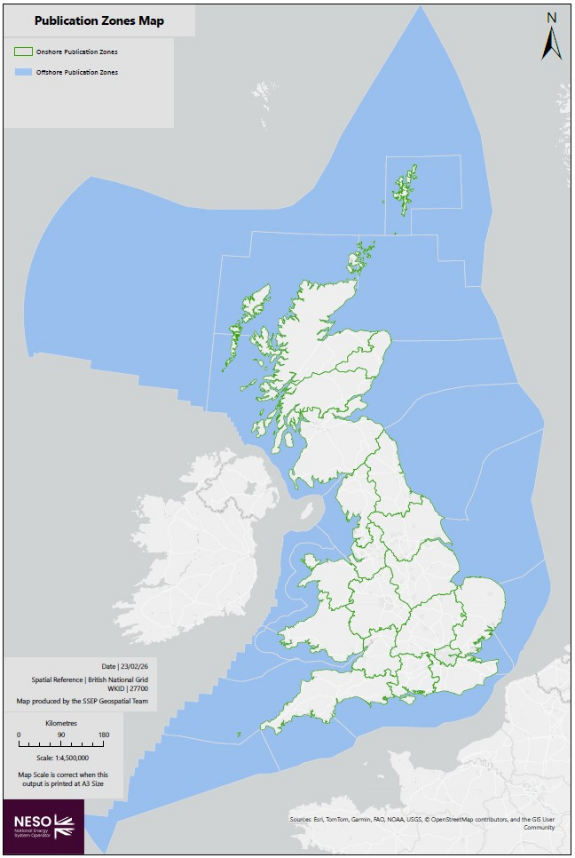
Figure 1: The 19 marine and 19 land publications zones that will be used in the publication of the draft SSEP[footnote 7].
We are taking each of these SSEP zones (as in Figure 1) as the geographical basis for RNP policy development at this stage. As our thinking develops, we will consider whether this is the appropriate geographical scale for the individual policy levers, when considering for instance the need for sufficient predictability for investors or for sufficient competition between projects when considering investment decisions.
Our aim for RNP is to reform and align the siting and investment levers across generation, network and storage, in a coordinated way, so that together these levers deliver the SSEP with maximum confidence and at lowest cost. We do not believe that we need to wait until we know “what” the SSEP says (i.e. how much generation capacity there should be in different locations). Instead, the siting and investment levers work is being developed to be agnostic to the specific SSEP Pathway that will be selected by the Secretary of State. Waiting for pathway selection before developing the RNP policy framework would risk delaying reforms to critical levers such as planning, connections, and locational charging. We will need to consider the impacts of how these different policy levers could impact the electricity sector. Part of this work will also involve understanding the trade-offs between the interactions of the different levers, policy objectives and their interactions with the SSEP Pathway. The SSEP Pathway will set the strategic direction, but there will be costs and benefits to where and how the SSEP is delivered in relation to the overall SSEP Pathway. Early clarity on lever reform will support investor certainty and will help to ensure that projects are SSEP-aligned from the earliest possible date.
The Reformed National Pricing (RNP) Siting and Investment Levers
The RNP siting and investment levers will support the delivery of the SSEP by effectively influencing decisions around project development siting and investment to facilitate a low-cost electricity system. This will help to ensure new generation, storage and network assets are developed in locations that minimise long‑term system costs.
The SSEP will set out how much energy generation, network and storage assets are needed, what types of technology should be used, where these assets should be located and when they should come forward across different zones from 2030 to 2050. To support delivery of the SSEP, we will need to use the various levers we have available to influence siting decisions, in a better co-ordinated way that will deliver benefits for billpayers. The role of the different levers will vary depending on how we combine the levers (as presented in the next section).
In this chapter, we are seeking views on our proposed approach to reforming the individual siting and investment levers, with a focus on how the levers can combine into coherent policy packages. We aim to take final decisions on the optimal combination of siting and investment levers as well as respond to the consultation feedback later in 2026. Once this decision on the best way to combine the individual siting and investment levers to deliver the SSEP has been taken, we will then confirm our plans for the precise reforms needed to each individual policy lever and how these will be implemented.
The aim when developing the RNP policy framework is to use existing levers as far as possible and to build on Clean Power 2030 reforms, in a way that works for any SSEP Pathway. The levers we consider are important to deliver the SSEP are set out below.
We have also considered when in a project’s lifecycle the different policy levers typically have an impact on developer decisions. The simplified illustrative graphic below (Figure 2) shows approximately when existing policy levers currently influence decisions for a project (taking a typical onshore wind project as an illustration and therefore seabed leasing is not relevant in this example). We are aware the levers overlap and this may not be the exact ordering for any specific project, and this may change further following reforms delivered through RNP. We also recognise for instance that many connections agreements have already been allocated. Network build is not shown in Figure 2, as with the publication of the CSNP, developers can assume that SSEP-aligned network is available when they need to connect.
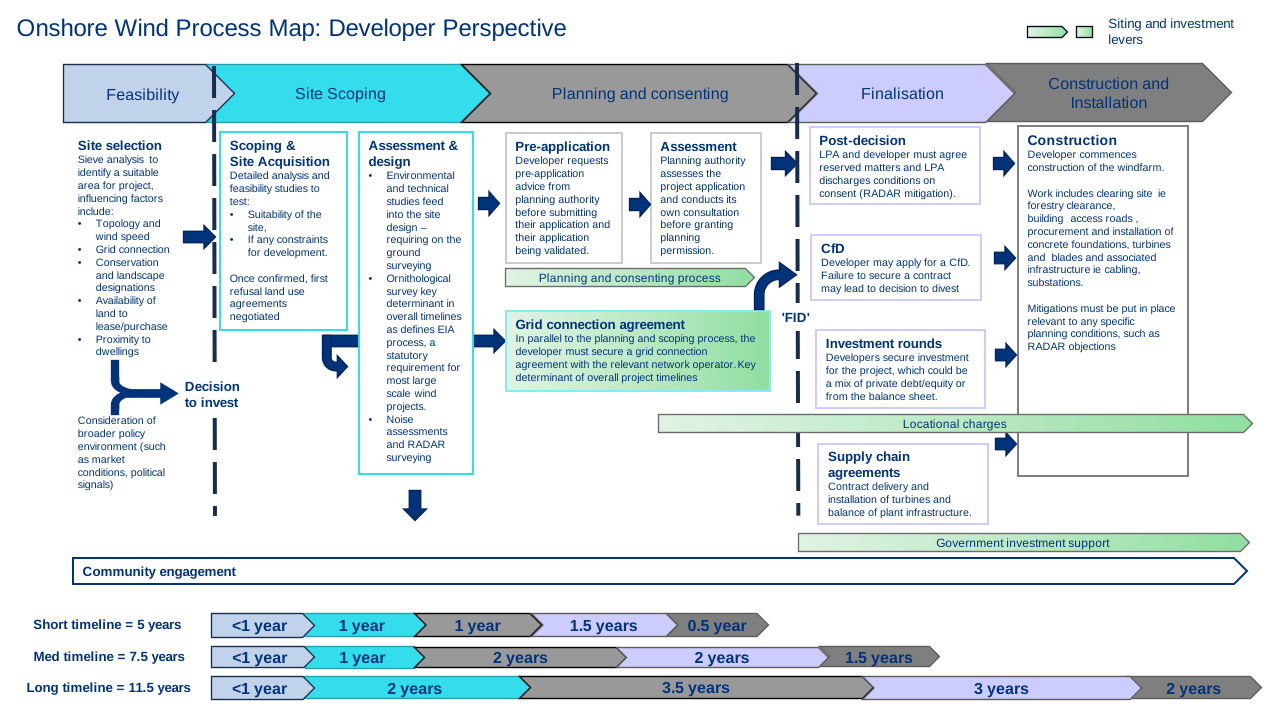
Figure 2: When in a project’s development lifecycle the levers (green arrows) currently influence a project, using onshore wind as an illustrative example. This graphic was produced based on the onshore wind task force and data provided by industry[footnote 8].
The levers we consider are important to deliver the SSEP are:
1. Network build – the SSEP Pathway will be used as the basis for the Centralised Strategic Network Plan (CSNP)[footnote 9] for transmission infrastructure (along with NESO’s Future Energy Scenarios now evolving into Future Energy pathways) to meet the future network requirements. The CSNP will set out how much network will be built where and when, based on the CSNP planning line set out in the SSEP Pathway and therefore it will also provide an important and clear signal to generation. The output of the CSNP will be an approved Great Britain level plan, which sets out new reinforcement projects to meet future energy network capacity need and can be put in place through Ofgem’s electricity network price control regime.
2. Seabed leasing – Seabed leasing rounds determine where offshore projects can be developed and are also key to the sequencing of new offshore clean energy projects. It is important to note that a significant proportion of Great Britain’s seabed has already been leased in previous leasing rounds or is used by other marine sectors such as fishing or shipping, interconnectors, telecoms cables and CCUS.
In relation to the SSEP, NESO are working with the devolved governments, The Crown Estate and Crown Estate Scotland to model the marine elements of the SSEP. Alongside these organisations, the government is assessing a range of potential options and considerations for seabed leasing, to align future seabed leasing with the SSEP capacities and zones. In particular, this includes considering if and how seabed leasing can align more with other RNP siting and investment levers, such as with the connections regime and CfD allocation rounds, and the benefits and drawbacks of doing so. Reform to this lever would look to build on where future seabed leasing rounds are already being reformed to align seabed leasing with other processes such as grid connections, network planning, and marine spatial plans. Each option considers: how seabed leases may align with SSEP locational outcomes; interactions with planned processes under the CSNP; and how to align practices in England, Wales and Scotland, recognising devolved competencies as leasing is devolved in Scotland. We will work closely with The Crown Estate, Crown Estate Scotland, the devolved governments and other stakeholders to explore if alignment with other RNP siting and investment levers, beyond what is already in train, would be appropriate and beneficial for industry and consumers.
3. Planning reform – This lever is about formalising the status of the SSEP within the Nationally Significant Infrastructure Project (NSIP) and local planning regime for England and Wales, governed by the Planning Act 2008 and Town and Country Planning Act 1990, respectively. The SSEP is referenced in the updated overarching National Policy Statement for energy (EN-1[footnote 10]) and the consultation[footnote 11] on updates to the National Planning Policy Framework. The UK and devolved governments will continue to explore additional options for formalising the status of the SSEP within our domestic planning regimes, as progress on the SSEP Pathway continues.
4. The Connections Regime – This lever is about aligning the connections process with the SSEP Pathway to reduce delays and ensure timely delivery of projects that have most strategic value. NESO and Ofgem are already prioritising generation and storage projects which align with the Clean Power 2030 Action Plan as a part of TMO4+ reforms, and we expect that the SSEP reforms will continue to build on these. As set out below in the options for how to combine the siting and investment levers, NESO, Ofgem and the government are considering a methodology that factors in the SSEP to determine connection offers for generation and storage. The ambition is to determine the optimal method that strikes the right balance between providing sufficient market liquidity and ensuring a coordinated approach to siting and investment.
5. Locational charges – Locational charges for generation assets connected to the transmission network are currently delivered through the Transmission Network Use of System (TNUoS) and connection charging regimes, which are managed by Ofgem. Connection charging recovers the costs of connecting new generation and demand to the network. The TNUoS regime recovers the costs of building, maintaining and operating the transmission network from users in different areas, enabling network companies to recover their costs. Depending upon how the siting and investment levers are combined (see the options described below), Ofgem and the government may reform locational charges to ensure consistency with the SSEP.
6. Generation and storage investment support mechanisms – Government and Ofgem support schemes may be used to help support the delivery of technologies in optimal amounts and/or locations consistent with the SSEP. Schemes include but are not limited to: the Contracts for Difference scheme, the Regulated Asset Base (RAB) model, the Hydrogen to Power Business Model, the power CCUS Dispatchable Power Agreement (DPA) business model, the CM, the interconnector cap and floor and the Long Duration Energy Storage (LDES) scheme. In addition to the siting signals currently sent by locational charges such as TNUoS, we will consider additional locational elements that could be included within our investment support schemes to help drive siting outcomes. The interactions between any reforms to the connections regime, locational charging mechanisms, and our investment support schemes, would need careful consideration as set out below.
How will the delivery levers be brought together?
The REMA Summer Update (July 2025) stated that we would implement an ambitious approach to RNP, and these reforms will support this government’s vision for a future power system which harnesses the benefits of greater strategic planning, as well as market reforms.
As outlined in the previous section, there are many siting and investment levers within scope, which cannot be viewed in isolation. They interact with each other to affect individual projects as they are developed, ahead of final siting and investment decisions. We therefore need to align and combine the different siting and investment levers in a comprehensive package, in a way which is consistent with our aim to support the delivery of the SSEP with maximum confidence and at lowest cost.
How the levers could combine
We believe that the policy levers to deliver the SSEP fall into 2 key groups. The first are ‘enabling levers’ (in particular: planning, seabed leasing, and also network build), which will play a similar role regardless of how the other levers work together, to align them with the SSEP and to enable delivery of the final SSEP at lowest cost.
We set out above our considerations in relation to planning and seabed leasing. In relation to network build, a key benefit of the transition to strategic planning is in allowing network build to commence ahead of need (and align with the SSEP and its associated levers like connections agreements), which would break the existing circular situation where strategic network build delays generation projects developing or coming online. As set out above, the SSEP will therefore inform the CSNP which will play an important role by setting the amount of new strategic network that should be built.
However, there are also trade-offs to consider about the interactions between network build-out and our expectations for the pace and location of generation build-out. Too much network build too early would leave this network under-utilised if there is not generation available to use it; but the reverse is also true – too much generation without networks will lead to more constraints. In addition, the date for connections agreements that can be taken up by customers is limited by network build and reinforcement. This includes both smaller transmission infrastructure reinforcements, such as upgrades to substations and larger transmission network reinforcements which will be designed in the CSNP. Certain strategically planned network projects can be considered “enabling works” prior to generation projects being able to connect. These generation projects have their connection date dependent on the delivery of network reinforcement.
Decisions on network planning and how much network to build or reinforce, where and when, will also therefore need to take account of our expectations for likely generation build-out. As set out below, there are a number of reasons why actual generation build-out may vary slightly from the precise CSNP planning line for the SSEP Pathway. For instance, this could be because new information emerges between SSEP iterations that might affect our view of the optimum mix of generation technologies, or to take account of the potential trade-offs set out below for instance in terms of the need to ensure value for money in the allocation of HMG investment support (e.g. through competition between projects).
The second group of levers are the ‘primary levers’, for which we have focused on the key choices to be made about how they can be combined to impact on siting decisions. The primary siting levers are the connections regime and locational charges, which both interact closely with our investment support schemes, e.g. the CfD scheme and CM. Note that these primary levers will be more impactful for technologies that are more flexible and competitive on location, and less impactful for technologies which are not.
These primary levers will drive siting decisions and the delivery of the SSEP with maximum confidence and at lowest cost. For instance, decisions on the network capacity to be made available to each technology in each SSEP zone impacts how many connections agreements are allocated, which affects the levels of competition between projects for HMG investment support. Similarly, decisions on locational charging will affect the geographic distribution of which projects are successful in securing investment support. Additional locational elements could also be included within our investment support schemes to help drive siting outcomes, building on the mechanisms utilised in the AR7 allocation round for offshore wind to address inframarginal rents.
There are a limited number of ways in which these primary levers can be combined into a coherent and cohesive package of reforms to deliver the SSEP, once it is endorsed. Each option illustrates a very different approach, with the different primary policy levers playing a different role in supporting the delivery of the SSEP and a more strategically planned power system.
When considered in combination with our investment support schemes, we think the key options and their main differences revolve around the role and level of directiveness of:
(i) the connections regime, which can be more or less “directive”; and (ii) locational charges (such as network and connection charging), which can be stronger or weaker.
Table 1: Grid showing the different options for combining the primary levers.
| Locational charges | |||
|---|---|---|---|
| No/lesser role | Stronger role | ||
| Connections regime | Permissive | Permissive connections, no/lesser role for locational charges. Option 0: would remove locational charges compared with the status quo. | Permissive connections; stronger role for locational charges. Option 1: relies on locational charges to achieve siting outcomes. |
| Directive | Directive connections; no/lesser role for locational charges. Option 2: relies on the connections regime to achieve siting outcomes. | Directive connections; stronger role for locational charges. Option 3: uses both the connections regime and locational charges to achieve siting outcomes. |
There is also a “hybrid” Option 4 which combines Options 1-3 for different technologies at the same time.
We acknowledge that some technologies, such as nuclear, would be unlikely to respond significantly to some siting and investment levers and may require additional strategic planning. To be clear, the Options in the table would apply the same regime across all technologies, even if they might respond in different ways; Option 4 would mean applying different regimes to different technologies.
Connections regime
We view the connections regime as a primary lever to determine the location of generation as part of the move to a more strategically planned system, as all generation and storage projects above the Transmission Impact Assessment Threshold require a transmission connection.
The SSEP will build upon the reforms set out in the Clean Power 2030 Action Plan, NESO’s recent reforms to the connections queue[footnote 12], and Ofgem’s recent announcement of reforms to accelerate grid connections.[footnote 13]
Under the TMO4+ reforms,[footnote 14] projects are prioritised based on readiness and their strategic importance for achieving Clean Power 2030 (see box below).
Clean Power 2030 connection reforms
In April 2025, Ofgem approved the electricity grid connection reforms known collectively as TMO4+. This new system replaced the old “first come, first served” model with a “first ready, first needed, first connected” approach, designed to speed up grid connections for viable projects that support the government’s clean power objectives. Under TMO4+ “readiness” and “strategic alignment” criteria are applied by NESO to the existing connection queue and will also be applied to new applicants in future connection windows.[footnote 15]
-
Readiness Criteria: Developers must secure land rights (ownership/lease/option) or have planning consent (Development Consent Order route) to progress.
-
Strategic Alignment: Prioritises projects crucial for meeting energy goals, or aligned with the Clean Power 2030 Action Plan.
Additionally, the Clean Power 2030 Action Plan sets out regional capacity allocations from 2031-35 for solar, onshore wind and batteries[footnote 16], as well as non-regional specific ranges for other technologies[footnote 17] to provide developers and investors with a 10-year horizon for connection offers. These capacity allocations are mainly derived from NESO’s 2035 Future Energy Scenario (FES) 2024, with a bespoke approach for onshore wind and unabated gas, and will underpin connection offers out to 2035; bridging the Clean Power 2030 Action Plan and the SSEP. The SSEP will cover the period from 2030 to 2050 and will build on the critical infrastructure identified in Clean Power 2030 Action Plan, setting out a longer-term vision for the power sector.
Projects are either prioritised for a Gate 2 connections agreement if they meet the readiness and strategic alignment criteria, or they receive a Gate 1 offer with a view to progressing to Gate 2 if readiness/strategic alignment is demonstrated in a later application window. Alternatively, projects which receive a Gate 1 offer have the option to agree to terminate their connection request.
As part of RNP, we will build on the approach set out in TMO4+ such that strategic alignment criteria will, in future, include the SSEP to prioritise connections across Great Britain. Under this approach, the SSEP will inform limits as to the maximum volume of connections agreements that will be prioritised for different technologies within each SSEP zone. One option would be to use the CSNP planning line from the SSEP Pathway, for each technology and zone, to inform these limits. However, this would not take into account the need to allow for competition within allocation mechanisms or project attrition rates, as it is likely that not all projects receiving a connection agreement will go on to construction and commissioning. If not enough connection agreements are allocated to replace these new projects which have not delivered, this could even raise security of supply considerations. Therefore, as part of RNP we are considering a new concept of ‘Connection Capacity Thresholds’, which would be informed by, but potentially different from, the CSNP planning line. We are seeking views on this concept (as outlined in the consultation questions below) and the design and method for setting these thresholds and how they are met, (which generation projects should receive a connection agreement up to the threshold), will be determined through further policy development.
This raises 3 key questions regarding the role of the connections regime under RNP:
- Firstly, how directive should the connections regime be? We could have a more directive approach (in other words, Connection Capacity Thresholds act as a strict filter on connections) or a more permissive connections regime (no firm thresholds set for connections, with industry using the CSNP planning line only as a guide). Under our proposed set of Options for illustrating the key choices in delivering the SSEP, the connections regime would be more “permissive” in Options 0 and 1, and more “directive” in Options 2 and 3.
- Secondly, where to set any Connection Capacity Thresholds in relation to the CSNP planning line for each SSEP technology and zone. There is a policy judgement to be made around where best to set the Connection Capacity Thresholds. There would also be judgements about whether to adjust this threshold higher or lower as needed, to allow adaptability and enable a more strict or flexible approach over time. Factors such as likely project attrition rates, the role different technologies play in ensuring electricity security, and the role of competition between projects including for HMG investment support, could all be relevant here. This judgement would also depend on decisions on the precise location of the CSNP planning line relative to the SSEP Pathway uncertainty ranges. Under our proposed options below, under Option 2a the Connection Capacity Thresholds would be set to align with the CSNP planning line within the SSEP Pathway for each technology and zone, while under Option 2b the Connection Capacity Thresholds would be set higher above the CSNP planning line for each technology and zone.
- Thirdly, under any approach to implementing RNP, a methodology would need to be established for prioritising which projects should receive connections agreements, up to any Connection Capacity Threshold for that SSEP technology and zone. This methodology would be particularly important where the Connection Capacity Threshold was set to align with the CSNP planning line, as there would be limited further opportunity to deprioritise lower-value projects at a later stage.
We will additionally focus on these connections reforms relating to the transmission network (including distribution connections that impact on transmission). A material amount of new generation, as well as most demand, connects to the distribution network. Where specific projects have an impact on transmission then these are captured by our proposed connections reforms. The scale of distribution generation and storage assets as well as behind the meter generation and storage that does not need a connection agreement, may be expected to rise in the future, and will not be covered by this SSEP lever. Instead Ofgem’s proposals for RESPs will look to drive strategic DNO investment in capacity upgrades and new connections, to drive action at this level.
Locational charges
Locational charges should reflect the system costs of building generation in different locations, that would not otherwise be accounted for by developers. Currently locational charges for the transmission network are delivered by Ofgem through the transmission network charging regimes (TNUoS and connection charges). They reflect the costs of adding new generation to the existing network in different locations. Typically, TNUoS charges for generators are higher further from demand centres, and lower (or even credits) closer to demand centres. Overall, the total amount recovered from consumers from network charging is limited to what network operators need to recover their costs.
The purpose of any locational charging regime is to make network users face the costs and benefits of connecting to the network in different locations. This should then incentivise network users to connect in locations which are most beneficial to the whole system, rather than just to them individually. To achieve this, locational charges need to recover both the costs of the local network assets required to connect new generation or demand (connection charges) and the marginal costs or benefits to the whole network from adding additional generation or demand in different locations. Broadly, marginal network costs or benefits can be estimated through 2 different approaches. This can be done either by considering the long run marginal costs (LRMC) of the network, which is the approach currently taken for TNUoS and involves estimating the costs of expanding the existing network. Alternatively, this can be done by considering the short run marginal costs (SRMC) of operating the existing network with additional generation / demand (additional constraint costs). Over an asset’s lifetime, the 2 approaches will tend towards the same outcome, assuming network reinforcements are made when it is economically efficient to do so. Ofgem’s Call for Input on locational charging, published ahead of this Delivery Plan, explores the potential approaches to locational charging further.
Whichever approach is taken, it is important that locational charges are able to represent marginal network costs or benefits, which vary over time and across locations, accurately and comprehensively. For example, by accounting for where network build is lagging behind generation build i.e. inefficient levels of network constraints are present. This is not represented in the current approach to TNUoS. In order for the charges to create effective incentives in the real world, network users also need to be able to sufficiently predict and respond to them ahead of final investment decisions. And the charges for an asset must then be stable from the point of the final investment decision onwards: otherwise this uncertainty is likely to increase investor cost of capital, with the risk that this is simply passed onto billpayers in the form of higher strike prices or investment costs. There is therefore a trade-off between the accuracy of the charges, and the ability of users to rationally respond to them, as well as the need to maintain stability after investments are made. A highly accurate charge that cannot be accounted for by network users well ahead of the point of investment, and varies significantly after the final investment decision, may not be as effective in changing behaviour as a more simplistic charge which is stable, and can be easily foreseen and planned around. There will be an optimum level of accuracy where the overall benefits of the charge will be maximised, such that most of the nuances of marginal network costs are captured, but the charges are still sufficiently stable, and easy to predict and respond to ahead of final investment decisions.
In addition to the above considerations, any locational charges will also need to achieve the following:
- Be implemented through a suitable institutional framework and change process that enables the optimal trade-off between accuracy and predictability / stability to be delivered.
- Be sufficiently granular (including by technology) to deliver the SSEP, whilst also being deliverable.
- Ensure that Transmission Owners (TOs) revenues are stable and reliable.
- Harmonise with other locational charging regimes such as Distribution Use of System (DUoS) and transmission loss multipliers. In due course, we will need to give consideration to locational charges on the distribution network.
As part of RNP, we are therefore considering the role that locational charges could play in a more strategically planned system. There are a number of key questions for this, as set out below:
- Firstly, whether to have locational charges at all;
- If locational charges were to continue to play a strong role in driving siting outcomes across the power system, we would also need to consider:
- Whether locational charges should be based on the costs of adding to the existing network or to the future planned network that will be built according to the CSNP (based on the SSEP Pathway);
- How best to implement any future locational charging regime, including the interactions with our investment support schemes.
Firstly, there is a choice about whether to have locational charges at all. One option would therefore be to remove locational charging, or to leave only a very weak residual role for locational charging e.g. to provide a signal within SSEP zones. Instead, we would rely on the connections regime to drive siting outcomes across the power system and deliver the SSEP. This would be the approach taken under Option 0 and Option 2.
Alternately, we could retain a strong role for locational charges, as set out under Option 1 and Option 3. If we were to do this, there is then a choice about whether we retain an approach that reflects the connection and marginal network costs that adding new assets to the existing network creates in different locations, which is similar to the current approach taken under TNUoS. Or whether we opt for a new approach which considers the connection costs and the marginal network costs of adding new assets to the existing network, and also modifies the charges to account for the future planned network that will be built according to the CSNP (based on the SSEP Pathway).
In both cases, we would need to consider the general requirements for, and potential approaches to, any locational charging regime, as set out above. There are advantages and disadvantages to each approach, which we explore further below.
In order to account for planned network build that has been committed to through the CSNP in the locational charging regime (in addition to the existing network), we would need to add additional network which has not yet been built (based on the CSNP) into the network model that is used to calculate charges. The model currently used to set TNUoS charges is based on the existing network only. Adding planned network build to the model would modify the charges in different locations, reflecting where there is expected to be additional network capacity in the future due to the CSNP. This should make the charges more accurate over the long-term, as they will reflect both the existing system and planned network build. It should also make the charges more likely to guide outcomes in line with the SSEP Pathway.
However, adding planned network build into the network model that is used to set locational charges would also significantly increase the complexity of the model, as compared to a modelling approach based only on the existing network. The modelling approach used for TNUoS is already very complicated, and we would be creating an additional layer of complexity. For example, we may need to consider how to take account of the date that future reinforcements would be expected to be delivered i.e. the model may need to contain a new, temporal element. We would also need to consider how to take account of any delays to planned network build, and any ambiguity that may exist in the CSNP e.g. where certain network reinforcement options may be left open until a later date.
This potential new approach to the modelling of locational charges could also make it more challenging to meet the general requirements for a locational charging regime. In particular, an approach which was based on adding an additional locational charging component to account for the future planned network within each of the individual SSEP zones could create further challenges in ensuring predictability for investors, as the additional component in the locational charge would need to change as generation is built in each individual SSEP zone and spare capacity on the future network is filled. This may result in an overall charge which is difficult to predict well in advance of final investment decisions, even if it is then stable over the lifetime of the project. It could also create particular challenges for HMG investment mechanisms which secure a large amount of generation capacity at the same time (e.g. in the same auction round), rather than on a project by project basis. This is because if, within an individual SSEP zone, significantly more capacity was entering an auction than would be required to meet the plan, then an additional “plan-reflective” locational charging component might seek to incentivise the first generation projects within that SSEP zone but then disincentivise further generation projects. This could be challenging to achieve in a way which both accurately reflects the plan and is predictable for investors.
There could also be an increased risk of excess inframarginal rents in particular locations arising from an additional “plan reflective” locational charging component. This is because we would be adding an additional component to the locational charge (to reflect future network build and therefore guide developers towards the plan), which could then further increase the bid of the marginal generator in our auctions. Our auctions are pay-as-clear, meaning that all successful projects receive the same clearing price as the marginal project. The difference between the clearing price and the bid price is referred to as inframarginal rent. There are good reasons to operate our auctions like this – it prevents strategic bidding, incentivises innovation, reduces costs in the longer-term, and increases competition and efficiency. However, adding additional charges to the marginal generator may further increase the bid of that generator and therefore result in excess inframarginal rents to other generators. Supporting reforms to our investment support schemes may therefore be needed in order to minimise any excess inframarginal rents that could arise as a result of reforming locational charging, whilst maintaining a pay as clear model and an efficient level of inframarginal rents.
Ofgem’s Call for Input on locational charging, published ahead of this Delivery Plan, explores the options for a plan aligned locational charge further.
We remain committed to delivering reform to TNUoS as soon as possible within this Parliament.
Interactions with our investment support schemes
As set out above, there are a range of ways in which the connections regime and locational charging could be reformed to deliver the SSEP. The interactions between the options for reforming other siting and investment levers and investment support schemes will be important. We will need to consider how we ensure continued investor appetite to bring forward a strong project development pipeline.
In particular, we will consider:
- Liquidity: sufficient liquidity is needed to enable efficient competition between projects, driving innovation and keeping costs as low as possible for billpayers. Should a directive connections regime be utilised through the use of Connection Capacity Thresholds, NESO and the government will need to consider how to determine connections offers for generation and storage in a way which enables a strong pipeline of project development and strikes the right balance between providing sufficient auction liquidity and a coordinated approach to siting and investment.
- Risk of mis-aligned locational outcomes: developers will seek to maximise their private returns. This typically results for instance in renewables projects being proposed where it is sunniest / windiest. However, these may not always be the best locations when considering whole system costs, such as the impact on constraint costs. Without intervention it could result in auction outcomes or investment decisions which are highly skewed towards projects in certain locations, regardless of whether that is best for the system and overall costs. Capping the volume of connections offered in different zones can reduce the degree of this skew and support a directive approach to supporting the delivery of the SSEP. Locational charging and locational elements within our investment support mechanisms can also influence the projects that enter or are successful in any auction.
- Excess inframarginal rents: pay as clear auctions drive competition and cost reduction, and avoid strategic bidding. But they also mean that any locational charge which is applied to the marginal generator can result in excess inframarginal rents for generators in other locations, increasing the overall costs of the auction, if it is not offset by other factors that impact on costs and revenues. The costs of these excess rents are ultimately borne by consumers. We will therefore need to consider how to minimise any excess inframarginal rent arising in the design of locational charges, including any implications for our investment support mechanisms.
- Predictability: the SSEP itself will provide an important new long-term investment signal. As discussed above, it is important that any locational charging regime creates signals that are sufficiently predictable ahead of their Final Investment Decision (FID), and sufficiently stable over the lifetime of projects, in order to drive an effective response.
- Adaptability: ensuring that our siting and investment levers can be adjusted as needed for instance to reflect uncertainties, bring us back closer to the SSEP Pathway, or if real-world conditions diverge from SSEP inputs (e.g. changes in technology costs), whilst giving sufficient investor certainty.
We will explore the extent to which existing investment support schemes can support delivery of the SSEP and wider strategic system requirements. For example, this could include the use of locational maxima or minima, or of measures to address locational inframarginal rents within individual auctions or allocations, or a move to locational auctions for SSEP zones or groups of zones. If further changes are needed, we will consider the most appropriate route, including amendments to scheme design and, if necessary, additional legislative measures. We plan to engage with stakeholders on these issues at the appropriate time.
Options for combining the levers
We have developed a set of options to illustrate the different ways in which the connections regime and locational charging could combine to provide a coherent set of siting signals in practice. We discuss below their potential benefits and downsides.
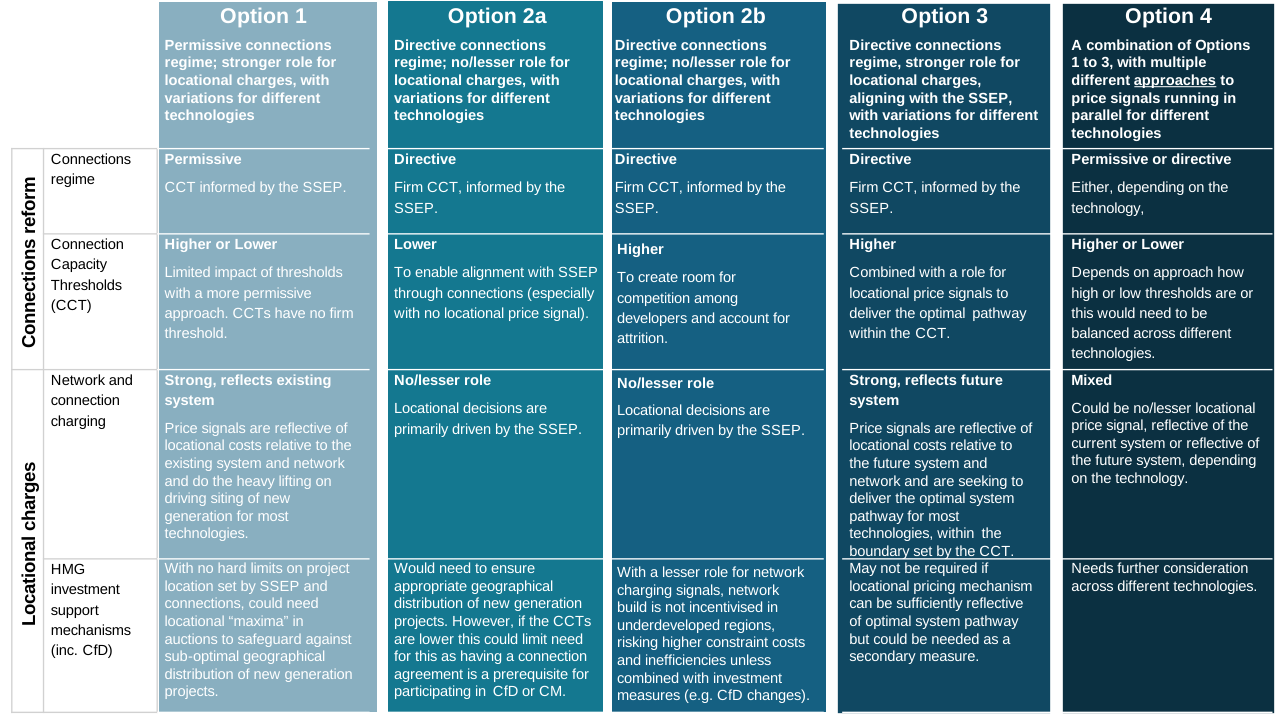
Figure 3: Core options to combine the different siting and investment levers.
Initial assessment of the options for combining the levers
Summary of assessment criteria
With reference to our RNP objective to deliver the SSEP with maximum confidence and at lowest cost, we have used 4 key assessment criteria to evaluate the options qualitatively, (including those in Figure 3 and Option 0 in Table 1), using the policy detail available. The criteria for assessing the options for how the levers could combine to deliver the SSEP include system efficiency, deliverability, investor confidence and adaptability.
| Criteria | Explanation |
|---|---|
| System Efficiency | Delivered in a way that effectively influences decisions around siting of generation and is aligned to delivering the SSEP and facilitating a low-cost electricity system by ensuring effective competition, limiting excessive inframarginal rents, addressing key market failures (e.g. negative externalities) and has positive impacts on consumers. Design of locational signals should ensure cost reflectivity - whether based on incremental network costs, total network value, or broader system costs as outlined in the plan - in a way that effectively influences siting decisions. |
| Deliverability | Options can be implemented in time for the SSEP’s introduction in 2030 and is compatible (causes no/minimal disruption) to the Clean Power 2030 objectives. The cost of implementation should be proportionate and not so high as to either offset the potential benefits reform could deliver, or lower investor confidence in delivering near-term projects. |
| Investor Confidence | Provides for certainty over costs and implementation timelines for investors and industry as well as providing a stable environment in which to attract investment. The methodology used should be transparent and readily understandable by all market participants. |
| Adaptability | Options are flexible enough to adapt to key future uncertainties. Including around future demand for electricity, project attrition and the risk of real-world delays, changes in technology costs etc. |
Each option was assessed on the basis of these criteria and where options failed one of the assessment criteria, we propose they are discounted.
Options we are proposing to discount
Based on our initial qualitative economic assessment, we consider that Options, 0, 1 and 4 are not suitable to be taken forward and therefore should be discounted.
Option 0 (permissive connections regime and no/lesser role for locational charges) - failed the system efficiency criteria as well as weakness with respect to adaptability. Under Option 0, locational siting signals would be extremely weak. This would lose the key benefits of greater strategic planning, especially the stronger join-up between where our generation and network is located. We would likely see significant constraint costs for billpayers, and significant inefficient investment in both generation and network (i.e. we would need to build significantly more network or generation capacity than in a more efficient system). We therefore believe that Option 0 would fail to deliver the potential benefits from moving to a more strategically planned system, as set out in the SSEP. Figure 3 therefore sets out the remaining core options for combining the levers.
Option 1 (permissive connections regime, stronger role for locational charges) - failed the system efficiency criteria as well as weakness on investor confidence and adaptability. Without a stronger role for the connections regime, there is a risk that siting decisions lead to a different outcome from the SSEP Pathway, because we will be relying entirely on locational charges and how developers respond to those charges. There are significant challenges to creating a locational charge which reflects the plan (discussed above), which may mean that this is not possible. This could lead to a mismatch between where new generation capacity is located and where network is planned to be built or reinforced under the CSNP. Any misalignment means there is a risk of continued constraint costs as well as potentially inefficient investment in both generation and network. In addition, as set out above there are significant challenges to creating a locational charge which both accurately reflects the plan and is investible.
Option 4 (hybrid option with multiple different approaches to locational charges running in parallel for different technologies) - failed the deliverability criteria as well as weakness for the system efficiency criteria and investor confidence criteria. Under Option 4, the approach to locational charging would be different for different types of generation, reflecting their unique characteristics and system needs. For instance, some generation technologies would not face any locational charges, while locational charging based on the existing network could apply to certain technologies and locational charging based on the future, planned network could apply to others. This is distinct to options 1, 2 and 3 in which a single approach to locational pricing would apply to all technologies, but there could still be different charges applied to different technologies within that overarching approach. Option 4 would be very complex to implement and operate, in particular with the requirement for multiple different locational charging regimes operating in parallel. This would be made even more complex as some of these technologies may be co-located at the same site or compete in the same support schemes e.g. the CM. There would also be difficult choices about which technologies or projects would be subject to which charging regime, with the risk of creating additional distortions which might lead to consumer detriment. Due to its complexity, this option therefore presents significant challenges in deliverability and implementation.
Options we recommend taking forward
We believe that Options 2 and 3 are most likely to deliver the SSEP with greatest system benefits, effectively addressing market failures and driving system efficiency, at lowest cost for consumers. We are therefore minded to pursue one of these options, in combination with any necessary changes to our investment support mechanisms and enabling levers.
Under Option 2, the primary lever to drive generation siting would be the connections regime to ensure that it aligns with the SSEP. Connection Capacity Thresholds, as set out above, would act as a strict filter on the volume of connections that could be allocated per technology and SSEP zone. There would be no or a relatively lesser role for locational charges in determining which projects get built. There are therefore 2 key decisions that underpin Option 2. These are where to set the Connection Capacity Thresholds for each SSEP technology and zone in relation to the SSEP Pathway and which generation projects should receive a connection agreement, up to the threshold.
The benefits and risks associated with this option are likely to vary depending upon where we set the Connection Capacity Thresholds, so we have constructed 2 sub-options (Options 2a and 2b) to illustrate the key considerations here. This includes how these options might interact with our investment support mechanisms, such as the CfD or CM, as well as the interaction between generation and network planning and build-out.
One approach (Option 2a), would be to set the Connection Capacity Thresholds to align with the CSNP planning line within the SSEP Pathway.
Under Option 2a, there would therefore be a strong likelihood that actual generation build would closely follow the SSEP, which would mean that we could also plan our network buildout to be closely aligned with the SSEP Pathway itself – reducing the need for additional network construction. This should also result in a close match between actual generation and network buildout, and low constraint costs. Option 2a would be particularly effective if project attrition rates are low once connections agreements have been allocated. However, there are limited levers to incentivise additional generation (of a given technology type) in any SSEP zones where capacity does not reach the SSEP Pathway. Option 2a also significantly limits the number of projects that can secure a connection agreement, reducing liquidity and competition for investment support such as CfD, which may increase the cost of individual generation projects. There may also be a risk of excess inframarginal rents for projects in some locations. It also carries risks if real-world conditions diverge from SSEP inputs, and additional connection agreements would need to be allocated for some technologies if we believed that there was an emerging risk to security of supply. And it places a heavy reliance on the methodology for prioritising projects for connections agreements, as the connections regime is the primary siting lever.
Table 2: Summary of the advantages and disadvantages of Option 2a.
| Advantages | Disadvantages |
|---|---|
| - Good probability of delivering generation build at or very close to the SSEP Pathway, improving overall system efficiency. - Greater confidence that outcome will be close to the CSNP Planning Line within the SSEP Pathway means we can build less network. - Approach well-suited for scenarios where we have high confidence in accuracy of SSEP modelling, real-world delivery will proceed to plan across all technologies, low rates of project attrition etc. - Approach well-suited if we are highly confident in our ability to prioritise the right projects for connection agreements. |
- Fewer projects get a connection agreement, therefore low liquidity / limited competition for HMG investment support. - Higher costs for generation build as a result. - Limited adaptability. The real-world may diverge between SSEP iterations. - Potential risks to security of supply, if not enough connections agreements allocated overall (or due to high project attrition rates once allocated). - Potential for high infra-marginal rents for some technologies and zones. - Limited levers to incentivise additional generation in zones where generation build is lagging. |
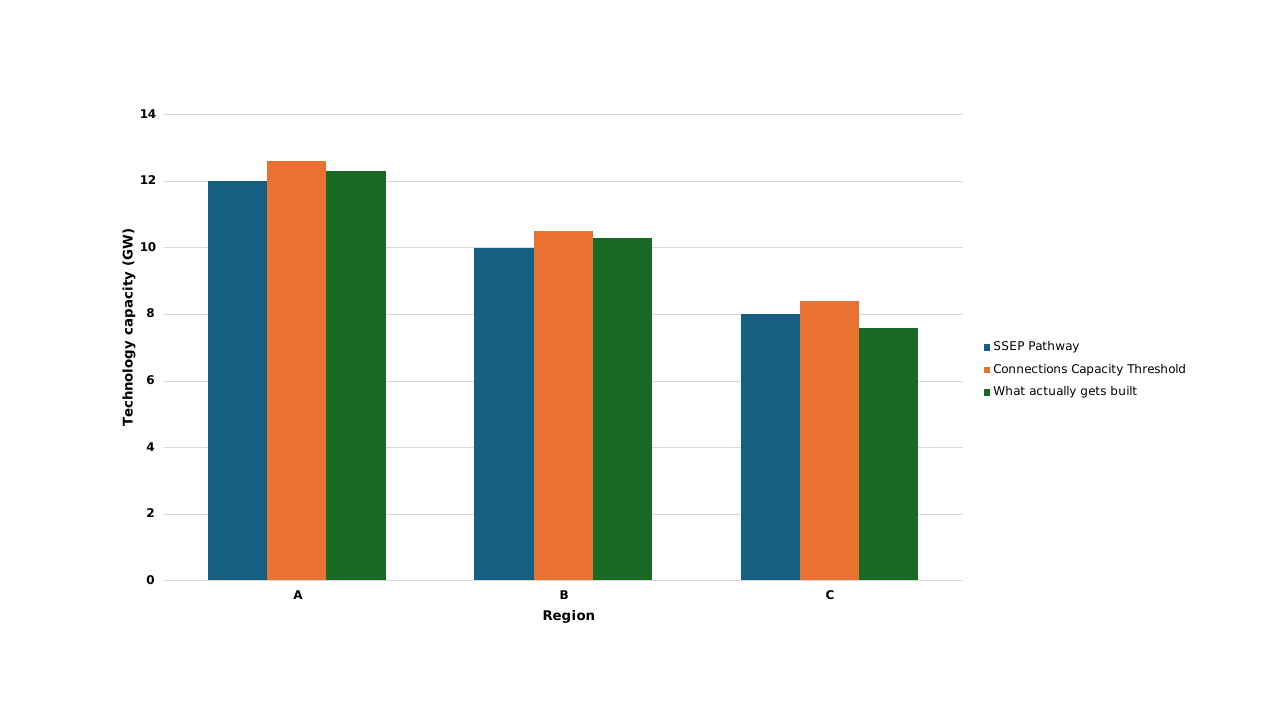
Figure 4: Illustrative scenario for Option 2a - Illustrative examples for setting the Connection Capacity Threshold marginally above the CSNP planning line.
In a scenario where the Connection Capacity Thresholds are set higher above the CSNP planning line for each technology and zone (Option 2b), there would be increased liquidity and competition for investment support, making the system more resilient to modelling inaccuracies, project attrition rates, and real-world developments between SSEP iterations. It also reduces reliance on the methodology for prioritising projects for connections agreements.
However, this approach increases the risk that the outcome in terms of actual generation build-out may diverge significantly from the SSEP Pathway. If the Connection Capacity Thresholds are set some distance above the CSNP planning line, without any locational charging regime we believe that developers will simply build in the locations that are most privately lucrative to them, without consideration to which locations have the lowest system costs for bill payers. This would likely result in developers building up to the maximum of the Connection Capacity Thresholds in some zones (e.g. where it is windiest or sunniest), and underbuilding in other zones (noting this could also be a risk for Option 2a). This would mean that those areas experiencing a generation overbuild would either require more network investment and/or result in higher constraint costs, while the network would be underutilised in those areas where developers had underbuilt generation. Under Option 2b we would therefore need to consider further if any additional mitigations may be required to ensure generation build-out aligns with the SSEP Pathway. To support this, a potential locational element could be considered as part of government investment support schemes.
Overall, this Option 2b could therefore result in an overall outcome that could be quite distorted compared to the final SSEP Pathway. Given that the final SSEP Pathway will be used to inform the network build plan (CSNP), deviating from the SSEP Pathway significantly could perpetuate issues with generation and network build being misaligned and high constraint costs. This could undermine the value of a more strategically planned system as set out in the SSEP and CSNP. In addition, there would also be a risk of excess inframarginal rents for projects in some locations, unless our investment support mechanisms were reformed to address this risk.
Table 3: Summary of the advantages and disadvantages of Option 2b.
| Advantages | Disadvantages |
|---|---|
| - Higher liquidity and therefore greater competition for HMG investment support. - Adaptability - more resilient to real-world changes between SSEP iterations, higher rates of project attrition, and to SSEP modelling not being fully accurate. - Places less weight on getting the prioritisation of projects for connections agreements exactly right. |
- Risk of a “gold rush” as developers build up to the max of the Connection Capacity Thresholds, in the most privately lucrative zones. - Likely under build in other zones, resulting in some under-utilised network. - Final outcome departing more from the SSEP Pathway would mean higher network build requirements overall and/or constraints, limiting system efficiency. - Potential for high locational infra-marginal rents for some technologies and zones. - Limited levers to incentivise additional generation in zones where generation build is lagging. |
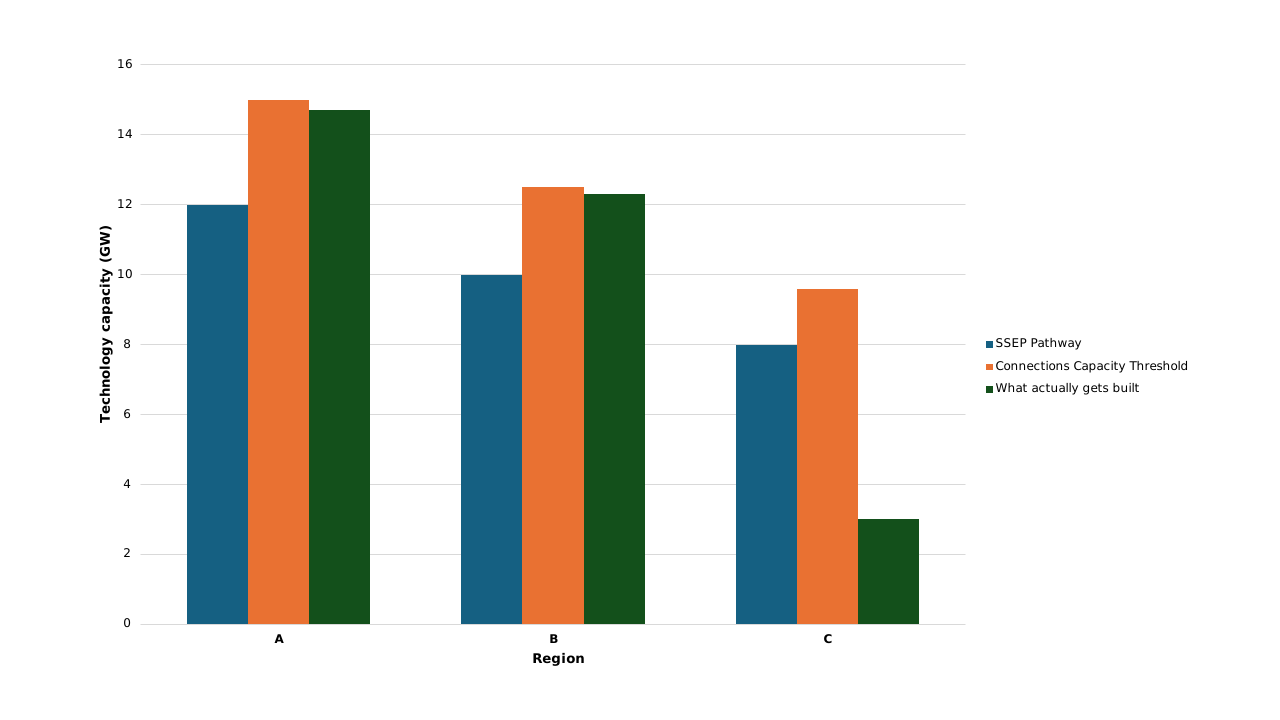
Figure 5: Illustrative scenario for Option 2b - Illustrative examples for setting the Connection Capacity Threshold higher than CSNP planning line.
Option 2 provides clarity to developers about the number of connections expected in each zone by technology and would be straightforward to understand and to implement, although the implications for our investment support mechanisms would need further consideration. The government therefore believes there is merit in keeping Options 2a and 2b for consultation, and is seeking views on how the potential risks and disadvantages set out above might be addressed.
Option 3 builds upon Option 2, so that both the connections process and locational charging levers drive siting outcomes. Firstly, as with Option 2, the connections regime sets the maximum volume of connection agreements that can be allocated by SSEP technology and zone. This Connection Capacity Threshold could be set some distance above the CSNP planning line for a SSEP technology and zone, which would enable more generation projects to secure a connections agreement. Locational charges as well as potentially the design of our HMG support schemes would then influence decisions on which of those generation projects proceed to FID and/or receive HMG investment support.
Option 3 could therefore address some of the limitations of Option 2, which relies mainly on the connections regime. Whilst Connection Capacity Thresholds can be used as a limit to prevent generation build from occurring significantly beyond the SSEP Pathway in a given zone, they would not be able to incentivise generation build in zones where generation build is lagging behind the pathway. Nor can Connection Capacity Thresholds provide developers with nuanced locational incentives or disincentives that reflect the system costs of different locations, and which zones are most and least in need of new generation, according to the SSEP Pathway. Finally, following NESO’s recent prioritisation of the connections queue, a significant volume of connections agreements have already been prioritised out to 2035. For some technologies, the volume of connections agreements allocated is equivalent to, or even exceeding, the 2035 permitted capacities as set out in the Clean Power 2030 Action Plan[footnote 18]. As we do not yet know what the final SSEP Pathway will be, it is difficult to know what projects, in terms of both technology and location, will be aligned with the SSEP. As some technologies are already at or exceeding the Clean Power 2030 ranges, we may need to find a way to ensure that the future projects proceeding construction are what are needed for the system through further prioritisation and filtering processes.
Under Option 3, this is therefore where there could also be a role for locational charging mechanisms. If the Connection Capacity Thresholds are set some distance above the CSNP planning line (as in Option 2b) to help provide the opportunity for greater competition (within investment support mechanisms or to account for project attrition rates) during project development, a locational charging regime, together with the design of our investment support schemes, could then be used to identify how much capacity to buy within the Connection Capacity Thresholds.
As for Option 1, under Option 3 we could either retain a locational charging approach that reflects the connection and marginal network costs that adding new assets to the existing network creates in different locations. Or we could opt for a new approach which considers the connection costs and the marginal network costs of adding new assets to the future planned network that will be built according to the CSNP (based on the SSEP Pathway).
We expect that combining the Connection Capacity Thresholds with locational charging mechanisms under Option 3 could increase the probability of delivering generation close to the SSEP Pathway, which also maintaining liquidity and competition for investment support. This could especially be the case if the locational charge is also based on future, planned network build in line with the SSEP and CSNP. This could in theory lead to the lowest-cost system, reducing network build requirements and constraint costs, while retaining the role of competition to keep generation build costs as low as possible. However, this option is more complex than Option 2 and would require significant reform of current locational charging mechanisms, particularly if creating a charge based on the future planned network, which could create deliverability challenges.
Depending on the approach taken to locational charging mechanisms, there could also be implications for the design of HMG investment support mechanisms, as discussed in the section above.
Table 4: Summary of the advantages and disadvantages of Option 3.
| Advantages | Disadvantages |
|---|---|
| - Higher probability of delivering at or very close to the SSEP Pathway, leading to greater system efficiency. - Can build less network as a result. - Higher liquidity and therefore greater competition for HMG investment support. - Adaptability - locational charging mechanisms can be “fine-tuned” between SSEP iterations, to take account of real-world delivery. |
- May require significant reform to current locational charging mechanisms, with deliverability challenges. - More complex approach to deliver than Option 2, especially if locational charging seeks to reflect progress against the SSEP in each zone. - Potential tension between ongoing “fine-tuning” of locational charging signals, and predictability for investors. - May still be a risk of locational inframarginal rents for some technologies and zones. |
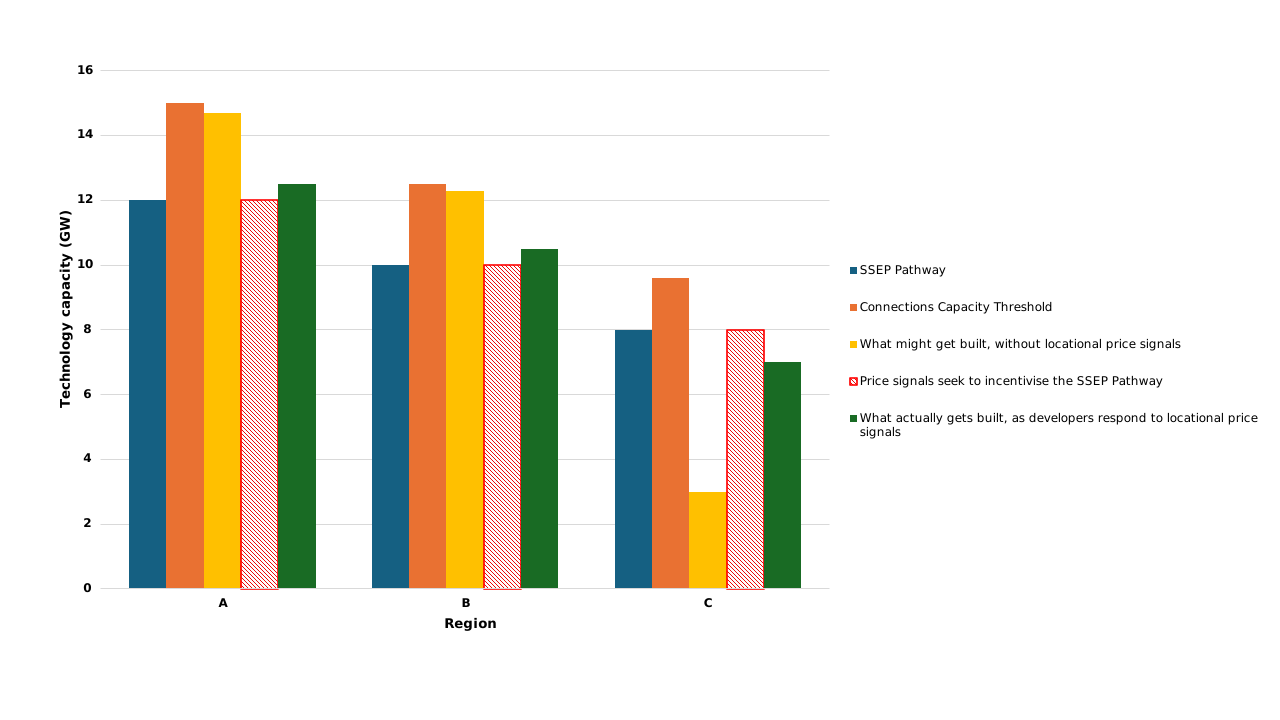
Figure 6: Illustrative scenario for Option 3.
In the hypothetical example in Figure 6, the arrows show the direction and strength of the locational charging signal in each zone, to incentivise this technology to build to the CSNP planning line, within the SSEP Pathway.
Transitioning to a strategically planned energy system
As well as considering the potential benefits to the electricity system and consumers as part of reforms to the siting and investment levers, we also understand that introducing such changes can naturally cause uncertainty for investors and those operating in the current market. We are keen to minimise any uncertainty as we move towards a more strategically planned power system with all the benefits that this will bring.
The government and Ofgem are therefore committed to developing a fair and transparent approach to transitional (investment decisions taken before fully implementing RNP and legacy (existing assets already on the system) arrangements. This will be essential for ensuring continued future investment, enabling the delivery of a low-carbon-based system at pace and for achieving clean power by 2030. We want to ensure that investors can have confidence in their decision-making and be assured that existing investments will be suitably protected against facing significant windfall gains or losses in the event of major reforms to the siting and investment levers.
We also recognise that moving towards delivery of the SSEP will take time, and some levers may be able to both be implemented and have an effect earlier than others. In addition, the balance of levers may need to change over time, and we may need to consider additional levers for later iterations of the SSEP.
In particular, we recognise that TNUoS charges differ from other siting and investment levers in that they continue to affect generators beyond the point of investment and throughout the lifetime of their assets, with variable annual charges impacting both new and existing generation. As substantial reforms to the current TNUoS regime are likely in most RNP scenarios, it is essential to recognise the potential financial implications for investments made on the basis of the current TNUoS regime. Accordingly, the government will be supporting Ofgem to prioritise the consideration of legacy and transitional arrangements for TNUoS to maintain a stable and predictable investment environment for electricity generation in Great Britain.
The scope of any legacy and transitional arrangements for reformed network charging will be shaped by how different assets are positioned to respond to new locational signals under RNP. A key consideration will be the extent to which different assets can reasonably respond to changes in charges introduced under RNP, and how that ability varies across technologies, commercial arrangements and stages of project development.
Ofgem’s recent Call for Input sets out 3 broad approaches for managing the transition from the existing charging framework to RNP. One option would retain a parallel charging regime based on the current methodology, updated annually using the transport model. Alternatively, charges could transition either through a phased move from the existing regime to the future RNP approach, or through the introduction of fixed charges for assets deemed to be within scope.
Ofgem, as the authority responsible for TNUoS, are leading the development of the considerations for legacy and transitional arrangements related to TNUoS. Further details are set out in Ofgem’s recent Call for Input on locational charging. Feedback on these options should be directed to Ofgem through their Call for Input. This process will enable stakeholders to review the proposed thinking and provide direct feedback, ensuring that a broad range of perspectives inform any final approach.
Consultation Questions
DESNZ are consulting on potential reforms to the RNP siting and investment levers and how they could be combined, as outlined in this chapter.
It is important that the policy levers support the delivery of the SSEP to reduce total system costs and consumer bills by influencing the location of new generation and storage projects where the SSEP calls for them. Therefore, we are consulting on potential reforms to the key siting and investment levers and how they could be combined as part of RNP.
We are primarily seeking stakeholder views on the questions below. Stakeholder answers will assist in developing our future work in determining how these levers can be combined and to develop a comprehensive package of reforms.
Identifying Levers
Q 1a) Do you agree with the key levers that we have identified for supporting the delivery of the SSEP? Please provide rationale and evidence for your answers.
Q 1b) Do you think there are any other levers missing or alternatives that should be considered? If so, please list them and provide rationale and evidence for your suggestion.
Categorisation of levers
Q 2) Do you agree with how we have categorised the levers? Specifically
a) in your view, should Network Build, Seabed Leasing and Planning Reform be categorised as enabling levers; and
b) in your view should the Connections Regime, Locational Charging and Generation and Storage Investment Support Mechanisms be categorised as primary levers?
If no, please provide rationale and evidence for your answers.
Lever options – how to combine the levers
Q 3) What are your views on the overall strategic approach we have used for combining the levers into an options framework? For example, the logic and structure underpinning the options including the grid for how to combine the primary levers (Table 1).
Assessment criteria
Q 4) To what extent do you agree or disagree with the criteria we have used to assess the options? Please provide rationale and evidence to support your answer with particular reference to any other criteria that could be included in the assessment.
Initial assessment
Q 5) Do you agree with our preference for Options 2a, 2b, and 3 being suitable for further development with Options 0, 1 and 4 being discounted? Are there aspects of Options that you either think work particularly well, or that we should consider further? Please provide comments and further evidence to support your answer.
Q 6) How do you think the risks and disadvantages identified under Options 2a, 2b and 3 (as outlined above in this document) could be addressed?
Individual Levers – Connections Regime
Q 7a) - Do you think it would be practical to set Connections Capacity Thresholds for Options 2a, 2b and 3, by SSEP technology and zone?
Q 7b) How should these thresholds be determined? Please provide rationale to support your answer.
Q 8a) Should we set the CCT at a level higher relative to the CSNP planning line to allow for project attrition and competition in investment support schemes? (i.e. the difference between Option 2a and 2b).
Q 8b) If we set the CCT above the SSEP Pathway, what additional safeguards might be needed to ensure we keep within the SSEP Pathway uncertainty range?
Individual Levers – Locational Charging
Q 9) What are your views on the role of locational charging, and interactions with our investment support schemes?
Note that detailed questions on potential TNUoS and connection charging reforms are covered in Ofgem’s recent Call for Input.
Individual Levers – Government investment support mechanisms
Q 10) For Options 2a, 2b and 3, what, if any, changes or reforms would be needed to government investment support mechanisms (such as the Contracts for Difference, Capacity Market etc), and if so, what specific reforms would be needed?
We would welcome feedback from stakeholders on the questions outlined above by 2 June 2026. Please use this link to access the full set of consultation questions and provide your answers. Please use this link to provide your response to ensure all the intel required is captured in a consistent format and to aid our analysis. If you would like a hard copy of the consultation questions or there are any issues please direct your queries to RNPcorrespondence@energysecurity.gov.uk.
We aim to decide on the optimal combination of the RNP siting and investment levers to deliver the SSEP and set out our plans for developing the detail of exactly how each of the levers will be reformed in 2026.
Ofgem have also recently launched their Call for Input on locational charging. This sets out in more detail how the regulatory levers of transmission network and connections charging might be reformed to align with RNP and to support delivery of the SSEP. Ofgem are presenting options for the design of a locational charge which could deliver any of the preferred Options 2a, 2b and 3 being consulted upon in this paper. The Call for Input asks for stakeholder views on any additional proposals for design options and cover consideration of legacy arrangements with the transition to any new regime. Feedback on the design and implementation detail for locational charging should be directed to the Ofgem Call for Input.
Actions:
- Ofgem have launched their Call for Input on locational charging – they will aim to provide a response in 2026.
- DESNZ to provide a government response to the consultation following the conclusion of the consultation.
- DESNZ to consider how the levers might be combined and reformed with the aim of taking final decisions on how to combine the siting and investment levers to deliver the SSEP later in 2026.
Chapter 3: Constraints Management Action Plan
Historical context on constraints
One of the key roles of the NESO is to ensure that electricity can flow from where it is generated to where it is demanded. When there isn’t enough network capacity to transfer the amount of electricity required, constraints occur. Constraints are typically categorised into thermal, voltage, and stability-related issues, with thermal constraints making up the vast majority. A network that never had any constraints would not be efficient, as it would be oversized to handle infrequent system events, like extreme weather or network faults. Efficient electricity systems experience constraints, and these must be managed by the System Operator.
The challenge is that, currently, in Great Britain constraint costs are too high. There are many different factors that contribute to this, but the main drivers are:
- Historic underinvestment in the network in recent years has meant that the development of new network infrastructure has not kept pace with the rapid expansion of generation. This shortfall has led to insufficient transmission capacity, increasing congestion across the network.
- Delivery of transmission infrastructure has also been too slow. It was reported that, in the period between 2013 to 2021, the actual delivery of new transmission investment by Transmission Owners lagged by 32% relative to planned upgrades[footnote 19].
- The need for planned and unplanned outages can also reduce network capacity. Engineers sometimes require parts of the system to be taken offline to allow the network to be upgraded and maintained, and for new network projects, generation and demand to be connected. This is known as system access. Taking network infrastructure offline to support critical upgrades, can temporarily reduce the transmission capacity of the network, increasing constraints.
- Market participants have insufficient incentives to consider constraints in their trading activity. Better incentivising flexible assets to help manage constraints could reduce costs.
To balance the grid when constraints arise, NESO may make payments, for instance, to reduce output from a generator in an area with surplus generation (turn down actions), or to increase output from one located closer to demand (turn up actions). Conversely, some generators may make payments to NESO in exchange for being turned down, for example a gas plant that is turned down would make a saving on its fuel costs.
NESO selects which units to adjust based on both cost and location. Payments are made by NESO to units whose output must be adjusted due to insufficient transmission capacity, effectively compensating them for being unable to deliver electricity to where it is needed despite being available and scheduled to generate.
These actions, whether turning up or turning down generators, are managed through NESO’s BM to maintain system security. Payments to manage constraints are a feature of many electricity system designs and are present in most countries.
In 2024/25, NESO spent £1.34 billion[footnote 20] on direct actions to manage thermal constraints. Thermal constraints occur when there is not enough network capacity to transport electricity from where it is generated to where it is demanded. They arise from the physical limit to the amount of power which can be transmitted through any piece of equipment, where the limit is set to ensure that the equipment does not overheat or causes a safety issue.
The costs of balancing the system are spread across both turn down and turn up actions. In 2024/25 total wind generators were paid £370 million to turn down, i.e. to generate less power. Conversely, the cost of actions to turn-up gas plants to replace curtailed generation was £910 million, or roughly two-thirds of the total constraint costs in that year [footnote 21].
Future constraint costs
Without further mitigating action, current modelling estimates that constraint costs may peak at around £7 billion in 2030/31 (subject to network build and generation deployment scenarios), before declining as network capacity improves (Figure 7).
Figure 7 shows a projection of how thermal constraint costs could materialise from 2027-2035 using a network with the Norwich to Tilbury link and Sea-Link network reinforcement projects delivering in 2031. This projection illustrates potential constraint cost outcomes, the uncertainty range reflects the sensitivity to factors such as network build-out, outages and the deployment and location of renewable assets.
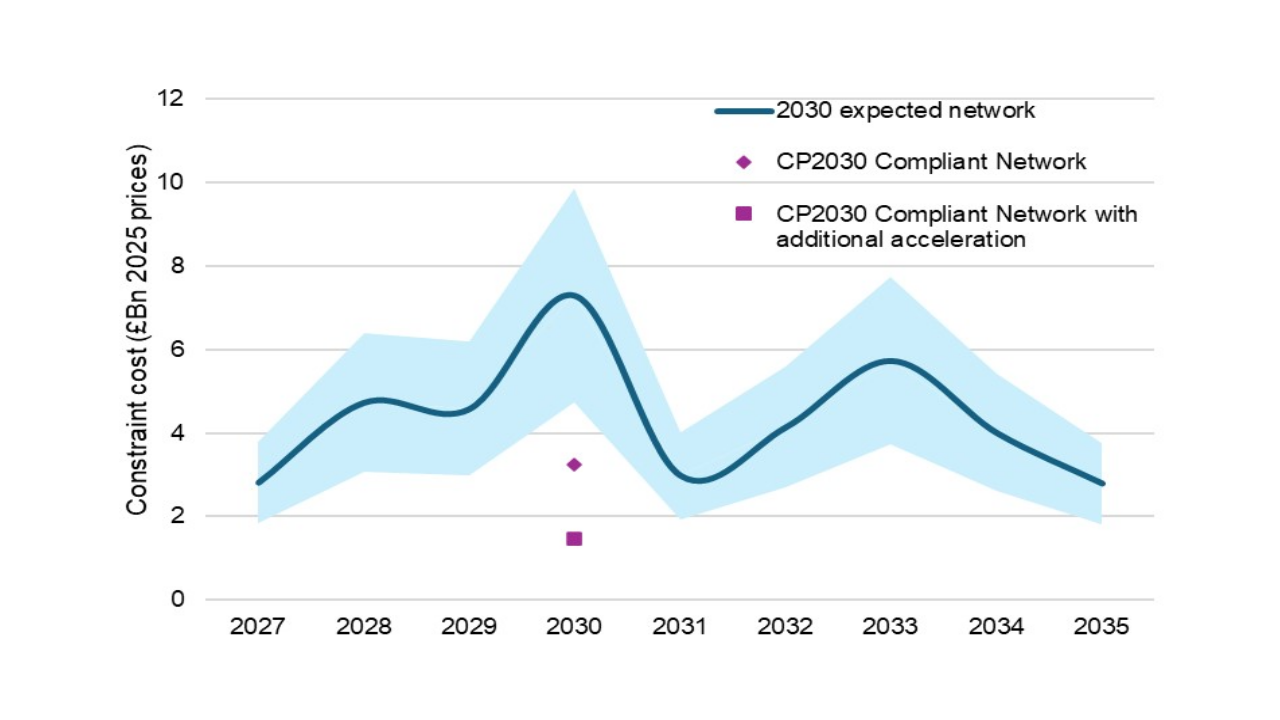
Figure 7: Projected thermal constraint costs (£ Billion 2025 prices) with an uncertainty range [footnote 22]. Data points in 2030 relate to variations of how constraint costs could materialise with different network capacity [footnote 23].
There are 3 main components to future constraint costs:
- Volume of constraints
- The cost of turn down actions
- The cost of turn up actions
While elevated gas prices could influence turn-up costs, we expect that in the short-term the primary driver will be the growing volume of thermal constraint actions, until key network reinforcement projects come online.
According to NESO[footnote 24], accelerating 3 key transmission infrastructure projects, Norwich to Tilbury (AENC and ATNC) and Sea-Link (SCD1) from completion in 2031 to 2030, could reduce this peak by approximately £4 billion as seen above in Figure 7 [footnote 25].
Managing constraints
There are 2 main ways to better manage constraint costs:
- Firstly, by reducing the actual volume of energy that is constrained, mainly via:
- Building more network
- Better coordination of system access, to facilitate network maintenance, upgrades and the connection of new projects.
- Getting more from our existing network.
- Secondly, by reducing the price paid to manage constraints, for both the prices of ‘turn-up’ and ‘turn-down’ actions.
This RNP publication sets out our plan to reduce constraint costs, in both the short, medium and long term. This builds on the work set out in the Clean Power 2030 Action Plan which will help alleviate many of the existing constraints by increasing transmission capacity. However, further measures are needed to efficiently manage constraints in the short term and reduce costs for consumers.
Taking Action to Manage Constraints
Working in collaboration with NESO and Ofgem, the government is pursuing additional measures that can reduce constraint costs in the short term, i.e. pre 2030 to reduce consumer costs as we accelerate the transition to a more flexible, efficient and clean power system.
The following sections set out both the concrete steps we are already taking and the further options we are actively exploring to lower constraint costs in the period before 2030. This list is not exhaustive, and the department is continuing to assess alternative approaches to mitigate the impacts of constraints on an ongoing basis.
A summary of the actions can be found in the table below:
| Area | Action |
|---|---|
| Network build and acceleration of network build | Government, NESO and Ofgem are driving urgent reforms to support network companies to deliver a transformational network expansion required for a Clean Power system by 2030, building on the Clean Power 2030 Action Plan we are: - Radically reforming the connections process to prioritise a ‘first ready-and-needed, first connected’ model. - Supporting accelerated connection of strategic demand projects. - Reforming planning and consenting, including through measures in the Planning and Infrastructure Act 2025. - Ensuring that regulatory planning and investment decisions enable investment in networks ahead of need, working with Ofgem to ensure network companies are incentivised to drive timely network build. - Ensuring that communities benefit from having new transmission infrastructure in their area: through new guidance on community funds and a bill discounts scheme for those closest to new transmission infrastructure. - Supporting the networks sector and supply chain industries to develop a Sector Growth Plan, as announced in the Industrial Strategy. - Reforming land access, rights and consenting so processes are fair, proportionate and will enable network infrastructure build. - Supporting the Energy Network Association (ENA)’s Moving the Grid Forward communication campaign. Supporting Ofgem’s work to ensure its price control process and wider regulation enable timely delivery of essential transmission infrastructure. |
| Accelerating construction | - DESNZ to work with TOs and Ofgem to explore measures to enable accelerated construction schedules for critical transmission works. |
| Dynamic Line Rating (DLR) | - All 3 TOs - SSEN, SP Energy Networks (SPEN) and National Grid Electricity Transmission (NGET) - to roll out DLR across their networks. - Ofgem will support DLR requests, either as baseline asks or under the System Operator to Transmission Owner (SO-TO) incentive (as long as Ofgem is not funding installation twice). More detail can be found in Ofgem’s RIIO-T3 Final Determinations[footnote 26]. - NESO are implementing a new Ratings Management System to enable use of real-time ratings in the control room. This will be a 3-phase plan. Phase one was delivered in March 2026. Phase 2 will deliver by the end of 2026 and phase 3 will conclude in 2027/28. - NESO has completed its assessment of circuits on which DLR installation is required. - NESO and Ofgem to keep the STCP 11-4 approval process (the process by which DLR installation is incentivised) under review to ensure it continues to support DLR installation at pace. |
| Balancing Mechanism (BM) Reforms | - Ahead of this Delivery Plan, NESO has led a Call for Input on measures to optimise the BM. |
| Better co-ordination of system access | Implementation of actions from NESO’s February 2025 consultation, Transmission Acceleration consultation, including: - NESO’s proposal for a code change which will allow for the constraint costs expected to be incurred in a project’s construction to be better reflected in the project’s financial case. The code change process was started in February 2026. - A review of the criteria which determines how much network can be taken out of service whilst ensuring appropriate network resilience. This review process was initiated in December 2025. - Production of the first strategic and holistic assessment of system access for the following 6 years by NESO and the TOs, due to make recommendations in June 2026 and to be updated regularly. - NESO and the TOs to undertake an end-to-end review of the system access process by the end of 2026. |
| Additional pre gate closure measures | - DESNZ will work in collaboration with NESO and Ofgem to further explore measures, or the better utilisation of current measures, that could equip NESO with additional tools to take action ahead of gate closure, helping to reduce constraint costs. - Building on previous engagement, NESO will continue to collaborate with industry during the first half of 2026 regarding additional pre-gate closure measures as a method to reduce constraints. |
| Better incentivising energy storage | - DESNZ will work closely with NESO and Ofgem to understand the benefits of storage technologies holistically, and investigate options aimed at maximising the benefits of storage technologies in reducing system costs. - NESO is also reviewing the approach it takes to balancing actions, examining the ways to make best use of storage. If further action is required, Ofgem and/or NESO will assess the options with industry. - By summer 2026, Ofgem will publish a document providing a description of the issue of repetitive retrading and its interactions with market rules including the Transmission Constraint Licence Condition (which prohibits licensed generators- including electricity storage - from obtaining an excessive benefit in constraint periods). This document will set out Ofgem’s initial views on the issue. - NESO has developed a methodology to measure skip rates of actions taken to manage thermal constraints and will look to implement the methodology in summer 2026. NESO will continue to progress actions set out in the Clean Flexibility Roadmap and Business Plan 3 (BP3) determinations to set an absolute numerical target for skip rates, deliver a substantial reduction in skip rates, and achieve parity of skip rate performance across technology types relative to each other. NESO’s numerical target for an average skip rate of 30% from January to June 2026 will be re-assessed following implementation of a new modification known as GC0166. |
| Flexible Demand | - DESNZ will use data from a trial run by UK Research and Innovation (UKRI) to consider if and how a permanent change would operate DESNZ is seeking powers, subject to Parliament, to allow FCLs to be permanently removed from demand turn up. - NESO will continue to develop its Demand for Constraints project. - NESO will continue to report on progress against its Demand Side Flexibility Routes to Market Review work plan and respond to stakeholder feedback and input during its quarterly programme updates. |
| Interconnectors | - Working closely with DESNZ and Ofgem, NESO will continue to engage with connected System Operators (SOs) to develop bilateral measures to improve cross-border trading, balancing and coordination. - DESNZ, NESO and Ofgem will continue to assess what more can be done to improve the alignment of flow and system need of interconnectors relative to network constraints, including potential expansion of Net Transfer Capacity (NTC) restrictions. NESO and Ofgem plan to provide an update on NTCs in Q3 2026. |
| Data Centres | - Department for Business and Trade (DBT) will consult on electricity price support for data centres in Artificial Intelligence (AI) Growth Zones located in Scotland, Cumbria and the North East, where they can harness excess renewable generation and reduce constraint costs. - The design of the scheme will help to incentivise projects to locate in strategic areas with no additional cost for other electricity billpayers. |
A: Reducing the volume of constraints
Network build and acceleration of network build
The current electricity network in Great Britain was built to accommodate a generation mix that is different to that which exists now. Additionally, the development of new network infrastructure has not kept pace with the rapid expansion of generation. This shortfall has led to insufficient transmission capacity, increasing congestion across the network. This, combined with the projected demand for electricity for the economy, requires an overhaul of the electricity network which is unparalleled in scale and pace. The connections process is being radically reformed. The transmission network is being transformed, from new offshore and onshore transmission lines to massive overhauls of existing parts of the grid to reconductor lines or uprate voltages. This expansion in space and capacity will enable us to bring power from the edges of Great Britain on land and our exclusive economic zone at sea, to centres of demand.
Government, NESO, Ofgem and network companies are undertaking an ambitious and urgent programme of actions to accelerate network build and critical transmission projects to complete by 2030, to deliver the network required for a Clean Power system. Actions include supporting supply chain and skills availability, reforming planning processes, ensuring community concerns are fully considered and communities benefit from infrastructure development in their area, and reforming the connection queue to ensure the network efficiently connects the most viable and ready projects first. The programme also includes regulatory actions such as putting in place powerful financial incentives on TOs to deliver constraint-relieving boundary reinforcement projects on time or early.
Network build will be particularly critical to reducing constraints across network boundaries, including between Scotland and England. NESO identified a portfolio of transmission projects (spanning new projects or major upgrades to existing network infrastructure) which are necessary for delivering clean power by 2030. Timely delivery of these projects is critical to minimise constraint costs. Government and its delivery partners are working at pace to de-risk projects and secure timely delivery of the whole Clean Power 2030 portfolio. NESO has identified key projects where delivery could be accelerated towards 2030 and any such acceleration would further reduce constraint costs[footnote 27].
Government is taking bold action to accelerate transmission network build and connections. Building on the work set out in the Clean Power 2030 Action Plan we are:
- Radically reforming the connections process to prioritise a ‘first ready-and-needed, first connected’ model.
- Supporting accelerated connection of strategic demand projects.
- Reforming the planning and consenting process, including through measures in the Planning and Infrastructure Act 2025.
- Ensuring that communities benefit from having new transmission infrastructure in their local area: we have published guidance on community funds and will be introducing a bill discounts scheme for those closest to new transmission infrastructure.
- Supporting the supply chain and skills pipeline by working with industry to develop a Sector Growth Plan, as announced in the Industrial Strategy.
- Reforming land access, rights and consenting so processes are fair, proportionate and will enable network infrastructure build.
- Continuing to support the Energy Network Association (ENA)’s Moving the Grid Forward public communication campaign.
- Supporting Ofgem’s work to ensure that its price control process and wider regulatory regime is designed to avoid delays to delivery of necessary transmission infrastructure.
- Supporting accelerated connection of strategic demand projects.
Accelerating construction
As delivery of the 2030 transmission network portfolio matures, and projects progress through planning consent, and receive funding approval from Ofgem, there is merit in renewed focus on potential opportunities to accelerate construction schedules for the most critical projects, supporting further reduction in constraints.
We welcome progress that TOs are already making in this area, by putting in practice innovative methods like offline and modular build of critical project components. However, we are keen to explore where there is opportunity to go further. We will work with industry to identify and implement more ambitious approaches to secure efficiencies across construction schedules. This will include areas where further action from government and Ofgem could support this effort.
Actions:
- DESNZ to work with TOs and Ofgem to explore measures to enable accelerated construction schedules for critical transmission works.
Making best use of the existing network
While building new network infrastructure is the most impactful measure to reducing constraints longer-term, there are additional steps we can take to make better use of the existing grid alongside building new network, helping to reduce impacts on consumer bills and supporting the integration of more renewable energy. Alongside the wider actions already outlined in the Clean Power 2030 Action Plan, as part of this RNP Delivery Plan we are setting out additional specific technical interventions that could be implemented to reduce constraints on the existing network in the shorter term. Government, NESO and Ofgem are working collaboratively to ensure these interventions can be taken at the pace and scale required to reduce costs to billpayers while new network infrastructure is built.
Dynamic Line Rating (DLR)
There are tangible options that are already viable to put into wider use to reduce existing constraint costs. DLR is a technology that uses real-time data, such as weather conditions, temperature and conductor sag, to determine the actual capacity of overhead transmission lines. Traditional ratings are based on conservative assumptions, which may underestimate how much electricity lines can safely carry. By providing a more accurate, dynamic assessment, DLR allows more power to flow across the network when conditions permit, reducing the need to curtail renewable generation and lowering constraint costs.
DLR is a mature, low-regret technology and ready to deploy technology, with high potential to reduce constraint costs quickly and relatively cost-effectively. DLR installation timelines will vary per circuit but can typically be installed within 1-2 years, depending on outages required and installation method. Our ambition is for DLR to be rolled out as fast as possible at any points across the network where it would be beneficial in reducing the constraint costs paid for by billpayers. We believe we are setting out the right framework to support TOs to install DLR, with Ofgem providing incentives to install and NESO upgrading the necessary IT to be able to make full use of DLR, allowing TOs to progress with installation at pace.
All 3 TOs - SSE, SPEN and NGET - have now confirmed detailed plans to roll out DLR across their networks. These plans were provided in response to the Minister’s request for delivery timelines, details on existing installations, and evidence of the capacity uplift already achieved. Alongside this TO activity, NESO is upgrading its control room technology so that dynamic ratings can be used operationally in real time, ensuring these benefits translate directly into reduced constraint costs.
Funding to install DLR is already available via a formal process called STCP 11-4[footnote 28], where NESO can request ‘enhanced services’, such as DLR, from TOs. TOs then apply to Ofgem for funding and carry out the work. This process can be used for both long-term and in-year delivery. Other funding routes exists, such as baseline allowances and ‘Use-it-or-Lose-It’ pots made available by Ofgem as part of their regular price controls.
Ofgem see the rollout of DLR to reduce constraint costs as a key priority for the next electricity transmission price control period (RIIO-ET3). Ofgem have announced they are incentivising DLR delivery and will also be supporting baseline asks (as long as they are not funding installation twice). Given the urgency with which we want TOs to roll out DLR and the immediate benefits it can provide, Ofgem expect that incentive rewards will only be available for DLR rollout during the current price control period (i.e. 2026-2031). This should encourage widespread delivery of these enhanced ratings. Further detail is included in Ofgem’s RIIO-T3 Final Determinations.
We believe maintaining a streamlined approval process is essential to ensure that DLR installations deliver clear cost-benefit value and minimise the impact of any outages required for their deployment. Following review between NESO and Ofgem, we can confirm NESO will be the approving party for DLR installation requests, which will help streamline delivery as we scale up DLR installations across the network.
NESO has previously collaborated with Great Britain’s 3 TOs to identify circuits where installing DLR would deliver the greatest benefit in reducing constraint costs, and has already requested installation on 40 circuits. Working collaboratively with TOs, NESO has completed its assessment of circuits on which DLR can help reduce constraints (March 2026) and going forwards will continue to work iteratively with TOs on identifying circuits where DLR can most help reduce constraints, in order to streamline delivery and maximise system benefits.
NESO is also progressing with the necessary upgrades to its IT to allow full use of DLR in its control room, to be ready to use the technology to more efficiently manage the system at both day-ahead and live at the earliest opportunity. This will be a 3-phase plan with phase one already delivered in March 2026. Phase 2 will deliver by the end of 2026 and phase 3 will conclude in 2027/28. In the meantime, NESO are progressing measures to maximise use of existing ratings data into the control room, which they expect to complete by mid-2026.
Government has written to TOs asking for a list of projects and their expected delivery date, and what capacity increase each project has delivered, in order to monitor delivery.
Actions:
- All 3 TOs - SSE, SPEN and NGET - to roll out DLR across their networks according to the commitments they have made.
- Ofgem will support DLR requests, either as baseline asks or under the SO-TO incentive (as long as Ofgem is not funding installation twice). More detail can be found in Ofgem’s RIIO-T3 Final Determinations.
- NESO are implementing a new Ratings Management System to enable use of real-time ratings in the control room. Phase one was delivered in March 2026. Phase 2 will deliver by the end of 2026 and phase 3 will conclude in 2027/28.
- NESO has completed its assessment of circuits on which DLR installation is required .
- NESO and Ofgem to keep the STCP 11-4 approval process (the process by which DLR installation is incentivised) under review to ensure it continues to support DLR installation at pace.
System access
System access (the process by which parts of the network are taken out of service to allow maintenance, upgrades and connection of new projects) has a significant impact on network constraints. When parts of the network are offline, constraints on the remaining operational sections may increase. We expect the system access reforms detailed here will be delivered through 2025-26, including via code changes beginning in early 2026, and a full end-to-end review by the end of 2026.
NESO and the onshore TOs are currently undertaking a programme to reform system access and optimise the process by which outages are planned, coordinated and managed. Reforms underway through this programme include implementation of actions from NESO’s February 2025 consultation[footnote 29], delivering an assessment of network access for Great Britain for the next 6 years, and undertaking an end-to-end review of the system access process. A key action being taken on constraint costs is to introduce a code change, proposed by NESO, which will allow for the constraint costs expected to be incurred in a project’s construction to be included in the financial case for network projects.
These reforms are critical in light of the unprecedented volume of new network and connection projects anticipated over the coming years, in addition to the ongoing access required to maintain the existing grid. In response, DESNZ, NESO, Ofgem, and the TOs are working collaboratively to maximise access windows across the system in preparation for 2030.
The expansion of network and generation capacity will reduce constraint costs in the long term, however the scale of access required means that, even with improved efficiency, direct constraint cost savings attributable to system access reforms remain uncertain in the short term.
Actions:
- Implementation of actions from NESO’s February 2025 consultation, including proposing a code change which will allow for the constraint costs expected to be incurred in a project’s construction to be better reflected in the financial case for network project. The code change process is underway as of March 2026..
- Initiating a review of the criteria which determines how much network can be taken out a service whilst ensuring appropriate network resilience. This review process was initiated in December 2025.
- Production of the first strategic and holistic assessment of system access for the following 6 years by NESO and the TOs, due to make recommendations in June 2026 and to be updated regularly.
- NESO and the TOs to aim to undertake an end-to-end review of the system access process by the end of 2026.
B: Managing the cost of constraints
The cost of constraints is ultimately passed through to consumers via Balancing Services Use of System (BSUoS) charges. When NESO takes actions to manage constraints on the network these interventions incur significant costs, such as the £910 million of payments to gas generators to replace curtailed generation in 2024/25, which accounted for two-thirds of total constraint costs in that year. NESO recovers these costs through BSUoS charges, which are levied on consumers and usually recovered by suppliers from consumers’ energy bills.
The government is working to rapidly assess what additional measures and policies could be implemented to help reduce the cost of constraints pre 2030. An initial overview of the policies under consideration can be found in the sections below.
In parallel, NESO have been working with industry to minimise the cost of constraints, including launching the Constraints Collaboration Project (CCP) and the Constraint Management Intertrip Service, as well as the steps noted above in relation to making better use of the existing network. Further detail on NESO’s initiatives is set out in the Balancing Costs Report[footnote 30] and the Balancing Costs Reduction Portfolio[footnote 31].
Constraints Collaboration Project
Since January 2024, NESO has been working with industry to review and assess possible solutions to reducing constraint costs in the short term through the Constraints Collaboration Project (CCP). The 3 CCP solutions will reach key milestones in early 2026, with Demand for Constraints tender planned for 2026 and delivery from 2028. The collaboration with industry resulted in several ideas for constraint management which are being taken forward for further assessment by NESO. This process actively takes into account feedback from industry project participants. The resulting 3 projects are outlined below:
- Demand for Constraints is a long-term constraints management market (CM) for flexible demand turn-up only based on a contract that allows NESO to request a demand source to increase its electricity consumption during periods of network constraints. This service incentivises flexible demand to locate in areas with constraints and enables more effective use of Great Britain’s homegrown renewable energy. The detailed design is currently being developed, and the technical requirements for Demand for Constraints are being finalised, with the intention to introduce a contract for delivery in 2028. On that basis, the tender is targeted in 2026.
- Extended intertrip scheme would expand NESO’s existing intertrip scheme which enables NESO’s control room to increase power flow on the existing transmission infrastructure, thus reducing the amount of generation being curtailed pre-emptively to avoid thermal constraints. NESO will continue Technical and Procurement Development work for the extended intertrip scheme during 2026.
- Boundary flow smoothing is an innovation project assessing a concept that could smooth the flow of power over a boundary by using flexibility service providers (FSPs) close to a constrained boundary to export or import electricity, helping to manage peaks and troughs in the power flow. The boundary flow smoothing innovation project was completed in March 2026.
Pre gate closure and constraint management
Gate closure refers to the point one hour prior to the start of a Settlement Period (as referred to in Chapter 4), where parties must submit information to NESO regarding their planned production or consumption in that period. Activities occurring prior to this can be referred to as pre gate closure.
Effective pre gate closure actions by NESO have the potential to assist in the management of the market by helping reduce the price of constraints, in particular by identifying and instructing potential generation turn up or demand turn down actions further in advance of delivery. Through use of these tools, NESO would, in theory, be able to reduce the number of balancing actions needed post gate closure, which in turn could contribute to lowering overall constraint costs.
These actions may start to change the way we think about roles in the energy system. NESO is traditionally thought of as the residual balancer, taking actions post gate closure, while the market trades pre gate closure. NESO being more active in pre gate closure, through more direct trading, or through establishing new markets for services in these timeframes is a significant shift from the current status quo and may be considered a move towards a ‘hybrid self’ dispatch model. Such a large change needs to be carefully considered to prevent unintended consequences on the market.
The department, in collaboration with NESO and Ofgem, is considering further measures, or the better utilisation of current measures that could equip NESO with additional tools to act ahead of gate closure, potentially helping to minimise the level of redispatch required.
Actions:
- DESNZ will work in collaboration with NESO and Ofgem to further explore measures, or the better utilisation of current measures, that could equip NESO with additional tools to take action ahead of gate closure, helping to reduce constraint costs.
- Building on previous engagement, NESO will continue to collaborate with industry during the first half of 2026 regarding additional pre gate closure measures as a method to reduce constraints.
Storage assets
Electricity storage, which includes batteries and long duration electricity storage (LDES), has an important role to play in decarbonising the power sector by 2030 and in achieving net zero by 2050. It helps balance the electricity system at lower cost and can charge when electricity is abundant and discharge when it is scarcer, mitigating the need for grid reinforcement. To make our future system work, we need a variety of storage technologies that complement each other. We expect new measures on storage, retrading and skip rate transparency will be delivered in summer 2026, including Ofgem’s publication on repetitive retrading and NESO’s implementation of the skip rate methodology.
In 2024, government gave the green light for the next generation of LDES assets by introducing a cap and floor investment support scheme to be delivered by Ofgem. Ofgem is in the processes of assessing the first round of project bids, with a view to reaching final decisions in the summer of 2026. Government has also outlined its plans for the deployment of battery storage in the Clean Power 2030 Action Plan and Clean Flexibility Roadmap, setting out an ambition for 23GW to 27GW of grid-scale batteries in Great Britain by 2030.
Our work on RNP aims to continue to cultivate an environment in which storage is incentivised to deploy in line with Clean Power by 2030 and with the SSEP beyond 2030, at the right levels in the right places, and operate in the right directions to maximise system benefit.
Efficient use of storage can provide opportunities for reducing constraint costs, if the assets are given signals to respond in a system-supportive way. However, we also have evidence from NESO that, due to inefficient market signals, assets can sometimes be incentivised to engage in inefficient behaviour during periods of constraint (called repetitive retrading or flip flopping), with most retrading actions coming from storage assets. NESO has been working to monitor the extent of such behaviour, not just for storage, but for the full range of generation technologies. NESO is also reviewing the approach it takes to balancing actions, examining the ways to make best use of storage.
NESO is continuing to progress a variety of actions to address the issue of skip rates in the BM. Skips occur when NESO takes a non-economic dispatch decision in the BM, and skip rates refers to the frequency at which certain actions or assets are bypassed or “skipped” during operational decisions. Whilst some skips are unavoidable, other skips are avoidable and should be minimised to ensure efficient and cost-effective dispatch processes that can be trusted. These actions could improve the efficiency, decision making processes and transparency with which it addresses skip rates, including for those behind thermal constraints. We will continue to consider how to make best use of the storage (and other) assets on our system, whilst ensuring an attractive investment environment consistent with our Clean Power 2030 and SSEP ambitions.
Actions:
- DESNZ will work closely with NESO and Ofgem to understand the benefits of storage technologies holistically, and investigate options aimed at maximising the benefits of storage technologies in reducing system costs.
- By summer 2026, Ofgem plans to publish a document providing a description of the issue of repetitive retrading and its interactions with market rules, including the Transmission Constraint Licence Condition (which prohibits licensed generators – including electricity storage - from obtaining an excessive benefit in constraint periods). This document will set out Ofgem’s initial views on the issue.
- NESO is also reviewing the approach it takes to balancing actions, examining the ways to make best use of storage. If further action is required, NESO and/or Ofgem will then assess the options with industry.
- NESO has developed a methodology to measure the ‘skip rates’ of actions to manage thermal constraints and will look to implement the methodology in summer 2026.
- NESO will continue to progress other actions set out in the Clean Flexibility Roadmap and Business Plan 3 (BP3) determinations to set an absolute numerical target for skip rates, deliver a substantial reduction in skip rates, and achieve parity of skip rate performance across technology types relative to each other). NESO’s numerical target for an average skip rate of 30% from January to June 2026 will be re-assessed following implementation of a new modification known as GC0166[footnote 32].
Better use of flexible demand
Consumer led flexibility can help address thermal constraints, by encouraging consumers in export constrained areas to increase their demand and those in import-constrained areas to decrease it. The Clean Flexibility Roadmap published in July 2025 outlines a programme of work by DESNZ, Ofgem and NESO to increase the levels of consumer led flexibility on the system, both in response to the challenge of increasing constraints, but also to encourage consumers to realise the benefits of flexible consumption more broadly.
This programme includes NESO’s Demand Side Flexibility Routes to Market Review, which plans to improve access to its markets, as well as increasing functionality in the Demand Flexibility Service. NESO is also developing its ‘Demand for Constraints’ project which aims to incentivise new, flexible demand behind constraints through long term contracts with industrial users and data centres. Large energy users, including data centres, can also play a key role by being flexible with their usage. This flexibility can generate system benefits that will help all energy users.
As well as costing consumers money, thermal constraints waste renewable power that could be used, for example, by households and businesses that can turn up their heating or shift vehicle charging into high renewable periods. With the right market conditions, households and businesses can shift or increase their electricity use at certain times to ‘soak up’ power helping the system operate more efficiently and supporting wider economic and social benefits. Given the value this flexibility provides to the system, consumers should receive this as free or very cheap power.
Delivering this in practice is technically possible today, but we recognise that current market arrangements do not make the most of demand behind constraints. When energy is used, it incurs FCLs and this reduces the ability for demand to compete in current balancing markets. We want to see fairer competition between demand turn up, storage, and generation turn down and will look at solutions that would maximise benefits to consumers.
We therefore want to explore options, including how levies apply, that could support more effective participation from flexible demand, alongside storage and other resources, in a way that maximises benefits for consumers while recognising the uncertainties and trade-offs involved. We have recently announced our intention to run a large-scale trial that will rebate consumption levies from demand turn up in balancing markets. The trial will be funded by UKRI and delivered in partnership with volunteer suppliers and aggregators. Rebating FCLs would be a technical change within the current system to exempt some costs from demand turn up in a limited set of circumstances. It requires detailed assessment to ensure it is designed in a way that doesn’t create further distortions and achieves the theoretical benefits outlined above.
This trial will help us make a final decision on exempting the cost of FCLs from demand turn up, as well as the precise design of any future exemption. To make that possible, we are seeking new statutory powers, subject to Parliament.
We also need to consider how best to pay for the fixed costs associated with a clean power system more broadly, and how these can best be recovered from billpayers in a way which still incentivises flexibility of demand. Ofgem’s Cost Allocation and Recovery Review considers some of these issues. DESNZ is working closely with Ofgem, using the outputs of the review to explore the implications of cost recovery options for the future system.
Actions:
- DESNZ will use data from a UKRI trial to consider if and how a permanent change would operate. DESNZ is seeking powers, subject to Parliament, that would allow FCLs to be permanently removed from demand turn up.
- NESO will continue to develop its Demand for Constraints project.
- NESO will continue to report on progress against its Demand Side Flexibility Routes to Market Review work plan and respond to stakeholder feedback and input during its quarterly programme updates.
- DESNZ will continue to work with Ofgem on the Cost Allocation and Recovery Review.
Interconnectors
Interconnectors linking Great Britain with neighbouring markets are often used by NESO because they offer a lower cost solution, or sometimes the only solution, to balancing the grid, helping us maintain our energy security. They are, and will continue to be, an important component of Great Britain’s energy capacity mix and their efficient use is central to Clean Power 2030 targets. The government’s ‘Next Steps for Electricity Interconnection in Great Britain’ sets out the strategic objectives and planned actions for future interconnection, focusing on enabling strategically planned new interconnectors and Offshore Hybrid Assets, deepening regional cooperation, and ensuring the efficient operation and timely delivery of current and future projects.
The main mechanism to achieve required changes in interconnector flows available to NESO is countertrading[footnote 33] on interconnectors. This mechanism is used to alter interconnector flows to manage system constraints. System constraints have various causes as outlined in this chapter and include interconnector flows that can conflict with Great Britain’s system needs. Regardless of the source, interconnectors are often used to balance the system as they are typically less expensive than the cost of paying generators to increase or reduce their output. In some scenarios, altering interconnector flows is the only option available to NESO when managing system constraints and securing the network.
We are exploring measures to more closely align interconnector flows with system needs and reduce overall constraint costs. These include fostering stronger energy relationships with our EU partners, improving System Operator to System Operator (SO-SO) Trading and coordination, as well as countertrading.
We are also assessing the potential expansion of other existing tools that are available to NESO such as NTC restrictions. NTC restrictions can be used by NESO (and connected SOs) to dynamically limit interconnector capacity available to market participants. NESO’s use of NTCs is currently limited to intraday (with narrow exceptions) under an Ofgem derogation, though use in day ahead could be permitted. In theory, this could limit interconnector flows exacerbating constraints, but may also introduce a range of wider trade‑offs that need to be carefully assessed when considering the overall net benefits. For example, it could risk raising Great Britain’s wholesale electricity price when import capacity is restricted. An expanded use of NTCs would also need to be compliant with the Trade and Cooperation Agreement (TCA), which requires the UK to maximise interconnector capacities, respecting the need to ensure system security and the most efficient use of systems. We expect NESO and Ofgem to provide an update on this in Q3 2026.
Following our 2025 REMA Summer Update, we continue to explore the United Kingdom’s possible participation in the internal electricity market of the European Union. Exploratory talks were concluded in December 2025, and we are now preparing for anticipated negotiations. Closer co-operation with the European Union on electricity would strengthen our energy security, our economy, and help us achieve our net zero goals.
Actions:
- The aim of any action taken will be to ensure constraint costs are managed efficiently and help lower bills for consumers across Great Britain. These include:
- Working closely with DESNZ and Ofgem, NESO will continue to engage with connected SOs to develop bilateral measures to improve cross-border trading, balancing and coordination.
- DESNZ, NESO and Ofgem will continue to assess what more can be done to improve the alignment of flow and system need of interconnectors relative to network constraints, including potential expansion of NTC restrictions. NESO and Ofgem plan to provide an update on NTCs in Q3 2026.
Data Centres
As AI data centres are major electricity users, AI data centre policy can be used to reduce constraint volumes and costs. When data centres locate in constrained areas, such as Scotland and the north of England, they can harness excess electricity and reduce the overall cost of our electricity system. This support will take effect from April 2027, subject to legislative timetables, with a review point scheduled for 2030.
As announced by the Secretary of State for Science, Innovation and Technology in the Delivering AI Growth Zones policy paper in November 2025[footnote 34], government will use AI Growth Zones to encourage investment in data centre capacity in locations that deliver these system savings. Where data centres in AI Growth Zones enable these savings, they will receive a commensurate discount on electricity costs. This approach will strengthen the grid and lower system costs, and the design of the approach means that there will be no additional cost for other electricity billpayers.
While the precise approach will be determined following consultation, data centres in eligible AI Growth Zone projects will be exempt from paying a portion of the costs that they pay into the electricity system.
Actions:
As previously announced in the November 2025 Delivering AI Growth Zones policy paper, government will develop a targeted pricing support mechanism to recycle grid constraint cost savings to data centres within eligible AI Growth Zones that deliver measurable system benefits.
From April 2027, subject to legislative timetables, data centres in AI Growth Zones will see a reduction in electricity costs of up to the following, with a review point in 2030:
- £24/MWh in Scotland
- £16/MWh in Cumbria
- £14/MWh in the North East
Chapter 4: Balancing and Settlement Reform
Electricity balancing and settlement refers to the processes by which electricity supply and demand are matched in real-time to ensure grid stability. Any differences - or “imbalance” - between what market participants consume and generate are settled financially. Efficient balancing and settlement arrangements are fundamental to maintaining the operability of our power system, as well as reducing costs for consumers.
The current arrangements were designed for an out-of-date system that comprised mostly large, thermal units. The changing nature of how electricity is generated in Great Britain, as well as other system changes, means that the requirements for balancing activity or ‘redispatch’ by NESO have changed. New arrangements are required to support these changes.
As our system continues to evolve, we will therefore need to keep our balancing and settlement arrangements under review, acting swiftly where emerging risks or potential improvements are identified. This document sets out our plans to decide upon and deliver at pace the 5 areas of reform identified by NESO and detailed in our 2025 REMA Summer Update.
In order to deliver those reforms as quickly as we can, we are investigating whether we could split them into 2 packages. Although the reforms are interlinked and interact with each other in terms of their effects, the first package (comprising the 3 potential reforms listed below) is more developed and can potentially be implemented more quickly. Subject to findings and feedback from NESO’s upcoming analysis and recent Call for Input, we consider it likely that these reforms will be taken forward, with a final decision planned for the second half of 2026:
- Lowering the mandatory BM participation threshold
- Mandating that Final Physical Notifications (FPNs) must match traded positions
- Alignment of the market trading deadline with gate closure
Stakeholders had an opportunity to provide their views on these reforms, and suggestions on the best way to deliver them, in NESO’s Call for Input. A final decision is likely to be made on these planned reforms by Ofgem in the second half of 2026, taking into account responses received to the Call for Input, and further analysis of the costs and benefits associated with these changes.
We have not yet formed an initial decision on the second package of potential reforms below:
- Unit-bidding
- Shortening the ISP to either 15 or 5 minutes.
We acknowledge these reforms are more complex and may have a greater impact on the wider wholesale and retail markets. Following NESO’s Call for Input and further analysis (with support from Ofgem), we anticipate coming to an initial decision on these proposed reforms in the second half of 2026, before possibly undertaking a further consultation to gather feedback from stakeholders. A final decision on whether to proceed with these 2 areas of reform is likely to be taken in the months following any consultation.
At present, we anticipate that Ofgem will be the administrative decision maker in respect of the proposed unit-bidding reform, while the Secretary of State is likely to be the administrative decision maker on whether we will proceed with the proposal to shorten the ISP. However, that position is subject to change as our thinking on decision making evolves. The final position will be confirmed in due course.
We are also considering the case for reform to current dispatch arrangements, due to the benefits that could be realised in terms of system operability and reducing costs for consumers. However, we are reaffirming our minded-to position stated within the 2024 REMA update not to proceed with Central Dispatch. Further detail on the potential for reform to dispatch arrangements is provided below.
Additionally, subject to the results of an ongoing cost benefit analysis, we continue to support the progress of the NESO-proposed code modification P462. P462 would address distortions to the BM from subsidies, potentially reducing costs for consumers. Ofgem will ultimately decide whether to accept the proposed code modification, based on the outcome of the cost-benefit analysis.
Further information on the detail and delivery of these reforms is provided below and can be found in the NESO Call for Input. Subject to the Parliamentary process, we will be taking new powers to support the efficient and effective implementation of these reforms at pace outside of the usual Significant Code Review processes, and to ensure that we, working with NESO and Ofgem, are able to develop additional regulations where needed.
What will these reforms achieve together?
A combination of all or some of these reforms will incentivise operational decisions by market participants that support system needs, while providing NESO with greater visibility of the market and access to a wider set of resources to use for balancing. This will promote efficient system operability and ensure that NESO has the necessary tools and framework to manage, and potentially reduce the requirement for, increasing levels of redispatch. This in turn will help reduce costs for consumers:
- Incentivise ‘self-balancing’ ahead of gate closure: scheduling decisions are often taken without regard to the physical capabilities of the network. These reforms would reduce the behaviour of market participants that can increase redispatch requirements and therefore balancing costs.
- Improve the granularity of information available to NESO: to manage increasing levels of redispatch, it is important that NESO has access to granular and locational data from market participants.
- Increase the volume of flexible capacity available for redispatch: with increasingly complex system requirements, it will be important that NESO has access to sufficient flexibility available for balancing. To achieve this, market participants will need to be incentivised and/or required to make capacity available for redispatch.
Lowering the mandatory Balancing Mechanism (BM) participation threshold
This would require smaller assets, such as small-scale batteries, to participate in the BM. This would mean that NESO would have more assets available to utilise when needed to balance the system. Lowering the mandatory BM participation threshold offers several benefits:
- Increased visibility and access: lowering the threshold gives NESO more visibility of and access to the growing share of smaller, embedded generation assets. This would give them more options to manage the expected levels of redispatch. NESO would also receive final physical notifications (FPNs) from more assets, meaning they would better understand system requirements.
- Reduced balancing costs: liquidity and competition in the BM would increase, resulting in a reduction in balancing costs.
- Level playing field: this reform would address the issue of fairness in the market, ensuring that smaller units have the same obligations and opportunities as larger ones.
We are considering a phased reduction of the BM threshold, with implementation that we hope would commence from 2027. The precise timings and design of this reform, including where the final threshold is set and how it is applied, will be shaped by further analysis and by stakeholder input through NESO’s recent Call for Input, which is being supported by Ofgem. We will consider the impact on smaller market participants to ensure that reducing the threshold is proportionate for all parties. This will inform a final decision on whether to proceed with this reform, which we anticipate will be made in the second half of 2026.
Actions:
- NESO undertook a Call for Input to gather stakeholder views and delivery suggestions.
- NESO will review Call for Input responses and conduct further analysis.
- Ofgem to make a decision on lowering the BM participation threshold as soon as possible thereafter.
- Initiate the process for code and licence modifications, to align with the agreed positions.
Mandating that Final Physical Notifications (FPNs) must match traded positions
This would mean that physical plans submitted by electricity generators, known as FPNs, must match the trades that have been made in the wholesale market. This would provide several potential benefits:
- Mitigation of Net Imbalance Volume (NIV) chasing: NIV chasing is a trading strategy where market participants deliberately incur a system imbalance to profit from instances of price volatility. This can be beneficial, as it can reduce the volume of balancing actions required by NESO. However, NIV chasing can also cause difficulties for NESO. This is because it often takes place without regard to locational needs, potentially exacerbating constraints. Mandating that FPNs match the traded position would effectively prohibit NIV chasing by BM Units (BMUs). This would ensure that market parties are required to be in a ‘self-balanced’ position, reducing the volume of redispatch required by NESO.
- Increased certainty for NESO: NESO would have greater certainty over the market position, as with more accurate FPNs, NESO would be able to better forecast the market length and better understand the actions required to balance the system.
- Encourages BM participation: by reducing the scope for NIV chasing, market parties are encouraged to offer flexibility into the BM thereby increasing competition due to the pooling of resources and liquidity.
Subject to Parliament’s approval of new statutory powers supporting the efficient and effective implementation of these reforms, we hope code modifications to support this reform will commence towards the end of 2027. This timeline will be developed following NESO’s Call for Input and further assessment and analysis, supported by Ofgem. This will inform a final decision by Ofgem on whether to proceed with this reform, which we anticipate will be made in the second half of 2026.
Actions:
- NESO undertook a Call for Input to gather stakeholder views and delivery suggestions.
- NESO will review Call for Input responses and conduct further analysis.
- Ofgem to come to a decision on whether FPNs should match traded positions as soon as possible thereafter.
- Initiate process for code and licence modifications, to align with the agreed positions.
Alignment of the market trading deadline with Balancing Mechanism (BM) gate closure
This reform would bring the electricity market trading deadline back in line with gate closure for all units. At present, trading is possible up and until real-time. However, re-alignment of the trading deadline and gate closure would offer several benefits:
- Mitigation of NIV chasing: it would reduce the incentive for market participants to engage in NIV chasing, as trading would not be permitted following gate closure. This would provide NESO with more certainty post-gate closure on the balancing actions required, facilitating more efficient redispatch decisions.
- Encourage BM participation: by removing the incentive for non-BMUs to trade closer to real-time, this reform encourages more volume to be offered to the BM, increasing liquidity and competition.
- Level playing field: it would restore a level playing field between BMUs and non-BMUs, ensuring that both types of units are subject to the same trading rules.
Subject to Parliament’s approval of new statutory powers supporting the efficient and effective implementation of these reforms, we hope code modifications to support this reform will commence in 2027/2028. This timeline will be developed following NESO’s Call for Input and further assessment and analysis, supported by Ofgem. This will inform a final decision on whether to proceed with this reform, which we anticipate will be made in the second half of 2026.
Actions:
- NESO undertook a Call for Input to gather stakeholder views and delivery suggestions.
- NESO will review Call for Input responses and conduct further analysis.
- Ofgem to come to a decision on the alignment of the market trading deadline and BM gate closure as soon as possible thereafter.
- Initiate process for code and licence modifications, to align with the agreed positions.
Unit-bidding
Great Britain currently employs portfolio-bidding in the wholesale market, whereby multiple units can be aggregated into a single bid for the purpose of trading on exchanges or through OTC bilateral trading. Unit-bidding refers to a market design in which BM participants would be required to trade at BMU level in the wholesale market. Compared to portfolio-bidding, unit-bidding could offer several benefits:
- Level playing field: it would create a more level playing field between smaller market participants and larger, more diversified players, given that larger parties could be incentivised to trade with smaller parties, increasing liquidity. Smaller parties with fewer assets may also be unit level by default, making their trading conduct more observable, whereas larger parties benefit from the shielding effect of portfolio-bidding.
- Improved dispatch efficiency: a more granular representation of units in the wholesale market could lead to a more efficient merit order and utilisation of units, reducing costs. It could also facilitate other smaller reforms that seek to improve dispatch efficiency.
- Energy and ancillary service co-optimisation: unit-bidding has the potential to facilitate a level of energy and reserve co-optimisation, reducing the impact of forecast errors and improving economic efficiency.
- Enhanced market monitoring and transparency: unit-bidding is likely to provide more granular insight into the activity of individual units, which would facilitate better market monitoring and enforcement of rules to discourage or prohibit suboptimal behaviours. This could reduce gaming and improve regulatory compliance.
However, we understand this could have significant implementation challenges, particularly for power exchanges, Elexon, and market participants. There would also be greater reporting and administrative requirements placed on market participants, and particularly larger companies who would have to submit separate bids for each unit. Unlocking consumer-led flexibility is critical to our 2030 Clean Power mission, and so we would need to determine how to manage units that are by their nature aggregated, such as those bundling multiple EV chargers or other small assets, including considering if exemptions are appropriate.
We continue to explore the case for implementing unit-bidding as part of the broader balancing and settlement reform package and assessing the operational, commercial and delivery implications of this reform. NESO’s Call for Input and analysis, which are supported by Ofgem, provides a critical opportunity for market participants to shape the direction of travel.
Subject to the outcomes of this engagement and analysis, we intend to come to an initial decision in the second half of 2026. This may be followed by a further consultation, to provide an opportunity to share views on the development of the unit-bidding reform. DESNZ will then work with NESO and Ofgem to form a recommendation, ahead of a final decision by either the Secretary of State or Ofgem.
In order to implement unit-bidding, regulation of the operations of power exchanges may be required. As such, we will seek to introduce legislation that would facilitate this, subject to further industry engagement and consultation.
Actions:
- NESO undertook a Call for Input to gather stakeholder views and delivery suggestions.
- NESO will review Call for Input responses and conduct further analysis.
- Come to a decision on unit-bidding following completion of any further consultation process.
Shortening the imbalance settlement period (ISP) to either 15 or 5 minutes
The settlement period length in Great Britain is currently 30 minutes – this is the period over which electricity trading and settlement is reconciled. In the EU, for example, member states are now required to adopt 15-minute settlement periods, although derogations and exemptions are available in certain circumstances. A similar reduction in settlement period length in Great Britain, such as moving from a 30-minute to a 15-minute or 5-minute ISP, could offer several benefits:
- Better matching of supply and demand: a shorter ISP increases the temporal granularity through which market participants manage their imbalance exposure. This would incentivise market participants to better schedule in line with operational requirements and enable the improved matching of supply and demand over time.
- Reduced balancing costs: with a shorter ISP, imbalances that were previously resolved by NESO in the balancing timeframe may instead be addressed in the intraday market at lower cost.
- Enhanced flexibility: greater volatility in prices under a shorter ISP would facilitate greater participation of fast-responding and flexible resources, such as batteries and consumer-led flexibility (CLF). Shorter ISPs would also enable the better characterisation of technical asset parameters (e.g. ramp rates), to which flexible technologies could respond.
- Improved feedback loop: a shorter ISP could create a ‘tighter’ gate closure effect, meaning that the frequency of feedback between real time and gate closure would increase, thereby providing more accurate information to the market.
We understand that this would require significant changes to systems and tools, and would have implications for the smart meter rollout and Market-wide Half Hourly Settlement (MHHS). We are conducting analysis to understand the full impact on market participants and delivery partners, including implementation complexity and commercial implications.
NESO’s recent Call for Input and analysis, which is supported by Ofgem, will further this work by gathering views from across the sector. It is intended that this feedback will inform the ongoing development of this reform, our implementation planning, and decisions on whether to proceed.
We aim to come to an initial decision on shortening the ISP length in the second half of 2026. This may be followed by a further consultation, providing an opportunity to input and share views on the development of this reform. DESNZ will then work with NESO and Ofgem to develop a recommendation for final approval. We anticipate that this decision will be made following the conclusion of any consultation process.
Actions:
- NESO undertook a Call for Input to gather stakeholder views and delivery suggestions.
- NESO will review Call for Input responses and conduct further analysis.
- We aim to come to an initial decision on settlement periods in the second half of 2026, potentially followed by further consultation.
- We aim to make a final decision on settlement periods following completion of any further consultation process.
Update on Dispatch Reform
Central Dispatch was a potential reform option explored as part of REMA. However, due to issues relating to deliverability and investor confidence, a minded-to position not to take forward Central Dispatch was adopted as part of the 2024 REMA Autumn update.
However, with current dispatch arrangements, significant redispatch could be required in the future due to a rapidly evolving technology mix and uncertainty around increasing levels of system constraints. As such, NESO, DESNZ and Ofgem will continue to explore a range of dispatch reform options with a view to improving system operability and reducing costs for consumers. To be clear, any reform to dispatch arrangements must satisfactorily address a number of key requirements, including delivering benefits for consumers, ensuring future system operability, maintaining investor confidence, and ensuring compatibility with the government’s legal obligations and international agreements. We cannot support reforms that do not deliver these key requirements.
NESO have recently sought views from stakeholders on the case for dispatch reform in their Call for Input. Responses are currently under review.
Update on P462
As mentioned in the REMA Summer Update, we are continuing to monitor the progress of the code modification P462. Currently, generators that receive subsidies factor them into the prices they offer when asked to reduce their electricity output in the BM. These subsidies can distort the true cost of balancing the system, increasing overall costs for consumers. P462 would remove these subsidies from the pricing process, so that the prices NESO sees better reflect the actual costs of balancing the system and would make the system more transparent.
P462 is currently undergoing a cost-benefit analysis as part of code modification processes overseen by Elexon. The cost-benefit analysis process commenced in February 2025 and Ofgem expects to receive a final report in 2026. We will continue to consider how this policy could work as part of an RNP market if approved by Ofgem (and seek legislative powers, subject to Parliament, to facilitate the implementation of the policy intent if necessary, while taking account of the need to respect Ofgem’s independence).
Chapter 5: Contracts for Difference (CfD) Update
The Contracts for Difference (CfD) scheme has been very successful in procuring renewable generation capacity at scale at competitive prices and is a model that has been emulated around the world. Allocation Round 7 represents a historic commitment to deliver significant renewable capacity that will drive Britain towards Clean Power 2030.
As part of our work on RNP, we have continued to consider how the current CfD scheme could be adapted, building on the previous REMA Programme. We have now concluded that the deemed CfD model, which was previously considered under the REMA Programme, has significant disadvantages and, therefore, we will not be taking it forward. We believe that the current CfD model of basing payment on actual output remains robust and supports investment in renewables. We are continuing to consider the capacity-based CfD model, which was also previously developed under the REMA Programme. In addition, further work is needed to continue to assess how the CfD can be used to deliver capacity in a way that is aligned with the SSEP and its role and interaction with other siting and investment levers.
Under the current CfD scheme, generators are paid based on their actual metered output, provided the wholesale market reference price is £0 or above. From contracts awarded in Allocation Round 4 onwards, CfD generators receive no difference payments for any settlement period in which the day‑ahead price is negative, even if the negative price period lasts only a single hour. This mechanism protects generators from market price volatility and ensures they are compensated for any electricity they produce when there is demand - whether from end consumers, batteries or other forms of storage, or for export to interconnected countries. This provides developers with confidence in the revenue stability of their projects.
Full details on the investment and operational distortions of the current CfD model identified by REMA are available in the second REMA consultation document, published in March 2024[footnote 35]. Three main issues with the current payment model were identified:
- We recognise that this model can introduce distortions into wholesale electricity markets. Generators may still receive their full strike price even when bidding in the day ahead market below their short run marginal cost, which can undermine market signals.
- An intraday market distortion: the intermittent renewable generators have an incentive to trade exclusively in the day-ahead market to avoid basis risk[footnote 36]. Once the day ahead price clears positive, generators may face a distortive incentive to trade any remaining output at negative intraday prices.
- In addition, investors face a degree of uncertainty around the frequency of negative wholesale prices during periods of national oversupply, increasing their exposure to risk.
There is no single market model that can solve every challenge created by today’s mix of renewable support schemes. Different technologies face different investment signals, operational behaviours and system impacts, and these will continue to evolve as deployment of renewables scales up. We will therefore keep our market design under review, building our understanding of where challenges are emerging and ensuring future reforms are targeted, proportionate and aligned with whole‑system needs.
In addition, CfD-subsidised assets can also cause distortions in the BM. As discussed in Chapter 4, we are following the progress of the proposed P462 code modification. P462 would limit the occurrence of distortive deeply negative pricing in the BM caused by CfD assets.
Since the 2024 REMA Autumn Update, we have continued to consider alternative approaches to retaining the existing CfD payments model. The 2 main reform options under consideration were deemed and capacity-based CfDs:
- Deemed CfD: like the current CfD model, this option guarantees generators a fixed price for their generation (the strike price). They are topped up to this strike price when the market reference price is lower than the strike price. They are levelled down to it when the reference price is higher. However, this option would decouple CfD payments from metered output and would instead base payments on what a plant could, in theory, have generated in each settlement period.
- Capacity-based CfD: this option also decouples payment from output, but it would do so by providing renewable generators with fixed, regular payments based on installed renewable capacity (£/MW). This would be set via competitive auction independent of market activity.
While there was some support for the above reform options in REMA’s consultation, there were also concerns. In the 2024 REMA Autumn Update, we noted that retaining the current output-based CfD remained a possible outcome until we could demonstrate that the consumer benefits from any reforms would outweigh any increased costs, risks, and disruptions of changing to a different CfD model.
Following further consideration, we are now discounting the deemed CfD option, for the reasons set out in the table below.
| Table 5: Risks of the deemed CfD option. |
|---|
| Gaming: Deemed CfD generators would have a strong incentive to inflate their estimates of deemed generation to maximise their revenue. Portfolio owners of both deemed CfD and other generating assets may be able to engage in market gaming to maximise revenue. We have not been able to identify satisfactory solutions to the latter risk in particular. Because deemed CfD assets would receive the same payments regardless of their actual output, portfolio owners would be able to manipulate the output and bidding behaviour of any deemed CfD assets, with the aim of maximising revenue for their other assets. We believe that this would result in very significant market distortions and would be very likely to increase overall costs for billpayers. |
| Overprotection from market risk: It would incentivise developers to design new renewable projects to maximise total potential generation, rather than to design projects which delivered the best value for consumers by maximising the amount of output which was available at times when there was demand. |
| Payment under curtailment: Under a deemed CfD, consumers would pay for a renewable asset’s ‘hypothetical’ generation, even when that asset has been curtailed due to national over-supply. This could raise overall consumer bills. |
| Implementation costs: All potential methodologies for estimating deemed generation would lead to higher implementation and administration costs for delivery bodies and other stakeholders. Specific models would need to be created and tested for each renewable technology which would create a significant burden. |
The deemed CfD therefore scored poorly against the value for money and deliverability REMA criteria. In particular, we have not been able to identify a satisfactory solution to the “cross-portfolio gaming” risk associated with a deemed CfD, and we believe that this risk significantly outweighs the potential benefits of decoupling payment from actual output in this way, and therefore do not intend to pursue this option further.
We are continuing to consider the capacity-based CfD approach, recognising both the distortions caused by the current CfD payments model and the other benefits provided by the current approach. We will continue to monitor these issues carefully, as part of our ongoing oversight of Great Britain’s electricity market arrangements.
As part of this update, we can therefore confirm that the changes being implemented under the RNP Programme will not include a shift to a deemed CfD model, where payments are based on potential rather than actual output.
Chapter 6: Delivery plan and next steps
The reforms set out in this publication are far-reaching and will shape our future power system for decades to come. Working closely with our delivery partners at NESO and Ofgem, we have developed a plan for delivery of our reforms and for further refinement of RNP policy, as detailed in this chapter.
We will also, subject to Parliament, seek powers to enable delivery of these reforms as appropriate, including powers to modify codes and licences with regards to reforms to balancing and locational charging arrangements, and if necessary to enable any reforms needed to ensure existing investment support schemes can support delivery of the SSEP and wider strategic system requirements. As outlined in Chapter 1, the current process for amending codes and licences can be lengthy and complex, and reforms to resolve this through Code Governance Reform will not be fully implemented in time to support delivery of these priorities. The powers we are seeking will enable us to work with our partner organisations to ensure these reforms are delivered effectively and at pace.
The legislative provisions sought will also facilitate the creation of a new bespoke licensable activity allowing Ofgem to better regulate network services provided to NESO, following a recent review by Ofgem[footnote 37]. Ofgem believe doing so can support a lower cost transition to a secure net zero electricity system. As a result, and in line with the wider vision for RNP, it is DESNZ’s intention to establish a new prohibited activity authorised through a licence from Ofgem, for the dedicated provision of network services to the electricity system.
While legislation progresses, engagement with stakeholders will continue to ensure that reform opportunities are maximised. DESNZ will also maintain close coordination with other government departments to support cross-departmental alignment during delivery. External engagement may include workshops with key stakeholders, as well as opportunities for the public to provide views through the consultation we have launched and Ofgem and NESO’s Calls for Input. Ahead of this publication, NESO has launched its Call for Input and Ofgem has launched its own Call for Input to gather further views on the effective delivery of RNP changes. In addition, a series of open webinars is being held alongside this publication, and, together with NESO and Ofgem, we intend to establish a number of expert panels to ensure that ongoing work on RNP continues to benefit from stakeholder insight and expertise.
Next steps for RNP Siting and Investment Levers
Chapter 2 gives an overview of the government’s plans for setting a strategic view on the RNP Programme’s future siting and investment levers to deliver on the vision for the SSEP.
Summarised, the next steps in this area are to:
1. Once the consultation period has closed, all responses and feedback will be analysed. The government will aim to take final decisions later in 2026 on how to combine the siting and investment levers to deliver the SSEP.
2. The Secretary of State is due to decide which SSEP Pathway to choose in the autumn of 2026. This will then form the basis of the ‘draft’ SSEP. NESO aims to consult on the draft SSEP in early 2027. Although the levers are being developed agnostic to the specific SSEP Pathway, these key decisions will influence the role that the different RNP siting and investment levers need to play.
3. In tandem Ofgem’s Call for Input on locational charging reform is underway to obtain stakeholder views – they aim to publish a response later in 2026.
Next steps for Constraints Management
This publication highlights 2 main approaches to managing constraint costs: lowering constrained energy volume and decreasing constraint costs.
In collaboration with NESO and Ofgem, we are considering additional reforms to improve how the volume and cost of constraints are managed, as set out earlier in this document. These include, but are not limited to:
- Network build and acceleration of network build
- Deploying ‘smart grid’ measures, and reforms to system access planning, to make better use of our existing network
- Review outputs from a UKRI trial to rebate FCLs in demand turn up areas.
- Delivering AI Growth Zones and support for data centres
- Ongoing work through NESO’s Constraints Collaboration Project (CCP) to develop solutions for thermal constraints with industry
- Reviewing new and existing tools for NESO to act ahead of gate closure
- More efficient use of storage assets, flexible demand, and interconnectors
Each measure will progress to a separate timeline, and further industry engagement will take place on specific measures in 2026 as set out in the Chapter 3 Constraints Management Action Plan.
Next steps for balancing and settlement reforms
In Chapter 4, this publication details DESNZ, NESO and Ofgem’s plans for progressing balancing and settlement reforms. The 5 reforms referred to were:
1. A lower mandatory BM participation threshold
2. A requirement for physical notifications to match traded positions
3. The alignment of gate closure and the market trading deadline
4. Unit-bidding
5. Shorter imbalance settlement periods
DESNZ, NESO and Ofgem will also continue to explore a range of dispatch reform options.
To summarise, the next steps are as follows:
1. NESO has recently undertaken a Call for Input to gather stakeholder views and delivery suggestions
2. Review Call for Input responses and conduct further analysis
3. Make a decision on reforms 1 to 3 as soon as possible thereafter
4. Make a decision on reforms 4 and 5 as soon as possible thereafter and following completion of any further consultation process
5. Initiate process for code and licence modifications, to align with the agreed positions
Delivery activities and opportunities for engagement into 2026
Figure 8 below gives an overview of the planned RNP workstreams over the next few years. We will continue to refine our delivery plans as options are refined. We will work in partnership with NESO and Ofgem on stakeholder engagement as the legislation and work on the reforms is progressing. We will continue to engage with stakeholders to ensure that we are maximising reform opportunities - this may include workshops with key stakeholders, as well as opportunities for the public to provide views through Calls for Input.
To ensure the government and its delivery partners are able to develop our plans for RNP to the greatest effect, we would encourage stakeholders to respond to:
- Ofgem’s Call for Input on locational charging reforms (March 2026), with a deadline for responses of 26 May 2026[footnote 38]
- The consultation questions in this document on RNP siting and investment levers, with a deadline for responses on 26 May 2026
- The SSEP consultation on the draft SSEP Pathway (early 2027)
If you have further comments on this update, then please direct your queries to RNPcorrespondence@energysecurity.gov.uk
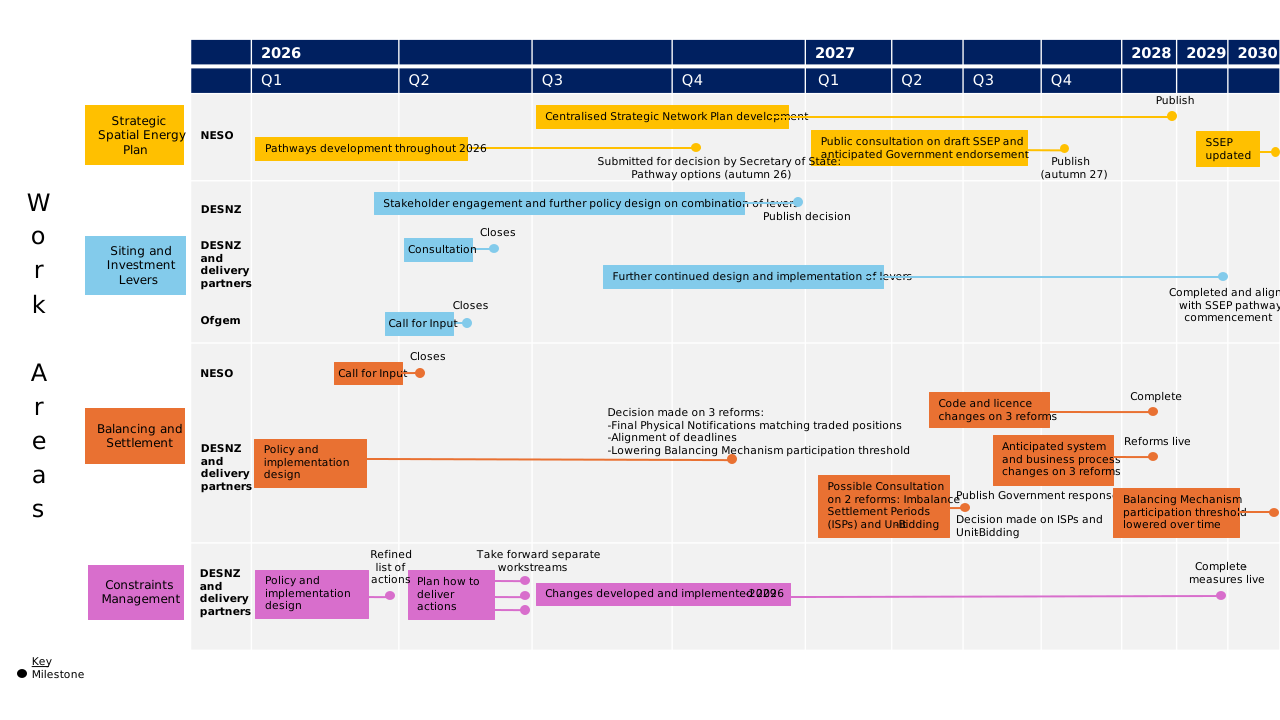
Figure 8: RNP anticipated delivery timeline
-
Department for Energy Security and Net Zero (2024) ‘Clean Power 2030 Action Plan - GOV.UK’ (viewed on 31 March 2026) ↩
-
Ofgem (2026) ‘Locational Charges and Regulatory Siting Levers Under Reformed National Pricing - Ofgem’ (viewed on 31 July 2026) ↩
-
Department for Energy Security and Net Zero (2026) ‘Government to make ‘plug-in solar’ available within months - GOV.UK’ (viewed on 31 March 2026) ↩
-
National Energy System Operator (2026) ‘Reformed National Pricing Call for Input (CfI) - National Energy System Operator’ (viewed on 31 March 2026) ↩
-
National Energy System Operator (2025) ‘2025 Annual Balancing Costs Report’ (viewed on 31 March 2026) ↩
-
Department for Energy Security and Net Zero (2024) ‘Clean Power 2030 Action Plan - GOV.UK’ (viewed on 31 March 2026) ↩
-
National Energy System Operator (2026) ‘SSEP Transparency Update, (2026), National Energy System Operator.’ (viewed on 31 March 2026) ↩
-
Department for Energy Security and Net Zero (2025) ‘DESNZ Onshore Wind Taskforce Strategy - July 2025’ (viewed on 31 March 2026) ↩
-
National Energy System Operator (2025) ‘Centralised Strategic Network Plan (CSNP) - National Energy System Operator’ (viewed on 31 March 2026) ↩
-
Department for Energy Security and Net Zero (2025) ‘Overarching National Policy Statement for Energy (EN-1) – December 2025’ (viewed on 31 March 2026) ↩
-
Department for Energy Security and Net Zero (2025) ‘Overarching National Policy Statement for energy (EN-1), 2025 - GOV.UK National Planning Policy Framework: proposed reforms and other changes to the planning system consultation’ (viewed on 31 March 2026)Overarching National Policy Statement for energy (EN-1), 2025 - GOV.UK ↩
-
National Energy System Operator (2025) ‘Connections Reform design documents and methodologies - National Energy System Operator’ (viewed on 31 March 2026) ↩
-
‘Ofgem (2025) ‘Ofgem sets out major reform package in next step to accelerate grid connections - Ofgem’ (viewed on 31 March 2026) ↩
-
Ofgem (2025) ‘Decision on Connections Reform Package (TMO4+) - Ofgem’ (viewed on 31 March 2026) ↩
-
Ofgem (2025) ‘Decision on Connections Reform Package (TMO4+) - Ofgem’ (viewed on 31 March 2026) ↩
-
Department for Energy Security and Net Zero (2025) ‘Clean Power 2030 Action Plan: A new era of clean electricity – connections reform annex (updated April 2025) - GOV.UK’ (viewed on 31 March 2026) ↩
-
Department for Energy Security and Net Zero (2025) ‘Clean Power 2030 Action Plan: A new era of clean electricity – main report - GOV.UK’ (viewed on 31 March 2026) ↩
-
National Energy System Operator (2025) ‘Connections Reform Results - National Energy System Operator’ (viewed on 31 March 2026) ↩
-
FTI Consulting (2023) ‘Assessment of locational wholesale electricity market design options in Great Britain’(viewed on 31 March 2026) ↩
-
NESO (2025) ‘2025 Annual Balancing Costs Report’ (viewed on 31 March 2026) ↩
-
NESO (2025) ‘2025 Annual Balancing Costs Report’ (viewed on 31 March 2026) ↩
-
NESO FES24 Holistic Transition constraint cost projectionsfrom the 2025 balancing report found at Balancing costs - National Energy System Operator and NESO Clean Power 2030 advice found at Clean Power 2030 - National Energy System Operator ↩
-
Clean Power 2030 compliant refers to Norwich-Tilbury [AENC/ATNC] and Sealink [SCD1] delivery date being brought forward from 2031 to 2030. Clean Power 2030 compliant network with additional acceleration refers to the acceleration of these projects in addition to 8 further critical projects from 2031-2037 delivering in 2030 as reported by NESO in the Clean Power 2030 advice. However, NESO have noted that delivering this high acceleration scenario would be difficult. ↩
-
National Energy System Operator (2025) ‘2025 Annual Balancing Costs Report’ (viewed on 31 March 2026) ↩
-
It is important to note that NESO’s projections for total constraints costs vary based on different scenarios which take into account multiple factors such as the pace of network and generation build out. ↩
-
Ofgem (2025) ‘RIIO-3 Final Determinations for the Electricity Transmission, Gas Distribution and Gas Transmission sectors - Ofgem’ (viewed on 31 March 2026) ↩
-
National Energy System Operator (2025) ‘2025 Annual Balancing Costs Report’ (viewed on 31 March 2026) ↩
-
System Operator Transmission Owner Code Procedure 11-4 (STCP 11-4). The 11-4 procedure is designed to be used both for Long Term Planning (years 1-6) and within year (year 0) delivery. ↩
-
National Energy System Operator (2025) ‘Transmission Acceleration Consultation 2025.’ (viewed on 31 March 2026) ↩
-
National Energy System Operator (2025) ‘2025 Annual Balancing Costs Report, National Energy System Operator, June 2025.’ (viewed on 31 March 2026) ↩
-
National Energy System Operator (2025) ‘Balancing Costs Portfolio, National Energy System Operator, February 2024.’ (viewed on 31 March 2026) ↩
-
National Energy System Operator (2025) ‘GC0166: Introducing new Balancing Mechanism Parameters for Limited Duration Assets’ (viewed on 31 March 2026) ↩
-
‘Countertrades’ are trades NESO conducts with traders in explicit intraday markets with or against the actual price spread, and are the larger portion of ‘interconnector redispatch’. ↩
-
Department for Science, Innovation and Technology (2025) ‘Delivering AI Growth Zones - GOV.UK’ (viewed on 31 March 2026) ↩
-
Department for Energy Security and Net Zero (2024) ‘Review of Electricity Market Arrangements: Second Consultation Document’ (viewed on 31 March 2026) ↩
-
Unpredictability in earnings related to variation in the difference between i) reference wholesale market price and ii) average capture price. ↩
-
Ofgem (2025) ‘Regulatory arrangements for dedicated provision of network services’ (viewed on 31 March 2026) ↩
-
Ofgem (2026) ‘Locational Charges and Regulatory Siting Levers Under Reformed National Pricing - Ofgem’ (viewed on 31 March 2026) ↩