Updating minimum energy performance standard for local space heaters: options assessment (accessible webpage)
Published 25 March 2026

© Crown copyright 2026
This publication is licensed under the terms of the Open Government Licence v3.0 except where otherwise stated. To view this licence, visit nationalarchives.gov.uk/doc/open-government-licence/version/3 or write to the Information Policy Team, The National Archives, Kew, London TW9 4DU, or email: psi@nationalarchives.gov.uk.
Where we have identified any third party copyright information you will need to obtain permission from the copyright holders concerned.
This publication is available at https://www.gov.uk/government/consultations/updating-standards-for-local-space-heating-products/updating-minimum-energy-performance-standard-for-local-space-heaters-options-assessment-accessible-webpage
Summary of proposal
Policy background
Local space heaters are heating products that heat the room they are installed in, in contrast to a central heating system, which provides heat to an entire building. They include:
- electric heaters (radiators, towel rails, underfloor heating)
- gas heaters (stoves, radiant heaters)
- liquid fuel heaters (kerosene heaters)
- infrared and tube heaters (often used in commercial or industrial settings)
Due to this diversity, local space heater ecodesign requirements are set in two different legal acts, one addressing liquid, gas and electric local space heaters (Regulation (EU) 2024/1103), and the other solid fuel local space heaters (Regulation (EU) 2015/1185). This proposal covers non-solid fuel local space heaters, replacing 2015/1188.
The new regulation introduces several broad changes, which are discussed below. However, changes fall under the following headings:
- Enhancing efficiency of products
- Encouraging effective energy consumption
- Supporting a circular economy
Local space heaters regulated under ecodesign requirements come in a variety of types, using different fuels and having different end users. Across 15 different products included in these regulations, there are 10 that use electricity, and five which use gas as their fuel source. Two of these gas fuelled products are used in commercial settings.
Table 1: breakdown of local space heaters included in the regulations
| Product | Fuel source | User |
|---|---|---|
| Open fronted local space heaters and open to chimney local space heaters | Gas | Domestic |
| Closed fronted open combustion local space heaters | Gas | Domestic |
| Balanced flue local space heaters | Gas | Domestic |
| Electric portable local space heaters | Electric | Domestic |
| Electric fixed local space heaters > 250W | Electric | Domestic |
| Electric fixed local space heaters ≤ 250W | Electric | Domestic |
| Electric storage local space heaters | Electric | Domestic |
| Electric underfloor local space heaters | Electric | Domestic |
| Fixed electric visibly glowing radiant local space heaters > 1.2kW | Electric | Domestic |
| Fixed electric visibly glowing radiant local space heaters ≤ 1.2kW | Electric | Domestic |
| Electric visibly glowing radiant portable local space heaters | Electric | Domestic |
| Electric towel rails > 250W | Electric | Domestic |
| Electric towel rails > 60W and ≤ 250W | Electric | Domestic |
| Luminous local space heaters | Gas | Commercial |
| Tube local space heaters | Gas | Commercial |
Local space heaters meet a range of user needs and are used either as supplementary heating alongside central heating or as an alternative to it. Typically heating a single room, they are used to keep warm, reduce heating costs, provide greater flexibility than central heating, or deliver comfort and aesthetic benefits. These heaters fall into overlapping categories and may serve multiple purposes.
Domestic gas-fuelled heaters provide warmth and comfort but are often chosen for their aesthetic appeal, particularly those replicating the look and feel of an open fire. Commercial gas-fuelled heaters, by contrast, are used purely for heating. Electric local space heaters are intended for domestic use and may be fixed or portable. Portable heaters offer flexibility by being movable between rooms, while fixed electric heaters remain in one location and operate similarly to radiators powered by a boiler, without serving an aesthetic function.
Summary of proposed intervention
The proposals set out in the consultation that accompanies this options assessment seek consistency with EU ecodesign regulations as a preferred way forward, although other options have been considered and appraised. We believe this approach will facilitate smoother trade relations, reduce administrative burdens for manufacturers, and ensure that consumers have access to efficient products. This intervention can be split into three parts which are outlined fully in the consultation document. A headline summary for each part can be found outlined below.
Part 1: enhancing efficiency of products
The government proposes to update ecodesign standards for local space heaters to improve energy efficiency and reduce emissions, reflecting advances in product design and heating controls.
The regulatory scope will expand to include heaters that require controls to operate, with all products required to manage heat output via a control. Towel rails will be defined as a separate product category, and the regulated power range will increase to cover domestic heaters up to 50kW and commercial heaters up to 300kW.
Product categories will increase from 12 to 15, with clearer definitions for specific heater types. Efficiency will be assessed using an updated Seasonal Space Heating Energy Efficiency (SSHEE) methodology aligned with EU standards. The primary energy conversion coefficient will be reduced from 2.5 to 1.9 to reflect electricity grid decarbonisation, and nitrogen oxide (NOx) emission limits will be tightened to improve air quality.
Part 2: encouraging effective energy consumption
To compliment the efficiency of energy consumption when providing heat, product requirements limiting unnecessary operation of local space heating products will avoid wasting energy. The proposals introduce requirements for controls and low-power modes.
Every heater must have a control to provide heat output. Definitions for ‘control’, ‘control function’ and separately sold ‘related controls’ will be introduced. Electric storage heaters must include electronic heat charge control with temperature feedback and fan-assisted output. Towel rails under 60W will only be allowed to run for a maximum of 6 hours at a time. More detail on the specific controls can be found in the consultation document.
Products must also include off, idle mode and standby modes with strict power limits. For example, off mode must use no more than 0.3W, and standby mode must stay between 0.5W and 3W depending on features. These measures align with EU regulations to ensure consistency and reduce wasted energy.
Part 3: supporting a circular economy
To cut waste and emissions from manufacturing and disposal, the proposals introduce ‘right to repair’ measures. Manufacturers will need to supply a list of spare parts, such as controls, thermostats, heating elements, and circuit boards, for a minimum of 10 years. We are proposing that these parts must be shipped within 10 working days.
Manufacturers must also provide repair information to approved installers within one working day and process applications for professional repairer status within five working days. Documentation will include mandatory phrases to guide consumers, such as warnings for flueless heaters and portable heaters to ensure they are operated safely, avoiding prolonged used in poorly ventilated spaces.
Finally, the proposals would ban practices that mislead efficiency tests, such as software updates that alter performance during testing. More detail on all mentioned above can be found in the consultation document.
Policy options
There are 5 policy options:
- Do nothing allowing passive regulatory divergence between Great Britain and the EU and Northern Ireland.
- Self-regulate allowing manufacturers to set and regulate ecodesign standards.
- (Preferred) Full alignment updating our regulations to match the new EU regulation.
- Delayed alignment with a 2-year delay in implementing the update to our regulations so they match the new EU regulation.
- Exceed EU standards by implementing selective alignment with enhancements.
The purpose of this options assessment is to support the consultation on updated ecodesign requirements for local space heaters.
Strategic case for proposed regulation
The Climate Change Act in 2008 made the UK the first country to introduce a legally binding, long-term emissions reduction target. Under the act, the UK was originally required to reduce greenhouse gas emissions by at least 80% on 1990 levels by 2050. In 2019, on advice of the Climate Change Committee (CCC), the UK committed to reaching net zero emissions by 2050 and consequently the target reduction in the act was amended to at least 100% reduction on 1990 levels[footnote 1].
There are 30 million[footnote 2] domestic and 2 million[footnote 3] non-domestic buildings in Great Britain. Reducing energy consumption used in heating is recognised as one of the biggest challenges we face in meeting our climate targets. In 2024, domestic electric space heating used 14TWh[footnote 4], accounting for 4% of all electricity demand in the UK. Local space heaters make up a meaningful portion of all energy consumed for heating.
It is expected that most buildings will decarbonise through the installation of heat pumps and the introduction of heat networks. However, for those buildings that remain on direct electric heating, or cannot install a heat pump due to space constraints, electric local space heaters (for example, electric storage heaters) could play an important role in decarbonising them. Around 3% of houses and 22% of flats use direct electric heating as their primary heating system[footnote 5], as opposed to a central heating system. As well as acting as the primary heating system for some homes, local space heaters also have an important role in secondary heating systems such as providing heat in rooms not covered by central heating (for example, heated towel rails) or providing additional thermal comfort (for example, portable space heaters). It is therefore essential to make sure these local space heaters are as energy efficient as possible.
Intervention that mandates improvements in a product’s energy efficiency will lead to traded and non-traded carbon savings and energy savings from both gas and electricity. This intervention will bolster these efficiency-based savings by encouraging effective energy consumption by mandating controls that stop a product producing heat when it does not need to, reducing the time it is used and supporting a circular economy, reducing waste, and increasing product lifetimes.
The increase in electricity prices since 2022 compared to historic levels, combined with consideration of pressure on the grid, illustrate the need to ensure only the most energy efficient products are available on the market. Whilst there is evidence to suggest that more energy efficient products tend to be more expensive up front, in the case of local space heaters, these upfront costs will be recouped by the following benefits:
- carbon savings: a phase out of the least energy efficient local space heaters from 2027 could see contributions to reducing the cost of achieving CB6 and CB7 through electricity and gas demand reduction from local space heaters, with direct contributions to the carbon budgets through traded electricity and non-traded gas savings
- energy demand: by improving the energy efficiency of local space heaters we expect to see a reduction in electricity and gas demand compared to leaving the market unregulated. This reduction will also be bolstered by regulation on appliance controls that will reduce total annual hours of use for local space heaters
- reduced bills: by improving the energy efficiency of local space heaters, we expect consumers will see a small reduction in their annual energy bills because of increased Minimum Energy Performance Standards (MEPs), greater than any increase in upfront cost over the lifetime of the product
- reduced waste: by introducing a regime of right to repair, consumers will be able to use their local space heater products for longer; reducing the rate at which local space heaters need to be replaced and increasing their expected lifetime
The argument for government intervention is that the market is not moving quickly enough towards more efficient local space heaters to enable the potential benefits to be realised. This is on account of several market failures.
Carbon externality: the price of less energy efficient local space heaters does not reflect the negative externalities associated with energy use. The excess energy used creates an avoidable cost to society in the form of excess power consumption and greenhouse gas emissions. Government intervention can help overcome this by ensuring that only more energy-efficient products are available.
Imperfect information: in the absence of higher MEPS, consumers may choose less efficient local space heaters due to limited awareness of lifetime energy and bill savings. Updated MEPS would require the purchase of more efficient products, delivering ongoing energy and bill savings.
Misaligned incentives: in rented properties, landlords more commonly install local space heaters compared to private owners, while tenants bear the energy costs. This misalignment of incentives reduces landlords’ incentives to purchase higher efficiency products at replacement, leading to the continued purchase of less efficient heaters and higher energy costs for tenants and society.
The draft regulations will apply in Great Britain only. Under the Windsor Framework, EU Ecodesign and Energy Labelling Regulations continue to apply directly in Northern Ireland, meaning businesses selling local space heaters in Northen Ireland may meet either EU requirements or the Great British standard. The costs and benefits in this options assessment are therefore assessed on a Great Britain only basis. Our assessment of the local space heater market in Great Britain shows that products currently on the market can exceed the proposed MEPS.
SMART objectives for intervention
The update to existing ecodesign requirements for local space heaters is intended to set optimal, new minimum standards for energy efficiency which reflect what is broadly achievable for local space heater products on the market. The intended effects are to:
- increase innovation, investment, and uptake of more energy efficient products by phasing out the least efficient products on the market
- reduce traded and non-traded carbon emissions and energy consumption from local space heaters
- reduce energy bills for consumers and businesses
- reduce demand on the power sector and electricity networks
- support the circular economy and reduce waste
This policy intervention will help reduce consumer bills and reduce electricity and gas demand, contributing to two key government priorities to increase energy security and reduce the cost of living. We believe this regulation follows the SMART objectives for the following reasons:
Specific: the regulations have been designed using the latest market analysis to ensure we achieve the desired effect of removing the least efficient local space heaters from each market while preserving consumer choice. These have been informed through consultation with technical experts, backed up by detailed market data on the range of products available.
Measurable: the MEPS levels set a specific efficiency level, which is understood by industry and used to measure efficiency. The testing methodology is already in place and efficiency achieved is required to be present on the label and technical information of products sold.
Achievable: we have used market data and expert advice on past trends and expected technological progress to ensure the proposed MEPS are achievable. Overall, the intervention would remove around 36% of products currently on the market. In two product categories, all existing models fall below the proposed standard; however, this remains achievable. These products account for only around 8,000 annual sales, are therefore niche, and the most efficient models currently available are only 1 to 2 percentage points below the proposed MEPS. This indicates that compliance would require only modest efficiency improvements. Manufacturers would be able to continue placing these products on the market once updated standards are met, and consumers would retain access to suitable alternatives across the wider range of local space heaters.
Realistic: these MEPS have been set using comprehensive data of the product types available on the UK market, to ensure an accurate level is set.
Time limited: while ecodesign legislation in general does not have an expiry date, the PIR is an opportunity to amend any unintended consequences of the legislation. Typically, over a ten year cycle all product regulations under ecodesign have their legislation updated to reflect the current market position and how technology may have changed over the period.
Proposed interventions
Description of the proposed intervention and explanation of the logical change process whereby this achieves SMART objectives.
Preferred option: update ecodesign regulations for local space heaters in line with EU updates
This intervention will include 3 distinct strands that will meet policy objectives.
- Enhancing efficiency of products: broadening the regulatory scope of products in question and increasing performance requirements.
- Encouraging effective energy consumption: introduce controls to ensure energy is consumed effectively.
- Supporting a circular economy: introduce the ability to be approved as a professional repairer and ensuring the ability to access spare parts and repair information.
Enhancing efficiency of products
In general, products cluster near the current minimum standards as it is usually cheaper to produce less efficient products. Market forces tend to drive products to the cheaper end, at a long-term cost to the consumer from energy consumption. This is the key reason for needing the intervention through ecodesign measures.
Typically, manufacturers can in general produce more efficient products, and in most cases a manufacturer will be producing multiple products with different efficiencies in the same factory. Our MEPS will have a varied impact across the 15 individual local space heater types included in these regulations, meaning that it is not the case that a consistent proportion of products will be removed across the local space heater types. For instance, some local space heater types will be unaffected, as our market research indicates that all products of that type are already meeting proposed MEPS. However, introducing the standards for these products will still reduce risk of dumping of inefficient products no longer able to be sold in the EU and keep regulation aligned between the EU and UK.
On average and when weighted by sales, we expect 36% of products to be removed from the local space heater market and these products rapidly replaced by more efficient models. Sales data broken down by product efficiency was unavailable, as bulk stock and sales data did not provide this level of detail. Instead, web-scraped data on local space heaters listed online was used as a proxy. The frequency of product listings by efficiency was taken to indicate the market’s efficiency distribution, a method used previously for other products.
Table 2: proportion of products removed from the market by the preferred option
| Product | Proportion of products removed from the market |
|---|---|
| Open fronted local space heaters and open to chimney local space heaters | 17% |
| Closed fronted open combustion local space heaters | 27% |
| Balanced flue local space heaters | 13% |
| Electric portable local space heaters | 49% |
| Electric fixed local space heaters > 250W | 46% |
| Electric fixed local space heaters ≤ 250W | 89% |
| Electric storage local space heaters | 0% |
| Electric underfloor local space heaters | 48% |
| Fixed electric visibly glowing radiant local space heaters > 1.2kW | 100% |
| Fixed electric visibly glowing radiant local space heaters ≤ 1.2kW | 100% |
| Electric visibly glowing radiant portable local space heaters | 5% |
| Electric towel rails > 250W | 53% |
| Electric towel rails > 60W and ≤ 250W | 54% |
| Luminous local space heaters | 23% |
| Tube local space heaters | 67% |
In terms of cost to the consumer, we assume that any increase in manufacturer costs resulting from an increase in MEPS, will be passed directly on to the consumer in full. We do expect to see minor cost increase for most products, but in some cases, there will be no price change[footnote 6]. However, the electricity and gas bill savings from using more efficient products will outweigh the cost of the new efficiency standards over time. A small increase in upfront costs per product will result in direct energy bill savings for consumers. Without raising MEPS, consumers are likely to buy products with lower efficiencies as they do not realise, or ignore, the opportunity of saving on their bills by using more efficient products. Table 14 in the annex presents the anticipated increase cost to consumers, bill saving and associated repayment period.
The preferred option of EU alignment will see updated MEPS as outlined in table 3. Owing to methodology changes in calculating SSHEE outlined in the consultation, minimum thresholds have been rescaled. Based on this, some new MEPS values may superficially appear lower than previous values, however this does not indicate a reduction in standards.
Table 3: updated MEPs under the preferred option
| Product | Previous MEPS (SSHEE) | Updated MEPS (SSHEE) |
|---|---|---|
| Open fronted local space heaters and open to chimney local space heaters | 42% | 40.3% |
| Closed fronted open combustion local space heaters | 72% | 63.6% |
| Balanced flue local space heaters | New category | 63.6% |
| Electric portable local space heaters | 36% | 44.7% |
| Electric fixed local space heaters > 250W | 38% | 47.5% |
| Electric fixed local space heaters ≤ 250W | 34% | 43.1% |
| Electric storage local space heaters | 38.5% | 47.3% |
| Electric underfloor local space heaters | 38% | 47.5% |
| Fixed electric visibly glowing radiant local space heaters > 1.2kW | 35% | 46.8% |
| Fixed electric visibly glowing radiant local space heaters ≤ 1.2kW | 31% | 40.5% |
| Electric visibly glowing radiant portable local space heaters | New category | 39.5% |
| Electric towel rails > 250W | 38%* | 46% |
| Electric towel rails > 60W and ≤ 250W | 34%* | 42.1% |
| Luminous local space heaters | 85% | 90% |
| Tube local space heaters | 74% | 80% |
- Towel rails are separated from their corresponding ‘electric fixed’ equivalent product category.
The long lead time for implementation of updates to the ecodesign regulations in combination with notifying the World Trade Organization (WTO) through a pre-notification is intended to allow manufacturers ample time to adjust their production. Whilst the consultation and notification process will be shorter for the introduction of the Great British version of these regulations, manufacturers have been gearing up for the introduction of EU regulations for some time. As such the effects of alignment would be smaller than they might have otherwise been.
A full cost-benefit analysis has been carried out to appraise the impact of intervention.
Table 4: summary of the headline costs and benefits associated with the preferred option
| Discounted monetised benefit (£m) | Discounted policy cost (£m) | Discounted net present value (NPV) (£m) | Carbon savings (MtCO2e) traded | Carbon savings (MtCO2e) non-traded | Electricity energy savings (GWh) | Gas energy savings (GWh) | |
|---|---|---|---|---|---|---|---|
| CB5 | 69 | 6 | 63 | 0.0 | 0.1 | 310 | 320 |
| CB6 | 115 | 3 | 112 | 0.0 | 0.1 | 713 | 555 |
| CB7 | 126 | 2 | 124 | 0.0 | 0.1 | 1,034 | 579 |
| To 2050 | 485 | 16 | 470 | 0.1 | 0.4 | 4,410 | 2.059 |
Benefits from the gas and electric energy savings gained by increasing product efficiencies have been translated into gas and electric fuel savings, reduced traded and non-traded carbon emissions as well as improvements in air quality. Costs have been determined by the increase in MEPS leading to higher costs to manufacturers. This reflects the cost-pass through associated with innovation (in this case, innovating towards higher efficiency products).
Table 5a: social-NPV component breakdown – benefits in £m
| Social-NPV components | Source | CB5 | CB6 | CB7 | 2050 |
|---|---|---|---|---|---|
| Long run variable cost (LRVC) savings | Gas | 8 | 12 | 10 | 39 |
| Carbon cost savings | Gas | 16 | 26 | 25 | 90 |
| Air quality damage savings | Gas | 0 | 1 | 1 | 2 |
| LRVC savings | Electricity | 37 | 72 | 88 | 338 |
| Carbon cost savings | Electricity | 7 | 5 | 2 | 15 |
| Air quality damage savings | Electricity | 0 | 0 | 0 | 0 |
Table 5b: social-NPV component breakdown – costs in £m
| Social-NPV components | CB5 | CB6 | CB7 | 2050 |
|---|---|---|---|---|
| Capital costs | 6 | 3 | 2 | 16 |
| Administration costs | 0 | 0 | 0 | 0 |
This intervention will lead to bill savings for users of the products purchased after the regulations have come into force.
Table 6: average yearly bill saving per product, averaged from 2027 to 2050, calculated from Green Book Domestic and Commercial energy prices[footnote 7]
| Product | Annual average bill savings |
|---|---|
| Open fronted local space heaters and open to chimney local space heaters | £7 |
| Closed fronted open combustion local space heaters | £6 |
| Balanced flue local space heaters | £1 |
| Electric portable local space heaters | £3 |
| Electric fixed local space heaters > 250W | £15 |
| Electric fixed local space heaters ≤ 250W | £6 |
| Electric storage local space heaters | £0 |
| Electric underfloor local space heaters | £10 |
| Fixed electric visibly glowing radiant local space heaters > 1.2kW | £43 |
| Fixed electric visibly glowing radiant local space heaters ≤ 1.2kW | £5 |
| Electric visibly glowing radiant portable local space heaters | £0 |
| Electric towel rails > 250W | £9 |
| Electric towel rails > 60W and ≤ 250W | £4 |
| Luminous local space heaters | £8 |
| Tube local space heaters | £80 |
We do not anticipate this intervention to cause gaps to appear in the market, or instances in which a consumer is unable to buy a specific type of product to meet their heating needs. Whilst some products will see large amounts of the available options removed from the market[footnote 8], we believe that the consumer will be left with enough alternatives when they come to replace their current local space heater product, due to the various categories of local space heaters that exist.
Furthermore, in the case of local space heaters that are going to be more impacted by these regulations than others. For example, the products that will see a greater proportion of the available products removed from the market, this regulation does not outright prohibit the sale of that type of product. In the case of fixed electric visibly glowing radiant local space heaters >1.2kW and fixed electric visibly glowing radiant local space heaters ≤1.2kW, while we predict that none of these products currently on the market will meet new requirements, manufacturers should be able to improve the efficiency of these products and continue placing them on the market.
We have also considered how this intervention will achieve the objectives stated in the previous section, presented as a logic model.
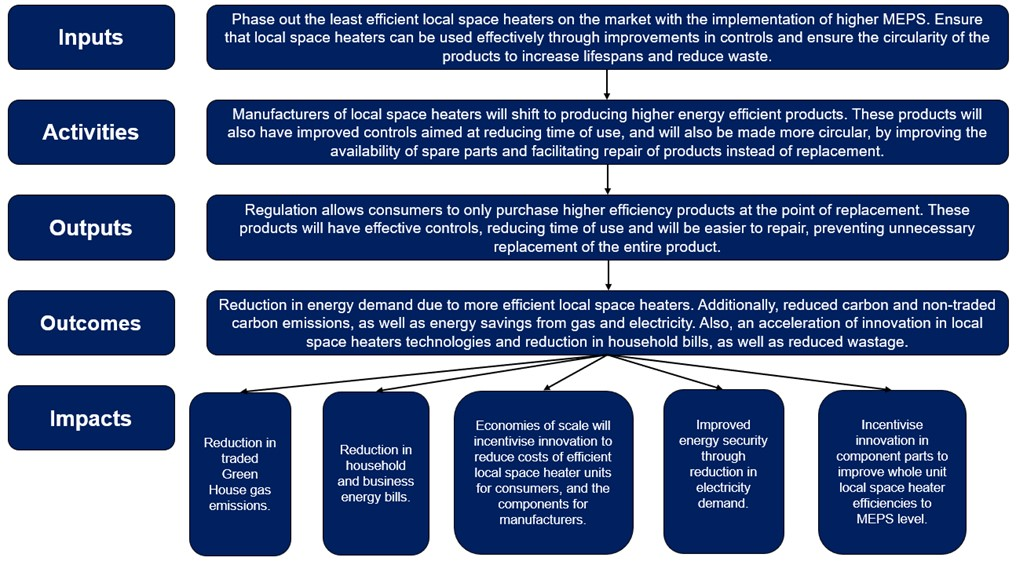
Description of the logic model
Inputs: Phase out the least efficient local space heaters on the market with the implementation of higher MEPS. Ensure that local space heaters can be used effectively through improvements in controls and ensure the circularity of the products to increase lifespans and reduce waste.
Activities: Manufacturers of local space heaters will shift to producing higher energy efficient products. These products will also have improved controls aimed at reducing time of use, and will also be made more circular, by improving the availability of spare parts and facilitating repair of products instead of replacement.
Outputs: Regulation allows consumers to only purchase higher efficiency products at the point of replacement. These products will have effective controls, reducing time of use and will be easier to repair, preventing unnecessary replacement of the entire product.
Outcomes: Reduction in energy demand due to more efficient local space heaters. Additionally, reduced carbon and non-traded carbon emissions, as well as energy savings from gas and electricity. Also, an acceleration of innovation in local space heaters technologies and reduction in household bills, as well as reduced wastage.
Impacts:
- Reduction in traded green house gas emissions
- Reduction in household and business energy bills
- Economies of scale will incentivise innovation to reduce costs of efficient local space heater units for consumers, and the components for manufacturers
- Improved energy security through reduction in electricity demand
- Incentivise innovation in component parts to improve whole unit local space heater efficiencies to MEPS level
Encouraging effective energy consumption
While not included in baseline NPV estimates, introducing updates to controls to ensure energy is consumed effectively could have more considerable impacts on energy savings than increases in MEPS. This will occur as the product will be used for fewer hours each year, as controls introduced will be able to turn a local space heater off when it does not need to be used, reducing wasted output. The impact of controls has not been included in baseline NPV and energy saving estimates, since it is not possible to determine how much controls will reduce heating hours by. This will depend on how individual local space heaters are used by consumers, meaning their heating habits will influence the savings made possible by improvements in controls.
The reduction in the number of hours the product is used for each year can also be translated into further bill savings for consumers. We have estimated bill savings from efficiency savings.
Table 7: additional annual consumer bills savings resulting from hours of use reductions, averaged from 2027 to 2050, not including efficiency savings, shown as £s per hour
| Bill savings from reduction in heating hours per year | 1% | 3% | 5% | 10% |
|---|---|---|---|---|
| Open fronted local space heaters and open to chimney local space heaters | £5 | £14 | £23 | £46 |
| Closed fronted open combustion local space heaters | £3 | £10 | £17 | £34 |
| Balanced flue local space heaters | £3 | £8 | £14 | £28 |
| Electric portable local space heaters | £1 | £3 | £5 | £11 |
| Electric fixed local space heaters > 250 W | £3 | £8 | £13 | £27 |
| Electric fixed local space heaters ≤ 250 W | £1 | £3 | £4 | £9 |
| Electric storage local space heaters | £5 | £16 | £26 | £53 |
| Electric underfloor local space heaters | £2 | £7 | £12 | £24 |
| Fixed electric visibly glowing radiant local space heaters > 1.2 kW | £4 | £12 | £19 | £38 |
| Fixed electric visibly glowing radiant local space heaters ≤ 1.2 kW | £2 | £6 | £10 | £21 |
| Electric visibly glowing radiant portable local space heaters | £3 | £10 | £17 | £33 |
| [electric] towel rails > 250 W | £1 | £4 | £7 | £13 |
| [electric] towel rails > 60 W and ≤ 250 W | £1 | £4 | £7 | £14 |
| Luminous local space heaters | £12 | £35 | £59 | £118 |
| Tube local space heaters | £21 | £62 | £104 | £208 |
Supporting a circular economy
There are clear benefits to introducing circularity measures to local space heating for consumers and wider society. Access to repair information, spare parts and installers will increase the lifetime of local space heater products, meaning they do not need to be replaced at the first instance of an operating fault. This will reduce waste and save consumers upfront costs. There is a minor risk that this will prevent consumers from having the most efficient products available. By not replacing a product, a consumer may not purchase a local space heater with the latest technology, which means they could miss out on further bill savings. However, this is only a risk if the local space heater market moves towards more efficient products on its own, which we do not believe is likely to happen. Typically, ecodesign regulations are refreshed around every 10 years. At which point we would evaluate the market again to see if more savings were achievable from further circular economy measures.
We anticipate that the impacts to businesses will be minimal, as manufacturers will already hold the parts needed in the case of replacement, in the manufacture of products. We recognise that there may be some limited additional costs associated with storing a wider range of spare parts and making minor adjustments to existing inventory or repair-support processes. However, early engagement with manufacturers indicates that these activities are already part of normal operations to comply with existing ecodesign and warranty requirements. As a result, any additional storage or labour costs arising from the proposed measures are expected to be small, transitional in nature, and readily absorbed into established business-as-usual systems.
Brief social research undertaken via interviews with manufacturers indicated that the average time spent on the market for local space heater products without controls is longer than for ones with controls (14 years compared to 5 years). The controls are evolving more rapidly, either due to technological advancements, customer demand, or regulatory requirements. However, given the length of time that a local space heater may spend on the market manufacturers may not hold the necessary parts needed in the event of repair for the total lifespan of the product, but they will currently hold these parts for models that will be affected by this regulation. As such, we anticipate storage costs resulting from holding a variety of spare parts for the products will be absorbed in the manufacturers’ already ongoing costs.
A qualitative approach is the most proportionate method available for assessing impacts relating to circular economy measures. Manufacturers currently do not publish granular data on inventory levels, repair activity, or the frequency with which spare parts are replaced for specific models of local space heaters. As a result, attempts to quantify costs would require assumptions that are unlikely to be robust and could lead to misleading estimates.
In addition, the expected scale of impacts is low relative to normal operating expenditure and existing compliance obligations under ecodesign. Manufacturers already hold a baseline level of spare parts to meet current regulatory and warranty obligations, and the additional requirements introduced by this measure represent an incremental extension rather than a new cost stream. Given this limited scale of change, a qualitative assessment is not only proportionate but avoids overstating impacts.
We recognise that any incremental costs associated with extending spare-parts provision or inventory management are likely to be passed on to consumers through small adjustments in product pricing. However, because the scale of these additional costs is expected to be minimal and absorbed within manufacturers’ existing operations, any resulting price effects are likely to be very limited. Moreover, these minor costs are expected to be outweighed by consumer bill savings over the lifetime of the product, due to reduced need for replacement and improved efficiency from maintaining products in use for longer.
We have also considered the impact that the costs associated with holding spare parts might be different for different manufacturers of different products. As local space heaters have different expected lifetimes, the likelihood of repair may be different – for instance, long lifespan products may need to be repaired more, meaning additional costs for manufacturers of those products. However, given the costs of holding spare parts are expected to be minimal, we also expect these differences in cost between products to be minimal.
Additionality
Given the preferred option to align with EU MEPS, we have considered additionality, that is, whether efficiency improvements would occur without Great Britain’s intervention. While some passive benefits could arise from EU regulation, we conclude that additionality is high.
Changes in EU regulations are unlikely to materially affect the Great British market, which has a strong domestic manufacturing base and is predominantly supplied by imports from China rather than the EU. Market average efficiency in Great Britain has remained largely stagnant, with limited evidence of innovation. As such, we do not expect EU developments alone to deliver meaningful efficiency improvements in Great Britain and conclude that domestic intervention is necessary to drive change. Average efficiency in Great Britain has remained largely stagnant, with limited evidence of innovation. As such, we do not expect EU developments alone to deliver meaningful efficiency improvements in Great Britain and conclude that domestic intervention is necessary to drive change.
Therefore, our do nothing option is assumed to have no benefit when considering energy savings. However, we have considered what the benefit would be in the case of considering some level of additionality in the do-nothing option, which can be found in the sensitivity analysis section.
Summary of long-list and alternatives
Option 1: do nothing
The current ecodesign regulations for space heating products would remain unchanged.
The main reason this option has not been pursued further is that, without updated regulation, the market will not achieve the full potential efficiency savings possible given the market and associated negative impacts described above. In a ‘do nothing’ scenario, it is reasonable to assume that Great British and global manufacturers of local space heater products have less incentive to innovate and produce products with improved energy efficiency, as their focus is likely to be price competition. They will have the opportunity to undercut higher priced, more efficient products with cheaper, less efficient products. Without updating ecodesign requirements, the market failures listed above would be unmitigated. There is also a risk of dumping, whereby EU and international manufacturers would dump their least efficient products, that could not be sold in the EU market, onto the market in Great Britain.
Option 2: self-regulation
The manufacturers would agree a common set of standards to adhere to.
We have considered self-regulation as an option, whereby suppliers of local space heaters would voluntarily ensure that their products met a higher minimum energy performance standard. This could either replace the existing ecodesign regulations entirely or be a means by which manufacturers go beyond the existing mandatory requirements to meet the higher MEPS proposed by this policy. Under the ecodesign legislative framework, the Secretary of State must not regulate an energy-related product that is already the subject of self-regulation; the legislative framework also sets out principles which voluntary initiatives should follow.
Where self-regulatory initiatives have been considered at an EU level for products other than local space heaters, concerns were raised about the lack of guidance around the criteria used to evaluate self-regulatory initiatives, particularly with respect to monitoring and evaluation.
A self-regulation scenario could create a coordination failure. In the absence of government intervention, there is a real risk of free riders introducing inefficient products into the market if a voluntary agreement were to be used. Particularly in a scenario in which a voluntary agreement replaced the existing mandatory requirements, there would be a risk that free riders could re-introduce highly inefficient products, which were previously banned, back into the market.
Further, research suggests that voluntary agreements around energy efficiency are best considered for products which are not regulated in other economies, where there is a small number of manufacturers, or where regulation is not practical. Products such as games consoles and imaging equipment are regulated in this way. Since mandatory requirements are practical and indeed already exist in many nations for local space heaters, and there are many manufacturers, we have ruled out self-regulation in Great Britain as a viable option. Continuing with a mandatory regulation approach provides clarity and a level of continuity for Great British businesses.
Option 3 (preferred): adopt EU proposals for local space heater MEPS
Current ecodesign regulations for local space heater products would be aligned with EU plans.
This proposal is the lead option to be considered. Aligning with the EU provides the best combination of energy savings and consumer bill savings, without putting the pressures associated with divergence on UK manufacturers.
Option 4: adopt EU proposals for local space heater MEPS (delayed until 2029)
Current ecodesign regulations for local space heater products would be aligned with EU plans, but implementation would be delayed until 2029.
The ecodesign policies relating to local space heating have targeted the scope of inclusion of some products, including the creation of three new product categories. While market testing data suggests that adoption would be beneficial to consumers, a low-risk approach would be to delay the implementation of this policy and observe the impact on the EU market.
We assess that delaying alignment to 2029 for this sole purpose would not prove an efficient option. This route would significantly weaken the energy demand reduction potential of the policy, impacting the contribution towards net zero targets. We assess that energy savings would be reduced by 500GWh of electricity and 700GWh of gas and reduce the overall NPV by 28% to £366m. Risk of increased trade barriers and product dumping, and increased cost to consumers, do not warrant the delay.
Option 5: adopt standards greater than the EUs
Proposed MEPS would go further than those proposed by the EU.
We have considered an option that would introduce MEPS that are greater than those proposed by the EU. In this option, Great Britain would align with the formula, definitions, and circular economy measures currently applying in the EU, but require higher minimum standards for 3 product categories:
- electric fixed local space heaters > 250W
- electric storage local space heaters
- electric towel rails > 250W
These products have been singled out, as there are theoretical instances where a product could fail 2015 MEPS, but pass 2024 MEPS in these 3 product categories. In providing targeted interventions to raise product standards in these product categories, there could be no ambiguity around the MEPS threshold. This option would provide additional benefits from energy savings from electricity and gas and traded and non-traded carbon savings, which would also outweigh the additional costs associated with increasing MEPS even further than what the EU have proposed.
This option would lead to additional electric demand savings compared with the preferred option, resulting in an additional reduction of 4TWh. This option would have no impact on savings from gas, as standards for gas products would not exceed EU proposals. However, divergent standards from the EU could negatively impact trade. There is a small risk that manufacturers may remove their products from the Northern Ireland market, known as delisting, if Great Britain diverges due to the need to provide a separate marking for Northern Irish products to the rest of Great Britain creating an additional administrative burden.
Description of shortlisted policy options carried forward
We have compared each option against the policy options discussed in Section 3, to determine its overall suitability. The option to raise existing MEPS for local space heaters in line with EU proposals has been carried through to consultation. This section will be used to outline our understanding of the local space heater business environment.
RAG comparison of options against outlined policy objectives
The 5 policy objectives are:
-
Increase innovation, investment and uptake of more energy efficient products by phasing out the least efficient products on the market
-
Reduce traded and non-traded carbon emissions, and energy consumption from local space heaters
-
Reduce energy bills for consumers and businesses
-
Reduce demand on the power sector and electricity networks
-
Support the circular economy and reduce waste
Do nothing
Objective 1: does not meet the objective
By not intervening, there would be no incentive for Great Britain’s manufactures to innovate and produce more efficiency products. There would be a risk of dumping of the least efficient products from the EU.
Objective 2: does not meet the objective
There is a chance of receiving passive carbon and energy savings because of EU regulations, but this could be offset by the risk of dumping of the worst performing products on Great Britain’s market.
Objective 3: does not meet the objective
There is a chance of receiving passive bill savings because of EU regulations, but this could be offset by the risk of dumping of the worst performing products on Great Britain’s market.
Objective 4: does not meet the objective
There is a chance of receiving passive demand savings because of EU regulations, but this could be offset by the risk of dumping of the worst performing products on Great Britain’s market.
Objective 5: does not meet the objective
There is a chance of receiving circularity improvements passively because of EU regulations, but this could be offset by the risk of dumping of the worst performing products on Great Britain’s market.
Overall suitability: low
Self-regulation
Objective 1: does not meet the objective
There is a chance of free riding with this option, which would minimise the incentive to innovate and allow the least efficient products to be placed on the market.
Objective 2: does not meet the objective
Without the guarantee that manufactures are meeting self-imposed standards, the potential of free riding behaviour will prevent full carbon and energy savings being realised.
Objective 3: does not meet the objective
Without the guarantee that manufactures are meeting self-imposed standards, the potential of free riding behaviour will prevent bill savings.
Objective 4: does not meet the objective
Without the guarantee that manufactures are meeting self-imposed standards, the potential of free riding behaviour will prevent full demand savings being realised.
Objective 5: does not meet the objective
Without the guarantee that manufactures are meeting self-imposed standards, the potential of free riding behaviour will prevent circularity being realised.
Overall suitability: low
Fully align Great Britain’s regulations with the EU (preferred)
Objective 1: meets objective
This would provide a clear guide for the standards manufacturers must meet, directly increasing the efficiency of products on the market.
Objective 2: meets objective
This would directly lead to carbon and energy savings because of improving the efficiency of products on the market.
Objective 3: meets objective
This would directly lead to bill savings because of improving the efficiency of products on the market.
Objective 4: meets objective
This would directly lead to demand savings because of improving the efficiency of products on the market.
Objective 5: meets objective
This would introduce measures specifically designed to improve the circularity of local space heaters through right to repair measures.
Overall suitability: high
Fully align Great Britain’s regulations with the EU but delay
Objective 1: meets objective
This would provide a clear guide for the standards manufacturers would be mandated to meet, directly increasing the efficiency of products on the market.
Objective 2: partially meets objective
This would directly lead to carbon and energy savings because of improving the efficiency of products on the market, albeit slower than the preferred option.
Objective 3: partially meets objective
This would directly lead to bill savings because of improving the efficiency of products on the market.
Objective 4: partially meets objective
This would directly lead to demand savings because of improving the efficiency of products on the market, albeit slower than the preferred option.
Objective 5: meets objective
This would introduce measures specifically designed to improve the circularity of local space heaters through right to repair measures, albeit slower than the preferred option.
Overall suitability: medium
Diverge from the EU to increase standards
Objective 1: partially meets objective
Higher domestic standards provide clarity but may discourage manufacturers from supplying the GB market, so the option does not fully support investment or maintain a broad range of efficient products.
Objective 2: meets objective
This would directly lead to carbon and energy savings because of improving the efficiency of products on the market.
Objective 3: meets objective
This would directly lead to bill savings because of improving the efficiency of products on the market.
Objective 4: meets objective
This would directly lead to demand savings because of improving the efficiency of products on the market.
Objective 5: meets objective
This would introduce measures specifically designed to improve the circularity of local space heaters through right to repair measures.
Overall suitability: medium
This process has identified option 3, fully align Great Britain with the EU, as the preferred option to carry forward, as it meets all outlined policy objectives.
To further understand the impact of regulations in the local space heater market, we have assessed the local space heater business environment, to determine whether intervention in this market will have adverse impacts on manufacturers and wholesalers, particularly SMEs (small and medium-sized enterprises).
We have identified 57 different stakeholder firms operating in the local space heater market. These firms, employ 3,774 people and turn over £735m annually. Of these 57 identified firms, three dominate the market in terms of employee numbers and turnover, employing 41% of all individuals employed in this industry and accounting for 37% of turnover. These three firms are the only ones that can be classed as ‘large-sized’ (over 250 number of employees). There are 14 manufacturers operating in the local space heater market that are categorized as medium-sized enterprises, 30 that are categorized as small-sized enterprises and 10 micro-enterprises.
Regionally, the local space heater industrial base is the southeast, which houses the most manufacturers accounting for the greatest turnover, while employing the second most workers. Other notable areas include the East Midlands, the southwest, and the northwest. The regional concentration of firms, employees and turnover is illustrated in the maps below.
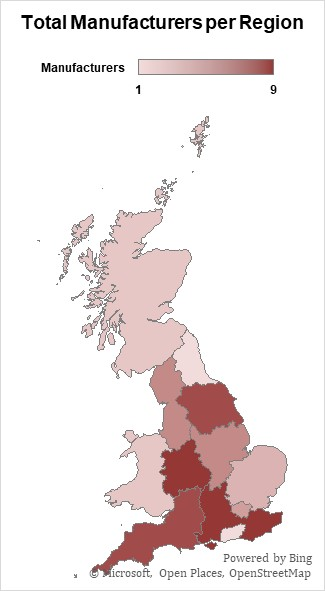
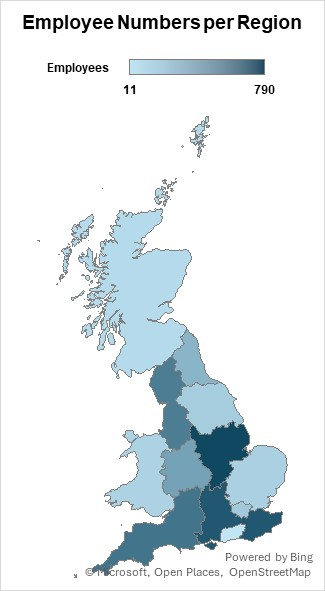
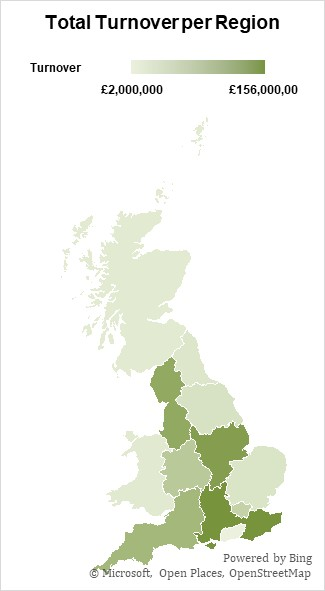
Even though large-sized business makes up the largest proportion of the local space heater manufacturing base, there is still a clear presence from small and medium-sized enterprises (SMEs). Micro-entities play a minor role in the manufacturing of relevant products, accounting for just 1% of the employees and turnover related to local space heater manufacturing.
Initial stakeholder conversations have indicated that SMEs are not expected to be disproportionally impacted by the introduction of this legislation. An approach was taken to reach out to stakeholders through an online survey, followed by 1:1 interview with those respondents who agreed to be contacted. The survey elicited just 8 complete responses, 1 anonymous and 7 from stakeholders who agreed to a follow-up interview. However, based on the small sample of SMEs who did respond for interview, they indicated that they do not expect to be disproportionately impacted by aligning with the new regulations. We expect that trade association responses will encompass the view of SMEs, broadening the evidence base, however we will look to confirm our initial assessment during the public consultation period. Some commented that larger companies would be impacted more, due to their larger product portfolios and wider market coverage. These views will be tested further during the consultation.
Given the costs to businesses associated with improving the efficiency of the products they manufacture, there may be a greater burden on these firms, who do not have the available capital, or the ability to economise at scale, to absorb the cost of having to innovate. However, these impacts are likely to be mitigated by the fact that these small-sized firms and micro-entities specialise in a small range of local space heater products and are therefore unlikely to have to innovate across a whole suite of products, which is more likely amongst large and even medium-sized enterprises. Engagement has focused specifically on SMEs, including elements of the consultation. We will engage with SMEs and use trade association to ensure an appropriate representation of SMEs.
To mitigate the impact on small and micro businesses, viable options considered and ruled out include:
- phasing the transition period
- providing an exemption
However, these options would be challenging to enforce as requirements relate to products and not manufacturers and so enforcement activities relate to checking whether products on the market comply with the requirements. An exemption, or a phasing of the regulation, would mean that products would have a 2-tier structure: those manufactured by medium (50 to 249 employees) and large manufacturers (more than 250 employees), and those by smaller businesses (10 to 49 employees). Such an approach would make enforcement activities harder and much more costly as businesses, as well as products, would have to be investigated. Further, if smaller businesses were exempt, such an approach could distort competition between large and SMEs, create a mechanism to bypass the regulations and reduce productivity through loss of economies of scale. Therefore, we do not consider a transition period or an exemption to be appropriate or proportionate.
Regulatory scorecard for preferred option
Part A: Overall and stakeholder impacts
Overall impacts on total welfare
Description of overall expected impact
We do anticipate a marginal increase in the upfront costs for some – not all – local space heater products included under the regulations. However, these additional costs are expected to be recuperated quickly through the bill savings resulting from consumers using a more efficient product.
Bill savings because of increased efficiency are directly proportional to the amount a local space heater is used by a household or business The overall impact of these regulations is expected to be positive due to these bill savings.
Directional rating: positive
Monetised impacts
For the reasons outlined above monetised impacts for protected groups have not been calculated. But overall bill savings mean the impacts of this measure are net positive with a total NPV of £470m based on the following:
-
carbon emissions savings: £105m
-
reduced long variable running costs: £378m
-
air quality improvements: £3m
-
total costs: £16m
This is outlined in more detail in the business and household sections below.
Directional rating: positive
Non-monetised impacts
There is an additional benefit to the electricity system through deployment of more efficient local space heaters which has not been monetised for this analysis. As more efficient local space heaters enter the market after regulations come into effect, there will be a reduction in total and likely peak (in cold weather) electricity demand, which will reduce the need for generation capacity and distribution network reinforcement, reducing system costs and increasing security of supply. Additionally, the reduction in gas demand resulting from increased efficiency will lead to a minor reduction in the demand for natural gas.
We also anticipate that the circular economy element of these regulations will increase the lifetime of local space heater products, meaning additional savings from delaying the need for replacement. Furthermore, regulations on controls will reduce the overall hours of use, leading to further household savings and reduce pressure on the distribution network. While these impacts are positive, we have not monetised them at this stage because they primarily arise from behavioural responses, such as consumers choosing to repair rather than replace products, and changes in usage patterns following improved controls. These effects are difficult to quantify robustly without detailed behavioural data, and any estimates would rely on assumptions with a high degree of uncertainty.
Directional rating: positive
Significant or adverse distributional impacts
We do not expect any significant distributional impacts because of this policy. Impacts are proportional to energy use of households and businesses and the extent to which they make use of local space heaters. Data from the English Housing Survey[footnote 9] suggests that households on lower incomes are more likely to use local space heaters than central heating systems and are more likely to use electricity as their heating fuel source. However, the differences are marginal. Once accounting for upfront costs, these regulations will be beneficial to all affected parties, and those in lower income households will benefit more, due to their greater use of local space heaters over central heating systems. Relevant considerations on business and households are discussed in the relevant sections below.
Directional rating: neutral
Expected impacts on businesses
Description of overall business impact A distinction needs to be made between businesses manufacturing and distributing local space heaters, and businesses that use them for commercial purposes. We do not anticipate any costs on manufacturers. Whilst we do anticipate that manufacturers will incur a cost because of regulations – the cost associated with innovating and producing a more efficient product – we predict that these will be passed directly onto the consumer. On the other hand, commercial users of local space heaters will benefit overall from these regulations. There are only two commercial local space heater products included in these regulations, accounting for around 3,000 total sales per year. Both products are gas fuelled and we anticipate a natural phase out of such gas products due to the move towards electrification in line with meeting net zero targets. As such, we anticipate the overall impact on businesses purchasing and using these products to be small. The impacts on businesses purchasing and installing local space heaters on their premises is expected to overall be positive. More detail on upfront cost increases and how these are mitigated by bill savings can be found in the Annexe.
Directional rating: positive
Monetised impacts
Business NPV: £23m
This NPV includes the benefit of commercial users of local space heaters using more efficient products.
This business NPV includes £1m worth of increased upfront costs to businesses purchasing commercial local space heaters.
This business NPV does not include costs associated with producing more efficient products due to the regulations. We anticipate £17m worth of costs incurred by manufacturers because of increased MEPS will be passed through directly onto consumers of local space heaters.
Transitional (one-off) costs of implementing the policy, include familiarisation costs of understanding the requirements, and are inclusive of training staff and setting up IT. We have included a one-off cost to monetise the impact of reading and understanding the new legislation. This cost, valued at £22,000 in total for all Great British businesses affected, will be realised in 2027 only. This transitional cost is calculated by multiplying the cost of one and a half days of labour by the estimated number of businesses that manufacture local space heaters. We estimate this cost to be higher than previously due to increase in MEPS, divergence from EU standards and the time needed to adjust for the new MEPS.
The number of Great British businesses affected is estimated from desk-based research using Companies House. While difficult to say exactly how many businesses are involved with local space heater manufacture, we have identified 57 individual manufacturers. Accounting for any areas in identifying firms, we have taken 60 manufacturers as an upper bound for determining overall familiarisation costs.
Directional rating: positive
Non-monetised impacts
We do not expect any further non-monetised impacts to those outlined above.
Directional rating: neutral
Significant or adverse distributional impacts
We do not expect any significant distributional impacts because of this policy. Impacts are proportional to energy use of businesses and the extent to which they make use of local space heaters. Whilst the regional concentration of manufacturers and business users of local space heaters may in principle result in regional impacts, the assumption of cost passthrough and savings on business electricity consumption mean these are not a concern in practice.
Directional rating: neutral
Expected impacts on households
Description of overall household impact
The impact on households is expected to overall be positive for these proposals. Whilst there will be a slight increase in upfront costs relative to the cost of some of the local space heater products included within the regulations, this is made back through bill savings, and these savings will continue into future years.
Directional rating: positive
Monetised impacts
Household NPV: £446m
This NPV includes the benefit of domestic users of local space heaters using more efficient products.
This includes the cost of manufacturers passing through the increase cost of MEPS compliant local space heaters, which we estimate to be £15m to 2050. These costs will be spread across the 18m local space heaters we expect to be sold by 2050. This is outweighed by total benefit from domestic local space heaters of £461m, resulting in the NPV of £446m.
Users of domestic gas local space heaters will see an annual bill saving of between £1 to £7 depending on the product they use. Some electric local space heaters will not be impacted by the regulations (as the efficiency of these products already exceeds proposed MEPS), but for users of the ones that are, users will see savings ranging from £3 to £43 per year, per product. Households that use multiple of the same local space heater, such as electric storage heaters, will therefore see proportionally increased savings. These figures will vary depending on the individuals’ hours of use of their local space heater product per year.
These bill savings across all users of local space heaters will contribute to 78% of the £485m present value (PV) of gross benefits we expect from our preferred option, with the remaining benefit resulting from carbon savings and air quality improvements, worth 22% and 1% respectively.
Of the 13 domestic local space heaters included in these regulations, only 8 are predicted to increase in price because of increased MEPS. These price increases are expected to be small and for 11 of the products will be paid back within a year of purchase.
A full breakdown of these figures per product can be found in the annexe.
Directional rating: positive
Non-monetised impacts
We do not expect any further non-monetised impacts to those outlined above.
Directional rating: neutral
Significant or adverse distributional impacts
We do not expect any significant distributional impacts because of this policy. Impacts are proportional to energy use of households and the extent to which they make use of local space heaters.
Data from the English Housing Survey[footnote 10] provided information on how different household types use local space heaters as their main heating source.
Tenure: owner-occupied and local authority homes have relatively low reliance on local space heaters (both under 5%), while private rented properties show the highest use at 14.3%, followed by housing association homes at 8.9%. Gas is the dominant fuel type across all tenures, particularly in owner-occupied (88.7%) and local authority dwellings (85.7%). Electricity use is most common in the private rented sector (15%) and housing association homes (10.7%), suggesting greater dependence on electric heating in these tenures.
Income group: use of local space heaters in minimal for all income groups, but those in lower income groups use of local space heaters more than those in higher income groups. However, the difference is minimal. For instance, 7.9% of those in the first income quintile (the lowest) use local space heating as their primary heating source, compared to 4.7% in the fifth income quintile (the highest). Those in lower income groups also use electricity as their main heating fuel type more so than those in higher income groups, but again the difference is minimal. For instance, 8.5% of those in the first income quintile use electricity as their primary heating fuel, compared to 6% in the fifth income quintile.
Dwelling type: use of local space heaters is minimal in most house types, especially detached (1.1%) and semi-detached homes (1.7%), but rises sharply in flats. Converted flats and purpose-built flats show high reliance on local space heaters, peaking at 27.5% in high-rise purpose-built flats. Fuel type also varies strongly by dwelling type. Houses predominantly use gas, while flats rely much more on electricity. High-rise purpose-built flats use gas at a much lower rate as their main fuel source (23.2%), compared with all other dwellings (81.6%).
Region: there is a regional gradient in local space heater use, from low levels in the northeast (3.7%) to higher levels in the southwest (12.3%). Southern regions, particularly the southwest and east of England, have both higher local space heater use and greater reliance on electric heating as areas with higher proportions of homes off the gas grid.
While lower income households spend a higher level of income on energy than high income ones, this intervention will reduce the burden on those households through bill reductions that outweigh increased upfront costs in the medium and long term.
No evidence has been found to indicate any impact on groups with the following protected characteristics:
- age
- disability
- gender reassignment
- marriage or civil partnership
- pregnancy and maternity
- race
- religion or belief
- sex
- sexual orientation
However, certain groups may be disproportionality represented in different dwelling types or have different reliance on space heating generally. If this is the case, then these groups will benefit from the increases in efficiency and the subsequent bill savings produced by this intervention.
Directional rating: neutral
Part B: impacts on wider government priorities
Business environment
Does the measure impact on the ease of doing business in the UK?
While the UK imports more local space heaters than it exports, there is still an active manufacturing base in with 57 firms employing 3,774 individuals. These firms include micro, small, medium, and large businesses, with at least one manufacturer operating in each region in Great Britain. As firms sell a range of local space heaters, most of which are already meeting the proposed increased minimum efficiency standards, we do not anticipate these regulations having an overall negative impact on firms. Alignment will also retain firms’ ability to easily place products on the EU and Northern Ireland market as well as Great Britain.
The regulations are not expected to limit the ability of manufacturers to compete. MEPS will remove products from the market in Great Britain, inevitably reducing consumer choice in the short run. However, these regulations mirror those already introduced in the EU, so manufacturers are already pivoting to the new standards, meaning adequate consumer choice will remain. We also expect manufacturers to innovate quickly to increase the number of models on the market which can meet the new MEPS.
Directional rating: neutral
International considerations
Does the measure support international trade and investment?
From 2022 to 2024, the UK exported approximately £37m worth of local space heaters per annum, accounting for 0.9% of the world export share. The UKs top export destinations over this period were Ireland (18% of total), Sweden (13% of total), and Germany (12% of total). From 2022 to 2024, the UK imported approximately £152m worth of local space heaters per annum, accounting for 3.7% of the world import share. The UKs top import partners over this period were predominately China (66% of total), but Germany (8% of total), Spain (4% of total) and the Netherlands (4% of total) also exported a notable amount of local space heaters to the UK.
There could be a negative effect on imports (for both quantity and value) caused by the fact that the higher standards in place in Great Britain would exclude a proportion of products currently on the market, therefore the pool of products which could be imported and be compliant with the new regulations would be smaller than at present. Nevertheless, we judge there would be a minimal risk of non- Great Britain businesses choosing to stop exporting local space heaters to the market in Great Britain as a way of avoiding the need to comply with the proposed new ecodesign requirements, as manufacturers are already adjusting for the similar EU standards.
Similar, there could also be a negative effect on exports (for both quantity and value), comes from marginally higher prices of domestic products due to the assumed passthrough of innovation costs. UK producers may need to charge higher prices for their existing low-efficiency products to reflect the increased costs associated with regulatory compliance and innovation. They could maintain current prices for exports to markets with lower efficiency standards while applying higher prices for exports to the EU to cover innovation expenses and any additional manufacturing costs. In the EU market, they would be competing with other producers facing comparable regulatory and cost pressures, resulting in competition on a level playing field. However, as the expected cost increase per product is small relative to the total cost of a local space heater, we expect this effect on to be small. There is expected to be minimal impact on trade because of these regulations, given we are aligning with the EU market MEPS and Great Britain manufacturers will continue to be able to export to the EU under the new regulations.
In accordance with the Windsor Framework, EU ecodesign regulations will continue to apply in Northern Ireland. As these regulations will align with those about to be implemented for local space heaters in the EU, we do not expect any impacts on the UK internal market or Northern Ireland specifically since these regulations will ensure that no trade barriers are introduced. Approximately £6m worth of local space heaters were exported from Great Britain to Northern Ireland per annum between 2022 and 2024. We do not expect this volume of trade to be affected because of aligning with EU regulations.
Directional rating: neutral
Natural capital and decarbonisation
Does the measure support commitments to improve the environment and decarbonise?
Environmental impacts, including greenhouse gas emissions, have already been costed and included in our analysis above.
This policy is expected to generate electricity savings, thereby reducing greenhouse gas emissions and demand from electricity generation.
The circularity measures included in this intervention have the potential to support natural capital, through the reduced waste of electrical products. By introducing right to repair measures, consumers will be able to continue using a product by replacing component parts only, whereas before, the whole product would have been discarded once it stopped work. This aspect of the regulations will increase the lifetime of local space heater products and therefore reduce waste. This impact has not been quantified, as we expect the impact to be minimal.
Directional rating: supports
Monitoring and evaluation of preferred option
Monitoring and evaluation
To support our market assessment and confirm that the proposed policy approach is appropriate for the market in Great Britain, we will conduct proactive engagement with stakeholders during public consultation. We will ensure that this encompasses both large manufacturers and SMEs, with both direct and via trade associations. We have included targeted consultation questions to aid our evaluation. This will aid a post-consultation government response. We intend to conduct a post implementation review (PIR) no later than 5 years after the regulation implementation date. The choice of review length accounts for the broad scope of products covered in the preferred policy option, which may require a longer timescale for full impacts to be visible. Furthermore, given that the preferred option is to align with the EU, it makes sense to incorporate any findings from the EU impact assessment, due no later than 9 May 2029. This would allow a broader-scale review of the trade impact across Europe of alignment.
We expect the PIR will be a qualitative review of the effects of policy, accompanied by quantitative evaluation where possible, or where any concerns are identified. The PIR would be primarily concerned with understanding:
- the impact on the efficiencies of local space heater products
- the impact on the prices of local space heater products
- product variety including prevalence of controls and other innovations
- import and export shares and whether they have changed post-implementation
The PIR would also look to assess whether:
- there are any changes to trends of new products coming to market
- there are significant changes to either local space heater or separate related controls technology
- there any areas affected products which should (or should not) be in scope
- innovation has created products which perform disproportionately better than those in class (so should be separated)
Scheduled EU review of regulations
The EU intend to conduct the review no later than 9 May 2029. Published alongside the regulations, the following impacts will be assessed as part of the review process:
- Whether it is appropriate to set stricter ecodesign requirements for energy efficiency and pollutant emissions.
- Whether the verification tolerances should be modified.
- The validity of the correction factors used to assess the seasonal space heating energy efficiency of local space heaters.
- Whether it is appropriate to introduce third party certification.
- Whether it is appropriate to include into the scope of this Regulation local space heaters for outdoor use only, sauna stoves and software controls.
- Whether it is appropriate to set additional resource efficiency requirements in accordance with the objectives of the circular economy, including whether more spare parts should be available, whether critical raw material requirements should be set, whether additional requirements for the availability of spare parts should be set.
- Whether the lifetime of local space heaters has decreased due to the introduction of more advanced controls and the appropriateness of revising the requirements related to controls and their application to ensure the longest possible lifetime.
- Whether it is appropriate to set additional requirements for the upgradeability of controls.
Given that we are proposing aligning with the EU on ecodesign standards, it makes sense to allow sufficient time for the EU to publish their report. This would allow us to glean information on the impacts of trade across Europe and highlight any major trends which require further investigation in Great Britain.
Impacts resulting from these regulations will come with limitations arising from (but not limited to) advances in technology, changes in consumer preference, trends in international trade, and fluctuations in fuel costs. To address this, the PIR will use a quantitative approach, to assess whether the regulations have impacted the market significantly.
Minimising administrative and compliance costs for preferred option
Transitional costs are estimated to be minimal because of updating the ecodesign requirements for local space heaters. More information can be found above in the expected impacts on businesses.
Enforcement and compliance costs are not easily quantified. Enforcement action is undertaken where the market surveillance authority (MSA) believes there is sufficient risk-based justification to do so, in line with standard enforcement policy[footnote 11]. Additional costs resulting from the preferred policy option are minimal because the aspects of the verification procedure to be followed by MSAs and the wider enforcement and sanctions regime (set out in the Ecodesign for Energy-related Products Regulations 2010) will remain unchanged under the preferred policy option.
Testing costs are not expected to increase under the lead policy option because the updated MEPS requirements only displace the existing MEPS requirements and no additional testing or reporting requirements are introduced. Also, we anticipate that product suppliers would be able to continue using the methods of measurement set out in established international standards which are used for testing under the existing ecodesign regulations, and which would be used in a ‘do nothing’ scenario. Any small extra costs associated with the declaration of conformity and the mandate for heating products sold on the market in Great Britain to display the UKCA mark that are incurred are expected to be absorbed by the supplier[footnote 12].
Any increase in frequency of testing or increase in the cost of testing, is expected to positively benefit UK SMEs, defined as having up to 49 full time equivalent (FTE) and 10 FTE employees respectively[footnote 13], involved in these sectors, who would have the opportunity to profit from the increased demand. As suggested in the government’s OIOO (One-In, One-Out) Methodology[footnote 14], the cost and benefits calculated have assumed 100% compliance since we have no evidence to suggest significant non-compliance would arise. Lack of compliance would, however, impact on both costs and savings.
Declaration
Department: Department for Energy Security and Net Zero
Contact details for enquiries: localspaceheaters@energysecurity.gov.uk
Senior responsible officer: I have read the Options Assessment, and I am satisfied that, given the available evidence, it represents a reasonable view of the costs, benefits and impact of the leading options.
Signed: Minister Martin McCluskey MP, Minister for Energy Consumers
Date: 19 March 2026
Summary: Analysis and Evidence
Price base year: 2026
Summary of appraisal for each policy option
1. Do nothing
Business as usual (baseline)
Net present social value
Under this option there would be no change from business as usual. There is no evidence to suggest that improvements in overall efficiency in the market will occur without intervention, meaning the worst performing products will remain. As such there are no additional costs or benefits associated with this option.
Key risks
Misaligned market incentives outlined above continue or become worse. Risk of dumping of more inefficient products onto the market in Great Britain as other countries improve standards. Loss of potential energy and carbon savings and resulting societal costs.
2. Self-regulation
Do minimum option
Net present social value
As described in the rationale for not pursuing this option we believe this option is unsuitable for producing carbon or energy savings compared to a business as usual scenario, due to self-regulation being most effective where there are a limited number of manufacturers and no existing standards. As such, there are no additional costs or benefits associated with this option.
Key risks
Misaligned market incentives outlined above continue or become worse. Risk of dumping of more inefficient products onto the market in Great Britain as other countries improve standards, as well as the encouragement of free riders not abiding by the self-imposed regulations. Loss of potential energy and carbon savings and resulting societal costs.
3. Aligning MEPS with EU proposals
Preferred way forward
Net present social value
The benefits of this policy will come from the reduction in energy consumption, and the policy costs are derived from higher product prices because of setting higher efficiency standards. The assumption is that these costs will be transferred from manufacturers to consumers.
The total NPV is £470m. The benefits of this policy compared to the baseline scenario are the following:
- carbon emissions savings = £105m
- reduced long-run variable energy costs = £378m
- air quality improvements = £3m
Expected traded carbon savings (MtCO2e):
- CB5 = 0.03
- CB6 = 0.02
- CB7 = 0.01
- To 2050 = 0.06
Expected non-traded carbon savings (MtCO2e):
- CB5 = 0.06
- CB6 = 0.10
- CB7 = 0.11
- To 2050 = 0.38
The policy cost is £16m, associated with the cost incurred by manufacturers to make more efficient products, being passed onto consumers.
Public sector financial costs
There are no public sector financial costs associated with applying new MEPS thresholds.
Significant unqualified benefits and costs
This regulation does not focus solely on MEPS, but also includes measures aimed at improving circularity through a right to replace, by mandating manufacturers hold in their stock, spare parts for when an appliance breaks, but does not need the whole unit to be replaced. Furthermore, this intervention will mandate improved controls for local space heater products, which will turn the product off when it does not need to be used, which will further reduce energy demand and increase carbon and energy savings. While the value of energy savings to households and businesses have been captured in our impacts above, there is an unquantified saving to public finances from the reduction in energy generation or infrastructure costs because of reduced demand.
Key risks
Risk of external factors moving the key assumptions that underpin the policy decisions (market distribution, costs, efficiency) deviating from what has been predicted. The PIR will assess if this is the case and adjustments to the policy made if needed.
Results of sensitivity analysis
The modelling used in the appraisal of the preferred option was sensitive to our assumption around efficiency, and the efficiency gains we expect because of intervention. Other sensitivities tested had minimal impacts on NPV estimates. Further detail can be found in the scenario analysis section.
4. Delay intervention by 2 years
Less ambitious preferred way forward
Net present social value
The benefits of this policy will come from the reduction in energy consumption, and the policy costs are derived from higher product prices because of setting higher efficiency standards. The assumption is that these costs will be transferred from manufacturers to consumers.
The total NPV is £366m. The benefits of this policy compared to the baseline scenario are the following:
- carbon emissions savings = £67m
- reduced long-run variable energy costs = £310m
- air quality improvements = £2m
Expected traded carbon savings (MtCO2e):
- CB5 = 0.01
- CB6 = 0.01
- CB7 = 0.01
- To 2050 = 0.03
Expected non-traded carbon savings (MtCO2e):
- CB5 = 0.02
- CB6 = 0.07
- CB7 = 0.07
- To 2050 = 0.25
The policy cost is £13m, associated with the cost incurred by manufacturers to make more efficient products, being passed onto consumers.
Public sector financial costs
There are no public sector financial costs associated with applying new MEPS thresholds.
Significant unqualified benefits and costs
As in the preferred way forward.
Key risks
Risk of not acquiring the full suite of benefits at the earliest feasible implementation date will result in unnecessary carbon and energy savings losses. There may also be a challenge for Great British firms supplying both the home and EU market simultaneously with different standards in place.
Results of sensitivity analysis
Sensitivities to key assumptions are the same as discussed for the preferred way forward.
5. Stricter MEPS than the EU
More ambitious preferred way forward
Net present social value
The benefits of this policy will come from the reduction in energy consumption, and the policy costs are derived from higher product prices because of setting higher efficiency standards. The assumption is that these costs will be transferred from manufacturers to consumers.
The total NPV is £833m. The benefits of this policy compared to the baseline scenario are the following:
- carbon emissions savings = £119m
- reduced long-run variable energy costs = £732m
- air quality improvements = £3m
Expected traded carbon savings (MtCO2e):
- CB5 = 0.05
- CB6 = 0.04
- CB7 = 0.02
- To 2050 = 0.11
Expected non-traded carbon savings (MtCO2e):
- CB5 = 0.06
- CB6 = 0.10
- CB7 = 0.11
- To 2050 = 0.38
The policy cost is £22m, associated with the cost incurred by manufacturers to make more efficient products, being passed onto consumers.
Public sector financial costs
There are no public sector financial costs associated with applying new MEPS thresholds.
Significant unqualified benefits and costs
This option will include the same un-quantified benefits and costs as in the preferred way forward. However, this option will also have significant unquantified benefits and costs. Divergent standards from the EU could negatively impact trade. There is a small risk that manufacturers may remove their products from the Northern Ireland market, known as delisting, if Great Britain diverges due to the need to provide a separate marking for Northern Ireland products to the rest of Great Britain creating an additional admin burden.
Key risks
Risk of the elimination of too high a proportion of the market, reducing customer choice and risking the overall strategic objective to accelerate the electric heating transition.
Results of sensitivity analysis
Sensitivities to key assumptions are the same as discussed for the preferred way forward.
Scenerio analysis
We have tested several sensitivities that are crucial to modelling outputs, to see their impact on overall NPV estimates. The results and rationale for the inclusion of the sensitivity can be found in the tables below.
Testing of assumptions in the model
Carbon values
The impact of placing a lower and a higher value on greenhouse gas emissions can be illustrated by using the existing low and high carbon values series, in addition to the prescribed central value.
| Value | Impact on preferred option NPV |
|---|---|
| High | £522m |
| Central | £470m |
| Low | £417m |
LCRVs
Changes in energy consumption are valued using the LRVCs. These values are subject to uncertainty, and therefore, high and low estimates have been included in the sensitivity analysis.
| Value | Impact on preferred option NPV |
|---|---|
| High | £550m |
| Central | £470m |
| Low | £414m |
Additionality
We have assumed that there won’t be any additionality associated with not intervening. However, if there is some level of additionality, in this sensitivity, 10%, we would see a reduction in NPV as some of the benefit from intervention would have happened without intervention.
| Value | Impact on preferred option NPV |
|---|---|
| High | n/a |
| Central | £470m |
| Low | £423m |
Efficiency
We have tested the impact of the efficiency gains we expect to see because of this intervention. We have found this impact to be almost directly proportional. In this case, if we only see 50% of the expected efficiency gains, we see a considerable reduction in the expected NPV.
| Value | Impact on preferred option NPV |
|---|---|
| High | £704m |
| Central | £470m |
| Low | £236m |
Upfront cost
We have tested the impact of there being a greater impact to the upfront cost of this intervention than we have modelled in our central scenario. We have found that if upfront costs were 25% greater than we believe is the case for the central scenario, there will be minimal impact on NPV estimates.
| Value | Impact on preferred option NPV |
|---|---|
| High | £474m |
| Central | £470m |
| Low | £466m |
Annex
This annex sets out the modelling approach used in this options assessment, the detail of the costs and benefits analysed in the CBA as well as the key assumptions made.
The main purpose of the model is to assess the impact of increasing the minimum energy performance standards for local space heaters and assessing what that does to the market average efficiency. Its outputs include the costs (in particular, higher costs resulting from the purchase of new products) and benefits (primarily in the form of energy and traded carbon savings from using more energy-efficient products.
The model uses a ‘bottom-up’ approach, allowing detailed scenarios to be modelled for specific products such as the setting of MEPS. Each product and scenario require specific inputs to be calculated or estimated, including:
- stocks and sales of energy-using product (EUP) being modelled (including breakdown by technology type)
- the lifespan of the EUP
- the energy consumption of EUP (including by mode type and mode such as ‘on’ or ‘standby’)
- the level of usage of EUP (hours/year)
- the price and value estimates, to calculate costs and benefits
Comparing the outputs of the model under different scenarios, the model quantifies the:
- additional purchase or production costs associated with new products (typically incurred by the consumer or other groups such as industry or government)
- benefits of energy savings over the lifetime of the products from switching to more energy efficient products, by reducing fuel costs and consumer bills
- costs and benefits of non-monetary factors such as improved air quality and a reduction in traded and non-treaded carbon emissions
Overview of key inputs into the cost-benefit analysis for local space heaters
Stock
Stock data was initially taken from the EU’s Impact Assessment, which provides EU27 product stocks and UK market shares. UK stocks were first estimated by applying these market shares to EU27 totals. These figures were then updated using wider evidence sources including DESNZ’s National Buildings Model (NBM), Energy Consumption in the UK (ECUK), and the English Housing Survey (EHS).
Following expert review, significant adjustments were made to electric local space heater estimates. NBM data indicated that storage heaters were underestimated and fixed electric heaters over 250W were overestimated. Revised stock estimates were aligned with ECUK’s constraint of roughly 14TWh of domestic electric space heating demand, with further adjustments informed by the EHS.
Commercial gas product stocks were also reduced. Evidence on non-domestic heating systems suggests around 50,000 units in England and Wales; applying an uplift for UK coverage produced a total of 60,000, allocated across product types using original EU proportions[footnote 15].
Domestic gas product estimates were broadly consistent with other evidence and did not require amendment.
These adjustments reflect an approximate reconciliation across data sources, focused on products used as primary heating systems. These adjustments Also accounted for secondary heating. Therefore, the overall scale of benefits and the positive NPV mean the conclusions are robust.
A relevant caveat to our stock estimates is that ‘domestic’ products might still be sold and used in non-domestic settings, meaning there is a chance that our regulatory updates to domestic applies might impact non-domestic users. However, this impact is likely to be minimal.
Furthermore, we also assume that a small and declining fraction of noncompliant products are sold for 3 years after implementation, to reflect the sale of products that were produced before the introduction of new standards that do not meet them. These products are still permitted to be sold.
Sources: Energy efficiency ecodesign requirements for local space heaters (review)[footnote 16].
Figures amended using National Buildings Model (NBM)[footnote 17] , Energy Consumption in the UK (ECUK)[footnote 18] and the English Housing Survey (EHS)[footnote 19].
Product lifetime
As part of the DESNZ-commissioned research[footnote 20], Eunomia estimated the lifetimes of various heating appliances using interviews with manufacturers and installers, supported by evidence from the literature. Lifetimes on direct electric heating products were aligned with estimates from Eunomia, to align with wider DESNZ sources such as the NBM. All other product lifetimes were taken from the EU impact assessment.
Sources: Energy efficiency – ecodesign requirements for local space heaters (review) and NBM
Sales
Sales estimates were presented in the EU’s Impact Assessment and calculated in the same way as the initial stock estimates were, as discussed above. However, after the appropriate revisions were made to the stock of local space heater products to bring them in line with wider sources, sales were also revised. Final sales estimates were determined by dividing the stock of a product by its estimated product lifetime. This is calculated by multiplying by 1/n (where n is the lifetime) so, for example, if a product has a lifetime of 10 years there is a 10% chance of it needing to be replaced in any given year.
We have not been able to test our assumptions of the future sales forecast of some electric local space heaters against wider sources. Some fossil heated homes may decarbonise via direct electric heating in future because they don’t have space for a heat pump and some homes may choose to replace electric space heating with a heat pump to lower bills. Therefore, there is uncertain as to whether the future sales of this type of heating product will increase or decrease. Therefore, we have persisted with our original approach, which sees these product types being sold at the same level out to 2050.
For gas sales, stock estimates were divided through by the product lifetime. Future sales have been forecast to decline at the same rate that gas boiler sales are expected to decline, to reflect the expected move away from gas-using products.
Sources: none
Energy demand
Energy demand for local space heaters refers to the amount of thermal energy required to maintain a desired temperature. A final energy demand figure for a local space heating product can be derived using the following formula: (capacity kW * in-situ efficiency) / heating hours per annum.
One notable caveat in our analysis is around the gas demand levels for domestic gas fires. The gas demand figure that we are presently using (taken from the EUs Impact Assessment as a benchmark) is likely to be an overestimate. However, this is the best available data we have on gas demand for this type of product, which is why it has been included.
Heat output
A product’s heat output is the amount of heat it can produce or transfer per unit of time. These values were taken directly from the EU Impact Assessment, as this source provided the most comprehensive overview of the local space heater products including in our modelling.
In-situ efficiency
In-situ efficiency refers to the performance of a local space heater (or other electric appliance) in its actual, installed capacity in the home, rather than in idealised testing conditions determined before a product is put onto the market. These values were taken directly from the EU Impact Assessment, as this source provided the most comprehensive overview of the local space heater products including in our modelling.
Heating hours
According to EU studies, the operating patterns of local space heaters vary significantly between product categories. The estimated annual heating hours range from 277 and 1,479. This covers 3 main heating uses:
- primary heating
- secondary heating
- decorative usage (ambiance)
Electric space heaters, particularly electric fixed local space heaters and electric storage heaters, are used most extensively, averaging 1,479 hours per year, while open to chimney local space heaters have the lowest usage at 277 hours per year. Comparatively, UK industry estimates of annual usage put usage of gas fires at 1,000 hours per year on average, with 500 hours for low usage and 1,500 for high usage.
As with the initial stock values, revisions were made to the overall energy demand for relevant products. Electric storage heaters’ energy demand was reduced to reflect the updated stock values and our understanding of the overall energy demand from these products based on the NBM. Further reductions were made to the energy demand for storage and fixed electric heaters. The EHS shows that vast majority of homes with electric primary heating also have electric secondary heating, so demand from primary heating technologies was scaled down slightly to reflect this. This brought the overall electric energy demand in line with the electric heating energy demand in ECUK.
Assumption on the rebound effect and comfort taking
A rebound effect occurs when improvements in efficiency lead consumers to use a product more frequently or for longer periods, partially offsetting the expected energy savings. In the context of heating, this often takes the form of comfort‑taking, where households maintain higher indoor temperatures or heat their homes for longer because running the appliance becomes cheaper or more convenient.
For this policy, we expect any rebound or comfort‑taking effects to be small in scale. Local space heaters are typically used for short, targeted periods, and extending product lifetimes through circular‑economy measures does not materially change running costs in a way that would drive significant behavioural shifts. Any additional heating use, such as an extra hour or two of operation in isolated cases, is unlikely to meaningfully affect overall energy consumption or undermine the policy’s benefits. Therefore, rebound effects and comfort taking have not been factored into our energy demand (or heating hours) assumptions.
Sources: Energy efficiency – ecodesign requirements for local space heaters (review)
Retail price
A web scraping technique was used to collate a list of local space heater products on the market in Great Britain. The web scraping extracted data from the EU’s EPREL database and selected retail and wholesalers’ websites used by UK consumers. Data was also drawn from manufacturers’ websites. The dataset was reviewed to screen out products that were not in scope of the regulations and drew out some key metrics (number of manufacturers, products per category, range of efficiencies, control features) which was used to undertake supplementary analysis. This web scraping exercise collected price data for around 10,000 individual local space heaters.
While baseline retail price of products informs supplementary analysis, price data has also been analysed to see if there is a relationship between price and efficiency. Firstly, it was cleaned for outliers to produce a more appropriate dataset for analysis. A regression calculation was then performed to estimate the relationship between price and efficiency for individual products. The R-squared statistic was used to determine how strong this relationship is, and the slope coefficient was used as an estimate of the price increase per 1-unit increase in efficiency. This price elasticity is then combined with the implied policy impact on the average efficiency of the product. We determined a relationship between price and efficiency existed for 9 of the 15 products included in the regulations. Of these 9 products, 6 had a weak, 2 moderate and 1 very strong relationship based on the R-squared calculation. The strength of relationship determined how much of the cost increase determined by the slope coefficient was applied to that product. A weak relationship meant 25% of the full price increase was applied, 50% for moderate and 100% for very strong.
Sources: data was web scraped from selected retailers.
Product efficiency
The same web scraping exercise was used to find tested efficiency data (as opposed to in-situ efficiency). The web scraped efficiencies underwent a transformation to convert them into SSHEE, the metric used by the EU to describe a local space heater’s efficiency.
These SSHEE values were the key variable that was used in determining the current market weighted average efficiency of each product, and how this average would change after an increase in the MEPS. To determine the change in the market weighted average efficiency of a product after an intervention, several steps were taken:
- The minimum and maximum efficiency for each product available in the market founded in the web-scrapped data. This created a bracket of efficiencies on the market and informs a distribution of efficiency on the market at consistent intervals.
- The number of products between these efficiency brackets is then summed to create a basic distribution of the number of products at different efficiency points across the market.
- A current market weighted average is calculated by taking the weighted average of the distribution, against the brackets calculated in step 1.
- A new market average is calculated in the same way as step 4. However, this calculation removes the products that fall below the proposed minimum efficiency level. 75% of these products are placed in the next available efficiency bin, and the remaining 25% go into the bin after, thus shifting the market to the right.
- The difference between the current market weighted average efficiency and the new market average is then used to calculate the change in the in-situ efficiency. This in-situ efficiency, the efficiency of the product when it is being used, is used to calculate energy and bill savings.
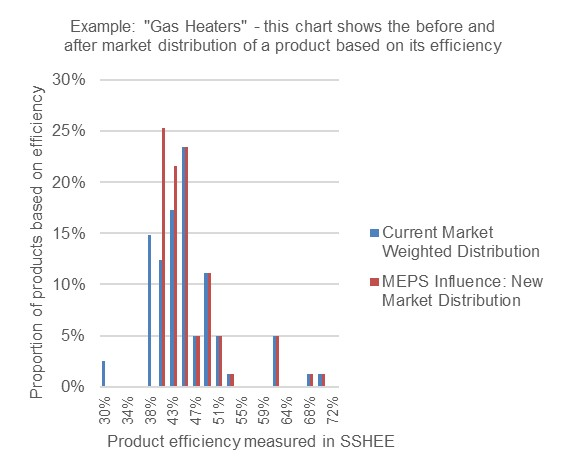
Caveat to above analysis
We have not been able to find or procure a detailed breakdown of sales linked to efficiency for individual products. We have bulk data on stock/sales that we use to get the overall scale of intervention, however efficiency is not available at this granular level. Instead, we used as a proxy web scraped data that collates the local space heater products found online, to give us an indication of what the market looks like. This gives us an indication of the number of products on the market, at different levels of efficiency. This was used as a proxy for sales by efficiency.
Sources: data was web scraped from selected retailers.
Monetized benefits and NPVs
Monetized benefits and NPVs:
- discount rate: the standard discount factors of 3.5% each year have been used from the HM Treasury Green Book Supplementary Guidance.
- assumptions on LRVC of energy supplies were used to calculate monetised LRVC savings resulting from setting efficiency standards.
- electricity emissions factors were used to convert the electricity consumption of local space heater sales in our model to carbon emissions, and therefore carbon savings associated with reductions from setting efficiency standards
- carbon price values were used to calculate the monetised savings associated to carbon reductions from setting efficiency standards
- air quality impacts of electricity consumption values used to calculate monetised air quality impact savings resulting from setting efficiency standards.
- retail electricity prices were used to calculate the bill savings associated to the energy savings of the local space heater sales from setting efficiency standards
Source: Green Book Supplementary Guidance tables[footnote 21] .
Transition costs
For hours taken, our proposal seeks to align with the requirements set out in the equivalent EU ecodesign and energy labelling measures for local space heaters (which are already published by the Commission), so we expect that businesses will take minimal time to confirm they are compliant with the new MEPS. This has been estimated as a day and a half of labour based on feedback from a previous consultation. The number of Great British businesses affected is estimated from desk-based research using Companies House. While difficult to say exactly how many businesses are involved with local space heater manufacture, we have identified 57 individual manufacturers. Accounting for any areas in identifying firms, we have taken 60 manufacturers as an upper bound for determining overall familiarisation costs.
To estimate the price of labour it has been assumed that reading and comprehending legislative text is unlikely to be low paid work. For small and micro businesses, it is likely that the business owner will take responsibility. In large companies it is likely to be members of a legal department or an expert in advising on changes in government regulation. This is reinforced by job titles included in responses to the consultation[footnote 22]. The Annual Survey of hours and Earnings find the median hourly earnings for full-time legal professionals and quality and regulatory professionals to be £23 and £22 per hour respectively. These hourly wages are the equivalent of £40,600 and £38,700 per-annum based on working 220 days of 8 hours. As a result of this a £23 per hour wage has been assumed. An additional 18% is added to this wage to account for overhead costs businesses face when employing workers. This provides a final cost for the comprehension of the regulations. An opportunity cost equal to the transitional cost has been included to account for this member of staff being diverted from other duties.
Source: ONS, Earnings and hours worked, occupation by four-digit SOC: ASHE table 14[footnote 23]
Key values per product
Table 12: key product efficiency assumptions
(Scroll right to see full table).
| Fuel | User | EU Proposed MEPS (SSHEE) |
Market average efficiency (SSHEE) |
Preferred option post-MEPS efficiency (SSHEE) |
Increase in market average efficiency (SSHEE) |
Product efficiency pre-MEPS (In-situ efficiency) |
Product efficiency post-MEPS (In-situ efficiency) |
Annual fuel demand pre-MEPS (kWh) |
Annual fuel demand pre-MEPS (kWh) |
|
|---|---|---|---|---|---|---|---|---|---|---|
| Open fronted local space heaters and open to chimney local space heaters | Gas | Domestic | 40.3% | 44.9% | 45.6% | 0.7% | 45% | 46% | 8,185 | 8,067 |
| Closed fronted open combustion local space heaters | Gas | Domestic | 63.6% | 66.3% | 67.4% | 1.1% | 60% | 61% | 6,146 | 6,047 |
| Balanced flue local space heaters | Gas | Domestic | 63.6% | 73.2% | 73.6% | 0.4% | 74% | 74% | 4,983 | 4,959 |
| Electric portable local space heaters | Electric | Domestic | 44.7% | 45.6% | 46.8% | 1.3% | 92% | 95% | 497 | 483 |
| Electric fixed local space heaters > 250 W | Electric | Domestic | 47.5% | 45.9% | 48.4% | 2.5% | 92% | 97% | 1,286 | 1,219 |
| Electric fixed local space heaters ≤ 250 W | Electric | Domestic | 43.1% | 41.2% | 43.9% | 2.7% | 85% | 91% | 435 | 408 |
| Electric storage local space heaters | Electric | Domestic | 47.3% | 48.6% | 48.6% | 0.0% | 98% | 98% | 2,399 | 2,399 |
| Electric underfloor local space heaters | Electric | Domestic | 47.5% | 46.4% | 48.4% | 2.0% | 82% | 85% | 1,129 | 1,084 |
| Fixed electric visibly glowing radiant local space heaters > 1.2 kW | Electric | Domestic | 46.8% | 39.9% | 47.0% | 7.1% | 90% | 100% | 1,951 | 1,756 |
| Fixed electric visibly glowing radiant local space heaters ≤ 1.2 kW | Electric | Domestic | 40.5% | 39.5% | 40.5% | 1.0% | 90% | 92% | 976 | 951 |
| Electric visibly glowing radiant portable local space heaters | Electric | Domestic | 39.5% | 42.2% | 42.3% | 0.0% | 92% | 92% | 1,530 | 1,529 |
| [electric] towel rails > 250 W | Electric | Domestic | 46.0% | 44.7% | 47.6% | 2.9% | 82% | 87% | 642 | 603 |
| [electric] towel rails > 60 W and ≤ 250 W | Electric | Domestic | 42.1% | 43.3% | 44.6% | 1.3% | 82% | 84% | 642 | 624 |
| Luminous local space heaters | Gas | Commercial | 90.0% | 92.8% | 93.5% | 0.7% | 91% | 92% | 30,945 | 30,729 |
| Tube local space heaters | Gas | Commercial | 80.0% | 79.7% | 82.8% | 3.1% | 75% | 78% | 56,320 | 54,233 |
Table 13: key product market assumptions
(Scroll right to see full table).
| Fuel | User | Median market cost pre-MEPS | Predicted cost post-MEPS | Stock (‘000) in 2030 |
Product lifetime years |
Sales (‘000) in 2030 |
|
|---|---|---|---|---|---|---|---|
| Open fronted local space heaters and open to chimney local space heaters | Gas | Domestic | £413 | £417 | 993 | 20 | 50 |
| Closed fronted open combustion local space heaters | Gas | Domestic | £2,344 | £2,344 | 2,152 | 20 | 108 |
| Balanced flue local space heaters | Gas | Domestic | £2,434 | £2,464 | 461 | 20 | 23 |
| Electric portable local space heaters | Electric | Domestic | £40 | £41 | 2,400 | 9 | 267 |
| Electric fixed local space heaters > 250 W | Electric | Domestic | £280 | £283 | 2,560 | 20 | 128 |
| Electric fixed local space heaters ≤ 250 W | Electric | Domestic | £38 | £39 | 697 | 20 | 35 |
| Electric storage local space heaters | Electric | Domestic | £750 | £750 | 3,000 | 20 | 150 |
| Electric underfloor local space heaters | Electric | Domestic | £215 | £215 | 1,704 | 40 | 43 |
| Fixed electric visibly glowing radiant local space heaters > 1.2 kW | Electric | Domestic | £349 | £349 | 51 | 9 | 6 |
| Fixed electric visibly glowing radiant local space heaters ≤ 1.2 kW | Electric | Domestic | £215 | £215 | 22 | 9 | 2 |
| Electric visibly glowing radiant portable local space heaters | Electric | Domestic | £26 | £26 | 94 | 9 | 10 |
| [electric] towel rails > 250 W | Electric | Domestic | £176 | £177 | 517 | 15 | 34 |
| [electric] towel rails > 60 W and ≤ 250 W | Electric | Domestic | £129 | £129 | 517 | 15 | 34 |
| Luminous local space heaters | Gas | Commercial | £0 | £0 | 25 | 15 | 2 |
| Tube local space heaters | Gas | Commercial | £2,166 | £2,248 | 35 | 20 | 2 |
Table 14: modelled savings per product, annual average from 2027 to 2050
(Scroll right to see full table).
| Fuel | User | BAU Fuel consumption (GWh) (Annual average) |
MEPS Fuel consumption (GWh) (Annual average) |
Energy Savings (GWh) (Annual average) |
BAU Carbon Emissions (MTCO2e) (Annual average) |
MEPS Carbon Emissions (MTCO2e) (Annual average) |
Carbon Savings (MTCO2e) (Annual average) |
|
|---|---|---|---|---|---|---|---|---|
| Open fronted local space heaters and open to chimney local space heaters | Gas | Domestic | 1,828 | 1,804 | 24.39 | 0.33 | 0.33 | 0.00 |
| Closed fronted open combustion local space heaters | Gas | Domestic | 3,051 | 3,006 | 45.18 | 0.56 | 0.55 | 0.01 |
| Balanced flue local space heaters | Gas | Domestic | 542 | 539 | 2.38 | 0.10 | 0.10 | 0.00 |
| Electric portable local space heaters | Electric | Domestic | 779 | 759 | 20.33 | 0.02 | 0.02 | 0.00 |
| Electric fixed local space heaters > 250 W | Electric | Domestic | 1,914 | 1,817 | 96.96 | 0.03 | 0.02 | 0.00 |
| Electric fixed local space heaters ≤ 250 W | Electric | Domestic | 177 | 166 | 10.53 | 0.00 | 0.00 | 0.00 |
| Electric storage local space heaters | Electric | Domestic | 4,184 | 4,184 | 0.00 | 0.06 | 0.06 | 0.00 |
| Electric underfloor local space heaters | Electric | Domestic | 609 | 585 | 23.76 | 0.01 | 0.01 | 0.00 |
| Fixed electric visibly glowing radiant local space heaters > 1.2 kW | Electric | Domestic | 68 | 61 | 6.60 | 0.00 | 0.00 | 0.00 |
| Fixed electric visibly glowing radiant local space heaters ≤ 1.2 kW | Electric | Domestic | 14 | 14 | 0.36 | 0.00 | 0.00 | 0.00 |
| Electric visibly glowing radiant portable local space heaters | Electric | Domestic | 94 | 94 | 0.07 | 0.00 | 0.00 | 0.00 |
| [electric] towel rails > 250 W | Electric | Domestic | 214 | 202 | 12.69 | 0.00 | 0.00 | 0.00 |
| [electric] towel rails > 60 W and ≤ 250 W | Electric | Domestic | 214 | 208 | 6.13 | 0.00 | 0.00 | 0.00 |
| Luminous local space heaters | Gas | Commercial | 170 | 169 | 1.10 | 0.03 | 0.03 | 0.00 |
| Tube local space heaters | Gas | Commercial | 444 | 429 | 15.20 | 0.08 | 0.08 | 0.00 |
| Total | 14,302 | 14,037 | 265.68 | 1.22 | 1.20 | 0.02 |
Table 15: key outputs per product, annual average from 2027 to 2050
(Scroll right to see full table).
| Fuel | User | Benefits (Total, £m) |
Costs (Total, £m) |
NPV (Total, £m) |
Annual bill savings (Annual average) |
Upfront cost increase | Payback period years |
|
|---|---|---|---|---|---|---|---|---|
| Open fronted local space heaters and open to chimney local space heaters | Gas | Domestic | £37 | £0 | £37 | £7 | £4 | 0.6 |
| Closed fronted open combustion local space heaters | Gas | Domestic | £69 | £0 | £69 | £6 | £0 | 0.0 |
| Balanced flue local space heaters | Gas | Domestic | £4 | £0 | £4 | £1 | £30 | 21.7 |
| Electric portable local space heaters | Electric | Domestic | £45 | £0 | £45 | £3 | £1 | 0.3 |
| Electric fixed local space heaters > 250 W | Electric | Domestic | £196 | £0 | £196 | £15 | £3 | 0.2 |
| Electric fixed local space heaters ≤ 250 W | Electric | Domestic | £21 | £0 | £21 | £6 | £1 | 0.1 |
| Electric storage local space heaters | Electric | Domestic | £0 | £0 | £0 | £0 | £0 | 0.0 |
| Electric underfloor local space heaters | Electric | Domestic | £47 | £0 | £47 | £10 | £1 | 0.1 |
| Fixed electric visibly glowing radiant local space heaters > 1.2 kW | Electric | Domestic | £15 | £0 | £15 | £43 | £0 | 0.0 |
| Fixed electric visibly glowing radiant local space heaters ≤ 1.2 kW | Electric | Domestic | £1 | £0 | £1 | £5 | £0 | 0.0 |
| Electric visibly glowing radiant portable local space heaters | Electric | Domestic | £0 | £0 | £0 | £0 | £0 | 0.0 |
| [electric] towel rails > 250 W | Electric | Domestic | £26 | £0 | £26 | £9 | £1 | 0.1 |
| [electric] towel rails > 60 W and ≤ 250 W | Electric | Domestic | £13 | £0 | £13 | £4 | £0 | 0.0 |
| Luminous local space heaters | Gas | Commercial | £2 | £0 | £2 | £8 | £0 | 0.0 |
| Tube local space heaters | Gas | Commercial | £23 | £0 | £23 | £80 | £82 | 1.0 |
-
HM Government (2025), Unlocking the benefits of the clean energy economy ↩
-
DESNZ (2025), Subnational estimates of properties not connected to the gas network ↩
-
DESNZ (2024), The Non-Domestic National Energy Efficiency Data-Framework 2024 (England and Wales) Geographical Annex ↩
-
DESNZ (2025), Energy Consumption in the UK (ECUK) 2025 ↩
-
DLUHC (2025), English Housing Survey data on energy performance, heating and insulation ↩
-
We expect to see price increases for 9 of the 15 products included in the regulations. ↩
-
DESNZ (2023), Green Book supplementary guidance: valuation of energy use and greenhouse gas emissions for appraisal ↩
-
In the case of fixed electric visibly glowing radiant local space heaters >1.2 kW and fixed electric visibly glowing radiant local space heaters ≤1.2 kW, all products being removed ↩
-
MLUHC (2025), English Housing Survey data on energy performance, heating and insulation ↩
-
DLUHC (2025), English Housing Survey data on energy performance, heating and insulation ↩
-
Based on DBT research on average costs for UKCA compliance. ↩
-
HM Government’s OIOU (One-In, One-Out) Methodology, July 2011 ↩
-
EU (2024), Energy efficiency – ecodesign requirements for local space heaters (review) ↩
-
BEIS (2022), BEIS business critical models: 2022 ↩
-
DESNZ (2022), Evidence update of low carbon heating and cooling in non-domestic buildings ↩
-
DESNZ (2025), Energy Consumption in the UK ↩
-
DLUHC (2026), [English Housing Survey]( https://www.gov.uk/government/collections/english-housing-survey ↩
-
Eunomia (2023), The Cost of Heating Appliances: A Comprehensive UK Database ↩
-
DESNZ (2023), Green Book supplementary guidance: valuation of energy use and greenhouse gas emissions for appraisal ↩
-
Earnings and hours worked, occupation by four-digit SOC: ASHE Table 14 SOC codes 241 and 248 ↩
-
Job titles include Senior Product Specialist, Head of EU technical market access. ↩