
Regulating on-screen assessment
Published 11 December 2025
Applies to England

© Crown copyright 2025
This publication is licensed under the terms of the Open Government Licence v3.0 except where otherwise stated. To view this licence, visit nationalarchives.gov.uk/doc/open-government-licence/version/3 or write to the Information Policy Team, The National Archives, Kew, London TW9 4DU, or email: psi@nationalarchives.gov.uk.
Where we have identified any third party copyright information you will need to obtain permission from the copyright holders concerned.
This publication is available at https://www.gov.uk/government/consultations/regulating-on-screen-assessment/regulating-on-screen-assessment
Introduction
Protecting standards in a digital age
Ofqual is consulting on proposals for how on-screen assessment should be regulated in GCSEs, AS and A levels in England. The approach supports responsible innovation, while ensuring that changes to assessment are carefully managed to protect standards, fairness, public confidence, and reliable delivery. We are proposing a controlled introduction of on-screen assessment, with pen-and-paper remaining central to most exams.
GCSEs, AS and A levels: respected qualifications at the heart of the system
GCSEs, AS and A levels sit at the heart of England’s education system. They signal academic achievement and open doors to further study and work. More than a million 16 to 19-year-olds take these high stakes exams each year, supported by the commitment and expertise of teachers, schools and colleges across the country.
Students, families, employers, and wider society trust these qualifications, because they are rigorous and reliable. They help shape futures, support economic growth, and contribute to England’s strong international reputation for educational standards. For these reasons, any changes to how these exams are taken must be handled with exceptional care.
Potential benefits of technology
The government has signalled that technology is at the forefront of its mission to modernise the education system, support teachers, and deliver better educational outcomes for children. Effective use of technology can improve curriculum delivery, overcome barriers to learning for children with special educational needs and disabilities (SEND), and better prepare young people for a digital future. Research we have undertaken jointly with the Department for Education (DfE) suggests that on-screen exams could benefit some students, including those with SEND.
Technology already permeates the work of the qualifications industry, including the 4 exam boards that deliver all GCSEs, AS and A levels in England. For example, technology is increasingly used to assist with setting question papers, digitising scripts for marking, training and quality assuring markers, and aggregating and processing data for results. Awarding organisations tell us that carefully deployed AI will be able to play a greater role as technology develops and improves.
Ofqual welcomes these developments, as they have the potential to further improve the quality of exam papers and marking, and deliver efficiencies at scale.
Curriculum and Assessment Review
The Curriculum and Assessment Review (CAR) Final Report noted calls for greater integration of technology in assessment. It further recognised potential benefits from wider use of on-screen assessment in the future, but it also noted that evidence is still limited and that wider implementation would have considerable delivery implications for schools and colleges.
The report concludes by recommending that the government: “ensures that the DfE and Ofqual continue to work together to explore potential for innovation in on-screen assessment in GCSE, AS and A level qualifications, particularly where this could further support accessibility for students with SEND and where this could reduce exam volume in the future. We recommend they continue to review the evidence and carefully consider risks and benefits.”
The government accepted this recommendation in its response to the final report of the CAR and the Secretary of State’s steer further emphasises that any “wider use of on-screen exams must be fair for students, proportionate, and manageable for schools and colleges to deliver with the staff, infrastructure and resources they have at present.”
The international picture
Some countries have introduced on-screen assessments for national secondary exams, but these examples reflect different contexts to England. Typically, student cohorts are smaller and overseen by a single state examination body, and national programmes have invested specifically in technology infrastructure to support the delivery of on-screen assessment, as part of a wider, integrated drive to digitise the whole school system. Importantly, there is no conclusive evidence that all the anticipated benefits have yet been fully realised elsewhere.
The importance of fairness, standards and delivery
It is critical that GCSEs, AS and A levels are fair and are seen to be fair. On-screen assessment could benefit some students, for example by improving accessibility or enhancing the assessment experience. However, research tells us that students may perform differently on paper and on screen. Moreover, students do not have equal access to digital devices or digital skills. Schools and colleges also face practical challenges, including variable digital infrastructure. These factors could widen existing gaps in achievement if any move to on-screen assessment is not carefully managed.
Maintaining standards across on-screen and paper-based exams is complex. Digital delivery introduces new risks. These include cyber-security threats, technical failures—which can be stressful for students and compromise valid outcomes—and new forms of malpractice, which could compromise the reputation of the qualifications. Maintaining standards and the safe, secure delivery of these important qualifications is a key consideration for Ofqual.
The current GCSE, AS and A level system
The 4 exam boards delivering GCSEs, AS and A levels in England are regulated by Ofqual to ensure that standards are maintained and that exams are high quality, valid, reliable and fair. When new GCSE, AS or A level specifications are proposed by exam boards, they must be scrutinised and accredited by Ofqual before they can be delivered to young people.
Ofqual’s regulations currently do not specify whether exams should be taken on paper or on screen. This reflects the fact that most exams are taken with pen and paper, and so the regulatory framework has not needed to restrict digital approaches. As a result, there is currently nothing to prevent exam boards from submitting any number of on-screen specifications for accreditation.
The approach set out in this consultation has been developed through close engagement with the DfE and a range of stakeholders and informed by the Secretary of State’s steer. While our proposals focus on GCSEs, AS and A levels, we are also seeking views on how this approach might apply to vocational and technical qualifications (VTQs). We will consult further on our regulatory approach to VTQs as government policy develops.
Given the risks noted above, it is important to take a proactive regulatory approach to on-screen assessment.
The approach we propose to take
In balancing these considerations, we believe pen-and-paper exams will continue to be central to the assessment of GCSEs, AS and A levels. We are not proposing that handwritten exams will disappear in favour of on-screen exams.
Instead, we propose a controlled approach to further adoption of on-screen assessment in GCSE, AS and A level qualifications. This will enable Ofqual, as the regulator, to set clear expectations that must be met before any proposed on-screen assessments can be taken by students. These guardrails will ensure that only high-quality assessments are available. This will protect against unfairness and help maintain the reputation and value of our national general qualifications.
At the same time, this approach would allow exam boards to innovate with on-screen assessment, but only those proposals that meet rigorous expectations will be accredited for use in schools and colleges. The high bar we set for accreditation will incentivise exam boards to invest in quality and lay the foundations for responsible innovation.
Because on-screen assessment in GCSEs, AS and A levels would be largely new, and readiness across schools and colleges to deliver on-screen exams varies significantly, the scale and pace of innovation must be carefully managed. While any on-screen assessments will not be considered ‘pilots’ there will be learning from early examples, informing any future developments.
Scale applies both to the number of qualifications accredited and their entry size. In addition to requiring a rigorous quality standard, we propose a further guardrail: each exam board may submit proposals for up to 2 new specifications for on-screen assessment, but, in line with the Secretary of State’s steer, these will not be permitted in the highest-entry subjects[footnote 1].
A proportionate regulatory approach
The changes we are consulting on will mean that any introduction of on-screen assessment is fair to students, protects the reliability and validity of our highly regarded and trusted GCSEs, AS and A levels, and is done at a scale and pace which are appropriate to this type of innovation.
Any proposal must meet stringent expectations for standards, fairness, deliverability and public confidence, and will be subject to robust scrutiny and accreditation by Ofqual to ensure that risks are appropriately managed and the interests of students, schools and colleges are protected.
This is a cautious, common-sense approach. By setting clear boundaries and high standards, Ofqual’s priority is to protect the integrity and reputation of our qualifications system, and to ensure fairness for students and deliverability for schools and colleges.
Have your say
This consultation sets out Ofqual’s proposed approach to regulating on-screen assessment in GCSEs, AS and A levels, and seeks views on how these proposals might apply to vocational and technical qualifications, where on-screen assessment is already more widely used. Subject to the outcome of this consultation, detailed rules and guidance will follow in 2026. If you have an interest in on-screen assessment or in general qualifications, please respond and share your views.
Proposals at a glance
To protect the interests of students and ensure that any introduction of on-screen assessment in GCSEs, AS and A levels is carefully managed, Ofqual is seeking views on its proposal to introduce a controlled approach for exam boards. This approach is shaped by the following guiding principles:
- Risks to standards, public confidence and fairness arising from on-screen assessment will be appropriately mitigated.
- On-screen assessment maintains or enhances the quality of the assessment experience for students and centres.
- On-screen assessment maintains or enhances accessibility for students with special educational needs and disabilities.
- On-screen assessment platforms, awarding organisation arrangements and centre arrangements are demonstrably capable of supporting secure and reliable assessment delivery.
Defining a controlled approach
The controlled approach is defined by the following proposals:
- Introduction of specific regulations for on-screen assessment: Ending the current permissive approach to on-screen assessment, by changing the default to not allowing on-screen assessment.
- Controlled entry: Each exam board may submit proposals for up to 2 new on-screen specifications, subject to Ofqual accreditation.
- High-entry subject restriction: In line with the Secretary of State’s steer, on-screen assessment will not be permitted in the highest-entry subjects (those with over 100,000 entries nationally).
- Separate specifications: On-screen and paper-based assessments must be offered as separate specifications, with substantially different questions for each – both to secure transparency and enable standards to be maintained – and will require accreditation.
Alongside these proposals for a controlled approach, we are also consulting on the following proposals to ensure a coherent approach to the regulation of on-screen assessment:
- Accepting the risks of on-screen only specifications: Exam boards will not be required to offer a paper-based alternative alongside any new on-screen specification.
- Expectations for platforms and devices: Ofqual will set clear expectations for on-screen assessment platforms and devices to support consistency and secure delivery, without mandating a single assessment platform.
- No use of students’ personal devices: Students’ own personal devices (such as their own laptops) will not be permitted for on-screen assessments for GCSEs, AS or A levels, though devices used for on-screen assessments may be used for teaching and learning.
- Application to vocational and technical qualifications: Ofqual is also seeking views on how the guiding principles might apply to vocational and technical qualifications (VTQs), where on-screen assessment is already more established.
A glossary of key terms related to this consultation is given in Annex A.
Audience
This consultation is open to anyone who may wish to make representation but may be of most interest to:
- students, including private candidates, and their parents and carers
- teachers, private tutors and home-educators
- school and college staff including IT and special educational needs co-ordinators (SENCOs)
- school and college leaders and heads of other types of exam centres
- exams officers
- exam boards and awarding organisations
- stakeholder representative organisations and unions
- those who use qualifications to make selection decisions, such as higher education institutions and employers
Consultation arrangements
Duration
This consultation will open for 12 weeks starting on Thursday 11 December 2025 and ending on Thursday 5 March 2025 at 11:59pm.
Respond
Please respond to this consultation by completing the online response form.
For information on how Ofqual will use and manage your data, please see Annex B.
Proposals
Guiding principles
To provide a clear foundation for the development and delivery of on-screen assessment in GCSEs, AS and A levels, Ofqual has identified a set of high-level guiding principles. These principles have shaped the proposals set out in this consultation and will inform the development of our regulatory approach to on-screen assessment. They are intended to ensure that any introduction of on-screen assessment maintains standards, protects students’ interests, and upholds public confidence in qualifications. These are:
- Risks to standards, public confidence and fairness arising from on-screen assessment will be appropriately mitigated.
- On-screen assessment maintains, and wherever possible, enhances, the quality of the assessment experience for students and centres.
- On-screen assessment maintains, and wherever possible, enhances accessibility for students with special educational needs and disabilities.
- On-screen assessment platforms, awarding organisation arrangements and centre arrangements are demonstrably capable of supporting secure and reliable assessment delivery.
A key decision underpinning our approach is that any new on-screen assessment will be subject to a rigorous accreditation process and must receive formal accreditation from Ofqual before it can be offered to students. Following this consultation, Ofqual will consider the specific requirements that exam boards must meet at accreditation and on an ongoing basis. Each of the above guiding principles will be further detailed in subsequent technical consultation, but together they set the direction for Ofqual’s approach.
Question 1
To what extent do you agree or disagree with Ofqual’s proposed guiding principles?
Controlled approach
Ofqual proposes that on-screen assessment will no longer generally be permitted in GCSEs, AS and A levels, except in the following cases:
- Limited new specifications: Each exam board may propose up to 2 new on-screen specifications for accreditation across all its general qualifications. Where an A level has a corresponding AS qualification (for example AS and A level business), these will be treated as one.
- Subjects where OSA is integral: OSA will continue to be allowed in subjects where it is important for validity or integral to the assessment approach. These currently are computer science, British Sign Language, and music technology.
- Existing on-screen specifications: The 5 existing specifications that already include on-screen assessment (GCSE geology, food preparation and nutrition, and GCSE/A level computer science) are not included in the 2-specification limit and may continue but must meet any new rules introduced.
- Reasonable adjustments: Exam boards are required by law to offer reasonable adjustments for disabled students, and Ofqual will continue to allow on-screen assessment as a reasonable adjustment where this meets specific accessibility needs.
This controlled approach is intended to ensure that any introduction of greater on-screen assessment is proportionate, manageable and controlled, taking into account the diversity of school and college contexts and the need for secure, reliable delivery.
In reaching this position, Ofqual has considered factors such as the variability of IT infrastructure, the operational demands on schools and colleges, stakeholder feedback on readiness, and the limited evaluative evidence on the benefits of on-screen assessment, particularly the absence of robust evidence in the English context. Limiting the number of new specifications also helps manage risks related to differences in students’ digital skills and familiarity with on-screen platforms.
The 2-specification limit will be kept under review. Ofqual will consider evidence and insights from the delivery of the initial set of on-screen specifications in practice, and will revisit this position as appropriate, particularly if wider system factors or key enablers, such as students’ digital skills, technology, or infrastructure, change. Any decision to increase the limit will be informed by the successful and secure delivery of these initial specifications, broader system readiness, and consideration of views from the DfE and other stakeholders.
Question 2
To what extent do you agree or disagree with the proposal to allow each awarding organisation to introduce no more than 2 new specifications using on-screen assessment within General Qualifications (GCSEs, AS and A Level)?
Question 3
To what extent do you agree or disagree with the proposal for Ofqual to keep under review the limit of 2 new on-screen specifications per awarding organisation and to revisit the policy, as appropriate, based on wider system changes and/or new evidence?
Subject restrictions
Ofqual proposes to introduce restrictions on the subjects in which new on-screen specifications can be accredited, taking into account the steer provided by the Secretary of State for Education. The government has set out its view that, while on-screen assessment offers potential benefits, its wider use in the highest-entry, high-stakes subjects should be carefully managed to protect students, schools and colleges, and the integrity of qualifications. Ofqual agrees this is currently a proportionate and necessary approach.
The proposed restriction is that, for the time being, on-screen assessment should not be permitted in the most widely taken GCSE and A level subjects, other than with the exceptions noted in the previous section. The proposed threshold is subjects with more than 100,000 national entries in England during a summer exam series over the past 5 years. At the point of consultation, these subjects are:
- GCSEs in English language, English literature, maths, combined science, biology, chemistry, physics, history, geography, religious studies, French, Spanish, and business
- A level maths
Ofqual believes that restricting the introduction of on-screen assessment in the most widely taken GCSE and A level subjects is the right thing to do. This reflects our own concerns about the manageability of large-scale implementation, the need to protect students and centres from delivery risks, and the importance of maintaining public confidence in qualifications.
This approach allows the sector to build capability and generate robust evidence from smaller-scale implementation before considering wider changes. It also helps to limit delivery risks and unintended impacts for students and schools and colleges, while maintaining public confidence in high-stakes qualifications.
Question 4
To what extent do you agree or disagree with Ofqual’s proposed subject restrictions?
Configuration of on-screen and paper-based assessments
Ofqual’s research indicates that students can perform differently depending on whether an exam is taken on paper or on screen. These differences, known as mode effects, can make one mode more or less demanding than the other. If the same grade boundaries were used across both modes, this could affect fairness.
While it is technically possible to manage mode effects by setting different grade boundaries for each mode, this approach, if applied within the same specification, could create confusion and undermine confidence in results. To support fairness and clarity, Ofqual proposes that exam boards must offer separate specifications for paper-based and on-screen assessments in GCSEs, AS and A levels.
Exam boards are already required to maintain standards over time and across specifications in the same subject, ensuring it is no easier or harder to achieve a given grade regardless of specification. This requirement will continue if additional specifications with on-screen assessment are introduced.
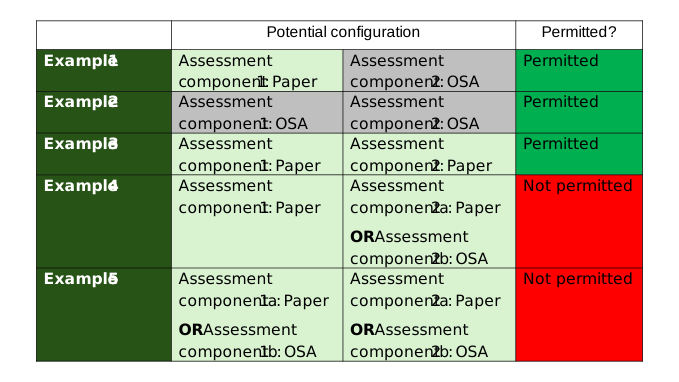
Exam boards may offer specifications that combine components assessed on paper and on screen, as illustrated in examples 1 and 2 in the table below. However, students will not be permitted to choose different modes for individual components within a single specification. This is for the same reasons of public transparency as noted above: to maintain standards, different grade boundaries may be required within a specification depending on the route selected.
This means that schools and colleges will need to decide, in advance, which specification (on-screen or paper-based) each student will be entered for in a given subject, as students cannot choose modes within a single specification.
The table and figure below provides an overview of how Ofqual proposes these arrangements would work in practice.
| Potential configuration part 1 | Potential configuration part 2 | Permitted? | |
|---|---|---|---|
| Example 1 | Assessment component 1: paper | Assessment component 2: OSA | Permitted |
| Example 2 | Assessment component 1: OSA | Assessment component 2: OSA | Permitted |
| Example 3 | Assessment component 1: paper | Assessment component 2: paper | Permitted |
| Example 4 | Assessment component 1: paper | Assessment component 2a: paper or Assessment component 2b: OSA |
Not permitted |
| Example 5 | Assessment component 1a: paper or Assessment component 1b: OSA |
Assessment component 2a: paper or Assessment component 2b: OSA |
Not permitted |
Distinct questions for on-screen and paper-based specifications
Ofqual recognises that exam boards may wish to develop both on-screen and paper-based specifications for the same subject, which may share similar content, structure and learning outcomes. However, using the same or very similar questions across both modes can compromise fairness and standards, as mode effects mean that students may interact with and respond to questions differently depending on whether they are on screen or on paper. It also may not be clear publicly why identical questions would attract different grade boundaries. To support validity and fairness, Ofqual proposes that exam boards must use substantially different questions in their on-screen and paper-based specifications. It will be for exam boards to determine and justify the extent of these differences, ensuring that risks are mitigated and providing evidence to Ofqual.
Question 5
To what extent do you agree or disagree with the proposal to require on-screen assessment to be offered in a separate specification, that is, not to allow choice of mode between paper-based and on-screen assessments within a single specification?
Question 6
To what extent do you agree or disagree with the proposal that, where an exam board offers both on-screen and paper-based specifications for the same subject, the assessments must use substantially different questions?
Availability of paper-based assessments
Ofqual does not require exam boards to offer particular subjects or specifications; the range of specifications available is determined by the market, which is shaped by school and college demand. Currently, not all subjects are offered by all schools and colleges. Similarly, not all exam boards offer all subjects. In line with this current practice, we do not propose to mandate that exam boards continue to offer paper-based assessments when introducing an on-screen assessment specification.
There is therefore a possibility, that in some subjects, all specifications move to on-screen assessment. This means that certain subjects, particularly those with fewer specifications and lower entry numbers, could be available only through on-screen assessment, with no paper-based alternative. While this is possible, it is likely to be in exam boards’ interests to continue to meet market demand for paper-based assessment while it exists, or to provide the means to participate in on-screen assessment. The proposed limit of 2 new on-screen specifications per exam board, together with the proposed subject restrictions, also helps to ensure that students at schools and colleges that are not ready to deliver on-screen assessments will continue to be able to access paper-based specifications in most subjects. In cases where subjects are only available on screen, it would be important for exam boards to provide appropriate support, such as technology and infrastructure, to enable schools and colleges to deliver these effectively. This reflects current market behaviour, where exam boards respond to school and college needs.
Ofqual’s existing regulatory requirements are also important to highlight. Under our current regulations, exam boards also have a duty to ensure schools and colleges can deliver these assessments and must not approve delivery where a centre cannot meet the necessary requirements.
Question 7
Do you have any concerns about the potential impact on students’ ability to take the subjects they want, if some specifications are only available through on-screen assessment?
On-screen assessment platforms
On-screen assessment platforms are central to the secure, accessible, and reliable delivery of on-screen assessments. Their design and functionality directly affect both the student assessment experience and the ability of schools and colleges to deliver assessments reliably.
Unlike some countries that use a single, nationally managed assessment platform, England’s qualifications market involves multiple exam boards, each responsible for selecting or developing the platforms they use. Some may have their own proprietary systems, while others may use third-party solutions.
This diversity in assessment platforms supports innovation and flexibility, but could also create challenges for schools and colleges, which may need to administer several different platforms. This is likely to increase demands on staff training, technical support, and administration. For students, encountering a range of platforms may make it harder to become familiar with the assessment format and navigation, potentially presenting challenges when preparing for and taking exams.
Ofqual does not consider it appropriate or practical to mandate a single assessment platform for all exam boards. While a single platform might offer consistency, it would restrict innovation and competition, add unnecessary burden for awarding organisations, require major market intervention, and potentially create a single point of failure for all students. Given differing priorities and existing investments, and the risk of a monopoly with less incentive for improvement, Ofqual does not consider itself best placed to select or mandate a single platform.
Ofqual has identified several key properties relating to on-screen assessment platforms that are central to secure, accessible, fair and reliable delivery. These include:
- Usability: intuitive and user-friendly platforms for students and teachers, with consistent core features across platforms
- Familiarisation: opportunities for students to practise and build confidence with the platform before assessment
- Accessibility: platforms to support a wide range of needs, including compatibility with assistive technologies
- Security: measures to protect assessment integrity, prevent malpractice, and ensure the secure handling of personal data
- Infrastructure: clear requirements for the infrastructure needed to deliver assessments reliably
- Technical support: appropriate support available before and during assessments
We are seeking views on whether these are the right issues to prioritise and how important they are to the successful delivery of on-screen assessments. Following this consultation, Ofqual will decide whether to address these issues through regulatory conditions, statutory guidance, or other mechanisms, considering the feedback received.
Platforms will need to meet high standards from the outset, with innovation and improvement expected to continue over time. The approach we will take will ensure high standards and consistency, while supporting ongoing development and further innovation.
Question 8
To what extent do you agree or disagree that the issues identified above are the right priorities for on-screen assessment platforms?
Are there other issues you consider important?
Digital devices for on-screen assessment
The devices used for on-screen assessment are critical to ensuring security, fairness and accessibility. A ‘bring your own device’ (BYOD) approach means students use their own laptops to complete on-screen assessments. Not all students have access to a suitable personal device, and those that do will have a wide range of devices with different specifications. This would create challenges for compatibility, security, and fairness.
Requiring schools and colleges to secure and configure a variety of student-owned devices would also place a substantial operational burden on centres and could introduce inequalities between students. For these reasons, Ofqual considers that a BYOD approach would not be appropriate for on-screen GCSEs, AS and A levels.
Ofqual is proposing to require exam boards to prohibit use of student-owned devices for completing on-screen assessments, with limited exceptions permitted as reasonable adjustments for disabled students where necessary and appropriate.
Question 9
To what extent do you agree or disagree with the proposal to require exam boards to prohibit use of student-owned devices for completing on-screen assessments?
Ofqual considered whether devices used for on-screen assessment should be reserved exclusively for exams. While exclusive use could reduce some risks, such as security and compatibility, it is not practical. Students may need access to devices for everyday teaching and learning, and requiring centres to procure, maintain and store separate assessment-only devices would significantly increase costs and operational complexity. These devices could quickly become outdated, require additional maintenance, and limit opportunities for students to familiarise themselves with them. Allowing dual-use devices avoids these issues and ensures students can use equipment they already know from everyday teaching and learning.
Ofqual therefore proposes that centre-owned, dual-use devices (used for exams as well as everyday teaching and learning) should be permitted for use in GCSEs, AS and A levels.
Question 10
To what extent do you agree or disagree with the proposal that devices used for on-screen assessments should not be required to be exclusively used for this purpose?
Reliable device performance, robust security, and clear technical requirements are essential for effective on-screen assessment. Ofqual has identified several key requirements relating to the devices used for on-screen assessments, including:
- Minimum technical specifications to ensure reliable platform performance
- Device and system testing before assessments, to confirm correct functioning and performance standards
- Robust security measures, such as locked-down browsers, to prevent unauthorised access during assessments
We are seeking views on whether these are the right issues to prioritise for devices used in on-screen assessments, and how important each is to the successful and secure delivery of assessments. We also welcome suggestions for any additional issues that should be considered.
Following this consultation, Ofqual will decide whether to address these issues through regulatory conditions, statutory guidance, or other mechanisms, considering the feedback received. The aim is to ensure exam boards provide clarity and support for schools and colleges, while allowing flexibility to accommodate different local contexts and technologies.
Question 11
To what extent do you agree or disagree that the issues identified above are the right priorities for devices used in on-screen assessments?
Are there other issues you consider important?
Security
Security is a critical consideration in the delivery of high-stakes qualifications. On-screen assessment offers potential security benefits, such as reducing risks associated with transporting and storing paper scripts and confidential exam papers, enabling digital tools to support human invigilation, enhanced data analytics to improve detection of malpractice and improving traceability throughout the assessment process. However, on-screen assessment also introduces significant risks, including the threat of cyber-attacks, new forms of malpractice and the potential for data corruption during the exam lifecycle.
Ofqual has identified several key security issues relating to on-screen assessment, including:
- protection against cyber-attacks and unauthorised access
- prevention and detection of malpractice
- secure data management throughout the assessment lifecycle
- ensuring the integrity and reliability of assessment platforms and devices
We are seeking views on whether these are the right security issues to prioritise, and how important they are to the secure delivery of on-screen assessments. We also welcome suggestions for any additional security risks or scenarios that should be considered.
Following this consultation, Ofqual will decide whether to address these security issues through regulatory conditions, statutory guidance, or other mechanisms, considering the feedback received.
Question 12
Are there specific security risks relating to on-screen assessment platforms, digital devices, or data management that you feel are not fully addressed by the issues identified above?
Delivery
Beyond the security considerations outlined earlier, on-screen assessments present both delivery opportunities and significant risks.
Our research indicates that on-screen assessments could improve the pace, reduce costs and improve efficiency of exam delivery. For example, it could reduce the time and money spent on transporting scripts, enable greater automation of some processes, reduce paper production and storage, and lessen some of the administrative burden associated with reasonable adjustments. However, these potential benefits may be offset by significant investment and ongoing costs for exam boards, including designing on-screen assessments, managing or procuring assessment platforms, maintaining secure infrastructure, and upskilling staff. Environmental impacts are mixed, while reduced transport and paper use may lower carbon emissions, increased reliance on digital infrastructure introduces new environmental considerations (see Ofqual’s research report, The carbon footprint of a GCSE, 2023).
Our research also shows that further introduction of on-screen assessment may introduce substantial implementation challenges for schools and colleges, including:
- Infrastructure: investment in devices and IT systems
- Staff training: upskilling exams officers, invigilators and support staff
- Technical support: increased demand during exam periods
- Preparation time: longer lead-in for testing and setup
- Space requirements: larger desks, power access, and connectivity
- Operational complexity: managing on-screen exams alongside paper-based exams
- Obsolescence: maintaining current hardware and software
These factors may increase costs and operational pressures, especially for resource-constrained schools and colleges. Importantly, it will be for individual schools and colleges to offer on-screen assessments only if they are confident in their ability to deliver them. This will be entirely optional, and even then, only a small number of specifications will be permitted to use on-screen assessment under Ofqual’s proposed controlled approach.
Ofqual’s existing regulatory requirements are also important to highlight. Exam boards must have written, enforceable agreements with schools and colleges to confirm they can deliver the assessment securely and reliably. This is critical for on-screen assessment, where technical and operational demands are higher. If a school or college cannot demonstrate to the exam board that it can deliver the qualification securely, the exam board must not allow it to do so. This puts the responsibility firmly on the exam board. If exam boards permit delivery where requirements are not met, Ofqual can hold them to account.
While the current paper-based exam system carries delivery risks, these are well understood and mitigated through established processes. In contrast, on-screen assessments introduce new and potentially more complex delivery risks, including IT compatibility challenges, network or power failures, and heightened concerns around security, data management, and malpractice. These risks require new mitigation strategies and robust contingency planning to ensure secure and reliable delivery.
Ofqual has identified the above as key delivery challenges for on-screen assessment. We are seeking views on whether these are the right delivery challenges to prioritise, and how important these are to successful, secure and reliable delivery of on-screen assessments. We also welcome suggestions for any additional delivery concerns that should be considered.
Following this consultation, Ofqual will decide whether to address these delivery issues through regulatory conditions, statutory guidance, or other mechanisms, considering the feedback received.
Question 13
Do you have any specific delivery concerns about on-screen assessments that you do not think are addressed by the issues identified above?
Vocational and technical qualifications
While the focus of this consultation has been on the use of on-screen assessment in GCSEs, AS and A levels due to their scale and profile, Ofqual also recognises the relevance of digital assessment methods for vocational and technical qualifications (VTQs).
In some cases, VTQs have similar purposes to GCSEs, AS and A levels, are taken by similar cohorts, and/or can be taken alongside them. These include T Levels, key stage 4 technical awards, Functional Skills qualifications, Alternative Academic Qualifications, applied generals and tech levels. Ofqual is keen to understand how the proposals for GCSEs, AS and A levels set out in this consultation might align with VTQs such as these and is seeking views on considerations as we develop the policy approach in this area.
The proposed guiding principles for on-screen assessment in general qualifications are as follows:
- Risks to standards, public confidence and fairness arising from on-screen assessment will be appropriately mitigated.
- On-screen assessment maintains and, wherever possible, enhances the quality of the assessment experience for students and centres.
- On-screen assessment maintains and, wherever possible, enhances accessibility for students with special educational needs and disabilities.
- On-screen assessment platforms, awarding organisation arrangements and centre arrangements are demonstrably capable of supporting secure and reliable assessment delivery.
For clarity, this question refers only to the guiding principles above, not to other proposals such as the specification limits or subject restrictions.
Question 14
To what extent do you agree or disagree that the guiding principles proposed in this consultation for general qualifications could be used for vocational and technical qualifications with similar purposes?
Please explain your answer and highlight any additional impacts or considerations we should take into account.
Equality impact assessment
Ofqual is subject to the public sector equality duty under the Equality Act 2010. This assessment considers the potential equality impacts—positive and negative—arising from our proposals to regulate on-screen assessments in GCSEs, AS, and A levels, both for students who share particular protected characteristics and for those who may be affected due to other factors such as socio-economic background. We welcome views on the impacts identified, suggestions for mitigation, and any additional impacts not covered.
What does the research tell us?
Ofqual’s research provides the evidence base for our approach. It highlights 3 principal risks in relation to equality:
-
Socio-economic inequality: Ofqual’s research highlights significant concerns about the potential for on-screen assessment to increase socio-economic inequities among students. For example, students from more advantaged backgrounds may have greater access to digital devices and reliable internet connectivity, which could give them an unfair advantage over other students taking on-screen assessments who do not have such access. Similarly, some schools and colleges are better equipped to offer and prepare students for on-screen assessment than others, potentially contributing to unequal experiences and outcomes.
-
Accessibility and SEND: Students with special educational needs (SEND) may face barriers with paper-based assessment. A range of reasonable adjustments are already available to support disabled students, including the use of word processors, scribes, and modified papers (such as large print or braille). Our research shows that, if designed well and thoroughly tested with students with a wide range of needs, on-screen assessment could help to reduce some barriers for certain groups. On-screen assessment can offer built-in accessibility features (such as adjustable font size, colour, text-to-speech, embedded audio or video, and compatibility with assistive technologies) that are not always possible with paper. Integrating these features as standard can reduce stigma and logistical challenges but only if platforms are accessible by design and thoroughly tested with diverse users. Our research also shows that students with SEND and those with lower digital skills require more extensive familiarisation with assessment platforms and tools.
-
Mode effects:
Our research also shows that students may perform differently in paper-based and on-screen assessments, although the evidence about these differences, often referred to as mode effects, is inconclusive and may vary by subject, student group, and context. While mode effects can interact with socio-economic and SEND factors, they may also affect students more broadly, introducing new sources of unfairness if not carefully managed.
It is important to recognise that the current paper-based approach is not without its own challenges, and that careful design and evaluation are needed to ensure fairness across assessment modes.
How our proposed approach responds
Our controlled and cautious approach is directly informed by this research:
- Limiting the number of new on-screen specifications and restricting high-entry subjects reduces the risk of rapid, large-scale inequity.
- Requiring separate specifications for on-screen and paper-based assessments supports fairness and clarity.
- Not mandating a single platform allows for innovation to support diverse needs but requires clear expectations for accessibility and support for familiarisation.
- Prohibiting the use of students’ personal devices (with limited exceptions for reasonable adjustments) aims to reduce the potential impacts of the digital divide and ensure a consistent, secure experience.
Reasonable adjustments
Under the Equality Act, exam boards are required by law to provide reasonable adjustments for disabled students. Ofqual will continue to allow exam boards to provide on-screen assessment as a reasonable adjustment where this meets specific accessibility needs. To be clear, this means adapting an existing paper-based specification to be delivered on screen for a disabled student, not creating a fundamentally new digital assessment. The proposed limits on new on-screen specifications and subject restrictions do not apply to on-screen assessment as a reasonable adjustment.
Ofqual’s research shows that on-screen assessment will only support disabled students if it is designed with accessibility in mind, thoroughly tested with a range of users, and supported by opportunities for familiarisation. Ofqual intends to introduce proportionate scrutiny of the use of on-screen assessment as a reasonable adjustment, including review of design and delivery arrangements, to ensure that standards, confidence, and fairness are maintained.
Summary of anticipated equality impacts and mitigations
To provide a clear overview, the table below sets out the principal equality risks for each proposal, together with the main mitigations designed to address them.
| Proposal | Equality impacts | Mitigation |
|---|---|---|
| Introduction of specific regulations for on-screen assessment | Sets clear expectations and boundaries for on-screen assessment. New requirements overall reduce the risk of disadvantage. |
Guiding principles set out expectations for fairness and accessibility. Controlled approach ensures risks are proactively managed. Ongoing monitoring and review. |
| Limit of 2 new on-screen specifications per exam board | Reduces risk of negative impacts for disadvantaged groups by allowing a manageable pace of on-screen assessment adoption. May limit rapid access to potential benefits of on-screen assessment for some groups if innovation is constrained. |
The policy allows for future review of the specification limit, so changes can be considered if evidence and system readiness support it. Focus on building capability and infrastructure. Reasonable adjustments ensure that disabled students can access necessary adjustments even if wider on-screen assessment is limited. |
| No on-screen assessment in high-entry subjects | Avoids large-scale delivery risks that could disproportionately affect disadvantaged or students with particular protected characteristics. Delays potential accessibility benefits for large cohorts, including those with SEND. |
Prioritises system stability and fairness. Allows time to build evidence and confidence before considering high-entry subjects. Review of subject restrictions as experience and evidence base grows. |
| Separate specifications for on-screen and paper-based assessment, with different questions | Supports fairness by reducing risk of mode effects disadvantaging particular groups of students. Supports fairness by helping to maintain standards across different modes. Reduces confusion and increases transparency for students. |
Accreditation process ensures both specifications meet high expectations. Ongoing review of comparability and outcomes. |
| Accepting the risks of on-screen only specifications | Risk that students in schools with limited digital access may face more restrictive subject choice. | Market demand likely to sustain paper-based options where needed. Expectations for exam boards to ensure deliverability in schools and colleges. |
| Expectations for platforms and devices, no single mandated platform | Potential for improved accessibility features and flexibility to meet diverse needs. Supports all students, especially those with SEND or lower digital skills to prepare for on-screen assessment, although effectiveness will depend on quality and consistency of support provided. Lack of a single platform may disadvantage students who need to learn multiple platforms, especially those with SEND. |
Clear expectations for accessibility and usability. Expectations for familiarisation and support for students and staff. |
| No use of students’ personal devices (only school- or college-provided devices permitted) | Reduces digital divide and supports fairness for students from lower socio-economic backgrounds. Schools and colleges with limited resources may struggle to provide enough devices, potentially impacting disadvantaged students. May increase the risk that some students, particularly private candidates or those not regularly attending a school or college, are less familiar with the devices used for assessment, potentially affecting their performance. |
Requirement for school- or college-provided devices ensures consistency and fairness. Limited exceptions permitted as reasonable adjustments for disabled students. Expectations for exam boards will address school and college requirements for familiarisation, with attention to private candidates. |
Next steps and building the evidence base
Ofqual recognises that the evidence base for the equality impacts of these proposals is still developing, particularly given the relatively limited experience of on-screen assessment in these qualifications to date. The responses to this consultation will play a crucial role in deepening our understanding of the likely impacts, both negative and positive. This will help us to refine our impact assessment, and, where possible, provide greater quantification of impacts.
We anticipate that, as the evidence base grows, there will be opportunities to undertake more detailed analysis, so that the regulatory approach remains proportionate, evidence-based, and responsive to the needs of a diverse range of students. Ofqual is committed to carrying out further research in this area, including evaluation of the impact of on-screen assessment on students with protected characteristics, to ensure that our approach continues to promote fairness and accessibility for all. Exam boards will also be expected to provide clear evidence of the impacts of their approaches and the effectiveness of any mitigations, conducting research and evaluation as part of the development and delivery of on-screen assessments.
Question 15
Are there any other impacts that we have not identified and should consider?
Question 16
Other than those we have identified, are there any ways in which we could mitigate potential negative impacts?
Regulatory impact assessment
In developing these proposals, Ofqual has carefully considered the potential regulatory impacts on exam boards as well as schools and colleges. The approach aims to strike a balance between introducing necessary controls to safeguard standards, fairness and public confidence while maintaining sufficient flexibility for exam boards to design and deliver new on-screen assessment specifications.
This approach is coherent with our statutory requirement under the Growth Duty to support sustainable long-term growth by facilitating innovation that adds value to students. It also supports Ofqual’s statutory objective to ensure that qualifications represent value for money, by maintaining the value and recognition of qualifications delivered via on-screen assessments as equivalent to those delivered through pen-and-paper assessments.
The following analysis considers the potential regulatory impacts of these proposals in detail, focusing on their implications for exam boards, schools, and colleges. Among the proposals, 3 key requirements for exam boards developing on-screen specifications are introduced:
- Develop separate specifications for on-screen assessment, distinct from paper-based versions, with sufficiently different questions.
- Ensure that platforms, devices, and delivery processes used for on-screen assessment meet regulatory expectations for security, reliability, and accessibility.
- Prohibit the use of students’ personal devices for on-screen assessment, except where required as a reasonable adjustment.
Impact on exam boards
The full impact of these proposals will depend on each exam board’s current approaches to qualification design and delivery, and on the extent to which they choose to introduce new on-screen assessment specifications. For example, the impact may differ if an exam board introduces one specification rather than 2, and there may be little or no impact for those who do not introduce any.
We recognise that requiring separate specifications and substantially different questions across paper-based and on-screen assessments introduces additional burden for exam boards. However, we consider this necessary to maintain confidence in the system.
We appreciate that these proposals will lead to additional costs for exam boards who choose to develop on-screen assessment specifications. Our proposals are intended as the most efficient way to meet our statutory objectives, and as the most proportionate way to mitigate risks at a system level. This means we have focused on outcomes, such as ensuring platforms, devices, and delivery processes are fit for purpose, while only introducing narrow prescriptive requirements where necessary, for example, regarding the use of students’ personal devices.
We will continue to use our existing accreditation process for new specifications. While we may enhance this process with specific checks for on-screen assessment, we are not proposing a separate or additional process. In addition, we have acknowledged the need for flexibility in the choice of platform, provided this supports consistency, familiarisation for students, and effective deliverability for schools and colleges.
While there is some limited experience of on-screen assessment in a small number of GCSEs and A levels[footnote 2] , this remains a relatively new mode of delivery for most general qualifications. As such our quantitative evidence base is limited. We want to work with exam boards to build this base to inform the design of the current and any future proposals in this space.
Impact on schools and colleges
Regulatory changes affecting the delivery of assessments are likely to have practical and resource implications for schools and colleges that choose to offer on-screen assessment in the potential 8 specifications permitted under these proposals (that is, if all 4 exam boards each introduce 2 on-screen specifications). Those schools and colleges will need to plan for the delivery of assessments in a digital format, which may involve adjustments to infrastructure, timetabling, invigilation arrangements, and staff training. While some schools and colleges already have experience with on-screen assessment for a limited number of qualifications, broader use of on-screen assessment may introduce new risks and operational challenges.
Schools and colleges choosing to offer on-screen assessment will also need to comply with the requirement to prohibit the use of students’ personal devices. This means they must provide suitable devices for all students undertaking on-screen assessments. This could represent a cost and logistical challenge, particularly for schools and colleges with limited existing IT infrastructure.
Permitting the use of students’ personal devices for on-screen assessment would introduce challenges for schools and colleges, including issues of security, compatibility, and support. These challenges, and the reasons for prohibiting student-owned devices, are discussed in detail in the “Digital devices for on-screen assessment” section. In summary, requiring centrally provided devices helps ensure a consistent, secure, and reliable assessment experience for all students.
The proposals seek to ensure that exam boards provide appropriate support to schools and colleges when introducing on-screen assessment specifications, helping schools and colleges to manage change and maintain secure, reliable delivery.
Summary of anticipated impacts
In addition to the 3 key requirements discussed above, the consultation sets out a number of proposals that together shape the regulatory approach to on-screen assessment. The table below provides a summary of the anticipated impacts of all of the proposals outlined in this consultation, considering their effects on both exam boards and schools or colleges.
This overview is intended to support respondents in identifying any additional impacts, costs, or benefits that may not have been captured in the preceding analysis. The impacts presented are based on a hypothetical baseline scenario in which no additional rules or regulatory changes are introduced for on-screen assessment. Any costs or benefits arise only if an exam board chooses to offer on-screen assessment; existing paper-based qualifications remain unchanged.
| Proposal | Impacts on exam boards | Impacts on schools/colleges |
|---|---|---|
| Introduction of specific regulations for on-screen assessment | Introduces costs related to implementing and maintaining additional rules. Restricts flexibility. |
Clearer approach may support planning. Confidence that risks specific to the way in which the assessment is carried out are being managed. |
| Limit of 2 new on-screen specifications per exam board | Restricts cost benefits from potential economies of scale and scope. Reduces competitive pressure to expand. |
Manageable pace of change. Reduces risk of delivery challenges. |
| No on-screen assessment in high-entry subjects | Restricts cost benefits from potential economies of scale. | Avoids large-scale operational and delivery challenges in core subjects. |
| Separate specifications for on-screen and paper-based, with different questions | Increases costs associated with additional workload and resource requirements relative to using a single specification. | Provides confidence that students will not be at a disadvantage in an OSA environment relative to a paper-based environment. |
| Accepting the risks of on-screen only specifications | Reduces costs compared with the alternative of requiring both paper and on-screen specifications, through supporting appropriate flexibility in specification design relative to a more conservative approach. | Schools and colleges lacking capacity for on-screen assessment may face costs to upgrade equipment or risk losing students, particularly if paper-based options are withdrawn in favour of OSA-only specifications. |
| Expectations for platforms, no single mandated platform | Increases costs related to ensuring technical capability. Potentially reduces costs and improves service received over the long term by not granting monopoly power to a given platform. |
Provides confidence in the technical aspect of OSA delivery. Multiple platforms may incur additional administrative costs and familiarisation costs for students and teaching and IT staff. |
| No use of students’ personal devices (only school- or college-provided devices permitted) | Reduces costs through addressing risks associated with use of personal devices. | If a school does not already have OSA capacity, there may be significant capital investment required to run on-screen assessment. Reduced costs through addressing risks associated with use of personal devices. |
| Devices used for on-screen assessment are not required to be exclusively used for this purpose | None | Reduces the likelihood of centres needing to invest in additional OSA capacity, mitigating the costs associated with on-screen only qualifications and not allowing students’ personal devices. |
Next steps and building the evidence base
Ofqual recognises that the evidence base for the regulatory impacts of these proposals is still developing, particularly given the relatively limited experience of on-screen assessment in general qualifications to date. The responses to this consultation will play a crucial role in deepening our understanding of the likely impacts, both costs and benefits. This will enable us to refine our impact assessment and, where possible, provide greater quantification of impacts.
We anticipate that, as the evidence base grows, there will be opportunities to undertake more detailed analysis, potentially as part of a future technical consultation, so that the regulatory approach remains proportionate, evidence-based, and responsive to the needs of exam boards and schools and colleges.
Question 17
Are there any impacts of these proposals (individually or combined) that we have not identified?
Please outline any additional costs or benefits that you foresee.
Question 18
What is your estimated cost to develop an on-screen assessment specification for an existing paper-based qualification?
We are looking for quantitative information, ideally monetary values – but are open to other quantitative data.
Question 19
Taken as a whole, how much will these proposals add to your cost of implementing on-screen assessment, relative to a hypothetical scenario where we provided no additional rules?
This could include the activities required, the level of resource commitment, financial outlay, or the nature and value of any benefits. Again, we are primarily interested in quantitative information, but value qualitative insights where there is significant uncertainty.
Question 20
Do you have any suggestions for reducing or mitigating the costs associated with these proposals?
Innovation
Ofqual has a duty under the Apprenticeships, Skills, Children and Learning Act 2009 to have regard to the desirability of facilitating innovation relating to the provision of regulated qualifications. Ofqual has committed to surveying awarding organisations’ views of the impact of its regulatory requirements on innovation and to consider any revisions required in response.
The proposals in this consultation represent a shift from a permissive approach, where on-screen assessment could be introduced without restriction, to a controlled approach, in which on-screen assessment is only permitted within defined parameters. By introducing limits on the number of new on-screen assessment specifications and restricting their availability in high-entry subjects, Ofqual recognises that there may be some constraint on innovation in certain areas. This approach is, however, considered proportionate and necessary to manage risks to standards, fairness, and public confidence.
Importantly, the controlled introduction of on-screen assessment is intended to support responsible innovation by enabling exam boards to develop and deliver new on-screen specifications in a safe and measured way. The proposals are designed to ensure that innovation in on-screen assessment is accompanied by robust safeguards, helping to build evidence and experience that may inform future policy development. This should also help maintain public confidence in the qualifications system.
While the regulatory approach for on-screen assessment is intentionally restrictive, it is important to note that exam boards continue to have significant scope to innovate in other aspects of GCSE, AS and A level provision. Innovation is already taking place in areas such as marking processes, use of technology in administration, and support for accessibility. The proposals do not limit these broader opportunities for innovation.
Ofqual welcomes views on the impact of these proposals on innovation, including any suggestions for how the regulatory approach could better support responsible innovation in the future.
Question 21
Do you have any comments on the impact of the proposals on innovation by exam boards?
Annex A: Key terms
- General qualifications – general qualifications are the qualifications taken most commonly by pupils at school, and include A levels, AS levels and GCSEs.
- Vocational and technical qualifications – a widely-used general term for vocational, technical and professional qualifications and courses, many of which are taken alongside general qualifications.
- Specification – an awarding organisation document setting out the content, structure, and assessment requirements for a qualification.
-
Component – A discrete part of a qualification which –
(a) focuses on specific areas of the knowledge, skills and understanding assessed for the qualification, and
(b) has a specific set of criteria against which Learners’ performance will be differentiated. - Accreditation – In the context of this consultation, the statutory process by which Ofqual scrutinises and accredits for delivery new qualifications for GCSE, AS and A level submitted by exam boards.
- On-screen assessment – On-screen assessment means students take their exams using digital devices, such as a computer, instead of writing their answers on paper. The questions appear on the screen, and students type or select their responses, which are then submitted electronically. On-screen assessment includes both online and offline (or hybrid) approaches to digital exams. It doesn’t necessarily require an internet connection during the exam.
- Paper-based assessment – An assessment where students complete their exams using pen and paper
- On-screen assessment platform – The secure digital system or software used to deliver on-screen assessments and collect students’ responses.
- Digital device - An electronic device, such as a computer or laptop, used to access and complete on-screen assessments.
- Bring your own device (BYOD) – An approach where students use their own digital devices to take on-screen assessments.
- Awarding organisation – An organisation recognised and regulated by Ofqual. Awarding organisations design, develop, deliver and award qualifications.
- Exam board – The term used for an awarding organisation which awards GCSEs, AS levels, A levels and similar qualifications.
- Centre – An organisation undertaking the delivery of an assessment (and potentially other activities) to Learners on behalf of an awarding organisation. Centres are typically educational institutions, training providers, or employers.
- Mode effects – Differences in student performance or experience caused by the method of assessment delivery, such as on-screen versus paper-based exams.
- Reasonable adjustments – An adjustment made to an assessment for a qualification so as to enable a disabled Learner to demonstrate his or her knowledge, skills and understanding to the levels of attainment required by the specification for that qualification.
Annex B: Consultation responses and your data
Why we collect your personal data
As part of our consultation process, you are not required to provide your name or any personal information that will identify you. However, we are aware that some respondents would like to provide contact information. If you or your organisation are happy to provide personal data, with regard to this consultation, please complete the details below. We would like to hear as many views as possible and ensure that we are reaching as many people as possible. In order for us to monitor this, understand views of different groups and take steps to reach specific groups, we may ask for sensitive data such as ethnicity and disability to understand the reach of this consultation and views of specific groups. You do not have to provide this information and it is entirely optional.
If there is any part of your response that you wish to remain confidential, please indicate at the appropriate point in the survey.
Where you have requested that your response or any part remains confidential, we will not include your details in any published list of respondents, however, we may quote from the response anonymously in order to illustrate the kind of feedback we have received.
Your data
Your personal data:
- will not be sent outside of the UK unless there are appropriate safeguards in place to protect your personal data
- will not be used for any automated decision making
- will be kept secure
We implement appropriate technical and organisational measures in order to protect your personal data against accidental or unlawful destruction, accidental loss or alteration, unauthorised disclosure or access and any other unlawful forms of processing.
Your rights: access, rectification and erasure
As a data subject, you have the legal right to:
- access personal data relating to you
- object to the processing of your personal data
- have all or some of your data deleted or corrected
- prevent your personal data being processed in some circumstances
- ask us to stop using your data, but keep it on record
If you would like to exercise your rights, please contact us using the details below. You can also find out more about Ofqual’s privacy information.
Freedom of Information Act and your response
Please note that information in response to this consultation may be subject to release to the public or other parties in accordance with access to information law, primarily the Freedom of Information Act 2000 (FOIA). We have obligations to disclose information to particular recipients including members of the public in certain circumstances. Your explanation of your reasons for requesting confidentiality for all or part of your response would help us balance requests for disclosure against any obligation of confidentiality. If we receive a request for the information that you have provided in your response to this consultation, we will take full account of your reasons for requesting confidentiality of your response and assess this in accordance with applicable data protection rules.
Members of the public are entitled to ask for information we hold under the Freedom of Information Act 2000. On such occasions, we will usually anonymise responses, or ask for consent from those who have responded, but please be aware that we cannot guarantee confidentiality.
If you choose ‘no’ in response to the question asking if you would like anything in your response to be kept confidential, we will be able to release the content of your response to the public, but we won’t make your personal name and private contact details publicly available.
How we will use your response
We will use your response to help us shape our policies and regulatory activity. If you provide your personal details, we may contact you in relation to your response. We will analyse all responses and produce reports of consultation responses. In the course of analysis, we will where possible avoid using your name and contact details. We will only process the body of your response, but we are aware that in some cases, this may contain information that could identify you.
Sharing your response
We may share your response, in full, with The Department for Education (DfE) where the consultation is part of work involving those organisations. We may need to share responses with them to ensure that our approach aligns with the wider process. Where possible, if we share a response, we will not include any personal data (if you have provided any). Where we have received a response to the consultation from an organisation, we will provide the DfE with the name of the organisation that has provided the response, although we will consider requests for confidentiality.
Where we share data, we ensure that adequate safeguards are in place to ensure that your rights and freedoms are not affected.
We use Citizen Space, which is part of Delib Limited, to collect consultation responses and they act as our data processor. You can view Citizen Space’s privacy notice.
Your response will also be shared internally within Ofqual in order to analyse the responses and shape our policies and regulatory activity. We use third party software to produce analysis reports, which may require hosting of data outside the UK, specifically the US. Please note that limited personal information is shared. All personal contact information is removed during this process. Where we transfer any personal data outside the UK, we make sure that appropriate safeguards are in place to ensure that the personal data is protected and kept secure.
Following the end of the consultation, we will publish an analysis of responses on our website. We will not include personal details in the responses that we publish.
We may also publish an annex to the analysis listing all organisations that responded but will not include personal names or other contact details.
How long will we keep your personal data?
Unless otherwise stated, Ofqual will keep your personal data (if provided) for a period of 2 years after the consultation closing date.
Our legal basis for processing your personal data
Where you provide personal data for this consultation, we are relying upon the public task basis as set out in Article 6(1)(e) of UK GDPR to process personal data which allows processing of personal data when this is necessary for the performance of our public tasks. We will consult where there is a statutory duty to consult or where there is a legitimate expectation that a process of consultation will take place. Where you provide special category data, we process sensitive personal data such as ethnicity and disability, we rely on Article 9(2)(g) of UK GDPR as processing is necessary for reasons of substantial public interest.
The identity of the data controller and contact details of our Data Protection Officer
This privacy notice is provided by The Office of Qualifications and Examinations Regulation (Ofqual). The relevant data protection regime that applies to our processing is the UK GDPR[footnote 3] and Data Protection Act 2018 (‘Data Protection Laws’). We ask that you read this privacy notice carefully as it contains important information about our processing of consultation responses and your rights.
How to contact us
If you have any questions about this privacy notice, how we handle your personal data, or want to exercise any of your rights, please contact our data protection officer at dp.requests@ofqual.gov.uk
We will respond to any rights that you exercise within a month of receiving your request, unless the request is particularly complex, in which case we will respond within 3 months.
Please note that exceptions apply to some of these rights which we will apply in accordance with the law.
-
The proposed threshold is subjects with over 100,000 national entries: GCSEs in English language, English literature, maths, combined science, biology, chemistry, physics, history, geography, religious studies, French, Spanish, and business. A level maths. ↩
-
The following general qualifications currently in the market have on-screen assessment components: WJEC Eduqas GCSE computer science, GCSE geology, GCSE food preparation and nutrition; Pearson GCSE computer science; and AQA A level computer science. Pearson A level music technology uses digital resources but is not an on-screen assessment. ↩
-
Please note that as of 1st January 2021, data protection laws in the UK have changed. The General Data Protection Regulation (EU) 2016/679(GDPR) no longer applies to the UK. However, the UK has incorporated GDPR into domestic law subject to minor technical changes. The Data Protection, Privacy and Electronic Communications (Amendment etc.) EU exit Regulations (DPPEC) came into force in the UK on 1st January 2021. This consolidates and amends the GDPR and UK Data Protection Act 2018 to create the new UK GDPR. ↩