Public Authorities (Fraud, Error and Recovery) Act DWP Codes of Practice: Verifying Eligibility in the Welfare System, Obtaining Information and Recovering Debt
Updated 19 December 2025

© Crown copyright 2025
This publication is licensed under the terms of the Open Government Licence v3.0 except where otherwise stated. To view this licence, visit nationalarchives.gov.uk/doc/open-government-licence/version/3 or write to the Information Policy Team, The National Archives, Kew, London TW9 4DU, or email: psi@nationalarchives.gov.uk.
Where we have identified any third party copyright information you will need to obtain permission from the copyright holders concerned.
This publication is available at https://www.gov.uk/government/consultations/public-authorities-fraud-error-and-recovery-act-dwp-codes-of-practice-verifying-eligibility-in-the-welfare-system-obtaining-information-and-recov/public-authorities-fraud-error-and-recovery-act-dwp-codes-of-practice-verifying-eligibility-in-the-welfare-system-obtaining-information-and-recov
Ministerial Foreword
Over the last decade, fraudsters have become increasingly sophisticated in the techniques that they use to steal people’s money, using data, technology and all manner of scams. Fraud against the public sector is a significant and constantly evolving challenge, requiring a robust and resolute response. In the social security system, DWP estimates show that the overall level of overpayments due to fraud and error was almost £10 billion in 2024 to 2025. In total, £45 billion has been overpaid in the social security system since the pandemic (measured from 2020 to 2021) due to fraud and error. Fraud against the public sector is not a victimless crime. It takes money away from vital public services, erodes trust, and harms innocent people. It is ultimately public services that suffer, and it is the taxpayer who is the victim of this crime.
In delivering this government’s Plan for Change, we have passed the most significant legislative reform in the last decade to reduce fraud and error in the public sector. The Public Authorities (Fraud, Error and Recovery) Act safeguards taxpayers’ money by helping to identify, prevent, and deter fraud and error across the public sector, and it enables the better recovery of debt owed to the taxpayer. Part 2 of the Act is estimated to deliver benefits of £1.5 billion until 2029 to 2030 as part of wider action in DWP to save a total of £9.6 billion.
The government will begin implementing the measures from 2026, once the Codes of Practice are published, to provide a guide on the appropriate use of these powers across DWP.
This consultation marks an essential opportunity for individuals, organisations, and experts to shape how these powers are applied in practice, ensuring they reflect the values and expectations of those they are designed to serve.
I am grateful for the extensive engagement with a number of key organisations and sectors that has fed into the development of these draft Codes and welcome the further ongoing engagement with the Department. We look forward to receiving your feedback on this important consultation.
– Andrew Western MP, Minister for Transformation, Department for Work and Pensions
About this Consultation
The Public Authorities (Fraud, Error and Recovery) Act 2025 establishes a modernised legislative framework to enable the Department for Work and Pensions (DWP) to more effectively identify, prevent, and reduce fraud and error within the social security system. Three draft Codes of Practice have been developed, to ensure the safe, effective and proportionate use of DWP’s new powers. To ensure appropriate governance and transparency in the exercise of these new powers, the DWP is committed to undertaking a public consultation on the proposed Codes of Practice developed under the Act.
Duration: from 8 December 2025 to 27 February 2026 (12 weeks)
Enquires (including requests for the paper in an alternative format) to: cop.paferconsultation@dwp.gov.uk
Responses will be analysed, and a consultation response document will be published.
How to respond to this consultation
Online - Consultation responses will be collected primarily through the survey link here: Public Authorities (Fraud, Error and Recovery) Act DWP Codes of Practice – Fill in form
Email - You can also submit representations/consultation responses via email: cop.paferconsultation@dwp.gov.uk
By post – Please send any responses to the following address:
DWP FED Consultation
2nd Floor
Caxton House
Tothill Street
London
SW1H 9NA
Please indicate whether you are responding as an individual or representing the views of an organisation.
Your response will be most useful if it is framed in direct response to the questions posed, though further comments and evidence are also welcome.
Data Protection and Confidentiality
The information you send us may need to be passed to colleagues within the Department for Work and Pensions and referred to in the published consultation report.
For more information about what we do with personal data, you can read DWP’s Personal Information Charter.
Quality Assurance
This consultation has been carried out in accordance with the government’s consultation principles.
Background
This consultation invites stakeholders and members of the public to share their views on the following Codes of Practice:
-
DWP Eligibility Verification Notices – This Code of Practice provides an explanation of DWP’s Eligibility Verification Measure and how DWP expects to exercise the power to issue an Eligibility Verification Notice and collect data to verify benefit entitlement.
-
DWP Recovery of Debt via Direct Deduction Order and Disqualification from Driving – This Code of Practice provides a clear explanation of the DWP’s Direct Deduction Order and disqualification from driving measures, and how DWP expects to exercise those powers to recover debt fairly and responsibly.
-
DWP Obtaining Information to Support Fraud Investigations in the Welfare System – This Code of Practice provides an explanation of DWP’s Information Gathering measure and how DWP expects to exercise this power to obtain information in cases of suspected fraud from any person, subject to exemptions for certain types of information.
Input provided by financial institutions, businesses, debt charities and advice sector, other Government departments and parliamentarians during the passage of the 2025 Act has been taken into consideration when preparing the draft Codes of Practice.
What are the Codes of Practice
Eligibility Verification Notices
The Act allows DWP to issue Eligibility Verification Notices (EVNs) to require banks and other financial institutions to look at the data they hold on specified accounts and provide information to help DWP verify a claimant’s entitlement to benefits and identify incorrect payments. The Code of Practice for the Eligibility Verification Measure will provide information about the circumstances in which an EVN may be issued and provide guidance on the content and scope of an EVN, and the use of data obtained using an EVN. The Code of Practice will also provide further information about the appeals and review processes available to financial institutions, the penalties which may be issued to financial institutions for failing to comply with an EVN, and the safeguarding of data subjects and their data.
Recovery of Debt via Direct Deduction Order and Disqualification from Driving
Debt recovery powers were broadened by the Act to create greater fairness in DWP debt recovery. Money owed to DWP can now be recovered from an individual’s bank account by issuing a direct deduction order to their bank for repayment. In the most serious cases where individuals have persistently and deliberately evaded repayment of debt, DWP can apply to the court to temporarily disqualify an individual from holding a driving licence where the court is satisfied that the debtor had the means to repay and did not without good reason. The Code of Practice will set out how DWP will use the new recovery powers, who they are intended for and the safeguards in place to ensure they are applied proportionality and fairly including rights of representation and appeal where appropriate. The Code will also outline the responsibilities for financial institutions when exercising a direct deduction order and what a court must consider for driving licence disqualification orders.
Obtaining Information to Support Fraud Investigations in the Welfare System
DWP’s existing information gathering powers were strengthened by the Act to allow fraud investigators to compel relevant information from any information holder when conducting a criminal investigation into a case of suspected fraud on an identifiable individual. It creates a single approach for gathering information from all information holders, unless that type of information is exempted, and allows for requests and responses to be made digitally. The Code of Practice will govern DWP’s updated information gathering powers and the Authorised Officers who will be accredited to use them.
Why are we consulting?
These Codes outline how specific DWP measures will be delivered in more detail, reflecting the newly secured legislation.
The PAFER Act includes a statutory obligation for the Government to publicly consult on the Codes for the EVM and Debt Recovery measures before the powers are used for the first time. The Codes for the Information Gathering powers places a duty on the Secretary of State to consider any representations to the draft Code under Section 3 of the Social Security Fraud Act 2001.
Gathering views from a diverse range of backgrounds and perspectives will help ensure that each Code of Practice is fit for purpose, supporting the effective, proportionate and responsible use of the new powers.
Territorial Extent
This consultation applies to Great Britain, as benefit administration is a partially devolved and reserved matter for Scotland and Wales, respectively. Benefit administration is a devolved matter for Northern Ireland, and it is anticipated that Northern Ireland will make corresponding legislation.
DWP Eligibility Verification Notices Code of Practice
EVM Code of Practice Overview
1. Introduction
About this Code of Practice
1.1 This Code of Practice (“Code”) is authorised under paragraph 17(1) of Schedule 3B to the Social Security Administration Act 1992 (“the Act”) which requires the Secretary of State to issue a code of practice regarding Eligibility Verification Notices (EVNs). The Secretary of State has the power to issue an EVN under paragraph 1(1) of Schedule 3B to the Act which underpins the delivery of the Department for Work and Pension’s (DWP’s) Eligibility Verification Measure (EVM).
1.2 Failure to observe the provisions of the Code does not, in itself, render parties liable to civil or criminal proceedings. The Code is, however, admissible as evidence in any proceedings if any provision of the Code is relevant in considering the exercise of the powers under Schedule 3B to the Act and the actions taken by financial institutions given an EVN.
1.3 This Code may be subject to further updates as necessary, including as the operational aspects of the measure evolve through the Test and Learn period (see paragraphs 2.7 to 2.10 of this Code).
1.4 In the event that the Code is substantively revised, DWP must hold a public consultation on the new draft and lay the new Code before Parliament (under paragraphs 17(3), 17(4), 18(1), and 18(2) of Schedule 3B to the Act).
1.5 This Code is intended for:
(i) The exercise of the Secretary of State’s functions under Schedule 3B to the Act and this Code are kept under review by an independent person(s) or body appointed under s.121DC of the Act. Further details are in Chapter 4.
(ii) DWP staff (and the Secretary of State for Work and Pensions).
(iii) Organisations in receipt of an EVN (i.e. banks and other financial institutions (“financial institutions”), as defined in paragraph 2 of Schedule 3B to the Act).
(iv) Data subjects (the identified or identifiable individual to whom personal data relates).
(v )The Code may also be of interest to members of the public who wish to know more about the power to issue an EVN.
1.6 The exercise of the Secretary of State’s functions under Schedule 3B to the Act and this Code are kept under review by an independent person(s) or body appointed under s.121DC of the Act. Further details are in Chapter 4.
2. Explanation of the power to issue an Eligibility Verification Notice
2.1. Where possible, DWP uses different sources of data to verify the information provided by claimants to ensure their benefit entitlement is calculated correctly. For example, DWP uses data from HM Revenue and Customs to verify information about Pay As You Earn (PAYE) employment and income that can affect benefit eligibility and entitlement. However, for other eligibility criteria – such as savings or investments held – such information is not readily available in a timely fashion. That can mean that benefits may be overpaid due to either fraud or error, which can lead to the build-up of debt for the claimant and losses to the taxpayer.
2.2 EVM will improve DWP’s access to important data to help verify entitlements, ensure payments are correct, prevent the build-up of overpayments and prevent debt from accruing. This will help to reduce fraud and identify errors, including where claimants and/or DWP have made genuine mistakes and help to ensure that they receive the correct amount of money that claimants are entitled to. This not only avoids claimants incurring large overpayments that must be repaid but also ensures that the people who are eligible for the support receive the correct amount of money at the right time.
2.3 EVM enables DWP (on behalf of the Secretary of State) to require banks and other financial institutions to look within their customer data and provide limited information to DWP which may indicate that a benefit is being incorrectly paid. DWP may require this only where they consider that it is necessary and proportionate to do so.
2.4 DWP will request data by issuing an EVN to financial institutions. The data items that DWP will request will be set out in the EVN and will be related to the eligibility rules for a specific benefit. Financial institutions will be required to provide DWP only with the information it requests, and none in excess.
2.5 For the eligibility criteria of the benefits in scope of the Eligibility Verification Measure, see:
(i) Universal Credit eligibility
(ii) Pension Credit eligibility
(iii) Employment and Support Allowance eligibility
2.6 DWP is prohibited by law (paragraphs 1(4) and (5) of Schedule 3B to the Act) from sharing personal data with financial institutions under this power and from requesting transaction information and special category data. DWP is obliged to maintain the security and confidentiality of all information that it receives and must follow all of its existing data security policies. DWP must comply at all times with data protection legislation. See Chapter 4 for further detailed information on safeguards.
Who is authorised to request information?
2.7 To ensure appropriate safeguarding of data, data subjects, and data holders, only DWP staff who are authorised by the Secretary of State will exercise the power to issue an EVN, on behalf of the Secretary of State. These limited number of people who will be authorised to issue the EVN are known as “authorised persons.”
How will the power to issue an EVN come into force?
2.8 This Code must be in force before an EVN can be issued. DWP will initially test the power with a small number of financial institutions to ensure that delivery is optimised, and that it is not unduly onerous to comply with EVNs. This will be known as the ‘Test and Learn’ period and will focus on ensuring that delivery of the measure is workable and effective. As such, it is possible that several different approaches will be trialled during this period in cooperation with financial institutions.
2.9 During this period, DWP may adopt a flexible approach to timescales and other aspects of compliance with an EVN, and the associated penalties regime. DWP recognises that financial institutions may raise questions as different approaches are trialled and will work closely with financial institutions to ensure that requests and associated deadlines are workable. However, all appropriate safeguards will be observed during this period, and the period will be reviewed by the independent oversight function.
2.10 During the Test and Learn phase, DWP will also work closely with key stakeholders and organisations, including within the finance industry and across Government. The aim is that once EVM is rolled out more widely, DWP will have already established the most effective ways of using EVM to assist in identifying incorrect payments of relevant benefits.
2.11 The measure will then be gradually rolled out with all relevant financial institutions.
Questions
To what extent do you agree to the following statements:
3. Chapter 2 clearly explains the purpose of the Eligibility Verification Measure (EVM).
a. Strongly agree
b. Agree
c. Neither agree nor disagree
d. Disagree
e. Strongly disagree
4. Please explain your response.
5. Chapter 2 clearly explains how DWP will use Eligibility Verification Notices (EVNs) to require information from banks and other financial institutions.
a. Strongly agree
b. Agree
c. Neither agree nor disagree
d. Disagree
e. Strongly disagree
6. Please explain your response.
7. Chapter 2 clearly explains how the EVM Test and Learn period will operate.
a. Strongly agree
b. Agree
c. Neither agree nor disagree
d. Disagree
e. Strongly disagree
8. Please explain your response.
9. Chapter 2 clearly explains the type of information that will be shared by financial institutions with DWP under EVM.
a. Strongly agree
b. Agree
c. Neither agree nor disagree
d. Disagree
e. Strongly disagree
10. Please explain your response.
11. Chapter 2 clearly explains that an EVN will only be issued when it is necessary and proportionate to do so, and the factors that may be considered as part of that assessment.
a. Strongly agree
b. Agree
c. Neither agree nor disagree
d. Disagree
e. Strongly disagree
12. Please explain your response.
3. Eligibility Verification Notice
What is an Eligibility Verification Notice?
3.1 An EVN is the means by which DWP will ask financial institutions for information. An EVN will be issued by authorised persons (on behalf of the Secretary of State) in accordance with Schedule 3B to the Act and requires a financial institution to look within its own datasets and provide data to help DWP identify where someone might not be receiving the correct amount of a relevant benefit. A relevant benefit payment is a payment of any of the following benefits specified in Schedule 3B to the Act: Universal Credit, State Pension Credit, and Employment and Support Allowance.
3.2 EVNs will be sent to financial institutions and will set out the specific information required by DWP, for example specifying the eligibility indicators which must be used by financial institutions to determine whether information should be shared with DWP. An EVN must not contain any personal information about anyone, including benefit recipients. This power can only be used to obtain information on accounts that receive a specified DWP benefit, and any accounts linked to that benefit receiving account where (alone or with other accounts) they match the eligibility indicators set by DWP (as set out in legislation).
3.3 The eligibility indicators in the EVN are the specific criteria that financial institutions will be asked to check relevant accounts against. They will be based on the eligibility rules for the specified benefits and therefore may differ for each benefit in scope. In Universal Credit, for example, an individual’s savings can affect how much they are paid. DWP must only request the minimum information to identify individuals who meet the eligibility indicators, and relevant details related to how the indicators have been met, and financial institutions must only provide minimal information to DWP.
3.4 For example, eligibility indicators in an EVN may be set such that financial institutions are required to return information about accounts which receive Universal Credit (or are linked to such accounts) and which have more than £16,000. This is the capital threshold for Universal Credit. The ask may vary for example, it may be that information is only returned in cases where there is a specific amount above £16,000, or it may be that DWP lowers this amount to help verify the correctness of payments where a claimant has between £6,000 and £16,000. This is because a person’s Universal Credit award entitlement is tapered where they have capital between £6,000 and £16,000.
3.5 Where information is shared with DWP, it is not shared on the assumption that the person to whom the information relates is guilty of any wrongdoing. Any accounts identified will be considered by DWP for further inquiry. No decisions about benefit entitlement will be made automatically on this information alone.
3.6 The EVN can request information about any account into which a relevant DWP benefit payment is made which meets the criteria set out in that EVN, as well as any accounts linked to that account (see paragraph 3.20 to paragraph 3.23 below about accounts in scope).
3.7 An EVN must not request data which is more than one year old ending with the day on which the EVN was sent. However, it may request the date on which the account(s) first began to meet the eligibility indicator(s) set out in the EVN, even if this date is from a period prior to one year ending on the day on which the EVN was sent. For example, a financial institution may be required to provide the date on which an account in receipt of a relevant benefit first held capital in excess of the capital amount specified in the EVN. If, over a period of time, an account (and any linked accounts) fluctuates in its meeting of an eligibility indicator, then the financial institution must share the date on which the account(s) in question most recently began to meet the eligibility indicator.
Necessity and proportionality
3.8 Before issuing an EVN, DWP must consider that it is necessary and proportionate to do so (as per Schedule 3B, paragraph 1(2)) and must assess and record an EVN’s compliance with Article 8 of the European Convention on Human Rights (ECHR).
3.9 DWP has already undertaken an assessment of the power as a whole and considers that it is compatible with the right to private life under Article 8 ECHR and that this measure is justified, in accordance with the law, and proportionate. This assessment can be viewed in the following memorandum: https://bills.parliament.uk/publications/60614/documents/6453.
3.10 DWP will record each assessment of necessity and proportionality, and compliance with Article 8 ECHR, prior to issuing the Notice. These assessments and each EVN will be approved by a Senior Civil Servant.
3.11 To assess whether it is necessary and proportionate to issue an EVN, DWP may consider:
(i) the prevalence of overpayments due to fraud and error in particular benefits
(ii) the extent to which the expected burden on the financial institution in complying with the EVN is proportionate to the anticipated results
(iii) the effectiveness of previous EVNs in identifying overpayments
(iv) reports produced by the Independent Reviewer of EVM
(v) feedback from financial institutions, including the outcome of previous Internal Reviews of an EVN
(vi) the outcome of any appeals to the First-tier Tribunal
(vii) any other relevant considerations
3.12 In relation to Article 8 assessments, this must also include assessments of how the proposed EVN:
(i) is issued in accordance with the law
(ii) pursues a legitimate aim
(iii) is necessary and proportionate
3.13 In addition to the considerations above, DWP may also consider:
(i) the anticipated results of issuing an EVN
(ii) the level of detail required by an EVN about relevant accounts
(iii) the amount and types of information about individuals that will be shared
(iv) whether there are other possible methods of obtaining the data required by an EVN
(v) whether there are other possible methods of addressing the aim pursued by an EVN
(vi) any other relevant considerations
Who is liable to comply with an EVN?
3.14 Schedule 3B to the Act enables DWP to require information from financial institutions where accounts they provide meet the criteria set out in an EVN. Schedule 3B to the Act defines financial institutions as organisations that are authorised to accept deposits or issue electronic money and, in the course of doing so, provide relevant accounts into which a relevant benefit may be paid. This means that an EVN may be issued to any financial institution which meets these criteria. Further types of financial institution may be added using regulations if they fall outside of the current definition but are relevant to the exercise of the power.
3.15 For information to be shared by a financial institution about a benefit-receiving account and any linked accounts, there must be a relationship between the financial institution, the benefit-receiving account, and DWP. In practice, this means that the financial institution must provide an account into which a relevant DWP benefit is paid.
3.16 Any organisation which does not meet these criteria must not be issued with an EVN.
3.17 DWP recognises that operating models may differ from financial institution to financial institution, and that where a financial institution operates as part of a group, there may be a certain organisation within that group which is better suited than others to receive an EVN. DWP will therefore work with financial institutions to ensure that EVNs are issued to the most appropriate organisation within a banking group.
3.18 Before issuing an EVN to a financial institution, DWP will discuss the requirements of complying with it with the institution in order to help them prepare for the formal ask, including ensuring a suitable digital solution is in place to allow the transfer of the data. DWP will not issue an EVN before this preparatory engagement has been offered.
Accounts in scope
3.19. Accounts in scope are those that are in receipt of a relevant benefit payment (or accounts which are linked to these), and which meet the conditions set out in the EVN. Linked accounts are any other accounts which are held by the same person who holds the account into which the relevant benefit payment is paid.
3.20 Schedule 3B to the Act clearly sets out accounts which are in and out of scope of the measure. Types of account which are in scope are current accounts, savings accounts and investment accounts. In line with benefit eligibility rules for the benefits in scope of EVM, some children’s accounts may be in scope where they are held on trust by one of the account holders of the account into which the relevant benefit is paid, or if they receive the relevant benefit payment. Credit card accounts and current account mortgages (including offset mortgages) are out of scope. All accounts must be personal accounts held within the United Kingdom.
3.21 Accounts which are not personal accounts (such as business accounts or charities) are not in scope for the measure. This is in line with the eligibility criteria of the benefits that EVM will require information about.
3.22 In some cases, an account that matches the criteria set out in the EVN may not belong to a benefit claimant. In the case of personal appointee accounts, for example, the benefit-receiving account is held by a person other than the benefit claimant. In this case, information regarding the matched account and any linked accounts will be shared with DWP if the conditions of the EVN are met. This is because the legislation prohibits DWP from sharing personal information (under paragraph 3(3) of Schedule 3B). However, the appointee’s information may not be relevant to the benefit claim. Once DWP has established such cases, the information will not be shared further and will not be used by any DWP operational area. More detailed information can be found in paragraphs 3.24 to 3.28 under “Whose information may be shared with DWP under the Eligibility Verification Measure?”
What type of information could an EVN request?
3.23 The EVN will require a financial institution to only provide the minimum information related to matched accounts to identify a benefit recipient within DWP’s own database. While DWP must not share personal data in an EVN, the information that is returned by financial institutions will include personal data, and the types of information that will be shared are detailed below.
3.24 The EVN will outline the specific data points that must be disclosed. The types of data that an EVN may require a financial institution to share with DWP are defined in paragraph 1(3) of Schedule 3B to the Act. These are:
(i) details of relevant accounts (for example, sort code and account number)
(ii) details about account holders (for example, their names and dates of birth) to enable identification of the benefit recipient
(iii) details about how the accounts meet the eligibility indicators specified within the EVN (for example, this may be to indicate that the total capital held across accounts is greater than the amount specified in the EVN or dates that the account has been consecutively used outside of the UK)
3.25 The eligibility indicators specified in the EVN will be linked to the eligibility criteria for the specified benefits. As such, if the eligibility criteria for the benefits in scope of EVM change over time, then the eligibility indicators specified in an EVN may change as well.
Information DWP must not require in an EVN
3.26 To ensure proportionality, compliance with Article 8 of the European Convention on Human Rights, and in compliance with data protection legislation, there are clear areas outside of the scope of an EVN. This means that some information must not be requested. An EVN must not require:
(i) information relating to any person or account (including any linked accounts) which does not match the eligibility indicators provided in the EVN
(ii) information which is not relevant to identifying potentially incorrect relevant benefit payments or verifying eligibility for a specified benefit payment
(iii) information which is more than one year old ending with the day on which the EVN was sent, except to provide the date on which an account most recently began to meet the eligibility indicator where requested
(iv) financial statements or transaction information (as defined in paragraph 22 to Schedule 3B to the Act). Financial institutions are also specifically prohibited from sending transaction information under the legislation. A financial institution is liable to receive a penalty if it shares such information (see Chapter 7)
(v) special category data as defined in paragraph 22 of Schedule 3B to the Act. Financial institutions are also specifically prohibited from sharing special category data. Special category data is sensitive, personal data such as information about an individual’s racial or ethnic origin, political opinions or religious or philosophical beliefs. For the definition of special category data, see Article 9 of UK GDPR. This restriction does not, however, prevent financial institutions from confirming that individuals are in receipt of the benefit specified in the EVN as set out in paragraph 1(5) of Schedule 3B to the Act
Whose information may be shared with DWP under the Eligibility Verification Measure?
3.27 Information about an account will only be returned to the DWP if the account (and any linked accounts) matches the strict criteria set out in the EVN.
3.28 If information returned to DWP is not directly relevant to a benefit claimant (for example in the case of appointees, where information is returned on an account which receives the benefit payment, but which does not belong to the relevant benefit claimant), it will be deleted after receipt and before the data have been used for operational purposes.
3.29 Similarly, information on joint account holders may be shared with DWP in certain circumstances. If the relevant benefit is paid into a joint account, for instance, details about all accounts held by both individuals will be shared with DWP by the financial institution. This is because DWP is not sharing claimant information with any external body and so the financial institution will not know which of the account holders, if either, is the benefit claimant. Where the benefit is a household benefit, such as Universal Credit, the capital held by both individuals may be relevant to eligibility for the benefit where those individuals are part of the same household. On receipt of the information from the financial institution, DWP will analyse the information, and information which is not relevant to eligibility for benefits will not be shared further or used by any DWP operational area.
3.30 If the person who holds a benefit-receiving account also holds a linked joint account, then the details of that account may be shared with DWP by the financial institution. No information about any other accounts held by the other account holder would be shared in this circumstance as these accounts would not be classed as a linked account. Linked accounts must be held by the same person who holds the benefit-receiving account.
3.31 For this reason, all those who hold an account into which a specified DWP benefit is paid should be aware that their account and any linked accounts may be considered by financial institutions as part of the measure. DWP will make claimants aware of this through various means, including through this Code and by updating Personal information charter - Department for Work and Pensions - GOV.UK.
Processing of appointee information
3.32 Information which is returned to DWP, but which is not relevant to a benefits claim, will not be shared further or used for any operational processes. This includes information about appointees that are not a benefit claimant. An appointee is a person who is responsible for making and maintaining benefit claims on someone else’s behalf.
3.33 On receipt of EVM information, DWP will use a matching process to identify whether the account holder identified by the financial institution and the benefit claimant in question are the same person. If DWP identifies that the data received from the financial institution does not relate to the claimant, the information will not be shared further and will not be used by DWP operational areas.
3.34 Some appointees may also independently claim a benefit specified in the EVN. In cases where an appointee is also a claimant of a benefit specified in the EVN, DWP will use the information to help verify their eligibility for the benefits that they receive.
3.35 DWP will not receive any information from financial institutions about corporate appointees or businesses that receive DWP payments into corporate accounts. This is because financial institutions must not share any information with DWP about business accounts, (paragraph 20(1) and (2) of Schedule 3B to the Act).
Processing of landlord information
3.36 There are certain circumstances where private landlords may receive payments directly from DWP on behalf of tenants who receive benefits, for example, where a claimant has asked DWP for help in managing their money, and payments to meet housing costs are made directly to a landlord. In these circumstances, if part of the benefit payment is paid into a landlord’s personal account rather than a business account, it is possible that information may be shared with DWP by the financial institution about the account into which the payment is made, and any linked accounts. However, since the information about the landlord’s account(s) is not relevant to the benefit claim, it will not be shared further and will not be used by any DWP operational area.
3.37 The same process will be used to identify accounts held by a landlord as will be used to identify accounts held by an appointee. Namely, DWP will use a matching process to identify whether the account holder identified by the financial institution and the benefit claimant in question are the same person. If DWP identifies that the data received from the financial institution do not relate to the claimant, the information will not be processed further and will not be used by any DWP operational area.
3.38 Some landlords may also independently claim a benefit specified in the EVN. In cases where a landlord is also a claimant of a benefit specified in the EVN, DWP will use the information to verify their eligibility for the benefits that they receive.
Frequency of a request for data
3.39 An EVN will specify whether data must be provided only on one occasion, or whether the data must be provided at a specific frequency for a period of time on specified dates. In the case of the latter, the EVN is known as a periodic Eligibility Verification Notice. A periodic EVN may be issued to a financial institution to require information to be shared on a regular basis for one year, for example. DWP will work with financial institutions to give them sufficient notice of any changes made to a periodic EVN.
Could there be any changes to the EVN once it has been issued to a financial institution?
3.40 Once an EVN has been issued, DWP may change or cancel it by notifying the financial institution. Such changes may include, for instance, corrections of minor clerical errors in an EVN. The financial institution will be notified of the change in writing. DWP will engage with financial institutions to ensure that the process is not unduly onerous for either party and that sufficient notice is given to enable compliance with an EVN. For this reason, DWP will aim to keep any changes to an EVN to a minimum, following the Test and Learn phase.
3.41 Substantial changes to an EVN may require DWP to reassess the EVN’s necessity and proportionality, in the same way as when the EVN is first issued. Any substantial changes must also be signed off by an appropriate Senior Civil Servant.
Complying with an EVN
In what format will the EVN be delivered?
3.42 The EVN will primarily be delivered electronically to financial institutions. All EVNs will be transferred securely and in line with DWP’s security policies.
How will a financial institution share data with DWP?
3.43 The EVN may require:
(i) the data to be presented in a specific way
(ii) the data to be provided to DWP in a specific way, including electronic communication services, and/or
(iii) the data to be provided using a specified address or portal set out in the EVN
Circumstances in which the Secretary of State will consider a financial institution as having complied with an EVN
3.44 An EVN will set out what a financial institution must do to comply with its requirements and specify the timeframe within which the financial institution must comply.
3.45 The Secretary of State will consider that a financial institution has complied with an EVN if it has:
(i) provided the information requested in the EVN
(ii) in accordance with the criteria of the EVN
(iii) in the requested format
(iv) within the timeframe specified
3.46 Where DWP believes that a financial institution has not complied with an EVN, the aim will always be to engage with the financial institution in the first instance to understand any issues, with a view to resolving them without resorting to the application of penalties permitted by the legislation.
3.47 In this situation, DWP will contact the financial institution and ask them to set out their reasons for why the EVN has not been complied with.
3.48 If DWP considers that a financial institution has failed to comply with an EVN and this engagement has not been effective, DWP has the power to issue a penalty to a financial institution as laid out in Chapter 7.
Issues complying with an EVN
3.49 In addition to the reviews and appeals procedures described in Chapter 5 and Chapter 6 respectively, financial institutions which experience technical difficulties while complying with an EVN may contact DWP using its Incident Management process (contact details to be confirmed).
3.50 The Incident Management process allows financial institutions to flag technical issues with DWP at any time. This constructive dialogue allows for technical issues to be addressed quickly and aids timely compliance.
How DWP will use data received in response to an EVN
3.51 DWP will use the data received from financial institutions to assist in identifying incorrect benefit payments, and to help verify a claimant’s eligibility for a specified benefit. This information received will initially be used to identify the claimant within DWP’s own systems, before it is then used to determine whether DWP must take any further action by looking into the claim in more detail. This will help to ensure that claimants are paid correctly and help prevent debt building up for individuals.
3.52 DWP will always aim to act on the data received promptly, for example within one month. Acting on the data means that work has started to establish whether an incorrect payment has been made, for example the information has been routed to the relevant area and an attempt to contact the claimant may have been made.
3.53 Where information is shared with DWP, it is not shared on the assumption that the person to whom the information relates is guilty of any wrongdoing, and a financial institution must not assume this. This is because it is not possible for the financial institution to ascertain from the sending of the information alone that a claimant may be receiving an incorrect amount of benefit. This is for DWP to determine through its business-as-usual processes. The information received simply indicates to DWP that further enquiry may be necessary to verify a claimant’s eligibility for the benefit payments they are receiving.
3.54 For this reason, DWP must not use its investigative powers under section 109BZA of the Act to require information about suspected DWP offences, when EVM information is relevant to that consideration, without also looking at other information it holds which is relevant to deciding whether to exercise these powers. This is as set out in paragraph 5 of Schedule 3B to the Act. For example, DWP may use capital declarations made by the claimant to establish whether there is a large discrepancy between this and the EVM information and will determine any further action accordingly.
3.55 Similarly, where EVM information may be relevant to a potential decision to suspend benefit payments or to change a benefit entitlement decision, DWP must consider all information it holds which is relevant to that decision. This is as set out in paragraph 5 of Schedule 3B to the Act.
3.56 Where DWP receives data that is not relevant, it will not share that information further and it will not be used by any DWP operational area. If DWP determines that no overpayment has been made, the data will be deleted following analysis.
3.57 Any further enquiries which may take place following receipt of EVM information may lead DWP to correct the benefit claim if necessary, or, if fraudulent behaviour is suspected, DWP may use the relevant powers for obtaining information in investigations under Part 6 of the Act. DWP staff will always take the decision on any further enquiries or investigations, and on any outcomes which may affect benefit awards or eligibility.
3.58 For the Code of Practice on the exercising of DWP’s powers for obtaining information under Part 6 of the Act, visit: Code of Practice on obtaining information: Social Security Fraud Act 2001 - GOV.UK [Note that this Code of Practice is also currently subject to a public consultation.]
3.59 If the data received indicates that a claimant has received an incorrect payment of one of the benefits set out in the EVN and they are also in receipt of a different benefit, then DWP may use the information received to re-assess the claimant’s eligibility for the second benefit. Certain benefits allow claimants to be automatically entitled to other benefits. For example, in some cases a claimant who is eligible for Pension Credit may be entitled to Housing Benefit, and where information received leads DWP to establish that a customer has received an incorrect Pension Credit payment, DWP may also notify the Local Authority which issues the Housing Benefit accordingly.
3.60 If enquiries lead DWP to establish that a benefit has been underpaid for any reason, then it will follow business-as-usual processes to correct this. This might be, for instance, if a claimant has received a compensation payment (certain compensation payments are disregarded) which does not count towards the calculation of their total capital balance for a benefit, but which they may have failed to inform DWP about. In such cases if an underpayment is found DWP would correct the claim to ensure the claimant receives what they are entitled to.
3.61 All data will be processed in accordance with relevant data protection legislation. The processing and use of data by financial institutions will be subject to both DWP and independent oversight. Additional information on oversight of EVM is found in Chapter 4.
Questions
To what extent do you agree to the following statements:
13. Chapter 3 clearly explains the types of accounts that fall within the scope of EVM.
a. Strongly agree
b. Agree
c. Neither agree nor disagree
d. Disagree
e. Strongly disagree
14. Please explain your response.
15. Chapter 3 clearly explains how DWP will use EVM information.
a. Strongly agree
b. Agree
c. Neither agree nor disagree
d. Disagree
e. Strongly disagree
16. Please explain your response.
4. Safeguarding
4.1 The legislation is intentionally limited and contains a number of clear and vital safeguards. These safeguards aim to protect those whose data is shared under EVM, and their data, as well as the financial institutions which are required to provide information. This Chapter sets out those safeguards.
Independent oversight of the Eligibility Verification Measure
4.2 The Secretary of State will appoint an independent person to oversee the use of the power to issue an EVN. The appointment will be listed on the Public Appointments Order in Council and carried out using an open, fair recruitment process, following the principles laid out in the Governance Code on Public Appointments. The Commissioner for Public Appointments will provide independent assurance that the appointment is made in accordance with these principles.
4.3 The remit of the independent oversight is to complete a retrospective review of delivery relating to the 12 months beginning with the measure’s coming into force date and every 12-month period subsequently. The review must consider:
(i) the extent to which DWP, and persons given an EVN, have complied with legislation
(ii) in the case of DWP, the Code of Practice
(iii) the extent to which the power has been effective in assisting in identifying, incorrect payments of relevant benefits during the period covered by the review
4.4 The independent person appointed to this position will help to ensure that data is handled responsibly and in compliance with data protection legislation and human rights considerations. Other organisations, such as the Information Commissioner’s Office and the Financial Conduct Authority, will also provide regulatory functions as a result of their existing remits in the areas in which EVM will operate.
4.5 The independent person will be provided with appropriate secretariat support and may request further specialist advice, as required, in discussion with the Secretary of State.
4.6 The independent person will produce a report for the Secretary of State every 12 months on the use of the power to issue an EVN. This report must be published and laid before Parliament. DWP must give the independent person any requested information which is relevant for the purposes of carrying out the review. The independent person(s) or body will not, however, be given uncontrolled access to DWP’s systems or its data in order to maintain security of the information that DWP holds.
4.7 The independent review ensures the measure is exercised in a responsible and effective manner, and in accordance with the legal framework. The requirement to publish findings and present them to Parliament supports transparency and facilitates scrutiny of whether the power is being used legally and proportionately and is effective in assisting in identifying incorrect payments of benefits, by both the public and Parliament.
Safeguarding the rights of individuals
Notice to data subjects
4.8 DWP has a Personal Information Charter (PIC) which is publicly available and details how DWP uses personal data. This includes general information about how DWP uses personal information shared with it and information about how DWP will use personal information shared with it under EVM. The PIC also lists the rights of data subjects and how they can exercise them, along with details of personal information collected.
4.9 Nothing in this measure will adversely affect the rights of data subjects under data protection laws, including the data subject’s right to access their own data via a Subject Access Request following existing guidance on how to do this. As such, data subjects retain the right to file a Subject Access Request with either DWP, the financial institution, or both.
Data minimisation
4.10 An EVN must not share any personal information with a financial institution and must only request limited information from a financial institution about accounts which meet the criteria set out. As set out in Schedule 3B to the Act (paragraph 1(4)), an EVN may only require specified information: the minimum information necessary for the DWP to be able to carry out any further enquiries where necessary.
Disregards
4.11 DWP must act in accordance with its existing policies. This includes continuing to comply with DWP policies about disregards.
4.12 Some claimants have a disregard in place which may in effect mean that they remain eligible for a specified benefit payment in circumstances which would otherwise make them ineligible. This might be, for example, if a claimant has received a relevant compensation payment which causes them to have more money than is usually allowed under benefit eligibility rules. A claimant in this situation may remain eligible for the benefit because the compensation payment is subject to a ‘disregard’ under DWP’s benefit eligibility rules.
4.13 DWP has processes in place to allow it to detect cases subject to a disregard and to ensure the data so that it is not used for operational processes.
Safeguarding vulnerable claimants
4.14 EVM is a data-requiring power. The process of a financial institution sharing data with DWP will not affect vulnerable claimants any differently to claimants who are not vulnerable.
4.15 DWP will take all reasonable steps to identify vulnerable individuals using information it already holds. All DWP staff who will be responsible for following up potentially incorrect benefit claims will receive training and support so that they can identify and manage complex cases and handle sensitive situations appropriately.
4.16 Whilst every effort will be made to identify indicators of vulnerability, it may not always be apparent.
4.17 All individuals are encouraged to self-disclose any vulnerabilities, or alternatively this could be via a representative or advocate on their behalf.
4.18 It is important that individuals, or their representative or advocate, make DWP aware of their situation as early as possible so that appropriate support and adjustments can be considered.
4.19 DWP already has Vulnerable Customer Champions and Advanced Customer Support Leaders, who can provide tailored advice and assistance where necessary.
4.20 For further information about how DWP supports claimants with additional support needs, visit:
Safeguards for financial institutions
4.22 EVM contains measures which safeguard financial institutions for the purposes of the measure. These include:
(i) DWP must only require information from financial institutions which hold the necessary information.
(ii) Schedule 3B to the Act is explicitly clear on information which must and must not be shared, and which accounts are in scope and out of scope.
(iii) Schedule 3B to the Act sets the legal basis for sharing information as specified.
(iv) A financial institution may contact DWP for further clarity on the eligibility indicators specified in the EVN to ensure that they can comply.
4.23 Financial institutions have the right to request a review of the decision to issue an EVN as well as the right to appeal against all or part of an EVN. This is embedded in the legislation and forms an important safeguard against the misuse or disproportionate use of this measure. Further information on appeals and internal reviews can be found in Chapter 5 and Chapter 6.
4.24 If DWP or anyone acting on behalf of DWP makes an unauthorised request for information, they may be liable to civil or criminal proceedings before the courts and subject to disciplinary action by DWP. If these individuals unlawfully disclose information acquired in the course of their employment, they may also be liable to prosecution.
4.25. For information about how EVM interacts with a financial institution’s financial legal obligations, see Chapter 8.
Safeguarding of data
Storage and retention of data
4.26 DWP continuously handles large volumes of data and has robust security processes in place to manage the data it will receive from financial institutions. Data must only be kept as long as necessary and in accordance with DWP’s Information Management Policy. At all times, data must be kept securely in line with DWP’s existing data storage processes while actively being used and must be destroyed safely and securely after use. DWP is transparent in how long it keeps data, and further information can be found here: DWP: Information Management Policies
4.27 Data must also be transferred in a secure manner, and DWP will work with financial institutions to ensure that this is the case.
Destruction of data
4.28 When data no longer serves an operational purpose, it must be securely destroyed in line with DWP’s existing data destruction processes.
4.29 Where DWP receives data that is not relevant, it must not share this information further and must not use the data for any further operational purposes. DWP has robust existing processes in place for safely and securely disposing of information of this nature.
Treatment and handling of Data
4.30 DWP must not share any personal data under this measure with financial institutions. Financial institutions must identify accounts about which to share information based on data that they already hold.
4.31 DWP and financial institutions are required by law to comply with rules and provisions set out in the Data Protection Act 2018 and UK GDPR.
4.32 DWP must ensure that once data have been received, and where it suggests an incorrect relevant benefit payment has been made, decisions about further enquiries or investigations, and about any outcomes which may affect benefit awards or eligibility will be made by DWP staff. No data source is perfect or infallible. That is why in fraud and error cases, a human will make any final decisions that affect benefit entitlement, and any indications of potential fraud or error will be looked at comprehensively.
4.33 The Financial Conduct Authority (FCA) has a responsibility to oversee the conduct of financial institutions in the United Kingdom. One of the authority’s operational objectives is to “use its powers over firms and markets to protect consumers”. If a financial institution breaches the standards expected by the FCA, then the FCA may take action against the financial institution.
Prohibition on the sharing of certain information
4.34 Schedule 3B to the Act expressly prohibits financial institutions from sharing transaction information and special category data with DWP in response to an EVN. In order to ensure that financial institutions comply with this prohibition, the legislation provides that penalties may be issued in circumstances where a financial institution shares this information.
DWP’s lawful bases for processing the personal data
4.35 DWP will process the personal data for EVM purposes using the ‘Public Task’ lawful basis from the UK GDPR, Article 6 (1) (e). That is because processing is necessary for the performance of a task carried out in the public interest or in the exercise of official authority vested in the controller.
4.36 The processing is necessary so that DWP can carry out its statutory functions, which are set out in Schedule 3B to the Act.
4.37 Personal data obtained by DWP will be processed under the general processing regime set out in the UK GDPR and Part 2 of the Data Protection Act 2018.
Data protection requirements
4.38 Financial institutions in receipt of an EVN should be aware that data protection obligations apply alongside the requirements stipulated in the EVN and any other requirements which govern the ways in which financial institutions operate.
4.39 At all times, DWP and financial institutions must abide by data protection legislation, including the seven key data protection principles, as set out in UK GDPR. For further information about these, see A guide to the data protection principles - ICO.
4.40 In compliance with the data protection principle of accuracy, data shared and processed under EVM must be accurate, and there are also penalties for financial institutions which share inaccurate information with DWP (see Chapter 7).
4.41 Financial institutions are prohibited from sharing transaction information and special category data with DWP, and there are penalties for financial institutions which do so (see Chapter 7). As the sharing of such information is prohibited by this legislation, financial institutions which breach this prohibition would not have a legal basis for this processing. This could therefore be a personal data breach. ICO guidance makes clear that when a personal data breach has occurred, data controllers must establish the likelihood of the risk to people’s rights and freedoms, and if a risk is likely, then the ICO must be notified. For further information about personal data breaches, see Personal data breaches: a guide - ICO.
Data Subject Complaints
Introduction
4.42 This section contains information for data subjects who wish to make a complaint. For information about the appeals process which financial institutions should use if they wish to make a complaint, see Chapter 5.
Complaints to DWP
4.43 DWP takes complaints very seriously and will seek to address any complaints, incidents or allegations of improper use of EVM via its normal complaints processes. Further details are available here: Complaints procedure - Department for Work and Pensions - GOV.UK.
4.44 Any concerns or complaints regarding this or any DWP policy should be directed via DWP’s Ministerial Correspondence Team. Further details are available here: Contact the Department for Work and Pensions about its policies - GOV.UK.
Complaints to the Information Commissioner’s Office
4.45 The Information Commissioner’s Office is the regulator for data protection matters in the UK and is responsible for the promotion of good practice regarding the processing of personal data. It may take action in the case of a breach of data protection legislation.
4.46 Complaints about data protection should initially be directed to DWP using the route described above. Should the matter remain unresolved following this, a complaint may be made to the Information Commissioner’s Office. DWP may also refer itself for any violation of this Code or any applicable law.
Mandatory reconsideration
4.47 Complaints to challenge a benefit decision are known as a ‘mandatory reconsideration’.
4.48 Mandatory reconsiderations can be requested if any of the following apply:
(i) it is believed that the office dealing with the claim has made an error or missed important evidence,
(ii) claimants disagree with the reasons for the decision, or
(iii) claimants wish to have the decision looked at again.
4.49 Mandatory reconsiderations must normally be requested within one month of the date of the decision.
4.50 All benefits within the scope of EVM are covered by the mandatory reconsideration process.
4.51 For further information about mandatory reconsideration, visit Challenge a benefit decision (mandatory reconsideration): Eligibility - GOV.UK.
Parliamentary and Health Service Ombudsman
4.52 The Parliamentary and Health Service Ombudsman carries out independent investigations into complaints about unfair or improper actions or poor service by UK government departments and their agencies.
4.53 Any complaint must be made to a Member of Parliament who will then decide whether to pass the complaint to the Ombudsman. The Ombudsman seeks to establish whether public bodies have acted correctly and fairly in discharging their duties.
4.54 Further information can be found on the Parliamentary and Health Service Ombudsman website at www.ombudsman.org.uk.
Questions
To what extent do you agree to the following statements:
17. The content in Chapter 4, regarding safeguarding the rights of individuals whose data may be shared under EVM, is clear.
a. Strongly agree
b. Agree
c. Neither agree nor disagree
d. Disagree
e. Strongly disagree
18. Please explain your response.
19. The content in Chapter 4, regarding the safeguards in place for financial institutions who will be required to comply with EVM, is clear.
a. Strongly agree
b. Agree
c. Neither agree nor disagree
d. Disagree
e. Strongly disagree
20. Please explain your response.
21. The content in Chapter 4, concerning the safeguarding of information received in response to an EVN, is clear.
a. Strongly agree
b. Agree
c. Neither agree nor disagree
d. Disagree
e. Strongly disagree
22. Please explain your response.
23. Chapter 4 clearly explains the role and remit of the Independent Reviewer.
a. Strongly agree
b. Agree
c. Neither agree nor disagree
d. Disagree
e. Strongly disagree
24. Please explain your response.
5. Internal Reviews
Introduction to the internal review process
5.1 A financial institution which is in receipt of an EVN may request that DWP review the decision to issue it with an EVN. Where this is the case, a review of the decision to issue an EVN will be carried out by DWP. This is known as an internal review.
5.2 There are a number of circumstances where a financial institution may request that DWP review its decision to issue an EVN. For example, it may be that the financial institution considers that they have received the EVN in error. Schedule 3B to the Act does not set out the circumstances in which a review may be requested or provide any restrictions in respect of reasons for requesting that DWP review the decision to issue the EVN. Technical issues which affect whether a financial institution can comply with an EVN should be dealt with using the Incident Management process described in Chapter 3.
5.3 The internal review process is designed to offer a faster and more cost-efficient alternative to the formal appeals procedure, for financial institutions that wish to address issues with DWP. It allows financial institutions to engage directly with DWP to resolve issues. This is in contrast to the appeals process, where appeals are made to the First-tier Tribunal. The appeals process for financial institutions is explained in Chapter 6.
5.4 Financial institutions are encouraged to use the internal review process as their first port of call where there may be questions or disputes about the issuing of an EVN. DWP will always aim to resolve any issues during the internal review. However, a financial institution retains the right to use the appeals process, which is carried out by the First-tier Tribunal. Further details on this are found in Chapter 6.
How does a financial institution request a review?
5.5 Each EVN will provide full details about the right to seek a review of the EVN, and how to do so.
5.6 A financial institution wishing to request a review of the decision to issue an EVN must ensure that the request is made within 14 calendar days, beginning with the day on which DWP issued the EVN.
5.7 Requests for a review should be made via email to the address included on the EVN. On receipt of a request, DWP will work to resolve the concerns raised as quickly as possible and will aim to formally resolve within14 days following receipt. Outcomes will be notified in writing via email.
Factors DWP may consider when carrying out a review
5.8 There are several reasons for which a financial institution may apply for a review, and DWP will act fairly and proportionately when deciding the outcome of the process.
5.9 DWP will consider relevant factors when undertaking an internal review, which may include whether:
(i) the EVN has been given to the wrong person,
(ii) the EVN does not comply with Schedule 3B to the Act,
(iii) it is unduly onerous to comply with the EVN,
(iv) there was any late receipt of an EVN, and/or
(v) the financial institution encountered any technical issues.
5.10 DWP will consider any representations made by a financial institution which makes a request for a review of the decision to issue an EVN, as well as any other factors relevant to the individual request.
What are the possible outcomes of a review?
5.11 Having considered the representations made by a financial institution, following a review DWP may:
(i) revoke the EVN,
(ii). uphold the EVN, or
(iii) vary the EVN.
5.12 While DWP is carrying out a review, the financial institution is not under any obligation to comply with the requirements of the EVN to which the review relates.
5.13 If the review determines that the EVN is to be upheld or varied, the period for compliance with the EVN begins with the day on which the outcome of the review is notified to the financial institution to whom the EVN was issued.
5.14 Notification of internal review outcomes will be by email.
6. Appeals against an Eligibility Verification Notice
6.1 Each EVN issued must provide details regarding both the right to seek a review of the EVN and the right to appeal against it.
6.2 DWP encourages financial institutions to seek an internal review before any appeal is made and would hope to resolve most concerns via this route. However, a financial institution is not obliged to request an internal review before making an appeal.
6.3 If in such cases a financial institution does not agree with the findings of a DWP internal review, or does not choose to follow the review procedure, they may appeal against the EVN.
6.4 This Chapter sets out the details of the appeals process. For information regarding appeals of penalties, see Chapter 7.
Process for appealing against an EVN
6.5 Financial institutions have the right to appeal to the First-tier Tribunal (“Tribunal”) against an EVN, or any subsequent penalty incurred under the grounds covered below.
6.6 Any appeal must be made within either 14 days beginning with the day on which the EVN was given, or if an internal review has been carried out, within 14 days of the day on which the financial institution was notified of the review outcome. The Tribunal also has the discretion to consider appeals brought against an EVN after this period has passed, if it considers it reasonable to do so.
6.7 Appealing against an EVN will result in the EVN being either confirmed, amended or revoked by the Tribunal.
6.8 Legislation sets out the only grounds for which an appeal to the Tribunal against an EVN can be made, which are the following:
(i) The recipient is not a person to whom an EVN should have been issued (i.e. they are not an eligible type of financial institution).
(ii) The EVN is not in accordance with Schedule 3B to the Act.
(iii) The EVN is unduly onerous to comply with.
6.9 Once an appeal has been brought, the financial institution is not under any obligation to comply with the requirements of the EVN until the outcome of the appeal has been decided, unless the Tribunal decides otherwise. Equally, no daily penalty rate can be charged by DWP whilst the appeals process is being carried out.
(i) amend the EVN,
(ii) revoke the EVN, or
(iii) dismiss the appeal.
The Tribunal decision
6.10 The Tribunal will consider the information presented to it by both the financial institution and DWP before reaching a decision. Following an appeal, the Tribunal has three choices:
6.11 Amending the EVN means the Tribunal could change the requirements within the EVN. For example, it could include changing the period for which information is to be provided, or the frequency with which information is to be provided. This may result, for example, in the financial institution (the appellant) receiving extra time to respond to an EVN than was initially set out.
6.12 If the Tribunal dismisses the appeal or amends the EVN, the financial institution must comply with it within the period specified by the Tribunal. If the Tribunal does not specify a period within which the financial institution must comply with the EVN, then DWP may specify this period.
Questions
To what extent do you agree to the following statements:
25. Chapters 5 & 6 (on Internal Review and Appeals processes for financial institutions) are clear.
a. Strongly agree
b. Agree
c. Neither agree nor disagree
d. Disagree
e. Strongly disagree
26. Please explain your response.
7. Penalties
How penalties could be used under EVM
7.1 An EVN must set out exactly what a financial institution must do to comply with its requirements and specify the timeframe within which the financial institution must comply.
7.2 If there are any concerns, the aim will always be to engage with financial institutions to understand those concerns, with a view to resolving them without resorting to the application of penalties permitted by the legislation.
7.3 If, however, any of the following situations occur, then the Department for Work and Pensions (DWP) have the power to issue a penalty to a financial institution in certain circumstances:
(i) If DWP considers that a financial institution has failed to comply with an EVN within the specified period.
(ii) If a financial institution shares information with DWP which is inaccurate.
(iii) If a financial institution shares information with DWP which is prohibited by the legislation – namely, transaction information or special category data.
Penalty for failure to comply with an EVN
7.4 If DWP considers that a financial institution has not complied with the requirements of the EVN within the period specified, and no reasonable excuse has been provided, then the financial institution may be issued with a fixed penalty up to a maximum of £1000.
7.5. However, before a fixed penalty can be issued, DWP must give the financial institution the opportunity to make representations about its compliance. This means that DWP will contact the financial institution and ask them to set out their reasons for why the EVN has not been complied with.
7.6 This communication will provide a clear explanation of the reasons DWP considers that a financial institution has not complied with the EVN and a clear timeframe for the financial institution to respond.
7.7 Following consideration of any representations, a decision will be made on the appropriateness of issuing a penalty.
7.8 DWP may consider that the financial institution has provided a reasonable excuse for the failure to comply. It is not possible to provide a comprehensive list of reasonable excuses, but these might include that the institution did not receive the Eligibility Verification Notice or that they encounter an IT issue of which the institution was previously unaware. In this situation, DWP will notify the financial institution that a penalty will not be issued.
7.9 Penalty notices will state the fixed penalty that applies and reason(s) for the penalty and provide details of how the penalty can be paid and how an appeal can be brought against the penalty.
What happens if a financial institution continues to fail to comply with an EVN?
7.10 Where a financial institution has received a fixed penalty for failure to comply with the requirements of an EVN and they continue to fail to comply without a reasonable explanation, DWP may issue an additional penalty for each day for which their non-compliance continues beginning on the day after the fixed penalty notice is sent.
7.11 The maximum daily rate penalty that can be imposed by DWP is £40 per day for an ongoing failure to comply. DWP may not impose more than one daily rate penalty in respect of an EVN, except in the case of a periodic EVN (see 3.43 for an explanation of what constitutes a periodic EVN).
7.12 If a financial institution fails to comply with a periodic EVN then a daily penalty may be applied in relation to the required return date for each period of that EVN. For example, if a periodic EVN requires a financial institution to provide information to the DWP on a monthly basis by a certain date each month, then a daily rate penalty may be imposed for every individual return date as if each return date were a separate EVN.
Situations where the daily rate penalty for failure to comply with an EVN may be increased
7.13 In the rare cases where DWP and the financial institution have not been able to resolve an issue, even after the application of a penalty, DWP is able to seek to increase the daily rate penalty. To do this, DWP must apply to the Tribunal. This is to enable an impartial judgement and to ensure both DWP and the financial institution have the opportunity to make their case before a court.
7.14 The circumstances where DWP can apply to the Tribunal are limited. These are only where a financial institution has already been issued with a daily rate penalty, which relates to a failure which has continued for 30 days or more from the day on which the initial daily rate penalty became payable.
7.15 If the Tribunal determines that a further penalty is appropriate, it will determine the value of the additional daily rate penalty which can be up to a maximum of £1000 per day, as well as the date that it should become payable.
Penalties for sharing inaccurate information or for sharing prohibited information
7.16 Financial institutions must share correct and accurate information in line with the criteria set out in the EVN and Schedule 3B to the Act (see Chapter 3 for further details). This is to ensure that information is only shared in situations where a relevant benefit may have been incorrectly paid. A penalty for sharing inaccurate information is known as an “inaccurate information penalty”.
7.17 If DWP considers that a financial institution has shared inaccurate information with DWP in response to an EVN, then a penalty may be issued to the financial institution.
7.18 For DWP to issue a financial institution with a penalty for sharing inaccurate information, any one of the following three conditions must be met, as set out in Schedule 3B to the Act. In each case, a penalty will not be issued if the financial institution has a reasonable excuse for providing the inaccurate information. The conditions are:
(i) The inaccuracy of the information given to DWP was deliberate or due to the financial institution’s failure to take reasonable care.
(ii) The financial institution knew at the time that it gave the information that it was inaccurate, but did not inform DWP at that time, or
(iii) The financial institution discovers at some point after giving DWP the information that it is inaccurate but does not take reasonable steps to inform DWP.
7.19 In addition to their obligation to provide DWP with accurate information, financial institutions are also obliged to only share certain types of information with DWP. There are certain types of information that a financial institution is specifically prohibited from sharing with DWP (detailed below). If a financial institution does share prohibited information, then DWP may issue the financial institution with a “prohibited information penalty.”
7.20 The types of information which a financial institution must not share are:
(i) Transaction information
(ii) Special category data
7.21 Transaction information refers to information which may enable a person to identify what an account holder has bought, the amount of a transaction, or the person or body with which the transaction was carried out (other than the account holder).
7.22 Special category data refers to data about a person which is particularly sensitive. Examples include information about a person’s racial or ethnic origin, their political opinions, or their religious beliefs. For a detailed overview of special category data, visit What is special category data? - ICO.
7.23 The prohibition against the sharing of special category data with DWP does not, however, prohibit the sharing of data to establish that an individual is in receipt of the specified relevant benefit in the EVN.
7.24 Financial institutions should put in place robust safeguards to mitigate the risk of these types of information being shared. The ability to impose a penalty on a financial institution that provides prohibited or inaccurate information without a reasonable excuse acts as an additional safeguard against this happening.
How a penalty for sharing inaccurate information or transaction information will be issued
7.25 DWP issues a financial institution with an inaccurate information penalty or a prohibited information penalty by giving them an “information penalty notice”. A penalty can only be issued after the financial institution has had the opportunity to make representations about:
(i) in the case of an inaccurate information penalty, whether the information is inaccurate and any of the conditions set out in paragraph 7.18 above are met, or
(ii) in the case of a prohibited information penalty, whether the financial institution has provided prohibited information without reasonable excuse.
7.26 As above, before a penalty is issued, DWP will give the financial institution the opportunity to make representations about its compliance. This means that DWP will contact the financial institution and ask them to provide an explanation for the information that DWP believe to be inaccurate or prohibited.
7.27 This communication will provide a clear explanation of the reasons DWP considers that a financial institution has sent inaccurate or prohibited information and a clear timeframe for the financial institution to respond.
7.28 DWP may consider that the financial institution has provided a reasonable explanation for the information provided. This might include further context that demonstrates that the information is accurate or an explanation, such as an unknown IT failure, and agreement to resend accurate data. In this situation, DWP will notify the financial institution that a penalty will not be issued.
7.29 If a penalty notice is issued, it will be sent to the same address or email address as the EVN unless another method has been agreed with the financial institution.
7.30 An information penalty notice must provide the reason for the penalty, including whether the amount of the penalty, and the period within which it must be paid. A penalty notice can also be varied or revoked by DWP.
7.31 See paragraph 7.39 below for a flowchart which sets out the timeframes for the various penalties that may be applicable.
Appeals against a penalty notice
7.32 If, after the issuing of a penalty notice, a financial institution disputes the issuing of said penalty notice, they may appeal to the Tribunal. An appeal must be brought within 30 days of the date the penalty notice was given.
7.33 If a financial institution appeals against a penalty notice, the penalty in question is not payable until the appeal is determined or withdrawn.
7.34 Full details of how to appeal against a penalty notice will be contained within the penalty notice itself.
7.35 The financial institution has the right to appeal only against:
(i) the fact it has been issued with a penalty,
(ii) the amount of the penalty, and
(iii) if relating to the daily rate penalty, the period during which the daily amounts are payable.
7.36 A financial institution cannot, however, appeal against a decision of the Tribunal to increase a daily rate penalty.
7.37 Any appeals brought regarding a penalty notice can result in the Tribunal:
(i) revoking the decision to impose the penalty
(ii) amending the amount of the penalty
(iiii) amending the period in within which all or part of the penalty is to be paid, or
(iv) dismissing the appeal.
7.38 If a financial institution appeals against a penalty and the Tribunal dismisses that appeal, amends the amount of the penalty, or amends the period within which the penalty must be paid, the financial institution must pay the penalty within the period specified by the Tribunal, or the period specified by DWP if the Tribunal does not do so.
7.39 The decision of the Tribunal will be final, meaning there is no further right of appeal.
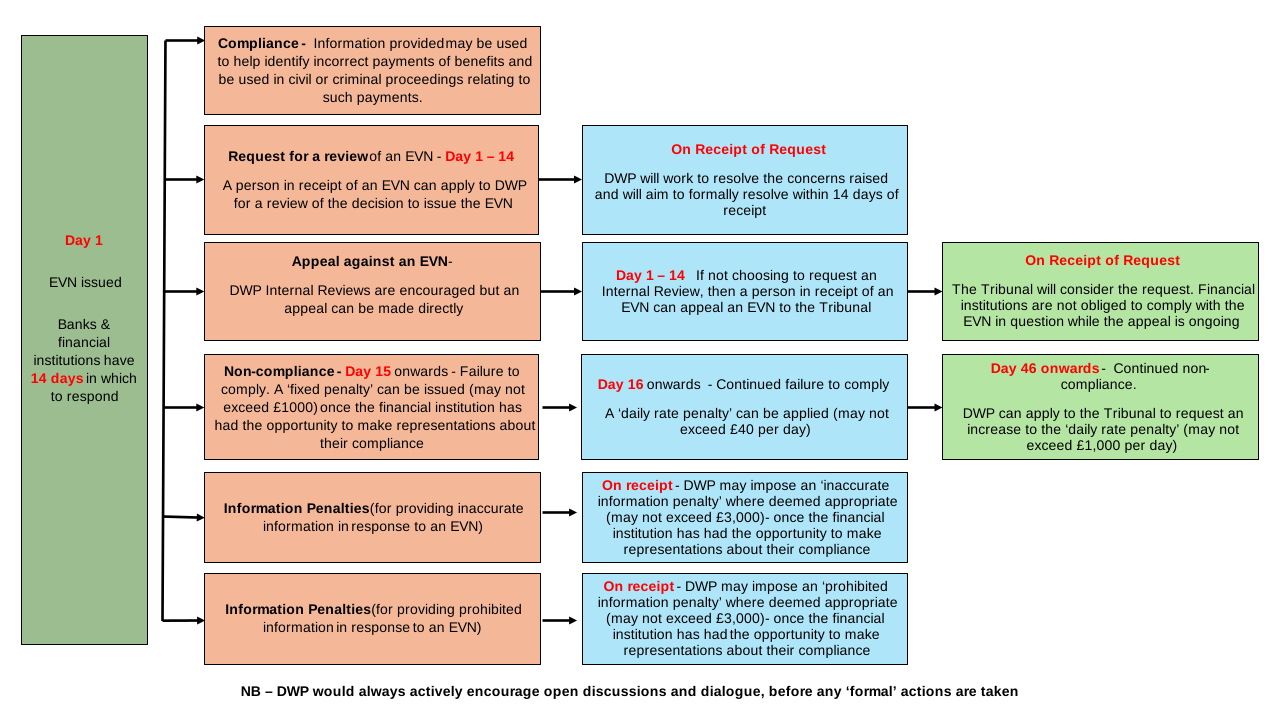
Questions
To what extent do you agree to the following statements:
27. Chapter 7 clearly details the penalties applicable to financial institutions and the process for appealing against a penalty.
a. Strongly agree
b. Agree
c. Neither agree nor disagree
d. Disagree
e. Strongly disagree
28. Please explain your response.
8. Interaction with financial crime obligations
8.1 The Eligibility Verification Measure is a data requiring measure. It does not by itself make or imply any judgement as to whether someone may or may not be meeting the eligibility criteria for the benefit that is being received. EVNs and the data returned in compliance with them do not in themselves suggest any suspicion of fraud, wrongdoing or that an error has occurred. Receipt of an EVN does not provide a financial institution any indication of benefit fraud. The sole purpose of EVNs is for financial institutions to send information to DWP to help DWP find potentially incorrect benefit payments, such as the recipient not meeting the eligibility criteria for the amount of benefit they are being paid. EVNs cannot be issued as part of an investigation into an individual, because EVNs do not contain any personal data and their sole purpose is to require data from financial institutions to help DWP find potential incorrect payments.
8.2 EVNs require banks and other financial institutions to objectively apply criteria specified in the EVN and return the required data to DWP. DWP cannot make any determinations or judgements based solely on the EVN data that is returned. DWP will need to undertake further checks, prompted by the returned data alongside other data held or obtained, about relevant individuals and their benefit claims to determine whether any potential incorrect payments may have been made or may be made and whether that was because of errors or fraud. For example, some DWP claimants will legitimately have more capital than is normally allowed under benefit rules if they meet exemptions set out in legislation, such as certain compensation payments.
8.3 EVNs do not require banks and other financial institutions to assess whether an incorrect payment may be or may have been made. Financial institutions have no access to DWP data that may indicate whether fraud or error has occurred. For these reasons, it is DWP’s view that information shared solely in response to an EVN should not trigger any financial crime obligations for the bank or financial institution sharing that data. If a financial institution identifies or already holds information in the course of its business that, in combination with a EVN return, might indicate fraud, they should consider their existing financial crime obligations (e.g. the Proceeds of Crime Act 2002 and the Money Laundering Regulations 2017).
8.4 Once the Eligibility Verification Measure is fully rolled out and reporting periodically, incorrect payments will be found by DWP quickly, limiting the value of overpayments made. The vast majority of any overpayments identified by DWP would therefore be expected to be treated as error cases, through established compliance processes, and only very small numbers of cases would be expected to be identified by DWP as being due to fraud.
Suspicious Activity Reports and EVM
8.5 Suspicious Activity Reports (SARs) alert the UK Financial Intelligence Unit which is housed within the National Crime Agency’s National Economic Crime Centre (NECC) to potential instances of reporters’ knowledge or suspicion of money laundering or terrorist financing.
8.6 Persons working in the regulated sector are required under legislation, in particular Part 7 of the Proceeds of Crime Act 2002 (POCA), to submit a SAR in respect of information that comes to them in the course of their business if they know or suspect, or have reasonable grounds for knowing or suspecting, that a person is engaged in money laundering.
8.7 Sections 330 and 331, Part 7 of POCA are specific to money laundering. They provide that a person in the regulated sector commits an offence if they fail to disclose information that comes to them in the course of their business if they know, suspect or have reasonable grounds for knowing or suspecting, that a person is engaged in money laundering. In such cases they are required to submit a SAR.
8.8 The provision in Part 2 of Schedule 3B to the Social Security Administration Act 1992 provides that a person does not commit an offence of failure to disclose (under s.330 and s.331 POCA) by failing to submit a “Suspicious Activity Report” if the information was obtained only as a result of complying with an EVN and they have no other knowledge or suspicion (or reasonable grounds for knowing or suspecting).
8.9 The amendment in Part 2 of Schedule 3B to the Social Security Administration Act 1992 does not exempt institutions and individuals from their ongoing obligations to detect and prevent money laundering (including reporting knowledge or suspicion of money laundering under POCA), that might arise independently of receiving an EVN or returning the required data to DWP.
Questions
To what extent do you agree to the following statements:
29. Chapter 8 clearly describes how EVM may interact with financial institutions’ financial crime reporting obligations.
a. Strongly agree
b. Agree
c. Neither agree nor disagree
d. Disagree
e. Strongly disagree
30. Please explain your response.
To what extent do you agree to the following statements:
31. The EVM Code of Practice is easy to understand.
a. Strongly agree
b. Agree
c. Neither agree nor disagree
d. Disagree
e. Strongly disagree
32. What changes if any, would you like to see in relation to the EVM Code of Practice, please explain here
33. Do you have any other comments on the EVM Code of Practice? Is there anything that you consider has not been addressed in the Code of Practice?
DWP Recovery of Debt via Direct Deduction Order and Disqualification from Driving Code of Practice
1. Introduction
About this Code of Practice
1.1 This Code of Practice (“Code”) is produced in accordance with Section 80D of the Social Security Administration Act 1992 (“the Act”) which requires the Secretary of State to issue a Code of Practice about the exercise of the Secretary of State’s functions under Schedule 3ZA and Schedule 3ZB to the Act.
1.2 The Secretary of State can recover certain social security debts from those no longer on DWP benefits and not in suitable Pay As You Earn (PAYE) employment using a Direct Deduction Order (DDO) under paragraph 1 of Schedule 3ZA to the Act. The Secretary of State can also recover such debts through applying to the court for a suspended (or subsequently, an immediate) disqualification from driving order, under paragraphs 1 and 2 of Schedule 3ZB to the Act, where an individual has failed to pay without reasonable excuse, is no longer entitled to, and not in receipt of DWP benefits, and recovery from PAYE earnings or through a DDO is not reasonably possible. These powers (“powers”) support the delivery of the Department for Work and Pensions (“DWP”) Recovery and Enforcement of Overpayments.
1.3 Chapter 2 of this Code describes the purpose of these powers, and the safeguards within these powers. Chapter 3 of this Code looks at the modes and methods of communication the DWP will use to engage with individuals, and Chapter 4 of this Code provides a step-by-step overview to the process of recovering debt using DDOs. Chapter 5 provides information for banks and other financial institutions (banks) who must give effect to DDOs, including on DWP giving notices to banks or penalties for failure to comply, and appeals against a penalty. For clarity throughout this document where ‘bank’ is referred to – this includes other financial institutions and organisations who are required to carry out DDOs. Chapter 6 of this Code sets out how debt will be recovered by application to the courts using the disqualification from driving power, including by obtaining suspended and immediate DWP disqualification orders. Chapter 7 sets out how DWP will process, use and retain information received. Chapter 8 sets out how the department will identify and support vulnerable individuals when applying these powers. Chapter 9 sets out how the department will strive to identify and support victims of domestic (including economic) abuse (DEA).
1.4 Chapter 6 of this Code sets out how debt will be recovered by application to the courts using the disqualification from driving power, including by obtaining suspended and immediate DWP disqualification orders. Chapter 7 sets out how DWP will process, use and retain information received. Chapter 8 sets out how the department will identify and support vulnerable individuals, when applying these powers. Chapter 9 sets out how the department will strive to identify and support victims of domestic (including economic) abuse (DEA).
1.5 Failure to observe the provisions of the Code itself does not render parties liable to civil or criminal proceedings. The Code may, however, be admissible as evidence in any proceedings or dispute in relation to the exercise of the powers under, or duties imposed by, Schedule 3ZA, Schedule 3ZB or associated regulations.
1.6 If the Code is substantively revised, the Secretary of State must lay the new Code before Parliament (as per Section 80D (6) of the Act).
Who this Code is for
1.7 This Code is intended for
-
DWP staff (acting on behalf of the Secretary of State for Work and Pensions)
-
banks which receive notices or orders under Schedule 3ZA to the Act
1.8 individuals owing recoverable overpayments, penalties or other debts to the department, and their representatives - throughout this Code where individual is referenced, this includes their representative if they have one and they are known to DWP
- the Code may also be relevant to parties to litigation, and of interest to the general public who wish to know more about these powers
The purpose of this Code is:
1.9 To provide a clear explanation of the DWP’s DDO and disqualification from driving powers, and how DWP expects to exercise those powers to recover debt fairly and responsibly.
1.10 To set out the main legal requirements of banks in relation to Schedule 3ZA.
1.11To set out DWP’s considerations to ensure that all individuals, especially those who are in vulnerable circumstances, are treated fairly.
1.12 To provide information of the operational safeguards associated with the use of these powers, including how the department will encourage individuals to engage and agree to sustainable payment plans to avoid the use of these powers.
1.13 This Code compliments, but does not replace, the Benefit Overpayment Recovery Guide (BORG). It does not concern how or when a debt owed to DWP is recoverable or when recovery will generally be pursued. For information regarding overpayments (including civil or administrative penalties), please refer to the BORG.
DWP’s Commitment to Fair and Proportionate Debt Recovery
1.14 DWP is committed to treating those in debt fairly, using the “principles of fairness for Government Debt Collection” set out in the Debt Fairness Charter.
1.15 DWP is an active member of the Government Debt Management Function’s (“GDMF”) Fairness Group which has supported the development of products that aim to improve fairness of Government debt management.
1.16 These products include the Debt Fairness Charter and GDMF Public Sector Toolkits, which aim to improve the way individuals experiencing a range of difficulties are identified and supported. These products build on DWP’s capability to resolve debt fairly.
1.17 To ensure a consistent approach to debt recovery across government, DWP will follow the Government Functional Standard (GovS 014, Debt) and take part in cross-government and cross-sector knowledge sharing forums.
1.18 DWP is committed to ensuring that any action taken to recover debts is fair and proportionate. These powers will be used as a last resort, where reasonable attempts to recover the amount owed and engage the individual, using other methods, have failed.
1.19 The Code aims to ensure that debt recovery through these powers is fair and proportionate and protects individuals in vulnerable circumstances from unintended financial hardship, for example in meeting essential living costs or from harm, such as being unable to flee from domestic abuse.
1.20 DWP will prioritise agreeing affordable payment terms with individuals wherever possible. All individuals considered for these powers will have had numerous opportunities to agree a voluntary and affordable payment plan before these powers are used.
1.21 The DWP Debt Management team will have made attempts to contact individuals by letter or by telephone to discuss payment before referring the case to the Debt Management Enforcement team. The Debt Management Enforcement team will make a minimum of four further attempts to engage the individual to agree a payment plan, by both letter (notification) and telephone call where a telephone number is available.
1.22 Attempts to contact the individual both by letter and by telephone will take place on separate occasions and at different times of the day to maximise opportunities to engage individuals.
1.23 All notifications will signpost individuals to organisations providing independent and free debt advice.
1.24 Individuals and independent debt advisors will be able to contact the DWP Debt Enforcement Team using a dedicated telephone number.
1.25 Where an independent debt advisor contacts DWP advising the individual has engaged with them and has permission to speak with DWP, we will work with them to try to find an appropriate solution without applying these powers.
1.26 A formally drawn up and debt advisor verified Standard Financial Statement (SFS) can be considered as part of affordability considerations.
1.27 DWP will ensure that individual circumstances, where known, are considered when deciding whether a DDO or application to the court for a disqualification order is appropriate.
Questions
To what extent do you agree to the following statements:
34. The things described in this chapter make it clear how many times an individual will be contacted prior to the use of the powers and that this gives plenty of opportunity to agree a voluntary payment plan thus preventing a direct deduction order.
a. Strongly agree
b. Agree
c. Neither agree nor disagree
d. Disagree
e. Strongly disagree
35. Please explain your response.
2. Explanation of the powers to recover debt by Direct Deduction Order (DDO) and by Disqualification from Driving
2.1 Under Schedule 3ZA to the Social Security Administration Act 1992, DWP has powers to issue a DDO to banks to recover debts directly from individuals bank accounts. In the most serious cases, where recovery by any other means is not reasonably possible, DWP can apply to the court for a suspended disqualification from driving order under Schedule 3ZB to the Act.
2.2 When DWP apply for a suspended disqualification from driving order, the Court will order the individual to comply with payment terms. If an individual fails to comply with the payment terms set by the court, this could lead to an immediate disqualification order, which would disqualify the individual from driving.
2.3 These powers will be used as a last resort where reasonable attempts to agree an affordable and sustainable payment plan have failed. They can only be applied where individuals are not in receipt of a DWP benefit, or where deductions from PAYE earnings are not reasonably possible. DWP will also conduct affordability and vulnerability checks prior to making a direct deduction order or applying for a disqualification from driving order.
2.4 The powers are intended to encourage individuals to contact the department at the earliest opportunity to discuss affordable payment terms without the powers being required.
2.5 The new recovery powers will be used by the Debt Management Enforcement Team on behalf of the Secretary of State.
Recovery of Debt by Direct Deduction Order (DDO)
2.6 The recovery powers provide the ability to recover money owed to DWP directly from the individual’s bank account (including joint accounts, or some accounts used for business purposes) through regular or lump sum direct deductions.
2.7 Before DDO action, the Debt Management Enforcement Team will have attempted to contact an individual on at least four separate occasions. This is in addition to any contact made prior to the case reaching the Debt Management Enforcement Team. All notifications will be issued by post and will include information on organisations which provide free independent debt advice.
2.8 For individuals who can repay, a voluntary affordable payment plan is DWP’s preferred outcome. DWP will use bank statements to determine an affordable payment plan where individuals have not engaged with the department to discuss payment.
2.9 If an affordability assessment indicates that an individual has no means to repay money owed, no further recovery by a DDO or disqualification from driving order will be attempted at that time.
Recovery of debt by disqualification from driving
2.10 As a last resort in the most serious cases where DWP considers the individual has the means to pay but is refusing, or avoiding repayment, without reasonable excuse (including taking action to move funds to prevent a DDO, or refusing to pay), DWP may apply for a court order to temporarily disqualify an individual from holding a driving licence.
2.11 At first, the Court must make a suspended disqualification order. This will allow the individual to continue to hold a driving licence but requires them to make payments as ordered by the Court. Only if the payment terms are breached, without good reason, can DWP apply to the court to immediately disqualify the individual from driving.
Proportionality of the powers
2.12 Recovery by these methods is a last resort where other reasonable efforts to recover the debt, and engage with the individual, have been unsuccessful. The department’s preferred option is to work with the individual to agree an affordable payment plan.
2.13 An individual’s ability to repay will always be considered, including whether recovery would cause a person to suffer hardship in meeting essential living expenses. A DDO should not cause an individual, or those who they live with or are financially dependent on the individual, undue hardship.
2.14 Disqualification from driving cannot occur if the Court determines an individual has an essential need for driving.
Safeguards
2.15 Statutory safeguards are built into both recovery methods outlined in this Code.
2.16 Safeguards for the recovery of debt by a DDO include assessing at least three months of bank statements before an Order can be made. Bank statements will be used to assess an individual’s ability to repay and to propose an affordable amount to be deducted directly from their account. They will also be used to establish whether deductions would cause a person to suffer hardship in meeting essential living expenses, and what share of the money reasonably belongs to the individual if the account is jointly held with another person.
2.17 Individuals will be notified of the proposed DDO and given at least one month to make representations to DWP before the DDO is given to the bank. The individual can also request a review of the DDO before it is implemented. Where an individual has made representation or requested a review, if they are still unhappy with the decision, they can appeal to the First-tier Tribunal.
2.18 Other safeguards include caps on regular deductions and a restriction that joint accounts can only be considered where deductions from an individual’s sole account is not reasonably possible.
2.19 Recovery of debt by the disqualification from driving power can only be considered for debts with at least £1,000 outstanding. An immediate disqualification order cannot be for more than 2 years in duration, and a court must not make a suspended or immediate disqualification order if it considers that the individual has an essential need for their driving licence.
2.20 Further safeguards include a help and advice section in all written correspondence signposting individuals to free independent debt advice agencies.
Transparency of the use of the powers
2.21 These are last resort powers. Individuals will have been notified of their debt through the debt management process and the period to make an appeal against the amount of the overpayment, or the decision that the debt is recoverable, will have already ended.
2.22 During the enforcement journey, individuals will again be informed of their outstanding debt balance, the recovery process and available support, including what to do if they disagree with a decision. They will also be informed that DWP may use the new powers and that bank statements may be obtained without further warning.
2.23 Use of the powers may result in additional cost to the individual, such as reasonable costs recoverable by the bank when making a deduction, or costs incurred by DWP in relation to disqualification applications. This will be clearly explained to individuals in DWP notifications.
How will individuals in vulnerable circumstances be supported?
2.24 DWP will be mindful of individuals who they suspect are experiencing financial hardship or would be considered vulnerable. This may include a reduced deduction amount or alternative course of action being considered. Individuals are always encouraged to contact the Department directly or through a third-party or representative, with details of any difficulties they are experiencing or any other relevant information regarding recovery of their debt. More information can be found in Chapter 7.
2.25 The Secretary of State has discretion to waive an overpayment of benefit in exceptional circumstances, on application. Chapter 8 of the Benefit overpayment recovery guide - GOV.UK contains more information.
2.26 Processes will include safeguards to provide support, in relation to debt recovery, where someone is a victim or survivor of domestic, including economic, abuse. Chapter 9 of this Code contains more information.
Questions
To what extent do you agree to the following statements:
36. Chapter 2 makes it clear that bank charges may be applied to any Direct Deduction Order (DDO) and that by contacting DWP an individual can agree a voluntary repayment plan and avoid the use of the DDO and therefore avoid these charges.
a. Strongly agree
b. Agree
c. Neither agree nor disagree
d. Disagree
e. Strongly disagree
37. Please explain your response.
38.This chapter makes it clear that contacting DWP to arrange a voluntary repayment plan will mean that a potential driving licence disqualification can be avoided.
a. Strongly agree
b. Agree
c. Neither agree nor disagree
d. Disagree
e. Strongly disagree
39. Please explain your response.
3. Communicating and engaging with individuals
3.1 DWP is committed to ensuring clarity, accessibility and fairness when communicating with individuals.
3.2 Individuals will be given information to help them understand their rights, responsibilities and options throughout the process, as well as being signposted to organisations which provide free and independent debt advice.
3.3 Individuals are encouraged to contact DWP as early as possible to discuss their circumstances and recovery options.
Clarity, sensitivity, and accessibility of communications
3.4 To ensure individuals can engage in a way that suits their needs and circumstances, communication channels available from DWP include:
-
in writing, through letters
-
telephone support
-
online self-service (where available)
3.5 All notifications will be clear and written in accordance with DWP communication standards, setting out next steps and how to contact DWP, as well as how to seek independent sources of support.
3.6 Individuals will be able to request information provided by DWP in alternative formats where needed, including:
-
Audio communication, such as tape, cd, mp3 or wav files
-
Braille
-
Coloured Paper
-
Email (as a reasonable adjustment with web-accessible pdfs)
-
Large print
-
Easy Read
-
BSL
-
Translation to Welsh
3.7 All notifications will include information encouraging individuals to discuss their outstanding debt with DWP, including payment options, and disclose circumstances that may affect their ability to repay the debt.
3.8 Notifications will be firm but fair, using language that encourages individuals to contact DWP. Notifications will set out solutions to ensure individuals feel able to engage without fear of immediate enforcement action wherever possible.
3.9 DWP staff are trained to handle interactions with empathy and compassion, as well as being able to identify potential indicators of vulnerability. For more information, see Chapter 8.
3.10 Alternative telephone support will be available and includes:
-
Allowing sufficient time for individuals to respond
-
Interpreter services
-
Video Relay services
-
Relay UK service
3.11 Individuals will be given reasonable time to respond and seek advice before DWP takes enforcement action.
3.12 Notifications will clearly set out what will happen next, especially where an individual does not respond and deadlines for responses will be made clear. DWP will always consider individual circumstances, where known, such as those who advise they need more time due to their vulnerability.
3.13 If an individual requests additional time, a reasonable extension will be granted where possible.
Questions
To what extent do you agree to the following statements:
40. This Chapter makes it clear that the DWP will help individuals who may need alternative forms of communication to contact and engage with DWP regarding the money that they owe.
a. Strongly agree
b. Agree
c. Neither agree nor disagree
d. Disagree
e. Strongly disagree
41. Please explain your response.
4. Recovery of debt via Direct Deduction Order (DDO): steps to recover debt
4.1 This section sets out the high-level policy for recovery through a DDO. This process is designed to be fair and provide individuals with opportunities to engage with DWP to seek support and raise concerns before direct deductions begin.
4.2 The DDO process is intended to be sensitive to the risk of causing or exacerbating financial hardship. In accordance with the Act, DWP must be satisfied, based on the available information provided by banks or individuals making representations, that a DDO will not cause hardship in meeting essential living expenses to:
-
the individual with the debt
-
any other holder of the account in question (where applicable)
-
any person who lives with, or is financially dependent on, either the individual or another holder of the account
Defining Financial Hardship
4.3 Financial hardship is defined as an individual’s inability to meet their essential household needs given their financial situation. Essential living needs are the ability to afford certain expenses, including food, utilities and housing costs. This list is not exhaustive, and circumstances may be considered on a case-by-case basis.
4.4 Indicators of financial hardship might include an individual who:
-
has no, or very limited, disposable income after meeting essential expenses
-
is reliant on credit and borrowing to survive
-
has payment plans in place to repay other debts
-
is already subject to debt relief support such as bankruptcy, insolvency, or breathing space (including mental health breathing space)
-
is already subject to other enforcement payment obligations
-
is experiencing a sudden financial shock e.g. loss of employment, bereavement, health crisis or domestic abuse
Identifying hardship
4.5 An individual can raise hardship concerns at any point in the enforcement process, however early conversations with DWP are encouraged.
4.6 Indicators of hardship will be considered when the DWP Debt Management Enforcement team assess an individual’s financial information or where information is received from support services or third-party advocates on their behalf.
4.7 The individual will have further opportunity to raise any hardship concerns as part of the disputes process as set out below.
Support and action when hardship is identified
4.8 Where hardship is confirmed, or reasonably suspected, the individual will be given the opportunity to:
-
provide any additional evidence to support in assessing their financial situation
-
seek independent debt advice and support
Step 1: Reasonable attempts and checks
4.9 Before these powers are applied, DWP will have checked that the individual is not in receipt of a DWP benefit and that deductions from PAYE are not reasonably possible.
4.10 DWP will conduct checks for DDO suitability, including checks for any vulnerable circumstances, based on information held by DWP. They will also use Credit Reference Agency information to identify bank accounts held by individuals which may be suitable for a DDO. Once bank accounts are identified, DWP will then decide if it is appropriate to contact the bank to request statements or information about any other accounts held with that bank.
Step 2: Notifications and initial contact
4.11 There will be a minimum of four separate attempts to contact an individual by the Debt Management Enforcement team using a variety of different methods. This will include at least two written notifications outlining as a minimum:
-
the outstanding debt amount
-
the options available to repay the debt
-
the deadline to respond before further action is considered
-
what may happen if no response is received, or payment is not made
-
sources of independent free debt advice
-
details on how to contact DWP
4.12 Individuals are encouraged to engage early, requesting more information if needed, and either agree a payment plan or tell DWP about their current circumstances. This could prevent further action in relation to the use of these powers. The purpose of these notifications is to encourage individuals to engage with DWP and discuss an affordable payment plan and what will happen if they do not make contact.
Step 3: Obtaining information and accessing bank statements
4.13 If the attempts to contact the individual have not resulted in an agreed payment plan, DWP will obtain and consider bank statements and other bank account information, so that any action taken to recover the debt from an account is fair and affordable.
4.14 DWP will initially identify an individual’s account using existing information held such as Credit Reference Agency data to identify accounts suitable for obtaining bank statements.
4.15 An Information Notice is issued to the bank to obtain bank statements from an individual’s account(s).
4.16 The information notice may only be sent to the bank for the purposes of considering whether to make a DDO.
4.17 Accessing financial information, such as bank statements, is an important safeguard enabling a more accurate assessment of an individual’s financial position and to ensure the suitability, sustainability and affordability of any DDO.
4.18 The aim is to:
-
determine whether the individual can afford direct deductions from their bank account to repay the debt
-
help to identify and consider essential living expenses, and ensure any relevant protected incomes are identified, so that the amount of any DDO is fair and affordable
-
look for reasonably obvious indicators of financial hardship
4.19 Bank statements for the relevant account must be considered before a DDO can be made. The information requested must be limited to what is necessary and fair to make an informed decision about an individual’s ability to repay, including in circumstances in which the individual may otherwise be unwilling to provide that information.
4.20 DWP will always request bank statements from an individual’s sole account in the first instance. However, where it is not possible to recover from a sole account, recovery from a joint account will be considered. DDOs may be applied to accounts used for business or commercial purposes, provided the account is held by the individual (rather than held by a limited company or limited liability partnership).
4.21 Banks are prohibited from notifying the individual or any other account holder(s) that DWP has requested or obtained bank statements or other information, under this power, until either DWP has notified the bank and individual of a proposal to make a DDO, or 3 months after the information notice was issued (if sooner). This is to prevent an individual from attempting to move or dispose of their money to evade recovery. No deductions will be made in respect of the debt during this time.
4.22 Only relevant accounts and information will be requested. This will involve at least three of the most recent months of statements. A longer period of statements may be requested if there is clear justification for this, for example where DWP is unable to establish a regular rate of income or assess affordability.
4.23 An individual’s sole account(s) must always be considered first for a DDO before statements for jointly held accounts can be obtained. This is to reduce any impacts on joint account holders who are not responsible for payment of the debt.
4.24 Considering bank account statements and information ensures that recovery decisions are based on the most up to date evidence of the individual’s ability to repay.
4.25 The three notices DWP can issue to banks to request information are: Account Information Notices, General Information Notices and Further Information Notices. These are described in more detail below.
Account Information Notice
4.26 This is a notice issued by DWP to a bank, requiring the bank to provide a period of recent bank account statements for an account, as specified in the notice. The notice will contain the name of the person and identify the relevant account(s).
4.27 An Account Information Notice (AIN) will only be issued where it appears, from information already held by DWP, by checking their systems including the Credit Reference Agency system, and/or from information provided following a General Information Notice, that the individual holds the account with that bank and it may be suitable for a DDO.
4.28 More than one AIN may be issued for the same recoverable amount, either in respect of one or multiple accounts.
General Information Notice
4.29 This is a notice issued by DWP to a bank, requiring them to provide the following information for each account held by the individual with that organisation.
4.30 If the account is a sole account, this will include:
-
name of account holder
-
address of account holder
-
account number and sort code
-
account type
-
account restrictions in place
-
balance of accounts and date the balance check was completed
4.31 If the account is a joint account, this will also include the name of the joint account holder and their correspondence address.
4.32 A General Information Notice (GIN) may be appropriate to give DWP a full view of the individual’s financial position. If an Account Information Notice is insufficient to determine the suitability of a DDO, a GIN can be used to identify additional alternative accounts which may be suitable to recover funds from. Similar to an AIN, more than one GIN may be issued for the same recoverable amount.
4.33 Obtaining the joint account holders’ contact details ensures DWP can provide relevant notices and orders, such as to invite their representations if a joint account is later considered for a DDO.
Further Information Notice
4.34 A Further Information Notice may be issued once a DDO is in place, requiring banks to provide further bank statements (as with an Account Information Notice) or information (as with a General Information Notice). The Further Information Notice may be issued when DWP is reviewing or considering whether to revoke, vary, suspend or restart a DDO.
Joint accounts
4.35 DWP will only apply a DDO to joint accounts where it is not reasonably possible to recover from a sole account.
4.36 Each account holder will be notified separately of the intention to recover directly from the account and invited to make representations. No recovery will start until all parties have been notified and the relevant period has passed.
4.37 DWP will presume that joint account holders each have an equal share of the funds, in accordance with the Act, unless there is reason to believe otherwise.
4.38 DWP can only deduct from the individual’s share of any money held in an account. If an account holder considers the liable person does not have any beneficial interest in the money held in a joint account, or the money is not held in equal shares, an explanation should be provided to DWP by the individual and/or the other account holders. They may be required to provide evidence to support this.
4.39 Information on how a joint account holder can contact DWP to discuss beneficial interest will be included in the notification.
Business Accounts
4.40 DWP will only apply a DDO to accounts known to be primarily used for business purposes where it is not reasonably possible to recover from another account held solely by the liable individual. Where a business account is held exclusively by an individual, it will be considered prior to any joint accounts.
4.41 As with non-business accounts where there is more than one account holder, each account holder will be notified separately of the intention to recover directly from the account and invited to make representations. No recovery will start until all parties have been notified and the relevant period has passed.
4.42 Where there is more than one account holder, DWP will presume that joint account holders each have an equal share of the funds in accordance with the Act, unless there is reason to believe otherwise.
4.43 DWP can only deduct from the individual’s share of any money. If they do not have any beneficial interest in the money held in a joint account, an explanation should be provided to DWP by the individual and/or the other account holders.
4.44 Information on how a joint account holder can contact DWP to discuss beneficial interest will be included in the notification.
4.45 DWP will not apply a DDO to accounts that are held by corporate bodies, such as limited companies or limited liability partnerships.
Step 4: Affordability assessment and consideration of an individual’s financial situation and circumstances
4.46 DWP will use the information obtained through information notices to determine whether a DDO is appropriate, and if so what terms to set. This will involve, for example:
-
determining an individual’s typical income and expenditure, including any disregarded income, essential living needs expenditure, and identifying clear evidence of any other financial commitments they may have
-
identify amounts of income and/or savings which could be used to repay the debt
-
comply with relevant safeguards, such as ensuring:
-
the deduction amount is not more than the statutory maximum rate (as set out in the Act and in the regulations) for Regular Direct Deduction Orders (RDDO)
-
the proposed deduction order would not cause the liable person or other account holder (or anyone living with or financially dependent on them) to suffer hardship in meeting essential living expenses (as defined in regulations)
-
if a joint account is being considered whether there is any reason to suspect each account holder does not have an equal share of the funds in the account
Protected income to be disregarded from calculation of the deduction amount
4.47 When reviewing bank statements, DWP will take steps to identify and exclude certain types of “protected” income from affordability calculations where these amounts are clearly identifiable.
4.48 Some protected income types will not be obvious from the bank statement alone. Therefore, it is important that individuals inform DWP if they believe any of their income should be treated as protected for the purposes of calculating a deduction amount. If it is not clear from the statement it may not be excluded from the assessment.
4.9 Examples of protected income include but are not limited to:
-
Child Benefit
-
Child Maintenance
-
Disability Living Allowance (DLA) paid for a child
-
Maternity Allowance or Maternity Payment from an employer
4.50 This list is not exhaustive. Where an individual receives other types of income that they believe should be protected, they should contact DWP to discuss. Except where required to disregard under the regulations, disregarding other kinds of income from the calculation is discretionary.
[Note: Income to be disregarded will be set out in Regulations, and this section will be updated where appropriate once Regulations are finalised.]
4.51 When the deduction rate has been calculated, DWP will write to the individual to advise them of the amount. During the representation stage, individuals can disclose any income they feel should not be considered or any personal circumstances that need to be considered.
Regular and Lump Sum Direct Deduction Orders
4.52 After the bank statements have been assessed and any representations properly made have been considered, the DWP Debt Management Enforcement team will determine whether making a DDO would be appropriate. This could be through either a Regular or Lump Sum Direct Deduction Order.
4.53 A Regular Direct Deduction Order (RDDO) is where DWP can instruct a bank to make regular deductions from an individual’s account to repay their outstanding debt. The first deduction could involve a larger amount, followed by smaller regular deductions.
4.54 A RDDO may be more suitable where the individual has sufficient available regular income to repay the debt over time, even if they have some savings.
4.55 A Lump Sum Direct Deduction Order (LSDDO) is where DWP instructs the bank to take a single, specified amount from the individual’s account to repay their outstanding debts.
4.56 An LSDDO would be more suitable where the individual holds enough savings, enabling a debt to be recovered in one payment, without the need for prolonged recovery through RDDOs. An LSDDO will only be considered where the amount to be recovered in one payment would not cause the individual, members of their household or anyone financially dependent on them, hardship in meeting essential living expenses.
4.57 At any point in the process, an individual can contact DWP to arrange an affordable and sustainable payment plan where the date and amount of the deduction can be discussed and mutually agreed. Step 11 contains further information on reviews.
Essential Living Costs and Avoiding Unintended Financial Hardship
4.58 If it becomes clear that a proposed or actual DDO would cause hardship in meeting essential living needs, as set out in para 4.2 to 4.8 the terms of the order will be revised. For example, DWP might lower the rate of a RDDO where relevant information is provided during the representation stage to show their essential living needs were greater than initially identified or decide a RDDO is more appropriate than a LSDDO.
4.59 When hardship is confirmed, recovery can be adjusted by:
-
agreeing to an affordable payment plan
-
varying the terms of a proposed or ongoing DDO, to ensure deductions are at a fair and affordable rate
-
proposing a RDDO instead of a LSDDO, or vice versa
-
temporarily suspending the DDO to allow time for an individual’s financial circumstances to become more stable (including where the individual is in Breathing Space or shows they need time to seek advice and support from a third-party debt advisor)
-
in exceptional circumstances, considering whether a waiver referral may be appropriate. More information is contained in Chapter 8 of the Benefit Overpayment Recovery Guide Benefit overpayment recovery guide - GOV.UK
4.60 It is important that the individual continues to engage with the DWP, to ensure any ongoing recoveries remain appropriate and affordable.
Step 5: Notifying the bank of a proposed DDO
4.61 Where a DDO is being proposed, following an assessment of the individual’s bank statements, a Pre Deduction Notice will be issued to the bank.
4.62 The Pre Deduction Notice may require, in the case of a proposed LSDDO, the bank to ring fence an amount in the bank account (or temporarily transfer the amount to a holding account) to ensure the individual cannot move this money prior to any DDO payment. Where DWP decides not to make the DDO or makes an order for a lower deduction amount than has been ring fenced, the money will be returned to the account without any restriction.
Step 6: Notifying individuals of a proposed DDO and representation window
4.63 At the same time as the Pre Deduction Notice is given to the bank, or shortly after, DWP will provide the notice to the individual and any other account holder. This notice will explain that DWP is proposing to make a DDO and set out the terms of the proposed order. Where an LSDDO is proposed, it will explain that some or all of the money proposed to be deducted has been ring-fenced by the bank and made unavailable to the account holders. any restrictions applied to the account, and the terms of the proposed DDO. The notice must be issued as soon as reasonably possible after the bank receives its notice.
4.64 The notice will explain to them how each other account holder can make representations on the proposed order, and that representations must be made to DWP within one calendar month beginning on the day the notice was sent.
4.65 The representation stage is an important safeguard to allow individuals the opportunity to advise DWP of any circumstances not identifiable from the information obtained from the banks or that DWP is unaware of that may be relevant to recovery action. No deductions will be taken during the representation stage to allow individuals time to engage.
4.66 If the individual contacts DWP to request more time to make representations, for example to seek independent advice, DWP will consider extending the time period for making representations where reasonable.
4.67 Where an individual makes representations about the proposed deduction amount, DWP may require them to provide further or supporting evidence. DWP may specify the kind of evidence required, and how and where this should be provided within the timeframe.
4.68 If a Standard Financial Statement is available that has been completed by a debt advisor, this can be provided as supporting evidence.
4.69 Where reasonable, during the representation stage, DWP will agree to mutually acceptable payment terms with the individual without requiring a DDO.
Step 7: Consideration of any Representations Made and Decision on Whether to Make the DDO
4.70 Where an individual has made representations, DWP will consider these (together with the information obtained from banks in Step 3) and decide whether to proceed with making the DDO. The DDO may be made, as proposed in Step 6, where DWP considers the terms remain fair and appropriate. Alternatively, it may make a DDO with different terms, based on the information provided by the bank and individual(s).
4.71 Where an individual discloses to DWP that they are vulnerable, DWP will consider the best course of action. This may include proceeding with the DDO with different terms, agreeing to a voluntary payment plan, or making no attempt to recover at that time.
4.72 There are three potential outcomes following representation. DWP may decide:
-
not to make the DDO - this may happen if a separate payment plan has been agreed with the individual or where it is clear, in light of further evidence, that the individual is unable to afford payment at that time
-
to make the DDO with different terms - this may happen where new evidence is provided during representations which indicate the proposed terms would not have been appropriate or fair, or would have caused hardship in meeting essential living needs
-
to make the DDO as proposed - this may happen if, following consideration of representations and any additional evidence, DWP is satisfied that the proposed terms remain affordable, fair and appropriate in the circumstances
4.73 If at any time during the DDO DWP is aware that an individual is now in receipt of a DWP benefit, recovery by DDO will be suspended or end, and DWP will instead seek recovery directly from the individual’s benefit where appropriate.
4.74 All decisions are taken on a case-by-case basis, while considering any supporting evidence provided.
4.75 DWP is committed to considering and responding to representations or reviews and to the subsequent decision of whether to make a DDO or not, as soon as reasonably possible. Occasionally there may be delays when dealing with particularly complex cases, or during extenuating circumstances.
4.76 Following this, a copy of the DDO (or a notice that no order is to be made at this time) will be given to the individual and any other account holder. They will also be notified of their right to review (see Step 8) and, where relevant, a right of appeal to the independent Tribunal. They will also be informed of any next steps.
Step 8: Review period
4.77 Once a DDO has been given, following the end of the representation period, the individual and any other account holder will have one month in which to request a review of the DDO, before any deductions are made. The review may be requested for a number of reasons, including if the individual or another account holder did not make representations during Step 7 or they would like DWP to reconsider any change made to the DDO following earlier representations.
4.78 The review period, including the opportunity to provide supporting evidence, lasts for one calendar month beginning on the day DWP gave the DDO. Where the review is requested before the end of that period, DWP may elect to uphold, pause, vary or revoke the DDO where it is appropriate to do so. The same principles described in Step 7, regarding representations, apply to reviews of a DDO.
4.79 The outcome of a review may result in the order being upheld, varied (for example, to change the amounts of deductions), or revoked. The individual will be notified of the outcome and, where relevant, their right of appeal to the Tribunal. They will also be informed of any next steps.
Step 9: Recovery by Direct Deduction Order action
4.80 Following the end of the review period outlined in Step 8, if no review was requested, the terms of the DDO were amended or the order was upheld following a review, the DDO will be provided to the bank and the deduction(s) will be made from the account by the bank as required by the order.
4.81 A confirmation letter will be issued to the individual and, where relevant, each other account holder, informing them that the order is in force and explain any next steps such as informing DWP if there is a change in their circumstances and the process for doing so.
Bank Charges
4.82 When a bank makes a deduction, it can also deduct an amount in respect of its reasonable costs in complying with the order. These will be in addition to the deduction amount taken by DWP.
4.83 These charges are limited by regulations. They must be taken into consideration when the terms of the DDO are calculated, to ensure the total amount of deduction is affordable if the maximum amount permitted is charged by the bank. This will ensure deductions are fair and do not cause undue hardship.
4.84 Individuals will have been notified in advance that any DDO could result in them incurring bank charges.
Step 10: Appeals
4.85 Where an individual or account holder(s) has made representation to DWP as per Step 7 or sought a review as per Step 8 they have the right to appeal the DDO to the First-tier Tribunal, which will independently consider whether DWP’s decision was correct. The appeal can be requested by any account holder of the specified account.
4.86 Appeals must be lodged directly with the Tribunal within one calendar month, beginning with the day after DWP notified the individual that a DDO would be made (following representation) or upheld or varied (following a review or other variation). Information on how to appeal to the Tribunal is included in the decision letter issued by DWP. More information on the appeals process will be available on Gov.uk.
4.87 Banks are required to continue taking deductions following the DDO whilst the appeal is ongoing, unless the DDO is suspended by DWP or the Tribunal.
4.88 If there is a risk of harm due to the deductions continuing during the appeal process either because the individual now presents as vulnerable, or another reason, they should contact DWP at the earliest opportunity. DWP can consider suspending recovery action by DDO until the appeal has concluded.
4.89 The time it takes for an appeal to be determined by the Tribunal can vary due to either the complexity of the issue(s) disputed, judicial and Tribunal availability, and case management matters (for example, if further evidence is required). The Tribunal is independent of the DWP, and the Department cannot influence the timing or prioritisation of their appeals.
4.90 The Tribunal may either uphold, vary or revoke the order. The individual will usually be notified of the outcome by the Tribunal. The Tribunal will also notify DWP who will then take the appropriate action.
4.91 Where an appeal is upheld or varied, once DWP have been notified, they will contact the bank to take the necessary action. In some cases, DWP may arrange to refund part or all of the money deducted under a DDO that has since been varied or revoked by the Tribunal.
Step 11: Request for a varied order and future support
4.92 If an RDDO remains in place, the individual (or joint account holder) can request that the order be varied, if their circumstances have changed. Individuals should request this by contacting the DWP Debt Enforcement team, either in writing or by telephone, and advise them of any changes in circumstances as soon as possible.
4.93 Notifications will state that a review of deductions can be made at any point during the RDDO and advise an individual (or joint account holder) how to make a request or report a change of circumstances.
4.94 Where a request for the RDDO to be varied is made, the principles set out in Steps 7 and 8 will apply. If required, a Further Information Notice will be issued to the bank to assess affordability in support of a variation request.
Questions
To what extent do you agree to the following statements:
42. This chapter makes it clear how an individual can make representation or ask for a review following the receipt of a Direct Deduction Notice.
a. Strongly agree
b. Agree
c. Neither agree nor disagree
d. Disagree
e. Strongly disagree
43. Please explain your response.
5. Recovery of debt via Direct Deduction Order (DDO): Information for Financial Institutions
General principles
5.1 This Chapter provides further information on information notices and DDOs issued under Schedule 3ZA of the Act. This chapter also provides information on the obligations for banks and potential penalties for non-compliance as set out in the Act.
5.2 Neither a DDO or any information notice, whether an Account Information Notice (AIN), a General Information Notice (GIN) or a Further Information Notice (FIN), is part of any current or future decision on benefit entitlement. The Act sets out that any information shared with DWP following an information notice cannot be used for anything other than debt recovery purposes.
5.3 Information notices or DDOs issued by DWP under Schedule 3ZA do not indicate an investigation of wrongdoing by DWP. Information notices are a request for information from banks to enable DWP to conduct an affordability assessment, when DWP is considering a DDO for a debt owed under civil law (Part III of the 1992 Act) following an overpayment of benefit. A DDO is similar to a Third-Party Debt Order and deduction orders given by other government departments for civil debts. A DDO will not normally follow any criminal prosecution, proceedings or investigations.
5.4 Information notices or DDOs issued by DWP to banks under Schedule 3ZA do not indicate that DWP has any reason to suspect or know the individual who owes the debt has committed any criminal or financial wrongdoing.
Role and scope of the Financial Services Sector
Extent of the Power
5.5 These powers will only apply to bank accounts belonging to or jointly owned by the individual(s) owing the money.
5.6 These powers will be used to recover money owed to DWP. For details of what constitutes money owed to DWP, see chapter 1 of the Benefit Overpayment Recovery Guide (BORG) Benefit overpayment recovery guide - GOV.UK
Accounts In Scope
5.7 Money will be recovered directly from deposit-taking bank, credit union and building society accounts, including Cash Individual Savings Accounts (Cash ISAs).
5.8 DWP will identify which bank account an order should be applied to and instruct banks by giving them the sort code and account number, or equivalent identifiers, of the account for which to apply the DDO.
Signatory to an account
5.9 A signatory on a bank account is authorised by the account holder to access and manage the account on their behalf.
5.10 Unlike a joint owner, a co-signatory may not be the legal owner of the funds. DWP cannot make a DDO for an account where the individual who owes the debt is solely a signatory to manage and access the funds on the legal owner’s behalf.
Lasting Powers of Attorney and Deputies
5.11 Where the bank is aware that there is a Lasting Power of Attorney or legal deputy (a “deputy”) acting on behalf of any relevant account holder, the bank must provide the name and correspondence address of the deputy to DWP following receipt of any information notice, pre-deduction notice or direct deduction order (except where the bank has previously provided this information).
Giving of notices to banks
The table below shows the most frequent notices that will be issued in relation to each order.
| Regular Direct Deduction Order | Lump Sum Direct Deduction Order |
|---|---|
| General Information Notice | General Information Notice |
| Account Information Notice | Account Information Notice |
| Further Information Notice | Further Information Notice |
| Pre-Deduction Notice (RDDO) - Notice to bank | Pre-Deduction Order (LSDDO) - Notice to bank to ring fence the amount of the funds |
| Regular Direct Deduction Order (RDDO) | Lump Sum Direct Deduction Order (LSDDO) |
| Revocation Notice | Revocation Notice |
5.12 Notices and orders will also provide general information on how to comply, in addition to the information set out in this Code and in legislation (Schedule 3ZA to the Act and the Regulations [to be confirmed when laid]).
5.13 Notices and orders will also provide general information on how to comply, in addition to the information set out in this Code and in legislation (Schedule 3ZA to the Act) and the Regulations [to be confirmed when laid].
5.14 Banks are prohibited from notifying the individual or any other account holder(s) that DWP has requested or obtained bank statements or other information, under this power, until either DWP has notified the bank, individual and any other account holder of a proposal to make a DDO, or 3 months after the information notice was issued (if sooner). This is to prevent an individual from attempting to move or dispose of their money to evade recovery. No deductions will be made in respect of the debt during this time.
5.15 A Pre Deduction Notice and DDO will include:
-
the individual’s name
-
the account number
-
and sort code to make the deduction from
-
a unique identifier
-
the terms of the specified order (including where relevant money must be ring-fenced)
-
the timescale in which the action needs to be taken by the bank
-
who to contact if it is unable to comply and
-
the consequences of not complying with the notice
-
for a direct deduction order, provision for the bank to deduct its reasonable costs
5.16 There may be other notices issued by DWP, for example where the individual has reported a change in their circumstances and DWP has decided to vary the terms of an order. Any additional notices will clearly set out the action to be taken by the banks and the timescale for that action.
5.17 Only statements for accounts and recent transaction periods (usually for the most recent three months) which appear relevant to a direct deduction order can be requested. A longer period of statements may be requested, where appropriate, to establish a rate of regular income or other factors as part of an affordability assessment, where three months is not sufficient.
5.18 When a Pre Deduction Notice is issued to a bank, the bank should notify DWP if it is unable to apply the terms of the order to that specific account. Banks will usually inform DWP of the reason(s) they are unable to comply with the order.
5.19 If a bank receives a Data Subject Access Request (DSAR), it will not be in breach of the prohibition by telling the individual they have received a notice (either an AIN or a GIN). The Act does not interfere with data protection rights and obligations, in accordance with the Data Protection Act 2018 (as amended).
5.20 If during the period the bank is prevented from disclosing that DWP has requested information or issued a Pre Deduction Notice and are contacted by the account holder(s) as a result, they can signpost the individual (and any other account holder) to contact DWP using lines that will be made available to the bank. This will not be regarded as a breach of the ‘do not notify’ requirement.
Relationship to other Orders
5.21 If DWP is aware that an individual has other deduction orders in place, these will be taken into consideration when assessing affordability. This may mean that DWP will reduce the amount of deduction to take account of the other orders or suspend recovery until the other deduction orders end.
[Note: Regulations will clarify what actions a bank must take where one or more other, similar orders are in place.]
Insufficient Funds
5.22 If there are insufficient funds in an account for an RDDO, the bank will make another attempt to take the deduction after 7 days. If there are still insufficient funds, the bank must inform DWP. Further deductions should be attempted, in accordance with the DDO, unless the Bank receives a notice varying, suspending or revoking the DDO.
5.23 Where the bank receives a Pre Deduction Notice for a LSDDO, it is required to ring-fence the amount specified in the Notice. The Bank will not be required to ring-fence further amounts credited into the account between the Pre-Deduction Notice being sent, and any subsequent LSDDO being received. The Act allows banks to transfer the money to a hold account to do this.
5.24 When the bank receives the LSDDO, it should only send the amount detailed in the order to DWP. Where this is lower than the amount ring-fenced following a Pre Deduction Notice, the remaining ring-fenced sum should be returned to the individual’s account and made available to them.
How should banks provide the information?
5.25 Notices and bank statements can be provided to DWP by either portal, secure email or post. This may change with improvements in future technology.
[Note: this will be agreed in regulations.]
Varied orders
5.26 If DWP varies the terms of the order, it will notify the bank by giving it the varied DDO. This will replace the previous DDO, and the Bank will need to comply with the varied order, including giving effect to any new deduction amount or applying the DDO to another account held by the debtor (where this was requested by an account holder).
5.27 An order may be varied before or after a Direct Deduction Order has been given to the bank.
5.28 An order may be varied in a number of circumstances including following a review requested by an account holder or following the outcome of an appeal. It may also be varied if an individual (and any other account holder) makes representation at any time during the order to inform DWP that their circumstances have changed.
5.29 When an order is varied, DWP will provide the bank with the varied DDO, which will identify the action(s) the bank needs to take.
Decisions to revoke, or not make, a DDO
5.30 Following a Pre Deduction Notice, DWP may decide not to make a DDO at that time. Where this happens, it will give the bank a notice, which will allow the bank to return any ring-fenced funds to the account.
5.31 Where a DDO has been given to a bank, and is subsequently revoked, DWP will issue a Revocation Notice to the bank.
5.32 An order may be revoked, by DWP or automatically, for a variety of reasons. These include:
-
an individual notifying a change in circumstances, resulting in a DDO no longer being appropriate
-
the DDO being revoked following a successful appeal
-
the total debt has been recovered in full
-
the individual dies
5.33 No deductions should be taken following receipt of the Revocation Notice. If a deduction is taken, it should be returned to the account or DWP will issue a refund.
5.34 If an individual dies and an amount has been frozen following receipt of a Pre Deduction Notice, DWP will issue a Revocation Notice to the bank once they are aware the person has died.
How DWP will work with banks
5.35 Contact details of the DWP Debt Management Enforcement team will be included in all notices and orders issued to the bank. Initially, notices and orders under Schedule 3ZA will be given as part of a robust period of test and learn activity, which will help DWP to find the most effective way of working with the banks on the DDO process.
Penalty for failure to comply with a notice
5.36 DWP may, under Part 2 of Schedule 3ZA to the Act, impose a penalty of £500 on a bank which has failed to comply with its obligations under the Act, including following receipt of a notice or order, without reasonable excuse.
5.37 Examples of when a penalty may be imposed include where a bank persistently:
-
fails to hold or “ringfence” monies in a timely manner in accordance with a LSDDO pre-deduction notice, when required to do so
-
tell individuals (and any other account holder) about information notices before allowed to do so
-
provides incorrect or incomplete information
-
fails to make (or stop making) deductions when required to do so
5.38 DWP will make decisions on penalties on a case-by-case basis.
5.39 Before a penalty is imposed, DWP will have taken the following action:
-
contacted the bank to discuss reasons for non-compliance with the notice(s), order(s) or other requirement
-
provided an opportunity for the bank to make representations about their compliance, including any reasonable excuse for a failure to comply
-
considered any reasons given to determine whether to proceed with imposing a penalty and, where appropriate, discuss the outcome with the relevant bank
5.40 If DWP decides it is appropriate, it will issue a penalty to the bank. This will include the reason(s) for the penalty, how to make payment and how to appeal the penalty.
How does a bank appeal against a penalty?
5.41 If DWP has imposed a penalty, the bank will have the opportunity to appeal to the First-tier Tribunal. The bank must lodge its appeal directly with the Tribunal within one month of the day after the day the penalty notice is issued. Appeals lodged after this time may not be accepted by the Tribunal and it is solely the Tribunal’s decision on whether to accept a late appeal.
5.42 Information on the right to appeal will be provided in the penalty notice, and more information can be found on the HMCTS website.
5.43 The Tribunal will decide whether it was correct to issue the penalty to the bank. This will likely include considering (a) whether the bank failed to comply with an obligation under Schedule 3ZA, and (b) whether the bank provided, and had, a reasonable excuse for its failure to comply. The Tribunal may uphold (confirm) or set aside (quash) the penalty.
5.44 The penalty will not be enforced until either the appeal has been finally determined or abandoned, or the period of bringing an appeal has lapsed.
5.55 Where a penalty has been made and is enforceable, DWP can apply to enforce the penalty, as a debt, through court if not paid within a reasonable period of time as notified by DWP to the bank. DWP may apply to the County Court or High Court (in England and Wales) or Sheriff Court (in Scotland) to enforce the penalty.
Questions
To what extent do you agree to the following statements:
44.The information in Chapter 5 makes clear the Penalties applicable to financial institutions and the process for appealing a penalty.
a. Strongly agree
b. Agree
c. Neither agree nor disagree
d. Disagree
e. Strongly disagree
45. Please explain your response.
6. Recovery of Debt - Disqualification from Driving General principles
6.1 In the most serious cases, DWP can consider applying to the court for an order which, if breached, could result in individuals being temporarily disqualified from driving.
6.2 In accordance with the Act, this measure can only be considered by DWP where the outstanding debt balance is a minimum of £1,000 and where it is not reasonably possible to recover the debt by any other means, including by DDO as set out in Chapter 5 or deductions from PAYE employment (see chapter 5, Para. 5.93 onwards of the BORG Benefit overpayment recovery guide - GOV.UK).
6.3 In accordance with the Act DWP cannot use the disqualification from driving power for individuals who, at the time of application, are entitled to and in receipt of a DWP benefit.
6.4 When considering an application under this power, the court must first determine whether the individual had the means to repay their debt to DWP but did not, without reasonable excuse. The court cannot make the order if it considers the individual has an essential need to drive.
6.5 A suspended order will always be made in the first instance, and the disqualification not given effect provided the individual complies with the payment terms set by the court. If they fail to do so, without reasonable excuse, DWP can apply for an immediate disqualification order which may have effect for up to two years from the date of disqualification.
6.6 An order must end as soon as the full amount owed to DWP has been repaid.
6.7 If an order is not granted by the court, for example where the court accepts the individual has an essential need for their licence, further applications may be made in the future. Additionally, where an immediate disqualification order comes to an end, DWP may apply for another immediate disqualification order for a further period of up to 2 years, if the individual continues not to repay the debt in full.
Suspended DWP Disqualification Order
6.8 The Court will firstly make a suspended disqualification order, where the individual will not be disqualified from holding a driving licence as long as they comply with a schedule of affordable payments ordered by the Court.
6.9 Payments will be monitored by DWP. Individuals must inform DWP if they are unable to make a payment, as there are consequences of not paying in accordance with the order.
6.10 DWP will give the individual the opportunity to provide (and evidence) any reasonable excuse for missing the payment before deciding whether to make an application to the Court for an immediate driving disqualification order.
Immediate DWP Driving Disqualification Order
6.11 Where the individual has failed to make more than one of the payments ordered by the Court (or has failed to make the final instalment due) without reasonable excuse, DWP will make a further application to the Court for an immediate disqualification order. If granted, this would disqualify the individual from driving for up to 2 years.
Right of Representation
6.12 An individual will have the opportunity to make representations to the Court before an order is made, including why they think an order should not be made, the terms of the payments they must make, or why they consider they have an essential need to drive.
6.13 The Court may make an order in the absence of the individual, where they fail or choose not to attend or make representations.
Halting the disqualification process
6.14 At any time up until a suspended disqualification order is made, an individual can repay the debt in full or agree and keep to an affordable payment arrangement directly with DWP, to avoid further action being taken. Where an individual’s circumstances change, it may be possible to vary the order to change the instalment amounts. See Paragraph 6.16.
6.15 If an individual repays their debt in full after an immediate disqualification order has been made, DWP will apply to the court to bring the order to an end. If the order is ended within 56 days of being made, the individual’s licence can be reinstated or returned by DVLA without a further cost to them. If this occurs after 56 days, the individual will have to apply to get their licence back and pay the applicable fee referenced in Paragraph 6.27.
Varying the disqualification order
6.16 Following a suspended or an immediate disqualification order, the individual can apply to the Court to vary the order. The Court can usually only vary the order if doing so will make recovery of the debt more likely. The Court might vary the order due to a change in what an individual can afford to pay and might, for example, change the amount the individual has to pay in each instalment.
6.17 If the individual is complying with the Court order and has made a number of payments, and DWP considers they intend to continue paying, DWP is unlikely to oppose a variation request.
6.18 If the order is varied and further payments are missed without good reason, the DWP would likely apply to reinstate the immediate disqualification order and reject any further variation requests.
[Note: how DWP will make an application to the court and any other relevant information will be determined in Regulations.]
How will DWP work with the Driver and Vehicle Licensing Agency (DVLA)?
6.19 If the DWP is considering making an application to the Court, they will enquire with DVLA to obtain the individual’s current driving status, if they hold a full or provisional driving licence and are not already disqualified from driving for some other reason.
6.20 The DVLA will not be notified by the Court or DWP when a suspended DWP disqualification order has been made. The Court will notify the DVLA when it makes an immediate disqualification order so that records and databases are immediately updated.
6.21 DWP intends to enter into a Memorandum of Understanding (MoU) document with DVLA for the purposes of exchanging data and giving effect to disqualification functions under the Act.
Holding of driving licence for period of disqualification
6.22 Individuals may be required to give their physical driving licence documents to the Court following an immediate disqualification order. Even where the physical licence is not initially provided, DVLA records will be immediately updated to show the individual is disqualified from driving, and their licence revoked. DVLA may require licence documentation to be returned to it in accordance with relevant legislation, where this has not been produced to the Court or police.
6.23 The police will have access to the DVLA records and will be aware that someone is disqualified, even if they retain their physical licence.
6.24 Where an individual has been required to give their licence to the Court, the police or another public body, it will be returned to DVLA who may hold or destroy the licence in accordance with normal practice. DWP will not receive or hold an individual’s driving licence.
Timeframes for disqualification
6.25 If an immediate disqualification order ends or is revoked within 56 days of being made because the individual has repaid the debt in full, they may be entitled to have their licence returned or replaced by DVLA without incurring a fee.
6.26 After an immediate disqualification order ends, if the period of disqualification lasted longer than 56 days, the individual will need to apply to DVLA to renew their driving licence and will incur a fee to do so. The disqualification period under an immediate disqualification order may last no longer than 2 years. In some circumstances, where the individual persistently breaches the suspended order by failing to pay without reasonable excuse, more than one immediate disqualification order may be given. This could bring the total time of disqualification to greater than 2 years in total. DWP must apply to revoke an immediate disqualification order whenever the debt has been paid in full. DWP will notify the court that the debt has been repaid, and the court will notify DVLA that the order has ended. DWP will confirm to the individual that the debt has been repaid.
Fees Payable
6.27 There will be a fee of £65* payable to DVLA for an individual to renew their licence, once a disqualification has ended.
6.28 In addition, there may be a fee payable to the Court to apply for the licence back, of £249*.
*Fees correct at time of publication
Information for the insurance industry and others
6.29 An Immediate DWP Disqualification Order is a civil order. It is not part of criminal proceedings and does not follow a criminal offence. It will not result in penalty points and is not any indication of the driver’s road safety. The order has no impact on any other period of disqualification.
Questions
To what extent do you agree to the following statements:
46. It is clear in this Chapter that in the first instance a payment plan will be set by the Court when issuing a suspended order. Only where this payment plan is not adhered to, without reasonable excuse, can someone be disqualified from driving.
a. Strongly agree
b. Agree
c. Neither agree nor disagree
d. Disagree
e. Strongly disagree
47. Please explain your response.
7. Processing, use and retention of information
General Principles
7.1 Information that is obtained under Schedules 3ZA or 3ZB of the Act is to be used only for the purpose set out in the Act (the recovery of debt through powers granted under Part 3 of the Act), except where the use, disclosure, processing or retention of the information for another purpose is required under the Act.
7.2 The information collected as part of these powers will be handled securely and lawfully, ensuring compliance with data protection legislation.
7.3 Only information considered reasonably necessary to carry out the powers under Schedules 3ZA and 3ZB will be collected from banks, the DVLA and other third parties.
7.4 DWP may, from time to time, need to consider if the information it holds is likely to remain accurate and relevant, particularly when reviewing or making further decisions (such as whether to vary an order). DWP might therefore need to request further information from individuals or from other parties, such as by issuing a bank a Further Information Notices (FINs). This may be under DWP’s own initiative or may follow a request from the liable individual (or another account holder, where applicable).
Information security
7.5 Any information received will be stored and destroyed safely and securely after use. DWP staff will follow information management and security policies including legislation and guidance published by the Information Commissioner’s Office (“ICO”) when using this data.
7.6 Any financial, personal and sensitive information obtained about an individual or an associated person through these powers will be securely stored electronically by DWP. Information held by DWP will only be available to its employees who are directly involved in the recovery of the debt, or matters relating to the recovery. This information includes bank statements, account balances or personal income and expenditure information.
7.7 Regulations will provide further provision for how notices, orders and information is to be given by DWP, and will include provision for how others (including banks) will be required to securely transfer information to DWP following receipt of a notice or order.
Information retention
7.8 All personal data will be handled in accordance with DWP’s retention policy, available as part of DWP’s Personal Information Charter information management policies. Personal information charter - Department for Work and Pensions - GOV.UK
7.9 Personal data will only be kept for as long as reasonably necessary. In accordance with the DWP’s data retention policy, it will be destroyed when this purpose has ended.
7.10 Information may be retained for continuing or future debt recovery action (including in relation to any potential review, appeal or proceeding). It may also be retained where required under a provision under any other enactment including (but not limited to):
-
The Criminal Procedures and Investigation Act 1996
-
The Criminal Procedure (Scotland) Act 1995
-
The Regulation of Investigatory Powers (Scotland) Act 2000
-
The Regulation of Investigatory Powers Act 2000
7.11 DWP staff must ensure they comply with the retention requirements when handling personal data which they are responsible for.
7.12 7DWP must maintain a record of all access to electronic information using the powers in the Act. DWP staff must record this information when required.
Data subject rights
7.13 Data subjects are the individuals whose information DWP processes for the purposes of the debt recovery. This Code does not alter rights provided under UK GDPR or the Data Protection Act 2018. It should be read in line with DWP’s privacy charter.
Oversight and accountability
7.14 DWP and financial institutions are required by law to comply with rules and provisions of data protection legislation, including UK GDPR and the Data Protection Act 2018.
7.15 DWP staff have a legal duty to observe rules on confidentiality and information security. The information should only be used for the purpose for which it has been obtained or should otherwise lawfully be used.
7.16 DWP staff will follow internal guidelines on information management and security when handling personal data. This includes an assessment of risks through a Data Protection Impact Assessment.
7.17 These procedures must ensure that:
-
information is only used for lawful purposes
-
breaches and violation are notified to the Information Commissioner
-
access to personal information is limited to those staff who need it to carry out their work
-
personal information is only disclosed to someone else where it is necessary and lawful to do so
7.18 DWP may take disciplinary proceedings or other action against members of staff if it is proven that staff have inappropriately accessed or used information that has been provided by an information provider. Complaints that are not satisfied through internal management routes will be passed for independent scrutiny.
Particular considerations relating to Schedule 3ZA
Provision of data from DWP to financial institutions
7.19 DWP will only provide a bank with personal information relating to an individual where the information is required under Schedule 3ZA, or if it is reasonably necessary to provide the information to enable the financial institution to comply with its obligations in relation to any information notice or DDO.
7.20 Any information provided to the bank electronically must be transferred by an appropriate method, in accordance with the Regulations.
7.21 Nothing in this Code, nor in Schedule 3ZA to the Act, prevents a bank from complying with a lawfully made Data Subject Access Request (DSAR), or form complying with any other legal duty to disclose information provided to it by DWP.
Data provided to DWP from Banks
7.22 Regulations will set out how information should be provided to DWP by individuals, banks and other parties.
7.23 Information collected under a General Information Notice, Account Information Notice or Further Information Notice (see Chapter 4) should be obtained and processed only for the purposes of debt recovery. It must not be used for other purposes, except where use or disclosure of the information is required by law.
Information relating to the recoverable amount
7.24 The DWP must not at any time provide any information to any person (except for the individual, or their authorised or lawful representative) on the circumstances which led to an amount becoming recoverable for the purposes of Section 80A of the Act, except in circumstances described below
7.25 This information can only be disclosed, in relation to the powers, if:
-
expressly required under the Act
-
it is necessary for DWP to undertake its functions or comply with its obligations under the Act
-
it is required to allow any other party to exercise their rights, perform a function or comply with an obligation under the Act
-
if the individual (or their lawful representative) has given DWP the express consent to share that information with that other person
-
DWP is otherwise required to disclose the information under the Act, any other enactment or at common law
7.26 Apart from identifying the recoverable amount and that it is owed under the Act, no other information about the recoverable amount should be disclosed to any other account holder or financial institution (except where this is required as part of court or Tribunal proceedings).
7.27 This includes information which:
-
identifies any benefit which was claimed or overpaid
-
the conduct (if any) of the individual which resulted in the amount becoming recoverable
-
details about the individual’s failure to settle the debt previously (other than DWP’s entitlement to recover through a DDO under Section 80A), or that any amount has previously been repaid
Particular considerations under Schedule 3ZB
7.28 Where DWP seeks information on an individual from the Driving and Vehicle Licensing Agency (DVLA), it must only seek information about whether they:
-
are at the time lawfully permitted to hold a driving licence in Great Britain and if this is a valid full or provisional driving licence
-
at the time are subject to any other disqualification order or proceeding, including where disqualification has been suspended
7.29 DWP may only seek this information in order to consider making an application for a Suspended DWP Disqualification Order or an Immediate DWP Disqualification Order under Schedule 3ZB.
7.30 DWP must not share the information obtained from the DVLA with any other person, except where disclosure is required to assist the Court in determining the application for a DWP disqualification order.
7.31 DWP may, in accordance with the Act, provide personal details to DVLA about the individual, which are necessary for DVLA to provide the requested information described above for the purposes of determining whether to seek an order under Schedule 3ZB in relation to that person.
7.32 DWP may, in accordance with the Act, provide copies of any relevant order of the Court issued under Schedule 3ZB in relation to that person.
Consideration of information sharing and disclosure involving joint account holders, representatives and others
7.33 DWP may obtain or use sensitive information provided by an individual, relevant account holder, or another such as a relative, debt advisor or representative. Notifications will state in what circumstances DWP must obtain the consent of the data subject, or person providing information, before sharing the information with other parties (such as sharing information provided by a joint account holder with the individual, or providing information on a matter to the individual’s debt advisor or representative).
7.34 The DWP Debt Enforcement team will take into consideration when information has been provided in confidence, if they consider there to be safeguarding concerns or during Court or Tribunal application or appeal proceedings.
7.35 If the individual or joint account holder has a person acting on their behalf, including under a deputyship or a Lasting Power of Attorney, DWP will seek to verify that person has the lawful authority for information to be provided on behalf of the individual or joint account holder.
Questions
To what extent do you agree to the following statements:
48. Chapter 7 of the Debt Code of Practice makes it clear how and when an individual’s information will be processed, used and stored in a secure way, and handled with care.
a. Strongly agree
b. Agree
c. Neither agree nor disagree
d. Disagree
e. Strongly disagree
49. Please explain your response.
8. Identifying and supporting vulnerable individuals
Definition of vulnerability
8.1 The department recognises that as human beings, we all have the potential to be vulnerable at different times in our lives.
8.2 The department defines vulnerability as an individual who has complex needs and requires additional support to enable them to engage with DWP. DWP knows that this definition must be flexible and where appropriate and reasonably possible the DWP Debt Enforcement Team will offer tailored support that meets individual needs and circumstances as set out in section.
8.3 Examples of vulnerability can include:
-
physical or mental health conditions that affect financial decision making
-
cognitive impairments, such as dementia
-
complex needs, where an individual requires additional support to engage with DWP
-
severe financial hardship (including bankruptcy)
-
life changing events, for example bereavement, the loss of a job or a relationship breakdown etc
-
victims and survivors of domestic abuse, as defined in the Domestic Abuse Act 2021, which includes economic abuse as a form of coercive and controlling behaviour
-
social and economic vulnerabilities such as low income or poverty, homelessness or risk of eviction
Identification of vulnerabilities
8.4 There are robust processes in place to support the vulnerable and those struggling with debts. Individuals can contact DWP at any time to discuss repayment terms. Where individuals make contact, and where appropriate, DWP can reduce or temporarily suspend recovery depending on the circumstances. In exceptional cases, DWP can consider waiving recovery of the debt entirely, please see Chapter 8 of the BORG Benefit overpayment recovery guide - GOV.UK.
8.5 DWP will take all reasonable steps to identify vulnerable individuals. This includes information obtained via bank statements where it is reasonable clear and obvious.
8.6 All debt recovery staff undergo mandatory, debt specific vulnerability training. Whilst every effort is made to reasonably identify indicators of vulnerability, it may not always be clear that an individual is vulnerable.
8.7 All individuals are encouraged to self-disclose any vulnerability characteristics, relevant circumstances and/or support needs so that they can be factored into DWP’s support and decision making. This disclosure can also be made by a representative such as legal delegate or advocate on their behalf.
8.8 It is important that individuals make DWP aware of their situation as early as possible so that appropriate support and adjustments can be considered.
Information from third parties
8.9 If individuals are experiencing difficulties that affect their ability to manage and pay their debt, they are encouraged to inform DWP at the earliest opportunity or seek advice from independent support services.
8.10 DWP will also consider information received from appropriate social workers, medical professionals and other third parties who are supporting the individual.
8.11 In appropriate cases, DWP may be able to seek a resolution through their supporting advocate or representative. Any information provided to DWP about an individual’s circumstances will be treated sensitively and will be held in confidence unless disclosure to an appropriate body is required, such as when required by law or where someone is at risk of immediate and serious harm.
Adjustments for those who are vulnerable
8.12 Where it is identified that an individual is in a vulnerable circumstance or has a support need, DWP will consider if suitable adjustments can be reasonably made when applying the powers. Such adjustments could include:
-
ensuring that communications are issued in a format that suits their needs
-
providing extra time for making representations, or before DWP takes an action, so that an individual can obtain the support that they need from an independent advice agency
-
pausing recovery actions for a time to allow someone’s financial or health needs to stabilise, or whilst alternative solutions are explored including, exceptionally consideration of waiver where appropriate
-
explanation, if the individual calls, to ensure they understand the benefits of setting up a voluntary, affordable and sustainable payment plan
-
adjusting the terms of a DDO to take into account additional needs as a result of an individual’s or dependent’s vulnerability
Questions
To what extent do you agree to the following statements:
50. Chapter 8 makes it clear how and when DWP will offer support to those who have been identified as or declared themselves as vulnerable.
a. Strongly agree
b. Agree
c. Neither agree nor disagree
d. Disagree
e. Strongly disagree
51. Please explain your response.
9. Consideration for victim-survivors of domestic (including economic) abuse (DEA)
9.1 Please see Annex B for information about domestic abuse as set out in the Domestic Abuse Act 2021.
9.2 DWP recognises that victim-survivors of domestic (including economic) abuse may experience DWP debt, fraud or error as a direct result of the abuse, and that there can be long term impacts of this abuse. This could relate to an individual, a partner or a joint account holder.
9.3 DWP understands that there may be situations where abusers control economic resources and/or finances, including restricting access to funds, digital banking and/or communications. The abuser may also have exploited or sabotaged their finances accruing debts in the victim-survivors name because of fraudulent or coercive controlling behaviours. DWP also understands that in some cases, a joint account holder could face ongoing or increased risks of harm if recovery action is taken.
9.4 Individuals may self-identify when engaging with DWP and DWP Debt Management Enforcement Team will receive training on how to spot signs that someone may be experiencing abuse. They will also be trained on how to handle disclosures sensitively and, where possible, offer ways to more safely communicate with DWP.
9.5 Where DWP is aware someone is experiencing, or is at risk of, domestic and economic abuse, it will consider whether it is appropriate to take actions under the DDO and disqualification from driving powers, particularly with regards to whether a deduction or disqualification may put an individual at greater risk of harm.
9.6 Where this is identified, adjustments may be made, where appropriate, as detailed at paragraph 8.12. Please also see Chapter 8 of the BORG Benefit overpayment recovery guide - GOV.UK which covers waivers.
Questions
To what extent do you agree to the following statements:
52.Overall, the Debt Code of Practice is easy to understand.
a. Strongly agree
b. Agree
c. Neither agree nor disagree
d. Disagree
e. Strongly disagree
53. What changes, if any, would you like to see in relation to the Debt Code of Practice, please explain here.
54. Do you have any other comments on the Debt Code of Practice?
55. Is there anything that you consider has not been addressed in the Code of Practice?
DWP Obtaining Information to Support Fraud Investigations in the Welfare System Code of Practice
1. Introduction
What is the purpose of this Code?
1.1 The Public Authorities (Fraud, Error and Recovery) Act 2025 inserted the powers into the Social Security Administration Act 1992 to allow DWP Authorised Officers authorised by the Secretary of State to require information about suspected fraud. This Code governs the use of these powers by Authorised Officers within DWP. Authorised Officers must have regard to this statutory Code when exercising the powers contained in Section 109BZA of the Social Security Administration Act 1992. Failure to observe the Code does not in itself render a person liable to civil or criminal proceedings. However, the Code is admissible as evidence in any proceedings where the manner in which these powers have been exercised is in question. Unauthorised requests for information are dealt with separately from this Code.
1.2 Fraud does occur in the welfare system, committed both by individuals and organised criminals. Where a suspicion of fraud arises, the DWP has legal powers to investigate to prove or disprove the allegation. These powers are set out in the Social Security Administration Act 1992 and the Social Security Fraud Act 2001, as amended. These powers are limited to specified staff known as “Authorised Officers” who work within criminal investigation teams.
1.3 Gathering information is an important stage in investigating a fraud allegation. The same legislation sets out how information can be compelled by Authorised Officers. It also sets out the exemptions and limitations on when information can be compelled – including that there must be a suspicion of fraud relating to an identifiable individual (by name or description). the information must be information that the information holder is reasonably expected to hold, and it must be necessary and proportionate to require it for the purposes of the investigation.
1.4 Section 3 of the Social Security Fraud Act 2001 requires the Secretary of State to issue a Code of Practice detailing the provision and use of DWP’s modernised powers to obtain information in cases of suspected fraud from any person, subject to exemptions for certain types of information. This document fulfils that requirement.
Who is this Code for?
1.5 This Code is intended for:
1. DWP Authorised Officers responsible for requesting information under these powers
2. Information Providers required to provide information under these powers
Who is authorised to request information?
1.6 Only DWP Authorised Officers, authorised by the Secretary of State for investigating a DWP offence under Section 109A(1), may exercise the powers set out in this Code. Subsections 2(c) and (d) of Section 109A of the Social Security Administration Act 1992 set out the purposes for which these powers can be exercised. Authorised Officers will be trained and accredited and issued with a certificate of their authority to act. On receipt of an information notice, this authorisation will be made clear to an Information Provider (a person obliged to provide information to DWP following receipt of an information notice) to show that this is a genuine request sent by an Authorised Officer.
1.7 More information about Authorised Officers is contained in Chapter 2.
Who is required to provide information?
1.8 Authorised Officers may issue an information notice to a person or organisation under Section 109BZA of the Social Security Administration Act 1992, when they have reasonable grounds to suspect that a person has committed, is committing, or intends to commit a DWP offence. A DWP offence, as defined in section 121DA (Social Security Administration Act 1992) includes any offence related to a DWP benefit, or grant, and an offence related to the allocation or use of a National Insurance Number.
1.9 Section 109BZA enables DWP Authorised Officers to issue information notices to any person or organisation that they believe may hold relevant information in respect of a criminal investigation into a DWP offence, unless the information is exempt. Should an Information Provider not have access to the information requested or be unable to provide it for some other reason, they must inform the DWP as to why they cannot comply with the information notice. DWP may contact the organisation to discuss those reasons and determine whether any further action will be taken.
1.10 Certain exemptions apply to DWP’s information gathering powers which are set out in the legislation and further detail is provided at Appendix 1. An Authorised Officer cannot compel an Information Provider to provide:
-
Information that is subject to legal professional privilege or, in Scotland, information held in confidence between a client and their professional legal adviser.
-
Information which may incriminate the holder of that information, or their spouse or civil partner.
-
Personal information about the recipients of services provided on a free of charge basis in relation to social security, housing (including the provision of free accommodation) or debt. These types of services include free advice, advocacy and crisis support.
-
Information that is defined as ‘journalistic material’ and ‘excluded material’ under Sections 11 to 13 of the Police and Criminal Evidence Act 1984 (PACE). This includes personal records pertaining to a person’s physical and mental health.
1.11 In the event that an Authorised Officer requests information, in good faith, that the Information Provider believes falls under one or more of the above exemptions, the Information Provider should inform the DWP that they believe the information requested is exempt.
1.12 These powers do not authorise any processing of information that contravenes data protection legislation (as defined in section 3(9) of the Data Protection Act 2018) or information that is prohibited by any of Parts 1 to 7 or Chapter 1 of Part 9 of the Investigatory Powers Act 2016 which covers provisions related to obtaining communications data.
How should the powers be used?
1.13 All cases are dealt with on an individual basis and ‘reasonable suspicion’ must be formed for each case before it becomes a criminal investigation and is subject to DWP’s information gathering powers. Reasonable suspicion means that an Authorised Officer holds an objective belief that a DWP offence has been, is being, or is going to be, committed, and that belief must be based on facts and information. Where an Authorised Officer has a reasonable suspicion, they may only request information where it is necessary, reasonable and proportionate to do so.
1.14 The information that is requested will vary and is dependent on each case and the type of alleged fraud. For example, where there is an income related fraud investigation, it may be relevant and proportionate for the Authorised Officer to make an information request to the suspect’s employer to confirm their salary to prove or disprove fraud. The information notice will set out what information is being sought and must be about a named or identifiable individual. See paragraphs 3.2 to 3.7 for further information.
1.15 Authorised Officers must only request information that is clearly relevant to the investigation – for example, where there is a suspicion that someone is working but has not declared it, an Authorised Officer may request bank statements to determine if they are being paid wages. The power under Section 109BZA of the Social Security Administration Act 1992 does not allow DWP to request information without a clear, necessary and proportionate reason to do so. Authorised Officers must be able to explain why the request is needed for one or both of the purposes in Section 109A(2)(c) and (d) and record their reasoning. See paragraph 3.2(i) and (ii) for further information.
1.16 Authorised Officers must have regard to all relevant information that is held by DWP when deciding whether to issue an information notice. This means, for instance, considering all information DWP holds that is relevant to assessing whether there are reasonable grounds to suspect a DWP offence or whether the information notice is necessary and proportionate. Authorised Officers should also be aware that where information received via DWP’s Eligibility Verification Measure (EVM) is relevant to the decision about whether to issue the information notice, this requirement to consider all other relevant information is also set out in the legislation (see Schedule 3B paragraph 5(2) and (3) of the Social Security Administration Act 1992). For more information on EVM, please see the relevant Code of Practice on Eligibility Verification Notices.
What are the safeguards against misuse of the powers?
1.17 Authorised Officers may only request, obtain and retain information where they are allowed to do so under the relevant provisions in the Social Security Administration Act 1992 and must abide by obligations set out under the relevant data protection legislation. At all times they must follow Departmental guidelines to ensure that all information obtained is kept and dealt with securely and confidentially.
1.18 Before issuing an information notice, Authorised Officers must first consider whether the use of the powers is necessary, whether an information notice is the most appropriate way to obtain the required information and whether the information can be obtained in a less intrusive manner. For example, when investigating income related fraud, the Authorised Officer should first determine if DWP already has access to that information through existing DWP records before making a request to a bank.
1.19 Authorised Officers who make unauthorised requests for information may be liable to civil or criminal proceedings before the courts and subject to disciplinary action by DWP. Authorised Officers (whether still employed or previously employed in social security administration or adjudication) who unlawfully disclose information relating to individuals acquired in the course of their employment, may be liable to prosecution (see Section 123 of the Social Security Administration Act 1992).
1.20 There are internal and external processes for complaints to be made about the use of these powers. See Chapter 6 for further information. See paragraph 6.1 for further information on independent inspections by His Majesty’s Inspectorate of Constabulary and Fire and Rescue Services (HMICFRS).
Questions
To what extent do you agree to the following statements:
56. The draft Code clearly explains the purpose of these powers.
a. Strongly agree
b. Agree
c. Neither agree nor disagree
d. Disagree
e. Strongly disagree
57. Please explain your response.
2. Who is authorised to use these powers?
The Authorised Officer
2.1 Only DWP officers who have the Secretary of State’s authorisation may use these powers. These officers are known as Authorised Officers.
2.2 Only staff who have received the appropriate training (see paragraph 2.4) will be eligible for authorisation.
2.3 Authorised Officers will hold a certificate of their authority which Information Providers will be made aware of when a request is made.
How will officers be authorised?
2.4. In DWP, the Senior Intelligence Leader (an officer of Senior Executive Officer grade) acting on behalf of the Secretary of State will authorise officers. Authorised Officers will be of management grade not below that of Executive Officer. They will be managed by officers not below the grade of Higher Executive Officer.
Questions
To what extent do you agree to the following statements:
58. The role of Authorised Officers is clearly explained in the Code.
a. Strongly agree
b. Agree
c. Neither agree nor disagree
d. Disagree
e. Strongly disagree
59. Please explain your response.
3. What are the powers?
3.1 Authorised Officers can only issue an information notice when there are reasonable grounds for suspecting that a person has committed, is committing, or intends to commit a DWP offence. Reasonable grounds for suspicion may vary depending on the circumstances of the case and each case must be considered on its own merits.
How will Authorised Officers determine a reasonable suspicion of fraud?
3.2 As set out in the legislation an Authorised Officer must ensure that they have reasonable grounds to suspect a DWP offence before issuing an information notice. Authorised Officers must take care not to rely on grounds that are arbitrary, discriminatory, or lacking proper evidence base, and each case must be considered on its own merit and the facts which relate to the fraud allegation. This reasonableness test must be applied to the particular circumstances in each case and is in two parts:
(i) First, the Authorised Officer must have formed a genuine suspicion in their own mind that a person has committed, is committing, or intends to commit a DWP offence, and
(ii) Secondly, the suspicion that a person has committed, is committing, or intends to commit a DWP offence must be reasonable. This means that there must be an objective basis for that suspicion based on facts, information and/or intelligence which are relevant to the likelihood of such an offence, and that a reasonable person would be entitled to reach the same conclusion based on the same facts and information and/or intelligence.
3.3 Therefore, reasonable grounds can never be supported on the basis of a “hunch”. Personal factors can also never support reasonable grounds for suspicion, for instance any assumption that specific groups are more likely to commit fraudulent acts such as generalisations or stereotypes about individuals (e.g. based on nationality, race, income or background).
3.4 Authorised Officers must ensure that each decision made relating to the use of the powers can be explained, is documented and available for checking by management and any inspection body. Management checks will ensure that these procedures are followed correctly.
How will Authorised Officers determine what is necessary and proportionate?
3.5 The legislation requires that an Authorised Officer must consider that requiring the information set out in the information notice is necessary and proportionate for the purposes set out in section 109A(2)(c) or (d) of the 1992 Act before issuing the information notice.
3.6 In considering this, an Authorised Officer should have regard to, among other things, the particular facts of the case – the information that constituted a reasonable suspicion of fraud – the nature of the suspected offence – the specific information provider being asked to provide the information – how the information may assist in proving or disproving the relevant suspicion – and the precise nature and volume of information being requested.
3.7 Regard should also be had to whether the use of the powers is necessary in the sense of whether the information could be obtained through any less intrusive means (as explained in paragraph 3.16).
When may Authorised Officers require information and about whom?
3.8 As above, Authorised Officers may require information only where they have reasonable grounds for believing that a person has committed, is committing or intends to commit, a DWP offence. That person must be identified by name or description in the information notice, or be a member of that person’s family (as explained in paragraph 3.12).
3.9 Legislation defines a DWP offence as including any offence pertaining to a benefit, payment, or grant for which DWP has responsibility. It also includes attempts and conspiracies to commit such offences. This means an Authorised Officer may have reasonable grounds to suspect a DWP offence is being committed where they suspect that a person is helping someone else to commit a DWP offence.
3.10 Information notices must be in relation to an identifiable person either by name or description. Where it is not possible to name someone, the Authorised Officer will provide information to assist the information provider to identify the person. The Authorised Officer must minimise any risk of obtaining irrelevant information about other people by providing as much necessary detail as possible to enable the Information Provider to identify the individual who is the subject of an information notice.
3.11 Authorised Officers may require information about people within a family only where their circumstances are directly relevant to the benefit claim being investigated. For example, if a person is claiming an income related benefit but not declaring their partner’s earnings, as well as enquiring about the claimant, Authorised Officers may make enquiries in relation to the partner’s bank account too.
3.12 A family is defined in Part 7, Section 137 of the Social Security Contributions and Benefits Act 1992 and associated regulations. This sets out that a family includes:
-
a couple
-
a couple and a member of the same household for whom one or both are responsible, and who is a child or a person of a prescribed description
-
a person (who is not a member of a couple) and a child (or person of a prescribed description) who is a member of their household for whom they are responsible (except in prescribed circumstances)
3.13 A couple means two people who are:
-
married to, or civil partners of, each other and are members of the same household
-
not married to, or civil partners of, each other but are living together as a married couple otherwise than in prescribed circumstances
3.14 Authorised Officers may only require information that they have reasonable grounds to suspect the Information Provider holds or has access to. This means that the information that is requested will normally be information that they keep as part of their normal business. Authorised Officers cannot insist that Information Providers supply information if they have been informed that it is not held or is no longer available. Information Providers are not obliged to inform the Authorised Officer of enquiries that have been made by other law enforcement agencies.
3.15 Obtaining information that is subject to legal professional privilege or, in Scotland, confidentiality as between client and professional legal adviser is legally prohibited and must not be requested. Legal professional privilege protects communications between a legal advisor acting in a professional capacity and the client. Where the communications are confidential and are for the purposes of seeking or giving legal advice, the person holding them has no obligation to provide them.
3.16 Before an Authorised Officer requests information from an Information Provider, consideration must be given as to whether the information could be obtained less intrusively, for example via DWP internal systems. Authorised Officers are required to fully document the steps they have taken using internal guidance templates to seek the information by less intrusive means before requesting information from an Information Provider. If the information cannot be obtained through less intrusive means, the investigator must provide a reason why. These records must be retained for audit and inspection purposes.
What types of information will be requested?
3.17 Subject to the exemptions above, Authorised Officers may request any relevant information where it is necessary, proportionate and relevant to investigate suspected DWP offences. These are the purposes set out in Section 109BZA. Examples of the type of information that may be requested can be found at Appendix 2.
3.18 Following an initial response to a request for information, an Authorised Officer may, where it is justified, request Information Providers give a more detailed or extensive response.
To whom should enquiries for information be addressed?
3.19 DWP will maintain a list of Information Providers who have specified a central point of contact for requests. This list will be made available to all Authorised Officers.
3.20 Requests for information will be made to the Information Provider for the attention of :
-
the nominated central point of contact.
-
the nominated individual, or
-
the most senior individual that can be identified
3.21 The DWP will instruct Information Providers as to where enquiries should be addressed.
How will information be requested?
3.22 DWP Authorised Officers will issue an information notice to the relevant Information Provider which will set out the requirements for the information holder to comply with and consequences for not complying. The notice must specify or describe:
-
the identity of the person to who the information requested relates
-
when the information notice must be complied with
-
how the information notice must be complied with (digitally unless specified otherwise in the notice)
3.23 Information Providers must comply with those arrangements unless there is a specific reason for them not to do so.
3.24 Authorised Officers will not normally make enquiries in person by means of a visit. They may arrange to telephone the organisation if they need to discuss the information that has been provided. No new enquiries will be made in the course of this contact, although clarification may be sought in relation to the information already provided.
How will Authorised Officers manage requests for information?
3.25 DWP will ensure that requests for information are made by Authorised Officers who are permitted to use these powers. Paragraph 5.3 of this Code provides further details on the safeguards in place to prevent misuse of these powers by DWP Authorised Officers and outlines the consequences of such misuse. To prevent unauthorised access or impersonation, requests will be made primarily by digital means, which will restrict access to issue an information notice to only DWP Authorised Officers.
3.26 DWP will seek to manage requests in such a way as to cause the least inconvenience to the Information Provider and should ensure that the burdens on business are kept to a minimum.
3.27 DWP will make sure that adequate provisions are in place to ensure that requests for information are made and received securely through digital means.
3.28 Information Providers will have access to the credentials of the Authorised Officer who made the request for information. If a request is received by an officer who has not provided their credentials, then it should be refused, and the Information Provider should contact DWP for further guidance (see Chapter 6: Internal complaints process for contact details)
What happens if an Information Provider fails to provide information?
3.29 Information Providers are required to comply with requests within a reasonable time scale. The time scale will be specified in the information notice. Due to the need to conduct investigations without delay, this will normally be within 10 working days unless specified otherwise. In exceptional cases, Information Providers may be asked to provide information more urgently.
3.30 There may be exceptional situations where an Information Provider is unable to provide the information within 10 working days. In such cases the Information Provider must contact the Authorised Officer to seek a mutually acceptable timescale for providing the requested information. Where multiple requests for information are made to an Information Provider and they are unable to meet the timescale for providing the information, a provider liaison point may be set up to negotiate timescales. In these situations, Information Providers will not be required to seek changes to timescales on a case-by-case basis. Legal action may be taken against Information Providers who fail to provide information within the specified timeframe and have not made an agreement to extend that deadline.
3.31 If an Information Provider is able to provide some but not all of the information within the specified timeframe, they should do so and agree a timescale with the Authorised Officer for when all of the information will be provided.
3.32 If an Information Provider is not able to comply with an Information Notice, they must inform the Authorised Officer who made the request and provide an explanation setting out their reasons. The Authorised Officer will consider if this explanation is reasonable, for example, if an Information Notice is requesting information that the Information Provider believes is exempt.
3.33 An Information Provider who deliberately fails to comply with a written request for information can be prosecuted under Section 111 of the 1992 Act. Authorised Officers should inform an Information Provider that they could face criminal proceedings if they refuse to provide the information that has been requested.
3.34 It is an offence under Section 111 of the Social Security Administration Act 1992 to:
-
intentionally delay or obstruct an Authorised Officer in their duties
-
refuse or neglect to answer any question
-
fail to furnish any information or produce any document when required to do so by an Authorised Officer
3.35 Information Providers may on conviction, under Section 111 of the Social Security Administration Act 1992, be fined up to £1,000 for failing to comply with a request for information. In addition, if, after conviction they continue to refuse or neglect to provide the requested information, they may be liable on conviction to a fine not exceeding £40 for each day on which they have continued to fail to provide the requested information.
3.36 No one is required to provide any information that may incriminate themselves, their spouse or civil partner. No one may be required to provide information subject to legal professional privilege.
Questions
To what extent do you agree to the following statements:
60. The Code clearly explains the method(s) by which DWP may require information from information providers.
a. Strongly agree
b. Agree
c. Neither agree nor disagree
d. Disagree
e. Strongly disagree
61. Please explain your response and refer to examples where possible.
62.The Code (Code for Obtaining Information) clearly explains that an Authorised Officer will only use these information gathering powers when it is necessary and proportionate.
a. Strongly agree
b. Agree
c. Neither agree nor disagree
d. Disagree
e. Strongly disagree
63. Please explain your response.
64. DWP will normally require an information holder to provide information within a 10-day time period. This timeframe for information holders to provide information is reasonable and appropriate.
a. Strongly agree
b. Agree
c. Neither agree nor disagree
d. Disagree
e. Strongly disagree
65. Please explain your response.
4. What will Information Providers need to know?
4.1 Information Providers should be aware that they are legally obliged to provide information that has been properly requested by an Authorised Officer. This obligation overrides any duty of customer confidentiality and means that they cannot be held liable for breach of confidentiality when the request is made in accordance with the law.
4.2 Appendix 3 specifies what must be included in all requests for information.
Who will receive payment?
4.3 The Secretary of State can make payment arrangements in respect of the provision of information where the Secretary of State considers it appropriate. The DWP may, where it thinks fit, enter into negotiation with Information Providers to decide whether payment is appropriate and if so, how much will be paid.
4.4 DWP intends that this will only apply in cases where the provision of information for payment is the sole (or principal) purpose of that business (e.g., Credit Reference Agencies who often charge third parties to share data), though there may be other circumstances where the Secretary of State decides payment arrangements are appropriate.
How will information be used?
4.5 In the event that a criminal prosecution is brought for an offence, the information provided by the Information Provider may be used as evidence in criminal proceedings before the courts. Usually this will be in the form of a witness statement, or in Scotland, a documentary production.
Confidentiality and security
4.6 Authorised Officers who obtain information from Information Providers are under a legal duty to observe the rules on confidentiality in internal guidance and must ensure that the information is kept securely, and the information is only used for the purpose for which it has been obtained. DWP have strict procedures to ensure that:
-
information is only used for lawful purposes
-
access to personal information is limited to those staff who need it to carry out their work
-
personal information is only disclosed to someone else where it is necessary and lawful to do so
4.7 DWP must maintain a record of all information notices made and information received by Authorised Officers under Sections 109BZA and 109BA of the Social Security Administration Act 1992. Records of information notices issued and information received will be kept by DWP, supporting and maintaining a clear audit trail of their use of these powers. Where provided digitally, this will help ensure the records are clear and accessible.
4.8 DWP will take disciplinary proceedings or other action against members of staff if it is proven that they have inappropriately accessed or used information that has been provided by an Information Provider. Complaints that are not satisfied through internal management routes can be passed for independent scrutiny where Information Providers can raise a complaint to the Parliamentary Health and Services Ombudsman and the Information Commissioners Office (see paragraphs 6.2, 6.10 and Appendix 4 for further information).
Questions
To what extent do you agree to the following statements:
66. The responsibilities of Information Providers in providing information are clearly explained in the Code.
a. Strongly agree
b. Agree
c. Neither agree nor disagree
d. Disagree
e. Strongly disagree
67. Please explain your response.
5. The fair and lawful collection of data
5.1 DWP must process the information that has been provided by the Information Providers lawfully and fairly, complying with data protection legislation. The Social Security Administration Act 1992 provides the legislative power to require the information from Information Providers.
5.2 DWP claim forms and leaflets inform claimants that information may be sought about them from certain third parties and under which circumstances.
Penalties for unlawful disclosure
5.3 If it appears that Authorised Officers obtained or disclosed information unlawfully, or attempted to do so, they will be subject to an internal investigation.
Retention and storage
5.4 Data protection legislation requires that personal information must not be kept for longer than is necessary. DWP staff should follow all relevant internal guidance.
5.5 In DWP, information will be retained in accordance with the Department’s guidance on retention of information. That is, it will usually be kept for not more than 24 months before being destroyed, unless longer retention is required under the Criminal Procedures and Investigations Act 1996, the Criminal Procedure (Scotland) Act 1995, the Regulation of Investigatory Powers (Scotland) Act 2000, the Regulation of Investigatory Powers Act 2000, or for an outstanding appeal, or Proceeds of Crime Act 2002 asset recovery.
5.6 When information is obtained, it will be kept in secure storage conditions and may be accessed only by those DWP staff who have a need to do so for the purposes of a fraud investigation under Section 109A(2)(c) and (d) of the Social Security Administration Act 1992.
Questions
To what extent do you agree to the following statements:
56.The Code provides a clear explanation of how data will be securely protected, retained, and stored in line with legal requirements.
a. Strongly agree
b. Agree
c. Neither agree nor disagree
d. Disagree
e. Strongly disagree
69. Please explain your response.
6. Complaints and Oversight
6.1 DWP have commissioned an “independent person/body”, His Majesty’s Inspectorate of Constabulary and Fire and Rescue services (HMICFRS) and His Majesty’s Inspectorate in Scotland (HMICS) to carry out reviews by virtue of Section 89 of the Public Authorities (Fraud, Error and Recovery) Act 2025. An independent inspection may review all functions exercised within a criminal investigation. This review will form a key oversight function for the DWP criminal investigations, where these information gathering powers will be in scope.
The Information Commissioner
6.2 The ICO is responsible for regulating data protection law and upholding information rights data in the public interest. They may take action against organisations for a breach of the law. Individuals can also complain to the ICO where they are unhappy with how an organisation has used their personal information.
6.3 Further information can be found on the Information Commissioner’s Office website.
Internal Complaints Process
6.4 Questions about the way that an Authorised Officer has used their powers or the reasonableness of their actions when obtaining information should be referred in the first instance, to the Authorised Officer who made the original request.
6.5 If this does not provide a satisfactory resolution then the Information Provider should write to the manager of the Intelligence Unit. If the complaint is still not resolved, the normal escalation route will be to the Operational Intelligence Unit Senior Intelligence Leader.
6.6 If a satisfactory outcome still cannot be achieved, the issue will be passed to the Director of Counter Fraud, Compliance and Debt, who will aim to give a full reply within 10 working days.
6.7 If it appears that Authorised Officers obtained or disclosed information unlawfully, or attempted to do so, they will be subject to an internal and possibly a police investigation.
6.8 If a reply cannot be provided within this time, we will say why and advise:
-
who is dealing with the letter
-
when a full reply can be expected
-
what has been done so far
6.9 Serious complaints relating to DWP Authorised Officers should be addressed to the Director of Counter Fraud, Compliance and Debt.
External Complaints Process
Parliamentary and Health Service Ombudsman
6.10 The Parliamentary and Health Service Ombudsman carries out independent investigations into complaints about unfair or improper actions or poor service by UK government departments and their agencies. Any complaint must be made to a Member of Parliament who will then decide whether to pass the complaint onto the Ombudsman. The Ombudsman seeks to establish whether public bodies have acted correctly and fairly in carrying out their functions and procedures. Contact details of the Parliamentary Ombudsman, where further information can be obtained from, can be found at Appendix 4.
6.11 Further information can be found on the Parliamentary and Health Service Ombudsman website at Who we are.
Vulnerability
6.12 DWP have existing processes in place when dealing with vulnerable claimants at each stage of a fraud investigation. When gathering information for fraud purposes, Authorised Officers must consider whether the subject is identified as having ‘complex needs’.
6.13 The Investigator must, at all times, balance the needs and safety of the individual against the public interest for the case to proceed. Authorised Officers are able to refer a case to a Vulnerable Customer Champions and Advanced Customer Support Leaders who are designated to provide advice on avenues of assistance that can be offered to an individual at any point in the investigation.
Questions
To what extent do you agree to the following statements:
70.This Code clearly sets out the approach to handling complaints, including the roles of the Information Commissioner’s Office and the Parliamentary and Health Service Ombudsman.
a. Strongly agree
b. Agree
c. Neither agree nor disagree
d. Disagree
e. Strongly disagree
71. Please explain your response.
72.The definitions used in the Code (e.g. Authorised Officer, Information Holder) are easy to understand.
a. Strongly agree
b. Agree
c. Neither agree nor disagree
d. Disagree
e. Strongly disagree
73. Please explain your response.
74.The Code of Practice is clear and easy to understand overall, including its language, structure, and formatting.
a. Strongly agree
b. Agree
c. Neither agree nor disagree
d. Disagree
e. Strongly disagree
75. Please explain your response.
76. Do you have any other comments on the Code of Practice for Obtaining Information, including anything you feel has not been addressed?
Annex A - Glossary
| Term | Definition |
|---|---|
| DWP | Department for Work and Pensions |
| Bank | This includes any banks, building society, credit union or other financial institutions which can accept deposit or issue electronic money (as defined in paragraph 24(1)-(2) of Schedule 3ZA to the Act) |
| Bank Statements | Financial statements provided by any bank |
| Individual/Individuals | The person to whom the debt relates or their representative. |
| Representative | Anyone who is acting on behalf of the individual such as a friend, a debt charity, an appointee, etc. |
| DDO re bank accounts | Direct Deduction Order |
| LSDDO | Lump Sum Direct Deduction Order |
| PAYE | Pay As You Earn |
| SFS | Standard Financial Statement |
| RDDO | Regular Direct Deduction Order |
| AIN | Account Information Notice |
| GIN | General Information Notice |
| FIN | Further Information Notice |
| Joint account holder | Any individual who holds a bank account jointly with the liable individual. This will normally mean each account holder has access to, and responsibility for the account and any funds in it |
| Business account | An account that relates to a either a sole trader or a partnership which is used for business or commercial purposes but is held (alone or jointly) by the liable individual. This does not include accounts held by corporations (such as limited companies or limited liability partnerships) |
| Pre-Deduction Notice | A notice issued to a bank, the liable individual and any joint account holder to advise that DWP intends to make a DDO. |
| Suspended DWP Disqualification Order or Suspended Disqualification Order | An order by the court requiring the individual to make payments to DWP, in respect of their debt. |
| Immediate DWP Disqualification Order or Immediate Disqualification Order | An order by the court disqualifying the individual from holding a Driving Licence, and therefore disqualifying them from driving, following a failure to comply with the terms of a Suspended DWP Disqualification Order without reasonable excuse |
Annex B - Definition of coercive behaviour as set out in the Domestic Abuse Act 2021
As set out in Domestic Abuse Act 2021, domestic abuse is defined as certain “abusive” behaviours by A towards B, provided both A and B are 16 or over and personally connected to each other. They are “personally connected” if they are, or have been, married, civil partners, engaged, parents to the same child or in an intimate personal relationship.
Coercive control is an act or a pattern of acts of assault, threats, humiliation and intimidation or other abuse that is used to harm, punish, or frighten their victim. Coercive and controlling behaviour is at the heart of domestic abuse.
The law recognises that domestic abuse can occur post-separation. Controlling or coercive behaviour can happen, where the parties are no longer in a relationship and are not living together.
Abusive behaviour can be a single incident or course of conduct, and includes any of the following:
-
physical or sexual abuse
-
violent or threatening behaviour
-
controlling or coercive behaviour
-
economic abuse (behaviour which has a substantial adverse effect on B’s ability to acquire, use or maintain money or property, or obtain goods or services)
-
psychological, emotional or other abuse
-
the behaviour could be directed towards another person, such as B’s child
Appendices
Appendix 1: Exemptions
Under this legislation DWP can request information from any Information Provider where there is a reasonable suspicion of fraud and it is necessary and proportionate to make such a request. The exercise of these powers must comply with obligations set out in the relevant data protection legislation.
There are some exemptions that apply to this compulsion, which are:
-
Information that relates to legal professional privilege which protects confidential communication between a lawyer and their client from disclosure. The same applies in Scotland.
-
Self-Incrimination: Information that could potentially implicate an individual, or their spouse or civil partner, in wrongdoing.
-
Personal information about the recipients of services provided on a free of charge basis in relation to social security, housing (including the provision of free accommodation) or debt. These types of services include free advice, advocacy and crisis support.
-
Information that is defined as ‘journalistic material’ and ‘excluded material’ as defined under Section 11 to 13 of the Police and Criminal Evidence Act 1984 (PACE) must not be requested. This includes certain types of information, including personal records relating to physical or mental health, spiritual counselling or assistance, journalistic material held in confidence, human tissue and tissue fluid.
-
Any information that has been identified as communications data, for example subscriber information, phone numbers, or IP addresses, may not be requested using these powers[footnote 1]
Appendix 2: Types of Information which can be requested
This list provides examples and is not exhaustive. Information that may be requested could include:
-
bank statements
-
building society statements
-
details of income from an insurance policy
-
address records from a credit reference agency
-
customer details from a utility company
-
student status from the Student Loan Company
-
mortgage application details
Appendix 3: Details to be provided by Authorised Officers when requesting information
All requests for information will include the following details:
-
the name and contact number of the Authorised Officer making the request
-
a copy of the Authorised Officer’s certificate
-
the name of the Operational Intelligence Unit Senior Intelligence Manager
-
sufficient information to ensure that the customer, and the particular account in question for example, are identifiable
Requests for information must also include details such as:
-
the name of the individual
-
their date of birth
-
their address
-
a description of the individual
-
any reference numbers associated with them
All information notices must include the following, as required by Section 109BZA(4) of the Social Security Administration Act 1992:
-
how the information is to be provided (e.g. format or method)
-
where the information must be sent
-
when the information must be provided by (i.e. a specific deadline)
-
the potential consequences of failing to comply
Appendix 4: Contact details
Ombudsman’s offices
England:
The Parliamentary and Health Service Ombudsman
Citygate
Mosley Street
Manchester
M2 3HQ
Scotland:
Scottish Public Services Ombudsman
4 Melville Street
Edinburgh
EH3 7NS
Wales:
Public Services Ombudsman for Wales
1 Ffordd yr Hen Gae
Pencoed
CF35 5LJ
Information Commissioner’s Offices
England:
The Information Commissioner’s Office – England
Wycliffe House
Water Lane
Wilmslow
Cheshire
SK9 5AF
Telephone: 0303 123 11113 Fax: 01625 523510
Scotland:
Information Commissioner’s Office – Scotland
6th floor
Quartermile One
15 Lauriston Place
Edinburgh
EH3 9EP
Telephone: 0303 123 1115
Email: Scotland@ico.org.uk
Wales:
Information Commissioner’s Office – Wales
2nd Floor Churchill House
Churchill Way
Cardiff
CF10 2HH
Telephone: 0330 414 6421
Email: wales@ico.org.uk
Appendix 5: Key Terms and Definitions
| Authorised Officer | A DWP official accredited by the Secretary of State who received appropriate training and authorisation to issue information notices and conduct investigations. |
| Information Provider | Any person or organisation, such as banks or employers, that possesses information relevant to a DWP fraud investigation. |
| Information Notice | A request for information issued by a DWP Authorised Officer compelling an information holder to provide specific information for the purposes of investigating fraud. |
| Reasonable grounds | An objective view requiring specific evidence that would lead a DWP Authorised Officer to suspect that fraud has occurred. |
| Oversight | The means of monitoring and reviewing DWP’s use of its information gathering powers to ensure compliance with the legislation. |
| Necessity | A requirement that the information must be needed to achieve the purpose for which it is requested. |
| Proportionality | Ensuring the level of intrusion is balanced against the importance of the aim, and that no more information is requested than is needed. |
| Excluded Material | This is defined under Section 11 of the Police and Criminal Evidence Act 1984 (PACE)and includes information such as personal records relating to a person’s physical or mental health, confidential journalistic material, or human tissue held for medical purposes. This information is exempt from disclosure under the information gathering powers described in this Code. |
| Data protection legislation | As set out in section 3(9) of the Data Protection Act 2018, this includes the Data Protection Act 2018, UK GDPR, and associated regulations. |
Summary of questions
Questions
To what extent do you agree to the following statements:
1. Which of the following best describes how you are responding to this consultation. Are you responding:
a. as a member of the public
b. as or on behalf of an individual business
c. as or on behalf of an employer/ business representative organisation
d. as or on behalf of an interested charity or other representative organisation
e. other
2. Which Code of Practice would you like to respond to first?
a. Eligibility Verification Measure
b. Information Gathering
c. Debt Recovery
3. Chapter 2 clearly explains the purpose of the Eligibility Verification Measure (EVM).
a. Strongly agree
b. Agree
c. Neither agree nor disagree
d. Disagree
e. Strongly disagree
4. Please explain your response.
5. Chapter 2 clearly explains how DWP will use Eligibility Verification Notices (EVNs) to require information from banks and other financial institutions.
a. Strongly agree
b. Agree
c. Neither agree nor disagree
d. Disagree
e. Strongly disagree
6. Please explain your response.
7. Chapter 2 clearly explains how the EVM Test and Learn period will operate.
a. Strongly agree
b. Agree
c. Neither agree nor disagree
d. Disagree
e. Strongly disagree
8. Please explain your response.
9. Chapter 2 clearly explains the type of information that will be shared by financial institutions with DWP under EVM.
a. Strongly agree
b. Agree
c. Neither agree nor disagree
d. Disagree
e. Strongly disagree
10. Please explain your response.
11. Chapter 2 clearly explains that an EVN will only be issued when it is necessary and proportionate to do so, and the factors that may be considered as part of that assessment.
a. Strongly agree
b. Agree
c. Neither agree nor disagree
d. Disagree
e. Strongly disagree
12. Please explain your response.
13. Chapter 3 clearly explains the types of accounts that fall within the scope of EVM.
a. Strongly agree
b. Agree
c. Neither agree nor disagree
d. Disagree
e. Strongly disagree
14. Please explain your response.
15. Chapter 3 clearly explains how DWP will use EVM information.
a. Strongly agree
b. Agree
c. Neither agree nor disagree
d. Disagree
e. Strongly disagree
16. Please explain your response.
17. The content in Chapter 4, regarding safeguarding the rights of individuals whose data may be shared under EVM, is clear.
a. Strongly agree
b. Agree
c. Neither agree nor disagree
d. Disagree
e. Strongly disagree
18. Please explain your response.
19. The content in Chapter 4, regarding the safeguards in place for financial institutions who will be required to comply with EVM, is clear.
a. Strongly agree
b. Agree
c. Neither agree nor disagree
d. Disagree
e. Strongly disagree
20. Please explain your response.
21. The content in Chapter 4, concerning the safeguarding of information received in response to an EVN, is clear.
a. Strongly agree
b. Agree
c. Neither agree nor disagree
d. Disagree
e. Strongly disagree
22. Please explain your response.
23. Chapter 4 clearly explains the role and remit of the Independent Reviewer.
a. Strongly agree
b. Agree
c. Neither agree nor disagree
d. Disagree
e. Strongly disagree
24. Please explain your response.
25. Chapters 5 & 6 (on Internal Review and Appeals processes for financial institutions) are clear.
a. Strongly agree
b. Agree
c. Neither agree nor disagree
d. Disagree
e. Strongly disagree
26. Please explain your response.
27. Chapter 7 clearly details the Penalties applicable to financial institutions and the process for appealing against a penalty.
a. Strongly agree
b. Agree
c. Neither agree nor disagree
d. Disagree
e. Strongly disagree
28. Please explain your response.
29. Chapter 8 clearly describes how EVM may interact with financial institutions’ financial crime reporting obligations.
a. Strongly agree
b. Agree
c. Neither agree nor disagree
d. Disagree
e. Strongly disagree
30. Please explain your response.
31. The EVM Code of Practice is easy to understand.
a. Strongly agree
b. Agree
c. Neither agree nor disagree
d. Disagree
e. Strongly disagree
32. What changes if any, would you like to see in relation to the EVM Code of Practice, please explain here
33. Do you have any other comments on the EVM Code of Practice? Is there anything that you consider has not been addressed in the Code of Practice?
a. Strongly agree
b. Agree
c. Neither agree nor disagree
d. Disagree
e. Strongly disagree
34. The things described in this chapter make it clear how many times an individual will be contacted prior to the use of the powers and that this gives plenty opportunity to agree a voluntary payment plan thus preventing a direct deduction order.
a. Strongly agree
b. Agree
c. Neither agree nor disagree
d. Disagree
e. Strongly disagree
35. Please explain your response.
26. Chapter 2 makes it clear that bank charges may be applied to any Direct Deduction Order (DDO) and that by contacting DWP an individual can agree a voluntary repayment plan and avoid the use of the DDO and therefore avoid these charges.
a. Strongly agree
b. Agree
c. Neither agree nor disagree
d. Disagree
e. Strongly disagree
37. Please explain your response.
38. This chapter makes it clear that contacting DWP to arrange a voluntary repayment plan will mean that a potential driving licence disqualification can be avoided.
a. Strongly agree
b. Agree
c. Neither agree nor disagree
d. Disagree
e. Strongly disagree
39. Please explain your response.
40. This Chapter makes it clear that the DWP will help individuals who may need alternative forms of communication to contact and engage with DWP regarding the money that they owe.
a. Strongly agree
b. Agree
c. Neither agree nor disagree
d. Disagree
e. Strongly disagree
41. Please explain your response.
42. This chapter makes it clear how an individual can make representation or ask for a review following the receipt of a Direct Deduction Notice.
a. Strongly agree
b. Agree
c. Neither agree nor disagree
d. Disagree
e. Strongly disagree
43. Please explain your response.
44. The information in Chapter 5 makes clear the Penalties applicable to financial institutions and the process for appealing a penalty.
a. Strongly agree
b. Agree
c. Neither agree nor disagree
d. Disagree
e. Strongly disagree
45. Please explain your response.
46. It is clear in this Chapter that in the first instance a payment plan will be set by the Court when issuing a suspended order. Only where this payment plan is not adhered to, without reasonable excuse, can someone be disqualified from driving.
a. Strongly agree
b. Agree
c. Neither agree nor disagree
d. Disagree
e. Strongly disagree
47. Please explain your response.
48. Chapter 7 of the Debt Code of Practice makes it clear how and when an individual’s information will be processed, used and stored in a secure way, and handled with care.
a. Strongly agree
b. Agree
c. Neither agree nor disagree
d. Disagree
e. Strongly disagree
49. Please explain your response.
50. Chapter 8 makes it clear how and when DWP will offer support to those who have been identified as or declared themselves as vulnerable.
a. Strongly agree
b. Agree
c. Neither agree nor disagree
d. Disagree
e. Strongly disagree
51. Please explain your response.
52. Overall, the Debt Code of Practice is easy to understand.
a. Strongly agree
b. Agree
c. Neither agree nor disagree
d. Disagree
e. Strongly disagree
53. What changes, if any, would you like to see in relation to the Debt Code of Practice, please explain here.
54. Do you have any other comments on the Debt Code of Practice?
55. Is there anything that you consider has not been addressed in the Code of Practice?
56. The draft Code clearly explains the purpose of these powers.
a. Strongly agree
b. Agree
c. Neither agree nor disagree
d. Disagree
e. Strongly disagree
57. Please explain your response.
58. The role of Authorised Officers is clearly explained in the Code.
a. Strongly agree
b. Agree
c. Neither agree nor disagree
d. Disagree
e. Strongly disagree
59. Please explain your response.
60. The Code clearly explains the method(s) by which DWP may require information from information providers.
a. Strongly agree
b. Agree
c. Neither agree nor disagree
d. Disagree
e. Strongly disagree
61. Please explain your response and refer to examples where possible.
62. The Code (Code for Obtaining Information) clearly explains that an Authorised Officer will only use these information gathering powers when it is necessary and proportionate.
a. Strongly agree
b. Agree
c. Neither agree nor disagree
d. Disagree
e. Strongly disagree
63. Please explain your response.
64. DWP will normally require an information holder to provide information within a 10-day time period. This timeframe for information holders to provide information is reasonable and appropriate.
a. Strongly agree
b. Agree
c. Neither agree nor disagree
d. Disagree
e. Strongly disagree
65. Please explain your response.
66. The responsibilities of Information Providers in providing information are clearly explained in the Code.
a. Strongly agree
b. Agree
c. Neither agree nor disagree
d. Disagree
e. Strongly disagree
67. Please explain your response.
68. The Code provides a clear explanation of how data will be securely protected, retained, and stored in line with legal requirements.
a. Strongly agree
b. Agree
c. Neither agree nor disagree
d. Disagree
e. Strongly disagree
69. Please explain your response.
70. This Code clearly sets out the approach to handling complaints, including the roles of the Information Commissioner’s Office and the Parliamentary and Health Service Ombudsman.
a. Strongly agree
b. Agree
c. Neither agree nor disagree
d. Disagree
e. Strongly disagree
71. Please explain your response.
72. The definitions used in the Code (e.g. Authorised Officer, Information Holder) are easy to understand.
a. Strongly agree
b. Agree
c. Neither agree nor disagree
d. Disagree
e. Strongly disagree
73. Please explain your response.
74. The Code of Practice is clear and easy to understand overall, including its language, structure, and formatting.
a. Strongly agree
b. Agree
c. Neither agree nor disagree
d. Disagree
e. Strongly disagree
75. Please explain your response.
76. Do you have any other comments on the Code of Practice for Obtaining Information, including anything you feel has not been addressed?
-
See Part 3 of the Investigatory Powers Act 2016: Investigatory Powers Act 2016 ↩