Improving the energy efficiency of socially rented homes in England: government response
Updated 1 April 2026

© Crown copyright 2026
This publication is licensed under the terms of the Open Government Licence v3.0 except where otherwise stated. To view this licence, visit nationalarchives.gov.uk/doc/open-government-licence/version/3 or write to the Information Policy Team, The National Archives, Kew, London TW9 4DU, or email: psi@nationalarchives.gov.uk.
Where we have identified any third party copyright information you will need to obtain permission from the copyright holders concerned.
This publication is available at https://www.gov.uk/government/consultations/improving-the-energy-efficiency-of-socially-rented-homes-in-england/outcome/improving-the-energy-efficiency-of-socially-rented-homes-in-england-government-response
Ministerial foreword
As a government, we are determined to make decisive progress toward a country in which everyone enjoys the security and comfort of a safe, warm and decent home. It is a scandal that millions of families still suffer the injustice of living in fuel poverty and this government is determined to do everything we can to bring costs down. Introducing a Minimum Energy Efficiency Standard (MEES) for social housing, as part of the Decent Homes Standard (DHS), will help safeguard this basic right for thousands of social housing tenants across the country and lift hundreds of thousands of homes out of fuel poverty for good.
As of 2024, 74% of social homes have an Energy Performance Certificate (EPC) at band A, B or C.[footnote 1] However, despite this progress, there are still far too many social tenants living in cold, damp or expensive-to-heat homes. This is why it is imperative that we introduce a new Minimum Energy Efficiency Standard which will ensure all new and existing social homes are brought up to EPC C, using the reformed EPC system. Providers will be expected to choose from making fabric improvements to insulate homes, so they stay warmer and lose less heat, install solar panels to directly reduce bills, or install heat pumps to help heat homes more efficiently.
These measures will not only help make energy bills cheaper for millions of social tenants and help towards eradicating the scourge of fuel poverty but make homes warmer, more comfortable and less susceptible to damp and mould. Improving the energy efficiency of our social homes will also reduce domestic carbon emissions, supporting the ambition to make Britain a clean energy superpower by 2030.
This reform is one of several measures government is taking to deliver lasting, transformative improvements to the safety and quality of our housing stock, including the £15 billion Warm Homes Plan, the biggest programme of home upgrades in British history.
Our expectation is clear: no tenant should have to live in unsafe conditions, and providers must continue their work to bring all properties up to this minimum standard.
However, we recognise these comprehensive regulatory reforms are a significant challenge for providers, who must balance the competing pressures of improving existing homes with delivering the new social and affordable housing the country so urgently needs. We listened carefully through the consultation.
That is why we have decided to extend the transition arrangements to 2030, which will ensure that every social home meets the current EPC C standard by 2030, while also setting a phased compliance date (2030 and 2039) to meet requirements under the new system. This will ensure every social home has a good level of energy efficiency, with tenants also able to look forward to future improvements, such as solar panels and decarbonised heating. This approach will also ensure social housing providers can spread the cost of implementing MEES, allowing them to deliver much needed social housebuilding alongside driving up the quality of existing homes.
I would like to thank all those who took the time to contribute to our consultation on the implementation of MEES in the social rented sector. Your input has been invaluable to the development of the final standard. I trust it will support providers to continue delivering tangible and lasting improvements for social tenants.
Executive summary
This document sets out the government response to the consultation on introducing a Minimum Energy Efficiency Standard (MEES) in the social rented sector (SRS). It sets out the minimum standards that tenants should be able to expect from their homes and defines providers’ obligations to provide housing that is safe and warm.
Introducing MEES in the social rented sector will bring multiple benefits to social tenants, including improving health outcomes, reducing household bills and helping to tackle fuel poverty. Improving energy efficiency of social rented homes will also contribute towards government’s commitments to reduce domestic carbon emissions and make Britain a clean energy superpower by 2030, and to upgrade up to 5 million homes by 2030 as part of the Warm Homes Plan.
SRS MEES is part of a wider series of reforms to ensure all social tenants have safe, warm and decent homes, including:
- Reforming what Energy Performance Certificates (EPCs) measure, replacing the current Energy Efficiency Rating (EER) and Environmental Impact Rating (EIR) metrics,[footnote 2] which are based on energy costs and carbon emissions, with multiple metrics to provide a more complete picture of a building’s energy performance.
- Reviewing how EPCs are measured and replacing the current methodology used to estimate energy performance in homes with the new Home Energy Model (HEM).
- Updating the Decent Homes Standard (DHS) so that it meets modern expectations of housing quality. In January 2026, government confirmed the policy design of the DHS following consultation. SRS MEES will be implemented as part of the DHS Criterion D, which focuses on thermal comfort.
- Government has also separately consulted on MEES in the private rented sector (PRS) in February 2025 and published a response to this consultation in January 2026. It can be read here: Improving the energy performance of privately rented homes: 2025 update
A consultation ran from 2 July to 12 September 2025 to seek views from social housing tenants, providers, and other interested organisations across the sector on implementing MEES in the social rented sector.
The consultation outlined government’s preferred option for MEES:
- a dual metric approach that requires EPC C in the fabric performance metric and in a secondary metric of either smart readiness or heating system metrics
- a compliance date of 2030 to meet the standard
- a £10,000 per property spend exemption which gives providers a further 10 years to meet the standard from 2030
- a transition period that allows properties that meet the existing EER C standard before 1 April 2028 to be considered compliant until the EPC expires
The consultation also sought respondents’ opinions on alternatives to government’s preferred option, including:
- different metric options of EPC C in fabric only, an alternative dual metric approach (with EPC C in either fabric performance + smart readiness, fabric performance + heating system, or smart readiness + heating system), or an average of EPC C in all three metrics and EPC C in two out of three metrics at the providers’ discretion
- alternative compliance dates of earlier or later than 2030
- for there to be no spend exemption or a higher spend exemption of £15,000
- a time-limit for the spend exemption of more or less than 10-years
A consultation stage Impact Assessment was published alongside the consultation, in which views were sought on the estimated costs and benefits of policy proposals
Summary of final position for SRS MEES
We have considered the consultation responses received and they have informed the final standard for SRS MEES, summarised below. Further information is provided later in the document about the consultation feedback and rationale for the final standard.
Compliance date and metrics
All new or existing properties must have an Energy Performance Certificate (EPC) ‘C’ or higher, against any one EPC metric by 1 April 2030 using reformed EPCs, unless a valid exemption applies. Social housing providers will be able to choose this metric from any of the following:
- fabric performance
- smart readiness
- heating system
Social housing providers must also meet EPC C or higher using reformed EPCs against a second EPC metric by 1 April 2039 (from the list above), unless a valid exemption applies.
Providers will have a choice of what metrics are best suited to their stock and will deliver the biggest benefits to their tenants, for example greater bill savings.
Compliance with SRS MEES will be demonstrated through EPCs. The recent partial government response to the EPC regime confirms new certificates will have a validity duration of 10 years: Reforms to the Energy Performance of Buildings regime – partial government response.
Government previously set out in the DHS policy statement that a valid EPC would be required throughout an SRS tenancy for compliance with the standard. As EPC reform is being finalised, government will keep this approach under review, and will announce final details in future guidance.
Transition
To aid the transition to the new EPC system, a transitionary period will apply until 1 April 2030.
Properties that achieve the current EPC ‘C’ standard under the energy efficiency rating (EER) methodology before 1 April 2030, and have a valid EPC demonstrating this, will be considered compliant with MEES for the duration of the validity period (from issue date) of their EPC.
Whilst EPC reforms are still being finalised, this will give providers certainty that they are able to carry on with existing plans to reach EER C by 2030 and then pursue SRS MEES compliance under the reformed EPC system between 2030 and 2039.
Exemptions applying to SRS MEES and the wider DHS
In the government response to the consultation on a reformed DHS, we set out the circumstances in which it will be acceptable to not meet the DHS because it is prohibitively hard or impossible to meet certain elements. These are where:
- tenants do not allow the landlord access to carry out works to comply with the standard
- physical or planning factors prevent the landlord from complying with the standard
- sale, demolition or regeneration of properties or estates is planned
Large private registered providers will report to the Regulator of Social Housing aggregate numbers of properties where the standard is not met in these circumstances.
MEES Specific Spend Exemptions
A spend exemption sets a maximum on the required spend to improve a home to meet SRS MEES. Each property will have a spend exemption of £10,000 for the first metric and £10,000 for the second metric. Each exemption will last for 10-years from the compliance date, giving providers additional time to meet the standard of EPC C. This is different to the original consultation proposals and is designed to accommodate the two compliance dates for MEES, 2030 and 2039.
First metric spend exemption
If a provider spends up to £10,000 trying to get a property to EPC C on their first chosen metric by 2030, but the property still doesn’t meet the standard, they can employ an exemption. This exemption lasts for 10 years up until 2040.
Second metric spend exemption
A spend exemption will also apply to the second chosen metric. If a provider spends up to £10,000 trying to get a property to EPC C on their second chosen metric by 2039 but the property still doesn’t meet the standard, they can claim an exemption. This exemption lasts for 10 years up until 2049.
Providers can spend towards both metrics at the same time
Providers will be free to spend towards the second metric and second spend exemption before 2030 alongside work to meet the first metric, if they wish to do so.
Providers can spend more than £10,000 if they wish
If providers wish to spend more meeting SRS MEES, they are free to do so. The spend exemption is in place as a mechanism to spread the cost of complying with SRS MEES, if needed, for hard-to-treat properties.
Providers do not have to spend the full £10,000 in order for the spend exemption to apply
If no further measures, outlined on a valid EPC, can be installed without going over the £10,000, providers can still benefit from the spend exemption.
For example, if a provider has already spent £7,000 of the £10,000 on trying to meet EPC C in any given metric, but the next measure would cost more than £3,000 and take the total spend over £10,000, then the provider is not required to spend on that measure. The provider would be able to apply the spend exemption having only spent £7,000.
Spend exemption inclusion and exclusion
The following can be included in the spend exemption:
- Value Added Tax (VAT)
- Administration & Ancillary (A&A): Up to 15% of A&A cost can be included in the spend exemption.
- Publicly Available Specification (PAS) costs: While we are not mandating PAS compliance as part of SRS MEES, we encourage it. The cost of being PAS compliant can therefore be included in the spend exemption.
- Grant funding: Certain third-party funding will count towards the spend exemption where this has improved the energy efficiency of the property. This includes where providers may be eligible for funds under government schemes. Only funding spent from the date this government response is published (1 April 2026) will count towards the spend exemption.
- EPC costs: The cost of up to two EPCs can be included per £10,000 spend exemption
The following are excluded from the spend exemption:
- Spending before the publication of this document on 1 April 2026: Spending on energy efficiency measures installed prior to the publication of this government response cannot be included in the spend exemption.
- Installation of gas boilers: While it may lead to an improvement to the EPC score, installing or replacing a gas boiler will not be considered as an eligible measure for the spend exemption.
Spend exemption renewal and adjustment
Government will decide at a future date whether to renew the spend exemptions for both metrics beyond their current end dates (2040 and 2049 respectively). Renewal would be done on the basis of spending up to an additional £10,000 on compliance with each metric.
Government will review the spend exemption after the compliance date for the first metric in 2030. It will consider whether the £10,000 should be increased to account for increases in costs of energy efficiency measures. This would not affect spending relating to compliance with the first metric in 2030.
Changes from consultation position
The position summarised above has changed from government’s preferred position at consultation stage. The following changes have been made:
- giving providers a choice of metric for both the first and second metrics, rather than specifying fabric for the primary metric and smart or heat for the secondary metric
- extending the compliance date of the secondary metric to 2039, from 2030
- extending the cut-off date for compliance using EER C to 2030, from 2028
- setting an additional spend exemption of £10,000 for the second metric, to be reviewed in 2030
Enforcement
Compliance with MEES will be regulated in the social rented sector by the Regulator of Social Housing (RSH) as part of the reformed DHS. The Housing Ombudsman will continue to play a role in offering social rented sector (SRS) tenants a route to redress if they are unhappy with how their landlord has dealt with a complaint.
The consultation: content and approach
The SRS MEES consultation was open for 10 weeks, from 2 July to 12 September 2025. Respondents could respond via our online survey, email or by post. The consultation asked 33 questions in total, including questions that invited either a ‘yes’ or ‘no’ response, as well as questions inviting further views in a free text box. Questions after Question 16 were optional, inviting views on implementing MEES in leaseholder properties and longer-term decarbonisation and Net Zero.
Consultation period activity
During the consultation period, officials also held a series of webinars, roundtables and workshops with stakeholders to provide further clarity on consultation proposals and understand attendees’ views on key areas. A sounding board chaired by MHCLG was also used to test proposals with stakeholders from across the sector, including industry bodies representing providers and charitable organisations. Topics for discussion included the affordability and deliverability of proposals for providers, as well as the impact of a standard for tenants and the wider sector.
Stakeholders in attendance at these sessions included social housing providers, provider representative groups, and industry body representative groups. The views expressed by stakeholders during these consultation sessions have been considered alongside formal consultation responses.
Officials also worked with partner organisations the Tenants Participatory Advisory Service (TPAS) and Citizens UK to seek social housing tenants’ views on the proposals, running a series of workshops across the country with over 200 attendees in total. Additionally, the Social Housing Resident Panel were asked to input their thoughts. Sections that reflect tenants’ views in this government response are largely based on this engagement during the consultation period. We thank those who took the time to participate.
Summary of consultation responses
The consultation received 254 responses. A breakdown by type of respondent is set out below:
| Option | Total | Percent |
|---|---|---|
| Social housing resident | 6 | 2% |
| Local authority registered provider | 83 | 33% |
| Housing association/ private-registered provider | 72 | 28% |
| Non-registered provider | 0 | 0% |
| Leaseholder in a building with social rented homes | 1 | <1% |
| Tenant/resident representative group | 5 | 2% |
| Landlord/registered-provider representative group | 6 | 2% |
| Industry body (such as the National Housing Federation) | 13 | 5% |
| Manufacturer, supplier, or supply chain representative body | 19 | 8% |
| Charity, NGO, or campaign group | 8 | 3% |
| Public body (such as Homes England, the Regulator of Social Housing) | 0 | 0% |
| Academia, think tank or any other research organisation | 3 | 1% |
| Standards/accreditation body (such as TrustMark, PAS) | 2 | <1% |
| Finance/lending organisation | 1 | <1% |
| Government body | 3 | 1% |
| Member of the public (not in social housing) | 7 | 3% |
| Other (such as membership organisations representing tenants and care providers, retrofit installers) | 25 | 10% |
| Not Answered | 0 | 0% |
*Where possible percentages have been rounded to the nearest whole number, meaning the total percentages may not always add up to 100%.
All responses received by the extended closing date were considered, and this document provides a summary of those responses. Respondents were not required to answer all the questions in the consultation.
Responses to closed ‘yes/no’ questions are presented in table format. The percentages of ‘yes/no’ answers have been rounded to the nearest whole number, meaning the total percentages may not always add up to 100%. The narrative text includes some breakdown of responses by group.
Responses to free-text questions were analysed to identify common themes and coded by which themes were present in each response. This approach provides a high-level view of the topics raised by different groups rather than a precise numerical output. Narrative summaries of the findings of this analysis are therefore included in this document, using the following terminology:
- theme raised by 0 to 19% of respondents - ‘A few’ or ‘A small number of’
- theme raised by 20 to 39% of respondents - ‘Some’
- theme raised by 40 to 59% of respondents - ‘Around half’
- theme raised by 60 to 79% of respondents - ‘Many’ or ‘Most’
- theme raised by 80+% of respondents - ‘A substantial majority’
Metrics
The consultation proposed a preferred option that would require two post EPC reform metrics to be met (Option 1). This would require homes to meet a standard for Fabric Performance first and then for providers to choose to meet either the Smart Readiness or Heating System standard.
The consultation sought views on this proposed dual metric approach by 2030 and asked for suggestions of any further alternative metrics that should be considered for SRS MEES. There was also an additional question for Registered Providers of social housing (RP’s) who were also asked to indicate whether they would be more likely to comply with the proposed secondary metric for the majority of their homes under the Smart Readiness or Heating System metric.
Question 1: Do you agree that the government’s preferred option (option 1- dual metric approach) to set a minimum energy efficiency standard for the SRS is the most suitable option?
There were 254 responses to this question
| Option | Total | Percent |
|---|---|---|
| Yes | 117 | 46% |
| No | 113 | 45% |
| Don’t Know | 24 | 10% |
| Not Answered | 0 | 0% |
Overall, respondents were split between opposing and supporting government’s preferred option (Option 1), with a small proportion of respondents answering ‘Don’t Know’ to this question.
46% of respondents supported Option 1, including 49% of local authority registered providers and 26% of housing association/private-registered providers, 83% of social housing tenants, 80% of tenant representative groups and 31% of industry bodies.
254 respondents provided a free text response for this question. Some respondents expressed strong support for Option 1 on the basis that it aligns with the fabric-first principle, which could reduce fuel poverty, improve thermal comfort, and prepare homes for future low-carbon heating systems, as well as aligning with industry best practices (such as PAS2035). A few respondents supported Option 1 on the basis that the secondary metric provides flexibility for providers to choose the most appropriate secondary measures for homes based on stock type, location, and tenant needs.
The most common concern with Option 1 was cost. Some respondents noted that Option 1 would require more investment from providers than has been budgeted for in current business plans, representing a step up in ambition compared to the current EER C methodology. Some respondents also noted that it would be hard to meet Option 1 within the proposed £10,000 spend exemption as the cost of fabric upgrades alone can exceed this. A few respondents suggested that a more flexible approach to Option 1 would be required for properties where further fabric improvements would not be practical or cost effective, and to allow providers discretion in sequencing works.
A few respondents (primarily representing social housing providers or industry bodies) raised concerns with the deliverability of Option 1 within government’s proposed timeframe as it would require providers to replan works and existing decarbonisation strategies. In addition, some responses questioned whether there would be capacity in the electricity grid and supply chain to implement Option 1 by 2030. Some respondents noted that the lack of clarity around new EPC metrics would make planning and compliance with Option 1 difficult. This was particularly highlighted as an area of uncertainty in the response from an industry body representing social housing providers and that this uncertainty meant they could not support any option that relied on the new HEM metrics until these are confirmed.
Question 2: If you do not agree, which, if any, of the other metric options outlined would be your preferred approach to set a minimum energy efficiency standard for the SRS?
Please explain your answer
There were 254 responses to this question
| Option | Total | Percent |
|---|---|---|
| Option 2: A fabric performance metric only, by 2030. | 47 | 19% |
| Option 3: Specified dual metrics, by 2030, either: Fabric Performance and Smart Readiness; Fabric Performance and Heating System; or Smart Readiness and Heating System. | 10 | 4% |
| Option 4A: An average of all three metrics (Fabric Performance, Smart Readiness and Heating System), by 2030. | 24 | 10% |
| Option 4B: Two of the three metrics, at the provider’s discretion, (Fabric Performance, Smart Readiness, Heating System), by 2030. | 29 | 11% |
| None of the above | 43 | 17% |
| Not applicable | 95 | 37% |
| Don’t Know | 19 | 7% |
| Not Answered | 0 | 0% |
145 respondents provided a free text response for this question. This was primarily (but not exclusively) representing the views of respondents who disagreed with the preferred approach outlined in Question 1.
19% of respondents supported a fabric performance metric only, by 2030 (Option 2). This included 29% of social housing providers (29% of local authority registered providers, 28% of housing association/private-registered providers), and 15% of industry bodies.
Respondents who supported Option 2 suggested that it aligns with housing providers’ existing EPC C programmes and business plans, is familiar to supply chains, and is seen as the most deliverable within current funding, skills and contractor capacity. Respondents also noted that Option 2 supports a fabric first approach, with a few respondents calling for a phased approach where fabric is improved before installation of low carbon heating and solar PV, to ensure fuel poverty is reduced.
11% of respondents supported Option 4B: two of the three metrics, at the provider’s discretion, (Fabric Performance, Smart Readiness, Heating System), by 2030. This included 10% of social housing providers (10% of local authority registered providers and 10% of housing association/private-registered providers) and 8% of industry bodies. 9% of respondents supported Option 4A: an average of all three metrics (Fabric Performance, Smart Readiness and Heating System), by 2030. This included 5% of social housing providers (2% of local authority registered providers, 8% of housing association/private-registered providers), and 23% of industry bodies.
Respondents who supported these options cited the flexibility to tailor pathways to building archetypes, tenant needs and local infrastructure. Increased flexibility was noted as improving cost‑effectiveness, compliance and resident experience as fewer rounds of works to each property would be necessary. Respondents also noted that the ‘fabric first’ approach proposed by the government preferred option could be difficult to meet for some types of properties.
One industry body representing housing professionals highlighted that ‘an approach that does not consider the physical ability of some property archetypes to meet the target metrics could lead to unintended consequences for providers and tenants.’ This primarily concerned circumstances where the fabric target being met would not be optimal or cost effective, with other solutions like prioritising solar panel installation having greater benefits for tenants. This was also supported by some large social housing providers who highlighted the need for some flexibility to a fabric metric first approach to ensure optimal outcomes. However, some respondents, such as a group campaigning against fuel poverty, highlighted the need for a robust ‘fabric first’ standard and ensuring all cost-effective fabric improvements should be the primary aim to 2030.
4% of respondents supported Option 3: Specified dual metrics, by 2030, either: Fabric Performance and Smart Readiness; Fabric Performance and Heating System; or Smart Readiness and Heating System. This included 1% of social housing providers (1% of local authority registered providers, 1% of housing association/private-registered providers), and 17% of social housing tenants.
A few respondents favoured Fabric + Heating over Fabric + Smart in order to accelerate the move away from fossil fuel systems and deliver an upgrade that would suit the tenant in one go. A few respondents advocated limiting choice of the secondary metric to the heating metric to accelerate decarbonisation in the sector.
17% of respondents selected ‘None of the above’. This included 14% of social housing providers (12% of local authority registered providers, 17% of housing association/private-registered providers), 17% of social housing tenants, and 31% of industry bodies. A few respondents suggested that retaining the current EPC (EER) C target to 2030 would be preferable to avoid changing the target for providers, followed by introducing a more ambitious standard later on once details of EPC reform have been finalised. A few respondents also suggested alternative options including using heat‑demand targets or portfolio‑specific routes for multi‑occupancy buildings.
Of the respondents who answered ‘Don’t know’ to Question 2 (7%), some of these respondents noted that the lack of clarity around new EPC metrics made it difficult to select a preferred alternative option to Option 1.
It should be noted that a few respondents selected multiple options in answer to this question, meaning the percentages add up to over 100%.
Question 3: Are there any other approaches to setting MEES that should be considered (such as an energy cost-based approach)? Please explain your answer
There were 254 responses to this question.
| Option | Total | Percent |
|---|---|---|
| Yes | 107 | 42% |
| No | 97 | 38% |
| Don’t Know | 50 | 20% |
| Not Answered | 0 | 0% |
42% of respondents answered Yes to Question 3, indicating that other approaches to setting MEES should be considered. This included 44% of social housing providers (40% of local authority registered providers, 47% of housing association/private-registered providers), 50% of social housing tenants, and 54% of industry bodies.
141 respondents provided a free text response for this question.
The most common alternative approach suggested was a cost-based approach. A few respondents endorsed this approach, arguing that it can be the best means of targeting fuel poverty by enabling providers to prioritise affordability, and can recognise regional delivery costs and stock constraints. However, respondents also noted that a cost-based metric is likely to work best as a complementary metric due to the flaws with cost-based approaches, with only a few respondents suggesting retaining EER C. This sentiment was shared by a few respondents who noted that the volatility of energy‑cost metrics can result in homes moving in and out of compliance and can disincentivise low‑carbon heating.
There was more support for keeping the EER C methodology as a temporary measure, until 2030. This was proposed by two large industry bodies representing social housing providers and housing professionals, as many social housing providers have already used this methodology to inform their business plans. This would provide immediate clarity on the standard, without having to wait for additional information on EPC reform.
A few respondents suggested an outcomes or performance-based approach. Respondents suggested that operational or absolute metrics would align standards with real consumption, running costs and carbon emissions, which could reward verified outcomes rather than modelled proxies. Examples of metrics that could be used included metered performance, Energy Use Intensity in kWh/m²/yr, or heat‑demand targets.
A few respondents called for MEES to explicitly consider ventilation adequacy, moisture risk and overheating to safeguard tenant wellbeing; see Annex A for information on how government is addressing overheating risk in social homes. A few respondents advocated for an approach that considers affordability for providers through considering the cost of works in comparison to rental or property value. A few respondents focused on sequencing and timelines, favouring phased pathways that align with other timelines and programmes of work, such as Net Zero and the DHS.
Question 4: If you are answering as a registered provider of social housing, after taking into account your future business plans and the provided assumptions for the requirements of the metrics, which secondary metric would you choose to meet the standard against within the preferred option? Please explain your answer.
There were 254 responses to this question.
| Option | Total | Percent |
|---|---|---|
| Smart Readiness | 54 | 21% |
| Heating System | 54 | 21% |
| Don’t Know | 50 | 20% |
| Not applicable | 96 | 38% |
| Not Answered | 0 | 0.0% |
Respondents to Question 4 were broadly split across Smart Readiness, Heating System and ‘Don’t Know’.
254 respondents provided a free text response for this question
21% of respondents (including 34% of local authority registered providers and 31% of housing association/private-registered providers) and 17% of landlord/registered-providers representative groups stated that they expected to choose the Smart Readiness metric as the secondary metric for the majority of their housing stock.
Some respondents noted that the Smart Readiness metric could offer an affordable, minimally invasive, and scalable pathway to MEES compliance. It was highlighted as capable of delivering immediate bill savings, empowering tenants through price visibility and time of use tariffs and preparing homes for future electrification. A few respondents indicated that the metric aligns with existing investment plans and is feasible within current supply chain and grid capacity constraints. For certain archetypes, smart readiness was considered the most pragmatic route, with tenants reportedly receptive to previous solar PV installations. However, some concerns were raised about rural grid connectivity for measures required to meet the Smart metric.
21% of respondents (including 36% of local authority registered providers and 29% of housing association/private-registered providers) and 17% of landlord/registered-providers representative groups stated that they expected to choose the Heating System metric as the secondary metric for the majority of their housing stock.
A few respondents noted the Heating System metric can provide gains in thermal comfort, carbon reduction, and affordability for tenants, especially when sequenced after fabric works. A few respondents emphasised that improvements to heating systems align with obligations required under the DHS and asset replacement cycles, potentially increasing efficiency and reducing disruption for tenants. A few respondents noted that for older or harder‑to‑treat stock, heating upgrades may be more practical than rewiring interventions. Respondents suggested that in dense areas, heat networks are seen as the cost‑effective decarbonisation route where demand density allows.
20% of respondents (including 24% of local authority registered providers and 35% of housing association/private-registered providers) and 50% of landlord/registered-providers representative groups responded ‘Don’t Know’ to Question 4.
Providers who selected ‘Don’t Know’ noted that they would take a pragmatic approach to meeting the secondary metric, driven by PAS 2035 assessments, property archetype, existing assets, and tenant needs. Respondents suggested using the Smart Readiness metric for individual homes and the Heating System metric for blocks or off‑gas areas, while others proposed installing smart measures first, followed by heating upgrades as lifecycles, market costs, and infrastructure evolve. Respondents noted that clarity over EPC reform would influence which secondary metric would be chosen for a property.
Tenant View on Metrics
There was generally strong support amongst tenants for fabric improvements. Many from the Social Housing Resident Panel ‘completely supported’ the proposal to prioritise measures to improve fabric performance (through improving insulation) of social homes first.
There was similar strong support amongst attendees at engagement sessions run by Tenants Participation Advisory Service (TPAS) and MHCLG, who generally supported a fabric first approach, and saw the benefits of fabric improvements in retaining heat and improving thermal comfort. However, some attendees of TPAS and MHCLG engagement sessions raised concerns about poor-quality insulation and highlighted the need for proper ventilation to prevent damp and mould and overheating in warmer months. Tenants also highlighted the need for meaningful tenant choice and tenant engagement over which measures are installed.
Amongst tenants who attended engagement sessions run by TPAS and MHCLG, most preferred to have solar PV installed over clean heat measures, although there was a mixed reception to the installation of smart meters. This was also reflected in the Social Housing Resident Panel, with 20% of attendees saying they would prefer their landlord to focus first on smart technologies and 17% saying they would prefer upgrades to their home’s heating system first.
Many attendees at TPAS and MHCLG engagement sessions expressed scepticism and uncertainty around low-carbon heating systems, particularly around heat pumps. A few attendees emphasised that their heating system must be affordable and should not raise the cost of energy bills. This was also supported by tenant focused organisations, such as a charity that campaigns against homelessness and advocates for tenants. Others raised that heat pumps are relatively new and unfamiliar technology and questioned whether there are enough tradespeople who know how to service or fix heat pumps.
Compliance Date
The consultation proposed a compliance date of 2030, requiring homes to meet a standard for Fabric Performance first and then meet either the Smart Readiness or Heating System standard, both by 2030.
The consultation sought views on whether respondents agreed with the 2030 compliance date and, if they did not agree with this date, whether they had a view on alternative options to 2030.
Question 5: Do you agree with the proposal for social homes to comply with MEES by 1 April 2030?
There were 254 responses to this question.
| Option | Total | Percent |
|---|---|---|
| Yes | 141 | 56% |
| No | 96 | 38% |
| Don’t Know | 17 | 7% |
| Not Answered | 0 | 0% |
Overall, respondents were in favour of the 2030 compliance date, with a few respondents (6.69%) answering ‘Don’t Know’ to this question.
47% of local authority registered providers and 43% of housing association/private-registered providers, 100% of social housing tenants and 69% of industry bodies supported the 2030 compliance date.
Question 6: If you have answered no to Question 5, do you have a view on alternative options for setting the compliance date, for example either earlier or later than 2030?
156 respondents provided an answer to this question.
Where respondents disagreed with a 2030 compliance date, they tended to propose time-limited or phased alternatives rather than open-ended delays, aiming to lower delivery risk while keeping ambition high. One industry body representing social housing providers suggested ‘phasing in MEES, so that providers need to meet a certain standard (on fabric) by 2030, and then additional measures by a later date’, thus supporting the principle of a 2030 date but with qualified support based on metric choice and compliance requirements.
Qualified support was also a feature of other responses. A few supportive responses noted that achieving SRS MEES by 2030 would be dependent on other factors. These included finalising the new EPC metrics early, clear guidance, adequate and consistent funding streams, and a realistic transition plan. 2030 was seen by some respondents as achievable only if providers can plan, procure and build capacity with certainty.
Some respondents noted that a compliance date of 2030 would require homes to be reprofiled and works to be replanned. A few respondents expressed concern that there would not be sufficient capacity in the supply chain to enable compliance with the proposed standard by 2030. Much of this concern was in relation to achieving the standard with a secondary metric. Respondents noted that limited installer availability and procurement bottlenecks in the lead up to the compliance date could make 2030 a challenging target.
A few respondents suggested that ongoing EPC reform meant a later date would be needed. A few respondents suggested aligning the compliance date for SRS MEES with the updated DHS (proposed in the DHS consultation for either 2035 or 2037) or to adopt a later backstop (2035-2040) to reduce duplication of works and disruption for tenants. Some respondents suggested a phased compliance date to smooth demand for retrofit and enable the supply chain to develop.
Tenant views on compliance date
Overall, attendees at engagement sessions run by TPAS and MHCLG were supportive of the 2030 compliance date and recognised the importance of setting a clear, long-term trajectory for improving energy efficiency in social housing. A small number of attendees however felt that the sector should move faster, citing the broader societal costs of poor-quality homes including, impacts on the NHS, schools, and community wellbeing, and arguing that earlier action could help mitigate these pressures.
Among those who endorsed 2030, some still raised concerns about the feasibility of meeting the proposed dual-metric requirement. These concerns centred on the significant scale of upgrades required across the sector, the risk that accelerated delivery could lead to rushed or poorly planned works, and the potential for tenant disruption if improvements are not managed sensitively. Attendees also highlighted uncertainty around funding, including whether available grant schemes would be sufficient, and how providers would balance MEES obligations with other investment pressures.
Government response
Government has considered the feedback to questions on metrics and compliance date together.
The cost and deliverability of government’s preferred option to meet two metrics by 2030 was a significant concern for the social housing sector, particularly as most providers have already invested or set aside funds to achieve or work towards achieving EER C by 2030. Many providers believed that achieving a minimum of EPC C in two metrics by 2030 would be a significantly more ambitious target than existing EPC C plans have accounted for.
Respondents also raised that it would not be feasible, practical or cost-effective to invest in fabric improvements for some types of properties, such as solid-wall, heritage and high-rise properties and therefore a flexible choice of metrics, where fabric improvements would not be practical or cost-effective, would allow providers discretion in sequencing the works to ensure benefits to the tenant. While some respondents expressed support for installing fabric measures first, recognising the benefits of reduced fuel poverty, improved thermal comfort for tenants and preparation for installing low carbon heating systems, others raised concerns about the cost and practicality of mandating the fabric metric first.
Government recognises the important role of the social rented sector in building new affordable and social housing supply, and the need to balance this carefully with investment in improving energy efficiency. Setting a standard that requires providers to meet one metric at EPC C or equivalent by 2030 and a second in 2039 strikes a balance between making significant improvements for tenants, such as reducing energy bills and tackling fuel poverty, while also giving the sector the time they need to plan upgrades such as heat pumps and solar panels, and also deliver the greatest expansion of social and affordable housing in a generation.
Government has therefore adjusted the final standard to reflect points raised in the consultation feedback, as well as considerations in relation to new housing supply. The standard will retain the proposed ‘dual metric’ approach where providers should meet a minimum of EPC C in two post- reform metrics, but with some key alterations:
- Providers will only be required to meet one metric by 1 April 2030 rather than two. Providers will be required to meet the second metric by 1 April 2039. This responds to concerns raised regarding the deliverability and affordability of MEES, balancing the need for social housing providers to also have sufficient financial capacity to build new social and affordable homes and meet other regulatory commitments, allowing providers additional time to plan how to meet the new standard.
- Providers will no longer be required to deliver the fabric metric first and will have a free choice of which metric they choose to meet (smart, heat or fabric) by 2030 and 2039. Where properties have insufficient fabric insulation, we encourage providers to prioritise compliance via fabric upgrades. However, where other metrics could provide greater benefits to tenants - for example greater bill savings - social housing providers will have the flexibility to choose. This responds to concerns about the feasibility and cost of mandating the fabric metric first and the calls for greater flexibility to choose energy efficiency measures best suited to individual properties or building archetypes. This also recognises the investment that social housing providers have either already made or have factored into their business plans, to reach EER C by 2030; meeting one new EPC metric at band C by 2030 is broadly equivalent to what is already included in social housing providers’ existing business plans.
- Compliance will be demonstrated by EPCs showing that homes meet the standard. The recent partial government response to the EPC regime confirms new certificates will have a validity duration of 10 years: Reforms to the Energy Performance of Buildings regime – partial government response
Modelled costs and benefits of this standard are set out in the accompanying impact assessment (see pages 32 to 33 of the impact assessment). Since the consultation stage impact assessment was published, estimated costs for SRS MEES have increased significantly. This is because a more stringent heat-loss metric is assumed to be required to comply with the fabric performance metric. See pages 35 to 36 of the Impact Assessment for full explanation of changes in modelling since the consultation stage.
Government has considered these projected increases in cost in conjunction with stakeholder responses and has taken the decision to set a standard that allows maximum flexibility for providers and gives providers additional time to comply with the secondary metric. Government has also set a transition approach that takes into account providers’ existing budgets and business plans.
Some respondents also noted that it is difficult to fully assess the options set out in the consultation due to a lack of clarity over the measures that will be required to reach band C against new EPC metrics. On 21 January 2026, government confirmed some changes to EPCs and the Energy Performance of Buildings Regulations that will follow EPC reform. Government has also published a consultation on how new EPC metrics will be calculated using HEM, including what measures will achieve band C against each metric: Home Energy Model: Energy Performance Certificates. This consultation closed on 18 March 2026 and government is analysing responses. Government is working hard to deliver new EPCs from late 2027. We recognise that the timeline is ambitious and want to work with industry to build a shared implementation plan and test our assumptions. This will provide clarity for the sector before compliance with the first metric for SRS MEES is required in 2030.
Implementing the standard
For some properties, local circumstances may mean it will be difficult to meet the standard. This may be due to the property (such as planning restrictions preventing the landlord from making changes to the layout of the property in line with requirements under criterion C), or the occupants not allowing access, or the landlord may not intend to keep the property (for example, the landlord intends to sell the property). There may also be challenges for rural properties (such as connectivity) and for heritage properties (such as the suitability of measures). Therefore, we proposed that any circumstances that prevent providers from meeting the overall DHS should also be treated as valid reasons for not meeting MEES.
The recent consultation response on reforming the DHS confirmed the circumstances for when it is acceptable for individual social housing dwellings not to meet the DHS as follows.
- Tenant Refusal of Access: There will be cases where tenants do not allow the landlord access to their homes to carry out works to comply with the standard. Guidance will set out clear steps providers should take to engage with tenants in these circumstances, in order to find mutually agreeable solutions. There will be cases, however, where this means the standard cannot be met.
- Physical or planning factors may prevent the landlord from complying with the standard. Guidance in these cases will make it clear that the most dangerous Category 1 hazards must still be addressed.
- Providers may have plans to sell, demolish or regenerate properties and estates and this would make compliance with the standard impractical or economically challenging. Guidance will set out our expectation, however, that tenant safety and wellbeing in these cases should still be the landlord’s priority.
In the SRS MEES consultation, respondents were asked questions specifically about potential exemptions that could apply to MEES directly, but not to the wider DHS.
Spend exemption
The consultation proposed a time-limited spend exemption of £10,000 per property between now and 1 April 2030. This would only apply to MEES, and not to the wider DHS. If the provider met MEES, no further action would be required. However, if the property still does not meet the minimum standard after the £10,000 expenditure or a further EPC measure cannot be installed within the £10,000 limit, the exemption would allow providers to delay meeting the proposed minimum standard for a further 10 years from 2030.
The consultation asked respondents if they agreed with the time-limited spend exemption, the £10,000 required investment and the 10-year time-limit. Respondents were also asked their opinion on alternatives to government’s preferred option.
Question 7: Do you agree with the government proposal to set a time-limited spend exemption? Please explain your answer.
There were 254 responses to this question.
| Option | Total | Percent |
|---|---|---|
| Yes | 195 | 77% |
| No | 34 | 13% |
| Don’t Know | 25 | 10% |
| Not Answered | 0 | 0% |
Most respondents (77%) agreed with the proposal to set a time-limited spend exemption. A breakdown of respondents by group shows that 83% of social housing tenants, 82% of local authority registered providers, and 67% of housing associations/private-registered providers agreed with government’s proposal to set a time-limited spend exemption.
254 respondents provided a free text response for this section.
Some respondents acknowledged that a time-limited spend exemption would help with budgeting pressures and support long-term planning, with the proposal seen as a pragmatic approach to balancing retrofitting with other regulatory requirements such as building safety, Awaab’s Law and the DHS.
A few respondents mentioned that a spend exemption was particularly important where archetype, structure or planning constraints make MEES disproportionately costly or technically infeasible, for example, for heritage, non-traditional or solid-wall properties and high-rise flats. One respondent replied ‘The cost of retrofit measures can be particularly high for certain properties, and this must be recognised in policy design. A time-limited exemption would provide social housing providers with the necessary flexibility to plan and secure funding for improvements, while still working towards full compliance with MEES within a realistic timeframe.’
A few respondents expressed concerns about the affordability of MEES, even with a time-limited spend exemption in place. These responses often flagged the time-limited nature of the exemption, which would postpone rather than reduce the costs of retrofitting homes, and make some financially unviable. A few respondents criticised the spend exemption on the basis that it would delay improvements for tenants and could be gamed by social housing providers.
Question 8: Government has considered three options for the setting maximum required investment under a spend exemption. Comparing these options, which do you think is most appropriate for the SRS? Please explain your answer
There were 254 responses to this question.
| Option | Total | Percent |
|---|---|---|
| Set it at £10,000 (Government preferred approach) | 135 | 53% |
| Set it at £15,000 | 52 | 20% |
| No spend exemption | 8 | 3% |
| Other- please specify below | 35 | 14% |
| Don’t Know | 24 | 10% |
| Not Answered | 0 | 0% |
Around half of respondents (53%) agreed with government’s preferred option to set the spend exemption at £10,000. A breakdown of respondents by group shows 80% of local authority registered providers, 91% of social housing associations/private-registered providers, and 80% of social housing tenants agreed with the £10,000 spend exemption.
254 respondents provided a free text response for this section.
A few respondents agreed on the basis that £10,000 was the most financially viable for providers, ensuring a reasonable minimum investment to help manage the cost of MEES and sustain long‑term investment.
Some respondents raised concerns about the high cost of hard-to-treat properties such as those with solid walls or non traditional, rural or off gas properties. Respondents highlighted that the £10,000 cost cap may not be sufficient in these cases, leading to inefficient investments or exemptions that leave tenants living in cold or inefficient homes.
For example, one respondent, a Housing Association, highlighted ‘In some cases, the most effective route to upgrade a property may cost significantly more than £10,000. Spending only £10,000 to meet the compliance threshold could result in inefficient spending where interventions fail to deliver meaningful improvements to thermal comfort or energy efficiency’.
A few respondents raised concerns that a £10,000 cost cap was not enough to cover the cost of heat pumps or to deliver single phase ‘whole house’ upgrades that would minimise repeat visits and disruption to tenants.
Question 9: Do you agree with government’s proposal for any time limited spend exemption to be valid for 10 years from 1 April 2030? Please explain your answer
There were 254 responses to this question.
| Option | Total | Percent |
|---|---|---|
| Yes | 145 | 57% |
| No | 84 | 33% |
| Don’t Know | 25 | 10% |
| Not Answered | 0 | 0% |
Around half of respondents (57%) agreed with government’s proposal to set the time-limited exemption at 10 years. A breakdown of respondents by group shows 69% of local authority registered providers, and 58% of social housing associations/private-registered providers agreed with the 10-year exemption period.
254 respondents provided a free text response for this section.
Some respondents believed that the 10‑year window would give providers a defined timeframe in which to carry out work, align with existing capital programmes, and avoid repeated reassessments that divert resource from delivery. For example, one respondent, a Housing Association, responded that ‘A 10-year exemption would give [us] a clear and stable timeframe to plan future investment, align with asset management cycles, and integrate MEES compliance into broader decarbonisation strategies.’
A few respondents also highlighted that the 10-year exemption period would allow sufficient time for supply chains to scale up and new technologies to emerge, bringing down costs and making previously unviable measures (such as heat pumps and external wall insulation) feasible before the exemption expires.
Respondents who opposed government’s proposals raised concerns that 10 years is too long and risks deferring meaningful works, which would prolong fuel poverty and slows decarbonisation. Respondents noted that their preferred timeframe for such an exemption ranged between 5–7 years, as this would reduce delays.
Question 10: If you have answered no to Question 8, would you prefer an exemption that is valid for: Please explain your answer.
There were 254 responses to this part of the question.
| Option | Total | Percent |
|---|---|---|
| Less than 10 years | 47 | 19% |
| More than 10 years | 45 | 18% |
| Don’t Know | 162 | 64% |
| Not Answered | 0 | 0% |
Most respondents (64%) replied ‘Don’t Know’ in response to the question on preferred exemption time. However, many of these respondents selected this option, as they agreed with government’s 10-year exemption but could not skip this question without selecting a response due to limitations with the survey.
19% of respondents said that the spend exemption should be less than 10 years. A breakdown of respondents by group shows that this included 6% of social housing providers, 33% of tenants, and 63% of charities and campaign groups.
18% of respondents said that the spend exemption should be more than 10 years. A breakdown of respondents by group shows that this included 25% of social housing providers and 17% of tenants.
254 respondents provided a free text response for this section.
Some respondents wanted earlier intervention and shorter review points to sustain momentum on tackling fuel poverty and reaching net‑zero, as well as limiting the time tenants spend in cold or expensive-to-heat homes. Respondents typically cited a time-limited exemption ranging between 3 and 7 years, rather than the proposed 10 years.
Respondents who suggested the spend exemption should be more than 10-years said that this would better support deliverability and business plans, allowing more time to sequence with lifecycle renewals and integrate MEES with competing obligations such as Awaab’s Law and the DHS.
A few respondents raised that hard-to-treat archetypes (such as solid‑wall, rural or off‑gas, heritage/conservation properties and mixed‑tenure blocks) may require more than 10 years to meet MEES, with some respondents suggesting a permanent or longer exemption for these property types.
Question 11: If you are answering as a provider for social housing, based on the current condition of your stock and the anticipated costs of meeting MEES, what proportion of your housing stock would you estimate you would use the spend exemption for? Please explain your answer.
There were 234 responses to this part of the question.
| Option | Total | Percent |
|---|---|---|
| Less than 10% | 47 | 19% |
| 10-20% | 30 | 12% |
| 20-30% | 16 | 6% |
| 30-40% | 9 | 4% |
| 40-50% | 4 | 2% |
| 50% or above | 12 | 5% |
| Don’t Know | 38 | 15% |
| Not applicable | 78 | 31% |
| Not Answered | 20 | 8% |
31% of respondents said that this question was not applicable to them, as they were not social housing providers.
The average proportion across all responses from social housing providers was around 10-20%. 19% of social housing providers said that they would use the spend exemption for less than 10% of their housing stock. This proportion was slightly higher among housing associations (35%). A slightly higher proportion of local authority providers (21%) than housing associations (10%) reported they would use the spend exemption for over 30% of their stock. 15% of social providers could not estimate what proportion of their housing stock they would use the spend exemption for, responding ‘Don’t Know’.
163 respondents provided a free text response for this section. Around half of respondents referenced stock data in their response to estimate exemption needs and assess retrofit feasibility.
Some respondents noted the difficulties of retrofitting housing types like solid-wall or system-built properties, and the need to use exemptions for these archetypes. Some respondents flagged that the cost of retrofitting is high, and will often exceed the £10,000, resulting in the use of the spend exemption for some of their housing stock.
Some respondents expressed concerns about the lack of clarity around EPC reform. Many respondents who answered ‘Don’t Know’ said they were unable to accurately assess the impact on their housing stock until these factors are finalised.
Tenant view on the spend exemption
Generally, tenant opinions on the spend exemption were mixed. Some attendees at engagement sessions run by TPAS and MHCLG agreed with government’s proposed minimum spend of £10,000 on the basis that it would help make MEES more affordable for providers. Some attendees expressed concerns about the affordability of MEES, even with the spend exemption in place, and expressed concern that costs would be passed down to tenants.
Other attendees at TPAS and MHCLG engagement sessions argued that the proposed £10,000 amount should be higher, as many properties will require significantly more funding to bring them up to standard. A few attendees believed there should be no spend exemption, as it offers providers and councils the option to do less to improve the efficiency of their homes. Some attendees expressed concerns that a spend exemption would provide a loophole for providers to delay or simply not carry out works, undermining the purpose of MEES. This concern was echoed by SHR (Social Housing Resident) panel members.
When discussing the time-limit of the spend exemption, some attendees at TPAS and MHCLG engagement sessions and SHR panel members found the 10-year duration of the spend exemption to be too long given the urgency of improving energy performance for tenants.
Government response
Government has considered the responses and has decided that there will be a spend exemption of £10,000, per property, for each of the two metrics. Each spend exemption will last for 10-years, giving providers additional time to meet the standard. This approach will help providers to plan future works and spread the costs of addressing some of the more expensive to retrofit properties over a longer period of time.
£10,000 per metric will allow providers to carry out meaningful works that benefit tenants; any lower amount would limit the measures that can be installed within the spend exemption and lead to more exemptions registered under the spend exemption. Investment of £10,000 on each home, will help to make SRS MEES more financially viable for providers and will spread the cost of upgrading homes over a longer period.
Government will decide at a suitable review point in the future whether further rounds of spend exemption are necessary.
First metric spend exemption
If a provider spends up to £10,000 to get a property to EPC C on their first chosen metric by 2030, but the property still doesn’t meet the standard, they can apply an exemption. This exemption lasts for 10 years up until 2040.
After 2030, providers who have not yet applied the spend exemption will be expected to meet the first metric in full
Second metric spend exemption
The spend exemption will also apply to the second chosen metric. If a provider spends up £10,000 to get a property to EPC C on their second chosen metric by 2039 but the property still doesn’t meet the standard, they can claim an exemption. This exemption lasts for 10 years until 2049.
Providers will be free to spend towards the second metric and second spend exemption before 2030 alongside work to meet the first metric. This process will ensure that providers can be proactive in meeting EPC C in both chosen metrics as early as possible to minimise disruption to tenants. Providers will have from the publication of this government response (1 April 2026) until 2039 to spend towards the second spend exemption for the second metric which will be at least £10,000.
Government will review the amount set for the second metric spend exemption in 2030 and may choose to increase the initial £10,000 upper limit in line with inflation. This would reduce the risk that very large numbers of homes become exempt from MEES because it is no longer possible to meet metrics, for example the heating systems metric, for less than £10,000.
Applying the spend exemption:
Dates of Operation
Any work carried out by providers after 1 April 2026 that improves a property’s score against their chosen metric will count towards each £10,000 spend exemption. This includes measures that also improve the property on aspects of the DHS, such as replacement windows, provided these measures improve the energy efficiency of the home under the EPC system. Any energy efficiency works that have already been carried out prior to the publication of this document will not count towards the spend exemption.
What Spending Will Count
While it may improve a property’s EPC score (subject to EPC reform), the cost of installing or replacing a gas boiler will not count towards the £10,000 spend exemption.
The spend exemption can be relied upon if no further measures outlined on a valid EPC can be installed towards the chosen metric at the date the exemption is applied for (2030 for the first metric, and 2039 for the second). This means that the exemption can be applied even if the full £10,000 is not spent, if providers can evidence that they have done all they can to meet their chosen metric within the exemption limit.
For example, if a provider has already spent £7,000 of the £10,000 on trying to meet EPC C in a metric, but the next measure would cost more than £3,000 and take the total spend over £10,000, then the provider is not required to spend on that measure. The spend exemption would still apply, even if the provider has only spent £7,000.
Cost technicalities
To further support affordability for providers, government will allow providers to count certain third-party funding towards the spend exemption where this has improved the energy efficiency of their property. This includes where providers may be eligible for funds under government schemes such as the Warm Homes: Social Housing Fund. Only funding spent from the date of this government response is published will count towards the spend exemption.
Providers will not be required to spend the full £10,000 where a home can reach the standard for a lower cost, and providers may spend more than £10,000 on a home if they think that this is appropriate and wish to do so.
Further guidance on the spend exemption will be published at a later date giving information for providers on how reporting on the spend exemption will work in practice.
Wider exemptions
Respondents were also asked to explain whether they expected there to be any other circumstances where homes could not meet MEES, but which are not covered by exemptions set out in the DHS, or the time-limited spend exemption.
Question 12: Are you aware of any other circumstances where individual dwellings could not meet the standard, but which are not covered by either applying the DHS exemptions to MEES or the time limited spend exemption? Please explain your answer
There were 254 responses to this question.
| Option | Total | Percent |
|---|---|---|
| Yes | 107 | 42% |
| No | 71 | 28% |
| Don’t know | 76 | 30% |
| Not Answered | 0 | 0% |
Around half (42%) of respondents stated that they were aware of other circumstances where individual dwellings could not meet the standard, but which are not covered by either applying the DHS exemptions to MEES or the time-limited spend exemption. This included 50% of social housing providers, 33% of social housing tenants and 23% of industry bodies.
254 respondents provided a free text response for this question.
Some respondents highlighted that heritage properties face unique barriers to meeting energy efficiency standards, due to strict planning, conservation, or design restrictions that limit or prohibit key retrofit measures such as insulation or solar panels.
Some respondents noted that certain archetypes (such as cross-wall bungalows, small solid-floor bungalows, and some non‑traditional systems) may still fall short of MEES even after all safe, reasonable measures are applied. Respondents suggested these homes might need major interventions that aren’t technically feasible and proposed a ‘no further measures’ exemption similar to the PRS exemptions to avoid excessive costs for providers.
A few respondents flagged consent barriers in mixed-tenure or leasehold properties, noting that upgrades to communal systems or building fabric often require approval from leaseholders or superior landlords. Delays or refusals (such as those under Section 20) can block compliance for social units. Respondents recommended focusing exemptions on tenant refusal rather than third-party or block-level consent issues.
A few respondents raised concerns that electricity grid constraints and delays in permissions from Distribution Network Operators (DNOs) could hinder SRS MEES compliance. Issues like looped supplies, G100 export limits, and lack of firm connections may block installation of heat pumps or solar PV. Respondents noted that delays in feeder or substation upgrades are beyond landlord control and not clearly covered by current exemptions.
The following themes were also identified as potential barriers to compliance by a few respondents: lease terms preventing block improvements; digital infrastructure being unable to support smart measures; lack of clarity over whether homes are in scope of regulations (such as temporary accommodation, HMOs); building safety regulations preventing measures from being installed; enabling works (such as roof strengthening for PV) or misalignment with asset lifecycles (such as roof/plant renewal) leaving homes non‑compliant without an explicit exemption; and properties requiring moisture or damp remediation before measures can be installed.
Tenant View on Exemptions
There was a mixed response to the proposal to exempt properties based on the exemptions outlined in the updated DHS. A recurring point raised by attendees at engagement sessions run by TPAS and MHCLG was a concern that the exemptions would provide loopholes for providers and lead to inequalities in the standard of social housing. This concern was shared by some SHR panel members, who also worried that exemptions could lead to inequality and discrimination.
Some attendees at TPAS and MHCLG engagement sessions highlighted that they would be very unhappy if their home was exempt from MEES and they were left in homes that were expensive or difficult to heat. SHR panel members also raised concerns over the potential unfairness of some tenants living in poorly insulated homes while others might benefit from upgrades.
Attendees at TPAS and MHCLG engagement sessions also raised questions about the enforcement and regulation of exemptions, and how this would work in practice. Some attendees argued that robust evidence should be needed to register any exemption, which should not be used as a way to avoid completing future retrofitting works.
Government response
In the government response to the consultation on a reformed DHS, we set out exemptions where it is prohibitively hard or impossible to meet certain elements of the standard. To meet criterion D of the DHS, compliance with MEES is required. There will therefore be additional spend exemptions that relate to MEES.
Overall, respondents expected that there would be circumstances where homes could not meet SRS MEES but would not be covered by exemptions proposed for the DHS. Our view is that almost all of the circumstances described by respondents will be covered by the wider DHS exemptions and we show this in Table 1 below.
Table 1: Additional exemptions suggested by respondents with explanation of consideration given to these.
| Suggested Exemption | Description | Coverage Under Existing DHS policy / SRS MEES Exemptions | Explanation |
|---|---|---|---|
| Digital/Smart-Readiness Limitations | Where smart-readiness or digital infrastructure needed for the smart metric cannot be installed due to connectivity, technical or site limitations. | Physical/Structural Constraints | Not a standalone exemption, however, choice of flexible metrics helps to ensure this should not be an issue. |
| Distribution Network Operator (DNO) Constraints | Where upgrades cannot proceed because the local electricity network or DNO cannot provide capacity or a required connection. | Physical/Structural Constraints; Where smart cannot be deployed, prioritise other metrics | DNO approval is expected to be required in a minority of SRS homes. If solar installations require approval, providers should work with DNOs to gain approval or meet a different metric if appropriate. |
| Enabling Works & Lifecycle Misalignment | Where MEES works would require disproportionate enabling works or would be ineffective because major lifecycle replacements are already planned. | Potentially physical/Structural Constraints; Building Safety; Spend Exemption | Covered by existing exemptions and the later compliance date for the second metric (2039). |
| Category/Ownership Gaps (TA, HMOs, Leasehold Only) | Where the landlord does not hold sufficient legal control over the property or tenure to carry out energy efficiency works. | Third Party Consent | Partially covered by existing exemptions. Further explanation will be included in guidance. |
| Moisture, Damp or Staged Remediation | Where underlying damp or structural issues must be resolved first to avoid unsafe or damaging retrofit installation. | No exemption for damp and mould issues in the DHS | Homes must comply with the DHS and SRS MEES. |
| Heritage Properties | Where heritage or conservation restrictions prevent measures that would alter the character or fabric of the building. | Planning Constraints; Structural Constraints; Spend Exemption | Covered by existing exemptions. |
| High-Cost Homes (>£25k investment) | Where the cost of works exceeds a certain amount and the property cannot reasonably be upgraded further. | Spend Exemption | Spend exemption limits maximum spend required per property. |
| ‘No Further Measures’ Technical Feasibility | Where all reasonable and cost-effective measures have been installed but the home still cannot meet the required metric. | Physical Constraints; Spend Exemption | Covered by existing exemptions. |
| Severe Tenant Impact/Health Vulnerability | Where works cannot safely be carried out because the tenant has a clinical or safeguarding need preventing temporary disruption. | Tenant Refusal | Guidance will provide further detail on appropriate support for tenants. |
| Temporary Occupancy/Short-Life Properties | Where homes are used for temporary accommodation or have a short remaining lifespan, making major investment poor value for money. | To be covered in future guidance | The government response to the consultation on a reformed DHS also covered temporary accommodation, confirming that there will not be a broad exemption from specific DHS requirements because individual cases can be very different. Instead, guidance will make clear that, if tenants have documented needs showing that certain DHS requirements are not in their best interest, those parts of the DHS should not apply. This will also apply to the application of MEES to temporary accommodation in social housing. |
The exemptions will be defined broadly so that providers are not penalised where it would be prohibitively difficult to improve a property to meet MEES, or where it can be demonstrated that the cost of meeting MEES should be spent elsewhere, such as where homes are due to be regenerated. On this basis, the exemptions for the DHS will also apply to SRS MEES.
Further guidance on exemptions will be published at a later date, with information for providers on the scope of the exemptions, and how they will work in practice. This guidance will also provide recommendations for best practice on engaging tenants to increase their knowledge and understanding of the benefits of retrofit works to encourage their acceptance.
EPC Transition
To recognise early action and provide reasonable flexibility as the incoming EPC system is finalised, a transition period was proposed in the SRS MEES consultation. The consultation proposed that from the date of introduction of new EPC certificates until 1 April 2028, properties that have already met EER C will be MEES compliant for the remainder of their EPC’s validity period.
The consultation asked respondents whether they agreed with this proposed transition approach and asked how they expected providers would treat properties if this transition approach was implemented.
Question 13: Do you agree that properties that meet an EPC (EER) rating of C prior to the introduction of new EPCs should be recognised as compliant with the future standard until their current EPC expires or is replaced? Please explain your answer.
There were 254 responses to this question.
| Option | Total | Percent |
|---|---|---|
| Yes | 218 | 86% |
| No | 24 | 10% |
| Don’t Know | 12 | 5% |
| Not Answered | 0 | 0% |
A substantial majority of respondents (86%) agreed with the proposal that homes that have already achieved an EPC (EER) rating of C prior to the introduction of new EPCs should be recognised as compliant with the future standard until their current EPC expires or is replaced, as part of the proposed transition approach for SRS MEES. This includes 98% of social housing providers (including 98% of local authority registered providers and 97% of housing association/private-registered providers), 50% of social housing tenants and 62% of industry bodies.
254 respondents provided a free text response for this question.
Many respondents, particularly registered providers of social housing, expressed strong support for the proposed transition arrangements, citing practical, financial, and administrative reasons.
Some respondents felt that properties which have already achieved an EER rating of C under the current system should not be penalised retrospectively due to changes in the EPC methodology as this would be unfair given the investment already made to reach this standard. For example, one respondent, a Local Authority, responded ‘We support the proposed transition period, as it provides a fair and practical approach for recognising early action by providers who have already invested in improving homes to EER C under the current EPC system. This approach avoids penalising those who acted in good faith before the new metrics were introduced and allows time for the sector to adapt to the reformed EPC framework.’
Some respondents noted that the proposed approach would provide clarity and stability during the transition to the new EPC framework. Some noted that the proposed transition would allow providers to plan upgrades and improvements in a phased and strategic manner, rather than needing to reassess or retrofit properties already at EER C. This was seen as particularly important for organisations managing large and diverse housing stocks where resource allocation must be carefully prioritised.
A few respondents did not agree with the transition proposals. These responses raised concerns about the accuracy and reliability of older EPCs, noting that some certificates may not reflect current building performance due to degradation or outdated assessment methods. These respondents generally argued properties should be moved to the new EPC framework as soon as possible.
Question 14: Do you agree with government’s proposal that, as an EPC reform transition measure, properties that have achieved EER C from the introduction of new EPCs until 1 April 2028 should be considered compliant until the property’s EPC expires, after which they would need to comply with MEES? Please explain your answer.
There were 250 responses to this question.
| Option | Total | Percent |
|---|---|---|
| Yes | 197 | 78% |
| No | 36 | 14% |
| Don’t Know | 17 | 7% |
| Not Answered | 4 | 2% |
Overall, respondents supported the proposal that properties that have achieved EER C from the introduction of new EPCs until 1 April 2028 should be considered compliant until the property’s EPC expires, after which they would need to comply with MEES, as part of the proposed transition approach for SRS MEES. Many respondents (78%) agreed with this aspect of the transition approach, including 85% of social housing providers, 50% of social housing tenants and 46% of industry bodies.
227 respondents provided a free text response for this question.
Overall, respondents saw this aspect of the transition approach as pragmatic, rewarding early action by providers and avoiding unnecessary duplication of assessments or retrofit works for homes that are already at or that will reach EER C in the coming years. Some respondents highlighted the recognition of early action as important. Some stated that the proposed transition would support better investment planning, allowing social housing providers to phase works and align upgrades with asset management cycles.
For respondents who did not agree with this aspect of the transition approach, the most common reason was delaying necessary works for tenants. A few respondents, particularly social housing tenants and tenant representative groups, expressed concern that the approach could delay necessary improvements, potentially creating a two-tier system of properties on the old and new standards.
A few respondents suggested that the cut-off date for compliance under the transition should be later than the proposed date of 1 April 2028. These respondents stated that providers should be allowed to continue with their planned trajectory to meet EER C by 2030 to avoid jeopardising existing business plans and to provide certainty while HEM boundaries are finalised. Respondents set out that without a later cut-off date for the transition, compliance with SRS MEES would be very challenging for providers to deliver alongside investing in new supply of homes. For example, one respondent, a Local Authority, responded ‘We believe this should be at least 2030 (but ideally 2035) in line with the initial proposals to meet EPC C by 2030. This would enable organisations the opportunity to continue with plans to meet EPC C and also future plan for the transition to the new standards.’
Question 15: If government’s proposed approach is implemented, which of the following courses of action do you think registered providers of social housing would take where homes currently meet EER C? (Subject to the new EPC system being introduced in 2026) Please explain your answer.
There were 254 responses to this question.
| Option | Total | Percent |
|---|---|---|
| Renew EPCs before the introduction of the new EPC system and comply ten years later | 53 | 21% |
| Renew EPCs when they expire and demonstrate compliance under EER C until required to meet MEES using new EPC metrics in the early 2030s | 92 | 36% |
| Renew EPCs when they expire and demonstrate compliance with MEES immediately following this; | 17 | 7% |
| Other | 34 | 13% |
| Don’t Know | 58 | 23% |
| Not Answered | 0 | 0% |
The responses to this question suggest that providers would take a mix of approaches to homes that currently meet EER C.
210 respondents provided a free text response for this question.
36% of respondents (including 43% of local authority registered providers and 42% of housing association/private-registered providers) anticipated that should government’s proposed transition approach be implemented, providers would renew the EPCs of homes already at EER C when they expire. After this, they would demonstrate compliance under EER C until required to meet MEES using new EPC metrics in the early 2030s. Some providers indicated that they would avoid early EPC renewal and rely on the transition period, using the validity period to plan for future upgrades aligned with new MEES metrics.
Some (21%) respondents (including 19% of local authority registered providers and 31% of housing association/private-registered providers) anticipated that should government’s proposed transition approach be implemented, providers would renew the EPCs of homes already at EER C before the introduction of the new EPC system and then comply ten years later. Many respondents that selected this answer suggested that providers would take a proactive approach to ensure maximum compliance under the old standard before needing to meet the new MEES requirements. These respondents suggested that this would enable providers to plan to meet the higher proposed incoming standard in the future. However, some respondents suggested that providers may renew EPCs early to delay undertaking the necessary works needed to meet the higher standard.
A small number of respondents answered ‘Other’ (13%), and some respondents answered ‘Don’t Know’ (23%) to this question. A few of these responses suggested that providers would take a combination of approaches for homes already at EER C, and that improving homes to meet the higher MEES or renewing certificates early would largely depend on stock condition, existing asset management plans, and available funding or finance to make improvements to homes. A few respondents noted that the lack of clarity over EPC reform made it difficult to predict how providers would treat stock, as there is uncertainty around the scale of works needed to meet the new standard.
Question 16: If the government’s proposed approach is implemented, which of the following courses of action do you think registered providers of social housing would take for homes that do not currently meet EER C? Please explain your answer.
There were 244 responses to this question.
| Option | Total | Percent |
|---|---|---|
| Improve homes to EER C by 1 April 2028 to demonstrate compliance under EER C for the rest of the EPC validity period, then carry out any additional work needed to meet MEES using new metrics | 59 | 23% |
| Improve homes to meet MEES using new EPC metrics by 1 April 2030 | 58 | 23% |
| Other | 56 | 22% |
| Don’t Know | 71 | 28% |
| Not Answered | 10 | 4% |
As with question 15, the responses to this question suggest that providers would take a mix of approaches under the proposed transition.
204 respondents provided a free text response for this question.
Some respondents (23%), including 20% of local authority registered providers and 39% of housing association/private-registered providers, anticipated that should government’s proposed transition approach be implemented, providers would aim to improve homes not yet at EER C to this standard by April 2028 to demonstrate compliance under the transition. Some providers indicated that this would enable them to continue their planned investment programmes and would provide additional time before further investment would be required to meet the higher MEES.
Some (23%) respondents to this question, including 35% of local authority registered providers and 13% of housing association/private-registered providers, expected that if the proposed transition approach were implemented, providers would improve homes currently below EER C to the final MEES by April 2030. Respondents noted that this could be the most efficient course of action as it would prevent the same property being worked on twice within a short period of time, which would help to reduce costs and minimise disruption for tenants.
Some respondents answered either ‘Other’ (22%) or ‘Don’t Know’ (28%) to this question. The most common reason for selecting these options was that a mix of approaches is expected to be taken by social housing providers, depending on stock quality, asset management plans, and available funding and finance options. As with Question 15, a few respondents to this question noted that the lack of clarity over EPC reform made it difficult to predict how providers would treat stock.
A few respondents noted concern with the costs of improving homes to EER C by April 2028 and/or MEES by April 2030, with some respondents noting that either of these courses of action would require providers to spend more on meeting the standard, and at an earlier date than anticipated.
Tenant view on Transition
Overall, attendees at engagement sessions run by TPAS and MHCLG largely supported the proposed transition period. This was on the basis that the transition approach would help to spread the burden on housing providers, as well as reward early action for providers that met EER C. A few attendees highlighted that some social housing providers have already completed or plan to complete retrofitting works.
Government response
Most respondents were in favour of government’s proposed transition approach, noting that this approach would recognise early action and provide clarity while EPC reform is finalised. Government has also considered feedback from social housing sector stakeholders, who noted that because most providers are already working towards achieving EER C by 2030, extending the transition period to 2030 would allow them to continue improving the energy efficiency of homes in line with existing business plans without having to make significant changes - preserving investment in other priority areas.
Therefore, to aid the transition to the new EPC system, a transitionary period will apply until 1 April 2030. This means that properties that meet band C under the energy efficiency rating (EER) metric during this period and have a valid EPC certificate that demonstrates compliance, will also be considered compliant with MEES for the duration of the validity period (from issue date) of their EPC. We expect the vast majority of homes that meet EER C will also be compliant with one or more of the post-reform metrics. We expect that providers will not need to change their planned upgrades to the vast majority of these homes to meet a single post reform metric. Where a home does not meet a reformed metric, providers will have time to make additional changes.
On 21 January 2026, government announced that to support the transition to the new-style EPC for domestic buildings, reformed EPCs will retain the legacy EER metric to enable comparison with current EPCs, and to support ongoing compliance with existing regulatory measures until it is no longer required.
Government has also announced its intention that both new and existing EPCs will have a 10-year validity period. This means that the latest date that homes could be compliant with MEES under the transition is 31 March 2040. The transition approach will ensure that homes are at an adequate level of energy efficiency for tenants to experience the benefit of warmer and cheaper homes, whilst also giving providers enough time to carry out works to meet the higher MEES standard.
Annex D shows how the transition approach will work for different compliance paths.
Further guidance on the transition approach will be published at a later date. This will provide information for providers on how the transition will work in practice and how it will interact with the spend exemption.
Leasehold
Respondents were asked about implications for leaseholders from the introduction of SRS MEES. Providers were asked if they foresaw any issues with the installation of energy efficiency measures in both properties where the leasehold was owned by the provider but not the freehold, and where the provider holds the freehold but there are leaseholders in the building.
Leaseholders were asked whether they supported providers offering to carry out energy efficiency works on their property, and about their experiences of works that had been carried out previously.
This section was primarily aimed at registered providers of social housing and leaseholders in properties where social housing providers own the freehold (for example properties purchased through right to buy) and was therefore optional.
Question 17: If you are a registered provider of social housing or industry body, do you foresee issues arising from installing energy efficiency measures where the leasehold is owned by the registered provider but not the freehold? If you have answered yes to this question, please explain your answer.
There were 254 responses to this question.
| Option | Total | Percent |
|---|---|---|
| Yes | 102 | 40% |
| No | 20 | 8% |
| Not applicable | 132 | 52% |
| Not Answered | 0 | 0% |
40% of respondents reported that they foresee issues arising from installing energy efficiency measures where the leasehold is owned by the registered provider but not the freehold. This included 84% of those who answered the question (yes/no), and 83% of social housing providers who answered the question (yes/no).
132 respondents provided a free text response for this question.
Respondents noted that installing energy efficiency measures in leasehold properties where the registered provider does not own the freehold presents a range of challenges. Many respondents (86%) noted that providers often face delays or refusals when seeking permission from freeholders to carry out works affecting communal areas or building fabric, such as insulation or solar PV installation.
Some respondents (36%) highlighted the complexity of lease agreements, which may prohibit or limit energy efficiency upgrades. A few respondents (17%) noted that ambiguity in leases over who was responsible for carrying out and maintaining retrofit works could complicate planning and delivery. Legal consultation requirements under Section 20 were seen by a few respondents (4%) as likely to delay projects and add complexity.
Some respondents called for statutory mechanisms or clearer government guidance to compel freeholder cooperation and streamline leaseholder engagement. A few respondents requested targeted funding or grant schemes to support retrofit in leasehold properties, especially where the provider lacks freehold control or where leaseholders cannot afford contributions.
Question 18: If you are a registered provider of social housing or industry body, do you foresee issues arising from installing energy efficiency measures in properties where the registered provider holds the freehold but there are also leaseholders in the building (for example, through Right to Buy)? If you have answered yes to this question, please explain your answer
There were 241 responses to this question.
| Option | Total | Percent |
|---|---|---|
| Yes | 144 | 57% |
| No | 14 | 6% |
| Not applicable | 83 | 33% |
| Not Answered | 13 | 5% |
The majority (57%) of respondents reported that they foresee issues arising from installing energy efficiency measures where the registered provider holds the freehold but there are also leaseholders in the building. This included 91% of those who answered the question (yes/no) and 91% of social housing providers who answered the question (yes/no).
165 respondents provided a free text response for this question.
The main issue reported by respondents was difficulty recovering costs from leaseholders, especially where leases lack clear charging provisions or costs are disputed. A few respondents highlighted affordability concerns, noting that certain leaseholders may struggle to pay their share, risking hardship and requiring flexible payment options.
Respondents noted that leasehold consent can delay works. Some respondents highlighted that statutory Section 20 consultation for major works would add time and administrative costs to works. A few respondents reported that formal consent is often needed for communal or external works, which can stall or block projects if leaseholders object. Others noted that lease terms may restrict certain upgrades, such as external wall insulation or solar PV, making some works technically or legally impossible.
A few respondents called for clearer government guidance or legislative change to simplify the process of getting leaseholder agreement and financial contributions to enable whole-building upgrades in mixed-tenure blocks.
Question 19: If you are a leaseholder (in a property where your freehold is owned by a social housing provider), do you support providers offering to conduct energy efficiency works in your property to meet MEES? Please explain your answer.
There were 223 responses to this question.
| Option | Total | Percent |
|---|---|---|
| Completely support | 5 | 2% |
| Support to some extent | 3 | 1% |
| Neither support nor do not support | 0 | 0% |
| Do not support | 1 | 0% |
| Not applicable | 214 | 84% |
| Not Answered | 31 | 12% |
The majority of respondents (84%) said that this question was not applicable. Nine respondents answered this question, including one leaseholder, three members of the public (not in social housing), two housing association/ private-registered providers, and two tenant/resident representative groups. Just one response did not support providers offering to conduct energy efficiency works to meet MEES.
Some respondents raised that they have had previous negative experiences with providers carrying out work and highlighted that providers should avoid carrying out work piecemeal. A few raised concerns about costs to the leaseholder of energy efficiency improvements and the importance of meaningful consultation regarding any work that the leaseholder may have to pay towards.
Question 20a: If you are a leaseholder, have you already had energy efficiency works carried out in conjunction with a social housing provider where they are the freeholder?
There were 220 responses to this question.
| Option | Total | Percent |
|---|---|---|
| Yes | 2 | 1% |
| No | 3 | 1% |
| Not applicable | 215 | 85% |
| Not Answered | 34 | 13% |
The majority of respondents (85%) said that this question was not applicable. Five respondents answered this question, including one leaseholder, two members of the public (not in social housing), one local authority, and one tenant/resident representative group.
Just two respondents said that they had already had energy efficiency works carried out in conjunction with a social housing provider, both of which recorded very negative experiences. These responses highlighted poor quality installations with little or no maintenance or service checks. Both responses noted there was no financial support provided or reduction in service charge when issues arose from poor quality works.
Question 21: Do you have any further comments on how providers can best work with leaseholders when improving energy efficiency of mixed tenure blocks?
There were 123 responses to this question.
There were a range of possible solutions and support suggested by respondents. The most common response was for there to be flexible payment options or grants accessible to leaseholders to help them pay for any improvement works, which would enable providers to progress works more easily without too much financial burden on leaseholders.
Some respondents pointed to the need for early and meaningful engagement with leaseholders when planning works, with others noting the need for collaboration, as well as the need for detailed, transparent costings to be shared with leaseholders early in the process.
Another clear theme was the need for better information on leaseholders’ responsibilities when it comes to retrofit, including the benefits, while others noted the need for clear national guidance clarifying the roles of different agents (such as the freeholder and the leaseholder) where responsibilities might overlap. It was suggested that this could even extend to legal tools if necessary to overcome potential challenges to retrofit works.
Government response
Where there are SRS homes that are in blocks owned by a freeholder[footnote 3] who is not a registered provider and who is responsible for maintaining the exterior and common parts of the block, we are clear that these homes should comply with all aspects of MEES where possible. This includes leaseholder-owned blocks (whether collectively enfranchised or through share of freehold). At the same time, we recognise that leaseholder–freeholder relationships can be complex, and that delivering works to meet SRS MEES becomes more challenging when freeholder involvement or agreement is required. We expect that freeholder consent will form part of the circumstances in which the standard cannot be met, but further guidance will be provided on how to manage situations where freeholder consent is withheld. This will be considered as part of future DHS guidance.
We acknowledge that some works required to meet MEES will affect both owner-occupier leaseholders and freeholders who are a social landlord. Clear guidance on how SRS MEES will be applied and enforced, including the respective responsibilities of social housing providers and owner-occupier leaseholders and how proportionate enforcement for leasehold properties will work, will be critical to applying the standard in a way that is fair and proportionate. It should be noted that leaseholders who are private landlords will be required to comply with PRS MEES.
This is a complex area, and we are committed to getting it right. In doing so we also need to take full account of government’s ongoing reforms to the leasehold system, including our commitment to set commonhold as the default tenure in future. We consider that further engagement with stakeholders is necessary to understand how MEES will apply to leasehold homes and we will provide further details in due course.
Additional questions or concerns raised
A final question in Chapter 2 of the consultation sought to understand whether respondents wanted government to consider any additional points in forming the government response.
Question 22: Do you have any additional questions or concerns not answered in this consultation that we should consider when drafting the guidance and government response? Please explain your answer.
There were 225 responses to this part of the question.
| Option | Total | Percent |
|---|---|---|
| Yes | 106 | 42% |
| No | 105 | 41% |
| Don’t Know | 14 | 6% |
| Not Answered | 29 | 11% |
42% of respondents said that they had additional questions or concerns not answered in this consultation that we should consider when drafting the guidance.
135 respondents provided a free text response for this question.
The following themes were identified as additional to those that have already been addressed in this consultation. Government’s response to these additional issues raised are also provided below.
Funding: Some respondents noted that the cost of reaching SRS MEES would be challenging for social housing providers. These respondents called for increased, long-term government funding to support the sector to improve the energy efficiency of social homes.
A spend exemption of £10,000 will apply to SRS MEES to help providers manage the costs of meeting the standard. Additionally, government has established funding options to enable social housing providers to finance energy efficiency upgrades and to support low-income households with the cost of upgrades. Annex B provides full details of relevant funding sources to support energy efficiency in the SRS.
Price rebalancing: A few respondents noted that the relative cost of electricity in comparison to gas would need to be rebalanced to encourage the adoption of low carbon heating systems and ensure that energy bills do not rise for tenants if their homes are moved away from gas heating systems.
Government recognises the structural issues presented by the difference between electricity and gas costs and will continue to closely monitor the balance of costs. Any action would only be taken where it is fair to all and does not increase the average dual fuel household bill.
Supply chain: A few respondents to Question 22 raised the issue of supply chain capacity. Respondents expressed concern that the delivery of MEES could be impacted by workforce shortages and limited resources, which could further inflate the costs of meeting MEES.
Government recognises the need for a skilled, competent and robust supply chain to deliver the improvements to buildings necessary to meet our net zero and fuel poverty targets. We are working closely with the industry to provide high-quality training opportunities and build a diverse workforce that is fit for the future. Government is providing certainty to the supply chain with longer delivery windows for the latest phases of our schemes (SHDF, ECO, Home Upgrade Grant etc.), giving providers up to September 2028 so the supply chain has more time to invest and upskill. In April, we announced plans to train up to 18,000 skilled workers to install heat pumps, fit solar panels, install insulation and work on heat networks through the extension of the Heat Training Grant and launch of the Warm Homes Skills Programme.
Government committed £625 million for construction skills at Spring Statement 2025, to recruit an additional 60,000 construction workers by 2028-29 and establish 10 new Construction Technical Excellence Colleges. The June 2025 Spending Review provided an additional £1.2 billion for the overall skills system per year by 2028-29. This includes funding to support over 1.3 million 16-19 year-olds access high-quality training, supporting 65,000 additional learners per year by 2028-29, including in construction. We have outlined further initiatives to support the sustainable growth of retrofit supply chains across the country in the Warm Homes Plan.
Call for evidence on longer-term decarbonisation and Net Zero
Chapter 3 of the consultation was an optional call for evidence for social housing providers. This chapter was designed to understand social housing providers’ plans for future decarbonisation and achieving net zero to inform future policy development. Responses to this chapter have not been used to inform government’s position on SRS MEES, therefore responses to Questions 23 to 33 have not been published as part of this government response. Consultation responses to these questions will be used to inform future government decision-making where appropriate.
Next steps
This response is being published in conjunction with the ‘Improving the energy efficiency of socially rented homes in England: final stage impact assessment’. We will publish additional guidance on the updated DHS and the SRS Minimum Energy Efficiency Standard in due course, which will further support social housing providers with the implementation of the new regulations.
We will also issue a direction to the Regulator of Social Housing (RSH), who will enforce the updated DHS and SRS MEES. Prior to this, a public consultation on the direction will be held, which we encourage you to complete once published.
Annexes
Annex A: Policy context
Improving the decency of homes
Energy efficient homes are more comfortable to live in. They retain their internal temperatures more effectively, wasting less heat in cold weather and staying cooler in the summer. This results in homes that are warmer and more comfortable for tenants.
Improved energy efficiency is crucial to tackling damp and mould; an adequately heated, ventilated and insulated home prevents condensation which causes damp and mould. There is a marked correlation between energy inefficient homes and the presence of damp and mould, with 20% of social tenants in the least energy efficient homes suffering from damp problems, in comparison with only 3% of social tenants in the most efficient homes.[footnote 4]
This means energy efficient homes that are warmer and more comfortable for tenants are also likely to have additional health benefits for the most vulnerable such as the elderly, disabled tenants, and young children. Warmer homes are expected to ease the symptoms of several medical conditions and promote healthy development of children. The Building Research Establishment (BRE) estimate that the potential savings to the NHS resulting from fixing a category 1 level damp and mould hazard are nearly £9.8 million per year (2019 prices).[footnote 5] The tragic death of two-year old Awaab Ishak in 2020 highlights the devastating impact of damp and mould. To address this, alongside government’s commitment to implement ‘Awaab’s Law’ in the SRS, proposals in this consultation will play a part in reducing damp and mould caused by condensation.
Achieve bill savings
Greater energy efficiency through the installation of measures such as insulation, solar panels or heat pumps enables tenants to heat, light, and/or power their homes more affordably. Our analysis predicts that, under the final SRS MEES policy design, tenant households in upgraded properties will achieve average annual bill savings of £203 by 2039. This shows how improved energy efficiency can support the finances of those living in social rented homes.
Fuel Poverty
The statutory fuel poverty target is to upgrade as many fuel poor homes as reasonably practicable to a minimum energy efficiency rating of Band C by 2030. Whilst the average EPC scores across homes in the SRS compare favourably to other tenures, there remain significant levels of fuel poverty in homes below EPC C. In 2024, 55% of social homes in England with an EPC rating of D to G were classified as fuel poor against the Fuel Poverty Energy Efficiency Rating (FPEER).
Government is taking action to drive down energy bills for good through the Warm Homes Plan. The Warm Homes Plan will tackle fuel poverty, helping lift up to one million households out of fuel poverty by 2030 through public investment and new minimum energy efficiency standards for private and social housing providers.
Alongside the Warm Homes Plan, government has published our new Fuel Poverty strategy which aims to lift around 1 million households out of fuel poverty by 2030. The forecast in the 2026 fuel poverty strategy for England included 250,000 households lifted out of fuel poverty by 2030 from the social rented sector. This illustration was based upon the consultation stage policy. Using the latest analysis, we expect that SRS MEES will lift around 323,000 households out of fuel poverty in England by 2030.
Net Zero
Homes currently make up 20% of total greenhouse gas emissions in the UK[footnote 6]. Achieving net zero requires the housing stock to transition to improved energy efficiency and low carbon heating. Government recognises that to meet our net zero target, we need to have largely eliminated emissions from our housing stock by 2050, and to have made significant progress this decade in order to meet our Carbon Budgets.
A transition to low carbon heating methods, such as air source and ground source heat pumps and connection to low carbon heat networks, is vital in the mission to deliver against our climate goals and reduce energy bills for tenants. Alongside fabric upgrades and smart measures to improve flexibility, low carbon heating options typically operate much more efficiently than their fossil fuel heating counterparts.
Government is exploring ways to further bring down the running costs of low carbon heating, so that future households see the efficiency of their low carbon heating systems translated into even greater bill savings.
Retrofit standards
Government wishes to ensure that any energy efficiency measures installed are of a high standard.
The British Standards Institute (BSI) published Publicly Available Specification (PAS) 2035/2030:2023 in September 2023. This represents an industry-wide approach to ensuring quality in the retrofit of people’s homes and is freely available for download on BSI’s webstore.
To avoid any unintended consequences arising in properties being retrofitted, such as damp and mould, we recommend that the measures proposed in this consultation are installed by TrustMark-registered installers in accordance with the PAS 2035 standards, but this will not become a requirement for SRS MEES. It is already a requirement for all energy efficiency measures installed through the WH: SHF, in alignment with requirements across all government funded schemes. Using TrustMark-registered installers provides assurance that businesses have been vetted for technical competence, customer service and good trading practices. It also provides consumers with access to redress if needed.
Microgeneration Certificate Scheme (MCS) are the leading quality assurance organisation for microgeneration (small scale renewable 50kW or smaller) technologies (such as heat pumps or solar panels) in the UK. MCS produces product and installation standards and runs an installer certification scheme. For a microgeneration installation to be eligible for government grant schemes like the Boiler Upgrade Scheme, it must be installed using a MCS approved product, by a MCS certified installer, to the relevant MCS installation standard for that technology (or by an equivalent scheme).
All MCS installers are required to be a member of the United Kingdom Accreditation Service (UKAS) approved certification body, who assess their competence and ability to meet MCS standards. All MCS installers are also currently required to be a member of a Chartered Trading Standards Institute approved consumer code, who offer Alternative Dispute Resolution. It is not a requirement for MEES that microgeneration installations are carried out by MCS registered installers. However, we recommend that MCS registered installers are used because it will ensure that an installation is carried out to a high-quality standard, using a product that has been rigorously tested, by a qualified installer. It also provides the strongest consumer protections, should there be problems with the installation.
While this system is working for many installations, the standards and accreditation process can be complex, and the accountability structures are not always clear. We also know the supply chain is constrained. Clear technical standards and strong consumer protection and redress are pivotal to ensure quality installations. We are therefore committed to improving the system, spanning from how installers working in people’s homes are certified and monitored, to where homeowners turn to for rapid action and enforcement if things go wrong. This work is already underway by DESNZ, with existing frameworks being tightened. We have set out further plans for reform as part of the Warm Homes Plan.
Climate adaptation
Government’s vision for the action we are taking, including MEES, will make homes both warm and resilient to extreme temperatures caused by climate change. Government has been carrying out a programme of research to respond to the risks of overheating, identified by the third Climate Change Risk Assessment, to health and wellbeing and the energy system, indoor air quality, and building fabric. This research is closing evidence gaps by identifying the buildings most vulnerable to extreme heat and where these are located, as well as appropriate adaptation solutions. This work has informed the development of the Warm Homes Plan, and we will also consider what further research is needed to develop housing standards to ensure this can support climate adaptation action in future years.
In October 2024, DESNZ published a report on energy efficiency retrofit measures in homes and their impact on summer overheating. This confirmed that energy efficiency measures, if correctly installed, are unlikely to exacerbate the risk of overheating. In particular, loft insulation, when installed with adequate ventilation was found to reduce risk of overheating. This highlights the importance of good quality installations.
The PAS 2035/2030:2023 specification has strengthened the guidance and requirements for climate resilience and adaptation in retrofit. As above, we therefore recommend providers have measures installed by Trustmark-registered installers in accordance with the PAS 2035 standards when improving homes to meet MEES.
Within the Warm Homes Plan,[footnote 7] government set out the intention to incorporate passive cooling measures within our capital funded schemes focused on improving social housing and homes of fuel poor consumers at the appropriate time over the course of this Parliament. Government has also taken steps to allow consumers to benefit from clean heat technologies that can also provide active cooling functionality where necessary. Government will prioritise higher impact, lower cost and lower regret measures to ensure the best value for money. These measures, alongside the MEES, will help to ensure that social renting homes can remain comfortable year-round.
We will provide further guidance to social housing providers on climate adaptation in due course.
Annex B: Relevant funding schemes
Warm Homes: Social Housing Fund
The Warm Homes: Social Housing Fund (WH:SHF) (formerly the Social Housing Decarbonisation Fund (SHDF)) provides grant funding for social housing providers to improve the energy performance of their properties through the installation of energy efficiency measures and low carbon technologies.
The main objectives of the WH:SHF are to tackle fuel poverty, reduce carbon emissions, and deliver warm, energy-efficient homes. The WH:SHF will also develop the green economy, support green jobs, and increase supply chain capability and capacity.
Just under £1.15 billion has been offered to retrofit English social homes across 138 projects under Warm Homes: Social Housing Fund Wave 3. This includes funding offered for 17 Strategic Partnership projects and 121 Challenge Fund projects.
The SHDF Demonstrator project was launched in 2020, and awarded around £62 million of grant funding in 2021 to social housing providers across England and Scotland to test innovative approaches to retrofitting at scale, seeing around 1,000 social homes improved to at least EPC band C and supporting around 1,200 local jobs.
Wave 1 of the SHDF awarded £178 million of grant funding for delivery from 2022. Wave 1 formally closed on 31 December 2023, with grant recipients finalising projects through January to March 2024. Official statistics published in November 2024 showed that to the end of July 2024, there were around 31,700 measures installed in around 16,100 households under SHDF Wave 1.
Wave 2.1 of the SHDF is delivering improvements to around 90,000 social homes between April 2023 and September 2025. £778 million of government funding was allocated for Wave 2.1 to see proposed energy performance improvements to around 90,000 social homes.
SHDF Wave 2.2 allocated £75.5 million of grant funding and is supporting 42 local authorities and housing associations, helping some of the lowest income households by delivering warmer and more energy efficient homes. This funding is expected to upgrade up to 8,800 homes, save tenants an average of £400 on their energy bills, lift 4,900 households out of fuel poverty, and support 1,300 jobs. This wave of funding has been targeted at organisations that did not receive funding under SHDF Wave 2.1.
From 2027/28 onwards, we intend to integrate the WH:SHF and the WH:LG into a single low-income capital scheme which will shift toward area-based delivery, learning the lessons from previous schemes. We will say more about the evolution of low-income schemes by Spring 2026.
Warm Homes: Local Grant
The Warm Homes: Local Grant (WH:LG) is a £500 million fuel poverty scheme led by Local Authorities, with delivery running from April 2025 to March 2028. 73 projects were awarded funding involving 271 Local Authorities across England (over 97% of eligible Local Authorities) have been awarded funding.
WH:LG will provide grants for energy performance measures and low carbon heating to private, low-income households living in EPC D-G homes in England to tackle fuel poverty and deliver progress towards Net Zero 2050 and the Carbon Budgets.
Examples of energy saving measures funded under the scheme include insulation measures, heat pumps, solar PV, smart controls, and other energy performance improvement measures such as draft proofing, windows, and doors (amongst others).
Social housing is ineligible for WH:LG funding, except for ‘infill’ purposes only, which is capped at 10% of homes upgraded for a given project. Social housing providers must also contribute at least 50% of the total cost of upgrades.
If local authorities wish to deliver a mixed tenure project in their area with a significant social housing component, they could complement owner occupier and private rented funded upgrades under the Warm Homes: Local Grant with social housing funded upgrades under the Warm Homes: Social Housing Fund, providing they are allocated funding under both schemes.
Social and Affordable Homes Programme
Government is committed to delivering 1.5 million homes. This will improve security for millions of people and unlock essential economic growth. However, we are also committed to the biggest increase in social and affordable housebuilding in a generation.
We have now confirmed a new 10-year £39 billion Social and Affordable Homes Programme to kickstart social and affordable housebuilding at scale across the country. This is the biggest long-term investment in social and affordable housing in recent memory.
The core strategic objective of this new programme will be to maximise supply – particularly of Social Rent homes, with a target to deliver at least 60% of the homes under the programme as Social Rent. This objective ensures we are prioritising delivery of the most affordable homes to help hard working families and lift children out of poverty and homelessness.
National Wealth Fund
The National Wealth Fund is providing total support of £1.3 billion of financial guarantees that will enable £1.65 billion of lending to be made available to registered providers of social housing. The guaranteed commitment will help to enable private capital to be mobilised into the social housing sector at both scale and an attractive price, removing a significant barrier to the deployment of funds within the sector by increasing access to financing for registered providers of social housing. By enabling £1.65 billion of lending through these guarantees, the NWF is ensuring that attractively priced financing is available to every aspect of the social housing market and caters to all needs.
Annex C: Summary of proposed EPC and HEM reforms
Government is undertaking a major reform of the Energy Performance of Buildings regime, replacing the current EPC calculation methodology (SAP and RdSAP) with the new Home Energy Model (HEM) and introducing an updated Energy Performance Certificate (EPC) format. The reforms aim to deliver clearer, more accurate assessments that better support decarbonisation, consumer understanding, and the UK’s net-zero commitments.
Under the proposals, the traditional single A-G rating will be replaced with four new EPC metrics: Fabric Performance, Heating System, Smart Readiness, and Energy Cost. These metrics will provide more transparent, granular information on different aspects of a property’s performance, addressing long standing criticisms that the current EPC conflates cost factors with underlying energy efficiency. Each metric will have its own bands, improving clarity for households, providers and regulators. Government has acknowledged the need for a multi-metric approach to reflect the true characteristics of a building, replacing the flawed single headline metric currently used.
Government is working hard to deliver new EPCs from late 2027. We recognise the timeline is ambitious and want to work with industry to build a shared implementation plan and test our assumptions. This will provide clarity for the sector before compliance with an SRS MEES comes into effect in 2030.
The HEM itself represents a major methodological shift. It replaces SAP/RdSAP with a dynamic, half-hourly energy simulation capable of modelling modern technologies more accurately, including heat pumps, smart controls, and integrated solar-battery systems. This addresses the limitations of the current monthly-based, age-defaulted RdSAP approach. Government also proposes a new modular data collection approach for existing dwellings which will support more flexible, accurate assessments. In addition, HEM will be expanded to allow assessments based on on-site inspection, further increasing accuracy for existing homes and retrofit scenarios.
The new system will also introduce updated EPC band boundaries for each of the four metrics. These will be used to set future Minimum Energy Efficiency Standards (MEES) for the rented sectors. Government intends for the Fabric, Heating, and Smart metrics to form the basis of future MEES, with consultation determining where the new minimum ‘C’ thresholds sit within each metric. This replaces the previous single SAP C target and aligns EPC reform directly with regulatory requirements in both PRS and SRS.
Annex D: Routes to compliance under the transition approach and spend exemption
Table 2 below shows possible routes to compliance with SRS MEES under HEM and under the transition approach, and timelines for the spend exemption.
Table 2: Timeline for transition between targets and spend exemption, showing potential routes to compliance.
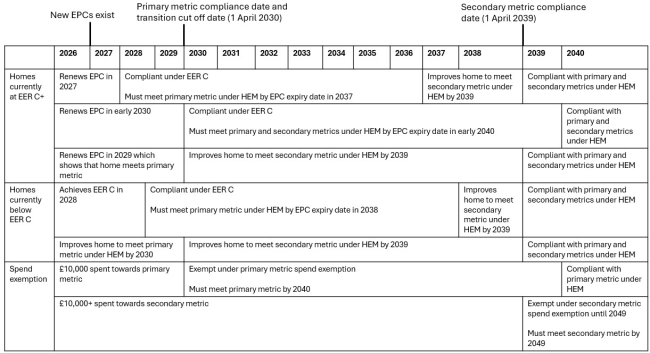
Annex E: Spend exemption worked examples
The examples below are for illustrative purposes to demonstrate how the spend exemptions will work in practice. The specific measures that enable a home to reach band C against new EPC metrics will be determined by EPC reform and may differ to the examples set out below. Government published a consultation on how new EPC metrics will be calculated using HEM, including what measures will achieve band C against each metric. Home Energy Model: Energy Performance Certificates.
Example 1
Provider A spends £8,000 on insulating a property by 2030 but does not meet band C against the fabric performance metric. The next fabric measure would require loft insulation and would cost £6,000. This property is exempt from any further expenditure to meet the first metric until 2040 under the spend exemption.
Provider A also spends £4,000 on installing smart heating controls in the same property by 2039, but does not meet band C against the smart readiness metric. The next smart measure would require solar PV to be installed and would cost £7,000. This property is exempt from any further expenditure to meet the second metric until 2049 under the spend exemption.
Example 2
Provider B’s property meets the smart metric at band C by 2030.
Provider B spends £10,000 on cavity wall insultation and double-glazed windows by 2039 but does not meet band C against the fabric performance metric. This property is exempt from any further expenditure to meet the second metric until 2049 under the spend exemption.
Example 3
Provider C spends £5,000 on preparing a home for a heat pump by 2030 but does not meet band C against the heating system metric. The heating system measure would require a heat pump to be installed and would cost £10,000. This property is exempt from any further expenditure to meet the first metric until 2040.
Provider C also installs solar panels in the same property to meet the smart readiness metric at band C by 2039 to be compliant with the second metric. No further expenditure is required for the second metric.
-
AT2_2 from Annex tables for English Housing Survey 2024 to 2025 headline findings on housing quality and energy efficiency ↩
-
The EER metric is a measure of the overall efficiency of a building, based on the energy costs. The EIR metric is a measure of a home’s impact on the environment in terms of carbon dioxide (CO2) emissions. ↩
-
For conciseness, we will generally just refer to leaseholders and freeholders in this section, but please note that these proposals will also apply to their commonhold equivalents: unit owners and commonhold associations. ↩
-
Chapter 3: annex tables from EHS 21-22 housing quality and condition ↩
-
Buildings Research Establishment (BRE) (2023) The cost of poor housing in England by tenure ↩