Enhanced protections for homeowners on freehold estates
Published 18 December 2025
Applies to England and Wales

© Crown copyright 2025
This publication is licensed under the terms of the Open Government Licence v3.0 except where otherwise stated. To view this licence, visit nationalarchives.gov.uk/doc/open-government-licence/version/3 or write to the Information Policy Team, The National Archives, Kew, London TW9 4DU, or email: psi@nationalarchives.gov.uk.
Where we have identified any third party copyright information you will need to obtain permission from the copyright holders concerned.
This publication is available at https://www.gov.uk/government/consultations/enhanced-protections-for-homeowners-on-freehold-estates/enhanced-protections-for-homeowners-on-freehold-estates
Scope of this consultation
Topic of this consultation
This consultation sets out wide-ranging proposals to give better rights and protection for homeowners living on privately managed estates and to address the considerable injustices they face. This includes the introduction of new measures in legislation that will mean homeowners on privately managed estates will no longer have to worry about losing their homes when they fall into arrears on their estate management charge.
The consultation also takes forward key measures in the Leasehold and Freehold Reform Act 2024 (“the 2024 Act”), which create a new regulatory framework to give homeowners on privately managed estates new rights, protections and powers to hold their estate manager to account for the money they spend. This framework is built around the enhanced framework for leaseholders and includes ensuring transparency of estate management charges. It gives homeowners the right to challenge the reasonableness of their charges, and allows these homeowners the right to apply to a tribunal to appoint a manager in the event of serious management failure. This consultation seeks views on how to implement these new requirements.
Throughout this consultation document, we will use the term “estate manager” as shorthand for both private embedded management companies and resident management companies. We also use the term “homeowner” to refer to those freehold and leasehold owners in houses and flats who are liable to pay an estate management charge. We will also refer to the “appropriate tribunal” in reference to the First-tier Tribunal in England or the Leasehold Valuation Tribunal in Wales.
Geographical scope
The proposals almost exclusively relate to England and Wales.
In particular, the 2024 Act conferred powers to implement most aspects of Part 5 on the Secretary of State to cover both England and Wales. It also conferred powers to implement sections 83 to 87 of the 2024 Act to Welsh Ministers in relation to Wales. This aspect of the consultation therefore only covers England.
Impact assessment
An Impact Assessment was previously published during passage of the 2024 Act which covered the relevant overarching measures. All regulations brought forward as a result of this consultation will be subject to appropriate assessment.
The UK government is mindful of its responsibilities, including those under the Public Sector Equality Duty to have due regard to the potential impact of their proposals on people with protected characteristics, and their responsibilities to consider environmental principles in any proposals, including, in relation to England, as set out in the Environment Act 2021. Consideration of these duties informed the passage of the 2024 Act, and we welcome evidence and views on the impact of this policy as part of this consultation. All regulations bought forward as a result of this consultation will be subject to appropriate assessment.
Basic information
Bodies responsible for the consultation
The Ministry of Housing, Communities and Local Government.
Duration
This consultation will last for 12 weeks from 18 December 2025 to 12 March 2026.
Enquiries
For any enquiries about the consultation please contact: protectinghomeowners@communities.gov.uk
How to respond
You may respond by completing an online survey on CitizenSpace.
Alternatively, you can email your response to the questions in this consultation to protectinghomeowners@communities.gov.uk
When you respond it would be very useful if you confirm whether you are responding as an individual or submitting an official response on behalf of an organisation, and if so, include the name of the organisation and your position.
Ministerial Foreword
For too many homeowners, the experience of living on a newly developed housing estate has been tainted by the hidden and enduring consequences of unadopted infrastructure. Roads, sewers, drains, green spaces, and other amenities that historically would have been maintained by the local authority or utility companies, are instead now routinely left to be managed by private estate management companies, often with little transparency or accountability.
In many cases, the quality of the amenities on such freehold estates is inferior to those adopted by the relevant public authority and falls far short of what people have a right to expect. Residential freeholders across the country frequently report open spaces not fit for purpose, roads left unsurfaced; and drainage systems which are often little more than open ditches. These issues blight people’s lives and with few of the rights to redress found in other markets and no ability to control the management of the estates on which they live, residents feel like they are treated as second-class homeowners.
This government believes that homeowners living on freehold estates deserve a fair deal. That is why we pledged in our manifesto to act to bring the injustice of ‘fleecehold’ private housing estates and unfair maintenance costs to an end.
Our objective is clear. We are determined to reduce the prevalence of private estate management arrangements, which are the root cause of the problems experienced by many residential freeholders. At the same time, we want to provide those who currently live on privately managed estates with greater rights and protections so that the fees they pay are fair, transparent, and robustly justified.
Alongside acting through primary legislation to ban the use of the draconian remedies available for nonpayment of rentcharges and working with the Law Commission to explore how homeowners on freehold estates might secure greater control over the management of their estates, we intend to bring into force the new consumer protection provisions in the Leasehold and Freehold Reform Act 2024.
These provisions allow for the creation of a new regulatory framework that will make estate management companies more accountable for how homeowners’ money is spent. They will provide homeowners who pay an estate management charge with better access to information they need to understand what they are paying for; the right to challenge the reasonableness at the First-tier Tribunal; and the right to go to the tribunal to appoint a substitute manager.
This consultation seeks views on how we implement this new framework effectively and to the benefit of all homeowners. We invite individual homeowners, estate managers and managing agents to share their views, with suggestions for improvements, and how they can be made.
Matthew Pennycook MP
Minister of State for Housing and Planning
About you questions
Question 1
Where are you based?
- England
- Wales
- Other
If other, please specify [Free text]
Question 2
What is your name? [Single line text]
Question 3
What is your email address? [Email address]
Question 4
Are you responding on behalf of an organisation? [Yes/No]
If “yes” what is the name of the organisation? [Free text]
Question 5
If you are responding on behalf of an organisation, which of the following best describes you
- I am responding as a resident management company.
- I am responding as a private management company.
- I am responding as a property managing agent organisation (private);
- Landlord of block(s) of flats;
- Other (please specify). [Free text]
Question 6
If you are responding as an individual, are you a:
- Homeowner of private housing;
- Homeowner or resident of social housing;
- Landlord owning a flat or block(s) of flats;
- Legal representative
- Other (please specify). [Free text]
Question 7
If you are a resident or private management company: How many staff members do you employ? [Number]
Question 8
If you are a resident management company: How many homes are there on the estate? [Number]
Question 9
If you are a resident or private management company: Do you employ a managing agent? [Yes/No]
Question 10
If you are a private management company: How many estates are you responsible for? [Number]
Question 11
If you are a private management company: What is the total number of homes on the estates that you manage? [Number]
Question 12
If you are a resident or private estate management company: How often do you issue a demand for payment?
- Annually
- Twice yearly
- Other (please specify) [Free text]
Introduction
Residential developments require common shared amenities like roads, sewers, drainage, play areas and open spaces. Historically, relevant adopting authorities, such as highways authorities and water companies, adopted amenities on new developments as a matter of course, on payment of a financial contribution from the developer, so that they would be maintained at public expense.
Over recent years, and especially over the last 15 years, we have witnessed the growth of private management on housing estates where some or all of the shared infrastructure is not maintained by the local authority or water companies, and the costs of their ongoing maintenance falls upon the homeowners of the estate through an estate management charge. The Competition and Markets Authority’s (CMA) market study into the housebuilding industry found that 80% of new homes sold by the eleven biggest builders in 2021 to 2022 were subject to estate management charges.
This payment, of an estate management charge, is in addition to the council tax that homeowners have to pay and is specified in the property deeds. The CMA estimated the average estate management charge at £358 per annum, but with a wide range depending on the circumstances of individual estates[1]. These charges are enforceable with, for some, the possibility of extreme penalties for breaches including a rent charge owner taking possession of or granting a lease over a homeowner’s property.
Many estate managers do seek to provide a good service and deliver their obligations effectively and efficiently and are responsive to the needs of the homeowners. However, we have heard that some homeowners living on privately managed estates often face significant challenges, including unclear obligations, high and unpredictable costs, and limited rights to challenge poor service. The main complaints include:
-
Homeowners are not provided with sufficient information or with sufficient detail to understand the charges they are asked to pay;
-
Homeowners are unable to get hold of relevant information to understand how costs are calculated;
-
Homeowners face high charges for minimal work carried out;
-
The quality of works carried out is poor;
-
The disproportionate sanctions for failure to pay in a timely manner; and
-
The lack of an effective mechanism to seek redress where things go wrong. For many their only power is to apply to the county court on the grounds of a breach of the terms of contract. This approach was, and remains, costly and time-consuming.
The similarity of these issues with those identified in relation to the injustices experienced by many leaseholders has spawned the term ‘fleecehold’ to describe the lack of consumer rights and protections.
The CMA’s market study identified widespread consumer detriment in this area as the result of the proliferation of this model. It made a number of recommendations to address this. The main recommendations were that government should take action to set common standards and mandatory adoption of public amenities on new residential estates (recommendations 1.1 and 1.2). It also set out a number of proposals to enhance protection, improve transparency and give greater rights to existing homeowners (recommendation 1.3).
This consultation concentrates on measures to enhance homeowner protections. The main focus is on implementing measures in the Leasehold and Freehold Reform Act 2024, which creates a new regulatory framework to hold estate managers to account for the money they spend and to seek redress when they consider charges to be unreasonable. However, it also seeks views on other recommendations set out by the CMA.
The document is set out into four parts:
Part 1
Removing disproportionate enforcement remedies: currently, sections 121 and 122 of the Law of Property Act 1925 allows rentcharge owners to take possession of or grant a lease over a property for even minor arrears, without notice. These remedies are outdated and wholly disproportionate, creating risks for homeowners and delays in property sales. The government intends to repeal these provisions through primary legislation and introduce a requirement for homeowners to be given notice of what they need to pay before enforcement action can start;
Part 2
Implementing the Leasehold and Freehold Reform Act 2024: Part 5 of the 2024 Act introduces a new regulatory framework to give homeowners more statutory rights and protections to hold estate managers more to account. These measures, which broadly mirror the regime in place to protect leaseholders, include:
- Giving homeowners the ability to challenge the reasonableness of the estate management charge and administration charges at the appropriate tribunal;
- Giving estate managers a time limit of 18 months from when costs for works are incurred to charge homeowners for the works, unless a future demand for payment notice has been served;
- Standardising the information estate managers will be required to provide homeowners, by introducing a standardised estate management charge demand form and annual report;
- Giving homeowners rights to request information that estate managers must provide to them;
- Giving homeowners greater influence over any major works of the shared amenities, by requiring estate managers to consult homeowners where the anticipated cost exceeds an appropriate amount; and
- Giving homeowners the right to apply to the appropriate tribunal to appoint a substitute estate manager in the event of serious management failure.
Part 3
Further government action to tackle injustices facing existing homeowners.
Building on the 2024 Act, the UK government will:
- strengthen the regulation of managing agents and estate managers on freehold estates, including mandatory minimum qualifications, to improve competence and accountability as informed by the consultation feedback;
- improve the home buying and selling process by reducing delays and capping unreasonable fees for information;
- legislate to fund free advice for homeowners on privately managed estates; and
- explore options to empower residents to take control of estate management.
Part 4
Other issues: the consultation also covers:
- Limits on administrative costs for recovering income-supporting rentcharge arrears.
- Considerations of environmental impacts, equality implications, and potential effects on the justice system.
Once implemented, these reforms will go some way to addressing the imbalance facing existing homeowners and provide them with the greater rights and protections that they deserve. This is not the sum total of UK government’s ambition for reform. This consultation is one-part of a two-part consultation. The UK government is separately consulting on options to reduce the prevalence of private managed estates with unadopted amenities.
Part 1: Removing disproportionate enforcement remedies
1. Repealing sections 121 and 122 of the Law of Property Act 1925
One of the most shocking injustices facing many homeowners on privately managed estates occurs when they fail to pay an estate management charge and fall into rentcharge arrears. Under the current law, rentcharge owners – typically estate managers – may rely on enforcement remedies in sections 121 and 122 of the Law of Property Act 1925 (“the 1925 Act”) in addition to alternative and more appropriate enforcement remedies for non-payment. These provisions allow the rentcharge owner to take possession of the property until arrears are cleared, grant a lease over the property to trustees, or appoint a receiver with mortgagee-like powers.
These remedies can be exercised without any notice being given and without a financial threshold, meaning that homeowners may not be aware that they have a debt. To compound matters, where a lease is granted the rentcharge owner is under no obligation to surrender the lease once the debt is paid, although in practice they will do so for a suitable administration fee. The case of Roberts v Lawton in 2016 highlighted the disproportionate nature of these remedies and abhorrent practice a small minority of owners of estate rentcharge arrears employ - in this case arrears ranging from about £6 to £15 resulted in the grant of a 99-year lease over the properties.
Although in most cases, the rentcharge owner will pursue any arrears through the small claims court, the existence of these statutory remedies is hampering the home buying and selling market, as many lenders are concerned about the potential impact to the security of their interest where there is an estate rentcharge. More lenders are requiring deeds of variation to property deeds (or other relevant legal documentation) to remove these remedies before approving loans, which adds time and cost to prospective homebuyers.
Furthermore, the estate manager (or other rentcharge owner) may sometimes rely on the availability of these disproportionate remedies to threaten homeowners with the loss of access to their home for non-payment.
These statutory remedies are draconian and disproportionate and are no longer suitable for our housing market. They should not be relied on as a means to recover unpaid debt, especially given the existence of other more appropriate debt recovery mechanisms.
The government will therefore repeal sections 121 and 122 of the Law of Property Act 1925 as soon as parliamentary time allows, and will set out that homeowners must be notified of the level of estate rentcharge arrears and how those arrears have been calculated before enforcement action can commence. As a result of these changes homeowners will no longer have to worry about losing, or the threat of losing, access to their homes, having a lease imposed upon their property or excessive practices when they fall into arrears. It will also make it easier for homeowners to sell their homes, by reducing time and cost associated with identifying and amending deeds.
Once these measures come into effect, rentcharge owners may still rely on alternative remedies to pursue arrears, provided they have satisfied notice requirements. Those remedies include:
- An action in the small claims court. This is a common route used in practice for the estate rentcharge owner to pursue a debt action against the current householder in the small claims court.
- A specific cost recovery clause in the deeds of transfer. This could for example result in the rentcharge owner employing a debt recovery service.
- A claim for breach of covenant. The deed creating the rentcharge may contain an express covenant to pay the annual sum.
- A statutory demand in bankruptcy. The rentcharge owner can serve a statutory demand which, if not complied with, could entitle the rentcharge owner to commence bankruptcy proceedings (depending on the amount owed).
Consultation on other circumstances which use the remedies under section 121 and 122 of the Law of Property Act 1925
This government is firm with our intent to repeal sections for homeowners on privately managed housing estates and subject to estate rentcharges. Yet, we are aware that the remedies in sections 121 and 122 of the 1925 Act are also available in relation to the following types of rentcharge:
a. where paragraph 3 of Schedule 1 to the Trusts of Land and Appointment of Trustees Act 1996 (trust in case of family charges) applies to the land on which the rent is charged or would apply if the land was not settled land or subject to a trust of land;
b. where an Act of Parliament provides for the creation of rentcharges in connection with the execution of works on land or commutation of any obligation to do such work; and
c. where a court requires the creation of the rentcharge.
We do not have information about how many of these types of rentcharges are created, how they are used or whether the remedies in sections 121 and 122 of the 1925 Act are used to enforce them. It considers that the use of these remedies is also likely to be excessive in those situations and is so minded to repeal these sections completely. That will remove these remedies for all rentcharges. However, we appreciate that it is possible that removing these remedies for the rentcharges listed above could lead to unintended consequences and we would like to gather further information to try and understand if there are any grounds for retaining sections 121 and 122 in any circumstances.
Question 13
If sections 121 and 122 1925 Act are repealed entirely, what impact will there be to rentcharges created in any of the following ways?
a. Where paragraph 3 of Schedule 1 to the Trusts of Land and Appointment of Trustees Act 1996 (trust in case of family charges) applies to the land on which the rent is charged or would apply if the land was not settled land or subject to a trust of land;
b. Where an Act of Parliament provides for the creation of rentcharges in connection with the execution of works on land or commutation of any obligation to do such work;
c. Where a court order requires the creation of the rentcharge. [Free Text]
Question 14
When are these types of rentcharges being used?
Provide details [Free text]
Part 2: Implementing the Leasehold and Freehold Reform Act 2024
2. Driving up accountability of estate managers
Under the terms of existing property deeds, homeowners will typically receive a bill for the provision of services for the maintenance and upkeep of communal areas on estates. The frequency of bills and the information provided alongside them depends on the terms of the deeds and, following that, rests with the estate manager. Most homeowners are asked to pay an upfront sum, but some are required to pay in arrears. The same applies to requests for information to help homeowners understand what they are paying for. Beyond what the deeds say, there are very few legal requirements on estate managers to be transparent in the charging and demanding of estate management charges and what information is provided to homeowners.
The 2024 Act empowers homeowners to hold estate managers to account for the money they spend. At its heart is a new obligation that estate management charges must be reasonably incurred and, where costs relate to works or services, the work or services must be of a reasonable standard. Furthermore, homeowners have the right to challenge the reasonableness of their estate management charge, whether it is a fixed or variable charge, at the appropriate tribunal.
Enabling homeowners living on privately managed estates to benefit from these changes relies on them having access to the right level of information at the right time. Implementing measures in the 2024 Act will give homeowners on privately managed estates more and timely information, that is accessible and standardised, to help them understand what their estate management charge is paying for and how their estate is managed. Under our reforms, homeowners will get: - an annual report;
- a standardised demand form to provide clarity about what they have to pay for the year ahead; and the right to request information.
While it is essential to provide homeowners with the information that is needed, it is important to ensure estate managers, or managing agents, are not unduly burdened, and that any added costs for provision of this information is proportionate, reasonable and beneficial.
2.1 A new annual report
Measures in the 2024 Act will require estate managers to provide an annual report. It is proposed that this report will provide homeowners with important information about the management of their estate. Many homeowners do not currently receive sufficient information.
The Secretary of State has powers to prescribe the annual report’s format, content and how it is provided to homeowners. In addition, the Secretary of State can also exempt certain categories of estate manager or type of estate management charge from this requirement if considered appropriate.
The annual report must be provided within one month of the end of the accounting period’s start, but it can be provided earlier as long as it includes the required information. This means that estate managers could combine the report with the estate management charge demand form if they wished, for example, to reduce costs.
Proposed format and contents of the annual report
The aim is to make the annual report clear, accessible and useful for homeowners and, in one place, provide most of the key information they will need about what they will be charged for over the year ahead and any significant planned expenditure beyond it. We propose the annual report includes the following minimum information:
-
Key contact details such as the owner of the communal areas of the estate, estate manager and managing agent;
-
Key information about the estate – for example, the name of the estate, the extent of the area managed by the estate manager (identified on a map), the number of properties contributing to the estate management costs;
-
Surveys – details of when the last surveys were carried out and when the next survey is due. This includes those relating to playgrounds, shared green spaces, Japanese Knotweed;
-
Administration charges – the administration charge schedule required by section 84 of the 2024 Act;
-
Major works – plans for major maintenance, repairs or improvements in the next 2 years;
-
Handling disputes – information to sign post homeowners where to go if they are unhappy with the estate management charge or want to make a complaint (e.g. details of the estate managers complaint procedure), as well as information about any ongoing formal notices of complaint (see section 5 below);
-
Insurance – details of any insurance for the estate (for example public liability insurance);
-
Adoption status and other relevant planning details – in cases where adoption is a planning condition, details of any adoption application made to the local authority, or when that application will be made with an explanation of why it has not yet been made. The same detail should be disclosed for any other relevant planning conditions; and
-
Estate management scheme – details of any formal estate management scheme under section 19 of the Leasehold Reform Act 1967 or under chapter 4 or section 93 of the Leasehold Reform, Housing and Urban Development Act 1993. These schemes regulate the use or appearance of a property within the Scheme Area.
A mock-up of the proposed report is at Annex A. We consider that there are grounds to standardise the format of the report to make it easier for homeowners to compare. We recognise that estate managers may already provide a lot of this information. We do, however, believe that it would be helpful for the information to be provided in a prescribed format. We would welcome views on this.
Question 15
Do you agree with the minimum information proposed for the annual report? [Yes/No]
If no, what additions or changes would make it more effective? [Free text]
Question 16
Do you agree that the information should be provided in a prescribed format? [Yes/No]
If not, why not? [Free text]
ii) Manner in which the annual report is to be provided
The 2024 Act allows the Secretary of State to prescribe how annual reports are provided to homeowners. We understand that, currently, most information is sent either by post or electronically. This could be through either an email or accessing a page on the estate manager’s website. We therefore propose to specify that demands must be served by one of these means.
Question 17
Do you agree that annual report may only be provided by post or electronically? [Post/Electronically/Both/Other (please specify)]
If other, how else should the demand be made? [Free text]
iii) Exemptions to the requirement to provide an annual report
Section 79(6) of the 2024 Act allows the Secretary of State to grant exemptions from providing an annual report based on the type of estate manager, type of estate management charge or any other matter. Our starting position is that there should be no exemptions. This is to ensure that homeowners receive the essential information they need about the management and maintenance of the estate. We would welcome views on whether there are any circumstances or justifications for any exemptions. We will also keep matters under review over time, should future grounds for exemptions arise.
Question 18
Should there be any exemptions from providing the annual report? [Yes/No]
Explain what exemptions should apply, and why?
[Free text]
2.2 A new standardised estate management charge demand form
Homeowners deserve to understand exactly what they are paying for through their estate management charge. We consider that homeowners should have sufficient financial and non-financial information to enable them to make an informed opinion on whether the costs incurred by the estate manager are reasonable and services provided are of a reasonable standard.
Manager or managing agent outlining how much a homeowner on a privately managed estate must pay for the works and services undertaken to manage and maintain the estate. The service or works for which monies may be collected, the period of time each invoice will cover, and whether payment is in advance or in arrears will depend on individual circumstances.
Currently, estate managers have total discretion (subject to the terms of the deeds) to decide how estate management charge demands are presented to homeowners and the information the demand contains. Indeed, in some cases, there are no demands at all; the deeds may not require a formal demand to be raised, with some homeowners simply paying monthly direct debits with a brief summary once a year. As a result, demands are not always issued in a consistent manner and may contain varying levels of detail, which does not provide transparency for homeowners. Whilst many estate managers do provide considerable information to homeowners, we are concerned that some homeowners do not receive sufficient information, and this makes it hard for them to understand whether the charges they are required to pay are reasonable, if information is even received at all.
The Secretary of State has powers under section 78 of the 2024 Act to prescribe the format and content of the estate management charge demand form.
Standardising the estate management demand form seeks to set a minimum level of detail to be included, rather than limit what information is provided. Estate managers are able to choose to provide more detail if they wish. We would like to get views on the minimum level of information and detail that should be provided on the new estate management demand form.
Proposed contents of the new estate management charge demand forms
Given the level of information proposed for inclusion in the annual report (see section 2.1), we propose that the estate management demand form should focus on the financial contribution that homeowners must pay towards the management and maintenance of the estate for the period.
It is important that demands for payment are prescribed in a clear and accessible format that is easy for homeowners to understand and to contain the right level of detail to meet homeowner needs. We would like to get views on the level of detail that would be appropriate for an estate management charge demand form and what information could be included in other documents.
As a minimum, we consider that the form should contain at least the following information:
- Name and address of homeowner, estate manager and property for which the estate management charge is payable. In cases where the party serving the demand is not the estate manager (because for example it is being handled by a managing agent), the estate management company’s details ought also to be given;
- Overall amount payable;
- The period which the payment covers;
- Payment details and deadline;
- Consequences of non-payment; and
- The annual budget, setting out details of planned expenditure on management costs, maintenance of the estate, and any insurance costs covering the communal areas.
We are clear that the form can contain more than the specified information if estate managers choose to do so. We are keen to balance the right to information with the cost to estate managers to adjust systems and put new arrangements in place which could be passed on to homeowners through the estate management charge.
A mock up of what the form might look like is at Annex B.
Unlike with leasehold properties we understand that estate management charges are generally issued annually, and there is not a second demand during the accounting year. However, we would welcome confirmation that this is the case.
Should there be circumstances where a homeowner receives more than one demand for payment in the year, either because the title deeds require it or because of some other valid reason (such as an unexpected cost), the 2024 Act gives the Secretary of State powers to prescribe a specific format for second and any subsequent demands. We propose that any new demand issued during the accounting year as required under any title deeds or some other arrangement is in the same format as the initial demand but only covers the provisions set out above. We would welcome views on this approach.
Details of the annual budget
The annual budget is a key component of any information provided to homeowners on privately managed estates. It is intended to clearly show an estimate of what the estate manager intends to spend money on and recover through the estate management charge. On many estates, homeowners will pay for exactly the same services. In others, costs vary depending on the extent of the shared areas and costs for their upkeep. In such cases, the budget may be divided to reflect this to make it easier for individual homeowners to understand what they are expected to contribute.
Our preferred approach is to require the budget to be provided as part of the initial estate management demand form and, as part of the demand form it should cover the budget for both the previous and existing accounting period. We recognise that there is a risk that the budget for the accounting period might be an estimate, but we consider that even an estimate will give homeowners a clear idea of where there are likely to be changes in expenditure. We do recognise though that there are also grounds to have the budget form part of the annual report, which would mean that estate managers would have to submit a budget within a month from the end of the accounting period. We are seeking views on when the budget should be provided.
We are also seeking your views on two options for the level of detail which the annual budget should contain. Information is intended to provide homeowners with a better understanding of what their estate management charge pays for, but we want your views on what level of information you think is sufficient and proportionate for homeowners’ needs. We recognise that the level of information will depend on what infrastructure and amenities the estate manager is responsible for maintaining.
Annual budget Option 1:
A simple breakdown under a limited number of standardised high-level headings for heads of costs as follows:
- Management fees and overheads;
- Road repairs and maintenance (including pavements and street lighting if applicable);
- Security costs (such as CCTV);
- Open space maintenance and repairs (including green spaces, trees, playground and off street paths);
- Drainage and sewerage maintenance and repairs;
- Other shared services (including communal heat networks, other communal heating, electric vehicle charge points, or other services such as electricity or telecommunications);
- Health and Safety Obligations (e.g. surveys);
- Insurance costs for shared areas; and
- Other Professional fees.
This seeks to give a high level of detail, but without seeking to overload homeowners with potentially too much information (noting they will also have wider rights to request further information should they wish, see section 2.4), nor increasing estate manager costs too much. See Annex B for an illustrative example of Option 1.
Annual budget Option 2
Proposes a more detailed breakdown of Option 1 with subcategories under each heading. For example:
- Management fees: further broken down into, for example office costs, directors and officers insurance, managing agent fee, cost of preparing accounts.
- Grounds maintenance: further broken down into green spaces, playground, trees etc.
While this approach further increases transparency, it could raise costs for estate managers which would likely be passed on to homeowners, who may also find this level of detail overwhelming. See Annex B2 for an illustrative example of Option 2.
Question 19
How frequently do you make demands for an estate management charge for payment?
- Once a year
- Once a year (plus exceptional payments for unplanned work)
- Twice a year
- Other (Please specify) [Free text]
Question 20
Do you agree with the proposed contents of the estate management charge demand form? [Yes/No]
If not, what changes to the proposed contents would you like to see? [Free text]
Question 21
Do you agree with the proposed approach for any interim demands? [Yes/No]
If no, please suggest an alternative approach [Free text]
Question 22
Which option do you think provides the most appropriate level of breakdown of heads of costs budget headings for the annual budget document? [Option 1/Option 2]
Explain why you prefer Option 1 or Option 2. [Free text]
Question 23
Do you consider that details of the budget should be provided as part of the estate management charge demand form, or as part of the annual report? [Annual Report/Estate management charge demand form]
Explain your answer [Free text]
iii) Exemptions for new estate management demand forms
Section 78(3) of the 2024 Act allows the Secretary of State to provide for exemptions to the general provision by reference to the description of the person making the demand, type of estate management charge or other matter.
Our starting point is that there should be no exemptions to providing the new estate management charge demand forms to homeowners. The intention with the proposed approach is that these forms should provide a simple, accessible and cost-effective way of giving homeowners clear information about their obligations. We recognise that many estates are managed by the residents. Even in those cases, we do not consider that there should be an exemption on the basis that even with a resident management company, not all homeowners are directly involved in the day-to-day management of the estate nor have access rights to key information. We therefore think that it is just as important for homeowners on resident-managed estates to receive the same information, without an exemption. However, we would welcome views on whether there are any circumstances or justifications for any exemptions. We will also keep matters under review over time, should future grounds for any exemptions arise.
Question 24
Should there be any exemptions from providing estate management charge demands using standardised forms? [Yes/No]
If yes, please explain what exemptions should apply, and why? [Free text]
Manner of provision of estate management charge demand forms
Measures in the 2024 Act allow the Secretary of State to prescribe how estate management charge demands are provided to homeowners. We understand that, currently, demands are sent either by post or electronically (such as email or via a portal on the estate manager’s website). We therefore propose to specify that demands must be served by one of these means.
Question 25
Do you agree that a demand for payment of estate management charges should be made by post or by electronic means? [Post/Electronically/Both/Other (please specify)]
If other, how else should the demand be made? [Free text].
2.3 Transition arrangements and costs for estate management charge demand forms and annual report
We recognise that the cost of these new measures will affect estate managers and managing agents differently, depending on the systems they have in place currently and the extent to which this information is already provided. Estate managers and managing agents may need to update IT systems, train staff or adjust their processes to meet the new requirements. Much of the information required for the annual report is likely to be already available. Annex 6 of The Impact Assessment that accompanied the 2024 Act made an initial assessment of direct costs to business of £24.7m over a 10 year period. Much of this cost is the result of changes to working practices. We are keen to obtain further information to better understand the overall impact of the proposals. For this reason, we are seeking views on the likely one-off costs associated with introducing these measures, taking into account the information required, the time to compile the information and the means of distribution to homeowners. Once implemented, ongoing costs we expect should be limited.
We want to understand how these costs will affect businesses and whether and if so, to what extent they will be passed onto homeowners through the estate management charge. We also recognise that to prepare for the new arrangements, a sufficient transition period is likely to be needed. We want the transition period to be as short as feasible and propose that 12 months would be appropriate. However, we would welcome views on a suitable transition period that would be appropriate to prepare for the new requirements for demand forms and annual report.
Question 26
Estate managers and managing agents only: Is there any information for the proposed estate management charge demand and annual report that you do not already collect? [Yes/No].
If yes, what is this information? [Free text]
If yes, how much time would it take to collect this information? [Free text]
If yes, what would be the cost of collecting this information? [Free text]
Question 27
Estate managers and managing agents only: Do you use management software, or do you manually process demands? [professional management software/manually process/other]
If other, please provide details [Free text]
Question 28
Estate managers and managing agents only: Do you issue demands at all? [Yes/No]
If yes, do you do this via electronic means or post? [Free text]
Question 29
Estate managers and managing agents only: Would you need to make significant adjustments to your systems to meet the new information requirements? [Yes/No]
If yes, would any adjustments be outsourced (for example, to an IT software provider)? [Free text]
Question 30
Estate managers and managing agents only: How much would it cost you (or, if outsourced, the provider) in terms of set up costs to adjust systems to collect and provide the information proposed in the demand forms or annual report and thereafter additional ongoing costs? Provide details [Free text]
Please provide a breakdown of set up costs which may be required [Free text]
Please provide a breakdown of likely additional costs of providing the information on an ongoing basis after set up. [Free text]
Question 31
Estate managers and managing agents only: Do you agree that 12 months is an acceptable transition period for estate managers to prepare for the new demand form and annual report arrangements to commence? [Yes/No]
If no, what should be an appropriate period and why? [Free text]
Question 32
Estate managers and managing agents only: Would you pass on all these transition costs to homeowners, for example through a management fee? [Yes/No]
If no, which costs are you likely to pass on? [Free text]
2.4 A new notice of future estate management charge demands
Section 76 of the 2024 Act requires all charges that homeowners are required to pay are demanded within 18 months of when the costs were incurred. This is intended to ensure timely billing and to avoid disputes over expenditure which has occurred long in the past.
If estate managers miss this 18-month deadline, homeowners will not be liable to pay these costs unless the estate manager sends a “future demand notice” within 18 months of the costs being incurred and confirms their future responsibility to contribute. This approach will provide certainty to homeowners and require estate managers to be clearer on the costs they have incurred and when they are likely to be charging homeowners for these costs.
Form and manner of notice to homeowners
The Secretary of State has powers to specify the form of the notice, the information to be included in it, and the manner in which it must be given to the homeowner. We propose that this includes: *the estimated amount of costs incurred; * the amount the individual homeowner is expected to be required to contribute to those costs; and * a date on or before which it is expected that the estate management charge will be demanded * It is important that estate managers provide homeowners with clear, timely and accessible information about future costs. Annex C sets out the detail of the proposed standard future demand notice. The form should be sent out to all homeowners who pay an estate management charge and where the estate manager seeks to rely on section 76 of the Act to delay the demand for any works.
The Secretary of State also has powers to determine the manner in which these forms should be set out. Unlike leases, freehold property deeds tend not to be prescriptive on how communication between the homeowner and estate manager must be carried out. For this reason, we are minded to allow homeowners to be informed by post or electronically. We would welcome views on this approach.
Question 33
Do you agree with the proposed structure and content of the future demand notice in Annex C? [Yes/No]
If no, what changes do you consider are needed and why?
[Free text]
Question 34
Do you agree that future demand notices should be sent out electronically or by post? [Post/Electronically/Both/Other (please specify)]
If other, please explain your reasoning and how future demand notices should be communicated to homeowners?
[Free text]
Grounds (reasons) for extending the estimated demand date
Once a future demand notice is issued, the Secretary of State has powers to limit the amount that estate managers may charge as well as the time limit by when a demand for payment must be made. Estate Managers may extend the expected demand date under specified circumstances.
For multi-year programmes of works, we expect estate managers to issue a future demand notice for each new set of works. For existing works, where there is a further increase in costs incurred after the initial future demand notice, we also expect estate managers to issue a further future demand notice to cover these additional costs incurred before the expiry of the existing demand notice and within 18 months of those costs being incurred. This is subject to any limitations imposed by the Secretary of State.
We are minded to impose a limitation so that costs should not be recovered if the time limit has lapsed on the initial future demand form or capped if the estimate on the initial form has been exceeded. This will encourage estate managers to provide as accurate an update as is possible and manage the works effectively. We would welcome views on this approach.
There may be justifiable reasons why estate managers might sometimes need to delay asking homeowners for payment beyond the expected demand date, even if the total costs stay the same. This might be because of disputes over the quality of works or delays to finishing them. The Secretary of State has the power to substitute the expected demand date with a later date. We propose that the only reason for extending the estimated demand date should be where there are delays to major works which have commenced but either not yet concluded or where the final account has not been finalised.
We welcome views on the appropriateness of these grounds and if other grounds should be considered.
Question 35
Should we legislate so that costs should not be recovered if the time limit has lapsed on the initial future demand form or capped if the estimate on the initial form has been exceeded? [Yes/No]
If no, please explain why and what limitations you would consider acceptable?
[Free text]
Question 36
Do you agree with the proposed grounds for extending the estimated demand date? [Yes/No]
If no, under what other reasons should estate managers be able to change the demand date?
[Free text]
Question 37
Do you agree that the notice of future demand forms needs to be signed by both the estate manager and a representative of the contracting company? [Yes/No]
If no, please explain your answer [Free text]
2.5 Enhanced rights to obtain information on request
Homeowners currently have limited access to information about how their estate is managed. Those who are members of resident management companies may have some rights under company law and the Articles of Association to see some documents, but not all homeowners have access to these rights. However, in many cases the right to see information rests on the voluntary policy and/or approach of each individual estate manager.
While estate managers will be required to provide more information to homeowners through the annual report (see section 2.1), homeowners may still have further questions and want to have access to various additional documents to understand matters in more detail. We believe homeowners should have access to key documents to enable them to better understand how the communal areas are being managed and how their money is spent. It may also help avoid disputes from escalating if homeowners can find assurance on a particular matter with the provision of additional information.
Information available on request should include access to documents that relate to items of expenditure in the estate management charge as well as those which deal with the management and maintenance of shared areas.
Sections 80 and 81 of the 2024 Act introduce a new right for homeowners on privately managed estates to require an estate manager to provide information relating to the management of the estate.
Estate managers will be required to provide relevant additional information that they hold to homeowners, and where the information is held by a third party, the third party is required to provide the information that they hold. Homeowners can also request to inspect a document and/or make copies. The estate manager may charge the homeowner for making copies of the information but not for accessing the premises. The charge will need to be reasonable.
The Secretary of State has a range of powers to create a robust yet proportionate framework to ensure homeowners receive information they are entitled to. We are seeking views on how to implement this new regime.
Information that can be requested from estate managers
Under section 80 of the 2024 Act the Secretary of State can specify the information that estate managers must provide to homeowners on request. That information must relate to estate management and must be in possession of the estate manager (or a third party). We think there is a variety of information which estate managers and third parties hold, and which homeowners should be able to access. We propose specifying in regulations what information should be provided by estate managers to homeowners; the proposed list of information is set out below. We have separated the information into financial and non-financial information. For the avoidance of doubt, our intention is to ensure that the information that may be provided is information that we would normally expect the estate manager to hold. It would not therefore cover information that might be held by other public bodies, for example, His Majesty’s Land Registry or local authorities, from whom information is obtainable using other formal mechanisms.
Table 1: Information homeowners are entitled to receive
Management of communal areas
| Information to be provided | Notes |
|---|---|
| Safety Management Plans | - |
| Planned maintenance plans and programmes | - |
| Specifications for major works | Covers work proposed and carried out under section 75 of the 2024 Act. Includes tender documents |
| Surveys and reports | Should include: - Health and safety - Environmental - Playground/green spaces - Japanese knotweed - Sewage and drainage systems |
| Insurance documents | Covers any specific buildings insurance, details of public liability insurance, employer indemnity insurance. |
| Warranties associated with the communal areas | - |
| Planning documents that guide the management of the estate | - |
Financial management
| Information to be provided | Notes |
|---|---|
| Contracts (for supplies and services), including details such as overall costs and additional costs (e.g. call out rates) | Includes details of managing agent contracts. A summary may be appropriate where there are GDPR concerns |
| Breakdown of management fees | - |
| Managing Agent contracts and services provided | Covers core services and fees for additional services paid for separately |
| Invoices and receipts for any estate management charge cost passed on to homeowners | Covers all documents relating to the management, maintenance and improvement of the communal areas paid for through the estate management charge |
| Invoices, receipts and, if appropriate, accounts | - |
| Copy of previous year’s annual report | - |
| Copy of the administration charge schedule | - |
| Estimates for major works | - |
In order to ensure proportionality, we also consider that the information made available must be relevant to the homeowner making the request. For example, the estate might be very large, with the homeowner only contributing towards part of the upkeep of the estate. It would be disproportionate to allow the homeowner access to information about part of an estate which they do not contribute towards.
We would welcome views on the appropriateness of disclosing the information listed in Table 1 and whether you think there is any further information that homeowners should be able to access. We also welcome views on our proposals to limit information solely to those documents which relate to services that the homeowner pays for.
Question 38
Do you agree with the proposed list of information that homeowners can request from their estate manager in Table 1? [Yes/No]
If no, what changes do you consider are necessary? [Free text]
Question 39
Do you agree that the information should be limited solely to those documents which relate to services that the homeowner pays for? [Yes/No]
If no, please explain your reasoning [Free text]
How documents should be provided and time periods covered
We consider that requests for information made by a homeowner to an estate manager should be made in as easy a format as possible, which may, therefore, include verbally, by post or by electronically. Equally we are keen that any information and/or documents are provided by the estate manager by post or electronically. We have considered whether there is a need for a standard form to provide clarity to estate managers and ensure that anyone within their organisation is able to pick up and acknowledge the request. However, this is not always justified since the nature of the requests may be very small, and at this stage we are minded not to specify a standard form, but would welcome views.
Estate managers should provide the requested information in an accessible format and manner where possible, including information obtained from third parties. Many people prefer to receive documents digitally, and so we consider that estate managers may also provide this information electronically or by post.
We propose that homeowners can request documents from previous years for their period of ownership. Unlike leaseholders, homeowners have no longstanding rights to look at previous documents. Quite often the furthest back they look is three years, which is the timeframe by which some information is requested under the Freehold Management Enquiry form (FME1) used as part of the conveyancing process for prospective homebuyers. We are minded to be consistent with this experience for the home buying and selling process, and therefore propose setting the limit at three years. We would welcome views on this approach.
Question 40
Do you agree with the proposed means by which homeowners may request and send documents? [Yes/No]
If no, what alternatives do you propose? [Free text]
Question 41
Do you agree that it is not necessary to request information using a standard form? [Yes/No]
If no, please explain what information should be in a standard form. [Free text]
Question 42
Do you agree with the proposal to give homeowners the right to request to retrieve documents relating to matters for up to three years? [Yes/No]
If no, please explain why [Free text]
Question 43
Please comment or suggest any changes to the proposals to the enhanced rights to request information.
| Provide details [Free text] |
Timeframe for providing requested information
The 2024 Act requires that estate managers must provide requested information within a specified time period. If they fail to do so, homeowners can apply to the appropriate tribunal, which can both require the estate manager to comply with the request for information as well as make an award of up to £5,000 in damages. We consider that the timetable for providing information should balance both the need to provide timely information to homeowners but also being fair and reasonable to the needs of estate managers and managing agents working on their behalf. We consider that, in most cases, it should not take longer than 28 calendar days to gather all relevant information requested by the homeowner, and provide it to them. Though how feasible this is may depend on factors like the nature of the request, the number and size of documents requested, whether the estate manager holds the necessary information, and whether documents can be sent electronically. We welcome views on this proposed time limit.
We consider that extensions to the proposed 28-day limit should only be justified in specific circumstances. For example, where a large volume of information is required. Since estate managers should already hold most of the relevant proposed information, the cases for seeking extensions should be rare. Where the estate manager does need to seek information from a third party, our provisional view is that an extension should be appropriate in certain circumstances. These circumstances include where one of the following criteria are met: 1. where a large volume of information is required from the third party; 2. the information spans many years (for example information covering at least three different years); and 3. the request involves acquiring information from more than one other party.
In such circumstances we propose that estate managers should have an additional seven days extension. In doing so, we expect estate managers to provide a clear explanation to the homeowner of why the additional time is required. We welcome views on the extension period and the limited circumstances when it should be granted.
There may be rare occasions where the third party is not traceable. In such circumstances we recognise that so long as the estate manager has made reasonable enquiries, then it is reasonable to assume that the third party does not have the information and there is no duty on the estate manager to provide it. We recognise that the final arbiter of what constitutes a reasonable enquiry might be the appropriate tribunal if the homeowner wishes to pursue the claim. We would welcome views on this approach.
The Secretary of State also has powers to provide that a request for information cannot be made until the end of a particular period or until another condition is met. We propose to limit the number of requests that homeowners may make within each 28 day period to avoid endless ongoing, repeated requests. We propose a limit of 3 requests and would welcome views on this, and as well as if there are any other times when homeowners should be prevented from requesting information, for practical, operational or cost reasons.
Question 44
Do you agree that 28 calendar days is a reasonable timeframe for an estate manager to provide requested information to a homeowner? [Yes/No]
Please provide reasons for your answer. [Free text]
Question 45
Do you agree with the circumstances under which the overall 28 day time period should be extended, and the proposal to allow an additional 7 extra calendar days? [Yes/No]
Please provide reasons for your answer. [Free text]
Question 46
What do you think is a suitable volume of information that triggers a possible extension of the date to respond? Provide details [Free text]
Question 47
Do you agree that the estate manager should not be responsible for failure to provide information from a third party that it is unable to trace? [Yes/No]
Question 48
Do you agree that homeowners should only be allowed to make three requests within a 28 day period? [Yes/No]
If no, please explain your answer [Free text]
Question 49
Are there any other situations when, for practical or operational reasons, it is not reasonable for homeowners to request information? Provide details [Free text] | | — |
Timeframe when information is required from a third party
When meeting a homeowner’s request for further information, there may be occasions when the estate manager needs to get information from a third party (also known as “the Receiving Party”) if they do not hold it themselves. This might be, for example, where information is held by a previous representative of the estate manager, like a managing agent.
The 2024 Act requires the Receiving Party to provide the requested information within a specified period. Our provisional view is that 15 calendar days would be appropriate and that this period should fall within the estate managers 28 calendar day timeframe. This means that, in order to meet the overall 28-day limit the estate manager would need to identify early on in the time period that they did not hold the information and make representations to the Receiving Party.
Question 50
Do you agree that the Receiving Party should respond to the estate manager’s request within 15 days? [Yes/No]
Time period for inspecting documents in person
There may be circumstances where it may be easier to access the information, and homeowners may wish to inspect documents in person. Currently, there is no requirement for estate managers to provide access for homeowners to inspect documents. Estate managers will be required to allow homeowners to inspect documents in person during a specified period, where the homeowner has requested to do so.
We recognise it might take time to gather the documents together. Our starting position is that, where a homeowner wants to inspect documents, similar timescales should apply as to providing information directly. This means that the estate manager should have 28 working days to obtain the information, and would welcome views on this approach.
We consider that the documents should be made available for a longer period of time after that initial period and are seeking views on whether three months would be appropriate, which we consider strikes the right balance between homeowner rights and time for the estate manager to make suitable arrangements. Within this timeframe, it will be for estate managers to work with the homeowner to determine how long they need to be in attendance to inspect the required information and to agree a suitable location to do so.
The provisions in the 2024 Act allow estate managers to also inspect documents from the Receiving Party. Such a request might arise, for example, in order to obtain or verify information that needs to be passed on or made available to homeowners. We expect such requests to be rare and, where they are made, consider that the Receiving Party should collect information and make facilities available within 10 working days. We also propose that the estate manager should have a limited period of time to access the information and propose that it should be able to inspect documents within 15 calendar days.
Where estate managers invoke their right to inspect documents from Receiving Parties, they are very unlikely to be able to meet the proposed requirement that information should be provided to homeowners within 28 days. Homeowners will face additional delay in obtaining information from the estate manager. For this reason and in such circumstances we are minded to extend the period of time that the estate manager needs in order to comply with the request for information from a homeowner, by a further 15 calendar days. We would welcome views on this approach.
Question 51
Do you agree that the estate manager should have 28 calendar days to pull together all relevant information for inspection? [Yes/No]
If not, please explain and suggest an alternative time period. [Free text]
Question 52
Do you agree that homeowners should have a maximum of three months after making a request to inspect documents in person? [Yes/No]
Please provide reasons for your answer and any changes you consider necessary. [Free text]
Question 53
Do you agree with the time period that Receiving Parties should have to make documents available to estate managers? [Yes/No]
If no, please provide alternative timescales. [Free text]
vi) Exemptions from the duty to comply with an information request
There may be circumstances where it is not appropriate for estate managers to comply with providing requested information set out in Table 1 to homeowners. We are minded to provide exemptions to estate managers to provide information on request to homeowners in only limited circumstances. We propose that exemptions should be limited to:
- Commercially sensitive information: if it cannot be redacted, the estate manager should provide a summary of the information and explain why the full document cannot be provided;
- Vexatious requests: for instance, if the request is disproportionate (e.g. multiple requests per week or month) or the tone or content of the request is objectionable to the extent that it is unreasonable to tolerate it; and
- Information that is not directly related to activities for which the estate management charge is payable. This means that, for example, homeowners will not be able to get information about the estate management charges on any other estate run by their estate manager, or about wider activities of the estate manager.
Question 54
Do you agree with the proposed exemptions to the duty to provide requested information? [Yes/No]
If no, what exemptions, if any, do you think should be provided and why? [Free text]
3. Administration Charges
3.1 Meaning of “administration charge”
In this section of the consultation, Welsh Ministers have delegated powers in relation to administration charges. Welsh Ministers are carrying out a separate consultation in respect to this specific section.
Sections 83 to 87 of the 2024 Act create a new regulatory framework surrounding the payment of an administration charge. These are one-off charges which may be charged to individual homeowners, in addition to the estate management charge, for specific requests. Section 83 of the 2024 Act defines the type of requests or circumstances which are to be considered and not to be considered an administration charge. Furthermore sections 86 and 87 of the Act, when commenced, will require that all administration charges must be reasonable and can be challenged at the appropriate tribunal.
Section 83(3) of the 2024 Act gives the Secretary of State and Welsh Ministers powers to amend the definition of administration charge. Our starting point is that the definition does not need to be changed, but we will keep this under review should any changes be needed in the future. We would welcome views on this position.
Question 55
Are there any additional payable charges which you think should not be regarded as an administration charge?
Provide details [Free text]
3.2 Duty to publish administration charge schedules
As part of driving up transparency of costs, we want to ensure that homeowners receive greater upfront clarity on administration charges they may be liable to pay. The deeds and other legal documents may specify when administration charges apply but rarely state the amount or require estate managers to proactively publish information about administration charges or the levels at which they are set. Many homeowners are unaware of potential costs or at what levels they are set.
Section 84 of the 2024 Act introduces a new requirement on estate managers, who expect to charge an administration fee, to publish an administration charge schedule showing the administration charges that individual homeowners may be liable to pay. Estate Managers will be required to provide homeowners with an updated schedule if there are any changes, and, under section 86, are not able to charge any new charges until 28 days after the revised schedule is published. This will increase the transparency of administration charges for homeowners, enabling them to be better informed on administration charges they may face and allowing them to be better informed if they wish to challenge administration charges they feel are unreasonable.
Form and content of the administration charge schedule
The new administration charge schedule should be clear, easy to understand and detailed enough to inform homeowners about potential costs. If an exact cost cannot be provided up front, an alternative method for calculating the cost should be included. We propose that this should include estimated costs for the parties involved, providing the homeowner with an indication of what the charges are likely to be. Annex D contains the proposed structure and contents of the administration charge schedule, which sets out fixed costs where an exact cost can be provided and variable costs where information on how the estimated cost is calculated is set out.
Question 56
Do you agree with proposed structure and content of the administration charge schedule as set out in Annex D? [Yes/No]
If no, what changes do you consider necessary? [Free text]
Manner of providing the administration charge schedule
We propose that estate managers provide a copy of their administration charge schedule in the annual report (see section 2.1) for all homeowners. They should provide any updated versions to homeowners separately (e.g. if the annual report has already been provided) when the changes are made. We also propose that the schedule must be made available upon request at any time.
Question 57
Do you agree that estate managers should make the administration charge schedule available on request, in addition to as part of the annual report? [Yes/No]
Question 58
Are there any other situations when estate managers should be able or required to provide the administration charge schedule to homeowners? Provide details [Free text]
4. Major Works
4.1 Introduction
The UK government recognises that there may be some non-cyclical maintenance, repairs or improvements to communal areas on estates where homeowners will be required to make one-off contributions. This will most likely occur where the infrastructure on the estate ages, for example if a major road requires resurfacing or redevelopment of a playground. It might also include, for example, installation of electric vehicle charge points on streets or in communal car parking areas.
One-off bills for major works can be a stressful experience for many homeowners on managed estates, especially leaseholders who face other financial pressures (such as increasing service charges). Under current arrangements, homeowners are not entitled to receive any advance warning or opportunity to understand or influence the work that is required.
The proposed new annual report (see section 2.1) will give homeowners advance warning of planned future major works. In addition, we consider it important that homeowners get an opportunity to have a say about the works to be carried out and who should carry it out. Section 75 of the 2024 Act therefore transposes the broad framework of the Section 20 major works regime process that apply to leasehold blocks, and in doing so retains sufficient flexibility to adjust it to fit the specific requirements of homeowners on private and mixed tenure estates.
This approach should ensure that homeowners who pay estate management charges have a proper opportunity to consider, and comment on, proposals before decisions are made. There may be conflict on occasions between the estate manager and homeowners over prospective works even where the estate manager is resident-led. While the ultimate decision will rest with the estate manager, these proposals seek to provide a sensible solution to facilitate a reasonable compromise.
4.2 Scope of Works
Section 75 of the 2024 Act allows the Secretary of State to set two potential financial thresholds, above which consultation will be required for carrying out works. We are keen to set the level at a figure which genuinely captures major works and does not interfere with the day-to-day activities that the estate manager carries out. We recognise that overall, estate management charges are generally lower than leasehold flat service charges, and that complying with major works requirements in leasehold flat blocks can be time-consuming and expensive. The thresholds must therefore be proportionate.
The first threshold is the cost to the individual homeowners. We propose to set the threshold at which prior consultation is required at £600 per homeowner in line with that proposed for leaseholders as set out in the consultation Strengthening leaseholder protections over charges and services. We consider this represents a balance between informing homeowners and allowing estate managers to carry out their tasks efficiently.
The second threshold concerns the total value of the works to be carried out. There may be some works where although the total cost per leaseholder may not be as much as the threshold for individual homeowners, the overall cost may be sufficiently significant that homeowners should have a right to understand what works are to be carried out. This is particularly the case on larger estates, where the overall costs of some major works will be apportioned more widely.
To help us set an appropriate threshold we would like views on costs of large projects on individual estates. However, we consider that the overall cost of works should be high before the consultation arrangements are triggered. For example, one of the major expenses we consider it worthwhile capturing is the resurfacing of roads. Costs for resurfacing vary enormously depending on the nature and extent of work required, but we consider that a threshold of around £0.5m might be a good starting point.
We recognise that, with regard to the leasehold consultation process, there has been some uncertainty as to what counts as “works”. For the avoidance of doubt, we propose that the thresholds mentioned above include associated costs that may also be passed on to the homeowner, such as legal costs, surveyor or engineer fees or project management fees, as well as the cost of the works alone.
Question 59
Do you agree that the threshold for which consultation is required should be £600 per homeowner? [Yes/No]
Question 60
What do you consider should be the threshold of the total cost of works for which consultation is required? Provide details [Free text]
Question 61
Please provide details of costs of very large projects undertaken on privately managed estates to help us make an informed decision.
Provide details [Free text]
4.3 Consultation requirements
Section 75(7) of the 2024 Act sets out measures that the Secretary of State may include as part of the proposed consultation requirements. We are keen to ensure that there is meaningful consultation with homeowners, but at the same time develop arrangements that avoid needless bureaucracy and administrative costs on estate managers. We recognise that the responsibility for carrying out the works, and ensuring that it is done to an adequate standard, rests with the estate manager. Clearly, in some cases, conflicts may arise, and it will not be possible to fully address the concerns of all parties. The proposals set out below intend to provide a sensible compromise within conflicting concerns.
We propose to mimic the existing notice-system that must be served for leaseholders, being a three-stage process as set out below.
Stage 1: Initial notice (Notice of Intent to carry out major works)
Under stage 1, estate managers will be asked to provide a proposed notice of the works to those homeowners who pay an estate management charge. This should include the following minimum information:
- details of the proposed work including the period when it will be carried out;
- reason for carrying out the work;
- an initial estimate of costs;
- an invitation to make written observations to the proposed works (to a specific address);
- the date by when observations should be made;
- a statement to formally invite homeowners to nominate a suitable person from whom the estate manager should be able to obtain an estimate, along with any minimum requirements stipulated by the estate manager (e.g. level of public liability insurance, required accreditations and qualifications, health and safety policy, references); and
- any other observations that might be relevant (including for example, how long the work might take, possible disruptions).
We propose that homeowners would have 21 days to make observations on the proposed works, and to exercise their right to nominate a contractor. The estate manager would have to have regard to any observations made.
We propose that the Notice of Intent should be set out in a prescribed form and a mock up is at Annex E but would welcome views.
If the homeowners exercise the right to nominate a contractor then estate managers must ask that nominated contractor for an estimate should they meet the minimum requirements set out in the Notice of Intent. If there is more than one nomination then the estate manager must invite all nominated contractors.
Following this, we propose that the estate manager would be required to obtain at least two estimates for the works (or more if homeowners invite more than one contractor). In order to promote competition and encourage value for money, we consider that estate managers are able to obtain estimates from contractors of their choice but propose that at least one of the estimates should be from a person not connected with the estate manager. We consider that a person who is connected with the estate manager is either:
- on the board of the estate management company; or
- a close relative of an employee of the estate management company; and
- that person in (a) and (b) is also a director or manager of the company that has been nominated to bid.
Where the contractor(s) nominated by homeowners do provide an estimate then this/they must be included as one of the notification of estimates as described below.
Stage 2: Notification of estimates
Once the estate manager has completed any tender process and obtained at least two estimates we propose that they should issue a notice of proposals. This should include the minimum information:
- A description of the works, including any major changes to the original proposal;
- Details of all relevant estimates obtained to carry out the work;
- A rough estimate of likely homeowner contributions for each estimate;
- A response to the notice of proposals;
- Updated timelines for the carrying out of the works;
- A statement to make on any observations received from homeowners (e.g. to explain why they do not consider some estimates are valid);
- A statement to formally invite homeowners to comment on the proposed estimates by a specific date. We consider that this should be 21 days; and
- An address or email to request information and to send observations.
We propose that this is set out in a prescribed form, and a mock up is at Annex F.
Stage 3: Notification of reasons
Following receipt and consideration of any homeowner views of the estimate, the estate manager will be able to award the contract. We propose that the estate manager informs homeowners of details of who was awarded the contract and the expected time and duration of the works. Furthermore, in cases where the estate manager does not let the contract to the cheapest contactor, it should explain the reasons for doing so.
We propose that this is set out in a prescribed form, and a mock up is at Annex G.
Question 62
Do you agree with the proposed consultation arrangements? [Yes/No]
Question 63
Do you agree with the proposed information that should be communicated to homeowners at each stage and in the prescribed forms at Annexes F and G? [Yes/No]
If no, please provide an alternative approach.
[Free text]
Question 64
What changes, if any, should we make to improve the consultation process? Provide details [Free text]
4.4 Other consultation issues
Given that many homeowners already receive information from their estate manager by electronic means we therefore propose to specify that the required notices must be served electronically or by post, and would welcome views.
Estate managers may apply to the appropriate tribunal to be able to dispense with the requirements to consult. There may be good grounds to do so, such as in cases of emergency to individual health or the environment. It is for the appropriate tribunal to determine whether or not to grant dispensation on an individual basis and they can only do so if they are satisfied that it is reasonable to do so. If the estate manager fails to consult in line with the agreed process, and in the absence of dispensation from the consultation requirements under section 75(5)(b) of the 2024 Act, the estate manager is limited to only recovering costs to the proposed threshold above which the consultation measures take place (whether triggered by the cost per homeowner or cost of the project, whichever is the lower). Although the Secretary of State does not have any powers in the 2024 Act in relation to dispensation, we would welcome views on any issues or concerns with this dispensation requirement.
Question 65
Do you consider that information should only be provided by post or electronically? [Post/Electronically/Both/Other (please specify)]
Question 66
Are there any issues or concerns around the dispensation process that we should consider? Provide details [Free text]
5. Appointment of a substitute manager
Sections 89 – 93 of the 2024 Act introduce measures which allow homeowners on privately managed estates to apply to the appropriate tribunal in order to appoint a substitute manager to replace the estate manager. This could be in cases where there has been serious management failure such as long-term poor performance by the existing management. Homeowners on estates are currently without the ability to replace the estate manager where they are consistently failing to fulfil their duties and provide a quality service. This effectively means that some homeowners are paying significant sums for an expected service whilst receiving little value in return but are powerless to find an alternative.
The measures introduced in the 2024 Act will make it possible for homeowners to apply to the appropriate tribunal to request that a substitute manager is appointed to manage the estate. The way in which we propose the new arrangements will work are set out in Diagram 1 below.
Diagram 1 – Diagram setting out how the new proposals for appointing a substitute manager will work
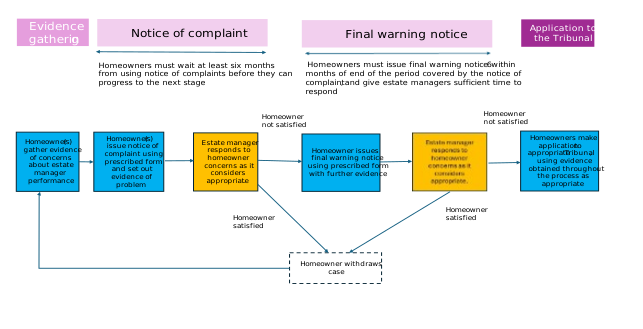
ALT text: This diagram describes the steps homeowners must take before they may apply to the appropriate tribunal to appoint a substitute manager.
5.1 Notice of Complaint
Section 89 of the Act sets out that the first step to commencing this process is via issuing a ‘Notice of Complaint’ in relation to an estate manager. This can be in the form of an individual complaint or of a joint complaint submitted by multiple homeowners or multiple individual complaints, as long as the homeowners and complaints are directly linked. The notice will be provided to the estate manager and from the point of issuing this, they will have a period of six months in which to rectify the matters contained in the complaint.
Section 89(2) requires that the notice must include the grounds of complaint and a statement that, if the complaints are not remedied within six months then the homeowner may make an application to the appropriate tribunal to appoint a substitute manager. The grounds for a complaint are:
- The estate manager is in breach of an obligation in relation to the dwelling or, if the obligation is dependent on notice, would be in breach but for the fact it has not been possible to give the estate manager the appropriate notice;
- Sums payable through the estate management charge are not being applied in an efficient and effective manner; -
- The administration or estate management charge payable or likely payable is unreasonable; or
- The estate manager has failed to comply with an approved Code of Practice.
Section 89(2)(c) gives the Secretary of State power to specify other information to be included in the Notice of Complaint. We propose that, in addition to the requirements in section 89(2)(a) and (b), the complainant should:
- provide evidence to back up the complaint. This might include, for example, details of action carried out by the estate manager in breach of the obligation, evidence of poor quality works, or evidence of an unreasonable charge;
- and provide details of those homeowners who are making the complaint.
We would welcome views on this or whether there is further information that should be provided at the Notice of Complaint stage. A proposed form of the contents of a Notice of Complaint is at Annex H.
Section 89(6) gives the Secretary of State the power to determine when a Notice of Complaint is given. It is already the case that, in order to exercise the right to appoint a substitute manager, homeowners must be paying an estate management charge. We propose that, in addition, two further conditions must be in place:
- the Notice of Complaint may only be given once homeowners have exhausted the estate manager’s complaints process. Where the estate is being managed by a managing agent on behalf of the resident management company, then homeowners must have exhausted the managing agents’ complaints process; and
- the communal areas of the estate are not in the process of being adopted by the local authority, or being transferred to residents via some other mechanism (for example if an embedded management company is in the process of transferring ownership and responsibilities to a resident management company).
We recognise that there may be cases where a complaint is made on exactly the same issue (for example poor quality road, or inadequate playground repairs) by more than one person who is unaware that another homeowner has made the same complaint. In such circumstances the six-month period would start with each Notice of Complaint. If homeowners became aware of another complaint after serving an initial notice, for example through the proposed annual report, then there is scope to combine complaints at subsequent stages.
Question 67
Do you agree with the additional information that should form part of a Notice of Complaint? [Yes/No]
Question 68
Should the information in the Notice of Complaint be set out in a prescribed and standardised manner as at Annex H? [Yes/No]
If not, what changes would you make? [Free text]
5.2 Final Warning Notice
Once homeowners have given a Notice of Complaint to the estate manager, they are required to give the estate manager 6 months to rectify the problem. This is because some issues might take a considerable time to resolve, and it is right that the estate manager is given that opportunity to correct matters. They may also be able to resolve matters/the issue through engagement with homeowners.
Should homeowners decide after this time has lapsed that the situation has not changed sufficiently, the next step is to issue a Final Warning Notice. This notice must include greater information than the Notice of Complaint, and include:
- the name of the person or persons giving the notice
- the address of their dwelling (or addresses of each dwelling);
- if different, an address (or addresses) at which a person may give notice to that person in connection with the application;
- a statement that the intention is to make an application for an appointment order for the estate; and
- the grounds on which the appropriate tribunal would be asked to make such an order and the matters that would be relied upon for the purpose of establishing those grounds.
There are slight differences on who may issue a Final Warning Notice. If a notice of complaint was issued jointly, then the Final Warning Notice must be submitted by the same people. However, people who did not sign up to a Notice of Complaint are able to sign up to a Final Warning Notice.
The Secretary of State has powers to require additional information as part of the Final Warning Notice. At this stage we are minded to require the same information as for the initial notice, namely: - provide evidence to back up the complaint. This is likely to include relevant information from the Notice of Complaint but supplemented by further, fresh evidence that arose during the notice of complaint period. This might include failure by the estate manager to engage on the issue or photographic evidence of problems emerging; and - provide details of those homeowners who are issuing this Final Warning Notice.
Section 91 of the 2024 Act provides details out which homeowners must sign up to the final warning notice for it to have effect. As a starting point all homeowners who were part of the initial notice of the complaint must also give the final warning notice. If a homeowner is unable to remain party to the complaint then the other owners cannot progress to make an application to the appropriate tribunal unless one of two conditions are met: - A homeowner who issued the initial Notice of Complaint no longer owns the property; or - The appropriate tribunal decides that because of the urgency of the case it would not be reasonably practical for all the original complainants to be party to the Final Warning Notice or application for an appointment order.
A mock up of the proposed Final Warning Notice is at Annex I.
Section 91(3) of the Act allows new homeowners to be added to names of homeowners who issue a final warning notice, alongside those who issued a Notice of Complaint. Homeowners who do not issue a Final Warning Notice may not be part of an application made to the appropriate tribunal to request the appointment of a substitute manager.
Section 91(9) also gives the Secretary of State the power to determine when a Final Warning Notice is given. We propose to place a condition that this notice must be given within 12 months of the Notice of Complaint, since there will be very few circumstances when there will be outstanding matters relating to the same complaint after this period. We also consider that it is not appropriate that a formal Notice of Complaint can stand indefinitely. We would welcome views on this issue.
Question 69
Do you agree that the contents of the proposed Final Warning Notice provides sufficient information to the estate manager? [Yes/No]
Question 70
Should the information in the Final Warning Notice be set out in a prescribed and standardised manner, as at Annex I? [Yes/No]
If not, what do you consider is appropriate? [Free text]
Question 71
Do you agree that a Final Warning Notice must be given within 12 months of a Notice of Complaint? [Yes/No]
If no please set out what period is appropriate [Free text]
Question 72
Do you have any further comments on how the final warning period should operate?
Provide details [Free text]
5.3 Exemptions from the appointment of a substitute manager
Section 92(1) of the 2024 Act gives the Secretary of State power to prevent the appropriate tribunal from appointing a substitute manager to individual or specific descriptions of estate manager. Our starting position is that there should be no exemptions since all estate managers, whether private or resident-led, should be accountable to homeowners. However, we will keep this issue under review and would welcome views on this position.
Question 73
Should there be any estate managers for whom the ability to appoint a substitute manager should not apply?
Provide details [Free text]
Part 3: Further government action to tackle the injustices with ‘fleecehold’
6. Further government action
The injustices faced by homeowners on privately managed estates are longstanding and ongoing. While the measures set out in Parts 1 and 2 above will provide greater protection for homeowners, the government is taking further action, set out in this part, to protect existing homeowners and improve their experience of living on privately managed estates. These will tackle the injustices homeowners and residents experience on these estates, alongside our separate consultation on the options for reducing the prevalence of estate management arrangements, and address the concerns set out in the CMA’s housebuilding study.
6.1 Regulation of managing agents
Managing agents play a key role in the maintenance of multi-occupancy buildings and privately managed estates and their importance will only increase as commonhold becomes the default tenure. Most estate managers, particularly resident-led, employ managing agents but whether they are chosen by, developers, management companies or residents themselves, it is essential that they provide a good service and are accountable for their actions to homeowners. There is, however, no legal requirement for agents to demonstrate that they possess the required knowledge and skills to carry out the required functions. The government is committed to regulating managing agents of leasehold blocks and privately managed estates. As a first step, the UK and Welsh governments consulted on minimum qualifications in our consultation on Strengthening leaseholder protections over charges and services published on 4 July 2025. This will help the industry professionalise, attract talent and provide a pathway to a career in property management. The consultation closed on 26 September 2025 and the UK and Welsh governments are considering the responses.
6.2 Advice for homeowners on unadopted estates
Homeowners subject to estate management charges often do not know who to turn to for advice on their rights and responsibilities and have to fund any advice they seek themselves. The government wants to make sure that homebuyers have access to high quality information and advice on estate management issues, and what they can do when things go wrong. The Secretary of State already has specific legal powers to fund advice for leaseholders and commonhold homeowners but does not have express statutory authority to fund the provision of advice, information and guidance to owners of homes living on privately managed estates and subject to estate management charges. This must change to ensure that residents on privately managed estates have access to greater advice, information or wider support for free. The government will seek to legislate so that the Secretary of State can fund advice for homeowners subject to estate management charges to make it fairer for those subject to estate management charges. Alongside this change in the law, the government will explore which body is best placed to provide free specialist advice to homeowners.
6.3 Empowering homeowners to take control of their estate
Some homeowners may already manage the estate through a resident-led management company, but they do not have the right to set up a management company to take over control, in a similar way as qualifying leaseholders may do for their buildings using existing Right to Manage arrangements under the Commonhold and Leasehold Reform Act 2002. The CMA Housebuilding Market Study[2], found that it is virtually impossible to switch management company where an “embedded” management company is in place. These embedded companies are appointed in the property deeds, and in many cases the provisions in the property deeds may not allow for switching when the company fails to provide contracted services, or challenging conditions are placed on homeowners in order to switch companies. Homeowners have a direct stake in their estate upkeep and pay for its maintenance, and the government wants to empower homeowners and provide an option for homeowners to exercise control over how their estate is managed if they so choose. The Law Commission published its 14th Programme of Law Reform on 4 September 2025 which includes their project on the management of housing estates to solve this technically complex issue, alongside the Ministry of Housing, Communities and Local Government as the sponsoring department for the project. The project will consider how to empower residents by giving them greater control over the management of their housing estates. It will examine whether the right to manage regime which benefits leaseholders could be adapted to apply to privately managed estates, and any additional or alternative solutions to the problem of estate management.
6.4 Improving the home buying and selling process
The current home buying and selling system is slow, costly and uncertain. One in three transactions currently fail, costing consumers £400 million and conveyancers and estate agents around £1 billion annually. There are a number of different reasons for the issues in the current system, one of the main reasons the process takes so long is a lack of digitalisation in the sector. Key property information, such as building control and property boundary information, remains predominantly paper-based or recorded in non-machine-readable formats. Even where data is available electronically, there are no established protocols for accessing, sharing and verifying that data. This leads to inefficiencies, delays and duplication. Another major issue is the lack of upfront information provided in the process, especially homebuyers on estates subject to estate management charges. Buyers can spend weeks or even months on a transaction before learning something vital about the property which causes things to fall through. That’s why this government announced the biggest shake-up to home buying in this country’s history on 6 October. As part of this announcement the government launched consultations on reforming the home buying and selling process and providing more clarity on what information should be included upfront in property listings. This will enable prospective homeowners to have greater upfront information about their home to enable them to make an informed decision. The consultations close on 29 December 2025. These measures will benefit homeowners on privately managed estates in England and Wales. However, we recognise that even with this additional upfront information homeowners will likely require more detailed financial and other relevant information from the estate manager so they can make fully informed decisions about whether to purchase a property on such an estate. Quite often this information has come through completing a Freehold Management Enquiry Form 1, where the prospective seller may be required to pay a fee for the information. Unfortunately, too many homeowners face persistent delays and high costs in trying to obtain this information. This may also delay the selling process and significantly increase selling costs for homeowners. To address this, the UK and Welsh governments will bring forward measures from the 2024 Act to speed up the provision of information for homeowners subject to estate charges who wish to sell their property and protect sellers from unreasonable fees when requesting this information. We will consult on implementing these measures, including capping fees, in 2026.
6.5 Going further to tackle injustices and enhance consumer protection
This document sets out the actions that government already taking action to start to tackle many of the injustices associated with living on a privately managed housing estates, but we want to make sure that we are capturing all of the relevant injustices existing homeowners face - outside of issues of amenity adoption which is being considered through our consultation on reducing the prevalence of unadopted estates - and explore what else we should be considering.
Question 74
Are the government actions in this document sufficient to tackle the injustices homeowners on privately managed estates experience? [Yes/No/Don’t Know] Please explain your answer [Free Text]
Question 75
Outside of amenity adoption by public authorities, what other measures should the government consider to address injustices?
Please give your views [Free Text]
Part 4: Other issues
7. Rentcharge arrears
Section 113 of the 2024 Act introduced greater protections for landowners (including homeowners) who fail to pay a regulated rentcharge[3] 40 days after its due date, regardless of whether the rentcharge was demanded. Rentcharge owners are no longer able to take possession of the property or grant a lease (a rentcharge lease) over the property. These provisions did not apply to any landowner in cases where, before 29 November 2023, the rentcharge owner had taken advantage of their right of remedy under sections 121 of the Law of Property Act 1925 (“1925 Act”). The 2024 Act also introduced a process that requires owners of regulated rentcharges to issue landowners with a demand for payment of rentcharge arrears before taking action to recover or compel payment (section 120B and 120C of the 1925 Act). Section 120B(6) of the 1925 Act provides that the landowner is not required to pay the rentcharge owner’s costs of preparing and a demand for payment. The Secretary of State has powers[4] to limit the amount payable by landowners, indirectly or directly, in respect of action to recover or compel payment of any unpaid regulated rentcharge. We recognise that, following the initial notice, rentcharge owners may seek to pass on administrative costs incurred when:
- Serving any follow-up letters to chase payment if the homeowner does not respond to the statutory notice;
- Making an application to the small claims court to recover payment; or
- Employing a debt recovery service to recover the costs.
Given that the level of rentcharges payable is very small (often between £8-£40 each year), we consider that the most likely form of seeking recovery of unpaid rentcharge arrears is through the small claims court. In such cases there are already established rules on the level of costs that may be recovered from homeowners under existing Court Procedure Rules[5].
We recognise that there may be an indemnity costs provision in a rentcharge lease which allows the rentcharge owner to seek their costs in full. We do not want to override or cut across these provisions. However, we consider that rentcharge owners may, in future, seek to instruct a debt recovery company to recover payment. We do not consider that this is a proportionate mechanism to recover such small sums, and the administration costs incurred or charged by the debt recovery company will significantly outweigh the unpaid rentcharge. Given this we propose that, while the homeowner should be liable to pay some administration costs, it should be significantly limited to reflect the cost of making an agreement.
On this basis we consider that the maximum administration fee payable is as follows:
- For all steps incurred by the rentcharge owner in instructing a debt recovery company to compel payment of the rentcharge arrears, we propose a sum of £100; and
- In all other instances, no fee is payable except for those that homeowners are ordered to pay by the courts (for example under the Civil Procedure Rules).
We do not intend on preventing rentcharge owners from passing on the costs payable by landowners in respect of fees charges to His Majesty’s Land Registry to amend any title or property deed. We would welcome views on these proposals.
Question 76:
Do you agree with the proposed limits on administrative costs? [Yes/No]
If no, please explain what is an appropriate level of costs and provide evidence to support your explanation.[Free text]
Question 77
Is there any other information or issues that the government should consider when determining an appropriate administration cost?
Provide details [Free text]
8. Other information
Impact on environment and protected characteristics
In addition to the more specific policy design questions, we are keen to understand perceived impact in a range of areas.
The Public Sector Equality Duty, set out in the Equality Act 2010, requires us to have due regard to the need to eliminate discrimination, advance equality of opportunity and foster good relationship between different groups. We are seeking views on potential impacts on those groups.
Question 78
Do you believe any of the proposals put forward could negatively or positively impact individuals who have a protected characteristic? [Yes/No] Age
[Yes/No] Disability
[Yes/No] Sex
[Yes/No] Gender Reassignment
[Yes/No] Marriage or civil partnership
[Yes/No] Pregnancy and maternity
[Yes/No] Race (colour, nationality, ethnic or national origins)
[Yes/No] Religion or Belief
[Yes/No] Sexual orientation
[If you have answered yes to any of the above] Please explain your rationale and evidence your thinking where possible. [Free text]
The Environment Act 2021 established a legal duty in England to also have due regard to five Environmental Principles. Their purpose is to prevent environmental damage and enhance the environment. The impact of policies on the environment, biodiversity and climate change are also an important consideration in Wales. We are keen to hear views on any perceived environmental impacts of this policy.
Question 79
Do you anticipate any environmental impacts from this policy, either positive or negative? [Yes/No]
If yes, please elaborate. How could positive impacts be maximised or negative impacts be mitigated or minimised? [Free text]
We are keen to understand any anticipated impacts on the justice system as a result of this policy. Consideration of these impacts is important in ensuring that service provision within the justice system is not negatively affected.
Question 80
Do you anticipate that this policy would be likely to impact the judicial system? Examples could be an increase or decrease in applications to court or tribunals, increasing the length or complexity of cases, and new requirements on judicial recruitment or training. [Yes/No]
If yes, please elaborate. [Free text]
Question 81
Do you anticipate that this policy would disproportionately impact local authorities? [Yes/No]
If yes, please elaborate. [Free text]
About this consultation
This consultation document and consultation process have been planned to adhere to the Consultation Principles issued by the Cabinet Office.
Representative groups are asked to give a summary of the people and organisations they represent, and where relevant who else they have consulted in reaching their conclusions when they respond.
Information provided in response to this consultation may be published or disclosed in accordance with the access to information regimes (these are primarily the Freedom of Information Act 2000 (FOIA), the Environmental Information Regulations 2004 and UK data protection legislation). In certain circumstances this may therefore include personal data when required by law.
If you want the information that you provide to be treated as confidential, please be aware that, as a public authority, the Department is bound by the information access regimes and may therefore be obliged to disclose all or some of the information you provide. In view of this it would be helpful if you could explain to us why you regard the information you have provided as confidential. If we receive a request for disclosure of the information we will take full account of your explanation, but we cannot give an assurance that confidentiality can be maintained in all circumstances. An automatic confidentiality disclaimer generated by your IT system will not, of itself, be regarded as binding on the Department.
The Ministry of Housing, Communities and Local Government will at all times process your personal data in accordance with UK data protection legislation and in the majority of circumstances this will mean that your personal data will not be disclosed to third parties. A full privacy notice is included below.
Individual responses will not be acknowledged unless specifically requested.
Your opinions are valuable to us. Thank you for taking the time to read this document and respond.
Are you satisfied that this consultation has followed the Consultation Principles? If not or you have any other observations about how we can improve the process please contact us via the complaints procedure.
Personal data
The following is to explain your rights and give you the information you are entitled to under UK data protection legislation. Note that this section only refers to personal data (your name, contact details and any other information that relates to you or another identified or identifiable individual personally) not the content otherwise of your response to the consultation.
1. The identity of the data controller and contact details of our Data Protection Officer
The Ministry of Housing, Communities and Local Government is the data controller. The Data Protection Officer can be contacted at dataprotection@communities.gov.uk or by writing to the following address:
Data Protection Officer,
Ministry of Housing, Communities and Local Government,
Fry Building,
2 Marsham Street,
London
SW1P 4DF
2. Why we are collecting your personal data
Your personal data is being collected as an essential part of the consultation process, so that we can contact you regarding your response and for statistical purposes. We may also use it to contact you about related matters.
We will collect your IP address if you complete a consultation online. We may use this to ensure that each person only completes a survey once. We will not use this data for any other purpose.
Sensitive types of personal data
Please do not share special category personal data or criminal offence data if we have not asked for this unless absolutely necessary for the purposes of your consultation response. By ‘special category personal data’, we mean information about a living individual’s:
- race
- ethnic origin
- political opinions
- religious or philosophical beliefs
- trade union membership
- genetics
- biometrics
- health (including disability-related information)
- sex life; or
- sexual orientation.
By ‘criminal offence data’, we mean information relating to a living individual’s criminal convictions or offences or related security measures.
3. Our legal basis for processing your personal data
The collection of your personal data is lawful under article 6(1)(e) of the UK General Data Protection Regulation as it is necessary for the performance by MHCLG of a task in the public interest/in the exercise of official authority vested in the data controller. Section 8(d) of the Data Protection Act 2018 states that this will include processing of personal data that is necessary for the exercise of a function of the Crown, a Minister of the Crown or a government department i.e. in this case a consultation.
Where necessary for the purposes of this consultation, our lawful basis for the processing of any special category personal data or ‘criminal offence’ data (terms explained under ‘Sensitive Types of Data’) which you submit in response to this consultation is as follows. The relevant lawful basis for the processing of special category personal data is Article 9(2)(g) UK GDPR (‘substantial public interest’), and Schedule 1 paragraph 6 of the Data Protection Act 2018 (‘statutory etc and government purposes’). The relevant lawful basis in relation to personal data relating to criminal convictions and offences data is likewise provided by Schedule 1 paragraph 6 of the Data Protection Act 2018.
4. With whom we will be sharing your personal data
MHCLG may appoint a ‘data processor’, acting on behalf of the Department and under our instruction, to help analyse the responses to this consultation. We may also make use of Artificial Intelligence in the analysis of responses. Where we do, we will ensure that the processing of your personal data remains in strict accordance with the requirements of the data protection legislation.
5. For how long we will keep your personal data, or criteria used to determine the retention period.
Your personal data will be held for two years from the closure of the consultation, unless we identify that its continued retention is unnecessary before that point.
6. Your rights, e.g. access, rectification, restriction, objection
The data we are collecting is your personal data, and you have considerable say over what happens to it. You have the right:
- to see what data we have about you
- to ask us to stop using your data, but keep it on record
- to ask to have your data corrected if it is incorrect or incomplete
- to object to our use of your personal data in certain circumstances
- to lodge a complaint with the independent Information Commissioner (ICO) if you think we are not handling your data fairly or in accordance with the law. You can contact the ICO at https://ico.org.uk/, or telephone 0303 123 1113.
Please contact us at the following address if you wish to exercise the rights listed above, except the right to lodge a complaint with the ICO: dataprotection@communities.gov.uk or
Knowledge and Information Access Team,
Ministry of Housing, Communities and Local Government,
Fry Building,
2 Marsham Street,
London
SW1P 4DF
7. Your personal data will not be sent overseas.
8. Your personal data will not be used for any automated decision making.
9. Your personal data will be stored in a secure government IT system.
We use a third-party system, Citizen Space, to collect consultation responses. In the first instance your personal data will be stored on their secure UK-based server. Your personal data will be transferred to our secure government IT system as soon as possible, and it will be stored there for two years before it is deleted.
Glossary of key terms
| Term | Definition |
|---|---|
| Administration charge | An amount payable by an individual homeowner as part of or in addition to the rent which is payable, directly or indirectly for specific activities defined under section 83 of the 2024 Act. |
| Annual report | An annual report is a report, covering a range of financial and other information, that will be provided to homeowners by their estate manager before or within one month of a new 12-month accounting period. |
| Appropriate tribunal or Relevant tribunal | Appropriate tribunal or relevant tribunal refers to the First-tier Tribunal (Property Chamber), or where determined by or under Tribunal Procedure Rules, the Upper Tribunal, in England and the Leasehold Valuation Tribunal in Wales, which will deal with settling disputes in relation to estate management charges, including disputes over the charges and failure to provide information to homeowners. |
| Communal areas | Areas on housing estates that are accessible to members of the public and which contain a number of public amenities, including highways (that incorporates street furniture and streetlights), sewers and drains, sustainable urban drainage systems, and open spaces ( including playgrounds, wildlife areas, woodland). The public amenities in the communal area for which individual homeowners are responsible for contributing towards their management and maintenance is set out in property deeds or other legally binding document. |
| Dispensation | An estate manager may apply to a court or a tribunal to avoid serving a notice under the major works procedure as set out in section 75(8) of the 2024 Act. If they succeed, the court or tribunal issues a dispensation from serving that notice. |
| Estate management charge | A financial contribution payable by a homeowner for a share of the cost of managing a range of public amenities in the communal areas of the estate. Details of what can (and cannot) be charged by the estate manager and the proportion of the charge to be paid by the individual homeowner will all be set out in the property deeds. |
| Estate management charge demand | An estate management charge demand is an invoice issued by the estate manager or managing agent setting out the contribution that a homeowner is required to pay for a specified period as set out in the property deeds to contribute towards the management and maintenance of a number of public amenities on communal areas. |
| Estate manager | Any person who has a right to enforce payment of an estate management charge. An estate manager may be a private or resident management company. |
| Event fee | A fee payable under a term of or relating to a residential lease of a retirement property on certain events such as resale or sub-letting. Event fees may be referred to by a variety of names including exit fees, transfer fees, deferred management fees, contingency fees and selling service fees. |
| First Tier Tribunal (FTT) | The First-tier Tribunal (Property Chamber) deals with settling disputes in relation to estate management charges in England, including failure to provide information to homeowners. |
| Homeowner | A homeowner is a person or company who owns a property on an estate and who has a legal obligation to pay an estate management charge (not service charge) for the management and maintenance of public amenities on communal areas. This may include a freehold homeowner or a leaseholder. |
| Leasehold Valuation Tribunal (LVT) | The Leasehold Valuation Tribunal deals with settling disputes in relation to leasehold property in Wales, including service charge disputes, lease variations and the determination of premiums for freehold purchase and lease extensions. |
| Managing agent | An individual or company appointed to run and manage the communal areas on behalf of an estate manager |
| Major works | Works which are necessary to keep a communal area in a satisfactory condition and/or meet any legal stipulations (such as through a planning agreement) where the contribution of each homeowner is above a prescribed threshold. |
| Relevant costs | Relevant costs are the costs or estimated costs incurred or to be incurred by or on behalf of the estate manager, for management, maintenance, repairs or improvement of communal areas. |
| Substitute manager | A manager appointed by the appropriate tribunal to carry out certain functions relating to the management and maintenance of the communal area. |