Call for evidence: Strategy for the built environment professions, trades and occupations
Updated 10 June 2026
Applies to England

© Crown copyright 2026
This publication is licensed under the terms of the Open Government Licence v3.0 except where otherwise stated. To view this licence, visit nationalarchives.gov.uk/doc/open-government-licence/version/3 or write to the Information Policy Team, The National Archives, Kew, London TW9 4DU, or email: psi@nationalarchives.gov.uk.
Where we have identified any third party copyright information you will need to obtain permission from the copyright holders concerned.
This publication is available at https://www.gov.uk/government/calls-for-evidence/strategy-for-the-built-environment-professions-trades-and-occupations/strategy-for-the-built-environment-professions-trades-and-occupations
Overview
This is a public call for evidence seeking detailed information about the challenges impacting how people and organisations work across the built environment sector, with a particular focus on skills, behaviours and accountability. The outcomes of this exercise will inform development of a new strategy for the built environment professions, trades and occupations.
Geographical scope
This call for evidence will inform policy development which would have effect in England only. However, we recognise that the built environment ‘system’ does not operate within the limits of a single jurisdiction. Following this, we consider it important to understand any significant cross-border activities or relationships.
Impact assessment
Not applicable. We will use information from this call for evidence to inform our assessment of the impact of future proposals as part of ongoing policy design.
Body responsible for the consultation
Ministry of Housing, Communities and Local Government
Duration
This call for evidence will last for 12 weeks from 20 May 2026 to 12 August 2026.
How to respond
Please respond to the call for evidence by completing the online survey.
Alternatively, you can email your response to the questions in this consultation to BPDengagement@communities.gov.uk.
If you are responding in writing, please make it clear which questions you are responding to.
The call for evidence includes 79 questions. You may choose to respond to those questions which are most relevant to your area(s), interest or expertise.
Anyone with an interest may respond. We are particularly interested to hear from:
- individuals, companies or organisations involved in all stages of the building lifecycle: procurement or commissioning; design, specification and construction; design, manufacture, testing and application of construction products; the inspection of buildings or enforcement activities; management and maintenance; decommissioning and demolition
- chartered and other professional bodies operating in the built environment sector including trade bodies and members and/or operators of self-certification (competent person) schemes and third-party certification schemes
- industry-led sector bodies and organisations
- statutory regulators, including bodies operating in other sectors
- finance and financial services professionals, including insurers, funders, investors and joint‑venture partners
- legal services professionals, including those involved in commercial contract law and conveyancing
- education and training providers, including Higher Education Institutions and wider skills and education providers to the construction industry
- local government representative organisations
- Citizens Advice and other consumer bodies
- disability charities, disabled people’s organisations and representatives of disability bodies
- members of the public
Enquiries
For any enquiries about this call for evidence please contact:
BPDengagement@communities.gov.uk
1. Introduction
1.1. The people and organisations who design, build, manage and maintain our buildings and built environment have an impact on almost every aspect of our lives. It is therefore essential that we have a skilled, motivated, responsible and productive workforce across the built environment, who are consistently equipped and enabled to deliver safe, high-performing and sustainable buildings.
1.2. We are developing a new long‑term strategy for the built environment professions, trades and occupations (the ‘Professions Strategy’), to be published in Spring 2027. This will take an overarching view of skills, behaviours and accountability across the built environment sector, drawing on evidence of what does and doesn’t work, to set out a long-term strategy for government, industry and those working in the sector. A critical aspect of this strategy will be to consider how government and industry can work together to improve equality, diversity, inclusion and access to the sector.
1.3. We are seeking evidence about both the people and organisations who work in the built environment and the overall system within which they operate: who does what, how work is undertaken and how skills, knowledge, behaviours and accountability practically support safety, quality, sustainability, resilience, growth and productivity. This call for evidence is designed as an information gathering exercise and does not present new policy proposals for consultation at this stage. The findings of this call for evidence will help us make critical choices about the shape and scope of the full strategy based on a solid understanding of how the system works now, and the kinds of actions that will lead to demonstrable change.
1.4. The Professions Strategy will be mutually reinforcing with other reforms and policies relating to the built environment across government. This includes the design and implementation of a new single construction regulator, changes to building regulations and construction product regulation and cross‑government initiatives such as the upcoming Construction Jobs Plan. As government, we are committed to working collaboratively to make sure these programmes and policy reforms fit together as part of a coherent programme of change. Taken together, these will enable us to tackle deeply entrenched social and economic challenges across the built environment sector, to support a shared vision for the future.
1.5. Practically, this will require collective commitment from both government and the sector to a long-term, ambitious programme of change that will have a lasting impact. We will work closely with industry to design and implement the new strategy to deliver meaningful, long-lasting and system-wide transformation that meets the needs of both those who work in the sector and those who live in and use those buildings and built environments every day.
2. About this call for evidence
Purpose
2.1. This call for evidence is focused on people and organisations in the built environment sector and the systems that govern how they operate. It seeks evidence on the skills, experience, behaviour and judgement of individuals involved in the building lifecycle, as well as the capability of the organisations within which they work, to inform ongoing policy development. We are particularly interested in developing our understanding of current barriers, opportunities and interdependencies shaping how people work during all stages of the building process. It is not a technical consultation on construction processes, although we recognise that commercial, contractual and regulatory arrangements all impact how people work in practice.
2.2. We want to build on the collective expertise that already exists within the sector and more widely as the basis for any future reforms. We are therefore seeking evidence from those involved across the full building lifecycle. This includes those directly employed in the full range of built environment professions, trades and occupations, as well as clients (commercial, public sector and domestic), manufacturers, education providers and those working in adjacent sectors such as insurance, legal and financial services.
Structure
2.3. This call for evidence is structured in 5 parts, based on core stages in the lifecycle of a building:
- pre-design
- design and specification
- construction
- occupation and maintenance (including small scale works and alterations)
- cross-cutting issues, themes and challenges
2.4. Respondents are invited to provide evidence on areas most relevant to their area(s) of focus and expertise. We are aware that a number of professions, trades and occupations play a role in more than one of these stages, and that dutyholder roles (as set out in Part 2A of the Building Regulations 2010) are defined throughout building work. Nevertheless, the stages of the building lifecycle provide a practical framework to structure this evidence-gathering exercise. There is no expectation that respondents will complete all questions.
2.5. For each stage we are seeking evidence on 6 key themes. Respondents are encouraged to provide real-world examples and quantitative evidence wherever possible to support their response, and to give particular consideration to equality, diversity, inclusion and access as they relate to your responses. Please clearly identify any information that is commercially sensitive or otherwise unsuitable for wider disclosure:
- Skills, knowledge, experience and capability, and the extent to which individuals and organisations are typically able to demonstrate necessary competence and capability. This includes whether organisations are able to recruit and retain staff with the necessary competence.
- The key drivers of behaviours, conduct and culture, and how these influence performance and decision-making. This incorporates the impact of business, financial and legal operating models, commercial incentives (including insurance arrangements) and cultural norms, as well as how individual roles can set a lasting tone across an entire project.
- The degree to which accountability and personal responsibility are understood and applied by individual and corporate actors at all stages of the building process.
- How the existing system infrastructure for education and training, competence and regulation and oversight work to incentivise and enable appropriate ways of working.
- Critical interdependencies across the building lifecycle, including how different roles work together and the way in which actions or choices taken at one stage can influence or constrain subsequent choices and behaviours downstream
- Practical actions for reform and the main barriers to success.
2.6. Respondents are also asked to consider the section on cross-cutting themes alongside their specific area(s) of practice. This seeks additional evidence on the overall system, including cross-cutting functions (such as planning, building control, inspection and enforcement); the role of sector bodies and regulators; emerging technologies and changing practice; and wider comparators and learning.
Scope
2.7. The scope of this call for evidence is deliberately broad and seeks evidence across both the full breadth and depth of the building system, capturing all stages of the building lifecycle and all types of building work.
2.8. Some areas in scope of the strategy for the built environment professions, trades and occupations (due in 2027) are not included in this call for evidence. This includes where government has already committed to take specific actions, or topics have or will be covered in separate consultations or calls for evidence. Policy areas and themes not specifically included within this call for evidence are:
- Regulation and education of fire engineers. Government published the Authoritative Statement of the Fire Engineers Advisory Panel and a statement of next steps for reform of the fire engineering profession in December 2025.
- Mandatory certification of fire risk assessors (FRA). Government published a consultation on the future of the FRA profession in March 2026. The consultation will run for 12 weeks until 18 June 2026.
- Building control reform. The Building Control Independent Panel (BCIP) published a problem statement and accompanying call for evidence in July 2025. We published the BCIP’s final recommendations and a government response setting out next steps alongside this call for evidence.
- Licensing of principal contractors working on high-risk buildings and a broader review of the dutyholder regime, as established under Part 2A of the Building Regulations 2010.
- The Single Construction Regulator and new central oversight function for the built environment professions, trades and occupations. Government’s consultation on the Single Construction Regulator Prospectus closed in March 2026. Government will publish a response this summer.
- Construction products reform. Government published the Construction Products Reform White Paper in February 2026. The consultation closed on 20 May 2026, and government will publish a response in due course.
Territorial extent
2.9. The information gathered through this call for evidence will inform development of a new Professions Strategy which will primarily have effect in England only. However, we recognise that elements of policy relating to this area are devolved while others are reserved UK-wide[footnote 1]. We also know that, practically, the built environment ‘system’ does not operate within the limits of a single jurisdiction. This is especially the case when considering both the supply of products, materials, investment, ownership, or services which operate across geographical borders (whether from within the UK, EU or internationally) and the role of many professional bodies which also operate globally. We are therefore interested in any significant cross-border activities or relationships relevant to the themes of this call for evidence.
2.10. As part of our ongoing strategy design, we are committed to working with the Devolved Administrations to make sure that reform is aligned and coherent across the UK. We will also work with professional bodies, trade organisations and education and training providers to understand how proposed reforms will interact with their international operations, as appropriate.
Additional notes
2.11. A full list of definitions of key terms used in this call for evidence is included at Annex A.
2.12. The topics raised in this call for evidence are intended as an information-gathering exercise and do not represent settled government policy. We will consult further on detailed policy proposals as part of an ongoing process of engagement.
3. The case for change
3.1. Our buildings and built environment fundamentally shape how we live, work and interact, influencing every aspect of society from economic productivity to public health, to our day-to-day safety and quality of life. The people who design, build, manage and maintain these environments – and the knowledge, skills and behaviours they bring to their role – are therefore central to driving better social and economic outcomes for individuals and the country as a whole.
3.2. The Grenfell Tower tragedy, and the Inquiry that followed, laid bare how fundamentally the system that governs those working in the built environment had failed. The Inquiry’s Phase 2 report was unambiguous. It concluded that the “safety of people in the built environment depends principally on a combination of three primary elements, good design, the choice of suitable materials and sound methods of construction, each of which depends in turn in a large measure on a fourth, the skill, knowledge and experience of those engaged in the construction industry. … at the time of the Grenfell Tower fire there were serious deficiencies in all four”[footnote 2].
3.3. This was not an isolated problem. Successive reviews stretching back to at least the 1940s have repeatedly identified the same failings: a system characterised by fragmented accountability, inadequate standards of professionalism, and persistent failures of competence and ethical behaviour, operating largely unchecked, across the entire industry, for decades. These system failures are reflected in the sector’s economic performance. Low productivity, high volatility resulting from exposure to wider economic trends and persistent workforce challenges mirror a sector in which business models can reward perceived or short-term improvements in speed and reductions in cost to the detriment of actual, long-term quality, safety and innovation.
3.4. Behind this system are individuals and organisations who have invested significant time, effort and money in building their skills and professional judgment, and who take pride in delivering buildings and places that are safe, high quality and valued by the people who use them. There are many aiming to deliver the highest standards possible, even whilst often operating under significant time, cost and commercial pressures. However, where the system does not consistently support and reinforce good practice, the consequences fall unevenly: at further cost to the individual, and in some cases reducing the ability of responsible businesses to invest, innovate and flourish.
3.5. The landscape for those working in the built environment reinforces this dynamic. There are a multitude of standards, accreditation routes and requirements for competence, with qualification often (though not always) a one-time credential rather than an ongoing guarantee. In many cases, professional and trade body membership remains voluntary, with limited incentives to participate when this is not an essential requirement and limited ability to prevent those disqualified from such schemes from continuing to practice. Despite significant endeavours to raise standards, competence remains primarily reliant on individual or organisational capacity and motivation to maintain and improve skills. In a sector where cost-cutting runs through every stage of decision-making, there is a risk that existing education, regulation and standards provide false assurance to consumers and do not adequately reward those who invest in achieving and demonstrating high standards.
3.6. Persistent faultlines with information and accountability also run throughout the wider system. Those commissioning and occupying buildings cannot readily assess the competence or integrity of those building them. Poor performance is difficult to detect; good performance is difficult to signal. The market cannot distinguish between those who meet high standards and those who do not, and often failure may not be observable until harm occurs years later. This is particularly acute in the domestic market where opportunities for consumer redress are limited when things go wrong.
3.7. Reform has been attempted many times and too often has been partial, unevenly implemented or deprioritised. The reforms that followed the Grenfell Tower tragedy were necessary and significant, but they are not sufficient. We have already committed to implementing the Inquiry’s recommendations in full, as well as going further to take a holistic view of the full system. This full system approach will address safety, quality and productivity together, and consider what conditions the system needs to create for individuals and organisations to thrive. This call for evidence takes forward that work, asking not just what has gone wrong, but why it keeps going wrong, and what it will take to change it.
4. Approach to reform
4.1. Government published the Single Construction Regulator Prospectus in December 2025, setting out an overarching vision for the built environment system. This identified core outcomes for a well-functioning building system:
- Buildings and built environments are safe and high-performing and deliver a healthy, accessible, secure and sustainable environment for occupants.
- Companies and individuals are enabled to thrive when they operate in the interests of current and future building users.
- The building system is trusted; users have confidence the system will act to prioritise the safety and needs of occupants.
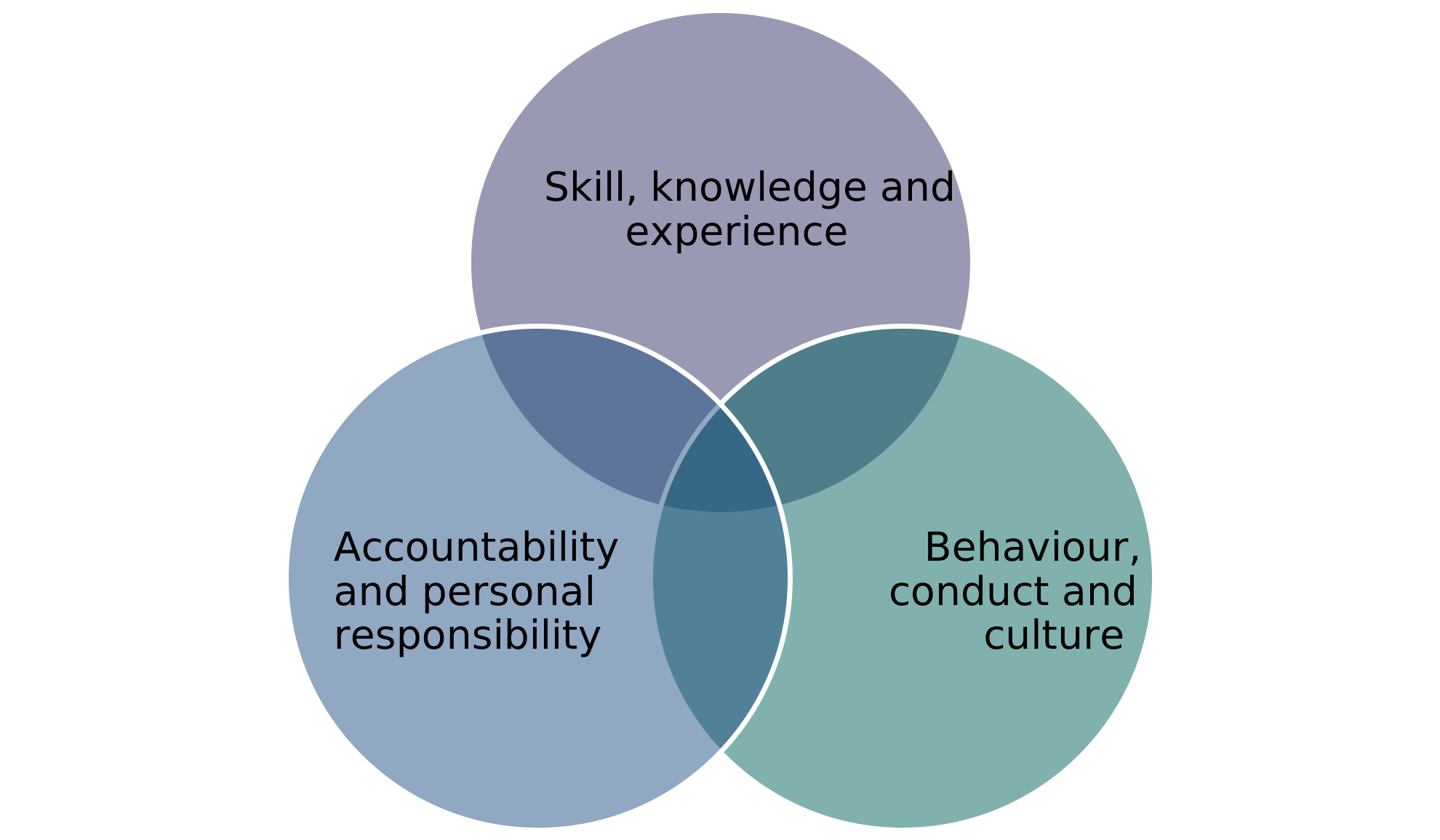
4.2. The new strategy for the Built Environment professions, trades and occupations will bring together government, sector bodies, organisations, regulators and individuals to set out the practical reforms that are needed at an individual, organisational and system-wide level to bring this vision to life. Practically, this will consider a range of regulatory and non-regulatory changes across 3 core and interdependent pillars of reform, linked to the overarching Single Construction Regulator outcomes:
- Skills, knowledge and experience: The practical and technical expertise and workmanship required to design, build and maintain safe, quality buildings and environments.
- Behaviour, conduct and culture: The professionalism with which people approach their work and the way the system is set up to incentivise and reward quality and ethical behaviour. This includes the way that people, systems and processes – such as business operating models, commercial factors (including contracting frameworks and insurance arrangements) impact individual and corporate decision-making.
- Accountability and personal responsibility: The way the system operates to promote individual and corporate responsibility, including effectively identifying and penalising inadequate standards.
4.3. Effective reform must address these 3 components together, taking account of the barriers and opportunities to each, as well as the ways that they intersect to reinforce or undermine each other. Focusing exclusively on regulation or skills provision without also addressing, for example, how poor market practices coalesce to create a so-called ‘race to the bottom’ or the way in which a general lack of transparency limits personal responsibility, will not be enough to drive the wholesale change that is needed. In the same way, reform must consider the ways in which organisational capability shapes what and how individual actors do: an otherwise skilled and conscientious individual can be constrained by the systems, incentives and capacity of the organisation in which they work.
Figure 1: The 3 pillars of reform
4.4. The scale of the challenge is significant. The whole building ecosystem spans residential, commercial and civic buildings and environments at every stage of their lifecycle, supported by a large and diverse workforce serving an even more diverse population. The potential scope of reform reflects this breadth. The final strategy will therefore need to reflect deliberate choices about focus and prioritisation in order to deliver meaningful impact, drawing on the responses to this call for evidence.
4.5. Ultimately, successful reform of the built environment system will be a long-term undertaking that relies on collective commitment, leadership and action from across government, individuals, industry, professional bodies and regulators, as well as those working in the professions, trades and occupations themselves. Everyone involved in the built environment has a role in creating the conditions for safer, higher-quality buildings and a system that commands public trust.
5. Call for evidence
5.1. This call for evidence is structured in 5 parts, based on the stages of the building lifecycle. Respondents are invited to provide evidence on areas most relevant to their area(s) of focus and expertise. There is no expectation that respondents will answer every question. However, we recognise that many roles span more than one stage, so please reflect on the breadth of your experience in your response and draw links across stages where relevant. You may also cross-refer between answers, where applicable.
5.2. For the purposes of this call for evidence, we are interested in understanding how people and organisations work in the built environment, and how the systems that shape and govern that work influence the delivery of safe, high-performing and sustainable buildings, on time and on budget.
5a. Pre-design
5.3. The pre-design stage sets the conditions within which all subsequent decisions about the building process are made. It includes strategic definition, briefing, early feasibility work and decisions about scope, time, cost, procurement and risk. For the purposes of this call for evidence, we are also interested in decisions relating to the design and manufacture of construction products. Decisions made at this stage often have long-term consequences and can be difficult or costly to reverse later. Contractual arrangements and incentives agreed at the pre-design stage, for example, can set a framework for accountability, competence and culture that impacts how people work across the full building lifecycle.
5.4. In common with other stages, a range of professions and occupations are involved in the pre-design stage. What distinguishes this stage from some others is the range of wider stakeholders that will have an influence on pre-design. We are especially interested in the role and influence of the client on building projects.
5.5. In considering the skills, knowledge and experience required of a client, there is evidence to suggest that the complexity of the client role has significantly increased in recent decades, increasing demands on the capability and capacity of organisations and the individuals working within them. This includes, but is not limited to, the ability to define outcomes, understand and manage risk, and commission and challenge professional advice.
5.6. Financial arrangements seem to drive increasing demands on client competence. There is considerable commercial demand on the client to manage the financial complexity shaping many decisions, including but not limited to Private Finance Initiative (PFI) arrangements. Meanwhile, public sector delivery has become increasingly reliant on a complex, mixed public and private financial model. At the same time, organisational capability to manage such arrangements has also been hollowed out with a loss of commercial and delivery expertise within public sector organisations. Overall, there is a concern that a lack of clear expectations, standards or regulation for those undertaking the client role may be critically undermining building safety and quality.
5.7. Client behaviour, conduct and ethics can strongly influence professional conduct elsewhere in the system. The evolution of procurement models intended to drive value, notably ‘design and build’ contracts, has led to risk being distributed through the supply chain. This potentially results in a lack of transparency and defensive behaviours, as well as decoupling the client’s relationship with design teams during construction, and therefore responsibility for overall building outcomes. It is reported that evaluation criteria often still prioritise cost over all other measures, despite strong examples of how collaborative contracting and open book procurement can improve overall outcomes and delivery performance, and sector commitments to adopting a more balanced scorecard approach.
5.8. Practically, clients take many forms, including public bodies, housing providers, commercial developers, small developers and individual building owners. In some cases, the client role is fulfilled by experienced property or construction professionals. However, there is a huge variation in experience and the perception of different types of experience, with implications for how accountability and personal responsibility are understood. We are also interested in the influence of funders, investors and joint‑venture partners on the client role and on early, risk-shaping decisions.
5.9. The dutyholder regime introduced by the Building Safety Act 2022 places duties on all clients to make suitable arrangements for planning, managing and monitoring a project so it complies with all relevant requirements on completion. This includes allocating enough time and resource for the building work to comply with building regulations; establishing, reviewing and maintaining systems and arrangements to meet building regulations; cooperating with others so they can comply with their duties; and enabling cooperation between designers and contractors. These duties give the client a critical role as convenor and collaborator. Anecdotal evidence suggests this is not yet well understood or adopted by clients, especially outside of the higher-risk buildings regime.
5.10. This section invites evidence on how the client role is exercised at the pre-design stage, including how responsibility is defined and carried through early decisions that shape risk, scope and outcomes. We are interested in how client capability is built and assured, how challenge and ethical decision-making are enabled, and where current arrangements constrain good practice or create avoidable uncertainty.
Questions: Pre-design
Please ensure you have read the relevant section of the call for evidence document before answering these questions.
When answering these questions, please provide real-world examples and quantitative evidence wherever possible to support your response. You may cross-refer between answers, where applicable. Where information provided is commercially sensitive or otherwise not suitable for wider publication, please make sure this is clearly marked.
Skills, knowledge and experience
1. What types of skills, knowledge and experience are needed to carry out pre-design work?
Please consider what individual competence and organisational capability is required and where these may vary across different types of building or project. We are interested in the range of skills, functions and roles at this stage e.g. technical, financial, legal, commercial or management skills, knowledge and experience. You do not need to list detailed technical skills and requirements for specific roles, unless this is helpful to support your response.
- [Free text response]
2. In your experience, where are the most material gaps in skills, knowledge, and experience in the pre-design phase?
- [Free text response]
3. Overall, how consistently do you think the skills, knowledge and experience necessary in the pre-design phase are demonstrated in practice?
- Very consistently
- Fairly consistently
- Neither consistently nor inconsistently
- Fairly inconsistently
- Very inconsistently
Behaviour, conduct and culture
4. What most influences behaviour and decision-making when carrying out pre-design work?
Please consider both positive and negative influences on behaviour and decision-making for individuals and organisations. For example, mandatory reporting requirements, different types of insurance requirements; conflicts of interest; business, financial or legal operating models; commercial incentives or pressures; competence; cultural norms or expectations; accountability and regulation; or other factors.
- [Free text response]
5. Overall, how consistently do you think the positive behaviours and decision-making necessary in the pre-design phase are demonstrated in practice?
- Very consistently
- Fairly consistently
- Neither consistently nor inconsistently
- Fairly inconsistently
- Very inconsistently
Accountability and responsibility
6. What benefits are there when individual and organisational roles, responsibilities and accountability are clearly defined, understood and applied during the pre-design stage?
Please consider what positive impacts this has on e.g. project delivery, behaviour and conduct and trust in the system. You should consider the influence of contributory factors such as the type of person or organisation playing the role of client or the nature, scale or complexity of the building project.
- [Free text response]
7. What challenges are there in defining, understanding or delivering these roles, responsibilities and accountability during the pre-design stage?
Please consider what negative impacts this has on e.g. project delivery, behaviour and conduct and trust in the system. You should consider the influence of contributory factors such as the type of person or organisation playing the role of client or the nature, scale or complexity of the building project.
- [Free text response]
8. Overall, how consistently do you think roles, responsibilities and accountabilities are clearly defined, understood and applied in the pre-design phase?
- Very consistently
- Fairly consistently
- Neither consistently nor inconsistently
- Fairly inconsistently
- Very inconsistently
9. How well do clients generally understand their responsibilities under the dutyholder regime set out in Part 2A of the Building Regulations 2010?
Please include real-world examples to support your response. You should consider how contributory factors such as the type of person or organisation playing the role of client or the nature, scale or complexity of the building project influence your experience of these issues.
- [Free text response]
10. How well do clients generally deliver their responsibilities under the dutyholder regime set out in Part 2A of the Building Regulations 2010?
Please include real-world examples to support your response. You should consider how contributory factors such as the type of person or organisation playing the role of client or the nature, scale or complexity of the building project influence your experience of these issues.
- [Free text response]
11. Overall, how consistently do you think clients understand and deliver their responsibilities under the dutyholder regime set out in Part 2A of the Building Regulations 2010?
- Very consistently
- Fairly consistently
- Neither consistently nor inconsistently
- Fairly inconsistently
- Very inconsistently
System infrastructure
12. Does the current system of (a) education and training, (b) competence standards and frameworks, and (c) regulation and oversight effectively incentivise and enable appropriate skills, behaviours, accountability and quality of work at the pre-design stage?
Please include real-world examples to support your responses, including where you think there are currently material gaps in provision.
- (a) Education and training [Free text response]
- (b) Competence standards and frameworks [Free text response]
- (c) Regulation and oversight [Free text response]
13. Overall, how effective do you think the current system infrastructure for skills, competence and regulation and oversight is at incentivising and enabling appropriate skills, behaviours, accountability and quality of work in the pre-design stage?
- Very effective
- Fairly effective
- Neither effective nor ineffective
- Fairly ineffective
- Very ineffective
Interdependencies and transition
14. Which actions, behaviours and decisions at the pre-design stage most influence subsequent stages of the building lifecycle, and which support or undermine effective transition into the design stage?
You may wish to consider how people and organisations do, can and should work together effectively across the different stages of the building lifecycle. Please include practical examples of where actions and relationships have worked effectively or ineffectively.
- [Free text response]
Summary
15. Thinking about government’s vision for a well-functioning system where buildings are safe, high-performing and sustainable; individuals and organisations are enabled to thrive; and the building system is trusted, how significant an impact do each of these factors currently have on delivering these outcomes at the pre-design stage?
-
(a) Skills, knowledge and experience [5-point scale]
- Significant positive impact
- Moderate positive impact
- Limited impact
- Moderate negative impact
- Significant negative impact
- (b) Behaviour, conduct and culture [5-point scale]
- (c) Accountability and responsibility [5-point scale]
- (d) Education and training [5-point scale]
- (e) Competence standards and frameworks [5-point scale]
- (f) Regulation and oversight [5-point scale]
16. Thinking about the issues raised in your responses to questions 1-15, what practical changes or actions would make the biggest difference to how pre-design work is carried out?
Please consider who should lead the changes you identify (including individuals, organisations, sector groups and government/statutory bodies), what practical next steps are required (including non-regulatory actions) and key barriers to implementation. Suggestions can draw on previously identified recommendations that have not been implemented, or on good practice that could be consolidated; they do not need to be new.
- [Free text response]
17. Of the actions listed in your response to question 16, which one change or action you would prioritise to deliver the greatest impact?
- [Free text response]
5b. Design and specification
5.11. The design and specification stage involves the development of a building from an agreed brief through to coordinated design and the preparation of the information needed to secure consents. This stage must demonstrate that the design will meet the performance requirements of the brief, including an acceptable level of risk. It includes concept development, multidisciplinary coordination, safety-critical and performance-determining design, and the production of specifications and technical information that enable construction and allocate responsibility. Similar to the pre-design stage, decisions made during design and specification often have long-term consequences for the overall project.
5.12. The skills, knowledge and experience required at this stage can vary significantly depending on the nature, scale and risk profile of the building as well as the specific functions being undertaken. Those working in design and specification roles are supported by a range of education pathways, professional bodies and competence frameworks. The UK is home to world‑leading design professionals, supported by strong educational institutions. However, this strength is not always reflected in the safety, performance and sustainability of our built environment, sometimes driven by uneven skills development across design professions.
5.13. There is significant variation across professions and occupations in workforce size, capability and capacity, as well as in how work is distributed between regulated professions, chartered professionals and other specialists. While many professions have established education and training pathways, there is evidence of skills shortages, capacity constraints and challenges in retaining experienced practitioners. The journey to becoming a competent design professional is long. For the majority, the process is academically, practically and financially demanding. However, this is often not matched in early and mid-career pay. Further, technological change, new materials and necessary reforms following the Grenfell Tower tragedy are also changing expectations.
5.14. Design and specification work is often delivered through multidisciplinary teams operating under a range of commercial and contractual arrangements. How effectively these teams work together and are managed can have a meaningful impact on behaviour, conduct and culture. The way multidisciplinary teams are organised, incentivised and supported, for example, may directly influence the quality of collaboration and assurance and the ability to prioritise safety, quality, performance and sustainability alongside cost and programme pressures.
5.15. Accountability and responsibility are shared between a wide range of professions, trades and occupations who contribute to the design and specification of buildings. Depending on the context, this may include architects, architectural technicians, fire engineers and engineers of different specialisms and others, working within multidisciplinary teams and across organisational and contractual boundaries. Responsibilities for design intent, safety‑critical design, performance‑determining design and coordination are often not held by the same roles or disciplines and may be allocated differently in practice from how they are described in guidance or contracts, if they are explicitly described at all.
5.16. The regulatory and assurance landscape that underpins these roles has developed unevenly. Architects are regulated in title under the Architects Act 1997. Other roles may have statutory duties attached to specific functions, as is the case with the principal designer role, or otherwise rely on chartership with professional bodies or voluntary registration with other industry schemes. Further, government has committed to introduce statutory regulation of fire engineers and fire risk assessors, though this work falls outside the scope of this call for evidence.
5.17. Part 2A of the Building Regulations 2010 sets out responsibilities of principal designers and designers to ensure compliance of building work with the Building Regulations. The principal designer and designer have duties around planning, managing, monitoring and coordinating matters related to the design work. Principal designers must meet competence requirements and are required to cooperate and communicate with other dutyholders. They have the responsibility for assuring competency in both high-risk buildings and non-high-risk buildings. Anecdotal evidence suggests that these requirements are not widely well understood or implemented, with implications for how accountability and personal responsibility is realised in practice.
5.18. This section invites evidence on how design and specification functions operate in practice, particularly how responsibility for design intent, coordination and safety critical decisions is allocated and managed across disciplines. We are interested in whether skills, knowledge and experience align with the functions being performed, how capability is developed and sustained and how commercial operating models may influence professional judgment and collaboration.
Questions: Design and specification
Please ensure you have read the relevant section of the call for evidence document before answering these questions.
When answering these questions, please provide real-world examples and quantitative evidence wherever possible to support your response. You may cross-refer between answers, where applicable. Where information provided is commercially sensitive or otherwise not suitable for wider publication, please make sure this is clearly marked.
Skills, knowledge and experience
18. What types of skills, knowledge and experience are needed to carry out design and specification work?
Please consider what individual competence and organisational capability is required and where these may vary across different types of building or project. We are interested in the range of skills, functions and roles at this stage e.g. regulatory knowledge, procurement, commercial or collaboration skills. You do not need to list detailed technical skills and requirements for specific roles, unless this is helpful to support your response.
- [Free text response]
19. In your experience, where are the most material gaps in skills, knowledge, and experience in the design and specification phase?
- [Free text response]
20. Overall, how consistently do you think the skills, knowledge and experience necessary in the design and specification phase are demonstrated in practice?
- Very consistently
- Fairly consistently
- Neither consistently nor inconsistently
- Fairly inconsistently
- Very inconsistently
Behaviour, conduct and culture
21. What most influences behaviour and decision-making when carrying out design and specification work?
Please consider both positive and negative influences on behaviour and decision-making for individuals and organisations. For example, regulatory and planning context; brief quality; procurement routes; commercial incentives and fee structures; or other factors.
- [Free text response]
22. Overall, how consistently do you think the positive behaviours and decision-making necessary in the design and specification phase are demonstrated in practice?
- Very consistently
- Fairly consistently
- Neither consistently nor inconsistently
- Fairly inconsistently
- Very inconsistently
Accountability and responsibility
23. What benefits are there when individual and organisational roles, responsibilities and accountability are clearly defined, understood and applied during the design and specification stage?
Please consider what positive impacts this has on e.g. project delivery, behaviour and conduct and trust in the system. You should consider the influence of contributory factors such as the type of person or organisation undertaking design and specification work or the nature, scale or complexity of the building project.
- [Free text response]
24. What challenges are there in defining, understanding or delivering these roles, responsibilities and accountability during the design and specification stage?
Please consider what negative impacts this has on e.g. project delivery, behaviour and conduct and trust in the system. You should consider the influence of contributory factors such as the type of person or organisation undertaking design and specification work or the nature, scale or complexity of the building project.
- [Free text response]
25. Overall, how consistently do you think roles, responsibilities and accountabilities are clearly defined, understood and applied in the design and specification phase?
- Very consistently
- Fairly consistently
- Neither consistently nor inconsistently
- Fairly inconsistently
- Very inconsistently
26. How well do principal designers generally understand their responsibilities under the dutyholder regime set out in Part 2A of the Building Regulations 2010?
Please include real-world examples to support your response. You should consider how contributory factors such as the type of person or organisation undertaking design and specification work or the nature, scale or complexity of the building project influence your experience of these issues.
- [Free text response]
27. How well do principal designers generally deliver their responsibilities under the dutyholder regime set out in Part 2A of the Building Regulations 2010?
Please include real-world examples to support your response. You should consider how contributory factors such as the type of person or organisation undertaking design and specification work or the nature, scale or complexity of the building project influence your experience of these issues.
- [Free text response]
28. Overall, how consistently do you think principal designers understand and deliver their responsibilities under the dutyholder regime set out in part 2A of the Building Regulations 2010?
- Very consistently
- Fairly consistently
- Neither consistently nor inconsistently
- Fairly inconsistently
- Very inconsistently
System infrastructure
29. Does the current system of (a) education and training, (b) competence standards and frameworks, and (c) regulation and oversight effectively incentivise and enable appropriate skills, behaviours, accountability and quality of work at the design and specification stage?
Please include real-world examples to support your responses, including where you think there are currently material gaps in provision.
- (a) Education and training [Free text response]
- (b) Competence standards and frameworks [Free text response]
- (c) Regulation and oversight [Free text response]
30. Overall, how effective do you think the current system infrastructure for skills, competence and regulation and oversight is at incentivising and enabling appropriate skills, behaviours, accountability and quality of work in the design and specification stage?
- Very effective
- Fairly effective
- Neither effective nor ineffective
- Fairly ineffective
- Very ineffective
Interdependencies and transition
31. Which actions, behaviours and decisions at the design and specification stage most influence subsequent stages of the building lifecycle, and which support or undermine effective transition into the construction stage?
You may wish to consider how people and organisations do, can and should work together effectively across the different stages of the building lifecycle. Please include practical examples of where actions and relationships have worked effectively or ineffectively.
- [Free text response]
Summary
32. Thinking about government’s vision for a well-functioning system where buildings are safe, high-performing and sustainable; individuals and organisations are enabled to thrive; and the building system is trusted, how significant an impact do each of these factors currently have on delivering these outcomes at the design and specification stage?
-
(a) Skills, knowledge and experience [5-point scale]
- Significant positive impact
- Moderate positive impact
- Limited impact
- Moderate negative impact
- Significant negative impact
- (b) Behaviour, conduct and culture [5-point scale]
- (c) Accountability and responsibility [5-point scale]
- (d) Education and training [5-point scale]
- (e) Competence standards and frameworks [5-point scale]
- (f) Regulation and oversight [5-point scale]
33. Thinking about the issues raised in your responses to questions 18-32, what practical changes or actions would make the biggest difference to how design and specification work is carried out?
Please consider who should lead the changes you identify (including individuals, organisations, sector groups and government/statutory bodies), what practical next steps are required (including non-regulatory actions) and key barriers to implementation. Suggestions can draw on previously identified recommendations that have not been implemented, or on good practice that could be consolidated; they do not need to be new.
- [Free text response]
34. Of the actions listed in your response to question 33, which one change or action you would prioritise to deliver the greatest impact?
- [Free text response]
5c. Construction
5.19. The construction stage involves the physical delivery of building work, translating design intent into a completed structure. It includes the manufacturing, construction and commissioning of buildings. In practice, the construction phase overlaps significantly with the design and specification stage and activities across these stages often occur in parallel.
5.20. The construction stage of a building has the potential to involve the widest range of professions, trades and occupations in a building’s lifecycle. Depending on the project this may include, but is not limited to, principal contractors, subcontractors and a huge variety of specialist trades, site managers, supervisors, building control professionals. The Principal Designer also remains involved during this stage.
5.21. Construction roles are characterised by a wide range of entry routes, qualifications and training pathways, reflecting the diversity of activities and specialisms. The skills, knowledge and experience required can vary significantly depending on the nature of the work, the level of risk, and the degree of specialisation.
5.22. As well as entry pathways, the people and organisations engaged in the construction stage are subject to a wide range of commercial, regulatory, professional and other requirements to maintain their status, bid for and carry out work. These may include contractual relationships and regulatory requirements such as in the Building Regulations and Health and Safety legislation, alongside requirements of different professional membership bodies and accreditation against multiple industry standards. We understand that the number and scale of these kinds of requirements can often feel like a burden to those in the sector.
5.23. There is evidence documenting demographic challenges in some roles, with parts of the sector struggling to attract enough people early in their career to replace those leaving the workforce. This is partly compounded by wider demands on the workforce to, for example, increase housebuilding across the UK or support delivery of the Warm Homes Plan’s commitment to upgrade 5 million homes by 2030. These factors all influence the overall landscape for skills, knowledge and experience of those working on the construction stage.
5.24. Behaviour, conduct and culture during construction have a direct impact on safety, quality and productivity, as well as on trust between clients, contractors and the public. Construction work is typically delivered under significant commercial, time and cost pressures, shaped by contracting models, procurement practices and insurance requirements. More generally, productivity has been a long-standing challenge for the construction sector and the cyclical nature of the industry, going from periods of high activity to low activity, has been felt to disincentivise investment in the workforce, with real implications for individual livelihoods.
5.25. Anecdotal evidence indicates that contracts are still primarily awarded with price as the overriding consideration, with a corresponding distribution of risk through the supply chain. These conditions can influence how decisions are made on site, how risks are managed, challenge is raised or addressed and how standards are upheld in practice, with some procurement approaches (such as design and build) having a particular impact on quality and safety.
5.26. This overall context creates a complex picture for accountability and responsibility across the construction stage. In particular, the choice of contracting model – whether a more traditional contracting arrangement where those working on site are directly employed by the client, or an alternative sub-contracting model where a principal contractor operates by procuring sub-contractors to do packages of work – can directly impact individual and corporate perceptions of ownership of accountability and risk.
5.27. Anecdotal evidence suggests that the prevalence of a sub-contracting model may also disincentivise or make more difficult investment in skills and learning through the supply chain, with potential knock-on consequences for productivity, safety and quality, often the result of reduced oversight.
5.28. This section seeks evidence on how responsibility and oversight operate on site during the construction stage, including how contractual and organisational arrangements shape supervision, assurance and decision-making in practice. We are interested in how workforce skills and organisational capability align with the work undertaken, and how commercial pressures can influence behaviour, standards and accountability as buildings are delivered.
Questions: Construction
Please ensure you have read the relevant section of the call for evidence document before answering these questions.
When answering these questions, please provide real-world examples and quantitative evidence wherever possible to support your response. You may cross-refer between answers, where applicable. Where information provided is commercially sensitive or otherwise not suitable for wider publication, please make sure this is clearly marked.
Skills, knowledge and experience
35. What types of skills, knowledge and experience are needed to carry out construction work?
Please consider what individual competence and organisational capability is required and where these may vary across different types of building or project. We are interested in the range of skills, functions and roles at this stage e.g. project and site management, quality management and inspection, on-site enforcement, mandatory reporting requirements, procurement and supply chain management, commercial and contract management. You do not need to list detailed technical skills and requirements for specific roles, unless this is helpful to support your response.
- [Free text response]
36. In your experience, where are the most material gaps in skills, knowledge, and experience in the construction phase?
- [Free text response]
37. Overall, how consistently do you think the skills, knowledge and experience necessary in the construction phase are demonstrated in practice?
- Very consistently
- Fairly consistently
- Neither consistently nor inconsistently
- Fairly inconsistently
- Very inconsistently
Behaviour, conduct and culture
38. What most influences behaviour and decision-making when carrying out construction work?
Please consider both positive and negative influences on behaviour and decision-making for individuals and organisations. For example, contractor decision making; supply chain structure and subcontractor fragmentation; the interaction of programme delivery and design information; site conditions; quality assurance and inspection. competence; cultural norms or expectations; or other factors.
- [Free text response]
39. Overall, how consistently do you think the positive behaviours and decision-making necessary in the construction phase are demonstrated in practice?
- Very consistently
- Fairly consistently
- Neither consistently nor inconsistently
- Fairly inconsistently
- Very inconsistently
Accountability and responsibility
40. What benefits are there when individual and organisational roles, responsibilities and accountability are clearly defined, understood and applied during the construction stage?
Please consider what positive impacts this has on e.g. project delivery, behaviour and conduct and trust in the system. You should consider the influence of contributory factors such as the type of person or organisation undertaking construction work or the nature, scale or complexity of the building project.
- [Free text response]
41. What challenges are there in defining, understanding or delivering these roles, responsibilities and accountability during the construction stage?
Please consider what negative impacts this has on e.g. project delivery, behaviour and conduct and trust in the system. You should consider the influence of contributory factors such as the type of person or organisation undertaking construction work or the nature, scale or complexity of the building project.
- [Free text response]
42. Overall, how consistently do you think roles, responsibilities and accountabilities are clearly defined, understood and applied in the construction phase?
- Very consistently
- Fairly consistently
- Neither consistently nor inconsistently
- Fairly inconsistently
- Very inconsistently
43. How well do principal contractors generally understand their responsibilities under the dutyholder regime set out in Part 2A of the Building Regulations 2010?
Please include real-world examples to support your response. You should consider how contributory factors such as the type of person or organisation undertaking construction work or the nature, scale or complexity of the building project influence your experience of these issues.
- [Free text response]
44. How well do principal contractors generally deliver their responsibilities under the dutyholder regime set out in Part 2A of the Building Regulations 2010?
Please include real-world examples to support your response. You should consider how contributory factors such as the type of person or organisation undertaking construction work or the nature, scale or complexity of the building project influence your experience of these issues.
- [Free text response]
45. Overall, how consistently do you think principal contractors understand and deliver their responsibilities under the dutyholder regime set out in part 2A of the Building Regulations 2010?
- Very consistently
- Fairly consistently
- Neither consistently nor inconsistently
- Fairly inconsistently
- Very inconsistently
System infrastructure
46. Does the current system of (a) education and training, (b) competence standards and frameworks, and (c) regulation and oversight effectively incentivise and enable appropriate skills, behaviours, accountability and quality of work at the construction stage?
Please include real-world examples to support your responses, including where you think there are currently material gaps in provision.
- (a) Education and training [Free text response]
- (b) Competence standards and frameworks [Free text response]
- (c) Regulation and oversight [Free text response]
47. Overall, how effective do you think the current system infrastructure for skills, competence and regulation and oversight is at incentivising and enabling appropriate skills, behaviours, accountability and quality of work in the construction stage?
- Very effective
- Fairly effective
- Neither effective nor ineffective
- Fairly ineffective
- Very ineffective
Interdependencies and transition
48. Which actions, behaviours and decisions at the construction stage most influence subsequent stages of the building lifecycle, and which support or undermine effective transition into the occupation and maintenance stage?
You may wish to consider how people and organisations do, can and should work together effectively across the different stages of the building lifecycle. Please include practical examples of where actions and relationships have worked effectively or ineffectively.
- [Free text response]
Specific areas of interest
49. Are there particular issues or benefits associated with different approaches to licensing, regulation and registration of contractors and/or subcontractors, including those working on smaller scale or domestic dwellings?
We are interested in whether changes to licensing, regulation and/or registration of those working on a range of projects, including smaller- or domestic-scale projects would be an effective tool to raise standards for competence, conduct and accountability. You may want to refer to examples from elsewhere in the building sector, other sectors or international comparators to support your response.
- [Free text response]
Summary
50. Thinking about government’s vision for a well-functioning system where buildings are safe, high-performing and sustainable; individuals and organisations are enabled to thrive; and the building system is trusted, how significant an impact do each of these factors currently have on delivering these outcomes at the construction stage?
-
(a) Skills, knowledge and experience [5-point scale]
- Significant positive impact
- Moderate positive impact
- Limited impact
- Moderate negative impact
- Significant negative impact
- (b) Behaviour, conduct and culture [5-point scale]
- (c) Accountability and responsibility [5-point scale]
- (d) Education and training [5-point scale]
- (e) Competence standards and frameworks [5-point scale]
- (f) Regulation and oversight [5-point scale]
51. Thinking about the issues raised in your responses to questions 35-50, what practical changes or actions would make the biggest difference to how construction work is carried out?
Please consider who should lead the changes you identify (including individuals, organisations, sector groups and government/statutory bodies), what practical next steps are required (including non-regulatory actions) and key barriers to implementation. Suggestions can draw on previously identified recommendations that have not been implemented, or on good practice that could be consolidated; they do not need to be new.
- [Free text response]
52. Of the actions listed in your response to question 51, which one change or action you would prioritise to deliver the greatest impact?
- [Free text response]
5d. Occupation and maintenance (including small scale works and alterations)
5.29. The occupation and maintenance stage covers the period when buildings are in use, including day-to-day operation and repair, maintenance and improvement (RMI). Much of the work carried out at this stage is similar in nature to construction activity. In some cases, such as refurbishment projects, this stage may also include wider professions and trades typically associated with the pre-design and design stages. This stage typically takes place over a much longer timeframe, often in occupied buildings and usually involves a large volume of small-scale or incremental works that may be subject to lower levels of coordination or oversight. Often these works are initiated by or directly affect homeowners or occupiers, though can vary significantly depending on the building type, use and size.
5.30. The skills, knowledge and experience required for works during the occupation and maintenance stage overlap in many respects with those needed during construction, particularly for technical or trade-based work. However, effective performance at this stage often depends on access to accurate building information, understanding of existing conditions and the ability to manage work safely in occupied places. Under the Construction, Design and Management (CDM) Regulations 2015, all construction projects involving multiple contractors are required to have a Health and Safety File (including operation and maintenance manuals), which should provide a roadmap for undertaking appropriate works. Anecdotal evidence, however, suggests that these can often be incomplete or that trades responsible for maintenance have inadequate competence or resourcing to deliver and maintain expected building performance. Soft landings and post-occupancy evaluation may not always be completed, leading to residual defects or a lack of learning on how a building works for its users and against specifications in practice. Organisational capability, supervision and specialisation is again a feature, with individuals and organisations focusing on particular elements of a building system (e.g. glazing or heating systems) rather than maintaining an view of how the overall project fits together.
5.31. In parts of the sector, particularly for domestic-scale work, this stage is often characterised by the use of self-certification schemes and other assurance arrangements intended to manage high volumes of work. Particularly in domestic RMI, it can be difficult for consumers to assess the quality of tradespeople before paying for a job.
5.32. There are several factors impacting behaviour, conduct and culture in occupation and maintenance. A particular feature of this stage is the prevalence of small, often reactive jobs carried out in occupied buildings. In this context, there may be significant variation in the skills, knowledge and behaviours of those undertaking work, as well as in the organisational capability of the businesses involved.
5.33. Occupation and maintenance is also the stage at which public trust in the sector is most directly experienced, through the condition of the buildings we use and live in and the quality of repair, maintenance and improvement work. Defects, difficulty in achieving redress and the asymmetry of information between domestic clients and those constructing buildings, with their skills, knowledge and experience, can undermine confidence and perceptions of accountability. For RMI work, we have heard anecdotally of cases of tradespeople refusing reasonable requests for defective work to be fixed and even fraud where money has been taken but no work provided. These conditions may influence behaviour and decision making in practice, including how standards are applied, how risks are managed and how responsibility is understood when things go wrong.
5.34. Similar to the construction stage, accountability and responsibility during occupation and maintenance is distributed across a wide range of professions, trades and occupations. Depending on the context, this may include facilities managers, managing agents, maintenance contractors, specialist trades and building owners. Unlike construction, responsibility at this stage is often further distributed over time, across multiple contracts or organisations, and may change as buildings are sold, let, managed or adapted. This can impact ability to trace accountability for decisions or work carried out over the life of a building.
5.35. At a domestic level, evidence suggests that there are limited routes for homeowners to seek compensation from tradespeople carrying out RMI work when damages are incurred. There is no universal requirement for membership of a redress scheme, and those voluntary schemes which do exist have limited enforcement powers, especially where individuals operate as limited companies with few assets. Insurance coverage is also very rare, leaving homeowners exposed to financial loss. Where homeowners suffer financial loss due to fraud, it has been raised by Parliamentarians that criminal investigations are rarely pursued by the police or Trading Standards.
5.36. The dutyholder responsibilities set out in Part 2A of the Building Regulations 2010 apply to all building work. This explicitly includes work that falls under the Building Regulations during the occupation stage and sets out competence requirements, as well as a requirement to cooperate and communicate with other dutyholders.
5.37. This section seeks evidence on how competence, conduct and accountability operate once buildings are in use. This includes how responsibilities are managed over time, across multiple actors or small-scale works. We are interested in how skills and organisational capability are assured in practice, how information asymmetry and redress affect behaviour, and where risks arise when work is undertaken without adequate competence or oversight.
Questions: Occupation and maintenance
Please ensure you have read the relevant section of the call for evidence document before answering these questions.
When answering these questions, please provide real-world examples and quantitative evidence wherever possible to support your response. You may cross-refer between answers, where applicable. Where information provided is commercially sensitive or otherwise not suitable for wider publication, please make sure this is clearly marked.
Skills, knowledge and experience
53. What types of skills, knowledge and experience are needed to carry out occupation and maintenance work?
Please consider what individual competence and organisational capability is required and where these may vary across different types of building or project. We are interested in the range of skills, functions and roles at this stage e.g. facilities management and operations, asset and lifecycle management, procurement, data and digital management, resident or occupier engagement (where relevant). You do not need to list detailed technical skills and requirements for specific roles, unless this is helpful to support your response.
- [Free text response]
54. In your experience, where are the most material gaps in skills, knowledge, and experience in the occupation and maintenance phase?
- [Free text response]
55. Overall, how consistently do you think the skills, knowledge and experience necessary in the occupation and maintenance phase are demonstrated in practice?
- Very consistently
- Fairly consistently
- Neither consistently nor inconsistently
- Fairly inconsistently
- Very inconsistently
Behaviour, conduct and culture
56. What most influences behaviour and decision-making when carrying out occupation and maintenance work?
Please consider both positive and negative influences on behaviour and decision-making for individuals and organisations. For example, the transition between the construction and occupier teams; facilities management resource; regulatory compliance; performance in occupation; cultural norms or expectations; or other factors.
- [Free text response]
57. Overall, how consistently do you think the positive behaviours and decision-making necessary in the occupation and maintenance phase are demonstrated in practice?
- Very consistently
- Fairly consistently
- Neither consistently nor inconsistently
- Fairly inconsistently
- Very inconsistently
Accountability and responsibility
58. What benefits are there when individual and organisational roles, responsibilities and accountability are clearly defined, understood and applied during the occupation and maintenance stage?
Please consider what positive impacts this has on e.g. project delivery, behaviour and conduct and trust in the system. You should consider the influence of contributory factors such as the type of person or organisation undertaking the work or the nature, scale or complexity of the building project.
- [Free text response]
59. What challenges are there in defining, understanding or delivering these roles, responsibilities and accountability during the occupation and maintenance stage?
Please consider what negative impacts this has on e.g. project delivery, behaviour and conduct and trust in the system. You should consider the influence of contributory factors such as the type of person or organisation undertaking the work or the nature, scale or complexity of the building project.
- [Free text response]
60. Overall, how consistently do you think roles, responsibilities and accountabilities are clearly defined, understood and applied in the occupation and maintenance phase?
- Very consistently
- Fairly consistently
- Neither consistently nor inconsistently
- Fairly inconsistently
- Very inconsistently
61. How well do accountable persons generally understand their responsibilities under the dutyholder regime set out in Part 2A of the Building Regulations 2010 and Articles 13 and 18 of The Regulatory Reform (Fire Safety) Order 2005?
Please include real-world examples to support your response. You should consider how contributory factors such as the type of person or organisation undertaking the work or the nature, scale or complexity of the building project influence your experience of these issues.
- [Free text response]
62. How well do accountable persons generally deliver their responsibilities under the dutyholder regime set out in Part 2A of the Building Regulations 2010 and Articles 13 and 18 of The Regulatory Reform (Fire Safety) Order 2005?
Please include real-world examples to support your response. You should consider how contributory factors such as the type of person or organisation undertaking the work or the nature, scale or complexity of the building project influence your experience of these issues.
- [Free text response]
63. Overall, how consistently do you think accountable persons understand and deliver their responsibilities under the dutyholder regime set out in part 2A of the Building Regulations 2010 and Articles 13 and 18 of The Regulatory Reform (Fire Safety) Order 2005?
- Very consistently
- Fairly consistently
- Neither consistently nor inconsistently
- Fairly inconsistently
- Very inconsistently
System infrastructure
64. Does the current system of (a) education and training, (b) competence standards and frameworks, and (c) regulation and oversight effectively incentivise and enable appropriate skills, behaviours, accountability and quality of work at the occupation and maintenance stage?
Please include real-world examples to support your responses, including where you think there are currently material gaps in provision.
- (a) Education and training [Free text response]
- (b) Competence standards and frameworks [Free text response]
- (c) Regulation and oversight [Free text response]
65. Overall, how effective do you think the current system infrastructure for skills, competence and regulation and oversight is at incentivising and enabling appropriate skills, behaviours, accountability and quality of work in the occupation and maintenance stage?
- Very effective
- Fairly effective
- Neither effective nor ineffective
- Fairly ineffective
- Very ineffective
Interdependencies and transition
66. Which actions, behaviours and decisions at the occupation and maintenance stage most influence subsequent stages of the building lifecycle, and which support or undermine effective transition across the occupation and maintenance stage?
You may wish to consider how people and organisations do, can and should work together effectively across the different stages of the building lifecycle. Please include practical examples of where actions and relationships have worked effectively or ineffectively.
- [Free text response]
Specific areas of interest
67. Based on your experience of renovation, maintenance and improvement (RMI) works completed during the occupation stage, is there evidence of particular issues associated with (a) quality, workmanship and standards, (b) behaviours, conduct and professionalism or (c) accountability, enforcement and redress?
- (a) Quality, workmanship and standards [Free text response]
- (b) Behaviours, conduct and professionalism [Free text response]
- (c) Accountability, enforcement and redress [Free text response]
Summary
68. Thinking about government’s vision for a well-functioning system where buildings are safe, high-performing and sustainable; individuals and organisations are enabled to thrive; and the building system is trusted, how significant an impact do each of these factors currently have on delivering these outcomes at the occupation and maintenance stage?
-
(a) Skills, knowledge and experience [5-point scale]
- Significant positive impact
- Moderate positive impact
- Limited impact
- Moderate negative impact
- Significant negative impact
- (b) Behaviour, conduct and culture [5-point scale]
- (c) Accountability and responsibility [5-point scale]
- (d) Education and training [5-point scale]
- (e) Competence standards and frameworks [5-point scale]
- (f) Regulation and oversight [5-point scale]
69. Thinking about the issues raised in your responses to questions 53-68, what practical changes or actions would make the biggest difference to how occupation and maintenance work is carried out?
Please consider who should lead the changes you identify (including individuals, organisations, sector groups and government/statutory bodies), what practical next steps are required (including non-regulatory actions) and key barriers to implementation. Suggestions can draw on previously identified recommendations that have not been implemented, or on good practice that could be consolidated; they do not need to be new.
- [Free text response]
70. Of the actions listed in your response to question 69, which one change or action you would prioritise to deliver the greatest impact?
- [Free text response]
5e. Cross-cutting issues, themes and challenges
5.38. This section seeks evidence on a number of key issues, themes and challenges that cut across different professions, roles and stages of the building lifecycle. These issues relate to how responsibility, information and assurance are managed across the building system, particularly between people, organisations and regulatory regimes. These are intended to capture challenges that cannot be fully understood by looking at any single lifecycle stage in isolation.
Accountability and responsibility
5.39. In addition to detailed questions about how duties, responsibility and accountability are understood and implemented at each stage of the building lifecycle, we are also interested in how organisational governance and senior oversight contribute to effective accountability. We are seeking to explore how senior officers operate to ensure their organisation fulfils its legal duties as a statutory dutyholder.
Cross-cutting functions
5.40. We are interested in the ways in which different parts of the building system work together to support or undermine overall delivery of safe, high-performing and sustainable buildings, on time and on budget. We know that there are particular functions that have an influence across multiple building lifecycle stages – including, but not limited to, planning, building control, project management, inspection, surveying, enforcement and redress. These functions act as key points of interface where multiple roles, regulatory regimes and decisions come together.
5.41. We are seeking to explore how the way these kinds of cross-cutting functions are carried out influences decision making, accountability and risk management across the building lifecycle, particularly where interpretations, conditions or decisions have specific impacts on performance, behaviour or interpretations of responsibility and accountability. We are also interested in whether there are recurring points of friction across the system which might benefit from greater clarity, consistency or coordination.
The role of sector bodies and regulators
5.42. Sector bodies and regulators, including professional bodies, trade associations, statutory and non-statutory regulators, leadership organisations and scheme operators have a critical role in setting and enforcing appropriate standards of competence, conduct and accountability for those working in the built environment sector. In particular, they may set entry and accreditation requirements for members and requirements for ongoing membership, such as requiring adherence to a code of conduct. They also play a role in the education and continuing professional development (CPD) of their members.
5.43. We are interested in how well current sector bodies and regulators are judged to support, monitor and enforce appropriate standards to deliver safe, high-performing and sustainable buildings, incentivise good practice and support public trust. In particular, we are seeking to explore what role these bodies do and should play within the built environment system.
5.44. Arrangements for overseeing compliance throughout a building’s lifecycle influence behaviour across the whole building system. These arrangements affect the interpretation of standards, how confident people are in raising concerns and how accountability is experienced by professionals, clients and building users. We are also therefore seeking views on current mechanisms for enforcement against poor practice and standards in the built environment.
Emerging technology and changing practice
5.45. Like all sectors of the economy, there is increasing demand for and adoption of new technologies and changing practices across the built environment, reflecting wider technological advances, digitisation and modern methods of construction. Evidence suggests that many individuals already employed in the construction industry require upskilling to use new technologies and methods, particularly in relation to the net zero transition. Industry bodies have also highlighted the need to focus on a broader array of skills beyond traditional trade-specific competencies, including management, digital capabilities and mental health management.
5.46. We are interested in how individuals, organisations and groups across the full building lifecycle are using technology and other innovations to drive improvements in skills, knowledge, behaviour, conduct and accountability, including to support transparency and trust. This includes evidence and examples of technology and Artificial Intelligence use cases, and where barriers such as cost, skills and data may exist.
Comparators and learning
5.47. We are also interested in evidence from other sectors and international comparators where this helps illuminate alternative approaches to roles, regulation, assurance or oversight. This may include examples of how other sectors or countries manage interfaces between professions or lifecycle stages, support skills development or strengthen accountability and public trust.
5.48. We are particularly interested in lessons that are transferrable to the UK context, including both successful reforms and approaches that have proven challenging to implement in practice.
Questions: Cross-cutting issues, themes and challenges
Please ensure you have read the relevant section of the call for evidence document before answering these questions.
When answering these questions, please provide real-world examples and quantitative evidence wherever possible to support your response. You may cross-refer between answers, where applicable. Where information provided is commercially sensitive or otherwise not suitable for wider publication, please make sure this is clearly marked.
Accountability and responsibility
71. How well do directors, managers or other senior officers/staff meet their legal responsibilities as senior officers of organisations delivering dutyholder functions?
- [Free text response]
Cross-cutting functions
72. Across the building lifecycle, where are individuals’ skills, knowledge, experience, behaviours and accountability and organisational capability (a) enhanced or (b) constrained by the way cross-cutting functions are carried out?
You may wish to consider how cross-cutting functions such as planning, building control, project management, inspection and surveying, enforcement or redress interact with different stages of the building lifecycle, including where these interactions support or undermine delivery. Please include practical examples where relevant.
- (a) Enhanced [Free text response]
- (b) Constrained [Free text response]
The role of sector bodies and regulators
73. What role do existing sector bodies and regulators play in supporting and assuring individuals’ skills, knowledge, experience, behaviours and accountability and organisational capability?
Please provide specific details, as appropriate. You may wish to consider how effective is current provision and whether there are gaps in current leadership and oversight.
- [Free text response]
74. Focusing on the current building system, what are the greatest barriers to effective enforcement against (a) individuals and (b) organisations working in the sector who fail to meet appropriate standards of skill, knowledge, experience, behaviour, conduct or accountability?
Please consider examples of where sector bodies or regulators support, monitor and enforce standards effectively and how they incentivise good practice and support public trust. Please also consider where there are gaps, overlaps or weaknesses in leadership or oversight.
- (a) Individuals [Free text response]
- (b) Organisations [Free text response]
Emerging technology and changing practice
75. How are emerging technologies or changing practices shaping how people and organisations work across the building lifecycle, and what are the greatest barriers to adopting new technology?
Please consider where technology and other innovations are supporting skills, knowledge, behaviours, conduct and accountability, including transparency and trust. Equally, where barriers such as skills, cost or data limit wider adoption.
- [Free text response]
76. To what extent are individuals and organisations able to access effective education, training and development to enable them to keep pace with emerging technology, innovation and changing practice?
- [Free text response]
Comparators and learning
77. Are there examples of good practice from other sectors or countries in relation to the themes raised in this call for evidence, that we should consider in developing a new strategy for the built environment professions, trades and occupations?
- [Free text response]
Closing questions
78. Based on your experience of previous attempts at reform, what are the 3 most important insights or considerations we should seek to reflect in designing a new strategy for the built environment professions, trades and occupations?
You may wish to include consideration of particular actions or risks to avoid.
- [Free text response]
79. Are there any other final points you wish to make which are not captured elsewhere in your response to this call for evidence?
- [Free text response]
5f. About you
5.49. To support our analysis of responses to this call for evidence, we are asking a brief series of questions about you and/or your organisation. These will help us to understand the potential impacts of future policy design on individuals and organisations.
Questions: About you
i. Please provide your name and email address. We may use these details to update you about ongoing development of the new strategy for the built environment professions, trades and occupations.
Providing your name and contact details is not mandatory and you may choose to leave these blank if you prefer. Information about how information provided in response to this call for evidence will be used is provided in the ‘About this call for evidence’ section.
- Name [Free text response]
- Email [Free text response]
ii. Would you be happy to be contacted by the Ministry of Housing, Communities and Local Government to provide further information on or related to the areas raised in this call for evidence?
- Yes
- No
iii. Are you responding as an individual or on behalf of a company, professional body or trade organisation?
- Individual
- Company
- Professional body
- Trade organisation
- Other (Please specify)
If you are responding as an individual, please go to question (v)
iv. If you are responding on behalf of a company, body or organisation, what is the name of your organisation?
Please note, if you are providing a response on behalf of a company, body or organisation, the name and details of the organisation may be subject to publication or appear in the final report, unless you specifically request confidentiality.
- [Free text response]
v. Which of the following best reflects your or your organisation’s primary area(s) of interest or expertise?
- Procurement and commissioning
- Building design, including architecture and engineering
- Building manufacturing and construction, including trades and contractors
- Building inspection, including building inspectors, surveyors, fire safety officers, fire risk assessors and warranty inspectors
- Building management and maintenance, including housing providers, landlords, property agents and retrofit
- Building demolition
- Clients
- Residents or tenants
- Regulation
- Education, skills and training
- Finance and insurance
- Other (Please specify) [Free text response]
vi. Is your or your organisation’s work primarily in the public or private sector?
- Public
- Private
- Mixed/other (Please specify) [Free text response]
vii. In total, approximately how many people are employed by the employer or organisation you work for or represent? (Please provide your best estimate)
- 1 (sole trader/consultant)
- 2 to 4
- 5 to 9
- 10 to 19
- 20 to 49
- 50 to 99
- 100+
- N/A
viii. If you represent a membership or representative body, in total, approximately how many people belong to your organisation? (Please provide your best estimate)
- Up to 1,000
- 1,000 to 4,999
- 5,000 to 9,999
- 10,000 to 24,999
- 25,000 to 49,999
- 50,000 to 99,999
- More than 100,000
- N/A
ix. Which nation(s) do you or your organisation operate in? (select all that apply)
- England
- Scotland
- Wales
- Northern Ireland
- Other (Please specify) [Free text response]
x. If you operate in England, which regions of England do you or your organisation operate in? (Select all that apply)
- East of England
- East Midlands
- London
- North East
- North West
- South East
- South West
- West Midlands
- Yorkshire and the Humber
- Other (Please specify) [Free text response]
6. Next steps
Engagement and co-design
6.1. We will continue to engage with stakeholders and organisations across the sector alongside this call for evidence, as part of an ongoing programme of engagement to support policy development. We will consider such engagement alongside any written responses to the call for evidence to inform decisions on the scope of the overall strategy for the built environment professions, trades and occupations.
6.2. Beyond the call for evidence, we are committed to an active process of co-design with the sector on core elements of the strategy. This will provide further opportunities for stakeholders and experts to shape and input directly into detailed policy design, drawing on the depth and breadth of expertise across the sector and building on existing industry-led initiatives.
Consultation
6.3. As part of our rolling programme of engagement, we will formally consult on specific legislative measures within scope of the strategy later in 2026.
Strategy
6.4. Government will publish an overarching strategy for the built environment professions, trades and occupations in Spring 2027, including consulting on final proposals. This will include detailed design of a new framework for regulation, oversight and enforcement for those working in the built environment sector, alongside other, non-regulatory levers to support skills, behaviours, culture and personal responsibility.
Annex A: Definitions
Definitions of key terms used in this call for evidence
- Building control: The regulatory system intended to ensure that building work complies with building regulations.
- Building regulations: Regulations that apply to most new buildings and many alterations of existing buildings in England and Wales, whether for domestic, commercial or industrial use. Compliance is a legal requirement.
- Built environment sector / building professions: These terms are used interchangeably in this document to refer to the range of people, bodies and organisations involved in activities connected with the development, design, construction, management or maintenance of residential, civil and commercial buildings. This includes the range of professionals and tradespeople who design, build, fund and maintain our buildings, as well as those in related occupations such as planners, and residents and users of every type and tenure of building. Each of these actors has a different level and type of impact on our buildings. The scope of these terms broadly aligns with the definition of ‘the built environment industry’ in the Building Safety Act 2022 and therefore excludes work on infrastructure, although this definition is preliminary and does not prejudge the scope of the final strategy.
- Client: Building and design work is done on behalf of the client, in relation to the client’s business. A client can be an organisation or an individual. They will often be a developer or the building owner.
- Competence (individual): The skills, knowledge, experience and behaviours necessary for an individual to perform a role safely and in compliance with regulations. Competence should be understood as both an individual and organisational responsibility (see ‘organisational capability’).
- Dutyholder regime: The legal framework introduced in England on 1 October 2023 by the Building Safety Act 2022, which places legal responsibility on those involved in the design and construction of buildings to ensure compliance with building regulations.
- Higher Risk Buildings (HRBs): Buildings deemed to be higher risk, subject to the requirements of the higher-risk regime directly overseen by the Building Safety Regulator.
- Organisational capability: The ability of an organisation to discharge its contractual and legal duties by ensuring it has appropriate management arrangements and resources in place to plan, manage, and monitor work effectively. Organisations must ensure that their workforce and supply chain collectively provide the competence (skills, knowledge, experience and behaviours) required.
- Professions, trades and occupations: The full range of people carrying out, for business purposes, activities and functions connected with the design, construction, management or maintenance of buildings. Throughout this call for evidence, ‘built environment/building professions’ may be used as shorthand to include all professions, trades and occupations in the sector.
- Professional body: An organisation that comprises members whose occupation is in a specific sector or specialism, such as surveying or structural engineering. Professional bodies may also have organisations as members. Professional bodies typically set entry requirements for members and requirements for ongoing membership, such as requiring adherence to a code of conduct. Professional bodies often play a role in the education and continuing professional development of their members.
- Regulation: A set of activities and functions centred around the setting, administration, monitoring and enforcement of rules (not all these elements need be present). Regulation can play a role in incentivising and changing behaviours across the built environment, helping build trust. Regulation can play an enabling role, giving guidance to practitioners, consumers and the market; it can drive continuing competence of all those operating across a regulated sector; and can play a role in identifying and mitigating risks. Regulation is often associated with government, but this call for evidence will adopt a broad definition that will allow us to talk about ‘self-regulation’ by professions and other forms of non-governmental regulation.
- Trade body: An organisation commonly established by and for member businesses similar occupations. Trade bodies typically advocate for their members and their occupation, and often play a role supporting members, for example with guidance or learning opportunities.
Annex B: Data privacy notice
This call for evidence document and call for evidence process have been planned to adhere to the Consultation Principles issued by the Cabinet Office.
Representative groups are asked to give a summary of the people and organisations they represent, and where relevant who else they have consulted in reaching their conclusions when they respond.
Information provided in response to this call for evidence may be published or disclosed in accordance with the access to information regimes (these are primarily the Freedom of Information Act 2000 (FOIA), the Environmental Information Regulations 2004 and UK data protection legislation. In certain circumstances this may therefore include personal data when required by law.
If you want the information that you provide to be treated as confidential, please be aware that, as a public authority, the department is bound by the information access regimes and may therefore be obliged to disclose all or some of the information you provide. In view of this it would be helpful if you could explain to us why you regard the information you have provided as confidential. If we receive a request for disclosure of the information we will take full account of your explanation, but we cannot give an assurance that confidentiality can be maintained in all circumstances. An automatic confidentiality disclaimer generated by your IT system will not, of itself, be regarded as binding on the department.
The Ministry of Housing, Communities and Local Government will at all times process your personal data in accordance with UK data protection legislation and, in the majority of circumstances, this will mean that your personal data will not be disclosed to third parties. A full privacy notice is included below.
Individual responses will not be acknowledged unless specifically requested.
Your opinions are valuable to us. Thank you for taking the time to read this document and respond.
Are you satisfied that this call for evidence has followed the Consultation Principles? If not or you have any other observations about how we can improve the process please contact us via the complaints procedure.
Personal data
The following is to explain your rights and give you the information you are entitled to under UK data protection legislation.
Note that this section only refers to personal data (your name, contact details and any other information that relates to you or another identified or identifiable individual personally) not the content otherwise of your response to the call for evidence.
1. The identity of the data controller and contact details of our Data Protection Officer
MHCLG is the data controller. The Data Protection Officer can be contacted at dataprotection@communities.gov.uk or by writing to the following address:
Data Protection Officer
Ministry of Housing, Communities and Local Government
Fry Building
2 Marsham Street
London
SW1P 4DF
2. Why we are collecting your personal data
Your personal data is being collected as an essential part of the call for evidence process, so that we can contact you regarding your response and for statistical purposes. We may also use it to contact you about related matters.
We will collect your IP address if you complete a call for evidence online. We may use this to ensure that each person only completes a survey once. We will not use this data for any other purpose.
Sensitive types of personal data
Please do not share special category personal data or criminal offence data if we have not asked for this unless absolutely necessary for the purposes of your call for evidence response. By ‘special category personal data’, we mean information about a living individual’s:
- race
- ethnic origin
- political opinions
- religious or philosophical beliefs
- trade union membership
- genetics
- biometrics
- health (including disability-related information)
- sex life
- sexual orientation
By ‘criminal offence data’, we mean information relating to a living individual’s criminal convictions or offences or related security measures.
3. Our legal basis for processing your personal data
The collection of your personal data is lawful under article 6(1)(e) of the UK General Data Protection Regulation as it is necessary for the performance by MHCLG of a task in the public interest/in the exercise of official authority vested in the data controller. Section 8(d) of the Data Protection Act 2018 states that this will include processing of personal data that is necessary for the exercise of a function of the Crown, a Minister of the Crown or a government department i.e. in this case a call for evidence.
Where necessary for the purposes of this call for evidence, our lawful basis for the processing of any special category personal data or ‘criminal offence’ data (terms explained under ‘Sensitive Types of Data’) which you submit in response to this call for evidence is as follows. The relevant lawful basis for the processing of special category personal data is Article 9(2)(g) UK GDPR (‘substantial public interest’), and Schedule 1 paragraph 6 of the Data Protection Act 2018 (‘statutory etc and government purposes’). The relevant lawful basis in relation to personal data relating to criminal convictions and offences data is likewise provided by Schedule 1 paragraph 6 of the Data Protection Act 2018.
4. With whom we will be sharing your personal data
MHCLG may appoint a ‘data processor’, acting on behalf of the department and under our instruction, to help analyse the responses to this call for evidence. Where we do, we will ensure that the processing of your personal data remains in strict accordance with the requirements of the data protection legislation.
We may use artificial intelligence (AI) tools to analyse the responses to the call for evidence more efficiently. These tools assist in identifying and mapping themes in call for evidence responses, but do not make decisions and all outputs are reviewed by staff for accuracy and reliability.
Data used in AI tools is not used for training the AI models.
5. For how long we will keep your personal data, or criteria used to determine the retention period
Your personal data will be held for 2 years from the closure of the call for evidence, unless we identify that its continued retention is unnecessary before that point.
6. Your rights, eg, access, rectification, restriction, objection
The data we are collecting is your personal data, and you have considerable say over what happens to it. You have the right:
- a. to see what data we have about you
- b. to ask us to stop using your data, but keep it on record
- c. to ask to have your data corrected if it is incorrect or incomplete
- d. to object to our use of your personal data in certain circumstances
- e. to lodge a complaint with the independent Information Commissioner (ICO) if you think we are not handling your data fairly or in accordance with the law. You can contact the ICO at https://ico.org.uk/, or telephone 0303 123 1113.
Please contact us at the following address if you wish to exercise the rights listed above, except the right to lodge a complaint with the ICO. Email dataprotection@communities.gov.uk or write to:
Knowledge and Information Access Team
Ministry of Housing, Communities and Local Government
Fry Building
2 Marsham Street
London
SW1P 4DF
7. Your personal data will not be sent overseas
8. Your personal data will not be used for any automated decision making
9. Your personal data will be stored in a secure government IT system
We use a third-party system, Citizen Space, to collect call for evidence responses. In the first instance your personal data will be stored on their secure UK-based server. Your personal data will be transferred to our secure government IT system as soon as possible, and it will be stored there for 2 years before it is deleted.
-
Under the current system, responsibility for building control policy, which includes regulation of building inspectors, is a devolved matter (though, Wales shares a legal framework and Registered Building Inspectors operating in Wales are subject to regulation by the Building Safety Regulator). Architects’ regulation is a reserved matter under the Architects Act 1997 and applies at a UK-wide level. ↩
-
Grenfell Tower Inquiry Phase 2 Report, Volume 7 para. 113.3 - GOV.UK ↩