Philippines
Subscriptions
Warnings and insurance
Your travel insurance could be invalidated if you travel against advice from the Foreign, Commonwealth & Development Office (FCDO).
Areas where FCDO advises against travel
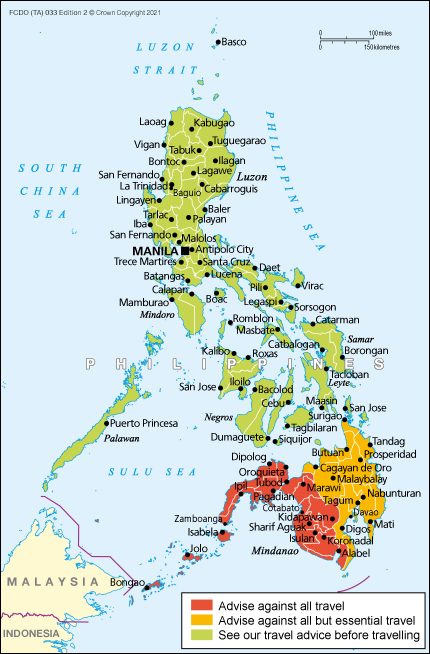
Mindanao and the Sulu archipelago
FCDO advises against all travel to western and central Mindanao and the Sulu archipelago.
FCDO also advises against all but essential travel to the remainder of Mindanao, except for:
- Camiguin Island
- Dinagat Island
- Siargao Island
This advice is due to terrorist activity and clashes between the military and insurgent groups in south Philippines.
Find out more about why FCDO advises against travel.
Typhoons
Around 20 typhoons hit the Philippines each year. Most typhoons happen between June and November. Follow the advice of local authorities, and monitor the progress of storms on the Philippines state weather agency and the Philippines Disaster Risk Reduction and Management Council. You can find updates on typhoon2000.ph, or follow @Typhoon2k on X.
Global travel impacts due to escalation in the Middle East
Escalation in the Middle East has caused widespread travel disruption, including airspace closures, delayed and cancelled flights.
Commercial options to depart the Philippines remain available, but your travel plans may be affected, even if your destination is not in the Middle East. Before you travel:
- check travel advice for any countries or territories you are transiting through
- check for the latest updates from your airline or tour operator
- review your travel insurance policy for coverage
- monitor local and international media for the latest information and sign up for travel advice email alerts
Demonstrations
Large-scale demonstrations are expected over the coming weeks in Metro Manila and elsewhere in the Philippines.
Avoid all demonstrations and large gatherings and follow the advice of local authorities. Demonstrations may lead to travel disruption. You should allow extra time for journeys and monitor local media for updates.
See Safety and security for more information on demonstrations and rallies in the Philippines.
Before you travel
No travel can be guaranteed safe. Read all the advice in this guide. You may also find it helpful to:
- see general advice for women travellers
- read our guide on disability and travel abroad
- see general advice for LGBT+ travellers
- read about safety for solo and independent travel
- see advice on volunteering and adventure travel abroad
Travel insurance
If you choose to travel, research your destinations and get appropriate travel insurance. Insurance should cover your itinerary, planned activities and expenses in an emergency.
About FCDO travel advice
FCDO provides advice about risks of travel to help you make informed decisions. Find out more about FCDO travel advice.
Get travel advice updates
Sign up to get email notifications when this travel advice is updated.
Follow FCDO: