Egypt
Subscriptions
Warnings and insurance
Your travel insurance could be invalidated if you travel against advice from the Foreign, Commonwealth & Development Office (FCDO).
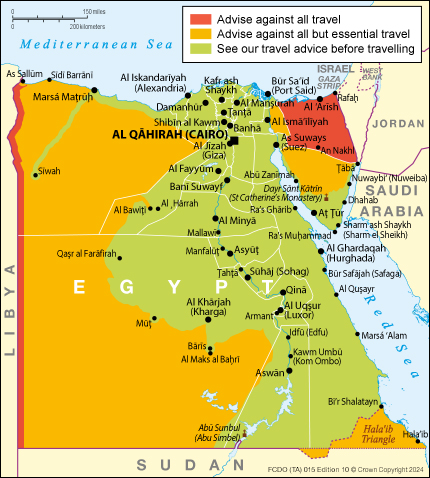
Areas where FCDO advises against travel
Egypt-Libya border
FCDO advises against all travel to within 20km of the Egypt-Libya border, except for the town of El Salloum, where we advise against all but essential travel.
North Sinai
FCDO advises against all travel to the North Sinai Governorate.
Northern part of South Sinai
FCDO advises against all but essential travel to the northern part of the South Sinai Governorate, beyond the St Catherine-Nuweibaa road, except for the coastal areas along the west and east of the peninsula.
Eastern part of Ismailiyah Governorate
FCDO advises against all but essential travel to the Ismailiyah Governorate east of the Suez Canal.
Western Desert
FCDO advises against all but essential travel to the area west of the Nile Valley and Nile Delta regions, except for:
- Luxor, Qina, Aswan, Abu Simbel and the Valley of the Kings
- the Faiyum Governorate
- the coastal areas between the Nile Delta and Marsa Matruh
- the Marsa Matruh-Siwa road
- the oasis town of Siwa
- the Giza Governorate north-east of the Bahariya Oasis
- the White Desert and Black Desert
- the oasis towns of Bahariya, Farafra, Dakhla (Mut) and Kharga
- the following roads and the desert area between them and the Nile valley:
- the road between Giza and Farafra and within 50km either side of this road (but FCDO advises against all but essential travel on the road between Bahariya and Siwa)
- the road between Farafra, Dakhla (Mut) and Kharga
- the road between Kharga and Baris
- the road between Baris and Luxor
Hala’ib Triangle and Bir Tawil Trapezoid
FCDO advises against all but essential travel to the Hala’ib Triangle and the Bir Tawil Trapezoid.
Find out more about why FCDO advises against travel.
Regional tensions
The US and Iran announced a memorandum of understanding (MOU) on 17 June in relation to the conflict in the Middle East, however the situation in the region remains unpredictable. Before the ceasefire, the Iranian regime had stated its intention to target locations associated with the US and Israel, including organisations, businesses, facilities, and institutions.
Since 8 July there have been strikes and retaliatory attacks in a number of locations across the region against US military and civilian infrastructure. There is a risk of more attacks and unforeseen escalation in the region. On 29 July, an apparent drone strike and fire caused damage to two ships moored off Damietta, in northern Egypt.
Conflict in Israel and Palestine
International borders in Israel and Palestine could close at short notice, including the Taba border crossing between Israel and Egypt. Check with local authorities and read Israel travel advice and Palestine travel advice before trying to cross.
Entering Egypt from Gaza
The Rafah border crossing is currently closed. When re-opened, Israel, Egypt and the authorities in Gaza may determine procedures for who is permitted to cross and when.
If you are a British national in Gaza who wants to leave Gaza, see Israel travel advice and Palestine travel advice.
Concern for friends and family
If you are concerned about friends or family, or need support from the UK government, call the British Embassy in Cairo.
Telephone: + 20 (0)2 2791 6000
If you have technical difficulties using this number, call +44 1767 667 600 (UK number).
Before you travel
No travel can be guaranteed safe. Read all the advice in this guide. You may also find it helpful to:
- see general advice for women travellers
- read our guide on disability and travel abroad
- see general advice for LGBT+ travellers
- read about safety for solo and independent travel
- see advice on volunteering and adventure travel abroad
Travel insurance
If you choose to travel, research your destinations and get appropriate travel insurance. Insurance should cover your itinerary, planned activities and expenses in an emergency.
About FCDO travel advice
FCDO provides advice about risks of travel to help you make informed decisions. Find out more about FCDO travel advice.
Get travel advice updates
Sign up to get email notifications when this travel advice is updated.
Follow FCDO: