MHRA Safety Roundup: May 2026
Summary of the latest safety advice for medicines and medical device users
To subscribe to monthly email alerts of MHRA Safety Roundup visit our sign up page
Download Document
Please access the PDF version of our Safety Roundup for our easy-read template and QR codes to access the full articles.
Nasal decongestant sprays and drops containing xylometazoline hydrochloride / oxymetazoline hydrochloride: increased risk of rebound congestion, rhinitis medicamentosa, and tachyphylaxis with overuse
Drug Safety Update
Summary
There have been reports of worsening nasal congestion (rebound congestion) when the effects of nasal decongestant sprays or drops containing xylometazoline hydrochloride and oxymetazoline hydrochloride, referred to hereafter as ‘xylometazoline’ and ‘oxymetazoline’, wear off. This typically occurs when these medicines are used for longer than recommended. Continued use can also lead to more serious and longer-lasting changes to the lining and structures of the nose (rhinitis medicamentosa). In addition, repeated use will result in a rapid and noticeable reduction in the medicine’s effectiveness (tachyphylaxis).
Patients and caregivers should be informed not to exceed the recommended dose and not to use for more than 5 consecutive days. Continuous use of these medicines for more than 5 days can lead to an increased risk of side effects. Medical advice should be sought if symptoms of nasal congestion persist, worsen or do not improve after 5 days, as alternative treatment may be required.
Key Advice for Healthcare Professionals:
- rebound congestion, rhinitis medicamentosa, and tachyphylaxis through overuse are recognised side effects with nasal sprays and drops containing xylometazoline or oxymetazoline when used beyond the maximum recommended duration
- patients may mistakenly interpret a rebound congestion effect as a continuation of the original congestion when it is a response to prolonged use of the product
- advise patients and their caregivers that xylometazoline and oxymetazoline are for short term use only and advise against prolonged or extended use beyond 5 days
- advise patients and their caregivers not to exceed the daily recommended dose and to take note of the minimum dosing interval stated in the product information
- if the symptoms of nasal congestion persist, worsen or do not improve after 5 days, alternative treatment may be required
- patients experiencing rebound congestion or related side effects may feel the need to continue using the products, leading to a cycle of overuse. Opportunistically review patients who may have become reliant on using these products and advise them on how to gradually stop using these medications. Stopping abruptly can worsen symptoms, but patients typically recover within 3 months with early recognition and treatment
- rhinitis medicamentosa is the most serious of these reported effects and is associated with persistent nasal congestion and longer-lasting changes to the nasal mucosa or structures of the nose. Symptoms may not resolve quickly after stopping the decongestant and, in severe cases, may require surgical intervention. Look out for patients presenting with severe nasal congestion and visible changes to the nasal mucosa or other internal nasal structures. Associated symptoms may include nasal irritation or itching, sneezing, and a runny nose. Management may require a tailored treatment plan, including gradual withdrawal of the decongestant, use of alternative therapies, and clinical follow-up to monitor recovery
- use of the nasal sprays or drops containing xylometazoline or oxymetazoline is contraindicated in patients who are taking other oral and nasal forms of sympathomimetic decongestants
- the product information will be transitioning over the next few months towards strengthened warnings regarding these side effects and to advise that they should not be used for more than 5 days
- report suspected adverse drug reactions associated with xylometazoline and oxymetazoline on a Yellow Card
Key Advice for Healthcare Professionals to Provide to Patients:
- nasal sprays and drops containing xylometazoline and oxymetazoline are used to help clear a blocked nose, caused by cold, flu and allergies
- you can buy these medicines in shops and pharmacies without needing a prescription
- only use these medicines for a short time and to help with your symptoms. You should follow the instructions for use in the Patient Information Leaflet and package labelling which comes with the medicine and to not exceed the daily recommended dose and to take note of the minimum time interval between doses
- do not use these medicines for more than 5 consecutive days
- if you use these medicines for longer than the recommended duration, your nose may become blocked again, and you may get other problems such as runny nose, sneezing, itching and irritation on the inside of the nose or your body can stop responding to the medicine
- these side effects may make you feel like you need to keep using the medication to manage your symptoms – talk to a healthcare professional if you are having trouble stopping the medication, or are using for longer or more than recommended
- contact your doctor if your symptoms worsen or you do not feel better after 5 days, as you may need a different treatment
- do not use xylometazoline or oxymetazoline together or with other oral and nasal forms of medicines used to treat a blocked nose, such as pseudoephedrine, phenylephrine or ephedrine
- it is important to read the Patient Information Leaflet that comes with your medicine and information on the outer packaging and to talk to a healthcare professional if you experience side effects
- report suspected side effects associated with xylometazoline and oxymetazoline on a Yellow Card
Finasteride and Dutasteride – updated safety warnings for psychiatric side effects and sexual dysfunction
Drug Safety Update
Summary
The MHRA has reviewed the evidence for finasteride and dutasteride and the risk of suicidal thoughts and behaviours and has recommended further measures to minimise this risk. The product information for finasteride and dutasteride containing medicines is being updated to provide more information on these side effects. The UK Finasteride patient cards, already introduced in 2024, highlight the risks of psychiatric and sexual side effects.
Key Advice for Healthcare Professionals:
- finasteride is associated with depression, suicidal ideation and sexual dysfunction which may persist after treatment is stopped
- inform patients of the risks at point of prescribing and advise patients to read the Finasteride patient cards and the patient leaflet for finasteride which are both supplied in the 1 mg and 5 mg packs
- the product information for finasteride 1 mg will be updated with a warning that sexual dysfunction may contribute to mood disorders, and that sexual dysfunction has also been reported without mood alterations
- when prescribing finasteride, review their medical record, ask patients if they have a history of depression or suicidal ideation and review patients regularly for psychiatric and/or sexual side effects
- patients prescribed finasteride 1 mg should stop taking the medicine if they develop suicidal thoughts or depression and contact their healthcare professional as soon as possible
- patients prescribed finasteride 5mg or dutasteride should consult their healthcare professional as soon as possible if they develop suicidal thoughts or depression
- dutasteride works in a similar way to finasteride – therefore, as a precaution, a warning will be added to the dutasteride product information that mood alterations have been reported with the same class of medicine (finasteride)
- patients prescribed finasteride or dutasteride should contact their healthcare professional if they experience sexual dysfunction
- report suspected adverse drug reactions associated with finasteride or dutasteride using the Yellow Card scheme
Key Advice for Healthcare Professionals to Provide to Patients:
- finasteride is associated with low mood, depression, suicidal thoughts and sexual dysfunction (decreased sex drive, erectile dysfunction and ejaculation disorders)
- before taking finasteride, read and keep the Finasteride patient cards and patient information leaflet within your pack and inform your doctor if you have any personal history of depression or suicidal thoughts
- if you have seriously harmed yourself or feel you are at risk of serious harm, contact emergency services on 999 immediately
- stop finasteride 1mg immediately if you develop depression or suicidal thoughts and contact your doctor as soon as possible
- if you are prescribed finasteride 5mg or dutasteride and you develop depression or suicidal thoughts, contact your doctor as soon as possible
- if prescribed finasteride or dutasteride and you experience decreased sex drive, difficulty having an erection or ejaculation problems you should contact your doctor for medical advice
Kimal Procedure Packs containing recalled components: Namic Angiographic Syringe with the risk of syringe disconnection; Namic Manifolds with the risk of foreign particulates. Important guidance for use in urgent procedures where there are no alternatives (DSI/2026/002)
Device Safety Information
Summary
The Namic Angiographic Control Syringes with RA (‘Namic RA syringes’), and the Namic White Star Off Handle Manifold (‘Namic White Star Manifolds’) are components supplied in certain Kimal procedure packs distributed in the UK and used by healthcare professionals in the UK primarily for diagnostic and interventional cardiology and radiology procedures.
Since April 2026, Medline International France and Kimal PLC have identified potential safety issues with these devices and have issued field safety notices to all affected hospitals in the UK advising that they should not be used except in urgent procedures where there are no alternatives.
The rotating adaptor in affected Namic syringes may unscrew (become loose) during use, due to a manufacturing issue that causes a loose connection and/or full disconnection between the syringe and the manifold.
There may be a risk of foreign particulates within the fluid pathway of affected Namic Manifolds.
Replacement Namic Manifolds are expected to be available from June 2026 onwards, but this is not guaranteed. Healthcare professionals who consider continued use of the impacted products within the Kimal procedure packs necessary should carefully assess and implement the following risk mitigation measures when using the impacted products.
Key Advice for Healthcare Professionals:
- identify whether your site uses Kimal procedure packs containing the Namic RA syringes and/or Namic Manifolds primarily for diagnostic or interventional cardiology or radiology procedures
- check your stock and identify any affected products
- as outlined in FSN 2026/004/017/601/048 and FSN 2026/004/017/601/053, apply the provided over-labels to the identified procedure packs. Customers must follow the instructions within the FSNs to obtain the labels from the manufacturer. The labels state that affected syringes and manifolds must be removed and discarded from further use
- remove and destroy all affected products unless there is no alternative and the use is unavoidable
- in urgent procedures, where the use of the Namic RA syringe and Namic manifold is required for a specific procedure, where there are no alternative devices available, and delaying the procedure would place the patient at significantly increased risk, the use of these devices may be considered as a last resort
- ensure systems are in place for healthcare professionals to undertake the following actions
For Namic RA syringe:
In urgent procedures where the use of affected syringes is required, where no alternative device is available, use the Namic RA syringe with caution and vigilance and follow the manufacturer’s instructions below:
- perform manual stabilisation of syringe-to-manifold connections and continuous monitoring during setup and throughout the entire procedure to ensure the connections are secure
- all connections should be finger tightened. However, be careful not to over-tighten as this can cause cracks and leaks to occur
- verify that there is no leakage by aspirating, and checking to see that air is not entering the system
- examine the device carefully for entrapped air and fully de-bubble prior to injection
If the Namic RA syringe unscrews and causes a loose connection or disconnects during procedural setup or during the procedure, follow the additional instructions provided in FSN 2026/004/017/601/048.
For Namic White Star handle manifold:
In urgent procedures, the use of the Namic Manifold may be considered as a last resort. In those cases, undertake the steps listed to flush out the Namic Manifold and associated tubing prior to use:
(i) ensure additional packs of kits are available for the procedure, to allow for replacements, in the event that a defective manifold is identified
(ii) prior to use, completely disconnect the manifold from all tubing, lines, and accessories so it is fully separated
(iii) flush sterile saline through each port and stopcock of the manifold, one at a time, allowing the fluid to drain into a separate sterile container
(iv) visually inspect the fluid in the container for signs of particulate matter
(v) dispose of all flushed fluid and the container as clinical waste
(vi) once completed, proceed with full procedural set-up in accordance with standard practice
- inspection of manifolds should be undertaken in line with the local procedures and appropriate environmental conditions. Where particulate matter is observed during inspection, discard and replace the manifold
- document the justifications for use of the affected Namic manifold in the patient’s medical records
- a specific recommended flushing procedure has not been validated by Medline. However, the above-mentioned flushing recommendations are intended as a risk mitigation step, and have been agreed by stakeholders including NHSE National Clinical Directors and Specialty advisors. Healthcare organisations should note there is no evidence that the residual risk will be completely eliminated, even if the above flush recommendations are undertaken
- ensure that your organisation’s risk register is updated to reflect the need for ongoing use of the manifolds/syringes, if no alternative measures are available
- report any cases of syringe unscrewing or visible particulate with the manifold through the Yellow Card system, or if in Scotland through the Incident Reporting & Investigation Centre (IRIC)
Key Advice for Healthcare Professionals to Provide to Patients:
- ensure patients and/or relatives are informed of the potential risk and consent is documented in accordance with GMC professional standards
Risk of severe harm from use of incorrect giving (administration) set for blood transfusion (DSI/2026/003)
Device Safety Information
Summary
There is a potential for serious harm to patients if an intravenous (IV) infusion giving set is used instead of a blood transfusion giving set to deliver a transfusion of blood or blood components. Use of an IV infusion giving set instead of a blood transfusion giving set may result in under-infusion of blood or destruction of red blood cells (haemolysis) which can lead to serious patient injury.
Key Advice for Healthcare Professionals:
Advice for coordinators:
- ensure staff who may carry out IV therapy and transfusions and non-clinical staff who handle the sets can identify the differences between IV infusion and blood transfusion giving sets
- ensure blood transfusion giving sets are stored in clearly labelled containers, in their original packaging, separate from IV infusion giving sets to prevent selection of the wrong type
Advice for individual healthcare professionals:
- always use a blood transfusion giving set for a blood transfusion
- be aware that using an IV infusion giving set for a blood transfusion can result in under-infusion of blood or haemolysis with potentially serious consequences for the patient
How to identify a blood transfusion giving set:

- blood transfusion giving sets (see image 1) contain a large filter (pore size ~170-200 µm). This is to allow larger blood components to pass through. Note: some blood transfusion giving sets have 2 chambers
- IV infusion giving sets (see image 2) contain a very small filter (pore size ~15 µm) to remove particulate matter
- if you cannot see a filter, check the packaging to ensure that you are using the correct type of set
- the packaging of a blood transfusion giving set should include the following:
- an indication that the product is for blood transfusion
- filter size ~170-200µm (whereas for an IV infusion it is ~15µm). The size of filter may be denoted using the below graphic
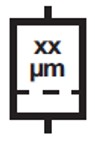
- be aware that manufacturers have not all used the same colour coding for packaging and giving set components to denote between sets for IV infusion and sets for blood transfusion. It is important users check that they have selected the correct set prior to use
Before starting a transfusion of blood or blood components:
- check that you are using a blood transfusion giving set
- check that the pump settings (if used) are correct
- a pre-transfusion checklist such as the Serious Hazards of Transfusion (SHOT) Transfusion checklist should be completed prior to starting a transfusion as recommended in 2017 through CAS alert CEM/COM/2017/005
Key Advice for Healthcare Professionals to Provide to Patients:
- Serious Hazards of Transfusion (SHOT) have developed resources for patients including the My Transfusion app which provides useful information for patients who are likely to receive a blood transfusion
Allurion Gastric Balloon: Updated safety information due to the risks of gastric outlet obstruction, small bowel obstruction and gastric perforation (DSI/2026/004)
Device Safety Information
Summary
In rare instances, the Allurion Gastric Balloon has not transited through the stomach or bowel as intended, leading to complications such as gastric outlet obstruction, small bowel obstruction and gastric perforation. Prompt medical intervention is essential to manage these complications.
Allurion Technologies Inc. have updated documentation with new safety information. Field Safety Notice (FSN-01-2026) provides further details and should be read in conjunction with this Device Safety Information (DSI).
Key Advice for Healthcare Professionals:
- remain vigilant and inform patients of the signs and symptoms of gastric outlet obstruction, small bowel obstruction and gastric perforation associated with the Allurion Gastric Balloon
- act promptly to prevent serious complications, including early referral or review for symptomatic patients
- familiarise yourself with the new safety information and materials as described in FSN-01-2026
- a Patient Information Card should be completed at the initial appointment and given to the patient at the time of device placement
- essential product and safety information can be accessed in the Physician Guidance Document. This document is available through the Allurion mobile app, the QR code on the Patient Information Card or the link in Table 1 below
- ensure any device that has not performed as intended and/or is involved in an adverse event is returned to Allurion Technologies Inc. for evaluation. Please report details of the event to Allurion Technologies Inc. at FSN@allurion.com and the MHRA via the Yellow Card Scheme
Key Advice for Healthcare Professionals to Provide to Patients:
- seek medical attention immediately if you experience symptoms such as severe or persistent abdominal pain, vomiting, nausea, swollen abdomen, or breathing difficulty, as these could be symptoms of gastric outlet obstruction, small bowel obstruction or gastric perforation
- always carry your Patient Information Card with you. Show it to any healthcare professional who treats you, especially if you are at a different hospital from where the device was placed and you feel unwell
- if you experience any side effects or issue with your balloon, don’t throw it away when it has passed and ensure that you return it to your healthcare professional
- if you suspect that you’ve had a side effect related to the Allurion Gastric Balloon report it to the MHRA via the Yellow Card website
Letters, medicines recalls and device notifications sent to healthcare professionals in May 2026
Direct Healthcare Professional Communications
We received notification that the following Direct Healthcare Professional Communications were sent or provided to relevant healthcare professionals in May 2026:
- . Sent to relevant stakeholders in April 2026
- . Sent to relevant stakeholders in April 2026
Medicine Recalls and Notifications
In May 2026, recalls and notifications for medicines were issued on:
Class 4 Medicines Defect Notification: Fresenius Medical Care Deutschland GmbH, balance 2.3% glucose, 1.25 mmol/l calcium, solution for peritoneal dialysis, EL(26)A/24. Issued 14 May 2026.
Fresenius Medical Care Deutschland GmbH have identified an error in the Braille printed on the outer label.
Class 4 Medicines Defect Notification: Milpharm Limited, Loperamide hydrochloride 2 mg Orodispersible Tablets, EL(26)A/23. Issued 11 May 2026.
Milpharm Limited has identified a discrepancy in the Patient Information Leaflet (PIL) approved for Loperamide hydrochloride 2 mg Orodispersible Tablets.
Medical Device Field Safety Notices
Find recently published Field Safety Notices
Report suspected drug reactions and device incidents on a Yellow Card
Please continue to report suspected adverse drug reactions and device incidents. Your report will help us safeguard public health.
When reporting, please provide as much information as possible, including information about medical history, any concomitant medication, onset timing, treatment dates and particularly if a side effect continued or started after treatment was stopped.
Report a medicine
Healthcare professionals should report via a Yellow Card to:
- the Yellow Card website
- the Yellow Card app; download from the Apple App Store or Google Play Store
- some clinical IT systems for healthcare professionals (EMIS, SystmOne, Vision, MiDatabank, and Ulysses)
Reporting for medical devices
Healthcare professionals should report incidents:
- in England and Wales to the Yellow Card website or via the Yellow Card app
- in Scotland to Incident Reporting & Investigation Centre (IRIC) and their local incident recording system
- in Northern Ireland to the Yellow Card website in accordance with your organisation’s medical device policies and procedures
Reporting for patients
Patients should report via a Yellow Card to:
- the Yellow Card website
- the Yellow Card app; download from the Apple App Store or Google Play Store
News Roundup
Dostarlimab (Jemperli▼) and immune-related skin adverse reactions: updates to the product information
Dostarlimab is indicated for certain types of endometrial cancer. Following a review of available data, the Summary of Product Characteristics (SmPC) for dostarlimab has been updated to recognise Stevens-Johnson syndrome (SJS) as an adverse reaction and update the warning on immune-related skin adverse reactions. The Patient Information Leaflet (PIL) was also updated.
Patients should be advised of the signs and symptoms of severe cutaneous adverse reactions (SCARs) and to seek medical advice immediately if any occur. Additionally, all prescribers of dostarlimab are reminded that there is a Patient Card which should be provided to each patient. For more details and the full indications, please refer to the SmPC for dostarlimab.
Healthcare professionals are also reminded that immune checkpoint inhibitors such as dostarlimab are associated with immune-mediated adverse reactions affecting various organs. Patients should be monitored for the signs and symptoms of serious reactions as described in the SmPC for each product, which can be found on the MHRA website.
BNF and BNFC updated guidance on medicines that cause drowsiness to help prevent co-sleeping deaths
The National Child Mortality Database (NCMD) has received reports that co-sleeping with a child while under the effects of medication that causes drowsiness can increase the risk of sudden infant death syndrome. The BNF and BNFC have consequently updated their guidance to highlight the risks of co-sleeping within the advice for cautionary and advisory label 2 – “Warning: This medicine may make you sleepy. If this happens, do not drive or use tools or machines. Do not drink alcohol.”
The following statement, which incorporates feedback from the NCMD, was added to BNF and BNFC:
“Patients who are parents or carers of babies aged up to 12 months should be counselled on the risks of co-sleeping (sleeping with a baby on a bed, sofa, chair, etc.); for further information on safer sleeping and co-sleeping, see the Lullaby Trust at https://www.lullabytrust.org.uk/baby-safety/safer-sleep-information/co-sleeping”.
This means that when a pharmacist dispenses medication that may cause drowsiness they can check with the person receiving the medication whether they care for babies under the age of 12 months and if they do, they can share the safe sleeping message.
To subscribe to monthly email alerts of MHRA Safety Roundup visit our sign up page
For any enquiries, please contact info@mhra.gov.uk