What veterinary businesses and vets need to do following the CMA’s final vets report
What veterinary businesses and veterinary professionals need to know now that the Competition and Markets Authority (CMA) has published the final report of its vet services market investigation.
The Competition and Markets Authority has been looking into the veterinary services market since September 2023. We have now published our final report which includes requirements for veterinary businesses (these are called ‘remedies’).
This page explains the parts of our decision that are most relevant to veterinary businesses and veterinary professionals, and when you may need to make changes.
Summary of changes
The remedies are grouped into 6 categories.
- Providing general information on ownership, prices and services: information to support pet owners when choosing a FOP
- Providing information and policies on treatments: information to support pet owners when considering treatments in the practice
- Prescribing veterinary medicines: information and processes to increase competition in the supply of medicines
- Managing out-of-hours contracts: restrictions on contract terms for third party out-of-hours suppliers, to make it easier for FOPs to switch
- Offering cremation services: information to support choice of service after the death of the pet and provision of a basic communal cremation
- Managing complaints: supporting a good complaints process
Who this applies to
Our remedies mainly apply to veterinary businesses operating one or more first opinion practices (FOPs) to the extent that they are providing veterinary services for household pets, but some also apply to referral centres, out-of-hours providers, and crematoria.
Our remedies will not apply to charitable organisations providing small animal veterinary services.
They do not directly apply to the veterinary professionals employed at vet practices. As an employee you will, however, see changes that may impact your work. For example, you may be required to provide additional information to pet owners during consultations about treatment costs or options for buying medicines.
The veterinary business where you work will need to have written policies and processes to ensure that vets and vet nurses are able to act in line with relevant parts of the RCVS Codes and Guidance (for example, those on providing pet owners with independent and impartial advice, and appropriate and timely information about treatment options and prices). This might include additional training on communications with pet owners.
If veterinary businesses fail to adhere to such policies or put pressure on vets to act in certain ways or sell certain treatments, they could potentially be in breach of the Order. Find out what happens if a veterinary business does not comply with the Order.
When you need to make changes
The time to comply with these requirements varies by remedy and size of business, with smaller businesses (those with fewer than 15 FOPs) generally having more time than larger businesses (those with 15 FOPs or more).
Our timetable provides a simple overview of when you need to make the changes.
What happens next: veterinary businesses must make changes
Veterinary businesses must now start to make changes. We have published a legal document setting out the detail of the requirements. We call this document a CMA Order. The Order makes the remedies legally binding for the businesses to which it applies. See our descriptions of the remedies to check if a remedy applies to your veterinary business.
The time available to implement changes varies by requirement and size of the veterinary business. We have set out these timings with the description of each remedy.
Funding Order
To fund its new role, the RCVS will charge a levy to veterinary businesses. The levy you need to pay is set out in the Veterinary Services Market Investigation (Funding) Order 2026 and depends on the number of FOPs (including outsourced out-of-hours service providers) you own.
What happens if a veterinary business does not comply with the Order?
If a veterinary business does not comply with its obligations, the CMA could:
-
work with a business to change its practices to stop the breach
-
issue a binding set of instructions (‘directions’) requiring the business to take steps to comply with the Order
-
impose a financial penalty on the business for breaching the Order
Information for other stakeholders
This page summarises the actions for veterinary businesses. There are further remedies for other stakeholders.
The RCVS, government and the VMD
Remedies that apply to the RCVS and our recommendations to government are summarised in part B section 1 of our report.
We require the RCVS to take specific actions. These are mainly actions that we are requiring of the RCVS or recommending to the RCVS to support the package of remedies we are imposing on veterinary businesses. We are also requiring the RCVS to monitor veterinary businesses’ compliance with our remedies. The CMA, not the RCVS, will be responsible for enforcing against any non-compliance with the Order.
We also set out recommendations to government to modernise the regulatory framework and to expand its scope so it also applies to veterinary businesses.
Animal charities
Charitable organisations providing small animal veterinary services will not need to comply with our requirements. Those organisations do not generally offer services that are made available to all pet owners and hence they do not compete with commercial veterinary businesses.
We would expect such charities to conduct themselves in a manner consistent with the obligations in the Order. That would include, for example, having robust complaint and redress procedures. It would also mean, to the extent that such charities require payment for the veterinary services they provide, making pet owners aware of the possible savings from obtaining medicines online and setting prescription fees at or below the level of the prescription fee caps.
Providing general information on ownership, prices and services
These are requirements that will improve transparency so that pet owners can easily compare practices, services and prices, in particular when they are choosing a FOP.
Transparent ownership
All veterinary businesses operating more than one FOP, or a combination of one or more FOPs, online pharmacies and other veterinary services, must clearly display ownership information online, in signage, on premises and communications.
Providing information on services and prices
All veterinary businesses operating one or more FOP must:
-
publish clear and accessible information about out-of-hours provision, qualifications and accreditations online and in premises
-
publish price lists for a defined list of services online and in premises
-
publish prices for commonly sold flea, tick and worm products and provide a link to the VMD Register of Online Retailers
-
provide a clear explanation of what is included in pet care plans (if offered) and the prices of items when bought outside the plan
-
share key practice information (including prices) with the RCVS for publication via an enhanced Find a Vet platform and for sharing with approved third parties
Timing
| Date | Action |
|---|---|
| September 2026 | Order made and undertakings accepted |
| December 2026 | Larger businesses need to comply |
| March 2027 | Smaller businesses to comply, and groups to comply with ownership transparency |
| June 2027 | RCVS to comply with requirement to modify Find a Vet and be ready to accept data |
| September 2027 | Businesses to provide data to RCVS |
There are 6 remedies in this category:
- 1. Ownership information
- 2a. Basic service information
- 2b: Standard price list
- 2c: Parasiticides price list
- 2d: Pet care plan information
- 3: Practice comparison remedy
The full information on this set of remedies can be found in Part B, Section 3 of our final report.
Remedy 1: Ownership information
This remedy applies to:
Groups of veterinary businesses operating one or more FOPs, or any combination of FOPs, online pharmacies, referral centres, out-of-hours practices, animal hospitals, diagnostic laboratories and pet crematoria.
What you need to do
The identity of the group must be clearly and prominently identified on websites and other online data, in premises, external signage and in communications. This obligation will apply across all business models and services, including in respect of any FOPs, online pharmacies, referral centres, out-of-hours practices and related services in your group of veterinary businesses.
When you need to do this by
6 months for all businesses (from when the CMA Order is in place).
Back to remedies in this category
Remedy 2a: Basic service information
This remedy applies to:
Veterinary businesses operating one or more FOPs (including services offered in an out-of-hours premises) or referral centres.
What you need to do
You must publish clear, accessible, prominent information about your services to support informed decision making by pet owners, including information regarding:
-
your out-of-hours care: where the out-of-hours service is outsourced, the identity of the out-of-hours provider, their telephone number(s), premises and web addresses, and information about when the provider is available and the nature of the service provided
-
qualifications held by practice staff, including any RCVS professional accreditations (these can be anonymised)
-
any current PSS (Practice Standards Scheme) awards and accreditations (including a link to RCVS supporting information for pet owners about the PSS)
You will need to provide copies of this in practice if requested.
When you need to do this by
3 months for larger businesses, 6 months for smaller ones (from when the CMA Order is in place).
Back to remedies in this category
Remedy 2b: Standard price list
This remedy applies to:
Veterinary businesses operating one or more FOPs (including services offered in an out-of-hours premises) or referral centres, and crematoria.
What you need to do
You must publish clear, standard price lists for a defined set of services you offer.
When you need to do this by
3 months for larger businesses, 6 months for smaller ones (from when the CMA Order is in place).
Additional information
Prices will need to be:
-
on the practice website (if you have one), a maximum of one click from the homepage without scrolling, and easily identifiable by using ‘price’, ‘pricing’ or ‘fees’ in page navigation information and page metadata, and displayed in a prominent, legible format
-
on in-practice materials, such as posters or leaflets, which should be prominently visible in the reception or waiting area, available to prospective customers visiting the practice without an appointment, and displayed in a prominent, legible format
-
when booking an appointment, any digital communication confirming the booking should contain price information for the consultation fee and any pre-booked standard treatments, plus a direct link to the price list on the website
The price list should include all of the services in the table below, if they are offered by the vet practice (or by third parties for out-of-hours consultations and cremations). There is no requirement to list prices for services you do not offer. All prices should include VAT. There should not be additional text included in the price list itself, but supplementary information about the services and how they are delivered can be included elsewhere on the website.
Consultation and preventative care
| Service | Notes |
|---|---|
| First consultation | Include standard appointment duration (minutes) |
| Repeat consultation | - |
| Out-of-hours consultation | Include third-party provider name (if used) and link to their website |
| Nurse consultation | Include standard appointment duration (minutes) |
| Nail clipping | - |
| Anal gland expression | - |
| Microchipping | - |
| Animal health certificate | Include any relevant charges for additional animals included |
| Primary vaccination course (with consultation) | - |
| Booster vaccination (with consultation) | - |
| Kennel cough vaccination (with consultation) | - |
| Pet care plan (monthly) | Include link to plan details |
Prescriptions, dispensing and administration
| Service | Notes |
|---|---|
| Prescription fee | Fee for the primary prescription (this will be capped at £21) |
| Additional items prescribed | Fee for any additional medications prescribed at the same consultation (this will be capped at £12.50) |
| Repeat prescription fee | - |
| Dispensing fee | - |
| Medicine administration fee | Injection into skin or muscle |
| Insurance administration fees | - |
Surgeries and treatments
| Service | Notes |
|---|---|
| Dental assessment (Initial examination of the mouth, scale and polish) | Standard checkboxes must be used to indicate whether the following elements are included in the price or will be charged separately: general anaesthesia, local anaesthesia, sedation, post-operative pain relief, hospitalisation and monitoring, pre-operative blood tests and post-operative check-ups |
| Castration | Standard checkboxes must be used to indicate whether the following elements are included in the price or will be charged separately: general anaesthesia, local anaesthesia, sedation, post-operative pain relief, hospitalisation and monitoring, pre-operative blood tests and post-operative check-ups |
| Spay – traditional/open | Standard checkboxes must be used to indicate whether the following elements are included in the price or will be charged separately: general anaesthesia, local anaesthesia, sedation, post-operative pain relief, hospitalisation and monitoring, pre-operative blood tests and post-operative check-ups |
| Spay – laparoscopic/keyhole | Standard checkboxes must be used to indicate whether the following elements are included in the price or will be charged separately: general anaesthesia, local anaesthesia, sedation, post-operative pain relief, hospitalisation and monitoring, pre-operative blood tests and post-operative check-ups |
| Physiotherapy session | - |
| Laser therapy session | - |
Diagnostics and laboratory tests (all diagnostics include interpretation)
| Service | Notes |
|---|---|
| X-ray | Includes sedation/general anaesthetic and 3 images |
| Abdominal ultrasound (single organ) | - |
| Echocardiogram | - |
| Cytology – ear swab | - |
| Cytology – fine needle aspiration | - |
| Basic urine screen | Including dipstick and measurement of specific gravity |
| CT scan (per body part) | Includes general anaesthetic and images |
| MRI scan (per body part) | Includes general anaesthetic and images |
| Pre-surgical/pre-anaesthetic blood test | - |
End-of-life care
| Service | Notes |
|---|---|
| Euthanasia | - |
| Cremation – communal | - |
| Cremation – individual | - |
Prices for the relevant treatments and services need to be provided in relation to 6 standardised pet characteristic and weight categories:
| Pet | Weight |
|---|---|
| Cat, small dog | <10kg |
| Medium dog | 10 to 25kg |
| Large dog | >25 to 40kg |
| Extra-large dog | >40 to 60kg |
| Giant dog | >60kg |
Where a FOP’s prices do not vary with pet characteristics (species or weight), the categories may be combined or consolidated.
For all the services and treatments on the list, the prices shown must be the typical prices a pet owner would pay at the relevant practice or provider. The prices must be based on a standard case with minimal complexity or complications. The prices need to be realistic, informative and easily understood for the owner of a typical animal in the relevant category, reflecting what they can reasonably expect to pay for the treatment or service. They should reflect the full price a pet owner would pay (including VAT). Where prices change, price lists must be updated before new prices are charged to pet owners.
Pet owners should be informed clearly via the price list that prices for any of the listed treatments or surgeries may be adjusted upwards in more complex or complicated cases.
Back to remedies in this category
Remedy 2c: Parasiticides price list
This remedy applies to:
Veterinary businesses operating one or more FOPs.
What you need to do
You must publish the prices of your most commonly sold flea, tick, and worming medicine products on your website, along with a prominent link to the VMD Register of Online Retailers. You must also make the same information available in practices.
When you need to do this by
3 months for larger businesses, 6 months for smaller ones (from when the CMA Order is in place).
Additional information
‘Most commonly sold’ pet parasiticide products are those for which your FOP sold at least 100 units in the previous 12 months. If there were fewer than 10 products meeting this threshold, you should list the top 10 parasiticide medicine products by sales in the previous 12 months. The listed prices must be for individual medicine products (with separate prices for products with different formulations, sizes and dosages).
Relevant businesses will need to review prescriptions generated over the last 12 months to identify the products to include on their price list.
The prices listed must be accurate and comprehensive. For each product they must include any charges, such as dispensing or administration fees, that are unavoidable when purchasing the product from the practice, and VAT. Where prices change, these must be reflected on the price list before new prices are charged.
The list must also include a prominent link to the VMD Register of Online Retailers.
You must include alongside the list a notice that pet owners should consult their vet about whether their pet needs parasiticide product(s), and if they do, that the vet will prescribe a specific medicine product based on their clinical judgement of what is best for the pet. You should prominently display this message alongside the price list, to make clear that it is a list of the prices charged where a medicine is prescribed, not a menu of options for the pet owner nor an exhaustive product range.
The price list must be clearly identifiable on your website and easily accessible. For example, the data must be provided in a downloadable file, a static table on the website or a searchable database. It must also be available in physical form in practices.
Back to remedies in this category
Remedy 2d: Pet care plan information
This remedy applies to:
Veterinary businesses operating one or more FOPs offering pet care plans.
What you need to do
You must publish clear, comprehensive information about the pet care plans you offer both online and in premises. This involves listing all included services, the relevant frequency of their provision and the standalone price of each, and details about parasiticides. You must explain how any claimed savings are calculated, enabling pet owners to assess whether a plan offers them value for money.
When you need to do this by
3 months for larger businesses, 6 months for smaller ones (from when the CMA Order is in place).
Additional information
Here is an illustration of what the information could look like for a typical FOP.
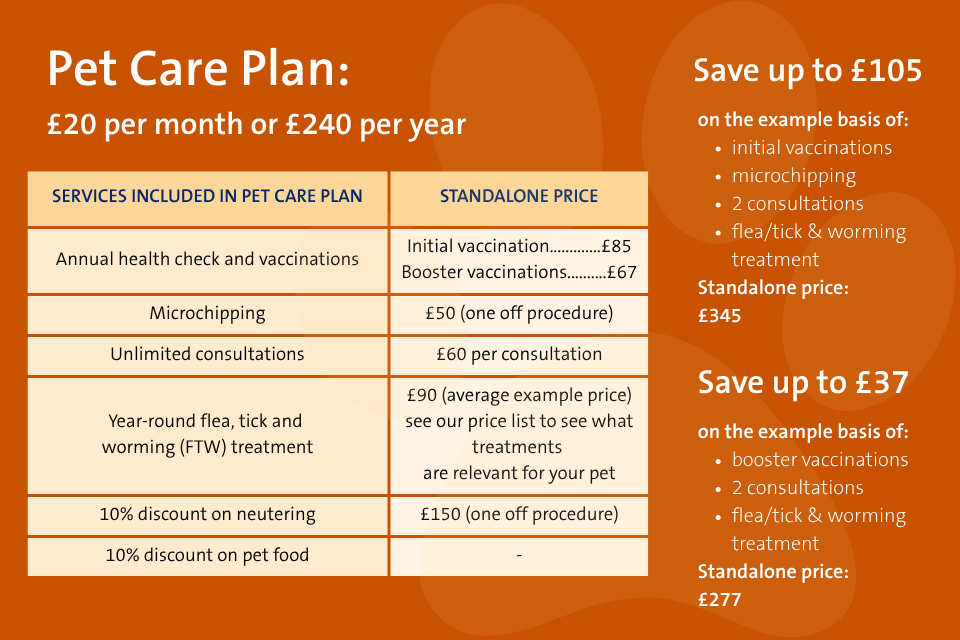
For each pet care plan you offer, you will need to publish on your webpage, and make available in premises:
-
a list of all services included in the plan, including free text with further information of what each service entails where that is not clear from the description of the service alone
-
the number of times each service can be accessed, including making clear when an included service is typically used just once in a pet’s lifetime
-
the time frame during which each service is available (for example per month, or per year)
-
the total price of the plan stated both as a monthly and annual rate
-
the standalone price for each service included
-
information on cancellation terms
In addition, where you include flea, tick and worming treatments (parasiticides) in a pet care plan, you will need to:
-
provide a link to your parasiticide product price list (as explained in ‘parasiticides price list (remedy 2c)’ above)
-
identify which parasiticides are included in the pet care plan or confirm that any parasiticides on the price list are included (subject to the vet’s recommendation)
-
include a message that pet owners should speak to their vet to understand which parasiticides, dosages and frequency are likely to be appropriate for their pet
Where you indicate that a pet owner could save money on a pet care plan in comparison to purchasing services separately, you will also need to:
-
indicate where savings relate to purchases that will only be required once during a pet’s lifetime (for example, neutering) and be clear about savings in later years
-
indicate to users how the savings were calculated, including in relation to parasiticides, making clear when in-house parasiticide prices (rather than ones obtainable at online pharmacies) are used in savings calculations
-
provide an indicative standalone price for a year of parasiticides
-
not include potential savings from discounts on optional products and services, such as pet food or neutering (although these could be highlighted separately)
-
where services are offered on an ‘unlimited’ basis (for example, an unlimited number of consultations), you should calculate savings using a reasonable estimate of the average usage and be clear how you have done this. If you cannot demonstrate the average number of consultations for people on pet care plans, your calculations must use no more than two consultations per year
Pet care plan pricing and standalone service pricing information needs to be updated when any prices change. You will also be required to send pet owners a reminder if annual pet care plans automatically renew.
Back to remedies in this category
Remedy 3: Supply data to RCVS to enable comparison between practices
This remedy applies to:
Veterinary businesses operating one or more FOPs or referral centres.
What you need to do
You will be required to submit key practice information to the RCVS through a web form. This includes information such as ownership, services offered, type of pets treated, pricing and pet care plan details. This includes all of the information set out in the other remedies in this category (remedies 2a, 2b, 2c and 2d).
The RCVS will use this to build an enhanced Find a Vet website. The RCVS will also be required to share this data with approved third parties, who might use it to offer a comparison site (subject to certain restrictions).
When you need to do this by
The RCVS has 9 months to prepare from when the CMA Order is in place, businesses will need to supply their data to the RCVS within 12 months (meaning a further 3 months).
Back to remedies in this category

Providing information and policies on treatments
About these remedies
Veterinary businesses will need to ensure that pet owners get the information and support they need when choosing treatments.
Written estimates
Veterinary businesses must provide pet owners with a written estimate to indicate the costs of the treatment(s) which are being recommended, when it is likely to be more than £500 (including VAT). This must be updated in writing when the cost is likely to increase by 20% or £500 (whichever is lower).
Find out more about this remedy
Itemised bills
Veterinary businesses must provide pet owners with an itemised bill.
Find out more about this remedy
Ensuring clinical freedom
Veterinary business must have policies and processes to ensure that veterinary professionals are able to act in accordance with relevant provisions of the RCVS Codes and Guidance.
Find out more about this remedy
Timing
| Time | Action |
|---|---|
| September 2026 | Order made |
| December 2026 | Large businesses put policies in place to ensure clinical freedom |
| March 2027 | Small businesses to ensure clinical freedom |
| June 2027 | Large businesses to provide written estimates and itemised bills |
| September 2027 | Small businesses to provide written estimates and itemised bills |
We have also recommended to the RCVS that it amends the Codes and Guidance to reflect the requirements to provide a written estimate and an itemised bill.
For more information about these remedies, go to part B, section 4 of our final report.
Remedy 4a: Provide written estimates
This remedy applies to
All veterinary businesses operating one or more FOP.
What you need to do
Give the pet owner a written estimate which indicates the reasonably likely costs of the treatment pathway which the veterinary professional, using their judgment and exercising reasonable care and skill, recommends, if those costs are reasonably likely to be £500 or more including VAT.
Give the pet owner a further written update if the total estimated cost of the treatment pathway is reasonably likely to increase by 20% or £500 including VAT (whichever is lower).
When you need to do this by
Large businesses have 9 months and smaller ones have 12 months (from when the Order is in place).
Additional information
The £500 threshold will be adjusted from time to time to take account of inflation, using the Consumer Price Index (CPI).
For treatments within a FOP, a treatment pathway means all diagnostic tests and/or treatments which a veterinary professional has already provided, and may provide, at the FOP, or for which they may make a referral to a professional within the same FOP, and which the professional recommends for the purpose of diagnosing and/or treating what they think the animal’s medical condition is reasonably likely to be.
It covers such tests and treatments for up to 12 months from the point at which the written estimate is provided and may encompass several stages of tests or treatment. It may cover one or more options for treating the pet, depending on what the veterinary professional judges the pet’s medical condition is reasonably likely to be.
The estimate can be given as a range or a specific figure, or a combination of the two. When giving a range, the vet should provide an indication of where in the range the cost is likely to be, and which factors would affect this.
When the treatment will be given outside the FOP (for example at a referral centre), the veterinary professional should give an estimate of the likely treatment costs to the best of their ability or an indication of what it would typically be expected to be.
The price indication that the business is required to give will depend on the circumstances. If, for example, the veterinary professional knows that the referral provider charges a fixed price for any diagnostic tests and/or treatments which are part of the treatment pathway, the written estimate must include these. In other cases, it must be an indication based on the relevant vet’s judgement and knowledge of the market. In these cases, the veterinary business which provides the written estimate will not be required to provide an update should the estimated costs increase.
Back to remedies in this category
Remedy 4b: Provide itemised bills
This remedy applies to
All veterinary businesses operating one or more FOP.
What you need to do
Give pet owners itemised bills for their pet’s treatment and other services they receive.
The itemised bills must, as a minimum, show:
- amounts relating to individual relevant medicinal products
- amounts relating to other goods and services provided by the business
- fees for outside services and any charge for additional administration or other costs to the business in arranging such services
The required information must be provided in a way that means pet owners understand what their bill covers. You will need to exercise your judgment to decide what level of descriptive detail is necessary for that purpose.
When you need to do this by
Larger businesses have 9 months and smaller ones have 12 months (from when the Order is in place).
Back to remedies in this category
Remedy 5: Ensure that veterinary professionals have clinical freedom
This remedy applies to
All veterinary businesses operating one or more FOP.
What you need to do
Have written policies and processes to ensure that vets and vet nurses are able to act in accordance with relevant provisions of the RCVS Codes and Guidance.
When you need to do this by
Larger businesses have 3 months and smaller ones have 6 months (from when the Order is in place).
Additional information
The relevant principles in the RCVS Codes require that veterinary professionals must:
- be open and honest with pet owners and respect their needs and requirements
- give independent and impartial advice and tell pet owners of any conflict of interest
- give pet owners appropriate information about the costs of services
- communicate effectively and obtain informed consent before treatments or procedures are carried out
The relevant provisions in the RCVS Guidance support the requirements of the Codes. They say that veterinary professionals should give pet owners a range of reasonable treatment options to consider, provide estimates and information about fees, and tell them about conflicts of interest in respect of referrals.
Back to remedies in this category
Prescribing veterinary medicines
About these remedies
These remedies aim to increase competition for veterinary medicines. They ensure that pet owners will be given the information they need to make informed choices about where to buy medicines and address barriers to exercising this choice. We are also setting a cap for prescription fees.
Key requirements are to:
-
provide information to pet owners that a written prescription is available and medication may be cheaper if bought elsewhere (find out more about this remedy)
-
distribute and publish standardised literature on the written prescription process (find out more about this remedy)
-
issue written prescriptions by the end of consultation (hard copy) or within 48 hours (digital) (find out more about this remedy)
-
give clear information about the availability of alternatives when prescribing and dispensing own brand medication (find out more about this remedy)
-
provide additional information for pet owners receiving ongoing medication (find out more about this remedy)
-
cap charges for written prescriptions at £21 for the first medication prescribed within a consultation, and £12.50 for each additional medication prescribed in the same consultation (find out more about this remedy)
Timing
| Time | Action |
|---|---|
| September 2026 | Order made |
| March 2027 | Large businesses to comply with prescription fee cap |
| June 2027 | Large businesses to comply with all other requirements |
| September 2027 | Small businesses to comply with all requirements |
For more information about these remedies, go to part B, section 5 of our final report.
Remedy 6: Information on getting a written prescription and purchasing medicines elsewhere
This remedy applies to
All veterinary businesses operating one or more FOP.
What you need to do
You must publicise to pet owners their ability to request a written prescription (which they can use to buy medicines elsewhere) and that medicines may be cheaper elsewhere. You must do this by providing written materials and oral prompts, at specified times before, during and after each consultation.
When you need to do this by
Larger businesses have 9 months and smaller ones have 12 months (from when the Order is in place).
Additional information
Written materials
The information and materials that need to be provided to pet owners will be designed and made available by the RCVS and CMA. You will not need to develop these materials yourself.
The RCVS will produce, distribute to veterinary businesses, and publish on its website, standardised literature and information about the ability of pet owners to request written prescriptions.
In its Order, the CMA will set out:
-
the specifications for a poster about written prescriptions
-
specific, standardised text about written prescriptions that FOPs will need to provide to pet owners
The RCVS standardised literature must be provided by FOPs to pet owners at the following times and in the following ways:
-
it must be placed on the FOP’s website (if it has one)
-
veterinary businesses will need to give new customers a link to the digital version or a copy of the literature when they first register with a FOP
-
veterinary businesses will need to provide existing customers with a link to the digital version, or a physical copy, of the literature when they are next invited to or attend an annual vaccination or sign up for a pet care plan
The standardised text must be provided to pet owners as follows:
- FOPs must include it on all emails and/or text communications with a pet owner confirming an appointment
- after a consultation where medicine was dispensed, FOPs must include it on all invoices/receipts
FOPs must also place the standardised poster within waiting rooms in a sufficiently prominent place.
Oral prompts during consultations
Vets must orally offer pet owners a choice of a written prescription during each consultation in which medicine is prescribed. This obligation will not apply where, for clinical reasons, the medicine is required for urgent administration.
You do not need to say that the medicine may be cheaper elsewhere in the consultation.
Back to remedies in this category
Remedy 7: Measures that reduce barriers to pet owners purchasing online
This remedy applies to
All veterinary businesses operating one or more FOP.
What you need to do
Provide a written prescription either in hard copy by the end of the consultation, or digitally within 48 hours. Digital copies can either be sent directly to an online pharmacy or given to the pet owner. We are not setting requirements on which of these can be given and we leave this to a discussion between the vet and the pet owner.
When you need to do this by
Larger businesses have 9 months and smaller ones have 12 months (from when the Order is in place).
Back to remedies in this category
Remedy 8: Making it easier to compare prices for Own Brand medication
This remedy applies to
All veterinary businesses operating one or more FOP that sell Own Brand medication.
What you need to do
When prescribing an Own Brand medication, you must inform pet owners that there is a Reference Product alternative available, and what it is, by complying with 3 requirements.
Consultation requirement
In a consultation when an Own Brand medication is prescribed, vets must inform the pet owner orally that they are being prescribed an Own Brand product, and that the Reference Product alternative is available for purchase from third parties, such as online pharmacies.
Dispensing requirement
When the Own Brand medication is dispensed, provide the pet owner with the name, in written format, of the Reference Product.
Labelling requirement
Specify clearly on both the labelling applied to Own Brand medicines and on the invoice, that the Reference Product alternative is available for purchase elsewhere.
When you need to do this by
Larger businesses have 9 months and smaller ones have 12 months (from when the Order is in place).
Additional information
An Own Brand medicine is a version of veterinary medicine product that, rather than having the brand name of a manufacturer, has a brand name given by the retailer or distributor of the product (which could, for example, be a buying group). An Own Brand medicine is a clinically identical version of a Reference Product (also sometimes referred to as an ‘originator product’) produced by a manufacturer.
If there are clinical reasons why the vet considers that they should not inform the pet owner about the Reference Product as the appropriate alternative to the Own Brand medicine (for example, because it is no longer available), they must instead comply with each of the above requirements in respect of a clinically appropriate alternative medicine.
It is not necessary for vets to tell pet owners about multiple medicines which are clinical alternatives to the Own Brand product.
Back to remedies in this category
Remedy 9: Provision of additional information for pet owners receiving ongoing medication
This remedy applies to
All veterinary businesses operating one or more FOP.
What you need to do
Pet owners who are prescribed ongoing medication must be given additional information about their ability to request a written prescription and the potential for savings from purchasing long term elsewhere.
You must either provide this information to the pet owner in the form of a physical flyer provided to the pet owner along with the medication or, if the pet owner requests, by email sent at the same time or immediately after the medicine is dispensed.
This information must be provided when the ongoing medication is first dispensed as a repeat or, if that is not practical, the second time it is dispensed.
When you need to do this by
Larger businesses have 9 months and smaller ones have 12 months (from when the Order is in place).
Additional information
In this context, an ongoing medication means a second (or more) issuance of the same medication, to treat the same condition, without any interruption or gap in the course of the medication.
The RCVS will produce and make available to FOPs (in digital format) a standardised A5 flyer.
You will not be required to provide the flyer where the medication is provided without charge at the point of dispensing – for example, where the pet owner has subscribed to a pet care plan including the relevant medications at no additional cost.
Back to remedies in this category
Remedy 10: Cap on fees for written prescriptions
Pet owners who want to purchase medicines outside the FOP need to obtain a written prescription. It is important that veterinary businesses do not discourage this by charging unreasonably high prices for providing this prescription.
This applies to
All veterinary businesses operating one or more FOPs (including services offered in an out of hours premises).
What you need to do
The maximum fee for providing a written prescription will be £21 for the primary prescription (in other words, the first medicine prescribed within a consultation). FOPs can charge £12.50 for each additional medicine prescribed within the same consultation.
When you need to do this by
Larger businesses have 6 months and smaller ones have 12 months (from when the Order is in place).
Additional information
The maximum fee for providing a written prescription for the first medication prescribed within a consultation will be £21. Any additional medicines for which a written prescription is required within the same consultation will have a maximum prescription fee of £12.50 per medicine. These prescription fee caps are inclusive of VAT and will be adjusted annually for inflation (using CPI). The fee caps will apply across the UK – there are no regional variations.
To prevent circumvention of these fee caps, businesses will be required to put in place policies and procedures to ensure that there should not be any difference between how long a medication is:
- dispensed within the FOP, and
- subject to a written prescription for dispensing elsewhere
Such policies and procedures would be required for all POM-V medication other than controlled drugs, which are excluded.
Back to remedies in this category

Managing out-of-hours contracts
About this remedy
This remedy makes it easier for businesses to switch out-of-hours (OOH) provider so they can offer better prices and services to their customers.
Contracts between FOPs and third-party out-of-hours providers will have a maximum notice period of 12 months. There should be no termination fees payable unless a FOP stops using the services before the notice period expires.
There is one remedy in this category:
When you need to do this by
| Date | Action |
|---|---|
| September 2026 | Order made, notice periods longer than 12 months no longer enforceable |
| December 2026 | OOH providers to inform FOPs about notice period |
The full information on this set of remedies can be found in part B, Section 6 of our final report.
Remedy 11: Restricting notice periods in out-of-hours contracts to a maximum of 12 months
This remedy applies to
All outsourced providers that contract with FOPs to cover their obligation to provide OOH services.
What you need to do
Contracts for third party out-of-hours services must not have notice periods of longer than 12 months. There should be no termination fees payable unless a FOP stops using the services before the notice period expires. Third party out-hours providers should not need to change anything else in the contract apart from the notice period.
When you need to do this by
Following the Order being put in place, OOH providers must comply with this remedy immediately and write to the FOPs (their clients) to inform them of changes to their contracts within 3 months.
Back to remedies in this category

Offering cremation services
About this remedy
This remedy ensures that pet owners get the information they need to make the right decision at a vulnerable moment and that a lower cost cremation option is available for all pet owners.
Veterinary businesses must offer a communal cremation. They must also provide pet owners with information on cremation options and prices (including for optional add-ons).
We are aware that many FOPs are already doing this, but we want to make sure that this is provided to all pet owners.
There is one remedy in this category:
When you need to do this by
| Date | Action |
|---|---|
| September 2026 | Order made |
| December 2026 | Larger businesses to comply with remedy |
| March 2027 | Smaller businesses to comply with remedy |
The full information on this remedy can be found in part B, section 7 of our final report.
Remedy 12: Clearly disclose cremation options and fees and ensure all pet owners can choose a communal cremation
This remedy applies to
All veterinary businesses operating one or more FOPs.
What you need to do
- ensure that pet owners are made aware of the full range of options available to them either shortly before or when their pet reaches the end of its life. These options are: to purchase an individual or communal cremation from the FOP, to make separate arrangements themselves directly with a crematorium, to take their deceased pet away for burial at home
- offer a basic communal cremation service
- ensure that the pet owner’s options are published on your websites and discussed with the pet owner at a suitable point before they decide what to do with their deceased pet
- ensure that clear pricing information is provided for both individual and communal cremations
When you need to do this by
Larger businesses have 3 months and smaller business have 6 months (from when the Order is in place).
Additional information
It is fine for the information to be provided in writing – there does not need to be a conversation.
To meet the obligation to provide clear pricing information, businesses must:
- provide prices for the individual and communal cremation services which they offer and make it clear to pet owners what is included in these services. This must be:
- made available to all existing and prospective customers as part of the veterinary business’s prominently published price list (set out in the price list remedy)
- presented in writing prior to the pet owner making a decision on what to do with the deceased pet, for example, on a consent form or on a separate leaflet
- provide the price for each discretionary add-on which is charged as extra (where offered). This means that where pet owners are offered the option to pay extra for certain services (such as fur clippings, urns or paw prints), these must not be included in the cremation price but instead shown to pet owners separately (for example, on a website or in a brochure). These add-ons do not need to be listed in the FOP’s standardised price list (under the price list remedy)
Back to remedies in this category

Managing complaints
About these remedies
These remedies strengthen complaint handling and access to mediation to improve outcomes for pet owners and competitive discipline in the market.
Requirements:
- ensuring that FOPs have a complaints handling process which meets minimum criteria, and have a complaint log for learning and sharing with the RCVS
- RCVS to contract an Alternative Dispute Resolution provider which offers mediation services to veterinary businesses operating FOPs
- engage in mediation where a complaint is not resolved in-house and the pet owner wishes to proceed to mediation
- decision tree published by RCVS to help pet owners navigate routes to redress
- collection and annual publication by RCVS of insights on complaints in the household pet veterinary market
There are 2 remedies in this category:
- Remedy 13: Have an in-house complaint procedure which meets minimum criteria
- Remedy 14: Participate in mediation
Part B section 8 of our final report sets out the detail of these remedies.
When you need to do this by
| Date | Action |
|---|---|
| September 2026 | Order made, RCVS Undertaking accepted |
| March 2027 | Complaint processes in place, mediation available and FOPs engage with this where complaints unresolved in-house, RCVS decision tree available |
| September 2028 | RCVS first annual report published |
Remedy 13: Have an in-house complaint procedure which meets minimum criteria
This remedy applies to
All veterinary businesses operating one or more FOPs and those providing OOH services.
What you need to do
Have (and follow) a written in-house complaint process which informs pet owners of how to complain about services provided at the FOP, when they can expect a reply from the FOP to any complaint made and what options are available when it is not possible to resolve the complaint in-house.
FOPs must publish their complaint process on their website. They must also keep a complaint log, review it periodically to facilitate learning from individual cases and identify any systemic issues and share this log with the regulator if requested to do so.
When you need to do this by
Within 6 months (all businesses) from the time the Order is in place.
Additional information
FOPs will need to do the following to meet the minimum requirements of the in-house complaint process. They will need to:
- seek to resolve complaints during the normal course of business (for example during a phone call or discussion in the practice)
- if this is not possible within 5 working days of receiving a complaint it becomes an actionable complaint and they will need acknowledge the complaint in writing within 5 working days
- send a full letter of response within 8 weeks of the complaint becoming actionable.
- keep a complaint log, have a process for reviewing this log and take reasonable steps to assess the complaints they receive and make related improvements to their services or processes where it is reasonable to do so
The RCVS will also be required to develop a decision tree setting out pet owners’ routes to redress (remedy 15a), which will include consumer-friendly explainers of the pet owner’s options when they want to raise a complaint. The decision tree will explain when, and about what, pet owners may approach each of the relevant sources of resolution and redress, the nature of the service offered by each such source, the cost to the pet owner and whether veterinary businesses must participate. Veterinary businesses will be required to include this decision tree in their FOPs’ complaint processes, provide it to pet owners at specified points in this process, and display it in prominently placed signage in FOP receptions and on their websites (as set out in the in-house complaint process remedy).
The RCVS will also collect, analyse and publish on an annual basis data and insights on complaints in the veterinary market for household pets (remedy 15b). This will inform and enrich the regulator’s thinking in its role as a statutory regulator and a Royal College.
Back to remedies in this category
Remedy 14: Participate in mediation
This remedy applies to
All veterinary businesses operating one or more FOPs and those providing OOH services.
What you need to do
Participate in mediation in good faith where the pet owner wishes to do so and in-house complaint processes have been exhausted. This option should be communicated to pet owners as part of the business’s complaint handling process.
The proposed resolution will be binding only if both parties agree to it. The RCVS will contract an Alternative Dispute Resolution (ADR) provider which offers mediation services to relevant veterinary businesses operating FOPs.
When you need to do this by
Within 6 months (all businesses) from the time the Order is in place.
Additional information
We anticipate that most veterinary businesses will select the VCMS as their ADR provider given that, to our knowledge, the VCMS is the only provider currently approved to offer a mediation service specifically for the veterinary sector. However, we do not consider that it is necessary to limit our remedy to this scheme only, and where suitable alternative approved ADR providers offering mediation exist, it will be open to veterinary businesses to use them.
The requirement for veterinary businesses to engage in mediation in good faith means that they must engage proactively with the mediation process in a genuine attempt to resolve complaints fairly and without undue delay. Veterinary businesses should be represented in the process by someone of appropriate authority who is able to explain the business’ position in relation to the complaint and resolve the dispute on behalf of the business, including by offering a commensurate remedy where there is merit to some or all of the complaint.
The outcome of mediation will, as is the case currently, not be binding unless both parties accept it as a full and final settlement of the complaint. Any agreed settlement will then provide the parties with rights they may enforce under contract law if necessary.
Back to remedies in this category
Find detailed information on our final decision
We have published a summary that provides an overview of how we have reached our conclusions and what our remedies package includes.
If you would like to review the full findings you can read our assessment of the problems in the market, and the supporting evidence, in part A of our final decision report.
If you are most interested in the detail of our remedies package this is in part B of the final decision report.