Tick-borne encephalitis: epidemiology, diagnosis and prevention
Advice for health professionals on tick-borne encephalitis (TBE) including symptoms, diagnosis and epidemiology.
Tick-borne encephalitis (TBE) is a viral infection caused by the the tick-borne encephalitis virus (TBEV) which belongs to the Flavivirus genus. TBE is usually transmitted to humans through the bite of an infected tick. Although infection can occur through consumption of infected unpasteurised dairy products.
Infection with TBEV causes no symptoms or only mild symptoms in most people. In rare cases, TBEV causes an acute infection of the central nervous system leading to meningitis or encephalitis or other neurological syndromes. This can occasionally result in long-term neurological symptoms and in severe cases death.
A related virus, louping ill virus (LIV) is closely related to TBEV, and causes louping ill disease in sheep, although human infections can occur with a similar syndrome to infection with TBEV. Together TBEV and LIV belong to the tick-borne encephalitis complex.
TBEV is endemic in ticks and animals in rural and forested parts of Europe, Russia, China and Japan. In recent years, TBE has become an increasing public health concern due to the expansion of endemic areas. In the UK, a small number of locally acquired cases have been reported since 2019.
There is no specific antiviral treatment for TBE. Cases with neurological symptoms require hospitalisation and supportive care.
Preventing tick bites is the main way to reduce the risk of infection. A vaccine against TBEV is available and is recommended for people travelling to areas where the virus is endemic and exposure risk is high.
Epidemiology
TBEV has a widespread geographic distribution across much of mainland Europe, with substantial increase in both case numbers and the extent of affected areas in the past 30 years. Areas of higher risk reflect the preferred habitat of infected ticks, which are mainly rural and forested environments.
The main vectors for TBEV are Ixodes ricinus ticks which are widespread in the UK, and Ixodes persulcatus ticks which are not native to the UK but can be found in Europe and northern Asia, including China and Japan. The main reservoir hosts for TBEV are small mammals, particularly rodents (such as voles, mice) and insectivores (such as shrews). Other animals contribute indirectly to virus circulation by enabling tick multiplication, including wild and domestic mammals, such as hares, deer, wild boar, sheep, cattle and goats.
TBEV has 5 closely related subtypes:
- European subtype - transmitted by Ixodes ricinus ticks, endemic in rural and forested areas of central, eastern and northern Europe
- Far-Eastern subtype - transmitted mainly by Ixodes persulcatus, it is endemic in far-eastern Russia and in forested regions of China and Japan
- Siberian subtype - transmitted by Ixodes persulcatus, it is endemic in the Ural region, Siberia, far-eastern Russia, and some areas in north-eastern Europe
- Baikalian subtype - a recently recognised subtype transmitted by Ixodes persulcatus and found in East Siberia
- Himalayan subtype- a recently recognised subtype , for which Marmota himalayana (Himalayan marmot) is the primary reservoir host, identified on the Qinghai-Tibet Plateau in China
The European subtype is generally associated with a milder disease compared with other TBEV subtypes.
UK epidemiology
In the UK, TBEV (European subtype) was first detected in ticks in 2019. To date, TBEV infected ticks have been detected in Thetford Forest, the Hampshire-Dorset border and parts of the North Yorkshire Moors.
The first probable human case of locally acquired TBE was diagnosed in 2019 following a tick bite in the New Forest. As of August 2026, there have been 10 UK acquired cases reported.
Figure 1. Map showing location of confirmed and probable TBE cases in the UK
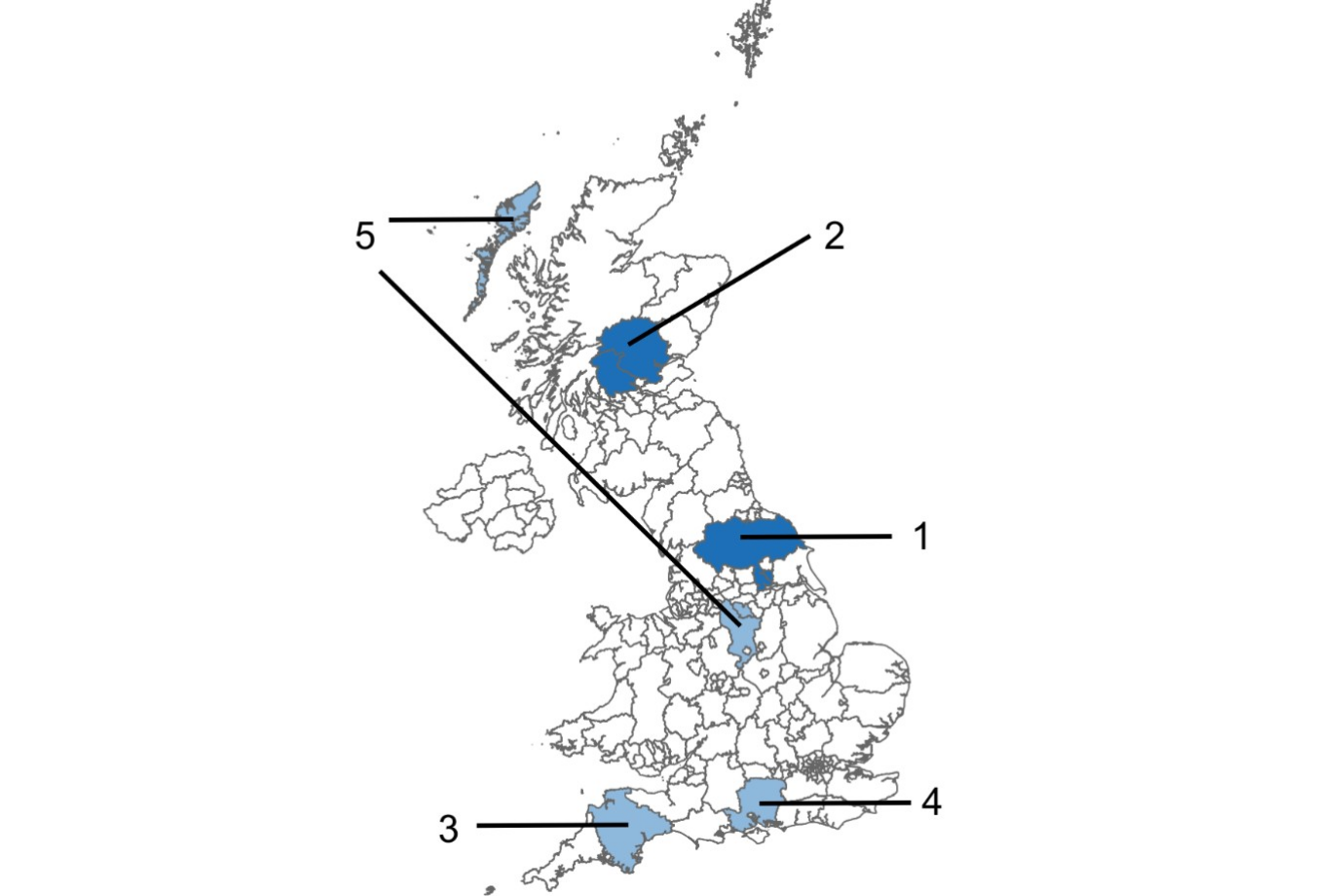
Map shows:
- One confirmed TBE complex case acquired in the North Yorkshire Moors.
- One confirmed TBE complex case acquired around the Loch Earn area in Scotland.
- One probable case acquired in Dartmoor.
- One confirmed TBE case and 5 probable TBE-complex cases acquired in Hampshire
- One probable TBE complex case acquired in either the Peak District, South Yorkshire or Na h-Eileanan Siar (outer Hebrides).
Transmission
TBEV is normally transmitted by the bite of an infected tick. Following infection humans are considered ‘dead end’ hosts as they do not develop sufficient levels of viraemia to enable onward transmission of virus to ticks. Infection can also occur through the consumption of unpasteurised milk or dairy products from infected animals, particularly cows, sheep or goats however this route of transmission is rare.
TBEV is not directly transmitted from person to person. Isolated cases of transmission through organ transplantation, blood transfusion, transplacental transmission and through breastfeeding have been reported. Infection has also occurred following laboratory sharps injuries.
Symptoms
The average incubation period of TBE is 7 days, but may be up to 28 days. The incubation period for foodborne infection is usually shorter, around 4 days.
Approximately two-thirds of human TBE virus infections are asymptomatic. In symptomatic cases, it is often biphasic, with an initial viraemic phase lasting approximately 5 days (range 2 to 10), and is associated with non-specific symptoms (fever, fatigue, headache, myalgia, nausea).
This phase is usually followed by an asymptomatic interval and apparent recovery, lasting 7 days (range 1 to 33). The second phase begins approximately 7 days after initial resolution of symptoms (range 1 to 33 days) and involves the central nervous system. Typical presentations are meningitis, meningoencephalitis, myelitis, paralysis, or radiculitis.
The European subtype is associated with milder disease, with 20% to 30% of patients experiencing the second phase, severe neurological sequelae in up to 10% of patients, and an overall mortality of 0.5% to 2%. In children, the second phase of illness is usually limited to meningitis, while adults older than 40 years are at increased risk of developing encephalitis. There is a higher likelihood of long-lasting sequelae, and a higher mortality, in those over the age of 60 years, the immunocompromised, or those with significant co-morbidities.
Anyone with flu-like symptoms following a tick bite should contact their GP or call NHS 111.
Acute encephalitis of is a notifiable disease and TBEV is a notifiable organism. Managing clinicians should notify their local health protection team when they suspect a clinical case.
Diagnosis
In the UK, clinicians who suspect a patient may have TBE, or who have a patient with undiagnosed encephalitis should seek advice from the UKHSA Imported Fever Service.
Testing is performed by the UKHSA Rare and imported pathogens laboratory (RIPL). In patients who have developed neurological symptoms, TBEV IgM and/or IgG antibodies are usually detectable in serum, except in those who are immunocompromised. For this reason, serum should be submitted in the first instance. RIPL will then request cerebrospinal fluid (CSF) if further analysis is required.
PCR can be used to detect TBEV or LIV RNA, enabling specific diagnosis of either TBE or louping ill. However, viral RNA is only transiently present in CSF and may no longer be detectable by the time neurological symptoms appear. As a result, diagnosis may sometimes rely solely on serology. In such cases, where antibody results cannot distinguish between TBEV and LIV, the diagnosis may be reported as a probable ‘TBE complex’ infection.
Clinicians are encouraged to discuss all suspected cases with RIPL to ensure that appropriate samples are submitted and the correct diagnostic pathway is followed.
Rare and imported pathogens laboratory (RIPL)
UK Health Security Agency
Manor Farm Road
Porton Down
Wiltshire
SP4 0JG
Email ripl@ukhsa.gov.uk
Telephone 01980 612348 (available 9am to 5pm, Monday to Friday)
DX address DX 6930400, Salisbury 92 SP
Treatment
There is no specific treatment for TBE.
Prevention
Tick bite avoidance and regular checking for and removal of ticks are the most important preventive measures for people who are planning to visit areas at high risk of tick bites either in the UK or abroad. This includes staying on paths and avoiding long grass when walking outdoors, using insect repellent, wearing long sleeved shirts and trousers and regularly checking for ticks on skin and clothing.
UKHSA has produced resources to support awareness raising initiatives. A vaccine is available for people visiting high risk areas. Further information on the TBE vaccine can be found in chapter 31 of the Green Book