The Life Chances Fund
Information about the Life Chances Fund which was delivered between 2016 and 2025.
Overview
The Life Chances Fund (LCF) was delivered between 2016 and 2025. It aimed to help those people in society who face the most significant barriers to leading happy and productive lives. The £70 million fund contributed to outcome payments for locally commissioned social outcomes contracts which involve socially-minded investors. The fund supported 29 projects, and was managed by The National Lottery Community Fund on behalf of DCMS.
The LCF engaged with more than 50,000 beneficiaries to achieve better life outcomes in areas such as health, employment, and housing. At least 90% of beneficiaries achieved at least one outcome.
The LCF had 7 primary objectives:
-
Increase the number and scale of SOPs in England.
-
Make it easier and quicker to set up a SOP.
-
Generate public sector efficiencies by delivering better outcomes, and understand how cashable savings are achieved.
-
Increase social innovation and build a clear evidence base for what works.
-
Increase the amount of capital available to voluntary, community and social enterprise (VCSE) providers to help them compete for public sector contracts.
-
Provide better evidence of the effectiveness of the SOP mechanism and the savings resulting.
-
Grow the scale of the social investment market.
The LCF empowered commissioners in local government to find locally-led place-based solutions to entrenched social problems. In doing so, it supported the development of effective local partnerships that were well-placed to deliver what’s really needed.
Note: The LCF was reduced to £70 million in 2020. This did not affect individual projects’ budgets or delivery. Final outturn spend was £52 million (of which £42 million was outcome payments).
The geographical spread of LCF projects
The LCF supported 29 projects across England, 70% (20 out of 29) of which operated outside of London and the South-East of England.
The Mental Health and Employment Partnership (#20) ran 5 LCF projects across London and Shropshire, supporting individuals with mental illness and learning disabilities into employment.
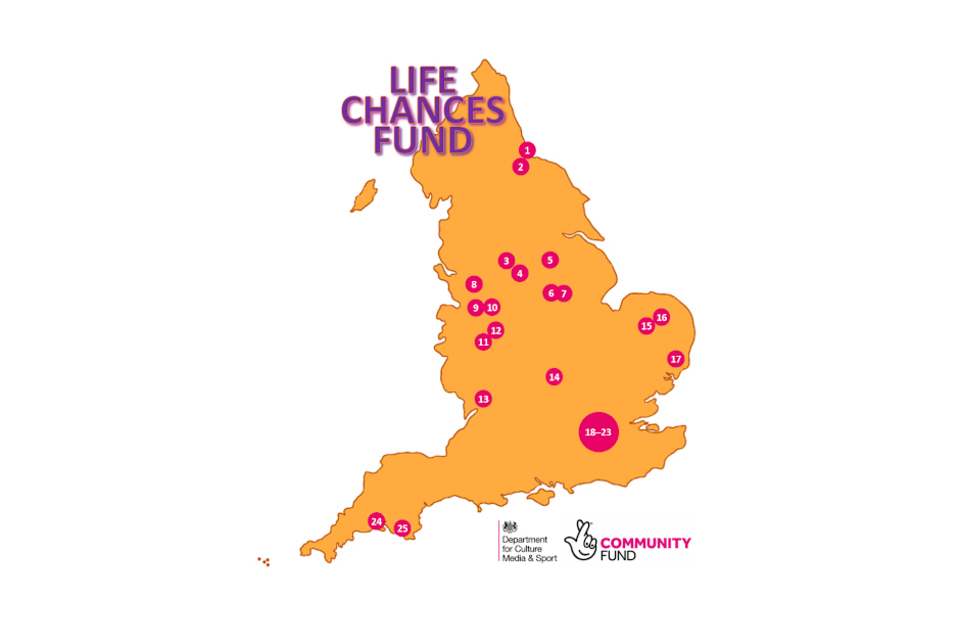
- Chances – Sunderland and 22 other England-wide locations
- The Skill Mill – Durham and 7 other England-wide locations
- Kirklees Better Outcomes Partnership – Yorkshire
- Promoting Independence – Sheffield
- Big Picture Learning – Doncaster
- DN2 Children’s Services – Nottingham
- Future Impact – Nottingham
- Fostering Better Outcomes – Cheshire
- Integrated Family Support Service – Staffordshire
- Pyramid Project – Staffordshire
- DFN - MoveForward – West Midlands (plus London and Kent)
- Midlands Regional Pause Hub – Midlands
- Gloucester Positive Behaviour Support – Gloucestershire
- Social Prescribing Project – Northamptonshire
- A Norfolk SIB for Carers – Norfolk
- Stronger Families Norfolk – Norfolk
- Stronger Families Suffolk – Suffolk
- West London Alliance – London
- Single Homeless Prevention Service – London and Norfolk
- Mental Health and Employment Partnership – 5 projects across London and Shropshire
- ParentChild+ – West London
- Enhanced Dementia Care – Hounslow
- West London Zone – West London
- Cornwall Frequent Attenders Programme – Cornwall
- Pause Project – Plymouth
Further details of projects that were funded through the Life Chances Fund can be found in the Government Outcomes Lab’s Impact Bond Dataset
LCF learning and evaluation
The LCF was accompanied by an evaluation strategy which sought to obtain evidence on the effectiveness of the LCF as a whole; the impact of individual projects on outcomes and beneficiaries; and the effectiveness of SOPs as a commissioning tool.
The following evaluation reports have been published:
Implementation process evaluation
Synthesis evaluation
Primary evaluation
- An introductory primary evaluation report
- An interim survey data release from the primary evaluation
- Final survey data release from the primary evaluation
- An analysis of children’s social care LCF projects
- Achieving Outcomes: Life Chances Fund final report
Kirklees Better Outcomes Partnership
- First interim evaluation of the Kirklees LCF project
- Second interim evaluation of of the Kirklees LCF project
- Final evaluation of the Kirklees LCF project
- Labour Markets Evaluation and Pilots Fund (of Kirklees Better Outcomes Partnership)
Mental Health and Employment Partnership
- First interim evaluation of the Mental Health and Employment Partnership LCF project
- Second interim evaluation of the Mental Health and Employment Partnership LCF project
- Final evaluation of the Mental Health and Employment Partnership LCF project
The Government Outcomes (GO) Lab was the government’s primary evaluation partner for the LCF. See further information about their work, as well as LCF project case studies and achievements to date
GO Lab’s evaluation work was supplemented by individual evaluations commissioned by the LCF projects themselves. Read the reports published so far from the LCF projects’ own evaluations