Planning for decommissioning of radioactive substances activities
How to prepare and plan for the decommissioning of sites permitted for radioactive substances activities.
Applies to England
What this guidance applies to
This guidance applies to the decommissioning of facilities where:
- permitted radioactive substances activities using sealed and unsealed sources have taken place
- radioactive wastes have been accumulated on the premises
This guidance does not apply to:
- radioactive substances activities carried out on a nuclear licenced site
- permits for the disposal of solid radioactive waste to land, for example in landfill
This guidance is relevant to other facilities that are permitted for the receipt and treatment of radioactive waste, such as incinerators.
When to plan for decommissioning
As a radioactive substances activity permit holder, you should to take a lifetime planning approach. This is so that people and the environment are protected now and in the future.
When the Environment Agency grant your permit for a radioactive substances activity, you should have already begun planning how you will:
- decommission your activities
- dispose of your radioactive wastes generated from decommissioning – linking your decommissioning plan to your waste management plan (WMP) is covered in this guide
- surrender your permit at the end of operations
Decommissioning will generate radioactive wastes, so your decommissioning plan should be linked to your WMP.
Decommissioning activities can take place at different times, such as when you stop using radioactive substances in a particular room or laboratory. Your decommissioning plan must address all decommissioning activities you will undertake during the lifetime of your site.
You should review and develop your decommissioning plan throughout the lifetime of your activities, refining it to reduce uncertainties.
Your management arrangements for each decommissioning project must ensure:
- compliance with your permit
- appropriate records are kept for each project for the life of your permit
At the end of operations, your decommissioning plan should be detailed enough to:
- explain how you will decommission
- enable you to apply to surrender your permit
Applying a graded approach
The level of detail in your decommissioning plan should be proportionate with the scale, complexity and hazard of your activities.
Your decommissioning plan should also reflect the lifecycle stage of your activity. You should develop it over time as you assess information and options, make decisions, and reduce uncertainties.
When you plan for decommissioning, you should consider your radioactive substances activities proportionately. If your activities are:
- simple, involving short-lived radionuclides – your plan may also be simple
- complex or involve long-lived radionuclides – your plan should reflect that complexity
If you’re developing a plan for complex activities, you should begin by addressing the decommissioning challenge strategically at a high-level and add more detail and certainty over time. You should do this until you have clarity over what and how you will decommission your activities.
Facilities fall into one of 3 categories – simple, intermediate or complex.
For all categories, a simple assessment will be needed to demonstrate that:
- best available techniques (BAT) are being implemented
- radiation doses to the public are as low as reasonably achievable (ALARA) from radioactive waste disposals
For more guidance on the Environment Agency’s expectations around demonstrating BAT for radioactive waste disposals, refer to RSR: Principles of optimisation.
A simple facility
A facility may be ‘simple’ if:
- it has sealed radioactive sources that can be removed with relative ease
- it may have a relatively small, localised area or areas of contamination that can be addressed through simple decontamination methods and techniques
- only radionuclides with a short half-life (less than or equal to 60 days) have been used
- the radiological risk to the public and the environment due to decommissioning activities is relatively low – less than 10 microsieverts (µSv) per year from decommissioning disposal and discharges
- there would be limited options for optimising decommissioning and waste management activities
- wastes can be characterised by calculation or measurement with little uncertainty
- wastes will be low level waste (LLW) or very low-level waste (VLLW)
- disposal routes will be available, allowing immediate decommissioning
- there is little or no on-site contamination to remediate
For operators using sealed sources only, the decommissioning plan could be very simple. It could involve just ensuring that there is a suitable disposal solution for the sources or that they will be returned to the supplier.
An intermediate facility
An intermediate facility has a contaminated area or areas of differing sizes in different locations of the facility, including contaminated or activated structures, systems and components.
The radiological risk to the public for intermediate facilities ranges from low to medium (in the range of several tens of microsieverts per year from decommissioning disposals and discharges).
For intermediate facilities, there may be:
- some challenging wastes to characterise
- some higher activity wastes (HAW) that require long-term storage before disposal – HAW is defined as wastes with more than 4 gigabecquerels (GBq) per tonne alpha (α) or more than 12 GBq per tonne beta (β) or gamma (γ), or both
- some on-site contamination to remediate
- high activity sealed source (or sources) that require specialist removal from equipment or specialist transport and transfer overseas
There may be different options available for decommissioning activities and managing wastes from intermediate sites. You will need to be able to demonstrate that you have chosen optimised solutions and can implement BAT.
A complex facility
A complex facility is similar to an intermediate facility but it usually has activated components or contamination requiring special methods, techniques and equipment to address source removal or decontamination.
Complex facilities may:
- need special considerations for waste handling, storage and disposal – for example, activated HAW that will require disposal in a geological disposal facility (GDF)
- have large areas of contamination requiring characterisation and remediation
- have significant characterisation uncertainties associated with their wastes
There may be many different options and factors that you need to consider when determining BAT for managing, accumulating and disposing of radioactive wastes from complex sites. These may include financial costs and the security of radioactive substances.
Design for decommissioning
You’ll need to design your facilities using BAT so that they can be decommissioned in a way that protects the public and the environment from the radiation exposures from radioactive waste disposals.
Your permitted activities must use BAT to minimise the generation of radioactive waste and its impact on people and the environment. This includes how your facilities are designed, built, maintained, operated and dismantled.
The design of your facilities, including waste stores and modifications to existing facilitates, should, where appropriate:
- enable decommissioning in a manner that minimises impacts on people and the environment from radioactive waste disposals
- ensure containment, minimise radioactive contamination and enable decontamination, which contribute to minimising the creation of radioactive waste during decommissioning
- support minimisation of resource use and application of the waste hierarchy to prevent and minimise wastes from decommissioning or enable the recycling of materials or reuse of equipment
- avoid creating problematic wastes without a disposal route during decommissioning
- facilitate the characterisation, segregation, packaging and disposal of radioactive waste during decommissioning
- allow appropriate maintenance of buildings and equipment during decommissioning to minimise the creation of radioactive waste and prevent the spread of contamination
- allow for building reuse during decommissioning where possible, avoiding the need to construct new buildings which will also require decommissioning
- minimise the number and size of contaminated areas to facilitate decontamination during decommissioning
- facilitate access to all parts of the facility that could become activated or contaminated, for example, through incorporation of hatches or large doors to facilitate removal of equipment
- minimise underground piping and embedded pipes in the building structures, for example, using pipe trenches and pipe sleeves
- use modular construction to facilitate the dismantling of buildings and equipment, for example, biological shielding
- separate and isolate non-radioactive and radioactive components and systems, such as separation of electrical and mechanical components
- facilitate the removal and decontamination of material or equipment, including by built-in decontamination mechanisms such as protective coverings and liners in process cells and areas where liquids might be present
- use materials that are resistant to activation and to degradation by chemicals, and have sufficient wear resistance to minimise the spread of activated corrosion products
- use smooth, seamless and non-absorbent work surfaces and flooring, and use removable or strippable coatings in areas likely to become contaminated
- provide proper ventilation and drainage systems to prevent or control the spread of radioactive contamination during operation and decommissioning
- consider lessons learned from previous decommissioning projects or actions
- enable remote decontamination, maintenance and monitoring, where necessary
- enable radioactive waste from operation or temporarily stored waste to be easily retrieved for treatment and disposal
- minimise the use of hazardous substances that could result in mixed hazardous and radioactive waste
You should consider the implications to decommissioning from changes you make to your activities throughout its lifecycle, for example, when:
- replacing or modifying plant
- starting or stopping activities
- changing your organisational structure
Develop your decommissioning plan
You should produce your initial decommissioning plan during the planning stage of a new site or facility.
Your plan should evolve over time, adding more detail as the end of operations approach and uncertainties about the quantity and nature of your wastes from decommissioning are resolved.
Your decommissioning plan should be informed by your WMP and BAT assessments.
For a simple site, this might be a single iteration of short statement of facts about your wastes that support your chosen approach to decommissioning.
For complex sites, you may need a systematic evaluation and comparison of alternative decommissioning approaches in terms of their impacts on people and the environment. You’ll need to consider the economic and social costs and benefits, as well as other factors.
You should:
- document your decommissioning plan
- describe the significant assumptions, uncertainties and risks associated with it
- describe how these uncertainties and risks will be managed
You should review and update your decommissioning plan during the lifecycle of your activities, refining it to reduce uncertainties. You should review your plan at least every 5 years, or earlier in the event of new information or technologies becoming available. Updates should take into account changes in policy, regulation and developments in BAT.
What your decommissioning plan should do
Your decommissioning plan should:
- be consistent with government policies and strategies for managing radioactive waste
- use a graded approach – that is, contain information of a type and level of detail proportionate with the scale and complexity of the site, its associated environmental hazards and risks, waste arisings and anticipated decommissioning timescales
- take account of the full lifecycle of the permitted site
- consider existing facilities, as well as planned ones, for decommissioning
- if relevant, involve interested parties at an early stage and describe, or refer to, the process by which their views will be taken into account when planning for decommissioning
- as far as possible, identify when all radioactive substances activities on the site will cease
- identify when you plan to apply for permit surrender and release from regulatory control
- describe how BAT will be used to minimise the generation of radioactive wastes
- include a commitment to appropriate financial arrangements for decommissioning and restoration of the site
- describe, or refer to, the decommissioning options and the timescales considered, the reasons for selecting the chosen option (or options) and the graded approach taken for determining the relative priorities of decommissioning projects and their associated radioactive waste arisings
- take account of relevant factors – such as those affecting the timing of decommissioning, the magnitude of the remaining hazard, the duration of the work, resources, and the fact that the overall objective of the work is to remove the hazard and protect the public and the environment
For complex sites, interdependencies between facilities or between plants within facilities should be identified and considered as part of your plan. This should include interactions between facilities undergoing decommissioning and those facilities continuing to operate, if relevant.
You should integrate your decommissioning plan with other relevant plans. Depending on your site, these might include plans for:
- managing radioactive wastes and your WMP – covering effluents and discharges and including any on-site disposals of solid waste
- dealing with specific structures, such as pipelines
- wider radioactive waste management and decommissioning, such as government strategies and those of its departments and agencies
- control and remediation of radioactively contaminated land and groundwater, including wastes generated through remediation
- asset management and maintenance
- bringing your site to a satisfactory state, allowing you to apply for permit surrender or partial surrender
Prepare to begin decommissioning
Before decommissioning starts, you will need to prepare a WMP to:
- identify and address the type and quantity of wastes to be managed, including solid, liquid and gaseous wastes
- Identify and address the timescales over which the wastes will arise
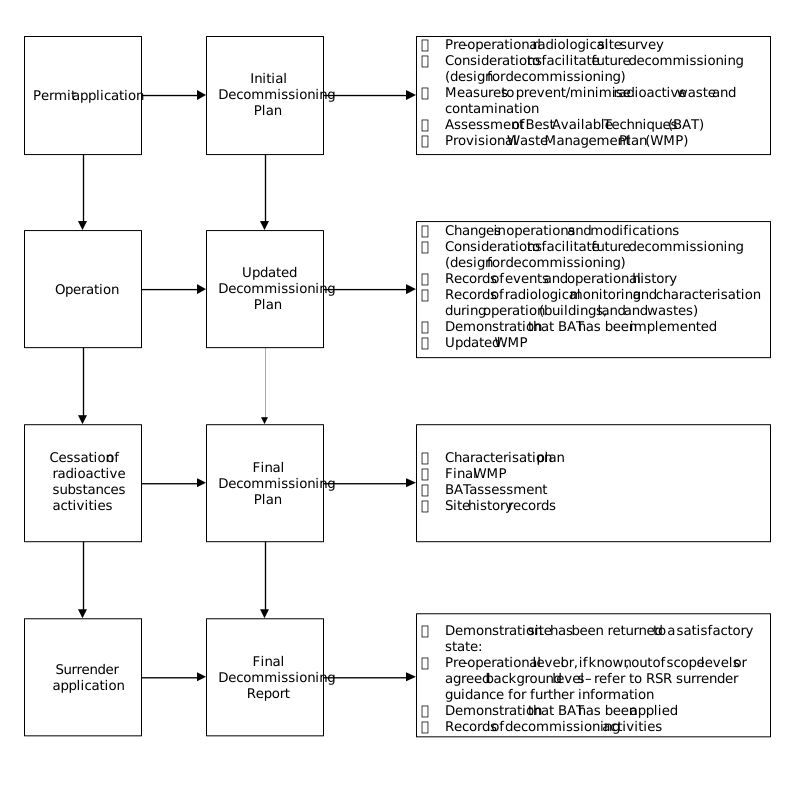
Figure 1 summarises the development of a decommissioning plan for a complex site, as explained in the sections ‘Develop your decommissioning plan’ and ‘What your decommissioning plan should do’. It gives some examples of the information inputs you can use to develop the plan and eliminate uncertainties over time.
Figure 1: Example of the evolution of the decommissioning plan during the lifetime of a complex facility
For guidance on how to demonstrate that your site has been returned to a satisfactory state for permit surrender, see Surrendering your non-nuclear radioactive substances permit.
Management of change
Your transition from operations to decommissioning will be a significant change. It will require a different approach to how you manage your work, and the skills and resources needed.
You should have robust procedures in place to manage this change and ensure continued compliance with your permit.
You should review your permit when planning decommissioning work to ensure that it covers all the work you plan to do, including waste accumulation and disposal limits.
Records management
You must:
- make a record of all your radioactive waste accumulations and disposals, as required by your permit
- retain appropriate records until you surrender your permit
Your decommissioning plan will rely on the records you make during operations, such as:
- a summary of all radioactive substances, their quantities and activities used throughout the operation of the site
- where radioactive substances were stored and used
- when components have been used in experiments or batched operations using radioactive materials or exposed to radiation resulting in activation
- where spills and abnormal events involving radioactive substances occurred, as well as how they were cleaned up
- waste characterisation and disposal records, particularly for waste remaining on-site at the end of operations
- routine area monitoring for contamination
You can use this information about the history of your site to:
- inform your decommissioning plan
- help select optimised solutions
- assist in demonstrating that BAT has been applied to minimise the quantity and activity of wastes generated by decommissioning activities
Your records may be hard copy or electronic.
You should design your records management system to ensure that records are retrievable and legible over many years.
If you need to retain records for a long period of time, traditional record keeping methods are unlikely to be sufficient. For example, if you are accumulating waste for long periods of time or when waste will need to be disposed of in a GDF. Your decommissioning plan should identify your strategy, methods, and procedures for long term management of records.
For further guidance on methods for long term records management systems, see:
- the International Atomic Energy Agency (IAEA)
- a code of practice from the UK government
- standards available, such as BSI 30300
You can also refer to the National Archives for a range of guidance, tools and templates to help you with records management.
If you transfer your operations and your permit to another operator, you must transfer your records too. You must transfer all relevant records to a new operator in a way that they are legible and can be used for permit compliance purposes.
Compliance assessment
The Environment Agency may either:
- review your decommissioning plan when they visit your premises
- ask you to send it to them so that they can assess whether it is adequate and proportionate for your activities and complies with your permit
The Environment Agency may also include a condition in your permit which requires you to periodically submit your decommissioning plan to them for assessment.